
Annual Report_AY2012_Robert E. Smith School of Nursing 1 of 56
|
|
|
- Amelia Carpenter
- 10 years ago
- Views:
Transcription
1 Unit Level Report AY 2012 Department: Robert E. Smith School of Nursing Delta State Academic Affairs/Provost and VPAA Robert E. Smith School of Nursing SON Mission Statement Mission statement The mission of the Delta State University School of Nursing is to prepare students for professional nursing practice in a multi cultural society as either a generalist at the Baccalaureate level or as an advanced practitioner of nursing at the Masters level. The program will prepare graduates to pursue advanced study. Related Items There are no related items. BSN-SON_01: Clinical Concepts Start: 7/1/2011 End: 6/30/2012 Learning Outcome 1. Apply nursing, natural and behavioral science concepts to the practice of nursing (clinical concepts or CC). GE #5. Data Collection (Evidence) HESI end of BSN program exam scores; BSN and RNBSN end of program evaluations (*Note: RNBSN end of program evaluations began being collected separate from BSN in 2010); employer/advisory evaluations (*Note: data combined for both BSN and RNBSN). Results of Evaluation Learning Outcome #1: Apply nursing, natural and behavioral science concepts to the practice of nursing (clinical concepts or CC) Clinical Concepts (Mean) YEAR EXAM EXAM EXAM BSN End of program surveys (Mean for LO#1) YEAR RNBSN End of program surveys (Mean for LO#1) YEAR Employer/advisory council surveys (Mean for LO#1) [combined BSN & RNBSN data] YEAR Use of Evaluation Results Student mean clinical concepts exam scores on the HESI exit exam given in NUR 408 had an overall mean score of 968 for 2011 (a minimum 900 score is required for success in NUR 408). Plans are to explore incorporation of Dedicated Education Annual Report_AY2012_Robert E. Smith School of Nursing 1 of 56
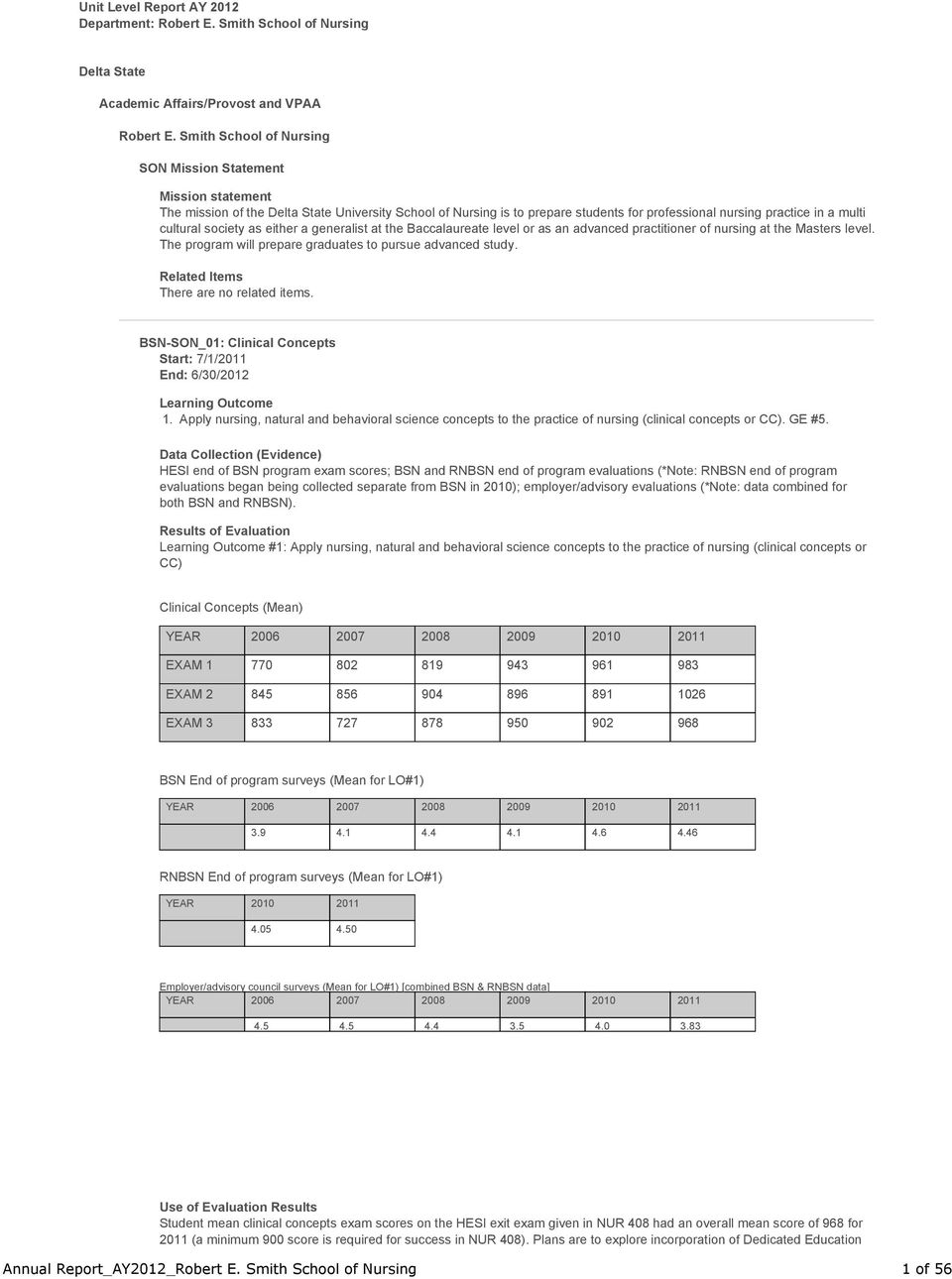
2 Units (DEUs) into one or both Adult Health clinical courses (NUR 335 and NUR 336) in conjunction with the Mississippi Office of Nursing Workforce. UG syllabi will be reviewed by course faculty for changes and updates to nursing practice, national trends, and nationally standardized exams (currently Elsivier Evolve HESI exams-speciality exams given as the final exam for each course in which there is a HESI exam available). The percentage of the grade for each course varies depending on the level of nursing course, with higher level courses having a greater weight for the HESI. In addition to the specialty exams, a midcurricular exam is administered during the 3rd semester of the BSN program to students and consists of all nursing content covered through this semester. The score is used to help faculty advisors and students determine strengths and weaknesses in nursing content. Individualized remediation continues to be required for each student who has a score below 900 on each specialty HESI exam, as well as the midcurricular exam in specific content areas. With NUR 408 requiring at least one score of 900 to pass the course and the letter grade earned is calculated by the HESI Exit Exams counting for 95% of the course grade, with each HESI Exit Exam being 31.66%. The Meds Publishing program (an online nursing academic enhancement program) has been replaced by ATI, which continues to be available to all students as well as a live HESI NCLEX-RN review for senior students. Students were also given an additional opportunity to obtain the minimum 900 score by being offered a fourth (4) HESI exit exam. All but one senior nursing student earned at least one 900 on the HESI exit exam and graduated. The senior nursing student retested during the spring semester and obtained the minimun score and graduated. End of program surveys of students and satisfaction surveys of alumni and employers on LO 1 also remain good with student ratings of the BSN program of study 4.46, RNBN program of study 4.50 on a 5 point scale, which is comparable to previous years, and an employer/advisory rating of 3.83, which is a slight decrease from previous years. We will continue to obtain feedback from BSN & RNBSN students, alumni and employers and monitor ratings and recommendations for improvement; revise curriculum as needed. We will watch for downward trends in employer ratings on LO 1 and take action accordingly. Continue to monitor national education, practice (NCLEX) and MS IHL/CCNE standards for BSN programs and revise curriculum as needed. Related Items There are no related items. BSN-SON_02: Nursing Concepts Start: 7/1/2011 End: 6/30/2012 Learning Outcome Learning Outcome #2: Utilize the nursing process and standards of care to deliver safe, comprehensive nursing care to diverse clients in a collaborative environment [critical thinking (CT), therapeutic community (TC), therapeutic nursing interventions (TNI), and cultural awareness/human diversity (CA) within the nursing process (NP) and standards of care (SOC-legal/ethical considerations]. GE #1, #2, #5, #7 & #10 Data Collection (Evidence) HESI end of program exam scores; BSN end of program evaluations; employer evaluations. Results of Evaluation Nursing Concepts (Mean) Exam #1 YEAR CT TC TNI CA NP SOC Nursing Concepts (Mean) Exam #2 YEAR CT TC TNI CA NP SOC Annual Report_AY2012_Robert E. Smith School of Nursing 2 of 56
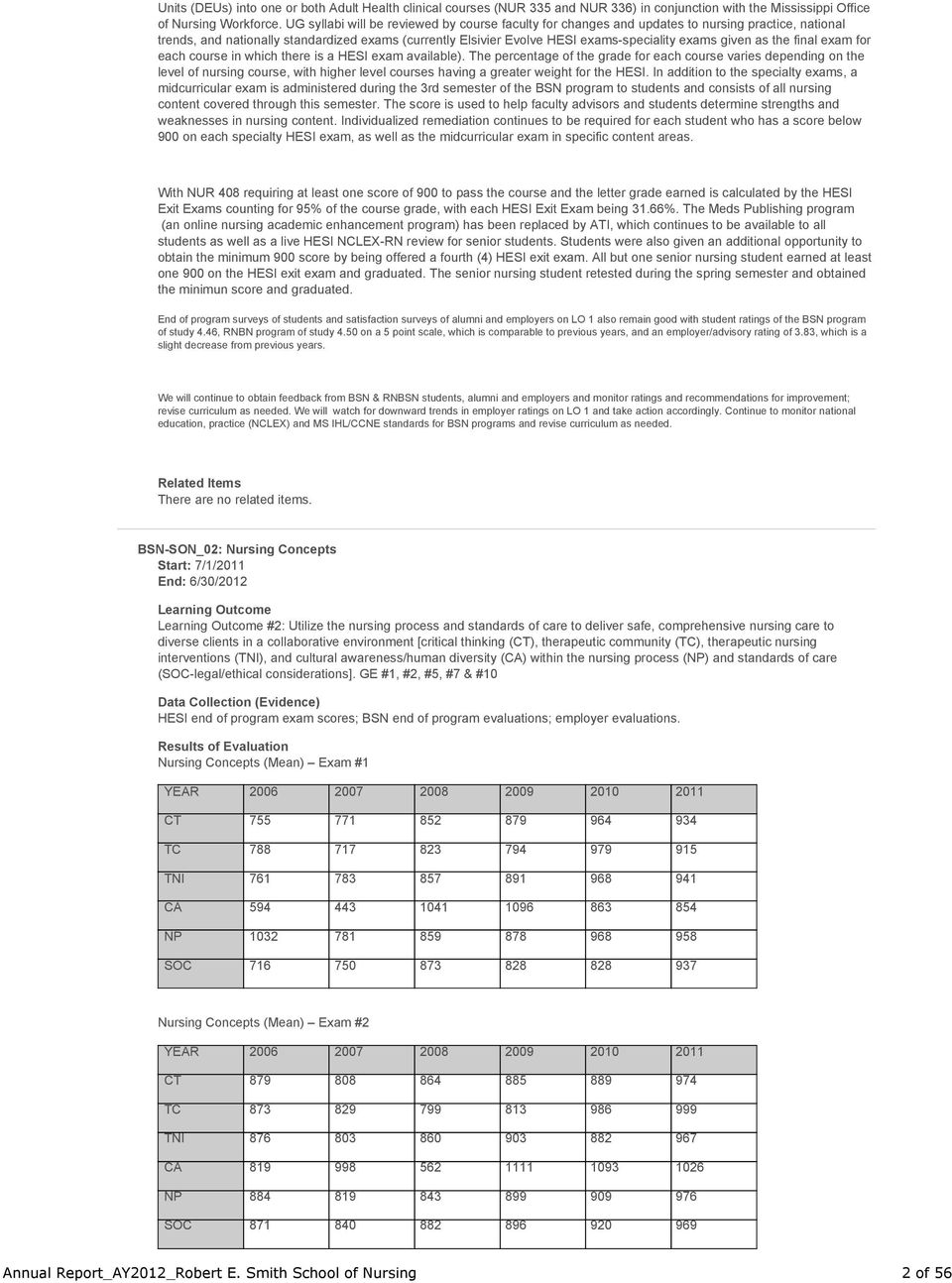
3 Nursing Concepts (Mean) Exam #3 YEAR CT TC TNI CA NP SOC BSN End of program surveys Mean 2006 Mean 2007 Mean 2008 Mean 2009 Mean 2010 Mean 2011 LO 2 =3.33 LO 2 =4.2 LO2 =3.9 LO 2:=4.2 LO 2:=4.7 LO2:=4.49 Employer/advisory council surveys Mean 2006 Mean 2007 Mean 2008 Mean 2009 Mean 2010 Mean 2011 LO 2:= 4.7 LO 2:=4.8 LO 2:=4.8 LO 2:=3.5 LO 2:=5.0 LO 2:= 3.83 Use of Evaluation Results The student nursing concepts mean exam scores on the HESI exit exam given in NUR 408 have continued to trend upward, with the exception of TC (therapeutic communication) with overall mean scores of: CT-913, TC-862, TNI-951, CA-1021, NP- 927, and SOC-957 during calendar year 2011 (a minimum 900 score is required for success in NUR 408). Therapeutic communication is threaded throught the curriculum, so UG faculty members will be made aware of this slight downward trend and place more emphasis on it in classroom content and clinical experiences. Syllabi continue to be reviewed by course faculty for changes and updates to nursing practice, national trends, and nationally standardized exams (currently Elsevier Evolve HESI exams-specialty exams given as the final exam for each course in which there is a HESI exam available). The percentage of the grade for each course varies depending on the level of nursing course, with higher level courses having a greater weight for the HESI. Individualized remediation continues to be required for each student who has a score below 900 on each specialty HESI exam and in specific content areas. The Meds Publishing online nursing academic enhancement program has been replaced by ATI, which is available to all students as well as a live HESI NCLEX-RN review for senior students. End of program surveys of students and satisfaction surveys of alumni and employers on LO 2 remain good with student ratings of the BSN program of study LO 3 scoring 4.49 on a 5 point scale, which is comparable to previous years ratings, however, the employer rating on LO 2 dropped to 3.83 as compared to a 5.0 in This employer rating will be shared with all faculty for review/improvement of therapeutic communication and employers surveyed again in 2012 to assess for improvement. We will continue to obtain feedback from BSN students and employers, and monitor ratings and make recommendations for improvement to appropriate faculty members; revise curriculum as needed. Continue to monitor national education, practice (NCLEX) and MS IHL/CCNE standards for BSN programs and revise curriculum as needed. Related Items There are no related items. BSN-SON_03_05: Leadership Start: 7/1/2011 End: 6/30/2012 Learning Outcome Learning Outcomes #3 and 5: Practice as a self-directed nursing leader who is accountable to self, society, and the evolving nursing profession [leadership]. GE # 9 Data Collection (Evidence) HESI end of program exam scores; BSN end of program evaluations; employer evaluations Results of Evaluation Learning Outcome #3: Practice as a self-directed nursing leader who is accountable to self, society, and the evolving nursing profession [leadership]. Learning Outcome #5: Advocate for improvement in healthcare through participation in professional and political processes [leadership]. GE # 9 Leadership (Mean) Annual Report_AY2012_Robert E. Smith School of Nursing 3 of 56

4 YEAR EXAM EXAM EXAM BSN End of program surveys Mean 2006 Mean 2007 Mean 2008 Mean 2009 Mean 2010 Mean 2011 LO 3 =4.0 LO 3:=4.2 LO3 =3.8 LO 3:=4.2 LO 3:=4.7 LO3:=4.67 Employer/advisory council surveys Mean 2006 Mean 2007 Mean 2008 Mean 2009 Mean 2010 Mean 2011 LO 3:= 4.8 LO 3:=4.8 LO 3:=4.8 LO 3:=3.5 LO 3:=5.0 LO 3:= 3.83 Use of Evaluation Results The student leadership mean exam scores on the HESI exit exam given in NUR 408 have continued to trend upward with an overall mean score of 956 during calendar year 2011 (a minimum 900 score is required for success in NUR 408). UG syllabi will be reviewed by course faculty for changes and updates to nursing practice, national trends, and nationally standardized exams (currently Elsevier Evolve HESI exams-specialty exams given as the final exam for each course in which there is a HESI exam available). The percentage of the grade for each course varies depending on the level of nursing course, with higher level courses having a greater weight for the HESI. Individualized remediation continues to be required for each student who has a score below 900 on each specialty HESI exam and in specific content areas. The Meds Publishing online nursing academic enhancement program has been replaced by ATI, which is available to all students as well as a live HESI NCLEX-RN review for senior students. End of program surveys of students and satisfaction surveys of alumni and employers on LO 3 remain good with student ratings of the BSN program of study LO 3 scoring 4.7 on a 5 point scale, which is comparable to previous years ratings, however, the employer rating on LO 3 dropped to 3.83 as compared to a 5.0 in This employer rating will be shared with the faculty teaching this content (NUR 402/442) for review/improvement of leadership content and employers surveyed again in 2012 to assess for improvement. We will continue to obtain feedback from BSN students and employers, and monitor ratings and make recommendations for improvement to appropriate faculty members; revise curriculum as needed. Continue to monitor national education, practice (NCLEX) and MS IHL/CCNE standards for BSN programs and revise curriculum as needed. Related Items There are no related items. BSN-SON_04: Evidence Based Practice Start: 7/1/2011 End: 6/30/2012 Learning Outcome Learning Outcome #4: Utilize research in the delivery of health care [evidence based practice].ge #3& #4 Data Collection (Evidence) HESI end of program exam scores; BSN end of program evaluations; employer evaluations Results of Evaluation Learning Outcome #4: Utilize research in the delivery of health care [evidence based practice]. GE #3& #4 Scholarship for Evidence Based Practice (Mean) - *denotes Not Tested YEAR EXAM EXAM 2 NT* 998 NT* EXAM 3 NT* BSN End of program surveys Mean 2006 Mean 2007 Mean 2008 Mean 2009 Mean 2010 Mean 2011 LO 4 =3.5 LO 4 =4.2 LO4:=3.5 LO 4:=4.2 LO 4:=4.7 LO 4:=4.67 Employer/advisory council surveys Mean 2006 Mean 2007 Mean 2008 Mean 2009 Mean 2010 Mean 2011 LO 4:= 3.4 LO 4:=4.0 LO 4:=4.1 LO 4:=3.5 LO 4:=1.0 LO4:= 3.83 Use of Evaluation Results The student evidcence based practice mean exam scores on the HESI exit exam given in NUR 408 have continued to trend Annual Report_AY2012_Robert E. Smith School of Nursing 4 of 56

5 upward with an overall mean score of 962 during calendar year 2011 (a minimum 900 score is required for success in NUR 408). UG syllabi will be reviewed by course faculty for changes and updates to nursing practice, national trends, and nationally standardized exams (The nursing program currently uses Elsevier Evolve HESI exams-specialty exams given as the final exam for each course in which there is a HESI exam available). The percentage of the grade for each course varies depending on the level of nursing course, with higher level courses having a greater weight for the HESI. Remediation continues to be required for each student who has a score below 900 on each specialty Individualized remediation continues to be required for each student who scores below 900 on each HESI exam and in specific content areas. The Meds Publishing online nursing academic enhancement program has been replaced by ATI, which is available to all students as well as a live HESI NCLEX-RN review for senior students. Research/Evidence Based Practice content is included in this program. End of program surveys of students and satisfaction surveys of alumni and employers on LO 4 remain good with student ratings of the BSN program of study LO 4 scoring 4.67 on a 5 point scale, which is comparable to previous years ratings; the employer rating on LO 4 dramatically increased from 1.0 in 2010 to 3.83 in We will continue to obtain feedback from BSN students and employers, and monitor ratings and make recommendations for improvement to appropriate faculty members; revise curriculum as needed. Continue to monitor national education, practice (NCLEX) and MS IHL/CCNE standards for BSN programs and revise curriculum as needed. Related Items There are no related items. BSN-SON_06: Physiological and Psychosocial Integrity Start: 7/1/2011 End: 6/30/2012 Learning Outcome Program Outcome #6: Provide individualized nursing care that focuses on health promotion and disease and injury prevention [physiology integrity or PI and psychosocial integrity or PsI]. GE #8 Data Collection (Evidence) HESI end of program exam scores; BSN end of program evaluations; employer evaluations Results of Evaluation Program Outcome #6: Provide individualized nursing care that focuses on health promotion and disease and injury prevention [physiology integrity or PI and psychosocial integrity or PsI]. GE #8 Physiological Integrity [PI] and Psychosocial Integrity [PsI] (Mean) Exam #1 YEAR PI PsI Physiology Integrity [PI] and Psychosocial Integrity [PsI] (Mean) Exam #2 YEAR PI PsI Physiology Integrity [PI] and Psychosocial Integrity [PsI] (Mean) Exam #3 YEAR PI PsI BSN End of program surveys Mean 2006 Mean 2007 Mean 2008 Mean 2009 Mean 2010 Mean 2011 LO 6 =3.9 LO 6 =4.1 LO6 =4.1 LO 6:=4.1 LO 6:=4.6 LO 6:=4.56 Employer/advisory council surveys Mean 2006 Mean 2007 Mean 2008 Mean 2009 Mean 2010 Mean 2011 LO 6:= 4.0 LO 6:=4.2 LO 6:=4.2 LO 6:=3.5 LO 6:=5.0 LO6:= 3.83 Use of Evaluation Results The student physiologic integrity mean exam scores on the HESI exit exam given in NUR 408 trended downward to 860 in 2011 as compared to > 900 during 2010 and The student psychological integrity mean scores have continued to trend upward with an overall mean score of 929 during calendar year 2011 (a minimum 900 score is required for success in NUR 408). Physiologic integrity is taught in the first semester in NUR 302/332 (fundamentals of nursing) and threaded throughout the curriculum. This downward trend will be reported to all nursing faculty so UG syllabi can be reviewed for changes and updates to nursing practice and national trends. In addition, 25% of the hours in clincal courses will be dedicated to simulation lab hours so students can experience and practice physiologic integrety (in addition to other nursing care knowledge needs Annual Report_AY2012_Robert E. Smith School of Nursing 5 of 56

6 identified). A nationally standardized exam will be utilized to assess for effectiveness (the Elsevier Evolve HESI examsspecialty exams are currently given as the final exam for each course in which there is a HESI exam available). The percentage of the grade for each course varies depending on the level of nursing course, with higher level courses having a greater weight for the HESI. Individualized Remediation will continue to be required for each student who has a score below 900 on each specialty HESI exam and in specific topic. The Meds Publishing online nursing academic enhancement program has been replaced by ATI, which is available to all students as well as a live HESI NCLEX-RN review for senior students. End of program surveys of students and satisfaction surveys of alumni and employers on LO 6 remain good with student ratings of the BSN program of study LO 3 scoring 4.56 on a 5 point scale, which is comparable to previous years ratings, however, the employer rating on LO 6 dropped to 3.83 as compared to a 5.0 in This employer rating will be shared with all nursing faculty for review/improvement of physiologic integrity content and employers surveyed again in 2012 to assess for improvement. We will continue to obtain feedback from BSN students and employers, and monitor ratings and make recommendations for improvement to appropriate faculty members; revise curriculum as needed. Continue to monitor national education, practice (NCLEX) and MS IHL/CCNE standards for BSN programs and revise curriculum as needed. Related Items There are no related items. BSN-SON_07: Safe Effective Care Start: 7/1/2011 End: 6/30/2012 Learning Outcome Program Outcome #7: Apply information and patient care technology to improve healthcare delivery from an interdisciplinary approach [safe, effective, care environment or SECE]. GE #9 Data Collection (Evidence) HESI end of program exam scores; BSN end of program evaluations; employer evaluations Results of Evaluation Safe, Effective, Care Environment [SECE] (Mean) YEAR EXAM EXAM EXAM BSN End of program surveys Mean 2006 Mean 2007 Mean 2008 Mean 2009 Mean 2010 Mean 2011 LO 5 =3.4 LO 5:=4.0 LO5:=3.9 LO 5 =3.9 LO 5:=4.7 LO 5:=4.38 Employer/advisory council surveys Mean 2006 Mean 2007 Mean 2008 Mean 2009 Mean 2010 Mean 2011 LO 5:= 3.5 LO 5:=3.9 LO 5:=4.0 LO 5:=3.5 LO 5:=4.0 LO5:= 3.83 Use of Evaluation Results The student mean exam scores for safe, effective care on the HESI exit exam given in NUR 408 have slowly trended upward with an overall mean score of 919 during calendar year 2011 (a minimum 900 score is required for success in NUR 408). The simulation lab coordinator has agreed to increase use of simulations specific to this learning outcome during calendar year As safe effective care is taught throughout the curriculum, all UG syllabi will be reviewed by course faculty for changes and updates to nursing practice and national trends specific to patient safety and effective care. A nationally standardized exam (currently Elsevier Evolve HESI exams are used in the nursing program, these are specialty exams given as the final exam for each course in which there is a HESI exam available). The percentage of the grade for each course varies depending on the level of nursing course, with higher level courses having a greater weight for the HESI. Individualized remediation continues to be required for each student who has a score below 900 on each specialty HESI exam and in specific content areas. The Meds Publishing online nursing academic enhancement program has been replaced by ATI, which is available to all students as well as a live HESI NCLEX-RN review for senior students. End of program surveys of students and satisfaction surveys of alumni and employers on LO 7 remain have trended slightly downward with student ratings of the BSN program of study LO 7 scoring 4.38 on a 5 point scale, as comparec to a 4.7 in The employer rating on LO 3 also decreased to 3.83 as compared to a 4.0 in The student and employer rating will be shared with all undergraduate nursing for review/improvement of safe and effective care content; Annual Report_AY2012_Robert E. Smith School of Nursing 6 of 56

7 students and employers will be surveyed again in 2012 to assess for improvement. We will continue to obtain feedback from BSN students and employers, and monitor ratings and make recommendations for improvement to appropriate faculty members; revise curriculum as needed. Continue to monitor national education, practice (NCLEX) and MS IHL/CCNE standards for BSN programs and revise curriculum as needed. Related Items There are no related items. MSN-SON_01: Evidence Based Practice Start: 7/1/2011 End: 6/30/2012 Learning Outcome Incorporate theories and research in development and implementation of evidence based practice. Data Collection (Evidence) Elsevier Evolve APRN HESI exam. A standardized exam administered at the end of program starting spring 2011 Anonymous annual end of program surveys (N =19) measuring program outcomes conducted electronically through the capstone courses by faculty and IRP with aggregate data reported by the Program Effectiveness Committee (PEC) to the SON Faculty Organization during monthly meetings as appropriate. MSN Annual employer/advisory council pencil and paper surveys (N = 12) distributed at the DSU RESSON Fall health care professions career fair. Surveys were distributed and collected by the SON Faculty and tabulated by the PEC committee. Aggregate results are reported as compiled to the SON Faculty Organization during monthly meetings as appropriate. Results of Evaluation LO 1 APRN HESI Mean Score YEAR EXAM 615 MSN End of program surveys Mean 2006 Mean 2007 Mean 2008 Mean 2009 Mean 2010 Mean 2011 LO 1 =4.3 LO 1:=4.5 LO 1:=4.5 LO 1:=4.2 LO 1:=5.0 LO 1:= 3.79 Employer/advisory council surveys Mean 2006 Mean 2007 Mean 2008 Mean 2009 Mean 2010 Mean 2011 LO 1:=3.75 LO 1:=4.0 LO 1:=4.0 LO 1:=3.3 LO 1:=5.0 LO 1:=3.83 NP_NE Certification Rates Use of Evaluation Results The mean score for Family Nurse Practitioner (FNP) students on the HESI score for LO 1 was 615. This score is well below the recommended score of 900. Annual Report_AY2012_Robert E. Smith School of Nursing 7 of 56

8 Graduate faculty members plan to change research project assignments from group assignments to individual assignments to incease the knowledge base of all graduate students by ensuring each one goes through each step of the research process. Individual students will also obtain and evaluate several different types of research articles (qualitative and quantative) and evaluate for academic rigor, ethical considerations and applicability to practice. Faculty will also increase face-to-face communication with students via WIMBA to clarify content and answer questions. Two elective courses (Differential Diagnosis and Family Nurse Practitioner Review) will become required courses. The APRN faculty members also recommend offering students the HESI APRN Family NP exam twice during the program of study so faculty and students can identify areas in needed of improvement and develop an individualized improvement plan for each student who has a score below 900 on the APRN HESI exam and in specific content areas. Scores from the student End of Program and Employee surveys also dropped in 2011 as compared to The mean student score was 3.79 as compared to 5.0 and the mean employer score was 3.83 as compared to 4.0. We will continue to obtain feedback from graduate students and employers and monitor ratings and recommendations for improvement. We will continue to monitor national education and practice standards for MSN programs for family nurse practitioner students and revise curriculum as needed. Continue to obtain feedback from graduate students, alumni and employers and monitor ratings and recommendations for improvement. Continue to monitor national education and practice standards for MSN programs for family nurse practitioner (FNP), nurse administrators (NA) and nurse educators (NE) and revise curriculum as needed. Related Items SP1.Ind02: National / Standardized Test Scores MSN-SON_02: Information Technology Start: 7/1/2011 End: 6/30/2012 Learning Outcome Incorporate information technology in the enhancement of health care. Data Collection (Evidence) Elsevier Evolve APRN HESI exam. A standardized exam administered at the end of program starting spring Anonymous annual end of program surveys (N =19) measuring program outcomes conducted electronically through the capstone courses by faculty and IRP with aggregate data reported by the Program Effectiveness Committee (PEC) to the SON Faculty Organization during monthly meetings as appropriate. MSN Annual employer/advisory council pencil and paper surveys (N = 12) distributed at the DSU RESSON Fall health care professions career fair. Surveys were distributed and collected by the SON Faculty and tabulated by the PEC committee. Aggregate results are reported as compiled to the SON Faculty Organization during monthly meetings as appropriate. Results of Evaluation LO 2 APRN HESI Mean Score Annual Report_AY2012_Robert E. Smith School of Nursing 8 of 56

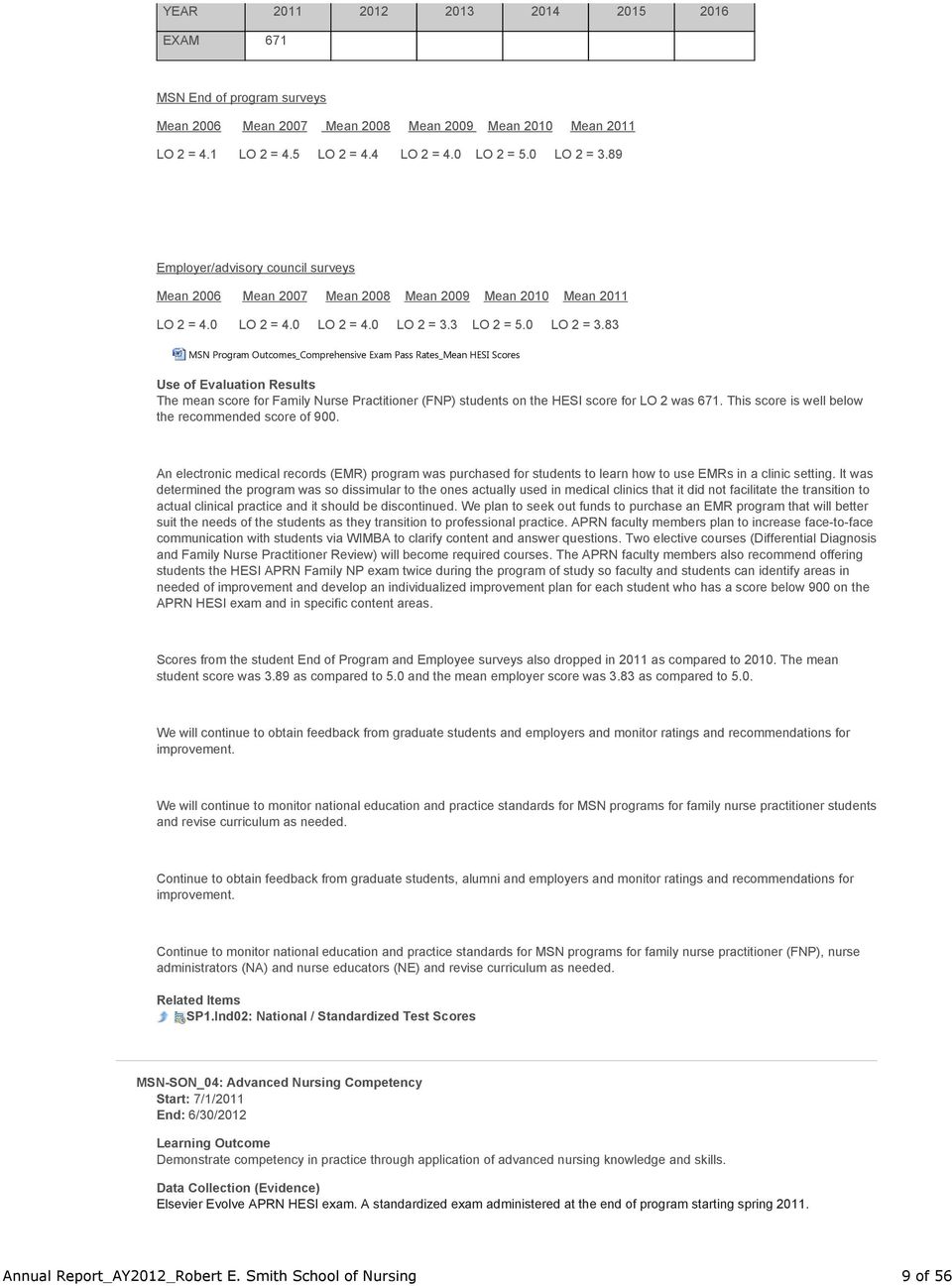
9 YEAR EXAM 671 MSN End of program surveys Mean 2006 Mean 2007 Mean 2008 Mean 2009 Mean 2010 Mean 2011 LO 2 = 4.1 LO 2 = 4.5 LO 2 = 4.4 LO 2 = 4.0 LO 2 = 5.0 LO 2 = 3.89 Employer/advisory council surveys Mean 2006 Mean 2007 Mean 2008 Mean 2009 Mean 2010 Mean 2011 LO 2 = 4.0 LO 2 = 4.0 LO 2 = 4.0 LO 2 = 3.3 LO 2 = 5.0 LO 2 = 3.83 MSN Program Outcomes_Comprehensive Exam Pass Rates_Mean HESI Scores Use of Evaluation Results The mean score for Family Nurse Practitioner (FNP) students on the HESI score for LO 2 was 671. This score is well below the recommended score of 900. An electronic medical records (EMR) program was purchased for students to learn how to use EMRs in a clinic setting. It was determined the program was so dissimular to the ones actually used in medical clinics that it did not facilitate the transition to actual clinical practice and it should be discontinued. We plan to seek out funds to purchase an EMR program that will better suit the needs of the students as they transition to professional practice. APRN faculty members plan to increase face-to-face communication with students via WIMBA to clarify content and answer questions. Two elective courses (Differential Diagnosis and Family Nurse Practitioner Review) will become required courses. The APRN faculty members also recommend offering students the HESI APRN Family NP exam twice during the program of study so faculty and students can identify areas in needed of improvement and develop an individualized improvement plan for each student who has a score below 900 on the APRN HESI exam and in specific content areas. Scores from the student End of Program and Employee surveys also dropped in 2011 as compared to The mean student score was 3.89 as compared to 5.0 and the mean employer score was 3.83 as compared to 5.0. We will continue to obtain feedback from graduate students and employers and monitor ratings and recommendations for improvement. We will continue to monitor national education and practice standards for MSN programs for family nurse practitioner students and revise curriculum as needed. Continue to obtain feedback from graduate students, alumni and employers and monitor ratings and recommendations for improvement. Continue to monitor national education and practice standards for MSN programs for family nurse practitioner (FNP), nurse administrators (NA) and nurse educators (NE) and revise curriculum as needed. Related Items SP1.Ind02: National / Standardized Test Scores MSN-SON_04: Advanced Nursing Competency Start: 7/1/2011 End: 6/30/2012 Learning Outcome Demonstrate competency in practice through application of advanced nursing knowledge and skills. Data Collection (Evidence) Elsevier Evolve APRN HESI exam. A standardized exam administered at the end of program starting spring Annual Report_AY2012_Robert E. Smith School of Nursing 9 of 56
10 Anonymous annual end of program surveys (N =19) measuring program outcomes conducted electronically through the capstone courses by faculty and IRP with aggregate data reported by the Program Effectiveness Committee (PEC) to the SON Faculty Organization during monthly meetings as appropriate. MSN Annual employer/advisory council pencil and paper surveys (N = 12) distributed at the DSU RESSON Fall health care professions career fair. Surveys were distributed and collected by the SON Faculty and tabulated by the PEC committee. Aggregate results are reported as compiled to the SON Faculty Organization during monthly meetings as appropriate. Results of Evaluation LO 4 APRN HESI Mean Score YEAR EXAM 691 MSN End of program surveys Mean 2006 Mean 2007 Mean 2008 Mean 2009 Mean 2010 Mean 2011 LO 4 = 4.3 LO 4 = 4.0 LO 4 = 4.6 LO 4 = 4.0 LO 4 = 5.0 LO 4 = 3.63 Employer/advisory council surveys Mean 2006 Mean 2007 Mean 2008 Mean 2009 Mean 2010 Mean 2011 LO 4 = 3.6 LO 4 = 3.5 LO 4 = 4.0 LO 4 = 3.5 LO 4 =5.0 LO 4 = 3.83 Use of Evaluation Results The mean score for Family Nurse Practitioner (FNP) students on the HESI score for LO 4 was 691. This score is well below the recommended score of 900. APRN faculty members plan to increase face-to-face communication with students via WIMBA to clarify content and answer questions. Each student will also present a patient case with SOAP notes to the class with q&a and discussion via WIMBA. This content was previously presented via WIMBA by students individually to the faculty member without class questions or discussion. Standardized patients (actors) will be used for student advanced physical assessment checkoffs for a more realistic learning experience (a student family member was used in prior semesters).two elective courses (Differential Diagnosis and Family Nurse Practitioner Review) will become required courses. The APRN faculty members also recommend offering students the HESI APRN Family NP exam twice during the program of study so faculty and students can identify areas in needed of improvement and develop an individualized improvement plan for each student who has a score below 900 on the APRN HESI exam and in specific content areas. Scores from the student End of Program and Employee surveys also dropped in 2011 as compared to The mean student score was 3.63 as compared to 5.0 and the mean employer score was 3.83 as compared to 5.0. We will continue to obtain feedback from graduate students and employers and monitor ratings and recommendations for improvement. We will continue to monitor national education and practice standards for MSN programs for family nurse practitioner students and revise curriculum as needed. Related Items There are no related items. MSN-SON_05: Human Diversity/Cultural Competence Start: 7/1/2011 End: 6/30/2012 Learning Outcome Annual Report_AY2012_Robert E. Smith School of Nursing 10 of 56

11 Demonstrate an appreciation of human diversity in the delivery of appropriate, individualized health care. Data Collection (Evidence) Elsevier Evolve APRN HESI exam. A standardized comprehensive exam administered at the end of program starting spring Anonymous annual end of program surveys (N =19) measuring program outcomes conducted electronically through the capstone courses by faculty and IRP with aggregate data reported by the Program Effectiveness Committee (PEC) to the SON Faculty Organization during monthly meetings as appropriate. MSN Annual employer/advisory council pencil and paper surveys (N = 12) distributed at the DSU RESSON Fall health care professions career fair. Surveys were distributed and collected by the SON Faculty and tabulated by the PEC committee. Aggregate results are reported as compiled to the SON Faculty Organization during monthly meetings as appropriate. Results of Evaluation LO 5 APRN HESI Mean Score YEAR EXAM 706 MSN End of program surveys Mean 2006 Mean 2007 Mean 2008 Mean 2009 Mean 2010 Mean 2011 LO 5 = 4.2 LO 5 = 4.5 LO 5 = 4.6 LO 5 = 4.0 LO 5 = 5.0 LO 5 = 3.68 Employer/advisory council surveys Mean 2006 Mean 2007 Mean 2008 Mean 2009 Mean 2010 Mean 2011 LO 5 = 3.6 LO 5 = 3.75 LO 5 = 4.5 LO 5 = 3.5 LO 5 =5.0 LO 5 = 3.83 Use of Evaluation Results The mean score for Family Nurse Practitioner (FNP) students on the HESI score for LO 5 was 701. This score is well below the recommended score of 900. APRN faculty members plan to increase face-to-face communication with students via WIMBA to clarify content and answer questions. Two elective courses (Differential Diagnosis and Family Nurse Practitioner Review) will become required courses. The APRN faculty members also recommend offering students the HESI APRN Family NP exam twice during the program of study so faculty and students can identify areas in needed of improvement and develop an individualized improvement plan for each student who has a score below 900 on the APRN HESI exam and in specific content areas. Scores from the student End of Program and Employee surveys also dropped in 2011 as compared to The mean student score was 3.68 as compared to 5.0 and the mean employer score was 3.83 as compared to 5.0. Continue to obtain feedback from graduate students and employers and monitor ratings and recommendations for improvement. Continue to monitor national education and practice standards for MSN programs for family nurse practitioner students and revise curriculum as needed. Related Items There are no related items. MSN-SON_03: Leadership Start: 7/1/2011 End: 6/30/2012 User Outcome Annual Report_AY2012_Robert E. Smith School of Nursing 11 of 56

12 Apply principles of leadership to promote effective change in the healthcare delivery system. Data Collection (Evidence) Elsevier Evolve APRN HESI exam. A standardized exam administered at the end of program starting spring 2011 Anonymous annual end of program surveys (N =19) measuring program outcomes conducted electronically through the capstone courses by faculty and IRP with aggregate data reported by the Program Effectiveness Committee (PEC) to the SON Faculty Organization during monthly meetings as appropriate. MSN Annual employer/advisory council pencil and paper surveys (N = 12) distributed at the DSU RESSON Fall health care professions career fair. Surveys were distributed and collected by the SON Faculty and tabulated by the PEC committee. Aggregate results are reported as compiled to the SON Faculty Organization during monthly meetings as appropriate. Results of Evaluation LO 3 APRN HESI Mean Score YEAR EXAM 718 MSN End of program surveys Mean 2006 Mean 2007 Mean 2008 Mean 2009 Mean 2010 Mean 2011 LO 3 = 4.1 LO 3 = 4.5 LO 3 = 4.6 LO 3 = 4.0 LO 3 = 5.0 LO 3 = 3.79 Employer/advisory council surveys Mean 2006 Mean 2007 Mean 2008 Mean 2009 Mean 2010 Mean 2011 LO 3 = 4.7 LO 3 = 4.8 LO 3 = 3.0 LO 3 = 3.5 LO 3 =4.0 LO 3 = 3.83 Use of Results and Recommendations The mean score for Family Nurse Practitioner (FNP) students on the HESI score for LO 3 was 718. This score is well below the recommended score of 900. APRN faculty members plan to increase face-to-face communication with students via WIMBA to clarify content and answer questions. Two elective courses (Differential Diagnosis and Family Nurse Practitioner Review) will become required courses. The APRN faculty members also recommend offering students the HESI APRN Family NP exam twice during the program of study so faculty and students can identify areas in needed of improvement and develop an individualized improvement plan for each student who has a score below 900 on the APRN HESI exam and in specific content areas. Annual Report_AY2012_Robert E. Smith School of Nursing 12 of 56

13 Scores from the student End of Program surveys dropped in 2011 as compared to The mean student score was 3.79 as compared to 5.0. The employer score was consistant with previous years at 3.83 (compared to 4.0 in 2010). We will continue to obtain feedback from graduate students and employers and monitor ratings and recommendations for improvement. We will continue to monitor national education and practice standards for MSN programs for family nurse practitioner students and revise curriculum as needed. Continue to obtain feedback from graduate students, alumni and employers and monitor ratings and recommendations for improvement. Continue to monitor national education and practice standards for MSN programs for family nurse practitioner (FNP), nurse administrators (NA) and nurse educators (NE) and revise curriculum as needed. Related Items SP1.Ind04: Job placement SON 2012_01: Maintain a High Quality Curriculum Start: 7/1/2011 End: 6/30/2012 Unit Goal The Robert E. Smith School of Nursing will continue to develop and maintain high quality graduate and undergraduate curricula that are sensitive to health care needs of the multicultural society. a. Collect data related to program effectiveness annually b. Recruit and retain qualified nursing faculty c. Participate in educational consortium agreements d. Incorporate innovative technology into the curriculum Evaluation Procedures Utilization of the comprehensive RESSON MPE which includes undergraduate (BSN) ) HESI Exit mean scores compared to national averages and NCLEX-RN first write pass scores, graduate (MSN) Advanced Practice Registered Nurse (APRN) exam scores (national percentile rank) and certification rates, the Community of Interest (COI): students, faculty, agencies, alumni, and the Advisory Council evaluation forms for students: course, course instructor, clinical instructor, preceptor clinical; end of program satisfaction, employer satisfaction, one and three year follow-up for graduates of both programs, survey form for the Advisory Council and the RESSON standing committee annual reports. Actual Results of Evaluation DSU SON BSN mean HESI score (national percentile rank) YEAR EXAM 1 EXAM 2 EXAM 3 757(23.42) 771(30.79) 850(55.11) 877(49.13) 967(83.23) 939(73.15) 864(50.88) 815(42.56) 864(58.97) 879(49.13) 888(63.84) 972(80.49) 854(48.01) 816(42.85) 854(55.97) 884(67.38) 900(67.27) 943(74.03) NCLEX 1 st write pass rate BSN 1 st write NCLEX-RN pass rate Annual Report from the National Council of State Boards of Nursing to Schools of Nursing (SON) re 1st write of NCLEX-RN pass rates. The NCLEX-RN is a licensure exam % 94% 78% 75% 85% 72% 82.86% 96.65% 96% 97% DSU SON MSN Advanced Practice Registered Nurse (APRN) exam score (national percentile rank) (817) Annual Report_AY2012_Robert E. Smith School of Nursing 13 of 56
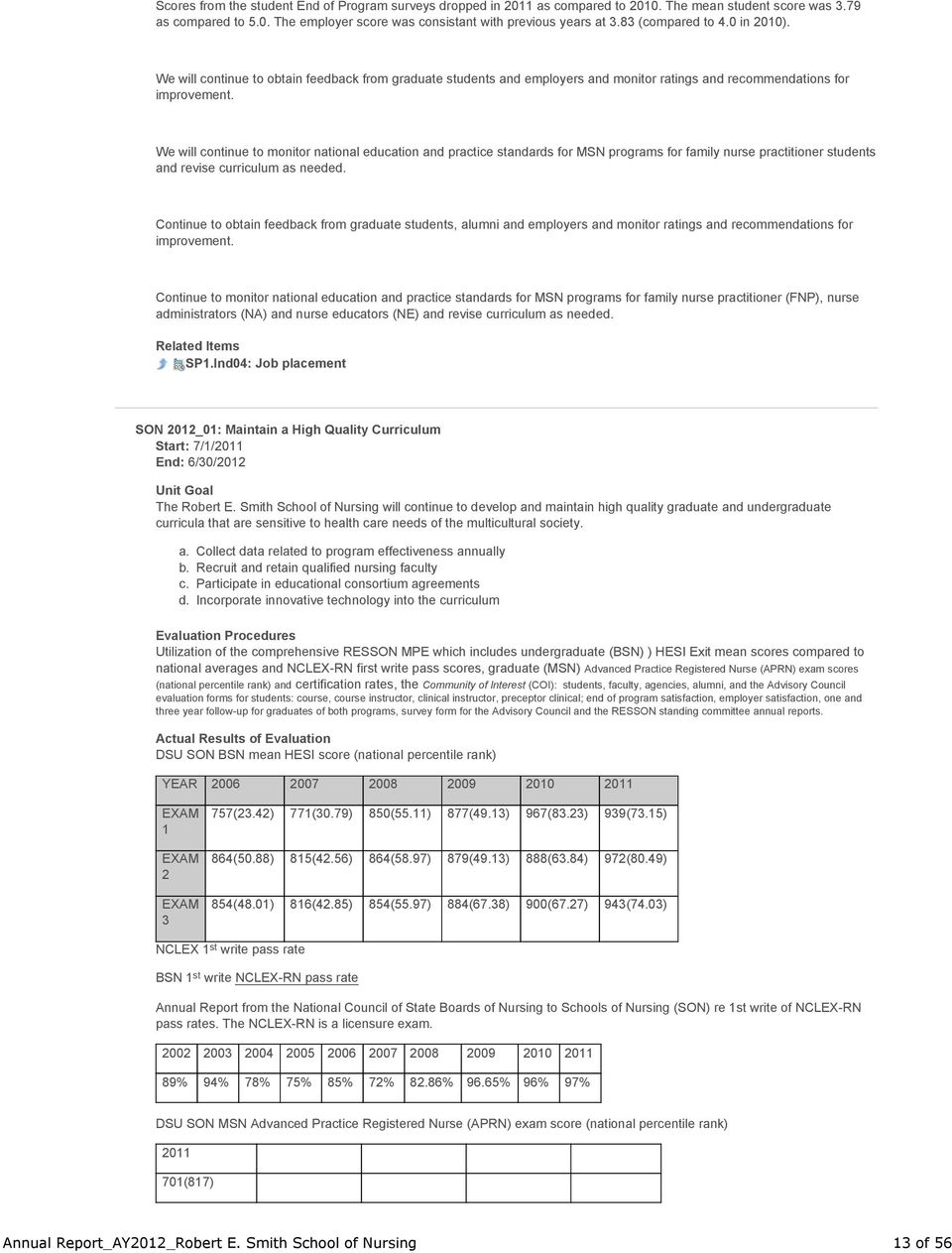
14 FNP Certification pass rate % 100% 100% 100% 100% 100% 100% 95% 100% 100% a. Undergraduate Program Continued assessment of curriculum, compared to national trends (such as nursing education redesign) and COI needs and revised as necessary. BSN: The data from 23 BSN students provided information that demonstrated they generally felt confident about program outcomes and were generally satisfied with courses, instructions, and resources. RNBSN: The data from 10/10 RN-BSN students provided information that demonstrated they felt confident about their preparation for professional nursing practice as a generalist as well as for continuous learning and advanced study. A mean score of 3 or better was received on each of the End of Program Satisfaction Survey questions. BSN End of program surveys Mean 2006 Mean 2007 Mean 2008 Mean 2009 Mean 2010 Mean 2011 PO 1:= 3.9 PO 1:=4.1 PO 1 =4.4 PO 1: =4.1 PO 1:=4.6 PO 1:=4.46 PO 2 =3.33 PO 2 =4.2 PO2 =3.9 PO 2:=4.2 PO 2:=4.7 PO2:=4.49 PO 3 =4.0 PO 3:=4.2 PO3 =3.8 PO 3:=4.2 PO 3:=4.7 PO3:=4.67 PO 4 =3.5 PO 4 =4.2 PO4:=3.5 PO 4:=4.2 PO 4:=4.7 PO 4:=4.67 PO 5 =3.4 PO 5:=4.0 PO5:=3.9 PO 5 =3.9 PO 5:=4.7 PO 5:=4.38 PO 6 =3.9 PO 6 =4.1 PO6 =4.1 PO 6:=4.1 PO 6:=4.6 PO 6:=4.56 Q1 under additional information on the surveys-would you recommend DSU s BSN program to a friend (N=33)? Yes=92% Yes=90% Yes=16% Yes=73.5% Yes=100% Yes=93.9% No response=8% No=10% No=84% No=26.5% No=0% No=6.1% Six (6/12) surveys were completed by advisory council and employers in 2011 for a 50% return rate. 1. Agencies surveyed included hospitals, outpatient facilities, home health care agencies, and private physician offices/clinics. Four (66%) of the results were from hospitals, one (16.6%) was from a home health care agency, and one (16.6%) was from an air ambulance service. 2. Titles/positions of those surveyed ranged from Chief Nursing Officer (CNO) to the category of other (i.e. Associate Director, Nurse Recruiters, Administrative Assistants, Marketing Coordinator, Kaplan Instructor, Home Care Coordinator, Nurse Director, Employee Relations Director, and Staffing Consultant). The majority (66.6%) held the position of Other with one a nurse recruiter and one the program director for an air ambulance service. The smallest percentage (33.3%) of those surveyed held positions as the facility CNO. 3. Assessment of agency size inferred from the number of nurses employed show the following: 50% employed between nurses, 16% employed between nurses, and 33% employed 100 or more nurses in their facility. 4. Numbers of RN vacancies indicated that 66% of those responding had less than 10 vacancies. Thirty-three percent (33%) reported vacancies ranging from 11 to More than 83% (83.3) reported their highest vacancy rate was in Medical Surgical nursing. The only other area of need identified was in the Emergency department at 16.6% OF vacancies. 6. Number of RESSON graduates employed by the facilities 7. varied. The largest percent (50%) employed 10 or fewer of RESSON graduates, 33.3% employed between RESSON graduates and 16.6% employed RESSON graduates. 8. The majority of respondents offered no recommendations for the DSU SON program. The only recommendation listed was: More clinical/hands on work Employer/advisory council surveys Mean 2006 Mean 2007 Mean 2008 Mean 2009 Mean 2010 Mean 2011 PO 1 = 4.5 PO 1:= 4.5 PO 1:=4.4 PO 1:=3.5 PO 1:=4.0 PO 1:=3.83 PO 2:= 4.7 PO 2:=4.8 PO 2:=4.8 PO 2:=3.5 PO 2:=5.0 PO 2:= 3.83 PO 3:= 4.8 PO 3:=4.8 PO 3:=4.8 PO 3:=3.5 PO 3:=5.0 PO 3:= 3.83 PO 4:= 3.4 PO 4:=4.0 PO 4:=4.1 PO 4:=3.5 PO 4:=1.0 PO4:= 3.83 PO 5:= 3.5 PO 5:=3.9 PO 5:=4.0 PO 5:=3.5 PO 5:=4.0 PO5:= 3.83 PO 6:= 4.0 PO 6:=4.2 PO 6:=4.2 PO 6:=3.5 PO 6:=5.0 PO6:= 3.83 Annual Report_AY2012_Robert E. Smith School of Nursing 14 of 56

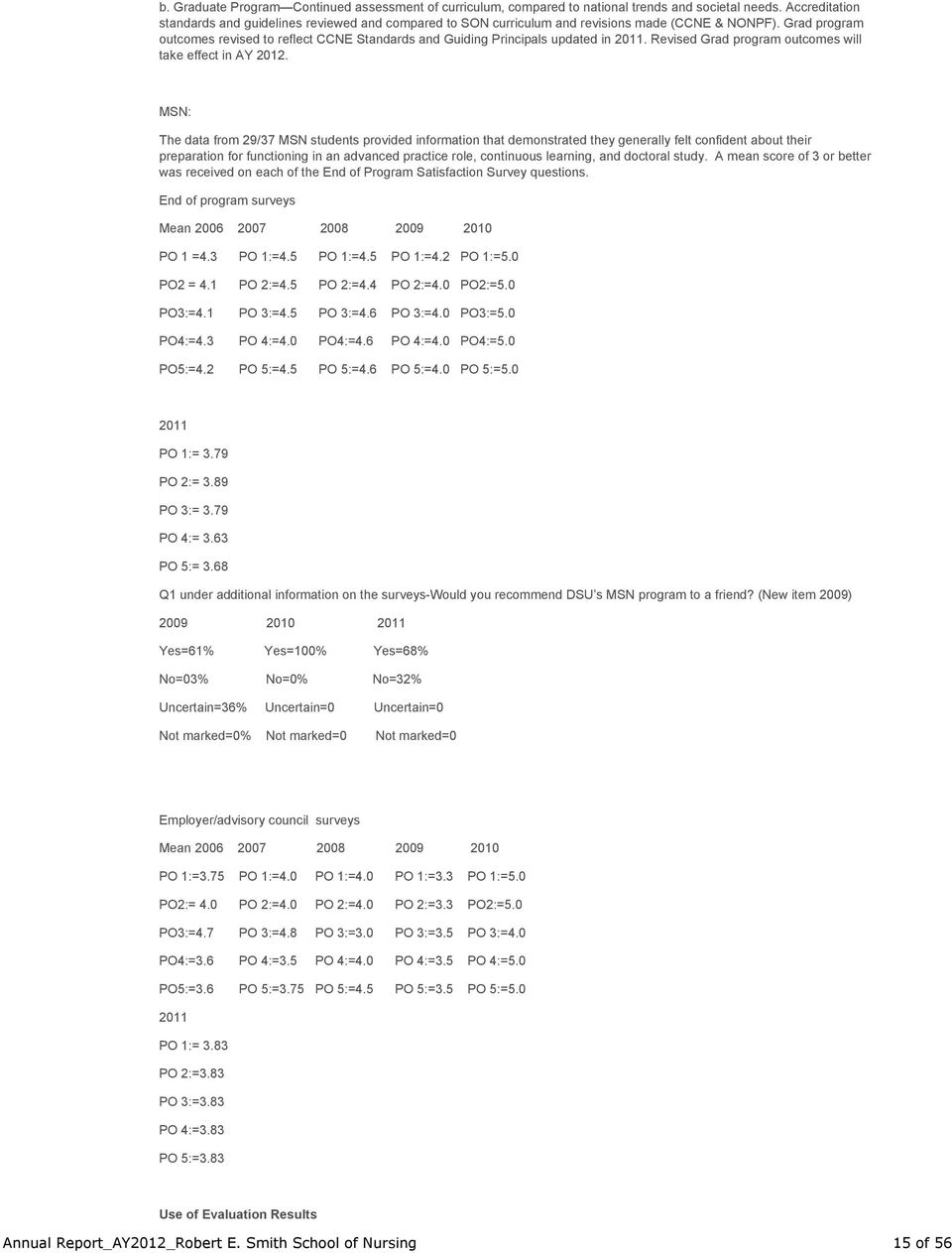
15 b. Graduate Program Continued assessment of curriculum, compared to national trends and societal needs. Accreditation standards and guidelines reviewed and compared to SON curriculum and revisions made (CCNE & NONPF). Grad program outcomes revised to reflect CCNE Standards and Guiding Principals updated in Revised Grad program outcomes will take effect in AY MSN: The data from 29/37 MSN students provided information that demonstrated they generally felt confident about their preparation for functioning in an advanced practice role, continuous learning, and doctoral study. A mean score of 3 or better was received on each of the End of Program Satisfaction Survey questions. End of program surveys Mean PO 1 =4.3 PO 1:=4.5 PO 1:=4.5 PO 1:=4.2 PO 1:=5.0 PO2 = 4.1 PO 2:=4.5 PO 2:=4.4 PO 2:=4.0 PO2:=5.0 PO3:=4.1 PO 3:=4.5 PO 3:=4.6 PO 3:=4.0 PO3:=5.0 PO4:=4.3 PO 4:=4.0 PO4:=4.6 PO 4:=4.0 PO4:=5.0 PO5:=4.2 PO 5:=4.5 PO 5:=4.6 PO 5:=4.0 PO 5:= PO 1:= 3.79 PO 2:= 3.89 PO 3:= 3.79 PO 4:= 3.63 PO 5:= 3.68 Q1 under additional information on the surveys-would you recommend DSU s MSN program to a friend? (New item 2009) Yes=61% Yes=100% Yes=68% No=03% No=0% No=32% Uncertain=36% Uncertain=0 Uncertain=0 Not marked=0% Not marked=0 Not marked=0 Employer/advisory council surveys Mean PO 1:=3.75 PO 1:=4.0 PO 1:=4.0 PO 1:=3.3 PO 1:=5.0 PO2:= 4.0 PO 2:=4.0 PO 2:=4.0 PO 2:=3.3 PO2:=5.0 PO3:=4.7 PO 3:=4.8 PO 3:=3.0 PO 3:=3.5 PO 3:=4.0 PO4:=3.6 PO 4:=3.5 PO 4:=4.0 PO 4:=3.5 PO 4:=5.0 PO5:=3.6 PO 5:=3.75 PO 5:=4.5 PO 5:=3.5 PO 5:= PO 1:= 3.83 PO 2:=3.83 PO 3:=3.83 PO 4:=3.83 PO 5:=3.83 Use of Evaluation Results Annual Report_AY2012_Robert E. Smith School of Nursing 15 of 56
16 a. Undergraduate and Graduate Program curriclum 1. Undergraduate and Graduate Programs detailed in MPE. 2. Participate in discussions with Mississippi Deans and Directors Council of Schools of Nursing regarding nursing education redesign. b. Revised Graduate Program Outcomes: 1. Integrate nursing, related sciences, and emerging evidence to improve health outcomes and safety for diverse populations. 2. Utilize leadership skills to design and implement strategies that improve care delivery and outcomes. 3. Contribute to the integration of healthcare services to improve quality and safety across the continuum of care. 4. Translate theory and research to provide evidence based nursing practice and improve outcomes. 5. Promote the use of information and communication technologies to provide safe, quality, and cost effective healthcare. 6. Analyze and interpret the effects of healthcare policies, ethics, and regulatory processes to influence practice and outcomes. 7. Employ collaborative leadership strategies to advocate, mentor, and function within inter-professional teams and partnerships. 8. Integrate individual and population based health promotion and prevention strategies to provide equitable, efficient, and effective global healthcare. 9. Apply advanced knowledge, skills, and competencies to design, implement, and evaluate direct and indirect care for individuals, families, and communities. Approved: 05/27/2011; Revised: 05/09/2011 Reviewed: 04/30/2012 Related Items SP1.Ind08: Curriculum Development and Revision SON 2012_02: Maintain/Increase Recruitment of Nursing Students Start: 7/1/2011 End: 6/30/2012 Unit Goal The School of Nursing will increase enrollment and graduation rates. a. Enhance marketing and recruitment plan b. Enhance student retention plan c. Enhance physical learning environment d. Evaluate, maintain and obtain current and new support resources Evaluation Procedures Feedback through the comprehensive SON MPE, in particular: admission, enrollment and retention data, student course evaluations and enrollment data. Actual Results of Evaluation BSN 1. On-line and use of technology efforts will continue and be enhanced as appropriate for course learning activities students applied to the BSN program, 39 were sent acceptance letters and 33 actually started the program of study fall Admissions to the pre-licensure BSN nursing program increased by 10% over 2010 admissions (from 32 to 33) for fall Nursing boot camp was well received by nursing students starting the program of study fall RNBSN 1. Students continue to be extremely positive regarding course delivery; the combination of limited, optional in-class time & online is a good balance and facilitates academic progress while employed. 2. Thirty-six (36) students applied to the RNBSN program, 36 were sent acceptance letters and 30 actually started the program of study. Admissions increased 67% from summer 2010-summer 2011 (from 18 to 30). MSN 1. On-line efforts will continue as appropriate for course learning activities. Annual Report_AY2012_Robert E. Smith School of Nursing 16 of 56

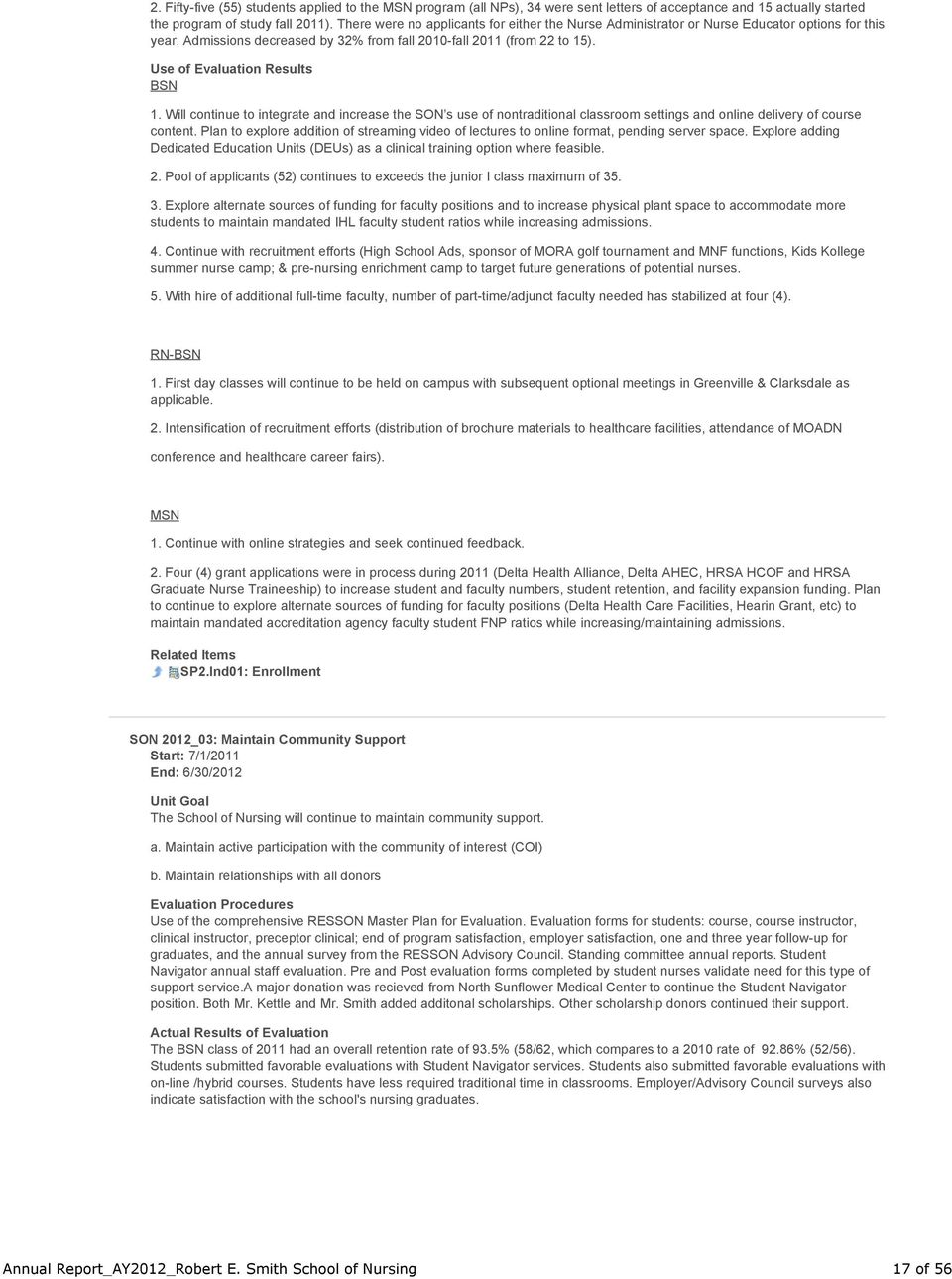
17 2. Fifty-five (55) students applied to the MSN program (all NPs), 34 were sent letters of acceptance and 15 actually started the program of study fall 2011). There were no applicants for either the Nurse Administrator or Nurse Educator options for this year. Admissions decreased by 32% from fall 2010-fall 2011 (from 22 to 15). Use of Evaluation Results BSN 1. Will continue to integrate and increase the SON s use of nontraditional classroom settings and online delivery of course content. Plan to explore addition of streaming video of lectures to online format, pending server space. Explore adding Dedicated Education Units (DEUs) as a clinical training option where feasible. 2. Pool of applicants (52) continues to exceeds the junior I class maximum of Explore alternate sources of funding for faculty positions and to increase physical plant space to accommodate more students to maintain mandated IHL faculty student ratios while increasing admissions. 4. Continue with recruitment efforts (High School Ads, sponsor of MORA golf tournament and MNF functions, Kids Kollege summer nurse camp; & pre-nursing enrichment camp to target future generations of potential nurses. 5. With hire of additional full-time faculty, number of part-time/adjunct faculty needed has stabilized at four (4). RN-BSN 1. First day classes will continue to be held on campus with subsequent optional meetings in Greenville & Clarksdale as applicable. 2. Intensification of recruitment efforts (distribution of brochure materials to healthcare facilities, attendance of MOADN conference and healthcare career fairs). MSN 1. Continue with online strategies and seek continued feedback. 2. Four (4) grant applications were in process during 2011 (Delta Health Alliance, Delta AHEC, HRSA HCOF and HRSA Graduate Nurse Traineeship) to increase student and faculty numbers, student retention, and facility expansion funding. Plan to continue to explore alternate sources of funding for faculty positions (Delta Health Care Facilities, Hearin Grant, etc) to maintain mandated accreditation agency faculty student FNP ratios while increasing/maintaining admissions. Related Items SP2.Ind01: Enrollment SON 2012_03: Maintain Community Support Start: 7/1/2011 End: 6/30/2012 Unit Goal The School of Nursing will continue to maintain community support. a. Maintain active participation with the community of interest (COI) b. Maintain relationships with all donors Evaluation Procedures Use of the comprehensive RESSON Master Plan for Evaluation. Evaluation forms for students: course, course instructor, clinical instructor, preceptor clinical; end of program satisfaction, employer satisfaction, one and three year follow-up for graduates, and the annual survey from the RESSON Advisory Council. Standing committee annual reports. Student Navigator annual staff evaluation. Pre and Post evaluation forms completed by student nurses validate need for this type of support service.a major donation was recieved from North Sunflower Medical Center to continue the Student Navigator position. Both Mr. Kettle and Mr. Smith added additonal scholarships. Other scholarship donors continued their support. Actual Results of Evaluation The BSN class of 2011 had an overall retention rate of 93.5% (58/62, which compares to a 2010 rate of 92.86% (52/56). Students submitted favorable evaluations with Student Navigator services. Students also submitted favorable evaluations with on-line /hybrid courses. Students have less required traditional time in classrooms. Employer/Advisory Council surveys also indicate satisfaction with the school's nursing graduates. Annual Report_AY2012_Robert E. Smith School of Nursing 17 of 56
18 Rates BSN Admission and Graduation Program Graduates (admitted/graduated) BSN (2005) BSN (2006) BSN (2007) BSN (2008) BSN (2009) BSN (2010) BSN (2011) 86% (34/28) 80% (39/31) 94% (54/51) 93% (58/54) 92% (47/43) 93% (56/52) 93.5% (58/62) Scholarships 1. KJ Smith Nursing Scholarship 2. Dana Lamar Nursing Scholarship 3. Samuels Nursing Scholarship 4. Branton-Woodall Nursing Award 5. American Legion Auxillary Scholarship 6. Dr Barbara Powell Scholarship 7. North Sunflower Medical Future Nurse Scholarship 8. Arlene Ward Bradshaw Nursing Award 9. Bryan/Hafter March of Dimes 10. James B Stone Scholarship 11. Nursing School Scholarship 12. Ferretti/Karnstedt Nursing Scholarship 13. Dr & Mrs Thomas Clay Schol 14. Hollingsworth Scholarship 15. Kate Kittle Memorial Scholarship 16. Kate Smith Kittle Memorial 17. Eugene Kittle Sr Memoral Nursing Scholarship 18. Blake Nursing Scholarship 19. Ellis Nursing Scholarship 20. Louise Brown Memorial Nursing Scholarship 21. Robert E Smith Nursing Scholarship Survey Results BSN: The data from 23 BSN students provided information that demonstrated they generally felt confident about program outcomes and were generally satisfied with courses, instructions, and resources. RNBSN: The data from 10/10 RN-BSN students provided information that demonstrated they felt confident about their preparation for professional nursing practice as a generalist as well as for continuous learning and advanced study. A mean score of 3 or better was received on each of the End of Program Satisfaction Survey questions. BSN End of program surveys Mean 2006 Mean 2007 Mean 2008 Mean 2009 Mean 2010 Mean 2011 Annual Report_AY2012_Robert E. Smith School of Nursing 18 of 56

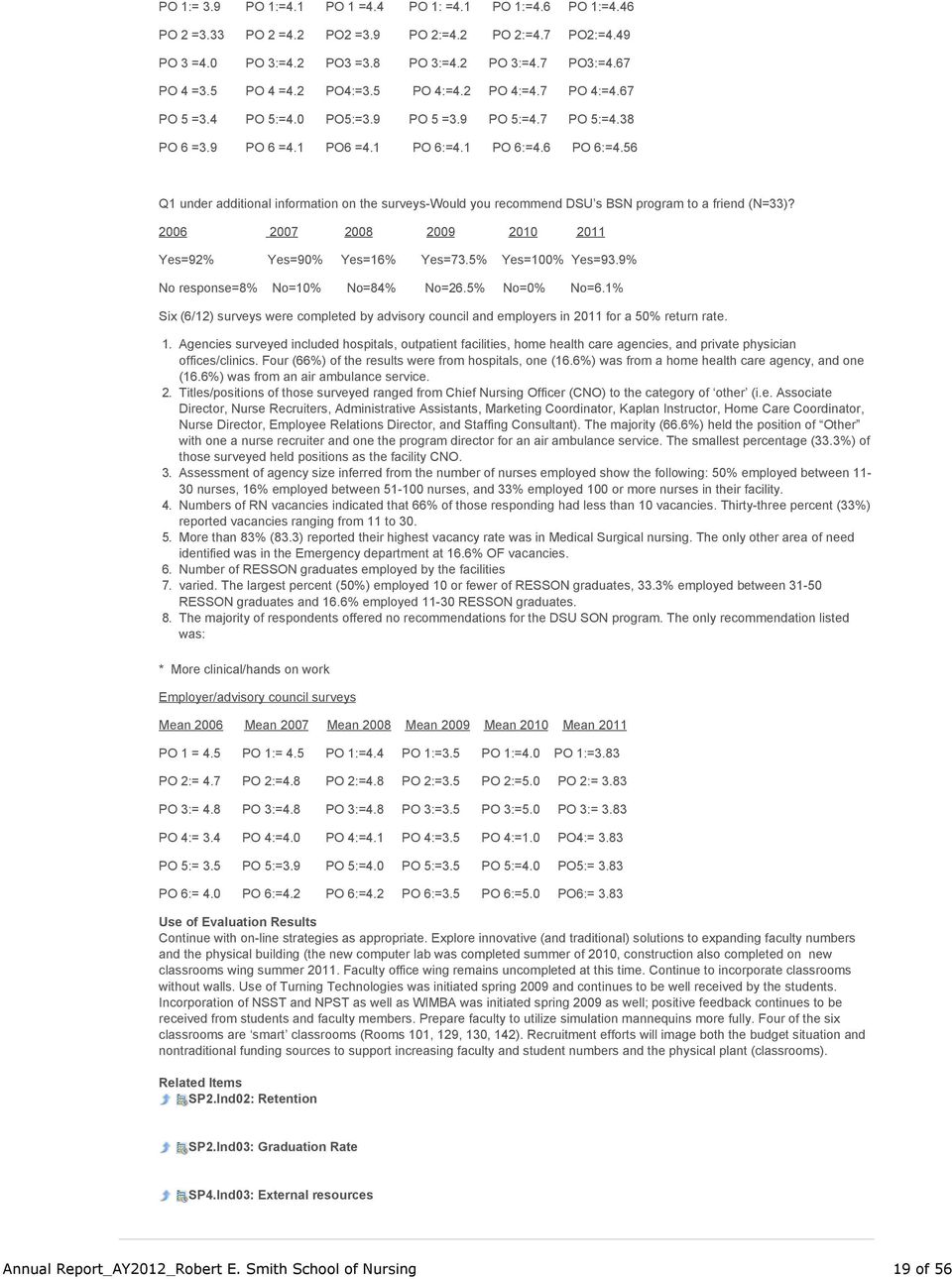
19 PO 1:= 3.9 PO 1:=4.1 PO 1 =4.4 PO 1: =4.1 PO 1:=4.6 PO 1:=4.46 PO 2 =3.33 PO 2 =4.2 PO2 =3.9 PO 2:=4.2 PO 2:=4.7 PO2:=4.49 PO 3 =4.0 PO 3:=4.2 PO3 =3.8 PO 3:=4.2 PO 3:=4.7 PO3:=4.67 PO 4 =3.5 PO 4 =4.2 PO4:=3.5 PO 4:=4.2 PO 4:=4.7 PO 4:=4.67 PO 5 =3.4 PO 5:=4.0 PO5:=3.9 PO 5 =3.9 PO 5:=4.7 PO 5:=4.38 PO 6 =3.9 PO 6 =4.1 PO6 =4.1 PO 6:=4.1 PO 6:=4.6 PO 6:=4.56 Q1 under additional information on the surveys-would you recommend DSU s BSN program to a friend (N=33)? Yes=92% Yes=90% Yes=16% Yes=73.5% Yes=100% Yes=93.9% No response=8% No=10% No=84% No=26.5% No=0% No=6.1% Six (6/12) surveys were completed by advisory council and employers in 2011 for a 50% return rate. 1. Agencies surveyed included hospitals, outpatient facilities, home health care agencies, and private physician offices/clinics. Four (66%) of the results were from hospitals, one (16.6%) was from a home health care agency, and one (16.6%) was from an air ambulance service. 2. Titles/positions of those surveyed ranged from Chief Nursing Officer (CNO) to the category of other (i.e. Associate Director, Nurse Recruiters, Administrative Assistants, Marketing Coordinator, Kaplan Instructor, Home Care Coordinator, Nurse Director, Employee Relations Director, and Staffing Consultant). The majority (66.6%) held the position of Other with one a nurse recruiter and one the program director for an air ambulance service. The smallest percentage (33.3%) of those surveyed held positions as the facility CNO. 3. Assessment of agency size inferred from the number of nurses employed show the following: 50% employed between nurses, 16% employed between nurses, and 33% employed 100 or more nurses in their facility. 4. Numbers of RN vacancies indicated that 66% of those responding had less than 10 vacancies. Thirty-three percent (33%) reported vacancies ranging from 11 to More than 83% (83.3) reported their highest vacancy rate was in Medical Surgical nursing. The only other area of need identified was in the Emergency department at 16.6% OF vacancies. 6. Number of RESSON graduates employed by the facilities 7. varied. The largest percent (50%) employed 10 or fewer of RESSON graduates, 33.3% employed between RESSON graduates and 16.6% employed RESSON graduates. 8. The majority of respondents offered no recommendations for the DSU SON program. The only recommendation listed was: * More clinical/hands on work Employer/advisory council surveys Mean 2006 Mean 2007 Mean 2008 Mean 2009 Mean 2010 Mean 2011 PO 1 = 4.5 PO 1:= 4.5 PO 1:=4.4 PO 1:=3.5 PO 1:=4.0 PO 1:=3.83 PO 2:= 4.7 PO 2:=4.8 PO 2:=4.8 PO 2:=3.5 PO 2:=5.0 PO 2:= 3.83 PO 3:= 4.8 PO 3:=4.8 PO 3:=4.8 PO 3:=3.5 PO 3:=5.0 PO 3:= 3.83 PO 4:= 3.4 PO 4:=4.0 PO 4:=4.1 PO 4:=3.5 PO 4:=1.0 PO4:= 3.83 PO 5:= 3.5 PO 5:=3.9 PO 5:=4.0 PO 5:=3.5 PO 5:=4.0 PO5:= 3.83 PO 6:= 4.0 PO 6:=4.2 PO 6:=4.2 PO 6:=3.5 PO 6:=5.0 PO6:= 3.83 Use of Evaluation Results Continue with on-line strategies as appropriate. Explore innovative (and traditional) solutions to expanding faculty numbers and the physical building (the new computer lab was completed summer of 2010, construction also completed on new classrooms wing summer Faculty office wing remains uncompleted at this time. Continue to incorporate classrooms without walls. Use of Turning Technologies was initiated spring 2009 and continues to be well received by the students. Incorporation of NSST and NPST as well as WIMBA was initiated spring 2009 as well; positive feedback continues to be received from students and faculty members. Prepare faculty to utilize simulation mannequins more fully. Four of the six classrooms are smart classrooms (Rooms 101, 129, 130, 142). Recruitment efforts will image both the budget situation and nontraditional funding sources to support increasing faculty and student numbers and the physical plant (classrooms). Related Items SP2.Ind02: Retention SP2.Ind03: Graduation Rate SP4.Ind03: External resources Annual Report_AY2012_Robert E. Smith School of Nursing 19 of 56
20 SON 2012_04: Increase Enrollment and Graduation Rates Start: 7/1/2011 End: 6/30/2012 Unit Goal The Robert E. Smith School of Nursing will increase enrollment and graduation rates. 1) enhance marketing and recruitment plan 2) develop a student retention plan 3) enhance physical learning environment 4) evaluate and maintain current support resources Rationale: By keeping a high retention rate, both programs will continue to graduate full class cohorts: High retention and graduation rates are more cost-effective for the taxpayers' dollar that is invested in the School and University. Use of distance learning technology will enable the RESSON to have an impact on learning that stretches beyond the traditional classroom with walls and will help ensure we maintain a competitive marketing edge with other state nursing programs. Evaluation Procedures 1) Feedback through the comprehensive RESSON Master Plan of Evaluation (MPE)--in particular student course evaluations and enrollment data. 2) Review and Revisions to Marketing and Recruitment Plan Actual Results of Evaluation BSN 1. Use of technology in course learning activities has increased to provide students with different ways of learning and applying content [i.e. ATI, ExamSoft, Simulation Lab, Neehr Perfect] students applied to the BSN program, 39 were sent acceptance letters and 33 actually started the program of study Fall Admissions to pre-licensure BSN nursing program increased by 10% over 2010 admissions (from 32 to 33) for Fall RNBSN 1. Students continue to be extremely positive regarding course delivery; the combination of limited, optional in-class time & online is a good balance and facilitates academic progress while employed. 2. Thirty-six (36) students applied to the RNBSN program, 36 was sent acceptance letters and 30 actually started the program of study. Admission increased 67% from summer 2010-summer 2011 (from 18 to 30). MSN 1. Use of technology in course learning activities has increased to provide students with different ways of learning and applying content [i.e. WIMBA, Pepid, Neehr Perfect]. 2. Fifty-five (55) students applied to the MSN program (all NPs), 34 were sent letters of acceptance and 15 actually started the program of study Fall 2011). There were no applicants for either the Nurse Administrator or Nurse Educator options for the year. Admissions decreased by 32% from fall 2010-fall 2011 (from 22 to 15). Use of Evaluation Results BSN 1. Will continue to integrate and increase the RESSON's use of nontraditional classroom settings and online delivery of course content. Plan to explore addition of streaming video of lectures to online format, pending server space. 2. Pool of applicants (52) continues to exceed the Junior I class maximum of Explore alternate sources of funding for faculty positions and increase physical space to accommodate more students to maintain mandated IHL faculty student ratios while increasing admissions. 4. Continue with recruitment efforts (high school ads, sponsor of MORA golf tournament and MNF functions, Kids Kollege summer nurse camp, & pre-nursing enrichment camp) to target future generations of potential nurses. 5. With hire of additional full-time faculty, number of part-time/adjunct faculty needed has stabilized at four (4). RNBSN 1. First day classes will continue to be held on campus with subsequent optional meetings in Greenville & Clarksdale as Annual Report_AY2012_Robert E. Smith School of Nursing 20 of 56

21 applicable. 2. Intensification of recruitment efforts (distribution of brochure materials to healthcare facilities, attendance of MOADN conference and healthcare career fairs). MSN 1. Continue with online strategies and seek continued feedback. 2. Four (4) grant applications wiere in process during 2011 (Delta Heath Alliance, Delta AHEC, HRSA HCOF and HRSA Graduate Nurse Traineeship) to increase student and faculty numbers, student retention, and facility expansion funding. Plan to continue to explore alternate sources of funding for faculty positions (Delta Health Care Facilities, Hearin Grant, etc.) to maintain mandated accreditation agency faculty student FNP ratios while increasing/maintaining admissions. 3. Increase recruitment efforts at healthcare facilities and conferences to increase MSN students. Related Items SP1.Ind08: Curriculum Development and Revision SP2.Ind01: Enrollment SP2.Ind02: Retention SP2.Ind03: Graduation Rate SP3.Ind08: Evaluations SON 2012_05: Maintain the High Employment rate of Nursing graduates Start: 7/1/2011 End: 6/30/2012 Unit Goal The undergraduate program will prepare students for professional nursing practice in a multi cultural society as a generalist at the Baccalaureate level and provide the Delta region with exceptional BSN nurses. BSN graduates will be prepared to pursue advanced study. Rationale: Baccalaureate prepared registered nurses are in demand in nursing, particularly in the Mississippi Delta region. The School provides avenues for this preparation to help diminish the shortage of baccalaureate prepared nurses in the Delta area. These nurses become nurse generalists and managers in health care facilities. These nurses assist in the provision of improved nursing care and improved patient outcomes to Delta area residents. The graduate program will prepare students in the advanced practice role of nurse administrator, educator or practitioner to help increase the number of master s prepared nurses working in the Delta area. Rationale: Master s prepared administrators, educators and primary care practitioners are in demand in nursing. The School provides avenues for this preparation to help diminish the shortage of master s prepared nurses in the Delta area. These nurses become nurse administrators/managers in health care facilities, faculty in schools of nursing or client educators in health care agencies and primary health care providers in clinic and hospital settings as nurse practitioners. These nurses assist in the provision of improved health care and consequently, improved quality of life to Delta area residents. Evaluation Procedures Surveys from the Mississippi Deans & Directors Council, the Mississippi State Board of Nursing, and the Mississippi Office of Nursing Workforce provide data for statewide nursing needs. The University s Registrar Office provides the data of adequate numbers of qualified nurses. The COAP and graduate program faculty review and consider applicants for admission. The graduates are contacted for employment data and information is systematically retrieved from the graduates at one and three years post graduation. Actual Results of Evaluation BSN Graduate Employment Program Graduates (Year) Employed in Mississippi n (%) Employed Elsewhere (%) Annual Report_AY2012_Robert E. Smith School of Nursing 21 of 56
22 34 BSN 17 RN-BSN Total = 51 (2011) 30 (88%) 16 (94%) 46 (90%) 04 (12%) 01 6%) 05 (10%) MSN Graduate Employment Program Graduates n (Year ) Employed in Mississippi n (%) Employed elsewhere n (%) 33 (2011) 29 (88%) 4 (12%) Use of Evaluation Results The School will continue to focus recruitment in the approximate Delta counties to promote retention of nursing graduates staying in the Delta area. The school will also continue to seek additional scholarship support and government funding to enable undergraduate students to more fully focus on success in their program of study. Continued recruitment will be conducted for graduate nurses interested in taking the nurse educator-specific courses as a post-master s student. Through the HRSA Advanced Nurse Traineeship grant, currently funded for 4 years, it has been possible to offer partial tuition scholarship support to graduate nursing students to facilitate pursuit of a full-time plan of study since fall The current need from healthcare agencies and educational entities (Associate Degree nursing programs) is for nurse educators and primary care providers. Intensive, comprehensive recruitment and scholarship funding efforts continue. Related Items SP1.Ind04: Job placement SON 2012_06: Maintain Outreach to DSU and the Delta Start: 7/1/2011 End: 6/30/2012 Unit Goal The students and faculty will provide the University community with the opportunity to know the benefits of healthy living through a Wellness Program and provide the Delta region with exceptional BSN nurses. Rationale: The benefits of healthy living do not warrant a rationale. This project provides for the students the example and involvement of future nurses in a community service activity. The students perform health assessment and education activities to promote healthy living at various campus and community events, including the annual Delta Health & Wellness Day. Evaluation Procedures Students, faculty and staff members participate in blood pressure checks, health teaching and recruitment at the DSU Benefits Fair, the Rice Luncheon, Oktoberfest, Crossties and at multiple other events that are documented by faculty and the SON resource assistant. Students are will continue to be assigned to Colleges and Departments and activity areas at the Delta Health & Wellness Day. A needs assessment will continue to be completed. Blood pressures will be checked in the fall and spring semesters and documented on a form developed for that purpose. In addition, specific months will continue to focus on selected health issues (i.e., October is Breast-Cancer Awareness Month) and information is provided at the designated information center for that College or Department, as well as through DSU library displays. Course faculty members will speak with department/division representatives to assess student activities and benefits of the program. 1 & 3 year follow-up and employer and advisory council data helps to track graduate locations. Actual Results of Evaluation Students, faculty and staff members participated in 12+ health/recruitment events during This number decreased from 75 due to loss of HRSA DHA health/recruitment funding and the recruiter/resource assistant funding. The University and regional community continue to provide positive responses and sincere thanks for the activities and information. Recipients of this health assessment and information can make informed decisions regarding further health care needs. Use of Evaluation Results Based upon student, faculty and participant feedback, additional health information has been provided. Additional assessments (BMI, HgA1C, Lipid testing) are also considered and implemented when feasible. Communication is facilitated through the use of the Pulse (the biannual SON newsletter), Post It Notes, the DSU e-news flyer, individual information centers in departments, library displays, and through campus . Graduates working in the Delta serve as an excellent Annual Report_AY2012_Robert E. Smith School of Nursing 22 of 56
23 recruitment avenue for future classes. An increase in new BSN nurses will complement the current nurse workforce throughout the Delta. Related Items SP5.Ind06: Community Outreach SON 2012_07: Maintain Faculty Development and Practice Start: 7/1/2011 End: 6/30/2012 Unit Goal The Robert E. Smith School of Nursing will strive to increase university outreach, service, and partnership initiatives to benefit the citizens of the region. a. Support evidence-based research initiatives to improve healthcare in the Delta region b. Participate in service-learning activities c. Provide continuing education initiatives d. Seek funding partnerships e. Faculty practice policy Rationale: National accreditation requires faculty practice, particularly for nurse practitioners. Faculty practice insures that nursing faculty members maintain competence and provide an opportunity for university and community service. Educators and practitioners would have an additional avenue to maintain their skills and provide for students learning. Faculty practice also offers opportunities for health care related research. In addition, the profession of nursing recognizes the doctorate as the terminal degree. With the master s program, doctoral prepared faculty members are needed which will fulfill the SACS guidelines that the majority of graduate faculty are to have the terminal degree in their field. Evaluation Procedures Faculty educational plans, faculty practice documentation, annual evaluations (including faculty activity records (FAR) or merit (MAD) evaluations), productivity, professional portfolios, survey by Faculty Development Committee. Actual Results of Evaluation The Faculty Development Committee continues to offer continuing education opportunities for nursing faculty that meets MS IHL requirements of at least 10 contact hours annually. In addition, the Robert E. Smith School of Nursing indirect account funds additional faculty development opportunities (average $2,000/faculty/year). The majority of nursing faculty members participate in practice one day a week as per the faculty practice policy. In addition, Blackboard/WebCT development/implementation continues with assistance from the TLC Faculty Institutes. One faculty member completed a doctoral program (DNP); another FT faculty member continues a DNP program of study. Another faculty member is progressing towards a Post Master s Psych/Mental Health NP program. The COAP continues to screen applicants for potential new faculty members. Faculty members are encouraged to pursue a doctoral degree in nursing and the advent of the Doctor of Nursing Practice (DNP) programs are offering another opportunity for nursing faculty to obtain an additional advanced/terminal degree in their discipline. All faculty members were evaluated according to the DSU Meritorious Achievement Document (MAD). Use of Evaluation Results Continue to support faculty as appropriate to accommodate their IHL requirements and personal professional coursework while maintaining excellence in program provisions for the SON. Related Items SP3.Ind07: Credentials SP3.Ind08: Evaluations SP3.Ind09: Professional development SP5.Ind02: Continuing Education SP5.Ind06: Community Outreach SON 2012_08: Support and Enhance the Educational and Research base of Faculty Start: 7/1/2011 End: 6/30/2012 Unit Goal Support and enhance the research base of the faculty members to improve health care in the Delta region and the state of Mississippi. [SON Priority #2] Rationale: Teaching and research are inseparably linked. Faculty members continue to need funding to support their efforts in conducting and disseminating finding. Evaluation Procedures Annual Report_AY2012_Robert E. Smith School of Nursing 23 of 56
24 Faculty portfolio, curriculum vitae, faculty practice documentation, annual and merit evaluations, Faculty Benchmark Worksheet, communication from faculty, reports to the Faculty Organization Meetings. Actual Results of Evaluation Each faculty member has engaged in appropriate scholarly activities (peer reviewed professional presentations or publications) or has submitted a written plan with specific annual goals and a status report on accomplishment of such goals for the previous year. Each nursing faculty member also documents regular faculty practice per the faculty practice policy. In addition, the SON participated in the eighth year of The Delta Health Initiative of the Delta Health Alliance. Approximately $36,000,000 over the past year (2010) was granted through HRSA in conjunction with other partners in the Alliance to continue a strong community based curriculum and address health care needs (including addressing the nursing shortage, which is currently ~13% in this region as compared to ~8% in the US) in the Delta. Three other grant applications was funded (a DHA Team Sugar Free grant to the Delta AHEC, housed in the RE Smith SON, a MS AHEC grant to the Delta AHEC, a HRSA Advanced Education Nursing Traineeship grant and a HRSA HCOF construction grant). Faculty members have the opportunity to participate in submitting results for publication and/or presentation. In addition, 21% (3/14) of the nursing faculty members and 25% (1/4) of the nursing staff are members of a minority population. Use of Evaluation Results The outcomes of scholarly productivity justify the time and revenue support that assist faculty to accomplish career goals and enhance classroom and clinical teaching. They also promote the University's mission and excellent reputation. All faculty members (instructors and faculty on the tenure track) will continue to incorporate and document (Faculty Benchmark Worksheet) scholarly activities as a focus of the requirements of University faculty (teaching, service, & scholarship). Related Items SP3.Ind06: Diversity SP3.Ind07: Credentials SP3.Ind08: Evaluations SP3.Ind09: Professional development SP5.Ind08: Area Priorities (Delta, IHL, or state) RESSON Executive Summary Overview (brief description of scope) The School of Nursing (SON) is conceptualized as a faculty of the whole with primary assignment to either the graduate or undergraduate programs. This framework fosters maximum utilization of faculty preparation and expertise, and promotes exceptional learning opportunities for all students. In concurrence with a comprehensive evaluation model that addresses all components of the organization, the School mission statement, philosophy, by-laws, and program outcomes are reviewed annually. The current documents are presented in Tables IIA-D. Annual Report_AY2012_Robert E. Smith School of Nursing 24 of 56
25 Table IIA: Delta State University School of Nursing Mission The mission of the Delta State University School of Nursing is to prepare students for professional nursing practice in a multicultural society as either a generalist at the Baccalaureate level or in an advanced practice role at the Master s level. The program will prepare graduates to pursue advanced study. Revised 02/16/09 last Reviewed 05/15/11 Table IIB. Delta State University School of Nursing Philosophy The philosophy of the faculty of the Delta State University School of Nursing is consistent with the goals and mission of the University. The faculty believes research and theoretical and systematic methods of critical thinking foster the development of the nursing profession. Nursing embodies the art and science of caring which is the nurturing, skillful act of being with another to promote optimum health and derives its mission from societal needs. Society is the organizing framework composed of family, group, and community that is governed by morals, ethics and laws. We believe that each person is a unique individual who possesses the right to informed choices in the attainment of health care services. Health is a dynamic state of being influenced by spiritual, cultural, psychological, physical and societal components, which interact with the environment. State of health is influenced by perceptions of the client and society. Nursing seeks to facilitate the health status of the client through interacting with client systems, assisting in the movement toward an optimum level of functioning or peaceful death. Revised 5/14/07 last Reviewed 05/15/11 Table IIC: Outcomes for the BSN Program (2011) 1. Apply nursing, natural, and behavioral science concepts to the practice of nursing. 2. Utilize the nursing process and standards of care to deliver safe, comprehensive nursing care to diverse clients in a collaborative environment. 3. Practice as a self-directed nursing leader who is accountable to self, society, and the evolving nursing profession. 4. Utilize research in the delivery of health care. 5. Advocate for improvement in healthcare through participation in professional and political processes. 6. Provide individualized nursing care that focuses on health promotion and disease and injury prevention. 7. Apply information and patient care technology to improve healthcare delivery from an interdisciplinary approach. Annual Report_AY2012_Robert E. Smith School of Nursing 25 of 56
26 Table IID: Outcomes for the MSN Program (revised May 2011) 1. Integrate nursing, related sciences, and emerging evidence to improve health outcomes and safety for diverse populations. 2. Utilize leadership skills to design and implement strategies that improve care delivery and outcomes. 3. Contribute to the integration of healthcare services to improve quality and safety across the continuum of care. 4. Translate theory and research to provide evidence based nursing practice and improve outcomes. 5. Promote the use of information and communication technologies to provide safe, quality, and cost effective healthcare. 6. Analyze and interpret the effects of healthcare policies, ethics, and regulatory processes to influence practice and outcomes. 7. Employ collaborative leadership strategies to advocate, mentor, and function within inter-professional teams and partnerships. 8. Integrate individual and population based health promotion and prevention strategies to provide equitable, efficient, and effective global healthcare. 9. Apply advanced knowledge, skills, and competencies to design, implement, and evaluate direct and indirect care for individuals, families, and communities. Accreditation The School has state, regional, and national accreditation recognition by the Mississippi State Board of Institutions of Higher Learning, the Southern Association of Colleges and Schools, and the Commission on Collegiate Nursing Education (CCNE). CCNE is the only accrediting body devoted exclusively to the evaluation of baccalaureate and graduate degree programs in nursing. Currently more than 690 baccalaureate and master s degree programs in nursing (73%) are accredited by CCNE ( 2012). The last CCNE and IHL accreditation visits for the whole RESSON program (undergraduate and graduate) was October Both BSN and MSN programs received full accreditation for the maximum of ten years with the next reaccreditation visit projected for fall of Structure & Governance The organizational structure of the School consists of the Dean, the Chair of Academic Programs (COAP), the Faculty; and the Staff (see Figure 1). The chain of command follows from the Dean to the Provost/Vice-President for Academic Affairs, the President, and then to the Mississippi State Board of Institutions of Higher Learning (IHL). The Dean chairs the Faculty Organization meetings, which is comprised of the total faculty. The COAP co-chairs the Faculty Organization meeting and is Ex Officio of the three faculty standing committees; Faculty Development, Student Affairs, and Program Effectiveness.Activities in curriculum, admissions, and resources are functions of all the faculty members (undergraduate and graduate). A nurse practitioner faculty member with a doctoral degree is named the nurse practitioner director in keeping with national guidelines. This faculty member oversees all curriculum matters and is liaison to the COAP. The correlation between the SON's governance structure and DSU Key Performance Areas are shown in Table IIE. President John M. Hilpert, the University s Seventh President (September 2003) identified eleven guiding principles. The third column demonstrates the SON s correlation with the new President s directives. Ad hoc committees are formed as needed. The DSU Faculty & Staff Handbook, the RESSON Faculty & Staff Handbook, and Roberts Rules of Order provide guidelines for governance. Annual standing committee reports are presented at the end of the fall semester. Comparative data Comparative Data (enrollment, CHP, majors, graduation rates, etc): Annual Report_AY2012_Robert E. Smith School of Nursing 26 of 56
27 ENROLLMENT BY MAJOR Spring 2008 Summer 2008 Fall 2008 UG GR UG GR UG GR Nursing ENROLLMENT BY MAJOR Spring 2009 Summer 2009 Fall 2009 UG GR UG GR UG GR Nursing ENROLLMENT BY MAJOR Spring 2010 Summer 2010 Fall 2010 UG GR UG GR UG GR Nursing ENROLLMENT BY MAJOR Spring 2011 Summer 2011 Fall 2011 UG GR UG GR UG GR Nursing CREDIT HOUR PRODUCTION Spring 2008 Summer 2008 Fall 2008 UG GR UG GR UG G NUR CREDIT HOUR PRODUCTION Spring 2009 Summer 2009 Fall 2009 UG GR UG GR UG G NUR CREDIT HOUR PRODUCTION Spring 2010 Summer 2010 Fall 2010 UG GR UG GR UG G NUR CREDIT HOUR PRODUCTION Spring 2011 Summer 2011 Fall 2011 UG GR UG GR UG G NUR , Nursing Graduates Nursing BSN 58 Annual Report_AY2012_Robert E. Smith School of Nursing 27 of 56
28 MSN 18 Total76 Graduation Rates Program Graduates (admitted/graduated) BSN (2005) BSN (2006) BSN (2007) BSN (2008) BSN (2009) BSN (2010) BSN (2011) MSN (2005) MSN (2006) MSN (2007) MSN (2008) MSN (2009) MSN (2010) MSN (2011) 86% (34/28) 80% (39/31) 94% (54/51) 93% (58/54) 92% (47/43 93% (56/52) 93.5% (58/62) 100% (10/10) 100% (24/24) 100% (17/17) 100% (30/30) 100% (33/33) 100% (13/13) 100% (18/18) Diversity Compliance Initiatives and Progress PLAN OF COMPLIANCE 1. Describe the special efforts made in 2011 to employ, train, and promote members of other races. * (The term other race is defined as indicated within the footnote below.) The School of Nursing had a composite of 14 full-time faculty members in spring and fall Three (3) of the full-time faculty (21%) in 2010 were African-American. In addition, the SON part-time staff member the Student Navigator is also African American (staff = 25% minority). Recruitment efforts continue to target a national pool with specific online advertisements to Minority Nurse, an AACN list serve of deans of school of nursing in liberal arts and small colleges and universities and the National Student Nurses Association broadcast for faculty positions. Approximately 24% (n = 12) of the School of Nursing s Advisory Council members (N = 50) are African-American. 2. Describe faculty exchange arrangement between other race institutions and indicate the number of faculty members involved. There were no faculty exchange arrangements during Describe the special efforts made to assist incumbent other race personnel to upgrade credentials for promotions to higher ranked positions. Indicate the number of employees involved. One African American faculty member completed a Doctor of Nursing Practice (DNP) program at the University of Alabama at Birmingham (UAB) in 2011 and was assisted with tuition, books and fees via reimbursement.. Another is on track to graduate from Samford University with a DNP May 2013 and is taking advantage of DSUs employee education policy that allows them to take 3 credit hours/week of course work during regular work hours. 4. Identify distinguished professorships of other race personnel brought to the campus in John Darnell, (Hernando, MS) presented a workshop titled Survival Spanish in Health Care fall, This was a repeat performance from every year since The School of Nursing plans to have this continuing education workshop at the RESSON. 5. Describe the cooperative programs involving both faculty and students between other race institutions and indicate the Annual Report_AY2012_Robert E. Smith School of Nursing 28 of 56
29 number of persons involved. Mississippi Valley State University Continues as a partner in the Delta Health Alliance. The SON is available to participate in recruitment and health care spots during their career days. The School of Nursing houses and directs the Delta Area Health Education Center (director is Shelby Polk, nursing faculty), which is working to network the multiple agencies existing to serve the predominant needs of the Delta experienced by the poor, the indigent, and the minority races. The School of Nursing received grant funding from the DHA for Team Sugar Free presentations during 2011 (six Bolivar County elementary schools) and summer 2011 (Score for Health Kids Kollege). In addition, the Dean of the School of Nursing continues to serve on the advisory (CRAFT) board of the Cleveland School District Allied Health Program. The School of Nursing has donated books to the Allied Health Program, assisted with fund raising ideas and the DSU Student Nurse Association has initiated adopting the Allied Health Program by partnering members with Allied Health students. 6. Identify new programs approved in 2011 which will have potential of attracting other race students and faculty members. The SON Delta Health Alliance project to increase numbers of nurses in the Delta has continued to place the SON in the community spotlight. The SON is active in regional Health Fairs and summer camps (Score for Health with Kids Kollege) combined with recruitment efforts and special events that target youth/new DSU college students for future nursing careers. These efforts have met with great success. Score for Health Kids Kollege (June 13-17, 2011) had 18 attendees with 67% white and 33% other ethnicities (6 African American. 7. Identify and describe efforts and accomplishments in strengthening existing programs and thereby attracting other race students and faculty members. BSN Continue with SUPPORT, SMART and READY projects to help prepare students to be successful in nursing school. Continue with a part-time admission option for at-risk students. Continue with enrichment activities to assist identified nursing students with challenges on national standardized nursing exams. RN-BSN 2011 enrollment increased in the RN-BSN program (30 compared 25 last year (2010) and to in previous years). The online classes with on-campus meetings in Greenville and Clarksdale have increased the opportunities for AD- RN nurses to advance up the professional career ladder. Historically the associate degree programs have a higher percentage of minority students, thus DSU SON recruitment in this pool has increased minority nurses with a baccalaureate degree. Plans for 2012 are to continue recruitment efforts to maintain/increase admissions to this program for future cohorts with at least 20 RN-BSN students. Planning has started for an RN-DNP program. MSN The Robert E. Smith SON offers the only BSN and MSN programs in the Delta region thus affording minorities the opportunity for regional access to graduate nursing education. * Since the majority of Delta State University s faculty, staff and students are classified as White, the term other race, as used above, is to be defined as including those individuals classified by the U.S. Census Bureau as American Indian, Alaskan Native, Asian, Black or African American, Native Hawaiian, or other Pacific Islander. Economic Development Initiatives and/or Impact Economic Development initiatives and/or impact: School of Nursing Fifty-one (51) students successfully completed the Bachelor of Science in nursing program in Currently, 92% (46/51) of these students are employed within the state. These graduates are employed in various health care agencies, ranging from inpatient hospital care to community home health. All of the graduates were employed immediately after graduation and are receiving a salary of approximately $56,635/year per graduate ($2,888, in total wages from the health care industry). Approximately 450 undergraduate students at the University have selected a pre-nursing plan of study to prepare for admission into the generic nursing program. Intensive and extensive recruitment efforts have been launched by the School and throughout the nation. Schools of Nursing continue to turn away thousands of qualified nursing applicants. According to AACN's report on Enrollment and Graduations in Baccalaureate and Graduate Programs in Nursing, U.S. nursing schools turned away 67,563 qualified applicants to baccalaureate and graduate nursing programs in 2010 due to an insufficient number of faculty, clinical sites, classroom space, clinical preceptors, and budget constraints. Three-fifths (62%) of the nursing schools responding to the 2010 survey pointed to faculty shortages as a reason for not accepting all qualified applicants into nursing programs. The spring 2010 applicant pool for the DSU SON pre-licensure BSN program was comparable to the numbers for Spring 2009 (approximately 70 applicants with 44 qualified applicants; 44 qualified applicants were accepted to start the program of nursing fall 2010, 36 accepted admission and 32 actually started the program). The spring 2011 applicant pool for the RN-BSN program included 36 qualified applicants; all 36 were accepted to start the Annual Report_AY2012_Robert E. Smith School of Nursing 29 of 56
30 program of nursing summer 2011, and 30 actually started the program. For the MSN program, there were 33 students qualified to start the program of nursing (also during fall 2010), 32 were accepted, and 15 actually started the program. The School s mission and strategic plan supports the University s mission and goals. The School contributes to the economic and health status in the Delta region and the state of Mississippi. The need for baccalaureate nurses at the professional entry level in an increasingly complex health care system is well substantiated. In addition, employers are starting to require that RNs in management positions obtain a BSN degree or risk demotion or job loss. The Delta State University nursing graduates are in demand at the local, state, regional, and national levels. The Master of Science in Nursing (MSN) program had thirty-three (33) students to graduate in May There were also 65 non-degree seeking students enrolled in prerequisite MSN courses spring The estimated salary for Master s Prepared Nurses (all options) is $84,183/year. For the 2011 graduates this would approximate to $2,778, generated in annual wages. Fall 2011 MSN enrollment consisted of 44 Nurse Practitioner, nine (9) Nurse Administrator, three (3) Nurse Educator students, and 22 Non-degree seeking students. The nursing profession provides a rich resource, Delta State nursing graduates, to the people of Mississippi. Nurses are essential contributors to health care in an increasingly complex system. Economically, this educational investment will have a long-term proactive impact in the Delta. These graduates are prepared to work in a variety of settings with clients of cultural diversity. Baccalaureate nurses are prepared as generalists. Master s prepared nurses are educated to work as administrator, educators, or practitioners. Among the many roles, Delta State graduates are prepared to function in community health agencies where family planning, health promotion, and disease prevention services, including immunizations, are provided to the public. When health care is remote or too costly, the morbidity of chronic and acute diseases will continue to be ever present in increasing statistics, thus an excess of state dollars will continue to go to Medicaid and Welfare payments. Healthy Mississippians who are employable are contributors to the overall economic infrastructure and promote the interests of our state. ONE YEAR ECONOMIC DEVELOPMENT PLAN (July 1, 2011-June 30, 2012) The School of Nursing plans to: Increase enrollment for both undergraduate and graduate programs. Maintain online and off-campus (Greenville [GHEC] and Clarksdale [CCHEC]) access for RN-BSN program Maintain online access for MSN and explore feasibility of off-campus class meetings (Greenville [GHEC and Clarksdale (CCHEC). Take the final steps for SACS approval of a DNP program at the RESSON Seek external funding to assist in easing budget constraints. FIVE YEAR ECONOMIC DEVELOPMENT PLAN (July 1, June 30, 2013) The School of Nursing plans to: Increase BSN enrollment by admitting students each regular term and per limitations set by IHL standard. Continue to seek external funding for current faculty positions, and additional faculty positions to accommodate future increased enrollment. Promote graduates to work within the Delta region: Delta tour, emphasis of Delta cultural into curriculum Obtain approval from SACS for first class admission summer Move to doctoral prepared faculty and increase grant/external funds to enhance the advancement of nursing science. The anticipated research productivity will provide economic gain to the state through Delta State and through the outcomes of nursing research on health care changes particularly in the areas of rural healthcare access and delivery. Grants, Contracts, Partnerships Grants: Bingham, V. (2011). HRSA Graduate Nurse Traineeship Grant. Submitted November, Funded ($23,072.00) Carlson, L. (2011). Delta Health Alliance Project 9 Addressing the Nursing Shortage in the Yazoo-Mississippi Delta. Funded ($377,685.00). Carlson, L. (2011). Second year of funding for the Delta Health Alliance Beacon BLUES Electronic Medical Records. Funded ($29, total over 3 years). Carlson, L. (2011). Third and last year of the MECSAPN MSN Consortium Grant. Funded ($62,000 over 3 years). Carlson, L. (2011). First year of the Mississippi Doctorate of Nursing Practice (DNP) Consortium Grant ($90,000 over 3 years). Carlson. L. (2011). Delta Area Health Education (AHEC) grant. Funded ($63.315) Hayes, C., Green, E, Allen, D, Newman, E. (2011). Plant a Seed to Grow Nutrition Program Grant. Funded ($500) Polk, S. (2011). TEAM Sugar Free. Funded (20,000). Annual Report_AY2012_Robert E. Smith School of Nursing 30 of 56
31 Service Leaning Data (List of Projects, number of students involved, total service learning hours, accomplishments, etc): The RESSON had no service learning hours that met a strict definition of the same. However, RESSON faculty, staff and students did log 43,719 clinical and volunteer hours for AY According to the website volunteer hours during FY 2011 were worth $20.85/hr. This translates to $911, in added value to DSU, Cleveland and the Delta region. Strategic Plan Data on faculty professional development, scholarly contributions and number of service activities: 2011 RESSON Faculty Benchmark Analysis Annual Report_AY2012_Robert E. Smith School of Nursing 31 of 56
32 DESCRIPTION MET NOT MET COMMENT RECOMMENDATION 1 100% of nursing faculty will attain at least 10 CE units annually X 100% 12/14 Faculty Benchmark Forms reviewed: 14/14 faculty obtained 10 or more contact hours during Total contact hours in 2011 = Average contact hours per faculty = % of nursing faculty will attain a minimum of 10 contact hours (IHL standard) 2 80% of nursing faculty will attain a mean score of 3.0 or above on all faculty/course/clinical evaluations each semester X 91.6% 12/14 faculty met or exceeded 3.0 on all faculty/course/clinical evaluations during spring, summer, fall semesters in % of nursing faculty will incorporate simulation activities into the Clinical/Practicum courses in which they teach X 66.6% 08/12 faculty (excluding simulation lab director) incorporated simulation activities into one or more clinical/practicum courses in which they teach A total of 63 activities were incorporated into courses during 2011 by 8 faculty members. Eight faculty reported participated in 48 simulation activities in % of nursing faculty will present research findings at conferences at the state, regional, or national level X 25% 3/12 faculty presented at the state level in 2011: 2 poster and 1 oral presentation Recommendation: PEC to revise this benchmark to be in line with the DSU Tenure and Promotion Policy requirements. Dr. Vicki Bingham (COAP) also presented a poster at a regional conference during % of faculty will submit or be published in a peer reviewed journal/book as an author, reviewer, or editor X 21% 3/12 faculty Submission/Publication 1 Book/Chapter Review 2 Recommendation: PEC to revise this benchmark to be in line with the DSU Tenure and Promotion Policy requirements. 6 10% of nursing faculty will submit a grant or serve as a grant reviewer X 33% 4/12 faculty submitted or obtained a grant in Recommendation: PEC to revise this benchmark to be in line with the DSU Tenure and Promotion Policy requirements. One faculty submitted a grant total award = $0 Annual Report_AY2012_Robert E. Smith School of Nursing 32 of 56
33 One faculty submitted a grant total award = $20,000 annually x 3 years Two faculty submitted a grant total award = $500 Dr. Vicki Bingham also submitted a grant and was awarded $23, % of faculty will participate in community services 8 60% of faculty will engage in faculty practice to maintain nursing competency X 100% X 71.42% 14/14 faculty participated in community services during 2011 A total of 40 community activities were documented on the reporting form. 10/14 faculty engaged in practice during All NP faculty met the minimum hours/year. NPs are required to practice a minimum of 1500 hours during the 5 year certification period (minimum 300 hrs/year or 6 hours/week). Committees reporting to unit (Committee records archived in the Dean s office): Nursing Faculty Organization Committee V. Personnel: An excellent complement of full-time faculty, staff, and part-time adjunct faculty (see Table IIIA) enable the School to fulfill the mission and insure that students achieve program outcomes. The faculty members have been recognized this past year with noteworthy activities and accomplishments. Annual Report_AY2012_Robert E. Smith School of Nursing 33 of 56
34 Table VA: 2011 Full-Time, Part-Time, & Adjunct Faculty Members & Staff Roster Full-Time Faculty 1 Lizabeth L. Carlson, DNS, RNC... Dean & Professor, Tenured Debra F. Allen, MSN, RN.....Instructor Vicki L. Bingham, PhD, RN... Chair of Academic Programs, Associate Professor, Tenured Lacey Blessitt, MSN, RN Instructor Jeni Bond, MSN, RN Instructor Carie Caesar, MSN, RN Instructor Catherine Hays, EdD, RN Associate Professor, Tenured Addie Herrod, MSN, RN, BC Instructor Monica Jones, DNP, RN, BC Instructor Donna Koestler, MSN, RN Instructor Shelby Polk DNP, RN, BC Assistant Professor Michelle Tippitt, MSN, RN,BC Instructor D. Louise Seals, EdD, RN, CNE Associate Professor, Tenured Betty Sylvest, DNS, RN, CNEAssociate Professor,Tenured Carleen Thompson, DNP, RN, BC. Assistant Professor Adjunct Faculty Jean Grantham, MSN, RN, BC Instructor Full-Time Staff Carla Lewis... Secretary to the Dean Judy Haney... Secretary to the Faculty Cheryl Oleis... Resource Assistant Deidra Student Navigator Emily Newman Director, Delta AHEC Noteworthy activities and accomplishments: Student Accomplishments: SNA Student members were active in many service projects this year. One DSU student was elected to the Mississippi Student Nurses Association Board: Mary Glenn- Chair of School President and represented DSU RESSON at National Student Nurses Association. SNA took BPs at the Rice Luncheon and provided a first aid station for the Pig Pickin and Homecoming DSU Football games as well as the Crossties Festival. They participated in monthly health education displays in the DSU library with handouts and Faculty Wellness Projects providing health information in the various Departments. SNA worked with the B.E.E.P. Program during October breast health awareness blitz including Komen on the Green. Members collected coke can tops for the Ronald McDonald House at St. Jude and collected cans for recycling and sold them for fundraising monies. They also sent two boxes to GIs in Operation Shoebox and sent 4 children Christmas boxes for Operation Christmas child. They collected hygiene supplies for the Sunshine House, toys for Blair E. Batson Children s Hospital in honor of Hayden Casevechia a terminally ill child from Greenville and participated in a For Women only Health Fair. They developed and presented a healthy lifestyles seminar for College Students and presented at each of the dormitories on campus and participated in the Plant a Seed project to help 1 st graders learn about growing healthy foods and the importance of proper nutrition. The RESSON SNA received the honor of being recognized at the Year of the Student Luncheon as one of the Student Organization Champions. The students also honored Carla Lewis and Judy Haney by assisting in planting two Crepe Myrtles in their honor. Faculty Accomplishments: Annual Report_AY2012_Robert E. Smith School of Nursing 34 of 56
35 Debra F. Allen, MSN Professional Organizations MNA District #21 Executive Committee MNA District #21 Delegate to Convention MNA Legislative Affairs Committee MNA Nominations Committee Chair Mississippi Nurses Foundation Nightingale Awards Committee Mississippi Nurses Foundation Centennial Celebration Committee ANA Delegate for Mississippi Sigma Theta Tau International, Honor Society of Nursing, Pi Xi Chapter, President for , re-elected National League of Nursing, member OAK, Leadership Honor Society, member University Involvement Faculty Senate Senator for , secretary for Delta Health and Wellness Committee, DSU Wellness Committee, GST Instructor, Healthy Campus/Community Initiative Steering Committee present Merit Pay Appeals Committee, General Education Committee, Research & Scholarly Activities Hayes, C., Andrews, K., Carter. S., Haynes, T., Newman, E. & Allen, D. (2010) Utilizing Contracting in Group Process with Baccalaureate and Master s Students. Poster Presentation at National Student Nursing Association Convention, Orlando, FL, April 2010; Region 8 Sigma Theta Tau International Conference, Hattiesburg, MS, October American Association of Colleges of Nursing Baccalaureate Education conference: Reform and Innovation: The Charge for Baccalaureate Nursing Education, November, 2010; MNA Nursing Summit, Jackson, MS, January 2012 Green, E., Hayes, C., Allen, D., Newman, E. & Fitts, L. (2011). Service Learning through the Plant a Seed to Grow Nutrition Program: An Interdisciplinary Pilot Project Designed and Implemented by Faculty and Students in Biology, Nursing, and Education with an At-risk Population of First Grade Students in a Rural Mississippi Delta Elementary School. By DSU Faculty Development Fund and Delta AHEC. ($ ). School of Nursing Activities Student Affairs Committee, responsible for Scholarship and Newsletter, Chair, 2012 Student Nurses Association, Faculty Advisor Community Activities Junior Auxiliary of Greenville, associate member Delta Cotton Belles, Grant Chairman Advisory/Craft Committee for the Cleveland Career Development and Technology Center, 2008-present DSU Student Nurses Association community service activities Bingham, Vicki, PhD, RN Grants Awarded HRSA Advanced Education Nursing Traineeship (AENT) grant for scholarship monies to graduate students in the amount of $23, Scholarly Activities S.U.P.P.O.R.T. Support, Understanding Provided by Parents/Others Reality Training, February 19, 2011 at the 25 Annual Conference of the Southern Nursing Research Society, Jacksonville, Florida. th Service to the Profession Served as Secretary to the Mississippi Council of Deans and Directors Board Served as Leadership Succession Chair for the PiXi Chapter of STII Annual Report_AY2012_Robert E. Smith School of Nursing 35 of 56
36 Lacey Blessitt, MSN, FNP-BC Had 5 students make >1000 on Pharmacology HESI. 13 out of 31 made 900 or above. Pharmacology overall grades: 6 A, 18 B Completed Warrior Dash 5K race in Jackson, MS; in the process raised right at $ for St. Jude. Carie Cesare, MSN Successfully completed a NOELLE Simulation Training for external staff (i.e. Labor & Delivery nurses) from Northwest MS Regional Medical Center and senior nursing students in course NUR 441: Maternity Nursing Practicum Jean Grantham, MSN President of 2012 Mississippi Public Health Association ( member statewide organization) Member of Mississippi Statewide Reproductive Health Advisory Council Student Anna Haksins Patton was selected for an internship with the Mississippi Department of Health, Epidemiology Program as a West Nile Education Intern. Catherine Hayes, Ed.D, MSN Grants Designed and implemented interdisciplinary project in collaboration with Dr. Ellen Green, Associate Professor of Biology, Debra Allen, Instructor of Nursing, Emily Newman, MS Delta AHEC, Lacey Fitts, Instructor of Chemistry and BSN and Science Education students the Plant a Seed to Grow Nutrition Program. $250 Faculty Development and $250 matching funding MS Delta AHEC for Plant a Seed to Grow Nutrition Program. Publications or other Scholarly Activities Abstract accepted for poster presentation, Mississippi Nurses Association: Utilizing Contracting in Group Process with Baccalaureate Nursing Students. Catherine Hayes, Ed.D, MSN, RN, Associate Professor of Nursing; Debra Allen, MSN, RN, Instructor of Nursing; Emily A. Newman, M.Ed, BSN, RN, MS Delta AHEC & Teresa Haynes, BSN, RN; Kelley Andrews, BSN, RN; Shelby Carter, BSN, RN Shelby Polk, DNP, RNBC Scholarship Proposal accepted to present to the National Organization of Nurse Practitioner Faculty Annual Conference held April Grant awarded for TEAM Sugar Free (2011). Funded ($20,000). Service Proposal accepted to present a one day workshop to be held June 18, 2012 at the RESSON to the Mississippi Nurses Foundation for continuing education unit approval. Awarded 7.25 CEUs for workshop. Betty Sylvest, DNS, RN, CNE Manuscript and Book Reviews Patricia Gillivan Developmental Editor. (2011) Practical Pharmacology and Therapeutics. (In process of reviews). F. A. Davis. I have reviewed 7 chapters for this book. Previous research (unpublished) Collins, P., Sylvest, B., Allen, D. & Bingham, V. (2011). Quality of Life affected by Percutaneous Transluminal Coronary Angioplasty and Stents in patients with Coronary Artery Disease. Master s Research Project. Robert E. Smith School of Nursing. Delta State University: Cleveland, Ms. Wilson, D. & Sylvest, B. (2011). Assessment of staff nurses knowledge of Evidence Based Practice. Master s Research Project. Robert E. Smith School of Nursing. Delta State University: Cleveland, Ms. Morgan, M., Taylor, B. & Sylvest, B. (2011). A teaching project for Breast Self- Annual Report_AY2012_Robert E. Smith School of Nursing 36 of 56
37 Professional Presentations Peer Reviewed Examination and Prevention in the community. Master s Research Project. Robert E. Smith School of Nursing. Delta State University: Cleveland, Varner, L., Sylvest, B., Jennings, G. (2011). Teaching writing. Teaching Professor Conference. Atlanta, GA. (5/20/2011) Non-Peer Reviewed Sylvest, B. (2011). Educational needs of Delta Populations related to cardiovascular disease. Wear Red Day. Center for Community Economic Development. 2/28/2011. Sylvest, B. (2011). Keynote Speaker. Robert E. Smith School of Nursing. Master of Science in Nursing Recognition Ceremony. Cleveland, MS: May 6, Sylvest, B. (2011). Eating disorders and coping with stress. Center Community Other Economic Development. B.E.E.P. Girl Power. 2/28/2011. Spring 2011 Participated in three BEEP sponsored workshops Spring 2011 Member of Provider unit of MNA to coordinate conferences such as the NP Convention in April, 2011 Spring 2011 I was awarded tenure in May Fall 2011 Letter of Recognition Fall 2011 sponsored by the Writing Across the Curriculum Committee and Dr. Lotven Vice President for Academic Affairs Fall 2011 Assisted Carie Ceaser grade WPE tests. Fall 2011 Member of Provider unit of MNA and worked on MNA Convention in Biloxi in October. I could not attend the Convention due to medical reasons. Spring and Fall 2011 All evaluation means were over 3.0 Participated in the Mississippi Delta Area Health Education Center (AHEC) and Delta State University Division of Health, Physical Education and Recreation Mississippi Department of Education Meeting on August 11, 2011 to discuss with faculty from other departments on how to best serve our students as they progress through the programs represented. DSU Junior Day on campus, I was available in my office to answer any questions the students might have related to the RESSON. Throughout 2011, I served on several committees in the RESSON as well as University wide committees. I have served on Advisory Boards for three programs through the CCED of DSU. I have taught CPR to students as well as faculty. I have served as advisor to several students. In the spring of 2011, I was advisor to the Adult Education masters students. Advisor for pre-nursing students. I have assisted in general registration dates at the RESSON for students who are coming into the university during the beginning of a semester. I have served as guest lecturer at Girl Power and Wear Red Day sponsored by the BEEP program through the CCED of DSU. I participated in Junior Day at the RESSON Carleen Thompson, DNP, RN Scholarship Contributor to a pathophysiology book (Chapter 40 Disorders of the eyes and ears) scheduled for publication by Pearson Spring of 2012 Other Completed post-masters of nursing degree at Delta State University for Family Nurse Practitioner Michelle (Mimi) Tippitt, MSN, PNP All 35 students in the class that graduated Dec 2011 left us with ACLS & PALS certification which I helped teach All 28 current seniors have completed PALS certification & 20% have completed ACLS certification as well. I expect that all 28 will have this certification prior to graduation All 28 of the current seniors completed (& performed in a stellar fashion)civilian Aeromedical Evacuation Sustainment Training (a high-reality simulation-based class & exercise in mass disaster response) I taught & assisted with teaching multiple courses of ACLS, PALS, & BLS at no charge to RESSON this year to ensure our students in particular had access to this training, though community members were also students in some courses. The students & RESSON personnel collected & delivered 2 large boxes of clothes, toys & art supplies for the children at Blair E. Batson Pediatric Hospital in Jackson, MS. Staff Accomplishments: Annual Report_AY2012_Robert E. Smith School of Nursing 37 of 56
38 Lizabeth Carlson Grants Carlson, L. (2011). Delta Health Alliance Project 9 Addressing the Nursing Shortage in the Yazoo-Mississippi Delta. Funded ($377,685.00). Carlson, L. (2011). Second year of funding for the Delta Health Alliance Beacon BLUES Electronic Medical Records. Funded ($29, total over 3 years). Carlson, L. (2011). Third and last year of the MECSAPN MSN Consortium Grant. Funded ($62,000 over 3 years). Carlson, L. (2011). First year of the Mississippi Doctorate of Nursing Practice (DNP) Consortium Grant ($90,000 over 3 years). Carlson. L. (2011). Delta Area Health Education (AHEC) grant. Funded ($63.315) Presentations and Other Scholarly Activities Continues to be a Sentinel reader/research article rater for the MORE (McMaster Online Rating of Evidence) EBN (Evidence- Based Nursing) project, fall, 2006-present. Service: University Academic Council member Statewide Committees: Vice Chair of the BHD Council of Mississippi Deans and Directors of Schools of Nursing, June, 2009-present Member of the statewide nursing student retention committee 2009-present Member of Research Committee of Mississippi Deans and Directors of Schools of Nursing, June, 2008-present Vice President of Mississippi Nurses Association District 23, January 2007-present National Service: State (Mississippi) Grassroots Liaison of AACN's Government Affairs Committee, August 1, 2007-present Committees reporting to unit Figure 2 DSU School of Nursing to IHL: Program & Committee Organizational Structure BOARD OF TRUSTEES INSTITUTIONS OF HIGHER LEARNING PRESIDENT Provost and Vice President for Academic Affairs to the President School of Nursing Faculty Organization Dean Standing Committees COAP Faculty Development Student Affairs Program Effectiveness Undergraduate Program Graduate Program Annual Report_AY2012_Robert E. Smith School of Nursing 38 of 56
39 Program COAP Undergraduate* BSN & RN-BSN Graduate* Administrator, Educator & Practitioner** (*Curriculum, Resource Admissions) (**FNP Track Director oversees all NP curricular matters) Related Items There are no related items. RESSON Executive Summary Overview (brief description of scope) The School of Nursing (SON) is conceptualized as a faculty of the whole with primary assignment to either the graduate or undergraduate programs. This framework fosters maximum utilization of faculty preparation and expertise, and promotes exceptional learning opportunities for all students. Annual Report_AY2012_Robert E. Smith School of Nursing 39 of 56
40 In concurrence with a comprehensive evaluation model that addresses all components of the organization, the School mission statement, philosophy, by-laws, and program outcomes are reviewed annually. The current documents are presented in Tables IIA-D. Table IIA: Delta State University School of Nursing Mission The mission of the Delta State University School of Nursing is to prepare students for professional nursing practice in a multicultural society as either a generalist at the Baccalaureate level or in an advanced practice role at the Master s level. The program will prepare graduates to pursue advanced study. Revised 02/16/09 last Reviewed 05/2012 Table IIB. Delta State University School of Nursing Philosophy The philosophy of the faculty of the Delta State University School of Nursing is consistent with the goals and mission of the University. The faculty believes research and theoretical and systematic methods of critical thinking foster the development of the nursing profession. Nursing embodies the art and science of caring which is the nurturing, skillful act of being with another to promote optimum health and derives its mission from societal needs. Society is the organizing framework composed of family, group, and community that is governed by morals, ethics and laws. We believe that each person is a unique individual who possesses the right to informed choices in the attainment of health care services. Health is a dynamic state of being influenced by spiritual, cultural, psychological, physical and societal components, which interact with the environment. State of health is influenced by perceptions of the client and society. Nursing seeks to facilitate the health status of the client through interacting with client systems, assisting in the movement toward an optimum level of functioning or peaceful death. Revised 5/14/07 last Reviewed 05/2012 Table IIC: Outcomes for the BSN Program (2012) 1. Apply nursing, natural, and behavioral science concepts to the practice of nursing. 2. Utilize the nursing process and standards of care to deliver safe, comprehensive nursing care to diverse clients in a collaborative environment. 3. Practice as a self-directed nursing leader who is accountable to self, society, and the evolving nursing profession. 4. Utilize research in the delivery of health care. 5. Advocate for improvement in healthcare through participation in professional and political processes. 6. Provide individualized nursing care that focuses on health promotion and disease and injury prevention. 7. Apply information and patient care technology to improve healthcare delivery from an interdisciplinary approach. Annual Report_AY2012_Robert E. Smith School of Nursing 40 of 56
41 Table IID: Outcomes for the MSN Program (revised May 2011, reviewed 5/2012) 1. Integrate nursing, related sciences, and emerging evidence to improve health outcomes and safety for diverse populations. 2. Utilize leadership skills to design and implement strategies that improve care delivery and outcomes. 3. Contribute to the integration of healthcare services to improve quality and safety across the continuum of care. 4. Translate theory and research to provide evidence based nursing practice and improve outcomes. 5. Promote the use of information and communication technologies to provide safe, quality, and cost effective healthcare. 6. Analyze and interpret the effects of healthcare policies, ethics, and regulatory processes to influence practice and outcomes. 7. Employ collaborative leadership strategies to advocate, mentor, and function within inter-professional teams and partnerships. 8. Integrate individual and population based health promotion and prevention strategies to provide equitable, efficient, and effective global healthcare. 9. Apply advanced knowledge, skills, and competencies to design, implement, and evaluate direct and indirect care for individuals, families, and communities. Accreditation The School has state, regional, and national accreditation recognition by the Mississippi State Board of Institutions of Higher Learning, the Southern Association of Colleges and Schools, and the Commission on Collegiate Nursing Education (CCNE). CCNE is the only accrediting body devoted exclusively to the evaluation of baccalaureate and graduate degree programs in nursing. Currently more than 690 baccalaureate and master s degree programs in nursing (73%) are accredited by CCNE ( 2012). The last CCNE and IHL accreditation visits for the whole RESSON program (undergraduate and graduate) was October Both BSN and MSN programs received full accreditation for the maximum of ten years with the next reaccreditation visit projected for fall of Structure & Governance The organizational structure of the School consists of the Dean, the Chair of Academic Programs (COAP), the Faculty; and the Staff (see Figure 1). The chain of command follows from the Dean to the Provost/Vice-President for Academic Affairs, the President, and then to the Mississippi State Board of Institutions of Higher Learning (IHL). The Dean chairs the Faculty Organization meetings, which is comprised of the total faculty. The COAP co-chairs the Faculty Organization meeting and is Ex Officio of the three faculty standing committees; Faculty Development, Student Affairs, and Program Effectiveness.Activities in curriculum, admissions, and resources are functions of all the faculty members (undergraduate and graduate). A nurse practitioner faculty member with a doctoral degree is named the nurse practitioner director in keeping with national guidelines. This faculty member oversees all curriculum matters and is liaison to the COAP. The correlation between the SON's governance structure and DSU Key Performance Areas are shown in Table IIE. President John M. Hilpert, the University s Seventh President (September 2003) identified eleven guiding principles. The third column demonstrates the SON s correlation with the new President s directives. Ad hoc committees are formed as needed. The DSU Faculty & Staff Handbook, the RESSON Faculty & Staff Handbook, and Roberts Rules of Order provide guidelines for governance. Annual standing committee reports are presented at the end of the fall semester. Comparative data Comparative data (enrollment, CHP, majors, graduation rates, etc): Annual Report_AY2012_Robert E. Smith School of Nursing 41 of 56
42 ENROLLMENT BY MAJOR Spring 2008 Summer 2008 Fall 2008 UG GR UG GR UG GR Nursing ENROLLMENT BY MAJOR Spring 2009 Summer 2009 Fall 2009 UG GR UG GR UG GR Nursing ENROLLMENT BY MAJOR Spring 2010 Summer 2010 Fall 2010 UG GR UG GR UG GR Nursing ENROLLMENT BY MAJOR Spring 2011 Summer 2011 Fall 2011 UG GR UG GR UG GR Nursing Annual Report_AY2012_Robert E. Smith School of Nursing 42 of 56
43 ENROLLMENT BY MAJOR Spring 2012 Summer 2012 Fall 2012 UG GR UG GR UG GR Nursing CREDIT HOUR PRODUCTION Spring 2008 Summer 2008 Fall 2008 UG GR UG GR UG G NUR CREDIT HOUR PRODUCTION Spring 2009 Summer 2009 Fall 2009 UG GR UG GR UG G NUR CREDIT HOUR PRODUCTION Spring 2010 Summer 2010 Fall 2010 Graduation Rates Program Graduates (admitted/graduated) UG GR UG GR UG G NUR CREDIT HOUR PRODUCTION Spring 2011 Summer 2011 Fall 2011 UG GR UG GR UG G NUR , CREDIT HOUR PRODUCTION Spring 2012 Summer 2012 Fall 2012 UG GR UG GR UG G NUR , Nursing Graduates BSN 53 MSN 13 Total 66 BSN (2005) BSN (2006) BSN (2007) BSN (2008) BSN (2009) BSN (2010) BSN (2011) BSN (2012) MSN (2005) MSN (2006) MSN (2007) MSN (2008) MSN (2009) MSN (2010) MSN (2011) MSN (2012) 86% (34/28) 80% (39/31) 94% (54/51) 93% (58/54) 92% (47/43 93% (56/52) 93.5% (58/62) 90.4% (47/52) 100% (10/10) 100% (24/24) 100% (17/17) 100% (30/30) 100% (33/33) 100% (13/13) 100% (18/18) 100% (15/15) Annual Report_AY2012_Robert E. Smith School of Nursing 43 of 56
44 Diversity Compliance Initiatives and Progress PLAN OF COMPLIANCE Describe the special efforts made in 2012 to employ, train, and promote members of other races. * (The term other race is defined as indicated within the footnote below.) The School of Nursing had a composite of 13 full-time faculty members in spring and fall Three (3) of the full-time faculty (23%) in 2012 were African-American. Recruitment efforts continue to target a national pool with specific online advertisements to Minority Nurse, an AACN list serve of deans of school of nursing in liberal arts and small colleges and universities and the National Student Nurses Association broadcast for faculty positions. Approximately 24% (n = 12) of the School of Nursing s Advisory Council members (N = 50) are African-American. 2. Describe faculty exchange arrangement between other race institutions and indicate the number of faculty members involved. There were no faculty exchange arrangements during Describe the special efforts made to assist incumbent other race personnel to upgrade credentials for promotions to higher ranked positions. Indicate the number of employees involved. One African American faculty member is on track to graduate from Samford University with a DNP May 2013 and is taking advantage of DSUs employee education policy that allows them to take 3 credit hours/week of course work during regular work hours. This faculty member is also taking advantage of the HRSA Minority Nurse Educator Loan Forgiveness grant to help fund her DNP. 4. Identify distinguished professorships of other race personnel brought to the campus in No distinguished professorships of other race personnel were brought to the campus for the RESSON in Describe the cooperative programs involving both faculty and students between other race institutions and indicate the number of persons involved. Mississippi Valley State University Continues as a partner in the Delta Health Alliance. The SON is available to participate in recruitment and health care spots during their career days. The School of Nursing directs one of the Delta Health Alliance (DHA) Team Sugar Free grants (PI is Dr. Shelby Polk, nursing faculty), which is working to network the multiple agencies existing to serve one of the predominant needs of the Delta (diabetes) experienced by the poor, the indigent, and the minority races. Presentations were made at 6 Delta Region locations (Bolivar, Washington and Grenada Counties). They included the (DSU student health fair, Bolivar County Delta Health and Wellness Day - Teen Zone, DSU employee benefits health fair, a diabetes workshop for health care providers, a church health fair and a Washington County elementary school health event, and at a DSU children s summer camp ( Health Boot Camp Kids Kollege). In addition, the Dean of the School of Nursing continues to serve on the advisory (CRAFT) board of the Cleveland School District Allied Health Program. The School of Nursing has donated books to the Allied Health Program, assisted with fund raising ideas and the DSU Student Nurse Association has initiated adopting the Allied Health Program by partnering members with Allied Health students and coaching them for Health Occupations Students of America (HOSA) State and Regional competitions in our skills/simulation lab. Identify new programs approved in 2012 which will have potential of attracting other race students and faculty members. The RESSON strives to increase recruitment of nursing students, which is likely to increase the numbers of nurses in the Delta, by being highly visible in the community via first aid booths. The SON is active in regional Health Fairs, at university and local events (Pigpickin, Homecoming, Oktoberfest, Crossties Festival), and in summer camps (Health Boot Camp with Kids Kollege) combined with recruitment efforts and special events that target youth/new DSU college students for future nursing careers. These efforts have met with good success. Health Boot Camp Kids Kollege (June 10-14, 2012) had 20 attendees with 65% Caucasian and 35% other races (6 African American, 1 Hispanic). 7. Identify and describe efforts and accomplishments in strengthening existing programs and thereby attracting other race students and faculty members. BSN Continue with SUPPORT and READY projects to help prepare students to be successful in nursing school. Continue with a part-time admission option for at-risk students. Continue with enrichment activities to assist identified nursing students with challenges on national standardized nursing exams. RN-BSN 2012 enrollment decreased by more than 50% in the RN-BSN program (12 compared to 25 last year (2011) and to in previous years). The online classes with on-campus meetings in Greenville and Clarksdale have increased the opportunities for AD-RN nurses to advance up the professional career ladder. Historically the associate degree programs have a higher percentage of minority students, thus DSU SON recruitment in this pool has increased minority nurses with a baccalaureate degree. Plans for 2013 are to intensify recruitment efforts to increase admissions to this program for future cohorts with at least 20 RN-BSN students. Planning continues for an RN-DNP program with MS IHL approval obtained in fall of 2011 and a prospectus submitted to SACS spring MSN The Robert E. Smith SON offers the only BSN and MSN programs in the Delta region thus affording minorities the opportunity for regional access to graduate nursing education. * Since the majority of Delta State University s faculty, staff and students are classified as White, the term other race, as Annual Report_AY2012_Robert E. Smith School of Nursing 44 of 56
45 used above, is to be defined as including those individuals classified by the U.S. Census Bureau as American Indian, Alaskan Native, Asian, Black or African American, Hispanic, Native Hawaiian, or other Pacific Islander. Economic Development Initiatives and/or Impact Economic Development initiatives and/or impact: School of Nursing Forty-seven (47) students successfully completed the Bachelor of Science in nursing program in Currently, 77% (36/47) of these students are employed within the state of Mississippi; 10 of the 11 employed outside of Mississippi are employed in Memphis, TN. These graduates are employed in various health care agencies, ranging from inpatient hospital care to community home health. All of the graduates were employed immediately after graduation and are receiving a salary of approximately $56,635/year per graduate ($2,661, in total wages from the health care industry). Approximately 500 undergraduate students at the University have selected a pre-nursing plan of study to prepare for admission into the generic nursing program. Intensive and extensive recruitment efforts have been launched by the School and throughout the nation. Schools of Nursing continue to turn away thousands of qualified nursing applicants. According to AACN's report on Enrollment and Graduations in Baccalaureate and Graduate Programs in Nursing, U.S. nursing schools turned away 67,563 qualified applicants to baccalaureate and graduate nursing programs in 2010 due to an insufficient number of faculty, clinical sites, classroom space, clinical preceptors, and budget constraints. Three-fifths (62%) of the nursing schools responding to the 2010 survey pointed to faculty shortages as a reason for not accepting all qualified applicants into nursing programs. The spring 2012 applicant pool for the DSU SON pre-licensure BSN program consisted of 67 qualified applicants, 37 were accepted to start the program fall 2012 and 29 students actually started the program. The applicant pool for the 2012 RN-BSN program included 24 qualified applicants, 23 were accepted to start the program in summer 2012 and 12 students actually started the program. This is a dramatic decrease in enrollment from 2011, which consisted of an RN-BSN applicant pool of 36 qualified applicants; all 36 were accepted to start the program of nursing summer 2011 and 30 actually started the program. For the MSN program, 33 qualified students applied, all 33 were accepted, and 23 actually started the program. During fall 2011, 33 students were qualified to start the program of nursing; 32 were accepted, and 15 actually started the program. The School s mission and strategic plan supports the University s mission and goals. The School contributes to the economic and health status in the Delta region and the state of Mississippi. The need for baccalaureate nurses at the professional entry level in an increasingly complex health care system is well substantiated. In addition, employers are starting to require that RNs in management positions obtain a BSN degree or risk demotion or job loss. The Delta State University nursing graduates are in demand at the local, state, regional, and national levels. The Master of Science in Nursing (MSN) program had fifteen (15) students to graduate in May There were also 65 nondegree seeking students enrolled in prerequisite MSN courses spring This is comparable to spring 2011 with 65 nondegree seeking students enrolled in prerequisite MSN courses. The estimated salary for Master s Prepared Nurses (all options) is $84,183/year. For the 2012 graduates this would approximate to $1,262, generated in annual wages. Total MSN enrollment (all levels) for Fall 2012 was 50 with 36 Nurse Practitioner students and 14 Non-degree seeking students. The nursing profession provides a rich resource, Delta State nursing graduates, to the people of Mississippi. Nurses are essential contributors to health care in an increasingly complex system. Economically, this educational investment will have a long-term proactive impact in the Delta. These graduates are prepared to work in a variety of settings with clients of cultural diversity. Baccalaureate nurses are prepared as generalists. Master s prepared nurses are educated to work as administrator, educators, or practitioners. Among the many roles, Delta State graduates are prepared to function in community health agencies where family planning, health promotion, and disease prevention services, including immunizations, are provided to the public. When health care is remote or too costly, the morbidity of chronic and acute diseases will continue to be ever present in increasing statistics, thus an excess of state dollars will continue to go to Medicaid and Welfare payments. Healthy Mississippians who are employable are contributors to the overall economic infrastructure and promote the interests of our state. ONE YEAR ECONOMIC DEVELOPMENT PLAN (July 1, 2011-June 30, 2012) The School of Nursing plans to: Increase enrollment for both undergraduate and graduate programs. Maintain online and off-campus (Greenville [GHEC] and Clarksdale [CCHEC]) access for RN-BSN program Maintain online access for MSN and explore feasibility of off-campus class meetings (Greenville [GHEC and Clarksdale (CCHEC). Take the final steps for SACS approval of a DNP program at the RESSON Seek external funding to assist in easing budget constraints. FIVE YEAR ECONOMIC DEVELOPMENT PLAN (July 1, June 30, 2013) The School of Nursing plans to: Increase BSN enrollment by admitting students each regular term and per limitations set by IHL standard. Continue to seek external funding for current faculty positions, and additional faculty positions to accommodate future increased enrollment. Promote graduates to work within the Delta region: Delta tour, emphasis of Delta cultural into curriculum Obtain approval from SACS for first class admission summer Move to doctoral prepared faculty and increase grant/external funds to enhance the advancement of nursing science. The anticipated research productivity will provide economic gain to the state through Delta State and through the outcomes of nursing research on health care changes particularly in the areas of rural healthcare access and delivery. Annual Report_AY2012_Robert E. Smith School of Nursing 45 of 56
46 Grants, Contracts, Partnerships Grants: Bingham, V. (2012). HRSA Advanced Education Nurse Traineeship (AENT) Grant. Submitted November, Not funded ($24,620.00) Carlson, L. (2012). Third year of funding for the Delta Health Alliance Beacon BLUES Electronic Medical Records. Funded ($29, total over 3 years). Carlson, L. (2012). Second year of the Mississippi Doctorate of Nursing Practice (DNP) Consortium Grant ($90,000 over 3 years). Hayes, C. (2012). $ Cleveland Garden Club & Cleveland Women s Club for Tree outside DSU Library Hayes, C. (2012). $ gift North Sunflower Regional Hospital Challenge Grant for grounds improvements DSU RESSON Polk, S. (2012). Delta Health Alliance TEAM Sugar Free. Funded ($20,000). rd Polk, S. (2012) DSU Year of Service support for the 3 Annual DSU Student Health Fair. Funded ($500.00). Partnerships: The Bolivar Medical Center Foundation funded two (2) nursing faculty positions in the amount of $150,000 for FY Service Learning: Service Leaning Data (List of Projects, number of students involved, total service learning hours, accomplishments, etc.): The RESSON had no service learning hours that met a strict definition of the same. However, RESSON faculty, staff and students did log 36,348 clinical and volunteer hours for AY According to the website volunteer hours during FY 2012 were worth $22.14/hr. This translates to $804, in added value to DSU, Cleveland and the Delta region. Committees reporting to unit Committees reporting to unit Figure 2 DSU School of Nursing to IHL: Program & Committee Organizational Structure BOARD OF TRUSTEES INSTITUTIONS OF HIGHER LEARNING PRESIDENT Provost and Vice President for Academic Affairs to the President School of Nursing Faculty Organization Dean Faculty Organization Committee COAP Standing Committees Faculty Development Student Affairs Program Effectiveness Undergraduate Program Graduate Program Annual Report_AY2012_Robert E. Smith School of Nursing 46 of 56
47 Programs COAP Undergraduate* BSN & RN-BSN Graduate* Administrator, Educator & Practitioner** (*Curriculum, Resource Admissions) (**FNP Track Director oversees all NP curricular matters) Related Items There are no related items. SWOT analysis Providing Department: Robert E. Smith School of Nursing Strengths 1. Diverse, highly qualified and engaged faculty and staff 2. Highly qualified students 3. Physical resources a. Classroom space b. Technology 1. Simulation Lab 2. Computer Lab 3. SMART Classrooms 4. External support a. Health Care Agency funded the Student Navigator Position for CY 2011 b. Grant applications increased Weaknesses Continued economic downturn has had a negative effect on overall external funding amounts Opportunities 1. Potential for Hearin grant funding 2. Potential for Federal HRSA grant applications 3. Nursing website redesign makes it more attractive and user friendly 4. Potential to place website URL on health care facility intranets for continuing educaiton Threats 1. Loss of nursing recruiter 2. Inability to obtain stable funding for student navigator 3. Continued economic stagnation Related Items There are no related items. Annual Report_AY2012_Robert E. Smith School of Nursing 47 of 56
48 Section V.a Faculty (Accomplishments) Noteworthy activities and accomplishments Judgment Meets Standards Does Not Meet Standards Not Applicable Narrative Accomplishments in Teaching, Service and Scholarship Student Accomplishments: The RESSON Student Nurses Association was active at the state and national level. One member served on the Mississippi Board of the Student Nurses Association, and one served as a delegate to the National Student Nurses Association. Members were also active in many (36) service projects this year. SNA took Blood Pressures at the Rice Luncheon and provided a first aid station for the Pig Pickin and Homecoming DSU Football games as well as the Crossties Festival and the DSU student move in day. They participated in monthly health education displays in the DSU library with handouts and Faculty Wellness Projects providing health information in the various Departments. SNA worked with the B.E.E.P. Program during October breast health awareness blitz including Komen on the Green. They developed and presented a healthy lifestyles seminar for College Students and presented at each of the dormitories on campus and presented Risky Business (Health, Safety and STD education) and Domestic Violence to the PIKE Fraternity. They also presented a Puberty/Hygiene class to 5 th graders at Washington School in Greenville and assisted with a For Women Only Health Fair in Greenville. Members collected coke can tops for the Ronald McDonald House at St. Jude and collected cans for recycling and sold them for fundraising monies; they also collect box tops for area elementary schools. They sent boxes to GIs in Operation Shoebox and sent Christmas boxes for Operation Christmas child. They collected hygiene supplies for the Sunshine House, sponsored a Trunk or Treat for DSU and another one for the DSU Child Development Center. Won an award for the DSU Stuff the Bus food drive for most food items donated and sponsored a Christmas Angel for the Greenville Salvation Army. Finally, they collected food and other items for the Bolivar County Humane Shelter, participated in the DSU Nurse Recruitment Day and MS Regional School Nurses Conference. They collected coats and blankets for St. Vincent DePaul and collected clothing for premature infants at Delta Regional Medical Center. The students also honored Carla Lewis and Judy Haney by assisting in planting two Crepe Myrtles in their honor. The RESSON received the honor of being recognized at the Year of the Student Luncheon as a DSU Champion. Faculty Accomplishments: Debra F. Allen Service Professional Organizations MNA District #21 President MNA District #21 Delegate to Convention MNA Legislative Affairs Committee MNA Nominations Committee Chair Mississippi Nurses Foundation Nightingale Awards Committee Mississippi Nurses Foundation Centennial Celebration Committee ANA Delegate for Mississippi Sigma Theta Tau International, Honor Society of Nursing, Pi Xi Chapter, President for ; Treasurer for National League of Nursing, member OAK, Leadership Honor Society, member Service University Faculty Senate Senator for , secretary for Delta Health and Wellness Committee, DSU Wellness Committee, GST Instructor, Healthy Campus/Community Initiative Steering Committee Merit Pay Appeals Committee, General Education Committee, Honors Recipient of the 2012 Mississippi Higher Education Appreciation Day, Working for Academic Excellence (HEADWAE) award for Delta State University. Annual Report_AY2012_Robert E. Smith School of Nursing 48 of 56 Vicki Bingham, PhD, RN
49 General Education Committee, Honors Recipient of the 2012 Mississippi Higher Education Appreciation Day, Working for Academic Excellence (HEADWAE) award for Delta State University. Vicki Bingham, PhD, RN Service Serve on the Executive Board as Secretary of the Mississippi Council of Deans and Directors re-elected for another two year term in April, 2013 Served as Leadership Succession Chair for the PiXi Chapter of STII Served as Vice Chair of the Mississippi Baccalaureate and Higher Degree Nursing Council elected as Chair in February, 2013 Serve as a board member on the Bolivar Medical Center Board of Trustees Grants Submitted application for the HRSA Advanced Education Nursing Traineeship (AENT) grant for scholarship monies to graduate students in the amount of $224, not awarded. Scholarly Activities S.U.P.P.O.R.T. Support, Understanding Provided by Parents/Others Reality Training, October 26-27, 2012 at the 8 th Regional Conference of the International Nursing Honor Society (Sigma Theta Tau), Jackson, TN. Catherine Hayes, Ed.D, MSN, RN Grants Submitted & Funded: $ Cleveland Garden Club & Cleveland Women s Club for Tree outside DSU Library $ gift North Sunflower Regional Hospital Challenge Grant for grounds improvements DSU RESSON Publications or Other Scholarly Activities Sigma Theta Tau Regional Meeting, Region 8, Jackson Tennessee: Poster Presentation of Interdisciplinary Project in collaboration with Dr. Ellen Green, Associate Professor of Biology, Debra Allen, Instructor of Nursing, Emily Newman, MS Delta AHEC, Lacey Fitts, Instructor of Chemistry and BSN and Science Education students the Plant a Seed to Grow Nutrition Program Addie Herrod 2013 brag facts On track to presenting capstone project and completing DNP requirements in May 2013 Will present research at the STTI Pi Xi Chapter Induction Ceremony 5/3/2013 Monica M. Jone Coordinator of the Library Health Display for RESSON for school year. Completed DNP at University of Alabama, Birmingham. Cumulative GPA of 3.62 with the completion of DNP. Title change to Assistant Professor of Nursing at DSU RESSON. Invited & Attended Johnson & Johnson Diabetes Institute, LLC for all expense paid 2 day workshop in Silicon Valley, CA. Presented Scholarly Project at STTI Induction Ceremony National Organization of Nurse Practitioner Faculty Conference, Using Advanced Technology to Ensure NP Competence in an Online Program, April 2012 DNP Consortium Representative for DSU RESSON, 2011 Mississippi Educational Consortium for the Doctorate of Nursing Practice member, 2011 Mississippi DNP Wall of Fame, 2011 New Jerusalem M.B. Church Missionary Health Conference Matters of the Heart-Understanding HTN, March 2011 American Academy of Nurse Practitioners 27 th National Conference, June 2012 Solution Focused Approach to Update Healthcare Providers in the Delivery of Consistent, Accurate, and Adequate Diabetes Education, June 2012 Beating Cardiovascular Disease: Understanding the Meaning and Value of Key Risk Factors, November 2011 Emily A. Newman, BSN, M.ed Service Annual Report_AY2012_Robert E. Smith School of Nursing 49 of 56 Profession American Society for Clinical Pathology - Member
50 Solution Focused Approach to Update Healthcare Providers in the Delivery of Consistent, Accurate, and Adequate Diabetes Education, June 2012 Beating Cardiovascular Disease: Understanding the Meaning and Value of Key Risk Factors, November 2011 (Mississippi) Grassroots Liaison of AACN's Government Affairs Committee, August 1, 2007-July 31, 2012 Emily A. Newman, BSN, M.ed Service Profession American Society for Clinical Pathology - Member Mississippi Rural Health Association Member Mississippi Nurses Association (MNA) District #23 Treasurer Delegate to MNA 2012 Annual Convention National League of Nursing, member National Student Nurses Association, Inc Sustaining Member Sigma Theta Tau International Honor Society of Nursing - Pi Xi Chapter - Member, Treasurer for ; President for Transcultural Nursing Society Chapter Alabama and Mississippi Member, Founding Board Member, Elections Committee Member, Research Symposium Planning Committee Transcultural International Nursing Society - Member University Involvement DSU Library Committee DSU Hall of Fame Committee, 2012 Shelby Polk Scholarship Grants TEAM Sugar Free Delta Health Alliance and DSU RESSON 1) August 1, 2012 July 31, ) D60RH ; CFDA# ) $20,000 DSU Year of Service grant proposal submitted 1) Received $ to purchase food for the 3 rd Annual DSU Student Health Fair 2) FNP 4 th semester students required to participate in event 1) BSN students optional participation in event Submitted a grant proposal on March 18, 2013 grant period will begin August 1, 2013 if received 1) Delta States Rural Development Network Grant Program 2) Announcement Type: Competing Continuation 3) Announcement Number: HRSA ) Catalog of Federal Domestic Assistance (CFDA) No ) 3 year grant $585,000 annually x 3 years Section V.b Staff (Accomplishments) No staff accomplishments for 2012 Judgment Meets Standards Does Not Meet Standards Not Applicable Narrative N/A Section V.c Administrators (accomplishments) Teaching, Service, Scholarship, Leadership Judgment Meets Standards Does Not Meet Standards Not Applicable Narrative Lizabeth Carlson Annual Service Report_AY2012_Robert E. Smith School of Nursing 50 of 56 State of Mississippi
51 3) Announcement Number: HRSA ) Catalog of Federal Domestic Assistance (CFDA) No ) 3 year grant $585,000 annually x 3 years Section V.b Staff (Accomplishments) No staff accomplishments for 2012 Judgment Meets Standards Does Not Meet Standards Not Applicable Narrative N/A Section V.c Administrators (accomplishments) Teaching, Service, Scholarship, Leadership Judgment Meets Standards Does Not Meet Standards Not Applicable Narrative Lizabeth Carlson Service State of Mississippi (Mississippi) Grassroots Liaison of AACN's Government Affairs Committee, August 1, 2007-July 31, 2012 Vice President of Mississippi Nurses Association District 30, January 2007-June 30, 2011 Member of Deans and Directors of American Associations of Colleges of Nursing (AACN), July 1, 2004-present Member of Deans and Directors of Mississippi Schools of Nursing, July, 2004-Present Member of the Southern Regional Education Board (SREB) Council on Collegiate Education in Nursing (CCEN), July 2004-Present Chair of Mississippi Deans and Directors of Schools of Nursing Scholarship Committee, June 2012-Present Member of Mississippi Deans and Directors of Schools of Nursing Research Committee, June 2010-Present Vice Chair of Mississippi Deans and Directors of Schools of Nursing Baccalaureate and Higher Programs, June 12, Scholarly Activities Sentinel reader/research article rater for the MORE (McMaster Online Rating of Evidence) EBN (Evidence-Based Nursing) project, Fall, 2006-present. Other Activities and Appointments Grants/Other Funding Obtained funding for two (2) faculty positions for CY from Bolivar Medical Center ($125,000) Section V.d Position(s) requested/replaced with justification Instructor of Nursing position requested. The MS Institutes of Higher Learning Nursing Program accreditation requirements requires a faculty/student ratio of no more than 1:15 in the classroom and 1:10 in clinical courses. Judgment Meets Standards Does Not Meet Standards Not Applicable Narrative An instructor of nursing resigned summer 2012 which negatively impacted our ability to maintain the requirements of MS IHL Nursing Program Accreditation Standards for classroom and clinical courses. Permission to advertise was granted, and after interviewing tw0 (2) individuals, this position was filled by a qualified nursing faculty member by the beginning of the fall 2012 semester. Section V.e Annual Recommended Report_AY2012_Robert Change(s) E. Smith School of Status of Nursing 51 of 56 No recommended change of status'
52 Narrative N/A Section V.c Administrators (accomplishments) Teaching, Service, Scholarship, Leadership Judgment Meets Standards Does Not Meet Standards Not Applicable Narrative Lizabeth Carlson Service State of Mississippi (Mississippi) Grassroots Liaison of AACN's Government Affairs Committee, August 1, 2007-July 31, 2012 Vice President of Mississippi Nurses Association District 30, January 2007-June 30, 2011 Member of Deans and Directors of American Associations of Colleges of Nursing (AACN), July 1, 2004-present Member of Deans and Directors of Mississippi Schools of Nursing, July, 2004-Present Member of the Southern Regional Education Board (SREB) Council on Collegiate Education in Nursing (CCEN), July 2004-Present Chair of Mississippi Deans and Directors of Schools of Nursing Scholarship Committee, June 2012-Present Member of Mississippi Deans and Directors of Schools of Nursing Research Committee, June 2010-Present Vice Chair of Mississippi Deans and Directors of Schools of Nursing Baccalaureate and Higher Programs, June 12, Scholarly Activities Sentinel reader/research article rater for the MORE (McMaster Online Rating of Evidence) EBN (Evidence-Based Nursing) project, Fall, 2006-present. Other Activities and Appointments Grants/Other Funding Obtained funding for two (2) faculty positions for CY from Bolivar Medical Center ($125,000) Section V.d Position(s) requested/replaced with justification Instructor of Nursing position requested. The MS Institutes of Higher Learning Nursing Program accreditation requirements requires a faculty/student ratio of no more than 1:15 in the classroom and 1:10 in clinical courses. Judgment Meets Standards Does Not Meet Standards Not Applicable Narrative An instructor of nursing resigned summer 2012 which negatively impacted our ability to maintain the requirements of MS IHL Nursing Program Accreditation Standards for classroom and clinical courses. Permission to advertise was granted, and after interviewing tw0 (2) individuals, this position was filled by a qualified nursing faculty member by the beginning of the fall 2012 semester. Section V.e Recommended Change(s) of Status No recommended change of status' Judgment Meets Standards Does Not Meet Standards Not Applicable Narrative N/A Section VI.a Annual Changes Report_AY2012_Robert Made in the E. Past Smith School Year of Nursing 52 of 56 New DNP program
53 Other Activities and Appointments Grants/Other Funding Obtained funding for two (2) faculty positions for CY from Bolivar Medical Center ($125,000) Section V.d Position(s) requested/replaced with justification Instructor of Nursing position requested. The MS Institutes of Higher Learning Nursing Program accreditation requirements requires a faculty/student ratio of no more than 1:15 in the classroom and 1:10 in clinical courses. Judgment Meets Standards Does Not Meet Standards Not Applicable Narrative An instructor of nursing resigned summer 2012 which negatively impacted our ability to maintain the requirements of MS IHL Nursing Program Accreditation Standards for classroom and clinical courses. Permission to advertise was granted, and after interviewing tw0 (2) individuals, this position was filled by a qualified nursing faculty member by the beginning of the fall 2012 semester. Section V.e Recommended Change(s) of Status No recommended change of status' Judgment Meets Standards Does Not Meet Standards Not Applicable Narrative N/A Section VI.a Changes Made in the Past Year New DNP program Judgment Meets Standards Does Not Meet Standards Not Applicable Narrative Prospectus submitted to SACS February 2012 for permission to offer a RN-DNP program. Section VI.b Recommended Changes for the Coming Year Start admissions for new RN-DNP program. Omit Chemistry as a general education course for nursing. Judgment Meets Standards Does Not Meet Standards Not Applicable Narrative Offer RN-DNP program after approval by SACS to start in summer The majority of Mississippi nursing programs no longer require Chemistry as a pre-requisite general education course and have not for several years with no negative effect on student progression in the program. DSU requires Chemistry as a pre-requisite to Biology courses that are required for admission to the RESSON program (Anatomy I and II and Microbiology), so this change will mostly affect RN-BSN students who have already been successful in these courses (required for ADN programs) without taking chemistry pre-requisite. This will result in RN-BSN students not having to go back and take Chemistry to be admitted to the RESSON RN-BSN program of study. Annual Report_AY2012_Robert E. Smith School of Nursing 53 of 56
54 An instructor of nursing resigned summer 2012 which negatively impacted our ability to maintain the requirements of MS IHL Nursing Program Accreditation Standards for classroom and clinical courses. Permission to advertise was granted, and after interviewing tw0 (2) individuals, this position was filled by a qualified nursing faculty member by the beginning of the fall 2012 semester. Section V.e Recommended Change(s) of Status No recommended change of status' Judgment Meets Standards Does Not Meet Standards Not Applicable Narrative N/A Section VI.a Changes Made in the Past Year New DNP program Judgment Meets Standards Does Not Meet Standards Not Applicable Narrative Prospectus submitted to SACS February 2012 for permission to offer a RN-DNP program. Section VI.b Recommended Changes for the Coming Year Start admissions for new RN-DNP program. Omit Chemistry as a general education course for nursing. Judgment Meets Standards Does Not Meet Standards Not Applicable Narrative Offer RN-DNP program after approval by SACS to start in summer The majority of Mississippi nursing programs no longer require Chemistry as a pre-requisite general education course and have not for several years with no negative effect on student progression in the program. DSU requires Chemistry as a pre-requisite to Biology courses that are required for admission to the RESSON program (Anatomy I and II and Microbiology), so this change will mostly affect RN-BSN students who have already been successful in these courses (required for ADN programs) without taking chemistry pre-requisite. This will result in RN-BSN students not having to go back and take Chemistry to be admitted to the RESSON RN-BSN program of study. Annual Report_AY2012_Robert E. Smith School of Nursing 54 of 56
55 Narrative N/A Section VI.a Changes Made in the Past Year New DNP program Judgment Meets Standards Does Not Meet Standards Not Applicable Narrative Prospectus submitted to SACS February 2012 for permission to offer a RN-DNP program. Section VI.b Recommended Changes for the Coming Year Start admissions for new RN-DNP program. Omit Chemistry as a general education course for nursing. Judgment Meets Standards Does Not Meet Standards Not Applicable Narrative Offer RN-DNP program after approval by SACS to start in summer The majority of Mississippi nursing programs no longer require Chemistry as a pre-requisite general education course and have not for several years with no negative effect on student progression in the program. DSU requires Chemistry as a pre-requisite to Biology courses that are required for admission to the RESSON program (Anatomy I and II and Microbiology), so this change will mostly affect RN-BSN students who have already been successful in these courses (required for ADN programs) without taking chemistry pre-requisite. This will result in RN-BSN students not having to go back and take Chemistry to be admitted to the RESSON RN-BSN program of study. Annual Report_AY2012_Robert E. Smith School of Nursing 55 of 56
56 Narrative Prospectus submitted to SACS February 2012 for permission to offer a RN-DNP program. Section VI.b Recommended Changes for the Coming Year Start admissions for new RN-DNP program. Omit Chemistry as a general education course for nursing. Judgment Meets Standards Does Not Meet Standards Not Applicable Narrative Offer RN-DNP program after approval by SACS to start in summer The majority of Mississippi nursing programs no longer require Chemistry as a pre-requisite general education course and have not for several years with no negative effect on student progression in the program. DSU requires Chemistry as a pre-requisite to Biology courses that are required for admission to the RESSON program (Anatomy I and II and Microbiology), so this change will mostly affect RN-BSN students who have already been successful in these courses (required for ADN programs) without taking chemistry pre-requisite. This will result in RN-BSN students not having to go back and take Chemistry to be admitted to the RESSON RN-BSN program of study. Annual Report_AY2012_Robert E. Smith School of Nursing 56 of 56
Process Documentation Located Who Has Responsibility Time/
 MASTER PLAN FOR PROGRAM EVALUATION 2013-2014 Standard I: PROGRAM QUALITY: MISSION AND GOVERNANCE Mission, goals, and expected outcomes of the program are congruent with those of the parent institution,
UNIVERSITY OF NEVADA, LAS VEGAS SCHOOL OF NURSING GRADUATE PROGRAMS MSN PROGRAM OUTCOMES NURSE PRACTITIONER TRACKS
 1 UNIVERSITY OF NEVADA, LAS VEGAS SCHOOL OF NURSING GRADUATE PROGRAMS MSN PROGRAM OUTCOMES NURSE PRACTITIONER TRACKS Program Outcomes Measurement Report Date 1. Evaluate the principles, personal values,
This standard is 100% met for the baccalaureate program. This standard is 100% met for the master s program.
 STANDARD 6 - Outcomes Evaluation of student learning demonstrates that graduates have achieved identified competencies consistent with the institutional mission and professional standards and that the
Program Review: Nursing (BSN) 2005
 The baccalaureate curriculum is an upper division course of study based on a liberal education and essential core competencies, knowledge, values and role development, preparing the professional nurse
Learning from Other Fields: Program Accountability in Nursing Education. Christine Pintz PhD, RN, FNP-BC George Washington School of Nursing
 Learning from Other Fields: Program Accountability in Nursing Education Christine Pintz PhD, RN, FNP-BC George Washington School of Nursing Objectives: This presentation will provide an overview of current
Online Assessment Report. Assessment Process Overview
 Online Assessment Report Assessment Process Overview The Online Campus embraces a philosophy of continuous quality improvement and requires program administrators to use a variety of robust assessments
Learning from Other Fields: Program Accountability in Nursing Education. Christine Pintz PhD, RN, FNP-BC George Washington School of Nursing
 Learning from Other Fields: Program Accountability in Nursing Education Christine Pintz PhD, RN, FNP-BC George Washington School of Nursing Objectives: This presentation will provide an overview of current
Strategic Nursing Plan 2011-2015
 UNIVERSITY OF MAINE AT FORT KENT DIVISION OF NURSING Strategic Nursing Plan 2011-2015 Prepared by the members of the Division of Nursing Jacqueline Devoe, FNP, MSN, RN, Assistant Professor of Nursing Diane
Full-Time Study 2 Years Part-Time Study Available Non-traditional Class & Clinical Schedule
 Contact us for the latest information regarding program changes/updates: Phone:(662)846-4255 Fax:(662)846-4271 E-mail: [email protected] WWW.DELTASTATE.EDU/NURSING Accredited by the National Commission
Doctor of Nursing Practice (DNP)
 REQUEST FOR NEW PROGRAM APPROVAL Catalog Copy for New Program Doctor of Nursing Practice (DNP) The doctor of nursing practice (DNP) degree prepares nurses with a blend of clinical, organizational, economic,
NURSING. Faculty. Bachelor of Science in Nursing. Programs Offered
 NURSING (707) 664-2465 Fax: (707) 664-2653 www.sonoma.edu/nursing DEPARTMENT CHAIR Deborah A. Roberts ADMINISTRATIVE STAFF Ana Munoz Kristi Nellman Faculty *Liz Close Michelle Kelly Deborah Kindy Wendy
Master of Science in Nursing. Learning Outcomes
 Master of Science in Nursing Director: Katherine Willock Program Accreditation: Commission on Collegiate Nursing Education Program Mission: The curriculum of the MSN is designed to prepare professional
UNIVERSITY OF WEST GEORGIA SCHOOL OF NURSING. Excellence in a Caring Environment TOTAL PLAN FOR EVALUATION
 1 UNIVERSITY OF WEST GEORGIA SCHOOL OF NURSING Excellence in a Caring Environment TOTAL PLAN FOR EVALUATION The Total Plan for Evaluation has been developed by the School of Nursing to assess the quality
Nursing. Faculty. Programs Offered. Bachelor of Science in Nursing. (707) 664-2465 www.sonoma.edu/nursing
 Nursing (707) 664-2465 www.sonoma.edu/nursing Department Chair Liz Close Administrative Staff Ana Munoz Eileen O Brien Faculty Anita Catlin Liz Close Carole Heath Deborah Kindy Jeanette Koshar Deborah
Assessment of the Associate Degree Nursing Program St. Charles Community College 2010-2011 Academic Year
 Assessment of the Associate Degree Nursing Program St. Charles Community College 2010-2011 Academic Year By Patti Williams MSN, RN Director of Nursing Programs St. Charles Community College March 2012
! " Full-time Study - 5 semesters Part-time Study Available. Full-time Study-12 Months Part-time Study Available Flexible Clinical Schedule
 Accredited by the National Commission on Collegiate Nursing Education and by the Mississippi Board of Trustees of State Institutions of Higher Learning Full-time Study - 5 semesters Part-time Study Available!
MASTER OF SCIENCE IN NURSING ONLINE PROGRAM
 Contact us for the latest information regarding program changes/updates: Phone:(662)846-4255 Fax:(662)846-4271 E-mail: [email protected] Accredited by the National Commission on Collegiate Nursing
SCHOOL OF NURSING Baccalaureate Study in Nursing Goals and Assessment of Student Learning Outcomes
 SCHOOL OF NURSING Baccalaureate Study in Nursing Goals and Assessment of Student Learning Outcomes The baccalaureate program prepares students for beginning professional nursing practice. The School of
NURSING. Faculty. Bachelor of Science in Nursing. Programs Offered
 NURSING DEPARTMENT OFFICE Nichols Hall 256, (707) 664-2465 Fax: (707) 664-2653 www.sonoma.edu/nursing DEPARTMENT CHAIR Deborah A. Roberts ADMINISTRATIVE STAFF Ana Munoz Kristi Nellman Faculty *Liz Close
Mission Statement: Program Goals:
 Program: School of Nursing and Health Sciences BSN Program Assessed by: Date: 2012-2013 Mission Statement: The purpose of the BSN Nursing program at Malone University is to provide an education that produces
Academic Consulting Group. Get the Grant: Writing a Powerful and Persuasive Grant Proposal EXAMPLES OF GRANT COMPONENTS
 Academic Consulting Group Get the Grant: Writing a Powerful and Persuasive Grant Proposal Objectives of Presentation: Susan Sportsman, RN, PhD, ANEF, FAAN 1. Evaluate the effectiveness of a basic logic
NURSING. Faculty. Bachelor of Science in Nursing. Programs Offered
 NURSING (707) 664-2465 Fax: (707) 664-2653 www.sonoma.edu/nursing DEPARTMENT CHAIR Deborah A. Roberts ADMINISTRATIVE STAFF Ana Munoz Eileen O Brien Faculty *Liz Close *Carole Heath Michelle Kelly Deborah
College of Nursing and Health Sciences Strategic Goals and Objectives 2013-
 Objective 1.1: Actively pursue VSU s Complete College Georgia Plan (CCG). See www.valdosta.edu/planning Strategy 1.1.1: Develop partnerships with K-12. 1 (USG Strategic Imperative 1a) Strategy 1.1.2: Improve
Sciences Center New Orleans
 Louisiana State University Health Catalog/Bulletin 2013 2014 Sciences Center New Orleans [ARCHIVED CATALOG] Nursing, MN Delete this section RN to MN and MSN Track 1. Submit a completed application. 2.
An Invitation to Apply:
 An Invitation to Apply: The University of Tampa College of Natural and Health Sciences: Department of Nursing Tenure Track Nurse Practitioner Faculty Member With Concentration In Care of Older Adults THE
University of Virginia. School of Nursing
 University of Virginia School of Nursing Graduate Program ASSESSMENT/EVALUATION MODEL Student Learning Objectives And Program Objectives Philosophy of the UVa School of Nursing The central purpose of the
University of Pikeville Division of Nursing RN-to-BSN Program. Accreditation Statement
 University of Pikeville Division of Nursing RN-to-BSN Program Accreditation Statement The University of Pikeville RN-BSN completion program is a candidate for accreditation by the National League for Nursing
College of Nursing Assessment Plan Prepared for the University of Toledo Assessment Committee Data Collection and Review Process for 2012
 College of Nursing Assessment Plan Prepared for the University of Toledo Assessment Committee Data Collection and Review Process for 2012 1. COLLEGE/UNIT MISSION STATEMENT College of Nursing Mission Statement:
RN- BSN Program Admission and Curriculum. Accreditation Statement. Admission Criteria RN- BSN Program
 RN- BSN Program Admission and Curriculum Accreditation Statement The University of Pikeville RN- BSN program is accredited by the Accreditation Commission for Education in Nursing (ACEN), 4 Peachtree Road
Accreditation Standards and Rules and Regulations for Mississippi Nursing Degree Programs
 Accreditation Standards and Rules and Regulations for Mississippi Nursing Degree Programs Revised July 1, 1992 Revised July 1, 1993 Amended April 1995 Amended June 1998 Amended July 1999 Revised November
Computer competency includes word processing skills and the ability to communicate electronically.
 College of Nursing Graduate Programs The College of Nursing at the University of Toledo offers several graduate-level degree and certificate programs. DNP and MS degrees and academic certificates are offered.
COLLEGE OF HEALTH & HUMAN SERVICES
 COLLEGE OF HEALTH AND HUMAN SERVICES 159 COLLEGE OF HEALTH & HUMAN SERVICES Degree Program Dothan Campus Montgomery Campus The College of Health and Human Services provides quality education for professional
College of Nursing Strategic Plan 2014 2018 Strategic Goals and Objectives:
 College of Nursing Strategic Plan 2014 2018 The mission of the College of Nursing is to foster an environment of education of professional nurses. Graduates of the program Strategic Goals and Objectives:
University of Pikeville Division of Nursing RN- to- BSN Program. Accreditation Statement. Admission Criteria* RN to BSN Program
 University of Pikeville Division of Nursing RN- to- BSN Program Accreditation Statement The University of Pikeville RN- BSN program is a candidate for accreditation by the National League for Nursing Accrediting
ESSENTIAL DUTIES AND RESPONSIBILITIES. Program Duties and Responsibilities:
 An Invitation to Apply: Simmons College School of Nursing and Health Sciences: Department of Nursing Director of the Doctor of Nursing Practice (DNP) Program THE SEARCH Simmons College School of Nursing
Minimum Quarter Units
 Nursing Science and Health-Care Leadership Graduate Group (NSHL) Master s Entry Program in Nursing (MEPN) MASTER OF SCIENCE IN NURSING DEGREE REQUIREMENTS Graduate Council Approval: January 9, 05 Master
MASTER OF SCIENCE IN NURSING
 Contact us for the latest information regarding program changes/updates: Phone: (662) 846-4255 Fax: (662) 846-4271 E-mail: [email protected] NURSING.DELTASTATE.EDU Accredited by the National Commission
Frequency of Assessment. Every three years and at any time of change of mission/philo sophy of the parent institution or the program.
 BSN PROGRAM CCNE Standard I: The mission, philosophy, and expected outcomes of the program are congruent with those of the parent institution, reflect professional nursing standards and guidelines, and
Nursing. take your career to the next level. Graduate School. Master s Degrees: Doctoral Degree: Advanced Certificates: BUFFALO NEW YORK
 Graduate School take your career to the next level Nursing Master s Degrees: Community Health Family Nurse Practitioner Doctoral Degree: Nursing Practice (D.N.P.) Advanced Certificates: Family Nurse Practitioner
University of Pikeville Division of Nursing RN-to-BSN Program. Admission and Curriculum Information
 Admission Criteria for the RN-to-BSN Program University of Pikeville Division of Nursing RN-to-BSN Program Admission and Curriculum Information 1. Must submit an application for admission to the University
2/06/13. Implementation Report Review. Barbara R. Kelley, EdD, RN, MS, MPH, CPNP. Hebrew University. EC curriculum recommendations
 2/06/13 Implementation Report Review Barbara R. Kelley, EdD, RN, MS, MPH, CPNP Hebrew University EC curriculum recommendations Evaluation of response BSN program The EC strongly recommends that the core
Online Assessment Report. Assessment Process Overview
 Online Assessment Report Assessment Process Overview The Online Campus embraces a philosophy of continuous quality improvement and requires program administrators to use a variety of robust assessments
ANNUAL REPORT FOR MISSISSIPPI NURSING DEGREE PROGRAMS
 ANNUAL REPORT FOR MISSISSIPPI NURSING DEGREE PROGRAMS Janette S. McCrory, DNP, RN Director of Nursing Education May 7, 202 Office of Academic and Student Affairs Mississippi Institutions of Higher Learning
ANNUAL REPORT FOR MISSISSIPPI NURSING DEGREE PROGRAMS
 ANNUAL REPORT FOR MISSISSIPPI NURSING DEGREE PROGRAMS Janette S. McCrory, DNP, RN Director of Nursing Education May 5, 204 Office of Academic and Student Affairs Mississippi Institutions of Higher Learning
M.S.N. Graduate Program
 M.S.N. Graduate Program Graduate Program Mission The Saint Luke s College of Health Sciences is an educational leader serving exceptional students pursuing a graduate nursing degree. An institution of
So You Want to Be a Nurse Practitioner? Choose the Right Program Marie Napolitano, PhD, FNP, Tracy A. Klein, PhD, FNP
 So You Want to Be a Nurse Practitioner? Choose the Right Program Marie Napolitano, PhD, FNP, Tracy A. Klein, PhD, FNP Oct 22, 2012 Finding a Nurse Practitioner Program www.medscape.com Nurse practitioner
Doctor of Nursing Practice (DNP) Program PSYCHIATRIC MENTAL HEALTH NURSE PRACTITIONER (PMHNP) (ACROSS THE LIFESPAN)
 Doctor of Nursing Practice (DNP) Program PSYCHIATRIC MENTAL HEALTH NURSE PRACTITIONER (PMHNP) (ACROSS THE LIFESPAN) The Vision of the College of Nursing is to be a force for innovation, learning and discovery
NEW GRADUATE CONCENTRATION PROPOSALS ARIZONA STATE UNIVERSITY
 NEW GRADUATE CONCENTRATION PROPOSALS ARIZONA STATE UNIVERSITY GRADUATE COLLEGE This form should be used for academic units wishing to propose a new concentration for existing graduate degrees. A concentration
Indiana University School of Nursing Program Assessment and Review Report 2013-14
 Indiana University School of Nursing Program Assessment and Review Report 2013-14 The 2013-2014 Program Assessment and Review Report for the School of Nursing encompasses the BSN (blue tones), the MSN
ANNUAL REPORT FOR MISSISSIPI NURSING DEGREE PROGRAMS
 ANNUAL REPORT FOR MISSISSIPI NURSING DEGREE PROGRAMS Submitted by Martha Catlette, DSN, RN Director of Nursing Education April 16, 2009 Office Academic and Student Affairs Mississippi Institutions of Higher
An Invitation to Apply: La Salle University School of Nursing and Health Sciences Chair of the Undergraduate Nursing Program
 An Invitation to Apply: La Salle University School of Nursing and Health Sciences Chair of the Undergraduate Nursing Program THE SEARCH The Chair is empowered by departmental colleagues, by the Dean, and
Johns Hopkins University (JHU) School of Nursing (SON) Master Evaluation Plan (MEP)
 Johns Hopkins University (JHU) School of Nursing (SON) Master Evaluation Plan (MEP) The SON MEP focuses on congruence between SON and JHU goals, and between SON academic s and professional nursing standards;
MCC Academic Program Review Report
 The mission of Mohave Community College is to be a learning-centered college, serving all constituencies, inspiring excellence through innovative learning methodologies and empowering students to succeed.
I - Institutional Information
 Indiana University East - Self Study - 4/14/2016 Page 1 I - Institutional Information To complete this section, first click on the Edit/Checkout button. Then copy and paste the headings into the Institutional
College of Nursing. Admission to Graduate Programs. Graduate Programs. Admission Requirements (DNP): 2011-2012 Catalog Revision 9/28/11 Page 1
 College of Nursing Graduate Programs The College of Nursing at the University of Toledo offers several graduate-level degree and certificate programs. DNP and MS degrees and academic certificates are offered.
GRADUATE PROGRAMS WITH A MAJOR IN NURSING (MS)
 GRADUATE PROGRAMS WITH A MAJOR IN NURSING (MS) Associate Dean: Dr. Donna Wofford Graduate Coordinator: Dr. Joe Franta Faculty: Belport, Coram, DeNiro, Howard, Murtagh, Rooney The Department of Nursing
Undergraduate Degree Map for Completion in Four Years
 Page 1 of 6 Undergraduate Degree Map for Completion in Four Years College: College of Allied Health and Nursing Department: School of Nursing Name of Program: NURSING Degree Designation: BS Emphasis/Concentration:
Center for Medicine, Nursing and Health Sciences North Haven Campus
 School of Nursing School and Program Information..................................................168 Mission Statement.............................................................. 169 Values.........................................................................
ANNUAL REPORT FOR MISSISSIPPI NURSING DEGREE PROGRAMS
 ANNUAL REPORT FOR MISSISSIPPI NURSING DEGREE PROGRAMS Janette S. McCrory, DNP, RN Director of Nursing Education May 9, 20 Office of Academic and Student Affairs Mississippi Institutions of Higher Learning
Post-Master's Adult Nurse Practitioner (AGNP)
 : Post-Master's Adult Nurse Practitioner (AGNP) University of Florida College of Nursing M. Dee Williams, PhD, RN [email protected] 1 Table of Contents A. Rationale... 3 B. Mission... 3 C. Student Learning
University of Southern Maine School of Nursing Systematic Plan of Evaluation December 2015
 Standard I Quality: Mission and Governance The mission, goals, and expected program outcomes are congruent with those of the parent institution, reflect professional nursing standards and guidelines, and
COLLEGE OF HEALTH & HUMAN SERVICES
 COLLEGE OF HEALTH AND HUMAN SERVICES 195 COLLEGE OF HEALTH & HUMAN SERVICES The College of Health and Human Services provides quality education for professional practice in a variety of areas associated
How To Become A Doctor Of Nursing Practice
 Department of Health Sciences Moss School of Nursing Doctor of Nursing Practice: Family Nurse Practitioner (DNP) DNP Program Information Packet The Doctor of Nursing Practice (DNP) degree is designed for
Winona State University - Rochester 859 30th Avenue SE, Rochester, MN 55904 507.285.7473 or 800.366.5418 x7473 GRADUATE PROGRAMS IN NURSING
 Winona State University - Rochester 859 30th Avenue SE, Rochester, MN 55904 507.285.7473 or 800.366.5418 x7473 GRADUATE PROGRAMS IN NURSING THANK YOU for your interest in Winona State University s Graduate
Nursing DEGREE ONLINE. online.uark.edu/nurse RN TO BACHELOR OF SCIENCE IN NURSING MASTER OF SCIENCE IN NURSING DOCTOR OF NURSING PRACTICE PROGRAMS
 Nursing DEGREE PROGRAMS ONLINE RN TO BACHELOR OF SCIENCE IN NURSING MASTER OF SCIENCE IN NURSING DOCTOR OF NURSING PRACTICE online.uark.edu/nurse Welcome to the Eleanor Mann School of Nursing Welcome!
Indiana University-Purdue University Fort Wayne (IPFW)
 Program Summary Task Force: Thank you for the time and effort you put forth in your report. Through the USAP process, we are working to create a culture of continuous improvement; setting specific and
Wittenberg Nursing Program Evaluation Committee Meeting Minutes January 13, 2016 Participants
 Wittenberg Nursing Meeting Minutes 1.13.16 ES 1 Wittenberg Nursing Meeting Minutes January 13, 2016 Participants Susan Moeller, RN; Wittenberg RN-BSN Student (by phone) Manager, Case Management, Springfield
2012 Scientific Evidence for Elsevier HESI Exams
 2012 Scientific Evidence for Elsevier HESI Exams Nurse educators use evidence-based teaching strategies to deliver the core nursing curriculum content. Elsevier HESI provides Admission Assessment (A 2
DNP NURSING DOCTOR OF NURSING PRACTICE
 DNP NURSING DOCTOR OF NURSING PRACTICE DOCTOR OF NURSING PRACTICE Why earn a Doctor of Nursing Practice (DNP) degree? Nationally, the level of preparation necessary for advanced practice registered nurses
Neosho County Community College Mary Grimes School of Nursing Program Review- Fall 2007
 Neosho County Community College Mary Grimes School of Nursing Review- Fall 2007 The Chanute Public School of Practical Nursing was initiated as a college department in 1963 in response to the need for
How To Get A Nursing Degree In New Jersey
 Nurse Education Associate in Applied Science (This page replaces pp. 108-109 of the Academic Bulletin - Revised Feb. 2011) Offered at the Passaic Academic Center, the Nurse Education Program includes both
Computer competency that includes word processing skills and the ability to communicate electronically.
 College of Nursing Graduate Programs The College of Nursing at the University of Toledo offers several graduate-level degree and certificate programs. DNP and MS degrees and academic certificates are offered.
MASTER OF SCIENCE IN NURSING Director: Jennifer Twaddell
 Nursing MASTER OF SCIENCE IN NURSING Director: Jennifer Twaddell Department of Nursing Mission and Purposes The Department of Nursing is dedicated to carrying out the mission of the College of Arts and
GRADUATE PROGRAMS WITH A MAJOR IN NURSING (MS)
 GRADUATE PROGRAMS WITH A MAJOR IN NURSING (MS) Associate Dean: Dr. Donna Wofford Graduate Coordinator: Dr. Joe Franta Faculty: Belport, Coram, DeNiro, Howard, Murtagh, Rooney The Department of Nursing
An Invitation to Apply: Quinnipiac University School of Nursing Director, Nurse Anesthesia Program
 An Invitation to Apply: Quinnipiac University School of Nursing Director, Nurse Anesthesia Program THE SEARCH The Quinnipiac University School of Nursing invites applications and nominations/recommendations
1/22/2013. This webinar will be recorded and available until January 22, 2016. January 22, 2013
 Disclosures There is no conflict of interest or relevant financial interest by the faculty or planners of this activity. AACN does not endorse any commercial product related to this activity. The entire
Graduation. Nursing. Pre-Nursing
 EVALUATION AND TECHNICAL SUPPORT CAPACITY XXXXXX has agreed to lead assessment efforts. The evaluation of the project will be greatly enhanced by Dr. XXXX expertise in evaluation, research design and knowledge
Advanced Practice Nursing
 Wegmans School of Nursing Master of Science in: Advanced Practice Nursing Program Overview The mission of the program at St. John Fisher College is to provide a stimulating milieu of academic and clinical
Executive Summary. Overview
 Executive Summary Overview The proposed Doctor of Nursing Practice (DNP) Consortium at the University of North Carolina at Charlotte (UNCC) and Western Carolina University (WCU) is a practice doctorate
BOARD OF HIGHER EDUCATION REQUEST FOR COMMITTEE AND BOARD ACTION. COMMITTEE: Assessment and Accountability NO.: AAC 08-01 BOARD DATE: October 19, 2007
 BOARD OF HIGHER EDUCATION REQUEST FOR COMMITTEE AND BOARD ACTION COMMITTEE: Assessment and Accountability NO.: AAC 08-01 BOARD DATE: October 19, 2007 MOVED: The Board of Higher Education hereby approves