
Requirements for Developing WebWorks Help
|
|
|
- Regina Griffith
- 10 years ago
- Views:
Transcription
1 WebWorks Help 5.0 Originally introduced in 1998, WebWorks Help is an output format that allows online Help to be delivered on multiple platforms and browsers, which makes it easy to publish information on the Web or on an enterprise intranet. Whether your Help system needs to be viewed on a Macintosh or Windows operating system, displayed with Mozilla Firefox, Safari, Internet Explorer, or Netscape, WebWorks Help 5.0 provides you with a flexible and adaptable Help system. About WebWorks Help WebWorks Help combines standard HTML and CSS1 and CSS2 with JavaScript to provide users with navigational controls found in typical Help systems, inlcuding an expandable/collapsible table of contents, an index, full text search, breadcrumbs and Related Topics menus.webworks Help can be easily integrated with applications written in C, C++, Java, or Visual Basic, as well as Web-based applications, which allows you to create and deploy context-sensitive Help easily. WebWorks Help enables you to publish your content in a variety of ways. The WebWorks Help system can be installed locally on the end user s computer, made available to multiple users on a network share, published on a CD-ROM, or hosted on an intranet Web server. Requirements for Developing WebWorks Help To develop WebWorks Help, the latest version of WebWorks epublisher Pro is recommended. To obtain the latest version of epublisher Pro, please visit our download center at In addition to the latest version of epublisher Pro, your system at least should 1

2 Formats: WebWorks Help 5.0 meet the minimum system requirements for running epublisher Pro; however, for optimal performance, we recommend that your system meet our preferred system requirements. Minimum System Requirements Microsoft Windows 2000 Microsoft Internet Explorer 5.5 (Service Pack 4) or greater, with JavaScript enabled Microsoft Word 2000 or greater Adobe FrameMaker 6.0 or greater 512 MB RAM Pentium IV or equivalent Microsoft.NET 1.1 or greater Preferred System Requirements Microsoft Windows XP Internet Explorer 6.0 with JavaScript enabled Microsoft Word 2003 Adobe FrameMaker 7.1 or GB RAM At least 200 MB free hard disk space 3 GHz or faster Pentium IV or AMD processor Microsoft.NET 1.1 or greater Requirements for Viewing WebWorks Help In order to view WebWorks Help systems, users must have a Windows, Macintosh, or UNIX computer running a supported browser with JavaScript enabled. If JavaScript is not enabled, then the Help set will not display in its entirety. To find out if JavaScript is enabled, consult the browser s options. WebWorks Help 5.0 has been tested on Internet Explorer 5.x and 6.x, Mozilla Firefox 1.x, Netscape 7.x and 8.x, Safari 1.x and 2.x, and Opera 7.54u2 and 8.x. 2 WebWorks epublisher Pro Format Guide

3 WebWorks Help 5.0 WebWorks Help User Interface When a WebWorks Help system launches, it can either display the frameset view or the topic view in the browser window. The view that displays depends on whether the user is calling context-sensitive Help or the entire Help system. The Frameset View The frameset view divides the browser window into three areas: an area for navigational controls, an area for toolbar buttons, and an area for Help topics. This view gives the user maximum control and is commonly used to display online Help requested from the Help menu and to display electronic books and other forms of online information. The frameset view utilizes a frameset file that divides the browser into three main areas: The Navigation Frame The Toolbar Frame The Topic Frame WebWorks epublisher Pro Format Guide 3

4 Formats: WebWorks Help 5.0 The navigation frame The toolbar The topic frame The Navigation Frame By default, the navigation frame displays four tabs: Contents, Index, Search, and Favorites. These tabs provide end users with core navigational features for your Help system. The Contents Tab The Contents tab contains the table of contents. All styles that have been assigned a TOC level will be displayed in the Contents pane. Users can click on items in the Content pane to view the topic. While browsing through topics in the table of contents, the item selected will auto-sychronize with the content in the topic pane. The Contents tab displays the table of contents in the form of an expandable/collapsible tree view. Each book icon represents a TOC entry that has subentries. A user can click on a closed book to open it to see its contents. When you expand a book, the closed book icon is replaced by an open book icon. The 4 WebWorks epublisher Pro Format Guide

5 WebWorks Help 5.0 page icon represents individual Help topics in the Help set. The Index Tab The Index tab displays an alphabetical list of keywords associated with topics. To view index entries, the user can select a letter group to display the entries for that group. When the user clicks on an index entry, the related topic will display in the topic frame. The keywords are defined by the Help author; in the source document, the author needs to embed index markers or index fields on keywords that will appear in the index. To learn more about embedding index markers or index fields, please consult your authoring tool s documentation. WebWorks epublisher Pro Format Guide 5

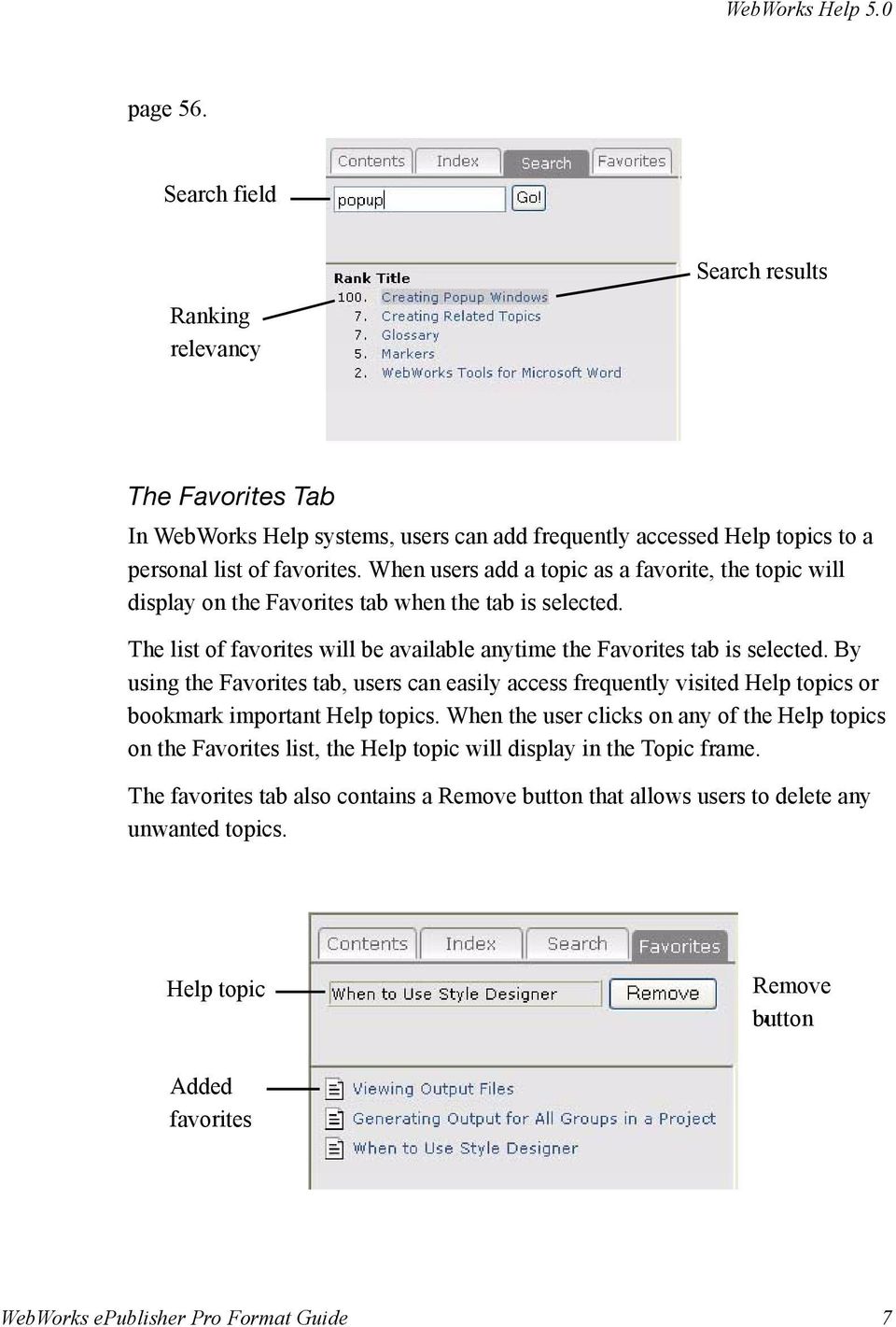
6 Formats: WebWorks Help 5.0 Index letter groups Keywords Related index entries The Search Tab The search tab displays a search field where the user can enter text, then select Go to return results related to the search text. The title whose content contains the word or phrase will be listed below the search field. All topics that contain the word or phrase that matches the search entry will display under Rank and Title fields. Each returned search result will have a relevancy ranking, which is the number that displays next to the topic. The relevancy ranking reflects how well the returned search result has matched the search criteria specified in wwh_files.xsl. For more information on how to modify the ranking relevancies, please see Modifying the Search Rank on 6 WebWorks epublisher Pro Format Guide


7 WebWorks Help 5.0 page 56. Search field Search results Ranking relevancy The Favorites Tab In WebWorks Help systems, users can add frequently accessed Help topics to a personal list of favorites. When users add a topic as a favorite, the topic will display on the Favorites tab when the tab is selected. The list of favorites will be available anytime the Favorites tab is selected. By using the Favorites tab, users can easily access frequently visited Help topics or bookmark important Help topics. When the user clicks on any of the Help topics on the Favorites list, the Help topic will display in the Topic frame. The favorites tab also contains a Remove button that allows users to delete any unwanted topics. Help topic Remove button Added favorites WebWorks epublisher Pro Format Guide 7
8 Formats: WebWorks Help 5.0 The Toolbar Frame The Topic Frame By default, the toolbar frame displays a set of buttons that provides users with additional functionality and navigational resources. These toolbar buttons allow the users to navigate through the content of the Help set. The standard WebWorks Help toolbar comes with the following buttons: Show in Contents button: Use this button to locate where the currently displayed topic is in the Contents tab. When you click on this button, WebWorks Help highlights the entry in the Contents tab that corresponds to the currently displayed topic. Previous button: Click on the Previous button to display the topic that precedes the currently displayed topic. Next button: Click on the Next button to display the topic that follows the currently displayed topic. PDF button: Click on the PDF button to display a PDF of the source document from which the currently displayed topic resides. Related Topics button: Click on the Related Topics button to open a menu that lists topics related to the currently displayed topic. You must set up Related Topics in your FrameMaker file in order for the Related Topics button to work correctly in your Help system. For more information, please see Creating Related Topics on page 23. Print button: Click on the Print button to print the currently displayed topic. button: The button enables you to gather feedback by from the users of your WebWorks Help system. When a user clicks on this button, the user s program opens a new, blank message addressed to an you specify. The Subject line of the message identifies the Help topic that was displayed when the user clicked the button. The output pages that are generated from your source documents will display in the topic frame. Anytime a user selects a topic from the Contents, Search, Index, or Favorites tab, the topic page will display in the Topic frame. 8 WebWorks epublisher Pro Format Guide

9 WebWorks Help 5.0 Topic Only View The topic only view displays only two areas: an area for toolbar buttons and another for Help topics. Using the topic only view, an application can open a smaller browser window that leaves more room onscreen for the application itself. Typically, context-sensitive Help uses the topic only view. Customizing WebWorks Help You can customize the appearance of your WebWorks Help set. By customizing your WebWorks Help set, you can add different functionalities and features to your Help system. There are two types of customizations: standard customizations and WebWorks Help specific customizations. Standard Customizations Standard customizations refer to any modifications that can be made to most formats, such as adding your company s contact information or specifying the HEX color value for your hyperlinks. Within each format, there are different methods of implementing standard customizations. In the following sections, we will cover the standard customizations that are applicable to WebWorks Help 5.0. Note: Typically, customizations to the WebWorks Help 5.0 format will require that you create a project format override. These are the standard customizations that you can apply to WebWorks Help: Customizing hyperlink colors Adding a logo to your topic pages Modifying the company contact information Displaying company contact information Disabling autonumbering from appearing in output Modifying Page.asp Creating popups WebWorks epublisher Pro Format Guide 9

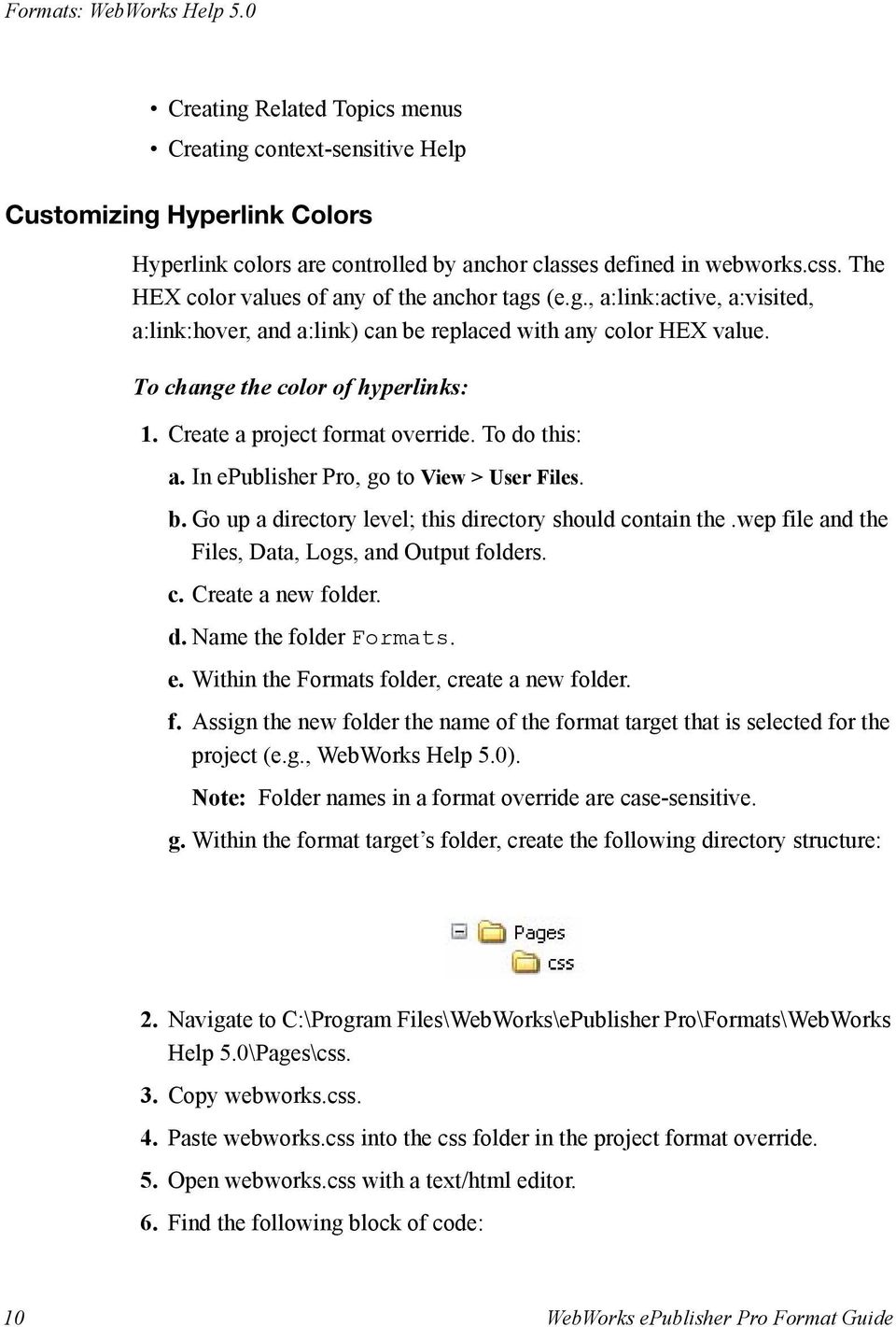
10 Formats: WebWorks Help 5.0 Creating Related Topics menus Creating context-sensitive Help Customizing Hyperlink Colors Hyperlink colors are controlled by anchor classes defined in webworks.css. The HEX color values of any of the anchor tags (e.g., a:link:active, a:visited, a:link:hover, and a:link) can be replaced with any color HEX value. To change the color of hyperlinks: 1. Create a project format override. To do this: a. In epublisher Pro, go to View > User Files. b. Go up a directory level; this directory should contain the.wep file and the Files, Data, Logs, and Output folders. c. Create a new folder. d. Name the folder Formats. e. Within the Formats folder, create a new folder. f. Assign the new folder the name of the format target that is selected for the project (e.g., WebWorks Help 5.0). Note: Folder names in a format override are case-sensitive. g. Within the format target s folder, create the following directory structure: 2. Navigate to C:\Program Files\WebWorks\ePublisher Pro\Formats\WebWorks Help 5.0\Pages\css. 3. Copy webworks.css. 4. Paste webworks.css into the css folder in the project format override. 5. Open webworks.css with a text/html editor. 6. Find the following block of code: 10 WebWorks epublisher Pro Format Guide
11 WebWorks Help 5.0 a:link:active { color: #0000CC} a:link:hover { color: #CC0033} a:link { color: #3366CC} a:visited { color: #9999CC} 7. Replace any of the color values with the HEX values you would like to use. a:link:active controls the color of the link when it is selected. a:link:hover controls the color of the link when the user hovers over the link. a:link controls the color of unvisited links. a:visited controls the color of links that have already been visited. 8. Save webworks.css. 9. In epublisher Pro, go to Project > Regenerate All. Adding a Logo If you add a logo image to your project, the logo will display alongside your company contact information on the top and/or bottom of the output pages in your Help system. There is a three-step process in order to get your logo image to display in your output. First, you must place the image that will be used as the logo in the User Files directory; next, you must select the image in Format Settings; finally, you must enable company information to display by using the Style Designer. To add a logo: 1. In epublisher Pro, select View > User Files. 2. Place the logo image into this directory. 3. Select Format > Format Settings. 4. Click on the value field next to the Company logo image setting. 5. Type in the name of the logo image (e.g., logo.gif) or click on the button to select the image from the User Files directory. 6. Click OK to close the Format Settings dialog box. 7. Select View > Style Designer. WebWorks epublisher Pro Format Guide 11

12 Formats: WebWorks Help Click on the Page Styles tab. 9. Select the Default page style. 10. Click on the Options tab. 11. Enable the company information for the top and/or the bottom. 12. Close the Style Designer. 13. Select Project > Regenerate All. Modifying the Company Contact Information You can add your company s contact information to each output page in your Help system. By default, the company contact information can display on the bottom and/or top of your output pages. You specify where the company contact information displays by enabling the Company info displayed at top or Company info displayed at bottom options in the Style Designer. With WebWorks Help 5.0, you can specify your company s name, address, phone number, fax number, and Web page. Note: Once you have specified your company s contact information, you will need to enable the Company info display options in the Style Designer. For more information, please see Displaying Company Contact Information on page 14. To modify the company address: 1. Select Format > Format Settings. 2. Find the setting Company address. 3. In the Value field, type in the address (e.g., [email protected]). 4. Click OK to close the Format Settings dialog box. Note: In order to display company information on the output pages, you must have the company information option enabled in the Style Designer. For more information, please see Displaying Company Contact Information on page 14. To modify the company fax number: 12 WebWorks epublisher Pro Format Guide

13 WebWorks Help Select Format > Format Settings. 2. Find the setting Company fax number. 3. In the Value field, type in the fax number (e.g., ). 4. Click OK to close the Format Settings dialog box. Note: In order to display company information on the output pages, you must have the company information option enabled in the Style Designer. For more information, please see Displaying Company Contact Information on page 14. To modify the company name: 1. Select Format > Format Settings. 2. Find the setting Company name. 3. In the Value field, type in the company s name (e.g., Quadralay Corporation). 4. Click OK to close the Format Settings dialog box. Note: In order to display company information on the output pages, you must have the company information option enabled in the Style Designer. For more information, please see Displaying Company Contact Information on page 14. To modify the company phone number: 1. Select Format > Format Settings. 2. Find the setting Company phone number. 3. In the Value field, type in the phone number (e.g., ). 4. Click OK to close the Format Settings dialog box. Note: In order to display company information on the output pages, you must have the company information option enabled in the Style Designer. For more information, please see Displaying Company Contact Information on page 14. WebWorks epublisher Pro Format Guide 13
14 Formats: WebWorks Help 5.0 To modify the company Web page: 1. Select Format > Format Settings. 2. Find the setting Company webpage. 3. In the Value field, type in the URL to the company s website (e.g Click OK to close the Format Settings dialog box. Note: In order to display company information on the output pages, you must have the company information option enabled in the Style Designer. For more information, please see Displaying Company Contact Information on page 14. Displaying Company Contact Information After you have specified your company s contact information such as your company s name and phone number you need to enable either one or both of the Company info display options in the Style Designer. If you open the Style Designer and click on the Page Styles tab, and then click on the Options tab, you will see that there are two options to enable where your company contact information is located: Company info displayed at bottom or Company info displayed at top. To display company information at the top of your topic page: 1. Select View > Style Designer. 2. Click on the Page Styles tab. 3. Select the Default page style. 4. Click on the Options tab. 5. Find the option Company info displayed at top. 6. Click on the drop-down button and select Enabled. 7. Close the Style Designer. 8. Select Project > Regenerate All. 14 WebWorks epublisher Pro Format Guide

15 WebWorks Help 5.0 To display company information at the bottom of your topic page: 1. Select View > Style Designer. 2. Click on the Page Styles tab. 3. Select the Default page style. 4. Click on the Options tab. 5. Find the option Company info displayed at bottom. 6. Click on the drop-down button and select Enabled. 7. Close the Style Designer. Select Project > Regenerate All. Disabling Autonumbering from Appearing in Output Oftentimes in your source document(s), you will have autonumbering enabled for print delivery purposes (e.g., printed manuals and PDFs). This allows you to append autogenerated numbers to your chapters and headings; however, for online delivery, you might not want to include autonumbering in your Help system. In epublisher Pro, there is an option in the Style Designer that allows you to disable autonumbering in your output. To disable autonumbering: 1. Select View > Style Designer. 2. Click on the Paragraph Styles tab. 3. Select the paragraph style that contains the autonumbering. 4. Click on the Options tab. 5. For the option Keep paragraph numbering, choose Disabled. 6. Close the Style Designer. Modifying Page.asp If you need to modify the formatting or display of any of the company information that displays at the top or bottom of your output pages, then you will WebWorks epublisher Pro Format Guide 15

16 Formats: WebWorks Help 5.0 need to modify Page.asp. For example, if you would like to change the font that your company s contact information displays in, then you would need to modify Page.asp. To modify Page.asp: 1. Create a project format override. To do this: a. In epublisher Pro, go to View > User Files. b. Go up a directory level; this directory should contain the.wep file and the Files, Data, Logs, and Output folders. c. Create a new folder. d. Name the folder Formats. e. Within the Formats folder, create a new folder. f. Assign the new folder the name of the format target that is selected for the project (e.g., WebWorks Help 5.0). Note: Folder names in a format override are case-sensitive. g. Within the format target s folder, create a new folder. h. Name the new folder Pages. i. Open a new browser window. j. Navigate to: C:\Program Files\WebWorks\ePublisher Pro\Formats\WebWorks Help 5.0\Pages. k. Copy Page.asp. l. Close the browser window. m.paste Page.asp into the Pages folder of your project format override. n. Open Page.asp with an HTML or text editor (e.g., Notepad). o. Make your changes to Page.asp. For example, if you want to change the font of your company phone number from Times New Roman to Sans-serif, then you will need to find the following block of code: <tr wwpage:condition="company-phone-exists"> <td style="text-align: right; font-size: 12px" 16 WebWorks epublisher Pro Format Guide

17 WebWorks Help 5.0 wwpage:content="company-phone"> Phone: </td> </tr> and replace it with: <tr wwpage:condition="company-fax-exists"> <td style="text-align: right; font-size: 12px; fontfamily: sans-serif" wwpage:content="company-fax"> Fax: </td> </tr> p. Save Page.asp. q. In your epublisher Pro project, select Project > Rengenerate All. Creating Popups To create popup windows, there must be a link between the hot text and the content it will display; after the popup links have been created, popups may be implemented by using marker styles or paragraph styles. Once you set up the hyperlinks in your source document and apply paragraph or marker styles to your content, you will need to assign popup behavior to your paragraph and marker styles. Using Marker Styles to Create Popups The three marker styles that are involved in creating usable popups are Popup, PopupOnly, and PopupEnd. These markers will be inserted into the source document to specify what content will be displayed through the popup window and whether or not the popup content will display in only a popup window or in both a popup window and through a clickable link. After the popup markers have been properly embedded in the source document(s), popup behavior needs to be assigned to the paragraph styles in the project. Here are the popup behaviors that can be assigned to marker styles: Popup start: Use this option to designate this marker style as the starting point for popup content. Popup start with no output: Use this option to designate this marker style WebWorks epublisher Pro Format Guide 17

18 Formats: WebWorks Help 5.0 as the starting point for popup content. Popup end: Use this option to designate this maker as the ending point for popup content. To display popups through a window and a clickable link: 1. Create the hyperlink between the hot text and the content to be displayed and ensure that the link resolves in the document. If you have problems creating the hyperlink, refer to your authoring tool s Help documentation for information on creating hyperlinks. Note: If you have more than one paragraph in the popup window the hyperlink should go to the first paragraph. 2. Place the insertion point at the beginning of the content to be displayed in the popup window. 3. Do one of the following: For Adobe FrameMaker: a. Go to Special Marker. b. Select Edit... from the Marker Type drop-down menu. c. Create a custom marker named Popup. d. Click Add. e. Click Done. f. Choose Popup from the Marker Type drop-down menu. g. Leave the Marker Text blank. h. Insert the new Popup marker. i. Place the insertion point at the end of the content to be displayed in the popup window. j. Select Edit... from the Marker Type drop-down menu. k. Create a custom marker named PopupEnd. l. Leave the Marker Text blank. m.insert the new PopupEnd marker. 18 WebWorks epublisher Pro Format Guide

19 WebWorks Help 5.0 For Microsoft Word: a. Place the insertion point at the beginning of the content to be displayed in the popup window. b. From the menu bar in Word, go to WebWorks Markers. c. Choose Popup from the list of markers. d. Leave the Value blank. e. Click OK to insert the marker. f. From the menu bar in Word, go to WebWorks Markers. g. Choose PopupEnd from the list of markers. h. Leave the Value field blank. i. Click OK to insert the PopupEnd marker. 4. In your project, select Project > Scan All Documents. 5. After the scanning process is complete, select View > Style Designer. 6. Click on the Marker Styles tab. 7. Select the Popup marker style. 8. From the Options tab, click on the drop-down button located in the Value field of the Marker type option. 9. Select the popup marker behavior Popup start. 10. Select the PopupEnd marker style. 11. From the Options tab, click on the drop-down button located in the Value field of the Marker type option. 12. Select the popup marker behavior Popup end. 13. Close the Style Designer. 14. Select Project > Regenerate All. To display popups through a window only: 1. Create the hyperlink between the hot text and the content to be displayed and ensure that the link resolves in the document. If you have problems creating the hyperlink, refer to your authoring tool s Help documentation for WebWorks epublisher Pro Format Guide 19

20 Formats: WebWorks Help 5.0 information on creating hyperlinks. Note: If you have more than one paragraph in the popup window the hyperlink should go to the first paragraph. 2. Place the insertion point at the beginning of the content to be displayed in the popup window. 3. Do one of the following: For Adobe FrameMaker: a. Go to Special Marker. b. Select Edit... from the Marker Type drop-down menu. c. Create a custom marker named PopupOnly. d. Click Done. Choose Popup from the Marker Type drop-down menu. e. Leave the Marker Text blank. f. Insert the new PopupOnly marker. g. Place the insertion point at the end of the content to be displayed in the popup window. h. Select Edit... from the Marker Type drop-down menu. i. Create a custom marker named PopupEnd. j. Leave the Marker Text blank. k. Insert the new PopupEnd marker. For Microsoft Word: a. From the menu bar in Word, go to WebWorks > Markers. b. Choose PopupOnly from the list of markers. c. Leave the Value blank. d. Click OK to insert the marker. e. From the menu bar in Word, go to WebWorks > Markers. f. Choose PopupEnd from the list of markers. g. Leave the Value field blank. 20 WebWorks epublisher Pro Format Guide

21 WebWorks Help 5.0 h. Click OK to insert the PopupEnd marker. 4. In your project, select Project > Scan All Documents. 5. After the scanning process is complete, select View > Style Designer. 6. Click on the Marker Styles tab. 7. Select the PopupOnly marker style. 8. From the Options tab, click on the drop-down button located in the Value field of the Marker type option. 9. Select the popup marker behavior Popup start with no output. 10. Select the PopupEnd marker style. 11. From the Options tab, click on the drop-down button located in the Value field of the Marker type option. 12. Select the popup marker behavior Popup end. 13. Close the Style Designer. 14. Select Project > Regenerate All. Using Paragraph Styles to Create Popups With epublisher Pro, you can use paragraph styles to create popups. There are two ways to do this: you can either create unique paragraph styles in your source document(s) dedicated solely to popup content and assign popup behavior to the paragraph styles using the Style Designer, or you can use the Document Designer to assign popup behavior to specific paragraphs in your output. In the latter method, you do not have to designate any styles solely for popup content. The popup content can use any existing paragraph style in your source document(s). The major difference between the two methods is that by using the Style Designer, you are assigning popup behavior to all content in your source document(s) that use that particular paragraph style, but by using the Document Designer, you are assigning popup behavior only to that instance of that paragraph style. Here are the popup behaviors that can be assigned to paragraph styles: Define: Use this option if you would like to display the popup text in a WebWorks epublisher Pro Format Guide 21
22 Formats: WebWorks Help 5.0 window and through a clickable link; however, select this option only if the paragraph style is applied to the first paragraph of popup content. Define with no output: Use this option if you would like to display the popup text only in a window; however, select this option only if the paragraph style is applied to the first paragraph of popup content. Append: Use this option if the paragraph style is applied to additional paragraphs following the first paragraph of popup content; however, select this option only if the paragraph style follows a paragraph style whose popup option has been set to Define. Append with no output: Use this option if the paragraph style is applied to additional paragraphs following the first paragraph of popup content; however, select this option only if the paragraph style follows a paragraph style whose popup option has been set to Define with no output. To create popups using the Style Designer: 1. In your source document(s), create the hyperlink between the hot text and the content that will be displayed in the popup window. Note: If you have more than one paragraph in the popup window the hyperlink should go to the first paragraph. 2. Create a unique paragraph style in your source document. Note: This paragraph style will only be applied to the content that will appear in the popup window. If the popup window will contain more than one paragraph, you will need to create a second paragraph style and apply it to any paragraphs following the first paragraph that should appear in the popup window. 3. In your project, select View > Style Designer. 4. Click on the Paragraph Styles tab. 5. Select the paragraph style that you would like to modify. 6. Click on the Options tab. 7. For the Popup option, click on the drop-down button and select one of the popup behaviors (Define, Define with no output, Append, or Append with no 22 WebWorks epublisher Pro Format Guide
23 WebWorks Help 5.0 output). For information on popup options, please see Using Paragraph Styles to Create Popups on page Close the Style Designer. 9. Select Project > Regenerate All. To create popups using the Document Designer: 1. Create the hyperlink between the hot text and the content that will be displayed in the popup window. Note: If you have more than one paragraph in the popup window the hyperlink should go to the first paragraph. 2. In the Document Manager, select the document in which the content that will be displayed in the popup window resides. 3. Select Project > Display Preview to generate a preview for this document. 4. In the preview, select the first paragraph of the content that will be displayed in the popup window. 5. From the Document Designer, click on the Options tab. 6. For the Popup option, click on the drop-down button and select one of the popup behaviors (e.g. Define, Define with no output, Append, or Append with no output). For more information on popup behaviors, please see Using Paragraph Styles to Create Popups on page Select Project > Regenerate All. Creating Related Topics Topics the author feels are similar to the current topic or that may be of additional interest to the user are called Related Topics. Related Topics may be configured to display on the click of a button or both on the click of a button and as a list of links within the topic. Related Topics links are essentially cross-references to other corresponding topics within your Help system. Instead of displaying cross-references directly in your output, you can create a list of Related Topics links. WebWorks epublisher Pro Format Guide 23
24 Formats: WebWorks Help 5.0 There are two ways Related Topics can display in your output: 1. Related Topics button only In your online content, the Related Topics list will only display within the v popup menu when the user clicks on the Related Topics button. The following illustration shows online content that displays only the Related Topics button. When the user clicks on the related topics button, a popup menu of Related Topics links will display. 2. Related Topics button and Related Topics links In your output, you can display the Related Topics list within a Related Topicss button as well as within the body of your content. In the following illustration, the Related Topics list displays from a popup menu, and it is also included within the content of the topic. 24 WebWorks epublisher Pro Format Guide
25 WebWorks Help 5.0 To create a Related Topics button and have the Related Topics links display in the output, in the source document, you need to create a paragraph style that will specifically apply to the Related Topics lists; then, you will need to create a list of Related Topics links for that particular section. To create the Related Topics list: 1. Identify the topic in which you would like to insert a Related Topics list. 2. Create a unique paragraph style that will be used specifically for the Related Topics list. 3. Identify the various topics to which you will be linking from this topic. Note: Generally, you should only create one Related Topics list for each section of your source document that corresponds to a Help topic. For example, if you have specified in your WebWorks epublisher Pro project that there will be a page break at each Heading 1 section, then you should only create one Related Topics list for each Heading 1 section within your source document. WebWorks epublisher Pro Format Guide 25
26 Formats: WebWorks Help Create and insert the list of cross-references to the topics you have chosen in step Apply the paragraph style you created in step 1 to the Related Topics list. 6. Save the document(s). 7. In WebWorks epublisher Pro, using either the Style Designer or Document Designer, select the paragraph style that you have assigned to your Related Topics lists. 8. Click on the Options tab. 9. Find the related-topic option. 10. Click on the drop-down arrow to display the related-topic options. Choose define if you want the related topics list to display both within the body of your topic and when the related topics button is clicked. Choose define-no-output if you want the related topics list to display only when the related topics button is clicked. Creating Context-Sensitive Help Contextual Help provides immediate assistance without requiring the user to leave the context in which he or she is working. It helps answer questions like "What is this?" and "Why would I use this?", providing information for a particular object and its context. In many applications, user interface controls (i.e., windows, tabs, buttons, etc.) have identifiers.when a user clicks on a Help button in an application dialog, the application calls this Help topic; the application relies on the identifier that has been implemented to identify the specific topic to be displayed. WebWorks epublisher Pro uses topic IDs as the identifier, in the form of TopicAlias markers, to create the bridge between the application and the Help system. In WebWorks Help, creating context-sensitive Help is a three-step process. First, you need to embed TopicAlias markers into your source documents; next, you need to assign topic alias marker behavior to your TopicAlias markers through the Style Designer; and finally, you need to call WebWorks Help from your application using either URL calls or the WebWorks Help API. 26 WebWorks epublisher Pro Format Guide
27 WebWorks Help 5.0 Before you begin: Collaborate with application developers about defining topic IDs as soon as possible. Topic IDs must follow these guidelines: Must be unique Must begin with an alphabetical character May contain alphanumeric characters May not contain special characters or spaces, with the exception of underscores ( _ ) To embed topic IDs in a FrameMaker document: 1. Navigate, in your source document, to the topic or paragraph that will be used as the Help topic. Most often, this is a heading paragraph that has a page break defined in WebWorks epublisher Pro; however, you can choose any paragraph in your source document. 2. Insert a TopicAlias marker in the topic or paragraph using the topic ID as the marker value. To do this: a. Place the insertion point at the beginning of the topic or paragraph. b. Go to Special Marker. c. In the Marker Type drop-down menu select Edit... d. Name the marker TopicAlias and click Add. e. TopicAlias should now be the specified Marker Type. Place the topic ID for the Marker Text. f. Click New Marker. 3. Save the document(s). 4. In your WebWorks epublisher Pro project, scan your documents and generate your project. To embed topic IDs in a Word document: 1. Place the insertion point at the beginning of the topic or paragraph. WebWorks epublisher Pro Format Guide 27
28 Formats: WebWorks Help Go to WebWorks Insert TopicAlias marker Place the topic ID in the available field. 4. Click OK. 5. Save the document(s). 6. In your WebWorks epublisher Pro project, scan your documents and generate your project. You will see hidden text (indicated by the dotted line underneath the text) appear with the type of marker (TopicAlias) and the value of this marker (topic ID). Note: You may need to choose WebWorks > Show/Hide Hidden Text and Fields to see the marker you inserted. WebWorks epublisher Pro will add these markers to the project and set the marker behavior to Topic alias. To assign topic alias behavior to topic alias markers: 1. In epublisher Pro, select View > Style Designer. Note: Make sure that you have scanned your source document(s) so that any changes to styles have been picked up. 2. Click on the Marker Styles button. 3. Select the TopicAlias marker from the list of marker styles. 4. From the Options tab, find the Marker type option. 5. Click in the Value field next to the option to enable the drop-down menu. 6. Select Topic alias from the list of marker behaviors. 7. Close the Style Designer. 8. Select Project > Regenerate All. Calling WebWorks Help Once you have embedded TopicAlias markers into your source document(s) and have assigned topic alias behavior to the markers, you are ready to implement context-sensitive Help. The next step in creating context-sensitive Help requires 28 WebWorks epublisher Pro Format Guide
29 WebWorks Help 5.0 you to call WebWorks Help from your application. There are two ways to call WebWorks Help: by using standard URLs or by using the WebWorks Help API. To call the entire WebWorks Help system using URLs: The call you need to make from your application needs to be in one of the following formats: Use this URL call if the WebWorks Help system is stored on a Web server. file:///c:/program Files/YourApplication/Help/index.htm Use this URL call if the WebWorks Help system is stored in the end user's local file system. To call an individual topic using URLs: The call you need to make from your application needs to be in one of the following formats: topic=topicid, where GROUPNAME is the name of the the first-level group in which the topic resides, and TOPICID refers to the marker text used in the topic alias marker for that topic. file:///c:/program Files/YourApplication/Help/index.htm&context=GROUPNAME&topic= TOPICID, where GROUPNAME is the name of the first-level group in which the topic resides, and TOPICID refers to the marker text used in the topic alias marker for that topic. To call WebWorks Help using the WebWorks Help API: WebWorks Help incorporates an API that software developers can use to call context-sensitive topics in a WebWorks Help system. Using the API instead of simple URLs gives the developer increased flexibility and enhanced control. Benefits of using the API include the following: The API automatically determines the user's default browser and opens it to display the correct Help topic. WebWorks epublisher Pro Format Guide 29
30 Formats: WebWorks Help 5.0 The API reduces the amount of code software developers must write in order to integrate context-sensitive Help. Without the API, developers must code their own COM interface to communicate with Internet Explorer on the Win-dows platform. This code is provided as part of the WebWorks Help API. Using the API can significantly reduce the time required to load an individual topic if the Help system is already open in the browser window. If your appli-cation calls a topic using a URL instead of the API, the entire frameset, includ-ing the WebWorks Help applet, is loaded each time the user invokes Help. If the application calls a topic using the API, and the correct helpset is already loaded in the browser window, neither the frameset nor the applet is reloaded; instead, the topic frame is used to display the correct Help topic. This results in a significant performance improvement for users of your WebWorks Help system. The WebWorks Help API is a C/C++ API and can be used with applications written in C, C++, Visual Basic, and Java. We have not yet updated the API for WebWorks Help 5.0; however, the WebWorks Help 4.0 API can be used. Just be sure not to use any of the Java navigation options, as WebWorks Help 5.0 does not include the Java navigation. The WebWorks Help API is available for download at Customizations Specific to WebWorks Help This section will cover project customizations specific to WebWorks Help 5.0. WebWorks Help specific customizations refer to any project or output modifications that can only be applied to WebWorks Help output such as replacing the splash image and using custom icons in the Contents tab. These types of customizations are specific to WebWorks Help: Adding a PDF button to the toolbar Replacing the splash image Removing the splash page Changing the toolbar buttons 30 WebWorks epublisher Pro Format Guide
31 WebWorks Help 5.0 Changing the background color of the toolbar Setting the initial width of the frame Controlling the appearance of the hover text in the navigation frame Customizing the font properties on all tabs Using custom icons in the Contents tab Customizing popup topics Modifying the appearance of the search message Modifying the search rank Changing the theme of the Help system Modifying the appearance of popups Renaming the top-level file Modifying the appearance of breadcrumbs Adding a PDF Button to the Toolbar In your epublisher Pro project, you can generate PDFs for each source document and/or each top-level group. You can either deliver the PDFs separately from your Help system, or you can add a PDF button to your toolbar that will display the PDFs in the frameset. The PDF that displays when you click on the PDF button depends on whether you have generated PDFs for the top-level groups or each source document in your project. In your project, if you have selected to: Generate PDFs only for the top-level groups, then when you click the PDF button, the PDF for the top-level group in which the currently viewed topic is located will display. Generate PDFs only for each source document, then when you click the PDF button, the PDF for the source document in which the currently viewed topic is located will display. Generate PDFs for all source documents and for all top-level groups, then when you click the PDF button, the PDF for the source document in which the currently viewed topic is located will display. WebWorks epublisher Pro Format Guide 31
32 Formats: WebWorks Help 5.0 For more information on generating PDFs, please see Creating PDFs on page 62. To add a PDF button to your toolbar: 1. In epublisher Pro, select Format > Format Settings. 2. Find the option Show PDF button. 3. Click in the Value field next to the option to enable the drop-down menu. 4. Select Enabled. 5. Close the Style Designer. 6. Select Project > Regenerate All. Replacing the Splash Image The splash page is the first page that displays in the topic frame when the Help set launches initially. By default, WebWorks Help systems display the WebWorks splash image; however, you can replace the default splash image with a custom image. To replace the splash image: 1. Create a project format override. To do this: a. In epublisher Pro, go to View > User Files. b. Go up a directory level; this directory should contain the.wep file and the Files, Data, Logs, and Output folders. c. Create a new folder. d. Name the folder Formats. e. Within the Formats folder, create a new folder. f. Assign the new folder the name of the format target that is selected for the project (e.g., WebWorks Help 5.0). Note: Folder names in a format override are case-sensitive. g. Within the format target s folder, create the following directory structure: 32 WebWorks epublisher Pro Format Guide
33 WebWorks Help 5.0 Note: Replace the Lobby_Blue folder with the name of the skin or theme that is used in the project. If the theme consists of two words, separate the words with an underscore (e.g., Architect_Red, Aero_Blue, Freeform_Green, etc.). To determine what theme the project is using, go to Format > Format Settings and find the Theme setting. 2. Within the images folder, place the image that will be used as the splash image. 3. Rename the image splash.jpg. 4. In the epublisher Pro project, select Project > Regenerate All. Removing the Splash Page Initially, when WebWorks Help launches, it displays the splash page; however, instead of displaying the splash page, WebWorks Help can display the first topic page instead. This means that when the Help system launches, it will take you directly to the first topic page of your Help set. To remove the splash page: 1. Create a project format override. To do this: a. In epublisher Pro, go to View > User Files. b. Go up a directory level; this directory should contain the.wep file and the Files, Data, Logs, and Output folders. c. Create a new folder. d. Name the folder Formats. e. Within the Formats folder, create a new folder. f. Assign the new folder the name of the format target that is selected for the WebWorks epublisher Pro Format Guide 33
34 Formats: WebWorks Help 5.0 project (e.g., WebWorks Help 5.0). Note: Folder names in a format override are case-sensitive. g. Within that folder, create the following directory structure: 2. Navigate to C:\Program Files\WebWorks\ePublisher Pro\Formats\WebWorks Help 5.0\Files\wwhelp\wwhimpl\common\html. 3. Copy first.htm. 4. Paste first.htm into the html folder in the project format override. 5. Rename first.htm to default.htm 6. In epublisher Pro, select Project > Regenerate All. Changing the Toolbar Buttons WebWorks Help systems have a standard toolbar that comes with the following buttons: Show in Contents button Previous button Next button PDF button Related Topics button Print button button These buttons allow you to navigate through the Help system, and they provide you with additional features such as printing a page from the Help set or e- mailing a link to a topic page. The buttons on the toolbar are actual GIF images located in the images folder of your project theme s diretory; therefore, these 34 WebWorks epublisher Pro Format Guide
35 WebWorks Help 5.0 standard buttons can either be replaced with another GIF image or removed from the toolbar. Removing or Replacing the Show in Contents Button The Show in Contents button allows users to synch the topic they are viewing to the TOC. To remove the Show in Contents button: 1. In epublisher Pro, go to Format > Format Settings. 2. Find the setting Automatically synchronize the TOC. 3. Change the value to Disabled. 4. Click OK to close the Format Settings dialog box. To replace the Show in Contents button: 1. Create a project format override. To do this: a. In epublisher Pro, go to View > User Files. b. Go up a directory level; this directory should contain the.wep file and the Files, Data, Logs, and Output folders. c. Create a new folder. d. Name the folder Formats. e. Within the Formats folder, create a new folder. f. Assign the new folder the name of the format target that is selected for the project (e.g., WebWorks Help 5.0). Note: Folder names in a format override are case-sensitive. g. Within the format target s folder, create the following directory structure: WebWorks epublisher Pro Format Guide 35
36 Formats: WebWorks Help 5.0 Note: Replace the Lobby_Blue folder with the name of the skin or theme that is used in the project. If the theme consists of two words, separate the words with an underscore (e.g., Architect_Red, Aero_Blue, Freeform_Green, etc.). To determine what theme the project is using, go to Format > Format Settings and find the Theme setting. 2. Inside the images folder, place the image that will be used as the Show in Contents button. 3. Name the image syncx.gif. 4. In epublisher Pro, select Project > Regenerate All. Removing and Replacing the Previous and Next Buttons The previous button allows users to navigate back to preceding topics in the Help system. To remove the Previous and Next button: 1. In epublisher Pro, go to Format > Format Settings. 2. Find the setting Show previous & next toolbar buttons. 3. Change the value to Disabled. 4. Click OK to close the Format Settings dialog box. To replace the Previous button: 1. Create a project format override. To do this: a. In epublisher Pro, go to View > User Files. 36 WebWorks epublisher Pro Format Guide
37 WebWorks Help 5.0 b. Go up a directory level; this directory should contain the.wep file and the Files, Data, Logs, and Output folders. c. Create a new folder. d. Name the folder Formats. e. Within the Formats folder, create a new folder. f. Assign the new folder the name of the format target that is selected for the project (e.g., WebWorks Help 5.0). Note: Folder names in a format override are case-sensitive. g. Within the format target s folder, create the following directory structure: Note: Replace the Lobby_Blue folder with the name of the skin or theme that is used in the project. If the theme consists of two words, separate the words with an underscore (e.g. Architect_Red, Aero_Blue, Freeform_Green, etc.). To determine what theme the project is using, go to Format > Format Settings, and find the Theme setting. 2. Inside the images folder, place the image that will be used as the Previous button. 3. Name the image prev.gif. 4. In epublisher Pro, select Project > Regenerate All. To replace the Next button: 1. Create a project format override. To do this: a. In epublisher Pro, go to View > User Files. WebWorks epublisher Pro Format Guide 37
38 Formats: WebWorks Help 5.0 b. Go up a directory level; this directory should contain the.wep file and the Files, Data, Logs, and Output folders. c. Create a new folder. d. Name the folder Formats. e. Within the Formats folder, create a new folder. f. Assign the new folder the name of the format target that is selected for the project (e.g., WebWorks Help 5.0). Note: Folder names in a format override are case-sensitive. g. Within the format target s folder, create the following directory structure: Note: Replace the Lobby_Blue folder with the name of the skin or theme that is used in the project. If the theme consists of two words, separate the words with an underscore (e.g., Architect_Red, Aero_Blue, Freeform_Green, etc.). To determine what theme the project is using, go to Format > Format Settings and find the Theme setting. 2. Inside the images folder, place the image that will be used as the Previous button. 3. Name the image next.gif. 4. In epublisher Pro, go to Project > Regenerate All. Changing the Background Color of the Toolbar The toolbar in WebWorks Help 5.0 is composed of a single repeating GIF image: toolsbg.gif. This image is located in the images folder of your project s theme 38 WebWorks epublisher Pro Format Guide
39 WebWorks Help 5.0 directory. To modify the background color of the toolbar, you will need to modify the color of toolsbg.gif with an image editor. To change the background color of the toolbar: 1. Create a project format override. To do this: a. In epublisher Pro, go to View > User Files. b. Go up a directory level; this directory should contain the.wep file and the Files, Data, Logs, and Output folders. c. Create a new folder. d. Name the folder Formats. e. Within the Formats folder, create a new folder. f. Assign the new folder the name of the format target that is selected for the project (e.g., WebWorks Help 5.0). Note: Folder names in a format override are case-sensitive. g. Within the format target s folder, create the following directory structure: Note: Replace the Lobby_Blue folder with the name of the skin or theme that is used in the project. If the theme consists of two words, separate the words with an underscore (e.g., Architect_Red, Aero_Blue, Freeform_Green, etc.). To determine what theme the project is using, go to Format > Format Settings and find the Theme setting. 2. Navigate to C:\Program Files\WebWorks\ePublisher Pro\Formats\WebWorks Help 5.0\Skins\Lobby_Blue\Files\wwhelp\wwhimpl\common\images. WebWorks epublisher Pro Format Guide 39
40 Formats: WebWorks Help 5.0 Note: Replace the Lobby_Blue folder with the name of the skin or theme that is used in the project. 3. Copy toolsbg.gif. 4. Paste toolsbg.gif into the images folder in the project format override. 5. Open toolsbg.gif with an image editor (e.g., Paint). 6. Modify toolsbg.gif to reflect the color that will be used as the toolbar background and save the changes to the image. 7. In epublisher Pro, select Project > Regenerate All. Setting the Initial Width of the Navigation Frame The navigation frame refers to the pane that contains the Contents, Index, Search, and Favorites tabs. When a WebWorks Help system launches, the initial width of the navigation frame is set to 300 pixels; however, by modifying wwhelp.htm, you can specify the initial width of the navigation frame when the Help set opens initially. To set the initial width of the navigation frame: 1. Create a project format override. To do this: a. In epublisher Pro, go to View > User Files. b. Go up a directory level; this directory should contain the.wep file and the Files, Data, Logs, and Output folders. c. Create a new folder. d. Name the folder Formats. e. Within the Formats folder, create a new folder. f. Assign the new folder the name of the format target that is selected for the project (e.g., WebWorks Help 5.0). Note: Folder names in a format override are case-sensitive. g. Within the format target s folder, create the following directory structure: 40 WebWorks epublisher Pro Format Guide
41 WebWorks Help Navigate to C:\Program Files\WebWorks\ePublisher Pro\Formats\WebWorks Help 5.0\Files\wwhelp\wwhimpl\js\html. 3. Copy wwhelp.htm. 4. Paste wwhelp.htm into the html folder of the project format override. 5. Open wwhelp.htm with a text or HTML editor (e.g., Notepad). 6. Find the following block of code: <frameset cols="300,*" onload="wwhhelp.finitstage(0);" onkeydown="wwhframe_handlekeydown((document.all docume nt.getelementbyid document.layers)?event:null);" onkeypress="wwhframe_handlekeypress((document.all docu ment.getelementbyid document.layers)?event:null);" onkeyup="wwhframe_handlekeyup((document.all document.g etelementbyid document.layers)?event:null);"> 7. Change 300 (the value for frameset columns) to the width you would like for navigation frame. Note: The width of the frameset is measured in pixels. 8. Save wwhelp.htm. 9. In epublisher Pro, select Project > Regenerate All. Controlling the Appearance of the Hover Text in the Navigation Frame Hover text refers to the popup window that displays whenever you move your mouse over a link on the Contents tab. WebWorks epublisher Pro Format Guide 41
42 Formats: WebWorks Help 5.0 The appearance of the hover text can be altered by modifying the wwhelp_settings.xml file. Within this file, you can modify the appearance of the hover text that appears in the navigation frame when the user hovers over any topic link. This includes changing the font color, background color, border color, and font of the hover text. Within this file, you can also disable the hover text from appearing in the navigation frame. To change the font color of the hover text: 1. Create a project format override. To do this: a. In epublisher Pro, go to View > User Files. b. Go up a directory level; this directory should contain the.wep file and the Files, Data, Logs, and Output folders. c. Create a new folder. d. Name the folder: Formats. e. Within the Formats folder, create a new folder. f. Assign the new folder the name of the format target that is selected for the project (e.g., WebWorks Help 5.0). Note: Folder names in a format override are case-sensitive. g. Within the format target s folder, create the following directory structure: 42 WebWorks epublisher Pro Format Guide
43 WebWorks Help 5.0 Note: Replace the Lobby_Blue folder with the name of the skin or theme that is used in the project. If the theme consists of two words, separate the words with an underscore (e.g., Architect_Red, Aero_Blue, Freeform_Green, etc.). To determine what theme the project is using, go to Format > Format Settings and find the Theme setting. 2. Navigate to C:\Program Files\WebWorks\ePublisher Pro\Formats\WebWorks Help 5.0\Skins\Lobby_Blue\Files\wwhelp\wwhimpl\common\images. Note: Replace the Lobby_Blue folder with the name of the skin or theme that is used in the project. 3. Copy wwhelp_settings.xml. 4. Paste wwhelp_settings.xml into the Lobby_Blue folder in the project format override. 5. Open wwhelp_settings.xml with a text or an XML editor (e.g., Notepad). 6. Find the following block of code: <HoverText enable="true"> <Font style="font-family: Verdana, Arial, Helvetica, sans-serif ; font-size: 8pt" /> <Colors foreground="#000000" background="#ffffcc" border="#999999" /> <Size width="150" /> </HoverText> 7. Replace # with the color HEX value you want to use. 8. Save wwhelp_settings.xml. 9. In epublisher Pro, select Project > Regenerate All. To change the background color of the hover text: 1. Create a project format override. To do this: a. In epublisher Pro, go to View > User Files. WebWorks epublisher Pro Format Guide 43
44 Formats: WebWorks Help 5.0 b. Go up a directory level; this directory should contain the.wep file and the Files, Data, Logs, and Output folders. c. Create a new folder. d. Name the folder Formats. e. Within the Formats folder, create a new folder. f. Assign the new folder the name of the format target that is selected for the project (e.g., WebWorks Help 5.0). Note: Folder names in a format override are case-sensitive. g. Within the format target s folder, create the following directory structure: Note: Replace the Lobby_Blue folder with the name of the skin or theme that is used in the project. If the theme consists of two words, separate the words with an underscore (e.g., Architect_Red, Aero_Blue, Freeform_Green, etc.). To determine what theme the project is using, go to Format > Format Settings, and find the Theme setting. 2. Navigate to C:\Program Files\WebWorks\ePublisher Pro\Formats\WebWorks Help 5.0\Skins\Lobby_Blue\Files\wwhelp\wwhimpl\common\images. Note: Replace the Lobby_Blue folder with the name of the skin or theme that is used in the project. 3. Copy wwhelp_settings.xml. 4. Paste wwhelp_settings.xml into the Lobby_Blue folder in the project format override. 5. Open wwhelp_settings.xml with a text or an XML editor (e.g., Notepad). 6. Find the following block of code: <HoverText enable="true"> <Font style="font-family: Verdana, Arial, Helvetica, sans-serif ; font-size: 8pt" /> 44 WebWorks epublisher Pro Format Guide
45 WebWorks Help 5.0 <Colors foreground="#000000" background="#ffffcc" border="#999999" /> <Size width="150" /> </HoverText> 7. Replace #FFFFCC with the color HEX value you want to use. 8. Save wwhelp_settings.xml. 9. In epublisher Pro, go to Project > Regenerate All. To change the font and font size of the hover text: 1. Create a project format override. To do this: a. In epublisher Pro, go to View > User Files. b. Go up a directory level; this directory should contain the.wep file and the Files, Data, Logs, and Output folders. c. Create a new folder. d. Name the folder: Formats. e. Within the Formats folder, create a new folder. f. Assign the new folder the name of the format target that is selected for the project (e.g., WebWorks Help 5.0). Note: Folder names in a format override are case-sensitive. g. Within the format target s folder, create the following directory structure: Note: Replace the Lobby_Blue folder with the name of the skin or theme that is used in the project. If the theme consists of two words, separate the words with an underscore (e.g., Architect_Red, Aero_Blue, Freeform_Green, etc.). To determine what theme the project is using, go to Format > Format Settings and find the Theme setting. 2. Navigate to C:\Program Files\WebWorks\ePublisher Pro\Formats\WebWorks Help 5.0\Skins\Lobby_Blue\Files\wwhelp\wwhimpl\common\images. WebWorks epublisher Pro Format Guide 45
46 Formats: WebWorks Help 5.0 Note: Replace the Lobby_Blue folder with the name of the skin or theme that is used in the project. 3. Copy wwhelp_settings.xml. 4. Paste wwhelp_settings.xml into the Lobby_Blue folder in the project format override. 5. Open wwhelp_settings.xml with a text or an XML editor (e.g. Notepad). 6. Find the following block of code: <HoverText enable="true"> <Font style="font-family: Verdana, Arial, Helvetica, sans-serif ; font-size: 8pt" /> <Colors foreground="#000000" background="#ffffcc" border="#999999" /> <Size width="150" /> </HoverText> 7. To change the font, replace Verdana, Arial, Helvetica, sans-serif with the font you want to use. 8. To change the font size, replace 8pt with the font size you want to use. 9. Save wwhelp_settings.xml. 10. In epublisher Pro, select Project > Regenerate All. To change the border color of the hover text: 1. Create a project format override. To do this: a. In epublisher Pro, go to View > User Files. b. Go up a directory level; this directory should contain the.wep file and the Files, Data, Logs, and Output folders. c. Create a new folder. d. Name the folder Formats. e. Within the Formats folder, create a new folder. f. Assign the new folder the name of the format target that is selected for the project (e.g., WebWorks Help 5.0). Note: Folder names in a format override are case-sensitive. 46 WebWorks epublisher Pro Format Guide
47 WebWorks Help 5.0 g. Within the format target s folder, create the following directory structure: Note: Replace the Lobby_Blue folder with the name of the skin or theme that is used in the project. If the theme consists of two words, separate the words with an underscore (e.g., Architect_Red, Aero_Blue, Freeform_Green, etc.). To determine what theme the project is using, go to Format > Format Settings and find the Theme setting. 2. Navigate to C:\Program Files\WebWorks\ePublisher Pro\Formats\WebWorks Help 5.0\Skins\Lobby_Blue\Files\wwhelp\wwhimpl\common\images. Note: Replace the Lobby_Blue folder with the name of the skin or theme that is used in the project. 3. Copy wwhelp_settings.xml. 4. Paste wwhelp_settings.xml into the Lobby_Blue folder in the project format override. 5. Open wwhelp_settings.xml with a text or an XML editor (e.g., Notepad). 6. Find the following block of code: <Panels> <HoverText enable="true"> <Font style="font-family: Verdana, Arial, Helvetica, sans-serif ; font-size: 8pt" /> <Colors foreground="#000000" background="#ffffcc" border="#999999" /> <Size width="150" /> </HoverText> 7. Replace # with the color HEX value you want to use. 8. Save wwhelp_settings.xml. 9. In epublisher Pro, select Project > Regenerate All. To disable the hover text: WebWorks epublisher Pro Format Guide 47
48 Formats: WebWorks Help Create a project format override. To do this: a. In epublisher Pro, go to View > User Files. b. Go up a directory level; this directory should contain the.wep file and the Files, Data, Logs, and Output folders. c. Create a new folder. d. Name the folder Formats. e. Within the Formats folder, create a new folder. f. Assign the new folder the name of the format target that is selected for the project (e.g., WebWorks Help 5.0). Note: Folder names in a format override are case-sensitive. g. Within the format target s folder, create the following directory structure: Note: Replace the Lobby_Blue folder with the name of the skin or theme that is used in the project. If the theme consists of two words, separate the words with an underscore (e.g., Architect_Red, Aero_Blue, Freeform_Green, etc.). To determine what theme the project is using, go to Format > Format Settings and find the Theme setting. 2. Navigate to C:\Program Files\WebWorks\ePublisher Pro\Formats\WebWorks Help 5.0\Skins\Lobby_Blue\Files\wwhelp\wwhimpl\common\images. Note: Replace the Lobby_Blue folder with the name of the skin or theme that is used in the project. 3. Copy wwhelp_settings.xml. 4. Paste wwhelp_settings.xml into the Lobby_Blue folder in the project format override. 5. Open wwhelp_settings.xml with a text or an XML editor (e.g., Notepad). 6. Find the following block of code: 48 WebWorks epublisher Pro Format Guide
49 WebWorks Help 5.0 <Panels> <HoverText enable="true"> <Font style="font-family: Verdana, Arial, Helvetica, sans-serif ; font-size: 8pt" /> <Colors foreground="#000000" background="#ffffcc" border="#999999" /> <Size width="150" /> </HoverText> 7. Change the value in <HoverText enable="true"> from true to false. 8. Save wwhelp_settings.xml. 9. In epublisher Pro, select Project > Regenerate All. Changing the Font Color on All Tabs in the Navigation Frame The tabs in the navigation frame all share the same font and text style properties. These style properties are specified in the wwhelp_settings.xml file, which is located in your project s theme directory. To change the font color on all the tabs in the navigation frame: 1. Create a project format override. To do this: a. In epublisher Pro, go to View > User Files. b. Go up a directory level; this directory should contain the.wep file and the Files, Data, Logs, and Output folders. c. Create a new folder. d. Name the folder Formats. e. Within the Formats folder, create a new folder. f. Assign the new folder the name of the format target that is selected for the project (e.g., WebWorks Help 5.0). Note: Folder names in a format override are case-sensitive. g. Within the format target s folder, create the following directory structure: WebWorks epublisher Pro Format Guide 49
50 Formats: WebWorks Help 5.0 Note: Replace the Lobby_Blue folder with the name of the skin or theme that is used in the project. If the theme consists of two words, separate the words with an underscore (e.g., Architect_Red, Aero_Blue, Freeform_Green, etc.). To determine what theme the project is using, go to Format > Format Settings and find the Theme setting. 2. Navigate to C:\Program Files\WebWorks\ePublisher Pro\Formats\WebWorks Help 5.0\Skins\Lobby_Blue\Files\wwhelp\wwhimpl\common\images. Note: Replace the Lobby_Blue folder with the name of the skin or theme that is used in the project. 3. Copy wwhelp_settings.xml. 4. Paste wwhelp_settings.xml into the Lobby_Blue folder in the project format override. 5. Open wwhelp_settings.xml with a text or an XML editor (e.g., Notepad). 6. Find the following block of code: <Tabs> <DefaultColors foreground="#666666" /> <SelectedColors foreground="#ffffff" /> </Tabs> 7. Replace # and/or #FFFFFF with the color HEX value you want you want to use. 8. Save wwhelp_settings.xml. 9. In epublisher Pro, select Project > Regenerate All. Using Custom Icons on the Contents Tab When you navigate through the TOC on the contents tab, you will see that there are two types of icons: open and closed book icons. Open book icons represent expanded TOC levels, and closed book icons represent unexpanded TOC levels. 50 WebWorks epublisher Pro Format Guide
51 WebWorks Help 5.0 Expanded book icon Closed book icon All of the icons displayed on the contents tab are actual GIF images (fc.gif and fo.gif) located in the images folder of your project s theme directory. By creating a project format override to replace fc.gif and fo.gif, you can use your own custom TOC icons instead. To replace the closed book icon on the Contents tab: 1. Create a project format override. To do this: a. In epublisher Pro, go to View > User Files. b. Go up a directory level; this directory should contain the.wep file and the Files, Data, Logs, and Output folders. c. Create a new folder. d. Name the folder Formats. e. Within the Formats folder, create a new folder. f. Assign the new folder the name of the format target that is selected for the project (e.g., WebWorks Help 5.0). Note: Folder names in a format override are case-sensitive. g. Within the format target s folder, create the following directory structure: WebWorks epublisher Pro Format Guide 51
52 Formats: WebWorks Help 5.0 Note: Replace the Lobby_Blue folder with the name of the skin or theme that is used in the project. If the theme consists of two words, separate the words with an underscore (e.g., Architect_Red, Aero_Blue, Freeform_Green, etc.). To determine what theme the project is using, go to Format > Format Settings and find the Theme setting. 2. Inside the images folder of the project format override, place the image that will be used as the closed book icon. 3. Name the image fc.gif. 4. In epublisher Pro, select Project > Regenerate All. To replace the open book icon on the Contents tab: 1. Create a project format override. To do this: a. In epublisher Pro, go to View > User Files. b. Go up a directory level; this directory should contain the.wep file and the Files, Data, Logs, and Output folders. c. Create a new folder. d. Name the folder Formats. e. Within the Formats folder, create a new folder. f. Assign the new folder the name of the format target that is selected for the project (e.g., WebWorks Help 5.0). Note: Folder names in a format override are case-sensitive. g. Within the format target s folder, create the following directory structure: 52 WebWorks epublisher Pro Format Guide
53 WebWorks Help 5.0 Note: Replace the Lobby_Blue folder with the name of the skin or theme that is used in the project. If the theme consists of two words, separate the words with an underscore (e.g., Architect_Red, Aero_Blue, Freeform_Green, etc.). To determine what theme the project is using, go to Format > Format Settings and find the Theme setting. 2. Inside the images folder of the project format override, place the image that will be used as the open book icon. 3. Name the image fo.gif. 4. In epublisher Pro, select Project > Regenerate All. Modifying the Appearance of the Search Message In WebWorks Help, when users click on the Search tab, the message Type in the word(s) to search for: displays. Once the user types in a word to search for and selects the Go button, the (Searching) message will display briefly in the search results box. The appearance of these messages is controlled by the h2 and h3 HTML tags, and these tags are located in the search.js file; therefore, in order to modify the appearance of the search messages, you will need to specify the style properties for h2 and h3 in a separate CSS file. To change the appearance of the message Type in the word(s) to search for:, you will need to create a style definition for h2, and to modify the appearance of the (Searching) message, you will need to create a style definition for h3. After you have specified the font properties in a CSS file for h2 and/or h3, you will need to reference the CSS file in the search.js file. WebWorks epublisher Pro Format Guide 53
54 Formats: WebWorks Help 5.0 To modify the appearance of the search messages: 1. Using a text or HTML editor, create a CSS file that contains style properties for h2 and h3. For example, your CSS file can contain the following: /* Controls appearance of the Searching message */ h2 { color: #FF00FF; text-decoration: underline; font-size: 12pt; } /* Controls appearance of the Searching message */ h3 { color: #FF00FF; text-decoration: none; font-size: 14pt; } 2. Save the CSS file to a location on your system (e.g., your desktop). 3. Create a project format override. To do this: a. In epublisher Pro, go to View > User Files. b. Go up a directory level; this directory should contain the.wep file and the Files, Data, Logs, and Output folders. c. Create a new folder. d. Name the folder Formats. e. Within the Formats folder, create a new folder. f. Assign the new folder the name of the format target that is selected for the project (e.g., WebWorks Help 5.0). Note: Folder names in a format override are case-sensitive. g. Within the format target s folder, create the following directory structure: 54 WebWorks epublisher Pro Format Guide
55 WebWorks Help Navigate to C:\Program Files\WebWorks\ePublisher Pro\Formats\WebWorks Help 5.0\Files\wwhelp\wwhimpl\js\scripts. 5. Copy search.js. 6. Paste search.js into the scripts folder of the project format override. 7. Open search.js with a text editor (e.g., Notepad). 8. Find the following block of code: // Display initializing message // HTML.fAppend( <h2> + WWHFrame.WWHJavaScript.mMessage.mInitializingMessage + </h2>\n ); 9. Replace it with: // Display initializing message // HTML.fAppend( <link rel=\ StyleSheet\ href=\../document.css\ type=\ text/css\ /> HTML.fAppend( <h2> + WWHFrame.WWHJavaScript.mMessage.mInitializingMessage + </h2>\n ); where../document.css\ refers to the location where your CSS file is located. 10. Find both instances of the following block of code: // Display searching message // HTML.fAppend( <h2> + WWHFrame.WWHJavaScript.mMessages.mSearchSearchingMessage + </h2>\n ); 11. Replace each instance with: WebWorks epublisher Pro Format Guide 55
56 Formats: WebWorks Help 5.0 // Display searching message // HTML.fAppend( <link rel=\ StyleSheet\ href=\../document.css\ type=\ text/css\ /> HTML.fAppend( <h2> + WWHFrame.WWHJavaScript.mMessages.mSearchSearchingMessage + </h2>\n ); where../document.css\ refers to the location where your CSS file is located. 12. Find the following block of code: // Display search message and/or prepare results for display // if (this.msavedsearchwords.length == 0) } HTML.fAppend( <h3> + WWHFrame.WWHJavaScript.mMessages.mSearchDefaultMessage + </h3>\n ); 13. Replace it with: // Display search message and/or prepare results for display // if (this.msavedsearchwords.length == 0) } HTML.fAppend( <link rel=\ StyleSheet\ href=\../document.css\ type=\ text/css\ /> HTML.fAppend( <h3> + WWHFrame.WWHJavaScript.mMessages.mSearchDefaultMessage + </h3>\n ); where../document.css\ refers to the location where your CSS file is located. 14. Save search.js. 15. In epublisher Pro, select Project > Regenerate All. Modifying the Search Rank The search results display in the search pane when a user types in a word to search for and clicks on the Go button. When the search results display, they are 56 WebWorks epublisher Pro Format Guide
57 WebWorks Help 5.0 sorted by the ranking relevancy. Ranking relevancy is calculated based on the scoring preference you have set for your tags in wwhelp_files.xml. By default, WebWorks Help assigns relevancy rankings based on where in a document a particular item is found. For example, if you have the scoring preference, or weight, for Heading 1 set to 25 and the weight for Heading 2 set to 15, then any search term that is found in a Heading 1 will return a higher relevancy than if the search term is located in a Heading 2. Here is how the ranking relevancy is calculated: Let s say that you search for the word popup, and that word appears both in a Heading 1 and a Heading 2 on one page and in a Heading 1 on another page. The search should return two results, and the results will be sorted by the ranking relevancy. To get the ranking relevancy, WebWorks Help takes the score of each search result and divides it by the highest score found. To get the score of each search result, the scoring preference for each tag is used. For example. let s say that Heading 1 has a scoring preference of 25 and Heading 2 has a scoring preference of 15. If the word popup appears in a Heading 1 and a Heading 2 on a topic page, then the score for that word on that page is 40 (or ). If the word popup appears in a Heading 1 on another topic page, then the score for that word on that page is 25 (the scoring preference for a Heading 1). Therefore, if 40 is the highest score that popup returns, the ranking relevancy of the first search result would be 100% or 40/40 x 100%, and the ranking relevancy for the second search result would be 38% or 15/40 x 100%. To modify the ranking relevancy for search results: 1. Create a project format override. To do this: a. In epublisher Pro, go to View > User Files. b. Go up a directory level; this directory should contain the.wep file and the Files, Data, Logs, and Output folders. c. Create a new folder. WebWorks epublisher Pro Format Guide 57
58 Formats: WebWorks Help 5.0 d. Name the folder Formats. e. Within the Formats folder, create a new folder. f. Assign the new folder the name of the format target that is selected for the project (e.g., WebWorks Help 5.0). Note: Folder names in a format override are case-sensitive. g. Within the format target s folder, create a new folder. h. Name the new folder Transforms. i. Navigate to C:\Program Files\WebWorks\ePublisher Pro\Formats\WebWorks Help 5.0\Transforms. j. Copy wwhelp_files.xml. k. Paste wwhelp_files.xml into the Transforms folder of your project format override. l. Open wwhelp_files.xml with a text or XML editor. m.find the following block of code: <ScoringPrefs> <meta name="keywords" weight="100"/> <meta name="description" weight="50"/> <meta name="summary" weight="50"/> <title weight="20"/> <h1 weight="15"/> <h2 weight="10"/> <caption weight="10"/> <h3 weight="7"/> <th weight="5"/> <h4 weight="5"/> <h5 weight="4"/> <h6 weight="3"/> <h7 weight="2"/> </ScoringPref> n. Modify the weight attributes for any of the tags (e.g., h1, h2, etc.) that you wish to change. o. Save wwhelp_files.xml. p. In epublisher Pro, select Project > Regenerate All. 58 WebWorks epublisher Pro Format Guide
59 WebWorks Help 5.0 Selecting a Theme In WebWorks Help 5.0, you can easily control the appearance of your Help set by choosing a theme. You can choose from 17 different themes; each WebWorks Help 5.0 theme comes with its own custom skin, which controls the color of the toolbar, navigation frame, tabs, and splash image. To choose a theme for WebWorks Help: 1. In epublisher Pro, select Format > Format Settings. 2. Find the setting Theme. 3. Click on the value field to see the drop-down menu. 4. Select a theme from the drop-down menu. 5. Click OK to close the Format Settings dialog box. 6. Select Project > Regenerate All. Renaming the Top-Level File When you generate output for your project, a top level file will be created. This file contains the entire Help system such as the table of contents, every topic page in your project, the index, etc. The top-level file is the file that end users will launch in order to view the Help set in its entirety. By default, the top level file is named index.html, but you can name the top-level file anything you want as long as you provide it with an.html or.htm extension. To rename the top level file: 1. In epublisher Pro, select Format > Format Settings. 2. Find the setting Top level filename. 3. From the value field, highlight index.html. 4. Type in the name you would to use for the top-level filename. 5. Click OK to close the Format Settings dialog box. 6. Select Project > Regenerate All. Assigning a Page Style to Popup Windows WebWorks epublisher Pro Format Guide 59
60 Formats: WebWorks Help 5.0 If you have popups in your content, the appearance of the popup windows is controlled by Page.asp; therefore, the popup windows will essentially take on the same look and feel as the rest of your topic pages from breadcrumbs to company information. If you want to assign a different page style than Page.asp to your popup windows, you will need to create a new page style in epublisher and assign it to your popup paragraph styles. Note: If you are using marker styles to create popups, you cannot use page styles to control the appearance of your popup windows. This method is only applicable to popups created with paragraph styles. To assign a page style to popup windows: 1. In epublisher Pro, select View > Style Designer. 2. Click on the Page Styles tab. 3. Click on the New Style button. Note: A new page style called Untitled will be added. 4. Click on the new page style Untitled to rename it. For example, if you are only going to use this page style for popup windows, name the new page style Popup Page Style. 5. From the Properties tab and the Options tab, select the options that you would like to assign to this page style. 6. Once you have finished creating your page style, click on the Paragraph Styles tab. 7. Select your popup paragraph style. 8. Click on the Options tab. 9. Find the option Popup page style. 10. Click on the drop-down button. 11. Select the page style you would like to assign to this popup paragraph style. 12. Close the Style Designer. 13. Select Project > Regenerate All. 60 WebWorks epublisher Pro Format Guide
61 WebWorks Help 5.0 WebWorks Help Output When you generate output from the WebWorks Help format, WebWorks epublisher Pro creates all the files required to produce a WebWorks Help system. The index.html file contains the complete content of your converted source documents. This is the file you distribute to end users. The following table contains and identifies the output files that are produced from a WebWorks Help project. File Type Extension Description Output pages.html HTML files that conform to the requirements of the WebWorks Help format. Help authors often refer to these HTML files as topic files. These files are incorporated into the compressed Help set file, and you do not need to distribute them to end users. Output graphics Cascading Style Sheets.gif,.png.,.jpeg.css Graphics files (file format depends on how you map and define graphics styles in your project). These files are incorporated into the compressed helpset file, and you do not need to distribute them to end users. Cascading Style Sheet files that conform to the CSS1 specification. These files are incorporated into the compressed Help set file, and you do not need to distribute them to end users. Generating Output for the Entire Project When you generate output for all groups in your project, you are generating an entry-point file for each first-level group and HTML files for each source document in your project. Depending on where you have specified page splits, a new HTML page will be created at each page split. You want to generate output for all of the groups in your project when you are deploying your output, merging your Help files, or generating the final, completed Help set. WebWorks epublisher Pro Format Guide 61
62 Formats: WebWorks Help 5.0 To generate online output for your entire project: 1. Click to select the topmost group in your project. 2. Choose Project Generate All. Generating Output for a Single Group When you generate output for a single group, you are creating the entry-point file and HTML files for the source documents within that specific group. In WebWorks epublisher Pro, there is an option to target a group to generate output with. When you choose the Generate option in WebWorks epublisher Pro, you are generating output for all of the source documents within that specific group. If you generate output for a first-level group, then output will be produced for all of the source documents found within that group as well as its subgroups. For example, if you have already generated output for the other groups in your project, and you have made some slight modifications to a single group, then you would want to generate output for that single group. This will reduce the amount of time that it takes WebWorks epublisher Pro to generate output for your project. To generate online output for a selected first-level group or subgroup: 1. From the Document Manager, click on the first-level group or subgroup for which you want to generate online output. 2. Choose Project Generate. Creating PDFs In epublisher Pro, there are two PDF options that you can enable in the Format Settings dialog to generate PDFs: Generate a PDF per document or Generate a PDF for each top-level group. The Generate a PDF per document option will generate a PDF for each source document in your project, and the Generate a PDF per top-level group option will generate a single PDF for all the source documents within a top-level group. To generate PDFs for each source document: 62 WebWorks epublisher Pro Format Guide
63 WebWorks Help Select Format > Format Settings. 2. Find the option Generate a PDF per document. 3. Click in the Value field to enable the drop-down menu. 4. Select Enabled. 5. Close the Format Settings dialog box. 6. Select Project > Regenerate All. To generate PDFs for each top-level group: 1. Select Format > Format Settings. 2. Find the option Generate a PDF per top level group. 3. Click in the Value field to enable the drop-down menu. 4. Select Enabled. 5. Close the Format Settings dialog box. 6. Select Project > Regenerate All. Creating Merged Help To create multivolume Help, you need to set up at least two first-level groups in your Document Manager. The name of your first-level groups will serve as the book names in your Help set. When you merge the output files from the groups within your project, you are taking the TOC, index, and search data from each top-level group s generated entry-point file, and combining that information into a single, consolidated system. Currently, when you generate output for your project, each first-level group will generate its own entry-point file. In order to create one cohesive Help set, you will need to merge the entry-point files into one consolidated Help set. By default, if you have created several first-level groups in your project, epublisher Pro will automatically create a merged or multivolume Help set for you. Once you generate output for your project, the multivolume Help set will be located in the Merged Output group in the Output Explorer, and it will be named index.html. WebWorks epublisher Pro Format Guide 63
64 Formats: WebWorks Help 5.0 When you launch your mutivolume Help set, you will notice that the names of your first-level groups will display in the TOC. If you want to organize and group your first-level groups under a different book name not specified in the Document Manager, or if you would like to reorganize the TOC of your multivolume Help set, you will need to use the Merge Settings feature in epublisher Pro. To organize the TOC of a multivolume Help set: 1. In epublisher Pro, select Format > Merge Settings. You will see a listing of all your first-level groups under the Hierarchy section. 2. Click and drag any of your first level groups to reposition them in the TOC hierarchy. 3. Close the Merge Settings dialog box. 4. Select Project > Regenerate All. To add a book to your multivolume Help set: 1. In epublisher Pro, select Format > Merge Settings. 2. Click on the Add button. A TOC entry, or book, called Untitled Topic will be added to your TOC hierarchy. 3. Double-click on Untitled Topic to rename it. 4. Click and drag any of your first-level groups into the new TOC entry. 5. Close the Merge Settings dialog box. 6. Select Project > Regenerate All. To rename first-level groups in the TOC: 1. In epublisher Pro, select Format > Merge Settings. You will see a listing of all of your first-level groups under the Hierarchy section. 2. Click to select any of your first-level groups in the TOC hierarchy. 64 WebWorks epublisher Pro Format Guide
65 WebWorks Help In the Table of contents title field, type in the name you would like to assign the first-level group. This is the name that will appear in the TOC. 4. Close the Merge Settings dialog box. 5. Select Project > Regenerate All. To change the name of Help set that displays in the title bar of the browser: 1. In epublisher Pro, select Format > Merge Settings. 2. In the Merge Title field, type in the name you would like to display in the title bar of the browser when the Help set initially launches. Delivering WebWorks Help After you have finalized changes and have generated output for your project, you will need to deliver the final product to be implemented into your application or posted on the Web. When you generate output for your project, all output will be stored in the Output folder of your project s directory. To access your Output folder, please see Viewing Output Files with the Output Directory on page 67. The Output directory contains the entry-point file, index.html, that you use in order to launch the entire Help set, all of the individual topic pages, all generated CSS files, PDFs, images, and necessary WebWorks Help components that enable the Help system to work. Everything within the Output folder needs to be delivered. Viewing Output The Output Explorer gives you access to all of the output files WebWorks epublisher Pro generates from the source documents in your project. When you create a new project, WebWorks epublisher Pro creates an output directory structure for the files you will generate. When you generate output for your project, the generated output files will populate the output directory structure and will be accessible from the Output Explorer; this means that you can double-click on any of the files located in the Output Explorer to view the generated output. WebWorks epublisher Pro Format Guide 65
66 Formats: WebWorks Help 5.0 There are two types of generated output files you can view in the Output Explorer: each individual HTML page generated according to the page breaks inserted in your project and the compiled Help set. The entry-point file to each type of output file depends on whether the source document or the group is selected in the Document Manager. When you select any of the first-level groups in the Document Manager, the Output Explorer displays a group with the same name as the group selected in the Document Manager; underneath this group, a Navigation group and a Reports group will display. When a first-level group is selected in the Document Manager, the Output Explorer will display the generated entry-point file under the Navigation group, and any reports associated with the format will display under the Reports group. Viewing the Entry-Point File with the Output Explorer The entry-point file comprises all of the generated output files contained within the first-level group, and it is the file that launches your Help set. Each first-level group has its own entry-point file. To view the entry-point file with the Output Explorer: 1. In the Document Manager, click to select the first-level group whose entrypoint file you would like to see. 2. Double-click on the entry-point file located under the Navigation group. Viewing the Generated Output Files with the Output Explorer When you generate output, each source document will produce its own HTML files based on the page breaks inserted in your project. A page break indicates that a new page will be produced at that break. To view HTML output files with the Output Explorer: 1. In the Document Manager, click to select the source document whose HTML 66 WebWorks epublisher Pro Format Guide
67 WebWorks Help 5.0 files you would like to see. 2. Double-click on the HTML files located under the Files group. Viewing Output Files with the Output Directory When you generate output for your project, all of the generated output pages are placed into the Output Directory. Each first-level group in your project will have its own folder in the Output Directory; each folder will contain the PDFs, entrypoint files, and HTML files that are associated with the first-level group. To access the files in the Output Directory, choose View > Output Directory. WebWorks epublisher Pro Format Guide 67
68 Formats: WebWorks Help WebWorks epublisher Pro Format Guide
Context-sensitive Help Guide
 MadCap Software Context-sensitive Help Guide Flare 11 Copyright 2015 MadCap Software. All rights reserved. Information in this document is subject to change without notice. The software described in this
Cascade Server CMS Quick Start Guide
 Cascade Server CMS Quick Start Guide 1. How to log in 2. How to open page 3. How to edit a page 4. How to create a new page 5. How to publish a page 6. How to change settings to view publish status page
Chapter 14: Links. Types of Links. 1 Chapter 14: Links
 1 Unlike a word processor, the pages that you create for a website do not really have any order. You can create as many pages as you like, in any order that you like. The way your website is arranged and
Email Basics. a. Click the arrow to the right of the Options button, and then click Bcc.
 Email Basics Add CC or BCC You can display the Bcc box in all new messages that you compose. In a new message, do one of the following: 1. If Microsoft Word is your e-mail editor a. Click the arrow to
Using Adobe Dreamweaver CS4 (10.0)
 Getting Started Before you begin create a folder on your desktop called DreamweaverTraining This is where you will save your pages. Inside of the DreamweaverTraining folder, create another folder called
WEBSITE CONTENT MANAGEMENT SYSTEM USER MANUAL CMS Version 2.0 CMS Manual Version 1.0 2-25-13
 WEBSITE CONTENT MANAGEMENT SYSTEM USER MANUAL CMS Version 2.0 CMS Manual Version 1.0 2-25-13 CONTENTS Things to Remember... 2 Browser Requirements... 2 Why Some Areas of Your Website May Not Be CMS Enabled...
TASKSTREAM FAQs. 2. I have downloaded a lesson attachment, but I cannot open it. What is wrong?
 TASKSTREAM FAQs Why do I not receive emails from TaskStream? It could be that your email program is interpreting incoming TaskStream mail as spam, which is a term for junk mail Spam is not typically stored
Cascade Server. End User Training Guide. OIT Training and Documentation Services OIT TRAINING AND DOCUMENTATION. oittraining@uta.
 OIT Training and Documentation Services Cascade Server End User Training Guide OIT TRAINING AND DOCUMENTATION [email protected] http://www.uta.edu/oit/cs/training/index.php 2013 CONTENTS 1. Introduction
Outlook Email. User Guide IS TRAINING CENTER. 833 Chestnut St, Suite 600. Philadelphia, PA 19107 215-503-7500
 Outlook Email User Guide IS TRAINING CENTER 833 Chestnut St, Suite 600 Philadelphia, PA 19107 215-503-7500 This page intentionally left blank. TABLE OF CONTENTS Getting Started... 3 Opening Outlook...
Create a PDF File. Tip. In this lesson, you will learn how to:
 Create a PDF File Now that you ve seen what an ETD looks like and how to browse the contents, it s time to learn how to convert your own thesis or dissertation into a PDF file. There are several different
http://ipfw.edu Quick Guide for Accessible PDF July 2013 Training: http://ipfw.edu/training
 Accessible PDF Getting Started Types of Documents best suited for PDF on the Web Document is longer than 5 pages. You need to preserve the formatting or layout of the original document, e.g., for printing.
Mastering the JangoMail EditLive HTML Editor
 JangoMail Tutorial Mastering the JangoMail EditLive HTML Editor With JangoMail, you have the option to use our built-in WYSIWYG HTML Editors to compose and send your message. Note: Please disable any pop
Web Mail Guide... Error! Bookmark not defined. 1 Introduction to Web Mail... 4. 2 Your Web Mail Home Page... 5. 3 Using the Inbox...
 Powered by Table of Contents Web Mail Guide... Error! Bookmark not defined. 1 Introduction to Web Mail... 4 1.1 Requirements... 4 1.2 Recommendations for using Web Mail... 4 1.3 Accessing your Web Mail...
Contents. Launching FrontPage... 3. Working with the FrontPage Interface... 3 View Options... 4 The Folders List... 5 The Page View Frame...
 Using Microsoft Office 2003 Introduction to FrontPage Handout INFORMATION TECHNOLOGY SERVICES California State University, Los Angeles Version 1.0 Fall 2005 Contents Launching FrontPage... 3 Working with
Building a Personal Website (Adapted from the Building a Town Website Student Guide 2003 Macromedia, Inc.)
 Building a Personal Website (Adapted from the Building a Town Website Student Guide 2003 Macromedia, Inc.) In this project, you will learn the web publishing skills you need to: Plan a website Define a
Module One: Getting Started... 6. Opening Outlook... 6. Setting Up Outlook for the First Time... 7. Understanding the Interface...
 2 CONTENTS Module One: Getting Started... 6 Opening Outlook... 6 Setting Up Outlook for the First Time... 7 Understanding the Interface...12 Using Backstage View...14 Viewing Your Inbox...15 Closing Outlook...17
CREATING A NEWSLETTER IN ADOBE DREAMWEAVER CS5 (step-by-step directions)
 CREATING A NEWSLETTER IN ADOBE DREAMWEAVER CS5 (step-by-step directions) Step 1 - DEFINE A NEW WEB SITE - 5 POINTS 1. From the welcome window that opens select the Dreamweaver Site... or from the main
Adobe Acrobat 9 Pro Accessibility Guide: Creating Accessible PDF from Microsoft Word
 Adobe Acrobat 9 Pro Accessibility Guide: Creating Accessible PDF from Microsoft Word Adobe, the Adobe logo, Acrobat, Acrobat Connect, the Adobe PDF logo, Creative Suite, LiveCycle, and Reader are either
USER GUIDE. Unit 2: Synergy. Chapter 2: Using Schoolwires Synergy
 USER GUIDE Unit 2: Synergy Chapter 2: Using Schoolwires Synergy Schoolwires Synergy & Assist Version 2.0 TABLE OF CONTENTS Introductions... 1 Audience... 1 Objectives... 1 Before You Begin... 1 Getting
Content Management System Help. basic tutorial on Evergreen s CMS
 Content Management System Help cms.evergreen.edu Tips, tricks and basic tutorial on Evergreen s CMS Contents Vocabulary Login Opening a page Editing a page Creating a new page Inserting internal and external
ARCONICS CONTENT MANAGEMENT SYSTEM FOR UL
 ARCONICS CONTENT MANAGEMENT SYSTEM FOR UL MENU OPTION CLASSIFICATION MANAGER Creating a new classification / menu 1. Click Classification manager 2. Click on the plus sign beside WWW to expand the folders
Google Docs Basics Website: http://etc.usf.edu/te/
 Website: http://etc.usf.edu/te/ Google Docs is a free web-based office suite that allows you to store documents online so you can access them from any computer with an internet connection. With Google
Content Management System User Guide
 CWD Clark Web Development Ltd Content Management System User Guide Version 1.0 1 Introduction... 3 What is a content management system?... 3 Browser requirements... 3 Logging in... 3 Page module... 6 List
Getting Started with KompoZer
 Getting Started with KompoZer Contents Web Publishing with KompoZer... 1 Objectives... 1 UNIX computer account... 1 Resources for learning more about WWW and HTML... 1 Introduction... 2 Publishing files
Basic Web Development @ Fullerton College
 Basic Web Development @ Fullerton College Introduction FC Net Accounts Obtaining Web Space Accessing your web space using MS FrontPage Accessing your web space using Macromedia Dreamweaver Accessing your
GOOGLE DOCS APPLICATION WORK WITH GOOGLE DOCUMENTS
 GOOGLE DOCS APPLICATION WORK WITH GOOGLE DOCUMENTS Last Edited: 2012-07-09 1 Navigate the document interface... 4 Create and Name a new document... 5 Create a new Google document... 5 Name Google documents...
Beginner s Guide to AIA Contract Documents Online Service for Single-Seat Users
 Beginner s Guide to AIA Contract Documents Online Service for Single-Seat Users Table of Contents Getting Started - Introducing ACD5- AIA Contract Documents New Online Service System Requirements Transitioning
UNGASS CRIS 2008
 version 1.0 UNGASS DATA ENTRY SOFTWARE: GLOBAL REPORTING 2008 TROUBLESHOOTING GUIDE Prepared by UNAIDS Evidence, Monitoring, and Policy Department UNAIDS 20, Avenue Appia 1211 Geneva 27 Switzerland Tel.
Ingeniux 8 CMS Web Management System ICIT Technology Training and Advancement ([email protected])
 Ingeniux 8 CMS Web Management System ICIT Technology Training and Advancement ([email protected]) Updated on 10/17/2014 Table of Contents About... 4 Who Can Use It... 4 Log into Ingeniux... 4 Using Ingeniux
MadCap Software. Import Guide. Flare 11
 MadCap Software Import Guide Flare 11 Copyright 2015 MadCap Software. All rights reserved. Information in this document is subject to change without notice. The software described in this document is furnished
NDSU Technology Learning & Media Center. Introduction to Google Sites
 NDSU Technology Learning & Media Center QBB 150C 231-5130 www.ndsu.edu/its/tlmc Introduction to Google Sites Get Help at the TLMC 1. Get help with class projects on a walk-in basis; student learning assistants
Endnote Web: Beginners Guide to Using Endnote Web and the Cite While You Write Function
 1 Endnote Web: Beginners Guide to Using Endnote Web and the Cite While You Write Function 1 Endnote Web User Guide Version 3.4 Created: June 2012 Author: Jessica Eustace-Cook 1 Table of Contents 1. About
JOOMLA 2.5 MANUAL WEBSITEDESIGN.CO.ZA
 JOOMLA 2.5 MANUAL WEBSITEDESIGN.CO.ZA All information presented in the document has been acquired from http://docs.joomla.org to assist you with your website 1 JOOMLA 2.5 MANUAL WEBSITEDESIGN.CO.ZA BACK
MICROSOFT OUTLOOK 2010 WORK WITH CONTACTS
 MICROSOFT OUTLOOK 2010 WORK WITH CONTACTS Last Edited: 2012-07-09 1 Access to Outlook contacts area... 4 Manage Outlook contacts view... 5 Change the view of Contacts area... 5 Business Cards view... 6
Checking Browser Settings, and Basic System Requirements for QuestionPoint
 Checking Browser Settings, and Basic System Requirements for QuestionPoint This document covers basic IE settings and system requirements necessary for QuestionPoint. These settings and requirements apply
For example, within General Settings, you can change the default language from English to Spanish and change the size of the text that is displayed.
 Atlantic Broadband s free Webmail service makes it easy to read and send email using just a web browser from any computer. This quick reference guide will help you get the most out of Webmail with useful
MyReports Recommended Browser Settings MYR-200a
 MyReports Recommended Browser Settings MYR-200a Note: If you have installed an additional Tool Bar on your browser, such as Yahoo Tool Bar or Google Tool Bar, be sure that it is also configured to allow
Virtual Exhibit 5.0 requires that you have PastPerfect version 5.0 or higher with the MultiMedia and Virtual Exhibit Upgrades.
 28 VIRTUAL EXHIBIT Virtual Exhibit (VE) is the instant Web exhibit creation tool for PastPerfect Museum Software. Virtual Exhibit converts selected collection records and images from PastPerfect to HTML
How to Edit Your Website
 How to Edit Your Website A guide to using your Content Management System Overview 2 Accessing the CMS 2 Choosing Your Language 2 Resetting Your Password 3 Sites 4 Favorites 4 Pages 5 Creating Pages 5 Managing
Intro to Web Development
 Intro to Web Development For this assignment you will be using the KompoZer program because it free to use, and we wanted to keep the costs of this course down. You may be familiar with other webpage editing
Web Ambassador Training on the CMS
 Web Ambassador Training on the CMS Learning Objectives Upon completion of this training, participants will be able to: Describe what is a CMS and how to login Upload files and images Organize content Create
Table of Contents. Welcome... 2. Login... 3. Password Assistance... 4. Self Registration... 5. Secure Mail... 7. Compose... 8. Drafts...
 Table of Contents Welcome... 2 Login... 3 Password Assistance... 4 Self Registration... 5 Secure Mail... 7 Compose... 8 Drafts... 10 Outbox... 11 Sent Items... 12 View Package Details... 12 File Manager...
How to create pop-up menus
 How to create pop-up menus Pop-up menus are menus that are displayed in a browser when a site visitor moves the pointer over or clicks a trigger image. Items in a pop-up menu can have URL links attached
Table of Contents. 1. Introduction to the Outlook Mail Client
 M icrosoft Outlook is the Microsoft s flagship messaging tool for email, calendaring and information sharing for Microsoft Exchange Server and is the supported client at. This manual will provide an introduction
Joomla! 2.5.x Training Manual
 Joomla! 2.5.x Training Manual Joomla is an online content management system that keeps track of all content on your website including text, images, links, and documents. This manual includes several tutorials
Microsoft Expression Web Quickstart Guide
 Microsoft Expression Web Quickstart Guide Expression Web Quickstart Guide (20-Minute Training) Welcome to Expression Web. When you first launch the program, you ll find a number of task panes, toolbars,
CONTENTM WEBSITE MANAGEMENT SYSTEM. Getting Started Guide
 CONTENTM WEBSITE MANAGEMENT SYSTEM Getting Started Guide Table of Contents CONTENTM WEBSITE MANAGEMENT SYSTEM... 1 GETTING TO KNOW YOUR SITE...5 PAGE STRUCTURE...5 Templates...5 Menus...5 Content Areas...5
Xtreeme Search Engine Studio Help. 2007 Xtreeme
 Xtreeme Search Engine Studio Help 2007 Xtreeme I Search Engine Studio Help Table of Contents Part I Introduction 2 Part II Requirements 4 Part III Features 7 Part IV Quick Start Tutorials 9 1 Steps to
The LSUHSC N.O. Email Archive
 The LSUHSC N.O. Email Archive Introduction The LSUHSC N.O. email archive permanently retains a copy of all email items sent and received by LSUHSC N.O. Academic email users. Email items will be accessible
EBOX Digital Content Management System (CMS) User Guide For Site Owners & Administrators
 EBOX Digital Content Management System (CMS) User Guide For Site Owners & Administrators Version 1.0 Last Updated on 15 th October 2011 Table of Contents Introduction... 3 File Manager... 5 Site Log...
Using Outlook Web Access
 Using Outlook Web Access Log on JTSA Outlook Web Access 1. Enter the following URL into the address bar on your web browser (Internet Explorer recommended) and press enter http://exweb.jtsa.edu 2. The
Previewing & Publishing
 Getting Started 1 Having gone to some trouble to make a site even simple sites take a certain amount of time and effort it s time to publish to the Internet. In this tutorial we will show you how to: Use
MLM1000 Multi-Layer Monitoring Software 061-4281-00
 MLM1000 Multi-Layer Monitoring Software 061-4281-00 Test Equipment Depot - 800.517.8431-99 Washington Street Melrose, MA 02176 - FAX 781.665.0780 - TestEquipmentDepot.com Read This First contains release
How To Manage Your Website On A Webmaster.Com (Webmaster) On A Pc Or Mac Or Macbook Or Macintosh (Web) On Pc Or Ipa (Web).Com (For Mac) On Your Pc Or Pc Or Your
 Creative Stream Content Management System (CMS) The Creative Stream CMS is modular and as such installations may vary. Therefore certain sections of this document may not be relevant to your CMS. Contents
Charter Business Desktop Security Administrator's Guide
 Charter Business Desktop Security Administrator's Guide Table of Contents Chapter 1: Introduction... 4 Chapter 2: Getting Started... 5 Creating a new user... 6 Recovering and changing your password...
Human Resources Website Drupal User Guide
 Human Resources Website Drupal User Guide Logon http://www.hr.ucsb.edu/user You will be given a unique username and password for editing the website. Basic Tools Quick Start 1. EDIT TAB on content page
Adobe Dreamweaver CC 14 Tutorial
 Adobe Dreamweaver CC 14 Tutorial GETTING STARTED This tutorial focuses on the basic steps involved in creating an attractive, functional website. In using this tutorial you will learn to design a site
Top Producer 8i Training Manual
 Top Producer 8i Training Manual Information in this document is subject to change without notice. Companies, names and data used in examples herein are fictitious unless otherwise noted, and are used for
Microsoft Expression Web
 Microsoft Expression Web Microsoft Expression Web is the new program from Microsoft to replace Frontpage as a website editing program. While the layout has changed, it still functions much the same as
Dreamweaver CS4 Day 2 Creating a Website using Div Tags, CSS, and Templates
 Dreamweaver CS4 Day 2 Creating a Website using Div Tags, CSS, and Templates What is a DIV tag? First, let s recall that HTML is a markup language. Markup provides structure and order to a page. For example,
Terminal Four. Content Management System. Moderator Access
 Terminal Four Content Management System Moderator Access Terminal Four is a content management system that will easily allow users to manage their college web pages at anytime, anywhere. The system is
OfficeSuite CRM Connector Quick Start-Up Guide Version 1.0 May 2013
 OfficeSuite CRM Connector Quick Start-Up Guide Version 1.0 May 2013 i Table of Contents INTRODUCTION AND GETTING STARTED... 1 OPERATING SYSTEM, HARDWARE AND SOFTWARE REQUIREMENTS... 1 Hardware Requirements...
SAP BusinessObjects Business Intelligence Platform Document Version: 4.1 Support Package 5-2014-11-06. Business Intelligence Launch Pad User Guide
 SAP BusinessObjects Business Intelligence Platform Document Version: 4.1 Support Package 5-2014-11-06 Business Intelligence Launch Pad User Guide Table of Contents 1 Document history....7 2 Getting started
Using ADOBE CONTRIBUTE CS5
 Using ADOBE CONTRIBUTE CS5 Legal notices Legal notices For legal notices, see http://help.adobe.com/en_us/legalnotices/index.html. iii Contents Chapter 1: What s new Chapter 2: Setting up Contribute The
zipform 6 Certified Training Manual 0
 zipform 6 Certified Training Manual 0 zipform 6 Certified Training Manual 1 Table of Contents Introduction 4 Online Real Estate Transaction Tools 4 The real estate business is changing. 4 How does zipform
Chapter 12 Creating Web Pages
 Getting Started Guide Chapter 12 Creating Web Pages Saving Documents as HTML Files This PDF is designed to be read onscreen, two pages at a time. If you want to print a copy, your PDF viewer should have
Using Outlook WebAccess
 Using Outlook WebAccess Outlook Toolbars - Terminology Update all folders New Move/Copy Reply Forward Check for New Messages Help Show/Hide Folders Delete Reply to All Show/Hide Reading Pain Search Address
ITP 101 Project 3 - Dreamweaver
 ITP 101 Project 3 - Dreamweaver Project Objectives You will also learn how to make a website outlining your company s products, location, and contact info. Project Details USC provides its students with
Microsoft Dynamics CRM Clients
 Microsoft Dynamics CRM Clients A user can work with Microsoft Dynamics CRM in two ways: By accessing the Microsoft Dynamics CRM application using Microsoft Internet Explorer, Google Chrome, FireFox, and
Content Management System
 OIT Training and Documentation Services Content Management System End User Training Guide OIT TRAINING AND DOCUMENTATION [email protected] http://www.uta.edu/oit/cs/training/index.php 2009 CONTENTS 1.
Creating Personal Web Sites Using SharePoint Designer 2007
 Creating Personal Web Sites Using SharePoint Designer 2007 Faculty Workshop May 12 th & 13 th, 2009 Overview Create Pictures Home Page: INDEX.htm Other Pages Links from Home Page to Other Pages Prepare
SAS Business Data Network 3.1
 SAS Business Data Network 3.1 User s Guide SAS Documentation The correct bibliographic citation for this manual is as follows: SAS Institute Inc. 2014. SAS Business Data Network 3.1: User's Guide. Cary,
Release Information. Copyright. Limit of Liability. Trademarks. Customer Support
 Release Information Document Version Number GeneticistAsst-1.1.6-UG002 Software Version 1.1.6 Document Status Final Copyright 2015. SoftGenetics, LLC, All rights reserved. The information contained herein
Application Notes: MaxACD Connector For Salesforce
 Application Notes: MaxACD Connector For Salesforce March 2013 Contents Introduction... 3 Requirements... 3 Installing the MaxACD Salesforce Connector... 4 Step 1: Import the Call Center File into Salesforce...
OWA User Guide. Table of Contents
 OWA User Guide Table of Contents 1. Basic Functionality of Outlook Web Access... 2 How to Login to Outlook Web Access (OWA)... 2 Change Password... 3 Mail... 3 Composing Mail... 5 Attachments - Web Ready
Microsoft PowerPoint 2008
 Microsoft PowerPoint 2008 Starting PowerPoint... 2 Creating Slides in Your Presentation... 3 Beginning with the Title Slide... 3 Inserting a New Slide... 3 Slide Layouts... 3 Adding an Image to a Slide...
Basic tutorial for Dreamweaver CS5
 Basic tutorial for Dreamweaver CS5 Creating a New Website: When you first open up Dreamweaver, a welcome screen introduces the user to some basic options to start creating websites. If you re going to
NDA-30141 ISSUE 1 STOCK # 200893. CallCenterWorX-Enterprise IMX MAT Quick Reference Guide MAY, 2000. NEC America, Inc.
 NDA-30141 ISSUE 1 STOCK # 200893 CallCenterWorX-Enterprise IMX MAT Quick Reference Guide MAY, 2000 NEC America, Inc. LIABILITY DISCLAIMER NEC America, Inc. reserves the right to change the specifications,
SoftChalk. Level 1. University Information Technology Services. Training, SoftChalk Level Outreach, 1 Learning Technologies and Video Production
 SoftChalk Level 1 University Information Technology Services Training, SoftChalk Level Outreach, 1 Learning Technologies and Video Production Page 1 of 49 Copyright 2013 KSU Department of University Information
Workshare Professional Secure Document Compliance for Microsoft Office 4.5. Workshare Professional Release Notes
 Workshare Professional Secure Document Compliance for Microsoft Office 4.5 Workshare Professional Release Notes INTRODUCTION Workshare is pleased to announce the Release of Workshare Professional 4.5.
GDP11 Student User s Guide. V. 1.7 December 2011
 GDP11 Student User s Guide V. 1.7 December 2011 Contents Getting Started with GDP11... 4 Program Structure... 4 Lessons... 4 Lessons Menu... 4 Navigation Bar... 5 Student Portfolio... 5 GDP Technical Requirements...
CDUfiles User Guide. Chapter 1: Accessing your data with CDUfiles. Sign In. CDUfiles User Guide Page 1. Here are the first steps to using CDUfiles.
 CDUfiles User Guide Chapter 1: Accessing your data with CDUfiles Here are the first steps to using CDUfiles. Sign In Open your web browser and enter cdufiles.cdu.edu.au or Note: Use cdufiles.egnyte.com
You can access it anywhere - on your desktop, online, or on your ipad. Benefits include:-
 EndNote online Contents Introduction... 2 Creating an EndNote online account... 2 Option 1: via EndNote desktop (X7)... 2 Option 2: via EndNote online... 4 Online search (Collect)... 5-6 Manual entry (Collect)...
Microsoft Outlook 2010. Reference Guide for Lotus Notes Users
 Microsoft Outlook 2010 Reference Guide for Lotus Notes Users ContentsWelcome to Office Outlook 2010... 2 Mail... 3 Viewing Messages... 4 Working with Messages... 7 Responding to Messages... 11 Organizing
CMS Training. Prepared for the Nature Conservancy. March 2012
 CMS Training Prepared for the Nature Conservancy March 2012 Session Objectives... 3 Structure and General Functionality... 4 Section Objectives... 4 Six Advantages of using CMS... 4 Basic navigation...
Netmail Search for Outlook 2010
 Netmail Search for Outlook 2010 Quick Reference Guide Netmail Search is an easy-to-use web-based electronic discovery tool that allows you to easily search, sort, retrieve, view, and manage your archived
Trend Micro Incorporated reserves the right to make changes to this document and to the products described herein without notice.
 Trend Micro Incorporated reserves the right to make changes to this document and to the products described herein without notice. Before installing and using the software, please review the readme files,
Microsoft SharePoint 2010 End User Quick Reference Card
 Microsoft SharePoint 2010 End User Quick Reference Card Microsoft SharePoint 2010 brings together the people, documents, information, and ideas of the University into a customizable workspace where everyone
Instructions for Configuring Your Browser Settings and Online Security FAQ s. ios8 Settings for iphone and ipad app
 Instructions for Configuring Your Browser Settings and Online Security FAQ s ios8 Settings for iphone and ipad app General Settings The following browser settings and plug-ins are required to properly
ITCS QUICK REFERENCE GUIDE: EXPRESSION WEB SITE
 Create a One-Page Website Using Microsoft Expression Web This tutorial uses Microsoft Expression Web 3 Part 1. Create the Site on your computer Create a folder in My Documents to house the Web files. Save
What is OneDrive for Business at University of Greenwich? Accessing OneDrive from Office 365
 This guide explains how to access and use the OneDrive for Business cloud based storage system and Microsoft Office Online suite of products via a web browser. What is OneDrive for Business at University
OpenIMS 4.2. Document Management Server. User manual
 OpenIMS 4.2 Document Management Server User manual OpenSesame ICT BV Index 1 INTRODUCTION...4 1.1 Client specifications...4 2 INTRODUCTION OPENIMS DMS...5 2.1 Login...5 2.2 Language choice...5 3 OPENIMS
Web Mail Classic Web Mail
 April 14 Web Mail Classic Web Mail Version 2.2 Table of Contents 1 Technical Requirements... 4 2 Accessing your Web Mail... 4 3 Web Mail Features... 5 3.1 Home... 5 3.1.1 Mailbox Summary... 5 3.1.2 Announcements...
UNPAN Portal Content Management System (CMS) User Guide
 UNPAN Portal Content Management System (CMS) User Guide www.unpan.org User Manual Version 1.0 260309 Page 1 of 36 Table of Contents A. UNPAN Sitemap... 3 B. DPADM Sitemap... 4 C. Introduction to UNPAN
WebFOCUS BI Portal: S.I.M.P.L.E. as can be
 WebFOCUS BI Portal: S.I.M.P.L.E. as can be Author: Matthew Lerner Company: Information Builders Presentation Abstract: This hands-on session will introduce attendees to the new WebFOCUS BI Portal. We will
General Electric Foundation Computer Center. FrontPage 2003: The Basics
 General Electric Foundation Computer Center FrontPage 2003: The Basics September 30, 2004 Alternative Format Statement This publication is available in alternative media upon request. Statement of Non-discrimination
Personal Portfolios on Blackboard
 Personal Portfolios on Blackboard This handout has four parts: 1. Creating Personal Portfolios p. 2-11 2. Creating Personal Artifacts p. 12-17 3. Sharing Personal Portfolios p. 18-22 4. Downloading Personal
DCA. Document Control & Archiving USER S GUIDE
 DCA Document Control & Archiving USER S GUIDE Decision Management International, Inc. 1111 Third Street West Suite 250 Bradenton, FL 34205 Phone 800-530-0803 FAX 941-744-0314 www.dmius.com Copyright 2002,