
Cincinnati SportsMedicine and Orthopaedic Center
|
|
|
- Alvin Beasley
- 10 years ago
- Views:
Transcription
1 Cincinnati SportsMedicine and Orthopaedic Center Medial Collateral Ligament Reconstruction Rehabilitation Protocol* This rehabilitation protocol was developed for patients who have had medial collateral ligament (MCL) major graft reconstructions. These patients frequently have a chronic condition and have failed conservative treatment. Any major reconstruction to the medial side of the knee carries a high risk of joint contracture. A high risk also exists for the development of saphenous neuritis symptoms since this major nerve has multiple branches around the site of the procedure. Quadriceps and hamstring control are critical to avoid valgus thrust loading and abnormal external tibial rotation during gait early postoperatively. The protocol is divided into 7 phases according to postoperative weeks (for instance, Phase I = Postoperative Weeks 1-2). Each phase has several categories including: General observation of the patient's condition (weight bearing, pain, hemarthrosis, muscle control) of specific variables with goals identified for each Treatment and exercise program, according to frequency and duration Rehabilitation goals which must be achieved to enter into the next phase The overall goals of the reconstruction and rehabilitation are to: Control joint pain, swelling, hemarthrosis (minimal or none) Regain normal knee flexion and extension Regain a normal gait pattern and neuromuscular stability for ambulation Regain normal quadriceps, hamstring lower extremity muscle strength Regain normal proprioception, balance, and coordination for desired activities Achieve optimal functional outcome based on orthopaedic and patient goals The supervised rehabilitation program is supplemented with a home self-management program which the patient performs on a daily basis. The therapist must evaluate the patient thoroughly to implement the enclosed protocol and should see the patient in the clinic for therapeutic procedures and modality treatments which are required for rehabilitation. The majority of this protocol can be accomplished at home provided patient cooperation and follow through are present. The approximate number of rehabilitation visits required for each phase are provided. Additional supervision may be required if a complication develops. Important postoperative signs to monitor include: Swelling of the knee joint or soft tissues Abnormal pain response Abnormal gait pattern with or without assistive device Insufficient flexion or extension motions, limited patellar mobility Weakness (strength/control) of the lower extremity, especially the quads/hamstrings Insufficient lower extremity flexibility Abnormal medial joint opening early postoperatively *copyright 1997
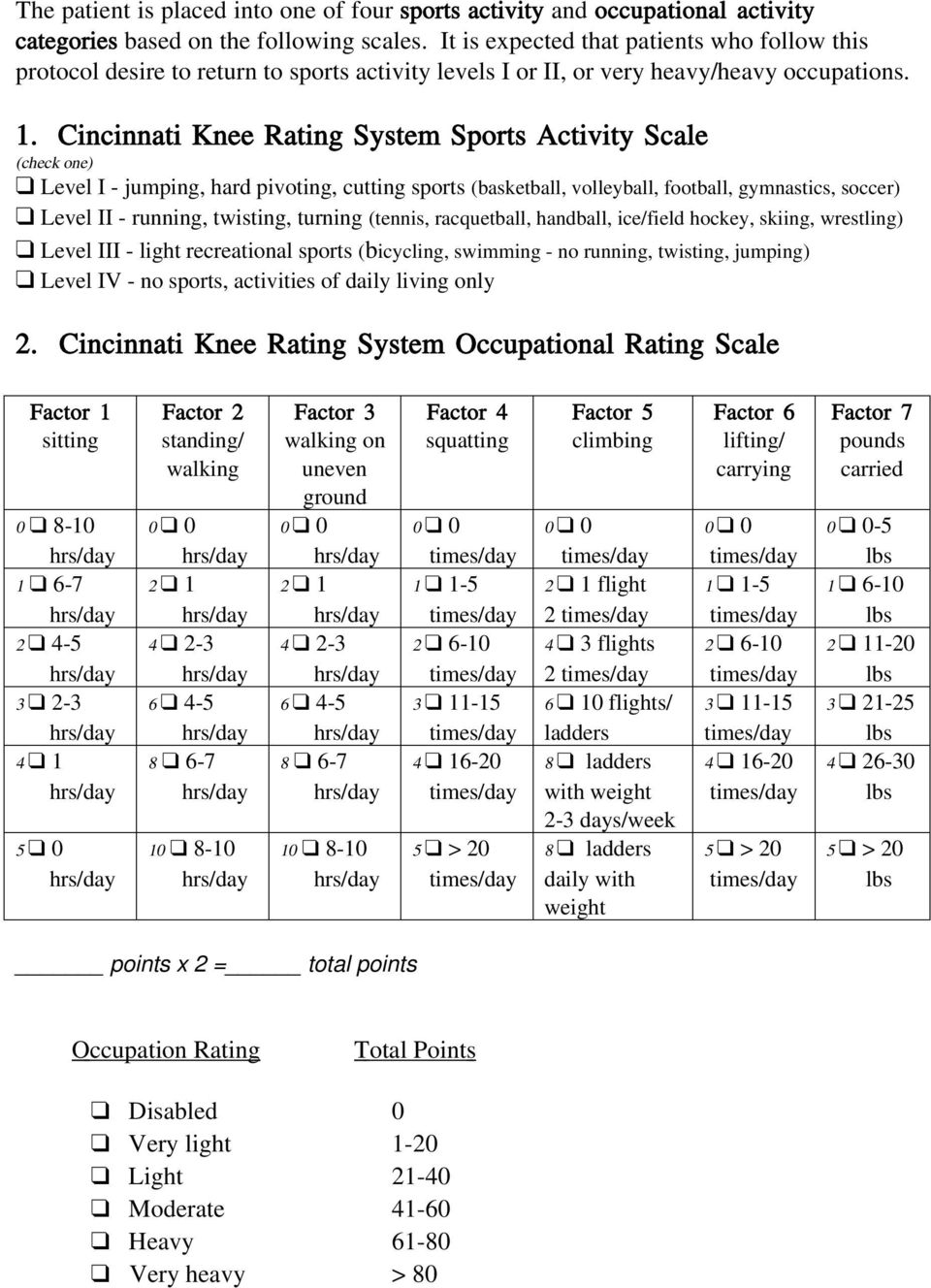
2 The patient is placed into one of four sports activity and occupational activity categories based on the following scales. It is expected that patients who follow this protocol desire to return to sports activity levels I or II, or very heavy/heavy occupations. 1. Cincinnati Knee Rating System Sports Activity Scale (check one) Level I - jumping, hard pivoting, cutting sports (basketball, volleyball, football, gymnastics, soccer) Level II - running, twisting, turning (tennis, racquetball, handball, ice/field hockey, skiing, wrestling) Level III - light recreational sports (bicycling, swimming - no running, twisting, jumping) Level IV - no sports, activities of daily living only 2. Cincinnati Knee Rating System Occupational Rating Scale Factor 1 sitting Factor 2 standing/ walking Factor 3 walking on uneven ground Factor 4 squatting > 20 Factor 5 climbing flight flights flights/ ladders 8 ladders with weight 2-3 days/week 8 ladders daily with weight Factor 6 lifting/ carrying > 20 Factor 7 pounds carried lbs lbs lbs lbs lbs 5 > 20 lbs points x 2 = total points Occupation Rating Total Points Disabled 0 Very light 1-20 Light Moderate Heavy Very heavy > 80
3 Physical Therapy Visit Timeline* Phase Weeks Postoperative Minimum # Visits Maximum # Visits Total *Physician Notification The physician will be notified if the patient (1) fails to meet the expected goals for each phase of the protocol, (2) has a persistent joint effusion, (3) develops a chronic pain syndrome, (4) develops abnormal medial joint opening, (5) complains of giving-way, (6) has difficulty with ambulation, or (7) has a limitation of knee motion or patellar mobility. These problems could result in a modification of this protocol and necessitate further visits to the physical therapist. Discharge Criteria (If goals for sports and occupation place patient into different categories, use category with highest functional demand criteria. For symptoms, use Symptom Rating Form found on next page.) Sports Activity Level I or Heavy/Very Heavy Occupational Rating* No pain, swelling, giving-way with level 10 on Symptom Rating Form KT-2000 < 3 mm (I-N, 134 N, total A/P) Biodex strength testing: quadriceps & hamstrings strength > 85% of opposite limb Function testing: 2 hop tests, limb symmetry > 85% Sports Activity Level II or Moderate Occupational Rating* No pain, swelling, giving-way with level 8 on Symptom Rating Form KT-2000 < 3 mm (I-N, 134 N, total A/P) Biodex strength testing: quadriceps & hamstrings strength > 80% of opposite limb Function testing: 2 hop tests, limb symmetry > 85% Sports Activity Level III or Light Occupational Rating No pain, swelling, giving-way with level 6 on Symptom Rating Form KT mm (I-N, 134 N, total A/P) Biodex strength testing: quadriceps & hamstrings strength > 70% of opposite limb Function testing: 2 hop tests, limb symmetry > 75% Sports Activity Level IV (ADL) or Very light Occupational Rating No pain, swelling, giving-way with level 4 on Symptom Rating Form KT mm (I-N, 134 N, total A/P) Biodex strength testing: quadriceps & hamstrings strength < 70% of opposite limb Function testing: 2 hop tests, limb symmetry < 75% *patients desiring to return to sports or strenuous work activities may require 4-6 more physical therapy visits during postoperative weeks for advanced neuromuscular, strength, and activity-specific training to prevent reinjury.

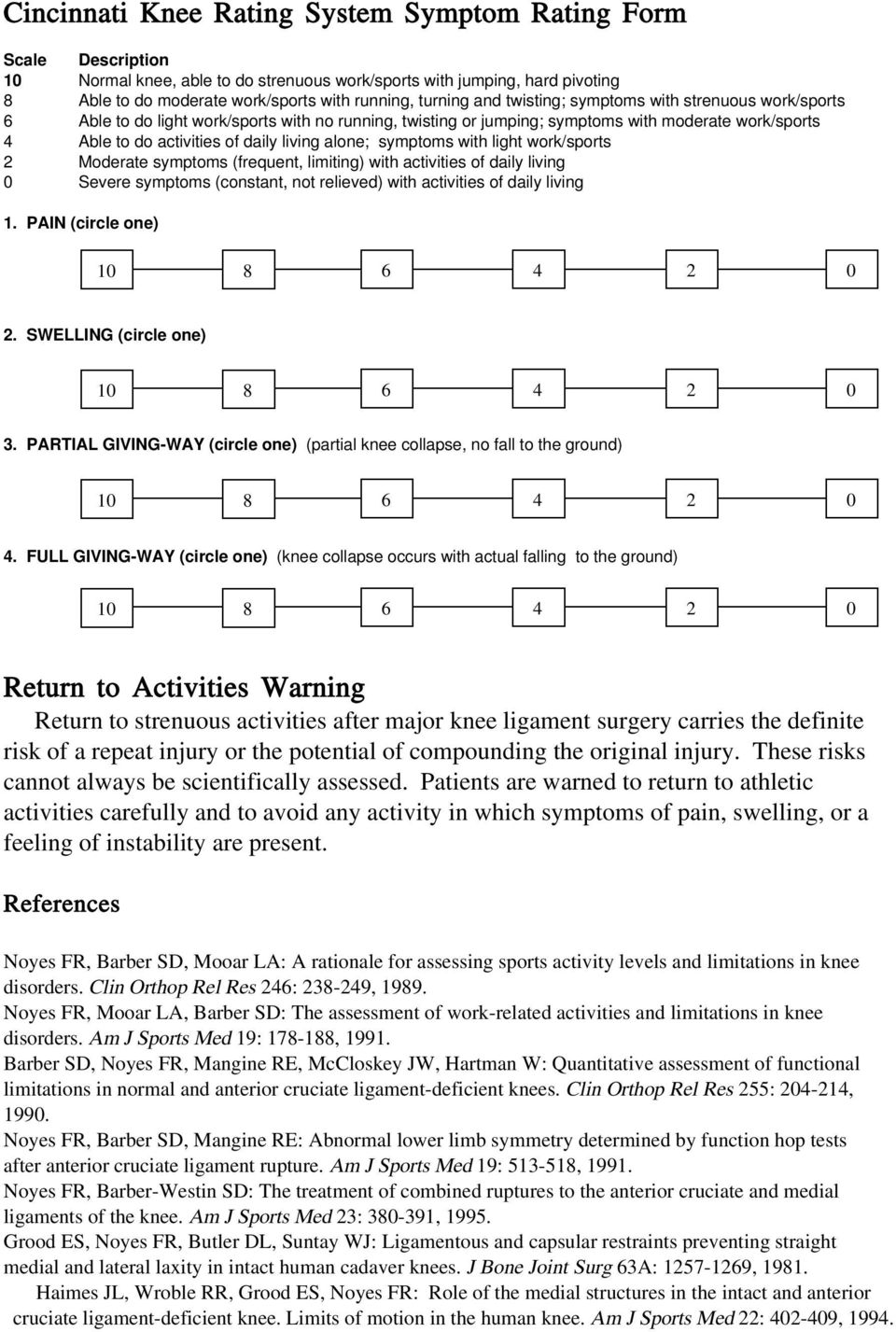
4 Cincinnati Knee Rating System Symptom Rating Form Scale Description 10 Normal knee, able to do strenuous work/sports with jumping, hard pivoting 8 Able to do moderate work/sports with running, turning and twisting; symptoms with strenuous work/sports 6 Able to do light work/sports with no running, twisting or jumping; symptoms with moderate work/sports 4 Able to do activities of daily living alone; symptoms with light work/sports 2 Moderate symptoms (frequent, limiting) with activities of daily living 0 Severe symptoms (constant, not relieved) with activities of daily living 1. PAIN (circle one) SWELLING (circle one) PARTIAL GIVING-WAY (circle one) (partial knee collapse, no fall to the ground) FULL GIVING-WAY (circle one) (knee collapse occurs with actual falling to the ground) Return to Activities Warning Return to strenuous activities after major knee ligament surgery carries the definite risk of a repeat injury or the potential of compounding the original injury. These risks cannot always be scientifically assessed. Patients are warned to return to athletic activities carefully and to avoid any activity in which symptoms of pain, swelling, or a feeling of instability are present. References Noyes FR, Barber SD, Mooar LA: A rationale for assessing sports activity levels and limitations in knee disorders. Clin Orthop Rel Res 246: , Noyes FR, Mooar LA, Barber SD: The assessment of work-related activities and limitations in knee disorders. Am J Sports Med 19: , Barber SD, Noyes FR, Mangine RE, McCloskey JW, Hartman W: Quantitative assessment of functional limitations in normal and anterior cruciate ligament-deficient knees. Clin Orthop Rel Res 255: , Noyes FR, Barber SD, Mangine RE: Abnormal lower limb symmetry determined by function hop tests after anterior cruciate ligament rupture. Am J Sports Med 19: , Noyes FR, Barber-Westin SD: The treatment of combined ruptures to the anterior cruciate and medial ligaments of the knee. Am J Sports Med 23: , Grood ES, Noyes FR, Butler DL, Suntay WJ: Ligamentous and capsular restraints preventing straight medial and lateral laxity in intact human cadaver knees. J Bone Joint Surg 63A: , Haimes JL, Wroble RR, Grood ES, Noyes FR: Role of the medial structures in the intact and anterior cruciate ligament-deficient knee. Limits of motion in the human knee. Am J Sports Med 22: , 1994.
5 Cincinnati SportsMedicine and Orthopaedic Center Rehabilitation Protocol Summary for Medial Collateral Ligament Reconstruction Postoperative Weeks Postop Months Brace: Bledsoe 0 locked Custom medial unloader minimum goals: Weight bearing: None Toe touch - 1/4 body weight 1/4 to 1/2 body weight Full Patella mobilization Modalities: Electrical muscle stimulation (EMS) Pain/edema management (cryotherapy) Stretching: Hamstring, gastroc-soleus, iliotibial band, quadriceps : Quad isometrics, straight leg raises Active knee extension Closed-chain: gait retraining, toe raises, wall sits, mini-squats Knee flexion hamstring curls (90 ) Knee extension quads (90-30 ) Hip abduction-adduction, multi-hip Leg press (70-10 ) Balance/proprioceptive training: Weight-shifting, mini-trampoline, BAPS, KAT, plyometrics Conditioning: UBE Bike (stationary) Aquatic program Swimming (kicking) Walking Stair climbing machine Ski machine Running: straight Cutting: lateral carioca, figure 8 s Full sports BAPS = Biomechanical Ankle Platform System (Camp, Jackson, MI), KAT = Kinesthetic Awareness Trainer (Breg, Inc., Vista, CA), UBE = upper body ergometer.

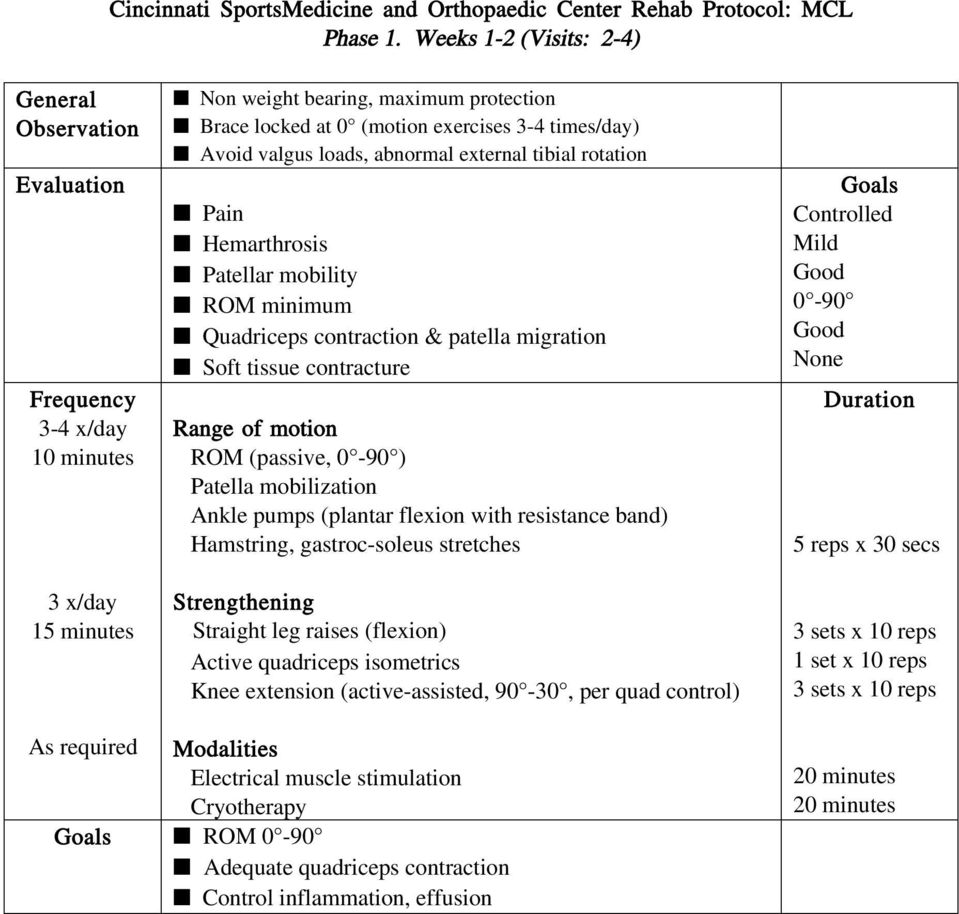
6 Phase 1. Weeks 1-2 (Visits: 2-4) General Observation 3-4 x/day 3 x/day 15 minutes Non weight bearing, maximum protection Brace locked at 0 (motion exercises 3-4 ) Avoid valgus loads, abnormal external tibial rotation Pain Hemarthrosis ROM minimum Quadriceps contraction & patella migration Soft tissue contracture ROM (passive, 0-90 ) Patella mobilization Ankle pumps (plantar flexion with resistance band) Hamstring, gastroc-soleus stretches Straight leg raises (flexion) Active quadriceps isometrics Knee extension (active-assisted, 90-30, per quad control) Controlled Mild 0-90 None 1 set x 10 reps As required Modalities Electrical muscle stimulation ROM 0-90 Adequate quadriceps contraction Control inflammation, effusion
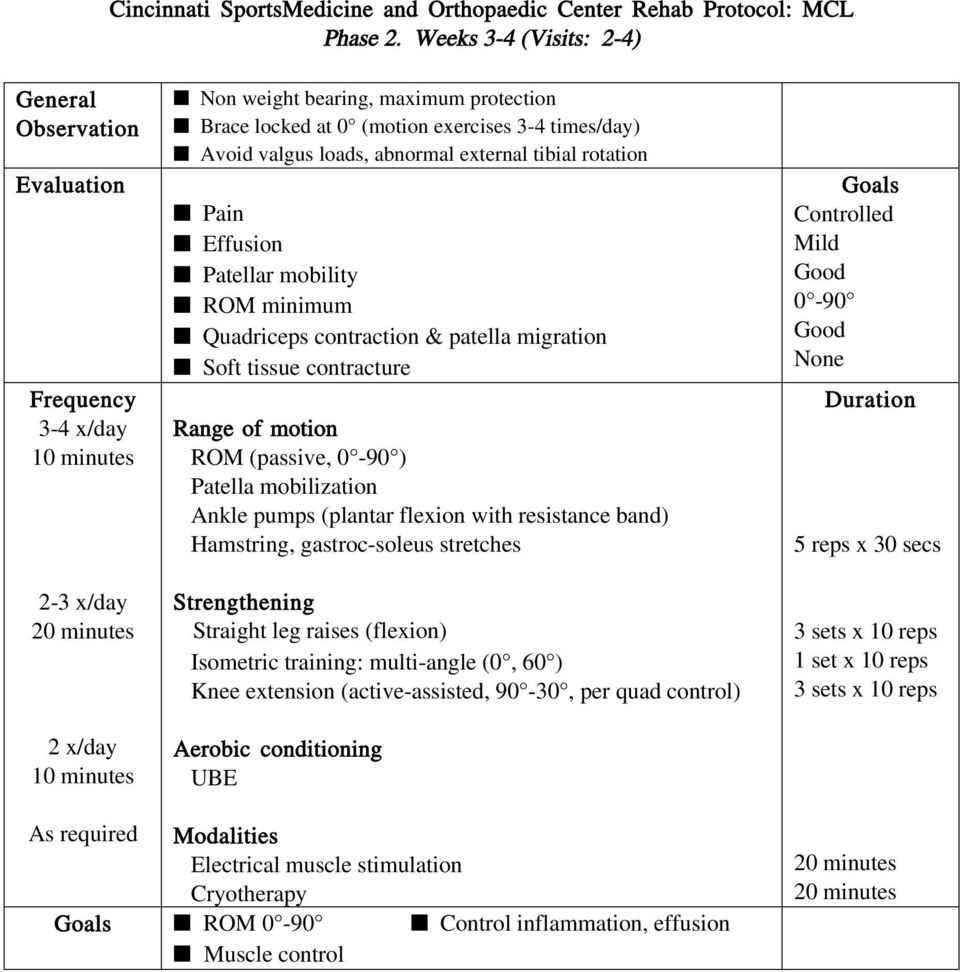
7 Phase 2. Weeks 3-4 (Visits: 2-4) General Observation 3-4 x/day 2-3 x/day Non weight bearing, maximum protection Brace locked at 0 (motion exercises 3-4 ) Avoid valgus loads, abnormal external tibial rotation Pain Effusion ROM minimum Quadriceps contraction & patella migration Soft tissue contracture ROM (passive, 0-90 ) Patella mobilization Ankle pumps (plantar flexion with resistance band) Hamstring, gastroc-soleus stretches Straight leg raises (flexion) Isometric training: multi-angle (0, 60 ) Knee extension (active-assisted, 90-30, per quad control) Aerobic conditioning UBE Controlled Mild 0-90 None 1 set x 10 reps As required Modalities Electrical muscle stimulation ROM 0-90 Control inflammation, effusion Muscle control
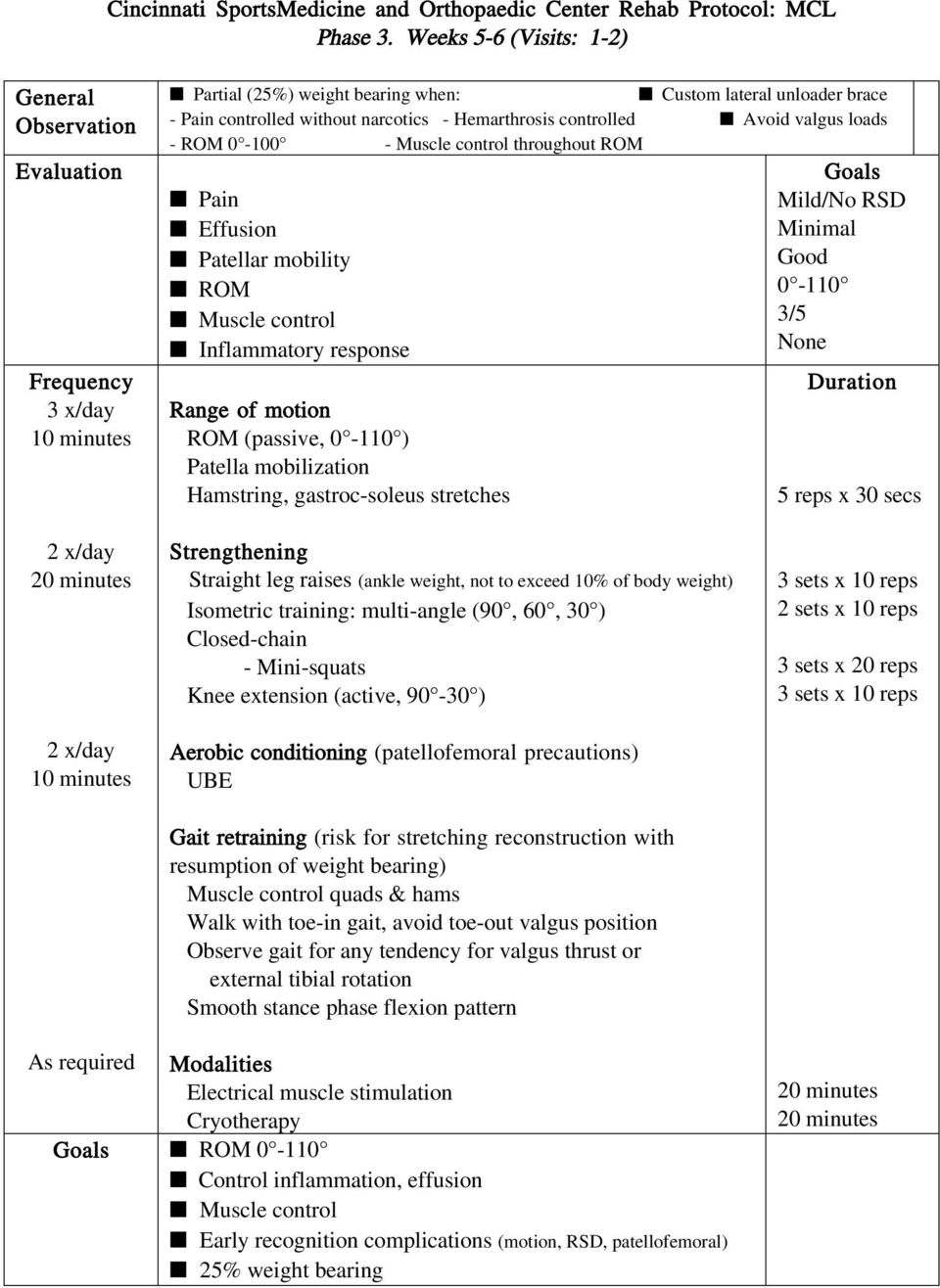
8 Phase 3. Weeks 5-6 (Visits: 1-2) General Observation 3 x/day Partial (25%) weight bearing when: Custom lateral unloader brace - Pain controlled without narcotics - Hemarthrosis controlled Avoid valgus loads - ROM Muscle control throughout ROM Pain Mild/No RSD Effusion Minimal ROM Muscle control 3/5 Inflammatory response None ROM (passive, ) Patella mobilization Hamstring, gastroc-soleus stretches Straight leg raises (ankle weight, not to exceed 10% of body weight) Isometric training: multi-angle (90, 60, 30 ) Closed-chain - Mini-squats Knee extension (active, ) Aerobic conditioning (patellofemoral precautions) UBE Gait retraining (risk for stretching reconstruction with resumption of weight bearing) Muscle control quads & hams Walk with toe-in gait, avoid toe-out valgus position Observe gait for any tendency for valgus thrust or external tibial rotation Smooth stance phase flexion pattern 2 sets x 10 reps 3 sets x 20 reps As required Modalities Electrical muscle stimulation ROM Control inflammation, effusion Muscle control Early recognition complications (motion, RSD, patellofemoral) 25% weight bearing
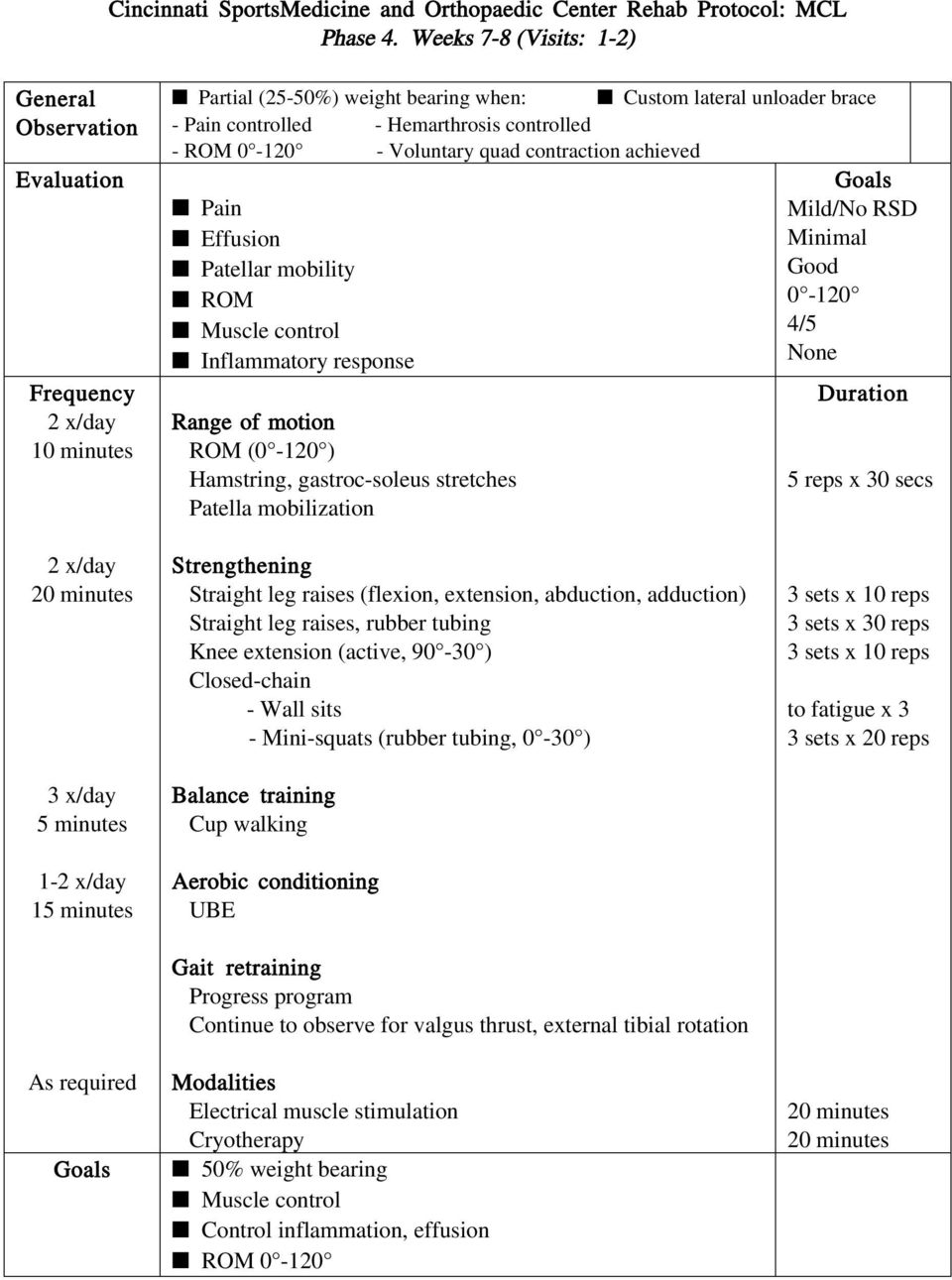
9 Phase 4. Weeks 7-8 (Visits: 1-2) General Observation Partial (25-50%) weight bearing when: Custom lateral unloader brace - Pain controlled - Hemarthrosis controlled - ROM Voluntary quad contraction achieved Pain Effusion ROM Muscle control Inflammatory response ROM (0-120 ) Hamstring, gastroc-soleus stretches Patella mobilization Mild/No RSD Minimal /5 None 3 x/day 5 minutes 1-15 minutes As required Straight leg raises (flexion, extension, abduction, adduction) Straight leg raises, rubber tubing Knee extension (active, ) Closed-chain - Wall sits - Mini-squats (rubber tubing, 0-30 ) Balance training Cup walking Aerobic conditioning UBE Gait retraining Progress program Continue to observe for valgus thrust, external tibial rotation Modalities Electrical muscle stimulation 50% weight bearing Muscle control Control inflammation, effusion ROM sets x 30 reps to fatigue x 3 3 sets x 20 reps
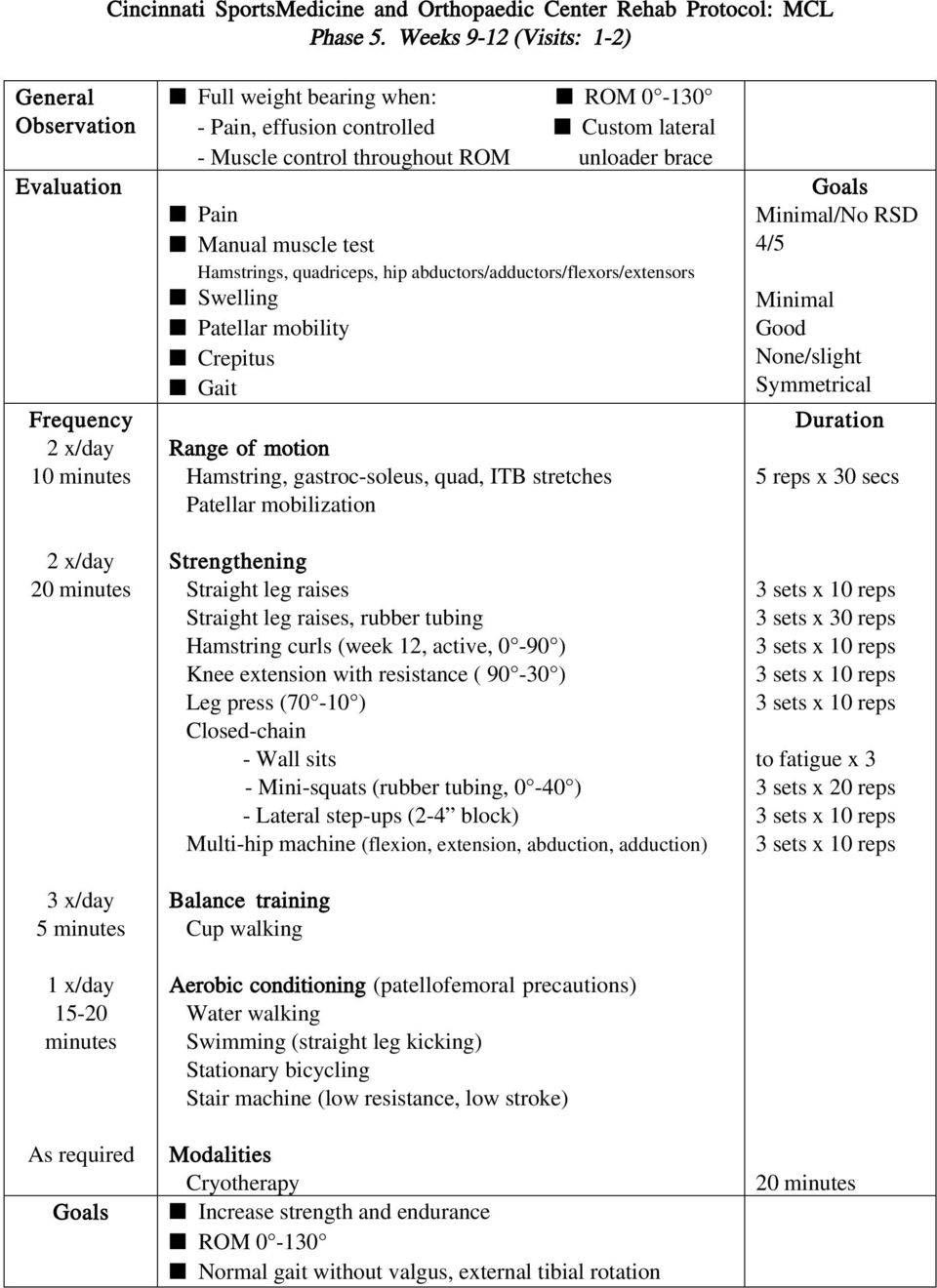
10 Phase 5. Weeks 9-12 (Visits: 1-2) General Observation 3 x/day 5 minutes 1 x/day minutes As required Full weight bearing when: ROM Pain, effusion controlled Custom lateral - Muscle control throughout ROM unloader brace Pain Manual muscle test Hamstrings, quadriceps, hip abductors/adductors/flexors/extensors Swelling Crepitus Gait Hamstring, gastroc-soleus, quad, ITB stretches Patellar mobilization Straight leg raises Straight leg raises, rubber tubing Hamstring curls (week 12, active, 0-90 ) Knee extension with resistance ( ) Leg press (70-10 ) Closed-chain - Wall sits - Mini-squats (rubber tubing, 0-40 ) - Lateral step-ups (2-4 block) Multi-hip machine (flexion, extension, abduction, adduction) Balance training Cup walking Aerobic conditioning (patellofemoral precautions) Water walking Swimming (straight leg kicking) Stationary bicycling Stair machine (low resistance, low stroke) Modalities Increase strength and endurance ROM Normal gait without valgus, external tibial rotation Minimal/No RSD 4/5 Minimal None/slight Symmetrical 3 sets x 30 reps to fatigue x 3 3 sets x 20 reps
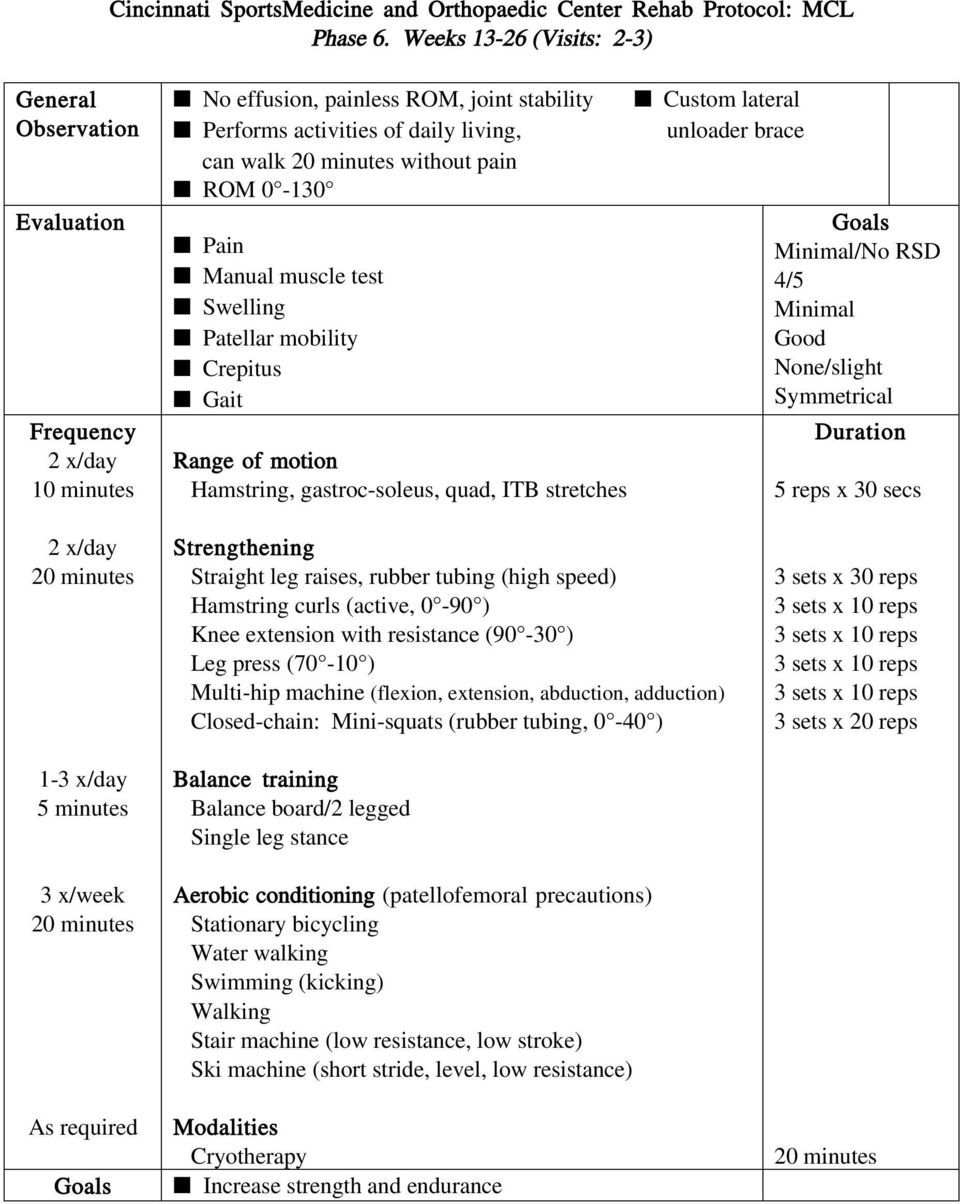
11 Phase 6. Weeks (Visits: 2-3) General Observation No effusion, painless ROM, joint stability Performs activities of daily living, can walk without pain ROM Pain Manual muscle test Swelling Crepitus Gait Hamstring, gastroc-soleus, quad, ITB stretches Custom lateral unloader brace Minimal/No RSD 4/5 Minimal None/slight Symmetrical 1-3 x/day 5 minutes 3 x/week As required Straight leg raises, rubber tubing (high speed) Hamstring curls (active, 0-90 ) Knee extension with resistance (90-30 ) Leg press (70-10 ) Multi-hip machine (flexion, extension, abduction, adduction) Closed-chain: Mini-squats (rubber tubing, 0-40 ) Balance training Balance board/2 legged Single leg stance Aerobic conditioning (patellofemoral precautions) Stationary bicycling Water walking Swimming (kicking) Walking Stair machine (low resistance, low stroke) Ski machine (short stride, level, low resistance) Modalities Increase strength and endurance 3 sets x 30 reps 3 sets x 20 reps
12 Phase 7. Weeks (Visits: 2-3) General No effusion, painless ROM, joint stability Custom lateral Observation Performs ADL, can walk without pain unloader brace Isometric test (% diff quads & hams) Swelling Crepitus None None/slight Hamstring, gastroc-soleus, quad, ITB stretches 1 x/day minutes 1-3 x/day 5 minutes 3 x/week minutes 3 x/week minutes 3 x/week 3 x/week Straight leg raises, rubber tubing (high speed) Hamstring curls (0-90 ) Knee extension with resistance (90-30 ) Leg press (70-10 ) Multi-hip machine (flexion, extension, abduction, adduction) Closed-chain: Mini-squats (rubber tubing, 0-40 ) Balance training Balance board/2 legged Single leg stance Aerobic conditioning (patellofemoral precautions) Stationary bicycling Water walking Swimming (kicking) Walking Stair machine (low resistance, low stroke) Ski machine (short stride, level, low resistance) Running program (9 mos. minimum, straight, 30% deficit isometric test) Jog Walk Backward run Cutting program (12 mos. minimum, 20% deficit isometric test) lateral, carioca, figure 8 s Functional training (12 mos. minimum) Plyometric training: box hops, level, double-leg Sport specific drills (10-15% deficit isometric test) 3 sets x 30 reps 3 sets x 20 reps 1/4 mile 1/8 mile 20 yards 20 yards 15 secs, 4-6 sets As required Modalities Increase function Maintain strength, endurance Return to previous activity level

Noyes Knee Institute Rehabilitation Protocol: Medial Ligament Repair or Reconstruction
 Noyes Knee Institute Rehabilitation Protocol: Medial Ligament Repair or Reconstruction Brace: Long-leg postoperative Custom unloading if required minimum goals: 0-90 0-110 0-120 0-130 Weight bearing: Toe
Cincinnati Sportsmedicine and Orthopaedic Center
 Cincinnati Sportsmedicine and Orthopaedic Center Total Knee Replacement: Rehabilitation Protocol This rehabilitation protocol was developed for patients who have had a cemented total knee arthroplasty.
Noyes Knee Institute Rehabilitation Protocol for ACL Reconstruction: Revision Knees, Allografts, Complex Knees
 Noyes Knee Institute Rehabilitation Protocol for ACL Reconstruction: Revision Knees, Allografts, Complex Knees 1-2 3-4 5-6 7-8 9-12 4 5 6 7-12 Brace: postoperative & functional () minimum goals: 0-90 0-120
Noyes Knee Institute Rehabilitation Protocol for Primary ACL Reconstruction: Early Return to Strenuous Activities
 Noyes Knee Institute Rehabilitation Protocol for Primary ACL Reconstruction: Early Return to Strenuous Activities 1-2 3-4 5-6 7-8 9-12 4 5 6 7-12 Brace: immobilizer for patient comfort () minimum goals:
Cincinnati SportsMedicine and Orthopaedic Center
 Cincinnati SportsMedicine and Orthopaedic Center Anterior Cruciate Ligament Reconstruction: Accelerated Rehabilitation Protocol* This rehabilitation protocol was developed for patients who have anterior
Cincinnati SportsMedicine and Orthopaedic Center
 Cincinnati SportsMedicine and Orthopaedic Center Anterior Cruciate Ligament Reconstruction: Delayed Rehabilitation Protocol* This rehabilitation protocol was developed for patients who have anterior cruciate
Noyes Knee Institute Rehabilitation Protocol: Meniscus Repair
 Noyes Knee Institute Rehabilitation rotocol: Repair 1-2 -4 5-6 7-8 9-12 4 5 6 7-12 Brace: Long-leg postoative Range of motion minimum goals: 0-90 0-1 0-15 Weight bearing: Toe touch 1/2 body weight /4 to
Knee Arthroscopy/Lateral Release Rehabilitation Dr. Walter R. Lowe
 Knee Arthroscopy/Lateral Release Rehabilitation Dr. Walter R. Lowe This rehabilitation protocol is designed for patients who have undergone knee arthroscopy or arthroscopic lateral release. The intensity
MEDIAL PATELLA FEMORAL LIGAMENT RECONSTRUCTION Rehab Protocol
 Rehab Protocol This rehabilitation protocol has been designed for patients who have undergone an MPFL reconstruction. Dependent upon the particular procedure, this protocol also may be slightly deviated
Theodore B. Shybut, M.D. 7200 Cambridge St. #10A Houston, Texas 77030 Phone: 713-986-5590 Fax: 713-986-5521. Sports Medicine
 Anterior Cruciate Ligament Reconstruction Accelerated Rehab This rehabilitation protocol has been designed for patients with ACL reconstruction who anticipate returning to a high level of activity as quickly
ANTERIOR CRUCIATE LIGAMENT RECONSTRUCTION Hamstring Graft/PTG-Accelerated Rehab
 The rehabilitation protocol has been designed for patients with ACL reconstruction who anticipate returning early to a high level of activity postoperatively. The ACL Rehabilitation protocol for all three
The Insall Scott Kelly Center for Orthopaedics and Sports Medicine 210 East 64th Street, 4 th Floor, New York, NY 10065
 ANTERIOR CRUCIATE LIGAMENT RECONSTRUCTION POST-OPERATIVE REHABILITATION PROTOCOL 2003 AUTOGRAFT BONE-PATELLA TENDON-BONE and ALLOGRAFT PROTOCOL PHASE I-EARLY FUNCTIONAL (WEEKS 1-2) Goals: 1. Educate re:
William J. Robertson, MD UT Southwestern Orthopedics 1801 Inwood Rd. Dallas, TX 75390-8882 Office: (214) 645-3300 Fax: (214) 3301 billrobertsonmd.
 Anterior Cruciate Ligament Reconstruction Postoperative Rehab Protocol You will follow-up with Dr. Robertson 10-14 days after surgery. At this office visit you will also see one of his physical therapists.
Post-Operative ACL Reconstruction Functional Rehabilitation Protocol
 Post-Operative ACL Reconstruction Functional Rehabilitation Protocol Patient Guidelines Following Surgery The post-op brace is locked in extension initially for the first week with the exception that it
Anterior Cruciate Ligament Reconstruction Accelerated Rehabilitation Protocol Dr. Mark Adickes
 Anterior Cruciate Ligament Reconstruction Accelerated Rehabilitation Protocol Introduction: This rehabilitation protocol is designed for patients with ACL injuries who anticipate returning early to a high
Anterior Cruciate Ligament Reconstruction. ACL Rehab Protocol
 Anterior Cruciate Ligament Reconstruction Rehab Protocol This rehabilitation protocol has been designed for patients following ACL reconstruction who anticipate returning to a high level of activity as
Meniscus Repair Rehabilitation Dr. Walter R. Lowe
 Meniscus Repair Rehabilitation Dr. Walter R. Lowe This rehabilitation protocol was developed for patients who have isolated meniscal repairs. Meniscal repairs located in the vascular zones of the periphery
Anterior Cruciate Ligament Reconstruction Rehabilitation Protocol
 Anterior Cruciate Ligament Reconstruction Rehabilitation Protocol GENERAL CONSIDERATIONS * This handout serves as a general outline for you as a patient to better understand guidelines and time frames
Anterior Cruciate Ligament Reconstruction Delayed Rehab Dr. Walter R. Lowe
 Anterior Cruciate Ligament Reconstruction Delayed Rehab Dr. Walter R. Lowe This rehabilitation protocol has been designed for patients who have undergone an ACL reconstruction (HS graft/ptg/allograft)
Meniscus Repair Rehabilitation Protocol Dr. Mark Adickes
 Meniscus Repair Rehabilitation Protocol Dr. Mark Adickes Introduction: This rehabilitation protocol was developed for patients who have isolated meniscal repairs. Depending upon the complexity of the tear
ACCELERATED REHABILITATION PROTOCOL FOR POST OPERATIVE POSTERIOR CRUCIATE LIGAMENT RECONSTRUCTION DR LEO PINCZEWSKI DR JUSTIN ROE
 ACCELERATED REHABILITATION PROTOCOL FOR POST OPERATIVE POSTERIOR CRUCIATE LIGAMENT RECONSTRUCTION DR LEO PINCZEWSKI DR JUSTIN ROE January 2005 Rationale of Accelerated Rehabilitation Rehabilitation after
PREOPERATIVE: POSTOPERATIVE:
 PREOPERATIVE: ACL RECONSTRUCTION RECOVERY & REHABILITATION PROTOCOL If you have suffered an acute ACL injury and surgery is planned, the time between injury and surgery should be used to regain knee motion,
ACL Reconstruction Post Operative Rehabilitation Protocol
 ACL Reconstruction Post Operative Rehabilitation Protocol The following is a generalized outline for rehabilitation following ACL reconstruction. The protocol may be modified if additional procedures,
Inland Orthopaedic Surgery & Sports Medicine
 Inland Orthopaedic Surgery & Sports Medicine Dr. Ed Tingstad 825 SE Bishop Blvd., Suite 120 Pullman, WA 99163 (509)332-2828 ACL Rehabilitation Guidelines General Guidelines: The following ACL rehabilitation
Post Operative Total Knee Replacement Protocol Brian White, MD www.western-ortho.com
 Post Operative Total Knee Replacement Protocol Brian White, MD www.western-ortho.com The intent of this protocol is to provide guidelines for progression of rehabilitation. It is not intended to serve
Medial Collateral Ligament (MCL) Rehabilitation Protocol
 Introduction: This rehabilitation protocol is designed for patients with Medial Collateral Ligament (MCL) Rehabilitation Protocol MCL injuries who require an early return to high level activity following
AQUATIC/LAND BASED CLINICAL PROTOCOL FOR GRADE I/II MCL INJURY
 Frisbie Memorial Hospital Marsh Brook Rehabilitation Services Wentworth-Douglass Hospital AQUATIC/LAND BASED CLINICAL PROTOCOL FOR GRADE I/II MCL INJURY FREQUENCY: 2-3 times per week. DURATION: 4-6 weeks
POSTERIOR CRUCIATE LIGAMENT RECONSTRUCTION POSTOPERATIVE REHABILITATION PROTOCOL
 Corey A. Wulf, MD POSTERIOR CRUCIATE LIGAMENT RECONSTRUCTION POSTOPERATIVE REHABILITATION PROTOCOL The range of motion allowed after posterior cruciate ligament reconstructive surgery is dependent upon
ACL Reconstruction Rehabilitation Program
 ACL Reconstruction Rehabilitation Program 1. Introduction to Rehabilitation 2. The Keys to Successful Rehabilitation 3. Stage 1 (to the end of week 1) 4. Stage 2 (to the end of week 2) 5. Stage 3 (to the
Rehabilitation Protocol: Total Hip Arthroplasty (THA)
 Rehabilitation Protocol: Total Hip Arthroplasty (THA) Department of Orthopaedic Surgery Lahey Hospital & Medical Center, Burlington 781-744-8650 Lahey Outpatient Center, Lexington 781-372-7020 Lahey Medical
ACL Reconstruction: Patellar Tendon Graft/Hamstring Tendon Graft
 ACL Reconstruction: Patellar Tendon Graft/Hamstring Tendon Graft Patellar Tendon Graft/Hamstring Tendon Graft General Information: The intent of these guidelines is to provide the therapist with direction
Rehabilitation Guidelines for Patellar Tendon and Quadriceps Tendon Repair
 UW Health Sports Rehabilitation Rehabilitation Guidelines for Patellar Tendon and Quadriceps Tendon Repair The knee consists of four bones that form three joints. The femur is the large bone in the thigh
Rehabilitation after ACL Reconstruction: From the OR to the Playing Field. Mark V. Paterno PT, PhD, MBA, SCS, ATC
 Objectives Rehabilitation after ACL Reconstruction: From the OR to the Playing Field Mark V. Paterno PT, PhD, MBA, SCS, ATC Coordinator of Orthopaedic and Sports Physical Therapy Cincinnati Children s
Post Surgery Rehabilitation Program for Knee Arthroscopy
 Post Surgery Rehabilitation Program for Knee Arthroscopy This protocol is designed to assist you with your rehabilitation after surgery and should be followed under the direction of a physiotherapist May
Mary LaBarre, PT, DPT,ATRIC
 Aquatic Therapy and the ACL Current Concepts on Prevention and Rehab Mary LaBarre, PT, DPT,ATRIC Anterior Cruciate Ligament (ACL) tears are a common knee injury in athletic rehab. Each year, approximately
Post Surgery Rehabilitation Program
 Post Surgery Rehabilitation Program Medial Patellofemoral Ligament Reconstruction and Imbrication This protocol is designed to assist you with your rehabilitation after surgery and should be followed under
Pre - Operative Rehabilitation Program for Anterior Cruciate Ligament Reconstruction
 Pre - Operative Rehabilitation Program for Anterior Cruciate Ligament Reconstruction This protocol is designed to assist you with your preparation for surgery and should be followed under the direction
REHABILITATION PROTOCOL
 COSM REHAB ANOTHER SERVICE PROVIDED BY THE CENTER FOR ORTHOPAEDICS & SPORTS MEDICINE REHABILITATION PROTOCOL KNEE ACL Reconstruction Protocol Please contact us with any questions. www.pacosm.com Indiana
Patellofemoral/Chondromalacia Protocol
 Patellofemoral/Chondromalacia Protocol Anatomy and Biomechanics The knee is composed of two joints, the tibiofemoral and the patellofemoral. The patellofemoral joint is made up of the patella (knee cap)
Brian P. McKeon MD Jason D. Rand, PA-C, PT Patient Information Sheet: Anterior Cruciate Ligament
 Brian P. McKeon MD Jason D. Rand, PA-C, PT Patient Information Sheet: Anterior Cruciate Ligament The anterior cruciate ligament or ACL is one of the major ligaments located in the knee joint. This ligament
Progression to the next phase is based on Clinical Criteria and/or Time Frames as appropriate.
 BRIGHAM AND WOMEN S HOSPITAL Department of Rehabilitation Services Phyp Physical Therapy Total Hip Arthroplasty/ Hemiarthroplasty Protocol: The intent of this protocol is to provide the clinician with
ACL Non-Operative Protocol
 ACL Non-Operative Protocol Anatomy and Biomechanics The knee is a hinge joint connecting the femur and tibia bones. It is held together by several important ligaments. The most important ligament to the
Anterior Cruciate Ligament (ACL) Rehabilitation
 Thomas D. Rosenberg, M.D. Vernon J. Cooley, M.D. Charles C. Lind, M.D. Anterior Cruciate Ligament (ACL) Rehabilitation Dear Enclosed you will find a copy of our Anterior Cruciate Ligament (ACL) Rehabilitation
Rehabilitation Guidelines for Knee Multi-ligament Repair/Reconstruction
 UW Health Sports Rehabilitation Rehabilitation Guidelines for Knee Multi-ligament Repair/Reconstruction The knee joint is comprised of an articulation of three bones: the femur (thigh bone), tibia (shin
B. TED MAURER, MD POSTOPERATIVE REHABILITATION PROTOCOL TOTAL KNEE ARTHROPLASTY
 B. TED MAURER, MD POSTOPERATIVE REHABILITATION PROTOCOL TOTAL KNEE ARTHROPLASTY Goals addressed prior to discharge from hospital setting: Independence with bed mobility, transfers (supine to sit and sit
GALLAND/KIRBY ACL RECONSTRUCTION WITH MENISCUS REPAIR POST-SURGICAL REHABILITATION PROTOCOL
 GALLAND/KIRBY ACL RECONSTRUCTION WITH MENISCUS REPAIR POST-SURGICAL REHABILITATION PROTOCOL POST-OP DAYS 1 14 Dressing: POD 1: Debulk dressing, TED Hose in place POD 2: Change dressing, keep wound covered,
ACL Reconstruction Physiotherapy advice for patients
 Oxford University Hospitals NHS Trust ACL Reconstruction Physiotherapy advice for patients Introduction This booklet is designed to provide you with advice and guidance on your rehabilitation after reconstruction
Anterior Cruciate Ligament Reconstruction Progression Rehabilitation Program By Jenna Hennebry, Erin Stiefel, and Lauren Schmidt
 Anterior Cruciate Ligament Reconstruction Progression Rehabilitation Program By Jenna Hennebry, Erin Stiefel, and Lauren Schmidt Case Study: 18 year old female soccer player Isolated ACL rupture (planted
Rehabilitation of Sports Hernia
 Rehabilitation of Sports Hernia (Involving Adductor Tenotomy, Ilioinguinal Neurectomy and Osteitis Pubis) An appendix follows this protocol for examples of exercises in each phase of rehabilitation. There
PHASE I ANKLE REHABILITATION EXERCISES
 PHASE I ANKLE REHABILITATION EXERCISES SWELLING CONTROL S REST: Keep your standing and walking activities to a minimum while swelling is a problem. ICE: Use an ice pack in a moist towel for 10-15 minutes
Strength Training for the Knee
 Strength Training for the Knee This handout is to help you rebuild the strength of the muscles surrounding the knee after injury. It is intended as a guideline to help you organize a structured approach
Rehabilitation Protocol: Total Knee Arthroplasty (TKA)
 Rehabilitation Protocol: Total Knee Arthroplasty (TKA) Department of Orthopaedic Surgery Lahey Hospital & Medical Center, Burlington 781-744-8650 Lahey Outpatient Center, Lexington 781-372-7020 Lahey Medical
Preventing Knee Injuries in Women s Soccer
 Preventing Knee Injuries in Women s Soccer By Wayne Nelson, DC, CCRS The United States has recently seen a rapid increase in participation of young athletes with organized youth soccer leagues. As parents
Knee Arthroscopy (Meniscectomy)
 Knee Arthroscopy (Meniscectomy) Anatomy and Biomechanics The knee is a hinge joint at the connection point between the femur and tibia bones. It is held together by several important ligaments. The knee
Hip Arthroscopy Rehabilitation Protocol
 Hip Arthroscopy Rehabilitation Protocol Phase I: Healing Phase (0-2 Weeks) Goal: Protect Incision, Reduce Inflammation, Allow Tissues to Heal, and Rest Wound Care: Keep Incision covered with sealed dressing
Dr Doron Sher MB.BS. MBiomedE, FRACS(Orth)
 Dr Doron Sher MB.BS. MBiomedE, FRACS(Orth) Knee, Shoulder, Elbow Surgery ACL REHABILITATION PROGRAM (With thanks to the Eastern Suburbs Sports Medicine Centre) The time frames in this program are a guide
Physical & Occupational Therapy
 In this section you will find our recommendations for exercises and everyday activities around your home. We hope that by following our guidelines your healing process will go faster and there will be
Knee sprains. What is a knee strain? How do knee strains occur? what you ll find in this brochure
 what you ll find in this brochure What is a knee strain? How do knee strains occur? What you should do if a knee strain occurs. What rehabilitation you should do. Example of a return to play strategy.
Anterior Cruciate Ligament Reconstruction Rehabilitation Protocol
 The First Two Weeks After Surgery You will go home with crutches and be advised to use ice. Goals 1. Protect reconstruction 2. Ensure wound healing 3. Maintain full knee extension 4. Gain knee flexion
Patellar Dislocation Conservative and Operative Rehabilitation
 1 Patellar Dislocation Conservative and Operative Rehabilitation Surgical Indications and Considerations Anatomical Considerations: Patellar stability is dependent upon two components: bony (trochlear
Eastern Suburbs Sports Medicine Centre
 Eastern Suburbs Sports Medicine Centre ACCELERATED ANTERIOR CRUCIATE LIGAMENT REHABILITATION PROGRAM Alan Davies Diane Long Mark Kenna (APA Sports Physiotherapists) The following ACL reconstruction rehabilitation
AN ACCELERATED REHABILITATION PROGRAMME FOR ENDOSCOPIC ANTERIOR CRUCIATE LIGAMENT RECONSTRUCTION
 AN ACCELERATED REHABILITATION PROGRAMME FOR ENDOSCOPIC ANTERIOR CRUCIATE LIGAMENT RECONSTRUCTION DR LEO PINCZEWSKI MR GREG CRIAG MR IAN COLLIER DECEMBER, 2004 INTRODUCTION Anterior cruciate ligament reconstruction
ACL RECONSTRUCTION POST-OPERATIVE REHABILITATION PROGRAMME
 ACL RECONSTRUCTION POST-OPERATIVE REHABILITATION PROGRAMME ABOUT THE OPERATION The aim of your operation is to reconstruct the Anterior Cruciate Ligament (ACL) to restore knee joint stability. A graft,
Rehabilitation. Modalities and Rehabilitation. Basics of Injury Rehabilitation. Injury Rehabilitation. Vocabulary. Vocabulary
 Modalities and Rehabilitation Rehabilitation Chapter 12: Basics of Injury Rehabilitation Vocabulary Balance: ability to maintain our center of gravity over a base of support Kinesthesia: the ability to
REHABILITATION AFTER REPAIR OF THE PATELLAR AND QUADRICEPS TENDON
 175 Cambridge Street, 4 th floor Boston, MA 02114 617-726-7500 REHABILITATION AFTER REPAIR OF THE PATELLAR AND QUADRICEPS TENDON The patellar tendon attaches to the tibial tubercle on the front of the
Rehabilitation Guidelines for Autologous Chondrocyte Implantation. Ashley Conlin, PT, DPT, SCS, CSCS
 Rehabilitation Guidelines for Autologous Chondrocyte Implantation Ashley Conlin, PT, DPT, SCS, CSCS Objectives Review ideal patient population Review overall procedure for Autologous Chondrocyte Implantation
Rehabilitation Protocol: Hip Arthroscopy Femoral Acetabular Impingement Debridement/Osteochondroplasty. Richard M. Wilk, M.D. Michael Kain, M.D.
 Rehabilitation Protocol: Hip Arthroscopy Femoral Acetabular Impingement Debridement/Osteochondroplasty Richard M. Wilk, M.D. Michael Kain, M.D. Department of Orthopaedic Surgery Lahey Hospital & Medical
Screening Examination of the Lower Extremities BUY THIS BOOK! Lower Extremity Screening Exam
 Screening Examination of the Lower Extremities Melvyn Harrington, MD Department of Orthopaedic Surgery & Rehabilitation Loyola University Medical Center BUY THIS BOOK! Essentials of Musculoskeletal Care
Hip Arthroscopy Labral Repair Rehabilitation Protocol
 Hip Arthroscopy Labral Repair Rehabilitation Protocol PHASE 1: INITIAL Diminish pain and inflammation Protect integrity of repaired tissue Prevent muscular inhibition Restore ROM within the restrictions
ANTERIOR CRUCIATE LIGAMENT RECONSTRUCTION
 Daniel P. Duggan, D.O. The Sports Clinic 23961 Calle de la Magdalena, Suite 229 Laguna Hills, CA 92653 Phone: (949) 581-7001 Fax: (949) 581-8410 http://orthodoc.aaos.org/danielduggando ANTERIOR CRUCIATE
Rehabilitation Guidelines for Meniscal Repair
 UW Health Sports Rehabilitation Rehabilitation Guidelines for Meniscal Repair There are two types of cartilage in the knee, articular cartilage and cartilage. Articular cartilage is made up of collagen,
Rehabilitation Guidelines for Posterior Cruciate Ligament Reconstruction
 UW Health Sports Rehabilitation Rehabilitation Guidelines for Posterior Cruciate Ligament Reconstruction The knee has three joints--the patellofemoral joint (knee cap), the tibiofemoral joint and the tibiofibular
Modified Brostrom-Gould Repair for Chronic Lateral Ankle Instability:
 BRIGHAM AND WOMEN S HOSPITAL Department of Rehabilitation Services for Chronic Lateral Ankle Instability: The intent of this protocol is to provide the clinician with a guideline of the post-operative
Steps to Success: A Guide to Knee Rehabilitation
 Steps to Success: A Guide to Knee Rehabilitation Indications Carticel (autologous cultured chondrocytes) is indicated for the repair of symptomatic, cartilaginous defects of the femoral condyle (medial,
Hip Bursitis/Tendinitis
 Hip Bursitis/Tendinitis Anatomy and Biomechanics The hip is a ball and socket joint that occurs between the head of the femur (ball) and the acetabulum of the pelvis (socket). It is protected by several
Introduction This case study presents a 24 year old male soccer player with an Anterior Cruciate Ligament (ACL) tear in his left knee.
 Introduction This case study presents a 24 year old male soccer player with an Anterior Cruciate Ligament (ACL) tear in his left knee. The athlete is a defender/mid-fielder and has been involved in soccer
Platelet-Rich Plasma Rehabilitation Guidelines
 UW Health Sports Rehabilitation Platelet-Rich Plasma Rehabilitation Guidelines What is Tendinopathy? Tendons are strong bands of connective tissue comprised primarily of a substance called collagen. Mechanically,
QUESTION I HAVE BEEN ASKED TO REHAB GRADE II AND III MCL INJURIES DIFFERENTLY BY DIFFERENT SURGEONS IN THE FIRST 6WEEKS FOLLOWING INJURY.
 QUESTION I HAVE BEEN ASKED TO REHAB GRADE II AND III MCL INJURIES DIFFERENTLY BY DIFFERENT SURGEONS IN THE FIRST 6WEEKS FOLLOWING INJURY. SOME ARE HINGE BRACED 0-90 DEGREES AND ASKED TO REHAB INCLUDING
ACL Rehab. Here are a few tips on how to progress through an ACL rehab protocol with minimal problems;
 ACL Rehab The ACL rehab protocol is broken down into 5 phases, and there s a list of goals and outcome measures that need to be satisfied at the end of each phase to move onto the next one. You move through
ChondroCelect Rehabilitation Program
 ChondroCelect Rehabilitation Program Rehabilitation differs depending on the type and site of the lesion and the patient personal profile. Grouping of the lesions and patient profiles is helpful to ensure
ACL Injury Prevention Through Proprioceptive & Neuromuscular Training Arlington Soccer Club April 1, 2010
 ACL Injury Prevention Through Proprioceptive & Neuromuscular Training Arlington Soccer Club April 1, 2010 Matthew R. McManus, PT Co-Owner & Regional Clinical Director - Massachusetts ProEx Physical Therapy
Rehabilitation Guidelines for Knee Arthroscopy
 Rehabilitation Guidelines for Knee Arthroscopy Arthroscopy is a common surgical procedure in which a joint is viewed using a small camera. This technique allows the surgeon to have a clear view of the
Knee Microfracture Surgery Patient Information Leaflet
 ORTHOPAEDIC UNIT: 01-293 8687 /01-293 6602 BEACON CENTRE FOR ORTHOPAEDICS: 01-2937575 PHYSIOTHERAPY DEPARTMENT: 01-2936692 Knee Microfracture Surgery Patient Information Leaflet Table of Contents 1. Introduction
Cervical Fusion Protocol
 REHABILITATION DEPARTMENT Cervical Fusion Protocol The following protocol for physical therapy rehabilitation was designed based on the typical patient seen at the Texas Back Institute for the procedure
Anterior Cruciate Ligament Reconstruction
 1 Anterior Cruciate Ligament Reconstruction Surgical Indications and Considerations Anatomical Considerations: The anterior cruciate ligament (ACL) lies in the middle of the knee. It arises from the anterior
Goals. Our Real Goals. Michael H. Boothby, MD Southwest Orthopedic Associates Fort Worth, Texas. Perform a basic, logical, history and physical exam
 Michael H. Boothby, MD Southwest Orthopedic Associates Fort Worth, Texas Goals Our Real Goals Perform a basic, logical, history and physical exam on a patient with knee pain Learn through cases, some common
How To Treat A Patella Dislocation
 Rehabilitation Guidelines for Patellar Realignment The knee consists of four bones that form three joints. The femur is the large bone in your thigh, and attaches by ligaments and a capsule to your tibia,
KNEES A Physical Therapist s Perspective American Physical Therapy Association
 Taking Care of Your KNEES A Physical Therapist s Perspective American Physical Therapy Association Taking Care of Your Knees When the mother of the hero Achilles dipped him in the river Styx, she held
Rehabilitation Guidelines for Medial Patellofemoral Ligament Repair and Reconstruction
 UW Health Sports Rehabilitation Rehabilitation Guidelines for Medial Patellofemoral Ligament Repair and Reconstruction The knee consists of four bones that form three joints. The femur is the large bone
Rehabilitation Program for Achilles Tendon Rupture/Repair
 Rehabilitation Program for Achilles Tendon Rupture/Repair This protocol is designed to assist you with your rehabilitation after surgery and should be followed under the direction of a physiotherapist
Rehabilitation After Knee Meniscus Repair
 Amon T. Ferry, MD Orthopedic Surgery Sports Medicine Rehabilitation After Knee Meniscus Repair Phase One: The first week after surgery Goals: 1. Control pain and swelling 2. Initiate knee motion 3. Activate
HSS: 212-606-1159 NYP/WC: 212-746-5348 Fax: 212-746-8488. Hip Arthroscopy Rehabilitation Labral Debridement with or without FAI Component
 General Guidelines: Hip Arthroscopy Rehabilitation Labral Debridement with or without FAI Component Normalize gait pattern with brace and crutches Weight-bearing as per procedure performed Continuous Passive
Physical Therapy for Shoulder. Joseph Lorenzetti PT, DPT, MTC Catholic Health Athleticare Kenmore 1495 Military Road Kenmore, NY 14217
 Physical Therapy for Shoulder and Knee Pain Joseph Lorenzetti PT, DPT, MTC Catholic Health Athleticare Kenmore 1495 Military Road Kenmore, NY 14217 Physical Therapy for Shoulder and Knee Pain GOALS: Explain
Rehabilitation After ACL Reconstruction
 CENTRE PERTH ORTHOPAEDIC & SPORTS MEDICINE Rehabilitation After ACL Reconstruction Dr Keith Holt Philosophy of Rehabilitation Rehabilitation, as it applies to the recovery period from Orthopaedic Surgery,
HIPABDUCTOR REPAIR PROTOCOL (Gluteus Medius/Minimus Repair)
 R. JOHN ELLIS, JR., M.D. LAWRENCE A. SCHAPER, M.D. MARK G. SMITH, M.D. G. JEFFREY POPHAM, M.D. AKBAR NAWAB, M.D. MICHAEL SALAMON, M.D. MATTHEW PRICE, M.D. DANIEL RUEFF, M.D. ELLIS & BADENHAUSEN ORTHOPAEDICS,
Vanderbilt Orthopaedic Institute
 Total Knee Arthroplasty (TKA) and Unicondylar Rehabilitation Guideline Pre-operative Phase Recommendations Attend pre-operative group education class Maintain and/or increase strength and ROM Education
Integrated Manual Therapy & Orthopedic Massage For Complicated Knee Conditions
 Integrated Manual Therapy & Orthopedic Massage For Complicated Knee Conditions Assessment Protocols Treatment Protocols Treatment Protocols Corrective Exercises Artwork and slides taken from the book Clinical
Goals of Post-operative operative Rehab. Surgical Procedures. Phase 1 Maximum protection and Mobility (1-4 weeks)
 Hip Arthroscopy - Post-Operative Care and Rehabilitation Franz Valenzuela, DPT, OCS Surgery corrects mechanical problems Rehabilitation corrects functional deficits Surgical Procedures Requires little