
KNEES A Physical Therapist s Perspective American Physical Therapy Association
|
|
|
- Coleen Heath
- 9 years ago
- Views:
Transcription
1 Taking Care of Your KNEES A Physical Therapist s Perspective American Physical Therapy Association
2 Taking Care of Your Knees When the mother of the hero Achilles dipped him in the river Styx, she held him by the heel, leaving that spot unprotected. For most of us mortals, however, that most vulnerable spot is two joints higher. The knee is a relatively simple joint that is required to do a complicated job to provide flexible mobility while bearing considerable weight. While walking down the street, our knees bear three to five times our body weight. When climbing stairs, that force can multiply to seven times our body weight. That force is borne by compact structures of bone and cartilage, supported by muscles and ligaments. When the knee is overstressed in sports or in everyday activities, those structures can break down and knee injury occurs. This booklet will discuss knee injury and how your licensed physical therapist can help you recover function. We ll discuss ways you can prevent future injury and reduce your risk of knee injury in the first place. This brochure is not intended as a substitute for professional health care APTA. All rights reserved. 1

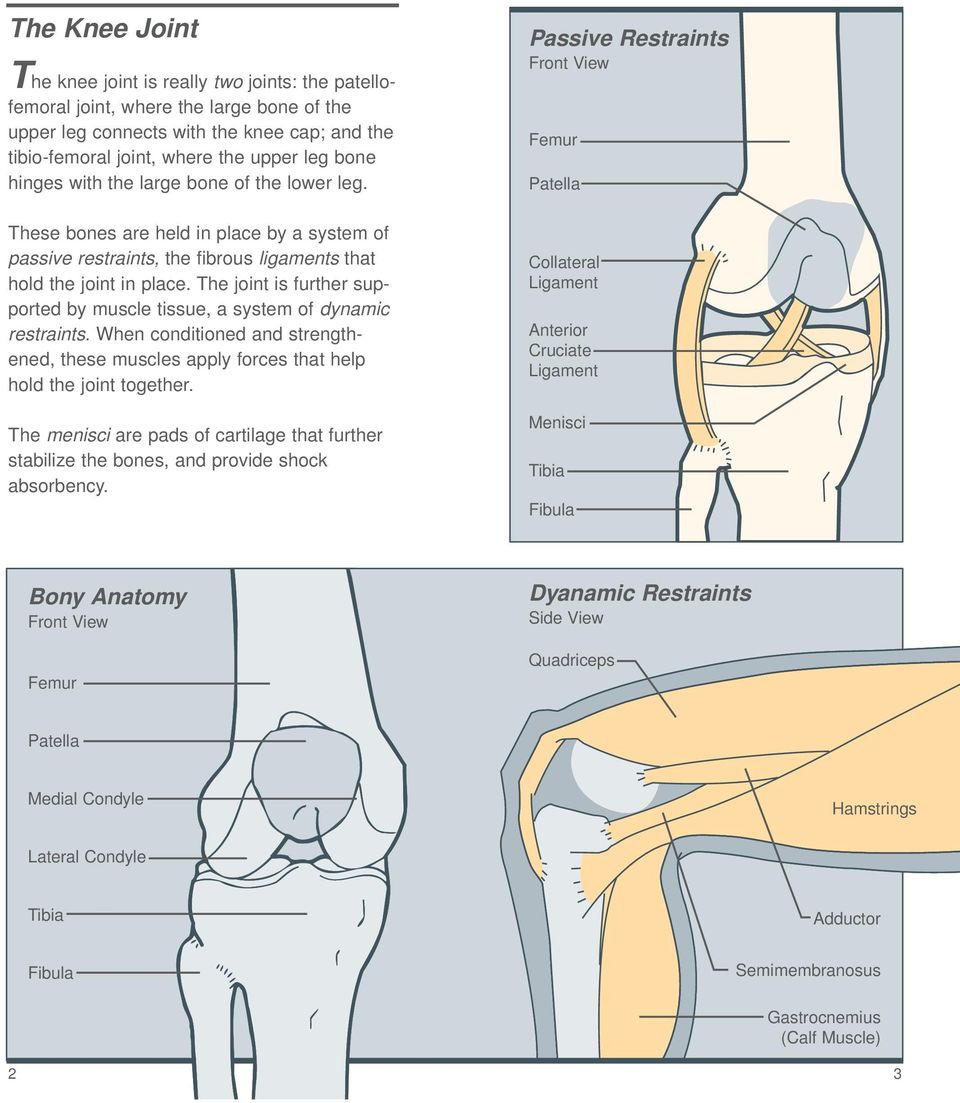
3 The Knee Joint The knee joint is really two joints: the patellofemoral joint, where the large bone of the upper leg connects with the knee cap; and the tibio-femoral joint, where the upper leg bone hinges with the large bone of the lower leg. These bones are held in place by a system of passive restraints, the fibrous ligaments that hold the joint in place. The joint is further supported by muscle tissue, a system of dynamic restraints. When conditioned and strengthened, these muscles apply forces that help hold the joint together. The menisci are pads of cartilage that further stabilize the bones, and provide shock absorbency. Passive Restraints Front View Femur Patella Collateral Ligament Anterior Cruciate Ligament Menisci Tibia Fibula Bony Anatomy Front View Femur Dyanamic Restraints Side View Quadriceps Patella Medial Condyle Hamstrings Lateral Condyle Tibia Adductor Fibula Semimembranosus Gastrocnemius (Calf Muscle) 2 3
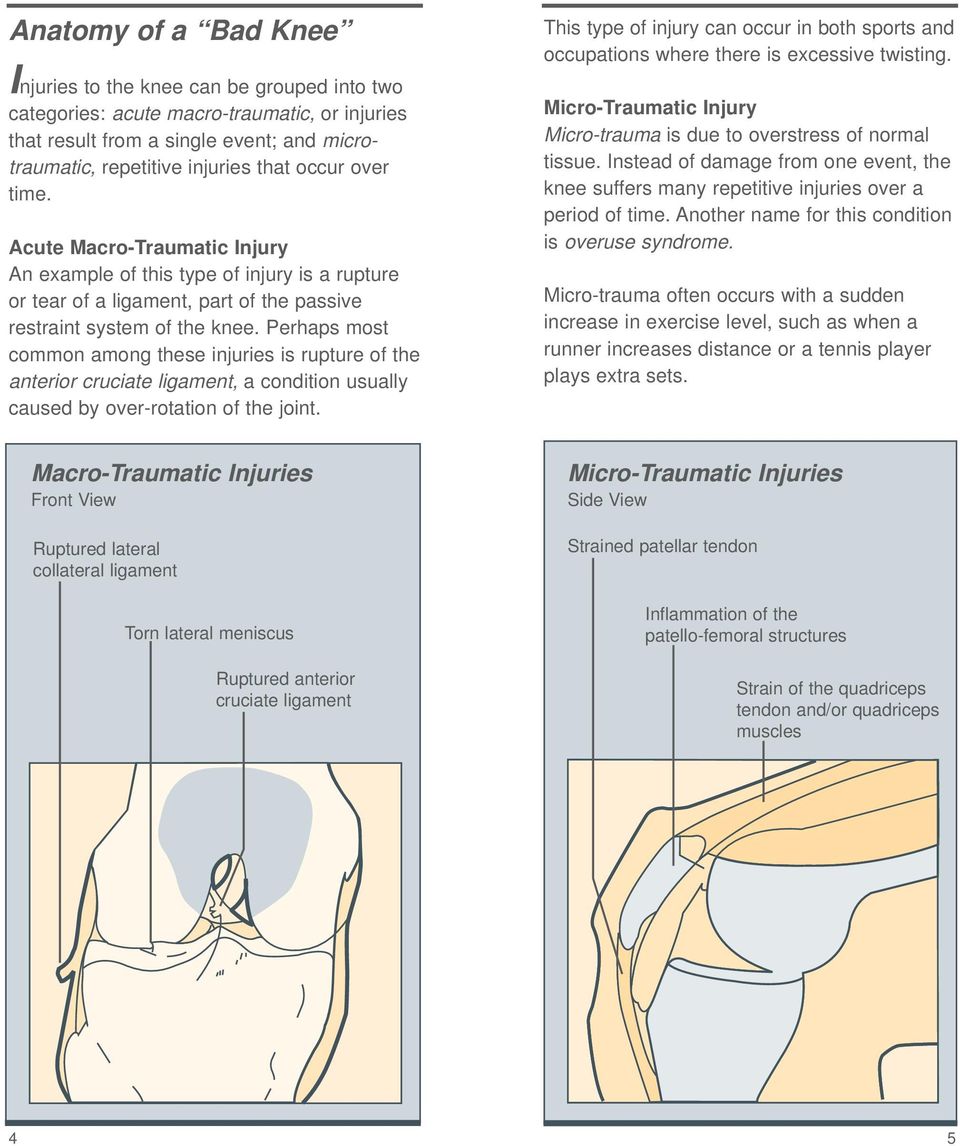
4 Anatomy of a Bad Knee Injuries to the knee can be grouped into two categories: acute macro-traumatic, or injuries that result from a single event; and microtraumatic, repetitive injuries that occur over time. Acute Macro-Traumatic Injury An example of this type of injury is a rupture or tear of a ligament, part of the passive restraint system of the knee. Perhaps most common among these injuries is rupture of the anterior cruciate ligament, a condition usually caused by over-rotation of the joint. This type of injury can occur in both sports and occupations where there is excessive twisting. Micro-Traumatic Injury Micro-trauma is due to overstress of normal tissue. Instead of damage from one event, the knee suffers many repetitive injuries over a period of time. Another name for this condition is overuse syndrome. Micro-trauma often occurs with a sudden increase in exercise level, such as when a runner increases distance or a tennis player plays extra sets. Macro-Traumatic Injuries Front View Ruptured lateral collateral ligament Torn lateral meniscus Ruptured anterior cruciate ligament Micro-Traumatic Injuries Side View Strained patellar tendon Inflammation of the patello-femoral structures Strain of the quadriceps tendon and/or quadriceps muscles 4 5
5 Treatment of Knee Injuries There is, unfortunately, no quick cure for a knee injury. Physical therapy plays a key role in treating and rehabilitating the knee, but you and your attitude toward recovery are the biggest factor in achieving a successful outcome. Physical Therapy Your licensed physical therapist will design a phased treatment plan with two main components: 1. Maximum protection, a series of exercises designed to help motion. Activities in this phase might include water walking, swimming, leg presses, and mini-squats; and 2. Return to function and maintenance, an exercise sequence to restore strength. These activities are a functional progression, that is, a gradual return to normal activities using exercises that simulate the knee stresses of your normal activities. Surgery Advances in surgical approaches to the knee joint have made repair to these structures practical in many cases. Arthroscopic surgery employs small incisions to access the joint. The surgeon views the damaged area through an arthroscope, hence the name. These procedures are quick, involve a minimum of discomfort, and enjoy an excellent success rate. Such surgery is indicated when: Repair is needed for ruptured ligaments or torn menisci, or Some level of disability accompanies injury. Your Role in Recovery Your physical therapist may give you some simple exercises you can do at home. Here are some examples he or she may include. You won t need any special equipment; for these exercises, all you need is a kitchen sink. 2. Toe Raises Strengthen the gastrocnemius muscle by raising up on the toes and balls of your feet; hold and repeat. 3. Leg Lifts Bend your knee lifting your foot upward; hold and repeat. You can add resistance by adding ankle weights. 1. Mini-Squats As you hold the edge of the sink, gently lower toward a partial squat position; hold and repeat. 6 7

6 Preventing Your Knee Injury Your knee s tolerance for stressful activities will decrease with age and loss of conditioning. So, stresses that would not have caused injury last year could hurt your knee today. A decrease in your level of activity over a period of time will also contribute to the vulnerability of your knees. But there are things you can do to help prevent injury so you can continue to enjoy sports and exercise. Pursuing an exercise program designed by your physical therapist, and applying some good common sense, can be your best protection from injury. The first step in designing your exercise program is an evaluation by your physical therapist. He or she can identify your predisposing factors, those body traits that may make you more or less vulnerable to a knee injury. Based on this assessment, your physical therapist can design a program that will help you gain your optimum levels of strength and conditioning. Before Your Next Ski Trip Here s an easy exercise that can help get your knees and muscles in shape before your next ski trip. But don t start the night before you leave; two to four weeks in advance should be adequate. Stand with your back against the wall, then slide down to a near-sitting position. With practice and repetition, slide down to a full sitting position. Be sure to stand on a nonskid surface, and keep your feet in front of your knees. Hold 10 seconds. Repeat 10 times at first and work up to 30 repeats. Your Exercise Prescription An exercise program is not generic. Because any particular exercise affects different people s bodies differently, your physical therapist will design the program that suits your body and your goals. 1. Rowing Machine Rowing machines offer a good workout for upper and lower body, including your knees. 2. Cross Country Skiing These machines offer a low-impact workout with variable resistance. 8 9

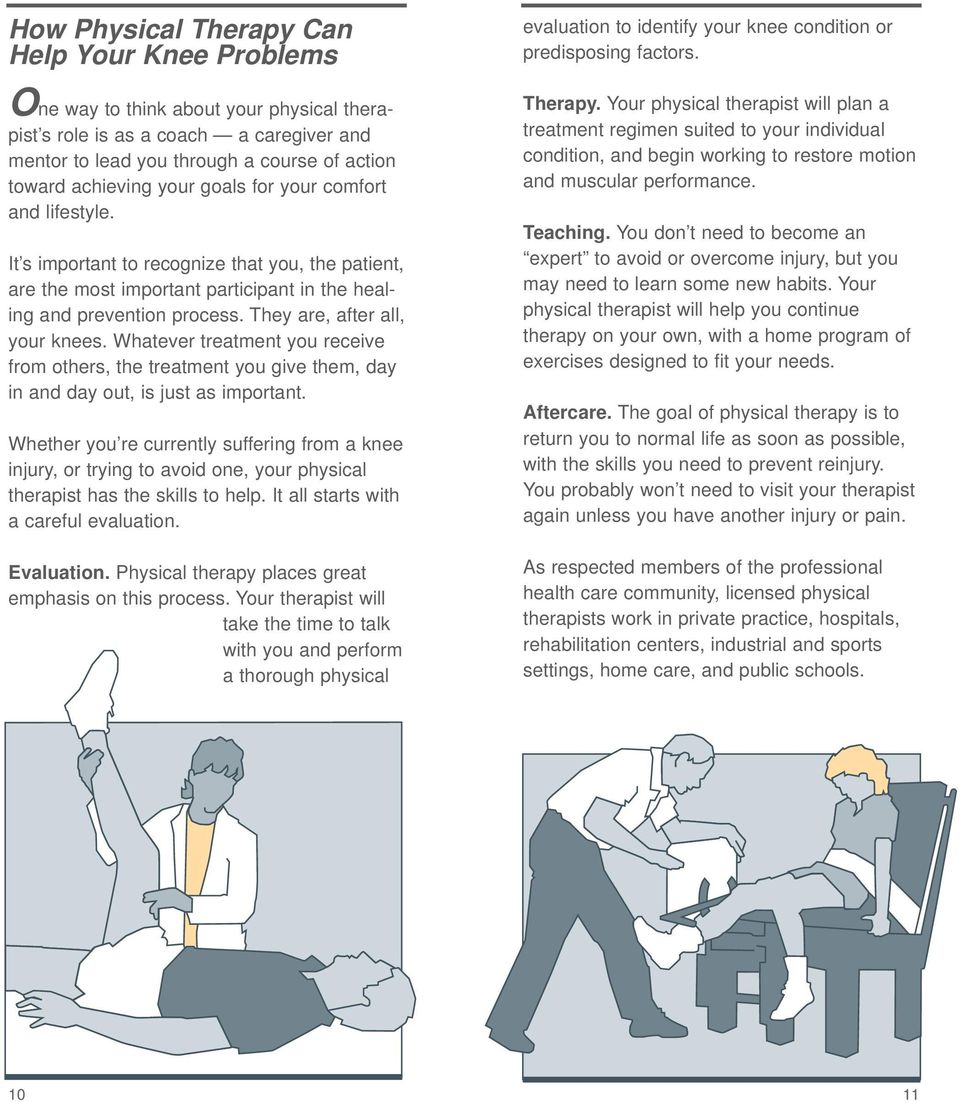
7 How Physical Therapy Can Help Your Knee Problems One way to think about your physical therapist s role is as a coach a caregiver and mentor to lead you through a course of action toward achieving your goals for your comfort and lifestyle. It s important to recognize that you, the patient, are the most important participant in the healing and prevention process. They are, after all, your knees. Whatever treatment you receive from others, the treatment you give them, day in and day out, is just as important. Whether you re currently suffering from a knee injury, or trying to avoid one, your physical therapist has the skills to help. It all starts with a careful evaluation. Evaluation. Physical therapy places great emphasis on this process. Your therapist will take the time to talk with you and perform a thorough physical evaluation to identify your knee condition or predisposing factors. Therapy. Your physical therapist will plan a treatment regimen suited to your individual condition, and begin working to restore motion and muscular performance. Teaching. You don t need to become an expert to avoid or overcome injury, but you may need to learn some new habits. Your physical therapist will help you continue therapy on your own, with a home program of exercises designed to fit your needs. Aftercare. The goal of physical therapy is to return you to normal life as soon as possible, with the skills you need to prevent reinjury. You probably won t need to visit your therapist again unless you have another injury or pain. As respected members of the professional health care community, licensed physical therapists work in private practice, hospitals, rehabilitation centers, industrial and sports settings, home care, and public schools
8 About APTA The American Physical Therapy Association is a national professional organization representing more than 74,000 members. The Association serves its members and the public by increasing the understanding of the physical therapy profession and its role in health care and by fostering improvements in physical therapy practice, research, and education. Acknowledgements Terry Malone, PT Cynthia Finke, PT, SCS Robert Mangine, PT Other APTA Brochures Fit Kids Fit Teens Fitness: A Way of Life For the Young at Heart: Exercise Tips for Seniors For Women of All Ages Taking Care of Your Back Taking Care of Your Hand, Wrist, and Elbow Taking Care of Your Hip Taking Care of Your Shoulder The Secret of Good Posture What You Need to Know About Balance and Falls What You Need to Know About Carpal Tunnel Syndrome What You Need to Know About Neck Pain What You Need to Know About Osteoporosis What Young People and Their Parents Need to Know About Scoliosis You Can Do Something About Incontinence Bulk quantities available. See the APTA Resource Catalog at or send your request by mail to APTA, 1111 North Fairfax Street, Alexandria, VA
9 Prepared as a public service by the 1111 North Fairfax Street Alexandria, VA M/PR-40/5-99 Printed on recycled paper

he American Physical Therapy Association would like to share a secret with you. It can help you do more with less effort breathe easier feel great.
 The Secret... T he American Physical Therapy Association would like to share a secret with you. It can help you do more with less effort breathe easier feel great. The secret is about good posture, which
ACL Reconstruction Physiotherapy advice for patients
 Oxford University Hospitals NHS Trust ACL Reconstruction Physiotherapy advice for patients Introduction This booklet is designed to provide you with advice and guidance on your rehabilitation after reconstruction
Pre - Operative Rehabilitation Program for Anterior Cruciate Ligament Reconstruction
 Pre - Operative Rehabilitation Program for Anterior Cruciate Ligament Reconstruction This protocol is designed to assist you with your preparation for surgery and should be followed under the direction
Rehabilitation Guidelines for Patellar Tendon and Quadriceps Tendon Repair
 UW Health Sports Rehabilitation Rehabilitation Guidelines for Patellar Tendon and Quadriceps Tendon Repair The knee consists of four bones that form three joints. The femur is the large bone in the thigh
Knee Conditioning Program. Purpose of Program
 Prepared for: Prepared by: OrthoInfo Purpose of Program After an injury or surgery, an exercise conditioning program will help you return to daily activities and enjoy a more active, healthy lifestyle.
Patellofemoral/Chondromalacia Protocol
 Patellofemoral/Chondromalacia Protocol Anatomy and Biomechanics The knee is composed of two joints, the tibiofemoral and the patellofemoral. The patellofemoral joint is made up of the patella (knee cap)
Physical & Occupational Therapy
 In this section you will find our recommendations for exercises and everyday activities around your home. We hope that by following our guidelines your healing process will go faster and there will be
ACCELERATED REHABILITATION PROTOCOL FOR POST OPERATIVE POSTERIOR CRUCIATE LIGAMENT RECONSTRUCTION DR LEO PINCZEWSKI DR JUSTIN ROE
 ACCELERATED REHABILITATION PROTOCOL FOR POST OPERATIVE POSTERIOR CRUCIATE LIGAMENT RECONSTRUCTION DR LEO PINCZEWSKI DR JUSTIN ROE January 2005 Rationale of Accelerated Rehabilitation Rehabilitation after
Knee Microfracture Surgery Patient Information Leaflet
 ORTHOPAEDIC UNIT: 01-293 8687 /01-293 6602 BEACON CENTRE FOR ORTHOPAEDICS: 01-2937575 PHYSIOTHERAPY DEPARTMENT: 01-2936692 Knee Microfracture Surgery Patient Information Leaflet Table of Contents 1. Introduction
ACL RECONSTRUCTION POST-OPERATIVE REHABILITATION PROGRAMME
 ACL RECONSTRUCTION POST-OPERATIVE REHABILITATION PROGRAMME ABOUT THE OPERATION The aim of your operation is to reconstruct the Anterior Cruciate Ligament (ACL) to restore knee joint stability. A graft,
.org. Achilles Tendinitis. Description. Cause. Achilles tendinitis is a common condition that causes pain along the back of the leg near the heel.
 Achilles Tendinitis Page ( 1 ) Achilles tendinitis is a common condition that causes pain along the back of the leg near the heel. The Achilles tendon is the largest tendon in the body. It connects your
Sports Injury Treatment
 Sports Injury Treatment Participating in a variety of sports is fun and healthy for children and adults. However, it's critical that before you participate in any sport, you are aware of the precautions
Knee Arthroscopy (Meniscectomy)
 Knee Arthroscopy (Meniscectomy) Anatomy and Biomechanics The knee is a hinge joint at the connection point between the femur and tibia bones. It is held together by several important ligaments. The knee
POSTERIOR CRUCIATE LIGAMENT RECONSTRUCTION POSTOPERATIVE REHABILITATION PROTOCOL
 Corey A. Wulf, MD POSTERIOR CRUCIATE LIGAMENT RECONSTRUCTION POSTOPERATIVE REHABILITATION PROTOCOL The range of motion allowed after posterior cruciate ligament reconstructive surgery is dependent upon
Plantar Fasciitis Information Leaflet. Maneesh Bhatia. Consultant Orthopaedic Surgeon
 Plantar Fasciitis Information Leaflet Maneesh Bhatia Consultant Orthopaedic Surgeon What is plantar fasciitis? The plantar fascia is a strong band of tissue that stretches from the heel to the toes. It
What is Osteoarthritis? Who gets Osteoarthritis? What can I do when I am diagnosed with Osteoarthritis? What can my doctor do to help me?
 Knee Osteoarthritis What is Osteoarthritis? Osteoarthritis is a disease process that affects the cartilage within a joint. Cartilage exists at the surface of the ends of the bones and provides joints with
Rehabilitation. Rehabilitation. Walkers, Crutches, Canes
 Walkers, Crutches, Canes These devices provide support through your arms to limit the amount of weight on your operated hip. Initially, after a total hip replacement you will use a walker to get around.
.org. Posterior Tibial Tendon Dysfunction. Anatomy. Cause. Symptoms
 Posterior Tibial Tendon Dysfunction Page ( 1 ) Posterior tibial tendon dysfunction is one of the most common problems of the foot and ankle. It occurs when the posterior tibial tendon becomes inflamed
ACL Reconstruction: Patellar Tendon Graft/Hamstring Tendon Graft
 ACL Reconstruction: Patellar Tendon Graft/Hamstring Tendon Graft Patellar Tendon Graft/Hamstring Tendon Graft General Information: The intent of these guidelines is to provide the therapist with direction
Structure & Function of the Knee. One of the most complex simple structures in the human body. The middle child of the lower extremity.
 Structure & Function of the Knee One of the most complex simple structures in the human body. The middle child of the lower extremity. Osteology of the Knee Distal femur (ADDuctor tubercle) Right Femur
ACL Reconstruction Rehabilitation Program
 ACL Reconstruction Rehabilitation Program 1. Introduction to Rehabilitation 2. The Keys to Successful Rehabilitation 3. Stage 1 (to the end of week 1) 4. Stage 2 (to the end of week 2) 5. Stage 3 (to the
Rehabilitation Guidelines for Meniscal Repair
 UW Health Sports Rehabilitation Rehabilitation Guidelines for Meniscal Repair There are two types of cartilage in the knee, articular cartilage and cartilage. Articular cartilage is made up of collagen,
Strength Training for the Knee
 Strength Training for the Knee This handout is to help you rebuild the strength of the muscles surrounding the knee after injury. It is intended as a guideline to help you organize a structured approach
Dr. O Meara s. Anterior Knee Pain (PatelloFemoral Syndrome) Rehabilitation Protocol www.palomarortho.com
 Dr. O Meara s Anterior Knee Pain (PatelloFemoral Syndrome) Rehabilitation Protocol www.palomarortho.com Anterior Knee Pain (PatelloFemoral Syndrome) Rehabilitation Protocol Hamstring Stretching & Strengthening
ACL Non-Operative Protocol
 ACL Non-Operative Protocol Anatomy and Biomechanics The knee is a hinge joint connecting the femur and tibia bones. It is held together by several important ligaments. The most important ligament to the
ACL Reconstruction Post Operative Rehabilitation Protocol
 ACL Reconstruction Post Operative Rehabilitation Protocol The following is a generalized outline for rehabilitation following ACL reconstruction. The protocol may be modified if additional procedures,
By Agnes Tan (PT) I-Sports Rehab Centre Island Hospital
 By Agnes Tan (PT) I-Sports Rehab Centre Island Hospital Physiotherapy Provides aids to people Deals with abrasion and dysfunction (muscles, joints, bones) To control and repair maximum movement potentials
Plantar Fasciitis. Plantar Fascia
 Plantar Fasciitis Introduction Plantar fasciitis is an inflammation of the thick band of tissue that connects your heel bone to your toes. This thick band of tissue is called the plantar fascia. Plantar
Understanding. Heel Pain
 Understanding Heel Pain What Causes Heel Pain? Heel pain is a common problem that occurs when the heel is placed under too much stress. Heel pain is most often caused by walking in ways that irritate tissues
Rehabilitation Guidelines for Knee Arthroscopy
 Rehabilitation Guidelines for Knee Arthroscopy Arthroscopy is a common surgical procedure in which a joint is viewed using a small camera. This technique allows the surgeon to have a clear view of the
www.ghadialisurgery.com
 P R E S E N T S Dr. Mufa T. Ghadiali is skilled in all aspects of General Surgery. His General Surgery Services include: General Surgery Advanced Laparoscopic Surgery Surgical Oncology Gastrointestinal
REHABILITATION AFTER REPAIR OF THE PATELLAR AND QUADRICEPS TENDON
 175 Cambridge Street, 4 th floor Boston, MA 02114 617-726-7500 REHABILITATION AFTER REPAIR OF THE PATELLAR AND QUADRICEPS TENDON The patellar tendon attaches to the tibial tubercle on the front of the
Passive Range of Motion Exercises
 Exercise and ALS The physical or occupational therapist will make recommendations for exercise based upon each patient s specific needs and abilities. Strengthening exercises are not generally recommended
Brian P. McKeon MD Jason D. Rand, PA-C, PT Patient Information Sheet: Anterior Cruciate Ligament
 Brian P. McKeon MD Jason D. Rand, PA-C, PT Patient Information Sheet: Anterior Cruciate Ligament The anterior cruciate ligament or ACL is one of the major ligaments located in the knee joint. This ligament
Knee sprains. What is a knee strain? How do knee strains occur? what you ll find in this brochure
 what you ll find in this brochure What is a knee strain? How do knee strains occur? What you should do if a knee strain occurs. What rehabilitation you should do. Example of a return to play strategy.
Achilles Tendon Repair Surgery Post-operative Instructions Phase One: The First Week After Surgery
 Amon T. Ferry, MD Orthopedic Surgery Sports Medicine Achilles Tendon Repair Surgery Post-operative Instructions Phase One: The First Week After Surgery Amon T. Ferry, MD Orthopedic Surgery / Sports Medicine
.org. Plantar Fasciitis and Bone Spurs. Anatomy. Cause
 Plantar Fasciitis and Bone Spurs Page ( 1 ) Plantar fasciitis (fashee-eye-tiss) is the most common cause of pain on the bottom of the heel. Approximately 2 million patients are treated for this condition
BP MS 150 lunch and learn: Stretching and injury prevention. Dr. Bart Kennedy (Sports Chiropractor) and Josh Thompson February 04, 2015
 BP MS 150 lunch and learn: Stretching and injury prevention Dr. Bart Kennedy (Sports Chiropractor) and Josh Thompson February 04, 2015 Epidemiology Overuse injuries most common, traumatic event second
Knee arthroscopy advice sheet
 Knee arthroscopy advice sheet During an arthroscopy, a camera is inserted into the knee through two or three small puncture wounds. It allows the surgeon to look at the joint surfaces, cartilage and the
Steps to Success: A Guide to Knee Rehabilitation
 Steps to Success: A Guide to Knee Rehabilitation Indications Carticel (autologous cultured chondrocytes) is indicated for the repair of symptomatic, cartilaginous defects of the femoral condyle (medial,
total hip replacement
 total hip replacement EXCERCISE BOOKLET patient s name: date of surgery: physical therapist: www.jointpain.md Get Up and Go Joint Program Philosophy: With the development of newer and more sophisticated
THE PREVENTION AND REHABILITATION OF SPORTS INJURIES THE PREVENTION AND REHABILITATION OF SPORTS INJURIES. NO, there isn t.
 THE PREVENTION AND REHABILITATION OF SPORTS INJURIES VILMOS DANI M.D. Department of Family Medicine Faculty of Medicine, Semmelweis University Budapest, Hungay GIZELLA PERÉNYI M.D. Department of Rehabilitation
Overuse injuries. 1. Main types of injuries
 OVERUSE INJURIES Mr. Sansouci is an ardent runner and swimmer. To train for an upcoming 10-km race, he has decided to increase the intensity of his training. Lately, however, his shoulder and Achilles
JOINT PAIN IN THE ADOLESCENT
 JOINT PAIN IN THE ADOLESCENT HOW SERIOUS CAN THAT BE? ROBERT A. KELLY, M.D. RESURGENS ORTHOPAEDICS JOINT PAIN IN THE ADOLESCENT INJURIES ABOUT JOINTS CAN BE CLASSIFIED AS EITHER: ACUTE/TRAUMATIC OR REPETITIVE/OVERUSE
Hip Conditioning Program. Purpose of Program
 Prepared for: Prepared by: OrthoInfo Purpose of Program After an injury or surgery, an exercise conditioning program will help you return to daily activities and enjoy a more active, healthy lifestyle.
ILIOTIBIAL BAND SYNDROME
 ILIOTIBIAL BAND SYNDROME Description The iliotibial band is the tendon attachment of hip muscles into the upper leg (tibia) just below the knee to the outer side of the front of the leg. Where the tendon
The Knee Internal derangement of the knee (IDK) The Knee. The Knee Anatomy of the anteromedial aspect. The Knee
 Orthopedics and Neurology James J. Lehman, DC, MBA, FACO University of Bridgeport College of Chiropractic Internal derangement of the knee (IDK) This a common provisional diagnosis for any patient with
Hand and Upper Extremity Injuries in Outdoor Activities. John A. Schneider, M.D.
 Hand and Upper Extremity Injuries in Outdoor Activities John A. Schneider, M.D. Biographical Sketch Dr. Schneider is an orthopedic surgeon that specializes in the treatment of hand and upper extremity
Post Operative Total Knee Replacement Protocol Brian White, MD www.western-ortho.com
 Post Operative Total Knee Replacement Protocol Brian White, MD www.western-ortho.com The intent of this protocol is to provide guidelines for progression of rehabilitation. It is not intended to serve
Physical Therapy for Shoulder. Joseph Lorenzetti PT, DPT, MTC Catholic Health Athleticare Kenmore 1495 Military Road Kenmore, NY 14217
 Physical Therapy for Shoulder and Knee Pain Joseph Lorenzetti PT, DPT, MTC Catholic Health Athleticare Kenmore 1495 Military Road Kenmore, NY 14217 Physical Therapy for Shoulder and Knee Pain GOALS: Explain
ANTERIOR CRUCIATE LIGAMENT RECONSTRUCTION
 Daniel P. Duggan, D.O. The Sports Clinic 23961 Calle de la Magdalena, Suite 229 Laguna Hills, CA 92653 Phone: (949) 581-7001 Fax: (949) 581-8410 http://orthodoc.aaos.org/danielduggando ANTERIOR CRUCIATE
Runner's Injury Prevention
 JEN DAVIS DPT Runner's Injury Prevention Jen Davis DPT Orthopedic Physical Therapy Foot Traffic 7718 SE 13th Ave Portland, OR 97202 (503) 482-7232 [email protected] www.runfastpt.com!1 THE AMAZING RUNNER
Mary LaBarre, PT, DPT,ATRIC
 Aquatic Therapy and the ACL Current Concepts on Prevention and Rehab Mary LaBarre, PT, DPT,ATRIC Anterior Cruciate Ligament (ACL) tears are a common knee injury in athletic rehab. Each year, approximately
ACL Reconstruction Rehabilitation
 ACL Reconstruction Rehabilitation The following exercises are commonly used for rehabilitation following ACL reconstruction surgery. However, each knee surgery is unique and each person s condition is
Rehabilitation. Rehabilitation. Walking after Total Knee Replacement. Continuous Passive Motion Device
 Walking after Total Knee Replacement After your TKR, continue using your walker or crutches until your surgeons tells you it is okay to stop using them. When turning with a walker or crutches DO NOT PIVOT
PERFORMANCE RUNNING. Piriformis Syndrome
 Piriformis Syndrome Have you started to experience pain in your hip or down your leg while beginning or advancing your fitness program? This pain may be stemming from the piriformis muscle in your hip.
Why knees hurt, and what you can do about it.
 Why knees hurt, and what you can do about it. Table of Contents How Knees Work Common Conditions and Treatment Options Surgical Procedures START Start the Journey to Pain-Free Knees START What Sets Us
Plantar Fascia Release
 Plantar Fascia Release Introduction Plantar fasciitis is a common condition that causes pain around the heel. It may be severe enough to affect regular activities. If other treatments are unsuccessful,
UK HealthCare Sports Medicine Patient Education December 09
 LCL injury Description Lateral collateral knee ligament sprain is a sprain (stretch or tear) of one of the four major ligaments of the knee. The lateral collateral ligament (LCL) is a structure that helps
Physical Therapy Corner: Knee Injuries and the Female Athlete
 Physical Therapy Corner: Knee Injuries and the Female Athlete Knee injuries, especially tears of the anterior cruciate ligament, are becoming more common in female athletes. Interest in women s athletics
ACL Injuries in Women Webcast December 17, 2007 Christina Allen, M.D. Introduction
 ACL Injuries in Women Webcast December 17, 2007 Christina Allen, M.D. Please remember the opinions expressed on Patient Power are not necessarily the views of UCSF Medical Center, its medical staff or
Strength Training HEALTHY BONES, HEALTHY HEART
 Strength Training HEALTHY BONES, HEALTHY HEART No matter what your age, strength training can improve your bone health and your balance. As we age, our bones lose both tissue and strength. This condition
Rehabilitation after shoulder dislocation
 Physiotherapy Department Rehabilitation after shoulder dislocation Information for patients This information leaflet gives you advice on rehabilitation after your shoulder dislocation. It is not a substitute
Most Common Running Injuries
 Most Common Running Injuries 1. Achilles Tendonitis 2. Chrondomalacia Runner s Knee 3. Iliotibial Band (ITB) syndrome 4. Plantar Fasciitis 5. Shin Splints Achilles Tendonitis inflammation of the Achilles
Range of Motion Exercises
 Range of Motion Exercises Range of motion (ROM) exercises are done to preserve flexibility and mobility of the joints on which they are performed. These exercises reduce stiffness and will prevent or at
world-class orthopedic care right in your own backyard.
 world-class orthopedic care right in your own backyard. Patient Promise: At Adventist Hinsdale Hospital, our Patient Promise means we strive for continued excellence in everything we do. This means you
Foot and Ankle Conditioning Program. Purpose of Program
 Prepared for: Prepared by: OrthoInfo Purpose of Program After an injury or surgery, an exercise conditioning program will help you return to daily activities and enjoy a more active, healthy lifestyle.
Theodore B. Shybut, M.D. 7200 Cambridge St. #10A Houston, Texas 77030 Phone: 713-986-5590 Fax: 713-986-5521. Sports Medicine
 Anterior Cruciate Ligament Reconstruction Accelerated Rehab This rehabilitation protocol has been designed for patients with ACL reconstruction who anticipate returning to a high level of activity as quickly
Rehabilitation After Knee Meniscus Repair
 Amon T. Ferry, MD Orthopedic Surgery Sports Medicine Rehabilitation After Knee Meniscus Repair Phase One: The first week after surgery Goals: 1. Control pain and swelling 2. Initiate knee motion 3. Activate
No two knees are alike. That s why we personalize your surgery just for you. Zimmer Patient Specific Instruments. For Knee Replacement Surgery
 No two knees are alike. That s why we personalize your surgery just for you. Zimmer Patient Specific Instruments For Knee Replacement Surgery Table of Contents Here s how it works....2 Why does my knee
.org. Tennis Elbow (Lateral Epicondylitis) Anatomy. Cause
 Tennis Elbow (Lateral Epicondylitis) Page ( 1 ) Tennis elbow, or lateral epicondylitis, is a painful condition of the elbow caused by overuse. Not surprisingly, playing tennis or other racquet sports can
Frequently Asked Questions following Anterior Cruciate Ligament Reconstruction Surgery 1
 Frequently Asked Questions following Anterior Cruciate Ligament Reconstruction Surgery 1 Will my knee be normal after surgery and recovery? Unfortunately, even with an ACL reconstructive procedure, it
PLANTAR FASCITIS (Heel Spur Syndrome)
 PLANTAR FASCITIS (Heel Spur Syndrome) R. Amadeus Mason MD Description Plantar fascitis is characterized by stiffness and inflammation of the main fascia (fibrous connective [ligament-like] tissue) on the
What Are Bursitis and Tendinitis?
 Bursitis and tendinitis are both common conditions that cause swelling around muscles and bones. They occur most often in the shoulder, elbow, wrist, hip, knee, or ankle. A bursa is a small, fluid-filled
Basic Training Exercise Book
 Basic Training Exercise Book Basic Training Exercise Book Instructions The exercises are designed to challenge the major muscles groups every day, approximately every 2 to 3 hours., for a total of 6 times
Ankle Injury/Sprains in Youth Soccer Players Elite Soccer Community Organization (ESCO) November 14, 2013
 Ankle Injury/Sprains in Youth Soccer Players Elite Soccer Community Organization (ESCO) November 14, 2013 Jeffrey R. Baker, DPM, FACFAS Weil Foot and Ankle Institute Des Plaines, IL Ankle Injury/Sprains
it s time for rubber to meet the road
 your total knee replacement surgery Steps to returning to a Lifestyle You Deserve it s time for rubber to meet the road AGAIN The knee is the largest joint in the body. The knee is made up of the lower
KNEE ARTHROSCOPY HANDBOOK
 KNEE ARTHROSCOPY HANDBOOK 1450 Ellis Street Suite 201 Bozeman, Montana 59715 (406) 587-0122 FAX (406) 587-5548 www.bridgerorthopedic.com Your Arthroscopy Handbook Contemplating surgery of any kind leads
Preventing Overuse Injuries at Work
 Preventing Overuse Injuries at Work The Optimal Office Work Station Use an adjustable chair with good lumbar support. Keep your feet flat on a supportive surface (floor or foot rest). Your knees should
Rebuilding your INDEPENDENCE. The Joint Center. This is your hospital.
 Rebuilding your INDEPENDENCE The Joint Center This is your hospital. Providing you with high-tech orthopedic care inahealingenvironment. Every year, thousands of Americans suffer from severe pain in their
The Insall Scott Kelly Center for Orthopaedics and Sports Medicine 210 East 64th Street, 4 th Floor, New York, NY 10065
 ANTERIOR CRUCIATE LIGAMENT RECONSTRUCTION POST-OPERATIVE REHABILITATION PROTOCOL 2003 AUTOGRAFT BONE-PATELLA TENDON-BONE and ALLOGRAFT PROTOCOL PHASE I-EARLY FUNCTIONAL (WEEKS 1-2) Goals: 1. Educate re:
Endoscopic Plantar Fasciotomy
 Endoscopic Plantar Fasciotomy Introduction Plantar fasciitis is a common condition that causes pain centralized around the heel. It may be severe enough to affect regular activities. Health care providers
9 exercises to rehab a torn ACL without surgery
 MENU Search foxnews.com Health Home Men's Health Women's Health Children's Health Alternative Medicine Diabetes Heart Health Allergies HEALTH 9 exercises to rehab a torn ACL without surgery By Julie Wilcox
Patellofemoral Joint: Superior Glide of the Patella
 Patellofemoral Joint: Superior Glide of the Patella Purpose: To increase knee extension. Precautions: Do not compress the patella against the femoral condyles. Do not force the knee into hyperextension
Medial patellofemoral ligament (MPFL) reconstruction
 Medial patellofemoral ligament (MPFL) reconstruction Introduction Mal-tracking (when the knee cap doesn t move smoothly in the grove below) and instability of the patella (knee Normal patella (above) on
Treatment Guide Knee Pain
 Treatment Guide Knee Pain Choosing Your Care Approximately 18 million patients visit a doctor or a hospital because of knee pain each year. Fortunately, there are many ways to successfully treat knee pain
Physical & Occupational Therapy
 In this section you will find our recommendations for exercises and everyday activities around your home. We hope that by following our guidelines your healing process will go faster and there will be
Shoulder Tendonitis. Brett Sanders, MD Center For Sports Medicine and Orthopaedic 2415 McCallie Ave. Chattanooga, TN (423) 624-2696
 Shoulder Tendonitis Brett Sanders, MD Center For Sports Medicine and Orthopaedic 2415 McCallie Ave. Chattanooga, TN (423) 624-2696 Shoulder tendinitis is a common overuse injury in sports (such as swimming,
Always warm up before commencing any exercise. Wear the correct clothing and footwear; do not train if you are unwell or injured.
 SUGGESTED FITNESS PROGRAMME General Exercise Guidance Good exercise training advice is highly specific to the individual. It should be understood, therefore, that the advice provided here can only be general.
GET A HANDLE ON YOUR HEEL PAIN GUIDE
 GET A HANDLE ON YOUR HEEL PAIN GUIDE American Podiatric Medical Association www.apma.org/heelpain Take a Moment to Focus in on Your Feet. Does one (or even both) of your heels hurt? If so, you aren t alone.
Strength Training for the Runner
 Strength Training for the Runner Strength Training for the Runner What? The goal of resistance training for runners is not necessarily adding muscle mass but 1. improving muscular strength, 2. improving
Your Practice Online
 P R E S E N T S Your Practice Online Disclaimer This information is an educational resource only and should not be used to make a decision on Knee replacement or arthritis management. All decisions about
www.noc.nhs.uk ACL Reconstruction Information for Patients Delivering Excellence Hip and Knee service
 www.noc.nhs.uk ACL Reconstruction Information for Patients Hip and Knee service Delivering Excellence Contents Page The classic injury 3 Why does the anterior cruciate ligament fail to heal? 4 Rationale
PREOPERATIVE: POSTOPERATIVE:
 PREOPERATIVE: ACL RECONSTRUCTION RECOVERY & REHABILITATION PROTOCOL If you have suffered an acute ACL injury and surgery is planned, the time between injury and surgery should be used to regain knee motion,
Meniscus Tear: Exercises
 Meniscus Tear: Exercises Your Kaiser Permanente Care Instructions Here are some examples of typical rehabilitation exercises for your condition. Start each exercise slowly. Ease off the exercise if you
PATELLOFEMORAL TRACKING AND MCCONNELL TAPING. Minni Titicula
 PATELLOFEMORAL TRACKING AND MCCONNELL TAPING Minni Titicula PF tracking disorder PF tracking disorder occurs when patella shifts out of the femoral groove during joint motion. most common in the US. affects
.org. Herniated Disk in the Lower Back. Anatomy. Description
 Herniated Disk in the Lower Back Page ( 1 ) Sometimes called a slipped or ruptured disk, a herniated disk most often occurs in your lower back. It is one of the most common causes of low back pain, as
Noyes Knee Institute Rehabilitation Protocol for Primary ACL Reconstruction: Early Return to Strenuous Activities
 Noyes Knee Institute Rehabilitation Protocol for Primary ACL Reconstruction: Early Return to Strenuous Activities 1-2 3-4 5-6 7-8 9-12 4 5 6 7-12 Brace: immobilizer for patient comfort () minimum goals: