
Rehabilitation Guidelines for Medial Patellofemoral Ligament Repair and Reconstruction
|
|
|
- Ethelbert Harrison
- 9 years ago
- Views:
Transcription
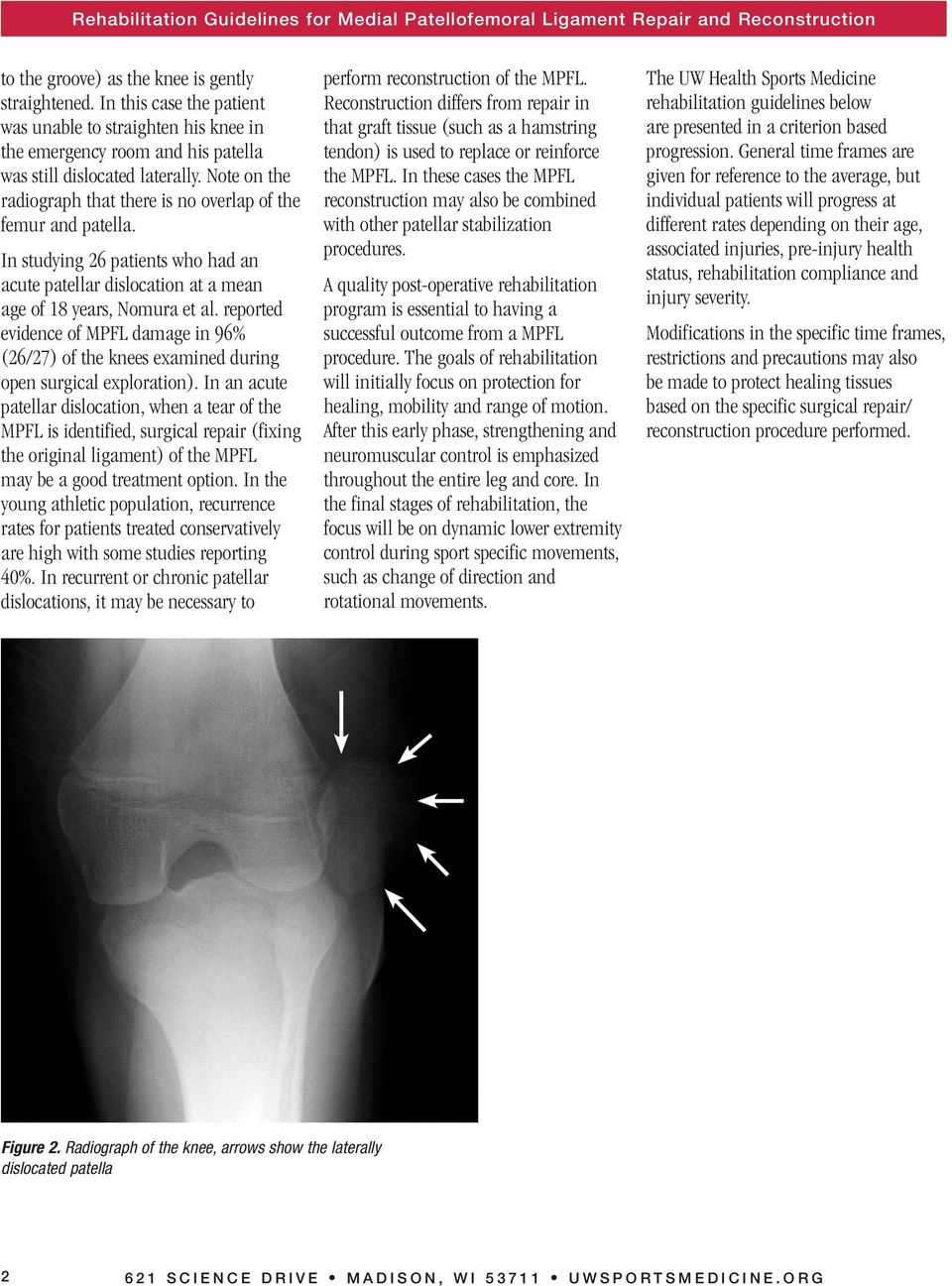
1 UW Health Sports Rehabilitation Rehabilitation Guidelines for Medial Patellofemoral Ligament Repair and Reconstruction The knee consists of four bones that form three joints. The femur is the large bone in the thigh and attaches by ligaments and a capsule to the tibia, the large bone in the lower leg commonly referred to as the shin bone. Next to the tibia is the fibula, which runs parallel to the tibia on the outside of the leg. The patella, commonly called the knee cap, is embedded in the quadriceps and patellar tendon which articulates with the front of the femur, which forms the patellofemoral joint. The patella acts as a pulley to increase the amount of force that the quadriceps muscle can generate. 1 The patella sits in a groove on the end of the femur called the trochlear groove. This groove varies in depth from person to person. While the knee flexes (bends), the patella travels down the groove and as the knee extends (straightens) the patella moves up the groove. As the patella travels up and down in the trochlear groove, the patella should maintain congruent boney alignment, which is often referred to as normal patellar tracking. There are several structures that work together to keep the patella aligned and stabilized in the femoral groove to prevent the patella from excessive lateral movement (movement towards the outside of the leg). The lateral aspect of the trochlear groove is normally about 1 centimeter higher than the medial (inside of the leg) aspect of the trochlear groove, which helps keep the patella in the trochlear groove by providing a buttress on the lateral side (Figure 1). 2 This provides the main resistance to lateral patellar translation (which is the most common direction of displacement), especially beyond 20 degrees of knee flexion. 3 People who have a shallow trochlea are more susceptible to patellar instability. Proper stabilization of the patella is also affected by the soft tissue structures (ligaments and muscles) surrounding the knee. The medial patellofemoral ligament (MPFL) is a continuation of the deep retinaculum and vastus medialis oblique (VMO) muscle fibers (inner portion of the quadriceps muscle) on the inside of the knee. These structures provide a significant force (near 60% total) against lateral Trochlea (groove for patella) displacement of the patella, as their force is directed inward or medially. 2,4 The MPFL is the primary restraint to lateral displacement of the patella during the first 20 to 30 degrees of knee flexion. 3 This ligament is a passive stabilizer and extends from the upper inner side of the patella to the medial aspect of the femur. The patellomeniscal ligament and retinaculum also contribute more than 20% of the restraining force. These ligaments can be injured and torn with an initial acute traumatic patellar dislocation (knee cap quickly going out of place). The most common mechanism for a patellar dislocation is a forceful inward rotation of the body on a planted foot. The radiograph below is that of a 12 year old boy in the emergency room after such an injury (Figure 2). Often times the patella will go back in to place (or relocate Patella Femur Figure 1. Radiograph of the patellofemoral joint with the knee in slight flexion. The lateral aspect of the trochlear groove is normally about 1 cm higher than the medial. The health care team for the UW Badgers and proud sponsor of UW Athletics

2 to the groove) as the knee is gently straightened. In this case the patient was unable to straighten his knee in the emergency room and his patella was still dislocated laterally. Note on the radiograph that there is no overlap of the femur and patella. In studying 26 patients who had an acute patellar dislocation at a mean age of 18 years, Nomura et al. reported evidence of MPFL damage in 96% (26/27) of the knees examined during open surgical exploration). In an acute patellar dislocation, when a tear of the MPFL is identified, surgical repair (fixing the original ligament) of the MPFL may be a good treatment option. In the young athletic population, recurrence rates for patients treated conservatively are high with some studies reporting 40%. In recurrent or chronic patellar dislocations, it may be necessary to perform reconstruction of the MPFL. Reconstruction differs from repair in that graft tissue (such as a hamstring tendon) is used to replace or reinforce the MPFL. In these cases the MPFL reconstruction may also be combined with other patellar stabilization procedures. A quality post-operative rehabilitation program is essential to having a successful outcome from a MPFL procedure. The goals of rehabilitation will initially focus on protection for healing, mobility and range of motion. After this early phase, strengthening and neuromuscular control is emphasized throughout the entire leg and core. In the final stages of rehabilitation, the focus will be on dynamic lower extremity control during sport specific movements, such as change of direction and rotational movements. The UW Health Sports Medicine rehabilitation guidelines below are presented in a criterion based progression. General time frames are given for reference to the average, but individual patients will progress at different rates depending on their age, associated injuries, pre-injury health status, rehabilitation compliance and injury severity. Modifications in the specific time frames, restrictions and precautions may also be made to protect healing tissues based on the specific surgical repair/ reconstruction procedure performed. Figure 2. Radiograph of the knee, arrows show the laterally dislocated patella 2
3 PHASE I (Surgery to 6 weeks after surgery) Range of Motion Cardiovascular Rehabilitation appointments begin 7 to 10 days after surgery and continue once every 10 to 14 days Protection of the post-surgical knee Restore normal knee range of motion Normalize gait Eliminate effusion (swelling) Restore leg control Brace locked in extension for gait and activities of daily living Use axillary crutches for gait as needed with brace on, weight bearing as tolerated Range of motion limitations as stated below 0 90 of knee flexion for passive and active assisted range of motion Quadriceps sets Four way leg lifts with brace on in supine for hip strengthening Ankle pumps Ankle isotonics with exercise band Upper body circuit training or use of an upper body ergometer 6 weeks after surgery PHASE II (begin after meeting Phase I criteria, usually 6 weeks after surgery) Rehabilitation appointments are 1 to 2 times per week Single leg stand control Good control and no pain with short arc functional movements, including steps and partial squats Good quad control Use a lateral buttress knee sleeve for all activities Avoid over-stressing fixation: begin movement control and gentle strengthening with closed chain movements in a shallow arc of motion and by using un-weighting techniques ( such as the pool or double leg support) 3

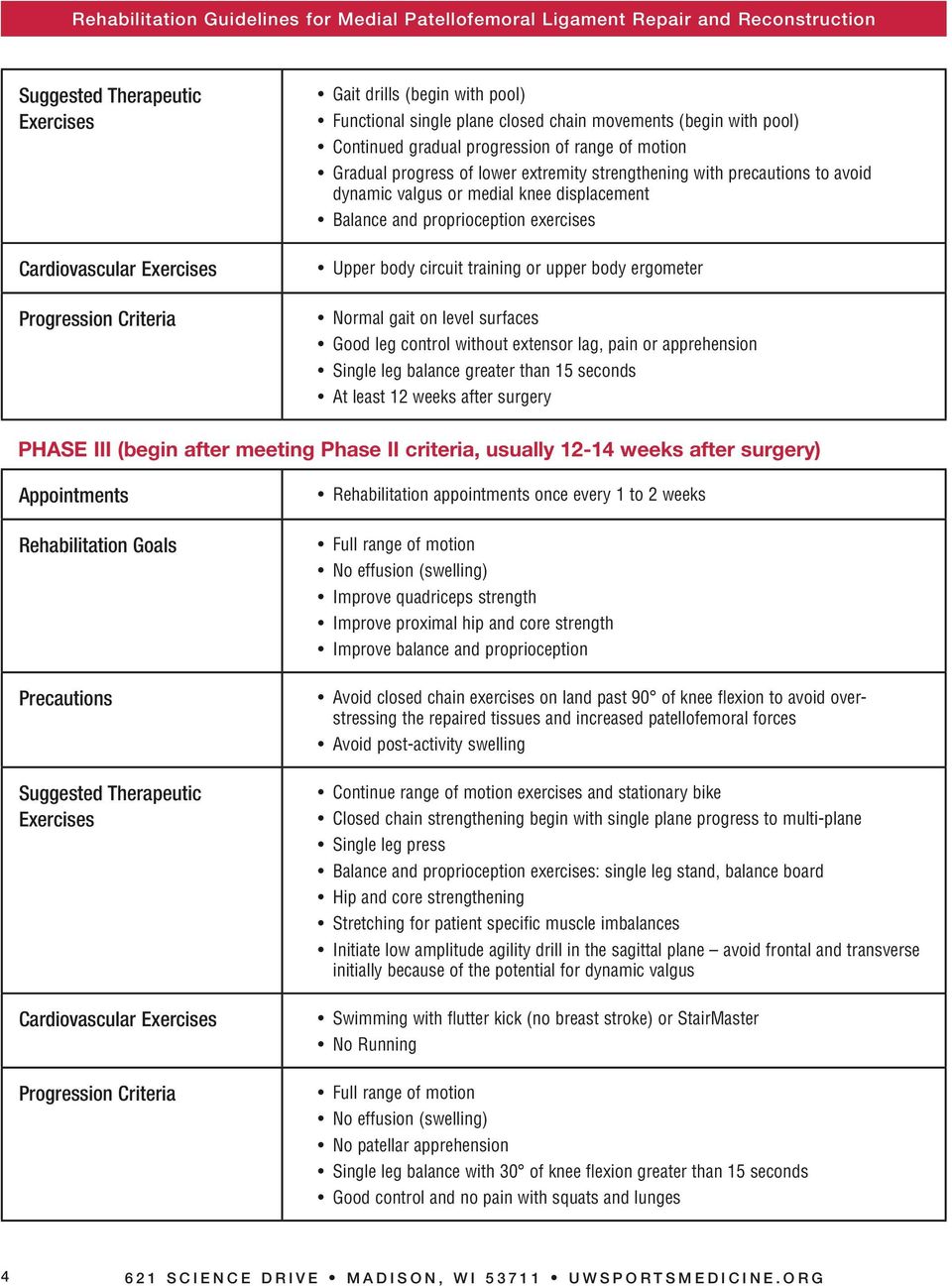
4 Cardiovascular Gait drills (begin with pool) Functional single plane closed chain movements (begin with pool) Continued gradual progression of range of motion Gradual progress of lower extremity strengthening with precautions to avoid dynamic valgus or medial knee displacement Balance and proprioception exercises Upper body circuit training or upper body ergometer Normal gait on level surfaces Good leg control without extensor lag, pain or apprehension Single leg balance greater than 15 seconds At least 12 weeks after surgery PHASE III (begin after meeting Phase II criteria, usually weeks after surgery) Cardiovascular Rehabilitation appointments once every 1 to 2 weeks Full range of motion No effusion (swelling) Improve quadriceps strength Improve proximal hip and core strength Improve balance and proprioception Avoid closed chain exercises on land past 90 of knee flexion to avoid overstressing the repaired tissues and increased patellofemoral forces Continue range of motion exercises and stationary bike Closed chain strengthening begin with single plane progress to multi-plane Single leg press Balance and proprioception exercises: single leg stand, balance board Hip and core strengthening Stretching for patient specific muscle imbalances Initiate low amplitude agility drill in the sagittal plane avoid frontal and transverse initially because of the potential for dynamic valgus Swimming with flutter kick (no breast stroke) or StairMaster No Running Full range of motion No effusion (swelling) No patellar apprehension Single leg balance with 30 of knee flexion greater than 15 seconds Good control and no pain with squats and lunges 4
5 PHASE IV (begin after meeting Phase III criteria, usually 16 to 18 weeks after surgery) Cardiovascular Rehabilitation appointments are approximately once every 2 to 3 weeks Good eccentric and concentric multi-plane dynamic neuromuscular control (including impact) to allow for return to work/sports Post-activity soreness should resolve within 24 hours Impact control exercises beginning 2 feet to 2 feet, progressing from 1 foot to the other and then 1 foot to the same foot Movement control exercises beginning with low velocity, single plane activities and progressing to higher velocity, multi-plane activities Progression to multi-planar agility drills with progressive increase in velocity and amplitude Sport/work specific balance and proprioceptive drills Hip and core strengthening Stretching for patient specific muscle imbalances Replicate sport or work specific energy demands Return to sport/work criteria: Dynamic neuromuscular control with multi-plane activities and without pain, instability or swelling Approval from the physician and/or sports rehabilitation provider These rehabilitation guidelines were developed collaboratively between Marc Sherry, PT, DPT LAT, CSCS ([email protected]) and the UW Sports Medicine physician group. Updated 7/2011 References 1. Fisher B, Nyland J, Brand E, Curtin B. Medial patellofemoral ligament reconstruction for recurrent patellar dislocation: a systematic review including rehabilitation and returnto-sports efficacy. Arthroscopy Oct;26(10): Neuman DA. Kinesiology of the Musculoskeletal System: Foundations for Physical Rehabilitation. 1st ed. St. Louis, MO: Mosby; Minkowitz R, Inzerillo C, Sherman OH. Patella Instability. Bull NYU Hosp Jt Dis. 2007;65(4): E. Nomura, Y. Horiuchi and M. Inoue, Correlation of MR imaging findings and open exploration of medial patellofemoral ligament injuries in acute patellar dislocations, Knee 9 (2002), pp. 139 Äì Andrish J. The Management of Recurrent Patellar Dislocation. Ortho Clinics North Am. 2008;39(3): Arendt EA, Fithian DC, Cohen E. Current concepts of lateral patella dislocation. Clinics Sports Med. 2002;21(3): Arendt EA, Moeller A, Agel J. Clinical outcomes of medial patellofemoral ligament repair in recurrent (chronic) lateral patella dislocations. Knee Surg Sports Traumatol Arthrosc Apr 30. At UW Health, patients may have advanced diagnostic and /or treatment options, or may receive educational materials that vary from this information. Please be aware that this information is not intended to replace the care or advice given by your physician or health care provider. It is neither intended nor implied to be a substitute for professional advice. Call your health provider immediately if you think you may have a medical emergency. Always seek the advice of your physician or other qualified health provider prior to starting any new treatment or with any question you may have regarding a medical condition. Copyright 2011 UW Health Sports Medicine Center 5 SM

How To Treat A Patella Dislocation
 Rehabilitation Guidelines for Patellar Realignment The knee consists of four bones that form three joints. The femur is the large bone in your thigh, and attaches by ligaments and a capsule to your tibia,
Rehabilitation Guidelines for Patellar Tendon and Quadriceps Tendon Repair
 UW Health Sports Rehabilitation Rehabilitation Guidelines for Patellar Tendon and Quadriceps Tendon Repair The knee consists of four bones that form three joints. The femur is the large bone in the thigh
Rehabilitation Guidelines for Meniscal Repair
 UW Health Sports Rehabilitation Rehabilitation Guidelines for Meniscal Repair There are two types of cartilage in the knee, articular cartilage and cartilage. Articular cartilage is made up of collagen,
Rehabilitation Guidelines for Posterior Cruciate Ligament Reconstruction
 UW Health Sports Rehabilitation Rehabilitation Guidelines for Posterior Cruciate Ligament Reconstruction The knee has three joints--the patellofemoral joint (knee cap), the tibiofemoral joint and the tibiofibular
Rehabilitation Guidelines for Knee Arthroscopy
 Rehabilitation Guidelines for Knee Arthroscopy Arthroscopy is a common surgical procedure in which a joint is viewed using a small camera. This technique allows the surgeon to have a clear view of the
Rehabilitation Guidelines for Knee Multi-ligament Repair/Reconstruction
 UW Health Sports Rehabilitation Rehabilitation Guidelines for Knee Multi-ligament Repair/Reconstruction The knee joint is comprised of an articulation of three bones: the femur (thigh bone), tibia (shin
Rehabilitation Guidelines for Lateral Ankle Reconstruction
 UW HEALTH SPORTS REHABILITATION Rehabilitation Guidelines for Lateral Ankle Reconstruction The ankle is a very complex joint. There are actually three joints that make up the ankle complex: the tibiotalar
Platelet-Rich Plasma Rehabilitation Guidelines
 UW Health Sports Rehabilitation Platelet-Rich Plasma Rehabilitation Guidelines What is Tendinopathy? Tendons are strong bands of connective tissue comprised primarily of a substance called collagen. Mechanically,
ACL RECONSTRUCTION POST-OPERATIVE REHABILITATION PROGRAMME
 ACL RECONSTRUCTION POST-OPERATIVE REHABILITATION PROGRAMME ABOUT THE OPERATION The aim of your operation is to reconstruct the Anterior Cruciate Ligament (ACL) to restore knee joint stability. A graft,
Rehabilitation Guidelines for Achilles Tendon Repair
 UW HEALTH SPORTS REHABILITATION Rehabilitation Guidelines for Achilles Tendon Repair The Achilles tendon is the strongest and thickest tendon in the body. It attaches the calf muscles (soleus and gastrocnemius)
ACL Non-Operative Protocol
 ACL Non-Operative Protocol Anatomy and Biomechanics The knee is a hinge joint connecting the femur and tibia bones. It is held together by several important ligaments. The most important ligament to the
ACL Reconstruction Post Operative Rehabilitation Protocol
 ACL Reconstruction Post Operative Rehabilitation Protocol The following is a generalized outline for rehabilitation following ACL reconstruction. The protocol may be modified if additional procedures,
Dr Doron Sher MB.BS. MBiomedE, FRACS(Orth)
 Dr Doron Sher MB.BS. MBiomedE, FRACS(Orth) Knee, Shoulder, Elbow Surgery ACL REHABILITATION PROGRAM (With thanks to the Eastern Suburbs Sports Medicine Centre) The time frames in this program are a guide
Patellofemoral/Chondromalacia Protocol
 Patellofemoral/Chondromalacia Protocol Anatomy and Biomechanics The knee is composed of two joints, the tibiofemoral and the patellofemoral. The patellofemoral joint is made up of the patella (knee cap)
Eastern Suburbs Sports Medicine Centre
 Eastern Suburbs Sports Medicine Centre ACCELERATED ANTERIOR CRUCIATE LIGAMENT REHABILITATION PROGRAM Alan Davies Diane Long Mark Kenna (APA Sports Physiotherapists) The following ACL reconstruction rehabilitation
Rehabilitation Guidelines Following Microfracture Procedures to the Knee
 UW Health Sports Rehabilitation Rehabilitation Guidelines Following Microfracture Procedures to the Knee There are two types of cartilage in the knee: meniscus and articular. One type of cartilage is the
William J. Robertson, MD UT Southwestern Orthopedics 1801 Inwood Rd. Dallas, TX 75390-8882 Office: (214) 645-3300 Fax: (214) 3301 billrobertsonmd.
 Anterior Cruciate Ligament Reconstruction Postoperative Rehab Protocol You will follow-up with Dr. Robertson 10-14 days after surgery. At this office visit you will also see one of his physical therapists.
ACL Reconstruction: Patellar Tendon Graft/Hamstring Tendon Graft
 ACL Reconstruction: Patellar Tendon Graft/Hamstring Tendon Graft Patellar Tendon Graft/Hamstring Tendon Graft General Information: The intent of these guidelines is to provide the therapist with direction
Theodore B. Shybut, M.D. 7200 Cambridge St. #10A Houston, Texas 77030 Phone: 713-986-5590 Fax: 713-986-5521. Sports Medicine
 Anterior Cruciate Ligament Reconstruction Accelerated Rehab This rehabilitation protocol has been designed for patients with ACL reconstruction who anticipate returning to a high level of activity as quickly
ACL Reconstruction Physiotherapy advice for patients
 Oxford University Hospitals NHS Trust ACL Reconstruction Physiotherapy advice for patients Introduction This booklet is designed to provide you with advice and guidance on your rehabilitation after reconstruction
PREOPERATIVE: POSTOPERATIVE:
 PREOPERATIVE: ACL RECONSTRUCTION RECOVERY & REHABILITATION PROTOCOL If you have suffered an acute ACL injury and surgery is planned, the time between injury and surgery should be used to regain knee motion,
QUESTION I HAVE BEEN ASKED TO REHAB GRADE II AND III MCL INJURIES DIFFERENTLY BY DIFFERENT SURGEONS IN THE FIRST 6WEEKS FOLLOWING INJURY.
 QUESTION I HAVE BEEN ASKED TO REHAB GRADE II AND III MCL INJURIES DIFFERENTLY BY DIFFERENT SURGEONS IN THE FIRST 6WEEKS FOLLOWING INJURY. SOME ARE HINGE BRACED 0-90 DEGREES AND ASKED TO REHAB INCLUDING
Pre - Operative Rehabilitation Program for Anterior Cruciate Ligament Reconstruction
 Pre - Operative Rehabilitation Program for Anterior Cruciate Ligament Reconstruction This protocol is designed to assist you with your preparation for surgery and should be followed under the direction
Rehabilitation Guidelines for Posterior Shoulder Reconstruction with or without Labral Repair
 Rehabilitation Guidelines for Posterior Shoulder Reconstruction with or without Labral Repair The anatomic configuration of the shoulder joint (glenohumeral joint) is often compared to a golf ball on a
Medial patellofemoral ligament (MPFL) reconstruction
 Medial patellofemoral ligament (MPFL) reconstruction Introduction Mal-tracking (when the knee cap doesn t move smoothly in the grove below) and instability of the patella (knee Normal patella (above) on
Knee Arthroscopy (Meniscectomy)
 Knee Arthroscopy (Meniscectomy) Anatomy and Biomechanics The knee is a hinge joint at the connection point between the femur and tibia bones. It is held together by several important ligaments. The knee
Rehabilitation Guidelines for Shoulder Arthroscopy
 Rehabilitation Guidelines for Shoulder Arthroscopy Front View Long head of bicep Acromion Figure 1 Shoulder anatomy Supraspinatus Image Copyright 2010 UW Health Sports Medicine Center. Short head of bicep
Patellar Dislocation Conservative and Operative Rehabilitation
 1 Patellar Dislocation Conservative and Operative Rehabilitation Surgical Indications and Considerations Anatomical Considerations: Patellar stability is dependent upon two components: bony (trochlear
GALLAND/KIRBY ACL RECONSTRUCTION WITH MENISCUS REPAIR POST-SURGICAL REHABILITATION PROTOCOL
 GALLAND/KIRBY ACL RECONSTRUCTION WITH MENISCUS REPAIR POST-SURGICAL REHABILITATION PROTOCOL POST-OP DAYS 1 14 Dressing: POD 1: Debulk dressing, TED Hose in place POD 2: Change dressing, keep wound covered,
MEDIAL PATELLA FEMORAL LIGAMENT RECONSTRUCTION Rehab Protocol
 Rehab Protocol This rehabilitation protocol has been designed for patients who have undergone an MPFL reconstruction. Dependent upon the particular procedure, this protocol also may be slightly deviated
ANTERIOR CRUCIATE LIGAMENT RECONSTRUCTION Hamstring Graft/PTG-Accelerated Rehab
 The rehabilitation protocol has been designed for patients with ACL reconstruction who anticipate returning early to a high level of activity postoperatively. The ACL Rehabilitation protocol for all three
Post Surgery Rehabilitation Program
 Post Surgery Rehabilitation Program Medial Patellofemoral Ligament Reconstruction and Imbrication This protocol is designed to assist you with your rehabilitation after surgery and should be followed under
Post-Operative ACL Reconstruction Functional Rehabilitation Protocol
 Post-Operative ACL Reconstruction Functional Rehabilitation Protocol Patient Guidelines Following Surgery The post-op brace is locked in extension initially for the first week with the exception that it
POSTERIOR CRUCIATE LIGAMENT RECONSTRUCTION POSTOPERATIVE REHABILITATION PROTOCOL
 Corey A. Wulf, MD POSTERIOR CRUCIATE LIGAMENT RECONSTRUCTION POSTOPERATIVE REHABILITATION PROTOCOL The range of motion allowed after posterior cruciate ligament reconstructive surgery is dependent upon
Rehabilitation Guidelines for Autologous Chondrocyte Implantation. Ashley Conlin, PT, DPT, SCS, CSCS
 Rehabilitation Guidelines for Autologous Chondrocyte Implantation Ashley Conlin, PT, DPT, SCS, CSCS Objectives Review ideal patient population Review overall procedure for Autologous Chondrocyte Implantation
AQUATIC/LAND BASED CLINICAL PROTOCOL FOR GRADE I/II MCL INJURY
 Frisbie Memorial Hospital Marsh Brook Rehabilitation Services Wentworth-Douglass Hospital AQUATIC/LAND BASED CLINICAL PROTOCOL FOR GRADE I/II MCL INJURY FREQUENCY: 2-3 times per week. DURATION: 4-6 weeks
Mary LaBarre, PT, DPT,ATRIC
 Aquatic Therapy and the ACL Current Concepts on Prevention and Rehab Mary LaBarre, PT, DPT,ATRIC Anterior Cruciate Ligament (ACL) tears are a common knee injury in athletic rehab. Each year, approximately
ACCELERATED REHABILITATION PROTOCOL FOR POST OPERATIVE POSTERIOR CRUCIATE LIGAMENT RECONSTRUCTION DR LEO PINCZEWSKI DR JUSTIN ROE
 ACCELERATED REHABILITATION PROTOCOL FOR POST OPERATIVE POSTERIOR CRUCIATE LIGAMENT RECONSTRUCTION DR LEO PINCZEWSKI DR JUSTIN ROE January 2005 Rationale of Accelerated Rehabilitation Rehabilitation after
Rehabilitation Guidelines for Arthroscopic Capsular Shift
 Rehabilitation Guidelines for Arthroscopic Capsular Shift The anatomic configuration of the shoulder joint (glenohumeral joint) is often compared to a golf ball on a tee. This is because the articular
Rehabilitation Guidelines for Anterior Shoulder Reconstruction with Arthroscopic Bankart Repair
 Rehabilitation Guidelines for Anterior Shoulder Reconstruction with Arthroscopic Bankart Repair The anatomic configuration of the shoulder joint (glenohumeral joint) is often compared to a golf ball on
Anterior Cruciate Ligament Reconstruction Rehabilitation Protocol
 Anterior Cruciate Ligament Reconstruction Rehabilitation Protocol GENERAL CONSIDERATIONS * This handout serves as a general outline for you as a patient to better understand guidelines and time frames
The Insall Scott Kelly Center for Orthopaedics and Sports Medicine 210 East 64th Street, 4 th Floor, New York, NY 10065
 ANTERIOR CRUCIATE LIGAMENT RECONSTRUCTION POST-OPERATIVE REHABILITATION PROTOCOL 2003 AUTOGRAFT BONE-PATELLA TENDON-BONE and ALLOGRAFT PROTOCOL PHASE I-EARLY FUNCTIONAL (WEEKS 1-2) Goals: 1. Educate re:
Anterior Cruciate Ligament Reconstruction Delayed Rehab Dr. Walter R. Lowe
 Anterior Cruciate Ligament Reconstruction Delayed Rehab Dr. Walter R. Lowe This rehabilitation protocol has been designed for patients who have undergone an ACL reconstruction (HS graft/ptg/allograft)
ACL Reconstruction Rehabilitation Program
 ACL Reconstruction Rehabilitation Program 1. Introduction to Rehabilitation 2. The Keys to Successful Rehabilitation 3. Stage 1 (to the end of week 1) 4. Stage 2 (to the end of week 2) 5. Stage 3 (to the
Rehabilitation Guidelines for Elbow Ulnar Collateral Ligament (UCL) Reconstruction
 Rehabilitation Guidelines for Elbow Ulnar Collateral Ligament (UCL) Reconstruction The elbow is a complex system of three joints formed from three bones; the humerus (the upper arm bone), the ulna (the
REHABILITATION GUIDELINES FOR SUBSCAPULARIS (+/- SUBACROMINAL DECOMPRESSION)
 REHABILITATION GUIDELINES FOR SUBSCAPULARIS (+/- SUBACROMINAL DECOMPRESSION) The rehabilitation guidelines are presented in a criterion based progression. General time frames are given for reference to
Anterior Cruciate Ligament Reconstruction Accelerated Rehabilitation Protocol Dr. Mark Adickes
 Anterior Cruciate Ligament Reconstruction Accelerated Rehabilitation Protocol Introduction: This rehabilitation protocol is designed for patients with ACL injuries who anticipate returning early to a high
Strength Training for the Knee
 Strength Training for the Knee This handout is to help you rebuild the strength of the muscles surrounding the knee after injury. It is intended as a guideline to help you organize a structured approach
Knee sprains. What is a knee strain? How do knee strains occur? what you ll find in this brochure
 what you ll find in this brochure What is a knee strain? How do knee strains occur? What you should do if a knee strain occurs. What rehabilitation you should do. Example of a return to play strategy.
KNEE ARTHROSCOPY POST-OPERATIVE REHABILITATION PROGRAMME
 KNEE ARTHROSCOPY POST-OPERATIVE REHABILITATION PROGRAMME ABOUT THE OPERATION The arthroscope is a fibre-optic telescope that can be inserted into a joint. A camera is attached to the arthroscope and the
Hamstring Apophyseal Injuries in Adolescent Athletes
 Hamstring Apophyseal Injuries in Adolescent Athletes Kyle Nagle, MD MPH University of Colorado Department of Orthopedics Children s Hospital Colorado Orthopedics Institute June 14, 2014 Disclosures I have
KNEES A Physical Therapist s Perspective American Physical Therapy Association
 Taking Care of Your KNEES A Physical Therapist s Perspective American Physical Therapy Association Taking Care of Your Knees When the mother of the hero Achilles dipped him in the river Styx, she held
Rehabilitation Guidelines For SLAP Lesion Repair
 Rehabilitation Guidelines For SLAP Lesion Repair The anatomic configuration of the shoulder joint (glenohumeral joint) is often compared to a golf ball on a tee. This is because the articular surface of
Noyes Knee Institute Rehabilitation Protocol: Medial Ligament Repair or Reconstruction
 Noyes Knee Institute Rehabilitation Protocol: Medial Ligament Repair or Reconstruction Brace: Long-leg postoperative Custom unloading if required minimum goals: 0-90 0-110 0-120 0-130 Weight bearing: Toe
Knee Arthroscopy/Lateral Release Rehabilitation Dr. Walter R. Lowe
 Knee Arthroscopy/Lateral Release Rehabilitation Dr. Walter R. Lowe This rehabilitation protocol is designed for patients who have undergone knee arthroscopy or arthroscopic lateral release. The intensity
UK HealthCare Sports Medicine Patient Education December 09
 LCL injury Description Lateral collateral knee ligament sprain is a sprain (stretch or tear) of one of the four major ligaments of the knee. The lateral collateral ligament (LCL) is a structure that helps
Dr. O Meara s. Anterior Knee Pain (PatelloFemoral Syndrome) Rehabilitation Protocol www.palomarortho.com
 Dr. O Meara s Anterior Knee Pain (PatelloFemoral Syndrome) Rehabilitation Protocol www.palomarortho.com Anterior Knee Pain (PatelloFemoral Syndrome) Rehabilitation Protocol Hamstring Stretching & Strengthening
UHealth Sports Medicine
 UHealth Sports Medicine Rehabilitation Guidelines for Arthroscopic Rotator Cuff Repair Type 2 Repairs with Bicep Tenodesis (+/- subacromial decompression) The rehabilitation guidelines are presented in
Brian P. McKeon MD Jason D. Rand, PA-C, PT Patient Information Sheet: Anterior Cruciate Ligament
 Brian P. McKeon MD Jason D. Rand, PA-C, PT Patient Information Sheet: Anterior Cruciate Ligament The anterior cruciate ligament or ACL is one of the major ligaments located in the knee joint. This ligament
Rehabilitation Guidelines Following Proximal Hamstring Primary Repair
 Rehabilitation Guidelines Following Proximal Hamstring Primary Repair The hamstring muscle group consists of three muscles: the biceps femoris, semitendinosus and semimembranosus. All three of these muscles
Post Surgery Rehabilitation Program for Knee Arthroscopy
 Post Surgery Rehabilitation Program for Knee Arthroscopy This protocol is designed to assist you with your rehabilitation after surgery and should be followed under the direction of a physiotherapist May
Physical & Occupational Therapy
 In this section you will find our recommendations for exercises and everyday activities around your home. We hope that by following our guidelines your healing process will go faster and there will be
Anterior Cruciate Ligament Reconstruction Rehabilitation Protocol
 The First Two Weeks After Surgery You will go home with crutches and be advised to use ice. Goals 1. Protect reconstruction 2. Ensure wound healing 3. Maintain full knee extension 4. Gain knee flexion
Post Operative Total Knee Replacement Protocol Brian White, MD www.western-ortho.com
 Post Operative Total Knee Replacement Protocol Brian White, MD www.western-ortho.com The intent of this protocol is to provide guidelines for progression of rehabilitation. It is not intended to serve
REHABILITATION AFTER REPAIR OF THE PATELLAR AND QUADRICEPS TENDON
 175 Cambridge Street, 4 th floor Boston, MA 02114 617-726-7500 REHABILITATION AFTER REPAIR OF THE PATELLAR AND QUADRICEPS TENDON The patellar tendon attaches to the tibial tubercle on the front of the
Introduction This case study presents a 24 year old male soccer player with an Anterior Cruciate Ligament (ACL) tear in his left knee.
 Introduction This case study presents a 24 year old male soccer player with an Anterior Cruciate Ligament (ACL) tear in his left knee. The athlete is a defender/mid-fielder and has been involved in soccer
Screening Examination of the Lower Extremities BUY THIS BOOK! Lower Extremity Screening Exam
 Screening Examination of the Lower Extremities Melvyn Harrington, MD Department of Orthopaedic Surgery & Rehabilitation Loyola University Medical Center BUY THIS BOOK! Essentials of Musculoskeletal Care
PATELLOFEMORAL TRACKING AND MCCONNELL TAPING. Minni Titicula
 PATELLOFEMORAL TRACKING AND MCCONNELL TAPING Minni Titicula PF tracking disorder PF tracking disorder occurs when patella shifts out of the femoral groove during joint motion. most common in the US. affects
EXCESSIVE LATERAL PATELLAR COMPRESSION SYNDROME (Chondromalacia Patella)
 EXCESSIVE LATERAL PATELLAR COMPRESSION SYNDROME (Chondromalacia Patella) Description Maintain appropriate conditioning: Excessive lateral patellar compression syndrome is characterized by pain in the knee
Steps to Success: A Guide to Knee Rehabilitation
 Steps to Success: A Guide to Knee Rehabilitation Indications Carticel (autologous cultured chondrocytes) is indicated for the repair of symptomatic, cartilaginous defects of the femoral condyle (medial,
www.ghadialisurgery.com
 P R E S E N T S Dr. Mufa T. Ghadiali is skilled in all aspects of General Surgery. His General Surgery Services include: General Surgery Advanced Laparoscopic Surgery Surgical Oncology Gastrointestinal
Anterior Cruciate Ligament (ACL) Rehabilitation
 Thomas D. Rosenberg, M.D. Vernon J. Cooley, M.D. Charles C. Lind, M.D. Anterior Cruciate Ligament (ACL) Rehabilitation Dear Enclosed you will find a copy of our Anterior Cruciate Ligament (ACL) Rehabilitation
Knee Kinematics and Kinetics
 Knee Kinematics and Kinetics Definitions: Kinematics is the study of movement without reference to forces http://www.cogsci.princeton.edu/cgi-bin/webwn2.0?stage=1&word=kinematics Kinetics is the study
REHABILITATION PROTOCOL
 COSM REHAB ANOTHER SERVICE PROVIDED BY THE CENTER FOR ORTHOPAEDICS & SPORTS MEDICINE REHABILITATION PROTOCOL KNEE ACL Reconstruction Protocol Please contact us with any questions. www.pacosm.com Indiana
ChondroCelect Rehabilitation Program
 ChondroCelect Rehabilitation Program Rehabilitation differs depending on the type and site of the lesion and the patient personal profile. Grouping of the lesions and patient profiles is helpful to ensure
Rehabilitation after ACL Reconstruction
 Rehabilitation after ACL Reconstruction John Nyland, DPT, EdD Artur Proniewicz, MD Paul Mazzone, BS Athletic Training Program Kosair Charities College of Health and Natural Sciences Spalding University,
Anterior Cruciate Ligament Reconstruction. ACL Rehab Protocol
 Anterior Cruciate Ligament Reconstruction Rehab Protocol This rehabilitation protocol has been designed for patients following ACL reconstruction who anticipate returning to a high level of activity as
Rehabilitation Guidelines Following Compartment Syndrome Release With Open Fasciotomy
 UW Health Sports Rehabilitation Rehabilitation Guidelines Following Compartment Syndrome Release With Open Fasciotomy Chronic Exertional Compartment Syndrome (CECS) is a painful condition of the lower
Rehabilitation of Sports Hernia
 Rehabilitation of Sports Hernia (Involving Adductor Tenotomy, Ilioinguinal Neurectomy and Osteitis Pubis) An appendix follows this protocol for examples of exercises in each phase of rehabilitation. There
Rehabilitation Protocol: Total Hip Arthroplasty (THA)
 Rehabilitation Protocol: Total Hip Arthroplasty (THA) Department of Orthopaedic Surgery Lahey Hospital & Medical Center, Burlington 781-744-8650 Lahey Outpatient Center, Lexington 781-372-7020 Lahey Medical
ANTERIOR CRUCIATE LIGAMENT RECONSTRUCTION
 Daniel P. Duggan, D.O. The Sports Clinic 23961 Calle de la Magdalena, Suite 229 Laguna Hills, CA 92653 Phone: (949) 581-7001 Fax: (949) 581-8410 http://orthodoc.aaos.org/danielduggando ANTERIOR CRUCIATE
What is Osteoarthritis? Who gets Osteoarthritis? What can I do when I am diagnosed with Osteoarthritis? What can my doctor do to help me?
 Knee Osteoarthritis What is Osteoarthritis? Osteoarthritis is a disease process that affects the cartilage within a joint. Cartilage exists at the surface of the ends of the bones and provides joints with
Rehabilitation Guidelines for Type I and Type II Rotator Cuff Repair and Isolated Subscapularis Repair
 UW Health SpoRTS Rehabilitation Rehabilitation Guidelines for Type I and Type II Rotator Cuff Repair and Isolated Subscapularis Repair The anatomic configuration of the shoulder joint (glenohumeral joint)
Meniscus Repair Rehabilitation Dr. Walter R. Lowe
 Meniscus Repair Rehabilitation Dr. Walter R. Lowe This rehabilitation protocol was developed for patients who have isolated meniscal repairs. Meniscal repairs located in the vascular zones of the periphery
Cincinnati Sportsmedicine and Orthopaedic Center
 Cincinnati Sportsmedicine and Orthopaedic Center Total Knee Replacement: Rehabilitation Protocol This rehabilitation protocol was developed for patients who have had a cemented total knee arthroplasty.
Noyes Knee Institute Rehabilitation Protocol for ACL Reconstruction: Revision Knees, Allografts, Complex Knees
 Noyes Knee Institute Rehabilitation Protocol for ACL Reconstruction: Revision Knees, Allografts, Complex Knees 1-2 3-4 5-6 7-8 9-12 4 5 6 7-12 Brace: postoperative & functional () minimum goals: 0-90 0-120
Knee Conditioning Program. Purpose of Program
 Prepared for: Prepared by: OrthoInfo Purpose of Program After an injury or surgery, an exercise conditioning program will help you return to daily activities and enjoy a more active, healthy lifestyle.
Knee Arthroscopy Post-operative Instructions
 Amon T. Ferry, MD Orthopedic Surgery Sports Medicine Knee Arthroscopy Post-operative Instructions PLEASE READ ALL OF THESE INSTRUCTIONS CAREFULLY. THEY WILL ANSWER MOST OF YOUR QUESTIONS. 1. You may walk
Meniscus Repair Rehabilitation Protocol Dr. Mark Adickes
 Meniscus Repair Rehabilitation Protocol Dr. Mark Adickes Introduction: This rehabilitation protocol was developed for patients who have isolated meniscal repairs. Depending upon the complexity of the tear
PHASE I ANKLE REHABILITATION EXERCISES
 PHASE I ANKLE REHABILITATION EXERCISES SWELLING CONTROL S REST: Keep your standing and walking activities to a minimum while swelling is a problem. ICE: Use an ice pack in a moist towel for 10-15 minutes
ACL Reconstruction Protocol
 ACL Reconstruction Protocol The primary emphasis of this ACL rehab protocol is on functional weight bearing exercises with a focus on restoring the balance between the quadriceps and hamstrings muscles,
Rehabilitation Protocol: Total Knee Arthroplasty (TKA)
 Rehabilitation Protocol: Total Knee Arthroplasty (TKA) Department of Orthopaedic Surgery Lahey Hospital & Medical Center, Burlington 781-744-8650 Lahey Outpatient Center, Lexington 781-372-7020 Lahey Medical
What is petellofemoral Pain syndrome?
 Jackie Davis What is petellofemoral Pain syndrome? Patellofemoral Syndrome can be defined as retropatellar or peripatellar pain resulting from physical and biochemical changes in the patellofemoral joint.
Noyes Knee Institute Rehabilitation Protocol for Primary ACL Reconstruction: Early Return to Strenuous Activities
 Noyes Knee Institute Rehabilitation Protocol for Primary ACL Reconstruction: Early Return to Strenuous Activities 1-2 3-4 5-6 7-8 9-12 4 5 6 7-12 Brace: immobilizer for patient comfort () minimum goals:
Rehabilitation Protocol: Hip Arthroscopy Femoral Acetabular Impingement Debridement/Osteochondroplasty. Richard M. Wilk, M.D. Michael Kain, M.D.
 Rehabilitation Protocol: Hip Arthroscopy Femoral Acetabular Impingement Debridement/Osteochondroplasty Richard M. Wilk, M.D. Michael Kain, M.D. Department of Orthopaedic Surgery Lahey Hospital & Medical
Rehabilitation after ACL Reconstruction: From the OR to the Playing Field. Mark V. Paterno PT, PhD, MBA, SCS, ATC
 Objectives Rehabilitation after ACL Reconstruction: From the OR to the Playing Field Mark V. Paterno PT, PhD, MBA, SCS, ATC Coordinator of Orthopaedic and Sports Physical Therapy Cincinnati Children s
Medial Collateral Ligament (MCL) Rehabilitation Protocol
 Introduction: This rehabilitation protocol is designed for patients with Medial Collateral Ligament (MCL) Rehabilitation Protocol MCL injuries who require an early return to high level activity following
ILIOTIBIAL BAND SYNDROME
 ILIOTIBIAL BAND SYNDROME Description The iliotibial band is the tendon attachment of hip muscles into the upper leg (tibia) just below the knee to the outer side of the front of the leg. Where the tendon