
15 Imaging ESSENTIAL IDEAS. How we see images. Option C. Understanding the human eye
|
|
|
- Emery Collins
- 9 years ago
- Views:
Transcription
1 Option C 15 Imaging ESSENTIAL IDEAS The progress of a wave can be modelled using the ray or the wavefront. The change in wave speed when moving between media changes the shape of the wave. Optical microscopes and telescopes utilize similar physical properties of lenses and mirrors. Analysis of the universe is performed both optically and by using radio telescopes to investigate different regions of the electromagnetic spectrum. Total internal reflection allows light or infrared radiation to travel along a transparent fibre. However, the performance of a fibre can be degraded by dispersion and attenuation effects. The body can be imaged using radiation generated from both outside and inside. Imaging has enabled medical practitioners to improve diagnosis with fewer invasive procedures (C1: Core) Introduction to imaging the progress of a wave can be modelled via the ray or the wavefront; the change in wave speed when moving between media changes the shape of the wave How we see images We see an object when light from it enters our eyes. Some objects emit light, but we are able to see most things because the light waves striking them are scattered in all directions and some of the waves spreading away from a particular point on the object are brought back together to a point in our eyes. Figure 15.1 shows this using rays to represent the directions in which the waves are travelling. The representation of an object that our eyes and brain see is called an image. The term object is generally used to describe the thing that we are looking at. cornea + lens point image light spreads in all directions from a point object eye (not to scale) Figure 15.1 The eye focusing light to form an image The eye uses refraction to bring light rays diverging from a point on an object back to a point on the image. This process is called focusing the light to form an image. Additional Perspectives Understanding the human eye Figure 15.2 shows the basic structure of the human eye. Light rays are refracted as they pass into the eye through the cornea. Further refraction then takes place at surfaces of the lens. As a result the rays are focused on the back of the eyeball (retina) where the image is formed. The iris controls the amount of light entering the eye. The aperture (opening) through which the light passes is called the pupil. In bright light the iris decreases the size of the pupil to protect the eye, while at night the pupil dilates (gets larger) so that more light can

2 2 15 Imaging lens aqueous humour cornea pupil iris vitreous humour retina fovea blind spot ligaments ciliary muscle optic nerve Figure 15.2 Physical features of the human eye be received by the retina in order to see clearly. The aqueous humour is a watery liquid between the cornea and the lens; the vitreous humour is a clear gel between the lens and the retina. The ciliary muscles can change the shape of the lens; this is how the eye is able to focus on objects that are at different distances away. 1 If images are not formed on the surface of the retina, the eye will not be able see clearly. Suggest possible reasons why this may happen. 2 Suggest the purpose of the optic nerve. a b Figure 15.3 How curved interfaces between transparent media affect wavefronts and rays We know from Chapter 4 that when wavefronts enter a different medium and their speed changes, they can refract and change direction. If the interface (boundary) between the two media has a curved surface, then the refracted wavefronts will change shape. Figures 15.3a and 15.3b show plane wavefronts (parallel rays) crossing an interface into a medium where they travel slower. Rays showing the direction of travel of the wavefronts are also included (rays are always drawn perpendicular to wavefronts). In 15.3a the incident waves arrive at a convex surface and the transmitted wavefronts and rays converge. In 15.3b the waves are incident on a concave surface and the transmitted wavefronts and rays diverge. Converging and diverging lenses The eye contains a lens that helps to focus the light. Manufactured lenses made of transparent materials (such as glass or plastic) use the effect shown in Figure 15.3 to focus light and form images. This usually involves light travelling from an object through air and then through a transparent lens that has two smooth, curved surfaces. Refraction then occurs at both surfaces as shown in Figure 15.4, which shows the effects of the two basic types of lens on plane wavefronts. The wavefronts inside the lenses have not been included in these diagrams. Light rays will refract and change direction at both surfaces of the lens, unless they are incident along a normal. However, in the rest of this chapter we will usually simplify the diagrams in order to show the rays changing direction only once in the centre of the lens.

3 15.1 (C1: Core) Introduction to imaging 3 Figure 15.4 Two basic types of lens and how they affect light waves (and rays) a converging rays wavefronts converging (convex) lens image formed at focus b wavefronts diverging (concave) lens diverging rays In Figure 15.4a the wavefronts converge to a focus for this reason this type of lens is often called a converging lens. Because of the shape of its surface, this type of lens is also called a convex lens. Despite their name, converging lenses do not always converge light (magnifying glasses are the exception). Figure 15.4b shows the action of a diverging lens (concave surface). Lenses are made in a wide variety of shapes and sizes, but all lenses can be described as either converging/convex or diverging/concave. Lenses have been in use for thousands of years in many societies around the world. The oldest were crafted from naturally occurring translucent rock (see Figure 15.5). They may have been used for magnification or for starting fires. Figure 15.5 The oldest known lens (found at the Assyrian palace at Nimrud); it is now in the British Museum in London

4 4 15 Imaging Thin lenses Although real lenses will not behave exactly as the idealized descriptions and equations presented in this chapter, lens theory can be applied confidently to thin lenses (which have surfaces with small curvatures) and for light incident approximately perpendicularly (normally) close to the middle of such lenses. Terminology Figure 15.6 illustrates the basic terms used to describe lenses. Figure 15.6 converging (convex) lens Defining the basic terms used to a focal point, F describe lenses principal axis F' principal axis focal length, f focal length, f b more powerful lens focal point, F principal axis F' principal axis focal length, f focal length, f c diverging (concave) lens principal axis F' F principal axis focal point focal length, f Figure 15.6 shows ray diagrams, and for the rest of this chapter we will continue to use rays because they are usually the easiest way of representing the behaviour of optical systems. However, as an example, Figure 15.7 shows how the behaviour of the converging lenses shown in Figure 15.6b could be represented using wavefronts. Figure 15.7 Wavefronts being focused by a converging lens wavefronts focal point

5 15.1 (C1: Core) Introduction to imaging 5 The principal axis of a lens is defined as the (imaginary) straight line passing through the centre of the lens, which is perpendicular to the surfaces. Light rays may be focused in different places depending on how close the object is to the lens, but a lens is defined in terms of where it focuses parallel rays of light that are incident on it. The focal point of a converging lens is defined as the point through which all rays parallel to the principal axis converge, after passing through the lens. For a diverging lens the focal point is the point from which the rays appear to diverge after passing through the lens. The focal point is sometimes called the principal focus. A lens has two focal points, the same distance from the centre of the lens on either side. These are shown as F and F in Figure The focal length, f, of a lens is defined as the distance along the principal axis between the centre of the lens and the focal point. Focal length is typically measured in centimetres, although the SI unit is metres. The focal length of a lens is the essential piece of information about a lens that tells us how it affects light passing through it. The longer the focal length of a lens, the less effect it has on light. The shorter the focal length of the lens, the bigger the refraction of the light, and the lens is described as being more powerful. For reasons that will be explained later, the focal lengths of diverging lenses are given negative values. To determine the focal length of a lens experimentally it is necessary to use parallel rays of light. These are conveniently obtained from any distant object spherical wavefronts from a point source become effectively parallel if they are a long distance from their origin. The focal length of a lens depends on the curvature of the surfaces and the refractive index of the material(s) from which the lens is made. Simple lenses have surfaces that are spherical the same shape as part of a sphere. A lens with a smaller radius of curvature, or a higher refractive index, will have a shorter focal length and be more powerful (see Figure 15.6b). Eyes are able to focus objects at different distances away by slightly changing their shape and, therefore, their focal lengths (a process called accommodation). People who work with lenses, such as optometrists and opticians, usually classify different lenses according to their (optical) power, a term that is not connected in any way to the more general meaning of power as the rate of transfer of energy. Optical power is defined by: 1 power = focal length P = 1 f This equation is given in the Physics data booklet. The unit for (optical) power is the dioptre, D, which is defined as the power of a lens with a focal length of 1 m. That is: 1 P (D) = f (m) When two lenses are placed close together, their combined power is equal to the sum of their individual powers.

6 6 15 Imaging Worked example 1 What are the powers of lenses that have focal lengths of: a +2.1 m b +15 cm c 50 cm? a P = 1 f = = D b P = 1 f = = +6.7 D c P = 1 f = = 2.0 D 1 a What is the focal length of a convex lens with a power of +2.5 D? b Make a sketch of a lens (of power +2.5 D) and then next to it draw a lens of the same diameter that has a much shorter focal length. c What assumption did you make? 2 a Calculate the power of a lens with a diameter of 4.0 cm and a focal length of 80 mm. b How is it possible that another lens of exactly the same shape could have a focal length of 85 mm? 3 A lens of what focal length can be combined with a lens of power +5 D to make a combined power of +25 D? 4 A pair of reading glasses (spectacles) have a power of +1.5 D. a What kind of lenses do they contain? b What is the focal length of the lenses? c If the focal length of the focusing system in the eye is +18 mm, what is the combined power of the eye and the reading glasses? 5 Make large copy of Figure 15.6c and then add wavefronts passing through the system. Forming images with converging lenses The properties of an image formed by a converging lens can be investigated using an illuminated object and moving a screen (and/or the object) until a well-focused image is observed. Variations in the image can be observed as the lens is moved, or if the lens is exchanged for another with a different focal length. The properties of an image An image can be fully described by listing these properties: its position whether it is upright or inverted (the same way up as the object or upside down) its size (and whether it is magnified or diminished) whether it is real or virtual. Real and virtual images Real images are formed where rays of light actually converge. Virtual images are formed when diverging rays enter the eye and the image is formed where the rays appear to have come from. (For example, the images seen when looking at ourselves in a plane mirror or using a magnifying glass are virtual.) Nature of Science Deductive logic By definition, a virtual image cannot be observed directly. Knowledge about virtual images must come from logical reasoning and assessment of other known facts (by deduction). Because it is evidently true that (real) images are formed where rays that originated at a point on an object are brought back together at another point, it is logical to conclude that when we can see a virtual image, the image is formed in a similar way (by rays diverging from a virtual point). Deductive reasoning (logic) produces specific conclusions from generalized true statements. For example, because we know that all forces occur in pairs (from Newton s third law), we can deduce that a gun must recoil when it is fired.

7 Linear and angular magnification 15.1 (C1: Core) Introduction to imaging 7 The magnification of an image tells us how much bigger or smaller the image is compared to the object, but this can be expressed in two different ways. Linear magnification, m The linear magnification, m, of an image is defined as the ratio of the height of the image, h i, to the height of the object, h o. m = h i h o This equation is given in the Physics data booklet. Because m is a ratio it has no unit. If m is larger than one, the image is magnified; if m is smaller than one, the image is diminished (smaller). Angular magnification, M Sometimes the dimensions of an object and/or an image are not easily determined, or sometimes quoting a value for a linear magnification may be unhelpful or misleading. For example, an image of the Moon that had a diameter of 1 m would be impressive, but its linear magnification would be m = h i /h o = 1/( ) = In such cases the concept of angular magnification becomes useful. See Figure Figure 15.8 The concept of angular magnification top rays from object θ o bottom eye top rays from image formed by optical instrument θ i bottom eye Angular magnification, M, is defined as the angle subtended at the eye by the image, θ i, divided by the angle subtended at the eye by the object, θ o. Because it is a ratio, it has no unit. M = θ i θ o This equation is given in the Physics data booklet. Returning to the example of an image of the Moon, if a 1 m diameter image of the Moon was viewed from a distance of 2 m, it would subtend an angle of 1 rad (or 29 ) at the eye. The Moon is 2 an average distance of m from Earth, so it subtends an angle of ( )/( ) = rad at our eyes. The angular magnification is found from M = 0.50/ = 54.

8 8 15 Imaging 6 When a magnifying glass was used to look at a small insect it appeared to have a length 3.7 mm. If the linear magnification of the lens was 4.6, what was the real length of the insect? 7 A picture of width 4.0 cm and height 2.5 cm is projected on to a screen so that it is 83 cm wide. a What is the linear magnification? b How tall is the image? c By what factor has the area of the image increased? 8 The angular magnification of a telescope was 12 when it was used to look at a tree 18 m tall. If the tree was 410 m away, what angle was subtended by the image of the tree at the eye of the observer? Predicting the properties of real images formed by converging lenses The position and properties of an image can be predicted theoretically by using one of two methods: scale drawing (ray diagrams) the (thin lens) equation, which links the object and image positions to the focal length of the lens. Using ray diagrams Figure 15.9a shows rays that are coming from the top of an extended object (that is, it is not a point object) being focused to form an image. All rays incident on the lens are focused to the same point. If part of the lens was covered, an image would still be formed at the same point by the remaining rays. The predictable paths of three rays coming from the top of the object are highlighted. These same three rays can be used to locate the image in any situation. A ray parallel to the principal axis passes through the focal point. A ray striking the centre of the lens is undeviated. A ray passing through the focal point emerges from the lens parallel to the principal axis. Figure 15.9 Predicting the paths of rays between an object and its image using three standard rays a A ray parallel to the principal axis is refracted through the focal point (not to scale) object F 2F 2F' F' image A ray passing through the focal point is refracted parallel to the principal axis A ray passing through the centre of the lens is undeviated b (not to scale) F 2F 2F' F'

9 15.1 (C1: Core) Introduction to imaging 9 Note that the vertical scale of the diagram is misleading a light ray striking the centre of a small thin lens from an object some distance away will be incident almost normally, which is not apparent in this diagram. Of course, all the light from an object does not come from one point at the top. Figure 15.9b also shows the paths of three rays going from the middle of the object to the middle of the image. In the example shown in Figure 15.9, we can see from the ray diagram that the image is between the positions F and 2F (the point 2F is a distance 2f from the centre of the lens) and it is diminished, inverted and real. If the lens shown was replaced by a less powerful lens, the image would be further away, bigger and dimmer (but it would remain inverted and real). If a lens and object are brought closer together, the image stays real and inverted but becomes larger and further away from the lens (as well as dimmer). But if the object is placed at the focal point, the rays will emerge parallel and not form a useful real image (it is at infinity). Figure represents these possibilities in a series of diagrams for easy comparison. Object further than 2F' object 2F' F' F Image is real, diminished and inverted 2F image Object at 2F' object F Image is real, same size as object and inverted 2F 2F' F' image Object between F' and 2F' object F 2F Image is real, magnified and inverted 2F' F' image Object at F' Image is at infinity object F 2F 2F' F' Figure How the image changes when a converging lens moves closer to an object

10 10 15 Imaging If an object is placed closer to the lens than the focal point, the emerging rays diverge and cannot form a real image. Used in this way, a lens is acting as simple magnifying glass, and a virtual, magnified image can be seen by an eye looking through the lens, as shown in Figure 15.12, which will be discussed later in this chapter. 9 a Draw a ray diagram to determine the position and size of the image formed when an object 10 mm tall is placed 8.0 cm from a convex lens of focal length 5.0 cm. b What is the linear magnification of the image? 10 a Draw a ray diagram to determine the position and size of the image formed when an object 20 cm tall is placed 1.20 m from a convex lens of power 2.0 D. b What is the linear magnification of the image? 11 Construct a ray diagram to determine where an object must be placed in order to project an image of linear magnification 10 on to a screen that is 2.0 m from the lens. 12 An image of an object 2.0 cm in height is projected on to a screen that is 80 cm away from the object. Construct a ray diagram to determine the focal length of the lens if the linear magnification is a Describe the properties of images that are formed by cameras. b Draw a sketch to show a camera forming an image of a distant object. c How can a camera focus objects that are different distances away? Using the thin lens equation The thin lens equation provides a mathematical alternative to scale drawings for determining the position and properties of an image. In this equation the symbol u is used for the distance between the object and the centre of the lens (called the object distance) and the symbol v is used for the distance between the image and the centre of the lens (the image distance), as shown in Figure object h o F' F image h i f f object distance, u image distance, v Figure Object and image distances The thin lens equation is given in the Physics data booklet: 1 f = 1 v + 1 u It is possible to put in values for f and u (when u < f) that would lead to a negative value for the image distance, v, so we need to understand what that means. A negative image distance means that the image is virtual (we will discuss virtual images again in the next section). More generally, we need to make sure that when inputting data into the thin lens equation we use the correct signs, as summarized in the real is positive convention: Real is positive convention Converging lenses have positive focal lengths. Distances to real objects and images are positive.

11 Upright images have positive linear magnifications. Diverging lenses have negative focal lengths. Distances to virtual images are negative. Inverted images have negative linear magnifications (C1: Core) Introduction to imaging 11 Looking at the two similar triangles with marked angles in Figure 15.11, it should be clear that: h o u = h i v or h i = v h o u Therefore, the magnitude of the linear magnification, m, (= h i ) can also be calculated from v h o u, but a negative sign is added because of the real is positive convention : m = v u This equation is listed in the Physics data booklet. ToK Link Conventions Could sign convention, using the symbols of positive and negative, emotionally influence scientists? The real is positive convention is used in this course, but there is another widely used alternative (which is not included). There are other situations in physics were we need to decide on a convention (for example, current flowing from positive to negative). And the choice of positive charge for protons and negative for electrons could easily have been the other way around. Provided that everyone understands the convention that is being used, it is not of great significance which system is used, although through cultural influences we may subjectively be inclined to wrongly believe that positive is more important than negative. Worked example 2 a Use the thin lens formula to calculate the position of the image formed by a converging lens of focal length 15 cm when the object is placed 20 cm from the lens. b What is the linear magnification? c Is the image upright or inverted? a 1 f = 1 v + 1 u 1 15 = v v = 60 cm b m = v u = = 3.0 c The negative sign confirms that the image is inverted. Sometimes it is convenient to be able to calculate magnification from simply knowing how far an object is from a lens of known focal length; m = (v/u) can be combined with the lens equation to show that: f m = u f This equation is not given in the Physics data booklet.

12 12 15 Imaging Additional Perspectives Deriving the thin lens equation Consider Figure again. The ray passing through the focal point on the right-hand side of the lens forms the hypotenuse of two similar right-angled triangles. Comparing these two triangles, we can write: h o f = h i v f h i = v f h o f But we have already that h i = v h o u. Comparing the two equations, it is clear that: v u = v f f vf = uv uf, or vf + uf = uv Dividing by uvf, we get: 1 f = 1 v + 1 u The important simplifying assumptions made in this derivation are that: the ray parallel to the principal axis changes direction in the middle of the lens the ray passing through the middle of the lens does not deviate because it is incident normally. These assumptions are only valid for rays striking a thin lens close to the principal axis. 1 Draw a ray diagram showing the formation of a real image by the refraction of rays at both surfaces of a converging lens. Use the thin lens formula to answer the following questions about forming real images with convex lenses. 14 In an experiment investigating the properties of a converging lens, image distances were measured for a range of different object distances. a Sketch the shape of a graph that would directly represent the raw data. b How would you process the data and draw a graph that would enable an accurate determination of the focal length? 15 a Determine the position of the image when an object is placed 45 cm from a converging lens of focal length 15 cm. b Calculate the linear magnification. 16 a Where must an object be placed to project an image on to a screen 2.0 m away from a lens of focal length 20 cm? b What is the linear magnification? 17 An object is placed 10 cm away from a converging lens and forms an image with a linear magnification of 3.5. What is the focal length of the lens? 18 What power lens is needed to produce an image on a screen 12 cm away, so that the length of the image is 10 per cent of the length of the object? 19 a Derive the equation m = f/(u f). b What focal length of converging lens will produce a magnification of 2 when an object is placed 6.0 cm away from the lens?
13 15.1 (C1: Core) Introduction to imaging 13 The range of normal human vision The adult human eyeball is between 2 cm and 3 cm in diameter and the focal length of its lens system must be a similar length so that parallel light from distant objects is focused on the back of the eye (the retina). Muscles in the eye alter the shape of the lens in order to change its focal length (power) so that objects at different distances can be focused on the retina. These muscles are more relaxed when viewing distant objects and most strained when viewing close objects. However, the normal human eye is not powerful enough to focus light from an object that is closer than about 25 cm. A ray diagram, or the use of the thin lens formula, will confirm that the images formed on the retina are always real, inverted and diminished. The nearest point to the human eye at which an object can be clearly focused (without straining) is called its near point. The distance from the eye to the near point for a person with normal eyesight (without any aid) is usually assumed to be 25 cm. This distance is often given the symbol D. The furthest point from the human eye that an object can be clearly focused (without straining) is called its far point. A normal eye is capable of focusing objects that are a long way away (although they cannot be seen in detail). The far point is assumed to be at infinity for normal vision. Simple magnifying glass In order to see an object in more detail we can move it closer to our eyes, but it will not normally be in focus if the distance to the eye is less than 25 cm. The use of a single converging lens can help to produce a magnified image. Figure shows the use of a converging lens as a simple magnifying glass. It produces both an angular magnification and a linear magnification. Image at the near point h i virtual image at near point object F' h o θ i θi F u v = D Figure A simple magnifying glass forming an image at the near point of the eye (not to scale) The object must be placed closer to the lens than the focal point, so that the rays diverge into the eye, which then sees an upright virtual image. The image distance v is equal to D, assuming that the lens is close to the eye.

14 14 15 Imaging Worked example 3 A converging lens of focal length 8.0 cm is used to magnify an object 2.0 mm tall. a Where must the object be placed to form an image at the near point (v = 25 cm)? b What is the height of the image? c Is the image upright or inverted? This question could be answered by drawing a ray diagram, but we will use the thin lens formula. a 1 f = 1 v + 1 u = remembering that a virtual image must be given a negative image distance u u = 6.1 cm b m = v u = = 4.1 so the height of the image is = 8.2 mm c The magnification is positive, which means that the image is upright. But the height of the image cannot be measured directly, so we are usually more concerned about the angular magnification, M, of a magnifying glass than its linear magnification, m. angle subtended at the eye by the image formed at the near point M near point = angle subtended at the eye by the object placed at the near point Looking at Figure 15.12: M near point = θ i θ o = h i / D h o /D = h i h o Note that this is numerically the same as the linear magnification, m (= v/u), but because the height of a virtual image is not easily measurable we need to find an alternative method of calculating the magnification, and it is also desirable to be able to calculate the possible magnification directly from a knowledge of the focal length of the lens. Looking at the similar triangles in Figure containing the angle θ i, we see that: M near point = h i = D h o u But we want an equation that gives us the angular magnification in terms of f, not u. Multiplying the lens equation ( 1 f = 1 v + 1 ) throughout by v gives us: u v f = v v + v u Remember that in this situation v = D (the negative sign is included because the image is virtual), so we get: or D f = 1 M near point M near point = D f + 1 This equation is given in the Physics data booklet. Using the data from Worked example 3 gives M near point = = 4.1, as before. 8 Image at infinity Forming an image at the near point provides the largest possible magnification, but the image can also be formed at infinity and this allows the eye to be more relaxed. Figure shows that the object must be placed at the focal point.
15 15.1 (C1: Core) Introduction to imaging 15 virtual image at infinity h o F' θi θ i F f Figure A simple magnifying glass with the image at infinity From Figure we see that θ i = h o, so that: M infinity = θ i θ o = h o f h o D f M infinity = D f This equation is given in the Physics data booklet. By adjusting the distance between the object and the lens, the angular magnification can be adjusted from D to D + 1, but the lens aberrations (see later) of high-power (small f) lenses f f limit the magnification possible with a single lens. A typical focal length for a magnifying glass is about 10 cm, which will produce an angular magnification between 2.5 and 3.5. More magnification would require a lens of greater curvature and too many aberrations. 20 a Draw an accurate ray diagram to show the formation of the image when an object is placed 5.0 cm away from a converging lens of focal length 8.0 cm. b Use the diagram to determine the linear magnification. 21 Use the thin lens formula to predict the nature, position and linear magnification of the image formed by a converging lens of power +20 D when it is used to look at an object 4.0 cm from the lens. 22 What is the focal length of a converging lens that produces a virtual image of length 5.8 cm when viewing a spider of length 1.8 cm placed at a distance of 6.9 cm from the lens? 23 a Calculate the angular magnification produced by a converging lens of focal length 12 cm when observing an image at the near point. b In what direction would the lens need to be moved in order for the image to be moved to infinity and for the eye to be more relaxed? c When the lens is adjusted in this way, what happens to the angular magnification? 24 What power lens will produce an angular magnification of 3.0 of an image at infinity? 25 Two small objects that are 0.10 mm apart can just be distinguished as separate when they are placed at the near point. What is the closest they can be together and still be distinguished when a normal human eye views them using a simple magnifying glass that has a focal length of 8.0 cm? 26 a Where must an object be placed for a virtual image to be seen at the near point when using a lens of focal length 7.5 cm? b Calculate the angular magnification in this position. Predicting properties of virtual images formed by diverging lenses Because they do not form real images, diverging lenses have fewer uses than converging lenses. However, ray diagrams and the thin lens equation can be used for them in the same way as for converging lenses.

16 16 15 Imaging Worked example 4 A 2.0 cm tall object is placed 6.0 cm from a diverging lens of focal length 4.0 cm. Determine the properties of the image by: a using a ray diagram b using the lens equation. a Figure shows an image that is virtual, upright, 0.8 cm tall and 2.4 cm from the centre of the lens. O F' I F Figure Virtual upright image formed by a diverging lens (not to scale) 1 b f = 1 v + 1 u = 1 v v = 12 = 2.4 cm 5 The negative sign represents a virtual image. m = v u = 2.4 = +0.40; so the image size = = 0.80 cm 6.0 The positive sign represents an upright image. Combining lenses If two lenses are used in an optical system, the final image can be predicted by treating the image formed by the first lens as the object for the second lens. Figure shows an example in which the virtual image formed by the diverging lens in Figure is used to form a second, real image by a converging lens of focal length 3.0 cm with its centre 3.1 cm from the centre of the diverging lens. The blue lines are just construction lines used to locate the top of the final image. Figure Combining lenses (not to scale) F I 2 O I 1 From a scale drawing we can see that the final image is real and inverted. It is located 6.6 cm from the converging lens and its size is 1.0 cm.

17 15.1 (C1: Core) Introduction to imaging 17 Alternatively, we can locate the image using the lens equation: = 1 v + 1 ( ) v = 6.6 cm The positive sign represents a real image. so: m = v u = = 1.2 final image size = = 0.96 cm The negative sign represents an inverted image. Optical powers of lens combinations When two or more thin lenses are placed close together, the optical power of the combination is approximately equal to the sum of their individual powers. For example, combining a +4 D lens with a 1.5 D lens will produce a combined power of +2.5 D. In terms of focal lengths, combining a converging lens of focal length 25 cm with a diverging lens of focal length 67 cm will have a combined focal length of 40 cm. Utilizations Correcting vision defects The distance between the lens and the retina in an adult human eye is typically about 1.7 cm. This means that a normal human eye has a focal length of about 1.7 cm when viewing a distant object (at the far point), which is equivalent to a power of about +60 D. The shape of the lens can be controlled so that the power can be varied in order to focus objects that are different distances away. For example, when observing an object 25 cm from the eye (at the standard near point) the focal length needs to be 1.5 cm, which is equivalent to a power of +67 D. In other words, the eye needs to accommodate objects at different distances by changing its power by up to +7 D. Younger people can normally use the muscles in their eyes to change the power of their eyes by approximately +10D, but as people get older most of them gradually lose this ability, and by the age of 70 many are unable to achieve a wide range of focus. Most commonly, older eyes have insufficient optical power to be able focus on close objects and need spectacles with converging lenses to provide the extra power needed for reading. 4 D +63 D retina Figure Correcting short-sight (the red lines show the paths that the rays would follow without the lens) Figure shows a common eye defect in younger people. Light from a distant object is focused slightly in front of the retina. A simplified interpretation might be that the lens is too powerful to form an image on the retina because it has a focal length of, for example, 1.6 cm instead of the required 1.7 cm (a power of +63 D instead of +59 D). This defect can be corrected by using spectacles of power 4 D (diverging lenses). 1 Find out how laser eye surgery can be used to correct vision defects and the circumstances under which it may be considered suitable or unsuitable. Spherical and chromatic aberrations Aberration is the term we use to describe the fact that, with real lenses, all the light coming from the same place on an object does not focus in exactly the same place on the image (as simple optics theory suggests). There are two principal kinds of aberration spherical and chromatic.

18 18 15 Imaging Figure represents spherical aberration. This is the inability of a lens, which has surfaces that are spherically shaped, to focus parallel rays that strike the lens at different distances from the principal axis to the same point. Spherical aberration results in unwanted blurring and distortion of images (see Figure 15.18), but in good-quality lenses the effect is reduced by adjusting the shape of the lens. However, this cannot completely remove aberration for all circumstances. The effects can also be reduced by only letting light rays strike close to the centre of the lens. In photography the size of the aperture (opening) through which light passes Figure Spherical aberration of monochromatic before it strikes the lens can be decreased to reduce the effects light (exaggerated) of spherical aberration. This is commonly known as stopping down the lens, but it has the disadvantage of reducing the amount of light passing into the camera and may also produce unwanted diffraction effects. Figure represents chromatic aberration. Chromatic aberration is the inability of a lens to refract parallel rays of light of different colours (wavelengths) to the same focal point. Any transparent medium has slightly different refractive indices for light of different frequencies, so that white light may be dispersed into different colours when it is refracted. Typically, chromatic aberration leads to the blurring of images and gives images red or blue/violet edges. white light object image Figure Typical distortion produced by spherical aberration (exaggerated) Figure Chromatic aberration Chromatic aberration can be reduced by combining two or more lenses together. For example, a converging lens can be combined with a diverging lens (of a different refractive index), so that the second lens eliminates the chromatic aberration caused by the first (see Figure 15.20). Figure Combining lenses of different refractive indices to correct for chromatic aberration white light diverging lens converging lens In the modern world we are surrounded by optical equipment capable of capturing video and still pictures and the quality of lenses has improved enormously in recent years. The quality of the images produced by the best modern camera lenses is highly impressive (Figure 15.21) and the improved detection of low light levels has meant that lenses (in mobile phones for example) can be very small, so that aberrations are less significant.

19 15.1 (C1: Core) Introduction to imaging 19 Figure This lens achieves top-quality images by having a large number of lens elements 27 a What is the focal length of a diverging lens that will produce an image 8.0 cm from its centre when an object is placed 10.0 cm from the lens? b List the properties of the image. 28 Suggest how the focal length of a diverging lens can be determined experimentally. 29 Two converging lenses with focal lengths of 10 cm and 20 cm are placed with their centres 30 cm apart. What is the linear magnification produced by this system when an object is placed 75 cm from the midpoint between the two lenses? Does this question have two different answers? 30 Make a copy of Figure and show on it where a screen would have to be placed to obtain an image with blue edges. 31 Draw a diagram(s) to illustrate the improved focusing achieved by stopping down a lens. 32 Suggest why lens aberrations tend to be worse for higher-power lenses. 33 In order to reduce chromatic aberration a converging lens of power +25 D was combined with a diverging lens of power 12 D. What is the focal length of this combination? a b centre of curvature F converging (concave) mirror focal length, f radius of curvature diverging (convex) mirror focal length, f radius of curvature Figure Reflection by spherical surfaces F normals centre of curvature principal axis principal axis Converging and diverging mirrors Mirrors with curved surfaces can also be used to focus images. The terminology and the principles involved are very similar to those already discussed concerning lenses. Figure shows the action of spherically shaped reflecting surfaces on parallel wavefronts represented by rays. Once again, the theory will assume that the rays are close to the principal axis and strike the mirror almost perpendicularly (the diagrams are exaggerated for clarity). The directions of the reflected rays can be predicted using the law of reflection (angle of incidence = angle of reflection). The concave surface (a) reflects the rays so that they converge to a real focal point, F, so the mirror is described as a converging mirror. The convex surface (b) reflects the rays so that they diverge from a virtual focal point, F, so the mirror is described as a diverging mirror. The distance from the centre of curvature of the spherical surface to the surface of the mirror is equal to twice the focal length, 2f. The properties of the image formed by a converging mirror can be investigated using an illuminated object and moving a screen (and/or the object) until a well-focused image is observed. Variations in the image can be observed when the mirror is moved, or if the mirror is exchanged for another with a different focal length.

20 20 15 Imaging Using ray diagrams to predict the properties of images in converging mirrors As with lens diagrams, there are three rays, the paths of which we can always predict. An incident ray parallel to the principal axis will be reflected through the focal point, or be reflected so that it appears to come from the focal point. An incident ray passing through the focal point will be reflected parallel to the principal axis. An incident ray passing through (or directed towards) the centre of curvature will be reflected back along the same path. Figure uses these rays to predict the properties of images in a converging mirror. Figure How the image changes as an object is brought closer to a converging mirror O C F I O C I F O I C F O C F image at infinity O I C F
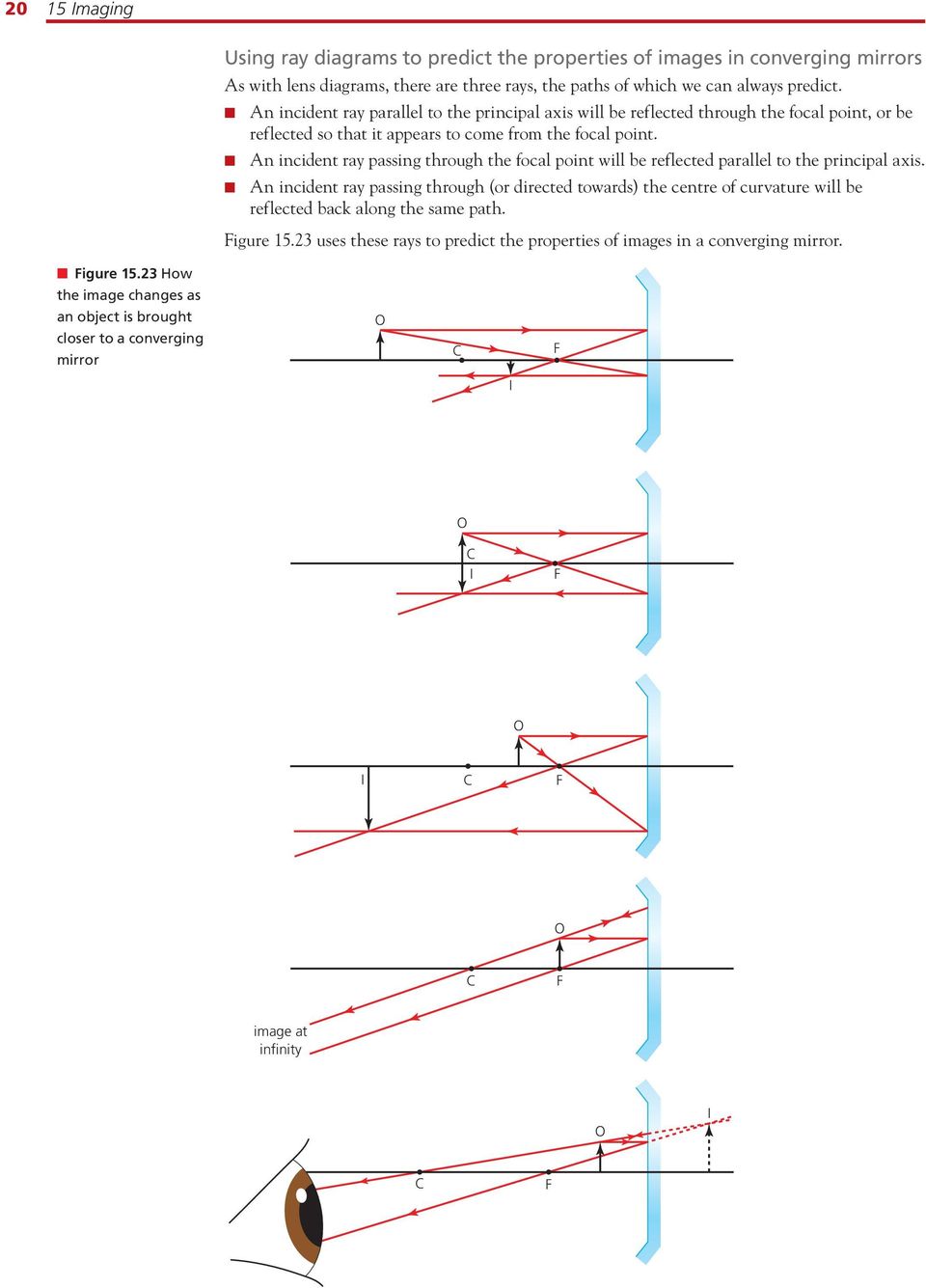
21 15.1 (C1: Core) Introduction to imaging 21 Figure shows us that as the object gets closer to the lens, the real inverted image gets larger and further away from the lens. But if the object is closer than the focal point the image is virtual, upright and magnified. Linear magnification, m = h i h o = v u (as with lenses) Angular magnification, M = θ i θ o (as with lenses) Worked example 5 When a 3.2 cm tall object is placed 5.1 cm from a converging mirror, a magnified virtual image is formed 9.7 cm from the mirror. a What is the linear magnification? b How tall is the image? a m = v u = = 1.9 b m = h i h o 1.9 = h i 3.2 h i = = 6.1 cm Diverging mirrors Figure show the formation of a diminished, upright, virtual image by a diverging mirror. This can be very useful when we need to see a wide field of vision, Figure shows one application a car s wing mirror. O small, upright virtual image C F F C Figure Producing small virtual images using a diverging mirror Figure Wide field of vision produced by a car s wing mirror mirror A O Mirror combinations Ray diagrams for locating the image formed by two curved mirrors can be difficult to draw because they usually do not share the same single principal axis. Figure shows an example. The object, O, forms a real, magnified, inverted image, I A, after the light has been reflected by the converging mirror, A. The principal axis of A has been drawn in two positions, the second of which is also the principal axis of the diverging mirror, B. Remember that in ray tracing we always assume that the rays are close to the principal axis and strike the mirror perpendicularly, even though this may not be represented well in the diagrams. F A F A F B I A mirror B I B F B C B Figure Forming an image using two curved mirrors
22 22 15 Imaging I A then provides the object that produces the (still) inverted, virtual image, I B, when the rays reflect off the diverging mirror, B. (The blue line is a construction line used to determine the position of the top of the image.) Spherical aberration in mirrors We have been assuming that spherical surfaces produce perfect focuses, and that is an acceptable assumption for rays close to the principal axis striking the surface almost perpendicularly, but for many applications (especially for larger mirrors) we need to be more realistic. Figure shows the effect of diverse reflections from a large spherical surface (the shape seen is often called a caustic curve). Spherical aberration can be overcome by adapting the shape of the reflecting surface. Parabolic reflectors can produce much better focuses than spherical surfaces see Figure Receiving dishes for satellite broadcasts are a good example of this kind of converging reflector. Figure Spherical aberration prevents a perfect focus Figure A parabolic surface can produce a good focus The same idea can be used in reverse. If a point source of light (or other radiation) is placed at, or near, the focus of a parabolic reflector, the emerging beam will be parallel, or have a low divergence. The beams from a torch, car headlight or spotlight (Figure 15.29) are good examples of beams with only small divergence, which are produced by parabolic reflecting surfaces. Figure The low divergence beam from a spotlight
23 15.2 (C2: Core) Imaging instrumentation Draw a ray diagram to determine the properties of the image formed when an object 1.5 cm tall is placed 7.0 cm from a converging mirror of focal length 5 cm. 35 a Draw a ray diagram of a diverging lens forming an image of an object placed between the mirror and its focal point. b Describe the properties of the image. 36 a A make-up/shaving mirror uses a curved mirror. Describe the image seen. b What kind of mirror is used, and typically how far away would a face be when using such a mirror? c Suggest a suitable focal length for such a mirror. 37 Draw a ray diagram to locate the final image formed by the following optical arrangement. An object is placed 20 cm away from a large converging mirror of focal length 8 cm; the image formed is located 4 cm in front of a small converging mirror of focal length 5 cm. The two mirrors face each other. 38 Draw ray diagrams to represent: a spherical aberration in a diverging mirror b the production of the light beam from a car headlight (C2: Core) Imaging instrumentation optical microscopes and telescopes utilize similar physical properties of lenses and mirrors; analysis of the universe is performed both optically and by using radio telescopes to investigate different regions of the electromagnetic spectrum In this section we will look at how lenses and/or mirrors can be combined to produce optical images better than can be seen by the eye or by the use of a single lens. Similar ideas can then be applied to the use of other parts of the electromagnetic spectrum for imaging, in particular the use of radio waves in astronomy. Extending the range of human senses in these ways has contributed enormously to our expanding knowledge of both the microscopic world and the rest of the universe. Optical compound microscopes If we want to observe an image of a nearby object with a higher magnification than can be provided with a single lens, a second converging lens can be used to magnify the first image (see Figure 15.30). The lens closer to the object is called the objective lens and the second lens, closer to the eye, is called the eyepiece lens. Two lenses used in this way are described as a compound microscope. Note that the size of the lenses and their separation are not drawn to scale. objective lens eyepiece lens object F o real, magnified image produced by the objective F e construction line F e F o final inverted, magnified, virtual image D Figure Compound microscope with the final image at the near point (normal adjustment)
24 24 15 Imaging bright light Figure Investigating a model microscope eyepiece lens translucent screen objective lens The object to be viewed under the microscope is placed just beyond the focal point of the objective lens, so that a real image is formed between the two lenses with a high magnification. The eyepiece lens is then used as a magnifying glass, and its position is adjusted to give as large an image as possible with the final virtual image usually at, or very close to, the near point of the eye. This is called normal adjustment. To locate the image by drawing you need to find the point where the construction line through the centre of the eyepiece from the top of the first image meets the extension of the ray from the first image that passes through the focal point. A model of a simple compound microscope can be investigated in a darkened room as shown in Figure To begin with, a converging lens with a focal length of about 5 cm is used to form an inverted image of a brightly illuminated object (e.g. graph paper) on a translucent screen. Then, the position of a second, less-powerful lens is adjusted until a second (virtual) image of the first image is seen when looking through this eyepiece. The screen can then be removed and the two lenses used together to observe the scale, so that the magnification of the image can be estimated. As with many optical experiments, keeping the eye and all the components aligned is important for success. Angular magnification The angular magnification produced by a compound microscope is equal to the product of the linear magnification of the objective lens multiplied by the angular magnification of the eyepiece lens. For an image at the near point: M overall = m objective M eyepiece = v u objective D f + 1 eyepiece This equation is not given in the Physics data booklet. If the final image is at infinity (for less eye strain) the +1 term can be omitted. Worked example 6 A compound microscope contains an objective lens of focal length 0.80 cm and an eyepiece lens of focal length 5.4 cm. The microscope is adjusted to form a final image at the near point of the eye for an object placed 0.92 cm in front of the objective. a Determine the distance between the two lenses. b What is the angular magnification of the image? a First find the image distance for the objective: 1 = 1 f v + 1 u = 1 v v = 6.1 cm Then find the object distance for the eyepiece: = u (remembering that virtual image distances are negative) u = 4.4 cm distance between lenses = v + u = = 10.5 cm b M = ( v u) ( D objective f + 1 ) eyepiece M = ( ) ( ) = 37
25 two objects that can just be resolved angular resolution 15.2 (C2: Core) Imaging instrumentation 25 The exact angular magnification of a microscope clearly depends on where the object and final image are located, but an approximate guide to the angular magnification of a compound microscope can be obtained from the focal lengths and the distance between the lenses, L: M DL f o f e. (This equation predicts M 45 for Worked example 6.) This confirms that shorter focal lengths will produce higher magnifications; but, as with magnifying glasses, the higher curvatures associated with higher of shorter focal lengths will introduce lens aberrations and reduce the quality of the images produced. Resolution Figure Angular resolution of the eye Although the magnification produced by a microscope is obviously important, resolution is usually of more significance in optical instruments. In general, high resolution can be described as the ability to see detail in an image. Two images that can be seen as separate are said to be resolved. To understand the difference, consider a picture on a phone or computer screen it can be very easy to magnify, but that often results in a poorer-quality image. A high-quality microscope, or telescope, will produce images with good magnification and resolution; a poorer-quality instrument may produce high magnification but the resolution will be disappointing. The magnification of an optical system is largely dependent on the focal lengths of the lenses, but the resolution of a system depends on the quality of the lenses, the diameter of the objective and the wavelength of the radiation being detected. High overall resolution also assumes that the properties of the surface detecting the waves, for example the separation of θ pixels in a camera or the separation of cells on the retina of the eye, will not have an adverse effect. A normal human eye can see two similar objects placed at the near point as separate if they are approximately at least 0.1 mm apart. Resolution is best represented by the angle subtended by these points, θ = rad (see Figure 15.32). Better resolution is represented by a smaller angle between two points that can just be seen as separate. Using a good microscope with an angular magnification of, say, 50 could improve the resolution by the same factor, so that it would then be possible to separate two points subtending an angle of ( ) = rad, which corresponds to a linear separation of mm at 50 the near point. Rayleigh s criterion The diffraction of waves as they pass into the eye, or an optical instrument, is the main factor limiting resolution, and the amount of diffraction depends on the wavelength, λ, and the width of the aperture, b (Chapter 4). Rayleigh s criterion is a guide to resolution for waves passing through circular apertures (the theory was discussed in Chapter 9, but is not needed here): Two objects are considered to be resolvable if the angle, θ, that they subtend at the eye or optical instrument is bigger than 1.22λ /b. Worked example 7 Use Rayleigh s criterion to estimate the angular resolution of the human eye. Assuming the average wavelength of light is m and the diameter of the pupil (in bright light) is 2 mm: θ = 1.22 λ = b rad Which is in reasonable agreement with actual observations. Applying Rayleigh s criterion to the resolution achieved by optical instruments, we can see that resolution would be improved by using shorter wavelengths and wider apertures. Using wider apertures has the added advantage of admitting more light and producing brighter images, although larger lenses may have aberration problems. Using light of smaller wavelengths (the
26 26 15 Imaging blue/violet end of the spectrum) can improve resolution but, of course, any coloured effects would be lost. Rayleigh s criterion can be used as a guide to resolution, but there are other factors involved for example placing an oil with a high refractive index between the specimen and the eyepiece can improve resolution. Utilizations Figure Electron microscopes The resolution of a microscope will be improved if radiation with a shorter wavelength than light can be used to examine the object. Waves of the electromagnetic spectrum with shorter wavelengths than light are ultraviolet, X-rays and gamma rays, but none of these are as easily produced, controlled and detected as a beam of electrons. Like all particles, electrons have wave properties but, because their mass is so small, electron wave properties are relatively easily observed; electrons in a beam have typical wavelengths of about m. This is about 5000 times smaller than the average wavelength of visible light, so that resolution can be improved by the same factor by using a beam of electrons rather than a beam of light photons. Beams of electrons can be produced by accelerating potential differences of a few thousand volts and their wavelength can be adjusted by changing the p.d. Because electrons are charged, they can be focused by electric or magnetic fields. Of course, electrons cannot be seen using our eyes, so their energy needs to be converted to light to form a visible image (see Figure 15.33). 1 Figure shows a living bed-bug. Use the internet to find out if placing such an organism in an electron beam is harmful. 39 An object is placed 5.0 mm from the objective lens of a two-lens compound microscope. The eyepiece of the microscope has a focal length of 4.0 cm. a If the linear magnification produced by the objective lens is 5.0, what is its focal length? b What is the overall angular magnification of the microscope when observing an image of this object at infinity? 40 a If the diameter of the objective lens in a microscope is 1.2 cm, estimate its angular resolution assuming an average wavelength of light of m. b If the microscope produces an angular magnification of 80, estimate the minimum separation of two points that can just be resolved by a normal human eye. c What assumption did you make in answering (b)? 41 Suggest why placing a transparent oil between a specimen and an objective lens can improve the resolution of a microscope. Simple optical refracting telescopes A telescope is an optical instrument designed to produce an angular magnification of a distant object. Images are formed by the processes of refraction or reflection. (Reflecting telescopes will be considered in the next section.) In a simple refracting astronomical telescope there are two lenses that together produce an inverted, virtual image. Such telescopes are usually of little use for looking at objects on Earth; this is why they are sometimes described as astronomical for use in astronomy. Light rays arriving at the objective lens of a telescope can be considered to be parallel because the source of light is such a long distance away. Consequently a small, inverted real image will be formed at the focal point of the objective lens. A second lens, the eyepiece, is then used as a magnifying glass to magnify this image.
27 15.2 (C2: Core) Imaging instrumentation 27 scale bright light objective lens translucent screen eyepiece lens Figure Investigating a model telescope A model of an astronomical telescope can be investigated in a darkened room as shown in Figure To begin with, a converging lens with a focal length of about 50 cm is used to form an inverted image of a brightly illuminated object (e.g. a scale) on a translucent screen. Then the position of a second, more powerful lens is adjusted until a second virtual image of the first image is seen when looking through the eyepiece. The screen can then be removed and the two lenses used together to observe the scale, and the magnification of the image can then be estimated. As with many optical experiments, keeping the eye and all the components aligned is important for success. Figure shows the basic construction of a two-lens astronomical telescope. The telescope is usually adjusted so that the final image is at infinity so that the eye can be relaxed when observing it for extended periods of time. This is called using the telescope in normal adjustment and the image formed by the objective must be formed at the focal point of the eyepiece. When adjusted in this way, the distance between the lenses is the sum of their focal lengths. The direction to the top of the final image is located by drawing a construction line through the centre of the eyepiece from the top of the first image. objective lens eyepiece lens f o f e parallel rays all from top of distant object θ o real image formed at focal points of both lenses F e F o construction line θ i θ o h 1 θ i virtual image at infinity Figure Simple refracting telescope with the final image at infinity (normal adjustment) The angular magnification (in this adjustment) can be determined by examining the two triangles involving h 1 : M = θ i θ o = h 1 f e h 1 f o M = f o f e This equation is given in the Physics data booklet. Clearly, a higher magnification is obtained by using an objective lens with a longer focal length (lower power) and an eyepiece lens with a smaller focal length (higher power). But lens aberrations of high-power eyepieces limit the angular magnification possible. If a telescope, or binoculars, are required to produce an upright image (for non-astronomical use) then another lens, or prism, must be added to the simple design shown in Figure to invert the image.
28 28 15 Imaging The quality and diameter of the objective lens are the most important factors when considering the quality of the image in any kind of optical instrument. A larger objective has two advantages: Most importantly, it collects more light to produce a brighter image (to see dimmer and more distant or smaller objects). There will be less diffraction, which improves the resolution of images. However, larger objectives also have aberration problems, which inevitably reduce the quality of the images. 42 A student hopes to construct an astronomical refracting telescope that produces an angular magnification of at least 100. a If she chooses an objective lens of focal length 68 cm, what is the minimum power needed for the eyepiece? b Explain why this telescope may not produce high-quality images. 43 Venus has a diameter of about km. a What angle does it subtend at the eye when it is a distance of km from Earth? (Assume that all of Venus is visible.) b A refracting telescope with an objective lens of focal length 120 cm is used to observe Venus. What is the diameter of the image formed by this lens? c An eyepiece lens of focal length 1.5 cm is used to form a final virtual image of Venus at infinity. What is the angle subtended by the image at the eyepiece? d Use your answers to (a) and (c) to confirm that the overall angular magnification of the telescope is given by M = f o /f e. 44 A refracting telescope consists of lenses of focal length 86 cm and 2.1 cm. a Which lens is the eyepiece? b Calculate the angular magnification in normal adjustment. c If the objective lens was replaced with another having twice the diameter but the same focal length, how would the image change? 45 Suggest how the use of a third lens in a refracting telescope can result in an upright image. ToK Link Can we trust our own senses? However advanced the technology, microscopes and telescopes always involve sense perception.can technology be used effectively to extend or correct our senses? Our eyes collect and focus light, and then electrical signals are sent along the optic nerve to our brains. The brain processes the information and the result is what we call an image, and we would describe this as real ( seeing is believing ). But our ability to observe is well known to be fallible, and simple optical illusions demonstrate how easily we can be fooled. In Figure our eyes tell us that squares A and B are different shades, but scientific measurement would correctly inform us that they are the same. Figure Squares A and B are exactly the same shade of grey!
29 15.2 (C2: Core) Imaging instrumentation 29 incident light plane mirror eyepiece real image formed by mirror converging objective mirror Figure A reflecting telescope with a Newtonian mounting Simple optical reflecting telescopes A reflecting telescope has an objective mirror (converging) rather than a refracting objective lens. The image formed is observed through an eyepiece lens. Figure shows the basic design of a reflecting telescope first described by Isaac Newton in It is described as having a Newtonian mounting. A small plane mirror has to be positioned in the incident beam in order to reflect the light into the eyepiece, which is positioned to the side of the main body of the telescope. Without this arrangement the observer would need to place their head in the incident beam. Of course it has the disadvantage that the plane mirror will prevent some of the light in the incident beam from reaching the converging mirror. Worked example 8 Two stars separated by a distance, s o, subtend an angle, θ o, of rad when viewed from Earth. The stars are observed through a Newtonian telescope with a converging mirror of focal length 3.4 m. a Calculate the separation, s i, of these two stars in the image formed by the converging mirror. (Assume they are the same distance from Earth.) b If the eyepiece has a focal length, f e, of 4.5 cm and is used to form a final image at infinity, what is the overall angular magnification produced by the telescope? a m = s i s o = v u The incident light rays are (almost) parallel, so the image is formed at the focal point, and therefore v = f. s i = s o u f But θ o = s o u, so: s i = θ o f = = m b The image from the mirror must be formed at the focal point of the eyepiece lens for the final image to be at infinity. angle subtended by image, θ i = s i = f e = rad M = θ i = θ o = 75 This could be found directly from M = f o. f e Figure A reflecting telescope with a Cassegrain mounting eyepiece diverging mirror converging objective mirror The Cassegrain mounting (designed by Laurent Cassegrain in 1672) is an alternative design that reflects the rays off a second (diverging) mirror back through a hole in the objective mirror see Figure This arrangement enables the user to look in the same direction as that from which the light is coming. Using a diverging mirror in this way produces extra magnification in a compact design.
30 30 15 Imaging Worked example 9 Consider Figure The rays converging to the small diverging mirror would otherwise have formed an image 24 cm behind the mirror, but have been reflected to a focus 1.36 m away near the hole in the converging objective mirror. What extra magnification has this introduced compared to the use of a plane mirror in a Newtonian mounting with an objective mirror and eyepiece of similar focal lengths? m = v u = = 5.6 Reflecting telescopes are still popular today and they have some important advantages over refracting telescopes, including: The light does not have to pass through a refracting medium, so there is no chromatic aberration. The light does not have to pass through a refracting medium, so there is no absorption or scattering. The objective has only one active surface so high-quality, larger-diameter objectives of the right shape are easier and cheaper to produce. For these reasons the majority of optical astronomical telescopes used for research are reflectors. They are also popular with amateur astronomers. Figure show the supporting structure of the world s largest reflecting telescope, Gran Telescopio Canarias. Figure shows a smaller reflecting telescope for individual use. Figure Reflecting telescope in the Canary Islands, Spain Figure Smaller reflecting telescope for amateur use 46 Determine the angular magnification of a Newtonian reflecting telescope that has a converging mirror of focal length 6.7 m and an eyepiece lens of focal length 1.8 cm. Assume that the final image is at infinity. 47 Increasing resolution and light-gathering ability is achieved by using larger mirrors. Explain why telescopes cannot be improved by simply making them bigger and bigger. 48 Use the internet to find out some of the reasons why an amateur astronomer would choose one of the two basic types of reflecting telescope described in this section (rather than the other). Satellite-borne telescopes Terrestrial telescopes (those on the Earth s surface) receive waves that have passed through the Earth s atmosphere. However, the atmosphere reflects, scatters, refracts and absorbs some of the incoming radiation, and these effects can significantly affect the quality of images formed by terrestrial telescopes. Examples of the effects of the atmosphere on radiation include stars viewed from the Earth s surface twinkling because of the constantly changing effects of refraction, and clear skies appearing blue because shorter wavelengths of light scatter more from the atmosphere than longer wavelengths. Optical astronomical telescopes also have particular problems they can only be used at night, they can only be used if there are no clouds, and they are affected by light from the Earth being scattered by the atmosphere after dark ( light pollution ). The effects of the atmosphere are very dependent on the wavelengths of the radiation involved, as shown in Figure
31 15.2 (C2: Core) Imaging instrumentation 31 Figure How the Earth s atmosphere affects incoming radiation Percentage of radiation reaching sea level Wavelength, λ/m There are a number of outstanding features in Figure 15.41: Radio waves, (e.g. with a typical wavelength of about 1 m) and microwaves are almost unaffected by passing through the atmosphere. Infrared is strongly absorbed (Chapter 8). Ultraviolet and X-ray radiations are mostly absorbed by the atmosphere. An obvious way of reducing the effects of the atmosphere is to place telescopes in locations that are at high altitudes, with good weather conditions and which are far from towns and cities. See Figure With the considerable improvements in satellite technology in recent years, it has become possible to place significant numbers of space telescopes on satellites ( satellite-borne ) in orbit around the Earth. This has produced an enormous amount of data (collected and analysed using high-power computers), new discoveries of less intense or more distant sources, or those emitting different kinds of radiation, and impressive high-resolution images. The Hubble telescope is probably the most well-known orbiting telescope, with many of its spectacular images well known and freely available around the world. The telescope was launched in 1990 and was named after the famous American astronomer Edwin Hubble. It has a mass of about 11 tonnes and orbits approximately 560 km above the Earth s surface, taking 96 minutes for one complete orbit. One of the greatest achievements of astronomers using the Hubble telescope has been accurately determining the distances to very distant stars, enabling a much improved estimate for the age of the universe. Because such projects are expensive and the data obtained of interest to astronomers worldwide, they are often joint ventures between countries. Figure Telescopes at Mauna Kea, Hawaii Utilizations A different kind of observatory Before the invention of the telescope, astronomers throughout the world made impressively accurate observations with their unaided eyes and by using a range of different devices to measure small angles. More than 100 years after the discovery of the telescope, between 1727 and 1734, Maharaja Jai Singh II built an impressive observatory at Jaipur in India, which consisted of 14 large geometrical structures to assist astronomy with the unaided eye (Figure 15.43). The biggest of these is 27 m tall and is the largest sundial in the world. Its shadow can be seen to move at a rate of up to 6 cm every minute.
32 32 15 Imaging Figure Jantar Mantar at Jaipur, India The purpose of the structures was to measure time and the apparent motions of the planets and stars, but also to be impressive structures in themselves and to stimulate interest in the newly developing science of astronomy. In India at that time, astronomy and astrology were closely connected, as they had been throughout the world in nearly all civilizations (and even today for many people). 1 Many people believe that the positions of the Moon, stars and planets can influence our individual lives and our futures. Do you think that this is possible? Explain your answer. Non-optical telescopes Nature of Science Technological advances in astronomy The invention of the optical telescope happened over 500 years ago; there is no general agreement about who was responsible although a German spectacle maker, Hans Lippershay, is often credited. Certainly Galileo adapted and improved early designs and his observations of moons orbiting Jupiter are well known. This was presented as evidence that the Earth may not be the centre of the universe and is an early example of the dramatic advances in human knowledge that can achieved by using instruments to extend our observations. For most of the subsequent 500 years, astronomy has relied on the detection of visible light to provide information, but radiation from all other parts of the electromagnetic spectrum also arrive at the top of the Earth s atmosphere from space. Telescopes and sensors capable of detecting infrared, ultraviolet and X-rays have now been placed on orbiting satellites, and the data obtained leads to knowledge about the universe that can be very different from that obtained from light alone. For example, new sources of radiation have been discovered (for example gamma ray bursts and X-ray binary stars) and our knowledge of how the universe began has improved considerably. Radio astronomy, in particular, is a highly advanced technology. Radio telescopes Radio waves are emitted by a wide variety of sources in space and they are mostly unaffected by passing through the Earth s atmosphere (see Figure 15.41), so radio telescopes can be terrestrial and, unlike visible light telescopes, they can be used 24 hours a day. Some sources have been discovered from their radio wave emissions because they do not emit significant visible light, but radio waves are also emitted as part of the spectrum of elements (for example hydrogen, the most common element in the universe, emits a significant radio wavelength of 21 cm). In this way radio astronomy has helped to map the universe.
33 Single dish radio telescopes 15.2 (C2: Core) Imaging instrumentation 33 A single dish radio telescope uses a reflector (usually parabolic) to focus the radio waves to a detector (aerial) placed at the focus. Figure shows the Parkes radio telescope in Australia, which has a diameter of 64 m. Figure The Parkes telescope in New South Wales, Australia We know that a guide to the angular resolution of a telescope may be determined from 1.22 λ, b where b is the width of the aperture/dish. The wavelengths to be investigated are predetermined by the nature of the investigation, and because radio wavelengths are much longer than light wavelengths, good resolution is much more difficult to achieve. The most significant factor controlling the resolution of a single-dish radio telescope is the width of the dish. Larger dishes will produce higher resolution but, unfortunately, larger dishes are also much more expensive; it is also more difficult to maintain their precise shape and more difficult to steer them to the desired direction. It should also be stressed that larger dishes will collect more energy, so that more distant and dimmer sources can be detected. The largest single-dish radio telescope in the world is at the Arecibo Observatory in Puerto Rico. It has a diameter of 305 m this is only possible because the surrounding landscape has been used to help support the structure. Worked example 10 a Determine the resolution of the Parkes telescope (Figure 15.44) if it was used to detect the 21 cm wavelength of hydrogen. b Would this telescope be able to resolve two stars emitting radio waves that were km apart and (both) km from Earth? a 1.22 λ = b 64 = This is worse than optical telescopes or the human eye b angle subtended at Earth by the stars = = This angle is less than , so the stars will not be resolvable. Radio interferometry telescopes There is an alternative method of improving the resolution of astronomical telescopes other than by constructing larger dishes. If the signals from an arrangement of two or more synchronized smaller telescopes can be combined (electronically), then the overall angular resolution will be approximately equal to that of a single dish with a diameter equal to the separation of the individual dishes. When using the equation for angular resolution, θ = 1.22 λ b, b becomes the separation of the telescopes rather than the width of each one.
34 34 15 Imaging There will be a path difference between a wavefront emitted from an astronomical source arriving at different telescopes (Figure 15.45). When the signals are combined, an interference pattern (Chapters 4 and 9) will be produced, the spacing and centre of which can be used to accurately determine the direction to the source of radiation. Figure Radio interferometry telescopes radio waves from astronomical source wavefront path difference baseline signals combined Resolution is improved by using more telescopes in a regular pattern (compare with the use of diffraction gratings, discussed in Chapter 9) and there are a number of different ways in which a pattern of telescopes might be arranged, however the details are not needed for this course. Receiving enough energy from distant and dim sources is always an important issue, so the total combined collecting area of the telescopes must still be as large as possible (which is another reason why more dishes are preferable). The individual telescopes may be arranged in an array relatively close together, see Figure 15.46, or they may be separated by a long distance (a long baseline), which can be as much as thousands of kilometres long and in different countries, although longer distances introduce technological problems. Figure An interferometer array Worked example 11 Compare the theoretical resolution of two radio telescopes of dish diameter 50 m separated by a distance of 1 km with one of the telescopes used individually. The effective aperture has been increased by a factor of 1000/50 = 20. So the angular resolution of the two together is 20 times smaller (better). The combination will also have double the receiving area and will therefore be able to detect less-intense sources.
35 15.3 (C3: Core) Fibre optics Suggest some reasons why the weightless and airless environment of a satellite orbit has advantages for reflecting telescopes. 50 Make a list of the advantages of placing telescopes on orbiting satellites. 51 When detecting radio waves of frequency 1420 MHz, what is the minimum diameter of a single-dish reflecting telescope needed to resolve two stars that are m apart and m from Earth? 52 What angular resolution would be obtained from an interferometer using two radio telescopes 540 m apart using radio waves of wavelength 0.18 m? 53 An angular resolution of 1 arcsecond is obtained using interferometry techniques. What separation of two telescopes would be needed to achieve this value when receiving radio waves with a frequency of 6 GHz? 54 Use the internet to research the latest developments in the SKA project. 55 Suggest what problems may arise when using interferometry techniques between telescopes that are thousands of kilometres apart (C3: Core) Fibre optics total internal reflection allows light or infrared radiation to travel along a transparent fibre; however, the performance of a fibre can be degraded by dispersion and attenuation effects In Chapter 4 we introduced the ideas of critical angle and total internal reflection, and briefly discussed how these could be used in, for example, optic fibre endoscopes to obtain images from inside the human body. In this section we will discuss optic fibres in more detail, with respect to their advantages in the transmission of data. Optic fibres, wires and wireless communication If we want to communicate over long distances and/or quickly transmit a large amount of data, we have two choices: (i) using electromagnetic waves through the air, (ii) sending signals along some kind of cable (insulated wire(s) or fibre(s)). There are many factors affecting the choice between these, and the advantages and disadvantages vary with the particular circumstances. But the majority of data transfer worldwide is still transmitted using signals sent through some kind of cable involving: electricity in copper wires, or infrared radiation in optic fibres. We will first consider some of the issues involved with using (copper) wires. At its simplest, we may consider that data passes along a cable as a signal carried by a varying potential difference between two wires, with an associated electromagnetic wave between and around the wires. The two principal problems that arise are as follows. The p.d.s change as they travel longer distances via the cable. Because of the resistance and other electrical properties of the wire, the voltage signals get smaller and change shape. (There is more about attenuation and dispersion later in this chapter.) Electromagnetic waves spreading away from a cable can induce unwanted e.m.f.s in other cables (especially at high frequencies). Such unwanted signals are commonly called electromagnetic noise (interference) or crosstalk if they come from other wires in the same cable. Electromagnetic noise can be greatly reduced by using twisted pair cabling in which the two insulated wires are twisted together (further explanation is not required). Figure shows the kind of cable widely used in computer networking and in local telephone networks.
36 36 15 Imaging Figure Fourcore twisted pair cabling An alternative for reducing electromagnetic noise is the use of co-axial cable, which contains a central copper wire surrounded by an insulator and then an outer copper mesh see Figure Figure Co-axial cable Figure Rays following a curved path along an optic fibre The mesh is connected to 0 V earth (grounded), meaning that electromagnetic signals cannot pass through it. As we will explain, communication using optic fibres (which also transfer data using electromagnetic waves) can overcome the problems associated with using copper wires. It was explained in Chapter 4 that total internal reflection can enable a light or an infrared beam to travel long distances along flexible glass fibres, as shown in the simplified representation in Figure Because the fibres are thin (as thin as 0.01 mm), the angle of incidence of a ray is always larger than the critical angle, so that repeated internal reflections occur. Almost no light escapes from the fibre and, because it is possible to make glass of great clarity, the beam can travel very long distances without much absorption or scattering. The radiation used for communication is usually infrared because it is absorbed even less than visible light. Total internal reflection and critical angle This section summarizes ideas from Chapter 4. Total internal reflection can occur when waves meet a boundary with another medium in which they would have a faster speed see Figure When the angle of incidence, θ, equals the critical angle, c, the angle of refraction is 90 and the refracted ray is parallel to the boundary. If the angle of incidence is larger than the critical angle, all the radiation is reflected back into the original medium.
37 15.3 (C3: Core) Fibre optics 37 Figure The critical angle (v 1 < v 2 ; n 1 > n 2 ) θ 1 = c Medium 1: optically denser wave speed slower, v 1 larger refractive index, n 1 θ 2 = 90 Medium 2: optically less dense wave speed faster, v 2 smaller refractive index, n 2 From the Physics data booklet (for Chapter 4) we know that: n 1 n = v 2 2 v = sin θ 2 1 sin θ 1 At the critical angle, θ 1 = c and θ 2 = 90, so sin θ 2 = 1, and then: n 1 n 2 = 1 sin c If the light is trying to pass from an optically denser material (medium 1) such as glass, plastic or water, into air (medium 2) then n 2 = n air = 1, so that (replacing n 1 with n): n = 1 sin c This equation is given in the Physics data booklet. Worked example 12 Infrared radiation is travelling along a glass optic fibre of refractive index 1.54 surrounded by air. a What is the speed of the radiation? b What is the smallest angle of incidence that the infrared rays can strike the boundary of the fibre at and still be totally internally reflected? c How would your answer to (b) change if the fibre were surrounded by a different type of glass of refractive index 1.47 (instead of air)? a n 1 n = v 2 2 v = 1.0 v 1 v 1 = m s 1 b n 1 1 n = 2 sin c, with n 2 = 1 n 1 = 1 sin c 1 sin c = 1.54 = 0.65 c = 40 c n 1 1 n = 2 sin c, with n 2 = 1.47 sin c = = 0.95 c = 73 Nature of Science Digital communication Modern electronic communication is digital in nature; this means that rather than communicating using voltages or light/infrared intensities, which vary continuously (analogue signals), the data are transmitted as a very large number of pulses, each of which is intended to have only one of two possible levels (commonly called 0 and 1, or low and high). Figure 15.51
38 38 15 Imaging Figure Digital signal representing the binary number Intensity or power of signal Time represents a signal of only eight binary digits (bits), commonly called one byte. (The term binary describes a number in which each digit can only have one of two possible values.) This kind of digital signal can be sent along a cable as a series of voltage pulses, or pulses of light/infrared. 56 Discuss the factors that affect the choice between using electromagnetic waves in cables or electromagnetic waves in air for communicating data. 57 Suggest why electromagnetic noise (interference) is often a bigger problem at higher frequencies. 58 Explain, with the help of diagrams, why angles of incidence inside optic fibres will always be large if the fibres are thin. Assume that the original signal is transmitted parallel to the axis of the optic fibre. 59 A typical optic fibre has a refractive index of a What is the critical angle for such a fibre if it is surrounded by air? b What is the critical angle for such a fibre if it is surrounded by glass of refractive index 1.51? c Signals travel slower in glass of higher refractive index. Discuss whether or not this is a significant factor in choosing the type of glass used in an optic fibre. 60 Suggest why digital signals are used in preference to analogue signals for transferring data. 61 Suppose the digital signals shown in Figure were transferred over a long distance and, as a result, the powers of the pulses were halved and the pulse times were doubled. Assuming that the pulses remain rectangular: a How would their energy have changed? b Sketch a graph of the received eight-bit signal. outer jacket material to strengthen the cable Structure of optic fibres cladding The sketch of an optic fibre shown in Figure is much simplified compared with real optic fibres. It is very important that the surfaces of the fibres do not get damaged, or get any impurities on them, because the condition for total internal reflection would then change at such places, and some radiation could escape. For this reason the fibres are surrounded by another layer of glass, known as cladding (Figure 15.52). The cladding protects the inner core fibre and also prevents the problems ( crosstalk ) that would occur if different fibres came into contact with each other (multicore fibres are in common use). The cladding must have a refractive index lower than the inner fibre (see the Worked example 12 and question 59). protective coating cladding core Figure A typical single core optic cable Dispersion in optic fibres When pulses (of various kinds) travel through long cables they each tend to spread out, so that they occupy longer and longer time intervals. This is known as dispersion and it is illustrated in Figure (The two pulses also have reduced amplitudes, but we will discuss this later.) In this example the two transmitted pulses were clearly separate, but by the time they were received they overlapped to such an extent that the data they were transferring may not have been accessible. Of course, it is possible to increase the time between transmitted pulses in order to keep them separate, but that would reduce the amount of data that could be sent in any given time. Dispersion limits the rate at which data can be transferred.
39 15.3 (C3: Core) Fibre optics 39 Figure Dispersion causes pulses to overlap signal transmitted long cable signal received Intensity Intensity Time Time rays enter at same time Waveguide and material dispersion in optic fibres There are two principal causes of dispersion in optic fibres waveguide dispersion and material dispersion. Waveguide dispersion If all the rays of light or infrared radiation that is transmitted along an optic fibre are parallel to begin with, they will follow parallel paths and take exactly the same time to reach any particular point along the cable. But this is an idealized situation and is not possible in practice. Rays representing a particular pulse can take slightly different paths and, therefore, different times to reach their destination. Figure illustrates this problem (but it is exaggerated for clarity). This causes the spreading of pulses and the kind of dispersion cladding core cladding Figure Rays taking different paths and causing waveguide dispersion rays exit at different times known as waveguide dispersion, which is sometimes also known as modal dispersion, although this term will not be used in IB examinations. (An optic fibre is an example of a waveguide, which is a term used for any structure designed to transfer waves along a particular route.) To reduce the effects of waveguide dispersion it is better to use very thin fibres and to try to ensure that the light rays are parallel, and also to use graded-index fibres, as described next. Step-index fibres and graded-index fibres Up to this point in our description of optic fibres and their cladding we have assumed that they both have constant refractive indices, so that there is a sudden change ( step ) of refractive index at the boundary between them. This simple arrangement is known as a stepped-index fibre and it is represented in Figure 15.55a. Figure Crosssectional variation of refractive indices in (a) step-index fibres and (b) graded-index fibres a cladding core b refractive index
40 40 15 Imaging Figure 15.55b represents a graded-index fibre in which the refractive index of the core optic fibre increases gradually towards a maximum at the centre. The effect of this is to relatively decrease the speed of the rays passing along the most direct (central) routes and relatively increase the speed of rays that pass closer to the outer surfaces of the core. The overall effect of having gradual changes in refractive index is to produce more central, curved paths, with less time differences between them, as shown in Figure This reduces waveguide dispersion. Figure Typical paths of rays in a graded-index fibre ray paths core cladding Material dispersion Material dispersion is the name given to dispersion caused by the use of different wavelengths. In this respect it is a problem similar to chromatic aberration in lenses. We know from Chapter 4 that the refractive index of a medium depends on the wavelength of the radiation. This effect is deliberately used in a prism to disperse light into a spectrum. For example, red light travels faster in glass (than the other visible colours), so that it has a slightly higher refractive index and it is the colour least deviated by passing through a prism. If different wavelengths (representing the same pulse) travel along the same path through an optic fibre, they will take slightly different times to reach their destination and will therefore produce dispersion. The obvious solution to material dispersion is to use monochromatic radiation. Infrared LEDs are the most common source. 62 a Explain why infrared radiation, which is normally internally reflected, could pass between optic fibres if they came in contact with each other. b Explain how the use of cladding will prevent this problem. 63 If the refractive indices of the cladding and the core in a stepped-index fibre are 1.60 and 1.55, respectively, what is the critical angle in the core? 64 Explain why dispersion limits the rate at which digital data can be communicated over longer distances. 65 Summarize, without reference to a diagram, how the use of graded-index fibres reduces waveguide dispersion. 66 Different data can be sent along the same optic fibre using different wavelengths of radiation. Discuss whether or not material dispersion affects this process. Utilizations Figure An underwater optic fibre cable Under-sea optic fibres It is estimated that more than 95 per cent of all international communication and data are transferred using under-sea optical cables, which may already exceed one million kilometres in collective length. A typical cable (Figure 15.57) is about 7 cm in overall width and has a mass of about 10 kg m 1. These cables carry telephone conversations and are also the basic structure that enables the use of the internet worldwide. They are considered to be vital for the economic and social functioning of the modern world, and their importance is such that many countries consider them an important aspect of national security. 1 Search the internet to find an up-to-date map of the world s under-sea optic cables. 2 Discuss to what extent the length of under-sea cables might affect our speed of access to the internet.
41 intensity, I 0 distance, x 15.3 (C3: Core) Fibre optics 41 Attenuation and the decibel (db) scale When anything (waves for example) is transmitted through a medium there will always be some scattering and absorption. Scattering occurs when waves are reflected by imperfections within the medium (usually randomly) and no longer continue to travel in their original direction. Absorption occurs when the wave energy is transferred to some other form within the material, usually internal energy. For these reasons the intensity of any signal reduces as it passes through a material. This reduction of intensity, which is called attenuation, may or may not be significant under different circumstances. It should not be confused with the reduction in intensity always associated with waves that are spreading out from their sources. Attenuation Attenuation is the gradual loss of intensity of a signal as it passes through a material. The high quality of the glass in optic fibres means that absorption and scattering should not be too significant over short distances, but they become important whenever long distances are involved. Scattering is the main cause of attenuation in optic fibres, but dispersion also affects attenuation. Consider again Figure Even in the idealized example of no absorption or no scattering (so that the total power received is the same as transmitted, which is shown by equal areas) the intensity has still been reduced. intensity, I Figure Variation of intensity with distance It may be assumed that signal intensity is reduced by equal factors in equal distances, which means that intensity varies exponentially with distance. This means that we can quote a value for the attenuation per unit length of a system. Calculating attenuation in decibels The simplest way of calculating a value for attenuation would be to determine the ratio of the signal intensities (or powers) at two points, which would be I/I 0 as shown in Figure However, because of the exponential nature of the relationship, a logarithmic value is preferred: attenuation = log I I0 Attenuation calculated in this way is given the unit bel, but a smaller unit, the decibel (db) is usually preferred: I attenuation (db) = 10 log I 0 This equation is given in the Physics data booklet. It can also be applied to powers: Attenuation (db) = 10 log P P 0 Because I < I 0, the attenuation in db will be a negative number. We will not be using a symbol to represent attenuation in this topic.
42 42 15 Imaging Worked example 13 The attenuation in an optic fibre of length 100 km is 53 db. If the input power is W, what power would be received: a 100 km away? b 200 km away? P a attenuation (db) = 10 log P 0 53 = 10 log ( P ) = P P = W b P = P = W It is common practice to quote attenuation per unit length, for example in db km 1. Table 15.1 gives some examples, but remember that this is just a rough guide because the values are also frequency dependent. (These numbers are sometimes called attenuation coefficients.) Table 15.1 Typical attenuations per unit length Type of cable Attenuation (db km 1 ) twisted pairs (1 MHz) 50 co-axial (200 MHz) 100 optic fibre (10 14 Hz) 1 Whatever kind of cable is used to communicate over long distances, attenuation will result in the signal intensity falling below an acceptable level unless the pulses can be amplified (and reshaped). The devices that perform this task are called repeaters or regenerators. Summary of the advantages of optic fibres compared to wires Optic fibres have many advantages over copper wires, especially whenever data needs to be transferred over long distances or at fast speeds. This is because, when compared to copper wires of similar dimensions, optic fibre systems: have much lower attenuation (so that amplifiers/repeaters can be fewer and further apart) have much improved data transfer rates do not cause electromagnetic noise or crosstalk, nor are they affected by them from other cables are more secure (it is more difficult for third parties to access the data) are lighter in weight. These advantages are so significant that optic fibres are the dominant means of transferring large amounts of data quickly over long distances. These are the superhighways of communication. On a smaller scale, however, the convenience and lower overall cost of a copper wiring system may be more significant. Nature of Science The technology of optical communication Total internal reflection is a relatively easily understood application of physics that was first described more than 400 years ago (by Kepler), although the concept of a beam of light being trapped inside a curved-shaped medium was not proposed until about 250 years later. The more recent application of this concept to the rapidly increasing use of optic fibres in the communication systems on which the modern world is so dependent is due to technological developments (such as improvements in the quality of glass), rather than new principles or new discoveries.
43 15.4 (C4: Additional Higher) Medical imaging Sketch a graph to show how the intensity of a signal varies with distance as it travels along an optic fibre. 68 a What is the overall attenuation of a cable if the intensity of a signal is halved by passing through it? b If a cable has an attenuation loss of 10 db, by what percentage is the intensity of the output lower than the input? 69 The attenuation in a cable is rated at 0.36 db for each 100 m. If the input power is 6.8 mw, what length of cable will reduce the power to W? 70 The input power to a very long optic cable is 0.15 W. When the power falls below a certain value (P) the signal needs to be amplified/regenerated. Determine the value of P if the minimum distance between repeaters is 80 km and the cable has an attenuation loss of 1.8 db km a Use the internet to determine the infrared frequency most commonly used in optical fibre communication. b Why is this particular frequency chosen? 72 Suggest why attenuation in an optic fibre is frequency dependent. 73 The advantages of transferring data using glass rather than copper seem considerable. Use the internet to research possible reasons why copper wiring is still in widespread use. X-rays photographic film in light-proof envelope 15.4 (C4: Additional Higher) Medical imaging the body can be imaged using radiation generated from both outside and inside; imaging has enabled medical practitioners to improve diagnosis with fewer invasive procedures In recent years the rapid growth of computing power and technological advances have resulted in a dramatic increase in the number of utilizations of physics in medicine around the world. Nuclear medicine was mentioned in Chapter 12 and there are many applications of lasers, but in this section we will discuss the various physics principles that can be used to obtain images of bones, organs and tissues located inside the human body. We begin with the use of X-rays and ultrasound, both of which involve sending penetrating waves into the body from outside, then we will discuss nuclear magnetic resonance. Detection and recording of X-ray images in medical contexts X-rays are useful in medical imaging because they are penetrating and some can pass deep into the body and out of the other side. However, some of the X-ray photons are absorbed, so when the transmitted X-rays are detected on the other side of the body, a shadow or negative picture can be produced. Figures 15.59a and 15.59b show how the bones have absorbed more of the X-rays than the rest of the hand. In this simple example, the X-rays are detected photographically (like light) by transferring the photons energy to produce chemical changes in the film. This technique is still widely used around the world. It is relatively inexpensive but the image must be chemically developed, which means there is a delay before the image is available to be viewed. Detection by CCD (charge-coupled devices) produces an immediate digital image and allows more control over the whole imaging and data-handling process. Equally as important, a detection process that requires a lower intensity will enable hospitals to use lower-power X-rays and reduce the health hazards associated with the use of X-rays. Figure (a) Arrangement for X-raying a hand; (b) an X-ray of a hand
44 44 15 Imaging Figure shows the process of having a dental X-ray with the CCD in the patient s mouth. Figure Having a dental X-ray taken Nature of Science Risk analysis The benefits of using X-rays to diagnose illnesses are substantial and obvious. However X-rays are also a potential health risk because the energy carried by X-ray photons is high enough to cause ionization and possibly to cause damaging chemical and biological changes in the body (in a similar way to gamma ray photons, as discussed in Chapter 7). The risk associated with directing a known amount of a particular kind of radiation into a particular patient cannot be known with certainty. Controlled experiments that involve exposing people (or animals) to radiation are clearly not acceptable, so the medical profession can only deal with statistics gathered indirectly from numerous previous events (medical or otherwise) in which people have been exposed to known, or estimated, amounts of radiation. Such data has been repeatedly analysed very extensively in order to assess the risk (the probability of harm) involved with any particular course of action. Doctors must balance the risks of exposing a patient to X-rays against the medical benefits to be gained from a diagnosis or detailed knowledge of the medical problem that they need to treat. The health of medical staff involved with the use of X-rays in hospitals (radiographers) also needs to be considered. Standard safety measures include: using X-rays of as low a power as is consistent with their intended purpose using X-rays for as short a time as possible monitoring and limiting the number of X-rays taken of a patient preventing X-rays from going anywhere else other than the part of the body they are being used to examine. The improvement in the technology involved with the production and, particularly, the detection of X-rays has been so considerable in recent years that the risks are now very well understood, well controlled and minimal. The required dose of radiation for any particular purpose is now so much reduced that a long trip in an aircraft (at high altitude) now involves a greater exposure to ionizing radiation than most X-rays. Attenuation of X-rays The amount of absorption depends on the energy carried by the X-ray photons and the type of material through which they are passing. We will now describe this in more detail, using the concept of attenuation, which we have already covered in our discussion of optic fibres. X-rays of higher frequency have higher energy (E = hf) and are more penetrating. They are often described as having the quality of hard X-rays and they are produced in X-ray machines that use higher voltages. Soft X-rays, with lower photon energies, are more easily absorbed.
45 15.4 (C4: Additional Higher) Medical imaging 45 Attenuation is the gradual loss of intensity of radiation as it passes through a medium. In general, the principal reasons for attenuation are absorption and scattering. In the following discussion we will always assume that the incident radiation is all travelling in the same direction (a parallel beam). For the energy of the X-ray photons commonly used in medical diagnosis, absorption due to the photoelectric effect is the principal means of attenuation and it is largely dependent on the proton number, Z, of the atoms present. For example, bone contains elements with a larger average proton number than soft tissue and therefore absorbs a higher percentage of X-rays. The attenuation can be expressed in decibels (as before, with optic fibres): attenuation (db) = 10 log ( I I 0 ) This equation is given in the Physics data booklet. We would normally expect that equal thicknesses of a homogeneous (uniform) medium would absorb (and scatter) the same percentage of the intensity, I. This is the essential characteristic of an exponential decrease and it can be simply characterized by referring to a half-value thickness (Figure 15.61). This is a similar concept to half-life in radioactive decay. Figure Halfvalue thicknesses Incident intensity (100%) Fraction transmitted Half-value thicknesses Half-value thickness, x ½, is defined as the thickness of a medium that will reduce the transmitted intensity to half its previous value. Figure shows how this can be represented graphically. Figure Graph of intensity thickness Intensity (%) x ½ 2x ½ 3x ½ 4x ½ 5x ½ Thickness, x
46 46 15 Imaging X-ray photons with higher energy will be more penetrating, so their half-value thickness of a particular medium will also be larger. Worked example 14 a When directed through a homogeneous material, the intensity of an X-ray beam falls to 1 of its initial 8 value over a distance of 15 cm. What is its half-value thickness? b What overall thickness would be needed to reduce the intensity to 16 1? c How would the half-value thickness of this material change if X-rays of longer wavelength were used? a 1 to 1 2 to 1 4 to 1 8 requires three half-thicknesses, so one half-thickness = 15 3 = 5 cm b 1 8 to 16 1 requires one more half-thickness: = 20 cm c Photons of a longer wavelength have less energy, so they would be less penetrating and the half-thickness would be smaller. An exponential equation for attenuation An exponential decrease like that shown in Figure can be represented by an equation of the form: I = I o e μx where I o and I are the intensities before and after the attenuation caused by passing through a medium of thickness x. (We have used similar equations in the study of radioactive decay and capacitor discharge.) This equation is given in the Physics data booklet. μ is a constant called the linear attenuation coefficient. It represents the amount of attenuation in a particular medium (for radiation of a specified wavelength). A larger value of μ represents more attenuation and corresponds to a smaller value for the halfvalue thickness. Both of these properties vary significantly with the energy of the X-ray photons. Taking logarithms and rearranging, we get: μ = 1 x ln ( I 0 I ) The unit of μ that is normally used with X-rays is cm 1. A value for the attenuation coefficient of a specific material can be found by using values of I o and I for a known thickness, x. Preferably a range of values would be used and the attenuation coefficient determined from a suitable graph. The linear attenuation coefficient and half-value thickness are different ways of expressing the same information. Their relationship can be derived by putting I = I o /2 for x = x ½ in the above equation: μ = x 1 ln ½ ( 2I 0 I 0 ) or: μx ½ = ln 2 This equation is given in the Physics data booklet. Attenuation coefficients are often called absorption coefficients although, as we have seen, absorption is not the only cause of attenuation.
47 15.4 (C4: Additional Higher) Medical imaging 47 Worked examples 15 An X-ray beam is reduced to 93 per cent of its intensity when it passes through a medium of thickness 0.48 mm. a What is the linear attenuation coefficient of the medium? b What is its half-value thickness? a μ = 1 x ln ( I 0 I ) 1 = ( 0.48) ln I ( I o ) = 0.15 mm 1 b μx ½ = ln 2 x ½ = = 4.6 mm An X-ray beam of intensity 580 mw m 2 is passed through parallel layers of two different materials. The first layer is 4.3 cm thick and has a linear attenuation coefficient of 0.89 cm 1 ; the second layer is 1.3 cm thick with a linear attenuation coefficient of 0.27 cm 1. a Determine the intensity of the X-rays that cross the boundary between the layers. b What intensity emerges from the second layer? a I = I o e μx = 580e ln I = ln 580 ( ) I = 13 mwm 2 b I = I o e μx = 13e ln I = ln 13 ( ) I = 9.1 mwm 2 Mass attenuation coefficient The linear attenuation coefficient of a medium represents how the intensity of an X-ray beam decreases with unit distance travelled through the medium, but the mass attenuation coefficient is often more useful when comparing different materials. The mass attenuation coefficient represents how the intensity of a beam decreases as it passes through unit mass of a particular medium. mass attenuation coefficient = linear attenuation coefficient density = μ ρ Figure Mass attenuation coefficient of water: variation with X-ray photon energy Mass attenuation coefficient/cm 2 g Photon energy/mev This equation is not given in the Physics data booklet. A mass attenuation coefficient most commonly has the unit cm 2 g 1. Figure show how the mass attenuation coefficient of water varies with photon energy. You should be able to show that a typical X-ray wavelength of m has a photon energy of MeV, which corresponds approximately to a mass attenuation coefficient of 0.05 cm 2 g 1.
48 48 15 Imaging Worked example 17 Use Figure to estimate the linear attenuation coefficient of water for photons of energy 100 kev. For 0.1 MeV photons, the mass absorption coefficient is approximately cm 2 g 1. Mass attenuation coefficient = = μ ρ, and the density of water is 1.0 g cm 3. μ = = 0.2 cm 1 Example of X-ray attenuation in the human body Figure shows a simplified cross-section of a human thigh and the relative intensities of X-rays passing through it. It has a bone (femur), which has a linear absorption coefficient of 0.62 cm 1, surrounded by soft tissue with an absorption coefficient of 0.12 cm 1. X-rays following path B emerge from the thigh with their intensity reduced to about 15 per cent; X-rays that follow path A, passing through the bone, have their intensity reduced to about 1 per cent. In this example, the overall attenuation of the X-rays passing through the bone (and soft tissue) is about 15 times higher than for the X-rays that only pass through the soft tissue. Figure Relative intensities of X-rays passing through a thigh 100% 16 cm m = 0.12 cm 1 thigh B 15% X-rays 100% 46% m = 0.62 cm 1 2% A 1% femur 5 cm 18 cm 74 A parallel X-ray beam was reduced in intensity from 100 W m 2 to 74 W m 2 after passing through 3.0 cm of a medium. Calculate the linear attenuation coefficient in cm A parallel beam of X-rays passes though a material with a half-value thickness of 3.7 cm. If the incident beam has an intensity of 150 W m 2, calculate: a the linear attenuation coefficient b the percentage of the incident intensity that emerges from a 4.5 cm thickness of the material. 76 The intensity of a parallel X-ray beam is reduced from 195 W m 2 to 127 W m 2 when it passes through a medium of thickness 2.10 mm. a What is the total power of the incident beam if it covers an area of 16.0 cm by 20.5 cm? b If the wavelength is m, how many photons enter the medium every second? c Calculate the linear attenuation coefficient. d What is the half-value thickness of the medium? e If the accelerating voltage producing the X-rays is increased, suggest how the half-value thickness will change. 77 A medium has a density of 1.9 g cm 3 and a linear attenuation coefficient of 0.22 mm 1. a What thickness of this medium will reduce a parallel X-ray beam to 33 per cent of its incident intensity? b What is the mass attenuation coefficient of the medium? 78 Explain why it is reasonable to expect that increasing the thicknesses of a medium by equal amounts will result in equal percentage falls in the transmitted intensities of X-rays. 79 A material has a density of 1.3 g cm 3 and a mass attenuation coefficient of 2.1 cm 2 g 1. Calculate its half-value thickness.
49 15.4 (C4: Additional Higher) Medical imaging If the linear attenuation coefficient for certain X-rays in soft tissue is quoted at 0.35 mm 1, what is the linear attenuation coefficient for bone (with the same X-rays) if bone has a half-value thickness that is 150 times larger than for soft tissue? 81 Confirm the values quoted in Figure for the relative intensities of the X-rays passing through the thigh. 82 Data showing the relative intensity for X-rays passing through a certain material is shown in Table Thickness (cm) Relative intensity Table 15.2 Data on X-ray absorption a Draw a relative intensity thickness graph to represent this attenuation. b Draw a graph of the logarithm of the relative intensity against thickness. c Use your two graphs to determine the attenuation coefficient and the half-value thickness. 83 Why is it reasonable to assume that both X-rays and gamma rays of the same energy will have the same value of half-value thickness? Obtaining good quality images with X-rays X-rays are not focused to form an image, so it is important for sharp images that all the radiation reaching any particular place on the film has followed the same path from the X-ray source and through the patient. When we describe an image as sharp we mean that any edges between different parts of the image are distinct and precise, and that it has good resolution. The source of X-rays needs to act like a point source, as in Figure 15.65a, rather than an extended source, as shown in Figure 15.65b. In 15.65a X-rays can only have followed one particular path to reach point P, but in 15.65b X-rays can arrive at point P from different directions. In the same way, a point source of light is needed in order to form sharp shadows. For sharp images, ideally the film or detector should also be as close as possible to the patient, who should not move during the exposure time, and the X-ray source placed as far away as possible. Of course, increasing the distance between the patient and the source has the significant disadvantage of requiring a source of higher intensity, and/or a longer exposure time. Figure Point and extended sources a point source b extended source P P sharp shadow blurred shadow
50 50 15 Imaging X-ray source patient oscillating grid intensifying screens film Figure X-ray arrangement with the film placed between two intensifying screens To increase the brightness of an image formed on photographic film, an intensifying screen(s) can be used to enhance the image. These screens contain fluorescent materials that emit light when struck by X-rays. Photographic film is much more sensitive to light than X-rays, so the image is intensified. Figure shows a possible arrangement, with the film placed between two intensifying screens. If X-rays scattered from all parts of the body can reach the film, the contrast of the image will be reduced because all parts of the film will receive more X-rays than they would if only X-rays travelling directly from the source reached the film. This effect can be reduced by using a collimating grid as shown in Figure A collimator makes all rays passing through it parallel to each other. The grid has to be oscillated from side to side during the exposure to enable all relevant parts of the patient to be imaged. For some applications, the contrast of an X-ray image can also be enhanced by temporarily introducing into the patient s body something that will affect the absorption of X-rays. For the digestive system this could be a (non-poisonous!) substance that the patient has to drink. For CT scans (see below) a contrast medium is sometimes injected into the bloodstream. The sharpness of an image can also be digitally enhanced later by a computer program. Computed tomography (CT) This technique uses computer control to obtain detailed, sharp, layered images of high contrast. The X-ray images described so far have all been two-dimensional. Detailed images of threedimensional objects can be obtained with more sophisticated and expensive equipment that is controlled by computers. Tomography is the term used to describe obtaining images of a three-dimensional object as a series of sections or slices. The principles of tomography are not difficult to understand, but CT scans (also called CAT scans, computed axial tomography) of anything as complicated as a human body (or part of it) require considerable computing power and expensive equipment. Figure shows a patient in a CT scanner. For some people a CT scan is an uncomfortable experience the body must remain as stationary as possible while the source of X-rays and an array of detectors are rotated around in Figure Patient in a CT scanner
51 15.4 (C4: Additional Higher) Medical imaging 51 Figure CT scan of head Figure CT scans of slices within a head a precise plane. What any particular detector receives will vary as the angle of incidence on the body changes. An image is not obtained directly, but the power of the computer is used to analyse all the data received during the rotation and to construct an image of the body in that particular plane. Other planes are then scanned by slightly moving the bed on which the patient is lying. It is then possible to use the computer to obtain images of any plane, or to obtain a complete three-dimensional image. Like digital images obtained with a camera, the images may be enhanced and changed in a wide variety of ways. Using the vast quantity of data collected, CT scans provide a range of high-contrast images with good resolution. They are able to distinguish tissues with a density difference as low as 1 per cent. Undoubtedly they provide images more useful than simple X-rays, but CT scanners are expensive to buy and to operate, and the longer exposure time compared with X-rays increases the radiation dose received by a patient by up to 1000 times, which is a significant additional health risk that has to be considered by the doctor. There has been a rapid increase in worldwide use of CT scanners in recent years. Figure shows a composite image, which should be compared with Figure 15.69, which shows CT scans of individual slices. 84 Make a list of the advantages of using electronic detectors rather than detecting X-rays photographically. 85 Explain why the detection of scattered X-rays reduces the contrast of an X-ray image. 86 An X-ray imaging system was redesigned to increase the distance between the source and the patient. a Suggest a reason why this was done. b If the same source is used, why will the intensity reaching the patient be reduced? 87 Find out what is meant by a barium meal. 88 List two advantage and two disadvantages of CT scans compared to conventional X-rays.
52 52 15 Imaging Figure Abdominal ultrasound scan (B-scan) Ultrasound imaging High-frequency sound waves can be used as an alternative to electromagnetic waves (X-rays) for obtaining images from inside the body and diagnosing illnesses. Any sound wave that has a frequency higher than that which can be heard by humans (20 khz) is called ultrasound and is described as ultrasonic. Frequencies used in ultrasonic imaging are typically between 2 MHz and 20 MHz. Unlike X-rays, ultrasound is not an ionizing radiation and has no known health risk. The equipment is also generally cheaper and easier to use, however the images produced do not usually have the same detail (high resolution) as those produced by CT scans because the longer wavelengths of ultrasound reduce resolution because of greater diffraction. Ultrasound techniques can produce better images of some soft tissues than X-rays, however. The ultrasound waves are usually directed into the patient using a handheld transducer (often called a probe) which converts electrical signals into ultrasound waves. Reflections are received back at the same device (Figure 15.70). In general, some waves will be reflected whenever they arrive at any boundary between two different media. This will be discussed in more detail later, but first we will look at how the ultrasonic waves are produced and detected. Generation and detection of ultrasound in medical contexts When certain materials are under stress (stretched or squashed) a potential difference is induced across them. Conversely, when the same material has a p.d. applied to it, a (very small) change of shape is produced. This is called the piezoelectric effect. Quartz crystals are commonly used in piezoelectric transducers and are ideal for the production and detection of ultrasound. An alternating p.d. applied across a piezoelectric crystal will make its surfaces oscillate at the same frequency; this disturbs the surrounding medium and a longitudinal ultrasonic wave propagates away. See Figure Figure Piezoelectric transducer co-axial cable acoustic insulator metal case backing material piezoelectric crystal electrodes plastic membrane When reflected ultrasound waves are incident on the same crystal, they can be detected by the alternating p.d. induced, which has the same frequency as the waves. Basic principles of ultrasound imaging Ultrasonic waves are directed into the patient s body and reflections travel back to the transducer whenever the waves meet a boundary between two different media. If the original direction of the waves is known, as well as the speed of the waves and the time delay between the emitted and reflected waves, then the location of where the reflection occurred can be pinpointed. (This is very similar to the principles used in the echolocation systems of sonar and radar.)
53 15.4 (C4: Additional Higher) Medical imaging 53 The ultrasound waves cannot be emitted and reflected continuously, because then there would be no easy way of knowing which waves caused which reflections. For this reason, the ultrasound is transmitted in short pulses, and the time between them should be longer than the longest time it could take a reflection to be received back at the transducer. Typically the time between pulses is about s, which means that the pulses of ultrasound have a frequency of about 10 khz (pulse repetition frequency). Remember that the ultrasound waves themselves have a much higher frequency of about 10 4 khz. Each pulse might typically contains two waves or more, so that a typical pulse duration is 2 1/f = 2 1/( ) = s see Figure This means that the time between pulses is about 500 times longer than the duration of each pulse. Longer pulse durations improve the resolution of images. Figure Pulses of ultrasound Intensity reflected waves must be received during this time Time pulse duration Worked examples 18 Ultrasound waves travelling at an average speed of 1600 m s 1 through a person's body reflect off an organ and are received back at the probe after 32 μs. a What is the distance of the surface of the organ beneath the skin? b What assumption was made in this calculation? a distance 2 = speed time = distance = m (2.6 cm) b The waves travel perpendicularly to the surface. 19 To examine structures relatively far from the surface of the body, the pulse repetition frequency may need to be reduced to, for example, 2 khz in order to increase the time between pulses. a What total distance can an ultrasound wave travelling at an average speed of 1580 m s 1 travel in the time between pulses (assume that the pulse duration is negligible)? b Estimate the number of pulses that could be in the body at any one instant. a distance = speed time = 1580 (1/ 2000) = 0.79 m (79 cm) b The maximum distance a (reflected) wave could travel is approximately twice the width of the body, which might be about 70 cm (depending on orientation). Under those circumstance there would only be one pulse in the body at any time. That is, the reflected pulse would be received before the next pulse was emitted. Acoustic impedance In general terms, acoustic impedance is a measure of the opposition of a medium to the flow of sound through it. Knowledge of acoustic impedance is needed to understand ultrasound imaging because the reflection of ultrasound waves from boundaries between media depends on how their acoustic impedances compare. The bigger the difference in impedances, the higher the percentage of incident waves that are reflected.
54 54 15 Imaging Acoustic impedance, Z, can be defined as: acoustic impedance = density of substance speed of sound in that substance Or, in symbols: Z = ρc This equation is given in the Physics data booklet. The units of impedance are kg m 2 s 1. Table 15.3 provides a list of some acoustic impedances relevant to ultrasound imaging at a typical frequency. (Acoustic impedance is a frequencydependent property.) Table 15.3 Acoustic properties of parts of the human body Medium Speed, v/m s 1 Density, ρ/kg m 3 Z/10 6 kg m 2 s 1 Acoustic impedance, air fat water soft tissue kidney liver blood muscle skin bone Ultrasound imaging clearly depends on the reflection of the waves from various boundaries, but one place where reflection is definitely not required is at the point where the waves enter the patient s body. From Table 15.3 we can see clearly that the acoustic impedance of air is very much lower than that of skin, which means that the percentage reflected from the skin would be very high if there was an air gap. Therefore, the transducer must be in good contact with the skin and this is helped by the use of a gel (coupling medium) between them. The gel has an acoustic impedance similar to that of skin. This is an example of a process known as impedance matching. The acoustic impedance of steel is about kg m 2 s 1. When this is compared with air ( kg m 2 s 1 ), it is clear why sound waves in air reflect off steel well. Worked example 20 a The speed of ultrasound waves in a particular part of a patient s body is 1580 m s 1. If the tissue has a density of 1050 kg m 3, what is its acoustic impedance? b Use Table 15.3 to determine an average density for bone. c Apart from air, which pair of media in the table have the highest percentage reflection? a Z = ρc = = kg m 2 s 1 b Z = ρc = ρ 4080 ρ = 1910 kg m 3 c Bone and fat, because their acoustic impedances have the greatest difference.
55 15.4 (C4: Additional Higher) Medical imaging The acoustic impedance of a certain material is kg m 2 s 1. What is the speed of sound waves in this material if its density is 1250 kg m 3? 90 A pulse contains three complete waves that have a frequency of 2.0 MHz. They travel at a speed of 1510 m s 1. a What is the duration of the pulse? b If the pulse repetition frequency is 8.4 khz, how far can the waves in a pulse travel before the next pulse is emitted? c Are these frequencies suitable for the examination of a part of the body that is 10 cm below the surface of the skin? 91 The ratio of reflected intensity, I r, to incident energy, I o, at a boundary between two media of acoustic impedances Z 1 and Z 2 is given by the following equation (which is not required in this course): I r = (Z 1 Z 2 )2 I o (Z 1 + Z 2 ) 2 a Show that this equation predicts that all of the incident energy is transmitted if the two media have equal impedances. b What percentage of the intensity is reflected if one medium has twice the impedance of the other? Does your answer depend on the direction in which the waves are travelling? c If ultrasound of intensity W cm 2 is incident on the boundary between soft tissue and liver, what intensity is transmitted into the liver? d Estimate the percentage of intensity transmitted into skin when ultrasonic waves are incident on it from air. Hence, explain why gels are used with ultrasound transducers. 92 Why would you expect X-ray imaging to produce better resolution than ultrasonic imaging? Ultrasound intensity gel probe probe A-scans and B-scans The simplest type of ultrasound scan is an A-scan. At each boundary between different media (for example, fat muscle or muscle bone) some of the waves are reflected and abdomen wall organ Figure Reflected waves in an A-scan (This time scale is not regular) Time bone some are transmitted. The reflected waves are received by the piezoelectric transducer and a p.d. is induced that can be displayed as a p.d. time graph. Figure shows a typical example. The amplitudes (intensities) of the reflected pulses received at the transducer depend on the distance that the waves have travelled, the type of boundary from which they have been reflected and the number of other media boundaries that the waves have crossed. It is called an A-scan because it displays information in the form of varying amplitudes. A-scans are useful for obtaining accurate measurements of a known situation. By moving the transducer to different locations the exact position, size and shape of an organ can be determined. There are a wide range of applications of this technology outside of medicine for example in the detection of faults in pipes and railway lines. Worked example 21 Consider Figure Calculate the width, s, of the organ if the time delay between reflections from the two boundaries is 73 μs. 2s = vδt = (assume a wave speed of 1040 m s 1 ) s = m (3.8 cm)
56 56 15 Imaging B-scans are more widely used than A-scans in hospitals. These display the information in the form of varying brightness in a two-dimensional, real-time video image such as that shown in Figure (A-scans are one-dimensional). They are called B-scans because they display information in terms of brightness. The information is obtained in essentially the same way as in an A-scan, except that the amplitude of the reflected wave is represented by the brightness of a dot on a screen. The picture is constructed by a computer program using the information from one or more transducers inside the ultrasound probe, transmitting waves in a slightly different direction while the probe is moved to different positions. Ultrasound scan frequency The range of frequencies used in ultrasound imaging has already been mentioned (between 2 MHz and 20 MHz), but why are those frequencies used? The choice is affected by two wave properties, which are frequency dependent in opposite senses diffraction and attenuation. 1 It is important that the ultrasound beam emerging from the transducer is parallel and can be directed towards a particular location on the patient s body. This means that there should not be much diffraction of the emerging beam. Therefore, the wavelength needs to be significantly less than the aperture on the transducer from which it is transmitted, because the amount of diffraction depends on the ratio λ/b, where b is the width of the structure causing the diffraction. For similar reasons, for good resolution the wavelength also needs to be much smaller than the parts of the body being examined (Chapter 9). So, in order to reduce the possible effects of muscle diffraction and to improve resolution, a high 10 frequency (short wavelength) is preferable. 8 Because the dimensions of the transducer and parts of the body may be typically a few 6 liver millimetres or more, the chosen wavelength needs to be shorter than approximately 1 mm, which 4 corresponds to a minimum frequency of about 2 MHz (using v = 1600 m s 1 2 ), although higher frequencies will be preferable in this respect. 2 It is also important that as little of the ultrasound energy is absorbed as possible. Because attenuation increases with frequency, lower frequencies are preferable in this respect. See Figure 15.74, which is a simplification but broadly represents the situation Ultrasound frequency/mhz For any particular examination, the ultrasound frequency used depends on the acoustic impedances of the part(s) of the body being scanned. The duration of the pulse is another factor affecting the resolution of the image (longer pulses are preferred). The pulse repetition frequency may also need to be adjusted for parts of the body that are at different distances from the surface of the skin. The ultrasound technician, or the doctor, may need to make adjustments depending on the particular circumstances. Summary of advantages and disadvantages of using ultrasound for medical diagnosis Advantages: No known harmful effects on the body. Relatively inexpensive. Equipment is mobile and can be moved easily to different locations. Non-invasive does not involve opening the body or inserting anything into the body. Particularly useful for examining the boundaries between soft tissues, where there may be only slight differences in density. Images are available in real-time and may also be seen at that time by the patient. Attenuation/dBcm 1 Figure How attenuation of a parallel ultrasound beam varies with frequency in two parts of the body (simplified)
57 15.4 (C4: Additional Higher) Medical imaging 57 Disadvantages: Poor resolution because of the relatively long wavelengths used. Ultrasonic waves do not transmit well through bone. Cannot be used effectively with spaces that contain gas (such as the lungs and stomach) because the waves are strongly reflected at the boundaries. Utilizations Ultrasound and ophthalmology Ultrasound, both A- and B-scans, is particularly useful for the examination of the soft tissues and fluids of the eye. (Ophthalmology is the branch of medicine that deals with the eye.) One widely used application of the A-scan is a quick and accurate measurement of the dimensions of the eyeball. The ultrasonic waves usually have a frequency in the range of 8 12 MHz. Information about the dimensions of the eye may be useful in diagnosing ocular problems and is very helpful for calculating the power needed for an artificial lens implant, such as in the treatment of cataracts. B-scans are used to obtain a visualization of the internal structure of the eye (see Figure 15.76), particularly the retina at the back of the eye. For these scans the waves can be directed into the eye through closed eyelids, as shown in Figure Figure Ultrasonic examination of the eye Figure Ultrasound image of an eye ToK Link 1 Sketch the structure of the eye seen in Figure and label the different parts (research any information you may need). We often only see what we expect to see It s not what you look at that matters, it s what you see. Henry David Thoreau. To what extent do you agree with this comment on the impact of factors such as expectation on perception? An untrained observer looking at images that represent the inside of the human body often find it difficult to interpret the true meaning of the picture they are looking at. Doctors need to be carefully trained in these skills. But we all tend to see in any image what we expect to see because the brain does not have the time to fully evaluate all the information that is available, and it may jump to (sometimes incorrect) conclusions based on previous observations. Figure provides a simple example. Of course, when we are alerted to the fact that an image requires special scrutiny, we give it much more attention than it would otherwise receive. Figure There are 12 faces in this picture can you spot them?
58 58 15 Imaging 93 Consider Figure a Explain how it is possible for the reflected waves that have travelled the longest distance to have the largest amplitude. b Explain why the time scale is not regular. c If the width of the organ was 2.2 cm and the wave speed in it was 1030 m s 1, what was the time difference between the second and third reflected pulses? d Determine the average acoustic impedance of the organ if its density was 1540 kg m a Explain why the use of a gel with an ultrasound probe can be considered as an example of impedance matching. b Suggest a suitable value for the acoustic impedance of the gel. 95 Consider Figure Estimate the percentage of the incident ultrasound intensity that is transmitted after passing through 2 cm of liver if the frequency is: a 4 MHz b 8 MHz. 96 a Suggest a reason why ultrasound may be of little use in the diagnosis of problems with the brain. b Give two reasons why ultrasound is used in preference to X-rays for pre-natal scanning. 97 Find another widespread use of ultrasound for medical diagnosis. Why is ultrasound used for this (rather than other imaging techniques)? 98 Suggest why ultrasound is not used for imaging lungs. 99 Research the use of Doppler ultrasound for diagnosing some heart conditions. Nuclear magnetic resonance Resonance is the name given to the effect in which a system (that can oscillate) absorbs energy from another external oscillating source. Resonance effects are greatest when the external source has a frequency equal to the natural frequency of the system. Pushing someone on a swing is an easily understood example the system (the swing) gains energy (its amplitude increases) if it is pushed at the same frequency as it swings naturally on its own. Nuclear magnetic resonance (NMR) provides an alternative to CT scans for providing images of sections through the body. Medical applications of NMR are also commonly called magnetic resonance imaging (MRI, avoiding the use of the emotive term nuclear ). NMR is particularly useful for brain scans because it is better than CT scans at displaying images of soft tissues. Its major advantage is that no dangerous radiations are used, but NMR scanners are more expensive than using X-rays and take a longer time to produce an image. Instead of sending penetrating and potentially dangerous X-rays into the body, NMR involves getting protons in the human body to absorb and then re-emit energy from an oscillating electromagnetic field. This is a complicated process and the following is only an outline of what is involved. Figure A spinning top precesses Aligning the spin of protons Charged particles have the property of spin, and spinning charges behave like tiny magnets. The spins are usually randomly orientated so they will not produce any net observable magnetic effect. But if these particles are placed in a (strong) magnetic field they can align with the field, although not perfectly. In fact, individual protons (in hydrogen atoms) will rotate around the direction of the magnetic field in a way similar to a child s spinning top rotating around the (vertical) direction of the Earth s gravitational field see Figure This kind of rotation around an axis is called precession. The frequency of precession is proportional to the strength of the magnetic field. It is called the Larmor frequency.
59 15.4 (C4: Additional Higher) Medical imaging 59 In NMR, single spinning protons in the nuclei of hydrogen atoms are made to precess when the patient is placed in a very strong uniform magnetic field (typically between 1 T and 3 T). This is known as the primary magnetic field. Hydrogen atoms are found throughout the body, especially in water molecules. Such magnetic fields maybe be times stronger than the Earth s magnetic field, but they are not known to cause any harmful effects (although there are a few well-understood exceptions). Magnetic fields of this strength can only be produced using very high electric currents circulating in coils of wire. This requires that the coils are at very low temperatures, so that they can become superconducting. Use of RF signals The spinning hydrogen nuclei can be made to precess together, in phase, by excitation from a resonant radio-frequency (RF) magnetic field. The RF causes resonance because it has the same frequency as the Larmor frequency, which will have a value somewhere within the radio wave section of the electromagnetic spectrum, typically about 60 MHz depending on the strength of the magnetic field. Because the nuclear magnetic fields of the protons are now precessing in phase with each other, they will generate a rotating magnetic field strong enough to be detected as an oscillating voltage by coils placed around the patient. After the excitation, the spins relax back to their original distribution at a characteristic rate called the relaxation rate. This rate varies with the type of tissue, so that determination of relaxation times leads to information about the type of tissue which, in turn, leads to more detailed and better-quality images. Use of gradient fields The description of MRI so far has not explained how it is possible to obtain three-dimensional images of patients. By imposing gradients of magnetic field in three perpendicular directions (x, y and z), signals from different parts of the patient can be made to resonate at different frequencies, thus allowing reconstruction of the three-dimensional distribution of protons. A typical MRI arrangement is shown in Figure Figure Arrangement for magnetic resonance imaging 100 a Suggest reasons why some people may find having an MRI scan an unpleasant experience. b Why would an MRI scan not be used to diagnose a broken arm. c Use the internet to research whether having an MRI scan has any adverse health effects. 101 Explain what is meant by the Larmor frequency. 102 Why are radio frequencies used to excite hydrogen atoms in MRI? 103 Explain what is meant by the term relaxation time and why it provides useful information in MRI. 104 a What are the essential differences between a CT scan and an MRI scan? b Why are powerful computers essential for both of these procedures? c Make a list of the advantages and disadvantages of these two types of scan.
60 60 15 Imaging Summary of knowledge 15.1 Introduction to imaging When light rays/wavefronts spreading out from a point object are incident on a lens that is thicker in the middle than at its edges, the rays will be refracted and converged to form a real image at the point where the rays cross (unless the object is at the focal point, or nearer to the lens). This kind of lens is called a converging (convex) lens. If the rays are incident on a lens that is thinner in the middle than at its edges, the rays will be refracted and diverged and a virtual image can be seen when looking through the lens at the point from which the rays appear to have come. This kind of lens is called a diverging (concave) lens. The principal axis of a lens is defined as the imaginary straight line passing through the centre of the lens, which is perpendicular to its surfaces. The focal point of a lens is defined as the point through which all rays parallel to the principal axis converge after passing through the lens (or the point from which they appear to diverge). The focal length of a lens is defined as the distance between the centre of the lens and the focal point. Its value depends on the refractive index of the material and the curvature of its surfaces. The optical power of a lens is defined as 1/focal length; P = 1/f. Optical power is measured in dioptres, D. Power (D) = 1/focal length (metres). The paths of three rays from the top of any extended object, which pass through a lens and then go to the top of the image, can be predicted. Using these rays, diagrams can be drawn to determine the position and nature of the image formed when objects are placed at various distances from a lens. In diagrams and calculations throughout this topic we have assumed that the lens is thin and that the rays are close to the principal axis. If this is not true, the image will not be formed exactly where predicted and the focus/image will not be as well defined. Real images are formed where rays actually cross. Virtual images are formed when rays diverge into the eye the image is formed where the rays appear to have come from. The linear magnification of an image is the ratio of the height of the image, h i, divided by the height of the object, h o. m = h i /h o = v/u. The angular magnification of an image is the angle subtended at the eye by the image divided by the angle subtended at the eye by the object. M = θ i /θ o. When referring to optical instruments it is common to refer to angular magnifications rather than linear magnifications. If the object is placed further away from a converging lens than the focal point, the image formed will always be real and inverted. The thin lens formula is 1/f = 1/v + 1/u. This formula can be used to determine the position and nature of an image. When using this formula it is important to remember that a distance to a virtual image and the focal length of a diverging lens are always negative. A positive magnification indicates that the image is upright; a negative magnification indicates that the image is inverted (m = v/u). If the object is placed at the focal point, or closer to a converging lens, the image will be magnified, upright and virtual. Used in this way the lens is described as a simple magnifying glass. The nearest point to the human eye at which an object can be clearly focused (without straining) is called the near point. It is accepted to be 25 cm from a normal eye and often given the symbol D. The furthest point from the human eye that an object can be clearly focused (without straining) is called the far point for a normal eye it is at infinity. The angular magnification, M, of a simple magnifying glass varies between D/f, for the image at infinity, to (D/f) + 1 for the image at the near point.
61 Summary of knowledge 61 Lens aberrations (especially with higher-power lenses) are the principal limitations on the magnification achievable by optical instruments that use lenses. Spherical aberration produces distorted images. It is the inability of a lens having spherical surfaces to bring all rays incident on it (from a point object) to the same focus. It may be reduced by adapting the shape of the lens, or by only using the centre of the lens. Chromatic aberration is the inability of a lens to bring rays of different colours (from a point object) to the same focus. It occurs because refractive index varies slightly with colour (wavelength). It can be reduced by combining lenses of different shapes and refractive indices. Diagrams can be drawn to represent these aberrations and how they can be reduced. Mirrors with curved surfaces can also be used to focus images. The terminology and the principles involved are very similar to those concerning lenses. Curved mirrors can have spherical aberration problems Imaging instrumentation The objective lens of a compound microscope forms a real magnified image of an object that is placed just beyond its focal point. The eyepiece then acts as a magnifying glass to produce a final image, which is inverted, magnified and virtual. Ray diagrams can be constructed to represent a microscope in normal adjustment with the final image at (or near to) the near point. Angular magnification equals the linear magnification of objective multiplied by the angular magnification of the eyepiece. Resolution is often more important than magnification in optical instruments. Good resolution can be considered to be the ability to see points as being separate. Magnifying an image can improve resolution, but not if the resolution is already poor. In general, resolution is improved by using better quality lenses, large apertures and small wavelengths (minimising diffraction effects). Large apertures also have the advantage of collecting more light and producing brighter images. Two objects are considered to be just resolvable if the angle, θ, that they subtend at the eye or optical instrument is larger than 1.22λ/b (Rayleigh s criterion), where b is the diameter of the receiving aperture. The objective lens of a telescope forms a diminished, real and inverted image of a distant object at its focal point. The eyepiece acts as a magnifying glass to produce a final image at infinity (in normal adjustment), which is inverted, diminished and virtual. The linear magnification is less than one, but the telescope produces an angular magnification, M = f o /f e. Ray diagrams can be constructed to represent a telescope in normal adjustment when the distance between the lenses is f o + f e. Reflecting telescopes use converging mirrors as their objectives (rather than converging lenses). Newtonian mountings use plane mirrors to reflect light into an eyepiece lens at the side. Cassegrain mountings use diverging mirrors to increase magnification and enable the observer to look through the telescope directly towards an object. Optical astronomical telescopes on the Earth s surface receive light that has been affected by passing through the Earth s atmosphere. Some radiation is absorbed or scattered, and some is refracted irregularly. Placing satellites on orbiting satellites above the atmosphere overcomes these limitations. Radio waves (including microwaves) are much less affected by the atmosphere (than light) and radio telescopes can be terrestrial. Many astronomical objects emit radio waves. The simplest radio telescopes have an aerial placed at the focal point of a single parabolic dish reflector. As with other waves, resolution is limited to angles larger than 1.22λ/b. Because radio waves from space might have a typical wavelength of about 1 m, good resolution using a single dish can only be achieved if it has a large diameter. Higher resolution when receiving radio waves is possible using interferometry techniques, in which the signals from two or more synchronized telescopes are combined electronically
62 62 15 Imaging and made to interfere. The spacing and centre of the interference pattern can be used to accurately determine the direction to the source of radiation. The maximum resolution achieved with two telescopes can be calculated using 1.22λ/b, with b equal to their separation. Using many telescopes in an array can improve resolution further Fibre optics Most data are sent along cables using either electrical pulses in copper wires, or infrared pulses in optic fibres. Data are sent using digital pulses, rather than continuously varying analogue signals. Digital data are transferred as a very large number of pulses, each of which can have only one of two possible levels (commonly called 0 or 1). As pulses travel along a cable they attenuate and disperse. Attenuation is the gradual loss of intensity of a signal as it passes through a material. Dispersion is the broadening of the width of a pulse and the associated decrease in intensity. These effects limit the distance that data can be transferred (before they need to be amplified and reformed) and the amount of data that can be sent in a given time through a particular cable. These effects are significantly lower with infrared pulses in optic fibres than they are with electrical pulses in copper wire. Electrical pulses also produce changing electromagnetic fields that can spread away from the cable and cause interference by inducing tiny e.m.f.s in other cables. These random unwanted signals are often called electronic noise. Signals in optic fibres do not have this problem. Electronic noise can be significantly reduced in copper cabling by using twisted pairs or co-axial cables. Data are transferred in digital form because when pulses are affected by dispersion, attenuation and noise, they can still usually be distinguished as 0 s or 1 s because there only two distinct levels. (Whereas analogue signals may become too distorted.) Optic fibres use the effect known as total internal reflection (Chapter 4). The radiation is reflected internally because the angle of incidence inside the fibre is always larger than the critical angle. In general n 1 /n 2 = 1/sin c or, if air is the external medium: n = 1/sin c. The core optic fibre(s) are protected from damage by cladding. The refractive index of the cladding material must be less than that of the core. The cladding also prevents different fibres from coming in contact with each other ( crosstalk ). Dispersion in optic fibres has two main causes waveguide dispersion and material dispersion. Waveguide dispersion is due to the fact that different rays (that started together) travel along slightly different paths. This problem can be limited by using graded-index fibres, in which the refractive index increases progressively towards the centre. This has the effect of confining rays to curved paths close to the centre of the fibre. Step-index fibres have cores of constant refractive index. Material dispersion can occur if radiation of different wavelengths is used. This is because they travel at different speeds (so they have slightly different refractive indices). This can be overcome by using monochromatic light (from a laser or infrared LED). The intensity of a signal confined to an optic fibre decreases exponentially with distance along the cable. If the intensity decreases from I 0 to I, then the attenuation (in db) is 10 log 10 I/I 0. It is usual to quote an attenuation per unit length of cable (e.g. 1.5 db km 1 ). A similar equation can be used for power instead of intensity. The decibel (db) scale is a logarithmic scale commonly used to compare an intensity (or power) to a reference level, especially where there are large differences involved. Compared with twisted pair and co-axial cables, optic fibres have lower attenuation, greater data transfer rates, do not produce noise, are more secure and are smaller and lighter.
63 Summary of knowledge Medical imaging When an X-ray beam is directed at a human body some of the radiation will be absorbed and scattered in the body and some will be transmitted directly, so that some X-rays can be detected on the other side of the body. It is this variation that makes X-rays so useful in medical imaging. Different parts of the body will absorb X-rays by different amounts and the intensity of the detected beam will show variations representing the presence of parts of the body with different densities and absorption rates. The X-rays that are transmitted can be detected either photographically or by the use of CCDs (charge-coupled devices, as used in digital cameras). The use of CCDs allows the electronic storage and manipulation of images. The intensity, I, of a parallel beam of X-rays (not spreading out) decreases exponentially with distance, x, due to absorption and scattering: I = I o e μx. μ is a constant called the linear attenuation coefficient. It represents the amount of attenuation per unit length in a particular medium (for radiation of a specified wavelength). The usual unit is cm 1. Attenuation can also be represented in the same way as for attenuation in an optic fibre: attenuation (db) = 10 log (I 1 /I 0 ). Absorption due to the photoelectric effect is the principal means of attenuation of X-rays and it is largely dependent on the proton number, Z, of the atoms present. For example, bone contains elements with a higher average proton number than soft tissue, and therefore absorbs a higher percentage of X-rays. The attenuation of X-rays is often characterized by the half-value thickness of a particular medium, x ½, which is defined as the thickness of a medium that will reduce the transmitted intensity to half its previous value. Linear attenuation coefficient and half-value thickness are inversely related: μx ½ = ln 2. The mass attenuation coefficient is used to compare the attenuation in unit masses of different materials: mass attenuation coefficient = linear attenuation coefficient/density = μ/ρ. The usual unit is cm 2 g 1. Attenuation of X-rays is greater for lower frequencies (photons of lower energy). Such beams are produced by lower voltages and are often called soft X-rays. Hard X-rays are more penetrating. High-quality X-ray images should have high intensity and contrast. The edges of different areas of the image should be sharp and well resolved. But at the same time it is important, for safety reasons, that the power of X-rays used should be as low as possible. Techniques for improving the quality of the images include: using a small source that is not too close to the patient; placing an oscillating collimating grid between the patient and the detector; using intensifying screens containing fluorescent materials. Computed tomography (CT) uses computer-controlled X-rays and machinery to obtain sharp images of planes of the patient (scans) with good resolution. These scans can be combined to present a three-dimensional image. There is a health risk associated with all uses of X-rays. Ultrasound imaging has no known risk, but the images have disappointing resolution because of the relatively long wavelengths used. Ultrasound waves (sound with frequencies higher than can be heard by humans) are directed into a patient s body and reflect back off boundaries between different media. Acoustic impedance, Z, is a measure of the opposition of a medium to the flow of sound through it. Z = ρc, where ρ is the density of the medium and c is the speed of the wave in the medium. The units of acoustic impedance are kg m 2 s 1. The bigger the difference in impedances, the higher the percentage of incident waves that are reflected at a boundary between two media. Ultrasound waves are produced using the piezoelectric effect, in which an alternating voltage applied across a crystal transducer makes it vibrate at the same frequency, sending waves into
64 64 15 Imaging the surroundings. When reflected waves are received back at the probe, oscillating voltages are produced and detected. The transducer (probe) is placed next to the skin of the patient with a gel between them (eliminating air). The gel has an acoustic impedance chosen to transmit the waves into the body efficiently. The ultrasound waves are transmitted in pulses, with sufficient time between the pulses for the reflected waves to be clearly detected. Resolution is improved by having several complete ultrasound waves in each pulse. The simplest types of ultrasound scans are known as A-scans (amplitude scans). The amplitude of the waves reflected from different boundaries in the patient s body are displayed as an amplitude time graph. Information from the graph can be used to determine the position and size of various parts of the body. B-scans are widely used in hospitals. The information is obtained in essentially the same way as in an A-scan, except that the amplitude of the reflected wave is represented by the brightness of a dot on a screen. A two-dimensional real-time video image picture is constructed by a computer programme using the information from one or more transducers inside the ultrasound probe, transmitting waves in a slightly different direction, often while the probe is moved to different positions. Higher ultrasound frequencies (smaller wavelengths) have less diffraction so that the beams are more directional and the images have better resolution. However, higher frequencies also undergo more attenuation. The frequency being used may need to be changed depending on the particular circumstances. Despite its poor resolution, ultrasound imaging provides a quick, safe, economical and mobile way of examining inside the body, especially when soft tissues are involved. Ultrasound cannot penetrate into bone effectively and cannot be used for spaces that contain air (e.g. lungs). Nuclear magnetic resonance (NMR) provides an alternative to CT scans for providing images of sections through the body. Medical applications of NMR are also commonly called magnetic resonance imaging, MRI. Because MRI does not involve ionizing radiation, it is considered safer than X-ray processes. MRI uses the spins of protons in hydrogen atoms. Hydrogen atoms are found throughout the body, particularly in water molecules. Resonance is the name given to the effect in which a system (that can oscillate) absorbs energy from another external oscillating source. Protons spin and behave like tiny magnets. These spins are usually randomly orientated so that they will not produce any net observable magnetic effect. During an MRI scan the patient is placed in a very strong primary magnetic field. This causes the spinning protons to precess around the direction of the external field. The rate of precession is called the Larmor frequency and it is proportional to the strength of the applied magnetic field. The Larmor frequency is in the radio-wave (RF) section of the electromagnetic spectrum. When protons are also subjected to an oscillating electromagnetic field of the same frequency (provided by the RF coils), resonance occurs and the protons begin to spin together, in phase. This affects the overall magnetic field strength. After the external RF signal is stopped the protons return to their earlier state at a rate that depends on the kind of tissue in which they are located. The changing magnetic field can be detected by the RF coils. The different relaxation rates provide information about the type of tissue. As well as the primary magnetic field, by imposing gradients of magnetic field in three perpendicular directions (x, y and z), signals from different parts of a patient can be made to resonate at different frequencies, allowing reconstruction of the three-dimensional distribution of protons.
65 Examination questions 65 Examination questions a selection Paper 3 IB questions and IB style questions Q1 a Two parallel rays of white light are incident on a convex lens. white light convex lens principal axis white light On a copy of the diagram, after refraction in the lens, draw the paths for the rays of red light and blue light present in the white light. (2) b Use your diagram in a to explain chromatic aberration. (3) c State one way in which chromatic aberration may be reduced. (1) d An object is placed 5.0 cm from the lens and is illuminated with red light. The focal length of the lens for red light is 8.0 cm. Calculate the: i position of the image (2) ii linear magnification. (1) IB Organization Q2 a Draw a ray diagram to show how a converging mirror can be used to produce an inverted, magnified, real image. (3) b i Describe the images formed by diverging mirrors. (2) ii Give one everyday use for diverging mirrors. (1) Q3 a The diagram shows two rays of light from a distant star incident on the objective of an astronomical telescope. The paths of the rays are also shown after they pass through the objective lens and are incident on the eyepiece lens of the telescope. objective lens eyepiece lens light from a distant star F 0 The principal focus of the objective lens is F o. On a copy of the diagram, mark the position of the: i principal focus of the eyepiece lens (label this F e ) (1) ii image of the star formed by the objective lens (label this I). (1) b State where the final image is formed when the telescope is in normal adjustment. (1) c Complete the diagram in a to show the direction in which the final image of the star is formed for the telescope in normal adjustment. (2)
66 66 15 Imaging d The eye ring of an astronomical telescope is a device that is placed outside the eyepiece lens of the telescope at the position where the image of the objective lens is formed by the eyepiece lens. The diameter of the eye ring is the same as the diameter of the image of the objective lens. This ensures that all the light passing through the telescope passes through the eye ring. A particular astronomical telescope has an objective lens of focal length 98.0 cm and an eyepiece lens of focal length 2.00 cm (i.e. f o = 98.0 cm, f e = 2.00 cm). Determine the position of the eye ring. (4) IB Organization Q4 a Explain what is meant by the angular magnification produced by an optical instrument. (2) b A small object is viewed through a converging lens of focal length 6.8 cm used by a student as a magnifying glass. If the image is at infinity what is the angular magnification achieved with normal vision? (2) c In order to obtain a greater magnification the student constructs a compound microscope that has two lenses of powers 100 D and 25 D. i What are the focal lengths of these two lenses? (1) ii Which of these two lenses is used as the eyepiece of the microscope? (1) iii What is the linear magnification provided by the objective lens when an object is placed 1.2 cm in front of it? (2) iv Calculate the angular magnification achieved by the microscope when in normal adjustment, with the image at the near point. (2) Q5 a A signal of power 53 mw enters an optic fibre of length 10.4 km. If the power of the signal at the end of the cable has reduced to 32 mw, calculate the attenuation per km along the cable. (2) b Dispersion is a cause of attenuation in the cable. Distinguish between waveguide dispersion and material dispersion. (3) c Explain how the use of graded-index fibres reduces waveguide dispersion. (2) Q6 a Outline how digital data are transferred using coaxial cables. (2) b List two advantages of the use of optic fibres for transferring data, compared with coaxial cables. (2) Higher Level only Q7 a Define half-value thickness. (1) b The half-value thickness in tissue for X-rays of a specific energy is 3.50 mm. Determine the fraction of the incident intensity of X-rays that has been transmitted through tissue of thickness 6.00 mm. (3) c For X-rays of higher energy than those in b, the half-value thickness is greater than 3.50 mm. State and explain the effect, if any, of this change on your answer in b. (2) d X-ray images are often blurred despite the patient remaining stationary during exposure. i State one possible physical mechanism for the blurring of an X-ray image. (1) ii For the physical mechanism stated in d i suggest how X-ray images can be made more distinct. (2) e The exposure time of photographic film to X-rays is longer than that for visible light. The exposure time for X-rays may be reduced with the use of enhancement techniques, such as that of an intensifying screen. Outline how an intensifying screen reduces the exposure time. (2) IB Organization Q8 a Computed tomography (CT) scans can provide much more useful information than individual X-rays. Outline the techniques used in CT scans that produce this improvement. (3) b i Give two advantages that CT scans have compared with ultrasound scans. (2) ii Give two advantages that ultrasound scans have compared with CT scans. (2)
67 Examination questions 67 Q9 a State the approximate range of ultrasound frequencies used in medical imaging. (1) b Distinguish between an A-scan and a B-scan. (1) c State one advantage and one disadvantage of using ultrasound at a frequency in the upper part of the range stated in a. (2) d A parallel beam of X-rays of a particular energy is used to examine a bone. At this energy the half-value thickness of bone is m and of muscle is m. The beam passes through bone of thickness m and through muscle of thickness m. Determine the ratio: decrease in intensity of beam produced by bone decrease in intensity of beam produced by muscle (3) e Suggest, using your answer to d, why is this beam is suitable for identifying a bone fracture. (1) IB Organization Q10 Nuclear magnetic resonance (NMR) provides an alternative to CT scans for obtaining images from inside the body. a Explain in general terms what is meant by resonance. (2) b During an NMR scan, what parts of the patient are made to resonate, and how is this resonance produced? (3) c Why is NMR usually considered to be safer than the use of X-rays? (1)
2) A convex lens is known as a diverging lens and a concave lens is known as a converging lens. Answer: FALSE Diff: 1 Var: 1 Page Ref: Sec.
 Physics for Scientists and Engineers, 4e (Giancoli) Chapter 33 Lenses and Optical Instruments 33.1 Conceptual Questions 1) State how to draw the three rays for finding the image position due to a thin
waves rays Consider rays of light from an object being reflected by a plane mirror (the rays are diverging): mirror object
 PHYS1000 Optics 1 Optics Light and its interaction with lenses and mirrors. We assume that we can ignore the wave properties of light. waves rays We represent the light as rays, and ignore diffraction.
Light and its effects
 Light and its effects Light and the speed of light Shadows Shadow films Pinhole camera (1) Pinhole camera (2) Reflection of light Image in a plane mirror An image in a plane mirror is: (i) the same size
Revision problem. Chapter 18 problem 37 page 612. Suppose you point a pinhole camera at a 15m tall tree that is 75m away.
 Revision problem Chapter 18 problem 37 page 612 Suppose you point a pinhole camera at a 15m tall tree that is 75m away. 1 Optical Instruments Thin lens equation Refractive power Cameras The human eye Combining
Chapter 17: Light and Image Formation
 Chapter 17: Light and Image Formation 1. When light enters a medium with a higher index of refraction it is A. absorbed. B. bent away from the normal. C. bent towards from the normal. D. continues in the
1. You stand two feet away from a plane mirror. How far is it from you to your image? a. 2.0 ft c. 4.0 ft b. 3.0 ft d. 5.0 ft
 Lenses and Mirrors 1. You stand two feet away from a plane mirror. How far is it from you to your image? a. 2.0 ft c. 4.0 ft b. 3.0 ft d. 5.0 ft 2. Which of the following best describes the image from
AP Physics B Ch. 23 and Ch. 24 Geometric Optics and Wave Nature of Light
 AP Physics B Ch. 23 and Ch. 24 Geometric Optics and Wave Nature of Light Name: Period: Date: MULTIPLE CHOICE. Choose the one alternative that best completes the statement or answers the question. 1) Reflection,
Geometric Optics Converging Lenses and Mirrors Physics Lab IV
 Objective Geometric Optics Converging Lenses and Mirrors Physics Lab IV In this set of lab exercises, the basic properties geometric optics concerning converging lenses and mirrors will be explored. The
Lecture 17. Image formation Ray tracing Calculation. Lenses Convex Concave. Mirrors Convex Concave. Optical instruments
 Lecture 17. Image formation Ray tracing Calculation Lenses Convex Concave Mirrors Convex Concave Optical instruments Image formation Laws of refraction and reflection can be used to explain how lenses
Light and Sound. Pupil Booklet
 Duncanrig Secondary School East Kilbride S2 Physics Elective Light and Sound Name: Pupil Booklet Class: SCN 3-11a - By exploring the refraction of light when passed through different materials, lenses
C) D) As object AB is moved from its present position toward the left, the size of the image produced A) decreases B) increases C) remains the same
 1. For a plane mirror, compared to the object distance, the image distance is always A) less B) greater C) the same 2. Which graph best represents the relationship between image distance (di) and object
Convex Mirrors. Ray Diagram for Convex Mirror
 Convex Mirrors Center of curvature and focal point both located behind mirror The image for a convex mirror is always virtual and upright compared to the object A convex mirror will reflect a set of parallel
Science In Action 8 Unit C - Light and Optical Systems. 1.1 The Challenge of light
 1.1 The Challenge of light 1. Pythagoras' thoughts about light were proven wrong because it was impossible to see A. the light beams B. dark objects C. in the dark D. shiny objects 2. Sir Isaac Newton
Rutgers Analytical Physics 750:228, Spring 2016 ( RUPHY228S16 )
 1 of 13 2/17/2016 5:28 PM Signed in as Weida Wu, Instructor Help Sign Out Rutgers Analytical Physics 750:228, Spring 2016 ( RUPHY228S16 ) My Courses Course Settings University Physics with Modern Physics,
9/16 Optics 1 /11 GEOMETRIC OPTICS
 9/6 Optics / GEOMETRIC OPTICS PURPOSE: To review the basics of geometric optics and to observe the function of some simple and compound optical devices. APPARATUS: Optical bench, lenses, mirror, target
7.2. Focusing devices: Unit 7.2. context. Lenses and curved mirrors. Lenses. The language of optics
 context 7.2 Unit 7.2 ocusing devices: Lenses and curved mirrors Light rays often need to be controlled and ed to produce s in optical instruments such as microscopes, cameras and binoculars, and to change
EXPERIMENT 6 OPTICS: FOCAL LENGTH OF A LENS
 EXPERIMENT 6 OPTICS: FOCAL LENGTH OF A LENS The following website should be accessed before coming to class. Text reference: pp189-196 Optics Bench a) For convenience of discussion we assume that the light
Solution Derivations for Capa #14
 Solution Derivations for Capa #4 ) An image of the moon is focused onto a screen using a converging lens of focal length (f = 34.8 cm). The diameter of the moon is 3.48 0 6 m, and its mean distance from
1 of 9 2/9/2010 3:38 PM
 1 of 9 2/9/2010 3:38 PM Chapter 23 Homework Due: 8:00am on Monday, February 8, 2010 Note: To understand how points are awarded, read your instructor's Grading Policy. [Return to Standard Assignment View]
RAY OPTICS II 7.1 INTRODUCTION
 7 RAY OPTICS II 7.1 INTRODUCTION This chapter presents a discussion of more complicated issues in ray optics that builds on and extends the ideas presented in the last chapter (which you must read first!)
Geometrical Optics - Grade 11
 OpenStax-CNX module: m32832 1 Geometrical Optics - Grade 11 Rory Adams Free High School Science Texts Project Mark Horner Heather Williams This work is produced by OpenStax-CNX and licensed under the Creative
LIGHT REFLECTION AND REFRACTION
 QUESTION BANK IN SCIENCE CLASS-X (TERM-II) 10 LIGHT REFLECTION AND REFRACTION CONCEPTS To revise the laws of reflection at plane surface and the characteristics of image formed as well as the uses of reflection
Thin Lenses Drawing Ray Diagrams
 Drawing Ray Diagrams Fig. 1a Fig. 1b In this activity we explore how light refracts as it passes through a thin lens. Eyeglasses have been in use since the 13 th century. In 1610 Galileo used two lenses
Chapter 27 Optical Instruments. 27.1 The Human Eye and the Camera 27.2 Lenses in Combination and Corrective Optics 27.3 The Magnifying Glass
 Chapter 27 Optical Instruments 27.1 The Human Eye and the Camera 27.2 Lenses in Combination and Corrective Optics 27.3 The Magnifying Glass Figure 27 1 Basic elements of the human eye! Light enters the
1051-232 Imaging Systems Laboratory II. Laboratory 4: Basic Lens Design in OSLO April 2 & 4, 2002
 05-232 Imaging Systems Laboratory II Laboratory 4: Basic Lens Design in OSLO April 2 & 4, 2002 Abstract: For designing the optics of an imaging system, one of the main types of tools used today is optical
Lesson 26: Reflection & Mirror Diagrams
 Lesson 26: Reflection & Mirror Diagrams The Law of Reflection There is nothing really mysterious about reflection, but some people try to make it more difficult than it really is. All EMR will reflect
The light. Light (normally spreads out straight... ... and into all directions. Refraction of light
 The light Light (normally spreads out straight...... and into all directions. Refraction of light But when a light ray passes from air into glas or water (or another transparent medium), it gets refracted
Reflection and Refraction
 Equipment Reflection and Refraction Acrylic block set, plane-concave-convex universal mirror, cork board, cork board stand, pins, flashlight, protractor, ruler, mirror worksheet, rectangular block worksheet,
Study Guide for Exam on Light
 Name: Class: Date: Study Guide for Exam on Light Multiple Choice Identify the choice that best completes the statement or answers the question. 1. Which portion of the electromagnetic spectrum is used
LIGHT SECTION 6-REFRACTION-BENDING LIGHT From Hands on Science by Linda Poore, 2003.
 LIGHT SECTION 6-REFRACTION-BENDING LIGHT From Hands on Science by Linda Poore, 2003. STANDARDS: Students know an object is seen when light traveling from an object enters our eye. Students will differentiate
Experiment 3 Lenses and Images
 Experiment 3 Lenses and Images Who shall teach thee, unless it be thine own eyes? Euripides (480?-406? BC) OBJECTIVES To examine the nature and location of images formed by es. THEORY Lenses are frequently
Chapter 23. The Reflection of Light: Mirrors
 Chapter 23 The Reflection of Light: Mirrors Wave Fronts and Rays Defining wave fronts and rays. Consider a sound wave since it is easier to visualize. Shown is a hemispherical view of a sound wave emitted
Lenses and Telescopes
 A. Using single lenses to form images Lenses and Telescopes The simplest variety of telescope uses a single lens. The image is formed at the focus of the telescope, which is simply the focal plane of the
Chapter 22: Mirrors and Lenses
 Chapter 22: Mirrors and Lenses How do you see sunspots? When you look in a mirror, where is the face you see? What is a burning glass? Make sure you know how to:. Apply the properties of similar triangles;
Lesson 29: Lenses. Double Concave. Double Convex. Planoconcave. Planoconvex. Convex meniscus. Concave meniscus
 Lesson 29: Lenses Remembering the basics of mirrors puts you half ways towards fully understanding lenses as well. The same sort of rules apply, just with a few modifications. Keep in mind that for an
Size Of the Image Nature Of the Image At Infinity At the Focus Highly Diminished, Point Real and Inverted
 CHAPTER-10 LIGHT REFLECTION AND REFRACTION Light rays; are; electromagnetic in nature, and do not need material medium for Propagation Speed of light in vacuum in 3*10 8 m/s When a light ray falls on a
Chapter 36 - Lenses. A PowerPoint Presentation by Paul E. Tippens, Professor of Physics Southern Polytechnic State University
 Chapter 36 - Lenses A PowerPoint Presentation by Paul E. Tippens, Professor of Physics Southern Polytechnic State University 2007 Objectives: After completing this module, you should be able to: Determine
Physics 25 Exam 3 November 3, 2009
 1. A long, straight wire carries a current I. If the magnetic field at a distance d from the wire has magnitude B, what would be the the magnitude of the magnetic field at a distance d/3 from the wire,
Basic Optics System OS-8515C
 40 50 30 60 20 70 10 80 0 90 80 10 20 70 T 30 60 40 50 50 40 60 30 C 70 20 80 10 90 90 0 80 10 70 20 60 50 40 30 Instruction Manual with Experiment Guide and Teachers Notes 012-09900B Basic Optics System
Procedure: Geometrical Optics. Theory Refer to your Lab Manual, pages 291 294. Equipment Needed
 Theory Refer to your Lab Manual, pages 291 294. Geometrical Optics Equipment Needed Light Source Ray Table and Base Three-surface Mirror Convex Lens Ruler Optics Bench Cylindrical Lens Concave Lens Rhombus
Physics 116. Nov 4, 2011. Session 22 Review: ray optics. R. J. Wilkes Email: [email protected]
 Physics 116 Session 22 Review: ray optics Nov 4, 2011 R. J. Wilkes Email: [email protected] ! Exam 2 is Monday!! All multiple choice, similar to HW problems, same format as Exam 1!!! Announcements
Understanding astigmatism Spring 2003
 MAS450/854 Understanding astigmatism Spring 2003 March 9th 2003 Introduction Spherical lens with no astigmatism Crossed cylindrical lenses with astigmatism Horizontal focus Vertical focus Plane of sharpest
Physics 202 Problems - Week 8 Worked Problems Chapter 25: 7, 23, 36, 62, 72
 Physics 202 Problems - Week 8 Worked Problems Chapter 25: 7, 23, 36, 62, 72 Problem 25.7) A light beam traveling in the negative z direction has a magnetic field B = (2.32 10 9 T )ˆx + ( 4.02 10 9 T )ŷ
Physical Science Study Guide Unit 7 Wave properties and behaviors, electromagnetic spectrum, Doppler Effect
 Objectives: PS-7.1 Physical Science Study Guide Unit 7 Wave properties and behaviors, electromagnetic spectrum, Doppler Effect Illustrate ways that the energy of waves is transferred by interaction with
UNIVERSITY OF SASKATCHEWAN Department of Physics and Engineering Physics
 UNIVERSITY OF SASKATCHEWAN Department of Physics and Engineering Physics Physics 111.6 MIDTERM TEST #4 March 15, 2007 Time: 90 minutes NAME: (Last) Please Print (Given) STUDENT NO.: LECTURE SECTION (please
Chapter 6 Telescopes: Portals of Discovery. How does your eye form an image? Refraction. Example: Refraction at Sunset.
 Chapter 6 Telescopes: Portals of Discovery 6.1 Eyes and Cameras: Everyday Light Sensors Our goals for learning:! How does your eye form an image?! How do we record images? How does your eye form an image?
Physics 1230: Light and Color
 Physics 1230: Light and Color The Eye: Vision variants and Correction http://www.colorado.edu/physics/phys1230 What does 20/20 vision mean? Visual acuity is usually measured with a Snellen chart Snellen
OPTICAL IMAGES DUE TO LENSES AND MIRRORS *
 1 OPTICAL IMAGES DUE TO LENSES AND MIRRORS * Carl E. Mungan U.S. Naval Academy, Annapolis, MD ABSTRACT The properties of real and virtual images formed by lenses and mirrors are reviewed. Key ideas are
PHYSICS PAPER 1 (THEORY)
 PHYSICS PAPER 1 (THEORY) (Three hours) (Candidates are allowed additional 15 minutes for only reading the paper. They must NOT start writing during this time.) ---------------------------------------------------------------------------------------------------------------------
Study of the Human Eye Working Principle: An impressive high angular resolution system with simple array detectors
 Study of the Human Eye Working Principle: An impressive high angular resolution system with simple array detectors Diego Betancourt and Carlos del Río Antenna Group, Public University of Navarra, Campus
A concise guide to Safety Glasses, the different standards and the effects of light on the eye. Contents. Links. Year of publication: 2010
 A concise guide to Safety Glasses, the different standards and the effects of light on the eye Year of publication: 2010 Produced by the leading supplier of Safety Glasses in the UK. All Rights Reserved.
19 - RAY OPTICS Page 1 ( Answers at the end of all questions )
 19 - RAY OPTICS Page 1 1 ) A ish looking up through the water sees the outside world contained in a circular horizon. I the reractive index o water is 4 / 3 and the ish is 1 cm below the surace, the radius
Optical Standards. John Nichol BSc MSc
 Optical Standards John Nichol BSc MSc The following notes are presented to explain: Spherical Aberration The Airy Disk Peak to Valley, RMS and Strehl Ratio Standards of Optics produced by Nichol Optical
Learning Optics using Vision
 Learning Optics using Vision Anjul Maheshwari David R. Williams Biomedical Engineering Center for Visual Science University of Rochester Rochester, NY Center for Adaptive Optics Project #42 2 INTRODUCTION
Lecture Notes for Chapter 34: Images
 Lecture Notes for hapter 4: Images Disclaimer: These notes are not meant to replace the textbook. Please report any inaccuracies to the professor.. Spherical Reflecting Surfaces Bad News: This subject
First let us consider microscopes. Human eyes are sensitive to radiation having wavelengths between
 Optical Differences Between Telescopes and Microscopes Robert R. Pavlis, Girard, Kansas USA icroscopes and telescopes are optical instruments that are designed to permit observation of objects and details
v = fλ PROGRESSIVE WAVES 1 Candidates should be able to :
 PROGRESSIVE WAVES 1 Candidates should be able to : Describe and distinguish between progressive longitudinal and transverse waves. With the exception of electromagnetic waves, which do not need a material
WAVELENGTH OF LIGHT - DIFFRACTION GRATING
 PURPOSE In this experiment we will use the diffraction grating and the spectrometer to measure wavelengths in the mercury spectrum. THEORY A diffraction grating is essentially a series of parallel equidistant
STAAR Science Tutorial 30 TEK 8.8C: Electromagnetic Waves
 Name: Teacher: Pd. Date: STAAR Science Tutorial 30 TEK 8.8C: Electromagnetic Waves TEK 8.8C: Explore how different wavelengths of the electromagnetic spectrum such as light and radio waves are used to
Physics, Chapter 38: Mirrors and Lenses
 University of Nebraska - Lincoln DigitalCommons@University of Nebraska - Lincoln Robert Katz Publications Research Papers in Physics and Astronomy 1-1-1958 Physics, Chapter 38: Mirrors and Lenses Henry
Review Vocabulary spectrum: a range of values or properties
 Standards 7.3.19: Explain that human eyes respond to a narrow range of wavelengths of the electromagnetic spectrum. 7.3.20: Describe that something can be seen when light waves emitted or reflected by
Magnification Devices
 LOW VISION AIDS Optical Characteristics of the Low Vision Patient The definition of visual loss includes two components and limited resolving power or acuity, a blur that can't be eliminated with a simple
- the. or may. scales on. Butterfly wing. magnified about 75 times.
 Lecture Notes (Applications of Diffraction) Intro: - the iridescent colors seen in many beetles is due to diffraction of light rays hitting the small groovess of its exoskeleton - these ridges are only
Buying Your First Telescope By Mike Usher
 Buying Your First Telescope By Mike Usher The first thing to understand is that a telescope is a high quality optical device and high quality optical devices are not inexpensive. Second mortgages are not
Lesson. Objectives. Compare how plane, convex, and concave. State the law of reflection.
 KH_BD1_SEG5_U4C12L3_407-415.indd 407 Essential Question How Do Lenses and Mirrors Affect Light? What reflective surfaces do you see in your classroom? What are the different properties of these surfaces
Interference. Physics 102 Workshop #3. General Instructions
 Interference Physics 102 Workshop #3 Name: Lab Partner(s): Instructor: Time of Workshop: General Instructions Workshop exercises are to be carried out in groups of three. One report per group is due by
4.4 WAVE CHARACTERISTICS 4.5 WAVE PROPERTIES HW/Study Packet
 4.4 WAVE CHARACTERISTICS 4.5 WAVE PROPERTIES HW/Study Packet Required: READ Hamper pp 115-134 SL/HL Supplemental: Cutnell and Johnson, pp 473-477, 507-513 Tsokos, pp 216-242 REMEMBER TO. Work through all
After a wave passes through a medium, how does the position of that medium compare to its original position?
 Light Waves Test Question Bank Standard/Advanced Name: Question 1 (1 point) The electromagnetic waves with the highest frequencies are called A. radio waves. B. gamma rays. C. X-rays. D. visible light.
How to make a Galileian Telescope
 How to make a Galileian Telescope I. THE BASICS THE PRINCIPLES OF OPTICS A Galileian telescope uses just two lenses. The objective lens is convergent (plano-convex), the ocular lens is divergent (plano-concave).
P R E A M B L E. Facilitated workshop problems for class discussion (1.5 hours)
 INSURANCE SCAM OPTICS - LABORATORY INVESTIGATION P R E A M B L E The original form of the problem is an Experimental Group Research Project, undertaken by students organised into small groups working as
PH3FP. (Jun14PH3FP01) General Certificate of Secondary Education Foundation Tier June 2014. Unit Physics P3. Time allowed 1 hour TOTAL
 Centre Number Surname Candidate Number For Examiner s Use Other Names Candidate Signature Examiner s Initials Question Mark Physics Unit Physics P3 Monday 19 May 2014 General Certificate of Secondary Education
7 Light and Geometric Optics
 7 Light and Geometric Optics By the end of this chapter, you should be able to do the following: Use ray diagrams to analyse situations in which light reflects from plane and curved mirrors state the law
FIFTH GRADE TECHNOLOGY
 FIFTH GRADE TECHNOLOGY 3 WEEKS LESSON PLANS AND ACTIVITIES SCIENCE AND MATH OVERVIEW OF FIFTH GRADE SCIENCE AND MATH WEEK 1. PRE: Interpreting data from a graph. LAB: Estimating data and comparing results
PH3FP. (JUn13PH3Fp01) General Certificate of Secondary Education Foundation Tier June 2013. Unit Physics P3 TOTAL. Time allowed 1 hour
 Centre Number Surname Candidate Number For Examiner s Use Other Names Candidate Signature Examiner s Initials Physics Unit Physics P3 Thursday 23 May 2013 For this paper you must have: a ruler a calculator
Section 13.3 Telescopes and Microscopes
 Glass correcting plate Secondary Finder scope ive Diagonal prism Equatorial drive Equatorial mount Section 13.3 Telescopes and Microscopes Tripod Not everything that we wish to see is visible to the naked
HOMEWORK 4 with Solutions
 Winter 996 HOMEWORK 4 with Solutions. ind the image of the object for the single concave mirror system shown in ig. (see next pages for worksheets) by: (a) measuring the radius R and calculating the focal
THE COMPOUND MICROSCOPE
 THE COMPOUND MICROSCOPE In microbiology, the microscope plays an important role in allowing us to see tiny objects that are normally invisible to the naked eye. It is essential for students to learn how
How To Understand General Relativity
 Chapter S3 Spacetime and Gravity What are the major ideas of special relativity? Spacetime Special relativity showed that space and time are not absolute Instead they are inextricably linked in a four-dimensional
In this project, you will be observing at least three objects with a telescope or binoculars, and drawing what you see.
 Telescopic Observations Materials: Paper, pencil, camera, Telescope or Binoculars In this project, you will be observing at least three objects with a telescope or binoculars, and drawing what you see.
Teacher s Resource. 2. The student will see the images reversed left to right.
 Answer Booklet Reflection of Light With a Plane (Flat) Mirror Trace a Star Page 16 1. The individual students will complete the activity with varying degrees of difficulty. 2. The student will see the
Lenses and Apertures of A TEM
 Instructor: Dr. C.Wang EMA 6518 Course Presentation Lenses and Apertures of A TEM Group Member: Anup Kr. Keshri Srikanth Korla Sushma Amruthaluri Venkata Pasumarthi Xudong Chen Outline Electron Optics
Vision Correction in Camera Viewfinders
 Vision Correction in Camera Viewfinders Douglas A. Kerr Issue 2 March 23, 2015 ABSTRACT AND INTRODUCTION Many camera viewfinders are equipped with a lever or knob that controls adjustable vision correction,
Optics and Geometry. with Applications to Photography Tom Davis [email protected] http://www.geometer.org/mathcircles November 15, 2004
 Optics and Geometry with Applications to Photography Tom Davis [email protected] http://www.geometer.org/mathcircles November 15, 2004 1 Useful approximations This paper can be classified as applied
Introduction to Optics
 Second Edition Introduction to Optics FRANK L. PEDROTTI, S.J. Marquette University Milwaukee, Wisconsin Vatican Radio, Rome LENO S. PEDROTTI Center for Occupational Research and Development Waco, Texas
26 VISION AND OPTICAL INSTRUMENTS
 CHAPTER 26 VISION AND OPTICAL INSTRUMENTS 929 26 VISION AND OPTICAL INSTRUMENTS Figure 26.1 A scientist examines minute details on the surface of a disk drive at a magnification of 100,000 times. The image
Light Telescopes. Grade Level: 5. 2-3 class periods (more if in-depth research occurs)
 Light Telescopes Grade Level: 5 Time Required: Suggested TEKS: Science - 5.4 Suggested SCANS Information. Acquires and evaluates information. National Science and Math Standards Science as Inquiry, Earth
EXPERIMENT O-6. Michelson Interferometer. Abstract. References. Pre-Lab
 EXPERIMENT O-6 Michelson Interferometer Abstract A Michelson interferometer, constructed by the student, is used to measure the wavelength of He-Ne laser light and the index of refraction of a flat transparent
12.1 What is Refraction pg. 515. Light travels in straight lines through air. What happens to light when it travels from one material into another?
 12.1 What is Refraction pg. 515 Light travels in straight lines through air. What happens to light when it travels from one material into another? Bending Light The light traveling from an object in water
PHYS 39a Lab 3: Microscope Optics
 PHYS 39a Lab 3: Microscope Optics Trevor Kafka December 15, 2014 Abstract In this lab task, we sought to use critical illumination and Köhler illumination techniques to view the image of a 1000 lines-per-inch
Forensic Science: The Basics. Microscopy
 Forensic Science: The Basics Microscopy Chapter 6 Jay A. Siegel,Ph.D. Power point presentation by Greg Galardi, Peru State College, Peru Nebraska Presentation by Greg Galardi, Peru State College CRC Press,
Theremino System Theremino Spectrometer Technology
 Theremino System Theremino Spectrometer Technology theremino System - Theremino Spectrometer Technology - August 15, 2014 - Page 1 Operation principles By placing a digital camera with a diffraction grating
Physics 10. Lecture 29A. "There are two ways of spreading light: to be the candle or the mirror that reflects it." --Edith Wharton
 Physics 10 Lecture 29A "There are two ways of spreading light: to be the candle or the mirror that reflects it." --Edith Wharton Converging Lenses What if we wanted to use refraction to converge parallel
Rediscover quality of life thanks to vision correction with technology from Carl Zeiss. Patient Information
 Rediscover quality of life thanks to vision correction with technology from Carl Zeiss Patient Information 5 2 It was really w Vision defects: Light that goes astray For clear vision the eyes, cornea and
Light Energy OBJECTIVES
 11 Light Energy Can you read a book in the dark? If you try to do so, then you will realize, how much we are dependent on light. Light is very important part of our daily life. We require light for a number
DOING PHYSICS WITH MATLAB COMPUTATIONAL OPTICS RAYLEIGH-SOMMERFELD DIFFRACTION INTEGRAL OF THE FIRST KIND
 DOING PHYSICS WITH MATLAB COMPUTATIONAL OPTICS RAYLEIGH-SOMMERFELD DIFFRACTION INTEGRAL OF THE FIRST KIND THE THREE-DIMENSIONAL DISTRIBUTION OF THE RADIANT FLUX DENSITY AT THE FOCUS OF A CONVERGENCE BEAM
Introduction. In Physics light is referred to as electromagnetic radiation which is a natural phenomenon that can
 Introduction In Physics light is referred to as electromagnetic radiation which is a natural phenomenon that can also be produced and detected through technological means. It has proven invaluable for
Physics 30 Worksheet # 14: Michelson Experiment
 Physics 30 Worksheet # 14: Michelson Experiment 1. The speed of light found by a Michelson experiment was found to be 2.90 x 10 8 m/s. If the two hills were 20.0 km apart, what was the frequency of the
Optical Communications
 Optical Communications Telecommunication Engineering School of Engineering University of Rome La Sapienza Rome, Italy 2005-2006 Lecture #2, May 2 2006 The Optical Communication System BLOCK DIAGRAM OF
PHYS 222 Spring 2012 Final Exam. Closed books, notes, etc. No electronic device except a calculator.
 PHYS 222 Spring 2012 Final Exam Closed books, notes, etc. No electronic device except a calculator. NAME: (all questions with equal weight) 1. If the distance between two point charges is tripled, the
Endoscope Optics. Chapter 8. 8.1 Introduction
 Chapter 8 Endoscope Optics Endoscopes are used to observe otherwise inaccessible areas within the human body either noninvasively or minimally invasively. Endoscopes have unparalleled ability to visualize