
Single 2.5V - 3.6V or 2.7V - 3.6V supply Atmel RapidS serial interface: 66MHz maximum clock frequency. SPI compatible modes 0 and 3
|
|
|
- August Lindsey
- 10 years ago
- Views:
Transcription
1 32Mb, 2.5V or 2.7V Atmel ataflash ATASHEET Features Single 2.5V - 3.6V or 2.7V - 3.6V supply Atmel RapidS serial interface: 66MHz maximum clock frequency SPI compatible modes 0 and 3 User configurable page size 512 bytes per page 528 bytes per page Page size can be factory preconfigured for 512 bytes Page program operation Intelligent programming operation 8,192 pages (512/528 bytes/page) main memory Flexible erase options Page erase (512 bytes) Block erase (4KB) Sector erase (64KB) Chip erase (32Mb) Two SRAM data buffers (512/528 bytes) Allows receiving data while reprogramming the flash array Continuous read capability through entire array Ideal for code shadowing applications Low power dissipation 7mA active read current,typical 25µA standby current, typical 15μA deep power down, typical Hardware and software data protection features Individual sector Sector lockdown for secure code and data storage Individual sector Security: 128-byte security register 64-byte user programmable space Unique 64-byte device identifier JEEC standard manufacturer and device I read 100,000 program/erase cycles per page, minimum ata retention: 20 years Industrial temperature range Green (Pb/halide-free/RoHS compliant) packaging options

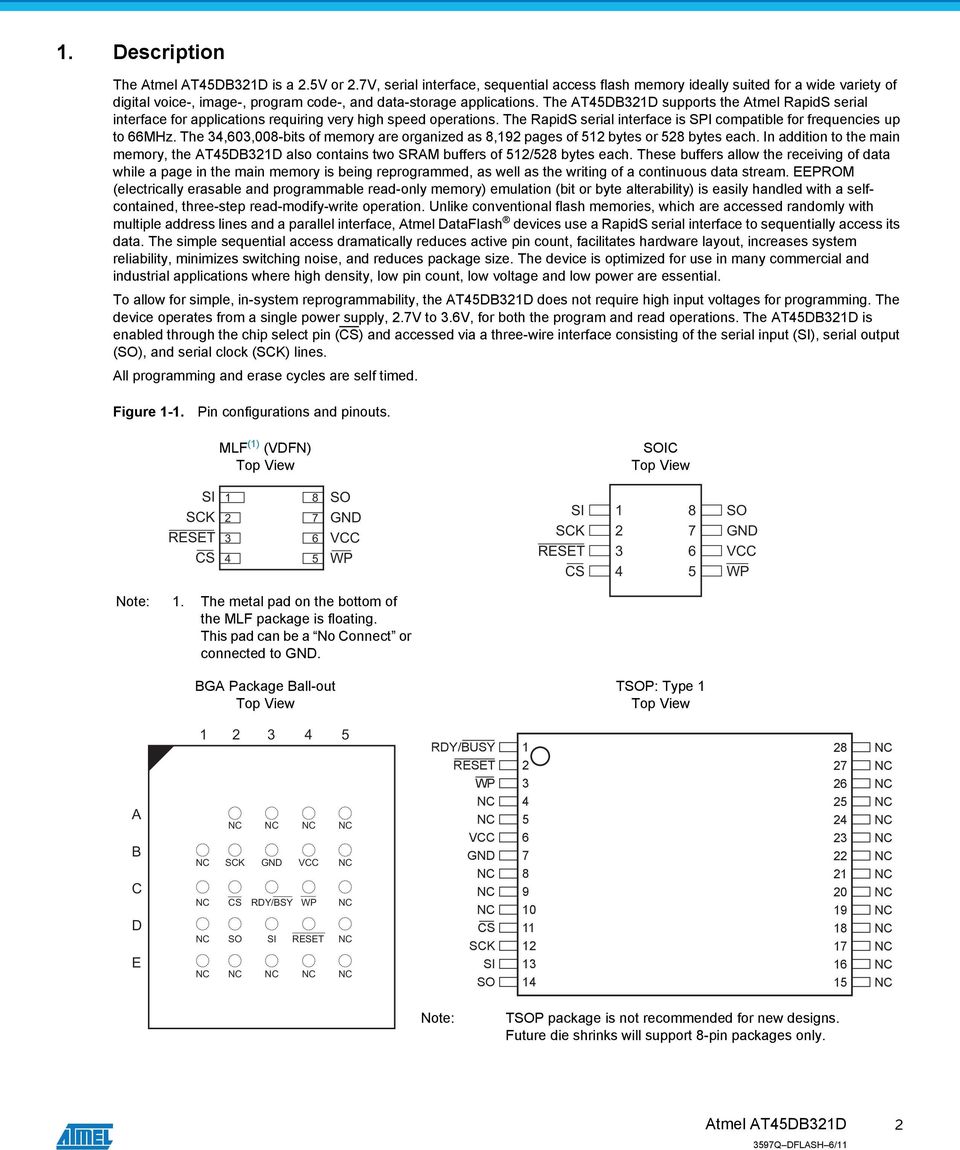
2 1. escription The is a 2.5V or 2.7V, serial interface, sequential access flash memory ideally suited for a wide variety of digital voice-, image-, program code-, and data-storage applications. The AT45B321 supports the Atmel RapidS serial interface for applications requiring very high speed operations. The RapidS serial interface is SPI compatible for frequencies up to 66MHz. The 34,603,008-bits of memory are organized as 8,192 pages of 512 bytes or 528 bytes each. In addition to the main memory, the AT45B321 also contains two SRAM buffers of 512/528 bytes each. These buffers allow the receiving of data while a page in the main memory is being reprogrammed, as well as the writing of a continuous data stream. EEPROM (electrically erasable and programmable read-only memory) emulation (bit or byte alterability) is easily handled with a selfcontained, three-step read-modify-write operation. Unlike conventional flash memories, which are accessed randomly with multiple address lines and a parallel interface, Atmel ataflash devices use a RapidS serial interface to sequentially access its data. The simple sequential access dramatically reduces active pin count, facilitates hardware layout, increases system reliability, minimizes switching noise, and reduces package size. The device is optimized for use in many commercial and industrial applications where high density, low pin count, low voltage and low power are essential. To allow for simple, in-system reprogrammability, the AT45B321 does not require high input voltages for programming. The device operates from a single power supply, 2.7V to 3.6V, for both the program and read operations. The AT45B321 is enabled through the chip select pin () and accessed via a three-wire interface consisting of the serial input (), serial output (SO), and serial clock (SCK) lines. All programming and erase cycles are self timed. Figure 1-1. Pin configurations and pinouts. MLF (1) (VFN) Top View SOIC Top View SCK RESET SO GN VCC WP SCK RESET SO GN VCC WP Note: 1. The metal pad on the bottom of the MLF package is floating. This pad can be a No Connect or connected to GN. BGA Package Ball-out Top View TSOP: Type 1 Top View A B C E NC NC NC NC NC SCK GN VCC NC NC RY/BSY WP NC NC SO RESET NC NC NC NC NC NC RY/BUSY RESET WP NC NC VCC GN NC NC NC SCK SO NC NC NC NC NC NC NC NC NC NC NC NC NC NC Note: TSOP package is not recommended for new designs. Future die shrinks will support 8-pin packages only. 2
3 Table 1-1. Pin Configurations Symbol SCK SO WP RESET RY/BUSY V CC GN Name and Function Chip Select: Asserting the pin selects the device. When the pin is deasserted, the device will be deselected and normally be placed in the standby mode (not deep powerdown mode), and the output pin (SO) will be in a high-impedance state. When the device is deselected, data will not be accepted on the input pin (). A high-to-low transition on the pin is required to start an operation, and a low-to-high transition is required to end an operation. When ending an internally self-timed operation such as a program or erase cycle, the device will not enter the standby mode until the completion of the operation. Serial Clock: This pin is used to provide a clock to the device, and is used to control the flow of data to and from the device. Command, address, and input data present on the pin are always latched on the rising edge of SCK, while output data on the SO pin are always clocked out on the falling edge of SCK. Serial Input: The pin is used to shift data into the device. The pin is used for all data input, including command and address sequences. ata on the pin are always latched on the rising edge of SCK. Serial Output: The SO pin is used to shift data out from the device. ata on the SO pin are always clocked out on the falling edge of SCK. Write Protect: When the WP pin is asserted, all sectors specified for protection by the sector protection register will be protected against program and erase operations, regardless of whether the enable sector protection command has been issued or not. The WP pin functions independently of the software controlled protection method. After the WP pin goes low, the content of the sector protection register cannot be modified. If a program or erase command is issued to the device while the WP pin is asserted, the device will simply ignore the command and perform no operation. The device will return to the idle state once the pin has been deasserted. The enable sector protection command and sector lockdown command, however, will be recognized by the device when the WP pin is asserted. The WP pin is internally pulled high, and may be left floating if hardware controlled protection will not be used. However, it is recommended that the WP pin also be externally connected to V CC whenever possible. Reset: A low state on the reset pin (RESET) will terminate the operation in progress and reset the internal state machine to an idle state. The device will remain in the reset condition as long as a low level is present on the RESET pin. Normal operation can resume once the RESET pin is brought back to a high level. The device incorporates an internal power-on reset circuit, and so there are no restrictions on the RESET pin during power-on sequences. If this pin and feature are not utilized, it is recommended that the RESET pin be driven high externally. Ready/Busy: This open drain output pin will be driven low when the device is busy in an internally self-timed operation. This pin, which is normally in a high state (through an external pull-up resistor), will be pulled low during programming/erase operations, compare operations, and page-to-buffer transfers. The busy status indicates that the flash memory array and one of the buffers cannot be accessed; read and write operations to the other buffer can still be performed. evice Power Supply: The V CC pin is used to supply the source voltage to the device. Operations at invalid V CC voltages may produce spurious results and should not be attempted. Ground: The ground reference for the power supply. GN should be connected to the system ground. Asserted State Low Type Input Input Input Output Low Low Input Input Output Power Ground 3

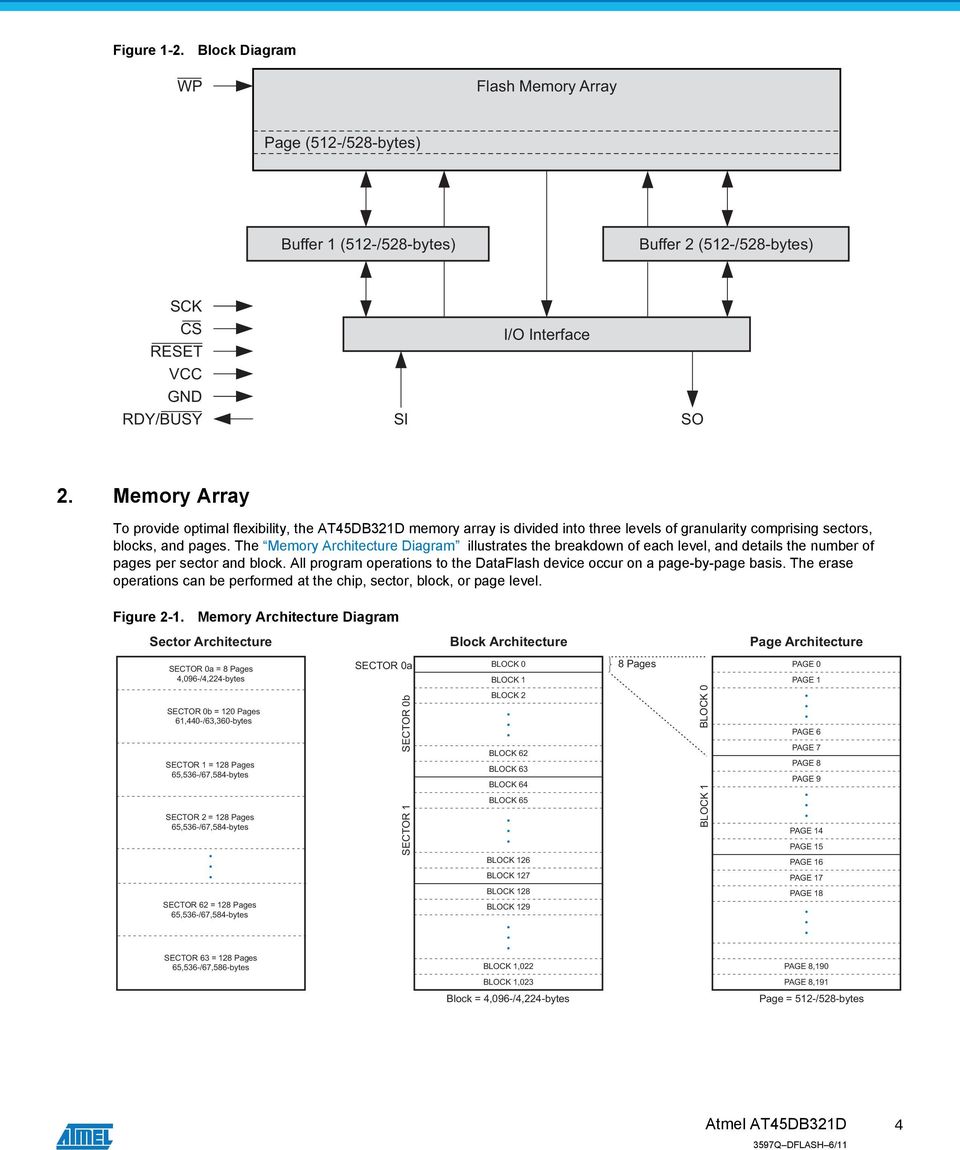
4 Figure 1-2. Block iagram WP Flash Memory Array Page (512-/528-bytes) Buffer 1 (512-/528-bytes) Buffer 2 (512-/528-bytes) SCK RESET VCC GN RY/BUSY I/O Interface SO 2. Memory Array To provide optimal flexibility, the AT45B321 memory array is divided into three levels of granularity comprising sectors, blocks, and pages. The Memory Architecture iagram illustrates the breakdown of each level, and details the number of pages per sector and block. All program operations to the ataflash device occur on a page-by-page basis. The erase operations can be performed at the chip, sector, block, or page level. Figure 2-1. Memory Architecture iagram Sector Architecture Block Architecture Page Architecture SECTOR 0a = 8 Pages 4,096-/4,224-bytes SECTOR 0b = 120 Pages 61,440-/63,360-bytes SECTOR 1 = 128 Pages 65,536-/67,584-bytes SECTOR 2 = 128 Pages 65,536-/67,584-bytes SECTOR 62 = 128 Pages 65,536-/67,584-bytes SECTOR 0a SECTOR 0b SECTOR 1 BLOCK 0 BLOCK 1 BLOCK 2 BLOCK 62 BLOCK 63 BLOCK 64 BLOCK 65 BLOCK 126 BLOCK 127 BLOCK 128 BLOCK Pages BLOCK 0 BLOCK 1 PAGE 0 PAGE 1 PAGE 6 PAGE 7 PAGE 8 PAGE 9 PAGE 14 PAGE 15 PAGE 16 PAGE 17 PAGE 18 SECTOR 63 = 128 Pages 65,536-/67,586-bytes BLOCK 1,022 BLOCK 1,023 Block = 4,096-/4,224-bytes PAGE 8,190 PAGE 8,191 Page = 512-/528-bytes 4
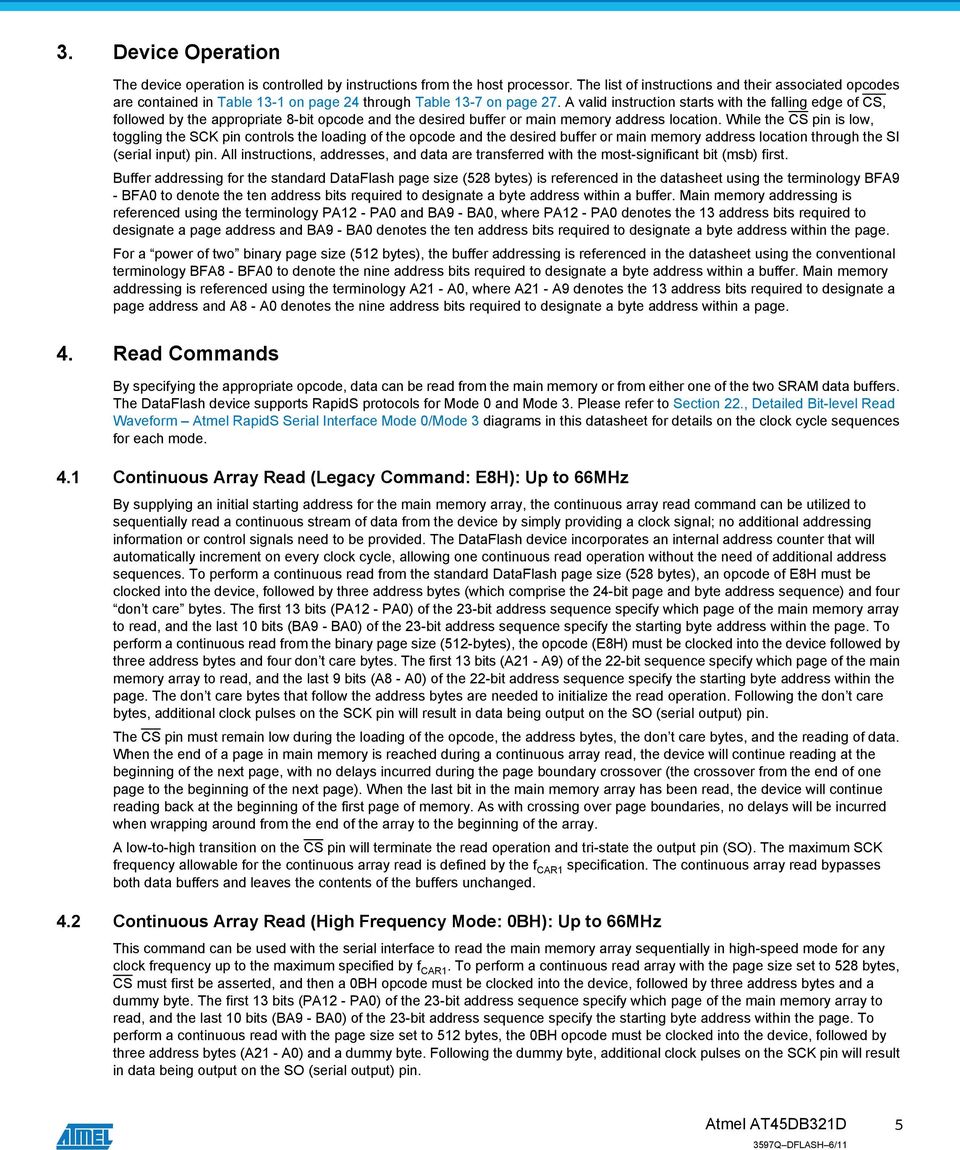
5 3. evice Operation The device operation is controlled by instructions from the host processor. The list of instructions and their associated opcodes are contained in Table 13-1 on page 24 through Table 13-7 on page 27. A valid instruction starts with the falling edge of, followed by the appropriate 8-bit opcode and the desired buffer or main memory address location. While the pin is low, toggling the SCK pin controls the loading of the opcode and the desired buffer or main memory address location through the (serial input) pin. All instructions, addresses, and data are transferred with the most-significant bit (msb) first. Buffer addressing for the standard ataflash page size (528 bytes) is referenced in the datasheet using the terminology BFA9 - BFA0 to denote the ten address bits required to designate a byte address within a buffer. Main memory addressing is referenced using the terminology PA12 - PA0 and BA9 - BA0, where PA12 - PA0 denotes the 13 address bits required to designate a page address and BA9 - BA0 denotes the ten address bits required to designate a byte address within the page. For a power of two binary page size (512 bytes), the buffer addressing is referenced in the datasheet using the conventional terminology BFA8 - BFA0 to denote the nine address bits required to designate a byte address within a buffer. Main memory addressing is referenced using the terminology A21 - A0, where A21 - A9 denotes the 13 address bits required to designate a page address and A8 - A0 denotes the nine address bits required to designate a byte address within a page. 4. Read Commands By specifying the appropriate opcode, data can be read from the main memory or from either one of the two SRAM data buffers. The ataflash device supports RapidS protocols for Mode 0 and Mode 3. Please refer to Section 22., etailed Bit-level Read Waveform Atmel RapidS Serial Interface Mode 0/Mode 3 diagrams in this datasheet for details on the clock cycle sequences for each mode. 4.1 Continuous Array Read (Legacy Command: E8H): Up to 66MHz By supplying an initial starting address for the main memory array, the continuous array read command can be utilized to sequentially read a continuous stream of data from the device by simply providing a clock signal; no additional addressing information or control signals need to be provided. The ataflash device incorporates an internal address counter that will automatically increment on every clock cycle, allowing one continuous read operation without the need of additional address sequences. To perform a continuous read from the standard ataflash page size (528 bytes), an opcode of E8H must be clocked into the device, followed by three address bytes (which comprise the 24-bit page and byte address sequence) and four don t care bytes. The first 13 bits (PA12 - PA0) of the 23-bit address sequence specify which page of the main memory array to read, and the last 10 bits (BA9 - BA0) of the 23-bit address sequence specify the starting byte address within the page. To perform a continuous read from the binary page size (512-bytes), the opcode (E8H) must be clocked into the device followed by three address bytes and four don t care bytes. The first 13 bits (A21 - A9) of the 22-bit sequence specify which page of the main memory array to read, and the last 9 bits (A8 - A0) of the 22-bit address sequence specify the starting byte address within the page. The don t care bytes that follow the address bytes are needed to initialize the read operation. Following the don t care bytes, additional clock pulses on the SCK pin will result in data being output on the SO (serial output) pin. The pin must remain low during the loading of the opcode, the address bytes, the don t care bytes, and the reading of data. When the end of a page in main memory is reached during a continuous array read, the device will continue reading at the beginning of the next page, with no delays incurred during the page boundary crossover (the crossover from the end of one page to the beginning of the next page). When the last bit in the main memory array has been read, the device will continue reading back at the beginning of the first page of memory. As with crossing over page boundaries, no delays will be incurred when wrapping around from the end of the array to the beginning of the array. A low-to-high transition on the pin will terminate the read operation and tri-state the output pin (SO). The maximum SCK frequency allowable for the continuous array read is defined by the f CAR1 specification. The continuous array read bypasses both data buffers and leaves the contents of the buffers unchanged. 4.2 Continuous Array Read (High Frequency Mode: 0BH): Up to 66MHz This command can be used with the serial interface to read the main memory array sequentially in high-speed mode for any clock frequency up to the maximum specified by f CAR1. To perform a continuous read array with the page size set to 528 bytes, must first be asserted, and then a 0BH opcode must be clocked into the device, followed by three address bytes and a dummy byte. The first 13 bits (PA12 - PA0) of the 23-bit address sequence specify which page of the main memory array to read, and the last 10 bits (BA9 - BA0) of the 23-bit address sequence specify the starting byte address within the page. To perform a continuous read with the page size set to 512 bytes, the 0BH opcode must be clocked into the device, followed by three address bytes (A21 - A0) and a dummy byte. Following the dummy byte, additional clock pulses on the SCK pin will result in data being output on the SO (serial output) pin. 5
6 The pin must remain low during the loading of the opcode, the address bytes, and the reading of data. When the end of a page in the main memory is reached during a continuous array read, the device will continue reading at the beginning of the next page, with no delays incurred during the page boundary crossover (the crossover from the end of one page to the beginning of the next page). When the last bit in the main memory array has been read, the device will continue reading back at the beginning of the first page of memory. As with crossing over page boundaries, no delays will be incurred when wrapping around from the end of the array to the beginning of the array. A low-to-high transition on the pin will terminate the read operation and tri-state the output pin (SO). The maximum SCK frequency allowable for the continuous array read is defined by the f CAR1 specification. The continuous array read bypasses both data buffers and leaves the contents of the buffers unchanged. 4.3 Continuous Array Read (Low Frequency Mode: 03H): Up to 33MHz This command can be used with the serial interface to read the main memory array sequentially without a dummy byte up to the maximum frequency specified by f CAR2. To perform a continuous read array with the page size set to 528 bytes, the must first be asserted, and then a 03H opcode must be clocked into the device, followed by three address bytes (which comprise the 24-bit page and byte address sequence). The first 13 bits (PA12 - PA0) of the 23-bit address sequence specify which page of the main memory array to read, and the last 10 bits (BA9 - BA0) of the 23-bit address sequence specify the starting byte address within the page. To perform a continuous read with the page size set to 512 bytes, the 03H opcode must be clocked into the device, followed by three address bytes (A21 - A0). Following the address bytes, additional clock pulses on the SCK pin will result in data being output on the SO (serial output) pin. The pin must remain low during the loading of the opcode, the address bytes, and the reading of data. When the end of a page in the main memory is reached during a continuous array read, the device will continue reading at the beginning of the next page with no delays incurred during the page boundary crossover (the crossover from the end of one page to the beginning of the next page). When the last bit in the main memory array has been read, the device will continue reading back at the beginning of the first page of memory. As with crossing over page boundaries, no delays will be incurred when wrapping around from the end of the array to the beginning of the array. A low-to-high transition on the pin will terminate the read operation and tri-state the output pin (SO). The continuous array read bypasses both data buffers and leaves the contents of the buffers unchanged. 4.4 Main Memory Page Read A main memory page read allows the user to read data directly from any one of the 8,192 pages in the main memory, bypassing both of the data buffers and leaving the contents of the buffers unchanged. To start a page read from the standard ataflash page size (528 bytes), an opcode of 2H must be clocked into the device, followed by three address bytes (which comprise the 24-bit page and byte address sequence) and four don t care bytes. The first 13 bits (PA12 - PA0) of the 23-bit address sequence specify the page in main memory to be read, and the last 10 bits (BA9 - BA0) of the 23-bit address sequence specify the starting byte address within that page. To start a page read from the binary page size (512 bytes), the 2H opcode must be clocked into the device, followed by three address bytes and four don t care bytes. The first 13 bits (A21 - A9) of the 22-bit sequence specify which page of the main memory array to read, and the last 9 bits (A8 - A0) of the 22-bit address sequence specify the starting byte address within the page. The don t care bytes that follow the address bytes are sent to initialize the read operation. Following the don t care bytes, additional pulses on SCK result in data being output on the SO (serial output) pin. The pin must remain low during the loading of the opcode, the address bytes, the don t care bytes, and the reading of data. When the end of a page in main memory is reached, the device will continue reading back at the beginning of the same page. A low-to-high transition on the pin will terminate the read operation and tri-state the output pin (SO). The maximum SCK frequency allowable for the main memory page read is defined by the f SCK specification. The main memory page read bypasses both data buffers and leaves the contents of the buffers unchanged. 4.5 Buffer Read The SRAM data buffers can be accessed independently of the main memory array, and utilizing the buffer read command allows data to be sequentially read directly from the buffers. Four opcodes, 4H or 1H for buffer 1 and 6H or 31H for buffe1(y of th 6
7 5. Program and Erase Commands 5.1 Buffer Write ata can be clocked in from the input pin () into either buffer 1 or buffer 2. To load data into the standard ataflash buffer (528 bytes), a 1-byte opcode, 84H for buffer 1 or 87H for buffer 2, must be clocked into the device, followed by three address bytes comprised of 14 don t care bits and 10 buffer address bits (BFA9 - BFA0). The 10 buffer address bits specify the first byte in the buffer to be written. To load data into the binary buffers (512 bytes each), a 1-byte 84H opcode for buffer 1 or 87H opcode for buffer 2 must be clocked into the device, followed by three address bytes comprised of 15 don t care bits and 9 buffer address bits (BFA8 - BFA0). The nine buffer address bits specify the first byte in the buffer to be written. After the last address byte has been clocked into the device, data can then be clocked in on subsequent clock cycles. If the end of the data buffer is reached, the device will wrap around back to the beginning of the buffer. ata will continue to be loaded into the buffer until a low-to-high transition is detected on the pin. 5.2 Buffer to Main Memory Page Program with Built-in Erase ata written into either buffer 1 or buffer 2 can be programmed into the main memory. A 1-byte opcode, 83H for buffer 1 or 86H for buffer 2, must be clocked into the device. For the standard ataflash page size (528 bytes), the opcode must be followed by three address bytes consist of 1 don t care bit, 13 page address bits (PA12 - PA0) that specify the page in the main memory to be written, and 10 don t care bits. To perform a buffer to main memory page program with built-in erase for the binary page size (512 bytes), the 83H opcode for buffer 1 or 86H opcode for buffer 2 must be clocked into the device, followed by three address bytes consisting of 2 don t care bits, 13 page address bits (A21 - A9) that specify the page in the main memory to be written, and 9 don t care bits. When a low-to-high transition occurs on the pin, the part will first erase the selected page in main memory (the erased state is a logic one) and then program the data stored in the buffer into the specified page in main memory. The erase and the programming of the page are internally self-timed, and should take place in a maximum time of t EP. uring this time, the status register and the RY/BUSY pin will indicate that the part is busy. 5.3 Buffer to Main Memory Page Program without Built-in Erase A previously-erased page within main memory can be programmed with the contents of either buffer 1 or buffer 2. A one-byte opcode, 88H for buffer 1 or 89H for buffer 2, must be clocked into the device. For the standard ataflash page size (528 bytes), the opcode must be followed by three address bytes that consist of 1 don t care bit, 13 page address bits (PA12 - PA0) that specify the page in the main memory to be written, and 10 don t care bits. To perform a buffer to main memory page program without built-in erase for the binary page size (512 bytes), the 88H opcode for buffer 1 or 89H opcode for buffer 2 must be clocked into the device, followed by three address bytes consisting of 2 don t care bits, 13 page address bits (A21 - A9) that specify the page in the main memory to be written, and 9 don t care bits. When a low-to-high transition occurs on the pin, the part will program the data stored in the buffer into the specified page in the main memory. It is necessary that the page in main memory being programmed has been previously erased using one of the erase commands (page erase or block erase). The programming of the page is internally self-timed, and should take place in a maximum time of t P. uring this time, the status register and the RY/BUSY pin will indicate that the part is busy. 5.4 Page Erase The page erase command can be used to individually erase any page in the main memory array, allowing the buffer to main memory page program to be utilized at a later time. To perform a page erase in the standard ataflash page size (528 bytes), an opcode of 81H must be loaded into the device, followed by three address bytes comprised of 1 don t care bit, 13 page address bits (PA12 - PA0) that specify the page in the main memory to be erased, and 10 don t care bits. To perform a page erase in the binary page size (512 bytes), the 81H opcode must be loaded into the device, followed by three address bytes consisting of 2 don t care bits, 13 page address bits (A21 - A9) that specify the page in the main memory to be erased, and 9 don t care bits. When a low-to-high transition occurs on the pin, the part will erase the selected page (the erased state is a logical 1). The erase operation is internally self-timed, and should take place in a maximum time of t PE. uring this time, the status register and the RY/BUSY pin will indicate that the part is busy. 7

8 5.5 Block Erase A block of eight pages can be erased at one time. This command is useful when large amounts of data have to be written into the device. This will avoid using multiple page erase commands. To perform a block erase for the standard ataflash page size (528-bytes), an opcode of 50H must be loaded into the device, followed by three address bytes comprised of 1 don t care bit, 10 page address bits (PA12-PA3), and 13 don t care bits. The 10 page address bits are used to specify which block of eight pages is to be erased. To perform a block erase for the binary page size (512 bytes), the 50H opcode must be loaded into the device, followed by three address bytes consisting of 2 don t care bits, 10 page address bits (A21 - A12), and 12 don t care bits. The 10 page address bits are used to specify which block of eight pages is to be erased. When a low-to-high transition occurs on the pin, the part will erase the selected block of eight pages. The erase operation is internally self-timed, and should take place in a maximum time of t BE. uring this time, the status register and the RY/BUSY pin will indicate that the part is busy. Table 5-1. Block Erase Addressing PA12/ A21 PA11/ A20 PA10/ A19 PA9/ A18 PA8/ A17 PA7/ A16 PA6/ A X X X X X X X X X X X X X X X X X X X X X X X X 1023 PA5/ A14 PA4/ A13 PA3/ A12 PA2/ A11 PA1/ A10 PA0/ A9 Block 5.6 Sector Erase The sector erase command can be used to individually erase any sector in the main memory. There are 64 sectors, and only one sector can be erased at a time. To perform a sector 0a or sector 0b erase for the standard ataflash page size (528 bytes), an opcode of 7CH must be loaded into the device, followed by three address bytes comprised of 1 don t care bit, 10 page address bits (PA12 - PA3), and 13 don t care bits. To perform a sector 1-63 erase, the 7CH opcode must be loaded into the device, followed by three address bytes comprised of 1 don t care bit, 6 page address bits (PA12 - PA7), and 17 don t care bits. To perform a sector 0a or sector 0b erase for the binary page size (512 bytes), an opcode of 7CH must be loaded into the device, followed by three address bytes comprised of 2 don t care bits, 10 page address bits (A21 - A12), and 12 don t care bits. To perform a sector 1-63 erase, the 7CH opcode must be loaded into the device, followed by three address bytes comprised of 2 don t care bits, 6 page address bits (A21 - A16), and 16 don t care bits. The page address bits are used to specify any valid address location within the sector to be erased. When a low-to-high transition occurs on the pin, the part will erase the selected sector. The erase operation is internally self-timed, and should take place in a maximum time of t SE. uring this time, the status register and the RY/BUSY pin will indicate that the part is busy. 8

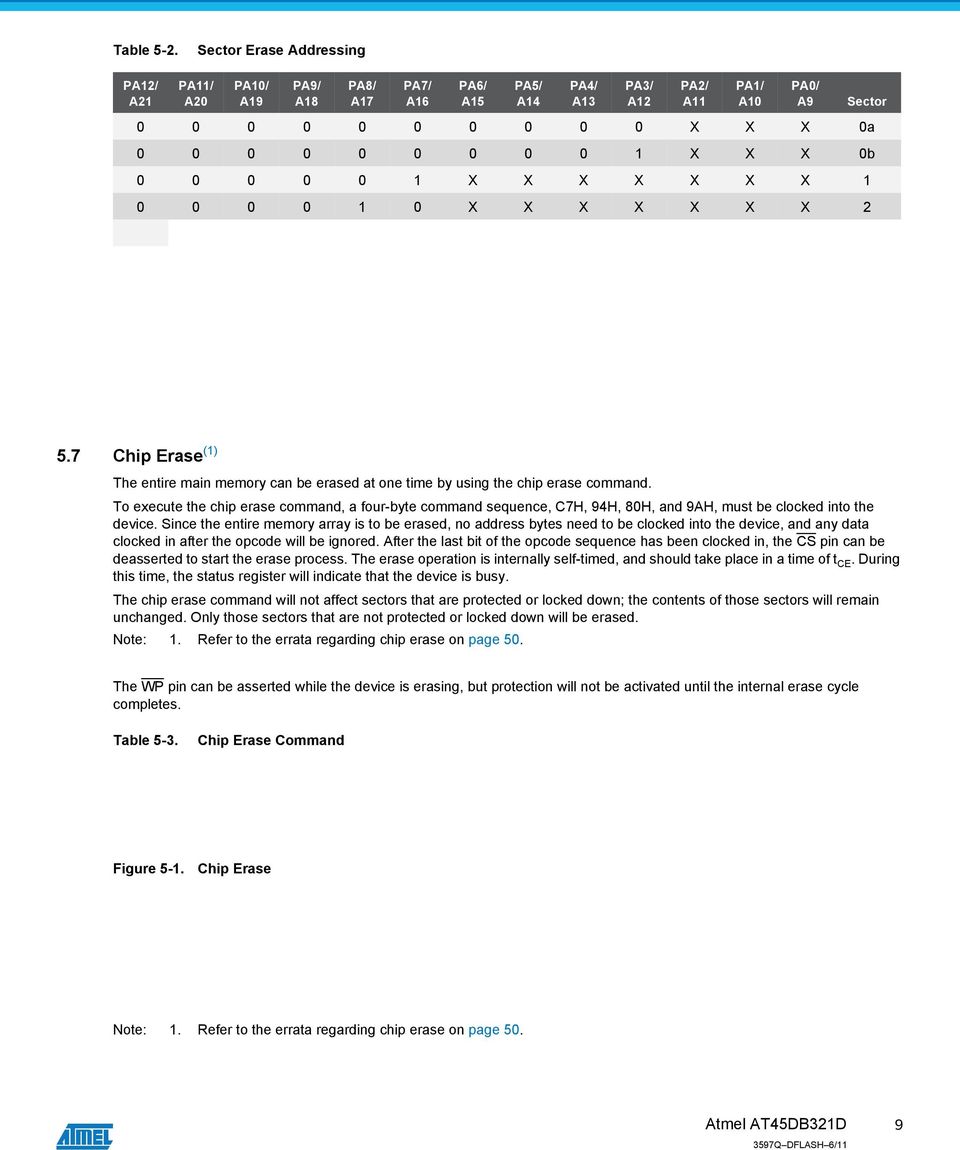
9 Table 5-2. Sector Erase Addressing PA12/ A21 PA11/ A20 PA10/ A19 PA9/ A18 PA8/ A17 PA7/ A16 PA6/ A X X X 0a X X X 0b X X X X X X X X X X X X X X X X X X X X X X X X X X X X X X X X X X X X X X X X X X 63 PA5/ A14 PA4/ A13 PA3/ A12 PA2/ A11 PA1/ A10 PA0/ A9 Sector 5.7 Chip Erase (1) The entire main memory can be erased at one time by using the chip erase command. To execute the chip erase command, a four-byte command sequence, C7H, 94H, 80H, and 9AH, must be clocked into the device. Since the entire memory array is to be erased, no address bytes need to be clocked into the device, and any data clocked in after the opcode will be ignored. After the last bit of the opcode sequence has been clocked in, the pin can be deasserted to start the erase process. The erase operation is internally self-timed, and should take place in a time of t CE. uring this time, the status register will indicate that the device is busy. The chip erase command will not affect sectors that are protected or locked down; the contents of those sectors will remain unchanged. Only those sectors that are not protected or locked down will be erased. Note: 1. Refer to the errata regarding chip erase on page 50. The WP pin can be asserted while the device is erasing, but protection will not be activated until the internal erase cycle completes. Table 5-3. Chip Erase Command Command Byte 1 Byte 2 Byte 3 Byte 4 Chip erase C7H 94H 80H 9AH Figure 5-1. Chip Erase Byte 1 Byte 2 Byte 3 Byte 4 Each transition represents 8 bits Note: 1. Refer to the errata regarding chip erase on page 50. 9
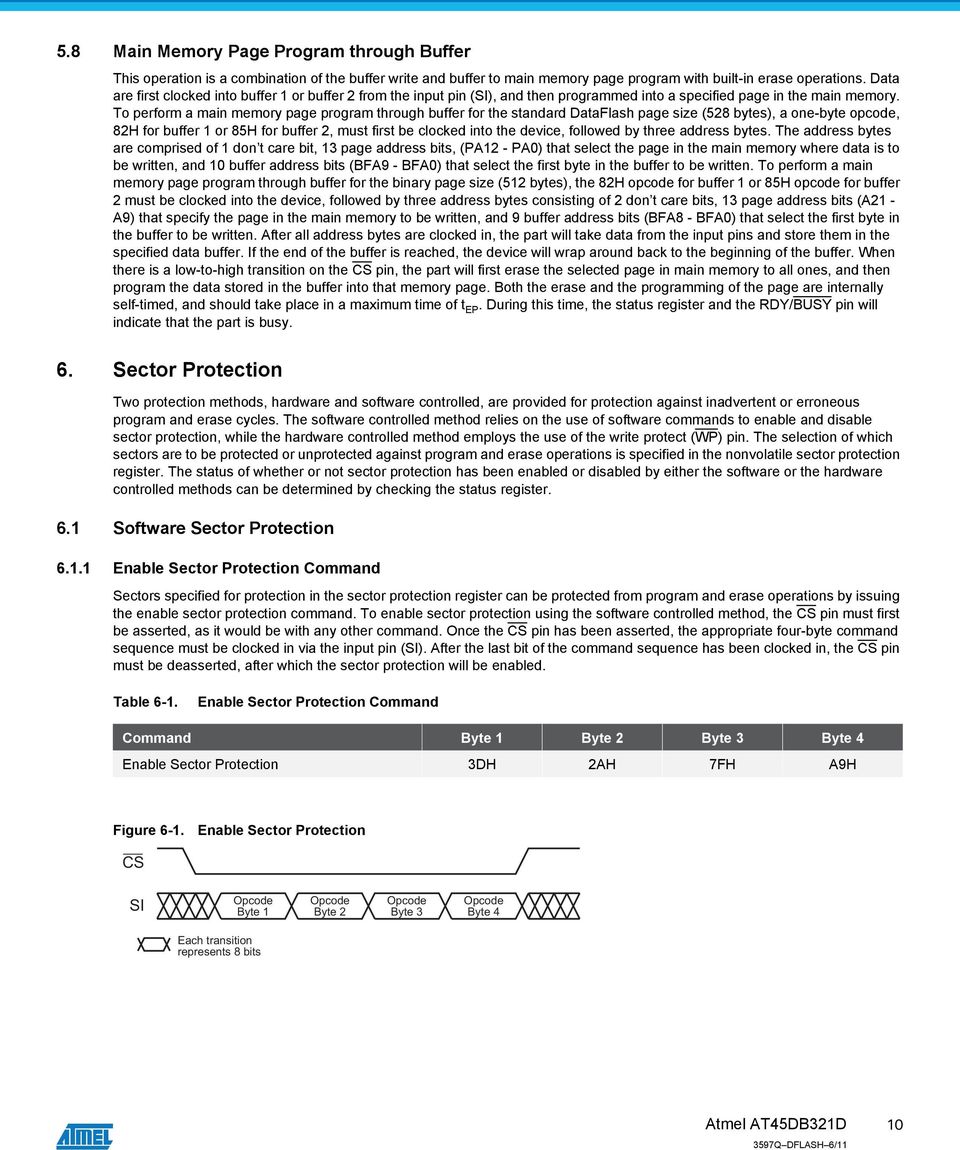
10 5.8 Main Memory Page Program through Buffer This operation is a combination of the buffer write and buffer to main memory page program with built-in erase operations. ata are first clocked into buffer 1 or buffer 2 from the input pin (), and then programmed into a specified page in the main memory. To perform a main memory page program through buffer for the standard ataflash page size (528 bytes), a one-byte opcode, 82H for buffer 1 or 85H for buffer 2, must first be clocked into the device, followed by three address bytes. The address bytes are comprised of 1 don t care bit, 13 page address bits, (PA12 - PA0) that select the page in the main memory where data is to be written, and 10 buffer address bits (BFA9 - BFA0) that select the first byte in the buffer to be written. To perform a main memory page program through buffer for the binary page size (512 bytes), the 82H opcode for buffer 1 or 85H opcode for buffer 2 must be clocked into the device, followed by three address bytes consisting of 2 don t care bits, 13 page address bits (A21 - A9) that specify the page in the main memory to be written, and 9 buffer address bits (BFA8 - BFA0) that select the first byte in the buffer to be written. After all address bytes are clocked in, the part will take data from the input pins and store them in the specified data buffer. If the end of the buffer is reached, the device will wrap around back to the beginning of the buffer. When there is a low-to-high transition on the pin, the part will first erase the selected page in main memory to all ones, and then program the data stored in the buffer into that memory page. Both the erase and the programming of the page are internally self-timed, and should take place in a maximum time of t EP. uring this time, the status register and the RY/BUSY pin will indicate that the part is busy. 6. Sector Protection Two protection methods, hardware and software controlled, are provided for protection against inadvertent or erroneous program and erase cycles. The software controlled method relies on the use of software commands to enable and disable sector protection, while the hardware controlled method employs the use of the write protect (WP) pin. The selection of which sectors are to be protected or unprotected against program and erase operations is specified in the nonvolatile sector protection register. The status of whether or not sector protection has been enabled or disabled by either the software or the hardware controlled methods can be determined by checking the status register. 6.1 Software Sector Protection Enable Sector Protection Command Sectors specified for protection in the sector protection register can be protected from program and erase operations by issuing the enable sector protection command. To enable sector protection using the software controlled method, the pin must first be asserted, as it would be with any other command. Once the pin has been asserted, the appropriate four-byte command sequence must be clocked in via the input pin (). After the last bit of the command sequence has been clocked in, the pin must be deasserted, after which the sector protection will be enabled. Table 6-1. Enable Sector Protection Command Command Byte 1 Byte 2 Byte 3 Byte 4 Enable Sector Protection 3H 2AH 7FH A9H Figure 6-1. Enable Sector Protection Byte 1 Byte 2 Byte 3 Byte 4 Each transition represents 8 bits 10
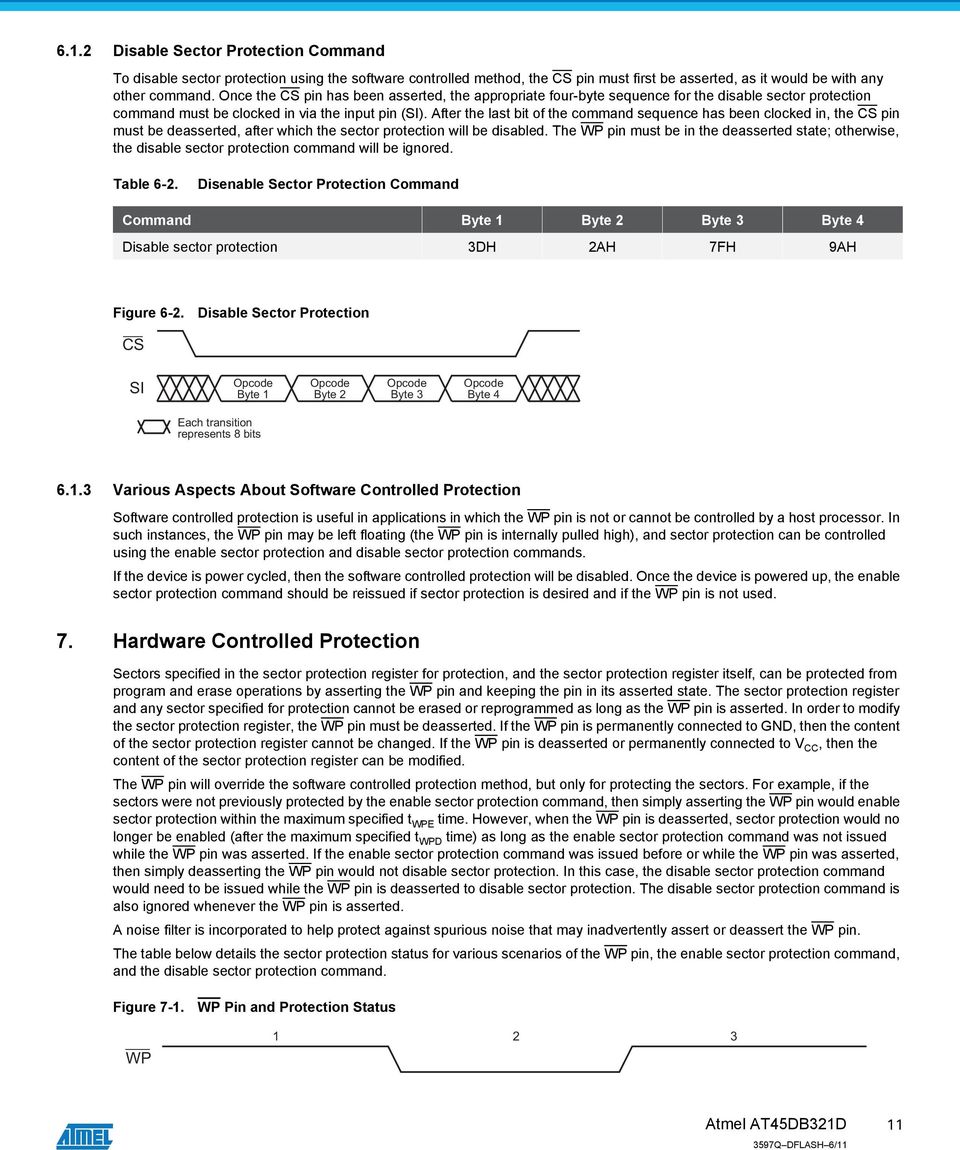
11 6.1.2 isable Sector Protection Command To disable sector protection using the software controlled method, the pin must first be asserted, as it would be with any other command. Once the pin has been asserted, the appropriate four-byte sequence for the disable sector protection command must be clocked in via the input pin (). After the last bit of the command sequence has been clocked in, the pin must be deasserted, after which the sector protection will be disabled. The WP pin must be in the deasserted state; otherwise, the disable sector protection command will be ignored. Table 6-2. isenable Sector Protection Command Command Byte 1 Byte 2 Byte 3 Byte 4 isable sector protection 3H 2AH 7FH 9AH Figure 6-2. isable Sector Protection Byte 1 Byte 2 Byte 3 Byte 4 Each transition represents 8 bits Various Aspects About Software Controlled Protection Software controlled protection is useful in applications in which the WP pin is not or cannot be controlled by a host processor. In such instances, the WP pin may be left floating (the WP pin is internally pulled high), and sector protection can be controlled using the enable sector protection and disable sector protection commands. If the device is power cycled, then the software controlled protection will be disabled. Once the device is powered up, the enable sector protection command should be reissued if sector protection is desired and if the WP pin is not used. 7. Hardware Controlled Protection Sectors specified in the sector protection register for protection, and the sector protection register itself, can be protected from program and erase operations by asserting the WP pin and keeping the pin in its asserted state. The sector protection register and any sector specified for protection cannot be erased or reprogrammed as long as the WP pin is asserted. In order to modify the sector protection register, the WP pin must be deasserted. If the WP pin is permanently connected to GN, then the content of the sector protection register cannot be changed. If the WP pin is deasserted or permanently connected to V CC, then the content of the sector protection register can be modified. The WP pin will override the software controlled protection method, but only for protecting the sectors. For example, if the sectors were not previously protected by the enable sector protection command, then simply asserting the WP pin would enable sector protection within the maximum specified t WPE time. However, when the WP pin is deasserted, sector protection would no longer be enabled (after the maximum specified t WP time) as long as the enable sector protection command was not issued while the WP pin was asserted. If the enable sector protection command was issued before or while the WP pin was asserted, then simply deasserting the WP pin would not disable sector protection. In this case, the disable sector protection command would need to be issued while the WP pin is deasserted to disable sector protection. The disable sector protection command is also ignored whenever the WP pin is asserted. A noise filter is incorporated to help protect against spurious noise that may inadvertently assert or deassert the WP pin. The table below details the sector protection status for various scenarios of the WP pin, the enable sector protection command, and the disable sector protection command. Figure 7-1. WP WP Pin and Protection Status
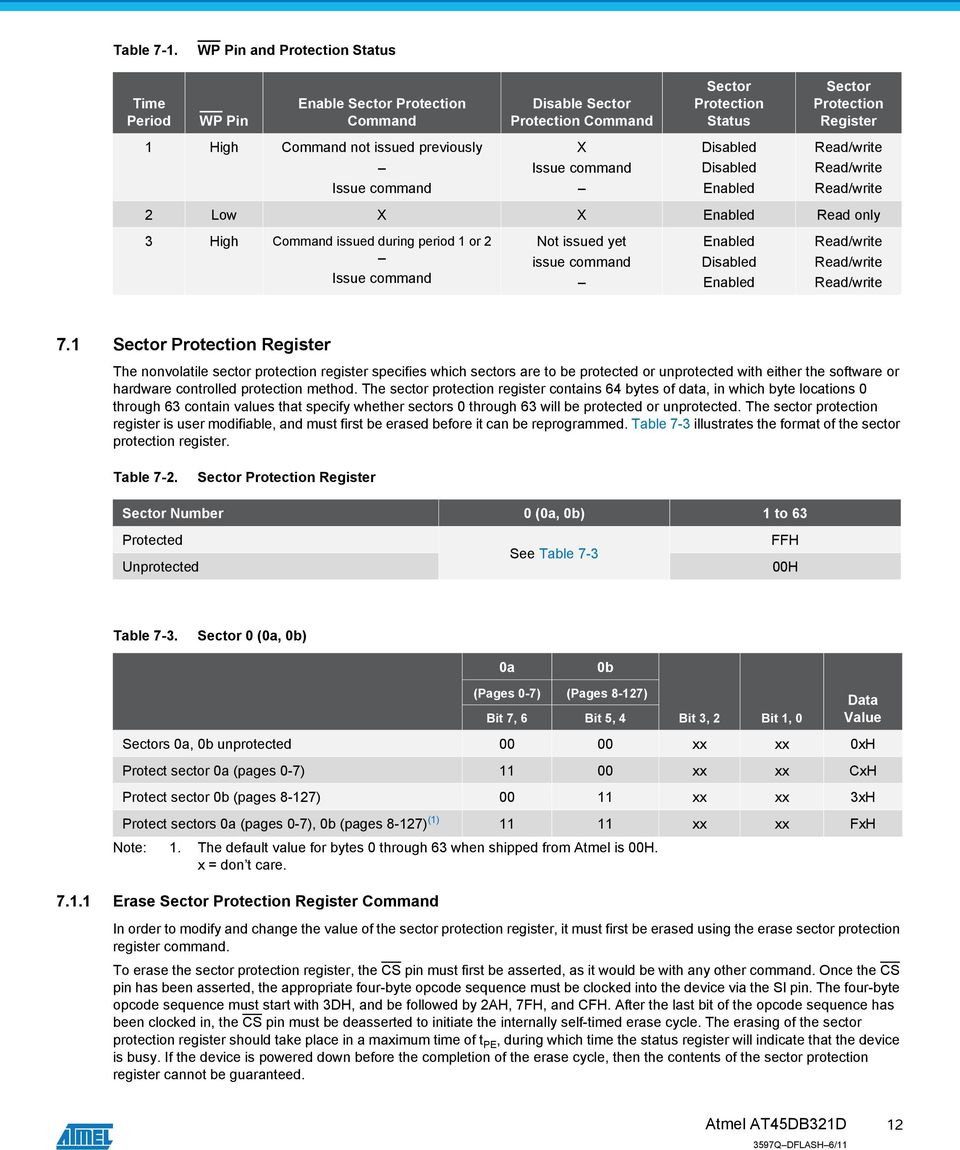
12 Table 7-1. WP Pin and Protection Status Time Period WP Pin Enable Sector Protection Command 1 High Command not issued previously Issue command isable Sector Protection Command X Issue command Sector Protection Status isabled isabled Enabled Sector Protection Register Read/write Read/write Read/write 2 Low X X Enabled Read only 3 High Command issued during period 1 or 2 Issue command Not issued yet issue command Enabled isabled Enabled Read/write Read/write Read/write 7.1 Sector Protection Register The nonvolatile sector protection register specifies which sectors are to be protected or unprotected with either the software or hardware controlled protection method. The sector protection register contains 64 bytes of data, in which byte locations 0 through 63 contain values that specify whether sectors 0 through 63 will be protected or unprotected. The sector protection register is user modifiable, and must first be erased before it can be reprogrammed. Table 7-3 illustrates the format of the sector protection register. Table 7-2. Sector Protection Register Sector Number 0 (0a, 0b) 1 to 63 Protected Unprotected See Table 7-3 FFH 00H Table 7-3. Sector 0 (0a, 0b) 0a 0b Note: 1. The default value for bytes 0 through 63 when shipped from Atmel is 00H. x = don t care Erase Sector Protection Register Command (Pages 0-7) (Pages 8-127) Bit 7, 6 Bit 5, 4 Bit 3, 2 Bit 1, 0 Sectors 0a, 0b unprotected xx xx 0xH Protect sector 0a (pages 0-7) xx xx CxH Protect sector 0b (pages 8-127) xx xx 3xH ata Value Protect sectors 0a (pages 0-7), 0b (pages 8-127) (1) xx xx FxH In order to modify and change the value of the sector protection register, it must first be erased using the erase sector protection register command. To erase the sector protection register, the pin must first be asserted, as it would be with any other command. Once the pin has been asserted, the appropriate four-byte opcode sequence must be clocked into the device via the pin. The four-byte opcode sequence must start with 3H, and be followed by 2AH, 7FH, and CFH. After the last bit of the opcode sequence has been clocked in, the pin must be deasserted to initiate the internally self-timed erase cycle. The erasing of the sector protection register should take place in a maximum time of t PE, during which time the status register will indicate that the device is busy. If the device is powered down before the completion of the erase cycle, then the contents of the sector protection register cannot be guaranteed. 12
13 The sector protection register can be erased with sector protection enabled or disabled. Since the erased state (FFH) of each byte in the sector protection register is used to indicate that a sector is specified for protection, leaving sector protection enabled during the erasing of the register allows the protection scheme to be more effective in the prevention of accidental programming or erasing of the device. If for some reason an erroneous program or erase command is sent to the device immediately after erasing the sector protection register and before the register can be reprogrammed, then the erroneous program or erase command will not be processed because all sectors will be protected. Table 7-4. Erase Sector Protection Register Command Command Byte 1 Byte 2 Byte 3 Byte 4 Erase sector protection register 3H 2AH 7FH CFH Figure 7-2. Erase Sector Protection Register byte 1 byte 2 byte 3 byte 4 Each transition represents 8 bits Program Sector Protection Register Command Once the sector protection register has been erased, it can be reprogrammed using the program sector protection register command. To program the sector protection register, the pin must first be asserted, and then the appropriate four-byte opcode sequence must be clocked into the device via the pin. The four-byte opcode sequence must start with 3H, and be followed by 2AH, 7FH, and FCH. After the last bit of the opcode sequence has been clocked into the device, the data for the contents of the sector protection register must be clocked in. As described in Section 7.1, the sector protection register contains 64 bytes of data, and so 64 bytes must be clocked into the device. The first byte of data corresponds to sector 0, the second byte corresponds to sector 1, and so on, with the last byte of data corresponding to sector 63. After the last data byte has been clocked in, the pin must be deasserted to initiate the internally self-timed program cycle. The programming of the sector protection register should take place in a maximum time of t P, during which the status register will indicate that the device is busy. If the device is powered down during the program cycle, the contents of the sector protection register cannot be guaranteed. If the proper number of data bytes is not clocked in before the pin is deasserted, then the protection status of the sectors corresponding to the bytes not clocked in can not be guaranteed. For example, if only the first two bytes are clocked in instead of the complete 62 bytes, then the protection status of the last 62 sectors cannot be guaranteed. Furthermore, if more than 64 bytes of data are clocked into the device, then the data will wrap back around to the beginning of the register. For instance, if 65 bytes of data are clocked in, then the 65 th byte will be stored at byte location 0 of the sector protection register. If a value other than 00H or FFH is clocked into a byte location of the sector protection register, then the protection status of the sector corresponding to that byte location cannot be guaranteed. For example, if a value of 17H is clocked into byte location 2 of the sector protection register, then the protection status of sector 2 cannot be guaranteed. The sector protection register can be reprogrammed while sector protection is enabled or disabled. Being able to reprogram the sector protection register with sector protection enabled allows the user to temporarily disable the sector protection of an individual sector rather than disabling sector protection completely. The program sector protection register command utilizes the internal SRAM buffer 1 for processing. Therefore, the contents of buffer 1 will be altered from its previous state when this command is issued. Table 7-5. Program Sector Protection Register Command Command Byte 1 Byte 2 Byte 3 Byte 4 Program sector protection register 3H 2AH 7FH FCH 13

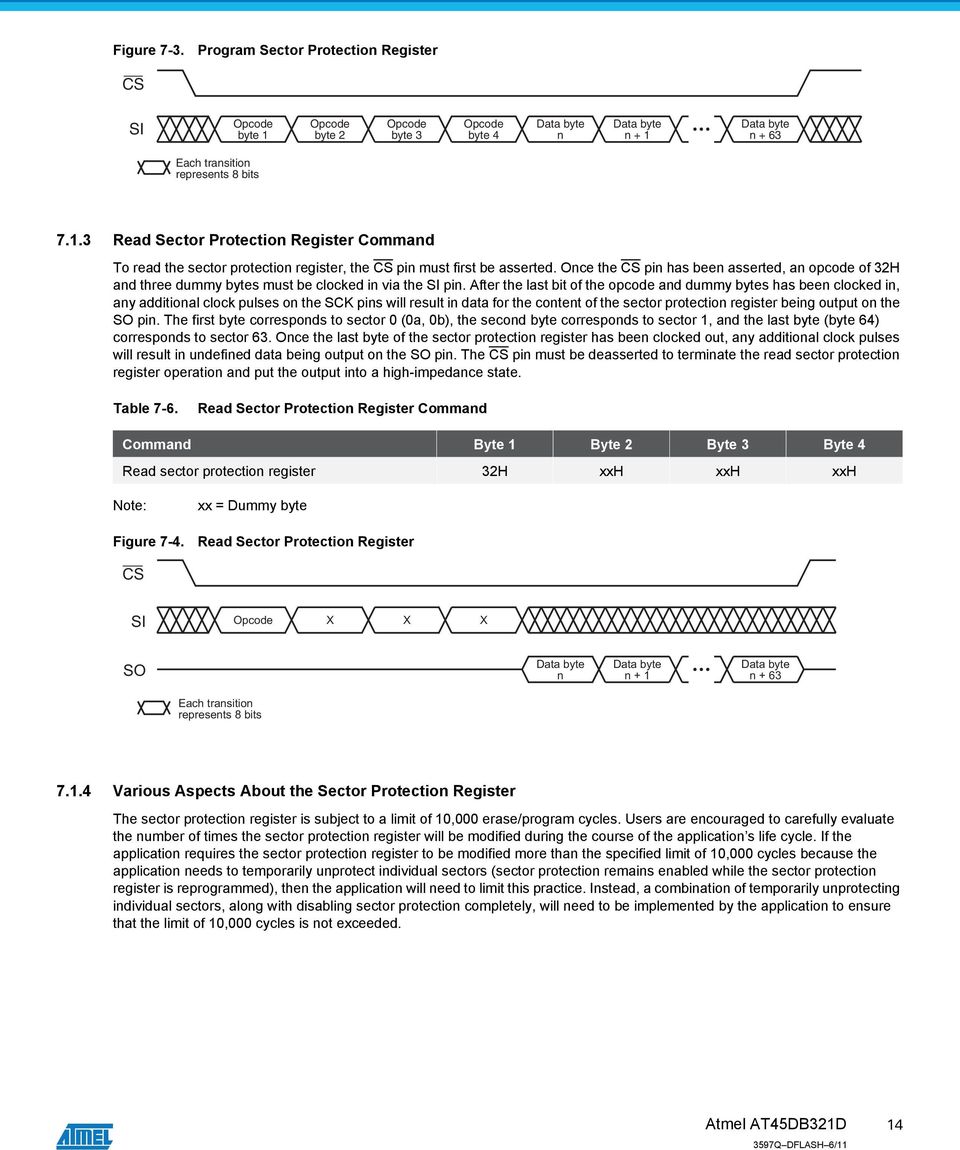
14 Figure 7-3. Program Sector Protection Register byte 1 byte 2 byte 3 byte 4 ata byte n ata byte n + 1 ata byte n + 63 Each transition represents 8 bits Read Sector Protection Register Command To read the sector protection register, the pin must first be asserted. Once the pin has been asserted, an opcode of 32H and three dummy bytes must be clocked in via the pin. After the last bit of the opcode and dummy bytes has been clocked in, any additional clock pulses on the SCK pins will result in data for the content of the sector protection register being output on the SO pin. The first byte corresponds to sector 0 (0a, 0b), the second byte corresponds to sector 1, and the last byte (byte 64) corresponds to sector 63. Once the last byte of the sector protection register has been clocked out, any additional clock pulses will result in undefined data being output on the SO pin. The pin must be deasserted to terminate the read sector protection register operation and put the output into a high-impedance state. Table 7-6. Read Sector Protection Register Command Command Byte 1 Byte 2 Byte 3 Byte 4 Read sector protection register 32H xxh xxh xxh Note: Figure 7-4. xx = ummy byte Read Sector Protection Register X X X SO ata byte n ata byte n + 1 ata byte n + 63 Each transition represents 8 bits Various Aspects About the Sector Protection Register The sector protection register is subject to a limit of 10,000 erase/program cycles. Users are encouraged to carefully evaluate the number of times the sector protection register will be modified during the course of the application s life cycle. If the application requires the sector protection register to be modified more than the specified limit of 10,000 cycles because the application needs to temporarily unprotect individual sectors (sector protection remains enabled while the sector protection register is reprogrammed), then the application will need to limit this practice. Instead, a combination of temporarily unprotecting individual sectors, along with disabling sector protection completely, will need to be implemented by the application to ensure that the limit of 10,000 cycles is not exceeded. 14
15 8. Security Features 8.1 Sector Lockdown The device incorporates a sector lockdown mechanism that allows each individual sector to be permanently locked so that it becomes read only. This is useful for applications that require the ability to permanently protect a number of sectors against malicious attempts at altering program code or security information. Once a sector is locked down, it can never be erased or programmed, and it can never be unlocked. To issue the sector lockdown command, the pin must first be asserted, as it would be for any other command. Once the pin has been asserted, the appropriate four-byte opcode sequence must be clocked into the device in the correct order. The four-byte opcode sequence must start with 3H, and be followed by 2AH, 7FH, and 30H. After the last byte of the command sequence has been clocked in, three address bytes specifying any address within the sector to be locked down must be clocked into the device. After the last address bit has been clocked in, the pin must be deasserted to initiate the internally self-timed lockdown sequence. The lockdown sequence should take place in a maximum time of t P, during which the status register will indicate that the device is busy. If the device is powered down before the completion of the lockdown sequence, then the lockdown status of the sector cannot be guaranteed. In this case, it is recommended that the user read the sector lockdown register to determine the status of the appropriate sector lockdown bits or bytes and reissue the sector lockdown command, if necessary. Table 8-1. Sector Lockdown Command Byte 1 Byte 2 Byte 3 Byte 4 Sector lockdown 3H 2AH 7FH 30H Figure 8-1. Sector Lockdown byte 1 byte 2 byte 3 byte 4 Address bytes Address bytes Address bytes Each transition represents 8 bits Sector Lockdown Register The nonvolatile sector lockdown register contains 64 bytes of data, as shown below: Table 8-2. Sector Lockdown Register Sector Number 0 (0a, 0b) 1 to 63 Locked Unlocked See Table 8-3 FFH 00H Table 8-3. Sector 0 (0a, 0b) 0a (Pages 0-7) Bit 7, 6 0b (Pages 8-127) Bit 5, 4 Bit 3, 2 Bit 1, 0 Sectors 0a, 0b unlocked H Sector 0a locked (pages 0-7) C0H Sector 0b locked (pages 8-127) H Sectors 0a, 0b locked (pages 0-127) F0H ata Value 15

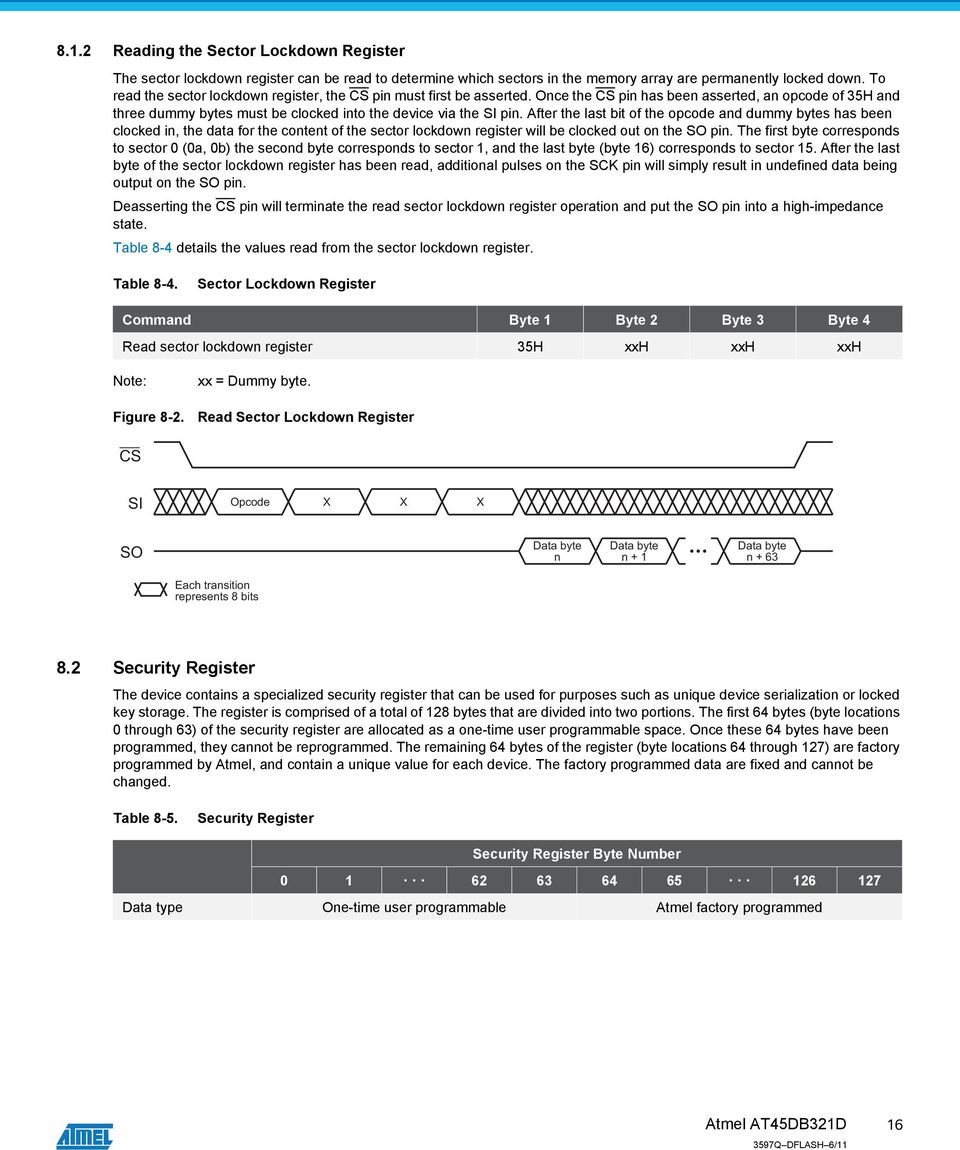
16 8.1.2 Reading the Sector Lockdown Register The sector lockdown register can be read to determine which sectors in the memory array are permanently locked down. To read the sector lockdown register, the pin must first be asserted. Once the pin has been asserted, an opcode of 35H and three dummy bytes must be clocked into the device via the pin. After the last bit of the opcode and dummy bytes has been clocked in, the data for the content of the sector lockdown register will be clocked out on the SO pin. The first byte corresponds to sector 0 (0a, 0b) the second byte corresponds to sector 1, and the last byte (byte 16) corresponds to sector 15. After the last byte of the sector lockdown register has been read, additional pulses on the SCK pin will simply result in undefined data being output on the SO pin. easserting the pin will terminate the read sector lockdown register operation and put the SO pin into a high-impedance state. Table 8-4 details the values read from the sector lockdown register. Table 8-4. Sector Lockdown Register Command Byte 1 Byte 2 Byte 3 Byte 4 Read sector lockdown register 35H xxh xxh xxh Note: Figure 8-2. xx = ummy byte. Read Sector Lockdown Register X X X SO ata byte n ata byte n + 1 ata byte n + 63 Each transition represents 8 bits 8.2 Security Register The device contains a specialized security register that can be used for purposes such as unique device serialization or locked key storage. The register is comprised of a total of 128 bytes that are divided into two portions. The first 64 bytes (byte locations 0 through 63) of the security register are allocated as a one-time user programmable space. Once these 64 bytes have been programmed, they cannot be reprogrammed. The remaining 64 bytes of the register (byte locations 64 through 127) are factory programmed by Atmel, and contain a unique value for each device. The factory programmed data are fixed and cannot be changed. Table 8-5. Security Register Security Register Byte Number ata type One-time user programmable Atmel factory programmed 16
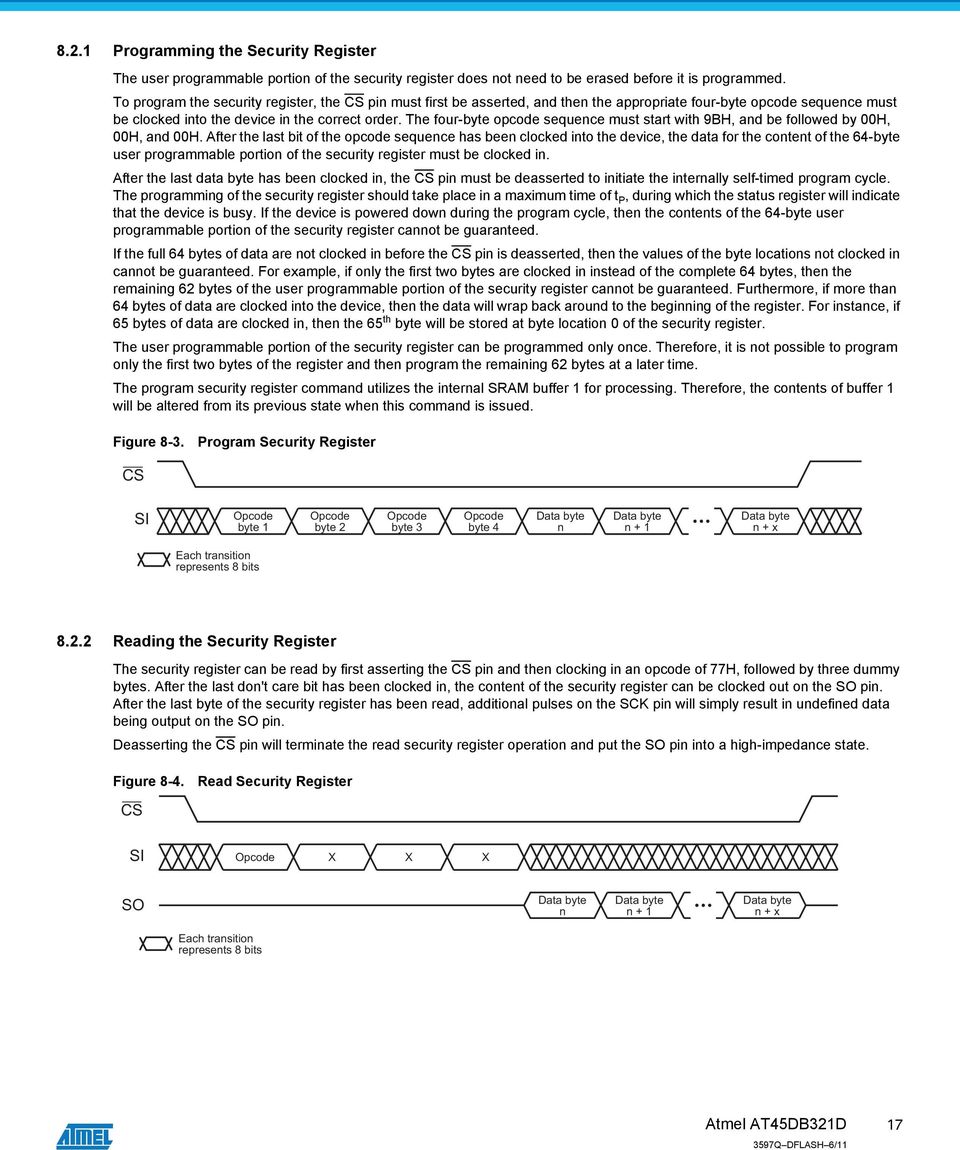
17 8.2.1 Programming the Security Register The user programmable portion of the security register does not need to be erased before it is programmed. To program the security register, the pin must first be asserted, and then the appropriate four-byte opcode sequence must be clocked into the device in the correct order. The four-byte opcode sequence must start with 9BH, and be followed by 00H, 00H, and 00H. After the last bit of the opcode sequence has been clocked into the device, the data for the content of the 64-byte user programmable portion of the security register must be clocked in. After the last data byte has been clocked in, the pin must be deasserted to initiate the internally self-timed program cycle. The programming of the security register should take place in a maximum time of t P, during which the status register will indicate that the device is busy. If the device is powered down during the program cycle, then the contents of the 64-byte user programmable portion of the security register cannot be guaranteed. If the full 64 bytes of data are not clocked in before the pin is deasserted, then the values of the byte locations not clocked in cannot be guaranteed. For example, if only the first two bytes are clocked in instead of the complete 64 bytes, then the remaining 62 bytes of the user programmable portion of the security register cannot be guaranteed. Furthermore, if more than 64 bytes of data are clocked into the device, then the data will wrap back around to the beginning of the register. For instance, if 65 bytes of data are clocked in, then the 65 th byte will be stored at byte location 0 of the security register. The user programmable portion of the security register can be programmed only once. Therefore, it is not possible to program only the first two bytes of the register and then program the remaining 62 bytes at a later time. The program security register command utilizes the internal SRAM buffer 1 for processing. Therefore, the contents of buffer 1 will be altered from its previous state when this command is issued. Figure 8-3. Program Security Register byte 1 byte 2 byte 3 byte 4 ata byte n ata byte n + 1 ata byte n + x Each transition represents 8 bits Reading the Security Register The security register can be read by first asserting the pin and then clocking in an opcode of 77H, followed by three dummy bytes. After the last don't care bit has been clocked in, the content of the security register can be clocked out on the SO pin. After the last byte of the security register has been read, additional pulses on the SCK pin will simply result in undefined data being output on the SO pin. easserting the pin will terminate the read security register operation and put the SO pin into a high-impedance state. Figure 8-4. Read Security Register X X X SO ata byte n ata byte n + 1 ata byte n + x Each transition represents 8 bits 17
18 9. Additional Commands 9.1 Main Memory Page to Buffer Transfer A page of data can be transferred from the main memory to either buffer 1 or buffer 2. To start the operation for the standard ataflash page size (528 bytes), a one-byte opcode, 53H for buffer 1 or 55H for buffer 2, must be clocked into the device, followed by three address bytes comprised of 1 don t care bit, 13 page address bits (PA12 - PA0) that specify the page in main memory that is to be transferred, and 10 don t care bits. To perform a main memory page to buffer transfer for the binary page size (512 bytes), the 53H opcode for buffer 1 or 55H opcode for buffer 2 must be clocked into the device, followed by three address bytes consisting of 2 don t care bits, 13 page address bits (A21 - A9) that specify the page in the main memory that is to be transferred, and 9 don t care bits. The pin must be low while toggling the SCK pin to load the opcode and the address bytes from the input pin (). The transfer of page of data from the main memory to the buffer will begin when the pin transitions from a low to a high state. uring the transfer of a page of data (t XFR ), the status register can be read or the RY/BUSY can be monitored to determine whether the transfer has been completed. 9.2 Main Memory Page to Buffer Compare A page of data in the main memory can be compared to the data in buffer 1 or buffer 2. To initiate the operation for a standard ataflash page size (528 bytes), a one-byte opcode, 60H for buffer 1 or 61H for buffer 2, must be clocked into the device, followed by three address bytes consisting of 1 don t care bit, 13 page address bits (PA12 - PA0) that specify the page in the main memory that is to be compared to the buffer, and 10 don t care bits. To start a main memory page to buffer compare for a binary page size (512 bytes), the 60H opcode for buffer 1 or 61H opcode for buffer 2 must be clocked into the device, followed by three address bytes consisting of 2 don t care bits, 13 page address bits (A21 - A9) that specify the page in the main memory that is to be compared to the buffer, and 9 don t care bits. The pin must be low while toggling the SCK pin to load the opcode and the address bytes from the input pin (). On the low-to-high transition of the pin, the data bytes in the selected main memory page will be compared with the data bytes in buffer 1 or buffer 2. uring this time (t COMP ), the status register and the RY/BUSY pin will indicate that the part is busy. On completion of the compare operation, bit 6 of the status register is updated with the result of the compare. 9.3 Auto Page Rewrite This mode is needed only when multiple bytes within a page or multiple pages of data are modified in a random fashion within a sector. This mode is a combination of two operations: 1. Main memory page to buffer transfer, and 2. Buffer to main memory page program, with built-in erase. A page of data is first transferred from the main memory to buffer 1 or buffer 2, and then the same data (from buffer 1 or buffer 2) are programmed back into their original page of main memory. To start the rewrite operation for the standard ataflash page size (528 bytes), a one-byte opcode, 58H for buffer 1 or 59H for buffer 2, must be clocked into the device, followed by three address bytes comprised of 1 don t care bit, 13 page address bits (PA12-PA0) that specify the page in main memory to be rewritten, and 10 don t care bits. To initiate an auto page rewrite for a binary page size (512 bytes), the 58H opcode for buffer 1 or 59H opcode for buffer 2 must be clocked into the device, followed by three address bytes consisting of 2 don t care bits, 13 page address bits (A21 - A9) that specify the page in the main memory that is to be written, and 9 don t care bits. When a lowto-high transition occurs on the pin, the part will first transfer data from the page in main memory to a buffer and then program the data from the buffer back into same page of main memory. The operation is internally self-timed, and should take place in a maximum time of t EP. uring this time, the status register and the RY/BUSY pin will indicate that the part is busy. If a sector is programmed or reprogrammed sequentially page by page, then the programming algorithm shown in Figure 23-1, page 41 is recommended. Otherwise, if multiple bytes in a page or several pages are programmed randomly in a sector, then the programming algorithm shown in Figure 23-2, page 42 is recommended. Each page within a sector must be updated/rewritten at least once within every 20,000 cumulative page erase/program operations in that sector. Please contact Atmel for availability of devices that are specified to exceed the 20,000 cycle cumulative limit. 18

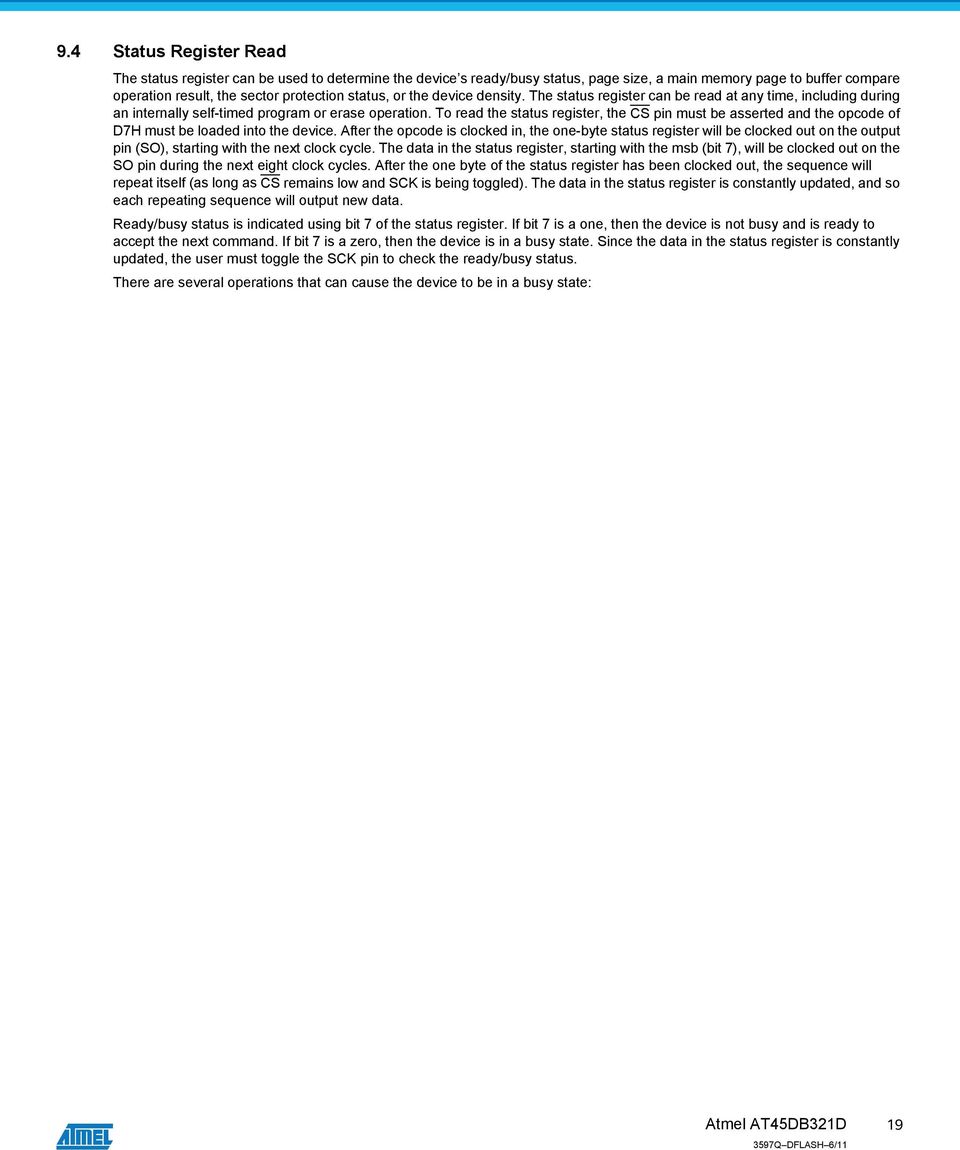
19 9.4 Status Register Read The status register can be used to determine the device s ready/busy status, page size, a main memory page to buffer compare operation result, the sector protection status, or the device density. The status register can be read at any time, including during an internally self-timed program or erase operation. To read the status register, the pin must be asserted and the opcode of 7H must be loaded into the device. After the opcode is clocked in, the one-byte status register will be clocked out on the output pin (SO), starting with the next clock cycle. The data in the status register, starting with the msb (bit 7), will be clocked out on the SO pin during the next eight clock cycles. After the one byte of the status register has been clocked out, the sequence will repeat itself (as long as remains low and SCK is being toggled). The data in the status register is constantly updated, and so each repeating sequence will output new data. Ready/busy status is indicated using bit 7 of the status register. If bit 7 is a one, then the device is not busy and is ready to accept the next command. If bit 7 is a zero, then the device is in a busy state. Since the data in the status register is constantly updated, the user must toggle the SCK pin to check the ready/busy status. There are several operations that can cause the device to be in a busy state: Main memory page to buffer transfer Main memory page to buffer compare Buffer to main memory page program Main memory page program through buffer Page erase, block erase, sector erase, and chip erase Auto page rewrite The result of the most recent main memory page to buffer compare operation is indicated using bit 6 of the status register. If bit 6 is a zero, then the data in the main memory page matches the data in the buffer. If bit 6 is a one, then at least one bit of the data in the main memory page does not match the data in the buffer. Bit 1 of the status register is used to provide information to the user whether sector protection has been enabled or disabled, either by the software-controlled or hardware-controlled method. A logic one indicates that sector protection has been enabled, and logic zero indicates that sector protection has been disabled. Bit 0 o the status register indicates whether the page size of the main memory array is configured for a power of two binary page size (512 bytes) or a standard ataflash page size (528 bytes). If bit 0 is a one, then the page size is set to 512 bytes. If bit 0 is a zero, then the page size is set to 528 bytes. The device density is indicated using bits 5, 4, 3, and 2 of the status register. For the AT45B321, the four bits are The decimal value of these four binary bits does not equate to the device density the four bits represent a combinational code relating to differing densities of ataflash devices. The device density is not the same as the density code indicated in the JEEC device I information. The device density is provided only for backward compatibility. Table 9-1. Status Register Format Bit 7 Bit 6 Bit 5 Bit 4 Bit 3 Bit 2 Bit 1 Bit 0 RY/BUSY COMP Protect Page size 19
20 10. eep Power-down After an initial power-up, the device will default to standby mode. The deep power-down command allows the device to enter into the lowest power-consumption mode. To enter the deep power-down mode, the pin must first be asserted. Once the pin has been asserted, an opcode of B9H must be clocked in via the input pin (). After the last bit of the command has been clocked in, the pin must be deasserted to initiate deep power-down operation. After the pin is deasserted, the device will enter the deep power-down mode within a maximum time of t EP. Once the device has entered the deep power-down mode, all instructions are ignored, except for the resume from deep power-down commands. Table eep Power-down Command eep power-down B9H Figure eep Power-down Each transition represents 8 bits 10.1 Resume from eep Power-down The resume from deep power-down command takes the device out of the deep power-down mode and returns it to the normal standby mode. To resume from deep power-down mode, the pin must first be asserted, and an opcode of ABH must be clocked in via the input pin (). After the last bit of the command has been clocked in, the pin must be deasserted to terminate the deep power-down mode. After the pin is deasserted, the device will return to the normal standby mode within a maximum time of t RP. The pin must remain high during the t RP time before the device can receive any commands. After resuming from deep power-down, the device will return to the normal standby mode. Table Resume from eep Power-down Command Resume from deep power-down ABH Figure Resume from eep Power-own Each transition represents 8 bits 20

21 11. Power of Two Binary Page Size Option Power of two binary page size configuration register is a user programmable, nonvolatile register that allows the page size of the main memory to be configured for binary page size (512 bytes) or standard ataflash page size (528 bytes). The power of two page size is a one-time programmable configuration register, and once the device is configured for power of two page size, it cannot be reconfigured again. The devices are initially shipped with the page size set to 528 bytes. The user has the option of ordering binary page size (512-byte) devices from the factory. For details, please refer to Section 24. Ordering Information on page 43. For the binary power of two page size to become effective, the following steps must be followed: 1. Program the one-time programmable configuration resister using the opcode sequence: 3H, 2AH, 80H, and A6H (see Section 11.1). 2. Power cycle the device (i.e., power down and power up again). 3. The page for the binary page size can now be programmed. If the above steps to set the page size prior to page programming are not followed, incorrect data during a read operation may be encountered Programming the Configuration Register To program the configuration register for power of two binary page size, the pin must first be asserted, as it would be with any other command. Once the pin has been asserted, the appropriate four-byte opcode sequence must be clocked into the device in the correct order. The four-byte opcode sequence must start with 3H, followed by 2AH, 80H, and A6H. After the last bit of the opcode sequence has been clocked in, the pin must be deasserted to initiate the internally self-timed program cycle. The programming of the configuration register should take place in a maximum time of t P, during which time the status register will indicate that the device is busy. The device must be power cycled after the completion of the program cycle to set the power of two page size. If the device is powered-down before the completion of the program cycle, then setting the configuration register cannot be guaranteed. However, the user should check bit 0 of the status register to see whether the page size was configured for binary page size or not. If not, the command can be issued again. Table Programming the Configuration Register Command Byte 1 Byte 2 Byte 3 Byte 4 Power of two page size 3H 2AH 80H A6H Figure Erase Sector Protection Register byte 1 byte 2 byte 3 byte 4 Each transition represents 8 bits 12. Manufacturer and evice I Read Identification information can be read from the device to enable systems to electronically query and identify the device while it is in the system. The identification method and the command opcode comply with the JEEC standard for Manufacturer and evice I Read Methodology for SPI Compatible Serial Interface Memory evices. The type of information that can be read from the device includes the JEEC-defined manufacturer I, the vendor-specific device I, and the vendor-specific extended device information. To read the identification information, the pin must first be asserted, and then the opcode of 9FH must be clocked into the device. After the opcode has been clocked in, the device will begin outputting the identification data on the SO pin during the subsequent clock cycles. The first byte to be output will be the manufacturer I, followed by two bytes of device I information. The fourth byte output will be the extended device information string length, which will be 00H to indicate that no extended 21
22 device information follows. As indicated in the JEEC standard, reading the extended device information string length and any subsequent data is optional. easserting the pin will terminate the manufacturer and device I read operation and put the SO pin into a high-impedance state. The pin can be deasserted at any time, and does not require that a full byte of data be read Manufacturer and evice I Information Byte 1 Manufacturer I Hex Value JEEC Assigned Code Bit 7 Bit 6 Bit 5 Bit 4 Bit 3 Bit 2 Bit 1 Bit 0 1FH Manufacturer I 1FH = Atmel Byte 2 evice I (Part 1) Hex Value Family Code ensity Code Bit 7 Bit 6 Bit 5 Bit 4 Bit 3 Bit 2 Bit 1 Bit 0 Family code 001 = ataflash 27H ensity code = 32Mb Byte 3 evice I (Part 2) Hex Value MLC Code Product Version Code Bit 7 Bit 6 Bit 5 Bit 4 Bit 3 Bit 2 Bit 1 Bit 0 MLC code 000 = 1-bit/cell technology 00H Product version = Second version Byte 4 Extended evice Information String Length Hex Value Byte Count Bit 7 Bit 6 Bit 5 Bit 4 Bit 3 Bit 2 Bit 1 Bit 0 00H Byte count 00H = 0 bytes of Information SO Each transition represents 8 bits 9FH 1FH 27H 00H 01H ata ata Manufacturer I Byte 1 evice I Byte 2 evice I Byte 3 Extended device information string length Extended device information Byte x Extended device information Byte x + 1 This information would only be output if the extended device information string length value was something other than 00H Note: Based on JEEC publication 106 (JEP106), manufacturer I data can be comprised of any number of bytes. Some manufacturers may have manufacturer I codes that are two, three, or even four bytes long, with the first byte(s) in the sequence being 7FH. A system should detect code 7FH as a continuation code and continue to read manufacturer I bytes. The first non-7fh byte would signify the last byte of manufacturer I data. For Atmel (and some other manufacturers), the manufacturer I data is comprised of only one byte. 22
23 12.2 Operation Mode Summary The commands described previously can be grouped into four different categories to make clearer which commands can be executed at what times. Group A commands consist of: 1. Main memory page read 2. Continuous array read 3. Read sector protection register 4. Read sector lockdown register 5. Read security register Group B commands consist of: 1. Page erase 2. Block erase 3. Sector erase 4. Chip erase 5. Main memory page to buffer 1 (or 2) transfer 6. Main memory page to buffer 1 (or 2) compare 7. Buffer 1 (or 2) to main memory page program, with built-in erase 8. Buffer 1 (or 2) to main memory page program, without built-in erase 9. Main memory page program through buffer 1 (or 2) 10. Auto page rewrite Group C commands consist of: 1. Buffer 1 (or 2) read 2. Buffer 1 (or 2) write 3. Status register read 4. Manufacturer and device I read Group commands consist of: 1. Erase sector protection register 2. Program sector protection register 3. Sector lockdown 4. Program security register If a group A command is in progress (not fully completed), then another command from group A, B, C, or should not be started. However, during the internally self-timed portion of group B commands, any command in group C can be executed. The group B commands using buffer 1 should use group C commands using buffer 2, and vice versa. Finally, during the internally self-timed portion of a group command, only the status register read command should be executed. 23
24 13. Command Tables Table Read Commands Command Main memory page read Continuous array read (legacy command) Continuous array read (low frequency) Continuous array read (high frequency) Buffer 1 read (low frequency) Buffer 2 read (low frequency) Buffer 1 read Buffer 2 read 2H E8H 03H 0BH 1H 3H 4H 6H Table Program and Erase Commands Command Buffer 1 write Buffer 2 write Buffer 1 to main memory page program, with built-in erase Buffer 2 to main memory page program, with built-in erase Buffer 1 to main memory page program, without built-in erase Buffer 2 to main memory page program, without built-in erase Page erase Block erase Sector erase Chip erase Main memory page program through buffer 1 Main memory page program through buffer 2 84H 87H 83H 86H 88H 89H 81H 50H 7CH C7H, 94H, 80H, 9AH 82H 85H Table Protection and Security Commands Command Enable sector protection isable sector protection Erase sector protection register Program sector protection register Read sector protection register Sector lockdown Read sector lockdown register Program security register Read security register 3H + 2AH + 7FH + A9H 3H + 2AH + 7FH + 9AH 3H + 2AH + 7FH + CFH 3H + 2AH + 7FH + FCH 32H 3H + 2AH + 7FH + 30H 35H 9BH + 00H + 00H + 00H 77H 24
25 Table Additional Commands Command Main memory page to buffer 1 transfer Main memory page to buffer 2 transfer Main memory page to buffer 1 compare Main memory page to buffer 2 compare Auto page rewrite through buffer 1 Auto page rewrite through buffer 2 eep power-down Resume from deep power-down Status register read Manufacturer and device I read 53H 55H 60H 61H 58H 59H B9H ABH 7H 9FH Table Legacy Commands (1) Command Buffer 1 read Buffer 2 read Main memory page read Continuous array read Status register read 54H 56H 52H 68H 57H Note: 1. These legacy commands are not recommended for new designs. 25
26 Table etailed Bit-level Addressing Sequence for Binary Page Size (512 Bytes) Page Size = 512-bytes Address Byte Address Byte Address Byte Reserved Reserved A21 A20 A19 A18 A17 A16 Additional on t Care Bytes 03h x x A A A A A A A A A A A A A A A A A A A A A A N/A 0Bh x x A A A A A A A A A A A A A A A A A A A A A A 1 50h x x A A A A A A A A A A x x x x x x x x x x x x N/A 53h x x A A A A A A A A A A A A A x x x x x x x x x N/A 55h x x A A A A A A A A A A A A A x x x x x x x x x N/A 58h x x A A A A A A A A A A A A A x x x x x x x x x N/A 59h x x A A A A A A A A A A A A A x x x x x x x x x N/A 60h x x A A A A A A A A A A A A A x x x x x x x x x N/A 61h x x A A A A A A A A A A A A A x x x x x x x x x N/A 77h x x x x x x x x x x x x x x x x x x x x x x x x N/A 7Ch x x A A A A A A x x x x x x x x x x x x x x x x N/A 81h x x A A A A A A A A A A A A A x x x x x x x x x N/A 82h x x A A A A A A A A A A A A A A A A A A A A A A N/A 83h x x A A A A A A A A A A A A A x x x x x x x x x N/A 84h x x x x x x x x x x x x x x x A A A A A A A A A N/A 85h x x A A A A A A A A A A A A A A A A A A A A A A N/A 86h x x A A A A A A A A A A A A A x x x x x x x x x N/A 87h x x x x x x x x x x x x x x x A A A A A A A A A N/A 88h x x A A A A A A A A A A A A A x x x x x x x x x N/A 89h x x A A A A A A A A A A A A A x x x x x x x x x N/A 9Fh N/A N/A N/A N/A B9h N/A N/A N/A N/A ABh N/A N/A N/A N/A 1h x x x x x x x x x x x x x x x A A A A A A A A A N/A 2h x x A A A A A A A A A A A A A A A A A A A A A A 4 3h x x x x x x x x x x x x x x x A A A A A A A A A N/A 4h x x x x x x x x x x x x x x x A A A A A A A A A 1 6h x x x x x x x x x x x x x x x A A A A A A A A A 1 7h N/A N/A N/A N/A E8h x x A A A A A A A A A A A A A A A A A A A A A A 4 A15 A14 A13 A12 A11 A10 A9 A8 A7 A6 A5 A4 A3 A2 A1 A0 Note: x = on t care. 26
27 Table etailed Bit-level Addressing Sequence for Standard ataflash Page Size (528 Bytes) Page Size = 528-bytes Address Byte Address Byte Address Byte Reserved PA12 PA11 PA10 PA9 PA8 PA7 PA6 Additional on t Care Bytes 03h x P P P P P P P P P P P P P B B B B B B B B B B N/A 0Bh x P P P P P P P P P P P P P B B B B B B B B B B 1 50h x P P P P P P P P P P x x x x x x x x x x x x x N/A 53h x P P P P P P P P P P P P P x x x x x x x x x x N/A 55h x P P P P P P P P P P P P P x x x x x x x x x x N/A 58h x P P P P P P P P P P P P P x x x x x x x x x x N/A 59h x P P P P P P P P P P P P P x x x x x x x x x x N/A 60h x P P P P P P P P P P P P P x x x x x x x x x x N/A 61h x P P P P P P P P P P P P P x x x x x x x x x x N/A 77h x x x x x x x x x x x x x x x x x x x x x x x x N/A 7Ch x P P P P P P x x x x x x x x x x x x x x x x x N/A 81h x P P P P P P P P P P P P P x x x x x x x x x x N/A 82h x P P P P P P P P P P P P P B B B B B B B B B B N/A 83h x P P P P P P P P P P P P P x x x x x x x x x x N/A 84h x x x x x x x x x x x x x x B B B B B B B B B B N/A 85h x P P P P P P P P P P P P P B B B B B B B B B B N/A 86h x P P P P P P P P P P P P P x x x x x x x x x x N/A 87h x x x x x x x x x x x x x x B B B B B B B B B B N/A 88h x P P P P P P P P P P P P P x x x x x x x x x x N/A 89h x P P P P P P P P P P P P P x x x x x x x x x x N/A 9Fh N/A N/A N/A N/A B9h N/A N/A N/A N/A ABh N/A N/A N/A N/A 1h x x x x x x x x x x x x x x B B B B B B B B B B N/A 2h x P P P P P P P P P P P P P B B B B B B B B B B 4 3h x x x x x x x x x x x x x x B B B B B B B B B B N/A 4h x x x x x x x x x x x x x x B B B B B B B B B B 1 6h x x x x x x x x x x x x x x B B B B B B B B B B 1 7h N/A N/A N/A N/A E8h x P P P P P P P P P P P P P B B B B B B B B B B 4 PA5 PA4 PA3 PA2 PA1 PA0 BA9 BA8 BA7 BA6 BA5 BA4 BA3 BA2 BA1 BA0 Note: P = Page address bit. B = Byte/buffer address bit. x = on t care. 27
28 14. Power-on/Reset State When power is first applied to the device, or when recovering from a reset condition, the device will default to Mode 3. In addition, the output pin (SO) will be in a high-impedance state, and a high-to-low transition on the pin will be required to start a valid instruction. The mode (Mode 3 or Mode 0) will be automatically selected on every falling edge of by sampling the inactive clock state Initial Power-up/Reset Timing Restrictions At power-up, the device must not be selected until the supply voltage reaches V CC (min.) and a further delay of t VL. uring power-up, the internal power-on reset circuitry keeps the device in reset mode until V CC rises above the power-on reset threshold value (V POR ). At this time, all operations are disabled and the device does not respond to any commands. After powerup is applied and V CC is at the minimum operating voltage, V CC (min.), the t VL delay is required before the device can be selected in order to perform a read operation. Similarly, the t PUW delay is required after V CC rises above the power-on reset threshold value (V POR ) before the device can perform a write (program or erase) operation. After initial power-up, the device will default to standby mode. Table Initial Power-up/Reset Timing Restrictions Symbol Parameter Min Typ Max Unit t VL V CC (min.) to chip select low 70 μs t PUW Power-up device delay before write allowed 20 ms V POR Power-on reset voltage V 15. System Considerations The RapidS serial interface is controlled by the SCK clock, serial input, and chip select pins. These signals must rise and fall monotonically and be free from noise. Excessive noise or ringing on these pins can be misinterpreted as multiple edges and cause improper operation of the device. The PC board traces must be kept to a minimum distance or appropriately terminated to ensure proper operation. If necessary, decoupling capacitors can be added on these pins to provide filtering against noise glitches. As system complexity continues to increase, voltage regulation is becoming more important. A key element of any voltage regulation scheme is its current sourcing capability. Like all flash memories, the peak current for a ataflash device occurs during the programming and erase operation. The regulator needs to supply this peak current requirement. An under-specified regulator can cause current starvation. Besides increasing system noise, current starvation during programming or erase can lead to improper operation and possible data corruption. 28
29 16. Electrical Specifications Temperature under bias C to +125 C Storage temperature C to +150 C All input voltages (except V CC but including NC pins) with respect to ground V to +6.25V All output voltages with respect to ground V to V CC + 0.6V *NOTICE: Stresses beyond those listed under Absolute Maximum Ratings may cause permanent damage to the device. The "Absolute Maximum Ratings" are stress ratings only, and functional operation of the device at these or any other conditions beyond those indicated in the operational sections of this specification is not implied. Exposure to absolute maximum rating conditions for extended periods may affect device reliability. Voltage Extremes referenced in the "Absolute Maximum Ratings" are intended to accommodate short duration undershoot/overshoot conditions and does not imply or guarantee functional device operation at these levels for any extended period of time. Table C and AC Operating Range (2.5V Version) Operating temperature (case) -40 C to 85 C -40 C to 85 C V CC power supply 2.5V to 3.6V 2.7V to 3.6V Table C Characteristics Symbol Parameter Condition Min Typ Max Unit I P I SB I CC1 (1) I CC2 eep power-down current Standby current Active current, read operation Active current, program/erase operation, RESET, WP = V IH, all inputs at CMOS levels, RESET, WP = V IH, all inputs at CMOS levels f = 20MHz; I OUT = 0mA; V CC = 3.6V f = 33MHz; I OUT = 0mA; V CC = 3.6V f = 50MHz; I OUT = 0mA; V CC = 3.6V f = 66MHz; I OUT = 0mA; V CC = 3.6V Notes: 1. I CC1 during a buffer read is 20mA, 20MHz. 2. All inputs (, SCK, #, WP#, and RESET#) are guaranteed by design to be 5V tolerant μa µa 7 10 ma 8 12 ma ma ma V CC = 3.6V ma I LI Input load current V IN = CMOS levels 1 µa I LO Output leakage current V I/O = CMOS levels 1 µa V IL Input low voltage V CC 0.3 V V IH Input high voltage V CC 0.7 V V OL Output low voltage I OL = 1.6mA; V CC = 2.7V 0.4 V V OH Output high voltage I OH = -100µA V CC - 0.2V V 29
30 Table AC Characteristics Atmel RapidS / Serial Interface (2.5V Version) Symbol Parameter Min Typ Max Min Typ Max Unit f SCK SCK frequency MHz f CAR1 SCK frequency for continuous array read MHz f CAR2 SCK frequency for continuous array read (Low frequency) MHz t WH SCK high time ns t WL SCK low time ns t SCKR (1) t SCKF (1) SCK rise time, peak-to-peak (slew rate) V/ns SCK fall time, peak-to-peak (slew rate) V/ns t Minimum high time ns t S setup time 5 5 ns t H hold time 5 5 ns t B high to RY/BUSY low ns t SU ata in setup time 2 2 ns t H ata in hold time 3 3 ns t HO Output hold time 0 0 ns t IS Output disable time ns t V Output valid 8 6 ns t WPE WP low to protection enabled 1 1 μs t WP WP high to protection disabled 1 1 μs t EP high to deep power-down mode 3 3 μs t RP high to standby mode μs t XFR Page to buffer transfer time µs t comp Page to buffer compare time µs t EP Page erase and programming time (512-/528-bytes) ms t P Page programming time (512/528 bytes) ms t PE Page erase time (512/528 bytes) ms t BE Block erase time (4,096/4,224 bytes) ms t SE Sector erase time (131,072/135,168 bytes) s t CE Chip erase time TB TB TB TB s t RST RESET pulse width µs t REC RESET recovery time 1 1 µs 30
31 17. Input Test Waveforms and Measurement Levels AC riving Levels 2.4V 0.45V 1.5V AC Measurement Level t R, t F < 2ns (10% to 90%) 18. Output Test Load evice under test 30pF 19. AC Waveforms Six different timing waveforms are shown on page 31. Waveform 1 shows the SCK signal being low when makes a high-tolow transition, and waveform 2 shows the SCK signal being high when makes a high-to-low transition. In both cases, output SO becomes valid while the SCK signal is still low (SCK low time is specified as t WL ). Timing waveforms 1 and 2 conform to RapidS serial interface, but for frequencies up to 66MHz. Waveforms 1 and 2 are compatible with SPI Mode 0 and SPI Mode 3, respectively. Waveform 3 and waveform 4 illustrate general timing diagram for RapidS serial interface. These are similar to waveform 1 and waveform 2, except that output SO is not restricted to become valid during the t WL period. These timing waveforms are valid over the full frequency range (maximum frequency = 66MHz) of the RapidS serial case. Table Waveform 1 SPI Mode 0 Compatible (for frequencies up to 66MHz) t t S t WH t WL t H SCK SO High impedance t V t HO Valid out t IS High impedance t SU t H Valid in 31
32 Table Waveform 2 SPI Mode 3 Compatible (for frequencies up to 66MHz) t t S t WL t WH t H SCK SO High Z t V t HO Valid out t IS High impedance t SU t H Valid in Table Waveform 3 Atmel RapidS Mode 0 (F MAX = 66MHz) t t S t WH t WL t H SCK SO High impedance t V t HO Valid out t IS High impedance t SU t H Valid in Table Waveform 4 Atmel RapidS Mode 3 (F MAX = 66MHz) t t S t WL t WH t H SCK SO High Z t V t HO Valid out t IS High impedance t SU t H Valid in 32
33 19.1 Utilizing the Atmel RapidS Function To take advantage of the RapidS function's ability to operate at higher clock frequencies, a full clock cycle must be used to transmit data back and forth across the serial bus. The ataflash device is designed to always clock its data out on the falling edge of the SCK signal and clock data in on the rising edge of SCK. For full clock cycle operation to be achieved when the ataflash device is clocking data out on the falling edge of SCK, the host controller should wait until the next falling edge of SCK to latch the data in. Similarly, the host controller should clock its data out on the rising edge of SCK in order to give the ataflash device a full clock cycle to latch the incoming data in on the next rising edge of SCK. Figure Atmel RapidS Mode Slave SCK A B C E MO BYTE-MO LSB F G H I MISO BYTE-SO LSB MO = Master Out, Slave In MISO = Master In, Slave Out The Master is the host controller and the Slave is the ataflash The Master always clocks data out on the rising edge of SCK and always clocks data in on the falling edge of SCK. The Slave always clocks data out on the falling edge of SCK and always clocks data in on the rising edge of SCK. A. Master clocks out first bit of BYTE-MO on the rising edge of SCK B. Slave clocks in first bit of BYTE-MO on the next rising edge of SCK C. Master clocks out second bit of BYTE-MO on the same rising edge of SCK. Last bit of BYTE-MO is clocked out from the Master E. Last bit of BYTE-MO is clocked into the slave F. Slave clocks out first bit of BYTE-SO G. Master clocks in first bit of BYTE-SO H. Slave clocks out second bit of BYTE-SO I. Master clocks in last bit of BYTE-SO Figure Reset Timing t REC t S SCK t RST RESET SO (OUTPUT) High impedance High impedance (INPUT) Note: The signal should be in the high state before the RESET signal is deasserted. 33
34 Figure Command Sequence for Read/Write Operations for a 512-Byte Page Size (Except Status Register Read, Manufacturer, and evice I Read) (INPUT) CM 8-bits 8-bits 8-bits X X X X X X X X X X X X X X X X X X X X X X X X LSB on t care bits Page address (A21 - A9) Byte/Buffer address (A8 - A0/BFA8 - BFA0) Figure Command Sequence for Read/Write Operations for a 528-Byte Page Size (Except Status Register Read, Manufacturer, and evice I Read) (INPUT) CM 8-bits 8-bits 8-bits X X X XX X X X X X X X X X X X X X X X X X X X LSB 1 on t care bit Page address (PA12 - PA0) Byte/Buffer address (BA9 - BA0/BFA9 - BFA0) 20. Write Operations The following block diagram and waveforms illustrate the various write sequences available. Figure Block iagram Flash Memory Array Page (512-/528-bytes) Buffer 1 to Main Memory Page Program Buffer 1 (512-/528-bytes) Buffer 2 to Main Memory Page Program Buffer 2 (512-/528-bytes) Buffer 1 WRITE Buffer 2 WRITE I/O Interface 34
35 Figure Buffer Write Completes writing into selected buffer (INPUT) CM Binary Page Size 15 don't care + BFA8-BFA0 X X X, BFA9-8 BFA7-0 n n+1 Last byte Figure Buffer to Main Memory Page Program (ata from Buffer Programmed into Flash Page) Starts self-timed erase/program operation Binary Page Size A21-A9 + 9 don't care bits (INPUT) CM PA12-6 PA5-0, XX XXXX XX Each transition represents 8 bits n = 1st byte read n+1 = 2nd byte read 21. Read Operations The following block diagram and waveforms illustrate the various read sequences available. Figure Block iagram Flash Memory Array Page (512-/528-bytes) Main Memory Page to Buffer 1 Buffer 1 (512-/528-bytes) Buffer 1 Read Main Memory Page Read Main Memory Page to Buffer 2 Buffer 2 (512-/528-bytes) Buffer 2 Read I/O Interface SO 35
36 Figure Main Memory Page Read Address for Binary Page Size A21-A16 A15-A8 A7-A0 (INPUT) CM PA12-6 PA5-0, BA9-8 BA7-0 X X 4 ummy bytes SO (OUTPUT) n n+1 Figure Main Memory Page to Buffer Transfer (ata from Flash Page Read into Buffer) Starts reading page data into buffer Binary Page Size A21-a9 + 9 on't care bits (INPUT) CM PA12-6 PA5-0, XX XXXX XXXX SO (OUTPUT) Figure Buffer Read Binary Page Size 15 on't care + Bfa8-bfa0 (INPUT) CM X X..X, BFA9-8 BFA7-0 X No dummy byte (opcodes 1H and 3H) 1 dummy byte (opcodes 4H and 6H) SO (OUTPUT) n n+1 Each transition represents 8 bits 36
37 22. etailed Bit-level Read Waveform Atmel RapidS Serial Interface Mode 0/Mode 3 Figure Continuous Array Read (Legacy E8H) SCK OPCOE Address bits 32 on't care bits A A A A A A A A A X X X X X X ata byte 1 SO High-impedance Bit 4095/4223 of Page N Bit 0 of Page N+1 Figure Continuous Array Read ( 0BH) SCK OPCOE Address bits a21 - a0 on't care A A A A A A A A A X X X X X X X X ata byte 1 SO High-impedance Figure Continuous Array Read (Low Frequency: 03H) SCK OPCOE Address bits a21-a A A A A A A A A A ata byte 1 SO High-impedance 37
38 Figure Main Memory Page Read (: 2H) SCK OPCOE Address bits 32 don't care bits A A A A A A A A A X X X X X X ata byte 1 SO High-impedance Figure Buffer Read ( 4H or 6H) SCK OPCOE Address bits Binary page size = 15 don't care + BFA8-BFA0 Standard dataflash page size = 14 don't care + BFA9-BFA0 on't care X X X X X X A A A X X X X X X X X ata byte 1 SO High-impedance Figure Buffer Read (Low Frequency: 1H or 3H) SCK OPCOE Address bits Binary page size = 15 don't care + BFA8-BFA0 Standard Atmel ataflash page size = 14 don't care + BFA9-BFA X X X X X X A A A ata byte 1 SO High-impedance 38
39 Figure Read Sector Protection Register ( 32H) SCK OPCOE on't care X X X X X X X X X ata byte 1 SO High-impedance Figure Read Sector Lockdown Register ( 35H) SCK OPCOE on't care X X X X X X X X X ata byte 1 SO High-impedance Figure Read Security Register ( 77H) SCK OPCOE on't care X X X X X X X X X ata byte 1 SO High-impedance 39
40 Figure Status Register Read ( 7H) SCK OPCOE Status register data Status register data SO High-impedance Figure Manufacturer and evice Read ( 9FH) SCK OPCOE 9FH SO High-impedance 1FH evice Id byte 1 evice Id byte 2 00H Note: Each transition shown for and SO represents one byte (8 bits) 40
41 23. Auto Page Rewrite Flowchart Figure Algorithm for Programming or Reprogramming of the Entire Array Sequentially START Provide Address and ata Buffer Write (84h, 87h) Main Memory Page Program through Buffer (82h, 85h) Buffer to Main Memory Page Program (83h, 86h) EN Notes: 1. This type of algorithm is used for applications in which the entire array is programmed sequentially, filling the array page by page. 2. A page can be written using either a main memory page program operation, or a buffer write operation followed by a buffer to main memory page program operation. 3. The algorithm above shows the programming of a single page. The algorithm will be repeated sequentially for each page within the entire array. 41
42 Figure Algorithm for Randomly Modifying ata START provide address of page to modify Main Memory Page to Buffer Transfer (53h, 55h) If planning to modify multiple bytes currently stored within a page of the Flash array Buffer Write (84h, 87h) Main Memory Page Program through Buffer (82h, 85h) Buffer to Main Memory Page Program (83h, 86h) Auto Page Rewrite (2) (58h, 59h) Increment Page Address Pointer (2) EN Notes: 1. To preserve data integrity, each page of an Atmel ataflash sector must be updated/rewritten at least once within every 20,000 cumulative page erase and program operations. 2. A page address pointer must be maintained to indicate which page is to be rewritten. The auto page rewrite command must use the address specified by the page address pointer. 3. Other algorithms can be used to rewrite portions of the flash array. Low-power applications may choose to wait until 20,000 cumulative page erase and program operations have accumulated before rewriting all pages of the sector. See application note AN-4 ( Using Atmel Serial ataflash ) for more details. 42
43 24. Ordering Information Ordering Code etail AT45B 321 MWU Atmel esignator Product Family evice ensity 32 = 32-megabit Interface 1 = Serial evice Grade U = Matte Sn lead finish, industrial temperature range (-40 C to +85 C) Package Option M = 8-pad, 6 x 5 x 1mm MLF (VFN) MW = 8-pad, 8 x 6 x 1mm MLF (VFN) S = 8-lead, 0.209" wide SOIC T = 28-lead, TSOP C = 24 Ball BGA evice Revision Green Package Options (Pb/Halide-free/RoHS Compliant) Operating Ordering Code (1)(2) Package Lead Finish Voltage f SCK (MHz) Operation Range AT45B321-MU AT45B321-MU-SL954 (3) 8M1-A AT45B321-MU-SL955 (4) AT45B321-MWU AT45B321-MWU-SL954 (3) 8MW AT45B321-MWU-SL955 (4) Matte Sn 2.7V to 3.6V 66 AT45B321-SU AT45B321-SU-SL954 (3) 8S2 AT45B321-SU-SL955 (4) AT45B321-TU 28T AT45B321-CU 24C3 Matte Sn 2.7V to 3.6V 66 AT45B321-MU-2.5 8M1-A AT45B321-SU-2.5 8S2 Matte Sn 2.5V to 3.6V 50 Notes: 1. The shipping carrier option is not marked on the devices. 2. Standard parts are shipped with the page size set to 528 bytes. The user is able to configure these parts to a 512-byte page size, if desired. 3. Parts ordered with suffix SL954 are shipped in bulk, with the page size set to 512 bytes. Parts will have 954 or SL954 marked on them. 4. Parts ordered with suffix SL955 are shipped in tape and reel, with the page size set to 512 bytes. Parts will have 955 or SL955 marked on them. Package Type Industrial (-40 C to 85 C) 2.7V to 3.6V 8M1-A 8MW 8S2 28T 24C3 8-pad, 6 x 5 x 1.0mm, very thin micro lead-frame package MLF (VFN) 8-pad, 8 x 6 x 1.0mm, very thin micro lead-frame package MLF (VFN) 8-lead, 0.209in-wide, plastic gull wing small outline package (EIAJ SOIC) 28-lead, 8mm x 13.4mm, plastic thin small outline package, type I (TSOP) 24-ball, 6mm x 8mm x 1.4mm ball grid array with a 1mm pitch 5 x 5 ball matrix 43
44 25. Packaging Information 8M1-A MLF (VFN) 1 0 E E1 Pin 1 I E VIEW TOP VIEW A2 A A3 A C COMMON IMENONS (Unit of Measure = mm) e Pin #1 Notch (0.20 R) E2 SYMBOL MIN NOM MAX NOTE A A A TYP b A TYP b L BOTTOM VIEW K E E E e 1.27 L o K /28/08 Package rawing Contact: [email protected] TITLE 8M1-A, 8-pad, 6 x 5 x 1.00mm Body, Thermally Enhanced Plastic Very Thin ual Flat No Lead Package (VFN) GPC YBR RAWING NO. 8M1-A REV. 44
45 8MW MLF (VFN) E Pin 1 I E VIEW TOP VIEW A A1 1 E1 Pin #1 I 1 Option A Pin #1 Cham f e r (C 0.30) COMMON IMENONS (Unit of Measure = mm) SYMBOL MIN NOM MAX N O T E A 1.00 A e Option B b b L BOTTOM VIEW K Pin #1 Notch (0.20 R) E E e 1.27 L K 0.30 REF Package rawing Contact: [email protected] 5/25/06 TITLE R A WING N O. RE V. 8MW, 8-pad, 8 x 6 x 1.0mm Body, Very Thin ual Flat Package No Lead (MLF) 8MW B 45
46 8S2 EIAJ SOIC C 1 E E1 N L End View Top View q e A b Side View A1 Notes: 1. This drawing is for general information only; refer to EIAJ rawing ER-7320 for additional information. 2. Mismatch of the upper and lower dies and resin burrs are not included. 3. etermines the true geometric position. 4. Values b,c apply to plated terminal. The standard thickness of the plating layer shall measure between to.021mm. COMMON IMENONS (Unit of Measure = mm) SYMBOL MIN NOM MAX NOTE A A1 b C E1 E L q e BSC /15/08 Package rawing Contact: [email protected] TITLE 8S2, 8-lead, Body, Plastic Small Outline Package (EIAJ) GPC STN RAWING NO. 8S2 REV. F 46
47 28T TSOP, Type 1 PIN 1 0º ~ 5º c Pin 1 Identifier Area 1 L e b L1 E A2 A SEATING PLANE GAGE PLANE A1 COMMON IMENONS (Unit of Measure = mm) Notes: 1. This package conforms to JEEC reference MO imensions 1 and E do not include mold protrusion. Allowable protrusion on E is 0.15mm per side and on 1 is 0.25mm per side. 3. Lead coplanarity is 0.10mm maximum. SYMBOL MIN NOM MAX NOTE A 1.20 A A Note 2 E Note 2 L L BAC b c e 0.55 BAC 12/06/02 Package rawing Contact: [email protected] TITLE RAWING NO. REV. 28T, 28-lead (8 x 13.4mm) Plastic Thin Small Outline Package, Type I (TSOP) 28T C 47
48 24C3 CBGA E A1 Ball I Top View A1 A 1.00 REF E1 e A1 Ball Corner 2.00 REF Side View A B COMMON IMENONS (Unit of Measure = mm) C 1 SYMBOL MIN NOM MAX NOTE E E E1 4.0 TYP e TYP Øb A 1.20 A Bottom View e 1.00 BSC b 0.40 TYP 9/10/04 Package rawing Contact: [email protected] TITLE RAWING NO. REV. 24C3, 24-ball (5 x 5 Array), 1.0 mm Pitch, 6 x 8 x 1.20 mm, Chip-scale Ball Grid Array Package (CBGA) 24C3 A 48
49 26. Revision History oc. Rev. ate Comments 3597Q 06/2011 In Table 16-3, - Increased t XFR, page to buffer transfer time and t COMP, page to buffer compare time max values from 200us to 300us - Changed t CE typical time and max time are TB, see errata - Changed t SE typical time is 1.6s and the max time is 5s Replace 24C1 with 24C3 Updated template 3597P 05/2010 Changed t SE (Typ) 1.6 to 0.7 and (Max) 5 to 1.3 Changed from 10,000 to 20,000 cumulative page erase/program operations and added the please contact Atmel statement in section O 10/2009 Added the 2.5V V CC option Removed AT45B321-MWU-2.5 and AT45B321-TU-2.5 from the ordering Information table 3597N 04/2009 Updated Absolute Maximum Ratings Added 24C1 24 Ball BGA package Option eleted Atmel ataflash Card Package Option 3597M 03/2009 Changed deep power-down current values - Increased typical value from 5µA to 15µA - Increased maximum value from 15µA to 25µA 3597L 02/2009 Changed t IS (Typ and Max) to 27ns and 35ns, respectively 3597K 09/2008 Corrected typographical errors in Sector Erase section. Corrected A17+A16 from x (on t care) to A for opcode 7Ch in Table 15-6 Corrected PA8+PA7 from x (on t care) to P for opcode 7Ch in Table J 04/2008 Added part number ordering code details for suffixes SL954/955 Added ordering code details 3597I 08/2007 Added additional text to power of two binary page size option Changed t VSCL from 50µs to 70µs Changed t RP from 30µs to 35µs Changed t XFR and t COMP values from 400µs to 200µs Removed AT45B321-CNU from ordering information and corresponding 8CN3 package 3597H 02/2007 Added AT45B321-CNU to ordering information and corresponding 8CN3 package Removed not recommended for new designs comment from 8MW package drawing 3597G 09/2006 Removed not recommended for new designs note from ordering information for 8MW package 3597F 08/2006 Added errata regarding Chip Erase Added AT45B321-SU to ordering information and corresponding 8S2 package 3597E 07/2006 Corrected typographical errors /2006 Added 8 x 6mm MLF (VFN) package Changed the sector size of 0a and 0b to 8 pages and 120 pages respectively Changed the Product Version Code to C 03/2006 Added preliminary Changed the sector size from 256-Kbytes to 64-Kbytes Added the Legacy Commands table 49
50 oc. Rev. ate Comments 3597B 01/2006 Added 6 x 5mm MLF (VFN) package Added text, in Programming the Configuration Register, to indicate that power cycling is required to switch to power of two page size after the opcode enable has been executed. Corrected typographical error regarding the opcode for chip erase in Program and Erase Commands table 3597A 11/2005 Initial release 27. Errata 27.1 Chip Erase Issue In a certain percentage of units, the chip erase feature may not function correctly and may adversely affect device operation. Therefore, it is recommended that the chip erase commands (opcodes C7H, 94H, 80H, and 9AH) not be used Workaround Use block erase (opcode 50H) as an alternative. The block erase function is not affected by the chip erase issue Resolution The chip erase feature may be fixed with a new revision of the device. Please contact Atmel for the estimated availability of devices with the fix. 50
51 Atmel Corporation 2325 Orchard Parkway San Jose, CA USA Tel: (+1) (408) Fax: (+1) (408) Atmel Asia Limited Unit 01-5 & 16, 19F BEA Tower, Millennium City Kwun Tong Roa Kwun Tong, Kowloon HONG KONG Tel: (+852) Fax: (+852) Atmel Munich GmbH Business Campus Parkring Garching b. Munich GERMANY Tel: (+49) Fax: (+49) Atmel Japan 9F, Tonetsu Shinkawa Bldg Shinkawa Chuo-ku, Tokyo JAPAN Tel: (+81) (3) Fax: (+81) (3) Atmel Corporation. All rights reserved. / Rev.: Atmel, Atmel logo and combinations thereof, ataflash, RapidS, and others are registered trademarks or trademarks of Atmel Corporation or its subsidiaries. Other terms and product names may be trademarks of others. isclaimer: The information in this document is provided in connection with Atmel products. No license, express or implied, by estoppel or otherwise, to any intellectual property right is granted by this document or in connection with the sale of Atmel products. EXCEPT AS SET FORTH IN THE ATMEL TERMS AN CONITIONS OF SALES LOCATE ON THE ATMEL WEBTE, ATMEL ASSUMES NO LIABILITY WHATSOEVER AN ISCLAIMS ANY EXPRESS, IMPLIE OR STATUTORY WARRANTY RELATING TO ITS PROUCTS INCLUING, BUT NOT LIMITE TO, THE IMPLIE WARRANTY OF MERCHANTABILITY, FITNESS FOR A PARTICULAR PURPOSE, OR NON-INFRINGEMENT. IN NO EVENT SHALL ATMEL BE LIABLE FOR ANY IRECT, INIRECT, CONSEQUENTIAL, PUNITIVE, SPECIAL OR INCIENTAL AMAGES (INCLUING, WITHOUT LIMITATION, AMAGES FOR LOSS AN PROFITS, BUNESS INTERRUPTION, OR LOSS OF INFORMATION) ARING OUT OF THE USE OR INABILITY TO USE THIS OCUMENT, EVEN IF ATMEL HAS BEEN AVISE OF THE POSBILITY OF SUCH AMAGES. Atmel makes no representations or warranties with respect to the accuracy or completeness of the contents of this document and reserves the right to make changes to specifications and products descriptions at any time without notice. Atmel does not make any commitment to update the information contained herein. Unless specifically provided otherwise, Atmel products are not suitable for, and shall not be used in, automotive applications. Atmel products are not intended, authorized, or warranted for use as components in applications intended to support or sustain life.
W25Q80, W25Q16, W25Q32 8M-BIT, 16M-BIT AND 32M-BIT SERIAL FLASH MEMORY WITH DUAL AND QUAD SPI
 8M-BIT, 16M-BIT AND 32M-BIT SERIAL FLASH MEMORY WITH DUAL AND QUAD SPI - 1 - Preliminary - Revision B Table of Contents 1. GENERAL DESCRIPTION... 5 2. FEATURES... 5 3. PIN CONFIGURATION SOIC 208-MIL...
Allows the user to protect against inadvertent write operations. Device select and address bytes are Acknowledged Data Bytes are not Acknowledged
 Write Protect CAT24WCxxx I 2 C Serial EEPROMs. Allows the user to protect against inadvertent write operations. WP = V CC : Write Protected Device select and address bytes are Acknowledged Data Bytes are
M25P05-A. 512-Kbit, serial flash memory, 50 MHz SPI bus interface. Features
 512-Kbit, serial flash memory, 50 MHz SPI bus interface Features 512 Kbits of flash memory Page program (up to 256 bytes) in 1.4 ms (typical) Sector erase (256 Kbits) in 0.65 s (typical) Bulk erase (512
1 Gbit, 2 Gbit, 4 Gbit, 3 V SLC NAND Flash For Embedded
 1 Gbit, 2 Gbit, 4 Gbit, 3 V SLC NAND Flash For Embedded Distinctive Characteristics Density 1 Gbit / 2 Gbit / 4 Gbit Architecture Input / Output Bus Width: 8-bits / 16-bits Page Size: x8 = 2112 (2048 +
The Programming Interface
 : In-System Programming Features Program any AVR MCU In-System Reprogram both data Flash and parameter EEPROM memories Eliminate sockets Simple -wire SPI programming interface Introduction In-System programming
PACKAGE OUTLINE DALLAS DS2434 DS2434 GND. PR 35 PACKAGE See Mech. Drawings Section
 PRELIMINARY DS2434 Battery Identification Chip FEATURES Provides unique ID number to battery packs PACKAGE OUTLINE Eliminates thermistors by sensing battery temperature on chip DALLAS DS2434 1 2 3 256
8-Bit Flash Microcontroller for Smart Cards. AT89SCXXXXA Summary. Features. Description. Complete datasheet available under NDA
 Features Compatible with MCS-51 products On-chip Flash Program Memory Endurance: 1,000 Write/Erase Cycles On-chip EEPROM Data Memory Endurance: 100,000 Write/Erase Cycles 512 x 8-bit RAM ISO 7816 I/O Port
EN25P64 EN25P64. 64 Megabit Uniform Sector, Serial Flash Memory FEATURES GENERAL DESCRIPTION
 64 Megabit Uniform Sector, Serial Flash Memory EN25P64 FEATURES Single power supply operation - Full voltage range: 2.7-3.6 volt 64 M-bit Serial Flash - 64 M-bit/8192 K-byte/32768 pages - 256 bytes per
M25P40 3V 4Mb Serial Flash Embedded Memory
 Features M25P40 3V 4Mb Serial Flash Embedded Memory Features SPI bus-compatible serial interface 4Mb Flash memory 75 MHz clock frequency (maximum) 2.3V to 3.6V single supply voltage Page program (up to
Parallel NOR Flash Automotive Memory
 Features Parallel NOR Flash Automotive Memory MT28EW512ABA1xJS-0AAT, MT28EW512ABA1xPC-0AAT Features Single-level cell (SLC) process technology Density: 512Mb Supply voltage V CC = 2.7 3.6V (program, erase,
Features INSTRUCTION DECODER CONTROL LOGIC AND CLOCK GENERATORS COMPARATOR AND WRITE ENABLE EEPROM ARRAY READ/WRITE AMPS 16
 July 2000 FM9346 (MICROWIRE Bus Interface) 1024- Serial EEPROM General Description FM9346 is a 1024-bit CMOS non-volatile EEPROM organized as 64 x 16-bit array. This device features MICROWIRE interface
Technical Note. Micron NAND Flash Controller via Xilinx Spartan -3 FPGA. Overview. TN-29-06: NAND Flash Controller on Spartan-3 Overview
 Technical Note TN-29-06: NAND Flash Controller on Spartan-3 Overview Micron NAND Flash Controller via Xilinx Spartan -3 FPGA Overview As mobile product capabilities continue to expand, so does the demand
W25Q128FV 3V 128M-BIT SERIAL FLASH MEMORY WITH DUAL/QUAD SPI & QPI. Publication Release Date: August 24, 2015 Revision L
 3V 128M-BIT SERIAL FLASH MEMORY WITH DUAL/QUAD SPI & QPI Publication Release Date: August 24, 2015 Revision L Table of Contents 1. GENERAL DESCRIPTIONS... 5 2. FEATURES... 5 3. PACKAGE TYPES AND PIN CONFIGURATIONS...
DS1821 Programmable Digital Thermostat and Thermometer
 ma www.maxim-ic.com FEATURES Requires no external components Unique 1-Wire interface requires only one port pin for communication Operates over a -55 C to +125 C (67 F to +257 F) temperature range Functions
CAT28C64B F R E E. 64K-Bit CMOS PARALLEL EEPROM L E A D FEATURES DESCRIPTION BLOCK DIAGRAM
 64K-Bit CMOS PARALLEL EEPROM FEATURES Fast read access times: 90/120/150ns Low power CMOS dissipation: Active: 25 ma max. Standby: 100 µa max. Simple write operation: On-chip address and data latches Self-timed
Table 1: Address Table
 DDR SDRAM DIMM D32PB12C 512MB D32PB1GJ 1GB For the latest data sheet, please visit the Super Talent Electronics web site: www.supertalentmemory.com Features 184-pin, dual in-line memory module (DIMM) Fast
Features. Instruction. Decoder Control Logic, And Clock Generators. Address Compare amd Write Enable. Protect Register V PP.
 February 1999 NM9366 (MICROWIRE Bus Interface) 4096-Bit Serial EEPROM General Description The NM9366 devices are 4096 bits of CMOS non-volatile electrically erasable memory divided into 256 16-bit registers.
1-Mbit (128K 8) Quad SPI nvsram with Real Time Clock
 CY4VPS -Mbit (28K 8) Quad SPI nvsram with Real Time Clock Features Density Mbit (28K 8) Bandwidth 8-MHz high-speed interface Read and write at 54 Mbps Serial Peripheral Interface Clock polarity and phase
DS1621 Digital Thermometer and Thermostat
 Digital Thermometer and Thermostat www.dalsemi.com FEATURES Temperature measurements require no external components Measures temperatures from 55 C to +125 C in 0.5 C increments. Fahrenheit equivalent
DS1621 Digital Thermometer and Thermostat
 www.maxim-ic.com FEATURES Temperature measurements require no external components Measures temperatures from -55 C to +125 C in 0.5 C increments. Fahrenheit equivalent is -67 F to 257 F in 0.9 F increments
DS1307ZN. 64 x 8 Serial Real-Time Clock
 DS137 64 x 8 Serial Real-Time Clock www.maxim-ic.com FEATURES Real-time clock (RTC) counts seconds, minutes, hours, date of the month, month, day of the week, and year with leap-year compensation valid
DS18B20 Programmable Resolution 1-Wire Digital Thermometer
 www.dalsemi.com FEATURES Unique 1-Wire interface requires only one port pin for communication Multidrop capability simplifies distributed temperature sensing applications Requires no external components
AT89C1051. 8-Bit Microcontroller with 1 Kbyte Flash. Features. Description. Pin Configuration
 AT89C1051 Features Compatible with MCS-51 Products 1 Kbyte of Reprogrammable Flash Memory Endurance: 1,000 Write/Erase Cycles 2.7 V to 6 V Operating Range Fully Static Operation: 0 Hz to 24 MHz Two-Level
8-bit RISC Microcontroller. Application Note. AVR910: In-System Programming
 AVR910: In-System Programming Features Complete In-System Programming Solution for AVR Microcontrollers Covers All AVR Microcontrollers with In-System Programming Support Reprogram Both Data Flash and
DS1721 2-Wire Digital Thermometer and Thermostat
 www.dalsemi.com FEATURES Temperature measurements require no external components with ±1 C accuracy Measures temperatures from -55 C to +125 C; Fahrenheit equivalent is -67 F to +257 F Temperature resolution
M25P32 32Mb 3V NOR Serial Flash Embedded Memory
 Features M25P32 32Mb 3V NOR Serial Flash Embedded Memory Features SPI bus-compatible serial interface 32Mb Flash memory 75 MHz clock frequency (maximum) 2.7V to 3.6V single supply voltage V PP = 9V for
Embedded Multi-Media Card Specification (e MMC 4.5)
 Product Features: Packaged NAND flash memory with e MMC 4.5 interface Compliant with e MMC Specification Ver 4.41 & 4.5. Bus mode - High-speed e MMC protocol - Provide variable clock frequencies
Micron Serial NOR Flash Memory
 Micron Serial NOR Flash Memory 1.8V, Multiple I/O, 4KB Sector Erase N25Q128A 128Mb, Multiple I/O Serial Flash Memory Features Features SPI-compatible serial bus interface 18 MHz (MAX) clock frequency 1.7
Module 2. Embedded Processors and Memory. Version 2 EE IIT, Kharagpur 1
 Module 2 Embedded Processors and Memory Version 2 EE IIT, Kharagpur 1 Lesson 5 Memory-I Version 2 EE IIT, Kharagpur 2 Instructional Objectives After going through this lesson the student would Pre-Requisite
SD Specifications Part A2 SD Host Controller Simplified Specification
 SD Specifications Part A2 SD Host Controller Simplified Specification Version 2.00 February 8, 2007 Technical Committee SD Association Revision History Date Version Changes compared to previous issue April
LE25U81AMC. Advance Information
 Ordering number : EN*A2286 LE25U81AMC Advance Information CMOS L 8M-bit (1024K x 8) Serial Flash Memory http://onsemi.com Overview The LE25U81AMC is a SPI bus flash memory device with a 8M bit (1024K 8-bit)
MR25H10. RoHS FEATURES INTRODUCTION
 FEATURES No write delays Unlimited write endurance Data retention greater than 20 years Automatic data protection on power loss Block write protection Fast, simple SPI interface with up to 40 MHz clock
3 Mbit / 4 Mbit / 8 Mbit LPC Flash SST49LF030A / SST49LF040A / SST49LF080A
 FEATURES: 3 Mbit / 4 Mbit / 8 Mbit LPC Flash 3 Mb / 4 Mb / 8 Mbit LPC Flash LPC Interface Flash SST49LF030A: 384K x8 (3 Mbit) SST49LF040A: 512K x8 (4 Mbit) SST49LF080A: 1024K x8 (8 Mbit) Conforms to Intel
64K (8K x 8) Parallel EEPROM with Page Write and Software Data Protection AT28C64B
 Features Fast Read Access Time 150 ns Automatic Page Write Operation Internal Address and Data Latches for 64 Bytes Fast Write Cycle Times Page Write Cycle Time: 10 ms Maximum (Standard) 2 ms Maximum (Option
ANV31A81W. Anvo-Systems Dresden
 FATURS Compatible with Serial Peripheral Interface (SPI) Supports SPI Modes 0 and 3 66MHz clock rate Block Write Protection Write Disable for Software Data Protection Secure WRIT Secure RAD Read Last Successful
Micron Serial NOR Flash Memory
 Micron Serial NOR Flash Memory 1.8V, Multiple I/O, 4KB Sector Erase N25Q64A 64Mb, 1.8V, Multiple I/O Serial Flash Memory Features Features SPI-compatible serial bus interface 18 MHz (MAX) clock frequency
ABRIDGED DATA SHEET EVALUATION KIT AVAILABLE
 EVALUATION KIT AVAILABLE General Description DeepCoverM embedded security solutions cloak sensitive data under multiple layers of advanced physical security to provide the most secure key storage possible.
CHAPTER 11: Flip Flops
 CHAPTER 11: Flip Flops In this chapter, you will be building the part of the circuit that controls the command sequencing. The required circuit must operate the counter and the memory chip. When the teach
256K (32K x 8) Battery-Voltage Parallel EEPROMs AT28BV256
 Features Single 2.7V - 3.6V Supply Fast Read Access Time 200 ns Automatic Page Write Operation Internal Address and Data Latches for 64 Bytes Internal Control Timer Fast Write Cycle Times Page Write Cycle
8 Mbit LPC Flash SST49LF080A
 FEATURES: 8 Mbit LPC Flash 8 Mbit LPC Flash LPC Interface Flash : 1024K x8 (8 Mbit) Conforms to Intel LPC Interface Specification 1.0 Flexible Erase Capability Uniform 4 KByte Sectors Uniform 64 KByte
NM93CS06 CS46 CS56 CS66. 256-1024- 2048-4096-Bit Serial EEPROM with Data Protect and Sequential Read
 August 1996 NM93CS06 CS46 CS56 CS66 (MICROWIRE TM Bus Interface) 256-1024- 2048-4096-Bit Serial EEPROM with Data Protect and Sequential Read General Description The NM93CS06 CS46 CS56 CS66 devices are
Having read this workbook you should be able to: recognise the arrangement of NAND gates used to form an S-R flip-flop.
 Objectives Having read this workbook you should be able to: recognise the arrangement of NAND gates used to form an S-R flip-flop. describe how such a flip-flop can be SET and RESET. describe the disadvantage
A New Chapter for System Designs Using NAND Flash Memory
 A New Chapter for System Designs Using Memory Jim Cooke Senior Technical Marketing Manager Micron Technology, Inc December 27, 2010 Trends and Complexities trends have been on the rise since was first
RAM & ROM Based Digital Design. ECE 152A Winter 2012
 RAM & ROM Based Digital Design ECE 152A Winter 212 Reading Assignment Brown and Vranesic 1 Digital System Design 1.1 Building Block Circuits 1.1.3 Static Random Access Memory (SRAM) 1.1.4 SRAM Blocks in
MICROPROCESSOR. Exclusive for IACE Students www.iace.co.in iacehyd.blogspot.in Ph: 9700077455/422 Page 1
 MICROPROCESSOR A microprocessor incorporates the functions of a computer s central processing unit (CPU) on a single Integrated (IC), or at most a few integrated circuit. It is a multipurpose, programmable
Block 3 Size 0 KB 0 KB 16KB 32KB. Start Address N/A N/A F4000H F0000H. Start Address FA000H F8000H F8000H F8000H. Block 2 Size 8KB 16KB 16KB 16KB
 APPLICATION NOTE M16C/26 1.0 Abstract The following article describes using a synchronous serial port and the FoUSB (Flash-over-USB ) Programmer application to program the user flash memory of the M16C/26
DIP Top View VCC A16 A15 A12 A7 A6 A5 A4 A3 A2 A1 A0 I/O0 I/O1 I/O2 GND A17 A14 A13 A8 A9 A11 A10 I/O7 I/O6 I/O5 I/O4 I/O3. PLCC Top View VCC A17
 Features Fast Read Access Time 70 ns 5-volt Only Reprogramming Sector Program Operation Single Cycle Reprogram (Erase and Program) 1024 Sectors (256 Bytes/Sector) Internal Address and Data Latches for
In-System Programming Design TM. Guidelines for ispjtag Devices. Introduction. Device-specific Connections. isplsi 1000EA Family.
 In-System Design TM February 2002 Introduction In-system programming (ISP ) has often been billed as a direct replacement for configuring a device through a programmer. The idea that devices can simply
ice40 Programming and Configuration
 ice40 Programming and Configuration October 2015 Technical Note TN1248 Introduction The ice40 devices are SRAM-based FPGAs. The ice40lp, ice40hx, ice40 Ultra, ice40 UltraLite and ice40 UltraPlus devices
MCF54418 NAND Flash Controller
 Freescale Semiconductor Application Note Document Number: AN4348 Rev. 0, 09/2011 MCF54418 NAND Flash Controller by: Liew Tsi Chung Applications Engineer 1 Introduction The ColdFire MCF5441x family is the
Technical Note NAND Flash 101: An Introduction to NAND Flash and HowtoDesignItIntoYourNextProduct
 Introduction Technical Note NAND Flash 101: An Introduction to NAND Flash and HowtoDesignItIntoYourNextProduct Introduction This technical note discusses the basics of NAND Flash and demonstrates its power,
ET-BASE AVR ATmega64/128
 ET-BASE AVR ATmega64/128 ET-BASE AVR ATmega64/128 which is a Board Microcontroller AVR family from ATMEL uses MCU No.ATmega64 and ATmega128 64PIN. Board ET-BASE AVR ATmega64/128 uses MCU s resources on
DS2401 Silicon Serial Number
 19-5860; Rev 3/15 Silicon Serial Number BENEFITS AND FEATURES Guaranteed Unique 64-Bit ROM ID Chip for Absolute Traceability o Unique, Factory-Lasered and Tested 64-Bit Registration Number (8-Bit Family
1 Mbit (128K x8) Page-Write EEPROM GLS29EE010
 1 Mbit (128K x8) Page-Write EEPROM 1Mb (x8) Page-Write, Small-Sector flash memories FEATURES: Single Voltage Read and Write Operations 4.5-5.5V for Superior Reliability Endurance: 100,000 Cycles (typical)
A N. O N Output/Input-output connection
 Memory Types Two basic types: ROM: Read-only memory RAM: Read-Write memory Four commonly used memories: ROM Flash, EEPROM Static RAM (SRAM) Dynamic RAM (DRAM), SDRAM, RAMBUS, DDR RAM Generic pin configuration:
DS1225Y 64k Nonvolatile SRAM
 DS1225Y 64k Nonvolatile SRAM www.maxim-ic.com FEATURES years minimum data retention in the absence of external power Data is automatically protected during power loss Directly replaces 2k x 8 volatile
SATA SSD Series. InnoDisk. Customer. Approver. Approver. Customer: Customer. InnoDisk. Part Number: InnoDisk. Model Name: Date:
 SATA SSD Series Customer: Customer Part Number: InnoDisk Part Number: InnoDisk Model Name: Date: InnoDisk Approver Customer Approver Table of contents EverGreen SATA SSD REVISION HISTORY... 4 LIST OF TABLES...
2-wire Serial EEPROM AT24C512
 Features Low-voltage and Standard-voltage Operation 5.0 (V CC = 4.5V to 5.5V). (V CC =.V to 5.5V). (V CC =.V to.v) Internally Organized 5,5 x -wire Serial Interface Schmitt Triggers, Filtered Inputs for
2.0 Command and Data Handling Subsystem
 2.0 Command and Data Handling Subsystem The Command and Data Handling Subsystem is the brain of the whole autonomous CubeSat. The C&DH system consists of an Onboard Computer, OBC, which controls the operation
DS1220Y 16k Nonvolatile SRAM
 19-5579; Rev 10/10 NOT RECOENDED FOR NEW DESIGNS 16k Nonvolatile SRAM www.maxim-ic.com FEATURES 10 years minimum data retention in the absence of external power Data is automatically protected during power
NORITAKE ITRON VFD MODULES GU126x64D-K610A4
 126 x 64 High Brightness Dot Graphic Display Single 5V DC Supply 3 ASCII Fonts ( 5 x 5, 5 x 7, 10 x 14 ) Asynchronous, SPI & Parallel interfaces Wide Temperature 40 to +85 C The module includes the VFD
User s Manual HOW TO USE DDR SDRAM
 User s Manual HOW TO USE DDR SDRAM Document No. E0234E30 (Ver.3.0) Date Published April 2002 (K) Japan URL: http://www.elpida.com Elpida Memory, Inc. 2002 INTRODUCTION This manual is intended for users
150127-Microprocessor & Assembly Language
 Chapter 3 Z80 Microprocessor Architecture The Z 80 is one of the most talented 8 bit microprocessors, and many microprocessor-based systems are designed around the Z80. The Z80 microprocessor needs an
GTS-4E Hardware User Manual. Version: V1.1.0 Date: 2013-12-04
 GTS-4E Hardware User Manual Version: V1.1.0 Date: 2013-12-04 Confidential Material This document contains information highly confidential to Fibocom Wireless Inc. (Fibocom). Fibocom offers this information
Technical Note. SFDP for MT25Q Family. Introduction. TN-25-06: Serial Flash Discovery Parameters for MT25Q Family. Introduction
 Technical Note SFDP for MT25Q Family TN-25-06: Serial Flash Discovery Parameters for MT25Q Family Introduction Introduction The serial Flash discoverable parameter (SFDP) standard enables a consistent
32 Mbit (4M x 8-Bit/2M x 16-Bit), 3 V Simultaneous Read/Write Flash
 Distinctive Characteristics S29JL032J 32 Mbit (4M x 8-Bit/2M x 16-Bit), 3 V Simultaneous Read/Write Flash Architectural Advantages Simultaneous Read/Write operations Data can be continuously read from
HT1632C 32 8 &24 16 LED Driver
 328 &216 LED Driver Features Operating voltage: 2.V~5.5V Multiple LED display 32 ROW /8 COM and 2 ROW & 16 COM Integrated display RAM select 32 ROW & 8 COM for 6 display RAM, or select 2 ROW & 16 COM for
Atmel s Self-Programming Flash Microcontrollers
 Atmel s Self-Programming Flash Microcontrollers By Odd Jostein Svendsli, Marketing Manager Summary The third-generation Flash microcontrollers from Atmel are now available. These microcontrollers offer
DS1220Y 16k Nonvolatile SRAM
 Not Recommended for New Design DS122Y 16k Nonvolatile SRAM www.maxim-ic.com FEATURES years minimum data retention in the absence of external power Data is automatically protected during power loss Directly
QorIQ espi Controller Register Setting Considerations and Programming Examples
 Freescale Semiconductor Application Note Document Number: AN4375 Rev. 1, 06/2012 QorIQ espi Controller Register Setting Considerations and Programming Examples About this document This document describes
Introducing AVR Dragon
 Introducing AVR Dragon ' Front Side Back Side With the AVR Dragon, Atmel has set a new standard for low cost development tools. AVR Dragon supports all programming modes for the Atmel AVR device family.
GETTING STARTED WITH PROGRAMMABLE LOGIC DEVICES, THE 16V8 AND 20V8
 GETTING STARTED WITH PROGRAMMABLE LOGIC DEVICES, THE 16V8 AND 20V8 Robert G. Brown All Rights Reserved August 25, 2000 Alta Engineering 58 Cedar Lane New Hartford, CT 06057-2905 (860) 489-8003 www.alta-engineering.com
Mobile SDRAM. MT48H16M16LF 4 Meg x 16 x 4 banks MT48H8M32LF 2 Meg x 32 x 4 banks
 Features Mobile SDRAM MT48H6M6LF 4 Meg x 6 x 4 banks MT48H8M32LF 2 Meg x 32 x 4 banks Features Fully synchronous; all signals registered on positive edge of system clock V DD /V D =.7.95V Internal, pipelined
TURBO PROGRAMMER USB, MMC, SIM DEVELOPMENT KIT
 TURBO PROGRAMMER USB, MMC, SIM DEVELOPMENT KIT HARDWARE GUIDE This document is part of Turbo Programmer documentation. For Developer Documentation, Applications and Examples, see http:/// PRELIMINARY (C)
NAND Flash Status Register Response in Cache Programming Operations
 Introduction NAND Flash Register Response in Cache ming Operations Introduction As NAND Flash memory continues to expand into different applications, faster data throughput is required. To enhance data
Production Flash Programming Best Practices for Kinetis K- and L-series MCUs
 Freescale Semiconductor Document Number:AN4835 Application Note Rev 1, 05/2014 Production Flash Programming Best Practices for Kinetis K- and L-series MCUs by: Melissa Hunter 1 Introduction This application
SPI Configuration and Flash Programming in UltraScale FPGAs
 XAPP1233 (v1.0) May 29, 2015 Application Note: UltraScale FPGAs SPI Configuration and Flash Programming in UltraScale FPGAs Authors: Matt Nielson and Ryan Rumsey Summary This application note describes
MICROPROCESSOR AND MICROCOMPUTER BASICS
 Introduction MICROPROCESSOR AND MICROCOMPUTER BASICS At present there are many types and sizes of computers available. These computers are designed and constructed based on digital and Integrated Circuit
Programming NAND devices
 Technical Guide Programming NAND devices Kelly Hirsch, Director of Advanced Technology, Data I/O Corporation Recent Design Trends In the past, embedded system designs have used NAND devices for storing
Chapter 6 PLL and Clock Generator
 Chapter 6 PLL and Clock Generator The DSP56300 core features a Phase Locked Loop (PLL) clock generator in its central processing module. The PLL allows the processor to operate at a high internal clock
Booting from NAND Flash Memory
 Booting from NAND Flash Memory Introduction NAND flash memory technology differs from NOR flash memory which has dominated the embedded flash memory market in the past. Traditional applications for NOR
6-BIT UNIVERSAL UP/DOWN COUNTER
 6-BIT UNIVERSAL UP/DOWN COUNTER FEATURES DESCRIPTION 550MHz count frequency Extended 100E VEE range of 4.2V to 5.5V Look-ahead-carry input and output Fully synchronous up and down counting Asynchronous
DS1990A-F5. Serial Number ibutton TM
 www.dalsemi.com SPECIAL FEATURES Upgrade of DS1990 allows multiple Serial Number ibuttons to reside on a common bus Unique 48 bit serial number Low-cost electronic key for access control 8-bit CRC for
CAM-VGA100 User Manual
 CAM-VGA100 User Manual Release Note: 1. Jan 28, 2004 official released v1.0 2. Feb 24, 2004 official released v1.1 Fix the definition of verify code Fix the bug of unable jump to power save mode Fix the
AN141 SMBUS COMMUNICATION FOR SMALL FORM FACTOR DEVICE FAMILIES. 1. Introduction. 2. Overview of the SMBus Specification. 2.1.
 SMBUS COMMUNICATION FOR SMALL FORM FACTOR DEVICE FAMILIES 1. Introduction C8051F3xx and C8051F41x devices are equipped with an SMBus serial I/O peripheral that is compliant with both the System Management
8051 hardware summary
 8051 hardware summary 8051 block diagram 8051 pinouts + 5V ports port 0 port 1 port 2 port 3 : dual-purpose (general-purpose, external memory address and data) : dedicated (interfacing to external devices)
AVR151: Setup and Use of the SPI. Introduction. Features. Atmel AVR 8-bit Microcontroller APPLICATION NOTE
 Atmel AVR 8-bit Microcontroller AVR151: Setup and Use of the SPI APPLICATION NOTE Introduction This application note describes how to set up and use the on-chip Serial Peripheral Interface (SPI) of the
Part Number Description Packages available
 Features 3 digital I/O Serial Data output Connects directly to RF Modules Easy Enc / Dec Pairing Function Minimal External Components Required Performs all encoding/decoding of data for Reliable Operation.
www.jameco.com 1-800-831-4242
 Distributed by: www.jameco.com 1-800-831-4242 The content and copyrights of the attached material are the property of its owner. www.maxim-ic.com FEATURES 10 years minimum data retention in the absence
S25FL128S and S25FL256S
 S25FL28S and S25FL256S S25FL28S 28 Mbit (6 Mbyte) S25FL256S 256 Mbit (32 Mbyte) MirrorBit Flash Non-Volatile Memory CMOS 3. Volt Core with Versatile I/O Serial Peripheral Interface with Multi-I/O Data
Connecting AMD Flash Memory to a System Address Bus
 Connecting AMD Memory to a System Address Bus Application Note This document is intended to clarify how memories may be connected to a system address bus and how software should issue device commands to
MAX II ISP Update with I/O Control & Register Data Retention
 MAX II ISP Update with I/O Control & Register Data Retention March 2006, ver 1.0 Application Note 410 Introduction MAX II devices support the real-time in-system mability (ISP) feature that allows you
Programming Interface. for. Bus Master IDE Controller. Revision 1.0
 Programming Interface for Bus Master IDE Controller Revision 1.0 5/16/94 Until this specification is ratified, it is solely owned and maintained by: Brad Hosler, Intel Corporation [email protected] (please
NB3H5150 I2C Programming Guide. I2C/SMBus Custom Configuration Application Note
 NB3H550 I2C Programming Guide I2C/SMBus Custom Configuration Application Note 3/4/206 Table of Contents Introduction... 3 Overview Process of Configuring NB3H550 via I2C/SMBus... 3 Standard I2C Communication
NOTE: The Flatpak version has the same pinouts (Connection Diagram) as the Dual In-Line Package.
 PRESETTABLE BCD/DECADE UP/DOWN COUNTERS PRESETTABLE 4-BIT BINARY UP/DOWN COUNTERS The SN54/74LS90 is a synchronous UP/DOWN BCD Decade (842) Counter and the SN54/74LS9 is a synchronous UP/DOWN Modulo-6
Serial port interface for microcontroller embedded into integrated power meter
 Serial port interface for microcontroller embedded into integrated power meter Mr. Borisav Jovanović, Prof. dr. Predrag Petković, Prof. dr. Milunka Damnjanović, Faculty of Electronic Engineering Nis, Serbia
NTE2053 Integrated Circuit 8 Bit MPU Compatible A/D Converter
 NTE2053 Integrated Circuit 8 Bit MPU Compatible A/D Converter Description: The NTE2053 is a CMOS 8 bit successive approximation Analog to Digital converter in a 20 Lead DIP type package which uses a differential
HD44780U (LCD-II) (Dot Matrix Liquid Crystal Display Controller/Driver)
 HD4478U (LCD-II) (Dot Matrix Liquid Crystal Display Controller/Driver) Description The HD4478U dot-matrix liquid crystal display controller and driver LSI displays alphanumerics, Japanese kana characters,
Flip-Flops, Registers, Counters, and a Simple Processor
 June 8, 22 5:56 vra235_ch7 Sheet number Page number 349 black chapter 7 Flip-Flops, Registers, Counters, and a Simple Processor 7. Ng f3, h7 h6 349 June 8, 22 5:56 vra235_ch7 Sheet number 2 Page number
LC7218, 7218M, 7218JM
 Ordering number : EN4758B CMOS LSI LC7218, 7218M, 7218JM PLL Frequency Synthesizer for Electronic Tuning in AV Systems Overview The LC7218, LC7218M and LC7218JM are PLL frequency synthesizers for electronic