
SolarWinds Firewall Security Manager Quick Start Guide
|
|
|
- Stephen Montgomery
- 10 years ago
- Views:
Transcription
1 SolarWinds Firewall Security Manager Quick Start Guide

2 FIREWALL SECURITY MANAGER Copyright SolarWinds Worldwide, LLC. All rights reserved worldwide. No part of this document may be reproduced by any means nor modified, decompiled, disassembled, published or distributed, in whole or in part, or translated to any electronic medium or other means without the written consent of SolarWinds. All right, title, and interest in and to the software and documentation are and shall remain the exclusive property of SolarWinds and its respective licensors. SOLARWINDS DISCLAIMS ALL WARRANTIES, CONDITIONS OR OTHER TERMS, EXPRESS OR IMPLIED, STATUTORY OR OTHERWISE, ON SOFTWARE AND DOCUMENTATION FURNISHED HEREUNDER INCLUDING WITHOUT LIMITATION THE WARRANTIES OF DESIGN, MERCHANTABILITY OR FITNESS FOR A PARTICULAR PURPOSE, AND NONINFRINGEMENT. IN NO EVENT SHALL SOLARWINDS, ITS SUPPLIERS, NOR ITS LICENSORS BE LIABLE FOR ANY DAMAGES, WHETHER ARISING IN TORT, CONTRACT OR ANY OTHER LEGAL THEORY EVEN IF SOLARWINDS HAS BEEN ADVISED OF THE POSSIBILITY OF SUCH DAMAGES. The SolarWinds, the SolarWinds & Design, ipmonitor, LANsurveyor, Orion, and other SolarWinds marks, identified on the SolarWinds website, as updated from SolarWinds from time to time and incorporated herein, are registered with the U.S. Patent and Trademark Office and may be registered or pending registration in other countries. All other SolarWinds trademarks may be common law marks or registered or pending registration in the United States or in other countries. All other trademarks or registered trademarks contained and/or mentioned herein are used for identification purposes only and may be trademarks or registered trademarks of their respective companies. Microsoft, Windows, and SQL Server are registered trademarks of Microsoft Corporation in the United States and/or other countries. SolarWinds Firewall Security Manager version 6.4, revised

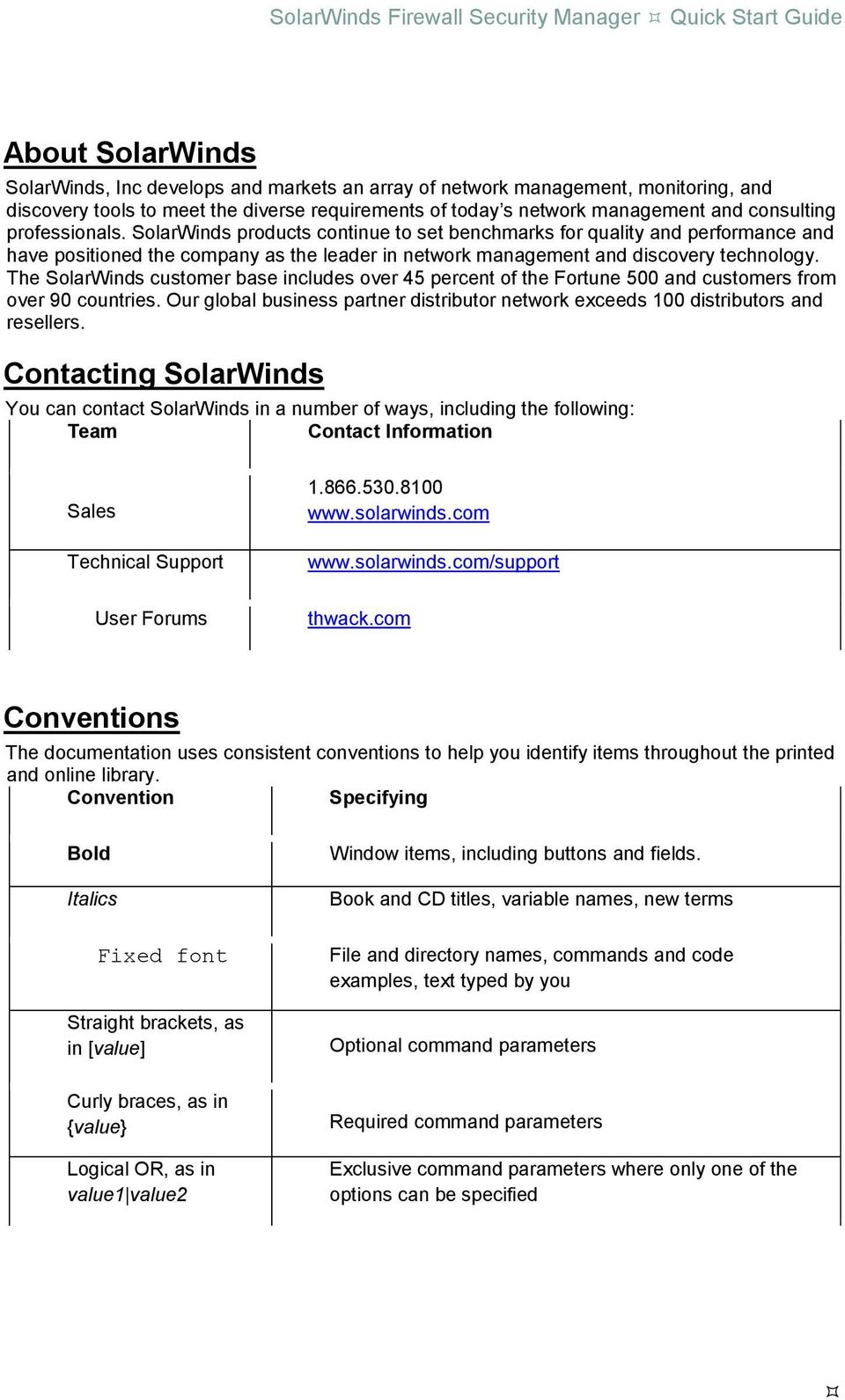
3 SolarWinds Firewall Security Manager Quick Start Guide About SolarWinds SolarWinds, Inc develops and markets an array of network management, monitoring, and discovery tools to meet the diverse requirements of today s network management and consulting professionals. SolarWinds products continue to set benchmarks for quality and performance and have positioned the company as the leader in network management and discovery technology. The SolarWinds customer base includes over 45 percent of the Fortune 500 and customers from over 90 countries. Our global business partner distributor network exceeds 100 distributors and resellers. Contacting SolarWinds You can contact SolarWinds in a number of ways, including the following: Team Contact Information Sales Technical Support User Forums thwack.com Conventions The documentation uses consistent conventions to help you identify items throughout the printed and online library. Convention Specifying Bold Italics Fixed font Straight brackets, as in [value] Curly braces, as in {value} Logical OR, as in value1 value2 Window items, including buttons and fields. Book and CD titles, variable names, new terms File and directory names, commands and code examples, text typed by you Optional command parameters Required command parameters Exclusive command parameters where only one of the options can be specified
4 About SolarWinds iii

5 SolarWinds Firewall Security Manager Quick Start Guide SolarWinds Firewall Security Manager Documentation Library The following documents are included in the SolarWinds Firewall Security Manager (FSM) documentation library: Document Purpose Online User Guide Evaluation Guide Quick Start Guide Release Notes Provides context-sensitive help for the user interface as well as an online reference manual for FSM users and administrators. Targeted to users evaluating FSM. Provides installation, setup, and common scenarios for which FSM provides a simple, yet powerful, solution. Provides installation, setup, and common scenarios for which FSM provides a simple, yet powerful, solution. Provides late-breaking information, known issues, and updates. The latest Release Notes can be found at

6 Quick Start Guide SolarWinds Firewall Security Manager iv SolarWinds Firewall Security Manager Documentation Library Contents About SolarWinds... iii Contacting SolarWinds... iii Conventions... iii SolarWinds Firewall Security Manager Documentation Library... iv Chapter 1 Introduction... 1 Integrating with SolarWinds NCM... 2 Chapter 2 Installing Firewall Security Manager... 3 Requirements... 3 Deployment Best Practices... 4 Installing the FSM Server... 4 Importing Firewall Configurations... 5 Connecting to the Device... 7 Importing from SolarWinds NCM... 8 Installing FSM Clients... 9 FSM Licensing Chapter 3 Getting Started... 13

7 SolarWinds Firewall Security Manager Quick Start Guide Viewing and Querying Firewall Details Using Packet Tracer Optimizing Firewalls Running and Scheduling FSM Reports Running PCI Analysis Reports Running the Security Audit Report Scheduling FSM Batch Reports Using Change Advisor Configuring Change Advisor Users Contents Configuring a Name Server Submitting a Change Request Managing Change Requests v

8 Quick Start Guide SolarWinds Firewall Security Manager vi Contents

9 SolarWinds Firewall Security Manager Quick Start Guide Chapter 1 Introduction SolarWinds Firewall Security Manager (FSM) is a versatile firewall and router management tool that provides comprehensive solution sets for audit and daily operational tasks. Use FSM to view and query device configurations in a normalized format, compare configuration versions, and model configuration changes before implementing them. Use reports in FSM to analyze compliance with enterprise and industry standards. The following illustrates the components of an FSM installation. FSM Server The FSM server consists of the database server, which all clients share, the SolarWinds License Manager, an FSM client, and the FSM web server, which provides the web-based interface for Change Advisor. FSM Clients The FSM client software analyzes the configurations and log data the FSM server collects for your managed devices. For additional information, see "Deployment Best Practices" on page 4. FSM Change Advisor Web Console The FSM Change Advisor web console provides a web-based interface to enter and review change requests for the managed firewalls. For additional information, see "Using Change Advisor" on page 20. Introduction 1

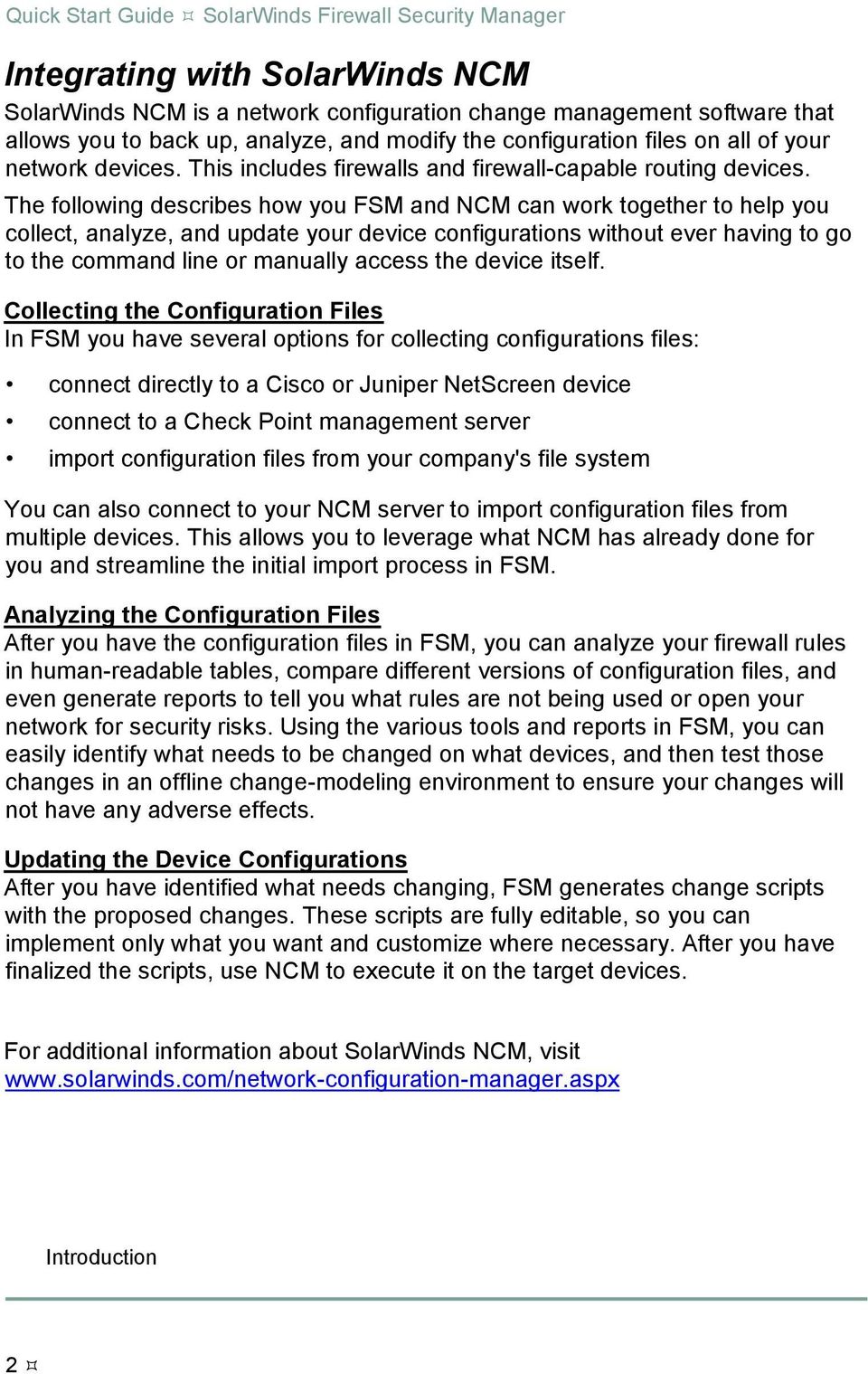
10 Quick Start Guide SolarWinds Firewall Security Manager Integrating with SolarWinds NCM SolarWinds NCM is a network configuration change management software that allows you to back up, analyze, and modify the configuration files on all of your network devices. This includes firewalls and firewall-capable routing devices. The following describes how you FSM and NCM can work together to help you collect, analyze, and update your device configurations without ever having to go to the command line or manually access the device itself. Collecting the Configuration Files In FSM you have several options for collecting configurations files: connect directly to a Cisco or Juniper NetScreen device connect to a Check Point management server import configuration files from your company's file system You can also connect to your NCM server to import configuration files from multiple devices. This allows you to leverage what NCM has already done for you and streamline the initial import process in FSM. Analyzing the Configuration Files After you have the configuration files in FSM, you can analyze your firewall rules in human-readable tables, compare different versions of configuration files, and even generate reports to tell you what rules are not being used or open your network for security risks. Using the various tools and reports in FSM, you can easily identify what needs to be changed on what devices, and then test those changes in an offline change-modeling environment to ensure your changes will not have any adverse effects. Updating the Device Configurations After you have identified what needs changing, FSM generates change scripts with the proposed changes. These scripts are fully editable, so you can implement only what you want and customize where necessary. After you have finalized the scripts, use NCM to execute it on the target devices. For additional information about SolarWinds NCM, visit Introduction 2
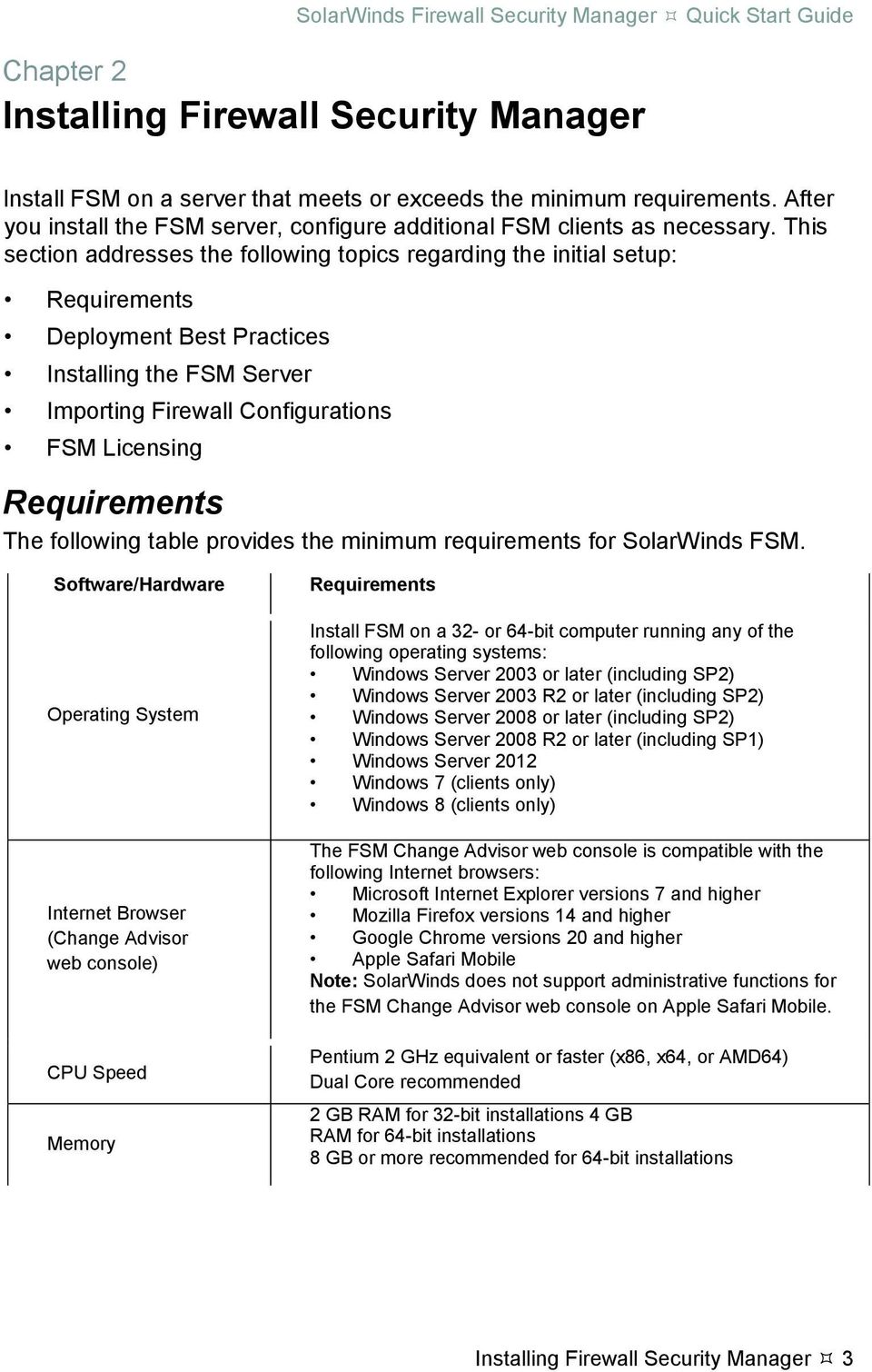
11 SolarWinds Firewall Security Manager Quick Start Guide Chapter 2 Installing Firewall Security Manager Install FSM on a server that meets or exceeds the minimum requirements. After you install the FSM server, configure additional FSM clients as necessary. This section addresses the following topics regarding the initial setup: Requirements Deployment Best Practices Installing the FSM Server Importing Firewall Configurations FSM Licensing Requirements The following table provides the minimum requirements for SolarWinds FSM. Software/Hardware Operating System Internet Browser (Change Advisor web console) CPU Speed Memory Requirements Install FSM on a 32- or 64-bit computer running any of the following operating systems: Windows Server 2003 or later (including SP2) Windows Server 2003 R2 or later (including SP2) Windows Server 2008 or later (including SP2) Windows Server 2008 R2 or later (including SP1) Windows Server 2012 Windows 7 (clients only) Windows 8 (clients only) The FSM Change Advisor web console is compatible with the following Internet browsers: Microsoft Internet Explorer versions 7 and higher Mozilla Firefox versions 14 and higher Google Chrome versions 20 and higher Apple Safari Mobile Note: SolarWinds does not support administrative functions for the FSM Change Advisor web console on Apple Safari Mobile. Pentium 2 GHz equivalent or faster (x86, x64, or AMD64) Dual Core recommended 2 GB RAM for 32-bit installations 4 GB RAM for 64-bit installations 8 GB or more recommended for 64-bit installations Installing Firewall Security Manager 3
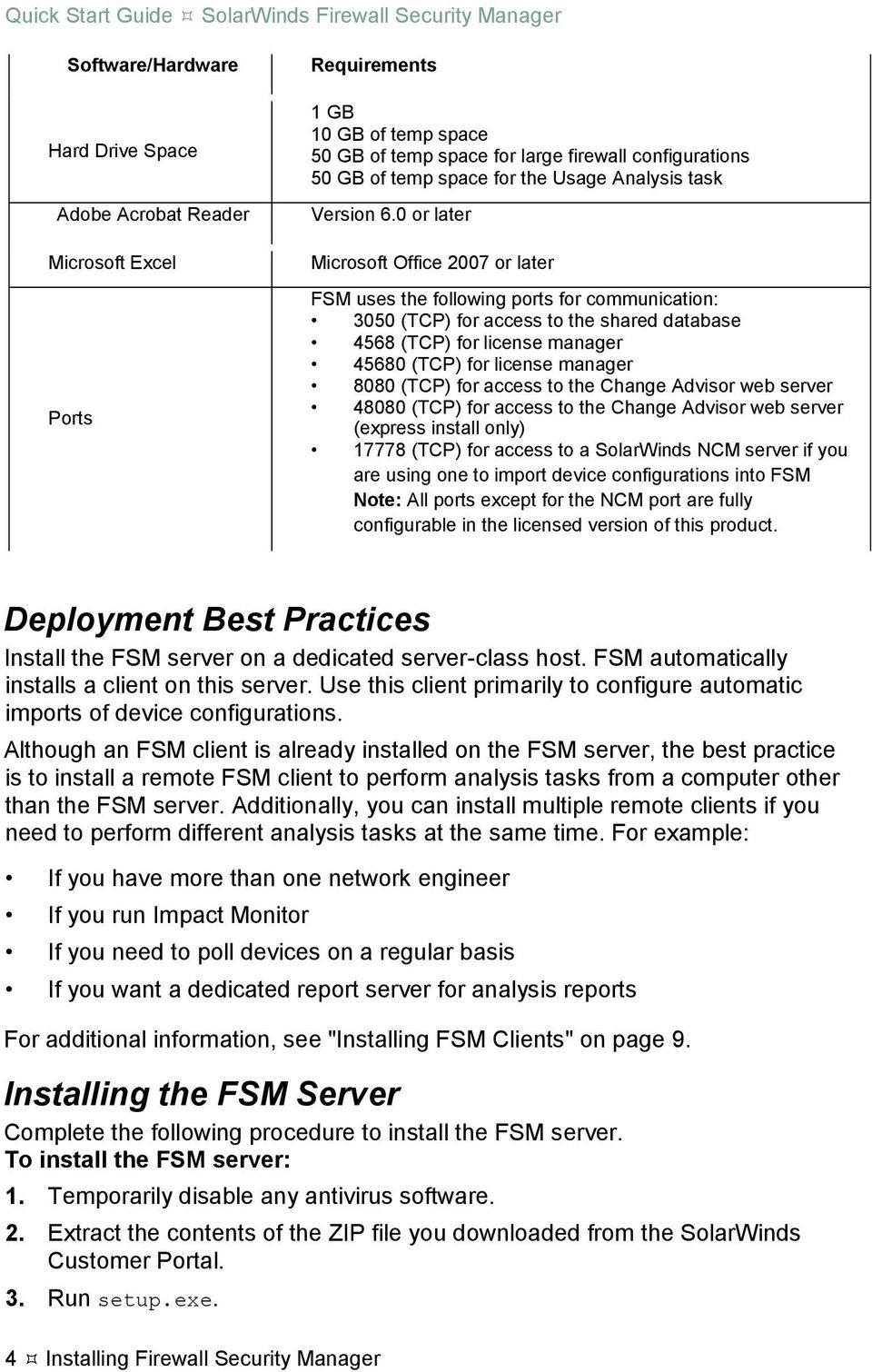
12 Quick Start Guide SolarWinds Firewall Security Manager Software/Hardware Hard Drive Space Adobe Acrobat Reader Microsoft Excel Ports Requirements 1 GB 10 GB of temp space 50 GB of temp space for large firewall configurations 50 GB of temp space for the Usage Analysis task Version 6.0 or later Microsoft Office 2007 or later FSM uses the following ports for communication: 3050 (TCP) for access to the shared database 4568 (TCP) for license manager (TCP) for license manager 8080 (TCP) for access to the Change Advisor web server (TCP) for access to the Change Advisor web server (express install only) (TCP) for access to a SolarWinds NCM server if you are using one to import device configurations into FSM Note: All ports except for the NCM port are fully configurable in the licensed version of this product. Deployment Best Practices Install the FSM server on a dedicated server-class host. FSM automatically installs a client on this server. Use this client primarily to configure automatic imports of device configurations. Although an FSM client is already installed on the FSM server, the best practice is to install a remote FSM client to perform analysis tasks from a computer other than the FSM server. Additionally, you can install multiple remote clients if you need to perform different analysis tasks at the same time. For example: If you have more than one network engineer If you run Impact Monitor If you need to poll devices on a regular basis If you want a dedicated report server for analysis reports For additional information, see "Installing FSM Clients" on page 9. Installing the FSM Server Complete the following procedure to install the FSM server. To install the FSM server: 1. Temporarily disable any antivirus software. 2. Extract the contents of the ZIP file you downloaded from the SolarWinds Customer Portal. 3. Run setup.exe. 4 Installing Firewall Security Manager
13 SolarWinds Firewall Security Manager Quick Start Guide 4. Select an installation type, and then click Next. For the sake of this guide, select Express Install Recommended to install FSM with default settings. Note: The Express installation option creates the FSM database with a default password. If you want to change this password during the installation, select the Advanced option. Otherwise, you can change the password manually at any time. For additional information, see the help topic, Changing the FSM Database Password. 5. Enter your address, and then click Next. 6. Accept the End User License Agreement (EULA), and then click Next. 7. After the installer finishes running the installation files, click Next. 8. After the installer finishes configuring FSM, click Next. 9. On the summary screen, review the list of installed components, and then click Done. Importing Firewall Configurations After you launch the FSM client for the first time, the application displays the Import Firewall Configurations wizard. This task stores the configuration files for the firewalls you import on the FSM server, which allows you to access the files offline for reporting and change modeling tasks. FSM currently supports configurations from the following devices: Cisco security appliances: PIX, ASA, FWSM, ASA 8.3 Cisco IOS routers: version 12.0 to 12.14, excluding X* series Juniper firewalls: Netscreen, SSG, ISG Check Point products: SmartCenter NG/NGX, Security Management R70 to R75 running on any platform, including: o SecurePlatform o o Check Point IPSO (formerly Nokia) Crossbeam o Linu x o Solaris o Win dows Installing Firewall Security Manager 5
14 Quick Start Guide SolarWinds Firewall Security Manager For additional information about the devices we support, see the KB article, FSM Supported Devices. When you import device configurations, the wizard presents the following import method options: Import from FileSystem Imports the configuration files for a single device from any locally accessible filesystem. This option requires that you have extracted the configuration files from the device and have them available. Connect to Device Connects to a specific device to extract the current configuration files. This option requires that you have network connectivity to the device and the appropriate credentials. Import from NCM Repository Imports the configuration files for one or more devices from a SolarWinds Network Configuration Manager (NCM) repository. FSM currently supports SolarWinds NCM versions 5.x, 6.x, and 7.x. This option requires network connectivity to the NCM server and the appropriate credentials. Import from Check Point Management Server Imports the configuration files for one or more Check Point firewalls from the Check Point management server. This option requires network connectivity to the Check Point management server and the appropriate credentials. This guide covers two import scenarios: Connecting to the Device Importing from SolarWinds NCM For additional information about importing device configurations from a file system, see the help topic, Data Collection Guide for Configs. For additional information about importing device configurations from a Check Point management server, see the help topic, CPMI Connection Parameters. Connecting to the Device Use the following procedure if you want FSM to connect directly to your devices to retrieve their configuration files. This option requires that you have network connectivity to the device and the appropriate credentials. To import firewall configurations directly from the device: 1. In the Import Firewall Configurations window, click Next. 2. On the Import New Firewall screen, complete the Device Information section as appropriate (optional). 3. In the Select Import Method section, select Connect to Device. 6 Installing Firewall Security Manager

15 SolarWinds Firewall Security Manager Quick Start Guide 4. In the Select Firewall Type section, select the type of device configuration you want to import. For the sake of this example, select Cisco Security Appliance (PIX/ASA/FWSM). 5. Click Next. 6. On the Firewall Connection Parameters screen, complete the Connection Parameters section: a. In the Device name or IP Address field, enter the hostname or IP address of the device. b. If you are connecting to the device using SSH, enter the appropriate username in the Username field. c. If you provided a username in the previous step, enter the corresponding password in the Password field. d. In the Transfer configs using field, select the transfer protocol. Note: FSM currently supports SSH 2 or Telnet. If your device uses SSH 1 or SSH 1.5, select Telnet as the transfer protocol. e. If you use a non-standard port for the protocol you selected, modify the default value in the Port field. 7. In the Firewall Command Template Parameters section, enter the appropriate values in the Value column, and then press Enter. For this example, enter the Enable password in the Value column for that parameter. Notes: After importing the firewall's configurations, FSM stores these credentials to retrieve configuration updates. The device command template uses additional parameters, which the wizard hides by default. If you have trouble connecting to a device, select Show internal command template parameters with default values, and modify the default parameters as necessary to mitigate the issue. 8. Click Finish. After you import a firewall, FSM adds it to the Firewall Inventory. For additional information, see "Viewing and Querying Firewall Details" on page 13. Importing from SolarWinds NCM Use the following procedure if you want to import your device configuration files from a SolarWinds Network Configuration Manager (NCM) server. This procedure works with NCM version 7.x and higher. For information about earlier versions, see the help topic, NCM Connector Setup for NCM 6.x. For additional information about SolarWinds NCM, visit Requirements Installing Firewall Security Manager 7
16 Quick Start Guide SolarWinds Firewall Security Manager The procedure in this section requires the following: Network access to the NCM server over port The IP address of the NCM server The username and password of an NCM user with Execute Script permissions. NCM roles with this permission include: o Administrator o Engineer o WebUploader Procedure Complete the following procedure from an FSM client to import device configurations from a SolarWinds NCM server. To import firewall configurations from an NCM server: 1. In the Import Firewall Configurations window, click Next. 2. On the Import New Firewall screen, complete the Device Information section as appropriate. 3. In the Select Import Method section, select Import from NCM Repository. 4. Click Next. 5. On the NCM Repository Connection Parameters screen, complete the Connection Parameters section: a. In the Server URL field, enter serverip :17778, where serverip is the IP address of the NCM server. b. In the Username field, enter the username for an NCM user with Execute Script permissions. c. In the Password field, enter the password for the NCM user. 6. Click Next. 7. After the wizard imports the list of available devices, select the devices you want to import. Note: FSM only imports configuration files from supported Cisco or NetScreen devices. The wizard does not allow you to proceed if you select a device with the type, "Unknown." 8. If the wizard returns a supported device with an Unknown type, click the Type field for that device, and then select the correct device type from the menu. To fix this issue on the NCM side, enable SNMP on the device, or manually select the device type in the node settings. 9. Click Finish. 8 Installing Firewall Security Manager
17 SolarWinds Firewall Security Manager Quick Start Guide 10. On the Firewall Import Status window, review the results of the import, and then click Complete Import. Note: Warning messages in this window do not affect FSM's ability to analyze the device configurations. After you import a firewall, FSM adds it to the Firewall Inventory. For additional information, see "Viewing and Querying Firewall Details" on page 13. Installing FSM Clients The FSM server includes the FSM client automatically. Install additional FSM clients to connect to the FSM server remotely, facilitate regular device polling, or to use as a report server. To install an FSM client: 1. Temporarily disable any antivirus software. 2. Ensure the FSM server is accessible from the client over the required ports. Temporarily disable the firewall on the FSM server or create the applicable firewall rules to allow client connectivity. For additional information, see "Requirements" on page Using the same installer media you used to install the FSM server, run setup.exe. 4. Select Client Install, and then click Next. Installing Firewall Security Manager 9

18 Quick Start Guide SolarWinds Firewall Security Manager 5. Enter your address, and then click Next. 6. Accept the End User License Agreement (EULA), and then click Next. 7. Browse to a custom installation folder or accept the default, and then click Next. 8. After the installer finishes installing the FSM client, click Next. 9. On the Local database configuration screen, click Test Connection. 10 Note: If you specified a new password for the FSM database either during the initial server installation or anytime thereafter, enter it here before testing the connection. 10. If the test is successful, click OK, and then click Next. 11. On the Shared database configuration screen, complete the information for the FSM server: a. Enter the IP address of the FSM server in the IP-Address of the server field. b. If you changed the shared database password, enter it in the Shared database password field. c. Click Test Connection. 12. If the test is successful, click OK, and then click Next. 13. After the installer finishes configuring the FSM client, click Next. 14. On the summary screen, review the list of installed components, and then click Done. FSM Licensing SolarWinds licenses the FSM server according to the number of devices it manages. Managed devices include all firewall and firewall-capable routing devices. When you install the FSM server, it automatically starts a 30-day trial period. When you are ready to enter your licensing information, open the SolarWinds License Manager and complete the appropriate licensing procedure: To access the SolarWinds License Manager: 1. In the FSM client, click Help > License Manager. 2. If you need to purchase a license, click Buy Now to navigate to the SolarWinds website. 3. If you already have a license, click Enter Registration Key, and then complete one of the following procedures. Installing Firewall Security Manager Licensing Servers with Internet Access

19 Licensing Servers without Internet Access SolarWinds Firewall Security Manager Quick Start Guide Licensing Servers with Internet Access Complete the following procedure to license your FSM server if it has access to the Internet. Note: If your FSM server accesses the Internet through a proxy server, complete the procedure for activating without Internet access instead. To license FSM on a server with Internet access: 1. On the Add License window, select I have internet access and an activation key. 2. Click the link to access the customer portal on the SolarWinds web site. 3. Log on to the portal using your SolarWinds customer ID and password. 4. On the left navigation bar, click License Management. 5. Navigate to your product, choose an activation key from the Unregistered Licenses section, and then copy the activation key. 6. If you cannot find an activation key in the Unregistered Licenses section, contact SolarWinds customer support. 7. Return to the Add License window, and then enter the activation key in the Activation Key field. 8. Click Next. 9. Enter your address and other registration information, and then click Next. Licensing Servers without Internet Access Complete the following procedure to license your FSM server if it does not have access to the Internet, or if it accesses the Internet through a proxy server. To license FSM on a server without Internet access: 1. On the Add License window, select This server does not have internet access, and then click Next. 2. Click Copy Unique Machine ID. 3. Paste the copied data into a text editor document. 4. Transfer the document to a computer with Internet access. Installing Firewall Security Manager 5. On the computer with Internet access, complete the following steps: a. Browse to 11

20 Quick Start Guide SolarWinds Firewall Security Manager nt.aspx, and then log on to the portal with your SolarWinds customer ID and password. b. Navigate to your product, and then click Manually Register License. c. If the Manually Register License option is not available for your product, contact SolarWinds customer support. d. Provide the Machine ID from Step 3, and then download your license key file. 6. Transfer the license key file to the FSM server. 7. Return to the Activate FSM window, browse to the license key file, and then click Next. Installing Firewall Security Manager Chapter 3 12

21 SolarWinds Firewall Security Manager Quick Start Guide Getting Started This chapter addresses some initial configuration steps along with a few common use cases for FSM. Review the following sections to get started: Viewing and Querying Firewall Details Using Packet Tracer Optimizing Firewalls Running and Scheduling FSM Reports Using Change Advisor Viewing and Querying Firewall Details After you import your devices, FSM lists them in the Firewall Inventory pane of the console. To view a firewall's details: 1. Select the firewall in the Firewall Inventory pane. 2. Click File > View Details. FSM displays the details under dedicated tabs in the right pane. The following define the sub-tabs on the details view. Use the filter fields at the top of the first four tabs to apply custom filters and query the configuration file. Security Rules The Security Rules tab of the details view displays all of the access control list (ACL) rules in the device configuration. Click an object in the Source, Destination, or Service column to view the object's definition in a separate dialog. Click outside of the definition dialog to close it. NAT Rules The NAT Rules tab of the details view provides a representation of the network address translation (NAT) rules in the device configuration. It displays the object's source, destination, and services before and after translation. Click an object in the Source, Destination, or Service column to view the object's definition in a separate dialog. Click outside of the definition dialog to close it. Getting Started 13
22 Quick Start Guide SolarWinds Firewall Security Manager Note: The entry, Original, in the translation (Trns.) columns indicates the NAT rule left the original value unchanged. Network Objects The Network Objects tab of the details view displays all the network address objects in the device configuration. This tab displays network object groups as collapsed tree lists. Click [+] next to the group name to expand the list and view the member objects. Service Objects The Service Objects tab of the details view displays all the service objects in the device configuration. This tab displays service object groups as collapsed tree lists. Click [+] next to the group name to expand the list and view the member objects. Interfaces The Interfaces tab of the details view displays a table of all the network interfaces identified in the device configuration. Select the checkbox in the PCI Zone column to indicate the selected zone leads to a PCI network. This is useful when preparing for a PCI audit. FSM assigns a default zone to each of these interfaces. Click the Zone field to modify the zone assigned to a specific interface. To create custom zones, click Window > Preferences, and then specify the custom zones in the Zone Definitions section. Native Configs The Native Configs tab of the details view displays the native configuration file FSM imported from the device. This is exactly what you would see if you viewed the configuration file from the command-line interface (CLI). Problems The Problems tab of the details view displays general status messages from FSM regarding the configuration import process. Most notably, this tab displays errors or warnings if FSM is not able to translate any part of the configuration. These problems may or may not impact analysis. Using Packet Tracer Packet Tracer traces a packet's path through a Layer 3 network. This is useful when evaluating configuration changes or troubleshooting issues. To do this, Packet Tracer performs two steps: 1. It finds all routable paths between the source and destination addresses in the packet using the network address translation (NAT) rules on all the devices along each path. 2. It evaluates the access control lists (ACL) of each device along a path to locate a routable path for the packet that is not blocked by the ACL. 14 Getting Started
23 SolarWinds Firewall Security Manager Quick Start Guide Complete the following procedure to specify the path you want Packet Tracer to evaluate. To run Packet Tracer for a specific path: 1. In the FSM client, click the Query menu, and then select Packet Tracer. 2. In the Packet Tracer window, enter the required information: Source IP Address Destination IP Address Protocol Port (number or service name) 3. Click Run. 4. In the Save As dialog, specify a name and location for the output file, and then click Save. For additional information about the Packet Tracer report, see the help topic, Packet Tracer. Optimizing Firewalls Use the Rule/Object Cleanup task with supported Cisco or Juniper firewall configurations to optimize your firewalls. The task generates a report that informs you of rules or objects in the selected firewall that you may want to remove or revise. This task also generates a new configuration file and a clean-up script, which you can edit and apply as necessary. The Rule/Object Cleanup task consists of two primary options: Redundant and Shadowed rules analysis This option checks the firewall configuration to identify redundant or shadowed rules and unreferenced network or service objects. Redundant rules are those covered by other rules that have the same action. Shadowed rules are those covered by other rules that have the opposite action. Find these results in the Structural Rule and Object Cleanup section of the Firewall Cleanup report. Log Usage Analysis Getting Started This option checks the firewall log to identify unused rules, network objects, or service objects. Find these results in the Usage-Based Rule and Object Cleanup section of the Firewall Cleanup report. Optionally, FSM can recommend the most optimal order for the firewall rules based on usage. If you select Include optimal rule ordering, FSM puts the 15
24 Quick Start Guide SolarWinds Firewall Security Manager most-used rules as close to the top of the configuration without changing the behavior of the firewall. This option is memory and compute intensive. To complete the Rule/Object Cleanup task: 1. In the FSM client, select one or more devices from the Firewall Inventory to clean up. 2. Click Optimize > Rule/Object Cleanup. 3. On the Rule/Object Cleanup dialog, select one or both options. 4. Click OK. 5. If you selected the Log Usage Analysis option, enter or browse to the folder that contains the firewall log files, and then click Generate Report. Note: FSM can import one or more individual log files or archives that contain log files. If you want to import multiple log files or archives, ensure they are in the same folder. 6. On the Generate Report screen, enter or browse to the location you want FSM to use for the output. 7. In the Report Format menu, select the format you want FSM to use for the Firewall Cleanup report. 8. Click OK. After FSM generates the output, it opens the report. FSM saves the new configuration file and clean-up script in the same output folder. Running and Scheduling FSM Reports FSM uses reports to perform a variety of tasks. For example, the Rule/Object Cleanup task discussed previously (see "Optimizing Firewalls" on page 15) generates one or two reports, depending on the cleanup functions you choose. FSM also provides a variety of reports for audit and compliance purposes. The topics in this section address how to prepare for and run two common audit reports. These sections are: Running PCI Analysis Reports 16 Getting Started
25 Running the Security Audit Report Scheduling FSM Batch Reports SolarWinds Firewall Security Manager Quick Start Guide For additional information about reporting in FSM, see the help topic, Batch Reports dialog. Running PCI Analysis Reports The Payment Card Industry (PCI) analysis reports assess whether firewalls protecting cardholder data comply with the PCI Data Security Standard (DSS). These reports are only applicable to the interfaces that protect cardholder data. FSM considers those interfaces to fall within the PCI Zone a designation you apply to the appropriate firewalls. Prerequisite As stated previously, the PCI analysis reports only apply to interfaces you designate as being in the PCI Zone. You make this designation on the Interfaces tab of the Firewall Details view. To designate an interface as being in the PCI Zone: 1. In the FSM client, open the Firewall Details view for the firewall you want to modify. 2. Click the Interfaces tab. 3. In the PCI Zone column, select each interface you want FSM to evaluate when you run the PCI analysis reports. Report Procedure Run all of the PCI analysis reports on multiple firewalls individually, or as a batch and schedule them to run at a later time. For additional information about the latter option, see "Scheduling FSM Batch Reports" on page 19. To run all of the PCI analysis reports at once: 1. In the FSM client, select the firewall(s) you want to analyze for PCI compliance. 2. Click the Audit menu, and then select Assess PCI Compliance. 3. In the PCI Checks Report window, click Browse to specify an output folder, and then click OK. For additional information about the reports this task generates, see the help topic, PCI Analysis Reports. Running the Security Audit Report The Security Audit report assesses the selected firewalls using a customizable list of security checks. The report lists all of the security checks that found dangerous or potentially risky services the firewall is allowing. Getting Started 17
26 Quick Start Guide SolarWinds Firewall Security Manager Prerequisite The Security Audit report only applies to firewalls considered to be a "perimeter" firewall. Such firewalls control access between an external zone (such as the Internet), an internal zone (such as a corporate network), and a demilitarized zone (DMZ). Perimeter firewalls dedicate each interface to a specific zone. You can change the zones assigned to each interface on a perimeter firewall on the Interfaces tab of the Firewall Details view. To change the zones dedicated to a firewall's interfaces: 1. In the FSM client, open the Firewall Details view for the firewall you want to modify. 2. Click the Interfaces tab. 3. In the Zone column, click the cell for the interface you want to reassign, and then select a new zone from the menu. Additionally, you have the option to customize the list of security checks before you run the Security Audit report. If you choose not to customize the list, FSM provides two pre-configured lists by default: Standard STIG This catalog is based on a collection of guidelines and recommendations from a variety of security authorities. Sources include NIST Guidelines on Firewalls and Firewall Policy, the National Security Agency (NSA), and the SANS Institute Firewall Checklist. This catalog is based on the Defense Information Systems Agency (DISA) Security Technical Implementation Guide (STIG) for Cisco routers. SolarWinds recommends you use the Standard catalog unless you are specifically required to comply with the DISA STIG. For information about how to customize the security check catalogs, see the help topic, Security Check Catalog Editor. Report Procedure Run the Security Audit report on demand, or schedule it to run at a specific time. For additional information about the latter option, see "Scheduling FSM Batch Reports" on page 19. To run the Security Audit report on demand: 1. In the FSM client, select the firewall(s) you want to audit. 2. Click the Audit menu, and then select Evaluate Security Checks. 3. In the Firewall Checks Report window, click Browse to specify an output folder. 4. In the Report Format field, select a file extension, and then click OK. 18 Getting Started
27 SolarWinds Firewall Security Manager Quick Start Guide For additional information about the reports this task generates, see the help topic, Security Audit Report. Scheduling FSM Batch Reports The previous sections illustrate how you can run individual reports or groups of related reports on demand. FSM also provides functionality to schedule a custom batch of reports to run at a specific time. This allows you to schedule reports to run once or as part of a recurring schedule. To schedule batch reports in FSM: 1. In the FSM client, select the firewall(s) for which you want to schedule the reports. 2. Click the Reports menu, and then select Batch Reports. 3. In the Generate Batch Reports window, select the reports you want to schedule. Notes: Some reports are not available in all formats. You cannot select a report if it does not support the format at the bottom of the window. Some reports automatically trigger related reports. If you select such a report, it automatically selects all related reports. 4. If you selected the Rule/Object Cleanup Log Usage Analysis report, click Next, and then click Browse to specify the location of the firewall's log files. 5. Click Schedule Report. 6. In the Browse For Folder window, select the output folder for the scheduled reports, and then click OK. 7. In the Schedule Reports window, specify the schedule and recurrence options according to your preferences, and then click OK. For additional information about the schedule and recurrence options, see the help topic, Schedule Report Generation. Using Change Advisor Change Advisor is a web interface for submitting and reviewing requests to change firewall configurations. To allow users to submit and/or approve requests, you must first configure user accounts from the administrative section of the web console. This section addresses the following procedures: Configuring Change Advisor Users Configuring a Name Server Submitting a Change Request Managing Change Requests Getting Started 19
28 Quick Start Guide SolarWinds Firewall Security Manager Configuring Change Advisor Users There are three types of user accounts in Change Advisor. Select from the following account types when you configure new Change Advisor users. Network Engineer The Network Engineer account type has permissions to both submit Change Advisor requests and view all requests from all users. Change Advisor Administrator User The Change Advisor Administrator account type has permissions to add and modify Change Advisor users, and configure name servers. Users of this type cannot submit or review Change Advisor requests. The User account type has permissions to add new Change Advisor requests and edit requests they have submitted. To configure Change Advisor users: 1. Open Change Advisor from within the FSM application: Click the Analyze Change menu, and then select Open Change Advisor. Note: You can also access the Change Advisor website at where ipaddressorhostname is the IP address or hostname of the FSM server. 2. Log in for the first time with the default credentials: a. In the Username field, enter admin. b. In the Password field, enter admin. c. Click Sign In. 3. On the User Accounts homepage, click New User Account. 4. On the New User Account page, complete the form with the appropriate information. 5. Click Update Account. Configuring a Name Server Change Advisor uses a name server to resolve IP addresses with DNS hostnames. It presents these hostnames in the Change Request interface so users can easily select the systems they need to connect. Alternatively, if you want to manually import a list of known hosts, see "Importing Known Hosts" on page 21. To configure a name server: 1. Log into the Change Advisor web console as a Change Advisor Administrator. 2. Click Settings. 20 Getting Started
29 SolarWinds Firewall Security Manager Quick Start Guide 3. On the Configure Name Server tab, click Add Server. 4. Complete the Add Name Server form for the name server. Note: The fields are different, depending on the type of name server you select. 5. Click Save Changes. Importing Known Hosts Complete the following procedure to manually import known hosts to the Change Advisor web server. This function accepts XLS files with the following columns: Host Name IP Address Department/Location Description Company Note: FSM generates a similar file when you click Export Known Hosts on the Settings page of the Change Advisor web console. Use this function to modify existing data or add new hosts. The Import File function overwrites the existing known hosts data on the Change Advisor server. To import known hosts: 1. Log into the Change Advisor web console as a Change Advisor Administrator. 2. Click Settings. 3. Click the Import Known Hosts tab. 4. Click Choose File, and then browse to the file you want to import. 5. Click Import File. Submitting a Change Request Use the Change Advisor web console to enter requests to change firewall configurations. Only users in the Network Engineer and User roles have access to this function. To submit a new change request: 1. Log into the Change Advisor web console as a User or Network Engineer. 2. Click New Change Request. 3. On the Change Request page, enter a subject and business purpose for the change request. 4. In the Priority menu, select a priority for the change request. Getting Started 21
30 Quick Start Guide SolarWinds Firewall Security Manager 5. Add a packet to the request to give the Network Engineer as much information as possible about the request: a. Click Add Packet. b. In the Add Packet window, select the source that requires the change request. c. Click Populate Src. d. Select the destination that the source needs to reach. e. Click Populate Dst. f. In the Protocol menu on the right, select the protocol the connection will use. g. In the Service field, enter the service the connection will use. h. Click Add Packet. Note: Users in the User role cannot edit a packet after adding it to a change request. 6. Click Submit. Managing Change Requests Use the FSM client to manage change requests users have submitted through the Change Advisor web console. When a user submits a change request, FSM uses the packet details to run Packet Tracer and identify any blocks or gaps in the current configurations. After FSM analyzes the request, it returns the appropriate status in the Change Advisor web console. Depending on the status, the engineer completes the request by: Adding Detail to the Change Request Reviewing the Change Request For detailed information about the statuses in the Change Advisor web console, see the help topic, Change Request Status. Adding Detail to the Change Request Complete this step for change requests with the Request Normalization status. This status means the request does not include sufficient information for FSM to review the request and recommend a change (if any). At this stage, an engineer must edit the request to provide the necessary information before FSM can proceed. To edit a Change Advisor request: 1. Log into the Change Advisor web console as a Network Engineer. 2. Click the Details link next to the request you want to edit. 3. If you want to change the Subject, Business Purpose, or Status of the request, click Edit, and then complete the Edit Request form. 22 Getting Started
31 SolarWinds Firewall Security Manager Quick Start Guide Note: At this point, you have the option to change the status to Closed. Consider this if you will not implement the change, or if the requestor did not provide sufficient information. 4. If the request is missing information in the Request Details section, click the pencil icon next to the incomplete details, and then complete the Edit Packet form. Note: Change Advisor needs the source and destination IP addresses and service to proceed. 5. If you want to add a note to the request, click Add Note, and then complete the Add Note form. After Change Advisor has enough information to proceed, FSM runs Packet Tracer again and returns a new status according to the results. If the request requires a change to the current configurations, the engineer must review the request to determine an implementation plan. If the request does not require a change, FSM automatically changes the status to Completed in Change Advisor. Reviewing the Change Request Complete this step for change requests that require some kind of change to the current configuration. This step assumes FSM was able to analyze the change request and provide a recommendation. In this step, the engineer reviews the recommendation from FSM and tests the change in a change modeling session. To review a Change Advisor recommendation: 1. Log into the Change Advisor web console as a Network Engineer. 2. Click the Details link next to the request you want to review. 3. In the Analyze Request section, click View Packet Tracer Report, and then review the report Change Advisor downloads: a. Open the Packet Tracer report in an XLS editor or viewer. The most common editor is Microsoft Excel. b. In the Packet Tracer report, click the hyperlink next to Trace Result Summary. c. Review the packet details in the report. This indicates whether there is a routable path for the request, and what rules (if any) are currently blocking the packet. d. Return to the Change Advisor web console to proceed. 4. If you want to analyze the security risk of a change request, click View Security Risks Report, and then review the Security Risk Analysis page: a. In the Security Violations section, click Show in the Details column. b. If you want to re-run the risk assessment against another security catalog, select a different catalog in the Use Selected Security Catalog menu, and then click Assess Risks. Getting Started 23
32 Quick Start Guide SolarWinds Firewall Security Manager c. Click the Back button in your browser to return to the request details page. 5. If you want to add a note to the change request, click Add Note, and then complete the Add Note dialog. 6. If you will implement the change request, open the FSM client to complete a change modeling session. For additional information see the help topic, Change Modeling Session. 7. After you have decided how to address the change, set the appropriate status in Change Advisor: a. In the Change Advisor web console, click Edit next to the change request. b. In the Request Status menu, select Completed or Closed. These statuses generally indicate that you have completed the change request. Use the notes in the request to indicate whether or not you have implemented any change. The following define these two "final" statuses: Completed Closed Use this status if you want the requestor to verify your change. Requests with this status remain visible to both the requestor (User role) and engineer (Network Engineer role). Use this status after you are satisfied you have sufficiently addressed the change request. Requests with this status no longer show up in the change request list for users in the Network Engineer role. 24 Getting Started
SOLARWINDS ORION. Patch Manager Evaluation Guide for ConfigMgr 2012
 SOLARWINDS ORION Patch Manager Evaluation Guide for ConfigMgr 2012 About SolarWinds SolarWinds, Inc. develops and markets an array of network management, monitoring, and discovery tools to meet the diverse
SOLARWINDS ORION. Patch Manager Evaluation Guide
 SOLARWINDS ORION Patch Manager Evaluation Guide About SolarWinds SolarWinds, Inc. develops and markets an array of network management, monitoring, and discovery tools to meet the diverse requirements of
SolarWinds Orion Integrated Virtual Infrastructure Monitor Supplement
 SolarWinds Orion Integrated Virtual Infrastructure Monitor Supplement INTEGRATED VIRTUAL INFRASTRUCTURE MONITOR Copyright 1995-2014 SolarWinds Worldwide, LLC. All rights reserved worldwide. No part of
SOLARWINDS ORION. Patch Manager Administrator Guide
 SOLARWINDS ORION Patch Manager Administrator Guide About SolarWinds SolarWinds, Inc. develops and markets an array of network management, monitoring, and discovery tools to meet the diverse requirements
SolarWinds. Packet Analysis Sensor Deployment Guide
 SolarWinds Packet Analysis Sensor Deployment Guide Copyright 1995-2015 SolarWinds Worldwide, LLC. All rights reserved worldwide. No part of this document may be reproduced by any means nor modified, decompiled,
DameWare Server. Administrator Guide
 DameWare Server Administrator Guide About DameWare Contact Information Team Contact Information Sales 1.866.270.1449 General Support Technical Support Customer Service User Forums http://www.dameware.com/customers.aspx
SolarWinds Migrating SolarWinds NPM Technical Reference
 SolarWinds Migrating SolarWinds NPM Technical Reference Copyright 1995-2015 SolarWinds Worldwide, LLC. All rights reserved worldwide. No part of this document may be reproduced by any means nor modified,
Table of Contents. Contents
 Contents Copyright 2015 SolarWinds Worldwide, LLC. All rights reserved worldwide. No part of this document may be reproduced by any means nor modified, decompiled, disassembled, published or distributed,
SolarWinds Technical Reference
 SolarWinds Technical Reference Riverbed and SolarWinds WAN Optimization Introduction...3 Using the WAN Optimization Reports...3 Downloading and Saving Your Reports...3 Specifying Traffic Optimized Interfaces...3
Migrating Cirrus. Revised 7/19/2007
 Migrating Cirrus Revised 7/19/2007 Procedure Overview...3 Requirements...3 About the Cirrus Configuration Management Database...4 Migrating Cirrus Configuration Management...4 Migrating Jobs...5 Migrating
Configuring and Integrating Oracle
 Configuring and Integrating Oracle The Basics of Oracle 3 Configuring SAM to Monitor an Oracle Database Server 4 This document includes basic information about Oracle and its role with SolarWinds SAM Adding
Interworks. Interworks Cloud Platform Installation Guide
 Interworks Interworks Cloud Platform Installation Guide Published: March, 2014 This document contains information proprietary to Interworks and its receipt or possession does not convey any rights to reproduce,
Server Installation Guide ZENworks Patch Management 6.4 SP2
 Server Installation Guide ZENworks Patch Management 6.4 SP2 02_016N 6.4SP2 Server Installation Guide - 2 - Notices Version Information ZENworks Patch Management Server Installation Guide - ZENworks Patch
Using SolarWinds Orion for Cisco Assessments
 Using SolarWinds Orion for Cisco Assessments Cisco Network Assessments Registering Your Assessment... 1 Installing SolarWinds Orion Network Performance Monitor... 1 Discovering Your Network... 1 Polling
Copyright 2014 SolarWinds Worldwide, LLC. All rights reserved worldwide. No part of this document may be reproduced by any means nor modified,
 Copyright 2014 SolarWinds Worldwide, LLC. All rights reserved worldwide. No part of this document may be reproduced by any means nor modified, decompiled, disassembled, published or distributed, in whole
Configuring and Integrating JMX
 Configuring and Integrating JMX The Basics of JMX 3 JConsole 3 Adding a JMX Component Monitor to SAM 6 This document includes basic information about JMX and its role with SolarWinds SAM 2 Configuring
Dell One Identity Cloud Access Manager 7.0.2. Installation Guide
 Dell One Identity Cloud Access Manager 7.0.2 2014 Dell Inc. ALL RIGHTS RESERVED. This guide contains proprietary information protected by copyright. The software described in this guide is furnished under
User Manual. Onsight Management Suite Version 5.1. Another Innovation by Librestream
 User Manual Onsight Management Suite Version 5.1 Another Innovation by Librestream Doc #: 400075-06 May 2012 Information in this document is subject to change without notice. Reproduction in any manner
Copyright 2015 SolarWinds Worldwide, LLC. All rights reserved worldwide. No part of this document may be reproduced by any means nor modified,
 Copyright 2015 SolarWinds Worldwide, LLC. All rights reserved worldwide. No part of this document may be reproduced by any means nor modified, decompiled, disassembled, published or distributed, in whole
http://docs.trendmicro.com
 Trend Micro Incorporated reserves the right to make changes to this document and to the products described herein without notice. Before installing and using the product, please review the readme files,
Veeam Backup Enterprise Manager. Version 7.0
 Veeam Backup Enterprise Manager Version 7.0 User Guide August, 2013 2013 Veeam Software. All rights reserved. All trademarks are the property of their respective owners. No part of this publication may
NSi Mobile Installation Guide. Version 6.2
 NSi Mobile Installation Guide Version 6.2 Revision History Version Date 1.0 October 2, 2012 2.0 September 18, 2013 2 CONTENTS TABLE OF CONTENTS PREFACE... 5 Purpose of this Document... 5 Version Compatibility...
Core Protection for Virtual Machines 1
 Core Protection for Virtual Machines 1 Comprehensive Threat Protection for Virtual Environments. Installation Guide e Endpoint Security Trend Micro Incorporated reserves the right to make changes to this
http://docs.trendmicro.com
 Trend Micro Incorporated reserves the right to make changes to this document and to the products described herein without notice. Before installing and using the product, please review the readme files,
Dell SupportAssist Version 2.0 for Dell OpenManage Essentials Quick Start Guide
 Dell SupportAssist Version 2.0 for Dell OpenManage Essentials Quick Start Guide Notes, Cautions, and Warnings NOTE: A NOTE indicates important information that helps you make better use of your computer.
SolarWinds Toolset Quick Start Guide
 SolarWinds Toolset Quick Start Guide Copyright 1995-2007 SolarWinds.net, Inc., all rights reserved worldwide. No part of this document may be reproduced by any means nor modified, decompiled, disassembled,
Installing and Configuring vcloud Connector
 Installing and Configuring vcloud Connector vcloud Connector 2.7.0 This document supports the version of each product listed and supports all subsequent versions until the document is replaced by a new
CA Nimsoft Monitor Snap
 CA Nimsoft Monitor Snap Quick Start Guide 7.0 Legal Notices Copyright 2013, CA. All rights reserved. Warranty The material contained in this document is provided "as is," and is subject to being changed,
Network Configuration Manager
 Network Configuration Manager AUTOMATED NETWORK CONFIGURATION & CHANGE MANAGEMENT Download a free product trial and start in minutes. SolarWinds Network Configuration Manager (NCM) simplifies managing
Universal Management Service 2015
 Universal Management Service 2015 UMS 2015 Help All rights reserved. No parts of this work may be reproduced in any form or by any means - graphic, electronic, or mechanical, including photocopying, recording,
Installation Guide for Pulse on Windows Server 2008R2
 MadCap Software Installation Guide for Pulse on Windows Server 2008R2 Pulse Copyright 2014 MadCap Software. All rights reserved. Information in this document is subject to change without notice. The software
SolarWinds Technical Reference
 SolarWinds Technical Reference Understanding Cisco ASA NetFlow Cisco Adaptive Security Appliance (ASA) NetFlow Overview... 3 Understanding the Implementation Requirements... 4 Troubleshooting ASA NetFlow...
How To Manage Storage With Novell Storage Manager 3.X For Active Directory
 www.novell.com/documentation Installation Guide Novell Storage Manager 4.1 for Active Directory September 10, 2015 Legal Notices Condrey Corporation makes no representations or warranties with respect
SolarWinds Technical Reference
 SolarWinds Technical Reference SolarWinds Orion Web-Based Reports SolarWinds Orion Web-Based Reports... 3 What s New... 3 Creating Reports in the Web Console... 4 Adding Content to Web Console Reports...
System Administration Training Guide. S100 Installation and Site Management
 System Administration Training Guide S100 Installation and Site Management Table of contents System Requirements for Acumatica ERP 4.2... 5 Learning Objects:... 5 Web Browser... 5 Server Software... 5
SolarWinds Technical Reference
 SolarWinds Technical Reference Best Practices for Troubleshooting NetFlow Introduction... 1 NetFlow Overview... 1 Troubleshooting NetFlow Service Status Issues... 3 Troubleshooting NetFlow Source Issues...
Installing and Configuring vcloud Connector
 Installing and Configuring vcloud Connector vcloud Connector 2.0.0 This document supports the version of each product listed and supports all subsequent versions until the document is replaced by a new
WhatsUp Gold v16.2 Installation and Configuration Guide
 WhatsUp Gold v16.2 Installation and Configuration Guide Contents Installing and Configuring Ipswitch WhatsUp Gold v16.2 using WhatsUp Setup Installing WhatsUp Gold using WhatsUp Setup... 1 Security guidelines
Installation Guide for Pulse on Windows Server 2012
 MadCap Software Installation Guide for Pulse on Windows Server 2012 Pulse Copyright 2014 MadCap Software. All rights reserved. Information in this document is subject to change without notice. The software
REQUIREMENTS AND INSTALLATION OF THE NEFSIS DEDICATED SERVER
 NEFSIS TRAINING SERIES Nefsis Dedicated Server version 5.1.0.XXX Requirements and Implementation Guide (Rev 4-10209) REQUIREMENTS AND INSTALLATION OF THE NEFSIS DEDICATED SERVER Nefsis Training Series
RSA Authentication Manager 8.1 Virtual Appliance Getting Started
 RSA Authentication Manager 8.1 Virtual Appliance Getting Started Thank you for purchasing RSA Authentication Manager 8.1, the world s leading two-factor authentication solution. This document provides
For Active Directory Installation Guide
 For Active Directory Installation Guide Version 2.5.2 April 2010 Copyright 2010 Legal Notices makes no representations or warranties with respect to the contents or use of this documentation, and specifically
NEFSIS DEDICATED SERVER
 NEFSIS TRAINING SERIES Nefsis Dedicated Server version 5.2.0.XXX (DRAFT Document) Requirements and Implementation Guide (Rev5-113009) REQUIREMENTS AND INSTALLATION OF THE NEFSIS DEDICATED SERVER Nefsis
Using SolarWinds Log and Event Manager (LEM) Filters and Alerts
 Using SolarWinds Log and Event Manager (LEM) Filters and Alerts Introduction... 1 Definitions... 1 LEM Components and Architecture... 2 LEM Alerts A Peek Under the Hood... 3 Troubleshooting Agents and
SMART Vantage. Installation guide
 SMART Vantage Installation guide Product registration If you register your SMART product, we ll notify you of new features and software upgrades. Register online at smarttech.com/registration. Keep the
Setting Up a Unisphere Management Station for the VNX Series P/N 300-011-796 Revision A01 January 5, 2010
 Setting Up a Unisphere Management Station for the VNX Series P/N 300-011-796 Revision A01 January 5, 2010 This document describes the different types of Unisphere management stations and tells how to install
Table of Contents. Introduction...9. Installation...17. Program Tour...31. The Program Components...10 Main Program Features...11
 2011 AdRem Software, Inc. This document is written by AdRem Software and represents the views and opinions of AdRem Software regarding its content, as of the date the document was issued. The information
SolarWinds Toolset Migrating Guide
 SolarWinds Toolset Migrating Guide Copyright 1995-2013 SolarWinds, Inc., all rights reserved worldwide. No part of this document may be reproduced by any means nor modified, decompiled, disassembled, published
PHD Virtual Backup for Hyper-V
 PHD Virtual Backup for Hyper-V version 7.0 Installation & Getting Started Guide Document Release Date: December 18, 2013 www.phdvirtual.com PHDVB v7 for Hyper-V Legal Notices PHD Virtual Backup for Hyper-V
Installation Guide. Novell Storage Manager 3.1.1 for Active Directory. Novell Storage Manager 3.1.1 for Active Directory Installation Guide
 Novell Storage Manager 3.1.1 for Active Directory Installation Guide www.novell.com/documentation Installation Guide Novell Storage Manager 3.1.1 for Active Directory October 17, 2013 Legal Notices Condrey
NETWRIX FILE SERVER CHANGE REPORTER
 NETWRIX FILE SERVER CHANGE REPORTER ADMINISTRATOR S GUIDE Product Version: 3.3 April/2012. Legal Notice The information in this publication is furnished for information use only, and does not constitute
Pearl Echo Installation Checklist
 Pearl Echo Installation Checklist Use this checklist to enter critical installation and setup information that will be required to install Pearl Echo in your network. For detailed deployment instructions
Product Manual. Administration and Configuration Manual
 Product Manual Administration and Configuration Manual http://www.gfi.com [email protected] The information and content in this document is provided for informational purposes only and is provided "as is" with
Deploying System Center 2012 R2 Configuration Manager
 Deploying System Center 2012 R2 Configuration Manager This document is for informational purposes only. MICROSOFT MAKES NO WARRANTIES, EXPRESS, IMPLIED, OR STATUTORY, AS TO THE INFORMATION IN THIS DOCUMENT.
HP IMC Firewall Manager
 HP IMC Firewall Manager Configuration Guide Part number: 5998-2267 Document version: 6PW102-20120420 Legal and notice information Copyright 2012 Hewlett-Packard Development Company, L.P. No part of this
SC-T35/SC-T45/SC-T46/SC-T47 ViewSonic Device Manager User Guide
 SC-T35/SC-T45/SC-T46/SC-T47 ViewSonic Device Manager User Guide Copyright and Trademark Statements 2014 ViewSonic Computer Corp. All rights reserved. This document contains proprietary information that
Copyright 1995-2015 SolarWinds Worldwide, LLC. All rights reserved worldwide. No part of this document may be reproduced by any means nor modified,
 Copyright 1995-2015 SolarWinds Worldwide, LLC. All rights reserved worldwide. No part of this document may be reproduced by any means nor modified, decompiled, disassembled, published or distributed, in
WebSpy Vantage Ultimate 2.2 Web Module Administrators Guide
 WebSpy Vantage Ultimate 2.2 Web Module Administrators Guide This document is intended to help you get started using WebSpy Vantage Ultimate and the Web Module. For more detailed information, please see
Kaspersky Security Center Web-Console
 Kaspersky Security Center Web-Console User Guide CONTENTS ABOUT THIS GUIDE... 5 In this document... 5 Document conventions... 7 KASPERSKY SECURITY CENTER WEB-CONSOLE... 8 SOFTWARE REQUIREMENTS... 10 APPLICATION
Quick Start Guide for VMware and Windows 7
 PROPALMS VDI Version 2.1 Quick Start Guide for VMware and Windows 7 Rev. 1.1 Published: JULY-2011 1999-2011 Propalms Ltd. All rights reserved. The information contained in this document represents the
PerleVIEW Device Management System User s Guide
 PerleVIEW Device Management System User s Guide Version 1.2 Part #5500320-12 May 2013 PerleVIEW V1.2 Copyright Statement This document must not be reproduced in any way whatsoever, either printed or electronically,
SolarWinds Web Help Desk Quick Start Guide
 SolarWinds Web Help Desk Quick Start Guide Copyright 1995-2012 SolarWinds Worldwide, LLC. All rights reserved worldwide. No part of this document may be reproduced by any means nor modified, decompiled,
Adaptive Log Exporter Users Guide
 IBM Security QRadar Version 7.1.0 (MR1) Note: Before using this information and the product that it supports, read the information in Notices and Trademarks on page page 119. Copyright IBM Corp. 2012,
Quick Install Guide. Lumension Endpoint Management and Security Suite 7.1
 Quick Install Guide Lumension Endpoint Management and Security Suite 7.1 Lumension Endpoint Management and Security Suite - 2 - Notices Version Information Lumension Endpoint Management and Security Suite
Contents. Version 1.1.6, revised 5.20.14
 Contents Copyright 1995-2014 SolarWinds Worldwide, LLC. All rights reserved worldwide. No part of this document may be reproduced by any means nor modified, decompiled, disassembled, published or distributed,
NETWRIX CHANGE NOTIFIER
 NETWRIX CHANGE NOTIFIER FOR SQL SERVER QUICK-START GUIDE Product Version: 2.6.194 February 2014. Legal Notice The information in this publication is furnished for information use only, and does not constitute
Configuration Guide. BES12 Cloud
 Configuration Guide BES12 Cloud Published: 2016-04-08 SWD-20160408113328879 Contents About this guide... 6 Getting started... 7 Configuring BES12 for the first time...7 Administrator permissions you need
NETWRIX EVENT LOG MANAGER
 NETWRIX EVENT LOG MANAGER QUICK-START GUIDE FOR THE ENTERPRISE EDITION Product Version: 4.0 July/2012. Legal Notice The information in this publication is furnished for information use only, and does not
CA Spectrum and CA Service Desk
 CA Spectrum and CA Service Desk Integration Guide CA Spectrum 9.4 / CA Service Desk r12 and later This Documentation, which includes embedded help systems and electronically distributed materials, (hereinafter
Polycom RSS 4000 / RealPresence Capture Server 1.6 and RealPresence Media Manager 6.6
 INTEGRATION GUIDE May 2014 3725-75304-001 Rev B Polycom RSS 4000 / RealPresence Capture Server 1.6 and RealPresence Media Manager 6.6 Polycom, Inc. 0 Copyright 2014, Polycom, Inc. All rights reserved.
Configuring WMI on Windows Vista and Windows Server 2008 for Application Performance Monitor
 Configuring WMI on Windows Vista and Windows Server 2008 for Application Performance Monitor Revised 1/22/2008 Requirements...1 Checking Application Performance Monitor Credentials Group Memberships...1
Dell One Identity Cloud Access Manager 8.0.1- How to Configure for High Availability
 Dell One Identity Cloud Access Manager 8.0.1- How to Configure for High Availability May 2015 Cloning the database Cloning the STS host Cloning the proxy host This guide describes how to extend a typical
Online Backup Client User Manual Linux
 Online Backup Client User Manual Linux 1. Product Information Product: Online Backup Client for Linux Version: 4.1.7 1.1 System Requirements Operating System Linux (RedHat, SuSE, Debian and Debian based
WhatsUp Gold v16.1 Installation and Configuration Guide
 WhatsUp Gold v16.1 Installation and Configuration Guide Contents Installing and Configuring Ipswitch WhatsUp Gold v16.1 using WhatsUp Setup Installing WhatsUp Gold using WhatsUp Setup... 1 Security guidelines
Acronis Backup & Recovery 11.5 Quick Start Guide
 Acronis Backup & Recovery 11.5 Quick Start Guide Applies to the following editions: Advanced Server for Windows Virtual Edition Advanced Server SBS Edition Advanced Workstation Server for Linux Server
TANDBERG MANAGEMENT SUITE 10.0
 TANDBERG MANAGEMENT SUITE 10.0 Installation Manual Getting Started D12786 Rev.16 This document is not to be reproduced in whole or in part without permission in writing from: Contents INTRODUCTION 3 REQUIREMENTS
NTP Software File Auditor for Windows Edition
 NTP Software File Auditor for Windows Edition An NTP Software Installation Guide Abstract This guide provides a short introduction to installation and initial configuration of NTP Software File Auditor
Sage 100 ERP. Installation and System Administrator s Guide
 Sage 100 ERP Installation and System Administrator s Guide This is a publication of Sage Software, Inc. Version 2014 Copyright 2013 Sage Software, Inc. All rights reserved. Sage, the Sage logos, and the
SolarWinds Technical Reference
 SolarWinds Technical Reference Using Active Directory for Orion Authentication Orion AD Integration... 1 Adding AD Orion Authentication for AD Users... 3 Adding a New User Account... 3 Configuring User
EMC Data Domain Management Center
 EMC Data Domain Management Center Version 1.1 Initial Configuration Guide 302-000-071 REV 04 Copyright 2012-2015 EMC Corporation. All rights reserved. Published in USA. Published June, 2015 EMC believes
Sage HRMS 2014 Sage Employee Self Service
 Sage HRMS 2014 Sage Employee Self Service Pre-Installation Guide October 2013 This is a publication of Sage Software, Inc. Document version: October 17, 2013 Copyright 2013. Sage Software, Inc. All rights
Veritas Cluster Server Database Agent for Microsoft SQL Configuration Guide
 Veritas Cluster Server Database Agent for Microsoft SQL Configuration Guide Windows 2000, Windows Server 2003 5.0 11293743 Veritas Cluster Server Database Agent for Microsoft SQL Configuration Guide Copyright
RealPresence Platform Director
 RealPresence CloudAXIS Suite Administrators Guide Software 1.3.1 GETTING STARTED GUIDE Software 2.0 June 2015 3725-66012-001B RealPresence Platform Director Polycom, Inc. 1 RealPresence Platform Director
SOFTWARE LICENSE LIMITED WARRANTY
 CYBEROAM INSTALLATION GUIDE VERSION: 6..0..0..0 IMPORTANT NOTICE Elitecore has supplied this Information believing it to be accurate and reliable at the time of printing, but is presented without warranty
Quick Start Guide for Parallels Virtuozzo
 PROPALMS VDI Version 2.1 Quick Start Guide for Parallels Virtuozzo Rev. 1.1 Published: JULY-2011 1999-2011 Propalms Ltd. All rights reserved. The information contained in this document represents the current
Installing and Configuring DB2 10, WebSphere Application Server v8 & Maximo Asset Management
 IBM Tivoli Software Maximo Asset Management Installing and Configuring DB2 10, WebSphere Application Server v8 & Maximo Asset Management Document version 1.0 Rick McGovern Staff Software Engineer IBM Maximo
Smart Business Architecture for Midsize Networks Network Management Deployment Guide
 Smart Business Architecture for Midsize Networks Network Management Deployment Guide Introduction: Smart Business Architecture for Mid-sized Networks, Network Management Deployment Guide With the Smart
How To Set Up A Firewall Enterprise, Multi Firewall Edition And Virtual Firewall
 Quick Start Guide McAfee Firewall Enterprise, Multi-Firewall Edition model S7032 This quick start guide provides high-level instructions for setting up McAfee Firewall Enterprise, Multi-Firewall Edition
Sharp Remote Device Manager (SRDM) Server Software Setup Guide
 Sharp Remote Device Manager (SRDM) Server Software Setup Guide This Guide explains how to install the software which is required in order to use Sharp Remote Device Manager (SRDM). SRDM is a web-based
Disaster Recovery. Websense Web Security Web Security Gateway. v7.6
 Disaster Recovery Websense Web Security Web Security Gateway v7.6 1996 2011, Websense, Inc. All rights reserved. 10240 Sorrento Valley Rd., San Diego, CA 92121, USA Published 2011 The products and/or methods
RecoveryVault Express Client User Manual
 For Linux distributions Software version 4.1.7 Version 2.0 Disclaimer This document is compiled with the greatest possible care. However, errors might have been introduced caused by human mistakes or by
CONFIGURING MICROSOFT SQL SERVER REPORTING SERVICES
 CONFIGURING MICROSOFT SQL SERVER REPORTING SERVICES TECHNICAL ARTICLE November/2011. Legal Notice The information in this publication is furnished for information use only, and does not constitute a commitment
Oracle Enterprise Manager. Description. Versions Supported
 Oracle Enterprise Manager System Monitoring Plug-in Installation Guide for Microsoft SQL Server Release 12 (4.1.3.2.0) E18740-01 November 2010 This document provides a brief description about the Oracle
Microsoft Dynamics GP. Workflow Installation Guide Release 10.0
 Microsoft Dynamics GP Workflow Installation Guide Release 10.0 Copyright Copyright 2008 Microsoft Corporation. All rights reserved. Complying with all applicable copyright laws is the responsibility of
How to Install Microsoft Mobile Information Server 2002 Server ActiveSync. Joey Masterson
 How to Install Microsoft Mobile Information Server 2002 Server ActiveSync Joey Masterson How to Install Microsoft Mobile Information Server 2002 Server ActiveSync Joey Masterson Copyright Information
Keynote DeviceAnywhere/HP Application Lifecycle Management (HP ALM/QC) Integration Guide. TCE Automation 5.2
 Keynote DeviceAnywhere/HP Application Lifecycle Management (HP ALM/QC) Integration Guide TCE Automation 5.2 Copyright Copyright 2012 Keynote DeviceAnywhere. All Rights Reserved. August 2012. Notice 2012
You can contact SolarWinds in a number of ways, including the following:
 Copyright 2015 SolarWinds Worldwide, LLC. All rights reserved worldwide. No part of this document may be reproduced by any means nor modified, decompiled, disassembled, published or distributed, in whole
Server & Application Monitor
 Server & Application Monitor agentless application & server monitoring SolarWinds Server & Application Monitor provides predictive insight to pinpoint app performance issues. This product contains a rich