
Veeam Backup Enterprise Manager. Version 7.0
|
|
|
- Cory Rice
- 10 years ago
- Views:
Transcription
1 Veeam Backup Enterprise Manager Version 7.0 User Guide August, 2013
2 2013 Veeam Software. All rights reserved. All trademarks are the property of their respective owners. No part of this publication may be reproduced, transmitted, transcribed, stored in a retrieval system, or translated into any language in any form by any means, without written permission from Veeam Software Inc (Veeam). The information contained in this document represents the current view of Veeam on the issue discussed as of the date of publication and is subject to change without notice. Veeam shall not be liable for technical or editorial errors or omissions contained herein. Veeam makes no warranties, express or implied, in this document. Veeam may have patents, patent applications, trademark, copyright, or other intellectual property rights covering the subject matter of this document. All other trademarks mentioned herein are the property of their respective owners. Except as expressly provided in any written license agreement from Veeam, the furnishing of this document does not give you any license to these patents, trademarks, copyrights, or other intellectual property. Important! Please read the End User Software License Agreement before using the accompanying software program(s). Using any part of the software indicates that you accept the terms of the End User Software License Agreement. 2 Veeam Backup & Replication Enterprise Manager Guide REV 2
3 CONTENTS ABOUT THIS GUIDE... 4 CONTACTING VEEAM SOFTWARE... 5 INTRODUCTION... 6 PLANNING AND PREPARATION... 7 PREREQUISITES... 7 REQUIREMENTS... 7 DEPLOYMENT INSTALLING VEEAM BACKUP ENTERPRISE MANAGER INSTALLING VEEAM BACKUP SEARCH ADMINISTRATION INITIAL CONFIGURATION Accessing the Management Website Adding Veeam Backup Servers Collecting Data from Backup Servers Configuring Security Settings Configuring Retention Settings Configuring Notification Settings Configuring Dashboard Settings MANAGING LICENSES Viewing and Changing the Current License Revoking Licensed Hosts MANAGING JOBS Starting, Stopping and Retrying Jobs Editing Job Settings Cloning Jobs VIEWING VCENTER SERVER INFORMATION CONTROLLING BACKUP INFRASTRUCTURE WITH VSPHERE WEB CLIENT PLUG-IN Configuring Plug-in Settings Examining Backup Infrastructure REPORTING SEARCHING AND RESTORING VMS Searching for VMs Performing 1-Click VM Restore SEARCHING AND RESTORING VM GUEST FILES Preparing for File Browsing and Searching Browsing VM Backups for Guest OS Files Searching VM Backups for Guest OS Files Performing 1-Click File Restore WORKING WITH VIRTUAL LAB REQUESTS Veeam Backup & Replication Enterprise Manager Guide REV 2
4 ABOUT THIS GUIDE This user guide provides information about main features, installation and use of Veeam Backup Enterprise Manager as part of the Veeam Backup & Replication solution. The document applies to Veeam Backup Enterprise Manager 7.0 and all subsequent versions until the document is replaced by a new edition. Intended Audience The user guide is intended for anyone who wants to use Veeam Backup Enterprise Manager. It is primarily aimed at network administrators managing backup environments, but can also be helpful for other users who plan to work with Veeam Backup Enterprise Manager. Related Documentation A complete set of Veeam Backup & Replication documentation can be found on the Veeam Backup & Replication product resources web page at Document Revision History Revision # Date Change Summary Revision 1 15/08/2013 Initial version of the document for Veeam Backup & Replication 7.0. Revision 2 29/08/2013 Minor formatting changes and licensing information updates. 4 Veeam Backup & Replication Enterprise Manager Guide REV 2
5 CONTACTING VEEAM SOFTWARE At Veeam Software we value the feedback from our customers. It is important not only to help you quickly with your technical issues, but it is our mission to listen to your input, and build products that incorporate your suggestions. Customer Support Should you have a technical concern, suggestion or question, please visit our Customer Center Portal at cp.veeam.com to open a case, search our knowledge base, reference documentation, manage your license or obtain the latest product release. Company Contacts For the most up to date information about company contacts and offices location, please visit Online Support If you have any questions about Veeam Backup & Replication, you can use the following resources: Full documentation set at Community forum at 5 Veeam Backup & Replication Enterprise Manager Guide REV 2

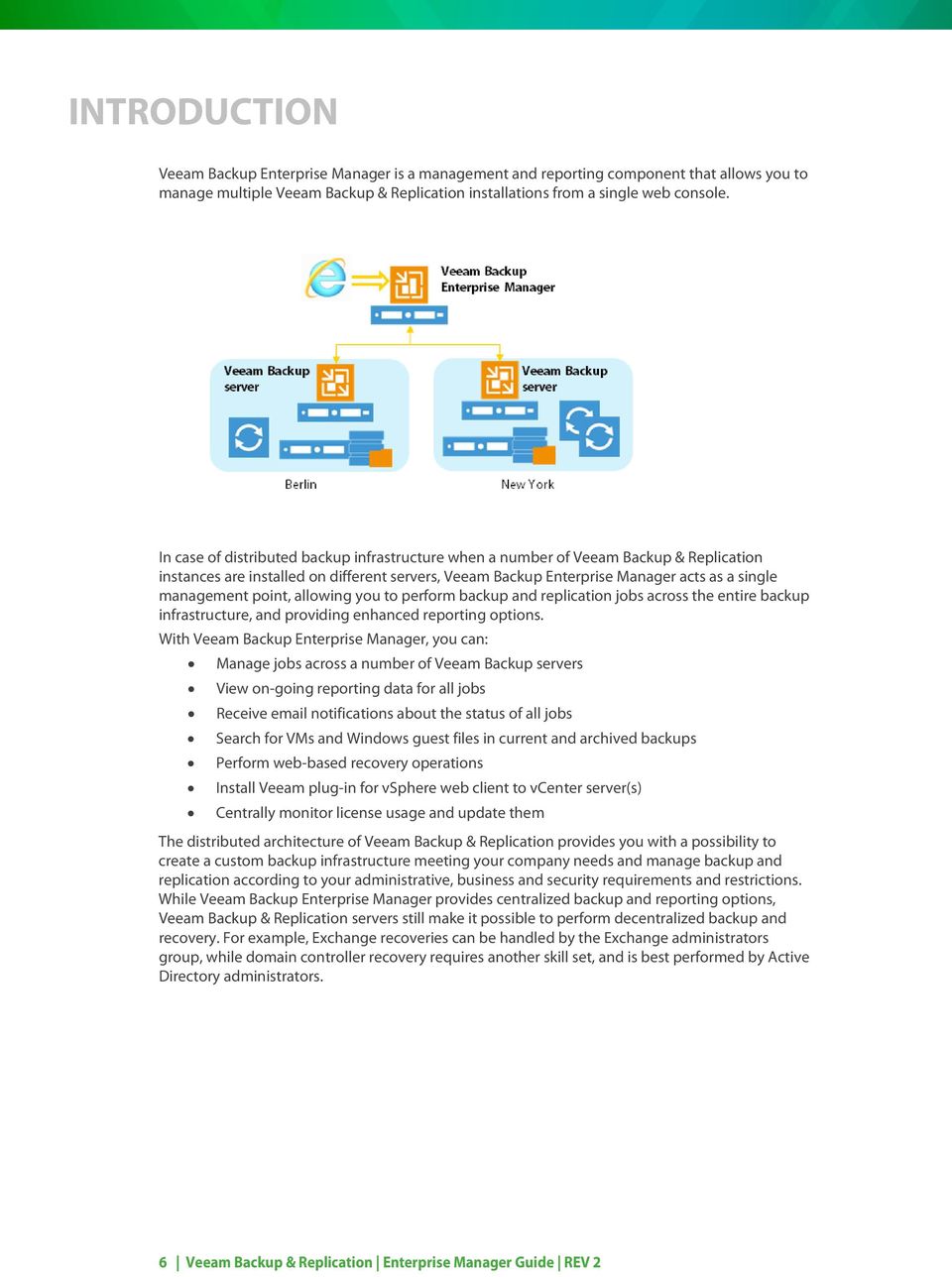
6 INTRODUCTION Veeam Backup Enterprise Manager is a management and reporting component that allows you to manage multiple Veeam Backup & Replication installations from a single web console. In case of distributed backup infrastructure when a number of Veeam Backup & Replication instances are installed on different servers, Veeam Backup Enterprise Manager acts as a single management point, allowing you to perform backup and replication jobs across the entire backup infrastructure, and providing enhanced reporting options. With Veeam Backup Enterprise Manager, you can: Manage jobs across a number of Veeam Backup servers View on-going reporting data for all jobs Receive notifications about the status of all jobs Search for VMs and Windows guest files in current and archived backups Perform web-based recovery operations Install Veeam plug-in for vsphere web client to vcenter server(s) Centrally monitor license usage and update them The distributed architecture of Veeam Backup & Replication provides you with a possibility to create a custom backup infrastructure meeting your company needs and manage backup and replication according to your administrative, business and security requirements and restrictions. While Veeam Backup Enterprise Manager provides centralized backup and reporting options, Veeam Backup & Replication servers still make it possible to perform decentralized backup and recovery. For example, Exchange recoveries can be handled by the Exchange administrators group, while domain controller recovery requires another skill set, and is best performed by Active Directory administrators. 6 Veeam Backup & Replication Enterprise Manager Guide REV 2
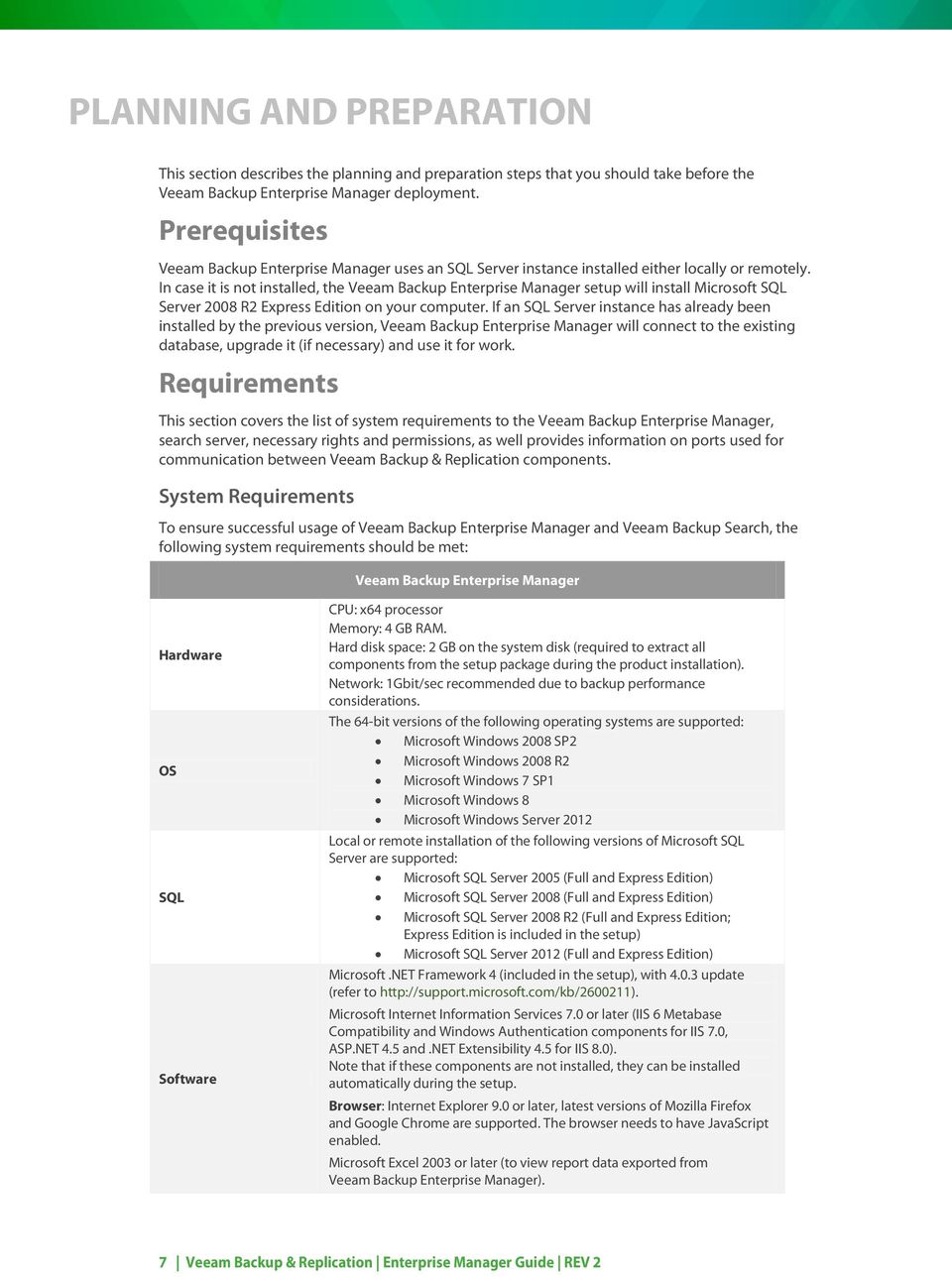
7 PLANNING AND PREPARATION This section describes the planning and preparation steps that you should take before the Veeam Backup Enterprise Manager deployment. Prerequisites Veeam Backup Enterprise Manager uses an SQL Server instance installed either locally or remotely. In case it is not installed, the Veeam Backup Enterprise Manager setup will install Microsoft SQL Server 2008 R2 Express Edition on your computer. If an SQL Server instance has already been installed by the previous version, Veeam Backup Enterprise Manager will connect to the existing database, upgrade it (if necessary) and use it for work. Requirements This section covers the list of system requirements to the Veeam Backup Enterprise Manager, search server, necessary rights and permissions, as well provides information on ports used for communication between Veeam Backup & Replication components. System Requirements To ensure successful usage of Veeam Backup Enterprise Manager and Veeam Backup Search, the following system requirements should be met: Veeam Backup Enterprise Manager Hardware OS SQL Software CPU: x64 processor Memory: 4 GB RAM. Hard disk space: 2 GB on the system disk (required to extract all components from the setup package during the product installation). Network: 1Gbit/sec recommended due to backup performance considerations. The 64-bit versions of the following operating systems are supported: Microsoft Windows 2008 SP2 Microsoft Windows 2008 R2 Microsoft Windows 7 SP1 Microsoft Windows 8 Microsoft Windows Server 2012 Local or remote installation of the following versions of Microsoft SQL Server are supported: Microsoft SQL Server 2005 (Full and Express Edition) Microsoft SQL Server 2008 (Full and Express Edition) Microsoft SQL Server 2008 R2 (Full and Express Edition; Express Edition is included in the setup) Microsoft SQL Server 2012 (Full and Express Edition) Microsoft.NET Framework 4 (included in the setup), with update (refer to Microsoft Internet Information Services 7.0 or later (IIS 6 Metabase Compatibility and Windows Authentication components for IIS 7.0, ASP.NET 4.5 and.net Extensibility 4.5 for IIS 8.0). Note that if these components are not installed, they can be installed automatically during the setup. Browser: Internet Explorer 9.0 or later, latest versions of Mozilla Firefox and Google Chrome are supported. The browser needs to have JavaScript enabled. Microsoft Excel 2003 or later (to view report data exported from Veeam Backup Enterprise Manager). 7 Veeam Backup & Replication Enterprise Manager Guide REV 2
8 Veeam Backup Search Hardware OS Software Refer to corresponding Microsoft Search Server version system requirements. Both 32-bit and 64-bit versions of the following operating systems: Microsoft Windows Server Microsoft Windows Server Microsoft Windows Server 2008 R2. All the latest service packs and security updates should be installed. Microsoft Search Server 2008 (including Express edition) Microsoft Search Server 2010 (including Express edition) Required Permissions The accounts used for installing and using Veeam Backup Enterprise Manager and Veeam Backup Search should have the following permissions: Account Veeam Backup Enterprise Manager Veeam Backup Search Server Required Permission Local Administrator permissions on the Veeam Backup Enterprise Manager server are required to install Veeam Backup Enterprise Manager. To be able to work with Veeam Backup Enterprise Manager, users should be assigned the Portal Administrator, Portal User or Restore Operator role (see Configuring Security Settings section below). Local Administrator permissions on the Veeam Backup Search Server console are required to install Microsoft Search Server and the Veeam Backup Search component Used Ports The following ports must be opened for Veeam Backup Enterprise Manager connections: From To Protocol Port Notes Veeam Backup Enterprise Manager IIS extension Browser Veeam Backup Server Microsoft Search Server Veeam Backup Enterprise Manager IIS extension TCP 9392 TCP to 2600 TCP 9395 TCP 9394 TCP 9393 Default port used by Veeam Backup Enterprise Manager for collecting data from Veeam Backup servers. Can be customized during Veeam Backup & Replication installation. Default port used by the Veeam Backup Catalog Data Service for catalog replication. Can be customized during Veeam Backup & Replication installation. Ports used by the Veeam Backup Catalog Data Service for replicating catalog data. Default port used by the Veeam Backup Search Service integration component. Can be customized during Veeam Backup Search installation. Default port used by IIS extension to communicate with Enterprise Manager. Can be customized during Enterprise Manager installation. Default port used to enable file search. Can be customized during Enterprise Manager installation. HTTP 9080 Default ports used to communicate with the website. Can be customized during HTTPS 9443 Enterprise Manager installation. 8 Veeam Backup & Replication Enterprise Manager Guide REV 2
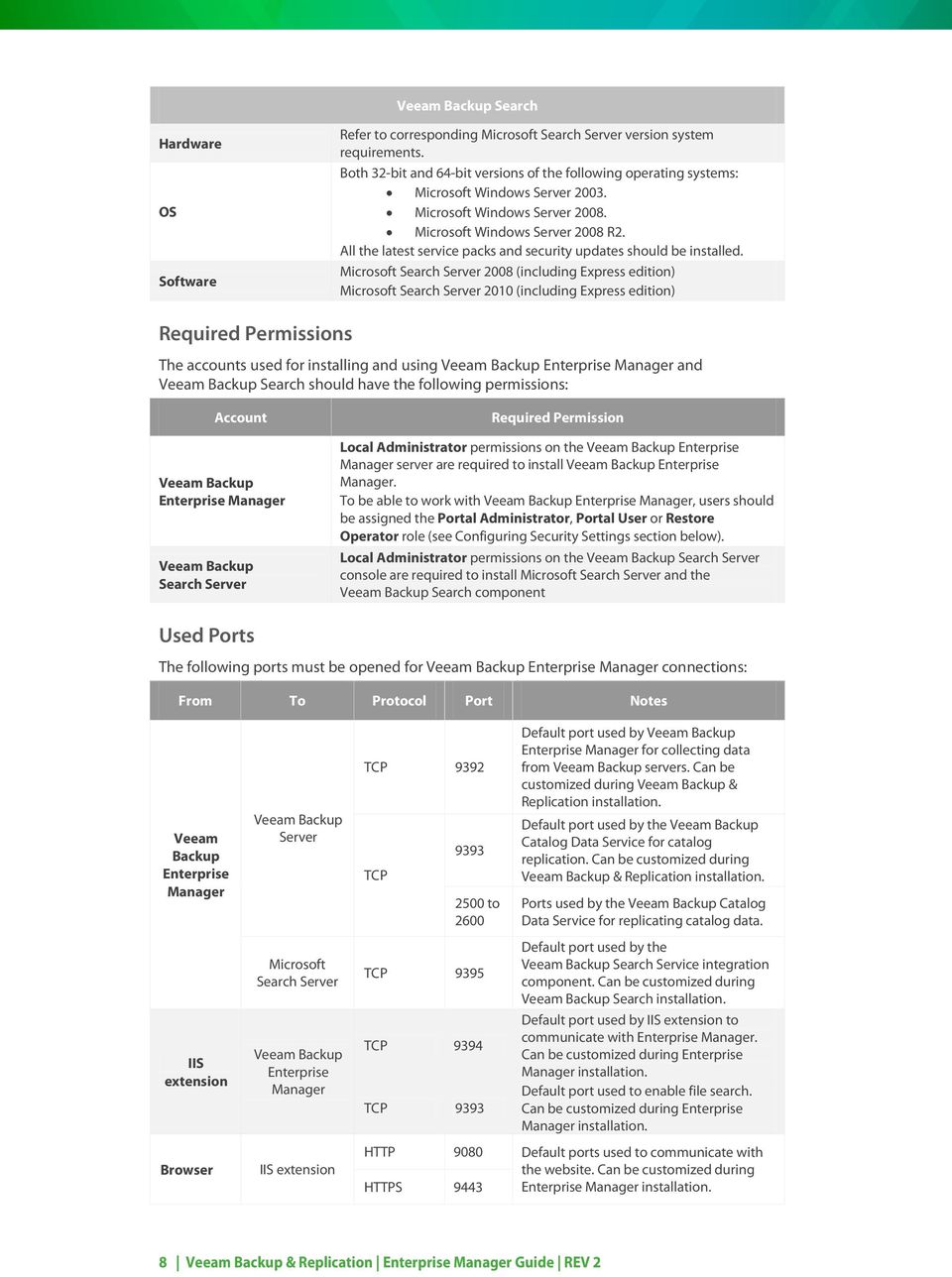
9 Restful API client Veeam Backup Restful API HTTP 9399 HTTPS 9398 Default ports used to communicate with Veeam Backup Restful API Service. Can be customized during Enterprise Manager installation. During installation, Veeam Backup & Replication automatically creates firewall rules for default ports to allow communication for the application components. 9 Veeam Backup & Replication Enterprise Manager Guide REV 2

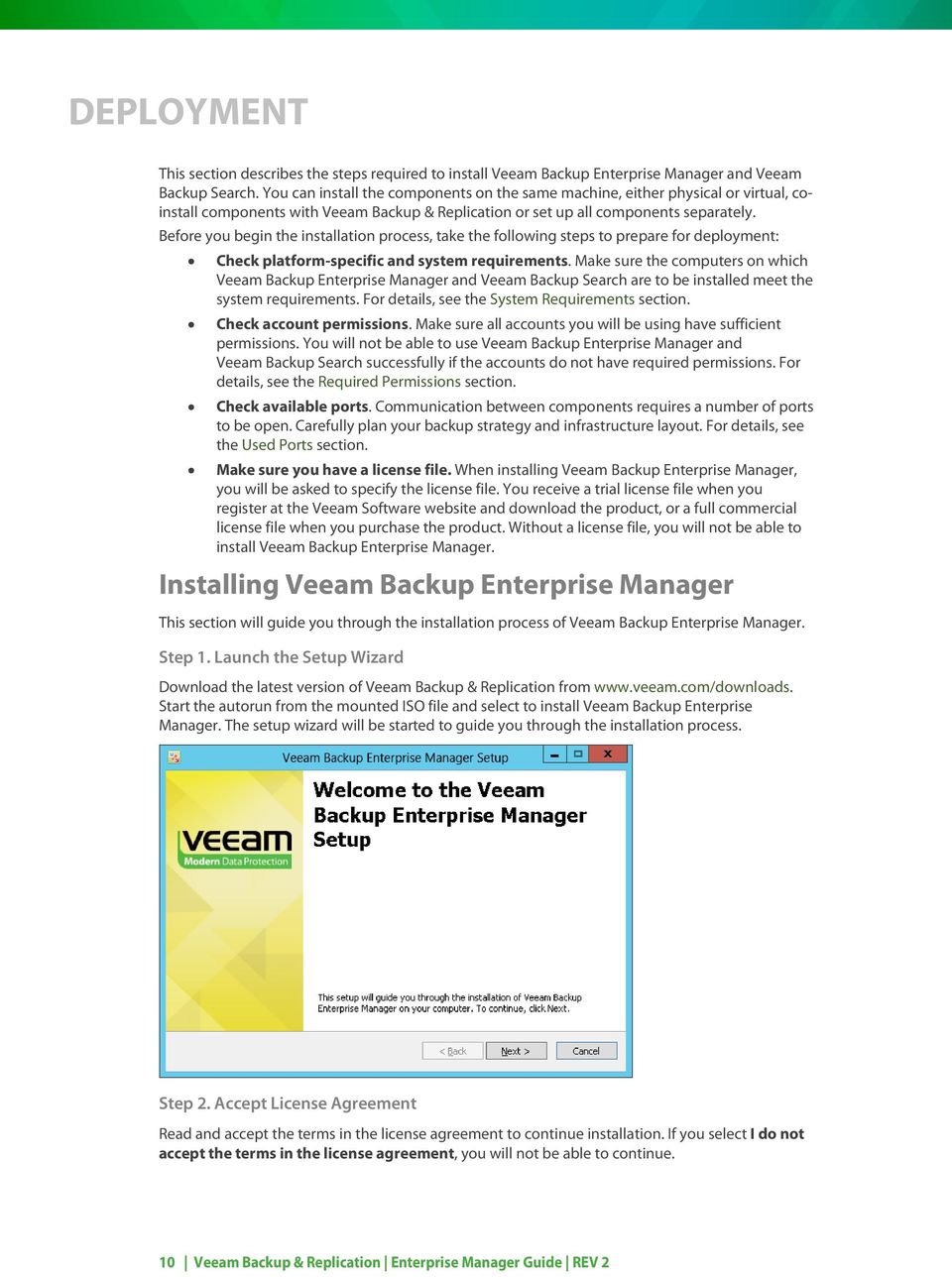
10 DEPLOYMENT This section describes the steps required to install Veeam Backup Enterprise Manager and Veeam Backup Search. You can install the components on the same machine, either physical or virtual, coinstall components with Veeam Backup & Replication or set up all components separately. Before you begin the installation process, take the following steps to prepare for deployment: Check platform-specific and system requirements. Make sure the computers on which Veeam Backup Enterprise Manager and Veeam Backup Search are to be installed meet the system requirements. For details, see the System Requirements section. Check account permissions. Make sure all accounts you will be using have sufficient permissions. You will not be able to use Veeam Backup Enterprise Manager and Veeam Backup Search successfully if the accounts do not have required permissions. For details, see the Required Permissions section. Check available ports. Communication between components requires a number of ports to be open. Carefully plan your backup strategy and infrastructure layout. For details, see the Used Ports section. Make sure you have a license file. When installing Veeam Backup Enterprise Manager, you will be asked to specify the license file. You receive a trial license file when you register at the Veeam Software website and download the product, or a full commercial license file when you purchase the product. Without a license file, you will not be able to install Veeam Backup Enterprise Manager. Installing Veeam Backup Enterprise Manager This section will guide you through the installation process of Veeam Backup Enterprise Manager. Step 1. Launch the Setup Wizard Download the latest version of Veeam Backup & Replication from Start the autorun from the mounted ISO file and select to install Veeam Backup Enterprise Manager. The setup wizard will be started to guide you through the installation process. Step 2. Accept License Agreement Read and accept the terms in the license agreement to continue installation. If you select I do not accept the terms in the license agreement, you will not be able to continue. 10 Veeam Backup & Replication Enterprise Manager Guide REV 2
11 Step 3. Install a License At this step, specify a valid license that was sent to you after registration. Click Browse and select the necessary.lic file. Step 4. Select Program Features and Choose Destination The Enterprise Manager setup installs Veeam Backup Enterprise Manager feature, which includes Enterprise Manager Web Site and Veeam Backup Enterprise Manager Server, and Veeam Backup Catalog. Note If you are installing Veeam Backup Enterprise Manager on the Veeam Backup & Replication machine where Veeam Backup Catalog is already installed, Veeam Backup Catalog will be excluded from the list of components. Use the Browse button to specify the desired installation folder for installed components. 11 Veeam Backup & Replication Enterprise Manager Guide REV 2
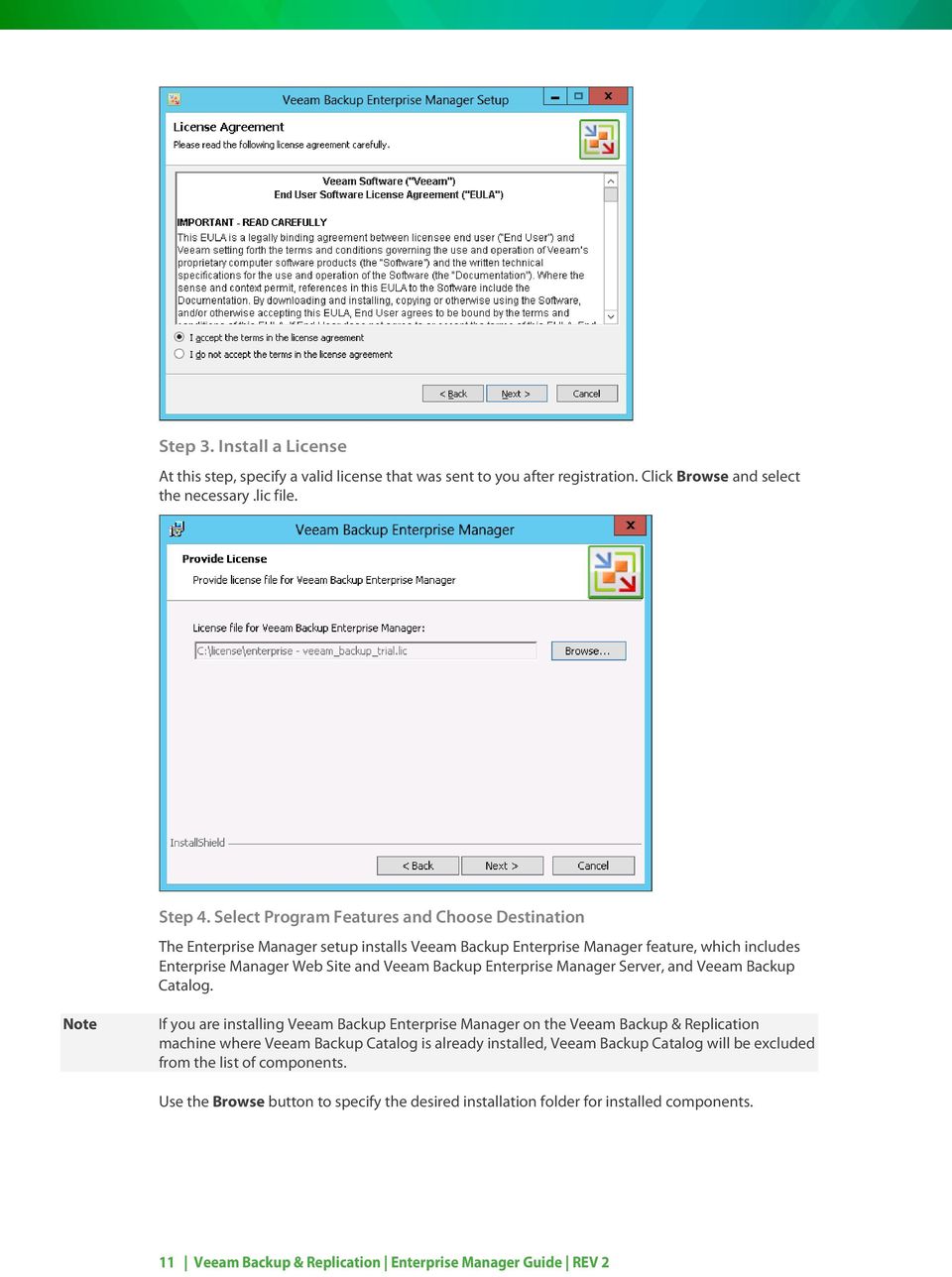
12 Before proceeding with the installation, the installer will perform system configuration check to determine if all prerequisite software is available on the machine. To learn what software is required for the installation, see the System Requirements section. If some of the required software components are missing, the wizard will offer you to install missing software automatically. To install software components in the current session without interrupting the setup, click the Install button. If you cancel automatic installation, you should install and enable the missing software manually; otherwise, you will not be able to proceed to the next step. You can re-run verification after installing required components manually. Step 5. Specify Service Credentials Specify credentials for the user account under which you want to run the Veeam Backup Enterprise Manager Service. This user account must have: Database owner rights for the Veeam Backup Enterprise Manager database on the SQL Server instance Full Control NTFS permissions for the VBRCatalog folder where index files are stored. 12 Veeam Backup & Replication Enterprise Manager Guide REV 2
13 The Log on as service right will be automatically granted to the specified user account. The user name should be specified in the DOMAIN\USERNAME format. Step 6. Set Up a Database to Be Used At this step, you should select an SQL Server instance to be used by Veeam Backup Enterprise Manager. You can use the same SQL Server for both Veeam Backup & Replication and Veeam Backup Enterprise Manager. If a SQL Server is not installed, select the Install new instance of SQL Server option. If a SQL Server is already installed, select the Use existing instance of SQL Server option. Enter the instance name in the HOSTNAME\INSTANCE format and specify the name of the database to be used. Note If the setup detects a VEEAMSQL2008R2 SQL server instance that meets the Veeam Backup Enterprise Manager system requirements on your machine, you can only use the existing local SQL Server instance or choose the one that runs remotely. The option to install a new SQL instance will be unavailable in this case. 13 Veeam Backup & Replication Enterprise Manager Guide REV 2

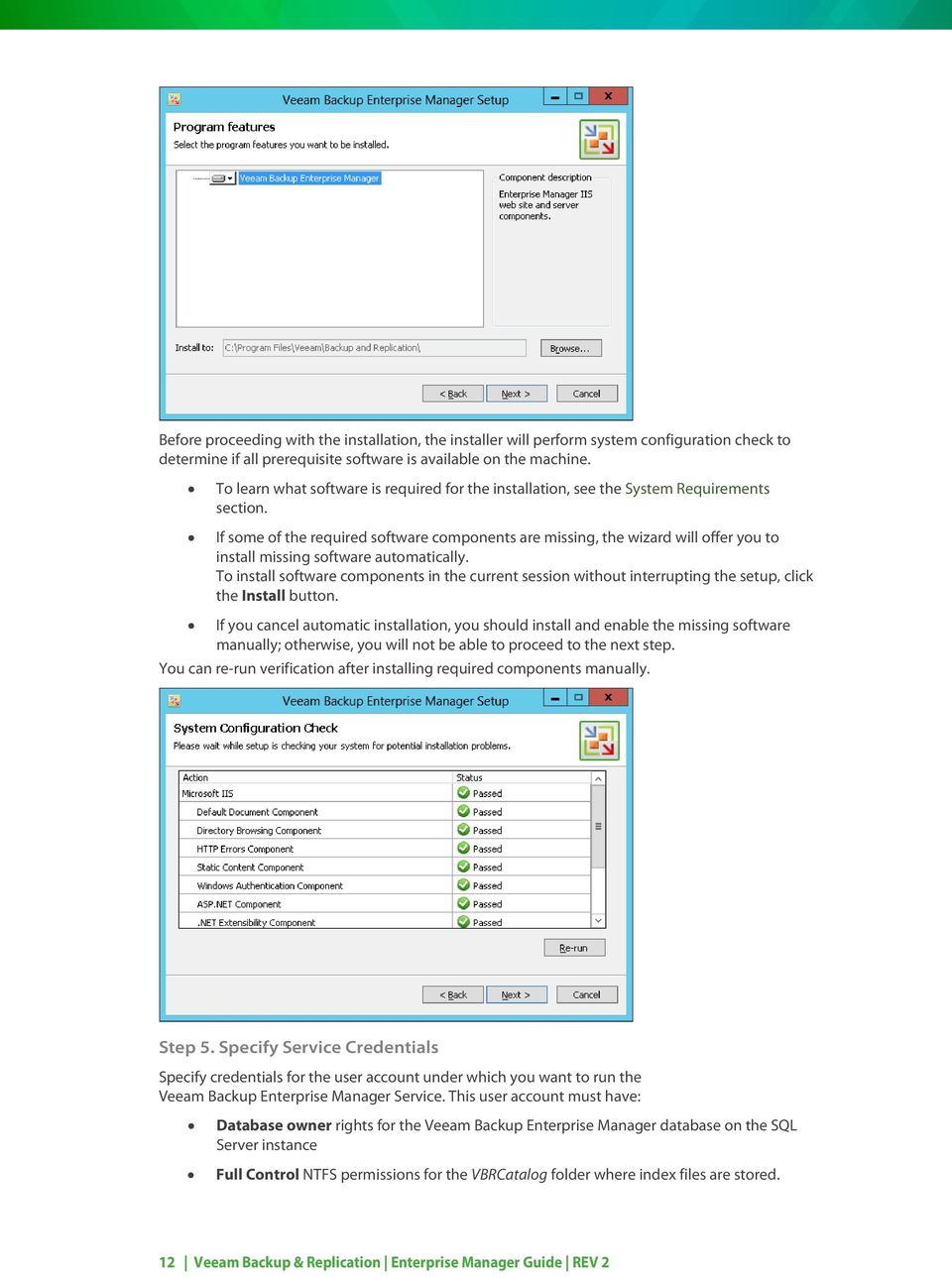
14 Step 7. Specify Enterprise Manager Ports Provide HTTP and HTTPS port numbers and select the certificate to be used by Veeam Backup Enterprise Manager service and RestAPI service. This certificate is needed to establish secure communication with the Enterprise Manager website using HTTPS (default port 9443); Veeam plug-in for vsphere Web Client and RestAPI client also will use this certificate to receive data using HTTPS protocol (default port 9398). If the setup wizard does not find an appropriate certificate to be used, it will generate a self-signed certificate. Click View certificate to review the details of the selected certificate. Step 8. Install Veeam Backup Enterprise Manager You can go back, review and modify previous steps using the Back button. If you are sure that all settings are configured correctly, click Install to begin the installation. When the installation completes, click Finish to exit the setup wizard. You can now open the Veeam Backup Enterprise Manager website. 14 Veeam Backup & Replication Enterprise Manager Guide REV 2
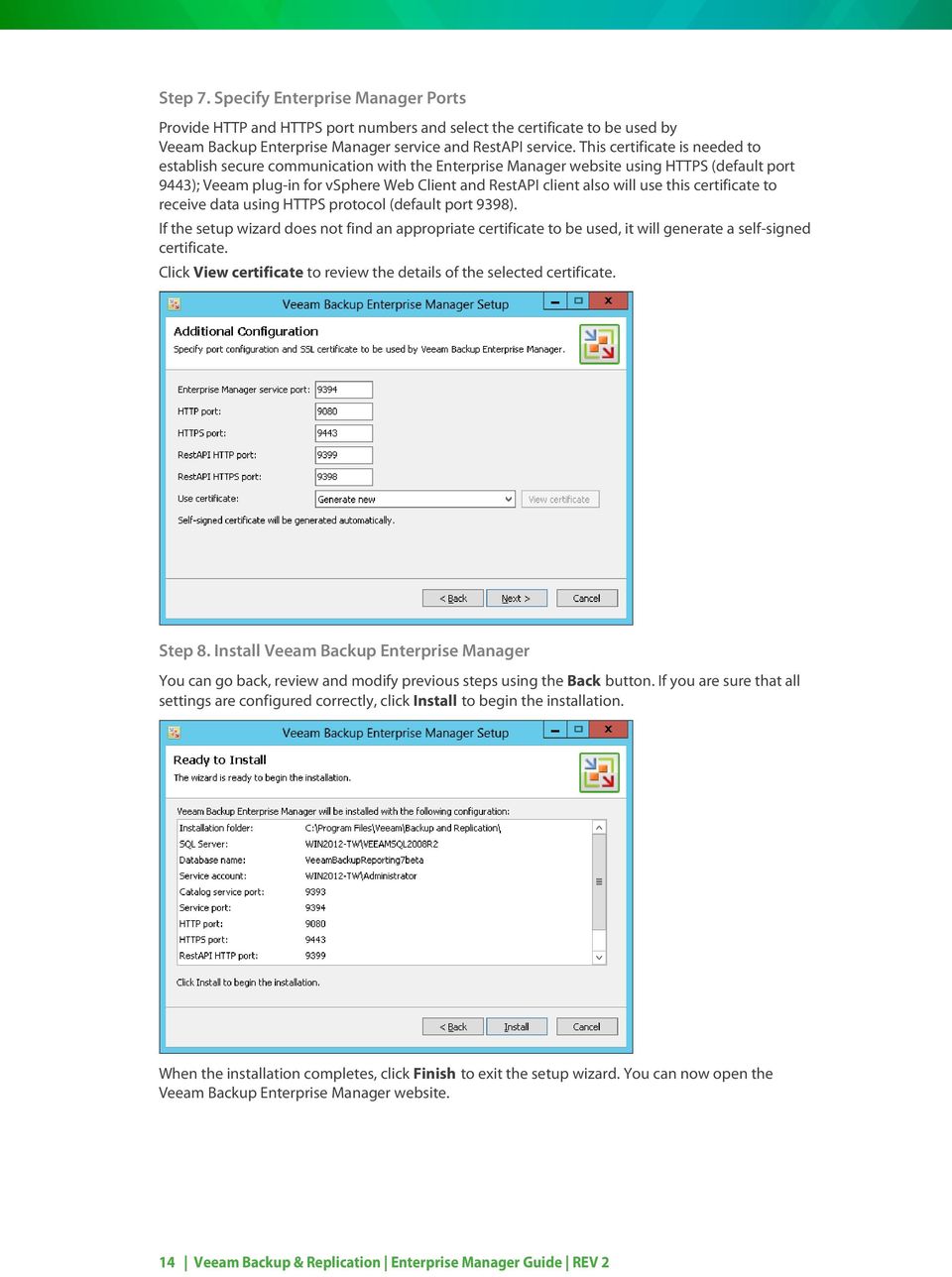
15 Installing Veeam Backup Search Veeam Backup Search is an optional component that is installed on a dedicated Microsoft Search Server in case you need to search through VM guest OS files search in large-scale virtual deployments, using sophisticated search criteria. Veeam Backup Search is not required if you have a relatively small number of backups: in this case, Veeam Backup Enterprise Manager can process indexing data by itself. This section will guide you through the installation process of Veeam Backup Search. Step 1. Install Microsoft Search Server Select a machine which will function as a search server and install Microsoft Search Server on this machine. Keep in mind that Microsoft Search Server can be installed on Windows Server machine only. Note Microsoft Search Server must be installed by a user who has administrator permissions on the computer. To learn more about hardware and software requirements for Microsoft Search Server, see (for Microsoft Search Server 2008) and (for Microsoft Search Server 2010). Step 2. Run Veeam Backup Search Setup On the machine where Microsoft Search Server is installed, run the setup file (Veeam_Backup_Search_Setup_x86.exe or Veeam_Backup_Search Setup_x64.exe) located in the Search folder of the mounted Veeam Backup & Replication installation image (.iso file) or the installation CD/DVD. Step 3. Accept License Agreement Read and accept the terms in the license agreement to continue installation. If you select I do not accept the terms in the license agreement, the installation process will be terminated. 15 Veeam Backup & Replication Enterprise Manager Guide REV 2
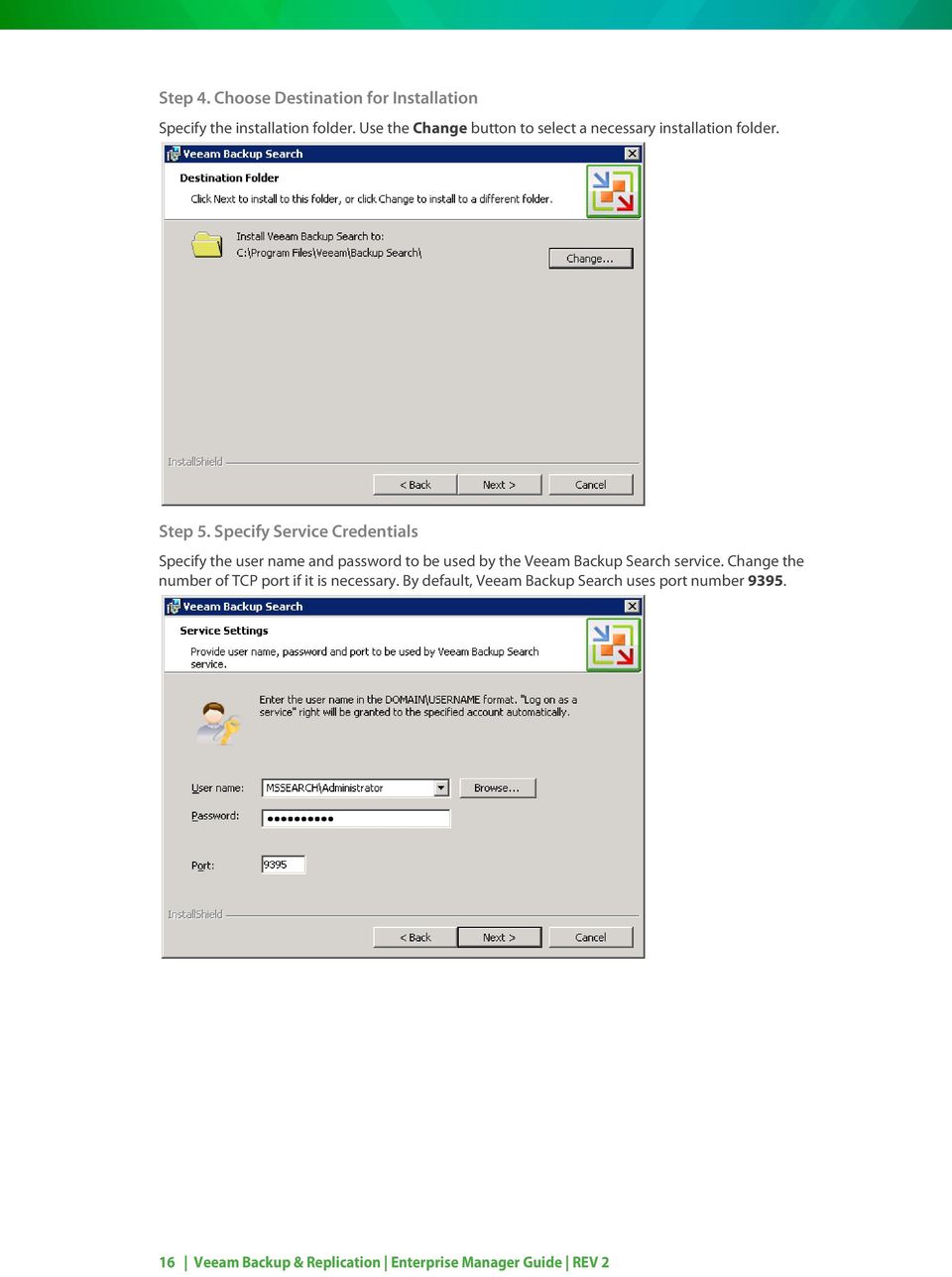
16 Step 4. Choose Destination for Installation Specify the installation folder. Use the Change button to select a necessary installation folder. Step 5. Specify Service Credentials Specify the user name and password to be used by the Veeam Backup Search service. Change the number of TCP port if it is necessary. By default, Veeam Backup Search uses port number Veeam Backup & Replication Enterprise Manager Guide REV 2
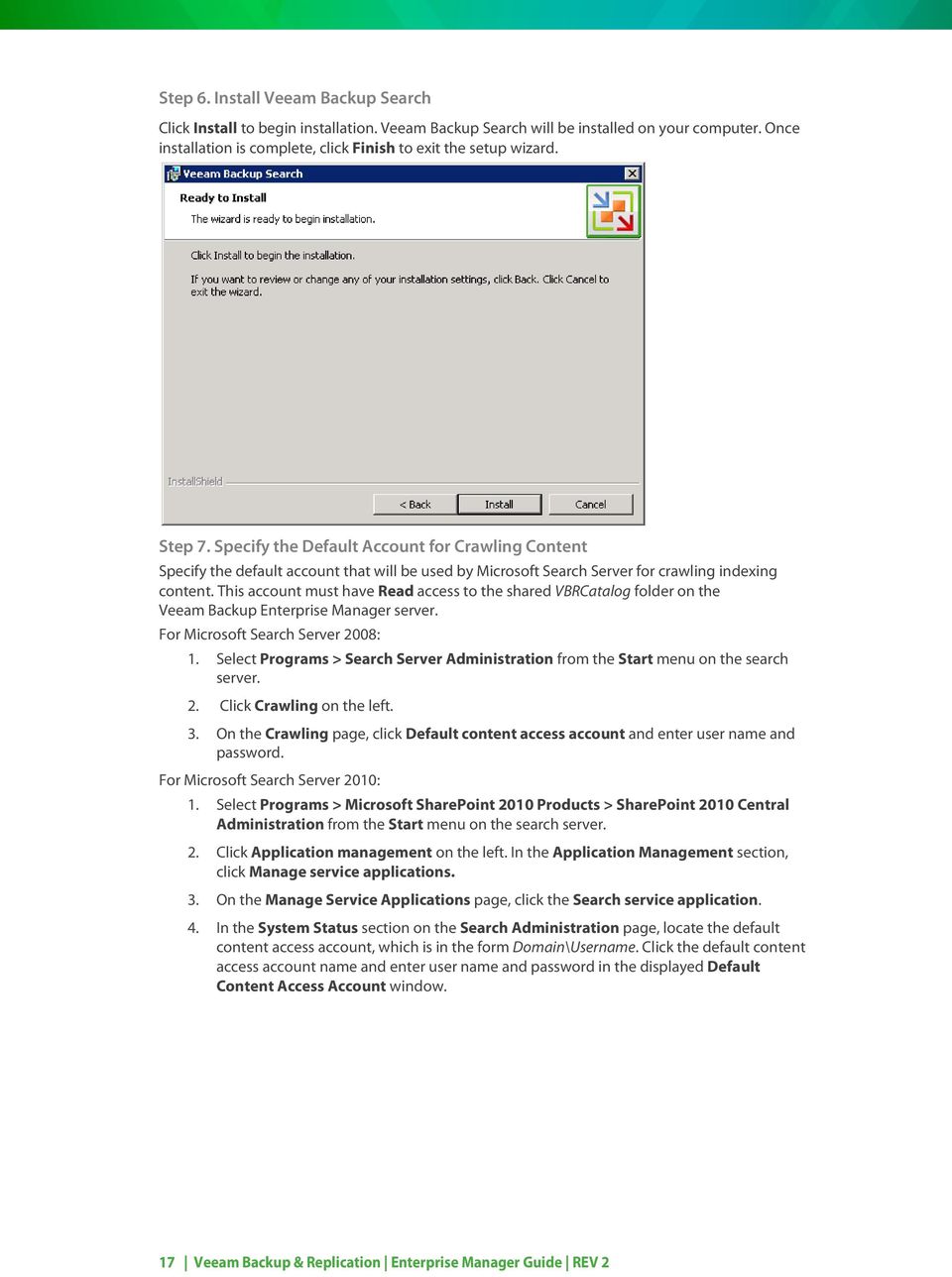
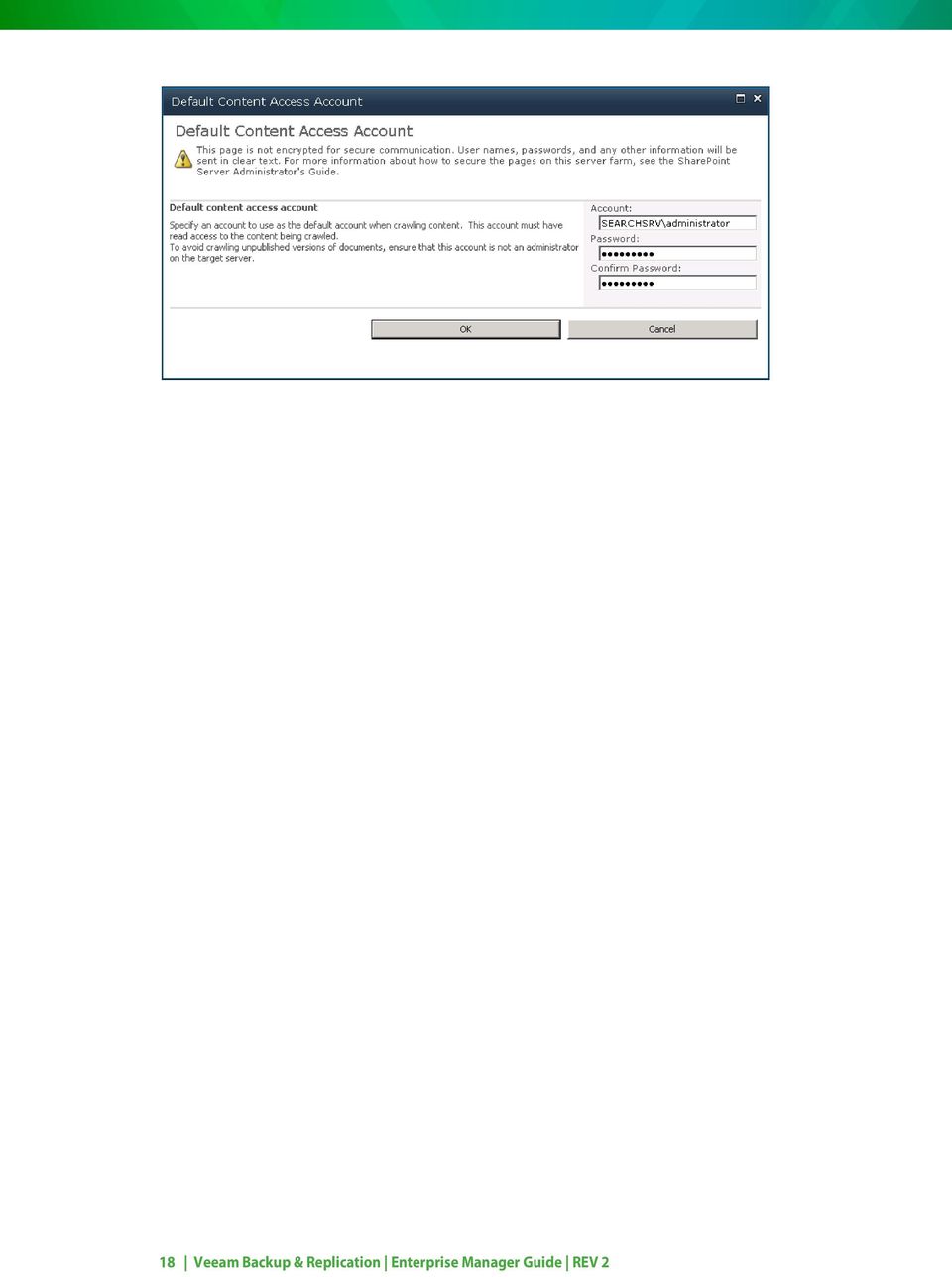
17 Step 6. Install Veeam Backup Search Click Install to begin installation. Veeam Backup Search will be installed on your computer. Once installation is complete, click Finish to exit the setup wizard. Step 7. Specify the Default Account for Crawling Content Specify the default account that will be used by Microsoft Search Server for crawling indexing content. This account must have Read access to the shared VBRCatalog folder on the Veeam Backup Enterprise Manager server. For Microsoft Search Server 2008: 1. Select Programs > Search Server Administration from the Start menu on the search server. 2. Click Crawling on the left. 3. On the Crawling page, click Default content access account and enter user name and password. For Microsoft Search Server 2010: 1. Select Programs > Microsoft SharePoint 2010 Products > SharePoint 2010 Central Administration from the Start menu on the search server. 2. Click Application management on the left. In the Application Management section, click Manage service applications. 3. On the Manage Service Applications page, click the Search service application. 4. In the System Status section on the Search Administration page, locate the default content access account, which is in the form Domain\Username. Click the default content access account name and enter user name and password in the displayed Default Content Access Account window. 17 Veeam Backup & Replication Enterprise Manager Guide REV 2
18 18 Veeam Backup & Replication Enterprise Manager Guide REV 2
19 ADMINISTRATION This section describes all types of administration and management tasks performed with Veeam Backup Enterprise Manager: initial configuration, centralized license and job management, reporting, searching for and restoring guest OS files. Initial Configuration When you start Veeam Backup Enterprise Manager for the first time, you should perform a number of configuration tasks which are required to start using the management and reporting functions. Note that the initial configuration tasks can be performed either by the user who installed Veeam Backup Enterprise Manager or any of the users listed in the local Administrators group (these accounts are automatically included into Portal Administrators group). To start working with Veeam Backup Enterprise Manager, perform the following steps: 1. Log in to the Veeam Backup Enterprise Manager website. For details, see the Accessing the Management Website section. 2. Add Veeam Backup servers you want to manage. For details, see the Adding Veeam Backup Servers section. 3. Retrieve data from added backup servers. For details, see the Collecting Data from Backup Servers section. 4. Assign Portal Administrator, Restore Operator or Portal User roles to users who will be working with Veeam Backup Enterprise Manager. For details, see the Configuring Security Settings section. 5. Provide notification settings to be able to receive s with summary on performed backup and replication jobs, lab request status changes and file restore operations. For details, see the Configuring Notification Settings section. Once you have performed initial configuration, you can start working with managed backup servers. Accessing the Management Website To access the Veeam Backup Enterprise Manager website, double-click the Veeam Backup Enterprise Manager icon on the desktop or select Programs > Veeam > Veeam Backup Enterprise Manager from the Start menu. Alternatively, if you are starting Veeam Backup Enterprise Manager website remotely, open your web browser and enter the host name and connection port in the address bar: For example: After the Veeam Backup Enterprise Manager website has loaded, you will be prompted to log in. When connecting for the first time, you will need to log in with administrative rights to perform initial configuration. For that, enter the credentials of the user account with local administrator rights (that is, a member of the local Administrators group) or the user account which was used to install Veeam Backup Enterprise Manager and click Login. Adding Veeam Backup Servers To start working with backup servers, you should add to Veeam Backup Enterprise Manager all Veeam Backup servers you want to manage: 1. Open the Configuration tab. 2. Open the Backup Servers section on the left of the Configuration view. 19 Veeam Backup & Replication Enterprise Manager Guide REV 2
20 3. Click Add at the top of the Backup Servers section. 4. In the Backup Server Settings window, enter a full DNS name or IP address of the server you want to add, and provide server description. 5. By default, the account under which Veeam Backup Enterprise Manager service is running will be used for interacting with the added backup server. If this account does not have administrative rights on the backup server you want to add, select the Use these credentials check box and provide name and password of the user with administrative rights on the added server. 6. Specify the port used by Veeam Backup Service. By default, port 9392 is used. 7. Click OK to add the server. To edit the settings of a server after it was added, select it in the Backup Servers list and click Edit on the toolbar. Then change the server connection settings as required. To delete an added backup server, select it in the Backup Servers list and click Remove on the toolbar. Collecting Data from Backup Servers Veeam Backup Enterprise Manager retrieves data from added backup servers using a data collection job. This job represents a task for collecting information about backup and replication jobs from SQL database(s) used by backup servers. Collected data is stored to the Veeam Backup Enterprise Manager SQL backend and can be accessed by multiple users via the management website. There are two options for running the data collection job: By default, Veeam Backup Enterprise Manager is configured to automatically collect data from added backup servers every 15 minutes. To change this interval, select Backup Servers on the left of the Configuration view and click Schedule on the toolbar. In the Data Collection Settings window, specify the desired interval next to the selected Periodically every option. To disable automatic running of the data collection job, select Manually. Note It is recommended to use automatic, scheduled data collection in order to ensure timely synchronization and update of the information presented to users. To start the data collection job manually at any time, select Backup Servers on the left of the Configuration view and click Start Collecting on the toolbar. 20 Veeam Backup & Replication Enterprise Manager Guide REV 2

21 Note When a data collection job is run, data from all added backup servers is collected at once. Every run of a data collection job initiates a new job session. To view details on job sessions, click Sessions on the left of the Configuration view. In the list of sessions, select the one you need and follow the click here link in the Log column. 21 Veeam Backup & Replication Enterprise Manager Guide REV 2
22 Configuring Security Settings To configure a security scheme for distributed backup infrastructure with Veeam Backup Enterprise Manager, you should assign roles to users working with the Veeam Backup Enterprise Manager portal and Veeam Backup servers. Veeam Backup Enterprise Manager Roles Veeam Backup Enterprise Manager implements security by limiting access to web management website features and data based on user roles. This empowers administrators to delegate permissions in a very granular way, on an as-needed basis, to the individuals who will complete the restore process. It is possible, for example, to delegate permissions to recover files without actually being able to see the contents of the files. Delegations can be made to users which will allow recovery across the virtual spectrum from individual files all the way through to the recovery of the entire VM. To be able to log in to the Veeam Backup Enterprise Manager website, the user must have the Portal Administrator, Restore Operator or Portal User role assigned. Users with the Portal Administrator role have full access to all administrative functions and configuration settings; they can browse, search and restore all VMs and files. The Configuration area is not accessible for Restore Operators and Portal Users. Users with the Portal User or Restore Operator role can access their restore scope list of VMs that can be recovered by appropriate personnel. For example, database administrators can restore database servers (SQL, Oracle, or other) this is their restore scope; Exchange administrators restore scope will include Exchange server VM, and so on. Depending on their role, non-administrative users can access the VMs and/or Files tab of Enterprise Manager web site. Important Restore scope (list of available VMs) can be customized if you have Enterprise Plus edition of Veeam Backup & Replication; in other editions, this list includes all VMs and cannot be customized. However, you can delegate recovery of entire VMs, guest files, or selected file types. Possible delegation options are described later in this section. Users with Restore Operator role can access VMs from their restore scope in VMs and/or Files tab and perform restore operations as permitted by their settings. Users with Portal User role can access VMs from their restore scope in VMs and/or Files tab, as well as reports for these VMs; they also can perform restore operations as permitted by their settings. Note By default, the Portal Administrator role is assigned to users listed in the local Administrators group and the user who installed Veeam Backup Enterprise Manager. To specify security settings for a user or a group of users: 1. Open the Configuration tab. 2. Open the Roles section on the left of the Configuration view. 3. Click Add on the toolbar. 22 Veeam Backup & Replication Enterprise Manager Guide REV 2
23 4. In the Account type field, select the type of account you want to add: User or Group. 5. In the Account field, specify the user account in the DOMAIN\Username format. 6. From the Role list, select the necessary portal role to be assigned: Portal User, Portal Administrator or Restore Operator. You can allow a new user to restore entire virtual machines and/or guest files only; you can also specify the Restore scope for this account, as described in the section below. To edit settings of a user or group, you can select it in the list of roles in the Configuration view and click Edit on the toolbar. To delete a user or group, select it in the list and click the Remove button on the toolbar. Configuring Restore Scope Default restore scope for users with non-administrative role includes All virtual machines from available backups. If you have Enterprise Plus edition of Veeam Backup & Replication deployed in your environment, you can customize restore scope for non-administrative users. To narrow the restore scope, when creating or editing the profile of a Portal User or Restore Operator, do the following in the Account dialog: 1. Choose Selected virtual machines only option, and click the Choose button : 2. In the Manage scope objects dialog, click Add object and select what virtual infrastructure objects to display: Hyper-V, vsphere or vcloud. 3. Then choose the VI objects you allow user to restore: 23 Veeam Backup & Replication Enterprise Manager Guide REV 2
24 Note For VMware objects, you can switch between Hosts & clusters, VMs & templates and Datastores & VMs views. 4. Click OK to save the settings. Users then will be able to view the VMs and/or files included in their scope on the corresponding tabs after they log in to Enterprise Manager. Note The VMs tab displays only virtual machines that have been backed up, and Files tab displays guest OS files only for virtual machines that have been backed up with guest file indexing enabled. For more information, please refer to Preparing for File Browsing and Searching section of this guide. Restore scope is automatically refreshed daily on built-in schedule and also after any role modification. It may happen that some newly created VMs and backups are not yet presented to users in the VMs or Files tab right after the login to Enterprise Manager. If so, a user can click the corresponding link ( I don t see my VM ) to refresh the view. 24 Veeam Backup & Replication Enterprise Manager Guide REV 2
25 Administrative user can refresh all scopes of all accounts manually for that, in the Roles section of Configuration page, click Rebuild roles. Again, consider that this operation will affect all configured roles. Portal Administrator can watch the progress of security scope rebuild process on the Sessions page. Configuring Restrictions for Restore Operations By default, users can restore all types of files from available backups. Files can be restored to two possible destinations a restore operator can choose to download files to the local machine or restore a file directly to the original location (that is, the original VM). For security purposes, you can configure additional restrictions for restore operations for example, narrow the list of file types that operators can restore, or prohibit operators to download restored files. To configure additional restrictions for restore operations, do the following when creating or editing user account: 1. In the Allow restore of section, enable the required restrictions: Select the Entire virtual machines checkbox to allow for restore of entire VMs included in user s restore scope. Select the Guest files checkbox to allow for the restore of guest OS files the following options will then become available: o Allow in-place file level restores only option selected will disable the Download option for users performing file restore. With this restriction enabled, users will only be able to restore files to the original location. Restored files will be available to the accounts having access to the original VM. o Allow restore of files with these extensions only option allows you to define which file types can be restored by users. In the text box, list extensions for allowed file types, separated by commas. 2. Click OK to save the changes. 25 Veeam Backup & Replication Enterprise Manager Guide REV 2
26 Veeam Backup & Replication Server Roles In addition to security settings for the management website, you need to configure security settings for every Veeam Backup server added to Veeam Backup Enterprise Manager. Security settings for Veeam Backup servers are used to authenticate user administrative rights for three operations: collecting data from backup servers, managing backup and replication jobs and restoring files. To perform these tasks, Veeam Backup Enterprise Manager interacts with a Veeam Backup server using one of the following accounts: If a Veeam Backup server was added with the default security settings, the account under which the Veeam Enterprise Manager Service runs will be used to interact with the backup server. If a Veeam Backup server was added with other user credentials, the specified account will be used to interact with the backup server. To be able to retrieve data from a Veeam Backup server, manage backup and replication jobs and restore files, you need to include the account used to interact with the backup server into the Veeam Backup Administrators group on the backup server side. Alternatively, you can include the account into the local Administrators group on the backup server; in this case, the Veeam Backup Administrator role will be assigned to the account automatically. On the Veeam Backup server side, all operations are performed by Veeam Backup Service that verifies beforehand if the account that is used to interact with the backup server has rights to accomplish the necessary actions. To specify security settings on the backup server side: 1. Log on to the necessary Veeam Backup Server as Veeam Backup Administrator. 2. Select Users and Roles from the main menu of Veeam Backup & Replication. 3. Click Add. 4. In the User name field, specify the account that Veeam Backup Enterprise Manager will use to interact with this backup server. Enter the name of a user or group in the DOMAIN\Username format. 5. From the Role list, select the Veeam Backup Administrator role. To edit settings of an added user or group, select it in the list of roles and click Edit on the right. Then edit user or group settings as required. To delete an added user or group, select it in the list and click Remove on the right. 26 Veeam Backup & Replication Enterprise Manager Guide REV 2
27 Configuring Retention Settings Veeam Backup Enterprise Manager allows configuring retention settings for the index files as well as for the event history. To configure retention settings: 1. Open the Configuration tab. 2. Open the Settings section on the left of the Configuration view. 3. In the Retention period, months field within the Guest file system catalog section, specify how long index files must be stored on the Veeam Backup Enterprise Manager server. If you use the Standard license edition for Veeam Backup servers in your virtual environment, Veeam Backup Enterprise Manager will keep index files only for those backups that are currently stored on disk (that is, the backups are available on backup repositories). If you use the Enterprise or Enterprise Plus license edition for Veeam Backup servers in your virtual environment, Veeam Backup Enterprise Manager will keep index files for backups that are currently stored on disk as well as for archived backups (for example, backups that were moved from a repository to tape). Essentially this means, that even if a backup is no longer stored on a backup repository, you will still be able to search its contents for guest OS files. 4. In the Event history section, specify the period for which Veeam Backup Enterprise Manager should keep historical data available in the main working area of the Veeam Backup Enterprise Manager website. By default, retention period for session data is set to 52 weeks. You can enter another value, or select to Keep all. Important! Please note that the retention settings you specify in Veeam Backup Enterprise Manager are propagated to all Veeam Backup servers connected to it. These settings override the Session history retention values specified at the level of the Veeam Backup server. 27 Veeam Backup & Replication Enterprise Manager Guide REV 2
28 For example, if the retention options of the Veeam Backup server are configured to keep the session history for 50 weeks, and in Veeam Backup Enterprise Manager you select to Keep only last 30 weeks, the latter value will be propagated to the Veeam Backup server; so the history will be kept for 30 weeks. Configuring Notification Settings To be able to receive notifications with the summary of performed backup and replication jobs, lab request status changes and file restore operations, you should configure notification settings. For that, open the Configuration tab, then open the Notifications section on the left of the Configuration view. When you finish configuring notification settings, click Save in the upper-right corner of the Notification settings preview pane - to apply the changes. Server Settings 1. In the server settings section, specify a full DNS name or IP address of the SMTP server that will be used for sending messages with notifications. If necessary, change the port number which will be used to communicate with the mail server. By default, port number 25 is used. 2. If the SMTP server requires SSL connection, select Use SSL. 3. If the SMTP server requires authentication, select the Requires authentication check box and specify authentication credentials. 28 Veeam Backup & Replication Enterprise Manager Guide REV 2
29 Notifications on Job Results To receive daily notifications on the job results: 1. In the Job Summary section, select the Send daily notification at check box and specify the time at which a notification should be sent. 2. In the From field, enter an address of the notification sender. 3. In the To field, enter an address of the notification recipient. To specify multiple addresses, use a comma. 4. Enter a subject of notifications. You can use the following variables in the subject: %1 number of jobs that ended with errors for the last 24 hours %2 number of jobs that ended with warnings for the last 24 hours %3 number of jobs that ended successfully for the last 24 hours %4 number of jobs that ended with errors for the last session %5 number of jobs that ended with warnings for the last session %6 number of jobs that ended successfully for the last session 29 Veeam Backup & Replication Enterprise Manager Guide REV 2
30 A notification will contain a report about the number of jobs performed with the Error, Warning and Success statuses, and provide a link to the Veeam Backup Enterprise Manager web UI so that you can see jobs statistics in detail. Note To verify that if you have configured settings correctly, use the corresponding Test button in each section. Veeam Backup Enterprise Manager will send a test to all specified addresses. Notifications on Lab Requests To receive notifications about lab requests: 1. In the Lab requests section, select the Send lab request notifications check box. 2. Specify the addresses of the notification sender and recipient(s), the subject of the message and statuses for which the notification should be sent. To specify multiple recipient addresses, use a comma. 30 Veeam Backup & Replication Enterprise Manager Guide REV 2
31 3. Select request statuses to be reported. Notifications on Restore Operations To receive notifications about performed file restore operations: 1. In the File restores section, select Send file restore notifications. 2. Specify the addresses of the notification sender and recipient(s). To specify multiple recipient addresses, use a comma. Notifications on License Expiration By default, you will receive notifications about support expiration, starting 14 days before the expiration date. Expiration information will be also shown in the License section and in the Enterprise Manager dashboards. To stop receiving the notification, select the Disable support expiration notifications checkbox. 31 Veeam Backup & Replication Enterprise Manager Guide REV 2
32 Configuring Dashboard Settings If required, you can customize the appearance of graphs in the main Veeam Backup Enterprise Manager view. 1. Open the Configuration tab. 2. Open the Site Settings section on the left of the Configuration view. 3. Use the Activity graph scale options to switch between graph types: Linear and Logarithmic. 4. By default, the time interval specified under the selected Show backup window check box is highlighted on the activity graph. You can change the highlighted interval to correlate with your planned backup window by editing the start and stop time. If you do not want to highlight the backup window on the graph, clear the Show backup window check box. 5. Save the changes. Managing Licenses Veeam Backup Enterprise Manager collects information about licenses installed on Veeam Backup servers connected to it. When Veeam Enterprise Manager replicates databases from backup servers, it also synchronizes license data (that is, checks if the license installed on the Veeam Backup server coincides with the license installed on the Veeam Backup Enterprise Manager server). If the licenses do not coincide, the license on the Veeam Backup server will be automatically updated with that on Veeam Backup Enterprise Manager. Using the Licensing section of Veeam Backup Enterprise Manager, you can manage and activate licenses for the whole backup infrastructure from a single web console and thus reduce administration overhead. Viewing and Changing the Current License To work with licenses for backup servers added to Veeam Backup Enterprise Manager: 1. Log on to Veeam Backup Enterprise Manager using an account with the Portal Administrator role. 32 Veeam Backup & Replication Enterprise Manager Guide REV 2
33 2. Open the Configuration tab. 3. Click Configuration in the upper right corner of the window. 4. Open the Licensing section on the left of the Configuration view. 5. The upper pane of the Licensing section displays the following information on the license installed on Enterprise Manager server: license edition (Standard, Enterprise or Enterprise Plus), the number of used sockets and the total number of licensed sockets for the vsphere and Hyper-V platforms. To update a license, click Change license and select the necessary.lic file. 6. To display detailed information about the current license, click License info. Revoking Licensed Hosts Veeam Backup & Replication is licensed per CPU Socket ("CPU Sockets") for every managed server. For more information on licensing, please refer to Veeam Backup & Replication FAQ - licensing, system requirements on Veeam website. You can revoke hosts from the license that is, to reclaim the license applied to one ESX(i) host and apply it to another ESX(i) host, or reclaim the license from one Hyper-V host and apply it to another Hyper-V host. This may be required if the host to which the license is applied does not need backup or replication anymore (for example, in case it is no longer used). To revoke a host: 1. Log on to Veeam Backup Enterprise Manager using an account with the Portal Administrator role. 2. Open the Configuration tab. 3. Open the Licensing section on the left of the Configuration view. 4. The lower pane of the Licensing section displays information on all hosts currently engaged in backup and replication jobs. The list contains information on virtualization servers with the type and number of CPU sockets on the each host. To see the jobs in which the host is engaged, click the Licensed link on the right. To revoke a host from the license, select it in the list and click Revoke at the top of the lower pane. 33 Veeam Backup & Replication Enterprise Manager Guide REV 2
34 Managing Jobs Veeam Backup Enterprise Manager acts as a single point for managing jobs from all added backup servers. Users with the Portal Administrator role can centrally manage jobs that have been previously configured on added backup servers start, stop, and retry, edit selective job settings or clone jobs. To view the list of jobs, click the Jobs tab in the main view of Veeam Backup Enterprise Manager. To quickly find the necessary job, use the filter at the top of the list. You can filter jobs by one or a number of filtering criteria: backup server, job name and last result. Once you have selected necessary filter criteria, click the Find button to apply them. Starting, Stopping and Retrying Jobs Veeam Backup Enterprise Manager allows you to manually control all configured jobs without the need to access the Veeam Backup & Replication console on the corresponding backup server. You can perform the following operations: To run a job, select it in the list on the Jobs tab, click Job actions on the toolbar and select Start job. To stop a job, select it in the list on the Jobs tab, click Job actions on the toolbar and select Stop job. To re-run a job that has failed, select it in the list on the Jobs tab, click Job actions on the toolbar and select Retry job. You can see the current state (including the latest job run status) in the Current State column of the jobs list. Enabling and Disabling Backup Copy Jobs Veeam Backup Enterprise Manager allows you to enable and disable backup copy jobs. A backup copy job runs continuously, but it can be disabled for some time. If disabled, it does not monitor source backup repositories and does not copy restore points to the target backup repository. For more information on backup copy job, refer to Veeam Backup & Replication User Guide. You can enable or disable a backup copy job at any time. For that, select it in the list on the Jobs tab, click Job actions on the toolbar and select Enable job or Disable job. Editing Job Settings Veeam Backup Enterprise Manager allows you to modify settings of VMware and Hyper-V backup and replication jobs that have been previously configured on managed backup servers. Important This capability is available if you have Enterprise or Enterprise Plus license installed. Also, consider that using the Veeam Backup Enterprise Manager web console, you can change only some settings of the Veeam Backup & Replication 7.0 jobs, as described below; jobs controlled by Veeam Backup servers 6.x and earlier cannot be edited. You can modify job settings in the following way: 34 Veeam Backup & Replication Enterprise Manager Guide REV 2
35 Manage the list of VMs that the job should process (add and remove VMs or VM containers to/from the list, exclude individual VMs from VM containers, change the order in which the job will process VMs) Configure guest processing settings Change the job schedule Other job settings can be configured via the Veeam Backup & Replication console on corresponding backup servers only. Job settings are modified by means of a web-based wizard. This section will guide you through all steps of the wizard and provide explanation on available options. Step 1. Launch the Wizard Open the Jobs tab and select the necessary job in the list. On the toolbar, click Job actions and select Edit job. Step 2. Edit the List of Virtual Machines You can change the list of VMs that the job will process by adding or removing individual VMs and VM containers (for example, entire hosts or clusters). Jobs with VM containers are dynamic in their nature: if a new VM is added to the container after a job is created, the job will be automatically updated to include the added VM. To add a VM or a VM container to the list, click Add on the right. In the displayed VI tree, select the necessary object and click Add. To facilitate objects selection, you can: Switch between virtual infrastructure views using the buttons in the top right corner. Search for objects: type a name or part of a name in the search field at the bottom of the window, use the button to the left of the field to select the necessary type of object to search for and click Start search. To remove a VM or VM container, select it in the list and click Remove. If required, you can also exclude individual VMs from VM containers (for example, if you need to back up the whole ESX(i) or Hyper-V server excluding several VMs running on this server). To exclude VMs from a VM container, select a VM container in the list and click Exclusions on the right. In the Exclusions section, click Add and select VMs that should be excluded. 35 Veeam Backup & Replication Enterprise Manager Guide REV 2
36 Step 3. Define VM Processing Order If specific VMs included in the job must be processed first, you can change VM processing order. VM processing order can be helpful if you want to ensure that processing of a VM does not overlap with other scheduled activities, or that it is completed before a certain time. To change VM processing order, select the necessary VMs and move them up or down the list using the Up and Down buttons on the right. In the same manner, you can set the backup order for containers in the backup list. Note, however, that if you choose to back up a container, VMs inside the container will be processed at random. To ensure that VMs are processed in the defined order, you should add them as standalone VMs, not as part of a container. Step 4. Configure Guest Processing Settings At the Guest Processing step of the wizard, you can select to create a transactionally consistent backup or replica. 1. If you want to create a transactionally consistent backup or replication ensuring successful recovery of VM applications without any data loss, select the Enable application-aware image processing check box. 2. To enable browsing and searching for guest OS files in backup, select the Enable guest file system indexing check box. This setting is required if you want to allow for viewing guest OS files and for performing 1-click file restore on the Files tab of Enterprise Manager web UI. 3. To coordinate proper VSS activities, Veeam Backup & Replication deploys a small executable file inside a VM. It is installed only during VSS quiescence procedure and removed immediately after the processing is finished (depending on the selected option, during the backup job or after it is finished), thus producing low impact on VM performance and stability. To learn more, please refer to Veeam Backup & Replication User Guide. In the Guest OS credentials section, specify an account with local administrative privileges for deploying this executable file. You can either select the account from the list, or click on the + sign to add a new account. Please note that the user name must be supplied in the DOMAIN\USERNAME format. The guest OS credentials you provide will be used for all VMs included in the job. 4. Click Advanced to specify advanced options for Veeam VSS processing. The Advanced Options section contains a list of VMs that will be processed with Veeam VSS tools. 36 Veeam Backup & Replication Enterprise Manager Guide REV 2
37 5. By default, for all VMs in the list Veeam Backup & Replication uses common credentials you provided in the Guest OS credentials section. If a different account should be used to deploy the executable file inside a specific VM, select the VM in the list, click Set User button and specify credentials for guest OS. 6. If you want to define custom settings for a VM added as part of a container, include the VM in the list as a standalone instance. To do so, click Add VM and choose a VM whose settings you want to customize. Next, select the VM in the list and define the necessary custom settings. To discard custom settings of a VM, select the VM in the list and click Remove. To provide granular quiescing options for a VM, select it in the list and click Edit. 7. In the Applications section on the Applications tab, specify the VSS behavior scenario: Select Require successful application processing if you want Veeam Backup & Replication to stop backup up a VM if any VSS errors occur. Select Ignore application processing failures if you want to continue backing up a VM even if VSS errors occur. This option is recommended to guarantee completion of the job. The created backup image will be not transactionally consistent, but crash consistent. Select Disable application processing if you do not want to enable quiescing for a VM. 8. Use the Transaction logs section to define the scenario of transaction log handing: Select Truncate logs on successful backup only if you want Veeam Backup & Replication to trigger truncation of logs only after the job is finished successfully. In this case, Veeam agent will wait for the backup to complete, and then will trigger truncation of transaction logs. If truncation of transaction logs is not possible for some reason, the logs will remain untouched in the VM guest OS till the next start of the Veeam agent. Select Truncate logs immediately if you want Veeam Backup & Replication to trigger truncation of logs in any case, no matter whether the job finishes successfully or fails. Select Do not truncate logs if you do not want Veeam Backup & Replication to truncate logs at all. This option is recommended if, together with Veeam Backup & Replication, you are using another backup tool to perform guestlevel backup, and this tool maintains consistency of the database state. In such scenario, truncation of logs with Veeam Backup & Replication will break the guestlevel backup chain and cause it to fall out of sync. 37 Veeam Backup & Replication Enterprise Manager Guide REV 2
38 Step 5. Configure Job Scheduling Settings The Job Schedule step of the wizard allows you to choose to manually run the job, schedule the job to start at a specific time for example, the least busy hours to reduce impact on the VI environment, or define a schedule for the job to run on a regular basis. To specify the job schedule, select the Run the job automatically check box. If this check box is not selected, the job is supposed to be run manually. You can choose to perform the job at specific time on defined week days, monthly, with specific periodicity, or after the certain job. In the Automatic retry section, define whether Veeam Backup & Replication should attempt to run the job again in case it fails for some reason. If you select to Retry failed VM processing, Veeam Backup & Replication will retry the job for the defined number of times with the specified time intervals between the attempts. In the Backup window section, determine a time span within which the backup job must be completed. The backup window prevents the job from overlapping with production hours and ensures it does not provide unwanted overhead on your virtual environment: 1) To set up a backup window for the job, select the Terminate job if it exceeds allowed backup window check box and click Window. 2) In the Time Periods section, define the allowed window and prohibited hours for the job. If the job exceeds the allowed window, it will be terminated. Step 6. Finish Working with the Wizard When you click Finish, Veeam Backup Enterprise Manager will propagate the changes to the Veeam Backup server where the job was initially configured. These changes will be written to the SQL configuration database. Cloning Jobs Job cloning allows you to create an exact copy of any backup, replication, backup copy job, file copy job, or tape archiving job available in the job list. Important This capability is available if you have Enterprise or Enterprise Plus license installed. Configuration details of a created job clone (copy) are written to the same SQL database that stores configuration details of the original job thus, the job clone is available and can be 38 Veeam Backup & Replication Enterprise Manager Guide REV 2
39 managed both via the Veeam Backup Enterprise Manager web UI and via the Veeam Backup & Replication console on a corresponding Veeam Backup server. Note If you are cloning a job that is configured to run automatically on schedule, consider that its clone job will be inactive (its status set to Disabled). Once a job is cloned, you can edit its settings (applies to backup or replication job clones). For details, see the Editing Job Settings section. Note, however, that not all of the job settings can be changed via the Enterprise Manager web UI. For example, you cannot change the backup repository and backup proxies used for the job or define advanced job settings. The recommended practice is to configure a set of job templates in advance, using the Veeam Backup & Replication console on every managed Veeam Backup server. These job templates can be used by Enterprise Manager Portal Administrators for cloning and further editing. To clone an existing job: 1. Open the Jobs tab. 2. Select the necessary job in the list, click Job actions on the toolbar and select Clone job. 3. In the displayed window, specify the name of the job copy. For backup jobs, you need to additionally specify the name of a resulting backup file. The backup file will be located on the same repository as the backup file of the original job. For replication jobs, you need to additionally specify a new suffix that will be appended to names of replicated VMs. 4. Click Clone. Viewing vcenter Server Information On the vcenter Server page, you can view the information on vcenter servers added to your Veeam Backup infrastructure. Use the corresponding commands to perform the operation you need, in particular: Check version use this command to request vcenter server version and operation status; if Veeam plug-in for vsphere Web Client is deployed, its version, status and installation account will be also displayed; Install use this command to install Veeam plug-in for vsphere Web Client on the selected server; see the section below for details; Remove use this command to uninstall the Veeam plug-in for vsphere Web Client from selected server. Important! To perform these operations, you should supply user account(s) with sufficient permissions to access vcenter server. (Currently, user account information is not imported from Veeam Backup database into Enterprise Manager database for security reasons.) 39 Veeam Backup & Replication Enterprise Manager Guide REV 2
40 40 Veeam Backup & Replication Enterprise Manager Guide REV 2
41 Controlling Backup Infrastructure with vsphere Web Client Plug-in The vsphere Web Client plug-in for Veeam Backup & Replication facilitates vsphere administrators daily routine of managing backup infrastructure in the organization. This plug-in allows authorized personnel to view detailed information on the status of Veeam Backup & Replication infrastructure, using no other tool but vsphere Web Client. In particular, vsphere administrator can view success, warning, failure counts for all jobs, as well as cumulative information on used and available storage space, and statistics on processed VMs. They can easily identify unprotected VMs and perform capacity planning, all directly from vsphere. The vsphere Web Client plug-in is installed from the vcenter Servers page of Configuration view in Enterprise Manager. Before installing the vsphere web client plug-in, make sure the following requirements are met: Supported version is vsphere Web Client v5.1.0 build or later Single Sign-On Service must be running Account used to install the plug-in must have sufficient access rights for vcenter server (must belong to the same domain in case of cross-domain access) For detailed information about vsphere Web Client, please refer to VMware documentation ( A618EF76-638A-49DA-991D-B93C5AC0E2B1.html.) 41 Veeam Backup & Replication Enterprise Manager Guide REV 2
42 To install Veeam plug-in for vsphere Web Client, do the following: 1. In the Configuration view, go to vcenter Servers section. 2. Select the vcenter server you need, and click Install. 3. Enter user name and password to connect to vcenter server, and specify connection port (default is 443). 4. Plug-in will be installed automatically and then displayed in the list of vcenter Servers and plug-ins. To explore plug-in status or to remove it from the server, use the corresponding commands on vcenter Server page of Enterprise Manager Configuration view. To access the plug-in from VMware vsphere Web Client, users should launch the Web Client and from the navigation pane on the left, select Veeam Backup & Replication. Important! To successfully obtain statistics from Veeam Backup Enterprise Manager, the accounts under which users access vsphere web client (and then automatically connect to Enterprise Manager) should be assigned one of the Enterprise Manager security roles. To open Veeam ONE reports (optional capability), these accounts should be also included in Veeam ONE Users or Veeam ONE Administrators group on the machine where Veeam ONE Server component is installed. 42 Veeam Backup & Replication Enterprise Manager Guide REV 2
43 Configuring Plug-in Settings To configure the connection to Veeam Enterprise Manager and (optionally) Veeam ONE server, go to the Settings tab on the right; after the statistics is collected, you will be able to view it on the Summary tab. 1. On the Settings tab, specify Veeam Backup Enterprise Manager web server and connection port; use the following format: Default is HTTP port Optionally, if you have Veeam ONE deployed in your environment, enter Veeam ONE server name and connection port. Default is HTTP port Click Save to apply connection settings. Examining Backup Infrastructure All components of the backup infrastructure backup servers, proxy servers, and repository servers - are listed on top of the Summary page, as well as the count of running and scheduled jobs. 43 Veeam Backup & Replication Enterprise Manager Guide REV 2
44 Next to the list, there are three key indicators that inform you how the VMs were protected during the specified period: Successful VM backups VMs with Warnings Failed VMs In the dashboard pane under the summary information, you can explore backup infrastructure in more details. The VMs overview widget gives you the information on how your VMs are protected: number of protected VMs (backed up or replicated), number of restore points available, source VM size, full and incremental backup size, replica restore point size, and successful backup sessions ratio. To maximize the widget, click the Full screen icon in the widget s top right corner; to change reporting period, click the gear icon and select the time period you need: o o o Last 24 hours Last 7 days Last 14 days Additionally, if Veeam ONE is installed, you can click the link and examine the Protected VMs report that provides a list of VMs which are protected by VBR, and which are not. In the Jobs statistics widget, all running jobs are displayed, as well as scheduled jobs and max job duration. Additionally, if Veeam ONE is installed, you can click the link and examine the Latest BU Job Statistics report. In the Repositories widget, detailed information for each backup repository is displayed, including repository name, overall capacity, free space and backup size. Additionally, if Veeam ONE is installed, you can click the link and examine the Capacity Planning for Repositories report. It gives you an estimation of when the repositories may run out of space. The Processed VMs widget shows a graphical representation of how the jobs ran (1 week, 2 weeks, 1 month filters can be applied). 44 Veeam Backup & Replication Enterprise Manager Guide REV 2
45 Reporting Veeam Backup Enterprise Manager provides reporting functionality that is based on job data collected from managed backup servers. Veeam Backup Enterprise Manager offers a wide range of reporting options, presenting information about performed jobs in various profiles. Being a common business requirement to IT infrastructure, reports allow you to get granular information about all jobs created on managed backup servers: Jobs performed for the last 24 hours Jobs performed for the last 7 days Data for jobs on specific backup servers Data for all performed jobs Data for all VMs engaged in jobs You can view on-going reporting data using the web browser as well as export reports to files in the Microsoft Excel format which can be saved for documenting and archiving purposes. On-Going Reporting Data Veeam Backup Enterprise Manager displays on-going data for two time periods data collected for the last day and data collected for the last week. To see on-going jobs data, click the Last 24 hours or Last 7 days tab, correspondingly. Every tab of the two views contains information for the following data related to performed jobs: The Summary block shows the total number of managed backup servers, performed jobs, processed VMs and VM templates. The Data block shows the average processing speed, total sizes of processed VMs, full backups and increments. The Last 24 hours/last 7 days block shows the total number of job runs, jobs completed successfully, completed with warnings and failed jobs. The Status block shows the status of backup files, managed backup servers, Veeam Backup Enterprise Manager and licenses. You can use the links in these blocks to drill down into detailed reports on specific aspects of the backup infrastructure. To visualize on-going jobs data, Veeam Backup Enterprise Manager uses dashboards with graphs showing time and date when jobs were performed, and the network throughput rate during the job. Jobs related to one backup server are marked with a separate color on the graph. The legend on the right interprets the color scheme used for all managed backup servers. The highlighted part of the graph represents the configured backup window. 45 Veeam Backup & Replication Enterprise Manager Guide REV 2
46 You can customize the appearance of graphs if necessary. For details, see the Configuring Dashboard Settings section. Reports on Backup Servers To view information about managed backup servers, open the Reports tab. You can drill down into this data by clicking the necessary link in the corresponding column of the displayed list to move through the levels in the following succession: backup servers > jobs > job sessions > session details. Each level contains a list of entries with details for that particular level. Tip You can export displayed information to a Microsoft Excel spreadsheet using the Export Excel button on the toolbar. Reports on Jobs To view information about all jobs from managed backup servers, open the Jobs tab in the main view of Veeam Backup Enterprise Manager. Every job in the list is described with the following data: job name, type, backup server on which the job was created, current job state, date of the latest run, date of the next run (if the job is scheduled) and description. Besides the information presented in the list of jobs, the Jobs tab allows you to view advanced job data: To see a list of job sessions, click the job name link in the Name column. To see detailed statistics on the last job run, click the state link in the Current State column. Reports on VMs To view information about all VMs engaged in performed jobs, open the VMs tab. Each entry in the list contains the following data: VM name, path to backup file, number of restore points, backup server to which the job relates, job name and status of the last job run. 46 Veeam Backup & Replication Enterprise Manager Guide REV 2
47 Besides the information presented in the list of VMs, the VMs tab allows you to view advanced VM data: To see detailed information about a VM, click its name in the VM column. To see detailed information about VM restore points, click a link in the Restore Points column. Tip You can export displayed information to a Microsoft Excel spreadsheet using the Export Excel button on the toolbar. 47 Veeam Backup & Replication Enterprise Manager Guide REV 2
48 Searching and Restoring VMs With Veeam Backup Enterprise Manager, authorized users can browse VM backups, search for VMs and restore them. Searching for VMs To search for specific VMs, no special permissions are required. To find the necessary VM(s), open the VMs tab and in the Name search field, supply the machine name or a part of it, and click Find. Performing 1-Click VM Restore Authorized users can restore the VMs included in their scope with a single click. Important This functionality is available in Enterprise or Enterprise Plus edition of Veeam Backup & Replication. Users with Portal Administrator role have no limitations; they can restore all VMs to their original location. Restore scope for users with Portal User or Restore Operator role is defined as described in the Configuring Restore Scope section. To restore a VM from backup, a user needs to take the following steps: 1. On the VMs tab, locate the necessary VM backup in the list of VMs displayed, or use search by VM name. 2. For the selected VM backup, click the Restore command button to view available restore points. 3. Select the point that will be used to restore the VM. Note Currently, Veeam Backup Enterprise Manager supports VM restore to its original location only. 4. Additionally, you can select to Power on VM after restoring. 5. Click Restore to start the process. 48 Veeam Backup & Replication Enterprise Manager Guide REV 2
49 You can view VM restore progress in the VMs page after you click View history; job session data and status will be displayed like shown below: 49 Veeam Backup & Replication Enterprise Manager Guide REV 2
50 Searching and Restoring VM Guest Files Veeam Backup Enterprise Manager allows you to browse the guest OS file system in a VM backup, search for guest OS files and restore necessary files. While browsing and search possibilities are available for all Veeam Backup Enterprise Manager users, file restore operations can be performed by authorized users only. Note At present, the search functionality is supported for Windows-based VMs only; however, it will be expanded to other file systems in future releases. To be able to perform search within a VM backup, you need to enable guest OS file system indexing in the properties of the corresponding backup job. For details, refer to the Creating Backup Jobs section of the Veeam Backup & Replication User Guide. When such a backup job is run, Veeam Backup & Replication creates a catalog (or index) of the VM guest OS files and stores index files on the Veeam Backup Server in the C:\VBRCatalog\Index\Machines\[vm_name] folder. Creation of the catalog is very fast the search engine works in the background outside the backup window and has minimal impact on the network and virtual environment. After the index is created and stored on backup servers, the Veeam Backup Enterprise Manager Catalog Service performs index replication it aggregates index data for all VM image backups from managed backup servers. This consolidated index is stored on the Veeam Backup Enterprise Manager server in the C:\VBRCatalog\Index\ catalog and is used for search queries. Note Even when VM backups are moved to an external storage device or tape, indexing data for such VMs remains in the catalog and is displayed in search results. You can use the Import feature in Veeam Backup & Replication to import the backup to the backup server, and then recover the file. Veeam Backup Enterprise Manager offers two options for finding the necessary guest OS files in indexed VM backups: browsing inside the guest file system of the selected VM backup and searching for specific files across all backups with flexible advanced filters (such as searching only inside backups created during a certain time period or files within a specified size range). If necessary, the advanced search functionality can be implemented using Veeam Backup Search an additional utility that is installed on a dedicated Microsoft Search Server. Veeam Backup Search uses Microsoft Search Server functionality to crawl aggregated index files in the Veeam Backup Enterprise Manager catalog and create a content index on the Search Server that is used to process search queries. This facilitates search functionality in case you have a large number of backups. Though use of the content index streamlines the search process, the content index itself can require significant space on disk. If you choose to implement search without Veeam Backup Search installed, this can result in a slower search process but you can save on the disk space. The capacity of a search server is limited and depends on the type of search server you plan to use. If you have a large number of backup servers and/or require storing index documents for a long period of time, you may want to deploy a number of search servers. In this case, the query processing and indexing load will be automatically spread across all deployed search servers. For detailed information on system requirements and installation steps, refer to the Installing Veeam Backup Search section. Veeam Backup Search is not a required component if you have a relatively small number of backups since Veeam Backup Enterprise Manager can process indexing data by itself. If you choose to implement search without Veeam Backup Search installed, no content index will be generated, which will allow you to save on disk space for storing index content. 50 Veeam Backup & Replication Enterprise Manager Guide REV 2
51 Preparing for File Browsing and Searching This section describes the steps you should perform to be able to use file browsing and search functionality. First Steps If you already have Veeam Backup & Replication and Veeam Backup Enterprise Manager installed, you need to perform the following steps to use the file browsing and search features: 1. Enable guest OS file system indexing on the Guest Processing step of the backup job wizard. 2. Run the backup job with guest OS file system indexing enabled. 3. Perform catalog replication. For details, see the Performing Catalog Replication and Indexing section. To enable faster search using Veeam Backup Search, you will have to additionally perform the following steps: 1. Install Microsoft Search Server on a dedicated machine. 2. Install Veeam Backup Search on the machine with Microsoft Search Server. For details, see the Installing Veeam Backup Search section. 3. Add the Search Server to Veeam Backup Enterprise Manager. For details, see the Adding a Search Server section. Adding a Search Server If you are planning to use the file search feature for a large number of VM backups in your backup infrastructure, configure at least one search server and add it to Veeam Backup Enterprise Manager. To add a search server: 1. Open the Configuration tab. 2. Open the Search Servers section in the left pane of the Configuration view. 3. Click Add at the top of the Search Servers view. 4. In the Search Server Settings window, enter a full DNS name or IP address of the server you want to add. Provide a description if necessary. 5. By default, the account under which Veeam Backup Service is running will be used for the added server. To specify a different account, select Use these credentials and provide a name and a password of a user with administrative privileges on the search server. 6. Specify the port used by the Veeam Backup Search Server Integration Service. By default, port number 9395 is used. 7. In the Capacity section, select the type of database server you are planning to use to set a recommended capacity value for the indexing server. Specify the limit of index documents to be created. By default, the limit is set to 300,000 documents. 8. Click OK to add the server. 51 Veeam Backup & Replication Enterprise Manager Guide REV 2
52 Note Microsoft Search Server crawls content in the shared VBRCatalog folder on the Veeam Backup Enterprise Manager server. Therefore, the VBRCatalog folder should be seen to the search server, and the search server should be granted access to the folder. When you click OK to add a search server, Veeam Backup Enterprise Manager will verify if required permissions are granted, and display a warning message if these permissions are not enough. To edit the settings of an existing server, select it in the Search Servers list and click Edit on the toolbar. To remove a search server, select it in the Search Servers list and click Remove on the toolbar. Performing Catalog Replication and Indexing Once you have run backup jobs with guest OS file system indexing enabled, you need to perform catalog replication to consolidate index files from multiple backup servers. During this operation, Veeam Backup Enterprise Manager aggregates index data from multiple backup servers and stores them on the Veeam Backup Enterprise Manager server to enable file browsing and search. Catalog replication must be performed regardless whether you use the Veeam Backup Search server in your backup infrastructure or not. Note Catalog replication is performed for VM images with indexed guest OS file systems on all managed backup servers. Veeam Backup Enterprise Manager provides two options to perform catalog replication: To perform manual catalog replication, select Search Servers on the left of the Configuration view and click Sync Catalog Now on the toolbar. To automatically run catalog replication after every backup job, select Search Servers on the left of the Configuration view and click Schedule on the toolbar. In the displayed window, select Automatically after every backup job and specify other options as necessary. Every run of a catalog replication job initiates a new job session which can be tracked under Sessions in the Configuration view. To view detailed information for a specific session, find it in the Sessions view and click the corresponding click here link in the Log column. 52 Veeam Backup & Replication Enterprise Manager Guide REV 2
53 Browsing VM Backups for Guest OS Files After you perform catalog replication, you can browse any VM backup for OS guest files. Note that with the file browsing functionality, you can browse and search for files in the selected VM backup at a specific restore point only. To browse guest OS files in a VM backup: 1. Open the Files tab. 2. Open the Browse tab. 3. Type in VM name of the machine that you want to browse, or select it from the list of VMs. 4. In the Restore point field, select a necessary date of backup and a restore point. Note that dates when backup of the selected VM was performed are marked green in the calendar. As a result, the file tree of the VM as of the selected backup and restore point date will be displayed. You can manually browse the file tree to find a necessary file, or use the search field on the right. Please consider that depending on the number of files on the VM, the search process may take some time. Searching VM Backups for Guest OS Files Veeam Backup Enterprise Manager allows you to search for guest OS files in all VM backups created by managed backup servers. You can use one of two available search modes simple or advanced. The simple search allows you to search for guest OS files in the selected VM backup at the latest restore point only. To perform simple search, follow the next steps: 1. Open the Files tab and go to the Search tab. 2. In the VM name field, select the VM that you want to browse. 3. In the Search field, type in the name of the necessary file or a part of it and click the search icon on the right. The advanced search allows you to search for guest OS files in the selected VM backup an all restore points and filter search results by certain criteria. To perform advanced search, follow the next step: 1. Open the Files tab and go to the Search tab. 2. In the VM name field, select the VM that you want to browse. 53 Veeam Backup & Replication Enterprise Manager Guide REV 2
54 3. In the Search field, type in the name of the necessary file or a part of it. 4. Expand the Advanced search section and define the necessary search criteria: Location select a specific folder on the VM to search in. Last modification time specify approximate time when the file was last modified or set a time interval. Backup time choose to search through the latest backup of the specified VM or all backups of the VM created within a certain time interval. Owner select to search for files with a specific owner. Type select to search for files of specific type or with a certain extension. Size specify approximate size of file or set a size range. 5. Click the search icon to the right of the Search field. Performing 1-Click File Restore After you find the necessary file, you can use Veeam Backup Enterprise Manager to restore it from backup with one click. You can choose to restore it to the original location or download it to the local machine. Important 1-Click file restore capability is available if you have Enterprise or Enterprise Plus edition. Restore operations are only available to authorized users according to their security settings. Users with the Portal Administrator role can restore files both to the original location or download them to the local machine. For users with non-administrative roles, you can configure additional restriction settings. For example, you can prohibit restore operators to download files to the local machine so they will be able to restore files to the original location only. Additionally, you can specify the types of files that can be restored by operators (this can be helpful if you want to limit operators access to sensitive data). For details, see the Configuring Security Settings section. Restoring Files to the Original Location If you choose to restore a file to the original location, Veeam Backup Enterprise Manager will extract the file from the backup and restore it to the original production VM. 54 Veeam Backup & Replication Enterprise Manager Guide REV 2
55 Restoring guest OS files to the original location is the most secure file recovery method, as the user who initiates the file restore operation in the Veeam Backup Enterprise Manager web UI cannot access the file itself. The restored files keep their original ownership and security permissions. Important This type of restore is only possible if the original VM is powered on and resides in the original location. To restore a file to the original location, follow these steps: 1. Locate the necessary file using browse or search possibilities of Veeam Backup Enterprise Manager. For details, see the Browsing VM Backups for Guest OS Files or Searching VM Backups for Guest OS Files sections. 2. Click the Restore button, or right-click the file and select Restore from the shortcut menu. 3. Click Yes to confirm the operation. Restore session will start, and you can view its progress in the session log. 4. The result of the operation will be displayed after you click View history. Downloading Files to the Local Machine The user who initiated file restore will be able to download the file to the local machine. To restore a file to the local machine, follow these steps: 1. Locate the necessary file using browse or search possibilities of Veeam Backup Enterprise Manager. For details, see the Browsing VM Backups for Guest OS Files or Searching VM Backups for Guest OS Files sections. 2. Click the Download button, or right-click the file and select Download. 3. Click Yes to confirm the operation. 4. Wait for restore session to complete and the file to be retrieved from the backup. 55 Veeam Backup & Replication Enterprise Manager Guide REV 2
56 6. In the Log tab, go to the last record in the session log ( Restored files are available for download ), and click the download link. Restored files are stored in ZipDownload package named FLR_<date>_<time>.zip available in temporary location (at C:\ProgramData\Veeam\Backup\WebRestore\). They are periodically cleaned up by Veeam Backup & Replication files older than 24 hours are automatically deleted (built-in value). Restoring Multiple Files In addition to restoring single files from selected restore points, Veeam Backup Enterprise Manager supports bulk restore. If you need to restore multiple files at once, you can add the necessary files to the restore list and then restore all files at once. The restore list can include files from different VMs, backups and restore points. To add a file to the restore list: 1. Locate the necessary file using browse or search possibilities of Veeam Backup Enterprise Manager. For details, see the Browsing VM Backups for Guest OS Files or Searching VM Backups for Guest OS Files sections. 2. Click the Add to restore list button, or use the file shortcut menu command. When a file is added to the restore list, the Pending Restores tab becomes available on the left. Note Veeam Backup Enterprise Manager keeps files in the restore list until you leave the Files section. When you switch to another section of the management website, the restore list is cleared. Select the necessary files from the restore list and use the Restore or Download buttons to perform the corresponding restore operation for all selected files. You can remove selected files from the list using the Remove selected link at the top-right of the list. Use the Select all and Clear all links to facilitate the file selection process. 56 Veeam Backup & Replication Enterprise Manager Guide REV 2
57 Veeam Backup Enterprise Manager keeps links for downloaded files in the history for one day (24 hours). To download a file that was previously restored: 1. Click the View History link in the bottom right corner. 2. Select the necessary restore operation. 3. Open the Log tab and click download. Working with Virtual Lab Requests The Requests tab allows you to approve and reject virtual lab requests, as well as prolong the time of virtual lab running which are part of the U-AIR process. For details, see the Universal Application Item-Level Restore documentation. 57 Veeam Backup & Replication Enterprise Manager Guide REV 2
Veeam Task Manager for Hyper-V
 Veeam Task Manager for Hyper-V Version 1.0 User Guide July, 2014 2014 Veeam Software. All rights reserved. All trademarks are the property of their respective owners. No part of this publication may be
How to Test Out Backup & Replication 6.5 for Hyper-V
 How to Test Out Backup & Replication 6.5 for Hyper-V Mike Resseler May, 2013 2013 Veeam Software. All rights reserved. All trademarks are the property of their respective owners. No part of this publication
PHD Virtual Backup for Hyper-V
 PHD Virtual Backup for Hyper-V version 7.0 Installation & Getting Started Guide Document Release Date: December 18, 2013 www.phdvirtual.com PHDVB v7 for Hyper-V Legal Notices PHD Virtual Backup for Hyper-V
VMware/Hyper-V Backup Plug-in User Guide
 VMware/Hyper-V Backup Plug-in User Guide COPYRIGHT No part of this publication may be reproduced, stored in a retrieval system, or transmitted in any form or by any means, electronic, mechanical, photocopying,
Installation Guide for Pulse on Windows Server 2012
 MadCap Software Installation Guide for Pulse on Windows Server 2012 Pulse Copyright 2014 MadCap Software. All rights reserved. Information in this document is subject to change without notice. The software
Installation Guide for Pulse on Windows Server 2008R2
 MadCap Software Installation Guide for Pulse on Windows Server 2008R2 Pulse Copyright 2014 MadCap Software. All rights reserved. Information in this document is subject to change without notice. The software
StarWind iscsi SAN: Global Deduplication with Veeam Backup&Replication
 StarWind iscsi SAN: Global Deduplication with Veeam Backup&Replication May 2012 TRADEMARKS StarWind, StarWind Software, and the StarWind and StarWind Software logos are trademarks of StarWind Software
Acronis Backup & Recovery 10 Advanced Server Virtual Edition. Quick Start Guide
 Acronis Backup & Recovery 10 Advanced Server Virtual Edition Quick Start Guide Table of contents 1 Main components...3 2 License server...3 3 Supported operating systems...3 3.1 Agents... 3 3.2 License
ArCycle vmbackup. for VMware/Hyper-V. User Guide
 ArCycle vmbackup for VMware/Hyper-V User Guide 2 Copyright Copyright ArCycle Software, Ltd., 2011-2014. All rights reserved. No part of this publication may be reproduced, stored in a retrieval system,
Installing and Configuring vcenter Multi-Hypervisor Manager
 Installing and Configuring vcenter Multi-Hypervisor Manager vcenter Server 5.1 vcenter Multi-Hypervisor Manager 1.1 This document supports the version of each product listed and supports all subsequent
Veeam Cloud Connect. Version 8.0. Administrator Guide
 Veeam Cloud Connect Version 8.0 Administrator Guide April, 2015 2015 Veeam Software. All rights reserved. All trademarks are the property of their respective owners. No part of this publication may be
Sharp Remote Device Manager (SRDM) Server Software Setup Guide
 Sharp Remote Device Manager (SRDM) Server Software Setup Guide This Guide explains how to install the software which is required in order to use Sharp Remote Device Manager (SRDM). SRDM is a web-based
Veeam Backup & Replication for VMware
 Veeam Backup & Replication for VMware Version 8.0 Evaluator s Guide May, 2015 2015 Veeam Software. All rights reserved. All trademarks are the property of their respective owners. No part of this publication
How to Backup and Restore a VM using Veeam
 How to Backup and Restore a VM using Veeam Table of Contents Introduction... 3 Assumptions... 3 Add ESXi Server... 4 Backup a VM... 6 Restore Full VM... 12 Appendix A: Install Veeam Backup & Replication
efolder BDR for Veeam Cloud Connection Guide
 efolder BDR for Veeam Cloud Connection Guide Setup Connect Preload Data uh6 efolder BDR Guide for Veeam Page 1 of 36 INTRODUCTION Thank you for choosing the efolder Cloud for Veeam. Using the efolder Cloud
Installing and Configuring vcloud Connector
 Installing and Configuring vcloud Connector vcloud Connector 2.7.0 This document supports the version of each product listed and supports all subsequent versions until the document is replaced by a new
5nine Security for Hyper-V Datacenter Edition. Version 3.0 Plugin for Microsoft System Center 2012 Virtual Machine Manager
 5nine Security for Hyper-V Datacenter Edition Version 3.0 Plugin for Microsoft System Center 2012 Virtual Machine Manager November 2013 11 Table of Contents Summary... 5 System requirements... 5 Permissions...
Unitrends Virtual Backup Installation Guide Version 8.0
 Unitrends Virtual Backup Installation Guide Version 8.0 Release June 2014 7 Technology Circle, Suite 100 Columbia, SC 29203 Phone: 803.454.0300 Contents Chapter 1 Getting Started... 1 Version 8 Architecture...
NSi Mobile Installation Guide. Version 6.2
 NSi Mobile Installation Guide Version 6.2 Revision History Version Date 1.0 October 2, 2012 2.0 September 18, 2013 2 CONTENTS TABLE OF CONTENTS PREFACE... 5 Purpose of this Document... 5 Version Compatibility...
Quick Start Guide for VMware and Windows 7
 PROPALMS VDI Version 2.1 Quick Start Guide for VMware and Windows 7 Rev. 1.1 Published: JULY-2011 1999-2011 Propalms Ltd. All rights reserved. The information contained in this document represents the
Core Protection for Virtual Machines 1
 Core Protection for Virtual Machines 1 Comprehensive Threat Protection for Virtual Environments. Installation Guide e Endpoint Security Trend Micro Incorporated reserves the right to make changes to this
PHD Virtual Backup for Hyper-V
 PHD Virtual Backup for Hyper-V version 7.0 Document Release Date: December 18, 2013 www.phdvirtual.com Legal Notices PHD Virtual Backup for Hyper-V version 7.0 Copyright 2005-2013 PHD Virtual Technologies,
Enterprise Manager. Version 6.2. Installation Guide
 Enterprise Manager Version 6.2 Installation Guide Enterprise Manager 6.2 Installation Guide Document Number 680-028-014 Revision Date Description A August 2012 Initial release to support version 6.2.1
Interworks. Interworks Cloud Platform Installation Guide
 Interworks Interworks Cloud Platform Installation Guide Published: March, 2014 This document contains information proprietary to Interworks and its receipt or possession does not convey any rights to reproduce,
vcenter Operations Manager for Horizon Supplement
 vcenter Operations Manager for Horizon Supplement vcenter Operations Manager for Horizon 1.6 This document supports the version of each product listed and supports all subsequent versions until the document
BackupAssist v6 quickstart guide
 Using the new features in BackupAssist v6... 2 VSS application backup (Exchange, SQL, SharePoint)... 2 Backing up VSS applications... 2 Restoring VSS applications... 3 System State backup and restore...
Installing and Configuring vcenter Support Assistant
 Installing and Configuring vcenter Support Assistant vcenter Support Assistant 5.5 This document supports the version of each product listed and supports all subsequent versions until the document is replaced
Installing and Configuring vcloud Connector
 Installing and Configuring vcloud Connector vcloud Connector 2.0.0 This document supports the version of each product listed and supports all subsequent versions until the document is replaced by a new
Dell One Identity Cloud Access Manager 7.0.2. Installation Guide
 Dell One Identity Cloud Access Manager 7.0.2 2014 Dell Inc. ALL RIGHTS RESERVED. This guide contains proprietary information protected by copyright. The software described in this guide is furnished under
Getting Started with ESXi Embedded
 ESXi 4.1 Embedded vcenter Server 4.1 This document supports the version of each product listed and supports all subsequent versions until the document is replaced by a new edition. To check for more recent
VMware vcenter Operations Manager for Horizon Supplement
 VMware vcenter Operations Manager for Horizon Supplement vcenter Operations Manager for Horizon 1.7 This document supports the version of each product listed and supports all subsequent versions until
BackupAssist v6 quickstart guide
 New features in BackupAssist v6... 2 VSS application backup (Exchange, SQL, SharePoint)... 3 System State backup... 3 Restore files, applications, System State and mailboxes... 4 Fully cloud ready Internet
File Share Navigator Online 1
 File Share Navigator Online 1 User Guide Service Pack 3 Issued November 2015 Table of Contents What s New in this Guide... 4 About File Share Navigator Online... 5 Components of File Share Navigator Online...
vsphere Replication for Disaster Recovery to Cloud
 vsphere Replication for Disaster Recovery to Cloud vsphere Replication 6.0 This document supports the version of each product listed and supports all subsequent versions until the document is replaced
Quick Install Guide. Lumension Endpoint Management and Security Suite 7.1
 Quick Install Guide Lumension Endpoint Management and Security Suite 7.1 Lumension Endpoint Management and Security Suite - 2 - Notices Version Information Lumension Endpoint Management and Security Suite
WhatsUp Gold v16.2 Installation and Configuration Guide
 WhatsUp Gold v16.2 Installation and Configuration Guide Contents Installing and Configuring Ipswitch WhatsUp Gold v16.2 using WhatsUp Setup Installing WhatsUp Gold using WhatsUp Setup... 1 Security guidelines
GRAVITYZONE HERE. Deployment Guide VLE Environment
 GRAVITYZONE HERE Deployment Guide VLE Environment LEGAL NOTICE All rights reserved. No part of this document may be reproduced or transmitted in any form or by any means, electronic or mechanical, including
Server Installation Guide ZENworks Patch Management 6.4 SP2
 Server Installation Guide ZENworks Patch Management 6.4 SP2 02_016N 6.4SP2 Server Installation Guide - 2 - Notices Version Information ZENworks Patch Management Server Installation Guide - ZENworks Patch
Quick Start Guide For Ipswitch Failover v9.0
 For Ipswitch Failover v9.0 Copyright 1991-2015 All rights reserved. This document, as well as the software described in it, is furnished under license and may be used or copied only in accordance with
SMART Vantage. Installation guide
 SMART Vantage Installation guide Product registration If you register your SMART product, we ll notify you of new features and software upgrades. Register online at smarttech.com/registration. Keep the
EMC VIPR SRM: VAPP BACKUP AND RESTORE USING EMC NETWORKER
 EMC VIPR SRM: VAPP BACKUP AND RESTORE USING EMC NETWORKER ABSTRACT This white paper provides a working example of how to back up and restore an EMC ViPR SRM vapp using EMC NetWorker. October 2015 WHITE
TSM Studio Server User Guide 2.9.0.0
 TSM Studio Server User Guide 2.9.0.0 1 Table of Contents Disclaimer... 4 What is TSM Studio Server?... 5 System Requirements... 6 Database Requirements... 6 Installing TSM Studio Server... 7 TSM Studio
Installation & Configuration Guide
 Installation & Configuration Guide Bluebeam Studio Enterprise ( Software ) 2014 Bluebeam Software, Inc. All Rights Reserved. Patents Pending in the U.S. and/or other countries. Bluebeam and Revu are trademarks
Foglight. Foglight for Virtualization, Free Edition 6.5.2. Installation and Configuration Guide
 Foglight Foglight for Virtualization, Free Edition 6.5.2 Installation and Configuration Guide 2013 Quest Software, Inc. ALL RIGHTS RESERVED. This guide contains proprietary information protected by copyright.
User Manual. Onsight Management Suite Version 5.1. Another Innovation by Librestream
 User Manual Onsight Management Suite Version 5.1 Another Innovation by Librestream Doc #: 400075-06 May 2012 Information in this document is subject to change without notice. Reproduction in any manner
Drobo How-To Guide. Use a Drobo iscsi Array as a Target for Veeam Backups
 This document shows you how to use a Drobo iscsi SAN Storage array with Veeam Backup & Replication version 5 in a VMware environment. Veeam provides fast disk-based backup and recovery of virtual machines
Backing Up the CTERA Portal Using Veeam Backup & Replication. CTERA Portal Datacenter Edition. May 2014 Version 4.0
 Backing Up the CTERA Portal Using Veeam Backup & Replication CTERA Portal Datacenter Edition May 2014 Version 4.0 Copyright 2009-2014 CTERA Networks Ltd. All rights reserved. No part of this document may
Quick Start Guide for Parallels Virtuozzo
 PROPALMS VDI Version 2.1 Quick Start Guide for Parallels Virtuozzo Rev. 1.1 Published: JULY-2011 1999-2011 Propalms Ltd. All rights reserved. The information contained in this document represents the current
Manual POLICY PATROL SECURE FILE TRANSFER
 Manual POLICY PATROL SECURE FILE TRANSFER MANUAL Policy Patrol Secure File Transfer This manual, and the software described in this manual, are copyrighted. No part of this manual or the described software
Veeam Backup & Replication. Version 7.0
 Veeam Backup & Replication Version 7.0 January, 2014 2014 Veeam Software. All rights reserved. All trademarks are the property of their respective owners. No part of this publication may be reproduced,
Veeam Backup & Replication. Version 8.0
 Veeam Backup & Replication Version 8.0 February, 2016 2016 Veeam Software. All rights reserved. All trademarks are the property of their respective owners. No part of this publication may be reproduced,
RealPresence Platform Director
 RealPresence CloudAXIS Suite Administrators Guide Software 1.3.1 GETTING STARTED GUIDE Software 2.0 June 2015 3725-66012-001B RealPresence Platform Director Polycom, Inc. 1 RealPresence Platform Director
Version 3.8. Installation Guide
 Version 3.8 Installation Guide Copyright 2007 Jetro Platforms, Ltd. All rights reserved. This document is being furnished by Jetro Platforms for information purposes only to licensed users of the Jetro
Request Manager Installation and Configuration Guide
 Request Manager Installation and Configuration Guide vcloud Request Manager 1.0.0 This document supports the version of each product listed and supports all subsequent versions until the document is replaced
TANDBERG MANAGEMENT SUITE 10.0
 TANDBERG MANAGEMENT SUITE 10.0 Installation Manual Getting Started D12786 Rev.16 This document is not to be reproduced in whole or in part without permission in writing from: Contents INTRODUCTION 3 REQUIREMENTS
System Administration Training Guide. S100 Installation and Site Management
 System Administration Training Guide S100 Installation and Site Management Table of contents System Requirements for Acumatica ERP 4.2... 5 Learning Objects:... 5 Web Browser... 5 Server Software... 5
OnCommand Performance Manager 1.1
 OnCommand Performance Manager 1.1 Installation and Administration Guide For VMware Virtual Appliances NetApp, Inc. 495 East Java Drive Sunnyvale, CA 94089 U.S. Telephone: +1 (408) 822-6000 Fax: +1 (408)
Metalogix SharePoint Backup. Advanced Installation Guide. Publication Date: August 24, 2015
 Metalogix SharePoint Backup Publication Date: August 24, 2015 All Rights Reserved. This software is protected by copyright law and international treaties. Unauthorized reproduction or distribution of this
Quick Start - Virtual Server idataagent (VMware)
 Page 1 of 24 Quick Start - Virtual Server idataagent (VMware) TABLE OF CONTENTS OVERVIEW Introduction Key Features Complete Virtual Machine Protection Granular Recovery of Virtual Machine Data Minimal
VMware vcenter Log Insight Getting Started Guide
 VMware vcenter Log Insight Getting Started Guide vcenter Log Insight 1.5 This document supports the version of each product listed and supports all subsequent versions until the document is replaced by
http://docs.trendmicro.com
 Trend Micro Incorporated reserves the right to make changes to this document and to the products described herein without notice. Before installing and using the product, please review the readme files,
Managing Multi-Hypervisor Environments with vcenter Server
 Managing Multi-Hypervisor Environments with vcenter Server vcenter Server 5.1 vcenter Multi-Hypervisor Manager 1.0 This document supports the version of each product listed and supports all subsequent
Contents Notice to Users
 Web Remote Access Contents Web Remote Access Overview... 1 Setting Up Web Remote Access... 2 Editing Web Remote Access Settings... 5 Web Remote Access Log... 7 Accessing Your Home Network Using Web Remote
Rally Installation Guide
 Rally Installation Guide Rally On-Premises release 2015.1 [email protected] www.rallydev.com Version 2015.1 Table of Contents Overview... 3 Server requirements... 3 Browser requirements... 3 Access
Virtual Web Appliance Setup Guide
 Virtual Web Appliance Setup Guide 2 Sophos Installing a Virtual Appliance Installing a Virtual Appliance This guide describes the procedures for installing a Virtual Web Appliance. If you are installing
Introduction to Hyper-V High- Availability with Failover Clustering
 Introduction to Hyper-V High- Availability with Failover Clustering Lab Guide This lab is for anyone who wants to learn about Windows Server 2012 R2 Failover Clustering, focusing on configuration for Hyper-V
XenClient Enterprise Synchronizer Installation Guide
 XenClient Enterprise Synchronizer Installation Guide Version 5.1.0 March 26, 2014 Table of Contents About this Guide...3 Hardware, Software and Browser Requirements...3 BIOS Settings...4 Adding Hyper-V
Deployment and Configuration Guide
 vcenter Operations Manager 5 This document supports the version of each product listed and supports all subsequent versions until the document is replaced by a new edition. To check for more recent editions
User Guide. CTERA Agent. August 2011 Version 3.0
 User Guide CTERA Agent August 2011 Version 3.0 Copyright 2009-2011 CTERA Networks Ltd. All rights reserved. No part of this document may be reproduced in any form or by any means without written permission
Thinspace deskcloud. Quick Start Guide
 Thinspace deskcloud Quick Start Guide Version 1.2 Published: SEP-2014 Updated: 16-SEP-2014 2014 Thinspace Technology Ltd. All rights reserved. The information contained in this document represents the
VMware Horizon FLEX User Guide
 Horizon FLEX 1.1 This document supports the version of each product listed and supports all subsequent versions until the document is replaced by a new edition. To check for more recent editions of this
NTP Software File Auditor for Windows Edition
 NTP Software File Auditor for Windows Edition An NTP Software Installation Guide Abstract This guide provides a short introduction to installation and initial configuration of NTP Software File Auditor
POLICY PATROL MFT. Manual
 POLICY PATROL MFT Manual MANUAL Policy Patrol MFT This manual, and the software described in this manual, are copyrighted. No part of this manual or the described software may be copied, reproduced, translated
Xcalibur Global Version 1.2 Installation Guide Document Version 3.0
 Xcalibur Global Version 1.2 Installation Guide Document Version 3.0 December 2010 COPYRIGHT NOTICE TRADEMARKS 2010 Chip PC Inc., Chip PC (Israel) Ltd., Chip PC (UK) Ltd., Chip PC GmbH All rights reserved.
NexentaConnect for VMware Virtual SAN
 NexentaConnect for VMware Virtual SAN User Guide 1.0.2 FP3 Date: April, 2016 Subject: NexentaConnect for VMware Virtual SAN User Guide Software: NexentaConnect for VMware Virtual SAN Software Version:
MultiSite Manager. User Guide
 MultiSite Manager User Guide Contents 1. Getting Started... 2 Opening the MultiSite Manager... 2 Navigating MultiSite Manager... 2 2. The All Sites tabs... 3 All Sites... 3 Reports... 4 Licenses... 5 3.
WhatsUp Gold v16.3 Installation and Configuration Guide
 WhatsUp Gold v16.3 Installation and Configuration Guide Contents Installing and Configuring WhatsUp Gold using WhatsUp Setup Installation Overview... 1 Overview... 1 Security considerations... 2 Standard
OnCommand Performance Manager 2.0
 OnCommand Performance Manager 2.0 Installation and Administration Guide For VMware Virtual Appliances NetApp, Inc. 495 East Java Drive Sunnyvale, CA 94089 U.S. Telephone: +1 (408) 822-6000 Fax: +1 (408)
Lepide Exchange Recovery Manager
 Configuration Guide Lepide Exchange Recovery Manager Lepide Software Private Limited, All Rights Reserved This User Guide and documentation is copyright of Lepide Software Private Limited, with all rights
RoomWizard Synchronization Software Manual Installation Instructions
 2 RoomWizard Synchronization Software Manual Installation Instructions Table of Contents Exchange Server Configuration... 4 RoomWizard Synchronization Software Installation and Configuration... 5 System
WhatsUp Gold v16.2 MSP Edition Deployment Guide This guide provides information about installing and configuring WhatsUp Gold MSP Edition to central
 WhatsUp Gold v16.2 MSP Edition Deployment Guide This guide provides information about installing and configuring WhatsUp Gold MSP Edition to central and remote sites. Contents Table of Contents Using WhatsUp
vsphere Replication for Disaster Recovery to Cloud
 vsphere Replication for Disaster Recovery to Cloud vsphere Replication 5.8 This document supports the version of each product listed and supports all subsequent versions until the document is replaced
About This Manual. 2 About This Manual
 Ver.4.1 Important This System Guide applies to RadiNET Pro Ver. 4.1. Please read this System Guide and the User s Manual on the RadiNET Pro CD-ROM carefully to familiarize yourself with safe and effective
Setting Up a Unisphere Management Station for the VNX Series P/N 300-011-796 Revision A01 January 5, 2010
 Setting Up a Unisphere Management Station for the VNX Series P/N 300-011-796 Revision A01 January 5, 2010 This document describes the different types of Unisphere management stations and tells how to install
Step-by-Step Guide for Microsoft Advanced Group Policy Management 4.0
 Step-by-Step Guide for Microsoft Advanced Group Policy Management 4.0 Microsoft Corporation Published: September 2009 Abstract This step-by-step guide describes a sample scenario for installing Microsoft
Omniquad Exchange Archiving
 Omniquad Exchange Archiving Deployment and Administrator Guide Manual version 3.1.2 Revision Date: 20 May 2013 Copyright 2012 Omniquad Ltd. All rights reserved. Omniquad Ltd Crown House 72 Hammersmith
Backup & Disaster Recovery Appliance User Guide
 Built on the Intel Hybrid Cloud Platform Backup & Disaster Recovery Appliance User Guide Order Number: G68664-001 Rev 1.0 June 22, 2012 Contents Registering the BDR Appliance... 4 Step 1: Register the
SC-T35/SC-T45/SC-T46/SC-T47 ViewSonic Device Manager User Guide
 SC-T35/SC-T45/SC-T46/SC-T47 ViewSonic Device Manager User Guide Copyright and Trademark Statements 2014 ViewSonic Computer Corp. All rights reserved. This document contains proprietary information that
Copyright 2012 Trend Micro Incorporated. All rights reserved.
 Trend Micro Incorporated reserves the right to make changes to this document and to the products described herein without notice. Before installing and using the software, please review the readme files,
Veeam Backup & Replication
 Veeam Backup & Replication Version 7.0 Evaluator s Guide Hyper-V Environments August, 2013 2013 Veeam Software. All rights reserved. All trademarks are the property of their respective owners. No part
Reconfiguring VMware vsphere Update Manager
 Reconfiguring VMware vsphere Update Manager vsphere Update Manager 6.0 This document supports the version of each product listed and supports all subsequent versions until the document is replaced by a
SOLARWINDS ORION. Patch Manager Evaluation Guide
 SOLARWINDS ORION Patch Manager Evaluation Guide About SolarWinds SolarWinds, Inc. develops and markets an array of network management, monitoring, and discovery tools to meet the diverse requirements of
NetIQ Sentinel 7.0.1 Quick Start Guide
 NetIQ Sentinel 7.0.1 Quick Start Guide April 2012 Getting Started Use the following information to get Sentinel installed and running quickly. Meeting System Requirements on page 1 Installing Sentinel
uh6 efolder BDR Guide for Veeam Page 1 of 36
 efolder BDR for Veeam Hyper-V Continuity Cloud Guide Setup Continuity Cloud Import Backup Copy Job Restore Your VM uh6 efolder BDR Guide for Veeam Page 1 of 36 INTRODUCTION Thank you for choosing the efolder
Sophos for Microsoft SharePoint startup guide
 Sophos for Microsoft SharePoint startup guide Product version: 2.0 Document date: March 2011 Contents 1 About this guide...3 2 About Sophos for Microsoft SharePoint...3 3 System requirements...3 4 Planning
About Recovery Manager for Active
 Dell Recovery Manager for Active Directory 8.6.1 May 30, 2014 These release notes provide information about the Dell Recovery Manager for Active Directory release. About Resolved issues Known issues System
Server Installation Manual 4.4.1
 Server Installation Manual 4.4.1 1. Product Information Product: BackupAgent Server Version: 4.4.1 2. Introduction BackupAgent Server has several features. The application is a web application and offers:
How To Use Gfi Mailarchiver On A Pc Or Macbook With Gfi Email From A Windows 7.5 (Windows 7) On A Microsoft Mail Server On A Gfi Server On An Ipod Or Gfi.Org (
 GFI MailArchiver for Exchange 4 Manual By GFI Software http://www.gfi.com Email: [email protected] Information in this document is subject to change without notice. Companies, names, and data used in examples