
Configuration Guide. BES12 Cloud
|
|
|
- Chester Sanders
- 9 years ago
- Views:
Transcription
1 Configuration Guide BES12 Cloud

2 Published: SWD

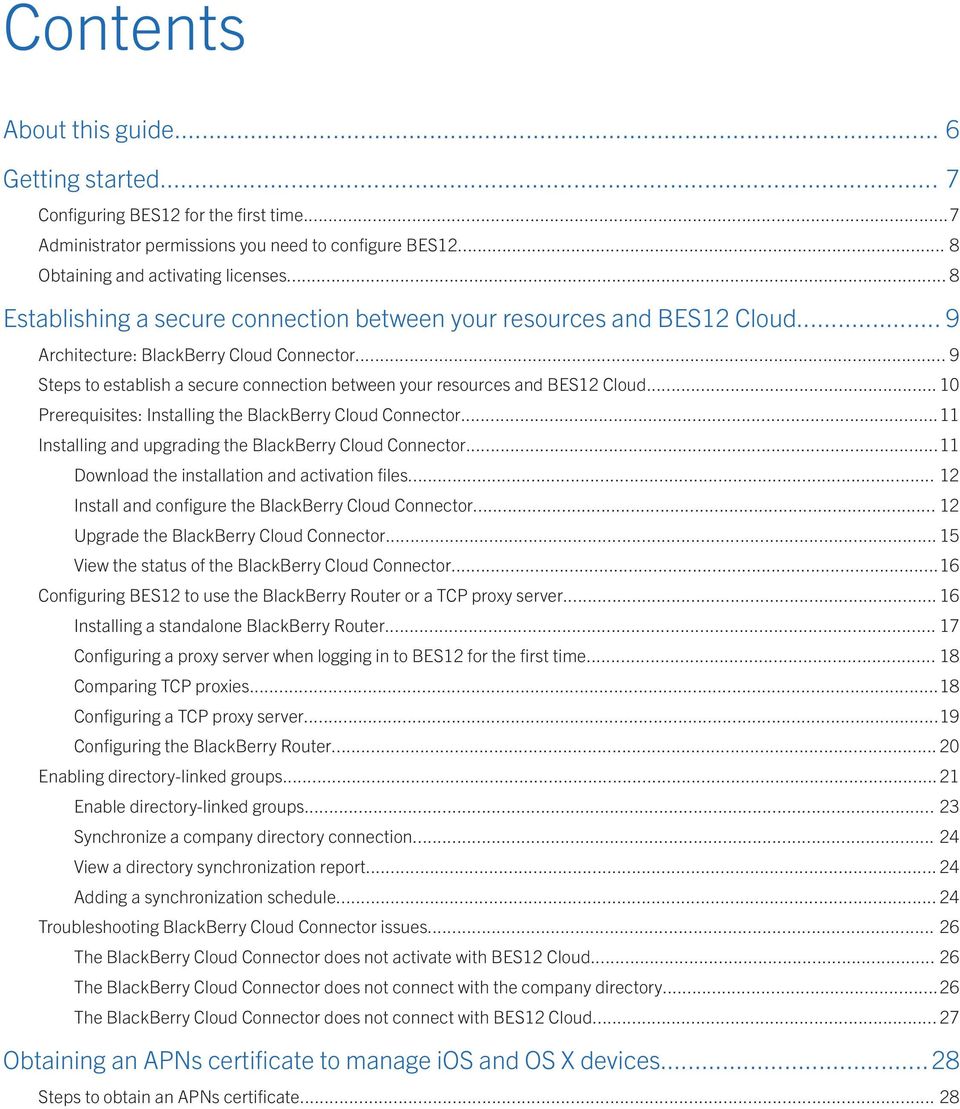
3 Contents About this guide... 6 Getting started... 7 Configuring BES12 for the first time...7 Administrator permissions you need to configure BES Obtaining and activating licenses... 8 Establishing a secure connection between your resources and BES12 Cloud... 9 Architecture: BlackBerry Cloud Connector... 9 Steps to establish a secure connection between your resources and BES12 Cloud Prerequisites: Installing the BlackBerry Cloud Connector...11 Installing and upgrading the BlackBerry Cloud Connector...11 Download the installation and activation files Install and configure the BlackBerry Cloud Connector Upgrade the BlackBerry Cloud Connector View the status of the BlackBerry Cloud Connector...16 Configuring BES12 to use the BlackBerry Router or a TCP proxy server Installing a standalone BlackBerry Router Configuring a proxy server when logging in to BES12 for the first time Comparing TCP proxies...18 Configuring a TCP proxy server...19 Configuring the BlackBerry Router Enabling directory-linked groups...21 Enable directory-linked groups Synchronize a company directory connection View a directory synchronization report Adding a synchronization schedule Troubleshooting BlackBerry Cloud Connector issues The BlackBerry Cloud Connector does not activate with BES12 Cloud The BlackBerry Cloud Connector does not connect with the company directory...26 The BlackBerry Cloud Connector does not connect with BES12 Cloud Obtaining an APNs certificate to manage ios and OS X devices...28 Steps to obtain an APNs certificate... 28
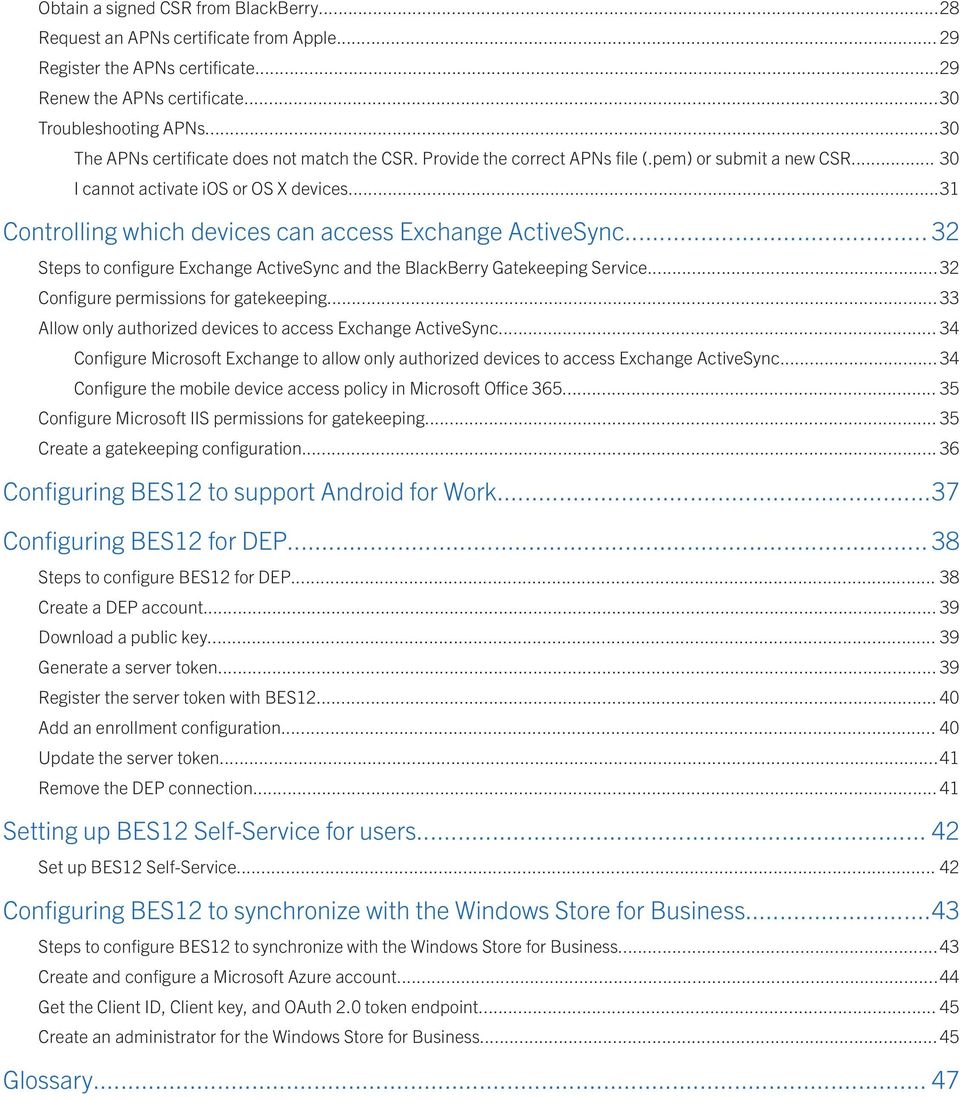
4 Obtain a signed CSR from BlackBerry...28 Request an APNs certificate from Apple Register the APNs certificate...29 Renew the APNs certificate...30 Troubleshooting APNs...30 The APNs certificate does not match the CSR. Provide the correct APNs file (.pem) or submit a new CSR I cannot activate ios or OS X devices...31 Controlling which devices can access Exchange ActiveSync Steps to configure Exchange ActiveSync and the BlackBerry Gatekeeping Service...32 Configure permissions for gatekeeping...33 Allow only authorized devices to access Exchange ActiveSync Configure Microsoft Exchange to allow only authorized devices to access Exchange ActiveSync...34 Configure the mobile device access policy in Microsoft Office Configure Microsoft IIS permissions for gatekeeping Create a gatekeeping configuration Configuring BES12 to support Android for Work...37 Configuring BES12 for DEP Steps to configure BES12 for DEP Create a DEP account Download a public key Generate a server token Register the server token with BES Add an enrollment configuration Update the server token...41 Remove the DEP connection Setting up BES12 Self-Service for users Set up BES12 Self-Service Configuring BES12 to synchronize with the Windows Store for Business...43 Steps to configure BES12 to synchronize with the Windows Store for Business...43 Create and configure a Microsoft Azure account...44 Get the Client ID, Client key, and OAuth 2.0 token endpoint Create an administrator for the Windows Store for Business...45 Glossary... 47
5 Legal notice...48

6 About this guide About this guide 1 BES12 Cloud helps you manage BlackBerry 10, ios, OS X, Android, and Windows devices for your organization. This guide provides instructions for configuring BES12 Cloud to meet your organization's needs. This guide is intended for senior IT professionals who are responsible for setting up and deploying the product. Before you can complete the tasks in this guide, you need to activate licenses. For more information about activating licenses, see the Licensing content. After you complete the tasks in this guide, see the Administration content to learn how to manage the BES12 domain. 6
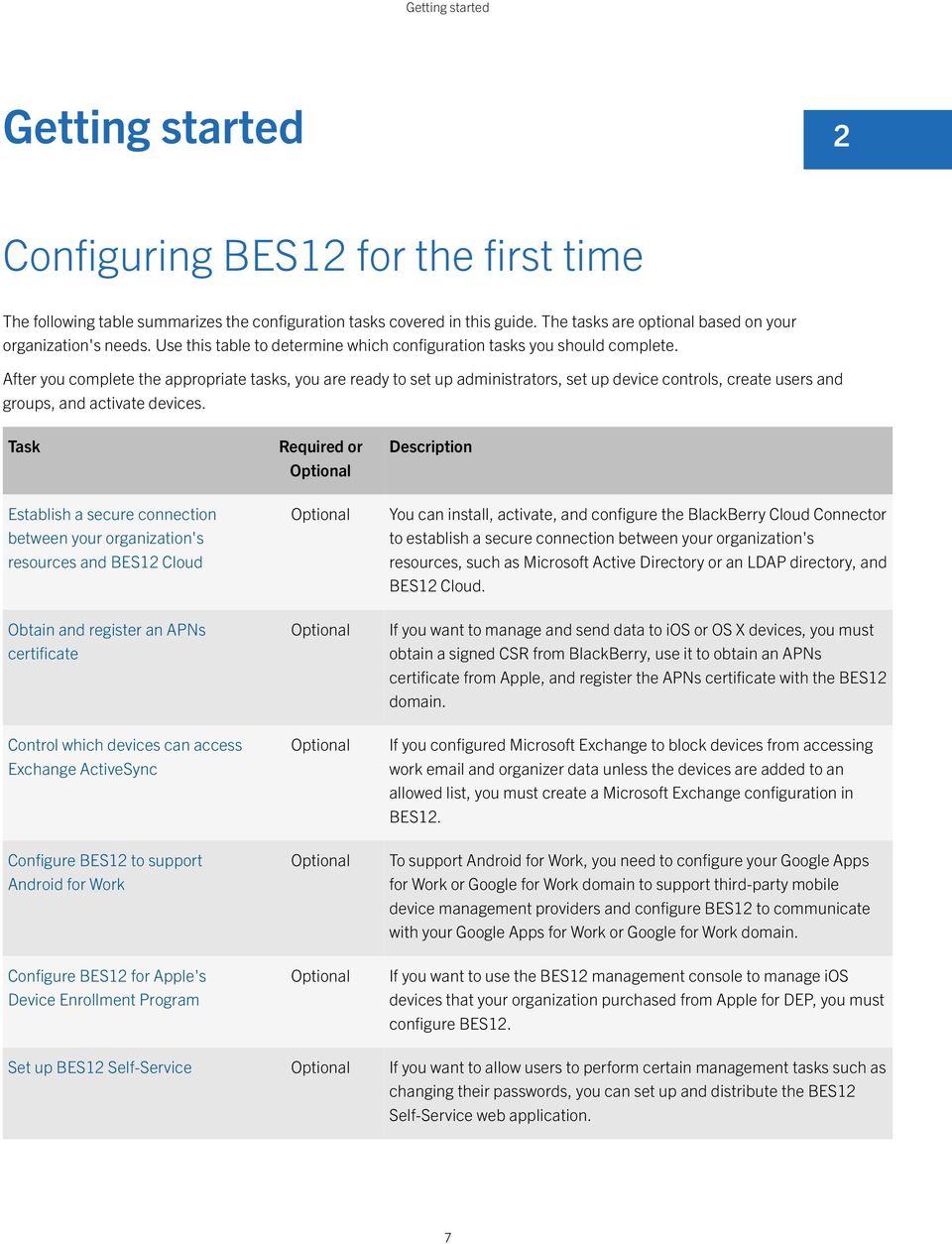
7 Getting started Getting started 2 Configuring BES12 for the first time The following table summarizes the configuration tasks covered in this guide. The tasks are optional based on your organization's needs. Use this table to determine which configuration tasks you should complete. After you complete the appropriate tasks, you are ready to set up administrators, set up device controls, create users and groups, and activate devices. Task Establish a secure connection between your organization's resources and BES12 Cloud Obtain and register an APNs certificate Control which devices can access Exchange ActiveSync Configure BES12 to support Android for Work Configure BES12 for Apple's Device Enrollment Program Required or Optional Optional Optional Optional Optional Optional Description You can install, activate, and configure the BlackBerry Cloud Connector to establish a secure connection between your organization's resources, such as Microsoft Active Directory or an LDAP directory, and BES12 Cloud. If you want to manage and send data to ios or OS X devices, you must obtain a signed CSR from BlackBerry, use it to obtain an APNs certificate from Apple, and register the APNs certificate with the BES12 domain. If you configured Microsoft Exchange to block devices from accessing work and organizer data unless the devices are added to an allowed list, you must create a Microsoft Exchange configuration in BES12. To support Android for Work, you need to configure your Google Apps for Work or Google for Work domain to support third-party mobile device management providers and configure BES12 to communicate with your Google Apps for Work or Google for Work domain. If you want to use the BES12 management console to manage ios devices that your organization purchased from Apple for DEP, you must configure BES12. Set up BES12 Self-Service Optional If you want to allow users to perform certain management tasks such as changing their passwords, you can set up and distribute the BES12 Self-Service web application. 7
8 Getting started Task Configure BES12 to synchronize with the Windows Store for Business Required or Optional Optional Description If you want to manage Windows 10 apps, you must configure BES12 to synchronize with the Windows Store for Business. Administrator permissions you need to configure BES12 When you perform the configuration tasks in this guide, log in to the management console using the administrator account that you created when you installed BES12. If you want more than one person to complete configuration tasks, you can create additional administrator accounts. For more information about creating administrator accounts, see the Administration content. If you create additional administrator accounts to configure BES12, you should assign the Security Administrator role to the accounts. The default Security Administrator role has the necessary permissions to complete any configuration task. Obtaining and activating licenses To activate devices in your organization's BES12 domain, you must obtain and activate the necessary licenses. You should activate licenses before you follow the configuration instructions in this guide, and before you add user accounts. For more information about the different types of licenses and how to activate licenses, see the Licensing content. 8
9 Establishing a secure connection between your resources and BES12 Cloud Establishing a secure connection between your resources and BES12 Cloud 2 You can install, activate, and configure the BlackBerry Cloud Connector to establish a secure connection between your organization's resources and BES12 Cloud. If you install the BlackBerry Cloud Connector, your organization can take advantage of the following features: BES12 Cloud can access your organization's company directory. You can create directory user accounts by searching for and importing user data from the company directory. Directory user accounts are different from local user accounts, which you create by manually adding user information in the management console. BES12 Cloud synchronizes user data with the company directory daily. You can configure when the automatic synchronization begins. You can also start the synchronization process manually for an individual. Directory users can use their directory credentials to access BES12 Self-Service. You can assign an administrative role to directory users to make them administrators. The users can then log in to the management console using their directory credentials. The BlackBerry Cloud Connector is a Java process. The installation and activation files for the BlackBerry Cloud Connector are available from the management console. Architecture: BlackBerry Cloud Connector The diagram above shows the components that the BlackBerry Cloud Connector interacts with. For more information about the BES12 Cloud architecture, see the Overview and what s new content. 9

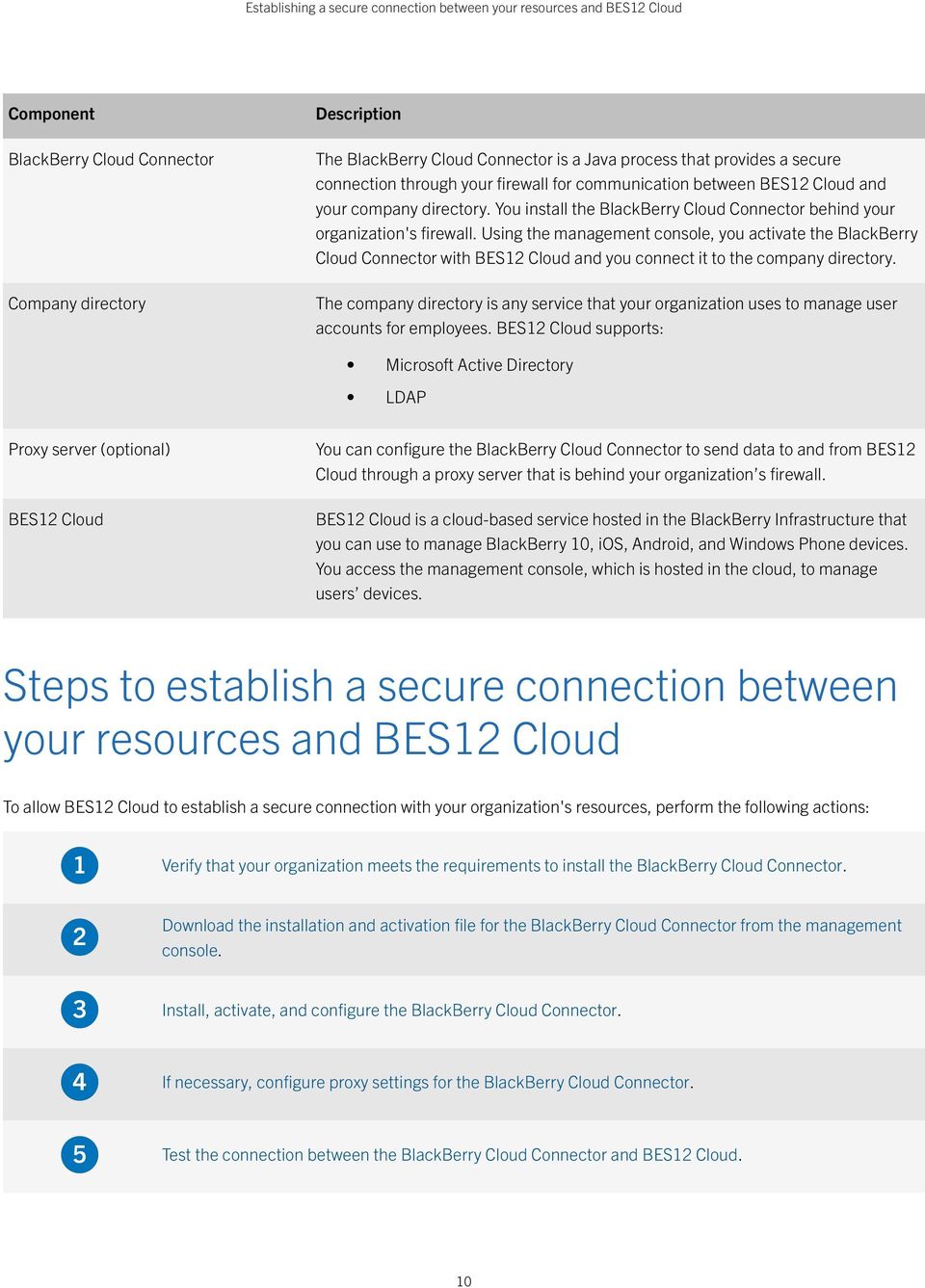
10 Establishing a secure connection between your resources and BES12 Cloud Component BlackBerry Cloud Connector Company directory Description The BlackBerry Cloud Connector is a Java process that provides a secure connection through your firewall for communication between BES12 Cloud and your company directory. You install the BlackBerry Cloud Connector behind your organization's firewall. Using the management console, you activate the BlackBerry Cloud Connector with BES12 Cloud and you connect it to the company directory. The company directory is any service that your organization uses to manage user accounts for employees. BES12 Cloud supports: Microsoft Active Directory LDAP Proxy server (optional) BES12 Cloud You can configure the BlackBerry Cloud Connector to send data to and from BES12 Cloud through a proxy server that is behind your organization s firewall. BES12 Cloud is a cloud-based service hosted in the BlackBerry Infrastructure that you can use to manage BlackBerry 10, ios, Android, and Windows Phone devices. You access the management console, which is hosted in the cloud, to manage users devices. Steps to establish a secure connection between your resources and BES12 Cloud To allow BES12 Cloud to establish a secure connection with your organization's resources, perform the following actions: Verify that your organization meets the requirements to install the BlackBerry Cloud Connector. Download the installation and activation file for the BlackBerry Cloud Connector from the management console. Install, activate, and configure the BlackBerry Cloud Connector. If necessary, configure proxy settings for the BlackBerry Cloud Connector. Test the connection between the BlackBerry Cloud Connector and BES12 Cloud. 10
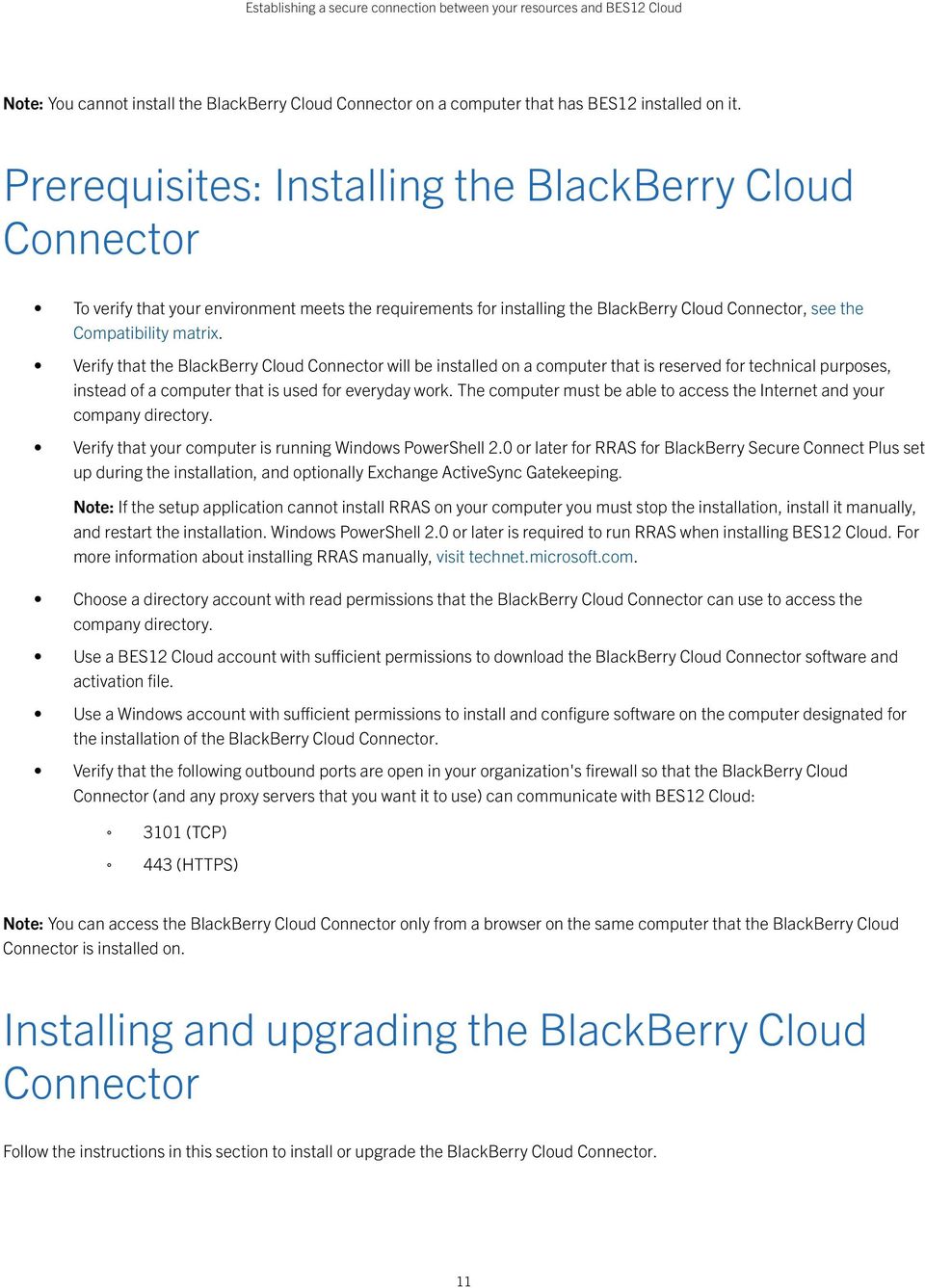
11 Establishing a secure connection between your resources and BES12 Cloud Note: You cannot install the BlackBerry Cloud Connector on a computer that has BES12 installed on it. Prerequisites: Installing the BlackBerry Cloud Connector To verify that your environment meets the requirements for installing the BlackBerry Cloud Connector, see the Compatibility matrix. Verify that the BlackBerry Cloud Connector will be installed on a computer that is reserved for technical purposes, instead of a computer that is used for everyday work. The computer must be able to access the Internet and your company directory. Verify that your computer is running Windows PowerShell 2.0 or later for RRAS for BlackBerry Secure Connect Plus set up during the installation, and optionally Exchange ActiveSync Gatekeeping. Note: If the setup application cannot install RRAS on your computer you must stop the installation, install it manually, and restart the installation. Windows PowerShell 2.0 or later is required to run RRAS when installing BES12 Cloud. For more information about installing RRAS manually, visit technet.microsoft.com. Choose a directory account with read permissions that the BlackBerry Cloud Connector can use to access the company directory. Use a BES12 Cloud account with sufficient permissions to download the BlackBerry Cloud Connector software and activation file. Use a Windows account with sufficient permissions to install and configure software on the computer designated for the installation of the BlackBerry Cloud Connector. Verify that the following outbound ports are open in your organization's firewall so that the BlackBerry Cloud Connector (and any proxy servers that you want it to use) can communicate with BES12 Cloud: 3101 (TCP) 443 (HTTPS) Note: You can access the BlackBerry Cloud Connector only from a browser on the same computer that the BlackBerry Cloud Connector is installed on. Installing and upgrading the BlackBerry Cloud Connector Follow the instructions in this section to install or upgrade the BlackBerry Cloud Connector. 11
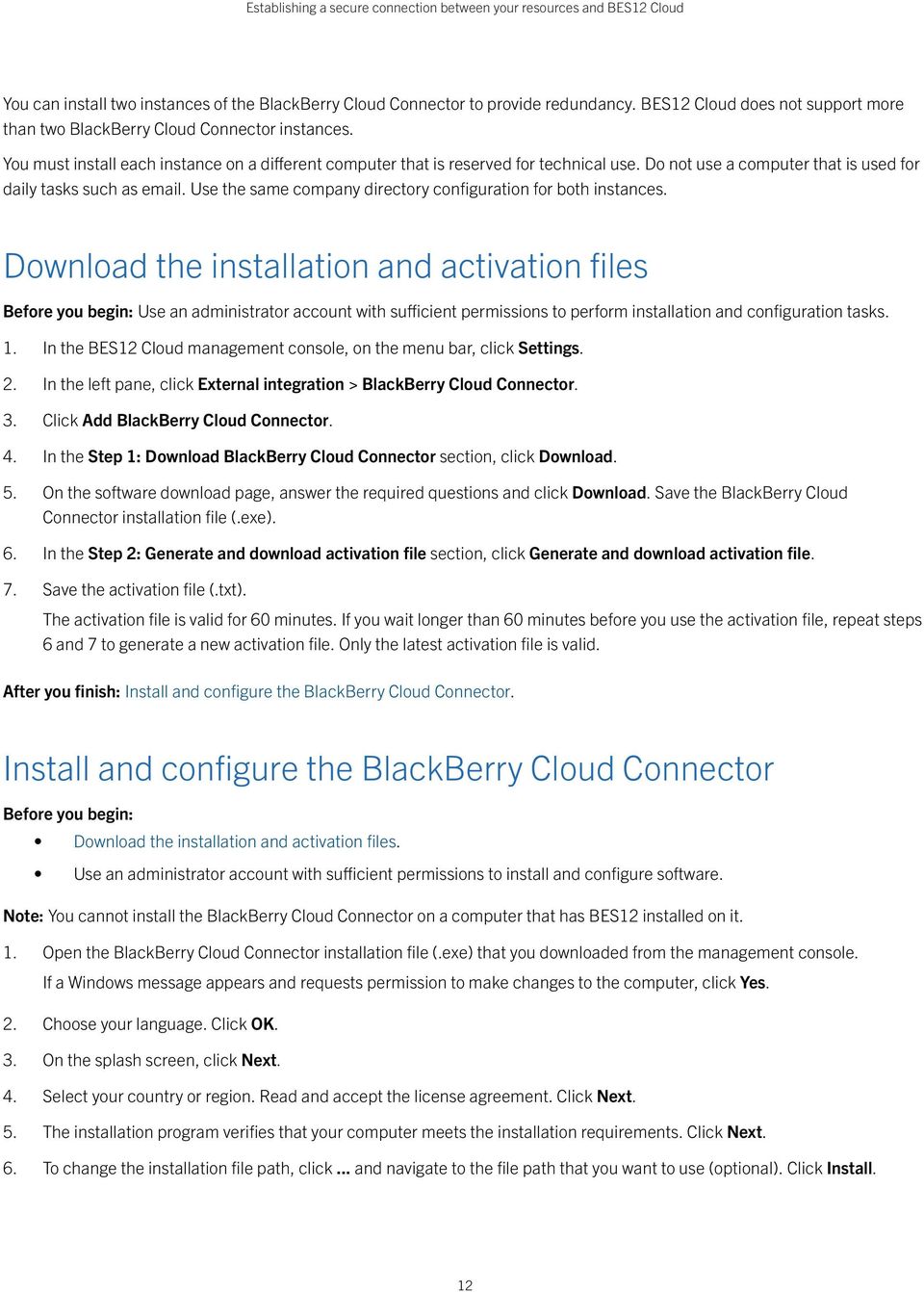
12 Establishing a secure connection between your resources and BES12 Cloud You can install two instances of the BlackBerry Cloud Connector to provide redundancy. BES12 Cloud does not support more than two BlackBerry Cloud Connector instances. You must install each instance on a different computer that is reserved for technical use. Do not use a computer that is used for daily tasks such as . Use the same company directory configuration for both instances. Download the installation and activation files Before you begin: Use an administrator account with sufficient permissions to perform installation and configuration tasks. 1. In the BES12 Cloud management console, on the menu bar, click Settings. 2. In the left pane, click External integration > BlackBerry Cloud Connector. 3. Click Add BlackBerry Cloud Connector. 4. In the Step 1: Download BlackBerry Cloud Connector section, click Download. 5. On the software download page, answer the required questions and click Download. Save the BlackBerry Cloud Connector installation file (.exe). 6. In the Step 2: Generate and download activation file section, click Generate and download activation file. 7. Save the activation file (.txt). The activation file is valid for 60 minutes. If you wait longer than 60 minutes before you use the activation file, repeat steps 6 and 7 to generate a new activation file. Only the latest activation file is valid. After you finish: Install and configure the BlackBerry Cloud Connector. Install and configure the BlackBerry Cloud Connector Before you begin: Download the installation and activation files. Use an administrator account with sufficient permissions to install and configure software. Note: You cannot install the BlackBerry Cloud Connector on a computer that has BES12 installed on it. 1. Open the BlackBerry Cloud Connector installation file (.exe) that you downloaded from the management console. If a Windows message appears and requests permission to make changes to the computer, click Yes. 2. Choose your language. Click OK. 3. On the splash screen, click Next. 4. Select your country or region. Read and accept the license agreement. Click Next. 5. The installation program verifies that your computer meets the installation requirements. Click Next. 6. To change the installation file path, click... and navigate to the file path that you want to use (optional). Click Install. 12
13 Establishing a secure connection between your resources and BES12 Cloud 7. When the installation completes, click Next. A console addresses panel for the BlackBerry Cloud Connector opens. 8. To open the BlackBerry Cloud Connector management console, click the link on the console addresses panel before you close the setup application, or manually enter the address in your browser. Click Close to close the setup application. 9. Select your language. Click Next. 10. When you activate the BlackBerry Cloud Connector, it sends data over HTTPS to enroll with BES12. After it is activated, the BlackBerry Cloud Connector sends and receives data over TCP. If you want to send data through a proxy behind your organization's firewall, see Configure BES12 to use a transparent TCP proxy server. 11. In the Friendly name field, type a name for the BlackBerry Cloud Connector. Click Next. 12. Click Browse. Select the activation file that you downloaded from the management console. 13. Click Activate. 14. In the drop-down list, click the type of company directory that your organization uses. 15. Click Configure. 16. Follow the steps for your organization s directory type: Directory type Microsoft Active Directory Steps 1. In the Username field, type the username of the Microsoft Active Directory account. 2. In the Domain field, type the FQDN of the domain that hosts Microsoft Active Directory. For example: domain.example.com. 3. In the Password field, type the password of the Microsoft Active Directory account. 4. In the Domain controller discovery drop-down list, click one of the following: If you want automatic discovery, click Automatic. If you want to specify the domain controller computer, click Select from list below. Click + and type the FQDN of the computer. Repeat this step to add more computers. 5. In the Global catalog search base field, type the search base that you want to access (for example, OU=Users,DC=example,DC=com). To search the entire Global Catalog, leave the field blank. 6. In the Global catalog discovery drop-down list, click one of the following: 7. Click Save. If you want automatic catalog discovery, click Automatic. If you want to specify the catalog computer, click Select from list below. Click + and type the FQDN of the computer. If necessary, repeat this step to specify more computers. 13

14 Establishing a secure connection between your resources and BES12 Cloud Directory type Steps LDAP directory 1. In the LDAP computer discovery drop-down list, click one of the following: If you want automatic discovery, click Automatic. In the DNS domain name field, type the DNS domain name. If you want to specify the LDAP computer, click Select from list below. Click + and type the FQDN of the computer. Repeat this step to add more computers. 2. In the Enable SSL drop-down list, select whether you want to enable SSL authentication for LDAP traffic. If you click Yes, click Browse and select the SSL certificate for the LDAP computer. 3. In the LDAP port field, type the port number of the LDAP computer. 4. In the Authorization required drop-down list, select whether BES12 Cloud must authenticate with the LDAP computer. If you click Yes, type the username and password of the LDAP account. The username must be in DN format (for example, CN=Megan Ball,OU=Sales,DC=example,DC=com). 5. In the Search base field, type the search base that you want to access (for example, OU=Users,DC=example,DC=com). 6. In the LDAP user search filter field, type the filter that you want to use for LDAP users. For example: (&(objectcategory=person)(objectclass=user) (memberof=cn=local,ou=users,dc=example,dc=com)). 7. In the LDAP user search scope drop-down list, click one of the following: If you want user searches to apply to all levels below the base DN, click All levels. If you want to limit user searches to one level below the base DN, click One level. 8. In the Unique identifier field, type the attribute for each user s unique identifier (for example, uid). The attribute must be immutable and globally unique for every user. 9. In the First name field, type the attribute for each user s first name (for example, givenname). 10. In the Last name field, type the attribute for each user s last name (for example, sn). 11. In the Login attribute field, type the attribute for each user s login attribute (for example, cn). This attribute is used for the value that users type to log in to BES12 Self-Service with their directory credentials. 12. In the field, type the attribute for each user s (for example, mail). 13. In the Display name field, type the attribute for each user s display name (for example, displayname). 14

15 Establishing a secure connection between your resources and BES12 Cloud Directory type Steps 14. In the profile account name field, type the attribute for each user s profile account name (for example, mail). 15. Click Save. 17. In the management console, click Settings. 18. In the left pane, click External integration > BlackBerry Cloud Connector. 19. In the Step 4: Test connection section, click Next. After you finish: To install a second BlackBerry Cloud Connector instance for redundancy, download another set of installation and activation files and repeat this task on a different computer. When you configure a second instance, use the same directory configuration. This should be done after the first instance has been installed and activated. If necessary, configure proxy settings for the BlackBerry Cloud Connector. To change the directory settings that you configured, in the BlackBerry Cloud Connector management console, click General settings > Company directory, then click for the directory connection. To delete a directory configuration, in the BlackBerry Cloud Connector management console, click General settings > Company directory, then click for the directory connection. Upgrade the BlackBerry Cloud Connector Before you begin: Use an administrator account with sufficient permissions to install and configure software. 1. Log in to the BlackBerry Cloud Connector management console. 2. Record all of your directory configuration settings. 3. Log in to the BES12 Cloud management console. 4. Download the BlackBerry Cloud Connector installation and activation files. For instructions, see Download the installation and activation files. 5. Install and configure the BlackBerry Cloud Connector using the information you recorded in step 2. For instructions, see Install and configure the BlackBerry Cloud Connector. Note: If you changed the BlackBerry Cloud Connector port and you are using Google Chrome as your default browser, the desktop shortcut may not be updated with the new port until you restart the computer. The BlackBerry Cloud Connector management console is still accessible by manually typing in the address with the new port number. 15
16 Establishing a secure connection between your resources and BES12 Cloud View the status of the BlackBerry Cloud Connector 1. In the BES12 Cloud management console, on the menu bar, click Settings. 2. In the left pane, click External integration > BlackBerry Cloud Connector. Configuring BES12 to use the BlackBerry Router or a TCP proxy server To use a proxy server with BES12, you can install the BlackBerry Router to act as a proxy server, or use a TCP proxy server that is already installed in your environment. You can install the BlackBerry Router or a proxy server outside your organization s firewall in a DMZ. Installing the BlackBerry Router or a TCP proxy server in a DMZ provides an extra level of security for BES12. Only the BlackBerry Router or the proxy server connects to BES12 from outside the firewall. All connections to the BlackBerry Infrastructure between BES12 and devices go through the BlackBerry Router or the proxy server. By default, BES12 connects directly to the BlackBerry Infrastructure using port However, if your organization's security policy requires that internal systems cannot connect directly to the Internet, you can install the BlackBerry Router or a TCP proxy server. The BlackBerry Router or TCP proxy server acts as an intermediary between BES12 and the BlackBerry Infrastructure. This image shows the following options for configuring BES12 to use a proxy server: no proxy server, a TCP proxy server deployed in a DMZ, and the BlackBerry Router deployed in a DMZ. 16
17 Establishing a secure connection between your resources and BES12 Cloud Installing a standalone BlackBerry Router The BlackBerry Router is an optional component that you can install in a DMZ outside your organization's firewall. The BlackBerry Router connects to the Internet to send data between BES12 and devices that use the BlackBerry Infrastructure. The BlackBerry Router functions as a proxy server and can support SOCKS v5 (no authentication). Note: If your current environment contains a TCP proxy server, you do not need to install the BlackBerry Router for BES12. Install a standalone BlackBerry Router Before you begin: Make sure that you have the name of the SRP host. The SRP host name is usually <country code>.srp.blackberry.com (for example, us.srp.blackberry.com). To verify the SRP host name for your country, visit the SRP Address Lookup page. Install a standalone BlackBerry Router instance on a computer that does not host any other BES12 components. Note: You cannot install the BlackBerry Router on a computer that hosts the BlackBerry Cloud Connector. 1. Download and extract the BES12 Installation.zip file on your computer. 2. From the extracted BES12 installation files, open the router folder. 3. Extract the setupinstaller.zip file from the router folder. This.zip file contains an Installer folder that has the Setup.exe file that you use to install the BlackBerry Router using the command prompt window. 4. Go to Start > All Programs > Accessories > Command Prompt. 17

18 Establishing a secure connection between your resources and BES12 Cloud 5. In the command prompt window, right-click and select Run as administrator. 6. In the command prompt window, navigate to the location of the BlackBerry Router Setup.exe file. 7. Type Setup.exe -srphost <srphostname> (for example, Setup.exe -srphost ca.srp.blackberry.com). Configuring a proxy server when logging in to BES12 for the first time You may be prompted to configure your initial BlackBerry Router instance or TCP proxy server when you log in to the BlackBerry Cloud Connector console for the first time. If you configure the proxy server, you may need to perform extra configuration for the BlackBerry Router or TCP proxy server in the management console. You can configure more BlackBerry Router or TCP proxy server instances after you have logged in to the BlackBerry Cloud Connector console. Comparing TCP proxies Proxy Description Transparent TCP proxy Intercepts normal communication at the network layer without requiring any special client configuration Requires no client browser configuration Usually located between the client and the Internet Performs some of the functions of a gateway or router Often used to enforce acceptable use policy Commonly used by ISPs in some countries to save upstream bandwidth and improve customer response times through caching SOCKS v5 proxy An Internet protocol for handling Internet traffic through a proxy server Can be handled with virtually any TCP/UDP application, including browsers and FTP clients that support SOCKS Can be a good solution for Internet anonymity and security Routes network packets between a client and server through a proxy server Can provide authentication so only authorized users can access a server Proxies TCP connections to an arbitrary IP address Can anonymize UDP protocols and TCP protocols like HTTP 18
19 Establishing a secure connection between your resources and BES12 Cloud Configuring a TCP proxy server When you activate the BlackBerry Cloud Connector, it sends data over HTTPS to activate with BES12 Cloud. After it is activated, the BlackBerry Cloud Connector sends and receives data over TCP. You can configure the BlackBerry Cloud Connector to route HTTPS or TCP data through a proxy server that is behind your organization s firewall. The BlackBerry Cloud Connector does not support authentication with a proxy server. You can configure multiple TCP proxy servers configured with SOCKS v5 (no authentication) to connect to BES12. Multiple TCP proxy servers configured with SOCKS v5 (no authentication) can provide support if one of the active proxy server instances is not functioning correctly. You configure only a single port that all SOCKS v5 (no authentication) service instances must listen on. If you are configuring more than one TCP proxy server with SOCKS v5 (no authentication), each server with SOCKS v5 must share the proxy listening port. Configure BES12 to use a transparent TCP proxy server Before you begin: Install a compatible transparent TCP proxy server in the BES12 domain. Use an administrator account with sufficient permissions to configure the BlackBerry Cloud Connector settings. 1. In the BlackBerry Cloud Connector management console, click General settings > Proxy. 2. Select the Proxy server option. 3. Perform any of the following tasks: Task Route HTTPS activation data through a proxy server Route TCP data through a TCP proxy server Steps In the Enrollment proxy fields, type the FQDN or IP address and the port number of the proxy server. In the BlackBerry Cloud Connector fields, type the FQDN or IP address and the port number of the proxy server. 4. Click Save. Enable SOCKS v5 on a TCP proxy server Before you begin: Install a compatible TCP proxy server with SOCKS v5 (no authentication) in the BES12 domain. 1. In the BlackBerry Cloud Connector management console, click General settings > Proxy. 2. Select the Proxy server option. 3. Select the Enable SOCKS v5 check box. 19

20 Establishing a secure connection between your resources and BES12 Cloud 4. Click. 5. In the Server address field, type the IP address or host name of the SOCKS v5 proxy server. 6. Click Add. 7. Repeat steps 1 to 6 for each SOCKS v5 proxy server that you want to configure. 8. In the Port field, type the port number. 9. Click Save. Configuring the BlackBerry Router You can configure multiple BlackBerry Router instances to connect to BES12 to provide high availability for the BlackBerry Router. You configure only one port for BlackBerry Router instances to listen on. By default, BES12 connects to the BlackBerry Router using port 3102 to connect to BES12 services. If you connect BES12 services to the BlackBerry Router, the BlackBerry Router supports all outbound traffic from the BES12 services. Note: If you want to use a port other than the default port for the BlackBerry Router, visit to read article KB Configure BES12 to use the BlackBerry Router Before you begin: Install the BlackBerry Router in the BES12 domain. 1. In the BlackBerry Cloud Connector management console, click General settings > Proxy. 2. Select the BlackBerry Router option. 3. Click. 4. In the Router address field, type the IP address or host name of the BlackBerry Router instance that you want to connect to BES Click Add. 6. Repeat steps 1 to 5 for each BlackBerry Router instance that you want to configure. 7. In the Port field, type the port number that all BlackBerry Router instances listen on. The default value is Click Save. 20
21 Establishing a secure connection between your resources and BES12 Cloud Enabling directory-linked groups You can create groups that are linked to groups in your company directory. You can configure BES12 to automatically synchronize the membership of a directory-linked group to its associated company directory groups. When you enable directory-linked groups, you can enable onboarding and offboarding, force the synchronization process, set the maximum number of changes per synchronization, and set the number of nested levels for the linked groups. Item Enable onboarding Description Onboarding allows you to automatically add user accounts to BES12 based on user membership in a company directory group. You must add company directory groups to the Onboarding directory groups section. User accounts from those company directory groups are automatically added to BES12 during the synchronization process. You can configure onboarded users to either receive an with an autogenerated device activation password or you can choose to not set a device activation password Offboarding Optionally, you can set up offboarding. Offboarding occurs when a user is removed from all company directory groups in the Onboarding directory groups list and offboarding is enabled. You can select the following the enforcement action options you want BES12 to take when a user is offboarded: Delete device data when the user is removed from all onboarding directory groups Delete only work data Delete all device data Delete all device data for corporate owned/delete only work data for individually owned Delete user when the user is removed from all onboarding directory groups Depending on the offboarding settings, company directory users, their devices, or both, they are automatically deleted from BES12 when they are deleted from all company directory groups configured for onboarding. They will be removed from BES12 if they do not belong to a company directory group configured for onboarding. The offboarding settings also apply to existing directory users in 21
22 Establishing a secure connection between your resources and BES12 Cloud Item Description BES12. It is recommended that you click the preview icon to generate the directory synchronization report to verify the changes. Force synchronization Force synchronization determines the synchronization behavior when a company directory group is deleted from the company directory. If a company directory group no longer exists when force synchronization is enabled, the company directory group is removed from the onboarding directory groups list and from any directory-linked groups during the synchronization process. When force synchronization is enabled, and if all the company directory groups linked to it are no longer in your company directory, a directory-linked group is converted to a local group. When force synchronization is disabled and a company directory group is not found in your company directory, the synchronization process is canceled. Sync limit If the number of changes exceeds the maximum number of changes for each synchronization, you can prevent the synchronization process from running. Before the synchronization process begins, the total number of changes that will occur are calculated by adding together the number of users onboarded, the number of users offboarded, the number of users added to groups, and the number of users removed from groups. The default value is 5. If you want no limit to the number of changes, you must enter a value of 0. Maximum nesting level of directory groups You can configure the maximum number of levels in a company directory group that you want directory-linked groups to link to. You can link to an unlimited number of nested levels. Examples: The default is -1. Returns all levels. Entering 0 returns the top level only. Entering 1 returns the top level and the first nested level. For example, if a company directory group has 5 levels and you want to link to all the levels you type -1 in the field provided. If you want to link to the top level only you enter 0, or if you wanted to link to the top level and the first 4 levels, you type 4. For more information about creating directory-linked groups, see the Administration content. 22
23 Establishing a secure connection between your resources and BES12 Cloud Enable directory-linked groups Before you begin: Verify that a company directory synchronization is not in progress. You cannot save the changes you make to the company directory connection until the synchronization is complete. 1. On the menu bar, click Settings > External integration > Company directory. 2. Click Sync settings. 3. To enable directory-linked groups, select Enable directory-linked groups. 4. To enable onboarding, select Enable onboarding and perform the following actions for each group you want to onboard: Option Description Enable onboarding 1. In the Onboarding directory groups section, click. 2. In the Search group from directory field, type the company directory group name. 3. Click. 4. Select the company directory group in the search results list. 5. Click Add. 6. If necessary, select Link nested groups. 5. In the Device activation section, choose one of the following: To send users an with an automatically generated activation password, click Auto-generate device activation password and send with activation instructions. Enter the time an activation password remains valid and choose an activation template. To not set a device activation password, select Do not set device activation password. 6. To delete device data when a user if offboarded, select Delete device data when the user is removed from all onboarding directory groups and choose from the following options: Option To delete all the data on a users device when they are removed from a group Description 1. Select one of the following options: a b c Delete only work data Delete all device data Delete all device data for corporate owned/delete only work data for individually owed 23
24 Establishing a secure connection between your resources and BES12 Cloud Option To delete a user account from BES12 when a user is removed from all onboarding groups Description Select Delete user when the user is removed from all onboarding directory groups. 7. To force the synchronization of directory-linked groups, select Force synchronization. 8. In the Sync limit field, type the maximum number of changes you want to allow in one directory synchronization. Note: The default value is 5. This means that the synchronization will not be performed if there are more than 5 changes. For example, if you leave this value at five and there are more than 5 changes, the synchronization will not run. If you enter a value of 0, this means there is no limit on the number of changes that a synchronization will complete. 9. In the Maximum nesting level of directory groups field, enter the number of nested levels for company directory groups. The default is -1, which means all levels. If you want the top level, type 0; if you want the top level and the first level, type 1, and so on. 10. Click Save. After you finish: For information about creating directory-linked groups, see the Administration content. Synchronize a company directory connection 1. On the menu bar, click Settings > External integration > Company directory. 2. In the Sync column, click. View a directory synchronization report 1. On the menu bar, click Settings > External integration > Company directory. 2. In the Last report column, click the date. Adding a synchronization schedule BES12 lets you set up synchronization schedules that automatically synchronize BES12 and your company directory. There are three types of synchronization schedules that you can add: 24
25 Establishing a secure connection between your resources and BES12 Cloud Schedule type Interval Once a day No recurrence Description Interval lets you choose the length of time between each synchronization and the time frame you want the synchronization to occur. You can select the days of the week that you want synchronizations to occur. You can select more than one day. Once a day lets you choose the time of day the synchronization starts and the days of the week that you want the synchronizations to occur. You can select more than one day. No recurrence lets you configure a one time synchronization that starts on a time and day you select. On the Company directory screen, you can manually synchronize BES12 and your company directory at any time. Add a synchronization schedule 1. On the menu bar, click Settings > External integration > Company directory. 2. On the Sync schedule tab, click. 3. In the Recurrence field, perform one of the following actions: Option Description Interval 1. Select Interval. 2. Type the time in minutes between synchronizations. 3. In the Synchronize between (UTC) field, select the time to start the synchronizations and the time to stop the synchronizations. 4. Select the days of the week when you want synchronizations to occur. Once a day 1. Select Once a day. 2. Select the time when you want the synchronization to start. 3. Select the days of the week when you want the synchronizations to occur. No recurrence 1. Select No recurrence. 2. Select the time when you want the synchronization to start. 3. Select the day when you want the synchronization to occur. 4. Click Add. 25
26 Establishing a secure connection between your resources and BES12 Cloud Troubleshooting BlackBerry Cloud Connector issues When you troubleshoot issues with the BlackBerry Cloud Connector, consider the following common issues. The BlackBerry Cloud Connector does not activate with BES12 Cloud Description After you upload the activation file and click Activate, you receive an error message that the activation was not successful. Possible solutions Try any of the following: Verify that you uploaded the latest activation file that you generated in the management console. Only the latest activation file is valid. Activation files expire after 60 minutes. Generate and upload a new activation file, then try to activate again. The BlackBerry Cloud Connector does not connect with the company directory Description After you specify the information for your company directory and click Save, you receive an error message that the BlackBerry Cloud Connector cannot connect with the company directory. Possible solutions Try any of the following: Verify that you specified the correct settings for the company directory. Verify that you specified the correct login information for the directory account, and that the account has the necessary permissions to access the company directory. Verify that the correct ports are open in your organization's firewall. 26
27 Establishing a secure connection between your resources and BES12 Cloud Verify that you did not use the same activation file for two different installations. Verify that you are using the most recent activation file. Review the most recent log file for details about why the BlackBerry Cloud Connector cannot access the company directory. By default, the log files for the BlackBerry Cloud Connector are located in <drive:>:\program Files \BlackBerry\BlackBerry Cloud Connector\logs. The BlackBerry Cloud Connector does not connect with BES12 Cloud Description When you test the connection between the BlackBerry Cloud Connector and BES12 Cloud, you receive an error message that the test was not successful. Possible solutions Try any of the following: Verify that the following outbound ports are open in your organization's firewall so that the BlackBerry Cloud Connector and any proxy servers that you want it to use can communicate with BES12 Cloud: 3101 (TCP) 443 (HTTPS) Review the most recent log file for information about why the BlackBerry Cloud Connector cannot connect with BES12 Cloud. By default, the log files for the BlackBerry Cloud Connector are located in <drive:>:\program Files\BlackBerry Cloud Connector\logs. 27
28 Obtaining an APNs certificate to manage ios and OS X devices Obtaining an APNs certificate to manage ios and OS X devices 3 APNs is the Apple Push Notification Service. You must obtain and register an APNs certificate if you want to use BES12 to manage ios or OS X devices. You can obtain and register the APNs certificate using the first login wizard or by using the external integration section of the administration console. Note: Each APNs certificate is valid for one year. The administration console displays the expiry date. You must renew the APNs certificate before the expiry date, using the same Apple ID that you used to obtain the certificate. If the certificate expires, devices do not receive data from BES12. If you register a new APNs certificate, device users must reactivate their devices to receive data. For more information, visit to read Issues with Sending Push Notifications in article TN2265. It is a best practice to access the administration console and the Apple Push Certificates Portal using the Google Chrome browser or the Safari browser. These browsers provide optimal support for requesting and registering an APNs certificate. Steps to obtain an APNs certificate To obtain and register an APNs certificate, perform the following actions: Step Action Obtain a signed CSR from BlackBerry. Use the signed CSR to request an APNs certificate from Apple. Register the APNs certificate. Obtain a signed CSR from BlackBerry You must obtain a signed CSR from BlackBerry before you can obtain an APNs certificate. 1. On the menu bar, click Settings > External integration > Apple Push Notification. 28
29 Obtaining an APNs certificate to manage ios and OS X devices 2. Click Get APNs Certificate. If you want to renew the current APNs certificate, click Renew certificate instead. 3. In the Step 1 of 3 - Download signed CSR certificate from BlackBerry section, click Download certificate. 4. Click Save to save the signed CSR file (.scsr) to your computer. After you finish: Request an APNs certificate from Apple. Request an APNs certificate from Apple Before you begin: Obtain a signed CSR from BlackBerry. 1. On the menu bar, click Settings > External integration > Apple Push Notification. 2. In the Step 2 of 3 - Request APNs certificate from Apple section, click Apple Push Certificate Portal. You are directed to the Apple Push Certificates Portal. 3. Sign in to the Apple Push Certificates Portal using a valid Apple ID. 4. Follow the instructions to upload the signed CSR (.scsr). 5. Download and save the APNs certificate (.pem) on your computer. After you finish: Register the APNs certificate. Register the APNs certificate Before you begin: Request an APNs certificate from Apple. 1. On the menu bar, click Settings > External integration > Apple Push Notification. 2. In the Step 3 of 3 - Register APNs certificate section, click Browse. Navigate to and select the APNs certificate (.pem). 3. Click Submit. After you finish: To test the connection between BES12 and the APNs server, click Test APNS certificate. To view the status and expiry date of the APNs certificate, click Settings > External integration > ios management. For more information about renewing the APNs certificate, see Renew the APNs certificate. 29
30 Obtaining an APNs certificate to manage ios and OS X devices Renew the APNs certificate The APNs certificate is valid for one year. You must renew the APNs certificate each year before it expires. Before you begin: Obtain a signed CSR from BlackBerry. 1. On the menu bar, click Settings > External integration > Apple Push Notification. 2. In the Step 2 of 3 - Request APNs certificate from Apple section, click Apple Push Certificate Portal. You are directed to the Apple Push Certificates Portal. 3. Sign in to the Apple Push Certificates Portal using the same Apple ID that you used to obtain the original APNs certificate. 4. Follow the instructions to renew the APNs certificate (.pem). You will need to upload the new signed CSR. 5. Download and save the renewed APNs certificate on your computer. 6. In the Step 3 of 3 - Register APNs certificate section, click Browse. Navigate to and select the renewed APNs certificate. 7. Click Submit. After you finish: To test the connection between BES12 and the APNs server, click Test APNS certificate. To view the status and expiry date of the APNs certificate, click Settings > External integration > ios management. Troubleshooting APNs This section helps you troubleshoot APNs issues. The APNs certificate does not match the CSR. Provide the correct APNs file (.pem) or submit a new CSR. Description You may receive an error message when you try to register the APNs certificate if you did not upload the most recently signed CSR file from BlackBerry to the Apple Push Certificates Portal. Possible solution If you downloaded multiple CSR files from BlackBerry, only the last one that you downloaded is valid. If you know which CSR is the most recent, return to the Apple Push Certificates Portal and upload it. If you are not sure which CSR is the most recent, obtain a new one from BlackBerry, then return to the Apple Push Certificates Portal and upload it. 30
31 Obtaining an APNs certificate to manage ios and OS X devices I cannot activate ios or OS X devices Possible cause If you are unable to activate ios or OS Xdevices, the APNs certificate may not be registered correctly. Possible solution Perform one or more of the following actions: In the administration console, on the menu bar, click Settings > External integration > Apple Push Notification. Verify that the APNs certificate status is "Installed." If the status is not correct, try to register the APNs certificate again. Click Test APNS certificate to test the connection between BES12 and the APNs server. If necessary, obtain a new signed CSR from BlackBerry and a new APNs certificate. 31
32 Controlling which devices can access Exchange ActiveSync Controlling which devices can access Exchange ActiveSync 4 You can stop unauthorized devices from using Exchange ActiveSync unless they are explicitly added to the allowed list. Devices that are not on the allowed list cannot access work and organizer data. Using the BlackBerry Gatekeeping Service makes it easier to add devices to the allowed list. To use the BlackBerry Gatekeeping Service, you must create a gatekeeping configuration for Microsoft Exchange Server or Microsoft Office 365 and assign an profile to users that has the automatic gatekeeping server selected. After you configure gatekeeping and assign the profile to users, the users' devices are automatically added to the allowed list. If the profile is removed from a user, the user's device is removed from the allowed list and can no longer connect to Microsoft Exchange (unless it is allowed using other means, for example, Windows PowerShell). For more information about adding an automatic gatekeeping server to an profile, viewing the connection status of a device, and allowing or blocking devices that are not automatically added to the allowed list, see the Administration content. Steps to configure Exchange ActiveSync and the BlackBerry Gatekeeping Service When you configure the BlackBerry Gatekeeping Service, you perform the following actions: Step Action Configure permissions for gatekeeping. Allow only authorized devices to access Exchange ActiveSync. Configure Microsoft IIS permissions for gatekeeping. Create a gatekeeping configuration. Create an profile that has an automatic gatekeeping server selected and assign it to user accounts, user groups, or device groups. For instructions, see the Administration content. 32
33 Controlling which devices can access Exchange ActiveSync Configure permissions for gatekeeping To use Exchange ActiveSync gatekeeping, you must create a user account in Microsoft Exchange Server or Microsoft Office 365 and give it the necessary permissions for gatekeeping. If you are using Microsoft Office 365, create a Microsoft Office 365 user account and assign it the Mail Recipients and Organization Client Access roles. If you are using Microsoft Exchange Server 2010 or later, follow the instructions below to configure management roles with the correct permissions to manage mailboxes and client access for Exchange ActiveSync. To perform this task, you must be a Microsoft Exchange administrator with the appropriate permissions to create and change management roles. Before you begin: On the computer that hosts Microsoft Exchange, create an account and mailbox to manage gatekeeping in BES12 (for example, BES12Admin). You must specify the login information for this account when you create an Exchange ActiveSync configuration. Note the name of this account, you will specify it at the end of the task below. WinRM must be configured with the default settings on the computer that hosts the Microsoft Exchange Server that you configure for gatekeeping. You must run the command Winrm quickconfig from a command prompt as an administrator. When the tool displays Make these changes [y/n], type y. After the command is successful, you see the following message. WinRM has been updated for remote management. WinRM service type changed to delayed auto start. WinRM service started. Created a WinRM listener on to accept WS-Man requests to any IP on this machine. 1. Open the Microsoft Exchange Management Shell. 2. Type New-ManagementRole -Name "<name_new_role_mail_recipients>" -Parent "Mail Recipients". Press ENTER. 3. Type New-ManagementRole -Name "<name_new_role_org_ca>" -Parent "Organization Client Access". Press ENTER. 4. Type New-ManagementRole -Name "<name_new_role_exchange_servers>" -Parent "Exchange Servers". Press ENTER. 5. Type Get-ManagementRoleEntry "<name_new_role_mail_recipients>\*" Where {$_.Name -ne "Get- ADServerSettings"} Remove-ManagementRoleEntry. Press ENTER. 6. Type Get-ManagementRoleEntry "<name_new_role_org_ca>\*" Where {$_.Name -ne "Get-CasMailbox"} Remove- ManagementRoleEntry. Press ENTER. 7. Type Get-ManagementRoleEntry "<name_new_role_exchange_servers>\*" Where {$_.Name -ne "Get- ExchangeServer"} Remove-ManagementRoleEntry. Press ENTER. 8. Type Add-ManagementRoleEntry "<name_new_role_mail_recipients>\get-activesyncdevicestatistics" -Parameters Mailbox. Press ENTER. 33
34 Controlling which devices can access Exchange ActiveSync 9. Type Add-ManagementRoleEntry "<name_new_role_mail_recipients>\get-activesyncdevice" -Parameters Identity. Press ENTER. 10. Perform this step only if you are using Microsoft Exchange Type Add-ManagementRoleEntry <name_new_role_mail_recipients>\get-mobiledevicestatistics Parameters Mailbox. Press ENTER. 11. Perform this step only if you are using Microsoft Exchange Type Add-ManagementRoleEntry <name_new_role_mail_recipients>\get-mobiledevice Parameters Mailbox. Press ENTER. 12. Type Add-ManagementRoleEntry "<name_new_role_org_ca>\set-casmailbox" -Parameters Identity, ActiveSyncBlockedDeviceIDs, ActiveSyncAllowedDeviceIDs. Press ENTER. 13. Type New-RoleGroup "<name_new_group>" -Roles "<name_new_role_mail_recipients>", "<name_new_role_org_ca>", "<name_new_role_exchange_servers>". Press ENTER. 14. Type Add-RoleGroupMember -Identity "<name_new_group>" -Member "BES12Admin". Press ENTER. Allow only authorized devices to access Exchange ActiveSync If your organization uses Microsoft Exchange Server 2010 or later, see Configure Microsoft Exchange to allow only authorized devices to access Exchange ActiveSync. If your organization uses Microsoft Office 365, see Configure the mobile device access policy in Microsoft Office 365. Configure Microsoft Exchange to allow only authorized devices to access Exchange ActiveSync You must configure Microsoft Exchange Server 2010 or later to allow only authorized devices to access Exchange ActiveSync. Devices for existing users that are not explicitly added to the allowed list in Microsoft Exchange must be quarantined until BES12 allows them access. To perform this task, you must be a Microsoft Exchange administrator with the appropriate permissions to configure the Set- ActiveSyncOrganizationSettings. For information about how to allow only authorized devices to access Exchange ActiveSync, visit to read article Enable a Device for Exchange ActiveSync Before you begin: Verify with your Microsoft Exchange administrator whether or not there are any users currently using Exchange ActiveSync. If your organization s default access level for Exchange ActiveSync is set to allow, and you have users setup and successfully synchronizing their devices, you must make sure that these users have a personal exemption or device rule associated to their user account or device before you set the default access level to quarantine. If they do not, then they are quarantined and their devices do not synchronize until they are allowed by BES12. 34
35 Controlling which devices can access Exchange ActiveSync For more information about setting the default access level for Exchange ActiveSync to quarantine, visit support.blackberry.com/kb to read article KB On a computer that hosts the Microsoft Exchange Management Shell, open the Microsoft Exchange Management Shell. 2. Type Set-ActiveSyncOrganizationSettings DefaultAccessLevel Quarantine. Press ENTER. Configure the mobile device access policy in Microsoft Office 365 To use the BlackBerry Gatekeeping Service with Microsoft Office 365, you must configure the mobile device access policy in Microsoft Office 365 to quarantine devices by default. 1. Log in to the Microsoft Office 365 administration portal. 2. In the side menu, click Admin. 3. Click Exchange. 4. In the Mobile section, click mobile device access. 5. Click Edit. 6. Click Quarantine - Let me decide to block or allow later. Configure Microsoft IIS permissions for gatekeeping BES12 uses Windows PowerShell commands to manage the list of allowed devices. To use the BlackBerry Gatekeeping Service, you must configure Microsoft IIS permissions. Perform the following actions on the computer that hosts the Microsoft client access server role. 1. Open the Microsoft Internet Information Services (IIS) Manager. 2. In the left pane, expand the server. 3. Expand Sites > Default Web Site. 4. Right-click the PowerShell folder. Select Edit Permissions. 5. Click the Security tab. Click Edit. 6. Click Add and enter the <new_group> that was created when you configured the Microsoft Exchange permissions for gatekeeping. 7. Click OK. 35
36 Controlling which devices can access Exchange ActiveSync 8. Confirm that Read & execute, List folder contents, and Read are selected. Click OK. 9. Select the PowerShell folder. Double-click the Authentication icon. 10. Select Windows Authentication. Click Enable. 11. Close the Microsoft Internet Information Services (IIS) Manager. Create a gatekeeping configuration You can create a gatekeeping configuration so that devices that comply with your organization's security policies can connect to the Microsoft Exchange Server or Microsoft Office 365. Before you begin: Configure permissions for gatekeeping. Allow only authorized devices to access Exchange ActiveSync. Configure Microsoft IIS permissions for gatekeeping. 1. In the BlackBerry Cloud Connector management console, click General settings > BlackBerry Gatekeeping Service. 2. Click 3. In the Server name field, type the name of the Microsoft Exchange Server or Microsoft Office 365 environment that you want to manage access to. 4. Type the username and password for the account that you created to manage Exchange ActiveSync gatekeeping. 5. In the Authentication type drop-down list, select the type of authentication that is used for the Microsoft Exchange Server or Microsoft Office Select the Use SSL check box to enable SSL authentication between BES12 and the Microsoft Exchange Server or Microsoft Office 365. Optionally, select additional certificate checks. 7. In the Proxy type drop-down list, select the type of proxy configuration, if any, that is used between BES12 and the Microsoft Exchange Server or Microsoft Office If you selected a proxy configuration in the previous step, select the authentication type that is used on the proxy server. 9. If necessary, select Authentication required and type the username and password. 10. Click Test Connection to verify that the connection is successful. 11. Click Save. After you finish: Create an profile that has an automatic gatekeeping server selected and assign it to user accounts, user groups, or device groups. For instructions, see the Administration content. 36
37 Configuring BES12 to support Android for Work Configuring BES12 to support Android for Work 5 BES12 supports the Android for Work feature in Android OS 5.1 (Lollipop) and later. Android for Work is a feature developed by Google that provides additional security for organizations that want to manage Android devices and allow their data and apps on Android devices. With Android for Work, you can unify work and personal requirements on Android devices that might not be owned by your organization. For example, you can use Android for Work to set up work on personal devices and still ensure that work data is secure. To support Android for Work in your organization, you must have a Google for Work domain or Google Apps for Work domain configured to support third-party mobile device management providers. To configure BES12 to support Android for Work, you must: Configure your Google for Work or Google Apps for Work domain to support mobile device management. Generate a token that BES12 uses when it connects to your Google for Work or Google Apps for Work domain. If you want to allow BES12 to create user accounts in your Google for Work domain, configure the permissions for the Google service account your host created to allow updates to the user directory. Connect BES12 to the Google for Work or Google Apps for Work domain. After you complete these tasks, you can add Android for Work activation types to your activation profiles. When a user activates a device with an Android for Work activation type, the device receives a work profile that separates and encrypts work data. If you remove the Android for Work connection in BES12, you also deactivate all devices that were activated with an Android for Work activation type. For instructions on how to perform the required tasks, visit to read article For more information about Google for Work, visit Note: You can connect only one BES12 instance to your Google for Work or Google Apps for Work domain. Before you connect another BES12 instance, you must remove the connection to the first instance. Remove the connection before you uninstall BES12, or before you revert to a virtual machine snapshot that you created before you established the connection. If you do not remove the connection, you may be unable to connect your Google domain to a new BES12 instance. 37
38 Configuring BES12 for DEP Configuring BES12 for DEP 6 You must configure BES12 to use Apple's Device Enrollment Program before you can synchronize BES12 with DEP. After you configure BES12, you can use the BES12 management console to manage the activation of the ios devices that your organization purchased for DEP. When you configure BES12 for Apple's Device Enrollment Program, you perform the following actions: Step Action Create a DEP account. Download a public key. Generate a server token. Register the server token with BES12. Add an enrollment configuration. Steps to configure BES12 for DEP When you configure BES12 for Apple's Device Enrollment Program, you perform the following actions: Step Action Create a DEP account. Download a public key. Generate a server token. 38
39 Configuring BES12 for DEP Step Action Register the server token with BES12. Add an enrollment configuration. Create a DEP account 1. On the menu bar, click Settings > External integration > Apple Device Enrollment. 2. In step 1 of 4: Create an Apple DEP account, click Create an Apple DEP account. 3. Complete the fields and follow the prompts to create your account. After you finish: Download a public key. Download a public key Before you begin: Create a DEP account. 1. On the menu bar, click Settings > External integration > Apple Device Enrollment. 2. In step 2 of 4: Download a public key, click Download public key. 3. Click Save. After you finish: Generate a server token. Generate a server token Before you begin: Download a public key. 1. On the menu bar, click Settings > External integration > Apple Device Enrollment. 2. In step 3 of 4: Generate a Server Token from Apple DEP account, click Open the Apple DEP portal. 3. Sign in to your DEP account. 4. Follow the prompts to generate a server token. After you finish: Register the server token with BES12. 39
40 Configuring BES12 for DEP Register the server token with BES12 BES12 uses a server token for authentication when it communicates with Apple's Device Enrollment Program. Before you begin: Generate a server token. 1. On the menu bar, click Settings > External integration > Apple Device Enrollment. 2. In step 4 of 4: Register the server token with BES12, click Browse. 3. Select the.p7m server token file. 4. Click Open. 5. Click Next. After you finish: Add an enrollment configuration. Add an enrollment configuration Before you begin: Register the server token with BES12 before you add your first enrollment configuration. After you register a server token, BES12 automatically displays the window where you add your first enrollment configuration. 1. Complete the fields and select the check boxes for the items you want to include in the enrollment configuration. If you select "Automatically assign new devices to this configuration", BES12 automatically assigns the enrollment configuration to ios devices when you register the devices in Apple's Device Enrollment Program. If you do not automatically assign an enrollment configuration, you can use the BES12 management console to assign enrollment configurations to ios devices registered in DEP. For more information about assigning enrollment configurations, see the Administration content. If you do not select either "Enable supervised mode" or "Allow removal of MDM profile" in the Device configuration section, BES12 prompts you to select one of the items when you save the enrollment configuration. You must select at least one of the items. Optionally, you can select both items. 2. Click Save. If the message "An error was encountered. The server token file could not be decrypted." appears, visit to read article If you selected "Automatically assign new devices to this configuration," click Yes. After you finish: Activate ios devices. For more information about activating devices, see the Administration content. 40
41 Configuring BES12 for DEP Update the server token The server token is valid for one year. You must renew the token each year before it expires. To see the status of the token, see the Expiry date in the Apple Device Enrollment Program window. Before you begin: If the public key has changed, Download a new public key. 1. On the menu bar, click Settings > External integration > Apple Device Enrollment. 2. In the Expiry date section, click Update server token. 3. In Step 1 of 2: Generate a Server Token from Apple DEP account, click Open the Apple DEP portal. 4. Sign in to your account for DEP. 5. Follow the prompts to generate a server token. 6. In step 2 of 2: Register the Server Token with BES12, click Browse. 7. Select the.p7m server token file. 8. Click Open. 9. Click Save. Remove the DEP connection CAUTION: If you remove the DEP connection, you cannot activate new ios devices in Apple's Device Enrollment Program. If you assigned enrollment configurations to devices and the configurations have not been applied, BES12 removes the enrollment configurations assigned to the devices. Removing the connection does not affect devices that are active on BES12. If your organization no longer deploys ios devices that use DEP, you can remove the BES12 connection to DEP. 1. On the menu bar, click Settings > External integration > Apple Device Enrollment. 2. Click Remove DEP connection. 3. Click Remove. 4. Click OK. 41
42 Setting up BES12 Self-Service for users Setting up BES12 Self-Service for users 7 BES12 Self-Service is a web-based application that you can make available to users so that they can perform management tasks such as creating activation passwords, remotely locking their devices, or deleting data from their devices. Users do not need to install any software on their computers to use BES12 Self-Service. You must provide the web address and login information to users. Set up BES12 Self-Service Set up BES12 Self-Service so that users can log in and perform some self-service tasks. 1. On the menu bar, click Settings > General settings > Self-Service. 2. Verify that Allow users to access the self-service console is selected. 3. To allow users to create activation passwords, select Allow users to activate devices in the self-service console and complete the following tasks: a. Specify the number of minutes, hours, or days that a user can activate a device before the activation password expires. b. Specify the minimum number of characters required in an activation password. c. In the Minimum password complexity drop-down list, select the level of complexity required for activation passwords. 4. Click Save. After you finish: Provide the BES12 Self-Service web address and login information to users. 42
43 Configuring BES12 to synchronize with the Windows Store for Business Configuring BES12 to synchronize with the Windows Store for Business 8 If you want to manage Windows 10 apps, you must configure BES12 to synchronize with the Windows Store for Business. When you configure BES12 to synchronize with the Windows Store for Business, you perform the following actions: Step Action Create and configure a Microsoft Azure account. Get the Client ID, Client key, and OAuth 2.0 token endpoint. Create an administrator for the Windows Store for Business. Steps to configure BES12 to synchronize with the Windows Store for Business When you configure BES12 to synchronize with the Windows Store for Business, you perform the following actions: Step Action Create and configure a Microsoft Azure account. Get the Client ID, Client key, and OAuth 2.0 token endpoint. Create an administrator for the Windows Store for Business. 43
44 Configuring BES12 to synchronize with the Windows Store for Business Create and configure a Microsoft Azure account To manage Windows 10 apps in BES12, you must create a Microsoft Azure account and authenticate BES12 with Microsoft Azure. 1. Log in to using your Microsoft account. If you do not have a Microsoft account, click Create a Microsoft account to create one. 2. If you do not have a Microsoft Azure subscription, click Sign up for Windows Azure and fill in the required fields. Credit card information is required. 3. Create a Microsoft Azure active directory. Optionally, you can use the default directory, but creating a new directory is recommended so that you can set a new directory name. a. In the left pane, click Active Directory. b. Click Create your directory. c. Fill in the necessary fields. d. Click the checkmark. 4. To add a virtual representation of BES12 in the Microsoft Azure directory, perform the following actions. Adding a virtual representation allows BES12 to authenticate with Microsoft Azure. a. In the directory that you created, click Applications. b. Click Add. c. Click Add an application my organization is developing. d. Enter a name for the application. For example, BES12. e. Select Web application and/or web API. f. In the Sign-on URL field, enter any valid URL. For example, This field is not used in BES12 but must be filled in Microsoft Azure. g. In the App ID URI field, enter any valid URI. For example, This field is not used in BES12 but must be filled in Microsoft Azure. h. Select your country or region. i. Click the checkmark. 44
45 Configuring BES12 to synchronize with the Windows Store for Business Get the Client ID, Client key, and OAuth 2.0 token endpoint Before you begin: Create and configure a Microsoft Azure account 1. In the Microsoft Azure console, click Configure. 2. Copy the Client ID. 3. In the BES12 management console, on the menu bar, click Settings > App Management > Windows 10 apps and paste the Client ID in the Client ID field. 4. In the Microsoft Azure console, in the keys section, select a duration in the Select duration drop-down list. 5. Copy the key. 6. In the BES12 management console, paste the key in the Client key field. 7. In the Microsoft Azure console, click View endpoints. 8. In the Token Endpoint URL field, copy the URL. 9. In the BES12 management console, paste the token endpoint URL in the OAuth 2.0 token endpoint field. Create an administrator for the Windows Store for Business To manage Windows 10 apps on devices, you must create an app catalog in the Windows Store for Business and synchronize the apps with BES12. To create the catalog in the Windows Store for Business, you must create at least one administrator account to log in to the store. Before you begin: Create and configure a Microsoft Azure account. 1. In the Microsoft Azure directory, click Users. 2. Click Add User. 3. On the screen, enter the required user information. 4. Click the next arrow. 5. On the screen, enter the required user information. 6. In the Role dropdown list, select Global Admin. 7. Click the next arrow. 45
46 Configuring BES12 to synchronize with the Windows Store for Business 8. On the screen, click create. 9. Click the checkmark. The user will receive an with their user name and temporary password. 46
47 Glossary Glossary 9 APNs Apple Push Notification service BES12 BlackBerry Enterprise Service 12 BES12 instance CSR DEP DNS FQDN HTTPS IIS LDAP SMTP SPN SSL TCP BES12 instance refers to all BES12 components installed on one computer except the BlackBerry Router, which is an optional component that is installed separately. A BES12 instance is sometimes referred to as a "unit of scale." certificate signing request Device Enrollment Program Domain Name System fully qualified domain name Hypertext Transfer Protocol over Secure Sockets Layer Internet Information Services Lightweight Directory Access Protocol Simple Mail Transfer Protocol (SMTP) is a TCP/IP protocol used with POP or IMAP to send and receive messages over a network, such as the Internet. A Service Principal Name (SPN) is an attribute of a user or group in Microsoft Active Directory that supports mutual authentication between a client of a Kerberos enabled service and the Kerberos enabled service. A Microsoft Active Directory account can have one or more SPNs. Secure Sockets Layer Transmission Control Protocol 47
48 Legal notice Legal notice BlackBerry Limited. Trademarks, including but not limited to BLACKBERRY, BES, EMBLEM Design, GOOD, GOOD WORK, LOCK Design, MANYME, MOVIRTU, SECUSMART, SECUSMART & Design, SECUSUITE, SECUVOICE, VIRTUAL SIM PLATFORM, WATCHDOX and WORKLIFE are the trademarks or registered trademarks of BlackBerry Limited, its subsidiaries and/or affiliates, used under license, and the exclusive rights to such trademarks are expressly reserved. All other trademarks are the property of their respective owners. Microsoft, Active Directory, ActiveSync, Microsoft Exchange, Microsoft Exchange Server, Microsoft Internet Information Services, Windows, Windows Phone, Windows PowerShell, and Windows Server are either registered trademarks or trademarks of Microsoft Corporation in the United States and/or other countries. ios is a trademark of Cisco Systems, Inc. and/or its affiliates in the U.S. and certain other countries. ios is used under license by Apple Inc. Apple and OS X are trademarks of Apple Inc. Android and Google Chrome are trademarks of Google Inc. All other trademarks are the property of their respective owners. This documentation including all documentation incorporated by reference herein such as documentation provided or made available on the BlackBerry website provided or made accessible "AS IS" and "AS AVAILABLE" and without condition, endorsement, guarantee, representation, or warranty of any kind by BlackBerry Limited and its affiliated companies ("BlackBerry") and BlackBerry assumes no responsibility for any typographical, technical, or other inaccuracies, errors, or omissions in this documentation. In order to protect BlackBerry proprietary and confidential information and/or trade secrets, this documentation may describe some aspects of BlackBerry technology in generalized terms. BlackBerry reserves the right to periodically change information that is contained in this documentation; however, BlackBerry makes no commitment to provide any such changes, updates, enhancements, or other additions to this documentation to you in a timely manner or at all. This documentation might contain references to third-party sources of information, hardware or software, products or services including components and content such as content protected by copyright and/or third-party websites (collectively the "Third Party Products and Services"). BlackBerry does not control, and is not responsible for, any Third Party Products and Services including, without limitation the content, accuracy, copyright compliance, compatibility, performance, trustworthiness, legality, decency, links, or any other aspect of Third Party Products and Services. The inclusion of a reference to Third Party Products and Services in this documentation does not imply endorsement by BlackBerry of the Third Party Products and Services or the third party in any way. EXCEPT TO THE EXTENT SPECIFICALLY PROHIBITED BY APPLICABLE LAW IN YOUR JURISDICTION, ALL CONDITIONS, ENDORSEMENTS, GUARANTEES, REPRESENTATIONS, OR WARRANTIES OF ANY KIND, EXPRESS OR IMPLIED, INCLUDING WITHOUT LIMITATION, ANY CONDITIONS, ENDORSEMENTS, GUARANTEES, REPRESENTATIONS OR WARRANTIES OF DURABILITY, FITNESS FOR A PARTICULAR PURPOSE OR USE, MERCHANTABILITY, MERCHANTABLE QUALITY, NON- INFRINGEMENT, SATISFACTORY QUALITY, OR TITLE, OR ARISING FROM A STATUTE OR CUSTOM OR A COURSE OF DEALING OR USAGE OF TRADE, OR RELATED TO THE DOCUMENTATION OR ITS USE, OR PERFORMANCE OR NON-PERFORMANCE OF ANY SOFTWARE, HARDWARE, SERVICE, OR ANY THIRD PARTY PRODUCTS AND SERVICES REFERENCED HEREIN, ARE HEREBY EXCLUDED. YOU MAY ALSO HAVE OTHER RIGHTS THAT VARY BY STATE OR PROVINCE. SOME JURISDICTIONS MAY NOT ALLOW THE EXCLUSION OR LIMITATION OF IMPLIED WARRANTIES AND CONDITIONS. TO THE EXTENT PERMITTED BY LAW, ANY IMPLIED WARRANTIES OR CONDITIONS RELATING TO THE DOCUMENTATION TO THE EXTENT THEY CANNOT BE 48
49 Legal notice EXCLUDED AS SET OUT ABOVE, BUT CAN BE LIMITED, ARE HEREBY LIMITED TO NINETY (90) DAYS FROM THE DATE YOU FIRST ACQUIRED THE DOCUMENTATION OR THE ITEM THAT IS THE SUBJECT OF THE CLAIM. TO THE MAXIMUM EXTENT PERMITTED BY APPLICABLE LAW IN YOUR JURISDICTION, IN NO EVENT SHALL BLACKBERRY BE LIABLE FOR ANY TYPE OF DAMAGES RELATED TO THIS DOCUMENTATION OR ITS USE, OR PERFORMANCE OR NON- PERFORMANCE OF ANY SOFTWARE, HARDWARE, SERVICE, OR ANY THIRD PARTY PRODUCTS AND SERVICES REFERENCED HEREIN INCLUDING WITHOUT LIMITATION ANY OF THE FOLLOWING DAMAGES: DIRECT, CONSEQUENTIAL, EXEMPLARY, INCIDENTAL, INDIRECT, SPECIAL, PUNITIVE, OR AGGRAVATED DAMAGES, DAMAGES FOR LOSS OF PROFITS OR REVENUES, FAILURE TO REALIZE ANY EXPECTED SAVINGS, BUSINESS INTERRUPTION, LOSS OF BUSINESS INFORMATION, LOSS OF BUSINESS OPPORTUNITY, OR CORRUPTION OR LOSS OF DATA, FAILURES TO TRANSMIT OR RECEIVE ANY DATA, PROBLEMS ASSOCIATED WITH ANY APPLICATIONS USED IN CONJUNCTION WITH BLACKBERRY PRODUCTS OR SERVICES, DOWNTIME COSTS, LOSS OF THE USE OF BLACKBERRY PRODUCTS OR SERVICES OR ANY PORTION THEREOF OR OF ANY AIRTIME SERVICES, COST OF SUBSTITUTE GOODS, COSTS OF COVER, FACILITIES OR SERVICES, COST OF CAPITAL, OR OTHER SIMILAR PECUNIARY LOSSES, WHETHER OR NOT SUCH DAMAGES WERE FORESEEN OR UNFORESEEN, AND EVEN IF BLACKBERRY HAS BEEN ADVISED OF THE POSSIBILITY OF SUCH DAMAGES. TO THE MAXIMUM EXTENT PERMITTED BY APPLICABLE LAW IN YOUR JURISDICTION, BLACKBERRY SHALL HAVE NO OTHER OBLIGATION, DUTY, OR LIABILITY WHATSOEVER IN CONTRACT, TORT, OR OTHERWISE TO YOU INCLUDING ANY LIABILITY FOR NEGLIGENCE OR STRICT LIABILITY. THE LIMITATIONS, EXCLUSIONS, AND DISCLAIMERS HEREIN SHALL APPLY: (A) IRRESPECTIVE OF THE NATURE OF THE CAUSE OF ACTION, DEMAND, OR ACTION BY YOU INCLUDING BUT NOT LIMITED TO BREACH OF CONTRACT, NEGLIGENCE, TORT, STRICT LIABILITY OR ANY OTHER LEGAL THEORY AND SHALL SURVIVE A FUNDAMENTAL BREACH OR BREACHES OR THE FAILURE OF THE ESSENTIAL PURPOSE OF THIS AGREEMENT OR OF ANY REMEDY CONTAINED HEREIN; AND (B) TO BLACKBERRY AND ITS AFFILIATED COMPANIES, THEIR SUCCESSORS, ASSIGNS, AGENTS, SUPPLIERS (INCLUDING AIRTIME SERVICE PROVIDERS), AUTHORIZED BLACKBERRY DISTRIBUTORS (ALSO INCLUDING AIRTIME SERVICE PROVIDERS) AND THEIR RESPECTIVE DIRECTORS, EMPLOYEES, AND INDEPENDENT CONTRACTORS. IN ADDITION TO THE LIMITATIONS AND EXCLUSIONS SET OUT ABOVE, IN NO EVENT SHALL ANY DIRECTOR, EMPLOYEE, AGENT, DISTRIBUTOR, SUPPLIER, INDEPENDENT CONTRACTOR OF BLACKBERRY OR ANY AFFILIATES OF BLACKBERRY HAVE ANY LIABILITY ARISING FROM OR RELATED TO THE DOCUMENTATION. Prior to subscribing for, installing, or using any Third Party Products and Services, it is your responsibility to ensure that your airtime service provider has agreed to support all of their features. Some airtime service providers might not offer Internet browsing functionality with a subscription to the BlackBerry Internet Service. Check with your service provider for availability, roaming arrangements, service plans and features. Installation or use of Third Party Products and Services with BlackBerry's products and services may require one or more patent, trademark, copyright, or other licenses in order to avoid infringement or violation of third party rights. You are solely responsible for determining whether to use Third Party Products and Services and if any third party licenses are required to do so. If required you are responsible for acquiring them. You should not install or use Third Party Products and Services until all necessary licenses have been acquired. Any Third Party Products and Services that are provided with BlackBerry's products and services are provided as a convenience to you and are provided "AS IS" with no express or implied conditions, endorsements, guarantees, representations, or warranties of any kind by BlackBerry and BlackBerry assumes no liability whatsoever, in relation thereto. Your use of Third Party Products and Services shall be governed by and subject to you agreeing to the terms of separate licenses and other agreements applicable thereto with third parties, except to the extent expressly covered by a license or other agreement with BlackBerry. The terms of use of any BlackBerry product or service are set out in a separate license or other agreement with BlackBerry applicable thereto. NOTHING IN THIS DOCUMENTATION IS INTENDED TO SUPERSEDE ANY EXPRESS WRITTEN 49
50 Legal notice AGREEMENTS OR WARRANTIES PROVIDED BY BLACKBERRY FOR PORTIONS OF ANY BLACKBERRY PRODUCT OR SERVICE OTHER THAN THIS DOCUMENTATION. BlackBerry Enterprise Software incorporates certain third-party software. The license and copyright information associated with this software is available at BlackBerry Limited 2200 University Avenue East Waterloo, Ontario Canada N2K 0A7 BlackBerry UK Limited 200 Bath Road Slough, Berkshire SL1 3XE United Kingdom Published in Canada 50
Configuration Guide BES12. Version 12.3
 Configuration Guide BES12 Version 12.3 Published: 2016-01-19 SWD-20160119132230232 Contents About this guide... 7 Getting started... 8 Configuring BES12 for the first time...8 Configuration tasks for managing
Configuration Guide BES12. Version 12.2
 Configuration Guide BES12 Version 12.2 Published: 2015-07-07 SWD-20150630131852557 Contents About this guide... 8 Getting started... 9 Administrator permissions you need to configure BES12... 9 Obtaining
Configuration Guide BES12. Version 12.1
 Configuration Guide BES12 Version 12.1 Published: 2015-04-22 SWD-20150422113638568 Contents Introduction... 7 About this guide...7 What is BES12?...7 Key features of BES12... 8 Product documentation...
Configuration Guide. BlackBerry Enterprise Service 12. Version 12.0
 Configuration Guide BlackBerry Enterprise Service 12 Version 12.0 Published: 2014-12-19 SWD-20141219132902639 Contents Introduction... 7 About this guide...7 What is BES12?...7 Key features of BES12...
BlackBerry Enterprise Service 10. Version: 10.2. Configuration Guide
 BlackBerry Enterprise Service 10 Version: 10.2 Configuration Guide Published: 2015-02-27 SWD-20150227164548686 Contents 1 Introduction...7 About this guide...8 What is BlackBerry Enterprise Service 10?...9
Architecture and Data Flow Overview. BlackBerry Enterprise Service 10 721-08877-123 Version: 10.2. Quick Reference
 Architecture and Data Flow Overview BlackBerry Enterprise Service 10 721-08877-123 Version: Quick Reference Published: 2013-11-28 SWD-20131128130321045 Contents Key components of BlackBerry Enterprise
Administration Guide. BlackBerry Enterprise Service 12. Version 12.0
 Administration Guide BlackBerry Enterprise Service 12 Version 12.0 Published: 2015-01-16 SWD-20150116150104141 Contents Introduction... 9 About this guide...10 What is BES12?...11 Key features of BES12...
BlackBerry Enterprise Service 10. Secure Work Space for ios and Android Version: 10.1.1. Security Note
 BlackBerry Enterprise Service 10 Secure Work Space for ios and Android Version: 10.1.1 Security Note Published: 2013-06-21 SWD-20130621110651069 Contents 1 About this guide...4 2 What is BlackBerry Enterprise
BlackBerry Enterprise Service 10. Universal Device Service Version: 10.2. Administration Guide
 BlackBerry Enterprise Service 10 Universal Service Version: 10.2 Administration Guide Published: 2015-02-24 SWD-20150223125016631 Contents 1 Introduction...9 About this guide...10 What is BlackBerry
BlackBerry Enterprise Service 10. Version: 10.2. Installation Guide
 BlackBerry Enterprise Service 10 Version: 10.2 Installation Guide Published: 2015-08-17 SWD-20150817115607897 Contents 1 About this guide...5 2 What is BlackBerry Enterprise Service 10?... 6 Key features
http://docs.trendmicro.com
 Trend Micro Incorporated reserves the right to make changes to this document and to the products described herein without notice. Before installing and using the product, please review the readme files,
Sophos Mobile Control Installation guide. Product version: 3.5
 Sophos Mobile Control Installation guide Product version: 3.5 Document date: July 2013 Contents 1 Introduction...3 2 The Sophos Mobile Control server...4 3 Set up Sophos Mobile Control...10 4 External
Licensing Guide BES12. Version 12.1
 Licensing Guide BES12 Version 12.1 Published: 2015-04-02 SWD-20150402115554403 Contents Introduction... 5 About this guide...5 What is BES12?...5 Key features of BES12... 5 About licensing...7 Steps to
Troubleshooting BlackBerry Enterprise Service 10 version 10.1.1 726-08745-123. Instructor Manual
 Troubleshooting BlackBerry Enterprise Service 10 version 10.1.1 726-08745-123 Instructor Manual Published: 2013-07-02 SWD-20130702091645092 Contents Advance preparation...7 Required materials...7 Topics
Upgrade Guide BES12. Version 12.1
 Upgrade Guide BES12 Version 12.1 Published: 2015-02-25 SWD-20150413111718083 Contents Supported upgrade environments...4 Upgrading from BES12 version 12.0 to BES12 version 12.1...5 Preupgrade tasks...5
Installation and Configuration Guide
 Installation and Configuration Guide BlackBerry Resource Kit for BlackBerry Enterprise Service 10 Version 10.2 Published: 2015-11-12 SWD-20151112124827386 Contents Overview: BlackBerry Enterprise Service
Preparing for GO!Enterprise MDM On-Demand Service
 Preparing for GO!Enterprise MDM On-Demand Service This guide provides information on...... An overview of GO!Enterprise MDM... Preparing your environment for GO!Enterprise MDM On-Demand... Firewall rules
Administration Guide BES12. Version 12.3
 Administration Guide BES12 Version 12.3 Published: 2015-10-30 SWD-20151028105551254 Contents Introduction... 11 About this guide...12 How to use this guide... 13 Steps to administer BES12... 13 Examples
Sophos Mobile Control Installation guide
 Sophos Mobile Control Installation guide Product version: 2.5 Document date: July 2012 Contents 1 Introduction... 3 2 The Sophos Mobile Control server... 4 3 Set up Sophos Mobile Control... 13 4 Running
Installing and Configuring vcloud Connector
 Installing and Configuring vcloud Connector vcloud Connector 2.7.0 This document supports the version of each product listed and supports all subsequent versions until the document is replaced by a new
BES10 Cloud architecture and data flows
 BES10 Cloud architecture and data flows Architecture: BES10 Cloud solution Component APNs BlackBerry Cloud Connector BES10 Cloud BlackBerry Infrastructure Company directory Devices GCM Other third-party
ManageEngine Desktop Central. Mobile Device Management User Guide
 ManageEngine Desktop Central Mobile Device Management User Guide Contents 1 Mobile Device Management... 2 1.1 Supported Devices... 2 1.2 What Management Operations you can Perform?... 2 2 Setting Up MDM...
Advanced Administration
 BlackBerry Enterprise Service 10 BlackBerry Device Service Version: 10.2 Advanced Administration Guide Published: 2014-09-10 SWD-20140909133530796 Contents 1 Introduction...11 About this guide...12 What
Sophos Mobile Control Installation guide. Product version: 3
 Sophos Mobile Control Installation guide Product version: 3 Document date: January 2013 Contents 1 Introduction...3 2 The Sophos Mobile Control server...4 3 Set up Sophos Mobile Control...16 4 External
Sophos Mobile Control Installation guide. Product version: 3.6
 Sophos Mobile Control Installation guide Product version: 3.6 Document date: November 2013 Contents 1 Introduction...3 2 The Sophos Mobile Control server...5 3 Set up Sophos Mobile Control...11 4 External
Kaspersky Lab Mobile Device Management Deployment Guide
 Kaspersky Lab Mobile Device Management Deployment Guide Introduction With the release of Kaspersky Security Center 10.0 a new functionality has been implemented which allows centralized management of mobile
Sophos Mobile Control SaaS startup guide. Product version: 6
 Sophos Mobile Control SaaS startup guide Product version: 6 Document date: January 2016 Contents 1 About this guide...4 2 About Sophos Mobile Control...5 3 What are the key steps?...7 4 Change your password...8
http://docs.trendmicro.com
 Trend Micro Incorporated reserves the right to make changes to this document and to the products described herein without notice. Before installing and using the product, please review the readme files,
Mobility Manager 9.0. Installation Guide
 Mobility Manager 9.0 Installation Guide LANDESK MOBILITY MANAGER Copyright 2002-2012, LANDesk Software, Inc. and its affiliates. All rights reserved. LANDesk and its logos are registered trademarks or
VMware Identity Manager Connector Installation and Configuration
 VMware Identity Manager Connector Installation and Configuration VMware Identity Manager This document supports the version of each product listed and supports all subsequent versions until the document
System Administration Training Guide. S100 Installation and Site Management
 System Administration Training Guide S100 Installation and Site Management Table of contents System Requirements for Acumatica ERP 4.2... 5 Learning Objects:... 5 Web Browser... 5 Server Software... 5
Introduction to the EIS Guide
 Introduction to the EIS Guide The AirWatch Enterprise Integration Service (EIS) provides organizations the ability to securely integrate with back-end enterprise systems from either the AirWatch SaaS environment
Copyright 2012 Trend Micro Incorporated. All rights reserved.
 Trend Micro Incorporated reserves the right to make changes to this document and to the products described herein without notice. Before installing and using the software, please review the readme files,
Installing Samsung SDS CellWe EMM cloud connectors and administrator consoles
 Appendix 1 Installing Samsung SDS CellWe EMM cloud connectors and administrator consoles This section explains how you use the Cloud Management Suite installation wizard for the following purposes: To
Virtual Data Centre. User Guide
 Virtual Data Centre User Guide 2 P age Table of Contents Getting Started with vcloud Director... 8 1. Understanding vcloud Director... 8 2. Log In to the Web Console... 9 3. Using vcloud Director... 10
F-Secure Messaging Security Gateway. Deployment Guide
 F-Secure Messaging Security Gateway Deployment Guide TOC F-Secure Messaging Security Gateway Contents Chapter 1: Deploying F-Secure Messaging Security Gateway...3 1.1 The typical product deployment model...4
The SSL device also supports the 64-bit Internet Explorer with new ActiveX loaders for Assessment, Abolishment, and the Access Client.
 WatchGuard SSL v3.2 Release Notes Supported Devices SSL 100 and 560 WatchGuard SSL OS Build 355419 Revision Date January 28, 2013 Introduction WatchGuard is pleased to announce the release of WatchGuard
OneLogin Integration User Guide
 OneLogin Integration User Guide Table of Contents OneLogin Account Setup... 2 Create Account with OneLogin... 2 Setup Application with OneLogin... 2 Setup Required in OneLogin: SSO and AD Connector...
Introduction to the Secure Email Gateway (SEG)
 Introduction to the Secure Email Gateway (SEG) Overview The Secure Email Gateway (SEG) Proxy server is a separate server installed in-line with your existing email server to proxy all email traffic going
NSi Mobile Installation Guide. Version 6.2
 NSi Mobile Installation Guide Version 6.2 Revision History Version Date 1.0 October 2, 2012 2.0 September 18, 2013 2 CONTENTS TABLE OF CONTENTS PREFACE... 5 Purpose of this Document... 5 Version Compatibility...
How to Obtain an APNs Certificate for CA MDM
 How to Obtain an APNs Certificate for CA MDM Contents How to Obtain an APNs Certificate for CA MDM Verify Prerequisites Obtaining Root and Intermediate Certificates Create a Certificate Signing Request
Sophos Mobile Control Startup guide. Product version: 3.5
 Sophos Mobile Control Startup guide Product version: 3.5 Document date: July 2013 Contents 1 About this guide...3 2 What are the key steps?...5 3 Log in as a super administrator...6 4 Activate Sophos Mobile
Administration Guide. WatchDox Server. Version 4.8.0
 Administration Guide WatchDox Server Version 4.8.0 Published: 2015-11-01 SWD-20151101091846278 Contents Introduction... 7 Getting started... 11 Signing in to WatchDox... 11 Signing in with username and
Installing and Configuring vcloud Connector
 Installing and Configuring vcloud Connector vcloud Connector 2.0.0 This document supports the version of each product listed and supports all subsequent versions until the document is replaced by a new
Sophos Mobile Control Installation guide. Product version: 5.1
 Sophos Mobile Control Installation guide Product version: 5.1 Document date: July 2015 Contents 1 Introduction...3 1.1 Sophos Mobile Control licenses...3 2 Integration...5 2.1 Ports and protocols...10
User Manual. Onsight Management Suite Version 5.1. Another Innovation by Librestream
 User Manual Onsight Management Suite Version 5.1 Another Innovation by Librestream Doc #: 400075-06 May 2012 Information in this document is subject to change without notice. Reproduction in any manner
BlackBerry Enterprise Server Express for Microsoft Exchange. Version: 5.0 Service Pack: 4. Upgrade Guide
 BlackBerry Enterprise Server Express for Microsoft Exchange Version: 5.0 Service Pack: 4 Upgrade Guide Published: 2013-02-21 SWD-20130221113643226 Contents 1 Overview: BlackBerry Enterprise Server Express...
Advanced Configuration Steps
 Advanced Configuration Steps After you have downloaded a trial, you can perform the following from the Setup menu in the MaaS360 portal: Configure additional services Configure device enrollment settings
APNS Certificate generating and installation
 APNS Certificate generating and installation Quick Guide for generating and installing an Apple APNS Certificate Version: x.x MobiDM Quick Guide for APNS Certificate Page 1 Index 1. APPLE APNS CERTIFICATE...
Quick Start Guide Sendio Hosted
 Sendio Email System Protection Appliance Quick Start Guide Sendio Hosted Sendio 6.x and 7.x Sendio, Inc. 4911 Birch St, Suite 150 Newport Beach, CA 92660 USA +1.949.274.4375 www.sendio.com QUICK START
DESLock+ Basic Setup Guide Version 1.20, rev: June 9th 2014
 DESLock+ Basic Setup Guide Version 1.20, rev: June 9th 2014 Contents Overview... 2 System requirements:... 2 Before installing... 3 Download and installation... 3 Configure DESLock+ Enterprise Server...
Sophos Mobile Control Super administrator guide. Product version: 3
 Sophos Mobile Control Super administrator guide Product version: 3 Document date: January 2013 Contents 1 About Sophos Mobile Control...3 2 Super administrator accounts...4 3 The super administrator customer...5
VMware Identity Manager Administration
 VMware Identity Manager Administration VMware Identity Manager 2.4 This document supports the version of each product listed and supports all subsequent versions until the document is replaced by a new
Sophos Mobile Control Startup guide. Product version: 3
 Sophos Mobile Control Startup guide Product version: 3 Document date: January 2013 Contents 1 About this guide...3 2 What are the key steps?...5 3 Log in as a super administrator...6 4 Activate Sophos
Introduction to Mobile Access Gateway Installation
 Introduction to Mobile Access Gateway Installation This document describes the installation process for the Mobile Access Gateway (MAG), which is an enterprise integration component that provides a secure
Vodafone Secure Device Manager Administration User Guide
 Vodafone Secure Device Manager Administration User Guide Vodafone New Zealand Limited. Correct as of September 2014. Do business better Contents Introduction 3 Help 4 How to find help in the Vodafone Secure
Hosted Microsoft Exchange Client Setup & Guide Book
 Hosted Microsoft Exchange Client Setup & Guide Book Section 1 Microsoft Outlook Web Access (OWA) access directions Section 2 Windows 10 Mail App setup & configuration Section 3 Windows Mobile Phone ActiveSync
QuickStart Guide for Mobile Device Management. Version 8.6
 QuickStart Guide for Mobile Device Management Version 8.6 JAMF Software, LLC 2012 JAMF Software, LLC. All rights reserved. JAMF Software has made all efforts to ensure that this guide is accurate. JAMF
Installation and Configuration Guide
 Entrust Managed Services PKI Auto-enrollment Server 7.0 Installation and Configuration Guide Document issue: 1.0 Date of Issue: July 2009 Copyright 2009 Entrust. All rights reserved. Entrust is a trademark
WHITE PAPER Citrix Secure Gateway Startup Guide
 WHITE PAPER Citrix Secure Gateway Startup Guide www.citrix.com Contents Introduction... 2 What you will need... 2 Preparing the environment for Secure Gateway... 2 Installing a CA using Windows Server
vcloud Director User's Guide
 vcloud Director 5.5 This document supports the version of each product listed and supports all subsequent versions until the document is replaced by a new edition. To check for more recent editions of
BlackBerry Mobile Voice System. Version: 5.3. Administration Guide
 BlackBerry Mobile Voice System Version: 5.3 Administration Guide Published: 2013-06-27 SWD-20130627112233808 Contents 1 Overview...7 2 Preparing to manage BlackBerry MVS user accounts... 8 3 Managing user
BlackBerry Enterprise Server for Microsoft Exchange Version: 5.0 Service Pack: 2. Feature and Technical Overview
 BlackBerry Enterprise Server for Microsoft Exchange Version: 5.0 Service Pack: 2 Feature and Technical Overview Published: 2010-06-16 SWDT305802-1108946-0615123042-001 Contents 1 Overview: BlackBerry Enterprise
User Guide. Time Warner Cable Business Class Cloud Solutions Control Panel. Hosted Microsoft Exchange 2007 Hosted Microsoft SharePoint 2007
 Chapter Title Time Warner Cable Business Class Cloud Solutions Control Panel User Guide Hosted Microsoft Exchange 2007 Hosted Microsoft SharePoint 2007 Version 1.1 Table of Contents Table of Contents...
Installation and Administration Guide
 Installation and Administration Guide BlackBerry Collaboration Service Version 12.1 Published: 2015-02-25 SWD-20150225135812271 Contents About this guide... 5 Planning a BlackBerry Collaboration Service
WhatsUp Gold v16.3 Installation and Configuration Guide
 WhatsUp Gold v16.3 Installation and Configuration Guide Contents Installing and Configuring WhatsUp Gold using WhatsUp Setup Installation Overview... 1 Overview... 1 Security considerations... 2 Standard
Installation Guide for Pulse on Windows Server 2008R2
 MadCap Software Installation Guide for Pulse on Windows Server 2008R2 Pulse Copyright 2014 MadCap Software. All rights reserved. Information in this document is subject to change without notice. The software
Quick Scan Features Setup Guide. Scan to E-mail Setup. See also: System Administration Guide: Contains details about E-mail setup.
 Quick Scan Features Setup Guide XE3024EN0-2 This guide includes instructions for: Scan to E-mail Setup on page 1 Scan to Mailbox Setup on page 6 Network Scanning Setup on page 9 Scan to PC Setup on page
Introduction to Directory Services
 Introduction to Directory Services Overview This document explains how AirWatch integrates with your organization's existing directory service such as Active Directory, Lotus Domino and Novell e-directory
BlackBerry Desktop Software User Guide
 BlackBerry Desktop Software User Guide Version: 2.4 SWD-1905381-0426093716-001 Contents Basics... 3 About the BlackBerry Desktop Software... 3 Set up your smartphone with the BlackBerry Desktop Software...
Sophos Mobile Control as a Service Startup guide. Product version: 3.5
 Sophos Mobile Control as a Service Startup guide Product version: 3.5 Document date: August 2013 Contents 1 About this guide...3 2 What are the key steps?...4 3 First login...5 4 Change your administrator
Lync Online Deployment Guide. Version 1.0
 Date 28/07/2014 Table of Contents 1. Provisioning Lync Online... 1 1.1 Operating System Requirements... 1 1.2 Browser Requirements Administrative Centre... 1 2. Obtaining your login Credentials & Logging
Installation Guide. BlackBerry Enterprise Service 12. Version 12.0
 Installation Guide BlackBerry Enterprise Service 12 Version 12.0 Published: 2014-11-20 SWD-20141120124702839 Contents About this guide... 5 What is BES12?... 6 Key features of BES12...6 Comparing BES12
Installation Guide for Pulse on Windows Server 2012
 MadCap Software Installation Guide for Pulse on Windows Server 2012 Pulse Copyright 2014 MadCap Software. All rights reserved. Information in this document is subject to change without notice. The software
How To Integrate An Ipm With Airwatch With Big Ip On A Server With A Network (F5) On A Network With A Pb (Fiv) On An Ip Server On A Cloud (Fv) On Your Computer Or Ip
 F5 Networks, Inc. F5 Recommended Practices for BIG-IP and AirWatch MDM Integration Contents Introduction 4 Purpose 5 Requirements 6 Prerequisites 6 AirWatch 6 F5 BIG-IP 6 Network Topology 7 Big-IP Configuration
Apple Mail... 36 Outlook Web Access (OWA)... 38 Logging In... 38 Changing Passwords... 39 Mobile Devices... 40 Blackberry...
 Contents Email Accounts... 3 Adding accounts... 3 Account Modifications... 6 Adding Aliases... 7 Primary E-mail Addresses... 10 Mailbox Quotas... 12 Removing accounts... 13 Mail Forwarding and Distribution
BlackBerry Enterprise Service 10 version 10.2 preinstallation and preupgrade checklist
 BlackBerry Enterprise Service version.2 preinstallation and preupgrade checklist Verify that the following requirements are met before you install or upgrade to BlackBerry Enterprise Service version.2.
Getting Started Guide: Getting the most out of your Windows Intune cloud
 Getting Started Guide: Getting the most out of your Windows Intune cloud service Contents Overview... 3 Which Configuration is Right for You?... 3 To Sign up or Sign in?... 4 Getting Started with the Windows
Authentication in XenMobile 8.6 with a Focus on Client Certificate Authentication
 Authentication in XenMobile 8.6 with a Focus on Client Certificate Authentication Authentication is about security and user experience and balancing the two goals. This document describes the authentication
Configuring SonicWALL TSA on Citrix and Terminal Services Servers
 Configuring on Citrix and Terminal Services Servers Document Scope This solutions document describes how to install, configure, and use the SonicWALL Terminal Services Agent (TSA) on a multi-user server,
Mobility Manager 9.5. Users Guide
 Mobility Manager 9.5 Users Guide LANDESK MOBILITY MANAGER Copyright 2002-2013, LANDesk Software, Inc. and its affiliates. All rights reserved. LANDesk and its logos are registered trademarks or trademarks
Mobility Manager 9.5. Installation Guide
 Mobility Manager 9.5 Installation Guide LANDESK MOBILITY MANAGER Copyright 2002-2013, LANDesk Software, Inc. and its affiliates. All rights reserved. LANDesk and its logos are registered trademarks or
AVG Business SSO Connecting to Active Directory
 AVG Business SSO Connecting to Active Directory Contents AVG Business SSO Connecting to Active Directory... 1 Selecting an identity repository and using Active Directory... 3 Installing Business SSO cloud
CA Mobile Device Management 2014 Q1 Getting Started
 CA Mobile Device Management 2014 Q1 Getting Started This Documentation, which includes embedded help systems and electronically distributed materials, (hereinafter referred to as the Documentation ) is
Getting Started Guide
 BlackBerry Web Services For Microsoft.NET developers Version: 10.2 Getting Started Guide Published: 2013-12-02 SWD-20131202165812789 Contents 1 Overview: BlackBerry Enterprise Service 10... 5 2 Overview:
IIS, FTP Server and Windows
 IIS, FTP Server and Windows The Objective: To setup, configure and test FTP server. Requirement: Any version of the Windows 2000 Server. FTP Windows s component. Internet Information Services, IIS. Steps:
QuickStart Guide for Mobile Device Management
 QuickStart Guide for Mobile Device Management Version 8.5 Inventory Configuration Security Management Distribution JAMF Software, LLC 2012 JAMF Software, LLC. All rights reserved. JAMF Software has made
Office of Information Technology Connecting to Microsoft Exchange User Guide
 OVERVIEW The Office of Information Technology is migrating its messaging infrastructure from Microsoft Exchange 2003 to Microsoft Exchange 2010. Moving to the latest technology will provide many enhancements
LifeSize Control TM Deployment Guide
 LifeSize Control TM Deployment Guide July 2011 LifeSize Control Deployment Guide 2 LifeSize Control This guide is for network administrators who use LifeSize Control to manage video and voice communications
Content Filtering Client Policy & Reporting Administrator s Guide
 Content Filtering Client Policy & Reporting Administrator s Guide Notes, Cautions, and Warnings NOTE: A NOTE indicates important information that helps you make better use of your system. CAUTION: A CAUTION
UP L18 Enhanced MDM and Updated Email Protection Hands-On Lab
 UP L18 Enhanced MDM and Updated Email Protection Hands-On Lab Description The Symantec App Center platform continues to expand it s offering with new enhanced support for native agent based device management
escan SBS 2008 Installation Guide
 escan SBS 2008 Installation Guide Following things are required before starting the installation 1. On SBS 2008 server make sure you deinstall One Care before proceeding with installation of escan. 2.
Flexible Identity. LDAP Synchronization Agent guide. Bronze. version 1.2
 Flexible Identity Bronze LDAP Synchronization Agent guide version 1.2 publication history Date Description Revision 2014.06.27 initial release 1.0 2014.11.24 rebranding 1.1 2015.04.16 LDAP synchronization
Copyright 2013 Trend Micro Incorporated. All rights reserved.
 Trend Micro Incorporated reserves the right to make changes to this document and to the products described herein without notice. Before installing and using the software, please review the readme files,
Dell SupportAssist Version 2.0 for Dell OpenManage Essentials Quick Start Guide
 Dell SupportAssist Version 2.0 for Dell OpenManage Essentials Quick Start Guide Notes, Cautions, and Warnings NOTE: A NOTE indicates important information that helps you make better use of your computer.
CUSTOMER Installing SAP Afaria
 SAP Afaria Document Version: 7 SP05-2014-09-02 CUSTOMER Table of Contents 1....3 1.1 Launching the Afaria Setup Program....3 1.2 Installing the Afaria Server....4 1.2.1 Configuring Afaria to use LDAP....6
Introduction to the AirWatch Cloud Connector (ACC) Guide
 Introduction to the AirWatch Cloud Connector (ACC) Guide The AirWatch Cloud Connector (ACC) provides organizations the ability to integrate AirWatch with their back-end enterprise systems. This document
ez Agent Administrator s Guide
 ez Agent Administrator s Guide Copyright This document is protected by the United States copyright laws, and is proprietary to Zscaler Inc. Copying, reproducing, integrating, translating, modifying, enhancing,