
CREDIT UNION TRENDS REPORT
|
|
|
- Alaina Logan
- 9 years ago
- Views:
Transcription
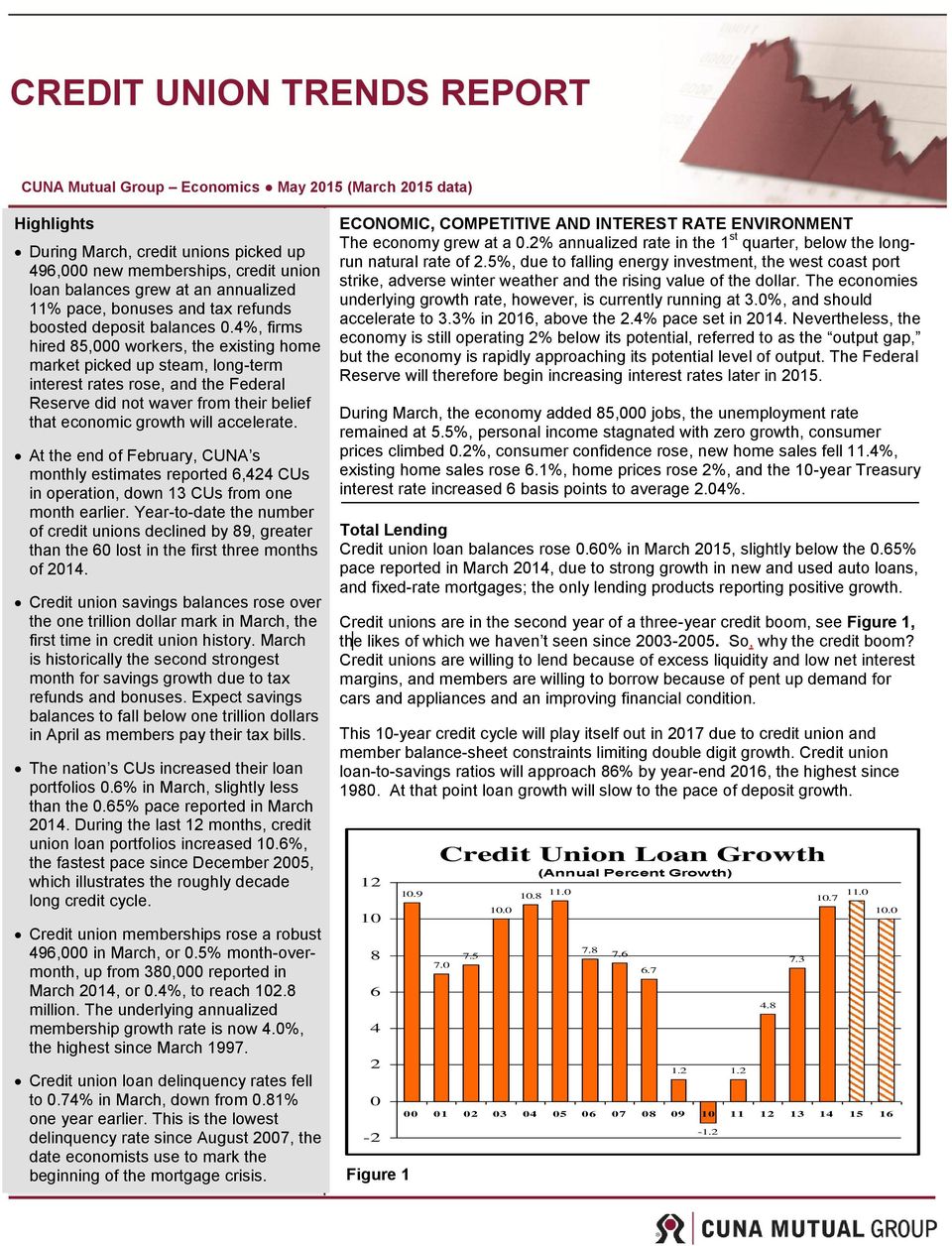
1 CREDIT UNION TRENDS REPORT CUNA Mutual Group Economics May 215 (March 215 data) Highlights During March, credit unions picked up 496, new memberships, credit union loan balances grew at an annualized pace, bonuses and tax refunds boosted deposit balances., firms hired 85, workers, the existing home market picked up steam, long-term interest rates rose, and the Federal Reserve did not waver from their belief that economic growth will accelerate. At the end of February, CUNA s monthly estimates reported 6,424 CUs in operation, down 13 CUs from one month earlier. Year-to-date the number of credit unions declined by 89, greater than the 6 lost in the first three months of 214. Credit union savings balances rose over the one trillion dollar mark in March, the first time in credit union history. March is historically the second strongest month for savings growth due to tax refunds and bonuses. Expect savings balances to fall below one trillion dollars in April as members pay their tax bills. The nation s CUs increased their loan portfolios. in March, slightly less than the.6 pace reported in March 214. During the last 12 months, credit union loan portfolios increased 1., the fastest pace since December 25, which illustrates the roughly decade long credit cycle. Credit union memberships rose a robust 496, in March, or. month-overmonth, up from 38, reported in March 214, or., to reach 12.8 million. The underlying annualized membership growth rate is now 4.%, the highest since March Credit union loan delinquency rates fell to.7 in March, down from.8 one year earlier. This is the lowest delinquency rate since August 27, the date economists use to mark the beginning of the mortgage crisis. ECONOMIC, COMPETITIVE AND INTEREST RATE ENVIRONMENT The economy grew at a. annualized rate in the 1 st quarter, below the longrun natural rate of 2., due to falling energy investment, the west coast port strike, adverse winter weather and the rising value of the dollar. The economies underlying growth rate, however, is currently running at 3.%, and should accelerate to 3. in 216, above the 2. pace set in 214. Nevertheless, the economy is still operating below its potential, referred to as the output gap, but the economy is rapidly approaching its potential level of output. The Federal Reserve will therefore begin increasing interest rates later in 215. During March, the economy added 85, jobs, the unemployment rate remained at 5., personal income stagnated with zero growth, consumer prices climbed., consumer confidence rose, new home sales fell 11., existing home sales rose 6., home prices rose, and the 1-year Treasury interest rate increased 6 basis points to average 2.. Total Lending Credit union loan balances rose.6% in March 215, slightly below the.6 pace reported in March 214, due to strong growth in new and used auto loans, and fixed-rate mortgages; the only lending products reporting positive growth. Credit unions are in the second year of a three-year credit boom, see Figure 1, the likes of which we haven t seen since So, why the credit boom? Credit unions are willing to lend because of excess liquidity and low net interest margins, and members are willing to borrow because of pent up demand for cars and appliances and an improving financial condition. This 1-year credit cycle will play itself out in 217 due to credit union and member balance-sheet constraints limiting double digit growth. Credit union loan-to-savings ratios will approach 8 by year-end 216, the highest since 198. At that point loan growth will slow to the pace of deposit growth Figure Credit Union Loan Growth (Annual Percent Growth)
2 Credit Union Consumer Installment Credit (CUCIC) Credit union credit card loan balances grew at a modest 4. seasonally-adjusted annualized growth rate in March see Figure 2, due to low gas prices reducing the amount of credit used at gas stations. March s seasonal factors usually shave off 1.41 percentage points from the underlying trend growth rate, see Figure 3, as members used bonuses and tax refunds to pay down credit card balances accumulated during the holiday shopping season. The outlook for credit unions credit card lending is positive because of strong consumer fundamentals like the improving labor market, rising home and stock values, faster wage growth, greater levels of consumer confidence and greater access to credit. Figure 2 CU Credit Card Growth Seasonally Adjusted Annualized Growth Rate % % - - Figure 3 Credit Card Loan Seasonal Factors 5.% 3. 4.% 3.% 2.% 1.% 1.% % Jan Feb Mar Apr May June July Aug Sept -. Oct Nov Dec -1.% % % Source: CUNA & NCUA. Vehicle Loans Credit union used-auto loan balances grew at a 14. seasonally-adjusted annualized growth rate in March, the fastest pace since November 1999, see Figure 4. March s used-auto loan seasonal factors usually add.32 percentage points to the underlying trend growth rate, see figure 5. The used auto buying and lending season begins in March and runs through September. Credit union new-auto loan balances grew at a 24. seasonally-adjusted annualized growth rate in March, the fastest pace on record. New-auto loan balances made up 3 of total loan balances in March, up from 3 in December 212, due to the tremendous surge in new auto sales in the past few years. CU Used Loan Growth Seasonally Adjusted Annualized Growth Rate % % Figure 4 Figure 5 Used Auto Loan Seasonal Factors Vehicle sales rebounded to a strong 17.1 million unit seasonally-adjusted annualized basis in March, up from 16.2 million units in February. Sales were up from March 214. The economic factors that are currently supporting vehicle sales are rising consumer confidence, an improving job market, greater access to credit, low interest rates, improving household balance sheets, and rising incomes. Expect car sales to increase in 215 to reach 17 million units, the strongest pace since % % % Jan Feb Mar Apr May June July Aug Sept -. Oct Nov Dec Source: CUNA & NCUA Credit Union Trends Report

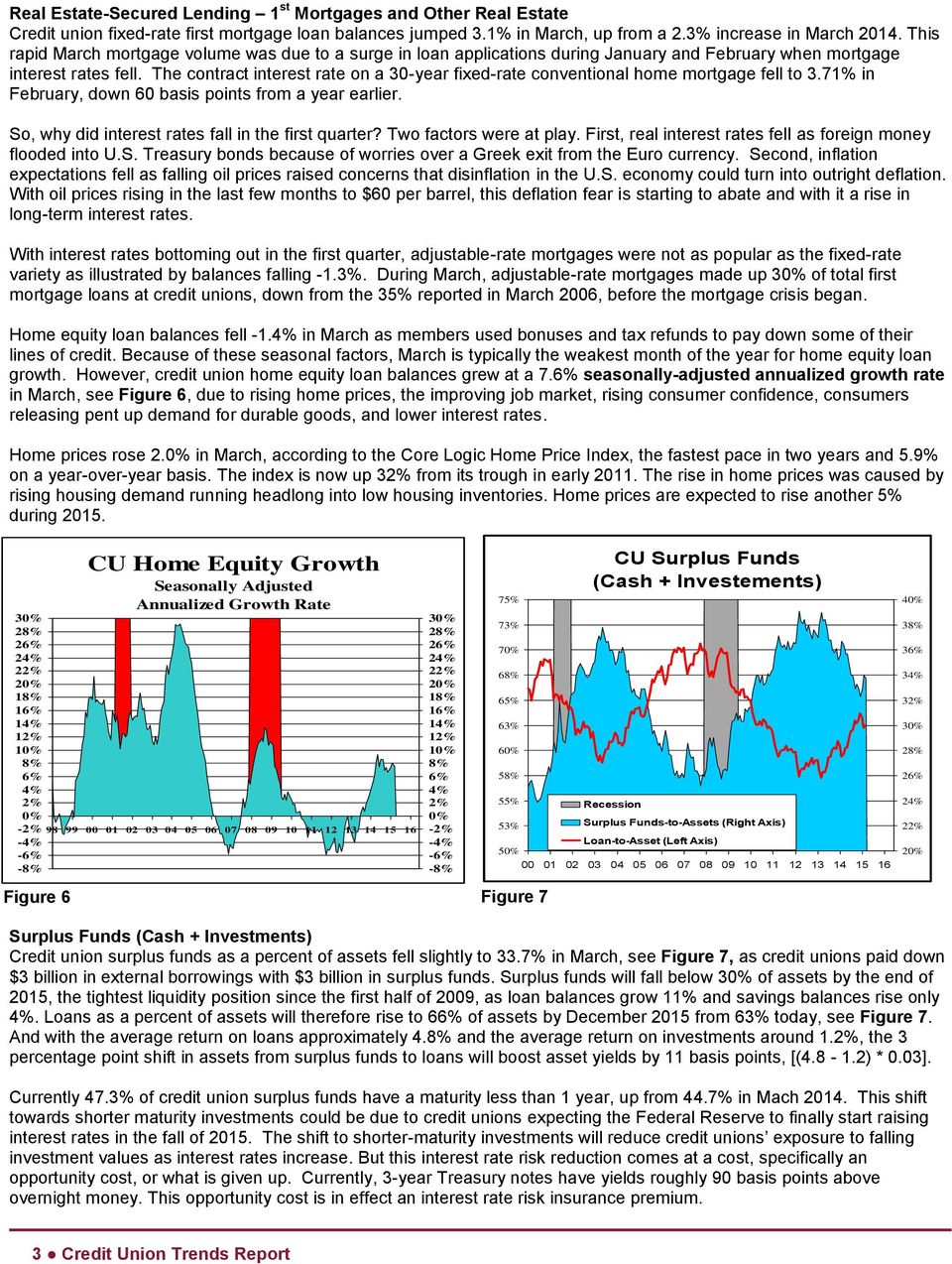
3 Real Estate-Secured Lending 1 st Mortgages and Other Real Estate Credit union fixed-rate first mortgage loan balances jumped 3. in March, up from a 2. increase in March 214. This rapid March mortgage volume was due to a surge in loan applications during January and February when mortgage interest rates fell. The contract interest rate on a 3-year fixed-rate conventional home mortgage fell to 3.7 in February, down 6 basis points from a year earlier. So, why did interest rates fall in the first quarter? Two factors were at play. First, real interest rates fell as foreign money flooded into U.S. Treasury bonds because of worries over a Greek exit from the Euro currency. Second, inflation expectations fell as falling oil prices raised concerns that disinflation in the U.S. economy could turn into outright deflation. With oil prices rising in the last few months to $6 per barrel, this deflation fear is starting to abate and with it a rise in long-term interest rates. With interest rates bottoming out in the first quarter, adjustable-rate mortgages were not as popular as the fixed-rate variety as illustrated by balances falling -1.. During March, adjustable-rate mortgages made up of total first mortgage loans at credit unions, down from the 3 reported in March 26, before the mortgage crisis began. Home equity loan balances fell -1. in March as members used bonuses and tax refunds to pay down some of their lines of credit. Because of these seasonal factors, March is typically the weakest month of the year for home equity loan growth. However, credit union home equity loan balances grew at a 7. seasonally-adjusted annualized growth rate in March, see Figure 6, due to rising home prices, the improving job market, rising consumer confidence, consumers releasing pent up demand for durable goods, and lower interest rates. Home prices rose 2.% in March, according to the Core Logic Home Price Index, the fastest pace in two years and 5. on a year-over-year basis. The index is now up 3 from its trough in early 211. The rise in home prices was caused by rising housing demand running headlong into low housing inventories. Home prices are expected to rise another during % 1 1 % CU Home Equity Growth Seasonally Adjusted Annualized Growth Rate % 1 1 % Figure 6 Figure % CU Surplus Funds (Cash + Investements) Recession Surplus Funds-to-Assets (Right Axis) Loan-to-Asset (Left Axis) % Surplus Funds (Cash + Investments) Credit union surplus funds as a percent of assets fell slightly to 33. in March, see Figure 7, as credit unions paid down $3 billion in external borrowings with $3 billion in surplus funds. Surplus funds will fall below of assets by the end of 215, the tightest liquidity position since the first half of 29, as loan balances grow and savings balances rise only. Loans as a percent of assets will therefore rise to 6 of assets by December 215 from 6 today, see Figure 7. And with the average return on loans approximately 4. and the average return on investments around 1., the 3 percentage point shift in assets from surplus funds to loans will boost asset yields by 11 basis points, [( ) *.3]. Currently 47. of credit union surplus funds have a maturity less than 1 year, up from 44. in Mach 214. This shift towards shorter maturity investments could be due to credit unions expecting the Federal Reserve to finally start raising interest rates in the fall of 215. The shift to shorter-maturity investments will reduce credit unions exposure to falling investment values as interest rates increase. But this interest rate risk reduction comes at a cost, specifically an opportunity cost, or what is given up. Currently, 3-year Treasury notes have yields roughly 9 basis points above overnight money. This opportunity cost is in effect an interest rate risk insurance premium. 3 Credit Union Trends Report
4 Savings and Assets Credit union savings balances grew at a 5. seasonally-adjusted annualized growth rate in March, see Figure 8, due to low gas prices, rising household income, strong job growth, and fast membership growth. March seasonal factors (bonuses and tax refunds) typically add 1.15 percentage points to the underlying savings trend growth, see Figure 9. Credit union saving balances grew.4 in March, faster than the.3 reported one year earlier. Almost all of this growth is taking place in liquid deposits like share drafts, regular shares, and MMAs as members anticipate the Federal Reserve will raise interest rates soon, and therefore do not want to lock up their funds in term deposits. Credit union cost of funds fell to a record low.5 in the first quarter of 215, from.5 in the first quarter of 214. We expect funding costs to rise later this year as short-term interest rates move up and members begin moving funds from low-rate core deposits to higher-rate share certificates and money market accounts. CU Savings Growth Seasonally Adjusted Annualized Growth Rate % % Figure 8 Figure 9 CU Savings Seasonal Factors % Jan Feb Mar Apr May June July Aug Sept Oct Nov Dec Capital and Other Key Measures The credit union average capital-to asset ratio rose to 1. in March 215, up from 1. in February, and above the 1. reported one year earlier. In the year ending in March, credit union capital rose a strong 8. while assets grew only 5., which pushed up the capital ratio.3 percentage points. Capital ratios should climb to 11. by the end of 216 as earnings and capital accumulation outpaces asset growth, see Figure 1. The credit union loan delinquency rate (loans two or more months delinquent as a percent of total loans outstanding) fell to.7 in March, down from.8 in March 214 and less than half the 1.8 reported in February 21, see Figure 11. Credit unions report large declines in the delinquency rate in February and March as members use bonuses and tax refunds to catch up on overdue loans % Source: CUNA & NCUA Net Capital-To-Asset Ratios 12 CU Delinquency Rate Versus Unemployment Rate Recession Unemployment (Left Axis).25 1 Delinquency (Right Axis) Figure 1 Figure 11 4 Credit Union Trends Report

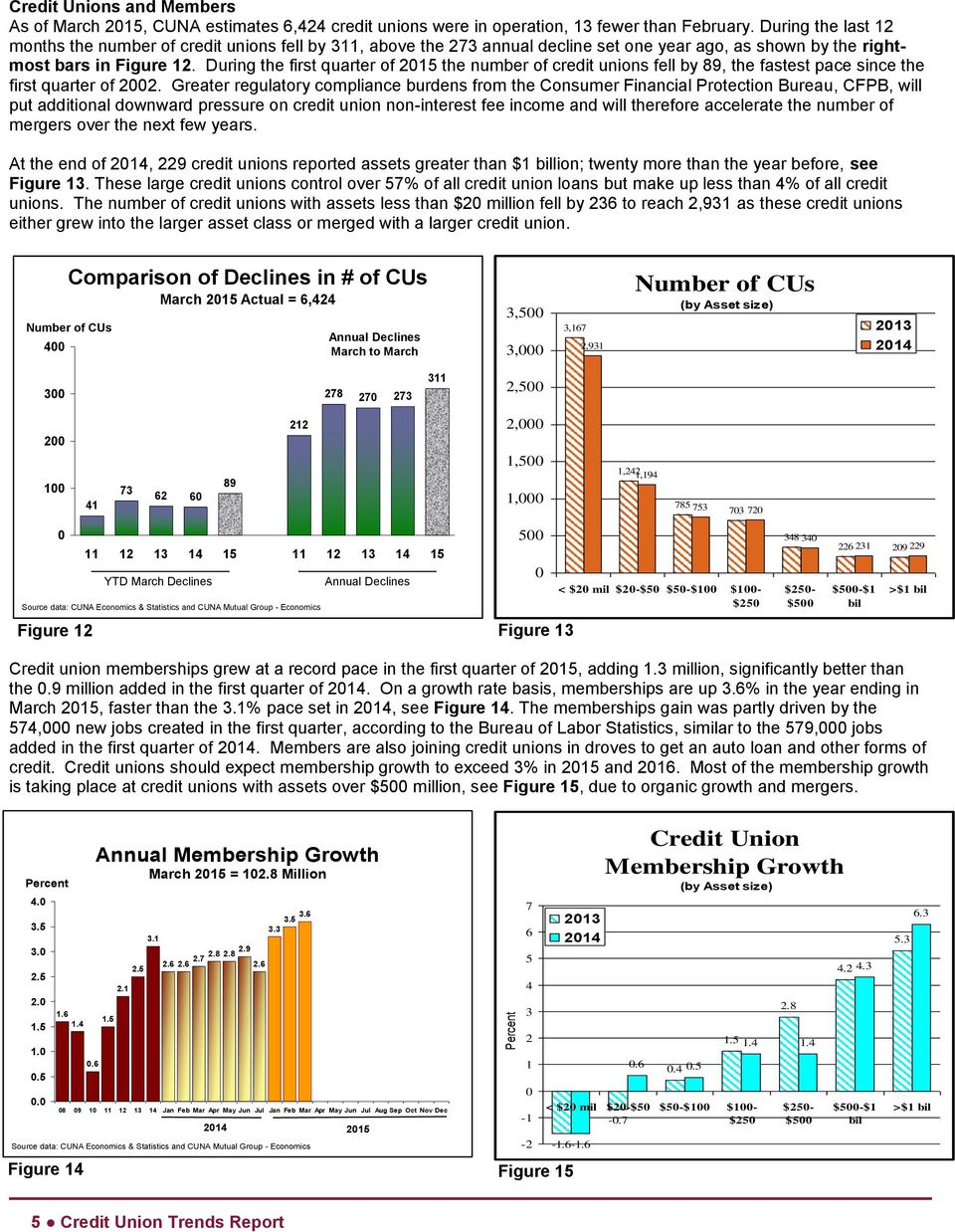
5 Percent Credit Unions and Members As of March 215, CUNA estimates 6,424 credit unions were in operation, 13 fewer than February. During the last 12 months the number of credit unions fell by 311, above the 273 annual decline set one year ago, as shown by the rightmost bars in Figure 12. During the first quarter of 215 the number of credit unions fell by 89, the fastest pace since the first quarter of 22. Greater regulatory compliance burdens from the Consumer Financial Protection Bureau, CFPB, will put additional downward pressure on credit union non-interest fee income and will therefore accelerate the number of mergers over the next few years. At the end of 214, 229 credit unions reported assets greater than $1 billion; twenty more than the year before, see Figure 13. These large credit unions control over 5 of all credit union loans but make up less than of all credit unions. The number of credit unions with assets less than $2 million fell by 236 to reach 2,931 as these credit unions either grew into the larger asset class or merged with a larger credit union. 4 Comparison of Declines in # of CUs March 215 Actual = 6,424 Number of CUs Annual Declines March to March 3,5 3, 3,167 2,931 Number of CUs (by Asset size) , , 1,5 1, 1,242 1, YTD March Declines Annual Declines Source data: CUNA Economics & Statistics and CUNA Mutual Group - Economics 5 < $2 mil $2-$5 $5-$1 $1- $ $25- $ $5-$1 bil >$1 bil Figure 12 Figure 13 Credit union memberships grew at a record pace in the first quarter of 215, adding 1.3 million, significantly better than the.9 million added in the first quarter of 214. On a growth rate basis, memberships are up 3. in the year ending in March 215, faster than the 3. pace set in 214, see Figure 14. The memberships gain was partly driven by the 574, new jobs created in the first quarter, according to the Bureau of Labor Statistics, similar to the 579, jobs added in the first quarter of 214. Members are also joining credit unions in droves to get an auto loan and other forms of credit. Credit unions should expect membership growth to exceed in 215 and 216. Most of the membership growth is taking place at credit unions with assets over $5 million, see Figure 15, due to organic growth and mergers. Percent Figure 14.6 Annual Membership Growth March 215 = 12.8 Million Jan Feb Mar Apr May Jun Jul Jan Feb Mar Apr May Jun Jul Aug Sep Oct Nov Dec 214 Source data: CUNA Economics & Statistics and CUNA Mutual Group - Economics Figure 15 Credit Union Membership Growth (by Asset size) < $2 mil $2-$5 $5-$1 $ $25 $25- $ $5-$1 bil >$1 bil 5 Credit Union Trends Report
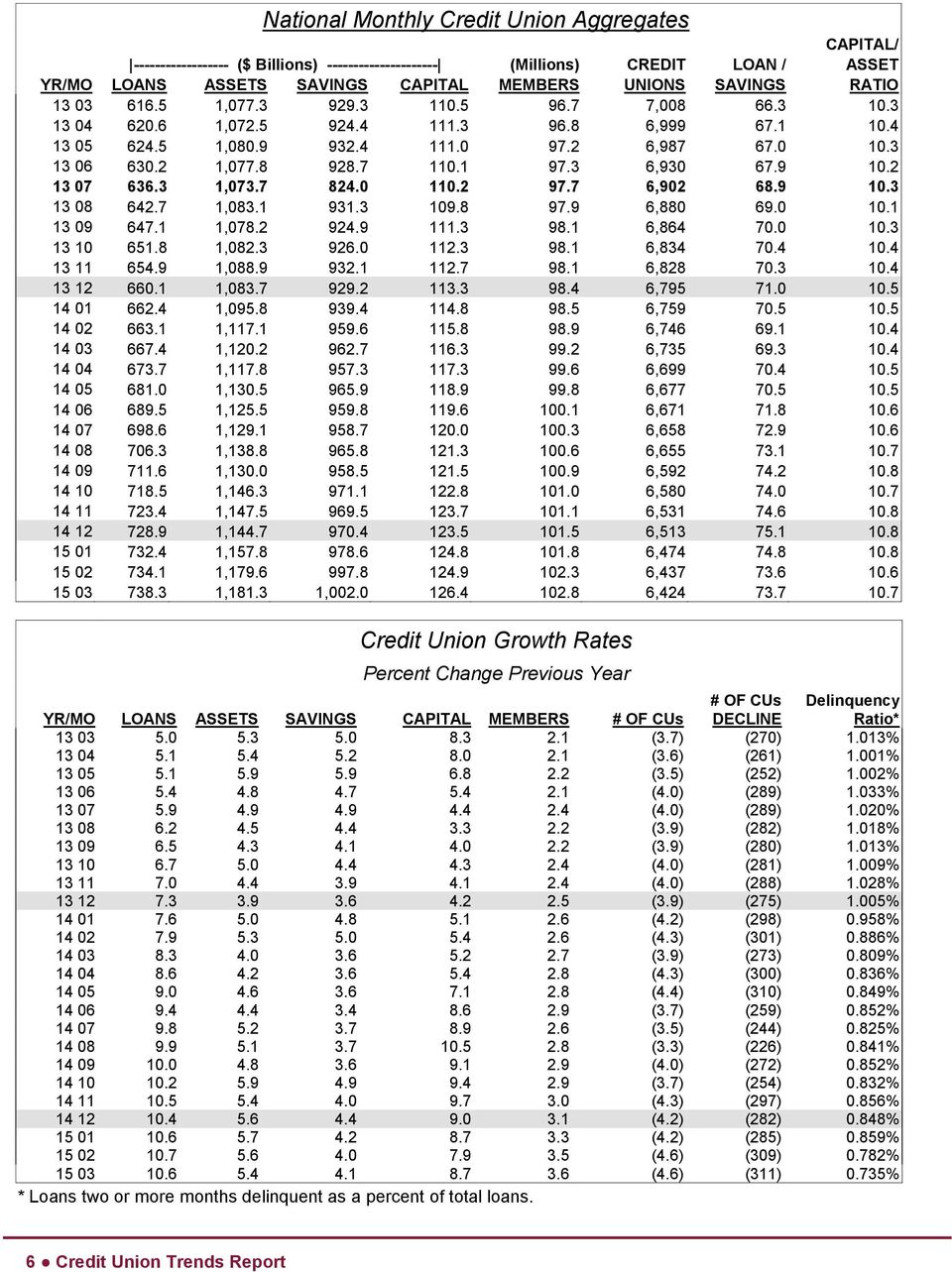
6 National Monthly Credit Union Aggregates CAPITAL/ ($ Billions) (Millions) CREDIT LOAN / ASSET YR/MO LOANS ASSETS SAVINGS CAPITAL MEMBERS UNIONS SAVINGS RATIO , , , , , , , , , , , , , , , , , , , , , , , , , , , , , , , , , , , , , , , , , , , , , , , , , , , Credit Union Growth Rates Percent Change Previous Year # OF CUs Delinquency YR/MO LOANS ASSETS SAVINGS CAPITAL MEMBERS # OF CUs DECLINE Ratio* (3.7) (27) (3.6) (261) (3.5) (252) (4.) (289) (4.) (289) 1.2% (3.9) (282) (3.9) (28) (4.) (281) (4.) (288) (3.9) (275) (4.2) (298) (4.3) (31) (3.9) (273) (4.3) (3) (4.4) (31) (3.7) (259) (3.5) (244) (3.3) (226) (4.) (272) (3.7) (254) (4.3) (297) (4.2) (282) (4.2) (285) (4.6) (39) (4.6) (311).73 * Loans two or more months delinquent as a percent of total loans. 6 Credit Union Trends Report
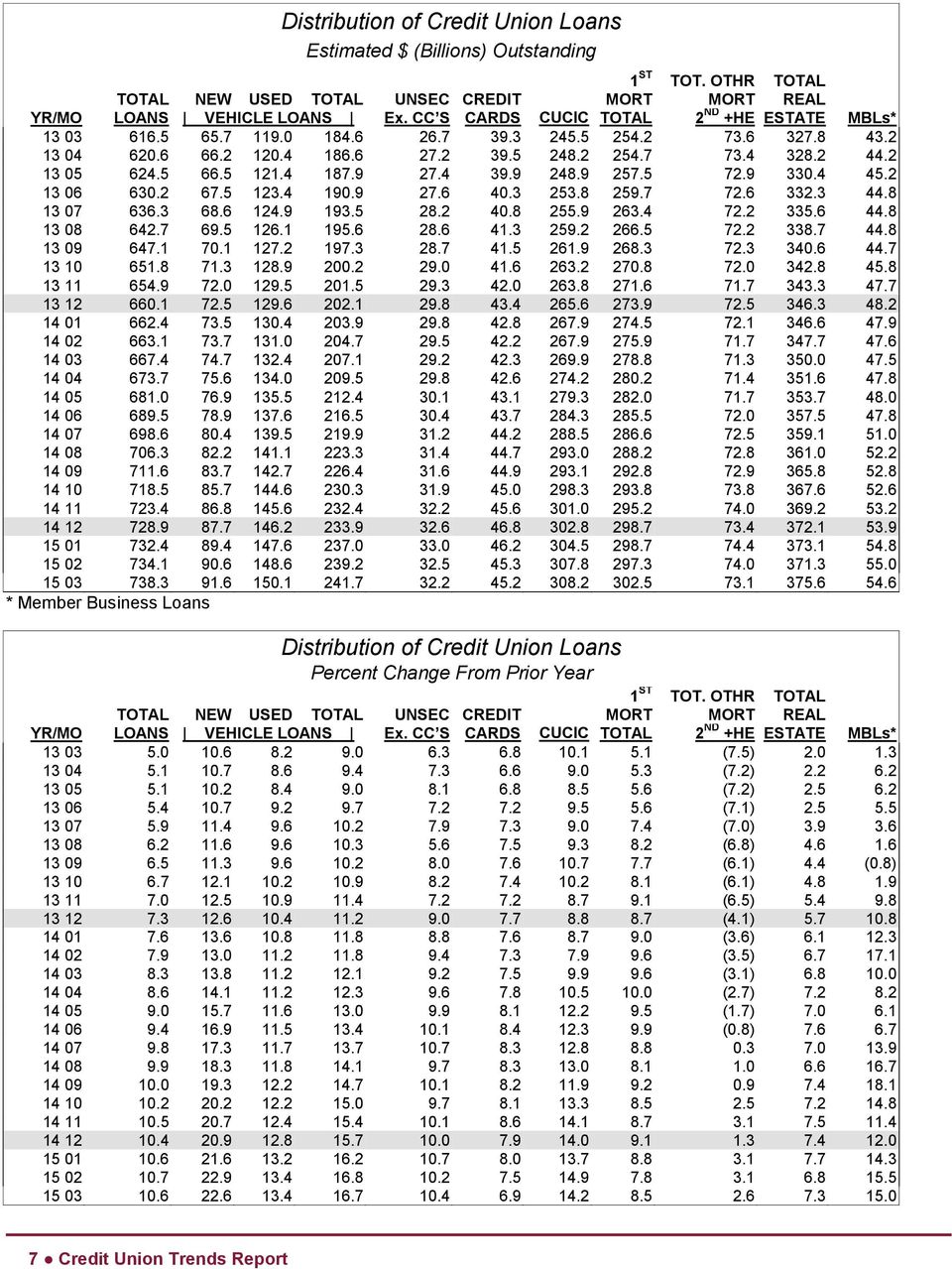
7 Distribution of Credit Union Loans Estimated $ (Billions) Outstanding 1 ST TOT. OTHR TOTAL TOTAL NEW USED TOTAL UNSEC CREDIT MORT MORT REAL YR/MO LOANS VEHICLE LOANS Ex. CC S CARDS CUCIC TOTAL 2 ND +HE ESTATE MBLs* * Member Business Loans Distribution of Credit Union Loans Percent Change From Prior Year 1 ST TOT. OTHR TOTAL TOTAL NEW USED TOTAL UNSEC CREDIT MORT MORT REAL YR/MO LOANS VEHICLE LOANS Ex. CC S CARDS CUCIC TOTAL 2 ND +HE ESTATE MBLs* (7.5) (7.2) (7.2) (7.1) (7.) (6.8) (6.1) 4.4 (.8) (6.1) (6.5) (4.1) (3.6) (3.5) (3.1) (2.7) (1.7) (.8) Credit Union Trends Report
8 Percent 15 1 Annual Growth Rates Total Loans & Installment Credit Total Loans CUCIC $ in Billions $474.2 $ CU Loan Portfolio $615.1 $58.5 $587.4 $58.3 $587. $544.1 $ % $ $ $ Mar CIC Other Percent CIC Share of Total Loans at Credit Unions $ Billions Consumer Installment Credit at Credit Unions This report on key CU indicators is based on data from CUNA E&S s Monthly Credit Union Estimates, the Federal Reserve Board, and CUNA Mutual Group Economics. To access this report on the Internet: Sign in at cunamutual.com Go to the Resource Library tab Under Publications heading, select Credit Union Trends Report If you have any questions, comments, or need additional information, please call. Thank you. Steven Rick , Ext [email protected] CUNA Mutual Group Economics CUNA Mutual Group, 215 All Rights Reserved. CUNA Mutual Group is the marketing name for CUNA Mutual Holding Company, a mutual insurance holding company, its subsidiaries and affiliates. 8 Credit Union Trends Report

CREDIT UNION TRENDS REPORT
 CREDIT UNION TRENDS REPORT CUNA Mutual Group Economics May 216 (March 216 Data) Highlights During March, credit unions picked-up 577, in new memberships, loan and savings balances grew at a % and 7.6%
CREDIT UNION TRENDS REPORT
 CREDIT UNION TRENDS REPORT CUNA Mutual Group Economics July 2 (May 2 data) Highlights First quarter data revisions were modest. The number of credit unions was revised down by and assets and loans were
Bank of Ghana Monetary Policy Report. Financial Stability Report
 BANK OF GHANA E S T. 1 9 5 7 Bank of Ghana Monetary Policy Report Financial Stability Report Volume 5: No.1/2013 February 2013 5.0 Introduction Conditions in global financial markets have improved significantly
Fixed Income 2015 Update. Kathy Jones, Senior Vice President Chief Fixed Income Strategist, Schwab Center for Financial Research
 Fixed Income 2015 Update Kathy Jones, Senior Vice President Chief Fixed Income Strategist, Schwab Center for Financial Research 1 Fed: Slow and Low 2015 Fixed Income Outlook 2 Yield Curve Flattening 3
A PLAN FOR A DEBT-FREE ALBERTA
 A PLAN FOR A DEBT-FREE ALBERTA Table of Contents Step 1 - Eliminating the Annual Deficit... 139 Step 2 - Eliminating the Net Debt... 139 Step 3 - Creating a Debt-Free Alberta... 142 Repaying Accumulated
Greek banks and corporate funding costs
 NATIONAL BANK OF GREECE Greek banks and corporate funding costs January 214 Paul Mylonas CRO & Chief Economist National Bank of Greece NBG: ECONOMIC ANALYSIS DEPARTMENT Economic Analysis Department Roadmap
Project LINK Meeting New York, 20-22 October 2010. Country Report: Australia
 Project LINK Meeting New York, - October 1 Country Report: Australia Prepared by Peter Brain: National Institute of Economic and Industry Research, and Duncan Ironmonger: Department of Economics, University
THE STATE OF THE ECONOMY
 THE STATE OF THE ECONOMY CARLY HARRISON Portland State University Following data revisions, the economy continues to grow steadily, but slowly, in line with expectations. Gross domestic product has increased,
THE STATE OF THE ECONOMY
 THE STATE OF THE ECONOMY ADAM SEIDMAN Portland State University In its latest report, the Oregon Office of Economic Analysis noted that full employment is finally within sight in Oregon. Indeed, 2015 saw
MBA Forecast Commentary Joel Kan
 MBA Forecast Commentary Joel Kan Mortgage Originations Estimates Revised Higher MBA Economic and Mortgage Finance Commentary: February 2016 In our most recent forecast, we presented revisions to our mortgage
COMPARISON OF FIXED & VARIABLE RATES (25 YEARS) CHARTERED BANK ADMINISTERED INTEREST RATES - PRIME BUSINESS*
 COMPARISON OF FIXED & VARIABLE RATES (25 YEARS) 2 Fixed Rates Variable Rates FIXED RATES OF THE PAST 25 YEARS AVERAGE RESIDENTIAL MORTGAGE LENDING RATE - 5 YEAR* (Per cent) Year Jan Feb Mar Apr May Jun
COMPARISON OF FIXED & VARIABLE RATES (25 YEARS) CHARTERED BANK ADMINISTERED INTEREST RATES - PRIME BUSINESS*
 COMPARISON OF FIXED & VARIABLE RATES (25 YEARS) 2 Fixed Rates Variable Rates FIXED RATES OF THE PAST 25 YEARS AVERAGE RESIDENTIAL MORTGAGE LENDING RATE - 5 YEAR* (Per cent) Year Jan Feb Mar Apr May Jun
Economic Factors Affecting Small Business Lending and Loan Guarantees
 Order Code RL34400 Economic Factors Affecting Small Business Lending and Loan Guarantees February 28, 2008 N. Eric Weiss Analyst in Financial Economics Government & Finance Division Economic Factors Affecting
Chapter 12: Gross Domestic Product and Growth Section 1
 Chapter 12: Gross Domestic Product and Growth Section 1 Key Terms national income accounting: a system economists use to collect and organize macroeconomic statistics on production, income, investment,
The case for high yield
 The case for high yield Jennifer Ponce de Leon, Vice President, Senior Sector Leader Wendy Price, Director, Institutional Product Management We believe high yield is a compelling relative investment opportunity
MBA Forecast Commentary Joel Kan, [email protected]
 MBA Forecast Commentary Joel Kan, [email protected] Weak First Quarter, But Growth Expected to Recover MBA Economic and Mortgage Finance Commentary: May 2015 Broad economic growth in the US got off to a slow
U.S. Credit Card. Trends, Liquidation and Portfolio Pricing
 U.S. Credit Card Sector Update: Market Trends, Liquidation and Portfolio Pricing Agenda U.S. Credit Card Sector AY Year in Review Key Economic Trends Liquidation and Pricing Changes Market Trends Unfolding
2012 Japan Broiler Market Situation Update and 2013 Outlook
 THIS REPORT CONTAINS ASSESSMENTS OF COMMODITY AND TRADE ISSUES MADE BY USDA STAFF AND NOT NECESSARILY STATEMENTS OF OFFICIAL U.S. GOVERNMENT POLICY Required Report - public distribution Date: GAIN Report
Bond Market Insights October 10, 2014
 Bond Market Insights October 10, 2014 by John Simms, CFA and Jerry Wiesner, CFA General Bond Market Treasury yields rose in September as prices fell. Yields in the belly of the curve (5- to 7-year maturities)
Territorial Bancorp Inc. Announces Second Quarter 2015 Results
 PRESS RELEASE FOR IMMEDIATE RELEASE Contact: Walter Ida (808) 946-1400 Territorial Bancorp Inc. Announces Second Quarter 2015 Results Earnings per share for the three months ended June 30, 2015 rose to
Lecture 4: The Aftermath of the Crisis
 Lecture 4: The Aftermath of the Crisis 2 The Fed s Efforts to Restore Financial Stability A financial panic in fall 2008 threatened the stability of the global financial system. In its lender-of-last-resort
NATIONAL CREDIT UNION SHARE INSURANCE FUND
 NATIONAL CREDIT UNION SHARE INSURANCE FUND PRELIMINARY & UNAUDITED FINANCIAL HIGHLIGHTS RENDELL L. JONES CHIEF FINANCIAL OFFICER MANAGEMENT OVERVIEW Balance Sheet Other - Insurance and Guarantee Program
COMMERCE BANCSHARES, INC. ANNOUNCES FOURTH QUARTER EARNINGS PER COMMON SHARE OF $.63
 Exhibit 99.1 1000 Walnut Street / Suite 700 / Kansas City, Missouri 64106 / 816.234.2000 CBSH FOR IMMEDIATE RELEASE: Wednesday, January 20, 2016 COMMERCE BANCSHARES, INC. ANNOUNCES FOURTH QUARTER EARNINGS
Finding income and managing risk in a near-zero interest-rate environment
 Aging Workforce Series Finding income and managing risk in a near-zero interest-rate environment William Martin, Head of Fixed-Income Portfolio Management TIAA-CREF Executive Summary Yields in traditional
Small Business Lending *
 Reserve Small Business Bank of Lending Australia Bulletin Small Business Lending * These notes were prepared in response to a request from the House of Representatives Standing Committee on Financial Institutions
Territorial Bancorp Inc. Announces 2015 Results
 PRESS RELEASE FOR IMMEDIATE RELEASE Contact: Walter Ida (808) 946-1400 Territorial Bancorp Inc. Announces 2015 Results Fully diluted earnings per share for the three months ended December 31, 2015 rose
Gauging Current Conditions: The Economic Outlook and Its Impact on Workers Compensation
 Gauging Current Conditions: The Economic Outlook and Its Impact on Workers Compensation October 2006 The gauges below indicate the economic outlook for the current year and for 2007 for factors that typically
THE POTENTIAL MACROECONOMIC EFFECT OF DEBT CEILING BRINKMANSHIP
 OCTOBER 2013 THE POTENTIAL MACROECONOMIC EFFECT OF DEBT CEILING BRINKMANSHIP Introduction The United States has never defaulted on its obligations, and the U. S. dollar and Treasury securities are at the
Exam 1 Review. 3. A severe recession is called a(n): A) depression. B) deflation. C) exogenous event. D) market-clearing assumption.
 Exam 1 Review 1. Macroeconomics does not try to answer the question of: A) why do some countries experience rapid growth. B) what is the rate of return on education. C) why do some countries have high
The U.S. and Midwest Economy in 2016: Implications for Supply Chain Firms
 The U.S. and Midwest Economy in 2016: Implications for Supply Chain Firms Rick Mattoon Senior Economist and Economic Advisor Federal Reserve Bank of Chicago Right Place Supply Chain Management Conference
2015 Farm Bank Performance Report Key Findings
 2015 Farm Bank Performance Report Key Findings The banking industry is the nation s most important supplier of credit to agriculture providing nearly 50 percent of all farm loans in the U.S. $170 billion
Strawberry Industry Overview and Outlook. Feng Wu Research Associate Gulf Coast Research and Education Center University of Florida fengwu@ufl.
 Strawberry Industry Overview and Outlook Feng Wu Research Associate Gulf Coast Research and Education Center University of Florida [email protected] Zhengfei Guan Assistant Professor Gulf Coast Research and
Sonoma County Economic Development Board BUSINESS BAROMETER
 BUSINESS BAROMETER September 2006 In This Month s Report: Newly revised employment data shows that Sonoma County added 3,000 jobs in the 12-month period ending July 2006. The seasonally adjusted unemployment
FEDERAL DEPOSIT INSURANCE CORPORATION Washington, DC 20429 FORM 8-K
 FEDERAL DEPOSIT INSURANCE CORPORATION Washington, DC 20429 FORM 8-K CURRENT REPORT Pursuant to Section 13 or 15(d) of the Securities Exchange Act of 1934 Date of Report (Date of earliest event reported)
Report for September 2015
 Report for tember 2015 Issued tember 30, 2015 National Association of Credit Management Combined Sectors So much for that hoped for pattern of one bad month followed by a good one. This month s CMI is
Financial Market Instruments
 appendix to chapter 2 Financial Market Instruments Here we examine the securities (instruments) traded in financial markets. We first focus on the instruments traded in the money market and then turn to
Diminished Liquidity in the Corporate Bond Market: Implications for Fixed Income Investors
 Diminished Liquidity in the Corporate Bond Market: Implications for Fixed Income Investors 3/16/215 Summary In the wake of the 27-8 Financial Crisis, investors increased their holdings of fixed income
Georgia. Mid-Year 2015. Prepared by: CUNA Economics and Statistics
 Georgia Mid-Year 2015 Prepared by: CUNA Economics and Statistics Source: Informa Research Services, NCUA, and CUNA. (1)Assumes 1.9 credit union members per household. Loan Product Comparative Interest
Economic indicators dashboard
 AS OF NOVEMBER 17, 2015 Economic indicators dashboard Vist www.blog.helpingadvisors.com for the full commentary of the Economic Indicators Dashboard. MOST RECENT 3-MO. trend TYPICAL range EXTREME range
AT&T Global Network Client for Windows Product Support Matrix January 29, 2015
 AT&T Global Network Client for Windows Product Support Matrix January 29, 2015 Product Support Matrix Following is the Product Support Matrix for the AT&T Global Network Client. See the AT&T Global Network
Bond Market Perspectives
 LPL FINANCIAL RESEARCH Bond Market Perspectives 20, 20 Municipals Bloom Amid Drought Anthony Valeri, CFA Market Strategist LPL Financial Highlights Limited new issuance and Treasury market strength have
Statement by. Janet L. Yellen. Chair. Board of Governors of the Federal Reserve System. before the. Committee on Financial Services
 For release at 8:30 a.m. EST February 10, 2016 Statement by Janet L. Yellen Chair Board of Governors of the Federal Reserve System before the Committee on Financial Services U.S. House of Representatives
Monthly Economic Dashboard
 RETIREMENT INSTITUTE SM Economic perspective Monthly Economic Dashboard Modest acceleration in economic growth appears in store for 2016 as the inventory-caused soft patch ends, while monetary policy moves
Economics 101 Multiple Choice Questions for Final Examination Miller
 Economics 101 Multiple Choice Questions for Final Examination Miller PLEASE DO NOT WRITE ON THIS EXAMINATION FORM. 1. Which of the following statements is correct? a. Real GDP is the total market value
Why Has Japan Been Hit So Hard by the Global Recession?
 IMF STAFF POSITION NOTE March 18, 9 SPN/9/5 Why Has Been Hit So Hard by the Global Recession? Martin Sommer I N T E R N A T I O N A L M O N E T A R Y F U N D INTERNATIONAL MONETARY FUND Why Has Been Hit
Solutions to Problem Set #2 Spring, 2013. 1.a) Units of Price of Nominal GDP Real Year Stuff Produced Stuff GDP Deflator GDP
 Economics 1021, Section 1 Prof. Steve Fazzari Solutions to Problem Set #2 Spring, 2013 1.a) Units of Price of Nominal GDP Real Year Stuff Produced Stuff GDP Deflator GDP 2003 500 $20 $10,000 95.2 $10,504
Historically, employment in financial
 Employment in financial activities: double billed by housing and financial crises The housing market crash, followed by the financial crisis of the 2007-09 recession, helped depress financial activities
52 ARTICLE The relationship between the repo rate and interest rates for households and companies
 ARTICLE The relationship between the repo rate and interest rates for households and companies Figure A. Rates for new mortgage agreements for households and the repo rate 8 9 Average mortgage rate Short
MULTIPLE CHOICE. Choose the one alternative that best completes the statement or answers the question.
 Suvey of Macroeconomics, MBA 641 Fall 2006, Final Exam Name MULTIPLE CHOICE. Choose the one alternative that best completes the statement or answers the question. 1) Modern macroeconomics emerged from
Renminbi Depreciation and the Hong Kong Economy
 Thomas Shik Acting Chief Economist [email protected] Renminbi Depreciation and the Hong Kong Economy If the recent weakness of the renminbi persists, it is likely to have a positive direct impact
Econ 330 Exam 1 Name ID Section Number
 Econ 330 Exam 1 Name ID Section Number MULTIPLE CHOICE. Choose the one alternative that best completes the statement or answers the question. 1) If during the past decade the average rate of monetary growth
Econ 202 Section H01 Midterm 2
 , Spring 2010 March 16, 2010 PLEDGE: I have neither given nor received unauthorized help on this exam. SIGNED: PRINT NAME: Econ 202 Section H01 Midterm 2 Multiple Choice. 2.5 points each. 1. What would
From Widening Deficits to Paying Down the Debt: Benefits for the American People
 From Widening Deficits to Paying Down the Debt: Benefits for the American People August 4, 1999 Office of Economic Policy U.S. Department of Treasury From Widening Deficits to Paying Down the Debt: Benefits
Chapter 13. Aggregate Demand and Aggregate Supply Analysis
 Chapter 13. Aggregate Demand and Aggregate Supply Analysis Instructor: JINKOOK LEE Department of Economics / Texas A&M University ECON 203 502 Principles of Macroeconomics In the short run, real GDP and
MORE UPSIDE FOR THE AUSTRALIAN DOLLAR
 Dec. 23 Jan. 2 ECONOMY AND STRATEGY 51.879.2529 Clément Gignac Strategist and Chief Economist Stéfane Marion Assistant Chief Economist Paul-André Pinsonnault Senior Fixed Income Economist Marc Pinsonneault
Economic Update as of June 30, 2016
 MACRO Report: Review of Wyoming s Economy Economic Update as of June 30, The MACRO Report is a quarterly publication comprised of charts focusing on energy, employment, state revenues, and other indicators
Investing Practice Questions
 Investing Practice Questions 1) When interest is calculated only on the principal amount of the investment, it is known as: a) straight interest b) simple interest c) compound interest d) calculated interest
1. 2015 Gross Borrowing Requirements and Funding Plan
 1 1. 2015 Gross Borrowing Requirements and Funding Plan 1.1 Gross Borrowing requirements The Treasury expects its 2015 gross borrowing requirements to amount to EUR 39.90 billion. This represents an increase
Investments 320 Dr. Ahmed Y. Dashti Chapter 3 Interactive Qustions
 Investments 320 Dr. Ahmed Y. Dashti Chapter 3 Interactive Qustions 3-1. A primary asset is an initial offering sold by a business, or government, to raise funds. A) True B) False 3-2. Money market instruments
Recovery in UK property to gain momentum. Recovery in UK property market to gain momentum. Research & Strategy. June 2013. Economic growth recovering
 Research & Strategy Recovery in UK property to gain momentum June 13 Recovery in UK property market to gain momentum This hasn t been a typical recession and it won t be a typical recovery. Nevertheless
Economic Outlook: Middle-Class Families Find Little Relief from Stagnant Wages and Rising Prices
 Economic Outlook: Middle-Class Families Find Little Relief from Stagnant Wages and Rising Prices The first half of 2005 was hard on middle-class families. As wage and employment growth trends remain at
Working Capital and the Financing Decision C H A P T E R S I X
 Working Capital and the Financing Decision C H A P T E R S I X Limited 2000 Figure 6-1a The nature of asset growth A. Stage I: Limited or no Growth PPT 6-1 Dollars Temporary current assets Capital assets
Eurozone Economic dashboard
 Eurozone Economic dashboard Our Economic Dashboard is designed to help investors understand the true state of the eurozone economy. It is not meant to serve as a direct prediction regarding the future
The Benefits of Membership. National
 The Benefits of Membership National June 2008 Prepared by: Credit Union National Association Economics and Statistics Department About Your Membership Benefits Report The Membership Benefits report communicates
Monetary Policy and Mortgage Interest rates
 Monetary Policy and Mortgage Interest rates July 2014 Key Points: Monetary policy, which operates through changes in the official cash rate (OCR), is the main lever of macroeconomic management in Australia
Introductory remarks by Jean-Pierre Danthine
 abcdefg News conference Berne, 15 December 2011 Introductory remarks by Jean-Pierre Danthine I would like to address three main issues today. These are the acute market volatility experienced this summer,
Household Debt and Credit: Student Debt
 Household Debt and Credit: Student Debt February 28, 2013 Donghoon Lee The views presented here are those of the author and do not necessarily reflect those of the Federal Reserve Bank of New York, or
U.S. and Regional Housing Markets
 U.S. and Regional Housing Markets House Prices Boom, Bust and Rebound Index, 1991: Q1=1* 3 CoreLogic house price index Real FHFA house price index 25 2 15 1 5 1991 199 1997 2 23 26 29 212 215 *Seasonally
MACROECONOMIC AND INDUSTRY ANALYSIS VALUATION PROCESS
 MACROECONOMIC AND INDUSTRY ANALYSIS VALUATION PROCESS BUSINESS ANALYSIS INTRODUCTION To determine a proper price for a firm s stock, security analyst must forecast the dividend & earnings that can be expected
Unemployment and Economic Recovery
 Cornell University ILR School DigitalCommons@ILR Federal Publications Key Workplace Documents 11-17-2009 Unemployment and Economic Recovery Brian W. Cashell Congressional Research Service Follow this and
Bond Market Perspectives
 LPL FINANCIAL RESEARCH Bond Market Perspectives December 16, 2014 Tempting TIPS Anthony Valeri, CFA Fixed Income & Investment Strategist LPL Financial Highlights Lower inflation expectations as a result
Monthly Report for Last Atlantis Partners LLC Share Classes November, 2008
 Monthly Report for Last Atlantis Partners LLC Share Classes November, 2008 Performance Summary Below are summary performance numbers for Last Atlantis Partners, LLC share classes. To download detailed
The President s Report to the Board of Directors
 The President s Report to the Board of Directors May 5, 2015 CURRENT ECONOMIC DEVELOPMENTS - May 5, 2015 Data released since your last Directors' meeting show that economic growth continued to slow in
Taking stock of China s external debt: low indebtedness, but rapid growth is a concern
 1991 1993 1995 1997 1999 21 23 25 27 29 211 213 1991 1992 1993 1994 1995 1996 1997 1998 1999 2 21 22 23 24 25 26 27 28 29 21 211 212 213 ECONOMIC ANALYSIS Taking stock of China s external debt: low indebtedness,
THE EMPIRE LIFE INSURANCE COMPANY
 THE EMPIRE LIFE INSURANCE COMPANY Condensed Interim Consolidated Financial Statements For the nine months ended September 30, 2013 Unaudited Issue Date: November 6, 2013 These condensed interim consolidated
Consumer Price Developments in December 2015
 sdzkl1;yah Consumer Price Developments in December 2015 CPI-All Items inflation came in at -0.6% year-on-year (y-o-y) in December CPI-All Items inflation came in at -0.6% in December, compared to -0.8%
Natalia Orlova, Chief Economist December 2004 [email protected] +7 095 795 36 77
 New Environment for Refinancing in Russia Natalia Orlova, Chief Economist December 2004 [email protected] +7 095 795 36 77 Excessive sterilization depressed liquidity Banking crisis stemmed from a decline
Today s bond market is riskier and more volatile than in several generations. As
 Fixed Income Approach 2014 Volume 1 Executive Summary Today s bond market is riskier and more volatile than in several generations. As interest rates rise so does the anxiety of fixed income investors
Housing Price Forecasts, 2015. Illinois and Chicago MSA
 Housing Price Forecasts, 2015 Illinois and Chicago MSA Presented To Illinois Association of Realtors From R E A L Regional Economics Applications Laboratory, Institute of Government and Public Affairs
A HOW-TO GUIDE: UNDERSTANDING AND MEASURING INFLATION
 A HOW-TO GUIDE: UNDERSTANDING AND MEASURING INFLATION By Jim Stanford Canadian Centre for Policy Alternatives, 2008 Non-commercial use and reproduction, with appropriate citation, is authorized. This guide
Recent U.S. Economic Growth In Charts MAY 2012
 Recent U.S. Economic Growth In Charts MAY 212 GROWTH SINCE 29 The Growth Story Since 29 Despite the worst financial crisis since the Great Depression and a series of shocks in its aftermath, the economy