
Instructions for Copying
|
|
|
- Octavia Rosemary Collins
- 9 years ago
- Views:
Transcription
1 Instructions for Copying Answers are printed in non-reproducible blue. Copy pages on a light setting in order to make multiple copies for classroom use.

2 Contents LIFE SCIENCE Chapter 1 From Cells to Ecosystems Chapter Concept Map Lesson 1 Lesson Outline Lesson Vocabulary Lesson Cloze Activity Lesson 2 Lesson Outline Lesson Vocabulary Lesson Cloze Activity Lesson 3 Lesson Outline Lesson Vocabulary Lesson Cloze Activity Writing in Science Lesson 4 Lesson Outline Lesson Vocabulary Lesson Cloze Activity Chapter Vocabulary Chapter 2 Heredity and Diversity Chapter Concept Map Lesson 1 Lesson Outline Lesson Vocabulary Lesson Cloze Activity Writing in Science Lesson 2 Lesson Outline Lesson Vocabulary Lesson Cloze Activity Reading in Science Lesson 3 Lesson Outline Lesson Vocabulary Lesson Cloze Activity Reading in Science Lesson 4 Lesson Outline Lesson Vocabulary Lesson Cloze Activity Writing in Science Chapter Vocabulary Life Science Literature iii

3 Contents EARTH SCIENCE Chapter 3 The Universe Chapter Concept Map Lesson 1 Lesson Outline Lesson Vocabulary Lesson Cloze Activity Lesson 2 Lesson Outline Lesson Vocabulary Lesson Cloze Activity Reading in Science Lesson 3 Lesson Outline Lesson Vocabulary Lesson Cloze Activity Chapter Vocabulary Chapter 4 Our Dynamic Earth Chapter Concept Map Lesson 1 Lesson Outline Lesson Vocabulary Lesson Cloze Activity Writing in Science Lesson 2 Lesson Outline Lesson Vocabulary Lesson Cloze Activity Lesson 3 Lesson Outline Lesson Vocabulary Lesson Cloze Activity Reading in Science Lesson 4 Lesson Outline Lesson Vocabulary Lesson Cloze Activity Chapter Vocabulary Earth and Space Science Literature iv

4 Contents PHYSICAL SCIENCE Chapter 5 Properties of Matter Chapter Concept Map Lesson 1 Lesson Outline Lesson Vocabulary Lesson Cloze Activity Reading in Science Lesson 2 Lesson Outline Lesson Vocabulary Lesson Cloze Activity Lesson 3 Lesson Outline Lesson Vocabulary Lesson Cloze Activity Lesson 4 Lesson Outline Lesson Vocabulary Lesson Cloze Activity Chapter Vocabulary Chapter 6 Motion and Energy Chapter Concept Map Lesson 1 Lesson Outline Lesson Vocabulary Lesson Cloze Activity Reading in Science Lesson 2 Lesson Outline Lesson Vocabulary Lesson Cloze Activity Lesson 3 Lesson Outline Lesson Vocabulary Lesson Cloze Activity Lesson 4 Lesson Outline Lesson Vocabulary Lesson Cloze Activity Chapter Vocabulary Physical Science Literature v

5

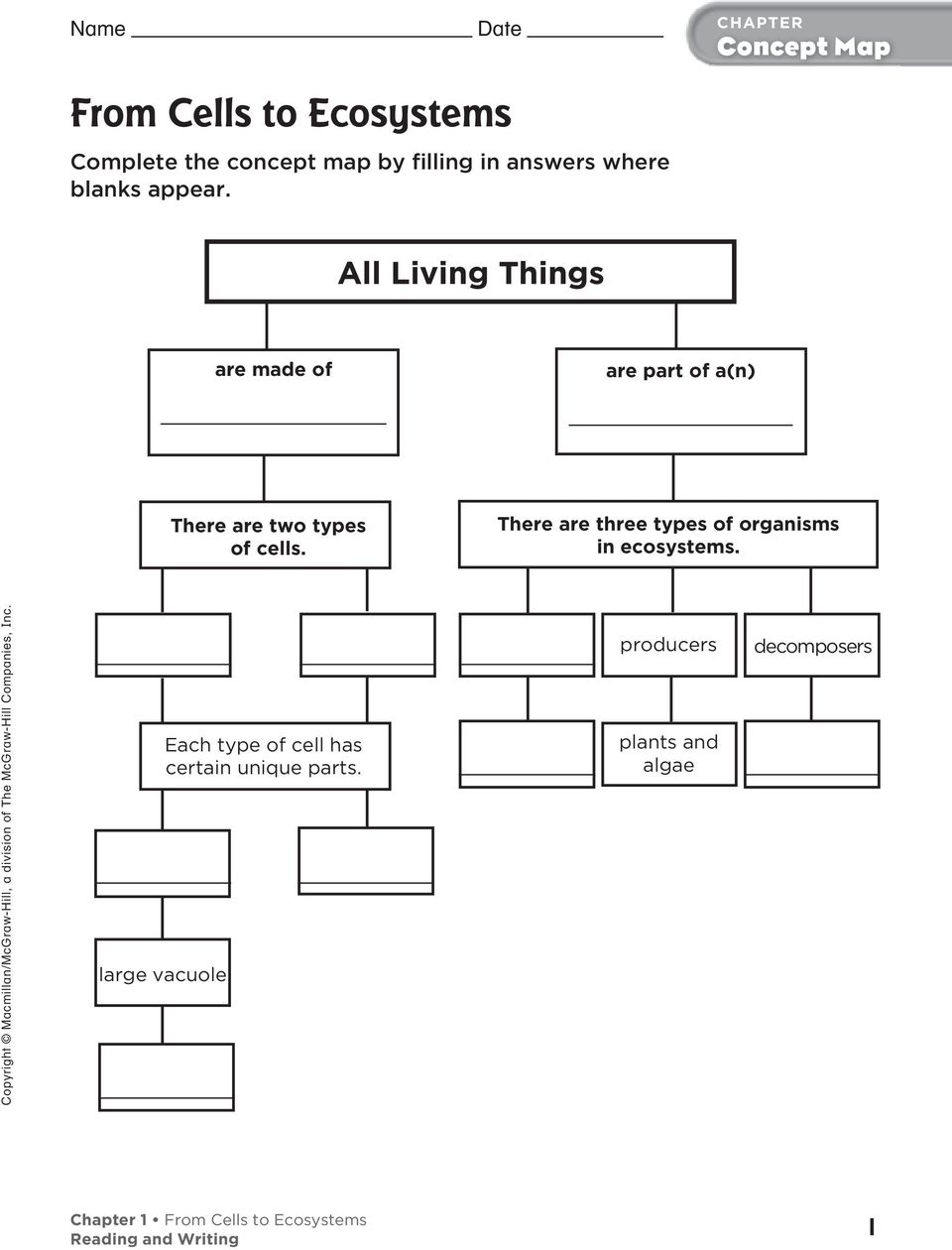
6 Name CHAPTER Concept Map From Cells to Ecosystems Complete the concept map by filling in answers where blanks appear. All Living Things are made of are part of a(n) There are two types of cells. There are three types of organisms in ecosystems. Each type of cell has certain unique parts. large vacuole producers plants and algae decomposers Chapter 1 From Cells to Ecosystems 1
7 Cells LESSON Outline Name GLE Use your textbook to help you fill in the blanks. What are cells? 1. All organisms, or living things, are made of. 2. Every cell in every living thing comes from another cell that. 3. A single-celled organism that can carry on all its life processes is called. 4. Organisms made up of more than one cell are called. 5. Scientists have identified more than different kinds of organisms. 6. Scientists estimate there may be more than kinds of unicellular organisms. What is inside an animal cell? 7. Both plant and animal cells perform life processes by using. 8. All cells are surrounded by a(n) that controls the materials that move in and out of the cell. 9. The region between the cell membrane and the nucleus is filled with. 10. The cell s control center is called the. 2 Chapter 1 From Cells to Ecosystems Use with Lesson 1 Cells

8 Name LESSON Outline 11. The tiny power plants in the cell where food is burned and energy is released are called. 12. A structure in a cell used for storage of water, food, and waste is the. What is inside a plant cell? 13. Plant cells have a(n) ; a rigid structure that serves as an outer covering. 14. A green structure, called a(n), uses the energy from the sun to produce food for the plant. How are cells organized? 15. Cells working together at the same job form a(n). 16. Groups of tissues working together form organs, and groups of organs working together form. Critical Thinking 17. Compare and contrast the cells of plants, animals, and unicellular organisms. Chapter 1 From Cells to Ecosystems Use with Lesson 1 3 Cells

9 LESSON Vocabulary Name Cells Read each clue and fill in the crossword puzzle. cell cytoplasm nucleus organism chlorophyll multicellular Across 3. the smallest unit of a living thing that can carry out the basic processes of life 5. sunlight-absorbing chemical 7. a living thing 7 Down 1. organisms that contain many different types of cells 2. a gel-like liquid inside the cell 4. organisms having one cell 6. a cell s control center 4 Chapter 1 From Cells to Ecosystems Use with Lesson 1 Cells

10 Name Cell s Fill in the blanks. LESSON Cloze Activity cell membrane cell wall cells cytoplasm mitochondria multicellular nucleus organelles unicellular All living things are made up of units called. Some organisms are ; that is, they consist of only one cell. More complex organisms, including plants and animals, are called organisms. All cells are surrounded by a(n) that controls what moves into and out of the cell. The insides of cells are filled with a gel-like fluid called. Within this liquid are the cell. Both plant and animal cells, as well as many unicellular organisms, contain a(n) and, which supply energy for the cell. Plant cells have a(n), one large central vacuole, and chloroplasts. Chloroplasts contain chlorophyll which uses energy from sunlight to produce food for the plant. Chapter 1 From Cells to Ecosystems Use with Lesson 1 5 Cells

11 LESSON Outline Name GLE Relationships in Ecosystems Use your textbook to help you fill in the blanks. What is in an ecosystem? 1. The living things in an environment are factors. 2. The nonliving things in an environment are factors. 3. All the living and nonliving things interacting in an environment make up a(n). 4. All the members of a species within an ecosystem are a(n). 5. Together, the populations in an ecosystem form a(n). How are food chains alike? 6. The path that energy takes in an ecosystem as it flows from organism to organism is a(n). 7. At the base of each food chain are that use the Sun s energy to make sugar and oxygen. 8. Sugar molecu les are the original source of food for, or any animal that eats plants or other animals. 6 Chapter 1 From Cells to Ecosystems Use with Lesson 2 Relationships in Ecosystems

12 Name LESSON Outline 9. Organisms in an ecosystem that break down dead or decaying plants and animals are. What are food webs made of? 10. A network of food chains that share some links is a(n). 11. Organisms that are eaten by other animals are. What are symbiotic relationships? 12. A symbiotic relationship that benefits both organisms is called. 13. In one organism benefits and the other is not harmed. What are parasites? 14. An organism that lives on or in another organism and harms it is a(n). Critical Thinking 15. What would happen if producers were removed from an ecosystem? Chapter 1 From Cells to Ecosystems Use with Lesson 2 7 Relationships in Ecosystems

13 LESSON Vocabulary Name Relationships in Ecosystems Who am I? What am I? Choose a word from the word box that answers each question. a. commensalism b. ecosystem c. food chain d. food web e. parasite f. population g. predator h. prey 1. I am a symbiotic relationship that benefits one organism without harming the other. What am I? 2. I am an organism that lives off of and harms its host. What am I? 3. I am a network of food chains that are connected. What am I? 4. I am an animal that hunts other animals for food. Who am I? 5. I include all living and nonliving things in an environment. What am I? 6. Predators hunt me for food. Who am I? 7. All the members of a single species in an ecosystem are part of me. What am I? 8. I am the path that energy takes as it moves from one organism to another in an ecosystem. What am I? 8 Chapter 1 From Cells to Ecosystems Use with Lesson 2 Relationships in Ecosystems

14 Name LESSON Cloze Activity Relationships in Ecosystems Fill in the blanks. carnivores food chain herbivores population community food web plants symbiosis All the living and nonliving things in an environment make up an ecosystem. Within an ecosystem, all living things make up a(n) a(n). All individuals of one species are. An ecosystem can be as large as a forest or as small as a fallen log. The path that energy takes as it moves from one organism to another in an ecosystem is a(n). A group of connected food chains is a(n). Producers, such as and algae, are at the base of each food chain. Consumers include that eat plants and that eat other animals. A close relationship between two or more kinds of organisms that lasts over time is called. Chapter 1 From Cells to Ecosystems Use with Lesson 2 9 Relationships in Ecosystems

15 LESSON Outline Name Photosynthesis GLE Use your textbook to help you fill in the blanks. What is photosynthesis? 1. Plants get energy to make food from. 2. is the process of making food using sunlight. 3. Photosynthesis occurs in cells that have. 4. Sunlight, and are needed to perform photosynthesis. 5. Chloroplasts act like tiny factories that make food in the form of. What do leaves do? 6. Tiny pores, called stomata, on the bottom of leaves take in from the air. 7. The opening and closing of stomata is controlled by 8. When a plant has enough water, the swell and pull open the stomata so the plant can breathe.. 9. In most plants, photosynthesis occurs in the chloroplast of the cells that are under the. 10. When plants store sugar, they store it as a molecule made up of long chain of sugars called. 11. Scientists express what happens during photosynthesis using this chemical equation:. 10 Chapter 1 From Cells to Ecosystems Use with Lesson 3 Photosynthesis

16 Name LESSON Outline What is the photosynthesis and respiration cycle? 12. The sugar that plants produce during photosynthesis is a hydrogen, and oxygen., a compound made from carbon, 13. Cellulose, the main substance that makes up the in plants, is a carbohydrate. 14. When you eat a vegetable, your body from the carbohydrates stored in the plants. 15. is the processes in which plant and animal cells use oxygen to break down stored carbohydrates. 16. Plant and animal cells produce and during cellular respiration. What are energy pyramids? 17. A diagram that shows the energy that is available at each level of an ecosystem is a(n). 18. At each level of an energy pyramid, about percent of the energy from the level below is lost. Summarize the Main Idea 19. How do plants make and use energy? Chapter 1 From Cells to Ecosystems Use with Lesson 3 11 Photosynthesis

17 LESSON Vocabulary Name Photosynthesis a. carbohydrate b. cellular respiration c. energy pyramid d. photosynthesis e. stomata Fill in the blanks. 1. the process that uses energy from the Sun to make food from water and carbon dioxide 2. a diagram that shows the amount of energy available at each level of an ecosystem 3. tiny pores in the bottom of leaves take in carbon dioxide from the air 4. a compound made from carbon, hydrogen, and oxygen 5. Starches and sugars are broken down in the cells in this process. 12 Chapter 1 From Cells to Ecosystems Use with Lesson 3 Photosynthesis

18 Name Photosynthesis LESSON Cloze Activity carbohydrate cellular respiration chlorophyll chloroplasts energy photosynthesis starch stomata water Fill in the blanks. How does the Sun give you the energy you need to do your schoolwork? When a plant gets enough water, the guard cells in the leaf swell and pull open the. The Sun shines on the plant so its leaves can make food from and carbon dioxide. This process is called, which means putting together by light. Photosynthesis takes place in the of the cells underneath the epidermis, or skin of the leaf. Chloroplasts contain, a green chemical that absorbs and stores the energy of sunlight. Sugar is a made from carbon, hydrogen, and oxygen. Plants store sugar as a. When the plant needs energy to grow or repair itself, it breaks down starches and sugars in a process called. When you eat a vegetable, or when you eat meat from an animal that eats plants, your body gets from the sugars and carbohydrates stored in the plant. Chapter 1 From Cells to Ecosystems Use with Lesson 3 13 Photosynthesis

19 Writing in Science Name GLE Saving Water the Yucca Plant Way Read the Writing in Science feature in your textbook. Write About It Explanatory Writing Write an article for young gardeners. Explain the process of CAM photosynthesis. Research facts and details for your article. Planning and Organizing Help Ray create an outline for his article. Here are some topics he wants to cover. Place them in the outline form below. What happens during the day in CAM photosynthesis? What is the purpose of CAM photosynthesis? What is photosynthesis? What happens at night during CAM photosynthesis? How does the process of CAM photosynthesis work? I. II. III. A. B. IV. Why is the yucca plant special? Now create an outline for your own article on a separate sheet of paper. Make it as detailed as possible. Add A, B, C points and subpoints (1, 2, 3) under these as necessary. 14 Chapter 1 From Cells to Ecosystems Use with Lesson 3 Photosynthesis

20 Name Writing in Science Now use a separate sheet of paper to write the first draft of your article. Revising and Proofreading Here is part of the report that Ray wrote. Help him combine his sentences. Use the transition word in parentheses. Make sure you punctuate the new sentence correctly. 1. In CAM photosynthesis, the stomata open at night. The air is cooler and the humidity is higher. (when) 2. CAM photosynthesis is effective. It results in more efficient water use. (since) Now revise and proofread your article. Ask yourself: Have I introduced my main idea about photosynthesis in yuccas? Have I included facts and details to show how this process works? Have I used examples and language appropriate for my audience? Have I used transition words and phrases to connect ideas? Have I ended with a strong conclusion about why yucca plants are special? Have I corrected all grammar errors? Have I corrected all problems in spelling, punctuation, and capitalization? Chapter 1 From Cells to Ecosystems Use with Lesson 3 15 Photosynthesis

21 LESSON Outline Name GLE Changes in Ecosystems Use your textbook to help you fill in the blanks. How can ecosystems change? 1. Ecosystems are changed by living that change the environment around them, and by events such as floods. 2. Humans can change ecosystems by new species or existing species. How do people affect the environment? 3. Pollution is a(n) change in the natural environment. 4. Air pollution from burning fuels causes. How does waste affect the land? 5. Some household garbage breaks down, but some garbage is not. 6. contains poisonous chemicals and metals. What happens when ecosystems change? 7. When a type of organism cannot respond to changes in an ecosystem, it may become. 8. When a species is in danger of extinction, it is called an species. 9. Species that could become endangered are known as species. 16 Chapter 1 From Cells to Ecosystems Use with Lesson 4 Changes in Ecosystems
22 Name LESSON Outline How do ecosystems come back? 10. Over time, a group of species in an ecosystem is replaced by a different group of species through. 11. In regions where few species existed before or where species were wiped out, occurs. 12. The first species to take hold in barren areas are species, such as mosses and lichens. 13. As larger plants and predators begin to live in an area, the community may become a(n), such as a prairie. 14. With enough moisture, may start to grow in a grassland. 15. A fully developed ecosystem supports the final stage of succession, a(n) What is secondary succession? community. 16. When a new community develops where a community had once existed, it is called Critical Thinking succession. 17. What are some of the ways that people cause harm to the land? Chapter 1 From Cells to Ecosystems Use with Lesson 4 17 Changes in Ecosystems
23 LESSON Vocabulary Name Changes in Ecosystems Match the correct letter with the description. a. climax community b. endangered species c. extinct d. pioneer species e. pollution f. primary succession g. secondary succession h. threatened species 1. When Earth s land, water, and air have reached their capacity to absorb and recycle wastes naturall y, occurs. 2. When a species dies out completely, the species is. 3. The establishment of a new community where a community had already existed is called. 4. Species with low numbers that could become endangered are called. 5. A species that is in danger of becoming extinct is a(n). 6. In the final stages of succession, a(n) develops. 7. One of the first species to live in an area that used to be lifeless is a(n). 8. Succession that occurs where there is no soil and where few, if any, living things exist is. 18 Chapter 1 From Cells to Ecosystems Use with Lesson 4 Changes in Ecosystems
24 Name Changes in Ecosystems Fill in the blanks. LESSON Cloze Activity animal habitat pioneer plants primary succession secondary succession species trees Ecosystems change over time. People cause some of the changes, through pollution, destruction, or hunting, or by introducing or removing. However, many ecosystem changes are natural. When land is burned by a fire or a farm field is abandoned, occurs. New begin to grow in the soil. Weeds, then shrubs, and finally grow. When few, if any, living things exist in an area, will establish a first community. The first organisms to live in the area are called species. After soil is established, larger plants can grow, and larger species can arrive. Eventually, forests develop. Finally, in the last stage of succession, a climax community is established. Chapter 1 From Cells to Ecosystems Use with Lesson 4 19 Changes in Ecosystems
25 CHAPTER Vocabulary Name From Cells to Ecosystems Choose the letter of the best answer. 1. All living and nonliving things in an environment make a(n) a. population. b. ecosystem. c. food web. d. food chain. 2. The part of a cell that controls all of its activity is the a. cell wall. b. cytoplasm. c. nucleus. d. vacuole. 3. Structures in plant cells that turn energy from sunlight into food are called a. chloroplasts. b. cell walls. c. cytoplasm. d. mitochondria. 4. An individual living thing is a(n) a. nucleus. b. parasite. c. organism. d. organ. 5. The first organisms to occupy an environment are called the a. extinct species. c. endangered species. b. threatened species. d. pioneer species. 6. The smallest unit of a living thing that carries out basic life processes is a(n) a. cell. c. cell wall. b. cell membrane. d. chloroplast. 7. In living things, tissues of different kinds come together to make up a(n) a. organ. b. organism. c. organ system. d. tissue. 8. The outside layer that controls what moves in and out of the cell is its a. cell membrane. c. cytoplasm. b. tissue. d. nucleus. 20 Chapter 1 From Cells to Ecosystems Use with Chapter 1
26 Name CHAPTER Vocabulary Choose the letter of the best answer. 9. In mitochondria, food is broken down and turned into energy through the process of a. photosynthesis. c. pollution. b. cellular respiration. d. recycling. 10. Structures in cells that store water, food, and wastes are called a. chloroplasts. b. cytoplasm. c. mitochondria. d. vacuoles. 11. Organisms that are made of many different kinds of cells are called a. invertebrate. b. multicellular. c. unicellular. d. vertebrate. 12. The sugar that plants produce during photosynthesis is a a. carbohydrate. c. parasite. b. pollutant. d. chloroplast. 13. The gel-like substance in a cell that supports all of the cell structures is the a. cell wall. b. chloroplast. c. cytoplasm. d. mitochondria. 14. A one-celled organism is a. monocellular. b. multicellular. c. single cellular. d. unicellular. 15. Plants release water and oxygen through their a. cellulose. c. stomata. b. carbohydrate. d. starch. 16. A collection of poisonous materials that must be carefully disposed of is called a. acid rain. b. toxic waste. c. incineration. d. fossil fuel. 17. When pollution mixes with moisture in the atmosphere it forms a. acid rain. b. tissue. c. population. d. stomata. Chapter 1 From Cells to Ecosystems Use with Chapter 1 21
27 CHAPTER Concept Map Name Heredity and Diversity Complete the concept map with information you have learned about different types of reproduction. Some answers have been written for you. All Living Things Reproduce Types of Reproduction Organisms That Use This Type of Reproduction Does this type of reproduction enhance genetic variation? Disadvantages or Advantage to This Type of Reproduction bacteria 22 Chapter 2 Heredity and Diversity
28 Name GLE Reproduction Use your textbook to help you fill in the blanks. LESSON Outline What are sexual and asexual reproduction? 1. Survival of a(n) depends on its ability to produce offspring. 2. Every organism comes from a parent through the process of. 3. The transfer of from parents to their offspring is known as reproduction. 4. Genetic material contains the information that controls an organism s. 5. The production of a new organism from two parents is called reproduction. 6. When an egg cell joins with a sperm cell, occurs. 7. A fertilized egg develops into an individual with traits from each. 8. The production of a new organism from a single parent is called How do organisms reproduce asexually? reproduction. 9. Most bacteria and unicellular protists reproduce by making a copy of their genetic material and. Chapter 2 Heredity and Diversity Use with Lesson 1 23 Reproduction
29 LESSON Outline Name 10. Cnidarians, sponges, and some fungi can reproduce through. 11. The eggs of insects, fish, frogs, and lizards sometimes develop into new animals without being. 12. New plants can grow from leaves, roots, or stems. This type of asexual reproduction is called. 13. Strawberry plants and ferns can reproduce asexually by forming. How do sexual and asexual reproduction compare? 14. An organism that reproduces asexually does not have to find a(n). 15. Organisms that reproduce asexually tend to be wellsuited to their. Critical Thinking 16. Why is sexual reproduction better than asexual reproduction for ensuring the survival of a species in a changing environment? 24 Chapter 2 Heredity and Diversity Use with Lesson 1 Reproduction
30 Name LESSON Vocabulary Reproduction Read each clue. Write the answer in the blanks using the words below. Then fill in the crossword puzzle. asexual runners splitting variation budding sexual trait vegetative Across 3. plant stems that run along the ground and sprout as new plants 5. any characteristic of a living thing 6. type of reproduction in which a new organism is produced from one parent 7. manner in which bacteria reproduce 8 8. Sexual reproduction gives rise to this in a species. Down 1. a bud growing from a fungus to become a new individual. 2. type of propagation in which a new plant grows from a leaf 4. type of reproduction in which a new organism is produced by two parents Chapter 2 Heredity and Diversity Use with Lesson 1 25 Reproduction
31 LESSON Cloze Activity Name Reproduction Fill in the blanks. asexual mate sexual variety splitting reproduce sperm No organism lives forever. This means all organisms must. There are two types of reproduction: and. Sexual reproduction requires two parents. A female egg cell unites with a male cell to produce a fertilized egg. The fertilized egg grows into a new, unique individual. Asexual reproduction requires only one parent and results in offspring that are genetically identical to the parent. The main advantage of sexual reproduction is that it promotes within a species. An advantage of asexual reproduction is that it does not require finding a(n). There are several methods of asexual reproduction. Simple, one-celled organisms, like bacteria and protists, undergo. Animals such as cnidarians, sponges, and fungi undergo a process called budding. 26 Chapter 2 Heredity and Diversity Use with Lesson 1 Reproduction
32 Name GLE How Do Sea Stars Regenerate? Writing in Science Write About It Explanatory Writing Explain how sea stars produce offspring using regeneration. Choose another animal that reproduces asexually. Write an explanation of how this process takes place. Getting Ideas Choose an animal to write about. Think about how it reproduces without parents. Write the steps below. First Next Last Planning and Organizing Xavier wants to explain how flatworms reproduce. Here are three sentences he wrote. Put them in order. Finally, each half grows into a separate flat worm. First, the flatworm divides in two. Stem cells turn into the types of cells needed to reproduce the missing part. Chapter 2 Heredity and Diversity Use with Lesson 1 27 Reproduction
33 Writing in Science Name Drafting Write a sentence to begin your explanation. Name the animal you are writing about. Tell your main idea about how this animal reproduces. This is your topic sentence. Now write your explanation. Use a separate piece of paper. Begin with your topic sentence. Explain how the animal reproduces. Write the steps in time order. Revising and Proofreading Here are some sentences Xavier wrote. Combine each pair. Use the time order word in parentheses. Write the new sentence on the line. 1. The stem cells multiply. They turn into specialized cells. (before) 2. A message is sent out to specialized cells. The cells near the wound cover it. (after) Now revise and proofread your writing. Ask yourself: Did I explain how the animal can reproduce without parents? Did I include time order words? Did I correct all mistakes? 28 Chapter 2 Heredity and Diversity Use with Lesson 1 Reproduction
34 Name GLE , Traits and Heredity Use your textbook to help you fill in the blanks. LESSON Outline What is heredity? 1. The passing of traits from one generation to the next is called. 2. Traits that offspring receive from their parents are traits. 3. A way of acting or behaving with which an animal is born is called a(n). 4. A behavior that develops during an animal s lifetime is a(n) behavior. 5. When ducks hatch, they learn to recognize and follow their mother, a behavior called. How are traits inherited? 6. Mendel discovered that each inherited trait is controlled by, one from each parent. 7. Today scientists refer to Mendel s factors as. 8. Genes are found in the nucleus of the cell. They are stored on. 9. A trait that masks another trait is called a(n) trait. 10. A trait that is masked is called a(n) trait. Chapter 2 Heredity and Diversity Use with Lesson 2 29 Traits and Heredity
35 LESSON Outline Name 11. In pea plants, purple flowers are a dominant trait and white flowers are a recessive trait. The purple trait is represented by and the white trait by p. How do we trace inherited traits? 12. A chart used to trace the history of traits in a family is called a(n). 13. On a pedigree chart, horizontal lines connect parents and vertical lines connect parents to. 14. Males are represented by squares, and are represented by circles. 15. Shaded shapes represent individuals with a particular, and unshaded shapes represent individuals without that trait. 16. Dimples are a dominant trait, represented by the letter D. A child who is a carrier of the recessive trait is represented by. Critical Thinking 17. Both a father and mother have dimples. Their son has dimples, but their daughter does not. Which genes, DD, Dd, or dd, does each family member have? 30 Chapter 2 Heredity and Diversity Use with Lesson 2 Traits and Heredity
36 Name LESSON Vocabulary Traits and Heredity Match the correct letter with the description. a. carrier b. dominant c. gene d. heredity e. inherited f. instinct g. pedigree h. recessive 1. a trait that an offspring receives from its parents 2. the passing down of traits from one generation to the next 3. behavior that is inherited 4. a trait that masks another trait 5. a trait that is masked or covered by another trait 6. chart used to trace the history of traits in a family 7. contains the chemical instructions for an inherited trait 8. individual who has inherited a gene for a trait, but does not show the trait physically Chapter 2 Heredity and Diversity Use with Lesson 2 31 Traits and Heredity
37 LESSON Cloze Activity Name Traits and Heredity Fill in the blanks. chromosomes heredity Gregor Mendel sperm cell genes instincts pedigree trait Parents pass on features of themselves to their offspring. Any notable feature of an organism is called a(n). The passing down of traits from parents to offspring is called. Some traits, such as hair or eye color, are physical traits. Other inherited traits are behavioral and are called. An Austrian monk,, discovered how traits are inherited. Today, Mendel s factors are called. They are stored on the inside the nucleus of cells. Offspring receive one set of genes from an egg cell and the other from the that fertilized the egg cell. Humans have an estimated 20,000 gene pairs. Some of these traits are easy to see. The history of a family trait and the way it has been inherited can be charted in a. These charts can be used to study heredity patterns. 32 Chapter 2 Heredity and Diversity Use with Lesson 2 Traits and Heredity
38 Name GLE 0507.T/E.2 Genetically Modified Corn Reading in Science Read the Reading in Science feature from your textbook. Look for cause and effect relationships. Cause and Effect Fill in the Cause and Effect Chart with cause and effect relationships you find in the article. Cause Effect Corn borer eats corn. Bt powder sprayed on corn. Other living things eat Bt corn. Corn plants make Bt toxin in their own cells, so the corn plants can protect themselves. Chapter 2 Heredity and Diversity Use with Lesson 2 33 Traits and Heredity
39 Reading in Science Name Write About It Cause and Effect 1. Explain how the bacterium Bt affects corn borers. 2. Tell how genetically modified corn might cause problems for other insects and the environment. Pl anning and Organizing Answer these questions in detail. 3. What does the Bt bacterium produce, and what effect does it have on corn borers? 4. What enables the Bt bacterium to make a protein that is toxic to corn borers? 5. What was transferred from the Bt bacterium to Bt corn? 6. How does Bt corn affect corn borers? 7. How might Bt corn affect other living things, such as Monarch butterflies? 34 Chapter 2 Heredity and Diversity Use with Lesson 2 Traits and Heredity
40 Name GLE Animal Adaptations for Survival Use your textbook to help you fill in the blanks. LESSON Outline What is adaptation? 1. A characteristic that helps an organism survive in its natural environment is a(n). 2. Organisms that are best adapted to their environment and pass on their traits to offspring. 3. A trait that helps an organism survive in its environment, such as the of an animal s fur, is a(n) adaptation. What are behavioral adaptations? 4. A characteristic that is an organism s response to its environment is a(n) adaptation. 5. A(n) is an inherited behavior. 6. Some birds and mammals perform elaborate attentiongetting dances to attract a(n). 7. Some adaptive behaviors can also help organisms take care of their. Chapter 2 Heredity and Diversity Use with Lesson 3 35 Animal Adaptations for Survival
41 LESSON Outline Name What are adaptations to climate? 8. To keep warm in cold climates, animals have fur. 9. In hot deserts, animals are often more active at, when temperatures drop. What adaptations do predators and prey have? 10. Any color, shape, or pattern that lets an organism blend into its environment is. 11. A type of camouflage in which an organism s coloring helps it blend in with its background is coloring. 12. When an organism matches the color, shape, and texture of the environment around it, it is showing protective What is mimicry?. 13. An adaptation in which an organism gets protection from predators by looking like a dangerous animal is. 14. Predators also use this characteristic to fool ; believing that the predators are harmless, prey come close enough to be caught. Critical Thinking 15. How do adaptations help an organism survive in its environment? 36 Chapter 2 Heredity and Diversity Use with Lesson 3 Animal Adaptations for Survival
42 Name Animal Adaptations for Survival Use the clues below to help you find the words hidden in the puzzle. LESSON Vocabulary R R E S E M B L A N C E Z M R T I G A D B Y A G E K Y T H J L L X X M J C Z Z S S L L M R T O M C O L O R A T I O N U D H I Q K P W W M B P F H A D A P T A T I O N L N P S V M M R G C A A A N X F F L I U U R D T G K Z H R T P I U Y I R E O 1. An organism that matches the color, shape, and texture of its environment is using protective. 2. A type of coloring, shape, or pattern that allows an organism to blend in with its environment is. 3. Any characteristic that helps an organism survive in a certain environment is a(n). 4. An adaptation in which an animal is protected against predators by its resemblance to an unpleasant or dangerous animal is. 5. A type of camouflage in which the color of an animal blends in with the animal s background is protective. Chapter 2 Heredity and Diversity Use with Lesson 3 37 Animal Adaptations for Survival
43 LESSON Cloze Activity Name Animal Adaptations for Survival Fill in the blanks. camouflage chemicals insulation mimicry penguin prey scarce streamlined Animals have adaptations that help them survive in their environments. For example, birds such as the have thick layers of soft feathers to provide against the cold. The humps of camels store fat for when food is. Ocean animals are more than land animals so that they can swim faster. Some adaptations developed because of predatorrelationships. Skunks use bad-smelling that make predators avoid them. Prey can use to blend in with their environments. Some animals also demonstrate, the ability to look like another animal that a predator finds unpleasant. For example, some predators stay away from the viceroy butterfly because it mimics the bad-tasting monarch butterfly. 38 Chapter 2 Heredity and Diversity Use with Lesson 3 Animal Adaptations for Survival
44 Name GLE Meet Caroline Chaboo Reading in Science Read the Reading in Science feature in your textbook. Look at the chart below. In each row, read the information in the two What I Know columns. Use it to infer something that is not directly stated in the text. Write that statement in the What I Infer column. Clues What I Know What I Infer 1. The Sabal palm stands up to high winds, drought, and driving rain in the The Sabal palm is well-adapted for the Caribbean region. region. 2. The beetle harms Sabal palm trees in regions where it lives. 3. The tortoise beetle weakens the Sabal palm, but. The tortoise beetle lives in Caroline Chaboo studies plants, such as the Sabal palm, to discover whether they have adapted natural protection against insect pests.. Chapter 2 Heredity and Diversity Use with Lesson 3 39 Animal Adaptations for Survival
45 Reading in Science Name Write About It Infer 1. How might a natural pesticide produced by the Sabal palm help other organisms? 2. Research tortoise beetles. What other plants do they eat? Write a report that tells how such a pesticide could help other plants. Using Id eas to Infer To answer question #1, first determine how a natural pesticide inside the Sabal palm would help the tree. Then, write your answer to the question: How might a natural pesticide in the Sabal palm help other organisms? Planning and Organizing Imagine that you have been told to research tortoise beetles to find out what other plants they eat. In order to conduct this research, first list the types of sources that would contain this information. a. b. c. Then, list key words you could use to look up the information in these sources. a. b. 40 Chapter 2 Heredity and Diversity Use with Lesson 3 Animal Adaptations for Survival
46 Name GLE Change over Time Use your textbook to help you fill in the blanks. LESSON Outline What are variations? 1. Darwin studied different types of finches while visiting the. 2. The birds were similar in every aspect except for their environments., which were suited to different 3. Darwin thought that the finches might all have come from one. 4. Variations that favor survival are likely to be passed on to the next generation, and variations that do not favor survival are likely to be passed on. 5. Variations can help a species live long enough to successfully. What is natural selection? 6. In nature organisms compete for natural resources such as food,, sunlight, and space. 7. Survival of the fittest is another way to describe the process of. 8. Plants and animals have more offspring than their environments can support to ensure that enough will to carry the species into the future. Chapter 2 Heredity and Diversity Use with Lesson 4 41 Change over Time
47 LESSON Outline Name What is evidence of change over time? 9. The history of Earth s changes can be found in. 10. Fossils can tell us about what an was like in the past. How old are fossils? 11. The of a rock is how old it is compared to another rock. 12. The is the age of a fossil in years. Is Earth still changing? 13. New islands may form due to activity. 14. Some species previously thought to be extinct are now Critical Thin king. 15. If the climate were suddenly to become colder, what variations do you think would most help animals to survive? 42 Chapter 2 Heredity and Diversity Use with Lesson 4 Change over Time
48 Name LESSON Vocabulary Change over Time Use the clues to fill in the crossword puzzle. absolute age fossil mutation natural selection relative age variation Down 1. a difference among members of the same species that enables some individuals to better survive and reproduce 4. the age of a rock compared to another 6 5 Across 2. the age of a fossil in years 3. the process that occurs when the organisms that are best suited to their environment survive and reproduce successfully 5. the remains, traces, or imprints of living things preserved in Earth s crust 6. a change in an organism s genetic material Chapter 2 Heredity and Diversity Use with Lesson 4 43 Change over Time
49 LESSON Cloze Activity Name Change over Time Fill in the blanks. absolute age changed environments fossils Gal ápagos reproduce resources variation The first person to organize observations for the origin of species was Charles Darwin. While visiting the Islands, Darwin noticed that the beaks of different finches were suited to different types of food. He believed that the different types of finches all came from one. Over time the birds that lived on the different islands to adapt to their particular. In order to survive, organisms must find enough to support life. Those that survive will successfully, and their species will continue. Sometimes a difference, mutation, or can help a species to survive. can indicate what past organisms and environments were like. The of rocks and fossils help explain how Earth has changed over its long history. 44 Chapter 2 Heredity and Diversity Use with Lesson 4 Change over Time
50 Name GLE So You Want to Be a Fossil Hunter Writing in Science Write About It Descriptive Writing Select a fossil discovery and write a description of it. Use sensory words and specific details to describe characteristics about the organism such as what it ate, what it looked like, and its habitat. Does the fossil resemble any organisms that are alive today? How old is the fossil? Getting Ideas What fossil will you describe? Write its name in the center circle of the web below. Write details that describe the fossil in the outer circles. You can add circles to the web if you like. Planning and Organizing Jorge wants to describe a fossil of a dinosaur footprint. Here are some sentences that he wrote. Write Yes if the sentence describes the fossil. Write No if it does not. 1. The huge footprint was 2 1_ 2 feet across. 2. It showed that the dinosaur had three long, bony toes. 3. I got scared when I looked at the footprint. Chapter 2 Heredity and Diversity Use with Lesson 4 45 Change over Time
51 Writing in Science Name Drafting Write a sentence to begin your description. Tell what fossil you will describe. Tell an important idea about this fossil. Now write your description. Use a separate piece of paper. Start with the sentence you just wrote. Then write your description. Use words that appeal to the senses. Use details that will help your readers picture the fossil. Revising and Proofreading Help Jorge improve his description. Add sensory words in the blanks. Choose a word from the box or pick your own. deep gray narrow sharp spiky The fossil footprint in the cold, stone reveals secrets of this creature that lived millions of years ago. The footprint had made a impression in the earth. This suggested that the dinosaur was very big and heavy. It showed long shapes at the end of the toes. Maybe this is where its heel of the foot was claws dug into the earth. The, not wide. Now revise and proofread your writing. Ask yourself: Did I include enough details to help readers picture the fossil? Did I use sensory words to bring my description to life? Did I correct all mistakes? 46 Chapter 2 Heredity and Diversity Use with Lesson 4 Change over Time
52 Name CHAPTER Vocabulary Heredity and Diversity Choose the letter of the best answer. 1. Which of the following organisms reproduces by using budding? a. sponge c. lizard b. cat d. frog 2. Which of the following plants reproduces by using runners? a. corn plant b. moss c. strawberry plant d. apple tree 3. Which of the following is an example of sexual reproduction? a. cloning b. budding c. seed production d. vegetative propagation 4. Which organism can develop from an unfertilized egg? a. human c. bird b. sheep d. lizard 5. Which of the following is an advantage of asexual reproduction? a. It requires a mate. b. It promotes species variety. c. It is convenient. d. It produces offspring that adapt easily to change. 6. A characteristics that helps an organism survive in its environment is a(n) a. trait. c. adaptation. b. style. d. gene. 7. A type of camouflage in which the color of the animal blends in with its background is called a. protective coloration. b. protective resemblance. c. adaptation. d. mimicry. 8. A butterfly that looks like a bad-tasting butterfly exhibits a. protective resemblance. b. protective coloration. c. hibernation. d. mimicry. Chapter 2 Heredity and Diversity 47
53 CHAPTER Vocabulary Name Choose the letter of the best answer. 9. A walking stick insect looks like a stick. This is an example of a. protective coloration. b. protective resemblance. c. instinct. d. mimicry. 10. A difference that allows an individual to better reproduce is a. fossils. b. imprinting. c. variation. d. natural selection. 11. Which causes variation? a. climate staying the same b. a species having little room to expand c. all members of a species dying out d. mutation 12. Sick animals often do not live to reproduce. This is part of a. natural selection. b. inherited behavior. c. mimicry. d. camouflage. 13. What do fossils that are dated using the half-life of an element tell us about the rock in which they were found? a. relative age c. half-life b. absolute age d. position 14. The passing of traits to offspring is known as a. genetics. b. heredity. c. hibernation. d. adaptation. 15. Which of these represents a carrier for the recessive trait? a. DD c. dd b. Dd d. d 16. An instinct is an example of a. a learned behavior. b. an inherited behavior. c. an inherited physical trait. d. imprinting. 17. If purple is the dominant gene for flower color, which item represents a white flower? a. PP c. Pp b. pp d. p 48 Chapter 2 Heredity and Diversity
54 Name UNIT Literature Monarch Butterflies at Risk Write About It Response to Literature In this article the author discusses monarch butterflies. What conditions affect these butterflies? What role does weather play? Think about a severe weather condition you have experienced. Write a personal narrative describing the severe weather and how it affected you and other people. Life Science 49
55 CHAPTER Concept Map Name The Universe Complete the concept map with information you learned about the universe. The stages of a medium-sized star are nebula, protostar, star, and white dwarf. Today, astronomers divide the sky into 88 patterns of stars., or The Sun is the star at the center of our. Eight planets revolve around the Sun, including four and four. The terrestrial planets have surfaces made of. The four planets furthest from the Sun have surfaces made of and are very different from one another. 50 Chapter 3 The Universe
56 Name GLE The Inner Planets LESSON Outline Use your textbook to help you fill in the blanks. What are planets? 1. A is made up of a star and the objects that surround it. 2. Large objects that orbit stars are called. 3. Some planets have objects called that orbit them. 4. Our solar system includes eight planets that orbit the. 5. Most of the solar system s orbit the Sun in a belt between Mars and Jupiter. 6. The planet closest to the Sun is, and the planet farthest away from the Sun is What do we know about Mercury, Venus, and Earth?. 7. Mercury, Venus, Earth, and Mars are planets with surfaces made of. 8. Mercury takes 88 Earth days to make one around the Sun. 9. Venus has an atmosphere made mostly of, which holds in heat and gives this planet the hottest surface in the solar system. 10. The most noticeable feature about is that it is covered in water. Chapter 3 The Universe Use with Lesson 1 51 The Inner Planets
57 LESSON Outline Name What is Mars like? 11. The fourth planet in our solar system is called. 12. Phobos and Deimos are the names of Mars s. 13. The reddish in Mars s atmosphere makes its sky look pink. Critical Thinking 14. Why do you think many of the craters on Earth are no longer visible? 52 Chapter 3 The Universe Use with Lesson 1 The Inner Planets
58 Name LESSON Vocabulary The Inn er Planets Match the correct letter with the description and fill in the crossword puzzle. asteroid moon planet revolution rotation solar system Across 4. a rock that revolves around the Sun in a belt between Mars and Jupiter 5. a star and the objects that orbit it Down 1. a large object that orbits a star but does not give off its own light 2. one complete trip around the Sun 3. a complete spin on an axis 6. a natural object that orbits a planet Chapter 3 The Universe Use with Lesson 1 53 The Inner Planets
59 LESSON Cloze Activity Name GLE The Inner Planets Fill in the blanks. asteroids Earth Mercury terrestrial craters Mars none Venus The major objects of the solar system are eight planets that orbit the Sun and their moons. Earth is one of the planets, which have rocky surfaces. Many of the inner planets have surfaces with large. Earth has one moon, some planets (such as Mercury and Venus) have, and other planets (such as Jupiter and Saturn) have dozens. Other objects in the solar system include the that orbit the Sun between and Jupiter. Scientists study to learn about the inner planets because they are made of the same kinds of materials. has some of the hottest surface temperatures in the solar system because of its thick carbon dioxide atmosphere. is sometimes hard to see from Earth because it is so close to the Sun. Astronomers study the solar system with many types of telescopes. 54 Chapter 3 The Universe Use with Lesson 1 The Inner Planets
60 Name GLE The Outer Planets LESSON Outline Use your textbook to help you fill in the blanks. What are the outer planets? 1. The planets are much larger than the planets. 2. Jupiter, Saturn, Uranus, and Neptune are planets with surfaces made of. 3. is the largest planet in the solar system; it has more mass than all the other planets combined. 4. Jupiter completes one in 4,333 Earth days. 5. Ganymede, Callisto, Io, and Europe are Jupiter s. What are Saturn and Uranus like? 6. The most noticeable feature about Saturn is its large set of that are made of ice and rock. 7. Saturn once every 10 hours and 39 minutes. 8. Uranus is unusual because its of rotation makes it look like it was knocked on its side. Chapter 3 The Universe Use with Lesson 2 55 The Outer Planets
61 LESSON Outline Name What are Neptune and dwarf planets like? 10. The planet farthest from the Sun is. 11. Neptune has some of the strongest of any planet in the solar system speeds have been recorded at 2,000 kilometers per hour (1,250 miles per hour). 12. Pluto was once considered a planet even though its diameter is only two-thirds the size of. 13. The dwarf planet is slightly larger than Pluto and takes 557 Earth-years to orbit the Sun. Critical Thinking 14. Why is it not possible to land a spacecraft on Jupiter or Saturn? 56 Chapter 3 The Universe Use with Lesson 2 The Outer Planets
62 Name The Outer Plan ets Who am I? What am I? LESSON Vocabulary Choose a word from the word box below that answers each question. a. rings b. comet c. Galilean moons d. the Great Red Spot e. methane f. Triton g. dwarf planet 1. I am a ball of rock and ice that orbits the sun. What am I? 2. I am the area of Jupiter that has enormous and powerful storms. What am I? 3. I am one of four large objects that orbits Jupiter. I was discovered by Galileo with his telescope. What am I? 4. I can be found orbiting all the outer planets, but I am more noticeable around Saturn. I am made of ice and rocks. What am I? 5. I give Neptune its blue color. What am I? 6. I am a moon of Uranus. I have some characteristics in common with Earth. What am I? 7. My name is Pluto. What am I? Chapter 3 The Universe Use with Lesson 2 57 The Outer Planets
63 LESSON Cloze Activity Name The Outer Planets Fill in the blanks. axis of rotation dwarf planets gas methane comets Eris Jupiter rocks and ice The four outer planets share many properties. They are all very large, are mostly made of, and rotate very fast. is a ball of gas so large that more than 1,000 Earths could fit inside it. Saturn has a recognizable series of rings made of that orbit the planet. Some scientists believe these rings may be the remains of that collided with or near Saturn. Uranus s is tipped so far that it looks like it is rotating on its side. It may have been struck by some object and knocked on its side. Neptune s layers of gas include large amounts of, which gives the planet its blue color. Pluto, Eris, and other are smaller than some of the moons of the planets in the solar system. takes over 557 Earth-years to revolve around the Sun. 58 Chapter 3 The Universe Use with Lesson 2 The Outer Planets
64 Name GLE Voyager Discoveries Read the following passage. In 1977, NASA launched the Voyager Interstellar Mission to explore Jupiter, Saturn, Uranus, Neptune, and their moons. The trip had to be very precisely planned. Speeds and distances had to be accurately calculated. The two Voyager spacecraft had to be close enough to each planet to collect data and to get a pull from that planet s gravity in order to be propelled toward their next destination. At the same time, the spacecraft had to be far enough away from the planets that they would not go into orbit around them. All of NASA s careful planning worked. The Voyager Mission has provided scientists with new and closer looks at our farthest neighbors. Voyager Spacecraft Travel Jupiter 1979: Images show Jupiter s rings. Volcanic activity is observed on Io, one of Jupiter s moons. Saturn : Scientists get a close look at Saturn s rings. They contain structures that look like spokes, or braids. Scientists observed that Titon, one of Saturn s moons, has a thin atmosphere and active, geyser-like landforms. Uranus 1986: Voyager photographs the dark rings around Uranus. It also sees ten new moons, bringing Uranus s total to 15 moons. Voyager sends back detailed images and data on the planet, its moons, and dark rings. Neptune 1989: Large storms are seen on the planet. One of these storms is Neptune s Great Dark Spot. Neptune was originally thought to be too cold to support this kind of weather. Reading in Science Chapter 3 The Universe Use with Lesson 2 59 The Outer Planets
65 Reading in Science Name After observing these planets, the Voyager spacecraft keep traveling. They are the first human-made objects to go beyond the heliosphere. The heliosphere is the region of space reached by the energy of our Sun. It extends far beyond the most distant planets in the solar system. Write About It Cause and Effect What caused the Voyager spacecraft to be propelled from one planet toward the next? How did scientists benefit from the Voyager missions? 1. What caused the Voyager spacecraft to be propelled from one planet toward the next? 2. How did scientists benefit from the Voyager missions? 60 Chapter 3 The Universe Use with Lesson 2 The Outer Planets
66 Name Stars GLE Use your textbook to help you fill in the blanks. LESSON Outline What are stars? 1. Stars form from a huge cloud of gases and dust called a(n). 2. When the cloud contracts and powerful reactions start to turn hydrogen atoms into helium atoms to produce energy, a(n) forms. 3. After billions of years, the hydrogen fuel of a star begins to run out and the star expands to become a(n). 4. A star that begins life with much more hydrogen than a medium-sized star such as our Sun ends its life as an exploding star called a(n). How are stars characterized? 5. A star s is the star s actual brightness. 6. A star s is how bright the star appears in Earth s night sky. 7. The Sun is a medium-sized star with a surface temperature of about 6,000 C. 8. By using gravitational microlensing, scientists have discovered system. outside our solar Chapter 3 The Universe Use with Lesson 3 61 Stars
67 LESSON Outline Name What are constellations? 9. Patterns of stars in the sky are. 10., the North Star, is located in the Little Dipper constellation. What are star charts? 11. Astronomers have created maps of the night sky called. 12. is how far north or south a star is from the equator. 13. is how far around the map the star is. Why do constellations seem to move? 14. The constellations appears to move because the Earth is on its axis. Critical Thinking 15. Will the Sun always shine? 62 Chapter 3 The Universe Use with Lesson 3 Stars
68 Name LESSON Vocabulary Stars Match the correct letter with the description. a. constellation b. star chart c. nebula d. star e. supernova f. white dwarf 1. An exploding star is a(n). 2. An object in space that produces its own energy, including heat and light, is a(n). 3. A map of the night sky is called a(n). 4. A huge cloud of gases from which stars form is a(n). 5. A group of stars that forms a pattern is a(n). 6. A small, very dense star is a(n). Chapter 3 The Universe Use with Lesson 3 63 Stars
69 LESSON Cloze Activity Stars Fill in the blanks. Name 10 billion gravitational microlensing Sun elliptical helium white dwarf energy nebulas A star is an object that produces its own. The is an average star with planets in orbits around it. Planets have been discovered around other stars using. Like living things, stars have life cycles. Stars are born from clouds of gas called. When gravity causes nebulas to contract enough, temperature rises and reactions that change hydrogen into start. When the helium is also gone, the star shrinks and cools to become a. The life cycle of a medium-size star, such as our Sun, is about years. Our Sun is about 5 billion years old. 64 Chapter 3 The Universe Use with Lesson 3 Stars
70 Name The Universe Choose the letter of the best answer. CHAPTER Vocabulary 1. The Sun and all the objects that orbit it make up the a. moon. b. solar system. c. nebula. d. universe. 4. What is Earth s revolution? a. its spinning motion on its axis b. its lunar gravitational pull c. its changing of seasons d. its movement in orbit around the Sun 2. What is an orbit? a. the speed of a planet moving around the Sun b. the order of planets in distance from the Sun c. the path a planet takes as it moves around the Sun d. the tilt of Earth on its axis 3. A comet is usually made of a. spinning gas. b. rock and ice. c. hydrogen and helium. d. red dust. 5. Callisto, Io, Europa, and Ganymede are the a. asteroid belt. b. Galilean moons. c. constellations. d. dwarf planets. 6. A small, dense star that forms at the end of a medium star s life cycle is a a. white dwarf. b. red giant. c. nebula. d. blue protostar. 7. A distant group of stars that form a pattern are known as a(n) a. solar system. b. universe. c. nebula. d. constellation. Chapter 3 The Universe 65
71 CHAPTER Vocabulary Name 8. The explosion of a star is called 12. What is absolute magnitude? a. a nebula. b. a supernova. c. a protostar. d. gravitational microlensing. 9. A natural object that orbits a planet is a(n) a. asteroid. b. comet. c. moon. d. star. 10. In the solar system, most asteroids are a. beyond Neptune. b. orbiting Saturn. c. between Mars and Jupiter. d. next to the Sun. 11. The largest planet in our solar system is a. the asteroid belt. b. Jupiter. c. the Sun. d. the Moon. a. the actual brightness of a star b. how far north or south from the equator a star appears c. the position of a star on a star chart d. the way a star looks in Earth s night sky 13. Stars form from a cloud of gas called a a. constellation. b. nebula. c. universe. d. neutron star. 14. The Sun is a a. yellow star. b. neutron star. c. white dwarf. d. red giant. 15. What is the name of the process by which distant planets are found as they pass in front of stars? a. The Gravitational Microlensing Method b. The Stellar Life Cycle Theory c. The Big Bang Theory 66 Chapter 3 The Universe d. The Expanding Universe Theory
72 Name CHAPTER Concept Map Our Dynamic Earth Complete the concept map by filling in answers where blanks appear. Changes in Atmosphere Happens every two to years Winds reverse directions, moving most air and causing Weather follows a pattern constantly move ocean water, affecting how areas receive heat and moisture Forces that Change Earth s Surface Plate Movements Move over hot spots Move toward each other Island mountains Earthquakes Mid-ocean Earthquakes mountains Earthquakes Chapter 4 Our Dynamic Earth 67
73 LESSON Outline Name Plate Tectonics GLE Use your textbook to help you fill in the blanks. What are Earth s layers? 1. The center part of Earth is made up of two parts the molten outer core and the core. 2. The layer above the core is called the inner. 3. Continents and the ocean floor are part of Earth s solid, rocky surface called the. Are the continents moving? 4. Alfred Wegener stated that Earth s were once joined in one landmass, but gradually pulled apart and drifted. 5. Wegener s showed that the age and composition of rocks in the on South America s east coast matched of those on Africa s west coast. 6. Scientists also discovered evidence in were once joined. What causes the ocean floor to move? that Africa and South America 7. Scientists developed the theory to explain how the continents have moved over millions of years. 8. Earth s lithosphere is made of huge pieces of solid rock called Melted rock called rises up through the crack where plates move apart under the ocean. Chapter 4 Our Dynamic Earth Use with Lesson 1 Plate Tectonics
74 Name LESSON Outline 10. As the ocean floor spreads at the plate boundary, the apart. resting on the plates also move What forces change Earth s crust? 11. The force that causes rocks to break as plates rub past each other is called. 12. A break or crack in the rocks of the lithosphere along which movements take place is called a(n). 13. Three types of faults include a strike-slip fault, a(n) fault, and a reverse fault. What are the different types of mountains? 14. When plates push together, compression causes the ground to form mountains. 15. A mountain range in Asia, the, began to form millions of years ago as folded mountains. 16. When rock on one side of a fault moves down and rock on the other side moves up, a mountain is formed. Critical Thinking 17. Compare how two types of mountains are formed. Chapter 4 Our Dynamic Earth Use with Lesson 1 69 Plate Tectonics
75 LESSON Vocabulary Name Plate Tectonics Use the terms in the box below to fill in the blanks. core fault geological features magma mantle plate tectonics hydrosphere 1. Ear th has several layers. The planet itself is divided into the crust, the core at the center. beneath it, and the 2. The is made up of Earth s liquid and solid water, including oceans, lakes, rivers, glaciers, and underground water. 3. Hot, melted rock is called. 4. A is a crack in the rock of the lithosphere, along which movements take place. 5. The physical features of Earth are part of Earth s surface. Earth s surface has many types of. 6. At the center of the Earth is its. 7. The model that states that Earth s surface is composed of large rock plates that fit together like jigsaw puzzle pieces is called. 70 Chapter 4 Our Dynamic Earth Use with Lesson 1 Plate Tectonics
76 Name Plate Tectonics Fill in the blanks. LESSON Cloze Activity compression continents fossils shear continental drift folded plate tectonics The continents were not always where they are today. About 100 years ago, Alfred Wegener developed the theory of. The theory states that Earth s were once one landmass. The landmass broke up millions of years ago, and the continents drifted to the positions we know today. Wegener supported his theory with evidence from rocks and. Later, scientists developed the theory of. When plates push together, they produce the force of. This force can push the ground at the boundary upward, forming mountains. When plates slide past each other, they create. This force can make huge blocks of crust break apart along faults. Over millions of years, the blocks can shift upward to form fault-block mountains. Chapter 4 Our Dynamic Earth Use with Lesson 1 71 Plate Tectonics
77 Writing in Science Name GLE Pangaea and Other Supercontinents Write About It Expository Writing Research the movement of Rodinia and Pannotia. Select a main idea. Write an expository essay with details that support your main idea. Getting Ideas Do some research to find out whether Rodinia and Pannotia actually existed. Use the chart below. In the boxes on the top, write details that you find. In the box on the bottom, summarize this information. Planning and Organizing Here are two sentences that Mai wrote. Write Yes if the sentence supports the idea that Rodinia and Pannotia actually existed. Write No if it does not. 1. There are common rock types and structural features along the coastlines of continents today. 2. Figuring out how supercontinents formed and broke apart is a lot like detective work. 72 Chapter 4 Our Dynamic Earth Use with Lesson 1 Plate Tectonics
78 Name Writing in Science Drafting Write a sentence to begin your essay. This sentence should tell your main idea about Rodinia and Pannotia. Review the evidence you found and your summary. Now write the first draft of your essay. Use a separate piece of paper. Include facts and details that back up your main idea. Draw a conclusion at the end. Revising and Proofreading Help Mai revise her writing. Use the word but to combine each pair of sentences. Put a comma before this word. Write the new sentence on the lines. 1. Pangaea was a supercontinent. It was not the earliest supercontinent. 2. Rodinia and Pannotia were both supercontinents. They were formed at different times. Now revise and proofread your writing. Ask yourself: Did I clearly state my main idea? Did I include facts and details to back up my idea? Did I reach a sound conclusion at the end? Did I correct all mistakes? Chapter 4 Our Dynamic Earth Use with Lesson 1 73 Plate Tectonics
79 LESSON Outline Volcanoes Name GLE Use your textbook to help you fill in the blanks. Where are volcanoes found? 1. Most of Earth s volcanoes are located at edges of. 2. A string of volcanoes at plate boundaries around the Pacific Ocean is known as the. 3. Volcanoes often erupt at places where one plate is the other. 4. The bottom edge of the diving plate melts in the heat of the. 5. The melted rock rises within the crust, forming a hot pool of. 6. The hot rock sometimes erupts through openings in Earth s surface as a(n). 7. Magma that reaches Earth s surface is. How does magma form geological features? 8. When magma hardens inside Earth s crust, it can form vertical and horizontal sills. 9. Magma pushed into a thick sill can form a(n). 10. The largest underground magma formations are, which can form large hills. 74 Chapter 4 Our Dynamic Earth Use with Lesson 2 Volcanoes
80 Name LESSON Outline 11. A volcano that is can erupt with lava, ash, gas, or rock. 12. When a volcano stays quiet for a time, it is. 13. A volcano that no longer erupts is, or dead. How do volcanoes build islands? 14. The Hawaiian Islands formed over a stationary pool of magma below Earth s crust called a(n). 15. When the mountains grew high enough to break the ocean s surface, they became volcanic. 16. As the plate moved slowly the islands moved from the hot spot. 17. Where two ocean plates meet and one is pushed under the other, an island may form. 18. Magma from the edge of the lower plate rises and builds volcanic islands along the plate. 19. An example of an island arc is the in Alaska. Critical Thinking 20. Why do volcanoes form when one plate pushes under another? Chapter 4 Our Dynamic Earth Use with Lesson 2 75 Volcanoes
81 LESSON Vocabulary Name Volcanoes Match the correct letter with the description. a. cinder-cone volcano b. composite volcano c. crater d. hot spot f. island chain g. lava h. shield volcano i. volcano e. island arc 1. magma that reaches Earth s surface 2. a series of volcanic islands that form along a plate boundary 3. a broad volcano with gently sloping sides formed from thin, fluid lava 4. an opening in Earth s crust through which magma flows 5. a stationary pool of magma below Earth s crust 6. a large, cone-shaped volcano built from alternating layers of cinders and hardened lava 7. a line of islands 8. a cup-shaped depression that forms around a volcano s vent 9. a cone-shaped volcano of cinders, with a narrow base and steep sides 76 Chapter 4 Our Dynamic Earth Use with Lesson 2 Volcanoes
82 Name Volcanoes Fill in the blanks. LESSON Cloze Activity cinder-cone lava plates volcano composite mantle shield Openings on the Earth s surface appear on the edges of the crust s plates. An opening in Earth s crust from which magma flows is a(n) form in places where. Most volcanoes push toward each other, and one dives under the other. The lower edge of the diving plate melts in the, producing hot magma that rises in the crust. Magma that breaks through to Earth s surface is. There are three types of volcanic mountains. A large, broad mountain composed of hardened lava is a(n) volcano. A narrow, steep mountain formed from cinders is a(n) volcano. A large, cone-shaped mountain formed by layers of lava and cinders is a(n) volcano. Volcanoes are built up over time as more material is deposited. Chapter 4 Our Dynamic Earth Use with Lesson 2 77 Volcanoes
83 LESSON Outline Earthquakes Name Use your textbook to help you fill in the blanks. What is an earthquake? GLE Earthquakes happen when the layers of rock on both sides of a(n) suddenly slip. 2. Waves of energy spread out from the, the place where the slipping began. 3. When they reach the surface, waves spread out from the above the focus). of the earthquake (the point directly 4. Most earthquakes happen at faults that are near the boundaries of. What waves do earthquakes make? 5. Scientists use a(n) to detect and measure earthquake waves. 6. The fastest earthquake waves, waves, pass through solids and liquids and move back and forth. 7. An earthquake s waves move up and down and from side to side. 8. The slowest-moving waves, waves, move across Earth s surface like ripples on a pond. How is an earthquake s energy measured? 9. Scientists use the scale to measure earthquake magnitude. 10. A measure of the amount of that an earthquake releases is magnitude. 78 Chapter 4 Our Dynamic Earth Use with Lesson 3 Earthquakes
84 Name LESSON Outline 11. Scientists use the scale to measure an earthquake s effects. 12. An underwater earthquake can produce a large wave called a(n). 13. Underwater earthquakes with a magnitude of or greater on the Richter scale are most likely to cause tsunamis. How can people prepare? 14. Layers of rubber and steel between a building and its foundation allow the building to, reducing the damage caused by up-and-down motions. 15. Before an earthquake, people should objects that might fall. 16. In their attempt to tell when earthquakes might happen, scientists look for possible warning signs such as changes in the angle of the. 17. Earthquakes are hard to, but the ability to do so would allow early warnings that could save lives. Critical Thinking 18. Which scale do you think would better explain an earthquake to you the Richter scale or the Mercalli scale? Why? Chapter 4 Our Dynamic Earth Use with Lesson 3 79 Earthquakes
85 LESSON Vocabulary Name Earthquakes Use the clues below to find the words hidden in the puzzle. S M G A R J F D H O Z M F O I G A D B Y E A R T H Q U A K E C G C D E L L X R T V N E R G K T I W S R I C H T E R B O P G T S U N A M I Y U V U H I P F O C U S X D G B E C K L T T Z E P I C E N T E R 1. A sudden movement of Earth s crust is a(n). 2. The point on the surface directly above an earthquake s focus is its. 3. A crack in Earth s crust is a(n). 4. The place along a fault where the slipping that causes an earthquake begins is the earthquake s. 5. A measure of the energy that an earthquake releases is its. 6. A large ocean wave caused by an underwater earthquake is a(n). 7. The scale that measures the magnitude of an earthquake is called the scale. 80 Chapter 4 Our Dynamic Earth Use with Lesson 3 Earthquakes
86 Name Earthquakes Fill in the blanks. LESSON Cloze Activity earthquake energy fault Mercalli primary or P Richter secondary or S The plates of the Earth are in motion. A sudden movement of Earth s crust is a(n). Most earthquakes occur near plate boundaries, when layers of rock that usually adhere to each other suddenly slip at a(n). The scale that measures the magnitude of an earthquake is called the scale. The scale that measures how severe an earthquake feels and the amount of damage the quake does to objects is called the scale. The movement of plates during an earthquake sends out waves of that shake the ground. When an earthquake occurs, waves move forward and back very rapidly. An earthquake s waves move up and down. The slowest waves are surface or L waves. These waves cause the most damage. Chapter 4 Our Dynamic Earth Use with Lesson 3 81 Earthquakes
87 Reading in Science Name Quake Predictors GLE 0507.T/E.2 Read the Reading in Science feature in your textbook. Look for clues in the article that help you draw conclusions about earthquakes. Draw Conclusions Use the graphic organizer to draw conclusions. Text Clues Conclusions 82 Chapter 4 Our Dynamic Earth Use with Lesson 3 Earthquakes
88 Name Reading in Science Write About It Draw Conclusions 1. Before the invention of the seismometer, how do you think people measured earthquakes? 2. Why are satellites a useful source of information about movement on Earth s surface? Planning and Organizing Explain one way to measure earthquakes that people could have used before the seismometer was invented. Drafting Now draw a conclusion about how satellites provide information about movements on Earth s surface. Chapter 4 Our Dynamic Earth Use with Lesson 3 83 Earthquakes
89 LESSON Outline Name The Atmosphere GLE Use your textbook to help you fill in the blanks. What are weather and climate? 1. Two variables that are important in determining climate are and. 2. The global variable that has the strongest effect on climate is. How do oceans affect temperature on land? 3. Air in contact with is warmed in the winter and cooled in the summer. 4. The movement of air from water to land is called a(n). 5. The movement of air from land to water is called a(n). How do mountains and ocean currents affect climate? 6. A(n) is a constant movement of ocean water. 7. Areas near currents tend to have near temperatures while areas currents tend to have temperatures. 84 Chapter 4 Our Dynamic Earth Use with Lesson 4 The Atmosphere
90 Name LESSON Outline 9. The temperature of an inland city is usually in summer and temperature of a coastal city. in winter than the 10. At a given latitude, the higher the altitude, the the climate. 11. The climate on the side of a mountain is wetter and cooler than the climate on the What is El Niño? side. 12. A cold current along the coast of Peru causes air pressure to be in the eastern Pacific than it is in the western Pacific. 13. El Niño brings to the coasts of North and South America; La Niña brings Critical Thinking to these coastal areas. 14. Location A is near the equator on the windward side of a mountain. Location B is at 30 N latitude on the east side of the Atlantic Ocean. Describe the climate in each location. Explain your answers. Chapter 4 Our Dynamic Earth Use with Lesson 4 85 The Atmosphere
91 LESSON Vocabulary Name The Atmosphere Choose a word from the word box below to complete the puzzle. atmosphere climate current El Niño rain shadow weather Across 5. layer of gases that surrounds Earth 6. causes rain and storms every two to seven years Down 1. average weather of a place 2. dry area on the leeward side of a mountain 3. condition of the troposphere at a particular time and place 4. constant movement of ocean wave Chapter 4 Our Dynamic Earth Use with Lesson 4 The Atmosphere
92 Name The Atmosphere Fill in the blanks. LESSON Cloze Activity altitude body of water latitude ocean currents precipitation temperature warm The type of weather that exists in a place over the long term is its climate. The two most important variables that determine climate are and. It is possible to predict the climate of an area if you know its. Areas near the equator have climates and the highest temperatures. They also have heavy precipitation during at least part of the year. Areas between 23.5 and 66.5 latitudes (whether north or south) have temperate climates. Other factors that affect climate are distance from a(n ),, and. All of these factors can give you a general idea of the climate of an area. Chapter 4 Our Dynamic Earth Use with Lesson 4 87 The Atmosphere
93 CHAPTER Vocabulary Name Our Dynamic Earth Choose the letter of the best answer. 1. Which is a geological feature on Earth s surface? a. tsunami b. volcano c. mantle d. hot spot 2. The crust and the top part of the mantle make up the a. atmosphere. b. hydrosphere. c. asthenosphere. d. lithosphere. 3. Earth s surface layer is the a. mantle. b. crust. c. biosphere. d. asthenosphere. 4. What layer of Earth s interior lies just below the crust? a. mantle b. inner core c. lithosphere d. outer core 5. The plate tectonics model states that Earth s crust is composed of a. one solid piece of rock. b. both liquid and frozen water. c. huge plates of solid rock that fit together. d. hot, melted rock. 6. What is a fault? a. energy that an earthquake produces b. the opening in a volcano c. a large crack in Earth s crust d. the boundary between two plates 7. Huge slabs of rock moving suddenly against each other in the Earth s crust create a. earthquakes. b. abyssal plains. c. volcanos. d. a trench stretch. 88 Chapter 4 Our Dynamic Earth
94 Name CHAPTER Vocabulary 8. A volcano is a. an opening in Earth s crust through which magma flows. b. any mountain near a plate boundary. c. a group of hot spot faults d. movement at a fault. 9. Almost all weather occurs in the a. stratosphere. b. asthenosphere. c. troposphere. d. lithosphere. 10. The dry area on the leeward side of a mountain is called a. the windward side. b. a rain shadow. c. the attitude. d. a land breeze. 11. What is the term used for melted rock that reaches the Earth s surface? a. lava b. mantle c. magma d. boundary rock 12. This device is used to detect and measure earthquake waves. a. wavometer b. richtometer c. barometer d. seismometer 13. The average weather in a place is called the a. climate. b. atmosphere. c. temperature. d. magnitude. 14. Underwater earthquakes of a great magnitude can create a. continental divides. b. trenches. c. tsunamis. d. aquatic drift. 15. The measure of the weight of air pressing down on an area is called a. air pressure. b. temperature. c. precipitation. d. rain shadow. Chapter 4 Our Dynamic Earth 89
95 UNIT Literature Name Understanding Earthquakes Read the Literature feature in your textbook. Write About It Response to Literature This article describes the study of earthquakes over the centuries. It explains how human knowledge about earthquakes has changed. Research a major earthquake that occurred in the past. Then write an essay describing the earthquake and its effects on people s lives. 90 Earth and Space Science
96 Name Properties of Matter CHAPTER Concept Map density has certain : volume Matter is made of: contains different types of : metal Chapter 5 Properties of Matter 91
97 LESSON Outline Matter Name GLE Use your textbook to help you fill in the blanks. What is matter made of? 1. A substance that cannot be broken down chemically into simpler substances is a(n). 2. Water can be broken down into and. 3. Most elements are solid, some are gases, and a few are at room temperature. 4. Today we know that a(n) is the smallest unit of an element that has that element s properties. What are atoms and molecules made of? 5. The center of an atom is its. 6. Because an atom has the same nu mber of and electrons, the atom has no overall charge. 7. An atom s nucleus contains particles called protons that have a positive charge and particles called that have no charge. 8. Negatively charged particles called move around the nucleus. 9. The number of protons in an atom is that atom s. 92 Chapter 5 Properties of Matter Use with Lesson 1 Matter
98 Name LESSON Outline 10. An atom s protons and neutrons have about the same mass. Electrons are and have about 1,800 times less mass than protons and neutrons. 11. The mass of all particles of an atom added together is its. 12. Two or more atoms joined into a single particle form a(n). 13. Molecules have properties that are different than the How are elements grouped? that form them. 14. Dmitri Mendeleev created the of elements. 15. The table s columns group elements according to their. How do we examine elements? 16. A single atom is only meters across. 17. Some microscopes use instead of light particles to examine a sample. Critical Thinking 18. What is matter made of? Chapter 5 Properties of Matter Use with Lesson 1 93 Matter
99 LESSON Vocabulary Name Matter Read each clue. Write the answer in the blanks using the words below. atom element molecule nucleus electron mass neutron proton 1. The smallest unit of an element that retains that element s properties is a(n). 2. The particle in an atom that has a negative charge is a(n). 3. A substance that chemical reactions cannot break down into something simpler is a(n). 4. When you add up all the particles in an atom you can find its atomic. 5. Two or more atoms that are joined into one particle are a(n). 6. In the nucleus of an atom, a particle that has no electrical charge is a(n). 7. The center of an atom is its. 8. In the nucleus of an atom, a particle that has a positive electrical charge is a(n). 94 Chapter 5 Properties of Matter Use with Lesson 1 Matter
100 Name Matter Fill in the blanks. LESSON Cloze Activity atoms elements nucleus properties electrons neutrons periodic table temperature Every substance on Earth is made of one or more. Dmitri Mendeleev created the in the 1860s. It groups elements according to their. One important property of an element is its state at room. Another is the way that it combines or mixes chemically with other elements. Each element is composed of tiny particles called, the smallest units that retain the element s properties. All atoms have the same parts. The center of an atom is its. The nucleus contains protons and. Atoms also contain, which move around the nucleus. Protons and neutrons have a much larger mass than electrons do. Chapter 5 Properties of Matter Use with Lesson 1 95 Matter
101 Reading in Science Name GLE Meet Adriana Aquino Read the Reading in Science feature in your textbook. Main Idea and Details Use the graphic organizer to list the main idea and the details of the article. Main Idea Details 96 Chapter 5 Properties of Matter Use with Lesson 1 Matter
102 Name Reading in Science Write About It Main ideas and Details 1. Tell how fish that live in Arctic and Antarctic oceans are able to keep from freezing. 2. Explain what would happen if one of these fishes did not have this adaptation to the cold water. 3. Research and explain other adaptations that allow fishes in cold environments to survive. Planning and Organizing Write a brief description of Adriana Aquino s job. What does she do while performing this job? Write a brief summary of the animal adaptation that is discussed in this article. Drafting Now explain why fish in Arctic and Antarctic oceans do not freeze. Then explain what would happen if these adaptations were not present. Chapter 5 Properties of Matter Use with Lesson 1 97 Matter
103 LESSON Outline Name SPI Physical Properties Use your textbook to help you fill in the blanks. What are physical properties? 1. Color is an example of a(n) because color can be observed without changing the identity of the substance. 2. The amount of matter in an object is its. 3. A measure of how strongly gravity pulls on an object is the object s. 4. The greater the of an object, the greater its weight. 5. Weight is measured in. 6. The amount of space an object takes up is its. 7. To measure liquid volume in, scientists use tools such as beakers or graduated cylinders. 8. The volume of solids is measured in. 9. Anything that has mass and volume is. What is density? 10. The amount of mass for each milliliter of a substance is that substance s. 11. To calculate density, divide an object s by its. 98 Chapter 5 Properties of Matter Use with Lesson 2 Physical Properties
104 Name LESSON Outline 12. If an object covers a large enough area of the water s surface, it can float on the water because of the of water particles. What are metals, nonmetals, and metalloids like? 13. Most are shiny, malleable, ductile, and good. 14. conduct electricity better than are called. but not as well as metals, so they How are atoms arranged in different states of matter? 15. Matter can exist as a solid, a(n), or a gas. 16. A liquid has a definite, but it takes the shape of the container holding it. 17. A gas does not have a definite volume or a definite Critical Thinking 18. How can matter be described?. Chapter 5 Properties of Matter Use with Lesson 2 99 Physical Properties
105 LESSON Vocabulary Name Physical Properties Fill in the crossword puzzle from the clues below. buoyancy density physical property weight conductor mass volume Across 4 1. an object s resistance to sinking how strongly gravity pulls on an object 3 5. something that allows heat and electricity to flow easily 7. the amount of matter in an object Down 2. the amount of space that matter takes up 4. can be observed without changing the identity of the object 6. the amount of mass for each unit of volume of a substance Chapter 5 Properties of Matter Use with Lesson 2 Physical Properties
106 Name Physical Properties Fill in the blanks. LESSON Cloze Activity buoyancy float properties solid constant gas push volume density mass sink weight We describe matter in a number of ways. Matter can exist as a(n), a liquid, or a(n). Scientists use these and other to identify matter. The amount of matter in an object is the object s, a property that is. However, the of an object changes as the force of gravity changes. The amount of space that an object takes up is its. Scientists also measure the amount of matter for each milliliter of a substance, or its. An object s resistance to sinking is. When an object is placed on a fluid, the object and the fluid against each other. If the fluid is denser, the object will. If the object is denser, the object will. Chapter 5 Properties of Matter Use with Lesson Physical Properties
107 LESSON Outline Name Changes of State GLE GLE Use your textbook to help you fill in the blanks. How can matter change state? 1. Altering the form or organization of an object without changing the type of matter within it is called a(n). 2. The three states of matter are, liquid, and. 3. The state of matter of an object is a(n) property. 4. The average vibration of molecules in an object is measured by. 5. When a solid gains heat energy, its molecules begin vibrating too quickly to stay together, so the solid becomes a(n). 6. When gases lose heat, they into liquids. 7. A liquid loses heat and into a solid. 8. When a solid changes directly into a gas, it. 9. Most liquids become when they change to a solid. 102 Chapter 5 Properties of Matter Use with Lesson 3 Changes of State
108 Name When does matter change state? LESSON Outline 10. When a substance melts or boils, it absorbs. 11. The temperature at which a substance changes from a solid to a liquid is its. 12. The temperature at which a substance changes from a liquid to a gas is its. 13. The temperature at which a substance changes from a liquid to a solid is its. 14. Nonmetals are weakly attracted to one another, so they have melting and boiling points. 15. The slow change from a liquid to a gas at temperatures below the boiling point is called. What are expansion and contraction? 16. An increase in an object s volume when it is heated is called ; a decrease in its volume when it is cooled is called. Critical Thinking 17. How does water change when heat is added or removed? Chapter 5 Properties of Matter Use with Lesson Changes of State
109 LESSON Vocabulary Name Changes of S tate Choose words from the word box below to finish the crossword puzzle. boiling point condensation evaporation melting point sublimation thermal expansion A cross 1. an increase in an object s volume because of a change in temperature Down 2. the changing of a gas into a liquid 3. a change from a solid to a gas 4. temperature at which a water changes from a liquid to a gas 5. a slow change from a liquid to a gas 6. the temperature at which water changes from a solid to a liquid 104 Chapter 5 Properties of Matter Use with Lesson 3 Changes of State
110 Name Changes of State Fill in the blanks. LESSON Cloze Activity boiling point freezing point gas heat liquid melting point solid sublimation temperature All substances have three common forms called physical states. These states are, liquid, and. The physical state of matter is changed when is added or taken away. A measure of the average energy that a substance has (the average vibration of its molecules) is its. When a solid is heated to its, its molecules start moving faster, and the solid changes into a(n). When the liquid is heated to its, its molecules move even faster, and the liquid turns into a gas. The melting point of water is 0 C, and its boiling point is 100 C. Sometimes a solid changes directly into a gas without passing through the liquid state, a process called. When a liquid is cooled to its, it becomes a solid. When a gas is cooled, it condenses and becomes a liquid. Chapter 5 Properties of Matter Use with Lesson Changes of State
111 LESSON Outline Name GLE Chemical Properties Use your textbook to help you fill in the blanks. What are chemical properties? 1. In addition to physical properties, substances have that describe how a substance reacts with other substances. 2. The location of an element on the can be used to determine the chemical properties of an element. 3. The soft and extremely reactive metals located in the far-left column of the periodic table are the. 4. The large group of elements that react and are located in the middle of the periodic table are. 5. The are nonmetals that do not react naturally with other elements. What are acids and bases? 6. Litmus paper and red-cabbage juice are called because they change colors when mixed with an acid or a base. 7. The scale measures how acidic or basic something is. 8. An acid tastes and has a low ph. 9. A base tastes and has a high ph. 106 Chapter 5 Properties of Matter Use with Lesson 4 Chemical Properties
112 Name LESSON Outline 10. The liquid in your stomach has a ph of about 2, so it is a(n). 11. Ammonia has a ph of about 11, which means that it is a(n). What are salts? 12. When an acid and a base react with each other, they form a(n). 13. When an acid and a base are mixed, a process called produces water and a salt. 14. A salt is any compound made of positive and negative. 15. Substances that form ions when placed in water are called electricity. Critical Thinking, and they conduct 16. A solution has a ph of 5. How will the solution taste? What would it react with to form a salt? Chapter 5 Properties of Matter Use with Lesson Chemical Properties
113 LESSON Vocabulary Name Chemical Properties Match the correct letter with the description. a. acid b. base c. chemical property d. corrosion e. flammability f. indicator g. neutralization 1. describes the way a substance reacts to other substances 2. reaction that occurs when an acid and a base are mixed 3. chemical property of a substance that describes its ability to burn 4. substance with a low ph level 5. substance with a high ph level 6. substance that changes colors in the presence of acids and bases 7. metals combining with nonmetals 108 Chapter 5 Properties of Matter Use with Lesson 4 Chemical Properties
114 Name Chemical Properties Fill in the blanks. LESSON Cloze Activity acid chemical periodic table salt alkali indicator ph scale base noble gases react Physical properties of elements include color, density, luster, and ability to conduct heat or electricity. An element s properties describe how it reacts with other elements. Elements are grouped on the according to similar physical and chemical properties. The elements that are most reactive are the metals. The elements that do not react naturally with other elements are the. Chemical properties of elements are determined by how they with one another when they are chemically combined. A substance that changes color in the presence of an acid or a base is a(n). The measures the strengths of acids and bases. During a neutralization reaction, a(n) and a(n) combine to produce water and a(n). Most salts dissolve easily in water. Chapter 5 Properties of Matter Use with Lesson Chemical Properties
115 CHAPTER Vocabulary Name Properties of Matter Choose the letter of the best answer. 1. A material that cannot be broken down into simpler chemical substances is a(n) a. element. b. metal. c. chemical. d. molecule. 2. What is the smallest particle of an element? a. molecule b. proton c. atom d. metalloid 3. The positively charged particles in an atom are called a. neutrons. b. electrons. c. protons. d. molecules. 4. Which particles share the nucleus of an atom with the protons? a. neutrons c. elements b. protons d. electrons 5. Which particles in an atom are negatively charged? a. protons b. neutrons c. molecules d. electrons 6. Two or more atoms can join to form a(n) a. element. b. neutron. c. molecule. d. superatom. 7. The amount of matter in an object is its a. weight. b. mass. c. volume. d. density. 110 Chapter 5 Properties of Matter
116 Name CHAPTER Vocabulary Choose the letter of the best answer. 8. The strength of gravity on an object determines that object s 12. An object s resistance to sinking is called a. mass. b. volume. c. weight. d. electrical charge. 9. The amount of space being taken up by matter is known as its a. volume. b. weight. c. mass. d. density. 10. When you add enough heat to a solid it will a. freeze. b. melt. c. condense. d. float. 11. The amount of mass for each milliliter of a substance determines the substance s a. weight. b. buoyancy. c. density. d. volume. a. weight. b. buoyancy. c. volume. d. surface tension. 13. The property that allows matter to be bent, flattened, or hammered without breaking is a. malleability. b. surface tension. c. ductility. d. buoyancy. 14. What happens to a metal that is left exposed to the environment and combines chemically with a nonmetal? a. It shrinks. b. It becomes a metalloid. c. It corrodes. d. It becomes a nonmetal. 15. One of the products of the reaction between an acid and a base is a a. neutralization. b. ph scale. c. salt. d. solution. Chapter 5 Properties of Matter 111
117 CHAPTER Concept Map Name Motion and Energy Fill in the concept map below using the information you know about energy. 1. Motion is a change in an object s over time. 2. Speed is a measure of how fast an object s position changes. A measurement of an object s speed and its direction is. A change in an object s velocity is. 3. A force is a push or a exerted on an object. 4. Newton s laws describe how forces affect. These laws include the, second, and. 5. The ability to do work, or to change an object, is. 6. is energy that flows between objects with different temperatures. 112 Chapter 6 Motion and Energy
118 Name GLE Motion Use your textbook to help you fill in the blanks. LESSON Outline What is motion? 1. The location of an object is its. A change in the position of an object over time is motion. Motion has two parts: and. 2. Distance can be measured in,,, or. 3. To measure direction, you can use a(n) and units of. 4. You need a(n) from which to measure position or motion. What is speed? 5. To calculate speed, divide the by the. 6. Units of speed can be or. 7. The calculated speed over an entire trip is speed. 8. To state the velocity of an object, you need to know the object s and its. Chapter 6 Motion and Energy Use with Lesson Motion
119 LESSON Outline Name What is acceleration? 9. Any change in the velocity of an object is a(n). 10. If the speed of a car traveling south is increasing 5 m/s, its acceleration is. 11. An acceleration can be a change in speed or a change in. Negative acceleration is called. What is momentum? 12. An object s mass multiplied by its velocity is its. 13. An object with a mass of 1 kg and a velocity of 10 m/s has a momentum of. 14. The more mass an object has, the its inertia. Critical Thinking 15. Would it be more difficult to stop a truck carrying a heavy load or stop the same truck empty? Explain your answer, using the concepts of inertia and momentum. 114 Chapter 6 Motion and Energy Use with Lesson 1 Motion
120 Name LESSON Vocabulary Motion Use the words in the word box to finish the puzzle. acceleration momentum position speed inertia motion reference velocity 1 Down 1. location of an object 3. change in velocity over time the rate at which an object s position is changing over time Across 2. tendency of an object to resist a change in motion 4. measurement of an object s speed and direction of motion 5. a frame from which you can measure position or motion 8. mass times velocity any change in position Chapter 6 Motion and Energy Use with Chapter Motion
121 LESSON Cloze Activity Motion Fill in the blanks. Name acceleration momentum motion speed time velocity To describe how an object moves, you need a frame of reference, or a group of objects from which you can measure position. You can then measure the object s, or change in position. By dividing the distance an object moved by the it took to move that distance, you describe an object s average. If you also measure the direction in which the object moved, you can describe its. If you know an object s speed at the beginning and end of a time interval, you can describe the object s over that time interval. An object s mass multiplied by its velocity is its. The greater an object s inertia or resistance to a change in its motion, the greater its momentum. 116 Chapter 6 Motion and Energy Use with Lesson 1 Motion
122 Name GLE 0507.Inq.5 The Positions of Earth and the Sun Read the Reading in Science feature in your textbook. Reading in Science Main Idea and Details Use the table below to record the main idea and details described in the time line portion of the reading passage in your textbook. Main Idea Many throughout history have made discoveries that help us determine how the planets and stars move. Details Aristotle developed a model showing the around. Ptolemy used Aristotle s model and to predict the way the Sun, the Moon, and the planets would appear in the. first proposed that the Sun is at the center of the solar system. Galileo s discovery of circling Copernicus s theory Einstein explained how works, helping us understand the movement of planets and stars. supported worked on the first 3-D map of the. Chapter 6 Motion and Energy Use with Lesson Motion
123 Reading in Science Name Write About It Main Idea and Details 1. Think about the selection you just read. Look for the main topic or central idea of the selection. 2. Write the main idea of the selection and give one detail that supports the main idea. Identifying the Main Idea The main idea is the central point of the passage. It tells you what the passage is about. Review the graphic organizer to find the main idea of the passage. Write that idea on the lines below. Identifying Supporting Details Details are important parts of the passage that support the main idea. Look for the supporting details within the list of scientists that follows the opening paragraphs. Give one detail from the article that supports the main idea. You can choose one supporting detail from your table. 118 Chapter 6 Motion and Energy Use with Lesson 1 Motion
124 Name GLE , , Forces and Motion Use your textbook to help you fill in the blanks. LESSON Outline What are forces? 1. Units of force are the and the. 2. An arrow can be used to represent the and of a force. 3. Forces are pushes, pulls, or that may cause changes in motion. 4. The force that pulls any two objects together is called. What are friction and air resistance? 5. The amount of friction depends on two factors: the roughness of the of the objects and how hard the objects are together. 6. Although falling objects accelerate as they fall, the air hits them and slows them down. The object influences the air resistance and drag force. What is Newton s first law? 7. According to the law of inertia, an object at rest tends to, and an object in motion tends to, unless acted upon by an of an. Chapter 6 Motion and Energy Use with Lesson Forces and Motion
125 LESSON Outline Name What is Newton s second law? 8. According to Newton s second law, an object s acceleration increases as the amount of unbalanced force on it ; an object s acceleration decreases as the object s mass. What is Newton s third law? 9. When one object pushes on a second object, the second object pushes back on the first object with the same amount of. 10. According to Newton s third law, for every action there is a(n) reaction. but Critical Thinking 11. Suppose that you are walking down the street. Describe the forces acting on you, and use Newton s laws of motion to describe your motion. 120 Chapter 6 Motion and Energy Use with Lesson 2 Forces and Motion
126 Name Forces and Motion What am I? LESSON Vocabulary Choose a word from the word box below that answers each question. a. action force b. balanced c. force d. friction e. gravity f. inertia g. reaction force h. unbalanced 1. I am the word that scientists use for a push or a pull. What am I? 2. I am the force that sometimes makes sliding difficult. What am I? 3. I am a force whose effect is offset by other forces, so I won t change your motion. What type of force am I? 4. I am a force whose effect is not offset, so I change your motion in some way. What type of force am I? 5. I am the first force in a pair. Whatever I push pushes back on whatever caused me. What am I? 6. I am the second force in a pair. If something gets pushed, I push back. What am I? 7. I am the tendency of an object in motion to stay in motion. 8. I am the force of attraction between two objects. Chapter 6 Motion and Energy Use with Lesson Forces and Motion
127 LESSON Cloze Activity Name Forces and Motion Fill in the blanks. accelerate force gravity mass distance gravitation inertia unbalanced The motion of any object can be explained using the laws that Newton discovered more than 300 years ago. His universal law of objects with more of states that have more force between them. Objects that are separated by more have less force of gravity between them. According to Newton s first law, also called the law of, an object at rest tends to stay at rest, and an object in motion tends to stay in motion, unless acted upon by a(n) force. The second law can be summed up with the equation F = ma. This equation means that an object accelerates more as the size of the unbalanced on it increases and that more massive objects less for a given force. Newton s third law states that for every action force there is an equal and opposite reaction force. 122 Chapter 6 Motion and Energy Use with Lesson 2 Forces and Motion
128 Name GLE Energy Use your textbook to help you fill in the blanks. LESSON Outline What is energy? 1. Work done on an object changes the amount of that the object has. 2. Work is equal to the used multiplied by the applied. over which the force was 3. The units of work are, or. 4. Energy is measured in units called. 5. A stretched spring has energy. 6. Lifting a ball increases its energy. 7. Chemical energy, elastic energy, and gravitational energy are different forms of energy. What is kinetic energy? 8. H eat, electricity, sound, and light are different forms of energy. 9. The amount of kinetic energy an object has depends on the object s. Chapter 6 Motion and Energy Use with Lesson Energy
129 LESSON Outline Name Ho w can energy change? 10. Energy cannot be or ; it can only. 11. Whenever energy is used to do work, energy. 12. Electricity does work in an oven by moving particles around and changing into. Critical Thinking 13. Trace the energy changes that occur in a toaster, in a radio, and in a windmill used to generate electricity. 124 Chapter 6 Motion and Energy Use with Lesson 3 Energy
130 Name LESSON Vocabulary Energy Use the words in the word box to finish the puzzle. chemical conservation elastic joules kinetic potential sound Down 1. Energy that is stored in the position of an object is called energy Units of work are 3. The energy of a moving object is energy. 4. The potential energy of a stretched object is called potential energy. 5. The kinetic energy of particles as they move in waves is. 6 Across 6. The law of of energy states that energy cannot be created or destroyed; it can only change form.. Chapter 6 Motion and Energy Use with Lesson Energy
131 LESSON Cloze Activity Energy Fill in the blanks. Name destroyed friction positive sound elastic kinetic potential work Work is defined as an unbalanced force acting on an object through a certain distance. Work will either add to or subtract from the energy of an object. The force of usually takes kinetic energy from a moving object. Energy is defined as the ability to do, or to change an object. If you lift a ball, you give it gravitational energy. If you drop the ball, its potential energy is converted into energy. Different forms of potential energy include chemical, nuclear, magnetic, and energy. Different forms of kinetic energy include heat,, and light. The law of conservation of energy states that energy cannot be created or. Energy can only change forms. 126 Chapter 6 Motion and Energy Use with Lesson 3 Energy
132 Name Heat GLE Use your textbook to help you fill in the blanks. LESSON Outline What is heat? 1. Heat is thermal energy that moves from an object with a(n) temperature to an object with a(n) temperature. 2. Heat continues to flow from one object to another object until both have the same. 3. Heat is the amount of thermal energy that an object releases. How does heat travel? 4. Conduction can occur between objects that are. 5. As hot and cool portions of a liquid or gas move, currents form. 6. The heat that you can feel radiating away from hot objects as electromagnetic rays is called rays. What is thermal conductivity? 7. Convection currents move heat more slowly than do but more quickly than conduction. 8. Heat traveling by conduction moves at the speed at which molecules can one another and change how fast nearby molecules are vibrating. Chapter 6 Motion and Energy Use with Lesson Heat
133 LESSON Outline Name 9. A material that conducts heat poorly is a good 10. Thermal conductivity increases as. increases, so conductors of heat and worst conductors. are the best are the 11. Objects with a low heat capacity change temperature when heated and give off heat as they cool. When is heat waste? 12. Heat energy caused by friction is usually a waste product that results when energy Critical Thinking. 13. Describe how heat is used in a kitchen. What appliances produce heat, and how do they produce it? What objects are used as insulators, and what objects are used as conductors? or 128 Chapter 6 Motion and Energy Use with Lesson 4 Heat
134 Name Heat Who am I? What am I? LESSON Vocabulary Choose a word from the word box below that answers each question. a. conduction b. conductivity c. convection d. heat e. radiation f. temperature 1. I can transfer heat through a vacuum because I am electromagnetic rays. Who am I? 2. I flow from a warmer object to a cooler object until both objects are the same temperature. What am I? 3. I move heat through a material from one atom or molecule to the next. Who am I? 4. I move heat as a liquid or a gas rises and sinks. Who am I? 5. I am a measurement of the average thermal energy of particles. What am I? 6. I can tell you how easily heat moves through a material. What am I? Chapter 6 Motion and Energy Use with Lesson Heat
135 LESSON Cloze Activity Heat Fill in the blanks. Name conduction convection faster gases liquids particles temperature thermal conductors thermal insulators Heat is energy that flows from an object at a higher temperature to an object at a lower temperature. The measure of the average kinetic energy of particles is. When a warmer object touches a cooler object, heat moves by. The particles of the warmer object vibrate. The two objects stay in place, but their bump one another and energy passes from the warmer object to the cooler object. Some materials, such as metals, are good. Other materials, such as gases, are good. Currents of matter spread heat through and, a process called. The transfer of heat by electromagnetic rays is called radiation. 130 Chapter 6 Motion and Energy Use with Lesson 4 Heat
136 Name CHAPTER Vocabulary Motion and Energy Choose the letter of the best answer. 1. How fast an object s position is changing over time is the object s a. velocity. b. acceleration. c. speed. d. mass. 2. Momentum is calculated by multiplying an object s mass by its a. mass. b. velocity. c. work. d. inertia. 3. The force of gravity between two objects a. increases with mass and decreases with distance. b. increases with distance and decreases with mass. c. decreases with mass and decreases with distance. d. increases with mass and increases with distance. 4. Friction between objects produces a. gravity. b. load. c. inertia. d. heat. 5. Newton s second law of motion states that force is equal to mass times a. speed. b. energy. c. velocity. d. acceleration. 6. Placing a dish on a higher shelf increases the dish s a. inertia. b. kinetic energy. c. weight. d. potential energy. Chapter 6 Motion and Energy 131
137 CHAPTER Vocabulary Name Choose the letter of the best answer. 7. Work is done when a. you push against a wall. b. you lift a book. c. you stand on the floor. d. you hold a box. 8. Kinetic energy is a. the energy of gravity. b. the energy of springs. c. the energy of motion. d. the energy of food. 9. The unit that is used to measure force is the a. meter. b. kilogram. c. Newton. d. joule. 10. Heat flows from a a. warmer object to a cooler object. b. warmer object to a very hot object. c. cooler object to a warmer object. d. cooler object to a very hot object. 11. The law of conservation of energy states that energy cannot be destroyed, it can only be a. changed b. created c. lost d. gained 12. How does heat move through empty space? a. conduction b. radiation c. convection d. It doesn t. 13. Friction usually a. speeds up a moving object. b. increases with the smoothness of a surface. c. changes kinetic energy into heat. d. decreases as mass increases. 132 Chapter 6 Motion and Energy
138 Name UNIT Literature Green and Clean: Plants as Pollution Control Read the Literature feature in your textbook. Write About It Response to Literature This article describes how plants are used to help clean polluted soil. Research additional information about cleaning up waste. Write a report about the cleaning process. Include facts and details from this article and from your research. Physical Science 133
139 LESSON Outline Name What is technology? Use your textbook to help you fill in the blanks. Ways People Move 1. is more than just computers, space shuttles, and new inventions. 2. The technology of includes everything from the horse-drawn wagon to the automobile. 3. Over time, technological advances paved the way for. 4. Many came about because of the technology of the automobile. Science and Technology 5. Science and technology on each other. 6. The steam engine was invented at the beginning of the 7. knowledge helps us plan technological solutions. Critical Thinking. Why should an inventor be concerned with using the right materials for his or her invention? 134 Technology: A Closer Look Use with Lesson 1 What is technology?
140 Name LESSON Outline What is technology? Match the correct letter with the description. a. technology b. mass transit c. industry d. manufacturing e. technological solution f. design g. Industrial Revolution h. maglev 1. A train that uses the technology of magnetic levitation is called a. 2. A business that makes goods or provides services is called an. 3. The way humans adapt nature to meet human needs and wants is called. 4. A system designed to transport large numbers of people is called. 5. A plan to show how something looks or functions is a. 6. Making products on a large scale is called. 7. The period of rapid development of factories and industries that began during the late 18th century is called the. 8. A problem that is solved by the use of technology is called a. Technology: A Closer Look Use with Lesson What is technology?
141 LESSON Cloze Activity Name What is technology? Fill in the blanks. adapt science design techniques industries technology invention has been around since the beginning of human culture. Generation after generation, people and build new objects to make life easier. Technology is how humans nature to meet their needs and wants. With new technologies, come new to support them. The of the automobile created a need for companies that built, sold, and fixed cars. Companies were needed to refine oil and sell gasoline. As more highways were built, drivers needed more places to eat and sleep while traveling. The principles of are used to make the materials for new inventions. New technologies also help scientists and the public develop new for doing things. 136 Technology: A Closer Look Use with Lesson 1 What is technology?
142 Name Right on Track! Writing in Science Write About It Use the Internet to identify what problems mass transit systems are designed to address. Write a plan to develop or improve a system near you. Find real-life examples to help you predict how much time, materials, and money it would take. Then draw a picture, or make a model. Getting Ideas Think of a mass transit system near you that needs improvement. Mass Transit System Problem: Town buses should be replaced with alternative fuel vehicles. Research: Many cities replace traditional buses with hybrids Solution Ideas: Raise money to buy hybrid buses Planning and Organizing Jessie writes some sample sentences for her essay. Here are some of the sentences that she wrote. Write Yes if the sentence describes a mass transit system that needs improvement. Write No if it does not. 1. The current buses burn fossil fuels and pollute the air. 2. The current buses run through the center of town every half hour. 3. Hybrid buses would use half the gasoline of the current bus system. Technology: A Closer Look Use with Lesson What is technology?
143 Writing in Science Name Drafting Write a sentence to begin your paragraph. Mention the mass transit system you will be addressing. Explain why you feel the system needs improvement. Revising and Proofreading Help Jessie improve her essay. Place the steps in the correct order. 1. Switching to hybrid bus technology will be costly and will take several years for the town to afford. 2. Mass transit systems that do not rely on fossil fuels include hybrid vehicles, and vehicles that run on biomass fuels. 3. There are currently mass transit bus systems that run on hybrid technology. Now revise and proofread your writing. Ask yourself: Did I write a plan to develop a mass transit system? Did I predict the time, materials, and money needed for the plan? Did I discuss the steps in the correct order? Did I correct all mistakes? Did I draw a picture or make a model? 138 Technology: A Closer Look Use with Lesson 1 What is technology?
144 Name The Design of Things LESSON Outline Use your textbook to help you fill in the blanks. Improving Old Ideas 1. Today s passenger planes have built on the designs of the 2. A designer or engineer develops a solution to a problem. from the early 1900s. The Design Process 3. Research helps designers identify a problem or a. 4. A helps a designer turn an idea into a model. 5. A working will help a designer identify design problems. Engineers and Their Work 6. Engineers use science and to design a product or process. 7. An aerospace engineer deals with such as gravity and friction. More Is Less? Critical Thinking What does today s computer technology have to do with the 1947 invention of the transistor? Technology: A Closer Look Use with Lesson The Design of Things
145 LESSON Vocabulary Name The Design of Things Match the correct letter with the description. a. design process b. schematic c. prototype d. transistor e. designer f. criteria g. constraints h. engineer 1. Ways to evaluate the pros and cons of a design solution are called the. 2. A designer s detailed drawing of a solution is called a. 3. A person who uses math and science to turn ideas into products and processes is called an. 4. The steps that a person goes through to find the solution to a design problem is called the. 5. A working model of a design is called a. 6. A tool invented in the 1940s that conducts electricity faster than a vacuum tube is called a. 7. Someone who takes an idea and designs a detailed plan to make it is called a. 8. Obstacles that must be overcome to make a successful design are. 140 Technology: A Closer Look Use with Lesson 2 The Design of Things
146 Name The Design of Things Fill in the blanks. LESSON Cloze Activity constraints engineers prototype solution criteria improvements schematic survey Designers and are people who come up with technological solutions. Many technological solutions are to old designs. Airplane design has changed in the past 100 years. Today planes can fly farther and faster than ever before. The design process starts when people have a problem that needs a. A can help people identify trends or patterns. This will help the designer decide on a solution. Then the designer thinks of the, or obstacles that must be overcome. The is the part of the process that shows a detailed drawing of the plan. A can then be built from the drawing. The working model can help a designer identify the of the design. Technology: A Closer Look Use with Lesson The Design of Things
147 Writing in Science Name Designing Safer Cars Write About It Create a survey that asks drivers what problems they have. Give it to people who drive and use their responses to come up with ideas to solve a specific need. Research the solutions to get an idea of possible constraints, such as time, money, and materials. Then draw a schematic of the best solution. Getting Ideas Think of problems that you have as a passenger in a car. Use some of these ideas to write your survey for drivers. Use a concept map like the one below to record your ideas. Planning and Organizing Carla chose to write a survey about the need for safer seat belts for children. Here are some sentences she wrote. Write Yes if the sentence relates to her chosen topic. Write No if it does not. 1. Many seat belts are attached to the car too high to work well for children or shorter adults. 2. Burning fossil fuels adds carbon dioxide to the atmosphere. 3. A lower seat belt can improve safety for children. 142 Technology: A Closer Look Use with Lesson 2 The Design of Things
148 Name Drafting Writing in Science Now write a first draft essay to explain the solution you have chosen. Explain how time, money, and materials will affect your design or proposed solution. On a separate sheet of paper, include a schematic drawing of your solution Now revise and proofread your writing. Ask yourself: Have I chosen a solution that can be addressed or an object that can be designed? Have I discussed the possible constraints of the solution? Have I included a schematic drawing of my solution? Have I corrected all mistakes? Technology: A Closer Look Use with Lesson The Design of Things
149 LESSON Outline Name Technology in Communications Use your textbook to help you fill in the blanks. 1. Talking, writing letters, using gestures, and using the phone are all forms of. 2. allowed people to communicate quickly over long distances. Communication Systems 3. Examples of communication are cell towers, traffic signals, and phones. 4. Wireless technology systems send signals through the air using. 5. The parts of a system are, process, output, and. Picture That! 6. The history of photographic technology dates back to the. 7. Today s cameras use electronic image sensors instead of film. Critical Thinking How were the first moving pictures different from today s films? 144 Technology: A Closer Look Use with Lesson 3 Technology in Communications
150 Name LESSON Vocabulary Technology in Communications Match the correct letter with the description. a. communication b. system c. fiber optics d. Internet e. input f. process g. output h. feedback 1. A newer kind of hardware that sends signals by light is called. 2. A huge system of computers and files shared by people all over the world is called the. 3. A group of separate parts that work together to do something is called a. 4. The exchange of ideas and information is called. 5. The information that is put into a system is called the. 6. The way information is sent through a technological system is called the. 7. The information that is received in a technological system is called the. 8. A return signal sent as a result of a system output is called. Technology: A Closer Look Use with Lesson Technology in Communications
151 LESSON Cloze Activity Name Technology in Communications Fill in the blanks. cell film process telegraph digital input system telephone Communication is faster and easier today than it was long ago. Electricity allowed for the invention of many other technologies. The machine used Morse code to send messages with electricity. Then the allowed people to talk to people across the country. With improvements to technology, people can now talk on phones using wireless technology. A technological is a group of separate parts that work together to do something. When sending a signal through a system, the is the first stage. The way the message is transmitted is called the. Photography and film has changed over the years also. For many years, cameras used light-sensitive to capture images. Today, photography allows us to see our images immediately. 146 Technology: A Closer Look Use with Lesson 3 Technology in Communications
152 Name What s on TV? Writing in Science Write About It Research more about the history of the television. Write a report using the details you find in your research. Then make a time line to identify how television has impacted society at various times. Getting Ideas Think about the most important events in TV history. Make a time line and then use the information to write your report. Record the information for your time line on a chart like the one below. Time Line of Television History 1887: Thomas Edison invents motion picture camera. 1907: Cathode ray tube makes first TV images. 1936: First television broadcast made in London. 1946: Television networks begin in the United States. 1965: Color television is broadcast for first time. 1969: Moon landing shown live on TV. 2005: Flat screen TVs and HDTV become popular. Planning and Organizing Miguel writes some sample sentences for his report. Here are some of the sentences that he wrote. Write Yes if the sentence relates to the history of television. Write No if it does not. 1. Millions of Americans witnessed the Moon landing live on television, and the experience brought the country together. 2. People were amazed at the technology of television in the 1940s. 3. In the future, television may be broadcast over the Internet. Technology: A Closer Look Use with Lesson Technology in Communications
153 Writing in Science Drafting Name Write a sentence to begin your report. Tell what the topic of your report is. Revising and Proofreading Help Miguel improve his essay. Place the steps in the correct order. 1. Color television was first broadcast on the NBC network. 2. HDTV has greater resolution than tube televisions that came before them. 3. The technology of television was made possible by the motion picture camera and the cathode ray tube. Now revise and proofread your writing. Ask yourself: Did I list events in the history of television that have impacted society? Did I discuss the events in the correct order? Did I make a time line of the events in television history? Did I correct all mistakes? 148 Technology: A Closer Look Use with Lesson 3 Technology in Communications
154 Name LESSON Outline Technology in Medicine Use your textbook to help you fill in the blanks. Modern Medicine 1. Long ago, pharmacists used plant parts to make. 2. Today, vaccines can keep people healthy. They use weakened Modern Medical Techniques to help the body build a defense against a disease. 3. Medical advances have helped people live and healthier lives 4. Doctor s may use a camera called an to look inside a patient s body. 5. Lasers are often used by doctors who perform. Into the Twenty-First Century 6. Doctors use to move robotic arms and hands which use surgical instruments. Getting Down to Genes 7. Scientists use genetic engineering to control the characteristics of some. Bio-basics for Solutions 8. One example of is genetic engineering. Critical Thinking What is a positive and a negative effect of using biological pesticides? Technology: A Closer Look Use with Lesson Technology in Medicine
155 LESSON Vocabulary Name Technology in Medicine Match the correct letter with the description. a. pharmacists b. vaccine c. laser d. genetics e. traits f. genetic engineering g. biotechnology h. prosthesis 1. A tool that focuses intense light waves that travel in a straight line is called a. 2. A weakened microorganism, or germ, put into a person s body is called a. 3. The use of living things to make products that improve the quality of life is called. 4. The study of how traits are passed in genes from one generation to the next is called. 5. People who prepare and give out medicine are called. 6. Characteristics of living things are called. 7. An artificial limb is called a. 8. Technology that allows scientists to work with genes to control characteristics is called. 150 Technology: A Closer Look Use with Lesson 4 Technology in Medicine
156 Name LESSON Cloze Activity Technology in Medicine Fill in the blanks. electricity medicine pharmacist vaccine electrocardiogram pacemaker sanitation Long ago, people used herbs and vegetables as a kind of. Even in ancient times, people had their medicines made by a. In the 1800s, diseases spread quickly because people lived in cities with poor invention of the and crowded conditions. Then, the allowed people to avoid getting some illnesses in the first place. Today people live longer lives because of medical technology. An EKG, or, is a machine that can sense problems with the heart. A is a device that can be put in the body to send an electric pulse to make a person s heart contract, or beat. Many of today s most important technologies rely on. Technology: A Closer Look Use with Lesson Technology in Medicine
157 Writing in Science Name Spare Body Parts Write About It Research some more information about prosthetic limbs. Write a report about how technology is improving the lives of people with prosthetics. Include specific examples, and detail what materials are being used. Getting Ideas Think of problems that you have as a passenger in a car. Use some of these ideas to write your survey for drivers. Use a concept map like the one below to record your ideas. Planning and Organizing Carla began her report about the technology behind new prosthetics. Here are some sentences she wrote. Write Yes if the sentence relates directly to her chosen topic. Write No if it does not. 1. A microprocessor helps the newest prosthetic devices to function properly. 2. It is important to consider how a new technology will affect people. 3. Lightweight materials allow patients to do more than ever before with their prosthesis. 152 Technology: A Closer Look Use with Lesson 4 Technology in Medicine
158 Name Drafting Writing in Science Now write a first draft of your report. Explain how new technologies have allowed for improvements in prosthetics. Discuss specific examples and talk about the materials used. Now revise and proofread your writing. Ask yourself: Have I discussed modern improvements in prosthetics? Have I talked about the newest materials used? Have I given real examples based on research? Have I corrected all mistakes in grammar, punctuation, and capitalization? Technology: A Closer Look Use with Lesson Technology in Medicine
159 LESSON Outline Name Exploring the Impact of Technology on Society Use your textbook to help you fill in the blanks. Using Technology Responsibly 1. Technology in our society has both a positive and negative. 2. Cars are a convenient technological travel solution. However, a trade-off is the traffic and cars cause. 3. Governments help to set up ethics for technology by passing It s Not Easy!. 4. People do not always agree on what is when it comes to technological solutions. Similar Systems, Different Technologies 5. In Ancient Rome, were built to bring water to the city. 6. The idea of carrying water long distances to a city was used for modern-day. 7. Today, large are used to bring water from reservoirs to cities for use. Critical Thinking Use a two-column chart to list the similarities and differences between between the ancient Roman and modern New York systems for delivering water. Rome New York City 154 Technology: A Closer Look Use with Lesson 5 Exploring the Impact of Technology on Society
160 Name Exploring the Impact of Technology on Society LESSON Vocabulary Match the correct letter with the description. a. impact b. trade-off c. ethics d. aqueducts e. risk f. benefit g. tracking h. reservoir 1. Long channels that carried water from one place to another were called. 2. Something you have to give up to get what you want is called a. 3. Rules that people follow so that they behave responsibly are called. 4. A large area used as a water supply is a. 5. The effect something has on other things is called an. 6. The action of following the trail of someone or something is called. 7. Another word for a danger is a. 8. An advantage that we get from something is called a. Technology: A Closer Look Use with Lesson Exploring the Impact of Technology on Society
161 LESSON Cloze Activity Name Exploring the Impact of Technology on Society Fill in the blanks. aqueducts ethics pollution trade-off decisions negative solution tunnels Technology improves the way we live. However, technology can also have a society. A impact on is something you have to give up to get what you want. For example, trash collection helps keeps our towns clean. It also adds to landfills. When thinking of a technological, we must consider its impact on the way we live. It is important to use when using technology. Sometimes laws tell us how we can and cannot use technology. Other times, individuals and companies must make their own. Some technological systems are built on older ideas. Think about the that bring water from reservoirs in upstate New York to the city for use as drinking water. This idea is based on the in Ancient Rome. 156 Technology: A Closer Look Use with Lesson 5 Exploring the Impact of Technology on Society
162 Name Writing in Science Tracking with Technology Write About It Do some research about satellites and how they work. How are they part of a system? What other uses do they have for society? What about their trade-offs? Write a compare and contrast report of your findings in which you evaluate the good and the bad. Do you think satellites are worth the trade-offs? Getting Ideas All technologies have some kind of trade-off. What are the positive and negative effects of satellites? Compare and contrast them in a chart like the one below. Satellites Positive Effects Help track endangered species. Can broadcast communications around the world. Can keep people safe by observing weather patterns from space. Negative Effects Relaying information is complex. Expensive to build and launch. Difficult to repair in space. Planning and Organizing Evan began his report about the positive and negative effects of satellites. Here are some sentences he wrote. Write Yes if the sentence contains words and details that create a clear picture for the reader. Write No if it does not. 1. Satellites can have good and bad effects. 2. Satellites allow us to transmit messages and important information through space and around the world in an instant. 3. Satellites use a complex and expensive system to gather and broadcast information. Technology: A Closer Look Use with Lesson Exploring the Impact of Technology on Society
163 Writing in Science Drafting Name Write a sentence to begin your report. Tell what your topic is. Explain that you will discuss the positive and negative effects of technology on society. Now write your description. Use a separate sheet of paper. Begin with the sentence you wrote above. Tell what some of the impacts and trade-offs of satellites are. Include descriptive words and details to help the reader visualize what you are writing. Revising and Proofreading Here are three sentences that Evan wrote for his report. Help him improve them. Replace each italic word or words with a more descriptive word from the box. Write the word in the blank. millions of transmit depend on 1. A satellite system is an expensive way to send information. 2. Meteorologists use satellite technology every day. 3. Many people use information gathered by satellites. Now revise and proofread your writing. Ask yourself: Did I discuss the benefits and trade-offs of satellites? Did I use words that create a clear picture for the reader? Did I use descriptive words to discuss the topic? Did I correct all mistakes in grammar, spelling, punctuation, and capitalization? 158 Technology: A Closer Look Use with Lesson 5 Exploring the Impact of Technology on Society
2. Fill in the blank. The of a cell is like a leader, directing and telling the different parts of the cell what to do.
 1. Plant and animal cells have some similarities as well as differences. What is one thing that plant and animal cells have in common? A. cell wall B. chlorophyll C. nucleus D. chloroplasts 2. Fill in
2. What kind of energy is stored in food? A. chemical energy B. heat energy C. kinetic energy D. light energy
 Assessment Bank Matter and Energy in Living Things SC.8.L.18.4 1. What is energy? A. anything that takes up space B. anything that has mass C. the ability to conduct current D. the ability to do work 2.
Unit: Plants & Animals (Grade 2)
 Unit: Plants & Animals (Grade 2) Content Area: Science Course(s): Science Time Period: 8 weeks Length: Weeks Status: Published Unit Overview Students will determine the life cycles of plants and animals
6. Which of the following is not a basic need off all animals a. food b. *friends c. water d. protection from predators. NAME SOL 4.
 NAME SOL 4.5 REVIEW - Revised Habitats, Niches and Adaptations POPULATION A group of the same species living in the same place at the same time. COMMUNITY-- All of the populations that live in the same
NOTE TO TEACHER: It is appropriate to introduce the mitochondria (where energy is made) as a major structure common to all cells.
 5.2.1 Recall the cell as the smallest unit of life and identify its major structures (including cell membrane, cytoplasm, nucleus, and vacuole). Taxonomy level: 1.1 and 1.2-A Remember Factual Knowledge
Which of the following can be determined based on this model? The atmosphere is the only reservoir on Earth that can store carbon in any form. A.
 Earth s Cycles 1. Models are often used to explain scientific knowledge or experimental results. A model of the carbon cycle is shown below. Which of the following can be determined based on this model?
5.1 Ecosystems, Energy, and Nutrients
 CHAPTER 5 ECOSYSTEMS 5.1 Ecosystems, Energy, and Nutrients Did anyone ever ask you the question: Where do you get your energy? Energy enters our world from the Sun but how does the Sun s energy become
GCSE BITESIZE Examinations
 GCSE BITESIZE Examinations General Certificate of Secondary Education AQA SCIENCE A BLY1B Unit Biology B1b (Evolution and Environment) AQA BIOLOGY Unit Biology B1b (Evolution and Environment) FOUNDATION
Matter and Energy in Ecosystems
 Matter and Energy in Ecosystems The interactions that take place among biotic and abiotic factors lead to transfers of energy and matter. Every species has a particular role, or niche, in an ecosystem.
Use this diagram of a food web to answer questions 1 through 5.
 North arolina Testing Program EO iology Sample Items Goal 4 Use this diagram of a food web to answer questions 1 through 5. coyotes 3. If these organisms were arranged in a food pyramid, which organism
10B Plant Systems Guided Practice
 10B Plant Systems Guided Practice Reproduction Station 1 1. Observe Plant A. Locate the following parts of the flower: stamen, stigma, style, ovary. 2. Draw and label the parts of a flower (listed above)
Plants, like all other living organisms have basic needs: a source of nutrition (food),
 LEARNING FROM LEAVES: A LOOK AT LEAF SIZE Grades 3 6 I. Introduction Plants, like all other living organisms have basic needs: a source of nutrition (food), water, space in which to live, air, and optimal
www.irishseedsavers.ie Natural surface water on earth includes lakes, ponds, streams, rivers, estuaries, seas and oceans.
 www.irishseedsavers.ie POND LIFE FACT SHEET Natural surface water on earth includes lakes, ponds, streams, rivers, estuaries, seas and oceans. A pond is a small body of fresh water shallow enough for sunlight
a. a population. c. an ecosystem. b. a community. d. a species.
 Name: practice test Score: 0 / 35 (0%) [12 subjective questions not graded] The Biosphere Practice Test Multiple Choice Identify the letter of the choice that best completes the statement or answers the
PHOTOSYNTHESIS AND CELLULAR RESPIRATION
 reflect Wind turbines shown in the photo on the right are large structures with blades that move in response to air movement. When the wind blows, the blades rotate. This motion generates energy that is
Section 3: Trophic Structures
 Marine Conservation Science and Policy Service learning Program Trophic Structure refers to the way in which organisms utilize food resources and hence where energy transfer occurs within an ecosystem.
4THE UNIVERSITY OF THE STATE OF NEW YORK
 4THE UNIVERSITY OF THE STATE OF NEW YORK GRADE 4 ELEMENTARY-LEVEL SCIENCE TEST WRITTEN TEST JUNE 6, 2011 Student Name School Name Print your name and the name of your school on the lines above. The test
Ecosystems and Food Webs
 Ecosystems and Food Webs How do AIS affect our lakes? Background Information All things on the planet both living and nonliving interact. An Ecosystem is defined as the set of elements, living and nonliving,
Cells & Cell Organelles
 Cells & Cell Organelles The Building Blocks of Life H Biology Types of cells bacteria cells Prokaryote - no organelles Eukaryotes - organelles animal cells plant cells Cell size comparison Animal cell
Grade Level Expectations for the Sunshine State Standards
 for the Sunshine State Standards FLORIDA DEPARTMENT OF EDUCATION http://www.myfloridaeducation.com/ The seventh grade student: The Nature of Matter uses a variety of measurements to describe the physical
Grade 5 Standard 5 Unit Test Heredity. 1. In what way will a kitten always be like its parents? The kitten will...
 Grade 5 Standard 5 Unit Test Heredity Multiple Choice 1. In what way will a kitten always be like its parents? The kitten will... A. be the same color. B. learn the same things. C. have the same body structures.
Comparing Plant and Animal Cells
 1.2 Comparing Plant and Animal Cells Here is a summary of what you will learn in this section: Plant and animal cell structures are called organelles. Plant and animal cells perform some similar functions,
GRADE 6 SCIENCE. Demonstrate a respect for all forms of life and a growing appreciation for the beauty and diversity of God s world.
 GRADE 6 SCIENCE STRAND A Value and Attitudes Catholic Schools exist so that curriculum may be taught in the light of Gospel teachings. Teachers must reinforce Gospel truths and values so that students
1.2 The Biosphere and Energy
 1.2 The Biosphere and Energy All activities require a source of energy a fuel. For example, to sustain a campfire, you need to keep it supplied with wood. To reach a destination by car, you need to have
reflect look out! organisms: living things
 reflect Imagine that a student in your school fell down and is having difficulty breathing. Sirens wail as an ambulance pulls into the school parking lot. The emergency workers rush over to help the student.
ENVIRONMENTAL CHANGES
 reflect How do you respond to environmental changes? Maybe you wear different types of clothes in different seasons. Maybe you only ride your bike during certain times of the year. What if you moved to
2 nd Grade Science Unit B: Life Sciences Chapter 3: Plants and Animals in Their Environment Lesson 1: How are plants and animals like their parents?
 2 nd Grade Science Unit B: Life Sciences Chapter 3: Plants and Animals in Their Environment Lesson 1: How are plants and animals like their parents? offspring Offspring are young plants and animals. Offspring
PUSD High Frequency Word List
 PUSD High Frequency Word List For Reading and Spelling Grades K-5 High Frequency or instant words are important because: 1. You can t read a sentence or a paragraph without knowing at least the most common.
CHAPTER 20 COMMUNITY ECOLOGY
 CHAPTER 20 COMMUNITY ECOLOGY MULTIPLE CHOICE 1. The relationship between a predator and its prey is best illustrated by a. a snake eating a bird. c. a lion eating a zebra. b. a fox eating a mouse. d. a
XII. Biology, Grade 10
 XII. Biology, Grade 10 Grade 10 Biology Pilot Test The spring 2004 Grade 10 MCAS Biology Test was based on learning standards in the Biology content strand of the Massachusetts Science and Technology/Engineering
Third Grade Science Vocabulary Investigation Design & Safety
 recycle dispose reuse goggles data conclusion predict describe observe record identify investigate evidence analyze mass matter float sink attract force magnet magnetic magnetism pole pull push repel Third
nucleus cytoplasm membrane wall A cell is the smallest unit that makes up living and nonliving things.
 1 In nature there are living things and nonliving things. Living things depend on three basic life processes: nutrition, sensitivity and reproduction. Living things are made up of cells. 1. Match the two
B2 Revision. Subject Module Date Biology B2 13 TH May (am)
 B2 Revision Subject Module Date Biology B2 13 TH May (am) Useful websites www.aqa.org.uk This website contains the specifications that we follow and also has a large number of past papers and mark schemes
Evolution (18%) 11 Items Sample Test Prep Questions
 Evolution (18%) 11 Items Sample Test Prep Questions Grade 7 (Evolution) 3.a Students know both genetic variation and environmental factors are causes of evolution and diversity of organisms. (pg. 109 Science
Essential Standards: Grade 4 Science Unpacked Content
 This document is designed to help North Carolina educators teach the Essential Standards (Standard Course of Study). NCDPI staff are continually updating and improving these tools to better serve teachers.
The Cell Teaching Notes and Answer Keys
 The Cell Teaching Notes and Answer Keys Subject area: Science / Biology Topic focus: The Cell: components, types of cells, organelles, levels of organization Learning Aims: describe similarities and differences
ELEMENTARY-LEVEL SCIENCE TEST
 4THE UNIVERSITY OF THE STATE OF NEW YORK SPRING 2008 GRADE 4 ELEMENTARY-LEVEL SCIENCE TEST WRITTEN TEST Student Name School Name Print your name and the name of your school on the lines above. The test
REVIEW UNIT 10: ECOLOGY SAMPLE QUESTIONS
 Period Date REVIEW UNIT 10: ECOLOGY SAMPLE QUESTIONS A. Sample Multiple Choice Questions Complete the multiple choice questions to review this unit. 1. All of the following are density-dependent factors
Anatomy and Physiology of Leaves
 I. Leaf Structure and Anatomy Anatomy and Physiology of Leaves A. Structural Features of the Leaf Question: How do plants respire? Plants must take in CO 2 from the atmosphere in order to photosynthesize.
Tropical rainforests grow in areas of high rainfall, they are found between the Tropic of Cancer and the Tropic of Capricorn.
 Tracking KS3 the Tropics In our Tropical Rainforest Biome you will discover how plants, animals and people of the Tropical Rainforest fit together. Let s Start! Look point 1 (Map on Left as you enter the
Introduction to Ecology
 Introduction to Ecology Ecology is the scientific study of the interactions between living organisms and their environment. Scientists who study ecology are called ecologists. Because our planet has many
Key Idea 2: Ecosystems
 Key Idea 2: Ecosystems Ecosystems An ecosystem is a living community of plants and animals sharing an environment with non-living elements such as climate and soil. An example of a small scale ecosystem
The Pennsylvania System of School Assessment
 The Pennsylvania System of School Assessment 2005 2006 Science Item and Scoring Sampler Grade 8 Pennsylvania Department of Education Bureau of Assessment and Accountability 2005 2006 TABLE OF CONTENTS
Cambridge International Examinations Cambridge Secondary 1 Checkpoint
 Cambridge International Examinations Cambridge Secondary 1 Checkpoint SCIENCE 1113/02 Paper 2 For Examination from 2014 SPECIMEN PAPER Candidates answer on the Question Paper. Additional Materials: Pen
Photosynthesis. Grade-Level Expectations The exercises in these instructional tasks address content related to the following grade-level expectations:
 GRADE 5 SCIENCE INSTRUCTIONAL TASKS Photosynthesis Grade-Level Expectations The exercises in these instructional tasks address content related to the following grade-level expectations: SI-M-A5 Use evidence
Given these characteristics of life, which of the following objects is considered a living organism? W. X. Y. Z.
 Cell Structure and Organization 1. All living things must possess certain characteristics. They are all composed of one or more cells. They can grow, reproduce, and pass their genes on to their offspring.
Ecology 1 Star. 1. Missing from the diagram of this ecosystem are the
 Name: ate: 1. Missing from the diagram of this ecosystem are the 5. ase your answer(s) to the following question(s) on the diagram below and on your knowledge of biology.. biotic factors and decomposers.
Plant Parts. Background Information
 Purpose The purpose of this lesson is for students to learn the six basic plant parts and their functions. Time Teacher Preparation: 30 minutes Student Activity: 60 minutes Materials For the teacher demonstration:
MS. Structure, Function, and Information Processing
 MIDDLE SCHOOL LIFE SCIENCE Alignment with National Science Standards Use the chart below to find Science A-Z units that best support the Next Generation Science Standards* for Middle School Life Science,
Scope and Sequence Interactive Science grades 6-8
 Science and Technology Chapter 1. What Is Science? 1. Science and the Natural World 2.Thinking Like a Scientist 3. Scientific Inquiry Scope and Sequence Interactive Science grades 6-8 Chapter 2. Science,
IDENTIFICATION OF ORGANISMS
 reflect Take a look at the pictures on the right. Think about what the two organisms have in common. They both need food and water to survive. They both grow and reproduce. They both have similar body
8.2 Cells and Energy. What is photosynthesis? Photosynthesis takes place in the chloroplasts. CHAPTER 8. Solar cells and chloroplasts
 CHAPTER 8 CELL PROCESSES 8.2 Cells and Energy To stay alive, you need a constant supply of energy. You need energy to move, think, grow, and even sleep. Where does that energy come from? It all starts
A Correlation of Pearson Miller & Levine Biology 2014 To the Utah Core State Standards for Biology Grades 9-12
 A Correlation of Pearson To the Utah Core State Standards Resource Title: Publisher: Pearson Education publishing as Prentice Hall ISBN (10 or 13 digit unique identifier is required): SE: 9780133242003
Lesson Overview. Biodiversity. Lesson Overview. 6.3 Biodiversity
 Lesson Overview 6.3 6.3 Objectives Define biodiversity and explain its value. Identify current threats to biodiversity. Describe how biodiversity can be preserved. THINK ABOUT IT From multicolored coral
Ecology Module B, Anchor 4
 Ecology Module B, Anchor 4 Key Concepts: - The biological influences on organisms are called biotic factors. The physical components of an ecosystem are called abiotic factors. - Primary producers are
Students will describe the carbon cycle and the journey a carbon atom might take on its way through this cycle after participating in a simulation.
 Pre-Visit Activity #3 The Carbon Cycle Overview Objectives Subjects Earth has a fixed number of carbon atoms which circulate among air, plants, animals, soil, and minerals by way of the carbon cycle. This
PLANT AND ANIMAL CELL ORGANELLES
 reflect The heart is an example of an organ. Think for a minute about your body. It s organized into parts that perform specific functions. For example, your heart functions to help transport materials
Principles of Ecology
 2 Principles of Ecology section 1 Organisms and Their Relationships Before You Read On the lines below, list the organisms that you have encountered today. You share the same environment with these organisms.
The Earth, Sun, and Moon
 reflect The Sun and Moon are Earth s constant companions. We bask in the Sun s heat and light. It provides Earth s energy, and life could not exist without it. We rely on the Moon to light dark nights.
Question Bank Five Kingdom Classification
 Question Bank Five Kingdom Classification 1. Who proposed Five Kingdom Classification? Give the bases of classification. Ans. Whittaker in 1969 proposed five kingdom classification based on :- (i) Cell
CHARACTERISTICS OF THE SOLAR SYSTEM
 reflect Our solar system is made up of thousands of objects, at the center of which is a star, the Sun. The objects beyond the Sun include 8 planets, at least 5 dwarf planets, and more than 170 moons.
The animals at higher levels are more competitive, so fewer animals survive. B.
 Energy Flow in Ecosystems 1. The diagram below shows an energy pyramid. Which of the following best explains why the number of organisms at each level decreases while moving up the energy pyramid? The
Living things: Cells Living things:
 unit 1 The cell is the smallest unit capable of living an independent existence. Most cells contain a nucleus which controls the way they work; the only cells in the human body with no nuclei are the red
Section 1 The Earth System
 Section 1 The Earth System Key Concept Earth is a complex system made up of many smaller systems through which matter and energy are continuously cycled. What You Will Learn Energy and matter flow through
Food Chains (and webs) Flow of energy through an ecosystem Grade 5 Austin Carter, Dale Rucker, Allison Hursey
 Food Chains (and webs) Flow of energy through an ecosystem Grade 5 Austin Carter, Dale Rucker, Allison Hursey References: Columbus Public Schools Curriculum Guide- Grade 5 GK-12 Biological Science Lesson
Pond Vocabulary Words and Meanings
 Pond Vocabulary Words and Meanings Adapt: to adjust to a use or situation Aquatic: from or in the water Bacteria: tiny organisms, too small to be seen with the naked eye Carnivore: an animal that eats
THE WATER CYCLE. Ecology
 THE WATER CYCLE Water is the most abundant substance in living things. The human body, for example, is composed of about 70% water, and jellyfish are 95% water. Water participates in many important biochemical
Practice Questions 1: Evolution
 Practice Questions 1: Evolution 1. Which concept is best illustrated in the flowchart below? A. natural selection B. genetic manipulation C. dynamic equilibrium D. material cycles 2. The diagram below
Science Grade 7 Unit 01 & 02: Science Safety & Flow of Energy 2012 2013
 Science Grade 7 Unit 01 & 02: Science Safety & Flow of Energy 2012 2013 1 2 Using the diagram above of a grassland ecosystem, complete the following: Draw and label an energy pyramid to represent this
GRADE 7: Life science 1. UNIT 7L.1 7 hours. Specialised cells. Resources. About this unit. Previous learning. Key vocabulary and technical terms
 GRADE 7: Life science 1 Specialised cells UNIT 7L.1 7 hours About this unit This unit is the first of six units on life science for Grade 7. This unit is designed to guide your planning and teaching of
1 Characteristics of Living Things
 CHAPTER 2 1 Characteristics of Living Things SECTION It s Alive!! Or Is It? BEFORE YOU READ After you read this section, you should be able to answer these questions: What are all living things made of?
Chapter 1 Structure of Living Things... 1 Chapter 2 Plant Structures and Functions... 21 Chapter 3 Human Body Systems... 41
 Contents Life Science Chapter 1 Structure of Living Things............................. 1 Chapter 2 Plant Structures and Functions........................ 21 Chapter 3 Human Body Systems................................
Eukaryotic Cell Structure: Organelles in Animal & Plant Cells Why are organelles important and how are plants and animals different?
 Why? Eukaryotic Cell Structure: Organelles in Animal & Plant Cells Why are organelles important and how are plants and animals different? The cell is the basic unit and building block of all living things.
Exhibit Inquiry. Rainforest. Aug 11
 Exhibit Inquiry Exhibit Inquiry Have students look for the following exhibits related to living things during their visit to the Ontario Science Centre: Where to go: (Level 6) What it's about: Tropical
Science I Classroom Guide
 SkillsTutor Science I Classroom Guide Table of Contents Getting Started... 1 Science I Lessons... 2 Quizzes...2 Tests...2 Science I Lesson Summaries... 3 Life Science...4 Physical Science...6 Earth Science...8
Smart Science Lessons and Middle School Next Generation Science Standards
 Smart Science Lessons and Middle School Next Generation Science Standards You have chosen the right place to find great science learning and, beyond learning, how to think. The NGSS emphasize thinking
Chapter 1 Structure of Living Things... 1 Chapter 2 Plant Structures and Functions... 21 Chapter 3 Human Body Systems... 41
 Teacher s Guide Contents Life Science Chapter 1 Structure of Living Things 1 Chapter 2 Plant Structures and Functions 21 Chapter 3 Human Body Systems 41 Earth Science Chapter 4 Earth s Water 71 Chapter
Lesson 1. Objectives: ocus: Subjects:
 Lesson 1 The Web of Life Objectives: 1. Understand the concept of an ecosystem. 2. Understand the interdependence of members of an ecosystem. Subjects: 1. Ecology 2. Language 3. Art MATERIALS: Copies of
Plant and Animal Cells
 Plant and Animal Cells a. Explain that cells take in nutrients in order to grow, divide and to make needed materials. S7L2a b. Relate cell structures (cell membrane, nucleus, cytoplasm, chloroplasts, and
PLANET EARTH: Seasonal Forests
 PLANET EARTH: Seasonal Forests Teacher s Guide Grade Level: 6-8 Running Time: 42 minutes Program Description Investigate temperate forests and find some of the most elusive creatures and welladapted plant
What is a Terrarium? Supplies Choosing your container Choosing your plants Building Your Terrarium
 What is a Terrarium? A terrarium is a collection of small plants growing in a transparent, sealed container. A terrarium is a closed environment, and can actually be used to illustrate how an ecosystem
Unit 5 Photosynthesis and Cellular Respiration
 Unit 5 Photosynthesis and Cellular Respiration Advanced Concepts What is the abbreviated name of this molecule? What is its purpose? What are the three parts of this molecule? Label each part with the
THE SOLAR SYSTEM - EXERCISES 1
 THE SOLAR SYSTEM - EXERCISES 1 THE SUN AND THE SOLAR SYSTEM Name the planets in their order from the sun. 1 2 3 4 5 6 7 8 The asteroid belt is between and Which planet has the most moons? About how many?
Asexual Reproduction Grade Six
 Ohio Standards Connection: Life Sciences Benchmark B Describe the characteristics of an organism in terms of a combination of inherited traits and recognize reproduction as a characteristic of living organisms
XVII. Science and Technology/Engineering, Grade 8
 VII. Science and Technology/Engineering, Grade 8 Grade 8 Science and Technology/Engineering Test The spring 2014 grade 8 Science and Technology/Engineering test was based on learning standards in the four
Grassland Food Webs: Teacher Notes
 Grassland Food Webs: Teacher Notes Alan Henderson ecosystem Objectives After completing this activity students will be able to: Create a food web and identify producers and consumers. Assign organisms
Rain Forests. America's. Web of Life. Rain Forest Ecology. Prince William Network's OVERVIEW OBJECTIVES SUBJECTS
 Rain Forest Ecology National Science Education Standards Standard C: Life Sciences Populations and ecosystems. Standard C: Life Sciences Diversity and adaptation of organisms. Standard F: Science in Personal
UNIT 1 - LIFE ... 1. LIVING THINGS AND NON LIVING THINGS
 ... 1. LIVING THINGS AND NON LIVING THINGS In this unit we are going to study LIFE. Biology is the study of living things. Consider what this means for a minute or two. Think about the different kinds
2- The Top and bottom of the leaf is covered by thin layer of cells called epidermis that allow sunlight to easily pass into the middle of the leaf.
 Final exam summary sheet Topic 5, lesson 2 How leaf is adapted to carry on photosynthesis? 1- Waxy layer called the cuticle cover the leaf slow the water loss. 2- The Top and bottom of the leaf is covered
KINDERGARTEN 1 WEEK LESSON PLANS AND ACTIVITIES
 KINDERGARTEN 1 WEEK LESSON PLANS AND ACTIVITIES UNIVERSE CYCLE OVERVIEW OF KINDERGARTEN UNIVERSE WEEK 1. PRE: Discovering misconceptions of the Universe. LAB: Comparing size and distances in space. POST:
Fry Phrases Set 1. TeacherHelpForParents.com help for all areas of your child s education
 Set 1 The people Write it down By the water Who will make it? You and I What will they do? He called me. We had their dog. What did they say? When would you go? No way A number of people One or two How
Cell Division Simulation: Bacteria Activity One
 Cell Division Simulation: Bacteria Activity One Introduction All living things are made of cells. Some living things, like plants and animals, are made of millions of cells. But some living things are
Introduction to Plants
 Introduction to Plants Unity and Diversity of Life Q: What are the five main groups of plants, and how have four of these groups adapted to life on land? 22.1 What are of plants? WHAT I KNOW SAMPLE ANSWER:
Worksheet: The theory of natural selection
 Worksheet: The theory of natural selection Senior Phase Grade 7-9 Learning area: Natural Science Strand: Life and living Theme: Biodiversity, change and continuity Specific Aim 1: Acquiring knowledge of
the!sun!to!sugars.!this!is!called!! photosynthesis.!the!byproduct!of!those! Nucleus! sugars!is!our!oxygen.!
 Cytoplasm ANIMAL CELL Vacuoles Mitochondria Chromosomes GolgiApparatus Chloroplast+ TheChloroplastiswhatmakesthefood inthecell.they reonlyfoundinplant cellsandsomeprotists.everygreen plantyouseeisconvertingenergyfrom
240Tutoring Life Science Study Material
 240Tutoring Life Science Study Material This information is a sample of the instructional content and practice questions found on the 240Tutoring GACE Early Childhood Education. This information is meant
Related Standards and Background Information
 Related Standards and Background Information Earth Patterns, Cycles and Changes This strand focuses on student understanding of patterns in nature, natural cycles, and changes that occur both quickly and
FOR TEACHERS ONLY. The University of the State of New York REGENTS HIGH SCHOOL EXAMINATION LIVING ENVIRONMENT
 FOR TEACHERS ONLY LE The University of the State of New York REGENTS HIGH SCHOOL EXAMINATION LIVING ENVIRONMENT Tuesday, June 21, 2011 9:15 a.m. to 12:15 p.m., only SCORING KEY AND RATING GUIDE Directions
WEATHER, CLIMATE AND ADAPTATIONS OF ANIMALS TO CLIMATE
 7 WEATHER, CLIMATE AND ADAPTATIONS OF ANIMALS TO CLIMATE TEXTBOOK QUESTIONS AND ANSWERS Q.1. Why weather changes so frequently? Ans. All changes in the weather are caused by the sun. The movement of the
7.1 What Are Cells? You are made of cells. A cell is the basic unit of structure and function in a living thing. CHAPTER 7
 CELL STRUCTURE AND FUNCTION 7.1 What Are Cells? Look closely at the skin on your arm. Can you see that it is made of cells? Of course not! Your skin cells are much too small to see with your eyes. Now