
Lecture Notes in Mathematics 1908
|
|
|
- Dinah Shelton
- 9 years ago
- Views:
Transcription
1 Lecture Notes in Mathematics 1908 Editors: J.-M. Morel, Cachan F. Takens, Groningen B. Teissier, Paris Subseries: École d Été de Probabilités de Saint-Flour

2 Saint-Flour Probability Summer School The Saint-Flour volumes are reflections of the courses given at the Saint-Flour Probability Summer School. Founded in 1971, this school is organised every year by the Laboratoire de Mathématiques (CNRS and Université Blaise Pascal, Clermont-Ferrand, France). It is intended for PhD students, teachers and researchers who are interested in probability theory, statistics, and in their applications. The duration of each school is 13 days (it was 17 days up to 2005), and up to 70 participants can attend it. The aim is to provide, in three high-level courses, a comprehensive study of some fields in probability theory or Statistics. The lecturers are chosen by an international scientific board. The participants themselves also have the opportunity to give short lectures about their research work. Participants are lodged and work in the same building, a former seminary built in the 18th century in the city of Saint-Flour, at an altitude of 900 m. The pleasant surroundings facilitate scientific discussion and exchange. The Saint-Flour Probability Summer School is supported by: Université Blaise Pascal Centre National de la Recherche Scientifique (C.N.R.S.) Ministère délégué à l Enseignement supérieur et à la Recherche For more information, see back pages of the book and Jean Picard Summer School Chairman Laboratoire de Mathématiques Université Blaise Pascal Aubière Cedex France

3 Terry J. Lyons Michael Caruana Thierry Lévy Differential Equations Driven by Rough Paths École d Été de Probabilités de Saint-Flour XXXIV ABC

4 Authors Terry J. Lyons Michael Caruana Mathematical Institute University of Oxford St. Giles' Oxford OX1 3LB United Kingdom Thierry Lévy Département de Mathématiques et Applications École Normale Supérieure 45, rue d Ulm Paris Cedex 05 France [email protected] Cover: Blaise Pascal ( ) Library of Congress Control Number: Mathematics Subject Classification (2000): 60H10, 60H05, 34A99, 60H30 ISSN print edition: ISSN electronic edition: ISSN Ecole d Eté de Probabilités de St. Flour, print edition: ISBN Springer Berlin Heidelberg New York ISBN Springer Berlin Heidelberg New York DOI / This work is subject to copyright. All rights are reserved, whether the whole or part of the material is concerned, specifically the rights of translation, reprinting, reuse of illustrations, recitation, broadcasting, reproduction on microfilm or in any other way, and storage in data banks. Duplication of this publication or parts thereof is permitted only under the provisions of the German Copyright Law of September 9, 1965, in its current version, and permission for use must always be obtained from Springer. Violations are liable for prosecution under the German Copyright Law. Springer is a part of Springer Science+Business Media springer.com Springer-Verlag Berlin Heidelberg 2007 The use of general descriptive names, registered names, trademarks, etc. in this publication does not imply, even in the absence of a specific statement, that such names are exempt from the relevant protective laws and regulations and therefore free for general use. Typesetting by the authors and SPi using a Springer LATEX macro package Cover design: design & production GmbH, Heidelberg Printed on acid-free paper SPIN: VA41/3100/SPi

5 A Word About the Summer School The Saint-Flour Probability Summer School was founded in It is supported by CNRS, the Ministère de la Recherche, and the Université Blaise Pascal. Three series of lectures were given at the 34th Probability Summer School in Saint-Flour (July 6 24, 2004), by the Professors Cerf, Lyons and Slade. We have decided to publish these courses separately. This volume contains the course of Professor Lyons; this final version has been written with two participants of the school, Michael Caruana and Thierry Lévy. We cordially thank them, as well as Professor Lyons for his performance at the summer school. Sixty-nine participants have attended this school. Thirty-five of them have given a short lecture. The lists of participants and of short lectures are enclosed at the end of the volume. Here are the references of Springer volumes which have been published prior to this one. All numbers refer to the Lecture Notes in Mathematics series, except S-50 which refers to volume 50 of the Lecture Notes in Statistics series. 1971: vol : vol : vol : vol : vol : vol : vol : vol : vol : vol : vol : vol : vol : vol : vol : vol 1837 & : vol : vol : vol : vol 1840 & : vol /86/87: vol 1362 & S : vol : vol 1869 & : vol : vol : vol : vol 1878, 1879 & : vol : vol : vol : vol 1897 Further details can be found on the summer school web site Jean Picard Clermont-Ferrand, September 2006

6 Foreword I am ashamed to say that my first visit to the annual summer school at Saint Flour was to give the lectures recorded in the pages to follow. The attentive and supportive audience made the opportunity into a true privilege. I am grateful for the opportunity, to Jean Picard and his team for their considerable efforts and the audiences for their interest and patience. I had been very busy in the weeks before the lectures and came equipped with a detailed outline and bibliography and a new tablet PC. Unlike my well-organised co-authors, who came with their printed notes, I wrote the detailed lecture notes as I went. Jean Picard, with his inevitable charm, tact and organisational skill, brought to the very rural setting of St Flour, a fast laser printer and every night there was a long period printing off and stapling the notes for the next days lecture (60 times over, as there was no Xerox machine!). The notes were, in the main, hand-written on the tablet PC, supplemented by a substantial set of preprints and publications for the improvised library. This worked adequately and also provided some amusement for the audience: the computer placed a time stamp on each page permitting the audience to see which pages were written at 2.00 am and how long each page (that survived) took to write. Writing ten 90-min lectures in two weeks was a demanding but enjoyable task. Two members of the meeting, Michael Caruana, and Thierry Lévy offered to convert the notes into the form you find here. They have taken my presentation to pieces, looked at it afresh, and produced a version that is cleaner and more coherent than I ever could have managed or imagined. I do not know how to express my gratitude. The original hand-written notes are, at the time of writing, to be found at: flour/index.htm The goal of these notes is to provide a straightforward and self-supporting but minimalist account of the key results forming the foundation of the theory of rough paths. The proofs are similar to those in the existing literature, but have been refined with the benefit of hindsight. We hope that the overall

7 VIII Foreword presentation optimises transparency and provides an accessible entry point into the theory without side distractions. The key result (the convergence of Picard Iteration and the universal limit theorem) has a proof that is significantly more transparent than in the original papers. We hope they provide a brief and reasonably motivated account of rough paths that would equip one to study the published work in the area or one of the books that have or are about to appear on the topic. Mathematical Goal The theory of rough paths aims to create the appropriate mathematical framework for expressing the relationships between evolving systems, by extending classical calculus to the natural models for noisy evolving systems, which are often far from differentiable. A rather simple idea works; differential equations obviously have meaning when used to couple smoothly evolving systems. If one could find metrics on smooth paths for which these couplings were uniformly continuous, then one could complete the space. The completions of the space of smooth paths are not complicated or too abstract and considering these spaces of generalised paths as the key spaces where evolving systems can be defined, modelled and studied seems fruitful. This approach has a number of applications, a few of which are mentioned in the notes. But the minimalistic approach we have set ourselves means we limit such discussion severely the applications seem to still be developing and quite distinctive so we would commit the reader into much extra work and defeat the overall goal of this text. In Saint Flour it was natural to give probabilistic applications. The hand-written notes give the first presentation of a proof for a quite precise extension of the support theorem not reproduced here. In 1936 Young introduced an extension to Stieltjes integration which applies to paths of p-variation less than 2. In a separate line of development, Chen (1957, geometry) and more recently Fliess (control theory), E. Platen (stochastic differential equations) and many others were lead to consider the sequence of iterated integrals of a path x in order to obtain a pathwise Taylor series of arbitrary order for the solution y to the vector equation dy t = f(y t ) dx t. These notes develop the non-commutative analysis required to integrate these two developments into the theory of rough paths, a mathematical framework for modelling the interaction between evolving systems. Oxford, March 2006 Terry J. Lyons

8 Introduction These notes put on record a series of ten lectures delivered by Terry Lyons at the Saint Flour summer school in July Terry Lyons s declared purpose was to bring the audience to the central result of the theory of rough paths along the straightest possible path. These notes, which follow closely the content of the lectures, are thus primarily intended for a reader who has never been exposed to the theory of rough paths. This introduction gives an overview of the subject and presents the content of each chapter, especially the first three, in some detail. The theory of rough paths can be briefly described as a non-linear extension of the classical theory of controlled differential equations which is robust enough to allow a deterministic treatment of stochastic differential equations, or even controlled differential equations driven by much rougher signals than semi-martingales. Let us first explain what a controlled differential equation is. In a setting where everything is differentiable, it is a differential equation of the form Ẏ t = F (Ẋt,Y t ), Y 0 = ξ, (1) where X is a given function, ξ is an initial condition, and Y is the unknown. The mapping F is taken to be linear with respect to its first variable. If F did not depend on its first variable, this would be the most general first-order time-homogeneous differential equation. The function F would be a vector field and Y would be the integral curve of this vector field starting at ξ. If now we had Ẏt = F (t, Y t ) instead of (1), this would be the most general first-order time-inhomogeneous differential equation. The solution Y would be an integral curve of the time-dependent vector field F. Equation (1) is really of this kind, except that the time-inhomogeneity has been made explicitly dependent on a path X, which is said to control the equation. The physical meaning of (1) is the following: at each time, Y describes the state of a complex system (for instance the brain, or a car) and it evolves as a function of its present state and the infinitesimal variation of an external parameter (like the air pressure near the ears or the angle of the steering wheel).

9 X Introduction Stochastic differential equations are of the form (1), except that X is usually far from being differentiable. They are often written under the form dy t = f(y t ) dx t, Y 0 = ξ, (2) which emphasises the linear dependence of the right-hand side with respect to dx t.k.itô, in introducing the concept of strong solution, emphasised the fact that the resolution of a stochastic differential equation amounts to the construction of a mapping between spaces of paths. For this reason, when the (deterministic) equation (2) admits a unique solution, we denote this solution by Y = I f (X, ξ), and we call I f the Itô map associated with f. The classical theory of differential equations tells us that if f is Lipschitz continuous, then (2) admits a unique solution as soon as X has bounded variation and this solution has bounded variation. Moreover, the Itô map I f is continuous as a mapping between spaces of paths with bounded variation. The fundamental results of the theory of rough paths resolve the following two problems: 1. Identify a natural family of metrics on the space of paths with bounded variation such that the Itô map X I f (X, ξ) is uniformly continuous with respect to these metrics, at least when f is regular enough. 2. Describe concretely the completion of the space of paths with bounded variation with respect to these metrics. Let us give the solutions in a very condensed form. In the simplest setting, the appropriate metrics depend on a real parameter p [1, + ) and two paths are close in the so-called p-variation metric if they are close in p-variation (a parameter-independent version of 1 p-hölder norm), as well as their first p iterated integrals. An element of the completion of the space of paths with bounded variation on some interval [0,T] with respect to the p-variation metric is called a rough path and consists in the data, for each sub-interval [s, t] of[0,t], of p tensors the first of which is the increment x t x s of some continuous path x which summarise the behaviour of this rough path on [s, t] in an efficient way, as far as controlled differential equations are concerned. This collection of tensors must satisfy some algebraic consistency relations and some analytic conditions similar to 1 p-hölder continuity. The theorem which is proved in Chap. 5 of these notes states, under appropriate hypotheses, the existence and uniqueness of the solution of a differential equation controlled by a rough path. It is worth noting that if the control X takes its values in a one-dimensional space, then the theory of rough paths becomes somehow trivial. Indeed, provided f is continuous, the Itô map is continuous with respect to the topology of uniform convergence and extends to the space of all continuous controls. The theory of rough paths is thus meaningful for multi-dimensional controls. The coexistence of algebraic and analytic aspects in the definition of rough paths makes it somewhat difficult at first to get a general picture of the theory.

10 Introduction XI Chapters 1 and 2 of these notes present separately the main analytical and algebraic features of rough paths. Chapter 1 is devoted to the concept of p-variation of a Banach-valued continuous function on an interval. Given a Banach space V and a real number p 1, a continuous function X :[0,T] V is said to have finite p-variation if sup D X ti+1 X ti p < +, where the supremum is taken over all subdivisions D of [0,T]. This is equivalent to the fact that X can be reparametrised as a 1 p-hölder continuous function. The central result of this chapter states that the classical Stieltjes integral t 0 Y u dx u, defined when Y is continuous and X has bounded variation, has an extension to the case where X and Y have finite p- andq-variation, respectively, provided p 1 + q 1 > 1. Moreover, in this case, the integral, as a function of t, has finite p-variation, like X. This was discovered by Young around 1930 and allows one to make sense of and even, if f is regular enough, to solve (2) when X has finite p-variation for p<2. On the other hand, if X is a real-valued path with finite p-variation for p 2, then in general the Riemann sums X ti (X ti+1 X ti ) fail to converge as the mesh of the subdivision tends to 0 and one cannot anymore define t 0 X u dx u. One could think that this threshold at p = 2 is due to some weakness of the Young integral, but this is not the case. A simple and very concrete example shows that the mapping which to a path X =(X 1,X 2 ): [0,T] R 2 with bounded variation associates the real number 1 2 T 0 X 1,u dx 2,u X 2,u dx 1,u (3) is not continuous in p-variation for p>2. The number defined by (3) is not just a funny counter-example. Firstly, it has a very natural geometric interpretation as the area enclosed by the curve X. Secondly, it is not very difficult to write it as the final value of the solution of a differential equation controlled by X, with a very regular, indeed a polynomial vector field f. So, even with a polynomial vector field, two paths which are close in p-variation for p>2 do not determine close responses in the controlled equation (2). This is a first hint at the fact that it is natural to declare two paths with finite p-variation for p>2 close to each other only if their difference has a small total p-variation and the areas that they determine are close. It is interesting to note that stochastic differential equations stand just above this threshold p = 2. Indeed, almost surely Brownian paths have infinite two-variation and finite p-variation for every p>2. The convergence in probability of the Riemann sums for stochastic integrals is, from the point of view of the Young integral, a miracle due to the very special stochastic structure of Brownian motion and the subtle cancellations it implies.
![Given a Banach space V and a real number p 1, a continuous function X :[0,T] V is said to have finite p-variation if sup D X ti+1 X ti p < +, where the supremum is taken over all subdivisions D of](/docs-images/46/21779251/images/page_10.jpg "[0,T]. This is equivalent to the fact that X can be reparametrised as a 1 p-hölder continuous function.")
11 XII Introduction The quantity (3) has a sense as a stochastic integral when X is a Brownian motion: it is the Lévy area of X. It was conjectured by H. Föllmer that all SDEs driven by a Brownian motion can be solved at once, i.e. outside a single negligible set, once one has chosen a version of the Lévy area of this Brownian motion. The theory of rough paths gives a rigourous framework for this conjecture and proves it. Chapter 2 explores the idea that (3) is the first of an infinite sequence of quantities which are canonically associated to a path with bounded variation in a Banach space. These quantities are the iterated integrals of the path. Let V be a Banach space. Let X :[0,T] V be a path with bounded variation. For every integer n 1, and every (s, t) such that 0 s t T, the nth iterated integral of X over [s, t] is the tensor of V n defined by Xs,t n = dx u1... dx un. (4) s<u 1<...<u n<t When V is R 2, (3) is just the antisymmetric part of X0,T 2. The zeroth iterated integral is simply Xs,t 0 =1 R = V 0. The importance of iterated integrals has been recognised by geometers, in particular K.T. Chen, a long time ago. In the context of controlled differential equations, their importance is most strikingly illustrated by the case of linear equations. Linear equations are those of the form (2) where the vector field f depends linearly on Y. When the control X has bounded variation, the resolution of the equation by Picard iteration leads to an expression of the solution Y as the sum of an infinite series of the form ( ) Y t = f n X0,t n Y 0, (5) n=0 where f n is an operator depending on f and n and whose norm grows at most geometrically with n. It is not hard to check that the norm of the iterated integral X0,t n of X decays like 1 n!. Thus, the series (5) converges extremely fast. In typical numerical applications, a dozen of terms of the series suffice to provide an excellent approximation of the solution. What is even better is the following: once a dozen of iterated integrals of X have been stored on a computer, i.e. around d 12 numbers if d is the dimension of V, it is possible to solve numerically very accurately any linear differential equation controlled by X with very little extra computation. The numerical error can be bounded by a simple function of the norm of the vector field. The iterated integrals of X over an interval [s, t] are thus extremely efficient statistics of X, in the sense that they determine very accurately the response of any linear system driven by X. It is in fact possible to understand exactly what it means geometrically for two paths with bounded variation and with the same origin to have the same iterated integrals: it means that they differ by a tree-like path. We state this result precisely in the notes, but do not include its proof.

12 Introduction XIII However satisfying the results above are: one is missing something essential about iterated integrals until one considers them all as a single object. This object is called the signature of the path. More precisely, with the notation used in (4), the signature of X over the interval [s, t] is the infinite sequence in R V V 2... defined as follows: S(X) s,t =(1,X 1 s,t,x 2 s,t,...). (6) The infinite sequence space n 0 V n is called the extended tensor algebra of V and it is denoted by T ((V )). It is indeed an algebra for the multiplication induced by the tensor product. The reader not familiar with this kind of algebraic structures should keep the following dictionary in mind. Assume that V has finite dimension d and choose a basis (v 1,...,v d )ofv. Then it is a tautology that V = V 1 is isomorphic to the space of homogeneous polynomials of degree 1 in the variables X 1,...,X d. It turns out that for every n 0, V n is isomorphic to the space of homogeneous polynomials of degree n in the non-commuting variables X 1,...,X d. For instance, if d = 2, then a basis of V 2 is (X 2 1,X 1 X 2,X 2 X 1,X 2 2 ). Finally, T ((V )) is isomorphic to the space of all formal power series in d non-commuting variables, not only as a vector space, but also as an algebra: the product of tensors corresponds exactly to the product of non-commuting polynomials. The fundamental property of the signature is the following: if (s, u, t) are such that 0 s u t T, then S(X) s,t = S(X) s,u S(X) u,t. (7) This multiplicativity property, although it encodes infinitely many relations between iterated integrals of X, can be proved in a very elementary way. However, the following abstract and informal point of view gives an interesting insight on the signature of a path. Among all differential equations that X can control, there is one which is more important than the others and in a certain sense universal. It is the following: ds t = S t dx t, S 0 =1, S :[0,T] T ((V )). (8) The solution to (8) is nothing but the signature of X: S t = S(X) 0,t. This suggests that the signature of a path should be thought of as a kind of universal non-commutative exponential of this path. Moreover, we deduce from (8) that the two sides of (7), which satisfy the same differential equation with the same initial value, are equal. Chapter 3 focuses on collections (S s,t ) 0 s t T of elements of T ((V )) which satisfy (7). Such collections are called multiplicative functionals and the point of the theory of rough paths is to take them as the fundamental objects driving

13 XIV Introduction differential equations. Rough paths are multiplicative functionals which satisfy some regularity property related to p-variation. Like the multiplicativity property, the regularity property is inspired by the study of the signature of a path. If X has bounded variation, then Xs,t 1 = X t X s t s and Xs,t n is of the order of t s n.ifx has only finite p-variation for some p (1, 2), then it is still possible to define its iterated integrals as Young integrals, and we expect Xs,t n to be of the order of t s n p. Let T denote the set of pairs (s, t) such that 0 s t T. A multiplicative functional of degree n in V is a continuous mapping X : T T (n) (V )= n i=0 V i. For each (s, t) T, X s,t is thus a collection of n + 1 tensors (1,Xs,t,X 1 s,t,...,x 2 s,t). n Let p 1 be a number. A multiplicative functional X is said to have finite p-variation if sup 0 i n sup D X i tk,t k+1 p i < +. (9) The first fundamental result of the theory expresses a deep connection between the multiplicativity property (7) and the finiteness of the p-variation (9). It states that a multiplicative functional with finite p-variation is determined by its truncature at level p. More precisely, if X and Y are multiplicative functionals of degree n p with finite p-variation and Xs,t i = Ys,t i for all (s, t) T and i =0,..., p, then X = Y. Conversely, any multiplicative functional of degree m with finite p-variation can be extended to a multiplicative functional of arbitrarily high degree with finite p-variation, provided p m. A p-rough path is then defined to be a multiplicative functional of finite p-variation and degree p. Chapters 4 and 5 give a meaning to differential equations driven by rough paths and present a proof of the main theorem of the theory, named Universal Limit Theorem by P. Malliavin, which asserts that, provided f is smooth enough, (2) admits a unique solution when X is a p-rough path. The solution Y is then itself a p-rough path. Let us conclude this introduction by explaining the part of the Universal Limit Theorem which can be stated without referring to rough paths, i.e. let us describe the metrics on the space of paths with bounded variation with respect to which the Itô map is uniformly continuous. Choose p 1. Consider X and X, both with bounded variation. For all (s, t) and all n 0, let Xs,t n and X s,t n denote their iterated integrals of order n over [s, t]. Then the distance in the p-variation metric between X and X is defined by d p (X, X) = sup 0 i p [ sup X i X ] i p 1 p i tk,tk+1. (10) tk,tk+1 D Now, provided the vector field f is of class C p +ε, the Itô map I f is uniformly continuous with respect to the distance d p.

14 Introduction XV It has been a great pleasure for us to write these notes, not the least thanks to the countless hours of discussions we have had with Terry Lyons during their preparation. We would like to thank him warmly for his kind patience and communicative enthusiasm. Our greatest hope is that some of this enthusiasm, together with some of our own fascination for this theory, will permeate through these notes to the reader.

15 Contents 1 Differential Equations Driven by Moderately Irregular Signals Signals with Bounded Variation The General Setting of Controlled Differential Equations The Theorems of Picard Lindelöf andcauchy Peano Paths with Finite p-variation Definitions Controls Approximation Results TheYoungIntegral Differential Equations Driven by Signals with Finite p-variation, with p< Peano s Theorem Lipschitz Functions Picard s Theorem What Goes Wrong with p No Continuous Extension of the Stieltjes Integral is Rich Enough to Handle Brownian Paths The Area Enclosed by a Path is Not a Continuous Functional in Two-Variation The Signature of a Path Iterated Integrals and Linear Equations TheSignatureofaPath Formal Series of Tensors The Signature of a Path Functions on the Range of the Signature Lie Elements, Logarithm and Exponential Truncated Signature and Free Nilpotent Groups The Signature of Paths with Bounded Variation

16 XVIII Contents 3 Rough Paths Multiplicative Functionals Definition of Multiplicative Functionals Extension of Multiplicative Functionals Continuity of the Extension Map SpacesofRoughPaths Rough Paths and the p-variation Topology Geometric Rough Paths TheBrownianRoughPath The Itô Multiplicative Functional The Stratonovich Multiplicative Functional New Noise Sources Integration Along Rough Paths Almost-Multiplicativity Almost-Additivity Almost Rough Paths Linear Differential Equations Driven by Rough Paths Integration of a One-form Along a Rough Path Construction of an Almost Rough Path Definition of the Integral Differential Equations Driven by Rough Paths Linear Images of Geometric Rough Paths Solution of a Differential Equation Driven byaroughpath The Universal Limit Theorem Linear Images and Comparison of Rough Paths Three Picard Iterations The Main Scaling Result Uniform Control of the Picard Iterations ProofoftheMainTheorem References Index List of Participants List of Short Lectures...107

Lecture Notes in Mathematics 2033
 Lecture Notes in Mathematics 2033 Editors: J.-M. Morel, Cachan B. Teissier, Paris Subseries: École d Été de Probabilités de Saint-Flour For further volumes: http://www.springer.com/series/304 Saint-Flour
Lecture Notes in Mathematics 2026
 Lecture Notes in Mathematics 2026 Editors: J.-M. Morel, Cachan B. Teissier, Paris Subseries: École d Été de Probabilités de Saint-Flour For further volumes: http://www.springer.com/series/304 Saint-Flour
Metric Spaces. Chapter 7. 7.1. Metrics
 Chapter 7 Metric Spaces A metric space is a set X that has a notion of the distance d(x, y) between every pair of points x, y X. The purpose of this chapter is to introduce metric spaces and give some
So let us begin our quest to find the holy grail of real analysis.
 1 Section 5.2 The Complete Ordered Field: Purpose of Section We present an axiomatic description of the real numbers as a complete ordered field. The axioms which describe the arithmetic of the real numbers
Chapter 31 out of 37 from Discrete Mathematics for Neophytes: Number Theory, Probability, Algorithms, and Other Stuff by J. M.
 31 Geometric Series Motivation (I hope) Geometric series are a basic artifact of algebra that everyone should know. 1 I am teaching them here because they come up remarkably often with Markov chains. The
Lecture Notes in Mathematics 2151
 Lecture Notes in Mathematics 2151 Editors-in-Chief: J.-M. Morel, Cachan B. Teissier, Paris Advisory Board: Camillo De Lellis, Zurich Mario di Bernardo, Bristol Alessio Figalli, Austin Davar Khoshnevisan,
Math 4310 Handout - Quotient Vector Spaces
 Math 4310 Handout - Quotient Vector Spaces Dan Collins The textbook defines a subspace of a vector space in Chapter 4, but it avoids ever discussing the notion of a quotient space. This is understandable
Algebraic and Transcendental Numbers
 Pondicherry University July 2000 Algebraic and Transcendental Numbers Stéphane Fischler This text is meant to be an introduction to algebraic and transcendental numbers. For a detailed (though elementary)
a 11 x 1 + a 12 x 2 + + a 1n x n = b 1 a 21 x 1 + a 22 x 2 + + a 2n x n = b 2.
 Chapter 1 LINEAR EQUATIONS 1.1 Introduction to linear equations A linear equation in n unknowns x 1, x,, x n is an equation of the form a 1 x 1 + a x + + a n x n = b, where a 1, a,..., a n, b are given
1 The Brownian bridge construction
 The Brownian bridge construction The Brownian bridge construction is a way to build a Brownian motion path by successively adding finer scale detail. This construction leads to a relatively easy proof
MATH10212 Linear Algebra. Systems of Linear Equations. Definition. An n-dimensional vector is a row or a column of n numbers (or letters): a 1.
 MATH10212 Linear Algebra Textbook: D. Poole, Linear Algebra: A Modern Introduction. Thompson, 2006. ISBN 0-534-40596-7. Systems of Linear Equations Definition. An n-dimensional vector is a row or a column
CHAPTER 3. Methods of Proofs. 1. Logical Arguments and Formal Proofs
 CHAPTER 3 Methods of Proofs 1. Logical Arguments and Formal Proofs 1.1. Basic Terminology. An axiom is a statement that is given to be true. A rule of inference is a logical rule that is used to deduce
ECON20310 LECTURE SYNOPSIS REAL BUSINESS CYCLE
 ECON20310 LECTURE SYNOPSIS REAL BUSINESS CYCLE YUAN TIAN This synopsis is designed merely for keep a record of the materials covered in lectures. Please refer to your own lecture notes for all proofs.
INDISTINGUISHABILITY OF ABSOLUTELY CONTINUOUS AND SINGULAR DISTRIBUTIONS
 INDISTINGUISHABILITY OF ABSOLUTELY CONTINUOUS AND SINGULAR DISTRIBUTIONS STEVEN P. LALLEY AND ANDREW NOBEL Abstract. It is shown that there are no consistent decision rules for the hypothesis testing problem
THE DIMENSION OF A VECTOR SPACE
 THE DIMENSION OF A VECTOR SPACE KEITH CONRAD This handout is a supplementary discussion leading up to the definition of dimension and some of its basic properties. Let V be a vector space over a field
THE BANACH CONTRACTION PRINCIPLE. Contents
 THE BANACH CONTRACTION PRINCIPLE ALEX PONIECKI Abstract. This paper will study contractions of metric spaces. To do this, we will mainly use tools from topology. We will give some examples of contractions,
5 Numerical Differentiation
 D. Levy 5 Numerical Differentiation 5. Basic Concepts This chapter deals with numerical approximations of derivatives. The first questions that comes up to mind is: why do we need to approximate derivatives
ARBITRAGE-FREE OPTION PRICING MODELS. Denis Bell. University of North Florida
 ARBITRAGE-FREE OPTION PRICING MODELS Denis Bell University of North Florida Modelling Stock Prices Example American Express In mathematical finance, it is customary to model a stock price by an (Ito) stochatic
Unified Lecture # 4 Vectors
 Fall 2005 Unified Lecture # 4 Vectors These notes were written by J. Peraire as a review of vectors for Dynamics 16.07. They have been adapted for Unified Engineering by R. Radovitzky. References [1] Feynmann,
Understanding Competitive Advantage
 Understanding Competitive Advantage Fredrik Nilsson Birger Rapp Understanding Competitive Advantage The Importance of Strategic Congruence and Integrated Control With 44 Figures 4y Springer Professor Dr.
The Product Manager s Toolkit
 The Product Manager s Toolkit Gabriel Steinhardt The Product Manager s Toolkit Methodologies, Processes and Tasks in High-Tech Product Management ISBN 978-3-642-04507-3 e-isbn 978-3-642-04508-0 DOI 10.1007/978-3-642-04508-0
BANACH AND HILBERT SPACE REVIEW
 BANACH AND HILBET SPACE EVIEW CHISTOPHE HEIL These notes will briefly review some basic concepts related to the theory of Banach and Hilbert spaces. We are not trying to give a complete development, but
MATH 132: CALCULUS II SYLLABUS
 MATH 32: CALCULUS II SYLLABUS Prerequisites: Successful completion of Math 3 (or its equivalent elsewhere). Math 27 is normally not a sufficient prerequisite for Math 32. Required Text: Calculus: Early
Notes on metric spaces
 Notes on metric spaces 1 Introduction The purpose of these notes is to quickly review some of the basic concepts from Real Analysis, Metric Spaces and some related results that will be used in this course.
LEARNING OBJECTIVES FOR THIS CHAPTER
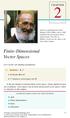 CHAPTER 2 American mathematician Paul Halmos (1916 2006), who in 1942 published the first modern linear algebra book. The title of Halmos s book was the same as the title of this chapter. Finite-Dimensional
Fixed Point Theorems
 Fixed Point Theorems Definition: Let X be a set and let T : X X be a function that maps X into itself. (Such a function is often called an operator, a transformation, or a transform on X, and the notation
Discussion on the paper Hypotheses testing by convex optimization by A. Goldenschluger, A. Juditsky and A. Nemirovski.
 Discussion on the paper Hypotheses testing by convex optimization by A. Goldenschluger, A. Juditsky and A. Nemirovski. Fabienne Comte, Celine Duval, Valentine Genon-Catalot To cite this version: Fabienne
Overview. Essential Questions. Precalculus, Quarter 4, Unit 4.5 Build Arithmetic and Geometric Sequences and Series
 Sequences and Series Overview Number of instruction days: 4 6 (1 day = 53 minutes) Content to Be Learned Write arithmetic and geometric sequences both recursively and with an explicit formula, use them
LOOKING FOR A GOOD TIME TO BET
 LOOKING FOR A GOOD TIME TO BET LAURENT SERLET Abstract. Suppose that the cards of a well shuffled deck of cards are turned up one after another. At any time-but once only- you may bet that the next card
Lasers in Restorative Dentistry
 Lasers in Restorative Dentistry Giovanni Olivi Matteo Olivi Editors Lasers in Restorative Dentistry A Practical Guide Editors Giovanni Olivi Rome Italy Matteo Olivi Rome Italy ISBN 978-3-662-47316-0 DOI
Undergraduate Notes in Mathematics. Arkansas Tech University Department of Mathematics
 Undergraduate Notes in Mathematics Arkansas Tech University Department of Mathematics An Introductory Single Variable Real Analysis: A Learning Approach through Problem Solving Marcel B. Finan c All Rights
Numerical Analysis Lecture Notes
 Numerical Analysis Lecture Notes Peter J. Olver 5. Inner Products and Norms The norm of a vector is a measure of its size. Besides the familiar Euclidean norm based on the dot product, there are a number
parent ROADMAP MATHEMATICS SUPPORTING YOUR CHILD IN HIGH SCHOOL
 parent ROADMAP MATHEMATICS SUPPORTING YOUR CHILD IN HIGH SCHOOL HS America s schools are working to provide higher quality instruction than ever before. The way we taught students in the past simply does
SOLUTIONS TO EXERCISES FOR. MATHEMATICS 205A Part 3. Spaces with special properties
 SOLUTIONS TO EXERCISES FOR MATHEMATICS 205A Part 3 Fall 2008 III. Spaces with special properties III.1 : Compact spaces I Problems from Munkres, 26, pp. 170 172 3. Show that a finite union of compact subspaces
FUNCTIONAL ANALYSIS LECTURE NOTES: QUOTIENT SPACES
 FUNCTIONAL ANALYSIS LECTURE NOTES: QUOTIENT SPACES CHRISTOPHER HEIL 1. Cosets and the Quotient Space Any vector space is an abelian group under the operation of vector addition. So, if you are have studied
MATH 4330/5330, Fourier Analysis Section 11, The Discrete Fourier Transform
 MATH 433/533, Fourier Analysis Section 11, The Discrete Fourier Transform Now, instead of considering functions defined on a continuous domain, like the interval [, 1) or the whole real line R, we wish
Continued Fractions and the Euclidean Algorithm
 Continued Fractions and the Euclidean Algorithm Lecture notes prepared for MATH 326, Spring 997 Department of Mathematics and Statistics University at Albany William F Hammond Table of Contents Introduction
THE CONTRACTION MAPPING THEOREM
 THE CONTRACTION MAPPING THEOREM KEITH CONRAD 1. Introduction Let f : X X be a mapping from a set X to itself. We call a point x X a fixed point of f if f(x) = x. For example, if [a, b] is a closed interval
DRAFT. Further mathematics. GCE AS and A level subject content
 Further mathematics GCE AS and A level subject content July 2014 s Introduction Purpose Aims and objectives Subject content Structure Background knowledge Overarching themes Use of technology Detailed
DIFFERENTIABILITY OF COMPLEX FUNCTIONS. Contents
 DIFFERENTIABILITY OF COMPLEX FUNCTIONS Contents 1. Limit definition of a derivative 1 2. Holomorphic functions, the Cauchy-Riemann equations 3 3. Differentiability of real functions 5 4. A sufficient condition
Prime numbers and prime polynomials. Paul Pollack Dartmouth College
 Prime numbers and prime polynomials Paul Pollack Dartmouth College May 1, 2008 Analogies everywhere! Analogies in elementary number theory (continued fractions, quadratic reciprocity, Fermat s last theorem)
arxiv:hep-th/0507236v1 25 Jul 2005
 Non perturbative series for the calculation of one loop integrals at finite temperature Paolo Amore arxiv:hep-th/050736v 5 Jul 005 Facultad de Ciencias, Universidad de Colima, Bernal Diaz del Castillo
3. Mathematical Induction
 3. MATHEMATICAL INDUCTION 83 3. Mathematical Induction 3.1. First Principle of Mathematical Induction. Let P (n) be a predicate with domain of discourse (over) the natural numbers N = {0, 1,,...}. If (1)
Section 4.4 Inner Product Spaces
 Section 4.4 Inner Product Spaces In our discussion of vector spaces the specific nature of F as a field, other than the fact that it is a field, has played virtually no role. In this section we no longer
IEOR 6711: Stochastic Models I Fall 2012, Professor Whitt, Tuesday, September 11 Normal Approximations and the Central Limit Theorem
 IEOR 6711: Stochastic Models I Fall 2012, Professor Whitt, Tuesday, September 11 Normal Approximations and the Central Limit Theorem Time on my hands: Coin tosses. Problem Formulation: Suppose that I have
Moreover, under the risk neutral measure, it must be the case that (5) r t = µ t.
 LECTURE 7: BLACK SCHOLES THEORY 1. Introduction: The Black Scholes Model In 1973 Fisher Black and Myron Scholes ushered in the modern era of derivative securities with a seminal paper 1 on the pricing
Linear Maps. Isaiah Lankham, Bruno Nachtergaele, Anne Schilling (February 5, 2007)
 MAT067 University of California, Davis Winter 2007 Linear Maps Isaiah Lankham, Bruno Nachtergaele, Anne Schilling (February 5, 2007) As we have discussed in the lecture on What is Linear Algebra? one of
Supplement to Call Centers with Delay Information: Models and Insights
 Supplement to Call Centers with Delay Information: Models and Insights Oualid Jouini 1 Zeynep Akşin 2 Yves Dallery 1 1 Laboratoire Genie Industriel, Ecole Centrale Paris, Grande Voie des Vignes, 92290
HOMEWORK 5 SOLUTIONS. n!f n (1) lim. ln x n! + xn x. 1 = G n 1 (x). (2) k + 1 n. (n 1)!
 Math 7 Fall 205 HOMEWORK 5 SOLUTIONS Problem. 2008 B2 Let F 0 x = ln x. For n 0 and x > 0, let F n+ x = 0 F ntdt. Evaluate n!f n lim n ln n. By directly computing F n x for small n s, we obtain the following
Mathematics Course 111: Algebra I Part IV: Vector Spaces
 Mathematics Course 111: Algebra I Part IV: Vector Spaces D. R. Wilkins Academic Year 1996-7 9 Vector Spaces A vector space over some field K is an algebraic structure consisting of a set V on which are
x a x 2 (1 + x 2 ) n.
 Limits and continuity Suppose that we have a function f : R R. Let a R. We say that f(x) tends to the limit l as x tends to a; lim f(x) = l ; x a if, given any real number ɛ > 0, there exists a real number
Lies My Calculator and Computer Told Me
 Lies My Calculator and Computer Told Me 2 LIES MY CALCULATOR AND COMPUTER TOLD ME Lies My Calculator and Computer Told Me See Section.4 for a discussion of graphing calculators and computers with graphing
ON COMPLETELY CONTINUOUS INTEGRATION OPERATORS OF A VECTOR MEASURE. 1. Introduction
 ON COMPLETELY CONTINUOUS INTEGRATION OPERATORS OF A VECTOR MEASURE J.M. CALABUIG, J. RODRÍGUEZ, AND E.A. SÁNCHEZ-PÉREZ Abstract. Let m be a vector measure taking values in a Banach space X. We prove that
Moving Least Squares Approximation
 Chapter 7 Moving Least Squares Approimation An alternative to radial basis function interpolation and approimation is the so-called moving least squares method. As we will see below, in this method the
Lecture 13 - Basic Number Theory.
 Lecture 13 - Basic Number Theory. Boaz Barak March 22, 2010 Divisibility and primes Unless mentioned otherwise throughout this lecture all numbers are non-negative integers. We say that A divides B, denoted
WHAT ARE MATHEMATICAL PROOFS AND WHY THEY ARE IMPORTANT?
 WHAT ARE MATHEMATICAL PROOFS AND WHY THEY ARE IMPORTANT? introduction Many students seem to have trouble with the notion of a mathematical proof. People that come to a course like Math 216, who certainly
LECTURE 15: AMERICAN OPTIONS
 LECTURE 15: AMERICAN OPTIONS 1. Introduction All of the options that we have considered thus far have been of the European variety: exercise is permitted only at the termination of the contract. These
Section 1.3 P 1 = 1 2. = 1 4 2 8. P n = 1 P 3 = Continuing in this fashion, it should seem reasonable that, for any n = 1, 2, 3,..., = 1 2 4.
 Difference Equations to Differential Equations Section. The Sum of a Sequence This section considers the problem of adding together the terms of a sequence. Of course, this is a problem only if more than
ON FIBONACCI NUMBERS WITH FEW PRIME DIVISORS
 ON FIBONACCI NUMBERS WITH FEW PRIME DIVISORS YANN BUGEAUD, FLORIAN LUCA, MAURICE MIGNOTTE, SAMIR SIKSEK Abstract If n is a positive integer, write F n for the nth Fibonacci number, and ω(n) for the number
NEW YORK STATE TEACHER CERTIFICATION EXAMINATIONS
 NEW YORK STATE TEACHER CERTIFICATION EXAMINATIONS TEST DESIGN AND FRAMEWORK September 2014 Authorized for Distribution by the New York State Education Department This test design and framework document
Automated Firewall Analytics
 Automated Firewall Analytics Ehab Al-Shaer Automated Firewall Analytics Design, Configuration and Optimization 123 Ehab Al-Shaer University of North Carolina Charlotte Charlotte, NC, USA ISBN 978-3-319-10370-9
Lecture Notes to Accompany. Scientific Computing An Introductory Survey. by Michael T. Heath. Chapter 10
 Lecture Notes to Accompany Scientific Computing An Introductory Survey Second Edition by Michael T. Heath Chapter 10 Boundary Value Problems for Ordinary Differential Equations Copyright c 2001. Reproduction
FACTORING POLYNOMIALS IN THE RING OF FORMAL POWER SERIES OVER Z
 FACTORING POLYNOMIALS IN THE RING OF FORMAL POWER SERIES OVER Z DANIEL BIRMAJER, JUAN B GIL, AND MICHAEL WEINER Abstract We consider polynomials with integer coefficients and discuss their factorization
1 Error in Euler s Method
 1 Error in Euler s Method Experience with Euler s 1 method raises some interesting questions about numerical approximations for the solutions of differential equations. 1. What determines the amount of
1 Review of Least Squares Solutions to Overdetermined Systems
 cs4: introduction to numerical analysis /9/0 Lecture 7: Rectangular Systems and Numerical Integration Instructor: Professor Amos Ron Scribes: Mark Cowlishaw, Nathanael Fillmore Review of Least Squares
Binomial lattice model for stock prices
 Copyright c 2007 by Karl Sigman Binomial lattice model for stock prices Here we model the price of a stock in discrete time by a Markov chain of the recursive form S n+ S n Y n+, n 0, where the {Y i }
Fanny Dos Reis. Visiting Assistant Professor, Texas A&M University. September 2006 - May 2008
 Fanny Dos Reis Positions Held Visiting Assistant Professor, Texas A&M University. September 2006 - May 2008 Visiting Assistant Professor, University of Lille 1, France. September 2004 - August 2006 Visiting
Review of Fundamental Mathematics
 Review of Fundamental Mathematics As explained in the Preface and in Chapter 1 of your textbook, managerial economics applies microeconomic theory to business decision making. The decision-making tools
1. Let X and Y be normed spaces and let T B(X, Y ).
 Uppsala Universitet Matematiska Institutionen Andreas Strömbergsson Prov i matematik Funktionalanalys Kurs: NVP, Frist. 2005-03-14 Skrivtid: 9 11.30 Tillåtna hjälpmedel: Manuella skrivdon, Kreyszigs bok
Section 1.1. Introduction to R n
 The Calculus of Functions of Several Variables Section. Introduction to R n Calculus is the study of functional relationships and how related quantities change with each other. In your first exposure to
No: 10 04. Bilkent University. Monotonic Extension. Farhad Husseinov. Discussion Papers. Department of Economics
 No: 10 04 Bilkent University Monotonic Extension Farhad Husseinov Discussion Papers Department of Economics The Discussion Papers of the Department of Economics are intended to make the initial results
ON THE NUMBER OF REAL HYPERSURFACES HYPERTANGENT TO A GIVEN REAL SPACE CURVE
 Illinois Journal of Mathematics Volume 46, Number 1, Spring 2002, Pages 145 153 S 0019-2082 ON THE NUMBER OF REAL HYPERSURFACES HYPERTANGENT TO A GIVEN REAL SPACE CURVE J. HUISMAN Abstract. Let C be a
Lecture L3 - Vectors, Matrices and Coordinate Transformations
 S. Widnall 16.07 Dynamics Fall 2009 Lecture notes based on J. Peraire Version 2.0 Lecture L3 - Vectors, Matrices and Coordinate Transformations By using vectors and defining appropriate operations between
MA 323 Geometric Modelling Course Notes: Day 02 Model Construction Problem
 MA 323 Geometric Modelling Course Notes: Day 02 Model Construction Problem David L. Finn November 30th, 2004 In the next few days, we will introduce some of the basic problems in geometric modelling, and
Ideal Class Group and Units
 Chapter 4 Ideal Class Group and Units We are now interested in understanding two aspects of ring of integers of number fields: how principal they are (that is, what is the proportion of principal ideals
1. Prove that the empty set is a subset of every set.
 1. Prove that the empty set is a subset of every set. Basic Topology Written by Men-Gen Tsai email: [email protected] Proof: For any element x of the empty set, x is also an element of every set since
Alex, I will take congruent numbers for one million dollars please
 Alex, I will take congruent numbers for one million dollars please Jim L. Brown The Ohio State University Columbus, OH 4310 [email protected] One of the most alluring aspectives of number theory
Arrangements of Stars on the American Flag
 Arrangements of Stars on the American Flag Dimitris Koukoulopoulos and Johann Thiel Abstract. In this article, we examine the existence of nice arrangements of stars on the American flag. We show that
Definition 8.1 Two inequalities are equivalent if they have the same solution set. Add or Subtract the same value on both sides of the inequality.
 8 Inequalities Concepts: Equivalent Inequalities Linear and Nonlinear Inequalities Absolute Value Inequalities (Sections 4.6 and 1.1) 8.1 Equivalent Inequalities Definition 8.1 Two inequalities are equivalent
Inner Product Spaces
 Math 571 Inner Product Spaces 1. Preliminaries An inner product space is a vector space V along with a function, called an inner product which associates each pair of vectors u, v with a scalar u, v, and
Lecture Notes in Computer Science 5161
 Lecture Notes in Computer Science 5161 Commenced Publication in 1973 Founding and Former Series Editors: Gerhard Goos, Juris Hartmanis, and Jan van Leeuwen Editorial Board David Hutchison Lancaster University,
Creating, Solving, and Graphing Systems of Linear Equations and Linear Inequalities
 Algebra 1, Quarter 2, Unit 2.1 Creating, Solving, and Graphing Systems of Linear Equations and Linear Inequalities Overview Number of instructional days: 15 (1 day = 45 60 minutes) Content to be learned
MATH 304 Linear Algebra Lecture 20: Inner product spaces. Orthogonal sets.
 MATH 304 Linear Algebra Lecture 20: Inner product spaces. Orthogonal sets. Norm The notion of norm generalizes the notion of length of a vector in R n. Definition. Let V be a vector space. A function α
What is Linear Programming?
 Chapter 1 What is Linear Programming? An optimization problem usually has three essential ingredients: a variable vector x consisting of a set of unknowns to be determined, an objective function of x to
A Non-Linear Schema Theorem for Genetic Algorithms
 A Non-Linear Schema Theorem for Genetic Algorithms William A Greene Computer Science Department University of New Orleans New Orleans, LA 70148 bill@csunoedu 504-280-6755 Abstract We generalize Holland
MASSACHUSETTS INSTITUTE OF TECHNOLOGY 6.436J/15.085J Fall 2008 Lecture 5 9/17/2008 RANDOM VARIABLES
 MASSACHUSETTS INSTITUTE OF TECHNOLOGY 6.436J/15.085J Fall 2008 Lecture 5 9/17/2008 RANDOM VARIABLES Contents 1. Random variables and measurable functions 2. Cumulative distribution functions 3. Discrete
1 if 1 x 0 1 if 0 x 1
 Chapter 3 Continuity In this chapter we begin by defining the fundamental notion of continuity for real valued functions of a single real variable. When trying to decide whether a given function is or
NP-Completeness and Cook s Theorem
 NP-Completeness and Cook s Theorem Lecture notes for COM3412 Logic and Computation 15th January 2002 1 NP decision problems The decision problem D L for a formal language L Σ is the computational task:
THE FUNDAMENTAL THEOREM OF ALGEBRA VIA PROPER MAPS
 THE FUNDAMENTAL THEOREM OF ALGEBRA VIA PROPER MAPS KEITH CONRAD 1. Introduction The Fundamental Theorem of Algebra says every nonconstant polynomial with complex coefficients can be factored into linear
The sum of digits of polynomial values in arithmetic progressions
 The sum of digits of polynomial values in arithmetic progressions Thomas Stoll Institut de Mathématiques de Luminy, Université de la Méditerranée, 13288 Marseille Cedex 9, France E-mail: [email protected]
The Heat Equation. Lectures INF2320 p. 1/88
 The Heat Equation Lectures INF232 p. 1/88 Lectures INF232 p. 2/88 The Heat Equation We study the heat equation: u t = u xx for x (,1), t >, (1) u(,t) = u(1,t) = for t >, (2) u(x,) = f(x) for x (,1), (3)
4.5 Linear Dependence and Linear Independence
 4.5 Linear Dependence and Linear Independence 267 32. {v 1, v 2 }, where v 1, v 2 are collinear vectors in R 3. 33. Prove that if S and S are subsets of a vector space V such that S is a subset of S, then
CHAPTER II THE LIMIT OF A SEQUENCE OF NUMBERS DEFINITION OF THE NUMBER e.
 CHAPTER II THE LIMIT OF A SEQUENCE OF NUMBERS DEFINITION OF THE NUMBER e. This chapter contains the beginnings of the most important, and probably the most subtle, notion in mathematical analysis, i.e.,
Chapter 3. Cartesian Products and Relations. 3.1 Cartesian Products
 Chapter 3 Cartesian Products and Relations The material in this chapter is the first real encounter with abstraction. Relations are very general thing they are a special type of subset. After introducing
Ordinary Differential Equations
 Course Title Ordinary Differential Equations Course Number MATH-UA 262 Spring 2015 Syllabus last updated on: 12-DEC-2015 Instructor Contact Information Mark de Longueville [email protected] Course
CONTINUED FRACTIONS AND FACTORING. Niels Lauritzen
 CONTINUED FRACTIONS AND FACTORING Niels Lauritzen ii NIELS LAURITZEN DEPARTMENT OF MATHEMATICAL SCIENCES UNIVERSITY OF AARHUS, DENMARK EMAIL: [email protected] URL: http://home.imf.au.dk/niels/ Contents
Classical theorems on hyperbolic triangles from a projective point of view
 tmcs-szilasi 2012/3/1 0:14 page 175 #1 10/1 (2012), 175 181 Classical theorems on hyperbolic triangles from a projective point of view Zoltán Szilasi Abstract. Using the Cayley-Klein model of hyperbolic