
MULTIPLE CHOICE. Choose the one alternative that best completes the statement or answers the question.
|
|
|
- Aubrey Davis
- 9 years ago
- Views:
Transcription
1 A.P. Chemistry Practice Test: Ch. 11, Solutions Name MULTIPLE CHOICE. Choose the one alternative that best completes the statement or answers the question. 1) Formation of solutions where the process is endothermic can be spontaneous provided that. A) the solvent is a gas and the solute is a solid B) they are accompanied by an increase in order C) they are accompanied by an increase in disorder D) they are accompanied by another process that is exothermic E) the solvent is water and the solute is a gas 2) The phrase "like dissolves like" refers to the fact that. A) polar solvents dissolve nonpolar solutes and vice versa B) solvents can only dissolve solutes of similar molar mass C) gases can only dissolve other gases D) polar solvents dissolve polar solutes and nonpolar solvents dissolve nonpolar solutes E) condensed phases can only dissolve other condensed phases 3) An unsaturated solution is one that. A) has no double bonds B) has a concentration lower than the solubility C) contains no solute D) contains the maximum concentration of solute possible, and is in equilibrium with undissolved solute E) contains more dissolved solute than the solubility allows 4) A solution with a concentration higher than the solubility is. A) is not possible B) is saturated C) is supercritical D) is unsaturated E) is supersaturated 5) Which one of the following substances would be the most soluble in CCl4? A) H2O B) NaCl C) CH3CH2OH D) NH3 E) C10H22 6) Which one of the following is most soluble in water? A) CH3OH B) CH3CH2CH2OH C) CH3CH2OH D) CH3CH2CH2CH2CH2OH E) CH3CH2CH2CH2OH 1
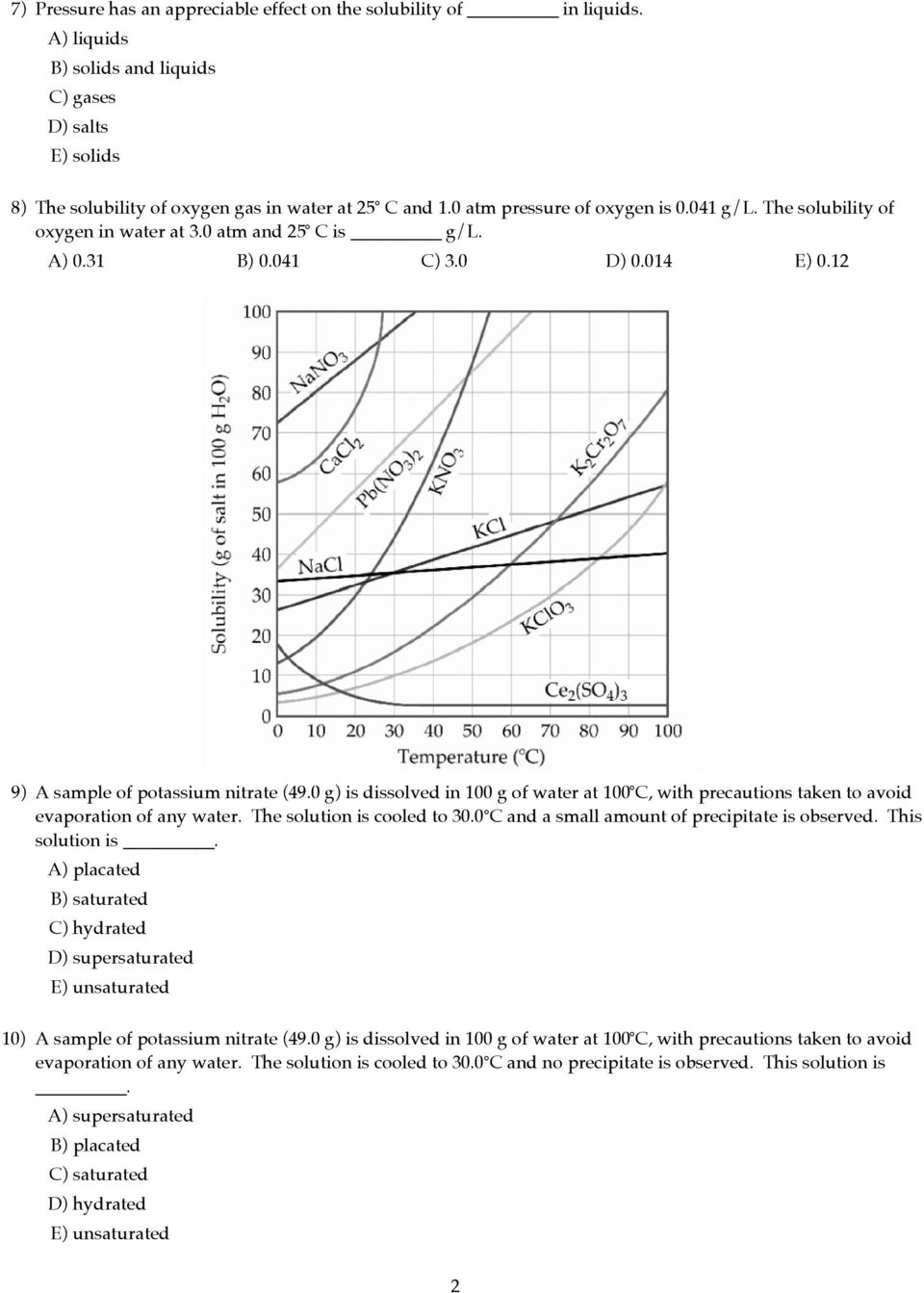
2 7) Pressure has an appreciable effect on the solubility of in liquids. A) liquids B) solids and liquids C) gases D) salts E) solids 8) The solubility of oxygen gas in water at 25e C and 1.0 atm pressure of oxygen is g/l. The solubility of oxygen in water at 3.0 atm and 25e C is g/l. A) 0.31 B) C) 3.0 D) E) ) A sample of potassium nitrate (49.0 g) is dissolved in 100 g of water at 100eC, with precautions taken to avoid evaporation of any water. The solution is cooled to 30.0eC and a small amount of precipitate is observed. This solution is. A) placated B) saturated C) hydrated D) supersaturated E) unsaturated 10) A sample of potassium nitrate (49.0 g) is dissolved in 100 g of water at 100eC, with precautions taken to avoid evaporation of any water. The solution is cooled to 30.0eC and no precipitate is observed. This solution is. A) supersaturated B) placated C) saturated D) hydrated E) unsaturated 2
3 11) The solubility of MnSO4 monohydrate in water at 20eC is 70.0 g per ml of water. A solution at 20eC that is 4.22 M in MnSO4 monohydrate is best described as a(n) solution. The formula weight of MnSO4 monohydrate is g/mol. A) unsaturated B) hydrated C) saturated D) solvated E) supersaturated 12) A solution contains 28% phosphoric acid by mass. This means that. A) the density of this solution is 2.8 g/ml B) 1 ml of this solution contains 28 g of phosphoric acid C) 100 g of this solution contains 28 g of phosphoric acid D) 1 L of this solution has a mass of 28 g E) 1 L of this solution contains 28 ml of phosphoric acid 13) The concentration of nitrate ion in a solution that contains M aluminum nitrate is M. A) B) C) 2.70 D) 1.80 E) ) Molality is defined as the. A) moles solute/moles solvent B) moles solute/liters solution C) moles solute/kg solvent D) moles solute/kg solution E) none (dimensionless) 15) The concentration of a benzene solution prepared by mixing 12.0 g C6H6 with 38.0 g CCl4 is molal. A) B) C) D) E) ) The concentration (M) of HCl in a solution prepared by dissolving 5.5 g of HCl in 200 g of C2H6O is M. The density of the solution is 0.79 g/ml. A) 0.93 B) 1.72 C) 6.0 x 10⁻⁴ D) 21 E) ) Which one of the following concentration units varies with temperature? A) molality B) mole fraction C) mass percent D) molarity E) all of the above 18) What is the molarity of sodium chloride in solution that is 13.0% by mass sodium chloride and that has a density of 1.10 g/ml? A) 1.43 x 10⁻² B) 2.23 C) 143 D) 2.45 E)

4 19) A m solution of which one of the following solutes will have the lowest vapor pressure? A) sucrose B) Ca(ClO4)2 C) NaCl D) Al(ClO4)3 E) KClO4 20) The magnitudes of Kf and of Kb depend on the identity of the. A) solvent B) solute and solvent C) solution D) solvent and on temperature E) solute 21) The vapor pressure of pure ethanol at 60eC is 0./459 atm. Raoult's Law predicts that a solution prepared by dissolving 10.0 mmol naphthalene (nonvolatile) in 90.0 mmol ethanol will have a vapor pressure of atm. A) B) C) D) E) ) The vapor pressure of pure water at 25eC is 23.8 torr. Determine the vapor pressure (torr) of water at 25eC above a solution prepared by dissolving 35 g of urea (a nonvolatile, non-electrolyte, MW = 60.0 g/mol) in 75 g of water. A) 3.3 B) 27 C) 2.9 D) 0.88 E) 21 23) Which of the following liquids will have the lowest freezing point? A) pure H2O B) aqueous sucrose (0.60 m) C) aqueous FeI3 (0.24 m) D) aqueous glucose (0.60 m) E) aqueous KF (0.50 m) 24) A solution containing 10.0 g of an unknown liquid and 90.0 g water has a freezing point of -3.33eC. Given Kf = 1.86eC/m for water, the molar mass of the unknown liquid is g/mol. A) 161 B) 69.0 C) 62.1 D) 333 E) ) A solution is prepared by dissolving 0.60 g of nicotine (a nonelectrolyte) in water to make 12 ml of solution. The osmotic pressure of the solution is 7.55 atm at 25eC. The molecular weight of nicotine is g/mol. A) 43 B) 0.60 C) 160 D) 50 E) 28 26) A solution is prepared by dissolving 6.00 g of an unknown nonelectrolyte in enough water to make 1.00 L of solution. The osmotic pressure of this solution is atm at 25.0eC. What is the molecular weight (g/mol) of the unknown solute? A) 195 B) 110 C) 16.4 D) 30.6 E) 5.12 x

5 27) Which of the following aqueous solutions will have the highest boiling point? A) 0.10 m NaCl B) 0.10 m Na2SO4 C) 0.20 m glucose D) 0.25 m sucrose E) 0.10 m SrSO4 28) Calculate the freezing point (0eC) of a m aqueous solution of NaNO3. The molal freezing-point-depression constant of water is 1.86eC/m. A) B) C) D) E) ) The ideal value of i (van't Hoff factor) for (NH4)3PO4. A) 5 B) 3 C) 4 D) 2 E) 1 30) Determine the freezing point (ec) of a molal aqueous solution of MgSO4. Assume i = 2.0 for MgSO4. The molal freezing-point-depression constant of water is 1.86eC/m. A) B) C) D) E) ) George is making spaghetti for dinner. He places 4.01 kg of water in a pan and brings it to a boil. Before adding the pasta, he adds 58 g of table salt to the water and again brings it to a boil. The temperature of the salty, boiling water is ec. It is a nice day at sea level so that pressure is 1.00 atm. Assume negligible evaporation of water. Kb for water is 0.52eC/m. A) B) C) D) E) ) The phenomenon used to differentiate colloids and true solutions is called the effect. A) van't Hoff B) Osmotic C) Raoult D) Henry E) Tyndall 33) A solution is prepared by adding 1.43 mol of KCl to 889 g of water. The concentration of KCl is molal. A) 622 B) C) 1.61 D) E) ) At 20eC, a 2.32 M aqueous solution of ammonium chloride has a density of g/ml. What is the molality of ammonium chloride in the solution? The formula weight of NH4Cl is g/mol. A) 2.32 B) C) D) 2.55 E) ) The osmotic pressure of a solution formed by dissolving 25.0 mg of aspirin (C9H8O4) in L of water at 25eC is atm. A) B) 1.38 C) 13.6 D) E)

6 Answer Key Testname: CH_11_PRAC_TEST_SOLUTIONS.TST MULTIPLE CHOICE. Choose the one alternative that best completes the statement or answers the question. 1) C ID: chem9b ) D ID: chem9b ) B ID: chem9b ) E ID: chem9b ) E ID: chem9b ) A ID: chem9b ) C ID: chem9b ) E ID: chem9b ) B ID: chem9b ) A ID: chem9b ) E ID: chem9b ) C ID: chem9b ) C ID: chem9b ) C ID: chem9b ) E ID: chem9b ) E ID: chem9b ) D ID: chem9b ) D ID: chem9b ) D ID: chem9b ) A ID: chem9b ) B ID: chem9b

7 Answer Key Testname: CH_11_PRAC_TEST_SOLUTIONS.TST 22) E ID: chem9b ) E ID: chem9b ) C ID: chem9b ) C ID: chem9b ) A ID: chem9b ) B ID: chem9b ) A ID: chem9b ) C ID: chem9b ) D ID: chem9b ) D ID: chem9b ) E ID: chem9b ) C ID: chem9b ) D ID: chem9b ) D ID: chem9b

8

9

10

11

12

Chapter 13. Properties of Solutions
 Sample Exercise 13.1 (p. 534) By the process illustrated below, water vapor reacts with excess solid sodium sulfate to form the hydrated form of the salt. The chemical reaction is Na 2 SO 4(s) + 10 H 2
48 Practice Problems for Ch. 17 - Chem 1C - Joseph
 48 Practice Problems for Ch. 17 - Chem 1C - Joseph 1. Which of the following concentration measures will change in value as the temperature of a solution changes? A) mass percent B) mole fraction C) molality
Chapter 13 Properties of Solutions
 Chemistry, The Central Science, 10th edition Theodore L. Brown; H. Eugene LeMay, Jr.; and Bruce E. Bursten Chapter 13 Properties of are homogeneous mixtures of two or more pure substances. In a solution,
Solutions. Chapter 13. Properties of Solutions. Lecture Presentation
 Lecture Presentation Chapter 13 Properties of Yonsei University homogeneous mixtures of two or more pure substances: may be gases, liquids, or solids In a solution, the solute is dispersed uniformly throughout
Sample Test 1 SAMPLE TEST 1. CHAPTER 12
 13 Sample Test 1 SAMPLE TEST 1. CHAPTER 12 1. The molality of a solution is defined as a. moles of solute per liter of solution. b. grams of solute per liter of solution. c. moles of solute per kilogram
2. Why does the solubility of alcohols decrease with increased carbon chain length?
 Colligative properties 1 1. What does the phrase like dissolves like mean. 2. Why does the solubility of alcohols decrease with increased carbon chain length? Alcohol in water (mol/100g water) Methanol
Chapter 14 Solutions
 Chapter 14 Solutions 1 14.1 General properties of solutions solution a system in which one or more substances are homogeneously mixed or dissolved in another substance two components in a solution: solute
13.3 Factors Affecting Solubility Solute-Solvent Interactions Pressure Effects Temperature Effects
 Week 3 Sections 13.3-13.5 13.3 Factors Affecting Solubility Solute-Solvent Interactions Pressure Effects Temperature Effects 13.4 Ways of Expressing Concentration Mass Percentage, ppm, and ppb Mole Fraction,
Colligative Properties
 CH302 LaBrake and Vanden Bout Colligative Properties PROBLEM #1: Give the molecular formula, the van t hoff factor for the following Ionic Compounds as well as guess the solubility of the compounds. If
Chapter 13: Properties of Solutions
 Chapter 13: Properties of Solutions Problems: 9-10, 13-17, 21-42, 44, 49-60, 71-72, 73 (a,c), 77-79, 84(a-c), 91 solution: homogeneous mixture of a solute dissolved in a solvent solute: solvent: component(s)
ESSAY. Write your answer in the space provided or on a separate sheet of paper.
 Test 1 General Chemistry CH116 Summer, 2012 University of Massachusetts, Boston Name ESSAY. Write your answer in the space provided or on a separate sheet of paper. 1) Sodium hydride reacts with excess
David A. Katz Department of Chemistry Pima Community College
 Solutions David A. Katz Department of Chemistry Pima Community College A solution is a HOMOGENEOUS mixture of 2 or more substances in a single phase. One constituent t is usually regarded as the SOLVENT
1) What is the overall order of the following reaction, given the rate law?
 PRACTICE PROBLEMS FOR TEST 2 (March 11, 2009) 1) What is the overall order of the following reaction, given the rate law? A) 1st order B) 2nd order C) 3rd order D) 4th order E) 0th order 2NO(g) + H 2(g)
Chemistry Ch 15 (Solutions) Study Guide Introduction
 Chemistry Ch 15 (Solutions) Study Guide Introduction Name: Note: a word marked (?) is a vocabulary word you should know the meaning of. A homogeneous (?) mixture, or, is a mixture in which the individual
CHEM 36 General Chemistry EXAM #1 February 13, 2002
 CHEM 36 General Chemistry EXAM #1 February 13, 2002 Name: Serkey, Anne INSTRUCTIONS: Read through the entire exam before you begin. Answer all of the questions. For questions involving calculations, show
Chapter 13 - Solutions
 Chapter 13 - Solutions 13-1 Types of Mixtures I. Solutions A. Soluble 1. Capable of being dissolved B. Solution 1. A homogeneous mixture of two or more substances in a single phase C. Solvent 1. The dissolving
To calculate the value of the boiling point constant for water. To use colligative properties to determine the molecular weight of a substance.
 Colligative Properties of Solutions: A Study of Boiling Point Elevation Amina El-Ashmawy, Collin County Community College (With contributions by Timm Pschigoda, St. Joseph High School, St. Joseph, MI)
Solution concentration = how much solute dissolved in solvent
 Solutions 1 Solutions Concentration Solution concentration = how much solute dissolved in solvent Coffee crystal = solute Water = solvent Liquid Coffee = solution so a solute is dissolved in solvent to
Chemistry 51 Chapter 8 TYPES OF SOLUTIONS. A solution is a homogeneous mixture of two substances: a solute and a solvent.
 TYPES OF SOLUTIONS A solution is a homogeneous mixture of two substances: a solute and a solvent. Solute: substance being dissolved; present in lesser amount. Solvent: substance doing the dissolving; present
Determination of Molar Mass by Boiling Point Elevation of Urea Solution
 Determination of Molar Mass by Boiling Point Elevation of Urea Solution CHRISTIAN E. MADU, PhD AND BASSAM ATTILI, PhD COLLIN COLLEGE CHEMISTRY DEPARTMENT Purpose of the Experiment Determine the boiling
MULTIPLE CHOICE. Choose the one alternative that best completes the statement or answers the question.
 Chapter 10 MULTIPLE CHOICE. Choose the one alternative that best completes the statement or answers the question. 1) A gas at a pressure of 10.0 Pa exerts a force of N on an area of 5.5 m2. A) 1.8 B) 0.55
Name Class Date. In the space provided, write the letter of the term or phrase that best completes each statement or best answers each question.
 Assessment Chapter Test A Chapter: States of Matter In the space provided, write the letter of the term or phrase that best completes each statement or best answers each question. 1. The kinetic-molecular
Chapter 11 Properties of Solutions
 Chapter 11 Properties of Solutions 11.1 Solution Composition A. Molarity moles solute 1. Molarity ( M ) = liters of solution B. Mass Percent mass of solute 1. Mass percent = 1 mass of solution C. Mole
Exam. Name. 1) Chlorine (atomic number = 17) has the electronic configuration:. E) 1s22s22d103s2
 Exam Name 1) Chlorine (atomic number = 17) has the electronic configuration:. A) 1s22s22p62d63s1 B) 1s22s22p63s23d5 C) 1s22s22p62d53s2 D) 1s22s22p63s23p5 E) 1s22s22d103s2 2) The complete electron configuration
Chemistry B11 Chapter 6 Solutions and Colloids
 Chemistry B11 Chapter 6 Solutions and Colloids Solutions: solutions have some properties: 1. The distribution of particles in a solution is uniform. Every part of the solution has exactly the same composition
Answers and Solutions to Text Problems
 9 Answers and Solutions to Text Problems 9.1 a. δ O δ + δ + H H In a water molecule, the oxygen has a partial negative charge and the hydrogens have partial positive charges. b. δ δ + O H δ + δ + δ H H
Essential Maths for Medics and Vets Reference Materials Module 2. Amount and Concentration.
 2 Amount and concentration: making and diluting solutions 2 Amount and concentration; making and diluting solutions... 2A Rationale... 2B Distinguishing between amount and concentration, g and %w/v...
Name: Class: Date: 2) Which one of the following exhibits dipole-dipole attraction between molecules? A) XeF 4 B) AsH 3 C) CO 2 D) BCl 3 E) Cl 2
 Name: Class: Date: IM Bonding 1) In liquids, the attractive intermolecular forces are. A) very weak compared with kinetic energies of the molecules B) strong enough to hold molecules relatively close together
CHAPTER 13: SOLUTIONS
 CHAPTER 13: SOLUTIONS Problems: 1-8, 11-15, 20-30, 37-88, 107-110, 131-132 13.2 SOLUTIONS: HOMOGENEOUS MIXTURES solution: homogeneous mixture of substances present as atoms, ions, and/or molecules solute:
Calculation of Molar Masses. Molar Mass. Solutions. Solutions
 Molar Mass Molar mass = Mass in grams of one mole of any element, numerically equal to its atomic weight Molar mass of molecules can be determined from the chemical formula and molar masses of elements
Liquid phase. Balance equation Moles A Stoic. coefficient. Aqueous phase
 STOICHIOMETRY Objective The purpose of this exercise is to give you some practice on some Stoichiometry calculations. Discussion The molecular mass of a compound is the sum of the atomic masses of all
5. Which temperature is equal to +20 K? 1) 253ºC 2) 293ºC 3) 253 C 4) 293 C
 1. The average kinetic energy of water molecules increases when 1) H 2 O(s) changes to H 2 O( ) at 0ºC 3) H 2 O( ) at 10ºC changes to H 2 O( ) at 20ºC 2) H 2 O( ) changes to H 2 O(s) at 0ºC 4) H 2 O( )
a. Cherry Garcia ice cream: heterogeneous mixture b. mayonnaise: colloid c, d, e. seltzer water, nail polish remover, and brass: solutions
 Chapter 8 1 Chapter 8 Solutions Solutions to In-Chapter Problems 8.1 A heterogeneous miture does not have a uniform composition throughout a sample. A solution is a homogeneous miture that contains small
EXERCISES. 16. What is the ionic strength in a solution containing NaCl in c=0.14 mol/dm 3 concentration and Na 3 PO 4 in 0.21 mol/dm 3 concentration?
 EXERISES 1. The standard enthalpy of reaction is 512 kj/mol and the standard entropy of reaction is 1.60 kj/(k mol) for the denaturalization of a certain protein. Determine the temperature range where
Stoichiometry. 1. The total number of moles represented by 20 grams of calcium carbonate is (1) 1; (2) 2; (3) 0.1; (4) 0.2.
 Stoichiometry 1 The total number of moles represented by 20 grams of calcium carbonate is (1) 1; (2) 2; (3) 01; (4) 02 2 A 44 gram sample of a hydrate was heated until the water of hydration was driven
REVIEW QUESTIONS Chapter 8
 Chemistry 51 ANSWER KEY REVIEW QUESTIONS Chapter 8 1. Identify each of the diagrams below as strong electrolyte, weak electrolyte or non-electrolyte: (a) Non-electrolyte (no ions present) (b) Weak electrolyte
Phase diagram of water. Note: for H 2 O melting point decreases with increasing pressure, for CO 2 melting point increases with increasing pressure.
 Phase diagram of water Note: for H 2 O melting point decreases with increasing pressure, for CO 2 melting point increases with increasing pressure. WATER Covers ~ 70% of the earth s surface Life on earth
Solutions: Molarity. A. Introduction
 Solutions: Molarity. A. Introduction... 1 B. Molarity... 1 C. Making molar solutions... 2 D. Using molar solutions... 4 E. Other mole-based concentration units [optional]... 6 F. Answers... 7 A. Introduction
A. Types of Mixtures:
 I. MIXTURES: SOLUTIONS 1) mixture = a blend of two or more kinds of matter, each of which retains its own identity and properties a) homogeneous mixture = a mixture that is uniform in composition throughout
87 16 70 20 58 24 44 32 35 40 29 48 (a) graph Y versus X (b) graph Y versus 1/X
 HOMEWORK 5A Barometer; Boyle s Law 1. The pressure of the first two gases below is determined with a manometer that is filled with mercury (density = 13.6 g/ml). The pressure of the last two gases below
MULTIPLE CHOICE. Choose the one alternative that best completes the statement or answers the question.
 General Chemistry PHS 1015 Practice Exam 4 Name MULTIPLE CHOICE. Choose the one alternative that best completes the statement or answers the question. 1) Which of the following statements about pressure
Aqueous Solutions. Water is the dissolving medium, or solvent. Some Properties of Water. A Solute. Types of Chemical Reactions.
 Aqueous Solutions and Solution Stoichiometry Water is the dissolving medium, or solvent. Some Properties of Water Water is bent or V-shaped. The O-H bonds are covalent. Water is a polar molecule. Hydration
Name: Class: Date: 2 4 (aq)
 Name: Class: Date: Unit 4 Practice Test Multiple Choice Identify the choice that best completes the statement or answers the question. 1) The balanced molecular equation for complete neutralization of
Solution a homogeneous mixture = A solvent + solute(s) Aqueous solution water is the solvent
 Solution a homogeneous mixture = A solvent + solute(s) Aqueous solution water is the solvent Water a polar solvent: dissolves most ionic compounds as well as many molecular compounds Aqueous solution:
EXPERIMENT # 3 ELECTROLYTES AND NON-ELECTROLYTES
 EXPERIMENT # 3 ELECTROLYTES AND NON-ELECTROLYTES Purpose: 1. To investigate the phenomenon of solution conductance. 2. To distinguish between compounds that form conducting solutions and compounds that
Ch 8.5 Solution Concentration Units % (m/m or w/w) = mass of solute x 100 total mass of solution mass of solution = mass solute + mass solvent
 1 Ch 8.5 Solution Concentration Units % (m/m or w/w) = mass of solute x 100 total mass of solution mass of solution = mass solute + mass solvent % (v/v) = volume of solute x 100 volume of solution filled
stoichiometry = the numerical relationships between chemical amounts in a reaction.
 1 REACTIONS AND YIELD ANSWERS stoichiometry = the numerical relationships between chemical amounts in a reaction. 2C 8 H 18 (l) + 25O 2 16CO 2 (g) + 18H 2 O(g) From the equation, 16 moles of CO 2 (a greenhouse
Thermodynamics of Mixing
 Thermodynamics of Mixing Dependence of Gibbs energy on mixture composition is G = n A µ A + n B µ B and at constant T and p, systems tend towards a lower Gibbs energy The simplest example of mixing: What
vap H = RT 1T 2 = 30.850 kj mol 1 100 kpa = 341 K
 Thermodynamics: Examples for chapter 6. 1. The boiling point of hexane at 1 atm is 68.7 C. What is the boiling point at 1 bar? The vapor pressure of hexane at 49.6 C is 53.32 kpa. Assume that the vapor
States of Matter CHAPTER 10 REVIEW SECTION 1. Name Date Class. Answer the following questions in the space provided.
 CHAPTER 10 REVIEW States of Matter SECTION 1 SHORT ANSWER Answer the following questions in the space provided. 1. Identify whether the descriptions below describe an ideal gas or a real gas. ideal gas
10. Calculate the mass percent nitrogen in (NH 4 ) 2 CO 3 (molar mass = 96.09 g/mol). a. 29.1 % c. 17.9 % e. 14.6 % b. 35.9 % d. 0.292 % f. 96.
 Chem 171-2-3: Final Exam Review Multiple Choice Problems 1. What is the molar mass of barium perchlorate, Ba(ClO 4 ) 2? a. 189.90 g/mol c. 272.24 g/mol e. 336.20 g/mol b. 240.24 g/mol d. 304.24 g/mol f.
Solutions. A Chem1 Reference Text Stephen K. Lower Simon Fraser University. 1 Solutions 2
 Solutions A Chem1 Reference Text Stephen K. Lower Simon Fraser University Contents 1 Solutions 2 2 Types of solutions 2 2.1 Gaseous solutions.................................... 4 2.2 Solutions of gases
SCH 4C1 Unit 2 Problem Set Questions taken from Frank Mustoe et all, "Chemistry 11", McGraw-Hill Ryerson, 2001
 SCH 4C1 Unit 2 Problem Set Questions taken from Frank Mustoe et all, "Chemistry 11", McGraw-Hill Ryerson, 2001 1. A small pin contains 0.0178 mol of iron. How many atoms of iron are in the pin? 2. A sample
#61 Notes Unit 8: Solids/Liquids Ch. Solids/Liquids ** Type of Solid Type of Bonding Properties Examples (compound) (Interparticle Force)
 #61 Notes Unit 8: Solids/Liquids Ch. Solids/Liquids ** Type of Solid Type of Bonding Properties Examples (compound) (Interparticle Force) Ionic Ionic -hard NaCl, CaF 2 -high melting pts. Molecular Covalent:
Unit 3 Notepack Chapter 7 Chemical Quantities Qualifier for Test
 Unit 3 Notepack Chapter 7 Chemical Quantities Qualifier for Test NAME Section 7.1 The Mole: A Measurement of Matter A. What is a mole? 1. Chemistry is a quantitative science. What does this term mean?
Element of same atomic number, but different atomic mass o Example: Hydrogen
 Atomic mass: p + = protons; e - = electrons; n 0 = neutrons p + + n 0 = atomic mass o For carbon-12, 6p + + 6n 0 = atomic mass of 12.0 o For chlorine-35, 17p + + 18n 0 = atomic mass of 35.0 atomic mass
Tutorial 4 SOLUTION STOICHIOMETRY. Solution stoichiometry calculations involve chemical reactions taking place in solution.
 T-27 Tutorial 4 SOLUTION STOICHIOMETRY Solution stoichiometry calculations involve chemical reactions taking place in solution. Of the various methods of expressing solution concentration the most convenient
4.5 Physical Properties: Solubility
 4.5 Physical Properties: Solubility When a solid, liquid or gaseous solute is placed in a solvent and it seems to disappear, mix or become part of the solvent, we say that it dissolved. The solute is said
7. 1.00 atm = 760 torr = 760 mm Hg = 101.325 kpa = 14.70 psi. = 0.446 atm. = 0.993 atm. = 107 kpa 760 torr 1 atm 760 mm Hg = 790.
 CHATER 3. The atmosphere is a homogeneous mixture (a solution) of gases.. Solids and liquids have essentially fixed volumes and are not able to be compressed easily. have volumes that depend on their conditions,
SAMPLE PROBLEM 8.1. Solutions of Electrolytes and Nonelectrolytes SOLUTION STUDY CHECK
 Solutions of Electrolytes and Nonelectrolytes SAMPLE PROBLEM 8.1 Indicate whether solutions of each of the following contain only ions, only molecules, or mostly molecules and a few ions: a. Na 2 SO 4,
CHEMISTRY II FINAL EXAM REVIEW
 Name Period CHEMISTRY II FINAL EXAM REVIEW Final Exam: approximately 75 multiple choice questions Ch 12: Stoichiometry Ch 5 & 6: Electron Configurations & Periodic Properties Ch 7 & 8: Bonding Ch 14: Gas
Unit 2: Quantities in Chemistry
 Mass, Moles, & Molar Mass Relative quantities of isotopes in a natural occurring element (%) E.g. Carbon has 2 isotopes C-12 and C-13. Of Carbon s two isotopes, there is 98.9% C-12 and 11.1% C-13. Find
VCE CHEMISTRY UNIT 2 Environmental Chemistry SAMPLE COURSE OUTLINE
 VCE CHEMISTRY UNIT 2 Environmental Chemistry SAMPLE COURSE OUTLINE Week Area of Study Key knowledge Possible activities Key skills 1 1 Water Role of water in maintaining life in the environment unique
6) Which compound is manufactured in larger quantities in the U.S. than any other industrial chemical?
 MULTIPLE CHOICE. Choose the one alternative that best completes the statement or answers the question. 1) Which statement concerning Arrhenius acid-base theory is not correct? A) Acid-base reactions must
4.4 Calculations Involving the Mole Concept
 44 Section 43 Questions 1 Define Avogadro s constant, and explain its significance in quantitative analysis 2 Distinguish between the terms atomic mass and molar mass 3 Calculate the mass of a molecule
Calorimetry: Heat of Vaporization
 Calorimetry: Heat of Vaporization OBJECTIVES INTRODUCTION - Learn what is meant by the heat of vaporization of a liquid or solid. - Discuss the connection between heat of vaporization and intermolecular
Name Date Class CHEMICAL QUANTITIES. SECTION 10.1 THE MOLE: A MEASUREMENT OF MATTER (pages 287 296)
 10 CHEMICAL QUANTITIES SECTION 10.1 THE MOLE: A MEASUREMENT OF MATTER (pages 287 296) This section defines the mole and explains how the mole is used to measure matter. It also teaches you how to calculate
Determination of Molar Mass by Freezing-Point Depression
 DETERMINATION OF MOLAR MASS BY FREEZING-POINT DEPRESSION 141 Determination of Molar Mass by Freezing-Point Depression OBJECTIVES: Gain familiarity with colligative properties of nonelectrolyte solutions
Stoichiometry. 1. The total number of moles represented by 20 grams of calcium carbonate is (1) 1; (2) 2; (3) 0.1; (4) 0.2.
 Stoichiometry 1 The total number of moles represented by 20 grams of calcium carbonate is (1) 1; (2) 2; (3) 01; (4) 02 2 A 44 gram sample of a hydrate was heated until the water of hydration was driven
Chemical Reactions in Water Ron Robertson
 Chemical Reactions in Water Ron Robertson r2 f:\files\courses\1110-20\2010 possible slides for web\waterchemtrans.doc Properties of Compounds in Water Electrolytes and nonelectrolytes Water soluble compounds
Exam 4 Practice Problems false false
 Exam 4 Practice Problems 1 1. Which of the following statements is false? a. Condensed states have much higher densities than gases. b. Molecules are very far apart in gases and closer together in liquids
Name Class Date. Section: Calculating Quantities in Reactions. Complete each statement below by writing the correct term or phrase.
 Skills Worksheet Concept Review Section: Calculating Quantities in Reactions Complete each statement below by writing the correct term or phrase. 1. All stoichiometric calculations involving equations
Name Date Class CHEMICAL QUANTITIES. SECTION 10.1 THE MOLE: A MEASUREMENT OF MATTER (pages 287 296)
 Name Date Class 10 CHEMICAL QUANTITIES SECTION 10.1 THE MOLE: A MEASUREMENT OF MATTER (pages 287 296) This section defines the mole and explains how the mole is used to measure matter. It also teaches
Why? Intermolecular Forces. Intermolecular Forces. Chapter 12 IM Forces and Liquids. Covalent Bonding Forces for Comparison of Magnitude
 1 Why? Chapter 1 Intermolecular Forces and Liquids Why is water usually a liquid and not a gas? Why does liquid water boil at such a high temperature for such a small molecule? Why does ice float on water?
Exercise 3.5 - Naming Binary Covalent Compounds:
 Chapter Exercise Key 1 Chapter Exercise Key Exercise.1 Classifying Compounds: Classify each of the following substances as either a molecular compound or an ionic compound. a. formaldehyde, CH 2 O (used
Molarity of Ions in Solution
 APPENDIX A Molarity of Ions in Solution ften it is necessary to calculate not only the concentration (in molarity) of a compound in aqueous solution but also the concentration of each ion in aqueous solution.
Problem Solving. Stoichiometry of Gases
 Skills Worksheet Problem Solving Stoichiometry of Gases Now that you have worked with relationships among moles, mass, and volumes of gases, you can easily put these to work in stoichiometry calculations.
Chemistry: Chemical Equations
 Chemistry: Chemical Equations Write a balanced chemical equation for each word equation. Include the phase of each substance in the equation. Classify the reaction as synthesis, decomposition, single replacement,
Chemical Equations & Stoichiometry
 Chemical Equations & Stoichiometry Chapter Goals Balance equations for simple chemical reactions. Perform stoichiometry calculations using balanced chemical equations. Understand the meaning of the term
EXPERIMENT 12: Empirical Formula of a Compound
 EXPERIMENT 12: Empirical Formula of a Compound INTRODUCTION Chemical formulas indicate the composition of compounds. A formula that gives only the simplest ratio of the relative number of atoms in a compound
AP Chemistry 2008 Free-Response Questions
 AP Chemistry 008 Free-Response Questions The College Board: Connecting Students to College Success The College Board is a not-for-profit membership association whose mission is to connect students to college
CST Practice Test. Multiple Choice Questions
 CST Practice Test Young NAME CST Practice Test Multiple Choice Questions 1) At 1 atm and 298 K, which of the K a values listed below represents the strongest acid? 5) Which electron-dot symbol represents
Chapter 3 Mass Relationships in Chemical Reactions
 Chapter 3 Mass Relationships in Chemical Reactions Student: 1. An atom of bromine has a mass about four times greater than that of an atom of neon. Which choice makes the correct comparison of the relative
1. When the following equation is balanced, the coefficient of Al is. Al (s) + H 2 O (l)? Al(OH) 3 (s) + H 2 (g)
 1. When the following equation is balanced, the coefficient of Al is. Al (s) + H 2 O (l)? Al(OH) (s) + H 2 (g) A) 1 B) 2 C) 4 D) 5 E) Al (s) + H 2 O (l)? Al(OH) (s) + H 2 (g) Al (s) + H 2 O (l)? Al(OH)
EXPERIMENT 10 Chemistry 110. Solutions Part 2 ACIDS, BASES, AND ELECTROLYTES
 EXPERIMENT 10 Chemistry 110 Solutions Part 2 ACIDS, BASES, AND ELECTROLYTES PURPOSE: The purpose of this experiment is to determine the properties of solutions of acids, bases and electrolytes. Students
4. Using the data from Handout 5, what is the standard enthalpy of formation of BaO (s)? What does this mean?
 HOMEWORK 3A 1. In each of the following pairs, tell which has the higher entropy. (a) One mole of liquid water or one mole of water vapor (b) One mole of dry ice or one mole of carbon dioxide at 1 atm
Solubility Product Constant
 Solubility Product Constant Page 1 In general, when ionic compounds dissolve in water, they go into solution as ions. When the solution becomes saturated with ions, that is, unable to hold any more, the
The polarity of water molecules results in hydrogen bonding [3]
![The polarity of water molecules results in hydrogen bonding [3]](/thumbs/40/21376601.jpg "The polarity of water molecules results in hydrogen bonding [3]") GUIDED READING - Ch. 3 PROPERTIES OF WATER NAME: Please print out these pages and HANDWRITE the answers directly on the printouts. Typed work or answers on separate sheets of paper will not be accepted.
GUIDED READING - Ch. 3 PROPERTIES OF WATER NAME: Please print out these pages and HANDWRITE the answers directly on the printouts. Typed work or answers on separate sheets of paper will not be accepted.
Chapter 5 Student Reading
 Chapter 5 Student Reading THE POLARITY OF THE WATER MOLECULE Wonderful water Water is an amazing substance. We drink it, cook and wash with it, swim and play in it, and use it for lots of other purposes.
IB Chemistry 1 Mole. One atom of C-12 has a mass of 12 amu. One mole of C-12 has a mass of 12 g. Grams we can use more easily.
 The Mole Atomic mass units and atoms are not convenient units to work with. The concept of the mole was invented. This was the number of atoms of carbon-12 that were needed to make 12 g of carbon. 1 mole
Exp 13 Volumetric Analysis: Acid-Base titration
 Exp 13 Volumetric Analysis: Acid-Base titration Exp. 13 video (time: 47:17 minutes) Titration - is the measurement of the volume of a standard solution required to completely react with a measured volume
In the box below, draw the Lewis electron-dot structure for the compound formed from magnesium and oxygen. [Include any charges or partial charges.
 Name: 1) Which molecule is nonpolar and has a symmetrical shape? A) NH3 B) H2O C) HCl D) CH4 7222-1 - Page 1 2) When ammonium chloride crystals are dissolved in water, the temperature of the water decreases.
Soil Chemistry Ch. 2. Chemical Principles As Applied to Soils
 Chemical Principles As Applied to Soils I. Chemical units a. Moles and Avogadro s number The numbers of atoms, ions or molecules are important in chemical reactions because the number, rather than mass
Formulae, stoichiometry and the mole concept
 3 Formulae, stoichiometry and the mole concept Content 3.1 Symbols, Formulae and Chemical equations 3.2 Concept of Relative Mass 3.3 Mole Concept and Stoichiometry Learning Outcomes Candidates should be
ATOMS. Multiple Choice Questions
 Chapter 3 ATOMS AND MOLECULES Multiple Choice Questions 1. Which of the following correctly represents 360 g of water? (i) 2 moles of H 2 0 (ii) 20 moles of water (iii) 6.022 10 23 molecules of water (iv)
Chemistry 151 Final Exam
 Chemistry 151 Final Exam Name: SSN: Exam Rules & Guidelines Show your work. No credit will be given for an answer unless your work is shown. Indicate your answer with a box or a circle. All paperwork must
Concentration of a solution
 Revision of calculations Stoichiometric calculations Osmotic pressure and osmolarity MUDr. Jan Pláteník, PhD Concentration of a solution mass concentration: grams of substance per litre of solution molar
Appendix D. Reaction Stoichiometry D.1 INTRODUCTION
 Appendix D Reaction Stoichiometry D.1 INTRODUCTION In Appendix A, the stoichiometry of elements and compounds was presented. There, the relationships among grams, moles and number of atoms and molecules
Review - After School Matter Name: Review - After School Matter Tuesday, April 29, 2008
 Name: Review - After School Matter Tuesday, April 29, 2008 1. Figure 1 The graph represents the relationship between temperature and time as heat was added uniformly to a substance starting at a solid