
Chapter 9. Systems of Linear Equations
|
|
|
- Oliver Lindsey
- 9 years ago
- Views:
Transcription
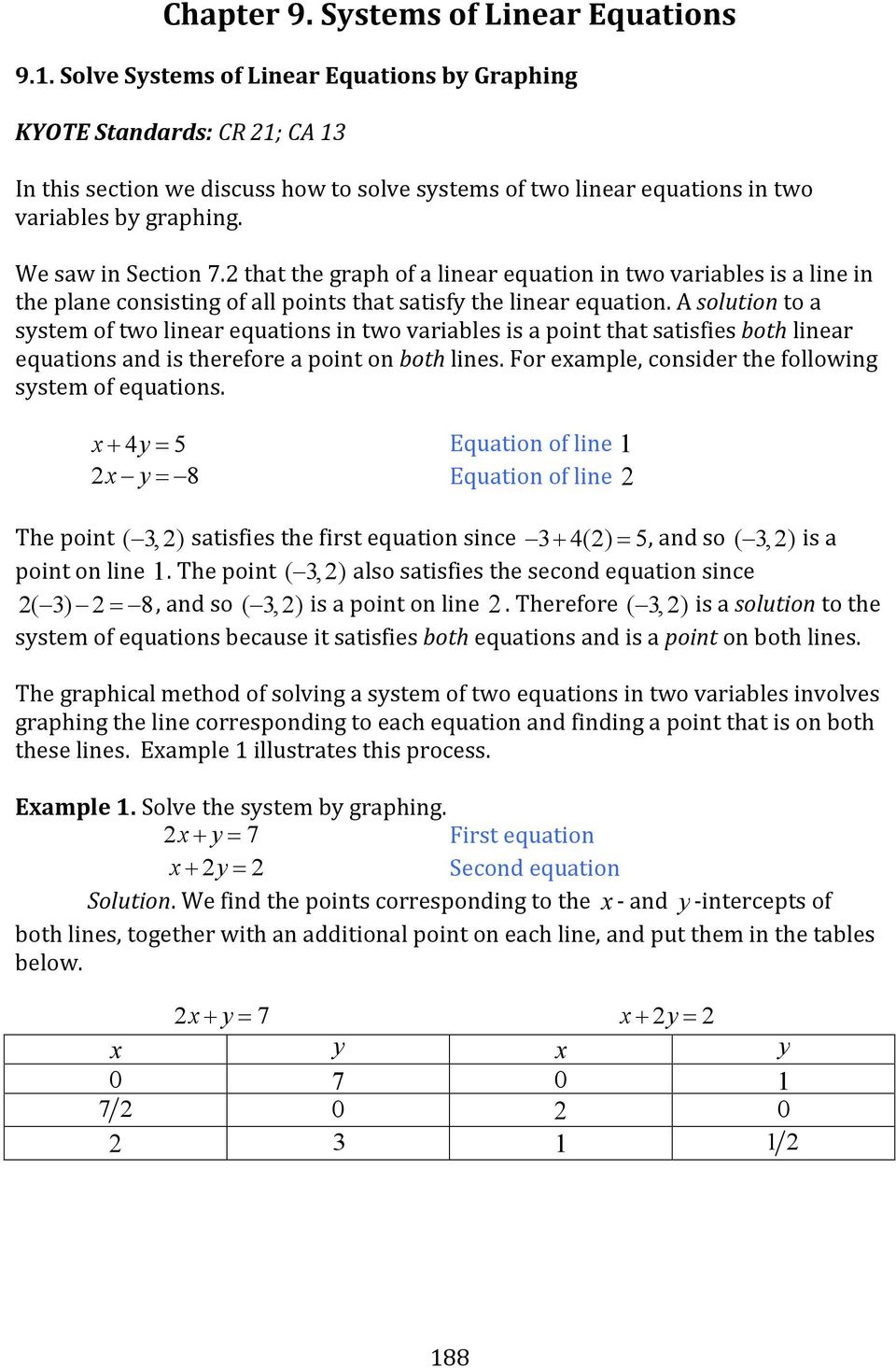
1 Chapter 9. Systems of Linear Equations 9.1. Solve Systems of Linear Equations by Graphing KYOTE Standards: CR 21; CA 13 In this section we discuss how to solve systems of two linear equations in two variables by graphing. We saw in Section 7.2 that the graph of a linear equation in two variables is a line in the plane consisting of all points that satisfy the linear equation. A solution to a system of two linear equations in two variables is a point that satisfies both linear equations and is therefore a point on both lines. For example, consider the following system of equations. x+4y=5 Equation of line 1 2x y= 8 Equation of line 2 The point ( 3, 2) satisfies the first equation since 3+ 4(2)= 5, and so ( 3, 2) is a point on line 1. The point ( 3, 2) also satisfies the second equation since 2( 3) 2= 8, and so ( 3, 2) is a point on line 2. Therefore ( 3, 2) is a solution to the system of equations because it satisfies both equations and is a point on both lines. The graphical method of solving a system of two equations in two variables involves graphing the line corresponding to each equation and finding a point that is on both these lines. Example 1 illustrates this process. Example 1. Solve the system by graphing. 2x+y= 7 First equation x+2y=2 Second equation Solution. We find the points corresponding to the x- and y-intercepts of both lines, together with an additional point on each line, and put them in the tables below. 2x+y= 7 x+2y=2 x y x y
2 We graph the two lines on the same axes below. y x 2x+y= 7 x+2y=2 We are looking for a pair of numbers (x,y) that satisfy both equations. Graphically, this means that we are looking for a point (x,y) that lies on both lines. There is clearly exactly one such point and it appears from the graph that this point has coordinates x=4 and y= 1. We substitute these values into both equations to verify that x=4 and y= 1 satisfy them both. Therefore x=4 and y= 1 is the unique solution to the system. Graphing is not an effective method for solving systems of linear equations. It is all but impossible, for example, to identify the exact solution of a system if the coordinates of that solution are not integers. However, graphing is an excellent way to help us visualize a solution to a system of equations. For a system of two linear equations in two variables, it enables us to see immediately that there are only three possibilities: 1. The lines defined by the two equations in the system are not parallel and hence must intersect in exactly one point. In this case, the system of equations has a unique (one and only one) solution. 2. The lines defined by the two equations in the system are parallel and distinct and hence cannot intersect. In this case, the system of equations has no solution. 3. The lines defined by the two equations in the system are same line. In this case, the system of equations has infinitely many solutions. (Any pair of numbers that satisfy one of the equations also satisfies the other equation and is therefore a solution to the system of equations.) 189

3 Exercise Set 9.1 Solve the given system of equations by graphing. Sketch the graph of each equation in the system on the same set of axes. Determine whether the system has a unique solution, no solution or infinitely many solutions. If it has a unique solution, estimate that solution from the graph and determine whether your estimate is correct. 1. x y=2 x+y=4 3. 3x+4y=12 3x+4y= x+y=6 x+2y=6 7. x y=3 x+ 3y=7 2. 2x+3y=10 x y=0 4. x+y=1 x+y= 3 6. x 2y=4 2x+4y= 8 8. y=2x+1 y=2x 1 9. y=x+1 y= 2x x+ 2y=6 x y= x+4y=12 9x+6y= x+y= 3 x 2y= 9 190

4 9.2. Solve Systems of Linear Equations Analytically KYOTE Standards: CR 21; CA 13 In this section we discuss how to solve systems of two linear equations in two variables analytically using two different methods: substitution and elimination. Substitution Method Use the following three steps as your guide when solving a system of two linear equations in two variables by substitution. Step 1. Choose one equation and solve for one of its variables in terms of the other variable. Step 2. Substitute the expression you found in Step 1 into the other equation to obtain an equation in one variable. Then solve for that variable. Step 3. Substitute the value of the variable found in Step 2 back into the expression found in Step 2 to solve for the remaining variable. Example 1. Solve the system by substitution. 3x+4y=2 First equation 2x y=5 Second equation Solution. The method of substitution requires that we solve for one of the variables in one of the equations. The best choice is to solve for y in the second equation because this approach is the only one that does not introduce any fractions. We obtain y=2x 5 Step 1 We substitute y=2x 5 into the first equation and solve for x to obtain 3x+4y=2 First equation 3x+4(2x 5)= 2 Substitute y=2x 5 3x+8x 20=2 Expand 11x= 22 Collect like terms x= 2 Divide by 11 Step 2 We substitute x= 2 into the equationy=2x 5 to obtain y=2(2) 5= 1 Step 3 Thus x= 2 and y= 1 is the unique solution to the system. It is a good idea to substitute these numbers in to the original equations to check your answer. 191
5 3(2)+ 4( 1)= 2 First equation 2(2) ( 1)= 5 Second equation Geometrically, this means that the point (2, 1) is on both the lines 3x+4y=2 and 2x y=5, and it is the only point on both these lines. Elimination Method Use the following three steps as your guide when solving a system of two linear equations in two variables by elimination. Step A. Multiply at least one of the equations by a number so that when the two equations are added, one of the variables is eliminated. Step B. Add the two equations to eliminate one variable, then solve for the remaining variable. Step C. Substitute the value of the variable found in Step B back into one of the original equations, and solve for the remaining variable. Example 2. Solve the system in Example 1 by elimination. 3x+4y=2 First equation 2x y=5 Second equation Solution. The method of elimination requires that we eliminate one of the variables by obtaining an equation involving only the other variable. The easiest approach in this case would be to eliminate y by multiplying the second equation by 4 and adding it to the first. We obtain 3x+4y=2 First equation 8x 4y=20 4 Second equation Step A We add these equations to eliminate y and solve for x. 11x= 22 First equation + 4 Second equation x= 2 Solve for x Step B We substitute x= 2 into the first equation and solve for y. We obtain 3(2)+ 4y=2 Substitute x= 2 into 3x+4y=2 4y= 4 Subtract 3(2)= 6 y= 1 Divide by 4 Step C Thus x= 2 and y= 1 is the unique solution to the system, confirming the solution we obtained in Example

6 Example 3. Solve the system. 7x+2y= 8 First equation 3x 5y=21 Second equation Solution. We can choose the method we wish to use in this case. We cannot solve for either variable in either equation without introducing fractions. So we rule out using substitution and choose elimination. If we use elimination and want to avoid fractions, then we need to change both equations by multiplying each one by an appropriate number. We multiply the first equation by 5 and the second equation by 2, and then add the two resulting equations to eliminate y. 35x+10y=40 5 First equation 6x 10y=42 2 Second equation Step A We add these equations to eliminate y and solve for x. 41x= 82 5 First equation+ 2 Second equation x= 2 Divide by 41 Step B We substitute x= 2 into the first equation and solve for y. We obtain 7(2)+ 2y= 8 Substitute x= 2 into 7x+2y= 8 2y= 6 Subtract 7(2)=14 y= 3 Divide by 2 Step C Thus x= 2 and y= 3 is the unique solution to the system. Example 4. Solve the system. 2x 3y=19 First equation y=2x 1 Second equation Solution. The substitution method is the logical choice in this case since the second equation y=2x 1 already has y written in terms of x and hence we can skip Step 1. We substitute y=2x 1 into the first equation and solve for x to obtain 2x 3y=19 First equation 2x 3(2x 1)=19 Substitute y=2x 1 2x 6x+3=19 Expand 4x=16 Collect like terms x= 4 Divide by 4 Step 2 193

7 We substitute x= 4 into the equationy=2x 1 to obtain y=2( 4) 1= 9 Step 3 Thus x= 4 and y= 9 is the unique solution to the system. Example 5. Solve the given system by graphing. Confirm your answer by solving the system analytically using either substitution or elimination. x+y=7 First equation x=2y 2 Second equation Solution. We find the points corresponding to the x- and y-intercepts of both lines, together with an additional point on each line, and put them in the tables below. x+y=7 x=2y 2 x y x y We graph the two lines on the same axes below. y 5 x=2y x+y=7 x It appears from the graph that the two lines intersect at the point (4,3) so that x=4 and y= 3 is the unique solution to the system. We check this result by solving the system analytically. We choose the substitution method because the second equation x=2y 2 has x written in terms of y and so we can skip Step 1. We substitute x=2y 2 into the first equation and solve for y to obtain x+y=7 First equation 2y 2+y= 7 Substitute x=2y 2 3y=9 Collect like terms 194

8 y= 3 Divide by 3 Step 2 We substitute y= 3 into the equationx=2y 2 to obtain x=2(3) 2= 4 Step 3 Thus x=4 and y= 3 is the unique solution to the system and confirms what we obtained from the graph. Example 6. Solve the given system. (a) x 2y= 4 (b) x 2y= 4 First equation 3x+6y=17 3x+6y=12 Second equation Solution. (a) We use the method of elimination to solve this system. We multiply the first equation by 3. 3x 6y= 12 3 First equation 3x+6y=17 Second equation Step A When we add these equations we discover that both x and y variables are eliminated and we obtain 0=5 What does this say about a solution to the original system? It says that if (x,y) is a solution to the system, then 0=5, a statement that is false. We conclude that the system has no solution. This conclusion is confirmed by noticing that the graphs of x 2y= 4 and 3x+6y=17 are distinct parallel lines with slope 1 2 and thus do not intersect. (b) The system in part (b) is nearly the same as the system in part (a), but the solutions are much different. We again use the method of elimination and multiply the first equation by 3. 3x 6y= 12 3 First equation 3x+6y=12 Second equation Step A We add these equations and discover once again that both x and y variables are eliminated and we can write 0=0 195

9 This is a true statement but tells us nothing about the solution of the system. But if we examine the two equations x 2y= 4 and 3x+6y=12, we see that multiplying the first equation by 3 yields the second equation. In other words, these are two different equations for the same line. Thus any pair of numbers (x,y) that satisfies one of these equations satisfies the other and is therefore a solution to the system. Consequently, this system has infinitely many solutions. Solve the given system by substitution. Exercise Set x+2y=5 y=2x x+ 2y=0 x=y 5 3. x= 3y 7 x= y+1 4. y=2x 3 y= 3x x y=3 3x+y=5 7. 2x+y=5 x+ 3y= x+3y=10 2x+y= x+4y= 9 x 3y= 8 6. x+y= 8 3x 2y= x+4y=1 2x y= x+2y=5 x+y= x 4y= 3 6x y=13 Solve the given system by elimination. 13. x+ 2y=11 3x 2y= x y=4 2x+ 3y= x+y= 7 2x y= x 3y=4 5x+7y=

10 17. 2x+3y= 1 4x+ 2y= x 4y=6 9x+5y= x 3y=0 3x+y= x+ 5y=1 x 3y= x 2y=4 5x 3y= 7 4x 3y=5 2x+6y= x+3y=12 7x 5y= x 10y= 1 8x+ 5y= 8 Solve the given system using either substitution or elimination x 3y=5 x= x 2y=15 y= x 3y=27 x 8y= x+ 5y 11= 0 x 3y+6=0 29. x+y 9=0 4x 5y=0 31. x=7y+10 x= 2y y= 3x+12 y=2x x 4y=5 3x+5y= x 8y+ 4=0 6x+4y 7= x=2y 5 5x+6y+1= y= 5x+1 10x 3y= x+y=1 2x y= x 3y=6 4x+6y= x 5y=0 y= 3 5 x x 4y=5 9x+12y= 15 3x+2y=6 40. y= 3 2 x

11 Solve the given system by graphing. Confirm your answer by solving the system analytically using either substitution or elimination. 41. x+y=3 2x y= x 3y=9 x+2y=1 43. y=x+ 3 y=2x x+y= 1 x 2y= 8 198

5 Systems of Equations
 Systems of Equations Concepts: Solutions to Systems of Equations-Graphically and Algebraically Solving Systems - Substitution Method Solving Systems - Elimination Method Using -Dimensional Graphs to Approximate
Solving Systems of Two Equations Algebraically
 8 MODULE 3. EQUATIONS 3b Solving Systems of Two Equations Algebraically Solving Systems by Substitution In this section we introduce an algebraic technique for solving systems of two equations in two unknowns
1 Determine whether an. 2 Solve systems of linear. 3 Solve systems of linear. 4 Solve systems of linear. 5 Select the most efficient
 Section 3.1 Systems of Linear Equations in Two Variables 163 SECTION 3.1 SYSTEMS OF LINEAR EQUATIONS IN TWO VARIABLES Objectives 1 Determine whether an ordered pair is a solution of a system of linear
Algebraic expressions are a combination of numbers and variables. Here are examples of some basic algebraic expressions.
 Page 1 of 13 Review of Linear Expressions and Equations Skills involving linear equations can be divided into the following groups: Simplifying algebraic expressions. Linear expressions. Solving linear
What does the number m in y = mx + b measure? To find out, suppose (x 1, y 1 ) and (x 2, y 2 ) are two points on the graph of y = mx + b.
 PRIMARY CONTENT MODULE Algebra - Linear Equations & Inequalities T-37/H-37 What does the number m in y = mx + b measure? To find out, suppose (x 1, y 1 ) and (x 2, y 2 ) are two points on the graph of
EQUATIONS and INEQUALITIES
 EQUATIONS and INEQUALITIES Linear Equations and Slope 1. Slope a. Calculate the slope of a line given two points b. Calculate the slope of a line parallel to a given line. c. Calculate the slope of a line
The Graphical Method: An Example
 The Graphical Method: An Example Consider the following linear program: Maximize 4x 1 +3x 2 Subject to: 2x 1 +3x 2 6 (1) 3x 1 +2x 2 3 (2) 2x 2 5 (3) 2x 1 +x 2 4 (4) x 1, x 2 0, where, for ease of reference,
Section 1.1 Linear Equations: Slope and Equations of Lines
 Section. Linear Equations: Slope and Equations of Lines Slope The measure of the steepness of a line is called the slope of the line. It is the amount of change in y, the rise, divided by the amount of
Factoring Quadratic Expressions
 Factoring the trinomial ax 2 + bx + c when a = 1 A trinomial in the form x 2 + bx + c can be factored to equal (x + m)(x + n) when the product of m x n equals c and the sum of m + n equals b. (Note: the
10.1 Systems of Linear Equations: Substitution and Elimination
 726 CHAPTER 10 Systems of Equations and Inequalities 10.1 Systems of Linear Equations: Sustitution and Elimination PREPARING FOR THIS SECTION Before getting started, review the following: Linear Equations
2.6 Exponents and Order of Operations
 2.6 Exponents and Order of Operations We begin this section with exponents applied to negative numbers. The idea of applying an exponent to a negative number is identical to that of a positive number (repeated
Solving Equations Involving Parallel and Perpendicular Lines Examples
 Solving Equations Involving Parallel and Perpendicular Lines Examples. The graphs of y = x, y = x, and y = x + are lines that have the same slope. They are parallel lines. Definition of Parallel Lines
Let s explore the content and skills assessed by Heart of Algebra questions.
 Chapter 9 Heart of Algebra Heart of Algebra focuses on the mastery of linear equations, systems of linear equations, and linear functions. The ability to analyze and create linear equations, inequalities,
Algebra Cheat Sheets
 Sheets Algebra Cheat Sheets provide you with a tool for teaching your students note-taking, problem-solving, and organizational skills in the context of algebra lessons. These sheets teach the concepts
Algebra 2 PreAP. Name Period
 Algebra 2 PreAP Name Period IMPORTANT INSTRUCTIONS FOR STUDENTS!!! We understand that students come to Algebra II with different strengths and needs. For this reason, students have options for completing
Answer Key for California State Standards: Algebra I
 Algebra I: Symbolic reasoning and calculations with symbols are central in algebra. Through the study of algebra, a student develops an understanding of the symbolic language of mathematics and the sciences.
3.1. Solving linear equations. Introduction. Prerequisites. Learning Outcomes. Learning Style
 Solving linear equations 3.1 Introduction Many problems in engineering reduce to the solution of an equation or a set of equations. An equation is a type of mathematical expression which contains one or
Indiana State Core Curriculum Standards updated 2009 Algebra I
 Indiana State Core Curriculum Standards updated 2009 Algebra I Strand Description Boardworks High School Algebra presentations Operations With Real Numbers Linear Equations and A1.1 Students simplify and
Algebra I. In this technological age, mathematics is more important than ever. When students
 In this technological age, mathematics is more important than ever. When students leave school, they are more and more likely to use mathematics in their work and everyday lives operating computer equipment,
LINEAR EQUATIONS IN TWO VARIABLES
 66 MATHEMATICS CHAPTER 4 LINEAR EQUATIONS IN TWO VARIABLES The principal use of the Analytic Art is to bring Mathematical Problems to Equations and to exhibit those Equations in the most simple terms that
7.7 Solving Rational Equations
 Section 7.7 Solving Rational Equations 7 7.7 Solving Rational Equations When simplifying comple fractions in the previous section, we saw that multiplying both numerator and denominator by the appropriate
2x + y = 3. Since the second equation is precisely the same as the first equation, it is enough to find x and y satisfying the system
 1. Systems of linear equations We are interested in the solutions to systems of linear equations. A linear equation is of the form 3x 5y + 2z + w = 3. The key thing is that we don t multiply the variables
x 2 + y 2 = 1 y 1 = x 2 + 2x y = x 2 + 2x + 1
 Implicit Functions Defining Implicit Functions Up until now in this course, we have only talked about functions, which assign to every real number x in their domain exactly one real number f(x). The graphs
1.3 LINEAR EQUATIONS IN TWO VARIABLES. Copyright Cengage Learning. All rights reserved.
 1.3 LINEAR EQUATIONS IN TWO VARIABLES Copyright Cengage Learning. All rights reserved. What You Should Learn Use slope to graph linear equations in two variables. Find the slope of a line given two points
1.2 GRAPHS OF EQUATIONS. Copyright Cengage Learning. All rights reserved.
 1.2 GRAPHS OF EQUATIONS Copyright Cengage Learning. All rights reserved. What You Should Learn Sketch graphs of equations. Find x- and y-intercepts of graphs of equations. Use symmetry to sketch graphs
Systems of Linear Equations in Three Variables
 5.3 Systems of Linear Equations in Three Variables 5.3 OBJECTIVES 1. Find ordered triples associated with three equations 2. Solve a system by the addition method 3. Interpret a solution graphically 4.
Temperature Scales. The metric system that we are now using includes a unit that is specific for the representation of measured temperatures.
 Temperature Scales INTRODUCTION The metric system that we are now using includes a unit that is specific for the representation of measured temperatures. The unit of temperature in the metric system is
Slope-Intercept Equation. Example
 1.4 Equations of Lines and Modeling Find the slope and the y intercept of a line given the equation y = mx + b, or f(x) = mx + b. Graph a linear equation using the slope and the y-intercept. Determine
Systems of Linear Equations and Inequalities
 Systems of Linear Equations and Inequalities Recall that every linear equation in two variables can be identified with a line. When we group two such equations together, we know from geometry what can
3.2. Solving quadratic equations. Introduction. Prerequisites. Learning Outcomes. Learning Style
 Solving quadratic equations 3.2 Introduction A quadratic equation is one which can be written in the form ax 2 + bx + c = 0 where a, b and c are numbers and x is the unknown whose value(s) we wish to find.
LINEAR INEQUALITIES. Mathematics is the art of saying many things in many different ways. MAXWELL
 Chapter 6 LINEAR INEQUALITIES 6.1 Introduction Mathematics is the art of saying many things in many different ways. MAXWELL In earlier classes, we have studied equations in one variable and two variables
Copyrighted Material. Chapter 1 DEGREE OF A CURVE
 Chapter 1 DEGREE OF A CURVE Road Map The idea of degree is a fundamental concept, which will take us several chapters to explore in depth. We begin by explaining what an algebraic curve is, and offer two
Overview. Observations. Activities. Chapter 3: Linear Functions Linear Functions: Slope-Intercept Form
 Name Date Linear Functions: Slope-Intercept Form Student Worksheet Overview The Overview introduces the topics covered in Observations and Activities. Scroll through the Overview using " (! to review,
No Solution Equations Let s look at the following equation: 2 +3=2 +7
 5.4 Solving Equations with Infinite or No Solutions So far we have looked at equations where there is exactly one solution. It is possible to have more than solution in other types of equations that are
Aim: How do we find the slope of a line? Warm Up: Go over test. A. Slope -
 Aim: How do we find the slope of a line? Warm Up: Go over test A. Slope - Plot the points and draw a line through the given points. Find the slope of the line.. A(-5,4) and B(4,-3) 2. A(4,3) and B(4,-6)
A synonym is a word that has the same or almost the same definition of
 Slope-Intercept Form Determining the Rate of Change and y-intercept Learning Goals In this lesson, you will: Graph lines using the slope and y-intercept. Calculate the y-intercept of a line when given
IV. ALGEBRAIC CONCEPTS
 IV. ALGEBRAIC CONCEPTS Algebra is the language of mathematics. Much of the observable world can be characterized as having patterned regularity where a change in one quantity results in changes in other
3.1 Solving Systems Using Tables and Graphs
 Algebra 2 Chapter 3 3.1 Solve Systems Using Tables & Graphs 3.1 Solving Systems Using Tables and Graphs A solution to a system of linear equations is an that makes all of the equations. To solve a system
LAKE ELSINORE UNIFIED SCHOOL DISTRICT
 LAKE ELSINORE UNIFIED SCHOOL DISTRICT Title: PLATO Algebra 1-Semester 2 Grade Level: 10-12 Department: Mathematics Credit: 5 Prerequisite: Letter grade of F and/or N/C in Algebra 1, Semester 2 Course Description:
FACTORISATION YEARS. A guide for teachers - Years 9 10 June 2011. The Improving Mathematics Education in Schools (TIMES) Project
 9 10 YEARS The Improving Mathematics Education in Schools (TIMES) Project FACTORISATION NUMBER AND ALGEBRA Module 33 A guide for teachers - Years 9 10 June 2011 Factorisation (Number and Algebra : Module
Review of Fundamental Mathematics
 Review of Fundamental Mathematics As explained in the Preface and in Chapter 1 of your textbook, managerial economics applies microeconomic theory to business decision making. The decision-making tools
Equations, Inequalities & Partial Fractions
 Contents Equations, Inequalities & Partial Fractions.1 Solving Linear Equations 2.2 Solving Quadratic Equations 1. Solving Polynomial Equations 1.4 Solving Simultaneous Linear Equations 42.5 Solving Inequalities
Algebra I Vocabulary Cards
 Algebra I Vocabulary Cards Table of Contents Expressions and Operations Natural Numbers Whole Numbers Integers Rational Numbers Irrational Numbers Real Numbers Absolute Value Order of Operations Expression
MATH 60 NOTEBOOK CERTIFICATIONS
 MATH 60 NOTEBOOK CERTIFICATIONS Chapter #1: Integers and Real Numbers 1.1a 1.1b 1.2 1.3 1.4 1.8 Chapter #2: Algebraic Expressions, Linear Equations, and Applications 2.1a 2.1b 2.1c 2.2 2.3a 2.3b 2.4 2.5
CHAPTER FIVE. Solutions for Section 5.1. Skill Refresher. Exercises
 CHAPTER FIVE 5.1 SOLUTIONS 265 Solutions for Section 5.1 Skill Refresher S1. Since 1,000,000 = 10 6, we have x = 6. S2. Since 0.01 = 10 2, we have t = 2. S3. Since e 3 = ( e 3) 1/2 = e 3/2, we have z =
Lecture 2. Marginal Functions, Average Functions, Elasticity, the Marginal Principle, and Constrained Optimization
 Lecture 2. Marginal Functions, Average Functions, Elasticity, the Marginal Principle, and Constrained Optimization 2.1. Introduction Suppose that an economic relationship can be described by a real-valued
Homework #2 Solutions
 MAT Spring Problems Section.:, 8,, 4, 8 Section.5:,,, 4,, 6 Extra Problem # Homework # Solutions... Sketch likely solution curves through the given slope field for dy dx = x + y...8. Sketch likely solution
SYSTEMS OF LINEAR EQUATIONS
 SYSTEMS OF LINEAR EQUATIONS Sstems of linear equations refer to a set of two or more linear equations used to find the value of the unknown variables. If the set of linear equations consist of two equations
Write the Equation of the Line Review
 Connecting Algebra 1 to Advanced Placement* Mathematics A Resource and Strategy Guide Objective: Students will be assessed on their ability to write the equation of a line in multiple methods. Connections
Vocabulary Words and Definitions for Algebra
 Name: Period: Vocabulary Words and s for Algebra Absolute Value Additive Inverse Algebraic Expression Ascending Order Associative Property Axis of Symmetry Base Binomial Coefficient Combine Like Terms
Practice Test Answer and Alignment Document Mathematics: Algebra II Performance Based Assessment - Paper
 The following pages include the answer key for all machine-scored items, followed by the rubrics for the hand-scored items. - The rubrics show sample student responses. Other valid methods for solving
1.4. Arithmetic of Algebraic Fractions. Introduction. Prerequisites. Learning Outcomes
 Arithmetic of Algebraic Fractions 1.4 Introduction Just as one whole number divided by another is called a numerical fraction, so one algebraic expression divided by another is known as an algebraic fraction.
1 Determinants and the Solvability of Linear Systems
 1 Determinants and the Solvability of Linear Systems In the last section we learned how to use Gaussian elimination to solve linear systems of n equations in n unknowns The section completely side-stepped
EdExcel Decision Mathematics 1
 EdExcel Decision Mathematics 1 Linear Programming Section 1: Formulating and solving graphically Notes and Examples These notes contain subsections on: Formulating LP problems Solving LP problems Minimisation
Using the ac Method to Factor
 4.6 Using the ac Method to Factor 4.6 OBJECTIVES 1. Use the ac test to determine factorability 2. Use the results of the ac test 3. Completely factor a trinomial In Sections 4.2 and 4.3 we used the trial-and-error
Mathematics Common Core Sample Questions
 New York State Testing Program Mathematics Common Core Sample Questions Grade The materials contained herein are intended for use by New York State teachers. Permission is hereby granted to teachers and
Lecture 9: Lines. m = y 2 y 1 x 2 x 1
 Lecture 9: Lines If we have two distinct points in the Cartesian plane, there is a unique line which passes through the two points. We can construct it by joining the points with a straight edge and extending
Algebra Unpacked Content For the new Common Core standards that will be effective in all North Carolina schools in the 2012-13 school year.
 This document is designed to help North Carolina educators teach the Common Core (Standard Course of Study). NCDPI staff are continually updating and improving these tools to better serve teachers. Algebra
Lecture 1: Systems of Linear Equations
 MTH Elementary Matrix Algebra Professor Chao Huang Department of Mathematics and Statistics Wright State University Lecture 1 Systems of Linear Equations ² Systems of two linear equations with two variables
Chapter 5. Rational Expressions
 5.. Simplify Rational Expressions KYOTE Standards: CR ; CA 7 Chapter 5. Rational Expressions Definition. A rational expression is the quotient P Q of two polynomials P and Q in one or more variables, where
Warm Up. Write an equation given the slope and y-intercept. Write an equation of the line shown.
 Warm Up Write an equation given the slope and y-intercept Write an equation of the line shown. EXAMPLE 1 Write an equation given the slope and y-intercept From the graph, you can see that the slope is
Geometry 1. Unit 3: Perpendicular and Parallel Lines
 Geometry 1 Unit 3: Perpendicular and Parallel Lines Geometry 1 Unit 3 3.1 Lines and Angles Lines and Angles Parallel Lines Parallel lines are lines that are coplanar and do not intersect. Some examples
Solving systems by elimination
 December 1, 2008 Solving systems by elimination page 1 Solving systems by elimination Here is another method for solving a system of two equations. Sometimes this method is easier than either the graphing
High School Algebra Reasoning with Equations and Inequalities Solve systems of equations.
 Performance Assessment Task Graphs (2006) Grade 9 This task challenges a student to use knowledge of graphs and their significant features to identify the linear equations for various lines. A student
PYTHAGOREAN TRIPLES KEITH CONRAD
 PYTHAGOREAN TRIPLES KEITH CONRAD 1. Introduction A Pythagorean triple is a triple of positive integers (a, b, c) where a + b = c. Examples include (3, 4, 5), (5, 1, 13), and (8, 15, 17). Below is an ancient
Linear Programming. Solving LP Models Using MS Excel, 18
 SUPPLEMENT TO CHAPTER SIX Linear Programming SUPPLEMENT OUTLINE Introduction, 2 Linear Programming Models, 2 Model Formulation, 4 Graphical Linear Programming, 5 Outline of Graphical Procedure, 5 Plotting
3.3. Solving Polynomial Equations. Introduction. Prerequisites. Learning Outcomes
 Solving Polynomial Equations 3.3 Introduction Linear and quadratic equations, dealt within Sections 3.1 and 3.2, are members of a class of equations, called polynomial equations. These have the general
Higher Education Math Placement
 Higher Education Math Placement Placement Assessment Problem Types 1. Whole Numbers, Fractions, and Decimals 1.1 Operations with Whole Numbers Addition with carry Subtraction with borrowing Multiplication
Factoring Trinomials: The ac Method
 6.7 Factoring Trinomials: The ac Method 6.7 OBJECTIVES 1. Use the ac test to determine whether a trinomial is factorable over the integers 2. Use the results of the ac test to factor a trinomial 3. For
3 1B: Solving a System of Equations by Substitution
 3 1B: Solving a System of Equations by Substitution 1. Look for an equation that has been solved for a single variable. Lets say 2. Substitute the value of that variable from into in place of that variable.
Linear Programming Notes V Problem Transformations
 Linear Programming Notes V Problem Transformations 1 Introduction Any linear programming problem can be rewritten in either of two standard forms. In the first form, the objective is to maximize, the material
Graphing Linear Equations in Two Variables
 Math 123 Section 3.2 - Graphing Linear Equations Using Intercepts - Page 1 Graphing Linear Equations in Two Variables I. Graphing Lines A. The graph of a line is just the set of solution points of the
Make sure you look at the reminders or examples before each set of problems to jog your memory! Solve
 Name Date Make sure you look at the reminders or examples before each set of problems to jog your memory! I. Solving Linear Equations 1. Eliminate parentheses. Combine like terms 3. Eliminate terms by
The Point-Slope Form
 7. The Point-Slope Form 7. OBJECTIVES 1. Given a point and a slope, find the graph of a line. Given a point and the slope, find the equation of a line. Given two points, find the equation of a line y Slope
Click on the links below to jump directly to the relevant section
 Click on the links below to jump directly to the relevant section What is algebra? Operations with algebraic terms Mathematical properties of real numbers Order of operations What is Algebra? Algebra is
Section 1.4. Lines, Planes, and Hyperplanes. The Calculus of Functions of Several Variables
 The Calculus of Functions of Several Variables Section 1.4 Lines, Planes, Hyperplanes In this section we will add to our basic geometric understing of R n by studying lines planes. If we do this carefully,
Coordinate Plane, Slope, and Lines Long-Term Memory Review Review 1
 Review. What does slope of a line mean?. How do you find the slope of a line? 4. Plot and label the points A (3, ) and B (, ). a. From point B to point A, by how much does the y-value change? b. From point
Solutions to Math 51 First Exam January 29, 2015
 Solutions to Math 5 First Exam January 29, 25. ( points) (a) Complete the following sentence: A set of vectors {v,..., v k } is defined to be linearly dependent if (2 points) there exist c,... c k R, not
Math 0980 Chapter Objectives. Chapter 1: Introduction to Algebra: The Integers.
 Math 0980 Chapter Objectives Chapter 1: Introduction to Algebra: The Integers. 1. Identify the place value of a digit. 2. Write a number in words or digits. 3. Write positive and negative numbers used
Lecture 8 : Coordinate Geometry. The coordinate plane The points on a line can be referenced if we choose an origin and a unit of 20
 Lecture 8 : Coordinate Geometry The coordinate plane The points on a line can be referenced if we choose an origin and a unit of 0 distance on the axis and give each point an identity on the corresponding
Solving Quadratic Equations
 9.3 Solving Quadratic Equations by Using the Quadratic Formula 9.3 OBJECTIVES 1. Solve a quadratic equation by using the quadratic formula 2. Determine the nature of the solutions of a quadratic equation
6.3 FACTORING ax 2 bx c WITH a 1
 290 (6 14) Chapter 6 Factoring e) What is the approximate maximum revenue? f) Use the accompanying graph to estimate the price at which the revenue is zero. y Revenue (thousands of dollars) 300 200 100
6 EXTENDING ALGEBRA. 6.0 Introduction. 6.1 The cubic equation. Objectives
 6 EXTENDING ALGEBRA Chapter 6 Extending Algebra Objectives After studying this chapter you should understand techniques whereby equations of cubic degree and higher can be solved; be able to factorise
Definition 8.1 Two inequalities are equivalent if they have the same solution set. Add or Subtract the same value on both sides of the inequality.
 8 Inequalities Concepts: Equivalent Inequalities Linear and Nonlinear Inequalities Absolute Value Inequalities (Sections 4.6 and 1.1) 8.1 Equivalent Inequalities Definition 8.1 Two inequalities are equivalent
Answers Teacher Copy. Systems of Linear Equations Monetary Systems Overload. Activity 3. Solving Systems of Two Equations in Two Variables
 of 26 8/20/2014 2:00 PM Answers Teacher Copy Activity 3 Lesson 3-1 Systems of Linear Equations Monetary Systems Overload Solving Systems of Two Equations in Two Variables Plan Pacing: 1 class period Chunking
Systems of Linear Equations: Two Variables
 OpenStax-CNX module: m49420 1 Systems of Linear Equations: Two Variables OpenStax College This work is produced by OpenStax-CNX and licensed under the Creative Commons Attribution License 4.0 In this section,
5.5. Solving linear systems by the elimination method
 55 Solving linear systems by the elimination method Equivalent systems The major technique of solving systems of equations is changing the original problem into another one which is of an easier to solve
6.5 Factoring Special Forms
 440 CHAPTER 6. FACTORING 6.5 Factoring Special Forms In this section we revisit two special product forms that we learned in Chapter 5, the first of which was squaring a binomial. Squaring a binomial.
Determine If An Equation Represents a Function
 Question : What is a linear function? The term linear function consists of two parts: linear and function. To understand what these terms mean together, we must first understand what a function is. The
Mathematics Review for MS Finance Students
 Mathematics Review for MS Finance Students Anthony M. Marino Department of Finance and Business Economics Marshall School of Business Lecture 1: Introductory Material Sets The Real Number System Functions,
c 2008 Je rey A. Miron We have described the constraints that a consumer faces, i.e., discussed the budget constraint.
 Lecture 2b: Utility c 2008 Je rey A. Miron Outline: 1. Introduction 2. Utility: A De nition 3. Monotonic Transformations 4. Cardinal Utility 5. Constructing a Utility Function 6. Examples of Utility Functions
Correlation key concepts:
 CORRELATION Correlation key concepts: Types of correlation Methods of studying correlation a) Scatter diagram b) Karl pearson s coefficient of correlation c) Spearman s Rank correlation coefficient d)
Elasticity. I. What is Elasticity?
 Elasticity I. What is Elasticity? The purpose of this section is to develop some general rules about elasticity, which may them be applied to the four different specific types of elasticity discussed in
What are the place values to the left of the decimal point and their associated powers of ten?
 The verbal answers to all of the following questions should be memorized before completion of algebra. Answers that are not memorized will hinder your ability to succeed in geometry and algebra. (Everything
Transition To College Mathematics
 Transition To College Mathematics In Support of Kentucky s College and Career Readiness Program Northern Kentucky University Kentucky Online Testing (KYOTE) Group Steve Newman Mike Waters Janis Broering
1. Graphing Linear Inequalities
 Notation. CHAPTER 4 Linear Programming 1. Graphing Linear Inequalities x apple y means x is less than or equal to y. x y means x is greater than or equal to y. x < y means x is less than y. x > y means
Unit 7: Radical Functions & Rational Exponents
 Date Period Unit 7: Radical Functions & Rational Exponents DAY 0 TOPIC Roots and Radical Expressions Multiplying and Dividing Radical Expressions Binomial Radical Expressions Rational Exponents 4 Solving
Question 2: How will changes in the objective function s coefficients change the optimal solution?
 Question 2: How will changes in the objective function s coefficients change the optimal solution? In the previous question, we examined how changing the constants in the constraints changed the optimal
FACTORING QUADRATICS 8.1.1 and 8.1.2
 FACTORING QUADRATICS 8.1.1 and 8.1.2 Chapter 8 introduces students to quadratic equations. These equations can be written in the form of y = ax 2 + bx + c and, when graphed, produce a curve called a parabola.