
UNIT 5 LINEAR MEASURING DEVICES AND COMPARATORS
|
|
|
- Suzanna Morton
- 9 years ago
- Views:
Transcription
1 UNIT 5 LINEAR MEASURING DEVICES AND COMPARATORS Linear Measuring Devices and Comparators Structure 5.1 Introduction Objectives 5.2 Non-precision Measuring Instruments 5.3 Precision Measuring Instruments 5.4 Electrical Measuring Devices 5.5 Comparators 5.6 Summary 5.7 Key Words 5.8 Answers to SAQs 5.1 INTRODUCTION Linear measurement includes the measurement of lengths, diameters, heights and thickness. The basic principle of linear measurement (mechanical type) is that of comparison with standard dimensions on a suitably engraved instrument or device. Linear measuring instruments are categorized depending upon their accuracy. The two categories are non-precision instruments and precision instruments. Non-precision instruments include steel rule, caliper divider, and telescopic gauge that are used to measure to the line graduations of a rule. Precision instruments include micrometers, vernier calipers, height gauges and slip gauges. A wide variety of electrical measuring devices is also available. Electric measuring devices are mainly transducers, i.e. they transform the displacement into suitable measurable parameter like voltage and current. Some of the displacement transducers are strain gauges, linear variable differential transformers (LVDT) and potentiometers. This unit will discuss different type of linear measuring devices and comparators. Objectives After studying this unit, you should be able to familiarise yourself with various type of linear measuring devices, and choose a suitable measuring device according to the precision required. 5.2 NON-PRECISION MEASURING INSTRUMENTS Non-precision instruments are limited to the measurement of parts to a visible line graduation on the instrument used. There are several non-precision measuring devices. They are used where high measurement accuracy is not required. This section describes some of the non-precision measuring devices Steel Rule It is the simplest and most common measuring instruments in inspection. The principle behind steel rule is of comparing an unknown length to the one previously calibrated. The rule must be graduated uniformly throughout its length. Rules are made in 150, 300, 55

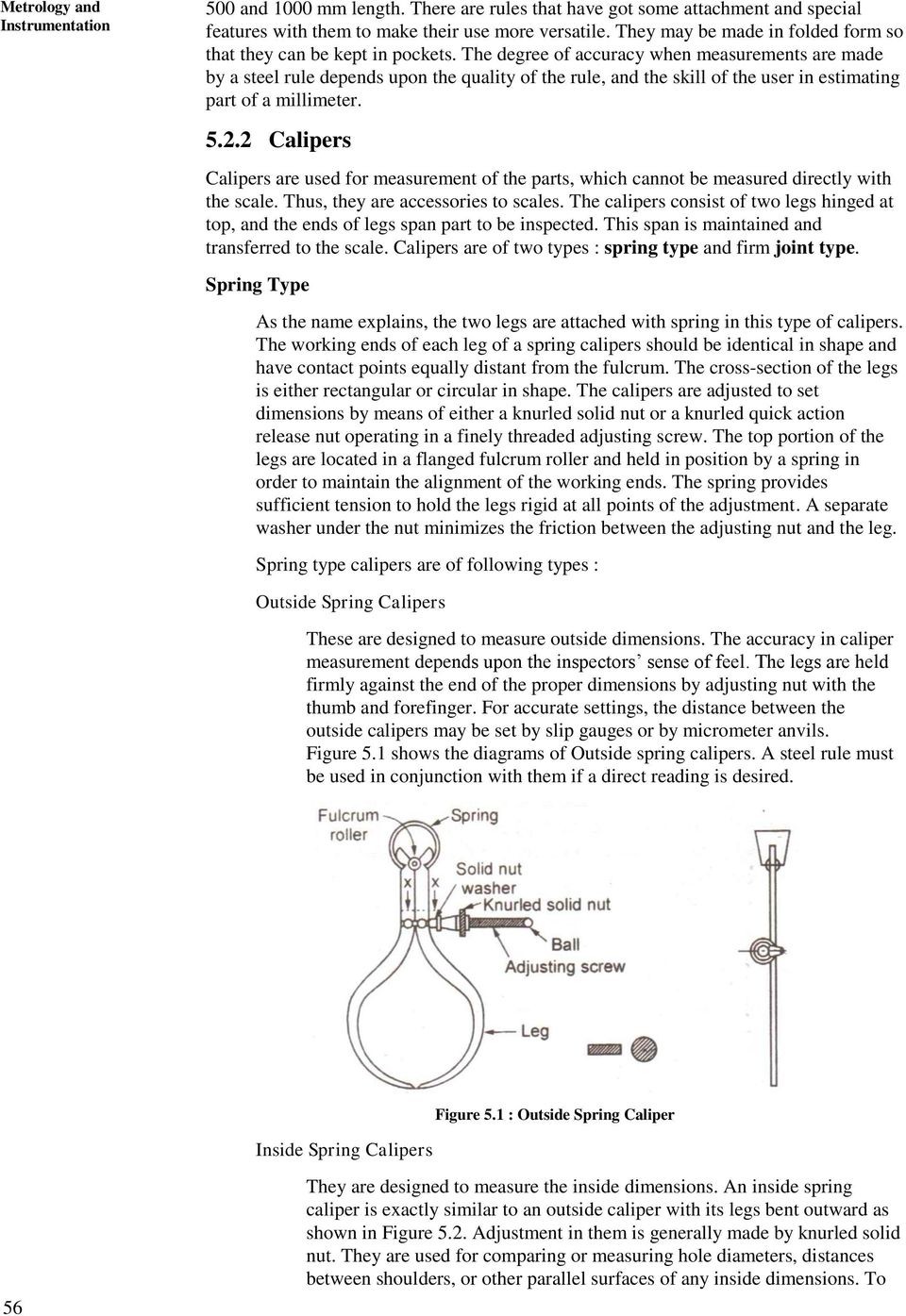
2 Metrology and Instrumentation 500 and 1000 mm length. There are rules that have got some attachment and special features with them to make their use more versatile. They may be made in folded form so that they can be kept in pockets. The degree of accuracy when measurements are made by a steel rule depends upon the quality of the rule, and the skill of the user in estimating part of a millimeter Calipers Calipers are used for measurement of the parts, which cannot be measured directly with the scale. Thus, they are accessories to scales. The calipers consist of two legs hinged at top, and the ends of legs span part to be inspected. This span is maintained and transferred to the scale. Calipers are of two types : spring type and firm joint type. Spring Type As the name explains, the two legs are attached with spring in this type of calipers. The working ends of each leg of a spring calipers should be identical in shape and have contact points equally distant from the fulcrum. The cross-section of the legs is either rectangular or circular in shape. The calipers are adjusted to set dimensions by means of either a knurled solid nut or a knurled quick action release nut operating in a finely threaded adjusting screw. The top portion of the legs are located in a flanged fulcrum roller and held in position by a spring in order to maintain the alignment of the working ends. The spring provides sufficient tension to hold the legs rigid at all points of the adjustment. A separate washer under the nut minimizes the friction between the adjusting nut and the leg. Spring type calipers are of following types : Outside Spring Calipers These are designed to measure outside dimensions. The accuracy in caliper measurement depends upon the inspectors sense of feel. The legs are held firmly against the end of the proper dimensions by adjusting nut with the thumb and forefinger. For accurate settings, the distance between the outside calipers may be set by slip gauges or by micrometer anvils. Figure 5.1 shows the diagrams of Outside spring calipers. A steel rule must be used in conjunction with them if a direct reading is desired. Inside Spring Calipers Figure 5.1 : Outside Spring Caliper 56 They are designed to measure the inside dimensions. An inside spring caliper is exactly similar to an outside caliper with its legs bent outward as shown in Figure 5.2. Adjustment in them is generally made by knurled solid nut. They are used for comparing or measuring hole diameters, distances between shoulders, or other parallel surfaces of any inside dimensions. To
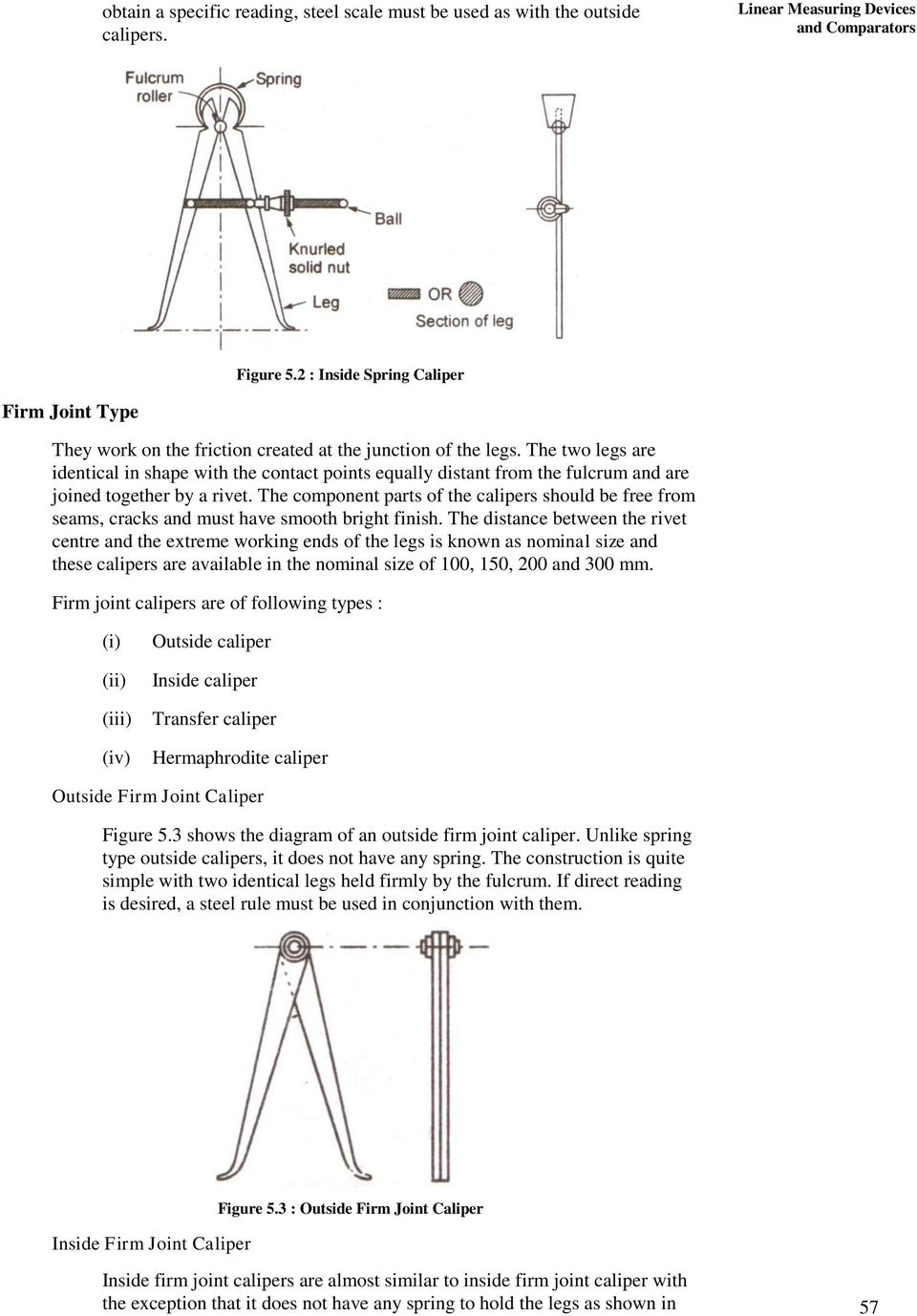
3 obtain a specific reading, steel scale must be used as with the outside calipers. Linear Measuring Devices and Comparators Figure 5.2 : Inside Spring Caliper Firm Joint Type They work on the friction created at the junction of the legs. The two legs are identical in shape with the contact points equally distant from the fulcrum and are joined together by a rivet. The component parts of the calipers should be free from seams, cracks and must have smooth bright finish. The distance between the rivet centre and the extreme working ends of the legs is known as nominal size and these calipers are available in the nominal size of 100, 150, 200 and 300 mm. Firm joint calipers are of following types : (i) (ii) (iii) (iv) Outside caliper Inside caliper Transfer caliper Hermaphrodite caliper Outside Firm Joint Caliper Figure 5.3 shows the diagram of an outside firm joint caliper. Unlike spring type outside calipers, it does not have any spring. The construction is quite simple with two identical legs held firmly by the fulcrum. If direct reading is desired, a steel rule must be used in conjunction with them. Inside Firm Joint Caliper Figure 5.3 : Outside Firm Joint Caliper Inside firm joint calipers are almost similar to inside firm joint caliper with the exception that it does not have any spring to hold the legs as shown in 57
4 Metrology and Instrumentation Figure 5.4. Micrometers generally make adjustment in them. Like spring type inside calipers, they are also used for comparing or measuring hole diameters, distances between shoulders, or other parallel surfaces of any inside dimensions. Figure 5.4 : Inside Firm Joint Caliper Transfer Caliper These are used for measuring recessed areas from which the legs of calipers can not be removed directly but must be collapsed after the dimension has been measured. Therefore, an auxiliary arm is provided with two legs so that it can preserve the original setting after the legs are collapsed. The nut N in Figure 5.5 is first locked and the caliper opened or closed against the work. The nut is then loosened and the leg is swung to clear the obstruction leaving the auxiliary arm in position. The leg can be moved back to the auxiliary leg, where it will show the size previously measured. Hermaphrodite Caliper Figure 5.5 : Transfer Caliper It is also known as odd leg caliper consisting of one divider and one caliper leg. It is used for layout work like scribing lines parallel to the edge of the work and for finding the centre of a cylindrical work. It can be with two types of legs, viz. notched leg or curved legs. 58 Figure 5.6 : Hermaphrodite Caliper

5 5.2.3 Divider A divider is similar in construction to a caliper except that both legs are straight with sharp hardened points at the end as shown in Figure 5.8. These are used for scribing arcs and circles and general layout work. The distance between the fulcrum roller centre and the extreme working end of one of legs is known as the nominal size Dividers are available in the sizes of 100, 200, 300 mm. In practice, one point is placed in the centre position and the circle or arc may then be scribed on the job with the other point. A steel scale must be used with this instrument. Figure 5.7 shows a divider. Linear Measuring Devices and Comparators Telescopic Gauge Figure 5.7 : Divider The telescopic gauge shown in Figure 5.8 is used for the measurement of internal diameter of a hole during machining operation. It consists of a handle and two plungers, one telescopic into the other and both under spring tension. Ends of the plungers have spherical contacts. The plunger can be locked in position by turning a knurled screw at the end of the handle. To measure the diameter of a hole, the plungers are first compressed and locked in position. Next, the plunger end is inserted in the hole and allowed to expand the opposite edges. Finally, they are locked in place, taken out of the hole, and measured by an outside micrometer Depth Gauge Figure 5.8 : Telescopic Gauge This tool is used to measure the depth of blind holes, grooves, slots, the heights of shoulders in holes and dimensions of similar character. This is essentially a narrow steel rule to which a sliding head is clamped at the right angles to the rule as shown in Figure 5.9. The head forms a convenient marker in places where the rule must be held in a distance from the point being measured. Figure 5.9 : Depth Gauge 59

6 Metrology and Instrumentation 5.3 PRECISION MEASURING INSTRUMENTS Since modern production processes is concerned with interchangeable products, precise dimensional control is required in industry. Precision measurement instruments use different techniques and phenomena to measure distance with accuracy. We will discuss some of the precision measuring instruments in this section Vernier Calipers Vernier calipers are precision measuring instruments that give an accuracy of 0.1 mm to 0.01 mm. The main scale carries the fixed graduations, one of two measuring jaws, a vernier head having a vernier scale engraved on. The vernier head carries the other jaw and slides on main scale. The vernier head can be locked to the main scale by the knurled screw attached to its head. Enlarged diagram of the metric vernier scale is shown in Figure Figure 5.10 : Vernier Caliper To understand the working principle of a vernier caliper, let us consider that the vernier scale has got 20 divisions which equals to 19 divisions of the main scale. Thus, one smallest division of the vernier scale is slightly smaller than the smallest division of the main scale. This difference is called vernier constant for that particular vernier caliper and when it is multiplied with the smallest unit of the main scale gives the least count of that vernier. Now, 20 vernier scale divisions (VSD) = 19 main scale division (MSD) 19 1 VSD = MSD 20 Vernier constant (VC) = 1 MSD 1 VSD 19 = 1 MSD MSD 20 1 = MSD 20 Now, if the smallest unit of the main scale be 1 mm, the least count of the vernier scale = VC one smallest unit of the main scale 1 = 1 mm = 0.05 mm

7 If the smallest unit in the main scale be 0.5 mm, the least count of the vernier scale is, Linear Measuring Devices and Comparators 1 = 0.5 mm 20 = mm To read a measurement from a vernier caliper, first the main scale reading up to the zero of the vernier scale is noted down. It will give accuracy up to the smallest division of the main scale. Now, vernier number of vernier scale division from its zero, which coincides exactly with the main scale is noted. This number when multiplied with the vernier constant gives the vernier scale reading. The actual length is obtained when the vernier scale reading is added to the main scale reading. The caliper is placed on the object to be measured and the fine adjustment screw is adjusted until the jaws tightly fit against the Workpiece. There are vernier calipers that incorporate arrangements for measurement of internal dimensions and depth. The vernier calipers are designed to measure both internal and external dimensions. The lower jaws of a vernier scale are used for external measurement and the upper jaws for the measurement of internal dimensions. The rectangular rod carried by the movable jaw is used for the measurement of depth. SAQ 1 (a) (b) Describe different types of caliper for measuring the linear dimensions. A vernier scale consists of 25 divisions on 12 mm spacing and the main scale has 24 divisions on 12 mm. What is the least count? Micrometers Micrometer is one of the most widely used precision instruments. It is primarily used to measure external dimensions like diameters of shafts, thickness of parts etc. to an accuracy of 0.01 mm. The essential parts of the instruments shown in Figure 5.11, consist of (a) (b) (c) (d) (e) (f) (g) Frame Anvil and spindle Screwed spindle Graduated sleeve or barrel Thimble Ratchet or friction stop Spindle clamp Figure 5.11 : Micrometer The frame is made of steel, malleable cast iron or light alloy. The anvil shall protrude from the frame for a distance of at least 3-mm in order to permit the attachment of measuring wire support. The spindle does the actual measuring and possesses the threads of 0.5 mm pitch. The barrel has datum and fixed graduations Thimble is tubular cover fastened with the spindle. The beveled edge of the spindle is divided into 50 equal parts, 61

8 Metrology and Instrumentation every fifth being numbered. The ratchet is a small extension to the thimble. It slips when the pressure on the screw exceeds a certain amount. It produces uniform reading and prevents damage or distortion of the instruments. The spindle clamp is used to lock the instrument at any desired setting. Procedure for Reading in a Micrometer The graduation on the barrel is in two parts divided by a line along the axis of the barrel called the reference line. The graduation above the reference is graduated in 1 mm intervals. The first and every fifth are long and numbered 0, 5, 10, 15, etc. The lower graduations are marked in 1 mm intervals but each graduation shall be placed at the middle of the two successive upper graduations to be read 0.5 mm. The thimble advances a distance of 0.5 mm in one complete rotation. It is called the pitch of the micrometer. The thimble has a scale of 50 divisions around its circumference. Thus, one smallest division of the circular scale is equivalent to longitudinal movement of 0.5 1/50 mm = 0.01mm. It is the least count of the micrometer. The job is measured between the end of the spindle and the anvil that is fitted to the frame. When the micrometer is closed, the line marked zero on the thimble coincides with the line marked zero on the barrel. If the zero graduation does not coincide, the micrometer requires adjustment. To take a reading from the micrometer, (1) the number of main divisions in millimeters above the reference line, (2) the number of sub-divisions below the reference line exceeding only the upper graduation, and (3) the number of divisions in the thimble have to be noted down. For example if a micrometer shows a reading of 8.78 mm when 8 divisions above the reference line = 8.00 mm 1 division below the reference line = 0.50 mm 28 thimble divisions = 0.28 mm 8.78 mm The various important terms used in connection with micrometers are given below. Backlash It is the lack of motion or lost motion of the spindle when the rotation of thimble is changed in direction. Measuring Range It is the total travel of the measuring spindle for a given micrometer. Cumulative Error It is the deviation of measurement from the nominal dimension determined at any optional point of the measuring range. It includes the effect of all possible individual errors such as errors of the thread, errors of measuring faces etc. It can be determined by using slip gauges. The following are the various types of micrometers. Inside Micrometer Caliper The measuring tips of inside micrometer are constituted by jaws with contact surface, which are hardened and ground to a radius. Unlike the conventional micrometer, an inside micrometer does not have any U-shape frame and spindle. One of the jaws is held stationary at the end and second one moves by the movement of the thimble. A locknut is provided to check the movement of the movable jaw. This facilitates the inspection of small internal dimension. 62

9 Linear Measuring Devices and Comparators Inside Micrometer Figure 5.12 : Inside Micrometer Caliper The inside micrometer is intended for internal measurement to an accuracy of mm. In principle, it is similar to an external micrometer and is used for measuring holes with a diameter over 50 cm. It consists of : (a) (b) (c) measuring unit extension rod with or without spacing collar, and handle. When the micrometer screw is turned in the barrel, the distance between the measuring faces of the micrometer can vary from 50 to 63 mm. To measure the holes with a diameter over 63 mm, the micrometer is fitted with extension rods. The extension rods of the sizes 13, 25, 50, 100, 150, 200 and 600 mm are in common use. Figure 5.13 : Measuring the Inside Diameter of a Hole by an Inside Micrometer (1) Micrometer, (2) Anvil, (3) Handle and (4) Extension Rod The measuring screw has a pitch of 0.5 mm. The barrel or sleeve is provided with a scale of 13 mm long and graduated into half-millimeter and millimeter divisions as in the external micrometer. A second scale is engraved on the beveled edge of the thimble. The beveled edge of the thimble is divided into 50 scale divisions round the circumference. Thus, on going through one complete turn, the thimble moves forward or backward by a thread pitch of 0.5 mm, and one division of its scale is, therefore, equivalent to a movement of 0.5 1/50 = 0.01 mm. Stick Micrometers Stick micrometers are used for measurement of longer internals length. A series of extension rods will permit continuous range of measurement up to the required length. It is connected with a 150 mm or 300 mm micrometer unit fitted with a micrometer of 25 mm range and having rounded terminal faces. Screw joints are used for joining the end-piece, extension rod and the measuring unit. The extension rod is generally hollow and has minimum external diameter of 14 mm. The accuracy of this instruments is in order of mm. Figure 5.14 shows the parts of a stick micrometer. Figure 5.14 : Stick Micrometer 63

10 Metrology and Instrumentation Screw Thread Micrometer Caliper The shape of a Screw thread Micrometer is more or less like an ordinary micrometer with the difference that it is equipped with a pointed spindle and a double V-anvil, both correctly shaped to contact the screw thread of the work to be gauged. The angle of the V-anvil and the conical point at the end of the spindle correspond to the included angle of the profile of the thread. The extreme point of the cone is rounded so that it will not bear on the root diameter at the bottom of the thread, and similarly clearance is provided at the bottom of the groove in the V-anvil so that it will not bear on the thread crest. The spindle point of such a micrometer can be applied to the thread of any pitch provided the form or included angle is always same. V-anvil Micrometer Caliper Figure 5.15 : Screw Thread Micrometer Caliper This is a special purpose micrometer used for checking out-of-roundness condition in centreless grinding and machining operations, odd-fluted taps, milling cutters, reamers etc. Use of special fixtures is eliminated in this type of micrometer. The V equals 60 degrees and the tip of the Vee coincides with axis of spindle. The zero reading of micrometer starts from a point where the two sides of the V meet. Figure 5.16 shows a V-anvil micrometer caliper. Blade Type Micrometer Figure 5.16 : V-anvil Micrometer Caliper It is ideally suited for fast and accurate measurement of circular formed tools, diameters and depth of all types of narrow grooves, slots, keyways, recesses etc. It has non-rotating spindle which advances to contact the work without rotation. 64 Figure 5.17 : Blade Type Micrometer

11 Bench Micrometer A bench micrometer is a high precision micrometer with an anvil retractor device for repeated measurement. The worktable is adjustable and the indicator can measure up to 1 m. The Anvil pressure is adjustable and linear friction transfer mechanism is used between anvil and indicator for high accuracy. Groove Micrometer It is used for measuring grooves, recesses and shoulders located inside a bore. Standard discs with diameter 12.7 mm and 6.35 mm are used to measure the locations inside a small bore. It is also capable of measuring an edge of a land and groove. Linear Measuring Devices and Comparators Digital Micrometer Figure 5.18 : Groove Micrometer Digital micrometer is capable of giving direct reading up to mm. The spindle thread is hardened, ground and lapped in this type of micrometers. The positive locking clamp ensures locking of spindle at any desired setting. Operation is very simple with push button controls for Zero reset and indication hold Height Gauge Figure 5.19 : Digital Micrometer This also uses the same principle of vernier caliper and is used especially for the measurement of height. It is equipped with a special base block, sliding jaw assembly and a removable clamp. The upper and lower surfaces of the measuring jaws are parallel to the base, which make possible to measure both over and under surfaces. A scribing attachment in place of measuring jaw can be used for scribing lines at certain distance above the surface. Specification of a vernier height gauge is made by specifying the range of measurement, type of scale required and any particular requirement in regard to the type of vernier desired. Figure 5.20 : Vernier Height Gauge 65

12 Metrology and Instrumentation Slip Gauges Slip gauges are rectangular blocks of steel having a cross-section of about 30 by 10 mm. The essential purpose of slip gauges is to make available end standards of specific lengths by temporarily combining several individual elements, each representing a standard dimension, into a single gauge bar. The combination is made by pressing the faces into contact and then imparting a small twisting motion while maintaining the contact pressure. This is called wringing. Wringing occurs due to molecular adhesion between a liquid film (thickness about 6 m to 7 m) and the mating surface. The combination made in that way can be used as reference for transferring the dimensions of the unit of length from the primary standard to gauge block of lower accuracy. It is also used for the verification and graduation of measuring apparatus and for direct measurement of linear dimensions of industrial components. For this purpose, control geometry of form such as flatness and parallelism of the surfaces and squareness of the gauging surfaces are essential. According to accuracy, the slip gauges can be graded into three categories, i.e. Grade 0, Grade I and Grade II. Generally, two sets of slip gauges are available. Normal Set Slip gauges of the following dimensions are available in this type of set. Table 5.1 : Normal Set Special Set Range Step Pieces to to to to to Total 45 Slip gauges of the following dimensions are available in this type of set. Table 5.2 : Special Set Range Step Pieces to to to to Total 86 The cross-section of most commonly used rectangular slip gauges are as shown below. Normal Size Cross-sectional Area (w d) in mm Up to 10 mm Above 10 mm Selection of Slip Gauges Standard procedure is followed in selecting slip gauges. It should be such that minimum number of slip gauges is chosen for combination of blocks depending on

13 the type of set available. The procedure will be clear if we explain it with an example : Linear Measuring Devices and Comparators SAQ 2 Let us consider the case where we have to arrange a dimension of mm and normal sets of slip gauges are available. Always the last decimal point is to be considered first, i.e mm. Since gauge of mm is not available, mm slip gauge is to be selected. The dimension left now is = mm. Now considering the second decimal place, slip gauge with 1.02 mm height is selected. The dimension left is = 54.4 mm. Next for 54.4 mm, slip gauge with 1.4 mm is to be chosen and then 3.0 mm gauge. Finally, 50 mm gauge is to be chosen. Thus, we have = mm. All these five slip gauges are wrung properly to get the required dimension. If special set of gauges be used, the combination in this case would have been = mm. (a) (b) List various types of micrometers. Describe screw thread micrometer caliper. List the slip gauges to be wrung together to produce an over all dimension of mm using both normal and special set of slip gauges without any protection slips. 5.4 ELECTRICAL MEASURING DEVICES Electrical measuring devices give the most precise value of measurement among all the instruments discussed above. They use electrical transducers that transform a variety of physical quantities and phenomena into electrical signals. We will discuss some of the widely used electric devices in linear measurement in the following sections Strain Gauge The most widely used pressure and force sensitive transducer is the strain gauge. The principle of the strain gauge is based on the resistive properties of electrical conductors. Electrical conductor possesses resistance based on the relationship L R A where R is the resistance, is the resistivity, L is the length and A is the area of cross-section. When a metal conductor is stretched or compressed, its resistance changes because of the fact that both length and diameter of the conductor change. These effects, called piezoresistive effect, can be used for measurement of several variables like strain and associated stress in experimental stress analysis, and small dimensional changes. Figure 5.21 shows the influence of forces. 67

14 Metrology and Instrumentation Figure 5.21 At the top of the figure, the conductor is unstressed. At the bottom of the figure, the conductor is in tension, increasing its length and reducing its area. The resistance of the strain gauge changes in proportion to its change in dimensions. R 0 R L A 0 0 L A The gauge factor, G, of a strain gauge is the ratio of relative change in resistance to the relative change in length. R G R L L There are two primary constructions used in making strain gauges : bonded and unbonded. These are shown in Figure In the unbonded strain gauge, the wire resistance element is stretched between two flexible supports. The wire stretches in accordance with the force applied to the diaphragm. The resistance of the wire changes due to these forces. 68 Figure 5.22 : (a) Unbonded; and (b) Bonded In a bonded strain gauge, a wire metal foil is placed in a thin metal diaphragm. When the diaphragm is flexed, the element deforms and change in resistance occurs. Generally, bonded strain gauge is more durable than unbonded. There are three types of strain gauges : (a) (b) (c) Metallic resistance strain gauge made of metallic wires such as constantan (Cu-Ni alloy) Nichrome V or Platinum alloy. Foil strain gauge consists of a thin, 8-to 15 m nitro-cellulose impregnated paper on which photo etched metal alloy filaments are attached as resistance material. For higher temperature, an epoxy backing is used instead of paper. The active length of the gauge is along the transverse axis. The gauge should be mounted with its transverse axis in the same direction as the direction of application of force or strain. Thus, the elongation of the gauge reduces the length and consequently the resistance. The third type is the semiconductor gauge. It depends on the piezoresistive properties of silicon and germanium. They have high sensitivities with gauge factor from 50 to 200. Their chief defects are fluctuations due to temperature and non-linear output. The p-type gauges increase resistance with applied tensile strain while n-type gauge resistance decreases. The gauge is generally bonded to the structure by epoxy adhesive or ceramic cement.

15 5.4.2 Potentiometer A potentiometer consists of a resistive elements provided with a sliding contact. This sliding contact may move either in linear or rotational direction and accordingly the corresponding potentiometer is called a linear or rotary potentiometer respectively. Figure 5.23 shows the diagram for translational, single turn rotational, and multi-turn helix potentiometer. Let e i and e 0 = input and output voltage (V) respectively, x t = total length of translational potentiometer m, x i = displacement of wiper from its zero position, and R p = total resistance of the potentiometer. Linear Measuring Devices and Comparators Figure 5.23 If the distribution of the resistance with respect to translational movement is linear, the resistance per unit length is R p /x p. The output voltage under ideal condition is : e 0 Resistance at the Output Terminal Input Voltage Resistance at the Input Terminal Rp xi / xt x i ei ei Rp xt Under ideal condition, the output voltage varies linearly with displacement Linear Variable Differential Transformer (LVDT) LVDT is high-resolution contact transducer. As Figure 5.24 illustrates, it is connected with three coils, one primary and two secondary. A magnetic core sits within the coil. If an alternating current is imposed on the primary coil, a voltage will be induced across the secondary coil. The magnitude of that voltage is a linear function of the position of the magnetic core. Deviation from the null position of the core can be translated into voltage reading by the equation V 0 = K X where, V 0 is the change in output voltage, K is a proportionality constant, and X is the change in position. Figure 5.24 : LVDT 69

16 Metrology and Instrumentation LVDTs come in various sizes. The resolution of an LVDT is excellent, easily able to measure displacement below inch. Since this is an analog device, the limits of resolution are usually governed by the resolution of the A/D converters. LVDT use alternating currents. Therefore, a requirement exists to transform the output voltage to DC before it is applied to the A/D converter. Manufacturers of LVDT serve this requirement with instrumentation packages that provide the required DC operation voltage. It is apparent that the LVDT has an advantage over the potentiometer as a position measurement device. Since its core does not touch the coil, there is no mechanical wear that would result in deterioration of performance over time. On the other hand, it is a more expensive transducer. It is justifiable primarily where very high and repeatable accuracy is required. 5.5 COMPARATORS Comparators are the instruments calibrated by means of end standards to measure unknown dimensions. The purpose of a comparator is to detect and display the small differences between the unknown linear dimensions and the length of the standard. The difference in lengths is detected as a displacement of a sensing probe. The important and essential function of the instruments is to magnify or amplify the small input displacement so that it is displayed on an analog scale. Comparators are classified on the basis of type of the amplification method used. Accordingly comparators are of following types or hybrid thereof. (a) Mechanical comparators, (b) Optical Comparators. (c) Pneumatic comparators, (d) Electrical comparators Mechanical Comparators Conventional mechanical methods to obtain magnification are not suitable in construction of mechanical comparators as it causes backlash and friction. Also they require a large input force. Let us understand the mechanical comparators by studying a reed comparator which is strictly a mechanical comparator. 70 Figure 5.25 : Mechanical (Reed) Comparator

17 A spindle attached to the movable member is in contact with the component to be measured. Movable member moves through a distance x, in response to displacement with respect to fixed member. The movable member is constrained by flexture strips or reeds R 1, to move relative to the fixed member. The pointer is attached to reeds R 2. A small input displacement produces a large angular movement, x, of the pointer on account of their orientation relative to the motion. The scale is calibrated by means of gauge blocks and indicate the difference in displacement of the fixed and movable elements. There is no friction and the hysteresis effect is minimized by using suitable steel for the reeds. Comparators of this type have sensitivities of the order of mm/scale division. There are many other systems which are used for mechanical comparators. However, there is a limit to magnification that can be achieved with purely a mechanical comparator Optical Comparators Optical comparators are based on the principle of projection of image. A simple optical comparator for measurement of linear dimension is shown in Figure The arrangement consists of mechanical system which causes a plane reflector to tilt about an axis so that the image of an index is projected on scale on the inner surface of a ground glass screen. The actual difference x between the two dimensions is amplified by a lever to give an angular displacement of a pivoted mirror. The reflected ray is deflected through an angle 2 from the original line and gives a reading of X on the scale. The main advantage of an optical comparator is that it is capable of giving higher degree of magnification due to reduction of moving members and better wear resistance qualities. Linear Measuring Devices and Comparators Pneumatic Comparators Figure 5.26 : Optical Comparator Pneumatic comparators are the widely used precision instruments which use the principle of obstructed nozzle. The schematic diagram of a pneumatic comparator is shown in Figure Figure 5.27 : Schematic Diagram of a Pneumatic Comparator It has two orifices O 1 and O 2 with diameter d 1 and d 2 respectively. Through O 1, air is supplied at a constant pressure, P s, which is the pressure of the source. 71

18 Metrology and Instrumentation The area of orifice O 1 = A 1 = ( / 4) d 1 2. This area is fixed. The area of the second orifice through which air can pass O 2 = A 2 = d 2 x. Thus, the area of orifice O 2 is variable and depends upon the displacement of the workpiece x. The intermediate pressure P i between the fixed orifice and the outlet is dependent upon the source pressure P s, and the pressure drops across the two orifices O 1 and O 2. Since area A 2 of the orifice O 2 varies with displacement x, the intermediate pressure, P i, also changes with change in x. Thus, change of pressure is a function of displacement x and hence can be used as a measure of dimension x Electrical Comparators Electrical comparators are used as a means of detecting and amplifying small movements of a work contacting elements. It may use any of the following transducers for magnification. They are (a) (b) (c) strain gauges, variable inductance transducers, and variable capacitance transducers. The transducer converts the displacement into a corresponding change in current and a meter recorder connected in the circuit to indicate the electrical change calibrated to show in terms of displacement. Generally, an amplifier is used to provide the requisite sensitivity and to match the characteristics of different parts of the circuit. There are different types of electrical comparators. One of them, called an electrolimit gauge, is used to check or measure the outside diameter of a roll. The object to be checked is placed on the anvil under overhanging gauging spindle. Movement of the spindle for its deviation from a standard dimension unbalances an electric circuit. The displacement is magnified electrically and shown on the dial meter. There are a number of advantages of electrical comparators over the mechanical type. They have little or no moving parts and, therefore, they maintain their accuracy over long periods. In addition, the sensitivity of these comparators can be adjusted at will to suit the type of measurement being done. Electrical comparators can give magnification from 600 to 10,000 according to the meter. Figure 5.28 shows the basic parts of an electric comparator. SAQ 3 Figure 5.28 : Electric Comparator What are the advantages of electrical comparators over mechanical comparators? 72

19 5.6 SUMMARY Linear Measuring Devices and Comparators In this unit, linear measuring devices and comparators have been discussed. The unit begins with the description of non-precision measuring devices like scale (ruler), caliper, divider and telescopic gauge. Next, precision measuring devices, viz. vernier caliper, micrometer, height gauges and slip gauges are explained. The principles of electrical measuring devices like strain gauges, LVDTs, potentiometers have also been discussed. The four basic types of comparator viz. mechanical, optical, pneumatic and electrical are discussed. 5.7 KEY WORDS Vernier Constant Least Count Wringing Transducer Piezo-resistive Effect Gauge Factor : It is defined as the difference between one small division of the vernier scale and one small division of the main scale. : It is the minimum distance that can be measured by a vernier caliper or a micrometer accurately. : It is the process of combining two slip gauges by application of pressure normal to the surface to be joined with sliding motion of one surface over the other. : A transducer is a device which, when actuated, transform energy from one form to another. : It is defined as the phenomenon due to which resistivity of a conductor changes when it is subjected to strain. : The gauge factor of a strain gauge is the ratio of relative change in resistance to the relative change in length. 5.8 ANSWERS TO SAQs SAQ 1 SAQ 2 See preceding text for answer. (a) (b) (c) Least count of a vernier scale = Main scale spacing Vernier scale spacing = mm = 1 50 mm = 0.02 mm See preceding text for answer. By using the normal set Original dimension = First Plate = Second Plate =

20 Metrology and Instrumentation Third Plate = Fourth Plate = Therefore, combination = mm = mm. By Using the Special Set Original dimension = First Plate = Second Plate = Third Plate = Fourth Plate = Therefore, combination = mm = mm. 74

OD 1401 9 PRECISION MEASURING INSTRUMENTS
 SUBCOURSE EDITION OD 1401 9 PRECISION MEASURING INSTRUMENTS PRECISION MEASURING INSTRUMENTS SUBCOURSE OD1401 EDITION 9 Unites States Army Combined Arms Support Command Fort Lee, VA 23801-1809 5 CREDIT
Measurement of Length, Mass, Volume and Density
 Measurement of Length, Mass, Volume and Density Experimental Objective The objective of this experiment is to acquaint you with basic scientific conventions for measuring physical quantities. You will
Common Mechanical Engineering Terms
 Common Mechanical Engineering Terms Ball and Detent (n) A simple mechanical arrangement used to hold a moving part in a temporarily fixed position relative to another part. The ball slides within a bored
MEASURING TOOLS AND TECHNIQUES
 CHAPTER 2 MEASURING TOOLS AND TECHNIQUES When performing maintenance and repair tasks on catapults and arresting gear equipment, you must take accurate measurements during inspection, to determine the
Force measurement. Forces VECTORIAL ISSUES ACTION ET RÉACTION ISOSTATISM
 Force measurement Forces VECTORIAL ISSUES In classical mechanics, a force is defined as "an action capable of modifying the quantity of movement of a material point". Therefore, a force has the attributes
Thickness Gauges. convex R 15 or R 40, flat 10 mm Ø, spherical
 Thickness Gauges Technical Data for Metric Thickness Gauges Page Model Lifting Contact points Contact points mm mm mm device standard available on request 130 K 15 0.1 10 15 no 6.35 mm Ø flat Ø flat, 130
Sheet Metal Shearing & Bending
 Training Objective After watching the program and reviewing this printed material, the viewer will gain a knowledge and understanding of the principles and machine methods of shearing and bending sheetmetal
Speed-Mat Rectangle Cutter
 Speed-Mat Rectangle Cutter 1 Honeycomb baseboard. 2 Left hold down. 14 3 Bottom hold down. 4 4 Left / right rule. 8 5 8 5 Left / right rule pointer. 1 6 Top / bottom rule. 7 Top / bottom rule pointer.
Lathe Milling Attachment
 Lathe Milling Attachment By L C. MASON BY CLEVERLY stacking cold-rolled flat stock together, T-slots and slide for this lathe milling attachment are made without costly machinery. In fact, only two tools,
The Bonelle Tool and Cutter Grinder
 The Bonelle Tool and Cutter Grinder The grinder was constructed about 1987 and exhibited at the 89th Model Engineering exhibition where it was awarded a bronze medal (see ME Vol164 No 3868 page 273). Subsequently
Lecture slides on rolling By: Dr H N Dhakal Lecturer in Mechanical and Marine Engineering, School of Engineering, University of Plymouth
 Lecture slides on rolling By: Dr H N Dhakal Lecturer in Mechanical and Marine Engineering, School of Engineering, University of Plymouth Bulk deformation forming (rolling) Rolling is the process of reducing
YUASA MILLING MACHINE ACCESSORIES & TOOLS
 97 HORIZONTAL / VERTICAL 5C COLLET INDEX 550 series 2 YEAR WARRANTY Spindle is manufactured with a taper seat in body frame. Rapid opening and closing is performed with a level collet closer with a leverage
Two most common lock nut groups: 1-Prevailing Torque Type Lock Nuts:
 Two most common lock nut groups: 1. PREVAILING TORQUE a design feature of the lock nut produces friction between threads of mated components thereby increasing the force needed to tighten as well as loosen
RAPID DIAL TEST INDICATORS
 RAPID DIAL TEST INDICATORS The Verdict Rapid presents the dial face inclined to the workpiece surface ensuring good visual accessibility obviating parallax error. Rapids incorporate a rear swivel spigot
Working Drawing and Assemblies. Chapter 10
 Working Drawing and Assemblies Chapter 10 Objectives 1.Define working drawings. 2. Describe how working drawings are used in industry. 3. List the major components of a complete set of working drawings.
SHOP NOTES METAL SHAPER FOR YOUR SHOP
 SHOP NOTES METAL SHAPER FOR YOUR SHOP A METAL SHAPER is indispensable for certain machining operations where flat surfaces must be produced within very close limits, such as machining flats on castings,
ELECTRIC FIELD LINES AND EQUIPOTENTIAL SURFACES
 ELECTRIC FIELD LINES AND EQUIPOTENTIAL SURFACES The purpose of this lab session is to experimentally investigate the relation between electric field lines of force and equipotential surfaces in two dimensions.
Technical Data. 7. Bearing Fits. 7.1 Interference. 7.2 Calculation of interference F B LLLLLLLLL( A-54
 Technical Data 7. Bearing Fits 7.1 Interference For rolling s the rings are fixed on the or in the housing so that slip or movement does not occur between the mated surface during operation or under. This
Introduction to JIGS AND FIXTURES
 Introduction to JIGS AND FIXTURES Introduction The successful running of any mass production depends upon the interchangeability to facilitate easy assembly and reduction of unit cost. Mass production
Lapping and Polishing Basics
 Lapping and Polishing Basics Applications Laboratory Report 54 Lapping and Polishing 1.0: Introduction Lapping and polishing is a process by which material is precisely removed from a workpiece (or specimen)
EVEN FOR SMALL QUANTITIES WE GET STARTED RIGHT AWAY...
 EVEN FOR SMALL QUANTITIES WE GET STARTED RIGHT AWAY... Because we produce in-house, so we don t have far to go. Our decisions are not based on when and who can do what in Asia; instead, we look at what
Std. XI Science Physics Practical Handbook
 Std. XI Science Physics Practical Handbook No. Experiments Page No. 1 Use of Vernier Callipers 1 2 Use of Micrometer screw gauge 5 3 Use of Spherometer 9 4 Parallelogram law of forces 12 5 Coefficient
Home"" """"> ar.cn.de.en.es.fr.id.it.ph.po.ru.sw
 Home"" """"> ar.cn.de.en.es.fr.id.it.ph.po.ru.sw Milling of Grooves, Elongated Slots and Break-throughs - Course: Techniques for machining of material. Trainees' handbook of lessons (Institut fr Berufliche
EDEXCEL NATIONAL CERTIFICATE/DIPLOMA MECHANICAL PRINCIPLES OUTCOME 2 ENGINEERING COMPONENTS TUTORIAL 1 STRUCTURAL MEMBERS
 ENGINEERING COMPONENTS EDEXCEL NATIONAL CERTIFICATE/DIPLOMA MECHANICAL PRINCIPLES OUTCOME ENGINEERING COMPONENTS TUTORIAL 1 STRUCTURAL MEMBERS Structural members: struts and ties; direct stress and strain,
COLLEGE OF ENGINEERING AND APPLIED SCIENCE MACHINE SHOP TOOLS AND PRACTICES
 COLLEGE OF ENGINEERING AND APPLIED SCIENCE MACHINE SHOP TOOLS AND PRACTICES I. OBJECTIVE To provide an overview and basic knowledge of the University of Wyoming, College of Engineering, equipment, tools,
technical guide Simple Linear Measurement Instruments
 technical guide Simple Linear Measurement Instruments Second edition February 2008 technical guide Simple Linear Measurement Instruments AS TG 1 Edition Statement Edition Amendment Date of Issue ISBN No.
Schedule of Accreditation issued by United Kingdom Accreditation Service 2 Pine Trees, Chertsey Lane, Staines-upon-Thames, TW18 3HR, UK
 2 Pine Trees, Chertsey Lane, Staines-upon-Thames, TW18 3HR, UK Unit 7 Contact: Mr S C Sparks Solent Industrial Estate Tel: +44 (0)1489 790296 Hedge End Fax: +44 (0)1489 790294 Southampton E-Mail: [email protected]
MaraMeter. Indicating Snap Gages
 - 9-2 MaraMeter. Indicating Snap Gages Overview MaraMeter. The Indicating Snap Gage is ideal for highly accurate and reliable results on cylindrical work pieces with a narrow tolerance. MaraMeter 840 F
BUILD A TABLETOP LOOM
 BUILD A TABLETOP LOOM From 1" x 2" stock (actual 3/4" x 1"1/2) cut: 4 pieces 15" long 4 pieces 5"1/2 long Use the above to make 2 frames for the front and back of the loom. From 1" x 4" stock (actual 3/4"
INSTRUCTIONS FOR CHAIN LINK INSTALLATION Chain Link fence & Posts Meshdirect.co.uk
 INSTRUCTIONS FOR CHAIN LINK INSTALLATION Chain Link fence & Posts Meshdirect.co.uk This guide explains how to correctly install our chain link fencing and post system. The guide provides details of the
Structural Integrity Analysis
 Structural Integrity Analysis 1. STRESS CONCENTRATION Igor Kokcharov 1.1 STRESSES AND CONCENTRATORS 1.1.1 Stress An applied external force F causes inner forces in the carrying structure. Inner forces
GEAROLOGY 4-1 WORMS AND WORM GEARS WORMS AND WORM GEARS
 GEAROLOGY 4-1 4 4-2 GEAROLOGY COMMON APPLICATIONS: Worm and worm gear sets are used in many, everyday products including: electrical mixers, hubometers, right Now that you have an understanding of two
Lab 7: Rotational Motion
 Lab 7: Rotational Motion Equipment: DataStudio, rotary motion sensor mounted on 80 cm rod and heavy duty bench clamp (PASCO ME-9472), string with loop at one end and small white bead at the other end (125
The Viscosity of Fluids
 Experiment #11 The Viscosity of Fluids References: 1. Your first year physics textbook. 2. D. Tabor, Gases, Liquids and Solids: and Other States of Matter (Cambridge Press, 1991). 3. J.R. Van Wazer et
Machine devices, jig devices
 Machine devices, jig devices 853 K0697 Rolled thread studs DIN 6379 Material: Tempered steel. KIPP Rolled thread studs DIN 6379 Order No. D L B1 B2 Approx. weight g Surface finish: Thread rolled. Class
UNITED STATES CUTTING TOOL INSTITUTE Product Groupings for Standards Activities CUTTING TOOL PRODUCTS
 CUTTING TOOL PRODUCTS 1. BORING ISO 5609 Boring bars for indexable inserts Dimensions ISO 6261 Boring bars (tool holders with cylindrical shank) for indexable inserts Designation JIS B 4128 Boring bars
RETROFITTING THE X3 MILLING MACHINE (2)
 RETROFITTING THE X3 MILLING MACHINE (2) Dick Stephen continues with the mechanical modifications. Fitting the ball screws The 12mm 2mm pitch supplied by THK ball screws are delivered with the nut fitted
Practical Alignment Tools and Techniques
 Practical Alignment Tools and Techniques Bruce Lehmann Sr. Engineer, Thin Kerf Technologies Inc Accurate sawing requires attention to proper alignment and maintenance. Alignment is critical to modem sawmills
Physics 41, Winter 1998 Lab 1 - The Current Balance. Theory
 Physics 41, Winter 1998 Lab 1 - The Current Balance Theory Consider a point at a perpendicular distance d from a long straight wire carrying a current I as shown in figure 1. If the wire is very long compared
Objectives. Experimentally determine the yield strength, tensile strength, and modules of elasticity and ductility of given materials.
 Lab 3 Tension Test Objectives Concepts Background Experimental Procedure Report Requirements Discussion Objectives Experimentally determine the yield strength, tensile strength, and modules of elasticity
LCWM Glossary. Mettler Toledo LCWM Glossary
 Mettler Toledo LCWM Glossary LCWM Glossary Accuracy A measure of a Scale s ability to provide a weight reading equal to the actual weight placed on the Scale. A Scale s accuracy is usually measured against
Precision Vise Combinations
 Precision Vise Combinations PanaVise vises and work holding tools have hundreds of uses limited only by your imagination! Each vise allows the head to Tilt, Turn & Rotate and position your work anywhere
VCE VET ENGINEERING STUDIES
 Victorian Certificate of Education 2013 SUPERVISOR TO ATTACH PROCESSING LABEL HERE STUDENT NUMBER Letter Figures Words VCE VET ENGINEERING STUDIES Written examination Section Wednesday 20 November 2013
SECTION G2: CABLE PROCESSOR MODULE MAINTENANCE
 SECTION G2: CABLE PROCESSOR MODULE MAINTENANCE Cable Processor Module overview WARNING! When tipping the Cable Processor Module back, (after removing the toggle arm pin), use extreme caution not to drop
C O N V E Y O R C O M P O N E N T S C H A I N S B E L T S B E A R I N G S
 C O N V E Y O R C O M P O N E N T S C H A I N S B E L T S B E A R I N G S January 2009 Issue 6 Valu Guide Brackets The Ultimate in Adjustability and Cost Savings Valu Guide brackets are part of a family
Precision Measuring Tools. Participant Self-Paced Workbook
 Precision Measuring Tools Participant Self-Paced Workbook Introduction Course Purpose The purpose of this course is to introduce you to precision measuring tools. In this course you will learn about decimals
FAG Hydraulic nuts. Technical Product Information
 FAG Hydraulic nuts Technical Product Information Contents Application 2 Design 2 Design variants 3 Pressure generators, connectors 4 Dimension tables for FAG hydraulic nuts (metric) 6 Dimension tables
General Allowances for Insulation & Cladding
 TRADE OF Industrial Insulation PHASE 2 Module 1 Sheet Metal and Insulation Fundamentals UNIT: 4 General Allowances for Insulation & Cladding Produced by In cooperation with subject matter expert: Michael
HT-0095 Mini PV Receptacles 22-32 AWG Crimping Hand Tool. Tool P/N HT-0095
 HT-0095 Mini PV Receptacles 22-32 AWG Crimping Hand Tool Tool P/N HT-0095 FCI MANUAL P/N 415988-001 Issued: Date (03/12/99) Page 1 of 18 HT-0095 Issued: Date (03/12/99) Page 2 of 18 Introduction Table
DRAFTING MANUAL. Gears (Bevel and Hypoid) Drafting Practice
 Page 1 1.0 General This section provides the basis for uniformity in engineering gears drawings and their technical data for gears with intersecting axes (bevel gears), and nonparallel, nonintersecting
Router Table Plans. www.bobsplans.com
 www.bobsplans.com Router Table Plans Increase the capabilities of your router with this weekend project. Features a sliding fence with EZ-Mount clamps. These clamps are simple to make and grip tightly
AMPSEAL* Automotive Plug Connector and Header Assembly
 AMPSEAL* Automotive Plug Connector and Header Assembly Application Specification 24 SEP 97 Rev E All dimensions are given in millimeters unless otherwise specified. All dimensional tolerances are +0.2
Physics 221 Experiment 5: Magnetic Fields
 Physics 221 Experiment 5: Magnetic Fields August 25, 2007 ntroduction This experiment will examine the properties of magnetic fields. Magnetic fields can be created in a variety of ways, and are also found
DSM http://www.dsmmfg.com 1 (800) 886-6376
 DESIGN GUIDE FOR BENT SHEET METAL This guide discusses how the bends are made, what thicknesses of sheet metal are commonly used, recommended bend radius to use when modeling the part, some practical limits
Rebuild Instructions for 70001 and 70010 Transmission
 Rebuild Instructions for 70001 and 70010 Transmission Brinn, Incorporated 1615 Tech Drive Bay City, MI 48706 Telephone 989.686.8920 Fax 989.686.6520 www.brinninc.com Notice Read all instructions before
UPPER TENSION MECHANISM - (66 & 99 models)
 UPPER TENSION MECHANISM - (66 & 99 models)..006 The principals of thread tension have already been covered in the section on How a Sewing Machine Works page [] E - 4. () The majority of tension adjustments
MONDOATHENS BASKETBALL SET (Reference PK110)
 MONDOATHENS BASKETBALL SET (Reference PK110) DESCRIPTION The MONDOATHENS backstop unit is mainly designed for multi-sports pavilions and installations where the highest-level basketball competitions are
6.6 GEAR MANUFACTURING. Introduction. Gear forming
 Valery Marinov, Manufacturing Technology Gear Manufacturing 123 6.6 GEAR MANUFACTURING Introduction Because of their capability for transmitting motion and power, gears are among the most important of
DMS 680. Universal length measuring system gauge inspection for»iso 9000«requirements
 DMS 680 Universal length measuring system gauge inspection for»iso 9000«requirements Universal length measuring system DMS 680 Wide range of applications For periodic inspection of gauges, reference gauges,
Gear PEPSI CAN STOVE INSTRUCTIONS
 Gear PEPSI CAN STOVE INSTRUCTIONS [NOTE: Updated Instructions are now available. The new stove is less likely to develop flame leaks and the fuel/air mixture is improved. Instructions for a simmer ring
CNC HARDWARE & TOOLING BASICS
 Computer Aided Manufacturing (CAM) CNC HARDWARE & TOOLING BASICS Assoc. Prof. Dr. Tamer S. Mahmoud 1. Parts of CNC Machine Tools Any CNC machine tool essentially consists of the following parts: Part Program,
Cutting and Shearing die design Cutting die design
 Manufacturing Processes 2 Dr. Alaa Hasan Ali Cutting and Shearing die design Cutting die design A stamping die is a special, one-of-a-kind precision tool that cuts and forms sheet metal into a desired
Subminiature Load Cell Model 8417
 w Technical Product Information Subminiature Load Cell 1. Introduction... 2 2. Preparing for use... 2 2.1 Unpacking... 2 2.2 Using the instrument for the first time... 2 2.3 Grounding and potential connection...
Removing chips is a method for producing plastic threads of small diameters and high batches, which cause frequent failures of thread punches.
 Plastic Threads Technical University of Gabrovo Yordanka Atanasova Threads in plastic products can be produced in three ways: a) by direct moulding with thread punch or die; b) by placing a threaded metal
Introduction to vacuum gauges. Vacuum Gauges where the Pressure Readings are Independent of the Type of Gas (Mechanical Vacuum Gauges)
 Introduction to vacuum gauges Vacuum Gauges where the Pressure Readings are Independent of the Type of Gas (Mechanical Vacuum Gauges) BOURDON Vacuum Gauge The inside of a tube which is bent into a circular
Precision Miniature Load Cell. Models 8431, 8432 with Overload Protection
 w Technical Product Information Precision Miniature Load Cell with Overload Protection 1. Introduction The load cells in the model 8431 and 8432 series are primarily designed for the measurement of force
22.302 Experiment 5. Strain Gage Measurements
 22.302 Experiment 5 Strain Gage Measurements Introduction The design of components for many engineering systems is based on the application of theoretical models. The accuracy of these models can be verified
Removable Aluminium posts
 Post Solent Sail Shades Ltd 120 Billington Gardens Hedge End Southampton SO30 2RT Tel/Fax: 01489 788243 www.solentsailshades.co.uk Email: [email protected] Removable Aluminium posts Single Pole
Milling Milling milling cutter milling machines 1
 Milling Milling is a basic machining process by which a surface is generated progressively by the removal of chips from a workpiece as it is fed to a rotating cutter in a direction perpendicular to the
Mitutoyo General Catalog
 Mitutoyo General Catalog Micrometer List of products Move to other products Digimatic Micrometer SERIES 293 Quickmike SERIES 293, 369, 422 Digimatic Micrometers SERIES 293 1 2 SPC Caliper 3 4 Depth gage
TRIMMING UNIT/DIAMOND MACHINE TST.13
 TRIMMING UNIT/DIAMOND MACHINE TST.13 REFERENCE BOOK rel. 02.15 TRIMMING UNIT/DIAMOND MACHINE TST.13 REL. 02.15 ENGLISH LANGUAGE 1 MACHINE DESCRIPTION TST.13 was designed and built for processing methacrylate.
Sheet metal operations - Bending and related processes
 Sheet metal operations - Bending and related processes R. Chandramouli Associate Dean-Research SASTRA University, Thanjavur-613 401 Table of Contents 1.Quiz-Key... Error! Bookmark not defined. 1.Bending
Linear modules Lifting units Rotary modules Grip modules Inductive proximity switches Plug connectors
 20000 Linear modules Lifting units Rotary modules Grip modules Inductive proximity switches Plug connectors 23000 22000 21000 20000 09000 08000 07000 06000 05000 04000 03000 02000 01000 823 Notes 824 Technical
7.3 Fit selection. Inner ring: Rotating. Outer ring: Stationary. Inner ring: Stationary. Outer ring: Rotating. Inner ring: Stationary
 7. Bearing Fits 7. Fitting For rolling s, inner and outer rings are fixed on the or in the housing so that relative movement does not occur between fitting surfaces during operation or under. This relative
EXPERIMENT O-6. Michelson Interferometer. Abstract. References. Pre-Lab
 EXPERIMENT O-6 Michelson Interferometer Abstract A Michelson interferometer, constructed by the student, is used to measure the wavelength of He-Ne laser light and the index of refraction of a flat transparent
LEADER IN CUTTING TECHNOLOGY
 LEADER IN CUTTING TECHNOLOGY FOR OVER 2 YEARS REASONS WHY TRONEX IS THE BEST IN THE WORLD 1 2 SUPERIOR CUTTING PERFORMANCE Cut hundreds of thousands of times before dulling. Cut hundreds of thousands of
VALLIAMMAI ENGINEERING COLLEGE SRM NAGAR KATTANKULATHUR DEPARTMENT OF MECHANICAL ENGINEERING ME2304 ENGINEERING METROLOGY AND MEASUREMENT
 VALLIAMMAI ENGINEERING COLLEGE SRM NAGAR KATTANKULATHUR DEPARTMENT OF MECHANICAL ENGINEERING ME2304 ENGINEERING METROLOGY AND MEASUREMENT QUESTION BANK UNIT I CONCEPT OF MEASUREMENT 1. What are the uses
Sheet Metal Stamping Dies & Processes
 Training Objectives After watching the program and reviewing this printed material, the viewer will gain knowledge and understanding of the stamping process and the die systems used to form sheet metal.
The purposes of this experiment are to test Faraday's Law qualitatively and to test Lenz's Law.
 260 17-1 I. THEORY EXPERIMENT 17 QUALITATIVE STUDY OF INDUCED EMF Along the extended central axis of a bar magnet, the magnetic field vector B r, on the side nearer the North pole, points away from this
Screw Thread Design. Rev. 3-4-09
 Screw Thread Design Screw Thread Fundamentals A screw thread is defined as a ridge of uniform section in the form of a helix on either the external or internal surface of a cylinder. Internal threads refer
Geometric Optics Converging Lenses and Mirrors Physics Lab IV
 Objective Geometric Optics Converging Lenses and Mirrors Physics Lab IV In this set of lab exercises, the basic properties geometric optics concerning converging lenses and mirrors will be explored. The
These features have made Lo Torc valves the choice of high pressure plug value users, worldwide:
 LO TORC Plug Valve The high value, dependable performance, and low maintenance requirements of Halliburton Lo Torc valves can help reduce overall operating costs and help cut downtime. These features have
MEASURING MACHINES. Pratt & Whitney METROLOGY LABORATORY. Measurement Systems, Inc.
 METROLOGY LABORATORY Pratt & Whitney Measurement s, Inc. METROLOGY LABORATORY The Standard of Accuracy Pratt & Whitney Metrology Laboratory Machines are the standard of accuracy to which all other gages
SERVICE PARTS LIST PAGE 1 OF 6 BASE ASSEMBLY SPECIFY CATALOG NO. AND SERIAL NO. WHEN ORDERING PARTS 12" DUAL BEVEL COMPOUND MITER SAW B27A
 PAGE 1 OF 6 BASE ASSEMBLY 00 0 EXAMPLE: Component Parts (Small #) Are Included When Ordering The Assembly (Large #). SPECIFY CATALOG NO. AND NO. WHEN ORDERING PARTS 1 02-80-0050 Thrust Bearing (1) 2 05-80-0510
Twist Drill Grinding Attachment By Steven Skiprat Jackson June 2009
 Twist Drill Grinding Attachment By Steven Skiprat Jackson June 2009 Part 1. About the tool Part 2. Mounting the tool Part 3. Using the tool Part 1. About the tool This little gadget while not a precision
The Physics of Diaphragm Springs
 The Physics of Diaphragm Springs Table of contents page Diaphragm springs - General 2 Standard Disc Springs or Belleville Springs 5 Properties of HAUSSERMANN Diaphragm Springs 7 Increasing Load or Deflection
NOT SEARCHING, BUT FINDING
 NOT SEARCHING, BUT FINDING We carefully ensure that our wide and extensive range provides a good assortment so that you feel in good hands, even if you are looking for portable measurement devices to provide
Universal Gauge Measuring System USERS MANUAL
 Universal Gauge Measuring System 2002 Chief Automotive Technologies, Inc. Chief s Limited One-Year Warranty & Liability CHIEF'S LIMITED ONE-YEAR WARRANTY & LIABILITY Chief Automotive Technologies, Inc.
Milling. COPYRIGHT 2008, Seco Tools AB 1/111
 Milling 1/111 2/111 Milling A simple choice! Experts required? No Just follow some basic rules. 3/111 Face milling 4/111 Square shoulder milling 5/111 Disc milling 6/111 Copy milling 7/111 Plunge milling
Milling & Machining Centers
 Training Objective After watching the program and reviewing this printed material, the viewer will gain knowledge and understanding of basic milling theories and procedures. In addition, the viewer will
ENGINEERING METROLOGY
 ENGINEERING METROLOGY ACADEMIC YEAR 92-93, SEMESTER ONE COORDINATE MEASURING MACHINES OPTICAL MEASUREMENT SYSTEMS; DEPARTMENT OF MECHANICAL ENGINEERING ISFAHAN UNIVERSITY OF TECHNOLOGY Coordinate Measuring
THE MECHANICS OF TENSION CONTROL By Jeff Damour CONVERTER ACCESSORY COPORATION Wind Gap, PA USA
 THE MECHANICS OF TENSION CONTROL By Jeff Damour CONVERTER ACCESSORY COPORATION Wind Gap, PA USA Introduction This presentation is a basic tutorial in the mechanics of web tension control. We will discuss:
STEADYfast Stabilizer Installation Notes Fifth Wheel and Travel Trailers 11/23/13
 STEADYfast Stabilizer Installation Notes Fifth Wheel and Travel Trailers 11/23/13 (See Supplemental Instructions for trailers with heavy duty round footplates and/or Power Leveling Systems) PHONE SUPPORT
Section. Tolerances. Aluminum Extrusion Manual. 4th Edition
 Section 8 Tolerances Aluminum Extrusion Manual 4th Edition Section 8 How straight is straight enough? How flat is flat enough? How uniform must a wall thickness be in order to be acceptable? These are
A METHOD OF CALIBRATING HELMHOLTZ COILS FOR THE MEASUREMENT OF PERMANENT MAGNETS
 A METHOD OF CALIBRATING HELMHOLTZ COILS FOR THE MEASUREMENT OF PERMANENT MAGNETS Joseph J. Stupak Jr, Oersted Technology Tualatin, Oregon (reprinted from IMCSD 24th Annual Proceedings 1995) ABSTRACT The
MECHANICS OF SOLIDS - BEAMS TUTORIAL 1 STRESSES IN BEAMS DUE TO BENDING. On completion of this tutorial you should be able to do the following.
 MECHANICS OF SOLIDS - BEAMS TUTOIAL 1 STESSES IN BEAMS DUE TO BENDING This is the first tutorial on bending of beams designed for anyone wishing to study it at a fairly advanced level. You should judge
Surface Profilometry as a tool to Measure Thin Film Stress, A Practical Approach. Gianni Franceschinis, RIT MicroE Graduate Student
 1 Surface Profilometry as a tool to Measure Thin Film Stress, A Practical Approach. Gianni Franceschinis, RIT MicroE Graduate Student Abstract-- As the film decreases in thickness the requirements of more
Chapter 6 Machining Center Carbide Insert Fundamentals
 This sample chapter is for review purposes only. Copyright The Goodheart-Willcox Co., Inc. All rights reserved. N10G20G99G40 N20G96S800M3 N30G50S4000 N40T0100M8 N50G00X3.35Z1.25T0101 N60G01X3.25F.002 N70G04X0.5
Gate Leg Drop Leaf Table Plans
 Preparing the table top blanks: Cut and glue enough 3/4 stock to make three panels 40 long by 24 wide (they will be cut to final size at a later time). While the glue dries we will work on the legs. Preparing