
The Physics of Diaphragm Springs
|
|
|
- Lester Francis
- 9 years ago
- Views:
Transcription
1 The Physics of Diaphragm Springs Table of contents page Diaphragm springs - General 2 Standard Disc Springs or Belleville Springs 5 Properties of HAUSSERMANN Diaphragm Springs 7 Increasing Load or Deflection with Springs of Given Dimensions 7 Design of Diaphragm Spring Supports, and Centering 8 Hysteresis 9 Set in Diaphragm Springs 9 Dynamic Loading of Diaphragm Springs 9 Torque Transmission with Diaphragm Springs 10 Applications of Special Diaphragm Springs 10 Summary of the Properties of HAUSSERMANN Special Diaphragm Springs 13 1

2 Diaphragm springs - General Symbols and nomenclature D e = Outside diameter mm D i = Inside diameter mm t = Thickness of individual spring mm h o = free cone height of the unloaded individual spring mm l o = Overall height of the individual spring mm l o = h o + t F = Spring force N s = Deflection mm Note: All dimensions shown in the following charts are given in millimeters (mm) and Newton (N). 1 mm = in. 1 N = 0.1 dan = 0,22 Ibf Example: A diaphragm spring having 200 mm outside diameter (De), 160 mm inside diameter (Di), and 2.5 mm thickness, would be labelled: Diaphragm spring 200 x 160 x 2.5. Spring force characteristics No other spring type has load-deflection characteristics as adjustable as the diaphragm spring. Such a spring may have a linear characteristic, a progressive characteristic obtained by proper superimposition, a depressive characteristic, or even a negative characteristic. This unique performance makes this spring a very flexible element of machine design, and unequalled by any other. Spring force F Fig. 1: Nomenclature of diaphragm springs Spring force F linear Deflection s Deflection s degressive-progressive Fig. 2: Various spring characteristics (diagrammatic) Spring force F Spring force F Spring force F progressive Deflection s Deflection s degressive-horizontal-progressive Deflection s degressive-negative-progressive 2

3 Dependence of Spring Characteristic on the h o /t Ratio The spring characteristic is varied within wide limits by altering the ratio of free cone height ho to thickness t. In fig. 3, height ho has been varied for a given constant thickness t, and in fig. 4 thickness t has been varied for a given constant ho. The point of inflection occurs when the spring is flattened out, and in figs. 3 and 4, it is at the intersection of the broken line with the spring characteristic. Both figures are based on a 200 x 160 x 2.5 spring. Fig. 5 again demonstrates the effect of the h o /t ratio upon the spring characteristics. Here, however, the spring force F has been referred to the free height h o. For any given diaphragm spring, the family of curves will supply the applicable h o /t from the shape of the desired characteristic curve. Example: A diaphragm spring is supposed to exert a maximum force of about 1.3 times the force applied in the flattened out position. Read off: h o /t = 2. Or: At what spring deflection will a diaphragm spring with ho/t = 2 have its minimum pressure? Find s = 1.4 h o. h o /t = 2 = 1.42 will give a partly horizontal pressure curve; h o /t > 2 = will yield a pronounced maximum and minimum force, with a negative spring rate between the maximum and the minimum. h o /t > 8 = 2.83 will make the spring stagnate in the minimum position, which means that a force opposite to the original one must be present in order to return the spring to its original Position. Fig. 3: Outline of characteristic as a function of h o /t, where t = constant Fig. 4: Outline of characteristic as a function of h o /t, where h o = constant 3

4 Fig. 5: Family of characteristics of the Diaphragm Spring, with variable h o /t 4

5 Characteristics of Spring Combinations Parallel stacking of springs will multiply the individual spring forces, while series stacking will multiply the individual deflections. In the latter case, the maximum deflection is reached when the individual springs become flat. By suitably combining a number of springs (Fig. 7) stacks having a progressive characteristic can be obtained. DIN Standard Disc Springs This series is established by DIN Specification 2093, and is supplemented by products of various manufacturers. The outside diameters are from 8 to 250 mm. For the A series, the h o /t ratio is 0.4, for the B series, h o /t is about 0.75, and for the C series h o /t is approximately 1.3. Properties 1. Large spring forces with small deflections, hence "stiff" performance. 2. Designed to be depressed no further than the flattening-out point. Actually, the available deflection should not exceed 0.75 h o, since the spring rolls off the support, which means a continuous reduction of leverage and hence a disproportionate increase in spring force (Fig. 8). Since the deflection obtainable from an individual spring is usually insufficient, a series arrangement must be considered. The spring force is increased by stacking discs in parallel; see Diaphragm Springs - General. Spring force F Spring force F Deflection s Fig. 6: Characteristics of different spring combinations (diagrammatic, disregarding friction) Deflection s Fig. 7: Spring combinations with progressive characteristics (diagrammatic, disregarding friction) 5

6 Properties of Stacked Disc Springs 1. Great forces correspond to large axial and small radial extension of the elements employed. 2. Considerable damping (due to friction), especially for parallel stacking, by which friction increases progressively with a larger number of discs. Friction occurs mainly between the discs and along the guide rod in the center. Depending on the number of discs and their arrangement, the spring forces are modified by the effects of friction which gives a hysteresis effect (see fig. 9). Fig. 8: Dimensions and spring characteristic of a B 90 DIN 2093 Standard disc spring Fig. 9: Influence of friction (damping) upon the spring characteristics of two sets of parallel and series stacked spring combinations. (Springs B 90 DIN Series 2093) 6

7 The use of standard disc springs is limited by: 1. Spring characteristics. All standard springs have a more or less stiff performance. Horizontal or negative characteristics are not available. 2. Deflection. This is relatively small and for single springs limited to a maximum of 0.75 ho. To obtain larger deflections, series stacking is required. This demands more space and introduces friction. 3. Damping. The friction in a parallel stacked spring prevents accurate maintainence of specified load characteristics. 4. Fatigue strength. This will reduce considerably for more than six series stacked springs and for parallel arrangements. HAUSSERMANN Special Diaphragm Springs Compared with standard disc springs, HAUSSERMANN special diaphragm springs have the following properties: 1. Sizes and proportions may be selected at will; we can supply any desired configuration. 2. Any desired spring characteristic may be obtained. 3. The deflection may be extended since the spring may be depressed beyond its flat condition (see Fig. 10), and by the provision of fingers. Thus a stacking of springs can be avoided in most cases. 4. There is no increase in friction (or in Fig. 10: Function of a diaphragm spring with extended deflection range. damping) and it is easier to obtain relatively exact adherence to a specified force-deflection curve. 5. Excellent fatigue strength even for dynamical loading far beyond flat dependent on the individual spring design. Increasing Load or Deflection with Springs of Given Dimensions Increasing the Spring Force Through Parallel Stacking From Fig. 6 it will be noted that the spring force can be doubled, tripled, etc. by means of parallel stacking. To reduce friction between the springs, the surfaces may be lubricated. Also, the springs may be separated by spacers, such as wire rings, and thus the friction will not be much more significant than in the case of single springs. Fig. 11: Increasing the spring force by parallel stacking Increasing Spring Force and Reducing Deflection by Decreasing the Leverage of the Spring Support If the leverage between the loading ring and the supporting ring is reduced, the spring force will increase by K f = D E D I D EF D IF The deflection is reduced by K s = 1 K f Fig. 12: How a reduction of support leverage affects the spring characteristic. 7

8 Increasing Deflection Through Series Stacking As shown in Fig. 6, the deflection may be doubled, tripled, etc., by series stacking. However, in view of the extended deflection range of the HAUSSERMANN diaphragm spring such stacking is frequently out of place, since: 1. The deflection of the individual spring then would be limited to s = 0.75 h o and hence at least three series stacked springs would be needed to obtain the maximum deflection of a single spring; 2. The damping effect would be increased by the stacking; 3. The ratio h o /t for single spring has to be limited to a maximum of 1.3 to eliminate the possibility of it deflecting more than others and snapping over centre when fully deflected. If this happened the performance of the stack assembly would be unpredictable. Increasing Deflection and Reducing Spring Force by Increasing the Leverage of the Spring Support By providing the annular disc with fingers of suitable length, the support leverage and hence the deflection can be extended considerably. The basic spring element is still the annular portion of the diaphragm spring; note Fig. 13. Again, the correction factors for spring force and spring deflection apply unchanged. Diaphragm spring with short fingers (see curve 1) Diaphragm spring ith long fingers (see curve 2) Design of Diaphragm Spring Supports, and Centering If springs are to be depressed beyond their flat position, they must be supported properly. When the spring is depressed, the support should not appreciably reduce the effective leverage in order to prevent an undesirable increase of the force applied. The greater the dynamic loading on the spring, the more carefully the support radius should be designed. Centering the springs on their outer diameter is recommended especially for diaphragm finger springs, since the finger ends will undergo considerable radial movement in operation. Fig. 13: How an extension of support leverage affects the spring characteristics 8

9 Some examples are shown below. The figures show externally centered designs; the same principles may be applied for internal centering. In the case of high dynamic loads, the finger tips of the springs should be hardened additionally to reduce wear (patented). Diaphragm spring between inclined planes. In cases of high dynamic loading, it is recommended that the support edges of the spring be rounded off. Pivot rings inserted in groove. Hysteresis As already mentioned in Increasing Load or Deflection of Springs, springs show a difference in load called hysteresis between compression and release which is due to friction. If the spring supports are rounded, smooth and greased this hysteresis can be kept down to approximately 2-4% of the average spring load. In cases of higher spring loads and less care taken with the spring supports this hysteresis effect can go as high as 10%. However, in certain applications there are vibrations present which overcome the static friction and so reduce the hysteresis to a negligible amount. Set in Diaphragm Springs Due to the considerable gradient in tensile stress across the spring section, the diaphragm spring exerts an appreciable stiffening effort internally. This makes the diaphragm spring superior in endurance over all other spring types, even at elevated temperatures. Supports rounded off. Fig. 14: Examples of spring support design Depending on the spring material, hardness and layout a spring will tend to "set" during the first few cycles. This effect is taken into account in the design of diaphragm springs. In addition to that springs can be "scragged" before final inspection to ensure that as far as practical the possibility of setting is removed. Due to this attention to detail the HAUS- SERMANN spring will give consistent characteristics over a long and severe service life. Dynamic Loading of Diaphragm Springs HAUSSERMANN springs for high dynamic loads are made from a carefully alloyed electric furnace steel of controlled sulphur and phosphorus content. They are accura- With a flat compression piece, the finger tips will be cranked and hardened. tely heat treated and shot peened for optimum service life. An adequate life expectancy of a spring is based on a proper limitation of the service stresses. At the top of a diaphragm spring, compressive stresses will prevail, with tensile stresses at the concave side. In the case of an annular disc spring, the critical region is the lower outside edge, which should be rounded off for best dynamic performance. With slotted diaphragm springs, there is also a notch effect at the root of the fingers. In HAUSSERMANN diaphragm springs this is, however, greatly attenuated by the provision of oval holes (patented). Extensive research has revealed that this feature will greatly extend the life of the spring, as 9

10 Round holes Elongated holes Ovalized holes will coining of the lower hole edges. Further measures to reduce stress include: Increasing the outside diameter, preserving all other dimensions as well as the shape of the characteristic. Reduction of the overall height (and resulting change in the characteristic). When these steps are impracticable, the load can be distributed over several diaphragm springs stacked in parallel. In general diaphragm springs should be preloaded. The preload deflection should be at least equal to.15 h o. This preload is to ensure that the residual tensile stresses at the inner upper corner are translated to compressive stresses to ensure maximum fatigue resistance. Torque Transmission with Diaphragm Springs Diaphragm finger type springs can also transmit a torque. In that case, the driving torque is transmitted from the shaft through the spring fingers to the outer casing via driving dogs rivetted to the spring. In this way a verycompact assembly is possible. This approach has been used for instance in the DAF Variomatic variable speed transmission. Applications of Special Diaphragm Springs From the wide field of application offered by the HAUSSERMANN special designs, in view of the extended deflection range and variability of characteristics, some examples will be presented. HAUSSERMANN Special Diaphragm Springs with Partly Horizontal Characteristics (h o /t = 1.42) The possibility of obtaining constant performance across deflections of variable length has created wide application, such as taking up the play in movable elements, for example ball bearings, seals and the like compensation for heat expansion of screw joints for example Fig. 15: Various hole patterns 10

11 compensation for play and assembly clearances Fig. 16 shows an application of a diaphragm spring with a part horizontal characteristic in a multiple-disc overload clutch.the design is straightforward and maintenance-free as opposed to the one shown above. automatic compensation for wear in overload clutches, multiple-disc clutches and brakes, etc. Clutches so equipped require no readjustment other than renewal of friction elements, and thus are free of maintenance. Frequently disc springs with an h o /t ratio of 1.3 are used in these cases. However, these springs do not actually have a horizontal portion and have to be stacked to give the required deflection. Therefore, as wear takes place, the load reduces with an increasing tendency for the clutch to slip. Fig. 16: Section (diagrammatic) of a multiple-disc overtorque clutch, employing (on top) three disc springs with h o /t = 1.3, and (below) one HAUSSERMANN Special Spring with h o /t = depressed beyond flatness 11

12 Special Springs with Partial Negative Characteristics These diaphragm springs are popular in the automotive field. In an automotive clutch equipped with a diaphragm finger spring, the clutch fingers reduce the releasing pressure, and simultaneously yield the leverage applied at fulcrum D for lifting the pressure plate. Conversely to the performance of a conventional coil spring, upon declutching the compressive force of the diaphragm spring decreases; this reduces the effort required. As the friction linings gradually lessen, the spring pressure will not diminish; rather, it will increase. The diaphragm spring thus compensates forwear, rendering further resetting of the clutch unnecessary. In this particular application, other advantages of the dia- phragm spring include: Minimum overall length of the clutch. Due to the rotational symmetry of the element, the diaphragm spring will cause no unbalance. High speeds will not affect the function of the diaphragm spring, as would have been the case with a helical spring. Another field in which HAUSSERMANN special diaphragm springs have been used to good advantage through featuring partly negative characteristics is that of stepless speed reducers. In a manually controlled primary variator pulley, the Fig. 17: HAUSSERMANN Diaphragm Spring with partly negative characteristic for use in passenger car clutches. Spring characteristic and section of clutch (diagrammatic) 12

13 opening width is set, and the opening of the secondary pulley is adjusted automatically. Slotted diaphragm type springs provide the pressure required for the adhesion of V-belts. The large deflection range necessary for the ultimate variator setting is obtained by means of a diaphragm spring having extended fingers and a large conical height. The load/deflection characteristic as shown in Fig. 18 is designed so that the variator power is constant over the whole speed range. Again, a straight forward and compact mechanism is obtained with a HAUSSER- MANN diaphragm spring. Other applications include the DAF Variomatic, the first V-belt drive for a car. Its high-capacity springs had been developed by HAUSSER- MANN in collaboration with DAF, the Dutch car manufacturer. Summary of the Properties of HAUS- SERMANN Special Diaphragm Springs The noteworthy attributes of these springs include the following: 1. Any useful characteristic of a diaphragm spring can be obtained. Only with this spring type can horizontal and negative characteristics be realized. 2. The deflection can be extended inasmuch as the spring may be deformed beyond the flat condition, and finger shaped levers may be provided for furt- Fig. 18: HAUSSERMANN Diaphragm Spring with partly negative characteristic for use in V- belt transmission for stepless speed control 13

14 her extension of the deflection range. 3. Close quality control ensures consistent performance, good endurance, and long life. 4. Short overall lengths allow compact design having adequate bending and torsional resistance. 5. Rotational symmetry eliminates unbalance and vibration hazards. 6. Failures through internal collapse or buckling at elevated speeds as with helical springs are averted. To save potential clients the effort involved in calculating a spring, we have prepared a Questionnaire that will give us preliminary information that our suggestions can be based on. Our Engineering Department then will be happy to study your problem and offer advice toward a final solution of your project. 14

There are four types of friction, they are 1).Static friction 2) Dynamic friction 3) Sliding friction 4) Rolling friction
 2.3 RICTION The property by virtue of which a resisting force is created between two rough bodies that resists the sliding of one body over the other is known as friction. The force that always opposes
GROUP 1:- Under 1.25mm thick. Cold formed Radiused edges Without bearing flats. GROUP 2:- 1.25mm thick up to and including 6mm
 Foreword The mid-nineteenth century saw the conception of a conical shaped spring disc. This spring disc was subsequently termed a BELLEVILLE WASHER after the name of it s originator. Developments such
Technical Data. 7. Bearing Fits. 7.1 Interference. 7.2 Calculation of interference F B LLLLLLLLL( A-54
 Technical Data 7. Bearing Fits 7.1 Interference For rolling s the rings are fixed on the or in the housing so that slip or movement does not occur between the mated surface during operation or under. This
4 SENSORS. Example. A force of 1 N is exerted on a PZT5A disc of diameter 10 mm and thickness 1 mm. The resulting mechanical stress is:
 4 SENSORS The modern technical world demands the availability of sensors to measure and convert a variety of physical quantities into electrical signals. These signals can then be fed into data processing
B.TECH. (AEROSPACE ENGINEERING) PROGRAMME (BTAE) Term-End Examination December, 2011 BAS-010 : MACHINE DESIGN
 No. of Printed Pages : 7 BAS-01.0 B.TECH. (AEROSPACE ENGINEERING) PROGRAMME (BTAE) CV CA CV C:) O Term-End Examination December, 2011 BAS-010 : MACHINE DESIGN Time : 3 hours Maximum Marks : 70 Note : (1)
Sheet metal operations - Bending and related processes
 Sheet metal operations - Bending and related processes R. Chandramouli Associate Dean-Research SASTRA University, Thanjavur-613 401 Table of Contents 1.Quiz-Key... Error! Bookmark not defined. 1.Bending
Lecture slides on rolling By: Dr H N Dhakal Lecturer in Mechanical and Marine Engineering, School of Engineering, University of Plymouth
 Lecture slides on rolling By: Dr H N Dhakal Lecturer in Mechanical and Marine Engineering, School of Engineering, University of Plymouth Bulk deformation forming (rolling) Rolling is the process of reducing
Selecting and Sizing Ball Screw Drives
 Selecting and Sizing Ball Screw Drives Jeff G. Johnson, Product Engineer Thomson Industries, Inc. Wood Dale, IL 540-633-3549 www.thomsonlinear.com [email protected] Fig 1: Ball screw drive is a
Self-aligning ball bearings
 Self-aligning ball bearings Designs... 470 Basic design... 470 Sealed bearings... 470 Bearings with an extended inner ring... 472 Bearings on sleeves... 473 Self-aligning ball bearing kits... 474 Appropriate
Fig 1 Power Transmission system of Tractor
 POWER TRANSMISSION SYSTEM Transmission is a speed reducing mechanism, equipped with several gears (Fig. 1). It may be called a sequence of gears and shafts, through which the engine power is transmitted
Permanent Magnetic Couplings and Brakes for Drive Technology
 Tridelta Magnetsysteme A Tridelta Group Company Permanent Magnetic Couplings and Brakes for Drive Technology Raw Materials Magnets Systems and Components Magnet N1 Soft iron N2 Resin Introduction and principals
Screw Thread Design. Rev. 3-4-09
 Screw Thread Design Screw Thread Fundamentals A screw thread is defined as a ridge of uniform section in the form of a helix on either the external or internal surface of a cylinder. Internal threads refer
Two most common lock nut groups: 1-Prevailing Torque Type Lock Nuts:
 Two most common lock nut groups: 1. PREVAILING TORQUE a design feature of the lock nut produces friction between threads of mated components thereby increasing the force needed to tighten as well as loosen
AN EXPLANATION OF JOINT DIAGRAMS
 AN EXPLANATION OF JOINT DIAGRAMS When bolted joints are subjected to external tensile loads, what forces and elastic deformation really exist? The majority of engineers in both the fastener manufacturing
7.3 Fit selection. Inner ring: Rotating. Outer ring: Stationary. Inner ring: Stationary. Outer ring: Rotating. Inner ring: Stationary
 7. Bearing Fits 7. Fitting For rolling s, inner and outer rings are fixed on the or in the housing so that relative movement does not occur between fitting surfaces during operation or under. This relative
Unit 6: EXTRUSION. Difficult to form metals like stainless steels, nickel based alloys and high temperature metals can also be extruded.
 1 Unit 6: EXTRUSION Introduction: Extrusion is a metal working process in which cross section of metal is reduced by forcing the metal through a die orifice under high pressure. It is used to produce cylindrical
EDEXCEL NATIONAL CERTIFICATE/DIPLOMA MECHANICAL PRINCIPLES OUTCOME 2 ENGINEERING COMPONENTS TUTORIAL 1 STRUCTURAL MEMBERS
 ENGINEERING COMPONENTS EDEXCEL NATIONAL CERTIFICATE/DIPLOMA MECHANICAL PRINCIPLES OUTCOME ENGINEERING COMPONENTS TUTORIAL 1 STRUCTURAL MEMBERS Structural members: struts and ties; direct stress and strain,
For New Technology Network. Steel Manufacturing Machinery Product Guide Book
 For New Technology Network R Steel Manufacturing Machinery Product Guide Book Ecological / Economical proposals from NTN NTN products exhibit benefits at various locations. Steel manufacturing equipment
Objectives. Experimentally determine the yield strength, tensile strength, and modules of elasticity and ductility of given materials.
 Lab 3 Tension Test Objectives Concepts Background Experimental Procedure Report Requirements Discussion Objectives Experimentally determine the yield strength, tensile strength, and modules of elasticity
SAMPLE TEST PAPER - I
 SCHEME E SAMPLE TEST PAPER - I Course Name : Mechanical Engineering Group Course Code : AE/PG/PT/ME/MH/FE Semester : Third Subject : Mechanical Engineering Drawing 12042 Time : 90 Minutes Marks: 25 Instruction:
SECTION 2B WHEEL ALIGNMENT TABLE OF CONTENTS
 SECTION 2B WHEEL ALIGNMENT TABLE OF CONTENTS Description and Operation... 2B2 Four Wheel Alignment... 2B2 Toein... 2B2 Caster... 2B2 Camber... 2B2 Diagnostic Information and Procedures... 2B3 Tire Diagnosis...
CH 6: Fatigue Failure Resulting from Variable Loading
 CH 6: Fatigue Failure Resulting from Variable Loading Some machine elements are subjected to static loads and for such elements static failure theories are used to predict failure (yielding or fracture).
Formula. = base of natural logarithms. = friction factor of the ropes in the grooves. = angle of wrap of the ropes on the traction sheave (radians).
 Formula It is generally accepted that the maximum available traction is dependent upon three major factors: i) angle of wrap of the ropes around the traction sheave; ii) shape of groove profile; and iii)
CRITERIA FOR PRELOADED BOLTS
 National Aeronautics and Space Administration Lyndon B. Johnson Space Center Houston, Texas 77058 REVISION A JULY 6, 1998 REPLACES BASELINE SPACE SHUTTLE CRITERIA FOR PRELOADED BOLTS CONTENTS 1.0 INTRODUCTION..............................................
Reaction Torque Sensor
 Force 1 1 N m up to 1 000 1 000 N m Type 9329A 9389A These easy to install piezoelectric reaction torque sensors are particularly suitable for measuring rapidly changing torques at non-rotating shafts.
Step 11 Static Load Testing
 Step 11 Static Load Testing Test loading is the most definitive method of determining load capacity of a pile. Testing a pile to failure provides valuable information to the design engineer and is recommended
Module 5 Couplings. Version 2 ME, IIT Kharagpur
 Module 5 Couplings Lesson 1 Introduction, types and uses Instructional Objectives At the end of this lesson, the students should have the knowledge of The function of couplings in machinery. Different
Structural Axial, Shear and Bending Moments
 Structural Axial, Shear and Bending Moments Positive Internal Forces Acting Recall from mechanics of materials that the internal forces P (generic axial), V (shear) and M (moment) represent resultants
Fric-3. force F k and the equation (4.2) may be used. The sense of F k is opposite
 4. FRICTION 4.1 Laws of friction. We know from experience that when two bodies tend to slide on each other a resisting force appears at their surface of contact which opposes their relative motion. The
CONVEYING TECHNOLOGY LOADING TECHNOLOGY PALLETIZING TECHNOLOGY PACKAGING TECHNOLOGY SORTATION AND DISTRIBUTION SYSTEMS
 CONVEYING TECHNOLOGY LOADING TECHNOLOGY PALLETIZING TECHNOLOGY PACKAGING TECHNOLOGY SORTATION AND DISTRIBUTION SYSTEMS High capacity chain bucket elevators BEUMER CONVEYING TECHNOLOGY Bucket elevators
BICO CHIPMUNK JAW CRUSHER - TYPE WD
 BICO CHIPMUNK JAW CRUSHER - TYPE WD The Bico Chipmunk Jaw Crusher is designed to give long and efficient service. In order to secure the long life and excellent performance that your crusher is capable
Diameter. Swift Lift Round Recess Plug. Note: The diameter of the narrow recess plug is the same as the diameter of the round recess plug.
 P-5 The P-5 is hot forged from carbon steel. The formed head provis spherical seating that the Lifting Eye engages, while a disc-shaped foot is embedd in the concrete. Due to its being a forged part, the
Optimum proportions for the design of suspension bridge
 Journal of Civil Engineering (IEB), 34 (1) (26) 1-14 Optimum proportions for the design of suspension bridge Tanvir Manzur and Alamgir Habib Department of Civil Engineering Bangladesh University of Engineering
Mechanical Reasoning Review
 Mechanical Reasoning Review Work can be made easier or faster through practical applications of simple and/or compound machines. This is called mechanical advantage - in other words, using the principal
MONDOATHENS BASKETBALL SET (Reference PK110)
 MONDOATHENS BASKETBALL SET (Reference PK110) DESCRIPTION The MONDOATHENS backstop unit is mainly designed for multi-sports pavilions and installations where the highest-level basketball competitions are
Geometry and dimensional tolerances of engine bearings
 Geometry and dimensional tolerances of engine bearings Dr. Dmitri Kopeliovich (Research & Development Manager.) 1. Hydrodynamic lubrication Engine bearings operate mostly in the hydrodynamic regime of
MEASURING WHEEL ALIGNMENT
 MEASURING WHEEL ALIGNMENT 2003-04 WHEEL ALIGNMENT Specifications & Procedures - Hummer - H2 Steering and vibration complaints are not always the result of improper alignment. One possible cause is wheel
Configured Linear Motion Assemblies Reduce Engineering and Assembly Costs and Leadtime
 Configured Linear Motion Assemblies Reduce Engineering and Assembly Costs and Leadtime Kyle Thompson, Associate Product Line Manager Thomson Industries, Inc. www.thomsonlinear.com www.linearmotioneering.com
Introduction to JIGS AND FIXTURES
 Introduction to JIGS AND FIXTURES Introduction The successful running of any mass production depends upon the interchangeability to facilitate easy assembly and reduction of unit cost. Mass production
9. TIME DEPENDENT BEHAVIOUR: CYCLIC FATIGUE
 9. TIME DEPENDENT BEHAVIOUR: CYCLIC FATIGUE A machine part or structure will, if improperly designed and subjected to a repeated reversal or removal of an applied load, fail at a stress much lower than
Design of a Rope Brake Dynamometer
 Middle-East Journal of Scientific Research 0 (5): 650-655, 014 ISSN 1990-933 IDOSI Publications, 014 DOI: 10.589/idosi.mejsr.014.0.05.11356 Design of a Rope Brake Dynamometer R. Gopinath Department of
SITEMA PowerStroke. Technical Information TI-P11. 1 Function. 2 Applications. Mould Closing Devices series FSK. Contents
 English translation of German original Technical Information TI-P11 SITEMA PowerStroke Mould Closing Devices series FS drive system for powerful forces on a short stroke hydraulic actuation closing force
Why Lead Screws are the Best Fit for Many Linear Motion Applications - and How to Rightly Apply Them
 Why Lead Screws are the Best Fit for Many Linear Motion Applications - and How to Rightly Apply Them Robert Lipsett, Engineering Manager, Thomson BSA Thomson Industries, Inc. San Jose, CA 800.882.8857
Structural Integrity Analysis
 Structural Integrity Analysis 1. STRESS CONCENTRATION Igor Kokcharov 1.1 STRESSES AND CONCENTRATORS 1.1.1 Stress An applied external force F causes inner forces in the carrying structure. Inner forces
LINEAR MOTION CONTROL
 LINEAR MOTION CONTROL Technical Data Sheet Static Locks RLSS Series Nexen s new generation of linear holding/locking devices take rod locking technology to the next level. With superior performance, these
Cutting and Shearing die design Cutting die design
 Manufacturing Processes 2 Dr. Alaa Hasan Ali Cutting and Shearing die design Cutting die design A stamping die is a special, one-of-a-kind precision tool that cuts and forms sheet metal into a desired
Chapter 2 Lead Screws
 Chapter 2 Lead Screws 2.1 Screw Threads The screw is the last machine to joint the ranks of the six fundamental simple machines. It has a history that stretches back to the ancient times. A very interesting
Common Mechanical Engineering Terms
 Common Mechanical Engineering Terms Ball and Detent (n) A simple mechanical arrangement used to hold a moving part in a temporarily fixed position relative to another part. The ball slides within a bored
Torque motors. direct drive technology
 Torque motors direct drive technology Why Direct Drive Motors? Fast and effective Direct-drive technology in mechanical engineering is defined as the use of actuators which transfer their power directly
Machine Screws, Dowel Pins and Hardware
 Machine Screws, Dowel Pins and Section Contents Plain Socket Head Screws...Page 13-2 Wire Locking Screws...Page 13-3 Captive Screws...Page 13- Ventilation Screws...Page 13- Shoulder Screws...Page 13-
Chapter 17: Springs. Fundamentals of Machine Elements, 3 rd ed. Schmid, Hamrock and Jacobson. 2014 CRC Press
 Chapter 17: Springs It must be confessed that the inventors of the mechanical arts have been much more useful to men than the inventors of syllogisms. Voltaire A collection of helical compression springs.
DELTA PT. Calculable Extra Performance
 DELTA PT Calculable Extra Performance DELTA PT The Screw for Thermoplastics Optimal material flow Superior vibration resistance High torsional strength and tensile strength Calculable performance The Fastener
Precision Miniature Load Cell. Models 8431, 8432 with Overload Protection
 w Technical Product Information Precision Miniature Load Cell with Overload Protection 1. Introduction The load cells in the model 8431 and 8432 series are primarily designed for the measurement of force
Shaft- Mounted Speed Reducers
 Torque Arm Design Considerations for Todd R. Bobak has worked in the gear industry for 15 years. He has held positions in technical service, design and development, and quality assurance. He is a product
The Pressure Velocity (PV) Relationship for Lead Screws
 The Pressure Velocity (PV) Relationship for Lead Screws Robert Lipsett, Engineering Manager Thomson Industries, Inc. Wood Dale, IL 540-633-3549 www.thomsonlinear.com The Pressure Velocity (PV) factor is
Camber, The unkind Curve
 Camber, The unkind Curve Understand how Camber can be handled in a typical Tube Mill: By W.B. Bud Graham, Contributing Writer Ok, were going to talk about curves. Not the one seen in a ball game but the
Highly flexible couplings
 Construction and operation 8.03.00 Instructions for installation 8.03.00 Types of stress 8.04.00 Diagrams for static deformation of the coupling ring 8.05.00 Coupling size 8.07.00 Examples of combinations
The Auto-tensioner Market and Technical Trends
 NTN TECHNICAL REVIEW No.73 2005 Technical Article The Auto-tensioner Market and Technical Trends Satoshi KITANO Tadahisa TANAKA Tomokazu NAKAGAWA Automotive engines generally use accessory drive belts,
Force measurement. Forces VECTORIAL ISSUES ACTION ET RÉACTION ISOSTATISM
 Force measurement Forces VECTORIAL ISSUES In classical mechanics, a force is defined as "an action capable of modifying the quantity of movement of a material point". Therefore, a force has the attributes
MECHANICAL PRINCIPLES OUTCOME 4 MECHANICAL POWER TRANSMISSION TUTORIAL 1 SIMPLE MACHINES
 MECHANICAL PRINCIPLES OUTCOME 4 MECHANICAL POWER TRANSMISSION TUTORIAL 1 SIMPLE MACHINES Simple machines: lifting devices e.g. lever systems, inclined plane, screw jack, pulley blocks, Weston differential
DRAFTING MANUAL. Gears (Bevel and Hypoid) Drafting Practice
 Page 1 1.0 General This section provides the basis for uniformity in engineering gears drawings and their technical data for gears with intersecting axes (bevel gears), and nonparallel, nonintersecting
PLM series Permanent load lifting magnets
 Lifting gear Load lifting magnets/chain hoists PLM series Permanent load lifting magnets Load-bearing capacity of up to 1 t depending on model despite light weight High standard of safety with simple lever
IMPORTANT DOCUMENTATION DO NOT DISCARD!
 PART NO.: 6441-263C SERIES GRT 3 JAW PARALLEL GRIPPERS INFORMATION SHEET IMPORTANT DOCUMENTATION DO NOT DISCARD! Use this information sheet to assist with gripper installation and setup. File with maintenance
FRONT SUSPENSION Click on the applicable bookmark to selected the required model year
 FRONT SUSPENSION 33A-2 FRONT SUSPENSION General Information GENERAL INFORMATION 33200010105 The front suspension on 2WD vehicles is an independent suspension system having the double wishbone combined
Linear modules Lifting units Rotary modules Grip modules Inductive proximity switches Plug connectors
 20000 Linear modules Lifting units Rotary modules Grip modules Inductive proximity switches Plug connectors 23000 22000 21000 20000 09000 08000 07000 06000 05000 04000 03000 02000 01000 823 Notes 824 Technical
Belt Drives and Chain Drives. Power Train. Power Train
 Belt Drives and Chain Drives Material comes for Mott, 2002 and Kurtz, 1999 Power Train A power train transmits power from an engine or motor to the load. Some of the most common power trains include: Flexible
Volkswagen Jetta, Golf, GTI 1999, 2000 Brake System 46 Brakes - Mechanical Components (Page GR-46)
 46 Brakes - Mechanical Components (Page GR-46) Front brakes Brake pads, removing and installing Brake pads, removing and installing FN 3 brake caliper, servicing FS III brake caliper, servicing Rear wheel
C O N V E Y O R C O M P O N E N T S C H A I N S B E L T S B E A R I N G S
 C O N V E Y O R C O M P O N E N T S C H A I N S B E L T S B E A R I N G S January 2009 Issue 6 Valu Guide Brackets The Ultimate in Adjustability and Cost Savings Valu Guide brackets are part of a family
The Roskilde Domes 2011 and 2012
 Proceedings of the International Association for Shell and Spatial Structures (IASS) Symposium 2013 BEYOND THE LIMITS OF MAN 23-27 September, Wroclaw University of Technology, Poland J.B. Obrębski and
ECONOMIC COMMISSION OF EUROPE (ECE) BRANDING
 Much like the U.S. Department of Transportation, The Economic Commission of Europe, or ECE, regulates the manufacturing of vehicle components. To receive ECE branded approval, tires must meet set standards
Manual piston sampler...m 11
 SAMPLING Manual piston sampler...m 11 Screw sampler...prec 22...PREC 100 Slide sampler...pr 55 Rotative screw sampler...prv Piston sampler...p 11 Sampler on belt conveyor...pba Rotating cup sampler...pgr
Working Drawing and Assemblies. Chapter 10
 Working Drawing and Assemblies Chapter 10 Objectives 1.Define working drawings. 2. Describe how working drawings are used in industry. 3. List the major components of a complete set of working drawings.
Checking Wheel Brakes Wear
 Issue 1 en 1 Checking Wheel Brakes Wear Contents Disc Brakes... 3 Removing the wheels... 4 Checking the Brake Pads... 5 Check brake disc thickness... 7 Checking brake disc for cracks... 8 Drum Brakes...
Disc vs Diaphragm Couplings
 A l t r a I n d u s t r i a l M o t i o n Warner Electric Boston Gear TB Wood s Formsprag Clutch Disc vs Diaphragm Couplings Wichita Clutch Marland Clutch Industrial Clutch Bauer Gear Motor Nuttall Gear
TECHNICAL INFORMATION
 TECHNICAL INFORMATION Models No. 2012NB Description 304mm (12") Automatic Thickness Planer CONCEPTION AND MAIN APPLICATIONS * Compact and light weight (27 Kg./59 lbs) automatic thickness planer for easier
Design of Steel Structures Prof. S.R.Satish Kumar and Prof. A.R.Santha Kumar. Fig. 7.21 some of the trusses that are used in steel bridges
 7.7 Truss bridges Fig. 7.21 some of the trusses that are used in steel bridges Truss Girders, lattice girders or open web girders are efficient and economical structural systems, since the members experience
Char-Lynn Spool Valve Hydraulic Motors. Repair Information. W Series Geroler Motors
 Char-Lynn Spool Valve Hydraulic Motors Repair Information W Series Geroler Motors with Parking Brake 004 Nut Key Ring, Retaining Bearing Ring, Retaining Ring, Retaining Washer (Thick), Pressure Washer,
Structural Bolting. Notice the Grade 5 has a much smaller head configuration and a shorter shank then the A325 structural bolt. Rev.
 Structural Bolting ASTM A325 and ASTM A490 are the two U.S. standard structural bolts. When looking at the mechanical requirements of bolts it appears that an ASTM A325 and SAE J429 Grade 5 are identical
SITEMA PowerStroke. Technical Information TI-P12. 1 Function. 2 Applications. Mould Closing Devices series FSKP. Contents
 SITEMA PowerStroke FSP ocking, actuating and releasing by pneumatic pressure English translation of German original Technical Information TI-P1 SITEMA PowerStroke Mould Closing Devices series FSP drive
Nuffield and Middleweight Leyland Tractor - 11 inch - Double Clutch Overhaul Part 1 - Clutch Removal and Dismantling
 Nuffield and Middleweight Leyland Tractor - 11 inch - Double Clutch Overhaul Part 1 - Clutch Removal and Dismantling Due to the many different configurations of cabed and non-cabed tractors this article
Milling. COPYRIGHT 2008, Seco Tools AB 1/111
 Milling 1/111 2/111 Milling A simple choice! Experts required? No Just follow some basic rules. 3/111 Face milling 4/111 Square shoulder milling 5/111 Disc milling 6/111 Copy milling 7/111 Plunge milling
THE COMPOSITE DISC - A NEW JOINT FOR HIGH POWER DRIVESHAFTS
 THE COMPOSITE DISC - A NEW JOINT FOR HIGH POWER DRIVESHAFTS Dr Andrew Pollard Principal Engineer GKN Technology UK INTRODUCTION There is a wide choice of flexible couplings for power transmission applications,
Unit 24: Applications of Pneumatics and Hydraulics
 Unit 24: Applications of Pneumatics and Hydraulics Unit code: J/601/1496 QCF level: 4 Credit value: 15 OUTCOME 2 TUTORIAL 2 HYDRAULIC AND PNEUMATIC CYLINDERS The material needed for outcome 2 is very extensive
Speed-Mat Rectangle Cutter
 Speed-Mat Rectangle Cutter 1 Honeycomb baseboard. 2 Left hold down. 14 3 Bottom hold down. 4 4 Left / right rule. 8 5 8 5 Left / right rule pointer. 1 6 Top / bottom rule. 7 Top / bottom rule pointer.
Ideal Cable. Linear Spring - 1. Cables, Springs and Pulleys
 Cables, Springs and Pulleys ME 202 Ideal Cable Neglect weight (massless) Neglect bending stiffness Force parallel to cable Force only tensile (cable taut) Neglect stretching (inextensible) 1 2 Sketch a
Sheet Metal Stamping Dies & Processes
 Training Objectives After watching the program and reviewing this printed material, the viewer will gain knowledge and understanding of the stamping process and the die systems used to form sheet metal.
Volkswagen B3 Passat Manual Transmission 02A 34 Manual Transmission - Controls, Assembly (Page GR-34) 02A 5-speed. Gearshift cable/lever installing
 34 Manual Transmission - Controls, Assembly (Page GR-34) 02A 5-speed Gearshift cable/lever installing Gearshift housing repairing Gearshift lever repairing lever/relay lever, installing Gearshift mechanism
CEEN 162 - Geotechnical Engineering Laboratory Session 7 - Direct Shear and Unconfined Compression Tests
 PURPOSE: The parameters of the shear strength relationship provide a means of evaluating the load carrying capacity of soils, stability of slopes, and pile capacity. The direct shear test is one of the
EVALUAT ING ACADEMIC READINESS FOR APPRENTICESHIP TRAINING Revised for ACCESS TO APPRENTICESHIP
 EVALUAT ING ACADEMIC READINESS FOR APPRENTICESHIP TRAINING for ACCESS TO APPRENTICESHIP SCIENCE SKILLS SIMPLE MACHINES & MECHANICAL ADVANTAGE AN ACADEMIC SKILLS MANUAL for The Construction Trades: Mechanical
Installation Manuals Version n. 01 of 14/06/2013
 Technical Manuals Installation Manuals Version n. 01 of 14/06/2013 pag. 2 Index Index... 2 Introduction and general hints... 3 Curving Profile... 3 DESCRIPTION... 3 MATERIAL... 3 CERTIFICATE... 3 SIZES...
International Journal of Engineering Research-Online A Peer Reviewed International Journal Articles available online http://www.ijoer.
 RESEARCH ARTICLE ISSN: 2321-7758 DESIGN AND DEVELOPMENT OF A DYNAMOMETER FOR MEASURING THRUST AND TORQUE IN DRILLING APPLICATION SREEJITH C 1,MANU RAJ K R 2 1 PG Scholar, M.Tech Machine Design, Nehru College
Bearing Failure: Causes and Cures
 Bearing Failure: Causes and Cures bearing.ppt Page 1 Excessive loads usually cause premature fatigue. Tight fits, brinelling and improper preloading can also bring about early fatigue failure. The solution
It's large enough to handle most welding job shop projects, yet small enough to make it a worth while home-workshop tool
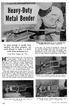 It's large enough to handle most welding job shop projects, yet small enough to make it a worth while home-workshop tool H Craft Print Project No. 272 ERE'S a metal bender that will enable you to bend
Lathe Milling Attachment
 Lathe Milling Attachment By L C. MASON BY CLEVERLY stacking cold-rolled flat stock together, T-slots and slide for this lathe milling attachment are made without costly machinery. In fact, only two tools,
Drive shaft, servicing
 Volkswagen Passat B6 - Drive shaft, servicing Стр. 1 из 41 40-7 Drive shaft, servicing Drive shafts, overview I - Assembly overview: Drive axle with CV joint VL100 40-7, Drive axle with CV joint VL100,
Simple Machines. What are simple machines?
 Definitions to know: Simple Machines Work done when an applied force causes an object to move in the direction of the force Energy ability to cause change; can change the speed, direction, shape, or temperature
OD 1401 9 PRECISION MEASURING INSTRUMENTS
 SUBCOURSE EDITION OD 1401 9 PRECISION MEASURING INSTRUMENTS PRECISION MEASURING INSTRUMENTS SUBCOURSE OD1401 EDITION 9 Unites States Army Combined Arms Support Command Fort Lee, VA 23801-1809 5 CREDIT
Fundamentals of Extrusion
 CHAPTER1 Fundamentals of Extrusion The first chapter of this book discusses the fundamentals of extrusion technology, including extrusion principles, processes, mechanics, and variables and their effects
EDEXCEL NATIONAL CERTIFICATE/DIPLOMA MECHANICAL PRINCIPLES AND APPLICATIONS NQF LEVEL 3 OUTCOME 1 - LOADING SYSTEMS TUTORIAL 3 LOADED COMPONENTS
 EDEXCEL NATIONAL CERTIICATE/DIPLOMA MECHANICAL PRINCIPLES AND APPLICATIONS NQ LEVEL 3 OUTCOME 1 - LOADING SYSTEMS TUTORIAL 3 LOADED COMPONENTS 1. Be able to determine the effects of loading in static engineering
MANUAL TRANSMISSION CONTENTS ...
 22D-0-1 MANUAL TRANSMISSION CONTENTS GENERAL INFORMATION... 22D-0-3 1. SPECIFICATIONS... 22D-1-1 TRANSMISSION MODEL TABLE GENERAL SPECIFICATIONS SERVICE SPECIFICATIONS TORQUE SPECIFICATIONS............