
Sue Fine Linn Maskell
|
|
|
- Josephine McCormick
- 9 years ago
- Views:
Transcription
1 FUN + GAMES = MATHS Sue Fine Linn Maskell Teachers are often concerned that there isn t enough time to play games in maths classes. But actually there is time to play games and we need to make sure that we choose quality games that reinforce concepts taught in the classroom and that challenge students to think and extend themselves. What do we hope students will achieve in maths by the end of Primary school? A flexible understanding and working knowledge of numbers and number relationships e.g. 1,2,4,8,16 is doubling, 5 is 3 more than 2, 2 is 3 less than 5 and 2 is 2 / 5 of 5 and 2 and 1 / 2 2 equals 5. An understanding of addition, subtraction, multiplication and division. Basic number facts to 100 including times tables. Place value and the importance of zero as a place holder. Understand the concept of fractions, that they are a number and that there are many different ways of expressing fractions (proper, decimal, percentage). Good problem solving strategies. Be confident to have a go and reflect on the answer. And most important of all, a positive attitude towards mathematics. We use games to experience maths in a non-threatening context. There are certain general requirements to facilitate effective learning and to ensure that we are using a quality game. It must have an aim. This can develop insight into a mathematical concept or develop or reinforce a mathematical skill e.g. Automatic recall of multiplication tables, identifying counting patterns. 64
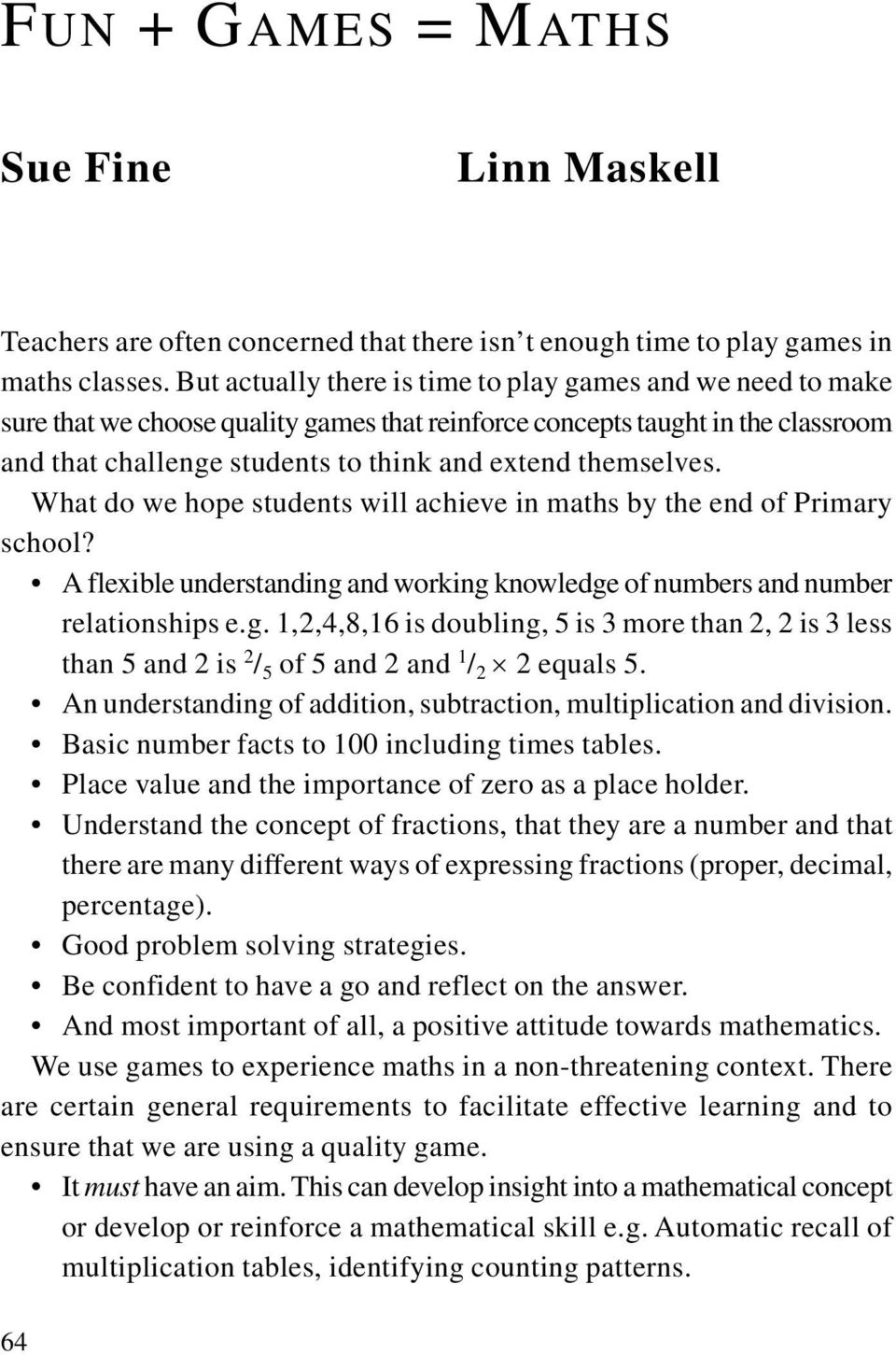
2 Sue Fine and Linn Maskell There should only be a few simple rules. It should be engaging. All maths lessons should begin with a quick 5-minute game that motivates students and, gets their head into a maths space. Sooly An example of a quick game Material: two 6-sided dice, game board Game board. 1. Children fill the grid with numbers, which they think will be thrown when two dice are rolled and the two numbers are added together. They can use each number more than once. 2. The teacher throws two dice. The two numbers thrown are called out, e.g. 3 and 5 these are written on the board. 3. The students total the numbers called and if they have the total they mark it off their grid. 4. The winner is the first person to have all their numbers marked off. 5. The winner calls out the answers and the numbers are checked off the board, e.g. 3 and 5 is written on the board, when the answer 8 is called out, 3 and 5 are ticked off. Sooly 2 is an extension of Sooly 1 1. Each student has 12 counters that are placed anywhere on the grid with no more that 4 counters against any one number. 2. Two six sided dice are rolled and their total added. 3. If there is a counter against that total then one counter only is removed. 4. The first person to remove all their counters is the winner. 65
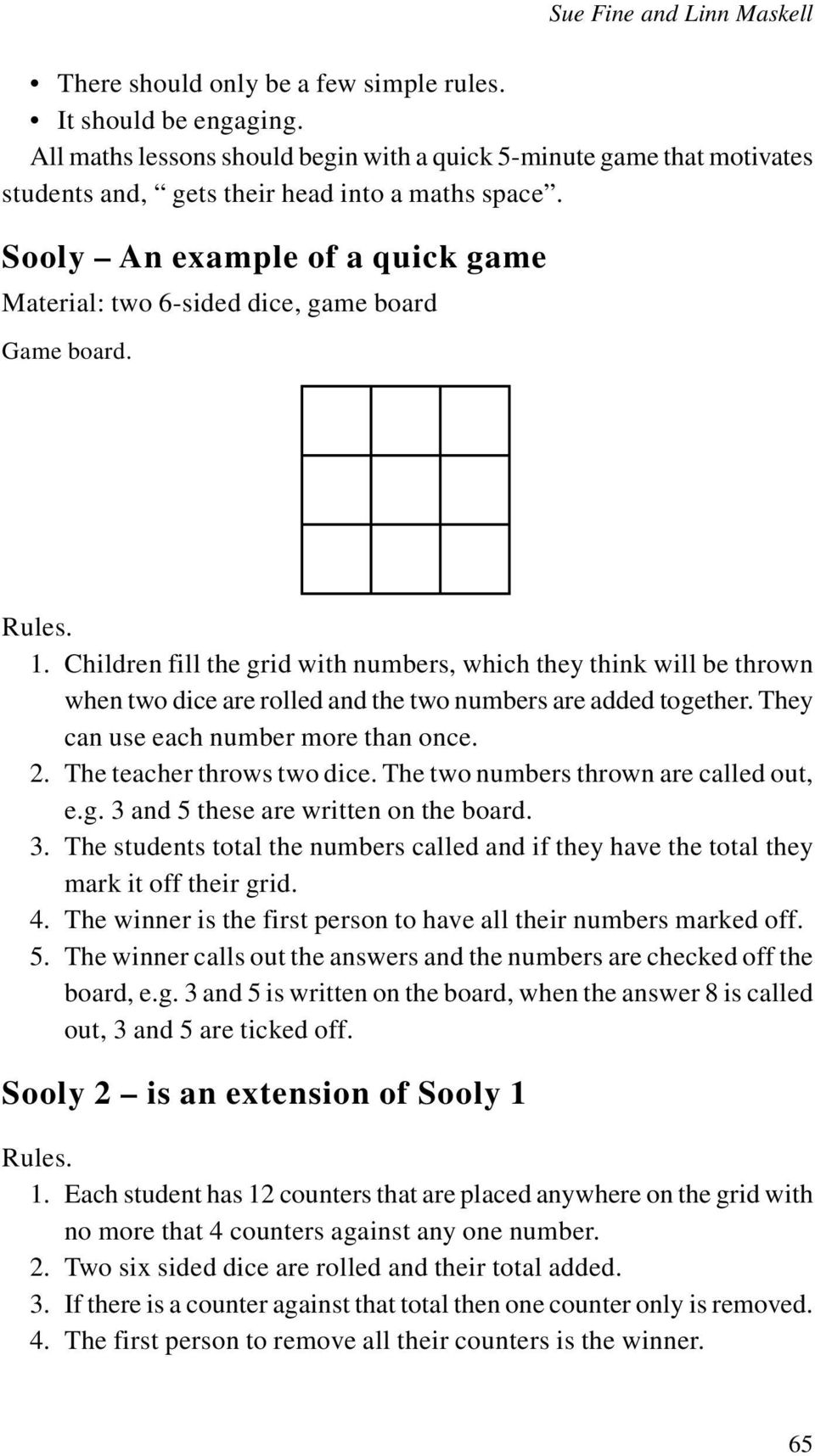
3 KEYNOTE: Fun + Games = Maths Game board. After the game has been played a few times ask the students what they have discovered. Repeat the game using one 12-sided dice. Will the results be the same? Ask the students what they have learnt from these games. How do we know what is likely to be the most frequently rolled number? Write down and discuss the pattern 12 = 6,6 11 = 6,5 5,6 10 = 5,5, 6,4, 4,6, 9 = 6,3, 3,6, 5,4, 4,5 and the pattern starts to emerge. Covered Numbers Materials: game board, two lots of 20 colored counters (2 colors only) and 2 six sided dice. 1. Two players each with 20 coloured counters and a game board. 66
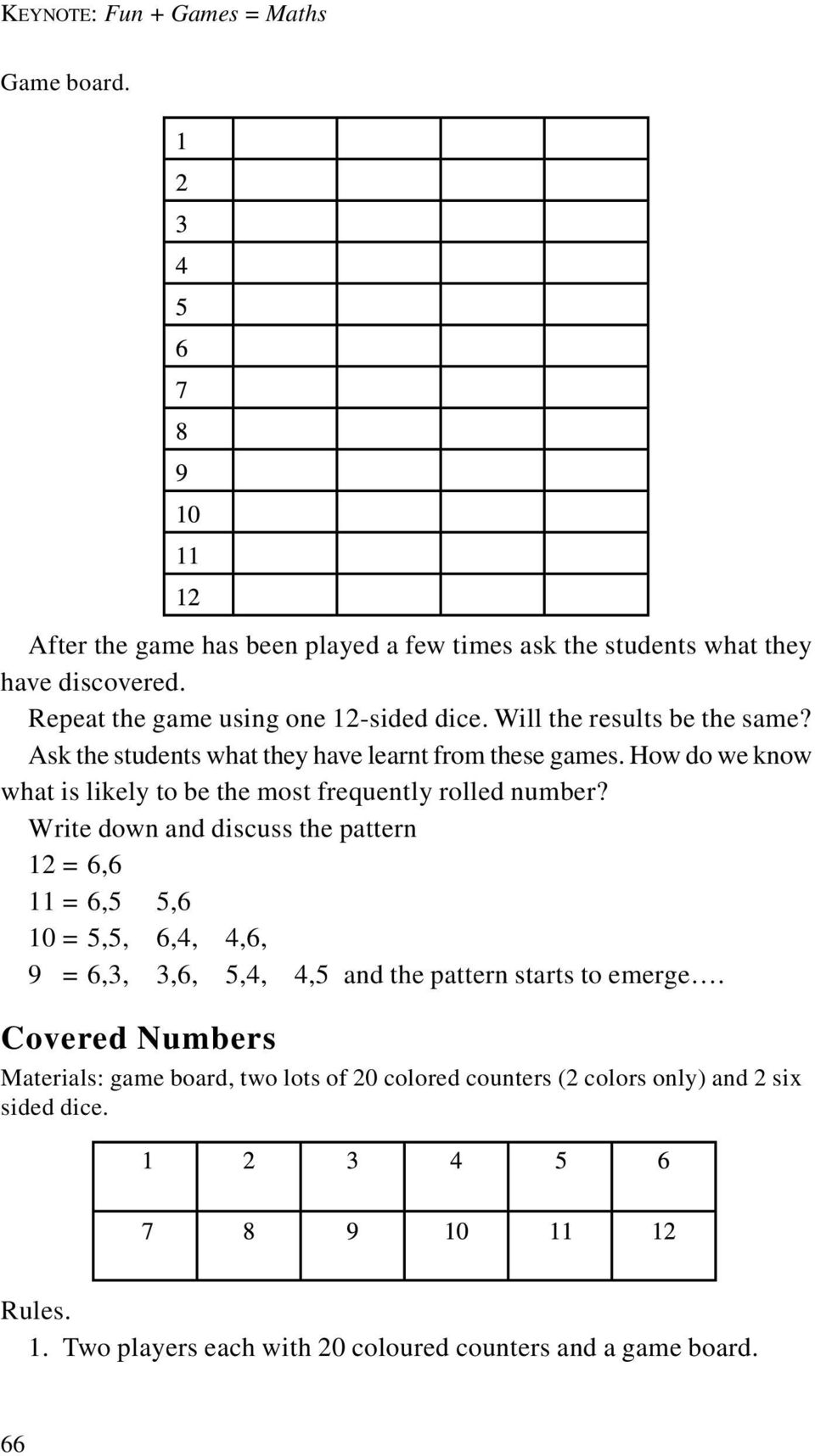
4 Sue Fine and Linn Maskell 2. Each player takes it in turn to roll the dice, e.g. Player A rolls a 9, and then has the choice of either placing 1 counter on 9 or counters on a combination that total 9, e.g. 6 and 2 and 1, or 5 and Player B has their turn and rolls a 7, they are able to place one counter on 7 or on both 2 and 2 and 3, or counters on 6 and There is a limit of 3 counters on any one number. This forces players to rethink combinations for the number they have rolled. 5. Once a player can no longer make a move, the game ends. The scores are totalled, i.e. each player adds up their total of the numbers that their counters have covered. 6. Extension of this game is to have more numbers on the grid, e.g and use a 12-sided dice and an 8-sided dice. Fish to Ten Materials: a pack of cards with the picture cards removed. This game is used to consolidate number combinations to 10. This can be played by up to 4 players. 1. The aim of the game is to make pairs to ten. 2. Each player is dealt 5 cards. If you have a six in your hand you must ask another player if they have a 4 i.e = A player must always have a minimum of 5 cards in their hand. They need to pick up from the pack of cards in the centre if a pair is made. 4. If the player you ask does not have your card, you pick a card up from the centre pack. 5. The player with the most pairs is the winner. 6. Extension to this game is to include the picture cards and make a higher total e.g. 15 or 20 using a combination of 3 or 4 cards to make the total. Partner Numbers to 10 Materials: Each child has a sheet with MAB longs drawn on it, plus one ten sided dice. 1. The dice is rolled and the number rolled is colored in e.g. 7 is rolled then 4 then 1 so the longs will look like this: 67
5 KEYNOTE: Fun + Games = Maths 2. Students then write the number sentence that equals ten e.g. 7+3=10, 4+6=10, 1+9= After the page is completed students can then cut out each long and order them from = 10, = 10, = 10 etc. to consolidate patterning and number facts to 10. An extension activity is to join two longs together to make 20 so patterns extend to = 20, = 20, = 20. Compatible numbers This is from Alistair McIntosh s Think Mathematically Materials: a card for each student with 8 or 10 pairs of numbers, arranged randomly, and such that each pair adds to say 10 or 100. A sample of each of these is shown. 1. Ask children to list as many pairs of compatible numbers as they can in a certain time e.g. 1 minute. 2. As a class check the different answers e.g. 33 and 67, 40 and 60 etc. 3. Repeat step 2 the next day to see whether they can beat the amount of compatible numbers they listed yesterday. 68

6 Sue Fine and Linn Maskell 4. Variation is to ask children to use three numbers that total e.g Ask children to make up their own boxes with 10 to 20 pairs of compatible numbers. Jessica s Game Material: Game board, tiles with numbers 0 to 9 on them, 10-sided die for the extension. 1. Each player places a set of number tiles face down in front of him/herself. The tiles should not be in order. 2. Each player takes one tile at a time and places it on any one of the squares on his/her game board. This step is repeated until the board is filled. 3. Numbers must be placed as drawn, and once placed cannot be moved or changed. 4. The last tile of each player will not be used. 5. The students add the numbers in the columns. The object of the game is to get as close to 1000 as possible without going over A player is out if they go over e.g. Player A puts these tiles in these spaces: hundreds tens ones Total 928 Game board This game reinforces place value, probability of numbers coming up and addition of 3-digit numbers. 69
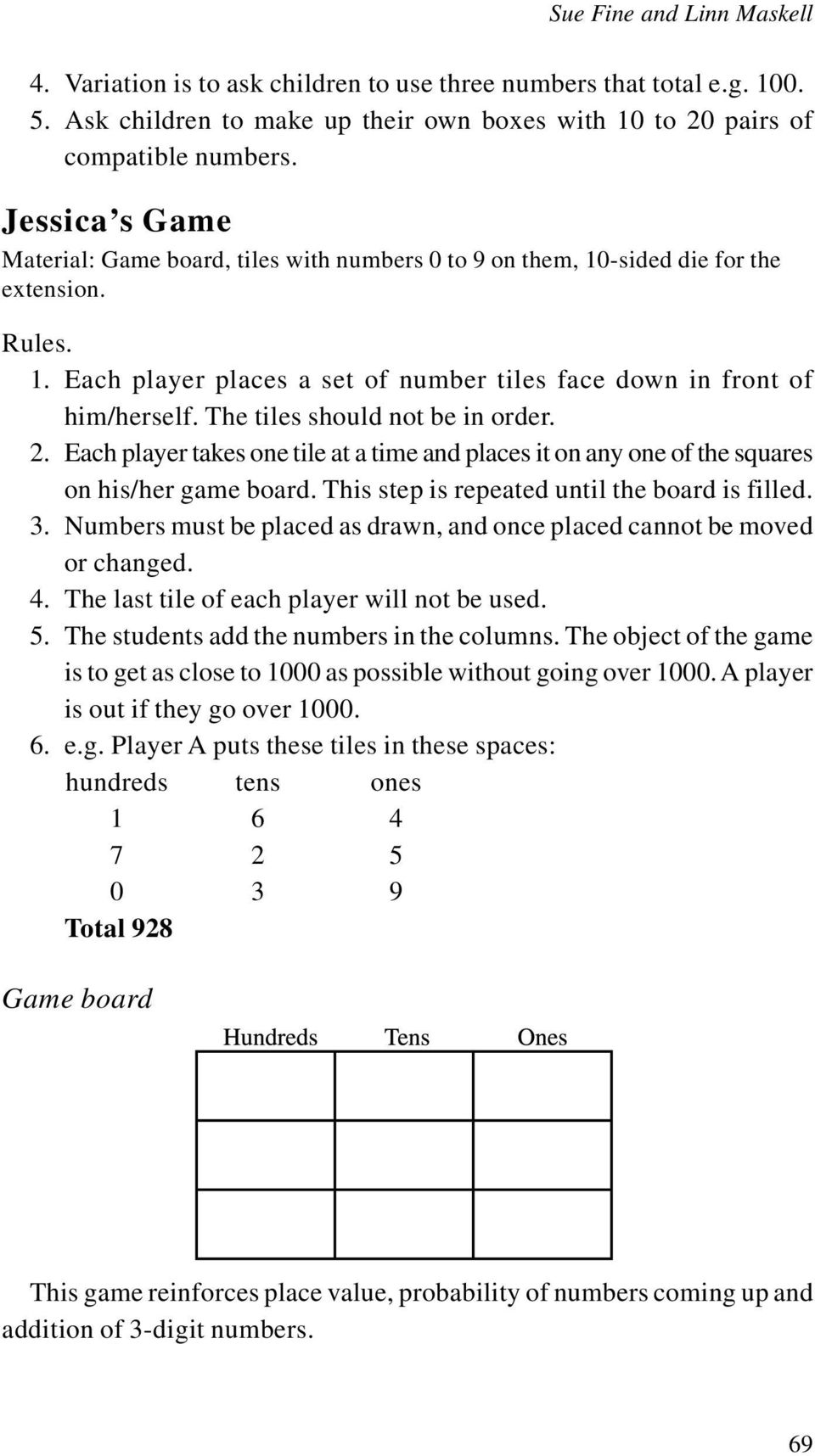
7 KEYNOTE: Fun + Games = Maths An extension of this is by using a 10-sided die. Now the same numbers can keep recurring. An easier version of this game is one from FAMPA called: Ninety Nine or bust This is a game for two or more players. Material: Die, calculator 1. Players take turns to roll the die and key in either the number rolled OR ten times that number, e.g. if 3 is rolled the player may key in either 3 or The number keyed in is added to that player s total. 3. After seven rounds, the player whose total is closest to, but less than 100 wins. Game board Pattern Block P 2 Fraction Game Materials: Pattern blocks hexagons, trapeziums, rhombi and triangles and fraction dice 1 / 4, 1 / 2, 1 / 3, 1 / 6.) 1. Each student begins with two hexagon shapes. The rest of the shapes are in the middle. 2. Place the dice in an opaque container. 70
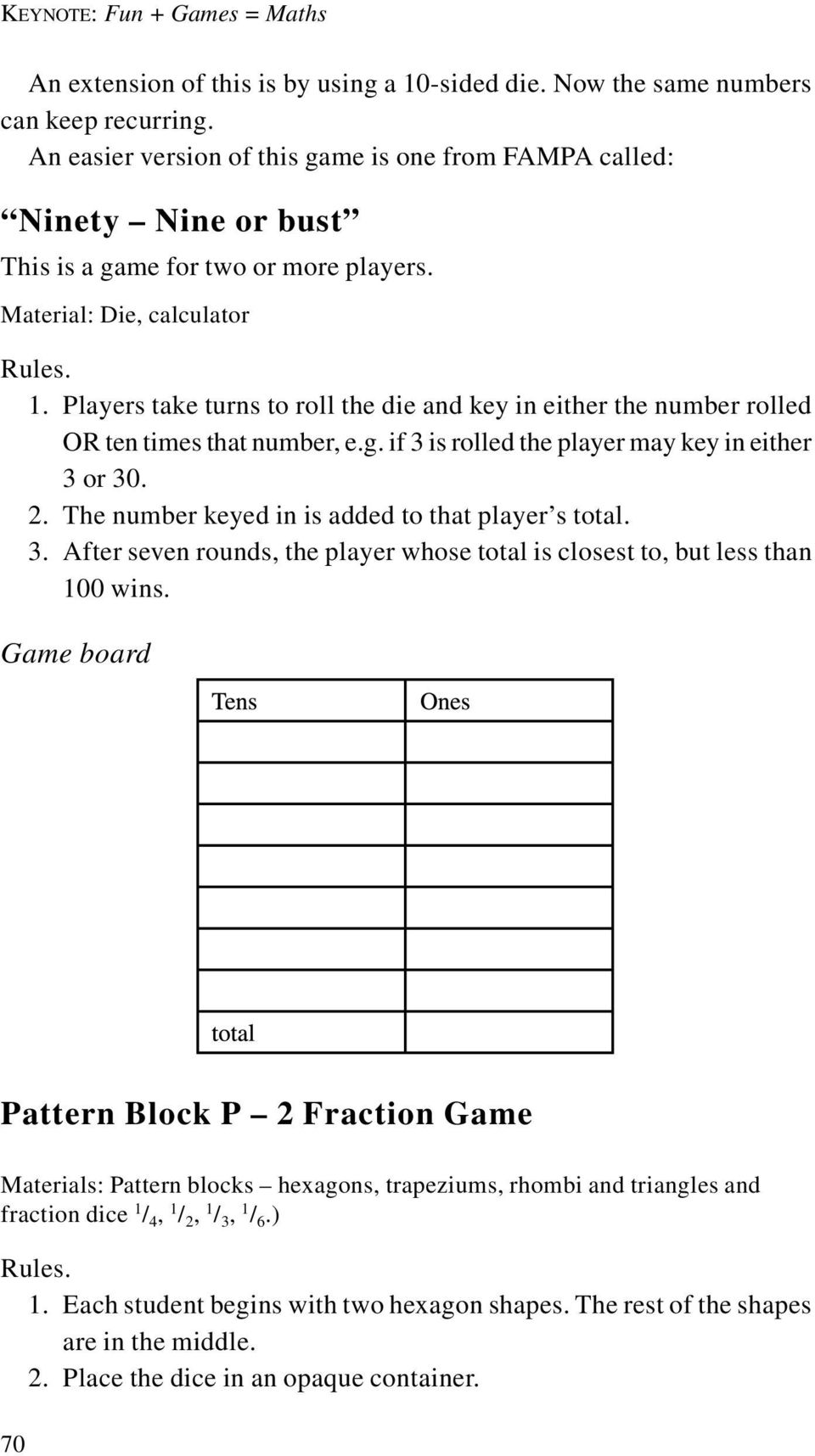
8 Sue Fine and Linn Maskell 3. Player 1 takes a die from the container and selects an appropriate shape, e.g. 1 / 2 = a trapezium. The die is replaced after each turn. 4. The next player has their turn etc. 5. The first player to have both hexagons covered is the winner. An extension to this activity is to have 6 hexagonal shapes. Each shape must be covered in a different way from the previous shape. The following is a great Fraction activity for the upper grades which students find fun, and non-threatening. 1. In large print write a proper fraction between 0 and 1 on a piece of paper. 2. Order yourselves from the smallest to the largest fraction. 3. Write down everything you know about the fraction. 4. Represent the fraction on a number line. 5. Write down the decimal equivalent. 6. Find and draw three other fractions equivalent to your fraction. Daring ducks This is a game of chance where you predict when you think the number 4 will be rolled. Rules: 1. All stand up. 2. The die is rolled and the number is called. Everyone should write that number in the Game 1 row. As the die is rolled again and additional numbers are called they must also be written down in that row. Your point score is the total of all those numbers. 3. Now you must decide whether to sit down and retain that number of points OR to remain standing and chance that a 4 will not be called. If the dice is rolled and a 4 is called, all those standing will lose all the points they have accumulated for this game. All those who have sat down may add the numbers for this game and write the total in the last column. 71
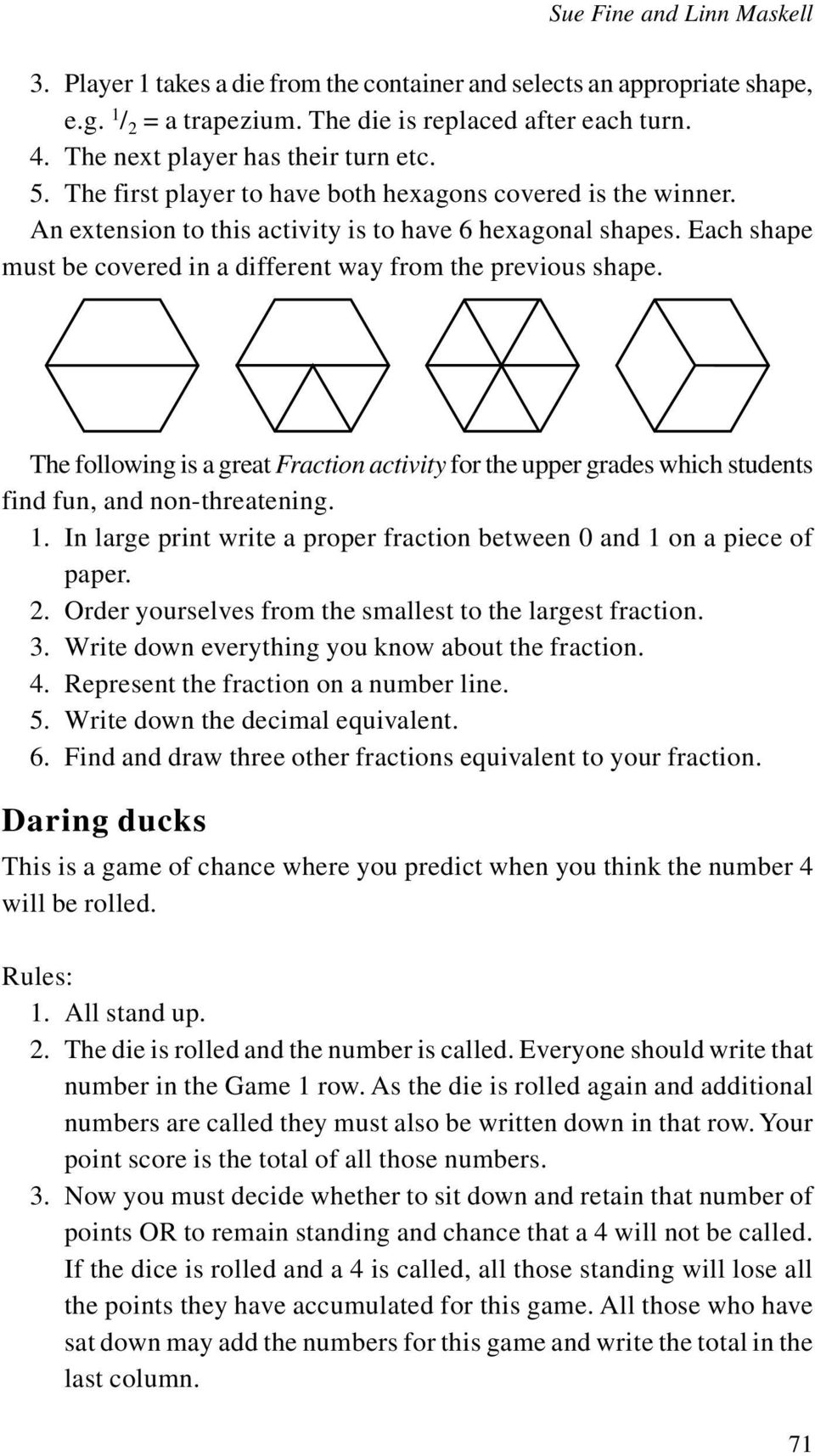
9 KEYNOTE: Fun + Games = Maths 4. Continue throwing the die and calling the number until a 4 is thrown. 5. Play 5 games and then total the scores. 6. The person with the highest score is the winner. Game board We enjoy Maths, and we enjoy games. Let us join the two and have fun with maths. References McIntosh, A. (1994) Think Mathematically, Melbourne: Longman/Cheshire. 72
MAKING MATH MORE FUN BRINGS YOU FUN MATH GAME PRINTABLES FOR HOME OR SCHOOL
 MAKING MATH MORE FUN BRINGS YOU FUN MATH GAME PRINTABLES FOR HOME OR SCHOOL THESE FUN MATH GAME PRINTABLES are brought to you with compliments from Making Math More Fun at and Math Board Games at Copyright
MATHS ACTIVITIES FOR REGISTRATION TIME
 MATHS ACTIVITIES FOR REGISTRATION TIME At the beginning of the year, pair children as partners. You could match different ability children for support. Target Number Write a target number on the board.
Hooray for the Hundreds Chart!!
 Hooray for the Hundreds Chart!! The hundreds chart consists of a grid of numbers from 1 to 100, with each row containing a group of 10 numbers. As a result, children using this chart can count across rows
Math Games For Skills and Concepts
 Math Games p.1 Math Games For Skills and Concepts Original material 2001-2006, John Golden, GVSU permission granted for educational use Other material copyright: Investigations in Number, Data and Space,
Ready, Set, Go! Math Games for Serious Minds
 Math Games with Cards and Dice presented at NAGC November, 2013 Ready, Set, Go! Math Games for Serious Minds Rande McCreight Lincoln Public Schools Lincoln, Nebraska Math Games with Cards Close to 20 -
Third Grade Math Games
 Third Grade Math Games Unit 1 Lesson Less than You! 1.3 Addition Top-It 1.4 Name That Number 1.6 Beat the Calculator (Addition) 1.8 Buyer & Vendor Game 1.9 Tic-Tac-Toe Addition 1.11 Unit 2 What s My Rule?
Permission is given for the making of copies for use in the home or classroom of the purchaser only.
 Copyright 2005 Second Edition 2008 Teresa Evans. All rights reserved. Permission is given for the making of copies for use in the home or classroom of the purchaser only. Part 1 Math Card Games to Play
LAF Level 1 Consolidating Targeted Interventions LIST OF TARGETED INTERVENTIONS SUBITISING SEEING IT ALL TRUSTING THE COUNT MAGIC BEAN TOSS
 LEARNING AND ASSESSMENT FRAMEWORK ZONE 1 CONSOLIDATING TARGETED INTERVENTIONS L E A R N I N G P L A N S LIST OF TARGETED INTERVENTIONS SUBITISING SEEING IT ALL TRUSTING THE COUNT MAGIC BEAN TOSS EXPLORING
Math Board Games. For School or Home Education. by Teresa Evans. Copyright 2005 Teresa Evans. All rights reserved.
 Math Board Games For School or Home Education by Teresa Evans Copyright 2005 Teresa Evans. All rights reserved. Permission is given for the making of copies for use in the home or classroom of the purchaser
Using games to support. Win-Win Math Games. by Marilyn Burns
 4 Win-Win Math Games by Marilyn Burns photos: bob adler Games can motivate students, capture their interest, and are a great way to get in that paperand-pencil practice. Using games to support students
Decimals and Percentages
 Decimals and Percentages Specimen Worksheets for Selected Aspects Paul Harling b recognise the number relationship between coordinates in the first quadrant of related points Key Stage 2 (AT2) on a line
An Australian Microsoft Partners in Learning (PiL) Project
 An Australian Microsoft Partners in Learning (PiL) Project 1 Learning objects - Log on to the website: http://www.curriculumsupport.education.nsw.gov.au/countmein/ - Select children Select children - This
Maths Targets for pupils in Year 2
 Maths Targets for pupils in Year 2 A booklet for parents Help your child with mathematics For additional information on the agreed calculation methods, please see the school website. ABOUT THE TARGETS
Mental Computation Activities
 Show Your Thinking Mental Computation Activities Tens rods and unit cubes from sets of base-ten blocks (or use other concrete models for tenths, such as fraction strips and fraction circles) Initially,
Foundation 2 Games Booklet
 MCS Family Maths Night 27 th August 2014 Foundation 2 Games Booklet Stage Focus: Trusting the Count Place Value How are games used in a classroom context? Strategically selected games have become a fantastic
by Teresa Evans Copyright 2005 Teresa Evans. All rights reserved.
 by Teresa Evans Copyright 2005 Teresa Evans. All rights reserved. Permission is given for the making of copies for use in the home or classroom of the purchaser only. SAMPLE PAGES Please enjoy using these
Assessment Management
 Facts Using Doubles Objective To provide opportunities for children to explore and practice doubles-plus-1 and doubles-plus-2 facts, as well as review strategies for solving other addition facts. www.everydaymathonline.com
Tasks to Move Students On
 Maths for Learning Inclusion Tasks to Move Students On Part 1 Maths for Learning Inclusion (M4LI) Tasks to Move Students On Numbers 1 10 Structuring Number Maths for Learning Inclusion (M4LI) Tasks to
Baseball Multiplication Objective To practice multiplication facts.
 Baseball Multiplication Objective To practice multiplication facts. www.everydaymathonline.com epresentations etoolkit Algorithms Practice EM Facts Workshop Game Family Letters Assessment Management Common
Match Learner. Learning by Playing
 Match Learner Learning by Playing Fax Sparebanken Pluss, Post-box 200 Account No: 3000.19.54756 2 Match Learner Learning by Playing Match is a quality game for all children age 2 years and up. The games
+ = has become. has become. Maths in School. Fraction Calculations in School. by Kate Robinson
 + has become 0 Maths in School has become 0 Fraction Calculations in School by Kate Robinson Fractions Calculations in School Contents Introduction p. Simplifying fractions (cancelling down) p. Adding
Five daily lessons. Page 8 Page 8. Page 12. Year 2
 Unit 2 Place value and ordering Year 1 Spring term Unit Objectives Year 1 Read and write numerals from 0 to at least 20. Begin to know what each digit in a two-digit number represents. Partition a 'teens'
BIG MATHS A GUIDE FOR PARENTS AND CARERS
 BIG MATHS A GUIDE FOR PARENTS AND CARERS Big Maths is a teaching programme used at Hazlehurst to help children to become numerate. Problem solving and word problems cannot be solved until children can
Acing Math (One Deck At A Time!): A Collection of Math Games. Table of Contents
 Table of Contents Introduction to Acing Math page 5 Card Sort (Grades K - 3) page 8 Greater or Less Than (Grades K - 3) page 9 Number Battle (Grades K - 3) page 10 Place Value Number Battle (Grades 1-6)
Three daily lessons. Year 5
 Unit 6 Perimeter, co-ordinates Three daily lessons Year 4 Autumn term Unit Objectives Year 4 Measure and calculate the perimeter of rectangles and other Page 96 simple shapes using standard units. Suggest
Add or Subtract Bingo
 Add or Subtract Bingo Please feel free to take 1 set of game directions and master game boards Please feel free to make 1 special game cube (write + on 3 sides and on the remaining 3 sides) You will need
Financial Literacy Meeting Ideas Daisy Financial Literacy Games and Activities
 Financial Literacy Meeting Ideas Daisy Financial Literacy Games and Activities Fulfills Money Counts steps 1, 2, 3: Money Money You need: Place Value Boards (one for each girl), bags of copied money (one
Paper 1. Calculator not allowed. Mathematics test. First name. Last name. School. Remember KEY STAGE 3 TIER 6 8
 Ma KEY STAGE 3 Mathematics test TIER 6 8 Paper 1 Calculator not allowed First name Last name School 2009 Remember The test is 1 hour long. You must not use a calculator for any question in this test. You
7 th Grade Integer Arithmetic 7-Day Unit Plan by Brian M. Fischer Lackawanna Middle/High School
 7 th Grade Integer Arithmetic 7-Day Unit Plan by Brian M. Fischer Lackawanna Middle/High School Page 1 of 20 Table of Contents Unit Objectives........ 3 NCTM Standards.... 3 NYS Standards....3 Resources
Fifth Grade Physical Education Activities
 Fifth Grade Physical Education Activities 89 Inclement Weather PASS AND COUNT RESOURCE Indoor Action Games for Elementary Children, pg. 129 DESCRIPTION In this game, students will be ordering whole numbers.
Mathematics Second Practice Test 1 Levels 4-6 Calculator not allowed
 Mathematics Second Practice Test 1 Levels 4-6 Calculator not allowed Please read this page, but do not open your booklet until your teacher tells you to start. Write your name and the name of your school
SKILL BUILDING MATH GAMES & ACTIVITIES
 SKILL BUILDING MATH GAMES & ACTIVITIES (Dave Gardner, Head Teacher, Explorations in Math) ([email protected] - [email protected]) NOTE: When played at the beginning of a math period, many of the games and
Year 9 mathematics test
 Ma KEY STAGE 3 Year 9 mathematics test Tier 6 8 Paper 1 Calculator not allowed First name Last name Class Date Please read this page, but do not open your booklet until your teacher tells you to start.
Brain Game. 3.4 Solving and Graphing Inequalities HOW TO PLAY PRACTICE. Name Date Class Period. MATERIALS game cards
 Name Date Class Period Brain Game 3.4 Solving and Graphing Inequalities MATERIALS game cards HOW TO PLAY Work with another student. Shuffle the cards you receive from your teacher. Then put them face down
Health in Action Project. Fraction Action
 Pillar: Active Living Division: II Grade Level: 6 Core Curriculum Connections: Math I. Rationale: Health in Action Project Fraction Action In this activity, students will review what an improper fraction
Paper 1. Calculator not allowed. Mathematics test. First name. Last name. School. Remember KEY STAGE 3 TIER 5 7
 Ma KEY STAGE 3 Mathematics test TIER 5 7 Paper 1 Calculator not allowed First name Last name School 2009 Remember The test is 1 hour long. You must not use a calculator for any question in this test. You
Everyday Math Online Games (Grades 1 to 3)
 Everyday Math Online Games (Grades 1 to 3) FOR ALL GAMES At any time, click the Hint button to find out what to do next. Click the Skip Directions button to skip the directions and begin playing the game.
Blood Circulation Game
 Blood Circulation Game Developed by June Agar at Rushey Mead School in Leicester. All the bits are here to make a board game, but some work by you and/or your children is needed. You might want to consider
The Crescent Primary School Calculation Policy
 The Crescent Primary School Calculation Policy Examples of calculation methods for each year group and the progression between each method. January 2015 Our Calculation Policy This calculation policy has
Current California Math Standards Balanced Equations
 Balanced Equations Current California Math Standards Balanced Equations Grade Three Number Sense 1.0 Students understand the place value of whole numbers: 1.1 Count, read, and write whole numbers to 10,000.
by Teresa Evans Copyright 2010 Teresa Evans. All rights reserved. Permission is given for the making of copies for use
 by Teresa Evans Copyright 2010 Teresa Evans. All rights reserved. Permission is given for the making of copies for use in the home or classroom of the purchaser only. Looking for More Math Fun? Making
BISHOP SCHOOL K 5 MATH FACTS GUIDE
 BISHOP SCHOOL K 5 MATH FACTS GUIDE INTRODUCTION This math fact guide is an outcome of several math related discussions among the staff. There is an agreement that the children need to know their math facts
Big Maths A guide for Ludworth Parents
 Ludworth Primary School Big Maths A guide for Ludworth Parents Big Maths is a teaching programme used at Ludworth to help children to become numerate. Problem solving and word problems cannot be solved
Five daily lessons. Pages 24, 28. Page 32. Page 60. Year 2
 Unit 4 Addition and subtraction Five daily lessons Year 1 Autumn term Unit Objectives Understand the operation of ition and of subtraction (as take away, difference and how many more to make ), and use
Game 9. Overview. Materials. Recommended Grades 3 5 Time Instruction: 30 45 minutes Independent Play: 20 30 minutes
 Game 9 Cross Out Singles Recommended Grades 3 5 Time Instruction: 30 45 minutes Independent Play: 20 30 minutes Quiet Dice Rolling dice can create lots of noise. To lessen the noise, consider using foam
Commutative Property Grade One
 Ohio Standards Connection Patterns, Functions and Algebra Benchmark E Solve open sentences and explain strategies. Indicator 4 Solve open sentences by representing an expression in more than one way using
Written methods for addition of whole numbers
 Stage 1: The empty number line Mathematics written methods at the Spinney Written methods for addition of whole numbers The mental methods that lead to column addition generally involve partitioning, e.g.
Counting Money and Making Change Grade Two
 Ohio Standards Connection Number, Number Sense and Operations Benchmark D Determine the value of a collection of coins and dollar bills. Indicator 4 Represent and write the value of money using the sign
What Is Singapore Math?
 What Is Singapore Math? You may be wondering what Singapore Math is all about, and with good reason. This is a totally new kind of math for you and your child. What you may not know is that Singapore has
Understand numbers, ways of representing numbers, relationships among numbers, and number systems
 Equivalent Fractions and Comparing Fractions: Are You My Equal? Brief Overview: This four day lesson plan will explore the mathematical concept of identifying equivalent fractions and using this knowledge
What is the Probability of Pigging Out
 What is the Probability of Pigging Out Mary Richardson Susan Haller Grand Valley State University St. Cloud State University [email protected] [email protected] Published: April 2012 Overview of
Math Card Games to Print and Play
 Math Card Games to Print and Play For School or Home Education by Teresa Evans Copyright 200 Teresa Evans. All rights reserved. Permission is given for the making of copies for use in the home or classroom
One-Inch Graph Paper
 One-Inch Graph Paper Classroom Strategies Blackline Master II - 1 49 Half-Inch Graph Paper 50 Classroom Strategies Blackline Master II - 2 Two-Centimeter Graph Paper Classroom Strategies Blackline Master
SuperSpeed Math. Addition, Subtraction, Multiplication, Division And the Gnarlies!
 SuperSpeed Math, copyright Chris Biffle SuperSpeed Math Addition, Subtraction, Multiplication, Division And the Gnarlies! Chris Biffle Crafton Hills College Yucaipa, California [email protected] SuperSpeed
Area and Perimeter: The Mysterious Connection TEACHER EDITION
 Area and Perimeter: The Mysterious Connection TEACHER EDITION (TC-0) In these problems you will be working on understanding the relationship between area and perimeter. Pay special attention to any patterns
Concepts of print are found to be effective when looking at comprehension strategies. These may include strategies such as:
 Appendix 1: Literacy Strategies Word Attack & Comprehension Strategies Word Attack Strategies These strategies, to which children should refer, can be displayed on a classroom wall and made into a bookmark
Math vocabulary can be taught with what Montessorians call the Three Period Lesson.
 Full Transcript of: Montessori Mathematics Materials Presentations Introduction to Montessori Math Demonstrations ( Disclaimer) This program is intended to give the viewers a general understanding of the
Year 2 Summer Term Oral and Mental Starter Activity Bank
 Year 2 Summer Term Oral and Mental Starter Activity Bank Objectives for term Recall x2 table facts and derive division facts. Recognise multiples of 5. Recall facts in x5 table. Recall x10 table and derive
Mental Maths module for the Foundation Phase
 Mental Maths module for the Foundation Phase 1 CONTENTS 1. The importance of Mental Mathematics p 4 2. Benefits of Mental Maths p 6 3. Mental Maths games p 7 4. Mental Maths activities p 8 2 1. The importance
Mathematics Success Grade 6
 T276 Mathematics Success Grade 6 [OBJECTIVE] The student will add and subtract with decimals to the thousandths place in mathematical and real-world situations. [PREREQUISITE SKILLS] addition and subtraction
3.2 Methods of Addition
 .2 Methods of Addition Objectives Relate addition stories to number bonds. Write two addition facts for a given number bond. Solve picture problems using addition. Learn addition facts through, and the
Played With Five Standard Six-Sided Dice. by Paul Hoemke
 Played With Five Standard Six-Sided Dice by Paul Hoemke 1 Copyright 2011 by Paul Hoemke. Five New 5-Dice Games by Paul Hoemke is licensed under a Creative Commons Attribution 3.0 Unported License. http://creativecommons.org/licenses/by/3.0/
Helping your child with Reading
 Helping your child with Reading Some ways that you can support. Getting Started Sharing books - We teach phonics to help our children learn to read and write and in order to do this successfully they need
Contents. Subtraction (Taking Away)... 6. Multiplication... 7 by a single digit. by a two digit number by 10, 100 or 1000
 This booklet outlines the methods we teach pupils for place value, times tables, addition, subtraction, multiplication, division, fractions, decimals, percentages, negative numbers and basic algebra Any
Algebra Unit Plans. Grade 7. April 2012. Created By: Danielle Brown; Rosanna Gaudio; Lori Marano; Melissa Pino; Beth Orlando & Sherri Viotto
 Algebra Unit Plans Grade 7 April 2012 Created By: Danielle Brown; Rosanna Gaudio; Lori Marano; Melissa Pino; Beth Orlando & Sherri Viotto Unit Planning Sheet for Algebra Big Ideas for Algebra (Dr. Small)
Year 9 mathematics test
 Ma KEY STAGE 3 Year 9 mathematics test Tier 5 7 Paper 1 Calculator not allowed First name Last name Class Date Please read this page, but do not open your booklet until your teacher tells you to start.
Summer Math Reinforcement Packet Students Entering into 2 nd Grade
 1 Summer Math Reinforcement Packet Students Entering into 2 nd Grade Our first graders had a busy year learning new math skills. Mastery of all these skills is extremely important in order to develop a
Five daily lessons. Page 9 Page 11. Page 17
 Unit 2 Ordering, estimating and rounding Year 2 Spring term Unit Objectives Year 2??Read and write whole numbers to at least 100 in figures and words.??compare two given two-digit numbers, say which is
GAMES WITH ONE DIE Games where you only use a single die can be plenty exciting indeed. Here are two good examples of this!
 [TACTIC rules for dice games] Here are 21 different dice games, with one, two, three or even more dice. We wish you lots of enjoyment! GAMES WITH ONE DIE Games where you only use a single die can be plenty
How we teach calculations in Maths A Parent s Guide
 How we teach calculations in Maths A Parent s Guide Belmont Maths Department 2011 1 Contents Introduction...Page 3 Maths at Belmont...Page 4 Addition...Page 5 Subtraction...Page 7 Multiplication...Page
Comparing Fractions Objective To provide practice ordering sets of fractions.
 Comparing Fractions Objective To provide practice ordering sets of fractions. www.everydaymathonline.com epresentations etoolkit Algorithms Practice EM Facts Workshop Game Family Letters Assessment Management
FIRST GRADE Number and Number Sense
 FIRST GRADE Number and Number Sense Hundred Chart Puzzle Reporting Category Number and Number Sense Topic Count and write numerals to 100 Primary SOL 1.1 The student will a) count from 0 to 100 and write
1 st Grade Math Do-Anytime Activities
 1 st Grade Have your child help create a number line (0-15) outside with sidewalk chalk. Call out a number and have your child jump on that number. Make up directions such as Hop to the number that is
First Grade Exploring Two-Digit Numbers
 First Grade Exploring Two-Digit Numbers http://focusonmath.files.wordpress.com/2011/02/screen-shot-2011-02-17-at-3-10-19-pm.png North Carolina Department of Public Instruction www.ncdpi.wikispaces.net
Unit 5 Length. Year 4. Five daily lessons. Autumn term Unit Objectives. Link Objectives
 Unit 5 Length Five daily lessons Year 4 Autumn term Unit Objectives Year 4 Suggest suitable units and measuring equipment to Page 92 estimate or measure length. Use read and write standard metric units
Mathematics. Introduction
 Mathematics Introduction Numeracy is a core subject within the National Curriculum. This policy outlines the purpose, nature and management of the mathematics taught and learned in our school. Mathematics
+ Addition + Tips for mental / oral session 1 Early addition. Combining groups of objects to find the total. Then adding on to a set, one by one
 + Addition + We encourage children to use mental methods whenever possible Children may not need to be taught every step STEP Tips for mental / oral session Counting Concept & images Comments Early addition
Accounting Games and Hands-on Activities. By Linda Welsh, Business Educator Whitehall High School
 Accounting Games and Hands-on Activities By Linda Welsh, Business Educator Whitehall High School Linda Welsh, Business Educator Whitehall High School Accounting Photoshop Web design Computer applications
Field Experience 1 Reflection Paper. Timothy D. Koerner. Research I (EDU 757) Professor Vicki Good
 FE 1 Reflection: -1- Field Experience 1 Reflection Paper Timothy D. Koerner Research I (EDU 757) Professor Vicki Good FE 1 Reflection: -2- Part: 1 Demographic Analysis of the Class Ms. Case s third grade
Math Journal HMH Mega Math. itools Number
 Lesson 1.1 Algebra Number Patterns CC.3.OA.9 Identify arithmetic patterns (including patterns in the addition table or multiplication table), and explain them using properties of operations. Identify and
Parts and Wholes. In a tangram. 2 small triangles (S) cover a medium triangle (M) 2 small triangles (S) cover a square (SQ)
 Parts and Wholes. L P S SQ M In a tangram small triangles (S) cover a medium triangle (M) small triangles (S) cover a square (SQ) L S small triangles (S) cover a parallelogram (P) small triangles (S) cover
for the Bill Hanlon [email protected]
 Strategies for Learning the Math Facts Bill Hanlon [email protected] The more sophisticated mental operations in mathematics of analysis, synthesis, and evaluation are impossible without rapid and accurate
Instructions. Tic, Tac, Toe Take turns placing a piece down. The first player to get 3 in a row (up, down or diagonally) wins!
 Thank you so much for downloading my Superhero unit. I hope you have lots of fun using it with your children. Please note that this unit is for your PERSONAL use only! That means that your may use it with
TCM040 MSOM NEW:TCM040 MSOM 01/07/2009 12:13 Page 1. A book of games to play with children
 TCM040 MSOM NEW:TCM040 MSOM 01/07/2009 12:13 Page 1 A book of games to play with children TCM040 MSOM NEW:TCM040 MSOM 01/07/2009 12:13 Page 2 Contents About this book 3 Find the hidden money 4 Money box
RACE TO CLEAR THE MAT
 RACE TO CLEAR THE MAT NUMBER Place Value Counting Addition Subtraction Getting Ready What You ll Need Base Ten Blocks, 1 set per group Base Ten Blocks Place-Value Mat, 1 per child Number cubes marked 1
Foundations For Learning. Intermediate Phase Mathematics Lesson plans
 GRADE 5 MATHEMATICS Third Term Lesson Plan Foundations For Learning Intermediate Phase Mathematics Lesson plans Third term Grade 5 1 Kindly send any response that you may have to: Dr Jennifer J Joshua
Day 1. Mental Arithmetic Questions KS3 MATHEMATICS
 Mental Arithmetic Questions. The tally chart shows the number of questions a teacher asked in a lesson. How many questions did the teacher ask? KS3 MATHEMATICS 2. How many seconds are there in two minutes?
TEACHER S GUIDE TO RUSH HOUR
 Using Puzzles to Teach Problem Solving TEACHER S GUIDE TO RUSH HOUR Includes Rush Hour 2, 3, 4, Rush Hour Jr., Railroad Rush Hour and Safari Rush Hour BENEFITS Rush Hour is a sliding piece puzzle that
Calculator Practice: Computation with Fractions
 Calculator Practice: Computation with Fractions Objectives To provide practice adding fractions with unlike denominators and using a calculator to solve fraction problems. www.everydaymathonline.com epresentations
Unit 13 Handling data. Year 4. Five daily lessons. Autumn term. Unit Objectives. Link Objectives
 Unit 13 Handling data Five daily lessons Year 4 Autumn term (Key objectives in bold) Unit Objectives Year 4 Solve a problem by collecting quickly, organising, Pages 114-117 representing and interpreting
Mathematics Assessment Collaborative Tool Kits for Teachers Looking and Learning from Student Work 2009 Grade Eight
 Mathematics Assessment Collaborative Tool Kits for Teachers Looking and Learning from Student Work 2009 Grade Eight Contents by Grade Level: Overview of Exam Grade Level Results Cut Score and Grade History
Self-Acceptance. A Frog Thing by E. Drachman (2005) California: Kidwick Books LLC. ISBN 0-9703809-3-3. Grade Level: Third grade
 Self-Acceptance A Frog Thing by E. Drachman (2005) California: Kidwick Books LLC. ISBN 0-9703809-3-3 This Book Kit was planned by Lindsay N. Graham Grade Level: Third grade Characteristic Trait: Self Acceptance
Adding and Subtracting Integers Unit. Grade 7 Math. 5 Days. Tools: Algebra Tiles. Four-Pan Algebra Balance. Playing Cards
 Adding and Subtracting Integers Unit Grade 7 Math 5 Days Tools: Algebra Tiles Four-Pan Algebra Balance Playing Cards By Dawn Meginley 1 Objectives and Standards Objectives: Students will be able to add
How To Play The Math Game
 Game Information 1 Introduction Math is an activity that is perfect for reviewing key mathematics vocabulary in a unit of study. It can also be used to review any type of mathematics problem. Math provides
Grade 4 Mathematics Patterns, Relations, and Functions: Lesson 1
 Grade 4 Mathematics Patterns, Relations, and Functions: Lesson 1 Read aloud to the students the material that is printed in boldface type inside the boxes. Information in regular type inside the boxes
Has difficulty with counting reliably in tens from a multiple of ten
 Has difficulty with counting reliably in tens from a multiple of ten Opportunity for: looking for patterns 5 YR / 100-square Tens cards (Resource sheet 24) Multiples of ten (10 100) written on A5 pieces
Fun ways to group students
 Fun ways to group students Tips for dividing into groups. Picture Cards: Hand out cards with images on such as strawberries, blueberries, blackberries and other such groups of things. Then get them to
Subject: Math Grade Level: 5 Topic: The Metric System Time Allotment: 45 minutes Teaching Date: Day 1
 Subject: Math Grade Level: 5 Topic: The Metric System Time Allotment: 45 minutes Teaching Date: Day 1 I. (A) Goal(s): For student to gain conceptual understanding of the metric system and how to convert
Guidance paper - The use of calculators in the teaching and learning of mathematics
 Guidance paper - The use of calculators in the teaching and learning of mathematics Background and context In mathematics, the calculator can be an effective teaching and learning resource in the primary
Oral and mental starter
 Lesson Objectives Order fractions and position them on a number line (Y6) Vocabulary gauge, litre numerator, denominator order Resources OHT. individual whiteboards (optional) Using fractions Oral and