
Foundations For Learning. Intermediate Phase Mathematics Lesson plans
|
|
|
- Hollie Simmons
- 9 years ago
- Views:
Transcription
1 GRADE 5 MATHEMATICS Third Term Lesson Plan Foundations For Learning Intermediate Phase Mathematics Lesson plans Third term Grade 5 1

2 Kindly send any response that you may have to: Dr Jennifer J Joshua [email protected] Department of Education Sol Plaatje House 123 Schoeman Street Pretoria South Africa Private Bag X895 Pretoria 0001 Tel: Fax: Department of Education Design and layout: Shereno (012) INTERMEDIATE PHASE 2 LAYING SOLID FOUNDATIONS FOR LEARNING
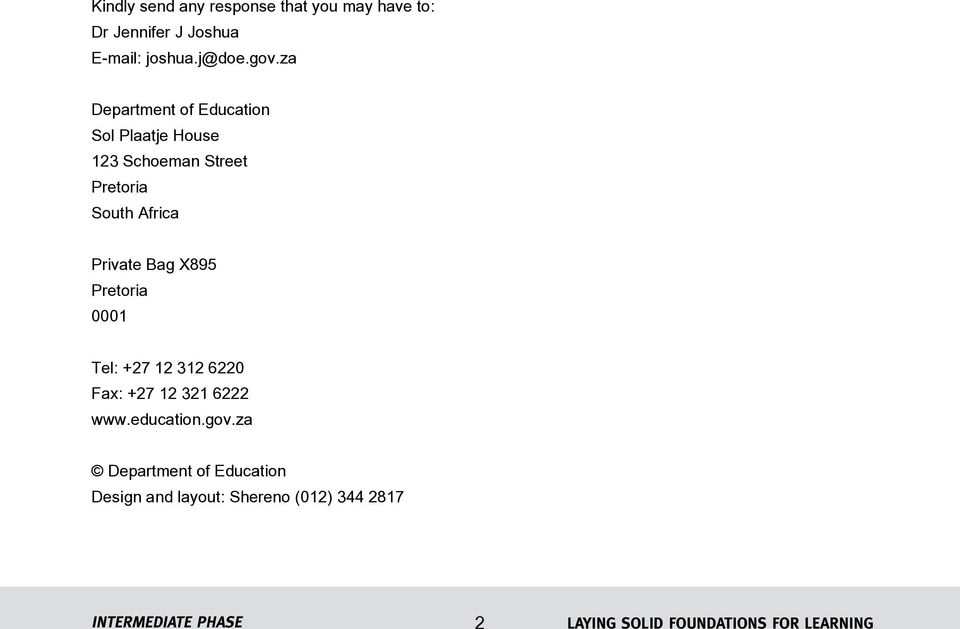
3 GRADE 5 MATHEMATICS Third Term Lesson Plan Table of Contents Third Term... 5 Overview of Lesson Plans... 5 Overview of Assessment Tasks... 8 Week 1: Overview Week 1: Lesson plans Week 2: Overview Week 2: Lesson plans Week 3: Overview Week 3: Lesson plans Week 4: Overview Week 4: Lesson plans Week 5: Overview Week 5: Lesson plans Week 6: Overview Week 6: Lesson plans Week 7: Overview Week 7: Lesson plans Week 8: Overview Week 8: Lesson plans Week 9: Overview Week 9: Lesson plans Week 10: Overview Week 10: Lesson plans
4 INTERMEDIATE PHASE 4 LAYING SOLID FOUNDATIONS FOR LEARNING

5 GRADE 5 MATHEMATICS Third Term Lesson Plan THIRD TERM OVERVIEW OF LESSON PLANS: GRADE 5 MATHEMATICS LO 1: NUMBERS, OPERATIONS AND RELATIONSHIPS LO2: PATTERNS, FUNCTIONS AND ALGEBRA LO 3: SPACE AND SHAPE LO 4: MEASUREMENT MENTAL STRATEGIES ARE DONE EVERY LESSON AS 4: Recognise place value of digits in whole numbers to a minimum of 5digit numbers AS 8: Estimate and calculate by selecting and using appropriate operations and techniques to solve problems that involve addition and subtraction of whole numbers with at least 5 digits AS 8: Estimate and calculate by selecting and using appropriate operations to solve problems that involve subtraction of whole numbers with at least 5 digits AS 8: Estimate and calculate by selecting and using appropriate operations to solve problems that involve multiplication of at least whole 3digit by 2digit numbers AS 8: Estimate and calculate by selecting and using appropriate operations to solve problems that involve subtraction of whole numbers with at least 5 digits AS 8: Estimate and calculate by selecting and using appropriate operations to solve problems that involve multiplication of at least whole 3digit by 2digit numbers AS 4: Write number sentences to describe a problem situation within a context AS 7: Describe and sketch views of a simple 3dimensional object in different positions AS 7: Describe and sketch views of a simple 3dimensional object in different positions AS 4: Describe and illustrate ways of representing time in different cultures throughout history AS 8: Investigate and approximate perimeter using rulers or measuring tapes LO 5: DATA HANDLING AS 2: Make and use simple data collection sheets that involve counting objects in order to collect data to answer questions posed by the teacher and the class WEEK 3 WEEK 2 WEEK 1 5

6 AS 3: Recognise and represent, in order to compare, factors of any 2digit whole number AS 7: Solve problems involving comparing two or more quantities of the same kind (ratio) AS 4: Recognise the place value of digits in whole numbers to a minimum of 6digit numbers AS 3: Recognise and represent in order to compare multiples of singledigit numbers to at least 100 AS 8: Estimate and calculate by selecting and using appropriate operations to solve problems that involve rounding off to the nearest 5, 10, 100 and division of at least whole 3digit numbers by 2digit numbers AS 3: Recognise and represent in order to compare common fractions to twelfths AS 8: Estimate and calculate by selecting and using appropriate operations to solve problems that involve addition and subtraction of common fractions with the same denominator and whole numbers with common fractions (mixed numbers) AS 1: Investigate and extend numeric and geometric patterns looking for general rules or a relationship including patterns not limited to sequences involving constant difference or ratio AS 6: Determine through discussion and comparison, the equivalence of different descriptions of the same relationship or rule represented: verbally in flow diagrams by number sentences WEEK 6 WEEK 5 WEEK 4 INTERMEDIATE PHASE 6 LAYING SOLID FOUNDATIONS FOR LEARNING

7 GRADE 5 MATHEMATICS Third Term Lesson Plan AS 8: Estimate and calculate by selecting and using appropriate operations to solve problems that involve finding fractions of whole numbers which result in whole numbers AS 3: Recognise and represent in order to compare: to a minimum of 6digit whole numbers; multiples of singledigit numbers to at least 100; factors of any 2digit whole numbers AS 8: Estimate and calculate by selecting and using appropriate operations to solve problems that involve: addition and subtraction of whole numbers with at least 5 digits; multiplication of 3digit by 2digit numbers; division of 3digit numbers by 2digit numbers AS 10: Use a range of techniques to perform written and mental calculations with whole numbers including adding in columns AS 10: Use a range of techniques to perform written and mental calculations with whole numbers including subtracting in columns AS 5: Solve or complete number sentences by inspection or by trialandimprovement, checking the solution by substitution AS 1: Determine through discussion and comparison, the equivalence of different descriptions of the same relationship or rule represented in flow diagrams and by number sentences AS 3: Investigate and compare 2dimensional shapes and 3dimensional objects according to properties AS 4: Recognise, describe and perform rotations, reflections and translations using geometric figures AS 5: Make 3dimensional objects AS 8: Investigate and approximate area of polygons (using square grids and tiling) to develop an understanding of square units AS 8: Investigate area of polygons using square grids and tiling to develop an understanding of square units AS 3: Organise and record data using tallies and tables AS 4: Examine ungrouped numerical data to determine mode AS 5: Draw graphs and interpret data: Pictographs with manytoone correspondence and appropriate keys Bar graphs AS 3: Organise and record data using tallies and tables AS, 5: Draw graphs and interpret data: pictographs and bar graphs WEEK 10 WEEK 9 WEEK 8 WEEK 7 7

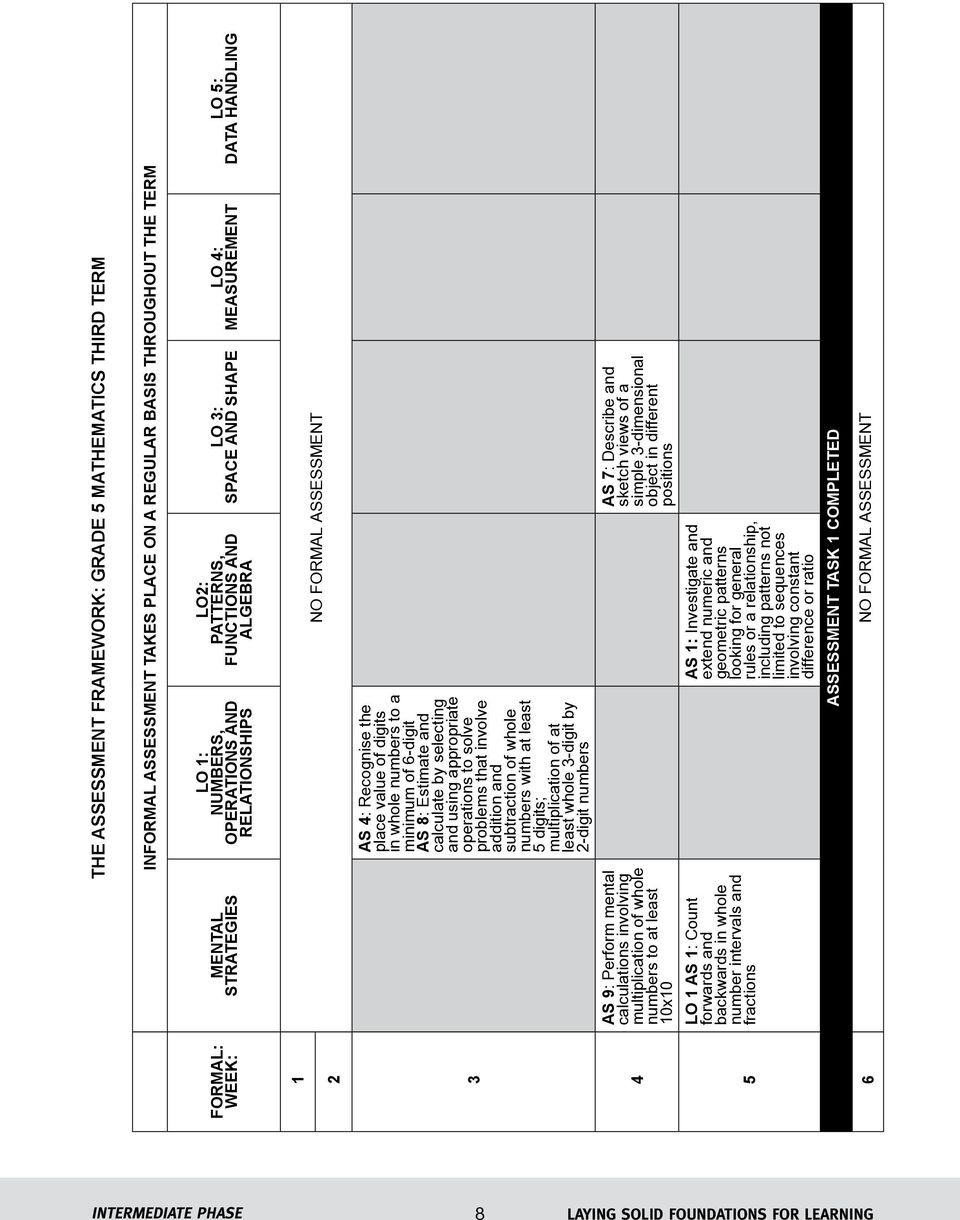
8 THE ASSESSMENT FRAMEWORK: GRADE 5 MATHEMATICS THIRD TERM INFORMAL ASSESSMENT TAKES PLACE ON A REGULAR BASIS THROUGHOUT THE TERM FORMAL: WEEK: MENTAL STRATEGIES LO 1: NUMBERS, OPERATIONS AND RELATIONSHIPS LO2: PATTERNS, FUNCTIONS AND ALGEBRA LO 3: SPACE AND SHAPE LO 4: MEASUREMENT 1 2 NO FORMAL ASSESSMENT AS 9: Perform mental calculations involving multiplication of whole numbers to at least 10x10 LO 1 AS 1: Count forwards and backwards in whole number intervals and fractions AS 4: Recognise the place value of digits in whole numbers to a minimum of 6digit AS 8: Estimate and calculate by selecting and using appropriate operations to solve problems that involve addition and subtraction of whole numbers with at least 5 digits; multiplication of at least whole 3digit by 2digit numbers AS 1: Investigate and extend numeric and geometric patterns looking for general rules or a relationship, including patterns not limited to sequences involving constant difference or ratio AS 7: Describe and sketch views of a simple 3dimensional object in different positions ASSESSMENT TASK 1 COMPLETED 6 NO FORMAL ASSESSMENT LO 5: DATA HANDLING INTERMEDIATE PHASE 8 LAYING SOLID FOUNDATIONS FOR LEARNING
9 GRADE 5 MATHEMATICS Third Term Lesson Plan AS 7: Solve problems involving comparing two or more quantities of the same kind (ratio) AS 8: Solve problems involving addition and subtraction of common fractions with the same denominator and whole numbers with common fractions (mixed numbers) AS 8: Solve problems involving: rounding off to the nearest 5, 10, 100 and 1 000; finding fractions of whole numbers which result in whole numbers AS 8: Estimate and calculate by selecting and using appropriate operations to solve problems that involve division of at least 3digit by 2digit numbers AS 3: Recognise and represent in order to compare to a minimum of 6digit whole numbers AS 3: Recognise and represent in order to compare: common fractions to twelfths; multiples of singledigit numbers to at least 100; factors of any 2digit whole number AS 5: Solve or complete number sentences by inspection of by trialand improvement, checking the solution by substitution ASSESSMENT TASK 2 COMPLETED NO FORMAL ASSESSMENT AS 4: Examine ungrouped numerical data to determine mode AS 3: Organise and record data using tallies and tables AS 5: Draw graphs and interpret data : Pictographs with a manytoone correspondence and appropriate keys; Bar graphs 9

10 INTERMEDIATE PHASE 10 LAYING SOLID FOUNDATIONS FOR LEARNING

11 GRADE 5 MATHEMATICS Third Term Lesson Plan GRADE 5: WEEK 1 OVERVIEW Hours: 5 Number of Periods: 5 Mathematics LO 1 AS 4, 8 LO 4 AS 4 Milestones: Recognise the place value of digits in whole numbers to a minimum of 6digit numbers. Addition and subtraction of whole numbers with at least 5 digits. Describes and illustrates ways of representing time in different cultures throughout history. Mental Strategies: Mental strategies are done with the whole class every day. The time should be used to develop skills and to build number sense. Day 1 Day 2 Day 3 Day 4 Day 5 Content Focus: Place value in 6digit numbers Resources: Chalkboard, textbook, worksheets Place value in 6digit numbers Group work: time through history Chalkboard, textbook, worksheets, learners research Adding 5digit numbers Adding 5digit numbers Chalkboard, textbook, worksheets Group work: time through history Chalkboard, textbook, worksheets, learners research Measuring time through history: group presentations Learners prepared presentations 11

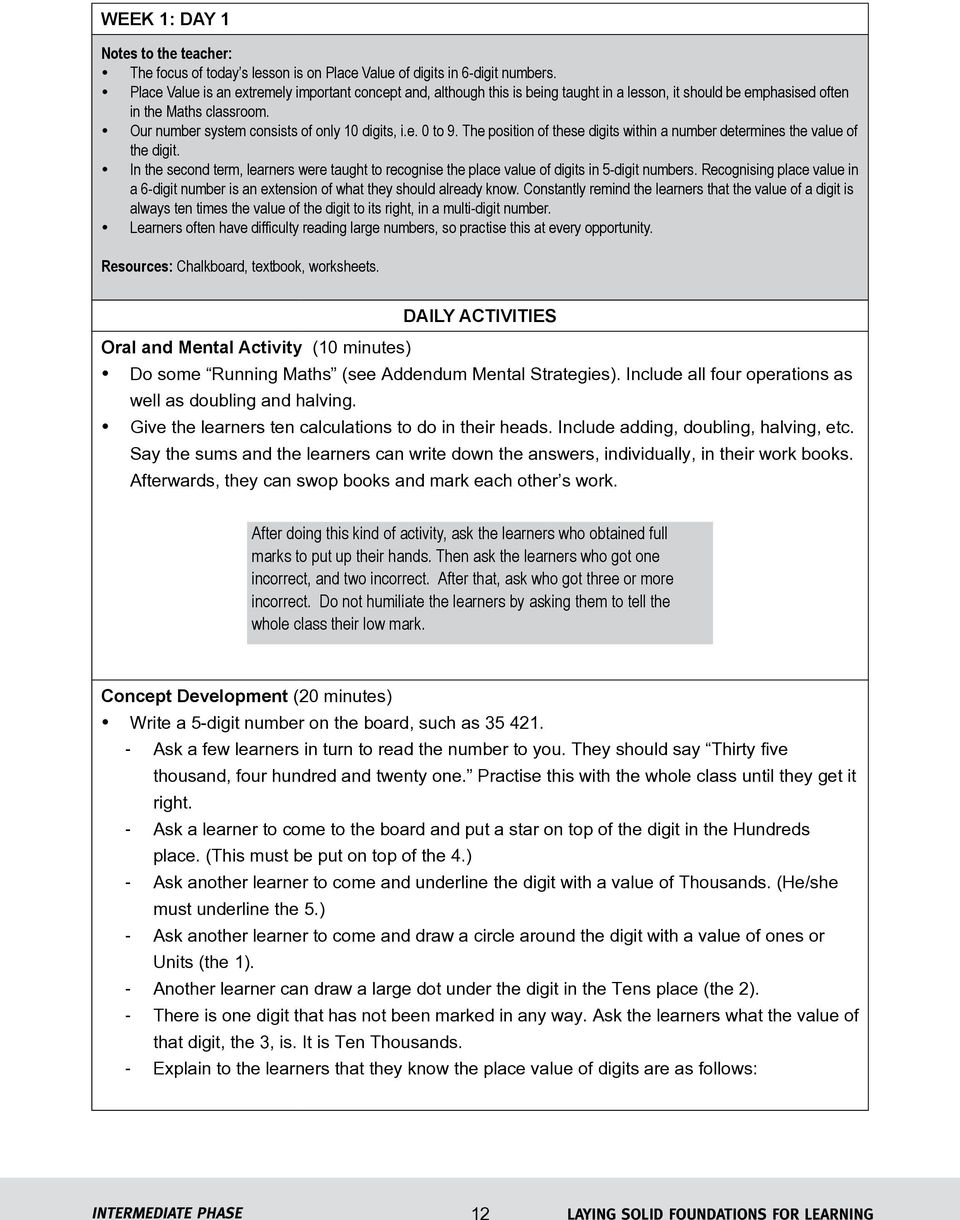
12 WEEK 1: DAY 1 Notes to the teacher: The focus of today s lesson is on Place Value of digits in 6digit numbers. Place Value is an extremely important concept and, although this is being taught in a lesson, it should be emphasised often in the Maths classroom. Our number system consists of only 10 digits, i.e. 0 to 9. The position of these digits within a number determines the value of the digit. In the second term, learners were taught to recognise the place value of digits in 5digit numbers. Recognising place value in a 6digit number is an extension of what they should already know. Constantly remind the learners that the value of a digit is always ten times the value of the digit to its right, in a multidigit number. Learners often have difficulty reading large numbers, so practise this at every opportunity. Resources: Chalkboard, textbook, worksheets. DAILY ACTIVITIES Oral and Mental Activity (10 minutes) Do some Running Maths (see Addendum Mental Strategies). Include all four operations as well as doubling and halving. Give the learners ten calculations to do in their heads. Include adding, doubling, halving, etc. Say the sums and the learners can write down the answers, individually, in their work books. Afterwards, they can swop books and mark each other s work. After doing this kind of activity, ask the learners who obtained full marks to put up their hands. Then ask the learners who got one incorrect, and two incorrect. After that, ask who got three or more incorrect. Do not humiliate the learners by asking them to tell the whole class their low mark. Concept Development (20 minutes) Write a 5digit number on the board, such as Ask a few learners in turn to read the number to you. They should say Thirty five thousand, four hundred and twenty one. Practise this with the whole class until they get it right. Ask a learner to come to the board and put a star on top of the digit in the Hundreds place. (This must be put on top of the 4.) Ask another learner to come and underline the digit with a value of Thousands. (He/she must underline the 5.) Ask another learner to come and draw a circle around the digit with a value of ones or Units (the 1). Another learner can draw a large dot under the digit in the Tens place (the 2). There is one digit that has not been marked in any way. Ask the learners what the value of that digit, the 3, is. It is Ten Thousands. Explain to the learners that they know the place value of digits are as follows: INTERMEDIATE PHASE 12 LAYING SOLID FOUNDATIONS FOR LEARNING
13 GRADE 5 MATHEMATICS Third Term Lesson Plan T Th Th H T U If we write a digit to the left of the Ten Thousands, can anybody tell you what the place value of that digit would be? It is Hundred Thousands, H Th for short, because it is 10 times greater than the digit to its right. Write on the board and tell the learners this is how we write a hundred thousand. Write a 6digit number on the board: Ask several learners to say the number to you. When a learner says it correctly (perhaps even the first learner you ask will be able to do this), get the whole class to say the number. We say: Five hundred and twenty one thousand, six hundred and twenty eight Thousand If learners have difficulty reading a 6digit number, draw a picture of a train. Each carriage can only carry 3 digits. The gaps between the carriages are like the gaps we leave when writing large numbers. Emphasise the importance of the gaps. Without them it would be very difficult to read large numbers. We read the numbers in the first carriage just like we read a 3digit number, except we add the word Thousands after it. Therefore read 521 thousand. Ask learners in turn to come to the board and mark each digit according to its place value, according to your instructions (as you did with the 5digit number). Repeat with at least four to five more examples. Practise reading the number and identifying the place value of each digit. Consolidation (20 minutes) If you cannot find suitable exercises in the textbook, make a worksheet or write work on the board for learners to complete, individually, in their workbooks. While they are busy working, check that they understand the concept of place value and, if necessary, work with small groups of learners who are having difficulty. Examples of work you can give: Writing 6digit numbers in words (give about 6). Write down the numbers from words, e.g. write: Three hundred and fifty one thousand, six hundred and seven. Learners must write (Give about 6.) Write down the value of the 2 in the following numbers: ; ; ; ; ; Rearrange the following digits to make the biggest possible number: (Give about 3). Rearrange the following digits to make the smallest possible number: (Give about 3. Note: you cannot start with a 0. You should also give some repeated digits such as or ) 13

14 Problem Solving (10 minutes) Give the learners two to three problems entailing place value, for example: In Town A there are people. In Town B, there are more people. How many people are in Town B? (Note: this is not an addition sum. Learners need only change the digit in the H Th place.) ASSESSMENT Informal: Assess from the learners participation in class and their written work whether they can recognise the place value of digits in a 6digit number. INTERMEDIATE PHASE 14 LAYING SOLID FOUNDATIONS FOR LEARNING

15 GRADE 5 MATHEMATICS Third Term Lesson Plan WEEK 1: DAY 2 Notes to the teacher: In today s lesson, we will continue with place value of digits in 6digit numbers. Writing numbers in expanded notation and building up numbers from their expanded form is good practice in recognising the place value of different digits. Without this knowledge, learners will be unable to add or subtract large numbers. It is important for the learners to keep saying the large numbers. Learners will be given some time to work on their group research projects (time through history). Resources: Chalkboard, textbooks, worksheets, calculators. DAILY ACTIVITIES Oral and Mental Activity (10 minutes) Play Zap on calculators. See Addendum Mental Strategies for instructions. This is a good way to practise place value. Concept Development (20 minutes) Write a 6digit number on the board: Ask a few learners to say the number in words. Make sure they get it correct. Ask different learners to tell you the place value of each digit (asked in random order). Ask different learners to come and write the number value of each digit on the board. They will write: ; ; 1 000; 300; 50; 6. If we add those numbers together, we will obtain the original number Tell the learners you are going to break the number down even further and write it in expanded notation, for example: = (5x ). Let different learners come up and write on the board in expanded notation. (This is not new to them.) They will write: (5x )+(2x10 000)+(1x1 000)+(3x100)+(5x10)+(6)= The whole class can read the expanded number and the 6digit number formed. Repeat with two to three more numbers. Write four expanded numbers on the board. Write the first two in the correct order (from largest place value to smallest) and the next two in random order. In pairs, learners can write down the numbers formed from these expanded numbers. Get learners in turn to read the numbers they have written, ensuring that they obtained the correct number and that they can read the numbers properly. Write four 6digit numbers on the board: ; ; ; Tell the learners you want to arrange these numbers in ascending order. That means from smallest to largest. The smallest number must be one of the numbers that starts with Look at the value of the digit in the s place: and is smaller than Therefore is the smallest number and is the next smallest number. Repeat with the other two numbers. They both begin with Look at the digit in the T Th place: and is smaller than , so < The four numbers in ascending order are: ; ; ; Repeat with four different 6digit numbers to be arranged in descending order. 15

16 Learners often confuse ascending and descending order. Tell them that down and descend both start with the letter d. So descending order means going down from largest to smallest. Ascending and up both start with a vowel (similar sounding), so ascending means going up from smallest to largest. Consolidation (20 minutes) If you cannot find suitable examples in the textbook, make a worksheet or write work on the board for the learners to complete, for example, you could give the learners the following table with questions to answer based on the numbers in the table. Examples: Eastern Cape No. of people in SA provinces who live in a house or brick structure on a separate stand or yard Free State Gauteng KwaZulu Natal Mpumalanga Northern Cape Northern Province North West Western Cape Which is the largest number in the table? Write it down in numbers and in words. Which is the smallest number in the table? Write it down in numbers and in words. Arrange the numbers of people in ascending and then in descending order. Write each of the above numbers in expanded notation. The total number of people in Mpumalanga and Northern Cape who live in this type of dwelling = (7x100)+(4x1 000)+(4x )+(8)+(9x10)+(6x10 000). How many people does this total? (Give three or more of this type of question.) If there were fewer people in Gauteng in this type of house, how many people would there be? If there were more in Mpumalanga, how many people would there be? Write down the place values of all the 7s in the above numbers. Write down the place values of all the 3s in the above numbers. Group work (10 minutes) Learners can work in their groups to prepare their presentation on time through history. ASSESSMENT Informal: Assess from the learners participation in class and their written work whether they can write 6digit numbers in ascending and descending order and write 6digit numbers in expanded notation. INTERMEDIATE PHASE 16 LAYING SOLID FOUNDATIONS FOR LEARNING

17 GRADE 5 MATHEMATICS Third Term Lesson Plan WEEK 1: DAY 3 Notes to the teacher: The focus of the next two lessons is on adding 5digit numbers. Learners have had practice in this in the second term, so it is not a new concept to them. At this stage, do not be prescriptive about the method that the learners use. They will only be introduced to the column method of addition in the fourth term. Include examples of adding more than two numbers in a calculation. Learners often do this in two calculations, and should be encouraged to do only one calculation. It is quicker and more accurate. Ensure that the learners know the vocabulary of addition: add, plus, find the sum of. Resources: Chalkboard, textbooks, worksheets. DAILY ACTIVITIES Oral and Mental Activity (10 minutes) Do some times tables practice. Focus on the 4, 5 and 6 times tables. Do some Clock Multiplication (See Addendum Mental Strategies). Give the learners ten random multiplication sums. Say the sum and the learners write down the answers only. Afterwards, they can swop books and mark each other s work. Concept Development (20 minutes) Divide the lower part of your chalkboard into four or five columns to give working space for four or five learners to do calculations. Write a problem on the board such as: At the football match between France and Germany, there were French supporters and German supporters. How many French and German supporters were there altogether? Ask the learners who think they can work this out. Choose four or five learners to come and do the calculation on the board. After they have finished, look at their methods. If they all used the same method, ask one of the learners to explain what he/she did. If any other methods were used, ask that learner to explain his/her method. If any of the learners obtained the incorrect answer, ask him/her to check the calculation or ask another learner to find the error. Repeat with an addition problem containing three 5digit numbers. Choose another four or five learners to come and do the calculation on the board. Make sure they do one calculation. Learners often want to add the first two numbers together, and then add the third number to the total of the first two numbers. This is not incorrect, but it is quicker and easier to do only one calculation. Give another four or five learners another problem to solve. You can write a problem with only two 5digit numbers, or a problem with three 5digit numbers. 17
18 Problem Solving (15 minutes) Give the learners five problems to solve entailing addition of 5digit numbers. They must complete these individually in their workbooks. While they are busy, work with learners who are having difficulty with addition. If you cannot find any suitable problems in the textbook, make a worksheet or write problems on the board. Two of the problems can entail adding two 5digit numbers, and the rest adding three 5digit numbers. Tell the learners that: they must write a number sentence for every problem; they must do the calculation; they must ensure their answer is complete (people, mealies, etc.). Consolidation (15 minutes) Learners can complete 5 to 6 addition sums in their workbooks. Write these on the board if there are no suitable exercises in the textbook. Do not make all the calculations addition of only 2 5digit numbers. You can even challenge your brighter learners with a calculation entailing adding four 5digit numbers in one calculation. This work can be completed for homework. ASSESSMENT Informal: You will be able to assess your learners ability to add 5digit numbers from the work that some of them did on the board, their participation in class and from their class work. INTERMEDIATE PHASE 18 LAYING SOLID FOUNDATIONS FOR LEARNING

19 GRADE 5 MATHEMATICS Third Term Lesson Plan WEEK 1: DAY 4 Notes to the teacher: Today s lesson continues from the previous lesson, adding 5digit numbers. Today the learners can do some calculations of numbers containing different numbers of digits, e.g. add a 5digit and 3digit number together. Repetition of a concept is important to help the learners become fully competent in that concept. However, it is also important to include a variety of similar calculations to help learners adapt and think about what they are doing. Learners will be given time to work on their research projects (time through history). Resources: Chalkboard, worksheets, textbook. DAILY ACTIVITIES Oral and Mental Activity (10 minutes) Do some counting activities. See Addendum Mental Strategies for ideas on how to vary counting activities. Examples: Count forwards in 15s starting at 24. Count backwards in 21s, starting at 441. Count in multiples of 9 from 81. Count backwards in multiples of 12 from 288. Concept Development (20 minutes) Choose a calculation from the work learners did in the previous lesson and let a learner show the class, on the board, how he/she did the calculation. Other learners can check that the answer is correct. Write a problem on the board which entails adding numbers containing different numbers of digits, for example: The farmer bought mealie seedlings from the coop. He planted of the seedlings and had 382 left over. How many seedlings did he buy altogether? Learners can work this out in pairs or groups of three. Walk around and check what they are doing. The learners will do something like this, depending on their methods: = (regroup into correct place values) = = He bought seedlings. Do two more examples on the board which entail adding two 5digit numbers and two more entailing adding different size numbers. Each time, give different learners the opportunity to do the calculation, or different learners can do different parts of the calculation. Problem Solving (15 minutes) Find four or more suitable problems in the textbook to give the learners more practice in the addition of numbers up to 5digits. If you cannot find any suitable problems, make a worksheet or write problems on the board. For each problem, the learners must: write a number sentence; do the calculation; check the calculation; write a complete answer. 19

20 Consolidation (15 minutes) Learners can do four addition sums. Two calculations can be adding two 5digit numbers, one calculation can be adding three 5digit numbers and one calculation can be adding two different size numbers (up to 5digit numbers). These can be completed for homework. Give the learners time to work on their group presentations on time through history. ASSESSMENT Informal: Check the learners written work to see that they can add 5digit numbers. INTERMEDIATE PHASE 20 LAYING SOLID FOUNDATIONS FOR LEARNING

21 GRADE 5 MATHEMATICS Third Term Lesson Plan WEEK 1: DAY 5 Notes to the teacher: During today s lesson, the learners must do their presentations on how time was represented in history. This Mathematics Assessment Standard integrates with History and English. If you teach your learners either or both of these subjects you can use this as an assessment for those subjects. Resources: Learners posters. DAILY ACTIVITIES Oral and Mental Activity (10 minutes) Write ten sums similar to the following, on the board. The learners must find pairs of numbers which add up to the total given. Examples: 102; 595; 211; 347; 405; 798; Learners write: = ; 899; 427; 504; 141; 301; Learners write: =1 200; Group Presentations (30 minutes) Learners must present their talks and show their posters to the rest of the class. Consolidation (20 minutes) Learners must complete the activities that the other groups gave them to complete. ASSESSMENT Informal: Assess how well the learners have worked in and contributed to a group. 21
22 INTERMEDIATE PHASE 22 LAYING SOLID FOUNDATIONS FOR LEARNING
23 GRADE 5 MATHEMATICS Third Term Lesson Plan GRADE 5: WEEK 2 OVERVIEW Hours: 5 Number of Periods: 5 Mathematics Milestones: LO 1 AS 8, 8 Estimate and calculate by selecting and using operations LO 5 AS 2 appropriate to solve problems that involve subtraction of whole numbers with at least 5 digits. Estimate and calculate by selecting and using operations appropriate to solve problems that involve multiplication of at least whole 3digit by 2digit numbers. Make and use simple data collection sheets that involve counting objects in order to collect data to answer questions posed by the teacher and the class. Mental Strategies: Mental strategies are done with the whole class every day. The time should be used to develop skills and to build number sense. Day 1 Day 2 Day 3 Day 4 Day 5 Content Focus: Subtraction of 5digit numbers Resources: Chalkboard, textbook, worksheets. Subtraction of 5digit numbers Chalkboard, textbook, worksheets Data handling: counting objects and using data collection sheets Chalkboard, worksheet, objects to be counted in categories. Multiplication of 3digit by 2digit numbers Chalkboard, textbook, worksheets Multiplication of 3digit by 2digit numbers Chalkboard, textbook, worksheets 23
24 WEEK 2: DAY 1 Notes to the teacher: The focus of the next two lessons is on subtracting 5digit numbers. This concept was taught in the second term, so is not new to the learners. At this stage, the learners do not need to subtract in columns. The easiest method for them would be to add on from the smaller number until the larger number is obtained. However, do not be prescriptive about the method they use, as long as they understand what they are doing and obtain the correct answer. It is important to check subtraction by addition (its inverse or opposite). This also gives the learners extra practice in addition. Ensure that the learners know the vocabulary of subtraction, such as subtract from, find the difference, take away and minus. Resources: Chalkboard, textbooks, worksheets. DAILY ACTIVITIES Oral and Mental Activity (10 minutes) Do some Running Maths (see Addendum Mental Strategies for instructions). Include adding, subtracting, doubling and halving. Give the learners ten addingon calculations to do individually in their workbooks. Afterwards they can swop books with a friend and mark each other s work. Examples: 456+ = =1 500 Concept Development (20 minutes) The learners can work in pairs or small groups to solve a problem such as the following. While they are busy, walk around and observe the method they are using. Last Christmas in Durban there were visitors. This year they are expecting visitors. How many more visitors will there be in Durban this year? After enough time, let one or two learners come and do the calculation on the board. As the learners do this, let them explain to the class what they are doing. Make sure you repeat the explanation to make it clear to all the learners. This is a common method that the learners will use at this stage: = = = = =1 355 more visitors. Get two or three learners to do an addition problem on the board to check the answer. Check by adding the difference (in this example, the answer 1 355) to the smaller number in the problem to obtain the larger number: = Do two or three more problems in a similar manner. INTERMEDIATE PHASE 24 LAYING SOLID FOUNDATIONS FOR LEARNING
25 GRADE 5 MATHEMATICS Third Term Lesson Plan Problem Solving (15 minutes) Find suitable problems entailing subtraction of 5digit numbers in the textbook for learners to complete individually in their workbooks. If you cannot find any suitable problems, make a worksheet or write problems on the board. While the majority of the learners are busy, work with any learners in small groups or individually who are having difficulty with this concept. The learners must: do three (or more) problems; write a number sentence for each problem; do the calculation; check by doing an addition; make sure their answers are complete. Consolidation (15 minutes) Learners can complete 5 subtraction calculations in their workbooks. Each time, they must check their answers by doing an addition. ASSESSMENT Informal: Take note of how the learners work in groups, participate in class and do their written work to assess their grasp of this concept. 25
26 WEEK 2: DAY 2 Notes to the teacher: In today s lesson, we will continue with subtraction. Today, we will focus on subtracting different size numbers from each other. It is important to give a great deal of practice in one concept, but it is also important to include variants of the concept to keep the learners thinking about what they are doing and not merely following a pattern to do a calculation by rote memory. Include some problem solving which entail addition and subtraction within one problem. Resources: Chalkboard, textbooks, worksheets. DAILY ACTIVITIES Oral and Mental Activity (10 minutes) Count forwards and backwards in whole numbers and fractions. See Addendum Mental Strategies for ideas on how to vary counting activities. Do not always start at zero. Examples: Count in thirds from to 7. Count backwards in quarters from (Note: learners must say and not ) Concept Development (20 minutes) Make a workspace for 4 or 5 learners, on your board by drawing columns. Write a problem such as the following on the board: Joe the builder received R for work he did. He paid his expenses which totalled R How much profit did he make on this job? (Learners should know what profit is from the second term). Ask the learners if any of them think they can do this calculation. Choose four or five learners who say they can to come and do the calculation in their workspace on the board. The learners will do something similar to this (they might add on to different numbers, but will come to the same answer): = = = = = =R4 617 profit Let another four or five learners check the answer by doing an addition calculation on the board: =R (The learners will show their working). Do another similar example. Problem Solving (15 minutes) Give the learners three problems to solve which entail subtracting different size numbers (up to 5 digits). If you cannot find suitable problems in the textbook, make a worksheet or write problems on the board. Include a problem which entails addition and subtraction, such as: INTERMEDIATE PHASE 26 LAYING SOLID FOUNDATIONS FOR LEARNING
27 GRADE 5 MATHEMATICS Third Term Lesson Plan The farmer had orange trees. He planted more, then chopped down which were not yielding fruit any more. How many trees does the farmer now have? For every problem, the learners must: write a number sentence; do the calculation; check their subtraction answers by adding; make sure their answers are complete. Consolidation (15 minutes) Give the learners at least four subtraction calculations to do. Some of these can have different size numbers. Each time, they must check their answers by adding. ASSESSMENT Informal: Take note of how the learners work on the board and do their written work to assess their grasp of this concept. 27
28 WEEK 2: DAY 3 Notes to the teacher: The learners are required to make and use simple data collection sheets that involve counting objects. They will use the sheets to collect data and answer questions. This will be the focus of today s lesson. There are many different objects that can be counted in this manner. What you ask the learners to count will depend a lot on the environment and facilities of your school. For example, if your school is a rural school, it will not be possible to count passing motor cars. Whatever objects the learners count, try to make this activity meaningful. The purpose of any data collection is to help understand trends and needs. For example, counting colours of different motor cars will help establish the most popular colour, which will help manufacturers produce more of that particular colour. If you look around your classroom or school, you will find many different objects that can be counted. Make sure the objects can be categorised. Do not ask learners to merely count the drawing pins in your classroom. You can ask them to count items of stationery and include drawing pins as a category under the heading Stationery. Resources: Chalkboard, textbooks, items (objects) to be counted. DAILY ACTIVITIES Oral and Mental Activity (10 minutes) Do some doubling and halving. Start off doing this orally, for example, say, Double 432 and ask learners to raise their hands to give the answer. Make sure that all the learners participate. Sometimes ask the learners who do not raise their hands. Afterwards, give the learners ten doubling and ten halving problems to do individually in their workbooks. You can ask the problems orally. Afterwards, let them swop books and mark each other s work. Concept Development (35 minutes) Whatever objects you choose to have your learners count, tell them a story such as: The Education Department wants to know how many desks, chairs, chalkboards, pinboards and dustbins we have in our classroom. We need to design ways to count these items. Or, The school principal is worried that some of the teachers have too much stationery in their classrooms. He wants to know how many drawing pins, paper clips, pencils, pieces of chalk and elastic bands we have. Or, The Traffic Department wants to know how many different kinds of vehicles are passing our school in half an hour. We must count the cars, bakkies, trucks, taxis and buses. As an example, you decide to let your learners count vehicles. Divide them into pairs. If the learners are going to count categories of vehicles, two or three pairs will count the same category (depending on the number of learners in your class). If you ask the learners to count the different colour vehicles, each pair might be able to count a different colour. Take the class outside, to a safe place, where they can see the passing traffic. One learner in each pair can watch the road and tell the other learner car, while the other makes a stroke (or dot or whatever he/she chooses to do) when the counter says car. (Some learners will probably use a tally chart. They have learnt about tally charts before, so might think to make one now.) When you think the learners have had enough time to count, take them back into the classroom to collate the data. INTERMEDIATE PHASE 28 LAYING SOLID FOUNDATIONS FOR LEARNING
29 GRADE 5 MATHEMATICS Third Term Lesson Plan An alternative option is to have several different groups counting different objects, e.g. one group can count furniture; another group can count stationery; another, different coloured lunch boxes in the class, etc. Afterwards, they can make questions based on their data (collated into a table) and groups can answer each other s questions. Consolidation (15 minutes) On the board, collate all the data the learners collected. Each pair of learners can give you the total and you write it on the board. If two or three pairs counted the same thing, and obtained different totals take the average of their totals. Draw a table like this: Type of vehicle Car 45 Taxi 38 Bus 4 Bakkie 29 Truck 15 Number Learners can copy the table into their books and answer questions that you write on the board. Examples: What was the most common vehicle that went past our school? How many vehicles went past the school altogether? Why do you think there were so few buses that went past our school? What is the difference between the number of cars and bakkies? The learners can create one or two of their own questions based on the data collected. ASSESSMENT Informal: Assess from the learners participation in class whether they understand the concept of counting objects to obtain data. 29
30 WEEK 2: DAY 4 Notes to the teacher: In term 2, learners multiplied 2digit numbers by 2digit numbers, as well as 3digit numbers by a 1digit number. In today s lesson, we will prepare the learners for multiplying a 3digit by a 2digit number by practising multiplying by 10s and multiples of 10s. The learners have done this before, but it is a relevant and important concept to revise. Resources: Chalkboard, textbook, worksheets. Oral and Mental Activity (10 minutes) DAILY ACTIVITIES Practise the 7x and 8x tables. Individual learners or groups can recite each table once or twice, then do some Clock multiplication (see Addendum Mental Strategies for instructions). Ask ten random 7x and 8x tables and learners can write down the answers in their workbooks. Afterwards, they can swop books and mark each other s work. Concept Development (20 minutes) As multiplying 3digit by 2digit numbers entails multiplying by multiples of 10, it is important that learners understand what happens to a number when they multiply a number by 10. Draw a table such as the following, containing at least 5 rows, on the board. Let learners come up one at a time to fill in the answers in the first column: 8 9 Column 1 x 10 Column 2 x 30 Column 3 x 50 Column 4 x 70 After completing the first column, ask the learners to tell you what they notice happening to the number. It has a zero added to the end. (Correctly, the original number moves into the tens place value position and we write 0 units.) Learners can take turns to complete Column 2, multiplying each number by 30. Discuss their answers and establish a shortcut way to do the sum: you multiply the number by 3, and then write a zero after the number. The first answer is worked out like this: 8x3x10=24x10=240. Repeat with Columns 3 and 4. Extend the above to multiplying two multiples of 10 together. Draw a table such as the following (containing at least 5 rows) and ask different learners to come and write down the answers, column by column. After each column has been completed, ask the learners what they observe. They will conclude that each number has two 0s at the end Column 1 x 10 Column 2 x 20 Column 3 x 40 Column 4 x 70 INTERMEDIATE PHASE 30 LAYING SOLID FOUNDATIONS FOR LEARNING
31 GRADE 5 MATHEMATICS Third Term Lesson Plan Column 1 x 10 Column 2 x 20 Column 3 x 40 Column 4 x Therefore, to multiply, for example 30x60, we say: 3x10x6x10 = 3x6x10x10 = 18x100 = Repeat with a table (again with at least 5 rows) in which learners must multiply multiples of 100 by multiples of 10: Column 1 x 10 Column 2 x 30 Column 3 x 50 Column 4 x After each column has been completed, ask the learners what they observe. They will conclude that each number has three 0s at the end. For example: 200x30 = 2x3x100x10 = 6x1 000 = Problem Solving (15 minutes) The learners can work alone to solve five or more problems such as: There were 567 people in each of 18 hotels. Round 567 off to the nearest 100 and round 18 off to the nearest 10. Calculate approximately how many people were in the hotels altogether. There are 25 rows of trees. In each row, there are 178 trees. Approximately how many trees are there altogether? Consolidation (15 minutes) Give the learners tables similar to the second and third tables you did with them on the board, to complete individually in their workbooks. Use different numbers from what you used earlier. ASSESSMENT Informal: Mark the learners class work to see that they understand the concept of multiplying by 10 and multiples of
32 WEEK 2: DAY 5 Notes to the teacher: The focus of today s lesson is on multiplying a 3digit number by a 2digit number. If the learners grasped the concept of multiplying numbers by 10 and multiples of 10, part of the battle is won. Each number in the 3digit number has to be multiplied by each number in the 2digit number. There are, therefore, 6 parts to the multiplication. Afterwards, each answer has to be added. The quickest and easiest way to do multiplication is in columns, but the learners will only be shown this method in Grade 6. Do not expect them to be able to use the column method. Resources: Chalkboard, textbooks, worksheets. DAILY ACTIVITIES Oral and Mental Activity (10 minutes) Do some Running Maths (see Addendum Mental Strategies for instructions). Give the learners ten problems to solve. Say the problems and the learners can write down the answers only in their workbooks. They can mark each other s work afterwards. Examples: There are thirty learners in the class. How many fingers and toes are there? Half of a number is 72. What is the number? I had 48 sweets. I ate a quarter of them. How many sweets did I eat? There were 58 people on the train. The train would only go if there were 100 people on board. How many more people had to board the train? I have 8 chocolates. My brother has 4 times more than me. How many chocolates does my brother have? Concept Development (20 minutes) Give the learners a problem such as the following to solve in their groups: 32 aeroplanes landed at Cape Town airport yesterday. Each aeroplane carried 224 passengers. How many people landed in Cape Town yesterday? While the learners work, walk around and see what each group is doing. Afterwards, choose a learner from a group to come and show his group s calculation on the board. As the learner does each step, let him tell the class what he is doing, or you ask the class what he is doing and why. The learner will probably do something like this: 224x32= people Write a number sentence. = (224 x 30) + (224 x 2) Break up the 2digit number. Break up the 3digit number and multiply = (200x30)+(20x30)+(4x30) + (200x2)+(20x2)+(4x2) each digit of each number by each digit of = = = = people the other number (6 multiplication sums. Regroup before adding if necessary). Add the regrouped numbers. Obtain a final total. If any other groups obtained the correct answer by using another method, let them come up and show their method on the board. Give the learners at least two more problems to work out in their groups, going through the calculation with them after each problem. INTERMEDIATE PHASE 32 LAYING SOLID FOUNDATIONS FOR LEARNING
33 GRADE 5 MATHEMATICS Third Term Lesson Plan Problem Solving (15 minutes) If any learners seem unsure of this concept, work with them individually or in small groups to make sure they can multiply a 3digit number by a 2digit number. The rest of the class can solve problems in their workbooks. If you cannot find any suitable problems in the textbook, make a worksheet or write problems on the board. The learners should do three problems. Each time, the learners must: write a number sentence; estimate their answer by rounding off; do the calculation; make sure their answer is complete; check their answer on a calculator. Consolidation (15 minutes) Give the learners at least five 3digit by 2digit calculations to do individually in their workbooks. You can write these on the board. Learners must copy them down and complete them for homework. ASSESSMENT Informal: You will know whether the learners have grasped this concept from their group work, participation in class and from the work in their workbooks. 33
34 INTERMEDIATE PHASE 34 LAYING SOLID FOUNDATIONS FOR LEARNING
35 GRADE 5 MATHEMATICS Third Term Lesson Plan GRADE 5: WEEK 3 OVERVIEW Hours: 5 Number of Periods: 5 Mathematics Milestones: LO 1 AS 8, 8 Estimate and calculate by selecting and using appropriate operations, to solve LO 2 AS 4 problems that involve: LO 3 AS 7 addition and subtraction of whole numbers with at least 5 digits; LO 4 AS 8 multiplication of at least whole 3digit by 2digit numbers. Write number sentences to describe a problem situation within a context. Describe and sketch views of a simple 3dimensional object in different positions. Investigate and approximate perimeter using rulers or measuring tapes. Mental Strategies: Mental strategies are done with the whole class every day. The time should be used to develop skills and to build number sense. Day 1 Day 2 Day 3 Day 4 Day 5 Content Focus: Problem solving, addition, subtraction, multiplication Write number sentences Resources: Chalkboard, textbook, worksheets. Investigate Perimeter Investigate Perimeter Investigate Perimeter. Chalkboard, textbooks, measuring tapes, rulers, string, trundle wheels. Items to be measured. Chalkboard, textbooks, worksheets. Assessment Task: addition, subtraction, multiplication, place value Chalkboard, textbooks, worksheets. Prepared Assessment Task. Sketches of 3d objects Chalkboard, textbooks, worksheets, dotted paper, objects to sketch. 35
36 WEEK 3: DAY 1 Notes to the teacher: Use today s lesson to consolidate addition, subtraction (5digit numbers) and multiplication (3digit by 2digit numbers). Learners need to be given practice in these operations. However, it is essential that you give them problems in which they must decide which operation to use. Spend time working with small groups of learners who are not yet sure of all these concepts. Resources: Chalkboard, textbook, worksheet containing a diversity of problems. DAILY ACTIVITIES Oral and Mental Activity (10 minutes) Practise times tables. Do a round of Tables King or Tables Challenge (see Addendum Mental Strategies). Afterwards give the learners a speed test containing 15 multiplication sums to do as quickly as they can. If you can give each learner his/her own copy to work on, that is the ideal. If you cannot, write the sums on the board and keep them covered until everybody is ready to start. Set a time limit of three minutes and see who can finish within that time. Revision (15 minutes) Divide the lower part of your board into four or five columns to create a working space for four to five learners. Write an addition sum which entails adding two 5digit numbers together on the board. Ask four or five learners to come and do the calculation in their workspace. Check that they all obtain the correct answer. Check their methods and go through the methods systematically. Repeat with a subtraction calculation entailing subtracting two 5digit numbers from each other (or a 5digit number minus a 3 or 4digit number). Choose different learners to come and do the calculations on the board. Afterwards, check by adding. A different learner can come and do the addition sums on the board. Revise a 3digit by 2digit multiplication calculation in the same way. Check that each learner does the calculation correctly. Tell the learners you are now going to give them problems to solve. Each time they must write a number sentence. Write an example of a problem on the board: There are trees in the forest. 228 were chopped down. How many trees are left? Ask if anybody can tell you what operation to use? Subtraction. Ask a learner to write a number sentence on the board. They will write: =. Explain that is correct. However, instead of using a placeholder ( ), you would like them to use a letter of the alphabet. The most common letter we use is the letter x. Write it χ to avoid confusion with a x (multiplication) sign. This is the way mathematicians write an unknown number. So, the above number sentence would be written: =χ. OR it can be written: χ= INTERMEDIATE PHASE 36 LAYING SOLID FOUNDATIONS FOR LEARNING
37 GRADE 5 MATHEMATICS Third Term Lesson Plan Problem Solving (35 minutes) Make a worksheet which contains a variety of problems so that the learners can identify which operation to use, write a number sentence (using a letter as placeholder) then do the calculation. Each answer must be complete (dogs, motor cars, etc) and the learners can check their answers afterwards (they can use their calculators as long as they do the calculation without the calculator first). Examples of problems: There are impala and kudu in the game reserve. How many buck is this altogether? There are 27 herds of elephants in another game park. Each herd consists of 172 elephants. How many elephants are in the reserve? The farm s dam holds litres of water. During a very hot summer, litres evaporated. How many litres of water were left in the dam? 17 truckloads of logs of wood were delivered to the mill. Each truck carried 128 logs. How many logs in total were delivered to the mill? To extend your learners, include one or two problems which use more than one operation. For example: There were cans of vegetables in the supermarket. The supplier delivered another 356 boxes, each containing 24 tins of vegetables, to the supermarket. How many tins of vegetables are there now? ASSESSMENT Informal: This variety of problems will enable you to assess whether your learners can identify which operations to use to successfully solve problems. 37
38 WEEK 3: DAY 2 Notes to the teacher: In today s lesson, learners will investigate perimeter. Perimeter is the distance around something. It is measured in millimetres, centimetres, metres or kilometres, depending on what is being measured. We would use millimetres to measure around our finger and kilometres to measure the distance around a city. This lesson will be a practical one, where learners are required to measure the distance around different items. This means there will be a lot of movement in your classroom, and outside if possible, so make sure that all the learners are participating and not using the opportunity to play around. After today s practical lesson, we will move on to calculate perimeters of different shapes with the minimum amount of measuring. Resources: Chalkboard, textbooks, tape measures, rulers, string, trundle wheels. Different items to be measured at different stations. DAILY ACTIVITIES Oral and Mental Activity (10 minutes) Count forwards and backwards in 25s. See Addendum Mental Strategies for ideas on how to vary this activity. Some suggested instructions: Start at 0, count in 25s to 500, then backwards to 0. Count backwards in 25s from 875 to 450. Count forwards in 25s from 250 to 700, then backwards again. Give the learners 10 addition calculations. Read the sum out loud and they must write down only the answers in their workbooks. Afterwards, they can swop and mark each other s work. Examples: Concept Development (30 minutes) Divide the learners into eight groups. Tell them that you have set up stations with an item at each station to be measured. Some of the stations have larger items, so will require the trundle wheel or long tape measure. Some items are curved, so will require string to carefully place around the outside of the item, after which the string will be measured using a ruler or tape measure. The learners must measure the distance around each item, choosing the most appropriate unit of length (mm, cm, m). Make sure the learners have the correct equipment to enable them to measure the items. After enough time at each station (some items will take longer to measure), give a signal to move the learners to the next station. INTERMEDIATE PHASE 38 LAYING SOLID FOUNDATIONS FOR LEARNING
39 GRADE 5 MATHEMATICS Third Term Lesson Plan Station Suggested item to be measured Equipment required 1 A4 sheet of paper or cardboard 2 Top of a desk (teacher s or learner s) Rulers Short tape measure 3 Chalkboard Tape measure 4 A group member s wrist Tape measure or string and ruler 5 The classroom Long tape measure 6 A square piece of paper (or a square drawn on paper) 7 Curved shape drawn on A4 paper to almost fill the page,e.g.: Ruler String and ruler 8 The playground (rugby field, football field, quad a large place within your school) Trundle wheel. Consolidation (20 minutes) In their groups, the learners can calculate the total distances around each item they measured, and each learner can complete a table such as the following in their workbooks. Make sure they write down what unit the distance was measured in (mm, cm, m). Station Item Distance around item 1 A4 sheet of paper or cardboard 2 Top of a desk 3 Chalkboard 4 A group member s wrist 5 The classroom 6 A square piece of paper (or a square drawn on paper) 7 Curved shape 8 The playground ASSESSMENT Informal: Assess the learners ability to cooperate within their group and their ability to use measuring equipment accurately. 39
40 WEEK 3: DAY 3 Notes to the teacher: Today s lesson is a continuation of the previous lesson in which learners measured the distance around different items. Today, the learners will be introduced to the word Perimeter which means the distance around something. The learners will be led to discover that to find the distance around a rectangle, they only need to measure the length of two sides, i.e. the length and the breadth (width), add the two measurements and double the total. They will also discover that they need only know the length of one side of a square to find its perimeter. The perimeter of a square is 4x the length of a side. Resources: Chalkboard, textbook, worksheets. DAILY ACTIVITIES Oral and Mental Activity (10 minutes) Count in fractions and whole numbers. See Addendum Mental Strategies for ideas on how to vary counting activities. Examples: Count in quarters from 5 to ; Count backwards in thirds from 12 to 6. Give the learners ten patterns to complete by writing down the missing numbers. Afterwards they can mark their own work (or swop with a friend). Examples: 575; 550; 525;..; ; 7 ; 7 5 ; : ; 8 5 ; 5 Concept Development (25 minutes) Ask the learners to turn to the table they filled in during the previous lesson. Ask different groups what measurements they obtained for different items. If these measurements differed from group to group, it would be because of slightly inaccurate measuring. Tell the learners that they obtained the measurement around different items. The correct name for this distance is Perimeter. Write Perimeter on the board and let the learners repeat the word several times. Ask them what we mean by perimeter? The distance around something. Ask the learners to look at the items they measured to find the perimeter. Which of these shapes were rectangles? The learners will tell you that the classroom, the playground (depending on your own school, this may not be a rectangle), the A4 paper, the top of the desk and the chalkboard are rectangles. Draw a rectangle on the board. Ask the learners what the properties of a rectangle are (in terms of its sides). The opposite sides are equal. Ask the learners, with this fact in mind, how many sides they need to measure to find the perimeter? Do they need to measure all four sides? The learners should realise that they only need to measure the length and the breadth, add those two measurements together and double it. Ask the learners if they can find a rule to calculate the perimeter of all rectangles? We add the length of the two sides, then double that measurement. On the rectangle you have drawn on the board, fill in a measurement for the length and for the breadth: INTERMEDIATE PHASE 40 LAYING SOLID FOUNDATIONS FOR LEARNING
41 GRADE 5 MATHEMATICS Third Term Lesson Plan 12 cm 4 cm Ask the learners how we find the perimeter of the above rectangle. We add the length and breadth together, then multiply by 2: 12+4=16 16x2=32 cm Repeat the above with two or three more rectangles. Draw a square on the board, and ask the learners what the properties of a square are (in terms of its sides). All four sides are equal. Draw a square on the board, with the measurement of one side filled in: 6 cm Ask the learners how to find the perimeter of the square. We only need to know the length of one side, because all four sides are equal. o, we can multiply the length of the side by 4: 6x4=24 cm Do another one or two examples on the board, making sure the learners participate by asking them questions. Problem solving (10 minutes) Give the learners two problems which entail calculating perimeter to solve. Examples: Mr Molepi has a vegetable garden that measures 13 m by 8 m. He wants to enclose it with a fence to keep the rabbits out. How many meters of fencing does he need? The athletes had to run around the square field with sides 80 m long. If they ran 120 m, how much further did they need to run to go once around the field? Consolidation (15 minutes) Give the learners five or six different rectangular items which they must measure and then calculate the perimeter. They can complete a table such as the following: Item What I measured My calculation Perimeter A4 paper L: 30 cm B: 21 cm (30+21)x2 102 cm. Find exercises in the textbook which entail finding the perimeter of squares and rectangles. If you cannot find any suitable examples, make a worksheet or draw squares and rectangles on the board. Fill in the minimum number of measurements to enable the learners to calculate the perimeter. 41
42 WEEK 3: DAY 4 Notes to the teacher: In today s lesson we are going to continue with the concept of perimeter. Learners will calculate the perimeter of different shapes by measuring however many sides are necessary to do so. This will also give you the opportunity to revise the names of different geometric shapes. Today you can give the learners some problem solving, entailing addition and subtraction of 5digit numbers and multiplication of 3digit by 2digit numbers, as part of Assessment Task 1. You can also assess their ability to recognise the place value of 6digit numbers. Resources: Chalkboards, worksheets. Prepared Assessment Task. DAILY ACTIVITIES Oral and Mental Activity (10 minutes) Give the learners a table such the following to complete individually in their workbooks. Afterwards, they can mark their own work: x20 x50 x60 x70 x40 Concept Development (10 minutes) Draw a triangle with equal sides on the board. Ask the learners what we call this shape. 17 cm Tell the learners that the three sides of the triangle are the same length. How do we calculate its perimeter? We can either add =51 or multiply 17x3=51. Ask the learners if they had to measure the triangle, if you had not given them the length of a side, how many sides would they have to measure? They only need to measure one if all the sides are the same length. Problem Solving (25 minutes) Give the learners at least three problems to solve, each one entailing a different operation: addition of 5digit numbers, subtraction of 5digit numbers, multiplication of a 3digit by a 2digit number. For each problem, they must write a number sentence, do the calculation and make sure their answers are complete. INTERMEDIATE PHASE 42 LAYING SOLID FOUNDATIONS FOR LEARNING
43 GRADE 5 MATHEMATICS Third Term Lesson Plan Give the learners 6digit numbers. They must identify the place value of each digit. You can either ask them to identify the place value of an underlined digit, or, for example, the place value of the 3 in each of the following numbers: ; ; ; ; ; Learners can write the first two numbers in words. Consolidation (15 minutes) Give the learners five or more different shapes which they must measure in order to calculate the perimeter. See Addendum Shapes for calculating Perimeter. For each shape they must: write down the name of the shape (except for number 5); measure as many sides as they need to in order to calculate the perimeter of the shape; As the lengths of the sides of the shapes may not be in exact centimeter units, the learners can use their calculators to work out the perimeter. If you do not have facilities to photocopy the Addendum, find a similar task in the textbook. Alternatively, draw shapes on the board and write in the length of however many sides are necessary in order to calculate the perimeter. This will mean that the learners do not get practice in measuring accurately. ASSESSMENT Informal: From the learners class work, you will be able to assess whether they can measure accurately and obtain the perimeter of different shapes. ASSESSMENT Formal, recorded Assessment Task 1: LO 1 AS 4: Recognise the place value of digits in whole numbers to a minimum of 6digit numbers. LO 1 AS 8: Estimate and calculate by selecting and using appropriate operations, to solve problems that involve: addition and subtraction of whole numbers with at least 5 digits; multiplication of at least whole 3digit by 2digit numbers. 43
44 WEEK 3: DAY 5 Notes to the teacher: Today learners will be drawing simple 3d objects from different perspectives (views). When doing such drawings, it is important that the learners draw only what they see. Because they know an object has three dimensions, they often want to draw more than the 2dimensional side of the object. Resources: Chalkboard, textbook, worksheets, everyday objects. Dotted paper. Oral and Mental Activity (10 minutes) DAILY ACTIVITIES Do some Running Maths. (See Addendum Mental Strategies for instructions.) Give the learners ten addition and subtraction sums to complete individually in their workbooks. Write sums such as the following on the board and the learners must write the answers only. Afterwards, they can swop books and mark each other s work. Discuss with the learners if they found any shortcuts to obtain their answers (Learners could add 100 then subtract 1) (Learners can regroup to make pairs of numbers which total 100) Concept Development (20 minutes) Ask the learners to take out their Maths textbook. Ask them how many dimensions it has. It has three, namely length, breadth and height. Explain that, even if we see only the front of the book, we know it has a back, a side, and pages. In the same way, if we see a friend from the back, we can identify him as our friend. Even though we cannot see his face at that time, we know what his face looks like. If we were to draw his head from the back, we would not draw his nose, mouth, eyes, etc. Draw the front of the Maths textbook on the board. Ask the learners if they agree that that is how they see the book. Ask the learners in their groups to draw their Maths textbook from different points of view: the side, the top, the back. Select a few learners to come and draw the book from different perspectives on the board. They will draw something like this: INTERMEDIATE PHASE 44 LAYING SOLID FOUNDATIONS FOR LEARNING
45 GRADE 5 MATHEMATICS Third Term Lesson Plan Repeat the above using a learner s space case, pencil box or any other simple object in the classroom. Ask the learners what shapes they have drawn. They have drawn rectangles. So, the space case has rectangular faces. All we draw is the face we see. Give a few more learners the opportunity to draw different objects in the classroom from different perspectives. They can draw something and the rest of the class can have a few attempts to identify it. For example, a learner might draw: glue stick from the top (bird s eye view). This is the view of a Consolidation (30 minutes) Find activities in the textbook which give learners practice in identifying objects drawn from different perspectives. If there are no suitable exercises, make a worksheet or write tasks on the board. It will be easier for the learners to do their drawings on dotted paper. These activities should include: drawing simple objects from different perspectives and saying from what perspective the objects are drawn; matching 2d drawings to 3d objects and describing which views are drawn of the object; draw a bird s eye view of their bedroom, a corner of the classroom, their house, or the kitchen, lounge or dining room at home. ASSESSMENT Informal: You will be able to assess from the activity in the learners workbooks whether they are able to sketch and describe views of simple 3d objects. 45
46 INTERMEDIATE PHASE 46 LAYING SOLID FOUNDATIONS FOR LEARNING
47 GRADE 5 MATHEMATICS Third Term Lesson Plan GRADE 5: WEEK 4 OVERVIEW Hours: 5 Number of Periods: 5 Mathematics Milestones: LO 1 AS 3, 7 Recognise and represent, in order to compare, factors of any LO 2 AS 1, 6 2digit whole number. Solve problems involving comparing two or more quantities of the same kind (ratio). Investigate and extend numeric and geometric patterns looking for general rules or a relationship including patterns not limited to sequences involving constant difference or ratio. Determine through discussion and comparison, the equivalence of different descriptions of the same relationship or rule represented: verbally; in flow diagrams; by number sentences. Mental Strategies: Mental strategies are done with the whole class every day. The time should be used to develop skills and to build number sense. Day 1 Day 2 Day 3 Day 4 Day 5 Content Focus: Resources: Chalkboard, textbooks, worksheets Number patterns Number patterns Factors Ratio Chalkboard, textbooks, worksheets Chalkboard, textbooks, worksheets Assessment Task: Mental calculations (multiplication to 10x10) Chalkboard, textbooks, worksheets Prepared Assessment Task (Mental calculations, multiplication) Ratio Assessment Tasks: Mental calculations (addition and subtraction); 3d objects drawn from different perspectives Chalkboard, textbooks, worksheets Prepared Assessment Tasks (Mental calculations, addition and subtraction and 3d objects) 47
48 WEEK 4: DAY 1 Notes to the teacher: During the next two lessons, the focus will be on investigating and extending numeric and geometric patterns. Learners must be able to establish a rule for the pattern and express this rule in different ways, i.e. verbally, in flow diagrams and by number sentences. Geometric and number patterns are not new to the learners. However, as with all concepts, the more practice the learners are given, the more skilful they will become. Using flow diagrams to establish a rule is a useful way to solve problems. This lesson will also, therefore, improve problem solving skills. Resources: Chalkboard, textbook, worksheets. DAILY ACTIVITIES Oral and Mental Activity (10 minutes) Practise multiplication tables. Practise all tables from 4 to 9. Use clock multiplication (see Addendum Mental Strategies for instructions). Concept Development (30 minutes) Draw a flow diagram such as the following on the board: Input (n) Outp ut (operat or) 20 Let the learners look at what you have drawn on the board. Read the different vocabulary to them: input number (n), operator (can be +,, x or ). Ask them, from looking at the flow diagram, what they think the first output number would be. They should be able to tell you it is 12. Ask the learners if they can write the calculation that they have just done as a number sentence. Choose a learner to come and write the number sentence on the board: 7+5=12. See if any learners can explain in words what they have done to obtain the answer. They will tell you that they have added 5 to the input number, 7, to obtain the output number, 12. Repeat with the second input number. Repeat with the third input number. Explain to the learners that they have written three different number sentences for this flow diagram. The number sentence is the rule; it is telling us in Mathematical language what we are doing. We want to find a general rule to describe what we are doing in the above flow diagram. That general rule must be applicable to any input number. Tell the learners to look again at the flow diagram, there is a clue written there. INTERMEDIATE PHASE 48 LAYING SOLID FOUNDATIONS FOR LEARNING
49 GRADE 5 MATHEMATICS Third Term Lesson Plan After listening to the learners ideas, if nobody can give you the general rule, tell them that we use the letter n for the input number. Then we can write a general rule: n+5. Repeat with at least two more flow diagrams, using different operators and different input numbers. Give the learners a problem to solve in their groups. Essie is saving money to buy a bicycle. For every Rand she saves, her father will give her a Rand. How much will she have in total when she has saved R50, R120 and R300? The learners must write down the rule (or open number sentence) and draw a flow diagram to solve this problem. When the groups have had enough time, ask two or three learners from different groups to come and write their solutions on the board (each learner can use a separate part of the board). They should write this: X The rule is nx2. Ask the learners to tell you what they did to each input number: they doubled it (or multiplied by 2). Repeat with another problem. Problem Solving (20 minutes) Give the learners five or six problems. For each problem, they must write a number sentence or rule and solve the problem by drawing a flow diagram. If you cannot find suitable problems in the textbook, make a worksheet or write problems on the board. Examples of problems: The egg farmer packs eggs into boxes which can hold 12 eggs. How many boxes will he need if his hens have laid 144 eggs, eggs and eggs? A car travels 100 km on 8 litres of petrol. How much petrol will it use if it travels 500 km, 800 km, km, km? The builder pays his labourers each R80 a day. How much will he pay a labourer who has worked for 4 days, 2 (working) weeks and 28 days? ASSESSMENT Informal: Assess from the learners verbal responses and written work whether they have understood the concepts of today s lesson. 49
50 WEEK 4: Day 2 Notes to the teacher: In today s lesson, we will continue with number patterns. The focus will be on extending number patterns, finding a rule for the patterns and explaining the rule in words. When we extend geometric patterns, we often rotate (turn), reflect (flip) or translate (slide) the shapes. The learners learnt these movements in the second term, so this lesson will be a revision of those movements. Resources: Chalkboard, textbooks, worksheets, DAILY ACTIVITIES Oral and Mental Activity (10 minutes) Give the learners a few flow diagrams to complete. Use different operators. Learners must find the output numbers. You can also include flow diagrams where some of the input and output numbers are given and the learners have to find the operator and the remaining input and output numbers. Include some where the output number is given and the learners have to work backwards (use the inverse/opposite operation) to find the input number. Concept Development (30 minutes) Draw a pattern such as the following on the board: Ask the learners who can extend the pattern by drawing the next shape. Choose someone to come and draw the next shape on the board. Ask two or three more learners in turn to continue the pattern on the board. See if anyone can describe the pattern. Ask a few learners in turn to describe it. Even if the first learner gets it correct, listen to other learners ideas. The pattern can be described as an arrow which is rotated (turned) through 90 degrees in a clockwise direction. If your learners do not know what 90 degrees is, explain that it is like the hands of a clock. The arrow has moved a quarter of the way around a clock face each time. Draw another geometric pattern (such as the one below) on the board. Ask learners in turn to continue the pattern by drawing the next shapes on the board. See if they can describe the pattern in words. This pattern can be described as black squares with white centres, alternating with white squares with black centres. Each time the pattern is repeated, the number of squares is increased by 1 (or one more square is added each time): Draw another pattern on the board which entails reflecting (flipping) the shape. For example: INTERMEDIATE PHASE 50 LAYING SOLID FOUNDATIONS FOR LEARNING
51 GRADE 5 MATHEMATICS Third Term Lesson Plan Learners can take turns to draw the next shape on the board. They can describe the pattern as a triangle that is being flipped (to make its mirror image). Write three or more numeric patterns on the board. Each time, ask different learners to come and extend (continue) the pattern and each time the learners must describe the pattern. Examples: 6; 12; 18; 24;.. (multiples of 6 or counting in 6s) 6; 18; 30; 42;. (every second multiple of 6) 121; 123; 125; 127;.. (odd numbers from 121) Consolidation (20 minutes) Find exercises in the textbook to practise extending and describing number patterns. If there are no suitable exercises, make a worksheet or draw geometric patterns and write numeric patterns on the board, similar to the examples in today s lesson. ASSESSMENT Informal: Many learners had the opportunity to extend and describe numeric and geometric patterns on the board. Use this and their written work to assess their understanding of extending and describing numeric and geometric patterns. 51
52 WEEK 4: DAY 3 Notes to the teacher: In today s lesson, the learners will learn how to find factors of numbers. A factor is a number that divides into another number without a remainder. Number 1 and the number itself are always factors of that number, for example, the factors of 6 are 1, 6 (the number itself), 2 and 3. Factors always come in pairs which can be multiplied together to obtain the number that we are finding the factors of. If the numbers that can be multiplied together are the same, we only write the number once, for example, pairs of numbers that we multiply together to obtain 9 are 1 x 9, and 3 x 3. We only write the 3 once. So, the factors of 9 are 1, 3 and 9. We usually write the factors of a number in ascending order. Factors are very important for concepts that the learners will need to know later on, for example: simplifying fractions and finding prime numbers. Resources: Chalkboard, textbooks, worksheets. DAILY ACTIVITIES Oral and Mental Activity (10 minutes) Give the learners a table such as the following to complete. If you cannot photocopy it, write it on the board and the learners can copy it and complete it. Give ten rows of calculations to be completed: 5x7= 7x5= 7=5 5=7 8x4= 4x8= 8=4 4=8 6x9= 9x6= 9=6 6=9 Concept Development (20 minutes) Ask the learners in their groups to write down as many pairs of numbers as they can that, when multiplied together, will equal 6. This will probably take less than half a minute. Ask the groups in turn what numbers they wrote down. If any of the groups wrote down 1 and 6, give them praise. The other pair of numbers is 2 and 3. Write the numbers 1, 2, 3 and 6 on the board. Explain to the learners that these numbers can divide exactly into 6 (multiplication is the opposite of dividing, so we can also say they are pairs of numbers which, when multiplied together, equal another given number) and are called factors of a number. Get the learners to repeat the word factor a few times and ask a few learners in turn to explain to you what we mean by a factor. Tell the learners that if we find the factors of any number, we must not forget that 1 divides into any number, and the number itself divides into itself. Using the factors of 6 as an example, 1 divides into 6 and 6 divides into 6. Therefore 1 and 6 are factors of 6. Repeat the above with another number, e.g. 8. The learners in their groups should find that the factors of 8 are 1, 8, 2, 4. Every factor has a partner. 1 and 8 are partners, 2 and 4 are partners. They are partners because they are multiplied together to make 8. Tell them we usually write these in ascending order (from smallest to largest), so we write: Factors of 8 = 1, 2, 4, 8. INTERMEDIATE PHASE 52 LAYING SOLID FOUNDATIONS FOR LEARNING
53 GRADE 5 MATHEMATICS Third Term Lesson Plan Repeat with a larger number, e.g. 64. Learners in their groups can use their calculators to find the factors of 64. Afterwards, agree that the factors of 64 = 1, 2, 4, 8, 16, 32, 64. Check that you have all the factors by finding each factor s partner: 1 and 64; 2 and 32; 4 and 16, 8 and? Tell the learners that 8x8=64, so 8 s partner is 8, but we only write down one 8. Give another example where you only write down one partner. The factors of 9 are 1, 3 and 9. We do not write the 3 down twice. Consolidation (20 minutes) Write a random list of 20 numbers (99 or smaller) and the learners must find all the factors of the numbers. They can work in pairs and use a calculator. Problem Solving (10 minutes) Learners can solve two or three problems similar to the one given below: 92 people went on a tour of the Cango Caves. The tour guide decided that 1 group of 92 people was too large. What size and number of groups could the tour guide make? (Note: Learners must find the factors of 92, and come up with the solution: 2 groups of 46 people, or he could make 4 groups of 23 people.) ASSESSMENT Informal: Assess from the learners participation in class and their group work whether they understand the concept of factors. 53
54 WEEK 4: DAY 4 Notes to the teacher: The focus of today s lesson is on Ratio. Ratio is a comparison between two parts of a mixture. The mixture can be men and women, cars and buses anything where we are comparing quantities. The most common place where we see ratio is on a bottle of juice concentrate, where the instructions tell us: Dilute 1:4. This means for every 1 part of juice, we add 4 parts of water. Ratio is written with a colon between the two (or more) numbers being compared. If the ratio is written 1:4, we say One to four. The first number refers to the first part of the mixture and the second number refers to the second part of the mixture. Hence parts juice to water is 1:4 and parts water to juice is 4:1. We do not write units of measurement, e.g. ml, in ratio. If we add the two numbers being compared in ratio, we obtain the total number of parts. If the ratio of juice concentrate to water is 1:4 it means that in any mix there are 5 parts. The fraction of juice concentrate in the mixture is 1 / 5 and the fraction part of the water is 4 / 5. Learners will be assessed on their ability to perform mental calculations up to 10x10. Resources: Chalkboard, textbook, worksheets. Orange juice concentrate (if possible). Prepared Assessment Task: Mental calculations: multiplication. DAILY ACTIVITIES Oral and Mental Activity (10 minutes) As part of Assessment Task 1, learners must be able to perform mental calculations involving multiplying whole numbers up to 10x10. Give the learners 20 multiplication calculations to complete. You can read out all 20 sums, or write all 20 on the board. Alternatively, you can say the first ten sums and write the next ten on the board. Learners must write down only the answers in their workbooks. Concept Development (30 minutes) Show the learners the orange juice concentrate. Ask a learner to come and look closely at the label to see if he/she can find the mixing instructions. (If you cannot bring a bottle of concentrate, draw a label on the board). Somewhere he/she will find the instruction which says: Dilute 1:4. ORANJUSE Dilute 1:4 to make a delicious orange drink. Manufactured in SA Ask the learners if they can tell you what it means to dilute 1:4. It means you pour a measure of the orange juice into the glass and then add 4 measures of water. INTERMEDIATE PHASE 54 LAYING SOLID FOUNDATIONS FOR LEARNING
55 GRADE 5 MATHEMATICS Third Term Lesson Plan Ask the learners how many parts/measures we have in the mixture. It is 5, because 1 part of orange + 4 parts water = 5 parts in total. Tell the learners that the dilution instructions, written 1:4, are what we call the ratio. Ask them to repeat the word ratio. Then say Dilute the orange juice in the ratio of one to four. The 1 part refers to the orange juice, the 4 parts refer to the water. We can swop the numbers around, but then we also have to swop the parts of the mixture to which they refer around: the ratio of water to orange is 4:1. Ask the learners to put up their hands if they like peanut butter (choose anything). Of those learners, select 3 girls and 4 boys to come to the front of the class. Tell the learners that this is a group of learners who like peanut butter. This group contains a mixture of boys and girls. Ask the learners how many learners in the group. There are 7. Ask a learner to come to the board and write the ratio of boys to girls. The learner must write 4:3. Choose a few learners in turn to say the ratio in words, four to three. Ask another learner to write the ratio of girls to boys on the board. It is 3:4. Get different learners to say the ratio in words, three to four: See if any learners can answer the question: The girls are a fraction of the whole group. What fraction are the girls? Write on the board as you explain: If the whole group has 7 members (we can divide the whole group into 7 equal parts): 7. The girls are 4 parts of the 4 7, giving the fraction 7. The girls are four sevenths of the group. Repeat the above with another group of learners. For example, choose 9 learners who like Maths, 7 girls and 2 boys, or 3 short learners and 2 tall learners. Problem Solving (20 minutes) If you cannot find any suitable exercises on ratio in the textbooks, make a worksheet or write work on the board for learners to complete individually in their workbooks. Give the learners about five problems to solve. Examples: The ratio of flour to sugar in the cake recipe is 1:2. If I use 1 cup of flour to make a cake, how many cups of sugar must I use? If I use 500 ml of flour, how much sugar must I use? My lawnmower has oil added to the petrol. The ratio of petrol to oil is 10:3. How many parts are there altogether in the mixture? If I buy 10 litres of petrol, how much oil must I buy? What fraction of the mixture is the petrol? What fraction of the mixture is the oil? To make orange paint, I mix red and yellow. If I mix red and yellow in the ratio 4:1, will I have a dark or light orange paint? If I mix yellow and red in the ratio 2:3, what fraction of the mixture is the yellow? ASSESSMENT Informal: From the learners verbal responses, participation in class and their written work, you will be able to assess their understanding of ratio. ASSESSMENT Formal, recorded Assessment Task 1: LO 1 AS 9: Perform mental calculations involving multiplication of whole numbers to at least 10x10. 55
56 WEEK 4: DAY 5 Notes to the teacher: In today s lesson, we will continue with the concept of ratio. As we discovered in the previous lesson, ratio is another way of writing a fraction. Today, we will use ratio to find a fraction of a whole number. In the second term, the learners were taught how to find a fraction of a whole number, so this also serves as revision of that concept. During the lesson, the learners will draw 3d objects from different perspectives as part of Assessment Task 1. They will also be formally assessed on their ability to perform mental calculations (addition and subtraction). Resources: Chalkboard, textbook, worksheets. Prepared Assessment Tasks: Mental calculations: addition and subtraction; Drawing 3d objects. DAILY ACTIVITIES Oral and Mental Activity (10 minutes) As part of Assessment Task 1, learners must be able to perform mental calculations involving addition and subtraction of whole numbers. Give the learners 20 calculations to complete. You can say all 20 sums or write all 20 on the board. Alternatively, you can say the first ten sums, and write the next ten on the board. Learners must write down only the answers in their workbooks. Make the sums varied and in random order (i.e. not the first ten addition, and then the next ten subtraction). Concept Development (20 minutes) Briefly revise the concept of ratio taught in the previous lesson. Ask the learners what it means if you say Glue can be made by mixing flour and water in the ratio 1:3. What does the 3 refer to? What does the 1 refer to? How many parts altogether? What fraction of the glue is the flour? Tell the learners that there are 32 learners in the class. The ratio of boys to girls is 5:3. How many boys and girls are there in the class? Let the learners work in pairs or groups to work this out. Firstly, the learners must add the two parts of the ratio: 5+3=8. The fraction of boys is and the fraction of girls is of 32 = 20. There are 20 boys. Divide by the denominator to find 8 1 (= 4) of 32 = 12 OR (boys) = 12 girls. Multiply by the numerator to find 8. 5x4=20 Repeat the above with at least two more examples. Problem Solving (15 minutes) Find problems in the textbook to give the learners practice in using ratio to find fractions of whole numbers. If you cannot find suitable examples, make a worksheet or write problems on the board. Give the learners at least 4 problems to solve. Examples: There are 72 trees in the park. The ratio of pine trees to poplar trees is 7:2. How many of each kind of tree is there in the park? INTERMEDIATE PHASE 56 LAYING SOLID FOUNDATIONS FOR LEARNING
57 GRADE 5 MATHEMATICS Third Term Lesson Plan I have 48 vegetables in my kitchen. The ratio of potatoes to onions is 5:3. How many potatoes and how many onions do I have? Learners counted cars passing their school. They found the ratio of white cars to all other colours was 2:1. If 63 cars were counted, how many of those were white? Consolidation (15 minutes) Assess the learners ability to describe and sketch simple 3d objects from different perspectives. Suggested tasks: Ask them to draw an object in the classroom from the side, the top and the front. Have a prepared worksheet (or draw on the board), showing one or two items (such as a table, a glue stick, a chair) drawn from different perspectives. Learners must write down from which point of view the items are drawn. ASSESSMENT Informal: By observing the learners participation in class and their written work, you will be able to assess their understanding of using ratio to find part of a whole number. ASSESSMENT Formal, recorded Assessment Task 1: LO 1 AS 9: Perform mental calculations involving addition and subtraction. LO 3 AS 7: Describe and sketch views of a simple 3dimensional object in different positions. 57
58 INTERMEDIATE PHASE 58 LAYING SOLID FOUNDATIONS FOR LEARNING
59 GRADE 5 MATHEMATICS Third Term Lesson Plan GRADE 5: WEEK 5 OVERVIEW Hours: 5 Number of Periods: 5 Mathematics Milestones: LO 1 AS 4, 3, 8 Recognise the place value of digits in whole numbers to a minimum of 6digit numbers. Recognise and represent, in order to compare, multiples of singledigit numbers to at least 100. Estimate and calculate by selecting and using operations appropriate to solve problems that involve: rounding off to the nearest 5, 10, 100 and 1 000; division of at least whole 3digit numbers by 2digit numbers. Mental Strategies: Mental strategies are done with the whole class every day. The time should be used to develop skills and to build number sense. Day 1 Day 2 Day 3 Day 4 Day 5 Content Focus: Place value of 6digit numbers Assessment task: count forwards and backwards in whole numbers and fractions Rounding off to the nearest 5, 10, 100 and Assessment Task: extending and describing numeric and geometric patterns Division: 3digit by 2digit numbers Division: 3digit by 2digit numbers Multiples of single digit numbers Resources: Place value Bingo cards (see Addendum Mental Strategies), chalkboard, textbooks Prepared Assessment Task (counting) Chalkboard, textbook, worksheets Prepared Assessment Task (numeric and geometric patterns) Chalkboard, textbooks, worksheets, ream of A4 paper (or large quantity of items to be divided among the learners in your class) Chalkboard, textbooks, worksheets Chalkboard, textbooks, worksheets 59
60 WEEK 5: DAY 1 Notes to the teacher: Today we will revisit place value of 6digit numbers. Never under estimate the importance of place value. Without recognising the place value of numbers, learners will be unable to perform operations of numbers. It is also important that the learners get as much practice as possible in saying large numbers. Today, you will also assess the learners ability to count forwards and backwards in whole number intervals and fractions. Resources: Place value bingo cards (see Addendum Mental Strategies), Prepared Assessment Task, chalkboard, textbook, worksheets. DAILY ACTIVITIES Oral and Mental Activity (10 minutes) Give the learners 10 to 15 problems to solve. Read the problem out loud and the learners can write down the answers only. Examples: I have 1 litre of cool drink mix. The concentrate was diluted in water in the ratio 1:4. How much of the mixture is cool drink concentrate? A centipede has 100 legs. I found 20 centipedes in my garden. How many legs were there altogether? Half of a number is 56. What is the number? The shop is 1 km from my house. If I had walked 565 metres, how much further did I have to walk to get to the shop? Revision (20 minutes) Play Place Value Bingo with the learners. The instructions can be found in the Addendum Mental Strategies. Problem Solving (15 minutes) Give the learners three problems to solve which entail addition and subtraction of 5digit numbers, and multiplication of 3digit by 2digit numbers. For each problem they must: write a number sentence; do the calculation; check their answers; make sure the answer is complete. Assessment Task (15 minutes) Give the learners 10 or 15 rows of numbers to assess their ability to count forwards and backwards in whole numbers and fractions. Try to avoid starting at 0. ASSESSMENT Informal: Observe from how the learners play Place Value Bingo that they can recognise the place value of digits up to 6digits. ASSESSMENT Formal, recorded Assessment Task 1: LO 1 AS 1: Count forwards and backwards in whole number intervals and fractions. INTERMEDIATE PHASE 60 LAYING SOLID FOUNDATIONS FOR LEARNING
61 GRADE 5 MATHEMATICS Third Term Lesson Plan WEEK 5: DAY 2 Notes to the teacher: In today s lesson, we will focus on rounding off to the nearest 5, 10, 100 and This is not a new concept to the learners. However, there are always some learners who continually have difficulty with rounding off. By revising this concept, you might find that learners who couldn t grasp it earlier in the year will suddenly understand it. Although part of the lesson is devoted specifically to rounding off, it should form an integral part of all lessons which entail problem solving. Learners need to estimate their answers, even when using a calculator, to ensure that their final answer is reasonable and close to what they estimated. In every day life, we constantly round off. If asked the distance from one point to another, we will say, for example, about 20 km, and not the exact distance 18,7 km As we shop, we have in mind the total cost of our purchases by rounding off as we put items into our trolley or shopping basket. Ensure that learners use the symbol (is approximately equal to) when rounding off. They must never use the = sign if two numbers are not exactly equal. In today s lesson you can assess the learners ability to extend and describe numeric and geometric number patterns. Resources: Chalkboard, textbook, worksheets, Prepared Assessment Task (patterns). DAILY ACTIVITIES Oral and Mental Activity (10 minutes) Count in multiples of 5, 10, 100 and See Addendum Mental Strategies for suggestions on how to vary this counting. Examples of counting instructions: Count in 5s starting at 115. Count in 10s starting at Count in 100s starting at Count backwards in 10s starting at Count backwards in 1 000s starting at Concept Development (20 minutes) Write a number on the board such as Ask learners in pairs to round this number off to the nearest 5, 10, 100 and See which pair finishes first and then ask them to come to the board to show the class how they rounded off to the nearest 5. You must also explain to ensure that all the learners understand. To round off to the nearest 5, we must look at the 36 which will either be rounded off to 35 or 40 (counting in 5s). As 36 is closer to 35 than to 40, rounded off to the nearest 5. Choose another pair of learners to explain how to round off to the nearest 10. We ask ourselves, which is the digit in the 10s place? It is the 3. So we look at the digit to its right, the 6. Because 6 is larger than 5 (the halfway number), 36 becomes 40 rounded off to the nearest 10. Therefore Another pair of learners can come to the board to explain how to round off to the nearest 100. We find the digit in the 100s place, which is the 2. The digit to its right, 3, is smaller than 5 (or the number 30 is less than 50). Therefore
62 One or two different learners can show how they rounded off to the nearest The value of the digit to the right of the thousands place is is smaller than 500, so the digit in the thousands place stays the same rounded off to the nearest Emphasise to the learners that we must use the sign. This means that two numbers are approximately equal. We must never use the = sign if two values are not absolutely equal. Write another 5 or 6digit number on the board and repeat the above, giving as many learners as possible a chance to explain their thinking. Assessment Task (15 minutes) Give the learners 3 numeric and 3 geometric patterns to extend. Each time, they must describe the pattern in words. Consolidation (15 minutes) Give the learners a table containing five or more numbers to round off to the nearest 5, 10, 100 and If some learners are still unsure of this concept, work with them in small groups or individually to help them understand Nearest 5 Nearest 10 Nearest 100 Nearest ASSESSMENT Informal: You will be able to assess the learners ability to round off numbers from their work in pairs, on the board and from their class work. ASSESSMENT Formal, recorded Assessment Task 1: LO 2 AS 1 Investigate and extend numeric and geometric patterns looking for general rules or a relationship, including patterns not limited to sequences involving constant difference or ratio. INTERMEDIATE PHASE 62 LAYING SOLID FOUNDATIONS FOR LEARNING
63 GRADE 5 MATHEMATICS Third Term Lesson Plan WEEK 5: DAY 3 Notes to the teacher: The focus of the next two lessons will be on division of 3digit numbers by 2digit numbers. Learners have spent time dividing 3digit numbers by 1digit numbers. They might feel insecure when faced with a 2digit divisor, but the concept of repeated subtraction is the same. Learners must try to subtract as large a number as possible each time. They will find multiples of the divisors by doubling and redoubling. Division is equal sharing. Start off with practical sharing as this makes the concept more meaningful to the learners. Division is the inverse (opposite) of multiplication. After solving problems, learners can check their work by doing a multiplication sum. In today s lesson, we will work on numbers without remainders. Resources: Chalkboard, textbooks, worksheets, a ream of A4 paper (or any items to divide amongst the learners). DAILY ACTIVITIES Oral and Mental Activity (10 minutes) Do a round of Tables King or Tables Challenge (see Addendum Mental Strategies for instructions). Give the learners a multiplication timestable grid to fill in. They can fill in the 2, 3, 4 and 5 times tables today. x Concept Development (30 minutes) Take a ream of A4 paper. Remove 20 sheets so that there are 480 in the pile. These 480 sheets are going to be shared among the 32 learners in your class. You will have to adapt this to suit the number of learners in your class and the items you have available for sharing. Use your calculator to check that the number of items being shared is divisible by the number of learners in your class. Tell the learners there are 480 sheets of paper. You want to share the paper so that each learner has the same number of pieces of paper. Ask a learner to hand out the paper as quickly as he can. 63
64 If the learner only hands out one sheet at a time, it will take a long time to share out the paper. Encourage him or her to hand out a few pieces at a time to each learner. When all the sheets of paper have been handed out, ask the learners to count how many sheets they have. They should all have received 15 sheets of paper. Ask the learners if anyone can write a number sentence for what you have just done; choose someone to come and write the number sentence on the board: =15. Ask a few learners to say the number sentence: Four hundred and eighty divided by 32 equals fifteen. Ask the learners what we mean by divided. It is the mathematical way of saying sharing. Choose four or five learners to come to the board and do a similar calculation mathematically, for example Divide your board so that each learner has a space to work in. The numbers they subtract will differ, but they will use repeated subtraction (the same as when physically handing out the paper) to work out the answer. They will do the calculation something like this: 77575= = =0 Continue subtracting until you obtain 0 3x25 4x25 24x = =31 Give the learners another problem to solve in pairs or in groups. For example: There are 648 learners to be placed in the school. There are 18 classrooms. How many learners will be in each class? Before the learners start, do a clue board with them to obtain multiples of the divisor (18). With the participation of the learners, write this on the board: 18x1=18 18x10=180 18x2=36 (double) 18x20=360 (double 18x10) 18x5=90 (Halve 18x10) When the pairs or groups of learners have completed the problem, let two or three learners come and do it on the board. They will do something like this: = = = =0 Continue subtracting until you obtain 0 20x18 10x18 5x18 1x =36 learners in a class. Ask the learners how we can check this calculation? We can multiply: 18x36=648 (do this on a calculator). INTERMEDIATE PHASE 64 LAYING SOLID FOUNDATIONS FOR LEARNING
65 GRADE 5 MATHEMATICS Third Term Lesson Plan Problem Solving (15 minutes) Give the learners between 3 and 5 problems to solve entailing dividing a 3digit number by a 2digit number. If there are no suitable problems in the textbook, make a worksheet or write problems on the board. Make sure there are no remainders. Work with individuals or small groups of learners who are having difficulty with this concept. For each problem the learners must: make a clue board; write a number sentence; estimate their answer by rounding the 3digit number off to the nearest 100 and the 2digit divisor to the nearest 10; do the calculation; make sure they write a complete answer; check their answers on the calculator by doing a multiplication sum (they must write down what they entered in the calculator and the answer). Further problem solving (15 minutes) Give the learners four problems to solve which entail rounding off to the nearest appropriate number (5, 10, 100 or 1 000). They must then calculate the answer using the rounded off numbers. Example: There are 72 people on 48 buses. Approximately how many people altogether? Learners must round off and calculate: 70x50=3 500 people. ASSESSMENT Informal: From the learners verbal responses, group work and class work, you will be able to assess whether they understand the concept of dividing a 3digit number by a 2digit number. 65
66 WEEK 5: DAY 4 Notes to the teacher: Today we will continue with division of a 3digit number by a 2digit number. Today s problems will include answers with remainders. Always encourage learners to subtract as large a number as possible each time. Resources: Chalkboard, textbook, worksheets. DAILY ACTIVITIES Oral and Mental Activity (10 minutes) Do some Running Maths (see Addendum Mental Strategies for instructions.) Let learners complete the 6, 7 and 8 times tables on their multiplication grid today. Concept Development (20 minutes) In pairs or groups, learners can solve the following problem: There are 588 bricks to be moved to the building site. In each wheelbarrow load, 16 bricks can be moved. How many wheelbarrow loads are needed to move all the bricks? When the learners have had enough time to do the calculation, choose two to five learners to do the calculation on the board in their own workspace. The numbers they subtract will differ, but their calculations will be something like this: Clue board: = = =12 30x16 4x16 2x =36 rem x2 = 32 (double 16) 16x4=64 (double above) 16x10=160 16x20=320 (double 160) We cannot subtract 16 from 12, so the remainder is 12. WATCH that the learners do not try to subtract 12 from 16. Subtraction is not commutative, i.e x30=480 (addx10 and x20) Tell the learners that whenever we solve a problem, we must go back to the question to check we have answered it. In this problem, we were asked: How many wheelbarrow loads are needed to move all the bricks? We cannot leave the 12 bricks behind, so we need another wheelbarrow load to carry the remaining bricks. Therefore, it will take 37 wheelbarrow loads to move all the bricks. Rephrase the original problem to read: How many full wheelbarrow loads will there be? The 12 remaining bricks cannot make a full load; therefore our answer will be 36 full wheelbarrow loads. Tell the learners to check a division sum with a remainder, we multiply the answer (quotient) by the divisor then add the remainder. So, in the above calculation, we multiply 36 (the quotient) by 16 (the divisor) = (the remainder) = 588, our original number. Repeat the above with another division problem containing a remainder. INTERMEDIATE PHASE 66 LAYING SOLID FOUNDATIONS FOR LEARNING
67 GRADE 5 MATHEMATICS Third Term Lesson Plan Problem Solving (20 minutes) Give the learners 6 problems to solve which entail dividing a 3digit number by a 2digit number. Include one or two that do not have remainders. If there are no suitable problems in the textbook, make a worksheet or write problems on the board. For each problem the learners must: make a clue board; write a number sentence; estimate their answer by rounding the 3digit number off to the nearest 100 and the 2digit divisor to the nearest 10; do the calculation; make sure they write a complete answer; check their answers on the calculator by doing a multiplication sum then adding the remainder (they must write down what they entered in the calculator and the answer). Consolidation (10 minutes) Give the learners 4 division sums to complete. If they do not finish in class, they can finish the work for homework. ASSESSMENT Informal: From the learners verbal responses, group work and class work, you will be able to assess whether they can solve problems entailing dividing a 3digit number by a 2digit number, with or without a remainder. 67
68 WEEK 5: DAY 5 Notes to the teacher: In the second term, learners worked with multiples of whole numbers smaller than 100. The concept of multiples will be revised today. Learners were introduced to the concept of common multiples and this will be emphasised more this lesson. Learners will also be able to find the lowest common multiple of two or more numbers. For example, 6 and 12 (and many more numbers) are multiples of both 2 and 3. We say 6 is a common multiple of 2 and 3, and 12 is a common multiple of 2 and 3. The lowest common multiple of 2 and 3 is 6: this is the smallest number that both 2 and 3 will divide into. Learners often get confused between factors and multiples. Tell them that the word multiple sounds like multiply, so the multiple of a number is the answer to a multiplication sum using that number. Lowest common multiples are important when learners add and subtract fractions. Resources: Chalkboard, textbooks, worksheets. DAILY ACTIVITIES Oral and Mental Activity (10 minutes) Learners can complete their multiplication grids by filling in the 9 and 10 times tables. x Show the learners how to use the multiplication grid to do a division calculation. For example, Go down the 7x column until you reach 35. Then go left along the row to the last column: 5. Therefore 35 7=5 (this is shaded, above). Do another example. Give the learners 10 division sums to complete using the grid. Concept Development (20 minutes) Write a row of numbers, such as the following, on the board: 25; 30; 35; 40. Ask the learners if they can describe the row of numbers that you have written. They should be able to tell you that the numbers are multiples of 5 from 25 to 40. Ask them to count forwards or backwards to extend this row of multiples. Emphasise the word multiples. INTERMEDIATE PHASE 68 LAYING SOLID FOUNDATIONS FOR LEARNING
69 GRADE 5 MATHEMATICS Third Term Lesson Plan Repeat with four or five more similar rows of multiples of different numbers. Ask one learner to come to the board and write down the first eight multiples of 4. At the same time, another learner can come to the board and write down the first eight multiples of 3. Ask another learner to come and draw a square around any numbers that he/she can see that are multiples of both 4 and 3: 4; 8; 12; 16; 24; 28; 32; 36 3; 6; 9; 12; 15; 18; 21; 24 Explain the meaning of the word Tell the learners these are called common multiples of 4 and 3. common in this sense. It means shared. For example, if there is Ask the learners what the smallest multiple of 4 and 3 is. It is 12. a fence between you and your We call the smallest multiple of two or more numbers the neighbour, the fence is common lowest common multiple. Get the learners to repeat this phrase. to both of you (it is shared). Repeat with two more pairs of numbers, e.g. the multiples of 2 and 6 (6 will be the lowest common multiple), 5 and 7. Consolidation (10 minutes) Find exercises in textbooks which give the learners practice in recognising multiples of numbers and finding common and lowest common multiples. If there are no suitable exercises, write work on the board for learners to complete individually in their workbooks. Example: Write down the first 10 multiples of 7 and the multiples of 5 from 5 to 80. Circle the common multiples. What is the lowest common multiple? Problem Solving (20 minutes) Give the learners 4 to 6 problems to solve entailing using all four operations (+ x ). For each problem, they must: write a number sentence; estimate their answer by rounding the off to the nearest 5 or appropriate power of 10 (10, 100 or 1 000); do the calculation; make sure they write a complete answer; check their answers on the calculator (they must write down what they entered in the calculator and the answer given by the calculator). ASSESSMENT Informal: Assess from the learners participation in class and their written work whether they understand multiples of whole numbers up to 99. You can also use this opportunity to assess their rounding off and problem solving ability (using all four operations to the level learnt so far) by checking their work books. 69
70 INTERMEDIATE PHASE 70 LAYING SOLID FOUNDATIONS FOR LEARNING
71 GRADE 5 MATHEMATICS Third Term Lesson Plan GRADE 5: WEEK 6 OVERVIEW Hours: 5 Number of Periods: 5 Mathematics Milestones: LO 1 AS 3, 8 Recognise and represent, in order to compare, common fractions to twelfths. Estimate and calculate by selecting and using appropriate operations to solve problems that involve addition and subtraction of common fractions with the same denominator and whole numbers with common fractions (mixed numbers). Mental Strategies: Mental strategies are done with the whole class every day. The time should be used to develop skills and to build number sense. Day 1 Day 2 Day 3 Day 4 Day 5 Content Focus: Common fractions to twelfths Addition of fractions Subtraction of fractions Addition of Mixed numbers Subtraction of Mixed numbers Resources: Chalkboard, textbook, worksheets Chalkboard, textbook, worksheets Chalkboard, textbook, worksheets Chalkboard, textbook, worksheets Chalkboard, textbook, worksheets 71
72 WEEK 6: DAY 1 Notes to the teacher: During the next few lessons, the focus will be on common fractions. Learners were taught to recognise fractions to twelfths in the second term, so today s lesson is revision of that concept. Constantly revise the vocabulary of fractions, i.e. numerator and denominator. Learners must understand that the greater the denominator, the smaller the fraction. Resources: Chalkboard, textbook, worksheets. Oral and Mental Activity (10 minutes) DAILY ACTIVITIES Play Fizz Bang (See Addendum Mental Strategies for instructions). Learners can write down ten rows of multiples of different numbers in different ranges. Give the instruction verbally and the learners can write down the multiples, e.g. The multiples of 4 from 40 to 60. The multiples of 5, greater than 35 and less than 65. The largest multiple of 6 between 70 and 80. Concept Development (30 minutes) Write the numbers 2, 3, 4, 6 and 12 on the board. Tell the learners that they know how to find the lowest common multiple of two numbers, but can anyone tell you the lowest common multiple of those 5 numbers? It is 12, because 12 is the lowest number that 2, 3, 4, 6 and 12 divide into. Tell the learners that you are now going to practise their measuring skills. Tell them to draw 5 rectangles, one under the other, in their workbooks. Each rectangle must measure 12cm by 2 cm. Draw a rough sketch on the board to show them what you want (two are drawn below): Ask the learners what the perimeter of each rectangle is. (This is not relevant to fractions, it is to revisit perimeter). Learners must pay attention and keep up with your instructions. Tell them that they must divide the first rectangle into two equal parts. How far from the end will they make the mark? 6 cm. They must measure accurately. Ask them what fraction each part has been 1 divided into. 2. What do we call the bottom number of the fraction? The denominator. What does the denominator tell us? How many equal parts the whole has been divided into. What do we call the top part of the fraction? The numerator. What is the function 1 ofthe numerator? It tells us how many parts we are using. Learners must write 2 on each half of the top rectangle. INTERMEDIATE PHASE 72 LAYING SOLID FOUNDATIONS FOR LEARNING
73 GRADE 5 MATHEMATICS Third Term Lesson Plan Repeat with the second rectangle, which must be divided into three equal parts. Each time, check that the learners measure accurately and revise the words numerator and denominator. Repeat the above, dividing the remaining three rectangles into quarters, sixths and twelfths. The completed task will look like this: Ask the learners questions which entail comparing fractions. For example, which is greater, 4 1 or 6 1? How many quarters are the same as a half? How many twelfths are the same as a half? How many sixths make a whole? Lead the learners to conclude that the greater the denominator, the smaller the fraction. Repeat the above twice more, asking questions and revising vocabulary. The first time, divide three rectangles into halves, quarters and eighths (make each rectangle 16 cm long). The second time, divide three rectangles into halves, fifths and tenths (each rectangle can be 10 cm long). Consolidation (20 minutes) Give the learners practice in comparing fractions up to twelfths. Include: Filling in > < or = between pairs of fractions. Writing groups of fractions in ascending order. Writing groups of fractions in descending order. Circling or underlining the largest/smallest fraction in a group of fractions. ASSESSMENT Informal: From the learners participation in class and their class work, you will be able to assess whether they can recognise and compare fractions to twelfths. 73
74 WEEK 6: DAY 2 Notes to the teacher: In today s lesson, we will be adding fractions with the same denominators. This is revision of term 2 s work, but needs to be revised so that the learners can progress to adding mixed numbers (whole numbers and fractions). In the second term, learners added fractions where the answer was less than 1. Today, they will obtain answers greater than 1, so will need to understand that, for example, 3 / 2 is the same as 1 / 2. Thus the concept of improper fractions and mixed numbers will be introduced. Do not emphasise the terminology at this stage. Resources: Chalkboard, textbooks, worksheets. DAILY ACTIVITIES Oral and Mental Activity (10 minutes) Use the multiplication grid that the learners completed last week. Practice dividing by 3 and 4. Learners can say, group by group, 6 divided by 3 equals 2, 9 divided by 3 equals 3, 12 divided by 3 equals 4, etc. Practise these randomly using Tables clock, modified for division (see Addendum Mental Strategies Term 2 for instructions). Concept Development (30 minutes) In pairs, learners can solve the following problem: I had a chocolate. I ate 3 of it and gave 10 4 of it. What fraction of the chocolate did we eat altogether? 10 When the learners have completed this (it should not take long), ask a learner to come my best friend 3 to the board and show his/her working = Some learners might want to add the denominators. Draw a sketch like the following on the board to show them why they only add the numerators: 3 that I ate plus 10 4 my friend ate = The tenths does not change. 10 Do one or two similar problems, making sure the answer is less than 1. Give the learners a problem such as the following, to work out in pairs: My mom made us pizzas for lunch. I ate 8 5 of my pizza and my sister ate 8 3 of her pizza. How much pizza did we eat altogether? Let a learner do the sum on the board: = 8. Ask the learners if we talk of eight eighths? No, we say 1 (whole). Together, my sister and I ate 1 pizza. Tell the learners: The following week, my mom made us pizza again. This time, my sister was hungry, so she ate 8 5 of her pizza. Not wanting to be outdone, and also being hungry, I ate 8 7 of my pizza. How much pizza did we eat this time? INTERMEDIATE PHASE 74 LAYING SOLID FOUNDATIONS FOR LEARNING
75 GRADE 5 MATHEMATICS Third Term Lesson Plan Ask another learner to do the calculation on the board: Draw a sketch of the pizzas on the board: My sister ate: I ate: = = 12, which can be shown like this: 8 Ask the learners what a better way to write 12 8 is, from looking at the sketch. It is My sister and I ate pizzas. Some learners might see that is the same as Explain to the learners that we call a fraction whose numerator is larger than its denominator an improper fraction. It is top heavy. We cannot leave a fraction like that, so we change it into what we call a mixed number. Using the above as an example, see if any of the learners can work out how we change an improper fraction to a mixed number mathematically? We divide the numerator by the denominator: 12 8=1 remainder 4, so we have 1 whole. The remainder (4) is written as the numerator and we keep the denominator the same (8): =1 8 Do two more similar problems in the same way, drawing sketches if necessary to help the learners understand the concept of changing improper fractions to mixed numbers. Problem Solving (10 minutes) Work with any learners who are having difficulty with this concept. Give the learners two or three problems to solve which entail adding fractions whose answers are between 1 and 2. Examples: 3 3 I spent 4 of an hour doing Maths homework and 4 doing English homework. How much time did I spend doing homework? At the picnic, we drank 5 12 of the litre of orange drink and How many litres did we drink altogether? 11 of the litre of strawberry drink. 12 Consolidation (10 minutes) The learners can complete at least 10 sums entailing addition of fractions, if not in class, then for homework. 75
76 WEEK 6: DAY 3 Notes to the teacher: The focus of today s lesson is on subtracting fractions. In the previous lesson, learners were introduced to the concept of changing an improper fraction to a mixed number. Today, they will learn to do the reverse operation, i.e. changing a mixed number to an improper fraction. In all calculations, ensure that the denominators are the same and no larger than 12. Subtraction is not commutative, i.e Learners often want to take the smaller number from the larger number, so just turn the two numbers around. Be on the look out for this error and correct it. Resources: Chalkboard, textbooks, worksheets. DAILY ACTIVITIES Oral and Mental Activity (10 minutes) Use the multiplication grid that the learners completed last week. Practice dividing by 5 and 6. Learners can say, group by group, as a whole class or individually, 10 divided by 5 equals 2, 15 divided by 5 equals 3, 20 divided by 5 equals 4, etc. Practise these randomly using Tables clock, modified for division (see Addendum Mental Strategies for instructions). Concept Development (20 minutes) Ask 5 or 6 learners to come to the board to solve the following problem. Give each learner his/her workspace. 7 3 I had 8 of my chocolate left after first break. At second break, I ate another 8. How much chocolate did I have left? Learners should be able to do this easily enough and, from practice in the previous lesson, they should know that one only works with the numerators. Therefore: = 8 4 of 4 1 my chocolate is left. Some learners will see that = 8 2. If you feel it necessary, illustrate the above problem by means of a sketch on the board. Give the learners another problem in which a fraction is subtracted from a mixed number. Choose another five or six learners to come and try to solve the problem on the board. There were litres of milk in the fridge. My mother used 8 5 of the milk to make pancakes. How much milk was left? Learners might do this: =1. (Subtract 8 of the 8, we still need to subtract 8 ) 1= = 8 of a litre is left. (Learners might know 8 = 4 ) INTERMEDIATE PHASE 76 LAYING SOLID FOUNDATIONS FOR LEARNING
77 GRADE 5 MATHEMATICS Third Term Lesson Plan Another method they might use is to change the 1 8 to = 8 of a litre left. If no learners used the second method (above), show it to them by drawing a sketch: 3 We have 1 whole litre of milk, plus another How many eighths do we have altogether? 8+3=11. We have = 8 of a litre. Ask the learners if they can tell you mathematically (without drawing a sketch) how to change a mixed number to an improper fraction. Listen to what they say and then explain: multiply the whole number by the denominator, add the numerator. Do not get too complicated with rules or expecting learners to know them by rote. It is sometimes easier for learners to have a mental picture for changing mixed numbers to improper fractions and vice versa. Do three or more similar problems in the same way. Problem Solving (15 minutes) Give the learners a few problems to solve which entail subtracting fractions. Some can be a fraction minus a fraction, others can be a mixed number subtract a fraction. Do not be too prescriptive about the method, but do not let the learners swop the smaller and larger fraction around, i.e. if they do a problem such as: 1 4 4, they must not change this to 4 4 and then ignore the 1. Consolidation (15 minutes) Learners can do about 12 addition and subtraction of fractions calculations individually in their workbooks. Concentrate more on subtraction but include a few addition calculations to revise this concept. ASSESSMENT Informal: You will assess the learners grasp of this concept from their participation in class and their written work. 77
78 WEEK 6: DAY 4 Notes to the teacher: In today s lesson, the focus is on addition of whole numbers and fractions (mixed numbers). The usual way to do this is to add the whole numbers first, add the fractions and then combine the two totals. Resources: Chalkboard, textbooks, worksheets. Oral and Mental Activity (10 minutes) DAILY ACTIVITIES Use the multiplication grid that the learners completed last week. Practice division by 7 and 8. Learners can say, group by group, as a whole class or individually, 14 divided by 7 equals 2, 21 divided by 7 equals 3, 28 divided by 7 equals 4, etc. Practise these randomly using Tables clock, modified for division (see Addendum Mental Strategies for instructions). Concept Development (20 minutes) In groups, learners can solve the following problem: Yesterday I walked 2 10 kilometers. 1 kilometers. How far will I have walked over the two days? 10 Watch how the learners work in their groups to solve this problem. Ask two or three Today I will walk 2 learners from groups who worked it out correctly to come and show their calculations on the board. The easiest method is: Add the whole numbers. Then add the fractions. Finally add the whole 10 number total and the fraction total together. 3 = = 4 km altogether The learners can work in groups to work out this problem: My house is 1 km from school My friend s house is 1 km further. How far is my friend s house from school? 12 When the learners have had enough time to complete the problem, choose different learners to come and show the class, on the board, what they did. They should have done this: 3 1 = = 2+1+ = Let the learners in their groups do two or three more problems. Each time, check their methods. Change the improper fraction to a mixed number Encourage learners to do each step of the problem under the previous step. This shows logical progression. INTERMEDIATE PHASE 78 LAYING SOLID FOUNDATIONS FOR LEARNING
79 GRADE 5 MATHEMATICS Third Term Lesson Plan Problem Solving (15 minutes) Learners can complete 5 or 6 problems that entail addition of whole numbers and fractions (mixed numbers) in their workbooks. Work with learners, individually or in small groups, who are having difficulty with this concept. If you cannot find suitable problems in the textbooks, make a worksheet or write problems on the board. Consolidation (15 minutes) Give the learners 6 addition of fractions and mixed numbers to complete in their workbooks. You can also give them 2 subtraction exercises to do, as learnt in the previous lesson. If the learners do not complete the work during class time, they can complete it for homework. ASSESSMENT Informal: Mark the learners workbooks to ensure that they can add whole numbers and fractions (mixed numbers). 79
80 WEEK 6: DAY 5 Notes to the teacher: Today we will continue working with mixed numbers. Learners will be introduced to subtraction of these numbers. The concept is the same as with addition. We deal with the whole numbers first by subtracting the smaller number from the larger number. We then subtract the fraction parts and combine the answer with the difference between the whole numbers. However, learners can also add on from the smaller mixed number to the larger mixed number, if this is the method that is easier for them. Make sure that all problems you give the learners have fractions with the same denominators and that the second fraction is smaller than the first fraction. If the second fraction is larger than the first, it would entail a process which is not required in Grade 5. Resources: Chalkboard, textbooks, worksheets. DAILY ACTIVITIES Oral and Mental Activity (10 minutes) Use the multiplication grid that the learners completed last week. Practice dividing by 9 and 10. Learners can say, group by group, as a whole class or individually, 18 divided by 9 equals 2, 27 divided by 9 equals 3, 36 divided by 9 equals 4, etc. Practise these randomly using Tables clock, modified for division (see Addendum Mental Strategies for instructions). Concept Development (20 minutes) Divide your board into five or six columns to give five or six learners a work space. Pose a problem to the whole class, then choose five or six learners who think they know how to 5 do this problem to come and do it on the board. 5 6 pizzas were made available for a pizza 1 eating competition. The contestants ate a total of 4 6 pizzas. How much pizza was left? The learners will probably do this and this is the most efficient method: = 1 and Subtract the whole numbers. Subtract the fractions. Combine the two answers. 4 =1 6 pizzas were left. If any learners found the difference by adding on, this is acceptable, but is a more complicated and less streamlined method than above. Encourage, but do not force, them to use the above method. Do two or three more problems in a similar manner. Problem Solving (15 minutes) Find suitable problems in the textbook which entail subtraction of whole numbers and fractions. Include some addition problems as well. If you cannot find suitable problems in the textbook, make a worksheet or write problems on the board. You should give the learners about eight problems in total. INTERMEDIATE PHASE 80 LAYING SOLID FOUNDATIONS FOR LEARNING
81 GRADE 5 MATHEMATICS Third Term Lesson Plan Consolidation (15 minutes) Give the learners a mixture of addition and subtraction of whole numbers and fractions to practice these concepts learned during the past few lessons. The more practice they get, the better they will become. They can complete the exercises for homework. Give them ten or more exercises to complete. ASSESSMENT Informal: Check the learners written work to assess whether they understand the concept of adding and subtracting mixed numbers. 81
82 INTERMEDIATE PHASE 82 LAYING SOLID FOUNDATIONS FOR LEARNING
83 GRADE 5 MATHEMATICS Third Term Lesson Plan GRADE 5: WEEK 7 OVERVIEW Hours: 5 Number of Periods: 5 Mathematics Milestones: LO 1 AS 8 Estimate and calculate by selecting and using appropriate LO 2 AS 5 LO 5 AS 3, 4, 5 operations to solve problems that involve finding fractions of whole numbers which result in whole numbers. Solve or complete number sentences by inspection or by trialandimprovement, checking the solution by substitution. Organise and record data using tallies and tables. Examine ungrouped numerical data to determine mode. Draw graphs and interpret data: Pictographs with manytoone correspondence and appropriate keys. Bar graphs. Mental Strategies: Mental strategies are done with the whole class every day. The time should be used to develop skills and to build number sense. Day 1 Day 2 Day 3 Day 4 Day 5 Content Focus: Finding fractions of whole numbers Assessment Task: ratio; adding and subtracting mixed numbers Resources: Chalkboard, textbooks, worksheets. Solving number sentences Assessment Task: rounding off and fractions of whole numbers. Chalkboard, textbooks, worksheets Data: tally tables and mode Chalkboard, textbooks, worksheets Data: Pictographs Assessment Task: Division Chalkboard, textbooks, worksheets Data: Bar graphs Chalkboard, textbooks, worksheets Prepared Assessment Task 83
84 WEEK 7: DAY 1 Notes to the teacher: Today we will revise finding a fraction of a whole number which results in a whole number. This was taught in the second term and has also been dealt with in ratio. The correct way to do this is to first divide by the denominator and then multiply by the numerator. Often learners want to multiply first and then divide. Although this will give the correct answer, the learners are creating larger numbers to work with, which could lead to errors being made. Furthermore, dividing by the denominator establishes what one part of the whole is. Once that is known, we multiply by the numerator to find the required number of parts of the whole. For example, 3 / 4 of 12. Find one quarter by dividing by 4 = 3. We want to know what three quarters is, so we say 3x3=9. Use this lesson to revise ratio as it is very closely linked to finding a fraction of a whole. Resources: Chalkboard, textbooks, worksheets. DAILY ACTIVITIES Oral and Mental Activity (10 minutes) Give the learners 20 division exercises to complete. Write these on the board. The learners can write down the answers only in their workbooks. Afterwards, they can swop books and mark each other s work. Concept Development (20 minutes) Choose 8 learners to come and stand at the front of the class. Ask the class how many of the learners at the front make a quarter of the group. It is 2. How do we find a quarter? We divide by 4. Get the 8 learners to stand in four pairs of 2. Count, one quarter, two quarters, three quarters, the whole group. Call two more learners to the front of the class, so there are now 10 learners. Ask the class how many learners make a fifth. It is 2. How did we find a fifth? We divided the group into 5 equal, smaller groups. Separate the 10 learners into fifths. Choose two more learners to come to the front of the class, making 12. Ask the class how many learners make a quarter of the group? It is 3. Get the learners to stand in 3s so that everyone can see that each quarter is 3 learners. 3 While the learners are standing in 3s, ask the class how many learners are 4 of the group. Show that the first group is one quarter, two groups is 2x3=6 learners (point to the groups), 3 quarters is 3x3=9 learners. Make sure that the whole class can see this clearly by using the concrete example of learners Using the 12 learners, find 3 and then 3 in the same way. Repeat finding 6 and then 6. All the learners can sit down. 1 Write a problem such as the following on the board: The farmer has 54 sheep. 6 of them have been sheared. How many have been sheared? Ask 2 or 3 learners to come and do the calculation on the board. This is what they should do: 54 6=9 sheep. INTERMEDIATE PHASE 84 LAYING SOLID FOUNDATIONS FOR LEARNING
85 GRADE 5 MATHEMATICS Third Term Lesson Plan Ask the class, who can tell you what fraction of the sheep has not been sheared? 5 6. So, how many sheep have not been sheared? 6 1 is 9 sheep, so 6 5 is 5x9=45 sheep. Check by adding: 45+9=54. Tell the learners that on another farm, there are 72 sheep. The ratio of sheep with short horns to those with long horns is 3:5. How many sheep have short horns and how many sheep have long horns? Choose two or three learners to work this out on the board. This is what they will do: 3+5=8 (total parts by adding the numbers in the ratio) 3 8 of 72 = (72 8)x3 = 9x3 =27 sheep have short horns. 5 8 of 72 OR 7227=45 sheep = (72 8)x5 =45 sheep have long horns. Check by adding: 45+27=72 Repeat the above with a similar problem involving ratio and finding a fraction of a whole number. Problem Solving (15 minutes) Give the learners at least 8 problems to solve entailing finding a fraction of a whole number which results in a whole number. Work with any learners who do not understand this concept. Assessment Task (15 minutes) Give the learners an Assessment Task comprising problems to: assess their ability to solve problems involving comparing two or more quantities of the same kind (ratio); assess their ability to solve problems involving addition and subtraction of mixed numbers. ASSESSMENT Informal: Assess from the learners participation in class and their written work whether they can find a fraction of a whole number. ASSESSMENT Formal, recorded Assessment Task 2: LO 1 AS 7: Solve problems involving comparing two or more quantities of the same kind (ratio) LO 1 AS 8: Solve problems involving addition and subtraction of common fractions with the same denominator and whole numbers with common fractions (mixed numbers) 85
86 WEEK 7: DAY 2 Notes to the teacher: In today s lesson, the focus is on solving number sentences e.g. χ+5=25. A letter is used instead of a place holder for an unknown quantity. Learners have already started doing this. This is good practice in using inverse operations for those learners who can do this, but the solution for χ can also be found by trialandimprovement. This means asking yourself what number (in the above example) plus 5 equals 25? It is 20. Check by substitution: 20+5=25. There will be time in today s lesson to do an Assessment Task. Assess the learners ability to solve problems entailing rounding off and problems entailing finding fractions of whole numbers. Resources: Chalkboard, textbooks, worksheets. DAILY ACTIVITIES Oral and Mental Activity (10 minutes) Do a round of Tables King (see Addendum Mental Strategies for instructions). Give the learners a variety of 20 calculations to complete. Say the problem, the learners write down the answers only. Examples: 8x what number = 32? =? 145+ what number = 500? 49 7=? How much is three quarters of 48? Write down the multiples of 6 from 30 to 40. Concept Development (20 minutes) Write a number sentence on the board, for example: x +82=100. Ask the learners what the x means? It is an unknown number and we use it as a place holder such as. Ask learners in pairs to find the value of x. When they have finished, ask one pair what they did. They possibly said to themselves What number + 82=100? 18+82=100. This pair of learners has found the solution by trialandimprovement and checked the answer by substitution, (replacing x with a number). Ask the learners if anybody solved the number sentence in another way? Some might have used the inverse (opposite) operation, in this case subtraction: 10082=18. Repeat with another number sentence, e.g. x 5=9. Ask another pair of learners to explain how they found the value of x. If they used the trialand improvement method, they will have asked themselves what number divided by 5 equals 9. They will find, by checking their multiples of 5, that x =45. Some learners may have used the inverse operation and said 5x9=45. x =45. Each method obtains the correct answer. Some learners may not be able to use the inverse operation and they are not required to do so. Check by substituting the x with your answer: 45 5=9. Repeat with two or three different number sentences. x does not always have to be at the beginning. Vary number sentences, for example: 45+ x = = x INTERMEDIATE PHASE 86 LAYING SOLID FOUNDATIONS FOR LEARNING
87 GRADE 5 MATHEMATICS Third Term Lesson Plan Consolidation (15 minutes) Give the learners about 20 number sentences to solve (complete) by trialand improvement. Each time they must check their answers by substitution. Assessment Task (15 minutes) Assess the learners ability to solve problems involving: Rounding off to the nearest 5, 10, 100 and Finding fractions of whole numbers which result in whole numbers. ASSESSMENT Informal: By observing the learners verbal responses and written work, you will be able to assess whether they can solve number sentences by trialandimprovement. ASSESSMENT Formal, recorded Assessment Task 2: LO 1 AS 8: Solve problems involving: Rounding off to the nearest 5, 10, 100 and Finding fractions of whole numbers which result in whole numbers. 87
88 WEEK 7: DAY 3 Notes to the teacher: During this and the next two lessons, we will be focusing on data handing. Today, we will revise making tally tables. By now, learners should be competent in making tally tables.. Finding the mode of a set of data will also be revised. Mode is the most frequently occurring number in a group of data. The easy way to remember this is by the first two letters of the words mode and most (mo). Learners are required to find the mode of ungrouped data. They will then have to sort the data into meaningful order to see what the most occurring number is. If there is anything in or near your school (e.g. passing cars) give learners the reallife exercise. If there is nothing suitable, try to make an interesting story (or use the example in Concept Development below). Resources: Chalkboard, textbooks, worksheets. DAILY ACTIVITIES Oral and Mental Activity (10 minutes) Practise the 7, 8 and 9 times tables. Ask learners in turn to answer random questions. Give the learners a speed test (limit the time) to write down the answers to 10 to 15 multiplication tables questions entailing the above tables. Concept Development (25 minutes) Tell the learners that the local shop was doing a survey to establish the favourite biscuit of children aged 6 to 12 years old. They were given a choice out of chocolate (Ch), Zoo (Z), Lemon Creams (L), Coconut (Co) and iced wafers (W). Each time a child that age walked past, the shop worker asked him/her which his/her favourite biscuit was and recorded the responses as follows (write this on the board): Ch L Ch Ch Z Z W L Ch Z Z Co Ch Ch Co Ch Co Z Ch Z Ch L Ch L Z W Ch L Co Ch Z Co Z Ch Ch Co L Ch Ch Z Ask the learners what is difficult about reading this information. What would have been an easier way to record the responses so that they could be easily counted to enable the shop to ascertain the favourite biscuit? Point out how difficult it would have been to count the responses if 100 or more children had been questioned. Tell them to work with a partner to organize the data in a meaningful way. After enough time, let one or two pairs of learners come to the board and show what they have done. They should have ordered the data in a tally table: INTERMEDIATE PHASE 88 LAYING SOLID FOUNDATIONS FOR LEARNING
89 GRADE 5 MATHEMATICS Third Term Lesson Plan Biscuit Tally Total Chocolate //// //// //// / 16 Wafer // 2 Lemon Cream //// / 6 Zoo //// //// 10 Coconut //// / 6 Ask a few questions about this data, for example, which was the most popular biscuit? Which was the least popular biscuit? How many children were asked about their favourite biscuit? Which two biscuits were equally popular? Ask learners in turn to tell you what size shoe they wear. As they answer, write their responses on the board, e.g Tell the learners that this set of data is again meaningless. In addition, you want to find the mode of the data. Ask them if anyone remembers what you mean by mode? It is the most frequently appearing number. This will be easier to find if the numbers are organized, either in ascending order or in a tally chart. However, in a small data series such as this, it is not difficult to find the mode. Ask different learners to count how many 4s, 5s, 6s, 7s and 8s they can see. They will find that 6 is the mode. Repeat, mode=most. Consolidation (15 minutes) Write a series of ungrouped numbers on the board to represent, e.g. percentages obtained by learners in the exams, numbers of people in households in the area, pocket money learners receive each month. Learners must arrange the data into a tally table and find the mode of the data. Problem Solving (10 minutes) Give the learners 2 problems to solve which entail division of 3digit numbers by 2digit numbers. ASSESSMENT Informal: Assess from the learners verbal responses, working with a partner and written class work, whether they are able to draw a tally table and find the mode of numerical data. 89
90 WEEK 7: DAY 4 Notes to the teacher: As followon from drawing tally tables, today learners will learn to represent data in a pictograph. A pictograph is a graph made up of pictures or symbols, where each symbol represents a particular number (of people questioned, cars passing by, etc). The number represented by a symbol is shown in a key. If this key is not included, the pictograph would be meaningless. Pictographs can be either vertical or horizontal. Use the data from the previous lesson. Assess the learners on their ability to divide a 3digit number by a 2digit number. Resources: Chalkboard, textbooks, worksheets. DAILY ACTIVITIES Oral and Mental Activity (10 minutes) Do a round of Tables King or Tables Challenge (see Addendum Mental Strategies for instructions). Ask ten questions to which learners must write down the answers only. Focus on fractions of a whole number (these entail division and multiplication). Examples: of 27 learners of 48 apples. Concept Development (20 minutes) Tell the learners that today they are going to draw a pictograph to show the information from the previous lesson (the biscuit survey). Ask them if they know what a pictograph might mean. It is a graph using small pictures or symbols to represent the information. One symbol represents many items. Work on the board, and the learners can work with you in their workbooks. Do not just let them blindly copy. Ask them questions to ensure their participation and understanding. In the same way as one starts a tally chart, we write the names of the biscuits in a table. Write down the total number of children who liked each type of biscuit for easy referral. The total does not form part of the pictograph. Biscuit Number of children Total Chocolate 16 Wafer 2 Lemon Cream 6 Zoo 10 Coconut 6 We need to choose a suitable symbol to represent a certain number of children. Get some ideas from your learners. or a stick figure might be suitable to represent a child, or INTERMEDIATE PHASE 90 LAYING SOLID FOUNDATIONS FOR LEARNING
91 GRADE 5 MATHEMATICS Third Term Lesson Plan a to represent a biscuit. Try to choose a meaningful and easy to draw symbol. One would not, for example, choose a motor car in this pictograph. Now we must decide how many children are represented by the symbol. All the above numbers are divisible by 2, so we could make = 2 children. Alternatively, the symbol could represent 4 children, in which case half a symbol would be drawn to represent 2 children. This information must be put in a key. Fill in the number of symbols to amount to the correct amount of children who liked each type of biscuit. Each time, ask the learners how many symbols you must draw. Biscuit Chocolate Wafer Lemon Cream Zoo Coconut Number of children KEY: = 2 children All graphs must have a heading to inform the reader what the graph is about. Complete the pictograph with a suitable heading: Pictograph showing children s favourite biscuits. Biscuit Chocolate Wafer Lemon Cream Zoo Coconut Number of children KEY: = 2 children Consolidation (15 minutes) The learners can use the tally table they made in the previous lesson to draw a neat, properly labeled pictograph with a key. Assessment Task (15 minutes) Assess the learners ability to solve problems that involve division of 3digit numbers by 2digit numbers. Give the learners at least 2 division problems, and include some addition, subtraction or multiplication problems to ensure that the learners can select the appropriate operation. 91
92 ASSESSMENT Informal: From the learners completed pictographs, you will be able to assess whether they can draw a properly labelled pictograph with a key. ASSESSMENT Formal, recorded Assessment Task 2: LO 1 AS 8: Estimate and calculate by selecting and using appropriate operations to solve problems that involve division of at least 3digit by 2digit numbers. INTERMEDIATE PHASE 92 LAYING SOLID FOUNDATIONS FOR LEARNING
93 GRADE 5 MATHEMATICS Third Term Lesson Plan WEEK 7: DAY 5 Notes to the teacher: Today learners are going to learn how to display data in a bar graph. Columns are drawn to represent the data. This kind of graph is sometimes referred to as a column graph. All graphs must have a heading to tell you what the graph is about. The graph must have labels on the vertical and horizontal axes. Each column must be the same width and the learners must use a ruler to draw the columns neatly. Draw a graph on the board with the learners following each step to enable them to complete their own graphs in their workbooks. Resources: Chalkboard, textbooks. DAILY ACTIVITIES Oral and Mental Activity (10 minutes) Do some Running Maths (see Addendum mental Strategies for instructions). Practise multiplication and division by giving learners 10 questions for which they must write down the answers only. Concept Development (30 minutes) Tell the learners that each teacher was asked to find out how the learners in their class get to school and present this information on a bar graph for the school principal. Today, they are going to learn how to draw a bar graph. A teacher found that her learners came to school as follows: 6 by bus, 15 by taxi, 5 by private car, 10 on foot and 4 on a bicycle. Draw the graph stepbystep with the learners following each step. Walk around the class to check that the learners are keeping up with you and drawing neat, accurate graphs. Start by writing numbers 0 to 16 up the vertical axis (see the graph below; the vertical axis is where the numbers are written and the label Number of learners ). Do not make the numbers too close together or the graph will be too small. Conversely, if the numbers are too far apart, the graph will not fit on the page. Learners can use one line to represent two learners. Write the label, Number of learners. Six learners come by bus. Draw a column to reach the line on which 6 is written. Make the bar or column a specific width, e.g. 1 or 1.5 cm. Make sure learners use a ruler to measure and draw the bar. Write bus under the column. Repeat with the other means of transport. It is VERY important to make all the columns the same width. They can touch each other, but if there are gaps between the columns, all the gaps must also be the same width. Write a suitable label on the horizontal axis: in the example below, the label on the horizontal axis is Means of Transport. Every graph must have a short heading which tells us what the graph is about. The heading in the graph below is How Grade 5s get to school. 93
94 Learners can complete their graph by colouring in each bar or column or filling them in with a neat pattern. The completed graph will look like this: Ask a few questions that the learners can answer, orally, by looking at their graphs, e.g. how many learners walk and cycle to school? If 5 more learners came by taxi, how many learners would come by taxi? Consolidation (20 minutes) Look in the textbook for an exercise which gives the learners practice in drawing a bar graph. If you cannot find a suitable exercise, write some data on the board and ask the learners to draw a bar graph to display the information. Graphs can be drawn to show many things applicable to learners interests, e.g. favourite sports. While the learners are busy, walk around to ensure that they use their rulers, measure accurately, and do all that is necessary to complete a neat and accurate graph. Learners can make up five questions which can be answered from looking at the graph they have drawn. ASSESSMENT Informal: Mark the graphs that the learners draw to see whether they can draw a neat bar graph. INTERMEDIATE PHASE 94 LAYING SOLID FOUNDATIONS FOR LEARNING
95 GRADE 5 MATHEMATICS Third Term Lesson Plan GRADE 5: WEEK 8 OVERVIEW Hours: 5 Number of Periods: 5 Mathematics LO 1 AS 3 LO 4 AS 8, 8 LO 5 AS 3, 5 Milestones: Recognise and represent, in order to compare: to a minimum of 6digit whole numbers; multiples of singledigit numbers to at least 100; factors of any 2digit whole numbers. Investigate and approximate area of polygons (using square grids and tiling) to develop an understanding of square units. Organise and record data using tallies and tables. Draw graphs and interpret data: pictographs and bar graphs. Mental Strategies: Mental strategies are done with the whole class every day. The time should be used to develop skills and to build number sense. Day 1 Day 2 Day 3 Day 4 Day 5 Content Focus: Revision: place value, pictographs, bar graphs, mode Revise Multiples, solving number sentences Resources: Chalkboard Chalkboard, textbooks, worksheets Revise factors Assessment Task: Mode and Place value Chalkboard Prepared Assessment Task Data handling investigation (Assessment Task) Smarties or coloured discs to represent Smarties, chalkboard, worksheets Perimeter and Area Assessment Task: factors, multiples, fractions to twelfths, and solving number sentences Textbooks, chalkboard, worksheets, cm 2 paper Prepared Assessment Task 95
96 WEEK 8: DAY 1 Notes to the teacher: Use this lesson to revise place value of digits in 6digit numbers. Focus on expanded notation and building up numbers from their expanded forms. There will also be time today for the learners to draw another pictograph and bar graph. Resources: Chalkboard, textbooks, worksheets. DAILY ACTIVITIES Oral and Mental Activity (10 minutes) Do some Running Maths. Write a mixture of 15 addition and subtraction sums on the board. Learners must write the answers only in their workbooks. Afterwards, they can swop books with a partner and mark each other s work. Try to vary the way in which you ask the questions, e.g. Which two of the following numbers, when added together, equal 700: 258; 352; 348; 442; 252? 483+ x = =? Find the sum of 82, 36 and 50. What is the difference between the smallest 3digit number and the largest 3digit number? Revision (15 minutes) Write a 6digit number on the board. Ask learners to come up in turn and write each part of the number in expanded notation. For example: (learner 1) = (5x ) +(6x10 000) (learner 2) +(9x1 000)+(8x100)+(7x10)+(4x1) Repeat two or three more times with different numbers and different learners. Write a number in expanded notation and ask five or six learners to come and write the number formed on the board. Create a workspace for each learner by drawing columns on the bottom part of the board. Example: (7x1 000)+ (9x ) + (4x10) + (8x10 000) + (5). Learners write: Get a few learners to say the number that has been formed. Repeat a few times with different expanded numbers and different learners. Written Revision (35 minutes) Give learners examples similar to what you have just done orally to complete in their workbooks. The learners can practise drawing pictographs and bar graphs. Give them a task such as the following: Farmer van Wyk has the following animals on his farm: 40 pigs, 35 cows; 10 horses; 55 sheep and 5 donkeys. Using a suitable symbol to represent 5 animals, draw a properly labelled pictograph with a heading and a key to show this information. a) Use one line of your workbook to equal 5 animals; draw a neat, properly labeled bar graph to show this information. Make sure your graph has a heading. INTERMEDIATE PHASE 96 LAYING SOLID FOUNDATIONS FOR LEARNING
97 GRADE 5 MATHEMATICS Third Term Lesson Plan WEEK 8: DAY 2 Notes to the teacher: In today s lesson, we will revise multiples. Learners will also be given practice in solving number sentences. Resources: Chalkboard, textbook, worksheet. DAILY ACTIVITIES Oral and Mental Activity (10 minutes) Give the learners a multiplication speed test to complete. Have photocopied tests or write 20 multiplication sums (up to 10x10) on the board, and, at your signal, the learners must start writing down the answers only and must stop when you say stop. See how many learners complete all 20 sums correctly in the allotted time (three minutes should be enough time). Revision (20 minutes) Divide the class into two teams. Ask each team in turn questions about multiples and give them number sentences to solve. You can include any other concepts as well, but focus mostly on multiples and number sentences (e.g. x x7=56). The learner answering the question can write the answer on the board if necessary. Keep score and give the winning team a reward (perhaps a few minutes extra break time). Ideas of questions you can ask about multiples: What are the first 5 multiples of 7 What is the largest multiple of 4 between 40 and 50? What is the seventh multiple of 3? What is the lowest common multiple of 4 and 5? Consolidation (30 minutes) Give the learners time to complete their bar graphs and pictographs from the previous lesson. Find revision exercises in the textbook. Select specific examples, focusing mostly on multiples and number sentences to be solved, for your learners to complete. If you cannot find any suitable exercises, make a worksheet or write work on the board. Revision of anything taught this term or even this year is very valuable. ASSESSMENT Informal: From the quiz you will be able to assess whether the learners are confident and competent in recognising multiples and solving number sentences. From marking the learners pictographs and bar graphs, you will see whether they are able to draw these two types of graphs. 97
98 WEEK 8: DAY 3 Notes to the teacher: Use today s lesson to revise factors. Remind learners that a number that divides exactly into another number is a factor of that number. Factors always have a partner. Give the learners a variety of problems to solve to practise their skills in addition, subtraction, multiplication and division. Today s Oral and Mental Activity will form part of Assessment Task 2. You will also formally assess the learners ability to find the mode of ungrouped numerical data and to recognise the place value of digits in a 6digit number. Resources: Chalkboard, textbooks, worksheets, Prepared Assessment Tasks. DAILY ACTIVITIES Oral and Mental Activity (10 minutes) The learners must complete 20 mental calculations involving addition, subtraction and multiplication (to 10x10). You can ask the first ten orally and the learners write down the answers only, and then the next ten you can write on the board. Revision (15 minutes) Ask the learners questions about factors, for example: What do we mean by a factor? (Learners sometimes confuse this word with fractions.) What number is a factor of every number? What are the factors of: 2, 5, 8, 9? If factors always come in pairs, why did you say there are only three factors of 9? Divide the class into four teams. Give each team a working space on the board by dividing the board into columns. Call the first learner from each team to come to the board. Ask them to write, in their space on the board, all the factors of a number, e.g. 48. The first team member to write all the factors correctly gets 4 points for his/her team, the second learner gets 3 points, the third team finished gets 2 points and the last team gets 1 point. Repeat using different numbers (any 2digit number) until all the team members have had a turn. Tally up the points and give the winning team a reward. Assessment Task (20 minutes) Place Value: Give the learners at least three 6digit numbers to write in expanded notation. The learners must write down the numbers formed from numbers written in expanded notation. Write the expanded notation in random order (i.e. do not start with s and end with 1s) and include numbers containing a 0. Give the learners at least 3. Mode: Give the learners ungrouped numerical data. They must find the mode of the data. Example: Learners test results out of 50: INTERMEDIATE PHASE 98 LAYING SOLID FOUNDATIONS FOR LEARNING
99 GRADE 5 MATHEMATICS Third Term Lesson Plan Problem solving (15 minutes) Give the learners six to eight problems to solve that entail: addition of 5digit numbers; subtraction of 5digit numbers; multiplication of a 3digt by a 2digit number; division of a 3digit number by a 2digit number. These can be completed for homework. For each problem, the learners must: write a number sentence; estimate the answer by rounding off; do the calculation; check the calculation; Write a complete answer (horses, trucks, etc). ASSESSMENT Formal, recorded Assessment Task 2: LO 1 AS 3: Recognise and represent in order to compare to a minimum of 6digit whole numbers. LO 5 AS 4: Examine ungrouped numerical data to determine mode. 99
100 WEEK 8: DAY 4 Notes to the teacher: In today s lesson, learners will conduct a Smarties investigation. This will form part of Assessment Task 2. If it is not practical or possible to give the learners actual Smarties, make coloured discs out of cardboard or find plastic counters in the Foundation Phase of your school to represent Smarties. Put a variety of different coloured discs in boxes or containers to make this investigation as realistic as possible. Learners will predict, from looking at the Smarties box, what colours of Smarties they will find. They will also predict whether there will be the same number of each colour in the box. They will then count the different colours of Smarties, using a tally chart. After that, they will draw a pictograph and bar graph to represent their findings. Groups of learners can share a box of Smarties (or their substitute) to look at and count but each learner must complete the task individually in their workbooks. This investigation can be changed to investigate something other than Smarties. If you do this, make it meaningful and interesting for the learners. Resources: Chalkboard or worksheets, boxes of Smarties or substitutes (one box per group of 4 learners), at least one box of real Smarties or a colour picture of a box of Smarties for learners to look at. DAILY ACTIVITIES Oral and Mental Activity (10 minutes) Do some counting, forwards and backwards, in whole numbers and fractions. See Addendum Mental Strategies for ideas on how to vary this. Do not always start at 0. Examples: Count in multiples of 4 from 48. Count backwards in 25s from 650. Count in eighths from 5 Count in 8s from Count backwards in 30s from 420. Investigation (40 minutes) Show the learners the box of Smarties (or they must look at their group s box if you gave each group a box). They must write down, individually in their workbooks, what colours of Smarties they expect to find in the box from what is depicted on the box. They must also write down if they think there will be the same number of each colour of Smarties in the box (yes/no). Tell the learners they are going to investigate what they have predicted. Have a prepared worksheet with the instructions, or write the instructions on the board. The learners must: Count the Smarties in their boxes and present their findings in a tally chart. Use the information on the tally chart to draw a pictograph. (Do not tell them to include a key; part of the assessment is to include a key.) Use the information on the tally chart to draw a bar graph. Answer some questions about their investigation, e.g. a) Are there all the colours of Smarties that you had predicted in the box? b) What colour is there the most of? INTERMEDIATE PHASE 100 LAYING SOLID FOUNDATIONS FOR LEARNING
101 GRADE 5 MATHEMATICS Third Term Lesson Plan c) d) e) How many Smarties are there altogether? Do you think all boxes of Smarties will have the same number of each colour as your box has? Do you think that all boxes of Smarties should contain the same number of each colour? Give a reason for your answer. Consolidation (10 minutes) Conclude this investigation by collating all the information to compare: The numbers of Smarties in each box (did all the boxes contain the same number?) From all the boxes, which colour were most of the Smarties, and which colour was there the fewest of? ASSESSMENT Formal, recorded Assessment Task 2: LO 5 AS 3: organise and record data using tallies and tables. LO 5 AS 5: Draw graphs and interpret data : Pictographs with a manytoone correspondence and appropriate keys; Bar graphs. 101
102 WEEK 8: DAY 5 Notes to the teacher: In today s lesson, learners will investigate perimeter and area. Earlier in the term, learners investigated perimeter of polygons. The perimeter of a closed shape is the distance around the closed shape. The area of a shape is the amount of flat space that the shape occupies. We measure perimeter in units of length, i.e. mm, cm, m, km. We measure the area of shapes in square units. These units are: square millimetres written mm 2 ; square centimetres written cm 2 ; square metres written m 2 ; and square kilometres written km 2. At this stage, we need only concern ourselves with cm 2. Resources: Chalkboard, textbooks, worksheets, cm 2 paper, string, rulers or tape measures, cm 2 paper with different size rectangles and squares drawn on it, Prepared Assessment Task. DAILY ACTIVITIES Oral and Mental Activity (10 minutes) Do some Running Maths or a round of Tables King (see Addendum mental Strategies for instructions). Give the learners ten problems to which they must write down the answers only in their workbooks. Say each problem, giving the learners enough time to solve it before saying the next problem. Examples: There were 48 apples in the box. A quarter of them were bad. How many apples were bad? 8 rows of 8 learners were standing on the hall. How many learners were there? There are 5 horses and 8 cows on the field. How many legs altogether? I ate 56 peanuts. My brother ate 36 more than me. How many peanuts did my brother eat? Concept Development (20 minutes) 2 Give each learner a sheet of cm paper. Tell them to take their pencils and trace around their feet (or hands, if you prefer) on the square paper: Ask them what we call the distance around something: perimeter. They have just drawn the distance around their feet. Tell them to take the string and their rulers and measure the perimeter of their feet. Give them a few minutes to do this. Walk around and help anyone who is having difficulty. INTERMEDIATE PHASE 102 LAYING SOLID FOUNDATIONS FOR LEARNING
103 GRADE 5 MATHEMATICS Third Term Lesson Plan Explain that the perimeter has enclosed a shape. In this case, it is the shape of their foot. That shape occupies what we call an area. We can measure the area a shape occupies using square centimetres. We write it like this: cm 2. Write it on the board. Ask the learners to trace the perimeter of their desks with their hands. Then ask them to show you the area of the top of their desks with their hands. Tell them to work out the approximate area of the shape of their feet, by counting how many square centimetres are enclosed by the perimeter. Where there are two approximate halves of a square, the learners must count it as one square. In the same way, they must combine quarters and three quarter squares (or four quarters) to make one square and thirds and two thirds (or three thirds) to make a whole square. After the learners have had enough time to count the squares, ask someone with fairly large feet the area of his/her foot. See if anyone has a larger foot, and find out who has the smallest foot in terms of area. See if any learners feet have the same area. Keep emphasizing the word area and the units of measuring area, cm 2. Assessment Task (15 minutes) Give the learners work to do to assess their ability to recognise factors of any 2digit number, multiples of single digit numbers to 100, fractions to twelfths, and their ability to solve number sentences. Consolidation (15 minutes) Find exercises in the textbook which entail finding the area of squares and rectangles by counting the cm 2 enclosed by the perimeter. They can also determine the perimeter of the shapes by measuring the number of sides necessary. If you cannot find suitable exercises, give each learner a sheet of cm 2 paper containing different size squares and rectangles. They must find the area and perimeter of each shape. Ensure that each time they find the area, they write cm 2, and for the perimeter, write cm. ASSESSMENT Informal: From the learners participation in class, their verbal responses and their written work, you will be able to assess whether they have grasped the concept of area. ASSESSMENT Formal, recorded Assessment Task 2: LO 1 AS 3: Recognise and represent in order to compare: common fractions to twelfths; multiples of singledigit numbers to at least 100; factors of any 2digit whole number. LO 2 AS 5: Solve or complete number sentences by inspection of by trialand improvement, checking the solution by substitution 103
104 INTERMEDIATE PHASE 104 LAYING SOLID FOUNDATIONS FOR LEARNING
105 GRADE 5 MATHEMATICS Third Term Lesson Plan Grade 5: Week 9 Hours: 5 Number of Periods: 5 Mathematics Milestones: LO 1 AS 8, 10 Estimate and calculate by selecting and using appropriate LO 2 AS 1 LO 4 AS 8 operations to solve problems that involve: addition and subtraction of whole numbers with at least 5 digits; multiplication of 3digit by 2digit numbers; division of 3digit numbers by 2digit numbers. Use a range of techniques to perform written and mental calculations with whole numbers including adding in columns. Determine through discussion and comparison, the equivalence of different descriptions of the same relationship or rule represented in flow diagrams and by number sentences. Investigate area of polygons using square grids and tiling to develop an understanding of square units. Mental Strategies: Mental strategies are done with the whole class every day. The time should be used to develop skills and to build number sense. Day 1 Day 2 Day 3 Day 4 Day 5 Content Focus: Investigate area Number patterns: flow diagrams Addition, subtraction, multiplication, division Adding in columns Adding in columns Resources: Chalkboard, cm 2 paper, plain paper for learners Chalkboard, textbooks, worksheets Worksheets, chalkboard Worksheets, chalkboard Worksheets, chalkboard 105
106 WEEK 9: DAY 1 Notes to the teacher: By now, all formal assessments for the third term should have been completed. This does not mean that the work is finished. It is important that you maintain the momentum and keep the learners working. They can never have too much practice in any of the work done during this term, or even the year so far. We will also start on concepts to be covered in the fourth term. Today, we will continue with investigating area. Learners must tile a rectangular room. They will then calculate the area of the floor by counting the tiles they have used. Afterwards they can colour in the tiles to form a pattern. Resources: Chalkboard, cm 2 paper, plain white paper for each learner (20cmx12 cm), glue, scissors (learners ). DAILY ACTIVITIES Oral and Mental Activity (10 minutes) Give the learners ten Maths chains to complete. They must work from left to right, filling in the answer to each calculation in the spaces, to obtain a final answer. Example: 5x5.x double.. double.21= Double = Investigation of area (30 minutes) 2 Give the learners cm paper and ask them to cut it very carefully into square tiles of 2 cm by 2 cm, or rectangular tiles 2 squares wide by 4 squares long. They can cut a mixture of both shapes. Hand out to each learner a sheet of paper measuring 12 cm by 16 cm, or with a rectangle of those dimensions drawn on it. Ask the learners what the area of each square tile is that they have cut. Ask them what the area of each rectangle is. Tell the learners that the blank piece of paper is the kitchen. They must use the tiles they have cut to tile the kitchen floor. They can either use the rectangular tiles, or the square tiles, or a combination of both. However, they must make sure the tiles are very carefully placed. When they have finished pasting the tiles, they must calculate the area of the kitchen by counting the cm 2. They must complete their tiling by colouring the tiles in some sort of attern. Suggest that they choose two matching colours and alternate these two colours. They must not just colour in randomly. Consolidation (15 minutes) 2 Using cm paper, learners can: Draw a rectangle whose length and breadth are in the ratio 8:5. They must then calculate the area of the rectangle they have drawn by counting the squares. INTERMEDIATE PHASE 106 LAYING SOLID FOUNDATIONS FOR LEARNING
107 GRADE 5 MATHEMATICS Third Term Lesson Plan Draw as many rectangles as they can with a perimeter = 24 cm. Give a hint: the length and breadth of these rectangles must all add up to 12cm. One rectangle could be 8 cm long and 4 cm wide. How many more can they draw? For each rectangle, they must calculate the area by counting the squares. ASSESSMENT Informal: Assess the learners work to see if they understand the concept of area. 107
108 WEEK 9: Day 2 Notes to the teacher: Revise number patterns today. Earlier in the term, learners described number patterns in flow diagrams, described them in words and wrote number sentences to describe them. Today, we will extend the flow diagrams to those which have two operators. By giving the output number and asking learners to find the input number, learners gain experience in working in reverse (using the inverse operation.) Resources: Chalkboard, textbooks, worksheets. DAILY ACTIVITIES Oral and Mental Activity (10 minutes) Learners can complete the following magic square. They must find the total by adding up the numbers in the completed row/column/diagonal. Each row, column and diagonal must come to the same total. Draw the magic square on the board. The learners can copy it and complete it in their workbooks If the learners complete this quickly and you have time, do some Clock Multiplication (see Addendum Mental Strategies for instructions). Concept Development (20 minutes) Give the learners a problem such as the following: A pizza costs R20. Each additional topping costs R5. Calculate the cost of a pizza with 1 topping, 2 toppings; 5 toppings and 6 toppings. Let the learners try to work out the costs of the pizzas in their groups. After a few minutes, discuss their solutions, which will probably look like this: R20+R5 for 1 topping = R25 R20+R10 (2xR5) = R30 for 2 toppings R20+R25 (5xR5) = R45 for 5 toppings R20+R30 (6xR5) = R50 for 6 toppings Ask the learners what operations were the same in each of the above. We added R20 and multiplied the number of toppings by R5. Explain that the R20 is the constant number, it never changes, it is the basic cost of a pizza, irrespective of how many toppings we put on it. Challenge the learners, in their groups, to try to design a flow diagram to calculate the above. After enough time, see what they have done. If any groups have succeeded in doing the correct flow diagram, ask them to come and do it on the board. If not, show them what to do: INTERMEDIATE PHASE 108 LAYING SOLID FOUNDATIONS FOR LEARNING
109 GRADE 5 MATHEMATICS Third Term Lesson Plan Explain that, because we multiply by the R5 each time, R5 must be in the box close to the number of toppings as we actually do the multiplication first. We add R20 each time, the fixed cost of pizza, so this comes in the next box. 1 R xr5 xr7 +R15 +R20 R29 R36 R64 Give the learners another, similar problem. They must design a flow diagram to solve the problem. For example: It costs R7 to get into the amusement park and R10 for each ride. Calculate the cost of an outing to the amusement park if a person has 1 ride, 2 rides, 3 rides and 7 rides. Their solution should look like this. Discuss it to make sure the learners understand. 1 R xr7 +R15 R29 R36 R64 Problem Solving (15 minutes) Give the learners two to three problems such as the ones above, to solve by drawing a flow diagram. They must work individually in their workbooks. Consolidation (15 minutes) Learners can complete 5 flow diagrams which contain two operations each. In some of the flow diagrams, give the learners the output number so that they can do the inverse operations to find the input numbers. Example: ASSESSMENT Informal: Assess from the learners participation in their groups and their written work whether they understand the concept of flow diagrams containing more than one operation. 109
110 WEEK 9: DAY 3 Notes to the teacher: In today s lesson, we will revise adding and subtracting 5digit numbers, multiplication of a 3digit by a 2digit number and division of a 3digit by a 2digit number. It is important to keep revising these operations. It keeps the learners minds sharp. Often, while one is busy with a concept, the learners grasp it, but a few weeks later they have forgotten it. That is why constant revision is important. Learners love any form of competition, so make the first part of your lesson a competition while revising. Resources: Chalkboard, worksheets. DAILY ACTIVITIES Oral and Mental Activity (10 minutes) Do some Running Maths (see Addendum Mental Strategies for instructions). Give the learners ten to fifteen rows, to practise using the inverse operation, to complete. This can easily be written on the board. For example: Revision (25 minutes) 8+7=x 7+8=x x 8= x 7= 8x7=x 7x8=x x 7= x 8= Divide the learners into four teams. Draw four columns in the lower part of your board to make a working space for each team. Write a question on the board that entails addition of two numbers up to 5digits each. Choose a learner (or two learners can work together) from each team to come to the board and complete the question as quickly as possible. The other learners, sitting in their seats, can also do the calculation. When the learners at the board have completed the calculation, award 4 points for the first learner finished with the correct answer, 3 points for second place, 2 points for third place and 1 point for fourth place. Choose different learners from each team to do a subtraction calculation on the board and award points as above. Repeat with multiplication, division and then any of the four operations until all the learners have had a turn to do a calculation on the board. If any learners are unwilling (perhaps they do not have confidence), do not force them, but try to encourage them to have a turn with the help of another learner Problem Solving (25 minutes) Make a worksheet comprising eight or more problems using the four operations randomly. If the problems are random, learners have to think about which operation the problem entails. For each problem learners must: write a number sentence; estimate the answer by rounding off; do the calculation; check the calculation (they can use their calculators or the inverse operation); make sure their answers are complete. INTERMEDIATE PHASE 110 LAYING SOLID FOUNDATIONS FOR LEARNING
111 GRADE 5 MATHEMATICS Third Term Lesson Plan WEEK 9: DAY 4 Notes to the teacher: This focus in this and the next lesson will be on adding in columns. This method is the quickest and most efficient method of adding whole numbers. It is important that learners know place value of digits to enable them to add or subtract in columns. This is new to the learners. Work slowly and thoroughly, keeping the numbers small, as this will enable learners to concentrate on the method and will give the learners confidence in this method. During this lesson, the digits to be added will total 9 or less. Try to avoid standing at the board doing all the talking. Involve the learners by asking questions. Resources: Chalkboard. DAILY ACTIVITIES Oral and Mental Activity (10 minutes) Do some counting activities. See Addendum Mental Strategies for ideas on how to vary this. Count backwards and forwards in whole numbers and fractions. Do not always start at 0. Include counting in multiples to remind learners what multiples are. Concept Development (30 minutes) Tell the learners that today they are going to learn a quick and easy method of adding numbers. Write a question such as the following on the board: Explain to the learners that we are going to write these numbers in columns. Ask them if they know what a column is. We write the Units in their own column and the Tens in their own column. Write this on the board: T U Throughout this lesson, ensure that the digits being added total 9 or less. Show the learners how the addition is written, with the digits of the same place value lined up under each other. We always start adding with the units. Ask the learners what 2+7 equals? 9. Ask them where they think we must write the 9. Under the digits that we have just added. We have 9 units: T U Tell the learners that you have finished adding the units. What do they think you need to do to complete the addition? Add the Tens. Tell them that we know they are Tens, but we can give them their digit name now and add 6+2=8. Ask a learner to come to the board and write 8 in the correct place: 111
112 T U Repeat the above with two 3digit numbers, asking questions all the time. Emphasise that we always start with the units, and then move left. This time, the column on the left is the Hundreds column: H T U Give the learners two 3digit numbers to add, using columns, in their books. Walk around and check that they all do it correctly. Repeat with two 4digit numbers. Keep emphasizing that we start with the units and then move left. Involve the learners by letting different learners come and write parts of the answer on the board and explain what they are doing. With 4digit numbers, we include a Thousands column: Th H T U To check that the learners have grasped the concept of always lining up the digits starting with the units, give them two different sized numbers to add together, e.g : Th H T U Some people like to write the biggest number on the top, but this is not necessary as long as the digits are in their correct columns. Start with the units and work left. As there is nothing to add to the 1 (in the Th column) the total is 1. Move on to adding three numbers together. Again, ask questions or get the learners to come and take turns to do parts of the addition on the board: H T U If your learners are still involved and concentrating, you could extend this concept to include adding three different sized numbers, e.g INTERMEDIATE PHASE 112 LAYING SOLID FOUNDATIONS FOR LEARNING
113 GRADE 5 MATHEMATICS Third Term Lesson Plan Consolidation (20 minutes) The learners can do about 20 additions in columns. Ensure each time that the digits being added do not total more than 9. You can vary the questions by having numbers comprising different numbers of digits. Include questions in which learners have to add more than two numbers together. When you write the additions, write them horizontally so that learners get practice in lining the digits up in their correct columns. ASSESSMENT Informal: You will be able to assess from the learners verbal responses, participation in class and their class work whether they understand the concept of adding in columns. 113
114 WEEK 9: DAY 5 Notes to the teacher: In today s lesson, we will continue with the concept of adding in columns. The digits in the units column will sometimes total more than 9, so this will entail carrying over to the Tens column. Ensure that the digits in the Tens column do not add up to more than 9. It is vital that learners keep each digit in its correct column. As in the previous lesson, the digits must be lined up under each other in columns, starting with the units. Avoid doing all the talking. Involve the learners by asking questions or asking them to do part of the sums on the board. Resources: Chalkboard, worksheet. DAILY ACTIVITIES Oral and Mental Activity (10 minutes) Do a round of Tables King or Tables Challenge (see Addendum Mental Strategies for instructions). Give the learners ten to fifteen multiplication and division questions. Say the questions and they must write down only the answers in their workbooks. Afterwards, they can swop with a partner and mark each other s work. Concept Development (25 minutes) Write the following addition on the board: Ask a learner to come and write it correctly in columns: T U Ask the learners where we start adding. Once they have told you, ask them what 8+8 equals. It equals 16. Tell them we now have a problem, because 16 is a 2digit number and we can only write one digit under the 8s in the units column. Ask them what they think we must do. Tell them that 16=10+6. We have one 10 and six units. Therefore, we can write the 6 units in the units column. We have to take the 1 ten and add it in with the other digits in the Tens column. We write it like this: T U Do not let the digits in the Tens column total more than 9 in all the questions you give the learners today. INTERMEDIATE PHASE 114 LAYING SOLID FOUNDATIONS FOR LEARNING
115 GRADE 5 MATHEMATICS Third Term Lesson Plan How many tens must we add? 1 (that we carried over from the units) +4+2=7. Where do we write the 7? In the Tens column: T U Do another two or three additions with carrying over, on the board with the learners participation and input. Give the learners a similar question to try in their workbooks. Walk around and check that they are doing it correctly. Move on to an example where three numbers are added together: T U Ask the learners to add the units. They total 21. Ask them how many tens we have and how many units we have: we have 2 tens and 1 unit. Where do we write the 1 unit and what do we do with the 2 tens? We write them like this: the 1 under the units and the 2 carried over into the Tens column. Add the digits in the Tens column: =9 T U Do another example of the above (adding three 2digit numbers with carrying over). Then do an example with a mixture of 3digit and 2digit numbers, e.g : H T U Do not let the digits in the Tens or Hundreds column total more than 9 in all the additions you give the learners today. Consolidation (15 minutes) Learners can do ten or more additions which entail carrying over from the units column. Make a worksheet or write the sums on the board. Work with individual or small groups of learners who are having difficulty with this method. 115
116 Problem Solving (10 minutes) Give the learners two or three problems entailing addition and subtraction of Mixed numbers to solve. ASSESSMENT Informal: From the learners participation in class and their written work, you will be able to assess whether they can add in columns with carrying over from the units column. INTERMEDIATE PHASE 116 LAYING SOLID FOUNDATIONS FOR LEARNING
117 GRADE 5 MATHEMATICS Third Term Lesson Plan GRADE 5: WEEK 10 OVERVIEW Hours: 5 Number of Periods: 5 Mathematics Milestones: LO 1 AS 10 Use a range of techniques to perform written and mental LO 3 AS 3, 4, 5, calculations with whole numbers including subtracting in columns. Investigate and compare 2dimensional shapes and 3dimensional objects according to properties. Recognise, describe and perform rotations, reflections and translations using geometric figures. Make 3dimensional objects. Mental Strategies: Mental strategies are done with the whole class every day. The time should be used to develop skills and to build number sense. Day 1 Day 2 Day 3 Day 4 Day 5 Content Focus: Subtraction in columns Subtraction in columns Revise properties of 2d shapes and tessellations Revise properties of 3d objects and making 3d objects from nets Make 3d objects Resources: Chalkboard, worksheets Chalkboard, worksheets Chalkboard, cardboard shapes, A4 paper Chalkboard, nets of objects, cardboard, string Chalkboard, nets of objects, cardboard, string, wire hangers 117
118 WEEK 10: DAY 1 Notes to the teacher: In today s lesson, the learners will be introduced to subtracting in columns. As with addition, it is important to line the digits up starting with the units. We also subtract starting with the units. The larger number always goes on top. Learners must be encouraged to always check their answers by doing an addition sum. In today s lesson, we will focus on subtracting numbers where each digit of the smaller number is smaller than each corresponding digit of the larger number. In the next lesson, we will progress to numbers where borrowing is involved (when a digit in the smaller number is larger than its corresponding digit in the bigger number). Keep the learners attention and ensure their participation by asking them questions and letting them write numbers on the board. Avoid doing all the talking. Resources: Chalkboard, worksheets. DAILY ACTIVITIES Oral and Mental Activity (10 minutes) Count in whole numbers and fractions. See Addendum Mental Strategies for ways to vary counting activities. Include large numbers and multiples. Do not always start and end at 0. Write down 10 rows of numbers on the board. Learners must find pairs in each row to equal a given total. Example: 428; 512; 472; 498; 508. Total 900. Learners write: =900. Concept Development (25 minutes) Write on the board: Find the difference between 54 and 89. Ask the learners what operation we must use to find the difference (subtraction). Ask them which the larger of the two numbers you have written is. Tell them you are going to subtract the smaller number from the larger number in columns. Ask them if anybody can write the two numbers correctly on the board: T U Keep all the digits of the number to be subtracted, smaller than the corresponding digits in the larger number in all of today s subtractions. Ask the learners what they think we must subtract first. We do exactly the same as in addition, start with the units and work left. Ask a learner to come and complete the question (with your guidance and input from the other learners): T U INTERMEDIATE PHASE 118 LAYING SOLID FOUNDATIONS FOR LEARNING
119 GRADE 5 MATHEMATICS Third Term Lesson Plan Now we must check our answer. The best way to do this is to add: T U Add the answer (difference) to the smaller number. If we obtain the larger number, our subtraction was correct. Encourage the learners to check subtraction by adding in this way. Do another example, subtracting two 3digit numbers from each other. After going through the process stepbystep with the learners, give them a question to complete individually in their books. Write a subtraction on the board which has two 4digit numbers. Go through it step by step with the learners, ensuring their participation and involvement. Check by adding. Give the learners a 4digit number minus a 3digit number. This will enable you to check that they line the digits up correctly in their columns. For example: T H T U Start as always with the units and then work left. When we get to the Th column, there is no number to be subtracted. This is the same as having a 0 in the smaller number. 9 nothing = 9. Consolidation (25 minutes) Give the learners at least 15 subtractions to complete in their workbooks. Ensure that there is no borrowing involved in any of the questions; this concept will be taught in the next lesson. For each subtraction, the learners must do an addition to check their answers. It is important to always check one s answers, and it gives the learners practice in adding in columns. ASSESSMENT Informal: Assess from the learners verbal responses, participation in class and their written work whether they understand the concept of subtracting in columns. 119
120 WEEK 10: DAY 2 Notes to the teacher: In today s lesson, we will continue with the concept of subtracting in columns. Today the learners will learn what to do when the digit to be subtracted is larger than the digit above it. Learners often want to turn the numbers around and merely subtract the smaller digit from the larger. Watch out for this and correct it. Subtraction is not commutative, i.e Learners have to go to the next column and borrow. Focus today only on numbers where a number in the Tens column has to be taken over to the units column. It is important that the learners grasp this concept in fairly simple examples. Resources: none DAILY ACTIVITIES Oral and Mental Activity (10 minutes) Give the learners a doubling and halving activity. Write 15 to 20 numbers to be doubled and halved. Example of how to set it out: Double Half Concept Development (25 minutes) Write a subtraction question on the board, e.g. 8459, and ask a learner to come and write it correctly in columns. At this stage, you could perhaps not write the headings H T U, etc, but if you feel it helps the learners, it is not a problem to write the headings: T U Ask the learners what we do first. We subtract the units. Ask the learners what the answer is. Many will say it is 5 because they cannot subtract 9 from 4, so they swop it around and say to themselves 94. Stop this immediately. Tell the learners we actually have a problem, because 9 is larger than 4. However, the whole number, 84, is larger than the number to be subtracted, 59, so we can do the calculation. Ask the learners what the place value of the 8 is. It is 8 tens. If we take 1 ten away from 80, how many 10 s are left? 7. So that is the first step. Show the learners on the board: T U Cross out the 8, and change it to 7, as we have taken one ten away. INTERMEDIATE PHASE 120 LAYING SOLID FOUNDATIONS FOR LEARNING
121 GRADE 5 MATHEMATICS Third Term Lesson Plan Ask the learners what they think we must do with the 10 that we took away from the 80. We add it to the 4 units to make 14. Check by adding: 25+59=84. T U =14, 149=5 Do at least two more sums on the board with the learners. Then give them a subtraction to complete individually in their workbooks. Walk around and check that they do this correctly. Do two or three examples of a 3digit number subtracting a 3digit number on the board. Each time, make sure that only the digits in the Units column necessitates borrowing. All the other digits in the bottom row must be smaller than their counterparts in the top row. Do an example of a 4digt number minus a 3digit number, and/or a 3digit number minus a 2digit number. Consolidation (15 minutes) Give the learners 10 subtractions to do in their workbooks. Include some where there is no borrowing and some where the tens must be borrowed from. Each time, the learners must check their answers by doing an addition sum. Problem Solving (10 minutes) The learners can solve four problems which entail adding and subtracting in columns. Each time they must: write a number sentence; estimate their answer by rounding off; do the calculation (in columns); check their answer; make sure their answer is complete. ASSESSMENT Informal: From the learners verbal responses and their written work, you will be able to assess whether they understand the concept of subtracting, with borrowing, in columns. 121
122 WEEK 10: DAY 3 Notes to the teacher: In today s lesson we will revise 2dimensional shapes in terms of their properties and use cutout shapes to trace and perform movements (translation, rotation and reflection) to create tessellations. Resources: Chalkboard. Cardboard shapes: squares, rectangles, triangles with all sides equal, triangles with only two equal sides, hexagons, pentagons, rhombuses, trapeziums. (You should have these from the second term. If not, make more out of old cardboard boxes) Blank A4 paper for each learner. Large cardboard shape, e.g. triangle (if you do not have the one you made in the second term, you can even use a board ruler or firm book). DAILY ACTIVITIES Oral and Mental Activity (10 minutes) Give the learners a table comprising 10 or more rows to complete where the calculations entail multiplication by multiples of 10 and 100. Example: x 40 x 60 x 200 x 500 Revision (15 minutes) Draw a table such as the table below. Have only the headings completed. Include any other shapes your learners know. Give the learners turns to come and complete an instruction you give. For example, you might say, This shape has four equal sides and four right angles. What is its name? The learner must write square under the correct heading. Ask another learner to draw the shape. For the next shape, you can draw the shape. Ask a learner to come and write the name of the shape and another learner to write its properties. Repeat until all the pictures, names and properties are filled in. Revise the three movements of shapes. Use a large cardboard shape (or board ruler or firm book). Hold the shape on the board and then slide it up, down, sideways. Ask the learners what they notice (the shape stays the same) and do they know what movement you are doing with the shape? (Sliding it.) Repeat by rotating the shape (turning it). Learners do not need to know the vocabulary: translate, rotate, reflect. They must know how to Repeat by reflecting the shape (flipping it). describe the movements. Complete the table by letting learners have turns to draw how the shapes look when they are moved. Give instructions such as, Draw a triangle when it is rotated, or What will a rhombus look like when we slide it? (When rotating or reflecting the learners will not necessarily do each the same way. Allow for this.) INTERMEDIATE PHASE 122 LAYING SOLID FOUNDATIONS FOR LEARNING
123 GRADE 5 MATHEMATICS Third Term Lesson Plan Picture of shape Name of shape Properties of shape Translate (slide) Rotate (turn) Reflect (flip) Square Rhombus Triangle Hexagon Trapezium Consolidation (35 minutes) Give the learners an A4 sheet of paper and cardboard shapes. They can choose one or two shapes to trace around and by flipping, sliding or turning; they will completely cover the A4 paper, leaving no gaps between the shapes, and no overlapping of shapes. When they have completed the pencil outlines of the shapes, they can colour in their tessellations to be displayed in the classroom. If they do not finish during class time, they can complete their tessellations for homework. ASSESSMENT Informal: From the learners participation in class, you will be able to assess whether they remember the properties of shapes. 123
124 WEEK 10: DAY 4 Notes to the teacher: In the next two lessons, we will revise properties of 3d objects. Learners will then use nets of these objects and work in groups to make mobiles to hang in the classroom. Resources: Chalkboard, cardboard, string, wire hangers (or sticks), nets of objects. Oral and Mental Activity (10 minutes) DAILY ACTIVITIES Do a round or two of Tables King or Tables Challenge. (See Addendum Mental Strategies for instructions.) Give the learners ten multiplications to complete in their workbooks. Say the question, the learners must write the answer only. Afterwards, they can swop books and mark each other s work. Revision (20 minutes) Divide the class into two teams. Ask each team in turn a question about different 3d objects. Keep the score and give the winning team a reward (such as a few minutes extra break time). Examples of questions you can ask: Draw a cube on the board. Ask one team to name the object. The next question can be, How many faces does a cube have? Ask a learner to show you a vertex. Ask another learner to tell you how many vertices a cube has. The next learner can label an edge. Finally a learner can tell you how many edges a cube has. Repeat with different objects. You can also include questions about 2d shapes, or any mathematical concepts, to ensure that you have enough questions to ask. Consolidation (30 minutes) Divide learners into groups of 4 or more. Give each group cardboard, string, a wire hanger and a net of a cube, triangular prism, rectangular prism, square based pyramid, cylinder and triangular based pyramid. Alternatively, you can give them different sized nets of cubes and rectangular prisms only. The groups are going to have a competition to see who can make the best mobile. Explain what a mobile is. Each group must make at least 6 3d objects from the nets. They must choose a theme (e.g. the sea, vegetables, motor cars, the seasons) to decorate their objects (they must decorate the objects before gluing them together). Once the objects have been decorated and glued, they must attach a piece of string to the object. INTERMEDIATE PHASE 124 LAYING SOLID FOUNDATIONS FOR LEARNING
125 GRADE 5 MATHEMATICS Third Term Lesson Plan Finally, they must make a wellbalanced mobile by attaching the objects by their string to the hanger. They will have to adjust the lengths of the string and position their objects carefully to ensure the mobile hangs properly. ASSESSMENT Informal: From the learners participation in the class competition, you will see whether they know the properties and names of 3d objects. 125
126 WEEK 10: DAY 5 Notes to the teacher: In today s lesson, the learners can complete the mobiles that they started in the previous lesson. Reward the groups who make the best mobiles by letting them show them to the school principal or the learners in the foundation phase of the school. Resources: Cardboard, string, wire hangers (or sticks), nets of objects. DAILY ACTIVITIES Oral and Mental Activity (10 minutes) Give the learners 10 or 15 problems to solve. Say the problem and learners can write down the answer only in their workbooks. Afterwards, they can swop books and mark each other s work. Try to include as many concepts as possible. Examples: I have six cubes. How many edges are there? The ratio of boys to girls is 2:3. If there are 40 learners altogether, how many boys are there? I had 2 litres of orange juice. I drank 450 ml of it. How much do I have left? Group Activity (30 minutes) The learners can continue working on their mobiles. Give them enough time to complete them but make sure that all the learners are actively engaged in this activity. When they have finished their mobiles, ask a colleague to come and judge the competition. Reward the winning group by letting them show their mobile to the school principal. The mobiles can be hung up in your classroom or donated to the foundation phase classes. Problem Solving (20 minutes) If the learners have finished their mobiles, give them a variety of problems to solve. Today, they can work in pairs or groups to see who finishes first with all their work correct. Focus mostly on adding and subtracting in columns, but include any concepts taught this term. For each problem, the learners must: write a number sentence; estimate by rounding off; do the calculation; check their answers; make sure their answers are complete. INTERMEDIATE PHASE 126 LAYING SOLID FOUNDATIONS FOR LEARNING
127 GRADE 5 MATHEMATICS Third Term Lesson Plan ADDENDUM: ORAL AND MENTAL ACTIVITIES. GRADE 5 THIRD TERM Note: The Lesson Plans refer to these activities. Refer to the Addendum, Term 2, for other activities referred to in the lesson plans. All these activities will require explanation the first time you use them, but after a bit of practice, the learners will know what you mean when you tell them what activity you are going to do. ZAP This is played on the calculator to reinforce place value. The aim is to continually subtract the correct number to get down to zero on the calculator. The first time you play, write a 3digit number on the board. Do not use the same digit twice. The learners enter the same number as you wrote into their calculators. Tell the learners you are going to give them a digit to zap, which means they have to get rid of that number by making it a zero. You say the digit, but they have to work out the number value and subtract that from the original number. Enter the number 459. Tell the learners to zap the 4. They have to enter on their calculators 400. They will be left with 59. Tell them to zap the 9. They enter on their calculators 9. They are now left with 50. Tell them to zap the 5. They must enter 50 to have a zero on their calculators. Move on to a number with 6 digits. Each digit must be different. You also need to zap the digits on your own calculator. This is what will happen: Number Instruction Enter on calculator Number now on calculator Zap the = Zap the 2 20= Zap the = Zap the 3 3= Zap the 6 600= Zap the = 0 COUNTING ACTIVITIES It is important to vary these to keep the learners alert. Some examples of varieties are: Give an instruction like Count in 25s from 75 to 225 and let one learner do all the counting. Give an instruction like Count in 25s from 75 to 225 and let a group of learners all the boys, all the girls, all the 11 year olds (vary it) do all the counting. The whole class can count together. Give an instruction Count in 4s, starting at 11. Learner 1 says 11, learner 2 says 15, and learner 3 says 19, etc, until you tell the learners to stop. Give an instruction Count backwards in 13s from 987. Learner 1 says 987, 974, 961, you tell the learner to stop and Learner 2 continues until you say stop. 127
128 As a variation on the above, when the third or fourth learner is told to stop, change the instruction, e.g. Count forwards in 12s, and the next learner continues. PLACE VALUE BINGO Preparation: To play this game for 6digit numbers, you will need to create 6 sets of 10 = 60 small cards. The first set will be Ones (Units). On the top of each card in this set, write Ones or Units. Then write the number 0 to 9 on each card. UNITS 0 UNITS 9 UNITS 1 UNITS 8 UNITS 2 UNITS 7 UNITS 3 UNITS 6 UNITS 4 UNITS 5 You can make the cards out of old cereal box cardboard. Keep the cards; you can use them again and again. Make 5 more sets for each place value, i.e. Tens, Hundreds, Thousands, Ten Thousands, and Hundred Thousands. It might be a good idea to write each set on a different coloured cardboard, or in a different coloured marker. Put all the cards in a plastic bag, plastic container (old icecream tub) or any box. Shake the box so the cards are well shuffled. Learners must take out a piece of paper and, using a marker or pen, write down any 6digit number. To play: Pick a card from the container and call out the number on the card. For example, If the learner has a 5 in the thousands place they must circle the number. Do not put the card back in the container; you need it to check later. Continue until a learner has circled all the numbers on their piece of paper, at which point he or she must call out BINGO. Check that the learner has all the correct numbers. The learner must first say the whole number to you, and then tell you which numbers he/she has, for example, I have (or a 6 in the hundred thousands place), 2 (or a 2 in the units place), 9 000, and so on. If the learner has all the correct numbers, he/she wins. Try to give a small reward. You can continue until one or two more learners get Bingo (let the winning learner call the numbers) or start another game with new numbers. INTERMEDIATE PHASE 128 LAYING SOLID FOUNDATIONS FOR LEARNING
129 GRADE 5 MATHEMATICS Third Term Lesson Plan ADDENDUM SHAPES FOR CALCULATING PERIMETER
130 Notes: INTERMEDIATE PHASE 130 LAYING SOLID FOUNDATIONS FOR LEARNING
131 GRADE 5 MATHEMATICS Third Term Lesson Plan Notes: 131
132 Notes: INTERMEDIATE PHASE 132 LAYING SOLID FOUNDATIONS FOR LEARNING
Unit 13 Handling data. Year 4. Five daily lessons. Autumn term. Unit Objectives. Link Objectives
 Unit 13 Handling data Five daily lessons Year 4 Autumn term (Key objectives in bold) Unit Objectives Year 4 Solve a problem by collecting quickly, organising, Pages 114-117 representing and interpreting
1 ST GRADE COMMON CORE STANDARDS FOR SAXON MATH
 1 ST GRADE COMMON CORE STANDARDS FOR SAXON MATH Calendar The following tables show the CCSS focus of The Meeting activities, which appear at the beginning of each numbered lesson and are taught daily,
The Crescent Primary School Calculation Policy
 The Crescent Primary School Calculation Policy Examples of calculation methods for each year group and the progression between each method. January 2015 Our Calculation Policy This calculation policy has
Unit 1 Number Sense. In this unit, students will study repeating decimals, percents, fractions, decimals, and proportions.
 Unit 1 Number Sense In this unit, students will study repeating decimals, percents, fractions, decimals, and proportions. BLM Three Types of Percent Problems (p L-34) is a summary BLM for the material
Five daily lessons. Page 8 Page 8. Page 12. Year 2
 Unit 2 Place value and ordering Year 1 Spring term Unit Objectives Year 1 Read and write numerals from 0 to at least 20. Begin to know what each digit in a two-digit number represents. Partition a 'teens'
Maths Targets for pupils in Year 2
 Maths Targets for pupils in Year 2 A booklet for parents Help your child with mathematics For additional information on the agreed calculation methods, please see the school website. ABOUT THE TARGETS
Math Journal HMH Mega Math. itools Number
 Lesson 1.1 Algebra Number Patterns CC.3.OA.9 Identify arithmetic patterns (including patterns in the addition table or multiplication table), and explain them using properties of operations. Identify and
CALCULATIONS. Understand the operation of addition and the related vocabulary, and recognise that addition can be done in any order
 CALCULATIONS Pupils should be taught to: Understand the operation of addition and the related vocabulary, and recognise that addition can be done in any order As outcomes, Year 1 pupils should, for example:
Unit 11 Fractions and decimals
 Unit 11 Fractions and decimals Five daily lessons Year 4 Spring term (Key objectives in bold) Unit Objectives Year 4 Use fraction notation. Recognise simple fractions that are Page several parts of a whole;
1 ENGAGE. 2 TEACH and TALK GO. Round to the Nearest Ten or Hundred
 Lesson 1.2 c Round to the Nearest Ten or Hundred Common Core Standard CC.3.NBT.1 Use place value understanding to round whole numbers to the nearest 10 or 100. Lesson Objective Round 2- and 3-digit numbers
NUMBERS AND THE NUMBER SYSTEM
 NUMBERS AND THE NUMBER SYSTEM Pupils should be taught to: Know the number names and recite them in order, from and back to zero As outcomes, Year 1 pupils should, for example: Join in rhymes like: One,
How we teach calculations in Maths A Parent s Guide
 How we teach calculations in Maths A Parent s Guide Belmont Maths Department 2011 1 Contents Introduction...Page 3 Maths at Belmont...Page 4 Addition...Page 5 Subtraction...Page 7 Multiplication...Page
Oral and mental starter
 Lesson Objectives Order fractions and position them on a number line (Y6) Vocabulary gauge, litre numerator, denominator order Resources OHT. individual whiteboards (optional) Using fractions Oral and
Intermediate Phase New Day-by-Day Planning Pack MATHEMATICS
 Intermediate Phase Planning Pack MATHEMATICS Contents: Work Schedules: Page Grade 4 2 Grade 5 4 Grade 6 5 Lesson Plans: Grade 4 6 Grade 5 21 Grade 6 36 Milestones: Grade 4... 52 Grade 5 57 Grade 6 62 Rubrics:
Unit 6 Number and Operations in Base Ten: Decimals
 Unit 6 Number and Operations in Base Ten: Decimals Introduction Students will extend the place value system to decimals. They will apply their understanding of models for decimals and decimal notation,
Decimals and Percentages
 Decimals and Percentages Specimen Worksheets for Selected Aspects Paul Harling b recognise the number relationship between coordinates in the first quadrant of related points Key Stage 2 (AT2) on a line
Mathematics Navigator. Misconceptions and Errors
 Mathematics Navigator Misconceptions and Errors Introduction In this Guide Misconceptions and errors are addressed as follows: Place Value... 1 Addition and Subtraction... 4 Multiplication and Division...
OA3-10 Patterns in Addition Tables
 OA3-10 Patterns in Addition Tables Pages 60 63 Standards: 3.OA.D.9 Goals: Students will identify and describe various patterns in addition tables. Prior Knowledge Required: Can add two numbers within 20
Unit 4 Measures time, mass and area
 Unit 4 Measures time, mass and area Five daily lessons Year 4 Spring term (Key objectives in bold) Unit Objectives Year 4 Estimate/check times using seconds, minutes, hours. Page 98 Know and use the relationships
Numeracy Targets. I can count at least 20 objects
 Targets 1c I can read numbers up to 10 I can count up to 10 objects I can say the number names in order up to 20 I can write at least 4 numbers up to 10. When someone gives me a small number of objects
Pocantico Hills School District Grade 1 Math Curriculum Draft
 Pocantico Hills School District Grade 1 Math Curriculum Draft Patterns /Number Sense/Statistics Content Strands: Performance Indicators 1.A.1 Determine and discuss patterns in arithmetic (what comes next
Problems in Teaching Primary School Mathematics
 Problems in Teaching Primary School Mathematics Seán Delaney, PhD Marino Institute of Education Laois Education Centre 18 October 2012 Introductions Who here: Teaches junior/senior infants Teaches 1 st
Charlesworth School Year Group Maths Targets
 Charlesworth School Year Group Maths Targets Year One Maths Target Sheet Key Statement KS1 Maths Targets (Expected) These skills must be secure to move beyond expected. I can compare, describe and solve
Using Proportions to Solve Percent Problems I
 RP7-1 Using Proportions to Solve Percent Problems I Pages 46 48 Standards: 7.RP.A. Goals: Students will write equivalent statements for proportions by keeping track of the part and the whole, and by solving
CAPS. Mathematics. Grade 2. Practice Book. Practice Book. Practice. Book. Book. Book. Book. Book. Book. Book. Book. Book. Book. Book. Book.
 Mathematics Grade 2 Name: CAPS Worksheet 1: Puzzle problems 1. Work out these puzzles with a partner. Make sure that each line for each puzzle adds up to the same number. a. b. 2 3 Each line must add up
Grade 5 Math Content 1
 Grade 5 Math Content 1 Number and Operations: Whole Numbers Multiplication and Division In Grade 5, students consolidate their understanding of the computational strategies they use for multiplication.
A booklet for Parents
 By the end of Year 2, most children should be able to Count up to 100 objects by grouping them and counting in tens, fives or twos; explain what each digit in a two-digit number represents, including numbers
Materials: Student-paper, pencil, circle manipulatives, white boards, markers Teacher- paper, pencil, circle manipulatives, worksheet
 Topic: Creating Mixed Numbers and Improper Fractions SOL: 5.7- The student will add and subtract with fractions and mixed numbers, with and without regrouping, and express answers in simplest form. Problems
Unit 7 The Number System: Multiplying and Dividing Integers
 Unit 7 The Number System: Multiplying and Dividing Integers Introduction In this unit, students will multiply and divide integers, and multiply positive and negative fractions by integers. Students will
Scope and Sequence KA KB 1A 1B 2A 2B 3A 3B 4A 4B 5A 5B 6A 6B
 Scope and Sequence Earlybird Kindergarten, Standards Edition Primary Mathematics, Standards Edition Copyright 2008 [SingaporeMath.com Inc.] The check mark indicates where the topic is first introduced
Commutative Property Grade One
 Ohio Standards Connection Patterns, Functions and Algebra Benchmark E Solve open sentences and explain strategies. Indicator 4 Solve open sentences by representing an expression in more than one way using
1 st Grade Math Do-Anytime Activities
 1 st Grade Have your child help create a number line (0-15) outside with sidewalk chalk. Call out a number and have your child jump on that number. Make up directions such as Hop to the number that is
ISAT Mathematics Performance Definitions Grade 4
 ISAT Mathematics Performance Definitions Grade 4 EXCEEDS STANDARDS Fourth-grade students whose measured performance exceeds standards are able to identify, read, write, represent, and model whole numbers
FIRST GRADE MATH Summer 2011
 Standards Summer 2011 1 OA.1 Use addition and subtraction within 20 to solve word problems involving situations of adding to, taking from, putting together, taking apart, and comparing, with unknowns in
Unit 6 Direction and angle
 Unit 6 Direction and angle Three daily lessons Year 4 Spring term Unit Objectives Year 4 Recognise positions and directions: e.g. describe and find the Page 108 position of a point on a grid of squares
Accommodated Lesson Plan on Solving Systems of Equations by Elimination for Diego
 Accommodated Lesson Plan on Solving Systems of Equations by Elimination for Diego Courtney O Donovan Class: Algebra 1 Day #: 6-7 Grade: 8th Number of Students: 25 Date: May 12-13, 2011 Goal: Students will
CALCULATIONS. Understand the operation of addition and the associated vocabulary, and its relationship to subtraction
 CALCULATIONS Pupils should be taught to: Understand the operation of addition and the associated vocabulary, and its relationship to subtraction As outcomes, Year 4 pupils should, for example: Use, read
MATHS ACTIVITIES FOR REGISTRATION TIME
 MATHS ACTIVITIES FOR REGISTRATION TIME At the beginning of the year, pair children as partners. You could match different ability children for support. Target Number Write a target number on the board.
Minnesota Academic Standards
 A Correlation of to the Minnesota Academic Standards Grades K-6 G/M-204 Introduction This document demonstrates the high degree of success students will achieve when using Scott Foresman Addison Wesley
Guidance paper - The use of calculators in the teaching and learning of mathematics
 Guidance paper - The use of calculators in the teaching and learning of mathematics Background and context In mathematics, the calculator can be an effective teaching and learning resource in the primary
OA4-13 Rounding on a Number Line Pages 80 81
 OA4-13 Rounding on a Number Line Pages 80 81 STANDARDS 3.NBT.A.1, 4.NBT.A.3 Goals Students will round to the closest ten, except when the number is exactly halfway between a multiple of ten. PRIOR KNOWLEDGE
Level 1 - Maths Targets TARGETS. With support, I can show my work using objects or pictures 12. I can order numbers to 10 3
 Ma Data Hling: Interpreting Processing representing Ma Shape, space measures: position shape Written Mental method s Operations relationship s between them Fractio ns Number s the Ma1 Using Str Levels
Year 2 Summer Term Oral and Mental Starter Activity Bank
 Year 2 Summer Term Oral and Mental Starter Activity Bank Objectives for term Recall x2 table facts and derive division facts. Recognise multiples of 5. Recall facts in x5 table. Recall x10 table and derive
Wigan LEA Numeracy Centre. Year 3 Mental Arithmetic Test Questions
 Wigan LEA Numeracy Centre Year 3 Mental Arithmetic Test Questions Produced by Wigan Numeracy Centre September 000 Test (end of week ) Year 3 Time Block I will read every question twice. In this first set
ALGEBRA. sequence, term, nth term, consecutive, rule, relationship, generate, predict, continue increase, decrease finite, infinite
 ALGEBRA Pupils should be taught to: Generate and describe sequences As outcomes, Year 7 pupils should, for example: Use, read and write, spelling correctly: sequence, term, nth term, consecutive, rule,
Students are able to represent and solve problems involving multiplication and division.
 Grade 3 Learning Targets and I Can Statements Operations and Algebraic Thinking Students are able to represent and solve problems involving multiplication and division. o I understand the product of multiplication
Three daily lessons. Year 5
 Unit 6 Perimeter, co-ordinates Three daily lessons Year 4 Autumn term Unit Objectives Year 4 Measure and calculate the perimeter of rectangles and other Page 96 simple shapes using standard units. Suggest
Sue Fine Linn Maskell
 FUN + GAMES = MATHS Sue Fine Linn Maskell Teachers are often concerned that there isn t enough time to play games in maths classes. But actually there is time to play games and we need to make sure that
Unit 5 Length. Year 4. Five daily lessons. Autumn term Unit Objectives. Link Objectives
 Unit 5 Length Five daily lessons Year 4 Autumn term Unit Objectives Year 4 Suggest suitable units and measuring equipment to Page 92 estimate or measure length. Use read and write standard metric units
Senior Phase Grade 8 Today Planning Pack MATHEMATICS
 M780636110236 Senior Phase Grade 8 Today Planning Pack MATHEMATICS Contents: Work Schedule: Page Grade 8 2 Lesson Plans: Grade 8 4 Rubrics: Rubric 1: Recognising, classifying and representing numbers...22
Teaching & Learning Plans. Introduction to Equations. Junior Certificate Syllabus
 Teaching & Learning Plans Introduction to Equations Junior Certificate Syllabus The Teaching & Learning Plans are structured as follows: Aims outline what the lesson, or series of lessons, hopes to achieve.
A Concrete Introduction. to the Abstract Concepts. of Integers and Algebra using Algebra Tiles
 A Concrete Introduction to the Abstract Concepts of Integers and Algebra using Algebra Tiles Table of Contents Introduction... 1 page Integers 1: Introduction to Integers... 3 2: Working with Algebra Tiles...
Concepts of print are found to be effective when looking at comprehension strategies. These may include strategies such as:
 Appendix 1: Literacy Strategies Word Attack & Comprehension Strategies Word Attack Strategies These strategies, to which children should refer, can be displayed on a classroom wall and made into a bookmark
Objective To introduce the concept of square roots and the use of the square-root key on a calculator. Assessment Management
 Unsquaring Numbers Objective To introduce the concept of square roots and the use of the square-root key on a calculator. www.everydaymathonline.com epresentations etoolkit Algorithms Practice EM Facts
Fractions as Numbers INTENSIVE INTERVENTION. National Center on. at American Institutes for Research
 National Center on INTENSIVE INTERVENTION at American Institutes for Research Fractions as Numbers 000 Thomas Jefferson Street, NW Washington, DC 0007 E-mail: [email protected] While permission to reprint this
Sample Fraction Addition and Subtraction Concepts Activities 1 3
 Sample Fraction Addition and Subtraction Concepts Activities 1 3 College- and Career-Ready Standard Addressed: Build fractions from unit fractions by applying and extending previous understandings of operations
Maths methods Key Stage 2: Year 3 and Year 4
 Maths methods Key Stage 2: Year 3 and Year 4 Maths methods and strategies taught in school now are very different from those that many parents learned at school. This can often cause confusion when parents
7 th Grade Integer Arithmetic 7-Day Unit Plan by Brian M. Fischer Lackawanna Middle/High School
 7 th Grade Integer Arithmetic 7-Day Unit Plan by Brian M. Fischer Lackawanna Middle/High School Page 1 of 20 Table of Contents Unit Objectives........ 3 NCTM Standards.... 3 NYS Standards....3 Resources
23 33 43 To bridge through a multiple of 10 eg 36 + 8 = 44 +4 +4
 ADDITION Foundation Stage Year 1 Year 2 Year 3 Begin to represent numbers using fingers, marks on paper or pictures. Begin to relate addition to combining 2 groups of objects. Eg. Practical activities,
Teaching Guidance. For. Multiplication and Division
 Teaching Guidance For Multiplication and Division (Overcoming Barriers Moving Levels 1 to 2, 2 to 3, 3 to 4, 4 to 5) 1 of 2 The National Strategies Primary Overcoming barriers in mathematics helping children
Change Number Stories Objective To guide children as they use change diagrams to help solve change number stories.
 Number Stories Objective To guide children as they use change diagrams to help solve change number stories. www.everydaymathonline.com epresentations etoolkit Algorithms Practice EM Facts Workshop Game
Mathematics Scope and Sequence, K-8
 Standard 1: Number and Operation Goal 1.1: Understands and uses numbers (number sense) Mathematics Scope and Sequence, K-8 Grade Counting Read, Write, Order, Compare Place Value Money Number Theory K Count
Chapter 111. Texas Essential Knowledge and Skills for Mathematics. Subchapter A. Elementary
 Elementary 111.A. Chapter 111. Texas Essential Knowledge and Skills for Mathematics Subchapter A. Elementary Statutory Authority: The provisions of this Subchapter A issued under the Texas Education Code,
Solve addition and subtraction word problems, and add and subtract within 10, e.g., by using objects or drawings to represent the problem.
 Solve addition and subtraction word problems, and add and subtract within 10, e.g., by using objects or drawings to represent the problem. Solve word problems that call for addition of three whole numbers
Lesson 18: Introduction to Algebra: Expressions and Variables
 LESSON 18: Algebra Expressions and Variables Weekly Focus: expressions Weekly Skill: write and evaluate Lesson Summary: For the Warm Up, students will solve a problem about movie tickets sold. In Activity
An Australian Microsoft Partners in Learning (PiL) Project
 An Australian Microsoft Partners in Learning (PiL) Project 1 Learning objects - Log on to the website: http://www.curriculumsupport.education.nsw.gov.au/countmein/ - Select children Select children - This
Unit 8 Angles, 2D and 3D shapes, perimeter and area
 Unit 8 Angles, 2D and 3D shapes, perimeter and area Five daily lessons Year 6 Spring term Recognise and estimate angles. Use a protractor to measure and draw acute and obtuse angles to Page 111 the nearest
EE6-5 Solving Equations with Balances Pages 77 78
 EE6-5 Solving Equations with Balances Pages 77 78 STANDARDS 6.EE.B.5, 6.EE.B.6 Goals Students will use pictures to model and solve equations. Vocabulary balance equation expression sides (of an equation)
10-4-10 Year 9 mathematics: holiday revision. 2 How many nines are there in fifty-four?
 DAY 1 Mental questions 1 Multiply seven by seven. 49 2 How many nines are there in fifty-four? 54 9 = 6 6 3 What number should you add to negative three to get the answer five? 8 4 Add two point five to
Parts and Wholes. In a tangram. 2 small triangles (S) cover a medium triangle (M) 2 small triangles (S) cover a square (SQ)
 Parts and Wholes. L P S SQ M In a tangram small triangles (S) cover a medium triangle (M) small triangles (S) cover a square (SQ) L S small triangles (S) cover a parallelogram (P) small triangles (S) cover
Understand numbers, ways of representing numbers, relationships among numbers, and number systems
 Equivalent Fractions and Comparing Fractions: Are You My Equal? Brief Overview: This four day lesson plan will explore the mathematical concept of identifying equivalent fractions and using this knowledge
Make maths fun!! Give your child lots of praise and encouragement!
 Make maths fun!! Give your child lots of praise and encouragement! Talk to your child about how you work things out. CALCULATION The maths work your child is doing at school may look very different to
Decomposing Numbers (Operations and Algebraic Thinking)
 Decomposing Numbers (Operations and Algebraic Thinking) Kindergarten Formative Assessment Lesson Designed and revised by Kentucky Department of Education Mathematics Specialists Field-tested by Kentucky
EXTRA ACTIVITy pages
 EXTRA FUN ACTIVITIES This booklet contains extra activity pages for the student as well as the tests. See the next page for information about the activity pages. Go to page 7 to find the Alpha tests. EXTRA
Version 01 7540004661. Part 1 Addition
 Version 01 7540004661 Part 1 Addition Survive Math 5 Part 1 Addition Survive Math 5 Addition and Subtraction i This content is Copyright 2005 Open School BC, all rights reserved. Open School BC content
Year 3 Mental Arithmetic Test Questions
 Year 3 Mental Arithmetic Test Questions Equipment Required Printed question and answer sheet for the reader Printed blank answer page for child Stopwatch or timer Pencil No other equipment is required
2nd Grade Math Common Core Curriculum
 Quarter 1 I. Number 2.1.2.B.1 To allow for refinement of curricular content and to guide the creation of quality aligned assessments, the Objectives column is intentionally incomplete. The District s Curriculum
Illinois State Standards Alignments Grades Three through Eleven
 Illinois State Standards Alignments Grades Three through Eleven Trademark of Renaissance Learning, Inc., and its subsidiaries, registered, common law, or pending registration in the United States and other
Algebra Unit Plans. Grade 7. April 2012. Created By: Danielle Brown; Rosanna Gaudio; Lori Marano; Melissa Pino; Beth Orlando & Sherri Viotto
 Algebra Unit Plans Grade 7 April 2012 Created By: Danielle Brown; Rosanna Gaudio; Lori Marano; Melissa Pino; Beth Orlando & Sherri Viotto Unit Planning Sheet for Algebra Big Ideas for Algebra (Dr. Small)
Tasks to Move Students On
 Maths for Learning Inclusion Tasks to Move Students On Part 1 Maths for Learning Inclusion (M4LI) Tasks to Move Students On Numbers 1 10 Structuring Number Maths for Learning Inclusion (M4LI) Tasks to
EVERY DAY COUNTS CALENDAR MATH 2005 correlated to
 EVERY DAY COUNTS CALENDAR MATH 2005 correlated to Illinois Mathematics Assessment Framework Grades 3-5 E D U C A T I O N G R O U P A Houghton Mifflin Company YOUR ILLINOIS GREAT SOURCE REPRESENTATIVES:
Medium term Plans for Spring Year 5
 Medium term Plans for Spring Year 5 Help these children be in a better position to achieve good results in the Y6 Sats in 2015. Although these tests will officially be based on the old curriculum, it is
MATHEMATICS GRADE 2 Extension Projects
 MATHEMATICS GRADE 2 Extension Projects WITH INVESTIGATIONS 2009 These projects are optional and are meant to be a springboard for ideas to enhance the Investigations curriculum. Use them to help your students
Phonics. High Frequency Words P.008. Objective The student will read high frequency words.
 P.008 Jumping Words Objective The student will read high frequency words. Materials High frequency words (P.HFW.005 - P.HFW.064) Choose target words. Checkerboard and checkers (Activity Master P.008.AM1a
STRAND: Number and Operations Algebra Geometry Measurement Data Analysis and Probability STANDARD:
 how August/September Demonstrate an understanding of the place-value structure of the base-ten number system by; (a) counting with understanding and recognizing how many in sets of objects up to 50, (b)
Wigan LEA Numeracy Centre. Year 6 Mental Arithmetic Tests. Block 1
 Wigan LEA Numeracy Centre Year 6 Mental Arithmetic Tests Block 1 6 Produced by Wigan Numeracy Centre July 2001 Year Six Mental Arithmetic Test 1 (5 seconds response time) 1. Write the number three hundred
Primary Curriculum 2014
 Primary Curriculum 2014 Suggested Key Objectives for Mathematics at Key Stages 1 and 2 Year 1 Maths Key Objectives Taken from the National Curriculum 1 Count to and across 100, forwards and backwards,
Current California Math Standards Balanced Equations
 Balanced Equations Current California Math Standards Balanced Equations Grade Three Number Sense 1.0 Students understand the place value of whole numbers: 1.1 Count, read, and write whole numbers to 10,000.
Review: Comparing Fractions Objectives To review the use of equivalent fractions
 Review: Comparing Fractions Objectives To review the use of equivalent fractions in comparisons. www.everydaymathonline.com epresentations etoolkit Algorithms Practice EM Facts Workshop Game Family Letters
MANCHESTER COLLEGE Department of Education. Length: 25 minutes Grade Intended: Pre-Algebra (7 th )
 LESSON PLAN by: Kyler Kearby Lesson: Multiplying and dividing integers MANCHESTER COLLEGE Department of Education Length: 25 minutes Grade Intended: Pre-Algebra (7 th ) Academic Standard: 7.2.1: Solve
Bar Graphs with Intervals Grade Three
 Bar Graphs with Intervals Grade Three Ohio Standards Connection Data Analysis and Probability Benchmark D Read, interpret and construct graphs in which icons represent more than a single unit or intervals
Assessment For The California Mathematics Standards Grade 2
 Introduction: Summary of Goals GRADE TWO By the end of grade two, students understand place value and number relationships in addition and subtraction and they use simple concepts of multiplication. They
Grade 5 Mathematics Curriculum Guideline Scott Foresman - Addison Wesley 2008. Chapter 1: Place, Value, Adding, and Subtracting
 Grade 5 Math Pacing Guide Page 1 of 9 Grade 5 Mathematics Curriculum Guideline Scott Foresman - Addison Wesley 2008 Test Preparation Timeline Recommendation: September - November Chapters 1-5 December
Arithmetic 1 Progress Ladder
 Arithmetic 1 Progress Ladder Maths Makes Sense Foundation End-of-year objectives page 2 Maths Makes Sense 1 2 End-of-block objectives page 3 Maths Makes Sense 3 4 End-of-block objectives page 4 Maths Makes
Arizona s College and Career Ready Standards Mathematics
 Arizona s College and Career Ready Mathematics Mathematical Practices Explanations and Examples Third Grade ARIZONA DEPARTMENT OF EDUCATION HIGH ACADEMIC STANDARDS FOR STUDENTS State Board Approved June
Indicator 2: Use a variety of algebraic concepts and methods to solve equations and inequalities.
 3 rd Grade Math Learning Targets Algebra: Indicator 1: Use procedures to transform algebraic expressions. 3.A.1.1. Students are able to explain the relationship between repeated addition and multiplication.
SIL Maths Plans Year 3_Layout 1 06/05/2014 13:48 Page 2 Maths Plans Year 3
 Maths Plans Year 3 Contents Introduction Introduction 1 Using the Plans 2 Autumn 1 7 Autumn 2 21 Spring 1 43 Spring 2 59 Summer 1 75 Basic Skills 89 Progression 97 The Liverpool Maths team have developed
1.6 Division of Whole Numbers
 1.6 Division of Whole Numbers 1.6 OBJECTIVES 1. Use repeated subtraction to divide whole numbers 2. Check the results of a division problem 3. Divide whole numbers using long division 4. Estimate a quotient
Grade 7 Mathematics. Unit 5. Operations with Fractions. Estimated Time: 24 Hours
 Grade 7 Mathematics Operations with Fractions Estimated Time: 24 Hours [C] Communication [CN] Connections [ME] Mental Mathematics and Estimation [PS] Problem Solving [R] Reasoning [T] Technology [V] Visualization
Area and Perimeter: The Mysterious Connection TEACHER EDITION
 Area and Perimeter: The Mysterious Connection TEACHER EDITION (TC-0) In these problems you will be working on understanding the relationship between area and perimeter. Pay special attention to any patterns