
HERMETIC ENGINE DRIVEN COMPRESSOR USING R-744 AS REFRIGERANT AND NATURAL GAS AS FUEL
|
|
|
- Derrick Cole
- 9 years ago
- Views:
Transcription
1 HERMETIC ENGINE DRIVEN COMPRESSOR USING R-744 AS REFRIGERANT AND NATURAL GAS AS FUEL Marcel van Beek (a), Martien Janssen (a) and David Berchowitz (b) (a) Re/genT BV Helmond, NL 5705 BZ 22, The Netherlands, (b) Global Cooling BV, Helmond, NL5705 BZ 22, The Netherlands, ABSTRACT A compact gas-fuelled engine-driven compressor, using R-744 as refrigerant, for a domestic heat pump (10 kw) is being developed. The engine is of the Stirling type, which is combined with the compressor part in a single, completely, sealed system. Input energy is provided by recuperated gas burner. An overall system energy diagram and some principal sketches are presented to explain the basic functioning of the machine. Some pictures of a model of the engine driven compressor integrated into a heat pump are shown to provide more detailed insight in system design and configuration possibilities. It is shown that R-744, due to its thermodynamic properties, is the most suitable working fluid for such a combined system. Estimations of system performance show that high primary energy ratios (PERhs) of up to 1.8 are possible using a small capacity heat pump (4 kw). Approximately, 6 kw of heat is extracted directly from the engine and burner. A comparison with electric heat pumps is given and the pros and cons of the gas fuelled heat pump are presented. Sub components (heat exchangers, engine housing etc.) and their influence on the required refrigerant charge are discussed. 1. INTRODUCTION This paper presents a summary of the work undertaken under the 6 th European Framework Programme project acronym Terra Therma (TT) regarding the development of a novel type of domestic heat pump comprising a linear CO 2 compressor driven by a gas-fired Stirling engine combined with a novel arrangement of slantered ground source heat probes. The probes and their configuration are outside the scope of this paper. Gas fired heat pumps using this principle have been pursued before. Efforts include a Duplex Stirling arrangement by Sunpower in 1983 (Penswick and Urieli, 1984), a free-piston Stirling engine hydraulically driving a Rankine heat pump by Mechanical Technology Inc. (Moynihan and Ackermann, 1980), a free-piston Stirling engine coupled to an inertia compressor (Richards and Auxer, 1978), a second and third effort by Sunpower using an inertial drive and mechanic coupling to a Rankine Heat Pump (Wood et al, 2000), (Chen and McEntee, 1991), and various efforts in Japan (MITI, 1986) and Europe (Lundqvist, 1993). All these efforts identified the main advantages of the concept. Namely, its high part load efficiency coupled with a potential for high reliability and long life. However, in every case these efforts failed to produce a practical, cost-effective device mainly due to the perceived need to isolate the working medium of the engine and heat pump. The main advantage of the machine discussed here is that the working fluid of the compressor and Stirling engine are identical and that therefore the total embodiment can be placed inside a single hermetic shell. In the following, a short description of the main characteristics of the developed system and of the experience gained throughout its development campaign is given. 2. ENGINE DRIVEN COMPRESSOR The engine of the compressor is of the free-piston Stirling engine (FPSE) type. A sketch of the engine driven compressor is presented in Fig. 1. The main advantage of the design is that both the Stirling engine and the heat pump are using the same working fluid. An ideal working fluid for a Stirling engine has low 1

2 specific heat capacity, resulting in a large increase in pressure for given heat input, high thermal conductivity and low dynamic viscosity (minimum friction losses). As the Stirling engine size reduces with the average pressure of the working fluid and the pressure inside the Stirling and the heat pump low pressure side is coupled, a low boiling point refrigerant is required. Based on this and the requirement that the working fluid may not deteriorate at the operating temperature of the Stirling engine (900 K), the refrigerant R-744 was selected. A B F G C D E A) Recuperator B) Combustor C) Hot side internal heat exchanger D) Regenerator E) Heat exchanger to absorb reject heat F) Displacer G) Alternator H) Bounce space I) Stirling piston J) Gas spring K) Mechanical spring L) Work space M) Compressor piston N) Compressor space V) Compressor valve plate H I J K L M N V Figure 1: Principle sketch of Stirling engine driven compressor in which the compressor part is indicated by the ovals. The efficiency of a Stirling engine is proportional to the Carnot efficiency based on the temperature between the hot and cold side of the machine. To obtain a high efficiency, the machine is fitted with a recuperative burner (pos A, B in Fig. 1) having a flame temperature of 1400 K and a hot side temperature of 900 K. The cold side (E) of the machine is directly connected to the water loop of the home heating system. The machine will operate at the eigen frequency corresponding to the masses of the Stirling piston (I) and the displacer (F), the gas springs (J, H) and the loading of the compressor. The work space (L) of the machine is connected to the suction line of the heat pump; hence the internal pressures and the operating frequency vary with the operating condition of the heat pump. The displacer (F) is fitted with a gas spring (J) and a small mechanical spring (K). The kinetic energy of the displacer is mainly stored in the gas spring. The main purpose of the mechanical spring is to align the displacer within the machine. The kinetic and work energy of the Stirling piston is driving the compressor and is partly stored in the bounce space (H). To produce work a phase difference must exist between the motion of the displacer and the working pistons of the Stirling engine. The phase difference depends on the damping resulting from the viscous dissipation of the working fluid when passing through the Stirling engine part (i.e. friction losses over the internal parts, regenerator, the cold and warm side heat exchanger and the connection ducts) and from the inertia of the working gas and is also related to the natural frequency of the displacer. Next to starting the machine, the alternator also functions as a stabilizer during normal operation. The work delivered by the Stirling engine needs to match the work required for driving the compressor and the unbalance is compensated by the alternator. To minimise vibration, the system is fitted with two opposing compressors. The performance of the Stirling engine is determined by simulation of the mechanical and fluid dynamics of the system, the details of which are beyond the scope of this paper. Final performance results of the engine without the burner are presented in Fig. 2. The X p curves show the powers delivered at different piston amplitudes and demonstrate the particular advantage of power modulation possible with these devices. The burner employs a high-effectiveness recuperator and therefore is able to provide heat to the engine at an efficiency of between 85 to 90%. NOx is estimated at less than 10 ppm achieved by rapid quenching of the flame. 2

3 Figure 2: Efficiency versus power for various CO 2 saturation pressures and piston amplitude. Reject temperature is taken at 40 C and acceptor temperature at 627 C. 2. HEAT PUMP A principle sketch of the Terra Therma heat pump is presented Fig.3. From the figure, it is seen that the working fluid evaporates in the evaporator, thereby extracting heat from the brine in the ground loop and ultimately from the ground. After the evaporator and prior to entering the compressor, the working fluid passes through an internal heat exchanger (IHE) and exchanges heat with the flow from the gas cooler. It is then compressed from the suction pressure to the discharge pressure and its temperature rises. After compression, the fluid passes through the gas cooler where heat is rejected to the central heating system and then through the IHE where it is further cooled by gas leaving the evaporator. Finally, the fluid is expanded and returns to the evaporator. The Stirling engine and the flue gas recovery system reject heat to the central heating system as well. Central heating inlet [35 C] Heat exchanger reject heat Stirling engine + Exhaust gas Compressor Internal Heat exchanger Accumulator Evaporator Brine in [0 C] Brine out [-3 C] Brine in [-3 C] Brine pump Brine out [0 C] Gas cooler Expansion valve Central heating return [30 C] Filter dryer Ground source Figure 3: TERRA THERMA heat pump system in floor heating mode system temperatures at rating condition, EN14511 (Brine for floor heating or similar operation (B0/W 35)). 3. COMPRESSOR PERFORMANCE The compressor pistons are directly coupled to the Stirling engine pistons and are lubricated by gas bearings. The performance of the compression process is described by the volumetric (Eq. 1) and isentropic (Eq. 2) efficiencies. η 2 1 (1) 3

4 η 1 (2) The isentropic losses, manifested in P in, result mainly from heat loss and viscous effects during compression, in addition to pressure losses across valves and mufflers. It is assumed that these losses can be kept within 5% of the theoretical compression power P th, thereby resulting in η i = The volumetric efficiency is directly related to the leakage over the compressor piston, dead volume and the losses of the gas bearings. Calculations and measurements, including CFD modelling (Fluent ) and experimental testing of the compressor part only, show that it is possible to design an adequate piston bearing configuration in which the total leakage and bearing consumption (ε b + ε l ) is within 5% of the mass flow at maximum capacity. The calculations were performed with a piston length of 100 mm, diametrical clearance of 18 µm +/- 2 µm and a top dead centre clearance of 0.5 mm. At the design conditions (EN (B0/W35)) this corresponds to a volumetric loss of ε d = 5.6% (0.5 mm clearance). Therefore a total volumetric efficiency of η v = 0.90 is assumed for the compressor at this condition. 4. HEAT PUMP MODEL The thermodynamic model for the heat pump uses refrigerant properties from Refprop The heat resistance of the selected gas cooler and evaporator are included through a temperature differential between the exit temperature of the working fluid and the inlet temperature of respectively the water and brine. The efficiency of the IHE was taken at 75% and validated against the manufacturer data of the heat exchanger selected. The model calculates the coefficient of performance (C.O.P.) of the heat pump cycle as defined by Eq. 3 and finds its maximum by discharge pressure optimisation... η η 1 (3) Fig. 4 and 5 show the pressure enthalpy and the temperature enthalpy diagram at the design condition. Heat rejected to (+) or the heat absorbed from (-) is shown for each heat exchanger. The required compression work, the characteristic isotherms (gas cooler exit and discharge temperature) and the estimated system C.O.P. are shown at the design condition, EN (B0/W35). From fig.5 it is seen, from the trend of the isobar of 100 bar, that a large quantity of high quality heat is available in the initial part of the gas cooler (> 2 kw at a temperature of above 60 C). The C.O.P. of the R-744 cycle is strongly related to the fluid temperature prior to throttling. Calculation of the C.O.P., applying a water flow temperature of 15 C results in C.O.P. = 5.03 at an approach temperature of 22 C, albeit at reduced discharge pressure (74 bar) and discharge temperature (92 C), compared to the design condition with a flow return temperature of 30 C, where the C.O.P = 3.39 at an approach temperature of 37 C. Pressure [bar] <= -682 W <= W C.O.P. = 3.39 C.O.P. = <= W ` <= W 60 ` <= +682 W Enthalpy [kj/kg] Enthalpy in [kj/kg] 126 C 37 C Cycle 100 bar 70 bar 30 bar Cycle <= W <= +682 W Temperature [ C] <= -682 W <= W <= W Figure 4: Pres. Enthalpy at EN (B0/W35) Figure 5: Temp. Enthalpy at EN (B0/W35) 4

5 5. SYSTEM PERFORMANCE Modelling of the Stirling engine performance resulted in an operating efficiency of 26.6% at the high-power design condition. The burner efficiency is taken at 85%, which is similar to what has been achieved by the MTI and GE programs (Little, 1986). Exhaust heat recovery will recover about 90% of the lost heat. Fig. 6 shows a Sankey diagram presenting the energy flows of the TT heat pump at the design condition. In Fig. 7 the variation of the system efficiency against the loading of the machine is presented. 0.1 Source Burner efficiency [%]: FPSE ef ficiency [%]: Heat Pump COPh: Fuel Input [kw] Burner efficiency [%] 85 Recovery efficiency [%] 90 Burner reject heat [kw] 0.1 Burner recovered heat [kw] 0.8 FPSE Input [kw] 5.2 FPSE efficiency [%] 26.6 FPSE reject heat [kw] 3.8 Mechanical power [kw] 1.4 Heat Pump COPh 3.39 Heat flow source HP [kw] 3.3 Heat flow to sink HP [kw] 4.7 Space heating [kw] 9.3 PERh 1.53 PERc 0.54 Space heating [kw]: 9.3 Figure 6: Energy flow at EN (B0/W35) Figure7: Loading vs. PERh at EN (B0/W35) 6. COMPARISON In the project, the emphasis was on proving feasibility of the TT heat pump. Therefore, the decision was made to focus on domestic heating only. However, the system has some advantages in producing hot water compared to standard electric heat pumps, although the integration of domestic hot water production is subject for further study; the principle advantages of the TT heat pump are highlighted. In Europe, electricity is mainly generated through conventional power plants, having an average thermal plant efficiency of 49.8 % and the losses for transformation and distribution are 28.6% (including energy section consumption) (EEA, 2008). This adds up to a total efficiency of primary energy of 35.6% for the electricity arriving at the consumer. Electrical heat pumps typically have a C.O.P of 4.5 at EN14511 (B0/W35). Therefore, a PERh of 1.6 results for electrical heat pumps, which is similar to the PERh estimated for the TT heat pump at this operating condition (PERh = 1.53). In Europe, as of June 2011, average natural gas cost for households was /kWh compared to /kWh for electricity giving a spark ratio of 2.94 ( Therefore, the TT heat pump has a substantial lower operation cost than an electrical heat pump. Compared to electrical ground source heat pumps the TT heat pump has the advantage that a smaller portion of heat is absorbed from the ground. Thereby, reducing the installation costs of the ground source heat exchanger by a factor two. Estimations for installation of the TT heat pump in Berlin showed a difference in installation costs of the ground source heat exchanger of 4200,- EUR compared to an electrical driven heat pump of equal heating capacity (Berchowitz et al, 2009). As shown in Section 4, the TT heat pump has a large quantity of high quality heat available in the initial part of the gas cooler. Section 4 also showed that the water inlet temperature has a large impact on system C.O.P. For the example calculation, operation at an approach temperature of 22 C, a total system PERh of 1.8 results. Therefore, the TT heat pump has the potential to generate hot tapping water at high efficiency, albeit smart integration of the system is required. Due to the increase in required pressure ratio, electrical heat pumps in general have relatively low efficiency when producing hot water. Calculations show a reduction in system C.O.P. from 4.4 at the design condition to a C.O.P. = 3.3 for an electric R-407C heat pump operating at a condensation temperature of 65 C, an evaporation temperature of -7 C and a sub-cooling and superheating of respectively 5 and 43 K, assuming an isentropic compressor efficiency of 70%. 5

6 7. DESIGN PRESSURE For commercialisation, the system must comply with the applicable directives (i.e. Machine Directive, Pressure Directive). The only deviation, except from the Stirling driven compressor, from a standard heat pump originates from the use of R-744 (CO 2 ) as refrigerant and the corresponding relatively high pressure requirements. Type approved R-744 refrigeration components are commercially available; therefore, except for the engine no difficulties were encountered. The hot section part of the Stirling driven compressor is designed based on maximum 1% creep after operating hours applying a pressure of 100 bar at the operating condition (900 K head temperature) and 160 bar at cold conditions. To ensure safe design of the machine a safety factor of 2 is desired, hence maximum pressures of 50 and 80 bar are set for operation and rest. To minimise the maximum system pressure and to comply with the applicable directives the system would have to be commercialised as complete assembled package. To avoid the blockage of liquid refrigerant and the possibility of extremely high pressures inside specific sections of the heat pump, no closing valves are fitted. In fact, at rest the refrigerant can move freely through the system and the pressure is constant throughout the system. In such designs the mass of refrigerant, the internal volume of the system and the maximum system temperature dominate the maximum pressure at rest. Calculations indicate that the maximum refrigerant charge is required for the condition with high evaporation temperature and high discharge pressure (optimum discharge pressure at relatively warm return temperatures of the heating water). For example, the variation in refrigerant charge between this condition and at design condition according EN14511 (BO/W35) is approximately 140 grams of CO 2. To cope with these variations in required refrigerant charge, the system is fitted with an accumulator, which is mounted directly after the evaporator. Often heat pump systems are controlled on the evaporator superheat (by varying the refrigerant throttling). Due to the accumulator, such control cannot be applied. To control the refrigeration loop (evaporator filling) and to ensure that the system will run at the highest possible efficiency, it was decided to control the system via pressure control on the discharge. Such control can be created using the discharge pressure as control signal for an electromagnetic expansion valve. In the following table, a calculation of the refrigerant charge required and the rest-pressure (based on a maximum temperature of 60 C) are given. In this calculation it is assumed that the evaporator exit is at saturated vapour condition and the accumulator is only filled with vapour. The calculation is based on applying commercially available plate heat exchangers suitable for CO 2 from SWEP. Table 1: Refrigerant charge and resulting rest pressure at 60 C. Operating conditions Discharge pressure 110 [bar] Evaporation temperature 5 [ C] Temperature at rest 60 [ C] Pressure at rest 64.2 [bar] Component Internal Volume [dm 3 ] Refrigerant Mass [kg] Specific volume [kg/dm 3 ] Remarks / heat exchanger type Stirling Engine Gas cooler B17H *8 IHE (Discharge) BDW16DWH*6 Evaporator B12H*14 IHE (Suction) BDW16DWH*6 Tubing Accumulator Total From the table it is seen that the internal heat exchanger requires quite a large quantity of refrigerant. By removing the IHE, hence reducing the efficiency of the system by approximately 5% on compressor C.O.P and 2% on overall system efficiency (PERh), the refrigerant quantity required reduces to 0.56 kg and the 6

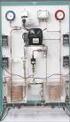
7 pressure at rest reduces to 58.7 bar. Further reduction of the rest pressure can be obtained by increasing the volume of the accumulator or by decreasing the internal volume of evaporator, gas cooler or tubing. Note that an evaporation temperature of 5 C corresponds to a pressure of 40 bar; hence significant reduction of rest pressure requires large changes in system volume. 8. CURRENT STATUS A working prototype was not built under the TT project but is seen as a logical next step in order to demonstrate the technology. The design phase was concluded with a rapid prototype construction of the Stirling driven compressor, which has been used for validation of the design and to display the working principle. In Fig. 8 a picture of a heat pump fitted with the gas driven compressor is shown. As a product, the total mass of the engine driven heat pump with burner is estimated at around 30 kg. A contained material cost has been estimated at 184, - EUR per unit (December 2009). Contained material costing does not include labour, part fabrication, amortization, shipping or any other fabrication cost. It represents a minimum cost associated with the material required to manufacture the device. Production costs would therefore be naturally higher than the contained material cost. Gas driven compressor Gas cooler Evaporator Internal heat exchanger Blower Expansion organ Figure 8: Gas driven compressor integrated in heat pump prototype is built using R-407C components, high pressure refrigerant circuit in red, low pressure refrigerant circuit in blue, water circuit in green, air supply in yellow and brine circuit in copper 7

8 9. CONCLUSIONS The Terra Therma project showed that R-744 is an acceptable fluid for the contradicting requirements of the heat pump and the Stirling engine and that a practical product package can be designed around this concept. From comparison of the performance predictions with high-efficiency electrical heat pumps, similar thermal efficiencies have been found for these devices. Since natural gas costs are generally lower than electrical costs per unit of energy, a substantial cost savings is possible to the end user. High pressures in a sealed system can be adequately and safely dealt with by proper design considerations. However, the engine driven compressor will not be an off-shelf replacement of an electrical compressor but rather part of a complete integrated system. ACKNOWLEDGMENT This work has been conducted by the Terra Therma Consortium sponsored by the E.U., under the FP6 framework, consisting of the following companies: Baxi (U.K.), Centre for Renewable Energy Sources (Greece), Sustainable Engine Systems, Ltd. (U.K.), Tecnica en Instalaciones de Fluidos SL (Spain), Renewables Ireland, Ltd (U.K.), Re/genT BV (the Netherlands), Tracto-Technik Spezialmaschinen GmbH (Germany), Global Cooling BV (the Netherlands) and Pera Innovation Limited (U.K.). All assistance is gratefully acknowledged. NOMENCLATURE P in Input mechanical power (W) ε b Fractional loss due to gas bearings (-) P in Input mechanical power (W) ε d Fractional losss due to dead volume (-) Q gc Heat rejection gascooler (W) ε l Fractional losses due to leakage (-) V swept swept volume of compressor (m 3 ) η i isentropic efficiency (-) X p Piston displacement (mm) η v volumteric efficiency (-) h i Enthalpy change due to isentropic ρ suc suction gas denisty (kg m -3 ) compression (J kg -1 ) h gc Enthalpy change in gascooler (J kg -1 ) ω Frequency (rad s -1 ) REFERENCES Berchowitz D., Janssen M., Beek M., Hagedorn A., CO2 Based Free-Piston Stirling Heat Pump with Ground Source Heat Reservoir. Proc. 14 th ISEC, Groningen, The Netherlands. Chen G., McEntee J., Development of a 3-KW free-piston Stirling engine with the displacer gas spring partially sprung to the power piston. Proc. 26 th IECEC, Boston, Massachusetts. EEA, European Environment Agency, Energy losses in transformation and distribution, ENER Little A. D, Status of Free-Piston Stirling Engine Driven Heat Pumps Development issues and Options, Final Report, Report ORNL/Sub/ /1, US DOE, Cambridge, MA. Lundqvist G., Stirling cycle heat pumps and refrigerators. doctoral thesis, Royal Institute of technology, Stockholm, Sweden. Moynihan T. M.., Ackermann R. A, Test results of a Stirling-engine heat actuated heat-pump breadboard system. Proc.15 th IECEC, Seattle, Washington. MITI, NEDO and Heat Pump Technology Center Of Japan, Stirling engine technology in Japan. Proc. of the International Symposium on the Stirling Engine and its applications to heat pump systems, Tokyo. Penswick L.B., And Urieli I., Duplex Stirling machines. Proc. 19 th IECEC, San Fransisco, California. Richards W.D.C., Auxer W.L., Performance of a Stirling engine powered heat activated heat pump. Proc. 15 th IECEC, San Diego, California. Wood J.G., Unger R. and Lane N.W., 2002, A Stirling Rankine fuel fired heat pump, Proc. ICEC, Purdue. 8

UNIT 2 REFRIGERATION CYCLE
 UNIT 2 REFRIGERATION CYCLE Refrigeration Cycle Structure 2. Introduction Objectives 2.2 Vapour Compression Cycle 2.2. Simple Vapour Compression Refrigeration Cycle 2.2.2 Theoretical Vapour Compression
Measurement And Application of Performance Characteristics Of A Free Piston Stirling Cooler
 Purdue University Purdue e-pubs International Refrigeration and Air Conditioning Conference School of Mechanical Engineering 00 Measurement And Application of Performance Characteristics Of A Free Piston
How To Calculate The Performance Of A Refrigerator And Heat Pump
 THERMODYNAMICS TUTORIAL 5 HEAT PUMPS AND REFRIGERATION On completion of this tutorial you should be able to do the following. Discuss the merits of different refrigerants. Use thermodynamic tables for
APPLIED THERMODYNAMICS TUTORIAL 1 REVISION OF ISENTROPIC EFFICIENCY ADVANCED STEAM CYCLES
 APPLIED THERMODYNAMICS TUTORIAL 1 REVISION OF ISENTROPIC EFFICIENCY ADVANCED STEAM CYCLES INTRODUCTION This tutorial is designed for students wishing to extend their knowledge of thermodynamics to a more
Lesson. 11 Vapour Compression Refrigeration Systems: Performance Aspects And Cycle Modifications. Version 1 ME, IIT Kharagpur 1
 Lesson Vapour Compression Refrigeration Systems: Performance Aspects And Cycle Modifications Version ME, IIT Kharagpur The objectives of this lecture are to discuss. Performance aspects of SSS cycle and
A Stirling-Rankine Fuel-Fired Heat Pump
 Purdue University Purdue e-pubs International Compressor Engineering Conference School of Mechanical Engineering 2000 A Stirling-Rankine Fuel-Fired Heat Pump J. G. Wood Sunpower R. Unger Sunpower N. W.
PERFORMANCE ANALYSIS OF VAPOUR COMPRESSION REFRIGERATION SYSTEM WITH R404A, R407C AND R410A
 Int. J. Mech. Eng. & Rob. Res. 213 Jyoti Soni and R C Gupta, 213 Research Paper ISSN 2278 149 www.ijmerr.com Vol. 2, No. 1, January 213 213 IJMERR. All Rights Reserved PERFORMANCE ANALYSIS OF VAPOUR COMPRESSION
HIGH-EFFICIENCY CO 2 HEAT PUMP WATER HEATER SYSTEMS FOR RESIDENTIAL AND NON-RESIDENTIAL BUILDINGS
 1 HIGH-EFFICIENCY CO 2 HEAT PUMP WATER HEATER SYSTEMS FOR RESIDENTIAL AND NON-RESIDENTIAL BUILDINGS Jørn Stene SINTEF Energy Research, 7465 Trondheim, Norway [email protected] In hotels, hospitals,
DEVELOPMENT OF A TWIN SCREW EXPRESSOR AS A THROTTLE VALVE REPLACEMENT FOR WATER-COOLED CHILLERS
 DEVELOPMENT OF A TWIN SCREW EXPRESSOR AS A THROTTLE VALVE REPLACEMENT FOR WATER-COOLED CHILLERS J J Brasz, Carrier Corporation, Syracuse, NY, 13221, USA [email protected] I K Smith and N Stosic
POSSIBILITY FOR MECHANICAL VAPOR RE-COMPRESSRION FOR STEAM BASED DRYING PROCESSES
 POSSIBILITY FOR MECHANICAL VAPOR RE-COMPRESSRION FOR STEAM BASED DRYING PROCESSES M. Bantle 1, I. Tolstorebrov, T. M. Eikevik 2 1 Department of Energy Efficiency, SINTEF Energy Research, Trondheim, Norway,
Increasing the evaporation temperature with the help of an internal heat exchanger
 Increasing the evaporation temperature with the help of an internal heat exchanger A. TAMBOVTSEV (a), H. QUACK (b) (a,b) Technische Universität Dresden, D-01062, Dresden, Germany (a) Fax: (+49351) 463-37247,
PG Student (Heat Power Engg.), Mechanical Engineering Department Jabalpur Engineering College, India. Jabalpur Engineering College, India.
 International Journal of Emerging Trends in Engineering and Development Issue 3, Vol. (January 23) EFFECT OF SUB COOLING AND SUPERHEATING ON VAPOUR COMPRESSION REFRIGERATION SYSTEMS USING 22 ALTERNATIVE
FUNDAMENTALS OF ENGINEERING THERMODYNAMICS
 FUNDAMENTALS OF ENGINEERING THERMODYNAMICS System: Quantity of matter (constant mass) or region in space (constant volume) chosen for study. Closed system: Can exchange energy but not mass; mass is constant
Research on the Air Conditioning Water Heater System
 Purdue University Purdue e-pubs International Refrigeration and Air Conditioning Conference School of Mechanical Engineering 28 Research on the Air Conditioning Water Heater System Fei Liu Gree Electric
Experimental Analysis of a Variable Capacity Heat Pump System Focusing on the Compressor and Inverter Loss Behavior
 Purdue University Purdue e-pubs International Refrigeration and Air Conditioning Conference School of Mechanical Engineering 21 Experimental Analysis of a Variable Capacity Heat Pump System Focusing on
Refrigeration and Airconditioning Prof. M. Ramgopal Department of Mechanical Engineering Indian Institute of Technology, Kharagpur
 Refrigeration and Airconditioning Prof. M. Ramgopal Department of Mechanical Engineering Indian Institute of Technology, Kharagpur Lecture No. # 22 Refrigeration System Components: Compressor (Continued)
The Second Law of Thermodynamics
 The Second aw of Thermodynamics The second law of thermodynamics asserts that processes occur in a certain direction and that the energy has quality as well as quantity. The first law places no restriction
AIR REVERSING R744 AIR CONDITIONING SYSTEM
 AIR REVERSING R744 AIR CONDITIONING SYSTEM A.HAFNER 1 ; D.J. GARSKI 2 ; J. MANZIONE 3 1 SINTEF Energy Research, 7465 Trondheim, Norway, [email protected] 2 MODINE, Racine, USA, [email protected]
Waste Heat Recovery through Air Conditioning System
 International Journal of Engineering Research and Development e-issn: 2278-067X, p-issn : 2278-800X, www.ijerd.com Volume 5, Issue 3 (December 2012), PP. 87-92 Waste Heat Recovery through Air Conditioning
Environmental and Safety Impacts of HFC Emission Reduction Options for Air Conditioning and Heat Pump Systems
 Environmental and Safety Impacts of HFC Emission Reduction Options for Air Conditioning and Heat Pump Systems William M. Corcoran, George Rusch, Mark W. Spatz, and Tim Vink AlliedSignal, Inc. ABSTRACT
High Pressure Ammonia Systems New Opportunities
 Purdue University Purdue e-pubs International Refrigeration and Air Conditioning Conference School of Mechanical Engineering 2010 High Pressure Ammonia Systems New Opportunities Andy Pearson Star Refrigeration
Analysis of Ammonia Water (NH3-H2O) Vapor Absorption Refrigeration System based on First Law of Thermodynamics
 International Journal of Scientific & Engineering Research Volume 2, Issue 8, August-2011 1 Analysis of Ammonia Water (NH3-H2O) Vapor Absorption Refrigeration System based on First Law of Thermodynamics
An analysis of a thermal power plant working on a Rankine cycle: A theoretical investigation
 An analysis of a thermal power plant working on a Rankine cycle: A theoretical investigation R K Kapooria Department of Mechanical Engineering, BRCM College of Engineering & Technology, Bahal (Haryana)
The Second Law of Thermodynamics
 Objectives MAE 320 - Chapter 6 The Second Law of Thermodynamics The content and the pictures are from the text book: Çengel, Y. A. and Boles, M. A., Thermodynamics: An Engineering Approach, McGraw-Hill,
FEASIBILITY OF A BRAYTON CYCLE AUTOMOTIVE AIR CONDITIONING SYSTEM
 FEASIBILITY OF A BRAYTON CYCLE AUTOMOTIVE AIR CONDITIONING SYSTEM L. H. M. Beatrice a, and F. A. S. Fiorelli a a Universidade de São Paulo Escola Politécnica Departamento de Engenharia Mecânica Av. Prof.
Energy savings in commercial refrigeration. Low pressure control
 Energy savings in commercial refrigeration equipment : Low pressure control August 2011/White paper by Christophe Borlein AFF and l IIF-IIR member Make the most of your energy Summary Executive summary
THEORETICAL AND EXPERIMENTAL EVALUATION OF AUTOMOBILE AIR-CONDITIONING SYSTEM USING R134A
 THEORETICAL AND EXPERIMENTAL EVALUATION OF AUTOMOBILE AIR-CONDITIONING SYSTEM USING R134A Jignesh K. Vaghela Assistant Professor, Mechanical Engineering Department, SVMIT, Bharuch-392001, (India) ABSTRACT
High-Capacity and Efficiency Stirling Cycle Cryocooler
 143 1 High-Capacity and Efficiency Stirling Cycle Cryocooler L. Penswick, Ronald W. Olan, Ian Williford, Shane Draney, and G. Buchholz Infinia Technology Corporation Richland, WA 99354 ABSTRACT Infinia
How To Know If A Refrigeration System Is Efficient
 Universitatea de Ştiinţe Agricole şi Medicină Veterinară Iaşi ASSESSMENT OF E SUBCOOLING CAPABILITIES OF A ERMOELECTRIC DEVICE IN A VAPOR COMPRESSION REFRIGERATION SYSTEM R. ROŞCA 1, I. ŢENU 1, P. CÂRLESCU
ECOCIAT. Domestic hot water heat recovery unit
 Heat recovery unit Domestic hot water High energy efficiency with R410A Compact and quiet Scroll compressors Brazed-plate heat exchangers Heating Heat recovery ENVIRONMENTALLY HFC R410A PROTECTION DE FRIENDLY
Performance Evaluation of a Heat Pump System for Simultaneous Heating and Cooling
 for Simultaneous Heating and Cooling F. Sustainable Energy Centre, University of South Australia Mawson Lakes Boulevard, Mawson Lakes 5095 AUSTRALIA E-mail: [email protected] Abstract The high efficiency
REFRIGERATION (& HEAT PUMPS)
 REFRIGERATION (& HEAT PUMPS) Refrigeration is the 'artificial' extraction of heat from a substance in order to lower its temperature to below that of its surroundings Primarily, heat is extracted from
LECTURE 28 to 29 ACCUMULATORS FREQUENTLY ASKED QUESTIONS
 LECTURE 28 to 29 ACCUMULATORS FREQUENTLY ASKED QUESTIONS 1. Define an accumulator and explain its function A hydraulic accumulator is a device that stores the potential energy of an incompressible fluid
Low GWP Replacements for R404A in Commercial Refrigeration Applications
 Low GWP Replacements for R404A in Commercial Refrigeration Applications Samuel YANA MOTTA, Mark SPATZ Honeywell International, 20 Peabody Street, Buffalo, NY 14210, [email protected] Abstract
Refrigeration Basics 101. By: Eric Nelson
 Refrigeration Basics 101 By: Eric Nelson Basics Refrigeration is the removal of heat from a material or space, so that it s temperature is lower than that of it s surroundings. When refrigerant absorbs
A Comparison of an R22 and an R410A Air Conditioner Operating at High Ambient Temperatures
 R2-1 A Comparison of an R22 and an R410A Air Conditioner Operating at High Ambient Temperatures W. Vance Payne and Piotr A. Domanski National Institute of Standards and Technology Building Environment
Thermodynamics - Example Problems Problems and Solutions
 Thermodynamics - Example Problems Problems and Solutions 1 Examining a Power Plant Consider a power plant. At point 1 the working gas has a temperature of T = 25 C. The pressure is 1bar and the mass flow
News in Data Center Cooling
 News in Data Center Cooling Wednesday, 8th May 2013, 16:00h Benjamin Petschke, Director Export - Products Stulz GmbH News in Data Center Cooling Almost any News in Data Center Cooling is about increase
Why and How we Use Capacity Control
 Why and How we Use Capacity Control On refrigeration and air conditioning applications where the load may vary over a wide range, due to lighting, occupancy, product loading, ambient weather variations,
Chapter 3.4: HVAC & Refrigeration System
 Chapter 3.4: HVAC & Refrigeration System Part I: Objective type questions and answers 1. One ton of refrigeration (TR) is equal to. a) Kcal/h b) 3.51 kw c) 120oo BTU/h d) all 2. The driving force for refrigeration
Testing methods applicable to refrigeration components and systems
 Testing methods applicable to refrigeration components and systems Sylvain Quoilin (1)*, Cristian Cuevas (2), Vladut Teodorese (1), Vincent Lemort (1), Jules Hannay (1) and Jean Lebrun (1) (1) University
ARP Food Industry, Portugal
 Food Industry, Portugal In a Portuguese food company colibri will install a twostage ammonia-water-absorption refrigeration system. The 1st refrigeration stage provides the customer with liquid ammonia
Distributed Solar-Thermal-Electric Generation and Storage Seth R. Sanders, Artin Der Minassians, Mike He EECS Department, UC Berkeley
 Distributed Solar-Thermal-Electric Generation and Storage Seth R. Sanders, Artin Der Minassians, Mike He EECS Department, UC Berkeley Technology: rooftop solar thermal collector + thermal energy storage
Commercial refrigeration has been in the environmental. Refrigerant. as a. Basics Considerations PART 1:
 PART 1: CO 2 Commercial refrigeration has been in the environmental spotlight for more than a decade, especially as leakage studies have revealed the true effects of hydrofluorocarbon (HFC) emissions.
Mohan Chandrasekharan #1
 International Journal of Students Research in Technology & Management Exergy Analysis of Vapor Compression Refrigeration System Using R12 and R134a as Refrigerants Mohan Chandrasekharan #1 # Department
OUTCOME 2 INTERNAL COMBUSTION ENGINE PERFORMANCE. TUTORIAL No. 5 PERFORMANCE CHARACTERISTICS
 UNIT 61: ENGINEERING THERMODYNAMICS Unit code: D/601/1410 QCF level: 5 Credit value: 15 OUTCOME 2 INTERNAL COMBUSTION ENGINE PERFORMANCE TUTORIAL No. 5 PERFORMANCE CHARACTERISTICS 2 Be able to evaluate
Top Technology for Industry, Agriculture, Business and Communities
 Top Technology for Industry, Agriculture, Business and Communities CHP The Technology with a Potential for Saving Energy Combined Heat and Power (CHP) is a highly efficient technology for the conversion
Ambient Energy Fraction of a Heat Pump
 Ambient Energy Fraction of a Heat Pump u Aye, R. J. Fuller and.. S. Charters International Technologies Centre (IDTC) Department of Civil and Environmental Engineering The University of Melbourne Vic 3010
D A T A S H E E T. TX6 Thermo Expansion Valves. Alco Controls TX6. Features. Introduction. Construction
 ALCO s series of Thermo -Expansion Valves are designed for air conditioning, chillers, rooftops, close control, A/C transportation, heat pumps, industrial cooling process and refrigeration applications.
Daikin Altherma hybrid heat pump. The natural combination
 Daikin Altherma hybrid heat pump The natural combination Daikin Altherma hybrid heat pump, the natural combination Why choose Daikin Altherma hybrid heat pump? What the customer wants: more energy efficient
AMMONIA AND CARBON DIOXIDE HEAT PUMPS FOR HEAT RECOVERY IN INDUSTRY
 AMMONIA AND CARBON DIOXIDE HEAT PUMPS FOR HEAT RECOVERY IN INDUSTRY Wiebke Brix (a), Stefan W. Christensen (b), Michael M. Markussen (c), Lars Reinholdt (d) and Brian Elmegaard (a) (a) DTU Technical University
Scroll Compressor Development for Air-Source Heat Pump Water Heater Applications
 Purdue University Purdue e-pubs International Refrigeration and Air Conditioning Conference School of Mechanical Engineering 2008 Scroll Compressor Development for Air-Source Heat Pump Water Heater Applications
A car air-conditioning system based on an absorption refrigeration cycle using energy from exhaust gas of an internal combustion engine
 A car air-conditioning system based on an absorption refrigeration cycle using energy from exhaust gas of an internal combustion engine G Vicatos J Gryzagoridis S Wang Department of Mechanical Engineering,
Stirling heat engine Internal combustion engine (Otto cycle) Diesel engine Steam engine (Rankine cycle) Kitchen Refrigerator
 Lecture. Real eat Engines and refrigerators (Ch. ) Stirling heat engine Internal combustion engine (Otto cycle) Diesel engine Steam engine (Rankine cycle) Kitchen Refrigerator Carnot Cycle - is not very
Guidelines of how to instrument, measure and evaluate refrigeration systems in supermarkets PAU GIMÉNEZ GAVARRELL
 Guidelines of how to instrument, measure and evaluate refrigeration systems in supermarkets PAU GIMÉNEZ GAVARRELL Master of Science Thesis Stockholm, Sweden 2011 What is not measured does not exist; What
New Trends in the Field of Automobile Air Conditioning
 New Trends in the Field of Automobile Air Conditioning E. Janotkova and M. Pavelek Department of Thermomechanics and Environmental Engineering Brno University of Technology, 61669 Brno, Czech Republic
A/C refrigerant system, overview
 Page 1 of 19 87-18 A/C refrigerant system, overview A/C refrigerant system, identification Typical A/C refrigerant system with expansion valve and receiver drier 1 - Evaporator 2 - Expansion valve 3 -
Variable Capacity Compressors, a new dimension for refrigeration engineers to explore
 Variable Capacity Compressors, a new dimension for refrigeration engineers to explore By: Marcos G. Schwarz, VCC Group Leader Corporate Research & Development, EMBRACO SA Abstract: This paper presents
How Ground/Water Source Heat Pumps Work
 How Ground/Water Source s Work Steve Kavanaugh, Professor Emeritus of Mechanical Engineering, University of Alabama Ground Source s (a.k.a. Geothermal s) are becoming more common as the costs of energy
High Performance Free-Piston Stirling Engines
 High Performance Free-Piston Stirling Engines Unrivalled Performance Energy Efficient Compact Robust Long-Lived Experience the Benefits of Unique Free-Piston Stirling Technology Benefits of Patented Sunpower
Daikin Altherma. hybrid heat pump. The natural combination
 Daikin Altherma hybrid heat pump The natural combination Why choose Daikin? As an industry leader, Daikin combines broad experience, technical innovation and responsive customer service to help you meet
Air-sourced 90 Hot Water Supplying Heat Pump "HEM-90A"
 Air-sourced 90 Hot Water Supplying Heat Pump "HEM-90A" Takahiro OUE *1, Kazuto OKADA *1 *1 Refrigeration System & Energy Dept., Compressor Div., Machinery Business Kobe Steel has developed an air-sourced
Energy Analysis and Comparison of Advanced Vapour Compression Heat Pump Arrangements
 Energy Analysis and Comparison of Advanced Vapour Compression Heat Pump Arrangements Stuart Self 1, Marc Rosen 1, and Bale Reddy 1 1 University of Ontario Institute of Technology, Oshawa, Ontario Abstract
CHAPTER 7 THE SECOND LAW OF THERMODYNAMICS. Blank
 CHAPTER 7 THE SECOND LAW OF THERMODYNAMICS Blank SONNTAG/BORGNAKKE STUDY PROBLEM 7-1 7.1 A car engine and its fuel consumption A car engine produces 136 hp on the output shaft with a thermal efficiency
Natural geothermal energy.
 ROTEX ground source heat pump Natural geothermal energy. ROTEX HPU ground the ground source heat pump that heats with free geothermal energy. Compact, environmentally responsible and uniquely efficient.
APPLICATIONS AND DEFINITIONS
 HEAT PUMP APPLICATIONS AND DEFINITIONS Per Fahlén SP Energy Technology APPLICATIONS OF HEAT PUMPS 900s: Refrigeration, need to chill food; Survival: very large application; chilled food comprises Turnover:
LG Electronics AE Company, Commercial Air Conditioning
 www.lgeaircon.com New concept Ecofriendly Highefficiency Heating solution Total heating & Hot water Solution for MULTI V LG Electronics AE Company, Commercial Air Conditioning 2 Yeouidodong, Yeongdeungpogu,
Field test of a novel combined solar thermal and heat pump system with an ice store
 Field test of a novel combined solar thermal and system with an ice store Anja Loose Institute for Thermodynamics and Thermal Engineering (ITW), Research and Testing Centre for Thermal Solar Systems (TZS),
AdSORPTION CHILLER NAK
 AdSORPTION CHILLER NAK Chilling Capacity from 50 to 430 kw Usage of Surplus Heat from 50 C Ã*%8ÃPE+Ã TECHNICAL DESCRIPTION ADSORPTION CHILLER NAK 1 INTRODUCTION... 2 2 THE PRINCIPLE OF ADSORPTION... 2
Development of a model for the simulation of Organic Rankine Cycles based on group contribution techniques
 ASME Turbo Expo Vancouver, June 6 10 2011 Development of a model for the simulation of Organic Rankine ycles based on group contribution techniques Enrico Saverio Barbieri Engineering Department University
We will try to get familiar with a heat pump, and try to determine its performance coefficient under different circumstances.
 C4. Heat Pump I. OBJECTIVE OF THE EXPERIMENT We will try to get familiar with a heat pump, and try to determine its performance coefficient under different circumstances. II. INTRODUCTION II.1. Thermodynamic
ALONE. small scale solar cooling device Project No TREN FP7EN 218952. Project No TREN/FP7EN/218952 ALONE. small scale solar cooling device
 Project No TREN/FP7EN/218952 ALONE small scale solar cooling device Collaborative Project Small or Medium-scale Focused Research Project DELIVERABLE D5.2 Start date of the project: October 2008, Duration:
Study on Design and Performance Prediction Methods for Miniaturized Stirling Engine
 99SETC-42 Study on Design and Performance Prediction Methods for Miniaturized Stirling Engine Copyright 1998 Society of Automotive Engineers, Inc. Koichi HIRATA, Dr. Power and Energy Engineering Division,
CONTENTS. ZVU Engineering a.s., Member of ZVU Group, WASTE HEAT BOILERS Page 2
 WASTE HEAT BOILERS CONTENTS 1 INTRODUCTION... 3 2 CONCEPTION OF WASTE HEAT BOILERS... 4 2.1 Complex Solution...4 2.2 Kind of Heat Exchange...5 2.3 Heat Recovery Units and Their Usage...5 2.4 Materials
Thermal Coupling Of Cooling and Heating Systems
 This article was published in ASHRAE Journal, February 2011. Copyright 2011 American Society of Heating, Refrigerating and Air-Conditioning Engineers, Inc. Posted at www.ashrae.org. This article may not
AE21-1319 R6 December 2013. Digital Capacity Control for Copeland Scroll Refrigeration Compressors AE21-1319 R6
 AE21-1319 R6 December 2013 Digital Capacity Control for Copeland Scroll Refrigeration Compressors TABLE OF CONTENTS Section Page Section Page Safety Safety Instructions...2 Safety Icon Explanation...2
HEAT PUMPS A KEY COMPONENT IN LOW CARBON FUTURE
 HEAT PUMPS A KEY COMPONENT IN LOW CARBON FUTURE Satish Joshi Managing Director CONTENTS 1. INTRODUCTION, APPLICATIONS 2. TECHNOLOGY, PROJECTS DONE, COST COMPARISION 3. HEAT PUMPS IN THE RENEWABLES DIRECTIVE,
The Development of Heat Pump Water Heaters Using CO 2 Refrigerant
 The Development of Heat Pump Heaters Using CO 2 Refrigerant Shigeharu TAIRA* * DAIKIN Industries, Ltd., 1000-2 Aza-Ohtani, Okamoto-cho, Kusatsu, Shiga 525-8526 Abstract heating consumes about one-third
TEST REPORT #31. System Drop-in Test of Refrigerant R-32 in Split Air-conditioning System
 Air-Conditioning, Heating, and Refrigeration Institute (AHRI) Low-GWP Alternative Refrigerants Evaluation Program (Low-GWP AREP) TEST REPORT #31 System Drop-in Test of Refrigerant R-32 in Split Air-conditioning
Michael Montgomery Marketing Product Manager Rosemount Inc. Russ Evans Manager of Engineering and Design Rosemount Inc.
 ASGMT / Averaging Pitot Tube Flow Measurement Michael Montgomery Marketing Product Manager Rosemount Inc. Russ Evans Manager of Engineering and Design Rosemount Inc. Averaging Pitot Tube Meters Introduction
ADVANCES IN SUPERMARKET REFRIGERATION SYSTEMS
 ADVANCES IN SUPERMARKET REFRIGERATION SYSTEMS Van D. Baxter, Oak Ridge National Laboratory, Oak Ridge, TN 37831-6070 ABSTRACT Present supermarket refrigeration systems require very large refrigerant charges
Performance Improvement of an Air Conditioning System Using Matrix Heat Exchanger
 International Journal of Engineering Research and Development e-issn: 2278-067X, p-issn: 2278-800X, www.ijerd.com Volume 2, Issue 11 (August 2012), PP. 66-70 Performance Improvement of an Air Conditioning
جامعة البلقاء التطبيقية
 AlBalqa Applied University تا سست عام 997 The curriculum of associate degree in Air Conditioning, Refrigeration and Heating Systems consists of (7 credit hours) as follows: Serial No. Requirements First
Chapter 2 P-H Diagram Refrigeration Cycle Analysis & Refrigerant Flow Diagram
 Chapter 2 P-H Diagram Refrigeration Cycle Analysis & Refrigerant Flow Diagram Copy Right By: Thomas T.S. Wan 温 到 祥 著 Sept. 3, 2008 All rights reserved Industrial refrigeration system design starts from
Condensers & Evaporator Chapter 5
 Condensers & Evaporator Chapter 5 This raises the condenser temperature and the corresponding pressure thereby reducing the COP. Page 134 of 263 Condensers & Evaporator Chapter 5 OBJECTIVE QUESTIONS (GATE,
Boiler Calculations. Helsinki University of Technology Department of Mechanical Engineering. Sebastian Teir, Antto Kulla
 Helsinki University of Technology Department of Mechanical Engineering Energy Engineering and Environmental Protection Publications Steam Boiler Technology ebook Espoo 2002 Boiler Calculations Sebastian
GEOTHERMAL POWER PLANT CYCLES AND MAIN COMPONENTS
 Presented at Short Course on Geothermal Drilling, Resource Development and Power Plants, organized by UNU-GTP and LaGeo, in Santa Tecla, El Salvador, January -, 0. GEOTHERMAL TRAINING PROGRAMME LaGeo S.A.
How To Power A Power Plant With Waste Heat
 Power Generation Siemens Organic Rankine Cycle Waste Heat Recovery with ORC Answers for energy. Table of Contents Requirements of the Future Power Supply without extra Fuel Siemens ORC-Module Typical Applications
Transient Analysis of Integrated Shiraz Hybrid Solar Thermal Power Plant Iman Niknia 1, Mahmood Yaghoubi 1, 2
 Transient Analysis of Integrated Shiraz Hybrid Solar Thermal Power Plant Iman Niknia 1, Mahmood Yaghoubi 1, 2 1 School of Mechanical Engineering, Shiraz University, Shiraz, Iran 1, 2 Shiraz University,
Unit 24: Applications of Pneumatics and Hydraulics
 Unit 24: Applications of Pneumatics and Hydraulics Unit code: J/601/1496 QCF level: 4 Credit value: 15 OUTCOME 2 TUTORIAL 2 HYDRAULIC AND PNEUMATIC CYLINDERS The material needed for outcome 2 is very extensive
Solenoid valves Type EVU
 Data sheet Solenoid valves EVU EVU solenoid valves are designed to fit into compact refrigeration systems. Available in direct and pilot operated versions, they can be applied in liquid, suction, and hot
Analytical Study of Vapour Compression Refrigeration System Using Diffuser and Subcooling
 IOSR Journal of Mechanical and Civil Engineering (IOSR-JMCE) e-issn: 2278-1684,p-ISSN: 2320-334X, Volume 11, Issue 3 Ver. VII (May- Jun. 2014), PP 92-97 Analytical Study of Vapour Compression Refrigeration
Optimization of combined heating and cooling in Supermarkets
 Optimization of combined heating and cooling in Supermarkets Funder-Kristensen T. 1 ; Fösel G. 2 and Bjerg P. 3 1 Ph.d. Head of Public & Industry Affairs, Danfoss, Nordborg, 6430, Denmark. 2 Dipl.-Ing.
C H A P T E R T W O. Fundamentals of Steam Power
 35 C H A P T E R T W O Fundamentals of Steam Power 2.1 Introduction Much of the electricity used in the United States is produced in steam power plants. Despite efforts to develop alternative energy converters,
Energy Efficient Ammonia Heat Pump. Energy and Climate Refrigeration and Heat Pump Technology
 Energy and Climate Refrigeration and Heat Pump Technology Energy Efficient Ammonia Heat Pump PSO no. 342-059 Claus Madsen Bastiaan Pijnenburg Henning Schumann Grindorf Rolf Christensen Bjarne D. Rasmussen
Unit 24: Applications of Pneumatics and Hydraulics
 Unit 24: Applications of Pneumatics and Hydraulics Unit code: J/601/1496 QCF level: 4 Credit value: 15 OUTCOME 2 TUTORIAL 3 HYDRAULIC AND PNEUMATIC MOTORS The material needed for outcome 2 is very extensive
STEAM TURBINE 1 CONTENT. Chapter Description Page. V. Steam Process in Steam Turbine 6. VI. Exhaust Steam Conditions, Extraction and Admission 7
 STEAM TURBINE 1 CONTENT Chapter Description Page I Purpose 2 II Steam Turbine Types 2 2.1. Impulse Turbine 2 2.2. Reaction Turbine 2 III Steam Turbine Operating Range 2 3.1. Curtis 2 3.2. Rateau 2 3.3.
saving energy in comfort Factsheet Recair Enthalpy
 saving energy in comfort Factsheet Recair Enthalpy Introduction Enthalpy Exchanger The enthalpy exchanger is able to transfer both sensible heat and latent heat (moisture) from the cooled to the heated
Development of Air-to-Water Heat Pump for Home Air conditioning/hot Water Supply Combination System with Chilled/Hot Water in European Markets
 2 Development of Air-to-Water Heat Pump for Home Air conditioning/hot Water Supply Combination System with Chilled/Hot Water in European Markets - Extending Use of New Heat Pump System in Cold Regions