
Work hard. Be nice. Name: Period: Date: UNIT 1: Introduction to Matter Lesson 4: A Fine Line Between Compounds and Mixtures
|
|
|
- Duane Peters
- 9 years ago
- Views:
Transcription
1 Name: Period: Date: UNIT 1: Introduction to Matter Lesson 4: A Fine Line Between Compounds and Mixtures Do Now: PRE-READING OPEN-NOTES QUIZ! By the end of today, you will have an answer to: How do pure substances differ from mixtures? CATALYST Think! What is the difference between salt and salt water? SALT (Compound) SALT WATER (Mixture) Chemical Formula NaCl (s) NaCl (aq) QUESTION: What differences do you notice in the chemical formula for a compound (salt) versus a mixture (salt water)? Draw a Particle Diagram using the key provided on the board. What is the difference between the two particle diagrams you drew? Salt water (NaCl(aq)) The two pure substances that make up salt water are: How can we physically separate the salt from the water?


2 HOW DO WE REPRESENT MATTER IN CHEMISTRY? MATTER Has Mass and Takes Up Space PURE SUBSTANCE A substance with a uniform and constant composition. ***Pure Substances cannot be separated through physical means***. MIXTURES ELEMENTS A pure substance composed of only one type of atom. Elements cannot be chemically decomposed. Where are they found? The Periodic Table and Table S! COMPOUNDS A pure substance composed of two or more different elements chemically combined. Compounds can be decomposed through chemical means. HOMOGENEOUS MIXTURE Examples: HETEROGENEOUS MIXTURE Examples: Particle Diagram: Particle Diagram:

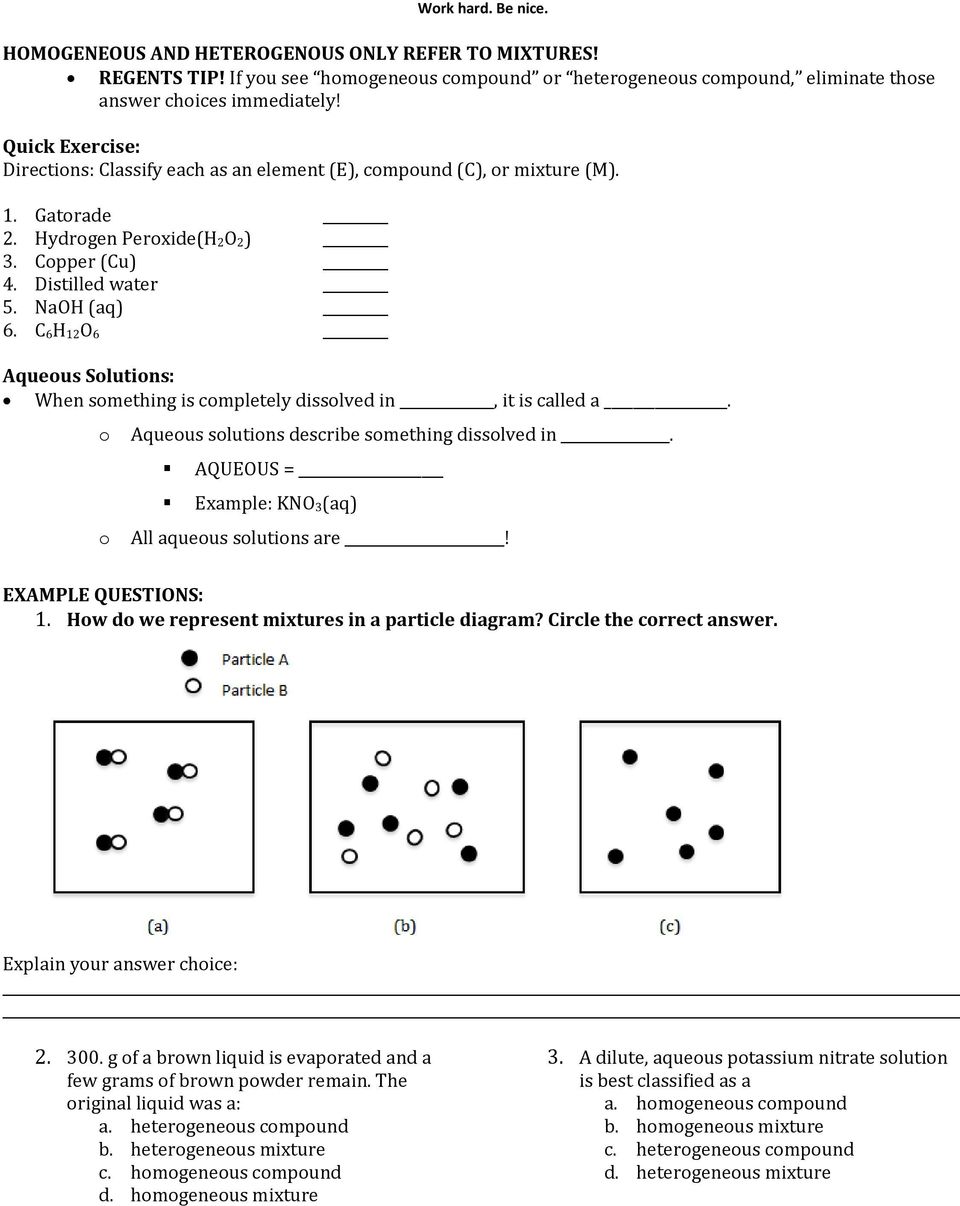
3 HOMOGENEOUS AND HETEROGENOUS ONLY REFER TO MIXTURES! REGENTS TIP! If you see homogeneous compound or heterogeneous compound, eliminate those answer choices immediately! Quick Exercise: Directions: Classify each as an element (E), compound (C), or mixture (M). 1. Gatorade 2. Hydrogen Peroxide(H 2O 2) 3. Copper (Cu) 4. Distilled water 5. NaOH (aq) 6. C 6H 12O 6 Aqueous Solutions: When something is completely dissolved in, it is called a. o o Aqueous solutions describe something dissolved in. AQUEOUS = Example: KNO 3(aq) All aqueous solutions are! EXAMPLE QUESTIONS: 1. How do we represent mixtures in a particle diagram? Circle the correct answer. Explain your answer choice: g of a brown liquid is evaporated and a few grams of brown powder remain. The original liquid was a: a. heterogeneous compound b. heterogeneous mixture c. homogeneous compound d. homogeneous mixture 3. A dilute, aqueous potassium nitrate solution is best classified as a a. homogeneous compound b. homogeneous mixture c. heterogeneous compound d. heterogeneous mixture
4 Name: Pd: Date: Chemistry WORK 1.4- Mixtures 10 points Summary: 1. Explain how a mixture differs from a pure substance. 2. Explain how homogeneous mixtures differ from heterogeneous mixtures. 3. Why do you think there are infinitely more mixtures than pure substances? Regents Review of All Types of Matter! 1. Which substance can be decomposed by chemical change? (Use Table S) (1) beryllium (2) boron (3) methanol (4) magnesium 6. Which is an example of a compound? (1) ammonia (2) calcium (3) diamond (4) uranium 2. One similarity between all mixtures and compounds is that both (1) Are heterogeneous (2) Are homogeneous (3) Combine in a definite proportion (4) Consist of two or more substances 3. Which substance can be decomposed by a chemical change? (1) Co (2) CO (3) Cr (4) Cu 4. Which pair is classified as chemical substances? (1) mixtures and solutions (2) compounds and solutions (3) elements and mixtures (4) compounds and elements 5. An example of a heterogeneous mixtures is (1) soil (2) sugar (3) carbon monoxide (4) carbon dioxide 7. Which is a characteristic of all mixtures? (1) They are homogeneous. (2) They are heterogeneous. (3) Their composition is a definite ratio. (4) Their composition can be varied. 8. Which sample represents a homogeneous mixture? (1) C 2H 5OH (l) (2) C 2H 5OH (aq) (3) C 2H 5OH (g) (4) C 2H 5OH (s) 9. Which material is a mixture? (1) water (2) air (3) methane (4) magnesium 10. In an equation, which symbol would indicate a mixture? (1) NH 3 (s) (2) NH 3 (l) (3) NH 3 (aq) (4) NH 3 (g)

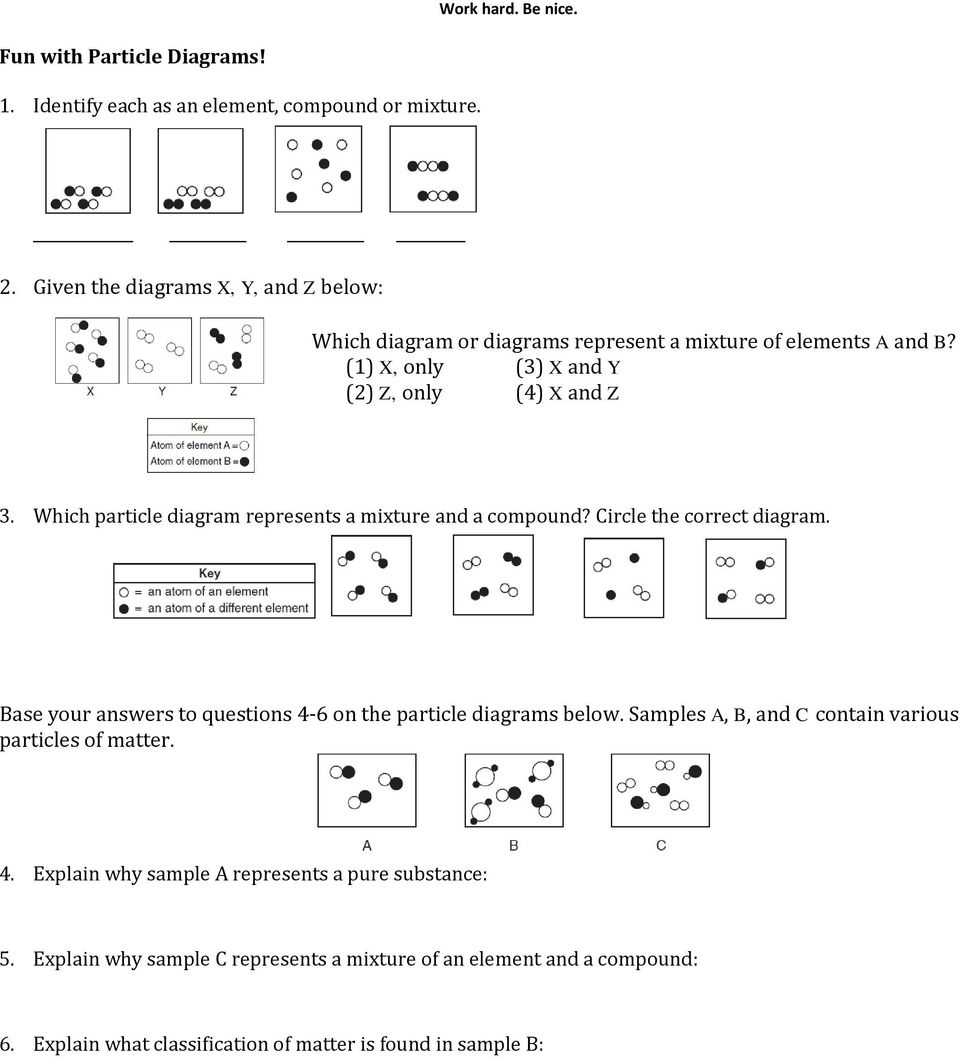
5 Fun with Particle Diagrams! 1. Identify each as an element, compound or mixture. 2. Given the diagrams X, Y, and Z below: Which diagram or diagrams represent a mixture of elements A and B? (1) X, only (3) X and Y (2) Z, only (4) X and Z 3. Which particle diagram represents a mixture and a compound? Circle the correct diagram. Base your answers to questions 4-6 on the particle diagrams below. Samples A, B, and C contain various particles of matter. 4. Explain why sample A represents a pure substance: 5. Explain why sample C represents a mixture of an element and a compound: 6. Explain what classification of matter is found in sample B:
6 Name: Pd: Date: Chemistry WORK 1.4- Mixtures Particle Diagram Review 12 points Direction: Classify the following particle diagrams as an element, compound, or mixture and write your answer on the lines provide below the table WRITE YOUR ANSWERS HERE:

7 Name: Pd: Date: Chemistry HW 1.4- Extra Review 10 points Directions: Answer all questions based on your knowledge of chemistry. 1. Matter that is composed of two or more different elements chemically combined in a fixed proportion is classified as (1) an isotope (2) a mixture (3) a solution (4) a compound 2. When sodium chloride is dissolved in water, the resulting solution is classified as a (1) Heterogenous compound (2) Homogeneous compound (3) Heterogeneous mixture (4) Homogeneous mixture 3. Which substance can be broken down by chemical means? (1) CO (2) Ce (3) Ca (4) Cu Which is a homogeneous mixture? (1) I 2 (s) (2) I 2 (l) (3) HCl (g) (4) HCl (aq) 6. When sugar is dissolved in water, the resulting solution is classified as a (1) homogeneous mixture (2) heterogeneous mixture (3) homogeneous compound (4) heterogeneous compound 7. A compound differs from a mixture in that a compound always has a (1) homogeneous composition (2) maximum of two components (3) minimum of three components (4) heterogeneous composition 8. Which list of formulas represent compounds, only? (1) CO 2, H 2O, NH 3 (2) H 2, N 2, O 2 (3) H 2, Ne, NaCl (4) MgO, NaCl, O 2 9. Which substance can be decomposed by chemical means (1) tungsten (3) krypton (2) antimony (4) methane 10. Bronze contains 90 to 95 percent copper and 5 to 10 percent tin. Because these percentages can vary, bronze is classified as (1) a compound (2) an element (3) a mixture (4) a substance

8 Name: Pd: Date: Exit Ticket Quiz 1.4- Mixtures 4 points 1. Which is characteristic of all mixtures? (1) They are homogeneous (2) They are heterogeneous (3) Their compositions are in a definite ratio (4) Their compositions may vary 2. How is a homogeneous mixture different from a heterogeneous mixture?two samples of bronze, a uniform material, are analyzed and found to contain different percentages of tin. Based on this information, bronze is likely a (1) homogeneous compound (2) heterogeneous compound (3) homogeneous mixture (4) heterogeneous mixture 3. An aqueous solution of sodium chloride is best classified as a (1) homogeneous compound (2) homogeneous mixture (3) heterogeneous compound (4) heterogeneous mixture Name: Pd: Date: Exit Ticket Quiz 1.4- Mixtures 4 points 1. Which is characteristic of all mixtures? (1) They are homogeneous (2) They are heterogeneous (3) Their compositions are in a definite ratio (4) Their compositions may vary 2. How is a homogeneous mixture different from a heterogeneous mixture?two samples of bronze, a uniform material, are analyzed and found to contain different percentages of tin. Based on this information, bronze is likely a (1) homogeneous compound (2) heterogeneous compound (3) homogeneous mixture (4) heterogeneous mixture 3. An aqueous solution of sodium chloride is best classified as a (1) homogeneous compound (2) homogeneous mixture (3) heterogeneous compound (4) heterogeneous mixture

9 Name: Pd: Date: PRE-READING QUIZ 1.4- Mixtures 5 points 1. What is a mixture? [1] 2. What are the two types of mixtures? [1] 3. How are homogenous mixtures and heterogeneous mixtures different? [1] 4. List one example of a homogenous mixture and one example of a heterogeneous mixture. [2] Name: Pd: Date: PRE-READING QUIZ 1.4- Mixtures 5 points 1. What is a mixture? [1] 2. What are the two types of mixtures? [1] 3. How are homogenous mixtures and heterogeneous mixtures different? [1] 4. List one example of a homogenous mixture and one example of a heterogeneous mixture. [2]

ATOMS. Multiple Choice Questions
 Chapter 3 ATOMS AND MOLECULES Multiple Choice Questions 1. Which of the following correctly represents 360 g of water? (i) 2 moles of H 2 0 (ii) 20 moles of water (iii) 6.022 10 23 molecules of water (iv)
7-5.5. Translate chemical symbols and the chemical formulas of common substances to show the component parts of the substances including:
 7-5.5 Translate chemical symbols and the chemical formulas of common substances to show the component parts of the substances including: NaCl [salt], H 2 O [water], C 6 H 12 O 6 [simple sugar], O 2 [oxygen
Chemistry Post-Enrolment Worksheet
 Name: Chemistry Post-Enrolment Worksheet The purpose of this worksheet is to get you to recap some of the fundamental concepts that you studied at GCSE and introduce some of the concepts that will be part
Review - After School Matter Name: Review - After School Matter Tuesday, April 29, 2008
 Name: Review - After School Matter Tuesday, April 29, 2008 1. Figure 1 The graph represents the relationship between temperature and time as heat was added uniformly to a substance starting at a solid
Unit 6 The Mole Concept
 Chemistry Form 3 Page 62 Ms. R. Buttigieg Unit 6 The Mole Concept See Chemistry for You Chapter 28 pg. 352-363 See GCSE Chemistry Chapter 5 pg. 70-79 6.1 Relative atomic mass. The relative atomic mass
SCH 4C1 Unit 2 Problem Set Questions taken from Frank Mustoe et all, "Chemistry 11", McGraw-Hill Ryerson, 2001
 SCH 4C1 Unit 2 Problem Set Questions taken from Frank Mustoe et all, "Chemistry 11", McGraw-Hill Ryerson, 2001 1. A small pin contains 0.0178 mol of iron. How many atoms of iron are in the pin? 2. A sample
Formulae, stoichiometry and the mole concept
 3 Formulae, stoichiometry and the mole concept Content 3.1 Symbols, Formulae and Chemical equations 3.2 Concept of Relative Mass 3.3 Mole Concept and Stoichiometry Learning Outcomes Candidates should be
CHAPTER 3: MATTER. Active Learning Questions: 1-6, 9, 13-14; End-of-Chapter Questions: 1-18, 20, 24-32, 38-42, 44, 49-52, 55-56, 61-64
 CHAPTER 3: MATTER Active Learning Questions: 1-6, 9, 13-14; End-of-Chapter Questions: 1-18, 20, 24-32, 38-42, 44, 49-52, 55-56, 61-64 3.1 MATTER Matter: Anything that has mass and occupies volume We study
W1 WORKSHOP ON STOICHIOMETRY
 INTRODUCTION W1 WORKSHOP ON STOICHIOMETRY These notes and exercises are designed to introduce you to the basic concepts required to understand a chemical formula or equation. Relative atomic masses of
Element of same atomic number, but different atomic mass o Example: Hydrogen
 Atomic mass: p + = protons; e - = electrons; n 0 = neutrons p + + n 0 = atomic mass o For carbon-12, 6p + + 6n 0 = atomic mass of 12.0 o For chlorine-35, 17p + + 18n 0 = atomic mass of 35.0 atomic mass
B) atomic number C) both the solid and the liquid phase D) Au C) Sn, Si, C A) metal C) O, S, Se C) In D) tin D) methane D) bismuth B) Group 2 metal
 1. The elements on the Periodic Table are arranged in order of increasing A) atomic mass B) atomic number C) molar mass D) oxidation number 2. Which list of elements consists of a metal, a metalloid, and
Chapter 1: Moles and equations. Learning outcomes. you should be able to:
 Chapter 1: Moles and equations 1 Learning outcomes you should be able to: define and use the terms: relative atomic mass, isotopic mass and formula mass based on the 12 C scale perform calculations, including
Warm-Up 9/9. 1. Define the term matter. 2. Name something in this room that is not matter.
 Warm-Up 9/9 1. Define the term matter. 2. Name something in this room that is not matter. Warm-Up 9/16 1. List the three most important rules of lab safety. 2. Would you classify jello as a solid or a
5. Which temperature is equal to +20 K? 1) 253ºC 2) 293ºC 3) 253 C 4) 293 C
 1. The average kinetic energy of water molecules increases when 1) H 2 O(s) changes to H 2 O( ) at 0ºC 3) H 2 O( ) at 10ºC changes to H 2 O( ) at 20ºC 2) H 2 O( ) changes to H 2 O(s) at 0ºC 4) H 2 O( )
Calculation of Molar Masses. Molar Mass. Solutions. Solutions
 Molar Mass Molar mass = Mass in grams of one mole of any element, numerically equal to its atomic weight Molar mass of molecules can be determined from the chemical formula and molar masses of elements
Name: Teacher: Pd. Date:
 Name: Teacher: Pd. Date: STAAR Tutorial : Energy and Matter: Elements, Compounds, and Chemical Equations: 6.5C Differentiate between elements and compounds on the most basic level. 8.5F Recognize whether
MOLES AND MOLE CALCULATIONS
 35 MOLES ND MOLE CLCULTIONS INTRODUCTION The purpose of this section is to present some methods for calculating both how much of each reactant is used in a chemical reaction, and how much of each product
Chapter 3 Mass Relationships in Chemical Reactions
 Chapter 3 Mass Relationships in Chemical Reactions Student: 1. An atom of bromine has a mass about four times greater than that of an atom of neon. Which choice makes the correct comparison of the relative
MOLECULAR MASS AND FORMULA MASS
 1 MOLECULAR MASS AND FORMULA MASS Molecular mass = sum of the atomic weights of all atoms in the molecule. Formula mass = sum of the atomic weights of all atoms in the formula unit. 2 MOLECULAR MASS AND
IB Chemistry. DP Chemistry Review
 DP Chemistry Review Topic 1: Quantitative chemistry 1.1 The mole concept and Avogadro s constant Assessment statement Apply the mole concept to substances. Determine the number of particles and the amount
Heterogeneous Homogenous. Mixtures; Solutions. Phases of matter: Solid. Phases of Matter: Liquid. Phases of Matter: Gas. Solid, Liquid, Gas
 Phases of matter: Solid Heterogeneous Homogenous Mixtures Solutions Phases of Matter: Liquid Atoms and molecules are more spaced out and now can move. The material can be slightly compressed into a smaller
Periodic Table, Valency and Formula
 Periodic Table, Valency and Formula Origins of the Periodic Table Mendelѐѐv in 1869 proposed that a relationship existed between the chemical properties of elements and their atomic masses. He noticed
Unit 3 Notepack Chapter 7 Chemical Quantities Qualifier for Test
 Unit 3 Notepack Chapter 7 Chemical Quantities Qualifier for Test NAME Section 7.1 The Mole: A Measurement of Matter A. What is a mole? 1. Chemistry is a quantitative science. What does this term mean?
Honors Chemistry: Unit 6 Test Stoichiometry PRACTICE TEST ANSWER KEY Page 1. A chemical equation. (C-4.4)
 Honors Chemistry: Unit 6 Test Stoichiometry PRACTICE TEST ANSWER KEY Page 1 1. 2. 3. 4. 5. 6. Question What is a symbolic representation of a chemical reaction? What 3 things (values) is a mole of a chemical
Chemical Reactions 2 The Chemical Equation
 Chemical Reactions 2 The Chemical Equation INFORMATION Chemical equations are symbolic devices used to represent actual chemical reactions. The left side of the equation, called the reactants, is separated
Chapter 2 Atoms and Molecules
 Chapter 2 Atoms and Molecules 2-1 Elements and their symbols Most of the chemicals you find in everyday life can be broken down into simper substances Key Concepts: A substance that cannot be broken down
MOLAR MASS AND MOLECULAR WEIGHT Themolar mass of a molecule is the sum of the atomic weights of all atoms in the molecule. Molar Mass.
 Counting Atoms Mg burns in air (O 2 ) to produce white magnesium oxide, MgO. How can we figure out how much oxide is produced from a given mass of Mg? PROBLEM: If If 0.200 g of Mg is is burned, how much
IB Chemistry 1 Mole. One atom of C-12 has a mass of 12 amu. One mole of C-12 has a mass of 12 g. Grams we can use more easily.
 The Mole Atomic mass units and atoms are not convenient units to work with. The concept of the mole was invented. This was the number of atoms of carbon-12 that were needed to make 12 g of carbon. 1 mole
Concept 1. The meaning and usefulness of the mole. The mole (or mol) represents a certain number of objects.
 Chapter 3. Stoichiometry: Mole-Mass Relationships in Chemical Reactions Concept 1. The meaning and usefulness of the mole The mole (or mol) represents a certain number of objects. SI def.: the amount of
Writing and Balancing Chemical Equations
 Name Writing and Balancing Chemical Equations Period When a substance undergoes a chemical reaction, chemical bonds are broken and new bonds are formed. This results in one or more new substances, often
Chapter 16: Tests for ions and gases
 The position of hydrogen in the reactivity series Hydrogen, although not a metal, is included in the reactivity series because it, like metals, can be displaced from aqueous solution, only this time the
Coimisiún na Scrúduithe Stáit State Examinations Commission
 2015. M33 Coimisiún na Scrúduithe Stáit State Examinations Commission LEAVING CERTIFICATE EXAMINATION, 2015 CHEMISTRY ORDINARY LEVEL TUESDAY, 16 JUNE AFTERNOON 2.00 TO 5.00 400 MARKS Answer eight questions
6 Reactions in Aqueous Solutions
 6 Reactions in Aqueous Solutions Water is by far the most common medium in which chemical reactions occur naturally. It is not hard to see this: 70% of our body mass is water and about 70% of the surface
Balancing chemical equations
 Balancing chemical equations The law of conservation of mass In order to balance a chemical equation, it is important to understand the law of conservation of mass. Definition 1: The law of conservation
Chemical Equations & Stoichiometry
 Chemical Equations & Stoichiometry Chapter Goals Balance equations for simple chemical reactions. Perform stoichiometry calculations using balanced chemical equations. Understand the meaning of the term
1. How many hydrogen atoms are in 1.00 g of hydrogen?
 MOLES AND CALCULATIONS USING THE MOLE CONCEPT INTRODUCTORY TERMS A. What is an amu? 1.66 x 10⁻²⁴ g B. We need a conversion to the macroscopic world. 1. How many hydrogen atoms are in 1.00 g of hydrogen?
Physical Changes and Chemical Reactions
 Physical Changes and Chemical Reactions Gezahegn Chaka, Ph.D., and Sudha Madhugiri, Ph.D., Collin College Department of Chemistry Objectives Introduction To observe physical and chemical changes. To identify
Chapter 8: Chemical Equations and Reactions
 Chapter 8: Chemical Equations and Reactions I. Describing Chemical Reactions A. A chemical reaction is the process by which one or more substances are changed into one or more different substances. A chemical
EXAMPLE EXERCISE 4.1 Change of Physical State
 EXAMPLE EXERCISE 4.1 Change of Physical State State the term that applies to each of the following changes of physical state: (a) Snow changes from a solid to a liquid. (b) Gasoline changes from a liquid
Moles, Molecules, and Grams Worksheet Answer Key
 Moles, Molecules, and Grams Worksheet Answer Key 1) How many are there in 24 grams of FeF 3? 1.28 x 10 23 2) How many are there in 450 grams of Na 2 SO 4? 1.91 x 10 24 3) How many grams are there in 2.3
WRITING CHEMICAL FORMULA
 WRITING CHEMICAL FORMULA For ionic compounds, the chemical formula must be worked out. You will no longer have the list of ions in the exam (like at GCSE). Instead you must learn some and work out others.
Atomic Structure. Name Mass Charge Location Protons 1 +1 Nucleus Neutrons 1 0 Nucleus Electrons 1/1837-1 Orbit nucleus in outer shells
 Atomic Structure called nucleons Name Mass Charge Location Protons 1 +1 Nucleus Neutrons 1 0 Nucleus Electrons 1/1837-1 Orbit nucleus in outer shells The number of protons equals the atomic number This
Unit 2: Quantities in Chemistry
 Mass, Moles, & Molar Mass Relative quantities of isotopes in a natural occurring element (%) E.g. Carbon has 2 isotopes C-12 and C-13. Of Carbon s two isotopes, there is 98.9% C-12 and 11.1% C-13. Find
Study Guide For Chapter 7
 Name: Class: Date: ID: A Study Guide For Chapter 7 Multiple Choice Identify the choice that best completes the statement or answers the question. 1. The number of atoms in a mole of any pure substance
neutrons are present?
 AP Chem Summer Assignment Worksheet #1 Atomic Structure 1. a) For the ion 39 K +, state how many electrons, how many protons, and how many 19 neutrons are present? b) Which of these particles has the smallest
Balancing Chemical Equations Worksheet
 Balancing Chemical Equations Worksheet Student Instructions 1. Identify the reactants and products and write a word equation. 2. Write the correct chemical formula for each of the reactants and the products.
2. DECOMPOSITION REACTION ( A couple have a heated argument and break up )
 TYPES OF CHEMICAL REACTIONS Most reactions can be classified into one of five categories by examining the types of reactants and products involved in the reaction. Knowing the types of reactions can help
List the 3 main types of subatomic particles and indicate the mass and electrical charge of each.
 Basic Chemistry Why do we study chemistry in a biology course? All living organisms are composed of chemicals. To understand life, we must understand the structure, function, and properties of the chemicals
MOLARITY = (moles solute) / (vol.solution in liter units)
 CHEM 101/105 Stoichiometry, as applied to Aqueous Solutions containing Ionic Solutes Lect-05 MOLES - a quantity of substance. Quantities of substances can be expressed as masses, as numbers, or as moles.
7.4. Using the Bohr Theory KNOW? Using the Bohr Theory to Describe Atoms and Ions
 7.4 Using the Bohr Theory LEARNING TIP Models such as Figures 1 to 4, on pages 218 and 219, help you visualize scientific explanations. As you examine Figures 1 to 4, look back and forth between the diagrams
Chemistry 51 Chapter 8 TYPES OF SOLUTIONS. A solution is a homogeneous mixture of two substances: a solute and a solvent.
 TYPES OF SOLUTIONS A solution is a homogeneous mixture of two substances: a solute and a solvent. Solute: substance being dissolved; present in lesser amount. Solvent: substance doing the dissolving; present
Chemistry: Chemical Equations
 Chemistry: Chemical Equations Write a balanced chemical equation for each word equation. Include the phase of each substance in the equation. Classify the reaction as synthesis, decomposition, single replacement,
Stoichiometry. What is the atomic mass for carbon? For zinc?
 Stoichiometry Atomic Mass (atomic weight) Atoms are so small, it is difficult to discuss how much they weigh in grams We use atomic mass units an atomic mass unit (AMU) is one twelfth the mass of the catbon-12
Lecture Topics Atomic weight, Mole, Molecular Mass, Derivation of Formulas, Percent Composition
 Mole Calculations Chemical Equations and Stoichiometry Lecture Topics Atomic weight, Mole, Molecular Mass, Derivation of Formulas, Percent Composition Chemical Equations and Problems Based on Miscellaneous
Experiment 5. Chemical Reactions A + X AX AX A + X A + BX AX + B AZ + BX AX + BZ
 Experiment 5 Chemical Reactions OBJECTIVES 1. To observe the various criteria that are used to indicate that a chemical reaction has occurred. 2. To convert word equations into balanced inorganic chemical
Chemical Calculations: Formula Masses, Moles, and Chemical Equations
 Chemical Calculations: Formula Masses, Moles, and Chemical Equations Atomic Mass & Formula Mass Recall from Chapter Three that the average mass of an atom of a given element can be found on the periodic
AS1 MOLES. oxygen molecules have the formula O 2 the relative mass will be 2 x 16 = 32 so the molar mass will be 32g mol -1
 Moles 1 MOLES The mole the standard unit of amount of a substance the number of particles in a mole is known as Avogadro s constant (L) Avogadro s constant has a value of 6.023 x 10 23 mol -1. Example
2 MATTER. 2.1 Physical and Chemical Properties and Changes
 2 MATTER Matter is the material of which the universe is composed. It has two characteristics: It has mass; and It occupies space (i.e., it has a volume). Matter can be found in three generic states: Solid;
Science 20. Unit A: Chemical Change. Assignment Booklet A1
 Science 20 Unit A: Chemical Change Assignment Booklet A FOR TEACHER S USE ONLY Summary Teacher s Comments Chapter Assignment Total Possible Marks 79 Your Mark Science 20 Unit A: Chemical Change Assignment
Solution a homogeneous mixture = A solvent + solute(s) Aqueous solution water is the solvent
 Solution a homogeneous mixture = A solvent + solute(s) Aqueous solution water is the solvent Water a polar solvent: dissolves most ionic compounds as well as many molecular compounds Aqueous solution:
Chemistry Ch 15 (Solutions) Study Guide Introduction
 Chemistry Ch 15 (Solutions) Study Guide Introduction Name: Note: a word marked (?) is a vocabulary word you should know the meaning of. A homogeneous (?) mixture, or, is a mixture in which the individual
Chapter 1 The Atomic Nature of Matter
 Chapter 1 The Atomic Nature of Matter 6. Substances that cannot be decomposed into two or more simpler substances by chemical means are called a. pure substances. b. compounds. c. molecules. d. elements.
Chapter Test A. Elements, Compounds, and Mixtures MULTIPLE CHOICE. chemically combined? MIXs2 a. element b. compound c. mixture d.
 Assessment Chapter Test A Elements, Compounds, and Mixtures MULTIPLE CHOICE Write the letter of the correct answer in the space provided. 1. What is a pure substance made of two or more elements that are
APPENDIX B: EXERCISES
 BUILDING CHEMISTRY LABORATORY SESSIONS APPENDIX B: EXERCISES Molecular mass, the mole, and mass percent Relative atomic and molecular mass Relative atomic mass (A r ) is a constant that expresses the ratio
Balancing Chemical Equations Practice
 Science Objectives Students will describe what reactants and products in a chemical equation mean. Students will explain the difference between coefficients and subscripts in chemical equations. Students
Multiple Choice Identify the letter of the choice that best completes the statement or answers the question.
 Introduction to Chemistry Exam 2 Practice Problems 1 Multiple Choice Identify the letter of the choice that best completes the statement or answers the question. 1.Atoms consist principally of what three
Ionic and Metallic Bonding
 Ionic and Metallic Bonding BNDING AND INTERACTINS 71 Ions For students using the Foundation edition, assign problems 1, 3 5, 7 12, 14, 15, 18 20 Essential Understanding Ions form when atoms gain or lose
Chapter 6 Notes Science 10 Name:
 6.1 Types of Chemical Reactions a) Synthesis (A + B AB) Synthesis reactions are also known as reactions. When this occurs two or more reactants (usually elements) join to form a. A + B AB, where A and
The Mole. Chapter 2. Solutions for Practice Problems
 Chapter 2 The Mole Note to teacher: You will notice that there are two different formats for the Sample Problems in the student textbook. Where appropriate, the Sample Problem contains the full set of
Solution. Practice Exercise. Concept Exercise
 Example Exercise 9.1 Atomic Mass and Avogadro s Number Refer to the atomic masses in the periodic table inside the front cover of this textbook. State the mass of Avogadro s number of atoms for each of
Syllabus OC18 Use litmus or a universal indicator to test a variety of solutions, and classify these as acidic, basic or neutral
 Chemistry: 9. Acids and Bases Please remember to photocopy 4 pages onto one sheet by going A3 A4 and using back to back on the photocopier Syllabus OC18 Use litmus or a universal indicator to test a variety
Tutorial 4 SOLUTION STOICHIOMETRY. Solution stoichiometry calculations involve chemical reactions taking place in solution.
 T-27 Tutorial 4 SOLUTION STOICHIOMETRY Solution stoichiometry calculations involve chemical reactions taking place in solution. Of the various methods of expressing solution concentration the most convenient
About the course GENERAL CHEMISTRY. Recommended literature: Chemistry: science of the matter. Responsible for the course: Dr.
 About the course GENERAL CHEMISTRY University of Pécs Medical School Academic year 2009-2010. Responsible for the course: Dr. Attila AGÓCS Optional course for 2 credit points. To have grade at the and
2 The Structure of Atoms
 CHAPTER 4 2 The Structure of Atoms SECTION Atoms KEY IDEAS As you read this section, keep these questions in mind: What do atoms of the same element have in common? What are isotopes? How is an element
Which substance contains positive ions immersed in a sea of mobile electrons? A) O2(s) B) Cu(s) C) CuO(s) D) SiO2(s)
 BONDING MIDTERM REVIEW 7546-1 - Page 1 1) Which substance contains positive ions immersed in a sea of mobile electrons? A) O2(s) B) Cu(s) C) CuO(s) D) SiO2(s) 2) The bond between hydrogen and oxygen in
Molecular Models in Biology
 Molecular Models in Biology Objectives: After this lab a student will be able to: 1) Understand the properties of atoms that give rise to bonds. 2) Understand how and why atoms form ions. 3) Model covalent,
Problem Solving. Percentage Yield
 Skills Worksheet Problem Solving Percentage Yield Although we can write perfectly balanced equations to represent perfect reactions, the reactions themselves are often not perfect. A reaction does not
Stoichiometry Review
 Stoichiometry Review There are 20 problems in this review set. Answers, including problem set-up, can be found in the second half of this document. 1. N 2 (g) + 3H 2 (g) --------> 2NH 3 (g) a. nitrogen
Word Equations and Balancing Equations. Video Notes
 Word Equations and Balancing Equations Video Notes In this lesson, you will: Use the law of conservation of mass and provide standard rules for writing and balancing equations. Write and balance equations
Chapter 3: Stoichiometry
 Chapter 3: Stoichiometry Key Skills: Balance chemical equations Predict the products of simple combination, decomposition, and combustion reactions. Calculate formula weights Convert grams to moles and
Chemical Reactions in Water Ron Robertson
 Chemical Reactions in Water Ron Robertson r2 f:\files\courses\1110-20\2010 possible slides for web\waterchemtrans.doc Properties of Compounds in Water Electrolytes and nonelectrolytes Water soluble compounds
stoichiometry = the numerical relationships between chemical amounts in a reaction.
 1 REACTIONS AND YIELD ANSWERS stoichiometry = the numerical relationships between chemical amounts in a reaction. 2C 8 H 18 (l) + 25O 2 16CO 2 (g) + 18H 2 O(g) From the equation, 16 moles of CO 2 (a greenhouse
Chapter 17. How are acids different from bases? Acid Physical properties. Base. Explaining the difference in properties of acids and bases
 Chapter 17 Acids and Bases How are acids different from bases? Acid Physical properties Base Physical properties Tastes sour Tastes bitter Feels slippery or slimy Chemical properties Chemical properties
11-1 Stoichiometry. Represents
 11-1 Stoichiometry What is stoichiometry? Calculations that relate the quantities of substances. It is the study of quantitative (measurable amounts) relationships in chemical reactions and equations.
Chemical Equations. Chemical Equations. Chemical reactions describe processes involving chemical change
 Chemical Reactions Chemical Equations Chemical reactions describe processes involving chemical change The chemical change involves rearranging matter Converting one or more pure substances into new pure
Unit 10A Stoichiometry Notes
 Unit 10A Stoichiometry Notes Stoichiometry is a big word for a process that chemist s use to calculate amounts in reactions. It makes use of the coefficient ratio set up by balanced reaction equations
General Chemistry Lab Experiment 6 Types of Chemical Reaction
 General Chemistry Lab Experiment 6 Types of Chemical Reaction Introduction Most ordinary chemical reactions can be classified as one of five basic types. The first type of reaction occurs when two or more
Chapter 3! Stoichiometry: Calculations with Chemical Formulas and Equations. Stoichiometry
 Chapter 3! : Calculations with Chemical Formulas and Equations Anatomy of a Chemical Equation CH 4 (g) + 2O 2 (g) CO 2 (g) + 2 H 2 O (g) Anatomy of a Chemical Equation CH 4 (g) + 2 O 2 (g) CO 2 (g) + 2
Unit 9 Stoichiometry Notes (The Mole Continues)
 Unit 9 Stoichiometry Notes (The Mole Continues) is a big word for a process that chemist s use to calculate amounts in reactions. It makes use of the coefficient ratio set up by balanced reaction equations
Bonding Practice Problems
 NAME 1. When compared to H 2 S, H 2 O has a higher 8. Given the Lewis electron-dot diagram: boiling point because H 2 O contains stronger metallic bonds covalent bonds ionic bonds hydrogen bonds 2. Which
Molar Mass Worksheet Answer Key
 Molar Mass Worksheet Answer Key Calculate the molar masses of the following chemicals: 1) Cl 2 71 g/mol 2) KOH 56.1 g/mol 3) BeCl 2 80 g/mol 4) FeCl 3 162.3 g/mol 5) BF 3 67.8 g/mol 6) CCl 2 F 2 121 g/mol
Amount of Substance. http://www.avogadro.co.uk/definitions/elemcompmix.htm
 Page 1 of 14 Amount of Substance Key terms in this chapter are: Element Compound Mixture Atom Molecule Ion Relative Atomic Mass Avogadro constant Mole Isotope Relative Isotopic Mass Relative Molecular
STOICHIOMETRY UNIT 1 LEARNING OUTCOMES. At the end of this unit students will be expected to:
 STOICHIOMETRY LEARNING OUTCOMES At the end of this unit students will be expected to: UNIT 1 THE MOLE AND MOLAR MASS define molar mass and perform mole-mass inter-conversions for pure substances explain
Chapter 4. Chemical Composition. Chapter 4 Topics H 2 S. 4.1 Mole Quantities. The Mole Scale. Molar Mass The Mass of 1 Mole
 Chapter 4 Chemical Composition Chapter 4 Topics 1. Mole Quantities 2. Moles, Masses, and Particles 3. Determining Empirical Formulas 4. Chemical Composition of Solutions Copyright The McGraw-Hill Companies,
Description of the Mole Concept:
 Description of the Mole Concept: Suppose you were sent into the store to buy 36 eggs. When you picked them up you would get 3 boxes, each containing 12 eggs. You just used a mathematical device, called
Name Date Class STOICHIOMETRY. SECTION 12.1 THE ARITHMETIC OF EQUATIONS (pages 353 358)
 Name Date Class 1 STOICHIOMETRY SECTION 1.1 THE ARITHMETIC OF EQUATIONS (pages 353 358) This section explains how to calculate the amount of reactants required or product formed in a nonchemical process.
Name: Unit 2- Elements, Compounds and Mixtures and Physical/Chemical Properties and Changes. Elements, Compounds and Mixtures
 Name: Unit 2- Elements, Compounds and Mixtures and Physical/Chemical Properties and Changes Day Page # Description IC/HW All 2 Warm-up IC 1 3 5 Matter Notes IC 1 6 Nuts & Bolts IC 1 7 Elements, Compounds
Liquid phase. Balance equation Moles A Stoic. coefficient. Aqueous phase
 STOICHIOMETRY Objective The purpose of this exercise is to give you some practice on some Stoichiometry calculations. Discussion The molecular mass of a compound is the sum of the atomic masses of all
CHM1 Review for Exam 12
 Topics Solutions 1. Arrhenius Acids and bases a. An acid increases the H + concentration in b. A base increases the OH - concentration in 2. Strong acids and bases completely dissociate 3. Weak acids and
1. What is the molecular formula of a compound with the empirical formula PO and a gram-molecular mass of 284 grams?
 Name: Tuesday, May 20, 2008 1. What is the molecular formula of a compound with the empirical formula PO and a gram-molecular mass of 284 grams? 2 5 1. P2O 5 3. P10O4 2. P5O 2 4. P4O10 2. Which substance