
Seismic Hazard Assessment for Guayaquil City (Ecuador): Insights from Quaternary Geological Data
|
|
|
- Rafe Hunt
- 9 years ago
- Views:
Transcription
1 Seismic Hazard Assessment for Guayaquil City (Ecuador): Insights from Quaternary Geological Data Kervin Chunga Dipartimento di Scienze Chimiche e Ambientali, Università dell'insubria, Via Vallegio 11, 22100, Como, Italia Coauthors: Carlos León, María Quiñónez (ESCIGEA, Universidad de Guayaquil, Ecuador), Stalín Benítez, Galo Montenegro (ESPOL, Guayaquil, Ecuador) Guayaquil City, the chief fluvial and maritime Port of Ecuador, is located in the estuarine zone of the lower Guayas River Drainage Basin (South of the Ecuadorian Seaboard). This city has the largest urban residents with inhabitants (Source: INEC, 2001); and together with Quito, the Capital's Nation city represents the 80% of the Industrial Production. However, this industrialized city is threatened by free from earthquakes. In fact, its closeness with significant seismogenetic structures makes it highly susceptible to tectonic events. The few available seismic hazard studies for the area of Guayaquil have been based essentially on seismological data. These studies have analyzed: (1) damage estimation to residential buildings (i.e., houses, schools, hospitals, etc.) (Argudo et al., 1993); (2) life-loss estimation models to the chief urban areas; and (3) assessment of Guayaquil seismic hazard through an adopted seismogenetic structure capable of generating large earthquakes. For instance, the Radius Project (Radius Project, 1999; selected as reference structure the Subduction Zone, capable of generating magnitude 8 earthquakes, and located about 200 Km NW of Guayaquil. In this paper, we discuss the contribution that detailed geological data can provide to the seismic hazard surveys of the area of Guayaquil city. We reviewed in detail the main seismic events that struck the study area and described capable seismogenetic structures through historical seismic data (implement it to the GIS tool); which will be applied to understand the actual situation of Guayaquil and its possible ground environmental effects as a consequence of moderate to strong earthquakes. For this study, we made a GIS database composed of 939 instrumental and historical intensity data (in the range of MM Intensity VI-XI) measured in 122 Ecuadorian seismic events (from 1557 to 2000). Information on these events has been provided by CERESIS Seismic Intensity Catalogue ( and from Web pages of some governmental entities ( The most destructive historical earthquake that struck Guayaquil (with MM IX) occurred on 14th May 1942 (Mw 7.8), causing moderate to high damage in the central urban area (Argudo et al., 1993). The earthquake occurred near the subducting Carnegie Ridge off the coast of Ecuador, where the Nazca Plate subducts beneath the South American Plate. The instrumental epicenter was located up to 240 Km NW from Guayaquil city. Moreover, other seismogenetic structures have also generated significant earthquakes that struck the area causing moderate to high effects to the Guayaquil suburban and urban sectors. The most representative are: (A) The 9th July 1653, Guayaquil earthquake: it was located in the surrounding of the current city with MM Intensity of VII. Previous seismic hazard studies have not mentioned this event, perhaps, because of the scarce information available in the historical record. (B) The 18th August 1980, earthquake (Ms 6.1) whose instrumental epicenter was located up to 28 Km NW from Guayaquil, with MM Intensity measured of VII-VIII. Seismic shaking was felt very strongly in the center and southern part of the city. For their epicentral locations, both the 9th July 1653 and the 18th August 1980 earthquakes could be tectonically linked to the active Colonche fault and to a potential Quaternary uplifting of the Chongon Colonche Ridge. (C) The 12th Dec 1953, Tumbes earthquake (Northwest Perú and South Ecuador, Ms 7.3), whose instrumental epicenter was located up to 155 Km SW from Guayaquil city, the MM Intensity measured for Guayaquil was of VI-VII (Silgado, 1957). The possible seismogenetic structure which generated this seismic event is still not well defined. Based on our surveys, this earthquake could be

2 linked to the Jubones-Tumbes Fault or to the capable Amistad Fault (see also the other Abstract by Chunga et al. in this vol.). (D) The 27th July 1971, earthquake (Ms 7.5), whose instrumental epicenter was located up to 290 Km SE from Guayaquil, is the most distant event that produced significant effects in Guayaquil, with MM Intensity of VII. This event could be linked to the Macuma reverse Fault (Prov. Morona Santiago). (E) The 4th February 1797, Riobamba earthquake (epicentral MM: XI): is considered as the strongest historical earthquake recorded in Ecuador ( The instrumental epicenter was located up to 150 Km NE from Guayaquil city. The MM Intensity in Guayaquil has not been measured neither studied in detail (e.g. Argudo et al., 1993). This event has been attributed to the capable Pallatanga strike slip Fault (this fault crosses the western Andean Cordillera and joins the Gulf of Guayaquil), which is characterized by slip rates ranging from 1 to 5 mm/yr (USGS, 2003; This large seismic event should be taken in account for future detailed paleoseismological studies, inasmuch as, its closeness to the Continental Megashear (composed by a right-lateral fault system about 2200 Km long, extended from the Gulf of Guayaquil, on the Pacific coast until the surrounding of Caracas, on the Caribbean coast) makes it an excellent test site. All these historical facts emphasize the importance of understanding the main ground natural effects caused by earthquakes, such as: natural subsidence or acceleration of anthropogenic subsidence (at present day, this last phenomenon is observed in the southwest sector of Guayaquil), ground cracking, liquefaction or settlement of soils, massive rockfalls and landslides and other effects common to earthquakes that have occurred in similar geologic settings. In fact, the lithologic characteristics of the soil on which Guayaquil lies is very uneven. For instance: (1) the commercial and urban center rest on unconsolidated Holocene alluvial clay deposits interbedded with silty and clayey sand sediments; (2) the southwestern and southern part of the city, where it is concentred the less developed urban area, directly lies on filling in marshland; (3) in the northern part of the city: a) the residential areas rest on consolidated stratified silt siliceous deposits, belonging to the Guayaquil Formation (Danian age, Cretaceous-Tertiary contact) and as well upon volcano-sedimentary successions appertain to the Cayo Formation (Late Cretaceous age); b) the marginal urban areas lie on unstable foothills; and c) in the Kennedy Norte residential zone, large buildings lie on softsediments. Indeed, these lithologic characteristics would create suitable conditions for amplification of ground motions. Therefore, for assessing the impact of seismically-induced ground effects in natural environment, we recommend to apply the new INQUA Intensity Scale which could be a powerful tool for the engineering community, allowing to properly taking into account the geological setting and the geotechnical aspects in the seismic hazard surveys. References Argudo, J., Bravo, F., Yela, R. (1993). Metodología para la reducción de la vulnerabilidad sísmica de escuelas y bibliotecas en Guayaquil. La Educación (115) II. Egred, J. (1968). Breve historia sísmica de la Republica del Ecuador. Observatorio Astronómico de Quito, Vol.4, pp Michetti, A.M.; Esposito, E.; Gürpinar, A.; Mohammadioun, B.; Mohammadioun, J.; Porfido, E.; Rogozhin, E.; Serva, L.; Tatevossian, R., Vittori, E., Audemard, F., Comerci, V., Marco, S. McCalpin, J., Mörner, N.A. (2004). The Scale INQUA: An innovative approach for assessing earthquake intensities based on seismically-induced ground effects in natural environment. Special paper. Memorie - Descrittive della Carta Geologica d'italia, Vol. LXVII, E. Vittori and V. Comerci eds.. APAT-Dip. Difesa del Suolo/ Servizio Geologico d'italia. Roma. Silgado, F.E. (1957). El movimiento sísmico del 12 de diciembre de Boletín de la Sociedad Geológica del Perú, vol.32, Part 2, pp

3 The 12 Dic, 1953, Earthquake, Ms 7.3, Ecuador-Peru border region: A Case Study for Applying the New INQUA Intensity Scale Kervin Chunga Dipartimento di Scienze Chimiche e Ambientali, Università dell'insubria, Via Vallegio 11, 22100, Como, Italia Coauthors: Yolanda Zamudio, Gloria Marín (Instituto Geofísico del Perú), José Egred (Instituto Geofísico del Ecuador), María Quiñónez, Diego Iturralde (ESCIGEA, Universidad de Guayaquil, Ecuador) The INQUA Scale is a newly proposed Macroseismic Intensity Scale, based solely on Earthquake Environmental Effects (EEE). This Scale has been discussed during the two Local Meetings carried out in Guayaquil, Ecuador. One of the points raised throughout the Meetings, was the importance of post-earthquake damage assessment. Moreover, we briefly reviewed the modern antiseismic building codes, in order to reconsider data relative to damage on buildings and make them confrontable with those of historical earthquakes. It's obvious, in fact that ancient buildings were constructed with different engineering standard from present ones. Regarding the INQUA Scale, the participants, technical and scientific community, has considered this new Scale as an excellent tool for the environmental analysis of past and contemporaneous Ecuadors earthquakes. Indeed, the closeness of the Ecuador to the Subduction Zone (where the Nazca Plate subducts beneath the South American Plate) and the significant active and capable seismogenetic structures that affect the continental block, make it highly susceptible to tectonic and tsunamigenic events. Historically, from 1557 to 2000, 122 seismic events have been reported in Ecuador (in the range of MM Intensity VIXI). The following earthquakes generated important tsunamis along the Ecuador's coastal range: (A) The 31st Dec 1906, earthquake, Ms 8.8, located about 138 Km W from Tortuga, Prov. Esmeraldas. This earthquake is classified as the sixth largest earthquake worldwide in the past 100 years. (B) The 2nd Oct 1933, earthquake, Ms 6.9, located offshore from Peninsula Sta. Elena. (C) The 12th Dec 1953, earthquake, Ms 7.3, located up to 23 Km NW from Tumbes, Peru-Ecuador border region. (D) The 19th January 1958, earthquake, Ms 7.8, Ecuador-Colombia boundary. (E) The 12th Dec 1979, earthquake, Ms 7.9, located offshore from San Lorenzo, Ecuador-Colombia boundary. (Espinoza, 1992; Chunga et al., 2002). Information about several earthquakes was recompiled in order to apply the INQUA Scale. In particular, we have selected the 12th Dec 1953, earthquake (Ms 7.3) as a sample event, because of two reasons: (a), the necessity to improve the information available for this event in Ecuador, and (b) the bibliographic documentations retrieved, that provide us an excellent description of the ground environmental effects in several cities close to the epicentral area (i.e., Silgado, 1957; The 1953 earthquake, struck the South Ecuador-Northwest Peru border region at am local time, with 7.3 Ms magnitude and VII-VIII Intensity (MM-1931 Scale) (Silgado, 1953). Its epicenter was located offshore 23 Km NW from Tumbes and 155 Km SW from Guayaquil. The maximum intensities was felt in Tumbes-Corrales- Celica, respectively. In the Tumbes and Corrales populations (Perú), 6 dead and at least 20 injuries were reported. Many local witnesses perceived a time shaking of about 40 seconds. Numerous material damages to both, Peruvian (San Juan, Zorritos, Santa Cruz, El Alto y Talara) and Ecuadorian (Gonzamaná, Celica, Azogues, Malacatos) villages occurred. Minor damage was reported in the Guayaquil city. Still, the tectonic source of this event has not been well-defined. According to our preliminary surveys, it seem possible to suggest a linking with either active faults (Jubones-Tumbes or Amistad) close to the epicentral area, associated to the compressive geodynamic model of the Subduction Zone. The Isoseismals of this earthquake were elongated about NW-SE (see Intensity Map of Silgado, 1957), almost parallel to the trend of the Jubones-Tumbes fault. For its closeness to this seismogenetic structure, and for its similar structural trend, the 1953 earthquake, could have direct relationship with the fault previously mentioned.

4 The documentation retrieved (Silgado, 1957) gave us an well description on the ground environmental effects accompanying the 1953 earthquake. The most significant effects occurred at the following sites: (1) large and deep cracks affecting alluvial soil with NW-SE trending reached up to 40 cm wide at Tumbes, on the Panamericana road, and up to 1.5 m wide between Zorritos and Tumbes; (2) significant liquefactions in alluvial sediments were observed in the Puerto Pizarro estuaries and other localities; (3) dry springs were activated in the Quebrada Bocapan; (4) significant earthquake fountains, 60 cm high, and sandy ground cracks with E-W trending were generated in the Puerto Pizarro seashore; (5) small landslides affecting loose sediments were frequent in the epicentral area, among them: El Alto, the surrounding of Zorritos, and many other villages along the Tumbes River canyon and flat settings. Small tsunamis with run-up heights of 20 cm were reported in La Libertad, northern coastal of the Peninsula St. Elena (Ecuador), about 138 Km NW from epicenter (Espinoza, 1992). Based on these field reconnaissance, carried out by Silgado (1957), and on our preliminary assessment, INQUA Intensity of IX should be well assigned to Tumbes and one INQUA Intensity VIII to the Corrales (Perú) and Celica (Ecuador) settings. References Chunga K., Dumont J.F Susceptibilidad tsunamigénica en las zonas costeras del Golfo de Guayaquil y correlación sedimentológica de un depósito de tsunami en el área de Villamil Playas. Mem. VIII Congreso Ecuatoriano en Ciencias de la Tierra. Guayaquil, 17 páginas. Espinoza J., Terremotos tsunamigénicos en el Ecuador. Acta Oceanográfica del Pacífico, 7(1), Michetti, A.M.; Esposito, E.; Gürpinar, A.; Mohammadioun, B.; Mohammadioun, J.; Porfido, E.; Rogozhin, E.; Serva, L.; Tatevossian, R., Vittori, E., Audemard, F., Comerci, V., Marco, S. McCalpin, J., Mörner, N.A. (2004). The Scale INQUA: An innovative approach for assessing earthquake intensities based on seismically-induced ground effects in natural environment. Special paper. Memorie - Descrittive della Carta Geologica d'italia, Vol. LXVII, E. Vittori and V. Comerci eds.. APAT-Dip. Difesa del Suolo/ Servizio Geologico d'italia. Roma. Silgado, F.E. (1957). El movimiento sísmico del 12 de diciembre de Boletín de la Sociedad Geológica del Perú, vol.32, Part 2, pp

5 Applying the INQUA Scale to Some Historical and Recent Peruvian Earthquakes Yolanda Zamudio Diaz Instituto Geofisico del Peru, Calle Badajoz 169, Urb. Mayorazgo, 4 Et, Lima 3, Peru Coauthors: Gloria Marin Ruiz, Luis Vilcapoma Lazaro This is a first approximation using INQUA scale to evaluate Peruvian earthquakes. Different macroseismic intensity scales were used to evaluate historical and instrumental seismicity, these scales are based on the damage caused during a seismic event, human observations, and a few effects in the nature. MM (Modified Mercalli Intensity Scale) and MSK-64 (Medvedev-Sponheuer- Karnik Intensity Scales) are more used in Peru but these intensities scales can not be used in uninhabited places, then the INQUA scale can be a valid tool to use in all places, taking into account the geological features too. Historical intensity data are available for the most significant events occurred in Peru but this information is only available from 1471 after Spaniards arrived to Peru, these intensity data were used to estimate the magnitudes and rupture lengths for historical earthquakes. Recently, the historical earthquakes were re-evaluated using MSK-64 scale and from 1979 the Geophysical Institute of Peru uses MSK-64 scale with a form of survey addapted by Ocola (1979) to Peruvian reality. Peru is located in an active tectonic zone, most of the seismicity being produced from the subduction process when the Nazca Plate is subducting below the South American Plate. Nevertheless, many earthquakes are caused by crustal deformation and geological fault reactived originating great intensities. In this work was we used the INQUA Scale to evaluate 15 earthquakes occurred from 1687 to the present time, these earthquakes have more information and their sources are subduction or geological fault. A first testing with two earthquakes was used in Huancayo (1969, 6.0 Mw, h = 40 km) and Moyobamba (1990, 6.6 Mw, h = 24 km, and 1991, 6.5 Mw, h = 20 km) events, both earthquakes were generated by geological fault reactivated. From the point of view of seismic engineering, it is necessary to have a real seismic zonation considering geological and ground features in each region of Peru, we considered the INQUA scale jointly with the other intensity scales, it will be a valuable contribution to be considered in future building codes.

6 INQUA intensity Scale Evaluation for the 1980 Southern Italy "Historical" Earthquake Eliana Esposito IAMC-CNR, Napoli Coauthors: S. Porfido, IAMC-CNR, Napoli; L. Guerrieri, APAT, Roma; E. Vittori, APAT, Roma; M. Pennetta, Università Federico II, Napoli Within the framework of INQUA (International Union for Quaternary Research) activities, an important topic regards the "INQUA EEE Scale" (Michetti et al., 2004) for assessing earthquake intensities based only on the seismically-induced ground effects in natural environment (EEE stands for Earthquake Environmental Effects). To improve the INQUA EEE Scale reliability, moderate-to-strong earthquakes, worldwide, are being analyzed by various working groups, in order to compare the obtained intensity values with those assessed with conventional scales (such as MM, MCS, MSK, EMS, JMA). To this aim, we present here the revision and reinterpretation of the geological effects produced by the November 23rd 1980, Irpinia-Basilicata (Southern Italy) earthquake (Ms=6.9 NEIC, nucleation depth km, epicentral intensity I0=X MCS), collected in the field soon after the event by several multidisciplinary groups (e.g., Carmignani et al., 1981), including some of the authors (EE and SP). The earthquake was a complex event, involving at least three distinct rupture episodes on different fault segments in a time span of approximately 40 seconds (Westaway, 1993). Over 300 localities were damaged with the loss of about 3, 000 lives. The earthquake induced primary and secondary effects distributed in an area of nearly 30, 000 km2 principally located in the Campania and Basilicata regions. Tectonic surface ruptures, soil cracks, landslides, liquefaction, deep seated gravitational deformations and hydrological anomalies were observed. After 20 years, we have decided to analyze the original evidence collected in the field by a) reviewing about 100 scientific papers, and b) performing new air photo interpretation, field surveys and interviews of eye witnesses. As a result, we have identified the most likely source of the 40 seconds event (Blumetti et al., 2002) and revealed the occurrence of numerous undocumented secondary effects (Esposito et al 1998, Porfido et al., 2002). Coseismic surface faulting occurred over a length of almost 40 km, with a normal maximum displacement to the NE nearing 1 m at Mt. Marzano. A second rupture about 8 km long occurred ca. 40 seconds later on a SW dipping fault system between Muro Lucano and Santomenna with a maximum observed offset of 30 cm. More than 200 landslides (mostly rock falls and pre-existing rotational and slump earth flows) were triggered over an area of 22, 000 km2, with single volumes sometimes exceeding 1 million cubic m. Ground cracks were also widespread in the epicentral area, as well as liquefaction phenomena, although the latter were generally modest in size. Hydrologic anomalies were reported even very far from the epicentre, in zones of low macroseismic intensity (IV MCS). The application of the INQUA EEE scale to the above listed coseismic effects has allowed to reconstruct an autonomous macroseismic field, to be compared with the MCS-MSK intensity field (Postpischl et al., 1985). The analysis of the most recent strong "historical" earthquakes in Italy based on the INQUA EEE scale serves as a test of the approach to be adopted to improve the comparability of the many older earthquakes listed in the Italian seismic catalogue. References Blumetti A. M., Esposito E., Ferreli L., Michetti A.M., Porfido S., Serva L., Vittori E., (2002): New data and reinterpretation of the november 23, 1980, M 6.9, Irpinia-Lucania earthquake (Southern Apennine) coseismic surface effects. International Workshop "Large-scale vertical movements and related gravitational processes" Special Issue, Studi Geologici Camerti,. 2002, Carmignani, L., Cello, G., Cerrina Feroni, A., Funiciello, R., Kalin, O., Meccheri, M., Patacca, E., Pertusati, P., Plesi, G., Salvini, F., Scandone, P., Tortorici, L., and Turco, E.: 1981, Analisi del

7 campo di fratturazione superficiale indotto dal terremoto campano-lucano del 23/11/1980, Rend. Soc. Geol. It. 4, Esposito, E., Gargiulo, A., Iaccarino, G., and Porfido S.: 1998, Distribuzione dei fenomeni franosi riattivati dai terremoti dell'appennino meridionale. Censimento delle frane del terremoto del 1980, Proc. Conv. Int. Prevention of Hydrogeological Hazards: The Role of Scientific Research, 1, CNR- IRPI, Alba, Michetti A. M., E. Esposito, Gürpinar, J. Mohammadioun, B. Mohammadioun, A., S. Porfido, E. Rogozhin, L. Serva, R. Tatevossian, E. Vittori, F. Audemard, V. Comerci, S. Marco, J. McCalpin, N.A. Mörner. (2004): The INQUA Scale. An innovative approach for assessing earthquake intensities based on seismically-induced ground effects in natural environment. Special paper APAT, Mem. Descr. Carta geol. d'italia, Vol LXVII. (E. Vittori & V. Comerci eds.). Porfido S., Esposito E., Michetti A. M., Blumetti A.M., Vittori E., Tranfaglia G., Guerrieri L., Ferreli L., Serva L., (2002): The geological evidence for earthquakes induced effects in the Southern Apennines (Italy). Surveys in Geophysics, 23, Postpischl, D., Branno, A., Esposito, E., Ferrari, G., Marturano, A., Porfido, S., Rinaldis, V., and Stucchi, M.: 1985, The Irpinia earthquake of November 23, 1980, in Atlas of Isoseismal Maps of Italian Earthquakes, CNR-PFG 114(2B), Westaway, R.: 1993, Fault rupture geometry for the 1980 Irpinia earthquake: a working hypothesis, Annali di Geofisica 36(1),

8 Testing the New INQUA Intensity Scale in Greek Earthquakes Anna Fokaefs Institute of Geodynamics, National Observatory of Athens Coauthors: G.A. Papadopoulos, S. Pavlides The new INQUA seismic intensity scale is an important challenge in the fields of macroseismology and earthquake geology. Therefore, testing of the new scale is of critical importance with the aim to calibrate the scale, to compare it with conventional scales as well as to improve it. Such testing has been attempted in particular cases of Greek earthquakes selected on the basis of some certain criteria that maximize the prospects for successful testing. More presicely, the selected earthquakes have in common that they were strong and their macroseismic effects included not only damage in buildings and other structures but also ground failures of several types like local landslides, rockfalls, ground fissures and soil liquefaction. In addition, the macroseismic fields of the selected earthquakes were studied and intensities in conventional scales were assessed during post-event field surveys undertaken by the authors. As a consequence, the observational material is reliable and detailed enough and, therefore, provides a good basis to test the new INQUA seismic intensity scale. On the basis of the above criteria we selected to test intensities related with the next earthquakes: Kyllini, NW Peloponnese, 16 October 1988 (Ms = 5.8), Athens, Attika, 7 September 1999 (Ms = 5.9), Lefkada island, Ionian Sea, 14 August 2003 (Ms = 6.3). An inventory of macroseismic effects as well as of conventional intensities has been created for each one of the studied earthquakes. On the basis of the macroseismic effects inventory intensities in the new INQUA scale were determined. A comparison between the conventional and new intensities has been made and the results are evaluated as regards the efficiency and possible future improvement of the new INQUA scale.

9 The Database of Coseismic Environmental Effects as a Tool for Earthquake Intensity Assessment within the INQUA EEE Scale Project Luca Guerrieri APAT (Italian Agency for Environment Protection and Technical Services), via Vitaliano Brancati 48, Roma Coauthors: Ruben Tatevossian, Eutizio Vittori, Valerio Comerci, Eliana Esposito, Alessandro M. Michetti, Sabina Porfido, Leonello Serva Refining the record of relevant Holocene natural events, and therefore of past seismicity, is one of the goal of the Dark Nature Project. Hazard forecast and risk mitigation must be based on highresolution paleo-records. In this paper, we discuss new methodological approaches for the study of earthquake ground effects, allowing a better comparison between seismological and paleoseismological evidence. In the last years, scientists dealing with seismic hazard assessment have started to acknowledge the potential substantial role of earthquake environmental effects (EEE) for earthquake intensity assessment. In fact it has become evident that EEEs should be taken into account for the following reasons: i) compared to traditional macroseismic scales, they ensure a higher comparability at the global scale, as EEEs are free from the influence of cultural and technological aspects; ii) all the effects on humans commonly used to calibrate intensity of shaking, suffer from saturation beyond intensity IX-X of the modern 12-degrees macroseismic scales; iii) they allow to extend the time span of earthquake catalogues to prehistoric times. In fact, surface faulting and other secondary effects (principally liquefaction) related to prehistoric events can be in some cases dated and sized through detailed paleoseismological investigations. In 1999, based on these general statements, an international group of geologists, seismologists and engineers promoted the compilation of a new scale of intensities based only on environmental effects (EEE Scale). A draft version of this scale was presented at the 14th INQUA Congress in Reno (2003), after an appraisal of the environmental effects induced by about 150 earthquakes distributed worldwide. A first update came one year later (Michetti et al., 2004) at the 32nd IGC in Florence. A 4-years long international project ( ) approved by INQUA and carried out by the INQUA TERPRO SubCommission on Paleoseismicity, GB/Projects/INQUA_Scale/default.html) is revising the present version of the scale, by analyzing the EEEs triggered by recent and historical earthquakes. In particular, several Regional Working Groups are testing the scale with well-documented seismic events occurred in their country. The ultimate goal of the project is to present the final version of the scale at the 15th INQUA Congress (in Cairns in 2007). Either coseismic environmental effects and man-made structures are strongly influenced by the site stratigraphy and morphology. In general, as commonly occurred for the conventional macroseismic scales applied to historical events (MM, MCS and partly MSK), the local EEE intensity value is attributed through an "expert" evaluation based on the description reported in the scale for that specific effect, i.e., without the statistical approach followed by the most recent conventional scale (EMS). Wherever possible, the local EEE intensity should be evaluated taking into account not the single effect, which typically occurs at a site, but all the effects observed within a limited area of "uniform" geology (locality), for example a river valley, mountain slope, large hill, a village or part of it, etc.. Therefore, the archiving process should be done at two levels of progressive detail (locality level and site level). In traditional macroseismic studies, the scale of locality level is typically a village, while a single macroseismic object (i.e. a single building), where damage degree can be defined but not intensity, is an analogue of site. In order to ensure the objectivity of the testing procedure, participants to the project have agreed on the need to store information regarding EEEs into a database precisely defined in its structure and

10 format, which follows the draft form initially adopted for the field survey. Actually, only a rigorous approach ensures the comparability of environmental effects triggered by earthquakes occurred in geologically and tectonically very different settings. This database, conceived as the tool to effectively store and retrieve information regarding past and new earthquakes by the participants to the project, is already accessible in the web page of the project and will be periodically updated with the contributes from the regional WGs. The EEE database has a relational structure kept as simple as possible. Several masks facilitate the input of data, from the most general to the most detailed ones. There are four main tables in agreement with the logical approach of the EEE Scale. So, each record in the table "Earthquake" is associated with one-to-many records in the "Locality" sub-table and each record in "Locality" is associated to one-to-many records in its EEE Sites sub-table. As the main table "Earthquake" presents general information on the seismic event, including surface faulting parameters, the table "Locality" reports all the information about the locality where one or more coseismic effects have occurred, i.e. location (coordinates, altitude) and local expression of the earthquake (e.g., local macroseismic intensity, site PGA). The table "Site" summaries the characteristics of the site (location, geomorphological environment, etc.) and the type of effect (surface faulting, slope movements, ground cracks, ground settlements, hydrological anomalies, tsunami, not geological effects). Information about the effect size, as requested in the EEE scale, can be archived in detail according to the type of effect. Information about damages on man-made structures (buildings, bridges, roads, etc.) in the same site, can be archived in a proper table "Effects on man-made structures". In order to standardize the descriptions of the effect and the site, data input is helped through the selection of attributes from a predefined menu. Finally, it is possible to assess the range of EEE intensities (minimum and maximum values) compatible with the size of the effect and its features. As the data input for a locality has been completed, it is possible to assess the EEE intensity for that locality on the basis of all EEE effects occurred within that locality. Moreover, in order to map the field of EEE local intensities, the EEE database allows to generate a table of localities with coordinates and EEE local intensities, that can be exported and loaded on a GIS project. In addition, a proper "EEE form" devoted to field annotations immediately after a seismic event has been prepared, due to the common difficulty to work directly with a database directly in the field during an emergency. This form contains the same fields and structure of the EEE database. Reference A.M. Michetti, E. Esposito, A.Gurpinar, B. Mohammadioun, J.Mohammadioun, S. Porfido, E. Roghozin, L. Serva, R. Tatevossian, E.Vittori, F. Audemard, V. Comerci, S. Marco, J. McCalpin, N.A. Morner (2004). The INQUA Scale. An innovative approach for assessing earthquake intensities based on seismically induced ground effects in natural environment. Memorie Descrittive della Carta Geologica d'italia, Special Volume LXVII, E. Vittori and V. Comerci eds.. APAT-Dip. Difesa del Suolo/ Servizio Geologico d'italia. Roma.

11 Damaged Cave Deposits Record 200, 000 Years of Paleoseismicity: Dead Sea Transform Region Elisa Joy Kagan Institute of Earth Sciences, The Hebrew University of Jerusalem, 91904, Israel and Geological Survey of Israel, 30 Malkhe Israel St., Jerusalem, 95501, Israel Coauthors: Amotz Agnon, Institute of Earth Sciences, The Hebrew University of Jerusalem, 91904, Israel; Miryam Bar-Matthews and Avner Ayalon, Geological Survey of Israel, 30 Malkhe Israel St., Jerusalem, 95501, Israel Geological research of past earthquakes, typically retrieving records from soft sediment deformations, can benefit from the study of rockfalls and damaged deposits in caves. Dating of damaged speleothems and deposits overgrowing rockfalls constrains the dates of the damaging earthquakes. We have compiled a long-term (200 kyr) paleoseismic record at the Soreq and Har- Tuv caves, near Jerusalem, Israel. The study caves, located 60 km west of the Dead Sea Transform (DST), record earthquake damage from DST ruptures (and possibly, smaller local intraplate events on faults that have not reached the surface or have yet to be observed). The study caves are outside of the rift zone and most likely record stronger and less frequent earthquakes. Non-seismic sources of collapse, such as ice-movements, ground subsidence, and cave-bears, cited often as alternative origins of cave damage, were considered and refuted. Neither ice cover, nor perma-frost, have occurred in this region during the investigated period. Ground subsidence does not pose a problem since the cave floors are solid carbonate rock. The caves have only non-natural openings, and therefore cave-bears have not entered. The study caves offer an excellent opportunity for paleoseismic research as they contain a large amount of fallen cave deposits of all types and sizes, such as stalactites, stalagmites, soda-straw speleothems, and pillars, as well as other forms of damage. The two study caves present the opportunity to correlate between two nearby sites. Comprehensive maps of the Soreq and Har-Tuv caves were prepared and demonstrate dominant EW and NW-SE orientation of fractures, and dominant EW and NS orientation of collapsed speleothems. The prevailing orientations of collapsed speleothems are parallel or perpendicular to the trend of the DST. These preferential orientations of collapse strongly support a seismic source of collapse. We identified "new generations" of speleothem growth on top of collapses. This postcollapse precipitation constrains ages of collapse. Unconformities between the collapses and the insitu regrowth were recognized, and termed paleoseismic "contacts". Laminae above and below each unconformity were separated and dated by the 230Th/234U mass spectrometry and other methods. The pre- and post-seismic dates of a collapse bracket the period within which the earthquake occurred. The closer in age the pre- and post-seismic deposits are, the better constrained the earthquakes age is. When dating post-seismic regrowth on collapsed bedrock (as opposed to collapsed speleothem), only the post-seismic age is available. We also drilled cores into the flowstone floor and discovered laminae that embed fallen small stalactites (known in the literature as soda-straw formations). We dated the laminae that embed the fallen stalactites, which give the age of the seismic event. We also compared the oxygen stable isotopic record (d18o) of the laminae adjacent to the tectonic unconformities with the extensive well-dated stable isotope record of Soreq Cave speleothems, as was reconstructed for the last 185 kyr by Bar-Matthews et al. (2000) and Ayalon et al. (2002), for paleoclimate purposes. This stable isotope technique comparison improves and corroborates the U/Th ages. Thirty-eight collapses were sampled and dated of which at least 13 (up to 18) separate events were dated. Dating of simultaneous collapses at different areas of the same cave and in the two different caves also strongly supports a seismic source of damage. The one Holocene event observed in the cave correlates with lacustrine seismites dated in cores from the Dead Sea and with an archeologically recorded earthquake. An event dated to 13 ka is recorded by two collapses, for which there is no known dated contemporaneous soft sediment record in the region to correlate with. Most Dead Sea sediments recovered so far show a prominent hiatus at the Pleistocene- Holocene transition. For the period between 75 to 20 ky, we identified 4 events, 2 events (at 51.0-

12 52.0 and ka) correlate with seismites in the Lisan record (at 52 and 39 ka). Another event (at ka) coincides with a hiatus in the lacustrine sections from 49 to 44 ka. An event at ka correlates with a cluster of seismites in the pre-lisan section. Twelve cave events older than 75 ka are at present the only dated paleoseismic record for this period in the region. Future work on the middle to lower Pleistocene Amora formation can be potentially correlated with our cave record. Overall, the karst paleoseismic record supports the lacustrine seismite evidence. The long dating range of calcite cave deposits and their potential for recording seismic events can vastly increase the length of the seismic record. The long Late Pleistocene cave record is useful for correlation with other records and for substantiation of the method, while the Holocene events are valuable for seismic hazard assessment. The unique opportunity to compare the stable isotope profiles of the speleothem seismites with the extensive paleoclimate record of the caves improves the accuracy of the seismite ages.

13 Using the INQUA Scale for the Assessment of Intensity: Case Study of 14/08/2003 Lefkada Earthquake, Greece George Papathanassiou Department of Geology, Aristotle University of Thessaloniki, Greece Coauthors: Pavlides Spyros The Lefkada (Ionian Islands, Greece) earthquake of 2003 (Mw=6.2, Ms=6.4) occurred few kilometers offshore the northwestern part of the island. According to the National Observatory of Athens, Institute of Geodynamics (NOAGI), its focus was located at N, E at depth h = 12 km. The maximum intensity has been evaluated as VIII (EMS), Papadopoulos et al. (2003), at Lefkada municipality. Few hours after the event, field surveys have been conducted in order to report the ground failures triggered by the earthquake. The aim of this research is to compare the intensity parameters of the 2003 earthquake based on the EMS scale, with those assessed using the INQUA intensity scale. The intensity values, provided by the INQUA scale, are based solely on the ground effects. This event was selected because of: a) the shock caused ground failure at several sites while the structural damages were few, b) the historical seismicity of the area indicates that at least two events during the 20th century (1914 and 1948) induced similar phenomena on the island, and c) these two past events occurred before the application of the first Greek seismic code (1959) to the building's construction. In particular, the 2003 earthquake caused considerable effects on the northern part of the island where the reported rockfalls-landslides were widespread while liquefaction occurrences were observed at the municipality of Lefkada. On the southern part, the environmental effects are classified as marginal to modest; the rockfalls were rare and occurred along slopes where equilibrium is unstable. Building damages were reported mainly at the town of Lefkada (northern part) while many port facilities have been damaged in the whole island. Intensity values in the range between V to VIII have been assessed by Papadopoulos et al. (2003) for the 14/08/2003 event based on the EMS scale. The historical records of the island provide well-documented information about ground failure triggered by two past earthquakes (27/11/1914 and 30/06/1948). According to the available seismic catalogues (e.g., Papazachos et al. 2000) these events had approximately the same source characteristics as the shock of Moreover, the reported environmental effects were distributed at the same sites of those triggered by the last earthquake. Galanopoulos (1950) reported that rockfalls and sand crater, probably due to densification, triggered by the 1914 and 1948 earthquakes at the road of Tsoukalades-Ag. Nikitas and the Pefkoulia beach respectively (similar phenomena were observed during the field observations, few days after the event of August 14th, 2003). The induced structural damages were significant, since many houses collapsed while others were severely damaged. For the seismic events of 1914 and 1948 the intensity values were in the range between VIII to IX based on Rossi-Forel scale, Critikos (1916), and between VII and X based on Mercalli-Graden scale, Galanopoulos (1950), respectively. These values had been assessed for the northern part of the island. The maximum epicentral intensities of these past earthquakes were evaluated as IX (MM scale) in both cases according to Papazachos et al., The first Greek seismic code was issued in 1959, after the devastating Kefalonia's earthquake of 1953, and it was revised in A new revision took place in 1992 and updated in 2000 and According to the 1992 Greek Seismic code, the PGA coefficient for the Lefkada's seismic zone was established to a=0.36g with a spectral magnification factor βo = 2, 5. Obviously, the implementation of this code contributed to the amelioration of the building strength. Therefore, the low-rise buildings of Lefkada were not heavily damaged by the event of The intensity values of the 2003 earthquake (INQUA scale), that were assessed at 18 sites on Lefkada's island based on field observations, were compared with those provided by Papadopoulos

14 et al and with the evaluated intensity parameters of the past events. This comparison's conclusions are: a) the major differences between the evaluated intensity parameters for the 2003 event, based on INQUA and EMS scale, are concentrated mainly at 4 sites, i.e. at the villages of Nydri (VII- INQUA, V EMS scale), Lygia (VII INQUA, V+ EMS), Kalamitsi (VII INQUA, V EMS) and Ag. Nikitas (VII+ INQUA, VI+ EMS), b) at the same sites are also observed significant differences among the intensity values of the past events with the values of the last one, based on EMS scale, c) the intensity values based on INQUA scale are more closed to the assessed values of the past events than the evaluated intensities based on EMS scale.

15 Study of the Verny, 1887, Earthquake in Central Asia: Using Environmental Effects to Scale the Intensity Ruben Tatevossian Institute of Physics of the Earth, RAS, Russia, Moscow, ul. B.Gruzinskaya, 10 The goal is to get mutually consistent assessments of intensity of shaking based on environmental and macroseismic effects caused by earthquake. Simultaneously, database structure for storing information on ground effects is discussed. Although all macroseismic scales prior to EMS98 include environmental effects for intensity assessment as their integral part, we make difference between environmental and macroseismic effects. Environmental effects are all kind of consequences of an earthquake (faults, ground cracks, landslides, rockfalls, etc.) observed in nature. Macroseismic effects refer only to human and man-made structure reactions to an earthquake. To measure the first type of effects, the Earthquake Environmental Effect (EEE) based INQUA scale [Michetti et al., 2004] is used. To measure macroseismic effects we'll use EMS98 [European Macroseismic Scale, 1998]. The Verniy, May 28 (June 9), 1887, earthquake is a large seismic event in Central Asia. It practically completely destroyed the regional center Verniy (later on Alma-Ata) and caused death tolls. An expedition was sent in epicentral area of the earthquake soon after its occurrence. The expedition collected and published [Mushketov, 1890] materials on the earthquake effects both in localities and in natural environment. As the case study represent historical earthquake it enables to verify if also in this situation the EEE information could be fit to rigid database structure and format. The presentation proves perspectives of environmental effects as a tool to calibrate earthquakes, if INQUA scale is used properly.

Chapter 7 Earthquake Hazards Practice Exam and Study Guide
 Chapter 7 Earthquake Hazards Practice Exam and Study Guide 1. Select from the following list, all of the factors that affect the intensity of ground shaking. a. The magnitude of the earthquake b. Rather
Using Remotely Sensed Data From ASTER to Look Impact of Recent Earth Quakes in Gujarat, India.
 Using Remotely Sensed Data From ASTER to Look Impact of Recent Earth Quakes in Gujarat, India. A major earth quake occurred in Gujarat, India on January 26,2000. (Origin time 03:16 GMT, Location 23.399N
Earthquake Hazards and Risks
 Page 1 of 7 EENS 3050 Tulane University Natural Disasters Prof. Stephen A. Nelson Earthquake Hazards and Risks This page last updated on 28-Aug-2013 Earthquake Risk Many seismologists have said that "earthquakes
Chincha and Cañete, Peru, Based
 Reconstruction of Ica, Pisco, Chincha and Cañete, Peru, Based on Updated Hazard Maps Julio Kuroiwa Professor emeritus National University of Engineering and UNDP Reconstruction Program/Sustainable Cities.
How Did These Ocean Features and Continental Margins Form?
 298 10.14 INVESTIGATION How Did These Ocean Features and Continental Margins Form? The terrain below contains various features on the seafloor, as well as parts of three continents. Some general observations
Preliminary damage survey report on 2015 Nepal Gorkha Earthquake
 Tokyo, 13 May 2015 Preliminary damage survey report on 2015 Nepal Gorkha Earthquake Pokhrel R.M., Chiaro G., Kiyota T., Katagiri T. Institute of Industrial Science, University of Tokyo, Japan Goda K. Bristol
Magnitude 8.8 OFFSHORE MAULE, CHILE
 A great 8.8-magnitude struck central Chile early Saturday. The quake hit 200 miles (325 kilometers) southwest of the capital Santiago. The epicenter was just 70 miles (115 kilometers) from Concepcion,
ARTICLE IN PRESS. Quaternary International 173 174 (2007) 30 44
 Quaternary International 173 174 (2007) 30 44 Environmental effects from five historical earthquakes in southern Apennines (Italy) and macroseismic intensity assessment: Contribution to INQUA EEE Scale
Unit 4 Lesson 6 Measuring Earthquake Waves. Copyright Houghton Mifflin Harcourt Publishing Company
 Shake, Rattle, and Roll What happens during an earthquake? As plates of the lithosphere move, the stress on rocks at or near the edges of the plates increases. This stress causes faults to form. A fault
Presentations. Session 1. Slide 1. Earthquake Risk Reduction. 1- Concepts & Terminology
 Earthquake Risk Reduction Presentations Session 1 Slide 1 Earthquake Risk Reduction 1- Concepts & Terminology Welcome to the World Bank Institute s (WBI) Distance Learning (DL) course on Earthquake Risk
Chapter 5: Earthquakes
 Chapter 5: Earthquakes 1. Experiencing an Earthquake firsthand 2. The Science of Ghost Forests and Megaearthquakes 3. Faults, Earthquakes, and Plate Tectonics 4. Seismic Waves and Earthquake Detection
TECTONICS ASSESSMENT
 Tectonics Assessment / 1 TECTONICS ASSESSMENT 1. Movement along plate boundaries produces A. tides. B. fronts. C. hurricanes. D. earthquakes. 2. Which of the following is TRUE about the movement of continents?
The Dynamic Crust 2) EVIDENCE FOR CRUSTAL MOVEMENT
 The Dynamic Crust 1) Virtually everything you need to know about the interior of the earth can be found on page 10 of your reference tables. Take the time to become familiar with page 10 and everything
Earthquakes. Earthquakes: Big Ideas. Earthquakes
 Earthquakes Earthquakes: Big Ideas Humans cannot eliminate natural hazards but can engage in activities that reduce their impacts by identifying high-risk locations, improving construction methods, and
Regents Questions: Plate Tectonics
 Earth Science Regents Questions: Plate Tectonics Name: Date: Period: August 2013 Due Date: 17 Compared to the oceanic crust, the continental crust is (1) less dense and more basaltic (3) more dense and
Magnitude 7.2 GUERRERO, MEXICO
 A powerful magnitude-7.2 earthquake shook central and southern Mexico on Friday. The earthquake occurred at a depth of 24 km (15 miles). Its epicenter was in the western state of Guerrero, near the seaside
Plate Tectonics. Introduction. Boundaries between crustal plates
 Plate Tectonics KEY WORDS: continental drift, seafloor spreading, plate tectonics, mid ocean ridge (MOR) system, spreading center, rise, divergent plate boundary, subduction zone, convergent plate boundary,
GROUND RESPONSE OF KATHMANDU VALLEY ON THE BASIS OF MICROTREMORS
 GROUND RESPONSE OF KATHMANDU VALLEY ON THE BASIS OF MICROTREMORS MADHAB R PANDEY 1 SUMMARY Devastation of Kathmandu valley from historical earthquakes, the M8.3 Bihar - Nepal Great Earthquake of 1934 in
February 28 Earthquake: We got off easy
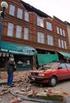 February 28 Earthquake: We got off easy State Geologist John Beaulieu Lucky may not be the first word that comes to mind after an earthquake that injured more than 200 and caused more than $1 billion damage,
FROM DRAWING ANTICLINE AXES TO 3D MODELLING OF SEISMOGENIC SOURCES: EVOLUTION OF SEISMOTECTONIC MAPPING IN THE PO PLAIN
 FROM DRAWING ANTICLINE AXES TO 3D MODELLING OF SEISMOGENIC SOURCES: EVOLUTION OF SEISMOTECTONIC MAPPING IN THE PO PLAIN Burrato P.*, Maesano F. E. *, D Ambrogi C.**, Toscani G., Valensise G.* (*) INGV,
The Severity of an Earthquake - ---- U.S. Department of the Interior/Geological Survey
 The Severity of an Earthquake - ---- U.S. Department of the Interior/Geological Survey ----~ Earthquakes can be measured in terms of either the effect of the earthquake (intensity) or of the energy released
Earthquakes: Interesting Facts and F.A.Q.
 Earthquakes: Interesting Facts and F.A.Q. Earthquakes kill approximately 8,000 people each year and have caused an estimated 13 million deaths in the past 4,000 years. The moment magnitude scale (MMS)
Plate Tectonics: Ridges, Transform Faults and Subduction Zones
 Plate Tectonics: Ridges, Transform Faults and Subduction Zones Goals of this exercise: 1. review the major physiographic features of the ocean basins 2. investigate the creation of oceanic crust at mid-ocean
Name: Date: Class: Finding Epicenters and Measuring Magnitudes Worksheet
 Example Answers Name: Date: Class: Finding Epicenters and Measuring Magnitudes Worksheet Objective: To use seismic data and an interactive simulation to triangulate the location and measure the magnitude
Glossary. continental crust: the sections of crust, the outermost layer of the earth, that include the continents
 aftershock: an earthquake that follows a larger earthquake or main shock and originates in or near the rupture zone of the larger earthquake. Generally, major earthquakes are followed by a number of aftershocks
DYNAMIC CRUST: Unit 4 Exam Plate Tectonics and Earthquakes
 DYNAMIC CRUST: Unit 4 Exam Plate Tectonics and Earthquakes NAME: BLOCK: DATE: 1. Base your answer to the following question on The block diagram below shows the boundary between two tectonic plates. Which
FIFTH GRADE PLATE TECTONICS 1 WEEK LESSON PLANS AND ACTIVITIES
 FIFTH GRADE PLATE TECTONICS 1 WEEK LESSON PLANS AND ACTIVITIES PLATE TECTONIC CYCLE OVERVIEW OF FIFTH GRADE VOLCANOES WEEK 1. PRE: Exploring the rocks produced by volcanoes. LAB: Comparing igneous rocks.
Plate Tectonics Practice Questions and Answers Revised August 2007
 Plate Tectonics Practice Questions and Answers Revised August 2007 1. Please fill in the missing labels. 2. Please fill in the missing labels. 3. How many large plates form the outer shell of the earth?
Plate Tectonics: Big Ideas. Plate Tectonics. Plate Tectonics. The unifying concept of the Earth sciences.
 Plate Tectonics: Big Ideas Our understanding of Earth is continuously refined. Earth s systems are dynamic; they continually react to changing influences from geological, hydrological, physical, chemical,
Risks of future Earthquake- and extreme hydrological Disasters in Southeast Asia with a Focus on Thailand
 Risks of future Earthquake- and extreme hydrological Disasters in Southeast Asia with a Focus on Thailand Manfred Koch Department of Geohydraulics and Engineering Hydrology University of Kassel Germany
Tsunami Practice Questions and Answers Revised November 2008
 Tsunami Practice Questions and Answers Revised November 2008 1. What happened on 26 December 2004 off the west coast of Sumatra? 2. What is the final estimate of the magnitude of the Sumatra 26 December
PROHITECH WP3 (Leader A. IBEN BRAHIM) A short Note on the Seismic Hazard in Israel
 PROHITECH WP3 (Leader A. IBEN BRAHIM) A short Note on the Seismic Hazard in Israel Avigdor Rutenberg and Robert Levy Technion - Israel Institute of Technology, Haifa 32000, Israel Avi Shapira International
Earthquakes Natural and Induced. Rick Aster Professor of Geophysics and Department Head Geosciences Department Colorado State University
 Earthquakes Natural and Induced Rick Aster Professor of Geophysics and Department Head Geosciences Department Colorado State University Overview What causes earthquakes? How do we detect, locate, and measure
CEDIM Forensic Disaster Analysis Group & CATDAT and Earthquake-Report.com. Philippines (Bohol) Earthquake Report #2
 CEDIM Forensic Disaster Analysis Group & CATDAT and Earthquake-Report.com Philippines (Bohol) Earthquake Report #2 Report Contributors: James Daniell (Earthquake Report & KIT); Armand Vervaeck, Carlos
HOMEOWNER S GUIDE. to LANDSLIDES. and MITIGATION RECOGNITION, PREVENTION, CONTROL, Compiled by Dr. Scott F. Burns Tessa M. Harden Carin J.
 HOMEOWNER S GUIDE to LANDSLIDES RECOGNITION, PREVENTION, CONTROL, and MITIGATION Compiled by Dr. Scott F. Burns Tessa M. Harden Carin J. Andrew Federal Emergency Management Agency Region 10 If you are
EARTHQUAKE MAGNITUDE
 EARTHQUAKE MAGNITUDE Earliest measure of earthquake size Dimensionless number measured various ways, including M L local magnitude m b body wave magnitude M s surface wave magnitude M w moment magnitude
Rapid Changes in Earth s Surface
 TEKS investigate rapid changes in Earth s surface such as volcanic eruptions, earthquakes, and landslides Rapid Changes in Earth s Surface Constant Changes Earth s surface is constantly changing. Wind,
Using GIS for Assessing Earthquake Hazards of San Francisco Bay, California, USA
 Using GIS for Assessing Earthquake Hazards of San Francisco Bay, California, USA Marzieh Zeinali Department of Resource Analysis, Saint Mary s University of Minnesota, Minneapolis, MN 55404 Keywords: San
The Next Generation Science Standards (NGSS) Correlation to. EarthComm, Second Edition. Project-Based Space and Earth System Science
 The Next Generation Science Standards (NGSS) Achieve, Inc. on behalf of the twenty-six states and partners that collaborated on the NGSS Copyright 2013 Achieve, Inc. All rights reserved. Correlation to,
Creation of Soil Liquefaction Susceptibility Maps for San Luis Obispo & Marin Counties using Geographic Information Systems.
 Creation of Soil Liquefaction Susceptibility Maps for San Luis Obispo & Marin Counties using Geographic Information Systems. Amelia M. Lowman December 2009 Dr. Lynn E. Moody Adviser Earth and Soil Sciences
4.6 GEOLOGIC AND SEISMIC HAZARDS
 4.6 GEOLOGIC AND SEISMIC HAZARDS This Section describes the current conditions relating to the geologic and seismic characteristics of the City of Cypress. This Section concludes with an analysis of geologic
Chapter Overview. Bathymetry. Measuring Bathymetry. Echo Sounding Record. Measuring Bathymetry. CHAPTER 3 Marine Provinces
 Chapter Overview CHAPTER 3 Marine Provinces The study of bathymetry charts ocean depths and ocean floor topography. Echo sounding and satellites are efficient bathymetric tools. Most ocean floor features
The earthquake source
 Global seismology: The earthquake source Reading: Fowler p111-140 and Bolt Appendix G Earthquake location Earthquake focus: Latitude, longitude, depth Earthquake epicenter: Latitude, longitude Earthquakes
Plate Tectonics. Plate Tectonics The unifying concept of the Earth sciences. Continental Drift
 Plate Tectonics The unifying concept of the Earth sciences. The outer portion of the Earth is made up of about 20 distinct plates (~ 100 km thick), which move relative to each other This motion is what
Earthquakes. www.earthquakes.bgs.ac.uk
 Earthquakes www.earthquakes.bgs.ac.uk Introduction Earthquakes are among the most deadly natural hazards. There are around 100 earthquakes each year of a size that could cause serious damage. They strike
College of Science and Health ENVIRONMENTAL SCIENCE & GEOGRAPHY Course Outline
 College of Science and Health ENVIRONMENTAL SCIENCE & GEOGRAPHY Course Outline 1. TITLE OF COURSE AND COURSE NUMBER: General Geology ENV 115, 4 credits 2. DESCRIPTION OF THE COURSE: Includes the study
FOURTH GRADE PLATE TECTONICS 1 WEEK LESSON PLANS AND ACTIVITIES
 FOURTH GRADE PLATE TECTONICS 1 WEEK LESSON PLANS AND ACTIVITIES PLATE TECTONIC CYCLE OVERVIEW OF FOURTH GRADE VOLCANOES WEEK 1. PRE: Comparing different structures of volcanoes. LAB: Modeling three types
Earthquakes. www.earthquakes.bgs.ac.uk. Seismograph stations operated by the British Geological Survey
 Seismograph stations operated by the British Geological Survey Earthquakes Photograph supplied by Andy Thompson, Arup Advanced Technology, EEFIT Mission www.earthquakes.bgs.ac.uk Introduction Earthquakes
EARTHQUAKE PREDICTION
 Lecture 15 Earthquake Prediction EARTHQUAKE PREDICTION To successfully predict an earthquake we would like to know:- PLACE TIME MAGNITUDE (rather like a weather forecast) 1 Evidence must be integrated
Geol 101: Physical Geology PAST EXAM QUESTIONS LECTURE 4: PLATE TECTONICS II
 Geol 101: Physical Geology PAST EXAM QUESTIONS LECTURE 4: PLATE TECTONICS II 4. Which of the following statements about paleomagnetism at spreading ridges is FALSE? A. there is a clear pattern of paleomagnetic
The seismic activity in the area of Greece between 1966 and 1969
 The seismic activity in the area of Greece between 1966 and 1969 P. A. GIANNAKOPOULOS * Received on March 28'", 1972 SUMMARY. The earthquake activity in the area of Greece for the years 1966, 1967, 1968
Interactive Plate Tectonics
 Interactive Plate Tectonics Directions: Go to the following website and complete the questions below. http://www.learner.org/interactives/dynamicearth/index.html How do scientists learn about the interior
KCC Event Brief: 2014 La Habra Earthquake
 KAREN CLARK & COMPANY KCC Event Brief: 2014 La Habra Earthquake June 2014 2 COPLEY PLACE BOSTON, MA 02116 T: 617.423.2800 F: 617.423.2808 Overview On Friday, March 28, 2014 at 9:09pm, a magnitude 5.1 earthquake
Transform Boundaries
 Lecture 7 Plates and Mantle Plumes Transform Boundaries Transform boundaries occur where one segment of rigid lithosphere slides horizontally past another in response to stresses in the lithosphere. The
Investigation 6: What happens when plates collide?
 Tectonics Investigation 6: Teacher Guide Investigation 6: What happens when plates collide? In this activity, students will use the distribution of earthquakes and volcanoes in a Web GIS to learn about
What are the controls for calcium carbonate distribution in marine sediments?
 Lecture 14 Marine Sediments (1) The CCD is: (a) the depth at which no carbonate secreting organisms can live (b) the depth at which seawater is supersaturated with respect to calcite (c) the depth at which
Name Date Class. By studying the Vocabulary and Notes listed for each section below, you can gain a better understanding of this chapter.
 CHAPTER 7 VOCABULARY & NOTES WORKSHEET Earthquakes By studying the Vocabulary and Notes listed for each section below, you can gain a better understanding of this chapter. SECTION 1 Vocabulary In your
Active tectonics of Utah Version 1.0, March 2002 E. Calais
 Active tectonics of Utah Version 1.0, March 2002 E. Calais The transition between the Basin and Range and the Colorado Plateau Utah is located at the transition between the Colorado plateau and the Basin
The correct answers are given below. Some talking points have been added for the teachers use.
 Natural Resources Canada 2011: Lesson Plan Grades 11 and 12 Landslide activity 5b: Landslides in Canada quiz Description: This is an independent study activity for grades 11 and 12. Students will read
ICOLD POSITION PAPER ON DAM SAFETY AND EARTHQUAKES
 ICOLD POSITION PAPER ON DAM SAFETY AND EARTHQUAKES August 2012 Dam Safety and Earthquakes Position Paper of International Commission on Large Dams (ICOLD) Prepared by ICOLD Committee on Seismic Aspects
Tectonic plates push together at convergent boundaries.
 KEY CONCEPT Plates converge or scrape past each other. BEFORE, you learned Plates move apart at divergent boundaries In the oceans, divergent boundaries mark where the sea floor spreads apart On land,
Hot Spots & Plate Tectonics
 Hot Spots & Plate Tectonics Activity I: Hawaiian Islands Procedures: Use the map and the following information to determine the rate of motion of the Pacific Plate over the Hawaiian hot spot. The volcano
6.E.2.2 Plate Tectonics, Earthquakes and Volcanoes
 Name: Date: 1. The road shown below was suddenly broken by a natural event. 3. The convergence of two continental plates would produce Which natural event most likely caused the crack in the road? island
Step 2: Learn where the nearest divergent boundaries are located.
 What happens when plates diverge? Plates spread apart, or diverge, from each other at divergent boundaries. At these boundaries new ocean crust is added to the Earth s surface and ocean basins are created.
Evaluating an Illinois Earthquake
 Evaluating an Illinois Earthquake Grade Level: 7-8 Adapted from an activity by Robert A. Bauer, GeoActivity HAZD-1, ISGS GeoActivities Series, Activities and Other Resources for Teaching Geology, Illinois
Introduction and Origin of the Earth
 Page 1 of 5 EENS 1110 Tulane University Physical Geology Prof. Stephen A. Nelson Introduction and Origin of the Earth This page last updated on 30-Jul-2015 Geology, What is it? Geology is the study of
Rocks and Plate Tectonics
 Name: Class: _ Date: _ Rocks and Plate Tectonics Multiple Choice Identify the choice that best completes the statement or answers the question. 1. What is a naturally occurring, solid mass of mineral or
 13º Encontro Sociedade Brasileira de Geofísica 2013 Rio de Janeiro, 26-29 29 August Earthquake Mitigation in the Lisbon and Lower Tagus Valley area, Portugal 1 J. Carvalho, R. Dias, C. Pinto, T. Cunha,
Overview. NRC Regulations for Seismic. Applied to San Onofre Nuclear Generating Station. NRC History. How we Regulate
 Overview 1. NRC History and Overview NRC Regulations for Seismic Analysis and Design Applied to San Onofre Nuclear Generating Station Christie Hale Megan Williams 2. Regulations for Seismic Hazards 3.
Continental Drift. Alfred Wegener (1880-1930) Proposed that all of the continents were once part of a large supercontinent - Pangaea Based on:
 Plate Tectonics and Continental Drift Continental Drift Alfred Wegener (1880-1930) Proposed that all of the continents were once part of a large supercontinent - Pangaea Based on: Similarities in shorelines
1. The diagram below shows a cross section of sedimentary rock layers.
 1. The diagram below shows a cross section of sedimentary rock layers. Which statement about the deposition of the sediments best explains why these layers have the curved shape shown? 1) Sediments were
A Preliminary Report The May 19, 2011 Simav, Turkey Earthquake
 A Preliminary Report The May 19, 2011 Simav, Turkey Earthquake Ömer AYDAN Tokai University, Shizuoka, Japan Visiting Professor, İstanbul Technical University Halil KUMSAR Pamukkale University May 24, 2011
 1 2 A very short description of the functional center network: regarding the Hydraulic and Hydrogeological risk, the national alert system is ensured by the National Civil Protection Department (DPCN),
Data Mining and Exploratory Statistics to Visualize Fractures and Migration Paths in the WCBS*
 Data Mining and Exploratory Statistics to Visualize Fractures and Migration Paths in the WCBS* Jean-Yves Chatellier 1 and Michael Chatellier 2 Search and Discovery Article #41582 (2015) Posted February
PALEOENVIRONMENTS OF THE LAKE BALATON AREA
 Eötvös Loránd University Department of Geophysics HUNGARY 1117 Budapest Pázmány Péter sétány 1/C Tel: +36-1-3812191 Fax: +36-1-3812192 E-mail: [email protected] PALEOENVIRONMENTS OF THE LAKE BALATON
WILLOCHRA BASIN GROUNDWATER STATUS REPORT 2009-10
 WILLOCHRA BASIN GROUNDWATER STATUS REPORT 2009-10 SUMMARY 2009-10 The Willochra Basin is situated in the southern Flinders Ranges in the Mid-North of South Australia, approximately 50 km east of Port Augusta
Remote Sensing and GIS based Approach for Multi-Source Landslide Mapping in Southern Kyrgyzstan
 Remote Sensing and GIS based Approach for Multi-Source Landslide Mapping in Southern Kyrgyzstan DARYA GOLOVKO 1, SIGRID ROESSNER 2, ROBERT BEHLING 3, HANS-ULRICH WETZEL 4 & HERMANN KAUFMANN 5 Southern
Engineering Geological Asset Management for Large Dams. Yasuhito SASAKI (1)
 Engineering Geological Asset Management for Large Dams Yasuhito SASAKI (1) (1) Geology Research Team, Public Works Research Institute, Japan E-mail:[email protected] Abstract Comprehensive inspection
Alfred Wegener s Theory of Continental Drift Became Modern Plate Tectonics. Wegener in Greenland about 1912. He froze to death there in 1930.
 Alfred Wegener s Theory of Continental Drift Became Modern Plate Tectonics Wegener in Greenland about 1912. He froze to death there in 1930. Science is self correcting. The Scientific Method The history
Stability Assessment of Chamshir Dam Based on DEM, South West Zagros
 2015 2nd International Conference on Geological and Civil Engineering IPCBEE vol. 80 (2015) (2015) IACSIT Press, Singapore DOI: 10.7763/IPCBEE. 2015. V80. 13 Stability Assessment of Chamshir Dam Based
How To Help The Environment
 CIIFEN Activities 2012 Rodney Martínez Güingla [email protected] Workshop on Climate Change in Mediterranean and Caribbean Seas: Guayaquil, Ecuador, 08-11 May 2011 MISSION To promote, coordinate and
SIXTH GRADE PLATE TECTONICS 1 WEEK LESSON PLANS AND ACTIVITIES
 SIXTH GRADE PLATE TECTONICS 1 WEEK LESSON PLANS AND ACTIVITIES PLATE TECTONIC CYCLE OVERVIEW OF SIXTH GRADE VOLCANOES WEEK 1. PRE: Comparing the structure of different types of volcanoes. LAB: Plotting
II. Earth Science (Geology) Section (9/18/2013)
 EAPS 100 Planet Earth Lecture Topics Brief Outlines II. Earth Science (Geology) Section (9/18/2013) 1. Interior of the Earth Learning objectives: Understand the structure of the Earth s interior crust,
Site C Clean Energy Project Topic Specific Sessions: Presentation by Natural Resources Canada
 Site C Clean Energy Project Topic Specific Sessions: Presentation by Natural Resources Canada Fort St. John, British Columbia January 13, 2014 Outline 1. Context for NRCan s Participation in the Joint
6.0 Results of Risk Analyses
 6. Results of Risk Analyses A risk analysis of the optimized embankment designs for the Salton Sea restoration project was conducted jointly by Kleinfelder and representatives from Reclamation. A risk
Plate Tectonics Short Study Guide
 Name: Class: Date: Plate Tectonics Short Study Guide Multiple Choice Identify the letter of the choice that best completes the statement or answers the question. 1. The existence of coal beds in Antarctica
FOURTH GRADE EARTHQUAKES 1 WEEK LESSON PLANS AND ACTIVITIES
 FOURTH GRADE EARTHQUAKES 1 WEEK LESSON PLANS AND ACTIVITIES PLATE TECTONIC CYCLE OVERVIEW OF FOURTH GRADE VOLCANOES WEEK 1. PRE: Comparing different structures of volcanoes. DURING: Modeling three types
4.11 Geologic and Soil Resources
 4.11 Geologic and Soil Resources Geology and soils are evaluated as part of an environmental document because conditions in the project area can influence the type and size of a project s structure, the
EARTHQUAKE. Definition of Hazard. History of Hazard as it Affects the City of Kent. Hazard Identification
 EARTHQUAKE Definition of Hazard Earthquakes are defined as the sudden release of energy occurring from the collision or shifting of crustal plates on the earth s surface or from the fracture of stressed
ENGINEERING-BASED EARTHQUAKE RISK MANAGEMENT
 ENGINEERING-BASED EARTHQUAKE RISK MANAGEMENT MRP Engineering Newsletter February 2012 The world recently experienced several major earthquakes, which caused severe local impacts and major worldwide repercussions.
THE TRANSITION FROM OPEN PIT TO UNDERGROUND MINING: AN UNUSUAL SLOPE FAILURE MECHANISM AT PALABORA
 THE TRANSITION FROM OPEN PIT TO UNDERGROUND MINING: AN UNUSUAL SLOPE FAILURE MECHANISM AT PALABORA Richard K. Brummer*, Hao Li* & Allan Moss *Itasca Consulting Canada Inc., Rio Tinto Limited ABSTRACT At
Using Google Earth to Explore Plate Tectonics
 Using Google Earth to Explore Plate Tectonics Laurel Goodell, Department of Geosciences, Princeton University, Princeton, NJ 08544 [email protected] Inspired by, and borrows from, the GIS-based Exploring
Georgia Performance Standards Framework for Science Grade 6. Unit Organizer: Geology: Inside the Earth (Approximate Time: 7 Weeks)
 The following instructional plan is part of a GaDOE collection of Unit Frameworks, Performance Tasks, examples of Student Work, and Teacher Commentary. Many more GaDOE approved instructional plans are
A disaster occurs at the point of contact between social activities and a natural phenomenon of unusual scale.
 Hazard Mapping and Vulnerability Assessment Mr. Toshiaki Udono Senior Project Manager, Kansai Division, PASCO Corporation, Japan Mr. Awadh Kishor Sah Project Manager, Project Implementation Department,
Where in the World Are All the Earthquakes?
 Curry School of Education, University of Virginia www.teacherlink.org/content/science/ Where in the World Are All the Earthquakes? In this activity, students go to the United States Geological Survey (USGS)
HAZARD MAPPING, RISK ASSESSMENT, AND INSURANCE COVERAGE OF NATURAL CATASTROPHE RISK
 SESSION III HAZARD MAPPING, RISK ASSESSMENT, AND INSURANCE COVERAGE OF NATURAL CATASTROPHE RISK Mr. Sumarjono Insurance Bureau of The Ministry of Finance of the Republic of Indonesia Geological Position