
|
|
|
- Shana Daniels
- 10 years ago
- Views:
Transcription
1 1

2 2

3 A very short description of the functional center network: regarding the Hydraulic and Hydrogeological risk, the national alert system is ensured by the National Civil Protection Department (DPCN), through the Functional Centres Network, together with scientific/technical Support Centres, named Competence Centres. The role of the Functional Center is to support the national alerting system at regional scale, managing the previsional phase and the monitoring and control during the event phase, ensuring the flow of data to the civil protection for the emergency and the management of the event phase. 3

4 The CFD is in charge to acquire and collect both real time and quasi-static data: quantitative data from monitoring networks (hydrometeorological stations, meteo radar,...), meteorological forecasting models output, Earth Observation data, hydraulic and hydrological simulation models, cartographic and thematic GIS data, planning studies, dam managing plans, non instrumental information from direct control of territorial presidium. The main role of this office is to manage the previsional phase, furnish 24h support for hydrogeological and hydraulic risk mitigation during the emergency period an to create a link between Civil Protection real time activities and environmental/planning delayed time ones. 4

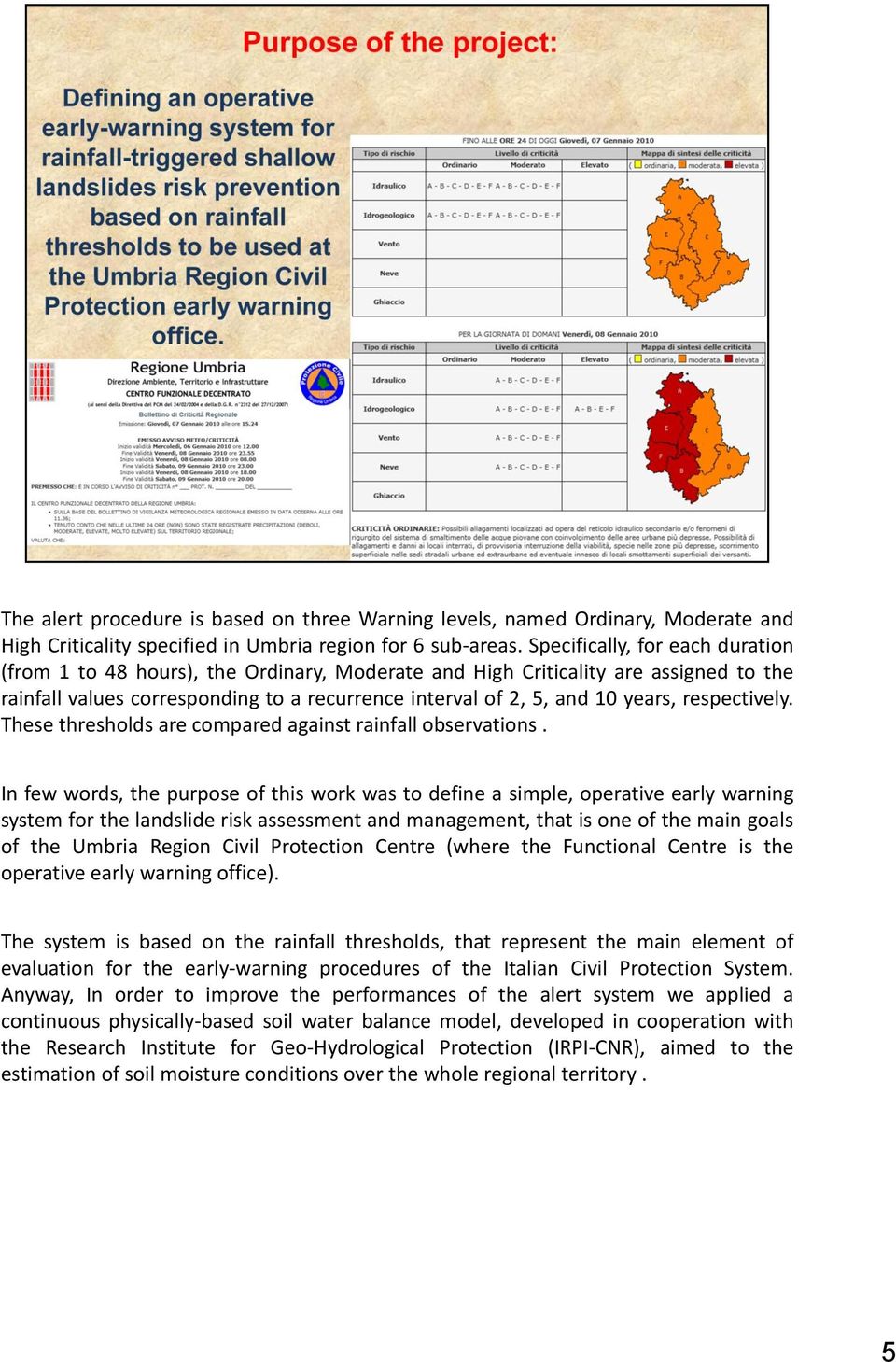
5 The alert procedure is based on three Warning levels, named Ordinary, Moderate and High Criticality specified in Umbria region for 6 sub-areas. Specifically, for each duration (from 1 to 48 hours), the Ordinary, Moderate and High Criticality are assigned to the rainfall values corresponding to a recurrence interval of 2, 5, and 10 years, respectively. These thresholds are compared against rainfall observations. In few words, the purpose of this work was to define a simple, operative early warning system for the landslide risk assessment and management, that is one of the main goals of the Umbria Region Civil Protection Centre (where the Functional Centre is the operative early warning office). The system is based on the rainfall thresholds, that represent the main element of evaluation for the early-warning procedures of the Italian Civil Protection System. Anyway, In order to improve the performances of the alert system we applied a continuous physically-based soil water balance model, developed in cooperation with the Research Institute for Geo-Hydrological Protection (IRPI-CNR), aimed to the estimation of soil moisture conditions over the whole regional territory. 5
6 The open-source website represents a fundamental decision support tool for real time data and information exchange with all the administrations and subjects involved. Our website is able to publish the following sections: -Alarm zones interactive description - Meteorological forecasting - hydraulic and hydrological simulation models 6

7 The Umbria Region, located in central Italy, is one of the most prone areas to landslide risk in Italy, being almost yearly affected by landslides and flood events at different spatial and temporal scales. Located in the central Italy, Umbria is characterized by quit a complex topography. The geology is constituted of post-orogenics marine and continental facies, flysch deposits consisting of clay-schist and clay-marl sediments, bedded limestones and volcanic rocks. All municipalities are prone to hydrogeological risk areas and about 9% of the territory (650 km 2 ) is affected by active landslides. More than 70% of the inventoried landslides are of dormant type, subject to reactivation with strong precipitations. The analysis of the landslides type shows that most of them (more than 70%) are of translational-rotational slow-moving type, about 4% are fast-moving slides, and 10% are deep-seated landslides. The precipitation regime can be classified as Mediterranean, with distinct dry and wet seasons. Higher monthly precipitation values generally occur during the autumn-winter period when landslides and floods, caused by widespread rainfall, normally occur. As an example, during a rainfall event that occurred in December 2008, 300 mm of rainfall in 12 days was registered (the mean of maximum monthly rainfall is around 240 mm), with 120 landslides reported to the Regional Civil Protection Office. Mean annual precipitation is about 1000 mm; mean annual temperature is 11 C; snowfalls at altitude below 500 m a.s.l. are unusual. 7

8 The warning system originates from a previous study, that attempts to define soil moisture (estimated using a soil water balance model) and their correlation with rainfall thresholds, that can be employed for hydrogeological risk prevention by the Functional Centre. The soil water balance model applied here was developed using soil moisture observations carried out in experimental catchments located in the Umbria Region. In particular, different expressions were considered for the different components of the model, such as infiltration, percolation and evapotranspiration. Different analyses were carried out by determining rainfall and soil moisture conditions prior to widespread landslide events that occurred in the Umbria Region and that are reported in the AVI (Italian Vulnerable Areas) inventory for the period

9 Based on the analysis of the widespread landslide events available within the AVI database, a linear relation between the rainfall thresholds and the initial soil moisture conditions was found, showing the key role of soil moisture on landslide triggering. The main result of the analysis is the quantification of the decreasing linear trend between the maximum cumulated rainfall values over 24, 36 and 48 hours and the soil moisture conditions prior to landslide events. This trend provides a mean to dynamically adjust the operational rainfall thresholds used for warning. Therefore, the correlation established between the maxima cumulative rainfall values and the soil moisture prior to the triggering of landslides allows to dynamically adjust the rainfall thresholds which is of great interest for our warning activities and to the realtime landslides risk assessment for the regional territory, decreasing the uncertainties tied to the application of the rainfall thresholds only. 9

10 On these basis, we decided to build the near real tyme system for landslide forecast. The system performs the following main steps: - estimation (using spatial interpolation algorithms) of the 20-days past rainfall and temperature together with the 72 h forecast data for every point of a calculation grid (that can be a single landslide, or a number of selected landslides, or a dense grid over the whole territory). This is done by using real-time data from the regional hydrometeorological monitoring network and the results of quantitative weather forecast COSMO ME local scale models for Umbria; - computation of the soil moisture index through the physically-based soil water balance model; -comparison of observed and forecasted rainfall data with the rainfall thresholds that take into account a correction factor linked to the soil moisture index; From the comparison, Definition of four early-warning indicators for each grid point (normal, caution, warning, alarm), in compliance with national and regional law. 10

11 Up to now, we developed the system with three applications: - a number of known landslides at higher risk previously classified; - the whole regional territory, with the definition of a WEB-GIS dynamic risk scenario, using susceptibility and vulnerability informations; - a large rockslide for which a conventional monitoring system is active. 11

12 This section of the early-warning system is aimed to the monitoring of 110 landslides at high risk in the Umbria territory: the choice of the sites comes from a preliminary work in which all the known situations at hydrogeological risk were classified. It must be pointed out that the system, up to now calibrated on the landslide dataset recorded during the main rainfall events occurred in the last 20 years in Umbria, is going to be tuned with landslide-specific thresholds, using the analysis of past rainfall, soil moisture conditions, and activation dates available for every landslide, developing specific paramaters for the water balance model too. 12
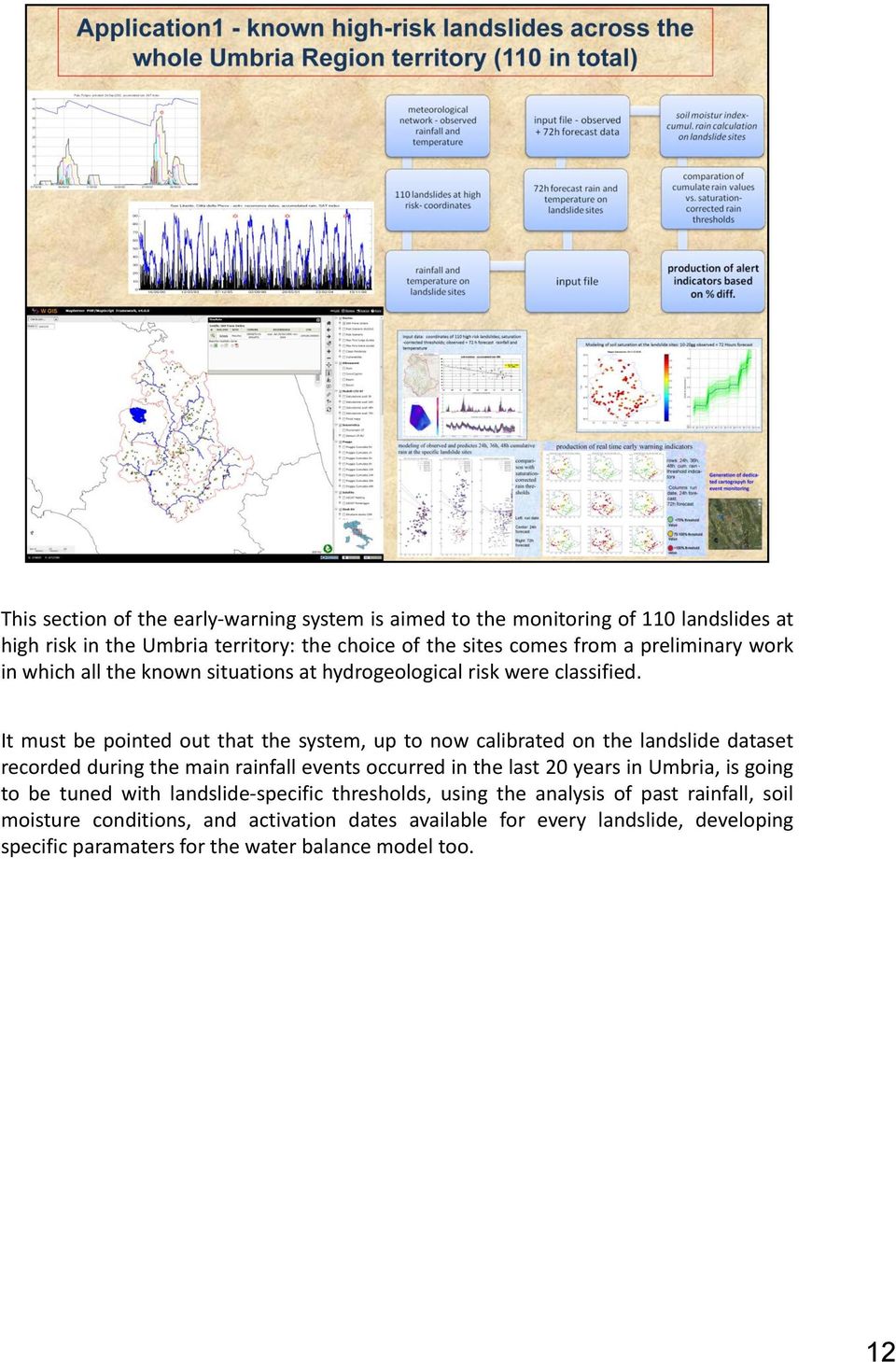
13 The comparison of accumulate rain, saturation index and correspondent threshold values lead to the production of the early warning indicators for the run date, 24h and 72 hours forecast 13

14 and dedicated cartography available through the WEB site 14

15 The section is based on the same methodology used for the 110 high risk landslides, but using a dense regular grid, in order to spatially extend the analysis and the monitoring to the whole regional territory. 15

16 The indicators are combined with susceptibility and vulnerability layers in order to build a risk scenario on a interpolation grid of 100*100m. This section is under development, the quality of the scenario is of course strongly dependent by the quality of susceptibility and vulnerability information. Here as example we use as susceptibility layer 4 levels of slope values, obtained by a 20*20m Digital Elevation Model: a susceptibility map is in progress by a cooperation with the CNR IRPI using POR FESR European founding. Vulnerability data come from all the information we were able to collect form regional and other local Authorities: viability, buildings, infrastructures an so on, and it is regularly updated. 16

17 A WebGis platform is so used to build near real-time dynamic scenarios combining the observed and forecasts rainfall (at 24-h and 72-h) with landslide susceptibility and vulnerability data. The main result of the analysis is a spatial information on landslide risk, highlighting the areas where local risk situations can emerge due to the interaction of the rainfallinduced landslides with the presence of vulnerability elements. This scenario has a dynamic character because of the re-computation of the rainfalls that are likely to trigger landslides on every dataset updating, during the event phase. 17

18 The Torgiovannetto landslide originated from a dismissed stone quarry near the town of Assisi, in Central Italy. The stratigraphy is constituted by stratified limestone with intercalation of thin weak clay layers: the dip of the front of the quarry is about 30-38, similar of that of the limestones bedding planes. A huge sliding rock wedge in the upper part of the quarry has formed, delimited by a big tension crack up to one meter wide and over 100 m long, shoving slow movements after heavy rainfalls, relating the raising of the pore pressure to the reduction of the shear strength on the stratification planes. The rock wedge threatens two roads at the base of the slope: the landslide is monitored by a meteorological station, an extensometer network and, recently, by a high dynamic accelerometer. The dataset collected up to now demonstrated the clear influence of the rainfall on the rock slide movements. Due to the potentiality of a catastrophic failure that could affect the suburban road passing close to the quarry, the University of Florence is-was is in charge of an alert procedure based upon the observation and prediction of the overtopping of cracks opening velocity (equal to 0.5 or 1 mm/day depending on the location of the different extensometer) detected by the extensimeter network, using three levels of criticity: normality, pre-alert and alert. The alert is declared when at least two extensometers exceed their velocity thresholds (1mm/day or 0.5 mm/day, depending on their position). 18

19 The application of the Landwarn system, aimed to the support of the monitoring of the rockslide, performs the following tasks: - the calculation of the accumulate rain measured by the in-situ meteorological station, and the predicted ones for the three following days using the COSMO-ME local scale prevision models; - the calculation of the soil moisture content using the balance model above described; - the comparison between the rain dataset and the rainfall thresholds dynamically adjusted by a correction factor linked to the soil moisture. The system result is constituted by the real time evaluation of rainfall and soil moisture conditions in the rockfall site and the estimate for three following days; this is used as a pre-alert threshold in case of intense meteorological events, supporting the alert procedure based on the extensimetric network. 19

20 Recently, we introduced the use of satellite derived soil moisture data. We are using them at the Torgiovannetto site with the aim of the estimation of the crack openings. The procedure developed for the forecast of the cracks opening velocity is based on the following tasks: - the calculation of the accumulate rain measured by the in-situ meteorological station, and the predicted ones for the three following days using -- the COSMO-ME local scale prevision models; - the calculation of the soil moisture content by the soil water balance model; - the estimation of the cracks opening velocity through a multiple regression analysis that takes rainfall and soil moisture conditions into account. The system result is constituted by the real-time evaluation of rainfall and soil moisture conditions for the Torgiovannetto site and the forecast for three following days of cracks opening. The multiple linear regression equation used for the estimation of cracks opening has been calibrated by analyzing a series of rainfall events that occurred in the period for which the opening of the tension cracks (as recorded by extensometers) is available. Specifically, besides via the soil water balance model, soil moisture estimates are also retrieved by satellite sensor. The Soil Water Index product obtained by the Advances SCATterometer (ASCAT) on board MetOp (Meteorological Operational) satellite is used for this purpose. Results indicate that the ASCAT SWI can be effectively used for the prediction of the cracks opening of the investigated Torgiovannetto landslide because of the good agreement between the observed and estimated cracks opening. The multiple regression performance decreases if modelled soil moisture data and Antecedent Precipitation Indices are used instead of the ASCAT SWI. The derived relationships are going to be implemented for the alert procedure of Torgiovannetto landslide. 20

21 PHYSICALLY BASED MODELS An under-development GIS-based code permits the prediction of the spatial distribution of the minimum rainfall intensity which is likely to trigger shallow landslides and debris flows over a given study area, based on the rainfall duration and the local geometric, hydrologic and mechanical characteristics of the slopes. Once validated, such an approach can be combined with short-time predictions of rainfall data, derived from the CFD real-time meteorological network, with the aim of implementing a new section of the early-warning system. 21
22 22
Flash Flood Science. Chapter 2. What Is in This Chapter? Flash Flood Processes
 Chapter 2 Flash Flood Science A flash flood is generally defined as a rapid onset flood of short duration with a relatively high peak discharge (World Meteorological Organization). The American Meteorological
Tool 2.3.1: General information on the causes of rainfall-induced landslides
 Impacts of Climate Change on Urban Infrastructure & the Built Environment A Toolbox Tool 2.3.1: General information on the causes of rainfall-induced landslides Author G. Dellow Affiliation GNS Science,
Fire Weather Index: from high resolution climatology to Climate Change impact study
 Fire Weather Index: from high resolution climatology to Climate Change impact study International Conference on current knowledge of Climate Change Impacts on Agriculture and Forestry in Europe COST-WMO
Flash Flood Guidance Systems
 Flash Flood Guidance Systems Introduction The Flash Flood Guidance System (FFGS) was designed and developed by the Hydrologic Research Center a non-profit public benefit corporation located in of San Diego,
AZ EGER-PATAK HIDROLÓGIAI VIZSGÁLATA, A FELSZÍNI VÍZKÉSZLETEK VÁRHATÓ VÁLTOZÁSÁBÓL ADÓDÓ MÓDOSULÁSOK AZ ÉGHAJLATVÁLTOZÁS HATÁSÁRA
 AZ EGER-PATAK HIDROLÓGIAI VIZSGÁLATA, A FELSZÍNI VÍZKÉSZLETEK VÁRHATÓ VÁLTOZÁSÁBÓL ADÓDÓ MÓDOSULÁSOK AZ ÉGHAJLATVÁLTOZÁS HATÁSÁRA GÁBOR KEVE 1, GÉZA HAJNAL 2, KATALIN BENE 3, PÉTER TORMA 4 EXTRAPOLATING
Precipitation Monitoring Network:
 The Caribbean Drought and Precipitation Monitoring Network: Adrian R. Trotman Caribbean Institute for Meteorology and Hydrology CARIWIN Regional Seminar 14-15 January, 2010 Georgetown, Guyana Why Plan
Impact of water harvesting dam on the Wadi s morphology using digital elevation model Study case: Wadi Al-kanger, Sudan
 Impact of water harvesting dam on the Wadi s morphology using digital elevation model Study case: Wadi Al-kanger, Sudan H. S. M. Hilmi 1, M.Y. Mohamed 2, E. S. Ganawa 3 1 Faculty of agriculture, Alzaiem
METHODOLOGY FOR LANDSLIDE SUSCEPTIBILITY AND HAZARD MAPPING USING GIS AND SDI
 The 8th International Conference on Geo-information for Disaster Management Intelligent Systems for Crisis Management METHODOLOGY FOR LANDSLIDE SUSCEPTIBILITY AND HAZARD MAPPING USING GIS AND SDI T. Fernández
The correct answers are given below. Some talking points have been added for the teachers use.
 Natural Resources Canada 2011: Lesson Plan Grades 11 and 12 Landslide activity 5b: Landslides in Canada quiz Description: This is an independent study activity for grades 11 and 12. Students will read
HAZARD RISK ASSESSMENT, MONITORING, MAINTENANCE AND MANAGEMENT SYSTEM (HAMMS) FOR LANDSLIDE AND FLOOD. Mohd. Nor Desa, Rohayu and Lariyah, UNITEN
 HAZARD RISK ASSESSMENT, MONITORING, MAINTENANCE AND MANAGEMENT SYSTEM (HAMMS) FOR LANDSLIDE AND FLOOD Mohd. Nor Desa, Rohayu and Lariyah, UNITEN WHAT WE HAVE IN MIND AND FROM OUR PREVIOUS PROJECT CONTRIBUTION
Landslides & Mudflows
 1 2 - What is a Landslide? - Geologic hazard Common to almost all 50 states Annual global Billions in losses Thousands of deaths and injuries 3 1 - What is a Landslide? - Gravity is driving force Some
USSD Workshop on Dam Break Analysis Applied to Tailings Dams
 USSD Workshop on Dam Break Analysis Applied to Tailings Dams Antecedents Newtonian / non-newtonian flows Available models that allow the simulation of non- Newtonian flows (tailings) Other models used
Real-time hazard impact modelling for surface water flooding: some UK developments
 Real-time hazard impact modelling for surface water flooding: some UK developments Steven Cole 1, Bob Moore 1, Timothy Aldridge 2, Andy Lane 3,4 and Stefan Laeger 4 International Conference on Flood Resilience,
Monitoring and Early Management of Emergences: New Instruments
 Monitoring and Early Management of Emergences: New Instruments Daniele Caviglia, DITEN - University of Genoa Domenico Sguerso, DICCA - University of Genoa Bianca Federici, DICCA - University of Genoa Andrea
Standardized Runoff Index (SRI)
 Standardized Runoff Index (SRI) Adolfo Mérida Abril Javier Gras Treviño Contents 1. About the SRI SRI in the world Methodology 2. Comments made in Athens on SRI factsheet 3. Last modifications of the factsheet
Risk and vulnerability assessment of the build environment in a dynamic changing society
 Risk and vulnerability assessment of the build environment in a dynamic changing society Limnei Nie SINTEF Building and infrastructure, P.O.Box 124 Blindern, NO-0314 Oslo, Norway. [email protected]
CASE STUDY LANDSLIDE MONITORING
 Introduction Monitoring of terrain movements (unstable slopes, landslides, glaciers, ) is an increasingly important task for today s geotechnical people asked to prevent or forecast natural disaster that
WILLOCHRA BASIN GROUNDWATER STATUS REPORT 2009-10
 WILLOCHRA BASIN GROUNDWATER STATUS REPORT 2009-10 SUMMARY 2009-10 The Willochra Basin is situated in the southern Flinders Ranges in the Mid-North of South Australia, approximately 50 km east of Port Augusta
Estimating Potential Reduction Flood Benefits of Restored Wetlands
 Estimating Potential Reduction Flood Benefits of Restored Wetlands Kenneth W. Potter University of Wisconsin Introduction Throughout the summer of 1993 a recurring question was the impact of wetland drainage
Eastern Caribbean Open-Source Geospatial Data Sharing and Management Workshop
 Eastern Caribbean Open-Source Geospatial Data Sharing and Management Workshop Data Collection and Management in the Caribbean Spice Island Resort, St. George s, Grenada October 6 7, 2011 Presented by:
FLOOD FORECASTING PRACTICE IN NORTHERN CALIFORNIA
 FLOOD FORECASTING PRACTICE IN NORTHERN CALIFORNIA California Department of Water Resources Post Office Box 219000, Sacramento, California 95821 9000 USA By Maurice Roos, Chief Hydrologist ABSTRACT Although
BECAUSE WEATHER MATTERS UBIMET
 UBIMET Weather Information and Alert Systems for Railroads UBIMET because weather matters One of the largest private weather services in Europe Provides severe weather warnings for more than 1 million
Preliminary advances in Climate Risk Management in China Meteorological Administration
 Preliminary advances in Climate Risk Management in China Meteorological Administration Gao Ge Guayaquil,Ecuador, Oct.2011 Contents China Framework of Climate Service Experience in Climate/disaster risk
GEOTECHNICAL ISSUES OF LANDSLIDES CHARACTERISTICS MECHANISMS PREPARDNESS: BEFORE, DURING AND AFTER A LANDSLIDE QUESTIONS FOR DISCUSSIONS
 GEOTECHNICAL ISSUES OF LANDSLIDES CHARACTERISTICS MECHANISMS PREPARDNESS: BEFORE, DURING AND AFTER A LANDSLIDE QUESTIONS FOR DISCUSSIONS Huge landslide Leyte, Phillipines, 1998 2000 casulties Small debris
Environmental Data Management Programs
 Hydrologic Engineering Centre (HEC) Software CD Collection of programs, developed by the U.S. Army Corps of Engineers Environmental Data Management Programs Name: HEC-DSS Package Purpose: Data Storage
Real-time modelling of surface water flooding hazard and impact at countrywide scales
 Real-time modelling of surface water flooding hazard and impact at countrywide scales Steven Cole 1, Robert Moore 1, Paul Mattingley 1,Timothy Aldridge 2, Jon Millard 3,4 and Stefan Laeger 5 BHS National
IBM Big Green Innovations Environmental R&D and Services
 IBM Big Green Innovations Environmental R&D and Services Smart Weather Modelling Local Area Precision Forecasting for Weather-Sensitive Business Operations (e.g. Smart Grids) Lloyd A. Treinish Project
WELCOMES ALL THE ATTENDEES WATER UTILISATION, MEASUREMENT AND METHODOLOGIES
 SUTRON india WELCOMES ALL THE ATTENDEES WATER UTILISATION, MEASUREMENT AND ABOUT SUTRON USA Strong Corporation was founded in 1975 Sutron Operates in : Hydrological Meteorological Oceanic Aviation Real-Time
Development of an Integrated Data Product for Hawaii Climate
 Development of an Integrated Data Product for Hawaii Climate Jan Hafner, Shang-Ping Xie (PI)(IPRC/SOEST U. of Hawaii) Yi-Leng Chen (Co-I) (Meteorology Dept. Univ. of Hawaii) contribution Georgette Holmes
New challenges of water resources management: Title the future role of CHy
 New challenges of water resources management: Title the future role of CHy by Bruce Stewart* Karl Hofius in his article in this issue of the Bulletin entitled Evolving role of WMO in hydrology and water
Nowcasting: analysis and up to 6 hours forecast
 Nowcasting: analysis and up to 6 hours forecast Very high resoultion in time and space Better than NWP Rapid update Application oriented NWP problems for 0 6 forecast: Incomplete physics Resolution space
FLOODALERT: A SIMPLIFIED RADAR-BASED EWS FOR URBAN FLOOD WARNING
 11 th International Conference on Hydroinformatics HIC 2014, New York City, USA FLOODALERT: A SIMPLIFIED RADAR-BASED EWS FOR URBAN FLOOD WARNING XAVIER LLORT (1), RAFAEL SÁNCHEZ-DIEZMA (1), ÁLVARO RODRÍGUEZ
Operational methodology to assess flood damages in Europe
 IIASA-DPRI 2008 Operational methodology to assess flood damages in Europe Contributors: Nicola Lugeri, Carlo Lavalle, Elisabetta Genovese 1 Focus of ADAM work on extremes Types Floods, Heat-wave, Drought
Landslides. Landslides-1. March 2007
 Landslides Learn if landslides, including debris flows, could occur in your area by contacting local officials, your state geological survey or department of natural resources, or the geology department
Standard Operating Procedures for Flood Preparation and Response
 Standard Operating Procedures for Flood Preparation and Response General Discussion Hurricanes, tropical storms and intense thunderstorms support a conclusion that more severe flooding conditions than
Flood risk assessment through a detailed 1D/2D coupled model
 CORFU Project Barcelona Case Study Final Workshop 19 th of May 2014 Flood risk assessment through a detailed 1D/2D coupled model Beniamino Russo Aqualogy Urban Drainage Direction Introduction and general
DEWETRA: la piattaforma nazionale per la condivisioni di dati, previsioni e procedure per le attivita di DRR
 Dipartimento della Protezione Civile Fondazione CIMA DEWETRA: la piattaforma nazionale per la condivisioni di dati, previsioni e procedure per le attivita di DRR G. Boni 2, P. Pagliara 1, A. Corina 1 1
Web Based Real Time Monitoring System Along North-South Expressway, Malaysia
 Web Based Real Time Monitoring System Along North-South Expressway, Malaysia Low Tian Huat Mohd Asbi & Associates, Malaysia; [email protected] Faisal Ali Department of Civil Engineering, Faculty of Engineering,
National Weather Service Flash Flood Modeling and Warning Services
 National Weather Service Flash Flood Modeling and Warning Services Seann Reed, Middle Atlantic River Forecast Center Peter Ahnert, Middle Atlantic River Forecast Center August 23, 2012 USACE Flood Risk
River Basin Management in Croatia
 River Basin Management in Croatia 2. INTERNATIONAL RIVER BASIN MANAGEMENT HIGH LEVEL SYMPOSIUM Cappadocia/NEVŞEHİR, Turkey 16-18 April 2013 2 Water sector responsibilities are shared among: Croatian Parliament
A disaster occurs at the point of contact between social activities and a natural phenomenon of unusual scale.
 Hazard Mapping and Vulnerability Assessment Mr. Toshiaki Udono Senior Project Manager, Kansai Division, PASCO Corporation, Japan Mr. Awadh Kishor Sah Project Manager, Project Implementation Department,
MONITORING OF DROUGHT ON THE CHMI WEBSITE
 MONITORING OF DROUGHT ON THE CHMI WEBSITE Richterová D. 1, 2, Kohut M. 3 1 Department of Applied and Land scape Ecology, Faculty of Agronomy, Mendel University in Brno, Zemedelska 1, 613 00 Brno, Czech
The Role of Information Communication Technology in Advancing Risk Resilience in Small Island Developing States
 The Role of Information Communication Technology in Advancing Risk Resilience in Small Island Developing States Presented by: Ronald Jackson, Executive Director, CDEMA At the: 10 th UN Regional Cartographic
How To Calculate Flood Damage Potential In European Landscape
 Background/Introduction RISK ANALYSIS MODULE 3, CASE STUDY 2 Flood Damage Potential at European Scale By Dr. Peter Burek There is good reason to be concerned about the growth of flood losses in Europe.
Elbe flood in 2002 and 2006 in terms of emergency management
 Elbe flood in 2002 and 2006 in terms of emergency management Ing. Jaroslav Pikal, Regional Authority of the Usti Region 10 Years of Transnational Cooperation in Flood Risk Management at the LABe ELbe Saxon
Rain on Planting Protection. Help Guide
 Rain on Planting Protection Help Guide overview Rain on Planting Protection allows growers to protect themselves from losses if rain prevents planting from being completed on schedule. Coverage is highly
Applying MIKE SHE to define the influence of rewetting on floods in Flanders
 Applying MIKE SHE to define the influence of rewetting on floods in Flanders MARK HENRY RUBARENZYA 1, PATRICK WILLEMS 2, JEAN BERLAMONT 3, & JAN FEYEN 4 1,2,3 Hydraulics Laboratory, Department of Civil
Lars-Göran Gustafsson, DHI Water and Environment, Box 3287, S-350 53 Växjö, Sweden
 Alternative Drainage Schemes for Reduction of Inflow/Infiltration - Prediction and Follow-Up of Effects with the Aid of an Integrated Sewer/Aquifer Model Introduction Lars-Göran Gustafsson, DHI Water and
Geospatial Information for disaster risk reduction and natural resources management. Rolando Ocampo Alcántar
 Geospatial Information for disaster risk reduction and natural resources management Rolando Ocampo Alcántar Content Background Geospatial Information for Disaster Management Risk Atlas Information Exchange
Havnepromenade 9, DK-9000 Aalborg, Denmark. Denmark. Sohngaardsholmsvej 57, DK-9000 Aalborg, Denmark
 Urban run-off volumes dependency on rainfall measurement method - Scaling properties of precipitation within a 2x2 km radar pixel L. Pedersen 1 *, N. E. Jensen 2, M. R. Rasmussen 3 and M. G. Nicolajsen
Global Flood Alert System (GFAS)
 An Introduction of Global Flood Alert System (GFAS) Kazuo UMEDA Director of 2 nd Research Department, Infrastructure Development Institute-JAPAN Target: Reduction of Human Loss World s s natural disaster
Use of numerical weather forecast predictions in soil moisture modelling
 Use of numerical weather forecast predictions in soil moisture modelling Ari Venäläinen Finnish Meteorological Institute Meteorological research [email protected] OBJECTIVE The weather forecast models
Product Description KNMI14 Daily Grids
 Product Description KNMI14 Daily Grids Dr. R. Sluiter De Bilt, July 2014 Technical report; TR-346 Product Description KNMI14 Daily Grids Version 1.0 Date July 2014 Status Final Colofon Title Product Description
Hydrologic Engineering Techniques for Regional Water Resources Planning
 US Army Corps of Engineers Hydrologic Engineering Center Hydrologic Engineering Techniques for Regional Water Resources Planning October 1969 Approved for Public Release. Distribution Unlimited. TP-17
Climate Extremes Research: Recent Findings and New Direc8ons
 Climate Extremes Research: Recent Findings and New Direc8ons Kenneth Kunkel NOAA Cooperative Institute for Climate and Satellites North Carolina State University and National Climatic Data Center h#p://assessment.globalchange.gov
Methods for Determination of Safe Yield and Compensation Water from Storage Reservoirs
 US Army Corps of Engineers Hydrologic Engineering Center Methods for Determination of Safe Yield and Compensation Water from Storage Reservoirs October 1966 Approved for Public Release. Distribution Unlimited.
City of London Climate Change Adaptation Strategy Dealing with Extreme Rainfall Events
 City of London Climate Change Adaptation Strategy Dealing with Extreme Rainfall Events May 29, 2014 Presented by: Berta Krichker M.Eng., FEC, P.Eng. Manager of Stormwater Unit Environmental and Engineering
UDG Spring Conference Birmingham 2016
 Use of Monitoring Equipment to Proactively Manage the Waste Water Network Presenters James Mason (RPS), Joanna Kelsey (Severn Trent Water) Contributors Andrew Bailey (RPS), John Hateley (RPS) Ruth Clarke
Chapter D9. Irrigation scheduling
 Chapter D9. Irrigation scheduling PURPOSE OF THIS CHAPTER To explain how to plan and schedule your irrigation program CHAPTER CONTENTS factors affecting irrigation intervals influence of soil water using
Emergency Management Service. early warning FLOOD AND FIRE ALERTS. Space
 Emergency Management Service early warning FLOOD AND FIRE ALERTS Space 1 Copernicus at a Glance Copernicus is the European Union s Earth Observation programme: a user-driven space programme under civil
Extreme Events in the Atmosphere
 Cover Extreme Events in the Atmosphere Basic concepts Academic year 2013-2014 ICTP Trieste - Italy Dario B. Giaiotti and Fulvio Stel 1 Outline of the lecture Definition of extreme weather event. It is
Drought Monitoring and Forecasting in Sub-Saharan African. Justin Sheffield Princeton University
 Drought Monitoring and Forecasting in Sub-Saharan African Justin Sheffield Princeton University Outline Challenges for sub-saharan Africa (SSA) Current capabilities (national, regional, international) Princeton
How To Understand And Understand The Flood Risk Of Hoang Long River In Phuon Vietnam
 FLOOD HAZARD AND RISK ASSESSMENT OF HOANG LONG RIVER BASIN, VIETNAM VU Thanh Tu 1, Tawatchai TINGSANCHALI 2 1 Water Resources University, Assistant Professor, 175 Tay Son Street, Dong Da District, Hanoi,
EVALUATING SOLAR ENERGY PLANTS TO SUPPORT INVESTMENT DECISIONS
 EVALUATING SOLAR ENERGY PLANTS TO SUPPORT INVESTMENT DECISIONS Author Marie Schnitzer Director of Solar Services Published for AWS Truewind October 2009 Republished for AWS Truepower: AWS Truepower, LLC
Hong Kong Observatory Summer Placement Programme 2015
 Annex I Hong Kong Observatory Summer Placement Programme 2015 Training Programme : An Observatory mentor with relevant expertise will supervise the students. Training Period : 8 weeks, starting from 8
Titelmasterformat durch Klicken. bearbeiten
 Evaluation of a Fully Coupled Atmospheric Hydrological Modeling System for the Sissili Watershed in the West African Sudanian Savannah Titelmasterformat durch Klicken June, 11, 2014 1 st European Fully
Use of Geographic Information Systems in late blight warning service in Germany. Kleinhenz, Zeuner, Jung, Martin, Röhrig, Endler
 Use of Geographic Information Systems in late blight warning service in Germany Kleinhenz, Zeuner, Jung, Martin, Röhrig, Endler Structure of ZEPP 14 Crop Protection Services of the German Federal States
CRS 610 Ventura County Flood Warning System Website
 CRS 610 Ventura County Flood Warning System Website Purpose This document gives instructions and a description of the information available via the Ventura County Watershed Protection District s (VCWPD)
My presentation will be on rainfall forecast alarms for high priority rapid response catchments.
 Hello everyone My presentation will be on rainfall forecast alarms for high priority rapid response catchments. My name is Oliver Pollard. I have over 20 years hydrological experience with the Environment
Safety of Small/Rural Dams and Barrier Lake Management
 Safety of Small/Rural Dams and Barrier Lake Management A. Introduction 1. Lessons learnt and recommendations are provided for artificial dams and barrier lakes. In the case of artificial dams, emphasis
MIKE 21 FLOW MODEL HINTS AND RECOMMENDATIONS IN APPLICATIONS WITH SIGNIFICANT FLOODING AND DRYING
 1 MIKE 21 FLOW MODEL HINTS AND RECOMMENDATIONS IN APPLICATIONS WITH SIGNIFICANT FLOODING AND DRYING This note is intended as a general guideline to setting up a standard MIKE 21 model for applications
CIESIN Columbia University
 Conference on Climate Change and Official Statistics Oslo, Norway, 14-16 April 2008 The Role of Spatial Data Infrastructure in Integrating Climate Change Information with a Focus on Monitoring Observed
Keynote 2: What is Landslide Hazard? Inventory Maps, Uncertainty, and an Approach to Meeting Insurance Industry Needs
 Keynote 2: What is Landslide Hazard? Inventory Maps, Uncertainty, and an Approach to Meeting Insurance Industry Needs Jeffrey R Keaton Richard J Roth, Jr Amec Foster Wheeler Los Angeles, USA Consulting
NOTES on the CONE PENETROMETER TEST
 GE 441 Advanced Engineering Geology & Geotechnics Spring 2004 Introduction NOTES on the CONE PENETROMETER TEST The standardized cone-penetrometer test (CPT) involves pushing a 1.41-inch diameter 55 o to
Abaya-Chamo Lakes Physical and Water Resources Characteristics, including Scenarios and Impacts
 LARS 2007 Catchment and Lake Research Abaya-Chamo Lakes Physical and Water Resources Characteristics, including Scenarios and Impacts Seleshi Bekele Awulachew International Water Management Institute Introduction
Appendix B. Introduction to Landslide Evaluation Tools Mapping, Remote Sensing, and Monitoring of Landslides
 Appendix B. Introduction to Landslide Evaluation Tools Mapping, Remote Sensing, and Monitoring of Landslides 66 The Landslide Handbook A Guide to Understanding Landslides Part 1. Mapping Maps are a useful
APPENDIX A : 1998 Survey of Proprietary Risk Assessment Systems
 APPENDIX A : 1998 Survey of Proprietary Risk Assessment Systems In its 1997 paper, the working party reported upon a survey of proprietary risk assessment systems designed for use by UK household insurers
CLIMATE CHANGE RISK ASSESSMENT
 Additional Financing of Green Power Development Project (RRP BHU 37399) CLIMATE CHANGE RISK ASSESSMENT I. Background 1. With its mountainous terrain and abundant rivers, Bhutan has large potential for
Application of Numerical Weather Prediction Models for Drought Monitoring. Gregor Gregorič Jožef Roškar Environmental Agency of Slovenia
 Application of Numerical Weather Prediction Models for Drought Monitoring Gregor Gregorič Jožef Roškar Environmental Agency of Slovenia Contents 1. Introduction 2. Numerical Weather Prediction Models -
Review of Groundwater Vulnerability Assessment Methods Unsaturated Zone. Dept. of Earth Sciences University of the Western Cape
 Review of Groundwater Vulnerability Assessment Methods Unsaturated Zone Dept. of Earth Sciences University of the Western Cape Background Sililo et al. (2001) Groundwater contamination depends on: Intrinsic
Probabilistic Risk Assessment Studies in Yemen
 Probabilistic Risk Assessment Studies in Yemen The catastrophic risk analysis quantifies the risks of hazard, exposure, vulnerability, and loss, thus providing the decision maker with the necessary information
Rapid Changes in Earth s Surface
 TEKS investigate rapid changes in Earth s surface such as volcanic eruptions, earthquakes, and landslides Rapid Changes in Earth s Surface Constant Changes Earth s surface is constantly changing. Wind,
Management of flooding downstream of dams
 Management of flooding downstream of dams Attachment to Victoria State Flood Emergency Plan Version 1.0 (6 February 2013) This plan is produced by the Victoria State Emergency Service and Department of
Assessment of Groundwater Vulnerability to Landfill Leachate Induced Arsenic Contamination in Maine, US - Intro GIS Term Project Final Report
 Assessment of Groundwater Vulnerability to Landfill Leachate Induced Arsenic Contamination in Maine, US - Intro GIS Term Project Final Report Introduction Li Wang Dept. of Civil & Environmental Engineering
CORRELATIONS BETWEEN RAINFALL DATA AND INSURANCE DAMAGE DATA ON PLUVIAL FLOODING IN THE NETHERLANDS
 10 th International Conference on Hydroinformatics HIC 2012, Hamburg, GERMANY CORRELATIONS BETWEEN RAINFALL DATA AND INSURANCE DAMAGE DATA ON PLUVIAL FLOODING IN THE NETHERLANDS SPEKKERS, M.H. (1), TEN
Create Your Own Soil Profile Ac5vity
 Create Your Own Soil Profile Ac5vity Middle School: 5-8 Task Overview: Soil profile refers to layers of soil. A typical soil profile takes nearly 1,000 to 100,000 years to form. The formation of the soil
Caribbean Catastrophe Risk Insurance Facility (CCRIF)
 CCRIF/Swiss Re Excess Rainfall Product A Guide to Understanding the CCRIF/Swiss Re Excess Rainfall Product Published by: Caribbean Catastrophe Risk Insurance Facility (CCRIF) Contact: Caribbean Risk Managers
Armenian State Hydrometeorological and Monitoring Service
 Armenian State Hydrometeorological and Monitoring Service Offenbach 1 Armenia: IN BRIEF Armenia is located in Southern Caucasus region, bordering with Iran, Azerbaijan, Georgia and Turkey. The total territory