
Vapor Pressure Curves
|
|
|
- Godfrey Pearson
- 9 years ago
- Views:
Transcription
1 Why? Vapor Pressure Curves The vapor pressure of a substance depends on the temperature (higher temperature leads to higher vapor pressure). A liquid boils when the vapor pressure equals the atmospheric pressure. Water boils at 100 o C at sea level, but in Denver, Colorado, which is a mile high and has lower atmospheric pressure than at sea level, water boils at a different temperature. Certain substances, such as nail polish and paint, dry quickly because they have high vapor pressures. Learning Objectives Understand the relationship between vapor pressure and temperature. Relate the vapor pressure of a substance to its boiling point. Use a vapor pressure curve to describe the relative strength of the intermolecular forces between the molecules of a substance. Success Criteria Produce an accurate written description of vapor pressure and its origins. Identify the boiling point of liquids from vapor pressure curves. Infer the relative strength of intermolecular forces based on data in vapor pressure curves. Resources Materials: ethanol, water, acetone, cotton balls Prerequisites Vaporization Phase changes Graphing skills Concepts and Vocabulary Define the following terms in your own words. Vaporization Evaporation Boiling Normal boiling point Intermolecular forces of attraction POGIL 2005, /5

2 Model 1 ( Table H) A liquid will boil when its vapor pressure equals atmospheric pressure. Water s normal boiling point is 100 C. At this temperature the vapor pressure of water is equal to kpa, standard atmospheric pressure. If we were in a location with a different atmospheric pressure the boiling point would be different. For example, if the atmospheric pressure were 90 kpa, the boiling point of water would be 95 o C. ( POGIL 2005, /5
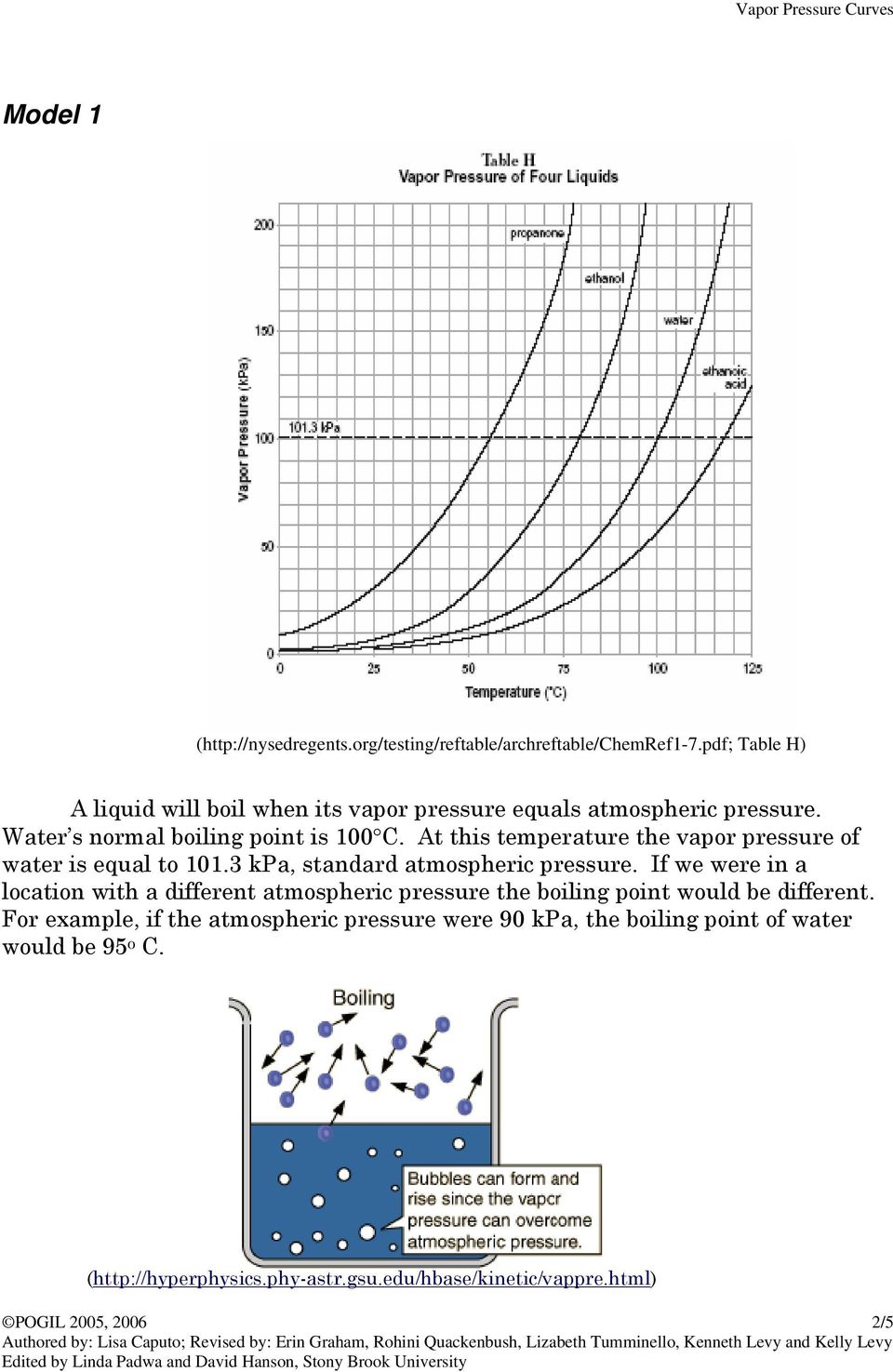
3 Key Questions 1. The vapor pressure curves of four liquids are shown in the graph in Model 1. What is plotted on the x-axis and what is plotted on the y-axis of the graph? 2. What happens to the vapor pressure of a substance when the temperature increases? 3. According to the information provided in Model 1, what determines the temperature at which a liquid boils? 4. What is the normal boiling point of propanone? 5. At what temperature will propanone boil if the atmospheric pressure is 70 kpa? Exercise 1. List the four liquids in Model 1 in order of increasing vapor pressure at 60 o C. Model 2 Evaporation, unlike vaporization, happens on the surface of liquids at all temperatures. This process is related to the strength of the forces holding the molecules in the liquid phase. The weaker the forces, the faster the molecules will escape from the liquid into the gas phase. A liquid with weak intermolecular forces will have a relatively large amount of vapor (gas phase) present above its surface. ( POGIL 2005, /5

4 Task Place an equal amount of ethanol, acetone (propanone), and water on three separate cotton balls. Wipe the cotton balls on the desk at the same time. Observe the relative rate of evaporation for the liquids. Record your observations below. Observations: Key Questions 1. Which liquid evaporated at the fastest rate? 2. Which liquid evaporated at the slowest rate? 3. Based on your observations, which liquid has the highest vapor pressure? Explain your answer. 4. Predict which of the three liquids used in this task would have the highest boiling point. Support your answer with an explanation. 5. Which of the three liquids has the strongest intermolecular forces of attraction? Support your answer with an explanation. POGIL 2005, /5

5 6. How do the intermolecular forces in propanone compare to the intermolecular forces found in water? Support your answer with an explanation. Applications 1. A thermometer is placed in a beaker of water at room temperature. The beaker, water, and thermometer are covered by a bell jar attached to a vacuum pump. The pump is turned on and the pressure inside the bell jar is reduced. Predict what would be observed inside the bell jar. 2. Based on your predictions, suggest a possible boiling point for the water in the bell jar by using the information on the vapor pressure curve in Model 1. (Specify both temperature and pressure.) 3. Suggest a reason why changes need to be made in the cooking time when eggs are boiled in a location with a high altitude such as Denver, when compared to the cooking time at a sea level location such as Miami. Support your answer with insight you have gained from this activity. POGIL 2005, /5

Materials 10-mL graduated cylinder l or 2-L beaker, preferably tall-form Thermometer
 VAPOR PRESSURE OF WATER Introduction At very low temperatures (temperatures near the freezing point), the rate of evaporation of water (or any liquid) is negligible. But as its temperature increases, more
5. Which temperature is equal to +20 K? 1) 253ºC 2) 293ºC 3) 253 C 4) 293 C
 1. The average kinetic energy of water molecules increases when 1) H 2 O(s) changes to H 2 O( ) at 0ºC 3) H 2 O( ) at 10ºC changes to H 2 O( ) at 20ºC 2) H 2 O( ) changes to H 2 O(s) at 0ºC 4) H 2 O( )
Chapter 4 Practice Quiz
 Chapter 4 Practice Quiz 1. Label each box with the appropriate state of matter. A) I: Gas II: Liquid III: Solid B) I: Liquid II: Solid III: Gas C) I: Solid II: Liquid III: Gas D) I: Gas II: Solid III:
1. The Kinetic Theory of Matter states that all matter is composed of atoms and molecules that are in a constant state of constant random motion
 Physical Science Period: Name: ANSWER KEY Date: Practice Test for Unit 3: Ch. 3, and some of 15 and 16: Kinetic Theory of Matter, States of matter, and and thermodynamics, and gas laws. 1. The Kinetic
Chapter Test A. States of Matter MULTIPLE CHOICE. a fixed amount of STAs2 a. a solid. b. a liquid. c. a gas. d. any type of matter.
 Assessment Chapter Test A States of Matter MULTIPLE CHOICE Write the letter of the correct answer in the space provided. 1. Boyle s law explains the relationship between volume and pressure for a fixed
Name Date Class STATES OF MATTER. SECTION 13.1 THE NATURE OF GASES (pages 385 389)
 13 STATES OF MATTER SECTION 13.1 THE NATURE OF GASES (pages 385 389) This section introduces the kinetic theory and describes how it applies to gases. It defines gas pressure and explains how temperature
Every mathematician knows it is impossible to understand an elementary course in thermodynamics. ~V.I. Arnold
 Every mathematician knows it is impossible to understand an elementary course in thermodynamics. ~V.I. Arnold Radiation Radiation: Heat energy transmitted by electromagnetic waves Q t = εσat 4 emissivity
Calorimetry: Heat of Vaporization
 Calorimetry: Heat of Vaporization OBJECTIVES INTRODUCTION - Learn what is meant by the heat of vaporization of a liquid or solid. - Discuss the connection between heat of vaporization and intermolecular
Science Department Mark Erlenwein, Assistant Principal
 Staten Island Technical High School Vincent A. Maniscalco, Principal The Physical Setting: CHEMISTRY Science Department Mark Erlenwein, Assistant Principal - Unit 1 - Matter and Energy Lessons 9-14 Heat,
Practical Applications of Freezing by Boiling Process
 Practical Applications of Freezing by Boiling Process Kenny Gotlieb, Sasha Mitchell and Daniel Walsh Physics Department, Harvard-Westlake School 37 Coldwater Canyon, N. Hollywood, CA 9164 Introduction
VAPORIZATION IN MORE DETAIL. Energy needed to escape into gas phase GAS LIQUID. Kinetic energy. Average kinetic energy
 30 VAPORIZATION IN MORE DETAIL GAS Energy needed to escape into gas phase LIQUID Kinetic energy Average kinetic energy - For a molecule to move from the liquid phase to the gas phase, it must acquire enough
To calculate the value of the boiling point constant for water. To use colligative properties to determine the molecular weight of a substance.
 Colligative Properties of Solutions: A Study of Boiling Point Elevation Amina El-Ashmawy, Collin County Community College (With contributions by Timm Pschigoda, St. Joseph High School, St. Joseph, MI)
13.1 The Nature of Gases. What is Kinetic Theory? Kinetic Theory and a Model for Gases. Chapter 13: States of Matter. Principles of Kinetic Theory
 Chapter 13: States of Matter The Nature of Gases The Nature of Gases kinetic molecular theory (KMT), gas pressure (pascal, atmosphere, mm Hg), kinetic energy The Nature of Liquids vaporization, evaporation,
States of Matter and the Kinetic Molecular Theory - Gr10 [CAPS]
![States of Matter and the Kinetic Molecular Theory - Gr10 [CAPS]](/thumbs/40/21739317.jpg "States of Matter and the Kinetic Molecular Theory - Gr10 [CAPS]") OpenStax-CNX module: m38210 1 States of Matter and the Kinetic Molecular Theory - Gr10 [CAPS] Free High School Science Texts Project This work is produced by OpenStax-CNX and licensed under the Creative
OpenStax-CNX module: m38210 1 States of Matter and the Kinetic Molecular Theory - Gr10 [CAPS] Free High School Science Texts Project This work is produced by OpenStax-CNX and licensed under the Creative
Chemistry 13: States of Matter
 Chemistry 13: States of Matter Name: Period: Date: Chemistry Content Standard: Gases and Their Properties The kinetic molecular theory describes the motion of atoms and molecules and explains the properties
Phase Diagram of tert-butyl Alcohol
 Phase Diagram of tert-butyl Alcohol Bill Ponder Department of Chemistry Collin College Phase diagrams are plots illustrating the relationship of temperature and pressure relative to the phase (or state
UNIT 6a TEST REVIEW. 1. A weather instrument is shown below.
 UNIT 6a TEST REVIEW 1. A weather instrument is shown below. Which weather variable is measured by this instrument? 1) wind speed 3) cloud cover 2) precipitation 4) air pressure 2. Which weather station
MOLECULAR WEIGHT BY BOILING POINT ELEVATION
 MOLECULAR WEIGHT BY BOILING POINT ELEVATION BACKGROUND This experiment demonstrates the use of colligative properties. The goal is to measure the molecular weight of a non-volatile solute by determining
Chem 112 Intermolecular Forces Chang From the book (10, 12, 14, 16, 18, 20,84,92,94,102,104, 108, 112, 114, 118 and 134)
 Chem 112 Intermolecular Forces Chang From the book (10, 12, 14, 16, 18, 20,84,92,94,102,104, 108, 112, 114, 118 and 134) 1. Helium atoms do not combine to form He 2 molecules, What is the strongest attractive
Surface Tension. the surface tension of a liquid is the energy required to increase the surface area a given amount
 Tro, Chemistry: A Molecular Approach 1 Surface Tension surface tension is a property of liquids that results from the tendency of liquids to minimize their surface area in order to minimize their surface
Rusty Walker, Corporate Trainer Hill PHOENIX
 Refrigeration 101 Rusty Walker, Corporate Trainer Hill PHOENIX Compressor Basic Refrigeration Cycle Evaporator Condenser / Receiver Expansion Device Vapor Compression Cycle Cooling by the removal of heat
Study the following diagrams of the States of Matter. Label the names of the Changes of State between the different states.
 Describe the strength of attractive forces between particles. Describe the amount of space between particles. Can the particles in this state be compressed? Do the particles in this state have a definite
CHEM 120 Online Chapter 7
 CHEM 120 Online Chapter 7 Date: 1. Which of the following statements is not a part of kinetic molecular theory? A) Matter is composed of particles that are in constant motion. B) Particle velocity increases
Name Class Date. In the space provided, write the letter of the term or phrase that best completes each statement or best answers each question.
 Assessment Chapter Test A Chapter: States of Matter In the space provided, write the letter of the term or phrase that best completes each statement or best answers each question. 1. The kinetic-molecular
Triple Point Experiment
 Equipment List Rotary vane vacuum pump 2-stage, 2 to 7 CFM. For example, Edwards 2M2 (2 CFM), Edwards RV5 (3.5 CFM), Edwards E2M8 (6.7 CFM) or equivalent. Bell jar Nalgene polycarbonate plastic, 5-5/8
Intermolecular Forces
 Intermolecular Forces: Introduction Intermolecular Forces Forces between separate molecules and dissolved ions (not bonds) Van der Waals Forces 15% as strong as covalent or ionic bonds Chapter 11 Intermolecular
Vapor Pressure of Liquids
 Vapor Pressure of Liquids Experiment 10 In this experiment, you will investigate the relationship between the vapor pressure of a liquid and its temperature. When a liquid is added to the Erlenmeyer flask
THE HUMIDITY/MOISTURE HANDBOOK
 THE HUMIDITY/MOISTURE HANDBOOK Table of Contents Introduction... 3 Relative Humidity... 3 Partial Pressure... 4 Saturation Pressure (Ps)... 5 Other Absolute Moisture Scales... 8 % Moisture by Volume (%M
(Walter Glogowski, Chaz Shapiro & Reid Sherman) INTRODUCTION
 Convection (Walter Glogowski, Chaz Shapiro & Reid Sherman) INTRODUCTION You know from common experience that when there's a difference in temperature between two places close to each other, the temperatures
Polarity and Properties Lab PURPOSE: To investigate polar and non-polar molecules and the affect of polarity on molecular properties.
 Name!!!! date Polarity and Properties Lab PURPOSE: To investigate polar and non-polar molecules and the affect of polarity on molecular properties. STATION 1: Oil and water do not mix. We all know that.
Everest. Leaders in Vacuum Booster Technology
 This article has been compiled to understand the process of Solvent Recovery process generally carried out at low temperatures and vacuum. In many chemical processes solute is to be concentrated to high
KINETIC MOLECULAR THEORY OF MATTER
 KINETIC MOLECULAR THEORY OF MATTER The kinetic-molecular theory is based on the idea that particles of matter are always in motion. The theory can be used to explain the properties of solids, liquids,
Distillation Experiment
 Distillation Experiment CHM226 Background The distillation process is a very important technique used to separate compounds based on their boiling points. A substance will boil only when the vapor pressure
Experiment 12E LIQUID-VAPOR EQUILIBRIUM OF WATER 1
 Experiment 12E LIQUID-VAPOR EQUILIBRIUM OF WATER 1 FV 6/26/13 MATERIALS: PURPOSE: 1000 ml tall-form beaker, 10 ml graduated cylinder, -10 to 110 o C thermometer, thermometer clamp, plastic pipet, long
Intermolecular and Ionic Forces
 Intermolecular and Ionic Forces Introduction: Molecules are attracted to each other in the liquid and solid states by intermolecular, or attractive, forces. These are the attractions that must be overcome
Calibration of Glassware
 Calibration of Glassware Introduction Glassware is commonly calibrated using a liquid of known, specific density, and an analytical balance. The procedure is to determine the mass of liquid the glassware
ENZYME ACTION: TESTING CATALASE ACTIVITY
 ENZYME ACTION: TESTING CATALASE ACTIVITY LAB ENZ 1.CALC From Biology with Calculators, Vernier Software & Technology, 2000 INTRODUCTION Many organisms can decompose hydrogen peroxide (H 2 O 2 ) enzymatically.
States of Matter CHAPTER 10 REVIEW SECTION 1. Name Date Class. Answer the following questions in the space provided.
 CHAPTER 10 REVIEW States of Matter SECTION 1 SHORT ANSWER Answer the following questions in the space provided. 1. Identify whether the descriptions below describe an ideal gas or a real gas. ideal gas
Activity 5 At a Glance
 At a Glance Testing Your Hypothesis by Boiling Water Below Its Boiling Temperature Purpose To have students boil water below its typical boiling temperature by reducing the pressure above the surface of
Lab: Properties of Polar and Nonpolar Substances
 Lab: Properties of Polar and Nonpolar Substances Purpose: To explain the interactions of matter in relation to polarity. Stations 1 and 2 - il and water do not mix As a metaphor, oil and water are often
Partner: Jack 17 November 2011. Determination of the Molar Mass of Volatile Liquids
 Partner: Jack 17 November 2011 Determination of the Molar Mass of Volatile Liquids Purpose: The purpose of this experiment is to determine the molar mass of three volatile liquids. The liquid is vaporized
EXPERIMENT 15: Ideal Gas Law: Molecular Weight of a Vapor
 EXPERIMENT 15: Ideal Gas Law: Molecular Weight of a Vapor Purpose: In this experiment you will use the ideal gas law to calculate the molecular weight of a volatile liquid compound by measuring the mass,
KINETIC THEORY OF MATTER - molecules in matter are always in motion - speed of molecules is proportional to the temperature
 1 KINETIC TERY F MATTER - molecules in matter are always in motion - speed of molecules is proportional to the temperature TE STATES F MATTER 1. Gas a) ideal gas - molecules move freely - molecules have
Chapter 12 - Liquids and Solids
 Chapter 12 - Liquids and Solids 12-1 Liquids I. Properties of Liquids and the Kinetic Molecular Theory A. Fluids 1. Substances that can flow and therefore take the shape of their container B. Relative
Chapter 5 Student Reading
 Chapter 5 Student Reading THE POLARITY OF THE WATER MOLECULE Wonderful water Water is an amazing substance. We drink it, cook and wash with it, swim and play in it, and use it for lots of other purposes.
Minnesota Comprehensive Assessments-Series III
 Not for student use. Minnesota Comprehensive Assessments-Series III Science Item Sampler Script Grade 8 S ARE NOT SECURE TEST MATERIALS. THIS ITEM SAMPLER SCRIPT MAY BE COPIED OR DUPLICATED. MINNESOTA
Physical Properties of a Pure Substance, Water
 Physical Properties of a Pure Substance, Water The chemical and physical properties of a substance characterize it as a unique substance, and the determination of these properties can often allow one to
Enzyme Action: Testing Catalase Activity
 Enzyme Action: Testing Catalase Activity Experiment 6A Many organisms can decompose hydrogen peroxide (H 2 O 2 ) enzymatically. Enzymes are globular proteins, responsible for most of the chemical activities
Investigation M3: Separating Mixtures into Component Parts
 Investigation M3: Separating Mixtures into Component Parts Goals: Use various methods to separate mixtures, make inferences from temperature/time graphs, and identify substances. 81 Activity M3.3: What
The Properties of Water (Instruction Sheet)
 The Properties of Water (Instruction Sheet) Property : High Polarity Activity #1 Surface Tension: PILE IT ON. Materials: 1 DRY penny, 1 eye dropper, water. 1. Make sure the penny is dry. 2. Begin by estimating
Surface Tension: Liquids Stick Together Teacher Version
 Surface Tension: Liquids Stick Together Teacher Version In this lab you will learn about properties of liquids, specifically cohesion, adhesion, and surface tension. These principles will be demonstrated
Write True or False in the space provided.
 CP Physics -- Exam #7 Practice Name: _ Class: Date: Write True or False in the space provided. 1) Pressure at the bottom of a lake depends on the weight density of the lake water and on the volume of the
Partnerships Implementing Engineering Education Worcester Polytechnic Institute Worcester Public Schools
 Partnerships Implementing Engineering Education Worcester Polytechnic Institute Worcester Public Schools Supported by: National Science Foundation Weather: 4.H.3 Weather and Classical Instruments Grade
SUGGESTED ACTIVITIES
 SUGGESTED ACTIVITIES (Thermal Energy) From Invitations to Science Inquiry 2 nd Edition by Tik L. Liem: Activity Page Number Concept Warm a Bottle by Shaking 184 Heat, Friction The Confused Bottles 206
First Grade Unit A: PHYSICAL SCIENCE Chapter 1: Observing Solids, Liquids and Gases Lessons 1 to 5
 First Grade Unit A: PHYSICAL SCIENCE Chapter 1: Observing Solids, Liquids and Gases Lessons 1 to 5 Physical Science Overview Materials (matter) come in different forms. Water can be rain falling (liquid)
Test 5 Review questions. 1. As ice cools from 273 K to 263 K, the average kinetic energy of its molecules will
 Name: Thursday, December 13, 2007 Test 5 Review questions 1. As ice cools from 273 K to 263 K, the average kinetic energy of its molecules will 1. decrease 2. increase 3. remain the same 2. The graph below
Distillation vaporization sublimation. vapor pressure normal boiling point.
 Distillation Distillation is an important commercial process that is used in the purification of a large variety of materials. However, before we begin a discussion of distillation, it would probably be
Chapter 17: Change of Phase
 Chapter 17: Change of Phase Conceptual Physics, 10e (Hewitt) 3) Evaporation is a cooling process and condensation is A) a warming process. B) a cooling process also. C) neither a warming nor cooling process.
Online Changing States of Matter Lab Solids What is a Solid? 1. How are solids different then a gas or a liquid?
 Name: Period: Online Changing States of Matter Lab Solids What is a Solid? 1. How are solids different then a gas or a liquid? 2. What are the atoms doing in a solid? 3. What are the characteristics of
THIRD GRADE WEATHER 1 WEEK LESSON PLANS AND ACTIVITIES
 THIRD GRADE WEATHER 1 WEEK LESSON PLANS AND ACTIVITIES WATER CYCLE OVERVIEW OF THIRD GRADE WATER WEEK 1. PRE: Comparing the different components of the water cycle. LAB: Contrasting water with hydrogen
Consider next the behavior of a mixture of two liquid compounds. The example shown below is for a 1:1 mixture of cyclohexane (C) and toluene (T).
 Distillation Distillation is a commonly used method for purifying liquids and separating mixtures of liquids into their individual components. Familiar examples include the distillation of crude fermentation
Humidity, Condensation, Clouds, and Fog. Water in the Atmosphere
 Humidity, Condensation, Clouds, and Fog or Water in the Atmosphere The Hydrologic Cycle Where the Water Exists on Earth Evaporation From the Oceans and Land The Source of Water Vapor for the Atmosphere
Enzyme Action: Testing Catalase Activity
 Enzyme Action: Testing Catalase Activity Experiment 6A Many organisms can decompose hydrogen peroxide (H 2 O 2 ) enzymatically. Enzymes are globular proteins, responsible for most of the chemical activities
Chapter 2, Lesson 5: Changing State Melting
 Chapter 2, Lesson 5: Changing State Melting Key Concepts Melting is a process that causes a substance to change from a solid to a liquid. Melting occurs when the molecules of a solid speed up enough that
SEPARATION OF A MIXTURE OF SUBSTANCES LAB
 SEPARATION OF A MIXTURE OF SUBSTANCES LAB Purpose: Every chemical has a set of defined physical properties, and when combined they present a unique fingerprint for that chemical. When chemicals are present
The Molar Mass of a Gas
 The Molar Mass of a Gas Goals The purpose of this experiment is to determine the number of grams per mole of a gas by measuring the pressure, volume, temperature, and mass of a sample. Terms to Know Molar
SAM Teachers Guide Heat and Temperature
 SAM Teachers Guide Heat and Temperature Overview Students learn that temperature measures average kinetic energy, and heat is the transfer of energy from hot systems to cold systems. They consider what
Practice Test. 4) The planet Earth loses heat mainly by A) conduction. B) convection. C) radiation. D) all of these Answer: C
 Practice Test 1) Increase the pressure in a container of oxygen gas while keeping the temperature constant and you increase the A) molecular speed. B) molecular kinetic energy. C) Choice A and choice B
Convection, Conduction & Radiation
 Convection, Conduction & Radiation There are three basic ways in which heat is transferred: convection, conduction and radiation. In gases and liquids, heat is usually transferred by convection, in which
Chemistry 1050 Chapter 13 LIQUIDS AND SOLIDS 1. Exercises: 25, 27, 33, 39, 41, 43, 51, 53, 57, 61, 63, 67, 69, 71(a), 73, 75, 79
 Chemistry 1050 Chapter 13 LIQUIDS AND SOLIDS 1 Text: Petrucci, Harwood, Herring 8 th Edition Suggest text problems Review questions: 1, 5!11, 13!17, 19!23 Exercises: 25, 27, 33, 39, 41, 43, 51, 53, 57,
Enzyme Action: Testing Catalase Activity 50 Points
 Names: LabQuest Enzyme Action: Testing Catalase Activity 50 Points 6A Many organisms can decompose hydrogen peroxide (H 2 O 2 ) enzymatically. Enzymes are globular proteins, responsible for most of the
VAPOR PRESSURE AS A FUNCTION OF TEMPERATURE. This laboratory covers material presented in section 11.8 of the 9 th Ed. of the Chang text.
 VAPOR PRESSURE AS A FUNCTION OF TEMPERATURE Objectives: (1) Observe and measure the change in the vapor pressure (dependent variable) as a function of temperature (independent variable). (2) Analyze the
Why? Intermolecular Forces. Intermolecular Forces. Chapter 12 IM Forces and Liquids. Covalent Bonding Forces for Comparison of Magnitude
 1 Why? Chapter 1 Intermolecular Forces and Liquids Why is water usually a liquid and not a gas? Why does liquid water boil at such a high temperature for such a small molecule? Why does ice float on water?
Unit 3: States of Matter Practice Exam
 Page 1 Unit 3: States of Matter Practice Exam Multiple Choice. Identify the choice that best completes the statement or answers the question. 1. Two gases with unequal masses are injected into opposite
In this experiment, we will use three properties to identify a liquid substance: solubility, density and boiling point..
 Identification of a Substance by Physical Properties 2009 by David A. Katz. All rights reserved. Permission for academic use provided the original copyright is included Every substance has a unique set
Kinetic Theory & Ideal Gas
 1 of 6 Thermodynamics Summer 2006 Kinetic Theory & Ideal Gas The study of thermodynamics usually starts with the concepts of temperature and heat, and most people feel that the temperature of an object
How do I measure the amount of water vapor in the air?
 How do I measure the amount of water vapor in the air? Materials 2 Centigrade Thermometers Gauze Fan Rubber Band Tape Overview Water vapor is a very important gas in the atmosphere and can influence many
TEACHER BACKGROUND INFORMATION THERMAL ENERGY
 TEACHER BACKGROUND INFORMATION THERMAL ENERGY In general, when an object performs work on another object, it does not transfer all of its energy to that object. Some of the energy is lost as heat due to
Chemistry. Stage 1 Desired Results 2013-2014. Kelly Clark, Kelly Puder, Sheryl Rabinowitz, Sarah Warren
 Chemistry 2013-2014 Kelly Clark, Kelly Puder, Sheryl Rabinowitz, Sarah Warren Unit 4: Kinetic Theory Transfer Goal: I want you to learn that the properties of particles can be predicted from their intermolecular
FXA 2008. Candidates should be able to : Define and apply the concept of specific heat capacity. Select and apply the equation : E = mcδθ
 UNIT G484 Module 3 4.3.3 Thermal Properties of Materials 1 Candidates should be able to : Define and apply the concept of specific heat capacity. Select and apply the equation : E = mcδθ The MASS (m) of
1. The Determination of Boiling Point
 1. The Determination of Boiling Point Objective In this experiment, you will first check your thermometer for errors by determining the temperature of two stable equilibrium systems. You will then use
The Structure of Water Introductory Lesson
 Dana V. Middlemiss Fall 2002 The Structure of Water Introductory Lesson Abstract: This is an introduction to the chemical nature of water and its interactions. In particular, this lesson will explore evaporation,
Chapter 13 - LIQUIDS AND SOLIDS
 Chapter 13 - LIQUIDS AND SOLIDS Problems to try at end of chapter: Answers in Appendix I: 1,3,5,7b,9b,15,17,23,25,29,31,33,45,49,51,53,61 13.1 Properties of Liquids 1. Liquids take the shape of their container,
Phase diagram of water. Note: for H 2 O melting point decreases with increasing pressure, for CO 2 melting point increases with increasing pressure.
 Phase diagram of water Note: for H 2 O melting point decreases with increasing pressure, for CO 2 melting point increases with increasing pressure. WATER Covers ~ 70% of the earth s surface Life on earth
Chapter 1 Student Reading
 Chapter 1 Student Reading Chemistry is the study of matter You could say that chemistry is the science that studies all the stuff in the entire world. A more scientific term for stuff is matter. So chemistry
Enzyme Action: Testing Catalase Activity
 Enzyme Action: Testing Catalase Activity DataQuest 12 Many organisms can decompose hydrogen peroxide (H 2 O 2 ) enzymatically. Enzymes are globular proteins, responsible for most of the chemical activities
Order of the Weather Experiments
 Order of the Weather Experiments 1. Staying Dry Towel in bottle--student i. Magic Air Pushing the stick down-- Student ii. Air Power Water in funnel--teacher 2. Tipping the Scale Weighing air--student
In the compression-refrigeration loop (air conditioning), which is likely to be warmer? 1. Condenser coil 2. Evaporator coil
 In the compression-refrigeration loop (air conditioning), which is likely to be warmer? 1. Condenser coil 2. Evaporator coil Answer: (1) Condenser coil See the video. A.R.E. Building Systems Study Guide
PRE-LAB FOR YEAST RESPIRATION AND FERMENTATION
 PRE-LAB FOR YEAST RESPIRATION AND FERMENTATION PURPOSE: To identify the products of yeast cultures grown under aerobic and anaerobic conditions STUDENTS' ENTERING COMPETENCIES: Before doing this lab, students
We will study the temperature-pressure diagram of nitrogen, in particular the triple point.
 K4. Triple Point of Nitrogen I. OBJECTIVE OF THE EXPERIMENT We will study the temperature-pressure diagram of nitrogen, in particular the triple point. II. BAKGROUND THOERY States of matter Matter is made
GETTING TO THE CORE: THE LINK BETWEEN TEMPERATURE AND CARBON DIOXIDE
 DESCRIPTION This lesson plan gives students first-hand experience in analyzing the link between atmospheric temperatures and carbon dioxide ( ) s by looking at ice core data spanning hundreds of thousands
Effects of Salt in Boiling Water
 Effects of Salt in Boiling Water Madeline Parker Today in science class, we did a very interesting experiment. It was a partner experiment about the effects of salt in boiling water. My partner was Lisa.
Determination of Molar Mass by Boiling Point Elevation of Urea Solution
 Determination of Molar Mass by Boiling Point Elevation of Urea Solution CHRISTIAN E. MADU, PhD AND BASSAM ATTILI, PhD COLLIN COLLEGE CHEMISTRY DEPARTMENT Purpose of the Experiment Determine the boiling
Laboratory Exercise: Calibration of a Thermometer
 CHEM 109 Introduction themistry Revision 3.1 Laboratory Exercise: Calibration of a Thermometer In this exercise we will calibrate a stem-type thermometer and then use it to correctly measure the Air temperature
CHAPTER 14 THE CLAUSIUS-CLAPEYRON EQUATION
 CHAPTER 4 THE CAUIU-CAPEYRON EQUATION Before starting this chapter, it would probably be a good idea to re-read ections 9. and 9.3 of Chapter 9. The Clausius-Clapeyron equation relates the latent heat
10.7 Kinetic Molecular Theory. 10.7 Kinetic Molecular Theory. Kinetic Molecular Theory. Kinetic Molecular Theory. Kinetic Molecular Theory
 The first scheduled quiz will be given next Tuesday during Lecture. It will last 5 minutes. Bring pencil, calculator, and your book. The coverage will be pp 364-44, i.e. Sections 0.0 through.4. 0.7 Theory
Name Class Date. F 2 2269 N A 1 88.12 cm 2 A 2 1221 cm 2 Unknown: Step 2: Write the equations for Pascal s principle and pressure, force, and area.
 Skills Worksheet Math Skills Pascal s Principle After you study each sample problem and solution, work out the practice problems on a separate sheet of paper. Write your answers in the spaces provided.
Evaluation copy. Enzyme Action: Testing Catalase Activity (Method 1 O 2 Gas Sensor) Computer 2
 Enzyme Action: Testing Catalase Activity (Method 1 O 2 Gas Sensor) Computer 2 Many organisms can decompose hydrogen peroxide (H 2 O 2 ) enzymatically. Enzymes are globular proteins, responsible for most
ES 106 Laboratory # 2 HEAT AND TEMPERATURE
 ES 106 Laboratory # 2 HEAT AND TEMPERATURE Introduction Heat transfer is the movement of heat energy from one place to another. Heat energy can be transferred by three different mechanisms: convection,