
Lab: Properties of Polar and Nonpolar Substances
|
|
|
- Mark Shepherd
- 9 years ago
- Views:
Transcription
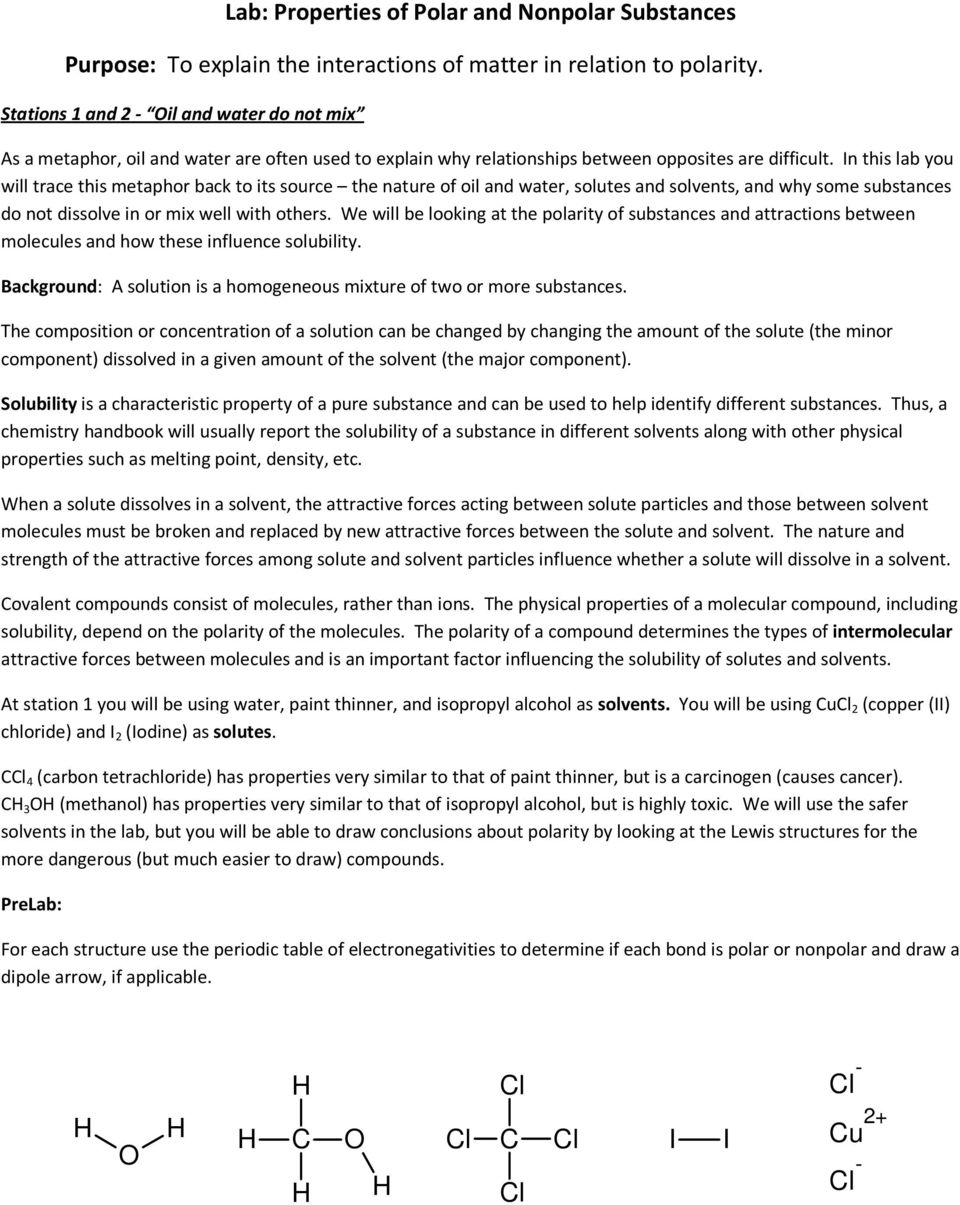
1 Lab: Properties of Polar and Nonpolar Substances Purpose: To explain the interactions of matter in relation to polarity. Stations 1 and 2 - il and water do not mix As a metaphor, oil and water are often used to explain why relationships between opposites are difficult. In this lab you will trace this metaphor back to its source the nature of oil and water, solutes and solvents, and why some substances do not dissolve in or mix well with others. We will be looking at the polarity of substances and attractions between molecules and how these influence solubility. Background: A solution is a homogeneous mixture of two or more substances. The composition or concentration of a solution can be changed by changing the amount of the solute (the minor component) dissolved in a given amount of the solvent (the major component). Solubility is a characteristic property of a pure substance and can be used to help identify different substances. Thus, a chemistry handbook will usually report the solubility of a substance in different solvents along with other physical properties such as melting point, density, etc. When a solute dissolves in a solvent, the attractive forces acting between solute particles and those between solvent molecules must be broken and replaced by new attractive forces between the solute and solvent. The nature and strength of the attractive forces among solute and solvent particles influence whether a solute will dissolve in a solvent. ovalent compounds consist of molecules, rather than ions. The physical properties of a molecular compound, including solubility, depend on the polarity of the molecules. The polarity of a compound determines the types of intermolecular attractive forces between molecules and is an important factor influencing the solubility of solutes and solvents. At station 1 you will be using water, paint thinner, and isopropyl alcohol as solvents. You will be using ul 2 (copper (II) chloride) and I 2 (Iodine) as solutes. l 4 (carbon tetrachloride) has properties very similar to that of paint thinner, but is a carcinogen (causes cancer). 3 (methanol) has properties very similar to that of isopropyl alcohol, but is highly toxic. We will use the safer solvents in the lab, but you will be able to draw conclusions about polarity by looking at the Lewis structures for the more dangerous (but much easier to draw) compounds. PreLab: For each structure use the periodic table of electronegativities to determine if each bond is polar or nonpolar and draw a dipole arrow, if applicable. l l l l l - I I u 2+ l -
2 List the 3 solvents in order of increasing polarity opper II hloride is a(n) (circle one) ionic polar covalent nonpolar covalent compound. Iodine (I 2 ) is a(n) (circle one) ionic polar covalent nonpolar covalent compound. : Station 1 Solubility of Solids 1. btain 6 test tubes. Fill two test tubes half full with water. Fill two test tubes half full with isopropyl alcohol. Fill two test tubes half full with paint thinner. 2. Make two sets of test tubes: a complete set contains one containing water, one containing isopropyl alcohol, and one containing paint thinner. 3. Using one set of 3 test tubes: put a small amount (less than a match head sized piece) of iodine into each test tube. Swirl or tap. Swirl or tap some more. 4. Judge by the color of the liquid whether the solid is insoluble, partially soluble, or very soluble. 5. Record all data on the table provided. 6. Empty the test tubes into the proper waste containers. Wash with soap and water. 7. Using the other set of 3 test tubes: obtain enough copper (II) chloride crystals to fill the tip of a scoopula. Put this much of the solid into each of the 3 test tubes. 8. Judge by the color of the liquid whether the solid is insoluble, partially soluble, or very soluble. 9. Record all data. 10. Empty the test tubes into the proper waste containers. Wash with soap and water. N PAINT TINNER DWN TE DRAIN R IN TE SINKS!! Station 2 Mixing Liquids 1. Put 4 ml of water into 1 test tube, then add 4 ml of paint thinner. Swirl or tap the test tube. Do they mix or separate? Record your observations. 2. Put 4 ml of water into a 2 nd test tube, then add 4 ml of alcohol. Swirl or tap the test tube. Do they mix or separate? Record your observations. 3. Put 4 ml of paint thinner into a 3 rd test tube, then add 4 ml of alcohol. Swirl or tap the test tube. Do they mix or separate? Record your observations. 4. Dispose of all liquids according to your teachers instructions. N PAINT TINNER DWN TE DRAIN R IN TE SINKS!!

3 Station 3 Evaporation Below are the Lewis structures for acetone (ingredient in most nail polish removers), ethyl alcohol (ethanol), and water. Determine the polarity of each bond and note NLY the polar bonds on the diagram, using a dipole arrow. 1. At exactly the same time, place 1 drop of each liquid on your lab table. Watch them evaporate. 2. List the liquids below, from first to evaporate to last to evaporate: A) B) ) Station 4 Bending Water 1. Run a small stream of water from the faucet. 2. Place the unrubbed balloon near the stream. Do you notice anything occurring? 3. Rub the FAE side of the balloon vigorously against your clothes or hair. Bring it close to, but not touching, the stream of water. Record your observations in the analysis section. Station 5 Magic Sand 1. Fill up 2 beakers about half-way with water. 2. To the first beaker, add a couple spoonfuls of magic sand. To the second beaker, add a couple spoonfuls of regular sand. 3. Stir each mixture with a stirring rod. 4. When you are finished with your observations, pour off as much water as possible into the water beaker without losing any sand. Then dump the regular sand into the designated tray. Scoop the magic sand back into the labeled beaker. 5. Answer the analysis questions. Station 6 Penny Stacker 1. Place two pennies on a paper towel. 2. n one penny, count how many drops of ethanol fit in the penny before the oil spills onto the paper towel. 3. n the other penny, count how many drops of water fit on the penny before the water spills onto the paper towel.

4

5 Name: Date: Per. Student# DATA TABLE Analysis: Station 1 Solubility of Solids Station 2 Mixing Liquids 1. Polar/Ionic solids dissolve in (circle one) polar nonpolar liquids. 2. Nonpolar solids dissolve in (circle one) polar nonpolar liquids. 3. Polar liquids (circle one) mix do not mix with nonpolar liquids. 4. Using what you have learned from this lab, explain why oil and water do not mix. Be sure to include the terms: polarity, attractive forces, molecules.

6 Station 3 Evaporation 5. The first liquid to evaporate had (circle one) the most the fewest polar bonds. 6. Use what you know about intermolecular attractions to explain this: Station 4 Bending Water 7. Sketch the behavior of the water with the balloon 8. By charging the balloon you are collecting electrons on the side of the balloon that was rubbed. Use this information, along with the knowledge that water is a polar molecule, to explain which part of the water molecule is attracted to the balloon. You may use words or sketches, but any explanation should include knowledge about the polarity of a water molecule.

7 Station 5 Magic Sand 9. Describe the difference between the interactions of water and the two types of sand. 10. Explain how you think magic sand works. Station 6 Penny Stacker (cohesiveness of molecules) 11. ow many drops of ethanol fit on the penny? 12. ow many drops of water? 13. Why were you able to fit more drops of one liquid on the penny than the other? onclusion Questions 14. What is a polar bond? 15. List 3 properties affected by the polarity of a molecule in this lab. a. b. c. 16. Polar compounds have (circle one) stronger weaker attractions between molecules. That means that they will evaporate at (circle one) higher lower temperatures. This is because of the attractions between the polar regions of each molecule.

Polarity and Properties Lab PURPOSE: To investigate polar and non-polar molecules and the affect of polarity on molecular properties.
 Name!!!! date Polarity and Properties Lab PURPOSE: To investigate polar and non-polar molecules and the affect of polarity on molecular properties. STATION 1: Oil and water do not mix. We all know that.
Name Lab #3: Solubility of Organic Compounds Objectives: Introduction: soluble insoluble partially soluble miscible immiscible
 Lab #3: Solubility of rganic Compounds bjectives: - Understanding the relative solubility of organic compounds in various solvents. - Exploration of the effect of polar groups on a nonpolar hydrocarbon
SOLUBILITY OF A SALT IN WATER AT VARIOUS TEMPERATURES LAB
 SOLUBILITY OF A SALT IN WATER AT VARIOUS TEMPERATURES LAB Purpose: Most ionic compounds are considered by chemists to be salts and many of these are water soluble. In this lab, you will determine the solubility,
Chapter 5, Lesson 3 Why Does Water Dissolve Salt?
 Chapter 5, Lesson 3 Why Does Water Dissolve Salt? Key Concepts The polarity of water molecules enables water to dissolve many ionically bonded substances. Salt (sodium chloride) is made from positive sodium
5s Solubility & Conductivity
 5s Solubility & Conductivity OBJECTIVES To explore the relationship between the structures of common household substances and the kinds of solvents in which they dissolve. To demonstrate the ionic nature
Experiment #8 properties of Alcohols and Phenols
 Introduction Experiment #8 properties of Alcohols and Phenols As has been mentioned before, over 20 million organic compounds have been identified. If each substance had to be studied as an entity completely
Name: Date: Period: Presentation #4. Covalent compounds continued practice with drawing them. Modeling covalent compounds in 3D
 Homework Activities Name: Date: Period: This week we will practice creating covalent compounds through drawings and 3D models. We will also look at polar and non-polar molecules to see how their structures
Chapter 13 Solution Dynamics. An Introduction to Chemistry by Mark Bishop
 Chapter 13 Solution Dynamics An Introduction to Chemistry by Mark Bishop Chapter Map Why Changes Happen Consider a system that can switch freely between two states, A and B. Probability helps us to predict
Hands-On Labs SM-1 Lab Manual
 EXPERIMENT 4: Separation of a Mixture of Solids Read the entire experiment and organize time, materials, and work space before beginning. Remember to review the safety sections and wear goggles when appropriate.
SEPARATION OF A MIXTURE OF SUBSTANCES LAB
 SEPARATION OF A MIXTURE OF SUBSTANCES LAB Purpose: Every chemical has a set of defined physical properties, and when combined they present a unique fingerprint for that chemical. When chemicals are present
In this experiment, we will use three properties to identify a liquid substance: solubility, density and boiling point..
 Identification of a Substance by Physical Properties 2009 by David A. Katz. All rights reserved. Permission for academic use provided the original copyright is included Every substance has a unique set
Solubility Curve of Sugar in Water
 Solubility Curve of Sugar in Water INTRODUCTION Solutions are homogeneous mixtures of solvents (the larger volume of the mixture) and solutes (the smaller volume of the mixture). For example, a hot chocolate
The Properties of Water (Instruction Sheet)
 The Properties of Water (Instruction Sheet) Property : High Polarity Activity #1 Surface Tension: PILE IT ON. Materials: 1 DRY penny, 1 eye dropper, water. 1. Make sure the penny is dry. 2. Begin by estimating
4.5 Physical Properties: Solubility
 4.5 Physical Properties: Solubility When a solid, liquid or gaseous solute is placed in a solvent and it seems to disappear, mix or become part of the solvent, we say that it dissolved. The solute is said
Laboratory 22: Properties of Alcohols
 Introduction Alcohols represent and important class of organic molecules. In this experiment you will study the physical and chemical properties of alcohols. Solubility in water, and organic solvents,
Reading Preview. Key Terms covalent bond molecule double bond triple bond molecular compound polar bond nonpolar bond
 Section 4 4 bjectives After this lesson, students will be able to L.1.4.1 State what holds covalently bonded s together. L.1.4.2 Identify the properties of molecular compounds. L.1.4.3 Explain how unequal
5. Which temperature is equal to +20 K? 1) 253ºC 2) 293ºC 3) 253 C 4) 293 C
 1. The average kinetic energy of water molecules increases when 1) H 2 O(s) changes to H 2 O( ) at 0ºC 3) H 2 O( ) at 10ºC changes to H 2 O( ) at 20ºC 2) H 2 O( ) changes to H 2 O(s) at 0ºC 4) H 2 O( )
Experiment #10: Liquids, Liquid Mixtures and Solutions
 Experiment #10: Liquids, Liquid Mixtures and Solutions Objectives: This experiment is a broad survey of the physical properties of liquids. We will investigate solvent/solute mixtures. We will study and
Organic Chemistry Lab Experiment 4 Preparation and Properties of Soap
 Organic Chemistry Lab Experiment 4 Preparation and Properties of Soap Introduction A soap is the sodium or potassium salt of a long-chain fatty acid. The fatty acid usually contains 12 to 18 carbon atoms.
Intermolecular and Ionic Forces
 Intermolecular and Ionic Forces Introduction: Molecules are attracted to each other in the liquid and solid states by intermolecular, or attractive, forces. These are the attractions that must be overcome
Chapter 13 - LIQUIDS AND SOLIDS
 Chapter 13 - LIQUIDS AND SOLIDS Problems to try at end of chapter: Answers in Appendix I: 1,3,5,7b,9b,15,17,23,25,29,31,33,45,49,51,53,61 13.1 Properties of Liquids 1. Liquids take the shape of their container,
Sugar or Salt? Ionic and Covalent Bonds
 Lab 11 Sugar or Salt? Ionic and Covalent Bonds TN Standard 2.1: The student will investigate chemical bonding. Have you ever accidentally used salt instead of sugar? D rinking tea that has been sweetened
Separation by Solvent Extraction
 Experiment 3 Separation by Solvent Extraction Objectives To separate a mixture consisting of a carboxylic acid and a neutral compound by using solvent extraction techniques. Introduction Frequently, organic
CHAPTER 10: INTERMOLECULAR FORCES: THE UNIQUENESS OF WATER Problems: 10.2, 10.6,10.15-10.33, 10.35-10.40, 10.56-10.60, 10.101-10.
 CHAPTER 10: INTERMOLECULAR FORCES: THE UNIQUENESS OF WATER Problems: 10.2, 10.6,10.15-10.33, 10.35-10.40, 10.56-10.60, 10.101-10.102 10.1 INTERACTIONS BETWEEN IONS Ion-ion Interactions and Lattice Energy
CHEM 2423 Recrystallization of Benzoic Acid EXPERIMENT 4 - Purification - Recrystallization of Benzoic acid
 EXPERIMENT 4 - Purification - Recrystallization of Benzoic acid Purpose: a) To purify samples of organic compounds that are solids at room temperature b) To dissociate the impure sample in the minimum
Unit 1 - Pure Substances and Mixtures Chapter 2: Solutions
 2.1 Solutes & Solvents Vocabulary: Unit 1 - Pure Substances and Mixtures Chapter 2: Solutions solvent the larger part of a solution - the part of a solution into which the solutes dissolve solute the smaller
Chapter 5 Student Reading
 Chapter 5 Student Reading THE POLARITY OF THE WATER MOLECULE Wonderful water Water is an amazing substance. We drink it, cook and wash with it, swim and play in it, and use it for lots of other purposes.
Properties of Alcohols and Phenols Experiment #3
 Properties of Alcohols and Phenols Experiment #3 Objectives: To observe the solubility of alcohols relative to their chemical structure, to perform chemical tests to distinguish primary, secondary and
Making Biodiesel from Virgin Vegetable Oil: Teacher Manual
 Making Biodiesel from Virgin Vegetable Oil: Teacher Manual Learning Goals: Students will understand how to produce biodiesel from virgin vegetable oil. Students will understand the effect of an exothermic
H H H O. Pre-Lab Exercises Lab 6: Organic Chemistry. Lab 6: Organic Chemistry Chemistry 100. 1. Define the following: a.
 Lab 6: Organic hemistry hemistry 100 1. Define the following: a. ydrocarbon Pre-Lab Exercises Lab 6: Organic hemistry Name Date Section b. Saturated hydrocarbon c. Unsaturated hydrocarbon 2. The formula
Surface Tension: Liquids Stick Together Teacher Version
 Surface Tension: Liquids Stick Together Teacher Version In this lab you will learn about properties of liquids, specifically cohesion, adhesion, and surface tension. These principles will be demonstrated
Electronegativity and Polarity MAIN Idea A chemical bond s character is related to each atom s
 Section 8.5 Objectives Describe how electronegativity is used to determine bond type. Compare and contrast polar and nonpolar covalent bonds and polar and nonpolar molecules. Generalize about the characteristics
PREPARATION AND PROPERTIES OF A SOAP
 (adapted from Blackburn et al., Laboratory Manual to Accompany World of Chemistry, 2 nd ed., (1996) Saunders College Publishing: Fort Worth) Purpose: To prepare a sample of soap and to examine its properties.
ISOLATION OF CAFFEINE FROM TEA
 ISLATIN F CAFFEINE FRM TEA Introduction In this experiment, caffeine is isolated from tealeaves. The chief problem with the isolation is that caffeine does not exist alone in the tealeaves, but other natural
SYNTHESIS AND ANALYSIS OF A COORDINATION COMPOUND OF COPPER
 Chemistry 111 Lab: Synthesis of a Copper Complex Page H-1 SYNTHESIS AND ANALYSIS OF A COORDINATION COMPOUND OF COPPER In this experiment you will synthesize a compound by adding NH 3 to a concentrated
In the box below, draw the Lewis electron-dot structure for the compound formed from magnesium and oxygen. [Include any charges or partial charges.
 Name: 1) Which molecule is nonpolar and has a symmetrical shape? A) NH3 B) H2O C) HCl D) CH4 7222-1 - Page 1 2) When ammonium chloride crystals are dissolved in water, the temperature of the water decreases.
Chem 112 Intermolecular Forces Chang From the book (10, 12, 14, 16, 18, 20,84,92,94,102,104, 108, 112, 114, 118 and 134)
 Chem 112 Intermolecular Forces Chang From the book (10, 12, 14, 16, 18, 20,84,92,94,102,104, 108, 112, 114, 118 and 134) 1. Helium atoms do not combine to form He 2 molecules, What is the strongest attractive
Experiment 12- Classification of Matter Experiment
 Experiment 12- Classification of Matter Experiment Matter can be classified into two groups: mixtures and pure substances. Mixtures are the most common form of matter and consist of mixtures of pure substances.
Which substance contains positive ions immersed in a sea of mobile electrons? A) O2(s) B) Cu(s) C) CuO(s) D) SiO2(s)
 BONDING MIDTERM REVIEW 7546-1 - Page 1 1) Which substance contains positive ions immersed in a sea of mobile electrons? A) O2(s) B) Cu(s) C) CuO(s) D) SiO2(s) 2) The bond between hydrogen and oxygen in
Warm-Up 9/9. 1. Define the term matter. 2. Name something in this room that is not matter.
 Warm-Up 9/9 1. Define the term matter. 2. Name something in this room that is not matter. Warm-Up 9/16 1. List the three most important rules of lab safety. 2. Would you classify jello as a solid or a
CHM 130LL: ph, Buffers, and Indicators
 CHM 130LL: ph, Buffers, and Indicators Many substances can be classified as acidic or basic. Acidic substances contain hydrogen ions, H +, while basic substances contain hydroxide ions, OH. The relative
POLAR COVALENT BONDS Ionic compounds form repeating. Covalent compounds form distinct. Consider adding to NaCl(s) vs. H 2 O(s):
 POLAR COVALENT BONDS Ionic compounds form repeating. Covalent compounds form distinct. Consider adding to NaCl(s) vs. H 2 O(s): Sometimes when atoms of two different elements form a bond by sharing an
Chapter 2: The Chemical Context of Life
 Chapter 2: The Chemical Context of Life Name Period This chapter covers the basics that you may have learned in your chemistry class. Whether your teacher goes over this chapter, or assigns it for you
Experiment 13: Determination of Molecular Weight by Freezing Point Depression
 1 Experiment 13: Determination of Molecular Weight by Freezing Point Depression Objective: In this experiment, you will determine the molecular weight of a compound by measuring the freezing point of a
Properties of Acids and Bases
 Lab 22 Properties of Acids and Bases TN Standard 4.2: The student will investigate the characteristics of acids and bases. Have you ever brushed your teeth and then drank a glass of orange juice? What
Chemistry 1050 Chapter 13 LIQUIDS AND SOLIDS 1. Exercises: 25, 27, 33, 39, 41, 43, 51, 53, 57, 61, 63, 67, 69, 71(a), 73, 75, 79
 Chemistry 1050 Chapter 13 LIQUIDS AND SOLIDS 1 Text: Petrucci, Harwood, Herring 8 th Edition Suggest text problems Review questions: 1, 5!11, 13!17, 19!23 Exercises: 25, 27, 33, 39, 41, 43, 51, 53, 57,
Household Acids and Bases
 Household Acids and Bases GRADE LEVEL INDICATORS Experiment Demonstrate that the ph scale (0-14) is used to measure acidity and classify substances or solutions as acidic, basic, or neutral. 21 Develop
The Synthesis of trans-dichlorobis(ethylenediamine)cobalt(iii) Chloride
 CHEM 122L General Chemistry Laboratory Revision 2.0 The Synthesis of trans-dichlorobis(ethylenediamine)cobalt(iii) Chloride To learn about Coordination Compounds and Complex Ions. To learn about Isomerism.
Mixtures and Pure Substances
 Unit 2 Mixtures and Pure Substances Matter can be classified into two groups: mixtures and pure substances. Mixtures are the most common form of matter and consist of mixtures of pure substances. They
Paper Chromatography: Separation and Identification of Five Metal Cations
 Paper Chromatography: Separation and Identification of Five Metal Cations Objectives Known and unknown solutions of the metal ions Ag +, Fe 3+, Co 2+, Cu 2+ and Hg 2+ will be analyzed using paper chromatography.
Experiment 3: Extraction: Separation of an Acidic, a Basic and a Neutral Substance
 1 Experiment 3: Extraction: Separation of an Acidic, a Basic and a Neutral Substance Read pp 142-155, 161-162, Chapter 10 and pp 163-173, Chapter 11, in LTOC. View the videos: 4.2 Extraction (Macroscale);
A. Types of Mixtures:
 I. MIXTURES: SOLUTIONS 1) mixture = a blend of two or more kinds of matter, each of which retains its own identity and properties a) homogeneous mixture = a mixture that is uniform in composition throughout
Chemistry B11 Chapter 6 Solutions and Colloids
 Chemistry B11 Chapter 6 Solutions and Colloids Solutions: solutions have some properties: 1. The distribution of particles in a solution is uniform. Every part of the solution has exactly the same composition
PAPER CHROMATOGRAPHY
 PAPER CHROMATOGRAPHY INTRODUCTION Chromatography is a technique that is used to separate and to identify components of a mixture. This analytical technique has a wide range of applications in the real
Taking Apart the Pieces
 Lab 4 Taking Apart the Pieces How does starting your morning out right relate to relief from a headache? I t is a lazy Saturday morning and you ve just awakened to your favorite cereal Morning Trails and
Test Bank - Chapter 4 Multiple Choice
 Test Bank - Chapter 4 The questions in the test bank cover the concepts from the lessons in Chapter 4. Select questions from any of the categories that match the content you covered with students. The
3/5/2014. iclicker Participation Question: A. MgS < AlP < NaCl B. MgS < NaCl < AlP C. NaCl < AlP < MgS D. NaCl < MgS < AlP
 Today: Ionic Bonding vs. Covalent Bonding Strengths of Covalent Bonds: Bond Energy Diagrams Bond Polarities: Nonpolar Covalent vs. Polar Covalent vs. Ionic Electronegativity Differences Dipole Moments
Chemical Bonding: Polarity of Slime and Silly Putty
 Lab 12 Chemical Bonding: Polarity of Slime and Silly Putty TN Standard 3.1: Investigate chemical bonding. Students will distinguish between polar and non-polar molecules. Have you ever read the newspaper
Name Class Date. What is ionic bonding? What happens to atoms that gain or lose electrons? What kinds of solids are formed from ionic bonds?
 CHAPTER 1 2 Ionic Bonds SECTION Chemical Bonding BEFORE YOU READ After you read this section, you should be able to answer these questions: What is ionic bonding? What happens to atoms that gain or lose
PHYSICAL SEPARATION TECHNIQUES. Introduction
 PHYSICAL SEPARATION TECHNIQUES Lab #2 Introduction When two or more substances, that do not react chemically, are blended together, the result is a mixture in which each component retains its individual
Classification of Chemical Substances
 Classification of Chemical Substances INTRODUCTION: Depending on the kind of bonding present in a chemical substance, the substance may be called ionic, molecular or metallic. In a solid ionic compound
Amino Acids, Peptides, and Proteins
 1 Amino Acids, Peptides, and Proteins Introduction Amino Acids Amino acids are the building blocks of proteins. In class you learned the structures of the 20 common amino acids that make up proteins. All
Neutralizing an Acid and a Base
 Balancing Act Teacher Information Objectives In this activity, students neutralize a base with an acid. Students determine the point of neutralization of an acid mixed with a base while they: Recognize
CHM220 Addition lab. Experiment: Reactions of alkanes, alkenes, and cycloalkenes*
 CM220 Addition lab Experiment: Reactions of alkanes, alkenes, and cycloalkenes* Purpose: To investigate the physical properties, solubility, and density of some hydrocarbon. To compare the chemical reactivity
experiment5 Understanding and applying the concept of limiting reagents. Learning how to perform a vacuum filtration.
 81 experiment5 LECTURE AND LAB SKILLS EMPHASIZED Synthesizing an organic substance. Understanding and applying the concept of limiting reagents. Determining percent yield. Learning how to perform a vacuum
Partner: Jack 17 November 2011. Determination of the Molar Mass of Volatile Liquids
 Partner: Jack 17 November 2011 Determination of the Molar Mass of Volatile Liquids Purpose: The purpose of this experiment is to determine the molar mass of three volatile liquids. The liquid is vaporized
Unit A: Studying Materials Scientifically
 ITEM BANKS Unit A: Studying Materials Scientifically Multiple choice: Circle the best answer. 1. What safety rules should you always follow while doing a science laboratory? a. Wear safety goggles at all
Synthesis of Aspirin and Oil of Wintergreen
 Austin Peay State University Department of hemistry hem 1121 autions Purpose Introduction Acetic Anhydride corrosive and a lachrymator all transfers should be done in the vented fume hood Methanol, Ethanol
Chapter 5 Classification of Organic Compounds by Solubility
 Chapter 5 Classification of Organic Compounds by Solubility Deductions based upon interpretation of simple solubility tests can be extremely useful in organic structure determination. Both solubility and
Prussian blue and cyanotype printing
 CHEM 101lab, fall 2008, J. Peters and cyanotype printing Ferric ferrocyanide, commonly known as, was first synthesized in 1704 in Berlin. has a very intense dark blue color and has been used extensively
Chapter 2 Polar Covalent Bonds; Acids and Bases
 John E. McMurry http://www.cengage.com/chemistry/mcmurry Chapter 2 Polar Covalent Bonds; Acids and Bases Javier E. Horta, M.D., Ph.D. University of Massachusetts Lowell Polar Covalent Bonds: Electronegativity
Freezing Point Depression: Why Don t Oceans Freeze? Teacher Advanced Version
 Freezing Point Depression: Why Don t Oceans Freeze? Teacher Advanced Version Freezing point depression describes the process where the temperature at which a liquid freezes is lowered by adding another
Name Class Date. In the space provided, write the letter of the term or phrase that best completes each statement or best answers each question.
 Assessment Chapter Test A Chapter: States of Matter In the space provided, write the letter of the term or phrase that best completes each statement or best answers each question. 1. The kinetic-molecular
Type of Chemical Bonds
 Type of Chemical Bonds Covalent bond Polar Covalent bond Ionic bond Hydrogen bond Metallic bond Van der Waals bonds. Covalent Bonds Covalent bond: bond in which one or more pairs of electrons are shared
Chemical Bonds. Chemical Bonds. The Nature of Molecules. Energy and Metabolism < < Covalent bonds form when atoms share 2 or more valence electrons.
 The Nature of Molecules Chapter 2 Energy and Metabolism Chapter 6 Chemical Bonds Molecules are groups of atoms held together in a stable association. Compounds are molecules containing more than one type
Recovery of Elemental Copper from Copper (II) Nitrate
 Recovery of Elemental Copper from Copper (II) Nitrate Objectives: Challenge: Students should be able to - recognize evidence(s) of a chemical change - convert word equations into formula equations - perform
EXPERIMENT 4: IONIC AND COVALENT PROPERTIES
 EXPERIMENT 4: IONIC AND COVALENT PROPERTIES PURPOSE To measure and observe properties of various substances. To arrange the substances into groups on the basis of their properties. To learn the properties
States of Matter and the Kinetic Molecular Theory - Gr10 [CAPS]
![States of Matter and the Kinetic Molecular Theory - Gr10 [CAPS]](/thumbs/40/21739317.jpg "States of Matter and the Kinetic Molecular Theory - Gr10 [CAPS]") OpenStax-CNX module: m38210 1 States of Matter and the Kinetic Molecular Theory - Gr10 [CAPS] Free High School Science Texts Project This work is produced by OpenStax-CNX and licensed under the Creative
OpenStax-CNX module: m38210 1 States of Matter and the Kinetic Molecular Theory - Gr10 [CAPS] Free High School Science Texts Project This work is produced by OpenStax-CNX and licensed under the Creative
IDENTIFICATION OF POLYMERS 1998 by David A. Katz. All rights reserved
 IDENTIFICATION OF POLYMERS 1998 by David A. Katz. All rights reserved David A. Katz Chemist, Educator, Science Communicator, and Consultant 133 N. Desert Stream Dr., Tucson, AZ 85745 Voice/Fax: 520-624-2207
Physical and Chemical Changes
 Physical and Chemical Changes Jana Barrow West Point Jr. High 2775 W 550 N 801-402-8100 West Point, UT 84015 [email protected] Eighth Grade Integrated Science Standard I: Students will understand the
Chapter 13 - Solutions
 Chapter 13 - Solutions 13-1 Types of Mixtures I. Solutions A. Soluble 1. Capable of being dissolved B. Solution 1. A homogeneous mixture of two or more substances in a single phase C. Solvent 1. The dissolving
CHEMICAL DETERMINATION OF EVERYDAY HOUSEHOLD CHEMICALS
 CHEMICAL DETERMINATION OF EVERYDAY HOUSEHOLD CHEMICALS Purpose: It is important for chemists to be able to determine the composition of unknown chemicals. This can often be done by way of chemical tests.
INTERMOLECULAR FORCES
 INTERMOLECULAR FORCES Intermolecular forces- forces of attraction and repulsion between molecules that hold molecules, ions, and atoms together. Intramolecular - forces of chemical bonds within a molecule
Determination of a Chemical Formula
 1 Determination of a Chemical Formula Introduction Molar Ratios Elements combine in fixed ratios to form compounds. For example, consider the compound TiCl 4 (titanium chloride). Each molecule of TiCl
CHAPTER 6 Chemical Bonding
 CHAPTER 6 Chemical Bonding SECTION 1 Introduction to Chemical Bonding OBJECTIVES 1. Define Chemical bond. 2. Explain why most atoms form chemical bonds. 3. Describe ionic and covalent bonding.. 4. Explain
How Much Water Fits on a Penny? 6
 6 Students conduct an experiment to determine how many drops of water will fit on a penny and apply their knowledge of the properties of water and chemical bonds to explain the phenomenon. Suggested Grade
BOND TYPES: THE CLASSIFICATION OF SUBSTANCES
 BOND TYPES: THE CLASSIFICATION OF SUBSTANCES Every (pure) substance has a unique set of intrinsic properties which distinguishes it from all other substances. What inferences, if any can be made from a
Calorimetry: Heat of Vaporization
 Calorimetry: Heat of Vaporization OBJECTIVES INTRODUCTION - Learn what is meant by the heat of vaporization of a liquid or solid. - Discuss the connection between heat of vaporization and intermolecular
RECITATION NOTES FOR EXPERIMENT # 5 A&B THIN LAYER CHROMATOGRAPHY
 RECITATION NOTES FOR EXPERIMENT # 5 A&B THIN LAYER CHROMATOGRAPHY Have your lab textbook available for quick reference to specific pages, indicated in red. BASIC PRINCIPLES OF CHROMATOGRAPHY Chromatography
Chapter 6: Mixtures. Overall Objectives 46. 6.1 Introduction 46. Time Required: 6.2 Types of mixtures 46
 Chapter 6: Mixtures Overall Objectives 46 6.1 Introduction 46 6.2 Types of mixtures 46 6.3 Like dissolved like 46 6.4 Soap 47 6.5 Summary 47 Experiment 6: Mix it Up! 48 Review 52 Notes 52 Time Required:
Chemistry Assessment Unit AS 1
 Centre Number 71 Candidate Number ADVANCED SUBSIDIARY (AS) General Certificate of Education January 2011 Chemistry Assessment Unit AS 1 assessing Basic Concepts in Physical and Inorganic Chemistry [AC111]
Chapter 4: Structure and Properties of Ionic and Covalent Compounds
 Chapter 4: Structure and Properties of Ionic and Covalent Compounds 4.1 Chemical Bonding o Chemical Bond - the force of attraction between any two atoms in a compound. o Interactions involving valence
Compounds vs mixtures. Physics and Chemistry IES Jaume Salvador i Pedrol February 2009
 Compounds vs mixtures Physics and Chemistry IES Jaume Salvador i Pedrol February 2009 Compounds Remember that a compound is a substance made up from two or more elements, chemically joined together. This
Chromatography...Oh Yeah!
 Chromatography...Oh Yeah! What s In Kool-Aid? An Introduction to Extraction and Chromatography OVERVIEW: The purpose of the experiment is to separate and analyze the components of prepared Kool- Aid using
For Chromatography, you must remember Polar Dissolves More, not like dissolves like.
 Chromatography In General Separation of compounds based on the polarity of the compounds being separated Two potential phases for a compound to eist in: mobile (liquid or gas) and stationary Partitioning
Chapter 6 Assessment. Name: Class: Date: ID: A. Multiple Choice Identify the choice that best completes the statement or answers the question.
 Name: Class: Date: ID: A Chapter 6 Assessment Multiple Choice Identify the choice that best completes the statement or answers the question. 1. When an atom loses an electron, it forms a(n) a. anion. c.
Separation of Amino Acids by Paper Chromatography
 Separation of Amino Acids by Paper Chromatography Chromatography is a common technique for separating chemical substances. The prefix chroma, which suggests color, comes from the fact that some of the
Phase diagram of water. Note: for H 2 O melting point decreases with increasing pressure, for CO 2 melting point increases with increasing pressure.
 Phase diagram of water Note: for H 2 O melting point decreases with increasing pressure, for CO 2 melting point increases with increasing pressure. WATER Covers ~ 70% of the earth s surface Life on earth
Ice Cream Lab- A Tasty Phase Change!
 Ice Cream Lab- A Tasty! Name Date EN Class Purpose: To investigate the effects of heat transfer on phase changes. To investigate the effects of temperature changes on physical changes. Materials: ½ cup