
McDougal Littell California:
|
|
|
- Jonah Waters
- 9 years ago
- Views:
Transcription
1 McDougal Littell California: Pre-Algebra Algebra 1 correlated to the California Math Content s Grades 7 8
2 McDougal Littell California Pre-Algebra

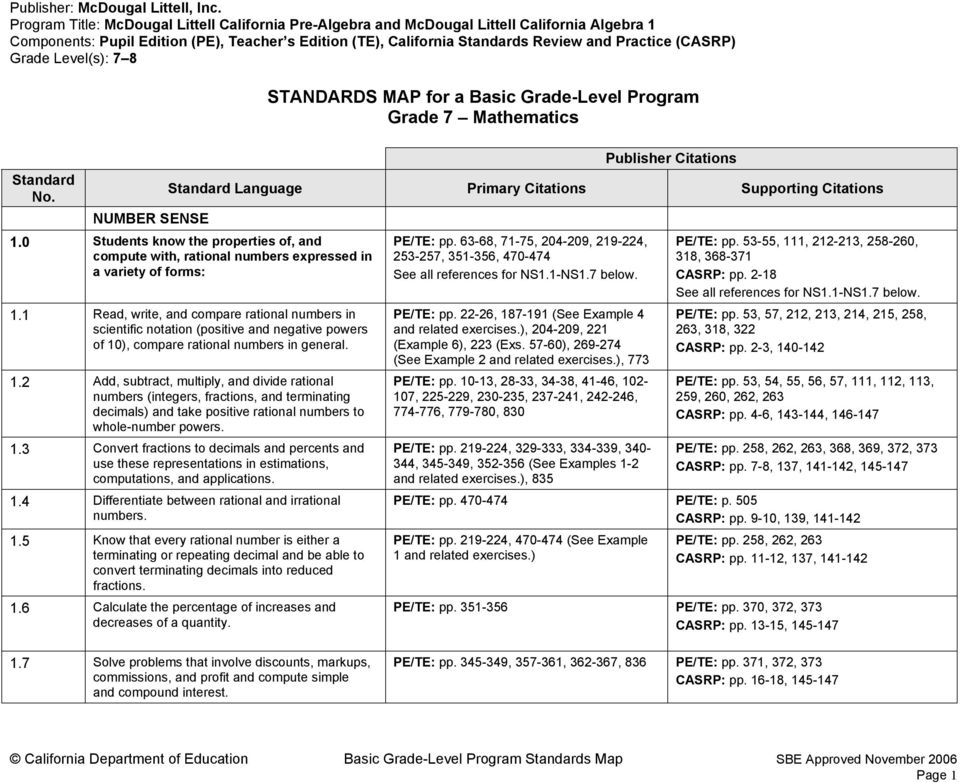
3 Components: Pupil Edition (PE), Teacher s Edition (TE), California s Review and Practice (CASRP) NUMBER SENSE STANDARDS MAP for a Basic Grade-Level Program Grade 7 Mathematics Language Primary Citations Supporting Citations 1.0 Students know the properties of, and compute with, rational numbers expressed in a variety of forms: 1.1 Read, write, and compare rational numbers in scientific notation (positive and negative powers of 10), compare rational numbers in general. 1.2 Add, subtract, multiply, and divide rational numbers (integers, fractions, and terminating decimals) and take positive rational numbers to whole-number powers. 1.3 Convert fractions to decimals and percents and use these representations in estimations, computations, and applications. 1.4 Differentiate between rational and irrational numbers. 1.5 Know that every rational number is either a terminating or repeating decimal and be able to convert terminating decimals into reduced fractions. 1.6 Calculate the percentage of increases and decreases of a quantity. PE/TE: pp , 71-75, , , , , See all references for NS1.1-NS1.7 below. PE/TE: pp , (See Example 4 and related exercises.), , 221 (Example 6), 223 (Exs ), (See Example 2 and related exercises.), 773 PE/TE: pp , 28-33, 34-38, 41-46, , , , , , , , 830 PE/TE: pp , , , , , (See Examples 1-2 and related exercises.), 835 PE/TE: pp , 111, , , 318, CASRP: pp See all references for NS1.1-NS1.7 below. PE/TE: pp. 53, 57, 212, 213, 214, 215, 258, 263, 318, 322 CASRP: pp. 2-3, PE/TE: pp. 53, 54, 55, 56, 57, 111, 112, 113, 259, 260, 262, 263 CASRP: pp. 4-6, , PE/TE: pp. 258, 262, 263, 368, 369, 372, 373 CASRP: pp. 7-8, 137, , PE/TE: pp PE/TE: p. 505 CASRP: pp. 9-10, 139, PE/TE: pp , (See Example 1 and related exercises.) PE/TE: pp. 258, 262, 263 CASRP: pp , 137, PE/TE: pp PE/TE: pp. 370, 372, 373 CASRP: pp , Solve problems that involve discounts, markups, commissions, and profit and compute simple and compound interest. PE/TE: pp , , , 836 PE/TE: pp. 371, 372, 373 CASRP: pp , California Department of Education Basic Grade-Level Program s Map SBE Approved November 2006 Page 1
4 Components: Pupil Edition (PE), Teacher s Edition (TE), California s Review and Practice (CASRP) Language Primary Citations Supporting Citations 2.0 Students use exponents, powers, and roots and use exponents in working with fractions: 2.1 Understand negative whole-number exponents. Multiply and divide expressions involving exponents with a common base. 2.2 Add and subtract fractions by using factoring to find common denominators. PE/TE: pp , , , See all references for NS2.1-NS2.5 below. PE/TE: pp , , 700 CASRP: pp See all references for NS2.1-NS2.5 below. PE/TE: pp , , PE/TE: pp. 212, 213, 214, 215 CASRP: pp PE/TE: pp PE/TE: pp. 259, 262, 263 CASRP: pp , 143, Multiply, divide, and simplify rational numbers by using exponent rules. PE/TE: pp , , PE/TE: pp. 212, 213, 214, 215, 700, 702, 703 CASRP: pp , 148, Use the inverse relationship between raising to a power and extracting the root of a perfect square integer; for an integer that is not square, determine without a calculator the two integers between which its square root lies and explain why. 2.5 Understand the meaning of the absolute value of a number; interpret the absolute value as the distance of the number from zero on a number line; and determine the absolute value of real numbers. PE/TE: pp , PE/TE: pp. 500, 501, 504, 505 CASRP: pp , 138, PE/TE: pp , PE/TE: pp. 53, 56, 57 CASRP: pp , 138, California Department of Education Basic Grade-Level Program s Map SBE Approved November 2006 Page 2

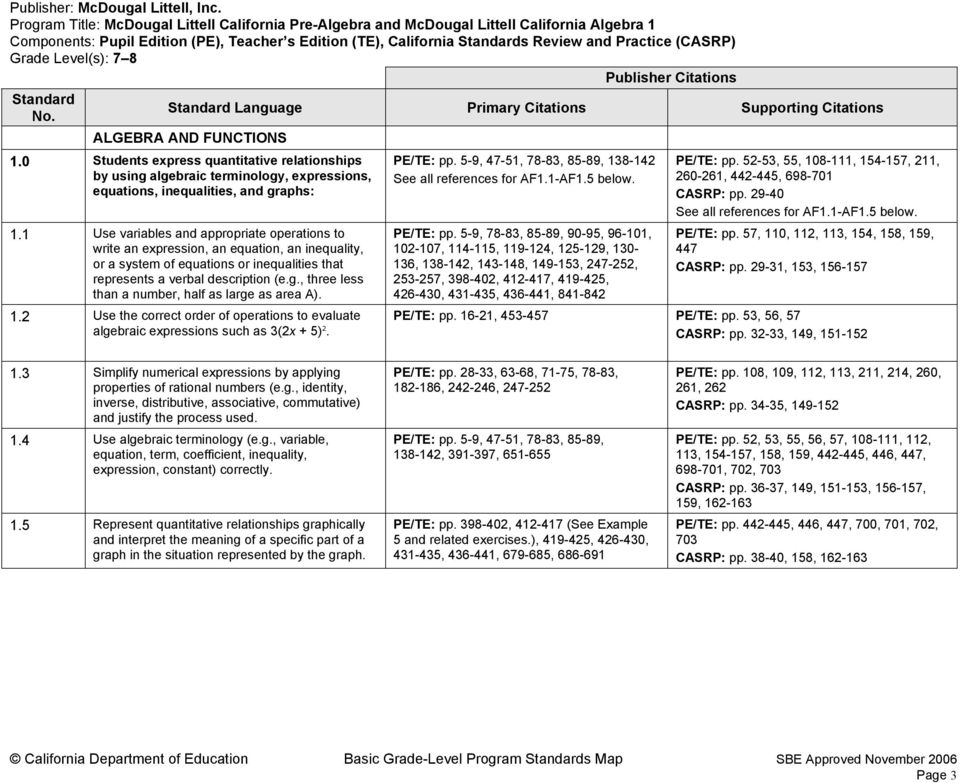
5 Components: Pupil Edition (PE), Teacher s Edition (TE), California s Review and Practice (CASRP) Language Primary Citations Supporting Citations ALGEBRA AND FUNCTIONS 1.0 Students express quantitative relationships by using algebraic terminology, expressions, equations, inequalities, and graphs: 1.1 Use variables and appropriate operations to write an expression, an equation, an inequality, or a system of equations or inequalities that represents a verbal description (e.g., three less than a number, half as large as area A). 1.2 Use the correct order of operations to evaluate algebraic expressions such as 3(2x + 5) 2. PE/TE: pp. 5-9, 47-51, 78-83, 85-89, See all references for AF1.1-AF1.5 below. PE/TE: pp. 5-9, 78-83, 85-89, 90-95, , , , , , , , , , , , , , , , , , PE/TE: pp , 55, , , 211, , , CASRP: pp See all references for AF1.1-AF1.5 below. PE/TE: pp. 57, 110, 112, 113, 154, 158, 159, 447 CASRP: pp , 153, PE/TE: pp , PE/TE: pp. 53, 56, 57 CASRP: pp , 149, Simplify numerical expressions by applying properties of rational numbers (e.g., identity, inverse, distributive, associative, commutative) and justify the process used. 1.4 Use algebraic terminology (e.g., variable, equation, term, coefficient, inequality, expression, constant) correctly. 1.5 Represent quantitative relationships graphically and interpret the meaning of a specific part of a graph in the situation represented by the graph. PE/TE: pp , 63-68, 71-75, 78-83, , , PE/TE: pp. 5-9, 47-51, 78-83, 85-89, , , PE/TE: pp , (See Example 5 and related exercises.), , , , , , PE/TE: pp. 108, 109, 112, 113, 211, 214, 260, 261, 262 CASRP: pp , PE/TE: pp. 52, 53, 55, 56, 57, , 112, 113, , 158, 159, , 446, 447, , 702, 703 CASRP: pp , 149, , , 159, PE/TE: pp , 446, 447, 700, 701, 702, 703 CASRP: pp , 158, California Department of Education Basic Grade-Level Program s Map SBE Approved November 2006 Page 3
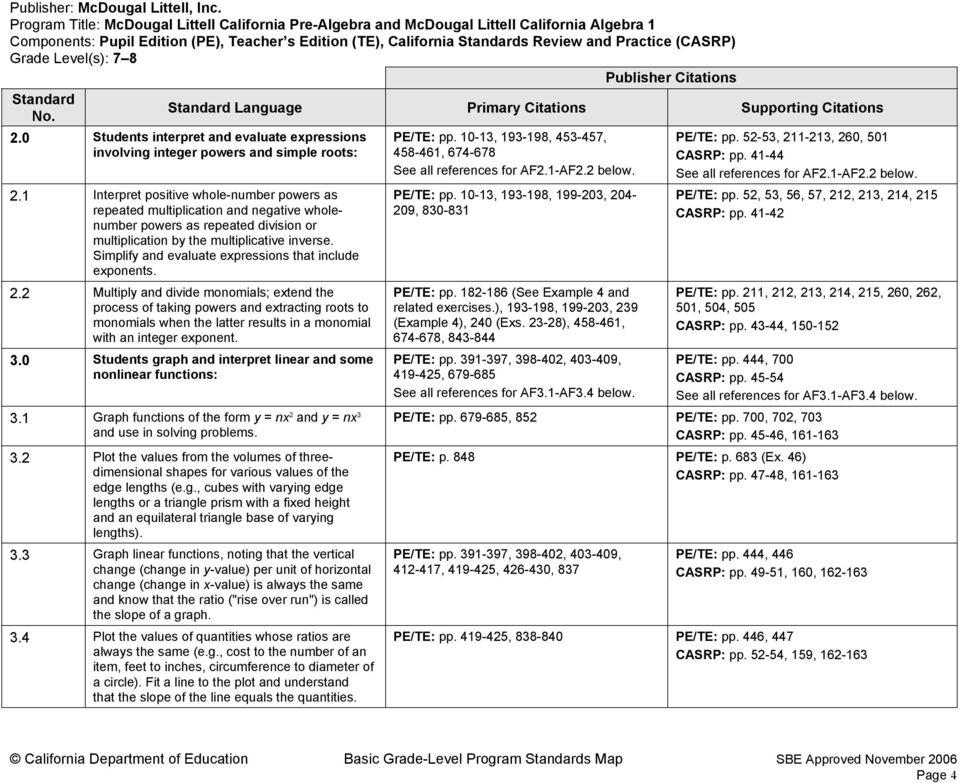
6 Components: Pupil Edition (PE), Teacher s Edition (TE), California s Review and Practice (CASRP) Language Primary Citations Supporting Citations 2.0 Students interpret and evaluate expressions involving integer powers and simple roots: 2.1 Interpret positive whole-number powers as repeated multiplication and negative wholenumber powers as repeated division or multiplication by the multiplicative inverse. Simplify and evaluate expressions that include exponents. 2.2 Multiply and divide monomials; extend the process of taking powers and extracting roots to monomials when the latter results in a monomial with an integer exponent. 3.0 Students graph and interpret linear and some nonlinear functions: 3.1 Graph functions of the form y = nx 2 and y = nx 3 and use in solving problems. 3.2 Plot the values from the volumes of threedimensional shapes for various values of the edge lengths (e.g., cubes with varying edge lengths or a triangle prism with a fixed height and an equilateral triangle base of varying lengths). 3.3 Graph linear functions, noting that the vertical change (change in y-value) per unit of horizontal change (change in x-value) is always the same and know that the ratio ("rise over run") is called the slope of a graph. 3.4 Plot the values of quantities whose ratios are always the same (e.g., cost to the number of an item, feet to inches, circumference to diameter of a circle). Fit a line to the plot and understand that the slope of the line equals the quantities. PE/TE: pp , , , , See all references for AF2.1-AF2.2 below. PE/TE: pp , , , , PE/TE: pp (See Example 4 and related exercises.), , , 239 (Example 4), 240 (Exs ), , , PE/TE: pp , , , , See all references for AF3.1-AF3.4 below. PE/TE: pp , , 260, 501 CASRP: pp See all references for AF2.1-AF2.2 below. PE/TE: pp. 52, 53, 56, 57, 212, 213, 214, 215 CASRP: pp PE/TE: pp. 211, 212, 213, 214, 215, 260, 262, 501, 504, 505 CASRP: pp , PE/TE: pp. 444, 700 CASRP: pp See all references for AF3.1-AF3.4 below. PE/TE: pp , 852 PE/TE: pp. 700, 702, 703 CASRP: pp , PE/TE: p. 848 PE/TE: p. 683 (Ex. 46) CASRP: pp , PE/TE: pp , , , , , , 837 PE/TE: pp. 444, 446 CASRP: pp , 160, PE/TE: pp , PE/TE: pp. 446, 447 CASRP: pp , 159, California Department of Education Basic Grade-Level Program s Map SBE Approved November 2006 Page 4
7 Components: Pupil Edition (PE), Teacher s Edition (TE), California s Review and Practice (CASRP) Language Primary Citations Supporting Citations 4.0 Students solve simple linear equations and inequalities over the rational numbers: 4.1 Solve two-step linear equations and inequalities in one variable over the rational numbers, interpret the solution or solutions in the context from which they arose, and verify the reasonableness of the results. 4.2 Solve multistep problems involving rate, average speed, distance, and time or a direct variation. PE/TE: pp See all references for AF4.1-AF4.2 below. PE/TE: pp , , , , PE/TE: pp. 122 (Ex. 7), 123 (Exs ), 128 (Ex. 37), 134 (Ex. 31), , , , , , 423 (Exs ), PE/TE: pp. 154, 157, 261, CASRP: pp See all references for AF4.1-AF4.2 below. PE/TE: pp. 154, 157, 158, 159, 261, 262, 263 CASRP: pp , 154, PE/TE: pp. 154, 157, 158, 159, 318, 319, 322, 447 CASRP: pp , California Department of Education Basic Grade-Level Program s Map SBE Approved November 2006 Page 5

8 Components: Pupil Edition (PE), Teacher s Edition (TE), California s Review and Practice (CASRP) Language Primary Citations Supporting Citations MEASUREMENT AND GEOMETRY 1.0 Students choose appropriate units of measure and use ratios to convert within and between measurement systems to solve problems: 1.1 Compare weights, capacities, geometric measures, times, and temperatures within and between measurement systems (e.g., miles per hour and feet per second, cubic inches to cubic centimeters). 1.2 Construct and read drawings and models made to scale. 1.3 Use measures expressed as rates (e.g., speed, density) and measures expressed as products (e.g., person-days) to solve problems; check the units of the solutions; and use dimensional analysis to check the reasonableness of the answer. 2.0 Students compute the perimeter, area, and volume of common geometric objects and use the results to find measures of less common objects. They know how perimeter, area, and volume are affected by changes of scale: 2.1 Use formulas routinely for finding the perimeter and area of basic two-dimensional figures and the surface area and volume of basic threedimensional figures, including rectangles, parallelograms, trapezoids, squares, triangles, circles, prisms, and cylinders. 2.2 Estimate and compute the area of more complex or irregular two- and three-dimensional figures by breaking the figures down into more basic geometric objects. PE/TE: pp , 76-77, , See all references for MG1.1-MG1.3 below. PE/TE: pp (See Example 5 and related exercises.), , , PE/TE: pp. 110, , 321 CASRP: pp See all references for MG1.1-MG1.3 below. PE/TE: p. 113 CASRP: pp , 164, PE/TE: pp PE/TE: pp. 321, 323 CASRP: pp , 165, PE/TE: pp (See Example 5 and related exercises.), 76-77, , , (See Example 2 and related exercises.), , PE/TE: pp , , , See all references for MG2.1-MG2.4 below. PE/TE: pp , 73 (Example 4), 74 (Exs ), , , , , , , , PE/TE: pp , (See Example 5 and related exercises.), , 549 (Exs. 31, 32), PE/TE: pp. 110, 112, 113, 318, 319, 323 CASRP: pp , 166, PE/TE: pp CASRP: pp See all references for MG2.1-MG2.4 below. PE/TE: pp. 112, , 568, 569 CASRP: pp , , 176, PE/TE: pp. 569 CASRP: pp , , 176, California Department of Education Basic Grade-Level Program s Map SBE Approved November 2006 Page 6
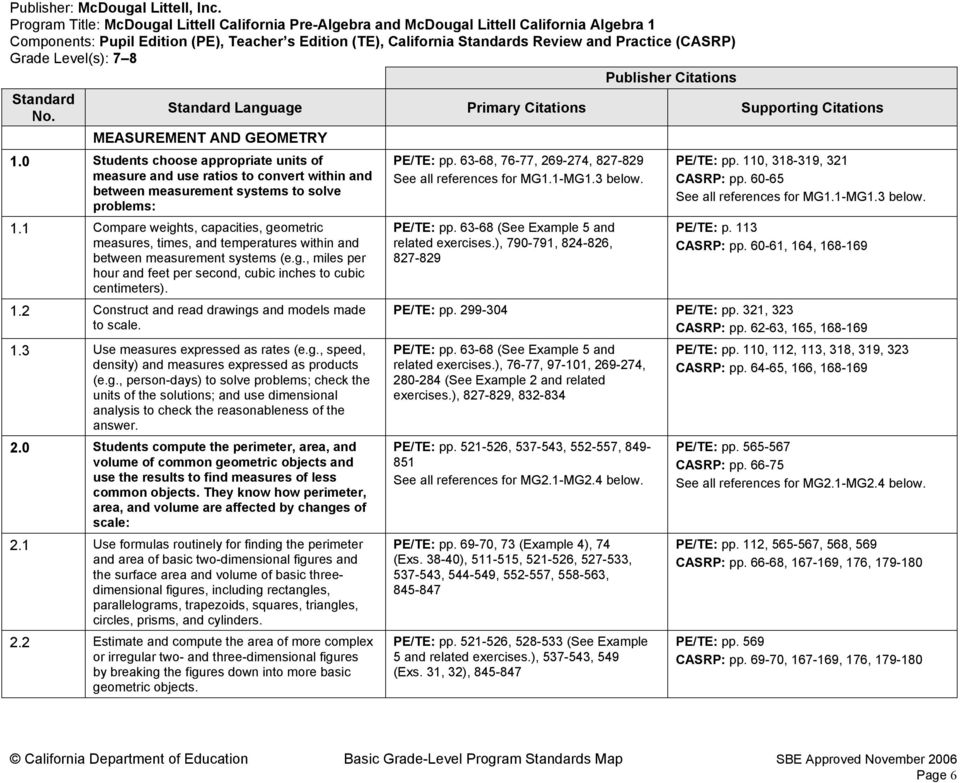
9 Components: Pupil Edition (PE), Teacher s Edition (TE), California s Review and Practice (CASRP) Language Primary Citations Supporting Citations 2.3 Compute the length of the perimeter, the surface area of the faces, and the volume of a threedimensional object built from rectangular solids. Understand that when the lengths of all dimensions are multiplied by a scale factor, the surface area is multiplied by the square of the scale factor and the volume is multiplied by the cube of the scale factor. 2.4 Relate the changes in measurement with a change of scale to the units used (e.g., square inches, cubic feet) and to conversions between units (1 square foot = 144 square inches or [1 ft. 2 ] = [144 in. 2 ], 1 cubic inch is approximately cubic centimeters or [1 in. 3 ] = [16.38 cm 3 ]). 3.0 Students know the Pythagorean theorem and deepen their understanding of plane and solid geometric shapes by constructing figures that meet given conditions and by identifying attributes of figures: 3.1 Identify and construct basic elements of geometric figures (e.g., altitudes, mid-points, diagonals, angle bisectors, and perpendicular bisectors; central angles, radii, diameters, and chords of circles) by using a compass and straightedge. 3.2 Understand and use coordinate graphs to plot simple figures, determine lengths and areas related to them, and determine their image under translations and reflections. 3.3 Know and understand the Pythagorean theorem and its converse and use it to find the length of the missing side of a right triangle and the lengths of other line segments and, in some situations, empirically verify the Pythagorean theorem by direct measurement. PE/TE: pp PE/TE: pp. 542 (Ex. 17), 556 (Ex. 21), 751 (Ex. 18) CASRP: pp , 176, PE/TE: pp PE/TE: pp. 527, 553 (Example 2), 556 (Ex. 22) CASRP: pp , 164, PE/TE: pp , , , See all references for MG3.1-MG3.6 below. PE/TE: pp , , , , , 794, PE/TE: pp , 514 (Ex. 22), 525 (Exs ), , , , PE/TE: pp. 320, 501, 754 CASRP: pp See all references for MG3.1-MG3.6 below. PE/TE: pp , , 720 (Ex. 23) CASRP: pp , 170, PE/TE: pp. 754, 756, 757 CASRP: pp , PE/TE: pp , PE/TE: pp. 501, 504, 505 CASRP: pp , 171, California Department of Education Basic Grade-Level Program s Map SBE Approved November 2006 Page 7

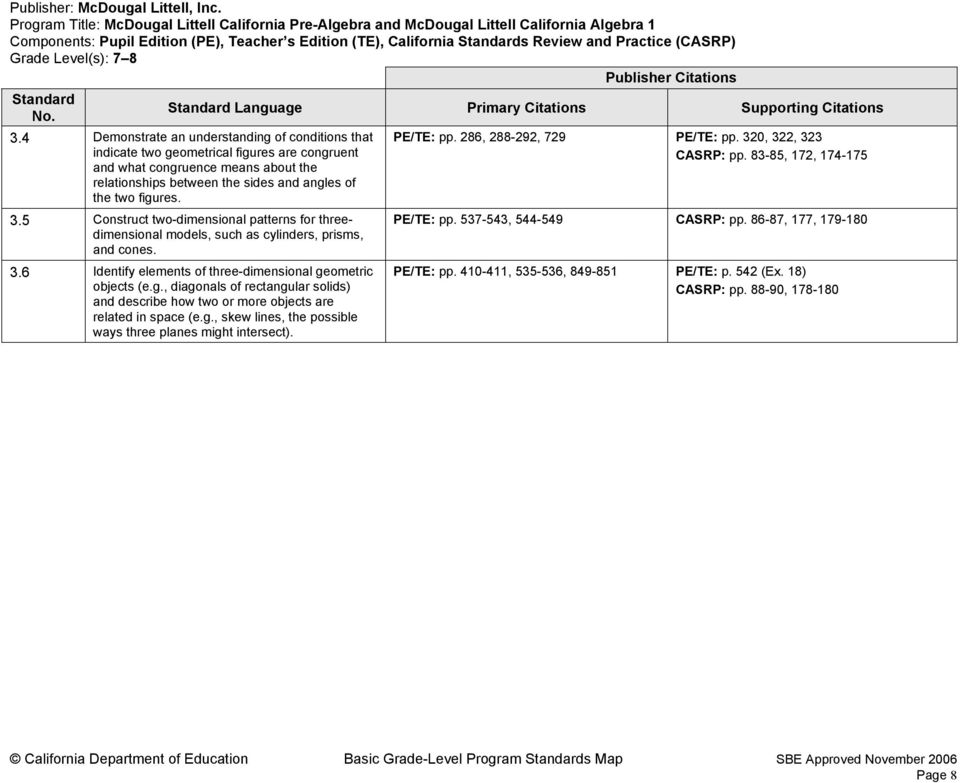
10 Components: Pupil Edition (PE), Teacher s Edition (TE), California s Review and Practice (CASRP) Language Primary Citations Supporting Citations 3.4 Demonstrate an understanding of conditions that indicate two geometrical figures are congruent and what congruence means about the relationships between the sides and angles of the two figures. 3.5 Construct two-dimensional patterns for threedimensional models, such as cylinders, prisms, and cones. 3.6 Identify elements of three-dimensional geometric objects (e.g., diagonals of rectangular solids) and describe how two or more objects are related in space (e.g., skew lines, the possible ways three planes might intersect). PE/TE: pp. 286, , 729 PE/TE: pp. 320, 322, 323 CASRP: pp , 172, PE/TE: pp , CASRP: pp , 177, PE/TE: pp , , PE/TE: p. 542 (Ex. 18) CASRP: pp , California Department of Education Basic Grade-Level Program s Map SBE Approved November 2006 Page 8
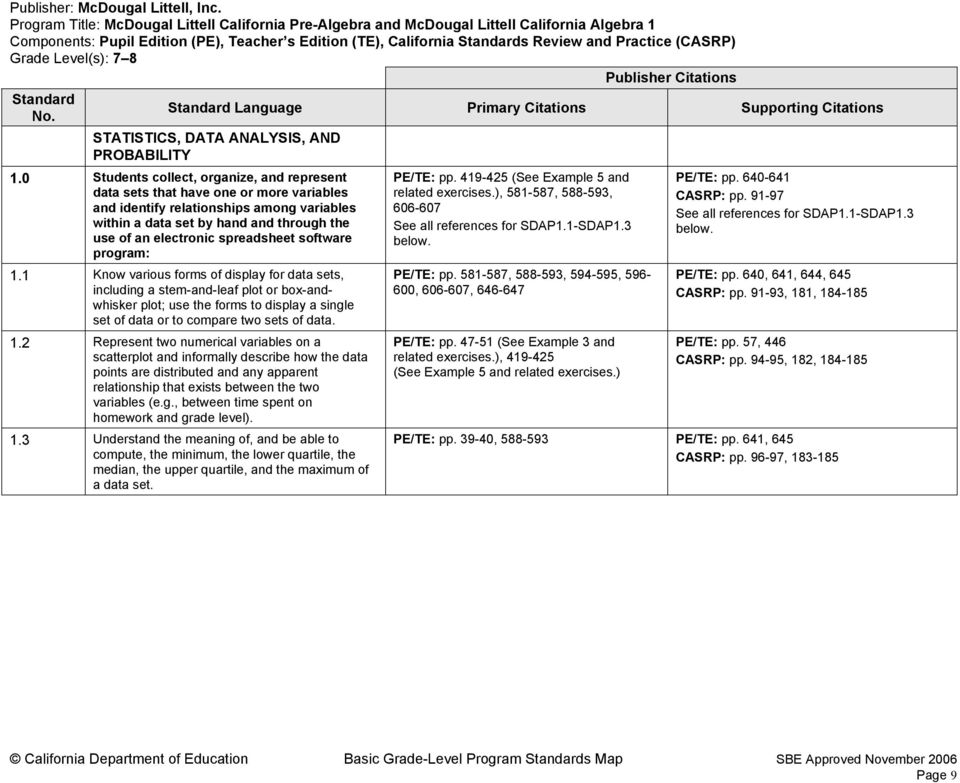
11 Components: Pupil Edition (PE), Teacher s Edition (TE), California s Review and Practice (CASRP) Language Primary Citations Supporting Citations STATISTICS, DATA ANALYSIS, AND PROBABILITY 1.0 Students collect, organize, and represent data sets that have one or more variables and identify relationships among variables within a data set by hand and through the use of an electronic spreadsheet software program: 1.1 Know various forms of display for data sets, including a stem-and-leaf plot or box-andwhisker plot; use the forms to display a single set of data or to compare two sets of data. 1.2 Represent two numerical variables on a scatterplot and informally describe how the data points are distributed and any apparent relationship that exists between the two variables (e.g., between time spent on homework and grade level). 1.3 Understand the meaning of, and be able to compute, the minimum, the lower quartile, the median, the upper quartile, and the maximum of a data set. PE/TE: pp (See Example 5 and related exercises.), , , See all references for SDAP1.1-SDAP1.3 below. PE/TE: pp , , , , , PE/TE: pp (See Example 3 and related exercises.), (See Example 5 and related exercises.) PE/TE: pp CASRP: pp See all references for SDAP1.1-SDAP1.3 below. PE/TE: pp. 640, 641, 644, 645 CASRP: pp , 181, PE/TE: pp. 57, 446 CASRP: pp , 182, PE/TE: pp , PE/TE: pp. 641, 645 CASRP: pp , California Department of Education Basic Grade-Level Program s Map SBE Approved November 2006 Page 9
12 Components: Pupil Edition (PE), Teacher s Edition (TE), California s Review and Practice (CASRP) Language Primary Citations Supporting Citations MATHEMATICAL REASONING 1.0 Students make decisions about how to approach problems: 1.1 Analyze problems by identifying relationships, distinguishing relevant from irrelevant information, identifying missing information, sequencing and prioritizing information, and observing patterns. (Gr. 7, NS 1.1; Gr. 7, AF 1.1) PE/TE, pp ; (Gr. 7, NS 1.2) PE/TE, pp ; (Gr. 7, AF 4.2) PE/TE, pp See all references for MR1.1-MR1.3 below. (Gr. 7, NS 1.2; Gr. 7, MG 1.1) PE/TE, pp ; (Gr. 7, NS 1.2) PE/TE, pp (See Example 4 and related exercises.); (Gr. 7, NS 1.2) PE/TE, p. 41; (Gr. 7, NS 1.1; Gr. 7, AF 1.1) PE/TE, pp ; (Gr. 7, NS 2.3) PE/TE, p. 193; (Gr. 7, AF 2.1) PE/TE, p. 199; (Gr. 7, NS 1.2) PE/TE, p. 242; (Gr. 7, AF 1.1; Gr. 7, AF 1.5) PE/TE, pp ; (Gr. 7, MG 3.3) PE/TE, p. 482; (Gr. 7, NS 1.2; Gr. 7, MG 1.1) PE/TE, p. 796; (Gr. 7, SDAP 1.0) PE/TE, p. 802 (Gr. 7, NS 1.2) PE/TE, p. 105 (Ex. 11); (Gr. 7, NS 1.3) PE/TE, p. 333 (Exs. 58, 59); (Gr. 7, MG 3.3) PE/TE, p. 467 (Ex. 6) (Gr. 7, NS 1.2; Gr. 7, MG 1.1; Gr. 7, MG 2.1) CASRP, pp See all references for MR1.1-MR1.3 below. (Gr. 7, AF 2.1) PE/TE, p. 13 (Ex. 37); (Gr. 7 AF 1.1; Prepare for Gr. 7, AF 4.1) PE/TE, p. 87 (Ex. 7); (Gr. 7, AF 1.1; Prepare for Gr. 7, AF 4.1) PE/TE, p. 99 (Ex. 7); (Gr. 7, NS 1.2) PE/TE, p. 105 (Ex. 11); (Prepare for Gr. 7, AF 1.3) PE/TE, p. 179 (Ex. 11); (Gr. 7, NS 1.2) PE/TE, p. 184 (Ex. 11); (Gr. 7, NS 2.3) PE/TE, p. 201 (Ex. 15); (Gr. 7, NS 1.2), PE/TE, p. 227 (Ex. 9) (Gr. 7, NS 1.2) CASRP, pp California Department of Education Basic Grade-Level Program s Map SBE Approved November 2006 Page 10

13 Components: Pupil Edition (PE), Teacher s Edition (TE), California s Review and Practice (CASRP) Language Primary Citations Supporting Citations 1.2 Formulate and justify mathematical conjectures based on a general description of the mathematical question or problem posed. 1.3 Determine when and how to break a problem into simpler parts. 2.0 Students use strategies, skills, and concepts in finding solutions: (Gr. 7, NS 1.2) PE/TE, p. 28; (Prepare for Gr. 7, NS 2.2) PE/TE, p. 171; (Prepare for Gr. 7, NS 2.2) PE/TE, p. 176 (Ex. 67); (Gr. 7, MG 3.4) PE/TE, p. 287; (Gr. 7, AF 3.3) PE/TE, p. 403; (Gr. 7, MG 3.3) PE/TE, p. 464; (Gr. 7, MG 3.3) PE/TE, p. 482; (Gr. 7, MG 3.3) PE/TE, p. 488; (Gr. 7, MG 2.1) PE/TE, p. 527 (Gr. 7, NS 1.2; Gr. 7, MG 1.1) PE/TE, pp ; (Gr. 7, AF 4.2) PE/TE, pp ; (Gr. 7, SDAP 1.0) PE/TE, p. 802 (Gr. 7, AF 4.0) PE/TE, p. 139; (Gr. 7, NS 1.2) PE/TE, pp ; (Gr. 7, AF 3.3; Gr. 7, NS 1.2) PE/TE, 232 (Example 2 Study Strategy); (Gr. 7, AF 4.0) PE/TE, pp ; (Gr. 7, NS 1.3) PE/TE, p. 334; (Gr. 7, NS 2.4) PE/TE, pp (See Examples 2, 3, 5 and related exercises.); (Gr. 7, AF 3.4) PE/TE, p. 488; (Gr. 7, MG 3.3) PE/TE, pp ; (Gr. 7, MG 3.1) PE/TE, p. 721 See all references for MR2.1-MR2.8 below. (Gr. 7, NS 2.3) PE/TE, p. 193; (Gr. 7, NS 1.2) PE/TE, p. 242; (Gr. 7, NS 1.3) PE/TE, p. 333 (Exs. 58, 59); (Gr. 7, NS 1.6) PE/TE, p. 356 (Ex. 27); (Gr. 7, AF 1.5) PE/TE, p. 432 (Ex. 4); (Gr. 7, MG 3.2) PE/TE, p. 733 (Ex. 19) (Gr. 7, MG 1.1) CASRP, pp (Gr. 7, SDAP 1.2) PE/TE, p. 49 (Ex. 7); (Gr. 7, AF 1.1), PE/TE, p. 122 (Ex. 7); (Gr. 7, AF 4.1) PE/TE, p. 249 (Ex. 9); (Gr. 7, AF 3.3) PE/TE, p. 394 (Ex. 11); (Gr. 7, MG 3.3) PE/TE, p. 467 (Ex. 6) (Gr. 7, MG 2.1) CASRP, pp (Gr. 7, AF 1.2) PE/TE, p. 20 (Ex. 39); (Gr. 7, AF 1.3) PE/TE, p. 67 (Ex. 49); (Gr. 7, MG 2.1) PE/TE, p. 161; (Gr. 7, NS 1.3) PE/TE, p. 341 (Example 4); (Gr. 7, AF 3.0) PE/TE, p. 389 (Ex. 24); (Gr. 7, MG 3.3) PE/TE, p. 499; (Gr. 7, MG 2.1; Gr. 7, MG 2.2) PE/TE, pp (Gr. 7, NS 1.0; Gr. 7, NS 1.1; Gr. 7, NS 1.2; Gr. 7, AF 1.0; Gr. 7, MG 2.1; Gr. 7, SDAP 1.1; Gr. 7, SDAP 1.1) CASRP, pp See all references for MR2.1-MR2.8 below. California Department of Education Basic Grade-Level Program s Map SBE Approved November 2006 Page 11

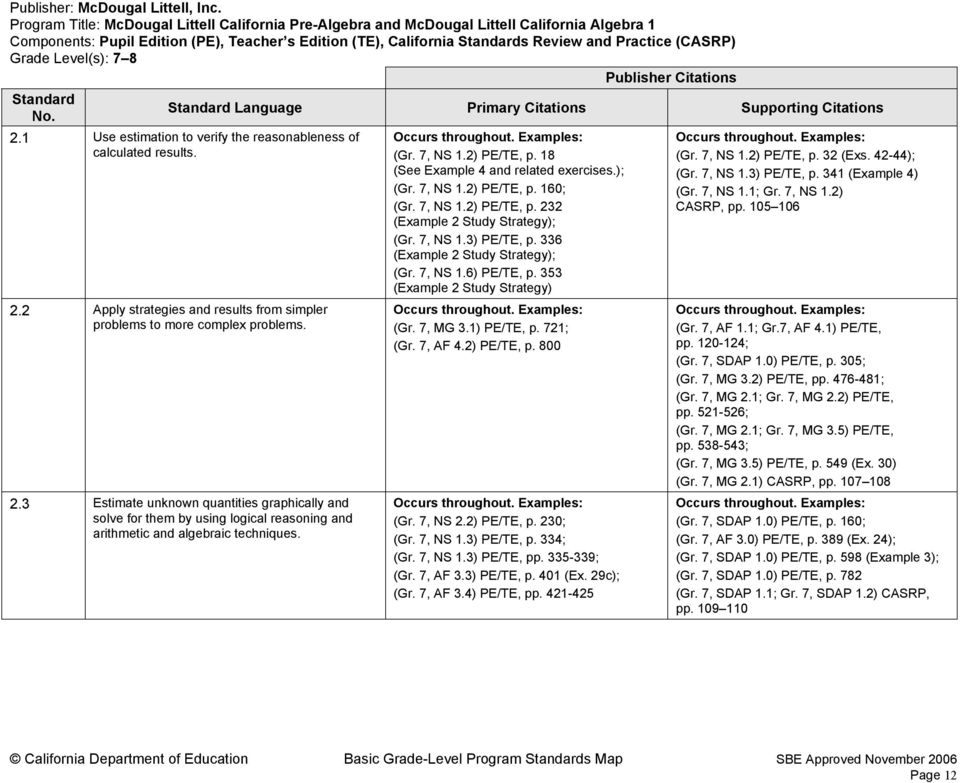
14 Components: Pupil Edition (PE), Teacher s Edition (TE), California s Review and Practice (CASRP) Language Primary Citations Supporting Citations 2.1 Use estimation to verify the reasonableness of calculated results. 2.2 Apply strategies and results from simpler problems to more complex problems. 2.3 Estimate unknown quantities graphically and solve for them by using logical reasoning and arithmetic and algebraic techniques. (Gr. 7, NS 1.2) PE/TE, p. 18 (See Example 4 and related exercises.); (Gr. 7, NS 1.2) PE/TE, p. 160; (Gr. 7, NS 1.2) PE/TE, p. 232 (Example 2 Study Strategy); (Gr. 7, NS 1.3) PE/TE, p. 336 (Example 2 Study Strategy); (Gr. 7, NS 1.6) PE/TE, p. 353 (Example 2 Study Strategy) (Gr. 7, MG 3.1) PE/TE, p. 721; (Gr. 7, AF 4.2) PE/TE, p. 800 (Gr. 7, NS 2.2) PE/TE, p. 230; (Gr. 7, NS 1.3) PE/TE, p. 334; (Gr. 7, NS 1.3) PE/TE, pp ; (Gr. 7, AF 3.3) PE/TE, p. 401 (Ex. 29c); (Gr. 7, AF 3.4) PE/TE, pp (Gr. 7, NS 1.2) PE/TE, p. 32 (Exs ); (Gr. 7, NS 1.3) PE/TE, p. 341 (Example 4) (Gr. 7, NS 1.1; Gr. 7, NS 1.2) CASRP, pp (Gr. 7, AF 1.1; Gr.7, AF 4.1) PE/TE, pp ; (Gr. 7, SDAP 1.0) PE/TE, p. 305; (Gr. 7, MG 3.2) PE/TE, pp ; (Gr. 7, MG 2.1; Gr. 7, MG 2.2) PE/TE, pp ; (Gr. 7, MG 2.1; Gr. 7, MG 3.5) PE/TE, pp ; (Gr. 7, MG 3.5) PE/TE, p. 549 (Ex. 30) (Gr. 7, MG 2.1) CASRP, pp (Gr. 7, SDAP 1.0) PE/TE, p. 160; (Gr. 7, AF 3.0) PE/TE, p. 389 (Ex. 24); (Gr. 7, SDAP 1.0) PE/TE, p. 598 (Example 3); (Gr. 7, SDAP 1.0) PE/TE, p. 782 (Gr. 7, SDAP 1.1; Gr. 7, SDAP 1.2) CASRP, pp California Department of Education Basic Grade-Level Program s Map SBE Approved November 2006 Page 12
15 Components: Pupil Edition (PE), Teacher s Edition (TE), California s Review and Practice (CASRP) 2.4 Make and test conjectures by using both inductive and deductive reasoning. Language Primary Citations Supporting Citations 2.5 Use a variety of methods, such as words, numbers, symbols, charts, graphs, tables, diagrams, and models, to explain mathematical reasoning. (Gr. 7, NS 1.2) PE/TE, p. 41; (Gr. 7, AF 4.1) PE/TE, p. 143; (Gr. 7, NS 2.3) PE/TE, p. 193; (Gr. 7, NS 1.2) PE/TE, p. 242; (Gr. 7, MG 3.4) PE/TE, p. 287; (Gr. 7, MG 3.3) PE/TE, p. 464; (Gr. 7, MG 3.3) PE/TE, p. 482; (Gr. 7, AF 3.4) PE/TE, p. 488; (Gr. 7, MG 2.1) PE/TE, p. 527 (Gr. 7, AF 1.1; Gr. 7, AF 1.4) PE/TE, p. 9 (Exs. 54, 55); (Gr. 7, AF 1.3) PE/TE, p. 173 (Example 2); (Gr. 7, AF 4.0) PE/TE, pp ; (Gr. 7, AF 4.2) PE/TE, pp ; (Gr. 7, AF 3.3) PE/TE, pp ; (Gr. 7, NS 1.4) PE/TE, p. 471; (Gr. 7, MG 3.2) PE/TE, p. 476; (Gr. 7, MG 2.1) PE/TE, p. 528; (Gr. 7, AF 3.1) PE/TE, p. 680; (Gr. 7, AF 1.5) PE/TE, p ; (Gr. 7, AF 1.5) PE/TE, p. 795; (Gr. 7, AF 1.5) PE/TE, pp ; (Gr. 7, AF 1.0) PE/TE, p. 801 (Gr. 7, AF 1.3) PE/TE, p. 171 (Ex. 3) (Gr. 7, AF 1.0) CASRP, pp (Gr. 7, AF 1.3) PE/TE, p. 67 (Ex. 49); (Gr. 7, NS 2.3) PE/TE, p. 198 (Ex. 59) (Gr. 7, NS 1.0) CASRP, pp California Department of Education Basic Grade-Level Program s Map SBE Approved November 2006 Page 13
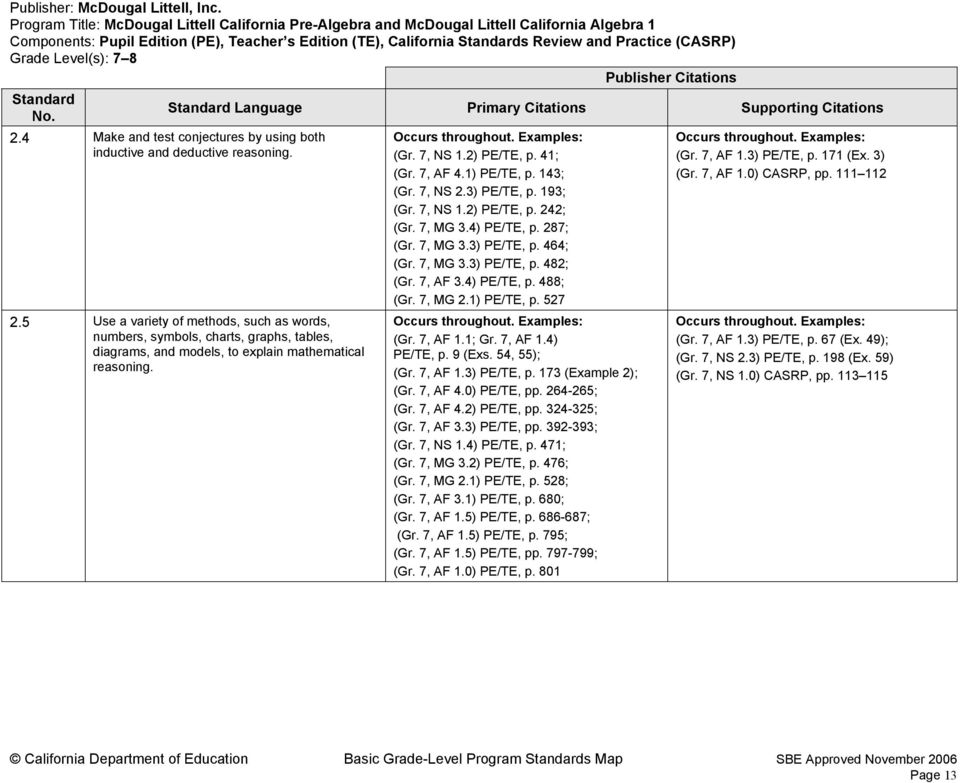
16 Components: Pupil Edition (PE), Teacher s Edition (TE), California s Review and Practice (CASRP) Language Primary Citations Supporting Citations 2.6 Express the solution clearly and logically by using the appropriate mathematical notation and terms and clear language; support solutions with evidence in both verbal and symbolic work. (Gr. 7, AF 4.2) PE/TE, pp ; (Gr. 7, NS 1.7) PE/TE, pp ; (Gr. 7, AF 3.3; Gr. 7, AF 3.4) PE/TE, pp ; (Gr. 7, MG 3.3) PE/TE, pp ; (Gr. 7, AF 1.1) PE/TE, pp ; (Gr. 7, AF 1.5) PE/TE, pp (Gr. 7, AF 1.2) PE/TE, p. 20 (Ex. 39); (Gr. 7, AF 4.1) PE/TE, p. 89 (Ex. 40); (Gr. 7, AF 4.1) PE/TE, p. 142 (Ex. 44); (Gr. 7, NS 2.2) PE/TE, p. 235 (Exs. 51, 52); (Gr. 7, AF 4.2) PE/TE, p. 284 (Exs ); (Gr. 7, NS 1.4) PE/TE, p. 474 (Exs. 41, 43); (Gr. 7, MG 2.1; Gr. 7, MG 2.2) PE/TE, p. 526 (Ex. 34) (Gr. 7, NS 1.0) CASRP, pp California Department of Education Basic Grade-Level Program s Map SBE Approved November 2006 Page 14
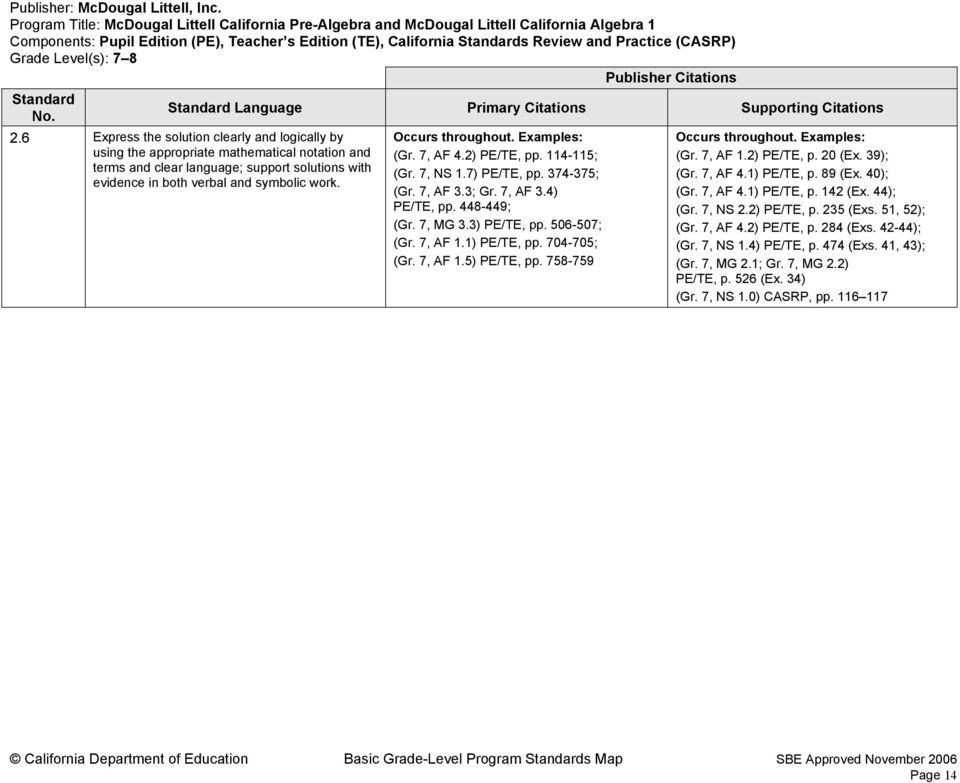
17 Components: Pupil Edition (PE), Teacher s Edition (TE), California s Review and Practice (CASRP) Language Primary Citations Supporting Citations 2.7 Indicate the relative advantages of exact and approximate solutions to problems and give answers to a specified degree of accuracy. (Gr. 7, AF 3.4) PE/TE, pp (See Example 5 and related exercises.); (Gr. 7, NS 2.4) PE/TE, pp (See Examples 2, 3, 5 and related exercises.); (Gr. 7, NS 2.4) PE/TE, pp (See Example 4 and related exercises.); (Gr. 7, MG 3.3) PE/TE, pp ; (Gr. 7, NS 1.4) PE/TE, pp ; (Gr. 7, MG 3.3) PE/TE, pp ; (Gr. 7, MG 3.3) PE/TE, p. 488; (Gr. 7, MG 3.3) PE/TE, pp ; (Gr. 7, MG 3.3) PE/TE, pp ; (Gr. 7, MG 2.1) PE/TE, pp ; (Gr. 7, MG 2.1; Gr. 7, MG 3.5) PE/TE, pp (See Example 3 and related exercises.); (Gr. 7, MG 3.5) PE/TE, p. 544 (Example 1); (Gr. 7, MG 3.5) PE/TE, pp (See Example 3 and related exercises.); (Gr. 7, MG 2.1) PE/TE, pp (See Examples 2, 3 and related exercises.); (Gr. 7, MG 2.1) PE/TE, pp (See Examples 2, 3 and related exercises.); (Gr. 7, AF 3.1) PE/TE, pp (See Example 4 and related exercises.); (Gr. 7, NS 1.0) PE/TE, pp (Gr. 7, MG 3.2) PE/TE, p. 481 (Ex. 52); (Gr. 7, MG 3.3) PE/TE, p. 499 (Gr. 7, NS 1.0) CASRP, pp California Department of Education Basic Grade-Level Program s Map SBE Approved November 2006 Page 15
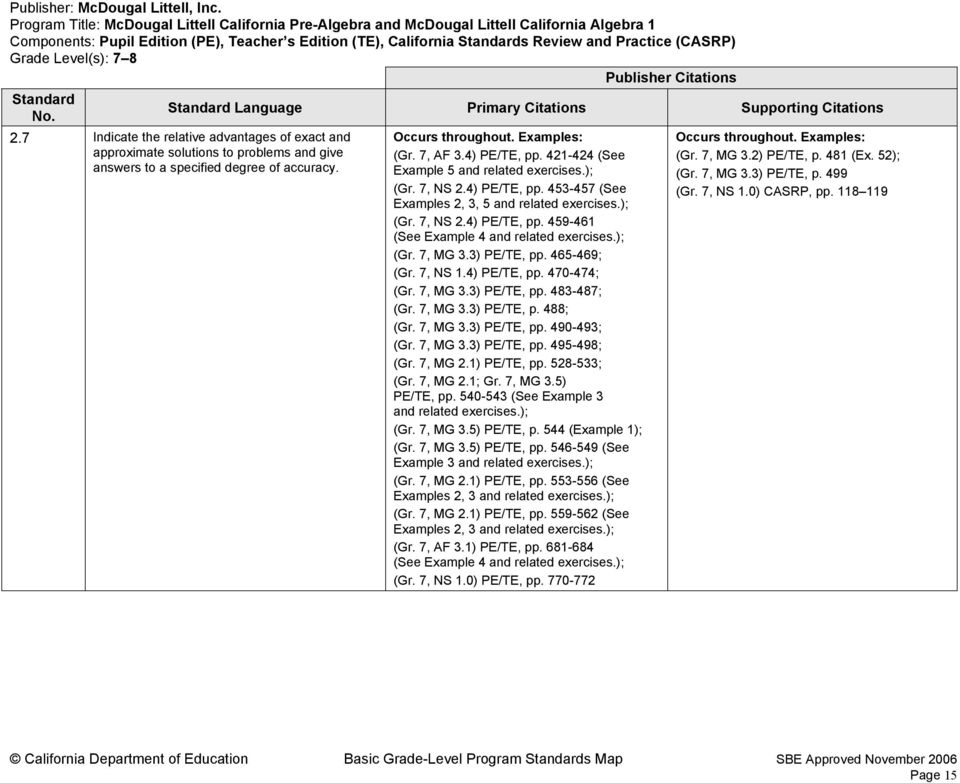
18 Components: Pupil Edition (PE), Teacher s Edition (TE), California s Review and Practice (CASRP) Language Primary Citations Supporting Citations 2.8 Make precise calculations and check the validity of the results from the context of the problem. 3.0 Students determine a solution is complete and move beyond a particular problem by generalizing to other situations: 3.1 Evaluate the reasonableness of the solution in the context of the original situation. (Gr. 7, NS 1.2; Gr. 7, MG 1.1) PE/TE, pp ; (Gr. 7, AF 4.0) PE/TE, p. 91 (Example 1); (Gr. 7, AF 4.0) PE/TE, p. 97 (Example 1); (Gr. 7, AF 4.0) PE/TE, pp ; (Gr. 7, AF 4.0) PE/TE, p. 139; (Gr. 7, NS 1.2) PE/TE, p. 243 (Example 1); (Gr. 7, AF 3.0) PE/TE, pp ; (Gr. 7, NS 1.2) PE/TE, p. 774; (Gr. 7, NS 1.2; Gr. 7, MG 2.1) PE/TE, p. 797 (Gr. 7, AF 4.0) PE/TE, p. 96; (Gr. 7, NS 1.2) PE/TE, p. 230; (Gr. 7, MG 3.1) PE/TE, pp See all references for MR3.1-MR3.3 below. (Gr. 7, AF 4.2) PE/TE, pp ; (Gr. 7, NS 2.2) PE/TE, p. 232 (Example 2 Study Strategy); (Gr. 7, NS 1.3) PE/TE, p. 336 (Example 2 Study Strategy); (Gr. 7, NS 1.3) PE/TE, p. 341 (Example 4); (Gr. 7, NS 1.6) PE/TE, p. 353 (Example 2 Study Strategy); (Gr. 7, AF 3.3) PE/TE, p. 413 (Example 2 Study Strategy); (Algebra 1, 8.0) PE/TE, p. 414 (Example 4 Study Strategy); (Gr. 7, AF 3.3) PE/TE, p. 427 (Example 3 Study Strategy); (Gr. 7, AF 3.3; Gr. 7, AF 3.4) PE/TE, pp (Gr. 7, NS 1.2) PE/TE, p. 32 (Exs ); (Gr. 7, AF 4.0) PE/TE, p. 135 (Exs ); (Gr. 7, AF 4.1) PE/TE, p. 150; (Gr. 7, MG 2.1) PE/TE, p. 161; (Gr. 7, AF 3.0) PE/TE, p. 391 (Gr. 7, NS 1.0) CASRP, pp (Gr. 7, NS 2.1) PE/TE, p. 203 (Ex. 61); (Gr. 7, AF 4.2) PE/TE, p. 277 (Ex. 7) (Gr. 7, AF 1.0; Gr. 7, AF 1.1; Gr. 7, MG 2.1) CASRP, pp See all references for MR3.1-MR3.3 below. (Gr. 7, AF 3.3) PE/TE, p. 401 (Ex. 29) (Gr. 7, MG 2.1) CASRP, pp California Department of Education Basic Grade-Level Program s Map SBE Approved November 2006 Page 16
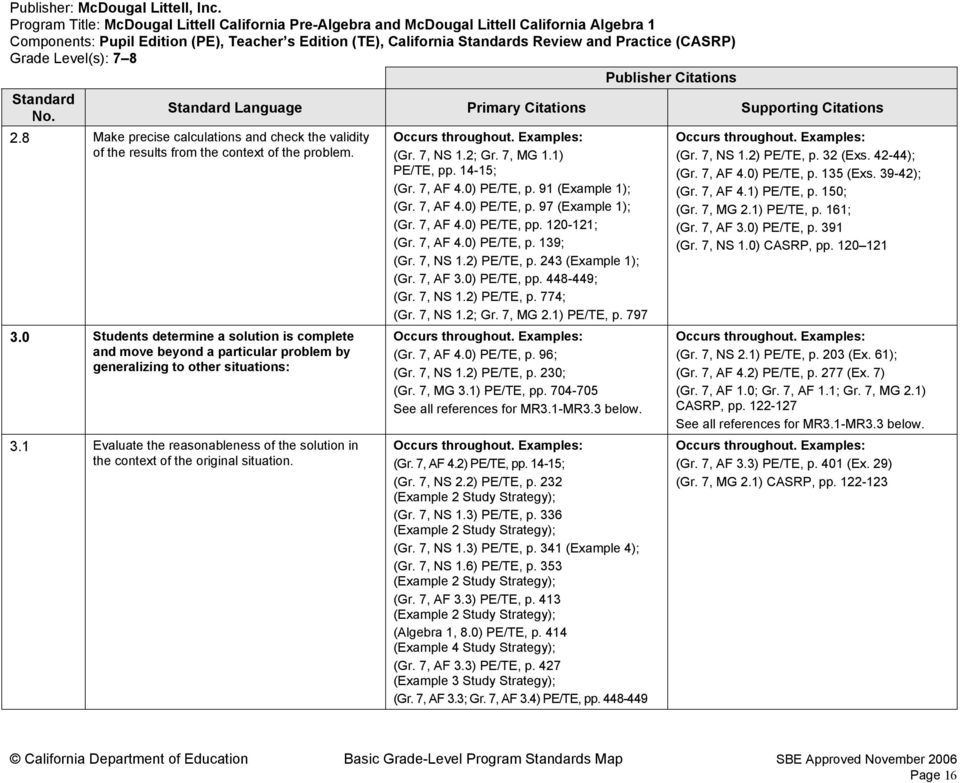
19 Components: Pupil Edition (PE), Teacher s Edition (TE), California s Review and Practice (CASRP) Language Primary Citations Supporting Citations 3.2 Note the method of deriving the solution and demonstrate a conceptual understanding of the derivation by solving similar problems. 3.3 Develop generalizations of the results obtained and the strategies used and apply them to new problem situations. (Gr. 7, AF 4.2) PE/TE, pp ; (Gr. 7, AF 4.1) PE/TE, p. 119; (Gr. 7, NS 1.2) PE/TE, p. 230; (Gr. 7, NS 1.2) PE/TE, p. 242; (Gr. 7, AF 4.2) PE/TE, pp ; (Gr. 7, NS 1.3) PE/TE, p. 334; (Gr. 7, MG 3.5) PE/TE, p. 537; (Algebra 1, 10.0) PE/TE, p. 656 (Gr. 7, AF 4.0) PE/TE, p. 96; (Gr. 7, AF 4.2) PE/TE, pp ; (Gr. 7, AF 4.1) PE/TE, p. 119; (Gr. 7, NS 1.2) PE/TE, p. 242; (Gr. 7, MG 3.3) PE/TE, p. 464; (Gr. 7, MG 3.3) PE/TE, pp ; (Gr. 7, MG 3.5) PE/TE, p. 537; (Gr. 7, AF 1.1) PE/TE, pp (Gr. 7, AF 4.0) PE/TE, p. 133 (Ex. 9); (Gr. 7, AF 4.2) PE/TE, p. 277 (Ex. 7); (Gr. 7, NS 1.6) PE/TE, p. 355 (Ex. 13) (Gr. 7, AF 1.0) CASRP pp (Gr. 7, NS 1.2) PE/TE, p. 33 (Exs ); (Gr. 7, NS 2.1) PE/TE, p. 203 (Ex. 61); (Gr. 7, AF 4.2) PE/TE, p. 284 (Ex. 44); (Gr. 7, SDAP 3.2) PE/TE, p. 311 (Ex. 21) (Gr. 7, AF 1.1) CASRP, pp California Department of Education Basic Grade-Level Program s Map SBE Approved November 2006 Page 17

20 McDougal Littell California Algebra 1
21 Components: Pupil Edition (PE), Teacher s Edition (TE), California s Review and Practice (CASRP), Resource Book, Assessment Book, Notetaking Guide, Practice Workbook STANDARDS MAP for a Basic Grade-Level Program Grade Eight Mathematics (Algebra I) ALGEBRA I 1.0 Students identify and use the arithmetic properties of subsets of integers and rational, irrational, and real numbers, including closure properties for the four basic arithmetic operations where applicable: Language Primary Citations Supporting Citations 1.1 Students use properties of numbers to demonstrate whether assertions are true or false. 2.0 Students understand and use such operations as taking the opposite, finding the reciprocal, taking a root, and raising to a fractional power. They understand and use the rules of exponents. 3.0 Students solve equations and inequalities involving absolute values. PE/TE: 75-78, 84, 89-91, 96, 100, 103, 104, 106, 120, 488, 489, 490, 491, 492, 495, 498, 499, 501, 504, 506, 508, 510, 543, 544, 547, , 939, 945, PE/TE: 77 (Exs ), 82 (Exs ), 91 (Exs ), 92 (Exs ), 99 (Exs. 3-4), 106 (Exs ), 492 (Ex. 39), 499 (Ex. 20), 507 (Exs ) PE/TE: 66, 67, , 106, , 113, 114, 115, 121, 488, , , 502, , , 543, 544, 547, 939, 945 PE/TE: , , 412, 417, 418, 419, 943 CASRP: 2-4, 91, Chapter 2: 16-20, 34, 39-43, 45 Chapter 8: 9-10 Assessment Book: 16-19, 21-23, 25 Notetaking Guide: 29, 33-37, 39 Practice Workbook: 18-19, 22, 26, 119, , 172 CASRP: 5-6, 91, Chapter 2: 50 CASRP: 7-9, 92, Chapter 2: 9 Chapter 8: 27-31, 33, 35 Assessment Book: 20, 22, 26, , 112, 114, 116, 118 Notetaking Guide: 25, 39-41, 43, Practice Workbook: 16, 26, 28, CASRP: 10-12, Chapter 6: 60-64, 66-67, 70-78, Assessment Book: 77, 81, 83, Notetaking Guide: Practice Workbook: California Department of Education Basic Grade-Level Program s Map SBE Approved November 2006 Page 1
22 Components: Pupil Edition (PE), Teacher s Edition (TE), California s Review and Practice (CASRP), Resource Book, Assessment Book, Notetaking Guide, Practice Workbook 4.0 Students simplify expressions before solving linear equations and inequalities in one variable, such as 3(2x-5) + 4(x-2) = 12. Language Primary Citations Supporting Citations 5.0 Students solve multistep problems, including word problems, involving linear equations and linear inequalities in one variable and provide justification for each step. 6.0 Students graph a linear equation and compute the x- and y- intercepts (e.g., graph 2x + 6y = 4). They are also able to sketch the region defined by linear inequality (e.g., they sketch the region defined by 2x + 6y < 4). 7.0 Students verify that a point lies on a line, given an equation of the line. Students are able to derive linear equations by using the point-slope formula. PE/TE: , , , 193, 194, 197, , 416, 419, 940, 943 PE/TE: , , , 193, 194, 197, , 416, 419, 940, 943 PE/TE: , 222, , , 272, 273, 275, 404, , 418, 419, 941, 943 PE/TE: 215, 219 (Exs. 3-9), , 316, 346, 349, 942 CASRP: 13-14, 96, Chapter 3: 17-21, 23-25, 29-33, 35, 39, 41-45, 47, 49, 90, Chapter 6: Assessment Book: 31-32, 34-36, 38, 40, 43, Notetaking Guide: 52-59, Practice Workbook: 33-37, CASRP: 15-17, Chapter 3: 17-21, 23-25, 29-33, 35, 39, 41-45, 47, 49, 90, 94 Chapter 6: Assessment Book: 31-32, 34-36, 38, 40-43, Notetaking Guide: 52-59, Practice Workbook: 32-37, CASRP: 18-21, 104, Chapter 4: 20-25, 27, 29 Chapter 6: 87-92, 94 Assessment Book: 46-47, 51, 53, 77, 79, 81, 83, 85 Notetaking Guide: 75-82, Practice Workbook: 49-54, 58-60, CASRP: 22-23, Chapter 4: 20, 22, 24 Chapter 5: 27, 29, 31, 33-34, Assessment Book: 49, 61 Notetaking Guide: Practice Workbook: 49, California Department of Education Basic Grade-Level Program s Map SBE Approved November 2006 Page 2
23 Components: Pupil Edition (PE), Teacher s Edition (TE), California s Review and Practice (CASRP), Resource Book, Assessment Book, Notetaking Guide, Practice Workbook 8.0 Students understand the concepts of parallel lines and perpendicular lines and how those slopes are related. Students are able to find the equation of a line perpendicular to a given line that passes through a given point. Language Primary Citations Supporting Citations 9.0 Students solve a system of two linear equations in two variables algebraically and are able to interpret the answer graphically. Students are able to solve a system of two linear inequalities in two variables and to sketch the solution sets Students add, subtract, multiply, and divide monomials and polynomials. Students solve multistep problems, including word problems, by using these techniques Students apply basic factoring techniques to second-and simple third-degree polynomials. These techniques include finding a common factor for all terms in a polynomial, recognizing the difference of two squares, and recognizing perfect squares of binomials. PE/TE: 246, 248, 249, , 331, 343, 347, 349, 352, 353, 459, 462, 463, 464, 478, 479, 482, 942, 944 PE/TE: , 434, , , , 458, , , 473, 475, 476, 477, 478, 479, 480, 481, 482, 483, 485, 944 PE/TE: , 560, 561, , , 580, 581, 589, 599, 605, 616, 617, 621, 783, , 800, 801, 809, 832, 835, 946, 949 PE/TE: 576, 578, 579, 582, , 592, , , , 618, 619, 620, 621, 946 CASRP: 24-26, 108, Chapter 5: 52-56, Chapter 7: 59 Assessment Book: 62 Notetaking Guide: Practice Workbook: 59, CASRP: 27-30, Chapter 7: 19-23, 25-27, 30-34, 36-38, 40-45, 47, 49-50, 83 Assessment Book: , 108 Notetaking Guide: Practice Workbook: CASRP: 31-35, , Chapter 9: 7-9, 11, 13-15, 18-22, 24-26, 28-32, Chapter 12: 34-38, 41 Assessment Book: 124, 127, 129, 131, , 171, 173, 175 Notetaking Guide: , Practice Workbook: , 186 CASRP: 36-39, , Chapter 9: 41-45, 49, 53-57, 59-61, 64-68, 71, 74-78, 80-81, 84-88, 91 Assessment Book: , 128, 130, 132 Notetaking Guide: Practice Workbook: 139, 141, 143, 145, 147 California Department of Education Basic Grade-Level Program s Map SBE Approved November 2006 Page 3
24 Components: Pupil Edition (PE), Teacher s Edition (TE), California s Review and Practice (CASRP), Resource Book, Assessment Book, Notetaking Guide, Practice Workbook 12.0 Students simplify fractions with polynomials in the numerator and denominator by factoring both and reducing them to the lowest terms. Language Primary Citations Supporting Citations 13.0 Students add, subtract, multiply, and divide rational expressions and functions. Students solve both computationally and conceptually challenging problems by using these techniques Students solve a quadratic equation by factoring or completing the square Students apply algebraic techniques to solve rate problems, work problems, and percent mixture problems. PE/TE: , 801, , 833, 835, 949 PE/TE: , , 826, 833, 834, 835, 949 PE/TE: , , , , , 676, 698, 699, 701, 947 PE/TE: , 240, 241, 242, 245, 246, 248, 249, 250, 255, 256, 258, 259, , 265, 267, 269, 273, 275, 279, 295, 298, 299, 304, 307, 308, 317, 346, 438, 441, 458, 483 CASRP: 40-41, 123, Chapter 12: Assessment Book: 169, 172, 173, 176 Notetaking Guide: Practice Workbook: CASRP: 42-44, 124, Chapter 12: 58-62, 65, 69-73, 75 Assessment Book: 170, 172, 174, 176 Notetaking Guide: Practice Workbook: CASRP: 45-47, Chapter 9: 53-55, 57, 64-66, 74-76, 78 Chapter 10: Assessment Book: 125, 126, 128, 130, 133, 135, 136, 143, 145, 147 Notetaking Guide: , 209, , Practice Workbook: 141, 143, 145, CASRP: 48-50, Chapter 4: 48, 50, 52, 54, 56 Chapter 7: 21 Assessment Book: 49, 51, 56, 93, 100 Notetaking Guide: 86 Practice Workbook: 57, 68, 73 California Department of Education Basic Grade-Level Program s Map SBE Approved November 2006 Page 4
25 Components: Pupil Edition (PE), Teacher s Edition (TE), California s Review and Practice (CASRP), Resource Book, Assessment Book, Notetaking Guide, Practice Workbook 16.0 Students understand the concepts of a relation and a function, determine whether a given relation defines a function, and give pertinent information about given relations and functions. Language Primary Citations Supporting Citations 17.0 Students determine the domain of independent variables and the range of dependent variables defined by a graph, a set of ordered pairs, or a symbolic expression Students determine whether a relation defined by a graph, a set of ordered pairs, or a symbolic expression is a function and justify the conclusion Students know the quadratic formula and are familiar with its proof by completing the square Students use the quadratic formula to find the roots of a second-degree polynomial and to solve quadratic equations. PE/TE: 35-40, 41, 42, 43-48, 49-50, 56, 57, 61, 938 PE/TE: 35-39, 43, 44, 45, 46, 48, 56, 57, 61, 207, 209, 210, 217, 218, 219, 220, 221, 521, 524, 532, 535, 631, 633, , 713, 714, 715, 716, 717, , 779, 780, 781, 782, 938, 941, 948 CASRP: 51-52, 128, Chapter 1: 62-66, 68-69, 72-79, 81-82, 87 Assessment Book: 3, 5, 7, 9-11 Notetaking Guide: Practice Workbook: CASRP: 53-55, Chapter 1: 62-66, 68-69, 72-79, 81-82, 87 Chapter 8: Chapter 11: 8-14, 17 Chapter 12: 19, 21, Assessment Book: 3, 5, 7, 9-11, 168, 171, 173 Notetaking Guide: 19-21, , Practice Workbook: 11, 13-14, 47, PE/TE: CASRP: 56-57, 128, PE/TE: , 695, 696, 699, CASRP: 58-59, 118, Chapter 10: 71-75, Assessment Book: 140, 147 Notetaking Guide: Practice Workbook: PE/TE: , 699, 701, 947 CASRP: 60-61, 118, Chapter 10: 71-75, Notetaking Guide: Practice Workbook: California Department of Education Basic Grade-Level Program s Map SBE Approved November 2006 Page 5
26 Components: Pupil Edition (PE), Teacher s Edition (TE), California s Review and Practice (CASRP), Resource Book, Assessment Book, Notetaking Guide, Practice Workbook 21.0 Students graph quadratic functions and know that their roots are the x-intercepts. Language Primary Citations Supporting Citations 22.0 Students use the quadratic formula or factoring techniques or both to determine whether the graph of a quadratic function will intersect the x- axis in zero, one, or two points Students apply quadratic equations to physical problems, such as the motion of an object under the force of gravity Students use and know simple aspects of a logical argument: 24.1 Students explain the difference between inductive and deductive reasoning and identify and provide examples of each Students identify the hypothesis and conclusion in logical deduction. PE/TE: 677, , 691, 700, 701, 947 CASRP: 62-65, 119, Chapter 10: 81-85, 87 Assessment Book: 139, , 144, Notetaking Guide: Practice Workbook: PE/TE: , 677, , 691, 700, 701, 947 PE/TE: 646, 648, 649, 654, 657, 658, , 661, 665, 667, 668, 672, 675, 676, 680, 682, 683, 701, 702, 704, 705 PE/TE: 66-67, 68, 92, 100, 108, 109, 113, 114, , 124, 125, 172, 318, 464, 493, 499, 727 CASRP: 66-67, 119, Chapter 10: Assessment Book: 143 Practice Workbook: CASRP: 68-69, Chapter 10: 38, 40, 61-63, 68 Assessment Book: 142 Practice Workbook: 157, 161, 165 CASRP: 70-75, 100, Chapter 2: 5-7, 12 PE/TE: CASRP: 70-71, 100, PE/TE: 66-67, 68 (Exs ), 108, 109, 113, 114, 124, 125 CASRP: 72-73, 100, , 120 Notetaking Guide: 26 Practice Workbook: 16 California Department of Education Basic Grade-Level Program s Map SBE Approved November 2006 Page 6
27 Components: Pupil Edition (PE), Teacher s Edition (TE), California s Review and Practice (CASRP), Resource Book, Assessment Book, Notetaking Guide, Practice Workbook 24.3 Students use counterexamples to show that an assertion is false and recognize that a single counterexample is sufficient to refute an assertion. Language Primary Citations Supporting Citations 25.0 Students use properties of the number system to judge the validity of results, to justify each step of a procedure, and to prove or disprove statements: 25.1 Students use properties of numbers to construct simple, valid arguments (direct and indirect) for, or formulate counterexamples to, claimed assertions. PE/TE: 66-67, 68 (Exs ), 92 (Exs ), 108, 109, 113, 114, 124, 125, 318, 385 (Exs ), 402 (Exs ), 464, 507 PE/TE: 75, 78, 89-90, 91, 96-98, 99, 100, 105, 118, 123, 150, 154, 155, 156, 369, 370, 436, 513, 563, 607, 609, 611, 617, 620, 721, 722, 822 PE/TE: 66-67, 68, 75, 78, 89-90, 91, 96-98, 99, 100, 105, 108, 118, 123, 150, 154, 155, 156, 318, 369, 370, 436, 464, 490, 496, 499, , 513, 563, 607, 609, 611, 617, 620, , 775, 822 CASRP: 74-75, 100, Chapter 2: 5-7, 12, 26, 84 Assessment Book: 20-21, 23 Notetaking Guide: 26 Practice Workbook: 16 CASRP: 76-81, Chapter 2: 19-20, 23, 39-41, 43, 46 Assessment Book: 19-21, 25 Notetaking Guide: 29, 34, 35, 37, 39, 41 Practice Workbook: 22 CASRP: 76-77, Chapter 2: 5-7, 12, 26, 84 Chapter 8: 29 Notetaking Guide: 26 Practice Workbook: Students judge the validity of an argument according to whether the properties of the real number system and the order of operations have been applied correctly at each step. PE/TE: 8-12, 13, 54, 75, 78, 89-90, 91, 96-98, 99, 100, 105, 118, 123, 150, 154, 155, 156, 369, 370, 436, 513, 563, 607, 609, 611, 617, 620, 721, 722, 822 CASRP: 78-79, Chapter 2: 39-41, 50 Practice Workbook: Given a specific algebraic statement involving linear, quadratic, or absolute value expressions or equations or inequalities, students determine whether the statement is true sometimes, always, or never. PE/TE: 22, 23, 24, 55, 57, 156, 157, 385 (Exs ), 392, 393, 402 (Exs ), 419, 656 CASRP: 80-81, California Department of Education Basic Grade-Level Program s Map SBE Approved November 2006 Page 7
28 CA 240 5/ CC2
1. Mathematics Content/Alignment with the Standards Correlation to California Algebra Readiness Standards
 PROGRAM DESCRIPTION The goal of Prentice Hall Connecting to Algebra is to fully prepare students for success in Algebra 1 by thoroughly covering the Algebra Readiness standards outlined by the California
Answer Key For The California Mathematics Standards Grade 7
 Introduction: Summary of Goals GRADE SEVEN By the end of grade seven, students are adept at manipulating numbers and equations and understand the general principles at work. Students understand and use
Answer Key for California State Standards: Algebra I
 Algebra I: Symbolic reasoning and calculations with symbols are central in algebra. Through the study of algebra, a student develops an understanding of the symbolic language of mathematics and the sciences.
LAKE ELSINORE UNIFIED SCHOOL DISTRICT
 LAKE ELSINORE UNIFIED SCHOOL DISTRICT Title: PLATO Algebra 1-Semester 2 Grade Level: 10-12 Department: Mathematics Credit: 5 Prerequisite: Letter grade of F and/or N/C in Algebra 1, Semester 2 Course Description:
Algebra 1 2008. Academic Content Standards Grade Eight and Grade Nine Ohio. Grade Eight. Number, Number Sense and Operations Standard
 Academic Content Standards Grade Eight and Grade Nine Ohio Algebra 1 2008 Grade Eight STANDARDS Number, Number Sense and Operations Standard Number and Number Systems 1. Use scientific notation to express
Math 0980 Chapter Objectives. Chapter 1: Introduction to Algebra: The Integers.
 Math 0980 Chapter Objectives Chapter 1: Introduction to Algebra: The Integers. 1. Identify the place value of a digit. 2. Write a number in words or digits. 3. Write positive and negative numbers used
Pre-Algebra 2008. Academic Content Standards Grade Eight Ohio. Number, Number Sense and Operations Standard. Number and Number Systems
 Academic Content Standards Grade Eight Ohio Pre-Algebra 2008 STANDARDS Number, Number Sense and Operations Standard Number and Number Systems 1. Use scientific notation to express large numbers and small
Glencoe. correlated to SOUTH CAROLINA MATH CURRICULUM STANDARDS GRADE 6 3-3, 5-8 8-4, 8-7 1-6, 4-9
 Glencoe correlated to SOUTH CAROLINA MATH CURRICULUM STANDARDS GRADE 6 STANDARDS 6-8 Number and Operations (NO) Standard I. Understand numbers, ways of representing numbers, relationships among numbers,
Higher Education Math Placement
 Higher Education Math Placement Placement Assessment Problem Types 1. Whole Numbers, Fractions, and Decimals 1.1 Operations with Whole Numbers Addition with carry Subtraction with borrowing Multiplication
Prentice Hall. California Edition of Algebra 1 - Classics Edition (Smith/Charles) 2008. Grade 8
 Prentice Hall Grade 8 California Edition of Algebra 1 - Classics Edition (Smith/Charles) 2008 C O R R E L A T E D T O California s Map for a Basic Grade Level Program Grade 8 PROGRAM DESCRIPTION Prentice
MATH 095, College Prep Mathematics: Unit Coverage Pre-algebra topics (arithmetic skills) offered through BSE (Basic Skills Education)
 MATH 095, College Prep Mathematics: Unit Coverage Pre-algebra topics (arithmetic skills) offered through BSE (Basic Skills Education) Accurately add, subtract, multiply, and divide whole numbers, integers,
Functional Math II. Information CourseTitle. Types of Instruction
 Functional Math II Course Outcome Summary Riverdale School District Information CourseTitle Functional Math II Credits 0 Contact Hours 135 Instructional Area Middle School Instructional Level 8th Grade
Indiana State Core Curriculum Standards updated 2009 Algebra I
 Indiana State Core Curriculum Standards updated 2009 Algebra I Strand Description Boardworks High School Algebra presentations Operations With Real Numbers Linear Equations and A1.1 Students simplify and
KEANSBURG SCHOOL DISTRICT KEANSBURG HIGH SCHOOL Mathematics Department. HSPA 10 Curriculum. September 2007
 KEANSBURG HIGH SCHOOL Mathematics Department HSPA 10 Curriculum September 2007 Written by: Karen Egan Mathematics Supervisor: Ann Gagliardi 7 days Sample and Display Data (Chapter 1 pp. 4-47) Surveys and
MATH 0110 Developmental Math Skills Review, 1 Credit, 3 hours lab
 MATH 0110 Developmental Math Skills Review, 1 Credit, 3 hours lab MATH 0110 is established to accommodate students desiring non-course based remediation in developmental mathematics. This structure will
NEW MEXICO Grade 6 MATHEMATICS STANDARDS
 PROCESS STANDARDS To help New Mexico students achieve the Content Standards enumerated below, teachers are encouraged to base instruction on the following Process Standards: Problem Solving Build new mathematical
Current Standard: Mathematical Concepts and Applications Shape, Space, and Measurement- Primary
 Shape, Space, and Measurement- Primary A student shall apply concepts of shape, space, and measurement to solve problems involving two- and three-dimensional shapes by demonstrating an understanding of:
Common Core Unit Summary Grades 6 to 8
 Common Core Unit Summary Grades 6 to 8 Grade 8: Unit 1: Congruence and Similarity- 8G1-8G5 rotations reflections and translations,( RRT=congruence) understand congruence of 2 d figures after RRT Dilations
CAMI Education linked to CAPS: Mathematics
 - 1 - TOPIC 1.1 Whole numbers _CAPS curriculum TERM 1 CONTENT Mental calculations Revise: Multiplication of whole numbers to at least 12 12 Ordering and comparing whole numbers Revise prime numbers to
of surface, 569-571, 576-577, 578-581 of triangle, 548 Associative Property of addition, 12, 331 of multiplication, 18, 433
 Absolute Value and arithmetic, 730-733 defined, 730 Acute angle, 477 Acute triangle, 497 Addend, 12 Addition associative property of, (see Commutative Property) carrying in, 11, 92 commutative property
CRLS Mathematics Department Algebra I Curriculum Map/Pacing Guide
 Curriculum Map/Pacing Guide page 1 of 14 Quarter I start (CP & HN) 170 96 Unit 1: Number Sense and Operations 24 11 Totals Always Include 2 blocks for Review & Test Operating with Real Numbers: How are
Algebra I. In this technological age, mathematics is more important than ever. When students
 In this technological age, mathematics is more important than ever. When students leave school, they are more and more likely to use mathematics in their work and everyday lives operating computer equipment,
Tennessee Mathematics Standards 2009-2010 Implementation. Grade Six Mathematics. Standard 1 Mathematical Processes
 Tennessee Mathematics Standards 2009-2010 Implementation Grade Six Mathematics Standard 1 Mathematical Processes GLE 0606.1.1 Use mathematical language, symbols, and definitions while developing mathematical
Algebra 1 Course Information
 Course Information Course Description: Students will study patterns, relations, and functions, and focus on the use of mathematical models to understand and analyze quantitative relationships. Through
with functions, expressions and equations which follow in units 3 and 4.
 Grade 8 Overview View unit yearlong overview here The unit design was created in line with the areas of focus for grade 8 Mathematics as identified by the Common Core State Standards and the PARCC Model
Prentice Hall Algebra 2 2011 Correlated to: Colorado P-12 Academic Standards for High School Mathematics, Adopted 12/2009
 Content Area: Mathematics Grade Level Expectations: High School Standard: Number Sense, Properties, and Operations Understand the structure and properties of our number system. At their most basic level
Curriculum Map by Block Geometry Mapping for Math Block Testing 2007-2008. August 20 to August 24 Review concepts from previous grades.
 Curriculum Map by Geometry Mapping for Math Testing 2007-2008 Pre- s 1 August 20 to August 24 Review concepts from previous grades. August 27 to September 28 (Assessment to be completed by September 28)
Performance Level Descriptors Grade 6 Mathematics
 Performance Level Descriptors Grade 6 Mathematics Multiplying and Dividing with Fractions 6.NS.1-2 Grade 6 Math : Sub-Claim A The student solves problems involving the Major Content for grade/course with
Assessment Anchors and Eligible Content
 M07.A-N The Number System M07.A-N.1 M07.A-N.1.1 DESCRIPTOR Assessment Anchors and Eligible Content Aligned to the Grade 7 Pennsylvania Core Standards Reporting Category Apply and extend previous understandings
Prentice Hall MyMathLab Algebra 1, 2011
 Prentice Hall MyMathLab Algebra 1, 2011 C O R R E L A T E D T O Tennessee Mathematics Standards, 2009-2010 Implementation, Algebra I Tennessee Mathematics Standards 2009-2010 Implementation Algebra I 3102
Prentice Hall Mathematics Courses 1-3 Common Core Edition 2013
 A Correlation of Prentice Hall Mathematics Courses 1-3 Common Core Edition 2013 to the Topics & Lessons of Pearson A Correlation of Courses 1, 2 and 3, Common Core Introduction This document demonstrates
The program also provides supplemental modules on topics in geometry and probability and statistics.
 Algebra 1 Course Overview Students develop algebraic fluency by learning the skills needed to solve equations and perform important manipulations with numbers, variables, equations, and inequalities. Students
Big Ideas in Mathematics
 Big Ideas in Mathematics which are important to all mathematics learning. (Adapted from the NCTM Curriculum Focal Points, 2006) The Mathematics Big Ideas are organized using the PA Mathematics Standards
Number Sense and Operations
 Number Sense and Operations representing as they: 6.N.1 6.N.2 6.N.3 6.N.4 6.N.5 6.N.6 6.N.7 6.N.8 6.N.9 6.N.10 6.N.11 6.N.12 6.N.13. 6.N.14 6.N.15 Demonstrate an understanding of positive integer exponents
10 th Grade Math Special Education Course of Study
 10 th Grade Math Special Education Course of Study Findlay City Schools 2006 Table of Contents 1. Findlay City Schools Mission Statement 2. 10 th Grade Math Curriculum Map 3. 10 th Grade Math Indicators
Chapter 111. Texas Essential Knowledge and Skills for Mathematics. Subchapter B. Middle School
 Middle School 111.B. Chapter 111. Texas Essential Knowledge and Skills for Mathematics Subchapter B. Middle School Statutory Authority: The provisions of this Subchapter B issued under the Texas Education
Unit 1: Integers and Fractions
 Unit 1: Integers and Fractions No Calculators!!! Order Pages (All in CC7 Vol. 1) 3-1 Integers & Absolute Value 191-194, 203-206, 195-198, 207-210 3-2 Add Integers 3-3 Subtract Integers 215-222 3-4 Multiply
Biggar High School Mathematics Department. National 5 Learning Intentions & Success Criteria: Assessing My Progress
 Biggar High School Mathematics Department National 5 Learning Intentions & Success Criteria: Assessing My Progress Expressions & Formulae Topic Learning Intention Success Criteria I understand this Approximation
For example, estimate the population of the United States as 3 times 10⁸ and the
 CCSS: Mathematics The Number System CCSS: Grade 8 8.NS.A. Know that there are numbers that are not rational, and approximate them by rational numbers. 8.NS.A.1. Understand informally that every number
In mathematics, there are four attainment targets: using and applying mathematics; number and algebra; shape, space and measures, and handling data.
 MATHEMATICS: THE LEVEL DESCRIPTIONS In mathematics, there are four attainment targets: using and applying mathematics; number and algebra; shape, space and measures, and handling data. Attainment target
Mathematics Georgia Performance Standards
 Mathematics Georgia Performance Standards K-12 Mathematics Introduction The Georgia Mathematics Curriculum focuses on actively engaging the students in the development of mathematical understanding by
MATH 60 NOTEBOOK CERTIFICATIONS
 MATH 60 NOTEBOOK CERTIFICATIONS Chapter #1: Integers and Real Numbers 1.1a 1.1b 1.2 1.3 1.4 1.8 Chapter #2: Algebraic Expressions, Linear Equations, and Applications 2.1a 2.1b 2.1c 2.2 2.3a 2.3b 2.4 2.5
Common Core State Standards for Mathematics Accelerated 7th Grade
 A Correlation of 2013 To the to the Introduction This document demonstrates how Mathematics Accelerated Grade 7, 2013, meets the. Correlation references are to the pages within the Student Edition. Meeting
Illinois State Standards Alignments Grades Three through Eleven
 Illinois State Standards Alignments Grades Three through Eleven Trademark of Renaissance Learning, Inc., and its subsidiaries, registered, common law, or pending registration in the United States and other
Prentice Hall: Middle School Math, Course 1 2002 Correlated to: New York Mathematics Learning Standards (Intermediate)
 New York Mathematics Learning Standards (Intermediate) Mathematical Reasoning Key Idea: Students use MATHEMATICAL REASONING to analyze mathematical situations, make conjectures, gather evidence, and construct
Algebra I Credit Recovery
 Algebra I Credit Recovery COURSE DESCRIPTION: The purpose of this course is to allow the student to gain mastery in working with and evaluating mathematical expressions, equations, graphs, and other topics,
Algebra and Geometry Review (61 topics, no due date)
 Course Name: Math 112 Credit Exam LA Tech University Course Code: ALEKS Course: Trigonometry Instructor: Course Dates: Course Content: 159 topics Algebra and Geometry Review (61 topics, no due date) Properties
Algebra 1 Course Title
 Algebra 1 Course Title Course- wide 1. What patterns and methods are being used? Course- wide 1. Students will be adept at solving and graphing linear and quadratic equations 2. Students will be adept
WORK SCHEDULE: MATHEMATICS 2007
 , K WORK SCHEDULE: MATHEMATICS 00 GRADE MODULE TERM... LO NUMBERS, OPERATIONS AND RELATIONSHIPS able to recognise, represent numbers and their relationships, and to count, estimate, calculate and check
GRADES 7, 8, AND 9 BIG IDEAS
 Table 1: Strand A: BIG IDEAS: MATH: NUMBER Introduce perfect squares, square roots, and all applications Introduce rational numbers (positive and negative) Introduce the meaning of negative exponents for
Pennsylvania System of School Assessment
 Pennsylvania System of School Assessment The Assessment Anchors, as defined by the Eligible Content, are organized into cohesive blueprints, each structured with a common labeling system that can be read
Florida Math for College Readiness
 Core Florida Math for College Readiness Florida Math for College Readiness provides a fourth-year math curriculum focused on developing the mastery of skills identified as critical to postsecondary readiness
Geometry. Higher Mathematics Courses 69. Geometry
 The fundamental purpose of the course is to formalize and extend students geometric experiences from the middle grades. This course includes standards from the conceptual categories of and Statistics and
Scope and Sequence KA KB 1A 1B 2A 2B 3A 3B 4A 4B 5A 5B 6A 6B
 Scope and Sequence Earlybird Kindergarten, Standards Edition Primary Mathematics, Standards Edition Copyright 2008 [SingaporeMath.com Inc.] The check mark indicates where the topic is first introduced
Topic: Unit 1-Variables, Expressions, and Integers
 Grade 7th Topic: Unit 1-Variables, Expressions, and Integers Essential Questions/Enduring CC.7.NS.1 Apply and extend previous understandings of operations with fractions to add, subtract, multiply, and
MATHS LEVEL DESCRIPTORS
 MATHS LEVEL DESCRIPTORS Number Level 3 Understand the place value of numbers up to thousands. Order numbers up to 9999. Round numbers to the nearest 10 or 100. Understand the number line below zero, and
Prentice Hall Connected Mathematics 2, 7th Grade Units 2009
 Prentice Hall Connected Mathematics 2, 7th Grade Units 2009 Grade 7 C O R R E L A T E D T O from March 2009 Grade 7 Problem Solving Build new mathematical knowledge through problem solving. Solve problems
Successful completion of Math 7 or Algebra Readiness along with teacher recommendation.
 MODESTO CITY SCHOOLS COURSE OUTLINE COURSE TITLE:... Basic Algebra COURSE NUMBER:... RECOMMENDED GRADE LEVEL:... 8-11 ABILITY LEVEL:... Basic DURATION:... 1 year CREDIT:... 5.0 per semester MEETS GRADUATION
Welcome to Math 7 Accelerated Courses (Preparation for Algebra in 8 th grade)
 Welcome to Math 7 Accelerated Courses (Preparation for Algebra in 8 th grade) Teacher: School Phone: Email: Kim Schnakenberg 402-443- 3101 [email protected] Course Descriptions: Both Concept and Application
Prentice Hall Mathematics, Algebra 1 2009
 Prentice Hall Mathematics, Algebra 1 2009 Grades 9-12 C O R R E L A T E D T O Grades 9-12 Prentice Hall Mathematics, Algebra 1 Program Organization Prentice Hall Mathematics supports student comprehension
Expression. Variable Equation Polynomial Monomial Add. Area. Volume Surface Space Length Width. Probability. Chance Random Likely Possibility Odds
 Isosceles Triangle Congruent Leg Side Expression Equation Polynomial Monomial Radical Square Root Check Times Itself Function Relation One Domain Range Area Volume Surface Space Length Width Quantitative
Georgia Standards of Excellence Curriculum Map. Mathematics. GSE 8 th Grade
 Georgia Standards of Excellence Curriculum Map Mathematics GSE 8 th Grade These materials are for nonprofit educational purposes only. Any other use may constitute copyright infringement. GSE Eighth Grade
Geometry Enduring Understandings Students will understand 1. that all circles are similar.
 High School - Circles Essential Questions: 1. Why are geometry and geometric figures relevant and important? 2. How can geometric ideas be communicated using a variety of representations? ******(i.e maps,
CORRELATED TO THE SOUTH CAROLINA COLLEGE AND CAREER-READY FOUNDATIONS IN ALGEBRA
 We Can Early Learning Curriculum PreK Grades 8 12 INSIDE ALGEBRA, GRADES 8 12 CORRELATED TO THE SOUTH CAROLINA COLLEGE AND CAREER-READY FOUNDATIONS IN ALGEBRA April 2016 www.voyagersopris.com Mathematical
Vocabulary Words and Definitions for Algebra
 Name: Period: Vocabulary Words and s for Algebra Absolute Value Additive Inverse Algebraic Expression Ascending Order Associative Property Axis of Symmetry Base Binomial Coefficient Combine Like Terms
Quick Reference ebook
 This file is distributed FREE OF CHARGE by the publisher Quick Reference Handbooks and the author. Quick Reference ebook Click on Contents or Index in the left panel to locate a topic. The math facts listed
South Carolina College- and Career-Ready (SCCCR) Algebra 1
 South Carolina College- and Career-Ready (SCCCR) Algebra 1 South Carolina College- and Career-Ready Mathematical Process Standards The South Carolina College- and Career-Ready (SCCCR) Mathematical Process
Florida Math 0028. Correlation of the ALEKS course Florida Math 0028 to the Florida Mathematics Competencies - Upper
 Florida Math 0028 Correlation of the ALEKS course Florida Math 0028 to the Florida Mathematics Competencies - Upper Exponents & Polynomials MDECU1: Applies the order of operations to evaluate algebraic
Mathematics Scope and Sequence, K-8
 Standard 1: Number and Operation Goal 1.1: Understands and uses numbers (number sense) Mathematics Scope and Sequence, K-8 Grade Counting Read, Write, Order, Compare Place Value Money Number Theory K Count
Math 1. Month Essential Questions Concepts/Skills/Standards Content Assessment Areas of Interaction
 Binghamton High School Rev.9/21/05 Math 1 September What is the unknown? Model relationships by using Fundamental skills of 2005 variables as a shorthand way Algebra Why do we use variables? What is a
Everyday Mathematics CCSS EDITION CCSS EDITION. Content Strand: Number and Numeration
 CCSS EDITION Overview of -6 Grade-Level Goals CCSS EDITION Content Strand: Number and Numeration Program Goal: Understand the Meanings, Uses, and Representations of Numbers Content Thread: Rote Counting
Such As Statements, Kindergarten Grade 8
 Such As Statements, Kindergarten Grade 8 This document contains the such as statements that were included in the review committees final recommendations for revisions to the mathematics Texas Essential
Anchorage School District/Alaska Sr. High Math Performance Standards Algebra
 Anchorage School District/Alaska Sr. High Math Performance Standards Algebra Algebra 1 2008 STANDARDS PERFORMANCE STANDARDS A1:1 Number Sense.1 Classify numbers as Real, Irrational, Rational, Integer,
Geometry Course Summary Department: Math. Semester 1
 Geometry Course Summary Department: Math Semester 1 Learning Objective #1 Geometry Basics Targets to Meet Learning Objective #1 Use inductive reasoning to make conclusions about mathematical patterns Give
Everyday Mathematics GOALS
 Copyright Wright Group/McGraw-Hill GOALS The following tables list the Grade-Level Goals organized by Content Strand and Program Goal. Content Strand: NUMBER AND NUMERATION Program Goal: Understand the
NEW YORK STATE TEACHER CERTIFICATION EXAMINATIONS
 NEW YORK STATE TEACHER CERTIFICATION EXAMINATIONS TEST DESIGN AND FRAMEWORK September 2014 Authorized for Distribution by the New York State Education Department This test design and framework document
How do you compare numbers? On a number line, larger numbers are to the right and smaller numbers are to the left.
 The verbal answers to all of the following questions should be memorized before completion of pre-algebra. Answers that are not memorized will hinder your ability to succeed in algebra 1. Number Basics
EVERY DAY COUNTS CALENDAR MATH 2005 correlated to
 EVERY DAY COUNTS CALENDAR MATH 2005 correlated to Illinois Mathematics Assessment Framework Grades 3-5 E D U C A T I O N G R O U P A Houghton Mifflin Company YOUR ILLINOIS GREAT SOURCE REPRESENTATIVES:
Geometry and Measurement
 The student will be able to: Geometry and Measurement 1. Demonstrate an understanding of the principles of geometry and measurement and operations using measurements Use the US system of measurement for
Algebra I Vocabulary Cards
 Algebra I Vocabulary Cards Table of Contents Expressions and Operations Natural Numbers Whole Numbers Integers Rational Numbers Irrational Numbers Real Numbers Absolute Value Order of Operations Expression
Florida Department of Education/Office of Assessment January 2012. Grade 6 FCAT 2.0 Mathematics Achievement Level Descriptions
 Florida Department of Education/Office of Assessment January 2012 Grade 6 FCAT 2.0 Mathematics Achievement Level Descriptions Grade 6 FCAT 2.0 Mathematics Reporting Category Fractions, Ratios, Proportional
Course Outlines. 1. Name of the Course: Algebra I (Standard, College Prep, Honors) Course Description: ALGEBRA I STANDARD (1 Credit)
 Course Outlines 1. Name of the Course: Algebra I (Standard, College Prep, Honors) Course Description: ALGEBRA I STANDARD (1 Credit) This course will cover Algebra I concepts such as algebra as a language,
Standards and progression point examples
 Mathematics Progressing towards Foundation Progression Point 0.5 At 0.5, a student progressing towards the standard at Foundation may, for example: connect number names and numerals with sets of up to
MTH124: Honors Algebra I
 MTH124: Honors Algebra I This course prepares students for more advanced courses while they develop algebraic fluency, learn the skills needed to solve equations, and perform manipulations with numbers,
Florida Math 0018. Correlation of the ALEKS course Florida Math 0018 to the Florida Mathematics Competencies - Lower
 Florida Math 0018 Correlation of the ALEKS course Florida Math 0018 to the Florida Mathematics Competencies - Lower Whole Numbers MDECL1: Perform operations on whole numbers (with applications, including
Grade 6 Mathematics Performance Level Descriptors
 Limited Grade 6 Mathematics Performance Level Descriptors A student performing at the Limited Level demonstrates a minimal command of Ohio s Learning Standards for Grade 6 Mathematics. A student at this
What are the place values to the left of the decimal point and their associated powers of ten?
 The verbal answers to all of the following questions should be memorized before completion of algebra. Answers that are not memorized will hinder your ability to succeed in geometry and algebra. (Everything
Prentice Hall Mathematics: Course 1 2008 Correlated to: Arizona Academic Standards for Mathematics (Grades 6)
 PO 1. Express fractions as ratios, comparing two whole numbers (e.g., ¾ is equivalent to 3:4 and 3 to 4). Strand 1: Number Sense and Operations Every student should understand and use all concepts and
The Australian Curriculum Mathematics
 The Australian Curriculum Mathematics Mathematics ACARA The Australian Curriculum Number Algebra Number place value Fractions decimals Real numbers Foundation Year Year 1 Year 2 Year 3 Year 4 Year 5 Year
Florida Algebra 1 End-of-Course Assessment Item Bank, Polk County School District
 Benchmark: MA.912.A.2.3; Describe the concept of a function, use function notation, determine whether a given relation is a function, and link equations to functions. Also assesses MA.912.A.2.13; Solve
GEOMETRY CONCEPT MAP. Suggested Sequence:
 CONCEPT MAP GEOMETRY August 2011 Suggested Sequence: 1. Tools of Geometry 2. Reasoning and Proof 3. Parallel and Perpendicular Lines 4. Congruent Triangles 5. Relationships Within Triangles 6. Polygons
HIBBING COMMUNITY COLLEGE COURSE OUTLINE
 HIBBING COMMUNITY COLLEGE COURSE OUTLINE COURSE NUMBER & TITLE: - Beginning Algebra CREDITS: 4 (Lec 4 / Lab 0) PREREQUISITES: MATH 0920: Fundamental Mathematics with a grade of C or better, Placement Exam,
New York State Student Learning Objective: Regents Geometry
 New York State Student Learning Objective: Regents Geometry All SLOs MUST include the following basic components: Population These are the students assigned to the course section(s) in this SLO all students
numerical place value additional topics rounding off numbers power of numbers negative numbers addition with materials fundamentals
 Math Scope & Sequence fundamentals number sense and numeration of the decimal system Count to 10 by units Associate number to numeral (1-10) KN 1 KN 1 KN 2 KN 2 Identify odd and even numbers/numerals and
Senior Phase Grade 8 Today Planning Pack MATHEMATICS
 M780636110236 Senior Phase Grade 8 Today Planning Pack MATHEMATICS Contents: Work Schedule: Page Grade 8 2 Lesson Plans: Grade 8 4 Rubrics: Rubric 1: Recognising, classifying and representing numbers...22
Grade 6 Mathematics Assessment. Eligible Texas Essential Knowledge and Skills
 Grade 6 Mathematics Assessment Eligible Texas Essential Knowledge and Skills STAAR Grade 6 Mathematics Assessment Mathematical Process Standards These student expectations will not be listed under a separate
AMSCO S Ann Xavier Gantert
 AMSCO S Integrated ALGEBRA 1 Ann Xavier Gantert AMSCO SCHOOL PUBLICATIONS, INC. 315 HUDSON STREET, NEW YORK, N.Y. 10013 Dedication This book is dedicated to Edward Keenan who left a profound influence
Mathematics Online Instructional Materials Correlation to the 2009 Algebra I Standards of Learning and Curriculum Framework
 Provider York County School Division Course Syllabus URL http://yorkcountyschools.org/virtuallearning/coursecatalog.aspx Course Title Algebra I AB Last Updated 2010 - A.1 The student will represent verbal
Week 1 Chapter 1: Fundamentals of Geometry. Week 2 Chapter 1: Fundamentals of Geometry. Week 3 Chapter 1: Fundamentals of Geometry Chapter 1 Test
 Thinkwell s Homeschool Geometry Course Lesson Plan: 34 weeks Welcome to Thinkwell s Homeschool Geometry! We re thrilled that you ve decided to make us part of your homeschool curriculum. This lesson plan
FOREWORD. Executive Secretary
 FOREWORD The Botswana Examinations Council is pleased to authorise the publication of the revised assessment procedures for the Junior Certificate Examination programme. According to the Revised National