
Macromolecules in my food!!
|
|
|
- Coral Thompson
- 9 years ago
- Views:
Transcription
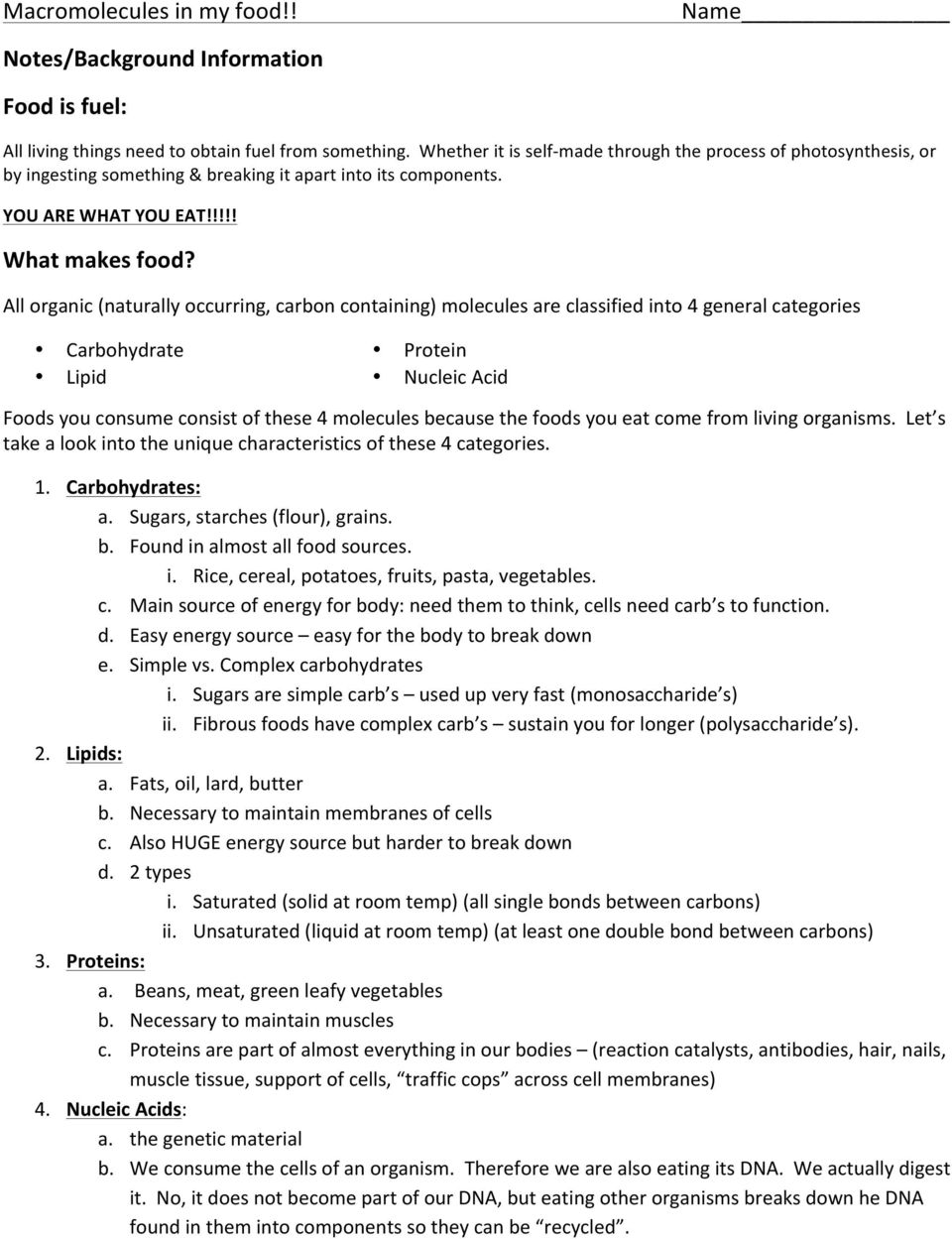
1 Macromolecules in my food!! Name Notes/Background Information Food is fuel: All living things need to obtain fuel from something. Whether it is self- made through the process of photosynthesis, or by ingesting something & breaking it apart into its components. YOU ARE WHAT YOU EAT!!!!! What makes food? All organic (naturally occurring, carbon containing) molecules are classified into 4 general categories Carbohydrate Lipid Protein Nucleic Acid Foods you consume consist of these 4 molecules because the foods you eat come from living organisms. Let s take a look into the unique characteristics of these 4 categories. 1. Carbohydrates: a. Sugars, starches (flour), grains. b. Found in almost all food sources. i. Rice, cereal, potatoes, fruits, pasta, vegetables. c. Main source of energy for body: need them to think, cells need carb s to function. d. Easy energy source easy for the body to break down e. Simple vs. Complex carbohydrates i. Sugars are simple carb s used up very fast (monosaccharide s) ii. Fibrous foods have complex carb s sustain you for longer (polysaccharide s). 2. Lipids: a. Fats, oil, lard, butter b. Necessary to maintain membranes of cells c. Also HUGE energy source but harder to break down d. 2 types i. Saturated (solid at room temp) (all single bonds between carbons) ii. Unsaturated (liquid at room temp) (at least one double bond between carbons) 3. Proteins: a. Beans, meat, green leafy vegetables b. Necessary to maintain muscles c. Proteins are part of almost everything in our bodies (reaction catalysts, antibodies, hair, nails, muscle tissue, support of cells, traffic cops across cell membranes) 4. Nucleic Acids: a. the genetic material b. We consume the cells of an organism. Therefore we are also eating its DNA. We actually digest it. No, it does not become part of our DNA, but eating other organisms breaks down he DNA found in them into components so they can be recycled.
2 Testing for Macromolecules This is the same test you will perform for the ingredients in your salad dressing. Materials: Test tube Spot Plate Biuret Test tube rack (&holder) Hot water bath Benedict s Solution Toothpicks Brown Paper Bag Iodine Substances to be tested provided by Mrs. Whitacre (Vegetable oil, Corn starch, Red wine Vinegar, Sugar, butter, Potato chips) If you brought in your own food substances to be tested from home you may It is required that you test at least 8 food samples!! Before beginning lab read the instructions for testing each macromolecule & then complete the pre lab table indicating what you will see for a positive test for each biomolecule. Then fill out the Predictions column in the data table below which macromolecule (s) do you think each substance will have? These will be completed for HW Thursday 11.1 night. Part A: Testing for Carbohydrates: Monosaccharaides/Simple Sugars Glucose, commonly called blood sugar, and fructose, fruit sugar, are two of the most common monosaccharaides. Monosaccharide s can be identified in a substance using an indicator called Benedict s solution. When Benedict s is heated in the presence of a monosaccharide, the color changes from blue to green to yellow to reddish- orange, depending on the amount of monosaccharide present. Procedure: 1. Mrs. Whitacre will have a hot water bath already prepared for you to use. 2. While this is heating, add 2 dropper- full of each sample to a test tube. Add 10 drops of Benedict s solution to each test tube. Be aware of which sample is which (label) 3. Place the test tubes in the hot- water bath. Heat the test tubes until the indicator changes color OR for 1 minute max if it doesn't seem to be changing color. 4. With a test tube holder, remove the tubes from the hot- water bath and place them back in the test tube rack. 5. Record any changes in your data table.

3 Part B: Testing for Carbohydrates: Polysaccharides/Starch Monosaccharide s may join together to form long chains called polysaccharides that may be either straight or branched. Starch is an example of a polysaccharide formed entirely of glucose monosaccharide s. Polysaccharides can be tested for using the indicator Lugol s reagent (iodine/potassium iodine). Lugol s will change color from yellow- brown to blue- black- purple in the presence of starch. Procedure: 1. Add a few drops of each sample to a spot plate. (be sure to be aware of which sample is which!) 2. Add 1 drop of Lugol s to each sample. 3. Record any changes in your data table. Part C: Testing for Lipids Lipids can be generally categorized into two subgroups: saturated fats and unsaturated fats. In saturated fats, the carbon chains are bonded together with only single covalent bonds and the remaining electrons are bonded to hydrogen. This structure keeps the hydrocarbon tails relatively straight, so they readily align with each other, pack closely together, and thus tend to be solid at room temperature. Saturated fats are most common in animals. Unsaturated fats have double bonds between the carbons and therefore do not have the maximum number of links to hydrogen. These regions of double bonding allow kinks to form in the hydrocarbon tails, keeping them from packing closely together. For this reason, unsaturated fats are usually liquid at room temperature. Unsaturated fats are common in plants. Lipids can also be tested for using the sack lunch method: the lipid is rubbed into a brown bag. If a grease spot appears (the brown bag appears translucent), then a lipid is present in the food. Procedure: Grease spot test (sack lunch): 1. Cut a piece of a paper lunch sack and make a grid (using a pencil, not a pen) for all the food samples you will test. Label each square with a different food sample. 2. Add 4-5 drops each solution to the appropriate square on the lunch bag. If solid, rub solution on paper bag. 3. Rub the solution until a wet spot appears on the paper. Wait for the foods to evaporate. 4. Hold the brown paper up to a bright light. Check for grease spots 5. If the paper has grease spots then the sample has lipids. 6. If found to have lipids, determine if your sample is a SAURATED or UNSATURATED far (how would you know this?)

4 Part D: Testing for Proteins Proteins are made up of one or more polypeptides, which are linear polymers of monomers called amino acids. Amino acids derive their name from the amino group and the carboxyl group (which is acidic). Polypeptides are formed when amino acids are joined together by peptide bonds between the amino group of one amino acid and the carboxyl group of another amino acid. Proteins can be tested for using Biuret s reagent, which reacts with the peptide bond between amino acids in the polypeptide. Biuret s reagent turns from blue to purple- violet if peptides bonds are present. Procedure: 1. Add a few drops of each sample to a spot plate. (be sure to be aware of which sample is which!) 2. Add 3-5 drops of Biuret s reagent to each sample. 3. Record any changes in color. Part E: Testing For Nucleic Acids If the ingredient came from a living organism or was at one point living, then it contains a nucleic acid. There is no specific test for this you just need to use analytical reasoning.

5 Name Each person in group will complete this lab. Keep the above portion as notes & turn in ONLY this page. PRE LAB QUESTIONS Data table What are the four major groups of macromolecules? What does each do for the cell or organism asa a whole? Provide an example of them in food as mentioned above. Macromolecule Group Role in the cell or organism Examples of them in food *********** Once you have read the instructions above, fill in the data table about the lab analysis. Macromolecule type What do you use to test What will you see if positive Monosaccharide (sugar) Polysaccharide (starch) Lipid Protein Nucleic Acid (***TURN OVER FOR MORE QUESTIONS)

6 Predictions of Food Samples Food Sample (those required for the lab) Vegetable Oil Prediction of Macromolecules Present Corn Starch Red Wine Venegar Potato Chip Sugar Butter Salad Dressing Ingredients: Enter below & make a prediction

7 Observations (Keep this as proof to use in your product report (lab analysis portion)) Fill out the table below based on the observations in which you see for each substance tested. If a food sample tests positive for the test enter +. If it tests negative enter -. Food Sample benedicts test (test sugars) biurets test (test proteins) lugol s test (test starch) grease spot test (test lipids) Result from nucleic acids test Macromolecules present in sample Vegetable Oil Corn Starch Red Wine Vinegar Potato Chip Butter Sugar YOUR SALAD DRESSING INGREDIENTS BELOW

Recognizing Organic Molecules: Carbohydrates, Lipids and Proteins
 Recognizing Organic Molecules: Carbohydrates, Lipids and Proteins Oct 15 8:05 PM What is an Organic Molecule? An Organic Molecule is a molecule that contains carbon and hydrogen and oxygen Carbon is found
Determination of Specific Nutrients in Various Foods. Abstract. Humans need to consume food compounds such as carbohydrates, proteins, fats,
 Determination of Specific Nutrients in Various Foods Abstract Humans need to consume food compounds such as carbohydrates, proteins, fats, and vitamins to meet their energy requirements. In this lab, reagents
Lab 2 Biochemistry. Learning Objectives. Introduction. Lipid Structure and Role in Food. The lab has the following learning objectives.
 1 Lab 2 Biochemistry Learning Objectives The lab has the following learning objectives. Investigate the role of double bonding in fatty acids, through models. Developing a calibration curve for a Benedict
Organic Molecules of Life - Exercise 2
 Organic Molecules of Life - Exercise 2 Objectives -Know the difference between a reducing sugar and a non-reducing sugar. -Distinguish Monosaccharides from Disaccharides and Polysaccharides -Understand
Organic Compounds. Essential Questions: What is Organic? What are the 4 major Organic Compounds? How are they made? What are they used for?
 Organic Compounds Essential Questions: What is Organic? What are the 4 major Organic Compounds? How are they made? What are they used for? Aristotle: Francesco Redi: What do we already know? Spontaneous
Biochemistry of Cells
 Biochemistry of Cells 1 Carbon-based Molecules Although a cell is mostly water, the rest of the cell consists mostly of carbon-based molecules Organic chemistry is the study of carbon compounds Carbon
Elements in Biological Molecules
 Chapter 3: Biological Molecules 1. Carbohydrates 2. Lipids 3. Proteins 4. Nucleic Acids Elements in Biological Molecules Biological macromolecules are made almost entirely of just 6 elements: Carbon (C)
Name: Hour: Elements & Macromolecules in Organisms
 Name: Hour: Elements & Macromolecules in Organisms Most common elements in living things are carbon, hydrogen, nitrogen, and oxygen. These four elements constitute about 95% of your body weight. All compounds
Carbon-organic Compounds
 Elements in Cells The living substance of cells is made up of cytoplasm and the structures within it. About 96% of cytoplasm and its included structures are composed of the elements carbon, hydrogen, oxygen,
Conduct A Qualitative Test For Starch, Fat, A Reducing Sugar, A Protein
 Conduct A Qualitative Test For Starch, Fat, A Reducing Sugar, A Protein Biology Leaving Cert Experiments Materials/Equipment Starch solution (1%) Iodine Solution Glucose Solution (1%) 100 C) Benedict s
Carbohydrates Lipids Proteins Nucleic Acids
 Carbohydrates Lipids Proteins Nucleic Acids Carbon The element of life! All living things contain the element carbon. Organic means it contains carbon The reason for this is because of carbon s ability
Elements & Macromolecules in Organisms
 Name: Date: Per: Table # Elements & Macromolecules in rganisms Most common elements in living things are carbon, hydrogen, nitrogen, and oxygen. These four elements constitute about 95% of your body weight.
The Structure and Function of Macromolecules: Carbohydrates, Lipids & Phospholipids
 The Structure and Function of Macromolecules: Carbohydrates, Lipids & Phospholipids The FOUR Classes of Large Biomolecules All living things are made up of four classes of large biological molecules: Carbohydrates
Testing for Sugars and Starch
 The Science of Nutrition Laboratory Science 70 Testing for Sugars and Starch Carbohydrates are the body's most important and readily available source of energy. Even though they've gotten a bad reputation
Biology 13A Lab #13: Nutrition and Digestion
 Biology 13A Lab #13: Nutrition and Digestion Lab #13 Table of Contents: Expected Learning Outcomes.... 102 Introduction...... 103 Food Chemistry & Nutrition.... 104 Activity 1: Testing for the Presence
Lecture Overview. Hydrogen Bonds. Special Properties of Water Molecules. Universal Solvent. ph Scale Illustrated. special properties of water
 Lecture Overview special properties of water > water as a solvent > ph molecules of the cell > properties of carbon > carbohydrates > lipids > proteins > nucleic acids Hydrogen Bonds polarity of water
Chapter 3: Biological Molecules. 1. Carbohydrates 2. Lipids 3. Proteins 4. Nucleic Acids
 Chapter 3: Biological Molecules 1. Carbohydrates 2. Lipids 3. Proteins 4. Nucleic Acids Elements in Biological Molecules Biological macromolecules are made almost entirely of just 6 elements: Carbon (C)
Lab 3 Organic Molecules of Biological Importance
 Name Biology 3 ID Number Lab 3 Organic Molecules of Biological Importance Section 1 - Organic Molecules Section 2 - Functional Groups Section 3 - From Building Blocks to Macromolecules Section 4 - Carbohydrates
Carbohydrates, proteins and lipids
 Carbohydrates, proteins and lipids Chapter 3 MACROMOLECULES Macromolecules: polymers with molecular weights >1,000 Functional groups THE FOUR MACROMOLECULES IN LIFE Molecules in living organisms: proteins,
Chapter 3 Molecules of Cells
 Bio 100 Molecules of cells 1 Chapter 3 Molecules of Cells Compounds containing carbon are called organic compounds Molecules such as methane that are only composed of carbon and hydrogen are called hydrocarbons
BIOMOLECULES. reflect
 reflect A child s building blocks are relatively simple structures. When they come together, however, they can form magnifi cent structures. The elaborate city scene to the right is made of small, simple
10.1 The function of Digestion pg. 402
 10.1 The function of Digestion pg. 402 Macromolecules and Living Systems The body is made up of more than 60 % water. The water is found in the cells cytoplasm, the interstitial fluid and the blood (5
Chemical Processes of Digestion
 Chemical Processes of Digestion Objective: To explain in short essays or diagrams how carbohydrates, proteins, and fats are digested into end products that can be absorbed into the blood, at the level
A disaccharide is formed when a dehydration reaction joins two monosaccharides. This covalent bond is called a glycosidic linkage.
 CH 5 Structure & Function of Large Molecules: Macromolecules Molecules of Life All living things are made up of four classes of large biological molecules: carbohydrates, lipids, proteins, and nucleic
The molecules of life. The molecules that make up living things are really big They are called macromolecules
 Food Labels All living things use materials and energy Our food comes from living things The food labels we see show us what our food is made of The stuff we are studying today can be found on food labels
Who took Jerell s ipod? -- An organic compound mystery 1
 Who took Jerell s ipod? -- An organic compound mystery 1 Jerell is a 10 th grade student who works at McDonald s on the weekends. While on break, Jerell was studying for his biology test and listening
Nutrients: Carbohydrates, Proteins, and Fats. Chapter 5 Lesson 2
 Nutrients: Carbohydrates, Proteins, and Fats Chapter 5 Lesson 2 Carbohydrates Definition- the starches and sugars found in foods. Carbohydrates are the body s preferred source of energy providing four
The Molecules of Cells
 The Molecules of Cells I. Introduction A. Most of the world s population cannot digest milk-based foods. 1. These people are lactose intolerant because they lack the enzyme lactase. 2. This illustrates
Chapter 5: The Structure and Function of Large Biological Molecules
 Name Period Concept 5.1 Macromolecules are polymers, built from monomers 1. The large molecules of all living things fall into just four main classes. Name them. 2. Circle the three classes that are called
Chapter 2. The Chemistry of Life Worksheets
 Chapter 2 The Chemistry of Life Worksheets (Opening image courtesy of David Iberri, http://en.wikipedia.org/wiki/file:camkii.png, and under the Creative Commons license CC-BY-SA 3.0.) Lesson 2.1: Matter
How To Understand The Chemistry Of Organic Molecules
 CHAPTER 3 THE CHEMISTRY OF ORGANIC MOLECULES 3.1 Organic Molecules The chemistry of carbon accounts for the diversity of organic molecules found in living things. Carbon has six electrons, four of which
McMush. Testing for the Presence of Biomolecules
 Biology McMush Testing for the Presence of Biomolecules MATERIALS AND RESOURCES EACH GROUP aprons beaker, 250 ml 2 clamps, test tube goggles graduated cylinder, 50 ml paper towels test tube brush test
1. The diagram below represents a biological process
 1. The diagram below represents a biological process 5. The chart below indicates the elements contained in four different molecules and the number of atoms of each element in those molecules. Which set
Biological molecules:
 Biological molecules: All are organic (based on carbon). Monomers vs. polymers: Monomers refer to the subunits that, when polymerized, make up a larger polymer. Monomers may function on their own in some
Disaccharides consist of two monosaccharide monomers covalently linked by a glycosidic bond. They function in sugar transport.
 1. The fundamental life processes of plants and animals depend on a variety of chemical reactions that occur in specialized areas of the organism s cells. As a basis for understanding this concept: 1.
The Huntington Library, Art Collections, and Botanical Gardens. How Sweet It Is: Enzyme Action in Seed Germination
 The Huntington Library, Art Collections, and Botanical Gardens How Sweet It Is: Enzyme Action in Seed Germination Overview This experiment is intended to familiarize students with the macromolecule starch,
4. Which carbohydrate would you find as part of a molecule of RNA? a. Galactose b. Deoxyribose c. Ribose d. Glucose
 1. How is a polymer formed from multiple monomers? a. From the growth of the chain of carbon atoms b. By the removal of an OH group and a hydrogen atom c. By the addition of an OH group and a hydrogen
BIOLOGICAL MOLECULES OF LIFE
 BIOLOGICAL MOLECULES OF LIFE C A R B O H Y D R A T E S, L I P I D S, P R O T E I N S, A N D N U C L E I C A C I D S The Academic Support Center @ Daytona State College (Science 115, Page 1 of 29) Carbon
Chemical Basis of Life Module A Anchor 2
 Chemical Basis of Life Module A Anchor 2 Key Concepts: - Water is a polar molecule. Therefore, it is able to form multiple hydrogen bonds, which account for many of its special properties. - Water s polarity
Chapter 5. The Structure and Function of Macromolecule s
 Chapter 5 The Structure and Function of Macromolecule s Most Macromolecules are polymers: Polymer: (poly: many; mer: part) Large molecules consisting of many identical or similar subunits connected together.
The Molecules of Life - Overview. The Molecules of Life. The Molecules of Life. The Molecules of Life
 The Molecules of Life - Overview The Molecules of Life The Importance of Carbon Organic Polymers / Monomers Functions of Organic Molecules Origin of Organic Molecules The Molecules of Life Water is the
Human Physiology Lab (Biol 236L) Digestive Physiology: Amylase hydrolysis of starch
 Human Physiology Lab (Biol 236L) Digestive Physiology: Amylase hydrolysis of starch Introduction Enzymes are proteins composed of amino acid building blocks. Enzymes catalyze or increase the rate of metabolic
LAB 3: DIGESTION OF ORGANIC MACROMOLECULES
 LAB 3: DIGESTION OF ORGANIC MACROMOLECULES INTRODUCTION Enzymes are a special class of proteins that lower the activation energy of biological reactions. These biological catalysts change the rate of chemical
10-ml Graduated cylinder 40 ml 3% Hydrogen peroxide solution (found in stores) Straight-edged razor blade Scissors and Forceps (tweezers)
 Name: Class: Date: Objectives * Measure the effects of changes in temperature, ph, and enzyme concentration on reaction rates of an enzyme catalyzed reaction in a controlled experiment. * Explain how environmental
Activity Sheets Enzymes and Their Functions
 Name: Date: Activity Sheets Enzymes and Their Functions amylase What are Enzymes? starch glucose Enzymes are compounds that assist chemical reactions by increasing the rate at which they occur. For example,
Worksheet 13.1. Chapter 13: Human biochemistry glossary
 Worksheet 13.1 Chapter 13: Human biochemistry glossary α-helix Refers to a secondary structure of a protein where the chain is twisted to form a regular helix, held by hydrogen bonds between peptide bonds
Do children with diabetes need a special diet?
 Do children with diabetes need a special diet? No! The basic nutritional needs of a child or adolescent with diabetes is the same as their peers Healthy eating is important for all children Children with
An introduction to the biochemistry of diet.
 An introduction to the biochemistry of diet. SEPA BioScience Montana Module 3 Introduction: The following provides a basic introduction to the biochemistry of three major nutritional components of your
3120-1 - Page 1. Name:
 Name: 1) Which series is arranged in correct order according to decreasing size of structures? A) DNA, nucleus, chromosome, nucleotide, nitrogenous base B) chromosome, nucleus, nitrogenous base, nucleotide,
Sugars, Starches, and Fibers Are All Carbohydrates
 Sugars, Starches, and Fibers Are All Carbohydrates What are carbohydrates? Today's food advertisements call them carbs, but they are not all the same. They are a group of compounds that have some similarities
Proteins and Nucleic Acids
 Proteins and Nucleic Acids Chapter 5 Macromolecules: Proteins Proteins Most structurally & functionally diverse group of biomolecules. : o Involved in almost everything o Enzymes o Structure (keratin,
Digestive System Why is digestion important? How is food digested? Physical Digestion and Movement
 Digestive System The digestive system is made up of the digestive tract a series of hollow organs joined in a long, twisting tube from the mouth to the anus and other organs that help the body break down
Independent Variables, Dependent Variables and Controls Practice
 Rough draft due: 2/22A & 2/23B (20 effort pts) Lab Practical: 2/22A & 2/23B (20 KS pts) Final draft due: 3/2A & 3/1B (50 KS pts) 1 Name: Teacher: Hour: Lab write-ups are a common part of many science courses
Lipids. There are 2 types of lipids; those that contain the structural component of a fatty acid; and
 Lipids Lipids are biomolecules that contain fatty acids or a steroid nucleus. soluble in organic solvents, but not in water. named for the Greek word lipos, which means fat. extracted from cells using
Table of Content. Enzymes and Their Functions Teacher Version 1
 Enzymes and Their Functions Jeisa Pelet, Cornell University Carolyn Wilczynski, Binghamton High School Cornell Learning Initiative in Medicine and Bioengineering (CLIMB) Table of Content Title Page Abstract..
Keystone Review Practice Test Module A Cells and Cell Processes. 1. Which characteristic is shared by all prokaryotes and eukaryotes?
 Keystone Review Practice Test Module A Cells and Cell Processes 1. Which characteristic is shared by all prokaryotes and eukaryotes? a. Ability to store hereditary information b. Use of organelles to control
tissues are made of cells that work together, organs are )
 Study Guide Cells Unit Test Matching. Write the letter of the correct response on the line. You may use the responses more than once. A. proteins B. simple carbohydrates C. complex carbohydrates D. lipids
I. Chapter 5 Summary. II. Nucleotides & Nucleic Acids. III. Lipids
 I. Chapter 5 Summary A. Simple Sugars (CH 2 O) n : 1. One C contains a carbonyl (C=O) rest contain - 2. Classification by functional group: aldoses & ketoses 3. Classification by number of C's: trioses,
The Chemistry of Carbohydrates
 The Chemistry of Carbohydrates Experiment #5 Objective: To determine the carbohydrate class of an unknown by carrying out a series of chemical reactions with the unknown and known compounds in each class
Experiment 10 Enzymes
 Experiment 10 Enzymes Enzymes are proteins that act as catalysts for biological reactions. Enzymes, like all catalysts, speed up reactions without being used up themselves. They do this by lowering the
WATER CHAPTER 3 - BIOCHEMISTRY "THE CHEMISTRY OF LIFE" POLARITY HYDROGEN BONDING
 CHAPTER 3 - BIOCHEMISTRY "THE CHEMISTRY OF LIFE" WATER Compare the body of the jellyfish with our own bodies. The jellyfish will die if it is removed from its water environment, yet we can live in the
DIABETES & HEALTHY EATING
 DIABETES & HEALTHY EATING Food gives you the energy you need for healthy living. Your body changes most of the food you eat into a sugar called glucose. (glucose) Insulin helps your cells get the sugar
Do not put any wastes down the sink! All materials will be collected as-is at the end of class.
 Chemical and Physical Processes of Digestion Exercise 39A / 39 (begins page 597 in 9 th &10 th eds, page 595 in 11 th edition, page 599 in 12 th edition) Lab 7 Objectives Read lab Exercise 39A / 39 Do
Digestive System Lecture 5 Winter 2014
 Digestive System Lecture 5 Winter 2014 This lecture tells the story of the Flow of Matter from Food to Cells. The pictures are only there to help you visualize structures don t worry about names of structures
Nutritional Glossary. Index of Contents
 Nutritional Glossary This glossary provides nutrition information about the nutrients commonly found in fruits, vegetables, and other plant foods Each glossary definition has a long and a short version.
Procedure for Protein Analysis. Protein Extraction
 Name Section Lab 6 Protein, Fats, Sugars and Starch Plants are composed of a variety of compounds, many of which humans use for food, drugs oils and cosmetics. Besides water, certain plant organs have
Diffusion, Osmosis, and Membrane Transport
 Diffusion, Osmosis, and Membrane Transport Introduction... 2 Diffusion and osmosis as related to cellular processes... 2 The hotter the medium, the faster the molecules diffuse... 2 TASK 1: TEMPERATURE
Unit 2: Cells, Membranes and Signaling CELL MEMBRANE. Chapter 5 Hillis Textbook
 Unit 2: Cells, Membranes and Signaling CELL MEMBRANE Chapter 5 Hillis Textbook HOW DOES THE LAB RELATE TO THE NEXT CHAPTER? SURFACE AREA: the entire outer covering of a cell that enables materials pass.
Cellular Respiration: Practice Questions #1
 Cellular Respiration: Practice Questions #1 1. Which statement best describes one of the events taking place in the chemical reaction? A. Energy is being stored as a result of aerobic respiration. B. Fermentation
B2 1 Cells, Tissues and Organs
 B2 Cells, Tissues and Organs 5 minutes 5 marks Page of 7 Q. The diagram shows a bacterium. On the drawing, name the structures labelled A, B, C and D. (Total 4 marks) Q2. (a) The diagrams show cells containing
Unit 5 Photosynthesis and Cellular Respiration
 Unit 5 Photosynthesis and Cellular Respiration Advanced Concepts What is the abbreviated name of this molecule? What is its purpose? What are the three parts of this molecule? Label each part with the
Pediatrics. Specialty Courses for Medical Assistants
 Pediatrics Specialty Courses for Medical Assistants 7007 College Boulevard, Suite 385 Overland Park, Kansas 66211 www.ncctinc.com t: 800.875.4404 f: 913.498.1243 Pediatrics Specialty Certificate Course
Cells & Cell Organelles
 Cells & Cell Organelles The Building Blocks of Life H Biology Types of cells bacteria cells Prokaryote - no organelles Eukaryotes - organelles animal cells plant cells Cell size comparison Animal cell
Investigating cells. Cells are the basic units of living things (this means that all living things are made up of one or more cells).
 SG Biology Summary notes Investigating cells Sub-topic a: Investigating living cells Cells are the basic units of living things (this means that all living things are made up of one or more cells). Cells
4.1 Chemical Energy and ATP. KEY CONCEPT All cells need chemical energy.
 4.1 Chemical Energy and ATP KEY CONCEPT All cells need chemical energy. 4.1 Chemical Energy and ATP Molecules in food store chemical energy in their bonds. Starch molecule Glucose molecule The chemical
Eating Well with Diabetes. Cassie Vanderwall UW Health Nutrition Registered Dietitian Certified Personal Trainer Certified Diabetes Educator
 Eating Well with Diabetes Cassie Vanderwall UW Health Nutrition Registered Dietitian Certified Personal Trainer Certified Diabetes Educator Outline What is Diabetes? Diabetes Self-Management Eating Well
Chapter 49 - Nutrients and the Digestive System I. Nutrients (chemical substances necessary for organisms to grow and function properly)
 Chapter 49 - Nutrients and the Digestive System I. Nutrients (chemical substances necessary for organisms to grow and function properly) 6 basic nutrients - 4 food groups (milk, meat, fruit and vegetable,
Macromolecules 1 Carbohydrates, Lipids & Nucleic Acids
 VEA Bringing Learning to Life Program Support Notes Macromolecules 1 Carbohydrates, Lipids & Nucleic Acids Grades 10 - College 25mins Teacher Notes by Sue Wright, B. Sc., Dip. Ed. Produced by VEA Pty Ltd
Absorption and Transport of Nutrients
 Page1 Digestion Food travels from mouth esophagus stomach small intestine colon rectum anus. Food mixes with digestive juices, moving it through the digestive tract Large molecules of food are broken into
Review and apply Investigation 5. Let s review Pages 311-312
 Review and apply Investigation 5 Let s review Pages 311-312 1. After you tested all the known powders with all the test liquids, describe what you did to identify the unknown powder. Students should have
Lesson Title: Nutrient Wise
 Standards This lesson aligns with the OSPI Health and Fitness Standards. This lesson will address GLE 1.5.1 Applies nutrition goals based on dietary guidelines and individual activity needs. GLE 1.5.4
Enzymes: Practice Questions #1
 Enzymes: Practice Questions #1 1. Compound X increases the rate of the reaction below. Compound X is most likely A. an enzyme B. a lipid molecule C. an indicator D. an ADP molecule 2. The equation below
Chapter 2 Chemical Principles
 Chapter 2 Chemical Principles I. Chemistry. [Students should read this section on their own]. a. Chemistry is the study of the interactions between atoms and molecules. b. The atom is the smallest unit
Photosynthesis and Cellular Respiration. Stored Energy
 Photosynthesis and Cellular Respiration Stored Energy What is Photosynthesis? plants convert the energy of sunlight into the energy in the chemical bonds of carbohydrates sugars and starches. SUMMARY EQUATION:
Process of Science: Using Diffusion and Osmosis
 Process of Science: Using Diffusion and Osmosis OBJECTIVES: 1. To understand one way to approach the process of science through an investigation of diffusion and osmosis. 2. To explore how different molecules
pathway that involves taking in heat from the environment at each step. C.
 Study Island Cell Energy Keystone Review 1. Cells obtain energy by either capturing light energy through photosynthesis or by breaking down carbohydrates through cellular respiration. In both photosynthesis
Cellular Respiration
 Cellular Respiration Cellular Respiration Text, Diagrams, Assessments, and Link to Standards Focus Questions 1) What is cellular respiration? 2) How is cellular respiration connected to breathing? 3) If
Molecular Cell Biology
 Harvey Lodish Arnold Berk Paul Matsudaira Chris A. Kaiser Monty Krieger Matthew P. Scott Lawrence Zipursky James Darnell Molecular Cell Biology Fifth Edition Chapter 2: Chemical Foundations Copyright 2004
CHM220 Addition lab. Experiment: Reactions of alkanes, alkenes, and cycloalkenes*
 CM220 Addition lab Experiment: Reactions of alkanes, alkenes, and cycloalkenes* Purpose: To investigate the physical properties, solubility, and density of some hydrocarbon. To compare the chemical reactivity
Get It Right. Answers. Chapter 1: The Science of Life. A biologist studies all living things.
 Discover Biology 'N' Level Science Chapter 1 Chapter 1: The Science of Life A biologist studies all living things. In order to carry out the scientific method, we need to ask questions. Discover Biology
PHOTOSYNTHESIS AND CELLULAR RESPIRATION
 reflect Wind turbines shown in the photo on the right are large structures with blades that move in response to air movement. When the wind blows, the blades rotate. This motion generates energy that is
What happens to the food we eat? It gets broken down!
 Enzymes Essential Questions: What is an enzyme? How do enzymes work? What are the properties of enzymes? How do they maintain homeostasis for the body? What happens to the food we eat? It gets broken down!
Chapter 5: The Structure and Function of Large Biological Molecules
 Name Period Chapter 5: The Structure and Function of Large Biological Molecules Concept 5.1 Macromolecules are polymers, built from monomers 1. The large molecules of all living things fall into just four
Anatomy and Physiology Placement Exam 2 Practice with Answers at End!
 Anatomy and Physiology Placement Exam 2 Practice with Answers at End! General Chemical Principles 1. bonds are characterized by the sharing of electrons between the participating atoms. a. hydrogen b.
Metabolism: Cellular Respiration, Fermentation and Photosynthesis
 Metabolism: Cellular Respiration, Fermentation and Photosynthesis Introduction: All organisms require a supply of energy and matter to build themselves and to continue to function. To get that supply of
Enzyme Lab. DEFINITIONS: 1. Enzyme: 2. Catalase: 3. Catalyze: 4. Hydrolysis: 5. Monomer: 6. Digestion: BACKGROUND INFORMATION
 Enzyme Lab DEFINITIONS: 1. Enzyme: 2. Catalase: 3. Catalyze: 4. Hydrolysis: 5. Monomer: 6. Digestion: BACKGROUND INFORMATION Many living tissues contain the enzyme catalase. This enzyme breaks down hydrogen
Diabetes Nutrition. Roseville & Sacramento Medical Centers. Health Promotion Department Nutritional Services
 Diabetes Nutrition Roseville & Sacramento Medical Centers Health Promotion Department Nutritional Services Agenda Blood sugar goals Factors that affect blood sugar Diet Options: Menus, Exchange Lists,
Catalase Enzyme Lab. Background information
 Catalase Enzyme Lab Background information Liver and other living tissues contain the enzyme catalase. This enzyme breaks down hydrogen peroxide, which is a harmful by-product of the process of cellular
But what does my body need? (No...it is not just candy and soda!)
 Chapter 35: Page 349 In the last chapter, you learned how important your immune system is to your survival. This week, you are going to learn how to keep your immune system strong and ready to protect