
Loop Calibration and Maintenance
|
|
|
- Clyde Hancock
- 9 years ago
- Views:
Transcription
1 Loop Calibration and Maintenance Application Note Introduction Process instrumentation requires periodic calibration and maintenance to ensure that it is operating correctly. This application note contains information to help guide technicians through some of the more common loop calibration tasks using Fluke tools. Fluke loop calibrators are ideal for a wide variety of calibration applications. They include: Fluke 707 Loop Calibrator Fluke 705 Loop Calibrator Fluke 715 Volt/ Calibrator Fluke 787 ProcessMeter A summary of the features of Fluke s loop calibrators and a glossary of terms are at the end of this application note. Field testing loop powered isolators The loop-powered isolator and the two-wire isolating transmitter are two of the more prevalent devices in use in 4-20 control loops today (see Figure 1). The testing and troubleshooting procedures for each are different and need to be understood by the technicians performing operational checks on these units in the field. Figure 1 Loop-powered isolators The main purpose of a loop isolator is to eliminate ground loops in control systems while sending the control signal current to another part of the system. Loop-powered isolators, unlike two-wire transmitters, draw their operating power from the input side of the isolator (see Figure 1), which requires a pickup voltage from 5.5 V to 13.5 V depending on the manufacturer. The output of the loop isolator is an electrically isolated mirror image of the input side current. The compliance voltage associated with the output is greatly reduced from that of the input side and ranges around 7.5 V. This produces a total loop loading capability of 350 Ω. This limited loop drive capability is the primary limitation of the loop isolator. Two-wire transmitters Isolating two-wire transmitters provide the same isolating functionality as loop isolators with the added advantage that many provide signal conditioning for a variety of inputs such as thermocouple, frequency, dc current, RTD, strain gauge, and other process inputs. The power supplied to a two-wire transmitter is connected to the output side of the transmitter. The two-wire transmitter modulates the current from the power supply between 4-20, proportional to the input. Typical power supplies for twowire transmitters range from 24 V to 48 V. Power supplies of this size allow a significant loop load capability on the output.

2 OUTPUT V OFF mv V 787 PROCESSMETER % MINMAXAVG MIN MAX RANGE HOLD H REL DC mv AC Mk Auto khz OUTPUT 0-24 SOURCE SIMULATE + + A COM V 0.44A (1A /30 sec) FUSED % STEP COARSE FINE 30 FUSED CAT 1000V Hz OUTPUT Field checking a loop-powered isolator Fluke loop calibrators have a unique current simulation feature that, when connected to an external power source, allows you to precisely control current between 0 and 24. When field checking a loop-powered isolator, the twowire loop transmitter supplying signal current to the isolator for the loop may be removed and the calibrator connected in simulate mode to control loop current (Figure 2). Connecting the Fluke loop calibrator In this example, we will use the Fluke 787 Process Meter. Although the operating controls vary, this application can also be performed using the Fluke 707, 715, and 705 loop calibrators. 1. Disconnect the main loop transmitter and connect the Fluke 787 to the loop with the test leads plugged into the center or Simulate terminals of the calibrator (see Figure 2). 2. Set the 787 rotary switch to the Output mode. Set the Fluke 787 to the 4-20 output mode. Make connection for simulate. The 787 is now outputting a precise 4 and is providing operating power to the input of the loop-powered isolator. 3. Place a Fluke 87, 187 or equivalent multimeter (1 µa resolution is ideal; 10 µa is acceptable), set in the measurement mode, on the output side of the isolator to monitor output current (see Figure 2). 4. Adjust the zero control on the isolator for a reading of on the output meter. 5. Step the input current to 20 using the % step button (25% or 4 increase) and adjust the span control on the isolator to read on the output meter connected to the isolator. Figure 2 6. Step input current down to 4 using the button (25% or 4 decrease) and check for a zero shift, adjust if necessary. 7. At this point, basic zero and span adjustments are complete. Check linearity Fluke loop calibrators can easily check the linearity of your loop isolator using the % step buttons and. Pushing these buttons when in the output mode increases or decreases the output current in 25% steps. In the 4-20 current mode these intermediate steps are at 8 (25%), 12 (50%), and 16 (75%). To check linearity of the isolator, push the associated % step buttons up and down and confirm that the digital multimeter (DMM) is reading the same value as is shown on the loop calibrator display. A variation from expected values should be compared to the linearity limits stated by the manufacturer of the loop-powered isolator. A Testing valve positioners Electronic valve positioners should receive periodic in-field calibrations as part of preventive maintenance programs. Fluke loop calibrators are the ideal test tools for these checks. Valve positioners vary in design and valve type and should be calibrated using specific instructions from the individual manufacturer. Quick operational checks can be performed using a field calibrator as a signal source while observing the valve stem position, mechanical position indicators, or flow indicators as input changes are made. Fluke loop calibrators provide a convenient source for simulating the controller output to a valve positioner. The following example shows a general method for an in-field operational check of a valve fitted with an electronic valve positioner. These methods may be adapted to various types of valves, however, manufacturer s specific instructions should always be consulted for proper and appropriate techniques. In the following example, valve operation and movement is checked either by feel or by observing valve stem movement. 2 Fluke Corporation Troubleshooting and Maintenance Using Fluke Loop Calibrators

3 Fluke 707 Positioner Flow Figure 3 Step 1: Basic set-up. Setting the Fluke 707 loop calibrator current output Place the calibrator in the 4-20 output current mode. Connect the 707 to the input terminals of the valve positioner (see Figure 3). Step 2: Zero adjustment Set the 707 to an output of 4 and allow some time for valve stem movement to stabilize. Quickly decrease the current from 4 to 3.9 by depressing and turning the vernier knob in a counterclockwise direction. You can operate the 707 with one hand while feeling the valve stem with your free hand to check for any sign of movement. Adjust for zero movement between these two current settings by using the zero adjustment on the positioner. Increase and decrease current from 4 to 4.1 using the vernier knob in the depressed position. Insure that the valve stem just begins movement above the 4.1 setting and fully closed at 4. Step 3: Span (full open) position check Using the 25% button, step the calibrator output value to 20 and allow the valve to stabilize. Step the input to 20.1 using the vernier knob in the depressed position turning clockwise while watching or feeling for movement of the valve stem. Minimize this movement using the span adjustment on the valve positioner. Using the vernier knob in the depressed position, adjust current up and down between and There should be no movement of the valve stem above 20 and a slight movement below 20. Step 4: Check zero and span again Many positioners have interactive zero and span controls. This step will help insure proper valve position adjustment. Repeat Step 2 and Step 3. Step 5: Linearity check For valves with linear action, linearity can be checked by setting the 707 to 4 and stepping current to 12 (50%) while observing valve travel. If your valve is of a nonlinear type, refer to the valve manual for proper operational checks. Step 6: Stroking the valve Checking for smooth valve operation is easy to accomplish using the slow ramp function of the 707. Set the calibrator to source mode and select the slow ramp function ( ) by depressing the 25% and 0-100% buttons simultaneously. Allow the calibrator to ramp through several cycles while watching or feeling for any abnormal operation of the valve, such as sticking in one position momentarily or erratic movement. Troubleshooting and Maintenance Using Fluke Loop Calibrators Fluke Corporation 3

4 Calibrating voltage input signal conditioners Fluke loop calibrators are ideal for calibrating many 4-20 signal conditioners using their precision current sourcing and simulation capabilities. However, there are many signal conditioners that require a precision voltage source for proper calibration. Using a simple precision resistor and standard connector, Fluke loop calibrators can field calibrate many standard and non-standard voltage input signal conditioners. This approach works well for the 705, 707 and 787 loop calibration tools (this is not necessary with the 715 loop calibrator as it has a precision direct voltage output). Voltage input signal conditioners come in many varieties. The most common are 0-10 V, 0-5 V and 1-5 V input levels. Typical outputs of these devices are an isolated or non-isolated 0-10 V or Resistors with values of 250 Ω to 500 Ω are common loop load resistors and provide voltage input levels as a function of the loop current (see Figure 4). Resistor Sourced Generated Fluke Loop Value Application Current Value Voltage Calibrator 10 Ω mv mv 707, 705, 787 transducer 250 Ω 0-5 V Source V 705, Ω 0-10 V Source V 705, 707, 787 Note: Input impedance of the device under test should be 1 MΩ Table 1. Values of precision resistors to accommodate a variety of voltage calibrations Using Fluke loop calibrators as a voltage source A precision shunt resistor may be used to derive voltages for calibration using the calibrator s current source mode. Using this system, Fluke loop calibrators are capable of generating voltages for devices with input spans as low as 10 mv to as high as 24 V. Table 1 gives values of precision resistors to accommodate a variety of voltage calibrations and the Fluke calibrator ideal for each application. Constructing a precision load resistor assembly A simple precision current shunt can be constructed using a precision RN60, 1 W resistor, (see table for the correct value), a dual banana jack connector and some test leads with alligator clips (see Figure 5). The RN60 class resistor is available from many commercial sources. Construct the assembly as shown in Figure 5. This precision resistor assembly, coupled with the precision current sourcing capabilities of Fluke loop calibrators, generates precision voltages to cover 1-5 V or 2-10 V applications. The 1,000 Ω assembly has an advantage in that it allows a direct one-to-one display correlation to voltage when sourcing current from the Fluke loop calibrator during calibration (1 = 1 V). The following example will utilize a 250 Ω to take advantage of the 0-100% and 25% buttons on the Fluke 707 (25% or 4 = 1 V). Constructing a precision current shunt Parts required: 1. Resistor: 1000 Ω Type: RN60 (50 ppm@70 C) 1 W test leads with alligator clips 3. Connector: Dual Banana Plug 2/screw terminals Figure 4 Figure 5 4 Fluke Corporation Troubleshooting and Maintenance Using Fluke Loop Calibrators

5 Calibrating the signal conditioner The following is a procedure for calibrating a 1-5 V input, 4-20 output signal conditioner using the precision current shunt constructed in Figure 5. Step 1: Setting the Fluke 707 to source With the shunt assembly in the source jacks, power the 707 on. 2. Check the display. If the display does not read 4, turn the 707 off and on again while holding the mode button for two seconds. The display should now read Step 2: Calibrating 1. Place a precision multimeter, such as the Fluke 87 DMM, set to dc current mode, in series with the output of the signal conditioner as shown in Figure Connect the test leads from the precision shunt assembly to the signal conditioner input terminals, observing proper polarity. 3. With the 707 set in the source mode, the display should read (1.00 V across the shunt). 4. Adjust the zero control on the signal conditioner for an indication of on the DMM. 5. Press the 0-100% button on the 707 until the display reads Then adjust the span adjustment on the signal conditioner until the display on the DMM reads Push the 0-100% button and the 707 should read Verify the meter connected to the output signal conditioner reads Calibration is now complete. Note: Many manufacturers specify a warm-up time prior to beginning calibration. 1 If your output meter displayed a value higher or lower than 4, consult the Making fine adjustments section on this page. Figure 6 Step 3: Checking linearity Once zero and span controls have been properly set, signal conditioner linearity may be verified using the following procedure. This procedure will check zero, 25%, 50%, 75% and span settings for signal conditioner linearity. 1. With the precision resistor assembly in place, adjust the source current of the Fluke loop calibrator to 4 (1.0 V) using the 25% button. The DMM displays Using the 25% button, step the source current to 25%, 50%, 75% and 100% and note the corresponding values. Table 2 shows the correct values of output for a linear signal conditioner. (If values differ from that shown in Table 2 by more than the linearity specification of the signal conditioner, contact the signal conditioner manufacturer or replace the device.) Fluke Display Input Output Reading % Input Voltage Current V V V V V Table 2. Correct value of output for a linear signal conditioner Making fine adjustments Many signal conditioners with 0-20 and 4-20 outputs are notorious for zero and span control interaction. If, when checking linearity in the calibration section, your output meter displayed a value higher or lower than 4, perform the following steps to affect the required 4 and 20 display on the output meter. 1. Note the value above or below 4 that was displayed on the output meter when you returned to a source value of on the 707. Adjust the zero control on the signal conditioner so the value of the output meter shows one-half the difference of the remaining value to 4. Example: If your display reading at zero input in step 7 was 3.50 adjust the output (with source current) to display a reading of 3.75, which is one-half the delta toward the desired value of 4 (eg = 0.50; 0.05 / = 3.75, or one-half the difference between the reading and the desired value). Troubleshooting and Maintenance Using Fluke Loop Calibrators Fluke Corporation 5

6 2. Set the source current of the 707 to using the 0-100% button. Note the output meter display reading. Adjust the span control of the signal conditioner one-half the delta from Example: If the output display reads 21. Adjust the span control to 20.5 (one-half the delta to the required value of 20 ). 3. Repeat this one-half step process until the required output is obtained. There are signal conditioners that have non-interactive controls that do not require this procedure. + Indicator Input 0% 50% 100% Verifying process scaled, indicators Scaled process indicators are used to provide information about a process either locally or to a control room located a distance away. These indicators typically take a measurement in series with the 4-20 loop signal or measure a 1 V-5 V drop across a 250 ohm resistor in series with the 4-20 signal (a 4-20 signal through a 250 ohm resistor produces a 1 V to 5 V drop). For indicators with a input, the direct current output of a 705, 707, 715 or 787 can be applied directly to the input of the indicator. For voltage input indicators, a 715 is ideal with its direct voltage output. Or use a resistor across the output of a 705, 707, or 787 as described previously ( Using Fluke loop calibrators as a voltage source ). Figure 7 This example will show how to use the 707 to verify a input indicator. Make connections as shown in Figure Power the 707 up; the default output should be 4. Note the indication, (digital or analog) which should be approximately 0%. 2. Depress the 0-100% button on the 707; it is now in the span check mode and is outputting 20. Note the indication (approximately 100%). 3. If testing the linearity is necessary, use the 25% button to step the output in 4 steps and record the indications. 4. To calculate the errors in percent, use the formula: Nominal - Actual/Span x 100 Nominal is the ideal value, actual is the recorded measurement and span is 16 (4-20 = a 16 span). Example: If the indication with 0% applied is 1%, calculate error as such: 0-1/16 =.0625 X 100 = 6.25% error. Calculate error based on the recorded indications and compare to the tolerances for the indicator. If any of the calculated errors are too large, adjustment may be necessary. Normally, there are at least two adjustments for analog indicators: zero and span. The zero adjustment is typically on the faceplate of the indicator. 5. With an output of from the 707 adjust the zero indication. Span adjustment is either a hard adjustment or accomplished by bending a linkage on the meter movement. Refer to the manufacturer s procedure for this adjustment. 6. Apply a signal to the indicator and make the adjustment as specified. Once the adjustment is completed, re-verify the indicator and confirm the adjustments had the desired effect. If the indicator still fails the test, it will either need to be readjusted until a satisfactory result is attained, or replaced. Voltage input indicators The procedure for using the 707 to verify voltage input indicators is almost identical to the procedure outlined. The primary difference is the addition of the precision 250 ohm adapter. 6 Fluke Corporation Troubleshooting and Maintenance Using Fluke Loop Calibrators

7 Fluke Loop Calibrator Considerations and Selection Fluke loop calibration tools have a variety of different performance features and capabilities that differentiate the models. The charts below will help you determine which model best fits your needs: Loop Calibrator Volt/ Calibrator Loop Calibrator ProcessMeter One-handed quick click Source or simulate Simultaneous and Two instruments in one: operation 24 loop current % of span display -Professional DMM Simultaneous and % Source voltage to Accuracy and resolution -Loop calibrator of span display 100 mv or 10 V Span check Precise control of Push button 25% steps Measure voltage output Auto ramping and loop current 0.015% accuracy and process signals stepping Auto ramping & stepping 1 microamp resolution High level of safety Function in any current mode (Cat III) Measure DMM capabilities V dc 28 V 10 V 28 V 1000 V V ac (true-rms) Ω 1000 V 40 MΩ A dc , 1 A A ac Frequency Hz/CPM 1 A 20 khz accuracy 0.015% 0.015% 0.020% 0.05% Span check Source/Simulate V dc 10 V Source voltage with µv resolution (1-10 Volts) dc/% scale source: auto step, auto ramp Record Min Max Hold Features 24 V loop supply Drive capability 24 V compliance 24 V compliance 24 V compliance 12 V compliance Warranty 3 year 3 year 3 year 3 year IEC category/ 30 V 30 V 30 V 1000 V, CAT III max voltage Accessories 707 Loop Calibrator 715 Volt/ Calibrator 705 Loop Calibrator 787 ProcessMeter 787CAL Calibration Kit 80T-IR Infrared Probe 80TK Thermocouple 80T-150U Temperature Probe TL20/22/24/26/28 Lead Sets TL70A/TL75/Y8140A Lead Sets AC20/AC80 Clips TP20 Industrial Test Probes 80i-400 AC Current Clamp i410 AC/DC Current Clamp 2 1 i1010 AC/DC Current Clamp 2 1 C10 Holster, C12A Case C25/C28/V90/C100/C800 Cases C510 Leather Case 80K-6/80K-40 High Voltage Probe 83RF/85RF High Frequency Probes PV350 Pressure Vacuum Module Fiber Optic Meter FOM 1 20 amps ac minimum 2 dc current only Troubleshooting and Maintenance Using Fluke Loop Calibrators Fluke Corporation 7

8 Glossary of terms 4-20 loop A 4-20 signal that is representative of a process variable or a control signal that controls a process variable. Compliance voltage DMM The voltage a current source develops when attempting to drive a signal through a resistive load. Digital multimeter. Electronic valve positioners Devices that can control the flow in a process with input from a or digital control signal. Ground loop Linearity Loop-powered isolator Precision current shunt RTD Signal conditioner Strain gauge Thermocouple A difference in potential (voltage) between (2) signal grounds. The closeness of a calibration curve to a specified straight line. Linearity is expressed as the maximum deviation of any calibration point from a specified straight line. A device that produces an electrically isolated mirror image of the input side 4-20 current. Milliamp; a unit of electric current equal to one thousandth of an ampere. A conductor joining two points in a circuit to form a parallel circuit, through which a precision voltage can be measured or derived. Resistance temperature device, a temperature measurement sensor that has predictable changes in resistance with a change in temperature. A circuit to modulate a signal so as to make it intelligible to, or compatible with, another device, including such manipulation as pulse shaping, pulse clipping, compensating, digitizing, and linearizing. A measuring element for converting force, pressure, tension, etc., into an electrical signal. A junction of dissimilar metals that generates a small voltage correlated to the temperature of the junction. µa or ua Microamp; a unit of electric current equal to one millionth of an ampere. Vernier A small, movable, graduated scale running parallel to the fixed graduated scale and used for measuring a fractional part of one of the divisions of the fixed scale. Fluke. Keeping your world up and running. Fluke Corporation PO Box 9090, Everett, WA USA Fluke Europe B.V. PO Box 1186, 5602 BD Eindhoven, The Netherlands For more information call: In the U.S.A. (800) or Fax (425) In Europe/M-East/Africa (31 40) or Fax (31 40) Canada (800)-36-FLUKE or Fax (905) Other countries (425) or Fax (425) Web access: Fluke Corporation. All rights reserved. Trademarks are the property of their respective owners. Printed in U.S.A. 8/ A-ENG-N Rev A Printed on recycled paper.

Multimeter measurements on variable frequency drives using the new Fluke 289 DMM
 Multimeter measurements on variable frequency drives using the new Fluke 289 DMM Application Note Editor s note: For similar instructions using the Fluke 87V DMM, reference Fluke article 12345. In the
1587/1577. Insulation Multimeters. Technical Data. Two powerful tools in one.
 1587/1577 Insulation Multimeters Technical Data Two powerful tools in one. The Fluke 1587 and 1577 Insulation Multimeters combine a digital insulation tester with a full-featured, true-rms digital multimeter
Essential Electrical Concepts
 Essential Electrical Concepts Introduction Modern vehicles incorporate many electrical and electronic components and systems: Audio Lights Navigation Engine control Transmission control Braking and traction
Process Tools. 2011 Selection Guide. inside for: for industrial instrumentation and electrical technicians. Loop Calibrators. Pressure Calibrators
 Process Tools for industrial instrumentation and electrical technicians 2011 Selection Guide Look inside for: Loop Calibrators Pressure Calibrators Temperature Calibrators Multifunction Process Calibrators
The table below lists the symbols used on the Clamp and/or in this manual. Important Information. See manual.
 i800 AC Current Clamp Instruction Sheet Introduction The i800 AC Current Clamp, the Clamp, has been designed for use with multimeters, recorders, power analyzers, safety testers, etc., for accurate non-intrusive
ABCs of DMMs Multimeter features and functions explained Application Note
 ABCs of DMMs Multimeter features and functions explained Application Note Digital multimeters offer a wide selection of features. Choosing the right meter for the job can be challenging unless you know
Insulation resistance testing. A complete solution for every person.
 Insulation resistance testing. A complete solution for every person. Insulation resistance. The latest test tools from the testing experts. You asked. We responded. Now you have more insulation testing
Fluke 3000 FC Series Test Tools Technical Data
 Fluke 3000 FC Series Test Tools Technical Data Now compatible with Fluke Connect Mobile App Start building tomorrow s test tool system today with the Fluke 3000 FC Digital Multimeter. The new Fluke Connect
10 Multimeter. Users Manual
 10 Multimeter Users Manual 1991-2001 Fluke Corporation, All rights reserved. Printed in USA All product names are trademarks of their respective companies. 10 MULTIMETER m m Mk SELECT RANGE OFF VDC VAC
New thermometers and accessories to grow your business
 New s and accessories to grow your business Fluke is introducing a new family of digital, contact s and accessories. Here is the information you will need to order, promote and sell these exciting, new
Isolated AC Sine Wave Input 3B42 / 3B43 / 3B44 FEATURES APPLICATIONS PRODUCT OVERVIEW FUNCTIONAL BLOCK DIAGRAM
 Isolated AC Sine Wave Input 3B42 / 3B43 / 3B44 FEATURES AC averaging technique used to rectify, amplify, and filter 50 Hz to 400 Hz sine-wave signals. Accepts inputs of between 20 mv to 550 V rms to give
Lab E1: Introduction to Circuits
 E1.1 Lab E1: Introduction to Circuits The purpose of the this lab is to introduce you to some basic instrumentation used in electrical circuits. You will learn to use a DC power supply, a digital multimeter
HVAC Clamp Meter. Users Manual
 902 HVAC Clamp Meter Users Manual PN 2547887 May 2006 Rev. 1, 3/07 2006-2007 Fluke Corporation. All rights reserved. Printed in China. All product names are trademarks of their respective companies. LIMITED
Wahl C50 Calibrator FEATURES
 NEW! On Site Multifunction Portable Far Superior Accuracy as Compared to Fluke! Simultaneous Measurement and Generation Quick Connect Terminals Anti-Shock Boot Quick Connect Terminals Navigator Power Supply,
Multifunction Process Calibrator
 725 Multifunction Process Calibrator Product Overview PN 1549644 English January 2000 Rev.2, 8/05 2000-2005 Fluke Corporation. All rights reserved. Printed in USA All product names are trademarks of their
EXPERIMENT 7 OHM S LAW, RESISTORS IN SERIES AND PARALLEL
 260 7- I. THEOY EXPEIMENT 7 OHM S LAW, ESISTOS IN SEIES AND PAALLEL The purposes of this experiment are to test Ohm's Law, to study resistors in series and parallel, and to learn the correct use of ammeters
User's Guide. True RMS Industrial Multimeter
 User's Guide 97650 True RMS Industrial Multimeter Ω C ã F ã 10A V µ 10A V ã ã ma A Introduction This meter measures AC/DC Voltage, AC/DC Current, Resistance, Capacitance, Frequency (electrical & electronic),
Fluke 3000 FC Series Test Tools Technical Data
 Fluke 3000 FC Series Test Tools Technical Data Now compatible with Fluke Connect Mobile App Start building tomorrow s test tool system today with the Fluke 3000 FC Digital Multimeter. The new Fluke Connect
Manual Ranging MultiMeter
 Owner s Manual Manual Ranging MultiMeter Model 82345 CAUTION: Read, understand and follow Safety Rules and Operating Instructions in this manual before using this product.! Safety! Operation! Maintenance!
AutoRanging Digital MultiMeter
 Owner's Manual AutoRanging Digital MultiMeter Model No. 82139 CAUTION: Read, understand and follow Safety Rules and Operating Instructions in this manual before using this product. Safety Operation Maintenance
Quick Start Guide 00825-0100-4764, Rev DA March 2014. Rosemount 8714D (Calibration Standard) Magnetic Flowtube Simulator
 Quick Start Guide 00825-0100-4764, Rev DA Rosemount 8714D (Calibration Standard) Magnetic Flowtube Simulator Quick Start Guide NOTICE This document provides basic guidelines for the Rosemount 8714D. It
Fossil fuel heating equipment
 Fossil fuel heating equipment principles and troubleshooting techniques Application Note This application note was written to provide you with an understanding of the basic principles of fossil fuel heating
WHY DIFFERENTIAL? instruments connected to the circuit under test and results in V COMMON.
 WHY DIFFERENTIAL? Voltage, The Difference Whether aware of it or not, a person using an oscilloscope to make any voltage measurement is actually making a differential voltage measurement. By definition,
Auto-ranging Digital Multimeter 52-0052-2 INSTRUCTION MANUAL
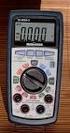 Auto-ranging Digital Multimeter 52-0052-2 INSTRUCTION MANUAL WARNING: READ AND UNDERSTAND THIS MANUAL BEFORE USING YOUR MULTIMETER. FAILURE TO UNDERSTAND AND COMPLY WITH WARNINGS AND OPERATING INSTRUCTIONS
Lab 3 - DC Circuits and Ohm s Law
 Lab 3 DC Circuits and Ohm s Law L3-1 Name Date Partners Lab 3 - DC Circuits and Ohm s Law OBJECTIES To learn to apply the concept of potential difference (voltage) to explain the action of a battery in
K Standard Grade Ni-Cr vs Ni-Al (Chromel vs Alumel)
 SureGrip TM 80PK-24 Air Temperature Probe Instruction Sheet XWWarning To avoid electrical shock, do not use this probe when voltages exceeding 24 V ac rms or 60 V dc are present. The probe tip is electronically
Using Thermocouple Sensors Connecting Grounded and Floating Thermocouples
 Connecting Grounded and Floating Thermocouples For best performance, Thermocouple sensors should be floating. This will ensure that no noise currents can flow in the sensor leads and that no common-mode
i410/i1010 AC/DC Current Clamp
 /i1010 AC/DC Current Clamp Instruction Sheet Safety Information XW Read First: Safety Information To ensure safe operation and service of the current clamp, follow these instructions: Read all operating
Fluke Digital Multimeters Solutions for every need
 Fluke Digital Multimeters Solutions for every need How to choose the best DMM for your job Choosing the right digital multimeter (DMM) requires thinking about what you ll be using it for. Evaluate your
22.302 Experiment 5. Strain Gage Measurements
 22.302 Experiment 5 Strain Gage Measurements Introduction The design of components for many engineering systems is based on the application of theoretical models. The accuracy of these models can be verified
Table of Contents. The Basics of Electricity 2. Using a Digital Multimeter 4. Testing Voltage 8. Testing Current 10. Testing Resistance 12
 Table of Contents The Basics of Electricity 2 Using a Digital Multimeter 4 IDEAL Digital Multimeters An Introduction The Basics of Digital Multimeters is designed to give you a fundamental knowledge of
VOLTAGE/CURRENT CALIBRATOR ISO-TECH ILC-421
 VOLTAGE/CURRENT CALIBRATOR ISO-TECH ILC-421 TABLE OF CONTENTS 1. FEATURES... 1 2. SPECIFICATIONS... 1 2-1 General Specifications...1 2-2 Electrical Specifications... 2 3. FRONT PANEL DESCRIPTION... 4 3-1
Current Probes. User Manual
 Current Probes User Manual ETS-Lindgren L.P. reserves the right to make changes to any product described herein in order to improve function, design, or for any other reason. Nothing contained herein shall
Transmitter Interface Program
 Transmitter Interface Program Operational Manual Version 3.0.4 1 Overview The transmitter interface software allows you to adjust configuration settings of your Max solid state transmitters. The following
APPLICATION NOTES OF SIGNAL ISOLATORS
 APPLICATION NOTES OF SIGNAL ISOLATORS Summary of Topics Page 一 General Characteristics of Signal Isolator 二 The reasons and solutions about interfere 三 Comparison of supplied by loop circuit, extra power,
Operational Amplifier - IC 741
 Operational Amplifier - IC 741 Tabish December 2005 Aim: To study the working of an 741 operational amplifier by conducting the following experiments: (a) Input bias current measurement (b) Input offset
M 140i. Multifunction Calibrator. Operation Manual
 M 140i Multifunction Calibrator Operation Manual M-140i Multifunction Calibrator MEATEST, s.r.o. 2 Operation Manual v33 MEATEST, s.r.o. M-140i Multifunction Calibrator Content Operation Manual... 1 Basic
Automation System TROVIS 6400 TROVIS 6493 Compact Controller
 Automation System TROVIS 6400 TROVIS 6493 Compact Controller For panel mounting (front frame 48 x 96 mm/1.89 x 3.78 inch) Application Digital controller to automate industrial and process plants for general
GENERAL SCIENCE LABORATORY 1110L Lab Experiment 6: Ohm s Law
 GENERAL SCIENCE LABORATORY 1110L Lab Experiment 6: Ohm s Law OBJECTIVES: To verify Ohm s law, the mathematical relationship among current, voltage or potential difference, and resistance, in a simple circuit.
323/324/325. Calibration Manual. Clamp Meter
 323/324/325 Clamp Meter Calibration Manual February 2013 2012 Fluke Corporation. All rights reserved. Specifications are subject to change without notice. All product names are trademarks of their respective
Electrical Fundamentals Module 3: Parallel Circuits
 Electrical Fundamentals Module 3: Parallel Circuits PREPARED BY IAT Curriculum Unit August 2008 Institute of Applied Technology, 2008 ATE310- Electrical Fundamentals 2 Module 3 Parallel Circuits Module
Fundamentals of Signature Analysis
 Fundamentals of Signature Analysis An In-depth Overview of Power-off Testing Using Analog Signature Analysis www.huntron.com 1 www.huntron.com 2 Table of Contents SECTION 1. INTRODUCTION... 7 PURPOSE...
# 2. Selecting and Using Thermistors for Temperature Control
 # 2 Selecting and Using Thermistors for Temperature Control Selecting and Using Thermistors for Temperature Control Thermally sensitive resistors (thermistors) are used widely in laser diode and detector
Service Information CALIBRATION PROCEDURE AND TROUBLESHOOTING FOR LINEAR GOVERNOR CONTROLLERS NOTE
 Service Information Calibration & Adjustments CALIBRATION PROCEDURE AND TROUBLESHOOTING FOR LINEAR GOVERNOR CONTROLLERS Part Number DYN1-10752-000-0-12/24 DYN1-10752-001-0-12/24* DYN1-10753-000-0-12/24
The Basics of Digital Multimeters
 IDEAL INDUSTRIES INC. The Basics of Digital Multimeters A guide to help you understand the basic Features and Functions of a Digital Multimeter. Author: Patrick C Elliott Field Sales Engineer IDEAL Industries,
Ground Resistance Clamp On Tester
 USER MANUAL Ground Resistance Clamp On Tester MODEL 382357 Introduction Congratulations on your purchase of Extech s 382357 Ground Resistance Tester. This Clamp on device allows the user to measure ground
No.1. Digital Multimeter RIGOL TECHNOLOGIES, INC.
 No.1 DM368 6½ digits Digital Multimeter Real 6 ½ digits readings resolution Up to 1 K rdgs/s of measurement speed and 512 K rdgs Nonvolatile Memory TrueRMS AC Voltage Current measuring Builtin 1 groups
DC Electronic Loads 8500 series
 Data Sheet DC Electronic Loads 8500 series 2400W 600 W - 1200 W 300 W Versatile & Economical DC Electronic Loads The 8500 series Programmable DC Electronic Loads can be used for testing and evaluating
Section 3. Sensor to ADC Design Example
 Section 3 Sensor to ADC Design Example 3-1 This section describes the design of a sensor to ADC system. The sensor measures temperature, and the measurement is interfaced into an ADC selected by the systems
Measuring Electric Phenomena: the Ammeter and Voltmeter
 Measuring Electric Phenomena: the Ammeter and Voltmeter 1 Objectives 1. To understand the use and operation of the Ammeter and Voltmeter in a simple direct current circuit, and 2. To verify Ohm s Law for
Use your troubleshooting superpowers for good Application Note
 Use your troubleshooting superpowers for good Application Note Unleash your full troubleshooting powers with innovative new tools from Fluke. You ve got skill. You ve got experience. Now you have some
FREQUENCY RESPONSE ANALYZERS
 FREQUENCY RESPONSE ANALYZERS Dynamic Response Analyzers Servo analyzers When you need to stabilize feedback loops to measure hardware characteristics to measure system response BAFCO, INC. 717 Mearns Road
PHYSICS 111 LABORATORY Experiment #3 Current, Voltage and Resistance in Series and Parallel Circuits
 PHYSCS 111 LABORATORY Experiment #3 Current, Voltage and Resistance in Series and Parallel Circuits This experiment is designed to investigate the relationship between current and potential in simple series
Model UT201/202: OPERATING MANUAL. Table of Contents
 Table of Contents Title Overview Unpacking Inspection Safety Information Rules For Safe Operation International Electrical Symbols The Meter Structure Rotary Switch Functional Buttons The Effectiveness
IDEAL INDUSTRIES, INC. TECHNICAL MANUAL MODELS: 61-763 61-765
 IDEAL INDUSTRIES, INC. TECHNICAL MANUAL MODELS: 61-763 61-765 The Service Information provides the following information: Precautions and safety information Specifications Performance test procedure Calibration
Calibrating DC Shunts: Techniques and Uncertainties
 Calibrating DC Shunts: Techniques and Uncertainties Jay Klevens Ohm-Labs, Inc. 611 E. Carson St., Pittsburgh, PA 15203 (412) 431-0640 [email protected] Abstract Accurate electrical current measurement
THERMAL ANEMOMETRY ELECTRONICS, SOFTWARE AND ACCESSORIES
 TSI and TSI logo are registered trademarks of TSI Incorporated. SmartTune is a trademark of TSI Incorporated. THERMAL ANEMOMETRY ELECTRONICS, SOFTWARE AND ACCESSORIES IFA 300 Constant Temperature Anemometry
Contents. Document information
 User Manual Contents Document information... 2 Introduction... 3 Warnings... 3 Manufacturer... 3 Description... Installation... Configuration... Troubleshooting...11 Technical data...12 Device Scope: PCB
72-7730 72-7732 Intelligent Digital Multimeters
 72-7730 72-7732 Intelligent Digital Multimeters Model 72-7730/72-7732 OPERATING MANUAL TABLE OF CONTENTS CHAPTER TITLE PAGE 1. Before You Start Overview Inspection Safety Information Rules For Safe Operation
5320A Multifunction Electrical Tester Calibrator. Verify and calibrate electrical test tools with a single instrument
 5320A Multifunction Electrical Tester Calibrator Verify and calibrate electrical test tools with a single instrument 2 5320A Multifunction Electrical Tester Calibrator: Wide workload coverage with a single
Measuring Insulation Resistance of Capacitors
 Application Note Measuring Insulation Resistance of Capacitors A common use of high resistance measuring instruments (often called megohmmeters or insulation resistance testers) is measuring the insulation
JNIOR. Overview. Get Connected. Get Results. JNIOR Model 310. JNIOR Model 312. JNIOR Model 314. JNIOR Model 410
 The INTEG is an Ethernet I/O (digital, analog) device that monitors and controls a small set of process signals. functions as both basic I/O for integration with another application or system AND as a
APPLICATION NOTE. Measuring Current Output Transducers with Campbell Scientific Dataloggers. App. Note Code: 2MI-B Revision: 1
 App. Note Code: 2MI-B Revision: 1 APPLICATION NOTE Measuring Current Output s with Campbell Scientific Dataloggers 815 W. 1800 N. Logan, Utah 84321-1784 (435) 753-2342 FAX (435) 750-9540 Copyright (C)
Process Calibration Tools
 Process Calibration Tools A full range of accurate, rugged and reliable calibration solutions for field and bench applications Electrical, Multifunction, and ma Loop Calibration Pressure and Flow Calibration
Fig. 1 Analogue Multimeter Fig.2 Digital Multimeter
 ELECTRICAL INSTRUMENT AND MEASUREMENT Electrical measuring instruments are devices used to measure electrical quantities such as electric current, voltage, resistance, electrical power and energy. MULTIMETERS
Users Manual. Temperature Calibrator
 724 Temperature Calibrator Users Manual February 2000 Rev.1, 8/03 2000-2003 Fluke Corporation. All rights reserved. All product names are trademarks of their respective companies. LIMITED WARRANTY & LIMITATION
Fluke 1650B Series Multifunction Installation Testers
 Fluke 1650B Series Multifunction Installation Testers Extended Specifications The installation testing solution for demanding environments The Fluke 1650B Series testers, with new advanced features, are
NTE923 & NTE923D Integrated Circuit Precision Voltage Regulator
 NTE923 & NTE923D Integrated Circuit Precision Voltage Regulator Description: The NTE923 and NTE923D are voltage regulators designed primarily for series regulator applications. By themselves, these devices
Physical Specifications (Custom design available.)
 Helmholtz Coils A useful laboratory technique for getting a fairly uniform magnetic field, is to use a pair of circular coils on a common axis with equal currents flowing in the same sense. For a given
Sierra S-Series Smart Interface Software User Manual
 Sierra S-Series Smart Interface Software User Manual Part Number IM-SIP 08/99 Revision B 5 Harris Court, Building L Monterey, CA 93940 (831) 373-0200 (800) 866-0200 Fax (831) 373-4402 http://www.sierrainstruments.com
Automotive Sensor Simulator. Automotive sensor simulator. Operating manual. AutoSim
 Automotive sensor simulator Operating manual AutoSim Contents Introduction.. page 3 Technical specifications.... page 4 Typical application of AutoSim simulator..... page 4 Device appearance... page 5
Selection Guide to Clamp-On Current Probes
 Selection Guide to Clamp-On Current Probes Selecting The Correct Clamp-On Current Probe Answering the following questions will help you to select the appropriate probe for your applications. 1. Determine
Measuring Temperature withthermistors a Tutorial David Potter
 NATIONAL INSTRUMENTS The Software is the Instrument Application Note 065 Measuring Temperature withthermistors a Tutorial David Potter Introduction Thermistors are thermally sensitive resistors used in
Basic RTD Measurements. Basics of Resistance Temperature Detectors
 Basic RTD Measurements Basics of Resistance Temperature Detectors Platinum RTD resistances range from about 10 O for a birdcage configuration to 10k O for a film type, but the most common is 100 O at 0
Multi-Range Programmable DC Power Supplies 9115 Series
 Data Sheet Multi-Range Programmable DC Power Supplies 1200 W / 3000 W Multi-Range DC Power Supplies Features & Benefits Any model can replace several supplies on your bench or in your rack. Unlike conventional
Instruction Manual. 2in1 LAN Tester & Multimeter. Model: LA-1011
 Instruction Manual 2in1 LAN Tester & Multimeter Model: LA-1011 1 Contents Introduction... Features... Safety Precautions.. Meter Description... Electrical Specification... Operation.. AutoRanging Multimeter.
QUICK START GUIDE FOR DEMONSTRATION CIRCUIT 956 24-BIT DIFFERENTIAL ADC WITH I2C LTC2485 DESCRIPTION
 LTC2485 DESCRIPTION Demonstration circuit 956 features the LTC2485, a 24-Bit high performance Σ analog-to-digital converter (ADC). The LTC2485 features 2ppm linearity, 0.5µV offset, and 600nV RMS noise.
CONTENTS. PAGE Chapter 1 General Information 1. Chapter 2 Setup 4 DP450-VDC 7 DP450-VAC 7 DP450-DCC 7 DP450-F 8 DP450-HACC 9 DP450-HDCC 11 DP450-E 13
 CONTENTS PAGE Chapter 1 General Information 1 Chapter 2 Setup 4 DP450-VDC 7 DP450-VAC 7 DP450-DCC 7 DP450-F 8 DP450-HACC 9 DP450-HDCC 11 DP450-E 13 Chapter 3 Alarm/Excitation Options 15 Wiring 17 Chapter
Physics 3330 Experiment #2 Fall 1999. DC techniques, dividers, and bridges R 2 =(1-S)R P R 1 =SR P. R P =10kΩ 10-turn pot.
 Physics 3330 Experiment #2 Fall 1999 DC techniques, dividers, and bridges Purpose You will gain a familiarity with the circuit board and work with a variety of DC techniques, including voltage dividers,
INSTRUCTION MANUAL. SIGNAL AMPLIFIER 4-20 ma
 INSTRUCTION MANUAL SIGNAL AMPLIFIER 4-20 ma 0305 260 IMPORTANT USER INFORMATION IMPORTANT USER INFORMATION Reading this entire manual is recommended for full understanding of the use of this product Should
PRODUCT PROFILE FEATURES
 PRODUCT PROFILE Pressure Transmitters & Pneumatic Transducer Airflow Transmitter, Differential Air Pressure Transmitter and Differential & Gauge Liquid/Gas Pressure Transmitter FEATURES AIRFLOW TRANSMITTER
Agilent 4338B Milliohm Meter
 Agilent 4338B Milliohm Meter 10 µω to 100 kω Technical Overview Introduction Ideal for precise measurements of extremely low resistances using an ac test signal, the Agilent Technologies 4338B suits bench-top
1587/1577. Insulation Multimeters. Users Manual
 1587/1577 Insulation Multimeters Users Manual PN 2401027 April 2005 2005 Fluke Corporation. All rights reserved. Printed in USA All product names are trademarks of their respective companies. LIMITED WARRANTY
OPERATION MANUAL. Pen type, separate electrode SOIL PH METER Model : PH-220S
 Pen type, separate electrode SOIL PH METER Model : PH-220S Your purchase of this SOIL PH METER marks a step forward for you into the field of precision measurement. Although this METER is a complex and
ABB Drives. User s Manual. Pulse Encoder Interface Module RTAC-01
 ABB Drives User s Manual Pulse Encoder Interface Module RTAC-0 Pulse Encoder Interface Module RTAC-0 User s Manual 3AFE 64486853 REV A EN EFFECTIVE:.5.00 00 ABB Oy. All Rights Reserved. Safety instructions
By Authority Of THE UNITED STATES OF AMERICA Legally Binding Document
 By Authority Of THE UNITED STATES OF AMERICA Legally Binding Document By the Authority Vested By Part 5 of the United States Code 552(a) and Part 1 of the Code of Regulations 51 the attached document has
7 FUNCTION DIGITAL MULTIMETER
 7 FUNCTION DIGITAL MULTIMETER 90899 OPERATING INSTRUCTIONS 3491 Mission Oaks Blvd., Camarillo, CA 93011 Visit our Web site at http://www.harborfreight.com Copyright 2004 by Harbor Freight Tools. All rights
Agilent 4339B/4349B High Resistance Meters
 Agilent 4339B/4349B High Resistance Meters Technical Overview Within Budget Without Compromise Introducing the Agilent Technologies 4339B and 4349B High Resistance Meters Used for Making Ultra- High Resistance
Event recording (or logging) with a Fluke 287/289 Digital Multimeter
 Event recording (or logging) with a Fluke 287/289 Digital Multimeter Application Note One of the major features of the Fluke 280 Series digital multimeters (DMM) with TrendCapture is their ability to record
CALIBRATION PROCEDURE NI 9219. Contents. Software Requirements. ni.com/manuals
 CALIBRATION PROCEDURE NI 9219 Français Deutsch ni.com/manuals Contents This document contains information for calibrating the National Instruments 9219. For more information on calibration, visit ni.com/calibration.
Voltech DC1000. Precision DC Bias Current Source
 DC1000 Precision DC Bias Current Source DC1000 Precision DC Bias Current Source TM Integral Rack Mount Lugs High Contrast Green LED Display Easy Control Rotary Knob Output LED Indicator DC 1000 OUTPUT
MODEL 2202IQ (1991-MSRP $549.00)
 F O R T H E L O V E O F M U S I C F O R T H E L O V E O F M U S I C MODEL 2202IQ (1991-MSRP $549.00) OWNER'S MANUAL AND INSTALLATION GUIDE INTRODUCTION Congratulations on your decision to purchase a LINEAR
A Collection of Differential to Single-Ended Signal Conditioning Circuits for Use with the LTC2400, a 24-Bit No Latency Σ ADC in an SO-8
 Application Note August 999 A Collection of Differential to Single-Ended Signal Conditioning Circuits for Use with the LTC00, a -Bit No Latency Σ ADC in an SO- By Kevin R. Hoskins and Derek V. Redmayne
User's Guide. Integrating Sound Level Datalogger. Model 407780. Introduction
 User's Guide 99 Washington Street Melrose, MA 02176 Phone 781-665-1400 Toll Free 1-800-517-8431 Visit us at www.testequipmentdepot.com Back to the Extech 407780 Product Page Integrating Sound Level Datalogger
Modular I/O System Analog and Digital Interface Modules
 OPERATING INSTRUCTIONS Modular I/O System Analog and Digital Interface Modules Installation Operation Maintenance Document Information Document ID Title: Operating Instructions Modular I/O System Part
Migrating from dc voltage dividers to modern reference multimeters
 Migrating from dc voltage dividers to modern reference multimeters Application Note Introduction Until the late 1980 s electrical calibration systems used to compare primary and secondary voltages and
Meter Relays. 077 Series Analogue Meter Relays. Features. Applications
 077 Series Analogue Features Monitors and controls any variable which can be converted to an A.C. or D.C. signal. Rugged, shock and vibration resistant design Indicator, relays and power unit in one housing