
GENERAL SCIENCE LABORATORY 1110L Lab Experiment 6: Ohm s Law
|
|
|
- Grace Mosley
- 9 years ago
- Views:
Transcription
1 GENERAL SCIENCE LABORATORY 1110L Lab Experiment 6: Ohm s Law OBJECTIVES: To verify Ohm s law, the mathematical relationship among current, voltage or potential difference, and resistance, in a simple circuit. APPARATUS: Windows 7 PC, Vernier LabPro Interface, Vernier Current & Voltage Probes, Vernier Logger Pro Software 3.8.*, two resistors (about 36 and 100 Ω), Banana Plug Wires, alligator clips to connect resistors to banana plug wires, Variable DC Power Supply. THEORY The electrical quantities can be difficult to understand because they cannot be observed directly. To clarify these terms, some people make the comparison between electrical circuits and water flowing in pipes. Here is a chart of the three electrical units we will study in this experiment. Electrical Quantity Voltage or Potential Difference Current Resistance Description Units Water Analogy A measure of the Energy difference per unit charge between two points in a circuit. A measure of the flow of charge in a circuit. A measure of how difficult it is for current to flow in a circuit. Volts (V) Amperes (A) Ohms (Ω ) Water Pressure Amount of water flowing A measure of how difficult it is for water to flow in a pipe. The fundamental relationship among voltage, current, and resistance was discovered by Georg Simon Ohm. Georg Simon Ohm (16 March July 1854) was a Bavarian (German) physicist and mathematician. As a high school teacher, Ohm began his research with the new electrochemical cell, (Is a device used

2 for generating an electromotive force (voltage) and current from chemical reactions (A Battery), invented by Italian scientist Alessandro Volta. Using equipment of his own creation, Ohm found that there is a direct proportionality between the potential differences (voltage) applied across a conductor and the resultant electric current. This relationship is known as Ohm's law. The relationship and the unit of electrical resistance were both named for him to commemorate this contribution to physics. One statement of Ohm s law is that the current through a resistor is directly proportional to the voltage across the resistor V/I = R (1) V is the voltage in volts, I is the current in amperes, and R is the resistance in ohms. A graph of V vs. I should yield a straight line with the slope of the line being the resistance. PROCEDURE 1. Turn on the Computer. 2. Make sure the computer has booted up completely. 3. Double click on Logger Pro (3.8.*). 4. Choose Open from the File menu. 5. Double click on Physics with Vernier. 6. Select and click open Exp 22 Ohm s Law. A graph of potential vs. current will be displayed. The vertical axis is scaled from 0 to 6 V. The horizontal axis is scaled from 0.0 to 0.6 Amperes. 7. Make sure the LabPro Interface is plugged into the USB port of the computer, its power supply is plugged in, and the interface is turned on. 8. Plug the Current probe into Channel 1 and the voltage probe is plugged into Channel Plug in the DC power supply. Make sure the power supply is turned off.

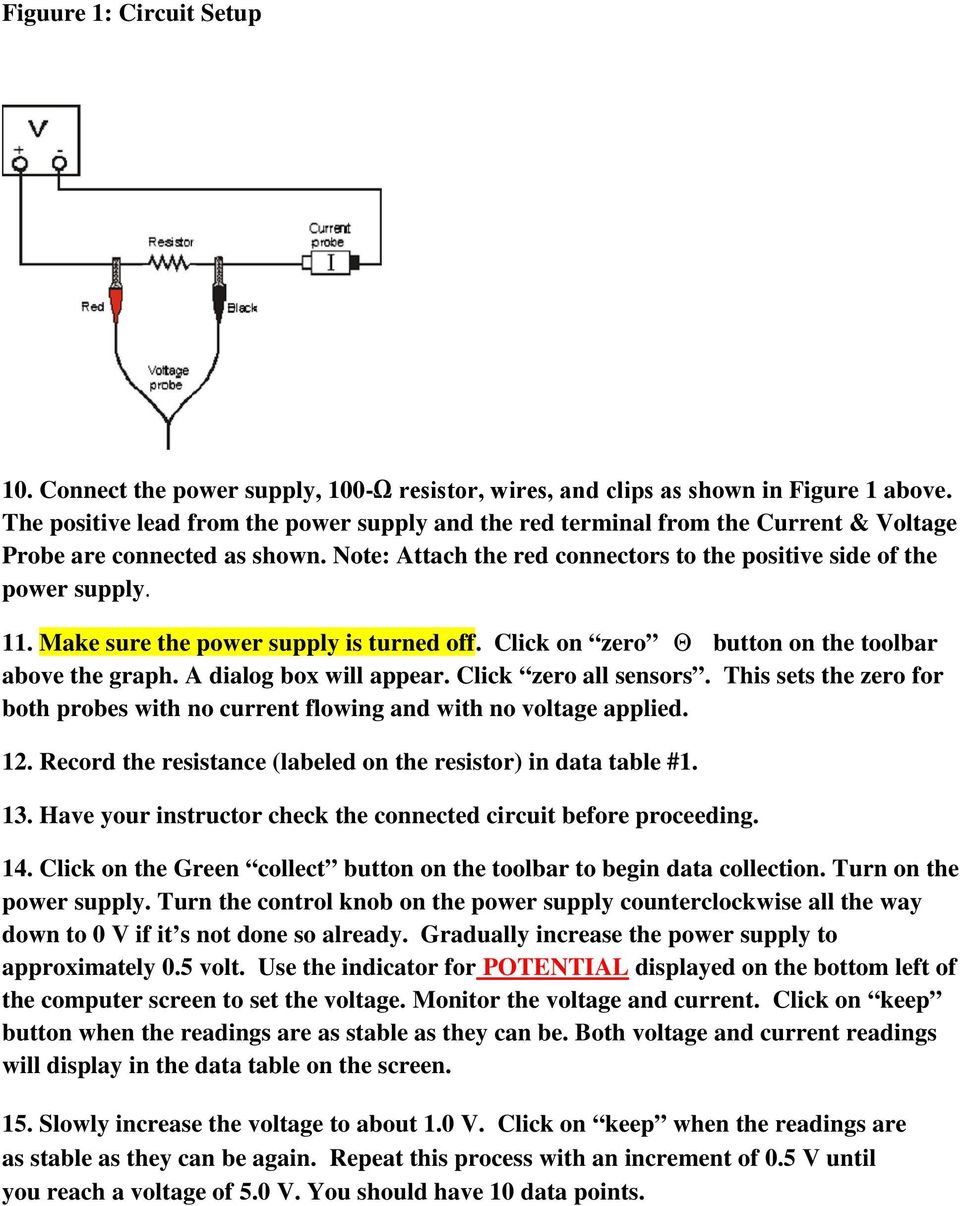
3 Figuure 1: Circuit Setup 10. Connect the power supply, 100-Ω resistor, wires, and clips as shown in Figure 1 above. The positive lead from the power supply and the red terminal from the Current & Voltage Probe are connected as shown. Note: Attach the red connectors to the positive side of the power supply. 11. Make sure the power supply is turned off. Click on zero Θ button on the toolbar above the graph. A dialog box will appear. Click zero all sensors. This sets the zero for both probes with no current flowing and with no voltage applied. 12. Record the resistance (labeled on the resistor) in data table # Have your instructor check the connected circuit before proceeding. 14. Click on the Green collect button on the toolbar to begin data collection. Turn on the power supply. Turn the control knob on the power supply counterclockwise all the way down to 0 V if it s not done so already. Gradually increase the power supply to approximately 0.5 volt. Use the indicator for POTENTIAL displayed on the bottom left of the computer screen to set the voltage. Monitor the voltage and current. Click on keep button when the readings are as stable as they can be. Both voltage and current readings will display in the data table on the screen. 15. Slowly increase the voltage to about 1.0 V. Click on keep when the readings are as stable as they can be again. Repeat this process with an increment of 0.5 V until you reach a voltage of 5.0 V. You should have 10 data points.
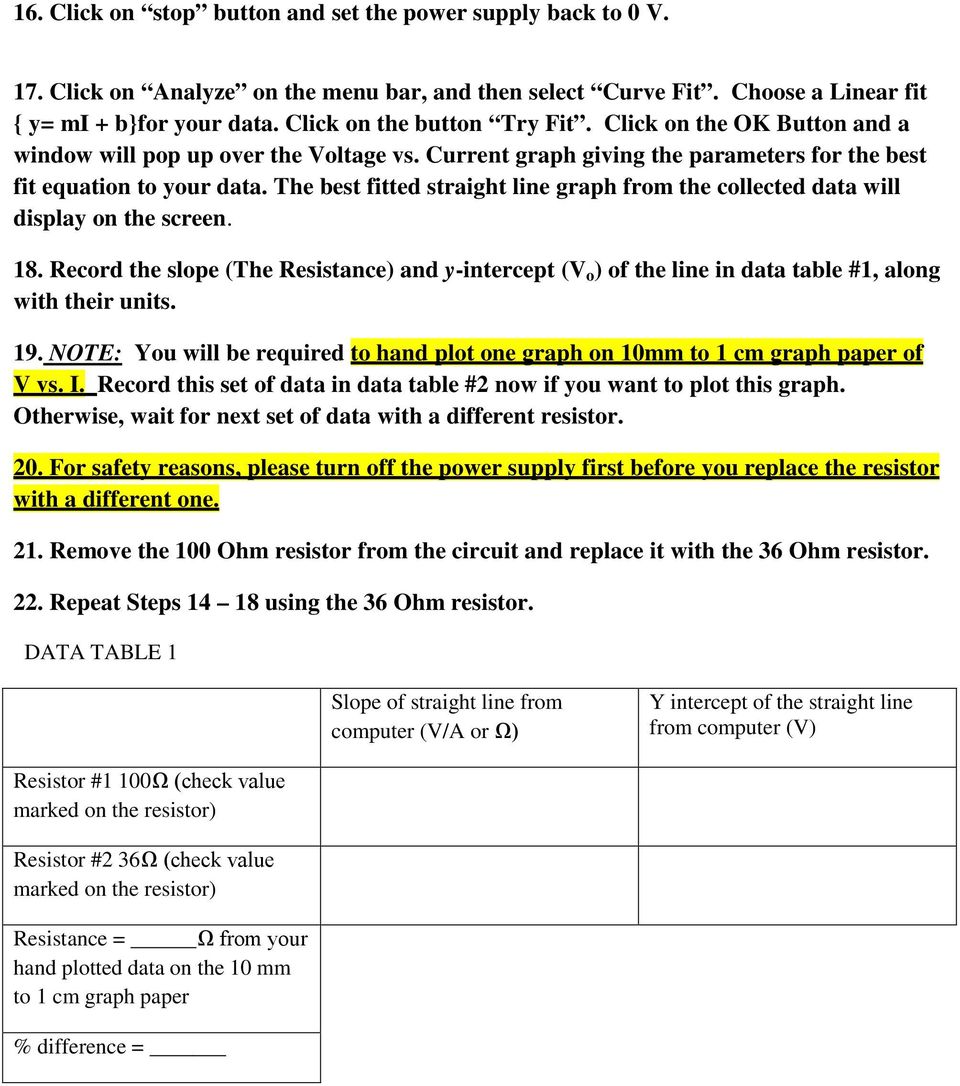
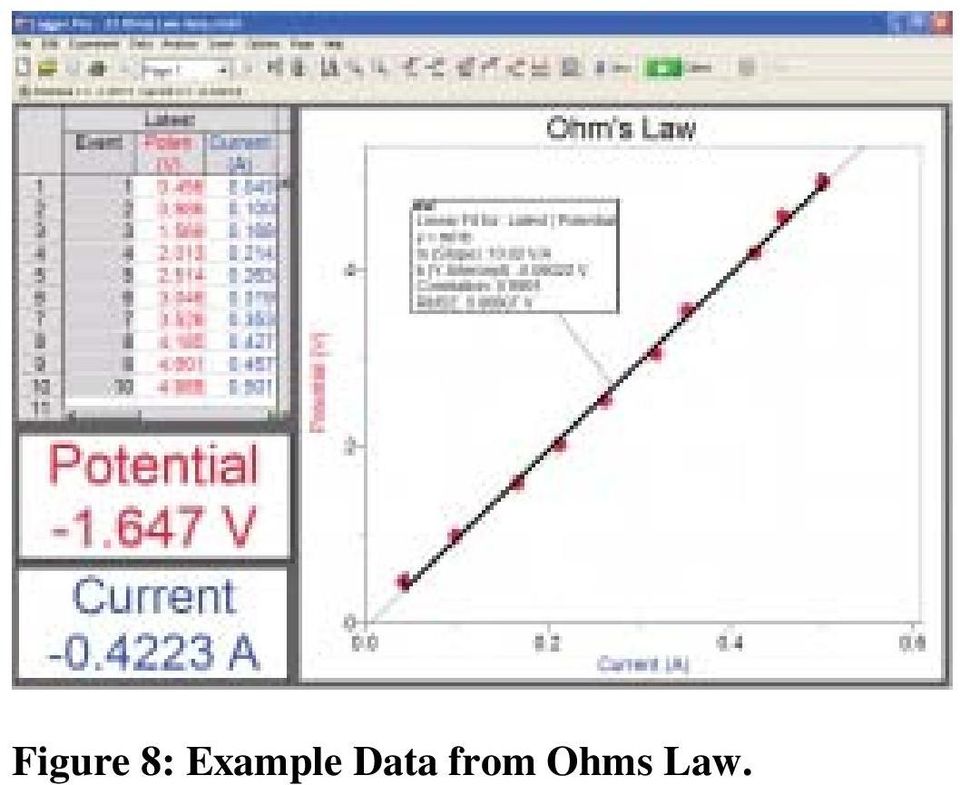
4 16. Click on stop button and set the power supply back to 0 V. 17. Click on Analyze on the menu bar, and then select Curve Fit. Choose a Linear fit { y= mi + b}for your data. Click on the button Try Fit. Click on the OK Button and a window will pop up over the Voltage vs. Current graph giving the parameters for the best fit equation to your data. The best fitted straight line graph from the collected data will display on the screen. 18. Record the slope (The Resistance) and y-intercept (V o ) of the line in data table #1, along with their units. 19. NOTE: You will be required to hand plot one graph on 10mm to 1 cm graph paper of V vs. I. Record this set of data in data table #2 now if you want to plot this graph. Otherwise, wait for next set of data with a different resistor. 20. For safety reasons, please turn off the power supply first before you replace the resistor with a different one. 21. Remove the 100 Ohm resistor from the circuit and replace it with the 36 Ohm resistor. 22. Repeat Steps using the 36 Ohm resistor. DATA TABLE 1 Slope of straight line from computer (V/A or Ω) Y intercept of the straight line from computer (V) Resistor #1 100Ω (check value marked on the resistor) Resistor #2 36Ω (check value marked on the resistor) Resistance = Ω from your hand plotted data on the 10 mm to 1 cm graph paper % difference =
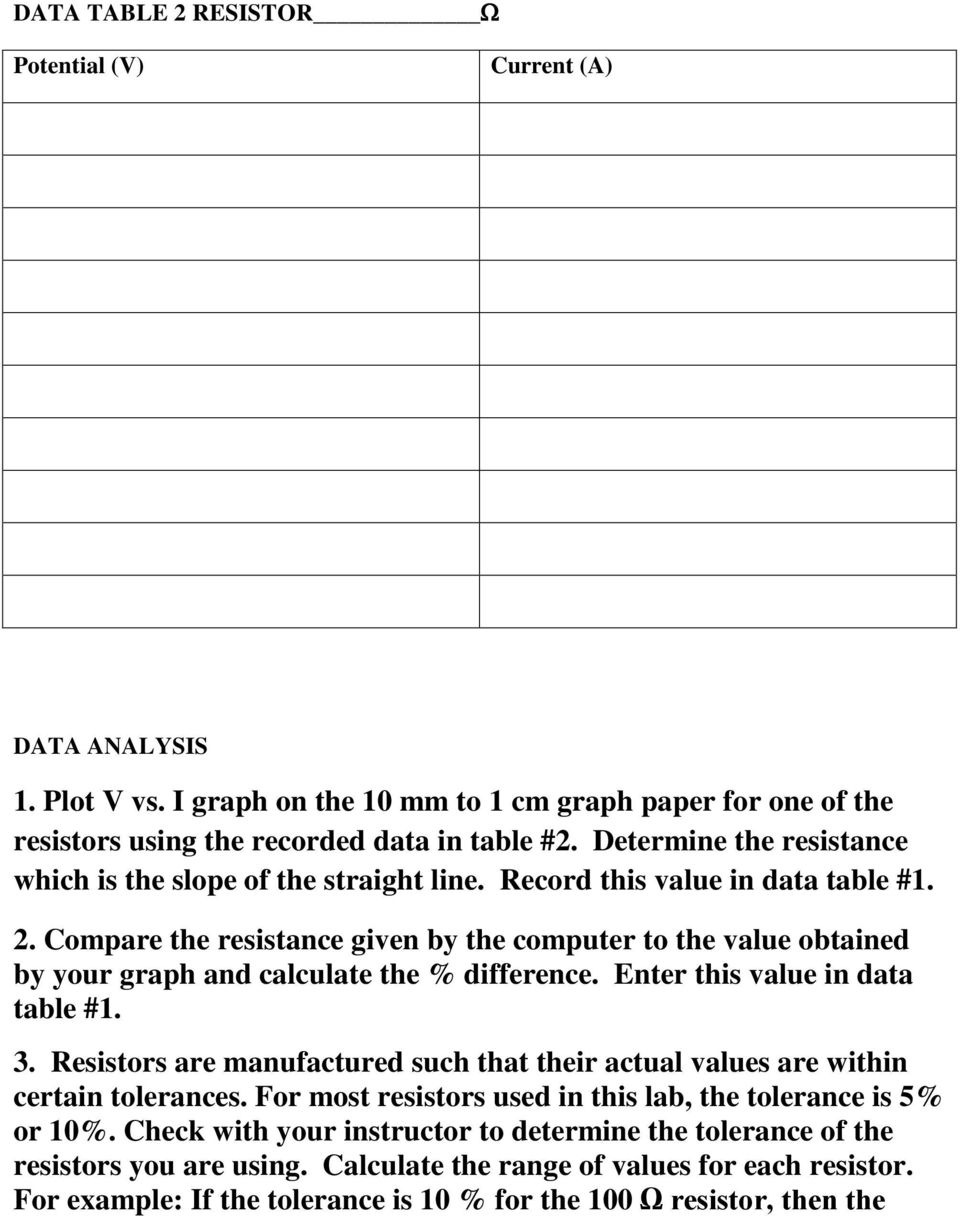
5 DATA TABLE 2 RESISTOR Ω Potential (V) Current (A) DATA ANALYSIS 1. Plot V vs. I graph on the 10 mm to 1 cm graph paper for one of the resistors using the recorded data in table #2. Determine the resistance which is the slope of the straight line. Record this value in data table #1. 2. Compare the resistance given by the computer to the value obtained by your graph and calculate the % difference. Enter this value in data table #1. 3. Resistors are manufactured such that their actual values are within certain tolerances. For most resistors used in this lab, the tolerance is 5% or 10%. Check with your instructor to determine the tolerance of the resistors you are using. Calculate the range of values for each resistor. For example: If the tolerance is 10 % for the 100 Ω resistor, then the
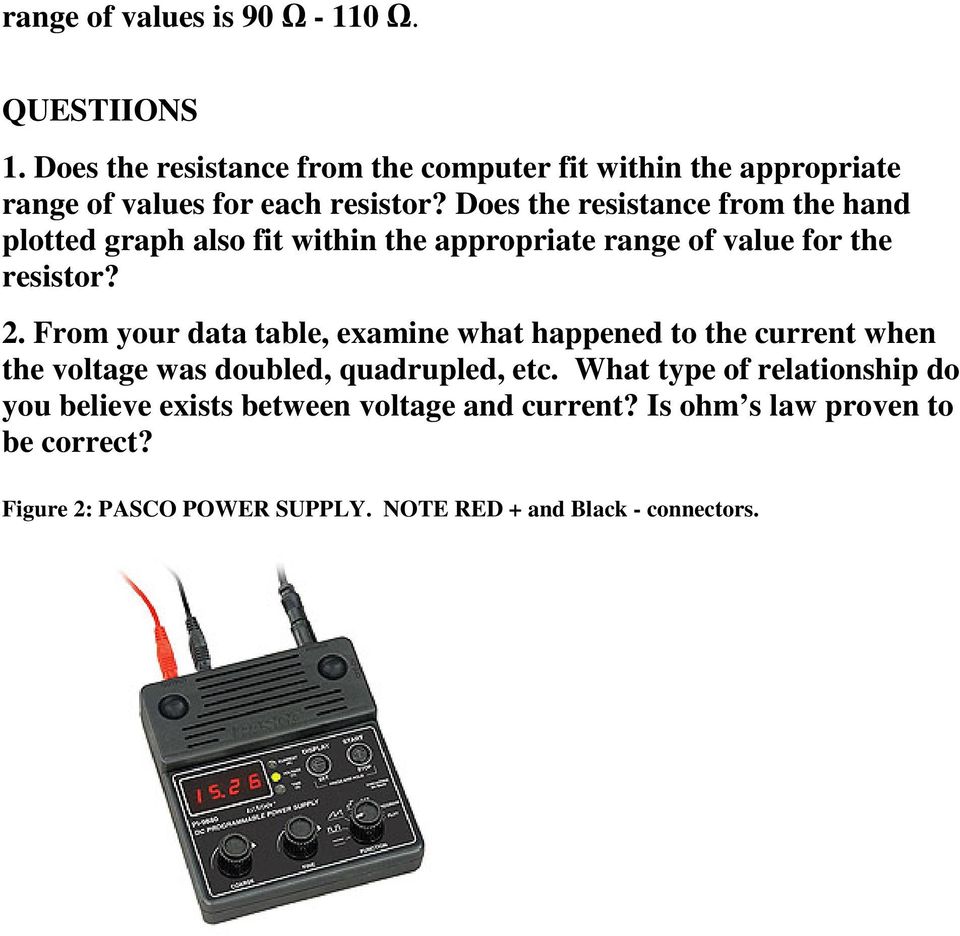
6 range of values is 90 Ω Ω. QUESTIIONS 1. Does the resistance from the computer fit within the appropriate range of values for each resistor? Does the resistance from the hand plotted graph also fit within the appropriate range of value for the resistor? 2. From your data table, examine what happened to the current when the voltage was doubled, quadrupled, etc. What type of relationship do you believe exists between voltage and current? Is ohm s law proven to be correct? Figure 2: PASCO POWER SUPPLY. NOTE RED + and Black - connectors.
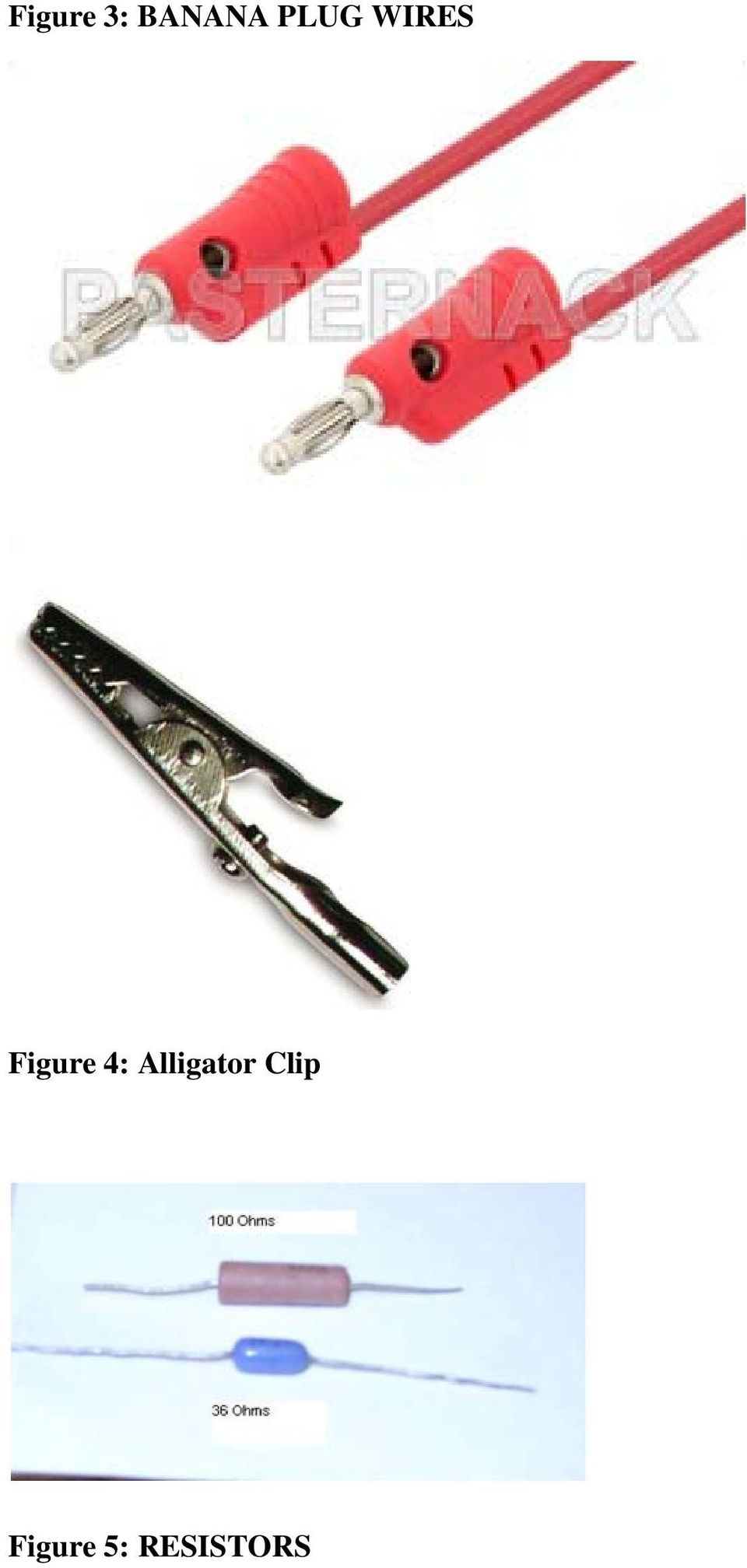
7 Figure 3: BANANA PLUG WIRES Figure 4: Alligator Clip Figure 5: RESISTORS
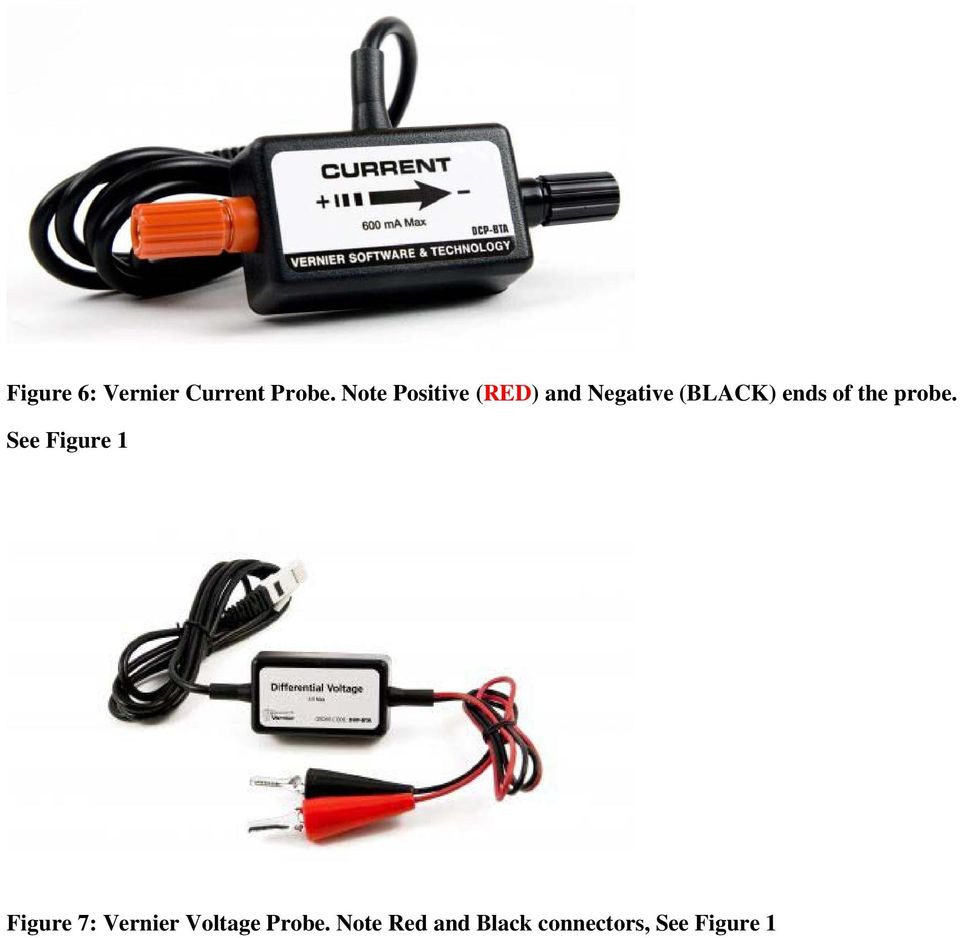
8 Figure 6: Vernier Current Probe. Note Positive (RED) and Negative (BLACK) ends of the probe. See Figure 1 Figure 7: Vernier Voltage Probe. Note Red and Black connectors, See Figure 1
9 Figure 8: Example Data from Ohms Law.
10 Lab Report Format: Your lab report for this experiment should contain the following sections: 1. Title of experiment in center of the first page. Date to the left of the title. Experimenters name with partners name(s) under experimenters name to the right of the title. 2. Objective 3. Apparatus 4. Original Data: Neatly filled out data page. 5. Sample calculations and graph: For this lab an example (ONE) needs to be shown for each of the following calculations: Slope hand plotted data, % difference between value of the resistance of the unknown resistor found using the graph paper and the resistance determined by the computer for the same resistor. Show the tolerance calculations for your two resistors to determine the range of possible values for each. Graph for Voltage vs. Current for one of your resistors. 6. Results: State your results (in the form of a very short sentence). Make sure the numerical results are properly rounded and have the correct number of significant digits. Report the experimental resistance for both resistors using the computer. Report the resistance from the hand plotted data. What is the per cent difference between the resistance from the hand plotted data and that obtained by the computer. Range of possible values of your resistors given their tolerances. 7. Conclusions: Address the answers to the three discussion questions on page 6 of the handout.. PROPER MATERIALS, ETC. FOR YOUR REPORTS 1. ALL DATA IS TO BE RECORDED DIRECTLY IN YOUR LAB NOTEBOOK. NO SCRATCH PAPER IS TO BE USED. 2. YOU ARE TO USE BLUE OR BLACK INK ONLY FOR RECORDING DATA AND DOING YOUR REPORTS IN YOUR NOTEBOOK. 3. REMEBER, ONLY THE FRONT OF THE PAGES IN YOUR LAB NOTEBOOK ARE TO BE USED FOR DOING YOUR LAB REPORT. I WILL NOT LOOK AT ANY INFORMATIION ON THE BACKSIDE OF THE NOTEBOOK PAGES. 4. DO NOT TEAR OUT ANY PAGES FROM YOUR NOTBOOK.
11 5. DO NOT ERASE OR USE WHITEOUT FOR MISTAKES!!!! All observations taken under the same experimental condition are equally valid and should be retained for analysis. Do not erase readings. If you must change a reading, draw a single line through it and then record the new measurement next to the old one.
Experiment: Series and Parallel Circuits
 Phy203: General Physics Lab page 1 of 6 Experiment: Series and Parallel Circuits OBJECTVES MATERALS To study current flow and voltages in series and parallel circuits. To use Ohm s law to calculate equivalent
Maximum value. resistance. 1. Connect the Current Probe to Channel 1 and the Differential Voltage Probe to Channel 2 of the interface.
 Series and Parallel Circuits Computer 23 Components in an electrical circuit are in series when they are connected one after the other, so that the same current flows through both of them. Components are
GENERAL SCIENCE LABORATORY 1110L Lab Experiment 5 THE SPRING CONSTANT
 GENERAL SCIENCE LABORATORY 1110L Lab Experiment 5 THE SPRING CONSTANT Objective: To determine the spring constant of a spiral spring Apparatus: Pendulum clamp, aluminum pole, large clamp, assorted masses,
Appendix C. Vernier Tutorial
 C-1. Vernier Tutorial Introduction: In this lab course, you will collect, analyze and interpret data. The purpose of this tutorial is to teach you how to use the Vernier System to collect and transfer
Lab 3 - DC Circuits and Ohm s Law
 Lab 3 DC Circuits and Ohm s Law L3-1 Name Date Partners Lab 3 - DC Circuits and Ohm s Law OBJECTIES To learn to apply the concept of potential difference (voltage) to explain the action of a battery in
Lab E1: Introduction to Circuits
 E1.1 Lab E1: Introduction to Circuits The purpose of the this lab is to introduce you to some basic instrumentation used in electrical circuits. You will learn to use a DC power supply, a digital multimeter
Measuring Electric Phenomena: the Ammeter and Voltmeter
 Measuring Electric Phenomena: the Ammeter and Voltmeter 1 Objectives 1. To understand the use and operation of the Ammeter and Voltmeter in a simple direct current circuit, and 2. To verify Ohm s Law for
Inductors in AC Circuits
 Inductors in AC Circuits Name Section Resistors, inductors, and capacitors all have the effect of modifying the size of the current in an AC circuit and the time at which the current reaches its maximum
Part 1: Background - Graphing
 Department of Physics and Geology Graphing Astronomy 1401 Equipment Needed Qty Computer with Data Studio Software 1 1.1 Graphing Part 1: Background - Graphing In science it is very important to find and
Series and Parallel Resistive Circuits Physics Lab VIII
 Series and Parallel Resistive Circuits Physics Lab VIII Objective In the set of experiments, the theoretical expressions used to calculate the total resistance in a combination of resistors will be tested
GENERAL SCIENCE LABORATORY 1110L Lab Experiment 3: PROJECTILE MOTION
 GENERAL SCIENCE LABORATORY 1110L Lab Experiment 3: PROJECTILE MOTION Objective: To understand the motion of a projectile in the earth s gravitational field and measure the muzzle velocity of the projectile
ACCELERATION DUE TO GRAVITY
 ACCELERATION DUE TO GRAVITY Objective: To measure the acceleration of a freely falling body due to gravitational attraction. Apparatus: Computer with Logger Pro, green Vernier interface box, picket fence
FREE FALL. Introduction. Reference Young and Freedman, University Physics, 12 th Edition: Chapter 2, section 2.5
 Physics 161 FREE FALL Introduction This experiment is designed to study the motion of an object that is accelerated by the force of gravity. It also serves as an introduction to the data analysis capabilities
Kirchhoff s Laws Physics Lab IX
 Kirchhoff s Laws Physics Lab IX Objective In the set of experiments, the theoretical relationships between the voltages and the currents in circuits containing several batteries and resistors in a network,
RLC Series Resonance
 RLC Series Resonance 11EM Object: The purpose of this laboratory activity is to study resonance in a resistor-inductor-capacitor (RLC) circuit by examining the current through the circuit as a function
RC Circuits and The Oscilloscope Physics Lab X
 Objective RC Circuits and The Oscilloscope Physics Lab X In this series of experiments, the time constant of an RC circuit will be measured experimentally and compared with the theoretical expression for
Lab 2: Resistance, Current, and Voltage
 2 Lab 2: Resistance, Current, and Voltage I. Before you come to la.. A. Read the following chapters from the text (Giancoli): 1. Chapter 25, sections 1, 2, 3, 5 2. Chapter 26, sections 1, 2, 3 B. Read
EXPERIMENT 7 OHM S LAW, RESISTORS IN SERIES AND PARALLEL
 260 7- I. THEOY EXPEIMENT 7 OHM S LAW, ESISTOS IN SEIES AND PAALLEL The purposes of this experiment are to test Ohm's Law, to study resistors in series and parallel, and to learn the correct use of ammeters
LIGHTSTICK KINETICS. INTRODUCTION: General background on rate, activation energy, absolute temperature, and graphing.
 LIGHTSTICK KINETICS From Advancing Science, Gettysburg College INTRODUCTION: General background on rate, activation energy, absolute temperature, and graphing. THE RATE LAW: The rate of a chemical reaction
1 One Dimensional Horizontal Motion Position vs. time Velocity vs. time
 PHY132 Experiment 1 One Dimensional Horizontal Motion Position vs. time Velocity vs. time One of the most effective methods of describing motion is to plot graphs of distance, velocity, and acceleration
Using an Oscilloscope
 Using an Oscilloscope The oscilloscope is used to measure a voltage that changes in time. It has two probes, like a voltmeter. You put these probes on either side of the thing that you want to measure
ε: Voltage output of Signal Generator (also called the Source voltage or Applied
 Experiment #10: LR & RC Circuits Frequency Response EQUIPMENT NEEDED Science Workshop Interface Power Amplifier (2) Voltage Sensor graph paper (optional) (3) Patch Cords Decade resistor, capacitor, and
Pressure -Temperature Relationship in Gases. Evaluation copy. Figure 1. 125 ml Erlenmeyer flask. Vernier computer interface
 Pressure -Temperature Relationship in Gases Computer 7 Gases are made up of molecules that are in constant motion and exert pressure when they collide with the walls of their container. The velocity and
Experiment: Static and Kinetic Friction
 PHY 201: General Physics I Lab page 1 of 6 OBJECTIVES Experiment: Static and Kinetic Friction Use a Force Sensor to measure the force of static friction. Determine the relationship between force of static
Resistance, Ohm s Law, and the Temperature of a Light Bulb Filament
 Resistance, Ohm s Law, and the Temperature of a Light Bulb Filament Name Partner Date Introduction Carbon resistors are the kind typically used in wiring circuits. They are made from a small cylinder of
Pulleys, Work, and Energy
 Pulleys, Work, and Energy In this laboratory, we use pulleys to study work and mechanical energy. Make sure that you have the following pieces of equipment. two triple-pulley assemblies apparatus from
PHYSICS 111 LABORATORY Experiment #3 Current, Voltage and Resistance in Series and Parallel Circuits
 PHYSCS 111 LABORATORY Experiment #3 Current, Voltage and Resistance in Series and Parallel Circuits This experiment is designed to investigate the relationship between current and potential in simple series
Electrical Resonance
 Electrical Resonance (R-L-C series circuit) APPARATUS 1. R-L-C Circuit board 2. Signal generator 3. Oscilloscope Tektronix TDS1002 with two sets of leads (see Introduction to the Oscilloscope ) INTRODUCTION
The electrical field produces a force that acts
 Physics Equipotential Lines and Electric Fields Plotting the Electric Field MATERIALS AND RESOURCES ABOUT THIS LESSON EACH GROUP 5 alligator clip leads 2 batteries, 9 V 2 binder clips, large computer LabQuest
Evaluation copy. Build a Temperature Sensor. Project PROJECT DESIGN REQUIREMENTS
 Build a emperature Sensor Project A sensor is a device that measures a physical quantity and converts it into an electrical signal. Some sensors measure physical properties directly, while other sensors
Experiment #3, Ohm s Law
 Experiment #3, Ohm s Law 1 Purpose Physics 182 - Summer 2013 - Experiment #3 1 To investigate the -oltage, -, characteristics of a carbon resistor at room temperature and at liquid nitrogen temperature,
Electrical Fundamentals Module 3: Parallel Circuits
 Electrical Fundamentals Module 3: Parallel Circuits PREPARED BY IAT Curriculum Unit August 2008 Institute of Applied Technology, 2008 ATE310- Electrical Fundamentals 2 Module 3 Parallel Circuits Module
Parallel Plate Capacitor
 Parallel Plate Capacitor Capacitor Charge, Plate Separation, and Voltage A capacitor is used to store electric charge. The more voltage (electrical pressure) you apply to the capacitor, the more charge
Experiment #4, Ohmic Heat
 Experiment #4, Ohmic Heat 1 Purpose Physics 18 - Fall 013 - Experiment #4 1 1. To demonstrate the conversion of the electric energy into heat.. To demonstrate that the rate of heat generation in an electrical
Magnetic Fields and Their Effects
 Name Date Time to Complete h m Partner Course/ Section / Grade Magnetic Fields and Their Effects This experiment is intended to give you some hands-on experience with the effects of, and in some cases
Joule Equivalent of Electrical Energy
 by Dr. James E. Parks Department of Physics and Astronomy 401 Nielsen Physics Building The University of Tennessee Knoxville, Tennessee 37996-1200 Copyright October, 2013 by James Edgar Parks* *All rights
STATIC AND KINETIC FRICTION
 STATIC AND KINETIC FRICTION LAB MECH 3.COMP From Physics with Computers, Vernier Software & Technology, 2000. INTRODUCTION If you try to slide a heavy box resting on the floor, you may find it difficult
GRAPH MATCHING EQUIPMENT/MATERIALS
 GRAPH MATCHING LAB MECH 6.COMP. From Physics with Computers, Vernier Software & Technology, 2000. Mathematics Teacher, September, 1994. INTRODUCTION One of the most effective methods of describing motion
Objectives 200 CHAPTER 4 RESISTANCE
 Objectives Explain the differences among conductors, insulators, and semiconductors. Define electrical resistance. Solve problems using resistance, voltage, and current. Describe a material that obeys
Ampere's Law. Introduction. times the current enclosed in that loop: Ampere's Law states that the line integral of B and dl over a closed path is 0
 1 Ampere's Law Purpose: To investigate Ampere's Law by measuring how magnetic field varies over a closed path; to examine how magnetic field depends upon current. Apparatus: Solenoid and path integral
Renewable Energy Monitor User Manual And Software Reference Guide. [email protected] (979) 703-1925
 Renewable Energy Monitor User Manual And Software Reference Guide [email protected] (979) 703-1925 1 Introducing the Horizon Renewable Energy Monitor The Renewable Energy Monitor is an educational
Experiment NO.3 Series and parallel connection
 Experiment NO.3 Series and parallel connection Object To study the properties of series and parallel connection. Apparatus 1. DC circuit training system 2. Set of wires. 3. DC Power supply 4. Digital A.V.O.
Experiment 4 ~ Resistors in Series & Parallel
 Experiment 4 ~ Resistors in Series & Parallel Objective: In this experiment you will set up three circuits: one with resistors in series, one with resistors in parallel, and one with some of each. You
The Determination of an Equilibrium Constant
 The Determination of an Equilibrium Constant Computer 10 Chemical reactions occur to reach a state of equilibrium. The equilibrium state can be characterized by quantitatively defining its equilibrium
How to use the OMEGALOG software with the OM-SQ2010/SQ2020/SQ2040 Data Loggers.
 How to use the OMEGALOG software with the OM-SQ2010/SQ2020/SQ2040 Data Loggers. OMEGALOG Help Page 2 Connecting Your Data Logger Page 2 Logger Set-up Page 3 Download Data Page 8 Export Data Page 11 Downloading
6/2016 E&M forces-1/8 ELECTRIC AND MAGNETIC FORCES. PURPOSE: To study the deflection of a beam of electrons by electric and magnetic fields.
 6/016 E&M forces-1/8 ELECTRIC AND MAGNETIC FORCES PURPOSE: To study the deflection of a beam of electrons by electric and magnetic fields. APPARATUS: Electron beam tube, stand with coils, power supply,
Scientific Graphing in Excel 2010
 Scientific Graphing in Excel 2010 When you start Excel, you will see the screen below. Various parts of the display are labelled in red, with arrows, to define the terms used in the remainder of this overview.
Absorbance Spectrophotometry: Analysis of FD&C Red Food Dye #40 Calibration Curve Procedure
 Absorbance Spectrophotometry: Analysis of FD&C Red Food Dye #40 Calibration Curve Procedure Note: there is a second document that goes with this one! 2046 - Absorbance Spectrophotometry. Make sure you
Experiment 3: Magnetic Fields of a Bar Magnet and Helmholtz Coil
 MASSACHUSETTS INSTITUTE OF TECHNOLOGY Department of Physics 8.02 Spring 2009 Experiment 3: Magnetic Fields of a Bar Magnet and Helmholtz Coil OBJECTIVES 1. To learn how to visualize magnetic field lines
Dealing with Data in Excel 2010
 Dealing with Data in Excel 2010 Excel provides the ability to do computations and graphing of data. Here we provide the basics and some advanced capabilities available in Excel that are useful for dealing
Experiment 7: Forces and Torques on Magnetic Dipoles
 MASSACHUSETTS INSTITUTE OF TECHNOLOY Department of Physics 8. Spring 5 OBJECTIVES Experiment 7: Forces and Torques on Magnetic Dipoles 1. To measure the magnetic fields due to a pair of current-carrying
Experiment #5, Series and Parallel Circuits, Kirchhoff s Laws
 Physics 182 Summer 2013 Experiment #5 1 Experiment #5, Series and Parallel Circuits, Kirchhoff s Laws 1 Purpose Our purpose is to explore and validate Kirchhoff s laws as a way to better understanding
Fundamentals of Signature Analysis
 Fundamentals of Signature Analysis An In-depth Overview of Power-off Testing Using Analog Signature Analysis www.huntron.com 1 www.huntron.com 2 Table of Contents SECTION 1. INTRODUCTION... 7 PURPOSE...
Experiment #8: Magnetic Forces
 Experiment #8: Magnetic Forces Purpose: To study the nature of magnetic forces exerted on currents. Equipment: Magnet Assembly and Stand Set of Current Loop PC oards Triple-Arm Pan alance 0 15 V dc Variable
People s Physics Book
 The Big Ideas: The name electric current is given to the phenomenon that occurs when an electric field moves down a wire at close to the speed of light. Voltage is the electrical energy density (energy
LAB2 Resistors, Simple Resistive Circuits in Series and Parallel Objective:
 LAB2 Resistors, Simple Resistive Circuits in Series and Parallel Objective: In this lab, you will become familiar with resistors and potentiometers and will learn how to measure resistance. You will also
Experiment 3: Magnetic Fields of a Bar Magnet and Helmholtz Coil
 MASSACHUSETTS INSTITUTE OF TECHNOLOGY Department of Physics 8.02 Spring 2006 Experiment 3: Magnetic Fields of a Bar Magnet and Helmholtz Coil OBJECTIVES 1. To learn how to visualize magnetic field lines
Conservation of Momentum Using PASCO TM Carts and Track to Study Collisions in One Dimension
 14 Conservation of Conservation of Using PASCO TM Carts and Track to Study s in One Dimension OBJECTIVE Students will collide two PASCO TM carts on a track to determine the momentum before and after a
F B = ilbsin(f), L x B because we take current i to be a positive quantity. The force FB. L and. B as shown in the Figure below.
 PHYSICS 176 UNIVERSITY PHYSICS LAB II Experiment 9 Magnetic Force on a Current Carrying Wire Equipment: Supplies: Unit. Electronic balance, Power supply, Ammeter, Lab stand Current Loop PC Boards, Magnet
Years after 2000. US Student to Teacher Ratio 0 16.048 1 15.893 2 15.900 3 15.900 4 15.800 5 15.657 6 15.540
 To complete this technology assignment, you should already have created a scatter plot for your data on your calculator and/or in Excel. You could do this with any two columns of data, but for demonstration
EXPERIMENT 3 Analysis of a freely falling body Dependence of speed and position on time Objectives
 EXPERIMENT 3 Analysis of a freely falling body Dependence of speed and position on time Objectives to verify how the distance of a freely-falling body varies with time to investigate whether the velocity
The purposes of this experiment are to test Faraday's Law qualitatively and to test Lenz's Law.
 260 17-1 I. THEORY EXPERIMENT 17 QUALITATIVE STUDY OF INDUCED EMF Along the extended central axis of a bar magnet, the magnetic field vector B r, on the side nearer the North pole, points away from this
Simple Harmonic Motion Experiment. 1 f
 Simple Harmonic Motion Experiment In this experiment, a motion sensor is used to measure the position of an oscillating mass as a function of time. The frequency of oscillations will be obtained by measuring
Physics Labs with Computers, Vol. 2 P38: Conservation of Linear Momentum 012-07001A
 Name Class Date Activity P38: Conservation of Linear Momentum (Motion Sensors) Concept DataStudio ScienceWorkshop (Mac) ScienceWorkshop (Win) Newton s Laws P38 Linear Momentum.DS P16 Cons. of Momentum
Experiment 6 ~ Joule Heating of a Resistor
 Experiment 6 ~ Joule Heating of a Resistor Introduction: The power P absorbed in an electrical resistor of resistance R, current I, and voltage V is given by P = I 2 R = V 2 /R = VI. Despite the fact that
FREQUENCY RESPONSE OF AN AUDIO AMPLIFIER
 2014 Amplifier - 1 FREQUENCY RESPONSE OF AN AUDIO AMPLIFIER The objectives of this experiment are: To understand the concept of HI-FI audio equipment To generate a frequency response curve for an audio
Galvanic Cells and the Nernst Equation
 Exercise 7 Page 1 Illinois Central College CHEMISTRY 132 Laboratory Section: Galvanic Cells and the Nernst Equation Name: Equipment Voltage probe wires 0.1 M solutions of Pb(NO 3, Fe(NO 3 ) 3, and KNO
Experiment 5: Magnetic Fields of a Bar Magnet and of the Earth
 MASSACHUSETTS INSTITUTE OF TECHNOLOGY Department of Physics 8.02 Spring 2005 Experiment 5: Magnetic Fields of a Bar Magnet and of the Earth OBJECTIVES 1. To examine the magnetic field associated with a
Tutorial 2: Using Excel in Data Analysis
 Tutorial 2: Using Excel in Data Analysis This tutorial guide addresses several issues particularly relevant in the context of the level 1 Physics lab sessions at Durham: organising your work sheet neatly,
This activity will show you how to draw graphs of algebraic functions in Excel.
 This activity will show you how to draw graphs of algebraic functions in Excel. Open a new Excel workbook. This is Excel in Office 2007. You may not have used this version before but it is very much the
THE SIMPLE PENDULUM. Objective: To investigate the relationship between the length of a simple pendulum and the period of its motion.
 THE SIMPLE PENDULUM Objective: To investiate the relationship between the lenth of a simple pendulum and the period of its motion. Apparatus: Strin, pendulum bob, meter stick, computer with ULI interface,
Resistors in Series and Parallel Circuits
 69 Resistors in Series and Parallel Circuits E&M: Series and parallel circuits Equipment List DataStudio file: Not Required Qty s Part Numbers 1 C/DC Electronics Lab EM-8656 2 D cell 1.5 volt Introduction
EXPERIMENT NUMBER 5 BASIC OSCILLOSCOPE OPERATIONS
 1 EXPERIMENT NUMBER 5 BASIC OSCILLOSCOPE OPERATIONS The oscilloscope is the most versatile and most important tool in this lab and is probably the best tool an electrical engineer uses. This outline guides
Mixing Warm and Cold Water
 Mixing Warm and Cold Water A Continuing Investigation of Thermal Pollution By Kevin White 1 Context: This lesson is intended for students conducting an ongoing study of thermal pollution. Perhaps, students
Prelab Exercises: Hooke's Law and the Behavior of Springs
 59 Prelab Exercises: Hooke's Law and the Behavior of Springs Study the description of the experiment that follows and answer the following questions.. (3 marks) Explain why a mass suspended vertically
Ohm s Law. George Simon Ohm
 Ohm s Law George Simon Ohm The law which governs most simple and many complex electrical phenomena is known as Ohm s Law. It is the most important law in electricity. In 1827, a German locksmith and mathematician
Your Multimeter. The Arduino Uno 10/1/2012. Using Your Arduino, Breadboard and Multimeter. EAS 199A Fall 2012. Work in teams of two!
 Using Your Arduino, Breadboard and Multimeter Work in teams of two! EAS 199A Fall 2012 pincer clips good for working with breadboard wiring (push these onto probes) Your Multimeter probes leads Turn knob
Curve Fitting in Microsoft Excel By William Lee
 Curve Fitting in Microsoft Excel By William Lee This document is here to guide you through the steps needed to do curve fitting in Microsoft Excel using the least-squares method. In mathematical equations
Chem 1B Saddleback College Dr. White 1. Experiment 8 Titration Curve for a Monoprotic Acid
 Chem 1B Saddleback College Dr. White 1 Experiment 8 Titration Curve for a Monoprotic Acid Objectives To learn the difference between titration curves involving a strong acid with a strong base and a weak
Plots, Curve-Fitting, and Data Modeling in Microsoft Excel
 Plots, Curve-Fitting, and Data Modeling in Microsoft Excel This handout offers some tips on making nice plots of data collected in your lab experiments, as well as instruction on how to use the built-in
Unit 7: Electrical devices LO2: Understand electrical sensors and actuators Sensors temperature the thermistor
 Unit 7: Electrical devices LO2: Understand electrical sensors and actuators Sensors temperature the thermistor Instructions and answers for teachers These instructions should accompany the OCR resource
Chapter 13: Electric Circuits
 Chapter 13: Electric Circuits 1. A household circuit rated at 120 Volts is protected by a fuse rated at 15 amps. What is the maximum number of 100 watt light bulbs which can be lit simultaneously in parallel
Determining the Acceleration Due to Gravity
 Chabot College Physics Lab Scott Hildreth Determining the Acceleration Due to Gravity Introduction In this experiment, you ll determine the acceleration due to earth s gravitational force with three different
Interactive Excel Spreadsheets:
 Interactive Excel Spreadsheets: Constructing Visualization Tools to Enhance Your Learner-centered Math and Science Classroom Scott A. Sinex Department of Physical Sciences and Engineering Prince George
Experiment 9 Electrochemistry I Galvanic Cell
 9-1 Experiment 9 Electrochemistry I Galvanic Cell Introduction: Chemical reactions involving the transfer of electrons from one reactant to another are called oxidation-reduction reactions or redox reactions.
K-Type Thermocouple Sensor User s Guide
 K-Type Thermocouple Sensor User s Guide 1 TABLE OF CONTENTS: 1 INTRODUCTION... 2 2 TYPICAL APPLICATION:... 2 3 INSTALLATION RULES:... 2 3.1 Connecting the sensor to M1/MD4 data logger:... 2 3.2 Connecting
6 H2O + 6 CO 2 (g) + energy
 AEROBIC RESPIRATION LAB DO 2.CALC From Biology with Calculators, Vernier Software & Technology, 2000. INTRODUCTION Aerobic cellular respiration is the process of converting the chemical energy of organic
Summary of important mathematical operations and formulas (from first tutorial):
 EXCEL Intermediate Tutorial Summary of important mathematical operations and formulas (from first tutorial): Operation Key Addition + Subtraction - Multiplication * Division / Exponential ^ To enter a
The Electrical Control of Chemical Reactions E3-1
 Experiment 3 The Electrical Control of Chemical Reactions E3-1 E3-2 The Task In this experiment you will explore the processes of oxidation and reduction, in which electrons flow between materials, and
Discovering Ohm s Law. Original: Revision: 17 October 2003 11 July 2007 George Wolfe, Alison Shull, Martin Alderman
 Title: Discovering Ohm s Law Original: Revision: Authors: Appropriate Level: Abstract: Time Required: NY Standards Met: Special Notes: 17 October 2003 11 July 2007 George Wolfe, Alison Shull, Martin Alderman
Lab 1: Introduction to PSpice
 Lab 1: Introduction to PSpice Objectives A primary purpose of this lab is for you to become familiar with the use of PSpice and to learn to use it to assist you in the analysis of circuits. The software
Lab 1: DC Circuits. Student 1, [email protected] Partner : Student 2, [email protected]
 Lab Date Lab 1: DC Circuits Student 1, [email protected] Partner : Student 2, [email protected] I. Introduction The purpose of this lab is to allow the students to become comfortable with the use of lab
The DC Motor. Physics 1051 Laboratory #5 The DC Motor
 The DC Motor Physics 1051 Laboratory #5 The DC Motor Contents Part I: Objective Part II: Introduction Magnetic Force Right Hand Rule Force on a Loop Magnetic Dipole Moment Torque Part II: Predictions Force
Experiment 17: Potentiometric Titration
 1 Experiment 17: Potentiometric Titration Objective: In this experiment, you will use a ph meter to follow the course of acid-base titrations. From the resulting titration curves, you will determine the
Determining the Free Chlorine Content of Swimming Pool Water. HOCl H + + OCl. Evaluation copy
 Determining the Free Chlorine Content of Swimming Pool Water Computer 33 Physicians in the nineteenth century used chlorine water as a disinfectant. Upon the discovery that certain diseases were transmitted
Physics 41, Winter 1998 Lab 1 - The Current Balance. Theory
 Physics 41, Winter 1998 Lab 1 - The Current Balance Theory Consider a point at a perpendicular distance d from a long straight wire carrying a current I as shown in figure 1. If the wire is very long compared
Tristan s Guide to: Solving Series Circuits. Version: 1.0 Written in 2006. Written By: Tristan Miller [email protected]
 Tristan s Guide to: Solving Series Circuits. Version: 1.0 Written in 2006 Written By: Tristan Miller [email protected] Series Circuits. A Series circuit, in my opinion, is the simplest circuit
Lab Exercise 1: Acoustic Waves
 Lab Exercise 1: Acoustic Waves Contents 1-1 PRE-LAB ASSIGNMENT................. 2 1-3.1 Spreading Factor: Spherical Waves........ 2 1-3.2 Interference In 3-D................. 3 1-4 EQUIPMENT........................
Lab 4 - Data Acquisition
 Spring 11 Lab 4 - Data Acquisition Lab 4-1 Lab 4 - Data Acquisition Format This lab will be conducted during your regularly scheduled lab time in a group format. Each student is responsible for learning
Experiment 2 Kinetics II Concentration-Time Relationships and Activation Energy
 2-1 Experiment 2 Kinetics II Concentration-Time Relationships and Activation Energy Introduction: The kinetics of a decomposition reaction involving hydroxide ion and crystal violet, an organic dye used