
The Sonometer The Resonant String and Timbre Change after plucking
|
|
|
- Rhoda Maria Gray
- 9 years ago
- Views:
Transcription
1 The Sonometer The Resonant String and Timbre Change after plucking EQUIPMENT Pasco sonometers (pick up 5 from teaching lab) and 5 kits to go with them BK Precision function generators and Tenma oscilloscopes Digital Tuners Sets of wires for the sonometers (box of guitar strings with solderless leads attached). These are d Addario strings EJ17 medium phosphor bronze and EXL120 extra light nickel. Adaptors so output of sound sensors can be connected to preamps Preamps connected to computers Two of ¼ guitar cables are needed per set up so that the output of the sonometer detectors can be put into the preamps and the output of the preamps can go into the audio input of the computers BNC T-s so the sonometer detector signals can simultaneously be seen on the oscilloscope and recorded BNC male to male for the adapters Rubber squares to prevent power out of the preamps going into the sonometer sensors 2 kg weights per setup so that guitar like string tensions can be chosen. Sonometer sensor warning. Please keep the microphone power in the preamp off if you are sending the sonometer sensor signal through the preamps. One year some sonometer sensors were damaged but we are not sure why. INTRODUCTION Many musical instruments, such as guitars, pianos, and violins, operate by exciting oscillation modes in strings. This process has much in common with the excitation of modes in the air inside a tube (as we explore in other labs). The frequency of mode n for an ideal string that is fixed at both ends is given by the following formula: v f n n 2L = (Equation 1) This formula predicts a relationship between the length L of the string and the frequencies f n at which the string will resonate. Here n is an integer. The lowest or fundamental mode would have n=1. The velocity of the sound wave, v, is set by the tension and weight of the string. The velocity of waves along a string is given by the following equation: T v = (Equation 2) ρ In this equation, T is the tension in the wire and ρ is the linear density of the string. The linear density is the mass per unit length of the string. If you know the linear density of and tension on a string, you can calculate the frequency at which the string will vibrate for a given length (like the length of a guitar neck or of a piano backboard). In our case, we will mount the string on a sonometer. We can vary the tension on the string and see how it changes the frequency at which the string will resonate. The sonometer also allows us to drive the string into vibration (without plucking the string) through the use of a magnetic field. This permits us to test which harmonics can themselves be made to ring within a certain length and type of string. The sonometer can also be used to see

2 which parts of the string are vibrating. By replacing the velocity in equation 1 with that given in equation 2 we find the following: (Equation 3) Note that if T is in units of mass times acceleration or g m/s 2 and is in units of g/m then is in units of m/s. This makes sense because it is a speed. If you then put L in units of m (meters) then f n (using the above formula) will be in units of Hz. The formula for the tension applied to the string is approximately: T ( notch# ) mg = (Equation 4) where m is the mass on the end of the string and g=9.81m/s is the gravitational acceleration. Notch number one is the notch closest to the sonometer string, while notch five is that farthest from the sonometer string sonometer The sonometer comes with two rectangular bars. One is the wave driver and we connect that one to the wave or function generator. This one will vibrate the string at the frequency set by the function generator. The other bar is a sensor. It is like a guitar pickup. It senses the motion of the string turning it into a voltage that can be seen with the oscilloscope or recorded into the computer using the microphone input to the computer and our microphone preamp. The above image shows a mode with n=3. Note that there are two nodes where the string is not moving. Equation 1 predicts that this mode has 3 times the frequency of the fundamental and 1/3 the wavelength of the fundamental or lowest mode. A node is where there is little motion; an antinode where there is maximal motion. The modes of oscillation have frequencies given by equation 1. Equation 1 shows that the frequencies of the modes of oscillation are integer multiples of the lowest or fundamental frequency (that with n=1). f n = n f 1 (Equation 5) The wavelength of the lowest or fundamental mode, λ 1, is twice the length of the string. The wavelengths of the higher frequency modes are that of the longest one divided by n. Each mode has n-1 nodes. λ n = λ 1 /n (Equation 6) Timbre changes: After a string is plucked many modes of oscillation are excited. However each mode or overtone may decay at a different rate leading to a change in the timbre of the sound. We can measure this affect by comparing the strength of one of the higher overtones to the fundamental at different times after plucking. A string that has strong higher overtones at longer times after plucking is said to have a bright sound. A string with higher overtones that quickly decay after plucking is said to have a soft sound. The decay rate of overtones is affected by string

3 composition, structure and tension. It is also affected by the stiffness of the bridge and nut and connections between bridge and nut and the rest of the instrument. PURPOSE One purpose of this lab is to look at relationships between density, tension and frequency in vibrating strings. We will try to use this relationship to understand some of the decisions made when choosing strings for different instruments. We also will explore how the string vibrates more easily at certain frequencies that we called modes. The spectrum of a plucked string will be related to its modes of vibrations. After a string is plucked different frequencies excited decay at different rates. We can explore how the timbre of the note changes as the vibrations die away. The Pasco sonometer showing weights sound sensor and driver. Note: The sonometers are not meant to be used with more than 1.5kg of weights. In this lab we have crimped the ends of two sets of guitar strings so they can be mounted on the sonometer. We can search for differences in timbre between different string types and strings at different tensions. Nickel wound or plated steel strings are often chosen for electric guitars. A string under higher tension is harder to play (you need more force to push the string down). The nickel/steel string set are lighter than the phosphor bronze set so they are intended to be under lower tension and so easier to play (see Table 1). There may also be differences in the time the note is sustained after plucking (how long the note is loud). Table 1 lists the properties of these strings. Note that the phosphor bronze strings are meant to be played under twice the tension of the nickel strings!

4 Table 1: The strings available for use on the sonometer. Guitar String Frequency (Hz) EJ17 medium phosphor bronze wound Linear Density (g cm -1 ) Tension (kg) EXL120 extra light nickel wound steel Linear Density (g cm -1 ) Linear densities and tensions are taken from d Addario specifications. These numbers are not needed to do this lab but are here for reference in case you want them. PROCEDURE Part I Sonometer. Light and Heavy Strings and String Tension In this part of the lab we will explore how changing string density and tension affects pitch. 1. Choose a two guitar strings, a light one and a heavier one. Place a string on the sonometer. Tighten the string by placing weights on the end with the notches. By using the weights you can measure the tension. If you tighten the string by screwing in the knob at the end of the sonometer you will not be able to measure the string tension with the weights. 2. Measure the pitch or the frequency of the fundamental mode. The easiest way to do this is Tension (kg) E A D G B E send the output of the sonometer detector/sensor into the preamp and then record its output with Audition. To send the output of the sonometer into the preamp you need to use an adaptor that has one end a BNC and the other end a ¼ connector. To record you will need to adjust the preamp amplification. After recording you can measure the frequency of the fundamental mode using the frequency analysis window. Note you will need to adjust the size of the FFT window (see under advanced options). 3. Measure the pitch of two different strings under the same tension. Consider why you might choose lighter strings for a soprano instrument. 4. Try increasing the string tension of a light thin string so that you raise the pitch of a string by a fifth (by 3/2). How much do you need to vary the string tension to raise the pitch by a fifth? Compare your measurement to what you might expect by studying equation 3. Equation 3 predicts that frequency is proportional to the square root of the tension. If you raise the pitch by a fifth that means the frequency of the fundamental is 3/2 times as high. Note: there are extra weights in the cabinet. 5. Place a light thin string (not a bass one) string on the sonometer and reduce the tension. Try to set it up to make a low note. What happens when you reduce the tension on the string to extremely low levels? Consider why one would choose heavier and longer strings for bass string instruments. Part II The Resonant String In this part of the lab we will excite the string at different frequencies and look at the amplitude of the motions on the string. At some driving frequencies we will see a large amplitude response on the string. At these frequencies the string is said to be in resonance. 1. Chose a light string. Attach a weight to the end of the sonometer.

5 2. Set the oscilloscope on dual mode. The trigger should be set to the channel associated with the driver. The sound sensor is input into the other oscilloscope channel so you should be able to see both signals. Position the driver near the bridge and the detector on the opposite side of the sonometer so they don t interfere with each other. 3. The function generator will magnetically drive the string. Slowly increase frequency until you find a point at which the string resonates. When you see the signal from the sensor become large on the oscilloscope you will know that the string is resonating. You may also hear the string vibrating. After you find a resonance, experiment with moving the sensor. Are there locations where you detect a stronger signal than others? Can you find nodes and anti-nodes? 4. If you excite a mode strongly enough that you can hear it you might be able to see the shape of the mode by looking closely at the string. Take a close look at the string to see if you can see nodes and anti-nodes. Note: When a mode is excited the driver is usual at half the frequency of the mode. I am guessing that the wave drivers push the string both at positive and negative voltage (or perhaps at positive and negative derivatives of the voltage). Note: I find that even with a light string, the tension on the sonometers is not high and the fundamental frequency of the string is usually below 100Hz. The strongest resonances tend to be at around 400 Hz or so and so are pretty high harmonics with many nodes and antinodes. We have found that often a frequency twice that of the driving frequency is excited on the string and often more than one frequency mode is driven simultaneously, making it challenging to see nodes and antinodes cleanly for any particular mode. 5. Send the output of the sensor into the preamp and the preamp output into the sound input of the computer. If you record while in Audition s spectral view you will see a continuous spectrogram produced in real time. If you record while the frequency analysis window is up it will be updated in real time. While looking at a real time frequency display vary the frequency on the function generator to see if you can see resonances appearing and disappearing in the spectrum. 6. Using the function generator increase or decrease the frequency until you find several more resonating frequencies. Vary the sensor location to see if you can determine the location of nodes and antinodes. 7. Turn off the function generator and pluck the string while looking at the real time spectrogram. 8. Pluck the string in different places (like at ½ or 1/3 the string length) to see how the overtone strengths depend on pluck location.

6 Figure 1. This shows the spectrum of a plucked nickel wound D string, playing D3 (under quite a bit of tension) just after plucking (red), 1/3 second after plucking (orange), and at increasingly longer times (yellow, green, blue and purple). I used the hold buttons on the upper part of the frequency analysis box to display many spectra on the same plot. Note that the strength of the fundamental is not much decreased at later times but the strength of the higher overtones has dropped by many db! After a few seconds we would describe the sound as duller or less bright. Note that the y-axis is in db (decibels). The decibel is the 20 times the log10 RMS (root mean square) plus a constant. Audition does db with respect to the maximum volume possible before clipping, so 0dB is near a signal that is clipped. Part III Timbre change after plucking 1. Pluck a string while recording through the preamp. Compare the spectrum of the sound just after plucking and at different times after plucking. See the above Figure At a sampling rate of 44.1kHz the time between samples is 1/44100=2.27x10-5 s. An FFT window that is 8192 samples long would be 0.186s long. If you are using an FFT window of 8192 the first spectrum you can measure would be centered at about 0.1s after the start of the pluck. You can slowly increase the time of the middle of the window using the right arrow. Try making a Figure like that shown in Figure 1 with the first held curve just after the start of the pluck and the other held spectra at times afterwards. Write down

7 the different times you use for each spectrum! Snap a figure like that shown in Figure 1 and send it to yourself for your lab report. 3. Does the shape of the spectrum (strength of frequency of overtones compared to one another) change in time? You may wish to measure the amplitudes of some of the overtones at different times. 4. Choose one of the following experiments I. Compare the decay rates of overtones for two different strings under similar tension. II. Compare the decay rates of overtones two different strings playing the same note but under different tensions. Adjust the tensions so the two strings are playing the same note. III. Compare the decay rates of overtones for a single string under two different tensions. IV. Compare the decay rates of overtones for a single string but with and without rubber under the bridge. 5. Create two figures similar to that shown in Figure 1 for the above experiment. Do you measure any difference in decay rates of overtones? GENERAL QUESTIONS 1. What integer modes do you think excited on the string with the frequency generator and wave driver. Base your interpretation on the frequencies of modes excited (they are integer multiples of what base frequency?) and how many nodes and antinodes you might have seen by moving the sound sensor. When you varied your pickup (sound sensor) location, did you see any difference in output amplitude? Can you explain this using illustrations such as this one? How many modes were excited at once? 2. Knowing what factors go into changing the resonant frequencies of a string, consider the choices for string tension, length and weight that are made in the design of different types of soprano and bass stringed instruments. 3. Why would heavier strings under higher tension be chosen for an acoustic guitar but lighter strings under lower tension be desirable for an electric guitar? LAB REPORT REQUIREMENTS An abstract Two figures such as shown in Figure 1 but for one of three above experiments. Discussion on the decay rates of overtones, and how these rates depend on frequency or other factors. Some discussion about factors that affect the design and timbre of stringed instruments.

8 Note for 2015: it would be fun to see if we can build an non-linear amplifier and get the string to sing on its own. I tried using the sonometer kit and hooking the sensor to the driver, but didn t hear much.

Sound and stringed instruments
 Sound and stringed instruments Lecture 14: Sound and strings Reminders/Updates: HW 6 due Monday, 10pm. Exam 2, a week today! 1 Sound so far: Sound is a pressure or density fluctuation carried (usually)
The Physics of Guitar Strings
 The Physics of Guitar Strings R. R. McNeil 1. Introduction The guitar makes a wonderful device to demonstrate the physics of waves on a stretched string. This is because almost every student has seen a
Standing Waves on a String
 1 of 6 Standing Waves on a String Summer 2004 Standing Waves on a String If a string is tied between two fixed supports, pulled tightly and sharply plucked at one end, a pulse will travel from one end
Bass Guitar Investigation. Physics 498, Physics of Music Sean G. Ely Randall Fassbinder
 Bass Guitar Investigation Physics 498, Physics of Music Sean G. Ely Randall Fassbinder May 14, 2009 Table of Contents 1. INTRODUCTION...1 2. EXPERIMENTAL SETUP AND PROCEDURE...1 2.1 PICKUP LOCATION...1
Teaching Fourier Analysis and Wave Physics with the Bass Guitar
 Teaching Fourier Analysis and Wave Physics with the Bass Guitar Michael Courtney Department of Chemistry and Physics, Western Carolina University Norm Althausen Lorain County Community College This article
1) The time for one cycle of a periodic process is called the A) wavelength. B) period. C) frequency. D) amplitude.
 practice wave test.. Name Use the text to make use of any equations you might need (e.g., to determine the velocity of waves in a given material) MULTIPLE CHOICE. Choose the one alternative that best completes
A: zero everywhere. B: positive everywhere. C: negative everywhere. D: depends on position.
 A string is clamped at both ends and then plucked so that it vibrates in a standing wave between two extreme positions a and c. (Let upward motion correspond to positive velocities.) When the
v = λ f this is the Golden Rule for waves transverse & longitudinal waves Harmonic waves The golden rule for waves Example: wave on a string Review
 L 23 Vibrations and Waves [3] resonance clocks pendulum springs harmonic motion mechanical waves sound waves golden rule for waves musical instruments The Doppler effect Doppler radar radar guns Review
Lab Exercise 1: Acoustic Waves
 Lab Exercise 1: Acoustic Waves Contents 1-1 PRE-LAB ASSIGNMENT................. 2 1-3.1 Spreading Factor: Spherical Waves........ 2 1-3.2 Interference In 3-D................. 3 1-4 EQUIPMENT........................
Experiment 1: SOUND. The equation used to describe a simple sinusoidal function that propagates in space is given by Y = A o sin(k(x v t))
 Experiment 1: SOUND Introduction Sound is classified under the topic of mechanical waves. A mechanical wave is a term which refers to a displacement of elements in a medium from their equilibrium state,
Fine Tuning. By Alan Carruth Copyright 2000. All Rights Reserved.
 Fine Tuning By Alan Carruth Copyright 2000. All Rights Reserved. I've been working toward a rational understanding of guitar acoustics for nearly as long as I've been making guitars (more than twenty years
AP1 Waves. (A) frequency (B) wavelength (C) speed (D) intensity. Answer: (A) and (D) frequency and intensity.
 1. A fire truck is moving at a fairly high speed, with its siren emitting sound at a specific pitch. As the fire truck recedes from you which of the following characteristics of the sound wave from the
INTERFERENCE OF SOUND WAVES
 1/2016 Sound 1/8 INTERFERENCE OF SOUND WAVES PURPOSE: To measure the wavelength, frequency, and propagation speed of ultrasonic sound waves and to observe interference phenomena with ultrasonic sound waves.
Waves and Sound. AP Physics B
 Waves and Sound AP Physics B What is a wave A WAVE is a vibration or disturbance in space. A MEDIUM is the substance that all SOUND WAVES travel through and need to have in order to move. Two types of
Resonance in a Closed End Pipe
 Experiment 12 Resonance in a Closed End Pipe 12.1 Objectives Determine the relationship between frequency and wavelength for sound waves. Verify the relationship between the frequency of the sound, the
INTERFERENCE OF SOUND WAVES
 2011 Interference - 1 INTERFERENCE OF SOUND WAVES The objectives of this experiment are: To measure the wavelength, frequency, and propagation speed of ultrasonic sound waves. To observe interference phenomena
FREQUENCY RESPONSE OF AN AUDIO AMPLIFIER
 2014 Amplifier - 1 FREQUENCY RESPONSE OF AN AUDIO AMPLIFIER The objectives of this experiment are: To understand the concept of HI-FI audio equipment To generate a frequency response curve for an audio
Physical Science Study Guide Unit 7 Wave properties and behaviors, electromagnetic spectrum, Doppler Effect
 Objectives: PS-7.1 Physical Science Study Guide Unit 7 Wave properties and behaviors, electromagnetic spectrum, Doppler Effect Illustrate ways that the energy of waves is transferred by interaction with
PHYSICS EXPERIMENTS (SOUND)
 PHYSICS EXPERIMENTS (SOUND) In the matter of physics, the first lessons should contain nothing but what is experimental and interesting to see. A pretty experiment is in itself often more valuable than
Lab E1: Introduction to Circuits
 E1.1 Lab E1: Introduction to Circuits The purpose of the this lab is to introduce you to some basic instrumentation used in electrical circuits. You will learn to use a DC power supply, a digital multimeter
FREE FALL. Introduction. Reference Young and Freedman, University Physics, 12 th Edition: Chapter 2, section 2.5
 Physics 161 FREE FALL Introduction This experiment is designed to study the motion of an object that is accelerated by the force of gravity. It also serves as an introduction to the data analysis capabilities
Copyright 2008 Pearson Education, Inc., publishing as Pearson Addison-Wesley.
 Chapter 20. Traveling Waves You may not realize it, but you are surrounded by waves. The waviness of a water wave is readily apparent, from the ripples on a pond to ocean waves large enough to surf. It
Mathematical Harmonies Mark Petersen
 1 Mathematical Harmonies Mark Petersen What is music? When you hear a flutist, a signal is sent from her fingers to your ears. As the flute is played, it vibrates. The vibrations travel through the air
PHYSICS 202 Practice Exam Waves, Sound, Reflection and Refraction. Name. Constants and Conversion Factors
 PHYSICS 202 Practice Exam Waves, Sound, Reflection and Refraction Name Constants and Conversion Factors Speed of sound in Air œ $%!7Î= "'!*7/>/
RLC Series Resonance
 RLC Series Resonance 11EM Object: The purpose of this laboratory activity is to study resonance in a resistor-inductor-capacitor (RLC) circuit by examining the current through the circuit as a function
16.2 Periodic Waves Example:
 16.2 Periodic Waves Example: A wave traveling in the positive x direction has a frequency of 25.0 Hz, as in the figure. Find the (a) amplitude, (b) wavelength, (c) period, and (d) speed of the wave. 1
State Newton's second law of motion for a particle, defining carefully each term used.
 5 Question 1. [Marks 28] An unmarked police car P is, travelling at the legal speed limit, v P, on a straight section of highway. At time t = 0, the police car is overtaken by a car C, which is speeding
State Newton's second law of motion for a particle, defining carefully each term used.
 5 Question 1. [Marks 20] An unmarked police car P is, travelling at the legal speed limit, v P, on a straight section of highway. At time t = 0, the police car is overtaken by a car C, which is speeding
SOLUTIONS TO CONCEPTS CHAPTER 15
 SOLUTIONS TO CONCEPTS CHAPTER 15 1. v = 40 cm/sec As velocity of a wave is constant location of maximum after 5 sec = 40 5 = 00 cm along negative x-axis. [(x / a) (t / T)]. Given y = Ae a) [A] = [M 0 L
Analysis of an Acoustic Guitar
 I. Introduction Analysis of an Acoustic Guitar The acoustic guitar has been a common component in many genres of music for many years. Its versatile, rich tones and popularity with famous artists have
Solution Derivations for Capa #13
 Solution Derivations for Capa #13 1 Identify the following waves as T-Transverse, or L-Longitudinal. If the first is T and the rets L, enter TLLL. QUESTION: A The WAVE made by fans at sports events. B
Linear Parameter Measurement (LPM)
 (LPM) Module of the R&D SYSTEM FEATURES Identifies linear transducer model Measures suspension creep LS-fitting in impedance LS-fitting in displacement (optional) Single-step measurement with laser sensor
Musical Analysis and Synthesis in Matlab
 3. James Stewart, Calculus (5th ed.), Brooks/Cole, 2003. 4. TI-83 Graphing Calculator Guidebook, Texas Instruments,1995. Musical Analysis and Synthesis in Matlab Mark R. Petersen ([email protected]),
Tuning Subwoofers - Calibrating Subwoofers
 Tuning Subwoofers - Calibrating Subwoofers WHY The purpose of a subwoofer is to fill in the bottom octaves below the capabilities of the mains speakers. There are many reasons to use a subwoofer to do
BXR. Owner, s Manual. One hundred BASS EXTENDED RANGE P/N 040695
 THE SOUND THAT CREATES LEGENDS BASS EXTENDED RANGE BXR One hundred Owner, s Manual P/N 040695 BXR 100 Owner s Manual Congratulations on your purchase of the Fender BXR 100 Bass amplifier. The Fender BXR
Dayton Audio is proud to introduce DATS V2, the best tool ever for accurately measuring loudspeaker driver parameters in seconds.
 Dayton Audio is proud to introduce DATS V2, the best tool ever for accurately measuring loudspeaker driver parameters in seconds. DATS V2 is the latest edition of the Dayton Audio Test System. The original
Lab 1: The Digital Oscilloscope
 PHYSICS 220 Physical Electronics Lab 1: The Digital Oscilloscope Object: To become familiar with the oscilloscope, a ubiquitous instrument for observing and measuring electronic signals. Apparatus: Tektronix
Chapter 15, example problems:
 Chapter, example problems: (.0) Ultrasound imaging. (Frequenc > 0,000 Hz) v = 00 m/s. λ 00 m/s /.0 mm =.0 0 6 Hz. (Smaller wave length implies larger frequenc, since their product,
SESSION ACOUSTIC DI USER S GUIDE
 SESSION ACOUSTIC DI USER S GUIDE INTRODUCTION Inspired by the LR Baggs Handcrafted Video Sessions and our experience in some of Nashville s great studios, Session Acoustic DI brings our signature studio
Experiment 5. Lasers and laser mode structure
 Northeastern University, PHYS5318 Spring 2014, 1 1. Introduction Experiment 5. Lasers and laser mode structure The laser is a very important optical tool that has found widespread use in science and industry,
Waves Trans-X. Software Audio Processor. User s Guide
 Waves Trans-X Software Audio Processor User s Guide Waves Trans-X software guide page 1 of 8 Chapter 1 Introduction and Overview The Waves Trans-X transient processor is a special breed of dynamics processor
The Physics of Music - Physics 15 University of California, Irvine. Instructor: David Kirkby [email protected]. Lecture 14.
 Miscellaneous Office hours this week are Wed 9-10am, 3-4pm. Lecture 14 Percussion Instruments Keyboard Instruments Office hours next week are Wed 2-4pm. There is a typo in 2(b) of Problem Set #6. The length
Measuring Impedance and Frequency Response of Guitar Pickups
 Measuring Impedance and Frequency Response of Guitar Pickups Peter D. Hiscocks Syscomp Electronic Design Limited [email protected] www.syscompdesign.com April 30, 2011 Introduction The CircuitGear
AIR RESONANCE IN A PLASTIC BOTTLE Darrell Megli, Emeritus Professor of Physics, University of Evansville, Evansville, IN dm37@evansville.
 AIR RESONANCE IN A PLASTIC BOTTLE Darrell Megli, Emeritus Professor of Physics, University of Evansville, Evansville, IN [email protected] It is well known that if one blows across the neck of an empty
Waves: Recording Sound Waves and Sound Wave Interference (Teacher s Guide)
 Waves: Recording Sound Waves and Sound Wave Interference (Teacher s Guide) OVERVIEW Students will measure a sound wave by placing the Ward s DataHub microphone near one tuning fork A440 (f=440hz). Then
22.302 Experiment 5. Strain Gage Measurements
 22.302 Experiment 5 Strain Gage Measurements Introduction The design of components for many engineering systems is based on the application of theoretical models. The accuracy of these models can be verified
LAB 6: GRAVITATIONAL AND PASSIVE FORCES
 55 Name Date Partners LAB 6: GRAVITATIONAL AND PASSIVE FORCES And thus Nature will be very conformable to herself and very simple, performing all the great Motions of the heavenly Bodies by the attraction
USER GUIDE PRO-EQ PLATINUM
 USER GUIDE PRO-EQ PLATINUM Welcome Thank you for making Fishman a part of your acoustic experience. We are proud to offer the finest acoustic amplification products available: high-quality professional-grade
Physics Labs with Computers, Vol. 2 P38: Conservation of Linear Momentum 012-07001A
 Name Class Date Activity P38: Conservation of Linear Momentum (Motion Sensors) Concept DataStudio ScienceWorkshop (Mac) ScienceWorkshop (Win) Newton s Laws P38 Linear Momentum.DS P16 Cons. of Momentum
Sound Pressure Measurement
 Objectives: Sound Pressure Measurement 1. Become familiar with hardware and techniques to measure sound pressure 2. Measure the sound level of various sizes of fan modules 3. Calculate the signal-to-noise
Doppler Effect Plug-in in Music Production and Engineering
 , pp.287-292 http://dx.doi.org/10.14257/ijmue.2014.9.8.26 Doppler Effect Plug-in in Music Production and Engineering Yoemun Yun Department of Applied Music, Chungwoon University San 29, Namjang-ri, Hongseong,
Using an Oscilloscope
 Using an Oscilloscope The oscilloscope is used to measure a voltage that changes in time. It has two probes, like a voltmeter. You put these probes on either side of the thing that you want to measure
Solution: F = kx is Hooke s law for a mass and spring system. Angular frequency of this system is: k m therefore, k
 Physics 1C Midterm 1 Summer Session II, 2011 Solutions 1. If F = kx, then k m is (a) A (b) ω (c) ω 2 (d) Aω (e) A 2 ω Solution: F = kx is Hooke s law for a mass and spring system. Angular frequency of
Work and Energy. W =!KE = KE f
 Activity 19 PS-2826 Work and Energy Mechanics: work-energy theorem, conservation of energy GLX setup file: work energy Qty Equipment and Materials Part Number 1 PASPORT Xplorer GLX PS-2002 1 PASPORT Motion
AP PHYSICS C Mechanics - SUMMER ASSIGNMENT FOR 2016-2017
 AP PHYSICS C Mechanics - SUMMER ASSIGNMENT FOR 2016-2017 Dear Student: The AP physics course you have signed up for is designed to prepare you for a superior performance on the AP test. To complete material
Cambridge International Examinations Cambridge International Advanced Subsidiary and Advanced Level
 Cambridge International Examinations Cambridge International Advanced Subsidiary and Advanced Level *0123456789* PHYSICS 9702/02 Paper 2 AS Level Structured Questions For Examination from 2016 SPECIMEN
Active noise control in practice: transformer station
 Active noise control in practice: transformer station Edwin Buikema 1 ; Fokke D. van der Ploeg 2 ; Jan H. Granneman 3 1, 2, 3 Peutz bv, Netherlands ABSTRACT Based on literature and extensive measurements
Lab 9: The Acousto-Optic Effect
 Lab 9: The Acousto-Optic Effect Incoming Laser Beam Travelling Acoustic Wave (longitudinal wave) O A 1st order diffracted laser beam A 1 Introduction qb d O 2qb rarefractions compressions Refer to Appendix
I Click on a link tab to jump to that page. Cover Page
 Publication, Duplication, or Retransmission Of This Document Not Expressly Authorized n Writing By The nstall Doctor s Prohibited. Protected By U.S. Copyright Laws. 1997,1998,1999,2000. Factory Radio Other
QUICK START GUIDE. Thank you for purchasing the ButtKicker Kit. This guide will help you quickly set up your new ButtKicker Kit Contents: BK-Kit-4
 BK-Kit-4 QUICK START GUIDE Thank you for purchasing the ButtKicker Kit. This guide will help you quickly set up your new ButtKicker Kit Contents: ButtKicker Advance Remote Control Chair/Couch Mounting
RANDOM VIBRATION AN OVERVIEW by Barry Controls, Hopkinton, MA
 RANDOM VIBRATION AN OVERVIEW by Barry Controls, Hopkinton, MA ABSTRACT Random vibration is becoming increasingly recognized as the most realistic method of simulating the dynamic environment of military
Kit 106. 50 Watt Audio Amplifier
 Kit 106 50 Watt Audio Amplifier T his kit is based on an amazing IC amplifier module from ST Electronics, the TDA7294 It is intended for use as a high quality audio class AB amplifier in hi-fi applications
Infrared Spectroscopy: Theory
 u Chapter 15 Infrared Spectroscopy: Theory An important tool of the organic chemist is Infrared Spectroscopy, or IR. IR spectra are acquired on a special instrument, called an IR spectrometer. IR is used
The Physics of Music: Brass Instruments. James Bernhard
 The Physics of Music: Brass Instruments James Bernhard As a first approximation, brass instruments can be modeled as closed cylindrical pipes, where closed means closed at one end, open at the other Here
18 Q0 a speed of 45.0 m/s away from a moving car. If the car is 8 Q0 moving towards the ambulance with a speed of 15.0 m/s, what Q0 frequency does a
 First Major T-042 1 A transverse sinusoidal wave is traveling on a string with a 17 speed of 300 m/s. If the wave has a frequency of 100 Hz, what 9 is the phase difference between two particles on the
Cell Phone Vibration Experiment
 Objective Cell Phone Vibration Experiment Most cell phones are designed to vibrate. But at what frequency do they vibrate? With an accelerometer, data acquisition and signal analysis the vibration frequency
Voltage. Oscillator. Voltage. Oscillator
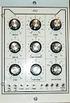 fpa 147 Week 6 Synthesis Basics In the early 1960s, inventors & entrepreneurs (Robert Moog, Don Buchla, Harold Bode, etc.) began assembling various modules into a single chassis, coupled with a user interface
Single Transistor FM Transmitter Design
 Single Transistor FM Transmitter Design In telecommunications, frequency modulation (FM) conveys information over a carrier wave by varying its frequency. FM is commonly used at VHF radio frequencies for
Waves-Wave Characteristics
 1. What is the wavelength of a 256-hertz sound wave in air at STP? 1. 1.17 10 6 m 2. 1.29 m 3. 0.773 m 4. 8.53 10-7 m 2. The graph below represents the relationship between wavelength and frequency of
The Monolina is available in four different base tunings D - F - A - C
 by feeltone products Monolina Easy to transport monochord for soundmassage and performace Utility model grant ash & cherry 28.4 x 13 x 4.3 2,7 kg designed by Ingo Böhme www.feeltoneusa.com The Monolina
The Tuning CD Using Drones to Improve Intonation By Tom Ball
 The Tuning CD Using Drones to Improve Intonation By Tom Ball A drone is a sustained tone on a fixed pitch. Practicing while a drone is sounding can help musicians improve intonation through pitch matching,
Sample Questions for the AP Physics 1 Exam
 Sample Questions for the AP Physics 1 Exam Sample Questions for the AP Physics 1 Exam Multiple-choice Questions Note: To simplify calculations, you may use g 5 10 m/s 2 in all problems. Directions: Each
Sound absorption and acoustic surface impedance
 Sound absorption and acoustic surface impedance CHRISTER HEED SD2165 Stockholm October 2008 Marcus Wallenberg Laboratoriet för Ljud- och Vibrationsforskning Sound absorption and acoustic surface impedance
Mounting instructions. Acceleration Transducer B12. B 26.B12.10 en
 Mounting instructions Acceleration Transducer B12 B 26.B12.10 en B12 3 Contents Page Safety instructions.............................................. 4 1 Scope of supply..............................................
BXR 300C BXR 300R. Owner, s Manual P/N 040294
 THE SOUND THAT CREATES LEGENDS BXR 300C BXR 300R Owner, s Manual P/N 040294 INTRODUCTION The Fender BXR 300 AMPLIFIER is the most recent effort in state of the art bass amplifier technology, and is a member
LAB #11: RESONANCE IN AIR COLUMNS
 OBJECTIVES: LAB #11: RESONANCE IN AIR COLUMNS To determine the speed of sound in air by using the resonances of air columns. EQUIPMENT: Equipment Needed Qty Equipment Needed Qty Resonance Tube Apparatus
physics 1/12/2016 Chapter 20 Lecture Chapter 20 Traveling Waves
 Chapter 20 Lecture physics FOR SCIENTISTS AND ENGINEERS a strategic approach THIRD EDITION randall d. knight Chapter 20 Traveling Waves Chapter Goal: To learn the basic properties of traveling waves. Slide
FOURIER TRANSFORM BASED SIMPLE CHORD ANALYSIS. UIUC Physics 193 POM
 FOURIER TRANSFORM BASED SIMPLE CHORD ANALYSIS Fanbo Xiang UIUC Physics 193 POM Professor Steven M. Errede Fall 2014 1 Introduction Chords, an essential part of music, have long been analyzed. Different
Gemini II. Subwoofer System OWNERS MANUAL
 Gemini II Subwoofer System OWNERS MANUAL CONTENTS Page No. 1) Safety instructions. 2) 3) 4) Connecting up your Gemini II. Connecting up using the high level input. Connecting up using the low level input.
Electromagnetic (EM) waves. Electric and Magnetic Fields. L 30 Electricity and Magnetism [7] James Clerk Maxwell (1831-1879)
![Electromagnetic (EM) waves. Electric and Magnetic Fields. L 30 Electricity and Magnetism [7] James Clerk Maxwell (1831-1879)](/thumbs/40/20813653.jpg "Electromagnetic (EM) waves. Electric and Magnetic Fields. L 30 Electricity and Magnetism [7] James Clerk Maxwell (1831-1879)") L 30 Electricity and Magnetism [7] ELECTROMAGNETIC WAVES Faraday laid the groundwork with his discovery of electromagnetic induction Maxwell added the last piece of the puzzle Heinrich Hertz made the experimental
L 30 Electricity and Magnetism [7] ELECTROMAGNETIC WAVES Faraday laid the groundwork with his discovery of electromagnetic induction Maxwell added the last piece of the puzzle Heinrich Hertz made the experimental
Loudspeaker Parameters. D. G. Meyer School of Electrical & Computer Engineering
 Loudspeaker Parameters D. G. Meyer School of Electrical & Computer Engineering Outline Review of How Loudspeakers Work Small Signal Loudspeaker Parameters Effect of Loudspeaker Cable Sample Loudspeaker
Fluid structure interaction of a vibrating circular plate in a bounded fluid volume: simulation and experiment
 Fluid Structure Interaction VI 3 Fluid structure interaction of a vibrating circular plate in a bounded fluid volume: simulation and experiment J. Hengstler & J. Dual Department of Mechanical and Process
A More Efficient Way to De-shelve 137 Ba +
 A More Efficient Way to De-shelve 137 Ba + Abstract: Andrea Katz Trinity University UW REU 2010 In order to increase the efficiency and reliability of de-shelving barium ions, an infrared laser beam was
LAB 6 - GRAVITATIONAL AND PASSIVE FORCES
 L06-1 Name Date Partners LAB 6 - GRAVITATIONAL AND PASSIVE FORCES OBJECTIVES And thus Nature will be very conformable to herself and very simple, performing all the great Motions of the heavenly Bodies
5.1 The First Law: The Law of Inertia
 The First Law: The Law of Inertia Investigation 5.1 5.1 The First Law: The Law of Inertia How does changing an object s inertia affect its motion? Newton s first law states that objects tend to keep doing
Waves - Transverse and Longitudinal Waves
 Waves - Transverse and Longitudinal Waves wave may be defined as a periodic disturbance in a medium that carries energy from one point to another. ll waves require a source and a medium of propagation.
I Click on a link tab to jump to that page
 & nstall Publication, Duplication, or Retransmission Of This Document Not Expressly Authorized n Writing By The nstall Doctor s Prohibited. Protected By U.S. Copyright Laws. 1997,1998,1999,2000. Factory
Experiment 3: Magnetic Fields of a Bar Magnet and Helmholtz Coil
 MASSACHUSETTS INSTITUTE OF TECHNOLOGY Department of Physics 8.02 Spring 2009 Experiment 3: Magnetic Fields of a Bar Magnet and Helmholtz Coil OBJECTIVES 1. To learn how to visualize magnetic field lines
A-level PHYSICS (7408/1)
 SPECIMEN MATERIAL A-level PHYSICS (7408/1) Paper 1 Specimen 2014 Morning Time allowed: 2 hours Materials For this paper you must have: a pencil a ruler a calculator a data and formulae booklet. Instructions
Constructing a precision SWR meter and antenna analyzer. Mike Brink HNF, Design Technologist.
 Constructing a precision SWR meter and antenna analyzer. Mike Brink HNF, Design Technologist. Abstract. I have been asked to put together a detailed article on a SWR meter. In this article I will deal
NUCLEAR MAGNETIC RESONANCE. Advanced Laboratory, Physics 407, University of Wisconsin Madison, Wisconsin 53706
 (revised 4/21/03) NUCLEAR MAGNETIC RESONANCE Advanced Laboratory, Physics 407, University of Wisconsin Madison, Wisconsin 53706 Abstract This experiment studies the Nuclear Magnetic Resonance of protons
XLS200 MKII. Subwoofer System OWNERS MANUAL
 XLS200 MKII Subwoofer System OWNERS MANUAL CONTENTS Page No. 1) Safety instructions. 2) 3) 4) Connecting up your XLS200. Connecting up using the high level input. Connecting up using the low level input.
ELECTRON SPIN RESONANCE Last Revised: July 2007
 QUESTION TO BE INVESTIGATED ELECTRON SPIN RESONANCE Last Revised: July 2007 How can we measure the Landé g factor for the free electron in DPPH as predicted by quantum mechanics? INTRODUCTION Electron
Tensions of Guitar Strings
 1 ensions of Guitar Strings Darl Achilles 1/1/00 Phsics 398 EMI Introduction he object of this eperiment was to determine the tensions of various tpes of guitar strings when tuned to the proper pitch.
4 SENSORS. Example. A force of 1 N is exerted on a PZT5A disc of diameter 10 mm and thickness 1 mm. The resulting mechanical stress is:
 4 SENSORS The modern technical world demands the availability of sensors to measure and convert a variety of physical quantities into electrical signals. These signals can then be fed into data processing
Inductors in AC Circuits
 Inductors in AC Circuits Name Section Resistors, inductors, and capacitors all have the effect of modifying the size of the current in an AC circuit and the time at which the current reaches its maximum
Germanium Diode AM Radio
 Germanium Diode AM Radio LAB 3 3.1 Introduction In this laboratory exercise you will build a germanium diode based AM (Medium Wave) radio. Earliest radios used simple diode detector circuits. The diodes
Experiment 3: Magnetic Fields of a Bar Magnet and Helmholtz Coil
 MASSACHUSETTS INSTITUTE OF TECHNOLOGY Department of Physics 8.02 Spring 2006 Experiment 3: Magnetic Fields of a Bar Magnet and Helmholtz Coil OBJECTIVES 1. To learn how to visualize magnetic field lines
Acceleration of Gravity Lab Basic Version
 Acceleration of Gravity Lab Basic Version In this lab you will explore the motion of falling objects. As an object begins to fall, it moves faster and faster (its velocity increases) due to the acceleration