
Camtasia Studio. Help File Document. Release 8.0. June TechSmith Corporation. All rights reserve
|
|
|
- Chrystal Welch
- 9 years ago
- Views:
Transcription
1 Create Engaging Screencasts Camtasia Studio Help File Document Release 8.0 June TechSmith Corporation. All rights reserve
2 Table of Contents Table of Contents 1 Recorder 1 Record PowerPoint 1 Your First Recording Use the Default Settings 2 Recorder's Preview Window 5 Change the View 5 Post-Recording Options 6 Camtasia SmartFocus Recording Tips 7 Record 8 The CAMREC Recording File 9 To Change the Recording File Format 9 Extract the AVI or WMV from a CAMREC Recording 9 Move or Resize the Recording Area 11 Lock the Recording Area to a Window or Application 12 Record the Entire Screen 13 Record at Standard or Widescreen Dimensions 14 Record a Region or Window 16 Record a Webcam in Camtasia Recorder 18 Add a Cursor Effect While Recording 19 Highlight the Cursor or Mouse Clicks 19 Record with a Custom Cursor 20 Show or Hide the Cursor 20 Add Mouse Click Sounds While Recording 21 Add Mouse Click Sound Effects 21 Draw on the Screen While Recording (ScreenDraw) 22 Use ScreenDraw While Recording (Custom Dimensions) 22 Use ScreenDraw While Recording (Full Screen) 23 ScreenDraw Hotkeys 23 Add a Caption While Recording 25 Add a System Stamp While Recording

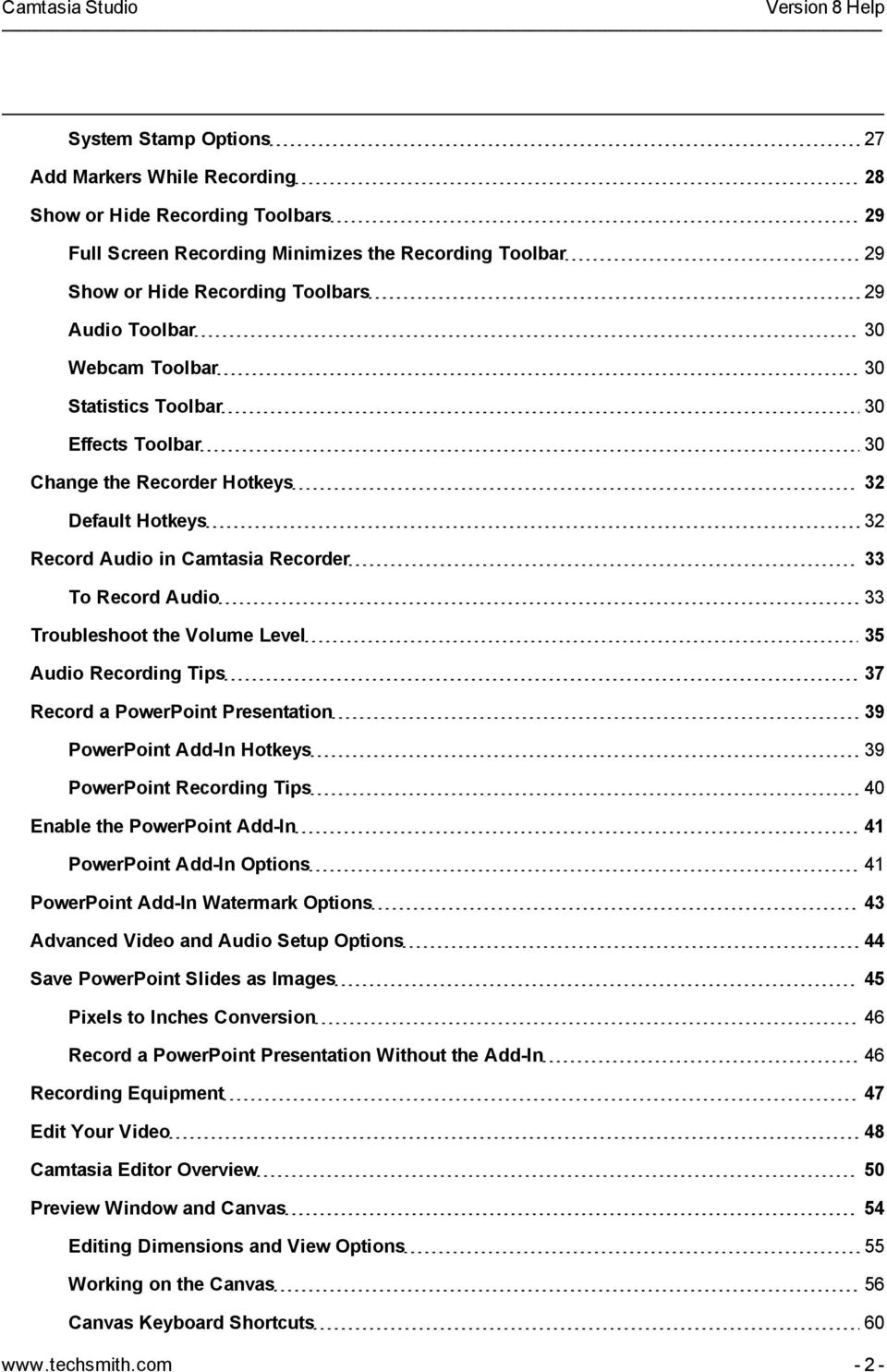
3 System Stamp Options 27 Add Markers While Recording 28 Show or Hide Recording Toolbars 29 Full Screen Recording Minimizes the Recording Toolbar 29 Show or Hide Recording Toolbars 29 Audio Toolbar 30 Webcam Toolbar 30 Statistics Toolbar 30 Effects Toolbar 30 Change the Recorder Hotkeys 32 Default Hotkeys 32 Record Audio in Camtasia Recorder 33 To Record Audio 33 Troubleshoot the Volume Level 35 Audio Recording Tips 37 Record a PowerPoint Presentation 39 PowerPoint Add-In Hotkeys 39 PowerPoint Recording Tips 40 Enable the PowerPoint Add-In 41 PowerPoint Add-In Options 41 PowerPoint Add-In Watermark Options 43 Advanced Video and Audio Setup Options 44 Save PowerPoint Slides as Images 45 Pixels to Inches Conversion 46 Record a PowerPoint Presentation Without the Add-In 46 Recording Equipment 47 Edit Your Video 48 Camtasia Editor Overview 50 Preview Window and Canvas 54 Editing Dimensions and View Options 55 Working on the Canvas 56 Canvas Keyboard Shortcuts
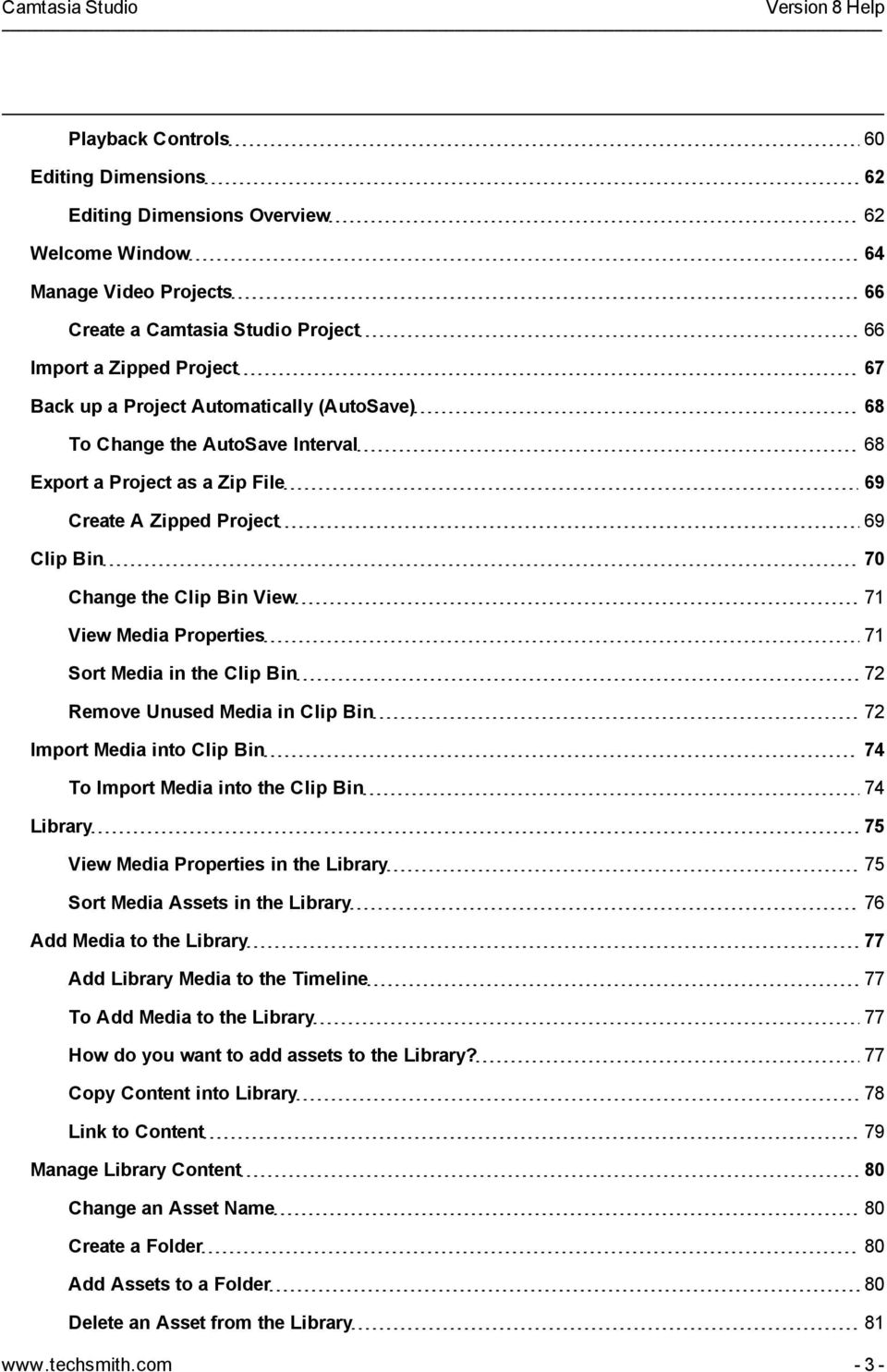
4 Playback Controls 60 Editing Dimensions 62 Editing Dimensions Overview 62 Welcome Window 64 Manage Video Projects 66 Create a Camtasia Studio Project 66 Import a Zipped Project 67 Back up a Project Automatically (AutoSave) 68 To Change the AutoSave Interval 68 Export a Project as a Zip File 69 Create A Zipped Project 69 Clip Bin 70 Change the Clip Bin View 71 View Media Properties 71 Sort Media in the Clip Bin 72 Remove Unused Media in Clip Bin 72 Import Media into Clip Bin 74 To Import Media into the Clip Bin 74 Library 75 View Media Properties in the Library 75 Sort Media Assets in the Library 76 Add Media to the Library 77 Add Library Media to the Timeline 77 To Add Media to the Library 77 How do you want to add assets to the Library? 77 Copy Content into Library 78 Link to Content 79 Manage Library Content 80 Change an Asset Name 80 Create a Folder 80 Add Assets to a Folder 80 Delete an Asset from the Library
5 Delete a Library Folder 81 Clean Up Library 82 Create Library Asset from Timeline Selection or Timeline Media 84 Add a Timeline Sequence 84 Add Timeline Media 85 Export Library Assets as a ZIP File (LIBZIP) 87 Export Assets or the Entire Library as a ZIP File 87 Import a Zipped Library File (LIBZIP) 89 Import from Editor 89 Import from Windows Explorer 89 Timeline 91 Timeline Toolbar 94 Navigate the Timeline 95 To Move Through a Video on the Timeline 95 Timeline Navigation Hotkeys 96 Media and Effects Hotkeys 97 Timeline Tracks 99 Tracks Overview 99 Make a Timeline Selection 102 To Make a Selection 102 Cut a Timeline Selection 104 Mark-In or Mark-Out a Video Clip 105 Split a Clip 106 Extend the Frame of a Video Clip 107 To Extend a Frame of a Video Clip 107 Adjust Clip Speed 108 To Adjust the Clip Speed 108 Markers 110 Add a Marker While Marker View is Closed 111 Add a Marker While Marker View is Open 111 Pin a Timeline Marker to a Media Clip 112 Turn a Media Marker into a Timeline Marker

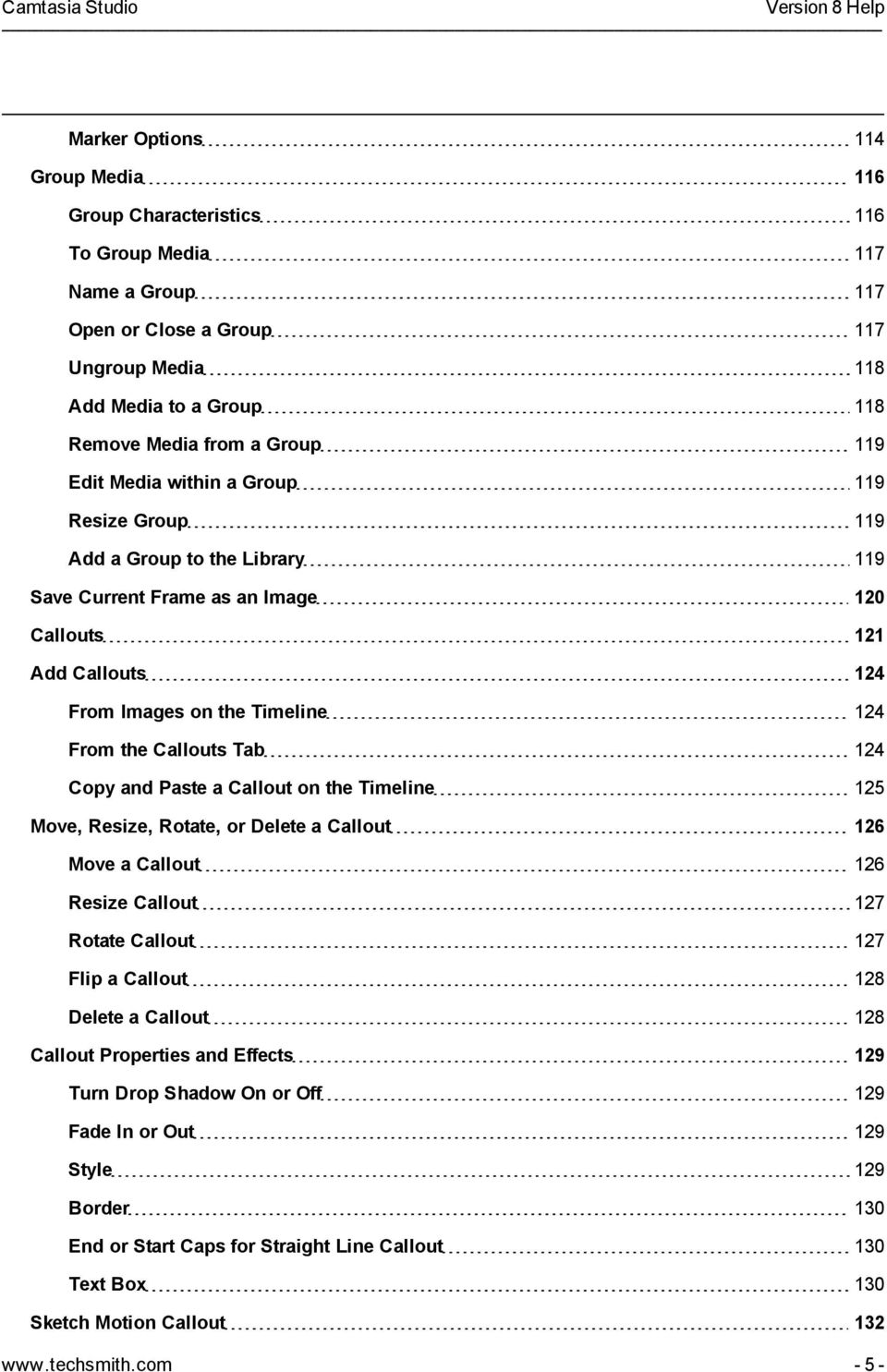
6 Marker Options 114 Group Media 116 Group Characteristics 116 To Group Media 117 Name a Group 117 Open or Close a Group 117 Ungroup Media 118 Add Media to a Group 118 Remove Media from a Group 119 Edit Media within a Group 119 Resize Group 119 Add a Group to the Library 119 Save Current Frame as an Image 120 Callouts 121 Add Callouts 124 From Images on the Timeline 124 From the Callouts Tab 124 Copy and Paste a Callout on the Timeline 125 Move, Resize, Rotate, or Delete a Callout 126 Move a Callout 126 Resize Callout 127 Rotate Callout 127 Flip a Callout 128 Delete a Callout 128 Callout Properties and Effects 129 Turn Drop Shadow On or Off 129 Fade In or Out 129 Style 129 Border 130 End or Start Caps for Straight Line Callout 130 Text Box 130 Sketch Motion Callout
7 Highlight Callout 133 Add a Highlight Callout 133 Add a Hotspot to a Callout 134 To Add a Hotspot to a Callout 135 Hotspot Actions 135 Blur or Pixelate the Screen with a Callout 137 To Blur the Screen With a Callout 137 Spotlight Callout 139 Add a Spotlight Callout 139 Text-Only Callout 140 Add a Text-Only Callout 140 Keystroke Callouts 141 Add a Manual Keystroke Callout 141 Auto Generate Keystroke Callouts from a CAMREC Recording 142 Use Any Image as a Callout 143 To Use an Image as a Callout or Title Clip 143 Zoom and Pan 145 Add a Zoom Animation 145 Add a Pan Animation 145 Delete a Zoom Animation 146 Adjust the Timing of the Zoom Animation 147 Zoom-n-Pan Tab Options 148 Auto Zoom and Pan with SmartFocus 149 SmartFocus Options 150 Audio 151 Editor Audio Setup Wizard 157 Select the Audio Recording Source 157 Tune the Volume Input Levels 157 Transitions 159 Visual Properties (Animations) 162 Voice Narration 167 To Record Voice Narration
8 Editor Audio Setup Wizard 168 Select the Audio Recording Source 168 Tune the Volume Input Levels 168 Cursor Effects 170 To Add a Cursor Animation 170 Cursor Effect Options 172 To Hide the Mouse Cursor 172 Delete a Cursor Animation 173 Captions (Closed and Open) 174 Captioning Methods 175 ADA Compliancy 176 Camtasia Studio and ADA Compliant Captions 176 Restore ADA Compliancy 176 Tips for Creating Effective Captions 177 Manually Add Captions 178 Speech-to-Text Captions 179 Training for Speech Recognition Accuracy 179 Tips Dialog 179 Add Captions Using Speech-to-Text 180 Speech Dictionary 183 Add Words Directly the Speech Dictionary from Within Camtasia Studio 183 Open the Windows Speech Dictionary 183 Import and Export Captions 184 Export Captions 184 Import Captions 184 Edit Captions 185 Change Caption Text 185 Change Font Attributes 185 Merge Synced Captions 186 Move and Size Captions 186 Change Caption Duration 186 Delete Captions
9 Quiz and Survey 188 Example of a Quiz Hosted on Screencast.com 189 Example of the Quiz View Answers Screen 189 Camtasia Quiz Service 189 Quizzes on the Timeline 191 Add a Quiz While Quiz View is Closed 192 Add a Quiz While Quiz View is Open 192 Pin a Timeline Quiz to a Media Clip 192 Turn a Media Quiz into a Timeline Quiz 193 Question Types 196 Multiple Choice 196 Fill in the Blank 196 Short Answer 196 True / False 197 Add a Quiz or Survey 198 Add a Quiz or Survey 198 Record Camera (Webcam) Video in Editor 201 Produce and Share a Video 202 Produce Your First Recording 202 Produce and Share Directly to Screencast.com 204 From within Camtasia Studio 204 From Recorder s Preview Window 205 Screencast.com Production Results 208 Produce and Share Directly to YouTube 209 From within Camtasia Studio 209 From Recorder s Preview Window 210 Produce Using Custom Production Settings 213 Production File Format Overview 214 Produce to MP4 Flash / HTML5 Player 216 To Produce to MP4 Flash Format 216 Flash / HTML 5 Player Options 217 Flash/HTML 5 Player Options

10 Controller Tab 217 Size Tab 219 Video Settings Tab 220 Audio Settings Tab 221 Options Tab 221 Quiz Reporting Options 223 Quiz Reporting Options 223 Camtasia Quiz Service 224 Marker Options (Customize the Table of Contents) 226 Marker/Table of Contents Options 226 Produce to Windows Media Video (WMV) 228 To Produce to Windows Media Player Video File Format 228 Windows Media Encoding Options 229 Produce to QuickTime Movie (MOV) 230 Produce to the QuickTime Movie Video File Format 230 QuickTime Encoding Options 231 Produce to Audio Video Interleave (AVI) 232 To Produce an AVI Video 232 AVI Encoding Options 233 AVI and TSC2 235 TechSmith's Screen Capture Codecs 235 Uses for AVI Files 235 Recommended AVI Production Settings 236 Produce to ipod, iphone, or itunes (M4V) 237 To Produce an ipod, iphone, or itunes Video 237 ipod Options 237 Produce Audio Only (MP3) 239 To Produce an Audio Only MP3 239 MP3 Encoding Options 239 Produce an Animated File (GIF) 241 To Produce an Animated GIF File 241 Animated GIF Encoding Options

11 Production Wizard Video Size 244 Video Size Options 244 Production Wizard Video Options 245 Video Options 245 Video and Project Information 247 Project Information Options 247 Quiz SCORM Manifest Options 249 SCORM Options 249 Production Wizard Watermark Options 250 Watermark Options 250 Production Wizard HTML Options 251 HTML Options 251 Production Wizard Marker Options 252 Marker / Table of Contents Options 252 Video File and Post-Production Options 254 Production Results 256 Production Results Options 256 Other Production Options 258 Batch Production 259 Batch Produce Using One Preset 259 Batch Produce Using Multiple Presets 259 Produce a Selection on the Timeline 260 Save Production Settings as a Preset 261 To Save Production Settings as a Preset 261 Add or Edit a Production Preset 262 To Add or Edit a Production Preset 262 Share a Production Preset 264 To Share a Production Preset 264 Preview the Production Settings 265 To Preview the Production Settings 265 Preview Manager 266 To Access the Preview Manager

12 To Move, View, or Hide Column Headings 267 Reference 269 Camtasia Studio System Requirements 270 About Camtasia Player 271 Camtasia Player System Requirements 271 Make Camtasia Player the Default Player 271 About Screencast.com 272 Camtasia Studio Integration 272 System Stamp and Caption Options 273 Recorder Tools Options 275 Recorder General Tab Options 276 Help Options 276 Capture Options 276 Saving Options 276 Recorder File Name Options 277 Hardware Acceleration 278 Recorder Inputs Tab Options 279 Video Options 279 Audio Options 279 Webcam Options 279 Audio Format 280 Recorder Program Tab Options 281 Recording Region Options 281 Workflow Options 281 Minimize Options 282 Camtasia Studio Tools Options 283 Camtasia Studio Program Tab Options 284 Change Media Durations 286 Change the Duration from the Timeline 286 Change Media Default Durations 286 PowerPoint Options 287 Post-Save Option

13 Enable PowerPoint Add-In 287 Import Slide Notes as Captions 287 Upgrade Options 288 Help Improve Camtasia Studio 289 TechSmith User Design Initiative (TUDI) 289 Program Participation Options

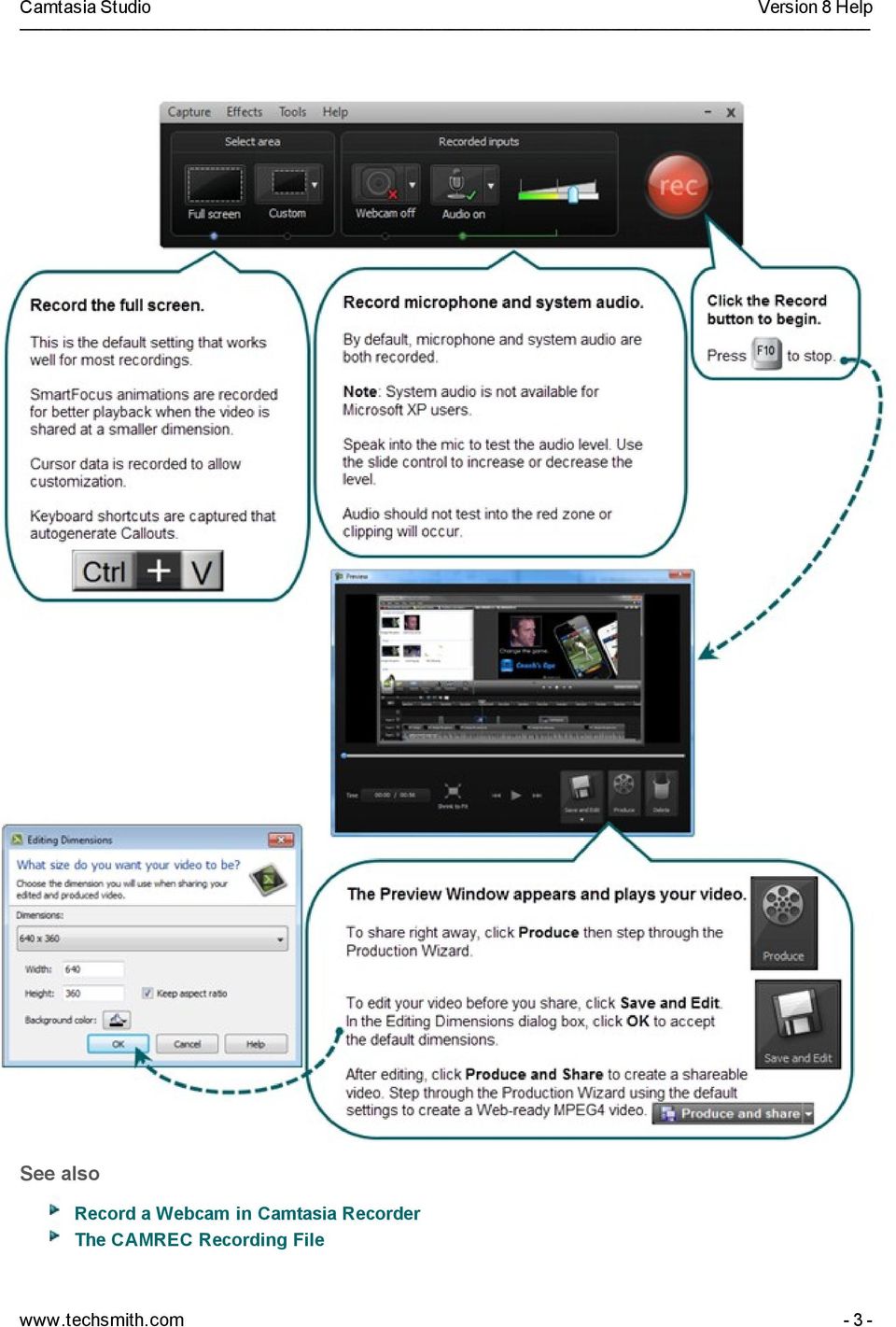
14 Recorder With Camtasia Recorder, you record exactly what you want: the entire screen, specific dimensions, a region, a window, or an application. Recorder is designed to be simple and easy-to-use starting with your first recording just click the Record button and begin your onscreen activity. Recorder automatically records: Microphone audio recording System audio recording (not supported on the Microsoft Windows XP operating system) SmartFocus zoom and pan keyframes to automatically optimize the viewing experience Keyboard shortcut data that generates automatic callouts in Editor Cursor data that allows you to customize the cursor in Editor Record PowerPoint Share more than just the slides from a presentation, use the Camtasia Studio PowerPoint Add-In to record and share PowerPoint presentations for attendees to watch again or for people unable to attend the presentation. With the PowerPoint Add-In, you can: Quickly record and produce a PowerPoint presentation as an interactive video to appear on a webpage. Include audio or camera video to include as a Picture-in-Picture recording. Save the PowerPoint recording as a Camtasia Studio project file (CAMPROJ) to edit or produce into a variety of file formats. Automatically add markers to the recording file for each slide in the presentation. If you include a table of contents in the final video, the markers appear as table of contents entries. See also Record a Webcam in Camtasia Recorder The CAMREC Recording File Show or Hide Recording Toolbars Add Markers While Recording Add a System Stamp While Recording Add Mouse Click Sounds While Recording Add a Cursor Effect While Recording Draw on the Screen While Recording (ScreenDraw) Record a PowerPoint Presentation

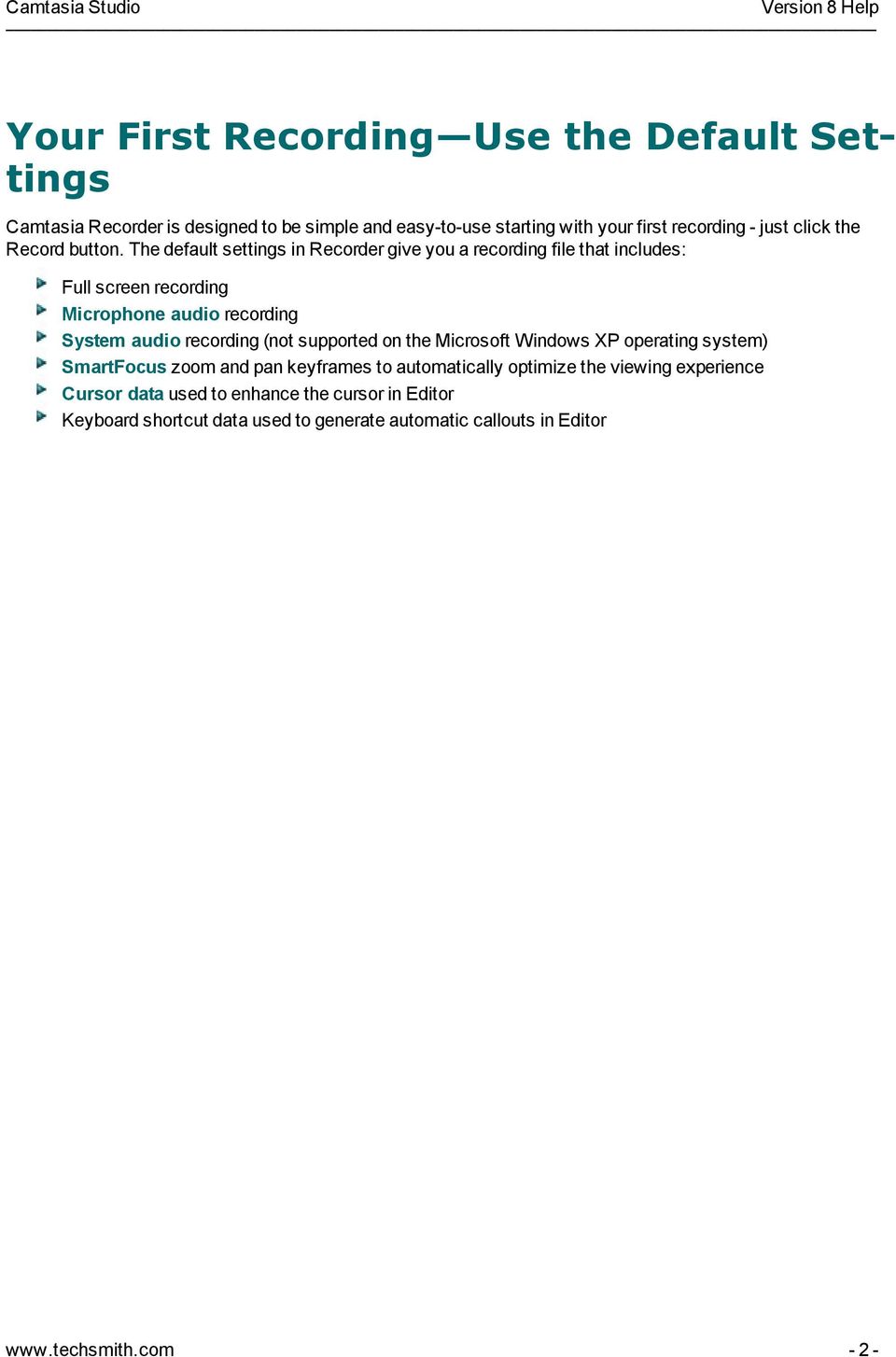
15 Your First Recording Use the Default Settings Camtasia Recorder is designed to be simple and easy-to-use starting with your first recording - just click the Record button. The default settings in Recorder give you a recording file that includes: Full screen recording Microphone audio recording System audio recording (not supported on the Microsoft Windows XP operating system) SmartFocus zoom and pan keyframes to automatically optimize the viewing experience Cursor data used to enhance the cursor in Editor Keyboard shortcut data used to generate automatic callouts in Editor
16 See also Record a Webcam in Camtasia Recorder The CAMREC Recording File
17 Show or Hide Recording Toolbars Add Markers While Recording Add a System Stamp While Recording Add Mouse Click Sounds While Recording Add a Cursor Effect While Recording Draw on the Screen While Recording (ScreenDraw) Record a PowerPoint Presentation
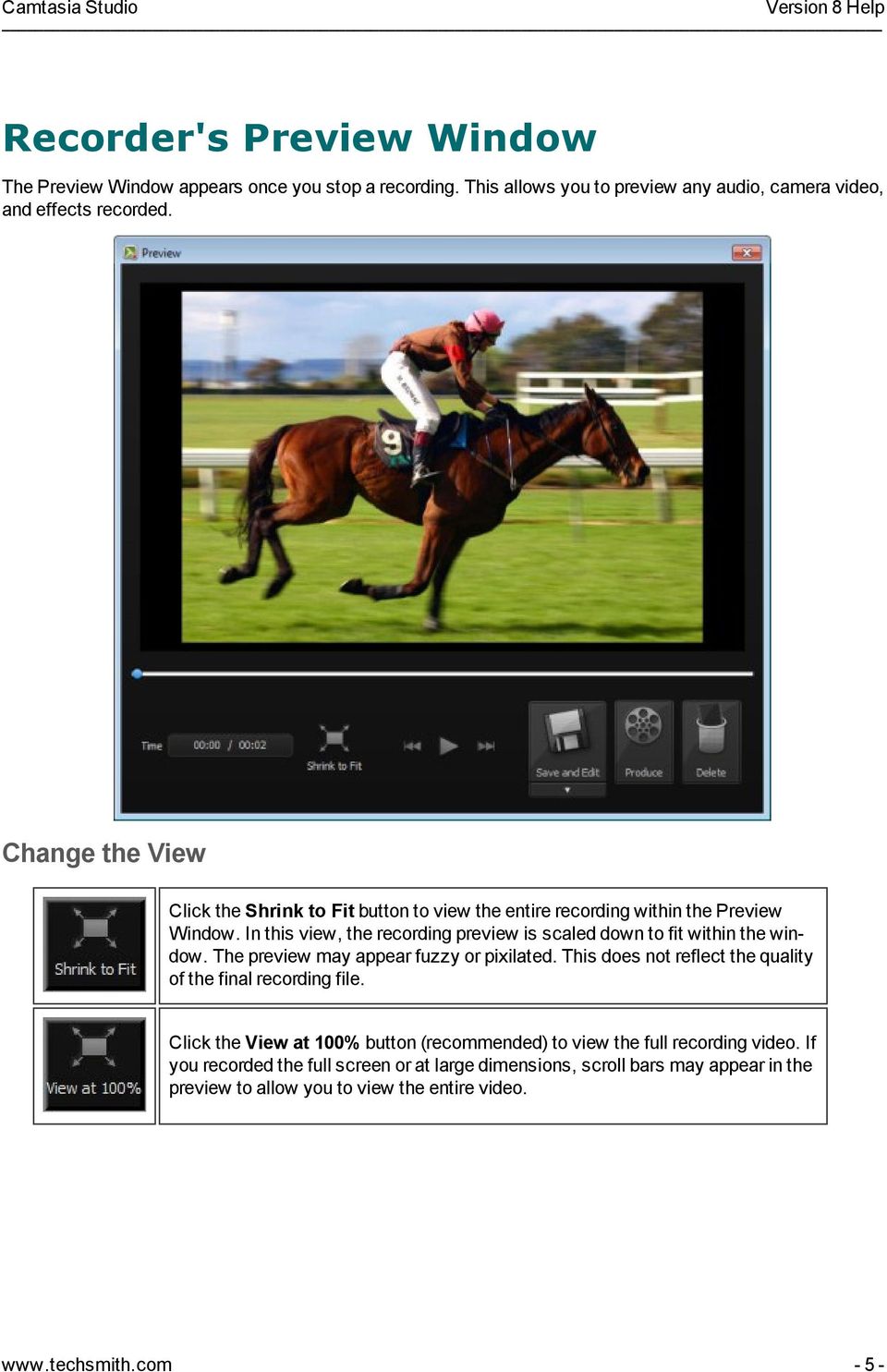
18 Recorder's Preview Window The Preview Window appears once you stop a recording. This allows you to preview any audio, camera video, and effects recorded. Change the View Click the Shrink to Fit button to view the entire recording within the Preview Window. In this view, the recording preview is scaled down to fit within the window. The preview may appear fuzzy or pixilated. This does not reflect the quality of the final recording file. Click the View at 100% button (recommended) to view the full recording video. If you recorded the full screen or at large dimensions, scroll bars may appear in the preview to allow you to view the entire video
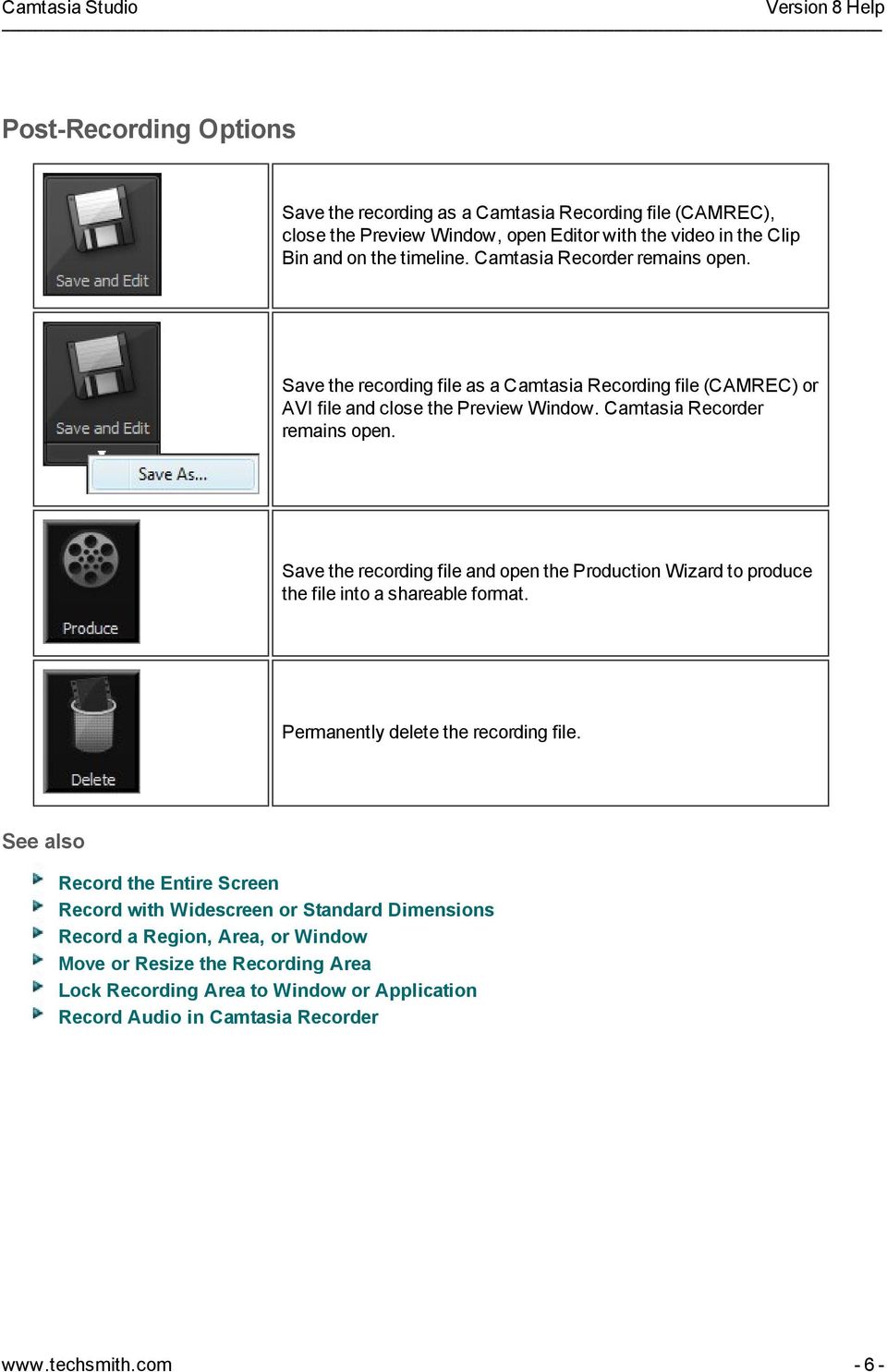
19 Post-Recording Options Save the recording as a Camtasia Recording file (CAMREC), close the Preview Window, open Editor with the video in the Clip Bin and on the timeline. Camtasia Recorder remains open. Save the recording file as a Camtasia Recording file (CAMREC) or AVI file and close the Preview Window. Camtasia Recorder remains open. Save the recording file and open the Production Wizard to produce the file into a shareable format. Permanently delete the recording file. See also Record the Entire Screen Record with Widescreen or Standard Dimensions Record a Region, Area, or Window Move or Resize the Recording Area Lock Recording Area to Window or Application Record Audio in Camtasia Recorder
20 Camtasia SmartFocus Recording Tips TechSmith's exclusive SmartFocus technology keeps track of where the action happens during your recording. Then it produces a video that zooms in on the parts you need to show. Camtasia SmartFocus is ideal for videos where the source clip or recording dimensions are large (example: full screen recordings) and you want to produce the final video at smaller dimensions (example: for the Web or for an ipod). When recording in Recorder, SmartFocus collects data about the actions completed and the cursor movement in the recording. SmartFocus predicts where to add zoom and pan animations in the recording, saving you the time it takes to manually add zoom and pan animations. If you plan to apply SmartFocus during the editing process, use the following recording tips to help Smart- Focus predict where to apply the zoom effects: See also Slow down. Use slow, deliberate mouse movements. Do not click around the screen too fast. Record at full screen dimensions and produce at smaller dimensions. SmartFocus is ideal for cases when you need to record at full screen or large dimensions, but want to produce the final video at smaller dimensions. For example, if you record a full screen application and then produce the final video for distribution on a smaller mobile device, the full screen recording is not viewable at the original dimensions without zooming. Record clips longer than 30 seconds. SmartFocus is optimized for recordings longer than 30 seconds. For shorter clips, you can manually add zoom and pan animations. Hover the cursor where you want the viewer to look. Keep the cursor still on the area of focus in the recording. For example, if you want the viewer to focus on a hyperlink, place the cursor on or near that area as you speak and then click. Do not talk with the cursor. Do not move the cursor around the screen as you speak. Try to keep the cursor still in the area of focus in the recording. Keep the cursor close when entering text. SmartFocus may not predict the correct action if you click in a text box, move the cursor to the other side of the screen, and then start talking. If you want the viewer to see what is typed into the text box, keep the cursor in the text box. Use the mouse scroll wheel (if applicable). Try using the mouse scroll wheel instead of clicking and dragging on the scroll bar. SmartFocus may zoom in on the scroll bar instead of the content scrolling. For example, use the mouse scroll wheel when scrolling long Web pages. Record a Webcam in Camtasia Recorder The CAMREC Recording File Show or Hide Recording Toolbars Add Markers While Recording Add a System Stamp While Recording Add Mouse Click Sounds While Recording Add a Cursor Effect While Recording Draw on the Screen While Recording (ScreenDraw) Record a PowerPoint Presentation Captions (Closed and Open)
21 Record By default, SmartFocus animations are automatically recorded and appear during the editing process on the Zoom track. SmartFocus zooms in on areas within the recording to optimize the viewing experience for videos produced at dimensions smaller than the original recording. See Camtasia SmartFocus Recording Tips. In addition to screen recording, Camtasia Recorder allows you to draw on the screen and add effects while recording. 1. Choose area to record: Full screen recording is the default. Record with custom dimensions Record a region 2. Record from a Web Camera. 3. Record Audio. Microphone audio is recorded by default. System Audio is recorded by default (option not available if using the Microsoft Windows XP operating system) 4. Click the Record button to begin. 5. Click the Stop button or press F10. The recording preview appears. See: Edit the recording See also Produce into a shareable format Record a Webcam in Camtasia Recorder The CAMREC Recording File Show or Hide Recording Toolbars Add Markers While Recording Add a System Stamp While Recording Add Mouse Click Sounds While Recording Add a Cursor Effect While Recording Draw on the Screen While Recording (ScreenDraw) Record a PowerPoint Presentation Captions (Closed and Open)
22 The CAMREC Recording File Camtasia Studio records in one of two file formats: as a CAMREC or as an AVI. By default, recordings are saved as a CAMREC file. The CAMREC is a custom file container that holds more than just a video file. Other video editing software can't read or open a CAMREC file. The data contained in the CAMREC allows you to edit your video within Camtasia Studio after recording is complete. The CAMREC file may contain: AVI screen recording Webcam video to use as a Picture-in-Picture Cursor data SmartFocus zoom and pan keyframe data Keyboard shortcut data Audio from a microphone System audio Marker data To Change the Recording File Format In Camtasia Recorder, select Tools > Options > General tab > Saving group box > Record to option. Select one of the following formats: Camtasia Recording File (.camrec):default recording file format. Proprietary Tech- Smith file format used to store screen and camera recording plus metadata about various streams into a single package. To add markers, apply Camtasia SmartFocus, or record a Web camera, you must record with this format. Audio Video Interleave (.avi):use AVI files to share the recording outside of Camtasia Studio. You cannot add markers, apply Camtasia SmartFocus, or record a Web camera with the AVI format. Extract the AVI or WMV from a CAMREC Recording The Extract CAMREC Contents option allows you to extract the screen (AVI) and camera (WMV) recording files from the CAMREC file. Use this option to edit the main video and Picture-in-Picture (PIP) clips separately
23 Or, use the AVI file extracted from the CAMREC with a third-party video editor as long as you have the TSC2 or EnSharpen codec installed on the computer. When installing Camtasia Studio, the TSC2 and EnSharpen codecs are also installed. To Extract the AVI or WMV: 1. In Camtasia Studio, right-click on a CAMREC file in the Clip Bin. 2. Select Extract Camrec Contents from the context menu. 3. Select the destination and click OK. 4. The AVI (screen recording) and WMV (camera recording) files save to the directory selected
24 Move or Resize the Recording Area When you click the Record button, a dashed green line appears around the recording area. To move the recording area, click and drag the compass icon inside the recording area to a new location on the screen. To resize the recording area, click and drag a handle on a corner of the recording area in or out. See also Record the Entire Screen Record at Standard or Widescreen Dimensions Record a Region or Window Lock the Recording Area to a Window or Application Record Audio in Camtasia Recorder
25 Lock the Recording Area to a Window or Application The Lock to Application option allows you to automatically size the recording area to the size of the selected application window. If the recording area is changed, the window or application automatically resizes to stay within the recording boundaries. When used in conjunction with the Lock Aspect Ratio option, proper aspect ratio is maintained if further resizing of the window or application is needed. 1. Click the window or application to record to give it focus on the desktop. 2. Open Camtasia Recorder. 3. Click the Custom button. The custom options expand. 4. Click the Custom dropdown and select Lock to Application. 5. Click the Custom dropdown and select Select area to Record. 6. Click on the window or application. 7. Click the Lock Aspect Ratio icon to ensure proper aspect ratio is maintained if further resizing is needed. See also Record the Entire Screen Record at Standard or Widescreen Dimensions Record a Region or Window Move or Resize the Recording Area Record Audio in Camtasia Recorder
26 Record the Entire Screen Select Full Screen to record large, maximized applications or all activity on your computer desktop. 1. Open Camtasia Recorder. 2. Click the Full Screen button. 3. Optional: Record from a Web Camera. 4. Record Audio. By default, both microphone and system audio are recorded. 5. Click the Record button. 6. Press F10 to stop recording. The Preview Window appears. Click Save and Edit to open your video in Editor where you can enhance and edit the video. See also Click Produce to open the Production Wizard to create a shareable video. Record a Webcam in Camtasia Recorder The CAMREC Recording File Show or Hide Recording Toolbars Add Markers While Recording Add a System Stamp While Recording Add Mouse Click Sounds While Recording Add a Cursor Effect While Recording Draw on the Screen While Recording (ScreenDraw) Record a PowerPoint Presentation Captions (Closed and Open)
27 Record at Standard or Widescreen Dimensions Select Custom to record using preset dimensions based on widescreen or standard aspect ratios. For best results when recording at custom dimensions, use dimensions with the same aspect ratio to edit and produce the final video. 1. Open Camtasia Recorder. 2. Click the Custom button. The custom options expand. 3. Click the dropdown to select from a list of Standard or Widescreen dimensions. Or, enter dimensions (in pixels) into the Width and Height fields. When entering dimensions into the Width and Height fields, click the lock icon to maintain the aspect ratio
28 4. Optional: Record from a Web Camera. 5. Record Audio. By default, both microphone and system audio are recorded. 6. Click the Record button. 7. Press F10 to stop recording. The Preview Window appears. Click Save and Edit to open your video in Editor where you can enhance and edit the video. See also Click Produce to open the Production Wizard to create a shareable video. Record the Entire Screen Record a Region or Window Move or Resize the Recording Area Lock the Recording Area to a Window or Application Record Audio in Camtasia Recorder
29 Record a Region or Window Record a specific area on the screen, a window, or an application. 1. Open Camtasia Recorder. 2. Click the Custom button. The custom options expand. 3. Click the Custom dropdown and choose Select area to record. To select a window to record, move the cursor until the area or window is highlighted. Click to select. To select a region to record, click and drag make a selection on the screen. Release mouse when done. 4. Optional: Record from a Web Camera. 5. Record Audio. By default, both microphone and system audio are recorded. 6. Click the Record button. 7. Press F10 to stop recording. The Preview Window appears. Click Save and Edit to open your video in Editor where you can enhance and edit the video. Click Produce to open the Production Wizard to create a shareable video
30 See also Record the Entire Screen Record at Standard or Widescreen Dimensions Move or Resize the Recording Area Lock the Recording Area to a Window or Application Record Audio in Camtasia Recorder
31 Record a Webcam in Camtasia Recorder Record camera video, such as a video of the speaker, along with your screen recording. Camtasia Recorder only supports camera recording when saving to the CAMREC file format. To change the file format, go to Tools > Options > General tab. 1. Click the Webcam button to enable webcam recording. 2. Click the dropdown to select the camera device. Camtasia Recorder does not support Digital video (DV) cameras. 3. A live preview of the Web camera appears to the right of the Webcam option. To view a larger preview, hover your cursor over the preview thumbnail. 4. To change the camera options, select Camera dropdown > Options. You can record camera video at a later time with the Record camera option in Camtasia Studio
32 Add a Cursor Effect While Recording With these options, the cursor is permanently burned into the recording and cannot be changed or removed. To have Recorder gather cursor data that can be enhanced and edited in Camtasia Studio, leave the Make cursor effects editable in Camtasia Studio option enabled within the Cursor tab. Highlight the Cursor or Mouse Clicks The Highlight Cursor effect focuses the viewer s attention on the movement of the mouse cursor and ensures the cursor does not blend into the background. The Highlight Clicks effect adds animated emphasis to mouse clicks during recording. 1. Select Effects > Options > Cursor tab > Disable the Make cursor effects editable in Camtasia Studio option 2. In the Highlight cursor group box, choose the shape, size, color, and opacity. 3. In the Highlight mouse clicks group box, choose the shape, size, and color for the left and right mouse clicks. 4. Click OK. To enable effects before recording, select Effects > Cursor > Highlight Clicks, Highlight Cursor, or Highlight Cursor & Clicks
33 To enable effects during recording, click Cursor Effects on the Recording toolbar to expand the options. Select Highlight Cursor, Highlight Clicks, or both options. Record with a Custom Cursor 1. Select Effects > Options > Cursor tab > Disable the Make cursor effects editable in Camtasia Studio option 2. In the Cursor group box, select the Use custom cursor or Use cursor from file option. Camtasia Recorder supports cursor (CUR) or icon (ICO) files for the custom cursor. C:\Windows\Cursors includes several icons you can use as the custom cursor. 3. Click OK. To enable effects before recording, select Effects > Cursor > Highlight Clicks, Highlight Cursor, or Highlight Cursor & Clicks. To enable effects during recording, click Cursor Effects on the Recording toolbar to expand the options. Select Highlight Cursor, Highlight Clicks, or both options. During recording, the system default cursor shows. The custom cursor is burned into the recording file and appears during the recording preview. Show or Hide the Cursor To not record the cursor, select Effects > Cursor > Hide Cursor. During the recording, the cursor appears on the screen. However, the cursor does not appear in the recording preview or recording file. See also Record a Webcam in Camtasia Recorder The CAMREC Recording File Show or Hide Recording Toolbars Add Markers While Recording Add a System Stamp While Recording Add a Caption While Recording Add Mouse Click Sounds While Recording Draw on the Screen While Recording (ScreenDraw) Record a PowerPoint Presentation
34 Add Mouse Click Sounds While Recording With these options, the mouse click sounds are permanently burned into the recording and cannot be changed or removed. To have Recorder gather cursor data that can be enhanced and edited in Camtasia Studio, leave the Make cursor effects editable in Camtasia Studio option enabled within the Cursor tab. Add Mouse Click Sound Effects Mouse click sound effects play a sound whenever you click the mouse button. 1. Before recording, select Effects > Options > Sound tab. 2. To use different audio files than those provided, click the Browse buttons. Search for and select the audio files (WAV). Click OK. 3. On the Sound tab, click OK to exit. 4. Turn on the Mouse Click Sounds option. Select Effects > Sound > Use Mouse Click Sounds. A checkmark lets you know the option is turned on. The sounds appear in each recording file until the option is turned off. Select Effects > Sound > Use Mouse Click Sounds. See also Record a Webcam in Camtasia Recorder The CAMREC Recording File Show or Hide Recording Toolbars Add Markers While Recording Add a System Stamp While Recording Add a Caption While Recording Add a Cursor Effect While Recording Draw on the Screen While Recording (ScreenDraw) Record a PowerPoint Presentation
35 Draw on the Screen While Recording (ScreenDraw) With these options, the drawing is permanently burned into the recording and cannot be changed or removed. Adding arrows or callouts in Camtasia Studio creates a similar effect. However, arrows and callouts in Camtasia Studio can be edited. Add drawing effects like arrows and circles over the screen as your record with ScreenDraw. Use ScreenDraw While Recording (Custom Dimensions) 1. Open Recorder. 2. Select Tools > Recording Toolbars > Effects toolbar. 3. Click the Record button to begin recording. After the countdown, the ScreenDraw option appears. 4. Click the ScreenDraw button on the Effects toolbar. 5. The ScreenDraw tools expand. Select a tool and click and drag to draw on the screen
36 6. To change the default tools, select an option from the dropdown list next to a tool on the Effects toolbar. 7. To undo the last ScreenDraw action, press CTRL+Z. 8. To exit ScreenDraw mode, press ESC or CTRL+SHIFT+D. Use ScreenDraw While Recording (Full Screen) 1. Open Recorder. 2. Select Tools > Recording Toolbars > Effects toolbar. 3. Click the Record button to begin recording. After the countdown, press CTRL+SHIFT+D to enable ScreenDraw. 4. Use the ScreenDraw hotkeys to select tools, tool width, shape, and color. 5. Click and drag with the cursor to draw on the screen. 6. To undo the last ScreenDraw action, press CTRL+Z. 7. To exit ScreenDraw mode, press ESC or CTRL+SHIFT+D. ScreenDraw Hotkeys When recording the full screen, use the ScreenDraw hotkeys to enable ScreenDraw and to change the tools. You can change the tool, color, or width of the drawing tools. Option Enable ScreenDraw Hotkey CTRL + SHIFT+D Tool Width 1 through 8 Frame Highlight F H
37 Option Hotkey Ellipse Pen Line Arrow Black Blue Cyan Green Yellow White Red Undo Redo Exit ScreenDraw E P L A K B C G Y W R CTRL+Z CTRL+Y Esc See also Record a Webcam in Camtasia Recorder The CAMREC Recording File Show or Hide Recording Toolbars Add Markers While Recording Add a System Stamp While Recording Add a Caption While Recording Add Mouse Click Sounds While Recording Add a Cursor Effect While Recording Record a PowerPoint Presentation
38 Add a Caption While Recording Use captions to add copyright information, special instructions, additional information, etc. Camtasia Recorder permanently overlays the caption text onto the recording. Adding captions or callouts in Camtasia Studio creates a similar effect. However, captions and callouts added in Camtasia Studio can be edited; those added during recording cannot. 1. Before recording, select Effects > Options > Annotation tab > Caption group box. 2. Enter the caption text in the Caption field. 3. Enable the Prompt before capture option to show the caption dialog box prior to recording. 4. Click the Caption Options button to customize the font and background for the caption. Click OK. 5. In the Annotation tab, click OK to exit. 6. Turn on the Caption option. Select Effects > Annotation > Caption. A checkmark lets you know the option is enabled. The caption appears in each recording file until the option is turned off. Select Effects > Annotation > Caption. See also Record a Webcam in Camtasia Recorder The CAMREC Recording File Show or Hide Recording Toolbars Add Markers While Recording Add a System Stamp While Recording Add Mouse Click Sounds While Recording Add a Cursor Effect While Recording Draw on the Screen While Recording (ScreenDraw) Record a PowerPoint Presentation Captions (Closed and Open)
39 Add a System Stamp While Recording A system stamp inserts recording information such as time/date and elapsed time into the recording. Camtasia Recorder permanently overlays the system stamp text onto the recording. This cannot be removed or edited within Camtasia Studio. 1. Before recording, select the system stamp options. Select Effects > Options > Annotation tab > System Stamp group box. 2. Click the Time/Date Format button to change the order and layout of the Time/Date stamp. Click OK when finished. 3. On the Annotation tab, click OK to exit. 4. Turn on the System Stamp option. Select Effects > Annotation > Add System Stamp. A checkmark lets you know the option is turned on. The system stamp appears in each recording file until the option is turned off. Select Effects > Annotation > Add System Stamp to turn the option off
40 System Stamp Options Stamp Option Time/Date Description Click the Time/Date Format button to change the order and layout of the Time/Date stamp. Use the Time/Date stamp when you need to know exactly when something occurred in the recording, such as for usability testing. Example Elapsed time Shows the amount of time passed since the recording started. Display Time/Date first Options Determines the order when including both the Time/Date and Elapsed time. Customize the font and background for the system stamp
41 Add Markers While Recording Add markers when recording to a CAMREC file in Camtasia Recorder or while editing in Camtasia Studio. Insert markers to: Create recording notes. For example, mark a pause in the recording to cut out during editing. Set points to split a long video into multiple videos. Create navigation points. If you include a table of contents in the final video, the markers appear as table of contents entries. To add a marker while recording, press CTRL+M or click the Add Marker button on the Recording toolbar. To view markers added during recording, import the CAMREC file into Camtasia Studio. The markers appear on the timeline. See also Record a Webcam in Camtasia Recorder The CAMREC Recording File Show or Hide Recording Toolbars Add a System Stamp While Recording Add a Caption While Recording Add Mouse Click Sounds While Recording Add a Cursor Effect While Recording Draw on the Screen While Recording (ScreenDraw) Record a PowerPoint Presentation
42 Show or Hide Recording Toolbars You can customize which toolbars appear on the toolbar during recording. By default, only the basic recording controls and audio toolbar appear when recording. Full Screen Recording Minimizes the Recording Toolbar When recording full screen, the recording toolbar minimizes to the system tray. Click the tray icon to access the recording options. Click the tray icon to hide it again. If you open or move the toolbar into the recording area, the toolbar is included in the final recording. To change when the toolbar minimizes, select Tools > Options > General tab > Minimize to system tray during recording. Show or Hide Recording Toolbars 1. In Recorder, select Tools > Recording Toolbars. The Recording Toolbars dialog box appears. 2. Enable or disable the desired toolbars. 3. Click OK. The Audio and Camera toolbars are only available when recording audio or camera
43 Audio Toolbar The Audio Input meter displays the audio level for the recording. The best audio quality occurs when the Audio Input meter is in the green to light orange range. Audio clipping may occur in the mid-orange to red range. Drag the slider to adjust the audio. Webcam Toolbar A live preview of the Web camera appears on the Camera toolbar. To view a larger preview, hover your cursor over the preview thumbnail. Statistics Toolbar The statistics toolbar provides information about the recording performance including: frames, frame rate (in frames per second), and the duration of the recording. Effects Toolbar Option ScreenDraw ScreenDraw Tools Description Click to enable ScreenDraw and to expand the ScreenDraw tools. Click to select a tool. Select an option from the dropdown to change the default tool
44 Option Description Add Marker Cursor Effects Click to add a marker. Click to expand the cursor effects options: Highlight Cursor Highlight Clicks
45 Change the Recorder Hotkeys 1. In Camtasia Recorder, select Tools > Options > Hotkeys tab. 2. Select a recording function. 3. Choose the shortcut keystrokes. 4. Click OK. Default Hotkeys Option Record/Pause Stop Marker ScreenDraw Select Region Hide Tray Icon Mute Default Hotkey F9 F10 CTRL + M CTRL+SHIFT+D None None None
46 Record Audio in Camtasia Recorder It is important to create your recordings with the best possible audio quality because the audio codecs used in producing the final video may cause audio quality to degrade. If the audio source is on and set up properly, the source meter appears active in Recorder and for all active sources in the Audio dropdown menu. Troubleshoot the Volume Level and Audio Recording Tips. The live audio meters in the dropdown are not available on the Microsoft XP operating system. To Record Audio 1. Enable the Audio option
47 2. Click the Audio dropdown to select the audio source. Available sources show an active audio meter. 3. Adjust the Input level so the highest volume displays in the green to yellow range. Audio clipping may occur in the mid-orange to red range. 4. Click OK. You can also record audio at a later time with the Voice Narration option in Editor See also Record the Entire Screen Record at Standard or Widescreen Dimensions Record a Region or Window Move or Resize the Recording Area Lock the Recording Area to a Window or Application
48 Troubleshoot the Volume Level Speak into your microphone or turn up the speaker audio (for system audio). You should see the audio meter respond. If it does not, use the table below to troubleshoot a solution. Level Issue Action Audio level is in the green range and responds to changes in the audio. No change needed. Audio level does not change when audio is present. Verify that the selected audio input source is connected and turned on. Verify that the correct audio input source is selected. To verify, click the Audio dropdown and select Options. Verify that the volume is not muted. Audio level is too low. (i.e. Audio is not in the green to yellow range.) Drag the slider to the right. Audio level is in the yellow to orange range where clipping might occur. Drag the slider to the left
49 Level Issue Action Audio level is in the orange to red range where clipping occurs. Drag the slider to the left
50 Audio Recording Tips Use the best microphone you can afford. Sound is critical to screen recording videos. Quite often, if the sound is bad, people will not watch the video. Use a USB microphone. USB microphones use less computer resources and record better audio than an analog microphone connected to your computer s sound card. Use the Camtasia Recorder default settings for audio. This includes recording your system audio to a separate track (not supported on the Microsoft Windows XP operating system). Practice using a microphone. Experiment with different volume levels and the microphone placement. Six inches from the microphone is usually good to record full tones, but not too close that other noises interfere. Record in a quiet location. Any microphone can pick up nearby noises. Most office areas have a lot of background noise that you may or may not notice. Take a second and listen. What do you hear? Try not to record your audio in a public location. Use an office or conference room away from high traffic areas. Place a note on the door letting others know that you are recording. Do a short test recording to make sure audio is being recorded. Use a script. A script helps you produce the best audio by allowing you to avoid mistakes or saying "um" or "uh." Even if you do not want a formal presentation, an outline can help reduce some mistakes. Project and enunciate. Speak as though you are addressing a small audience in a large room. Monitor the audio level as you record. The green to yellow range indicates normal. Orange to red warns you the input is close to becoming over-modulated. Best audio quality occurs when the Audio Input meter is in the green to very light orange range. Use the Editor s Audio Enhancements after you record Audio enhancements help you automatically improve the quality of the audio tracks by reducing noise, evening out volume levels, and eliminating white noise, as well as "um s," and "ah s." Adjust the audio volume in Editor. If your volume is too low or too loud, use the volume controls in Editor to adjust the audio up or down. Add audio points to enhance certain areas of the waveform. Background music can add a nice touch if done correctly. If you have background music playing on your computer while you are recording narration with a microphone, the background music appears on a separate track within Editor. Edit the background music to fit the narration using fade effects or volume adjustments. Record the audio and video separately. After you become familiar with using Camtasia Studio, try recording the screen without the audio
51 Within Editor, complete all of your video editing. When the video editing is finalized, add the audio using the Voice Narration option. This is the preferred process for people who routinely create screen recordings. Stop and listen to the sound in your recording area. Record your screen with audio, but don t speak. Then, listen to the recording. You ll be surprised how much noise is in a room. Is your chair squeaky or creaky? Is your phone ringer on? Is your keyboard loud when you type? Are there pets or kids in the background? Do you have a heating or cooling vent overhead that can be heard? Is your microphone picking up humming from your computer or other devices? Block the computer s humming sound. Build a small box lined with foam to put your microphone in as you record, use pillows or blankets to muffle the noise, or cover your head with a blanket
52 Record a PowerPoint Presentation Use the Camtasia Studio PowerPoint Add-in to record and produce PowerPoint presentations from within Microsoft PowerPoint. 1. In Camtasia Studio, choose Record PowerPoint from the Record the Screen menu: 2. Microsoft PowerPoint opens. Open a PowerPoint presentation to record. 3. Select the recording options from the PowerPoint Add-In Toolbar. To record voice narration, enable Record Audio. To record camera video (Picture-in-Picture), enable Record Camera. To preview the camera stream while recording, enable Camera Preview. Click Camtasia Studio recording options to change the settings. 4. Click the Record button. 5. The presentation opens in presentation mode. A Camtasia Studio dialog box opens in the lower right corner of the screen. Click the Click to begin recording button. 6. Progress through the PowerPoint presentation slides. 7. To stop the recording before the last slide, press ESC. To stop the recording at the end of the presentation, click Stop recording. 8. Enter a file name and location and click Save. The presentation recording saves as a Camtasia Studio recording file (CAMREC). PowerPoint Add-In Hotkeys Option Hotkey Record Pause Stop CTRL+SHIFT+F9 CTRL+SHIFT+F9 CTRL+SHIFT+F
53 PowerPoint Recording Tips Use the following tips for best results when recording and sharing a PowerPoint presentation. See also Best Font: 32 point Arial Use sans serif fonts Use high contrasts: Either a light background with a dark font or a dark background with a light font Use simple backgrounds Spell check before recording Use the Notes option import slide notes into Camtasia Studio as captions Use Title placeholders title text imports into Camtasia Studio as table of contents markers Use well-cropped images Use simple animations Add transitions between slides in PowerPoint, not Camtasia Studio. Use the same transition throughout the entire presentation. Record a Webcam in Camtasia Recorder The CAMREC Recording File Show or Hide Recording Toolbars Add Markers While Recording Add a System Stamp While Recording Add Mouse Click Sounds While Recording Add a Cursor Effect While Recording Draw on the Screen While Recording (ScreenDraw)
54 Enable the PowerPoint Add-In Use the Camtasia Studio PowerPoint Add-in to record and produce PowerPoint presentations from within Microsoft PowerPoint. In the Camtasia Studio installation, the add-in is enabled by default. You can enable the add-in at a later time by selecting Camtasia Studio > Tools > Options > PowerPoint tab > Enable PowerPoint Add-in. PowerPoint Add-In Options To access the options: In Microsoft PowerPoint 2010 and earlier versions, select PowerPoint Add-in toolbar > Options button In Microsoft PowerPoint 2003 and earlier versions, select PowerPoint Add-in toolbar > Options button
55 See also PowerPoint Add-In Watermark Options Advanced Video and Audio Setup Options
56 PowerPoint Add-In Watermark Options To access the options: In Microsoft PowerPoint 2010 and earlier, select Add-ins tab > PowerPoint Add-in toolbar > Options > enable Include Watermark > Watermark button In Microsoft PowerPoint 2003 and earlier versions, select PowerPoint Add-in toolbar > Options > enable Include Watermark > Watermark button Add a watermark to: Identify the video owner/creator Protect intellectual property Brand a video with a company s or institution s logo You can also add a watermark in the Production Wizard in Camtasia Studio
57 Advanced Video and Audio Setup Options To access the options: In Microsoft PowerPoint 2010 and earlier versions, select Add-ins tab > PowerPoint Add-in Toolbar > Options > Advanced In Microsoft PowerPoint 2003 and earlier versions, select PowerPoint Add-in toolbar > Options > Advanced Option Video Codec Audio Device Audio Codec Audio Format Audio Setup Wizard Save as CAMREC Save as AVI with a project file Defaults Description Displays the selected video codec. Click the Video Setup button to change the codec settings Select an audio input device. Displays the audio codec selected in the Audio Format dialog. Displays the audio format selected in the Audio Format dialog. Open the Audio Setup Wizard to set up and adjust the audio for the recording. Save the PowerPoint recording as a Camtasia Studio Recording file (CAM- REC). Save as an AVI file to immediately share the recording outside of Camtasia Studio. Use the Camtasia Studio project file (CAMPROJ) to edit and produce the recording file. Restore the PowerPoint Add-in default settings. The default settings are recommended for most recordings
58 Save PowerPoint Slides as Images You can save PowerPoint slides as images to import into Camtasia Studio. If you make a mistake in the voice narration or find a typo in a slide, you can easily fix the error without needing to record the entire presentation again. 1. Open the PowerPoint presentation. 2. If you know the dimensions you plan to produce your Camtasia Studio video as, resize the PowerPoint slides to match. Use the chart below to convert the height and width (in inches) to the output dimensions (in pixels) for the final video. For example, if you plan to produce the final video at 640 x 480 pixels, enter 6.67 in the Height field and 5 in the Width field. In Microsoft PowerPoint and earlier version, select Design tab > Page Setup. In Microsoft PowerPoint 2003 and earlier versions, select File > Page Setup. 3. To save the slides as images: In Microsoft PowerPoint 2007, select Office button > Save As > PowerPoint Presentation. In Microsoft PowerPoint 2003 and earlier versions, select File > Save As. 4. The Save As dialog box appears. From the Save as type drop down, select an image format (BMP, GIF, JPG, PNG) and click Save. 5. Click Every Slide or Current Slide Only from the dialog box that appears
59 Pixels to Inches Conversion Pixels Inches Ratio Width Height Width Height W:H Record a PowerPoint Presentation Without the Add-In After you save the PowerPoint slides as individual images, you can create the presentation in Camtasia Studio. 1. In Camtasia Studio, select Import Media. 2. Select the image files saved from the PowerPoint presentation and click Open. 3. The images of the slides import into the Clip Bin. Drag the images onto the Timeline in the desired sequence. 4. The Project Settings dialog box appears. Enter the dimensions into the Width and Height fields and click OK. 5. In the Task List, select Voice narration. 6. Begin recording voice narration. Click the Extend Current Frame button to extend the slide s duration to match the voice narration. 7. Click Finished
60 Recording Equipment I want to record... Equipment Sound Microphone Audio For best results, use a USB microphone. A lapel microphone works well for presentations or when you don't want the microphone to appear on the camera video. Sound card Camera video (Picturein-Picture) Web camera or other recording device
61 Edit Your Video Use Editor to arrange and edit clips on the timeline to build your video. The timeline is the primary working area for editing your video. You can import images, recording files, video clips, and audio into editor to include on the timeline. There are several components within Editor including the Clip Bin, Library, Preview Window, timeline, and task tabs used to add and edit effects. Before you begin to use Editor, take a few minutes to familiarize yourself with these components. You ll also want to learn how to create and manage video projects. Crucial Steps for Success: Complete Your Video in this Order For the best video editing, complete your edits in the following order. You may not include each of these steps in every video project you work on, but, to ensure success, the order below should still be followed. For example, always import all the media and arrange it on the timeline before you begin to edit the audio. Or, edit the audio on the timeline before you add a transition. 1. Import images, recording files, video clips, and audio and arrange the clips on the timeline. 2. Make basic edits to the clips on the timeline. Cut and split clips, move clips, add markers, etc. 3. Record camera video (webcam)and add to timeline. 4. Edit the audio. 5. Add voice narration. 6. Add title clips and transitions
62 7. Apply SmartFocus and add zoom, pan, and other animations to draw viewers attention to specific action in the video. 8. Add other effects such as callouts, captions, quizzes or surveys
63 Camtasia Editor Overview Access to three of Editor s important features: Record the Screen, Import Media, and Produce and Share your video. Menu Options Access program settings and options, import and export functions, and features. Editing Dimensions Click to open the Editing Dimensions dialog box. Select a dimension for editing your video. For the best results, choose the size you want your final video to be Choose editing dimensions smaller than the original recording to automatically add SmartFocus zoom animations to the timeline Magnification View Options
64 Click to choose the magnification level of the video on the canvas. This does not change the editing dimensions of the video. Choose Shrink to Fit to view the entire video within the boundaries of the canvas. Get help using Camtasia Studio Choose Help > Camtasia Studio Help or click the help icon to open the help file. The help file contains valuable information to help you learn how to record, edit, produce, and share your video. Click the Online Tutorials icon to access training videos and documentation on the website. Preview Window View Options Toggle Pan View Turn panning on or off. When zoomed in on the video at a high magnification level, use the pan option to move the video around within the boundaries of the canvas. In pan mode, the cursor turns into a hand while hovered on the canvas. Click and drag the video on the canvas to get a better view. While in pan mode, the canvas editing features are disabled. Switch to Full Screen Mode View the entire canvas in full screen mode. All editing features are enabled while working in full screen mode. Press the Esc key on the keyboard to exit full screen mode. Canvas Detach or Attach the Preview Window Click to detach the entire Preview Window from the Editor. Click again to reattach the Preview Window to the Editor. The Preview Window's canvas is the work area where you arrange, rotate, resize, and order the content on the timeline. When a clip, group, or other media is selected on the timeline, it is also selected on the canvas. To size, grab a handle and drag. To rotate, grab center handle and turn. To reorder media, right-click and choose the placement from the menu. Media reordered on the canvas is automatically reordered to a different track on the timeline
65 Playback Controls Use the playback controls to move throughout the video. Task Tabs Choose a tab to add callouts, transitions, zoom and pan animations, and more. Library Click the More tab to reveal more options. Double-click a piece of media (callout, transition, zoom animation, etc.) on the timeline to automatically open the related tab. Holds timeline sequences, video, audio, and image clips you want to use from project to project. Items in the Library are called media assets. The Library comes pre-populated with professional media assets you can use to add professional looking intros, outros, title clips, and more. These media assets are royalty free. Clip Bin Holds all video, audio, and image clips imported into the current project. Timeline Toolbar Access to basic editing tools such as zoom in an out, copy and paste, cut and split. Timeline Tracks Tracks represent the sequence of all clips and effects in a video. Multiple tracks can be added. Click on track name to rename the track. Right-click a track to see track options like add a track, remove a track, select all media on track, and more. Timeline The primary working area used to assemble and edit your video
66 See also Editing Dimensions Welcome Window Clip Bin Import Media into Clip Bin Library Add Media to the Library Manage Library Content Export Library Assets as a ZIP File (LIBZIP) Import a Zipped Library File (LIBZIP) Preview Window and Canvas
67 Preview Window and Canvas The Preview Window consists of three important areas: the Canvas, Editing Dimensions and view options, and the playback controls. The Preview Window might not always show the video exactly as it will play once it is produced. Clip speeds, zoom animations, visual properties animations, callouts, or transitions, etc. might not play correctly in the Preview Window. To see exactly how a transition, callout, or other effects will play, use the Produce Selection As option. Continue with Editing Dimensions and View Options Working on the Canvas Playback Controls
68 Editing Dimensions and View Options Editing Dimensions The Preview Window displays a preview of how the final video will look produced with the dimensions selected in the Editing Dimensions dialog box. Click the icon to open the Editing Dimensions dialog box. Select a dimension for editing your video. For the best results, choose the size you want your final video to be. Choose editing dimensions smaller than the original recording to automatically add SmartFocus zoom animations to the timeline. Editing dimensions of at least 640 x 480 are required for any video that will have a table of contents (TOC) or quiz. Background color. Change the color of the canvas. The canvas is the background of your video. Therefore, the background color appears in the final video whenever it can be seen in the Preview Window. Continue with Editing Dimensions. Magnification View Options Click the icon to change the magnification level of the video on the canvas. This does not change the editing dimensions of the video. Choose Shrink to Fit to view the entire video within the boundaries of the canvas. When view is magnified, use Pan tool to move the video around within the boundaries of the canvas. Preview Window View Options Toggle Pan View Turn panning on or off. When zoomed in on the video at a high magnification level, use the pan option to move the video around within the boundaries of the canvas. In pan mode, the cursor turns into a hand while hovered on the canvas. Click and drag the video on the canvas to get a better view. While in pan mode, the canvas editing features are disabled. Switch to Full Screen Mode View the entire canvas in full screen mode. All editing features are enabled while working in full screen mode. Press the Esc key on the keyboard to exit full screen mode
69 Detach or Attach the Preview Window Click to detach the entire Preview Window from the Editor. Click again to reattach the Preview Window to the Editor. Working on the Canvas The canvas is the work area where you arrange, rotate, resize, and order the media that is on the timeline. The option to change the background color of the canvas is located in the Editing Dimensions dialog box. The canvas is the background of your video. Therefore, the background color appears in the final video whenever it can be seen in the Preview Window. Selected Media When a clip, group, or other media is selected on the timeline, it is also selected on the canvas. Move, Resize and Rotate Media To move media, grab and drag. To size media, grab a handle and drag. To rotate, grab center handle and turn
70 Press and hold the ALT key while dragging the clip for 3-D rotation. To Select More than One Media Click on the first media, press and hold Shift on the keyboard then click on the other media. Selected media can be moved, rotated, and resized together. Group Media Click on the first media, press and hold Shift on the keyboard then click on the other media. Right-click on one of the selections and choose Group from the menu. To ungroup, right-click the group and choose Ungroup from the menu
71 To reorder media, right-click and choose the desired order placement from the menu. Media reordered on the canvas is automatically reordered to a different track on the timeline. Canvas Snapping Guidelines for Media Alignment Snapping is available on the canvas to assist in aligning media. As media is moved on the canvas, the snapping guidelines appear
72 Non Active Part of the Canvas A non active area surrounds the active part of the canvas. Anything on the non active part of the canvas is not included in the video
73 The active part of the canvas. Everything on the active part of the canvas is included in the video. The outside edges of the canvas contain boundary guidelines to help you snap media to the edge of the canvas The non active part of the canvas surrounds the active canvas. Anything on the non active part of the ca included in the video. The non active part of the canvas is convenient for having media appear from off the canvas and into the animation. Media on the non active part of the canvas can have animations added to them. Canvas Keyboard Shortcuts Keyboard Arrow Keys Scroll Mouse Wheel Shift Key CTRL Key Double-click CTRL Key + Scroll Mouse Wheel Move the selected media on the canvas. When in pan mode, moves the view. Increase or decrease the magnification view level. Hold the shift key while resizing media to maintain aspect ratio. Override maintaining the aspect ratio while resizing media. Double-click on any media to edit it or open it's task page. Scale zoom animation for the selected media. Playback Controls Use the playback controls to move throughout the video. Preview Window Button Option Hotkey Description Previous Clip Step Backward Play/Pause Step Forward CTRL+ALT+Left Arrow CTRL+ Left Arrow Hold the keys down to rewind. Spacebar CTRL+Right Arrow Hold the keys down to fast Move the scrubber to the beginning of the previous clip on the timeline. Rewind the video frame-by-frame. Start the video from the playhead/scrubber position. Click again to pause. Fast forward the video frame-byframe
74 Preview Window Button Option Hotkey Description Next Clip Scrubber Time code forward. CTRL+ALT+Right Arrow Move the scrubber to the beginning of the next clip on the timeline. Indicates the playback progress on the timeline. Shows the current position of the playhead within the duration of the timeline. The time code displays in Hours:Minutes:Seconds;Frames. See also Editing Dimensions Welcome Window Clip Bin Import Media into Clip Bin Library Add Media to the Library Manage Library Content Export Library Assets as a ZIP File (LIBZIP) Import a Zipped Library File (LIBZIP)
75 Editing Dimensions To access these options, in Editor click the Editing Dimensions icon on the Preview Window or choose View menu > Project > Editing Dimensions. Editing Dimensions Overview The Editing Dimensions dialog box appears the first time you add a clip to the timeline. The editing dimensions allow you to edit your video at the size you want your final video to be. For the best results, select editing dimensions that match the size you want your final video to be. For full screen recordings or recordings made from standard or wide screen presets, the default setting works best. To change the editing dimensions to a standard size preset, click on the dimensions and choose the preset from the menu. To enter a custom width and height for the editing dimensions, enter dimensions (in pixels) into the Width and Height fields. Editing dimensions of at least 640 x 480 are required for any video that will have a table of contents (TOC) or quiz. Choose editing dimensions smaller than the original recording to automatically add SmartFocus zoom animations to the timeline. See also Welcome Window Clip Bin Import Media into Clip Bin Library Add Media to the Library Manage Library Content Export Library Assets as a ZIP File (LIBZIP)
76 Import a Zipped Library File (LIBZIP) Preview Window and Canvas
77 Welcome Window Select Camtasia Studio > Help > Show Welcome Window The Welcome window appears when you open Camtasia Studio. See also Record the Screen: Open Camtasia Recorder to record the screen. Import Media: Select the video, audio, or image files to import into the Clip Bin. Recent Projects: Displays the last three projects opened. To open another project, click the more link. Free Training: Click any of the options to access video tutorials, the help file, technical support, and PDF documentation. Community Click the left and right arrows to cycle through the online TechSmith community options. Click an option to go to that site. Editing Dimensions Clip Bin
78 Import Media into Clip Bin Library Add Media to the Library Manage Library Content Export Library Assets as a ZIP File (LIBZIP) Import a Zipped Library File (LIBZIP) Editor Preview Window and Canvas
79 Manage Video Projects By default, a Camtasia project file (CAMPROJ) is created when you begin work on your video in the Editor. A project is created automatically when you open Editor to create a new video or, if you choose the Save and Edit option after recording. A Camtasia Studio project file (CAMPROJ) saves of all media in the Clip Bin, clips and effects on the timeline, any editing completed on the timeline, and the editing dimensions. With a CAMPROJ file, you can: Continue work on a video at a later time. Share the CAMPROJ file with others for collaboration on a video. Or, zip up your project to move it to another computer. Produce and share your video to a number of popular video formats. Create a Camtasia Studio Project 1. Start a new project by selecting one of the following: a. In Editor, choose File > New Project. b. After recording with Camtasia Recorder, click Save and Edit in the Preview Window. c. After recording with the PowerPoint Add-In, click Edit my recording from the Post-Save Options dialog box. 2. To add other media to your project, in Editor, click Import media. 3. Arrange all clips and elements on the timeline. 4. Choose File > Save to save the Camtasia Studio project file (CAMPROJ). See also Import a Zipped Project Back up a Project Automatically (AutoSave) Export a Project as a Zip File
80 Import a Zipped Project When a zipped project is imported, Camtasia Studio unzips it to a folder that you choose. At that time, the project is ready to open within Editor. 1. In Editor, choose File > Import Zipped Project. 2. The Import Zipped Project File dialog box appears. Click Browse and select a zipped project file. 3. Select a project destination folder. 4. Check the Open project after import option to open the project in Editor. 5. Click OK. See also Back up a Project Automatically (AutoSave) Export a Project as a Zip File
81 Back up a Project Automatically (Auto- Save) AutoSave automatically saves a backup project file for recovery. AutoSave is enabled by default and is set to save every two minutes. To Change the AutoSave Interval 1. In Editor, select Tools > Options > Program tab. 2. Make sure the Enable AutoSave option is checked. 3. Enter the number of minutes between saves into the AutoSave interval field. 4. Click OK. If you open the project after a crash or system failure, Editor automatically recovers the last saved project file. See also Import a Zipped Project Export a Project as a Zip File
82 Export a Project as a Zip File Use the Export Project as Zip option to: Transfer a project to a new location on a network. Save a backup copy of the project files. Send the project file to others for team collaboration. Moving or deleting original files (for example, on a hard drive or network) that have been imported into the Clip Bin can break your Camtasia Studio projects. Before moving or deleting any files, open your video projects and export them as a Camtasia Studio zipped project file. Be sure to check the Include all files from the Clip Bin in zip option. This creates a selfcontained project with backed up Clip Bin files. Create A Zipped Project 1. In Editor, select File > Export Project As Zip. 2. The Export Project as Zip dialog box appears. Click Browse to select a folder destination for the zip file. Click Save. 3. Check the Include all files from Clip Bin in zip option to include a copy of all media files in the Clip Bin in the zip file. 4. Click OK. See also Import a Zipped Project Back up a Project Automatically (AutoSave)
83 Clip Bin The Clip Bin references all video, audio, and image clips imported into the current project. You can add multiple instances of a clip onto the timeline. A produced video only includes the clips and elements on the timeline. To add a clip to the video, drag the clip from the Clip Bin onto the timeline or right-click on a clip and select Add to Timeline. Clips in the Clip Bin are not affected by any editing on the timeline. When you add a clip to the timeline, you create a copy of the source clip. For example, if you split a clip on the timeline, the split is not reflected in the original clip in the Clip Bin. To import media, see Import Media into Clip Bin. Moving or deleting original files (for example, on a hard drive or network) that have been imported into the Clip Bin can break your Camtasia Studio projects. Before moving or deleting
84 any files, open your video projects and export them as a Camtasia Studio zipped project file. Be sure to select the Include all files from the Clip Bin in zip option. This creates a self-contained project with backed up Clip Bin files. Change the Clip Bin View By default, the Clip Bin displays the clips as Thumbnails sorted by Groups. You can change the Clip Bin view or sort the clips by different criteria to help organize the Clip Bin. To change the view, right-click in the Clip Bin and choose the view from the menu. Thumbnail View Display an image of the clips. Details View Provide detailed information about the clips, such as file size, dimensions, and duration. View Media Properties To view additional clip properties such as file name, location or size, right-click on a clip and select Properties from the context-menu
85 Sort Media in the Clip Bin By default, the Clip Bin organizes the clips into groups by media type. You can sort the clips in the Clip Bin by name or type. To change the sort criteria, right-click in the Clip Bin and choose Sort by from the context menu. Remove Unused Media in Clip Bin To remove any clips or media not being used on the timeline, right-click in the Clip Bin and select Remove unused clips from the context menu
86 See also Editing Dimensions Welcome Window Import Media into Clip Bin Library Add Media to the Library Manage Library Content Export Library Assets as a ZIP File (LIBZIP) Import a Zipped Library File (LIBZIP) Editor Preview Window and Canvas
87 Import Media into Clip Bin Editor adds imported media files into the Clip Bin. You can import the following file formats into a Camtasia Studio project: Video files (CAMREC, AVI, MP4, MPG, MPEG, WMV, MOV, SWF) Camtasia Studio does not support multiple tracks in a MOV. Camtasia Studio imports one video and one audio track from a MOV file. Only SWF files created from Jing or a previous version of Camtasia Studio can be imported. Image files (BMP, GIF, JPG, PNG) Audio files (WAV, MP3, WMA) Zipped project files To Import Media into the Clip Bin 1. In Editor, select the Clip Bin tab. 2. Select Import media. 3. Select the file(s) to import. Hold <CTRL> to select multiple files. 4. Click Open. The media appears in the Clip Bin. See also To add a clip to the video, drag the clip from the Clip Bin onto the timeline or right-click on a clip and select Add to Timeline. Editing Dimensions Welcome Window Clip Bin Library Add Media to the Library Manage Library Content Export Library Assets as a ZIP File (LIBZIP) Import a Zipped Library File (LIBZIP) Editor Preview Window and Canvas
88 Library The Library holds timeline sequences, video, audio, and image clips that you want to use from project to project. Items in the Library are called media assets. The Library comes pre-populated with royalty free media assets you use to add a professional to your videos. To add a media asset to the video, drag the asset from the Library onto the timeline or right-click on an asset and select Add to Timeline. View Media Properties in the Library To view additional properties such as file name, location or size, right-click on a Library asset and select Properties from the context-menu
89 Sort Media Assets in the Library You can sort media assets in the Library by name, type or size. To change the sort criteria, right-click in the Library and select Sort by from the context menu. Or, double-click a sort option at the top of the Library. See also Add Media to the Library Manage Library Content Create Library Asset from Timeline Selection or Timeline Media Export Library Assets as a ZIP File (LIBZIP) Import a Zipped Library File (LIBZIP)
90 Add Media to the Library You can add the following file formats to the Library: Video files (CAMREC, AVI, MP4, MPG, MPEG, WMV, MOV, SWF) Camtasia Studio does not support multiple tracks in an MOV. Camtasia Studio imports one video and one audio track from an MOV file. Only SWF files created with Jing or a previous version of Camtasia Studio can be imported. Image files (BMP, GIF, JPG, PNG) Audio files (WAV, MP3, WMA) Zipped Library file (LIBZIP) You can also add the following timeline media to the Library: Callouts Timeline selections with or without transitions and animations A group with or without transitions and animations Quizzes that are pinned to media in a group Quizzes pinned to media that are in a timeline selection Captions in a group Captions in timeline selection Add Library Media to the Timeline To add an asset to the video, drag it from the Library onto the timeline or right-click on an asset and select Add to Timeline. To Add Media to the Library 1. In Editor, make a media or playhead selection on the timeline or select a clip in the Clip Bin. 2. Right-click the selection and choose one of the following: Add playhead selection to Library, Add asset to Library, or Add to Library. 3. The asset appears in the Library. How do you want to add assets to the Library? When assets are added to the Library, they are added as a copy of the asset file or as a link to the asset file. To select a default method for adding assets, choose Tools > Options > Program tab > Library content group box. Each option is explained below
91 Deleting Library assets can break other projects using those assets. Also, moving or deleting files that have been imported into the Library can break your Camtasia Studio projects. Before moving or deleting any files, open your video projects and export them as a Camtasia Studio zipped project file. Be sure to select the Include all files from the Clip Bin in zip option. This creates a self-contained project with backed up Clip Bin files. Copy Content into Library This option places a copy of all assets into the Library. Since copied assets increase the file size of Camtasia Studio projects, it is best to only copy assets used from project to project into the Library. Use the Clip Bin to
92 hold the media files only needed for the current project. When adding a timeline selection or group (also called timeline sequence) to the Library as a copied asset, if there is a video portion in the sequence, the entire video is added as a copy not just the selected portion. Since this can increase the file size of your of Camtasia Studio projects, it is recommended that timeline selections be added to the Library as links, not copies. Link to Content This option links to the original asset file on a hard drive or network location. Since moving the asset from its original location breaks projects that link to those files, it is recommended that assets be placed in a location where they will not be moved or accidentally deleted. To change a linked asset into a copied asset, right click the asset in the Library and select Properties from the context menu then click Copy to Library. See also Library Manage Library Content Create Library Asset from Timeline Selection or Timeline Media Export Library Assets as a ZIP File (LIBZIP) Import a Zipped Library File (LIBZIP)
93 Manage Library Content There are several options available to help you manage the media assets in the Library. Continue with Change an Asset Name Create a Folder Add Assets to a Folder Delete an Asset from the Library Delete a Library Folder Delete a Library Folder Clean Up Library Change an Asset Name To change an asset s name, click once on the asset, pause for a moment then click again. The name becomes highlighted. Type the new name. Create a Folder Folders help keep your Library organized. To create a folder, right-click in the area at the top of the Library tab. From the context menu, select New Folder then give your folder a name. Add Assets to a Folder To add an asset to a folder, click and drag an asset on top of a folder and drop it there
94 The Library does not support subfolder hierarchy. Delete an Asset from the Library To delete an asset from the Library or a folder in the Library, right-click the asset and select Delete from Library from the context menu. You are prompted to confirm the delete. If the asset is in use on the timeline, the asset cannot be deleted from the Library. Deleting Library assets can break other projects using those assets. Also, moving or deleting files that have been imported into the Library can break your Camtasia Studio projects. Before moving or deleting any files, open your video projects and export them as a Camtasia Studio zipped project file. Also, be sure to select the Include all files from the Clip Bin in zip option. This creates a selfcontained project with backed up Clip Bin files. Delete a Library Folder To delete a folder, right-click on it and select Delete from Library from the context menu. You are prompted to confirm the delete. If the folder contains assets is in use on the timeline, the folder cannot be deleted from the Library. Deleting a Library folder that contain assets can break other projects using those assets. Also, moving or deleting files that have been imported into the Library can break your Camtasia Studio projects. Before moving or deleting any files, open your video projects and export them as a Camtasia Studio zipped project file. Also, be sure to select the Include all files from the Clip Bin in zip option. This creates a selfcontained project with backed up Clip Bin files
95 Clean Up Library The Clean Up Library option removes any broken links, rebuilds the Library indexes, and updates your folders. If you frequently add, delete, and move assets within the Library, it is good to perform this routine maintenance on a regular basis. Once you perform the cleanup process, you cannot restore the Library to the previous version. To perform the Library Clean Up Maintenance: 1. Choose Tools > Option > Program tab. 2. Click the Clean Up Library button. 1. The clean up confirmation appears. Read the message then click Yes to continue. The clean up process begins immediately
96 See also Library Add Media to the Library Create Library Asset from Timeline Selection or Timeline Media.htm Export Library Assets as a ZIP File (LIBZIP) Import a Zipped Library File (LIBZIP)
97 Create Library Asset from Timeline Selection or Timeline Media You can create Library assets from the content on the timeline. Timeline sequences may contain markers, zoom and pan animations, video, audio, callouts, and more. You can add the following file formats to the Library: Video files (CAMREC, AVI, MP4, MPG, MPEG, WMV, MOV, SWF) Camtasia Studio does not support multiple tracks in an MOV. Camtasia Studio imports one video and one audio track from an MOV file. Only SWF files created from Jing or a previous version of Camtasia Studio can be imported. Image files (BMP, GIF, JPG, PNG) Audio files (WAV, MP3, WMA) Zipped Library file (LIBZIP) You can also add this timeline media to the Library: Callouts Any timeline selections with or without transitions and animations A group with or without transitions and animations Quizzes that are pinned to media in a group Quizzes pinned to media that are in a timeline selection Captions in a group Captions in timeline selection If you have a particular sequence you want to use at the beginning or end of every video that you make, create the sequence one time and save it to the Library to be used in other video projects. If your company uses a standard callout, title clip, or transition for their videos, add those elements to the Library then export them and share with everyone on your team. When a timeline sequence that includes a portion of a video saved in the Library, the entire video is actually saved. When you drag the sequence to the timeline, only the saved selection appears. Add a Timeline Sequence 1. Make a selection on the timeline. Or, select a video clip, audio clip, or element (callouts, zoom animations, etc.). 2. Right-click the selection
98 3. Select Add playhead selection to Library. 4. The sequence is added to the Library as an asset. Click the asset in the Library to rename it. Drag asset into a folder for better Library organization. Drag asset to the timeline to include in the final video. Add Timeline Media To add media such as a video clip, audio clip, callout or group to the Library: 1. Click to select a clip on the timeline. When the clip is selected it is highlighted in blue. 2. Right-click the media on the timeline. 3. Select Add asset to Library. 4. The clip is added to the Library as an asset. Click the asset in the Library to rename it. Drag asset into a folder for better Library organization. Drag asset to the timeline to include in the final video
99 See also Library Add Media to the Library Manage Library Content Export Library Assets as a ZIP File (LIBZIP) Import a Zipped Library File (LIBZIP)
100 Export Library Assets as a ZIP File (LIB- ZIP) If you or your company uses a certain callout, title clip, survey, or transition for their videos, create those assets one time, add them to the Library, then export the Library as a zip (LIBZIP) to use across several computers or to share with others. You can also export folders or the entire library. Export Assets or the Entire Library as a ZIP File 1. While in the Library: Click to select an asset file. To select multiple files, press and hold the CTRL key and click to select each file. To export the entire Library, do not select any files. 2. Right-click a selected asset and select Export Library from the context menu. To export the entire Library, right-click in the white space below all the Library folders and select Export Library from the context menu 3. Accept the default file location and file name or click the Browse button to choose a new location and name. Click OK. See also Library Add Media to the Library Manage Library Content
101 Create Library Asset from Timeline Selection or Timeline Media Import a Zipped Library File (LIBZIP)
102 Import a Zipped Library File (LIBZIP) Import a zipped Library file (LIBZIP) to add media assets to your Library. Import from Editor 1. In Editor, select File > Library > Import zipped Library. 2. The Import Zipped Library dialog appears. Browse for and select a LIBZIP file. Click Open. 3. Click OK to begin the import. Import from Windows Explorer 1. In Windows explorer, double-click a LIBZIP file. 2. A confirmation dialog appears. Click Yes to begin the import
103 See also Library Add Media to the Library Manage Library Content Create Library Asset from Timeline Selection or Timeline Media Export Library Assets as a ZIP File (LIBZIP) Import a Zipped Library File (LIBZIP)
104 Timeline Use the timeline to assemble and edit the video. The timeline represents the sequence of all video clips and other media (callouts, markers, zoom animations, etc.) that will be included in a video. Timeline toolbar Access basic editing options such as split, cut, copy, paste, zoom in, and zoom out. Tick marks represent time in terms of minutes and seconds. A video is built sequentially through time moving from left to right. Time / Duration Playhead The tick marks on the ruler scale according to the timeline zoom level. To change the zoom level, grab the zoom slider and drag in either direction. Indicates the current frame selected on the timeline. The current frame displays in the Preview Window. Drag the green In point or red Out point to make a selection. Double-click any part of the playhead to bring the points together
105 again. Make a selection with the playhead to: Timeline Selection Cut an unwanted portion of the video. Produce a specific area as a separate video. Save a sequence as a Library asset. Copy and paste a section to another location on the timeline. Tracks represents the sequence of media on the timeline both horizontally and vertically. Tracks Everything that appears at one point in time vertically appears at the same time in the video. Tracks can be renamed. Tracks can be locked to prevent editing or other changes to the media on that track. Only media on a timeline track is rendered into the final video. An unlimited number of tracks can be added to the timeline. Audio appears on the timeline as a waveform. Audio Transitions Camtasia Recording files (CAMREC) with audio appear on the timeline as one media. The audio can be separated from the video. Add audio fades, points for precision editing, remove noise from audio, and more. Transitions add a visual effect between the end of a clip and the beginning of the next clip. Use transitions to indicate the passage of time, change in location, to call attention, or to create a smooth flow between clips. Add media to a group to help keep the timeline organized, to resize or move all media at one time, or to copy and paste frequently used sequences. Groups Open / Close Media Groups contain their own timeline tracks for editing. You need not ungroup to edit tracks in a group. Groups can contain an unlimited number of media or tracks. Drag media in or out of a group. Groups can be renamed. Click the plus/minus icon to open or close a group. Groups and media that have animations can be opened for editing then closed again
106 Animations Animations include cursor effects, visual properties effects, and zoom and pan effects. Click the arrow on the animation tray to open the view for editing. Hide or show the quiz or marker view. Hide / Show Quiz or Marker View Media Context Menus Timeline Context Menus When a quiz or marker is added to the timeline, the quiz or marker view automatically opens at the top of the timeline. When the quiz/marker view is open, you are in a mode that allows you to add other quizzes or markers. A quiz/marker can be added to the timeline, media, or a group. When added to media or a group, if the media/group is moved, deleted, copied, or pasted, the quiz/marker goes with it. You must be in quiz or marker view to edit or view this media. Right-click on media, a group, a quiz, a marker, etc to view the editing options for that media. The position of the playhead and the media on the timeline determine the options available in the context menu. Right-click on the timeline tracks or the track names to view track options. The position of the playhead and the content on the timeline determine the options available in the context menu. Snapping guidelines allow media on the timeline to be perfectly aligned with each other. Snapping When moving media, each time the beginning or end of one media aligns with another, a snapping line appears. To change the snapping settings, choose View > Timeline Snapping. Check or uncheck the media to snap to options. To temporarily override snapping while moving media, press and hold the CTRL key on the keyboard. Snapping is also available on the canvas to help align media
107 Timeline Toolbar Zoom in on the timeline. Zoom out on the timeline. Fully zoomed out shows the entire timeline. To change the zoom level, click the zoom icons or grab the zoom slider and drag in either direction. Cut Selection Cuts a selection from the timeline. The cut portion can be pasted on the timeline. Split Split a clip at the position of the playhead. Copy Copies the selection or media to the Clipboard. Paste Paste the contents of the Clipboard on the timeline. CTRL+Z On keyboard CTRL+Y On keyboard Undo Will undo the last action in succession. This is an unlimited undo feature. Redo Will redo the last action in succession. This is an unlimited redo feature
108 Navigate the Timeline To Move Through a Video on the Timeline To search for a specific frame on the timeline: Click the Play button in the Preview window's playback controls. Click the Pause button when the video reaches the desired frame. Drag the scrubber to a specific location. See also Press the left or right arrow keys on the keyboard to move the playhead on the timeline to the desired frame. Click a location on the time tick marks. The playhead moves to that location. Media and Effects Hotkeys
109 Timeline Navigation Hotkeys Option Hotkey Previous Clip Step Backward Play/Pause Stop Step Forward Next Clip CTRL+ALT+Left Arrow CTRL+Left Arrow Hold the keys down to rewind. Spacebar CTRL+ALT+Space CTRL+Right Arrow Hold the keys down to fast forward. CTRL+ALT+Right Arrow CTRL+Plus Zoom In Or CTRL+Mouse scroll wheel up CTRL+Minus Zoom Out Or CTRL+Mouse scroll wheel down CTRL+F9 Zoom to Fit Or CTRL+SHIFT+Mouse scroll wheel down CTRL+F11 Zoom to Maximum Zoom to Selection Select Next Clip Select Previous Clip Select from current position to the end of the timeline Select from current position to the beginning of the timeline Or CTRL+SHIFT+Mouse scroll wheel up CTRL+F10 CTRL+SHIFT+ALT+Right Arrow CTRL+SHIFT+ALT+Left Arrow CTRL+SHIFT+End CTRL+SHIFT+Home Select between markers CTRL+SHIFT [
110 Option Hotkey Or CTRL+SHIFT ] Previous marker Next marker Jump to end of timeline Jump to beginning of timeline CTRL+[ CTRL+] CTRL+End CTRL+Home CTRL+SHIFT+Right Make a selection step-by-step Or CTRL+SHIFT+Left Media and Effects Hotkeys The options in the Hotkeys tab allow you to change the default hotkeys for adding media or effects (callouts, markers, visual animations, etc.) to the timeline. To assign new hotkeys: 1. In Editor, choose Tools > Options. 2. Click the Hotkeys tab. 3. Select a command in the Command hotkey list. 4. Choose the keystrokes. 5. When done, click OK
111 See also Timeline Tracks Make a Selection Cut a Timeline Selection Mark-In or Mark-Out a Video Clip Split a Clip Extend the Frame of a Clip Group Media Add a Marker Cut a Selection
112 Timeline Tracks Tracks represents the sequence of media on the timeline both horizontally and vertically. Everything that appears at one point in time vertically will appear at the same time in the video. Only media on a timeline track will be rendered into the final video. An unlimited number of tracks can be added to the timeline. Tracks Overview
113 Option Description Tracks Add a Track All tracks are located in the track section of the timeline. If there are several tracks on the timeline, use the scroll bar on the right side of the timeline to view unseen tracks. Click to add a track to the timeline. Or, drag and drop media from the Clip Bin or Library onto this area to automatically create a new track. Rename Track To change a track name, double-click the name then type. Change Size of All Tracks Use the track slider to resize all of the tracks at one time. To resize just one track, hover the mouse over the track border above the name and drag up or down. Lock or unlock a track. Lock / Unlock Track Show / Hide Quiz or Marker View Lock a track to prevent editing or other changes to the media on that track. Tracks in a group cannot be locked. Hide or show the quiz or marker view. When a quiz or marker is added to the timeline, the quiz or marker view automatically opens at the top of the timeline. Each piece of media in a group has its own separate track. Group Tracks There can be an unlimited number of tracks in a group. Edit the media on a group track as you would on a timeline track. There is no need to ungroup to edit media in a group. Right-click on the timeline tracks or the track names to view track options available in the context menu. Choose from: Track Options Insert track above Remove track Rename track Select all media on track Lock track Unlock track See also Make a Selection Cut a Timeline Selection
114 Mark-In or Mark-Out a Video Clip Split a Clip Extend the Frame of a Clip Group Media Add a Marker Cut a Selection
115 Make a Timeline Selection Make a selection on the timeline to: Make edits to just that area of the timeline. Save a timeline sequence to the Library. Copy then paste the selection to a different location on the timeline. The playhead consists of three parts: the green in point, the red out point, and the gray playhead. Drag the in and out points along the timeline to make a selection. Double-click any part of the playhead to bring the in and out points together again. To Make a Selection 1. Click a location on the timeline. 2. Click and drag the in or out points to make the selection. Use the zoom slider to get a better view of the timeline, if necessary. The selected area is highlighted in blue. 3. Perform the desired edits. See also Timeline Tracks Cut a Timeline Selection Mark-In or Mark-Out a Video Clip Split a Clip Extend the Frame of a Clip Group Media
116 Add a Marker Cut a Selection
117 Cut a Timeline Selection A cut removes a selection from the timeline and puts it on the clipboard. If desired, the selection can then be pasted elsewhere on the timeline. You can cut within a single clip or across multiple clips. Edits on the timeline do not affect the clips in the Clip Bin. The Clip Bin maintains the original files. 1. Lock any tracks on the timeline that contains media you do not want to cut. 2. Drag the in or out points to make the selection. Use the zoom slider to get a better view of the timeline, if necessary. The selected area is highlighted in blue. 3. Click the Cut button. 4. To paste the selection elsewhere on the timeline, move the playhead to a new location and click the Paste button. See also Timeline Tracks Make a Selection Mark-In or Mark-Out a Video Clip Split a Clip Extend the Frame of a Clip Group Media Add a Marker
118 Mark-In or Mark-Out a Video Clip Mark-in or mark-out a clip to remove time from the beginning or end of a clip. The mark-in/mark-out option differs from the Cut option in that the mark-in/mark-out option hides a portion of the clip instead of cutting it. 1. Click to select a clip on the timeline. When selected, the clip is blue. 2. Hover the cursor over the beginning or end of the clip. 3. When the highlight on the end appears, grab the clip and drag in either direction. See also Timeline Tracks Make a Selection Cut a Timeline Selection Split a Clip Extend the Frame of a Clip Group Media Add a Marker Cut a Selection
119 Split a Clip The Split tool divides one clip into two clips. You can move and edit each clip separately. Split clips to insert transitions, title slides, or graphics between scenes. Edits on the timeline do not affect the clips in the Clip Bin. The Clip Bin maintains the original files. 1. Position the playhead on the timeline where the split will occur. Only the media under the playhead will be split. 2. Click to select each media to be split. When a media is selected, it turns blue. To select multiple pieces of media, press and hold the CTRL key on the keyboard then click each media to be split. 3. Click Split or, press S on the keyboard. The clip splits into two separate clips. Use caution when arranging and editing the split clips on the timeline. Both clips have the same name. See also Timeline Tracks Make a Selection Cut a Timeline Selection Mark-In or Mark-Out a Video Clip Extend the Frame of a Clip Group Media Add a Marker Cut a Selection
120 Extend the Frame of a Video Clip The Extend Frame option extends the duration of a frame in a video clip by creating an image of that one frame and inserting it on the timeline. Use this option to extend the video frame to match the length of the audio or voice narration. The extend frame option creates: An image clip that only contains one frame. You can adjust the duration of this clip by dragging the end of it along the timeline. A video clip that follows the image clip. This video clip is the rest of the original video. To Extend a Frame of a Video Clip 1. Position the playhead on the frame to extend. 2. Click to select the video clip on the timeline. When selected, the clip is blue. 3. Right-click on the clip and select Extend Frame or, press E on the keyboard. 4. If necessary, drag the new image clip to the desired duration. Click OK. See also Timeline Tracks Make a Selection Cut a Timeline Selection Mark-In or Mark-Out a Video Clip Split a Clip Group Media Add a Marker Cut a Selection
121 Adjust Clip Speed Adjusting the clip speed changes the playback speed of a video clip. Adjust the clip speed higher to cause the video to play back faster. Adjust the clip speed lower to cause the video to play back slower. Clip speed cannot be applied to a selection or the entire timeline. To Adjust the Clip Speed 1. Select a clip on the timeline. 2. Right-click the selection and select Clip Speed. 3. The Clip Speed dialog appears 4. Enter a percentage of the original clip speed (other than 100) to speed up or slow down playback. 100% is the original clip speed, 200% is 2 times the original clip speed, and 50% is half the original clip speed. 5. Click OK. 6. On the timeline, clip speed has been added to the clip's animation view to visually show clip speed has been applied. 7. Click on the end of the clip to see the clip speed statistics. Drag the ends of the clip to speed up or slow down the clip speed
122 When the animations view is closed, clip speed is hidden from view. See also Timeline Tracks Make a Selection Cut a Timeline Selection Mark-In or Mark-Out a Video Clip Split a Clip Extend the Frame of a Clip Group Media Add a Marker Cut a Selection
123 Markers Use markers to Create navigation points. If you include a table of contents in the final video, the markers appear as table of contents entries. Mark an area in the recording that needs to be cut out during editing. Set points to split a long video into multiple videos. Add markers while Recording a.camrec video in Recorder. Recorded markers can be edited in Editor. Editing in Editor. Recording a PowerPoint presentation. Each slide is brought into the Editor as a separate marker. When a marker is added to the timeline, the marker view automatically opens at the top of the timeline. Continue with Markers on the Timeline Add a Marker While Marker View is Closed Add a Marker While Marker View is Open Pin a Timeline Marker to a Media Clip Turn a Media Marker into a Timeline Marker Marker Options Markers on the Timeline Markers can be added to the timeline or pinned to media on the timeline. By default, markers are added as timeline markers. When added to the timeline, markers stay in the same location regardless of what media is added, moved, or deleted on the timeline. Timeline markers cannot be added to the Library. When pinned to a media or group, if the media/group is moved, deleted, copied, pasted, or added to the Library, the marker goes with it
124 Use the Marker/Quiz button on the timeline to show or hide the marker view. When the marker view is open, you are in Marker mode which allows you to quickly and efficiently add new markers and edit existing ones. You must be in marker view to edit, view, or delete markers. When not in marker view, marker placement is seen above the timeline as green and blue indicators. Green indicates timeline markers. Blue indicates makers pinned to media. It is best to hide the marker view before editing clips on the timeline. Add a Marker While Marker View is Closed 1. Position the playhead on the timeline. 2. Press M on the keyboard. 3. The marker view opens and the marker is added to the timeline. 4. Enter a name and press Enter on the keyboard. If you include a table of contents in the final video, the marker names appear as table of contents entries. Add a Marker While Marker View is Open When the marker view is open, you are in Marker mode which allows you to quickly and efficiently add new markers and edit existing ones. 1. Hover the cursor over the timeline moving it along the top of the tick marks and media clips. Notice how marker indicators appear wherever a marker can be added. 2. To create a: a. Timeline marker, hover over the time tick marks at the top of the timeline. A green indicator appears. Or b. Media marker, hover over the top of a media clip. A blue indicator appears. 3. Click indicator to create the marker. 4. When finished adding markers, hide the marker view
125 Pin a Timeline Marker to a Media Clip 1. Show the marker view. 2. Drag the timeline marker along the timeline to where it will be pinned on the media clip. 3. Click the marker thumbnail to highlight it. When selected, it is framed in blue and the marker indicator is yellow. 4. Hover the mouse cursor over the top of the media clip. A blue indicator appears. 5. Click on the blue indicator. The indicator changes position and color. It is now pinned to the media
126 6. When finished adding markers, hide the marker view. Turn a Media Marker into a Timeline Marker 1. Open the marker view. 2. Click the media marker thumbnail to highlight it. When selected, it is framed in blue and the marker indicator is yellow. 3. Hover the mouse cursor over the time tick marks at the top of the timeline. A green indicator appears
127 4. Click on the green indicator. The indicator will change position and color. It is now a timeline marker. 5. When finished adding markers, hide the marker view. Marker Options Option Move a marker Delete a marker Delete all markers Change marker name Split at all markers Remove all markers How To Show the marker view and drag the marker to a new location on the top of the timeline time or on the media clip. Show the marker view then right-click on a marker and choose Delete. Show the marker view then right-click on a marker and choose Delete all markers. Markers are immediately removed. Show the marker view and double-click on a marker name. Enter the new name and press Enter on the keyboard. Automatically split clips on the timeline based on the marker locations. Choose Edit > Markers > Split at all markers. Remove all markers on the timeline without opening the marker view. Choose Edit > Markers > Remove all markers. A confirmation dialog box appears. Choose Yes to remove all markers. See also Timeline Tracks Make a Selection Cut a Timeline Selection Mark-In or Mark-Out a Video Clip Split a Clip
128 Extend the Frame of a Clip Group Media Cut a Selection
129 Group Media Media on the timeline can be grouped together to: Help keep the timeline organized Resize all the media on the canvas at one time retaining the proper aspect ratio Move media together on the timeline or on the canvas Copy and paste frequently used sequences Save frequently used sequences in the Library for use from project to project Group Characteristics Groups contain their own timeline tracks for editing. You need not ungroup to edit tracks in a group. Group tracks cannot be locked. Groups can contain an unlimited number of media or tracks. Groups can be added to other groups. Drag media in or out of a group. Groups can be renamed. Click the plus/minus icon to open or close a group. Groups can be saved to the Library. Groups can have quizzes or markers pinned to them. When saved to the Library, quizzes and markers are also saved. A group shows an outline of the placement of all the media inside of it along with the number of clips in the group. Media retains its original placement on the timeline when added to a group
130 To Group Media 1. Select the media on the timeline: a. Press the Shift key on the keyboard and click on each media to go into the group. b. Or, click and drag the mouse on the timeline capturing all the media to go into the group. 2. Right-click one of the selections and choose Group from the menu. The media is moved into the group. Name a Group 1. Double-click on the name. The name will open up for editing. 2. Type the new name. 3. Press Enter on the keyboard. Open or Close a Group To open a group, click once on the plus sign or double-click next to the group name. To close a group, click once on the minus sign or double-click next to the group name. Groups with vertically placed media open up and expand across other tracks on the timeline. This temporarily blocks the view of other media that may be on the timeline
131 Groups with horizontally placed media open with the group header expanded across the track above it. This will temporarily block access to media that may be on that track. Ungroup Media Right-click on a group and choose Ungroup from the menu. Media from the group will retain its original position on the timeline. If there is other media on the timeline, the ungrouped media may be placed on new tracks. Add Media to a Group 1. Drag the media over top of the group and hover until the group header turns white with a dashed line around it. 2. Remain hovering until the group opens and the media appears in the group
132 3. Place the media in the desired location. Remove Media from a Group Open a group and drag media out of the group onto the timeline. If the media in the group was on its own track, right-click the empty track and choose Remove track from the menu. To delete a clip, open a group, select the media to be removed and press Delete on the keyboard. This action deletes the clip from the entire project timeline. Edit Media within a Group Media in a group can be edited like other media on the timeline with two exceptions. Tracks in a group cannot be locked. When making a selection in an open group, everything on the timeline is selected. Lock any timeline tracks you do not want to edits applied to. Resize Group Hover over either end of the group until the end highlights then drag the group in either direction. Media touching the edge of the side being dragged automatically increases in duration if it is a media that: 1. Can be resized to any duration such as an image or callout. 2. Was previously trimmed or resized. However, the media can only increase up to its original duration. For example, an audio clip that was two minutes was trimmed to one minute. When a group is resized, this clip could increase to its full size of two minutes but not beyond that original duration. Add a Group to the Library Right-click on a group and choose Add asset to Library from the menu. See also Timeline Tracks Make a Selection Cut a Timeline Selection Mark-In or Mark-Out a Video Clip Split a Clip Extend the Frame of a Clip Add a Marker Cut a Selection
133 Save Current Frame as an Image Use the Export Frame As option to save the current frame (seen on the canvas) as an image file (BMP, GIF, JPG, or PNG). 1. Position the playhead on the timeline. Refer to the canvas to ensure the correct frame is selected. 2. Select File > Produce special > Export frame as 3. The Export Frame As dialog appears. Enter a file name and select a file location. 4. Select a file format from the Save as type field. 5. Click Save. See also Timeline Tracks Make a Selection Cut a Timeline Selection Mark-In or Mark-Out a Video Clip Split a Clip Extend the Frame of a Clip Group Media Add a Marker Cut a Selection
134 Callouts Callouts are graphics that appear on top of a video to draw viewers attention to important objects or processes in a video. Add Callout Click to add a new callout to the timeline at the location of the playhead. The callout also appears on the canvas. Callouts can be sized, rotated, and moved on the canvas
135 Callout Gallery Click to open the callout gallery. Scroll through the gallery and choose the desired callout. The editing options appear. The callout appears on the canvas. Callout Properties and Effects Change colors, styles, and more. The changes appear on the canvas. Text Add text to your callout. The changes appear on the canvas. Fade In and Fade Out To include a fade in or out effect, set the duration of the fades. A time of 0.00 seconds provides an instant appearance with no fade effect. Fade effects are visible on the callout on the timeline. Make Hotspot Add interactivity to a callout. Pause at end of callout Video pauses when this callout is encountered. Click to continue Viewer must click the callout to continue viewing the video. Go to frame at time Video jumps to a specific frame. Enter the frame to jump to in the Hours:Minutes:Seconds;Frames format. Go to marker Video jumps to a marker in the video. Select a marker from the dropdown to jump to. Jump to URL Opens the Web page Opaque Text Enable the Open URL in new browser window to open the Web page in a separate window. Check to keep the text a solid color if the callout has transparency applied to it. Text Box Choose how the text fits into the callout
136 See also Add Callouts Move, Resize, Rotate, or Delete a Callout Callout Properties and Effects Sketch Motion Callout Highlight Callout Add a Hotspot to a Callout Blur or Pixelate the Screen with a Callout Spotlight Callout Text-Only Callout Keystroke Callouts Use Any Image as a Callout
137 Add Callouts Callouts are graphics that appear on top of a video to draw viewers attention to important objects or processes in a video. From Images on the Timeline All images added to the timeline are callout-ready. To edit the callout, double-click it on the timeline. The Callout task page appears for text editing. More effects such as drop shadow, border, color, and opacity can be found in the Visual Properties tab. From the Callouts Tab 1. In Editor, click the Callouts tab. The Callouts task page appears. 2. Position the playhead on the timeline where the callout will be added. 3. Click Add Callout. 4. Select a callout from the dropdown gallery. The callout appears on the canvas and on the timeline at the playhead. 5. Enter text into the text box. The text is updated to the callout on the canvas. 6. Resize, move, or rotate the callout on the canvas. Press and hold the ALT key while dragging for 3-D rotation. 7. Make changes to the Border color and width, Fill color, and other Effects such as shadow, opacity and style. 8. To include a fade in or out effect, use the zoom slider. Fade effects are visible on the callout on the timeline. 9. More effects such as drop shadow, border, color, and opacity can be found in the Visual Properties tab
138 Copy and Paste a Callout on the Timeline 1. Right-click a callout on the timeline and select Copy from the context menu. 2. Move the playhead on the timeline to the new callout location. 3. Right-click the timeline and select Paste from the context menu. See also The copy/paste options on the timeline toolbar can also be used. Keyboard shortcuts CTRL+C and CTRL+V can also be used. Move, Resize, Rotate, or Delete a Callout Callout Properties and Effects Sketch Motion Callout Highlight Callout Add a Hotspot to a Callout Blur or Pixelate the Screen with a Callout Spotlight Callout Text-Only Callout Keystroke Callouts Use Any Image as a Callout
139 Move, Resize, Rotate, or Delete a Callout To edit a callout, double-click it on the timeline or on the canvas. Move a Callout On Timeline To move a callout to a new location on the timeline, click and drag to the new location. On Canvas To move the callout to a new location on the canvas, click and drag the callout to a new location. Through Media Layers Each time a media is added to the same location on the timeline, it is created on a new canvas layer in front of the existing media. The order of the tracks determine the location of the callout placement on the canvas. To move a callout backward or forward through layers of other media, right-click the callout on the canvas and choose from the following options: Bring to Front Bring the selected callout to the front most layer. The callout is in front of all other media. Bring Forward Bring the selected callout forward one layer. Send to Back Send the selected callout to the back most layer. The callout is behind of all other media. Send Backward Send the selected callout backward one layer. When a callout is moved through the layers on the canvas, it automatically changes tracks on the timeline
140 Resize Callout On Timeline To resize a callout on the timeline to change its duration, drag either end of the callout. On Canvas To resize a callout on the canvas to change its size, click and drag a handle in any direction. Resize Shape Some arrow callouts have handles that allow you to change the shape of the arrow. Hover over the handles. If the handle turns yellow, drag to change the shape. Rotate Callout To rotate a callout on the canvas, click and drag the center handle to the left or right. Press and hold the ALT key while dragging the clip for 3-D rotation
141 Flip a Callout To flip a callout, select it on the canvas then choose Effects > Flip > Horizontal or Vertical in the Callouts tab. Delete a Callout Select the callout on the timeline or canvas and click Delete on the keyboard. Right-click a callout on the timeline and select Delete from the context menu. Double-click the callout on the timeline or canvas and click the Remove Callout button in the Callouts tab. See also Add Callouts Callout Properties and Effects Sketch Motion Callout Highlight Callout Add a Hotspot to a Callout Blur or Pixelate the Screen with a Callout Spotlight Callout Text-Only Callout Keystroke Callouts Use Any Image as a Callout
142 Callout Properties and Effects Properties and effects in the Callouts tab include border color, fill color, transparency level, style, drop shadow, and more. Not all effects or properties are available for every callout. More effects can be found in the Visual Properties tab. Turn Drop Shadow On or Off Select Effects > Shadow. More shadow effects can be found in the Visual Properties tab. Fade In or Out Include a fade in or out effect. Use the sliders to set the duration of the fades. Fade effects are visible on the callout on the timeline. Style Change the look of the callout. Select Effects > Style
143 Border Change the border color and width. Select Effects > Border. More customize options can be found in the Visual Properties tab. End or Start Caps for Straight Line Callout Add arrow or round caps to the straight line callout. Select Effects > End caps or Start caps. Text Box Customize how the text fits into the selected callout
144 See also Add Callouts Move, Resize, Rotate, or Delete a Callout Text Shape Callout Shape Callout - No Text Sketch Motion Callout Highlight Callout Add a Hotspot to a Callout Blur or Pixelate the Screen with a Callout Spotlight Callout Text-Only Callout Keystroke Callouts Use Any Image as a Callout
145 Sketch Motion Callout Sketch motion callouts are animations drawn on the screen over a period of time. Customizations include drawing time, color, fade length, and more. 1. In Editor, click the Callouts tab. The Callouts task page appears. 2. Position the playhead on the timeline where the callout will be added. 3. Click the Add Callout button. 4. Select a Sketch Motion callout from the dropdown gallery. The callout appears on the canvas. 5. Drag the callout to the desired location on the canvas. 6. Grab a handle to adjust the size and rotation. 7. Press and hold the ALT key while dragging the clip for 3-D rotation. 8. Drag the Draw Time slider to set the length of time for the drawing of the effect. 9. To change the color, click the Border button. More effects can be found in the Visual Properties tab. See also Add Callouts Move, Resize, Rotate, or Delete a Callout Callout Properties and Effects Highlight Callout Add a Hotspot to a Callout Blur or Pixelate the Screen with a Callout Spotlight Callout Text-Only Callout Keystroke Callouts Use Any Image as a Callout
146 Highlight Callout Add a highlight to bring attention to a location in your video. Add a Highlight Callout 1. In Editor, click the Callouts tab. The Callouts task page appears. 2. Position the playhead on the timeline where the callout will be added. 3. Click the Add Callout button. 4. Select the Highlight Rectangle callout from the dropdown gallery. The callout appears on the canvas. 5. Drag the callout to the desired location on the canvas. 6. Grab a handle to adjust the size and rotation. Press and hold the ALT key while dragging the clip for 3-D rotation. 7. To change the color of the highlight, click the Fill button. 8. To include a fade in or out effect, use the slider to set the duration of the fades. More effects can be found in the Visual Properties tab. See also Add Callouts Move, Resize, Rotate, or Delete a Callout Callout Properties and Effects Sketch Motion Callout Add a Hotspot to a Callout Blur or Pixelate the Screen with a Callout Spotlight Callout Text-Only Callout Keystroke Callouts Use Any Image as a Callout
147 Add a Hotspot to a Callout Add a hotspot to a callout to add interactivity within a produced MP4 video. Use hotspots to: Direct customers to a link to download your software Show viewers websites in a new browser window Take viewers to specific markers or frames within the video Allow viewers to replay a section in the video You can add a hotspot to the following callout types: Transparent Shape with Text Highlight Rectangle Text-only Keystroke Blur Pixelate Image
148 To Add a Hotspot to a Callout To add a hotspot to an existing callout or an image on the timeline, double-click the callout or image on the canvas or timeline. The Callouts task page appears. 1. On the Callouts tab, check the Make Flash Hotspot option. 2. Click the Flash Hotspot Properties button. 3. The Flash Hotspot Properties dialog appears. 4. Select the Hotspot actions. 5. Click OK. Hotspot Actions Option Pause at end of callout Click to continue Go to frame at time Go to marker Jump to URL Description Video pauses when this callout is encountered. Viewer must click the callout to continue viewing the video. Video jumps to a specific frame. Enter the frame to jump to in the Hours:Minutes:Seconds;Frames format. Video jumps to a marker in the video. Select a marker from the dropdown to jump to. Enable the Open URL in new browser window to open the Web page in a separate window. See also Add Callouts Move, Resize, Rotate, or Delete a Callout
149 Callout Properties and Effects Sketch Motion Callout Highlight Callout Blur or Pixelate the Screen with a Callout Spotlight Callout Text-Only Callout Keystroke Callouts Use Any Image as a Callout
150 Blur or Pixelate the Screen with a Callout Add blur or pixelate callouts to maintain privacy while showing an actual process, screen, or issue. The blur and pixelate callout hides portions of the video containing confidential or sensitive content, such as: addresses Login information Phone numbers Personal information Credit card numbers To Blur the Screen With a Callout 1. In Editor, click on the Callouts tab. The Callouts task page appears. 2. Position the playhead on the timeline where the callout will be added. 3. Click the Add Callout button. 4. Select the Blur or Pixelate callout from the dropdown gallery. The callout appears on the canvas. 5. Drag the callout to the desired location on the canvas. 6. To adjust the blur effect, use the Intensity slider. 7. Grab a handle to adjust the size and rotation. Press and hold the ALT key while dragging the clip for 3-D rotation. 8. To include a fade in or out effect, use the slider to set the duration of the fades. See also Add Callouts Move, Resize, Rotate, or Delete a Callout Callout Properties and Effects Sketch Motion Callout
151 Highlight Callout Add a Hotspot to a Callout Spotlight Callout Text-Only Callout Keystroke Callouts Use Any Image as a Callout
152 Spotlight Callout The Spotlight callout adds an area of light while dimming the rest of the screen. Add a Spotlight Callout 1. In Editor, click the Callouts tab. The Callouts task page appears. 2. Position the playhead on the timeline where the callout will be added. 3. Click the Add Callout button. 4. Select the Spotlight callout from the dropdown gallery. The callout appears on the canvas. 5. Drag the callout to the desired location on the canvas. 6. To adjust the darkness, use the Intensity slider. 7. Grab a handle to adjust the size. 8. To include a fade in or out effect, use the slider to set the duration of the fades. See also Add Callouts Move, Resize, Rotate, or Delete a Callout Callout Properties and Effects Sketch Motion Callout Highlight Callout Add a Hotspot to a Callout Blur or Pixelate the Screen with a Callout Text-Only Callout Keystroke Callouts Use Any Image as a Callout
153 Text-Only Callout The Text-Only callout adds text to the video. No border option is available for this callout. Add a Text-Only Callout 1. In Editor, click the Callouts tab. The Callouts task page appears. 2. Position the playhead on the timeline where the callout appears. 3. Click the Add Callout button. 4. Select the Text callout from the dropdown gallery. The callout appears on the canvas. 5. Drag the callout to the desired location on the canvas. 6. Grab a handle to adjust the size. 7. Add text in the text box. 8. Use the font options to change the font style, size, and more. 9. To include a fade in or out effect, use the slider to set the duration of the fades. See also Add Callouts Move, Resize, Rotate, or Delete a Callout Callout Properties and Effects Sketch Motion Callout Highlight Callout Add a Hotspot to a Callout Blur or Pixelate the Screen with a Callout Spotlight Callout Keystroke Callouts Use Any Image as a Callout
154 Keystroke Callouts Use Keystroke callouts to show keyboard activity in your video. For example, if you press CTRL+C on the keyboard as you are recording, show that keyboard combination using the keystroke callouts. Options include several key styles and built-in keystroke combinations. Keystroke callouts can be added manually or auto generated from keystrokes in a CAMREC recording. Add a Manual Keystroke Callout 1. In Editor, click the Callouts tab. The Callouts task page appears. 2. Position the playhead on the timeline where the callout will be added. 3. Click the Add Callout button. 4. Select the desired Keystroke callout from the dropdown gallery. The keystroke callout appears on the canvas. 5. Place the cursor in the Enter keystroke or combination field. 6. On the keyboard, press the keystroke combination or command. For commands such as, press and hold the CTRL key on the keyboard. When the plus sign appears in the field, press the next key. 7. To change the style click the Effects button. 8. Drag the callout to the desired location in the Preview Window. 9. Grab a handle to adjust the size and rotation. Press and hold the ALT key while dragging the clip for 3-D rotation
155 10. Resize, move, or rotate the callout on the canvas. 11. To include a fade in or out effect, use the slider to set the duration of the fades. 12. More effects such as drop shadow, border, color, and opacity can be found in the Visual Properties tab. Auto Generate Keystroke Callouts from a CAMREC Recording 1. Editor, click the Callouts tab. The Callouts task page appears. 2. Click the Add Callout button. 3. Select the desired Keystroke callout from the dropdown gallery. The keystroke callout appears on the canvas. 4. Click the Generate the camrec button. The keystroke callouts are generated and placed on the timeline and canvas at the time they appear in the video. Auto generated keystroke callouts can be edited, deleted, moved, resized, etc. just like manually added keystroke callouts. See also Add Callouts Move, Resize, Rotate, or Delete a Callout Callout Properties and Effects Sketch Motion Callout Highlight Callout Add a Hotspot to a Callout Blur or Pixelate the Screen with a Callout Spotlight Callout Text-Only Callout Use Any Image as a Callout
156 Use Any Image as a Callout Create your own custom callouts by adding an image file (BMP, GIF, PNG, or JPG) to the timeline. All images added to the timeline are callout-ready. To Use an Image as a Callout or Title Clip 1. Drag an image to the timeline. 2. To add text, double-click. The Callout task page appears for text editing. 3. Grab a handle to adjust the size and rotation. Press and hold the ALT key while dragging the clip for 3-D rotation. 4. If desired, Add a hotspot to your callout. 5. Not all callout effects are available for images being used as callouts (fade in/out for example). Effects such as drop shadow, border, color, and opacity can be found in the Visual Properties tab. Use transitions to fade the image callout in or out. Experiment with the various transitions to give your image callout a unique effect. See also Add Callouts Move, Resize, Rotate, or Delete a Callout Callout Properties and Effects Sketch Motion Callout
157 Highlight Callout Add a Hotspot to a Callout Blur or Pixelate the Screen with a Callout Spotlight Callout Text-Only Callout Keystroke Callouts
158 Zoom and Pan The Zoom-n-Pan tab offers a quick way to add zoom in, zoom out, and pan animations to the timeline. Add zoom and pan animations to: Improve viewing when producing the final video at dimensions smaller than the source clip. Focus on important actions within the video, such as typing in a text field or selecting an option in a large application. Move from area to area when the editing dimensions are large. Continue with To Add a Zoom Animation To Add a Pan Animation To Delete a Zoom Animation To Adjust the Timing of the Zoom Animation Zoom-n-Pan Tab Options Add a Zoom Animation 1. In Editor, click the Zoom-n-Pan tab. The Zoom and Pan task page appears. 2. Position the playhead on the timeline where the zoom animation will be added. 3. Move and resize the zoom rectangle to get the desired zoom effect. The zoom animation is automatically added to the timeline. Add a Pan Animation A Pan effect moves around the video from side-to-side or up and down. When panning, the pan animations are all the same size
159 To add a pan animation, you first need to add a zoom animation. 1. In Editor, click the Zoom-n-Pan tab. The Zoom and Pan task page appears. 2. Add the zoom animation. 3. Position the playhead on the timeline where the pan animation will be added. This needs to be a location after the zoom animation. 4. Move but do not resize the zoom rectangle. The pan animation is added to the timeline. 5. To add another pan animation, repeat steps 3 and 4. Delete a Zoom Animation 1. Select the media on the timeline that contains the zoom animation to be deleted. 2. Click on the animation icon to open the animation view. 3. Double-click on the animation to be deleted. 4. Press Delete on the keyboard or right-click the animation and select Delete from the context menu. To delete all zoom and visual animations on the media clips, choose Delete all visual animations on media from the context menu
160 Adjust the Timing of the Zoom Animation The timing of the zoom animation determines how long it takes to zoom in, zoom out, or pan. 1. Select the media on the timeline that contains the zoom animation to be adjusted. 2. Click on the animation icon to open the animation view. 3. Double-click on the animation. 4. Drag the beginning of the animation in either direction to change the duration. You can also adjust this animation using the options found in the Visual Properties tab
161 Zoom-n-Pan Tab Options Zoom rectangle Maintain aspect ratio The rectangle in the Preview Window indicates the position of the zoom animation within the video. To change the zoom position, click and drag the rectangle. Maintain the same aspect ratio for the zoom rectangle as it is sized. Scale for Best Quality Click to clear the zoom animation and set the media dimensions to 100% scale. Full Screen Click to clear the zoom animation and return the media to full screen dimensions. The zoom scale indicates the zoom percentage for a zoom and pan animation. Scale SmartFocus To change the zoom scale: a. Drag the Scale slider. Or b. Click and drag on a handle on the rectangle in the Preview Window. Automatically generate zoom and pan animations for CAM- REC recordings on the timeline. Continue with Auto Zoom and Pan with SmartFocus
162 Auto Zoom and Pan with SmartFocus Camtasia SmartFocus only applies to.camrec files recorded with Camtasia Recorder version 5.0 or later. For other recordings, manually add a zoom or pan animation to clips on the timeline. TechSmith's exclusive SmartFocus technology keeps track of where the action happens during your recording. Then, zoom and pan animations are automatically added to the CAMREC video on the timeline. Camtasia SmartFocus is ideal for videos where the source clip or recording dimensions are large (ex. full screen recordings) and you want to produce the final video at smaller dimensions (ex. for the Web or for an ipod). If you produce the final video with dimensions smaller than the source clip dimensions, without Smart- Focus the content in the video may appear small and difficult to view. In Camtasia Recorder, SmartFocus collects data about the actions completed and the cursor movement in the recording. SmartFocus predicts where to add zoom animations, saving you the time it takes to manually find and insert zoom and pan animations. By default, SmartFocus is automatically applied when a CAMREC recording is added to the timeline. SmartFocus animations appear on the CAMREC recording in the visual animations view. Apply SmartFocus to Selected Timeline CAMREC Recordings 1. In Editor, click the Zoom-n-Pan tab. The Zoom and Pan task page appears. 2. Select the CAMREC recording on the timeline SmartFocus will be applied to. When selected, the recording is blue. 3. In the Zoom-n-Pan tab, click the Apply SmartFocus to selected clips button. 4. Zoom and pan animations are added to the CAMREC recordings. SmartFocus animations are edited just like other animations. See Zoom and Pan. Zoom animations can also be edited in the Visual Properties tab. Apply SmartFocus to all CAMREC Recordings on the Timeline 1. In Editor, click the Zoom-n-Pan tab. The Zoom and Pan task page appears. 2. Click the Apply SmartFocus to timeline button. 3. Zoom and pan animations are added to all CAMREC recordings on the timeline. SmartFocus animations are edited just like other animations. See Zoom and Pan. Zoom animations can also be edited in the Visual Properties tab
163 SmartFocus Options Apply SmartFocus to clips added When checked, SmartFocus animations are automatically added to each CAMREC recording placed on the timeline. This option is also found in Tools > Options > Program tab Apply SmartFocus to selected timeline CAMREC recordings. Apply SmartFocus to selected clips If SmartFocus has already been applied or if other animations are on the recordings, you are prompted to remove the existing animations and replace them with new animations. Apply SmartFocus to all CAMREC recordings on the timeline. Apply SmartFocus to timeline Lock SmartFocus to maximum scale If SmartFocus has already been applied or if other animations are on the recordings, you are prompted to remove the existing animations and replace them with new animations. This option is also found in Tools > Options > Program tab
164 Audio To access the audio options, click on the Audio tab. The Audio task page appears and all the audio on the timeline turns green. This lets you know you are in Audio Edit mode. To edit audio, select one or more clips on the timeline. When selected, the clips are highlighted in blue. CAMREC recordings by default are linked together with the microphone audio. To unlink a CAMREC's video and audio, right-click the CAMREC on the timeline and choose Separate video and audio from the context menu. The recording is split into separate clips on the timeline. A CAMREC's system audio is added to the timeline as a separate audio file. Learn how to work with audio points, fade audio in or out, remove audio noise, and more. To access the audio options, click the Audio tab
165 Enable Volume Leveling Adjust the volume of the audio clips to a standard level. Use this option when audio clips varies greatly. This option acts as toggle on a per clip basis
166 Check to turn on. Uncheck to turn off. Volume leveling is applied to an entire audio clip and can be applied to: One selected audio clip. Multiple selected audio clips. Volume Variation Select an option from the Volume variation dropdown menu that best describe on the timeline. If you choose Custom Settings, select from the following options. Ratio Sets the compression slope which determines how the output signal c signal once the input signal exceeds the threshold. Threshold Sets the level which signals are compressed or limited. Increasing the higher level, reducing the amount of compression or limiting. Gain Process of reducing dynamics lowers the signal s overall level. The ga adding increasing output gain, or signal level. Enable noise removal to reduce background noise for the audio on the timelin As soon as Noise Removal is enabled, the color of the audio waveform chang in the Audio tab: Enable Noise Removal And from gray to orange while in the other views: Noise removal is applied to an entire audio clip and can be applied to: One selected audio clip Multiple selected audio clips
167 Advanced Adjust Sensitivity Open additional noise removal options to manually set the noise removal, adj and fix clipping. Use the Adjust sensitivity slider if the noise reduction process caused the aud radation may occur if the noise removal occurred within a selection without tr Click the Auto noise training button to have Editor automatically remove no Auto Noise Training Editor detects noise in the audio by using a selection with silence. Once clicked, noise removal is immediately applied to the audio clips. Set the noise removal based on an area of silence you choose. Manual Noise Training on Selection Drag the playhead s green In point or red Out point to make a selection of sile get a better view of the timeline, if necessary. 1. Click the Advanced button. 2. Click the Use manual noise selection button. 3. Noise removal is applied to the timeline immediately. Clipping results in an audible distortion in the audio. Remove Clipping Remove Clicks Enable this option to cut off the recorded audio when the audio volume reache Use the Click Sensitivity slider to set the threshold for the filter. Enable to remove recorded artifacts that sound like clicks. Use the Click Sensitivity slider to set the threshold for the filter. The volume of an audio can be applied to: Volume Up or Down One selected audio clip Multiple selected audio clips A selection on an audio clip A selection that spans several selected audio clips To adjust the audio: On the Audio tab, click the Volume Up button or Volume Down butto 25% with each click of the button. Adjust Volume for Individual Clips The audio on individual audio clips can be adjusted by grabbing the bar in the dragging it up or down. Audio fades can be applied to: Fade In or Fade Out One selected audio clip Multiple selected audio clips A selection on an audio clip A selection that spans several selected audio clips To fade in the audio, click the Fade In button
168 To fade out the audio, click the Fade Out button. To adjust a fade, grab the audio point and drag it. The waveform adjusts acco Mute the audio selection on the timeline. Unlike the delete or cut options, this the existing waveform. Replace with Silence Silence can be applied to: One selected audio clip Multiple selected audio clips A selection on an audio clip A selection that spans several selected audio clips To add silence to the audio, click the Silence button
169 Edit an audio waveform by adding custom points of contact to drag to achieve Drag an audio point to adjust the volume up or down. Audio points can be moved up, down, left, and right. To add an audio point: Add or Remove Audio Points 1. Select the audio clip on the timeline. 2. Move the playhead to where the audio point will be added. 3. Click Add Audio point in the Audio tab or right-click clip and choose context menu. To remove one audio point: 1. Select the audio point on the timeline. 2. Click Remove audio points in the Audio tab or right-click clip on choo menu. To remove all audio points from a clip: 1. Select the audio clip on the timeline. 2. Click Remove audio points in the Audio tab or right-click clip on choo on media from the context menu. The Export audio as option combines all audio on the timeline into one audio f backup of the audio or to create a soundtrack to import into another applicatio Export Audio To access this option, select Editor > File > Produce special > Export audio a MP3: Smaller file size. Good for voice narration. WAV: Microsoft file format. High quality audio at a larger file sizes
170 Editor Audio Setup Wizard The Audio Setup Wizard assists you in setting up the audio for your recording. In the Audio Setup Wizard, select the audio input device and input source. The wizard automatically adjusts the volume level for the selected input source. Select the Audio Recording Source 1. In the Recording source area, select the audio input source. Only the input sources supported by the current sound card appear. 2. If the audio input source is live, you should see activity within the Input level meter. If you do not see any activity, try selecting another source or troubleshoot the volume level. 3. Drag the Input level slider to control the overall volume level. Adjust the slider so the loudest part of the audio is in the upper yellow to mid-orange range. If the meter is in the red range, audio clipping may occur. Drag the slider down. 4. Click Next. The Tune Volume Input Levels screen appears. Tune the Volume Input Levels This option automatically adjusts the volume level based on a three second record you make
171 1. Click the Auto-Adjust Volume button. 2. A three second countdown appears. When the status changes to Go, read the sentence in the dialog box aloud as you would during recording. After the timer runs out, the volume level is automatically adjusted. 3. Click Finish
172 Transitions To change the default duration for a transition, select Tools > Options > Program tab. Is the transition cutting off part of the video clip? See Use Trimmed Content In Transition. Transitions add a visual effect between the end of a clip and the beginning of the next clip. Transitions can also be added to a group:
173 Or to a single image or video clip: Use transitions to indicate the passage of time, change in location, to call attention, or to create a smooth flow between clips. Random Dissolve and Fade through Black are commonly used transitions. To Add a Transition 1. Click the Transitions tab. 2. Double-click a transition to preview the transition effect on the canvas. 3. Drag the desired transition onto the timeline. The timeline lights up with all of the areas where a transition can be dropped. 4. Drop the transition in the desired area. Change the Duration of a Transition Drag the ends of the transition to adjust the duration.. Delete a Transition 1. Click on a transition on the timeline to select it. The transition is yellow when selected. 2. Press the Delete key on the keyboard. Change a Transition 1. Click on a transition on the timeline to select it. The transition is yellow when selected. 2. Drag the new transition overtop of the transition being replaced. The transition will turn pink
174 Use Trimmed Content In Transition To access this option right-click a transition. Check the Use Trimmed Content In Transition option in the context menu. Transitions use frames at the end of one video and the beginning of another. This can consume portions of the video that need to be seen. Enable this option to have the transition effect use several frames of a video clip that was trimmed, split, or cut. This retains the edited portion of the video and allows the effect to appear smoother since the "good" frames are not being consumed by the transition. Consider the following scenario: 1. Clip A and Clip B are on the timeline. I need to edit Clip A to remove the highlighted portion. 2. Clip A has been edited and all unwanted frames have been removed. 3. A transition has been added between Clip A and Clip B. The transition consumes the ends of the clips causing the edited portion of Clip A to be cut off. 4. Enable the Use Trimmed Content In Transition option. This allowed the transition to use frames previously cut out of the video leaving the edited part fully intact
175 Visual Properties (Animations) The options in the Visual Properties tab allow you to create animations using content on the timeline. Other options in the Visual Properties tab allow you to add color, shadow, and opacity effects to most visual media on the timeline like video, callouts, and images. Animations might include: A talking head video that smoothly transitions or trades places with a screen recording video. A spinning image that enters the video from the left, pauses, then flies off to the right. Several videos that play simultaneously on the canvas while moving in a pattern you create. Callouts that animate on the canvas to draw attention to an area in the video. Visual properties animations are instructions you add to the timeline to tell the image or video on the canvas how to behave. For most effects, add the animation then perform the desired action on the canvas. Editor records the action and adds it to the media on the timeline. Animations can be added to a single media clip or a group. Animations typically work in pairs: the first to start the effect, the second to change or end the effect. Watch a video on creating animations! Click the Online Tutorial icon Window. above the Preview When working with the animations, make sure the media clip or group is selected before you begin. Animations can be further customized with fade, color, and opacity effects
176 Add Animation When adding animations, place the playhead where you want the animation to END. To add an animation:
177 1. Click the Add animation button. An animation is added to the media at the point of the playhead. 2. Immediately perform the desired action on the canvas with the media. For example, resize, move, rotate, etc. 3. Change the duration. This is how long it will take to complete the animation. To change the duration of the animation, hover over the animation, grab the end, and drag to the left or right. Use the zoom slider to get a better view. To see your animation, place the playhead before the animation. Click Play. To reset the animation to the default settings, click the Restore button. To delete the animation, select the animation on the timeline and click Delete on the keyboard. Scale the media larger or smaller within the animation. When adding animations, place the playhead where you want the animation to END. Scale 1. Add a new animation to the media or select an existing animation on the timeline. 2. Use the slider to set the size the media will be when the animation ends. Also use the scale option to resize media without adding an animation. Just select the media on the timeline and drag the scale slider. Adjust the opacity of the media in an animation. Opacity When adding animations, place the playhead where you want the animation to END
178 1. Add a new animation to the media or select an existing animation on the timeline. 2. Use the slider to set the size the media will be when the animation ends. Also use the opacity option on other media without adding an animation. Just select the media on the timeline and drag the opacity slider. Adjust the position of the media in an animation. Position Use the X, Y, Z options to move the media up, down, or back and forth on the horizon. Use the spin controls or enter a value in the field. Also use the position options on other media without adding an animation. Just select the media on the timeline and set the desired position settings. Adjust the rotation of the media in an animation. Use the rotation options to move the media through various planes. Use the spin controls or enter a value in the field. Rotation Also use the rotation options on other media without adding an animation. Just select the media on the timeline and set the desired position settings. Reset Animation / Settings Restore original settings to media that have animations, scale, and rotate other visual properties applied to them. Add a drop shadow to the selected media on the timeline. Drop Shadow Use the options to customize the shadow. Apply to video, images, and callouts
179 Add color to the selected media on the timeline. Use the slider to adjust the effect. Apply to video, images, and callouts. Colorize Add a plain border to the selected media on the timeline. Border Use the options to customize the border. Apply to video, images, and callouts
180 Voice Narration Use voice narration to insert a voice recording into the video. The video clips on the timeline play in the Preview Window while recording voice narration. Camtasia Studio synchronizes the voice narration with the clips on the timeline. The audio clip created appears on the timeline when the voice narration ends. To Record Voice Narration A microphone is needed to record voice narration. 1. Enable the Mute speakers during recording option when clips on the timeline include audio. The microphone may record audio playing from the speakers. 2. Click the Audio Setup Wizard button to set the audio input options. 3. Click Start Recording. 4. Click Stop Recording when done. Name and save the audio clip. The voice recording is added to the timeline
181 Editor Audio Setup Wizard The Audio Setup Wizard assists you in setting up the audio for your recording. In the Audio Setup Wizard, select the audio input device and input source. The wizard automatically adjusts the volume level for the selected input source. Select the Audio Recording Source 1. In the Recording source area, select the audio input source. Only the input sources supported by the current sound card appear. 2. If the audio input source is live, you should see activity within the Input level meter. If you do not see any activity, try selecting another source or troubleshoot the volume level. 3. Drag the Input level slider to control the overall volume level. Adjust the slider so the loudest part of the audio is in the upper yellow to mid-orange range. If the meter is in the red range, audio clipping may occur. Drag the slider down. 4. Click Next. The Tune Volume Input Levels screen appears. Tune the Volume Input Levels This option automatically adjusts the volume level based on a three second record you make
182 1. Click the Auto-Adjust Volume button. 2. A three second countdown appears. When the status changes to Go, read the sentence in the dialog box aloud as you would during recording. After the timer runs out, the volume level is automatically adjusted. 3. Click Finish
183 Cursor Effects In Recorder, cursor data is collected and stored in the CAMREC recording file. In Editor, the cursor can be enhanced for better visibility using a highlight, spotlight, sound effect and more. The cursor effects work by inserting animations: one to add the effect and one to change or remove the effect. For example, if an animation is added at the beginning of the video, all of the cursor instances in the video are changed to match the cursor effects assigned to the animation. See also Cursor Effect Options To Hide the Mouse Cursor Delete a Cursor Animation To Add a Cursor Animation 1. On the timeline, select the CAMREC video that will have animations added. The CAMREC turns blue when selected. 2. Click the Cursor Effects tab. If it is not in view, click the More tab. From the list, select Cursor Effects. The Cursor Effects task page appears. 3. Click the Add animations button. A new animation appears on the CAMREC and the animation view is opened to show the cursor data
184 captured during recording. 4. Use the slider to set the cursor size. The cursor size updates on the canvas. 5. Choose the highlight, click, and sound effects from the dropdown menus. Changes update on the canvas. All other instances of the cursor in the CAMREC that come after this first animation are changed by the effects assigned to the animation. To change the cursor back to the original look, add another animation and undo the settings. Add as many animations as needed to achieve the desired look
185 Cursor Effect Options Mouse cursor visible Hides the cursor from view. Cursor Size Slider to increase or decrease the cursor size. Click the small triangle next to the effect title. This opens and closes the properties. Cursor Effects Properties Cursor Preview Window Choose from: Highlight effect Left-click effect Right-click effect Click sound effect Each effect has their own properties. Choose from color, size, duration, etc. As effects are added, the Preview Window is updated. To view animation effects such as rings, click on the Preview Window. To Hide the Mouse Cursor The Hide option hides the cursor from view in the final video. To show the cursor again, remove the cursor animation on the CAMREC recording
186 1. On the timeline, select the CAMREC video that will have animations added. The CAMREC turns blue when selected. 2. Click the Cursor Effects tab. If it is not in view, click the More tab. From the list, select Cursor Effects. The Cursor Effects task page appears. 3. Click the Add animations button. A new animation appears on the CAMREC and the animation view is opened to show the cursor data captured during recording. 4. In the Cursor Effects tab, uncheck the Mouse cursor visible option. Delete a Cursor Animation To delete a cursor animation, click an animation on the timeline and press the Delete key on the keyboard. To remove all cursor animations, right-click an animation select Delete all cursor animations on media
187 Captions (Closed and Open) Captions display onscreen text within a video to provide additional or interpretive information to viewers. Captions are used to create videos accessible to a larger audience, such as: Viewers with hearing impairments Viewers that cannot listen to audio with their current settings International audiences with subtitles and onscreen translations for non-native speakers Camtasia Studio has two options for how captions appear in the final video: closed and open. Closed Captions Can be turned on and off by the viewer via a CC button on the controller. Can be ADA compliant or customized by changing the font attributes including size, color, and alignment. Can be made searchable in the video when producing as an MP4 video file. Can be hidden to produce a video without captions in it. (Does not delete captions on timeline.) Open Captions Can be customized by changing the font attributes including size, color, and alignment. Can be made searchable in the video when producing as an MP4 video file. Are burned into the video and cannot be turned off. For Closed or Open captions to display in the final video, certain settings must be applied in both the Captions task page and Production Wizard. See Caption Settings
188 Captioning Methods There are four ways to add captions to your video: See also Add captions using automatic Speech-to-Text Create captions from audio on the timeline. This feature makes use of Microsoft s Speech-to-Text engine. Import a prepared caption file Import an SRT, SAMI, or SMI file to automatically sync prepared captions with the video. Add captions by synchronizing text and audio Paste a prepared script into the text box and synchronize the captioning with the audio playback. Add captions manually Manually type each caption into the text box. Set caption points to determine where the caption should begin and end. ADA Compliancy Speech Dictionary Import and Export Captions Edit Captions
189 ADA Compliancy The Americans with Disabilities Act (ADA) is a federal anti-discrimination statute designed to ensure equal access to opportunities and benefits for qualified individuals with disabilities. The act seeks to remove barriers preventing qualified people with disabilities from enjoying the same opportunities enjoyed by those without disabilities. Captions allow persons with hearing disabilities to have access to videos by displaying the audio portion of the video as text on the screen. In many state, government, or education institutions, videos must include ADA compliant captions. Camtasia Studio helps you adhere to these standards by providing an ADA compliant captioning feature. ADA compliant captions: Are one to three lines of text that appear on-screen all at once, stay there for a few seconds, and are replaced by another caption or no caption Are timed to synchronize with the audio Should not cover up graphics and other essential visual elements of the picture Require the use of upper and lowercase letters Must use a font similar to Helvetica medium Must have good resolution Fit the requested 32 characters to a line See this Wikipedia article for more information. Camtasia Studio and ADA Compliant Captions By default, new captions are added using ADA compliant font settings. When the ADA Compliant button is blue, ADA Compliancy mode is on. If a font attribute is selected that is not ADA compliant, the ADA Compliant button grays out and a tip alerts you that you are out of compliancy. Restore ADA Compliancy To restore ADA compliancy to the captions, click the ADA compliant button. This is a global setting. All captions return to ADA compliancy and all other formatting is removed
190 Tips for Creating Effective Captions See also Captions should be synchronized and appear at approximately the same time as the audio. Words should be verbatim when time allows or as close as possible in other situations. Descriptions for music or other sound effects should be inside square brackets, such as [music] or [laughter]. Captions should appear on-screen long enough to be read. Captions should be limited to no more than two lines on-screen. Speakers should be identified when more than one person is on-screen or when the speaker is not visible. Punctuation is used to clarify meaning. Spelling should be correct throughout the production. Sound effects should be written when they add to understanding. All words should be captioned, regardless of language or dialect. Italics should be used when a new word is being defined or a word is heavily emphasized in speech. ADA Compliancy Add Captions to Video by Sychronizing Text and Audio Manually Add Captions Speech-to-Text Captions Import and Export Captions Edit Captions
191 Manually Add Captions With the manual captioning process you type captions directly into the text boxes. Captions created this way are added at the point of the playhead. Add a New Caption in Any Location 1. Click the Captions tab. The Captions task page appears. 2. Position the playhead where the caption will be added.. 3. Click Add caption media. A new caption text box appears. 4. Type text into the text box. The caption appears on the timeline and on the canvas as you type. A caption turns red to identify that it exceeds the limit of three lines per caption. 5. Click the new caption on the timeline to select it. Click Play in the Preview Window to see if the new caption is synced to the audio. If necessary, drag the caption ends on the timeline to sync the caption with the audio. 6. Repeat steps 2-5 for all remaining captions. See also Captions (Closed and Open) Caption Settings ADA Compliancy Add Captions to Video by Synchronizing Text and Audio Speech-to-Text Captions Import and Export Captions Edit Captions
192 Speech-to-Text Captions The Speech-to-text feature automatically creates captions from voice narration or audio on the timeline. Capitalization and punctuation are not added during the Speech-to-text process. Windows Speech Recognition software is not installed on computers running Microsoft Windows XP. You can download and install this free software from the Microsoft website. Once Speech Recognition software is properly installed, you are able to use the Speech-to-Text feature in Camtasia Studio. Training for Speech Recognition Accuracy Windows Speech Recognition provides recognition accuracy that improves with each use as it adapts to your speaking style and vocabulary. For more accurate speech-to-text transcription of your audio recordings, go through the Voice Training tutorials provided with the Speech Recognition software. However, even with training, it is best to review all captions and edit them to ensure accuracy. The Speech-to-text voice training works best with audio created from the voice used in the training. If you import audio files from a person who has not completed the voice training on the computer used for captioning, the captions are not as accurate and require more extensive editing. Tips Dialog When you click the Speech-to-text button, you see the following tip dialog
193 This tip dialog contains several important links that help you get the most out of the Speech-to-text feature including access to the voice training tutorials, tips for getting the best audio quality, and procedures for adding words to the Speech-to-text dictionary. Add Captions Using Speech-to-Text Capitalization and punctuation are not added during the Speech-to-text process. 1. Click the Captions tab. The Captions task page appears. 2. Click the Speech-to-text button. To caption a particular section of the timeline, make a selection with the playhead. Right-click the selection and select Speech-to-text. 3. Read the tip that appears then click Continue
194 4. If there are multiple audio files on different tracks, you are prompted to select the audio track to be transcribed. Select the track and click Continue. 5. The Preparing audio for transcription dialog appears. When the transcription is complete, the captions appear on the timeline 6..When the audio is ready, the transcription begins. 7. Once your captions are on the timeline, proofread and edit all captions and add capitalization and punctuation such as periods and commas
195 8. Double-click a caption to open it in the Captions task page for editing. To add Speech-to-text captions for a specific area of the timeline, use the playhead to make a timeline selection. Right-click the selection and select Speech-to-text from the menu. See also Speech Dictionary Caption Settings ADA Compliancy Import and Export Captions Edit Captions
196 Speech Dictionary The Windows Speech-to-text software includes a dictionary used to: Add a new word to the dictionary. Prevent a word from being transcribed. Change or delete existing words. Add Words Directly the Speech Dictionary from Within Camtasia Studio Add words directly to the Speech Dictionary from the Captions tab in Camtasia Studio. Just highlight the word in the caption text box, right-click, and choose Add to dictionary from the menu. This option does not bring up the Speech Dictionary. For best audio transcription, after adding a word, open the Windows Speech Dictionary and enter a vocal pronunciation of the word. Open the Windows Speech Dictionary There are several ways to open the Windows Speech Dictionary: In Camtasia Studio, select Captions tab > Speech-to-text button. In the Speech-to-text tip box, click Start adding words to the dictionary link. The Speech Dictionary dialog box appears. Right-click the Speech Recognition software interface. Choose Open the Speech Dictionary. The Speech Dictionary dialog box appears. In Camtasia Studio, select Tools > Speech > Improve speech-to-text. In the Speech-to-text tip box, click Start adding words to the dictionary link. The Speech Dictionary dialog box appears
197 Import and Export Captions Import and export a caption file from within the Captions tab. The caption file contains the caption text and information about when each caption should be displayed. Supported caption file types are SAMI and SRT (SubRip) files. Export Captions 1. Add and edit all captions in the Captions task page. 2. Click the Export captions button. 3. In the Export captions to file dialog, give the file a name. 4. Choose the file type. 5. Click Save. Import Captions Importing captions via a caption file replaces all existing captions on the timeline. 1. Click the Import captions button. 2. In the Import captions from file dialog, browse for and select the caption file. 3. Click Open. The new captions are added to the timeline. If there are existing captions on the timeline, you are prompted to delete them. Click Yes. The new captions are added to the timeline
198 Edit Captions Captions can be edited, deleted, moved, and merged. The options for synched and manual captions differs. Each option is explained in detail below. Continue with Change Caption Text Change Font Attributes Merge Text with Previous Caption Move and Size Captions Change Caption Duration Delete Captions Change Caption Text 1. Double-click a caption on the timeline. The Captions task page opens and the selected caption text is highlighted. 2. Make any changes. The new text is seen on the canvas and is updated on the timeline. Change Font Attributes There are two options for applying font attributes to captions: Global and Individual. Global Settings Global attributes apply to all captions currently on the timeline and new captions added to the timeline. Global attributes include: Font style Font size Text color Background color Alignment Placement To change the font attributes for all captions, select the option from the font toolbar. Individual Settings Individual attributes can be apply to selected caption text. Individual attributes include: Bold Italic To change the font attributes for selected text: 1. Highlight a selection in the caption text box. 2. Click bold or italic
199 Merge Synced Captions If synced captions are too short in terms of the amount of text they contain, they can be merged together. This allows for more text per caption. When captions are merged, the duration of the caption does not change. Captions entered manually cannot be merged. If merged captions contain more than three lines of text, the text in red does not appear in the caption. To merge a caption 1. Right-click on a caption on the timeline. 2. Choose Merge text with previous caption from the context menu. The text is merged and the caption on the right is removed from the timeline and Caption task page. Move and Size Captions Synced Captions Synced captions are grouped together and cannot be moved or sized individually. To move a caption group, grab and drag along the timeline to the new location. Manual Captions Manual captions can be resized and moved along the timeline. To move a caption, grab and drag along the timeline to the new location. To resize the caption, grab and drag an end in either direction. Change Caption Duration Default Duration
200 The default duration for a caption is four seconds. This allows enough time for about three lines of text to appear in each caption. To change the default duration of the captions, choose Tools > Options > Default duration > Captions. Change Duration of One Caption Click a caption on the timeline to highlight it. Grab an end of the caption and drag in either direction. Delete Captions To delete captions, do one of the following: Synched captions cannot be deleted individually. However, the text from individual captions can be deleted. Right-click a synched caption and choose Remove text from the context menu. Click a manual or group of synched captions on the timeline to highlight it. Press Delete on the keyboard. Right-click a caption on the timeline. Select Delete caption or Delete all captions from the context menu. In the Captions task page, right-click a time stamp next to a caption text box. Select Delete caption, Delete caption text, or Delete all captions from the context menu
201 Quiz and Survey Insert a quiz or survey into your video to: Test viewers knowledge through multiple choice, fill in the blank, short answer, and true/false questions. Add open ended questions to gain feedback or gather user information such as an address to contact the viewer at a later time. You must produce the video as an MP4 video file with a player to include a quiz or survey. With a quiz or survey, you can: Include an unlimited number of fill in the blank, multiple choice, short answer, or true/false questions. Provide up to thirty answers options per question. Analyze quiz results via a SCORM-compliant Learning Management System (LMS). Get score reporting via the Camtasia Quiz Service. Require quiz / survey takers to submit a name and address. Set the quiz to be scored or unscored. For surveys, use the unscored option
202 Example of a Quiz Hosted on Screencast.com Example of the Quiz View Answers Screen Camtasia Quiz Service You will receive the results of the quiz through via the Camtasia Quiz Service. The quiz service takes the collected quiz data and sends it to the quiz creator in the form of two CSV reports: Summary and Detailed. The Summary CSV report contains a total score and percentage for each person, per video. While a video may have several quizzes, the summary report combines the scores from all quizzes in the video to give one overall score. The Detailed CSV report contains a time stamp, detailed question/answer scores, text field entries, and more
203 The reports are in a comma delimited CSV text file format. This format is best viewed in a program that allows you to easily manipulate data in columnar format like Microsoft Excel or Google Spreadsheets. Reports are sent once each day. No reports are sent if there is no new data collected. Reports aggregate data. So, each report contains both old and new data. You cannot unsubscribe from the Quiz Service. The only way to stop getting reports is to stop having people take the quiz or take the video down from the Web. You cannot change the reporting address. Reports are delivered in an similar to the following: See also Question Types Add a Quiz or Survey
204 Quizzes on the Timeline Quizzes can be added to the timeline or pinned to media on the timeline. By default, quizzes are added as timeline quizzes. When added to the timeline, quizzes stay in the same location regardless of what media is added, moved, or deleted on the timeline. Timeline quizzes cannot be added to the Library. When added to a media or group, if the media/group is moved, deleted, copied, pasted, or added to the Library, the quiz goes with it. Use the Marker/Quiz button on the timeline to show or hide the quiz view. When the quiz view is open, you are in Quiz mode which allows you to quickly and efficiently add new quizzes and edit existing ones. You must be in quiz view to edit, view, or delete quizzes. When not in quiz view, quiz placement is seen above the timeline as red and purple indicators. Red indicates timeline markers. Purple indicates makers pinned to media. It is best to hide the quiz view before editing clips on the timeline. Continue with Add a Quiz While Quiz View is Closed Add a Quiz While Quiz View is Open
205 Pin a Timeline Marker to a Media Clip Turn a Media Quiz into a Timeline Quiz Add a Quiz While Quiz View is Closed 1. Position the playhead on the timeline. 2. Press Q on the keyboard. 3. The quiz view opens and the quiz is added to the timeline. 4. Continue with Add a Quiz or Survey. Add a Quiz While Quiz View is Open When the quiz view is open, you are in Quiz mode which allows you to quickly and efficiently add new quizzes and edit existing ones. 1. Hover the cursor over the timeline moving it along the top of the tick marks and media clips. Notice how quiz indicators appear wherever a quiz can be added. 2. To create a: a. Timeline quiz, hover over the time tick marks at the top of the timeline. A red indicator appears. b. Media quiz, hover over the top of a media clip. A purple indicator appears. 3. Click indicator to create the quiz. 4. Double-click the quiz in the quiz view. Continue with Add a Quiz or Survey. Pin a Timeline Quiz to a Media Clip 1. Show the quiz view. 2. Drag the timeline quiz along the timeline to where it will be pinned on the media clip. 3. Click the quiz thumbnail to highlight it. When selected, it is framed in blue and the quiz indicator is yellow
206 4. Hover the mouse cursor over the top of the media clip. A purple indicator appears. 5. Click on the purple indicator. The indicator changes position and color. It is now pinned to the media. 6. When finished adding quizzes, hide the quiz view. Turn a Media Quiz into a Timeline Quiz 1. Open the quiz view
207 2. Click the media quiz thumbnail to highlight it. When selected, it is framed in blue and the quiz indicator is yellow. 3. Hover the mouse cursor over the time tick marks at the top of the timeline. A red indicator appears. 4. Click on the red indicator. The indicator will change position and color. It is now a timeline quiz
208 5. When finished adding quizzes, hide the quiz view. See also Quiz and Survey Add a Quiz or Survey Question Types
209 Question Types Add any of the following question types to your quiz or survey: Multiple Choice Requires the viewer to select an answer from a list of answers provided. Quiz example: Which color is not a subtractive primary color? Magenta Yellow Red Survey example: Which method of help do you prefer? Help file Tutorial videos PDF guide Other Fill in the Blank Requires the viewer to enter a short answer to the question. Quiz example: The creator of Snagit and Camtasia Studio, two popular software applications, is. Survey example: What state do you live in? Tips for Writing Fill in the Blank Questions Include a question that prompts for the viewer s name or ID in order to identify the quiz or survey at a later time. Provide acceptable answer terms that allow for common spelling errors, possible abbreviations, or partial answers. Avoid using nicknames. Avoid using lists. Keep answers limited to one or two words to avoid mismatched answers due to extra spaces or the order of the answer terms. Answers are not case sensitive. For example, TechSmith could be entered as techsmith or TechSmith or any other combination of upper and lowercase letters. Short Answer Requires the viewer to enter a short answer. Commonly used format for surveys. Quiz example: How many days in a calendar year? Survey example: Are you a home owner?
210 True / False Quiz example: There are 362 days in a calendar year. Survey example: I am planning to purchase a new automobile within the next six months. Continue with Add a Quiz or Survey
211 Add a Quiz or Survey When creating a quiz or a survey, the main difference between the two is the type of questions asked. Typically a survey is not scored and a quiz most often times is scored. The process for creating a quiz or survey are exactly the same. A survey might be added at the end of a video to solicit feedback about the video content. A quiz might be placed at strategic intervals within the video to test viewers on the content they are watching. Add a Quiz or Survey 1. In Editor, position the playhead on the timeline where a quiz or survey will be added. 2. Click the More tab and select Quizzing. The Quizzing task page appears. 3. Click the Add Quiz button. The quiz view opens and a quiz is added to the timeline
212 To create a media quiz, see Quizzes on the Timeline. 4. Enter the name of the quiz in the Quiz Name field. a. The name updates to the quiz on the timeline. b. The quiz name also appears as a title in the live quiz. 5. Choose the scoring option. Uncheck the score quiz option if this is going to be a survey. 6. Double-click the Default Question Text to move down to the Question Options section of the page. 7. Choose the question type from the dropdown menu: See also Question Types. 8. Enter the question in the Question field. Press Tab on the keyboard to move to the answer section. 9. Add the answers. If the question type is a multiple choice, enter the all possible answers into the Answers text box
213 For a fill in the blank question, enter all correct answers. 10. Choose the correct answer. 11. Use the arrow buttons to move the answers up or down in the desired order. 12. When done with the first question, click the Preview button to see how this question looks in the live quiz. 13. Click the Add Question button to add another question to this quiz. Continue until all questions are added. 14. Do you want viewers to see their answers after they have been submitted? If yes, check that option. Viewers cannot change their answers with this option. They can only view the answer they gave along with the correct answer. See also Quiz and Survey Quizzes on the Timeline Question Types
214 Record Camera (Webcam) Video in Editor The Record Camera option records camera video from a Web camera and synchronizes it with the video on the timeline. 1. In Editor, position the playhead on the timeline. 2. From the More tab, select Record camera. The Record Camera task page appears. 3. If the camera is set up properly, the camera appears in the Available video devices dropdown. 4. Select the recording and audio options. These options are specific to the camera you are using. 5. If necessary, adjust the audio settings. 6. Click the Start Recording button. The video on the timeline (if applicable) plays back in the Preview Window as you record the Web camera. 7. Click the Stop Recording button. 8. The Save Video Capture As dialog appears. Enter a file name and click Save. 9. Click Finished. The video clip appears in the Clip Bin and on the timeline at the location of the playhead. See also Picture-in-Picture (PIP) Choose the Editing View for the PIP Video Modify a Picture-in-Picture (PIP) Video Editor Audio Setup Wizard Record a Webcam in Camtasia Recorder
215 Produce and Share a Video The production process, also called rendering, creates an output file based on the sequence of video clips, audio clips, images, and effects on the timeline. Preset production options contain settings optimized for popular distribution methods: Screencast.com, You- Tube, the Web, or mobile devices. Produce Your First Recording 1. After recording, within Recorder s Preview Window, click Produce. Or, within Camtasia Studio, click Produce and Share. The Production Wizard appears. 2. The default setting is the recommended video file format based on the recording dimensions, editing dimensions and / or content on the timeline. To change to another output, select an option from the dropdown: 3. Click Next. In the Production name field, give your video a name
216 4. Click Finish. The rendering process begins. 5. When rendering is complete, the Production Results screen appears. This is an overview that lists the specifics of your video such as files created, duration, file size, etc. 6. Click Finish to close the Production Wizard. See also Produce to MP4 Flash - HTML5 Player Produce to ipod, iphone, or itunes (M4V) Produce to QuickTime Movie (MOV) Produce to Windows Media Player (WMV) Produce and Share Directly to Screencast.com Produce and Share Directly to YouTube Produce Audio Only (MP3) Produce to Audio Video Interleave (AVI)
217 Produce and Share Directly to Screencast.com From within Camtasia Studio 1. Within Editor, click the Produce and Share dropdown and select Share to Screencast.com. 2. The Sign In to Screencast.com screen appears. Enter your Screencast.com credentials. Click Next. 3. Give your video a title and select the production folder. 4. Click Options to choose the controller behavior or turn features on or off like quizzing, table of contents, etc. 5. Click Finish. The video begins the rendering process
218 6. When rendering is complete, the video appears on Screencast.com and is ready to play. 7. The Production Results page appears in Editor with the share and embed code available. Click Finish to close the Production Wizard. From Recorder s Preview Window 1. After recording, within Recorder s Preview Window, click Produce. 2. The Production Wizard appears. From the dropdown, select Share to Screencast.com
219 3. Click Next. The Sign In to Screencast.com screen appears. 4. Enter your Screencast.com credentials. Click Next. 5. Give your video a title and select the production folder. 6. Click Options to choose the controller behavior or turn features on or off like quizzing, table of contents, etc. 7. Click Finish. The video begins the rendering process. 8. When rendering is complete, the video appears on Screencast.com and is ready to play. 9. The Production Results page appears in Editor with the share and embed code available. Click Finish to close the Production Wizard
220 See also Produce to MP4 Flash - HTML5 Player Produce and Share Directly to YouTube Produce Audio Only (MP3) Produce to Audio Video Interleave (AVI) Produce to ipod, iphone, or itunes (M4V) Produce to QuickTime Movie (MOV) Produce to Windows Media Player (WMV)
221 Screencast.com Production Results To access these options, select Camtasia Studio > Produce video as > Custom production settings > Complete the Production Wizard > Production Results. After rendering the video, the following occurs depending on the post-production options selected on the Produce Video screen. The Production Results area provides a summary of the file location, output files created, and the settings used to produce the video. The video plays back for your review. If you selected to upload by FTP or to Screencast.com, the dialog to upload the video appears. To view the production files, click the Open Production Folder button. To save the production settings as a preset, click the Create Production Preset button. If you uploaded directly to Screencast.com, see Screencast.com Production Results
222 Produce and Share Directly to YouTube From within Camtasia Studio 1. Within Editor, click the Produce and Share dropdown and select Share to YouTube. The Sign In to YouTube screen appears. 2. Enter your YouTube credentials. Click Next
223 3. Give your video a title, choose the category, and select other YouTube options. 4. Click Finish. The video begins the rendering process. 5. When rendering is complete, the video appears on YouTube and is ready to play. From Recorder s Preview Window 1. After recording, within Recorder s Preview Window, click Produce. 2. The Production Wizard appears. From the dropdown menu, select Share to YouTube
224 3. Click Next. The Sign In to YouTube screen appears. 4. Enter your YouTube credentials. Click Next. 5. Give your video a title, choose the category, and select other YouTube options. 6. When rendering is complete, the video appears on YouTube and is ready to play
225 See also Produce to MP4 Flash - HTML5 Player Produce and Share Directly to Screencast.com Produce Audio Only (MP3) Produce to Audio Video Interleave (AVI) Produce to ipod, iphone, or itunes (M4V) Produce to QuickTime Movie (MOV) Produce to Windows Media Video (WMV)
226 Produce Using Custom Production Settings The Custom production settings option allows you to select detailed production options and save the settings as a preset for future use. For detailed instructions for each file type, see: Flash and HTML5 Player Options Produce to Windows Media Video (WMV) Produce to QuickTime Movie (MOV) Produce to Audio Video Interleave (AVI) Produce to ipod, iphone, or itunes (M4V) Produce Audio Only (MP3) Produce an Animated File (GIF)
227 Production File Format Overview File Type File Extension Distribution Strengths Weaknesses Excellent quality Small file size Plays on most MPEG-4 video MP4 Web, Local, Mobile, CD, DVD desktop browsers and newer smartphones and tablets Broad adoption and support for this format Best format for sharing Not supported by all browsers if the Flash player is not installed Requires Windows Media Windows Media Video WMV Web, Local, CD, DVD Plays in Windows Media Player on most Windows PCs Excellent quality Small file size Player or Silverlight player Does not play natively on Macs Limited mobile playback support Requires QuickTime Movie MOV Web, Local, CD, DVD Plays in itunes or QuickTime player on Windows Native video format for Macs Cross platform itunes or QuickTime player to be installed on Windows Limited mobile playback support Audio Video Interleaved AVI Not intended for distribution Vendor neutral format A good format for Not a good choice as a sharable for
228 mat Specific use with video editors Standard format audio and video codecs required if played on another machine MP3 Audio MP3 Web, Local, CD Excellent audio quality Small file size Standard format Audio only format QuickTime M4V Video M4V Sync with ipod, iphone, and ipad via itunes Compatible with older video-capable ipods and iphones Small dimensions Being replaced by MP4 Cannot Animated GIF GIF Embed in or web page Small file size Can be embedded into an or other places where an image can be used. include audio Poor visual quality Limited to 256 colors Limited to short durations
229 Produce to MP4 Flash / HTML5 Player The MP4 Flash file format creates a high quality, low file size video for playback on multiple Web browsers and mobile devices. To Produce to MP4 Flash Format 1. In Camtasia Studio, click Produce and Share. 2. The Production Wizard appears. Select Custom production settings from the dropdown. Click Next. 3. Select the MP4 Flash / HTML5 player output option. Click Next. 4. In the Flash / HTML5 Player Options screen, select a controller theme, choose the features to include in the video, and more. Click Next. 5. Select the Video Options. Click Next. 6. Customize TOC (if markers or quiz are in the video). Click Next. 7. Customize Quiz (if there is a quiz in the video). Click Next. 8. On the Produce Video screen, enter a production name, select the post production and upload options. 9. Click Finish. The video begins to render. 10. When video is complete, read the Production Results screen then click Finish. See also Produce and Share Directly to Screencast.com Produce and Share Directly to YouTube Produce Audio Only (MP3) Produce to Audio Video Interleave (AVI) Produce to ipod, iphone, or itunes (M4V) Produce to QuickTime Movie (MOV) Produce to Windows Media Video (WMV)
230 Flash / HTML 5 Player Options To access these options, select Camtasia Studio > Produce and Share button > Custom production settings > Next > MP4 - Flash/HTML 5 Player > Next. Flash/HTML 5 Player Options The Flash/HTML 5 Player options allow you to choose the look of the controller, turn features on or off in your video, and adjust video settings like quality, keyframes, and more. Controller Tab In this tab, choose the controller theme (look) and the video start/stop actions
231 Option Description Turn the video controller on or off. Produce with controller Controller Theme Pause at Start Start Thumbnail Auto-Hide Controls If you only want to produce a video file, uncheck this option. When unchecked, Camtasia Studio features like quizzes, hotspots, table of contents, and closed captions are not included in the video. From the dropdown, choose the look of the controller. A preview is seen below the options. When checked, the video begins in a paused state. The viewer must click the play button to view the video. When unchecked, the video begins immediately. Choose an image that displays before the video begins. When Pause at Start is unchecked, you cannot choose a start thumbnail. When checked, the playback controls appear when the mouse is moved over the video. When unchecked, the playback controls are always visible. Options for when the video ends includes: After Video Stop with replay button: The video stops and displays the last frame of the video with a replay button. Stop: The video stops on the last frame. Viewer must use the playback controls to replay video. Loop playback: Continuously plays the video. Go to URL : Open a URL in the viewer s default web browser
232 Size Tab Option Description The size of the frame in the HTML page, where the video is initially displayed. When the Embed size and Video size are the same: Embed Size The quality of the embedded video is the best it can be since no scaling is being done to the video at playback time. In full screen mode, the quality does not look better. When the Embed size is smaller than the Video size: In full screen mode, the quality looks better. The video's file size is larger, and takes longer to download. The size that the video is produced at. Video Size Keep aspect ratio The video size should never be less than the embed size. Maintain the current aspect ratio of the video when resizing
233 Video Settings Tab Option Frame Rate Description The Automatic option preserves the highest frame rate for all clips on the timeline. To decrease the file size, select a lower frame rate. Decreasing the frame rate to reduce the bandwidth required by the video stream may cause the video to appear choppy during playback. Select an option from the dropdown and then use the slider to adjust the quality. Encoding Mode Keyframe every H.264 profile The Quality (strongly recommended) encoding mode allows the bitrate to vary as needed to achieve a given quality without unnecessarily increasing file size. The Bitrate encoding mode sets the maximum data transfer rate (in kbps). A lower bitrate produces a smaller file size but may decrease the video quality. Key frames determine accuracy when seeking through a video. To decrease file size, increase the number of seconds between key frames. The default option is recommended. Do not change this setting unless you are familiar with H.264 encoding options
234 H.264 level Multiple files based on markers The default option is recommended. Do not change this setting unless you are familiar with H.264 encoding options. Produce a separate video production for each marker on the timeline. Audio Settings Tab Option Encode Audio Description Select the audio bitrate from the dropdown. Disable this option if you do not want to include audio in the final video. Options Tab In this tab, choose the features to include in the video. Options that are grayed out are not available
235 Option Description Check to include a table of contents in the video. Table of Contents If you have markers in your video, these can be used to include a table of contents in the final video. You are able to rename the markers and choose which markers to include in the table of contents in the Production Wizard's Marker options screen. Check to make the video searchable. Searchable The Searchable feature adds a search pane to the video and allows viewers to search for text in captions, PowerPoint slides, PowerPoint notes, and markers. Viewers can click a search result to jump to that location in the video. Check to include captions in the video. Caption type options include: Captions Closed captions: Can be turned on and off by the viewer via a CC button on the controller. Captions burned into video: Become part of the video and cannot be turned off. Caption initially visible: When checked, captions are seen when the video begins playing. Only available with the Closed Captions option. Uncheck to hide captions when videos first plays. Viewers must turn captions on via a CC button on the controller. Quizzing Check to include quizzes in the video. You are able to choose the reporting and viewer options in the Production Wizard's Quiz Reporting options screen
236 Quiz Reporting Options To access these options, in Camtasia Studio, select Produce and Share button > Custom production settings > Next > MP4 - Flash / HTML 5 Player > Next > Video Options > Next > Marker Options > Next > Quiz Reporting Options. Quiz Reporting Options You can report the results of the quiz through or via a SCORM-compliant Learning Management System (LMS). Option No quiz reporting Report quiz results using SCORM Report quiz results through Description Check to disable quiz reporting for all quizzes in a video. Provides a packaged elearning lesson with the video using SCORM. Click the SCORM Options button to select the elearning manifest options. Enter, then re-enter, the address of the person to receive the quiz reports. The address must match in both fields. Quiz results are sent to the recipient once each day if new data is present via the Camtasia Quiz Service
237 Option Description An incorrect address cannot be changed later. Viewer Identity Choose viewer identity requirements. Require a name and from the viewer taking the quiz / survey or allow them to take the quiz / survey anonymously. Camtasia Quiz Service You will receive the results of the quiz through via the Camtasia Quiz Service. The quiz service takes the collected quiz data and sends it to the quiz creator in the form of two CSV reports: Summary and Detailed. The Summary report contains a total score and percentage for each person, per video. While a video may have several quizzes, the summary report combines the scores from all quizzes in the video to give one overall score. The Detailed report contains a time stamp, detailed question/answer scores, text field entries, and more. The reports are in Comma Delimited, CSV text file format. This format is best viewed in a program that allows you to easily manipulate data in columnar format like Microsoft Excel or Google Spreadsheets. Reports are sent once each day. No reports are sent if there is no new data collected. Reports aggregate data. So, each report contains both old and new data. You cannot unsubscribe from the Quiz Service. The only way to stop getting reports is to stop having people take the quiz or take the video down from the Web. You cannot change the reporting address
238 Reports are delivered in an similar to the following:
239 Marker Options (Customize the Table of Contents) To access these options, select Camtasia Studio > Produce and Share button > Custom production settings > Next > MP4 - Flash / HTML 5 Player > Next > Video Options > Next > Marker Options. Marker/Table of Contents Options Markers automatically create navigation points in a video. When you include a table of contents (TOC) in the video, the markers appear as interactive hyperlinks in the table of contents. To edit and customize the table of contents, select from the following options: Option Number marker entries Table of contents initially Description Number the table of contents entries sequentially in the produced TOC. Check to show the table of contents when the video plays
240 visible Option Description If unchecked, the viewer will need to turn on the TOC via a button on the video controller. Disable the markers you do not want to appear in the table of contents. Markers, quizzes, and surveys Rename Fixed Left Fixed Right To rename a TOC entry, double-click the entry in the list and type a new name. Or, select the entry from the list and click Rename. Choose to position TOC on the left side of the video. Choose to position TOC on the right side of the video. Text with thumbnail: TOC shows both the thumbnail and the text Text only: TOC shows only the text Thumbnail only: TOC shows only the thumbnail Marker Display See also Add Markers While Recording Markers
241 Produce to Windows Media Video (WMV) To Produce to Windows Media Player Video File Format 1. Make all edits to your video. 2. Click Produce and Share. 3. The Production Wizard appears. Select Custom production settings from the dropdown. Click Next. 4. Select the WMV-Windows Media video option. Click Next. 5. Select a Profile on the Windows Media Encoding Options screen (see descriptions below). Click Next. 6. Select the dimensions and options to reduce file size on the Video Size screen. Click Next. 7. Select the Video Options. Click Next. 8. If you have markers on the timeline, customize the table of contents or choose to create multiple videos based on the markers. Click Next. 9. On the Produce Video screen, enter a video name and choose the post production and upload options Click Finish. The video begins rendering. 11. Once production is completed, the Production Results screen appears. Click Finish to exit the Production Wizard. Click the Preview button at any time in the Production Wizard to produce a 30 second sample of your video using the current settings
242 Windows Media Encoding Options For best results, select Camtasia Studio Best Quality and File Size (recommended) for the profile. This option adapts well to a variety of source content and maintains high quality while using only as much file size as needed. Windows Media Encoding Option Profiles Description Details Description Select a profile that contains the desired encoding settings. Read-only field provides a description of the selected profile. Provides details about the selected audio and video encoding options. See also Flash and HTML5 Player Options Produce to QuickTime Movie (MOV) Produce to Audio Video Interleave (AVI) Produce to ipod, iphone, or itunes (M4V) Produce Audio Only (MP3) Produce an Animated File (GIF)
243 Produce to QuickTime Movie (MOV) To produce to the MOV file format, you need the latest version of QuickTime from Produce to the QuickTime Movie Video File Format 1. Make all edits to your video. 2. Click Produce and Share. 3. The Production Wizard appears. Select Custom production settings from the dropdown. Click Next. 4. Select the MOV-QuickTime movie option. Click Next. 5. Select the QuickTime Encoding Options (see below). Click Next. 6. Select the dimensions and options to reduce file size on the Video Size screen. Click Next. 7. Select the Video Options. Click Next. 8. If you have markers on the timeline, customize the table of contents or choose to create multiple videos based on the markers. Click Next. 9. On the Produce Video screen, enter a video name and choose the post production and upload options. 10. Click Finish. The video begins rendering. 11. Once production is completed, the Production Results screen appears. Click Finish to exit the Production Wizard. Click the Preview button at any time in the Production Wizard to produce a 30 second sample of your video using the current settings
244 QuickTime Encoding Options The MOV file format has a wide selection of video and audio compression options. We recommend H.264 for the video compression and MPEG-4 Audio (AAC) for the audio compression. QuickTime populates the options available on the QuickTime Encoding Options screen. See the QuickTime documentation for more information on these settings. See also Flash and HTML5 Player Options Produce to Windows Media Video (WMV) Produce to Audio Video Interleave (AVI) Produce to ipod, iphone, or itunes (M4V) Produce Audio Only (MP3) Produce an Animated File (GIF)
245 Produce to Audio Video Interleave (AVI) The AVI file format retains the highest quality during recording and allows for editing in Camtasia Studio or other video editing programs. Camtasia Studio uses the TechSmith Screen Capture Codec (TSC2) as the default video compressor. To Produce an AVI Video 1. Make all edits to your video. 2. Click Produce and Share. 3. The Production Wizard appears. Select Custom production settings from the dropdown. Click Next. 4. Select the AVI-Audio Video Interleave video file option. Click Next. 5. Select AVI Encoding Options (see descriptions below). Click Next. 6. Select the dimensions and options to reduce file size on the Video Size screen. Click Next. 7. Select the Video Options. Click Next. 8. If you have markers on the timeline, customize the table of contents or choose to create multiple videos based on the markers. Click Next. 9. On the Produce Video screen, enter a video name and choose the post production and upload options. 10. Click Finish. The video begins rendering. 11. Once production is completed, the Production Results screen appears. Click Finish to exit the Production Wizard. Click the Preview button at any time in the Production Wizard to produce a 30 second sample of your video using the current settings
246 AVI Encoding Options Colors Option Frame rate Video compression Audio Format Encode audio Details Description The Automatic option preserves the highest color setting for clips on the Timeline. To decrease the file size, select a lower color depth. The Automatic option preserves the highest frame rate for clips on the Timeline. To decrease the file size, select a lower frame rate. Opens the Video Compression Options dialog box which allows you to select the screen capture codec. Opens the Audio Format dialog box to set the playback rate options. Disable this option if you do not want to include audio in the produced video. Displays the audio and video encoding options selected. See also Flash and HTML5 Player Options Produce to Windows Media Video (WMV) Produce to QuickTime Movie (MOV) Produce to ipod, iphone, or itunes (M4V)
247 Produce Audio Only (MP3) Produce an Animated File (GIF)
248 AVI and TSC2 TechSmith's Screen Capture Codecs About TSC2 By default, Camtasia Studio encodes AVIi video files with the TechSmith Screen Capture Codec 2 (TSC2). TSC2 is a very high quality lossy format, meaning much of the original quality is preserved to in the video output. Most people cannot see a difference between videos produced with the TSC2 and TSCC codecs. A TSC2 produced video is smaller in size then a video produced with TSCC. While the file size is smaller, an AVI video is not meant to be a shareable video. TSC2 is the best codec for recording high motion video. About TSCC The TechSmith Screen Capture Codec (TSCC) is lossless, meaning the original quality is preserved to maintain the highest quality output. A TSCC produced video is larger in size than a video produced with TSC2. TSCC can be selected for use for either recording video or producing video files. TSCC is not the best codec for recording high motion video. To use the TSCC codec for recording, choose Recorder > Tools > Options > Inputs tab > Video Settings button > Compressor dropdown menu > TechSmith Screen Capture Codec EnSharpen decodes TSCC and TSC2 AVI files in any application that uses QuickTime. The TSC2, TSCC, and EnSharpen codecs are installed on your computer during Camtasia Studio installation. Uses for AVI Files Produce the video as an AVI file to use as a source clip in other projects. Include an AVI as a video link in a Camtasia MenuMaker menu for CD-ROM distribution. To ensure playback on any Windows PC, MenuMaker automatically includes Camtasia Player with the CD menu. Camtasia Player decodes the TSCC AVI without viewers needing to install the codec on their computer. Use with a 3rd party DVD-authoring software. The dimensions for DVDs differ across countries. The NTSC standard is 720 x 480 and the PAL standard is 720 x 576. Select the correct dimensions on the Video Size screen
249 Recommended AVI Production Settings Option Recommended Settings Colors Frame Rate Video Compression Audio Format Largest Video Size Automatic Automatic TSC2 PCM, 44.1 khz, 16 bit, Mono For DVD: 720 x 480 (NTSC) 720 x 576 (PAL)
250 Produce to ipod, iphone, or itunes (M4V) ipod is a portable media player designed and marketed by Apple Inc. Select the M4V option to create a video specifically formatted to play on a video-capable ipod, ipod Touch, iphone, or within itunes. To improve viewing on smaller resolutions, such as on an ipod or an iphone, apply SmartFocus or add Zoomn-Pan animations to the Timeline. To Produce an ipod, iphone, or itunes Video 1. Make all edits to your video. 2. Click Produce and Share. 3. The Production Wizard appears. Select Custom production settings from the dropdown. Click Next. 4. Select the M4V-iPod, iphone, itunes compatible video option. Click Next. 5. Select the ipod Options (see descriptions below). Click Next. 6. On the Produce Video screen, enter a video name and choose the post production and upload options. 7. Click Finish. The video begins rendering. 8. Once production is completed, the Production Results screen appears. Click Finish to exit the Production Wizard. Click the Preview button at any time in the Production Wizard to produce a 30 second sample of your video using the current settings. ipod Options
251 Option Options Description Opens the Project Properties dialog box to enter itunes and author information. See Add Metadata. Select the bandwidth and dimensions for the video: M4V Select 320 x 240 dimensions for playback on an ipod or in itunes. Select iphone (480 x 320) for playback on an iphone, ipod Touch, or in itunes. See also Flash and HTML5 Player Options Produce to Windows Media Video (WMV) Produce to QuickTime Movie (MOV) Produce to Audio Video Interleave (AVI) Produce Audio Only (MP3) Produce an Animated File (GIF)
252 Produce Audio Only (MP3) To Produce an Audio Only MP3 1. Make all edits to your video. 2. Click Produce and Share. 3. The Production Wizard appears. Select Custom production settings from the dropdown. Click Next. 4. Select the MP3-audio only option. Click Next. 5. Select the MP3 Encoding Options (see descriptions below). Click Next. 6. On the Produce Video screen, enter a video name and choose the post production and upload options. 7. Click Finish. The video begins rendering. 8. Once production is completed, the Production Results screen appears. Click Finish to exit the Production Wizard. Click the Preview button at any time in the Production Wizard to produce a 30 second sample of your video using the current settings. MP3 Encoding Options Options Option Audio encoding bitrate Description Opens the Project Properties dialog box to enter author and copyright information. See Add Metadata. Select the data transfer rate for the audio encoding
253 See also Flash and HTML5 Player Options Produce to Windows Media Video (WMV) Produce to QuickTime Movie (MOV) Produce to Audio Video Interleave (AVI) Produce to ipod, iphone, or itunes (M4V) Produce an Animated File (GIF)
254 Produce an Animated File (GIF) To Produce an Animated GIF File 1. Make all edits to your video. 2. Click Produce and Share. 3. The Production Wizard appears. Select Custom production settings from the dropdown. Click Next. 4. Select the GIF-animation file option. Click Next. 5. Select the Animated GIF Encoding Options (see descriptions below). Click Next. 6. Select the dimensions and options to reduce file size on the Video Size screen. Click Next. 7. Select the Video Options. Click Next. 8. If you have markers on the timeline, customize the table of contents or choose to create multiple videos based on the markers. Click Next. 9. On the Produce Video screen, enter a video name and choose the post production and upload options. 10. Click Finish. The video begins rendering. 11. Once production is completed, the Production Results screen appears. Click Finish to exit the Production Wizard. Click the Preview button at any time in the Production Wizard to produce a 30 second sample of your video using the current settings
255 Animated GIF Encoding Options Option Colors Frame rate Loop indefinitely Play Optimized palette Include windows colors Description Select Automatic to preserve the highest color setting for clips on the Timeline. To decrease the file size, select a lower color depth. Select Automatic to preserve the highest frame rate for clips on the Timeline. To decrease the file size, select a lower frame rate. Continuously play the video. Enable to enter the number of times to loop the video. Uses all colors in all frames in the GIF file. Produces a better quality GIF file than a fixed palette. Include the standard Windows 20 colors in the GIF file palette
256 Option Dithered color reduction Details Description Dithering attempts to smooth the effects of color reduction. Select this option for real-world video content rather than for screen recordings. Displays the audio and video options selected. See also Flash and HTML5 Player Options Produce to Windows Media Video (WMV) Produce to QuickTime Movie (MOV) Produce to ipod, iphone, or itunes (M4V) Produce Audio Only (MP3)
257 Production Wizard Video Size To access these options, select Camtasia Studio > Produce and Share button > Custom production settings > Choose video file format > Next > Encoding Options > Video Size. Video Size Options Select the final dimensions for the video. The default size originally set in the Editing Dimensions dialog box is recommended. Option Editing dimensions video size (Recommended) Custom size Description Produces a video at the dimensions selected in the Editing Dimensions dialog box. Enter a custom width and height to produce the video
258 Production Wizard Video Options To access these options, select: Camtasia Studio > Produce and Share button > Custom production settings > Next > MP4 - Flash / HTML 5 Player > Next > Video Options. Or Camtasia Studio > Produce and Share button > Custom production settings > Choose video file format > Next > Encoding Options > Video Size > Next > Video Options. Video Options Add metadata and select the options for Quiz SCORM Reporting, watermark, and HTML embed. Option Video Info Options Description Enter additional information about the video such as the title, author, and copyright information
259 Option SCORM Options Description Enable to report quiz results via SCORM. Click the Options button to access the SCORM Manifest options. Not all SCORM options are available with all production file formats. Add a watermark to: Watermark Options Image Path Embed video into HTML Identify the video owner/creator Protect intellectual property Brand a video with a company s or institution s logo See Production Wizard Watermark Options. Provides the path and file name for the watermark image. Create an HTML Web page that has the video embedded in it. See Production Wizard HTML Options. Not all HTML options are available with all production file formats
260 Video and Project Information To access this option, select: Camtasia Studio > Produce and Share button > Custom production settings > Next > MP4 - Flash / HTML 5 Player > Next > Video Options > Video Info group box > Options button. Or Camtasia Studio > Produce and Share button > Custom production settings > Choose video file format > Next > Encoding Options > Video Size > Next > Video Options > Video Info group box > Options button. Project Information Options The Video Information tabs allow you to enter information about your project, video, author, copyright, and more. This information may be viewable to others and searchable on the Internet. Use caution when deciding what personal information to include
261 For detailed definition of these fields, go to the Dublin Core Web site. For a detailed definition of the fields on the itunes Information tab, go to itunes RSS Tags
262 Quiz SCORM Manifest Options To access these options select : Camtasia Studio > Produce and Share button > Custom production settings > Next > MP4 - Flash / HTML 5 Player > Next > Video Options > Next > Marker Options > Next > Quiz Reporting Options > SCORM options button. Or Camtasia Studio > Produce and Share button > Custom production settings > Choose video file format > Next > Encoding Options > Video Size > Next > Video Options > Enable SCORM > Options button. SCORM Options The SCORM manifest is a mandatory XML file that describes the components of the content package, such as the course name, course description, and lesson name. Complete the following options for the manifest: Option Identifier Title Description Subject Description Unique identifier for the manifest. Created by default. Enter a title for the elearning course. Enter a description for the elearning course. Enter a subject for the elearning course. Version Indicates the version of the manifest. The default is version 1.2. Duration Language Lesson Title Read-only field that displays the total time to play the elearning lesson at its intended speed. Enter the language code for the audience. By default, the language code is in English. Enter the title for the lesson. Select one of the following options for packaging the archive file: Package Options Produce zip file Produce unzipped file Produce both zip file and unzipped files
263 Production Wizard Watermark Options To access these options select : Camtasia Studio > Produce and Share button > Custom production settings > Next > MP4 - Flash / HTML 5 Player > Next > Video Options > Watermark group box > Options button. Or Camtasia Studio > Produce and Share button > Custom production settings > Choose video file format > Next > Encoding Options > Video Size > Next > Video Options > Watermark group box > Options button. Watermark Options Add a watermark to: Identify the video owner/creator. Protect intellectual property. Brand a video with a company s or institution s logo. To include a watermark, enable the Include watermark option on the Video Options screen in the Production Wizard
264 Production Wizard HTML Options To access these options, in Camtasia Studio, select Produce and Share button > Custom production settings > Choose video file format > Next > Encoding Options > Video Size > Video Options > HTML group box > HTML Options button. HTML Options Create an HTML Web page that has the video embedded in it. Enable the Embed video into HTML option and select the following options. Option Alignment Show Play Controls Start Video Playing Title Description Select the video s alignment within the HTML page. Display the player controls on the HTML page. Allows for easy navigation for the video. Starts playing the video as soon as the HTML page opens. Enter a name that appears at the top of the HTML page
265 Production Wizard Marker Options To access these options, select Camtasia Studio >Produce and Share button > Custom production settings > Choose video file format > Next > Encoding Options > Video Size > Next > Video Options > Next > Marker Options. Marker / Table of Contents Options Markers automatically create navigation points in a video. When you include a table of contents (TOC) in the video, the markers appear as interactive hyperlinks in the table of contents. To edit and customize the table of contents, select from the following options: Option Produce multiple files based on my markers Include a table of contents with my produced video Description Produce a separate video production for each marker on the Timeline. Check this option to include a TOC in the video
266 Option Cut off long marker names, don't wrap Number marker entries Description Check this option to cut off long marker names so they do not wrap to a second line in the TOC. Number the table of contents entries sequentially in the produced TOC. Uncheck to disable the markers you do not want to appear in the table of contents. Markers Rename Move Left Move Right To rename a TOC entry, double-click the entry in the list and type a new name. Or, select the entry from the list and click Rename. To decrease the indent, select an entry from the list and click Move Left. To indent an entry, select an entry from the list and click Move. See also Add Markers While Recording Markers
267 Video File and Post-Production Options To access these options, in Camtasia Studio, select Produce and Share button > Custom production settings > Step through the Production Wizard screens > Produce Video screen. Click the Finish button to begin rendering the video. This process produces the audio, video, and image clips into a video based on the sequence on the Timeline. Continue with Production Results. Option Production Name Description Enter the production name. This is the name of the video
268 Option Description Folder Organize produced files into sub-folders Show production results Play video after production Upload by FTP Choose a folder location for the produced video files. Check this option to organize each produced video into its own folder. This is used in conjunction with the "produce separate files at markers" production option. After rendering the video, view a summary of the file location, output files created, and the settings used for production. Plays the produced video in a Preview Window for review. Upload the produced video files by FTP (File Transfer Protocol). FTP allows you to transfer your files between your local computer and a server over the Internet
269 Production Results To access these options, select Camtasia Studio > Produce and Share > Screencast.com > Step through the Production Wizard > Produce video > Production Results screen. Production Results Options After the video completes production, the following occurs depending on the post-production options selected on the Produce Video screen. The Production Results area provides a summary of the file location, output files created, and the settings used to produce the video. The video plays back for your review. If you selected to upload by FTP the dialog to upload the video appears. To view the production files, click Open Production Folder
270 To save the production settings as a preset, click the Create Production Preset button. Click Finish to close the Production Wizard
271 Other Production Options In addition to the Production Wizard, Camtasia Studio offers several other ways to produce your videos and manage your production settings. Option Preview the Production Settings Save Production Settings as a Preset Description The Preview option renders the first thirty seconds of the video based on the selected production settings. This option allows you to preview the current production settings without producing the entire video. Save your production settings to add a new production preset to the Production Wizard. Share production presets to: Share a Production Preset Batch Production Preview Manager Produce a Selection on the Timeline Work on team projects that require specific dimensions, file formats, or other production options Define a standard look for a company s videos The Batch Production option renders multiple Camtasia Studio projects at the same time using the production presets you choose. The Preview Manager saves all production previews rendered for a project. Use the Preview Manager to view and compare the production preview. Produce a selection on the Timeline to create a short video or to preview an effect
272 Batch Production The Batch Production option renders multiple Camtasia Studio projects at the same time using production presets. Batch Produce Using One Preset 1. In Camtasia Studio, choose Tools menu > Sharing > Batch Production. The Batch Production wizard appears. 2. Click the Add Files/Projects button. Select the files to render (CAMREC, AVI, CAMPROJ, MPG, MPEG, WMV, MOV, MPEG-4, or FLV). Click Next. 3. Choose Use one production preset for all files/projects option then select a preset from the dropdown menu or click Preset manager to choose a different preset. 4. Click Next. To create a new preset, select Preset Manager > New. 5. Click Browse to choose the output folder. Check the Organize produced files into sub-folders option to produce the files/projects into separate folders. 6. Check the Show production results option to view a summary after rendering. 7. Click Finish. The batch processing begins. The progress of each file/project appears in the Rendering Batch Production dialog. Batch Produce Using Multiple Presets 1. In Camtasia Studio, select Tools > Sharing > Batch Production. The Batch Production wizard appears. 2. Click the Add Files/Projects button. Select the files to render (CAMREC, AVI, CAMPROJ, MPG, MPEG, WMV, MOV, MPEG-4, or FLV). Click Next. 3. Select the Use a different production preset for each file/project option. Click Next. 4. Click within the Preset Name column to change the preset for each file/project. Click Next. Or Click Preset manager to choose a different preset To create a new preset, select Preset Manager > New. 5. Click Browse to choose the output folder. Enable the Organize produced files into sub-folders option to produce the files/projects into separate folders. 6. Check the Show production results option to view a summary after rendering. 7. Click Finish. The batch processing begins. The progress of each file/project appears in the Rendering Batch Production dialog
273 Produce a Selection on the Timeline Produce a selection on the Timeline to create a short video or to preview an effect. 1. Use the in and out points on the playhead to make a selection on the timeline. 2. Right-click the selection and choose Produce selection as. 3. The Production Wizard appears. Produce the video with the desired settings
274 Save Production Settings as a Preset Add a new production preset to the Production Wizard to: Create a production standard for company, team, or yourself Remember and save frequently used production settings To Save Production Settings as a Preset 1. Make all edits to your video. 2. Click Produce and Share. 3. The Production Wizard appears. Select Custom production settings from the dropdown. Click Next. 4. Step through the wizard. Click Finish on the Produce Video screen. 5. After producing the video, the Production Results screen appears. Click the Create a Production Preset button. 6. The Create Production Preset dialog appears. Enter a name and description for the preset. Click OK. 7. Click Finish. The production preset now appears in the dropdown list in the Production Wizard. See also Add or Edit a Production Preset Share a Production Preset
275 Add or Edit a Production Preset Add a new production preset to: Create a production standard for company, team, or yourself Save frequently used production settings Edit a production preset to: Customize the default presets to fit your production needs Make changes to existing presets To Add or Edit a Production Preset 1. In Camtasia Studio, click Produce and Share. 2. The Production Wizard appears. Select Add / Edit preset from the dropdown. 3. Click Next. The Manage Production Presets dialog box appears. To add a preset, click the New button. The Create a Production Preset Wizard opens. To edit an existing preset, select a preset from the dropdown and click the Edit button. The Edit a Production Preset Wizard opens. 4. Enter a name and description for the preset and choose a file format
276 5. Click Next. Step through the rest of the wizard to make selections relevant to the file format that you chose. 6. At the end of the wizard, click Finish. 7. In the Manage Production Presets dialog, click Close. The production preset appears in the dropdown list in the Production Wizard. See also Share a Production Preset Save Production Settings as a Preset
277 Share a Production Preset Share production presets to: Work on team projects that require specific dimensions, file formats, or other production options Define a standard look for a company s videos To Share a Production Preset 1. Open the following file location: On Microsoft Windows XP or earlier: C:\Documents and Settings\My Documents\Camtasia Studio\Custom Production Presets 8.0 On Microsoft Windows 7 and earlier: C:\User\Documents\Camtasia Studio\Custom Production Presets Right-click on the production preset to share. Select Send To > Mail Recipient. 3. The recipient needs to copy the file into the same file location on their computer. The production preset appears in the recipient s dropdown in the Production Wizard. You cannot share presets created in previous versions of Camtasia Studio with Camtasia Studio 8. See also Save Production Settings as a Preset Preview Manager
278 Preview the Production Settings The Preview option renders the first thirty seconds of the video based on the selected production settings. This option allows you to preview the current production settings without producing the entire video. The Preview option is available on each of the Production Wizard screen. To Preview the Production Settings 1. Make all edits to your video. 2. Click Produce and Share. 3. The Production Wizard appears. Select Custom production settings from the dropdown. Click Next. 4. Select a file format. Click Next. 5. Select the desired production settings throughout the Production Wizard. 6. Click the Preview button and select the Preview Current Settings option from the menu. 7. The Production Wizard renders the first thirty seconds of the video and saves the preview in the Preview Manager. 8. The produced video plays. If you like the settings, continue to the end of the Production Wizard and produce the entire video. If you do not like the settings, use the Back and Next buttons to move through the wizard to make changes. To change the default duration for a production preview, select Tools > Options > Program tab > Default duration. See also Preview Manager
279 Preview Manager The Preview Manager saves all production previews rendered for a project. Use the Preview Manager to view and compare the production previews. To Access the Preview Manager 1. Make all edits to your video. 2. Click Produce and Share. 3. The Production Wizard appears. Select Custom production settings from the dropdown. Click Next. 4. Select a file format. Click Next. 5. Select the desired production settings. 6. Click the Preview dropdown and select the Preview manager option. The Preview Manager appears
280 To Move, View, or Hide Column Headings Click and drag a column heading along the heading row and drop it in the desired location. Check a column to view Uncheck a column to hide
281
282 Reference This section describes technical information and options available in Camtasia Studio and Camtasia Recorder. See also Camtasia Studio System Requirements About Camtasia Player About Screencast.com System Stamp and Caption Options Recorder Tools Options Camtasia Studio Tools Options
283 Camtasia Studio System Requirements Base requirements Microsoft Windows XP SP3, Windows Vista, or Windows 7 Microsoft DirectX 9 or later version Microsoft.NET 4.0 Client Profile (included, except with MSI installer) Dual-Core Processor minimum, Quad-Core Processor or better recommended 2GB RAM minimum, 4GB RAM or greater recommended 2 GB of hard-disk space for program installation Display dimensions of 1024x768 or greater Dedicated Windows-compatible sound card, microphone and speakers recommended Feature specific requirements Camtasia Studio Add-in for PowerPoint requires PowerPoint 2007 or 2010 (32 bit) Import of.mov and production to.mov and.m4v requires Apple QuickTime 7.2 or later Camera video recording requires a USB Web camera. Recording live from a DV camera is not supported Integration with Camtasia Relay requires Camtasia Relay Client Recorder GPU acceleration requires DirectX 9 compatible video adapter with 128 MB of video memory or greater and Pixel Shader 2.0 or later
284 About Camtasia Player Camtasia Player is a standalone video player, optimized for playing screen recordings. Plays videos at 100% of their original size to maintain readability. Runs on any 32-bit Windows platform, with no dependencies on runtime libraries, OS version, or DirectX. Player is a single.exe file. No setup required and Player does not use the registry or any configuration files. Use command line options to invoke Player in various ways from CD-ROMs, multimedia authoring tools, and scripting languages or batch files. Only plays.avi files and includes built-in support for the TechSmith Screen Capture Codec (TSC2). Requires installation of the basic Windows multimedia support for playing.avi files. The TechSmith Screen Capture Codec (TSC2) is built into Camtasia Player. The benefits include: The ability to playback videos on the host PC without needing to install the TSC2. Preservation of nearly 100% of the video quality Optimized for screen capture, resulting in small and highly compressed files. Exceptional compression speed at all color depths. Camtasia Player System Requirements Microsoft Windows 2000, Windows XP, or Windows Vista or later Windows-compatible sound card and speakers (recommended) 470 KB of hard disk space for program installation Installation of basic Windows multimedia.avi file support Installation of any audio or video codecs required by the.avi files To view the codecs installed, select Control Panel > Sounds and Audio Devices > Hardware tab. Make Camtasia Player the Default Player 1. Right-click on an.avi file in Windows Explorer. 2. Select Open With > Choose Program. 3. The Open With dialog box appears. Click Browse. 4. Find and select: C:\Program Files\TechSmith\Camtasia Studio 6\CamPlay.exe 5. Click Open. 6. Enable the Always use the selected program to open this kind of file option. 7. Click OK
285 About Screencast.com Screencast.com is a place to upload, manage, and share high-quality videos, presentations, and images. With Screencast.com, you can: Control the rights to your content Maintain original quality Access the stats on your content Allow viewers to comment Share content and provide viewers with a link to your content, a MediaRoll widget, or RSS feed Use Screencast.com to... Upload Jing and Snagit captures to the web and share them with a link. Share your Camtasia videos online-and-control how private or public they are. Share Morae usability testing videos with UX teams and stakeholders. Screencast.com Free: 3 GB or Storage 2 GB Monthly Bandwidth 4 Privacy Options Clear Videos and images, every time To learn more, visit Camtasia Studio Integration See also Upload videos directly from Camtasia Studio to Screencast.com. Create your Screencast.com folder prior to uploading. Customize the thumbnail. After production, the video is immediately available to share with your viewers. Produce and Share Directly to Screencast.com
286 System Stamp and Caption Options To access these options, choose Camtasia Recorder > Effects > Options > Annotation tab > System stamp options button or Caption options button. The system stamp and caption options define the appearance of the system stamp or caption including the font, font color, style, position, etc. Normal Options Drop Shadow Outlined Shadow Transparent background Word Wrap Position Displays normal text in the recording. Adds a drop shadow to the text. Outline the text with a shadow. Description Allows anything in the recording area behind the system stamp or caption to be seen. Wraps the system stamp or caption text to fit within the size of the recording area. Click a square in the grid to select the position of the caption or system stamp in the recording area
287 Font Color Options Description Click the Font button to edit the font type, size, and color. Click the Color button to edit the text, background, shadow, or outline color in the system stamp or caption. See also Add a System Stamp While Recording Add a Caption While Recording
288 Recorder Tools Options To access these options, select Camtasia Recorder > Tools > Options. The Tools Options dialog box provides access to the global options available in Camtasia Recorder. See also Recorder General Tab Options Recorder File Name Options Hardware Acceleration Recorder Inputs Tab Options Audio Format Change the Recorder Hotkeys Recorder Program Tab Options
289 Recorder General Tab Options To access these options, select Camtasia Recorder > Tools > Options > General tab. Help Options Option Show tooltips Warn me when recorder will be recorded Description Display tooltips in Camtasia Recorder. Displays a warning dialog box when Camtasia Recorder appears in the recording area and in the final recording file. Capture Options Option Capture layered windows Capture keyboard input Disable screensaver during capture Disable Aero during capture Description Capture translucent or irregularly-shaped layered windows. An example of a layered window is the Office Assistant in Microsoft Office Record keystrokes. See Keystroke Callouts. Enable this option when conducting long, unmonitored recordings. Disables the aero style in Windows Vista or Windows 7. Saving Options Option Record to File options button Temporary folder Description Select the recording file format. CAMREC is the default file format. See The CAMREC Recording File. Opens the File Options dialog box. See Recorder File Name Options. Select a folder to store the temporary files created while recording
290 Recorder File Name Options To access these options, select Camtasia Recorder > Tools > Options > General tab > File options button. Set the file name preferences for recording in Camtasia Recorder
291 Hardware Acceleration The option to disable hardware acceleration during capture is only available on Microsoft Windows XP or earlier operating systems. To access these options, select Camtasia Recorder > Tools > Options > General tab > Disable display acceleration during capture. Screen recording can exhaust the CPU resources which can result in low frame rates or sluggish performance. Tool low of a frame rate can make videos appear jerky. If the system resources are exhausted, the mouse cursor or background applications may run slowly. After recording, you may see a black box instead of the recording. This is evident on slower systems, when running CPU intensive applications and recording large areas of the screen. Disabling hardware acceleration greatly reduces CPU utilization on Microsoft Windows XP. Some applications require hardware acceleration to run properly. Games, CAD programs, and TV cards are a few examples. Try other methods to reduce the CPU: Decrease the size of the recording area. Lower the capture frame rate. Use a faster computer
292 Recorder Inputs Tab Options To access these options, select Camtasia Recorder > Tools > Options > Inputs tab. Video Options Option Screen capture frame rate Video settings button Restore defaults Description Select the capture frame rate in frames per second. Larger frame rates usually produce smoother videos. However, larger frame rates produce larger file sizes and require more system resources to record the video. Opens the Video Compression Setup dialog box which allows you to select the screen capture codec. Restores the video capture settings to the default values: capture frame rate (30 fps) and video codec (TechSmith Screen Capture Codec 2). Audio Options Option Audio device Volume slider Audio settings button Record system audio option Description Select a microphone or audio device from the dropdown. Drag the volume slide to adjust the recording volume level. Click to select the audio format for the recording file. See Audio Format. System audio is the system sounds from your computer such as mouse click sounds and audio playing from your speaker. Disable this option to not record the system audio. Webcam Options Option Webcam device Device properties button Format settings button Description Select the camera device from the dropdown. If the device is on and properly set up, a preview of the camera appears. Consult your camera device s documentation. Consult your camera device s documentation
293 Audio Format Camtasia Recorder > Tools > Options > Inputs tab > Audio settings button. The following options determine the audio format for the recording file: Add a New Audio Format 1. Select the Format and the Attributes. 2. Click Save As and enter a name for the format. 3. Click OK. Record with an Existing Audio Format 1. Select a Name from the dropdown list. 2. Click OK
294 Recorder Program Tab Options To access these options, select Camtasia Recorder > Tools > Options > Program tab. Recording Region Options Option Region appearance Glowing capture rectangle Force popup dialog boxes into region Force region to multiple of 4 (improves quality) Descriptions Choose how to display the green recording rectangle during recording. Options include: Corners, Rectangle, and Hidden. Flashes the green recording area during recording. Opens dialog boxes and other popup windows into the recording area. Forces the dimensions of the video (in pixels) to a multiple of four. This eliminates errors when viewing videos created with certain codecs (such as Microsoft Video 1) which requires frames in multiples of four pixels. Workflow Options Option Record screen after starting capture Restore cursor location after pause Hide Preview Window after recording is stopped Show countdown before recording Description Uncheck the Show countdown before recording option to have recording begin immediately when the Record hotkey or button is pressed. Restores the cursor to the position on the screen prior to the pause. This allows you to seamlessly continue the action in the recording prior to the pause. You must press F9 to pause and resume the recording to use this option. Select this option to not preview your screencast after recording. Choose from the following post recording options: Save, Produce, Add to Timeline, Add to Clip bin
295 Minimize Options Option Minimize recorder Minimize to Description If you open or move the toolbar into the recording area, the toolbar will appear in the final recording file. Select one of the following options to determine when to minimize the toolbar: If recorder will be recorded Always Never Double-click the system tray icon during recording to open the toolbar. Select the location to minimize the toolbar Taskbar Tray
296 Camtasia Studio Tools Options To access these options, select Camtasia Studio > Tools > Options. The Tools Options dialog box provides access to the global options available in Camtasia Studio. Camtasia Studio Program Tab Options PowerPoint Options Upgrade Options Help Improve Camtasia Studio
297 Camtasia Studio Program Tab Options To access these options, select Camtasia Studio > Tools > Option > Program tab. Option Show Welcome Window on startup Use trimmed content in transitions Description Display Welcome Window. Transitions use frames at the end of one video and the beginning of another. This can consume portions of the video you might need to see onscreen. Enable this option to have the transition effect use several frames of a video clip that was trimmed, split, or cut
298 Option Description This allows the effect to appear smoother since the "good" frames are not being consumed by the transition. Apply SmartFocus to clips added Lock SmartFocus to maximum scale Use GPU acceleration if available Enable Autosave Copy content into Library Link to content Clean up Library button Help tips Default durations Temporary storage folder Automatically apply SmartFocus animations to CAMRECs added to the timeline. SmartFocus only pans animations. No zoom animations are added. If available, performance of editing, previewing, and production is better. This option is not available for Microsoft Windows XP. Back up your project file automatically for file recovery. See Back up a Project Automatically (Auto- Save). When an asset is added to the Library, Camtasia Studio creates a copy of the asset. When an asset is added to the Library, Camtasia Studio links to the original asset file on a hard drive or network location. If assets are moved from the original location, the link to the asset breaks within the Library. The Clean up Library option removes any broken links, rebuilds the Library indexes, and updates your folders. Once you perform the cleanup process, you cannot restore the Library to the previous version. Select to Show all tips and Show all balloon tips Select the default duration (in seconds) for transitions, callouts, title clips, and images added to the timeline. Changes to the default duration and does not apply to elements currently on the Timeline. Select the default folder to store temporary files
299 Change Media Durations Change the Duration from the Timeline 1. Click to select a clip on the timeline. When selected, the clip is blue. 2. Hover the cursor over the beginning or end of the clip. 3. When the highlight on the end appears, grab the clip and drag in either direction. Change Media Default Durations 1. Select Tools > Options > Program tab > Default duration. 2. Enter the new time, in seconds, into the desired box. Or, use the arrow buttons to change the time. 3. Click OK
300 PowerPoint Options Camtasia Studio > Tools > Options > PowerPoint tab. Post-Save Option Enable the Prompt for next action after recording is saved option to open a dialog box after saving the PowerPoint recording. The dialog box allows you to immediately edit or produce the recording file in Camtasia Studio. Enable PowerPoint Add-In Enable the PowerPoint Add-In in Microsoft PowerPoint. Use the Camtasia Studio PowerPoint Add-in to record and produce PowerPoint presentations from within Microsoft PowerPoint. See Record a PowerPoint Presentation. Import Slide Notes as Captions For PowerPoint recordings, you can import the PowerPoint presentation notes onto the Timeline as captions. Select from the following options: See also Always ask about importing PowerPoint slide notes as captions Always import PowerPoint slide notes as captions Never PowerPoint slide notes as captions Captions (Closed and Open)
301 Upgrade Options To access these options, select Camtasia Studio > Tools > Options > Upgrade Options tab. Check to see if you are running the latest version of Camtasia Studio. An Internet connection is required. To automatically check for Camtasia Studio program updates, click the Enable automated upgrade checking option. By default, Camtasia Studio checks every 14 days. Camtasia Studio displays a dialog box that asks if you want to check for available upgrades
302 Help Improve Camtasia Studio To access these options, select Camtasia Studio > Tools > Options > Help us improve tab. TechSmith User Design Initiative (TUDI) The TechSmith User Design Initiative (TUDI) is the perfect opportunity for you to help us improve TechSmith products. If you choose to opt-in, we collect anonymous information about your hardware configuration and how you use TechSmith products. This allows us to identify trends and usage patterns. TUDI runs in the background, collecting information when you click on something that performs an action. You won't even know it's there and TUDI will not slow down the performance of your machine. The information will be used as a guide during development. Usually, during the design of the interface, we take a lot of educated guesses. This data allows us to look at how people are actually using our products and is of great help to guide design. Program Participation Options Choose Yes, sign me up! at any time to participate in the program. Choose No, thank you at any time to withdraw from the program. Click More information to view the TechSmith TUDI disclosure statement on the TechSmith website. Click View my data to see the data being sent back to TechSmith
303
Camtasia Studio 8.4 Create Engaging Screencasts
 !! Camtasia Studio 8.4 May 2014 2014 TechSmith Corporation. All rights reserved This manual, as well as the software described in it, is furnished under license and may be used or copied only in accordance
Camtasia Studio Project Collaboration. Version 7.0
 Camtasia Studio Project Collaboration Version 7.0 Table of Contents Camtasia Studio 7 & Project Collaboration... 3 Tips for Managing Collaborative Video Projects... 4 Create a Video Script... 7 Script
Camtasia Recording Settings
 Camtasia Recording Settings To Capture Video Step 1: Resolution and Recording Area In the select area section, you can choose either to record the full screen or a custom screen size. Select the dropdown
Camtasia Studio. Creating Screen Videos
 Camtasia Studio Creating Screen Videos WORKSHOP DESCRIPTION... 1 Overview 1 Prerequisites 1 Objectives 1 INTRODUCTION... 1 WHY USE CAMTASIA STUDIO?... 2 WHERE CAN I GET CAMTASIA STUDIO?... 2 HOW TO USE
Snagit on Windows. Editing Video Captures in Camtasia Studio 7.1. Release 11.0. February 2011. 2011 TechSmith Corporation. All rights reserved.
 Snagit on Windows Editing Video Captures in Camtasia Studio 7.1 Release 11.0 February 2011 2011 TechSmith Corporation. All rights reserved. This manual, as well as the software described in it, is furnished
Getting Started Guide
 Getting Started Guide 2012 TechSmith Corporation. All rights reserved. 1 About this Guide Whether you re using Snagit on Windows or Mac, this guide will help you get started! Content that only applies
Copyright 2006 TechSmith Corporation. All Rights Reserved.
 TechSmith Corporation provides this manual as is, makes no representations or warranties with respect to its contents or use, and specifically disclaims any expressed or implied warranties or merchantability
Snagit 12. Snagit 12 Help. Version 12.4.1. August 2015 2015 TechSmith Corporation
 12 Version 12.4.1 August 2015 2015 TechSmith Corporation All rights reserved This manual, as well as the software described in it, is furnished under license and may be used or copied only in accordance
PODCASTING ON WINDOWS PCs USING CAMTASIA
 PODCASTING ON WINDOWS PCs USING CAMTASIA INTRODUCTION Camtasia 3 is one of the most powerful applications currently on the market for creating podcast content on Windows PCs. Originally designed as a screen
Working with Windows Movie Maker
 518 442-3608 Working with Windows Movie Maker Windows Movie Maker allows you to make movies and slide shows that can be saved to your computer, put on a CD, uploaded to a Web service (such as YouTube)
Done. Click Done to close the Capture Preview window.
 The Capture Preview window allows you to preview, edit, and customize a screen capture before it is saved to a file, inserted into your document, attached to an e-mail, or sent to a variety of other Output
After creating your powerpoint, use Camtasia to enhance the presentation.
 Page 1 of 5 Camtasia Powerpoint Recordings After creating your powerpoint, use Camtasia to enhance the presentation. With Camtasia installed, a special Record menu appears in the upper left hand corner
Windows Movie Maker 2012
 Windows Movie Maker 2012 Open Windows Movie Maker A shortcut for Movie Maker should be on the desktop, but if it is not, you can search for the program by touching the right edge of the screen and swiping
The main imovie window is divided into six major parts.
 The main imovie window is divided into six major parts. 1. Project Drag clips to the project area to create a timeline 2. Preview Window Displays a preview of your video 3. Toolbar Contains a variety of
Movie Maker 2 Beginning
 Movie Maker 2 Beginning Quick Overview...3 Preparing a Folder...3 Collecting Resources...3 Pictures...4 Screen Resolution...4 Starting Windows Movie Maker...4 Which Version?...4 Windows Movie Maker 2 Window...4
Snagit 10. Getting Started Guide. March 2010. 2010 TechSmith Corporation. All rights reserved.
 Snagit 10 Getting Started Guide March 2010 2010 TechSmith Corporation. All rights reserved. Introduction If you have just a few minutes or want to know just the basics, this is the place to start. This
PowerPoint 2007 Basics Website: http://etc.usf.edu/te/
 Website: http://etc.usf.edu/te/ PowerPoint is the presentation program included in the Microsoft Office suite. With PowerPoint, you can create engaging presentations that can be presented in person, online,
Sharing Files and Whiteboards
 Your user role in a meeting determines your level of file sharing. The type of files you can share include documents, presentations, and videos. About Sharing Files, page 1 Changing Views in a File or
Camtasia: Importing, cutting, and captioning your Video Express movie Camtasia Studio: Windows
 Camtasia: Importing, cutting, and captioning your Video Express movie Camtasia Studio: Windows Activity 1: Adding your Video Express output into Camtasia Studio Step 1: the footage you shot in the Video
SMART Board Training Outline Trainer: Basel Badran
 Sharjah Higher Colleges of Technology SMART Board Training Outline Trainer: Basel Badran What is a SMART Board? o Concept & Technology SMART Board Components: o Smart Tools Start Center Recorder Keyboard
Snagit on Windows 11
 Snagit on Windows 11 Editing Snagit Video Captures in Camtasia Studio 8 Version 11.1.0 Oct 2012 2012 TechSmith Corporation All rights reserved This manual, as well as the software described in it, is furnished
SnagIt Add-Ins User Guide
 Version 8.1 User Guide By TechSmith Corp. User Guide User Guide Contents User s Guide 1 Overview...1 Word, PowerPoint, and Excel Add-Ins...2 Outlook Add-In...2 Internet Explorer / Windows Explorer Add-In...2
Windows Live Movie Maker
 Windows Live Movie Maker What is Windows Live Movie Maker? Windows Live Movie Maker is available on all computers that have Windows 7. Teachers and students use Windows Live Movie Maker to turn videos
Welcome to Corel VideoStudio Pro X5
 Contents Welcome to Corel VideoStudio Pro X5............................ 2 New Features and Enhancements................................ 4 Getting to Know the Workspace.................................
Tips & Tricks for Creating Tutorials for Library Staff April, 2009 By: Nicole Zepper, UIUC Library Technical Services GA
 Tips & Tricks for Creating Tutorials for Library Staff April, 2009 By: Nicole Zepper, UIUC Library Technical Services GA Introduction When creating training videos for library staff, using Camtasia Studio
SMART BOARD USER GUIDE FOR PC TABLE OF CONTENTS I. BEFORE YOU USE THE SMART BOARD. What is it?
 SMART BOARD USER GUIDE FOR PC What is it? SMART Board is an interactive whiteboard available in an increasing number of classrooms at the University of Tennessee. While your laptop image is projected on
SMART Ink 1.5. Windows operating systems. Scan the following QR code to view the SMART Ink Help on your smart phone or other mobile device.
 SMART Ink 1.5 Windows operating systems User s guide Scan the following QR code to view the SMART Ink Help on your smart phone or other mobile device. Trademark notice SMART Ink, SMART Notebook, SMART
PowerPoint 2007: Basics Learning Guide
 PowerPoint 2007: Basics Learning Guide What s a PowerPoint Slide? PowerPoint presentations are composed of slides, just like conventional presentations. Like a 35mm film-based slide, each PowerPoint slide
SMART Board Menu. Full Reference Guide
 SMART Board Full Reference Guide Start-Up After entering Windows, click on the desktop icon SMART Board Tools. The SMART Board icon will appear in the system tray on the bottom right of the screen. Turn
Sharing Presentations, Documents, and Whiteboards
 Chapter 19 19 Sharing Presentations, Documents, and Whiteboards Your user role in an event determines your level of sharing. Whichever role you take, the following table describes the basic tasks associated
Adobe Captivate Tips for Success
 Adobe Captivate Tips for Success Before you begin editing your Captivate project, make sure you create a back up copy of your.cp file in case you delete something you need later. 1 Before You Record Your
Epson Brightlink Interactive Board and Pen Training. Step One: Install the Brightlink Easy Interactive Driver
 California State University, Fullerton Campus Information Technology Division Documentation and Training Services Handout Epson Brightlink Interactive Board and Pen Training Downloading Brightlink Drivers
Florence School District #1
 Florence School District #1 Module 2: SMART Board Basics and Beyond 1 SMART Board Software and Beyond In SMART Notebook software, you can create or open SMART Notebook software (.notebook) files. After
Digital Pen & USB Flash Drive. User Guide. December 2006 1
 Digital Pen & USB Flash Drive User Guide December 2006 1 Table of Contents Introduction...4 The Digital Pen Up Close...5 The Pen...5 Installing Your Digital Pen's Batteries...6 The USB F lash Receiver...7
PowerPoint 2013 Basics of Creating a PowerPoint Presentation
 Revision 4 (01-31-2014) PowerPoint 2013 Basics of Creating a PowerPoint Presentation MICROSOFT POWERPOINT PowerPoint is software that lets you create visual presentations. PowerPoint presentations are
Microsoft PowerPoint 2010
 Microsoft PowerPoint 2010 Starting PowerPoint... 2 PowerPoint Window Properties... 2 The Ribbon... 3 Default Tabs... 3 Contextual Tabs... 3 Minimizing and Restoring the Ribbon... 4 The Backstage View...
Adobe Acrobat 6.0 Professional
 Adobe Acrobat 6.0 Professional Manual Adobe Acrobat 6.0 Professional Manual Purpose The will teach you to create, edit, save, and print PDF files. You will also learn some of Adobe s collaborative functions,
Microsoft Office PowerPoint 2013
 Microsoft Office PowerPoint 2013 Navigating the PowerPoint 2013 Environment The Ribbon: The ribbon is where you will access a majority of the commands you will use to create and develop your presentation.
SMART Board TM Interactive Whiteboard Learner Workbook
 SMART Board TM Interactive Whiteboard Learner Workbook Bringing people and ideas together. TM Suite 600, 1177 11th Avenue SW, Calgary, AB CANADA T2R 1K9 Toll-free 1.888.42.SMART, ext. 2690 Tel. 403.245.0333
Screencast-o-matic ProPage Basics
 Screencast-o-matic software can be used to create presentations, lectures, demos and other courserelated recordings anything you can capture on your computer screen and/or webcam including live action,
itunes Basics Website: http://etc.usf.edu/te/
 Website: http://etc.usf.edu/te/ itunes is the digital media management program included in ilife. With itunes you can easily import songs from your favorite CDs or purchase them from the itunes Store.
Introduction to Smart Board. Table of Contents. Connection Basics 3. Using the Board (Basics) 4. The Floating Tools Toolbar 5-6
 Introduction to Smart Board Table of Contents Overview 2 Connection Basics 3 Using the Board (Basics) 4 The Floating Tools Toolbar 5-6 The Smartboard Smart Tool Buttons Collecting and Sharing Content with
SnagIt 8.2.2. Help File E-Book. By TechSmith Corporation
 SnagIt 8.2.2 Help File E-Book By TechSmith Corporation TechSmith License Agreement TechSmith Corporation provides this manual "as is", makes no representations or warranties with respect to its contents
Advanced Presentation Features and Animation
 There are three features that you should remember as you work within PowerPoint 2007: the Microsoft Office Button, the Quick Access Toolbar, and the Ribbon. The function of these features will be more
Central Management Software CV3-M1024
 Table of Contents Chapter 1. User Interface Overview...5 Chapter 2. Installation...6 2.1 Beginning Installation...6 2.2 Starting the CMS software...10 2.3 Starting it from the Start menu...10 2.4 Starting
Microsoft Office 2010: Introductory Q&As PowerPoint Chapter 3
 Microsoft Office 2010: Introductory Q&As PowerPoint Chapter 3 How do I resize the picture so that it maintains its proportions? (PPT 141) Press and hold the shift key while dragging a sizing handle away
Avigilon Control Center Web Client User Guide
 Avigilon Control Center Web Client User Guide Version: 4.12 Enterprise OLH-WEBCLIENT-E-E-Rev2 Copyright 2013 Avigilon. All rights reserved. The information presented is subject to change without notice.
Using MindManager 14
 Using MindManager 14 Susi Peacock, Graeme Ferris, Susie Beasley, Matt Sanders and Lindesay Irvine Version 4 September 2014 2011 Queen Margaret University 1. Navigating MindManager 14... 3 Tool Bars and
Microsoft Word 2013 Tutorial
 Microsoft Word 2013 Tutorial GETTING STARTED Microsoft Word is one of the most popular word processing programs supported by both Mac and PC platforms. Microsoft Word can be used to create documents, brochures,
SMART Board Interactive Whiteboard Setup with USB Cable
 SMART Board Interactive Whiteboard Setup with USB Cable The instructions below are for the SMART Board interactive whiteboard 500 series and apply to both desktop and laptop computers. Ready Light USB
SMART Board User Guide for PC
 SMART Board User Guide for PC What is it? The SMART Board is an interactive whiteboard available in an increasing number of classrooms at the University of Tennessee. While your laptop image is projected
Microsoft Office 2010: Introductory Q&As PowerPoint Chapter 1
 Microsoft Office 2010: Introductory Q&As PowerPoint Chapter 1 Are the themes displayed in a specific order? (PPT 6) Yes. They are arranged in alphabetical order running from left to right. If you point
Florence School District #1
 Florence School District #1 Training Module 2 Designing Lessons Designing Interactive SMART Board Lessons- Revised June 2009 1 Designing Interactive SMART Board Lessons Lesson activities need to be designed
Microsoft PowerPoint 2010 Handout
 Microsoft PowerPoint 2010 Handout PowerPoint is a presentation software program that is part of the Microsoft Office package. This program helps you to enhance your oral presentation and keep the audience
Microsoft PowerPoint 2011
 Microsoft PowerPoint 2011 Starting PowerPoint... 2 Creating Slides in Your Presentation... 3 Beginning with the Title Slide... 3 Inserting a New Slide... 3 Adding an Image to a Slide... 4 Downloading Images
SMART Board Interactive Whiteboard Learner Workbook
 SMART Board Interactive Whiteboard Learner Workbook Bringing people and ideas together. TM Suite 300, 1207 11th Avenue SW, Calgary, AB CANADA T3C 0M5 Toll-free 1.888.42.SMART, ext. 2690 Tel. 403.245.0333
A Beginner s Guide to PowerPoint 2010
 A Beginner s Guide to PowerPoint 2010 I. The Opening Screen You will see the default opening screen is actually composed of three parts: 1. The Slides/Outline tabs on the left which displays thumbnails
Creating a Digital Movie with Pinnacle Studio (v. 10) Overview... 2. Using Pinnacle Studio... 3
 Creating a Digital Movie with Pinnacle Studio (v. 10) Overview... 2 Understanding Movie Formats...2 Permissions and Copyright...2 Using Pinnacle Studio... 3 Step One: Capturing Video from a Digital Camera...3
SMART Meeting Pro 4.0 SP3 software
 Help us make this document better smarttech.com/feedback/170897 SMART Meeting Pro 4.0 SP3 software USER S GUIDE Product registration If you register your SMART product, we ll notify you of new features
Microsoft Migrating to PowerPoint 2010 from PowerPoint 2003
 In This Guide Microsoft PowerPoint 2010 looks very different, so we created this guide to help you minimize the learning curve. Read on to learn key parts of the new interface, discover free PowerPoint
International Ulead Systems, Inc. http://www.ulead.com http://www.ulead.com.tw Support: http://www.ulead.com/tech http://www.ulead.com.
 User Guide Ulead Systems, Inc. March 2006 English edition for Ulead VideoStudio SE, March 2006. 1992-2006 Ulead Systems, Inc. All rights reserved. No part of this publication may be reproduced or transmitted
Blackboard Collaborate Classroom in Desire2Learn. Presenters
 Blackboard Collaborate Classroom in Desire2Learn Presenters Copyright 2014 Information Technology Services Kennesaw State University This document may be downloaded, printed, or copied, for educational
Microsoft Word 2010 Tutorial
 Microsoft Word 2010 Tutorial GETTING STARTED Microsoft Word is one of the most popular word processing programs supported by both Mac and PC platforms. Microsoft Word can be used to create documents, brochures,
Micro Cam Software. User Manual V1.3
 Micro Cam Software User Manual V1.3 CONTENT CHAPTER 1: MICRO CAM SOFTWARE INSTALLATION AND CONNECTION... - 1-1.1 SOFTWARE MICRO CAM INSTALLATION... - 1-1.2 WIRED DEVICE CONNECTION... - 4-1.3 SOFTWARE OPERATION
Microsoft Lync 2013 TRAINING GUIDE. University Of Central Florida Computer Services & Telecommunications
 Microsoft Lync 2013 TRAINING GUIDE University Of Central Florida Computer Services & Telecommunications Table of Contents Microsoft Lync 2013... 1 Lync 2013 Main Screen... 1 Lync Options... 2 General Options...2
Lync 2013 - Online Meeting & Conference Call Guide
 Lync 2013 - Online Meeting & Conference Call Guide Alteva Hosted Lync Version:00 QUICK LINKS Schedule an Online Meeting Change Meeting Access and Presenter Options Join from a Computer with Lync Installed
Revision history: New comments added to: m)! Universal Driver
 Revision history: 1.0! 17/07/2006! Initial draft 1.1! 18/07/2006! Added screen shot for picture slides. 1.2! 07/09/2006! New features added: s)! Support for QuickTime VR movies. t)! Support for PDF files
ECHO360 PERSONAL CAPTURE
 ECHO360 PERSONAL CAPTURE Echo360 - Personal Capture allows a User an easy way to capture, edit, publish, and view lectures from their personal computers. Users and/or Instructors can use Echo360 to capture
WHAT S NEW IN WORD 2010 & HOW TO CUSTOMIZE IT
 WHAT S NEW IN WORD 2010 & HOW TO CUSTOMIZE IT The Ribbon... 2 Default Tabs... 2 Contextual Tabs... 2 Minimizing and Restoring the Ribbon... 3 Customizing the Ribbon... 3 A New Graphic Interface... 5 Live
NDSU Technology Learning & Media Center
 1 NDSU Technology Learning & Media Center QBB 150C 231-5130 www.ndsu.edu/its/tlmc Creating a Large Format Poster (Plot) Using PowerPoint 2013 Posters should be designed and created in a manner that best
Creating Web Pages with Microsoft FrontPage
 Creating Web Pages with Microsoft FrontPage 1. Page Properties 1.1 Basic page information Choose File Properties. Type the name of the Title of the page, for example Template. And then click OK. Short
BB FlashBack v. User Manual and How-To Guide
 BB FlashBack v User Manual and How-To Guide I. Quick Start Guide... 1 Recording a movie... 2 How to make your first recording... 2 Editing your movie... 6 The toolbar... 6 Editing frames... 9 How to delete
IT Quick Reference Guides Using Windows 7
 IT Quick Reference Guides Using Windows 7 Windows Guides This sheet covers many of the basic commands for using the Windows 7 operating system. WELCOME TO WINDOWS 7 After you log into your machine, the
USING WINDOWS MOVIE MAKER TO CREATE THE MOMENT BEHIND THE PHOTO STORY PART 1
 PART 1 Windows Movie Maker lets you assemble a range of video, pictures, and sound elements to create a story. It is an application that comes with most PC computers. This tip sheet was created using Windows
2. How to Use SMART Board as a Projector and Whiteboard
 Page 1 Smart Board Getting Started Smart Board is an interactive whiteboard developed by SMART Technologies that combines the capabilities of a data projector and a white board. Use the SMART Board to
Smart Board Notebook Software A guide for new Smart Board users
 Smart Board Notebook Software A guide for new Smart Board users This guide will address the following tasks in Notebook: 1. Adding shapes, text, and pictures. 2. Searching the Gallery. 3. Arranging objects
BASIC VIDEO EDITING: IMOVIE
 IMOVIE imovie comes with Apple Mac computers and lets you assemble audio, video and photos to create your own movies. This tip sheet was compiled using imovie 11 so you may notice some differences if using
Google Docs Basics Website: http://etc.usf.edu/te/
 Website: http://etc.usf.edu/te/ Google Docs is a free web-based office suite that allows you to store documents online so you can access them from any computer with an internet connection. With Google
Microsoft Word 2010. Quick Reference Guide. Union Institute & University
 Microsoft Word 2010 Quick Reference Guide Union Institute & University Contents Using Word Help (F1)... 4 Window Contents:... 4 File tab... 4 Quick Access Toolbar... 5 Backstage View... 5 The Ribbon...
Information Technology Lab School of Information University of Texas Summer 2005
 Introduction to Windows Movie Maker 2 1 Information Technology Lab School of Information University of Texas Summer 2005 1. Introduction This paper tutorial is designed as a basic introduction to Microsoft
Migrating to Excel 2010 from Excel 2003 - Excel - Microsoft Office 1 of 1
 Migrating to Excel 2010 - Excel - Microsoft Office 1 of 1 In This Guide Microsoft Excel 2010 looks very different, so we created this guide to help you minimize the learning curve. Read on to learn key
Short Film Editing in Windows Movie Maker
 STC 1 Short Film Editing in Windows Movie Maker STC 2 Background Windows Movie Maker is a simple and easy-to-learn software for editing videos. Using Movie Maker, you can add video clips, pictures, and
Microsoft PowerPoint 2008
 Microsoft PowerPoint 2008 Starting PowerPoint... 2 Creating Slides in Your Presentation... 3 Beginning with the Title Slide... 3 Inserting a New Slide... 3 Slide Layouts... 3 Adding an Image to a Slide...
SMART BOARD Essentials
 SMART BOARD Essentials Date: October, 2013 Version: 1.0 Version Control Information Version Date Description 1.0 21/10/2013 Course release File Path S:\ADM-HR\L-and-OD\Staff Development\Enterprise System
CAMTASIA - Screen Recorder
 CAMTASIA - Screen Recorder Upon opening the program, you should see a Welcome screen that allows you to open a Recent Project, view Tutorials under the Free Training section, or begin working with a new
SMART NOTEBOOK 10. Instructional Technology Enhancing ACHievement
 SMART NOTEBOOK 10 Instructional Technology Enhancing ACHievement TABLE OF CONTENTS SMART Notebook 10 Themes... 3 Page Groups... 4 Magic Pen... 5 Shape Pen... 6 Tables... 7 Object Animation... 8 Aligning
GETTING STARTED TABLE OF CONTENTS
 imovie 11 Tutorial GETTING STARTED imovie 11 is consumer-level digital video editing software for Macintosh. You can use imovie 11 to edit the footage you film with digital video cameras and HD video cameras.
Copyright 2002-2003 Kinoma Inc. All rights reserved.
 Kinoma Producer 2 Version 2.0 Copyright 2002-2003 Kinoma Inc. All rights reserved. Before using this software, please read the End User License Agreement that is supplied together with this software. http://www.kinoma.com
Contents Welcome and introduction...3
 Quickstart Guide Contents Welcome and introduction...3 About the Stop Motion Pro Quickstart Guide...3 Before starting...4 Registration and unlocking...4 Task 1 - Make your first animation...5 Create a
Getting Started with Microsoft Office Live Meeting. Published October 2007 Last Update: August 2009
 Getting Started with Microsoft Office Live Meeting Published October 2007 Last Update: August 2009 Information in this document, including URL and other Internet Web site references, is subject to change
Getting Started with Microsoft Office Live Meeting. Published October 2007
 Getting Started with Microsoft Office Live Meeting Published October 2007 Information in this document, including URL and other Internet Web site references, is subject to change without notice. Unless
Using Acrobat Comment and Markup tools
 Using Acrobat Comment and Markup tools In Adobe Acrobat 9 and Adobe Reader, a comment is a note, highlight, stamp, or any other markup you add to your PDF document by using the comment and markup tools.
Mastering Lync Meetings
 Mastering Lync Meetings cd_mastering_lync_meetings_v2 1 8/25/2014 Course Title Contents Overview of scheduled Online Lync meetings... 3 General Best Practices... 3 Scheduling the meeting... 4 Recurring
Maximizing the Use of Slide Masters to Make Global Changes in PowerPoint
 Maximizing the Use of Slide Masters to Make Global Changes in PowerPoint This document provides instructions for using slide masters in Microsoft PowerPoint. Slide masters allow you to make a change just
Sharing a Screen, Documents or Whiteboard in Cisco Unified MeetingPlace
 Sharing a Screen, Documents or Whiteboard in Cisco Unified MeetingPlace Release: 7.0 Revision Date: December 9, 2009 1:29 pm This section describes how to use the features in the Cisco Unified MeetingPlace
Welcome to the Notability User Guide Find what you re looking for quickly using the search icon.
 Welcome to the Notability User Guide Find what you re looking for quickly using the search icon. Table of Contents: Page 1: Table of contents Page 2: Intro and Handwriting Page 3: Writing and Typing Page
User Guide. March 2015. Moovly.com. Discover all Moovly Features and learn how to create videos like a Pro!
 User Guide March 2015 Discover all Moovly Features and learn how to create videos like a Pro! Moovly.com 1. Getting Started... 4 1.1. Technical requirements... 4 1.2. Moovly Editor Overview... 4 1.3. Making
MULTIMEDIA INSTALLING THE MULTIMEDIA UPGRADE
 26 MULTIMEDIA With the PastPerfect MultiMedia Upgrade, you will be able to attach digital images and link multimedia files to your catalog records. This is an optional feature and may be purchased for
Handout: Word 2010 Tips and Shortcuts
 Word 2010: Tips and Shortcuts Table of Contents EXPORT A CUSTOMIZED QUICK ACCESS TOOLBAR... 2 IMPORT A CUSTOMIZED QUICK ACCESS TOOLBAR... 2 USE THE FORMAT PAINTER... 3 REPEAT THE LAST ACTION... 3 SHOW