
International Ulead Systems, Inc. Support:
|
|
|
- Milton Rich
- 9 years ago
- Views:
Transcription
1 User Guide Ulead Systems, Inc. March 2006
2 English edition for Ulead VideoStudio SE, March Ulead Systems, Inc. All rights reserved. No part of this publication may be reproduced or transmitted in any form or by any means, electronic or mechanical, including photocopying, recording or storing in a retrieval system, or translated into any language in any form without the express written permission of Ulead Systems, Inc. Software license The software described in this document is furnished under a License Agreement, which is included with the product. This Agreement specifies the permitted and prohibited uses of the product. Licenses and trademarks ICI Library C-Cube Microsystems. All rights reserved. Ulead and the Ulead Systems logo are registered trademarks and Ulead VideoStudio is a trademark of Ulead Systems, Inc. Intel, Pentium and MMX are registered trademarks and/or trademarks of Intel Corporation. Microsoft, Windows, DirectX and/or other Microsoft products referenced herein are either trademarks or registered trademarks of Microsoft Corporation. Adobe, the Adobe logo, and Acrobat are trademarks of Adobe Systems Incorporated. QuickTime and the QuickTime logo are trademarks used under license. QuickTime is registered in the U.S. and other countries. All other product names and any registered and unregistered trademarks mentioned in this manual are used for identification purposes only and remain the exclusive property of their respective owners. Sample files Files provided as samples on the program CD can be used for personal demonstrations, productions and presentations. No rights are granted for commercial reproduction or redistribution of any sample files. North & South America Ulead Systems Inc. Support: Japan Ulead Systems Inc. Support: Germany Ulead Systems GmbH Support: France Support: International Ulead Systems, Inc. Support: China Ulead Systems, Inc. Support: United Kingdom Support:

3 ULEAD VIDEOSTUDIO USER GUIDE 3 Getting started 5 Movie Wizard 5 Step 1: Add video and images Step 2: Select a template Step 3: Finish VideoStudio Editor The user interface The Toolbar The Project Timeline Starting a new movie project Setting your preferences Setting project properties Adding clips Previewing Saving your project Capture Digital Video (DV) DV Quick Scan Importing from DVD/DVD-VR Edit Adding clips to the Video Track Video clips Images Color clips Trimming a clip Saving trimmed clips Ripple Editing Adding chapters using Chapter Point Bar Converting multiple files Playback Speed Split by Scene Multi-trimming your video Applying video filters Key frame settings Pan & Zoom Effect Adding transitions Overlay Adding clips to the Overlay Track Adding Objects or Frames Adding Flash animations Title Adding text Modifying text attributes Applying animation
4 4 ULEAD VIDEOSTUDIO USER GUIDE Audio Adding voiceover narration Adding background music Importing music from an audio CD Adding audio files Trimming and cutting audio clips Stretching audio duration Fade-in/out Mixing audio tracks Using the Clip Volume Control Duplicating an audio channel Volume rubber banding Applying audio filters Share Creating movie templates Creating and saving a video file Burning a DVD, VCD or SVCD Assembling files Adding/Editing chapters Creating selection menus Previewing Burning your project onto a disc Project Playback Exporting your movie Output video file to a different medium Posting your video on a Web page Sending a movie by Electronic greeting cards Setting your video as your Movie Screen Saver Creating an audio file Recording back to a DV camcorder Index

5 ULEAD VIDEOSTUDIO USER GUIDE 5 Getting started When you run VideoStudio, a startup screen appears which allows you to choose between the following video editing modes: VideoStudio Editor gives you the full editing features of VideoStudio. Movie Wizard is ideal for users who are new to video editing. Tip: Select 16:9 to use widescreen for your project. Movie Wizard If you are new to video editing or you want to quickly make a movie, you can use the VideoStudio Movie Wizard to assemble video clips and images, add background music and titles, then output the final movie as a video file, burn it onto a disc, or further edit the movie in VideoStudio Editor. Step 1: Add video and images 1. Click one the following buttons to add video and images to your movie. Tip: Click Library to open the media library that contains media clips that come with VideoStudio. To import your own video or image files to the Library, click. 2. If you selected multiple clips, the Change Clip Sequence dialog box will appear where you can arrange the order of the clips. Drag the clips to the desired sequence then click OK. 3. The video and image clips that you selected for your movie will be added to the Media Clip List. Right-click a clip to open a menu with more options. Tip: You can also arrange clips in the Media Clip List by dragging them to the desired sequence.
6 6 ULEAD VIDEOSTUDIO USER GUIDE Jog Slider Library Mark-in/ Mark-out handles Media Clip List Navigation Panel Step 2: Select a template 1. Select a theme template from the Theme template list. Home Movies templates allow you to create movies that include both video and images while Slideshow templates are used exclusively for creating image slideshows. 2. To set the overall length of your movie, click. For Slideshow templates, specify Smart Pan & Zoom in the Settings dialog box. Smart Pan & Zoom automatically focuses the pan and zoom motion to important parts of the image like the face.

7 ULEAD VIDEOSTUDIO USER GUIDE 7 3. To replace the title, first select the preset title from the Title list. Double-click the preset text in the Preview Window, then type in your text. 4. To replace the background music, click to open the Audio Options window. Dragging the slider to the left increases the volume of the background music and decreases the volume of the video's audio. 5. Click Next. Note: If you opened the VideoStudio Wizard within VideoStudio Editor, clicking Next will skip the last step and directly insert the clips onto the Timeline in the VideoStudio Editor. Step 3: Finish Click Create Video File to output your movie as a video file that can be played back on the computer. Click Create Disc to burn your movie onto a disc. Click Edit in Ulead VideoStudio Editor to make further edits to your movie using VideoStudio Editor. VideoStudio Editor VideoStudio Editor provides a step-by-step workflow that makes creating movies simple and easy.

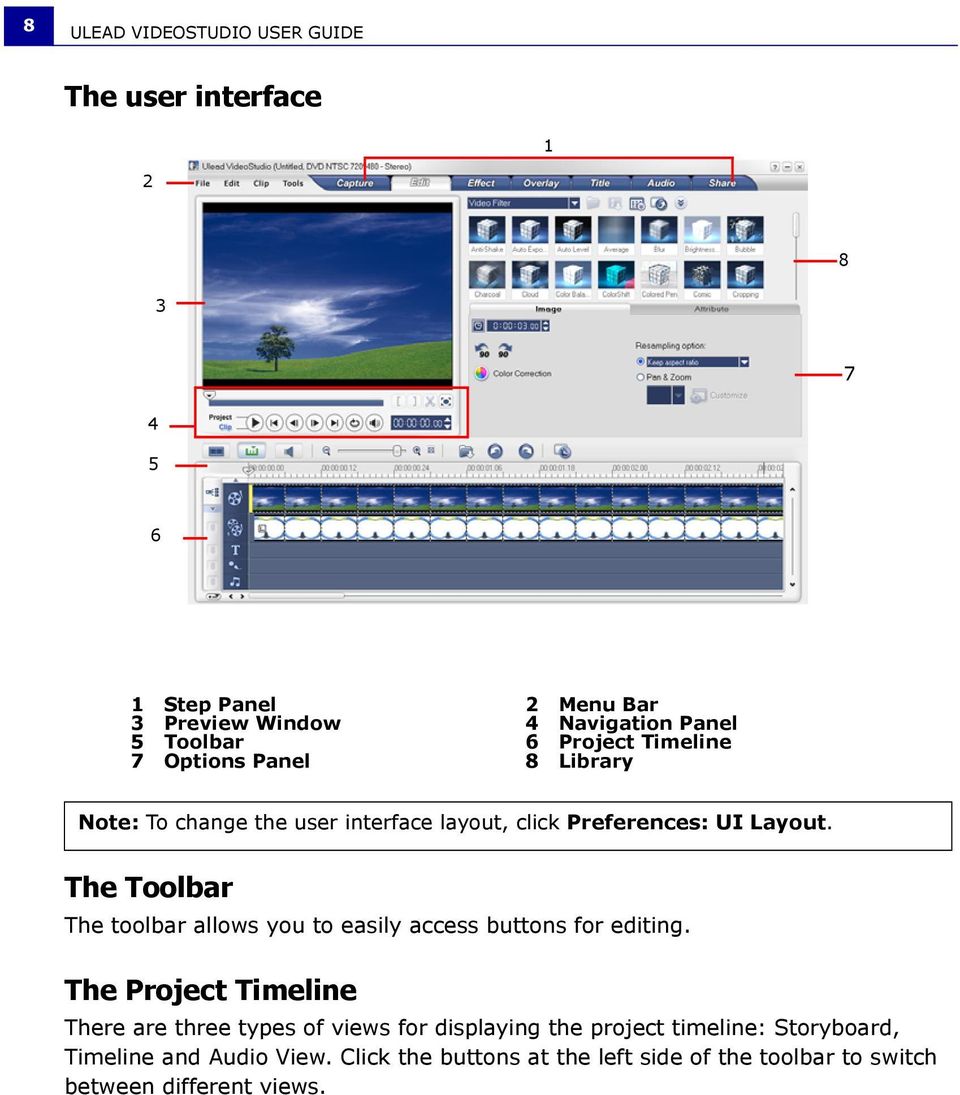
8 8 ULEAD VIDEOSTUDIO USER GUIDE The user interface Step Panel 2 Menu Bar 3 Preview Window 4 Navigation Panel 5 Toolbar 6 Project Timeline 7 Options Panel 8 Library Note: To change the user interface layout, click Preferences: UI Layout. The Toolbar The toolbar allows you to easily access buttons for editing. The Project Timeline There are three types of views for displaying the project timeline: Storyboard, Timeline and Audio View. Click the buttons at the left side of the toolbar to switch between different views.
9 ULEAD VIDEOSTUDIO USER GUIDE 9 Storyboard View Storyboard View is the fastest and simplest way to add video clips to your movie. You can drag and drop video clips to insert and arrange them. Transition effects can be inserted between video clips. A selected video clip can be trimmed in the Preview Window. Click Enlarge to maximize the storyboard display. Timeline View Timeline View gives you the most comprehensive display of the elements in your movie project. It divides a project into a separate tracks for video, overlay, title, voice and music. To switch to different tracks: Click a Step button in the Step Panel that corresponds to the track. Click the Track buttons. Double-click the desired track, or click a clip on the track. Audio View Audio View allows you to visually adjust the volume levels of video, voice and music clips. Clips that contain audio are displayed with a volume rubber band that you can click and drag to adjust their volume. Starting a new movie project When you run VideoStudio, it automatically opens a new project and lets you start composing your movie production. A new project always uses VideoStudio's default settings. To check what these settings are, click File: Project Properties. Setting your preferences Customize the program's working environment through the Preferences dialog box. You can specify a working folder for saving files, set undo levels, choose preferred settings for program behavior and more. To open the Preferences dialog box, select File: Preferences [F6].

10 10 ULEAD VIDEOSTUDIO USER GUIDE Setting project properties Project Properties serve as your template for previewing your movie projects. The project settings in the Project Properties dialog box determine the appearance and quality of a project when it is previewed on-screen. To customize project settings, select File: Project Properties. Adding clips There are three ways you can do to add clips to your project: Capture video clips from a video source. The video clips will be inserted onto the Video Track. Drag clips from the Library onto the correct tracks. Click to directly insert media files to the different tracks. Previewing The Play button in the Navigation Panel serves two purposes: for playback of your entire project or a selected clip. To play back, click Project or Clip, then click Play. VideoStudio offers you two preview options: Instant Playback and High Quality Playback. Select File: Preferences - General, then choose the preview method that you prefer in Playback method. Saving your project While composing your movie project, select File: Save [Ctrl + S] to frequently save your project. To automatically save your work, select File: Preferences then select Auto save duration and specify the time interval between saves.

11 ULEAD VIDEOSTUDIO USER GUIDE 11 Capture The steps on how to capture is similar for all types of video sources except for the available capture settings in the Capture Video Options Panel that can be selected for each type of source. To capture video: 1. Click the Capture Step then click Capture Video. 2. To specify a capture duration, enter the values in the Duration box in the Options Panel. 3. Select your capture device from the Source list. 4. Select a file format to use for saving your captured video from the Format list. 5. Specify a Capture folder in which to save video files. 6. Click Options to open a menu for customizing more capture settings. 7. Scan your video to search the part to capture. 8. When you get to the part of the video that you want to capture, click Capture Video to start capturing. 9. If you specified a capture duration, wait for the capture to complete. Otherwise, click Stop Capture or press [Esc] to stop capturing. Notes: When your camcorder is in Record mode (usually named CAMERA or MOVIE), you can capture live video. The available settings in the Video and Audio Capture Property Settings dialog box vary, depending on the capture file format that you have chosen. Digital Video (DV) To capture Digital Video (DV) in its native format, select DV from the Format list in the Options Panel. This saves the captured video as a DV AVI file (.AVI). Note: You can also use the DV Quick Scan option to capture DV video.

12 12 ULEAD VIDEOSTUDIO USER GUIDE DV AVI type-1 and type-2 When capturing DV, click Options in the Options Panel to open a menu, then select DV Type in the menu and choose whether to capture DV as DV type-1 or DV type-2. Split by scene It often happens that a single DV tape contains several footage that were shot at different times. VideoStudio saves you the hassle of having to capture the segments one by one then save them as separate files. The Split by scene feature will do that job for you. To use Split by scene option in Capture Step: 1. Select the Split by scene option in the Options Panel. 2. Click Capture Video. VideoStudio will automatically look for the scenes according to their shooting date and time and capture them as separate files. DV Quick Scan Use this option to scan a DV device for scenes to import. Importing from DVD/DVD-VR You can import DVD/DVD-VR formatted video from a disc or from your hard drive into VideoStudio. To import from DVD/DVD-VR: 1. Click the Capture Step then click Import from DVD/DVD-VR. 2. Select your DVD drive and then click Import DVD Folder. 3. Specify the location of the DVD folder in the Browse for folder window then click OK. 4. In the Import DVD window, select which DVD tracks to import in Label. Use the preview screen to view the selected tracks to import. 5. Click Import to finish. All imported videos will be added to the thumbnail list in the Library.

13 ULEAD VIDEOSTUDIO USER GUIDE 13 Edit The Edit Step is where you arrange, edit and trim the video clips used in your project. Adding clips to the Video Track You only work on the Video Track when you are in the Edit Step. On the Video Track, you can insert three types of clips: video, image and color clips. Video clips There are several ways of inserting video clips on the Video Track: Select a clip in the Library and drag and drop it to the Video Track. Multiple clips can be selected by pressing [Shift] or [Ctrl]. Right-click a clip in the Library then select Insert To: Video Track. Select one or more video files in Windows Explorer then drag and drop to the Video Track. To insert a clip from a file folder directly to the Video Track, click Insert Media Files located to the left of the Timeline. Images The ways of adding still images to the Video Track are the same as when adding video clips. Color clips Color clips are solid colored backgrounds that are useful for titles. For example, insert a black color clip as background for end credits. You can use the preset color clips or create new color clips in the Library. Trimming a clip There are three ways of trimming a clip:
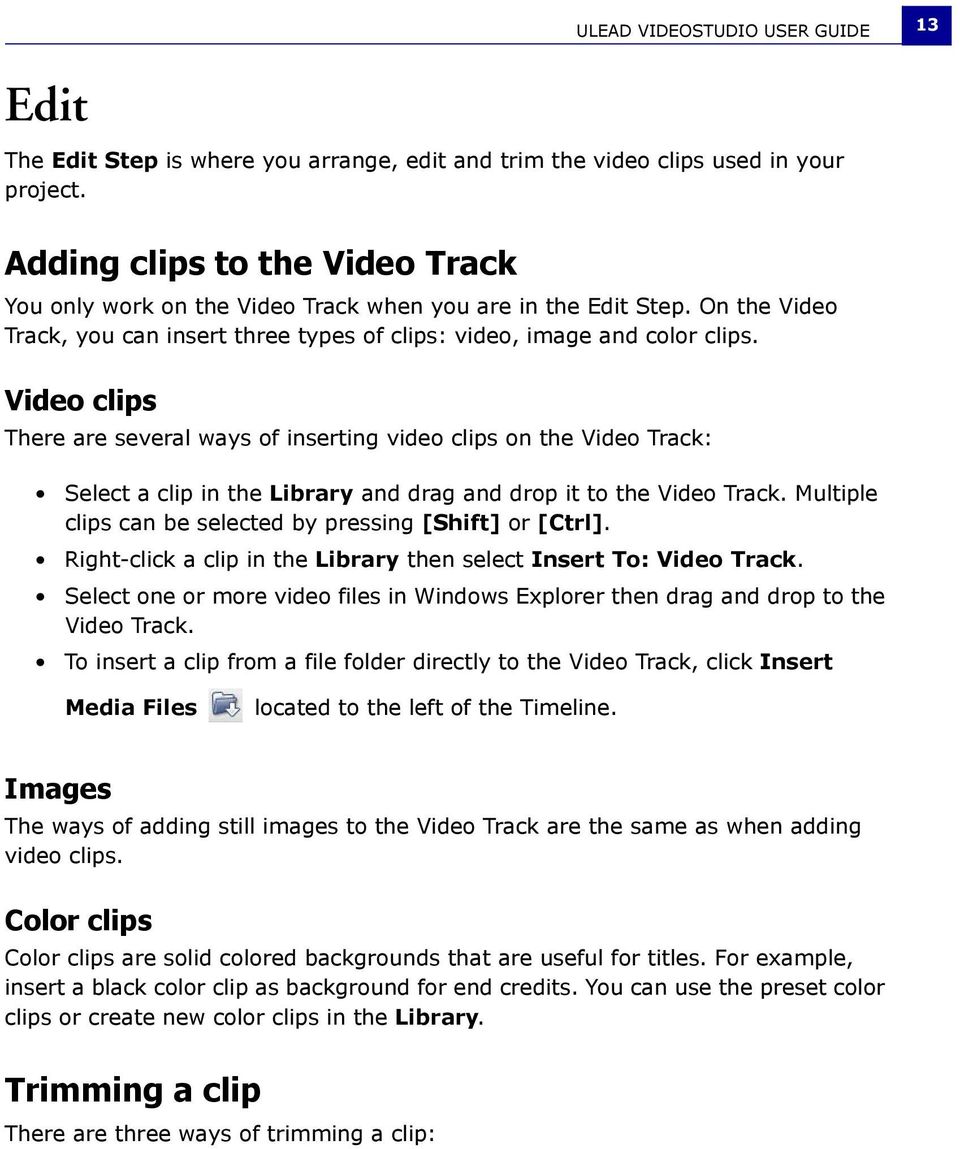
14 14 ULEAD VIDEOSTUDIO USER GUIDE To split a clip into two: 1. Select the clip you want to split on the Storyboard or Timeline. 2. Drag the Jog Slider to the point where you want to cut the clip. Tip: Click or to set the cutting point more precisely. 3. Click to cut the clip into two clips. To remove one of these clips, select the unwanted clip and press [Delete]. To trim a clip with the Trim Handles: 1. Select a clip on the Storyboard or Timeline. 2. Click and drag the Trim handles to set the Mark-in/Mark-out points on the clip. For more precise trimming, click on a Trim handle, hold it, and use the left or right arrow keys on your keyboard to trim one frame at a time.. Trim handles Mark-in/ Mark-out To trim a clip directly on the Timeline: 1. Click a clip in the Timeline to select it.
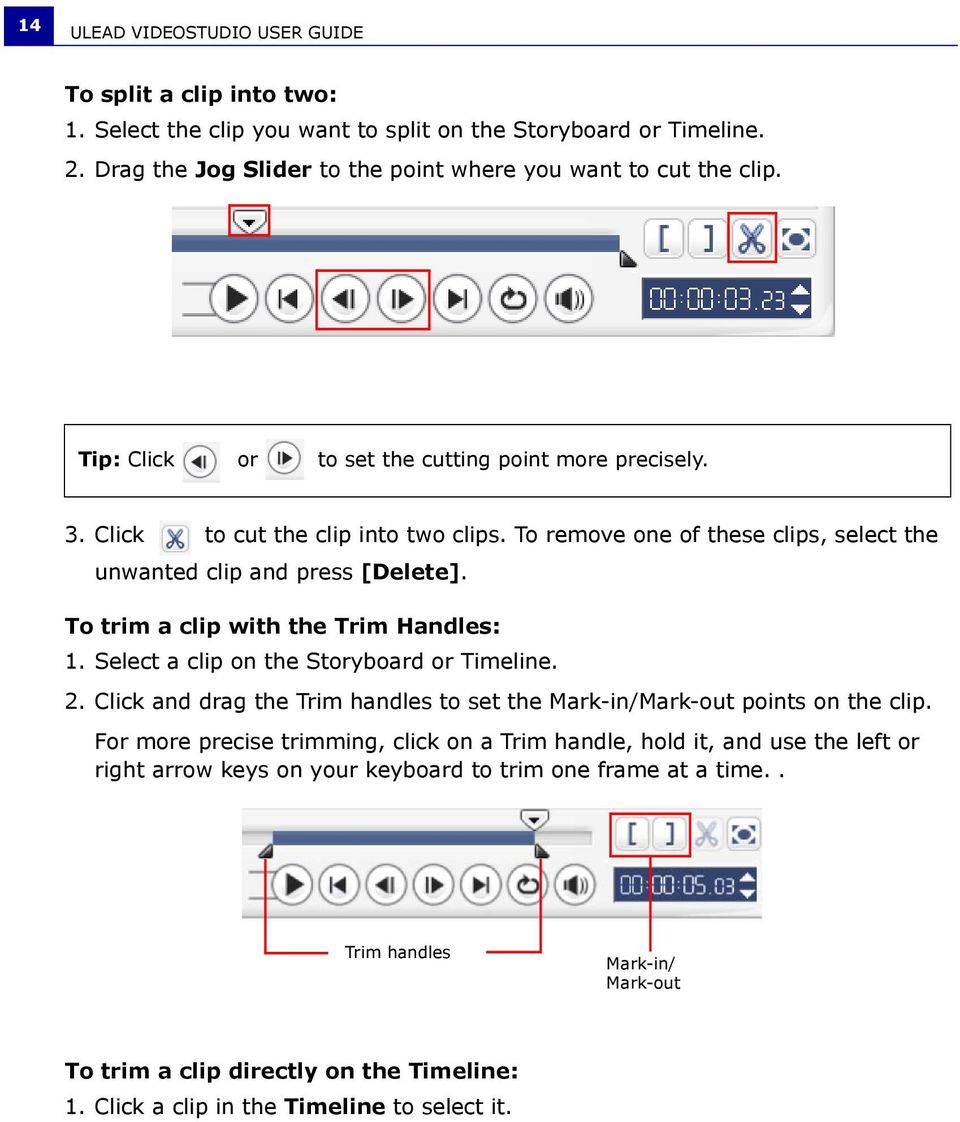
15 ULEAD VIDEOSTUDIO USER GUIDE Drag the yellow Trim handles on either side of the clip to change its length. Or, click the timecode in the Duration box in the Options Panel and enter the desired clip length Duration Trim Handles 3. Other clips in your project automatically reposition themselves according to changes made. Note: Changes made in the video Duration box only affect the Mark-out point. The Mark-in point remains unchanged. Saving trimmed clips To save, select a trimmed clip in the Storyboard, Timeline or the Library and select Clip: Save Trimmed Video. Ripple Editing Ripple Editing allows you to insert clips while automatically moving other clips (including empty spaces) aside, to make room for it on the Timeline. Use this mode to maintain the original track synchronizations when inserting additional clips. Ripple Editing is enabled for the tracks where content is inserted.

16 16 ULEAD VIDEOSTUDIO USER GUIDE A color clip is inserted before the original clip and all clips where Ripple Editing is applied shift accordingly To insert clips in Ripple Editing mode: 1. Click Ripple Editing to activate the panel, then select the corresponding box for each track where you want to apply Ripple Editing. 2. Drag the clip to insert from the Library to the desired position on the Timeline. As soon as the new clip is in place, all clips where Ripple Editing is applied will shift accordingly while maintaining their track positions relative to one another. Note: Ripple Editing can be applied from any of the three project views. Adding chapters using Chapter Point Bar To edit a chapter, click on a chapter pointer you want to edit and drag to a new position. To rename, double click a chapter pointer and then enter a new chapter name. Click OK. To remove, simply drag the pointer outside the timeline ruler and then drop. Converting multiple files Batch Convert allows you to simultaneously convert a large number of files to another format. To do Batch Convert: 1. Click. 2. Click Add and then choose the files you want to convert.

17 ULEAD VIDEOSTUDIO USER GUIDE Select an output folder in Save in folder. 4. In Save as type, choose your desired output type. 5. Click Convert. 6. The result is shown in the Task Report dialog box. Click OK to finish. Playback Speed Set your video in slow motion to emphasize a movement, or set it to play at lightning speed and give your movie a comical air. Simply adjust the speed attributes for your video clip by clicking Playback Speed under the Options Panel of the Edit Step. Drag the slider according to your preferences (i.e., slow, normal or fast), or enter a value. You can also specify a set duration for the clip in Time stretch. Click OK when finished. Tip: Hold [Shift] then drag the end of the clip on the Timeline to change the playback speed. Split by Scene Use the Split by Scene feature in the Edit Step to detect different scenes in a video file and automatically break it down into several clip files. The way VideoStudio detects scenes depends on the type of video file. In a captured DV AVI file, scenes can be detected in two ways: DV Recording Time Scan detects scenes according to their shooting date and time. Frame Content detects content changes, such as motion change, camera shifting, brightness change, etc., and splits them into separate files. In an MPEG-1 or MPEG-2 file, scenes can only be detected based on content changes (i.e., by Frame Content). To use Split by Scene on a DV AVI or MPEG file: 1. Go to the Edit Step and select a captured DV AVI file or an MPEG file in the Timeline.
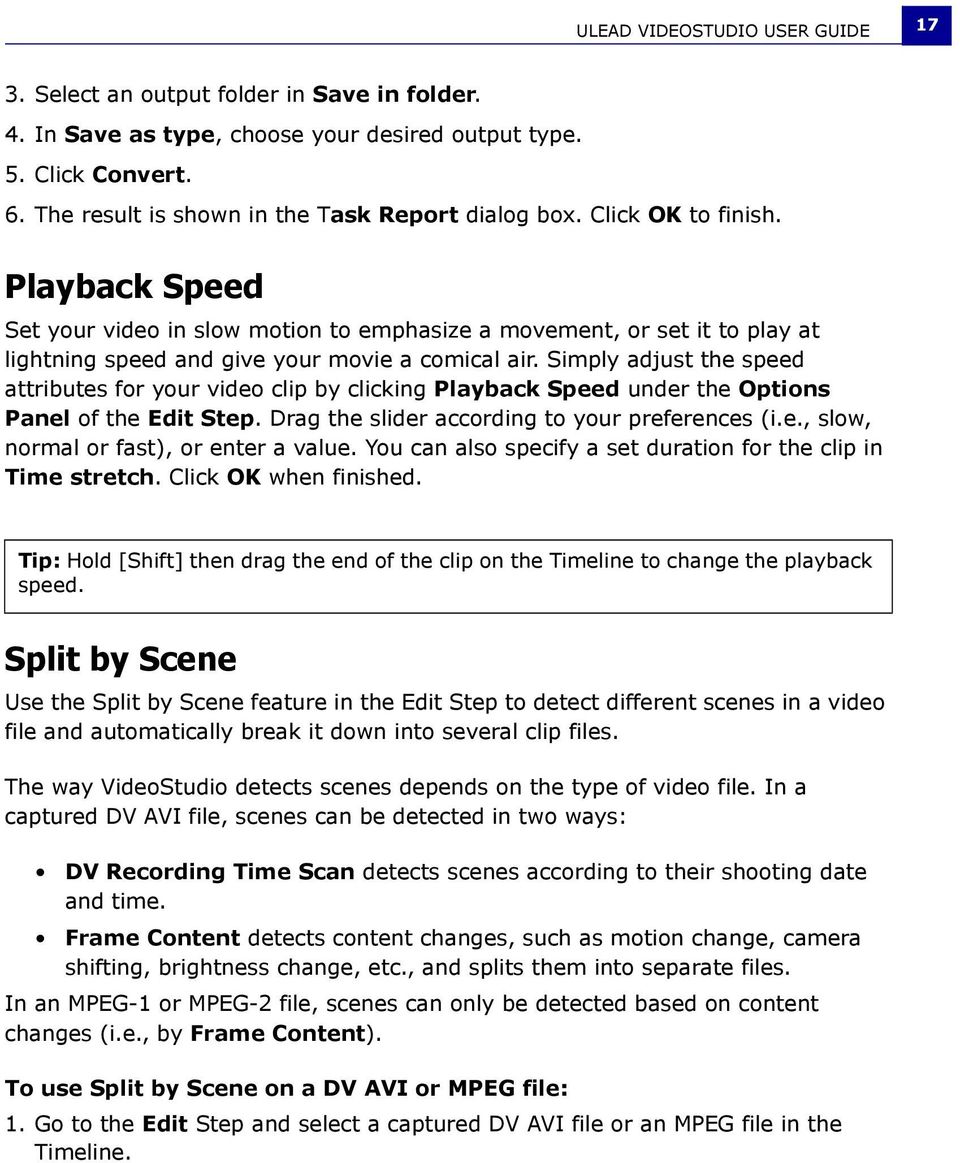
18 18 ULEAD VIDEOSTUDIO USER GUIDE 2. Click Split by Scene in the Options Panel. This will open the Scenes dialog box. 3. Choose your preferred scan method (DV Recording Time Scan or Frame Content). 4. Click Options. In the Scene Scanning Sensitivity dialog box, drag the slider to set the Sensitivity level. A higher value means more precision in the scene detection. 5. Click OK. 6. Click Scan. VideoStudio then scans through the video file and lists all the detected scenes. 7. Click OK to split the video. Multi-trimming your video The Multi-trim Video feature is another method for breaking down a clip into multiple segments. While Split by Scene is automatically done by the program, Multi-trim Video gives you complete control over the clips you wish to extract, making it even easier for you to manage your project.

19 ULEAD VIDEOSTUDIO USER GUIDE Timeline zoom Drag up and down to sub-divide a video clip into frames per second. 3 Jog Wheel Use to scroll to different parts of the clip. 2 AccuCut Timeline Scan a video clip frame by frame for accurate mark-in and mark-out positions. 4 Shuttle Slider Preview the clip at different playback speeds. To trim a video file into multiple clips: 1. Go to the Edit Step and click Multi-trim Video in the Options Panel. 2. In the Multi-trim Video dialog box, view the whole clip first by clicking to determine how you want to mark segments. 3. Choose the number of frames to display by dragging the Timeline zoom. You can choose to display the smallest subdivision of one frame per second.
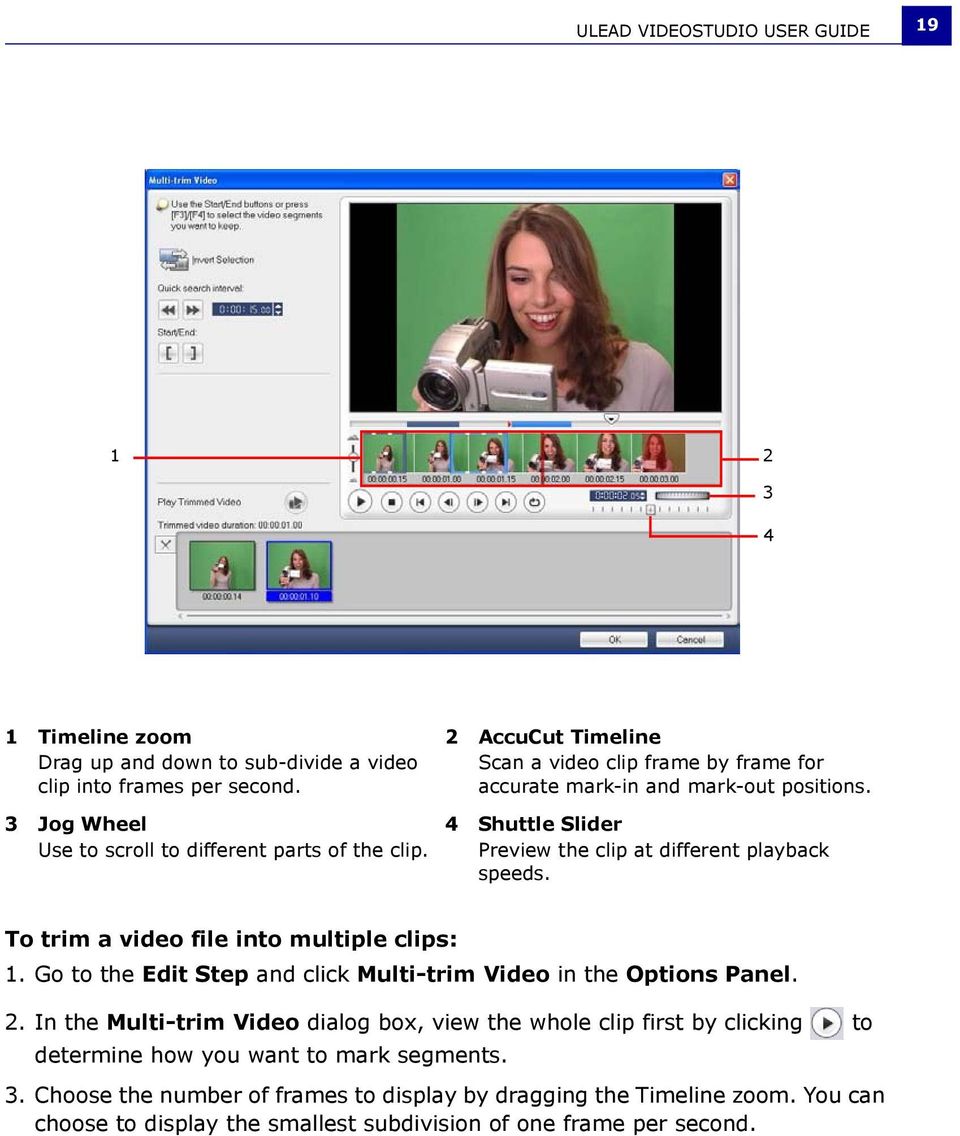
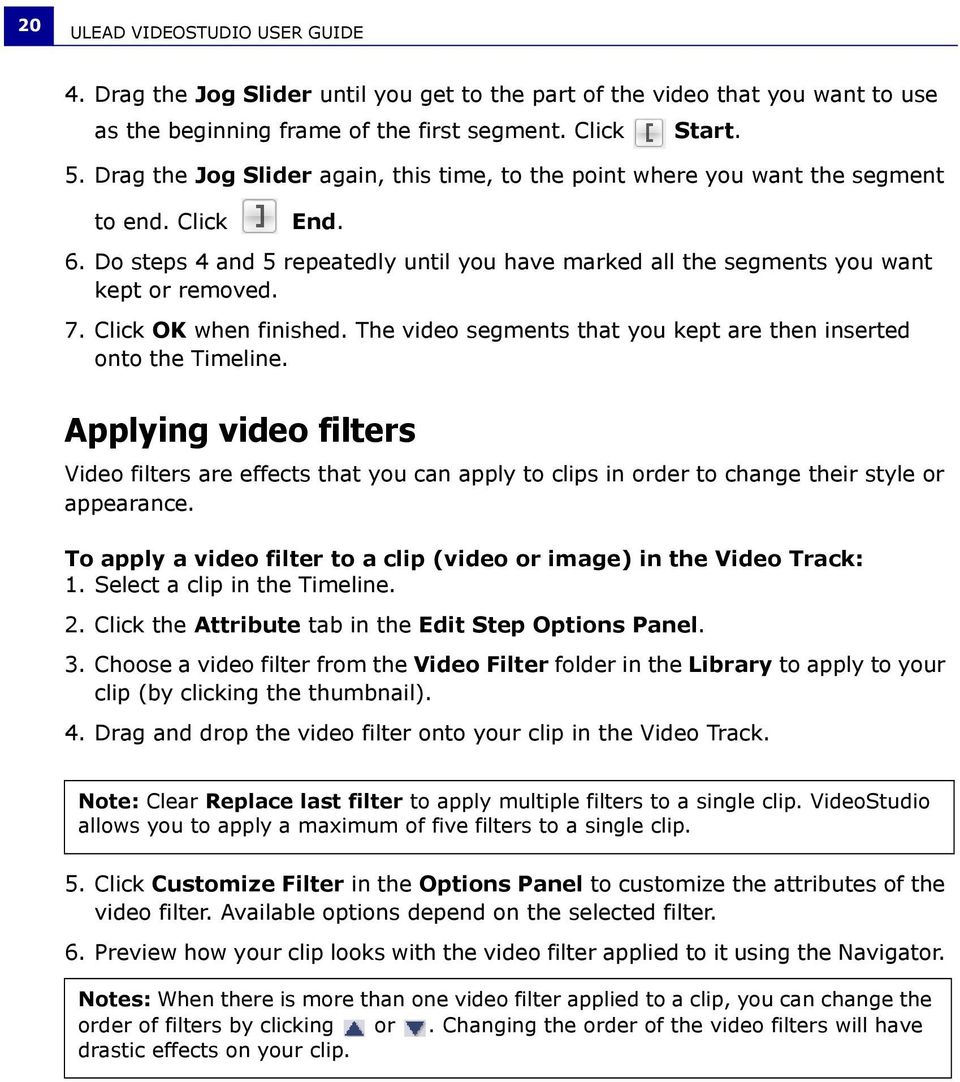
20 20 ULEAD VIDEOSTUDIO USER GUIDE 4. Drag the Jog Slider until you get to the part of the video that you want to use as the beginning frame of the first segment. Click Start. 5. Drag the Jog Slider again, this time, to the point where you want the segment to end. Click End. 6. Do steps 4 and 5 repeatedly until you have marked all the segments you want kept or removed. 7. Click OK when finished. The video segments that you kept are then inserted onto the Timeline. Applying video filters Video filters are effects that you can apply to clips in order to change their style or appearance. To apply a video filter to a clip (video or image) in the Video Track: 1. Select a clip in the Timeline. 2. Click the Attribute tab in the Edit Step Options Panel. 3. Choose a video filter from the Video Filter folder in the Library to apply to your clip (by clicking the thumbnail). 4. Drag and drop the video filter onto your clip in the Video Track. Note: Clear Replace last filter to apply multiple filters to a single clip. VideoStudio allows you to apply a maximum of five filters to a single clip. 5. Click Customize Filter in the Options Panel to customize the attributes of the video filter. Available options depend on the selected filter. 6. Preview how your clip looks with the video filter applied to it using the Navigator. Notes: When there is more than one video filter applied to a clip, you can change the order of filters by clicking or. Changing the order of the video filters will have drastic effects on your clip.
21 ULEAD VIDEOSTUDIO USER GUIDE 21 Key frame settings Key frames are frames in a clip where you can specify a different attribute or behavior for your video filter. This gives you the flexibility to determine how your video filter will look like at any point in a clip. To set key frames for your clips: 1. Drag and drop a video filter from the Library onto a clip in the Timeline. 2. Click Customize Filter. The dialog box for the video filter opens. Note: Settings available in the dialog box are different for each video filter. 3. In the Key frame controls, drag the Jog Slider or use the arrows to go to the frame where you'd like to change the attributes of your video filter. Key frame Controls Note: You can use the mouse wheel to zoom in or out of the Timeline Control bar for precise placement of key frames. 4. Click Add key frame to set that frame as a key frame in the clip. You can adjust the video filter settings for that particular frame. Note: A diamond-shaped mark on the Timeline Control bar will appear. This indicates the frame is a key frame in the clip. 5. Repeat steps 3 and 4 to add more key frames to your clip. 6. Click OK when finished.
22 22 ULEAD VIDEOSTUDIO USER GUIDE Tip: You can preview the clip with applied video filter on VideoStudio s Preview Window or an external device such as a TV monitor or DV camcorder. Click, then click to open the Preview Playback Options dialog box where you can choose the display medium. Pan & Zoom Pan & Zoom is applied to still images, and it emulates the pan and zoom effect of a video camera. To apply this effect to an image, select an image clip in the Timeline, then select Pan & Zoom and click Customize Pan & Zoom. Note: Pan & Zoom cannot be applied to masked images. In the Pan & Zoom dialog box, the crosshairs in the Image Window represent the key frames in the image clip where settings can be customized to produce the pan and zoom effect. When customizing each key frame, use the Image Window to focus on an area or to pan the image; use the Options tab settings to customize the zooming effect.
23 ULEAD VIDEOSTUDIO USER GUIDE 23 To apply Pan & Zoom: 1. Drag the Start key frame, represented by a crosshair in the Image Window, to the subject that you want to focus. Image Preview 2. Zoom in on the subject by minimizing the marquee box or by increasing the Zoom ratio. Image Preview 3. Drag the crosshair of the End key frame to your desired final point. Image Preview 4. Click to preview the effect. 5. Click OK to apply the effect to the image.
24 24 ULEAD VIDEOSTUDIO USER GUIDE Effect Transition effects make your movie smoothly change from one scene to the next. They are applied between clips in the Video Track and their attributes can be modified in the Options Panel. Effective use of this feature can add a professional touch to your movie. Adding transitions The Library provides a wide range of preset transitions from crossfades to explosions that you can add to your project. You can add transitions either in Storyboard View or Timeline View. Note: By default, you need to manually add transitions to your project. If you want VideoStudio to automatically add transitions between clips, select File: Preferences - General then select Use default transition effect. This saves you time in selecting transitions, especially when you are creating a slideshow project that contains images only, since transitions are randomly chosen from the Library and automatically added between images. To add a transition: 1. Click the Effect Step, then select one of the categories of transitions from the Folders list.
25 ULEAD VIDEOSTUDIO USER GUIDE Scroll through the effects thumbnails in the Library. Select and drag an effect to the Timeline, roughly between two video clips. Drop your effect and it will snap into place. You can only drag and drop one clip at a time. Tip: Double-clicking a transition in the Library automatically inserts it into the first empty transition slot between two clips. Repeating this process will insert a transition into the next empty transition slot. To replace a transition in your project, drag the new transition from the Library onto the transition thumbnail to be replaced on the Storyboard or Timeline.
26 26 ULEAD VIDEOSTUDIO USER GUIDE Overlay The Overlay Step allows you to add overlay clips to combine with your videos in the Video Track. Use an overlay clip to create a picture-in-picture effect or add a lower-third graphic to create more professional-looking movie productions. Adding clips to the Overlay Track Drag media files to the Overlay Track on the Timeline to add them as overlay clips for your project. To add a clip to the Overlay Track: 1. In the Library, select the media folder that contains the overlay clip that you want to add to your project. Tip: To load media files into the Library, click locate the media file and click Open.. In the dialog box that opens, 2. Drag the media file from the Library to the Overlay Track on the Timeline. Tips: To insert a media file directly to the Overlay Track, right-click the Overlay Track and select the type of file you want to add. The file will not be added into the Library. You can also use color clips as overlay clips. 3. Customize the overlay clip using the options available in the Edit tab.
27 ULEAD VIDEOSTUDIO USER GUIDE Click the Attribute tab. The overlay clip is then resized to a preset size and positioned at the center. Use the options in the Attribute tab to apply motion to the overlay clip, add filters, resize and reposition the clip, and more. Tips: To make overlay clips with transparent backgrounds, you can create a 32-bit alpha channel AVI video file or an image file with an alpha channel. You can use an animation program such as Ulead COOL 3D Production Studio or an image editing program such as Ulead PhotoImpact to create these video and image files. Another alternative is to use VideoStudio s Mask & Chroma Key function to mask a specific color on an image. To apply motion to the current overlay clip: In the Attribute tab, select where the overlay clip will Enter and Exit the screen under Direction/Style. Click a specific arrow as to where you want your clip to enter and exit in your movie. Tip: Pause Duration determines how long your pause will be in the designated area before the clip exists the screen. If you applied motion to the overlay clip, drag the Trim handles to set the Pause Duration. Pause Duration To apply transparency to the current overlay clip: In the Attribute tab, click Mask & Chroma Key to go to the Overlay Options Panel. Drag the Transparency slider to set the opacity of the overlay clip.
28 28 ULEAD VIDEOSTUDIO USER GUIDE To specify Chroma Key settings to the current overlay clip: 1. Click Mask & Chroma Key in the Attribute tab to go to the Overlay Options Panel. 2. Select Apply Overlay Options then Chroma Key in Type. 3. Click the Color Box then select the color to be rendered as transparent. Without Chroma Key With Chroma Key Tips: Select then click on a color in the image that will be rendered as transparent. Drag the Similarity Slider to specify the color range of the selected color that will be rendered as transparent. To add a border around the current overlay clip: In the Attribute tab, click Mask & Chroma Key to go to the Overlay Options Panel. Drag the Border slider to set the thickness of the border of the overlay clip. Set the color of the border by clicking the Color Box beside the slider.
29 ULEAD VIDEOSTUDIO USER GUIDE 29 To resize the current overlay clip: In the Attribute tab, drag a handle on the overlay clip on the Preview Window to resize it. If you drag a yellow corner handle, it will keep the aspect ratio when you resize the clip. It is recommended that you keep the overlay clip within the title safe area. You can also right-click the overlay clip on the Preview Window to open a menu where you can resize the overlay clip to keep the aspect ratio, revert it to the default size, use the original size of the overlay clip, or resize it to occupy the entire screen. The Keep Aspect Ratio option resizes the overlay clip based on the width or height, depending on which is longer in length, of the overlay clip. longer side Note: When you resize the overlay clip then go back to the Edit tab, the clip will appear to have resized back to its original size. This is only for editing purposes, the overlay clip retains its properties. To reposition the current overlay clip: In the Attribute tab, drag the overlay clip to the desired area on the Preview Window. You can also right-click the overlay clip on the Preview Window to open a menu where you can automatically place the overlay clip in a preset position on the video. It is recommended that you keep the overlay clip within the title safe area.
30 30 ULEAD VIDEOSTUDIO USER GUIDE To apply a filter to the current overlay clip: You can apply video filters to your overlay clips. For more details on how to apply, you can refer to Edit: Applying video filters. To use the same attributes for different overlay clips: You can use the attributes (size and position) of one overlay clip and apply it to a different overlay clip on your movie project. To apply the same attributes, first right-click the source overlay clip then select Copy Attributes. Next, right-click the target overlay clip then select Paste Attributes. Adding Objects or Frames Add decorative objects or frames for your videos as overlay clips. To add an object or frame: 1. In the Library, select Decoration: Object/Frame in the Folder list. 2. Select an object/frame then drag it onto the Overlay Track on the Timeline. 3. Click the Attribute tab to resize and reposition the object/frame. Object Frame Adding Flash animations Give more life to your videos by adding Flash animations as overlay clips. To add a Flash animation: 1. In the Library, select Flash Animation in the Folder list.
31 ULEAD VIDEOSTUDIO USER GUIDE Select a Flash animation then drag it onto the Overlay Track on the Timeline. 3. Click the Attribute tab to resize and reposition the object/frame. To customize the current object, frame, or Flash animation: Use the various options available in the Edit and Attribute tabs to customize your object and frame. You can add animation, apply transparency, resize the object or frame, and more.
32 32 ULEAD VIDEOSTUDIO USER GUIDE Title While a picture may be worth a thousand words, the text in your video production (i.e., subtitles, opening and closing credits, etc.) adds to the clarity and comprehensibility of your movie. In VideoStudio's Title Step, create professionallooking titles, complete with special effects, in minutes. Adding text Ulead VideoStudio allows you to add text either in multiple text boxes or in a single text box. Using multiple text boxes gives you the flexibility to position the different words of your text anywhere on the video frame and allows you to arrange the stacking order of the text. Use a single text box when you are creating opening titles and end credits for your projects. To add multiple titles: 1. In the Options Panel, select Multiple titles. 2. Use the buttons in the Navigation Panel to scan your movie and select the frame where you want to add the title. 3. Double-click the Preview Window and type in your text. Click outside the text box when you are done typing. To add another set of text, double-click again on the Preview Window. 4. Repeat step 3 to add more sets of text.
33 ULEAD VIDEOSTUDIO USER GUIDE 33 If you switch to Single title before adding to the Timeline the multiple text that you entered, only the selected text or the first text that you typed in (when no text box is selected) will be retained. The other text boxes will be removed and the Text backdrop option will be disabled. To add a single title: 1. In the Options Panel, select Single title. 2. Use the buttons in the Navigation Panel to scan your movie and select the frame where you want to add the title. Double-click the Preview Window and type in your text. 3. In the Options Panel, set the Line spacing. 4. When you are done typing the text, click the Timeline to add the text to your project. It is recommended to keep your text within the title safe area. The title safe area is the rectangular box on the Preview Window. By keeping the text within the bounds of the title safe area, the whole text will not be truncated when viewed on a TV screen. You can display or hide the title safe area by selecting File: Preferences - General tab - Display title safe area in Preview Window. To edit the text: For single titles, select the title clip on the Title Track and click the Preview Window.
34 34 ULEAD VIDEOSTUDIO USER GUIDE For multiple titles, select the title clip on the Title Track and click the Preview Window then click the text that you want to edit. Notes: Once a title clip has been inserted onto the Timeline, you can adjust its duration by either dragging the handles of the clip, or entering a Duration value in the Options Panel. To see how the title appears on the underlying video clip, select the title clip and then click Play Trimmed Clip or drag the Jog Slider. Tip: When you are creating multiple title clips that share the same attributes such as font type and style, it is a good rule of thumb to store one copy of your title clip in the Library. (Just drag and drop the title clip from the Timeline into the Library.) This way, you can easily duplicate the title clip (by dragging it from the Library back onto the Title Track) and then change the title. To add preset text to your project: The Library contains various preset text that you can use for your projects. To use these preset text, select Title in the Library Folder list then drag the preset text onto the Title Track. To insert subtitles to your project: You can also use your own movie subtitle files for your project. To insert your own, click Open Subtitle File. In the Open dialog box, locate the file you want to use and click Open. To save text files: Saving movie subtitles allows you to reuse them in the future. Click Save Subtitle File to open the Save As dialog box. Locate where to save your movie subtitle and click Save. Note: Movie subtitles will automatically be saved as *.utf files.
35 ULEAD VIDEOSTUDIO USER GUIDE 35 Modifying text attributes Modify the attributes of your text, such as font face, style, size, and more, by using the available settings in the Options Panel. More options allow you to set the style and alignment, apply a Border, Shadow and Transparency and add a Text backdrop to your text. A text backdrop superimposes your text on a horizontal color bar that stretches across the video frame. Click to open the Text Backdrop dialog box to select whether to use a solid or gradient color and to set the transparency of the text backdrop. To rearrange the stacking order for multiple titles: In the Preview Window, click the text box you want to rearrange. After selecting, right-click it then on the menu that opens, select how you want to restack the text. To reposition a text in a multiple-title clip: Drag the text box to the new position.
36 36 ULEAD VIDEOSTUDIO USER GUIDE Applying animation Apply motion to your text with VideoStudio s text animation tools such as Fade, Moving Path, and Drop. To apply animation to the current text: 1. In the Animation tab, select Apply Animation. 2. Select the animation category to use in Type. 3. Select a preset animation from the box under Type. Tip: Click to open a dialog box where you can specify animation attributes. 4. Drag the Pause duration handles to specify how long the text will pause after it enters and before it exits the screen.
37 ULEAD VIDEOSTUDIO USER GUIDE 37 Audio Sounds are one of the elements that determine the success of your video production. VideoStudio's Audio Step allows you to add both narration and music to your project. The Audio Step consists of two tracks: Voice and Music. Insert your narrations on the Voice Track and your background music or sound effects on the Music Track. Adding voiceover narration Documentaries and news features often use narrations to help the audience understand what is going on in the video. VideoStudio allows you to record your own narration with crisp and clear results. To add voiceover narration: 1. Click the Music & Voice tab. 2. Move to the section of the video where you want to insert your narration by using the Jog Slider. Note: You cannot record over an existing clip. When a clip is selected, recording is disabled. Make sure that a clip is not selected by clicking on an empty area on the Timeline. 3. Click Record Voice. The Adjust Volume dialog box appears. 4. Speak into the microphone and check if the meter responds accordingly. Use the Windows audio mixer to adjust the volume of the microphone. 5. Click Start and begin speaking into the microphone. 6. Press [Esc] or click Stop to stop recording. Tip: The best way to record narrations is to do the recording in 10 to 15-second sessions. This makes it easier to remove a badly recorded narration and redo it. To remove, just select the clip on the Timeline and press [Delete].
38 38 ULEAD VIDEOSTUDIO USER GUIDE Adding background music Set the tone of your movie with the background music of your choice. VideoStudio can record and convert song tracks from your CD into WAV files and then insert them onto the Timeline. VideoStudio also supports WMA, AVI, and other popular audio file formats which you can directly insert onto the Music Track. Importing music from an audio CD Capture music by importing from an audio CD. VideoStudio copies the CDA audio file then saves it in your hard drive as a WAV file. To import music from an audio CD: 1. Click Import from Audio CD in the Music & Voice tab to open the Rip CD Audio dialog box. To check if the disc is detected, see to it that Audio Drive is enabled. 2. Select the tracks to be imported in the Track List. 3. Click Browse and select the destination folder where the imported files will be saved. 4. Click Rip to start importing the audio tracks. To add third-party music: 1. Click the Auto Music tab. 2. Select how the program will search for music files in Scope. 3. Select the Library from where to import the music. 4. Under Music, select the music you want to use. 5. Select a Variation of the selected music. Click Play Selected Music to play back the music with the variation applied. 6. Set the Volume level then click Add to Timeline. Tip: Select Auto trim to automatically trim the audio clip to fit the empty space based on the Jog Slider position.
39 ULEAD VIDEOSTUDIO USER GUIDE 39 Adding audio files VideoStudio provides a separate Voice Track and Music Track but you may interchangeably insert voice and music files on either track. To insert, click and select Insert Audio. Choose which track to insert your audio file. Tip: Click Audio View for easier editing of your audio clips. The VideoStudio CD also comes with several audio clips ready for you to use. Click Load audio to add them to the Library for easy access. Trimming and cutting audio clips After recording voice and music, you can easily trim your audio clips on the Timeline. There are two ways to trim audio clips: On the Timeline, a selected audio clip has two yellow handles that can be used for trimming. Just grab a handle, either from the beginning or end, and drag it to shorten a clip. Drag the Trim handles. Tip: You can also trim a clip in the Library by using the Trim handles. Aside from trimming, you can also cut audio clips. Drag the Jog Slider to the position where you want to cut the audio clip then click Cut clip based on Jog Slider position. You can then delete the excess part of the clip.
40 40 ULEAD VIDEOSTUDIO USER GUIDE Tip: To play the trimmed portion of the clip, click Play Trimmed Clip. Note: VideoStudio also has an Auto-trim function. When you insert an audio clip between two existing clips in the Timeline, it will automatically be trimmed to fit the available space. Stretching audio duration The time stretch feature allows you to stretch an audio clip without distorting its pitch. Normally, stretching audio clips to fit the project results in a distorted sound. The time stretch feature will make the audio clip sound like it is just played in a slower tempo. Note: When you stretch an audio clip by %, the sound will not be distorted. However, if stretched below or above that range, the sound may be distorted. To stretch the duration of an audio clip: 1. Click the Music & Voice tab in the Options Panel. 2. Click Playback Speed to open the Playback Speed dialog box. 3. Enter a value in Speed or drag the slider to change the speed of the audio clip. A slower speed makes the clip s duration longer while a faster speed makes it shorter. Tips: You can specify how long the clip will play in Time stretch duration. The speed of the clip will automatically adjust to the specified duration. This feature will not trim the clip when you specify a shorter time. You can stretch the time of an audio clip in the Timeline by holding [Shift] then dragging the yellow handles on the selected clip.
41 ULEAD VIDEOSTUDIO USER GUIDE 41 Fade-in/out Background music that starts and ends gradually is commonly used to create smooth transitions. For each of your music clips, you can click and to fadein and fade-out the volume at the start and end of the clip. Mixing audio tracks The key to making narrations, background music, and existing audio of your video clips blend well together is to control the volume of your clips. Blend the different audio tracks in your project by using the Audio Step Options Panel or Audio View. Using the Clip Volume Control You will find the volume control in the Options Panel. Clip volume represents the percentage of the original recorded volume. Values range from 0 to 500%, where 0% completely silences the clip and 100% retains the original recorded volume.
42 42 ULEAD VIDEOSTUDIO USER GUIDE Duplicating an audio channel Audio files sometimes separate the vocal sound from the background audio and put them in different channels. Duplicating an audio channel allows you to mute the other channel. For example, the voice is on the left audio channel and the background music on the right. When you duplicate the right channel, it will mute the vocal part of the song leaving the background music to play. To duplicate an audio channel, select Duplicate audio channel in the Attribute tab in the Options Panel then select which audio channel to duplicate. Volume rubber banding The volume rubber band is the horizontal line in the middle of the track and can only be seen when you are in Audio View. You can use the rubber band to adjust the volume of the audio track of video clip and the audio clips in the Music and Voice tracks. To adjust the volume level using the rubber band: 1. Click Audio View. 2. On the Timeline, click the track whose volume level you want to adjust. 3. Click a point on the rubber band to add a key frame. This allows you to adjust the volume level of the track based on this key frame.
43 ULEAD VIDEOSTUDIO USER GUIDE Drag the key frame upwards/downwards to increase/decrease the volume level at this point of the clip. 5. Repeat steps 3 and 4 to add more key frames to the rubber band and to adjust the volume level. Applying audio filters VideoStudio allows you to apply filters such as Amplify, Long Echo, Normalize, Pitch Shift, Remove Noise, Reverb, Stadium and Volume Labeling to your audio clips in the Music and Voice tracks. You can only apply audio filters when you are in Timeline View. To apply audio filters: 1. Click Timeline View. 2. Select the audio clip on which to apply an audio filter. 3. In the Options Panel, click Audio Filter. This opens the Audio Filter dialog box. In the Available filters list, select the desired audio filters and click Add. Note: An audio filter can be customized if the Options button is enabled. Click Options to open a dialog box where you can define the settings for the particular audio filter. 4. Click OK.
44 44 ULEAD VIDEOSTUDIO USER GUIDE Share Render your project into a video file format that is suitable for your audience or purpose. You can export the rendered video file as a Web page, multimedia greeting card, or send it to a friend by . All these and more can be done in VideoStudio's Share Step. A DVD authoring wizard is also integrated in this step, enabling you to directly burn your project as a DVD, SVCD, or VCD. Creating movie templates Movie templates contain settings which define how to create the final movie file. By using the preset movie templates provided by Ulead VideoStudio, or by creating your own templates in the Make Movie Manager, you can have multiple variations of your final movie. For instance, you can create movie templates that provide high quality outputs for DVD and videotape recording, and also set up movie templates that give lower quality but acceptable outputs for different purposes, such as Web streaming and distribution. To create movie templates: 1. Select Tools: Make Movie Manager. The Make Movie Templates Manager dialog box opens. 2. Click New. In the New Template dialog box, select the File format and type in a Template name. Click OK. 3. In the Template Options dialog box, set the options you want in the General and AVI/Compression tabs. Note: The available options in the tabs will depend on the type of file format of the template.
45 ULEAD VIDEOSTUDIO USER GUIDE Click OK. Notes: Movie templates will appear in a selection menu when you click Create Video File in the Share Step. If you do not want to use a movie template, you can select Custom from the pop-up menu. This allows you to choose your own settings for creating the final movie or simply use the current project settings. To modify the settings of a movie template, click Edit in the Make Movie Manager dialog box. Creating and saving a video file Before rendering your entire project into a movie file, select File: Save or Save As to save it first as a VideoStudio project file (*.VSP). This allows you to return to your project anytime and make edits. If you want to preview your project before creating a movie file, switch to Project Mode and click Play in the Navigation Panel. How the project is played back depends on the option you have selected in File: Preferences - General tab - Playback method. To create a video file of the entire project: 1. Click Create Video File in the Options Panel. A selection menu of movie templates then opens.
46 46 ULEAD VIDEOSTUDIO USER GUIDE 2. To create a movie file using the current project settings, select Same as Project Settings. Or, select one of the preset movie templates. These templates let you create a movie file that is suitable for the Web or for output to DVD, SVCD or VCD. Note: To check current project settings, select File: Project Properties. To check the saving options provided by a movie template, select Tools: Make Movie Manager. You can also use the settings of the first video clip in the Video Track by selecting Same as First Video Clip. 3. Enter the desired file name for your movie and click Save. The movie file will then be saved and placed in the Video Library. Tip: To save on rendering time, use the same settings for your source video (e.g. captured video), VideoStudio project, and movie template. You can also render your project partially. SmartRender allows "changes only" rendering, eliminating the need to re-render an entire video sequence when slight modifications have been made. To create a video file of the preview range: 1. Click the ruler on top of the Timeline to make sure no clip is selected. 2. Select a preview range using the Trim Handle. Or, drag the triangle along the ruler then press [F3] and [F4] to mark the start and end points respectively. Trim Handle Note: A red line representing the selected range should appear on the ruler. 3. Click Create Video File in the Options Panel.
47 ULEAD VIDEOSTUDIO USER GUIDE Select a movie template. 5. In the Create Video File dialog box, click Options. In the Options dialog box, select Preview range. Click OK. 6. Enter a file name and click Save. Another method of partially rendering your project is to click Play-Project while holding down the [Shift] key. You don't have to be in the Share Step to do this. The selected range will be rendered then shown in the Preview Window. Doing this will create a temporary video file under the folder specified in the Preview tab of the Preferences dialog box. Burning a DVD, VCD or SVCD Click Create Disc in the Options Panel to output your project (together with other VideoStudio projects or videos) to create a DVD, VCD and SVCD. In the dialog box that opens, first choose an output format. Second, decide whether you want to add other projects and videos. See the following sections for more information. Notes: Your entire VideoStudio project can be brought into the Create Disc dialog box for burning even if you did not save it first as a.vsp file. Video will be adjusted to the correct aspect ratio (as specified in the Disc Templates Manager dialog box), and automatically letterboxed or pillarboxed to fit the correct aspect ratio.
48 48 ULEAD VIDEOSTUDIO USER GUIDE Mark-in Media Clip List Jog Slider Settings and options Set Mark-in/-out Project Settings Change display aspect ratio Navigation Panel Mark-out Assembling files Import videos or VideoStudio project files (VSP) you want to include in your final movie. To add videos: 1. Click Add video files. Locate the folder where the videos are, and then select one or more video clips you want to add.
49 ULEAD VIDEOSTUDIO USER GUIDE Click Open. Notes: You can add video formats such as AVI, QuickTime, and MPEG files. You can also add VCD video (DAT) files. After a video clip is added to the Media Clip List, sometimes you may see a black thumbnail. This is because the first scene (frame) of this video clip is a black screen. To change it, double-click to select this video clip and move the Jog Slider to the scene you want. Next, right-click the thumbnail and select Change Thumbnail. To add VideoStudio projects: 1. Click Add VideoStudio project files. Locate the folder where the projects are, and then select one or more video projects you want to add. 2. Click Open. You can trim a video and VideoStudio project using the Jog Slider, mark-in/out, and navigation controls. Trimming a video gives you the freedom to precisely edit the video length. Tip: You can also add videos from DVD/DVD-VR discs.
50 50 ULEAD VIDEOSTUDIO USER GUIDE Adding/Editing chapters This feature is only available when the Create menu option is selected. By adding chapters, you can create submenus linked to their associated video clip. Represented as a video thumbnail in a submenu, each chapter is like a bookmark for a video clip. When viewers click on a chapter, the playback of the video will start from the selected chapter. Notes: You can create up to 99 chapters for a video clip. If the Create menu option is not selected, you will be guided to the preview step immediately without creating any menus after clicking Next. When you are creating a disc with only one VideoStudio project or one video clip, do not select Use first clip as introductory video if you want to create menus. To create or edit chapters linked to a video clip: 1. Select a video in the Media Clip List. 2. Click Add/Edit Chapter.
51 ULEAD VIDEOSTUDIO USER GUIDE Drag the Jog Slider to move to a scene to set it as a chapter then click Add Chapter. Or, click Auto Add Chapters to let VideoStudio automatically select chapters. Tips: If you want to use Auto Add Chapters, your video must be at least one minute long or the video has scene change information. If you click Auto Add Chapters and your video is a DV-formatted AVI file captured from a DV camcorder, Ulead VideoStudio can automatically detect scene changes and add chapters accordingly. If the selected video is an MPEG-2 file with scene change information, Ulead VideoStudio automatically generates these chapters for you when you click Auto Add Chapters. 4. Repeat Step 3 to add more chapter points. You can also use Remove Chapter or Remove All Chapters to delete unwanted chapters. 5. Click OK. Creating selection menus In this step, you can create the main menu and submenus. These menus provide an interactive screen for your movie viewer to choose which video to watch. Ulead VideoStudio includes a set of menu templates for you to create your menus and submenus. Clip 1 Clip 2 Main menu Submenu #1
52 52 ULEAD VIDEOSTUDIO USER GUIDE In this example, Clip 1 has three chapters so when you click the Clip 1 video thumbnail, it will jump to submenu #1. If you look at Clip 2, it has no chapters assigned to it so when you click Clip 2, the video will start playing from the beginning. To edit menus: 1. By default, VideoStudio automatically makes all required menus for you. Use Currently displayed menu to switch to the menu you want to edit. 2. In the Gallery tab, click Menu template category and select a specific category. Click a particular template to apply. 3. Click "My Title" to customize the menu heading. You can also click the text description under each video thumbnail for customization. Note: If you do not modify My Title and the thumbnail descriptions or skip Step 2, there will be no menu heading and thumbnail text in the final output. 4. In the Edit tab, you can further customize your movie by adding background image, music or audio and by modifying font properties.
53 ULEAD VIDEOSTUDIO USER GUIDE 53 Tips: Select Motion Menu to enable motion attributes to the selected menu template. Click Layout Settings to specify whether to apply layout to all pages of the menu, reset the page, or reset all pages of the menu. Click Advanced Settings to specify whether to add a title menu, create a chapter menu, or display the thumbnail numbers in the Chapter List. Click Customize to apply pan & zoom, motion filter and, menu in and menu out effects. 5. When you're done, click Go to the preview step to preview the movie. Previewing Now, it's time to see how your movie looks like before you burn it onto a disc. Simply move the mouse and click Play to watch your movie and test the menu selection on your computer. Use the navigation controls here as you would on a standard remote control of a home DVD player. Tip: As you move between controls, a Tool Tip pops up and tells you its specific function. Burning your project onto a disc This is the final step in the disc creation process. You can burn your movie onto a disc, create a DVD folder structure on your hard drive so you can play the DVD
54 54 ULEAD VIDEOSTUDIO USER GUIDE movie on your computer or create a disc image file of your movie to save on your hard drive. Tip: For details about the different disc formats, you can refer to Appendix C: Technology Overview - DVD, VCD and SVCD. To burn your movie onto a disc: 1. Click Next after you preview your project. 2. Click Show more output options to show other output options. Select Create DVD folders to create folders for your project and specify their location. Select Create disc image file to make an ISO image file of the DVD for later use. Select Normalize audio to make sure that irregular audio levels during playback are prevented. 3. Click Burning Options to define additional burner and output settings. 4. Click Burn to start the burning process. 5. After successfully burning your disc, a dialog box appears from which you can select the next step. Close prompts you to save your work and close Ulead VideoStudio.
55 ULEAD VIDEOSTUDIO USER GUIDE 55 Burning options Disc burner Specify the settings for your burning device. Label Enter a volume name of up to 32 characters onto the CD/DVD. Drive Select the disc burner that you want to use to burn the video file. Copies Set the number of disc copies to burn. Disc type Displays the output disc format for the current project. Create to disc Select to burn your video project onto a disc. Recording format Select DVD-Video format to use the DVD industry standard. To quickly re-edit your disc without copying the file to the hard disk, select DVD-Video (fast re-editable) which still complies with the industry standard, and has very high compatibility when working with set-top home DVD players and computer DVD-ROM. Select DVD+VR for DVD players supporting this format. Create DVD folders This option is only enabled when the video file being created is a DVD-Video. The files created are in preparation for burning the video file to a DVD. This also allows the user to view the finished DVD file on the computer using a DVD-Video player software. Create disc image Select this option if you plan to burn the video file several times. By selecting this option, you don't have to generate the file again when you want to burn the same video file. Normalize audio Select to prevent irregular audio levels during playback of your movie. Different video clips may have different audio recording levels when created. When these video clips are put together, the volume could vary greatly from one to another. To make volume levels consistent between clips, Normalize audio function evaluates and adjusts the audio waveform of the whole project to assure a balance audio level throughout the video. Erase Deletes all the data in the rewritable disc. Burning Options Click to adjust the advanced output settings for burning your project. Delete temp files Removes all unnecessary files in your working folder. Burn Begins the recording process. Required space Use the following indicators as reference when burning your projects. These indicators help determine if you have sufficient space to successfully burn your project onto the disc.
56 56 ULEAD VIDEOSTUDIO USER GUIDE Required/Available hard disk space Displays the space needed by the working folder of the project and the space available for use in the hard drive. Required/Available disc space Displays the space needed to fit the video file in the disc and the space that is available for use. Notes: Make sure your project does not exceed 4.37 gigabytes when burning onto a 4.7- Gigabyte DVD disc. If you will burn a DVD with nearly 2 hours of video, consider these options to optimize the project size: use a video data rate not higher than 4000 kbps, use MPEG audio, or use still image menus instead of motion menus. Project Playback Project Playback is used to output your entire project or part of it to a DV camcorder. This also gives you an actual size preview of your movie using the entire screen of either a PC or TV monitor. You can only output your project on a DV camcorder if your project is using a DV AVI template. How your video is played back will depend on the Playback method option that you selected in Preferences. To play back your project in actual size: 1. In the Options Panel, click Project Playback. 2. In the Project Playback - Options dialog box, click Finish. To stop the play back, press [Esc]. Note: If you only want to output the preview range of your project to the monitor, select Preview range. To record your project to a DV camcorder: 1. Turn on your DV camcorder and set it to Play (VTR/VCR) mode. 2. In the Options Panel, click Project Playback.
57 ULEAD VIDEOSTUDIO USER GUIDE In the Project Playback - Options dialog box, select Use device control then click Next. Note: If you only want to output the preview range of your project to the DV camcorder, select Preview range. 4. In the Project Playback - Device Control dialog box, use the Navigation Panel to go to the section of the DV tape where to start recording your project.
58 58 ULEAD VIDEOSTUDIO USER GUIDE Tip: Click Transmit to device unit for preview to preview your project on the DV camcorder s LCD monitor. 5. Click Record. When recording is complete, click Finish. Exporting your movie VideoStudio provides you with a number of ways to export and share your movie, which will be discussed in the following sections. Output video file to a different medium The Output the video file to a different medium is only allowed after you create a final video file of your project or you select a video file that is in the Library. You cannot export project files. Posting your video on a Web page The Internet is another medium where you can share your movies but there are a few things you need to take into consideration. A short three minute video can take up 60MB of disk space and will take many hours to download. However, at
59 ULEAD VIDEOSTUDIO USER GUIDE 59 reasonable file sizes, viewers can download your movies from the Internet. Creating video for the Internet requires proper use of video format and compression to produce good quality but small file size video files. After you have created a movie that is suitable for posting to the Internet, VideoStudio can assist with the task of coding the HTML document. To export your video onto a Web page: 1. Select a video clip from the Library. 2. Click Output video file to a different medium and select Web Page. 3. A message will appear asking if you want to use Microsoft ActiveMovie control or not. ActiveMovie is a small plug-in for your Internet browser (standard with IE 4.0 or above) which your viewers need to install. If you choose No, the page will be set up with a simple link to the movie. 4. Enter a name and location for the new HTML file. 5. Click OK.
60 60 ULEAD VIDEOSTUDIO USER GUIDE Your default browser will open, displaying your page. When you upload this page to your Web server, you need to change one line of code to reflect the relative links to the associated movie file. With Activemovie control Without Activemovie control Sending a movie by When you select , VideoStudio automatically opens your default client and inserts the selected video clip into a new message as an attachment. Enter the necessary infomation in the fields then click Send. If your program was not previously configured as the default client, follow the instructions below to set up your program. In MAPI-compliant programs such as Netscape Mail and Eudora, you need to enable their MAPI (Messaging Application Programming Interface) option. To set up Microsoft Outlook Express as your default program: 1. In Outlook Express, select Tools: Options. 2. Click the General Tab in the Options dialog box. 3. Under Default Messaging Programs, click the Make Default button after the This application is NOT the default Mail handler option. 4. Click Apply. To enable MAPI in Netscape Mail: 1. In Netscape Mail, select Edit: Preferences.
61 ULEAD VIDEOSTUDIO USER GUIDE Select Mail & Newsgroups in the Category list. 3. Select Use Netscape Messenger from MAPI-based applications. 4. Click OK. To enable MAPI in Eudora: 1. In Eudora, select Tools: Options. 2. Select MAPI in the Category list. 3. Select Always under Use Eudora MAPI server. Electronic greeting cards Share your video with friends and relatives by creating multimedia greeting cards. VideoStudio packs the movie into an executable (EXE) file that automatically plays the video. In addition, you can even display your video using your choice of background. To create a greeting card: 1. Select a video clip from the Library. Note: You cannot export DV AVI files as a greeting card. 2. Click Output video file to a different medium and select Greeting Card. 3. Your video appears in a bounding box in the Multimedia Greeting Card dialog box. Double-click an image from the Background template to select it. 4. Drag the thumbnail to adjust the position. Another way is to enter X and Y axis values. You can also resize the image using the black controls around the thumbnail, or enter Width and Height values directly. 5. Enter a file name for the card in the Greeting card file entry box. 6. Click OK to create the card.
62 62 ULEAD VIDEOSTUDIO USER GUIDE The background templates that are provided with VideoStudio are JPEG image files. You can create your own templates in any graphics editor, or even use still frames captured from your movies. To use your own backgrounds, search for images using Browse next to the Background template file name entry box. Setting your video as your Movie Screen Saver Personalize your desktop computer by creating your own video file then setting it as your screen saver. Set a video as your desktop screen saver: 1. Select a WMV file from the Library. 2. Click Output video file to a different medium and select Movie Screen Saver. The Display Properties dialog box will appear with the video file as the selected screen saver. 3. Click OK to apply the settings. Creating an audio file Sometimes, you want to save the audio track of your video project in a separate audio file. This is especially useful when you want to use the same sound with another set of images, or when you want to convert the audio of a captured live performance into sound files. VideoStudio makes it easy for you to create an audio file of your project in MPA, RM, or WAV format. To create an audio file: 1. Open your project and click the Share Step. Note: You can also create a sound file from an existing video file by selecting it in the Library. 2. Click Create Sound File. 3. From the Save as type list, select the audio format you want to use and select Options to display the Audio Save Options dialog box. 4. Fine tune your audio attributes and click OK.
63 ULEAD VIDEOSTUDIO USER GUIDE Enter a file name and click Save. Recording back to a DV camcorder After editing your project and creating a video file, VideoStudio allows you to record the video to your DV camcorder. You can only record a video that is using DV AVI format to your DV camcorder. To record a movie to your DV camcorder: 1. Turn your camcorder on and set it to Play mode (or VTR / VCR mode). See your camcorder's manual for specific instructions. 2. Click the Share Step. 3. Select a compatible DV AVI file from the Library. 4. Click DV Recording. 5. The DV Recording - Preview Window dialog box opens. You can preview the video file here. After you are done previewing, click Next. 6. In the Project Playback - Record Window dialog box, use the Navigation Panel to go to the section of the DV tape where to start recording. Tip: Click Transmit to device unit for preview to preview your project on the DV camcorder s LCD monitor. 7. Click Record. After you are done recording your project to the DV camcorder, click Finish. Note: Before recording a video file back to your DV camcorder, make sure the video is saved with the correct codec. For example, the codec DV Video Encoder usually works well for most NTSC DV camcorders. You can select it from the Compression tab in the Video Save Options dialog box.
64 64 ULEAD VIDEOSTUDIO USER GUIDE Index A ActiveMovie 59 Adding 10, 30 audio files 39 background music 38 chapters 16 clips to Overlay Track 26 clips to the Video Track 13 clips to your project 10 Flash animations 30 frames 30 multiple titles 32 music from audio CD 38 objects 30 preset text 34 single title 33 text 32 third-party music 38 transitions 24 voiceover 37 Animation effects 36 Applying 20 audio filters 43 text animation 35 video filters 20 Audio filters 43 Audio Step 37 Audio View 9 Auto-trim 40 B Batch Convert 16 Border 28 overlay clip 28 Burning 47 C Capture Step 11 Capturing 11 analog video 12 Digital Video (DV) 11 Chapter Point Bar 16 Chroma Key 28 Clip Volume Control 41 Color clips 13 Converting multiple files 16 Create Audio File 62 Create Disc 7 adding/editing chapters 50 burning onto a disc 53 creating selection menus 51 previewing 53 Create Video File 7 Creating 44 movie templates 44 video - entire project 45 video - preview range 46 video file 45 Customize Filter 20 Customizing 31 frame 31 object 31 D Dialog boxes 18 Audio Filter 43 Customize Filter 21 Pan & Zoom 22 Scanning Sensitivity 18 Duplicating an audio channel 42 DV 11 DV AVI Type-1 and Type-2 12
65 ULEAD VIDEOSTUDIO USER GUIDE 65 DV Quick Scan 12 DVD/DVD-VR 12 E Edit in Ulead VideoStudio Editor 7 Editing 13 chapters (Create Disc) 50 Edit Step 13 text 33 Effect Step 24 Export 58 DV Recording Greeting Card 61 Movie Screen Saver 62 Web page 58 F Flash animations 30 I Images 13 Importing from an audio CD 38 K Keep aspect ratio 29 Key frame 21 M Mask & Chroma Key 27, 28 Mixing audio tracks 41 Modifying text attributes 35 Motion 27 Movie Wizard 5 Multiple text 32 Multi-trim Video 18 O Overlay Step 26 P Pan & Zoom 22 Playback Speed 17 Previewing 10 Project Playback 56 Project Properties 10 R Rearranging stacking order for titles 35 Repositioning 29 overlay clip 29 Resize overlay clip 29 Ripple Editing 15 S Saving 10 trimmed clips 15 video file 45 Screen saver 62 Setting your preferences 9 Share Step 44 Single text 32 Smart Pan & Zoom 6 Split by Scene 12, 17 Startup screen 5 Storyboard View 9 Stretching audio duration 40 T Text animation 36 Text backdrop 35 Timeline View 9 Title safe area 33 Title Step 32 Transitions 24 Transparency 27 overlay clip 27 Trim handles 14
66 66 ULEAD VIDEOSTUDIO USER GUIDE Trimming 13 audio clips 39 Trim Bar 14 Trim handles 14 V Video clips 13 Video filter 20 applying to overlay clip 30 key frame 21 Video Track 13 VideoStudio Editor 5, 7 project timeline 8 toolbar 8 user interface 8 Volume rubber banding 42
Movie Maker 2 Beginning
 Movie Maker 2 Beginning Quick Overview...3 Preparing a Folder...3 Collecting Resources...3 Pictures...4 Screen Resolution...4 Starting Windows Movie Maker...4 Which Version?...4 Windows Movie Maker 2 Window...4
Getting Started Guide
 Getting Started Guide Contents Welcome to Corel VideoStudio Pro X6............................ 2 New Features and Enhancements................................ 4 Understanding the Workspace..................................
Welcome to Corel VideoStudio Pro X5
 Contents Welcome to Corel VideoStudio Pro X5............................ 2 New Features and Enhancements................................ 4 Getting to Know the Workspace.................................
Transferring Video Clips to Digital Video Using Pinnacle 15
 Transferring Video Clips to Digital Video Using Pinnacle 15 Understanding Movie Formats Before you can begin the process of converting VHS to digital video, you must decide what movie format you need,
Working with Windows Movie Maker
 518 442-3608 Working with Windows Movie Maker Windows Movie Maker allows you to make movies and slide shows that can be saved to your computer, put on a CD, uploaded to a Web service (such as YouTube)
Creating a Digital Movie with Pinnacle Studio (v. 10) Overview... 2. Using Pinnacle Studio... 3
 Creating a Digital Movie with Pinnacle Studio (v. 10) Overview... 2 Understanding Movie Formats...2 Permissions and Copyright...2 Using Pinnacle Studio... 3 Step One: Capturing Video from a Digital Camera...3
PowerPoint 2007 Basics Website: http://etc.usf.edu/te/
 Website: http://etc.usf.edu/te/ PowerPoint is the presentation program included in the Microsoft Office suite. With PowerPoint, you can create engaging presentations that can be presented in person, online,
Windows Live Movie Maker
 Windows Live Movie Maker What is Windows Live Movie Maker? Windows Live Movie Maker is available on all computers that have Windows 7. Teachers and students use Windows Live Movie Maker to turn videos
Digital Video Capture and Edit with imovie HD 6.0.2
 RESEARCH AND INSTRUCTIONAL SUPPORT REVISED: AUGUST 2006 Project Management Digital Video Capture and Edit with imovie HD 6.0.2 Plan out your time and process before beginning the capture and edit. A few
The main imovie window is divided into six major parts.
 The main imovie window is divided into six major parts. 1. Project Drag clips to the project area to create a timeline 2. Preview Window Displays a preview of your video 3. Toolbar Contains a variety of
Information Technology Lab School of Information University of Texas Summer 2005
 Introduction to Windows Movie Maker 2 1 Information Technology Lab School of Information University of Texas Summer 2005 1. Introduction This paper tutorial is designed as a basic introduction to Microsoft
imovie HD Getting Started Includes explanations for importing video, editing footage, adding transitions, effects, titles, and more
 imovie HD Getting Started Includes explanations for importing video, editing footage, adding transitions, effects, titles, and more 1 Contents Chapter 1 6 Introduction 6 Using This Document 7 What s New
Microsoft Office PowerPoint 2013
 Microsoft Office PowerPoint 2013 Navigating the PowerPoint 2013 Environment The Ribbon: The ribbon is where you will access a majority of the commands you will use to create and develop your presentation.
Corel VideoStudio Pro X7 User Guide
 Corel VideoStudio Pro X7 User Guide Contents Quick start...................................... 1 Welcome....................................... 9 What s new in Corel VideoStudio Pro X7?...................
PowerPoint 2007: Basics Learning Guide
 PowerPoint 2007: Basics Learning Guide What s a PowerPoint Slide? PowerPoint presentations are composed of slides, just like conventional presentations. Like a 35mm film-based slide, each PowerPoint slide
A Beginner s Guide to PowerPoint 2010
 A Beginner s Guide to PowerPoint 2010 I. The Opening Screen You will see the default opening screen is actually composed of three parts: 1. The Slides/Outline tabs on the left which displays thumbnails
Rm avi to dvd vcd svcd mpeg video converter
 Rm avi to dvd vcd svcd mpeg video converter DVD Burning Xpress is an integrated tool used to convert home video DV tape to MPEG-2 and burn to DVD disc directly. It features simple user interface, with
USING WINDOWS MOVIE MAKER TO CREATE THE MOMENT BEHIND THE PHOTO STORY PART 1
 PART 1 Windows Movie Maker lets you assemble a range of video, pictures, and sound elements to create a story. It is an application that comes with most PC computers. This tip sheet was created using Windows
Microsoft Windows Movie Maker
 Microsoft Windows Movie Maker Created by: Julia Zangl Colby, Technology Integration Specialist Plymouth Public Schools Summer 2008 Sources Available on my Wiki: http://juliazanglcolby.wikispaces.com/moviemaking
GETTING STARTED TABLE OF CONTENTS
 imovie 11 Tutorial GETTING STARTED imovie 11 is consumer-level digital video editing software for Macintosh. You can use imovie 11 to edit the footage you film with digital video cameras and HD video cameras.
Windows Movie Maker Making a Narrated Slide Show
 Windows Movie Maker Making a Narrated Slide Show Step-by-Step Instructions 1. Plan your slide show by gathering the desired digital photographs, organizing them into the proper sequence for presentation,
Microsoft PowerPoint 2010
 Microsoft PowerPoint 2010 Starting PowerPoint... 2 PowerPoint Window Properties... 2 The Ribbon... 3 Default Tabs... 3 Contextual Tabs... 3 Minimizing and Restoring the Ribbon... 4 The Backstage View...
Short Film Editing in Windows Movie Maker
 STC 1 Short Film Editing in Windows Movie Maker STC 2 Background Windows Movie Maker is a simple and easy-to-learn software for editing videos. Using Movie Maker, you can add video clips, pictures, and
Creating Stop Motion Animation in Corel VideoStudio Pro
 Creating Stop Motion Animation in Corel VideoStudio Pro Create animated videos by stitching together individual still images captured from webcams or camcorders using Stop Motion Animation in Corel VideoStudio
Maximizing the Use of Slide Masters to Make Global Changes in PowerPoint
 Maximizing the Use of Slide Masters to Make Global Changes in PowerPoint This document provides instructions for using slide masters in Microsoft PowerPoint. Slide masters allow you to make a change just
WINDOWS MOVIEMAKER Understanding collections, projects, and movies
 WINDOWS MOVIEMAKER Understanding collections, projects, and movies The terms collection, project, and movie are used throughout the user interface and Help. The following topic explains these terms and
Windows Live Movie Maker for teachers and faculty
 Windows Live Movie Maker for teachers and faculty Step-by-step Get Windows Live Movie Maker Download Download Windows Live Movie Maker at http://windowslive.com/desktop/moviemaker Run After the program
Central Management Software CV3-M1024
 Table of Contents Chapter 1. User Interface Overview...5 Chapter 2. Installation...6 2.1 Beginning Installation...6 2.2 Starting the CMS software...10 2.3 Starting it from the Start menu...10 2.4 Starting
Camtasia Studio. Creating Screen Videos
 Camtasia Studio Creating Screen Videos WORKSHOP DESCRIPTION... 1 Overview 1 Prerequisites 1 Objectives 1 INTRODUCTION... 1 WHY USE CAMTASIA STUDIO?... 2 WHERE CAN I GET CAMTASIA STUDIO?... 2 HOW TO USE
Audacity 1.2.4 Sound Editing Software
 Audacity 1.2.4 Sound Editing Software Developed by Paul Waite Davis School District This is not an official training handout of the Educational Technology Center, Davis School District Possibilities...
Working With Animation: Introduction to Flash
 Working With Animation: Introduction to Flash With Adobe Flash, you can create artwork and animations that add motion and visual interest to your Web pages. Flash movies can be interactive users can click
Windows Movie Maker 2012
 Windows Movie Maker 2012 Open Windows Movie Maker A shortcut for Movie Maker should be on the desktop, but if it is not, you can search for the program by touching the right edge of the screen and swiping
Adobe Captivate Tips for Success
 Adobe Captivate Tips for Success Before you begin editing your Captivate project, make sure you create a back up copy of your.cp file in case you delete something you need later. 1 Before You Record Your
I ntroduction. Accessing Microsoft PowerPoint. Anatomy of a PowerPoint Window
 Accessing Microsoft PowerPoint To access Microsoft PowerPoint from your home computer, you will probably either use the Start menu to select the program or double-click on an icon on the Desktop. To open
Avigilon Control Center Web Client User Guide
 Avigilon Control Center Web Client User Guide Version: 4.12 Enterprise OLH-WEBCLIENT-E-E-Rev2 Copyright 2013 Avigilon. All rights reserved. The information presented is subject to change without notice.
Video Editing with Final Cut Pro X - Introduction
 Video Editing with Final Cut Pro X - Introduction (10.1.3) Digital Media Commons http://dmc.rice.edu/ dmc- [email protected] (713) 348-3635 COURSE OUTLINE PART I: Introduction to FCPX 1. What is Final Cut
Dazzle. Digital Video Creator 100 User s Guide
 Dazzle Digital Video Creator 100 User s Guide Copyright SCM Microsystems. All rights reserved. Trademarks are used for informational purposes, and remain the property of their owners. Part number 401737
Introduction to Final Cut Pro 7 - Editing Basics
 Workshop Objectives Become familiar with the Final Cut Pro workspace, basic editing, capturing footage, using tools, exporting to tape, or QuickTime. Learn effective workflow and file management strategies.
Capturing Material. Section 3
 Section 3 Capturing Material Duration: 60 minutes Capturing material is the process of creating media files from video or audio source material. This section describes how to capture material from different
Microsoft PowerPoint 2011
 Microsoft PowerPoint 2011 Starting PowerPoint... 2 Creating Slides in Your Presentation... 3 Beginning with the Title Slide... 3 Inserting a New Slide... 3 Adding an Image to a Slide... 4 Downloading Images
Advanced Presentation Features and Animation
 There are three features that you should remember as you work within PowerPoint 2007: the Microsoft Office Button, the Quick Access Toolbar, and the Ribbon. The function of these features will be more
Power Point 2003 Table of Contents
 Power Point 2003 Table of Contents Creating a Presentation... 2 Selecting Background and Format for Slide... 3 Creating the Title Slide... 4 Adding a New Slide... 5 Types of Text for a Slide: Taken from
Figure 3.5: Exporting SWF Files
 Li kewhatyou see? Buyt hebookat t hefocalbookst or e Fl ash + Af t eref f ect s Chr i sjackson ISBN 9780240810317 Flash Video (FLV) contains only rasterized images, not vector art. FLV files can be output
Basic video editing using imovie
 Apple Computer released imovie in October 1999. In April 2000 Apple made imovie available for free download on their Web site. With imovie 2 in July 2000 imovie is no longer free unless you purchase a
PowerPoint. Basics. Project
 PowerPoint 2010 Basics Project PRESENTED BY THE TECHNOLOGY TRAINERS OF THE MONROE COUNTY LIBRARY SYSTEM EMAIL: [email protected] MONROE COUNTY LIBRARY SYSTEM 734-241-5770 840 SOUTH ROESSLER
Introduction to dobe Acrobat XI Pro
 Introduction to dobe Acrobat XI Pro Introduction to Adobe Acrobat XI Pro is licensed under the Creative Commons Attribution-NonCommercial-NoDerivatives 4.0 International License. To view a copy of this
I. Create a New Project
 Judith Herb College of Education imovie 09 Tutorial Students in the Judith Herb College of Education are required to complete video projects in many classes as well as their student teaching. These videos
Creating Custom Crystal Reports Tutorial
 Creating Custom Crystal Reports Tutorial 020812 2012 Blackbaud, Inc. This publication, or any part thereof, may not be reproduced or transmitted in any form or by any means, electronic, or mechanical,
SMART Board Training Outline Trainer: Basel Badran
 Sharjah Higher Colleges of Technology SMART Board Training Outline Trainer: Basel Badran What is a SMART Board? o Concept & Technology SMART Board Components: o Smart Tools Start Center Recorder Keyboard
Microsoft Publisher 2010 What s New!
 Microsoft Publisher 2010 What s New! INTRODUCTION Microsoft Publisher 2010 is a desktop publishing program used to create professional looking publications and communication materials for print. A new
Windows Movie Maker: An Introduction
 Windows Movie Maker: An Introduction The Movie Maker Interface This is the storyboard where you will add images, music, and videos. Work with arranging your media here. Preview all changes made to the
PODCASTING ON WINDOWS PCs USING CAMTASIA
 PODCASTING ON WINDOWS PCs USING CAMTASIA INTRODUCTION Camtasia 3 is one of the most powerful applications currently on the market for creating podcast content on Windows PCs. Originally designed as a screen
What is idvd? idvd is a software program used to create menus for DVD projects and to burn video to DVDs.
 RESEARCH AND INSTRUCTIONAL SUPPORT Revised: June 2007 What is idvd? idvd is a software program used to create menus for DVD projects and to burn video to DVDs. Starting a new idvd project You can open
DoItYourself. Converting VHS tapes to DVD
 DoItYourself Converting VHS tapes to DVD Mark Wainwright Sewell Direct 12/7/2009 Contents Before you get started:... 3 Equipment... 3 Connections... 3 Test... 4 Recording... 4 Create clips with the VCR...
Creating Web Pages with Microsoft FrontPage
 Creating Web Pages with Microsoft FrontPage 1. Page Properties 1.1 Basic page information Choose File Properties. Type the name of the Title of the page, for example Template. And then click OK. Short
How To Set Up Flir Cloud Client For Pc Or Mac Or Mac (For Pc Or Ipad) On A Pc Or Pc Or Mouse (For Mac) On An Iphone Or Ipa) On Pc Or Tv (For Ipa
 Instruction Manual FLIR Cloud Services Client Instruction Manual FLIR Cloud Services Client #LX400018; r. 2.0/14567/14568; en-us iii Table of contents 1 Setting up FLIR Cloud Client for PC or Mac...1
FastTrack Schedule 10. Tutorials Manual. Copyright 2010, AEC Software, Inc. All rights reserved.
 FastTrack Schedule 10 Tutorials Manual FastTrack Schedule Documentation Version 10.0.0 by Carol S. Williamson AEC Software, Inc. With FastTrack Schedule 10, the new version of the award-winning project
hp pavilion home pc hp dvd writer
 hp pavilion home pc hp dvd writer The information in this document is subject to change without notice. Hewlett-Packard Company makes no warranty of any kind with regard to this material, including, but
itunes Basics Website: http://etc.usf.edu/te/
 Website: http://etc.usf.edu/te/ itunes is the digital media management program included in ilife. With itunes you can easily import songs from your favorite CDs or purchase them from the itunes Store.
SMART Board Menu. Full Reference Guide
 SMART Board Full Reference Guide Start-Up After entering Windows, click on the desktop icon SMART Board Tools. The SMART Board icon will appear in the system tray on the bottom right of the screen. Turn
Smart Board Notebook Software A guide for new Smart Board users
 Smart Board Notebook Software A guide for new Smart Board users This guide will address the following tasks in Notebook: 1. Adding shapes, text, and pictures. 2. Searching the Gallery. 3. Arranging objects
Handout: Word 2010 Tips and Shortcuts
 Word 2010: Tips and Shortcuts Table of Contents EXPORT A CUSTOMIZED QUICK ACCESS TOOLBAR... 2 IMPORT A CUSTOMIZED QUICK ACCESS TOOLBAR... 2 USE THE FORMAT PAINTER... 3 REPEAT THE LAST ACTION... 3 SHOW
SMART Notebook 10 User s Guide. Linux Operating Systems
 SMART Notebook 10 User s Guide Linux Operating Systems Product Registration If you register your SMART product, we ll notify you of new features and software upgrades. Register online at www.smarttech.com/registration.
Corel VideoStudio Pro X8 User Guide
 Corel VideoStudio Pro X8 User Guide Contents Quick start...................................... 1 Welcome....................................... 9 What s new in Corel VideoStudio Pro X8?...................
Microsoft PowerPoint 2008
 Microsoft PowerPoint 2008 Starting PowerPoint... 2 Creating Slides in Your Presentation... 3 Beginning with the Title Slide... 3 Inserting a New Slide... 3 Slide Layouts... 3 Adding an Image to a Slide...
Easy VHS to DVD 3 & Easy VHS to DVD 3 Plus. Getting Started Guide
 Easy VHS to DVD 3 & Easy VHS to DVD 3 Plus Getting Started Guide ii Roxio Easy VHS to DVD Getting Started Guide www.roxio.com Get Started with Roxio Easy VHS to DVD 3 In this guide Welcome to Roxio Easy
Recording and Editing Audio with Audacity
 1 Recording and Editing Audio with Audacity http://audacity.sourceforge.net/ Audacity is free, open source software for recording and editing sounds. It is available for Mac OS X, Microsoft Windows, Linux,
Contents. Launching FrontPage... 3. Working with the FrontPage Interface... 3 View Options... 4 The Folders List... 5 The Page View Frame...
 Using Microsoft Office 2003 Introduction to FrontPage Handout INFORMATION TECHNOLOGY SERVICES California State University, Los Angeles Version 1.0 Fall 2005 Contents Launching FrontPage... 3 Working with
SMART Ink 1.5. Windows operating systems. Scan the following QR code to view the SMART Ink Help on your smart phone or other mobile device.
 SMART Ink 1.5 Windows operating systems User s guide Scan the following QR code to view the SMART Ink Help on your smart phone or other mobile device. Trademark notice SMART Ink, SMART Notebook, SMART
Copyright 2006 TechSmith Corporation. All Rights Reserved.
 TechSmith Corporation provides this manual as is, makes no representations or warranties with respect to its contents or use, and specifically disclaims any expressed or implied warranties or merchantability
Elecard AVC HD Editor User Guide
 Elecard AVC HD Editor User Guide Notices Elecard AVC HD Editor User Guide First edition: November 2008. Date modified: June 10, 2010. For information, contact Elecard. Phone: +7-3822-492-609; Fax: +7-3822-492-642
TheFinancialEdge. Crystal Reports Tutorial
 TheFinancialEdge Crystal Reports Tutorial 101911 2011 Blackbaud, Inc. This publication, or any part thereof, may not be reproduced or transmitted in any form or by any means, electronic, or mechanical,
Exporting to DVD with EDIUS
 How To Guide Exporting to DVD with EDIUS desktop. grassvalley. com professional. grassvalley. com 2008 Thomson. All rights reserved. Grass Valley is a trademark of Thomson. All other trademarks are properties
CyberLink. PowerDirector 4. User s Guide
 CyberLink PowerDirector 4 User s Guide Copyright and Disclaimer All rights reserved. No part of this publication may be reproduced, stored in a retrieval system, or transmitted in any form or by any means
WebEx Recorder and Player
 WebEx Recorder and Player User Guide 3.26 Copyright 1997 2011 Cisco and/or its affiliates. All rights reserved. WEBEX, CISCO, Cisco WebEx, the CISCO logo, and the Cisco WebEx logo are trademarks or registered
Florence School District #1
 Florence School District #1 Training Module 2 Designing Lessons Designing Interactive SMART Board Lessons- Revised June 2009 1 Designing Interactive SMART Board Lessons Lesson activities need to be designed
IT Quick Reference Guides Using Windows 7
 IT Quick Reference Guides Using Windows 7 Windows Guides This sheet covers many of the basic commands for using the Windows 7 operating system. WELCOME TO WINDOWS 7 After you log into your machine, the
Introduction To Microsoft Office PowerPoint 2007. Bob Booth July 2008 AP-PPT5
 Introduction To Microsoft Office PowerPoint 2007. Bob Booth July 2008 AP-PPT5 University of Sheffield Contents 1. INTRODUCTION... 3 2. GETTING STARTED... 4 2.1 STARTING POWERPOINT... 4 3. THE USER INTERFACE...
Multi-Site 4200. Remote Viewing Software. User Guide
 Multi-Site 4200 Remote Viewing Software User Guide Document 800-12064V1 Rev A 09/2012 User Guide Revisions Issue Date Revisions A 07/2012 New document. V1 Rev A 09/2012 Updated the description of the
Nero Video: Add and Edit Menus with Nero Video
 Nero Video: Add and Edit Menus with Nero Video The tutorial and all its contents are protected by copyright and are the property of Nero AG. All rights reserved. This tutorial contains material that is
S M A R T D R A W U S E R G U I D E : F u n d a m e n t a l s f o r N e w U s e r s
 2016 S M A R T D R A W U S E R G U I D E : F u n d a m e n t a l s f o r N e w U s e r s TABLE OF CONTENTS Introduction... 5 Getting Started in SmartDraw... 6 Home Screen... 6 How to Search for a Template
Creating a Time-lapse Effect in Corel VideoStudio Pro
 Creating a Time-lapse Effect in Corel VideoStudio Pro Mesmerize your audience by adding some drama to your movie using the Time-lapse effect in Corel VideoStudio Pro. This technique makes your video project
Adding emphasis to a presentation in PowerPoint 2010 and 2013 for Windows
 Adding emphasis to a presentation in PowerPoint 2010 and 2013 for Windows This document introduces technique to add interest to your presentation using graphics, audio and video. More detailed training
Microsoft Power Point 2007 Study Guide PowerPoint The Microsoft Office Button The Quick Access Toolbar The Title Bar
 Microsoft Power Point 2007 Study Guide PowerPoint is a presentation software package. With PowerPoint, you can easily create slide shows. Trainers and other presenters use slide shows to illustrate their
This document is aimed at users of the Milestone XProtect Professional s Monitor application, including users of the Monitor application s Viewer.
 milestone XProtect Professional 4.6 Monitor & Viewer User s Manual Target Audience for this Document This document is aimed at users of the Milestone XProtect Professional s Monitor application, including
How to create a Flash banner advert in DrawPlus X2
 How to create a Flash banner advert in DrawPlus X2 Open DrawPlus X2 and choose Start New: Keyframe Animation Select WebPlus 10 Flash Banner and click on Open The work area should look like the screenshot.
PowerPoint 2013: Basic Skills
 PowerPoint 2013: Basic Skills Information Technology September 1, 2014 1 P a g e Getting Started There are a variety of ways to start using PowerPoint software. You can click on a shortcut on your desktop
Camtasia: Importing, cutting, and captioning your Video Express movie Camtasia Studio: Windows
 Camtasia: Importing, cutting, and captioning your Video Express movie Camtasia Studio: Windows Activity 1: Adding your Video Express output into Camtasia Studio Step 1: the footage you shot in the Video
Creating Hyperlinks & Buttons InDesign CS6
 Creating Hyperlinks & Buttons Adobe DPS, InDesign CS6 1 Creating Hyperlinks & Buttons InDesign CS6 Hyperlinks panel overview You can create hyperlinks so that when you export to Adobe PDF or SWF in InDesign,
How to Make Super Video CD from Photos
 How to Make Super Video CD from Photos Introduction There are hundreds digital photos on your computer hard drive, However, storing photos on computer is not a good choice, the computer may crash, or you
MICROSOFT OFFICE ACCESS 2007 - NEW FEATURES
 MICROSOFT OFFICE 2007 MICROSOFT OFFICE ACCESS 2007 - NEW FEATURES Exploring Access Creating and Working with Tables Finding and Filtering Data Working with Queries and Recordsets Working with Forms Working
Cut a video into multiple short clips
 Step-by-Step Guide Cut a video into multiple short clips Separating the highlights and key messages from hours of raw footage requires a tool that makes for easy clipping and painless export to multiple
SMART NOTEBOOK 10. Instructional Technology Enhancing ACHievement
 SMART NOTEBOOK 10 Instructional Technology Enhancing ACHievement TABLE OF CONTENTS SMART Notebook 10 Themes... 3 Page Groups... 4 Magic Pen... 5 Shape Pen... 6 Tables... 7 Object Animation... 8 Aligning
2012 Ward s Natural Science
 2012 Ward s Natural Science Contents Recommended System Requirements...3 Additional Assistance...3 QUICK START GUIDE Installation Instructions...4 How It Works...5 Your First View...6 Navigating the Library...7
a basic guide to video conversion using SUPER
 a basic guide to video conversion using SUPER This is a basic guide to video conversion using the freeware video conversion tool SUPER, from erightsoft. SUPER is a graphic front end to several free, powerful,
hp pavilion home pc hp dvd writer
 hp pavilion home pc hp dvd writer The information in this document is subject to change without notice. Hewlett-Packard Company makes no warranty of any kind with regard to this material, including, but
ATG 2022 Introduction to Digital Video Editing
 ATG 2022 Introduction to Digital Video Editing May 2002 Wake Forest University Table of Contents 1 TASKS...1 2 INSTALLATION...1 2.1 COURSEWARE CD...1 2.2 SYSTEM REQUIREMENT...1 2.3 VIDEO STUDIO...2 2.3.1