
4: EIGENVALUES, EIGENVECTORS, DIAGONALIZATION
|
|
|
- Noel Whitehead
- 9 years ago
- Views:
Transcription
1 4: EIGENVALUES, EIGENVECTORS, DIAGONALIZATION STEVEN HEILMAN Contents 1. Review 1 2. Diagonal Matrices 1 3. Eigenvectors and Eigenvalues 2 4. Characteristic Polynomial 4 5. Diagonalizability 6 6. Appendix: Notation 8 1. Review Lemma 1.1. Let V be a finite-dimensional vector space over a field F. Let β, β be two bases for V. Let T : V V be a linear transformation. Define Q := [I V ] β β. Then [T ]β β and [T ] β β satisfy the following relation [T ] β β = Q[T ] β β Q 1. Theorem 1.2. Let A be an n n matrix. Then A is invertible if and only if det(a) 0. Exercise 1.3. Let A be an n n matrix with entries A ij, i, j {1,..., n}, and let S n denote the set of all permutations on n elements. For σ S n, let sign(σ) := ( 1) N, where σ can be written as a composition of N transpositions. Then det(a) = n sign(σ) A iσ(i). σ S n 2. Diagonal Matrices So far, we should have a reasonably good understanding of linear transformations, matrices, rank and invertibility. However, given a matrix, we don t yet have a good understanding of how to simplify this matrix. In mathematics and science, the general goal is to take some complicated and make it simpler. In the context of linear algebra, this paradigm becomes: try to find a particular basis such that a linear transformation has a diagonal matrix representation. (After all, diagonal matrices are among the simplest matrices.) We now attempt to realize this goal within our discussion of eigenvectors and diagonalization. Definition 2.1 (Diagonal Matrix). An n n matrix A with entries A ij, i, j {1,..., n} is said to be diagonal if A ij = 0 whenever i j, i, j {1,..., n}. If A is diagonal, we denote the matrix A by diag(a 11, A 22,..., A nn ). Date: November 19,
![Then [T ]β β and [T ] β β satisfy the following relation [T ] β β = Q[T ] β β Q 1. Theorem 1.2. Let A be an n n matrix. Then A is invertible if and only if det(a) 0. Exercise 1.3.](/docs-images/46/21671040/images/page_1.jpg "Let A be an n n matrix with entries A ij, i, j {1,..., n}, and let S n denote the set of all permutations on n elements.")
2 Lemma 2.2. The rank of a diagonal matrix is equal to the number of its nonzero entries. 3. Eigenvectors and Eigenvalues Definition 3.1 (Eigenvector and Eigenvalue). Let V be a vector space over a field F. Let T : V V be a linear transformation. An eigenvector of T is a nonzero vector v V such that, there exists λ F with T (v) = λv. The scalar λ is then referred to as the eigenvalue of the eigenvector v. The equation T (v) = λv is self- Remark 3.2. The word eigen is German for self. referential in v, which explains the etymology here. Example 3.3. If A is diagonal with A = diag(a 11,..., A nn ), then L A has eigenvectors (e 1,..., e n ) with eigenvalues (A 11,..., A nn ). Example 3.4. If T is the identity transformation, then every vector is an eigenvector with eigenvalue 1. Example 3.5. If T : V V has v N(T ) with v 0, then v is an eigenvector of T with eigenvalue zero. Example 3.6. Define T : C (R) C (R) by T (f) := f. For any y R, the function f(x) := e ixy satisfies T f(x) = f (x) = y 2 f(x). So, for any y R, e ixy is an eigenfunction of T with eigenvalue y 2. Definition 3.7 (Eigenspace). Let V be a vector space over a field F. Let T : V V be a linear transformation. Let λ F. The eigenspace of λ is the set of all v V (including zero) such that T (v) = λv. Remark 3.8. Given λ F, the set of v such that T (v) = λv is the same as N(T λi V ). In particular, an eigenspace is a subspace of V. And N(T λi V ) is nonzero if and only if T λi V is not one-to-one. Lemma 3.9 (An Eigenvector Basis Diagonalizes T ). Let V be an n-dimensional vector space over a field F, and let T : V V be a linear transformation. Suppose V has an ordered basis β := (v 1,..., v n ). Then v i is an eigenvector of T with eigenvalue λ i F, for all i {1,..., n}, if and only if the matrix [T ] β β is diagonal with [T ]β β = diag(λ 1,..., λ n ). Proof. We begin with the forward implication. Let i {1,..., n}. Suppose T (v i ) = λ i v i, [T (v i )] β is a column vector whose i th entry is λ i, with all other entries zero. Since [T ] β β = ([T (v 1 )] β,..., [T (v n )] β ), we conclude that [T ] β β = diag(λ 1,..., λ n ). Conversely, suppose [T ] β β = diag(λ 1,..., λ n ). Since [T ] β β = ([T (v 1)] β,..., [T (v n )] β ), we conclude that T (v i ) = λ i v i for all i {1,..., n}, so that v i is an eigenvector of T with eigenvalue λ i, for all i {1,..., n}. Definition 3.10 (Diagonalizable). A linear transformation T : V V is said to be diagonalizable if there exists an ordered basis β of V such the matrix [T ] β β is diagonal. Remark From Lemma 3.9, T is diagonalizable if and only if it has a basis consisting of eigenvectors of T. 2

3 Example Let T : R 2 R 2 denote reflection across the line l which passes through the origin and (1, 2). Then T (1, 2) = (1, 2), and T (2, 1) = (2, 1), so we have two eigenvectors of T with eigenvalues 1 and 1 respectively. The vectors ((1, 2), (2, 1)) are independent, so they form a basis of R 2. From Lemma 3.9, T is diagonalizable. For β := ((1, 2), (2, 1)), we have [T ] β 1 0 β = diag(1, 1) =. 0 1 Note that [T 2 ] β β = I 2 = [I R 2] β β, so T 2 = I R 2. The point of this example is that, once we can diagonalize T, taking powers of T becomes very easy. Definition 3.13 (Diagonalizable Matrix). An n n matrix A is diagonalizable if the corresponding linear transformation L A is diagonalizable. Lemma A matrix A is diagonalizable if and only if there exists an invertible matrix Q and a diagonal matrix D such that A = QDQ 1. That is, a matrix A is diagonalizable if and only if it is similar to a diagonal matrix. Proof. Suppose A is an n n diagonalizable matrix. Let β denote the standard basis of F n, so that A = [L A ] β β. Since A is diagonalizable, there exists an ordered basis β such that D := [L A ] β β is diagonal. From Lemma 1.1, there exists an invertible matrix Q := [I F n] β β such that A = [L A ] β β = Q[L A] β β Q 1 = QDQ 1. We now prove the converse. Suppose A = QDQ 1, where Q is invertible and D is diagonal. Let λ 1,..., λ n such that D = diag(λ 1,..., λ n ). Then De i = λ i e i for all i {1,..., n}, so A(Qe i ) = QDQ 1 Qe i = QDe i = λ i Qe i. So, Qe i is an eigenvector of A, for each i {1,..., n}. Since Q is invertible and (e 1,..., e n ) is a basis of F n, we see that (Qe 1,..., Qe n ) is also a basis of F n. So, β := (Qe 1,..., Qe n ) is a basis of F n consisting of eigenvectors of A, so A is diagonalizable by Lemma 3.9, since [L A ] β β is diagonal. Lemma Let A be an n n matrix. Suppose β = (v 1,..., v n ) is an ordered basis of F n such that v i is an eigenvector of A with eigenvalue λ i for all i {1,..., n}. Let Q be the matrix with columns v 1,..., v n (where we write each v i in the standard basis). Then A = Q diag(λ 1,..., λ n )Q 1. Proof. Let β be the standard basis of F n. Note that [I F n] β β = Q. So, by Lemma 1.1, Since L A v i = λ i v i for all i {1,..., n}, A = [L A ] β β = Q[L A] β β Q 1. The Lemma follows. [L A ] β β = diag(λ 1,..., λ n ). 3
![From Lemma 3.9, T is diagonalizable. For β := ((1, 2), (2, 1)), we have [T ] β 1 0 β = diag(1, 1) =. 0 1 Note that [T 2 ] β β = I 2 = [I R 2] β β, so T 2 = I R 2.](/docs-images/46/21671040/images/page_3.jpg "The point of this example is that, once we can diagonalize T, taking powers of T becomes very easy. Definition 3.13 (Diagonalizable Matrix).")
4 4. Characteristic Polynomial Lemma 4.1. Let A be an n n matrix. Then λ F is an eigenvalue of A if and only if det(a λi n ) = 0. Proof. Suppose λ is an eigenvalue of A. Then there exists v F n such that Av = λv and v 0, so that (A λi n )v = 0. So, (A λi n ) is not invertible, and det(a λi n ) = 0, from the contrapositive of Theorem 1.2. Conversely, if det(a λi n ) = 0, then A λi n is not invertible, from the contrapositive of Theorem 1.2. In particular, A λi n is not one-to-one. So, there exists v F n with v 0 such that (A λi n )v = 0, i.e. Av = λv. Definition 4.2 (Characteristic Polynomial). Let A be an n n with entries in a field F. Let λ F, and define the characteristic polynomial f(λ) of A, by f(λ) := det(a λi n ). Lemma 4.3. Let A, B be similar matrices. Then A, B have the same characteristic polynomial. Proof. Let λ F. Since A, B are similar, there exists an invertible matrix Q such that A = QBQ 1. So, using the multiplicative property of the determinant, det(a λi) = det(qbq 1 λi) = det(q(b λi)q 1 ) = det(q) det(b λi) det(q 1 ) = det(q) det(q) 1 det(b λi) = det(b λi). Lemma 4.4. Let A be an n n matrix all of whose entries lie in P 1 (F). Then det(a) P n (F). Proof. From Exercise 1.3 from the homework, det(a) is a sum of polynomials of degree at most n. That is, det(a) itself is in P n (R). Remark 4.5. From this Lemma, we see that the characteristic polynomial of A is a polynomial of degree at most n. Lemma 4.6. Let A be an n n matrix with entries A ij, i, j {1,..., n}. Then there exists g P n 2 (F) such that f(λ) = det(a λi) = (A 11 λ) (A nn λ) + g(λ) Proof. Let B := A λi. From Exercise 1.3 from the homework, n det(a λi) = (A ii λ) + sign(σ) σ S n : σ I n n B iσ(i). Note that each term in the sum on the right has a number of λ terms equal to the number of i {1,..., n} such that i = σ(i). So, if σ S n and σ I n, it suffices to show that there exist at least two integers i, j {1,..., n} with i j such that σ(i) i and σ(j) j. We prove this assertion by contradiction. Suppose there exists σ S n, σ I n with exactly one i {1,..., n} with σ(i) i. Then σ(k) = k for all k {1,..., n} {i}. Since σ is a permutation, σ is onto, so there exists i {1,..., n} such that σ(i ) = i. Since σ(k) = k 4

5 for all k {1,..., n} {i}, we must therefore have i = i, so that σ(i) = i, a contradiction. We conclude that since σ I n, there exist at least two i, j {1,..., n} with i j such that σ(i) i and σ(j) j, as desired. Definition 4.7 (Trace). Let A be an n n matrix with entries A ij, i, j {1,..., n}. Then the trace of A, denoted by Tr(A), is defined as n Tr(A) := A ii. Theorem 4.8. Let A be an n n matrix. There exist scalars a 1,..., a n 2 F such that the characteristic polynomial f(λ) of A satisfies f(λ) = ( 1) n λ n + ( 1) n 1 Tr(A)λ n 1 + a n 2 λ n a 1 λ + det(a). Proof. From Lemma 4.6, there exists g P n 2 (F) such that f(λ) = (A 11 λ) (A nn λ) + g(λ). Multiplying out the product terms, we therefore get the two highest order terms of f. That is, there exists G P n 2 (F) such that f(λ) = ( λ) n + Tr(A)( λ) n 1 + G(λ). Finally, to get the zeroth order term of the polynomial f, note that by definition of the characteristic polynomial, f(0) = det(a). Example 4.9. Let a, b, c, d R. Then the characteristic polynomial of a b c d is (a λ)(d λ) bc = λ 2 λ(a + d) + (ad bc) = λ 2 λtr(a) + det(a). Example The characteristic polynomial of is λ 2 1 = (λ + 1)(λ 1). Example Let i := 1. The characteristic polynomial of is λ = (λ + i)(λ i). However, we cannot factor λ using only real numbers. So, as we will see below, we can diagonalize this matrix over the complex numbers, but not over the real numbers. Theorem 4.12 (The Fundamental Theorem of Algebra). Let f(λ) be a real polynomial of degree n. Then there exist λ 0, λ 1,... λ n C such that f(λ) = λ 0 n (λ λ i ). 5

6 Remark This theorem is one of the reasons that complex numbers are useful. If we have complex numbers, then any real matrix has a characteristic polynomial that can be factored into complex roots. Without complex numbers, we could not do this. 5. Diagonalizability Recall that n linearly independent vectors in F n form a basis of F n. So, from Lemma 3.9 or the proof of Lemma 3.14, we have Lemma 5.1. Let A be an n n matrix with elements in F. Then A is diagonalizable (over F) if and only if there exists a set (v 1,..., v n ) of linearly independent vectors in F n such that v i is an eigenvector of A for all i {1,..., n}. We now examine some ways of finding a set of linearly independent eigenvectors of A, since this will allow us to diagonalize A. Proposition 5.2. Let A be an n n matrix. Let v 1,..., v k be eigenvectors of A with eigenvalues λ 1,..., λ k, respectively. If λ 1,..., λ k are all distinct, then the vectors v 1,..., v k are linearly independent. Proof. We argue by contradiction. Assume there exist α 1,..., α k F not all zero such that k α i v i = 0. Without loss of generality, α 1 0. Applying (A λ k I) to both sides, k 1 k 1 0 = α i (A λ k I)v i = α i (λ i λ k )v i. We now apply (A λ k 1 I) to both sides, and so on. Continuing in this way, we eventually get the equality 0 = α 1 (λ 1 λ k )(λ 1 λ k 1 ) (λ 1 λ 2 )v 1. Since λ 1,..., λ k are all distinct, and α 1 0, and since v 1 0 (since it is an eigenvector), we have arrived at a contradiction. We conclude that v 1,..., v k are linearly independent. Corollary 5.3. Let A be an n n matrix with elements in F. Suppose the characteristic polynomial f(λ) of A can be written as f(λ) = n (λ i λ), where λ i F are distinct, for all i {1,..., n}. Then A is diagonalizable. Proof. For all i {1,..., n}, let v i F n be the eigenvector corresponding to the eigenvalue λ i. Setting k = n in Proposition 5.2 shows that v 1,..., v n are linearly independent. Lemma 5.1 therefore completes the proof. Example 5.4. Consider The characteristic polynomial is then A = f(λ) = (1 λ)(4 λ) + 2 = λ 2 5λ + 6 = (λ 2)(λ 3). 6

7 So, f(λ) has two distinct real roots, and we can diagonalize A over R. Observe that v 1 = (2, 1) is an eigenvector with eigenvalue 2 and v 2 = (1, 1) is an eigenvector with eigenvalue 3. So, if we think of the eigenvectors as column vectors, and use them to define Q, 2 1 Q :=, 1 1 we then have the desired diagonalization = Q Q = Exercise 5.5. Using the matrix from Example 4.11, find its diagonalization over C. In summary, if A is an n n matrix with elements in F, and if we can write the characteristic polynomial of A as a product of n distinct roots in F, then A is diagonalizable over F. On the other hand, if we cannot write the characteristic polynomial as a product of n roots in F, then A is not diagonalizable over F. (Combining Lemmas 3.14 and 4.3 shows that, if A is diagonalizable, then it has the same characteristic polynomial as a diagonal matrix. That is, the characteristic polynomial of A is the product of n roots.) (Recalling Example 4.11, the real matrix with characteristic polynomial λ can be diagonalized over C but not over R.) The only remaining case to consider is when the characteristic polynomial of A can be written as a product of n non-distinct roots of F. Unfortunately, this case is more complicated. It can be dealt with, but we don t have to time to cover the entire topic. The two relevant concepts here would be the Jordan normal form and the minimal polynomial. To see the difficulty, note that the matrix is diagonal, so it is diagonalizable. Also, the standard basis of R 2 are eigenvectors, and the characteristic polynomial is (2 λ) 2. On the other hand, consider the matrix 2 1 A =. 0 2 This matrix also has characteristic polynomial (2 λ) 2, but it is not diagonalizable. To see this, we will observe that the eigenvectors of A do not form a basis of R 2. Since 2 is the only eigenvalue, all of the eigenvectors are in the null space of However, this matrix has only a one-dimensional null space, which is spanned by the column vector (1, 0). Since the eigenvectors of A do not form a basis of R 2, A is not diagonalizable, by Remark 3.11 (or Lemma 3.9). 7

8 6. Appendix: Notation Let A, B be sets in a space X. Let m, n be a nonnegative integers. Let F be a field. Z := {..., 3, 2, 1, 0, 1, 2, 3,...}, the integers N := {0, 1, 2, 3, 4, 5,...}, the natural numbers Q := {m/n: m, n Z, n 0}, the rationals R denotes the set of real numbers C := {x + y 1 : x, y R}, the complex numbers denotes the empty set, the set consisting of zero elements means is an element of. For example, 2 Z is read as 2 is an element of Z. means for all means there exists F n := {(x 1,..., x n ): x i F, i {1,..., n}} A B means a A, we have a B, so A is contained in B A B := {x A: x / B} A c := X A, the complement of A A B denotes the intersection of A and B A B denotes the union of A and B C(R) denotes the set of all continuous functions from R to R P n (R) denotes the set of all real polynomials in one real variable of degree at most n P (R) denotes the set of all real polynomials in one real variable M m n (F) denotes the vector space of m n matrices over the field F I n denotes the n n identity matrix det denotes the determinant function S n denotes the set of permutations on {1,..., n} sign(σ) := ( 1) N where σ S n can be written as the composition of N transpositions Tr denotes the trace function 6.1. Set Theory. Let V, W be sets, and let f : V W be a function. Let X V, Y W. f(x) := {f(v): v V }. f 1 (Y ) := {v V : f(v) Y }. The function f : V W is said to be injective (or one-to-one) if: for every v, v V, if f(v) = f(v ), then v = v. The function f : V W is said to be surjective (or onto) if: for every w W, there exists v V such that f(v) = w. 8

9 The function f : V W is said to be bijective (or a one-to-one correspondence) if: for every w W, there exists exactly one v V such that f(v) = w. A function f : V W is bijective if and only if it is both injective and surjective. Two sets X, Y are said to have the same cardinality if there exists a bijection from V onto W. The identity map I : X X is defined by I(x) = x for all x X. To emphasize that the domain and range are both X, we sometimes write I X for the identity map on X. Let V, W be vector spaces over a field F. Then L(V, W ) denotes the set of linear transformations from V to W, and L(V ) denotes the set of linear transformations from V to V. UCLA Department of Mathematics, Los Angeles, CA address: [email protected] 9

Math 115A HW4 Solutions University of California, Los Angeles. 5 2i 6 + 4i. (5 2i)7i (6 + 4i)( 3 + i) = 35i + 14 ( 22 6i) = 36 + 41i.
 Math 5A HW4 Solutions September 5, 202 University of California, Los Angeles Problem 4..3b Calculate the determinant, 5 2i 6 + 4i 3 + i 7i Solution: The textbook s instructions give us, (5 2i)7i (6 + 4i)(
Similarity and Diagonalization. Similar Matrices
 MATH022 Linear Algebra Brief lecture notes 48 Similarity and Diagonalization Similar Matrices Let A and B be n n matrices. We say that A is similar to B if there is an invertible n n matrix P such that
Orthogonal Diagonalization of Symmetric Matrices
 MATH10212 Linear Algebra Brief lecture notes 57 Gram Schmidt Process enables us to find an orthogonal basis of a subspace. Let u 1,..., u k be a basis of a subspace V of R n. We begin the process of finding
MATH 423 Linear Algebra II Lecture 38: Generalized eigenvectors. Jordan canonical form (continued).
 MATH 423 Linear Algebra II Lecture 38: Generalized eigenvectors Jordan canonical form (continued) Jordan canonical form A Jordan block is a square matrix of the form λ 1 0 0 0 0 λ 1 0 0 0 0 λ 0 0 J = 0
Au = = = 3u. Aw = = = 2w. so the action of A on u and w is very easy to picture: it simply amounts to a stretching by 3 and 2, respectively.
 Chapter 7 Eigenvalues and Eigenvectors In this last chapter of our exploration of Linear Algebra we will revisit eigenvalues and eigenvectors of matrices, concepts that were already introduced in Geometry
University of Lille I PC first year list of exercises n 7. Review
 University of Lille I PC first year list of exercises n 7 Review Exercise Solve the following systems in 4 different ways (by substitution, by the Gauss method, by inverting the matrix of coefficients
by the matrix A results in a vector which is a reflection of the given
 Eigenvalues & Eigenvectors Example Suppose Then So, geometrically, multiplying a vector in by the matrix A results in a vector which is a reflection of the given vector about the y-axis We observe that
LINEAR ALGEBRA W W L CHEN
 LINEAR ALGEBRA W W L CHEN c W W L Chen, 1997, 2008 This chapter is available free to all individuals, on understanding that it is not to be used for financial gain, and may be downloaded and/or photocopied,
Chapter 6. Orthogonality
 6.3 Orthogonal Matrices 1 Chapter 6. Orthogonality 6.3 Orthogonal Matrices Definition 6.4. An n n matrix A is orthogonal if A T A = I. Note. We will see that the columns of an orthogonal matrix must be
Section 6.1 - Inner Products and Norms
 Section 6.1 - Inner Products and Norms Definition. Let V be a vector space over F {R, C}. An inner product on V is a function that assigns, to every ordered pair of vectors x and y in V, a scalar in F,
Numerical Analysis Lecture Notes
 Numerical Analysis Lecture Notes Peter J. Olver 6. Eigenvalues and Singular Values In this section, we collect together the basic facts about eigenvalues and eigenvectors. From a geometrical viewpoint,
Mathematics Course 111: Algebra I Part IV: Vector Spaces
 Mathematics Course 111: Algebra I Part IV: Vector Spaces D. R. Wilkins Academic Year 1996-7 9 Vector Spaces A vector space over some field K is an algebraic structure consisting of a set V on which are
MATH 551 - APPLIED MATRIX THEORY
 MATH 55 - APPLIED MATRIX THEORY FINAL TEST: SAMPLE with SOLUTIONS (25 points NAME: PROBLEM (3 points A web of 5 pages is described by a directed graph whose matrix is given by A Do the following ( points
1 Sets and Set Notation.
 LINEAR ALGEBRA MATH 27.6 SPRING 23 (COHEN) LECTURE NOTES Sets and Set Notation. Definition (Naive Definition of a Set). A set is any collection of objects, called the elements of that set. We will most
T ( a i x i ) = a i T (x i ).
 Chapter 2 Defn 1. (p. 65) Let V and W be vector spaces (over F ). We call a function T : V W a linear transformation form V to W if, for all x, y V and c F, we have (a) T (x + y) = T (x) + T (y) and (b)
Recall the basic property of the transpose (for any A): v A t Aw = v w, v, w R n.
 ORTHOGONAL MATRICES Informally, an orthogonal n n matrix is the n-dimensional analogue of the rotation matrices R θ in R 2. When does a linear transformation of R 3 (or R n ) deserve to be called a rotation?
MAT 242 Test 2 SOLUTIONS, FORM T
 MAT 242 Test 2 SOLUTIONS, FORM T 5 3 5 3 3 3 3. Let v =, v 5 2 =, v 3 =, and v 5 4 =. 3 3 7 3 a. [ points] The set { v, v 2, v 3, v 4 } is linearly dependent. Find a nontrivial linear combination of these
( ) which must be a vector
 MATH 37 Linear Transformations from Rn to Rm Dr. Neal, WKU Let T : R n R m be a function which maps vectors from R n to R m. Then T is called a linear transformation if the following two properties are
Notes on Determinant
 ENGG2012B Advanced Engineering Mathematics Notes on Determinant Lecturer: Kenneth Shum Lecture 9-18/02/2013 The determinant of a system of linear equations determines whether the solution is unique, without
MATH 304 Linear Algebra Lecture 9: Subspaces of vector spaces (continued). Span. Spanning set.
 MATH 304 Linear Algebra Lecture 9: Subspaces of vector spaces (continued). Span. Spanning set. Vector space A vector space is a set V equipped with two operations, addition V V (x,y) x + y V and scalar
α = u v. In other words, Orthogonal Projection
 Orthogonal Projection Given any nonzero vector v, it is possible to decompose an arbitrary vector u into a component that points in the direction of v and one that points in a direction orthogonal to v
Inner Product Spaces and Orthogonality
 Inner Product Spaces and Orthogonality week 3-4 Fall 2006 Dot product of R n The inner product or dot product of R n is a function, defined by u, v a b + a 2 b 2 + + a n b n for u a, a 2,, a n T, v b,
NOTES ON LINEAR TRANSFORMATIONS
 NOTES ON LINEAR TRANSFORMATIONS Definition 1. Let V and W be vector spaces. A function T : V W is a linear transformation from V to W if the following two properties hold. i T v + v = T v + T v for all
Notes on Symmetric Matrices
 CPSC 536N: Randomized Algorithms 2011-12 Term 2 Notes on Symmetric Matrices Prof. Nick Harvey University of British Columbia 1 Symmetric Matrices We review some basic results concerning symmetric matrices.
Linear Algebra I. Ronald van Luijk, 2012
 Linear Algebra I Ronald van Luijk, 2012 With many parts from Linear Algebra I by Michael Stoll, 2007 Contents 1. Vector spaces 3 1.1. Examples 3 1.2. Fields 4 1.3. The field of complex numbers. 6 1.4.
Lecture 3: Finding integer solutions to systems of linear equations
 Lecture 3: Finding integer solutions to systems of linear equations Algorithmic Number Theory (Fall 2014) Rutgers University Swastik Kopparty Scribe: Abhishek Bhrushundi 1 Overview The goal of this lecture
Inner products on R n, and more
 Inner products on R n, and more Peyam Ryan Tabrizian Friday, April 12th, 2013 1 Introduction You might be wondering: Are there inner products on R n that are not the usual dot product x y = x 1 y 1 + +
Chapter 17. Orthogonal Matrices and Symmetries of Space
 Chapter 17. Orthogonal Matrices and Symmetries of Space Take a random matrix, say 1 3 A = 4 5 6, 7 8 9 and compare the lengths of e 1 and Ae 1. The vector e 1 has length 1, while Ae 1 = (1, 4, 7) has length
THE DIMENSION OF A VECTOR SPACE
 THE DIMENSION OF A VECTOR SPACE KEITH CONRAD This handout is a supplementary discussion leading up to the definition of dimension and some of its basic properties. Let V be a vector space over a field
a 11 x 1 + a 12 x 2 + + a 1n x n = b 1 a 21 x 1 + a 22 x 2 + + a 2n x n = b 2.
 Chapter 1 LINEAR EQUATIONS 1.1 Introduction to linear equations A linear equation in n unknowns x 1, x,, x n is an equation of the form a 1 x 1 + a x + + a n x n = b, where a 1, a,..., a n, b are given
Linear Algebra Notes for Marsden and Tromba Vector Calculus
 Linear Algebra Notes for Marsden and Tromba Vector Calculus n-dimensional Euclidean Space and Matrices Definition of n space As was learned in Math b, a point in Euclidean three space can be thought of
The Characteristic Polynomial
 Physics 116A Winter 2011 The Characteristic Polynomial 1 Coefficients of the characteristic polynomial Consider the eigenvalue problem for an n n matrix A, A v = λ v, v 0 (1) The solution to this problem
MATH 304 Linear Algebra Lecture 18: Rank and nullity of a matrix.
 MATH 304 Linear Algebra Lecture 18: Rank and nullity of a matrix. Nullspace Let A = (a ij ) be an m n matrix. Definition. The nullspace of the matrix A, denoted N(A), is the set of all n-dimensional column
Methods for Finding Bases
 Methods for Finding Bases Bases for the subspaces of a matrix Row-reduction methods can be used to find bases. Let us now look at an example illustrating how to obtain bases for the row space, null space,
LINEAR ALGEBRA. September 23, 2010
 LINEAR ALGEBRA September 3, 00 Contents 0. LU-decomposition.................................... 0. Inverses and Transposes................................. 0.3 Column Spaces and NullSpaces.............................
Notes on Orthogonal and Symmetric Matrices MENU, Winter 2013
 Notes on Orthogonal and Symmetric Matrices MENU, Winter 201 These notes summarize the main properties and uses of orthogonal and symmetric matrices. We covered quite a bit of material regarding these topics,
October 3rd, 2012. Linear Algebra & Properties of the Covariance Matrix
 Linear Algebra & Properties of the Covariance Matrix October 3rd, 2012 Estimation of r and C Let rn 1, rn, t..., rn T be the historical return rates on the n th asset. rn 1 rṇ 2 r n =. r T n n = 1, 2,...,
x + y + z = 1 2x + 3y + 4z = 0 5x + 6y + 7z = 3
 Math 24 FINAL EXAM (2/9/9 - SOLUTIONS ( Find the general solution to the system of equations 2 4 5 6 7 ( r 2 2r r 2 r 5r r x + y + z 2x + y + 4z 5x + 6y + 7z 2 2 2 2 So x z + y 2z 2 and z is free. ( r
Finite dimensional C -algebras
 Finite dimensional C -algebras S. Sundar September 14, 2012 Throughout H, K stand for finite dimensional Hilbert spaces. 1 Spectral theorem for self-adjoint opertors Let A B(H) and let {ξ 1, ξ 2,, ξ n
Matrix Representations of Linear Transformations and Changes of Coordinates
 Matrix Representations of Linear Transformations and Changes of Coordinates 01 Subspaces and Bases 011 Definitions A subspace V of R n is a subset of R n that contains the zero element and is closed under
1 Introduction to Matrices
 1 Introduction to Matrices In this section, important definitions and results from matrix algebra that are useful in regression analysis are introduced. While all statements below regarding the columns
1 VECTOR SPACES AND SUBSPACES
 1 VECTOR SPACES AND SUBSPACES What is a vector? Many are familiar with the concept of a vector as: Something which has magnitude and direction. an ordered pair or triple. a description for quantities such
Linear Maps. Isaiah Lankham, Bruno Nachtergaele, Anne Schilling (February 5, 2007)
 MAT067 University of California, Davis Winter 2007 Linear Maps Isaiah Lankham, Bruno Nachtergaele, Anne Schilling (February 5, 2007) As we have discussed in the lecture on What is Linear Algebra? one of
Math 550 Notes. Chapter 7. Jesse Crawford. Department of Mathematics Tarleton State University. Fall 2010
 Math 550 Notes Chapter 7 Jesse Crawford Department of Mathematics Tarleton State University Fall 2010 (Tarleton State University) Math 550 Chapter 7 Fall 2010 1 / 34 Outline 1 Self-Adjoint and Normal Operators
8 Square matrices continued: Determinants
 8 Square matrices continued: Determinants 8. Introduction Determinants give us important information about square matrices, and, as we ll soon see, are essential for the computation of eigenvalues. You
Applied Linear Algebra I Review page 1
 Applied Linear Algebra Review 1 I. Determinants A. Definition of a determinant 1. Using sum a. Permutations i. Sign of a permutation ii. Cycle 2. Uniqueness of the determinant function in terms of properties
Introduction to Matrix Algebra
 Psychology 7291: Multivariate Statistics (Carey) 8/27/98 Matrix Algebra - 1 Introduction to Matrix Algebra Definitions: A matrix is a collection of numbers ordered by rows and columns. It is customary
4 MT210 Notebook 4 3. 4.1 Eigenvalues and Eigenvectors... 3. 4.1.1 Definitions; Graphical Illustrations... 3
 MT Notebook Fall / prepared by Professor Jenny Baglivo c Copyright 9 by Jenny A. Baglivo. All Rights Reserved. Contents MT Notebook. Eigenvalues and Eigenvectors................................... Definitions;
Recall that two vectors in are perpendicular or orthogonal provided that their dot
 Orthogonal Complements and Projections Recall that two vectors in are perpendicular or orthogonal provided that their dot product vanishes That is, if and only if Example 1 The vectors in are orthogonal
Classification of Cartan matrices
 Chapter 7 Classification of Cartan matrices In this chapter we describe a classification of generalised Cartan matrices This classification can be compared as the rough classification of varieties in terms
MATRIX ALGEBRA AND SYSTEMS OF EQUATIONS. + + x 2. x n. a 11 a 12 a 1n b 1 a 21 a 22 a 2n b 2 a 31 a 32 a 3n b 3. a m1 a m2 a mn b m
 MATRIX ALGEBRA AND SYSTEMS OF EQUATIONS 1. SYSTEMS OF EQUATIONS AND MATRICES 1.1. Representation of a linear system. The general system of m equations in n unknowns can be written a 11 x 1 + a 12 x 2 +
MA106 Linear Algebra lecture notes
 MA106 Linear Algebra lecture notes Lecturers: Martin Bright and Daan Krammer Warwick, January 2011 Contents 1 Number systems and fields 3 1.1 Axioms for number systems......................... 3 2 Vector
MATRIX ALGEBRA AND SYSTEMS OF EQUATIONS
 MATRIX ALGEBRA AND SYSTEMS OF EQUATIONS Systems of Equations and Matrices Representation of a linear system The general system of m equations in n unknowns can be written a x + a 2 x 2 + + a n x n b a
Lecture 1: Schur s Unitary Triangularization Theorem
 Lecture 1: Schur s Unitary Triangularization Theorem This lecture introduces the notion of unitary equivalence and presents Schur s theorem and some of its consequences It roughly corresponds to Sections
GENERATING SETS KEITH CONRAD
 GENERATING SETS KEITH CONRAD 1 Introduction In R n, every vector can be written as a unique linear combination of the standard basis e 1,, e n A notion weaker than a basis is a spanning set: a set of vectors
Inner Product Spaces
 Math 571 Inner Product Spaces 1. Preliminaries An inner product space is a vector space V along with a function, called an inner product which associates each pair of vectors u, v with a scalar u, v, and
3. Let A and B be two n n orthogonal matrices. Then prove that AB and BA are both orthogonal matrices. Prove a similar result for unitary matrices.
 Exercise 1 1. Let A be an n n orthogonal matrix. Then prove that (a) the rows of A form an orthonormal basis of R n. (b) the columns of A form an orthonormal basis of R n. (c) for any two vectors x,y R
MATH10212 Linear Algebra. Systems of Linear Equations. Definition. An n-dimensional vector is a row or a column of n numbers (or letters): a 1.
 MATH10212 Linear Algebra Textbook: D. Poole, Linear Algebra: A Modern Introduction. Thompson, 2006. ISBN 0-534-40596-7. Systems of Linear Equations Definition. An n-dimensional vector is a row or a column
A note on companion matrices
 Linear Algebra and its Applications 372 (2003) 325 33 www.elsevier.com/locate/laa A note on companion matrices Miroslav Fiedler Academy of Sciences of the Czech Republic Institute of Computer Science Pod
Similar matrices and Jordan form
 Similar matrices and Jordan form We ve nearly covered the entire heart of linear algebra once we ve finished singular value decompositions we ll have seen all the most central topics. A T A is positive
Eigenvalues, Eigenvectors, Matrix Factoring, and Principal Components
 Eigenvalues, Eigenvectors, Matrix Factoring, and Principal Components The eigenvalues and eigenvectors of a square matrix play a key role in some important operations in statistics. In particular, they
The Determinant: a Means to Calculate Volume
 The Determinant: a Means to Calculate Volume Bo Peng August 20, 2007 Abstract This paper gives a definition of the determinant and lists many of its well-known properties Volumes of parallelepipeds are
A characterization of trace zero symmetric nonnegative 5x5 matrices
 A characterization of trace zero symmetric nonnegative 5x5 matrices Oren Spector June 1, 009 Abstract The problem of determining necessary and sufficient conditions for a set of real numbers to be the
is in plane V. However, it may be more convenient to introduce a plane coordinate system in V.
 .4 COORDINATES EXAMPLE Let V be the plane in R with equation x +2x 2 +x 0, a two-dimensional subspace of R. We can describe a vector in this plane by its spatial (D)coordinates; for example, vector x 5
Lecture 4: Partitioned Matrices and Determinants
 Lecture 4: Partitioned Matrices and Determinants 1 Elementary row operations Recall the elementary operations on the rows of a matrix, equivalent to premultiplying by an elementary matrix E: (1) multiplying
Linear Algebra Done Wrong. Sergei Treil. Department of Mathematics, Brown University
 Linear Algebra Done Wrong Sergei Treil Department of Mathematics, Brown University Copyright c Sergei Treil, 2004, 2009, 2011, 2014 Preface The title of the book sounds a bit mysterious. Why should anyone
Examination paper for TMA4115 Matematikk 3
 Department of Mathematical Sciences Examination paper for TMA45 Matematikk 3 Academic contact during examination: Antoine Julien a, Alexander Schmeding b, Gereon Quick c Phone: a 73 59 77 82, b 40 53 99
December 4, 2013 MATH 171 BASIC LINEAR ALGEBRA B. KITCHENS
 December 4, 2013 MATH 171 BASIC LINEAR ALGEBRA B KITCHENS The equation 1 Lines in two-dimensional space (1) 2x y = 3 describes a line in two-dimensional space The coefficients of x and y in the equation
Eigenvalues and Eigenvectors
 Chapter 6 Eigenvalues and Eigenvectors 6. Introduction to Eigenvalues Linear equations Ax D b come from steady state problems. Eigenvalues have their greatest importance in dynamic problems. The solution
Name: Section Registered In:
 Name: Section Registered In: Math 125 Exam 3 Version 1 April 24, 2006 60 total points possible 1. (5pts) Use Cramer s Rule to solve 3x + 4y = 30 x 2y = 8. Be sure to show enough detail that shows you are
Notes on Linear Algebra. Peter J. Cameron
 Notes on Linear Algebra Peter J. Cameron ii Preface Linear algebra has two aspects. Abstractly, it is the study of vector spaces over fields, and their linear maps and bilinear forms. Concretely, it is
SF2940: Probability theory Lecture 8: Multivariate Normal Distribution
 SF2940: Probability theory Lecture 8: Multivariate Normal Distribution Timo Koski 24.09.2015 Timo Koski Matematisk statistik 24.09.2015 1 / 1 Learning outcomes Random vectors, mean vector, covariance matrix,
I. GROUPS: BASIC DEFINITIONS AND EXAMPLES
 I GROUPS: BASIC DEFINITIONS AND EXAMPLES Definition 1: An operation on a set G is a function : G G G Definition 2: A group is a set G which is equipped with an operation and a special element e G, called
BANACH AND HILBERT SPACE REVIEW
 BANACH AND HILBET SPACE EVIEW CHISTOPHE HEIL These notes will briefly review some basic concepts related to the theory of Banach and Hilbert spaces. We are not trying to give a complete development, but
More than you wanted to know about quadratic forms
 CALIFORNIA INSTITUTE OF TECHNOLOGY Division of the Humanities and Social Sciences More than you wanted to know about quadratic forms KC Border Contents 1 Quadratic forms 1 1.1 Quadratic forms on the unit
LEARNING OBJECTIVES FOR THIS CHAPTER
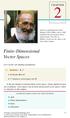 CHAPTER 2 American mathematician Paul Halmos (1916 2006), who in 1942 published the first modern linear algebra book. The title of Halmos s book was the same as the title of this chapter. Finite-Dimensional
Unit 18 Determinants
 Unit 18 Determinants Every square matrix has a number associated with it, called its determinant. In this section, we determine how to calculate this number, and also look at some of the properties of
13 MATH FACTS 101. 2 a = 1. 7. The elements of a vector have a graphical interpretation, which is particularly easy to see in two or three dimensions.
 3 MATH FACTS 0 3 MATH FACTS 3. Vectors 3.. Definition We use the overhead arrow to denote a column vector, i.e., a linear segment with a direction. For example, in three-space, we write a vector in terms
Linear Algebra: Determinants, Inverses, Rank
 D Linear Algebra: Determinants, Inverses, Rank D 1 Appendix D: LINEAR ALGEBRA: DETERMINANTS, INVERSES, RANK TABLE OF CONTENTS Page D.1. Introduction D 3 D.2. Determinants D 3 D.2.1. Some Properties of
4.5 Linear Dependence and Linear Independence
 4.5 Linear Dependence and Linear Independence 267 32. {v 1, v 2 }, where v 1, v 2 are collinear vectors in R 3. 33. Prove that if S and S are subsets of a vector space V such that S is a subset of S, then
Matrices and Linear Algebra
 Chapter 2 Matrices and Linear Algebra 2. Basics Definition 2... A matrix is an m n array of scalars from a given field F. The individual values in the matrix are called entries. Examples. 2 3 A = 2 4 2
ABSTRACT ALGEBRA: A STUDY GUIDE FOR BEGINNERS
 ABSTRACT ALGEBRA: A STUDY GUIDE FOR BEGINNERS John A. Beachy Northern Illinois University 2014 ii J.A.Beachy This is a supplement to Abstract Algebra, Third Edition by John A. Beachy and William D. Blair
PROJECTIVE GEOMETRY. b3 course 2003. Nigel Hitchin
 PROJECTIVE GEOMETRY b3 course 2003 Nigel Hitchin [email protected] 1 1 Introduction This is a course on projective geometry. Probably your idea of geometry in the past has been based on triangles
Linear Algebra Done Wrong. Sergei Treil. Department of Mathematics, Brown University
 Linear Algebra Done Wrong Sergei Treil Department of Mathematics, Brown University Copyright c Sergei Treil, 2004, 2009, 2011, 2014 Preface The title of the book sounds a bit mysterious. Why should anyone
These axioms must hold for all vectors ū, v, and w in V and all scalars c and d.
 DEFINITION: A vector space is a nonempty set V of objects, called vectors, on which are defined two operations, called addition and multiplication by scalars (real numbers), subject to the following axioms
Let H and J be as in the above lemma. The result of the lemma shows that the integral
 Let and be as in the above lemma. The result of the lemma shows that the integral ( f(x, y)dy) dx is well defined; we denote it by f(x, y)dydx. By symmetry, also the integral ( f(x, y)dx) dy is well defined;
Linear Algebra. A vector space (over R) is an ordered quadruple. such that V is a set; 0 V ; and the following eight axioms hold:
 Linear Algebra A vector space (over R) is an ordered quadruple (V, 0, α, µ) such that V is a set; 0 V ; and the following eight axioms hold: α : V V V and µ : R V V ; (i) α(α(u, v), w) = α(u, α(v, w)),
6.2 Permutations continued
 6.2 Permutations continued Theorem A permutation on a finite set A is either a cycle or can be expressed as a product (composition of disjoint cycles. Proof is by (strong induction on the number, r, of
MATH 304 Linear Algebra Lecture 20: Inner product spaces. Orthogonal sets.
 MATH 304 Linear Algebra Lecture 20: Inner product spaces. Orthogonal sets. Norm The notion of norm generalizes the notion of length of a vector in R n. Definition. Let V be a vector space. A function α
Using row reduction to calculate the inverse and the determinant of a square matrix
 Using row reduction to calculate the inverse and the determinant of a square matrix Notes for MATH 0290 Honors by Prof. Anna Vainchtein 1 Inverse of a square matrix An n n square matrix A is called invertible
Solving Systems of Linear Equations
 LECTURE 5 Solving Systems of Linear Equations Recall that we introduced the notion of matrices as a way of standardizing the expression of systems of linear equations In today s lecture I shall show how
You know from calculus that functions play a fundamental role in mathematics.
 CHPTER 12 Functions You know from calculus that functions play a fundamental role in mathematics. You likely view a function as a kind of formula that describes a relationship between two (or more) quantities.
Math 115A - Week 1 Textbook sections: 1.1-1.6 Topics covered: What is a vector? What is a vector space? Span, linear dependence, linear independence
 Math 115A - Week 1 Textbook sections: 1.1-1.6 Topics covered: What is Linear algebra? Overview of course What is a vector? What is a vector space? Examples of vector spaces Vector subspaces Span, linear
Math 312 Homework 1 Solutions
 Math 31 Homework 1 Solutions Last modified: July 15, 01 This homework is due on Thursday, July 1th, 01 at 1:10pm Please turn it in during class, or in my mailbox in the main math office (next to 4W1) Please
26. Determinants I. 1. Prehistory
 26. Determinants I 26.1 Prehistory 26.2 Definitions 26.3 Uniqueness and other properties 26.4 Existence Both as a careful review of a more pedestrian viewpoint, and as a transition to a coordinate-independent
DETERMINANTS IN THE KRONECKER PRODUCT OF MATRICES: THE INCIDENCE MATRIX OF A COMPLETE GRAPH
 DETERMINANTS IN THE KRONECKER PRODUCT OF MATRICES: THE INCIDENCE MATRIX OF A COMPLETE GRAPH CHRISTOPHER RH HANUSA AND THOMAS ZASLAVSKY Abstract We investigate the least common multiple of all subdeterminants,
Linear Algebra Notes
 Linear Algebra Notes Chapter 19 KERNEL AND IMAGE OF A MATRIX Take an n m matrix a 11 a 12 a 1m a 21 a 22 a 2m a n1 a n2 a nm and think of it as a function A : R m R n The kernel of A is defined as Note
Brief Introduction to Vectors and Matrices
 CHAPTER 1 Brief Introduction to Vectors and Matrices In this chapter, we will discuss some needed concepts found in introductory course in linear algebra. We will introduce matrix, vector, vector-valued
DATA ANALYSIS II. Matrix Algorithms
 DATA ANALYSIS II Matrix Algorithms Similarity Matrix Given a dataset D = {x i }, i=1,..,n consisting of n points in R d, let A denote the n n symmetric similarity matrix between the points, given as where