
10 Evolutionarily Stable Strategies
|
|
|
- Tabitha Mills
- 9 years ago
- Views:
Transcription
1 10 Evolutionarily Stable Strategies There is but a step between the sublime and the ridiculous. Leo Tolstoy In 1973 the biologist John Maynard Smith and the mathematician G. R. Price wrote an article in Nature showing how game theory applies to the behavior of animals (Maynard Smith and Price 1973). Maynard Smith went on to write a book on the subject (Maynard Smith 1982), which has become a classic. The idea of applying game theory to animals, and not just the higher primates, but fish, dung beetles, fireflies, and pond scum as well, seemed strange at the time, because game theory had always been the preserve of hyperrationality. Animals hardly fit the bill. Maynard Smith made three critical shifts from traditional game theory. The first is in the concept of a strategy, the second in the concept of equilibrium, and a third in the nature of agent interactions. Strategy. In classical game theory, players have strategy sets from which they choose particular strategies. In biology, species have strategy sets (genotypic variants), of which individuals inherit one or another variant, perhaps mutated, that they then play in their strategic interactions. This extends nicely to the treatment of culture in human society, in which case we say that society has the strategy set (the set of alternative cultural forms) and individuals inherit or choose among them. Equilibrium. In place of the Nash equilibrium, Maynard Smith and Price used the evolutionarily stable strategy (ESS) concept. A strategy is an ESS if a whole population using that strategy cannot be invaded by a small group with a mutant genotype. Similarly, a cultural form is an ESS if, upon being adopted by all members of a society (firm, family, etc.), no small group of individuals using an alternative cultural form can invade. We thus move from explaining the actions of individuals to modeling the diffusion of forms of behavior ( strategies ) in society. Player interactions. In place of the one-shot and repeated games of classical game theory, Maynard Smith introduced the notion of the repeated, 230

2 Evolutionarily Stable Strategies 231 random pairing of agents who play strategies based on their genome but not on the previous history of play. The ESS concept is particularly useful because it says something about the dynamic properties of a system without being committed to any particular dynamic model. As we shall see, however, an evolutionary system with a symmetrical two-player stage game can be dynamically stable without being an ESS ( 12.9) Evolutionarily Stable Strategies: Definition Consider a two-player normal form game in which both players have the set S D fs 1 ; : : : ; s n g of pure strategies, and the payoffs to an agent playing s i 2 S and another agent playing s j 2 S are ij 1 for the first and 2 ij D 1 ji for the second. We call such a game symmetric in payoffs. In addition, we assume the agents cannot condition their play on whether they are player 1 or player 2. We call such a game symmetric in strategies. If a game is symmetric in both payoffs and strategies, we simply call the game symmetric. We call A D.ij 1 / the matrix of the symmetric game. Note that A represents only the payoffs for the row player, because the payoffs to the column player are just the transpose of A. Let G be a symmetric game with matrix A (we ll call it the stage game) and large population of agents. In each period t D 1; 2; : : :, agents are randomly paired and they play the stage game G once. Each agent is of type i for some s i 2 S, meaning that the agent uses strategy s i in the stage game. If the proportion of agents of type j is p j at a particular time, we say the state of the population is D p 1 s 1 C : : : C p n s n. Note that we must have p 1 ; : : : ; p n 0 and P i p i D 1. The payoff at that time to a player of type i when the state of the population is is defined by i D nx ij p j ; (10.1) j D1 which is the player s expected payoff before being assigned a particular partner. These conditions define a new game, called the evolutionary game corresponding to the stage game G. Suppose the state of the population is, and some small subpopulation plays a mutant strategy D q 1 s 1 C : : : C q n s n, in the sense that q i is the frequency of pure strategy s i in this subpopulation. We say the mutant is of

3 232 Chapter 10 type, and has payoff D nx i;j D1 q i ij p j ; when a random member of its population meets a random member of the population. Suppose the state of the population is D p 1 s 1 C : : : C p n s n. The expected payoff to a randomly chosen member of the population is thus just. If we replace a fraction > 0 of the population with a mutant of type, the new state of the population is D.1 / C ; so the payoff to a randomly chosen nonmutant is D.1 / C ; and the expected payoff to a mutant is D.1 / C : We say the mutant type can invade the population if and for all sufficiently small > 0, ; which says that, on average, a mutant does at least as well against the new population as does a nonmutant. We say is an evolutionarily stable strategy (ESS) if it cannot be invaded by any mutant type, in a sense defined precisely below. We assume that mutants can employ mixed strategies in applying the ESS criterion, because as we shall see later ( 12.7), with this assumption evolutionarily stable strategies have powerful dynamic properties. A Nash equilibrium in an evolutionary game can consist of a monomorphic population of agents, each playing the same mixed strategy, or a polymorphic population, a fraction of the population playing each of the underlying pure strategies in proportion to its contribution to the mixed Nash strategy. The two interpretations are interchangeable under many conditions, and we shall not commit ourselves exclusively to either interpretation. Because the stage

4 Evolutionarily Stable Strategies 233 game is a one-shot, it is rarely plausible to hold that an individual will play a strictly mixed strategy. Thus, in general, the heterogeneous population interpretation is superior. The heterogeneous mutant must then possess some internal mechanism for maintaining the constant frequency distribution q 1 ; : : : ; q n from period to period. We relax this assumption when we treat evolutionary games as dynamical systems in chapter Properties of Evolutionarily Stable Strategies Prove the following properties of evolutionarily stable strategies: a. Strategy 2 S is an ESS if, for every mutant type 2 S, there is an > 0 such that for all 2.0; / and defining D.1 / C, we have > : (10.2) b. We say that 2 S has a uniform invasion barrier if there is some o 2.0; 1/ such that (10.2) holds for all and all 2.0; o /. Strategy is an ESS if and only if it has a uniform invasion barrier. c. Strategy 2 S is an ESS if and only if, for any mutant type 2 S, we have ; and if D, then > : This says that 2 S is an ESS if and only if a mutant cannot do better against an incumbent than an incumbent can do against another incumbent, and if a mutant does as well as an incumbent against another incumbent, then an incumbent must do better against a mutant than a mutant does against another mutant. Note here that we are assuming mutants can use mixed strategies. d. An evolutionarily stable strategy is a Nash equilibrium that is isolated in the set of symmetric Nash equilibria (that is, it is a strictly positive distance from any other symmetric Nash equilibrium). e. Every strict Nash equilibrium in an evolutionary game is an ESS.

5 234 Chapter Characterizing Evolutionarily Stable Strategies THEOREM 10.1 Suppose symmetric two-player game G has two pure strategies. Then, if and 12 22, G has an evolutionarily stable strategy. PROOF: Suppose 11 > 21. Then, pure strategy 1 is a strict Nash equilibrium, so it is an evolutionarily stable strategy. The same is true if 22 > 12. So suppose 11 < 21 and 22 < 12. Then, we can show that the game has a unique completely mixed symmetric equilibrium p, where each player uses strategy 1 with probability p 2.0; 1/. The payoff to strategy 1 against the mixed strategy. p; 1 p/ is then p 11 C.1 p/ 12, and the payoff to strategy 2 against this mixed strategy is p 21 C.1 p/ 22. Because these must be equal, we find that p D /=, where D C < 0. Note that under our assumptions, 0 < p < 1, so there is a unique completely mixed Nash equilibrium. p; 1 p/. Now let q be the probability a mutant player uses pure strategy 1. Because each pure strategy is a best response to p, q must also be a best response to p, so clearly, qp D pp. To show that p is an ESS, we must show that pq > qq. We have and pq D pœ 11 q C 12.1 q/ C.1 p/œ 21 q C 22.1 q/ qq D qœ 11 q C 12.1 q/ C.1 q/œ 21 q C 22.1 q/ : Subtracting and simplifying, we get which proves we have an ESS. pq qq D. p q/ 2 > 0; THEOREM 10.2 Using the same notation, the stage game has a strictly mixed Nash equilibrium if and only if 11 > 21 and 22 > 12, or 11 < 21 and 22 < 12. The equilibrium is an ESS only if the second set of inequalities holds.

6 Evolutionarily Stable Strategies 235 PROOF: It is easy to check that if there is a mixed strategy equilibrium, the frequency of pure strategy 1 must satisfy D ; where D C : Suppose > 0. Then 0 < < 1 if and only if 0 < < C 22 12, which is true if and only if 11 > 21 and 22 > 12. If < 0, a similar argument shows that 0 < < 1 if and only if the other pair of inequalities holds. Suppose there is a mutant that uses pure strategy 1 with probability ˇ. Thus, in general, ı D ı 11 C.1 ı/ 12 C.1 /ı 21 C.1 /.1 ı/ 22 D ı C ı / C / C 22 : It follows that ˇ D. ˇ/Œ. 22 a 12 / D 0; so the equilibrium is an ESS if and only if ˇ > ˇˇ. But ˇ ˇˇ D ˇ C ˇ.a 21 a 22 / C.a 12 a 22 / C a 22 ˇ2 ˇ.a 21 a 22 / ˇ.a 12 a 22 / a 22 D ˇ. ˇ/ C. ˇ/.a 12 a 22 / D. ˇ/.ˇ C a 12 a 22 / D. ˇ/.ˇ / D. ˇ/ 2 : Thus, the equilibrium is an ESS if and only if < 0, which is equivalent to a 11 < a 21 and a 22 < a 12. This proves the assertion. THEOREM 10.3 Suppose D 1s 1 C : : : C ns n 2 S is an ESS, where s i is a pure strategy and i > 0 for i D 1; : : : ; n. Suppose D ˇ1s 1 C : : : C ˇns n 2 S is also an ESS. Then, ˇi D i for i D 1; : : : n. In other words, the support of an ESS cannot strictly contain the support of another ESS. THEOREM 10.4 If 2 S is weakly dominated, then is not an ESS.

7 236 Chapter 10 THEOREM 10.5 An evolutionary game whose stage game has a finite number of pure strategies can have only a finite number of evolutionarily stable strategies. PROOF: Suppose there are an infinite number of distinct evolutionarily stable strategies. Then there must be two, say and, that use exactly the same pure strategies. Now is a best response to, so must do better against than does against itself. But does equally well against as does against. Thus, is not an ESS and similarly for. By the distance between two strategies D P i p is i and D P i q is i, we mean the distance in R n between the points.p 1 ; : : : ; p n / and.q 1 ; : : : ; q n /. The following is proved in Hofbauer and Sigmund (1998). Note that the theorem implies that an evolutionarily stable strategy is an isolated Nash equilibrium, in the sense that there is an > 0 such that no strategy within distance of is a Nash equilibrium. THEOREM 10.6 Strategy 2 S is an ESS if and only if there is some > 0 such that > for all 2 S within distance of. PROOF: Suppose is an ESS, so for any, there is an Q./ such that ;.1 /C < ;.1 /C for all 2.0; Q.//: (10.3) In fact, we can choose Q./ as follows. If (10.3) holds for all 2.0; 1/, then let Q./ D 1. Otherwise, let Q be the smallest > 0 such that (10.3) is violated and define Q./ D C : It is easy to check that Q./ 2.0; 1 and (10.3) are satisfied. Let T S be the set of strategies such that if 2 T, then there is at least one pure strategy used in that is not used in. Clearly, T is closed and bounded, 62 T, Q./ is continuous, and Q./ > 0 for all 2 T. Hence, Q./ has a strictly positive minimum such that (10.3) holds for all 2 T and all 2.0; /. If is a mixed strategy and s is a pure strategy, we define s./ to be the weight of s in (that is, the probability that s will be played using ). Now consider the neighborhood of s consisting of all strategies such that j1 s./j < for all pure strategies s. If s, then > 1 s./ D > 0

8 Evolutionarily Stable Strategies 237 for some pure strategy s. Then D.1 /s C r, where r 2 T. But then (10.3) gives r < s. If we multiply both sides of this inequality by and add.1 / s to both sides, we get < s, as required. The other direction is similar, which proves the assertion. THEOREM 10.7 If 2 S is a completely mixed evolutionarily stable strategy (that is, it uses all pure strategies with positive probability), then it is the unique Nash equilibrium of the game and > for all 2 S,. PROOF: If is completely mixed, then for any tau 2 S, D, because any pure strategy has the same payoff against as does against. Therefore, any mixed strategy has the same payoff against as has against. For similar reasons, D. Thus, is an ESS and if is any other strategy, we must have > A Symmetric Coordination Game Consider a two-player pure coordination game in which both players win a > 0 if they both choose Up, and they win b > 0 if they both choose Down, but they get nothing otherwise. Show that this game has a mixed-strategy equilibrium with a lower payoff than either of the pure-strategy equilibria. Show that this game is symmetric, and the mixed-strategy equilibrium is not an ESS. Show that there are, however, two ESSs. This example shows that sometimes adding the ESS requirement eliminates implausible and inefficient equilibria A Dynamic Battle of the Sexes The battle of the sexes ( 3.9) is not symmetric, and hence the concept of an evolutionarily stable strategy does not apply. However, there is an obvious way to recast battle of the sexes so that it becomes symmetric. Suppose when two players meet, one is randomly assigned to be player 1, and the other player 2. A pure strategy for a player can be written as xy, which means if I am Alfredo, I play x, and if I am Violetta, I play y. Here x stands for Opera and y stands for Gambling. There are thus four pure strategies, OO, OG, GO, GG. This game is symmetric, and the normal form matrix (only the payoff to player 1 is shown) is

9 238 Chapter 10 OO OG GO GG OO 3/2,3/2 1,1/2 1/2,1 0,0 OG 1/2,1 0,0 1,2 1/2,1/2 GO 1,1/2 2,1 0,0 1,1/2 GG 0,0 1,1/2 1/2,1 3/2,3/2 Let 0, ˇ 0, 0 and ı D 1 ˇ 0 be the fraction of players who use strategy OO, OG, GO, and GG, respectively (or, equivalently, let. ; ˇ; ; ı/ be the mixed strategy of each player). Show that there are two pure-strategy Nash equilibria, OO and GG, and for each 2 Œ0; 1, there is a mixed-strategy Nash equilibrium OO C.1=3 /OG C.2=3 /GO C GG. Show that the payoffs to these equilibria are 3/2 for the pure-strategy equilibria and 2/3 for each of the mixed-strategy equilibria. It is easy to show that the first two equilibria are ESSs, and the others are not they can be invaded by either OO or GG Symmetrical Throwing Fingers Similarly, although throwing fingers ( 3.8) is not a symmetric game, and hence the concept of an evolutionarily stable strategy does not apply, there is an obvious way to recast throwing fingers so that it becomes symmetric. Suppose when two players meet, one is randomly assigned to be player 1, and the other player 2. A pure strategy for a player can be written as xy, which means if I am player 1, I show x fingers, and if I am player 2, I show y fingers. There are thus four pure strategies, 11, 12, 21, and 22. Show that this game is symmetric, and derive the normal form matrix (only the payoff to player 1 is shown) ,0 1,1 1, 1 0,0 12 1, 1 0,0 0,0 1,1 21 1,1 0,0 0,0 1, ,0 1, 1 1,1 0,0 Let 0, ˇ 0, 0 and ı D 1 ˇ 0 be the fraction of players who use strategy 11, 12, 21, and 22, respectively (or, equivalently, let. ; ˇ; ; ı/ be the mixed strategy of each player). Show that a Nash

10 Evolutionarily Stable Strategies 239 equilibrium is characterized by D 1=2, ˇ D (which implies ı D /. It is easy to show that any such Nash equilibrium can be invaded by any distinct strategy. 0; ˇ0; 0 ; ı 0 / with 0 D 1=2 0, ˇ0 D 0, so there is no evolutionarily stable strategy for throwing fingers Hawks, Doves, and Bourgeois THEOREM 10.8 The mixed-strategy equilibrium in the hawk-dove game ( 3.10) is an ESS. PROOF: The payoff to H is.v w/=2 C.1 /v = v.v C w/=2, and the payoff to D is.1 /.v=2/ D v=2.v=2/. These are equated when D v=w, which is < 1 if w > v. To show that this mixed-strategy equilibrium is an ESS, note that 11 D.v w/=2, 21 D 0, 22 D v=2, and 12 D v. Thus 11 D.v w/=2 < 0 D 21 and 22 D v=2 < v D 12, so the equilibrium is an ESS. Note that in the hawk-dove-bourgeois game ( 6.41), the bourgeois strategy is a strict Nash equilibrium, and hence is an ESS Trust in Networks II We now show that the completely mixed Nash equilibrium found in trust in networks ( 6.23) is not an ESS and can be invaded by trusters. In case you think this means this equilibrium is dynamically unstable, think again! See Trust in Networks III ( 12.10). For specificity, we take p D 0:8. You can check that the equilibrium has inspect share 0:71 trust share ˇ 0:19, and defect share 0:10. The payoff to the equilibrium strategy s is ss 0:57. The payoff to trust against the equilibrium strategy is of course ts D ss 0:57, but the payoff to trust against itself is tt D 1, so trust can invade Cooperative Fishing In a certain fishing village, two fisherman gain from having the nets put out in the evening. However, the fishermen benefit equally whether or not they share the costs of putting out the nets. Suppose the expected catch is, the cost of putting out the nets to each is c 1 if each fisherman does it alone, and the cost to each is c 2 < c 1 if they do it together. We assume =2 > c 1, so it

ECON 40050 Game Theory Exam 1 - Answer Key. 4) All exams must be turned in by 1:45 pm. No extensions will be granted.
 1 ECON 40050 Game Theory Exam 1 - Answer Key Instructions: 1) You may use a pen or pencil, a hand-held nonprogrammable calculator, and a ruler. No other materials may be at or near your desk. Books, coats,
6.207/14.15: Networks Lecture 15: Repeated Games and Cooperation
 6.207/14.15: Networks Lecture 15: Repeated Games and Cooperation Daron Acemoglu and Asu Ozdaglar MIT November 2, 2009 1 Introduction Outline The problem of cooperation Finitely-repeated prisoner s dilemma
Chapter 7. Evolutionary Game Theory
 From the book Networks, Crowds, and Markets: Reasoning about a Highly Connected World. By David Easley and Jon Kleinberg. Cambridge University Press, 2010. Complete preprint on-line at http://www.cs.cornell.edu/home/kleinber/networks-book/
Online Appendix to Stochastic Imitative Game Dynamics with Committed Agents
 Online Appendix to Stochastic Imitative Game Dynamics with Committed Agents William H. Sandholm January 6, 22 O.. Imitative protocols, mean dynamics, and equilibrium selection In this section, we consider
6.254 : Game Theory with Engineering Applications Lecture 2: Strategic Form Games
 6.254 : Game Theory with Engineering Applications Lecture 2: Strategic Form Games Asu Ozdaglar MIT February 4, 2009 1 Introduction Outline Decisions, utility maximization Strategic form games Best responses
Computational Learning Theory Spring Semester, 2003/4. Lecture 1: March 2
 Computational Learning Theory Spring Semester, 2003/4 Lecture 1: March 2 Lecturer: Yishay Mansour Scribe: Gur Yaari, Idan Szpektor 1.1 Introduction Several fields in computer science and economics are
ECO 199 B GAMES OF STRATEGY Spring Term 2004 PROBLEM SET 4 B DRAFT ANSWER KEY 100-3 90-99 21 80-89 14 70-79 4 0-69 11
 The distribution of grades was as follows. ECO 199 B GAMES OF STRATEGY Spring Term 2004 PROBLEM SET 4 B DRAFT ANSWER KEY Range Numbers 100-3 90-99 21 80-89 14 70-79 4 0-69 11 Question 1: 30 points Games
ECON 459 Game Theory. Lecture Notes Auctions. Luca Anderlini Spring 2015
 ECON 459 Game Theory Lecture Notes Auctions Luca Anderlini Spring 2015 These notes have been used before. If you can still spot any errors or have any suggestions for improvement, please let me know. 1
12 Evolutionary Dynamics
 12 Evolutionary Dynamics Through the animal and vegetable kingdoms, nature has scattered the seeds of life abroad with the most profuse and liberal hand; but has been comparatively sparing in the room
0.0.2 Pareto Efficiency (Sec. 4, Ch. 1 of text)
 September 2 Exercises: Problem 2 (p. 21) Efficiency: p. 28-29: 1, 4, 5, 6 0.0.2 Pareto Efficiency (Sec. 4, Ch. 1 of text) We discuss here a notion of efficiency that is rooted in the individual preferences
a 11 x 1 + a 12 x 2 + + a 1n x n = b 1 a 21 x 1 + a 22 x 2 + + a 2n x n = b 2.
 Chapter 1 LINEAR EQUATIONS 1.1 Introduction to linear equations A linear equation in n unknowns x 1, x,, x n is an equation of the form a 1 x 1 + a x + + a n x n = b, where a 1, a,..., a n, b are given
MATH10212 Linear Algebra. Systems of Linear Equations. Definition. An n-dimensional vector is a row or a column of n numbers (or letters): a 1.
 MATH10212 Linear Algebra Textbook: D. Poole, Linear Algebra: A Modern Introduction. Thompson, 2006. ISBN 0-534-40596-7. Systems of Linear Equations Definition. An n-dimensional vector is a row or a column
Chapter 7. Sealed-bid Auctions
 Chapter 7 Sealed-bid Auctions An auction is a procedure used for selling and buying items by offering them up for bid. Auctions are often used to sell objects that have a variable price (for example oil)
Continued Fractions and the Euclidean Algorithm
 Continued Fractions and the Euclidean Algorithm Lecture notes prepared for MATH 326, Spring 997 Department of Mathematics and Statistics University at Albany William F Hammond Table of Contents Introduction
Systems of Linear Equations
 Systems of Linear Equations Beifang Chen Systems of linear equations Linear systems A linear equation in variables x, x,, x n is an equation of the form a x + a x + + a n x n = b, where a, a,, a n and
Lecture 5 Principal Minors and the Hessian
 Lecture 5 Principal Minors and the Hessian Eivind Eriksen BI Norwegian School of Management Department of Economics October 01, 2010 Eivind Eriksen (BI Dept of Economics) Lecture 5 Principal Minors and
1.4 Compound Inequalities
 Section 1.4 Compound Inequalities 53 1.4 Compound Inequalities This section discusses a technique that is used to solve compound inequalities, which is a phrase that usually refers to a pair of inequalities
Inner Product Spaces
 Math 571 Inner Product Spaces 1. Preliminaries An inner product space is a vector space V along with a function, called an inner product which associates each pair of vectors u, v with a scalar u, v, and
Practice with Proofs
 Practice with Proofs October 6, 2014 Recall the following Definition 0.1. A function f is increasing if for every x, y in the domain of f, x < y = f(x) < f(y) 1. Prove that h(x) = x 3 is increasing, using
Lecture V: Mixed Strategies
 Lecture V: Mixed Strategies Markus M. Möbius February 26, 2008 Osborne, chapter 4 Gibbons, sections 1.3-1.3.A 1 The Advantage of Mixed Strategies Consider the following Rock-Paper-Scissors game: Note that
Discrete Mathematics and Probability Theory Fall 2009 Satish Rao, David Tse Note 2
 CS 70 Discrete Mathematics and Probability Theory Fall 2009 Satish Rao, David Tse Note 2 Proofs Intuitively, the concept of proof should already be familiar We all like to assert things, and few of us
Games of Incomplete Information
 Games of Incomplete Information Jonathan Levin February 00 Introduction We now start to explore models of incomplete information. Informally, a game of incomplete information is a game where the players
1 if 1 x 0 1 if 0 x 1
 Chapter 3 Continuity In this chapter we begin by defining the fundamental notion of continuity for real valued functions of a single real variable. When trying to decide whether a given function is or
Chapter 3. Cartesian Products and Relations. 3.1 Cartesian Products
 Chapter 3 Cartesian Products and Relations The material in this chapter is the first real encounter with abstraction. Relations are very general thing they are a special type of subset. After introducing
ALMOST COMMON PRIORS 1. INTRODUCTION
 ALMOST COMMON PRIORS ZIV HELLMAN ABSTRACT. What happens when priors are not common? We introduce a measure for how far a type space is from having a common prior, which we term prior distance. If a type
Overview of Violations of the Basic Assumptions in the Classical Normal Linear Regression Model
 Overview of Violations of the Basic Assumptions in the Classical Normal Linear Regression Model 1 September 004 A. Introduction and assumptions The classical normal linear regression model can be written
I. GROUPS: BASIC DEFINITIONS AND EXAMPLES
 I GROUPS: BASIC DEFINITIONS AND EXAMPLES Definition 1: An operation on a set G is a function : G G G Definition 2: A group is a set G which is equipped with an operation and a special element e G, called
CPC/CPA Hybrid Bidding in a Second Price Auction
 CPC/CPA Hybrid Bidding in a Second Price Auction Benjamin Edelman Hoan Soo Lee Working Paper 09-074 Copyright 2008 by Benjamin Edelman and Hoan Soo Lee Working papers are in draft form. This working paper
Notes on Orthogonal and Symmetric Matrices MENU, Winter 2013
 Notes on Orthogonal and Symmetric Matrices MENU, Winter 201 These notes summarize the main properties and uses of orthogonal and symmetric matrices. We covered quite a bit of material regarding these topics,
Sudoku puzzles and how to solve them
 Sudoku puzzles and how to solve them Andries E. Brouwer 2006-05-31 1 Sudoku Figure 1: Two puzzles the second one is difficult A Sudoku puzzle (of classical type ) consists of a 9-by-9 matrix partitioned
Vector and Matrix Norms
 Chapter 1 Vector and Matrix Norms 11 Vector Spaces Let F be a field (such as the real numbers, R, or complex numbers, C) with elements called scalars A Vector Space, V, over the field F is a non-empty
Chapter 11 Number Theory
 Chapter 11 Number Theory Number theory is one of the oldest branches of mathematics. For many years people who studied number theory delighted in its pure nature because there were few practical applications
Solution to Homework 2
 Solution to Homework 2 Olena Bormashenko September 23, 2011 Section 1.4: 1(a)(b)(i)(k), 4, 5, 14; Section 1.5: 1(a)(b)(c)(d)(e)(n), 2(a)(c), 13, 16, 17, 18, 27 Section 1.4 1. Compute the following, if
LEARNING OBJECTIVES FOR THIS CHAPTER
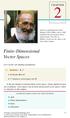 CHAPTER 2 American mathematician Paul Halmos (1916 2006), who in 1942 published the first modern linear algebra book. The title of Halmos s book was the same as the title of this chapter. Finite-Dimensional
MATRIX ALGEBRA AND SYSTEMS OF EQUATIONS
 MATRIX ALGEBRA AND SYSTEMS OF EQUATIONS Systems of Equations and Matrices Representation of a linear system The general system of m equations in n unknowns can be written a x + a 2 x 2 + + a n x n b a
CS 103X: Discrete Structures Homework Assignment 3 Solutions
 CS 103X: Discrete Structures Homework Assignment 3 s Exercise 1 (20 points). On well-ordering and induction: (a) Prove the induction principle from the well-ordering principle. (b) Prove the well-ordering
So let us begin our quest to find the holy grail of real analysis.
 1 Section 5.2 The Complete Ordered Field: Purpose of Section We present an axiomatic description of the real numbers as a complete ordered field. The axioms which describe the arithmetic of the real numbers
Fundamentele Informatica II
 Fundamentele Informatica II Answer to selected exercises 1 John C Martin: Introduction to Languages and the Theory of Computation M.M. Bonsangue (and J. Kleijn) Fall 2011 Let L be a language. It is clear
The Binomial Distribution
 The Binomial Distribution James H. Steiger November 10, 00 1 Topics for this Module 1. The Binomial Process. The Binomial Random Variable. The Binomial Distribution (a) Computing the Binomial pdf (b) Computing
6.4 Normal Distribution
 Contents 6.4 Normal Distribution....................... 381 6.4.1 Characteristics of the Normal Distribution....... 381 6.4.2 The Standardized Normal Distribution......... 385 6.4.3 Meaning of Areas under
God created the integers and the rest is the work of man. (Leopold Kronecker, in an after-dinner speech at a conference, Berlin, 1886)
 Chapter 2 Numbers God created the integers and the rest is the work of man. (Leopold Kronecker, in an after-dinner speech at a conference, Berlin, 1886) God created the integers and the rest is the work
Pigeonhole Principle Solutions
 Pigeonhole Principle Solutions 1. Show that if we take n + 1 numbers from the set {1, 2,..., 2n}, then some pair of numbers will have no factors in common. Solution: Note that consecutive numbers (such
Student Outcomes. Lesson Notes. Classwork. Discussion (10 minutes)
 NYS COMMON CORE MATHEMATICS CURRICULUM Lesson 5 8 Student Outcomes Students know the definition of a number raised to a negative exponent. Students simplify and write equivalent expressions that contain
4. Continuous Random Variables, the Pareto and Normal Distributions
 4. Continuous Random Variables, the Pareto and Normal Distributions A continuous random variable X can take any value in a given range (e.g. height, weight, age). The distribution of a continuous random
Notes on Determinant
 ENGG2012B Advanced Engineering Mathematics Notes on Determinant Lecturer: Kenneth Shum Lecture 9-18/02/2013 The determinant of a system of linear equations determines whether the solution is unique, without
Théorie de la décision et théorie des jeux Stefano Moretti
 héorie de la décision et théorie des jeux Stefano Moretti UMR 7243 CNRS Laboratoire d'analyse et Modélisation de Systèmes pour l'aide à la décision (LAMSADE) Université Paris-Dauphine email: [email protected]
Scalar Valued Functions of Several Variables; the Gradient Vector
 Scalar Valued Functions of Several Variables; the Gradient Vector Scalar Valued Functions vector valued function of n variables: Let us consider a scalar (i.e., numerical, rather than y = φ(x = φ(x 1,
5544 = 2 2772 = 2 2 1386 = 2 2 2 693. Now we have to find a divisor of 693. We can try 3, and 693 = 3 231,and we keep dividing by 3 to get: 1
 MATH 13150: Freshman Seminar Unit 8 1. Prime numbers 1.1. Primes. A number bigger than 1 is called prime if its only divisors are 1 and itself. For example, 3 is prime because the only numbers dividing
Duality in Linear Programming
 Duality in Linear Programming 4 In the preceding chapter on sensitivity analysis, we saw that the shadow-price interpretation of the optimal simplex multipliers is a very useful concept. First, these shadow
CONTINUED FRACTIONS AND PELL S EQUATION. Contents 1. Continued Fractions 1 2. Solution to Pell s Equation 9 References 12
 CONTINUED FRACTIONS AND PELL S EQUATION SEUNG HYUN YANG Abstract. In this REU paper, I will use some important characteristics of continued fractions to give the complete set of solutions to Pell s equation.
MATRIX ALGEBRA AND SYSTEMS OF EQUATIONS. + + x 2. x n. a 11 a 12 a 1n b 1 a 21 a 22 a 2n b 2 a 31 a 32 a 3n b 3. a m1 a m2 a mn b m
 MATRIX ALGEBRA AND SYSTEMS OF EQUATIONS 1. SYSTEMS OF EQUATIONS AND MATRICES 1.1. Representation of a linear system. The general system of m equations in n unknowns can be written a 11 x 1 + a 12 x 2 +
8 Primes and Modular Arithmetic
 8 Primes and Modular Arithmetic 8.1 Primes and Factors Over two millennia ago already, people all over the world were considering the properties of numbers. One of the simplest concepts is prime numbers.
The Basics of Game Theory
 Sloan School of Management 15.010/15.011 Massachusetts Institute of Technology RECITATION NOTES #7 The Basics of Game Theory Friday - November 5, 2004 OUTLINE OF TODAY S RECITATION 1. Game theory definitions:
Mathematical Induction
 Mathematical Induction (Handout March 8, 01) The Principle of Mathematical Induction provides a means to prove infinitely many statements all at once The principle is logical rather than strictly mathematical,
1 Introduction. Linear Programming. Questions. A general optimization problem is of the form: choose x to. max f(x) subject to x S. where.
 Introduction Linear Programming Neil Laws TT 00 A general optimization problem is of the form: choose x to maximise f(x) subject to x S where x = (x,..., x n ) T, f : R n R is the objective function, S
Stanford Math Circle: Sunday, May 9, 2010 Square-Triangular Numbers, Pell s Equation, and Continued Fractions
 Stanford Math Circle: Sunday, May 9, 00 Square-Triangular Numbers, Pell s Equation, and Continued Fractions Recall that triangular numbers are numbers of the form T m = numbers that can be arranged in
The Epsilon-Delta Limit Definition:
 The Epsilon-Delta Limit Definition: A Few Examples Nick Rauh 1. Prove that lim x a x 2 = a 2. (Since we leave a arbitrary, this is the same as showing x 2 is continuous.) Proof: Let > 0. We wish to find
6.3 Conditional Probability and Independence
 222 CHAPTER 6. PROBABILITY 6.3 Conditional Probability and Independence Conditional Probability Two cubical dice each have a triangle painted on one side, a circle painted on two sides and a square painted
Lecture Notes on MONEY, BANKING, AND FINANCIAL MARKETS. Peter N. Ireland Department of Economics Boston College. [email protected]
 Lecture Notes on MONEY, BANKING, AND FINANCIAL MARKETS Peter N. Ireland Department of Economics Boston College [email protected] http://www2.bc.edu/~irelandp/ec261.html Chapter 16: Determinants of the Money
CHAPTER 3. Methods of Proofs. 1. Logical Arguments and Formal Proofs
 CHAPTER 3 Methods of Proofs 1. Logical Arguments and Formal Proofs 1.1. Basic Terminology. An axiom is a statement that is given to be true. A rule of inference is a logical rule that is used to deduce
Math 4310 Handout - Quotient Vector Spaces
 Math 4310 Handout - Quotient Vector Spaces Dan Collins The textbook defines a subspace of a vector space in Chapter 4, but it avoids ever discussing the notion of a quotient space. This is understandable
1.2 Solving a System of Linear Equations
 1.. SOLVING A SYSTEM OF LINEAR EQUATIONS 1. Solving a System of Linear Equations 1..1 Simple Systems - Basic De nitions As noticed above, the general form of a linear system of m equations in n variables
INDISTINGUISHABILITY OF ABSOLUTELY CONTINUOUS AND SINGULAR DISTRIBUTIONS
 INDISTINGUISHABILITY OF ABSOLUTELY CONTINUOUS AND SINGULAR DISTRIBUTIONS STEVEN P. LALLEY AND ANDREW NOBEL Abstract. It is shown that there are no consistent decision rules for the hypothesis testing problem
PYTHAGOREAN TRIPLES KEITH CONRAD
 PYTHAGOREAN TRIPLES KEITH CONRAD 1. Introduction A Pythagorean triple is a triple of positive integers (a, b, c) where a + b = c. Examples include (3, 4, 5), (5, 1, 13), and (8, 15, 17). Below is an ancient
Probabilistic Strategies: Solutions
 Probability Victor Xu Probabilistic Strategies: Solutions Western PA ARML Practice April 3, 2016 1 Problems 1. You roll two 6-sided dice. What s the probability of rolling at least one 6? There is a 1
WRITING PROOFS. Christopher Heil Georgia Institute of Technology
 WRITING PROOFS Christopher Heil Georgia Institute of Technology A theorem is just a statement of fact A proof of the theorem is a logical explanation of why the theorem is true Many theorems have this
A Simple Model of Price Dispersion *
 Federal Reserve Bank of Dallas Globalization and Monetary Policy Institute Working Paper No. 112 http://www.dallasfed.org/assets/documents/institute/wpapers/2012/0112.pdf A Simple Model of Price Dispersion
Mistakes Allow Evolutionary Stability in the Repeated Prisoner's Dilemma Game. I. Introduction
 J. theor. Biol. (1989) 136, 47-56 Mistakes Allow Evolutionary Stability in the Repeated Prisoner's Dilemma Game ROBERT BOYD Department of Anthropology, University of California, Los Angeles, California
Sequential lmove Games. Using Backward Induction (Rollback) to Find Equilibrium
 Sequential lmove Games Using Backward Induction (Rollback) to Find Equilibrium Sequential Move Class Game: Century Mark Played by fixed pairs of players taking turns. At each turn, each player chooses
1. Prove that the empty set is a subset of every set.
 1. Prove that the empty set is a subset of every set. Basic Topology Written by Men-Gen Tsai email: [email protected] Proof: For any element x of the empty set, x is also an element of every set since
Discrete Mathematics and Probability Theory Fall 2009 Satish Rao, David Tse Note 10
 CS 70 Discrete Mathematics and Probability Theory Fall 2009 Satish Rao, David Tse Note 10 Introduction to Discrete Probability Probability theory has its origins in gambling analyzing card games, dice,
Method To Solve Linear, Polynomial, or Absolute Value Inequalities:
 Solving Inequalities An inequality is the result of replacing the = sign in an equation with ,, or. For example, 3x 2 < 7 is a linear inequality. We call it linear because if the < were replaced with
arxiv:1112.0829v1 [math.pr] 5 Dec 2011
![arxiv:1112.0829v1 [math.pr] 5 Dec 2011](/thumbs/39/18839218.jpg "arxiv:1112.0829v1 [math.pr] 5 Dec 2011") How Not to Win a Million Dollars: A Counterexample to a Conjecture of L. Breiman Thomas P. Hayes arxiv:1112.0829v1 [math.pr] 5 Dec 2011 Abstract Consider a gambling game in which we are allowed to repeatedly
How Not to Win a Million Dollars: A Counterexample to a Conjecture of L. Breiman Thomas P. Hayes arxiv:1112.0829v1 [math.pr] 5 Dec 2011 Abstract Consider a gambling game in which we are allowed to repeatedly
9 Repeated Games. Tomorrow, and tomorrow, and tomorrow, Creeps in this petty pace from day to day To the last syllable of recorded time Shakespeare
 9 Repeated Games Tomorrow, and tomorrow, and tomorrow, Creeps in this petty pace from day to day To the last syllable of recorded time Shakespeare When a game G is repeated an indefinite number of times
Linear Programming Notes V Problem Transformations
 Linear Programming Notes V Problem Transformations 1 Introduction Any linear programming problem can be rewritten in either of two standard forms. In the first form, the objective is to maximize, the material
Lecture 3: Finding integer solutions to systems of linear equations
 Lecture 3: Finding integer solutions to systems of linear equations Algorithmic Number Theory (Fall 2014) Rutgers University Swastik Kopparty Scribe: Abhishek Bhrushundi 1 Overview The goal of this lecture
Linear Algebra I. Ronald van Luijk, 2012
 Linear Algebra I Ronald van Luijk, 2012 With many parts from Linear Algebra I by Michael Stoll, 2007 Contents 1. Vector spaces 3 1.1. Examples 3 1.2. Fields 4 1.3. The field of complex numbers. 6 1.4.
Cournot s model of oligopoly
 Cournot s model of oligopoly Single good produced by n firms Cost to firm i of producing q i units: C i (q i ), where C i is nonnegative and increasing If firms total output is Q then market price is P(Q),
From the probabilities that the company uses to move drivers from state to state the next year, we get the following transition matrix:
 MAT 121 Solutions to Take-Home Exam 2 Problem 1 Car Insurance a) The 3 states in this Markov Chain correspond to the 3 groups used by the insurance company to classify their drivers: G 0, G 1, and G 2
HOMEWORK 5 SOLUTIONS. n!f n (1) lim. ln x n! + xn x. 1 = G n 1 (x). (2) k + 1 n. (n 1)!
 Math 7 Fall 205 HOMEWORK 5 SOLUTIONS Problem. 2008 B2 Let F 0 x = ln x. For n 0 and x > 0, let F n+ x = 0 F ntdt. Evaluate n!f n lim n ln n. By directly computing F n x for small n s, we obtain the following
MATH10040 Chapter 2: Prime and relatively prime numbers
 MATH10040 Chapter 2: Prime and relatively prime numbers Recall the basic definition: 1. Prime numbers Definition 1.1. Recall that a positive integer is said to be prime if it has precisely two positive
Simon Fraser University Spring 2015. Econ 302 D200 Final Exam Solution Instructor: Songzi Du Tuesday April 21, 2015, 12 3 PM
 Simon Fraser University Spring 2015 Econ 302 D200 Final Exam Solution Instructor: Songzi Du Tuesday April 21, 2015, 12 3 PM The brief solutions suggested here may not have the complete explanations necessary
Chapter 17. Orthogonal Matrices and Symmetries of Space
 Chapter 17. Orthogonal Matrices and Symmetries of Space Take a random matrix, say 1 3 A = 4 5 6, 7 8 9 and compare the lengths of e 1 and Ae 1. The vector e 1 has length 1, while Ae 1 = (1, 4, 7) has length
Exact Nonparametric Tests for Comparing Means - A Personal Summary
 Exact Nonparametric Tests for Comparing Means - A Personal Summary Karl H. Schlag European University Institute 1 December 14, 2006 1 Economics Department, European University Institute. Via della Piazzuola
How to Solve Strategic Games? Dominant Strategies
 How to Solve Strategic Games? There are three main concepts to solve strategic games: 1. Dominant Strategies & Dominant Strategy Equilibrium 2. Dominated Strategies & Iterative Elimination of Dominated
Chapter 9. Systems of Linear Equations
 Chapter 9. Systems of Linear Equations 9.1. Solve Systems of Linear Equations by Graphing KYOTE Standards: CR 21; CA 13 In this section we discuss how to solve systems of two linear equations in two variables
6.207/14.15: Networks Lectures 19-21: Incomplete Information: Bayesian Nash Equilibria, Auctions and Introduction to Social Learning
 6.207/14.15: Networks Lectures 19-21: Incomplete Information: Bayesian Nash Equilibria, Auctions and Introduction to Social Learning Daron Acemoglu and Asu Ozdaglar MIT November 23, 25 and 30, 2009 1 Introduction
Nash Equilibria and. Related Observations in One-Stage Poker
 Nash Equilibria and Related Observations in One-Stage Poker Zach Puller MMSS Thesis Advisor: Todd Sarver Northwestern University June 4, 2013 Contents 1 Abstract 2 2 Acknowledgements 3 3 Literature Review
Bayesian Nash Equilibrium
 . Bayesian Nash Equilibrium . In the final two weeks: Goals Understand what a game of incomplete information (Bayesian game) is Understand how to model static Bayesian games Be able to apply Bayes Nash
arxiv:0909.4913v2 [math.ho] 4 Nov 2009
![arxiv:0909.4913v2 [math.ho] 4 Nov 2009](/thumbs/40/21097349.jpg "arxiv:0909.4913v2 [math.ho] 4 Nov 2009") IRRATIONALITY FROM THE BOOK STEVEN J. MILLER AND DAVID MONTAGUE arxiv:0909.4913v2 [math.ho] 4 Nov 2009 A right of passage to theoretical mathematics is often a proof of the irrationality of 2, or at least
IRRATIONALITY FROM THE BOOK STEVEN J. MILLER AND DAVID MONTAGUE arxiv:0909.4913v2 [math.ho] 4 Nov 2009 A right of passage to theoretical mathematics is often a proof of the irrationality of 2, or at least
5.1 Radical Notation and Rational Exponents
 Section 5.1 Radical Notation and Rational Exponents 1 5.1 Radical Notation and Rational Exponents We now review how exponents can be used to describe not only powers (such as 5 2 and 2 3 ), but also roots
Chapter 27: Taxation. 27.1: Introduction. 27.2: The Two Prices with a Tax. 27.2: The Pre-Tax Position
 Chapter 27: Taxation 27.1: Introduction We consider the effect of taxation on some good on the market for that good. We ask the questions: who pays the tax? what effect does it have on the equilibrium
3. Mathematical Induction
 3. MATHEMATICAL INDUCTION 83 3. Mathematical Induction 3.1. First Principle of Mathematical Induction. Let P (n) be a predicate with domain of discourse (over) the natural numbers N = {0, 1,,...}. If (1)
The Fundamental Theorem of Arithmetic
 The Fundamental Theorem of Arithmetic 1 Introduction: Why this theorem? Why this proof? One of the purposes of this course 1 is to train you in the methods mathematicians use to prove mathematical statements,