
Manual No. TOE-S606-12F-OY. VS mini J7. Compact General Purpose Inverter USER S MANUAL
|
|
|
- Beatrix Haynes
- 9 years ago
- Views:
Transcription
1 Manual No. TOE-S606-12F-OY VS mini J7 Compact General Purpose Inverter USER S MANUAL
2 PREFACE YASKAWA s VS mini J7 (hereinafter, called VS mini). is a small and simple inverter; as easy as using a contactor. This instruction manual describes installation, maintenance and inspection, troubleshooting, and specifications of the VS mini. Read this instruction manual thoroughly before operation. OMRON YASKAWA Motion Control B.V. General Precautions Some drawings in this manual are shown with the protective cover or shields removed, in order to describe detail with more clarity. Make sure all covers and shields are replaced before operating this product. This manual may be modified when necessary because of improvement of the product, modification, or changes in specifications. Such modifications are denoted by a revised manual No. To order a copy of this manual, if your copy has been damaged or lost, contact your OYMC representative. OYMC is not responsible for any modification of the product made by the user, since that will void your guarantee. 2

3 NOTES FOR SAFE OPERATION Read this instruction manual thoroughly before installation, operation, maintenance or inspection of the VS mini. In this manual, NOTES FOR SAFE OPERATION are classified as WARNING or CAUTION. WARNING Indicates a potentially hazardous situation which, if not avoided, could result in death or serious injury to personnel. CAUTION Indicates a potentially hazardous situation which, if not avoided, may result in minor or moderate injury to personnel and damage to equipment. It may also be used to alert against unsafe practices. Even items described in CAUTION may result in a vital accident in some situations. In either case, follow these important notes. NOTE : These are steps to be taken to insure proper operation. 3

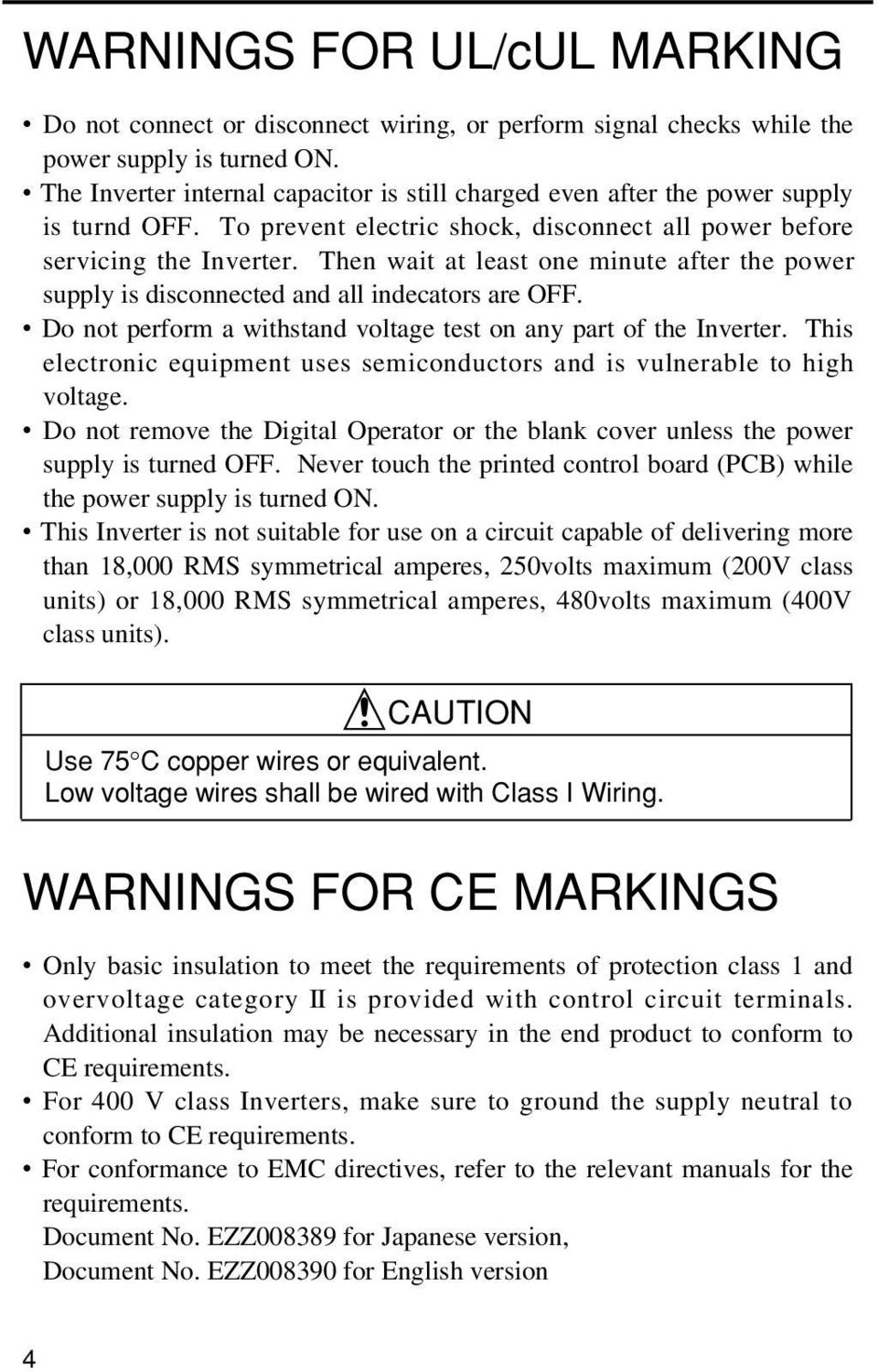
4 WARNINGS FOR UL/cUL MARKING Do not connect or disconnect wiring, or perform signal checks while the power supply is turned ON. The Inverter internal capacitor is still charged even after the power supply is turnd OFF. To prevent electric shock, disconnect all power before servicing the Inverter. Then wait at least one minute after the power supply is disconnected and all indecators are OFF. Do not perform a withstand voltage test on any part of the Inverter. This electronic equipment uses semiconductors and is vulnerable to high voltage. Do not remove the Digital Operator or the blank cover unless the power supply is turned OFF. Never touch the printed control board (PCB) while the power supply is turned ON. This Inverter is not suitable for use on a circuit capable of delivering more than 18,000 RMS symmetrical amperes, 250volts maximum (200V class units) or 18,000 RMS symmetrical amperes, 480volts maximum (400V class units). CAUTION Use 75 C copper wires or equivalent. Low voltage wires shall be wired with Class I Wiring. WARNINGS FOR CE MARKINGS Only basic insulation to meet the requirements of protection class 1 and overvoltage category II is provided with control circuit terminals. Additional insulation may be necessary in the end product to conform to CE requirements. For 400 V class Inverters, make sure to ground the supply neutral to conform to CE requirements. For conformance to EMC directives, refer to the relevant manuals for the requirements. Document No. EZZ for Japanese version, Document No. EZZ for English version 4
5 RECEIVING CAUTION (Ref. page) Do not install or operate any inverter which is damaged or has missing parts. Failure to observe this caution may result in personal injury or equipment damage. 15 MOUNTING CAUTION (Ref. page) Lift the cabinet by the heatsink. When moving the unit, never lift by the plastic case or the terminal covers. Otherwise, the main unit may be dropped causing damage to the unit. 17 Mount the inverter on nonflammable material (i.e. metal). Failure to observe this caution can result in a fire. 17 When mounting units in an enclosure, install a fan or other cooling device (open chasis to keep the intake air temperature below 50: (122<). Overheating may cause a fire or damage to the unit. 18 The VS mini generates heat. For effective cooling, mount it vertically. Refer to the figure in Mounting Dimensions on page 18. 5

6 WIRING WARNING (Ref. page) Only commence wiring after verifying that the power supply is turned OFF. Failure to observe this warning can result in an electric shock or a fire. 20 Wiring should be performed only by qualified personnel. Failure to observe this warning can result in an electric shock or a fire. 20 When wiring the emergency stop circuit, check the wiring thoroughly before operation. Failure to observe this warning can result in personal injury. 20 For 400V class, make sure to ground the supply neutral. Failure to observe this warning can result in an electric shock or a fire. 24 Make sure to ground the ground terminal according to the local grounding code. Failure to observe this warning can result in an electric shock or a fire. 24 6

7 CAUTION (Ref. page) Verify that the inverter rated voltage coincides with the AC power supply voltage. Failure to observe this caution can result in personal injury or a fire. Do not perform a withstand voltage test of the inverter. It may cause semi-conductor elements to be damaged. Make sure to tighten terminal screws of the main circuit and the control circuit. Failure to observe this caution can result in a malfunction, damage or a fire. 20 Never connect the AC main circuit power supply to output terminals U/T1, V/T2, and W/T3. The inverter will be damaged and invalidate the guarantee. 20 Do not connect or disconnect wires or connectors while power is applied to the circuit. Failure to observe this caution can result in personal injury. Do not change signals during operation. The machine or the inverter may be damaged. 7

8 OPERATION WARNING (Ref. page) Only turn ON the input power supply after replacing the front cover. Do not remove the covers while current is flowing. Failure to observe this warning can result in an electric shock. Never operate the digital operator or dip the switches when your hand is wet. Failure to observe this warning can result in an electric shock. Never touch the terminals while current is flowing, even during inverter stopping. Failure to observe this warning can result in an electric shock. When the fault retry function is selected, stand clear of the inverter or the load, since it may restart suddenly after being stopped. (Construct machine system, so as to assure safety for personnel, even if the inverter should restart.) Failure to observe this warning can result in personal injury. 53 When continuous operation after power recovery is selected, stand clear of the inverter or the load, since it may restart suddenly after being stopped. (Construct machine system, so as to assure safety for personnel, even if the inverter should restart.) Failure to observe this warning can result in personal injury. 48 Since the digital operator stop button can be disabled by a function setting, install a separate emergency stop switch. Failure to observe this warning can result in personal injury. If an alarm is reset with the operation signal ON, the inverter restarts automatically. Only reset the alarm after verifying that the operation signal is OFF. Failure to observe this warning can result in personal injury. 26 8

9 CAUTION (Ref. page) Never touch the heatsink since the temperature is very high. Failure to observe this caution can result in harmful burns to the body. Since it is easy to change operation speed from low to high speed, verify the safe working range of the motor and machine before operation. Failure to observe this caution can result in personal injury and machine damage. Install a holding brake separately if necessary. Failure to observe this caution can result in personal injury. If using an Inverter with an elevator, take safety measures on the elevator to prevent the elevator from dropping. Failure to observe this caution can result in personal injury. Do not change signals during operation. The machine or the inverter may be damaged. All the constants of the inverter have been preset at the factory. Do not change the settings unnecessarily. The inverter may be damaged. 27 MAINTENANCE AND INSPECTION WARNING Never touch high-voltage terminals in the inverter. Failure to observe this warning can result in an electric shock. Disconnect all power before performing maintenance or inspection. Then wait at least one minute after the power supply is disconnected and all LEDs and CHARGE LED are extinguished. The capacitors are still charged and can be dangerous. 9

10 WARNING (Ref. page) Do not perform withstand voltage test on any part of the VS mini. This electronic equipment uses semiconductors and is vulnerable to high voltage. Only authorized personnel should be permitted to perform maintenance, inspections or parts replacement. [Remove all metal objects (watches, bracelets, etc.) before operation.] (Use tools which are insulated against electric shock.) Failure to observe this warning can result in an electric shock. 84 CAUTION (Ref. page) The control PC board employs CMOS ICs. Do not touch the CMOS elements. They are easily damaged by static electricity. Do not connect or disconnect wires, cooling fan or connentors while power is applied to the circuit. Failure to observe this caution can result in personal injury. 84 Others WARNING Never modify the product. Failure to observe this warning can result in an electric shock or personal injury and will invalidate the guarantee. 10
![] (Use tools which are insulated against electric shock.) Failure to observe this warning can result in an electric shock. 84 CAUTION (Ref. page) The control PC board employs CMOS ICs.](/docs-images/46/21223065/images/page_10.jpg "Do not touch the CMOS elements. They are easily damaged by static electricity. Do not connect or disconnect wires, cooling fan or connentors while power is applied to the circuit.")
11 WARNING DISPLAY A warning label is displayed on the front cover of the inverter, as shown below. Follow these instructions when handling the inverter. PLASTIC CASE QUALIFICATION MARK NAME- PLATE STATUS INDICATOR LAMP WARNING DISPLAY Japanese/French Warning Display An English warning display is on the front panel of the inverter. If you need Japanese or French warning display, a sheet of labels is included. Place it over the English warning display. Warning Display (Back of this manual) WARNING Risk of electric shock. Read manual before installing. Wait 1 minute for capacitor discharge after disconnecting power supply. To conform to requirements, make sure to ground the supply neutral for 400V class. AVERTISSEMENT Risque de décharge électrique. Lire le manuel avant I installation. Attendre 1 minute après la coupure de I alimentation, pour permettre la décharge des condensateurs. Pour répondre aux exigences, s assurer que le neutre soit relié à la terre, pour la série 400V. English French Japanese Warning Display WARNING Risk of electric shock. Read manual before installing. Wait 1 minute for capacitor discharge after disconnecting power supply. To conform to requirements, make sure to ground the supply neutral for 400V class. Example of 200V class, 3-phase, 1.5 kw inverter 11

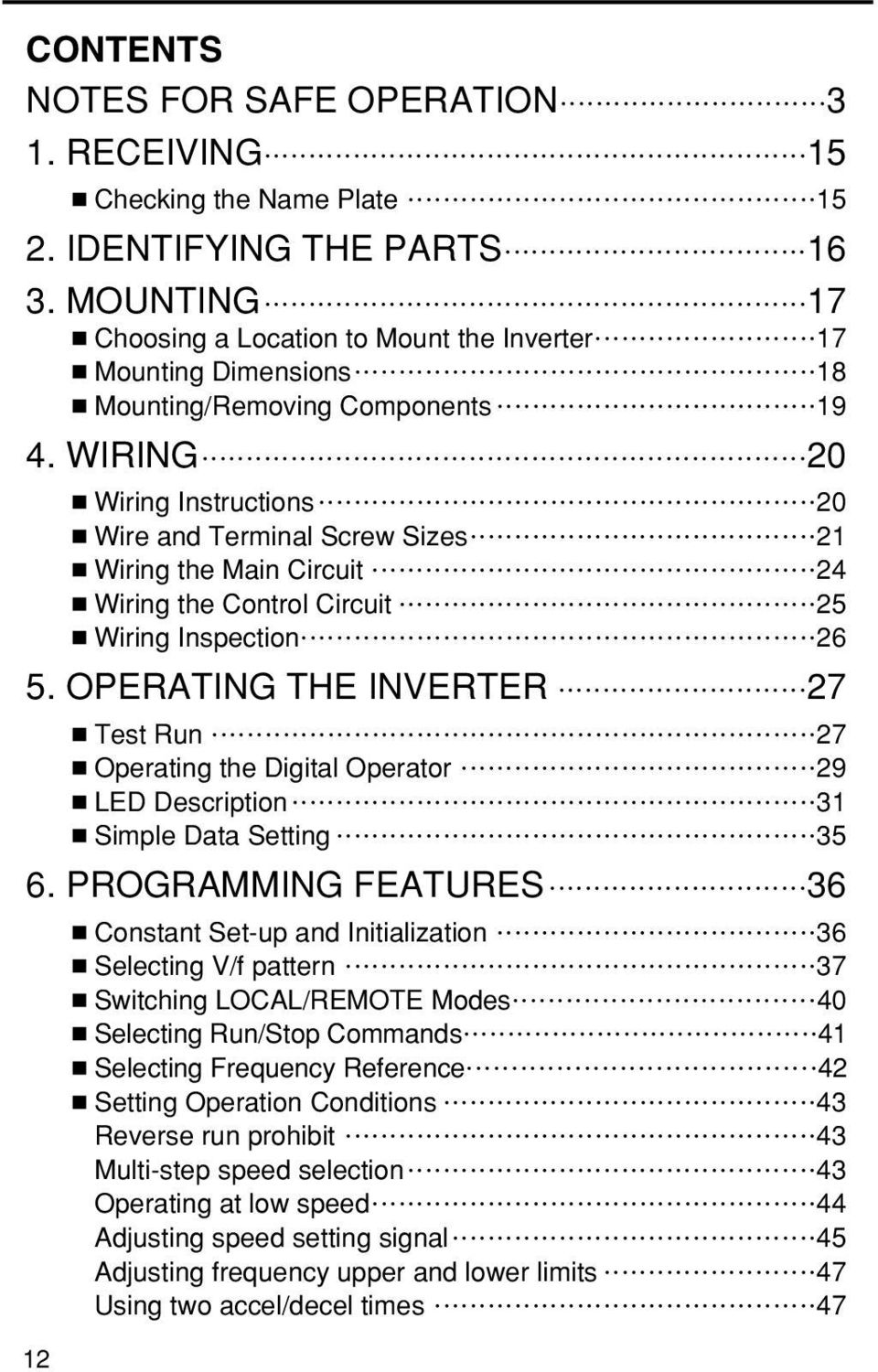
12 CONTENTS NOTES FOR SAFE OPERATION 3 1. RECEIVING 15 Checking the Name Plate IDENTIFYING THE PARTS MOUNTING 17 Choosing a Location to Mount the Inverter 17 Mounting Dimensions 18 Mounting/Removing Components WIRING 20 Wiring Instructions 20 Wire and Terminal Screw Sizes 21 Wiring the Main Circuit 24 Wiring the Control Circuit 25 Wiring Inspection OPERATING THE INVERTER 27 Test Run 27 Operating the Digital Operator 29 LED Description 31 Simple Data Setting PROGRAMMING FEATURES Constant Set-up and Initialization 36 Selecting V/f pattern 37 Switching LOCAL/REMOTE Modes 40 Selecting Run/Stop Commands 41 Selecting Frequency Reference 42 Setting Operation Conditions 43 Reverse run prohibit 43 Multi-step speed selection 43 Operating at low speed 44 Adjusting speed setting signal 45 Adjusting frequency upper and lower limits 47 Using two accel/decel times 47
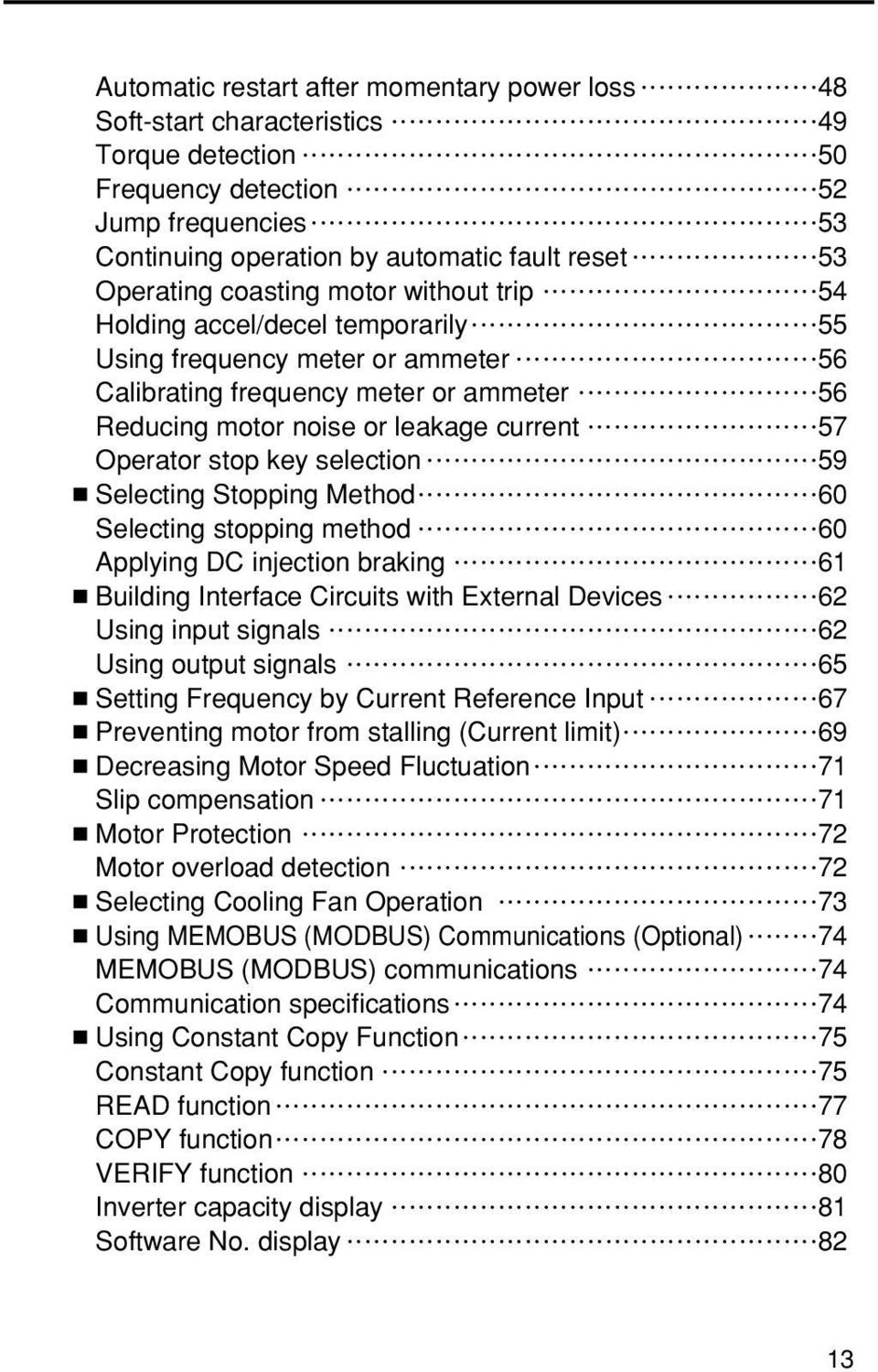
13 Automatic restart after momentary power loss 48 Soft-start characteristics 49 Torque detection 50 Frequency detection 52 Jump frequencies 53 Continuing operation by automatic fault reset 53 Operating coasting motor without trip 54 Holding accel/decel temporarily 55 Using frequency meter or ammeter 56 Calibrating frequency meter or ammeter 56 Reducing motor noise or leakage current 57 Operator stop key selection 59 Selecting Stopping Method 60 Selecting stopping method 60 Applying DC injection braking 61 Building Interface Circuits with External Devices 62 Using input signals 62 Using output signals 65 Setting Frequency by Current Reference Input 67 Preventing motor from stalling (Current limit) 69 Decreasing Motor Speed Fluctuation 71 Slip compensation 71 Motor Protection 72 Motor overload detection 72 Selecting Cooling Fan Operation 73 Using MEMOBUS (MODBUS) Communications (Optional) 74 MEMOBUS (MODBUS) communications 74 Communication specifications 74 Using Constant Copy Function 75 Constant Copy function 75 READ function 77 COPY function 78 VERIFY function 80 Inverter capacity display 81 Software No. display 82 13
14 7. MAINTENANCE AND INSPECTION 84 Periodical Inspection 84 Part Replacement FAULT DIAGNOSIS 87 Protective and Diagnostic Function 87 Troubleshooting SPECIFICATIONS 98 Standard Specifications (200V Class) 98 Standard Specifications (400V Class) 101 Standard Wiring 104 Sequence Input Connection with NPN/PNP Transistor 106 Dimensions/Heat Loss 109 Recommended Peripheral Devices 111 Constants List

15 1. RECEIVING After unpacking the VS mini, check the following : Verify that the part numbers match your purchase order or packing slip. Check the unit for physical damage that may have occurred during shipping. If any part of VS mini is missing or damaged, call for service immediately. Checking the Name Plate Example of 3-phase, 200VAC, 0.1kW (0.13HP) INVERTER MODEL INPUT SPEC. OUTPUT SPEC. LOT NO. SERIAL NO. MASS SOFTWARE NO. MODEL Inverter VS mini J7 Series No. A Type Digital operator provided (with potentiometer) C I M R J 7 A Z 2 0 P 1 No. 0P1 0P2 0P4 0P7 1P5 2P2 3P0 4P0 No. B 2 4 Applicable maximum motor output 200V class 400V class 0.1kW 0.25kW 0.37kW 0.55kW 1.1kW 1.5kW 2.2kW 4.0kW 0.55kW 1.1kW 1.5kW 2.2kW 3.0kW 4.0kW Voltage Class Single-phase 200VAC Three-phase 200VAC Three-phase 400VAC SPEC 2 0 P 1 0 No. Z Specifications OYMC standards B 2 4 Single-phase 200VAC Three-phase 200VAC Three-phase 400VAC No. 0P1 0P2 0P4 0P7 1P5 2P2 3P0 4P0 Applicable maximum motor output 200V class 400V class 0.1kW 0.25kW 0.37kW 0.55kW 1.1kW 1.5kW 2.2kW 4.0kW 0.55kW 1.1kW 1.5kW 2.2kW 3.0kW 4.0kW No. Protective structure Open chassis 0 (IP20) 15

16 2. IDENTIFYING THE PARTS Digital operator (with potentiometer) Used for setting or changing constants. Frequency can be set using potentiometer. Opening the covers 16 CIMR-J7** 21P5, 22P2, 24P0 B0P7, B1P5 40P2, 40P4, 40P7, 41P5 42P2, 43P0, 44P0 CIMR-J7** 20P1, 20P2, 20P4, 20P7, B0P1, B0P2, B0P4

17 3. MOUNTING Choosing a Location to Mount the Inverter Be sure the inverter is protected from the following conditions : Extreme cold and heat. Use only within the ambient temperature range : -10 to +50ºC (14 to 122ºF) Rain, moisture Oil sprays, splashes Salt spray Direct sunlight. (Avoid using outdoors) Corrosive gases (e.g. sulfurized gas) or liquids Dust or metallic particles in the air. Physical shock, vibration. Magnetic noise. (Example : welding machines, power devices, etc.) High humidity. Radioactive substances. Combustibles : thinner, solvents, etc. 17

18 Mounting Dimensions To mount the VS mini, dimensions as shown below are required. 30mm (1.18 in.) OR MORE 30mm (1.18 in.) OR MORE 100mm (3.94 in.) OR MORE 100mm (3.94 in.) OR MORE 18

19 Mounting / Removing Components Removing and Mounting Digital Operator and Covers Removing front cover Use a driver to loosen the screw on the front cover surface to direction 1 to remove it. Then press the right and left sides to direction 2 and lift the front cover to direction 3. Mounting front cover Insert the tab of the upper part of the front cover into the groove of the inverter, and press the lower part of the front cover onto the plastic case until the cover snaps shut. Then, tighten the screws. Removing option cover After removing front cover, remove the option cover to direction 2 with section A as a supporting point. Mounting option cover Mount the terminal cover in the descending order of the above procedure for removal. Removing upper/bottom covers After removing front cover, lift the covers to direction 1. Mounting upper/bottom covers Mount the front cover in the descending order of the above procedure for removal. 19

20 4. WIRING Wiring Instructions (1) Always connect the power input terminals R/L1, S/L2, and T/L3 (R/L1, S/L2 for single-phase) and power supply via a molded-case circuit braker (MCCB) or a fuse. Never connect them to terminals U/T1,V/T2,W/T3,, +1 or +2. Refer to page 111 for recommended peripheral devices. For singlephase inverters, always use terminals R/L1 and S/L2. Never connect to terminal T/L3. Inverter Power Supply Connection Terminals 200V 3-phase Input 200V Single Input Power Supply Specification Power Supply Product Specification Product CIMR-J7??B??? CIMR-J7??2??? Connect to R/L1, Connect to R/L1, S/L2 S/L2, T/L3 400V 3-phase Input Power Supply Specification Product CIMR-J7??4??? Connect to R/L1, S/L2, T/L3 (2) Connect the motor wiring to terminals U/T1, V/T2 and W/T3 on the main circuit output side (bottom of the inverter). (3) If the wiring distance between inverter and motor is long, reduce the inverter carrier frequency. For details, refer to Reducing motor noise or leakage current (n46) on page 57. (4) Control wiring must be less than 50m (164ft) in length and separate from the power wiring. Use twisted-pair shielded wire when inputting the frequency signal externally. (5) Tighten the screws on the main circuit and control circuit terminals. (6) Do not connect or disconnect wiring, or perform signal check while the power supply is turned ON. (7) For 400V class inverters, make sure to ground the supply neutral to conform to CE requirements. (8) Only basic insulation to meet the requirements of protection class 1 and overvoltage category II is provided with control circuit terminals. Additional insulation may be necessary in the end product to conform to CE requirements. (9) A closed-loop connector should be used when wiring to the main circuit terminal. (10) Voltage drop should be considered when determining wire size. Voltage drop can be calculated using the following equation: Phase-to phase voltage drop (V) = 3 wire resistance (Ω/km) wiring distance (m) current (A) 10-3 Select a wire size so that voltage drop will be less than 2% of the normal rated voltage. 20

21 Wire and Terminal Screw Sizes 1. Control Circuit Model Terminal Symbol Screw MA, MB, MC M3 Common to all models S1 to S5,SC,FS, FR,FC,AM,AC M2 Tighte Torque N m (Ib in) 0.5 to 0.6 (4.44 to 5.33) 0.22 to 0.25 (1.94 to 2.21) mm 2 twisted wire single Wire Applicable size Recommended size AWG mm 2 AWG 0.5 to to to to to to 16 twisted wire 0.5 to 0.75 single 0.5 to 1.25 Type Shielded wire or equivalent 2. Main Circuit 200V Class 3-phase Input Series Model Terminal Symbol Screw R/L1,S/L2,T/L3,,+1,+2, 0.8 to 1.0 U/T1,V/T2,W/T3 M3.5 (7.1 to 8.88) CIMR- J7AZ 20P1 CIMR- J7AZ 20P2 CIMR- J7AZ 20P4 CIMR- J7AZ 20P7 CIMR- J7AZ 21P5 CIMR- J7AZ 22P2 CIMR- J7AZ 24P0 R/L1,S/L2,T/L3,,+1,+2, U/T1,V/T2,W/T3 R/L1,S/L2,T/L3,,+1,+2, U/T1,V/T2,W/T3 R/L1,S/L2,T/L3,,+1,+2, U/T1,V/T2,W/T3 R/L1,S/L2,T/L3,,+1,+2, U/T1,V/T2,W/T3 R/L1,S/L2,T/L3,,+1,+2, U/T1,V/T2,W/T3 R/L1,S/L2,T/L3,,+1,+2, U/T1,V/T2,W/T3 M3.5 M3.5 M3.5 M3.5 M3.5 M4 Tightening Torque Applicable size N m (Ib in) mm to 1.0 (7.1 to 8.88) 0.8 to 1.0 (7.1 to 8.88) 0.8 to 1.0 (7.1 to 8.88) 0.8 to 1.0 (7.1 to 8.88) 0.8 to 1.0 (7.1 to 8.88) 1.2 to 1.5 (10.7 to 13.3) 0.75 to to to to 2 2 to to to to to to 10 Note : The wire size is set for copper wires at 75 C (160 F). Wire Recommended size AWG mm 2 AWG Type to to to to V vinylsheathed wire or equivalent 21
22 200V Class Single-phase Input Series Terminal Symbol Screw Model CIMR- J7AZ B0P1 CIMR- J7AZ B0P2 CIMR- J7AZ B0P4 CIMR- J7AZ B0P7 CIMR- J7AZ B1P5 R/L1,S/L2,T/L3,,+1,+2, U/T1,V/T2,W/T3 R/L1,S/L2,T/L3,,+1,+2, U/T1,V/T2,W/T3 R/L1,S/L2,T/L3,,+1,+2, U/T1,V/T2,W/T3 R/L1,S/L2,T/L3,,+1,+2, U/T1,V/T2,W/T3 R/L1,S/L2,T/L3,,+1,+2, U/T1,V/T2,W/T3 M3.5 M3.5 M3.5 M3.5 Tightening Torque Applicable size N m (lb in) mm to 1.0 (7.1 to 8.88) 0.8 to 1.0 (7.1 to 8.88) 0.8 to 1.0 (7.1 to 8.88) 0.8 to 1.0 (7.1 to 8.88) 0.75 to to to 2 2 to to to to to 10 Wire Recommended size AWG mm 2 AWG Type to 1.0 M3.5 (7.1 to 8.88) 2 to to Notes : 1. The wire size is set for copper wires at 75 C (160 F). 2. Three-phase input is also available for single-phase input series. 600V vinylsheathed wire or equivalent 22
23 400V Class 3-phase Input Series Model Terminal Symbol Screw R/L1,S/L2,T/L3,,+1,+2, 0.8 to 1.0 U/T1,V/T2,W/T3 M3.5 (7.1 to 8.88) CIMR- J7AZ 40P2 CIMR- J7AZ 40P4 CIMR- J7AZ 40P7 CIMR- J7AZ 41P5 CIMR- J7AZ 42P2 R/L1,S/L2,T/L3,,+1,+2, U/T1,V/T2,W/T3 R/L1,S/L2,T/L3,,+1,+2, U/T1,V/T2,W/T3 R/L1,S/L2,T/L3,,+1,+2, U/T1,V/T2,W/T3 R/L1,S/L2,T/L3,,+1,+2, U/T1,V/T2,W/T3 M3.5 M3.5 M3.5 M4 Tightening Torque Applicable size N m (Ib in) mm to 1.0 (7.1 to 8.88) 0.8 to 1.0 (7.1 to 8.88) 0.8 to 1.0 (7.1 to 8.88) 1.2 to 1.5 (10.65 to 13.31) 2 to to to to to to to to 10 R/L1,S/L2,T/L3, CIMR-,+1,+2, 1.2 to 1.5 J7AZ 2 to to 10 2 U/T1,V/T2,W/T3 M4 (10.65 to 13.31) 43P0 3.5 R/L1,S/L2,T/L3, CIMR-,+1,+2, 1.2 to 1.5 J7AZ 2 to to 10 2 U/T1,V/T2,W/T3 M4 (10.65 to 13.31) 44P0 3.5 Note : The wire size is set for copper wires at 75 C (160 F). Wire Recommended size AWG mm 2 AWG Type to to V vinylsheathed wire or equivalent 23
24 Wiring the Main Circuit L1L2L3 [Example of 3-phase, 200V class, 1.5kW inverters] Main circuit input power supply Always connect the power supply line to input terminals R/L1, S/L2, and T/L3 [R/L1, S/L2 for single-phase inverters]. Never connect them to terminal U/T1,V/T2,W/T3,, +1, or +2. Otherwise the inverter may be damaged. NOTE For single-phase inverters, always use terminals R/L1 and S/L2. Never connect to terminal T/L3. Inverter output Connect the motor terminals to U/T1, V/T2, W/T3. Wiring the main circuit terminals Pass the cables through wiring hole and connect. Be sure to mount the cover in its original position. Grounding (Use ground terminal.) Make sure to ground the ground terminal according to the local grounding code. Never ground the VS mini in common with welding machines, motors, or other electrical equipment. When several VS mini units are used side by side, ground each unit as shown in examples. Do not loop the ground wires. Connect with a Phillips (plus) screwdriver. GOOD GOOD POOR 24
25 Wiring the Control Circuit Only basic insulation is provided for the control circuit terminals. Additional insulation may be necessary in the end product. Control circuit terminals Pass the cable through wiring hole and connect. Be sure to mount the covers on its original position. SW7 PNP NPN SW8 MA MB MC S1 S2 S3 S4 S5 SC FS FR FC AM AC * SW7 can be changed according to sequence input signal (S1 to S5) polarity. 0V common: NPN side (factory setting) +24 common: PNP side Refer to page 106 for SW7. Refer to page 67 for SW8. Wiring the control circuit terminals Screwdriver blade width 0.4 mm max (0.016 in.) 2.5 mm max (0.098 in.) Insert the wire into the lower part of the terminal block and connect it tightly with a screwdriver. 5.5 mm (0.22 in.) Wire sheath strip length must be 5.5mm (0.22in.). 25
26 Open the front cover and verify that the strip length is 5.5mm. (0.22in.) Wiring Inspection After completing wiring, check the following : Wiring is proper. Wire clippings or screws are not left in the unit. Screws are securely tightened. Bare wire in the terminal does not contact other terminals. NOTE If the FWD (REV) run command is given during the operation reference selection (n02=1) from the control circuit terminal, the motor will start automatically after the main circuit input power supply is turned ON. 26
27 5. OPERATING THE INVERTER Test Run The inverter operates by setting the frequency (speed). There are three types of operation modes for the VS mini : 1 Run command from the digital operator (potentiometer/digital setting). 2 Run command from the control circuit terminal. 3 Run command from communications (MEMOBUS communications) Prior to shipping, the drive is set up to receive run command and frequency reference from the operator. Below are instructions for running the VS mini using the digital operator (with potentiometer). For instructions on operation, refer to page 35. Operation reference or frequency reference constants can be selected separately as shown below. Name Run Command Selection Frequency Reference Selection Constant n02 = Enables operator RUN, STOP/RESET = Enables control circuit terminal run/stop = Enables communications (MEMOBUS communications) n03 = Enables operator volume = Enables frequency reference 1 (constant n21) = Enables voltage reference (0 to 10V) of control circuit terminal = Enables current reference (4 to 20mA) of control circuit terminal = Enables current reference (0 to 20mA) of control circuit terminal = Enables communications (MEMOBUS communications) 27
28 Operation Steps 1. Turn the potentiometer fully to the left before turning the power ON. 2. F/R blinks. Select FWD/REV run using keys. NOTE Never select REV when reverse run is prohibited. 3. Press DSPL to blink FREF. Then press RUN. Operator Display 0.0 (Forward) or (Reverse) LED Display FREF F/R FREF Status Indicator LED RUN ALARM RUN RUN ALARM ALARM 4. Operates the motor by turning the potentiometer to the right. (Frequency reference corresponds to the potentiometer NOTE If the potentiometer is switched rapidly, the motor also accelerates or decelerate rapidly corresponding to the potentiometer movement. Pay attention to load status and switch the potentiometer with the speed not to affect motor movement. 0.0 to 60.0 Minimum output frequency is 1.5Hz FREF Status indicator lamp : ON : Blinking : OFF RUN ALARM Operation Check Points Motor rotates smoothly. Motor rotates in the correct direction. Motor does not have abnormal vibration or noise. Acceleration or deceleration is smooth. Current matching the load flows. Status indicator LEDs and digital operator display are correct. 28
29 Operating the Digital Operator All functions of the VS mini are set by the digital operator. Below are descriptions of the display and keypad sections. Data display section Press to switch between function LEDs. Press to enter the constant data. (Displays the constant data when selecting constant no. by PRGM LED.) DIGITAL OPERATOR Press to increase constant no./data value. Press to decrease constant no./data value. Status indicator Press to run the motor. Press to stop the motor. (Press to reset at faults.) Frequency setting potentiometer Changes frequency setting according to potentiometer. Function display LEDs (Color in parenthesis indicates the color of LED.) FREF Frequency reference setting/monitoring (GREEN) FOUT Output frequency monitor (GREEN) IOUT Output current monitor (GREEN) Function display LEDs LED switches to another function each time DSPL is pressed. The displayed data can be changed. MNTR Multi-function monitor (GREEN) F/R Operator RUN command FWD/REV selection (GREEN) LO/RE LOCAL/REMOTE Selection (RED) PRGM Constant no./data (RED) 29
30 Description of Status Indicator LEDs There are two LEDs on the middle right section of the face of the VS mini. The inverter status is indicated by various combinations of ON, BLINKING and OFF LEDs. RUN indicator and status indicator on the RUN button have the same function. : ON : BLINKING (Long Blinking) : BLINKING : OFF Operation Ready RUN ALARM (During Stop) Ramp to Stop Normal Operation RUN ALARM RUN ALARM RUN ALARM (Green) (Red) For details on how the status indicator LEDs function at inverter faults, refer to Section 8 FAULT DIAGNOSIS AND CORRECTIVE ACTIONS on page 87. If a fault occurs, the ALARM LED lights. NOTE The fault can be reset by turning ON the fault reset signal (or pressing STOP RESET key on the digital operator) with the operation signal OFF or by turning OFF the power supply. If the operation signal is ON, the fault cannot be reset by the fault reset signal. 30
31 LED Description By pressing DSPL on the digital operator, each of the function LEDs can be selected. The following flowchart describes each function LED. Power ON FREF Frequency reference setting/monitor (Hz) Sets VS mini operation speed. DSPL FOUT IOUT MNTR F/R Output frequency monitor (Hz) Displays frequency that VS mini is currently outputting. Setting disabled. DSPL Output current monitor (A) Displays current that VS mini is currently outputting. Setting disabled. DSPL Multi-function monitor Description of the selected monitor is displayed. (Refer to pages 32 and 33 for details.) DSPL FWD/REV run selection Sets the motor rotation direction when run command is given by the digital operator. Setting can be changed by or key. FO (forward run) EV (reverse run) < < If the VS mini loses power while in one of these modes, it will return to this mode once power is restored. Monitor No. U01: Frequency reference (FREF) U02: Output frequency (FOUT) U03: Output current (IOUT) U04: Output voltage reference (Unit: 1V) U05: DC voltage (Unit: 1V) U06: Input terminal status U07: Output terminal status U09: Fault history U10: Software No. U15: Data reception error DSPL 31
32 LOCAL / REMOTE Selection LO/RE This function switches the operation; operation using the digital operator including frequency setting with potentiometer, or that using the input terminals or through communications Setting can be changed by or key. (Local) (Remote) PRGM DSPL Constant No. / data Sets and changes data using constant No. (Refer to page 34.) DSPL < < Return to FREF MNTR Multi-Function monitor Selecting monitor Press DSPL key. When MNTR is ON, data can be displayed by selecting monitor No. [Example] Monitoring Output Voltage Reference IOUT DSPL U04 MNTR Select U04 by pressing ^ or key. ^ 200 ENTER MNTR DSPL or ENTER Output voltage reference is displayed. DSPL F/R 32
33 Monitoring Following items can be monitored by U- constants. Constant No. Name Description U01 U02 U03 U04 U05 U06 U07 U09 U10 U15 Frequency reference (FREF) Output frequency (FOUT) Output current (IOUT) Output voltage DC voltage Input terminal status Output terminal status Fault history Software No. Data reception error Hz Hz A V V Input/Output terminal status --- Input terminal status Frequency reference can be monitored. (Same as FREF) Output frequency can be monitored. (Same as FOUT) Output current can be monitored. (Same as IOUT) Output voltage can be monitored. Main circuit DC voltage can be monitored. Input terminal status of control circuit terminals can be monitored. Output terminal status of control circuit terminals can be monitored. Last four fault history is displayed. Software No. can be checked. Contents of MEMOBUS communication data reception error can be checked. (contents of transmission register No. 003DH are the same) 1: Terminal S1 is closed. 1: Terminal S2 is closed. 1: Terminal S3 is closed. 1: Terminal S4 is closed. 1: Terminal S5 is closed. Not used Output terminal status 1: Terminal MA-MC is closed. Not used 33
34 Fault history display method Fault description is displayed when U09 is selected. (Example)??? : Fault description "---" is displayed if there is no fault. (Refer to page 87 for details.) Clearing fault history Set constant n01 to 6 to clear fault history. Set data returns to its initial value after completion of 6 setting. Note: Constant initialize (n01=12, 13) clears the fault history. Setting and referring constants Following shows how to select and change constants. LO LO/RE REMOTE/LOCAL selection N01 PRGM 600 FREF DSPL Constant No./ data DSPL PRGM ENTER PRGM PRGM ENTER n02 Run command selection Setting n02 (Run command selection) N02 0 Initial setting:0 operator reference N02 PRGM After 1 sec Return to constant No. display 1 Set to 1 Control circuit terminal reference (blinking at changing) 1 PRGM Data set 34
35 Simple Data Setting Potentiometer setting (Refer to 5. OPERATING THE INVERTER) and digital setting are both available for simple accel/decel operation of the VS mini. Frequency reference by potentiometer signal is set with initial setting (n03=0). Factory setting of the model with operator (without potentiometer) is set by digital operator (n03=1). Following is an example in which the function LEDs are used to set frequency reference, acceleration time, deceleration time, and motor direction. Operation Steps 1. Turn ON the power supply. Operator Display 0.0 LED Display FREF Status Indicator LED RUN ALARM 2. Set constant n03 to 1. 1 PRGM RUN ALARM 3. Set the following constants. n16 : 15.0 (acceleration time) n17 : 5.0 (deceleration time) 4. Select NOTE forward or reverse run by pressing q or w key. Examine the application. (Never select REV when reverse run is prohibited.) 5. Set the reference by pressing q or w key (Forward) or (Reverse) 60.0 PRGM F/R FREF RUN ALARM RUN ALARM RUN ALARM 6. Press RUN. 0.0 to 60.0 FOUT RUN ALARM 7. Press STOP to stop to 0.0 FOUT RUN ALARM Status indicator lamp : BLINKING (Long Blinking) : BLINKING : OFF 35
36 6. PROGRAMMING FEATURES Factory settings of the constants are shown as Constant Set-up and Initialization Constant selection/initialization (n01) in the tables. The following table describes the data which can be set or read when n01 is set. Unused constants among n01 to n79 are not displayed. n01 Setting 0 n01 Constant that can be set Constant that can be referred n01 to n n01 to n79* Fault history cleared Not used Initialize Initialize (3-wire sequence) * Excluding setting disabled constants. Refer to page 63. n01 to n79 NOTE EMM appears on the LED display for one second and the set data returns to its initial values in the following cases : (1) The set values of input terminal function selection 2 to 5 (n36 to n39) are the same. (2) If the following conditions are not satisfied in the V/f pattern setting : Max. output frequency (n09) Max. voltage output frequency (n11) > Mid. output frequency (n12) Min. output frequency (n14) For details, refer to Adjusting torque according to application (V/f pattern setting) on page 37. (3) If the following conditions are not satisfied in the Jump frequency setting : Jump frequency 2 (n50) Jump frequency 1 (n49) (4) If Frequency reference lower limit (n31) Frequency reference upper limit (n30) (5) If motor rated current (n32) 120% of inverter rated current 36
37 Selecting V/f pattern Adjusting torque according to application Adjust motor torque by using V/f pattern and full-range automatic torque boost. V/f pattern setting Set V/f pattern by n09 to n15 as described below. Set each pattern when using a special motor (high-speed motor, etc.) or when requiring special torque adjustment of machine. V: (VOLTAGE) n10 n13 n15 0 f n14 n12 n11 n09 (FREQUENCY) Be sure to satisfy the following conditions for the setting of n09 to n15. n14 n12 < n11 n09 If n14 = n12 is set, the set value of n13 is disabled. Constants No. Name Unit Setting range Initial Setting n09 Max. output frequency 0.1Hz 50.0 to 400.0Hz 50.0Hz n10 n11 n12 Max. voltage Max. voltage output frequency (base frequency) Mid. output frequency 1V 0.1Hz 0.1Hz 1 to 255V (1 to 510V)* 0.2 to 400.0Hz 1 to 399Hz 200V (400V) 50.0Hz 1.3Hz n13 Mid. output 1 to 255V frequency voltage 1V (1 to 510V)* 12V (24V) n14 Min. output frequency 0.1Hz 0.1 to 10.0Hz 1.3Hz n15 Min. output 1 to 50V frequency voltage 1V (1 to 100V)* 12V (24V) * For 400-volt class inverters 37
38 Typical setting of V/f pattern Set the V/f pattern according to the application as described below. For 400V class, the voltage values (n10, n13, and n15) should be doubled. When running at a frequency exceeding 50Hz/60Hz, change the maximum output frequency (n09). Note: Be sure to set the maximum output frequency according to the motor characteristics. (1) For general-purpose applications Motor Specification : 60Hz V f Constant n09 n10 n11 n12 n13 n14 n15 (2) For fans/pumps Motor Specification : 60Hz Setting Motor Specification : 50Hz (Factory setting) V f Motor Specification : 50Hz Constant Setting n n n n n13 12 n n15 12 V f Constant Setting n n n n n13 50 n n15 10 V f Constant Setting n n n n12 25 n n n15 10 (3) For applications requiring high starting torque Motor Specification : 60Hz Motor Specification : 50Hz V f Constant Setting n n n n n13 24 n n15 18 V f Constant Setting n n n n n13 24 n n15 18 Increasing voltage of V/f pattern increases motor torque, but an excessive increase may cause motor overexcitation, motor overheat or vibration. Note : n12 is to be set to motor rated voltage. 38
39 When operating with frequency larger than 60Hz/50Hz, change only max. output frequency (n09). n10 =200V CONSTANT TORQUE CONSTANT OUTPUT OR VARIABLE OUTPUT BASE POINT n11 =60Hz n09 =90Hz Full-range automatic torque boost Motor torque requirement changes according to load conditions. Fullrange automatic torque boost adjusts voltage of V/f pattern according to the requirement. The VS mini automatically adjusts the voltage during constant-speed operation as well as during acceleration. The required torque is calculated by the inverter. This ensures tripless operation and energy-saving effects. Output voltage Torque compensation gain (n63) Required torque Operation V (VOLTAGE) Required torque Increase voltage f (FREQUENCY) Normally, no adjustment is necessary for torque compensation gain (n63 factory setting : 1.0). When the wiring distance between the inverter and the motor is long, or when the motor generates vibration, change the automatic torque compensation gain. In these cases, set the V/f pattern (n09 to n15). 39
40 Switching LOCAL/REMOTE Modes The following functions can be selected by switching the LOCAL or REMOTE mode. To select RUN/STOP commands or frequency reference, change the mode in advance depending on the following applications. LOCAL mode : Enables the digital operator for RUN/STOP commands and FWD/REV run commands. Frequency reference can be set by volume or FREF. REMOTE mode : Run by the n02 setting (run command selection). Frequency reference can be set by n03 (frequency reference selection) setting. How to select LOCAL/REMOTE modes When LOCAL/REMOTE switching function is not set for multi-function input selection (When 17 is not set to any of constants n36 to n39) When LOCAL/REMOTE switching function is set at multi-function input selection (When 17 is set to any of constants n36 to n39) Select Lo for operator LO/RE selection. Select re for operator LO/RE selection. Set multi-function input terminal is turned ON. Set multi-function input terminal is turned OFF. LOCAL mode REMOTE mode 40
41 Selecting Run/Stop Commands Refer to Switching LOCAL / REMOTE Modes (page 40) to select either the LOCAL mode or REMOTE mode. Operation method (RUN / STOP commands, FWD / REV run commands) can be selected by the following method. LOCAL mode When Lo (local mode) is selected for digital operator LO / RE ON mode, or when LOCAL / REMOTE switching function is set and the input terminals are turned ON, run operation is enabled by the STP or RUN of the digital operator, and FWD/REV run is enabled by F / R ON mode (using or key). LO / RE is not effective when local / remote switching function is selected for multi-function input selection. REMOTE mode Select remote mode. There are following two methods to select remote mode. 1. Select re (remote mode) for LO / RE selection. 2. When the local / remote switching function is selected for multifunction input selection, turn OFF the input terminal to select remote mode. Select operation method by setting the constant n02. n02=0: Enables the digital operator (same with local mode) =1: Enables the multi-function input terminal (see fig. below) =2: Enables communications (refer to page 74) (When option card is installed) Example for using the multi-function input terminal as operation reference (two-wire sequence) < For example of three-wire sequence, refer to page 63. n02 : 1 (Initial setting : 0) IM n36 : 2 FWD RUN/STOP REV RUN/STOP < S1 S2 SC Operating (RUN / STOP commands) by communications (When option card is installed) Setting constant n02 to 2 in REMOTE mode can give RUN/STOP commands by communication (MEMOBUS communications). For details, refer to page
42 Selecting Frequency Reference Frequency reference can be selected by the following methods. Setting by operator Select REMOTE or LOCAL mode in advance. For the method for selecting the mode, refer to page 40. LOCAL mode Select command method by constant n07. n07=0 : Enables the setting by potentiometer on digital operator (initial setting). Factory setting of the model with digital operator (without potentiometer) is n07=1. =1 : Enables the digital setting by digital operator, setting value is stored in constant n21 (frequency reference 1). Digital setting by digital operator Input frequency while FREF is lit (press ENTER after setting the numeric value). Frequency reference setting is effective when 1 is set to constant n08 instead of pressing ENTER key. n08=0 : Enables frequency reference setting by ENTER key (initial setting). =1 : Disable frequency reference setting by ENTER key. REMOTE mode Select command method by constant n03. n03=0 : Enables frequency reference setting by potentiometer on digital operator (initial setting). Initial setting of the model with digital operator (without potentiometer) is n03=1. =1 : Frequency reference 1 effective. (constant n21) =2 : Voltage reference (0 to 10V) (See the figure below) =3 : Current reference (4 to 20mA) (Refer to page 67) =4 : Current reference (0 to 20mA) (Refer to page 67) =6 : communication (Refer to page 74) Example of frequency reference by voltage signal n03 = 2 (Factory setting : 0) MASTER SPEED FREQUENCY REFERENECE 2KΩ FS FREQUENCY SETTING POWER +12V, 20mA (0 TO +10V) FR FC(0V) IM 42
43 Setting Operation Conditions Reverse run prohibit (n05) Reverse run disabled setting does not accept a reverse run command from the control circuit terminal or digital operator. This setting is used for applications where a reverse run command can cause problems. Setting 0 1 Description Reverse run enabled. Reverse run disabled. Multi-step speed selection By combining frequency reference and input terminal function selections, up to 9 steps of speed can be set. 8-step speed change n02=1 (operation mode selection ) n36=2 (Multi-function contact input terminal 2) n03=1 (Frequency reference selection ) n37=6 (Multi-function contact input terminal 3) n21=25.0hz (Frequency reference 1) n38=7 (Multi-function contact input terminal 4) n22=30.0hz (Frequency reference 2) n39=8 (Multi-function contact input terminal 5) n23=35.0hz (Frequency reference 3) n24=40.0hz (Frequency reference 4) FWD n25=45.0hz (Frequency reference 5) RUN/STOP S1 n26=50.0hz (Frequency reference 6) REV RUN/STOP n27=55.0hz (Frequency reference 7) MULTI-STEP S2 SPEED REF 1 n28=60.0hz (Frequency reference 8) S3 MULTI-STEP SPEED REF 2 MULTI-STEP S4 SPEED REF 3 S5 NOTE When all multi-function reference inputs are OFF, frequency reference selected by constant n03 (frequency reference selection) becomes effective. SC n36=2 (Input terminal S2) Initial Setting n37=6 (Input terminal S3) Change the setting to 6. n38=7 (Input terminal S4) Change the setting to 7. n39=8 (Input terminal S5) Change the setting to 8. 43
44 FREQUENCY REFERENCE (n28) 60.0 Hz (n27) 55.0 Hz (n26) 50.0 Hz (n25) 45.0 Hz (n24) 40.0 Hz (n23) 35.0 Hz (n22) 30.0 Hz (n21) 25.0 Hz TIME FWD (REV) RUN/STOP MULTI-STEP SPEED REF. 1 (TERMINAL S3) MULTI-STEP SPEED REF. 2 (TERMINAL S4) MULTI-STEP SPEED REF. 3 (TERMINAL S5) ON ON ON ON ON ON ON ON Operating at low speed By inputting a jog command and then a forward (reverse) run command, operation is enabled at the jog frequency set in n29. When multi-step speed references 1, 2, 3 or 4 are input simultaneously with the jog command, the jog command has priority. Name Jog frequency Jog command Constant No. Setting n29 Factory setting : 6.0Hz n36 to n39 Set to 10 for any constant. 44
45 Adjusting speed setting signal To provide frequency reference by analog input of control circuit terminal FR or FC, the relationship between analog input and frequency reference can be set. FREQURNCY REFERNCE MAX. OUTPUT FREQUENCY GAIN 100 MAX. OUTPUT FREQUENCY BIAS 100 0V (4mA) (0mA) 10V (20mA) (20mA) ( ) indicates the value when current reference input is selected. Frequency reference gain (n41) The analog input voltage value for the max (10V). output frequency (n09) can be set in units of 1% (max. output frequency n09=100%) * Factory setting : 100% Frequency reference bias (n42) The frequency reference provided when analog input is 0V (4mA or 0mA) can be set in units of 1%. (max. output frequency n09=100%) * Factory setting : 0% Typical Setting To operate the inverter with frequency reference of 0% to 100% at 0 to 5V input MAX. FREQUENCY (100%) 0% 0V 5V 10V Gain n41 = 200 Bias n42 = 0 45
46 To operate the inverter with frequency reference of 50% to 100% at 0 to 10V input MAX. FREQUENCY (100%) 50% 0V 10V Gain n41 = 100 Bias n42 = 50 46
47 Adjusting frequency upper and lower limits INTERNAL FREQUENCY REFERENCE FREQUENCY UPPER LIMIT (n30) FREQUENCY LOWER LIMIT (n31) SET FREQUENCY REFERENCE Frequency reference upper limit (n30) Sets the upper limit of the frequency reference in units of 1%. (n09: Max. output frequency = 100%) Factory setting: 100% Frequency reference lower limit (n31) Sets the lower limit of the frequency reference in units of 1%. (n09: Max. output frequency = 100%) When operating at frequency reference 0, operation is continued at the frequency reference lower limit. However, when frequency reference lower limit is set to less than the min. output frequency (n14), operation is not performed. Factory setting: 0% Using two accel/decel times OUTPUT FREQUENCY ACCEL TIME 1 (n16) DECEL TIME 1 ACCEL (n17) TIME 2 (n18) DECEL TIME 2* (n19) DECEL TIME 1* (n17) FORWARD (REVERSE) ON RUN COMMAND MULTI-STEP ON SPEED REFERENCE ACCEL/DECEL TIME SELECTION (TERMINAL S2 TO S5) * When deceleration to a stop is selected (n04 = 0). ON TIME By setting input terminal function selection (either of n36 to n39) to 11 (accel/decel time select), accel/decel time is selected by turning ON/OFF the accel/decel time select (terminal S2 to S5). At OFF : n16 (accel time 1) n17 (decel time 1) At ON : n18 (accel time 2) n19 (decel time 2) 47
48 Accel time Set the time needed for output frequency to reach 100% from 0%. Decel time Set the time needed for output frequency to reach 0% from 100%. (Maximum output frequency n09=100%) Automatic restart after momentary power loss (n47) When momentary power loss occurs, operation restarts automatically. Setting Description 0 Continuous operation after momentary power loss not provided. 1* Continuous operation after power recovery within momentary power loss ridethru time 2* Continuous operation after power recovery (Fault output not provided) * Hold the operation command to continue the operation after recovery from a momentary power loss. When 2 is selected, operation restarts if power supply voltage reaches its normal level while control power supply is held. No fault signal is output. 48
49 Soft-start characteristics (n20) To prevent shock at machine start/stop, accel/decel can be performed in S- curve pattern. Setting S-curve characteristic time 0 S-curve characteristic not provided second second second Note : S-curve characteristic time is the time from accel/decel rate 0 to a regular accel/decel rate determined by the set accel/decel time. FREQUENCY REFERENCE OUTPUT FREQUENCY OUTPUT FREQUENCY TIME S-CURVE CHARACTERISTIC TIME (Tsc) The following time chart shows FWD/REV run switching at deceleration to a stop. FORWARD RUN COMMAND REVERSE RUN COMMAND ACCELERATION DECELERATION DC INJECTION BRAKING TIME AT STOP MIN. OUTPUT FREQUENCY n53 n14 OUTPUT FREQUENCY MIN. OUTPUT FREQUENCY n14 S-curve characteristics in ACCELERATION DECELERATION 49
50 Torque detection If an excessive load is applied to the machine, output current increase can be detected to output alarm signals to multi-function output terminals MA and MB. To output an overtorque detection signal, set output terminal function selection n40 to overtorque detection [Setting:6 (NO contact) or 7 (NC contact)]. MOTOR CURRENT n60 MULTI-FUNCTION OUTPUT SIGNAL (OVERTORQUE DETECTION SIGNAL) TERMINAL MA, MB * * ON ON n61 n61 TIME * Overtorque detection release width (hysterisis) is set at approx. 5% of inverter rated current. 50
51 Overtorque detection function selection (n59) Setting Description Overtorque detection not provided Detected during constant-speed running, and operation continues after detection. Detected during constant-speed running, and operation stops during detection. Detected during running, and operation continues after detection. Detected during running, and operation stops during detection. (1) To detect overtorque at accel/decel, set to 3 or 4. (2) To continue the operation after overtorque detection, set to 1 or 3. During detection, the operator displays OL3 alarm (blinking). (3) To halt the inverter by a fault at overtorque detection, set to 2 or 4. At detection, the operator displays OL3 fault (ON). Overtorque detection level (n60) Sets the overtorque detection current level in units of 1%. (Inverter rated current = 100%) Factory setting: 160% Overtorque detection time (n61) If the time when motor current exceeds the overtorque detection level (n60) is longer than overtorque detection time (n61), the overtorque detection function operates. Factory setting : 0.1sec. 51
52 Frequency detection (n58) Effective when either of output terminal function selection n40 is set to frequency detection (setting: 4 or 5). Frequency detection turns ON when output frequency is higher or lower than the frequency detection level (n58). Frequency detection 1 (Output frequency Frequency detection level n58) (Set n40 to 4. ) FREQUENCY DETECTION LEVEL [Hz] (n58) OUTPUT FREQUENCY RELEASE WIDTH 2Hz FREQUENCY DETECTION SIGNAL ON Frequency detection 2 (Output frequency Frequency detection level n58) (Set n40 to 5. ) OUTPUT FREQUENCY FREQUENCY DETECTION SIGNAL RELEASE WIDTH +2Hz ON ON FREQUENCY DETECTION LEVEL (Hz) (n58) 52
53 Jump frequencies (n49 to n51) This function allows the prohibition or jumping of critical frequencies so that the motor can operate without resonance caused by machine systems. This function is also used for dead band control. Setting the value to 0.0Hz disables this function. Set prohibited frequency 1 or 2 as follows : OUTPUT FREQUENCY n49 n50 n51 n51 n49 n50 If this condition is not satisfied the inverter displays EMM for one second and restores the data to original settings. FREQUENCY REFERENCE Operation is prohibited within jump frequency range. However, motor operates without jumping during accel/decel. Continuing operation by automatic fault reset (n48) Sets the inverter to restart and reset fault detection after a fault occurs. The number of self-diagnosis and retry attempts can be set at n48 up to 10. The inverter automatically restarts after the following faults occur : OC (overcurrent) GF (ground fault) OV (overvoltage) The number of retry attempts are cleared to 0 in the following cases : (1) If no other fault occurs within 10 minutes after retry (2) When the fault reset signal is ON after the fault is detected (3) Power supply is turned OFF 53
54 Operating coasting motor without trip To operate coasting motor without trip, use the speed search command or DC injection braking at start. Speed search command Restarts a coasting motor without stopping it. This function enables smooth switching between motor commercial power supply operation and inverter operation. Set input terminal function selection (n36 to n39) to 14 (search command from maximum output frequency) or 15 (search command from set frequency). Build a sequence so that FWD (REV) run command is input at the same time as the search command or after the search command. If the run command is input before the search command, the search command becomes disabled. Time chart at search command input FWD (REV) RUN COMMAND SEARCH COMMAND MAX. OUTPUT FREQUENCY OR FREQUENCY REFERENCE AT RUN COMMAND INPUT OUTPUT FREQUENCY ON ON AGREED SPEED DETECTION MIN. BASEBLOCK TIME (0.5s) SPEED SEARCH OPERATION DC injection braking at start (n52, n54) Restarts a coasting motor after stopping it. Set the DC injection braking time at start in n54 in units of 0.1 second. Set DC injection braking current in n52 in units of 1% (inverter rated current =100%). When the setting of n54 is 0, DC injection braking is not performed and acceleration starts from the minimum output frequency. When n52 is set to 0, acceleration starts from the minimum output frequency after the baseblocking for n54 setting time. MIN. OUTPUT FREQUENCY n14 54 n54 DC INJECTION BRAKING TIME AT START
55 Holding accel/decel temporarily To hold acceleration or deceleration, input accel/decel hold command. The output frequency is maintained when the accel/decel hold command is input during acceleration or deceleration. When the stop command is input during accel/decel prohibition command input, accel/decel hold is released and operation ramps to stop. Set multi-function input terminal selection (n36 to n39) to 16 (accel/decel hold command). Time chart at accel/decel hold command input FWD (REV) RUN COMMAND ACCEL/DECEL HOLD COMMAND ON ON ON ON FREQUENCY REFERENCE OUTPUT FREQUENCY FREQUENCY AGREED SIGNAL ON ON Note : When the FWD (REV) run command is input along with the accel/decel hold command, the motor does not operate. However, when frequency reference lower limit (n31) is set greater than or equal to min. output frequency (n14), the motor operates at frequency reference lower limit (n31). 55
56 Using frequency meter or ammeter (n44) Selects to output either output frequency or output current to analog output terminals AM-AC for monitoring. Setting 0 1 Description Output frequency Output current In initial setting, analog voltage of approx. 10V is output when output frequency (output current) is 100%. FREQUENCY METER AM FM 0 TO 10VDC AC OUTPUT FREQUENCY (OUTPUT CURRENT) 100% Analog monitor gain can be set by n V ANALOG OUTPUT Calibrating frequency meter or ammeter (n45) Used to adjust analog output gain. FREQUENCY METER/AMMETER (3V 1mA FULL-SCALE) n45 AM FM OUTPUT FREQUENCY (OUTPUT CURRENT) 100% n45=0.30 FACTORY SETTING n45=1.00 AC 3V 10V ANALOG OUTPUT Set the analog output voltage at 100% of output frequency (output current). Frequency meter displays 0 to 60Hz at 0 to 3V. 10V 56 n45 Setting = 3V 0.30 Output frequency becomes 100% at this value.
57 Reducing motor noise or leakage current (n46) Set inverter output transistor switching frequency (carrier frequency). Setting Carrier Frequency 12 fout (Hz) 24 fout (Hz) 36 fout (Hz) 2.5 (khz) 5.0 (khz) 7.5 (khz) 10.0 (khz) Metallic Noise from Motor Higher Not audible Noise and Current Leakage Smaller Larger Setting values 7, 8, or 9 multiplies output frequency according to output frequency value. n46=7 fc=12 fout fc=carrier FREQUENCY 2.5kHz 1.0kHz 83.3Hz 208.3Hz fout=output FREQUENCY n46=8 fc=24 fout fc=carrier FREQUENCY 2.5kHz 1.0kHz 41.6Hz 104.1Hz fout=output FREQUENCY n46=9 fc=36 fout fc=carrier FREQUENCY 2.5kHz 1.0kHz 27.7Hz 69.4Hz fout=output FREQUENCY 57
58 Factory setting varies according to inverter capacity (kva). Voltage Class (V) 200 Single-phase 3-phase phase Capacity (kw) Initial Setting Setting Carrier Frequency 4 10kHz 4 10kHz 4 10kHz 4 10kHz 3 7.5kHz 3 7.5kHz 3 7.5kHz 3 7.5kHz 3 7.5kHz 3 7.5kHz 3 7.5kHz 3 7.5kHz 3 7.5kHz 3 7.5kHz Maximum Continuous Output Current (A) Reduced Current (A) NOTE (1) Reduce continuous output current when changing carrier frequency to 4 (10 khz) for the 200V class (1.5kW or more) and 400V class inverters. Refer to the table above for the reduced current. [Operation Condition] Input power supply voltage : 3-phase 200 to 230V (200V class) Single-phase 200 to 240V (200V class) 3-phase 380 to 460V (400V class) Ambient temperature : -10 to +50 C (14 to 122 F) (Protection structure: open chassis type IP20) (2) If the wiring distance is long, reduce the inverter carrier frequency as described below. Wiring Distance between Inverter and Motor Carrier frequency (n46 setting) Up to 50m Up to 100m More than 100m 10kHz or less (n46=1,2,3,4, 7,8,9) 5kHz or less 2.5kHz or less (n46=1,2, (n46=1, 7,8,9) 7,8,9,) (3) Carrier frequency is automatically reduced to 2.5kHz when Reducing carrier frequency selection at low speed (n75) is set to 1 and the following conditions are satisfied: Output frequency 5Hz Output current 110% Factory setting : 0 (Disabled) 58
59 Operator stop key selection (n06) Selects processing when STOP key is pressed during operation from multifunction input terminal. Setting 0 1 Description STOP key effective when running either from multi-function input terminals or communications. When STOP key is pressed, the inverter stops according to the setting of constant n04. At this time, the digital operator displays S P alarm (blinking). This stop command is held in the inverter until both forward and reverse run commands are open, or unitl run command from communications becomes zero. STOP key ineffective when running either from multi-function input terminals or communications. 59
60 Selecting Stopping Method Selecting stopping method (n04) Selects the stopping method suitable for application. Setting Description 0 Deceleration to stop 1 Coast to stop Deceleration to stop Example when accel/decel time 1 is selected OUTPUT ACCEL FREQUENCY TIME 1 (n16) FWD (REV) RUN COMMAND * ON DECEL TIME 1 (n17) * DECEL TIME 1 (n17) TIME MIN. OUTPUT FREQUENCY (FREQUENCY AT DC INJECTION BRAKING START) n14 (FACTORY SETTING: 1.5Hz) DC INJECTION BRAKING TIME AT STOP (n53) (FACTORY SETTING: 0.5s) * When frequency reference is changed during running. Upon termination of the FWD (REV) run command, the motor decelerates at the decel rate determined by the time set to deceleration time 1 (n17) and DC injection braking is applied immediately before stop. DC injection braking is also applied when the motor decelerates by setting frequency reference lower than min. output frequency (n14) with FWD (or REV) run command ON. If the decel time is short or the load inertia is large, overvoltage (OV) fault may occur at deceleration. In this case, increase the decel time. 60
61 Coast to stop Example when accel/decel time 1 is selected OUTPUT FREQUENCY ACCEL TIME 1 (n016) * DECEL TIME 1 (n17) * COAST TO STOP TIME FWD (REV) RUN COMMAND ON * When frequency reference is changed during running. Upon removal of the FWD (REV) run command, the motor starts coasting. Applying DC injection braking DC injection braking current (n52) Sets DC injection braking current in units of 1%. (Inverter rated current=100%) DC injection braking time at stop (n53) Sets the DC injection braking time at stopping in units of 0.1 second. When the setting of n53 is 0, DC injection braking is not performed but inverter output is shut OFF at the timing of DC injection braking start. n14 MIN. OUTPUT FREQUENCY n53 DC INJECTION BRAKING TIME AT STOP When coasting to a stop is specified in stopping method selection (n04), DC injection braking at stop does not operate. 61
62 Building Interface Circuits with External Devices Using input signals Multi-function input terminal S2 to S5 functions can be changed when necessary by setting constants n36 to n39 respectively. The same value cannot be set to different constant settings. Setting Name Description Ref FWD/REV run command (3-wire sequence selection) Reverse run (2-wire sequence selection) External fault (NO contact input) External fault (NC contact input) Fault reset Multi-step speed reference 1 Multi-step speed reference 2 Multi-step speed reference 3 JOG command Accel/decel time select External baseblock (NO contact input) External baseblock (NC contact input) Search command from maximum frequency Search command from set frequency Accel/decel hold command LOCAL/REMOTE selection Communication/ control circuit terminal selection Emergency stop fault (NO contact input) Emergency stop alarm (NO contact input) Emergency stop fault (NC contact input) Emergency stop alarm (NC contact input) UP/DOWN command Self-test Setting enabled only for n37 Inverter stops by external fault signal input. Digital operator display is?*. Resets the fault. Fault reset not effective with the run signal ON. Motor coast to a stop by this signal input. Digital operator display is BB. Speed search reference signal Inverter stops by emergency stop signal input according to stopping method selection (n04). When frequency coasting to a stop (n04 is set to 1) method is selected, inverter coasts to a stop according to decel time setting 2 (n19). Digital operator display is S P. (lit at fault, blinking at alarm) Setting enabled only for n39 (terminal S5) Setting enabled only for n39 (terminal S5) * Numbers 2 to 5 is displayed in corresponding to the terminal numbers S2 to S5 respectively Initial setting No. n36 n37 n38 n39 Terminal S2 S3 S4 S5 Initial Setting Function Reverse run (2-wire sequence selection) Fault reset External fault (NO contact input) Multi-step speed reference 1 62
63 Terminal function at 3-wire sequence selection When 0 is set at the terminal S3 (n37), terminal S1 becomes run command, terminal S2 becomes stop command, and terminal S3 becomes FWD/REV run command. RUN SW STOP SW (NO CONTACT) (NC CONTACT) S1 S2 S3 LOCAL/REMOTE select (setting: 17) Select operation reference either by the digital operator or by the settings of run command selection (n02) and frequency reference selection (n03). LOCAL/REMOTE select is available only during stop. Open : Run according to the setting of run command selection (n02) or frequency reference selection (n03). Closed : Run by frequency reference and run command from the digital operator. (Example) Set n02 = 1, n03 = 2, n07 = 0. Open VS mini Run command (Run when closed ) Stop command (Stop when open ) FWD/REV run selection SC FWD run when open ( REV run when closed ) : Run by frequency reference from multi-function input terminal FR and run command from multi-function input terminals S1 to S5. Closed : Run by potentiometer frequency reference and run command from the digital operator. UP/DOWN command (setting: n39 = 034) With the FWD (REV) run command entered, accel/decel is enabled by inputting the UP or DOWN signals to multi-function input terminals S4 and S5 without changing the frequency reference, so that operation can be performed at the desired speed. When UP/DOWN commands are specified by n39, any function set to n38 becomes disabled; terminal S4 becomes an input terminal for the UP command and terminal S5 for the DOWN command. Multi-function Input Terminal Closed S4 (UP command) Open Open Closed Multi-function Input Terminal S5 (DOWN command) Operation Status Open Accel Closed Decel Open Hold Closed Hold 63
64 Time Chart at UP/DOWN Command Input FWD RUN UP COMMAND S4 DOWN COMMAND S5 UPPER LIMIT SPEED LOWER LIMIT SPEED OUTPUT FREQUENCY D1H U H D H U H D D1 H U D1 H D D1 H FREQUENCY AGREED SIGNAL U = UP (accelerating) status D = DOWN (decelerating) status H = HOLD (constant speed) status U1 = UP status, clamping at upper limit speed D1 = DOWN status, clamping at lower limit speed Notes : 1. When UP/DOWN command is selected, the upper limit speed is set regardless of frequency reference. Upper limit speed = Max. output frequency (n09) Frequency reference upper limit (n30)/100% 2. Lower limit value is either min. output frequency (n14) or max. output frequency (n09) frequency reference lower limit (n31)/100% (whichever is larger.). 3. When the FWD (REV) run command is input, operation starts at the lower limit speed without an UP/DOWN command. 4. If the jog command is input while running by the UP/DOWN command, the jog command has priority. 5. Multi-step speed reference 1 to 3 is not effective when UP/DOWN command is selected. Multi-step speed reference is effective during running in hold status. 6. When 1 is set for HOLD output frequency memory selection (n62), output frequency can be recorded during HOLD. Setting 0 1 Description Output frequency is not recorded during HOLD. When HOLD status is continued for 5 seconds or longer, the output frequency during HOLD is recorded and the inverter restarts at the recorded frequency. 64
65 Communication/multi-function input terminal selection input (setting: 18) (This function is effective when option card is installed) Operation can be changed from communication command, or from multifunction input terminal or digital operator command. Run command from communication and frequency reference are effective when multi-function input terminal for this setting is Closed. Run command in LOCAL/REMOTE mode and frequency reference are effective when Open. Using output signals (n40) Multi-function output terminal MA and MB functions can be changed when necessary by setting constant n057. Terminal MA and MB functions: Set to n40 Setting Name Description Fault In operation Agreed frequency Zero speed Frequency detection Frequency detection Overtorque detection (NO contact output) Overtorque detection (NC contact output) Minor fault Base blocked Operation mode Inverter operation ready Fault restart In UV In reverse run In speed search Data output from communication Closed when inverter fault occurs. Closed when either FWD/REV command is input or voltage is output from the inverter. Closed when setting frequency agrees with inverter output frequency. Closed when inverter output frequency is less than min. output frequency. Output frequency > = Frequency detection level (n58) Output frequency < = Frequency detection level (n58) Closed when the alarm is indicated. Closed when the inverter output is shut off. Closed when LOCAL is selected by LOCAL/REMOTE selection. Closed when inverter fault is not detected, and operation is ready. Closed during fault retry Closed when undervoltage is detected. Closed during reverse run. Closed when inverter conducts speed search. Operates multi-function output terminal independently from inverter operation (by MEMOBUS communication) Ref.page
66 Initial setting of multi-function output terminal No. n40 Terminals MA, MB Initial Setting 1 (in operation) Frequency agreed signal (setting=2) DETECTION WIDTH ±2Hz RELEASE WIDTH ±4Hz OUTPUT FREQUNENCY FREQUENCY AGREED SIGNAL ON 66
67 Setting Frequency by Current Reference Input When setting frequency by inputting current reference (4-20mA or 0-20mA) from the control circuit terminal FR, switch the DIP switch SW8 on the control circuit board to I side. SW8 is accessed by removing the option cover. SW8 SW8 V I NOTE Never input voltage reference to control circuit terminal FR when DIP switch SW8 is switched to I side. 67
68 Current reference selection After changing DIP switch (V/I switch of SW8), PRESS operator, then set the following constants. 4-20mA...n03 = mA...n03 = 4 PRGM on the digital Setting : n02 = 0, n03 = 3 or 4 CURRENT REFERENCE 4-20mA OR 0-20mA (n004=3 OR 4) Setting : n02 = 1, n03 = 3 or 4 FWD RUN/STOP REV RUN/STOP CURRENT REFERENCE 4-20mA OR 0-20mA (n004=3 OR 4) FS FR FC S1 S2 SC FS FR FC IM IM Press the digital operator keys to run or stop the inverter. Switch run and stop direction by setting F/R LED. Set frequency by the analog current signal [0-100% ( max. frequency ) / 4-20mA or 0-20mA] connected to the control circuit terminal. Switch run/stop and FWD/REV run with switching device connected to the control circuit terminal. Multi-function input terminal S2 is set to Reverse run / stop (n36 = 2). Set frequency by the analog current signal [0-100% ( max. frequency ) / 4-20mA or 0-20mA] connected to the control circuit terminal. Frequency reference gain (n41)/bias (n42) can be set even when current reference input is selected. For details, refer to Adjusting frequency setting signal on page
69 Preventing Motor from Stalling (Current Limit) Automatically adjusts the output frequency and output current according to the load to continue operation without stalling the motor. Stall prevention (current limit) level during acceleration (n56) Sets the stall prevention (current limit) level during acceleration in units of 1% (Inverter rated current = 100%). Factory setting: 170% A setting of 200% disables the stall prevention (current limit) during acceleration. During acceleration, if the output current exceeds the value set for n56, acceleration stops and frequency is maintained. When the output current goes down to the value set for n56, acceleration starts. MOTOR CURRENT n56 OUTPUT FREQUENCY TIME *Stops the acceleration to prevent the motor from stalling. Release width (hysteresis) of stall prevention during accel is approx. 5% of inverter rated current. * TIME In the constant output area [output frequency > max. voltage output frequency (n11)], following equation automatically decreases the stall prevention (current limit) level during acceleration. Stall prevention (current limit) level during accel in constant output area Stall prevention (current limit) Max. voltage output frequency (n11) = level during accel (n56) Output frequency Stall prevention level during acceleration Stall prevention during accel (n56) Stall prevention limit during accel (40% of n56) Max. voltage output frequency n11 Output frequency 69
70 Stall prevention (current limit) level during running (n57) Sets the stall prevention (current limit) level during running in units of 1% (Inverter rated current = 100%). * Factory setting: 160% A setting of 200% disables the stall prevention (current limit) during running. If stall prevention action current at agreed speed exceeds the value set for n57 for longer than 100msec, deceleration starts. When the output current exceeds the value set for n57, deceleration continues. When the output current goes down to the value set for n57, acceleration starts, up to the set frequency. Stall prevention accel/decel settings during operation are: currently selected acceleration time 1 (n16), deceleration time 1 (n17) and acceleration time 2 (n18) and deceleration time 2 (n19). MOTOR CURRENT n57 OUTPUT FREQUENCY TIME * reduces frequency prevent speed loss at acceleration start, output current hysterisis is approx., 5% of inverter rated current. 100msec * TIME Stall prevention (current limit) function during deceleration (n55) To prevent overvoltage during deceleration, the inverter automatically lengthen the deceleration time according to the value of main circuit DC voltage. Setting 0 1 Stall prevention (current limit) during deceleration Provided Not Provided FREQUENCY Controls the deceleration time to prevent overvoltage fault. SET DECEL TIME TIME 70
71 Decreasing Motor Speed Fluctuation As the load becomes larger, motor speed is reduced and motor slip value is increased. The slip compensating function controls the motor speed at a constant value even if the load varies. When inverter output current is equal to the motor rated current (n32), the compensation frequency is added to the output frequency. Compensation frequency = Motor rated slip (n64) Output current Motor no-load current (n65) Motor rated current (n32) Motor no-load current (n65) Slip compensation gain (n66) Constants Constants No. n32 n65 n66 n67 Slip compensation Name Unit Setting range Initial Setting 0.1A 0 to 120% of inverter rated current * Motor rated current n64 Motor rated slip 0.1Hz 0.0 to 20Hz * Motor no-load current Slip compensation gain Slip compensation time constant 1% to s 0 to 99% (100%=Motor rated current n32) * 0.0 to 25.5s When 0.0s is set, delay time becomes 2.0s * Differs depending on inverter capacity. Notes : 1. Slip compensation is not performed in the following condition: Output frequency < min. output frequency (n14) 2. Slip compensation is not performed during regeneration. 3. Slip compensation is not performed when motor rated current (n32) is set to 0.0A. 2.0s 71
72 Motor Protection Motor overload detection The VS mini protects against motor overload with a built-in electronic thermal overload relay. Motor rated current (electoronic thermal reference current, n32) Set to the rated current value shown on the motor nameplate. Note: Setting to 0.0A disables the motor overload protective function. Motor overload protection selection (n33, n34) n33 Setting Electronic Thermal Characteristics Applied to general-purpose motor Applied to inverter motor Electronic thermal overload protection not provided Constants No. n34 Name Unit Setting Range Initial Setting Protection constant selection 1min 1 to 60min 8min The electronic thermal overload function monitors motor temperature, based on inverter output current and time, to protect the motor from overheating. When electronic thermal overload relay is enabled, an OL1 error occurs, shutting OFF the inverter output and preventing excessive overheating in the motor. When operating with one inverter connected to one motor, an external thermal relay is not needed. When operating several motors with one inverter, install a thermal relay on each motor. 72
73 General-purpose motor and inverter motor Induction motors are classified as general-purpose motors or inverter motors, based on their cooling capabilities. Therefore, the motor overload function operates differently between these two motor types. Example of 200V class motor General-purpose Motor Inverter Motor Cooling Effect Effective when operated at 50/60Hz from commercial power supply. Effective even when operated at low speed (approx. 6Hz) Torque Characteristics TORQUE (%) SEC SHORT-TERM CONTINUOUS RATING OPERATION FREQUENCY (Hz) Base Frequency 60Hz (V/f for 60Hz, 220V Input Voltage) For low-speed operation, torque must be limited in order to stop motor temperature rise TORQUE (%) SEC SHORT-TERM CONTINUOUS RATING OPERATION FREQUENCY (Hz) Base Frequency 60Hz (V/f for 60Hz, 220V Input Voltage) Use an inverter motor for continuous operation at low speed. Electronic Thermal overload OL1 error (motor overload protection) occurs when continuously operated at 50/60Hz or less at 100% load. Electronic thermal overload protection not activated even when continuously operated at 50/60Hz or less at 100% load. Selecting Cooling Fan Operation In order to increase lifetime, the cooling fan can be set to operate only when inverter is running. n35 = 0 (initial setting) : Operates only when inverter is running (Continues operation for 1 minute after inverter is stopped.) = 1 : Operates with power ON 73
74 Using MEMOBUS (MODBUS) Communications Serial communication is available with VS mini using programmable controller (MEMOCON series) and MEMOBUS. In order to perform serial communications, RS-485/422 interface card (optional) must be installed. Refer to MEMOBUS Instruction Manual (Manual No.: TOEZ-C ) for details of communications. MEMOBUS (MODBUS) communications MEMOBUS system is composed of a single master (PLC) and slaves (1 to 31 VS-mini units). Communication between master and slave (serial communication) is controlled according to the master program with the master initiating communication and the slave responding. The master sends a signal to one slave at a time. Each slave has a preregistered address No., and the master specifies the number and conduct signal communications. The slave receives the communication to carry out designated functions and reply to the master. MEMOCON Series VS mini J7 VS mini J7 VS mini J7 Example of RS-485 communication Communications specifications 74 Interface Synchronization Communication parameters Communication protocol Max. number of inverters that can be connected RS-422, RS-485 Asynchronous (Start-stop synchronization) Baud rate : Selected from 2400/4800/9600/19200 bps Data length : 8 bits fixed Parity : Selected from even/odd/none Stop bits : 1 bit fixed MEMOBUS (MODBUS) (RTU mode only) 31 units (When using RS-485)
75 Using Constant Copy Function Constant copy function The digital operator for remote operation (Model JVOP-146, Optional) can store constants for one inverter. A backup power supply is not necessary since EEPROM is used. Note: When using a digital operator for remote operation, use with a remote interface unit for remote operation (optional) and the cable for remote operation (optional). Refer to the VS mini J7 catalog (Literature No. KAE-S606-12) for details. Constant copy function is possible only for the inverters with same product series and power supply specifications. However, some constants may not be copied. It is also impossible to copy constants between VS mini and VS- 606V7 inverters. The prohibition of the reading of constants from the inverter can be set at n77. The constant data cannot be changed when this constant is set. If any alarm occurs during constant copy, the PRGM will blink and copying will continue. Constant copy function selection (n76) Depending on the setting of n76 for constant copy function selection, the following functions are available: (1) Read all the constants from the inverter (READ) and store them in EEPROM in the digital operator. (2) Copies the constants stored in the digital operator to the inverter (COPY). (3) Verify that the constants in the digital operator and the constants in the inverter are the same (VERIFY). (4) Displays the maximum applicable motor capacity and the voltage class of the inverter that has the constants stored in the digital operator. (5) Displays the software number of the inverter that has the constants stored in the digital operator. 75
76 Constant No. n76 Name Unit Setting Range Initial Setting Constant copy function selection rdy: READY red: READ CPy: COPY vfy: VERIFY va: Inverter capacity display Sno: Software No. display rdy Prohibiting constant read selection (n77) Select this function to prevent accidentally overwriting the constants stored in EEPROM or in the digital operator. Reading is not possible when this constant is set to 0. The constant data stored in the digital operator are protected from accidental overwriting. When reading is performed while this constant is set to 0, PrE will blink. Press the DSPL or ENTER and return to the constant No.display. Constant No. Name Unit Setting Range Initial Setting n77 Constant read selection prohibit 0: READ prohibited 1 0 1: READ allowed 76
77 READ function Reads out the constants in batch from the inverter and stores them in EEPROM inside the digital operator. When the read-out is executed, the previously stored constants data in the EEPROM are cleared and replaced with the newly entered constants. [Example] Store the constants read out from the inverter, in the EEPROM inside the digital operator. Enable the setting of the constants n01 to n79. Explanation pressing or v key. Press ENTER. Opretor display Press DSPL to light [PRGM]. N01 (Can be a different constant No.) Press ENTER to display the 0 ( Lit ) set value. (Can be a different set value.) Change the set value to 4 by 1 (Blinks) v 1 (Lit for one second.) N01 (The constant is displayd.) Set contant read prohibited selection (n77) to READ enabled. 1 Change the constant No. to N77 n77 by pressing or v key. 0 (Lit) Press ENTER to display the set value. 1 (Blinks) Change the set value to 1 by pressing or v key. 1 (Lit for one second) Press ENTER. N77 (The constant displayed.) v v Execute read-out (READ) by constant copy Function selection (n76). Set Constant read prohibited selection (n77) to READ disabled. 2 Change the constant No. by pressing or v key. Press ENTER to display the set value. Change the set value to red by pressing or v key. Press ENTER. v Press DSPL or ENTER Change the constant No.to n77 by pressing or v key. v v N76 DY (Lit) ED (Lit) ED (Blinks while executing READ) END (End is displayed after the execution of READ is completed.) N76 (The constant is displayed.) N77 1 (Lit) Press ENTER to display the set value. Chage the set value to 0 by pressing or v key. Press ENTER. 0 (Blinks) 1 When READ is enabled (n77=1), this setting is not necessary. 2 The setting is not necessary unless the READ prohibition is selected. v 0 (Lit for one minute) N77 (the constant No. is display ed.) 77
78 COPY function Writes the constants stored inside the digital operator in batch to the inverter. Write-in is possible only for the inverters with same product series and power supply specifications. Therefore, writing from 200 V class to 400 V class (or vice versa), from V/f control mode to vector control mode (or vice versa), and from VS mini to VS-606V7 are not possible. Constant Copy Function Selection (n76), Constant Read Selection Prohibit (n77), Fault history (n78), Software version No. (n79), and hold output frequency are not written. vae will appear (blinking) when the capacity of the inverters differs. Press ENTER to continue writing in (the COPY function). Press STOP/RESET to stop the COPY function. Following constants are not written if the inverter capacity is different. Constant No. Name Constant No. Name n09 to n15 V/ f setting n64 Motor rated slip n32 n46 Motor rated current Carrier frequency selection n65 Motor no-load current [ Example ] Write the constans from EEROM inside the degital operator to the inverter Explanation Operator display Enable the settings for the Press DSPL to light [PRGM] N01 constants n01 to n79. (Can be a different constant No.) Press ENTER to display the set 0 (Lit) value. (Can be a different set value.) Change the set value to 4 by 1 (Blinks) pressing or v key. Press ENTER. 1 (Lit for one second) N01 (The constant No. is Execute write-in (COPY) by displayed) Constant Copy Function Change the constant No. to n76 Selection (n76). by pressing or v key. N76 Press ENTER to display the set value. DY (Lit) Change the set value to CPy by pressing or v key. CPY (Lit) Press ENTER. CPY (Blinks while executing CPY) END (End is displayed when the Perss DSPL or ENTER. execution of CPY is completed.) N76 (The constant No. is displayed) v v v 78
79 A setting range check and matching check for the written-in constants are executed after the constants are written from the digital operator to the inverter. If any constant error is found, the written constants are discarded and the constants stored before writing are restored. When a setting range error is found, the constant No. where an error occurs is indicated by blinking. When a matching error is found, OP? (?:a number) is indicated by blinking. 79
80 VERIFY function Collates the constants stored in the digital operator with the constant in the inverter. As well as write-in, VERIFY is possible only for the inverters with same product series and power supply specifications. When the constants stored in the digital operator correspond to those in the inverter, vfy is displayed by blinking, then End is displayed. [Example] Collate the constants stored in EEPROM inside the digital operator with the constants in the inverter Enable the setting for the constans n01 to n79. Execute VERIFY by Constant Copy Function selection (n76). Display the unmatched constant No. Display the constant value in the inverter. Display the constant value in the digital operator. Continue the execution of VERIFY. Explanation Operator display Press DSPL to light [PRGM]. N01 Press ENTER to display the (Can be a different constant No.) set value. 0 (Lit) Change the set value to 4 by (Can be a different constant No.) Pressing or v key. 1 (Blinks) Press ENTER. 1 (Lit for one second) N01 (The constant No. is displayed) v Change the constant No. to N76 n76 by pressing or v key. Press ENTER to display the DY (Lit) set value. Change the set value to vfy by VFY (Lit) pressing or v key. Press ENTER. VFY (Blinks while executing VERIFY) N09 (Blinks) (When n09 is unmatched) 60.0 (Blinks) Press ENTER (Blinks) Press ENTER. VFY (Blinks while executing Press key. VERIFY) Press DSPL or ENTER. END(End is displayed when the execution of VERIFY is completed). N76 (The constant No. is displayed) v v While an unmatched constant No. is displayed or a constant value is displayed, pressing STOP/RESET interrupts the execution of VERIFY and End is displayed. Pressing DSPL or ENTER returns to the constant No. v 80
81 Inverter capacity display The voltage class and maximum applicable motor capacity (whose constants stored in the digital operetor are read out) are displayed. [Example] Display the voltage class and maximum applicable motor capacity for the inverter whose constants stored in EEPROM inside the digital operator Enable the setting for the constans n01 to n79. Execute Inverter Capacity Display (va) by Constant copy function selection (n76) Explanation Change the constant No. to n76 by pressing or v key. Press ENTER to display the set value. Change the set value to va fy by pressing or v key. Press ENTER. Press DSPL or ENTER. Operator display Press DSPL to light [PRGM]. N01 Press ENTER to display the (Can be a different constant No.) set value. 0 (Lit) Change the set value to 4 by (Can be a different constant No.) Pressing or v key. 1 (Blinks) Press ENTER. 1 (Lit for one second) N01 (The constant No. is displayed) v v v N76 DY (Lit) VF1 (Lit) 20.7 (Lit) (For 20P7) N76 (The constant No. is displayed) * The following shows the explanation of inverter capacity display B 2 4 Voltage class Single-phase 200V Three-phase 200V Three-phase 400V Max. applicable motor capacity 200V class 400V class 0.1kW 0.25kW 0.37kW 0.55kW 0.55kW 1.1kW 1.1kW 1.5kW 1.5kW 2.2kW 2.2kW 3.0kW 4.0kW 4.0kW 81
82 Software No. display The software No. (of the inverter whose constants stored in the digital operator are read out) is displayed. [Example] Display the software No. of the inverter whose constants stored in EEPROM inside the digital operator Explanation Operator display Enable the setting for the constans n01 to n79. Execute Software No. Display (Sno) by Constant copy function selection (n76). Press DSPL to light [PRGM]. N01 Press ENTER to display the (Can be a different constant No.) set value. 0 (Lit) Change the set value to 4 by (Can be a different set value.) Pressing or v key. 1 (Blinks) Press ENTER. 1 (Lit for one second) N01 (The constant No. is displayed) Change the constant No. to N76 n76 by pressing or v key. Press ENTER to display the DY (Lit) set value. Change the set value to Sno by SNO (Lit) pressing or v key. Press ENTER. Press DSPL or ENTER. Displays Lower 3 digits of the software version. v v v 011 (Lit) (software version : VSP020011) N76 (The constant No. is displayed) 82
83 Display list Operator display DY ED CPY VFY VR SNO END P E DE CSE DPS NDF CPE CYE F04 VRE Description Lit : Setting for constant copy function selection enabled Lit: READ selected Flashed: READ under execution Lit: Writing (COPY) selected Blinks: Writing (COPY) under execution Lit: VERIFY selected Flashed: VERIFY under execution Lit: Inverter capacity display selected Lit: Software No. Display selected Lit: READ, COPY (writing), or VERIFY completed Blinks: Attempt to execute READ while Constant Read Selection Prohibit (n77) is set to 0. Corrective action Confirm the necessity to execute READ, then set constant Read selection Prohibit (n77) to 1 to execute READ. Blinks: The constant could not be read Confirm that the main circuit power supply properly by READ operation. Or, a main voltage is correct, then re-execute READ. circuit low voltage is detected during READ operation. Blinks: A sumcheck error occurs in the consant data stored in the digital operator. Blinks: The password for the connected inverter and that for the constant data stored in the digital operator are disagreed. [Ex.] Writing (COPY) from VS mini to VS-606V7 Blinks: No constant data stored in the digital operator. Blinks: Attempt to execute writing (COPY) or VERIFY between different voltage classes or different control modes. Blinks: A main circuit low voltage is detected during writing (COPY) operation. Lit: A sumcheck error occurs in the constant data stored in the inverter. Blinks: Attempt to execute COPY or VERIFY between inverters of different capacities. The constans stored in the digital operator cannot be used. Re-execute READ to store the constans in the digital operator. Check if they are the same product series. Execute READ. Check each voltage class and control mode. Confirm that the main circuit power supply voltage is correct, then re-execute writing (COPY). Initialize the constans. If an error occurs again, replace the inverter due to a failure of constant memory element (EEPROM) in the inverter. Press ENTER to continue the execution of COPY or VERIFY. Press STOP to interrupt the execution of COPY or VERIFY. Blinks: A communication error occurs Check the connection between the inverter between the inverter and the digital operator. and the digital operator. FE If a communication error occurs durring READ operation or writing (COPY) operation, be sure to re-execute READ or COPY. Note: While red, CPy, or vfy is displayed by blinking, key input on the digital operator is disabled. While red, CPy and vfy are not displayed by blinking, pressing DSPL or ENTER redisplays the constant No. 83
84 7. MAINTENANCE AND INSPECTION Periodical Inspection Periodically inspect the inverter as described in the following table to prevent accidents and to ensure high performance with high-reliability. Location to Check Check For Solution Terminals, unit Connection hardware is Properly seat and tighten mounting screws, properly seated and hardware. etc. Heatsink securely tightened. Built up dust, dirt, and debris Blow with dry compressed air : to Pa, 57 to 85 psi (4 to 6kg / cm 2 ) pressure Printed circuit board Power elements and smoothing capacitor Cooling fan Accumulation of conductive material or oil mist Abnormal odor or discoloration Abnormal noise or vibration Cumulative operation time exceeding 20,000 hours Blow with dry compressed air : to Pa, 57 to 85 psi (4 to 6kg / cm 2 ) pressure If dust or oil cannot be removed, replace the inverter unit. Replace the inverter unit. Replace the cooling fan. Part Replacement Inverter s maintenance periods are noted below. Keep them as reference. Part Replacement Guidelines Part Standard Replacement Period Replacement Method Cooling fan Smoothing capacitor Breaker relays Fuses 2 to 3 years 5 years years Replace with new part. Replase with new part. (Determine need by inspection.) Determine need by inspection. Replace with new part. Aluminum capacitors Replase with new board. on PCBs 5 years (Determine need by inspection.) Note: Usage conditions are as follows: Ambient temperature: Yearly average of 30 C Load factor: 80% max. Operating rate: 12 hours max. per day 84
85 Replacement of cooling fan Inverter of W-dimension (width) 68mm (2.68 inches), 140mm (5.51 inches) 1. Removal (1) Press the right and left clicks of the fan cover to direction 1, and then pull them to direction 2 to remove the fan cover from the inverter unit. (2) Pull the wiring to direction 3 from the fan cover rear face, and remove the protective tube and connector. (3) Open the left and right sides of the fan cover to remove the cooling fan from the cover. 2. Mounting (1) Mount the cooling fan on the fan cover. The arrow mark to indicate the wind direction of the cooling fan must be in the opposite side to the cover. (2) Connect the connector and mount the protective tube firmly. Mount the connector joint section on the fan cover rear face. (3) Mount the fan cover on the inverter. Be sure to mount the right and left clicks of the fan cover on the cooling fin. 85
86 Inverter of W-dimension (width) 108mm (4.25 inches) 1. Removal (1) Remove the front cover, and then remove the cooling fan connector (CN4). (2) Press the right and left clicks of the fan cover to direction 1, and pull the fan cover to direction 2 to remove it from the inverter unit. Pull out the wiring from the cable lead-in hole at the bottom of the plastic case. (3) Open the right and left sides of the fan cover to remove the cover from the cooling fan. 2. Mounting (1) Mount the cooling fan on the fan cover. The arrow mark to indicate the wind direction must be opposite to the cover. (2) Mount the fan cover on the inverter. Be sure to mount the right and left clicks of the fan cover on the cooling fin. Lead in the wiring from the cable lead-in hole at the bottom of the plastic case to the inside of the inverter. (3) Connect the wiring to the cooling fan connector (CN4) and mount the front cover and the terminal cover. 86
87 8. FAULT DIAGNOSIS Protective and Diagnostic Function This section describes the alarm and fault displays, explanations for fault conditions and corrective actions to be taken if the VS mini malfunctions. < Corrective actions for models without digital operator > 1. Input fault reset or cycle the power supply OFF and ON. 2. When a fault cannot be corrected: Turn the power supply OFF and check the wiring and control logic. 87
88 <Corrective Actions of Models with Digital Operator> : ON : BLINKING : OFF Alarm Display and Contents Alarm Display Digital RUN ALARM Operator (Green) (Red) U Blinking O Blinking OH Blinking CRL Blinking Inverter Status Warning Fault contacts do not change state. Explanation UV (Main circuit low voltage) Main circuit DC voltage drops below the low-voltage detection level while the inverter output is OFF. 200V: Main circuit DC voltage drops below approx. 200V. (160V for singlephase) 400V: Main circuit DC voltage drops below approx. 400V. OV (Main circuit overvoltage) Main circuit DC voltage exceeds the overvoltage detection level while the inverter output is OFF. Detection level : 200V class: approx. 410V or more 400V class: approx. 820V or more OH (Cooling fin overheat) Intake air temperature rises while the inverter output is OFF. CAL (MEMOBUS communications waiting) Correct data has not been received from the PLC when the constants n02 (run command selection) is 2 or n03 (frequency reference selection) is 6, and power is turned ON. Causes and Corrective Actions Check the following : Power supply voltage Main circuit power supply wiring is connected. Terminal screws are securely tightened. Check the power supply voltage. Check the intake air temperature. Check communication devices, and transmission signals. 88
89 Alarm Display Digital RUN ALARM Operator (Green) (Red) OP? Blinking OL3 Blinking Inverter Status Warning Fault contacts do not change state. Explanation Causes and Corrective Actions OP? (Constant setting Check the setting values. error when the constant setting is performed through the MEMOBUS communications) OP1: Two or more values are set for multifunction input selection. (constants n36 to n39) OP2: Relationship among V / f constants is not correct. (constants n09, n11, n12, n14) OP3: Setting value of motor rated current exceeds 120% of inverter rated current. (constant n32) OP4: Upper / lower limit of frequency reference is reversed. (constants n30, n31) OP5: Setting values of jump frequencies 1 and 2 are not appropriate. (constants n49, n50) OP9: Carrier frequency setting is incorrect. (constant n46) OL 3 (Overtorque detection) Motor current exceeded the preset value in constant n60. Reduce the load, and expand the accel / decel time. SE Blinking SER (Sequence error) Inverter receives LOCAL / REMOTE select command or communication / control circuit terminal changing signals from the multifunction terminal while the inverter is outputting. Check the external circuit (sequence). 89
90 Alarm Display Digital RUN ALARM Operator (Green) (Red) BB Blinking Inverter Status Explanation BB (External baseblock) Baseblock command at multi-function terminal is active, the inverter output is shut OFF (motor coasting). Temporary condition is cleared when input command is removed. Causes and Corrective Actions Check the external circuit (sequence). EF Blinking EF (Simultaneous FWD/ REV run commands) When FWD and REV run commands are simultaneously input for over 500ms, the inverter stops according to constant n04. Check the external circuit (sequence). S P Blinking or Warning Fault contacts do not change state. STP (Operator function stop) STOP is pressed RESET during running by the control circuit terminals FWD / REV command, or by the run command from communications. The inverter stops according to constant n04. STP(Emergency stop) Inverter receives emergency stop alarm signal. Inverter stops according to constant n04. Open FWD/REV command of control circuit terminals. Check the external circuit (sequence). FRN Blinking CE Blinking FAN(Cooling fan fault) Cooling fan is locked. CE (MEMOBUS comunications fault) Check the following: Cooling fan Cooling fan wiring is not connected. Check the comunication devices or signals. 90
91 Fault Display Digital RUN ALARM Operator (Green) (Red) OC Fault Display and Contents Inverter Status Explanation OC (Overcurrent) Inverter output current momentarily exceeds approx. 200% of rated current. (Control power supply fault) Voltage fault of control power supply is detected. Causes and Corrective Actions Short circuit or grounding at inverter output side Excessive load GD 2 Extremely rapid accel/ decel time (constants n16 to n19) Special motor used Starting motor during coasting Motor of a capacity greater than the inverter rating has been started. Magnetic contactor open/closed at the inverter output side OV UV1 Protective Operation Output is shut OFF and motor coasts to a stop. GF (Ground fault) Ground fault current at the inverter output exceeded inverter rated current. OV (Main circuit overvoltage) Main circuit DC voltage exceeds the overvoltage detection level because of excessive regenerative energy from the motor. Detection level: 200V: Stops at main circuit DC voltage below approx. 410V. 400V: Stops at main circuit DC voltage approx. 820V or more. UV1 (Main circuit low voltage) Main circuit DC voltage drops below the lowvoltage detection level while the inverter output is ON. 200V: Stops at main circuit DC voltage below approx. 200V.(160V for single-phase) 400V: Stops at main circuit DC voltage approx. 400V or more. Cycle power. If the fault remains, replace the inverter. Check that motor insulation has not deteriorated. Check the connection between inverter and motor. Insufficient decel time (constants n17 and n19) Lowering of minus load (elevator, etc.) Increase decel time. Reduction of input power supply voltage Open phase of input supply Occurrence of momentary power loss Check the following : Power supply voltage Main circuit power supply wiring is connected. Terminal screws are securely tightened. 91
92 Fault Display Digital RUN ALARM Operator (Green) (Red) OH Inverter Status Explanation OH (Cooling fin overheat) Temperature rise because of inverter overload operation or intake air temperature rise. Causes and Corrective Actions Excessive load Improper V/f pattern setting Insufficient accel time if the fault occurs during acceleration Intake air temperature exceeding 122<(50:) Cooling fan stops OL1 OL2 OL3 Protective Operation Output is shut OFF and motor coasts to a stop. OL1 (Motor overload) Motor overload protection operates by built-in electronic thermal overload relay. OL2 (Inverter overload) Inverter overload protection operates by built-in electronic thermal overload relay. OL3 (Overtorque detection) Inverter output current exceeded the preset value in constant n60. When overtorque is detected, inverter performs operation according to the preset setting of constant n59. Check the following : Load size V/f pattern setting (constants n09 to n15) Intake air temperature. Check the load size or V/f pattern setting (constants n09 to n15) Set the motor rated current shown on the nameplate by constant n32. Check the load size or V/f pattern setting (constants n09 to n15) Check the inverter capacity. Check the driven machine and correct the cause of the fault, or increase the value of constant n60 up to the highest value allowed for the machine. 92
93 Fault Display Digital RUN ALARM Operator (Green) (Red) EF? F00 F01 F04 Inverter Status Protective Operation Output is shut OFF and motor coasts to a stop. Explanation EF? (External fault) Inverter receives an external fault input from control circuit terminal. EF0: External fault reference through MEMOBUS communications EF2: External fault input command from control circuit terminal S2 EF3: External fault input command from control circuit terminal S3 EF4: External fault input command from control circuit terminal S4 EF5: External fault input command from control circuit terminal S5 CPF-00 Initial memory fault has detected. CPF-01 ROM error has detected. CPF-04 EEPROM fault of inverter control circuit is detected. Causes and Corrective Actions Check the external circuit (sequence). Cycle power. If the fault remains, replace the inverter. Cycle power. If the fault remains, replace the inverter. Record all constant data and initialize the constants. (Refer to page 36 for constant initialization.) Cycle power. If the fault remains, replace the inverter. 93
94 Fault Display Digital RUN ALARM Operator (Green) (Red) F05 Inverter Status Explanation CPF-05 A/D converter fault is detected. Causes and Corrective Actions Cycle power. If the fault remains, replace the inverter. F06 F07 CE S P or Protective Operation Output is shut OFF and motor coasts to a stop. CPF-06 Option card connecting fault A non-corresponding option card is connected. CPF-07 Operator control circuit (EEPROM or A/D converter) fault CE(MEMOBUS communications fault) Normal reception of communication data is not possible. STP(Emergency stop) The inverter stops according to constant n04 after receiving the emergency stop fault signal. Remove power to the inverter. Check the connection of the digital operator. Verify inverter software number. Cycle power. If the fault remains, replace the inverter. Check the communication devices or communication signals. Check the external circuit (sequence). (OFF) Stops according to Insufficient power constant supply voltage Control power supply fault Hardware fault Check the following : Power supply voltage Main circuit power supply wiring is connected. Terminal screws are securely tightened. Control sequence. Replace the inverter. Note : For display/clear of fault history, refer to page
95 Troubleshooing Trouble Cause Corrective Actions The motor does not operate when an external operation signal is input. The motor stops. The torque is not output. The operation method selection is Set the run command (n02) to wrong. Control Circuit Terminal. The run command (n02) is not set to Control Circuit Terminal. A 3-wire sequence is in effect. The multi-function input method (n37) is set to 3-wire sequence, and the S2 control terminal is not closed. The frequency reference is too low. The input frequency reference is lower than the setting for the min.output frequency (n14). Local mode is in effect. The SW setting for the reference selection is wrong. Example: The reference 4-20mA is input, but the SW is set to "V". The stall prevention level during acceleration is too low. Because the stall prevention level during acceleration (n56) is set too low, the output current reaches the set level, the output frequency is stopped, and the acceleration time is lengthened. The stall prevention level during running is too low. Because the stall prevention level during running (n57) is set too low, the output current reaches the set level, and the speed drops. The load is too heavy. If the load is too heavy, stall prevention is activated, the output frequency is stopped, and the acceleration time is lengthened. To use a 3-wire sequence, make the wiring so that the S2 control terminal is closed. To use a 2-wire sequence, set the multifunction input (n37) to a value other than 3-wire sequence. Input a frequency reference greater than the min. output frequency (n14). Set the LO/RE selection of the digital operator to RE. For analog input, make sure that the frequency reference (n03) and SW settings are correct. Check if the stall prevention level during acceleration (n56) is set to an appropriate value. Check if the stall prevention level during running (n57) is set to an appropriate value. Lengthen the set acceleration time (n16). Reduce the load. 95
96 Trouble Cause Corrective Actions The motor speed is unstable. The motor speed fluctuates when operating with a light load. When the maximum frequency was changed, the maximum voltage frequency was also changed. The load is too heavy. If the load is too heavy, stall prevention is activated, the output frequency is stopped, and the acceleration time is lengthened. The carrier frequency is too high. If operating the motor with a light load, a high carrier frequency may cause the motor speed to fluctuate. The V/f set value is too high for a low speed operation. Because the set value for the V/f is too high, over-excitation occurs at low speeds. Decrease the carrier frequency (n46). Set the V/f (n09 to n15) according to the load characteristics. The maximum frequency and Set the maximum frequency and base frequency were incorrectly the base frequency according to adjusted. the motor specifications. Example: To operate a 60 Hz motor at 40 Hz or less, the maximum frequency and base frequency are set to 40 Hz. The inverter is used for an operation at 1.5 Hz or less. The analog reference input is unstable and has noise interference. To increase the speed of a general-purpose motor, only change the maximum frequency. The V/f set value is too low. Set the V/f (n09 to n15) according to the load characteristics. The stall prevention level during running is too low. Because the stall prevention level during running (n57) is too low, the output current reaches the set level and the speed drops. Check if the stall prevention level during running (n57) is set to an appropriate value. Reduce the load. Do not use the VS mini for an operation that runs at 1.5 Hz or less. For an operation at 1.5 Hz or less, use a different inverter model. Increase the set value for the filter time constant. 96
97 Trouble Cause Corrective Actions The digital operator does not turn ON. The power is not being supplied. The breaker or other component on the power input side is not turned ON, and the power is being not supplied. Check if the power is being supplied. 97
98 9. SPECIFICATIONS Standard Specifications (200V Class) Voltage Class Model CIMR-J7*Z???? Output Characteristics Power Supply Control Characteristics 3- phase Singlephase Max. Applicable Motor Output kw (HP)* Inverter Capacity (kva) Rated Output Current (A) Max. Output Voltage (V) Max. Output Frequency (Hz) Rated Input Voltage and Frequency Allowable Voltage Fluctuation Frequency Setting Resolution Accel/Decel Time Braking Torque 20P1 B0P1 0.1 (0.13) P2 B0P (0.23) V single- / 3-phase 0.55 (0.5) 1.1 (1) 1.5 (2) Allowable Frequency Fluctuation ±5% Control Method Sine wave PWM (V/f control) Frequency Control Range 0.1 to 400Hz Frequency Accuracy Digital reference: ± 0.01% (-10 to + 50 C) (Temperature Change) Analog reference: ± 0.5% (25 ± 10 C) 2.2 (3) 0.0 to 999 sec. (accel / decel time are independently programmed) Short-term average deceleration torque 0.1, 0.25kW (0.13HP, 0.25HP): 150% 0.55, 1.1kW (0.5HP, 1HP): 100% 1.5kW (2HP) : 50% 2.2kW(3HP) or more: 20% Continuous regenerative torgue: Approx. 20% V/f Characteristics Possible to program any V / f patterm * Based on a standard 4-pole motor for max. applicable motor output. Shows deceleration torque for uncoupled motor decelerating from 60Hz with the shortest possible deceleration time. 4.0 (5) 3-phase, 200 to 230V (proportional to input voltage) Single-phase, 200 to 240V (proportional to input voltage) 400Hz(Programmable) 3-phase, 200 to 230V, 50/60Hz Single-phase, 200 to 240V, 50/60Hz -15 to + 10% 20P4 B0P P7 B0P P5 22P2 B1P Digital reference: 0.1Hz (less than 100Hz) / 1Hz (100Hz or more) Analog reference: 1 / 1000 of max. output frequency 24P Output Frequency Resolution 0.01Hz Overload Capacity 150% rated output current for one minute Frequency Reference 0 to 10VDC (20kΩ), 4 to 20mA (250Ω), 0 to 20mA (250Ω), Signal Frequency setting potentiometer (Selectable) 98
99 Voltage Class Model CIMR-J7*Z???? Protective Functions 3- phase Singlephase 20P1 B0P1 20P2 B0P2 200V single- / 3-phase 20P4 B0P4 20P7 B0P7 21P5 22P2 24P0 B1P5 Motor Overload Protection Electronic thermal overload relay Instantaneous Motor coasts to a stop at approx. 200% of inverter rated Overcurrent current Motor coasts to a stop after 1 minute at 150% of inverter Overload rated output current Overvoltage Motor coasts to a stop if DC bus voltage exceed 410V Stops when DC bus voltage is approx. 200V or less Undervoltage (approx. 160V or less for single-phase series) Following items are selectable : Not provided (stops if Momentary Power power loss is 15ms or longer), continuous operation if Loss power loss is approx. 0.5s or shorter, continuous operation Cooling Fin Overheat Protected by electronic circuit Can be set individual level during accel / decel, provided / Stall Prevention Level not provided available during coast to a stop Input Signals Cooling Fan Fault Ground Fault Power Charge Indication Multi-function Input Protected by electronic circuit (fan lock detection) Protected by electronic circuit (rated output current level) RUN lamp stays ON or digital operator LED stays ON. (Charge LED is provided for 400V) ON until the DC bus voltage becomes 50V or less. Four of the following input signals are selectable: Reverse run (3-wire sequence), fault reset, external fault (NO / NC contact input), multi-step speed operation, Jog command, accel / decel time select. external baseblock (NO / NC contact input), speed search command, accel / decel hold command, LOCAL / REMOTE selection, communication / control circuit terminal selection, emergency stop fault emergency stop alarm Other Functions Output Signals Multi-function Output * Following output signals are selectable (1 NO / NC contact output) : Fault, running, zero speed, at frequency, frequency detection (output frequency or set value), during overtorque detection, minor error, during baseblock, operation mode, inverter run ready, during fault retry, during UV, during speed search, data output through communication Standard Functions Full-range automatic torque boost, slip compensation, DC injection braking current / time at start/stop, frequency reference bias /gain, frequency reference with built-in potentiometer, constant copy, [MEMOBUS communications (RS-485/422, max. 19.2K bps) (optional) ] * Minimum permissible load: 5VDC, 10mA (as reference value) 99
100 Other Functions Environmental Conditions Voltage Class Model CIMR-J7*Z???? 200V single- / 3-phase Status Indicator LED RUN and ALARM provided as LED's Available to monitor frequency reference, Digital Operator output frequency, output current Main circuit: screw terminals Terminals Control circuit: plug-in screw terminal Wiring Distance between Inverter 100m (328ft) or less and Motor Enclosure Open chassis Cooling fan is provided for the following models: Cooling Method 200V, 0.75kW (1HP) or large inverters (3-phase) 200V, 1.5kW (2HP) or large inverters (single-phase) Other models are self-cooling Ambient Temperature Open chasis : -10 to +50 C (14 to 122 F) (not frozen) Display Humidity 3- phase Singlephase Storage Temperature * Location Elevation Vibration 20P1 B0P1 20P2 B0P2 20P4 B0P4 20P7 B0P7 21P5 95%RH or less (non-condensing) -20 to +60 C (-4 to +140 F) Indoor (free from corrosive gases or dust) 1000m (3280ft) or less Up to 9.8m / S 2 (1G) at less than 20Hz, up to 2m / S 2 (0.2G) at 20 to 50Hz 22P2 24P0 B1P5 * Temperature during shipping (for short period) If the wiring distance between inverter and motor is long, reduce the inverter carrier frequency. For details, refer to Reducing motor noise or leakage current (n46) on page
101 Standard Specifications (400V Class) Voltage Class Model 3- CIMR-J7*Z???? phase Max. Applicable Motor Output kw (HP) * Output Characteristics Power Supply Control Characteristics Inverter Capacity (kva) Rated Output Current (A) Max. Output Frequency (Hz) Rated input Voltage and Frequency Allowable Voltage Fluctuation Frequency Setting Resolution 400V 3-phase 40P2 40P4 40P7 41P5 42P2 43P0 44P (0.5) (0.75) Max. Output Voltage (V) 3-phase, 380 to 460V (proportional to input voltage) 400Hz(Programmable) 3-phase, 380 to 460V, 50/60Hz -15 to + 10% 1.1 (1.5) (2) Allowable Frequency Fluctuation ±5% Control Method Sine wave PWM (V/f control) Frequency Control Range 0.1 to 400Hz Frequency Accuracy Digital reference: ± 0.01%, -10 to + 50 C (14 to 122 F) (Temperature Change) Analog reference: ± 0.5%, 25 ± 10 C (59 to 95 F) Digital reference: 0.1Hz (less than 100Hz) / 1Hz (100Hz or more) Analog reference: 1 / 1000 of max. output frequency Output Frequency Resolution 0.01Hz Overload Capacity 150% rated output current for one minute Frequency Reference 0 to 10VDC (20kΩ), 4 to 20mA (250Ω), 0 to 20mA (250Ω) Signal Frequency setting potentiometer (Selectable) 0.0 to 999 sec. Accel/Decel Time (accel / decel time are independently programmed) Short-term average deceleration torque 0.37kW: 150% 0.55kW, 1.1kW: 100% Braking Torque 1.5kW (2HP) : 50% 2.2kW (3HP) or more: 20% Continuous regenerative torgue: Approx. 20% V/f Characteristics Possible to program any V / f patterm * Based on a standard 4-pole motor for max. applicable motor output. Shows deceleration torque for uncoupled motor decelerating from 60Hz with the shortest possible deceleration time. 2.2 (3) (4) (5)
102 Voltage Class Model CIMR-J7*Z???? Protective Functions Other Functions Motor Overload Electronic thermal overload relay Protection Instantaneous Motor coasts to a stop at approx. 200% of inverter rated Overcurrent current Motor coasts to a stop after 1 minute at 150% of inverter Overload rated output current Overvoltage Motor coasts to a stop if DC bus voltage exceed 820V Undervoltage Stops when DC bus voltage is approx. 400V or less Following items are selectable : Not provided (stops if Momentary Power power loss is 15ms or longer), continuous operation if Loss power loss is approx. 0.5s or shorter, continuous operation Cooling Fin Overheat Protected by electronic circuit Can be set to individual levels during accel / decel, Stall Prevention Level provided / not provided available during coast to a stop Input Signals Output Signals 3- phase Cooling Fan Fault Ground Fault Power Charge Indication Multi-function Input Multi-function Output * Standard Functions 400V 3-phase 40P2 40P4 40P7 41P5 42P2 43P0 44P0 Protected by electronic circuit (fan look detection) Protected by electronic circuit (rated output current level) Charge LED is provided. ON until the DC bus voltage becomes 50V or less. Four of the following input signals are selectable: Reverse run (3-wire sequence), fault reset, external fault (NO / NC contact input), multi-step speed operation, Jog command, accel / decel time select. external baseblock (NO / NC contact input), speed search command, accel / decel hold command, LOCAL / REMOTE selection, communication / control circuit terminal selection, emergency stop fault emergency stop alarm Following output signals are selectable (1 NO / NC contact output,) : Fault, running, zero speed, at frequency, frequency detection (output frequency or set value), during overtorque detection, minor error, during baseblock, operation mode, inverter run ready, during fault retry, during UV, during speed search, data output through communication Full-range automatic torque boost, slip compensation, DC injection braking current / time at start/stop frequency reference bias /gain, frequency reference with built-in potentiometer, constant copy, [MEMOBUS communications (RS-485/422, max. 19.2K bps) (optional) ] * Minimum permissible load: 5VDC, 10mA (as reference value) 102
103 Voltage Class Model 3- CIMR-J7*Z???? phase Status Indicator LED Other Functions Environmental Conditions Display Digital Operator Terminals Wiring Distance between Inverter and Motor Enclosure RUN and ALARM provided as standard LED's Available to monitor frequency reference, output frequency, output current Main circuit: screw terminals Control circuit: plug-in screw terminal 100m (328ft) or less Open chassis Cooling fan is provided for the following models: Cooling Method 400V, 1.5kW (3HP) or large inverters (3-phase) Other models are self cooling Ambient Temperature Open chassis: -10 to +50 C (14 to 122 F) (not frozen) Humidity 95%RH or less (non-condensing) -20 to +60 C (-4 to 140 F) Indoor (free from corrosive gases or dust) Storage Temperature* Location Elevation Vibration 400V 3-phase 40P2 40P4 40P7 41P5 42P2 43P0 44P0 1000m (3280ft) or less Up to 9.8m / S 2 (1G) at less than 20Hz, up to 2m / S 2 (0.2G) at 20 to 50Hz * Temperature during shipping (for short period) If the wiring distance between inverter and motor is long, reduce the inverter carrier frequency. For details, refer to Reducing motor noise or leakage current (n46) on page
104 Standard Wiring SHORT-CIRCUIT BAR* DC REACTOR (OPTION) U X L1 MCCB 2 R/L1 1 FOR SINGLE-PHASE, USE R/L1 AND S/L2. MULTI- FUNCTION INPUT FORWARD RUN/STOP REVERSE RUN/STOP EXTERNAL FAULT (NO CONTACT) L2 L3 FAULT RESET MULTI-STEP SPEED REF. 1 S/L2 T/L3 S1 S2 S3 S4 S5 U/T1 V/T2 W/T3 MA MB MC RUNNING IM MULTI-FUNCTION OUTPUT 250VAC 1A OR LESS 30VDC 1A OR LESS SC SHIELDED CONNECTION TERMINAL SPEED REFERENCE PULSE TRAIN (30kHz MAX.) FREQUENCY REF. 2kΩ P P FS FREQUENCY SETTING POWER SUPPLY ( 12V 20mA) FR SPEED FREQUENCY REFERENCE 0 TO 10V (20kΩ) OR FC 4 to 20mA / 0 to 20mA (250Ω) 0V DIGITAL OPERATOR FREQUENCY SETTING VOLUME AM AC ANALOG MONITOR P FM OUTPUT 0 TO 10VDC (2mA) OUTPUT FREQUENCY Shielded P Twisted-pair wires 104 : Only basic insulation (Protective class 1, overvoltage categoly 2) is provided for the control circuit terminals. Additional insulation may be necessary in the end product to conform to CE requirements. * Short-circuit bar should be removed when connecting DC reactor. Minimum permissible load: 5VDC, 10mA (as reference value)
105 Terminal description Type Terminal Name Function (Signal Level) Main Circuit Control Circuit Input Output Sequence Frequency reference Multi-function contact output R/L1, S/L2, T/L3 U/T1, V/T2, W/T3 +2, +1 +1, S1 S2 S3 S4 S5 SC FS FR FC MA MB MC AM AC AC power supply input Inverter output DC reactor connection DC power supply input Grounding NO contact output NC contact output Contact output common Analog monitor output Analog monitor common 0V Use main circuit power input. (Use terminals R/L1 and S/L2 for single -phase inverters. Never use terminal T/L3.) Inverter output When connecting optional DC reactor, remove the main circuit short-circuit bar between +2 and +1. DC power supply input (+1: positive -: negative) * For grounding (according to the local grounding code) Forward run input Closed: FWD run, open: REV run Multi-function input selection 2 Factory setting closed: REV run, open: FWD run Multi-function input selection 3 Factory setting: Fault reset Multi-function input selection 4 Factory setting: External fault (NO contact) Multi-function input selection 5 Factory setting: Multi-step speed reference 1 Multi-function input For control signal selection common Power for frequency setting +12V (permissible current 20mA max.) Factory setting: running Factory setting: Output frequency 0 to +10VDC Photo-coupler insulation, 24VDC, 8mA Master speed frequency 0 to +10VDC (20kΩ) or 4 to 20mA (250kΩ) or 0 to reference 20mA (250Ω) (1/1000 resolution) Frequency reference common 0V * DC power supply input terminal is not applied to CE/UL standards. Minimum permissible load: 5VDC, 10mA (as reference value) Contact capacity 250VAC 1A or less, 30VDC 1A or less 0 to +10VDC, 2mA or less, 8-bit resolution 105
106 Sequence Input Connection with NPN/PNP Transistor SW7 When connecting sequence inputs (S1 to S5) with transistor, turn the rotary switch SW7 depending on the polarity(0v common: NPN side, +24V common: PNP side). Factory setting: NPN side 106
107 Sequence connection with NPN transistor (0V common) VS mini J7 Multifuction input Forward run / stop Reverse run/ stop Fault reset External fault (NO) Multi-step speed reference 1 S1 S2 S3 S4 S5 SW7 NPN +24V SC PNP 107
108 Sequence connection with PNP transistor (+24V common) External power supply +24V Forward run / stop Reverse run / stop Multifunction Fault reset input External fault (NO) Multi-step speed reference 1 S1 S2 S3 S4 S5 VS mini J7 SW7 NPN +24V SC PNP 108
109 Dimensions/Heat Loss 8.5 (0.34) Fig (0.34) Fig
110 110 Dimensions in mm (inches)/mass in kg (lb)/heat Loss (W) Voltage class Capacity kw 200V 3-phase 0.1 M 4 1 M 4 1 M 4 1 M 4 2 M 4 2 Mass Heatsink Unit Heat Loss (W) Total 0.5 (1.10) 0.5 (1.10) 0.8 (1.77) 0.9 (1.98) 1.3 (2.86) 1.5 (3.31) 2.1 (4.62) 0.5 (1.10) 0.5 (1.10) 0.9 (1.98) 1.5 (3.31) 1.5 (3.31) V singlephase 400V 3-phase W 68 (2.68) 108 (4.25) 68 (2.68) 68 (2.68) 68 (2.68) 108 (4.25) D 70 (2.76) 102 (4.02) 122 (4.80) 129 (5.08) 70 (2.76) 154 (6.06) W1 56 (2.20) 96 (3.78) 56 (2.20) 56 (2.20) 56 (2.20) 96 (3.78) d M 4 M 4 M 4 M 4 M 4 M 4 Fig H 128 (5.04) 128 (5.04) 128 (5.04) 128 (5.04) 128 (5.04) 128 (5.04) H1 118 (4.65) 118 (4.65) 118 (4.65) 118 (4.65) 118 (4.65) 118 (4.65) H2 5 (0.20) 5 (0.20) 5 (0.20) 5 (0.20) 5 (0.20) 5 (0.20) 68 (2.68) 68 (2.68) 68 (2.68) 108 (4.25) 108 (4.25) 128 (5.04) 128 (5.04) 128 (5.04) 128 (5.04) 128 (5.04) 70 (2.76) 112 (4.41) 129 (5.08) 154 (6.06) 70 (2.76) 56 (2.20) 56 (2.20) 56 (2.20) 96 (3.78) 96 (3.78) 118 (4.65) 118 (4.65) 118 (4.65) 118 (4.65) 118 (4.65) 5 (0.20) 5 (0.20) 5 (0.20) 5 (0.20) 5 (0.20) (5.51) 161 (6.34) 128 (5.04) M (5.04) 118 (4.65) 5 (0.20) (4.25) 108 (4.25) 108 (4.25) 108 (4.25) 108 (4.25) 140 (5.51) 128 (5.04) 128 (5.04) 128 (5.04) 128 (5.04) 128 (5.04) 128 (5.04) 99 (3.90) 129 (5.08) 154 (6.06) 154 (6.06) 81 (3.19) 161 (6.34) 96 (3.78) 96 (3.78) 96 (3.78) 96 (3.78) 96 (3.78) 128 (5.04) 118 (4.65) 118 (4.65) 118 (4.65) 118 (4.65) 118 (4.65) 118 (4.65) 5 (0.20) 5 (0.20) 5 (0.20) 5 (0.20) 5 (0.20) 5 (0.20) M 4 M 4 M 4 M 4 M 4 M (2.20) 1.1 (2.43) 1.5 (3.31) 1.5 (3.31) 1.5 (3.31) 2.1 (4.62) (5.51) 128 (5.04) 161 (6.34) 128 (5.04) 118 (4.65) 5 (0.20) M (4.62)
111 Recommended Peripheral Devices It is recommended that the following peripheral devices should be mounted between the AC main circuit power supply and VS mini input terminals R/L1, S/L2, and T/L3. MCCB (Molded-case circuit breaker)/fuse : Be sure to connect it for wiring protection. Magnetic contactor: Mount a surge suppressor on the coil (refer to the table shown below.) When using a magnetic contactor to start and stop the inverter, do not exceed one start per hour. Recommended MCCB and magnetic contactor 200V 3-phase VS mini model J7 *Z 20P1 Capacity (kva) Rated Output Current (A) MCCB type NF30 (MITSUBISHI) Magnetic contactor type HI (YASKAWA CONTROL) Fuse (UL Class RK5) 200V single-phase VS mini model J7 *Z B0P1 Capacity (kva) Rated Output Current (A) MCCB type NF30, NF50 (MITSUBISHI) Magnetic contactor type HI (YASKAWA CONTROL) Fuse (UL Class RK5) 400V 3-phase J7 *Z 20P2 J7 *Z 20P4 J7 *Z 20P7 J7 *Z 21P5 J7 *Z 22P2 J7 *Z 24P A 5A 5A 10A 20A 20A 30A HI-7E HI-7E HI-7E HI-7E HI-10-2E HI-10-2E HI-20E 5A 5A 5A 10A 20A 20A 30A J7 *Z B0P2 J7 *Z B0P4 J7 *Z B0P7 J7 *Z B1P A 5A 10A 20A 20A HI-7E HI-7E HI-7E HI-10-2E HI-15E 5A 5A 10A 20A 20A VS mini model J7 *Z 40P2 Capacity (kva) Rated Output Current (A) MCCB type NF30, NF50 (MITSUBISHI) Magnetic contactor type HI (YASKAWA CONTROL) Fuse (UL Class RK5) J7 *Z 40P4 J7 *Z 40P7 J7 *Z 41P5 J7 *Z 42P2 J7 *Z 44P A 5A 5A 10A 10A 20A 20A HI-7E HI-7E HI-7E HI-10-2E HI-10-2E 5A 5A 5A 10A 10A J7 *Z 43P0 HI-10-2E 20A HI-10-2E 20A 111
112 Surge suppressors Surge Suppressors Coils and relays Large size magnetic contactors 200V to 230V Control relays MY-2,-3 (OMRON) HH-22, -23(FUJI) MM-2, -4 (OMRON) Model DCR2-50A22E 10A25C Specifications 250VAC 0.5µF 200Ω 250VAC 0.1µF 100Ω Code No. C C Ground fault interrupter: Select a ground fault interrupter not affected by high frequencies. To prevent malfunctions, the current should be 200mA or more and the operating time 0.1 sec. or more. Example : NV series by Mitsubishi Electric Co., Ltd. (manufactured in 1988 and after) EGSG series by Fuji Electric Co., Ltd. (manufactured in 1984 and after) AC and DC reactor : Install an AC reactor to connect to a power supply transformer of large capacity (600kVA or more) or to improve power factor on the power supply side. Noise filter: Use a noise filter exclusively for inverter if radio noise generated from the inverter causes other control devices to malfunction. NOTE 1. Never connect a general LC/RC noise filter to the inverter output circuit. 2. Do not connect a phase advancing capacitor to the I/O sides and/or a surge suppressor to the output side. 3. When a magnetic contactor is installed between the inverter and the motor, do not turn it ON/OFF during operation. For the details of the peripheral devices, refer to the catalog. 112
113 Constants List Addition of constants accompanied by the upgraded software version The constants marked with #1 are applicable for the upgraded software version No. VSP or later. Constants that can be changed during operation The constants whose numbers are in bold can be changed during operation. No. Register No. for Transmission Name Setting Range Setting Unit Initial Setting User Setting Ref. Page H Password 0, 1, 6, 12, H Run command selection 0 to Frequency reference H 0 to 6 1 selection (Note 4) H Selecting stopping method 0, Selecting reverse run 0105H prohibited 0, H Stop key function 0, H Selecting frequency 0, 1 1 reference in local mode (Note 4) H Frequency reference setting method from digital operator 0, H Max. output frequency 50.0 to 400Hz 0.1Hz (less than 100Hz) 50.0Hz AH Max. voltage 1 to 255V (Note 1) 0.1V 200V (Note 1) BH Max. voltage output 1Hz 0.2 to 400Hz frequency (100Hz or more) 50.0Hz CH Mid. output frequency 0.1 to 399 1Hz (100Hz or more) 1.3Hz DH Mid. output frequency 1 to 255V 12V 1V voltage (Note 1) (Note 1) EH Min. output frequency 0.1 to 10.0Hz 0.1Hz 1.3Hz V 010FH Min. output frequency 1 to 50V 0.1V voltage (Note 1) (Note 1) H Acceleration time to s (less than 100s) 1s (100s or more) 10.0s H Deceleration time to s (less than 100s) 1s (100s or more) 10.0s H Acceleration time to s (less than 100s) 1s (100s or more) 10.0s H Deceleration time to s (less than 100s) 1s (100s or more) 10.0s H S-curve selection 0 to
114 Register No. No. for Name Setting Transmission Range H Frequency reference 1 (Master speed frequency reference) Setting Unit Initial Setting 0.1Hz (less than 100Hz) 0.0 to 400 1Hz (100Hz or more) 6.0Hz User Setting Ref. Page Hz (less than 100Hz) H Frequency reference to 400 1Hz (100Hz or more) 0.0Hz H Frequency reference H Frequency reference H Frequency reference 5 011AH Frequency reference 6 011BH Frequency reference to to to to to Hz (less than 100Hz) 1Hz (100Hz or more) 0.1Hz (less than 100Hz) 1Hz (100Hz or more) 0.1Hz (less than 100Hz) 1Hz (100Hz or more) 0.1Hz (less than 100Hz) 1Hz (100Hz or more) 0.1Hz (less than 100Hz) 1Hz (100Hz or more) 0.0Hz 0.0Hz 0.0Hz 0.0Hz 0.0Hz Hz (less than 100Hz) CH Frequency reference to 400 1Hz (100Hz or more) 0.0Hz Hz (less than 100Hz) DH Jog frequency 0.0 to 400 1Hz (100Hz or more) 6.0Hz Frequency reference 011EH upper limit 0 to 110% 1% 100% 31 Frequency reference 011FH lower limit 0 to 110% 1% 0% H Motor rated current H Electronic thermal motor protection 34 Electronic thermal motor 0122H protection time constant setting 35 Selecting cooling fan 0123H operation 0 to 120% of inverter rated current 0.1A (Note 2) 72 0 to to 60 min 1min 8min 0,
115 Register No. No. for Name Setting Setting Initial User Ref. Transmission Range Unit Setting Setting Page 36 Multi-function input 2 to H selection 2 10 to Multi-function input 0, 2 to H selection 3 10 to Multi-function input 2 to H selection 4 10 to H Multi-function input 2 to 8 selection 5 10 to 22, 34, H Multi-function output selection 0 to 7, 10 to Analog frequency 0129H reference gain 0 to 255% 1% 100% Analog frequency 012AH reference bias -99 to 99% 1% 0% Filter time constant for 012BH analog frequency 0.00 to 2.00s 0.01s 0.10s 44 Multi-function analog 012CH output (terminal AM-AC) 0, DH Analog monitor gain 0.00 to EH Carrier frequency selection 1 to 4, 7 to (Note 3) FH Momentary power loss ridethrough method 0 to H Automatic retry attempts 0 to 10 times 1 0 time H Jump frequency to 400Hz 0.01Hz (less than 100Hz) / 0.1Hz (100Hz or more) 0.0Hz H Jump frequency to 400Hz 0.01Hz (less than 100Hz) / 0.1Hz (100Hz or more) 0.0Hz H Jump frequency range 0.0 to 25.5Hz 0.1Hz 0.0Hz DC injection braking 0134H current 0 to 100% 1% 50% H DC injection braking time at stop 0.0 to 25.5% 0.1s 0.5s DC injection braking time 0136H at start 0.0 to 25.5% 0.1s 0.0s Stall prevention during 0137H deceleration 0, Stall prevention during 0138H deceleration 30 to 200% 1% 170% Stall prevention during 0139H running 013AH Frequency detection level 30 to 200% 0.0 to 400Hz 1% 0.1Hz (less than 100Hz) / 1Hz (100Hz or more) 160% 0.0Hz
116 Register No. No. for Name Setting Setting Initial User Transmission Range Unit Setting Setting 59 Overtorque detection 013BH function 0 to CH Overtorque detection level 30 to 200% 1% 160% DH Overtorque detection time 0.1 to 10.0s 0.1s 0.1s EH Hold output 0, FH Torque compensation gain 0.0 to H Motor rated slip 0.0 to 20.0Hz 0.1Hz (Note 2) H Motor no-load current 0 to 99% 1% (Note 2) H Slip compensation gain 0.0 to H Slip compensation time constant 0.0 to 25.5s 0.1s 2.0s 68 MEMOBUS timeover 0144H selection 0 to MEMOBUS frequency H reference and frequency 0 to monitor unit H MEMOBUS slave address 0 to H MEMOBUS BPS selection 0 to H MEMOBUS parity selection 0 to H Transmission waiting time 10 to 65ms 1ms 10ms AH RTS control 0, Reducing carrier frequency #1 014BH selection at low speed 76 #1 Constant copy function 014CH selection 77 #1 Constant read selection 014DH prohibit EH Fault history FH Software version No. Ref. Page Notes: 1. Upper limit of setting range and initial setting are doubled at 400 class. 2. Changes depending on inverter capacity Refer to the next page. 3. Changes depending on inverter capacity. Refer to page Initial setting of the model with digital operator (without potentiometer) is 1. Setting can be set to 0 by constant initialization , rdy, red, Cpy, vfy, va, Sno rdy 75 0, Stores, displays most recent Setting disabled alarm Displays lowerplace 3 digits of Setting disabled software No
117 < 200V class 3-phase No. Name Unit Initial setting Inverter capacity kw 0.1kW 0.25kW 0.55kW 1.1kW 1.5kW 2.2kW 4.0kW n32 Motor rated current A n64 Motor rated slip Hz n65 Motor no-load current % < 200V class single-phase No. Name Unit Initial setting Inverter capacity kw 0.1kW 0.25kW 0.55kW 1.1kW 1.5kW n32 Motor rated current A n64 Motor rated slip Hz n65 Motor no-load current % < 400V class 3-phase No. Name Unit Initial setting Inverter capacity kw 0.37kW 0.55kW 1.1kW 1.5kW 2.2kW 3.0kW 4.0kW n32 Motor rated current A n64 Motor rated slip Hz n65 Motor no-load current %
118 NOTES 118
119 NOTES 119
120 NOTES 120
121 NOTES 121
122 NOTES 122
123 OMRON YASKAWA MOTION CONTROL B.V. Wegalaan JD Hoofddorp The Netherlands phone: + 31 (0) fax: + 31 (0) Note: Specifications subject to change without notice. Manual No. TOE-S606-12F-OY
VS-606V7 Series Instruction Manual COMPACT GENERAL-PURPOSE INVERTER (VOLTAGE VECTOR CONTROL)
 VS-606V7 Series Instruction Manual COMPACT GENERAL-PURPOSE INVERTER (VOLTAGE VECTOR CONTROL) PREFACE YASKAWA s VS-606V7 is such a small and simple inverter; as easy as using a contactor. This instruction
Varispeed V7 INSTRUCTION MANUAL
 YASKAWA Varispeed V7 INSTRUCTION MANUAL COMPACT GENERAL-PURPOSE INVERTER (VOLTAGE VECTOR CONTROL) FOR DeviceNet COMMUNICATIONS Upon receipt of the product and prior to initial operation, read these instructions
VARISPEED V7 IP65 Compact Sensorless Vector Inverter USER S MANUAL
 V7_IP65.qxd 15.02.2006 13:17 Uhr Seite 1 Manual No. I161E-EN-01 VARISPEED V7 IP65 Compact Sensorless Vector Inverter USER S MANUAL OMRON YASKAWA MOTION CONTROL B.V. Wegalaan 65 2132 JD Hoofddorp The Netherlands
COMPACT INVERTER FOR GENERAL-USE
 YASKAWA COMPACT INVERTER FOR GENERAL-USE 200V CLASS (THREE-PHASE) 0.1 TO 3.7kW (0.13 TO 5HP) 200V CLASS (SINGLE-PHASE) 0.1 TO 1.5kW (0.13 TO 2HP) 400V CLASS (THREE-PHASE) 0.2 TO 3.7kW (0.25 TO 5HP) Certified
VS mini J7. USER S Manual. Compact General Purpose Inverter. VS mini J7
 Manual No. I63E-EN-01 Manual No. I63E-EN-01 VS mini J7 USER S MANUAL OMRON YASKAWA MOTION CONTROL B.V. Wegalaan 65 2132 JD Hoofddorp The Netherlands phone: + 31 (0) 23 568 74 00 fax: + 31 (0) 23 568 74
GPD 506/P5 Start-up Procedure and Checklist
 GPD 506/P5 Start-up Procedure and Checklist Preparation for GPD506/P5 Drive Start-Up...2 HVAC Start-Up Procedure for GPD 506/P5 WITH Bypass Option:...4 HVAC Start-Up Procedure for GPD 506/P5 WITHOUT Bypass
Manual No. YEG-TOE-S616-55.1-OY. VARISPEED F7 Vector Control Frequency Inverter USER S MANUAL
 Manual No. YEG-TOE-S616-55.1-OY VARISPEED F7 Control Frequency Inverter USER S MANUAL Table of Content Warnings... VII Safety Precautions and Instructions for Use... VIII EMC Compatibility... X Line Filters...
J1000. System configuration
 YASKAWA JZ J1000 The basic inverter V/f controlled inverter Good torque performance (150% / 3 Hz) Double rating ND 120%/1min and HD 150%/1 min Overload detection function (150% during 60s) thermal function
A1000 Cheat Sheet (Open Loop Vector)
 A1000 Cheat Sheet (Open Loop Vector) The following procedure is a supplement to supplied with this equipment and will guide the user in properly wiring the A1000 and. It will also show the user how to
SAFETY INSTRUCTIONS WARNING
 Important User Information Thank you for purchasing LS Variable Frequency Drives! SAFETY INSTRUCTIONS Always follow safety instructions to prevent accidents and potential hazards from occurring. In this
Single Phase Soft Starter
 Single Phase Soft Starter Installation & Operating Manual 6/02 Table of Contents Section 1 General Information................................................... 1 1 General Description................................................
YASKAWA AC Drive Compact V/f Control Drive J1000
 YASKAWA YASKAWA AC Drive Compact V/f Control Drive 100 V CLASS, SINGLE-PHASE INPUT: 0.1 to 1.1 kw 200 V CLASS, THREE-PHASE INPUT: 0.1 to 5.5 kw 200 V CLASS, SINGLE-PHASE INPUT: 0.1 to 2.2 kw 400 V CLASS,
YASKAWA AC Drive-J1000
 YASKAWA AC Drive-J1000 Compact V/f Control Drive Quick Start Guide Type: CIMR-JU Models: 200 V Class, Three-Phase Input: 0.1 to 5.5 kw 200 V Class, Single-Phase Input: 0.1 to 2.2 kw 400 V Class, Three-Phase
12 Volt 30 Amp Digital Solar Charge Controller
 12 Volt 30 Amp Digital Solar Charge Controller User s Manual WARNING Read carefully and understand all INSTRUCTIONS before operating. Failure to follow the safety rules and other basic safety precautions
DLP-PU/E Instruction Manual
 Instruction Manual BEFORE USING THE POWER SUPPLY UNIT Pay attention to all warnings and cautions before using the unit. Incorrect usage could lead to an electrical shock, damage to the unit or a fire hazard.
TIG INVERTER INSTRUCTION MANUAL
 TIG INVERTER INSTRUCTION MANUAL Contents Warning General Description Block Diagram Main Parameters Circuit Diagram Installation and Operation Caution Maintenance Spare Parts List Troubleshooting 3 4 4
Cat. No. I527-E2-02 USER S MANUAL SYSDRIVE 3G3MV. Multi-function Compact Inverter
 Cat. No. I527-E2-02 USER S MANUAL SYSDRIVE 3G3MV Multi-function Compact Inverter Thank you for choosing this SYSDRIVE 3G3MV-series product. Proper use and handling of the product will ensure proper product
SAFETY INSTRUCTIONS. Always follow safety instructions to prevent accidents and potential hazards from occurring.
 Thank you for purchasing LS Variable Frequency Drives! SAFETY INSTRUCTIONS Always follow safety instructions to prevent accidents and potential hazards from occurring. In this manual, safety messages are
CAUTION OPC-LM1-ID. Option Card for Frequency Divider. Fuji Electric FA Components & Systems Co., Ltd. Instruction Manual
 Instruction Manual Option Card for Frequency Divider Deliver this instruction manual without fail to those who actually operate the equipment. Read this operation manual and understand the description
SAFETY INSTRUCTIONS WARNING
 Thank you for purchasing LG Variable Frequency Drives! SAFETY INSTRUCTIONS Always follow safety instructions to prevent accidents and potential hazards from occurring. In this manual, safety messages are
TABLE OF CONTENTS. Fig. 1 EV Pictorial Wiring Diagram 5. Section 2 Inverter Option Modules 6
 TABLE OF CONTENTS Introduction.. 3 Section 1 Safety Precautions.. 3 1.1 Preface.. 3 1.2 Receiving and Inspection... 3 1.3 Installation and Pre-operation 4 1.4 During Power ON. 4 Fig. 1 EV Pictorial Wiring
CAUTION OPC-LM1-IL. Option Card for Encoder of Line Driver Output. Instruction Manual
 Instruction Manual OPC-LM1-IL Option Card for Encoder of Line Driver Output CAUTION Deliver this instruction manual without fail to those who actually operate the equipment. Read this operation manual
SAFETY INSTRUCTIONS. Always follow safety instructions to prevent accidents and potential hazards from occurring.
 Thank you for purchasing LS Variable Frequency Drives! SAFETY INSTRUCTIONS Always follow safety instructions to prevent accidents and potential hazards from occurring. In this manual, safety messages are
MC Series Drives. Flexible, simple, rugged, robust! Phone: 800.894.0412 - Fax: 888.723.4773 - Web: www.actechdrives.com - Email: info@actechdrives.
 Drives Flexible, simple, rugged, robust! Our promise Commitment to Price Leadership Price leadership is serious business. It takes continuous life cycle management to make price leadership a sustainable
Bulletin 150 Smart Motor Controllers SMC-3 Smart Motor Controller
 Overview/Modes of Operation Bulletin 150 Smart Motor Controller The SMC-3 is a compact, simple to use, solid-state motor controller designed to operate 3-phase motors. It features a built-in overload relay
User s Manual Before using the inverter, you need to read and save the safety instructions.
 User s Manual Before using the inverter, you need to read and save the safety instructions. STI SERIES (STI200, STI300, STI500, STI700, STI1000) Power Frequency Pure Sine Wave Inverter The information
/ Instruction Manual. Analog Input/Output Interface Card "OPC-G1-AIO"
 / Instruction Manual Analog Input/Output Interface Card "OPC-G1-AIO" Fuji Electric Co., Ltd. INR-SI47-1288b-JE English Version Preface Thank you for purchasing our analog input/output interface card.
VCM Installation and Operations Manual. Table of Contents
 Table of Contents VCM Installation and Operations Manual 1.0 Introduction... 1 2.0 Product Inspection... 2 2.1 Nameplate Layout... 2 3.0 Operating Precautions... 3 3.1 Before Power up... 3 3.2 During Power
Phone: 800.894.0412 - Fax: 888.723.4773 - Web: www.clrwtr.com - Email: [email protected]
 Product description Wide rated operational voltage 208 600 V AC Wide rated control supply voltage 100 250 V, 50/60 Hz Rated operational current 18 to 370 A Wide ambient temperature range, -25 to +60 ºC
IDEAL INDUSTRIES, INC. TECHNICAL MANUAL MODELS: 61-763 61-765
 IDEAL INDUSTRIES, INC. TECHNICAL MANUAL MODELS: 61-763 61-765 The Service Information provides the following information: Precautions and safety information Specifications Performance test procedure Calibration
Power supply unit Model: PAC-SC50KUA
 Building Air Conditioning Control System Power supply unit Model: PAC-SC50KUA Installation Manual Contents 1. Safety precautions... 1 2. Product feature... 2 1. Specification... 2 2. Appearance... 2 3.
MCR1900 Media Converter 19-Slot Chassis
 MCR1900 Media Converter 19-Slot Chassis Installation Guide Part #5500304-11 Copyright Statement This document must not be reproduced in any way whatsoever, either printed or electronically, without the
12. Inspection and Maintenance
 12. and Maintenance Mandatory Be sure to inspect the inverter regularly and periodically to prevent it from breaking down because of the environment of use, such as temperature, humidity, dust and vibration,
MTE SERIES RLW. World REACTORS USER MANUAL PART NO. INSTR 030 REL. 090930. 2009 MTE Corporation
 MTE SERIES RLW World REACTORS USER MANUAL PART NO. INSTR 030 REL. 090930 2009 MTE Corporation IMPORTANT USER INFORMATION NOTICE MTE Series RLW reactors are components designed to improve the reliability
Instruction Manual Copy Adapter "CPAD-C1A" "CP Fuji Electric Systems Co., Ltd. INR-SI47-0886a-EU Rev 052010
 Instruction n Manual Copy Adapter "CPAD-C1A" Thank you for purchasing our Copy Adapter CPAD-C1A. This product is designed to copy function codes and their data, which are stored in the FRENIC-Mini series
Advantium 2 Plus Alarm
 ADI 9510-B Advantium 2 Plus Alarm INSTALLATION AND OPERATING INSTRUCTIONS Carefully Read These Instructions Before Operating Carefully Read These Controls Corporation of America 1501 Harpers Road Virginia
USER S MANUAL. MaxPower 400-600 UPS. Uninterruptible Power System 28-2MAXPO0018
 USER S MANUAL MaxPower 400-600 UPS Uninterruptible Power System 28-2MAXPO0018 IMPORTANT SAFETY INSTRUCTIONS SAVE THESE INSTRUCTIONS This manual contains important instructions for models MaxPower 400 and
PowerFlex 700S and 700H Frame 12 DC Bus Connector Kit
 PowerFlex 700S and 700H Frame 12 DC Bus Connector Kit Installation Instructions This document provides instructions for the installation of a DC bus connector kit for PowerFlex 700S and 700H frame 12 drives
Liquid Leakage Sensor Amplifier
 9 Liquid Leakage Sensor Amplifier Space-saving Sensor Amplifier reliably detects a wide variety of liquids ranging from water to chemical liquids with low conductivity 1 Detects leakage of liquid such
SOFT-STARTER MANUAL. Series: SSW-07 0899.5318 E/2
 SOFT-STARTER MANUAL Series: SSW-07 0899.5318 E/2 12/2006 Summary of revisions The information below describes the revisions in this manual. Revision Description Chapter 1 First Edition - 2 General Revision
ARCO Electric Products Installation and Maintenance Manual Low Voltage Automatic Power Factor Correction Capacitor Systems 2013
 ARCO Electric Products Installation and Maintenance Manual Low Voltage Automatic Power Factor Correction Capacitor Systems 2013 READ CAREFULLY These instructions are intended to cover good practices in
MEMOBUS/Modbus Communications
 2 2.1 MEMOBUS/MODBUS CONFIGURATION............260 2.2 COMMUNICATION SPECIFICATIONS..............261 2.3 COMMUNICATION TERMINAL RESISTANCE........262 2.4 CONNECTING A PLC...........................263 2.5
Owner s Manual. For Automatic Transfer Switch. 100-200 Amp, Service Entrance/Non-Service Entrance
 Owner s Manual For Automatic Transfer Switch 100-200 Amp, Service Entrance/Non-Service Entrance Model Numbers RTST100A3 RTSP100A3 RTST150A3 RTST200A3 RTSP200A3 MODEL NUMBER: SERIAL NUMBER: DATE PURCHASED:
VLT Series 3500 Adjustable Frequency Drive Instruction Manual
 Adjustable Frequency Drive Instruction Manual VLT Series 3500 Instruction Manual 175R5237 - Document Version 5.00 This manual applies to all VLT Series 3502-3800 Adjustable Frequency Drives with software
32VFD Variable Frequency Drives for Centrifugal Chillers
 32VFD 32VFD Variable Frequency Drives for Centrifugal Chillers ENERGY-SAVING CONTROL FOR CENTRIFUGAL CHILLERS Reduce energy consumption in your existing centrifugal chiller Your chiller was specified to
Variable Speed AC Motor Drives SM-Basic Installation and Operation Manual
 ELECTRIC MOTORS, GEARMOTORS AND DRIVES Variable Speed AC Motor Drives SM-Basic Installation and Operation Manual We, EC Declaration of Conformity In accordance with EN45014:1998 Leeson Electric Corporation
OPERATING MANUAL. Table of contents. 2 Phase Stepping Motor Driver 2M542. Rev. A. Introduction page 2. Specifications page 2 Timing chart page 3
 2 Phase Stepping Motor Driver 2M542 OPEATING MANUAL Table of contents Introduction page 2 Specifications page 2 Timing chart page 3 Setting page 4 Current set page 4 educe current function page 4 Micro
Clear Glass Sensor. Ordering Information E3S-CR67/62. Optimum Sensor for Detecting Transparent Glass and Plastic Bottles
 Clear Glass Sensor Optimum Sensor for Detecting Transparent Glass and Plastic Bottles E3S-CR67/62 Retroreflective Sensor smoothly detects 5-mm gaps. Detects transparent bottles that have a lens effect.
SJ200 Series Inverter Quick Reference Guide
 SJ2 Series Inverter Quick Reference Guide Single-phase Input 2V Class Three-phase Input 2V Class Three-phase Input 4V Class Hitachi Industrial Equipment Systems Co., Ltd. Manual No. NB6501XA March 24 Caution:
User s Manual AURORA 1.2K/2.2K
 User s Manual AURORA 1.2K/2.2K Uninterruptible Power System Safety CAUTION This UPS utilizes voltages that may be hazardous. Do not attempt to disassemble the unit. The unit contains no user serviceable
TOSVERT VF-MB1. Functions for lift application
 TOSVERT VF-MB1 Functions for lift application The technical information in this manual is provided to explain the principal functions and applications of the product, but not to grant you a license to
NX Series Inverters. HVAC Pocket Programming Guide
 NX Series Inverters HVAC Pocket Programming Guide HVAC Pocket Programming Guide HVAC Pocket Programming Guide / Contents This guide provides a single reference document for the user of NXL HVAC (product
ETC TWO STAGE ELECTRONIC TEMPERATURE CONTROL
 RANCO INSTALLATION INSTRUCTIONS ETC TWO STAGE ELECTRONIC TEMPERATURE CONTROL Relay Electrical Ratings PRODUCT DESCRIPTION The Ranco ETC is a microprocessor-based family of electronic temperature controls,
33.6W Power over Ethernet Waterproof Adapter PoE Plus Single Port Injector for Outdoor Application
 33.6W Power over Ethernet Waterproof Adapter PoE Plus Single Port Injector for Outdoor Application Features Compliant with the IEEE802.3at Standard -40 to +60 C Temperature Range Diagnostic LEDs Full Protection
OPERATOR S MANUAL 18 VOLT, 1 HOUR CHARGER
 OPERATOR S MANUAL 18 VOLT, 1 HOUR CHARGER P110 Your battery charger has been engineered and manufactured to Ryobi s high standard for dependability, ease of operation, and operator safety. When properly
VLT Series 300 Watt True Sine Wave Inverter
 VLT Series 300 Watt True Sine Wave Inverter PURE SINE WAVE INVERTER I ON 0 OFF REMOTE CONTROL AC OUTPUT POWER STATUS Vout Vin Models VLT12-300 VLT24-300 300 Watt VLT Series Inverter - 1 - TABLE OF CONTENTS
12 Volt 30 Amp Digital Solar Charge Controller Installation & Operation Manual
 12 Volt 30 Amp Digital Solar Charge Controller Installation & Operation Manual This 30Amp charge controller is designed to protect your 12Volt Lead-acid or Gel-cell battery from being overcharge by solar
SINUS M. USER MANUAL -Installation and Programming Instructions-
 15P0073B1 SINUS M VARIABLE FREQUENCY DRIVE USER MANUAL -Installation and Programming Instructions- Issued on 17/02/11 R.03.1 SW Ver. EU2.3 English This manual is integrant and essential to the product.
SAFETY INSTRUCTIONS. To prevent injury and property damage, follow these instructions during the installation and operation of the inverter.
 Thank you for purchasing LS Variable Frequency Drives! SAFETY INSTRUCTIONS To prevent injury and property damage, follow these instructions during the installation and operation of the inverter. Incorrect
VLT 6000 HVAC. Contents
 Contents Introduction Safety...3 Safety Guidelines...3 Warnings Against Unintended Start...3 Introduction...4 About this manual...4 Assumptions...4 References...4 Trademarks...5 Programming the VLT 6000
Solid Core and Split Core Adjustable Current Status Switches CSS-O, CSS-C; CSP-O, CSP-C
 Solid Core and Split Core Adjustable Current Status Switches CSS-O, CSS-C; CSP-O, CSP-C DESCRIPTION FEATURES PRODUCT DATA Very low operating trip points LED status indication Integral DIN rail mounting
TECHNICAL DATASHEET #TD1404AX PWM CONTROLLED SOLENOID DRIVER
 TECHNICAL DATASHEET #TD1404AX PWM CONTROLLED SOLENOID DRIVER (PWM Input, 1.2A or 2A Output, Metal Box or PCB) PCB Board - P/N: PWMC-PCB-2A, PWMC-PCB-1.2A Packaged Driver (metal box with 1.5 m (5 ft.) cable)
Instruction Manual. Designed for Fan and Pump Applications
 Instruction Manual Designed for Fan and Pump Applications Thank you for purchasing our FRENIC-Eco series of inverters. This product is designed to drive a three-phase induction motor. Read through this
PSR The compact range Description
 Description The PSR range is the most compact of all the ABB softstarter ranges, thereby making it possible to fit many devices into the same enclosure. The system concept with Manual Motor Starters provides
Content. Operational manual for RBU
 Content Operational manual for RBU 1 Safety Precautions...1 1.1 Safety definition... 1 1.2 Warning symbols... 1 1.3 Safety guidelines... 1 2 Inspection...4 2.1 Unpacking inspection... 4 2.2 Application
VSD Series Drives. November 2009 Supersedes September 2006. Powered by Eaton Technology. User Manual
 Powered by Eaton Technology VSD Series Drives User Manual Supersedes September 2006 LIT-1201828 For more information visit: www.johnsoncontrols.com Powered by Eaton Technology VSD Series Drives User Manual
Drayton Digistat +2RF/+3RF
 /+3RF Programmable Room Thermostat Wireless Model: RF700/22090 Model: RF701/22092 Power Supply: Battery - Thermostat Mains - Digistat SCR Invensys Controls Europe Customer Service Tel: 0845 130 5522 Customer
Cross-beam scanning system to detect slim objects. 100 mm 3.937 in
 891 Object Area Sensor General terms and conditions... F-17 Related Information Glossary of terms... P.1359~ Sensor selection guide...p.831~ General precautions... P.1405 PHOTO PHOTO Conforming to EMC
Bulletin 150 SMC Flex Smart Motor Controller Specifications
 Specifications Specifications Standard Features Optional Features Installation Setup Communications Power Wiring Control Wiring Keypad Software Starting and Stopping Modes Protection and Diagnostics Metering
DRM75A 230V 20/100A DIN rail single phase two wire energy meter
 DRM75A 230V 20/100A DIN rail single phase two wire energy meter 1.1 Safety instruction 1.2 Foreword 1.3 Performance criteria 1.4 Specifications 1.5 Basic errors 1.6 Description 1.7 Dimensions 1.8 Installation
No. : EX##-OMF0004 OPERATION MANUAL. SI unit EX12#-SMB1
 No. : EX##-OMF0004 OPERATION MANUAL EX12#-SMB1 Contents 1. Safety instructions ------------------------------------------------------ P3 2. Notes ------------------------------------------------------
IMPORTANT SAFETY INSTRUCTIONS WARNING READ AND SAVE THESE OPERATING AND SAFETY INSTRUCTIONS BEFORE USING THIS HEATER.
 THERMAWAVE CERAMIC HEATER Model HZ-850 Series Model HZ-860 Series IMPORTANT SAFETY INSTRUCTIONS WARNING READ AND SAVE THESE OPERATING AND SAFETY INSTRUCTIONS BEFORE USING THIS HEATER. Warning Failure to
1000 Hz High Frequency Custom Software
 YASKAWA AC Drive - V1000 Option 1000 Hz High Custom Software Supplement Software No. VSV91005X To properly use the product, read this manual thoroughly and retain for easy reference, inspection, and maintenance.
Daker DK 1, 2, 3 kva. Manuel d installation Installation manual. Part. LE05334AC-07/13-01 GF
 Daker DK 1, 2, 3 kva Manuel d installation Installation manual Part. LE05334AC-07/13-01 GF Daker DK 1, 2, 3 kva Index 1 Introduction 24 2 Conditions of use 24 3 LCD Panel 25 4 Installation 28 5 UPS communicator
LIEBERT VNSA Installation Sheet
 LIEBERT VNSA Installation Sheet Description The Liebert vnsa network switch is designed for connecting multiple Ethernet-ready devices and comes in various models. The unit may have: A Liebert icom display
Number 1 in efficiency
 PowerXL DE1 Variable Speed Starter www.eaton.eu/de1 Number 1 in efficiency The easiest way of variable motor speed NEW Variation DE11 The new device category! The PowerXL DE1 Variable Speed Starter Why
User Manual for CH-PFC76810
 AA Portable Power Corp www.batteryspace.com, Email: [email protected] User Manual for CH-PFC76810 1. Overview The CH-PFC76810 charger is suitable for charging lithium ion battery packs such as those
INSTALLATION INSTRUCTIONS
 LIGHTING CONTROL PANELS 4 AND 8 RELAYS INSTALLATION INSTRUCTIONS INSTALLATION OVERVIEW The installation instructions contained in this document are provided as a guide for proper and reliable installation.
Analog Servo Drive 25A8
 Description Power Range NOTE: This product has been replaced by the AxCent family of servo drives. Please visit our website at www.a-m-c.com or contact us for replacement model information and retrofit
When any of the following symbols appear, read the associated information carefully. Symbol Meaning Description
 Samba OPLC SM35-J-R20 Installation Guide The Unitronics SM35-J-R20 offers the following onboard I/Os: 12 Digital Inputs, configurable via wiring to include: 1 HSC/Shaft-encoder Input, 2 Analog inputs (only
REGULINE 600VA / 1000VA REGULATOR USER MANUAL
 REGULINE 600VA / 1000VA REGULATOR USER MANUAL TUNÇMATİK REGULINE SERIES AUTOMATIC VOLTAGE REGULATOR Models: REGULINE 600VA / REGULINE 1000VA Principle of Operation Automatic Voltage Regulators regulate
REB 1 REB 3 REB 5 REB 6 REB 8 REB 10 REB 12 REB 16
 REB 1 REB 3 REB 5 REB 6 REB 8 REB 10 REB 12 REB 16 Manually Operated Electronic Speed Controller Single Phase For all applications using suitably specified single-phase induction motor fans 1 GENERAL The
SECTION 26 29 23 VARIABLE FREQUENCY DRIVES
 SECTION 26 29 23 VARIABLE FREQUENCY DRIVES PART 1 GENERAL 1.01 SCOPE A. Furnish and install individual freestanding variable frequency AC drives (VFD) as shown on the Drawings and specified herein. 1.02
ADM1TE 5/30A DIN rail single phase two wire energy meter
 ADMTE 5/30A DIN rail single phase two wire energy meter. Safety instruction.2 Foreword.3 Performance criteria.4 Specifications.5 Basic errors.6 Description.7 Dimensions.8 Installation.9 Operating.0 Troubleshooting.
Adjustment functions for both span and shift have been incorporated
 SENSORS FOR SERIES LED Type Wafer Alignment Sensor FX-0-F FT-F9 FD-F7 EX-F70/F60 M SH-7 FD-L4 M-DW The use of a safe LED light beam now allows for high precision detection with a resolution of 0!m (.8
EPM3. Phase Sequence and Motor Rotation Tester. Users Manual
 EPM3 Phase Sequence and Motor Rotation Tester Users Manual 1 L1 L2 L3 2 3 A B C CAT 600V 3-PHASE TESTER 5 TEST M1 M2 BATT M3 EPM3 MOTOR ROTATION TESTER EPM3 MOTOR ROTATION DETERMINED WHILE FACING MOTOR
Outdoor 33.6W Dual Port Passive Power-over-Ethernet Midspan For External Security Cameras and Wireless Access Points
 Outdoor 33.6W Dual Port Passive Power-over-Ethernet Midspan For External Security Cameras and Wireless Access Points Features SELV Compliant No Detection Passive Injector Gigabit Compatible Full Protection
MC1000 Series Installation and Operation Manual
 MC1000 Series Installation and Operation Manual NOTE! The manual covers software version M108314 and above. Refer to parameter 63 for the software version of the drive you are working with. If you are
Part No. IA005001. Feb. 2013 USER S MANUAL INSULATION RESISTANCE TESTER TOS7200
 Part No. IA005001 Feb. 2013 USER S MANUAL INSULATION RESISTANCE TESTER TOS7200 DANGER This Tester generates high voltage! Any incorrect handling may cause death. Read Chapter 2 PRECAUTIONS ON HANDLING
Specifications H8CA-S H8CA-S RATINGS. Approved by the following standards CHARACTERISTICS
 Solid-State Counter/Timer 1/16 DIN, Easy-to-Operate Combination Counter and Timer Operation selectable as preset counter or timer 6-digit LCD Present Value: 8 mm (.32 in) Set Value: 4 mm (.16 in) Nonsignificant
LG Air Conditioning Multi F(DX) Fault Codes Sheet. Multi Split Units
 Multi Split Units If there is a fault on any LG Multi unit, an Error mark is indicated on the display window of the indoor unit, wired-remote controller, and LED s of outdoor unit control board. A two
Specifying a Variable Frequency Drive s
 Specifying a Variable Frequency Drive s Put on by Bruce Reeves and Jeremy Gonzales Dykman Electrical Covering the Western US For all of your VFD and Soft Start and Motor Needs How To Specify a Variable
Emotron VSA Variable Speed Drive
 Emotron VSA Variable Speed Drive Instruction manual English Quick Start Guide This guide is designed to assist in installing and running the variable speed drive to verify that the drive and motor are
AMFA-27 AMFA-29. Operator s Manual & Installation Instructions. Rev. 2.5
 AMFA-27 AMFA-29 Operator s Manual & Installation Instructions Rev. 2.5 Date: 17 July, 2010 Permanently-connected, utility Interactive, single-phase, inverters Model AMFA-27 WIND TURBINE INVERTER (240 VAC
How To Use A Power Supply Unit (Upu)
 BRAVER UPS (Uninterruptible Power System) User s Manual Safety CAUTION! This UPS utilizes voltages that may be hazardous. Do not attempt to disassemble the unit. The unit contains no user replaceable parts.
Modular I/O System Analog and Digital Interface Modules
 OPERATING INSTRUCTIONS Modular I/O System Analog and Digital Interface Modules Installation Operation Maintenance Document Information Document ID Title: Operating Instructions Modular I/O System Part
Power Supply Unit, Primary Switched, Narrow Design MINI-PS-12-24DC/24DC/1
 Power Supply Unit, Primary Switched, Narrow Design MINI POWER provides: Extra narrow design with widths of 22.5 mm, 45 mm, and 67.5 mm (0.886, 1.772, and 2.657 in.) Global use due to a wide-range input
UI2120G OPERATING MANUAL. Driver for 2-phase Stepping Motor
 HP-7434-4 Driver for 2-phase Stepping Motor UI2120G OPERATING MANUAL Table of contents Introduction...Page 2 1.Safety precautions...page 3 2.Product verification...page 5 3.Names and functions of driver
R.C.C.B. s two-pole LEXIC
 87045 LIMOGES Cedex Telephone : (+33) 05 55 06 87 87 Fax : (+ 33) 05 55 06 88 88 R.C.C.B. s two-pole LEXIC 089 06/09/10/11/12/15/16/17/18/ 27/28/29/30/35, CONTENTS PAGES 1. Electrical and mechanical characteristics...