
MATHEMATICS GRADE 2 Extension Projects
|
|
|
- Gerald Gibson
- 9 years ago
- Views:
Transcription
1 MATHEMATICS GRADE 2 Extension Projects WITH INVESTIGATIONS 2009 These projects are optional and are meant to be a springboard for ideas to enhance the Investigations curriculum. Use them to help your students apply what they have learned each quarter and to expand their math skills. This is just the beginning of this process. Core Content Numbers & Algebra Geometry & Measurement Compare and represent whole numbers up to 1000, with an emphasis on place value. Demonstrate mastery of addition and subtraction basic facts; add and subtract one- and two- digit numbers in realworld and mathematical problems. Recognize, create, describe, and use patterns and rules to solve real-world and mathematical problems. Use number sentences involving addition, subtraction, and unknowns to represent and solve real-world and mathematical problems; create real-world situations corresponding to number sentences. Identify, describe, and compare basic shapes according to their geometric attributes. Understand length as a measurable attribute; use tools to measure length. Use time and money in real-world and mathematical situations. Mathematics Grade 2 Extension Projects with Investigations Page 1

2 Grade 2 Quarter 1 Project Unit 1 Unit 2 (Investigation 1) Counting, Coins, and Investigations Shapes, Blocks, and Symmetry Strand MN Benchmark Benchmark # Read, write and represent whole numbers up to Representations may include numerals, addition, subtraction, multiplication, words, pictures, tally marks, number lines and manipulatives, such as bundles of sticks and base 10 blocks Making tens, fact families, doubles plus or minus one, counting on, counting back, and the commutative and associative properties. Use the relationship between addition and subtraction to generate basic facts. Demonstrate fluency with basic addition facts and related subtraction facts Use mental strategies and algorithms based on knowledge of place value to add and subtract two-digit numbers. Strategies may include decomposition, expanded notation, and partial sums and differences Geometry & Measurement Geometry & Measurement Solve real-world and mathematical addition and subtraction problems involving whole numbers with up to 2 digits. Identify and name basic two-dimensional shapes, such as squares, circles, and triangles, rectangles, trapezoids, and hexagons Describe, compare, and classify two- and threedimensional figures according to number and shape of faces, and the number of sides, edges and vertices (corners) **Note: The Geometry and Measurement standards will be addressed during the Quarter 2 Project. Mathematics Grade 2 Quarter 1 Extension Projects with Investigations Page 2

3 GRADE 2 QUARTER 1 PURPOSE: NUMBER SENSE Numbers! Numbers! Everywhere! These activities can be done as a class, small group, individually, with a partner, or a team. They can be completed in class or as homework. Students numbers can be as large or small as they choose. Choose one or all of the following: 1. Students will create a number journal using a variety of ways to record the numbers they find in their every day lives. This number can be found in the classroom, somewhere else at school, at home, in the neighborhood, at the store, wherever they can find a number! Any number they find will become the number of the day. They will record their findings and show that number in a variety of ways. My Number of the Day could be a one time activity or something they can do again and again with a new number over several days. 2. Students will decompose numbers using How many ways can you break up this number? This could be a one time activity or something they can do again and again with a new number over several days. 3. Students will show the many ways to make the number 10 with How many ways to make 10 are there? using 2, 3, and/or 4 addends. 4. Students will create real-world mathematical addition problems using items and people that are in their classroom, school, or home with Math in My World. * * * * * * * * * * * * * * * * * * * * * * * * * * * * * * * * * * * * * * * * * * * * * * Great websites for Number and practice (and they re fun too!): (Finding numbers on the hundreds chart) (a variety of math games) (a variety of math games) (a variety of Math games) Mathematics Grade 2 Quarter 1 Extension Projects with Investigations Page 3

4 Name: My Number of the Day The number I found was Where was your number? Here are the different ways I can record this number: Using... Numerals Addition (Numbers Written Down) (? +? =? ) Subtraction (? -? =? ) Words Pictures Tally Marks (Use Another Paper If You Need To) A Number Line Or Hundreds Chart (Use Another Paper If You Need To) Tens And Ones My Own Way (Choose One From Above And Do It A Little Differently Or Make Up Your Own) Another Way Still Another Way The Last Way Circle the one you think was your best work and best shows the number you found. Put an X on the one you think was a difficult way to show this number. Why? Mathematics Grade 2 Quarter 1 Extension Projects with Investigations Page 4

5 Name: How Many Ways Can You Break Up This Number? Here is an example. If I choose the number 5, then these are all of the addition equations I can make: I made 17 addition equations! Pick a number between 1 and 20. Write it here: Write all your addition equations in the box...or on another piece of paper How many addition equations did you make with your number being the sum? (Count your equations when you are finished). Mathematics Grade 2 Quarter 1 Extension Projects with Investigations Page 5

6 Name: Making 10 2 addends How Many Ways Can You Make 10? Show all ways to make ten. Color some of the blocks red and the other part blue. Then write the equation. red red red red red blue blue blue blue blue Equation = 10 Equation Equation Mathematics Grade 2 Quarter 1 Extension Projects with Investigations Page 6

7 Name: Making 10 3 addends How Many Ways Can You Make 10? Show all ways to make ten. Color some of the blocks red, some blue, and the other part yellow. Then write the equation. red red red red red blue blue blue blue yellow Equation = 10 Are there more ways? Show them on another piece of paper. Mathematics Grade 2 Quarter 1 Extension Projects with Investigations Page 7

8 Name Making 10 4 addends HOW MANY WAYS CAN YOU MAKE 10? Show all ways to make ten. Color some of the blocks red, some blue, some green, and the other part yellow. Then write the equation. red red red red red red red blue green yellow Equation = 10 Equation Equation Equation Equation Equation Equation Equation Equation Are there more ways? Show them on another piece of paper. Mathematics Grade 2 Quarter 1 Extension Projects with Investigations Page 8

9 Name: More Equations for Equation Equation Equation Equation Equation Equation Equation Equation Equation Equation Equation Mathematics Grade 2 Quarter 1 Extension Projects with Investigations Page 9

10 Name: Example: My Own Math Problems - Addition Someone Gives You Things! What Do YOU Want More Of? One day my friend Fred gave me 22 gummy bears. (person) (number) (things) The next day my uncle Joe gave me 13 more gummy bears. (person) (number) (same things) How many gummy bears (same things) Picture: do I have now? Equation: = 35 gummy bears Label (things) Now do a problem from YOUR world. One day gave me. (person) (number) (things) The next day gave me more. (person) (number) (same things) How many do I have now? (same things) Picture: Equation: + = _ Label (things) Mathematics Grade 2 Quarter 1 Extension Projects with Investigations Page 10

11 Name: My Own Math Problems - Addition Moving things come along...be creative! There were at the. (number) (things) (place) more came along. (number) (same things) How many are there now? (same things) Picture: Equation: + = Label (things) What else can come together? There were at the. (number) (things) (place) more came along. (number) (same things) How many are there now? (same things) Picture: Equation: + = Label (things) Mathematics Grade 2 Quarter 1 Extension Projects with Investigations Page 11

12 Grade 2 Quarter 2 Project Unit 2 (Investigations 2 and 3) Unit 3 Shapes, Blocks, and Symmetry Stickers, Number Charts, and Story Problems Strand MN Benchmark Benchmark # Read, write and represent whole numbers up to 1000 (Q2: up to 200). Representations may include numerals, addition, subtraction, multiplication, words, pictures, tally marks, number lines and manipulatives, such as bundles of sticks and base blocks. Algebra Geometry & Measurement Geometry & Measurement Geometry & Measurement Compare and order whole numbers up to (Q2:up to 200) Use place value to describe whole numbers between 10 and 1000 (Q2: between 10 and 200) in terms of groups of hundreds, tens and ones. Know that 100 is ten groups of 10, and 1000 is ten groups of 100. Use mental strategies and algorithms based on knowledge of place value to add and subtract two-digit numbers. Strategies may include decomposition, expanded notation, and partial sums and differences. Estimate sums and differences up to 100. Solve real-world and mathematical addition and subtraction problems involving whole numbers with up to 2 digits. Demonstrate fluency with basic addition facts and related subtraction facts. Use strategies to generate addition and subtraction facts including making tens, fact families, doubles plus or minus one, counting on, counting back, and the commutative and associative properties. Use the relationship between addition and subtraction to generate basic facts. Understand how to interpret number sentences involving addition, subtraction and unknowns represented by letters. Use objects and number lines and create real-world situations to represent number sentences. Identify and name basic two- and three-dimensional shapes, such as squares, circles, and triangles, rectangles, trapezoids, hexagons, cubes, rectangular prisms, cones, cylinders and spheres. Describe, compare, and classify two- and three dimensional figures according to number and shape of faces, and the number of sides, edges and vertices (corners). Identify pennies nickels, dimes and quarters. Find the value of a group of coins and determine combinations of coins that equal a given amount Mathematics Grade 2 Quarter 2 Extension Projects with Investigations Page 12

13 Grade 2 Quarter 2 Project Purpose: Geometry and Shapes These activities can be done as a class, small group, individually, with a partner, or a team. They can be completed in class or as homework. Choose one or all of the following: Project #1 Extreme Math Makeover! Students will create a mathematical room. Depending on your students, they can create one or two rooms or an entire house. Students will use their number sense and understanding of shapes to create the perfect room for a family who loves numbers and geometric shapes. They will use as many two- and threedimensional shapes as possible. They will keep track of the quantity of shapes used. Students will make a list of the different items (walls, windows, doors, and furniture etc.) they will need for the mathematical room. Students will make a list of the different shapes they will need to create the mathematical room. Students will keep track of the number of each item they will need and will calculate the totals. Students will create a blueprint for their room design. Students can also create a 3D model of their design. Project #2 Let s Go Shopping! Students will use their understanding of coins and their values to create a store. Students will decide on a store name and create a logo. Students will prepare a magazine or TV advertisement. Students will price items and display them. Students will pretend they are store clerks and customers. Mathematics Grade 2 Quarter 2 Extension Projects with Investigations Page 13

14 The Story: The Geometry Family loves math! The grown-ups in the family have jobs that need a lot of math skills. The children all love math and think it is fun. The family wants a room that shows their love of numbers and shapes. They have hired you to create this room. They want to have lots and lots of shapes and patterns and numbers that will show how much they love math. They have hired you to be the architect, the contractor, and the interior designer of their new room. Be sure to have lots of windows and bricks and things for the children to count! They love it! Be creative! Use as many 2D and 3D shapes as you can. Just think of the interesting shaped windows, doors and furniture you can create! Your imagination can run wild! Make the best house you can for the Geometry family. Have fun! Mathematics Grade 2 Quarter 2 Extension Projects with Investigations Page 14

15 s Math Room (Your name) Geometric shapes to use: circles triangles rectangles Trapezoids hexagons squares cubes cones cylinders rectangular prisms spheres Room (Kitchen? Bathroom? Living room?) Item (Windows, furniture, appliances, walls, doors, pictures etc.) Shape 2D or 3D shape? Quantity (How many?) Mathematics Grade 2 Quarter 2 Extension Projects with Investigations Page 15

16 Name: Use these pages to make more rooms for your house. Room Item (window, furniture, wall etc.) Shape 2D or 3D shape? Quantity (How many?) Room Item (window, furniture, wall etc.) Shape 2D or 3D shape? Quantity (How many?) COOL STUFF! On a separate piece of paper create a blueprint for your room (house) design. You can also create a 3D model of their design using clay, boxes, wood shapes, etc. Share your blueprint and your 3D model! Mathematics Grade 2 Quarter 2 Extension Projects with Investigations Page 15

17 Name: Let s Go Shopping! You are now the owner of a store where your classmates are going to be your customers. You will create a logo and an advertisement for your new store. You will price your items and make believe that you are selling items to your friends. The Name of My Store The Logo for My Store Mathematics Grade 2 Quarter 2 Extension Projects with Investigations Page 16

18 Name: Let s Go Shopping! The Advertisement for My Store You can choose to do a TV advertisement or a magazine advertisement. The TV ad will be a chance for you to write a script, gather your props and work on your acting skills. The magazine ad needs to have something that catches people s attention and persuades people to come to your store. Remember to include the name of your store and your store logo in whatever advertisement you choose to do. Our decision: TV ad magazine ad Here is the plan: Mathematics Grade 2 Quarter 2 Extension Projects with Investigations Page 17

19 Name: Let s Go Shopping! Create a list of the items you will sell at your store. Choose 10 things to sell and decide on their price. All items need to be less than $1.00 each. Item Price If you sell everything at your store, how much money will you make? $ Mathematics Grade 2 Quarter 2 Extension Projects with Investigations Page 18

20 Grade 2 Quarter 3 Project Unit 4, Unit 5, Unit 6 Pockets, Teeth, and Favorite Things How Many Floors? How Many Rooms? How Many Tens? How Many Ones? Strand MN Benchmark Benchmark # Algebra Algebra Algebra Geometry & Measurement Read, write and represent whole numbers up to 1000 (Q3: up to 500). Representations may include numerals, addition, subtraction, multiplication, words, pictures, tally marks, number lines and manipulatives, such as bundles of sticks and base 10 blocks. Compare and order whole numbers to Solve real-world and mathematical addition and subtraction problems involving whole numbers with up to 2 digits. Demonstrate fluency with basic addition facts and related subtraction facts. Use place value to describe whole numbers between 10 and 1000 (Q3: between 10 and 500) in terms of groups of hundreds, tens and ones. Know that 100 is ten groups of 10, and 1000 is ten groups of 100. Use addition and subtraction to create and obtain information from tables, bar graphs and tally charts. Identify, create and describe simple number patterns involving repeated addition or subtraction, skip counting and arrays of objects such as counters or tiles. Use patterns to solve problems in various contexts. Understand how to interpret number sentences involving addition, subtraction and unknowns represented by letters. Use objects and number lines and create realworld situations to represent number sentences. Use number sentences involving addition, subtraction, and unknowns to represent given problem situations. Use number sense and properties of addition and subtraction to find values for the unknowns that make the number sentences true. Identify pennies, nickels, dimes and quarters. Find the value of a group of coins and determine combinations of coins that equal a given amount Extension Projects with Investigations Page 19

21 Grade 2 Quarter 3 Project Purpose: Number Sense and Algebra Project #1 The Gigantic School With a copy of the school s floor plan or creating their own design by counting all the rooms, students will add several floors to their school. Project #2 Algebra is Awesome Alphabet Book Students will create algebra problems for each letter of the alphabet and create an alphabet book of algebra problems using letters as variables. The variable letter and the topic of the page will match. Students will create a story problem and a solution for each letter. This activity can be done individual, with a partner, as a team or with the entire class. Students could work on this all at once or do a page or two per day. Note: To make a class book or to do a display of algebra stories, use the enlarged version at the end of the book pages. Each child will choose a letter or letters. Some more great math websites for a variety of math subjects: Extension Projects with Investigations Page 20
22 Name: Here is the information about my school. The number of rooms on first floor. Now create a table describing how many floors would be in your school if you added a second and third floor. Rooms on Number of Floors this floor Number of Rooms (17+17) (34+17) (51+17) If your school already has several floors, you can use first floor as your model and keep the pattern going or your can look at the map of your school and repeat that pattern. Example: If the first floor of your school has 20 rooms and the second floor has 17 rooms then the pattern would be as follows: Rooms on Number of Floors this floor Number of Rooms ( ) ( ) ( ) Extension Projects with Investigations Page 21
23 Name: Now create a table of your own school. Complete the pattern. Number of Floors Rooms on this floor Number of Rooms Now make the school using connecting cubes. Extension Projects with Investigations Page 22
24 Algebra is Awesome! My Variable Alphabet Book Written and illustrated by Here is your sample page. You will make 26 pages for the letters in the alphabet. You will write an equation using the letter as the variable in that equation. Your story should include something that begins with that letter. Follow this example. Variable: a Equation 40 a = 25 Solution a = 15 Story There were 40 alligators. Some of them jumped in the pond. There were 25 left on the shore. How many jumped in the pond? 15 alligators jumped in. Variable: a Variable: b Equation Solution a =. Solution b =. Extension Projects with Investigations Page 23
25 Variable: c Solution c =. Variable: d Solution d =. Variable: e Solution e =. Variable: f Solution f =. Extension Projects with Investigations Page 24
26 Variable: g Solution g =. Variable: h Solution h =. Variable: i Solution i =. Variable: j Solution j =. Extension Projects with Investigations Page 25
27 Variable: k Solution k =. Variable: l Solution l =. Variable: m Solution m =. Variable: n Solution n =. Extension Projects with Investigations Page 26
28 Variable: o Solution o =. Variable: p Solution p =. Variable: q Solution q =. Variable: r Solution r =. Extension Projects with Investigations Page 27
29 Variable: s Solution s =. Variable: t Solution t =. Variable: u Solution u =. Variable: v Solution v =. Extension Projects with Investigations Page 28
30 Variable: w Solution w =. Variable: x Solution x =. Variable: y Solution y =. Variable: z Solution z =. Extension Projects with Investigations Page 29
31 Variable: Equation: Solution: = My Story Extension Projects with Investigations Page 30
32 Unit 7 Grade 2 Unit 8 Quarter 4 Project Unit 9 Parts of a Whole, Parts of a Group Partners, Teams, and Paper Clips Measuring Length and Time Strand MN Benchmark Benchmark # Algebra Geometry & Measurement Geometry & Measurement Geometry & Measurement Read, write and represent whole numbers up to 1000 (Q4: up to 1000). Representations may include numerals, addition, subtraction, multiplication, words, pictures, tally marks, number lines and manipulatives, such as bundles of sticks and base 10 blocks. Compare and order whole numbers to Demonstrate fluency with basic addition facts and related subtraction facts. Use place value to describe whole numbers between 10 and 1000 (Q4: between 10 and 1000) in terms of groups of hundreds, tens and ones. Know that 100 is ten groups of 10, and 1000 is ten groups of 100. Use mental strategies and algorithms based on knowledge of place value to add and subtract two-digit numbers. Strategies may include decomposition, expanded notation, and partial sums and differences. Find 10 more or 10 less than any given three-digit number. Find 100 more or 100 less than any given three-digit number. Recognize, name, compare and represent unit fractions with drawings and concrete materials. Round numbers up to the nearest 10 and 100 and round numbers down to the nearest 10 and 100. Estimate sums and differences up to 100. Solve real-world and mathematical addition and subtraction problems involving whole numbers with up to 2 digits. Identify, create and describe simple number patterns involving repeated addition or subtraction, skip counting and arrays of objects such as counters or tiles. Use patterns to solve problems in various contexts. Demonstrate an understanding of the relationship between length and the numbers on a ruler by using a ruler to measure lengths to the nearest centimeter or inch Tell time to the quarter-hour and distinguish between a.m. and p.m. Understand the relationship between the size of the unit of measurement and the number of units needed to measure the length of an object Extension Projects with Investigations Page 31
33 Grade 2 Quarter 4 Project Purpose: Geometry and Measurement - Time Project #1 Tick Tock, There Goes the Clock! 1. Students will keep track of everything they do for an entire day and calculate the elapsed time. 2. Students will create a timeline for their day. 3. Students will create a timeline for their lives. Project #2 Fractions Can I Get a Piece of That? 1. Students will make their own pizza with several different ingredients using fractions. 2. Students will draw examples of common fractions. They will draw fractions of whole shapes and fractions of a group of items. 3. Students will draw examples of fractions of their choice. They will draw fractions of whole shapes and fractions of a group of items. Extension Projects with Investigations Page 32
34 Name: Activity Tick Tock, There Goes the Clock! My Day Time Started am or pm? Time Ended am or pm? Time Elapsed Total Time (24 hours = 1 Day) Extension Projects with Investigations Page 33
35 On a separate piece of paper, make a timeline of your entire day. Include activities, times and elapsed times. Here is a sample of a part of a day: Wake up Get dressed Eat Breakfast Brush teeth Leave House On bus 7:15 7:20 7:30 7:50 8:00 8:10 5 min 10 min. 20 min. 10 min. 10 min. You can also make a timeline of your life. Start when you are born and put in the years of important events. You can end with today or go into the future and predict when you with do some great things! When will you graduate from school? When will you get a job? Will you have a family? What are your future dreams? I am in I was I started second I will I will buy I will born. school. grade. graduate. a car. travel to Mars years 2 years 9 years 1 year 11 years Extension Projects with Investigations Page 34
36 Play TONY FRACTION S PIZZA SHOP Make a PIZZA! Divide it into fourths, fifths, sixths, sevenths, eighths, ninths or tenths. Put a different ingredient on each section. If you want more than one piece with your favorite topping, that s fine, but you need to use at least 3 different ingredients. Draw your pizza and fill in the chart for how you divided your pizza. When you add your fractions together, you ll have a WHOLE pizza! Fractions! Fractions! Fractions! Make different posters (12X18 or larger paper) and put them around the room. Students will draw examples of each of the fractions and also have the opportunity to create some of their own. As they finish their drawing, they can cut them apart and attach them to the correct poster. The titles for the posters and the student pages are on the following pages. 1/2 1/3 1/4 2/3 3/4 1/6 1/8 are the common fractions that will be used. 1/2 of a whole: 1/2 of a group: Extension Projects with Investigations Page 35
37 Name s Pizza Sample: pepperoni cheese peppers olives bacon sausage pineapple ham onion mushrooms Fraction Ingredient 1/4 mushrooms 1/2 pepperoni 1/8 olives 1/8 cheese 1 whole Pizza! Extension Projects with Investigations Page 36
38 Name s Pizza Fraction pepperoni cheese peppers olives bacon sausage pineapple ham onion mushrooms Ingredient Extension Projects with Investigations Page 37
39 1/2 of a whole 1/2 of a group 1/3 of a whole 1/3 of a group 1/4 of a whole 1/4 of a group 2/3 of a whole 2/3 of a group 3/4 of a whole 3/4 of a group 1/6 of a whole 1/6 of a group 1/8 of a whole 1/8 of a group of a Extension Projects with Investigations Page 38
40 1/2 of a whole 1/3 of a group 2/3 of a whole 3/4 of a group 1/8 of a whole Put these on the posters. 1/2 of a group 1/3 of a whole 1/4 1/4 of a of a whole group 2/3 3/4 of a of a group whole 1/6 1/6 of a of a whole group 1/8 Your own of a fraction! group Extension Projects with Investigations Page 39
41 Great website for fraction flags: More fractions websites: Extension Projects with Investigations Page 40
Pocantico Hills School District Grade 1 Math Curriculum Draft
 Pocantico Hills School District Grade 1 Math Curriculum Draft Patterns /Number Sense/Statistics Content Strands: Performance Indicators 1.A.1 Determine and discuss patterns in arithmetic (what comes next
2nd Grade Math Common Core Curriculum
 Quarter 1 I. Number 2.1.2.B.1 To allow for refinement of curricular content and to guide the creation of quality aligned assessments, the Objectives column is intentionally incomplete. The District s Curriculum
1st Grade Math Standard I Rubric. Number Sense. Score 4 Students show proficiency with numbers beyond 100.
 1st Grade Math Standard I Rubric Number Sense Students show proficiency with numbers beyond 100. Students will demonstrate an understanding of number sense by: --counting, reading, and writing whole numbers
Minnesota Academic Standards
 A Correlation of to the Minnesota Academic Standards Grades K-6 G/M-204 Introduction This document demonstrates the high degree of success students will achieve when using Scott Foresman Addison Wesley
FIRST GRADE MATH Summer 2011
 Standards Summer 2011 1 OA.1 Use addition and subtraction within 20 to solve word problems involving situations of adding to, taking from, putting together, taking apart, and comparing, with unknowns in
Everyday Mathematics CCSS EDITION CCSS EDITION. Content Strand: Number and Numeration
 CCSS EDITION Overview of -6 Grade-Level Goals CCSS EDITION Content Strand: Number and Numeration Program Goal: Understand the Meanings, Uses, and Representations of Numbers Content Thread: Rote Counting
Chapter 111. Texas Essential Knowledge and Skills for Mathematics. Subchapter A. Elementary
 Elementary 111.A. Chapter 111. Texas Essential Knowledge and Skills for Mathematics Subchapter A. Elementary Statutory Authority: The provisions of this Subchapter A issued under the Texas Education Code,
Everyday Mathematics GOALS
 Copyright Wright Group/McGraw-Hill GOALS The following tables list the Grade-Level Goals organized by Content Strand and Program Goal. Content Strand: NUMBER AND NUMERATION Program Goal: Understand the
Progressing toward the standard
 Report Card Language: The student can add and subtract fluently within 20. CCSS: 2.OA.2 Fluently add and subtract within 20 using mental strategies, by end of grade, know from memory all sums of two one-digit
Analysis of California Mathematics standards to Common Core standards- Kindergarten
 Analysis of California Mathematics standards to Common Core standards- Kindergarten Strand CA Math Standard Domain Common Core Standard (CCS) Alignment Comments in reference to CCS Strand Number Sense
ISAT Mathematics Performance Definitions Grade 4
 ISAT Mathematics Performance Definitions Grade 4 EXCEEDS STANDARDS Fourth-grade students whose measured performance exceeds standards are able to identify, read, write, represent, and model whole numbers
Indicator 2: Use a variety of algebraic concepts and methods to solve equations and inequalities.
 3 rd Grade Math Learning Targets Algebra: Indicator 1: Use procedures to transform algebraic expressions. 3.A.1.1. Students are able to explain the relationship between repeated addition and multiplication.
Quarter One: August-October
 Quarter One: August-October (Chapters 1 3, 5-6, 10) August - December Quarterly Addition facts with sums through 20 General Math Content 1. Write sums through 20. 1. Choose and enter the appropriate answer.
Math Journal HMH Mega Math. itools Number
 Lesson 1.1 Algebra Number Patterns CC.3.OA.9 Identify arithmetic patterns (including patterns in the addition table or multiplication table), and explain them using properties of operations. Identify and
1 st Grade Math Do-Anytime Activities
 1 st Grade Have your child help create a number line (0-15) outside with sidewalk chalk. Call out a number and have your child jump on that number. Make up directions such as Hop to the number that is
Mercer County Schools
 Mercer County Schools PRIORITIZED CURRICULUM Mathematics Content Maps Second Grade Mercer County Schools PRIORITIZED CURRICULUM The Mercer County Schools Prioritized Curriculum is composed of West Virginia
Grade 5 Math Content 1
 Grade 5 Math Content 1 Number and Operations: Whole Numbers Multiplication and Division In Grade 5, students consolidate their understanding of the computational strategies they use for multiplication.
1A: Understand numbers, ways of representing numbers, relationships among numbers, and number systems.
 NCTM STANDARD 1: Numbers and Operations Kindergarten Grade 2 1A: Understand numbers, ways of representing numbers, relationships among numbers, and number systems. Kindergarten Grade One Grade Two 1. Count
Mathematics Scope and Sequence, K-8
 Standard 1: Number and Operation Goal 1.1: Understands and uses numbers (number sense) Mathematics Scope and Sequence, K-8 Grade Counting Read, Write, Order, Compare Place Value Money Number Theory K Count
Grade 1. M3: Ordering and Expressing Length Measurements as Numbers
 Grade 1 Key Areas of Focus for Grades K-2: Addition and subtraction-concepts, skills and problem solving Expected Fluency: Add and Subtract within 10 Module M1: Addition and Subtraction of Numbers to 10
SCOPE & SEQUENCE. Kindergarten, First Grade, and Second Grade. Skills and Activities
 SCOPE & SEQUENCE Kindergarten, First Grade, and Second Grade Skills and Activities INNOVATIVE LEARNING CONCEPTS INC. creators of TOUCHMATH TouchMath materials were first published in 1975. Innovative Learning
1 ST GRADE COMMON CORE STANDARDS FOR SAXON MATH
 1 ST GRADE COMMON CORE STANDARDS FOR SAXON MATH Calendar The following tables show the CCSS focus of The Meeting activities, which appear at the beginning of each numbered lesson and are taught daily,
EVERY DAY COUNTS CALENDAR MATH 2005 correlated to
 EVERY DAY COUNTS CALENDAR MATH 2005 correlated to Illinois Mathematics Assessment Framework Grades 3-5 E D U C A T I O N G R O U P A Houghton Mifflin Company YOUR ILLINOIS GREAT SOURCE REPRESENTATIVES:
Mathematics Florida Standards (MAFS) Grade 2
 Mathematics Florida Standards (MAFS) Grade 2 Domain: OPERATIONS AND ALGEBRAIC THINKING Cluster 1: Represent and solve problems involving addition and subtraction. MAFS.2.OA.1.1 Use addition and subtraction
PUBLIC SCHOOLS OF EDISON TOWNSHIP DIVISION OF CURRICULUM AND INSTRUCTION ELEMENTARY MATH GRADE 2 MATH IN FOCUS
 PUBLIC SCHOOLS OF EDISON TOWNSHIP DIVISION OF CURRICULUM AND INSTRUCTION ELEMENTARY MATH GRADE 2 MATH IN FOCUS Length of Course: Term Elective / Required: Required Schools: Elementary Student Eligibility:
Everyday Mathematics. Grade 4 Grade-Level Goals. 3rd Edition. Content Strand: Number and Numeration. Program Goal Content Thread Grade-Level Goals
 Content Strand: Number and Numeration Understand the Meanings, Uses, and Representations of Numbers Understand Equivalent Names for Numbers Understand Common Numerical Relations Place value and notation
STRAND: Number and Operations Algebra Geometry Measurement Data Analysis and Probability STANDARD:
 how August/September Demonstrate an understanding of the place-value structure of the base-ten number system by; (a) counting with understanding and recognizing how many in sets of objects up to 50, (b)
Scope and Sequence KA KB 1A 1B 2A 2B 3A 3B 4A 4B 5A 5B 6A 6B
 Scope and Sequence Earlybird Kindergarten, Standards Edition Primary Mathematics, Standards Edition Copyright 2008 [SingaporeMath.com Inc.] The check mark indicates where the topic is first introduced
Everyday Mathematics. Grade 4 Grade-Level Goals CCSS EDITION. Content Strand: Number and Numeration. Program Goal Content Thread Grade-Level Goal
 Content Strand: Number and Numeration Understand the Meanings, Uses, and Representations of Numbers Understand Equivalent Names for Numbers Understand Common Numerical Relations Place value and notation
for the Common Core State Standards 2012
 A Correlation of for the Common Core State s 2012 to the Common Core Georgia Performance s Grade 2 FORMAT FOR CORRELATION TO THE COMMON CORE GEORGIA PERFORMANCE STANDARDS (CCGPS) Subject Area: K-12 Mathematics
2 nd Grade Texas Mathematics: Unpacked Content
 2 nd Grade Texas Mathematics: Unpacked Content What is the purpose of this document? To increase student achievement by ensuring educators understand specifically what the new standards mean a student
South Carolina College- and Career-Ready Standards for Mathematics
 South Carolina College- and Career-Ready Standards for Mathematics South Carolina Department of Education Columbia, South Carolina 2015 State Board of Education Approved First Reading on February 11, 2015
South Carolina College- and Career-Ready Standards for Mathematics
 South Carolina College- and Career-Ready Standards for Mathematics South Carolina Department of Education Columbia, South Carolina 2015 State Board of Education Approved First Reading on February 11, 2015
Illinois State Standards Alignments Grades Three through Eleven
 Illinois State Standards Alignments Grades Three through Eleven Trademark of Renaissance Learning, Inc., and its subsidiaries, registered, common law, or pending registration in the United States and other
Such As Statements, Kindergarten Grade 8
 Such As Statements, Kindergarten Grade 8 This document contains the such as statements that were included in the review committees final recommendations for revisions to the mathematics Texas Essential
CCSS-M Critical Areas: Kindergarten
 CCSS-M Critical Areas: Kindergarten Critical Area 1: Represent and compare whole numbers Students use numbers, including written numerals, to represent quantities and to solve quantitative problems, such
Voyager Sopris Learning Vmath, Levels C-I, correlated to the South Carolina College- and Career-Ready Standards for Mathematics, Grades 2-8
 Page 1 of 35 VMath, Level C Grade 2 Mathematical Process Standards 1. Make sense of problems and persevere in solving them. Module 3: Lesson 4: 156-159 Module 4: Lesson 7: 220-223 2. Reason both contextually
Standard 1: Students can understand and apply a variety of math concepts.
 Grade Level: 4th Teacher: Pelzer/Reynolds Math Standard/Benchmark: A. understand and apply number properties and operations. Grade Level Objective: 1.A.4.1: develop an understanding of addition, subtraction,
Charlesworth School Year Group Maths Targets
 Charlesworth School Year Group Maths Targets Year One Maths Target Sheet Key Statement KS1 Maths Targets (Expected) These skills must be secure to move beyond expected. I can compare, describe and solve
MAFS: Mathematics Standards GRADE: K
 MAFS: Mathematics Standards GRADE: K Domain: COUNTING AND CARDINALITY Cluster 1: Know number names and the count sequence. CODE MAFS.K.CC.1.1 Count to 100 by ones and by tens. MAFS.K.CC.1.2 MAFS.K.CC.1.3
-- Martensdale-St. Marys Community School Math Curriculum
 -- Martensdale-St. Marys Community School Standard 1: Students can understand and apply a variety of math concepts. Benchmark; The student will: A. Understand and apply number properties and operations.
Grade 4 Unit 3: Multiplication and Division; Number Sentences and Algebra
 Grade 4 Unit 3: Multiplication and Division; Number Sentences and Algebra Activity Lesson 3-1 What s My Rule? page 159) Everyday Mathematics Goal for Mathematical Practice GMP 2.2 Explain the meanings
BPS Math Year at a Glance (Adapted from A Story Of Units Curriculum Maps in Mathematics K-5) 1
 Grade 4 Key Areas of Focus for Grades 3-5: Multiplication and division of whole numbers and fractions-concepts, skills and problem solving Expected Fluency: Add and subtract within 1,000,000 Module M1:
NUMBER CORNER YEARLONG CONTENT OVERVIEW
 August & September Workouts Calendar Grid Quilt Block Symmetries Identifying shapes and symmetries Calendar Collector Two Penny Toss Probability and data analysis Computational Fluency Mental Math Fluently
K-12 Louisiana Student Standards for Mathematics: Table of Contents
 K-12 Louisiana Student Standards for Mathematics: Table of Contents Introduction Development of K-12 Louisiana Student Standards for Mathematics... 2 The Role of Standards in Establishing Key Student Skills
Georgia Standards Alignment Grades One through Six
 Georgia Standards Alignment Grades One through Six Trademark of Renaissance Learning, Inc., and its subsidiaries, registered, common law, or pending registration in the United States and other countries.
Kindergarten Math Content 1
 Kindergarten Math Content 1 Number and Operations: Whole Numbers Counting and the Number System A main focus in Kindergarten is counting, which is the basis for understanding the number system and for
Mathematics K 6 continuum of key ideas
 Mathematics K 6 continuum of key ideas Number and Algebra Count forwards to 30 from a given number Count backwards from a given number in the range 0 to 20 Compare, order, read and represent to at least
NCTM Curriculum Focal Points for Grade 5. Everyday Mathematics, Grade 5
 NCTM Curriculum Focal Points and, Grade 5 NCTM Curriculum Focal Points for Grade 5 Number and Operations and Algebra: Developing an understanding of and fluency with division of whole numbers Students
Math 5th grade. Create your own number and explain how to use expanded form to show place value to the ten millions place.
 Number Properties and Operations Whole number sense and addition and subtraction are key concepts and skills developed in early childhood. Students build on their number sense and counting sense to develop
Intermediate Phase New Day-by-Day Planning Pack MATHEMATICS
 Intermediate Phase Planning Pack MATHEMATICS Contents: Work Schedules: Page Grade 4 2 Grade 5 4 Grade 6 5 Lesson Plans: Grade 4 6 Grade 5 21 Grade 6 36 Milestones: Grade 4... 52 Grade 5 57 Grade 6 62 Rubrics:
Numeracy Targets. I can count at least 20 objects
 Targets 1c I can read numbers up to 10 I can count up to 10 objects I can say the number names in order up to 20 I can write at least 4 numbers up to 10. When someone gives me a small number of objects
Glencoe. correlated to SOUTH CAROLINA MATH CURRICULUM STANDARDS GRADE 6 3-3, 5-8 8-4, 8-7 1-6, 4-9
 Glencoe correlated to SOUTH CAROLINA MATH CURRICULUM STANDARDS GRADE 6 STANDARDS 6-8 Number and Operations (NO) Standard I. Understand numbers, ways of representing numbers, relationships among numbers,
COMMON CORE STATE STANDARDS FOR MATHEMATICS 3-5 DOMAIN PROGRESSIONS
 COMMON CORE STATE STANDARDS FOR MATHEMATICS 3-5 DOMAIN PROGRESSIONS Compiled by Dewey Gottlieb, Hawaii Department of Education June 2010 Operations and Algebraic Thinking Represent and solve problems involving
Number Sense and Operations
 Number Sense and Operations representing as they: 6.N.1 6.N.2 6.N.3 6.N.4 6.N.5 6.N.6 6.N.7 6.N.8 6.N.9 6.N.10 6.N.11 6.N.12 6.N.13. 6.N.14 6.N.15 Demonstrate an understanding of positive integer exponents
Math Content by Strand 1
 Patterns, Functions, and Change Math Content by Strand 1 Kindergarten Kindergarten students construct, describe, extend, and determine what comes next in repeating patterns. To identify and construct repeating
Commutative Property Grade One
 Ohio Standards Connection Patterns, Functions and Algebra Benchmark E Solve open sentences and explain strategies. Indicator 4 Solve open sentences by representing an expression in more than one way using
Republic of the Philippines Department of Education DepEd Complex, Meralco Avenue Pasig City. K to 12 Curriculum Guide MATHEMATICS
 Republic of the Philippines Department of Education DepEd Complex, Meralco Avenue Pasig City K to 12 Curriculum Guide MATHEMATICS (Grade 1 to Grade 10) January 31, 2012 CONCEPTUAL FRAMEWORK Mathematics
It s time to have some fun!
 WAKE UP YOUR BRAINS It s time to have some fun! We have put together some great ways to have fun working with math, reviewing math skills, and exploring math in the world all around you! OUR goal is for
Arizona s College and Career Ready Standards Mathematics
 Arizona s College and Career Ready Mathematics Mathematical Practices Explanations and Examples Third Grade ARIZONA DEPARTMENT OF EDUCATION HIGH ACADEMIC STANDARDS FOR STUDENTS State Board Approved June
Grade 2 Level. Math Common Core Sampler Test
 Grade 2 Level Math Common Core Sampler Test Everyone we come in contact with is scrambling to get their hands on example questions for this grade level. This test sampler is put together to give you an
Fractions in Grade 1
 Fractions in Grade 1 Understanding of fractions and fractional fluency has been a major concern and hindrance to our students conceptual knowledge of fractions and the relationships among them. This unit
Decimals and Percentages
 Decimals and Percentages Specimen Worksheets for Selected Aspects Paul Harling b recognise the number relationship between coordinates in the first quadrant of related points Key Stage 2 (AT2) on a line
numerical place value additional topics rounding off numbers power of numbers negative numbers addition with materials fundamentals
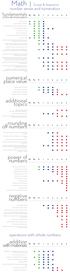 Math Scope & Sequence fundamentals number sense and numeration of the decimal system Count to 10 by units Associate number to numeral (1-10) KN 1 KN 1 KN 2 KN 2 Identify odd and even numbers/numerals and
Grade 1 Geometric Shapes Conceptual Lessons Unit Outline Type of Knowledge & SBAC Claim Prerequisite Knowledge:
 Grade 1 Geometric Shapes Conceptual Lessons Unit Outline Type of Knowledge & SBAC Claim Prerequisite Knowledge: Standards: Lesson Title and Objective/Description Shape names: square, rectangle, triangle,
Solve addition and subtraction word problems, and add and subtract within 10, e.g., by using objects or drawings to represent the problem.
 Solve addition and subtraction word problems, and add and subtract within 10, e.g., by using objects or drawings to represent the problem. Solve word problems that call for addition of three whole numbers
Parts and Wholes. In a tangram. 2 small triangles (S) cover a medium triangle (M) 2 small triangles (S) cover a square (SQ)
 Parts and Wholes. L P S SQ M In a tangram small triangles (S) cover a medium triangle (M) small triangles (S) cover a square (SQ) L S small triangles (S) cover a parallelogram (P) small triangles (S) cover
a. Look under the menu item Introduction to see how the standards are organized by Standards, Clusters and Domains.
 Chapter One Section 1.1 1. Go to the Common Core State Standards website (http://www.corestandards.org/math). This is the main site for further questions about the Common Core Standards for Mathematics.
Summer Math Reinforcement Packet Students Entering into 2 nd Grade
 1 Summer Math Reinforcement Packet Students Entering into 2 nd Grade Our first graders had a busy year learning new math skills. Mastery of all these skills is extremely important in order to develop a
How To Learn To Understand And Understand The Math Of The Year
 Year R Maths Objectives In order to meet the Early Learning Goals at the end of Year R children must be able to: Numbers Count reliably with numbers from -0, place them in order and say which number is
Washington Grade Level Content Expectations EALR s Grades K-5
 A Correlation of to the Washington Grade Level Content Expectations EALR s Grades K-5 M/M-112 INTRODUCTION This document demonstrates how well Investigations in Number, Data, and Space integrates with
Problem of the Month: William s Polygons
 Problem of the Month: William s Polygons The Problems of the Month (POM) are used in a variety of ways to promote problem solving and to foster the first standard of mathematical practice from the Common
Problem of the Month: Cutting a Cube
 Problem of the Month: The Problems of the Month (POM) are used in a variety of ways to promote problem solving and to foster the first standard of mathematical practice from the Common Core State Standards:
Numeracy and mathematics Experiences and outcomes
 Numeracy and mathematics Experiences and outcomes My learning in mathematics enables me to: develop a secure understanding of the concepts, principles and processes of mathematics and apply these in different
Mathematical Practices
 The New Illinois Learning Standards for Mathematics Incorporating the Common Core Mathematical Practices Grade Strand Standard # Standard K-12 MP 1 CC.K-12.MP.1 Make sense of problems and persevere in
Problem of the Month: Perfect Pair
 Problem of the Month: The Problems of the Month (POM) are used in a variety of ways to promote problem solving and to foster the first standard of mathematical practice from the Common Core State Standards:
5 th Grade Common Core State Standards. Flip Book
 5 th Grade Common Core State Standards Flip Book This document is intended to show the connections to the Standards of Mathematical Practices for the content standards and to get detailed information at
Prentice Hall Mathematics: Course 1 2008 Correlated to: Arizona Academic Standards for Mathematics (Grades 6)
 PO 1. Express fractions as ratios, comparing two whole numbers (e.g., ¾ is equivalent to 3:4 and 3 to 4). Strand 1: Number Sense and Operations Every student should understand and use all concepts and
Kindergarten Math Curriculum Course Description and Philosophy Text Reference:
 Kindergarten Math Curriculum Course Description and Philosophy How do numbers and math affect our daily lives? What types of problems can be solved by understanding numbers and math concepts? Through inquiry,
How does one make and support a reasonable conclusion regarding a problem? How does what I measure influence how I measure?
 Middletown Public Schools Mathematics Unit Planning Organizer Subject Mathematics Grade/Course Grade 7 Unit 3 Two and Three Dimensional Geometry Duration 23 instructional days (+4 days reteaching/enrichment)
Fractions as Parts of a Group
 1 Fractions as Parts of a Group Use fractions to describe parts of a group. 1. 5 of the squares are white. a) What fraction of the group are people? b) What fraction of the group are dogs? 8 or 1 2 8 is
Academic Standards for Mathematics
 Academic Standards for Grades Pre K High School Pennsylvania Department of Education INTRODUCTION The Pennsylvania Core Standards in in grades PreK 5 lay a solid foundation in whole numbers, addition,
Line Segments, Rays, and Lines
 HOME LINK Line Segments, Rays, and Lines Family Note Help your child match each name below with the correct drawing of a line, ray, or line segment. Then observe as your child uses a straightedge to draw
Counting Money and Making Change Grade Two
 Ohio Standards Connection Number, Number Sense and Operations Benchmark D Determine the value of a collection of coins and dollar bills. Indicator 4 Represent and write the value of money using the sign
Fractions In Action! Dawn Jesse
 Fractions In Action! Dawn Jesse Fractions In Action Dawn Jesse Fractions In Action is an interactive activity that consists of direct instruction, cooperative learning and is inquire based. As the students
MATHEMATICS. Standard Course of Study and Grade Level Competencies
 MATHEMATICS Standard Course of Study and Grade Level Competencies K-12 Public Schools of North Carolina State Board of Education Department of Public Instruction TABLE OF CONTENTS ACKNOWLEDGMENTS...1
Unit 9. Unit 10. Unit 11. Unit 12. Introduction Busy Ant Maths Year 2 Medium-Term Plans. Number - Geometry - Position & direction
 Busy Ant Maths Year Medium-Term Plans Unit 9 Geometry - Position & direction Unit 0 ( Temperature) Unit Statistics Unit Fractions (time) 8 Busy Ant Maths Year Medium-Term Plans Introduction Unit Geometry
What Is Singapore Math?
 What Is Singapore Math? You may be wondering what Singapore Math is all about, and with good reason. This is a totally new kind of math for you and your child. What you may not know is that Singapore has
Assessment For The California Mathematics Standards Grade 2
 Introduction: Summary of Goals GRADE TWO By the end of grade two, students understand place value and number relationships in addition and subtraction and they use simple concepts of multiplication. They
Primary Curriculum 2014
 Primary Curriculum 2014 Suggested Key Objectives for Mathematics at Key Stages 1 and 2 Year 1 Maths Key Objectives Taken from the National Curriculum 1 Count to and across 100, forwards and backwards,
Assessment For The California Mathematics Standards Grade 3
 Introduction: Summary of Goals GRADE THREE By the end of grade three, students deepen their understanding of place value and their understanding of and skill with addition, subtraction, multiplication,
Minnesota Comprehensive Assessments-Series III
 Name Minnesota Comprehensive Assessments-Series III Mathematics Item Sampler Grade 3 ITEM SAMPLERS ARE NOT SECURE TEST MATERIALS. THIS ITEM SAMPLER TEST BOOK MAY BE COPIED OR DUPLICATE State of Minnesota
Discovering Math: Exploring Geometry Teacher s Guide
 Teacher s Guide Grade Level: 6 8 Curriculum Focus: Mathematics Lesson Duration: Three class periods Program Description Discovering Math: Exploring Geometry From methods of geometric construction and threedimensional
Fourth Grade Math Standards and "I Can Statements"
 Fourth Grade Math Standards and "I Can Statements" Standard - CC.4.OA.1 Interpret a multiplication equation as a comparison, e.g., interpret 35 = 5 x 7 as a statement that 35 is 5 times as many as 7 and
Math Games For Skills and Concepts
 Math Games p.1 Math Games For Skills and Concepts Original material 2001-2006, John Golden, GVSU permission granted for educational use Other material copyright: Investigations in Number, Data and Space,
4 Mathematics Curriculum
 New York State Common Core 4 Mathematics Curriculum G R A D E GRADE 4 MODULE 1 Topic F Addition and Subtraction Word Problems 4.OA.3, 4.NBT.1, 4.NBT.2, 4.NBT.4 Focus Standard: 4.OA.3 Solve multistep word
Common Core State Standards for. Mathematics
 Common Core State Standards for Mathematics Table of Contents Introduction 3 Standards for Mathematical Practice 6 Standards for Mathematical Content Kindergarten 9 Grade 1 13 Grade 2 17 Grade 3 21 Grade
Copyright 2008 [SingaporeMath.com Inc.]. All rights reserved.
![Copyright 2008 [SingaporeMath.com Inc.]. All rights reserved.](/thumbs/40/21422510.jpg "Copyright 2008 [SingaporeMath.com Inc.]. All rights reserved.") Assessment Test for Singapore Primary Mathematics 2B Standards Edition This test covers material taught in Primary Mathematics 2B Standards Edition (http://www.singaporemath.com/) 1. Fill in the blanks
Assessment Test for Singapore Primary Mathematics 2B Standards Edition This test covers material taught in Primary Mathematics 2B Standards Edition (http://www.singaporemath.com/) 1. Fill in the blanks
MATH COMPUTATION. Part 1. TIME : 15 Minutes
 MATH COMPUTATION Part 1 TIME : 15 Minutes This is a practice test - the results are not valid for certificate requirements. A calculator may not be used for this test. MATH COMPUTATION 1. 182 7 = A. 20