
Mercer County Schools
|
|
|
- Lesley Kennedy
- 9 years ago
- Views:
Transcription
1 Mercer County Schools PRIORITIZED CURRICULUM Mathematics Content Maps Second Grade

2 Mercer County Schools PRIORITIZED CURRICULUM The Mercer County Schools Prioritized Curriculum is composed of West Virginia Content Standards and Objectives that have been identified as "Essential, Important, and Nice to Know." The Essential and Important objectives, which are aligned to the WESTEST, must be learned by the student in order to ensure his/her success. Therefore, the majority of al time (90% - 95%) must be devoted to the mastery of these objectives. To assist you with your al planning, the Prioritized Curriculum is divided into learning units (Content Maps) creating an al sequence and estimated time for delivering the intended/learned curriculum.

3 C O N C E P T M A P MATH - Grade 2 Suggested Sequence: 1. Number Sense Number Operations to Number Sense Patterns 5. Number Operations - part 2 6. Geometry 7. Number Sense Fractions 9. Graphs/data analysis 10. Time 11. Money 12. Measurement ALL ESSENTIAL AND IMPORTANT CONCEPTS MUST BE ASSESSED Revised May 21, 2005

4 Key Concepts: Estimated days to Complete: 10 Number order (0-20) Odd and even numbers (0-20) Number Sense (0-20) CSO s: MA 2.1.1(E); 2.1.2(E); 2.1.3(E); 2.1.4(I); 2.1.5(E) Ones Tens Order Compare Numbers can be used to count, label, order, identify, measure and describe things and experiences Greater than & Less Than Ones, tens (0-20) Digit Place value (0-20) standard form What is a number? Why do we have numbers? How do we use numbers everyday? What would happen if we didn t have numbers? How many different ways can you represent (show) a number? Estimate Skip count Odd & Even Ordinal numbers (0-20) Use of various manipulatives Mountain Math Drops In a Bucket Tally Marks Standard Technology Standard based Ordinals

5 Key Concepts: Estimated days to Complete: 15 Addition to 18 Subtraction to 18 Number Operations to 18 CSO s: MA 2.1.8(E); 2.1.9(E); (I) Numbers are interrelated Compare Addend Sum Difference Altogether Fact families More than Properties How can you represent the same number different ways? How do you use clues to solve story problems? Less than Fact family Number sentence Flash cards Timed test Digit Problem solving Technology Standards based

6 Key Concepts: Estimated days to Complete: 15 Number order Odd and even Ones, tens, hundreds Number Sense (0-100) CSO s: MA 2.1.1(E); 2.1.2(E); 2.1.3(E); 2.1.4(I) Hundreds Expanded form Rounding Standard form Numbers can be used to count, label, order, identify, measure and describe things and experiences. Digit Odd Rounding to tens and hundreds Place value (standard and expanded form) What is a number? Why do we have numbers? How do we use numbers everyday? What would happen if we didn t have numbers? What is the value of this digit? How many different ways can you represent a number? Even Problem solving Use various manipulatives Mountain math Drops in a Bucket Technology Standards based

7 Key Concepts: Estimated days to Complete: 5 Growing/repeating patterns Counting patterns (3 s, 4 s) Patterns CSO s: MA 2.2.1(E); 2.2.3(I); 2.2.4(I); 2.2.5(I) The identification of patterns and trends enables prediction Growing pattern Repeating pattern Skip counting Odd/even Predict Pattern rules What is a pattern? How do we find patterns? How do we show patterns? What will happen next in the pattern? Pattern blocks Related literature Technology Standards based

8 Key Concepts: Estimated days to Complete: 45 Addition of 2-and 3-digit numbers without regrouping Number Operations CSO s: MA 2.1.8(E); (I); (E); (I) Ones Tens Hundreds Addition of 2- and 3-digit numbers with regrouping Regrouping Numbers are interrelated Sum Subtraction of 2- and 3-digit numbers without regrouping Subtraction of 2- and 3-digit numbers with regrouping What is regrouping? When do you regroup? How do you use clues to solve story problem? Manipulatives Work mats Difference Addend Operation Modeling Technology Standards based

9 Key Concepts: Estimated days to Complete: 10 Solid figures Plane figures Geometry CSO s: MA 2.3.1(E); 2.2.3(I); 2.3.4(I); 2.3.5(I); 2.3.7(E) Rectangular prism Sphere Cone Cylinder Both the real and the man-made world are designed using geometric figures Cube Comparisons Pyramid Symmetry Congruency Position: rotated/reflected Where is geometry in the natural world? The man-made world? What is a plane figure? What is a solid figure? Plane/solid figures Geoboards Tangrams Faces Edges/sides Angles Corners Symmetry & Congruency Technology Standards based Related literature Slide Rotate (Turn) Reflect (Flip)

10 Key Concepts: Estimated days to Complete: 15 Number order Odd and even Number Sense ( ) CSO s: MA 2.1.1(E); 2.1.2(E); 2.1.3(E); 2.1.4(I); 2.1.6(E) Numbers can be used to count, label, order, identify, measure, and describe things and experiences. Thousands Standard form Expanded form Ones, tens, hundreds, thousands Place value (standard and expanded form) What is a number? Why do we have numbers? How do we use numbers everyday? What would happen if we didn t have numbers? What is the value of this digit? Problem solving Use of various manipulatives Mountain math Drops in a Bucket Technology Standards based

11 Key Concepts: Estimated days to Complete: 5 Fractions Fractional parts Fractions CSO s: MA 2.1.7(E) Parts of a whole can be represented as fractions Halves, fourths, thirds, sixths Equal parts Whole How do we show an equal part of something? How are numbers used to show fractions? Modeling with manipulatives Related literature Technology Standards based

12 Key Concepts: Estimated days to Complete: 10 Types of graphs Simple experiments to predict Graphs and Data Analysis CSO s: MA 2.5.2(E); 2.5.3(E); 2.5.4(I) Data display often reveals patterns that are used to solve problems Prediction Data Horizontal bar graph Picture graph Pictograph Date Certain Questions Problem solving Why do we use graphs? When do we use graphs? When do symbols mean more than one? Various manipulatives Standards based Impossible Outcome Survey Table Tally marks Technology Related literature Comparing

13 Key Concepts: Estimated days to Complete: 10 Sequencing Calendar Time CSO s: MA 2.4.6(E); 2.4.7(E); 2.4.8(E); 2.4.9(E) Telling time is an essential life skill Face Analog Digital Sequence a.m. / p.m. Quarter hour Prediction Half hour Why is time important? How do we use clocks to tell time? How do we use calendars? Intervals Quarter hour Problem solving Individual clocks and calendars Related literature Technology Standards based

14 Key Concepts: Estimated days to Complete: 10 Coin values (dollar) Coin collections (dollar) Money CSO s: MA (E) Coins Penny Nickel Dime Money is a valuable tool in daily life Different money is used in different countries. Quarter Representations Dollar Change Why do we use money? Why do we need standard values for the coins? How do we use money in daily life? Cents Value Amount/total Play money Career speaker Price Problem solving Change Technology Related literature Standards based

15 Key Concepts: Estimated days to Complete: 10 Area Perimeter Units of measure: Standard Metric Length Inches Feet Yard Mile Centimeter Capacity Cups,pints,quarts,gallons Weight Pounds, kilograms Temperature Measurements CSO s: MA 2.4.1(E); 2.4.2(I); 2.4.3(I); 2.4.5(I) Measurement helps us understand and describe our world Why do we measure? Why do we have different units of measure? Use scale weights, rulers, thermometers Related literature Pounds/kilograms Inches/Feet/Yard/Mile Perimeter Area Cups/Pints/Quarts/Gallons Centimeter Temperature Fahrenheit Celsius Technology Standards based

Quarter One: August-October
 Quarter One: August-October (Chapters 1 3, 5-6, 10) August - December Quarterly Addition facts with sums through 20 General Math Content 1. Write sums through 20. 1. Choose and enter the appropriate answer.
Pocantico Hills School District Grade 1 Math Curriculum Draft
 Pocantico Hills School District Grade 1 Math Curriculum Draft Patterns /Number Sense/Statistics Content Strands: Performance Indicators 1.A.1 Determine and discuss patterns in arithmetic (what comes next
1st Grade Math Standard I Rubric. Number Sense. Score 4 Students show proficiency with numbers beyond 100.
 1st Grade Math Standard I Rubric Number Sense Students show proficiency with numbers beyond 100. Students will demonstrate an understanding of number sense by: --counting, reading, and writing whole numbers
Indicator 2: Use a variety of algebraic concepts and methods to solve equations and inequalities.
 3 rd Grade Math Learning Targets Algebra: Indicator 1: Use procedures to transform algebraic expressions. 3.A.1.1. Students are able to explain the relationship between repeated addition and multiplication.
2nd Grade Math Common Core Curriculum
 Quarter 1 I. Number 2.1.2.B.1 To allow for refinement of curricular content and to guide the creation of quality aligned assessments, the Objectives column is intentionally incomplete. The District s Curriculum
Everyday Mathematics CCSS EDITION CCSS EDITION. Content Strand: Number and Numeration
 CCSS EDITION Overview of -6 Grade-Level Goals CCSS EDITION Content Strand: Number and Numeration Program Goal: Understand the Meanings, Uses, and Representations of Numbers Content Thread: Rote Counting
Everyday Mathematics GOALS
 Copyright Wright Group/McGraw-Hill GOALS The following tables list the Grade-Level Goals organized by Content Strand and Program Goal. Content Strand: NUMBER AND NUMERATION Program Goal: Understand the
1A: Understand numbers, ways of representing numbers, relationships among numbers, and number systems.
 NCTM STANDARD 1: Numbers and Operations Kindergarten Grade 2 1A: Understand numbers, ways of representing numbers, relationships among numbers, and number systems. Kindergarten Grade One Grade Two 1. Count
Minnesota Academic Standards
 A Correlation of to the Minnesota Academic Standards Grades K-6 G/M-204 Introduction This document demonstrates the high degree of success students will achieve when using Scott Foresman Addison Wesley
ISAT Mathematics Performance Definitions Grade 4
 ISAT Mathematics Performance Definitions Grade 4 EXCEEDS STANDARDS Fourth-grade students whose measured performance exceeds standards are able to identify, read, write, represent, and model whole numbers
Mathematics Scope and Sequence, K-8
 Standard 1: Number and Operation Goal 1.1: Understands and uses numbers (number sense) Mathematics Scope and Sequence, K-8 Grade Counting Read, Write, Order, Compare Place Value Money Number Theory K Count
Illinois State Standards Alignments Grades Three through Eleven
 Illinois State Standards Alignments Grades Three through Eleven Trademark of Renaissance Learning, Inc., and its subsidiaries, registered, common law, or pending registration in the United States and other
Scope and Sequence KA KB 1A 1B 2A 2B 3A 3B 4A 4B 5A 5B 6A 6B
 Scope and Sequence Earlybird Kindergarten, Standards Edition Primary Mathematics, Standards Edition Copyright 2008 [SingaporeMath.com Inc.] The check mark indicates where the topic is first introduced
EVERY DAY COUNTS CALENDAR MATH 2005 correlated to
 EVERY DAY COUNTS CALENDAR MATH 2005 correlated to Illinois Mathematics Assessment Framework Grades 3-5 E D U C A T I O N G R O U P A Houghton Mifflin Company YOUR ILLINOIS GREAT SOURCE REPRESENTATIVES:
PUBLIC SCHOOLS OF EDISON TOWNSHIP DIVISION OF CURRICULUM AND INSTRUCTION ELEMENTARY MATH GRADE 2 MATH IN FOCUS
 PUBLIC SCHOOLS OF EDISON TOWNSHIP DIVISION OF CURRICULUM AND INSTRUCTION ELEMENTARY MATH GRADE 2 MATH IN FOCUS Length of Course: Term Elective / Required: Required Schools: Elementary Student Eligibility:
1 ST GRADE COMMON CORE STANDARDS FOR SAXON MATH
 1 ST GRADE COMMON CORE STANDARDS FOR SAXON MATH Calendar The following tables show the CCSS focus of The Meeting activities, which appear at the beginning of each numbered lesson and are taught daily,
-- Martensdale-St. Marys Community School Math Curriculum
 -- Martensdale-St. Marys Community School Standard 1: Students can understand and apply a variety of math concepts. Benchmark; The student will: A. Understand and apply number properties and operations.
Thank you for your interest in Inspiration and Kidspiration!
 The Inspired Standards Match is designed to demonstrate the many ways Kidspiration and Inspiration support the standards and to give educators ideas for using these tools to meet learning goals across
Math 5th grade. Create your own number and explain how to use expanded form to show place value to the ten millions place.
 Number Properties and Operations Whole number sense and addition and subtraction are key concepts and skills developed in early childhood. Students build on their number sense and counting sense to develop
Progressing toward the standard
 Report Card Language: The student can add and subtract fluently within 20. CCSS: 2.OA.2 Fluently add and subtract within 20 using mental strategies, by end of grade, know from memory all sums of two one-digit
Mathematics Florida Standards (MAFS) Grade 2
 Mathematics Florida Standards (MAFS) Grade 2 Domain: OPERATIONS AND ALGEBRAIC THINKING Cluster 1: Represent and solve problems involving addition and subtraction. MAFS.2.OA.1.1 Use addition and subtraction
Chapter 111. Texas Essential Knowledge and Skills for Mathematics. Subchapter A. Elementary
 Elementary 111.A. Chapter 111. Texas Essential Knowledge and Skills for Mathematics Subchapter A. Elementary Statutory Authority: The provisions of this Subchapter A issued under the Texas Education Code,
Number, Operation, and Quantitative Reasoning
 2 nd Grade Math TEKS I Can Statements Website Resources Number, Operation, and Quantitative Reasoning 2.1A I can use models to make a number that has hundreds, tens,and ones 2.1B I can read and write whole
MATHEMATICS GRADE 2 Extension Projects
 MATHEMATICS GRADE 2 Extension Projects WITH INVESTIGATIONS 2009 These projects are optional and are meant to be a springboard for ideas to enhance the Investigations curriculum. Use them to help your students
Everyday Mathematics. Grade 4 Grade-Level Goals. 3rd Edition. Content Strand: Number and Numeration. Program Goal Content Thread Grade-Level Goals
 Content Strand: Number and Numeration Understand the Meanings, Uses, and Representations of Numbers Understand Equivalent Names for Numbers Understand Common Numerical Relations Place value and notation
Everyday Mathematics. Grade 4 Grade-Level Goals CCSS EDITION. Content Strand: Number and Numeration. Program Goal Content Thread Grade-Level Goal
 Content Strand: Number and Numeration Understand the Meanings, Uses, and Representations of Numbers Understand Equivalent Names for Numbers Understand Common Numerical Relations Place value and notation
SCOPE & SEQUENCE. Kindergarten, First Grade, and Second Grade. Skills and Activities
 SCOPE & SEQUENCE Kindergarten, First Grade, and Second Grade Skills and Activities INNOVATIVE LEARNING CONCEPTS INC. creators of TOUCHMATH TouchMath materials were first published in 1975. Innovative Learning
Second edition. Student's Book 3. Laurie Sealy and Sandra Moore
 CARIBBEAN Primary MATHEMATICS Second edition Student's Book 3 Laurie Sealy and Sandra Moore BRIGHT SPARKS SB3 prf4.indd 1 Macmillan Education Between Towns Road, Oxford, OX4 3PP A division of Macmillan
Analysis of California Mathematics standards to Common Core standards- Kindergarten
 Analysis of California Mathematics standards to Common Core standards- Kindergarten Strand CA Math Standard Domain Common Core Standard (CCS) Alignment Comments in reference to CCS Strand Number Sense
Georgia Standards Alignment Grades One through Six
 Georgia Standards Alignment Grades One through Six Trademark of Renaissance Learning, Inc., and its subsidiaries, registered, common law, or pending registration in the United States and other countries.
Standard 1: Students can understand and apply a variety of math concepts.
 Grade Level: 4th Teacher: Pelzer/Reynolds Math Standard/Benchmark: A. understand and apply number properties and operations. Grade Level Objective: 1.A.4.1: develop an understanding of addition, subtraction,
Level 1 - Maths Targets TARGETS. With support, I can show my work using objects or pictures 12. I can order numbers to 10 3
 Ma Data Hling: Interpreting Processing representing Ma Shape, space measures: position shape Written Mental method s Operations relationship s between them Fractio ns Number s the Ma1 Using Str Levels
Math Journal HMH Mega Math. itools Number
 Lesson 1.1 Algebra Number Patterns CC.3.OA.9 Identify arithmetic patterns (including patterns in the addition table or multiplication table), and explain them using properties of operations. Identify and
for the Common Core State Standards 2012
 A Correlation of for the Common Core State s 2012 to the Common Core Georgia Performance s Grade 2 FORMAT FOR CORRELATION TO THE COMMON CORE GEORGIA PERFORMANCE STANDARDS (CCGPS) Subject Area: K-12 Mathematics
How To Learn To Understand And Understand The Math Of The Year
 Year R Maths Objectives In order to meet the Early Learning Goals at the end of Year R children must be able to: Numbers Count reliably with numbers from -0, place them in order and say which number is
1 st Grade Math Do-Anytime Activities
 1 st Grade Have your child help create a number line (0-15) outside with sidewalk chalk. Call out a number and have your child jump on that number. Make up directions such as Hop to the number that is
NUMBER CORNER YEARLONG CONTENT OVERVIEW
 August & September Workouts Calendar Grid Quilt Block Symmetries Identifying shapes and symmetries Calendar Collector Two Penny Toss Probability and data analysis Computational Fluency Mental Math Fluently
Charlesworth School Year Group Maths Targets
 Charlesworth School Year Group Maths Targets Year One Maths Target Sheet Key Statement KS1 Maths Targets (Expected) These skills must be secure to move beyond expected. I can compare, describe and solve
numerical place value additional topics rounding off numbers power of numbers negative numbers addition with materials fundamentals
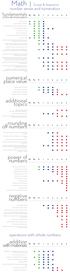 Math Scope & Sequence fundamentals number sense and numeration of the decimal system Count to 10 by units Associate number to numeral (1-10) KN 1 KN 1 KN 2 KN 2 Identify odd and even numbers/numerals and
Math Questions & Answers
 What five coins add up to a nickel? five pennies (1 + 1 + 1 + 1 + 1 = 5) Which is longest: a foot, a yard or an inch? a yard (3 feet = 1 yard; 12 inches = 1 foot) What do you call the answer to a multiplication
Mathematics K 6 continuum of key ideas
 Mathematics K 6 continuum of key ideas Number and Algebra Count forwards to 30 from a given number Count backwards from a given number in the range 0 to 20 Compare, order, read and represent to at least
Republic of the Philippines Department of Education DepEd Complex, Meralco Avenue Pasig City. K to 12 Curriculum Guide MATHEMATICS
 Republic of the Philippines Department of Education DepEd Complex, Meralco Avenue Pasig City K to 12 Curriculum Guide MATHEMATICS (Grade 1 to Grade 10) January 31, 2012 CONCEPTUAL FRAMEWORK Mathematics
Numeracy Targets. I can count at least 20 objects
 Targets 1c I can read numbers up to 10 I can count up to 10 objects I can say the number names in order up to 20 I can write at least 4 numbers up to 10. When someone gives me a small number of objects
Grade 5 Math Content 1
 Grade 5 Math Content 1 Number and Operations: Whole Numbers Multiplication and Division In Grade 5, students consolidate their understanding of the computational strategies they use for multiplication.
Welcome to Harcourt Mega Math: The Number Games
 Welcome to Harcourt Mega Math: The Number Games Harcourt Mega Math In The Number Games, students take on a math challenge in a lively insect stadium. Introduced by our host Penny and a number of sporting
Unit 9. Unit 10. Unit 11. Unit 12. Introduction Busy Ant Maths Year 2 Medium-Term Plans. Number - Geometry - Position & direction
 Busy Ant Maths Year Medium-Term Plans Unit 9 Geometry - Position & direction Unit 0 ( Temperature) Unit Statistics Unit Fractions (time) 8 Busy Ant Maths Year Medium-Term Plans Introduction Unit Geometry
Assessment For The California Mathematics Standards Grade 3
 Introduction: Summary of Goals GRADE THREE By the end of grade three, students deepen their understanding of place value and their understanding of and skill with addition, subtraction, multiplication,
Directions: Place greater than (>), less than (<) or equal to (=) symbols to complete the number sentences on the left.
 Comparing Numbers Week 7 26) 27) 28) Directions: Place greater than (>), less than (
Students are able to represent and solve problems involving multiplication and division.
 Grade 3 Learning Targets and I Can Statements Operations and Algebraic Thinking Students are able to represent and solve problems involving multiplication and division. o I understand the product of multiplication
Number Sense and Operations
 Number Sense and Operations representing as they: 6.N.1 6.N.2 6.N.3 6.N.4 6.N.5 6.N.6 6.N.7 6.N.8 6.N.9 6.N.10 6.N.11 6.N.12 6.N.13. 6.N.14 6.N.15 Demonstrate an understanding of positive integer exponents
MAFS: Mathematics Standards GRADE: K
 MAFS: Mathematics Standards GRADE: K Domain: COUNTING AND CARDINALITY Cluster 1: Know number names and the count sequence. CODE MAFS.K.CC.1.1 Count to 100 by ones and by tens. MAFS.K.CC.1.2 MAFS.K.CC.1.3
Topic Lesson Widget HOTsheet
 Numbers to 1000 and beyond Numbers to 1000 Words and numbers Number machine Ordering numbers Numbers beyond 1000 Number creator Jersey numbers Number grid puzzles Number creator Digit cards Passwords Splitting
My Year 1 Maths Targets
 My Year 1 Maths Targets Number number and place value I can count to and across 100, forwards and backwards, beginning with 0 or 1, or from any given number. I can count in multiples of twos, fives and
Released Assessment Questions, 2015. Answering Multiple-Choice Questions
 Released Assessment Questions, 2015 Primary Division 13300 Grade 3 Mathematics Assessment of Reading, Writing and Mathematics INSTRUCTIONS Answering Multiple-Choice Questions Like this: Not like this:
Possible Stage Two Mathematics Test Topics
 Possible Stage Two Mathematics Test Topics The Stage Two Mathematics Test questions are designed to be answerable by a good problem-solver with a strong mathematics background. It is based mainly on material
2 nd Grade Texas Mathematics: Unpacked Content
 2 nd Grade Texas Mathematics: Unpacked Content What is the purpose of this document? To increase student achievement by ensuring educators understand specifically what the new standards mean a student
CCSS-M Critical Areas: Kindergarten
 CCSS-M Critical Areas: Kindergarten Critical Area 1: Represent and compare whole numbers Students use numbers, including written numerals, to represent quantities and to solve quantitative problems, such
NEW MEXICO Grade 6 MATHEMATICS STANDARDS
 PROCESS STANDARDS To help New Mexico students achieve the Content Standards enumerated below, teachers are encouraged to base instruction on the following Process Standards: Problem Solving Build new mathematical
Primary Curriculum 2014
 Primary Curriculum 2014 Suggested Key Objectives for Mathematics at Key Stages 1 and 2 Year 1 Maths Key Objectives Taken from the National Curriculum 1 Count to and across 100, forwards and backwards,
Prentice Hall Mathematics: Course 1 2008 Correlated to: Arizona Academic Standards for Mathematics (Grades 6)
 PO 1. Express fractions as ratios, comparing two whole numbers (e.g., ¾ is equivalent to 3:4 and 3 to 4). Strand 1: Number Sense and Operations Every student should understand and use all concepts and
Academic Standards for Mathematics
 Academic Standards for Grades Pre K High School Pennsylvania Department of Education INTRODUCTION The Pennsylvania Core Standards in in grades PreK 5 lay a solid foundation in whole numbers, addition,
Geometry and Measurement
 The student will be able to: Geometry and Measurement 1. Demonstrate an understanding of the principles of geometry and measurement and operations using measurements Use the US system of measurement for
Grade 2 Level. Math Common Core Sampler Test
 Grade 2 Level Math Common Core Sampler Test Everyone we come in contact with is scrambling to get their hands on example questions for this grade level. This test sampler is put together to give you an
Manitoba Curriculum. Alignment with Mathletics. Supported by independent evidence-based research and practice. Powerful reporting.
 Supported by independent evidence-based research practice. Follows provincial curricula Powerful reporting Student centred Content Kindergarten Grade 1 Grade 2 02 04 08 Grade 10 Applied & Pre-Calculus
MATHS LEVEL DESCRIPTORS
 MATHS LEVEL DESCRIPTORS Number Level 3 Understand the place value of numbers up to thousands. Order numbers up to 9999. Round numbers to the nearest 10 or 100. Understand the number line below zero, and
Cambridge Primary Mathematics Curriculum Framework (with codes)
 Cambridge Primary Mathematics Curriculum Framework (with codes) Contents Introduction Stage 1...1 Stage 2...5 Stage 3...9 Stage 4...14 Stage 5...18 Stage 6...24 Note on codes Each learning objective has
Previous Letterland at Tweetsie Railroad Motivation and reward Letterland at Tweetsie Curriculum Guides
 Previous Letterland at Tweetsie Railroad Each May since 2007, children from all over North Carolina (and Texas and Georgia) have come to Letterland at Tweetsie Railroad, where we have transformed our theme
MMLA Student Test/MathAssessments.MSCenters.Org. MMLA Mathematics Assessment Items
 Page 1 of 42 MMLA Mathematics Assessment Items Name: Date: Multiple Choice Questions Select the one best answer for each question. 1. Which of the following sets of numbers are all of the factors of 24?
CCSS Mathematics Implementation Guide Grade 5 2012 2013. First Nine Weeks
 First Nine Weeks s The value of a digit is based on its place value. What changes the value of a digit? 5.NBT.1 RECOGNIZE that in a multi-digit number, a digit in one place represents 10 times as much
South Carolina College- and Career-Ready Standards for Mathematics
 South Carolina College- and Career-Ready Standards for Mathematics South Carolina Department of Education Columbia, South Carolina 2015 State Board of Education Approved First Reading on February 11, 2015
South Carolina College- and Career-Ready Standards for Mathematics
 South Carolina College- and Career-Ready Standards for Mathematics South Carolina Department of Education Columbia, South Carolina 2015 State Board of Education Approved First Reading on February 11, 2015
Overview. Essential Questions. Grade 8 Mathematics, Quarter 4, Unit 4.3 Finding Volume of Cones, Cylinders, and Spheres
 Cylinders, and Spheres Number of instruction days: 6 8 Overview Content to Be Learned Evaluate the cube root of small perfect cubes. Simplify problems using the formulas for the volumes of cones, cylinders,
Arizona s College and Career Ready Standards Mathematics
 Arizona s College and Career Ready Mathematics Mathematical Practices Explanations and Examples Third Grade ARIZONA DEPARTMENT OF EDUCATION HIGH ACADEMIC STANDARDS FOR STUDENTS State Board Approved June
The symbols indicate where the topic is first introduced or specifically addressed.
 ingapore Math Inc. cope and equence U: U.. Edition : ommon ore Edition : tandards Edition : ommon ore tandards 1 2 3 4 5 Reviews in ommon ore Edition cover just the unit whereas those in U.. and tandards
MATHEMATICS. Standard Course of Study and Grade Level Competencies
 MATHEMATICS Standard Course of Study and Grade Level Competencies K-12 Public Schools of North Carolina State Board of Education Department of Public Instruction TABLE OF CONTENTS ACKNOWLEDGMENTS...1
Intermediate Phase New Day-by-Day Planning Pack MATHEMATICS
 Intermediate Phase Planning Pack MATHEMATICS Contents: Work Schedules: Page Grade 4 2 Grade 5 4 Grade 6 5 Lesson Plans: Grade 4 6 Grade 5 21 Grade 6 36 Milestones: Grade 4... 52 Grade 5 57 Grade 6 62 Rubrics:
Pre-Algebra 2008. Academic Content Standards Grade Eight Ohio. Number, Number Sense and Operations Standard. Number and Number Systems
 Academic Content Standards Grade Eight Ohio Pre-Algebra 2008 STANDARDS Number, Number Sense and Operations Standard Number and Number Systems 1. Use scientific notation to express large numbers and small
Glencoe. correlated to SOUTH CAROLINA MATH CURRICULUM STANDARDS GRADE 6 3-3, 5-8 8-4, 8-7 1-6, 4-9
 Glencoe correlated to SOUTH CAROLINA MATH CURRICULUM STANDARDS GRADE 6 STANDARDS 6-8 Number and Operations (NO) Standard I. Understand numbers, ways of representing numbers, relationships among numbers,
Tennessee Mathematics Standards 2009-2010 Implementation. Grade Six Mathematics. Standard 1 Mathematical Processes
 Tennessee Mathematics Standards 2009-2010 Implementation Grade Six Mathematics Standard 1 Mathematical Processes GLE 0606.1.1 Use mathematical language, symbols, and definitions while developing mathematical
Grade 5 Mathematics Curriculum Guideline Scott Foresman - Addison Wesley 2008. Chapter 1: Place, Value, Adding, and Subtracting
 Grade 5 Math Pacing Guide Page 1 of 9 Grade 5 Mathematics Curriculum Guideline Scott Foresman - Addison Wesley 2008 Test Preparation Timeline Recommendation: September - November Chapters 1-5 December
Measurement. Introduction... 3
 Introduction... 3 Unit 1: Length Customary System Lesson 1: Length... 3 Lesson 2: Perimeter... 3 Lesson 3: Length Estimation... 4 Lesson 4: Selection of Units... 4 Lesson 5: Changing Units... 5 Unit 2:
Wigan LEA Numeracy Centre. Year 3 Time Block 3 Mental Arithmetic Test Questions
 Wigan LEA Numeracy Centre Year 3 Time Block 3 Mental Arithmetic Test Questions Produced by Wigan Numeracy Centre September 2000 Test 3 (end of week 2) Year 3 Block 3 I will read every question twice. In
The National Curriculum 2014 Programmes of Study for Mathematics
 The National Curriculum 2014 Programmes of Study for Mathematics Information inserted by the Lancashire Mathematics Team to support schools and teachers in identifying elements of the curriculum that have
Discovering Math: Exploring Geometry Teacher s Guide
 Teacher s Guide Grade Level: 6 8 Curriculum Focus: Mathematics Lesson Duration: Three class periods Program Description Discovering Math: Exploring Geometry From methods of geometric construction and threedimensional
Grade 3 FCAT 2.0 Mathematics Sample Answers
 Grade FCAT 2.0 Mathematics Sample Answers This booklet contains the answers to the FCAT 2.0 Mathematics sample questions, as well as explanations for the answers. It also gives the Next Generation Sunshine
The Australian Curriculum Mathematics
 The Australian Curriculum Mathematics Mathematics ACARA The Australian Curriculum Number Algebra Number place value Fractions decimals Real numbers Foundation Year Year 1 Year 2 Year 3 Year 4 Year 5 Year
FIRST GRADE MATH Summer 2011
 Standards Summer 2011 1 OA.1 Use addition and subtraction within 20 to solve word problems involving situations of adding to, taking from, putting together, taking apart, and comparing, with unknowns in
Mathematical Practices
 The New Illinois Learning Standards for Mathematics Incorporating the Common Core Mathematical Practices Grade Strand Standard # Standard K-12 MP 1 CC.K-12.MP.1 Make sense of problems and persevere in
Year 3 Mental Arithmetic Test Questions
 Year 3 Mental Arithmetic Test Questions Equipment Required Printed question and answer sheet for the reader Printed blank answer page for child Stopwatch or timer Pencil No other equipment is required
COMMON CORE STATE STANDARDS FOR MATHEMATICS 3-5 DOMAIN PROGRESSIONS
 COMMON CORE STATE STANDARDS FOR MATHEMATICS 3-5 DOMAIN PROGRESSIONS Compiled by Dewey Gottlieb, Hawaii Department of Education June 2010 Operations and Algebraic Thinking Represent and solve problems involving
Key Stage 2 Mathematics Programme of Study
 Deeloping numerical reasoning Identify processes and connections Represent and communicate Reiew transfer mathematical to a ariety of contexts and eeryday situations identify the appropriate steps and
Voyager Sopris Learning Vmath, Levels C-I, correlated to the South Carolina College- and Career-Ready Standards for Mathematics, Grades 2-8
 Page 1 of 35 VMath, Level C Grade 2 Mathematical Process Standards 1. Make sense of problems and persevere in solving them. Module 3: Lesson 4: 156-159 Module 4: Lesson 7: 220-223 2. Reason both contextually
K-12 Louisiana Student Standards for Mathematics: Table of Contents
 K-12 Louisiana Student Standards for Mathematics: Table of Contents Introduction Development of K-12 Louisiana Student Standards for Mathematics... 2 The Role of Standards in Establishing Key Student Skills
Grade 1. M3: Ordering and Expressing Length Measurements as Numbers
 Grade 1 Key Areas of Focus for Grades K-2: Addition and subtraction-concepts, skills and problem solving Expected Fluency: Add and Subtract within 10 Module M1: Addition and Subtraction of Numbers to 10
Standards and progression point examples
 Mathematics Progressing towards Foundation Progression Point 0.5 At 0.5, a student progressing towards the standard at Foundation may, for example: connect number names and numerals with sets of up to
DesCartes (Combined) Subject: Mathematics 2-5 Goal: Data Analysis, Statistics, and Probability
 DesCartes (Combined) Subject: Mathematics 2-5 Goal: Data Analysis, Statistics, and Probability RIT Score Range: Below 171 Below 171 Data Analysis and Statistics Solves simple problems based on data from
STRAND: Number and Operations Algebra Geometry Measurement Data Analysis and Probability STANDARD:
 how August/September Demonstrate an understanding of the place-value structure of the base-ten number system by; (a) counting with understanding and recognizing how many in sets of objects up to 50, (b)
In mathematics, there are four attainment targets: using and applying mathematics; number and algebra; shape, space and measures, and handling data.
 MATHEMATICS: THE LEVEL DESCRIPTIONS In mathematics, there are four attainment targets: using and applying mathematics; number and algebra; shape, space and measures, and handling data. Attainment target
of surface, 569-571, 576-577, 578-581 of triangle, 548 Associative Property of addition, 12, 331 of multiplication, 18, 433
 Absolute Value and arithmetic, 730-733 defined, 730 Acute angle, 477 Acute triangle, 497 Addend, 12 Addition associative property of, (see Commutative Property) carrying in, 11, 92 commutative property
Common Core State Standards for Mathematics Accelerated 7th Grade
 A Correlation of 2013 To the to the Introduction This document demonstrates how Mathematics Accelerated Grade 7, 2013, meets the. Correlation references are to the pages within the Student Edition. Meeting