
Name: Date: Period: Presentation #4. Covalent compounds continued practice with drawing them. Modeling covalent compounds in 3D
|
|
|
- Deirdre Flynn
- 9 years ago
- Views:
Transcription
1 Homework Activities Name: Date: Period: This week we will practice creating covalent compounds through drawings and 3D models. We will also look at polar and non-polar molecules to see how their structures affect their interactions with various molecules. We will end the week by investigating how solubility is affected by factors such as surface area, temperature and pressure. CLASS MONDAY (2/27) TUESDAY (2/28) WEDNESDAY (2/29) THURSDAY (3/1) FRIDAY (3/2) NO SCHOOL Presentation #3 Introduction to Covalent Compounds Presentation #4 Covalent compounds continued practice with drawing them Presentation #5 Polar vs. non-polar molecules Presentation #6 Polar vs. non-polar molecules continued Creating lava lamps Detergent investigation Modeling covalent compounds in 3D Read and annotate p. 2-4, p. 12 p Write a reflection about answer questions on p.5 today s activity. Type it up and finish p. 6-7 and it to me. Answer the following questions: 1.) What is detergent and how does it clean clothes? 2.) How does detergent affect surface tension? 3.) How does detergent affect an oil-water mixture? ALEKS Tutorial on covalent bonding: (type in Chemistry Tutorial 6.01a: How Covalent Bonds Form ) Ionic and covalent bonding animation: (type in ionic and covalent bonding animation 1

2 Warmup- Reflection on Ionic Compounds 1.) Explain how ionic bonding works. 2.) What common physical properties do ionic compounds have? (What do ionic compounds all look like?) Why are they like this? 3.) What do ionic compounds have in common in regards to their melting points are they high or low melting points? Why are all there melting points like this? (Hint- has to do with their ionic bonds). 4.) What happens when you put ionic compounds in water? 5.) What is electricity and why do ionic compounds in water conduct electricity? 2


3 Homework Covalent Compounds Covalent Bonding Overview & Single Bonds Read the following pages and highlight and annotate any important information. Then answer the questions below: 3

4 4

5 5

6 Answer the following questions: 1.) On page 2, the text talks about the story of an art project. How does this art project relate to covalent bonding? 2.) Describe what a covalent bond is and what type of elements make covalent bonds. 3.) What type of force holds atoms together in a covalent bond? 4.) What is another name for a covalent compound? 5.) On page 3, there is a diagram of a water molecule at the bottom. Explain why oxygen bonds together with hydrogen (make sure that you talk about the electrons in your explanation). 6.) On page 4, there is a diagram of a water molecule at the bottom. Explain why nitrogen bonds together with 3 hydrogen atoms (make sure that you talk about the electrons in your explanation) instead of 2 hydrogen atoms like water. 7.) Page 4 talks about double and triple bonds. What is a double bond? What is a triple bond? 8.) Look at page 4. Why does oxygen create a double bond with itself? 9.) Look at page 4. Why does nitrogen create a triple bond with itself? 6

7 Drawing Covalent Compounds Use Lewis Dot Structures to show how these covalent bonds form. 7

8 Molecular Compound Electron dot structures Structural Formulas (represent bonds with dashes) # of unshared pairs Type of bonds (single, double, triple) EX: HF There are 3 pairs of unshared electrons 1 single bond between H and F 1.) F 2 2.) H 2 O 3.) NH 3 4.) N 2 5.) CO 2 6.) HCN 7.) HCl 8


9 Warmup Covalent Compounds Read the following information about molecular (covalent) compounds and you ve already learned about the properties of ionic compounds. Fill in the chart below. Properties Ionic Compounds Covalent Compounds Strength of bonds (stronger or weaker?) Typical phases of matter (solid, liquid, gas?) Melting point (high or low?) Dissolves in water (yes or no?) Conducts electricity (yes or no?) 9

10 Practice with Covalent Compounds In this exercise, I want you to figure out what each of these covalent compounds will look like. First, draw the Lewis dot structures and then draw the structural compounds of each (use sticks or lines to represent the bonds between each atom in the compound). 1) SHF 2) CF 2 S 3) BH 3 4) SF 2 5) P 2 H 4 10

11 Modeling Covalent Compounds Build these compounds using the molecular kits provided, draw the Lewis Dot Structures and Structural Compounds (model with lines to represent the bonds), state the type of bonds and give the compound a name. COMPOUND FORMULA Lewis Dot Structures Structural Compound Types of Bonds 1. CO 2 2. CH4 3. HCN 4. C2H4 5. C3H6 6. HCOOH 7. C2H2 8. N2F2 11

12 Homework- Drawing Covalent Compounds Fill in the chart below. COMPOUND FORMULA Lewis Dot Structures Structural Compound Types of Bonds 1. CF 4 2. BF 3 3. NF 3 4. H 2 CS 5. CH 2 F 2 6. O 2 7. PF 3 8. H 2 S 12

13 Warmup- Practice with Drawing Ionic and Covalent Compounds Ionic Compounds Ionic compounds (share or steal?) electrons. Figure out the formulas for the following ionic compounds: 1.) Mg + Br Chemical formula: 2.) Al + Cl Chemical formula: Covalent Compounds Covalent compounds (share or steal?) electrons. Figure out what the following compounds will look like draw the Lewis Dot Structures and the structural compounds (bonds = lines) for each. 13

14 14

15 Blobs in a Bottle (a polar vs. nonpolar molecule lab) [taken from Science Bob at Introduction: You ve already learned about polar and nonpolar molecules and how they react with water. You will now put the polarity principles to work to create a lava lamp and understand how it works. Materials: A clean water bottle of water Vegetable oil Alka seltzer tablets Food coloring Procedure: 1. Pour the water into the bottle. 2. Use a measuring cup, beaker or funnel to slowly pour the vegetable oil into the bottle until it s almost full. You may have to wait a few minutes for the oil and water to separate. 3. Add 10 drops of food coloring to the bottle. The drops will pass through the oil and then mix with the water below. 4. Break a seltzer tablet in half and drop the half tablet into the bottle. Watch it sink to the bottom and let the blobby greatness begin! Data & Observations: What do you notice happening between the oil and the water? What happens when the alka-seltzer tablet hits the water? What does it produce? What happens AFTER the alka-seltzer tablet hits the water? Why is this lab called Blobs in a Bottle? Conclusion: 1. Why don t water and oil mix? Make sure to use polar and nonpolar molecules in your answer. 2. The CO 2 gas produced by the alka-seltzer and water reaction rises to the top of the bottle and carries with it the colored water. When the gas escapes from the top, why does the water sink back down? 15

16 Homework Polar and Nonpolar Molecules Part 1: Identifying Ionic, Polar and Nonpolar Bonds For ionic bonds, the difference in electronegativity (ΔEN) between atoms is. For polar covalent bonds, the difference in electronegativity (ΔEN) between atoms is. For nonpolar covalent bonds, the difference in electronegativity (ΔEN) between atoms is. Use your Periodic Table of Electronegativities to help you figure out whether the following bonds are ionic, polar or nonpolar. Bonds Ionic, polar or nonpolar? Bonds Ionic, polar or nonpolar? 1. Na-Cl 9. Fe- Cl 2. C-S 10. F-F 3. S-F 11. Cr- O 4. N-Cl 12. C-O 5. Fe-S 13. H-H 6. O-Cl 14. C-H 7. Cl-Cl 15. Br-I 8. Si-Br 16. Ca-F Part 2: Identifying Polar and Nonpolar Molecules The following compounds are all covalent. Draw the compounds and figure out whether they are polar or nonpolar covalent molecules. 1.) CS 2 Polar or nonpolar? 2.) SF 2 Polar or nonpolar? 3.) BF 3 16

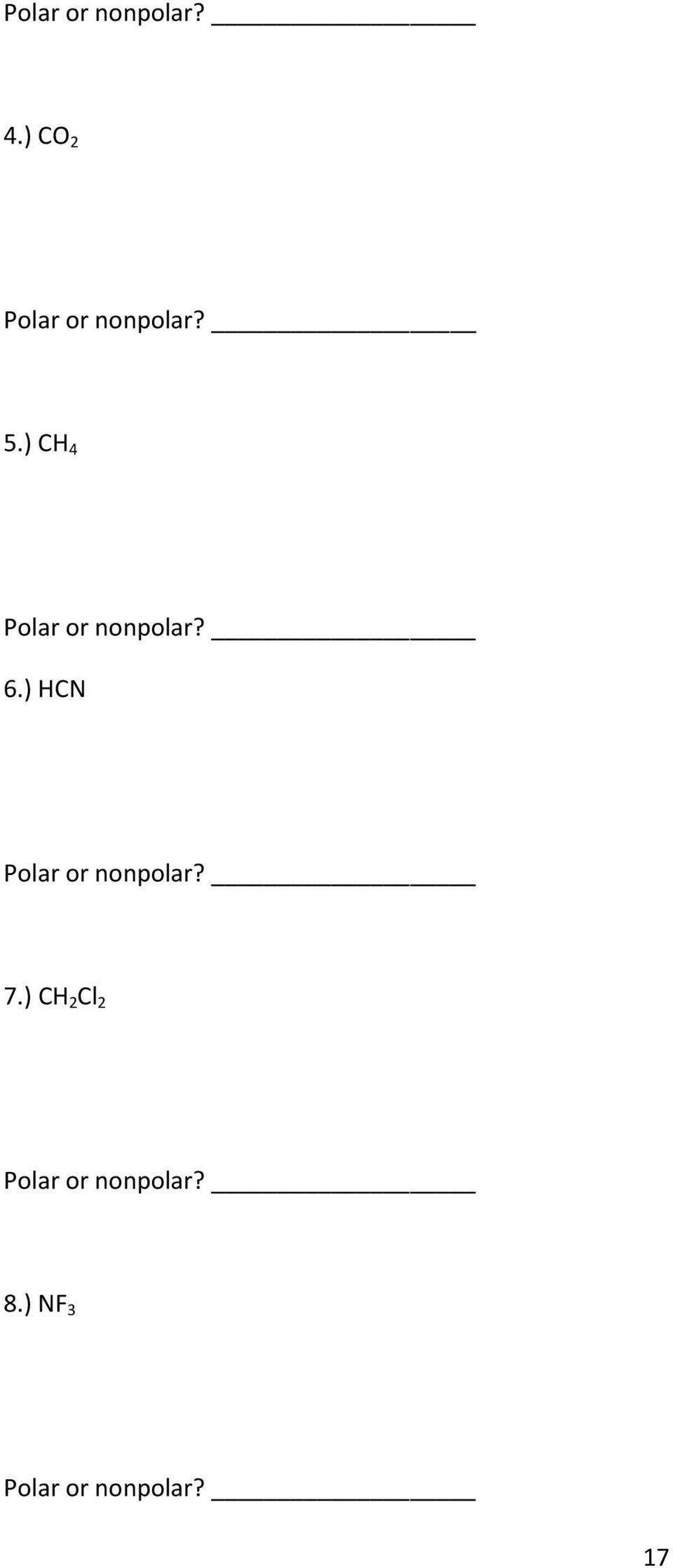
17 Polar or nonpolar? 4.) CO 2 Polar or nonpolar? 5.) CH 4 Polar or nonpolar? 6.) HCN Polar or nonpolar? 7.) CH 2 Cl 2 Polar or nonpolar? 8.) NF 3 Polar or nonpolar? 17
18 Part 3: Polar and Nonpolar Molecules in Water Here are the following molecules and their structures. Explain what will happen to these molecules when I put them in water will they mix together with water or not? Why or why not? Make sure you talk about polar and nonpolar molecules in your explanation. 18

19 Warmup Polar and Nonpolar Molecules Identify whether these molecules are polar or nonpolar. Explain why. NH 3 BF 3 CH 3 Cl 19

20 The Detergent Lab In class, we ve talked about polar and non-polar molecules and why oil and water don t mix together. Today we are going to explore how detergent works how it cleans our dishes and clothes. Review: In a previous class, you did an experiment where you tested how many drops a penny would hold. What happened during that lab to the penny and the water? Why did you get those results? Predict: Today we are going to see how detergent affects how many drops of water we can fit on the surface of a penny. Make a prediction what do you think detergent will do to the penny and the water? Why do you think that? Method: NORMAL PENNY 1. Get a pipette and a small graduate cylinder filled with water. 2. Drop water from the pipette onto the penny, keeping careful count of each drop. Draw a diagram below showing the shape of the penny just before it overflows. person #1 person #2 person #3 person #4 Average 20

21 EFFECTS OF DETERGENT 1. With your finger, spread one small drop of detergent on the surface of a dry penny. 2. How many drops do you think this penny will hold after being smeared with detergent more, less, or the same as before? Why? 3. Using the same pipette as before, add drops of water to the penny surface. Keep careful count of the number of drops, and draw the water on the penny after one drop, about half full, and just before overflowing. 4. How many drops were you able to place on the penny this time before it overflowed? 5. Record how many drops each person in your group placed on the penny this time. person #1 person #2 person #3 person #4 Average 6. Did the detergent make a difference? Describe the effect of the detergent. 7. What does detergent do to have this effect on water? 8. Explain how detergents act as cleaning agents, considering the cohesion among water molecules and the affects of amphipathic (both polar and nonpolar) molecules. 21
22 DETERGENT, OIL AND WATER Introduction In this activity, we ll see how detergent affects oil and water. Predict: What happens when you put oil and water together why? What do you think will happen when we add detergent to the oil and water mixture? Procedure: 1. Add a few drops of food coloring to the water. 2. Pour about 30 ml of the colored water along with the 30 ml of cooking oil into the water bottle. 3. Screw the lid on tight and shake the bottle as hard as you can. 4. Put the bottle back down and have a look. Let the mixture sit for a couple of minutes and observe. After a couple of minutes, what happened with the oil-water mixture? 5. Now add some detergent. 6. Screw the lid back on the water bottle and shake the bottle as hard as you can. What happened with the oil-water-detergent mixture? 22
3/5/2014. iclicker Participation Question: A. MgS < AlP < NaCl B. MgS < NaCl < AlP C. NaCl < AlP < MgS D. NaCl < MgS < AlP
 Today: Ionic Bonding vs. Covalent Bonding Strengths of Covalent Bonds: Bond Energy Diagrams Bond Polarities: Nonpolar Covalent vs. Polar Covalent vs. Ionic Electronegativity Differences Dipole Moments
POLAR COVALENT BONDS Ionic compounds form repeating. Covalent compounds form distinct. Consider adding to NaCl(s) vs. H 2 O(s):
 POLAR COVALENT BONDS Ionic compounds form repeating. Covalent compounds form distinct. Consider adding to NaCl(s) vs. H 2 O(s): Sometimes when atoms of two different elements form a bond by sharing an
In the box below, draw the Lewis electron-dot structure for the compound formed from magnesium and oxygen. [Include any charges or partial charges.
 Name: 1) Which molecule is nonpolar and has a symmetrical shape? A) NH3 B) H2O C) HCl D) CH4 7222-1 - Page 1 2) When ammonium chloride crystals are dissolved in water, the temperature of the water decreases.
CHEMISTRY BONDING REVIEW
 Answer the following questions. CHEMISTRY BONDING REVIEW 1. What are the three kinds of bonds which can form between atoms? The three types of Bonds are Covalent, Ionic and Metallic. Name Date Block 2.
ch9 and 10 practice test
 1. Which of the following covalent bonds is the most polar (highest percent ionic character)? A. Al I B. Si I C. Al Cl D. Si Cl E. Si P 2. What is the hybridization of the central atom in ClO 3? A. sp
EXPERIMENT 9 Dot Structures and Geometries of Molecules
 EXPERIMENT 9 Dot Structures and Geometries of Molecules INTRODUCTION Lewis dot structures are our first tier in drawing molecules and representing bonds between the atoms. The method was first published
Chapter 13 - LIQUIDS AND SOLIDS
 Chapter 13 - LIQUIDS AND SOLIDS Problems to try at end of chapter: Answers in Appendix I: 1,3,5,7b,9b,15,17,23,25,29,31,33,45,49,51,53,61 13.1 Properties of Liquids 1. Liquids take the shape of their container,
Bonding Practice Problems
 NAME 1. When compared to H 2 S, H 2 O has a higher 8. Given the Lewis electron-dot diagram: boiling point because H 2 O contains stronger metallic bonds covalent bonds ionic bonds hydrogen bonds 2. Which
Which substance contains positive ions immersed in a sea of mobile electrons? A) O2(s) B) Cu(s) C) CuO(s) D) SiO2(s)
 BONDING MIDTERM REVIEW 7546-1 - Page 1 1) Which substance contains positive ions immersed in a sea of mobile electrons? A) O2(s) B) Cu(s) C) CuO(s) D) SiO2(s) 2) The bond between hydrogen and oxygen in
CHAPTER 6 Chemical Bonding
 CHAPTER 6 Chemical Bonding SECTION 1 Introduction to Chemical Bonding OBJECTIVES 1. Define Chemical bond. 2. Explain why most atoms form chemical bonds. 3. Describe ionic and covalent bonding.. 4. Explain
Lab: Properties of Polar and Nonpolar Substances
 Lab: Properties of Polar and Nonpolar Substances Purpose: To explain the interactions of matter in relation to polarity. Stations 1 and 2 - il and water do not mix As a metaphor, oil and water are often
Intermolecular and Ionic Forces
 Intermolecular and Ionic Forces Introduction: Molecules are attracted to each other in the liquid and solid states by intermolecular, or attractive, forces. These are the attractions that must be overcome
EXPERIMENT 1: Survival Organic Chemistry: Molecular Models
 EXPERIMENT 1: Survival Organic Chemistry: Molecular Models Introduction: The goal in this laboratory experience is for you to easily and quickly move between empirical formulas, molecular formulas, condensed
Survival Organic Chemistry Part I: Molecular Models
 Survival Organic Chemistry Part I: Molecular Models The goal in this laboratory experience is to get you so you can easily and quickly move between empirical formulas, molecular formulas, condensed formulas,
EXPERIMENT 17 : Lewis Dot Structure / VSEPR Theory
 EXPERIMENT 17 : Lewis Dot Structure / VSEPR Theory Materials: Molecular Model Kit INTRODUCTION Although it has recently become possible to image molecules and even atoms using a high-resolution microscope,
Chapter 4: Structure and Properties of Ionic and Covalent Compounds
 Chapter 4: Structure and Properties of Ionic and Covalent Compounds 4.1 Chemical Bonding o Chemical Bond - the force of attraction between any two atoms in a compound. o Interactions involving valence
Ionic and Covalent Bonds
 Ionic and Covalent Bonds Ionic Bonds Transfer of Electrons When metals bond with nonmetals, electrons are from the metal to the nonmetal The becomes a cation and the becomes an anion. The between the cation
DCI for Electronegativity. Data Table:
 DCI for Electronegativity Data Table: Substance Ionic/covalent EN value EN Value EN NaCl ionic (Na) 0.9 (Cl) 3.0 2.1 KBr (K) 0.8 (Br) 2.8 MgO (Mg) 1.2 (O) 3.5 HCl (H) 2.1 (Cl) 3.0 HF (H) 2.1 (F) 4.0 Cl
Polarity and Properties Lab PURPOSE: To investigate polar and non-polar molecules and the affect of polarity on molecular properties.
 Name!!!! date Polarity and Properties Lab PURPOSE: To investigate polar and non-polar molecules and the affect of polarity on molecular properties. STATION 1: Oil and water do not mix. We all know that.
Chem 112 Intermolecular Forces Chang From the book (10, 12, 14, 16, 18, 20,84,92,94,102,104, 108, 112, 114, 118 and 134)
 Chem 112 Intermolecular Forces Chang From the book (10, 12, 14, 16, 18, 20,84,92,94,102,104, 108, 112, 114, 118 and 134) 1. Helium atoms do not combine to form He 2 molecules, What is the strongest attractive
Honors Chemistry: Unit 6 Test Stoichiometry PRACTICE TEST ANSWER KEY Page 1. A chemical equation. (C-4.4)
 Honors Chemistry: Unit 6 Test Stoichiometry PRACTICE TEST ANSWER KEY Page 1 1. 2. 3. 4. 5. 6. Question What is a symbolic representation of a chemical reaction? What 3 things (values) is a mole of a chemical
pre -TEST Big Idea 2 Chapters 8, 9, 10
 Name: AP Chemistry Period: Date: R.F. Mandes, PhD, NBCT Complete each table with the appropriate information. Compound IMF Compound IMF 1 NiCl 3 7 ClCH 2 (CH 2 ) 3 CH 3 2 Fe 8 H 2 CF 2 3 Ar 9 H 2 NCH 2
Questions on Chapter 8 Basic Concepts of Chemical Bonding
 Questions on Chapter 8 Basic Concepts of Chemical Bonding Circle the Correct Answer: 1) Which ion below has a noble gas electron configuration? A) Li 2+ B) Be 2+ C) B2+ D) C2+ E) N 2-2) Of the ions below,
SOME TOUGH COLLEGE PROBLEMS! .. : 4. How many electrons should be shown in the Lewis dot structure for carbon monoxide? N O O
 SME TUGH CLLEGE PRBLEMS! LEWIS DT STRUCTURES 1. An acceptable Lewis dot structure for 2 is (A) (B) (C) 2. Which molecule contains one unshared pair of valence electrons? (A) H 2 (B) H 3 (C) CH 4 acl 3.
The Properties of Water (Instruction Sheet)
 The Properties of Water (Instruction Sheet) Property : High Polarity Activity #1 Surface Tension: PILE IT ON. Materials: 1 DRY penny, 1 eye dropper, water. 1. Make sure the penny is dry. 2. Begin by estimating
Alkanes. Chapter 1.1
 Alkanes Chapter 1.1 Organic Chemistry The study of carbon-containing compounds and their properties What s so special about carbon? Carbon has 4 bonding electrons. Thus, it can form 4 strong covalent bonds
Chapter 5 Student Reading
 Chapter 5 Student Reading THE POLARITY OF THE WATER MOLECULE Wonderful water Water is an amazing substance. We drink it, cook and wash with it, swim and play in it, and use it for lots of other purposes.
Chemistry 1050 Chapter 13 LIQUIDS AND SOLIDS 1. Exercises: 25, 27, 33, 39, 41, 43, 51, 53, 57, 61, 63, 67, 69, 71(a), 73, 75, 79
 Chemistry 1050 Chapter 13 LIQUIDS AND SOLIDS 1 Text: Petrucci, Harwood, Herring 8 th Edition Suggest text problems Review questions: 1, 5!11, 13!17, 19!23 Exercises: 25, 27, 33, 39, 41, 43, 51, 53, 57,
Molecular Models in Biology
 Molecular Models in Biology Objectives: After this lab a student will be able to: 1) Understand the properties of atoms that give rise to bonds. 2) Understand how and why atoms form ions. 3) Model covalent,
Test Bank - Chapter 4 Multiple Choice
 Test Bank - Chapter 4 The questions in the test bank cover the concepts from the lessons in Chapter 4. Select questions from any of the categories that match the content you covered with students. The
Phase diagram of water. Note: for H 2 O melting point decreases with increasing pressure, for CO 2 melting point increases with increasing pressure.
 Phase diagram of water Note: for H 2 O melting point decreases with increasing pressure, for CO 2 melting point increases with increasing pressure. WATER Covers ~ 70% of the earth s surface Life on earth
Name Lab #3: Solubility of Organic Compounds Objectives: Introduction: soluble insoluble partially soluble miscible immiscible
 Lab #3: Solubility of rganic Compounds bjectives: - Understanding the relative solubility of organic compounds in various solvents. - Exploration of the effect of polar groups on a nonpolar hydrocarbon
EXPERIMENT # 17 CHEMICAL BONDING AND MOLECULAR POLARITY
 EXPERIMENT # 17 CHEMICAL BONDING AND MOLECULAR POLARITY Purpose: 1. To distinguish between different types of chemical bonds. 2. To predict the polarity of some common molecules from a knowledge of bond
Reading Preview. Key Terms covalent bond molecule double bond triple bond molecular compound polar bond nonpolar bond
 Section 4 4 bjectives After this lesson, students will be able to L.1.4.1 State what holds covalently bonded s together. L.1.4.2 Identify the properties of molecular compounds. L.1.4.3 Explain how unequal
Chapter 7. Comparing Ionic and Covalent Bonds. Ionic Bonds. Types of Bonds. Quick Review of Bond Types. Covalent Bonds
 Comparing Ionic and Covalent Bonds Chapter 7 Covalent Bonds and Molecular Structure Intermolecular forces (much weaker than bonds) must be broken Ionic bonds must be broken 1 Ionic Bonds Covalent Bonds
Chapter 2: The Chemical Context of Life
 Chapter 2: The Chemical Context of Life Name Period This chapter covers the basics that you may have learned in your chemistry class. Whether your teacher goes over this chapter, or assigns it for you
Chemical Bonds. Chemical Bonds. The Nature of Molecules. Energy and Metabolism < < Covalent bonds form when atoms share 2 or more valence electrons.
 The Nature of Molecules Chapter 2 Energy and Metabolism Chapter 6 Chemical Bonds Molecules are groups of atoms held together in a stable association. Compounds are molecules containing more than one type
Chapter 13 Solution Dynamics. An Introduction to Chemistry by Mark Bishop
 Chapter 13 Solution Dynamics An Introduction to Chemistry by Mark Bishop Chapter Map Why Changes Happen Consider a system that can switch freely between two states, A and B. Probability helps us to predict
Molecular Geometry & Polarity
 Name AP Chemistry Molecular Geometry & Polarity Molecular Geometry A key to understanding the wide range of physical and chemical properties of substances is recognizing that atoms combine with other atoms
Laboratory 11: Molecular Compounds and Lewis Structures
 Introduction Laboratory 11: Molecular Compounds and Lewis Structures Molecular compounds are formed by sharing electrons between non-metal atoms. A useful theory for understanding the formation of molecular
Chapter 5 Classification of Organic Compounds by Solubility
 Chapter 5 Classification of Organic Compounds by Solubility Deductions based upon interpretation of simple solubility tests can be extremely useful in organic structure determination. Both solubility and
Bonding & Molecular Shape Ron Robertson
 Bonding & Molecular Shape Ron Robertson r2 n:\files\courses\1110-20\2010 possible slides for web\00bondingtrans.doc The Nature of Bonding Types 1. Ionic 2. Covalent 3. Metallic 4. Coordinate covalent Driving
States of Matter CHAPTER 10 REVIEW SECTION 1. Name Date Class. Answer the following questions in the space provided.
 CHAPTER 10 REVIEW States of Matter SECTION 1 SHORT ANSWER Answer the following questions in the space provided. 1. Identify whether the descriptions below describe an ideal gas or a real gas. ideal gas
Lesson Plan for Lava Lamps
 Lesson Plan for Lava Lamps Written by Liz Roth-Johnson and Perry Roth-Johnson Introduction & Background Information Although we cannot see them with our eyes, all things are made up of molecules. Different
Instructions Answer all questions in the spaces provided. Do all rough work in this book. Cross through any work you do not want to be marked.
 GCSE CHEMISTRY Higher Tier Chemistry 1H H Specimen 2018 Time allowed: 1 hour 45 minutes Materials For this paper you must have: a ruler a calculator the periodic table (enclosed). Instructions Answer all
How Much Water Fits on a Penny? 6
 6 Students conduct an experiment to determine how many drops of water will fit on a penny and apply their knowledge of the properties of water and chemical bonds to explain the phenomenon. Suggested Grade
Section 3.3: Polar Bonds and Polar Molecules
 Section 3.3: Polar Bonds and Polar Molecules Mini Investigation: Evidence for Polar Molecules, page 103 A. The polar liquids will all exhibit some type of bending toward charged materials. The nonpolar
Chapter 8 Basic Concepts of the Chemical Bonding
 Chapter 8 Basic Concepts of the Chemical Bonding 1. There are paired and unpaired electrons in the Lewis symbol for a phosphorus atom. (a). 4, 2 (b). 2, 4 (c). 4, 3 (d). 2, 3 Explanation: Read the question
Sample Exercise 8.1 Magnitudes of Lattice Energies
 Sample Exercise 8.1 Magnitudes of Lattice Energies Without consulting Table 8.2, arrange the ionic compounds NaF, CsI, and CaO in order of increasing lattice energy. Analyze From the formulas for three
POLARITY AND MOLECULAR SHAPE WITH HYPERCHEM LITE
 POLARITY AND MOLECULAR SHAPE WITH HYPERCHEM LITE LAB MOD4.COMP From Gannon University SIM INTRODUCTION Many physical properties of matter, such as boiling point and melting point, are the result of the
Section Activity #1: Fill out the following table for biology s most common elements assuming that each atom is neutrally charged.
 LS1a Fall 2014 Section Week #1 I. Valence Electrons and Bonding The number of valence (outer shell) electrons in an atom determines how many bonds it can form. Knowing the number of valence electrons present
Chapter 17. How are acids different from bases? Acid Physical properties. Base. Explaining the difference in properties of acids and bases
 Chapter 17 Acids and Bases How are acids different from bases? Acid Physical properties Base Physical properties Tastes sour Tastes bitter Feels slippery or slimy Chemical properties Chemical properties
H 2O gas: molecules are very far apart
 Non-Covalent Molecular Forces 2/27/06 3/1/06 How does this reaction occur: H 2 O (liquid) H 2 O (gas)? Add energy H 2O gas: molecules are very far apart H 2O liquid: bonding between molecules Use heat
Freezing Point Depression: Why Don t Oceans Freeze? Teacher Advanced Version
 Freezing Point Depression: Why Don t Oceans Freeze? Teacher Advanced Version Freezing point depression describes the process where the temperature at which a liquid freezes is lowered by adding another
Sample Exercise 8.1 Magnitudes of Lattice Energies
 Sample Exercise 8.1 Magnitudes of Lattice Energies Without consulting Table 8.2, arrange the following ionic compounds in order of increasing lattice energy: NaF, CsI, and CaO. Analyze: From the formulas
Review - After School Matter Name: Review - After School Matter Tuesday, April 29, 2008
 Name: Review - After School Matter Tuesday, April 29, 2008 1. Figure 1 The graph represents the relationship between temperature and time as heat was added uniformly to a substance starting at a solid
CHAPTER 10: INTERMOLECULAR FORCES: THE UNIQUENESS OF WATER Problems: 10.2, 10.6,10.15-10.33, 10.35-10.40, 10.56-10.60, 10.101-10.
 CHAPTER 10: INTERMOLECULAR FORCES: THE UNIQUENESS OF WATER Problems: 10.2, 10.6,10.15-10.33, 10.35-10.40, 10.56-10.60, 10.101-10.102 10.1 INTERACTIONS BETWEEN IONS Ion-ion Interactions and Lattice Energy
We will not be doing these type of calculations however, if interested then can read on your own
 Chemical Bond Lattice Energies and Types of Ions Na (s) + 1/2Cl 2 (g) NaCl (s) ΔH= -411 kj/mol Energetically favored: lower energy Like a car rolling down a hill We will not be doing these type of calculations
Chapter 2 Polar Covalent Bonds; Acids and Bases
 John E. McMurry http://www.cengage.com/chemistry/mcmurry Chapter 2 Polar Covalent Bonds; Acids and Bases Javier E. Horta, M.D., Ph.D. University of Massachusetts Lowell Polar Covalent Bonds: Electronegativity
Hands-On Labs SM-1 Lab Manual
 EXPERIMENT 4: Separation of a Mixture of Solids Read the entire experiment and organize time, materials, and work space before beginning. Remember to review the safety sections and wear goggles when appropriate.
Making Biodiesel from Virgin Vegetable Oil: Teacher Manual
 Making Biodiesel from Virgin Vegetable Oil: Teacher Manual Learning Goals: Students will understand how to produce biodiesel from virgin vegetable oil. Students will understand the effect of an exothermic
CHEMISTRY 101 EXAM 3 (FORM B) DR. SIMON NORTH
 1. Is H 3 O + polar or non-polar? (1 point) a) Polar b) Non-polar CHEMISTRY 101 EXAM 3 (FORM B) DR. SIMON NORTH 2. The bond strength is considerably greater in HF than in the other three hydrogen halides
CHAPTER 12: CHEMICAL BONDING
 CHAPTER 12: CHEMICAL BONDING Active Learning Questions: 3-9, 11-19, 21-22 End-of-Chapter Problems: 1-36, 41-59, 60(a,b), 61(b,d), 62(a,b), 64-77, 79-89, 92-101, 106-109, 112, 115-119 An American chemist
Cambridge International Examinations Cambridge International Advanced Subsidiary and Advanced Level
 Cambridge International Examinations Cambridge International Advanced Subsidiary and Advanced Level *0123456789* CHEMISTRY 9701/02 Paper 2 AS Level Structured Questions For Examination from 2016 SPECIMEN
CALCULATING THE SIZE OF AN ATOM
 Ch 100: Fundamentals of Chemistry 1 CALCULATING THE SIZE OF AN ATOM Introduction: The atom is so very small that only highly sophisticated instruments are able to measure its dimensions. In this experiment
Determination of a Chemical Formula
 1 Determination of a Chemical Formula Introduction Molar Ratios Elements combine in fixed ratios to form compounds. For example, consider the compound TiCl 4 (titanium chloride). Each molecule of TiCl
5. Which of the following is the correct Lewis structure for SOCl 2
 Unit C Practice Problems Chapter 8 1. Draw the lewis structures for the following molecules: a. BeF 2 b. SO 3 c. CNS 1- d. NO 2. The correct Lewis symbol for ground state carbon is a) b) c) d) e) 3. Which
Exercises Topic 2: Molecules
 hemistry for Biomedical Engineering. Exercises Topic 2 Authors: ors: Juan Baselga & María González Exercises Topic 2: Molecules 1. Using hybridization concepts and VSEPR model describe the molecular geometry
CHEMISTRY 1710 - Practice Exam #5 - SPRING 2014 (KATZ)
 CHEMISTRY 1710 - Practice Exam #5 - SPRING 2014 (KATZ) Name: Score: This is a multiple choice exam. Choose the BEST answer from the choices which are given and write the letter for your choice in the space
2. Which one of the ions below possesses a noble gas configuration? A) Fe 3+ B) Sn 2+ C) Ni 2+ D) Ti 4+ E) Cr 3+
 Chapter 9 Tro 1. Bromine tends to form simple ions which have the electronic configuration of a noble gas. What is the electronic configuration of the noble gas which the bromide ion mimics? A) 1s 2 2s
CHEMICAL FORMULAS AND EQUATIONS
 reflect Imagine that you and three other classmates had enough supplies and the recipe to make one pepperoni pizza. The recipe might include a ball of dough, a cup of pizza sauce, a cup of cheese, and
20.2 Chemical Equations
 All of the chemical changes you observed in the last Investigation were the result of chemical reactions. A chemical reaction involves a rearrangement of atoms in one or more reactants to form one or more
Chemistry 51 Chapter 8 TYPES OF SOLUTIONS. A solution is a homogeneous mixture of two substances: a solute and a solvent.
 TYPES OF SOLUTIONS A solution is a homogeneous mixture of two substances: a solute and a solvent. Solute: substance being dissolved; present in lesser amount. Solvent: substance doing the dissolving; present
CHAPTER 6 REVIEW. Chemical Bonding. Answer the following questions in the space provided.
 Name Date lass APTER 6 REVIEW hemical Bonding SETIN 1 SRT ANSWER Answer the following questions in the space provided. 1. a A chemical bond between atoms results from the attraction between the valence
CHEMISTRY II FINAL EXAM REVIEW
 Name Period CHEMISTRY II FINAL EXAM REVIEW Final Exam: approximately 75 multiple choice questions Ch 12: Stoichiometry Ch 5 & 6: Electron Configurations & Periodic Properties Ch 7 & 8: Bonding Ch 14: Gas
Lewis Dot Notation Ionic Bonds Covalent Bonds Polar Covalent Bonds Lewis Dot Notation Revisited Resonance
 Lewis Dot Notation Ionic Bonds Covalent Bonds Polar Covalent Bonds Lewis Dot Notation Revisited Resonance Lewis Dot notation is a way of describing the outer shell (also called the valence shell) of an
The Structure of Water Introductory Lesson
 Dana V. Middlemiss Fall 2002 The Structure of Water Introductory Lesson Abstract: This is an introduction to the chemical nature of water and its interactions. In particular, this lesson will explore evaporation,
The Synthesis of trans-dichlorobis(ethylenediamine)cobalt(iii) Chloride
 CHEM 122L General Chemistry Laboratory Revision 2.0 The Synthesis of trans-dichlorobis(ethylenediamine)cobalt(iii) Chloride To learn about Coordination Compounds and Complex Ions. To learn about Isomerism.
5. Structure, Geometry, and Polarity of Molecules
 5. Structure, Geometry, and Polarity of Molecules What you will accomplish in this experiment This experiment will give you an opportunity to draw Lewis structures of covalent compounds, then use those
Health Science Chemistry I CHEM-1180 Experiment No. 15 Molecular Models (Revised 05/22/2015)
 (Revised 05/22/2015) Introduction In the early 1900s, the chemist G. N. Lewis proposed that bonds between atoms consist of two electrons apiece and that most atoms are able to accommodate eight electrons
Part B 2. Allow a total of 15 credits for this part. The student must answer all questions in this part.
 Part B 2 Allow a total of 15 credits for this part. The student must answer all questions in this part. 51 [1] Allow 1 credit for 3 Mg(s) N 2 (g) Mg 3 N 2 (s). Allow credit even if the coefficient 1 is
Non-Covalent Bonds (Weak Bond)
 Non-Covalent Bonds (Weak Bond) Weak bonds are those forces of attraction that, in biological situations, do not take a large amount of energy to break. For example, hydrogen bonds are broken by energies
LEWIS DIAGRAMS. by DR. STEPHEN THOMPSON MR. JOE STALEY
 by DR. STEPHEN THOMPSON MR. JOE STALEY The contents of this module were developed under grant award # P116B-001338 from the Fund for the Improvement of Postsecondary Education (FIPSE), United States Department
Intermolecular Forces
 Intermolecular Forces: Introduction Intermolecular Forces Forces between separate molecules and dissolved ions (not bonds) Van der Waals Forces 15% as strong as covalent or ionic bonds Chapter 11 Intermolecular
CH204 Experiment 2. Experiment 1 Post-Game Show. Experiment 1 Post-Game Show continued... Dr. Brian Anderson Fall 2008
 CH204 Experiment 2 Dr. Brian Anderson Fall 2008 Experiment 1 Post-Game Show pipette and burette intensive and extensive properties interpolation determining random experimental error What about gross error
ACE PRACTICE TEST Chapter 8, Quiz 3
 ACE PRACTICE TEST Chapter 8, Quiz 3 1. Using bond energies, calculate the heat in kj for the following reaction: CH 4 + 4 F 2 CF 4 + 4 HF. Use the following bond energies: CH = 414 kj/mol, F 2 = 155 kj/mol,
Chemistry Workbook 2: Problems For Exam 2
 Chem 1A Dr. White Updated /5/1 1 Chemistry Workbook 2: Problems For Exam 2 Section 2-1: Covalent Bonding 1. On a potential energy diagram, the most stable state has the highest/lowest potential energy.
Chapter 6 Assessment. Name: Class: Date: ID: A. Multiple Choice Identify the choice that best completes the statement or answers the question.
 Name: Class: Date: ID: A Chapter 6 Assessment Multiple Choice Identify the choice that best completes the statement or answers the question. 1. When an atom loses an electron, it forms a(n) a. anion. c.
Start: 26e Used: 6e Step 4. Place the remaining valence electrons as lone pairs on the surrounding and central atoms.
 Section 4.1: Types of Chemical Bonds Tutorial 1 Practice, page 200 1. (a) Lewis structure for NBr 3 : Step 1. The central atom for nitrogen tribromide is bromine. 1 N atom: 1(5e ) = 5e 3 Br atoms: 3(7e
Chapter 5, Lesson 3 Why Does Water Dissolve Salt?
 Chapter 5, Lesson 3 Why Does Water Dissolve Salt? Key Concepts The polarity of water molecules enables water to dissolve many ionically bonded substances. Salt (sodium chloride) is made from positive sodium
Chemical Bonding: Covalent Systems Written by Rebecca Sunderman, Ph.D Week 1, Winter 2012, Matter & Motion
 Chemical Bonding: Covalent Systems Written by Rebecca Sunderman, Ph.D Week 1, Winter 2012, Matter & Motion A covalent bond is a bond formed due to a sharing of electrons. Lewis structures provide a description
CP Chemistry Review for Stoichiometry Test
 CP Chemistry Review for Stoichiometry Test Stoichiometry Problems (one given reactant): 1. Make sure you have a balanced chemical equation 2. Convert to moles of the known substance. (Use the periodic
FOR TEACHERS ONLY. The University of the State of New York REGENTS HIGH SCHOOL EXAMINATION PHYSICAL SETTING/CHEMISTRY
 FOR TEACHERS ONLY PS CH The University of the State of New York REGENTS HIGH SCHOOL EXAMINATION PHYSICAL SETTING/CHEMISTRY Wednesday, January 29, 2003 9:15 a.m. to 12:15 p.m., only SCORING KEY AND RATING
We emphasize Lewis electron dot structures because of their usefulness in explaining structure of covalent molecules, especially organic molecules.
 Chapter 10 Bonding: Lewis electron dot structures and more Bonding is the essence of chemistry! Not just physics! Chemical bonds are the forces that hold atoms together in molecules, in ionic compounds,
Chemistry B11 Chapter 4 Chemical reactions
 Chemistry B11 Chapter 4 Chemical reactions Chemical reactions are classified into five groups: A + B AB Synthesis reactions (Combination) H + O H O AB A + B Decomposition reactions (Analysis) NaCl Na +Cl
Keystone Exams: Chemistry Assessment Anchors and Eligible Content. Pennsylvania Department of Education www.education.state.pa.
 Assessment Anchors and Pennsylvania Department of Education www.education.state.pa.us 2010 PENNSYLVANIA DEPARTMENT OF EDUCATION General Introduction to the Keystone Exam Assessment Anchors Introduction
Chemical Formulas, Equations, and Reactions Test Pre-AP Write all answers on your answer document.
 Name: Period: Chemical Formulas, Equations, and Reactions Test Pre-AP Write all answers on your answer document. 1. Which of the following is a NOT a physical property of hydrogen? A. It is gas C. It is
5s Solubility & Conductivity
 5s Solubility & Conductivity OBJECTIVES To explore the relationship between the structures of common household substances and the kinds of solvents in which they dissolve. To demonstrate the ionic nature
Chemistry Diagnostic Questions
 Chemistry Diagnostic Questions Answer these 40 multiple choice questions and then check your answers, located at the end of this document. If you correctly answered less than 25 questions, you need to