
We emphasize Lewis electron dot structures because of their usefulness in explaining structure of covalent molecules, especially organic molecules.
|
|
|
- Sarah Austin
- 9 years ago
- Views:
Transcription
1 Chapter 10 Bonding: Lewis electron dot structures and more Bonding is the essence of chemistry! Not just physics! Chemical bonds are the forces that hold atoms together in molecules, in ionic compounds, and in metals. In molecules and polyatomic ions, bonds are the forces that hold groups of atoms together and make them act as a unit. Only the valence electrons (outermost electrons of an atom) participate significantly in bonding. # valence electrons = digit in ones place of group # The term valence electrons is not welldefined and is less useful for transition metals. The highest common oxidation number for groups 3 through 7 is the group number. OsO 4 Caution for groups 10, 11, & 12: They are often considered to have 10, 11, & 12 valence electrons respectively, although the highest common oxidation # for group 12 elements is +2, implying only two valence electrons. In group 11, only Ag + is common, but Cu + and Cu 2+ and Au + and Au 3+ are common. In group 10, Ni 2+ and Ni 3+ are common, and Ni(IV) and Pd(IV) and Pt(IV) all exist. But platinum does not oxidize in air at any temperature and is insoluble in HCl(aq) and HNO 3 (aq), implying that Pt is rather unreactive, consistent with no valence electrons. Remember that the heavier pblock metals such as Tl, Pb, and Bi usually form +1, +2, and +3 ions respectively despite being in Groups 13, 14, and 15 this effect is called the inert pair effect. Lewis electron dot structures 1. Apply to maingroup elements 2. Use valence electrons: s and p electrons in outermost shell H He: Li Na K Be etc. 3. Octet rule & duet rule ionic bond example: K loses its one valence electron to form K +, F gains one electron to have a filled valence shell in F K(g) + F(g) KF(g) and K(s) + ½ F 2 (g) KF(s) 1 covalent bond: share pair of valence electrons as in H:H and F 2 Equal sharing of an electron pair gives a non covalent bond. Unequal sharing of an electron pair gives a covalent bond. Types of bonds Ionic full charge separation metalnonmetal usually Polar covalent partial charge separation different nonmetals Non covalent no charge separation same nonmetal usually Metallic mobile electrons metals in bulk Examples: NaCl, CaO, Fe 2 S 3, KMnO 4, TiCl 4, HF, F 2 We emphasize Lewis electron dot structures because of their usefulness in explaining structure of covalent molecules, especially organic molecules. Draw Lewis electron dot structures: CH 4 CH 3 CH 3 CH 2 CH 2 HCCH C 2 H 2 + NH 3 & NH 4 LiF Na 2 O HF

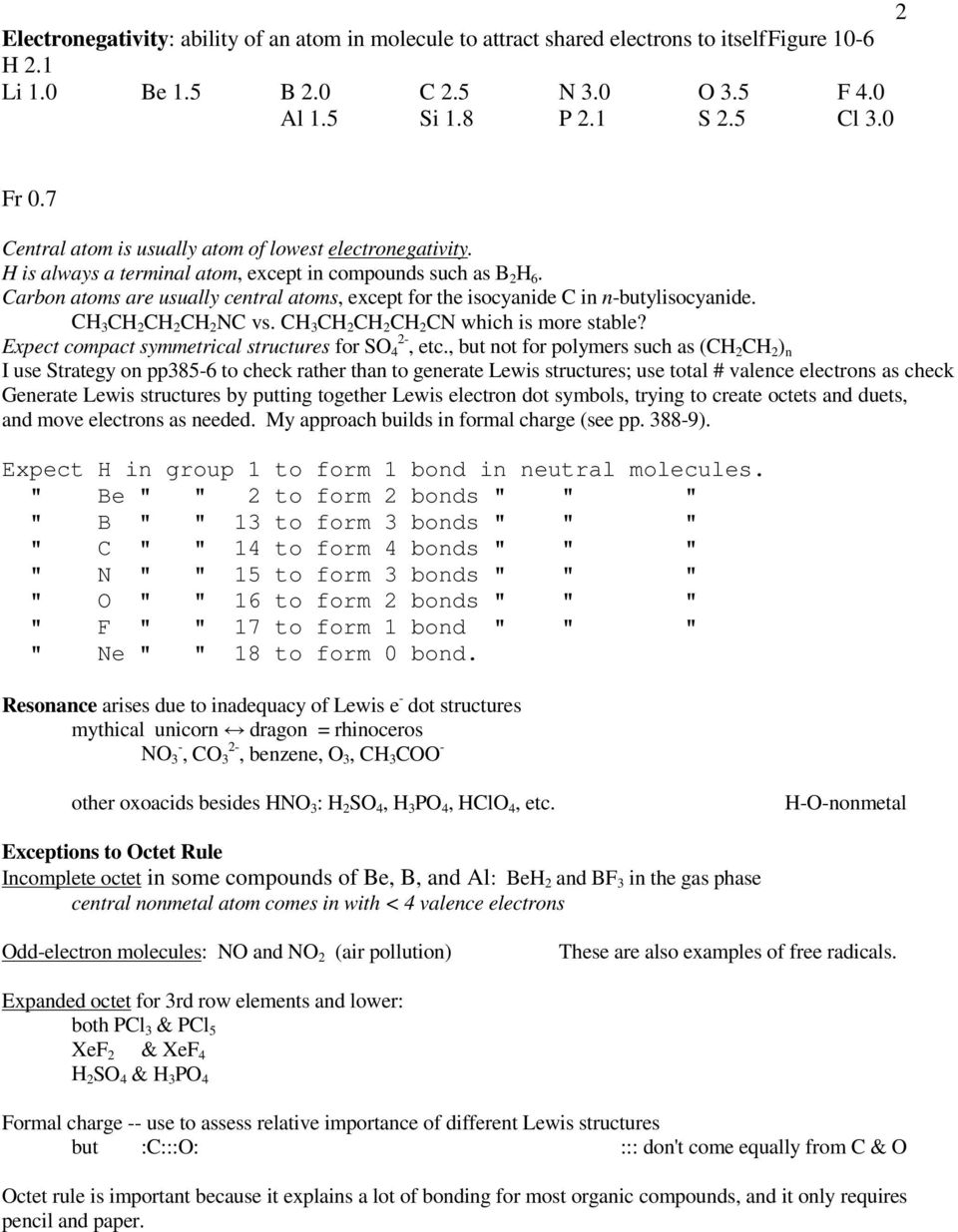
2 2 Electronegativity: ability of an atom in molecule to attract shared electrons to itself Figure 106 H 2.1 Li 1.0 Be 1.5 B 2.0 C 2.5 N 3.0 O 3.5 F 4.0 Al 1.5 Si 1.8 P 2.1 S 2.5 Cl 3.0 Fr 0.7 Central atom is usually atom of lowest electronegativity. H is always a terminal atom, except in compounds such as B 2 H 6. Carbon atoms are usually central atoms, except for the isocyanide C in nbutylisocyanide. CH 3 CH 2 CH 2 CH 2 NC vs. CH 3 CH 2 CH 2 CH 2 CN which is more stable? Expect compact symmetrical structures for SO 4 2, etc., but not for polymers such as (CH 2 CH 2 ) n I use Strategy on pp3856 to check rather than to generate Lewis structures; use total # valence electrons as check Generate Lewis structures by putting together Lewis electron dot symbols, trying to create octets and duets, and move electrons as needed. My approach builds in formal charge (see pp. 3889). Expect H in group 1 to form 1 bond in neutral molecules. " Be " " 2 to form 2 bonds " " " " B " " 13 to form 3 bonds " " " " C " " 14 to form 4 bonds " " " " N " " 15 to form 3 bonds " " " " O " " 16 to form 2 bonds " " " " F " " 17 to form 1 bond " " " " Ne " " 18 to form 0 bond. Resonance arises due to inadequacy of Lewis e dot structures mythical unicorn dragon = rhinoceros NO 3, CO 3 2, benzene, O 3, CH 3 COO other oxoacids besides HNO 3 : H 2 SO 4, H 3 PO 4, HClO 4, etc. HOnonmetal Exceptions to Octet Rule Incomplete octet in some compounds of Be, B, and Al: BeH 2 and BF 3 in the gas phase central nonmetal atom comes in with < 4 valence electrons Oddelectron molecules: NO and NO 2 (air pollution) These are also examples of free radicals. Expanded octet for 3rd row elements and lower: both PCl 3 & PCl 5 XeF 2 & XeF 4 H 2 SO 4 & H 3 PO 4 Formal charge use to assess relative importance of different Lewis structures but :C:::O: ::: don't come equally from C & O Octet rule is important because it explains a lot of bonding for most organic compounds, and it only requires pencil and paper.
3 Write the Lewis electron dot structure for... CNH 5 NO 3 & HNO 3 SO 4 2 OCl N 2 O ClF 3 3 Be able to show resonance, incomplete octets on Be & B, expanded octets on third row elements and lower Percent ionic character Figure 107 Electrostatic potential maps visualize charge distribution within a species Formal charge helps us decide which Lewis structures are important. When I bring together atoms with their valence electrons to form molecules, I automatically try to obtain formal charges of zero. CH 3 NH 2 vs CH 2 NH 3 OCl and where H + would add CN and where H + would add BF 3 and SO 4 2 and H 2 SO 4 and SO 2 Based on formal charge, the best Lewis structure may not have octet on central atom 107 VSEPR Table 10.1; U:\_SC Student File Area\Pultz\VSEPR.pdf Look at # of different directions for valence electron pairs! modify step #2 on p401 This determines the geometry of the electron pairs. Figure 1012 shows balloons Now note where atoms are attached to the central atom; this determines the molecular shape. model kits Molecular ity put VSEPR & bond ity together Bond ity & charge distribution in covalent compounds Usually do not have equal sharing of electrons due to differences in electronegativity ==> partial charges δ+ and δ HOH HCl Show the direction of ity of each of the following bonds, using partial charges: HO, HN, CCl, CMg Difference in electronegativity ==> or ionic bond Which bond is more? HF or HI? BC or BF? CSi or CS? Which bond is most? NH or NO or NC K&T4Exer9.12 If bond, symmetry determines whether molecule is. CO 2 HCN BF 3 SO 2 CCl 4 HOH C 2 H 6 C 2 H 4 C 2 H 2 SF 4 octet & expanded octet O=C=O vs O=C=S HCl CCl 4 (Figure 1015)

4 4 108 & 109 Bond Properties bond order in H 3 PO 4, NO 2, CO, O 3 Bond length & bond energy depend on: Tables 10.2 & 10.3 identity of atoms HH 74 pm HC 110 pm CO 143 pm Bond length depends on atomic sizes bond order C=O 120 pm As bond order increases, bond length hybridization ( 113) bond energy changes across period are unpredictable bond energy decreases going down group & increases with bond order Expanded octets normally on central atom only. Note species which are isoelectronic, such as XeF 2 and I 3 Note bond angles for linear arrangement of electron pairs, trigonal planar arrangement of electron pairs, tetrahedral arrangement of electron pairs, etc. work on Practice Examples & Concept Assessments in 96, 97, & Ch. 10. Concept Assessment on p. 407: I find answer in back confusing. NO 2 is isoelectronic with O 3 whose structure is on p391, & the bond order is 1½. NO 2 + is shown in (10.14) on p388, & the bond order is 2. The higher the bond order, the shorter the bond length. NO 2 + has shorter NO bonds. Some Chapter 10 problems 1a. Write the best Lewis formula, including formal charges if any, for the cyanide ion, CN. b. If a hydrogen ion, H +, attaches to a cyanide ion, does it attach to the C or to the N? Explain. 2. Do Prelab for Molecular Models exp't at U:\_SC Student File Area\Pultz\Molecular_Models.doc 3. Predict molecular shape &/or overall ity (/non) for species in Molecular Models exp't 4. Predict the order of increasing electronegativity in each of the following groups of elements: a. C, N, O b. S, Si, Sr c. F, Cl, Br, I d. S, O, F 5. Predict which bond in each of the following groups will be the most : a. CF, SiF, TiF b. CH, NH, OH, FH c. CO or SiO 6. Write resonance structures for CO 3 2. Use the correct symbol between resonance structures.

5 Partial answer key to Some Chapter 10 problems 5 1a. Write the best Lewis formula, including formal charges if any, for the cyanide ion, CN. [:C N:] C is assigned 5 valence electrons for the purpose of calculating formal charge (all of the 2 lone pair electrons and half of the 6 bonding electrons). A neutral individual C atom has 4 valence electrons. Since it has gained an electron, C has a formal charge of 1. N is assigned 5 valence electrons for the purpose of calculating formal charge (all of its 2 lone pair electrons and half of the 6 bonding electrons). A neutral individual N atom has 5 valence electrons. Since the number of electrons is unchanged, N has a formal charge of 0. We can check our assignment of formal charges by adding them up: = 1 which is the overall charge on the cyanide ion. b. If a hydrogen ion, H +, attaches to a cyanide ion, does it attach to the C or to the N? Explain your answer. It attaches to the C. 1st explanation: C has a 1 formal charge and H has a +1 charge. Unlike charges attract. 2nd explanation: The two possible Lewis electron dot structures are HC N: and :C NH In neutral molecules we expect 4 bonds for C and 3 bonds for N, and this is what we find in H C N: but not in :C NH 3rd explanation: The two possible Lewis electron dot structures are HC N: and :C NH In HC N: the formal charges are 0 for H (since it brings in 1 valence electron and is assigned half of the 2 bonding electrons between H and C), 0 for C (since it brings in 4 valence electrons and is assigned half of the 8 bonding electrons around C), and 0 for N (since it brings in 5 valence electrons and is assigned half of the 6 bonding electrons between it and C, and all of its 2 lone pair electrons). All formal charges are zero, and this is desired for Lewis electron dot structures. In :C NH we calculate a formal charge of 1 for C, +1 for N, and 0 for H. Two of the formal charges are nonzero, making this structure less likely. Furthermore, the most electronegative element in the molecule, N, has the positive formal charge, contrary to expectations. 3. Predict the molecular shape and/or the overall ity ( or non) for the species in the "Molecular Models" experiment. CH 4 tetrahedral non SiCl 4 tetrahedral non NH 3 trigonal pyramidal H 2 O bent HCN linear CO 2 linear non F 2 linear non O 2 linear non N 2 linear non HCl linear PCl 3 trigonal pyramidal PCl 5 trigonal bipyramidal non SF 4 seesaw SF 6 octahedral non BF 3 trigonal planar non ClF 3 Tshaped IF 5 square pyramidal XeF 2 linear non XeF 4 square planar non

6 SO 2 bent O 3 bent non N 2 O linear C 2 H 2 linear non C 2 H 4 non C 2 H 6 non CH 3 CH 2 CH 3 non CH 3 F CH 2 Cl 2 CH 3 OH H 2 CO H 2 NNH 2, except anti conformation is non CH 3 COOH HNO 3 + NH 4 tetrahedral ICl 2 linear IF 4 square planar CH 3 O tetrahedral 2 CO 3 trigonal planar NO 2 bent NO 3 trigonal planar 2 SO 4 tetrahedral OCN linear I 3 linear + NO 2 linear 6 4. Predict the order of increasing electronegativity in each of the following groups of elements: a. C, N, O b. S, Si, Sr c. F, Cl, Br, I d. S, O, F Z38.7,8 C < N < O Sr < Si < S I < Br < Cl < F S < O < F 5. Predict which bond in each of the following groups will be the most : a. CF, SiF, TiF TiF Ti & F have the greatest electronegativity difference. b. CH, NH, OH, FH FH c. CO or SiO SiO 6. Write resonance structures for the carbonate ion, CO 3 2. Use the correct symbol between resonance structures.

ch9 and 10 practice test
 1. Which of the following covalent bonds is the most polar (highest percent ionic character)? A. Al I B. Si I C. Al Cl D. Si Cl E. Si P 2. What is the hybridization of the central atom in ClO 3? A. sp
Theme 3: Bonding and Molecular Structure. (Chapter 8)
 Theme 3: Bonding and Molecular Structure. (Chapter 8) End of Chapter questions: 5, 7, 9, 12, 15, 18, 23, 27, 28, 32, 33, 39, 43, 46, 67, 77 Chemical reaction valence electrons of atoms rearranged (lost,
EXPERIMENT 17 : Lewis Dot Structure / VSEPR Theory
 EXPERIMENT 17 : Lewis Dot Structure / VSEPR Theory Materials: Molecular Model Kit INTRODUCTION Although it has recently become possible to image molecules and even atoms using a high-resolution microscope,
Chapter 7. Comparing Ionic and Covalent Bonds. Ionic Bonds. Types of Bonds. Quick Review of Bond Types. Covalent Bonds
 Comparing Ionic and Covalent Bonds Chapter 7 Covalent Bonds and Molecular Structure Intermolecular forces (much weaker than bonds) must be broken Ionic bonds must be broken 1 Ionic Bonds Covalent Bonds
SOME TOUGH COLLEGE PROBLEMS! .. : 4. How many electrons should be shown in the Lewis dot structure for carbon monoxide? N O O
 SME TUGH CLLEGE PRBLEMS! LEWIS DT STRUCTURES 1. An acceptable Lewis dot structure for 2 is (A) (B) (C) 2. Which molecule contains one unshared pair of valence electrons? (A) H 2 (B) H 3 (C) CH 4 acl 3.
EXPERIMENT 9 Dot Structures and Geometries of Molecules
 EXPERIMENT 9 Dot Structures and Geometries of Molecules INTRODUCTION Lewis dot structures are our first tier in drawing molecules and representing bonds between the atoms. The method was first published
Vocabulary: VSEPR. 3 domains on central atom. 2 domains on central atom. 3 domains on central atom NOTE: Valence Shell Electron Pair Repulsion Theory
 Vocabulary: VSEPR Valence Shell Electron Pair Repulsion Theory domain = any electron pair, or any double or triple bond is considered one domain. lone pair = non-bonding pair = unshared pair = any electron
ACE PRACTICE TEST Chapter 8, Quiz 3
 ACE PRACTICE TEST Chapter 8, Quiz 3 1. Using bond energies, calculate the heat in kj for the following reaction: CH 4 + 4 F 2 CF 4 + 4 HF. Use the following bond energies: CH = 414 kj/mol, F 2 = 155 kj/mol,
5. Which of the following is the correct Lewis structure for SOCl 2
 Unit C Practice Problems Chapter 8 1. Draw the lewis structures for the following molecules: a. BeF 2 b. SO 3 c. CNS 1- d. NO 2. The correct Lewis symbol for ground state carbon is a) b) c) d) e) 3. Which
CHEMISTRY BONDING REVIEW
 Answer the following questions. CHEMISTRY BONDING REVIEW 1. What are the three kinds of bonds which can form between atoms? The three types of Bonds are Covalent, Ionic and Metallic. Name Date Block 2.
CHAPTER 12: CHEMICAL BONDING
 CHAPTER 12: CHEMICAL BONDING Active Learning Questions: 3-9, 11-19, 21-22 End-of-Chapter Problems: 1-36, 41-59, 60(a,b), 61(b,d), 62(a,b), 64-77, 79-89, 92-101, 106-109, 112, 115-119 An American chemist
The Lewis structure is a model that gives a description of where the atoms, charges, bonds, and lone pairs of electrons, may be found.
 CEM110 Week 12 Notes (Chemical Bonding) Page 1 of 8 To help understand molecules (or radicals or ions), VSEPR shapes, and properties (such as polarity and bond length), we will draw the Lewis (or electron
Chemical Bonding: Covalent Systems Written by Rebecca Sunderman, Ph.D Week 1, Winter 2012, Matter & Motion
 Chemical Bonding: Covalent Systems Written by Rebecca Sunderman, Ph.D Week 1, Winter 2012, Matter & Motion A covalent bond is a bond formed due to a sharing of electrons. Lewis structures provide a description
AP Chemistry A. Allan Chapter 8 Notes - Bonding: General Concepts
 AP Chemistry A. Allan Chapter 8 Notes - Bonding: General Concepts 8.1 Types of Chemical Bonds A. Ionic Bonding 1. Electrons are transferred 2. Metals react with nonmetals 3. Ions paired have lower energy
CHEM 1301 SECOND TEST REVIEW. Covalent bonds are sharing of electrons (ALWAYS valence electrons). Use Lewis structures to show this sharing.
 CEM 1301 SECOND TEST REVIEW Lewis Structures Covalent bonds are sharing of electrons (ALWAYS valence electrons). Use Lewis structures to show this sharing. Rules OCTET RULE an atom would like to have 8
Exercises Topic 2: Molecules
 hemistry for Biomedical Engineering. Exercises Topic 2 Authors: ors: Juan Baselga & María González Exercises Topic 2: Molecules 1. Using hybridization concepts and VSEPR model describe the molecular geometry
Laboratory 11: Molecular Compounds and Lewis Structures
 Introduction Laboratory 11: Molecular Compounds and Lewis Structures Molecular compounds are formed by sharing electrons between non-metal atoms. A useful theory for understanding the formation of molecular
Chemistry Workbook 2: Problems For Exam 2
 Chem 1A Dr. White Updated /5/1 1 Chemistry Workbook 2: Problems For Exam 2 Section 2-1: Covalent Bonding 1. On a potential energy diagram, the most stable state has the highest/lowest potential energy.
Bonding & Molecular Shape Ron Robertson
 Bonding & Molecular Shape Ron Robertson r2 n:\files\courses\1110-20\2010 possible slides for web\00bondingtrans.doc The Nature of Bonding Types 1. Ionic 2. Covalent 3. Metallic 4. Coordinate covalent Driving
2. Atoms with very similar electronegativity values are expected to form
 AP hemistry Practice Test #6 hapter 8 and 9 1. Which of the following statements is incorrect? a. Ionic bonding results from the transfer of electrons from one atom to another. b. Dipole moments result
Health Science Chemistry I CHEM-1180 Experiment No. 15 Molecular Models (Revised 05/22/2015)
 (Revised 05/22/2015) Introduction In the early 1900s, the chemist G. N. Lewis proposed that bonds between atoms consist of two electrons apiece and that most atoms are able to accommodate eight electrons
CHEMISTRY 1710 - Practice Exam #5 - SPRING 2014 (KATZ)
 CHEMISTRY 1710 - Practice Exam #5 - SPRING 2014 (KATZ) Name: Score: This is a multiple choice exam. Choose the BEST answer from the choices which are given and write the letter for your choice in the space
Question 4.2: Write Lewis dot symbols for atoms of the following elements: Mg, Na, B, O, N, Br.
 Question 4.1: Explain the formation of a chemical bond. A chemical bond is defined as an attractive force that holds the constituents (atoms, ions etc.) together in a chemical species. Various theories
7) How many electrons are in the second energy level for an atom of N? A) 5 B) 6 C) 4 D) 8
 HOMEWORK CHEM 107 Chapter 3 Compounds Putting Particles Together 3.1 Multiple-Choice 1) How many electrons are in the highest energy level of sulfur? A) 2 B) 4 C) 6 D) 8 2) An atom of phosphorous has how
C has 4 valence electrons, O has six electrons. The total number of electrons is 4 + 2(6) = 16.
 129 Lewis Structures G. N. Lewis hypothesized that electron pair bonds between unlike elements in the second (and sometimes the third) row occurred in a way that electrons were shared such that each element
A pure covalent bond is an equal sharing of shared electron pair(s) in a bond. A polar covalent bond is an unequal sharing.
 CHAPTER EIGHT BNDING: GENERAL CNCEPT or Review 1. Electronegativity is the ability of an atom in a molecule to attract electrons to itself. Electronegativity is a bonding term. Electron affinity is the
Covalent Bonding & Molecular Compounds Multiple Choice Review PSI Chemistry
 Covalent Bonding & Molecular Compounds Multiple Choice Review PSI Chemistry Name 1) Which pair of elements is most apt to form a molecular compound with each other? A) aluminum, oxygen B) magnesium, iodine
Self Assessment_Ochem I
 UTID: 2013 Objective Test Section Identify the choice that best completes the statement or answers the question. There is only one correct answer; please carefully bubble your choice on the scantron sheet.
Molecular Geometry and VSEPR We gratefully acknowledge Portland Community College for the use of this experiment.
 Molecular and VSEPR We gratefully acknowledge Portland ommunity ollege for the use of this experiment. Objectives To construct molecular models for covalently bonded atoms in molecules and polyatomic ions
CHAPTER 6 Chemical Bonding
 CHAPTER 6 Chemical Bonding SECTION 1 Introduction to Chemical Bonding OBJECTIVES 1. Define Chemical bond. 2. Explain why most atoms form chemical bonds. 3. Describe ionic and covalent bonding.. 4. Explain
Questions on Chapter 8 Basic Concepts of Chemical Bonding
 Questions on Chapter 8 Basic Concepts of Chemical Bonding Circle the Correct Answer: 1) Which ion below has a noble gas electron configuration? A) Li 2+ B) Be 2+ C) B2+ D) C2+ E) N 2-2) Of the ions below,
Structures and Properties of Substances. Introducing Valence-Shell Electron- Pair Repulsion (VSEPR) Theory
 Structures and Properties of Substances Introducing Valence-Shell Electron- Pair Repulsion (VSEPR) Theory The VSEPR theory In 1957, the chemist Ronald Gillespie and Ronald Nyholm, developed a model for
CH101/105, GENERAL CHEMISTRY LABORATORY
 CH101/105, GENERAL CHEMITRY LABORATORY LABORATORY LECTURE 5 EXPERIMENT 5: LEWI TRUCTURE AND MOLECULAR HAPE Lecture topics I. LEWI TRUCTURE a) calculation of the valence electron numbers; b) choosing the
Chapter10 Tro. 4. Based on the Lewis structure, the number of electron domains in the valence shell of the CO molecule is A) 1 B) 2 C) 3 D) 4 E) 5
 Chapter10 Tro 1. All of the geometries listed below are examples of the five basic geometries for molecules with more than 3 atoms except A) planar triangular B) octahedral C) tetrahedral D) trihedral
DCI for Electronegativity. Data Table:
 DCI for Electronegativity Data Table: Substance Ionic/covalent EN value EN Value EN NaCl ionic (Na) 0.9 (Cl) 3.0 2.1 KBr (K) 0.8 (Br) 2.8 MgO (Mg) 1.2 (O) 3.5 HCl (H) 2.1 (Cl) 3.0 HF (H) 2.1 (F) 4.0 Cl
Sample Exercise 8.1 Magnitudes of Lattice Energies
 Sample Exercise 8.1 Magnitudes of Lattice Energies Without consulting Table 8.2, arrange the ionic compounds NaF, CsI, and CaO in order of increasing lattice energy. Analyze From the formulas for three
Electronegativity and Polarity
 and Polarity N Goalby Chemrevise.org Definition: is the relative tendency of an atom in a molecule to attract electrons in a covalent bond to itself. is measured on the Pauling scale (ranges from 0 to
Bonding Practice Problems
 NAME 1. When compared to H 2 S, H 2 O has a higher 8. Given the Lewis electron-dot diagram: boiling point because H 2 O contains stronger metallic bonds covalent bonds ionic bonds hydrogen bonds 2. Which
Which substance contains positive ions immersed in a sea of mobile electrons? A) O2(s) B) Cu(s) C) CuO(s) D) SiO2(s)
 BONDING MIDTERM REVIEW 7546-1 - Page 1 1) Which substance contains positive ions immersed in a sea of mobile electrons? A) O2(s) B) Cu(s) C) CuO(s) D) SiO2(s) 2) The bond between hydrogen and oxygen in
A mutual electrical attraction between the nuclei and valence electrons of different atoms that binds the atoms together is called a(n)
 Chemistry I ATOMIC BONDING PRACTICE QUIZ Mr. Scott Select the best answer. 1) A mutual electrical attraction between the nuclei and valence electrons of different atoms that binds the atoms together is
VSEPR Model. The Valence-Shell Electron Pair Repulsion Model. Predicting Molecular Geometry
 VSEPR Model The structure around a given atom is determined principally by minimizing electron pair repulsions. The Valence-Shell Electron Pair Repulsion Model The valence-shell electron pair repulsion
3/5/2014. iclicker Participation Question: A. MgS < AlP < NaCl B. MgS < NaCl < AlP C. NaCl < AlP < MgS D. NaCl < MgS < AlP
 Today: Ionic Bonding vs. Covalent Bonding Strengths of Covalent Bonds: Bond Energy Diagrams Bond Polarities: Nonpolar Covalent vs. Polar Covalent vs. Ionic Electronegativity Differences Dipole Moments
: : Solutions to Additional Bonding Problems
 Solutions to Additional Bonding Problems 1 1. For the following examples, the valence electron count is placed in parentheses after the empirical formula and only the resonance structures that satisfy
EXPERIMENT # 17 CHEMICAL BONDING AND MOLECULAR POLARITY
 EXPERIMENT # 17 CHEMICAL BONDING AND MOLECULAR POLARITY Purpose: 1. To distinguish between different types of chemical bonds. 2. To predict the polarity of some common molecules from a knowledge of bond
Exam. Name. 1) Chlorine (atomic number = 17) has the electronic configuration:. E) 1s22s22d103s2
 Exam Name 1) Chlorine (atomic number = 17) has the electronic configuration:. A) 1s22s22p62d63s1 B) 1s22s22p63s23d5 C) 1s22s22p62d53s2 D) 1s22s22p63s23p5 E) 1s22s22d103s2 2) The complete electron configuration
Chapter 8 Basic Concepts of the Chemical Bonding
 Chapter 8 Basic Concepts of the Chemical Bonding 1. There are paired and unpaired electrons in the Lewis symbol for a phosphorus atom. (a). 4, 2 (b). 2, 4 (c). 4, 3 (d). 2, 3 Explanation: Read the question
3) Of the following, radiation has the shortest wavelength. A) X-ray B) radio C) microwave D) ultraviolet E) infrared Answer: A
 1) Which one of the following is correct? A) ν + λ = c B) ν λ = c C) ν = cλ D) λ = c ν E) νλ = c Answer: E 2) The wavelength of light emitted from a traffic light having a frequency of 5.75 1014 Hz is.
5. Structure, Geometry, and Polarity of Molecules
 5. Structure, Geometry, and Polarity of Molecules What you will accomplish in this experiment This experiment will give you an opportunity to draw Lewis structures of covalent compounds, then use those
Chapter 10 Molecular Geometry and Chemical Bonding Theory
 Chem 1: Chapter 10 Page 1 Chapter 10 Molecular Geometry and Chemical Bonding Theory I) VSEPR Model Valence-Shell Electron-Pair Repulsion Model A) Model predicts Predicts electron arrangement and molecular
Ionic and Covalent Bonds
 Ionic and Covalent Bonds Ionic Bonds Transfer of Electrons When metals bond with nonmetals, electrons are from the metal to the nonmetal The becomes a cation and the becomes an anion. The between the cation
Bonding Models. Bonding Models (Lewis) Bonding Models (Lewis) Resonance Structures. Section 2 (Chapter 3, M&T) Chemical Bonding
 Bonding Models Section (Chapter, M&T) Chemical Bonding We will look at three models of bonding: Lewis model Valence Bond model M theory Bonding Models (Lewis) Bonding Models (Lewis) Lewis model of bonding
Sample Exercise 8.1 Magnitudes of Lattice Energies
 Sample Exercise 8.1 Magnitudes of Lattice Energies Without consulting Table 8.2, arrange the following ionic compounds in order of increasing lattice energy: NaF, CsI, and CaO. Analyze: From the formulas
In the box below, draw the Lewis electron-dot structure for the compound formed from magnesium and oxygen. [Include any charges or partial charges.
 Name: 1) Which molecule is nonpolar and has a symmetrical shape? A) NH3 B) H2O C) HCl D) CH4 7222-1 - Page 1 2) When ammonium chloride crystals are dissolved in water, the temperature of the water decreases.
Name: Class: Date: 3) The bond angles marked a, b, and c in the molecule below are about,, and, respectively.
 Name: Class: Date: Unit 9 Practice Multiple Choice Identify the choice that best completes the statement or answers the question. 1) The basis of the VSEPR model of molecular bonding is. A) regions of
A REVIEW OF GENERAL CHEMISTRY: ELECTRONS, BONDS AND MOLECULAR PROPERTIES
 A REVIEW OF GENERAL CEMISTRY: ELECTRONS, BONDS AND MOLECULAR PROPERTIES A STUDENT SOULD BE ABLE TO: 1. Draw Lewis (electron dot and line) structural formulas for simple compounds and ions from molecular
Molecular Geometry and Chemical Bonding Theory
 Chapter 10 Molecular Geometry and Chemical Bonding Theory Concept Check 10.1 An atom in a molecule is surrounded by four pairs of electrons, one lone pair and three bonding pairs. Describe how the four
LEWIS DIAGRAMS. by DR. STEPHEN THOMPSON MR. JOE STALEY
 by DR. STEPHEN THOMPSON MR. JOE STALEY The contents of this module were developed under grant award # P116B-001338 from the Fund for the Improvement of Postsecondary Education (FIPSE), United States Department
CHEMISTRY 101 EXAM 3 (FORM B) DR. SIMON NORTH
 1. Is H 3 O + polar or non-polar? (1 point) a) Polar b) Non-polar CHEMISTRY 101 EXAM 3 (FORM B) DR. SIMON NORTH 2. The bond strength is considerably greater in HF than in the other three hydrogen halides
Polarity. Andy Schweitzer
 Polarity Andy Schweitzer What does it mean to be polar? A molecule is polar if it contains + and somewhere in the molecule. Remember: Protons can not move. So for a molecule to get a +/- it must somehow
Chemistry 105, Chapter 7 Exercises
 hemistry 15, hapter 7 Exercises Types of Bonds 1. Using the periodic table classify the bonds in the following compounds as ionic or covalent. If covalent, classify the bond as polar or not. Mg2 4 i2 a(3)2
Geometries and Valence Bond Theory Worksheet
 Geometries and Valence Bond Theory Worksheet Also do Chapter 10 textbook problems: 33, 35, 47, 49, 51, 55, 57, 61, 63, 67, 83, 87. 1. Fill in the tables below for each of the species shown. a) CCl 2 2
Chapter 9. Chemical reactivity of molecules depends on the nature of the bonds between the atoms as well on its 3D structure
 Chapter 9 Molecular Geometry & Bonding Theories I) Molecular Geometry (Shapes) Chemical reactivity of molecules depends on the nature of the bonds between the atoms as well on its 3D structure Molecular
Chapter 4: Structure and Properties of Ionic and Covalent Compounds
 Chapter 4: Structure and Properties of Ionic and Covalent Compounds 4.1 Chemical Bonding o Chemical Bond - the force of attraction between any two atoms in a compound. o Interactions involving valence
Chapter 8 Concepts of Chemical Bonding
 Chapter 8 Concepts of Chemical Bonding Chemical Bonds Three types: Ionic Electrostatic attraction between ions Covalent Sharing of electrons Metallic Metal atoms bonded to several other atoms Ionic Bonding
Chapter 13 - LIQUIDS AND SOLIDS
 Chapter 13 - LIQUIDS AND SOLIDS Problems to try at end of chapter: Answers in Appendix I: 1,3,5,7b,9b,15,17,23,25,29,31,33,45,49,51,53,61 13.1 Properties of Liquids 1. Liquids take the shape of their container,
CHAPTER 10 THE SHAPES OF MOLECULES
 ATER 10 TE AE MLEULE 10.1 To be the central atom in a compound, the atom must be able to simultaneously bond to at least two other atoms. e,, and cannot serve as central atoms in a Lewis structure. elium
Unit 3: Quantum Theory, Periodicity and Chemical Bonding
 Selected Honour Chemistry Assignment Answers pg. 9 Unit 3: Quantum Theory, Periodicity and Chemical Bonding Chapter 7: The Electronic Structure of Atoms (pg. 240 to 241) 48. The shape of an s-orbital is
CHEM 1211K Test IV. MULTIPLE CHOICE (3 points each)
 CEM 1211K Test IV MULTIPLE COICE (3 points each) 1) ow many single covalent bonds must a silicon atom form to have a complete octet in its valence shell? A) 4 B) 3 C) 1 D) 2 E) 0 2) What is the maximum
CHAPTER 6 REVIEW. Chemical Bonding. Answer the following questions in the space provided.
 Name Date lass APTER 6 REVIEW hemical Bonding SETIN 1 SRT ANSWER Answer the following questions in the space provided. 1. a A chemical bond between atoms results from the attraction between the valence
Exam 2 Chemistry 65 Summer 2015. Score:
 Name: Exam 2 Chemistry 65 Summer 2015 Score: Instructions: Clearly circle the one best answer 1. Valence electrons are electrons located A) in the outermost energy level of an atom. B) in the nucleus of
pre -TEST Big Idea 2 Chapters 8, 9, 10
 Name: AP Chemistry Period: Date: R.F. Mandes, PhD, NBCT Complete each table with the appropriate information. Compound IMF Compound IMF 1 NiCl 3 7 ClCH 2 (CH 2 ) 3 CH 3 2 Fe 8 H 2 CF 2 3 Ar 9 H 2 NCH 2
Chem 121 Problem Set V Lewis Structures, VSEPR and Polarity
 hemistry 121 Problem set V olutions - 1 hem 121 Problem et V Lewis tructures, VEPR and Polarity AWER 1. pecies Elecronegativity difference in bond Bond Polarity Mp 3 E = 3.0-3.0 = 0 for - very weakly polar
Name: Block: Date: Test Review: Chapter 8 Ionic Bonding
 Name: Block: Date: Test Review: Chapter 8 Ionic Bonding Part 1: Fill-in-the-blank. Choose the word from the word bank below. Each word may be used only 1 time. electron dot structure metallic electronegativity
4.2. Molecular Shape and Polarity. Lewis Structures for Molecules and Polyatomic Ions
 Molecular Shape and Polarity 4.2 molecule is a discrete chemical entity, in which atoms are held together by the electrostatic attractions of covalent bonds. In previous chemistry courses, you used Lewis
Since we will be dealing with aqueous acid and base solution, first we must examine the behavior of water.
 Acids and Bases Know the definition of Arrhenius, Bronsted-Lowry, and Lewis acid and base. Autoionization of Water Since we will be dealing with aqueous acid and base solution, first we must examine the
Chapter 17. How are acids different from bases? Acid Physical properties. Base. Explaining the difference in properties of acids and bases
 Chapter 17 Acids and Bases How are acids different from bases? Acid Physical properties Base Physical properties Tastes sour Tastes bitter Feels slippery or slimy Chemical properties Chemical properties
CHAPTER 10 THE SHAPES OF MOLECULES
 ATER 10 TE AE MLEULE EMIAL ETI BED READIG RBLEM B10.1 lan: Examine the Lewis structure, noting the number of regions of electron density around the carbon and nitrogen atoms in the two resonance structures.
7.14 Linear triatomic: A-----B-----C. Bond angles = 180 degrees. Trigonal planar: Bond angles = 120 degrees. B < B A B = 120
 APTER SEVEN Molecular Geometry 7.13 Molecular geometry may be defined as the three-dimensional arrangement of atoms in a molecule. The study of molecular geometry is important in that a molecule s geometry
Chapter 11. Electrochemistry Oxidation and Reduction Reactions. Oxidation-Reduction Reactions. Oxidation-Reduction Reactions
 Oxidation-Reduction Reactions Chapter 11 Electrochemistry Oxidation and Reduction Reactions An oxidation and reduction reaction occurs in both aqueous solutions and in reactions where substances are burned
CHAPTER 5: MOLECULES AND COMPOUNDS
 CHAPTER 5: MOLECULES AND COMPOUNDS Problems: 1-6, 9-13, 16, 20, 31-40, 43-64, 65 (a,b,c,e), 66(a-d,f), 69(a-d,f), 70(a-e), 71-78, 81-82, 87-96 A compound will display the same properties (e.g. melting
Molecular Structure and Polarity
 OpenStax-CNX module: m51053 1 Molecular Structure and Polarity OpenStax College This work is produced by OpenStax-CNX and licensed under the Creative Commons Attribution License 4.0 By the end of this
Covalent Bonding and Molecular Geometry
 Name Section # Date of Experiment Covalent Bonding and Molecular Geometry When atoms combine to form molecules (this also includes complex ions) by forming covalent bonds, the relative positions of the
Lecture 22 The Acid-Base Character of Oxides and Hydroxides in Aqueous Solution
 2P32 Principles of Inorganic Chemistry Dr. M. Pilkington Lecture 22 The Acid-Base Character of Oxides and Hydroxides in Aqueous Solution Oxides; acidic, basic, amphoteric Classification of oxides - oxide
NET IONIC EQUATIONS. A balanced chemical equation can describe all chemical reactions, an example of such an equation is:
 NET IONIC EQUATIONS A balanced chemical equation can describe all chemical reactions, an example of such an equation is: NaCl + AgNO 3 AgCl + NaNO 3 In this case, the simple formulas of the various reactants
OCTET RULE Generally atoms prefer electron configurations with 8 valence electrons. - Filled s and p subshells
 TYPES EMIAL BDIG 1 Ionic Bonding - Bond between ions whose charges attract each other - ne atom gives electrons and one atom takes electrons. Example a + l - ionic bond ovalent Bonding - two atoms each
Section Activity #1: Fill out the following table for biology s most common elements assuming that each atom is neutrally charged.
 LS1a Fall 2014 Section Week #1 I. Valence Electrons and Bonding The number of valence (outer shell) electrons in an atom determines how many bonds it can form. Knowing the number of valence electrons present
Molecular Geometry & Polarity
 Name AP Chemistry Molecular Geometry & Polarity Molecular Geometry A key to understanding the wide range of physical and chemical properties of substances is recognizing that atoms combine with other atoms
Unit 3: Quantum Theory, Periodicity and Chemical Bonding. Chapter 10: Chemical Bonding II Molecular Geometry & Intermolecular Forces
 onour Chemistry Unit 3: Quantum Theory, Periodicity and Chemical Bonding Chapter 10: Chemical Bonding II Molecular Geometry & Intermolecular orces 10.1: Molecular Geometry Molecular Structure: - the three-dimensional
Chemistry 151 Final Exam
 Chemistry 151 Final Exam Name: SSN: Exam Rules & Guidelines Show your work. No credit will be given for an answer unless your work is shown. Indicate your answer with a box or a circle. All paperwork must
Lewis Dot Notation Ionic Bonds Covalent Bonds Polar Covalent Bonds Lewis Dot Notation Revisited Resonance
 Lewis Dot Notation Ionic Bonds Covalent Bonds Polar Covalent Bonds Lewis Dot Notation Revisited Resonance Lewis Dot notation is a way of describing the outer shell (also called the valence shell) of an
Name period Unit 3 worksheet
 Name period Unit 3 worksheet Read chapter 8, 2.52.7 1. Explain the difference between metallic, ionic, and covalent bonding Metallic cations share a sea of electrons Ionic atoms give and take electrons
Start: 26e Used: 6e Step 4. Place the remaining valence electrons as lone pairs on the surrounding and central atoms.
 Section 4.1: Types of Chemical Bonds Tutorial 1 Practice, page 200 1. (a) Lewis structure for NBr 3 : Step 1. The central atom for nitrogen tribromide is bromine. 1 N atom: 1(5e ) = 5e 3 Br atoms: 3(7e
POLAR COVALENT BONDS Ionic compounds form repeating. Covalent compounds form distinct. Consider adding to NaCl(s) vs. H 2 O(s):
 POLAR COVALENT BONDS Ionic compounds form repeating. Covalent compounds form distinct. Consider adding to NaCl(s) vs. H 2 O(s): Sometimes when atoms of two different elements form a bond by sharing an
Nomenclature of Ionic Compounds
 Nomenclature of Ionic Compounds Ionic compounds are composed of ions. An ion is an atom or molecule with an electrical charge. Monatomic ions are formed from single atoms that have gained or lost electrons.
Acids and Bases: A Brief Review
 Acids and : A Brief Review Acids: taste sour and cause dyes to change color. : taste bitter and feel soapy. Arrhenius: acids increase [H ] bases increase [OH ] in solution. Arrhenius: acid base salt water.
Electronegativity and Polarity MAIN Idea A chemical bond s character is related to each atom s
 Section 8.5 Objectives Describe how electronegativity is used to determine bond type. Compare and contrast polar and nonpolar covalent bonds and polar and nonpolar molecules. Generalize about the characteristics
B) atomic number C) both the solid and the liquid phase D) Au C) Sn, Si, C A) metal C) O, S, Se C) In D) tin D) methane D) bismuth B) Group 2 metal
 1. The elements on the Periodic Table are arranged in order of increasing A) atomic mass B) atomic number C) molar mass D) oxidation number 2. Which list of elements consists of a metal, a metalloid, and
Electrons in Atoms & Periodic Table Chapter 13 & 14 Assignment & Problem Set
 Electrons in Atoms & Periodic Table Name Warm-Ups (Show your work for credit) Date 1. Date 2. Date 3. Date 4. Date 5. Date 6. Date 7. Date 8. Electrons in Atoms & Periodic Table 2 Study Guide: Things You
EXPERIMENT 1: Survival Organic Chemistry: Molecular Models
 EXPERIMENT 1: Survival Organic Chemistry: Molecular Models Introduction: The goal in this laboratory experience is for you to easily and quickly move between empirical formulas, molecular formulas, condensed
Chemistry 1050 Chapter 13 LIQUIDS AND SOLIDS 1. Exercises: 25, 27, 33, 39, 41, 43, 51, 53, 57, 61, 63, 67, 69, 71(a), 73, 75, 79
 Chemistry 1050 Chapter 13 LIQUIDS AND SOLIDS 1 Text: Petrucci, Harwood, Herring 8 th Edition Suggest text problems Review questions: 1, 5!11, 13!17, 19!23 Exercises: 25, 27, 33, 39, 41, 43, 51, 53, 57,