
Basic Biological Principles Module A Anchor 1
|
|
|
- Isaac Newman
- 9 years ago
- Views:
Transcription
1 Basic Biological Principles Module A Anchor 1 Key Concepts: - Living things are made of units called cells, are based on a universal genetic code, obtain and use materials and energy, grow and develop, reproduce, respond to their environment, maintain a stable internal environment, and change over time. - Prokaryotic cells do not separate their genetic material within a nucleus. In eukaryotic cells, the nucleus separates the genetic material from the rest of the cell. - The cells of multicellular organisms become specialized for particular tasks and communicate with one another. Vocabulary: Homeostasis Evolution Asexual reproduction Eukaryote Nucleus Sexual reproduction Cell membrane DNA Membrane-bound organelles Cell Prokaryote Cell specialization Characteristics of Life: 1. List the characteristics of life common to all living things. 2. If an organism lacks any of these characteristics, is it considered living? Why or why not? 3. Which of the following characteristics of living things explains why birds fly south for the winter? A. Living things respond to their environment B. Living things maintain homeostasis C. Living things are made of cells D. Living things are based on a universal genetic code 4. Which characteristic(s) of living things is more important to the survival of the species as a whole, rather than the individual organism? Why?
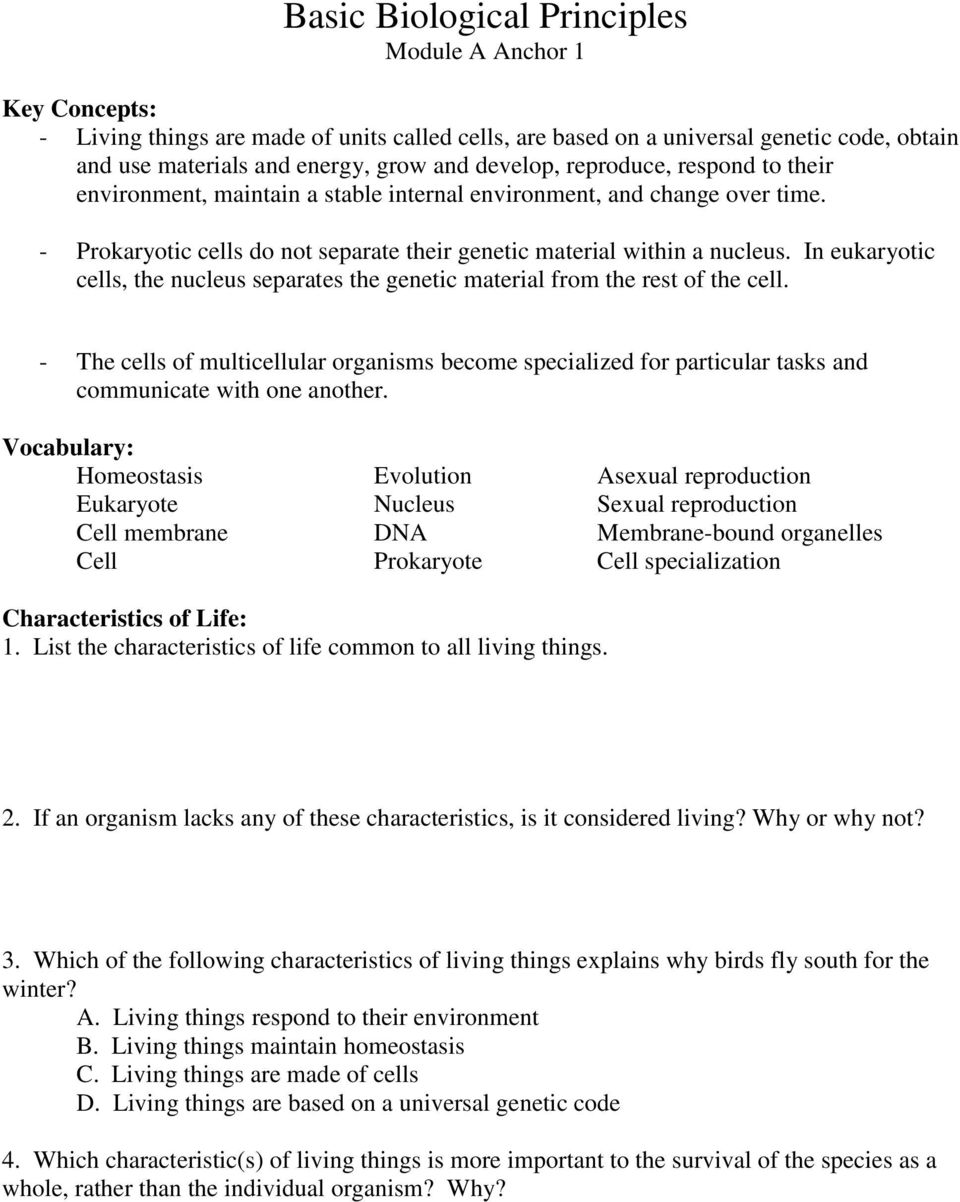
2 Prokaryotes vs. Eukaryotes: 1. Compare and contrast prokaryotes and eukaryotes in terms of structures; list specific organelles which are present in each, as well as other structural similarities and differences. 2. Compare and contrast prokaryotes and eukaryotes in terms of genetic material. 3. How are the similarities and differences between prokaryotic and eukaryotic cells dependent on their size? 4. How do the structures of prokaryotic and eukaryotic cells influence their functions? 5. Not all cells are alike. Which of the following is NOT a true statement about differences between cells? A. Cells come in many different shapes B. Different kinds of cells are different sizes C. Some cells have a nucleus and others do not D. Most cells have a membrane, but some do not Levels of Organization: 1. Describe the relationship between organelles, cells, tissues, organs, and organ systems. 2. Cells in multicellular organisms have many sizes and shapes. These differences are referred to as cell specialization. Cell specialization allows cells to: A. Reproduce B. Perform different functions C. Respond to their environment D. Be less complex

3 3. The cells of unicellular organisms are: A. Specialized to perform different tasks B. Larger than those of multicellular organisms C. Able to perform all the functions necessary for life D. Unable to respond to changes in their environment 4. Give an example of changes that take place as cells in a multicellular organism differentiate. 5. Explain the relationship between cell specialization, multicellular organisms, and homeostasis. 6. How are unicellular and multicellular organisms alike? How are they different?

4 Basic Biological Principles Module A Anchor 1 Characteristics of Life: 1. List the characteristics of life common to all living things. Living things are made of cells, are based on a universal genetic code, obtain and use materials and energy, grow and develop, reproduce, respond to their environment, maintain a stable internal environment, and change over time. 2. If an organism lacks any of these characteristics, is it considered living? Why or why not? No nonliving things can contain some of the characteristics of life. For example, a chemical can react to the environment. 3. Which of the following characteristics of living things explains why birds fly south for the winter? A. Living things respond to their environment 4. Which characteristic(s) of living things is more important to the survival of the species as a whole, rather than the individual organism? Why? Reproduction ensures the continuation of the species, but has no direct benefit to the organism Change over time refers to evolution, which occurs to species and not to individual organisms. Individual organisms survive or do not survive, altering the species as a whole and allowing it to continue existing. Prokaryotes vs. Eukaryotes: 1. Compare and contrast prokaryotes and eukaryotes in terms of structures; list specific organelles which are present in each, as well as other structural similarities and differences. Prokaryotes No nucleus, no membrane-bound organelles, unicellular Eukaryotes contain genetic material within nucleus, contain membrane-bound organelles, can be unicellular or multicellular Both contain cell-membrane, cell wall, ribosomes, contain genetic material 2. Compare and contrast prokaryotes and eukaryotes in terms of genetic material. Prokaryotes do not contain their genetic material within a nucleus. Contain circular pieces of DNA concentrated within a nucleoid. Some contain plasmids, which can be shared with other prokaryotes. Eukaryotes contain their genetic material in chromosomes within a nucleus. 3. How are the similarities and differences between prokaryotic and eukaryotic cells dependent on their size? Prokaryotic cells are smaller, therefore have a more favorable surface-area to volume ratio. This makes transport of materials into and out of the cell much easier. Prokaryotes are therefore able to lack membrane-bound organelles and have less complex internal structure. Eukaryotes are generally larger than prokaryotes, and have a less favorable surface-area to

5 volume ratio. This makes transport more complicated, requiring them to contain a larger variety of organelles. 4. How do the structures of prokaryotic and eukaryotic cells influence their functions? Prokaryotes contain everything necessary to carry out life processes; however, they do lack the complex internal structure of eukaryotes. The more complex internal structure of eukaryotes allows them to perform a larger array of functions, including those requiring multicellularity. 5. Not all cells are alike. Which of the following is NOT a true statement about differences between cells? D. Most cells have a membrane, but some do not Levels of Organization: 1. Describe the relationship between organelles, cells, tissues, organs, and organ systems. Groups of a variety of organelles make up cells. Groups of the same cell type make up tissues. Groups of multiple tissues make up organs. Groups of organs with the same overall purpose working together make up organ systems. 2. Cells in multicellular organisms have many sizes and shapes. These differences are referred to as cell specialization. Cell specialization allows cells to: B. Perform different functions 3. The cells of unicellular organisms are: C. Able to perform all the functions necessary for life 4. Give an example of changes that take place as cells in a multicellular organism differentiate. Organisms originally begin as undifferentiated stem cells. These stem cells are capable of differentiating into any cell type. A number of factors influence the type of cell into which a stem cell differentiates. These factors are not all fully understood. Once a cell reaches its final differentiated state, it can no longer naturally change. 5. Explain the relationship between cell specialization, multicellular organisms, and homeostasis. Multicellular organisms are large and complex; therefore, they require more complicated systems in order to maintain homeostasis. Multicellular organisms accomplish this by designating particular functions to particular cells. This allows different cells to work together to maintain homeostasis within a larger organism. 6. How are unicellular and multicellular organisms alike? How are they different? Alike both are able to perform all of the functions necessary for life. Both can perform a large array of functions. Different the cell of a unicellular organism is capable of performing all its necessary functions. A multicellular organism, due to its large size and complex structure, differentiates different cells for different functions.

Given these characteristics of life, which of the following objects is considered a living organism? W. X. Y. Z.
 Cell Structure and Organization 1. All living things must possess certain characteristics. They are all composed of one or more cells. They can grow, reproduce, and pass their genes on to their offspring.
Cell Growth and Reproduction Module B, Anchor 1
 Cell Growth and Reproduction Module B, Anchor 1 Key Concepts: - The larger a cell becomes, the more demands the cell places on its DNA. In addition, a larger cell is less efficient in moving nutrients
CCR Biology - Chapter 5 Practice Test - Summer 2012
 Name: Class: Date: CCR Biology - Chapter 5 Practice Test - Summer 2012 Multiple Choice Identify the choice that best completes the statement or answers the question. 1. If a cell cannot move enough material
Cells in Biology. Lesson 1.
 Lesson 1. Cells in Biology. Jump-Start Your Learning. Before you begin reading, take a piece of paper and write ''Cells'' across the top. Then, as fast as you can, jot down any notes, facts, opinions or
The Cell Teaching Notes and Answer Keys
 The Cell Teaching Notes and Answer Keys Subject area: Science / Biology Topic focus: The Cell: components, types of cells, organelles, levels of organization Learning Aims: describe similarities and differences
But what about the prokaryotic cells?
 Chapter 32: Page 318 In the past two chapters, you have explored the organelles that can be found in both plant and animal s. You have also learned that plant s contain an organelle that is not found in
Chapter 3. Cellular Structure and Function Worksheets. 39 www.ck12.org
 Chapter 3 Cellular Structure and Function Worksheets (Opening image copyright by Sebastian Kaulitzki, 2010. Used under license from Shutterstock.com.) Lesson 3.1: Introduction to Cells Lesson 3.2: Cell
Biology Chapter 7 Practice Test
 Biology Chapter 7 Practice Test Multiple Choice Write the letter that best answers the question or completes the statement on the line provided. 1. The work of Schleiden and Schwann can be summarized by
Quick Hit Activity Using UIL Science Contests For Formative and Summative Assessments of Pre-AP and AP Biology Students
 Quick Hit Activity Using UIL Science Contests For Formative and Summative Assessments of Pre-AP and AP Biology Students Activity Title: Quick Hit Goal of Activity: To perform formative and summative assessments
Eukaryotic Cell Structure: Organelles in Animal & Plant Cells Why are organelles important and how are plants and animals different?
 Why? Eukaryotic Cell Structure: Organelles in Animal & Plant Cells Why are organelles important and how are plants and animals different? The cell is the basic unit and building block of all living things.
Respiration occurs in the mitochondria in cells.
 B3 Question Which process occurs in the mitochondria in cells? Why do the liver and muscle cells have large number of mitochondria? What is the function of the ribosomes? Answer Respiration occurs in the
7.2 Cell Structure. Lesson Objectives. Lesson Summary. Cell Organization Eukaryotic cells contain a nucleus and many specialized structures.
 7.2 Cell Structure Lesson Objectives Describe the structure and function of the cell nucleus. Describe the role of vacuoles, lysosomes, and the cytoskeleton. Identify the role of ribosomes, endoplasmic
Chapter 4: A Tour of the Cell. 1. Cell Basics. Limits to Cell Size. 1. Cell Basics. 2. Prokaryotic Cells. 3. Eukaryotic Cells
 Chapter 4: A Tour of the Cell 1. Cell Basics 2. Prokaryotic Cells 3. Eukaryotic Cells 1. Cell Basics Limits to Cell Size There are 2 main reasons why cells are so small: If cells get too large: 1) there
Essentials of Human Anatomy & Physiology 11 th Edition, 2015 Marieb
 A Correlation of Essentials of Human Anatomy Marieb To the Next Generation Science Standards Life A Correlation of, HS-LS1 From Molecules to Organisms: Structures and Processes HS-LS1-1. Construct an explanation
Homeostasis and Transport Module A Anchor 4
 Homeostasis and Transport Module A Anchor 4 Key Concepts: - Buffers play an important role in maintaining homeostasis in organisms. - To maintain homeostasis, unicellular organisms grow, respond to the
The Cell Interior and Function
 The Cell Interior and Function 5 5.0 CHAPTER PREVIEW Investigate and understand the organization and function of the cell interior. Define the differences between eukaryotic and prokaryotic cell structure.
4. Why are common names not good to use when classifying organisms? Give an example.
 1. Define taxonomy. Classification of organisms 2. Who was first to classify organisms? Aristotle 3. Explain Aristotle s taxonomy of organisms. Patterns of nature: looked like 4. Why are common names not
Gymnázium, Brno, Slovanské nám. 7, WORKBOOK - Biology WORKBOOK. http://agb.gymnaslo.cz
 WORKBOOK http://agb.gymnaslo.cz Biology Subject: Teacher: Iva Kubištová Student:.. School year:../ This material was prepared with using http://biologygmh.com/ Topics: 1. 2. 3. 4. 5. 6. Viruses and Bacteria
Biology 101 Chapter 4 Cells as the Basic Unit of Life. The Cell Theory Major Contributors: Galileo = first observations made with a microscope
 Biology 101 Chapter 4 Cells as the Basic Unit of Life The Cell Theory Major Contributors: Galileo = first observations made with a microscope Robert Hooke = first to observe small compartments in dead
AP Biology Essential Knowledge Student Diagnostic
 AP Biology Essential Knowledge Student Diagnostic Background The Essential Knowledge statements provided in the AP Biology Curriculum Framework are scientific claims describing phenomenon occurring in
Antibiotics: The difference between prokaryotic and eukaryotic cells, Biology AA, Teacher Leslie Hadaway, New lesson, Science
 Antibiotics: The difference between prokaryotic and eukaryotic cells, Biology AA, Teacher Leslie Hadaway, New lesson, Science Antibiotics: The difference between prokaryotic and eukaryotic cells Author(s)
1 Characteristics of Living Things
 CHAPTER 2 1 Characteristics of Living Things SECTION It s Alive!! Or Is It? BEFORE YOU READ After you read this section, you should be able to answer these questions: What are all living things made of?
Class Time: 30 minutes. Other activities in the Stem Cells in the Spotlight module can be found at: http://gslc.genetics.utah.edu/teachers/tindex/
 Teacher Guide: Color-Label-Learn: Creating Stem Cells for Research ACTIVITY OVERVIEW Abstract: Students color and label images on a worksheet and answer questions about the on-line content featured in
Science 10-Biology Activity 14 Worksheet on Sexual Reproduction
 Science 10-Biology Activity 14 Worksheet on Sexual Reproduction 10 Name Due Date Show Me NOTE: This worksheet is based on material from pages 367-372 in Science Probe. 1. Sexual reproduction requires parents,
Endocrine System: Practice Questions #1
 Endocrine System: Practice Questions #1 1. Removing part of gland D would most likely result in A. a decrease in the secretions of other glands B. a decrease in the blood calcium level C. an increase in
1 Mutation and Genetic Change
 CHAPTER 14 1 Mutation and Genetic Change SECTION Genes in Action KEY IDEAS As you read this section, keep these questions in mind: What is the origin of genetic differences among organisms? What kinds
Plant and Animal Cells
 Plant and Animal Cells a. Explain that cells take in nutrients in order to grow, divide and to make needed materials. S7L2a b. Relate cell structures (cell membrane, nucleus, cytoplasm, chloroplasts, and
A Correlation of Miller & Levine Biology 2014
 A Correlation of Miller & Levine Biology To Ohio s New Learning Standards for Science, 2011 Biology, High School Science Inquiry and Application Course Content A Correlation of, to Introduction This document
Cell Biology Questions and Learning Objectives
 Cell Biology Questions and Learning Objectives (with hypothetical learning materials that might populate the objective) The topics and central questions listed here are typical for an introductory undergraduate
MCAS Biology. Review Packet
 MCAS Biology Review Packet 1 Name Class Date 1. Define organic. THE CHEMISTRY OF LIFE 2. All living things are made up of 6 essential elements: SPONCH. Name the six elements of life. S N P C O H 3. Elements
7.1 What Are Cells? You are made of cells. A cell is the basic unit of structure and function in a living thing. CHAPTER 7
 CELL STRUCTURE AND FUNCTION 7.1 What Are Cells? Look closely at the skin on your arm. Can you see that it is made of cells? Of course not! Your skin cells are much too small to see with your eyes. Now
LAB 09 Cell Division
 LAB 09 Cell Division Introduction: One of the characteristics of living things is the ability to replicate and pass on genetic information to the next generation. Cell division in individual bacteria and
Answer Key. Vocabulary Practice
 Answer Key Vocabulary Practice Copyright by McDougal Littell, a division of Houghton Mifflin Company A. Categorize Words 1. organism, L; cell, L; species, L; transgenic, B; biotechnology, T; molecular
Fifth Grade Cells: Structures and Processes Assessment
 Fifth Grade Cells: Structures and Processes Assessment 1a. All living things are made up of. a. cells b. tissues c. organisms d. systems 1b. All living things are made up of. 1c. Explain what cells are
Unit I: Introduction To Scientific Processes
 Unit I: Introduction To Scientific Processes This unit is an introduction to the scientific process. This unit consists of a laboratory exercise where students go through the QPOE2 process step by step
KEY CONCEPT Organisms can be classified based on physical similarities. binomial nomenclature
 Section 17.1: The Linnaean System of Classification Unit 9 Study Guide KEY CONCEPT Organisms can be classified based on physical similarities. VOCABULARY taxonomy taxon binomial nomenclature genus MAIN
(D) 181-183, 186-187, 190-193 TFYI 187 TPK 190
 NEVADA Life Science Content Standards for Grade 8 Life s Structure and Function A From Bacteria to Plants B Animal Diversity C Human Body Systems D OBJECTIVES Content Standard 6.0: Structure and Function
Meiosis is a special form of cell division.
 Page 1 of 6 KEY CONCEPT Meiosis is a special form of cell division. BEFORE, you learned Mitosis produces two genetically identical cells In sexual reproduction, offspring inherit traits from both parents
Cells & Cell Organelles
 Cells & Cell Organelles The Building Blocks of Life H Biology Types of cells bacteria cells Prokaryote - no organelles Eukaryotes - organelles animal cells plant cells Cell size comparison Animal cell
1. When new cells are formed through the process of mitosis, the number of chromosomes in the new cells
 Cell Growth and Reproduction 1. When new cells are formed through the process of mitosis, the number of chromosomes in the new cells A. is half of that of the parent cell. B. remains the same as in the
The Living Cell from the Biology: The Science of Life Series. Pre-Test
 1 Pre-Test Directions: Answer each question TRUE OR FALSE. 1. The instructions for making proteins are stored in molecules of DNA. 2. Proteins are made in the nucleus. 3. All cells are surrounded by a
The microscope is an important tool.
 KEY CONCEPT Microscopes allow us to see inside the cell. BEFORE, you learned Some organisms are unicellular and some are multicellular A microscope is necessary to study most cells The cell theory describes
Introduction to Animals
 Introduction to Animals Unity and Diversity of Life Q: What characteristics and traits define animals? 25.1 What is an animal? WHAT I KNOW SAMPLE ANSWER: Animals are different from other living things
Prokaryotic and Eukaryotic Cells
 Lab 2- Bio 201 Prokaryotic and Eukaryotic Cells Name: OBJECTIVES To explore cell structure and morphology in prokaryotes and eukaryotes. To gain more experience using the microscope, and in particular,
AP BIOLOGY 2006 SCORING GUIDELINES. Question 1
 AP BIOLOGY 2006 SCORING GUIDELINES Question 1 A major distinction between prokaryotes and eukaryotes is the presence of membrane-bound organelles in eukaryotes. (a) Describe the structure and function
OBJECTIVES PROCEDURE. Lab 2- Bio 160. Name:
 Lab 2- Bio 160 Name: Prokaryotic and Eukaryotic Cells OBJECTIVES To explore cell structure and morphology in prokaryotes and eukaryotes. To gain more experience using the microscope. To obtain a better
A CONTENT STANDARD IS NOT MET UNLESS APPLICABLE CHARACTERISTICS OF SCIENCE ARE ALSO ADDRESSED AT THE SAME TIME.
 Biology Curriculum The Georgia Performance Standards are designed to provide students with the knowledge and skills for proficiency in science. The Project 2061 s Benchmarks for Science Literacy is used
Workshop: Cellular Reproduction via Mitosis & Meiosis
 Workshop: Cellular Reproduction via Mitosis & Meiosis Introduction In this workshop you will examine how cells divide, including how they partition their genetic material (DNA) between the two resulting
Compartmentalization of the Cell. Objectives. Recommended Reading. Professor Alfred Cuschieri. Department of Anatomy University of Malta
 Compartmentalization of the Cell Professor Alfred Cuschieri Department of Anatomy University of Malta Objectives By the end of this session the student should be able to: 1. Identify the different organelles
Plant and Animal Cells
 Plant and Animal Cells Cell Scientists Hans and Zacharias Janssen Dutch lens grinders, father and son produced first compound microscope (2 lenses) Robert Hooke (1665) English Scientist looked at a thin
Cytology. Living organisms are made up of cells. Either PROKARYOTIC or EUKARYOTIC cells.
 CYTOLOGY Cytology Living organisms are made up of cells. Either PROKARYOTIC or EUKARYOTIC cells. A. two major cell types B. distinguished by structural organization See table on handout for differences.
Chapter 12: The Cell Cycle
 Name Period Chapter 12: The Cell Cycle Overview: 1. What are the three key roles of cell division? State each role, and give an example. Key Role Example 2. What is meant by the cell cycle? Concept 12.1
A Correlation of Pearson Miller & Levine Biology 2014 To the Utah Core State Standards for Biology Grades 9-12
 A Correlation of Pearson To the Utah Core State Standards Resource Title: Publisher: Pearson Education publishing as Prentice Hall ISBN (10 or 13 digit unique identifier is required): SE: 9780133242003
Cells, tissues and organs
 Chapter 8: Cells, tissues and organs Cells: building blocks of life Living things are made of cells. Many of the chemical reactions that keep organisms alive (metabolic functions) take place in cells.
Chapter 3. Cell Division. Laboratory Activities Activity 3.1: Mock Mitosis Activity 3.2: Mitosis in Onion Cells Activity 3.
 Chapter 3 Cell Division Laboratory Activities Activity 3.1: Mock Mitosis Activity 3.2: Mitosis in Onion Cells Activity 3.3: Mock Meiosis Goals Following this exercise students should be able to Recognize
Biology. EL indicates a goal that supports the Maryland Environmental Literacy Standards.
 Biology Students must pass the High School Assessment in Biology to earn a high school diploma in Maryland. The HCPSS curriculum in Biology is aligned to the Maryland State Curriculum in Biology. Special
Name Class Date. binomial nomenclature. MAIN IDEA: Linnaeus developed the scientific naming system still used today.
 Section 1: The Linnaean System of Classification 17.1 Reading Guide KEY CONCEPT Organisms can be classified based on physical similarities. VOCABULARY taxonomy taxon binomial nomenclature genus MAIN IDEA:
1. Why is mitosis alone insufficient for the life cycle of sexually reproducing eukaryotes?
 Chapter 13: Meiosis and Sexual Life Cycles 1. Why is mitosis alone insufficient for the life cycle of sexually reproducing eukaryotes? 2. Define: gamete zygote meiosis homologous chromosomes diploid haploid
Name: Class: Date: Multiple Choice Identify the choice that best completes the statement or answers the question.
 Name: Class: Date: Chapter 17 Practice Multiple Choice Identify the choice that best completes the statement or answers the question. 1. The correct order for the levels of Linnaeus's classification system,
Classification Why Things are Grouped classify Methods of Classification
 Classification What features do biologists use to group living things? You know that most plants are green and do not more around. You also know that most animals are not green and do move around. The
Cell Division Simulation: Bacteria Activity One
 Cell Division Simulation: Bacteria Activity One Introduction All living things are made of cells. Some living things, like plants and animals, are made of millions of cells. But some living things are
Cell and Membrane Practice. A. chromosome B. gene C. mitochondrion D. vacuole
 Name: ate: 1. Which structure is outside the nucleus of a cell and contains N?. chromosome. gene. mitochondrion. vacuole 2. potato core was placed in a beaker of water as shown in the figure below. Which
Keystone Review Practice Test Module A Cells and Cell Processes. 1. Which characteristic is shared by all prokaryotes and eukaryotes?
 Keystone Review Practice Test Module A Cells and Cell Processes 1. Which characteristic is shared by all prokaryotes and eukaryotes? a. Ability to store hereditary information b. Use of organelles to control
The Science of Biology
 Chapter 1 The Science of Biology Section 1 1 What Is Science? (pages 3 7) This section explains what the goal of science is and describes a scientific view of the world. What Science Is and Is Not (page
Video Links: Differences Between Plant and Animal Cells http://www.youtube.com/watch?v=mwz4ptp_qeu
 Comparing Animal and Plant Cells by Annie Plant and animal cells are known as Eukaryotic cells which contain a nucleus and other genetic material enclosed within membranes. (Science Daily, n.d.) The primary
The Cell Grade Ten. Estimated Duration: Three hours
 Ohio Standards Connection: Life Sciences Benchmark A Explain that cells are the basic unit of structure and function of living organisms, that once life originated all cells come from pre-existing cells,
List, describe, diagram, and identify the stages of meiosis.
 Meiosis and Sexual Life Cycles In this topic we will examine a second type of cell division used by eukaryotic cells: meiosis. In addition, we will see how the 2 types of eukaryotic cell division, mitosis
CHROMOSOME STRUCTURE CHROMOSOME NUMBERS
 CHROMOSOME STRUCTURE 1. During nuclear division, the DNA (as chromatin) in a Eukaryotic cell's nucleus is coiled into very tight compact structures called chromosomes. These are rod-shaped structures made
13.4 Gene Regulation and Expression
 13.4 Gene Regulation and Expression Lesson Objectives Describe gene regulation in prokaryotes. Explain how most eukaryotic genes are regulated. Relate gene regulation to development in multicellular organisms.
CHAPTER 9 CELLULAR REPRODUCTION P. 243-257
 CHAPTER 9 CELLULAR REPRODUCTION P. 243-257 SECTION 9-1 CELLULAR GROWTH Page 244 ESSENTIAL QUESTION Why is it beneficial for cells to remain small? MAIN IDEA Cells grow until they reach their size limit,
Lesson 1 Characteristics of Life
 Lesson 1 Student Labs and Activities Page Appropriate For: Launch Lab 8 all students Content Vocabulary ELL 9 all students Lesson Outline ELL 10 all students MiniLab 12 all students Content Practice A
the!sun!to!sugars.!this!is!called!! photosynthesis.!the!byproduct!of!those! Nucleus! sugars!is!our!oxygen.!
 Cytoplasm ANIMAL CELL Vacuoles Mitochondria Chromosomes GolgiApparatus Chloroplast+ TheChloroplastiswhatmakesthefood inthecell.they reonlyfoundinplant cellsandsomeprotists.everygreen plantyouseeisconvertingenergyfrom
Regents Biology REGENTS REVIEW: PROTEIN SYNTHESIS
 Period Date REGENTS REVIEW: PROTEIN SYNTHESIS 1. The diagram at the right represents a portion of a type of organic molecule present in the cells of organisms. What will most likely happen if there is
AP BIOLOGY 2008 SCORING GUIDELINES (Form B)
 AP BIOLOGY 2008 SCORING GUIDELINES (Form B) Question 2 2. Many biological structures are composed of smaller units assembled into more complex structures having functions based on their structural organization.
Cells. Structure, Function and Homeostasis
 Cells Structure, Function and Homeostasis Characteristics of Cells Basic unit of life anything alive is made of cells Plasma membrane (skin) that separates them from the environment. Skeletonsfor protection
Summary. 16 1 Genes and Variation. 16 2 Evolution as Genetic Change. Name Class Date
 Chapter 16 Summary Evolution of Populations 16 1 Genes and Variation Darwin s original ideas can now be understood in genetic terms. Beginning with variation, we now know that traits are controlled by
Grade Level Expectations for the Sunshine State Standards
 for the Sunshine State Standards FLORIDA DEPARTMENT OF EDUCATION http://www.myfloridaeducation.com/ The seventh grade student: The Nature of Matter uses a variety of measurements to describe the physical
Lecture 4 Cell Membranes & Organelles
 Lecture 4 Cell Membranes & Organelles Structure of Animal Cells The Phospholipid Structure Phospholipid structure Encases all living cells Its basic structure is represented by the fluidmosaic model Phospholipid
THE HISTORY OF CELL BIOLOGY
 SECTION 4-1 REVIEW THE HISTORY OF CELL BIOLOGY Define the following terms. 1. cell 2. cell theory Write the correct letter in the blank. 1. One early piece of evidence supporting the cell theory was the
Question Bank Five Kingdom Classification
 Question Bank Five Kingdom Classification 1. Who proposed Five Kingdom Classification? Give the bases of classification. Ans. Whittaker in 1969 proposed five kingdom classification based on :- (i) Cell
Eukaryotes. www.njctl.org PSI Biology Eukaryotes & Gene Expression
 Eukaryotes The Eukaryotic Cell Classwork 1. Identify two characteristics that are shared by all cells. 2. Suppose you are investigating a cell that contains a nucleus. Would you categorize this cell as
Bio EOC Topics for Cell Reproduction: Bio EOC Questions for Cell Reproduction:
 Bio EOC Topics for Cell Reproduction: Asexual vs. sexual reproduction Mitosis steps, diagrams, purpose o Interphase, Prophase, Metaphase, Anaphase, Telophase, Cytokinesis Meiosis steps, diagrams, purpose
Chemical Basis of Life Module A Anchor 2
 Chemical Basis of Life Module A Anchor 2 Key Concepts: - Water is a polar molecule. Therefore, it is able to form multiple hydrogen bonds, which account for many of its special properties. - Water s polarity
www.njctl.org PSI Biology Mitosis & Meiosis
 Mitosis and Meiosis Mitosis Classwork 1. Identify two differences between meiosis and mitosis. 2. Provide an example of a type of cell in the human body that would undergo mitosis. 3. Does cell division
Introduction to the Cell: Plant and Animal Cells
 Introduction to the Cell: Plant and Animal Cells Tissues, Organs, and Systems of Living Things Cells, Cell Division, and Animal Systems and Plant Systems Cell Specialization Human Systems All organisms
LAB 8 EUKARYOTIC CELL DIVISION: MITOSIS AND MEIOSIS
 LAB 8 EUKARYOTIC CELL DIVISION: MITOSIS AND MEIOSIS Los Angeles Mission College Biology 3 Name: Date: INTRODUCTION BINARY FISSION: Prokaryotic cells (bacteria) reproduce asexually by binary fission. Bacterial
An Overview of Cells and Cell Research
 An Overview of Cells and Cell Research 1 An Overview of Cells and Cell Research Chapter Outline Model Species and Cell types Cell components Tools of Cell Biology Model Species E. Coli: simplest organism
2. What kind of energy is stored in food? A. chemical energy B. heat energy C. kinetic energy D. light energy
 Assessment Bank Matter and Energy in Living Things SC.8.L.18.4 1. What is energy? A. anything that takes up space B. anything that has mass C. the ability to conduct current D. the ability to do work 2.
High School Science Course Correlations between Ohio s 2010 Course Syllabi and the First Draft of the High School NGSS
 High School Science Course Correlations between Ohio s 2010 Course Syllabi and the First Draft of the High School NGSS This document correlates the content in Ohio s course syllabi with the performance
Anatomy PHL 212. By Dr Tajdar Husain Khan
 Anatomy PHL 212 By Dr Tajdar Husain Khan Overview of Anatomy Anatomy(from the Greek word anatome,"dissection") is a branch of natural science dealing with the structural organization of living things The
Human Body Systems Project By Eva McLanahan
 Human Body Systems Project By Eva McLanahan Students will work in groups to research one of the eleven body systems as found in Holt, Rinehart, and Winston Modern Biology (2002). Research will focus on
Break down material outside their body and then absorb the nutrients. Most are single-celled organisms Usually green. Do not have nuclei
 Name Date Class CHAPTER 9 REINFORCEMENT WORKSHEET Keys to the Kingdom Complete this worksheet after you have finished reading Chapter 9, Section 2. Patty dropped her notes while she was studying the six
Reproductive System & Development: Practice Questions #1
 Reproductive System & Development: Practice Questions #1 1. Which two glands in the diagram produce gametes? A. glands A and B B. glands B and E C. glands C and F D. glands E and F 2. Base your answer
D.U.C. Assist. Lec. Faculty of Dentistry Medical Biology Ihsan Dhari. Kingdoms of life
 Kingdoms of life The earliest classification system recognized only two kingdoms : plants and animals but the use of microscope led to discovery of microorganisms, so the two kingdoms system was no longer
Eukaryotic Cells Organelles Cell Wall cell wall
 Eukaryotic Cells Think back to Schwann and Schleiden. It wasn t until that fateful lunch that Schwann realized he was seeing cells. After that moment cell biology knowledge exploded (just a saying; it
Prokaryotic and Eukaryotic Cells
 Why? Prokaryotic and Eukaryotic Cells Do all cells have the same structure? An efficiency apartment is a one-room apartment. This one room is where you sleep, eat, shower, and entertain your guests. It
Chapter 5 Organelles. Lesson Objectives List the organelles of the cell and their functions. Distinguish between plant and animal cells.
 Chapter 5 Organelles Lesson Objectives List the organelles of the cell and their functions. Distinguish between plant and animal cells. Check Your Understanding What is a cell? How do we visualize cells?
Scottish Qualifications Authority
 National Unit specification: general information Unit code: FH2G 12 Superclass: RH Publication date: March 2011 Source: Scottish Qualifications Authority Version: 01 Summary This Unit is a mandatory Unit
Viruses. Viral components: Capsid. Chapter 10: Viruses. Viral components: Nucleic Acid. Viral components: Envelope
 Viruses Chapter 10: Viruses Lecture Exam #3 Wednesday, November 22 nd (This lecture WILL be on Exam #3) Dr. Amy Rogers Office Hours: MW 9-10 AM Too small to see with a light microscope Visible with electron
Cells Vocabulary List & Definitions
 Cells Vocabulary List & Definitions cytoplasm mitochondrion nucleolus nucleus organ tissue vacuole cell membrane cell wall chlorophyll chloroplast chromosome inherited genetic material in a cell not specified