
GORE SPACEFLIGHT MICROWAVE CABLE ASSEMBLIES
|
|
|
- Sherilyn Boyd
- 9 years ago
- Views:
Transcription
1 GORE SPACEFLIGHT MICROWAVE CABLE ASSEMBLIES
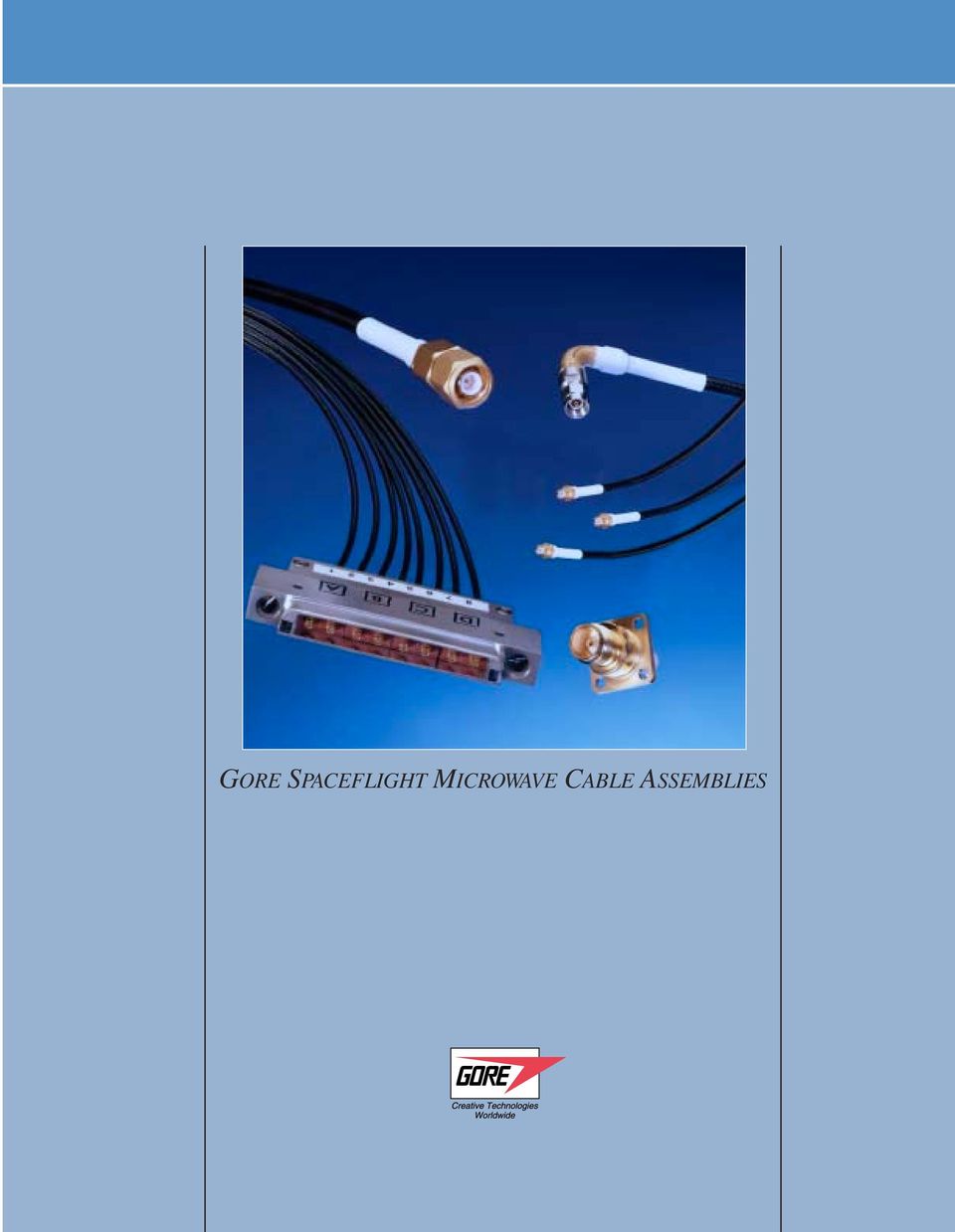
2 Reduced Program Risk. W. L. Gore & Associates, Inc. has developed and proven a wide range of products specifically tailored to the spaceflight industry. With an unmatched history in demanding environments, you may be assured that Gore will provide the reliable products necessary to meet your individual system requirements. Gore is a quality and service oriented manufacturer of a multitude of high-technology products. Among these products are GORE microwave cable assemblies. GORE microwave cable assemblies were introduced to the microwave community in A short time later, the first GORE assemblies were used in a spaceflight application. Since then Gore has remained the worldwide leader in providing custom microwave cable assemblies for demanding applications. Typical applications using Gore microwave cable assemblies include: test, aerospace, defense, telecommunication, and general purpose. Gore continues to refine existing products in order to provide the most reliable microwave assembly for your application. The information contained in this catalog covers the current GORE spaceflight microwave product line. It is accurate and up-to-date as of the time of printing. Continual product advancements, however, virtually assure some information obsolescence. For this reason, all information contained herein is subject to change without notice. The Microwave Product Team at Gore is committed to the success of your program. If you desire a product or need information not found in this catalog, please contact Gore. Gore's dedicated engineering team stands ready to tailor a microwave cable assembly to meet your needs.

3 Table of Contents Section 1 Cable 2 Part Numbering System 4 Specifications and Standards 5 General Material Characteristics 7 Requirements 8 Electrical Performance 10 Frequently Asked Questions 13 VSWR 15 Typical Insertion Loss 16 Guaranteed (Maximum) Insertion Loss 18 Insertion Loss and Phase Variation 20 Phase/Time Delay Matched Assemblies 24 High Power Applications 26 Section 2 Passive Intermodulation Tech Note 31 Radiation Resistance Tech Note 33 Section 3 Ordering Guidelines 35 Cable Options 36 Connector Options 38 Section 4 Connector Drawings: Example 42 Connector Drawings: Connector Drawings: Connector Drawings: Connector Drawings: Connector Drawings: Connector Drawings: Connector Drawings: Connector Drawings: Section 5 Mating and Retention Characteristics 53 Care and Handling 54 Cable Handling and Assembly Inspection 56 Section 6 Constants and Formulas 57 Section 7 Spaceflight Heritage 59 Index 60 1

4 Section 1 Cable Cable Construction Size for size, GORE microwave cable assemblies provide the lowest insertion loss available on the market today. This is accomplished through a unique cable design that exploits the low dielectric constant, low-loss tangent, and conforming nature of expanded polytetrafluoroethylene (eptfe) dielectric. A basic cable design is shown below. Jacket Typical Design Mechanical Shield: Braided Round Wire Gore eptfe Dielectric Core Electrical Shield: Helically Wrapped,Overlapped, Silver- Plated Copper Foil Conductor: Large Diameter The low dielectric constant of the eptfe dielectric core (e r 1.4) allows the use of center conductors with nearly twice the surface area per unit length as those used in solid PTFE cables of comparable diameter, while still maintaining a characteristic impedance of 50 ohms. This provides a significant decrease in assembly insertion loss and enables higher transmission power. Our low loss tangent further reduces assembly insertion loss, particularly as the frequency of operation is increased. Capacitance is nominally 25 pf/ft (82 pf/m). The conforming nature of the eptfe dielectric allows for the use of an electrical shield with 100% coverage. This shield consists of helically wrapped, overlapped, silver-plated copper foil. The overlaps are in intimate contact with each other and with the eptfe dielectric. The result is minimized signal leakage from the cable and less resistance to signal flow on its inside surface, both of which further reduce assembly insertion loss. Additionally, on some cables a standard braided mechanical shield is placed over the electrical shield to increase crush resistance, torque resistance, and connector pull strength. A variety of jacket materials are available depending on the environment. Our standard spaceflight assembly jacket is TEFZEL material from E.I. dupont denemours and Company Inc.. This material offers superior radiation resistance without compromising flexibility. In addition, Gore offers materials that improve flexibility, enhance radiation resistance, are nonmagnetic, provide several levels of crush resistance, or limit the cable s range of motion. These materials can be used in various combinations to align cable performance with your requirements. Selecting the Right Cable All our assemblies are designed and manufactured for broadband performance. Bandwidth may vary depending on cable/ connector configuration. In general, GORE microwave cable assemblies fall into the following basic categories: DC through 12.4 GHz DC through 18.0 GHz DC through 26.5 GHz DC through 40 GHz DC through 50 GHz DC through 65 GHz Throughout the specified range, our cables are virtually free of moding and narrow band VSWR and insertion loss anomalies. Our broadband performance simplifies specifications, eliminates segregation by frequency, enhances frequency agility, and reduces your stock requirements. The GORE microwave cable assembly product line is divided into several basic cable diameters from in. to in. (1.2mm to 8.1mm). As expected, for a given set of conditions, a larger diameter cable will have lower loss than a smaller diameter cable. This comes at the penalty of a heavier weight per length and a larger bend radius. The physical environment that the cable will experience also affects its final construction. For applications where flex is required, such as in a gimbal, a stranded center conductor should be used. For static applications, a lower loss, solid center conductor is usually the better fit. Lastly, various levels of cable ruggedization are available for custom applications. Customer Specifications Frequently, Gore works with a customer s specification to develop a unique set of assembly requirements. Gore will maintain customer specifications and drawings for as long as their program remains active. This helps to expedite subsequent orders and ensure consistently high quality products. Gore Guarantee Unless otherwise specified, every GORE microwave cable assembly is 100% tested, inspected, and certified to meet the acceptance requirements contained in all applicable specifications, 2

5 Section 1 Cable whether stated in this catalog or in pre-approved customer contracts. Each assembly is guaranteed to meet those requirements and to be free from defects in materials and/or workmanship at time of delivery. Defect or failure claims may be filed for up to one year beyond the original shipment date. ISO 9001/14001 Gore s microwave manufacturing facilities maintain ISO 9001/ certification. 3

6 Section 1 Part Numbering System GORE PART NUMBER / Cable Type Connector "A" Connector "B" Assembly Length in Inches Angular Displacement GORE Part Numbering System GORE part numbers consist of a minimum of 12 and a maximum of 15 alphanumeric characters. Groupings of these characters have a specific meaning, as illustrated above. Prefix characters 1 and 2 together define the cable type. For assemblies without other options, characters 1 and 2 will designate the basic cable type. For special requirements such as phase match tolerances, hybrid ruggedization, etc., a special part number assignment may be needed. Please contact Gore if you have special requirements. Characters 3, 4, and 5 define the connector ( A ) to be used on one end of the assembly. To determine these characters, refer to the connector configuration drawings for the basic cable type you have selected (see Section 4). Special Note: If characters 13, 14, and 15 are not specified, the assembly will be supplied with an angular displacement of zero degrees. Characters 13, 14, and 15 are required for ordering purposes only, and are not stamped on the assembly I.D. tube unless specified. For more information about angular displacement, see page 38. Specifying Assembly Length Length is measured using the connector reference plane of straight pin connectors, the pin center line of right angle connectors, and the physical end of straight socket connectors. As an example, please refer to the assembly shown below, 41ZL5ZL Minimum spaceflight assembly length ranges from 1.5 in. (38.1mm) to 4.0 in. (101.6 mm) depending on connectors and cable type. If a shorter assembly is required please contact Gore. Similarly, characters 6, 7, and 8 define the connector ( B ) to be used on the second end of the assembly. Characters 9, 10, and 11 define the assembly length in inches. Lengths which require only one or two digits (6 or 24 in., for example) should be preceded by zeroes in the unused positions (006, 024). 41ZL5ZL Character 12 is used to further define lengths which are not in whole-inch increments (24.5 in., for example). Do not use a twoplace decimal: round to the most desirable tenth of an inch for your application (keep in mind the length tolerance provided in the assembly specifications). If your length is a whole-inch increment, a "0" should be placed in position 12. L Characters 13, 14, and 15 (preceded by a slash) are used only when an assembly has two angled or D mount connectors (or a combination thereof) so that their angular displacement may be specified (see page 38). Angles less than 100 should be preceded by a zero in box 13. 4

7 Section 1 Specifications & Standards Gore Solder Workmanship Standard This specification covers 50-ohm, low insertion loss, flexible coaxial cable assemblies. Cable assemblies conforming to this document are intended for use in high-reliability, spaceflight, and critical ground support applications. Applicable Documents The following documents, of the issue in effect on the date of invitation for bids or request for proposal, may apply in whole or in part to a finished microwave assembly. Government specifications and standards referenced in this catalog may be changed or eliminated as a part of the government s acquisition streamlining efforts or for other reasons. At such time, industry or company specifications and standards may be substituted. Specifications Federal AMS-QQ-N-290 Plating, Electro-Deposited Nickel QQ-B-626* Brass, One-Half Hard, Composition 360 QQ-C-530* Beryllium Copper QQ-P-35* Passivated Treatments for Corrosion QQ-S-571* Solder, Tin Alloy: Lead-Tin Alloy; and Lead Alloy ZZ-R-765 Rubber, Silicone Military MIL-C-17 Cables, Radio Frequency, Flexible and Semi-Rigid MIL-C Coatings, Electroless Nickel MIL-C-87104* Coaxial Assemblies SAE-AMS-DTL Insulation Sleeving, Electrical, Heat Shrinkable, General MIL-G-45204* Gold Plate, Type II, Grade B (Pins - Class 2; Bodies - Class 1) MIL-I-45208* Inspection Systems Requirements MIL-M Marking of Electrical Insulation Materials MIL-P-19468* Polytetrafluoroethylene (PTFE) Fluorocarbon MIL-PRF Connector, Coaxial, Radio Frequency MIL-R-25988* MIL-R-46198* MIL-R-83248* MIL-T Standards Military MIL-STD-202 MIL-STD-348 MIL-STD-1344 MIL-STD-2000* Rubber, Fluorosilicone Elastomer, Oil, Fuel Resin, Polyimide, Hot Pressed or Pressed and Sintered Rubber, Fluorocarbon Elastomer, High Temp. Fluid, and Compression Set Resistant Transmission Lines, Transverse Electromagnetic Mode Test Methods for Electronic and Electrical Component Parts Radio Frequency Connector Interfaces Test Methods for Electrical Connectors Standard Requirements for Soldered Electrical and Electronic Assemblies Other Aerospace Material Specifications NHB (3A-2)* Requirements for Soldering Electrical Connections NASA-STD Solder Electrical Connections SAE/AMS 2404 Plating, Electroless Nickel SAE/AMS 2405 Electroless Nickel Plating SAE/AMS 2433 Plating, Nickel-Thallium-Boron or Nickel- Boron SAE/AMS 3593 Plastic Tubing, Electrical Insulation, Irradiated Polyvinylidene Fluoride, Semi-Rigid, Heat Shrink Marker Sleeving, Grade Low Outgassing SAE/AMS 3683 Tubing, Irradiated Modified Fluoropolymer Plastic, Electrical Insulation, Flame Resistant, Flexible, Heat-Shrinkable, 2 to 1 Shrink Ratio American National Standards IEEE STD 287* Precision Coaxial Connectors J-STD-004 Requirements for Soldering Fluxes J-STD-006 Requirements for Electronic Grade Solder Alloys and Fluxed and Non-Fluxed Solid Solders for Electronic Soldering Applications Special Note: * These standards or specifications are for REFERENCE ONLY. They are obsolete or have been replaced by a new standard (as of publishing date). 5

8 Section 1 Specifications & Standards American Society for Testing & Materials ASTM-A-269 Seamless and Welded Austenitic Stainless Steel Tubing for General Services, Class 316L ASTM-A-582/A582M Specification for Free Machining Stainless Steel Bars ASTM-B-16 Free-Cutting Brass Rod, Bar and Shapes for Use in Screw Machines ASTM-B-194 Copper-Beryllium Alloy Plate, Sheet Strip, and Rolled Bar ASTM-B-196 Copper-Beryllium Alloy Rod and Bar ASTM-B-197 Copper-Beryllium Alloy Wire ASTM-B-298 Silver Coated Soft or Annealed Copper Wire ASTM-B-488 Electrodeposited Coatings of Gold ASTM-B-607 Autocatalytic Nickel Boron Coatings for Engineering Use ASTM-B-656 Autocatalytic (Electroless) Nickel-Phosphorus Deposition on Metals for Engineering Use ASTM-B-733 Autocatalytic Nickel-Phosphorus Coatings on Metals ASTM-D-1457 Polytetrafluoroethylene (PTFE) Molding and Extrusion Materials ASTM-D-1710 PTFE Basic Shapes, Rod, and Heavy-Walled Tubing ASTM-D-5205 Polyetherimide (PEI) Materials Institute of Printed Circuits IPC-FC-221* Flat-Copper Conductors for Flat Cables Special Note: * These standards or specifications are for REFERENCE ONLY. They are obsolete or have been replaced by a new standard (as of publishing date). 6

9 Section 1 General Material Characteristics General Material Characteristics* The following list covers the majority of our microwave cable assemblies. For a specific list, please contact Gore. Connector Body Shell (SMA, TNC, Type N): Beryllium Copper per ASTM-B-196, Temper TD04 (H), Alloy C17300 or Stainless Steel per ASTM-A-582/A 582M Plating: Gold Plate per ASTM-B-488, Type II, Grade C, Class 1.25 or MIL-G-45204, Type II, Grade C, Class 1, to thickness; over electrodeposited nickel underplate per AMS-QQ-N-290, Class 1, to thickness; over copper strike Dielectric Support Beads: Ultem 1000 PEI resin: ASTM-D-5205; Vespel polyimide: MIL-R-46198, Type 1, Form M; PTFE: ASTM-D-1457 Torlon resin: 4203 Jacket Materials: Spaceflight Cable: Extruded TEFZEL material. Ruggedization: Stainless steel Connector Coupling Nut: Stainless Steel Type 303 per ASTM-A-582/ A 582M Passivate per QQ-P-35, Type II Connector Hat: Copper alloy UNS No. C36000, Temper H02, per ASTM-B-16 Plating: Gold Plate per MIL-G-45204, Type II, Grade C, Class 1, to thickness; over electroless nickel underplate per MIL-C-26074, Class 1, to thickness; over copper strike Retaining Nut: Stainless Steel Type 303 per ASTM-A-582/ A 582M Passivate per QQ-P-35, Type II C-Ring: Beryllium Copper per ASTM-B-196, Temper TD04 (H), Alloy C17300 Center Contact: Beryllium Copper per ASTM-B-196, Temper TD04 (H), Alloy C17300, or Stainless Steel Type 303 per ASTM-A-582/ A 582M Plating: Gold Plate per ASTM-B-488 Type II, Grade C, Class 2.5 or MIL- G-45204, Type II, Grade C, Class 2, to thickness; over electroless nickel underplate per MIL-C-26074, Class 1, to thickness; over copper strike * Please consult Gore for specific material usage. 7

10 Section 1 Requirements Requirements Cable assemblies will meet the requirements specified within this catalog. Conductor Standard conductors will be silver-coated copper wire per ASTM- B-298. Silver coating will be 40 microinches minimum per MIL- C-17. Dielectric Core The dielectric core will be tape-wrapped, expanded polytetrafluoroethylene (eptfe) conforming to the requirements of MIL-C-17, Type F-6. Electrical Shield The inner shield will be helically wrapped, silver coated flat copper conforming to IPC-FC-221. Silver coating will be 40 microinches minimum per MIL-C-17. Mechanical Shield The outer shield will be braided, silver coated round copper wire per ASTM-B-298. Silver coating will be 40 microinches minimum per MIL-C-17. Outer shield coverage will be 90% minimum as determined by MIL-C-17. Jacket The jacket will be extruded TEFZEL material, conforming to MIL-C-17, type X, tinted black. Connectors Connector type will be as specified. Materials and finishes will conform to the requirements of MIL-PRF-39012, when applicable. Gaskets and O-Rings All connector gaskets and O-rings will be made of VITON fluoroelastomer per MIL-R-83248, or silicone per ZZ-R-765 or MIL-R PTFE Conditioning All PTFE connector parts fabricated and supplied by Gore will be conditioned for a minimum of one hour at +177 o C ± 16 o C prior to assembly. Solder All solder used during assembly will be Type SN63, SN96, or other alloys per J-STD-006 as the application requires. Pre-Tinning Prior to assembly the stripped cable center conductor and foil shield ends will be pre-tinned. The pre-tinning will conform to the soldering criteria in Gore Standard 10001, when applicable. Soldering The pin contacts of the connectors will be soldered to the center conductor of the cables and the outer shield of the cable will be soldered to the connector sleeve. Soldered joints will conform to the soldering criteria in Gore Standard 10001, when applicable. Shrink Tubing Shrink tubing will be per SAE/AMS 3593, SAE/AMS 3683, or SAE/AMS-DTL or other modified polyvinylidene fluoride material. Configuration The configuration of each assembly will be as specified herein and by the procuring activity. Length The completed cable assembly length and tolerances of nonphase matched assemblies will be as specified below: Nominal Length Tolerance Up to 5 ft. (1500mm) ±0.25 in. (6.4mm) 5-15 ft. (1500mm-4600mm) ±0.50 in. (12.7mm) ft. (4600mm-7600mm) ±1.00 in. (25.4mm) > 25 ft. (7600mm) Consult Gore Cable Assembly Identification Unless specified by the customer, each cable assembly will be supplied with an identification shrink tube. It will contain, as a minimum (if space allows), the following information: Gore Part Number Cage Code (if applicable) Gore Serial Number The tubing will be shrunk to its minimum dimensions, movable for customer s positioning, and be constrained by the connectors. Additional identification markers will be in accordance with, and at the option of, the procuring facility. 8

11 Section 1 Requirements Marking Ink Marking ink shall meet the permanency test of MIL-M Workmanship Finished cable assemblies shall conform to the requirements specified herein. Nonconforming assemblies shall not be shipped. Visual Inspection All aspects of material and construction shall be visually examined. The cable outer surface shall be smooth (free from lumps, kinks, abrasions, pin holes, pitted or pocked surfaces). The configuration of each assembly shall be as specified herein and by the procuring activity. Connector Plating Adhesion On a sampling lot basis the plated connector component shall be crushed. The adhesion of the plating and all underplatings shall then be examined at a magnification of at least 10X. Neither the plating, nor any underplating, on gold-plated connector piece parts shall show blistering, peeling, lifting, or flaking from the base metal or from each other at their interface. Cracks in the base metal or any plating will not be considered failure unless accompanied by flaking, peeling, or blistering. Radiographic Examination Radiographic examination shall be performed on each completed cable to connector termination. For Gore s examination one view shall be taken perpendicular to the center line of the connector. There shall be no evidence of solder peaks, projections, or loose solder particles in any solder joint. X-ray images, either in wetfilm or computer generated graphics, will be retained for procuring activity, source inspection, and/or included with shipment when required. Operating Environment The coaxial cable assemblies are designed to withstand a normal spaceflight operating environment (-55 C to C, and pressure less than 10-5 torr). 9

12 Section 1 Electrical Performance Electrical Parameters When tested by the appropriate method for application, the insertion loss, VSWR or return loss, and phase parameters of each cable assembly will not exceed specified values. Insertion loss, VSWR or return loss, and phase measurements (when applicable) will be made using a scalar or vector network analyzer. Guaranteed (Maximum) Insertion Loss The guaranteed insertion loss shown on page 18 represents our standard specifications. Please consult Gore before specifying lower values. Typical insertion loss values can be much better then guaranteed insertion loss values as shown on page 16. Guaranteed VSWR The attached VSWR guarantees, shown on page 15, are our standard specifications. Please consult Gore before specifying lower values. Typical VSWR values can be much better then guaranteed VSWR values as shown on page 15. Characteristic Impedance The characteristic impedance of the cable will be 50 ± 1 ohm as measured during the manufacturing process by using a time domain reflectometer and a 50-ohm precision air line. Continuity Continuity will be confirmed based on results obtained from insertion loss and VSWR. Dielectric Withstanding Voltage The cable assembly will be tested in accordance with MIL-C-17. The voltage will be applied between the inner and outer conductors for a minimum of one minute without breakdown. When tested, the assembly will be capable of withstanding the following VRMS, with no breakdown, flashover, or sparkover: Dielectric Withstanding Voltage Part Number Base Cable VRMS O.D. in (mm) 5U (1.2) 100 8S (2.2) / (3.0) (3.6) /41/5D (4.8) / (7.4) (8.1) 1500 Coupling Mechanism Proof Torque When tested, the coupling mechanism of thread-on connectors will not be dislodged from the connector body when the specified force is applied. The mechanism will rotate freely. The interface dimensions of the socket connector will be compatible with the pin being tested, and will not cause destructive mating. Shielding Effectiveness In general, our assemblies meet 90 db/ft (exclusive of connectors) per MIL-STD-1344, Method 3008, Mode Stirred Chamber, (DC-18GHz) or Sniffer-Probe Method (over 18GHz). Any specific method or specification can be supplied by the customer. Connector performance is type-dependent. Please contact Gore for specific details. Shielding Effectiveness GORE Microwave Cable Double Braid Coax Single Braid Coax AL/Mylar With Drain Coax Test method MIL-STD-1344, method 3008 The graph shows the typical shielding performance for four different coax cable types. Each type differs only in the construction of the cable s outer shield. As shown, a Gore microwave cable provides significantly better shielding than braiding or aluminized mylar approaches because of the helically wrapped foil outer shield. Time Delay If required, the time delay will be tested in acceptance with MIL- C-17 using a time domain reflectometer, or a vector network analyzer. The nominal time delay of the cable will be 1.2 ns/ft (3.94 ns/m). 10

13 Section 1 Electrical Performance Thermal Shock The assemblies will be capable of withstanding thermal shock requirements when tested in accordance with MIL-STD-202, Method 107, at specified conditions. Quality Assurance Provisions The quality assurance provisions of ISO 9001 and MIL-I will apply with exceptions and additions as specified herein. All inspections and tests will be conducted by Gore at our facility or at an approved outside test facility. Gore will allow reasonable access to quality control and test facilities for source inspection purposes. All documentation not considered proprietary will be available for review at the Gore facility. Special Note: Qualification and Source Inspection, when required, must be specified by the procuring activity at the time of request for quote or proposal. Quality Assurance Verification Quality assurance will be verified by: A. Acceptance Inspection - 100% inspection of all assemblies shipped. B. Qualification - When specified by the procuring activity. Acceptance Inspection Prior to shipment, unless otherwise specified, all cable assemblies will be subjected to, and successfully pass, the following tests: Insertion Loss VSWR Dielectric Withstanding Voltage Radiographic Examination Visual Inspection Phase (When Applicable) Acceptance Inspection Report Acceptance inspection reports for each shipment lot will be certified by a responsible Gore Quality Assurance Representative. The report will be available for review at Gore s facility, upon request. Insertion loss, VSWR, x-ray, and phase data (when applicable) will be submitted to the procuring activity with the shipment lot. Successful completion of the acceptance inspection for each cable assembly will be indicated by completion of a supplier Certificate of Compliance submitted to the procuring activity with the shipment lot. Qualification Qualification, when requested, will be per the Gore Standard Spaceflight Specification or customer supplied specifications as defined by customer requirements. Qualification Methods Qualification may be satisfied either by similarity, analysis, or by actual testing as agreed upon by the procuring activity and Gore. Traceability Records will be kept by Gore showing all significant manufacturing processes, procedures, and inspection steps that have been performed. Records will indicate the date of the operation and will relate the finished product to the specific production lot. Assembly serial numbers will be the key to the records, and will allow traceability to raw materials. Records will be retained by Gore for seven (7) years. Certificate of Compliance A Certificate of Compliance, signed by a Gore Quality Representative, will be provided with each cable assembly or group of cable assemblies. This guarantees that each cable assembly has been fully tested in accordance with this document and meets the requirements herein as specified by the procuring activity. Preparation For Delivery Packaging Cable assemblies will be packaged in antistatic bags. The assemblies will then be packed in boxes and voids shall be filled with shock-absorbent material to prevent damage. Shipping containers may contain multiple assemblies. Labeling Each cable assembly package will be labeled or tagged to indicate the part number. Spaceflight Hardware Processing All spaceflight assemblies are manufactured in a Class 10,000 clean room environment. Soldering and inspections are performed by certified personnel. Certifications are granted on successful completion of in-house training conducted by soldering instructors certified to NAS , MIL-STD-2000A, and/or J-STD A visual and mechanical inspection of connector components per MIL-PRF is performed to verify that critical dimensions are met, thus ensuring both electrical and mechanical in- 11

14 Section 1 Electrical Performance tegrity on every spaceflight assembly. In addition, all metal parts are degreased prior to assembly integration to ensure maximum cleanliness for the spaceflight environment. One hundred percent x-ray verification of the stringent solder fill criteria, coupled with extensive electrical testing, completes the cycle of producing an extremely reliable GORE spaceflight cable assembly. 12

15 Section 1 Frequently Asked Questions After choosing your basic cable and connector, there are several additional factors that may influence final assembly construction. Some of the more common factors are discussed below: Q1. Does Gore offer phase matching options? A. Yes, Gore has extensive experience in providing phase matched sets, either to an absolute standard or relative to one another. Discussions of phase performance are provided on page The exact phase performance will depend on the particular cable construction. Q2. I have a high power application. What are my options? A. High power applications can affect microwave assembly construction and performance in several ways. For powers over 5-10 watts and frequencies between 400 MHz and 6 GHz, multipaction and ionization breakdown effects must be considered. An overview of these effects is available by request. The second consideration is thermal breakdown. As a rough guide for non-vacuum applications with a service temperature below 70 C and f>3.6 GHz, thermal breakdown should be analyzed when: ρ ƒ> 60 for TNC, or ρ ƒ> 40 for SMA where ρ=cw power (Watts) and ƒ=frequency (GHz) The exact power rating of each cable and connector configuration will depend on its thermal environment. Q3. Do you offer radiation tolerant designs? A. Yes, Gore offers a wide range of radiation tolerant designs from 5 Mrad to beyond 100 Mrad. The type and intensity of high-energy radiation encountered in space is complex and depends on the trajectory of the spacecraft, the impingement angle of the radiation, and the presence or absence of external shielding. Q4. I have an extreme thermal environment. Do I need to specify different materials? A. Possibly. Our standard construction is guaranteed from -55 o C to 150 o C. For lower temperatures, special manufacturing procedures are required to stabilize cable performance. At higher extremes, different materials may be required. Gore has qualified several of our cable assemblies to below -180 o C. If your environment extends beyond the range of -55 o C to 150 o C, please contact Gore to specify the appropriate construction. Q5. Do you make cables for flex applications? A. Yes, the GORE microwave assembly product line is divided into two separate categories. The first is an ultra low loss solid center conductor construction for static applications. The second is a stranded construction for flex applications. This construction can be optimized for very high flex applications such as found in an antenna gimbal. Stranded cable designs have a slightly higher insertion loss when compared to the same size solid construction. Flex life data on our various constructions can be provided at your request. Q6. What is the lowest loss I can specify? A. Unlimited. The low loss tangent and low dielectric constant of Gore s eptfe dielectric insulation material allows Gore to offer the industry's lowest insertion loss for any given flexible cable size. Pages 17 and 19 contain two loss curves of the guaranteed and typical loss for each cable type. While insertion loss may be specified between these two formulas, there will be a price premium for specifying loss near the minimum insertion loss line, please consult Gore prior to ordering. Q7. What is the best way to install GORE assemblies? A. There are many options for installing GORE microwave assemblies. Consult Gore with your specific installation requirements to allow us to determine your best installation options. Gore has extensive experience in providing microwave coaxial assemblies for complex applications. Our engineering team is always ready to help you develop the best solution for your application. Gore can provide suggestions regarding the best way to harness assemblies for multi-line configurations. The effects of various clamping technologies on assembly performance have also been studied by Gore. Q8. Do I have to worry about outgassing? A. No, all materials used in GORE spaceflight constructions meet or exceed NASA outgassing requirements. Depending on the cable configuration, there will be a brief period of time required for the dielectric to vent. For some very high power applications, it may be desirable to provide venting in the connector housing. Q9. How much design flexibility do I have? A. Gore offers much design flexibility and spaceflight qualified constructions in a variety of standard configurations. For unique applications, Gore has a dedicated engineering team ready to solve your microwave interconnect problem. 13

16 Section 1 Frequently Asked Questions Q10. What if I need an emergency turnaround on a microwave assembly? A. Gore recognizes the critical nature of the flight integration schedule and is prepared to meet your needs. We can often turn around small orders within 72 hours. Q11. What if I damage a cable after installation? A. Ideally the cable would be removed for repair or replacement at the Gore plant, however, we recognize that this is not always possible. Gore has a team available to perform repairs at your facility. In most cases we can begin the repair within 48 hours of notification. Gore recognizes the critical nature of the flight integration schedule and is prepared to meet your needs. 14

17 Section 1 VSWR VSWR Assembly VSWR or return loss is influenced to a large extent by the particular assembly configuration (length and connector types) in combination with the frequency and bandwidth, and to a lesser extent by the test method and equipment in use. It is impossible, therefore, to provide within this literature a single VSWR specification that would be applicable to all combinations of the variables mentioned above. The following table may be used as a guide. All values apply only to generic connector series SMA, TNC, Type N, and to Gore s higher frequency versions of these series. When specific assembly requirements and test methods have been established, it is often possible to guarantee lower VSWR values. Conversely, some connector and/or length combinations (extremely short or extremely long) may result in higher values. To be certain, please contact Gore with your specific requirements. Cable Assembly VSWR Frequency Straight Connectors Two Angle Connectors* Mixed Connectors* Range (GHz) Guar. Typ. Guar. Typ. Guar. Typ. DC to (1.10) 1.20 (1.10) 1.20 (1.10) 2 to (1.10) 1.25 (1.20) 1.25 (1.20) 4 to (1.20) 1.35 (1.30) 1.35 (1.25) 8 to (1.25) 1.45 (1.35) 1.40 (1.30) 12 to (1.25) 1.45 (1.35) 1.40 (1.30) 16 to (1.25) 1.45 (1.35) 1.40 (1.30) 18 to (1.35) 1.55 (1.45) 1.50 (1.40) 26.5 to 65 Call Gore Call Gore Call Gore * For box right angle connectors, please consult Gore. VSWR to Return Loss Conversion VSWR Return Loss

18 Section 1 Typical Insertion Loss Typical Insertion Loss Generic Base Cable Nom. Min. Bend Insertion Loss Formula 1 Freq. Cable O.D. 2 Weight 2 Radius 4 Loss (db)= A + B f + C sqrt(f) + L[D + E f + F sqrt(f)] Max. Type inches (mm) g/ft (g/m) in. (mm) A B C D E F (GHz) 5U (1.2) 1.7 (5.6) 0.25 (6.4) S (2.2) 4 (13.1) 0.5 (12.7) (3.0) 9 (29.5) 0.5 (12.7) (4.8) 17 (55.8) 1.0 (25.4) (7.4) 40 (131.2) 1.5 (38.1) (3.0) 9 (29.5) 0.5 (12.7) (3.6) 11 (36.1) 1.0 (25.4) /5D (4.8) 17 (55.8) 1.0 (25.4) / (7.4) 40 (131.2) 1.5 (38.1) (8.1) 44 (144.3) 2.0 (50.8) V (5.3) 19 (62.7) 1.5 (38.1) Notes: 1 f=frequency in GHz; L=Assembly length in feet. For non-straight connectors add the following lengths per connector for calculation only: 0.5 (12.7mm) for 8S and 5U cable; 1.0 (25.4mm) for 26, 27, and 56 cable; 1.5 (38.1mm) for 21, 41, and 5V cable; and 2.0 (50.8mm) for 22, 42, and 28 cable. Consult Gore for typical insertion loss for assemblies shorter than 12 inches (304.8mm) 2 All dimensions and properties are for TEFZEL jacketed constructions with silver-plated copper center conductors. 3 Part numbers 21, 22, and 26 use a stranded center conductor; these parts are recommended for applications requiring high flex life. 4 Minimum bend radius is for multiple bends. Smaller bend radii may be possible for single bend applications. This formula can be used to predict the expected performance of an assembly in a system. It includes connector mismatch error and does account for test error. As such, this information is for reference value only; it cannot be used to specify assembly insertion loss. Length is measured between connector reference planes subject to the aforementioned non-straight connector adders. For VSWR and Return Loss calculations, use the table on page

19 Section 1 Typical Insertion Loss Figure 1 Typical Insertion Loss for a 36 in. (914.4mm) Assembly for Various Cable Types 5U Insertion Loss (db) 8S Frequency (GHz) Calculation Example: 34.5", 0.190" O.D., solid center conductor cable with straight pin TNCA to swept pin connector TNCA: Part #: 41ZL5ZL Length for equation = 34.5" +1.5" for the swept connector. Insertion Loss Equation at 4.2 GHz: I L (db) = ( ) sqrt(4.2) + (36/12)[ sqrt(4.2)] =0.50dB 17

20 Section 1 Guaranteed (Maximum) Insertion Loss Guaranteed (Maximum) Insertion Loss Generic Base Cable Nom. Min. Bend Insertion Loss Formula 1 Freq. Cable O.D. 2 Weight 2 Radius 4 Loss (db)= A + B f + C sqrt(f) + L[D + E f + F sqrt(f)] Max. Type inches (mm) g/ft (g/m) in. (mm) A B C D E F (GHz) 5U (1.2) 1.7 (5.6) 0.25 (6.4) S (2.2) 4 (13.1) 0.5 (12.7) (3.0) 9 (29.5) 0.5 (12.7) (4.8) 17 (55.8) 1.0 (25.4) (7.4) 40 (131.2) 1.5 (38.1) (3.0) 9 (29.5) 0.5 (12.7) (3.6) 11 (36.1) 1.0 (25.4) /5D (4.8) 17 (55.8) 1.0 (25.4) / (7.4) 40 (131.2) 1.5 (38.1) (8.1) 44 (144.3) 2.0 (50.8) V (5.3) 19 (62.7) 1.5 (38.1) Notes: 1 f=frequency in GHz; L=Assembly length in feet. For non-straight connectors add the following lengths per connector for calculation only: 0.5 (12.7mm) for 8S and 5U cable; 1.0 (25.4mm) for 26, 27, and 56 cable; 1.5 (38.1mm) for 21, 41, and 5V cable; and 2.0 (50.8mm) for 22, 42, and 28 cable. Consult Gore for guaranteed insertion loss for assemblies smaller than 12 inches (304.8mm). 2 All dimensions and properties are for TEFZEL jacketed constructions with silver-plated copper center conductors. 3 Part numbers 21, 22, and 26 use a stranded center conductor; these parts are recommended for applications requiring high flex life. 4 Minimum bend radius is for multiple bends. Smaller bend radii may be possible for single bend applications. Tighter guarantees may be possible on some cable types, consult Gore. The insertion loss figures represented by this table may be used to calculate the maximum allowable assembly insertion loss value. This calculation includes test error, measurement error and connector effects. Length is measured between connector reference planes subject to the aforementioned non-straight connector adders. For VSWR and Return Loss calculations, use the table on page

21 Section 1 Guaranteed (Maximum) Insertion Loss Figure 2 Guaranteed (Max.) Insertion Loss for a 36 in. (914.4mm) Assembly for Various Cable Types U Insertion Loss (db) S Frequency (GHz) Calculation Example: 34.5", 0.190" O.D., solid center conductor cable with straight pin TNCA to swept pin connector TNCA: Part #: 41ZL5ZL Length for equation = 34.5" +1.5" for the swept connector. Insertion Loss Equation at 4.2 GHz: I L (db) = ( ) sqrt(4.2) + (36/12)[ sqrt(4.2)] =0.58 db 19
22 Section 1 Insertion Loss and Phase Variation Changes in Insertion Loss With Temperature Insertion loss tracking is the ability of different assemblies of the same type and length to closely reproduce, with changing temperature, their inherent loss characteristics. As with phase tracking, the closer the assemblies track, the lower the residual systemic error, and the more consistent the beamwidth, sidelobe suppression, and beam steering will be. System range, jamming and clutter resistance, and overall accuracy are ultimately superior. Poor insertion loss tracking is generally attributable to poor control over materials and processes during cable manufacturing, or by use of a mix of different assemblies with different characteristics. Figure 3 is a plot of data which illustrates typical insertion loss tracking of GORE microwave cable assemblies over the temperature range of -100 C to +150 C. Typical insertion loss will track within two percent for a given cable type, depending on the assembly length. Tighter insertion loss tracking may be achieved by selecting cables from the same material batch. Please consult Gore for details. Changes In Phase Length With Temperature GORE microwave cable assemblies offer the opportunity to improve the performance and reliability of a phase sensitive system while also reducing its complexity and cost. The low loss and Figure 3 Attenuation Change (% db) vs. Temperature, Bulk Property Cable Attenuation Attenuation Formula 8 4 Attenuation (%db) Formula for percent change in bulk attenuation at 18 GHz = Temp tanh[(temp - 15)/10] Note: Temperature is degrees C Temperature ( C) The above curve is a property of bulk cable; very low loss cable assemblies may deviate slightly due to connector effects over temperature. Insertion loss change is in percent db relative to 0 db change at 25 C. This measurement was taken at 18 GHz and is a weak function of frequency. Insertion loss change is primarily due to the change in conductivity of the silver with temperature. To a lesser extent, the loss tangent of the eptfe is also a function of temperature. 20
23 Section 1 Insertion Loss and Phase Variation VSWR characteristics of our products are well known. Perhaps not so well known is our exceptional electrical length stability under various environmental conditions. The purpose of this information is to familiarize you with that stability. The key to this enhanced stability is our well-known cable dielectric, eptfe. The eptfe used is manufactured exclusively by Gore, and is used in no other manufacturer s microwave assemblies. It is, in essence, the key component of our microwave cable assembly. The information presented herein was extracted from a variety of actual qualification tests and applications. However, due to extensive variations in system requirements, it may or may not be applicable to your requirements, and should not be directly specified without our consultation. Gore routinely provides performance guarantees for specific requirements. With our unique vertical integration, we have an unmatched capability to define the phase performance of our assemblies. For additional information, please contact Gore. Temperature Change (Phase vs. Temperature) The extent of electrical length change over temperature range is referred to as phase-temperature response. The flatter the response curve, with reference to a specified temperature (usually 25 C), the better. In addition to the flatness of the phase-temperature response curve, the extent of hysteresis is of great concern. Hysteresis is the change in electrical length measured at a particular temperature, when cycling toward a temperature extreme, and upon return to that particular temperature from the extreme. It is very difficult to apply error correction techniques to a system using transmission lines which exhibit hysteresis characteristics since their electrical lengths, when returning to a temperature from cold versus returning to it from hot, are different. Assembly Fingerprints (Phase vs. Temperature) When considered together, the phase/temperature response and the hysteresis characteristics of a particular microwave transmission line assembly type constitute its fingerprint. The fingerprint for each assembly type is unique, within limits. Some assembly types have wide limits, usually due to a lack of control over materials and the manufacturing processes. GORE microwave cable assemblies have very tight limits of variation on their fingerprint, because Gore has total control over variables. We can and do guarantee limits, if requested. The fingerprints for full-density PTFE semirigid type assemblies and for GORE eptfe type assemblies are very different, and are used to illustrate the differences you will encounter between Figure 4 Change in E.L. IN deg/ghz/ft Change In Electrical Length With Temperature: GORE Expanded PTFE Cable vs. Full Density PTFE Cable Typical Gore Expanded PTFE Cable Full Density PTFE Cable Temperature ( C) 21
24 Section 1 Insertion Loss and Phase Variation assembly types. Figure 4 shows the difference between solid PTFE and Gore s eptfe. Electrical length is normalized to 0 degrees electrical length at 25 C. All data is relative to this value. Figure 5 is the fingerprint for one of our most common cable types, 41. The data shows the mean phase performance value and expected lower and upper phase performance windows. The vertical scale is shown in units of phase change in degrees/ghz/ ft. These measurements do not include measurement error. Fingerprints and Your System In order to compare the impact on your system of the fingerprints shown in Figure 5, you must first define certain requirements of your application: operating frequency, assembly length, operating and nonoperating temperature ranges, and the tolerance of your system for phase change with changing temperature. The latter is dependent on your system performance specifications, and the complexity of error correction (and its associated cost) that you can live with. Values achieved by these calculations are nominal; actual assembly characteristics will vary based on a variety of design characteristics and requirements. Contact us for specific data relating to your particular needs. Phase Tracking Phase tracking is the ability of multiple assemblies of the same type and length to closely reproduce, with changing tempera- Figure 5 Phase Change vs. Temperature 41 Cable, Bulk Property Upper Limit Average Lower Limit Phase Change ( /GHz/ft) Temperature ( C) This curve represents the nominal phase change in degrees per GHz per feet for bulk 41 cable (0.190" (4.8mm) diameter, solid center conductor, TEFZEL jacket). Phase change is relative to 0 ppm at 25 C. Phase change is a complex function driven by elongation of the cable with increasing temperature and a state change within the eptfe which occurs at approximately 15 C. Phase change is repeatable with temperature cycling. The exact phase characteristics will vary slightly among different cable types. Please contact Gore before specifying any phase versus temperature characteristics. Example: A 10ft Gore microwave cable assembly operating at 4.2 GHz over the temperature change of +25 C to -55 C: From Figure 5 we observe a.24 deg/ghz/ft. of phase length change. EL =
25 Section 1 Insertion Loss and Phase Variation ture, their inherent fingerprint. The closer assemblies track to one another the better, since error-corrected systems are generally designed to operate at the mean of the tracking window. The larger the window, the larger the residual systemic error. In military applications such errors affect, for example, beamwidth, sidelobe suppression, and beam steering, which in turn affect system range, clutter and jamming resistance, and overall accuracy. In digital applications such errors will increase signal skew. The failure of assemblies to phase track adequately is most often due to poor materials and process control during manufacturing of the cable and assembly, or to the use of a mix of assemblies, constructed of components produced by different manufacturers. Phase Stability with Bending The phase stability of coaxial assemblies with bending or flexure is of great importance in phase sensitive systems, since there are very few applications in which the assemblies will not be subjected to bending during installation, routine maintenance, or actual use. It is important that phase changes with bending be minimal and predictable. Only then can the impact of those changes on system performance be assessed during the system design phase. Predictability is particularly important for systems such as phase arrays, where many paths must ultimately be matched in electrical length within tolerances. Also of importance, but often overlooked, are phase changes which are induced during system maintenance. If cables are temporarily moved to achieve access, it is highly improbable that they will be returned to their exact original position. And, even if they are, changes of electrical length will almost certainly occur. It is very important that these changes be minimized; otherwise, system performance will suffer. Unfortunately, phase changes with flexure cannot be totally avoided, since coaxial cable is a cylindrical component. When a cylindrical component is bent, the circumference of the outside of the bend must be larger than that of the inside of the bend. This modifies the geometry of the cylinder and the stresses within it due to extension and compression. Coaxial cable consists of multiple concentric, cylindrical components. Since their diameters, materials and actual construction differ, modification of their geometries and stresses with bending and torque differ accordingly. These differences ultimately translate into changes in electrical length. GORE microwave coaxial assemblies offer the best phase stability with bending, due to the extreme flexibility and resilience of our dielectric and also due to Gore s shielding technology. This shielding technique was introduced by Gore in 1975 and has demonstrated its superior flexibility, shielding effectiveness, and phase stability over the years. This proven design, when used in combination with Gore s eptfe dielectric, eliminates many of the bend-induced stresses which are found in other assemblies. The end result is far less phase change when our assemblies are bent or flexed. Of course, it is important to establish the stability characteristics of the assembly in the actual system environment. Unfortunately, this is not always possible or practical, so a test which will provide an indication of relative phase stability must be used. One such test consists of a check in which the median conditions of occasional bending, medium bend radius, and single, reversed bend plane are simulated. To make the test more stringent, a large bend angle (a worst-case condition) is incorporated. In this test, a mandrel having a radius equal to one and one half times the minimum recommended cable bend radius is used. Four measurements of electrical length are made: first with the assembly relaxed (in a straight position); then with the assembly wrapped 360 clockwise on the mandrel to provide a large bend angle; then with the assembly wrapped 360 counterclockwise on the mandrel to simulate a reversed bend plane; and finally, again in the relaxed state. Electrical and Mechanical Stability in Severe Environments Assemblies used in microwave systems are exposed to many environmental conditions in addition to temperature change. Among these are vibration, shock, humidity, flexure, and torque. GORE microwave cable assemblies subjected to vibration and shock environments over long periods of time are not destined to fail mechanically and electrically due to metal fatigue or cracking of solder joints, as is the case with semirigid assemblies. Further, they do not exhibit self-generated noise or microphonism during vibration. And, last but not least, they retain their electrical characteristics: electrical length, phase and loss stability, insertion loss, and VSWR. 23
26 Section 1 Phase/Time Delay Matched Assemblies Phase Matched Sets If you require sets of assemblies with matching electrical characteristics, we have extensive engineering, manufacturing, and testing resources to meet your needs. By coupling these capabilities with our cables exceptional electrical stability over temperature and flexure, Gore can ensure that you receive the most advanced products available. The matched electrical characteristics that are generally specified by our customers consist of either phase, insertion loss, or differential signal time delay characteristics. In some instances, more than one characteristic is specified. Specifications must include frequency information, physical length of the assemblies, connector types required, and tolerances on all parameters. Information specifying whether the assemblies in a set are to be matched on an absolute or relative basis is also required. Absolute Matched Sets Absolute matched sets are sets of two or more assemblies for which electrical parameters regarding match are specified via use of absolute electrical values and allowable tolerances. For example, electrical specifications might be: All other things being equal, the tighter the phase window, the more difficult and expensive the assembly is to manufacture. A relative difficulty chart is shown on the next page. Please contact Gore to discuss your requirements. Differential Signal Transmission Time Delay Matching Input Line 1 Line 2 Output Cable pairs used in parallel data transmission. Gore is capable of minimizing skew through time delay matching to better than <1 picosecond. All assemblies shall have an electrical length of X ± 3 degrees and an insertion loss of Y ± 0.20 db at Z GHz. Every assembly in the set must meet the criteria. This type of specification consequently ensures the availability of individual spares at a later date. For this reason, absolute matched sets are sometimes also referred to as infinite matched sets. Relative Matched Sets Relative matched sets differ from absolute matched sets in that no absolute electrical values, only relative ones, are specified. For example, electrical specifications might be: In a set, any assembly shall be within X of any other assembly. Each and every assembly in a particular delivered set will meet the criteria. However, it is unlikely that members of one set will match a second set. Generally, it is easier to obtain a clear match within relative sets than would be possible with an absolute standard. 24
27 Section 1 Phase Matched Assemblies Figure 6 Phase Match Yield Curve Yield (%) Curve= (.95)[1-(.6)e (-200*LT) - (.4)(e (-250*LT) ).5 ] 1.5 LT= Length Tolerance Time Delay= 102ps per inch or 40.2ps per cm Wave Length=9.8 in./ghz or 24.9 cm/ghz Phase Degrees: 1 deg. = in. 1.0 GHz or cm 1.0 GHz 1 in. = 36.7 at 1.0 GHz 1 cm = 14.5 at 1.0 GHz Helpful conversions: Length in Degrees = 360 (Length in ns) (Freq. in GHz) Length in Inches = (Length in Deg.)/(Freq. in GHz) 20 Assume a dielectric constant of ± Length Tolerance (in.) Example: To determine the yield for a phase match tolerance of ±2 at 4GHz: Step 1: Step 2: Calculate the Length Tolerance in inches: Length Tolerance = (tolerance in degrees)/ frequency = /4 GHz = ± From the curve, find the corresponding yield for your calculated Length Tolerance. For this example the Length Tolerance of ± is shown to produce a yield of about 79%. You may also use the curve formula to determine the yield: (.95)[1-(.6)e (-200*LT) - (.4)(e (-250*LT) ).5 ] 1.5 = (.95)[1-(.6)e (-200*0.0136) - (.4)(e (-250*0.0136) ).5 ] 1.5 = 0.79 or 79% yield 25
28 Section 1 High Power Applications High Power Applications During spaceflight operation, one or more mechanisms may limit the operational power of a coaxial assembly. Perhaps the most common limiting mechanism is thermal breakdown. This is caused by heating within the cable and connector due to power dissipation. Less common, but equally important in a spaceflight environment, are multipaction and ionization breakdown effects. The intent of this technical notice is to provide a brief overview of these effects and how they relate to a coaxial transmission system. Actual environments include additional factors that may affect the conclusions presented herein. Thermal Breakdown Thermal breakdown is a fairly complex interaction of heating within the cable, connector, source, and load. To determine the power dissipation of a cable, a simple calculation that takes into account the loss per unit length of the cable plus connector losses can be used. This yields the total cable power loss. Power dissipation can be assumed to be uniform provided the assembly does not operate in high VSWR/Return Loss conditions. In this case, localized heating due to a current standing wave may also need to be calculated. Given a certain level of heat generation within an assembly, thermal dissipation occurs through three primary mechanisms. The first mechanism is longitudinally along the cable center conductor. Since approximately 50% of the heat is dissipated along the center conductor, and the center conductor is almost 1,000 times better a thermal conductor than the surrounding eptfe, the ability of the source and load to dissipate heat will play a significant role in power handling. The second mechanism is radial conduction. Inside the cable a percentage of the heat generated within the center conductor will pass through the eptfe insulation and out through the cable exterior. Within the connector, a similar process takes place through the dielectric support beads. These thermal dissipation mechanisms may be enhanced by using conductive tie downs along the cable and conductive strapping at the connector interface. The third mechanism, radiant emission, is the weakest. Gore uses a high emissivity (0.92) black jacket material to promote thermal dissipation; however, the use of the other two mechanisms provides the greatest ability to reduce the assembly temperature. Given these complex characteristics, it is impossible to define one set of curves to predict the power handling of a coaxial assembly. The curves shown in Figure 7 represent estimates of a few select assembly types. In a nominal 50 ohm system, multipaction and ionization breakdown mechanisms may occur in an air section between conductors in the presence of a periodic RF/microwave field. Even in a dielectric filled coaxial transmission line, air sections may exist between the inner and outer conductor at the connector interface. At atmospheric pressures below 10-5 torr (approximately equal to an altitude above 100 miles (160 km)), multipaction breakdown is the limiting mechanism. At higher atmospheric pressures, multipaction cannot exist and ionization breakdown is the limiting breakdown mechanism. Because both breakdown mechanisms are harmonic in nature, breakdown will only occur under a limited set of circumstances. Breakdown can be expressed in terms of the product between the conductor gap (d in mm), and the fundamental frequency (f in GHz). Referring to Figure 8, multipaction is the dominating factor for f d less than 0.7 GHz mm. Above 2 GHz mm, ionization breakdown limits power handling. Between 0.7 and 2 GHz mm both mechanisms may be present. Multipaction Breakdown Multipactor breakdown arises from a resonant secondary electron emission in the conductor wall. This mechanism requires a high vacuum condition, where the mean free path of an electron is greater than the distance between the inner and outer conductors. Under this condition, free electrons are accelerated by the electric field component of the microwave signal and strike conductor surface, thus producing additional electrons. This electron cloud increases in intensity by being swept by half wave (N=odd) cycles between conductor surfaces. When the gap distance, microwave frequency, and electronic field support a resonant mode, the process will be sustained and an electron avalanche condition will exist. This mobility limited event will increase until the mutual repulsion of the electrons limits the peak density of the electron cloud. The end result is discharge between the conductor surfaces, with an associated power density typically less than 10 mw/cm 2. Usually, a venting mechanism is provided at the connector interface to prevent destructive pressure buildup during discharge. However, even nondestructive power 26
29 Section 1 High Power Application Figure 7 Maximum Power Limitations (65 C Base Temperature) " - SMA 0.190" - TNC 0.290" - TNC CW / Peak Power (W Maximum power handling is limited by Thermal Breakdown (due to effective continuous power) in the downward sloping region Maximum power handling is limited by Multipaction and/or Ionization Breakdown (due to peak power) in the upward sloping region Frequency (GH Figure 8 Multipaction and Ionization Breakdown Limits for a 50 Ohm Coaxial System 10 3 Multipacting Breakdown Breakdown Power (watts) 10 2 Diffusion-Controlled Ionization Breakdown p λp=300 torr mm f d (GHz mm) 27
30 Breakdown Power (watts) Section 1 High Power Applications levels can lead to data transmission loss, excess noise, and eventual connector failure. Figure 9 shows the extent of experimental multipactor data taken on a coaxial geometry conductor surface. Normalized to an f*d product, this demonstrates the comparatively tight set of conditions required for multipactor. In fact, multipactor is an unique mechanism in that it is possible to transmit at power above the multipactor region. Although total available power is the usual desired result, multipactor stems from the electric field present. Potential limits on the power are adjacent electric fields which can reduce or increase multipactor effects and VSWR effects due to poor matching conditions. Power handling is stated in an ideal 50 ohm system, and must be derated for VSWR>1. As noted, a resonant condition must exist between the conductor surface to sustain multipactor breakdown. In addition to the primary power and f*d product constraints, four additional conditions should be considered when analyzing a system for multipactor: 1. A vacuum greater than approximately 10-3 torr must be present between the inner and outer conductor to enable electron transport. Thus the interposition of a dielectric material in the air gap or reconfiguration of the connector dimensions can be used to prevent multipactor. 2. The electron generation at the conductor surface must be multiplicative to induce avalanche. In other words, for every incident primary electron, an additional fraction of secondary electrons must be produced. The measure of this effect can be represented as δ, where δ>1 is sufficient for multipactor to exist. Because δ is strongly dependent on surface conditions, studies have shown the effect of contaminants and methods of reducing δ. Dust, fingerprints, and volatile substances resulting from outgassing have been found to reduce power handling between 0 to 6 db. This points out the need to have a safe margin between the onset of multipactor shown in Figure 9 and the design criteria. As yet, no lasting substance has been found to significantly increase power handling through a decrease in δ. 3. Multipactor is an electric field driven event. As such, conductor geometry, the presence of external fields, and VSWR all must be Ω Figure 9 Multipactor Region for Coaxial Transmission Lines, Zo=50Ω 50 Ω Coaxial System Breakdown Voltage (rmsv) Design Boundary fd (GHz mm) 28
31 Section 1 High Power Application considered before power handling can be determined. For ease in theoretical calculations, most multipactor power rating curves presented in literature apply to parallel plate conductors. While these can provide a ball park guide to the f*d region where multipactor can occur (parallel plate models offer conservative projections), E-field concentration at the center conductor of a coaxial line can significantly alter parallel plate rating curves. 4. A common misconception is that multipactor breakdown requires both the inner and outer surfaces to be conductive. This is incorrect; one or both surfaces may be insulated by dielectric. Although this will reduce the applied electric field across the gap, such regions must still be analyzed for multipactor. Ionization Breakdown Ionization breakdown occurs when a concentration of free electrons is generated through resonant collisions between electrons and gas molecules. This effect is less common than multipactor breakdown as it requires partial pressure conditions that are unlikely to occur in space. Unlike multipactor breakdown, which is a surface phenomenon, ionization breakdown is initiated in the air gap between the inner and outer conductor. During ionization, a high energy short is realized between inner and outer conductors. Since there is no upper power limit to ionization, either the connector interface or an unprotected transmitter can be permanently damaged during the event. In ionization breakdown, either the frequency is too large or the air gap distance is too small to allow the electrons to significantly interact with conductor surfaces. Thus the electrons accumulate in a charge cloud that is swept between the conductor surfaces. With each pass of the electric field, the electrons interact with the molecules causing additional charge accumulation and thermal dissipation. Limited by diffusion, this process will continue until the energy density is sufficient to form a plasma arc between conductors. Breakdown reaches a minimum when the energy transfer from the microwave field to the electrons is at a maximum. This point is referred to as the collision-frequency transition point. Below this pressure, the collision decrease, the mean free path increases and proportionally less energy is imparted to the electrons. At higher pressures, collisions increase, the mean free path is decreased, and the breakdown voltage increases. In Figure 10, the ionization and multipactor power limit for a set of f*d contours is plotted against a normalized pressurewavelength axis. In a spaceflight mission with continuous transmit, it is useful to calculate the worst case pressure for ionization. Referring to Figure 10, the f*d contours for most useful geometries go through a minimum at: (1) p/f 1 torr/ghz where c=fλ and where p is pressure in torr and f is the fundamental frequency in GHz. As a simple example, suppose f equals 4 GHz and d equals 2.5 mm. Then, the f*d product is 10 GHz*mm and a minium breakdown occurs at: (2) p/4 GHz +/-1 torr/ghz <=> p +/-4 torr Working across to the power axis, the maximum transmit power is 260 watts. As depicted in Figure 10, there is a slight negative slope to the minima of points on f*d contours such that f*d=25 GHz*mm, p/ f=.9torr/ghz and for f*d=2.5 GHz*mm, p/f=1.5torr/ghz. As a practical matter, the ionization phenomenon is constrained to a very narrow set of pressures and f*d products. In most circumstances, thermal dissipation, rather than ionization will limit the peak transmit power. Acknowledgments: The data used to generate Figures 8, 9, and 10 is largely based in measurements obtained from Reference 1. References: 1. R. Woo, Final Report on RF Breakdown in Coaxial Transmission Lines, NASA Report , October, P. F. Clancy, Multipactor Control in Microwave Space Systems, Microwave Journal, March 1978, pp 77-78, D. Woode and J. Petit, Design Data for the Control of Multipactor Discharge in Spaceflight Microwave and RF Systems, Microwave Journal, January 1992, pp J Rodney and M. Vaughn, Multipactor, IEEE Trans Ed., Vol. 35, No. 7, July 1988, pp N. Rozarion, et al. Investigation of Telstar 4 Spacecraft Ku-Band and C-Band Antenna Components for Multipactor Breakdown, IEEE Trans Ed., Vol. 42, No. 4, April 1994, pp
32 Section 1 High Power Application Ω Figure 10 RF Voltage Breakdown in Coaxial Transmission Lines, Zo=50Ω, Air Dielectric Breakdown Power (watts) pλ (torr mm) 30
33 Section 2 Passive Intermodulation Tech Note Introduction Passive Intermodulation (PIM) is an interference phenomenon attributable to the many sources of non-linearity within a communication system. In high power, multichannel systems, these nonlinear sources generate higher order harmonics of the fundamental frequency. The fundamental signal plus the harmonic products then mix together to generate a predictable set of new frequencies. The end result is that certain parts of the frequency spectrum become unusable for the receiving portion of the communication system. While careful allocation of receive and transmit frequencies can be used to avoid this problem, spectrum crowding and assigned frequency allocation may make this impossible. If it is determined that your system may be affected by PIM distortion, there are a few basic guidelines that may be used to minimize PIM generation. The following sections describe in more detail the generation of PIM products and different material constructions as they pertain to coaxial cable systems. Background One of the major sources of PIM in a coaxial cable assembly results from the contact resistance of metals within the cable and connector surfaces. These surfaces behave like diodes that cause a nonlinear current voltage trace. These nonlinearities generate harmonic frequencies that can be represented as: F n (wt) = A 0 + A 1 cos(wt +φ 1 ) + A 2 (cos2wt +φ 2 ) +... F n = F n ± 2F n ± 3F n... In a system with two or more transmission frequencies, these harmonics can mix together to form multiple frequencies. For example, in a two-tone system, with carriers at F 1 and F 2, the output spectrum could equal: F out = F 1 + F 2 + 2F 2 -F 1 +2F 1 -F 2 +3F 2-2F 1 +3F 1-2F 2... In general, these mixing products can be referred to by their order, such that: F n =1 st order 2F 2 -F 1 =3 rd order 3F 2-2F 1 =5 th order...etc. Fortunately, the power content of the higher order harmonics, beyond the 5 th, drops dramatically. Also, your system may employ either filters or other devices that further reduce higher order harmonics. Nevertheless, the potential for a significant power content in the 3 rd through 9 th order equations is still quite real. If these frequencies fall within your receive path, your system's noise figure will degrade. Options After determining that your system may be affected by PIM, you still have several cable options that may reduce or eliminate your problem. Several papers have been written on the subject of PIM (see references on page 32) and the use of different contact materials. Again, since each surface and metal-to-metal contact point within the coaxial RF field may generate PIM products, it is in these areas where care must be taken. These surfaces may be broken into three major categories: cable, cable-to-connector junction, and connector-to-connector junction. Cable The cable itself is probably the easiest factor to control. In general, a solid center conductor reduces the number of point contacts versus a stranded center conductor. However, studies have shown that by using metals with low contact resistance, such as silver or gold, the problem can be virtually eliminated. The second source of PIM is surface oxides on either the inner or outer conductor. These semiconducting oxides are one of the greatest factors in the generation of PIM. Thus, two very common center conductor materials, aluminum and copper, should not be used without an overplate of nonoxidizing metal. Lastly, conductor surface finishes should either prevent the formation of oxides at the metal to finish junction, or be of sufficient depth that they extend at least five "skin depths" normal to the TEM field. This is illustrated in the figure below: dielectric inner conductor skin depth = (1/ωσµ) 1/2 outer conductor TEM field Cable Cross Section -Surface finish } 5 skin depths Where: ω = 2 π frequency σ = metal conductivity µ = magnetic permeability 31
34 Section 2 Passive Intermodulation Tech Note Cable to Connector Termination: The single most important concern is the degree of contact between the cable and connector. Since a partial contact will result in a nonlinear device, only 360 solder attachment of the connector to the cable should be used. However, when using solder, care must be taken to prevent excess solder from extending beyond the connector to cable joint. Connector: Due to the many mating surfaces found within a standard connector interface, particular care must be taken to prevent PIM. In general, all metals that exhibit magnetic properties, paramagnetic properties, or possess surface oxides should be eliminated along the signal path. References: 1. M. Bayrak, M. Eng and F. A. Benson, "Intermodulation Products from Nonlinearities in Transmission Lines and Connectors at Microwave Frequencies," Proc. IEEE, Vol. 122, No. 4, April M. Bani Amin and F. A. Benson, "Coaxial Cables as Sources of Intermodulation Interference at Microwave Frequencies," IEEE Trans. ed., Vol. EMC-20, No. 3, August 1978, pp F. Arazm and F. A. Benson, "Nonlinearities in Metal Contacts at Microwave Frequencies," IEEE Trans. ed., Vol. EMC-22, No. 3, August 1980, pp
35 Section 2 Radiation Resistance Tech Note Radiation Resistance Until now, high-radiation environments presented microwave system designers with a difficult coaxial cable choice: semi-rigid cable or externally shielded flexible cable. The problems associated with configuring and routing semi-rigid cables are well-known. Standard flexible cables with fluorocarbon jackets and dielectrics deteriorate when exposed to high levels of radiation. External shields add weight and complexity to flexible cable runs. Designed-in Radiation Resistance GORE spaceflight cables are engineered to withstand the severe levels of radiation found in many satellite applications. The use of radiation resistant materials, along with our proven basic constructions, provides a truly practical choice for flexible cable in high radiation environments. Gore's radiation resistant cable retains the basic construction and performance of our standard microwave cable. Standard Spaceflight Construction Our standard spaceflight product line, for radiation environments up to 100 Mrad, is our most common spaceflight construction. This assembly differs from our baseline ground cable in that it is manufactured with a TEFZEL radiation resistant jacket material. This material ensures that the cable remains structurally sound during radiation exposure. Microwave Assembly Specifications GORE spaceflight microwave assemblies use dielectric cores identical to those found in our basic cable types. Naturally, all GORE spaceflight cable types meet the generally accepted maximum vacuum outgassing rates for spacecraft of 1.0% TML and 0.10% CVCM. The low or ultra-low attenuation of these cable types is retained and the same insertion loss and VSWR guarantees apply. Figure 11 Effect of Radiation on GMCA Performance Insertion Loss Change Vs. Frequency (27 Cable ) Insertion Loss Change (%) MRad 50 MRad MRad MRad Frequency (GHz) 33
36 Section 2 Radiation Resistance Tech Note Radiation Resistance Over a Wide Exposure Range The type and intensity of high-energy radiation encountered in space is complex and depends on the trajectory of the spacecraft, the impingement angle of the radiation, and the presence or absence of external shielding. Gore's standard spaceflight assemblies withstand a 30 megarad (10 6 rads) dose of Cobalt 60 gamma radiation with only a slight change in electrical performance. After 100 megarads (10 7 rads) the jacket remains pliable and the mechanical performance is only slightly affected. Figures 11 and 12 show the effects of radiation on insertion loss performance for two different cables, Gore part numbers 27 and 28. For more information on radiation resistant GORE microwave coaxial assemblies, please contact Gore. Figure 12 Effect of Radiation on GMCA Performance Insertion Loss Change Vs. Frequency (28 Cable ) Insertion Loss Change (%) MRad MRad 30 MRad MRad Frequency (GHz) 34
37 Section 3 Ordering Guidelines Areas to Consider When Ordering GORE Microwave Cable GORE microwave coaxial assemblies are ready to meet the challenge of your system. From initial concept stage to prototype development to field testing, Gore engineers are available to assist in reducing your system risk. The information from this questionnaire will aid in specifying the most appropriate GORE microwave assembly. Special Note: It is important when placing your order to identify it as spaceflight. This will ensure you receive spaceflight qualified materials and processes. For quicker service please have the following information available when calling: Application: Number of assemblies: Length: in Connector Interface: End A: End B: Max. Cable O.D.: in Profile Restrictions: Min. Bend Radius: in Wiring Restrictions: Weight Restrictions: Maximum Operating Frequency: Temperature Range: Electrical Length, Time Delay, and/or Phase Matching Requirements: (Absolute/Relative) Insertion Loss of db per ft at GHz VSWR/Return Loss: Expected Shock/Vibration: Other Environmental Requirements (ex. radiation, etc.) Other items to consider: High Power (Including CW or peak/average power levels) Routing Restrictions Mate-Demate Cycles Phase with Temperature and/or Flexure Insertion Loss with Temperature Temperature Cycling/Thermal Shock 35
38 Section 3 Basic Cable Options Cable Construction Size for size, GORE microwave coaxial cable assemblies provide the lowest insertion loss available on the market today. This is accomplished through a unique cable design that exploits the low dielectric constant, low loss tangent, and conforming nature of expanded polytetrafluoroethylene (eptfe) dielectric. A basic cable design is shown below. Jacket Typical Design Mechanical Shield: Braided Round Wire Gore eptfe Dielectric Core Electrical Shield: Helically Wrapped,Overlapped, Silver- Plated Copper Foil Conductor: Large Diameter The low dielectric constant of the eptfe dielectric core (e r ~1.4) allows the use of center conductors with nearly twice the surface area per unit length as those used in solid PTFE cables of comparable diameter, while still maintaining a characteristic impedance of 50 ohms. This provides a significant decrease in assembly insertion loss and enables higher transmission power. Our low loss tangent further reduces assembly insertion loss, particularly as the frequency of operation is increased. = materials can be used in various combinations to align cable performance with your requirements. The cable option chart on the following two pages lists all of the standard cables with their Gore part number and respective technical information. Light Weight Cable Options Gore s unmatched quality and performance are now available in a light weight version. Our newest cable constructions provide a significant decrease in weight while continuing to provide the lowest insertion loss available on the market today. These light weight cables provide the superior electrical and mechanical performance you expect from Gore s spaceflight microwave cable assemblies. For specific information about the available cable sizes and connector options for our light weight space-qualified cables, please contact Gore. The conforming nature of the eptfe dielectric allows for the use of an electrical shield with 100% coverage. This shield consists of helically wrapped, overlapped, silver-plated copper foil. The overlaps are in intimate contact with each other and with the eptfe dielectric. The result is minimized signal leakage from the cable and less resistance to signal flow on its inside surface, both of which further reduce assembly insertion loss. Additionally, most cables have a braided mechanical shield placed over the electrical shield to provide torsional and tensile strength. A variety of jacket materials are available depending on the use environment. Our standard spaceflight assembly jacket is TEFZEL material from E.I. dupont denemours and Company Inc. This material offers superior abrasion and moisture resistance without compromising flexibility. In addition, Gore offers materials that improve flexibility, enhance radiation resistance, are nonmagnetic, provide several levels of crush resistance, or limit the cable s range of motion. These 36
39 Section 3 Cable Options Standard Spaceflight Cable Base Cable Max. Nom. Min Bend Restricted Nom. Cable Gore in. (mm), Freq. Center Weight Radius * Bend Outer Dia. P/N Special Attribute GHz Conductor g/ft (g/m) in. (mm) Radius in. (mm) 5U (1.2) 65 Solid 2 (6.5) 0.25 (6.4) No (1.4) 8S (2.2) 65 Solid 4 (13.1) 0.5 (12.7) No (2.3) (3.0) 26.5 Solid 9 (29.5) 0.5 (12.7) No (3.1) (3.0) 26.5 Stranded 9 (29.5) 0.5 (12.7) No (3.1) (4.8) 18 Solid 17 (55.8) 1.0 (25.4) No (4.9) (4.8) 18 Stranded 17 (55.8) 1.0 (25.4) No (4.9) 5V (5.3), Phase Stable 18 Solid 19 (62.7) 1.5 (38.1) No (5.5) (7.4) 18 Solid 40 (131.2) 1.5 (38.1) No (7.3) (7.4) 18 Stranded 40 (131.2) 1.5 (38.1) No (7.3) (8.1) 18 Solid 44 (144.4) 2.0 (50.8) No (8.1) 5D (4.8), High Frequency 30 Solid 17 (55.8) 1.0 (25.4) No (4.9) (3.6), High Frequency 40 Solid 10 (32.8) 1.0 (25.4) No (3.5) * Minimum bend radius is for multiple bends. 37
40 Section 3 Connector Options Choosing the Connector After the cable size is determined, connectors can be selected. For general applications, Gore offers several styles of miniature push-on and blindmate connectors as well as the standards: SMA, TNC, and Type N. For test applications, we offer 7 mm, 3.5 mm, 2.92 mm (K), 2.4 mm, 1.85 mm test connectors and other specialty adapters. Many of these connectors may be specified as either pin, socket, with a right angle, as a bulkhead, or flange mount. While the connector options are diverse, it is important to note that not all connectors are available with all cable styles. In general, the smaller connectors are configured for smaller diameter cables. Similarly, the larger connectors mate with the larger diameter cables. The table below provides a rough guide. Some of the more common connector configurations may be found in this section. Connectors are available in three options: pin, socket, and hermaphroditic. These connectors can be referred to by several different names. Pin connectors are also known as male or plug. Socket connectors are also known as female or jack, while hermaphroditic connectors are referred to as sexless. Base Cable O.D. in. (mm) (1.2) (2.2) (3.0) * (3.8) (4.8) (7.4) (8.1) Miniature (See Notes) SMA/ 2.92mm TNC Type N Angular displacement should be specified per the following drawing: Assembly Near End Position the assembly so that the near-end (end A) right angle connector (or D mount flat) faces downward (0 position per drawing). Sight along the assembly to determine the angular displacement of the far end (end B) right angle connector (or D mount flat), as compared to the near-end connector. The standard manufacturing tolerance on a specified angular displacement is ± 10 for assembly lengths to 24 in. (609.6mm), and ± 20 for lengths longer than 24 in. (609.6mm). If relative angular displacement is not specified, we will assume that a zero degree displacement (connectors and connector flats in the same plane) is desired. Recommended Available Not Recommended NOTES: * in. (3.8mm) diameter cable is primarily designed for high frequency (>26.5 GHz) applications mm connectors are also available. Miniature connectors encompass SMPM, SMP, MSSS connector, and other similar types. Specifying Displacement of Angular Terminations On assemblies with two angled connectors, two D hole panel mount connectors, or a combination thereof, the relative angular displacement of the two connectors must be specified to avoid the application of excessive torque to the assembly during installation. The shorter the assembly, the more important the correct specification becomes. 38
41 Section 3 Connector Options Notes: * Connector drawing not available in this catalog, call Gore for specifics about the connector. 1 SMP connectors are compatible and intermateable with GPO connectors. 2 GS3 connectors are compatible and intermateable with MSSS connectors. Cable Type 5U: (1.2 mm) O.D., solid center conductor, 65 GHz max. freq. Connector Configuration Gore Part Max. Freq. Catalog Type Number (GHz) Page Number SMP 1 Straight Socket ZEM SMP 1 Right Angle Socket ZF SMA Straight Pin S GS3 2 Straight Socket ZMS 20 * GS3 2 Right Angle Socket ZMM 20 * Cable Type 8S: (2.2 mm) O.D., solid center conductor, 65 GHz max. freq. Connector Configuration Gore Part Max. Freq. Catalog Type Number (GHz) Page Number SMA Straight Pin S SMA Box Right Angle Pin S SMA Clip Right Angle Pin ZF SMA Straight Bulkhead Mount Socket R42 18 * SMP 1 Right Angle Socket ZF SMP 1 Straight Socket ZEM GS3 2 Straight Pin, Limited Detent ZNF Cable Type 27: (3.1 mm) O.D., solid center conductor, 26.5 GHz max. freq. 26: (3.1 mm) O.D., stranded center conductor, 26.5 GHz max. freq. Connector Configuration Gore Part Max. Freq. Catalog Type Number (GHz) Page Number SMA Straight Pin S SMA Swept Right Angle Pin S SMA Elbow Right Angle Pin S21 18 * SMA Box Right Angle Pin S SMA Clip Right Angle Pin ZF SMA Straight Bulkhead Mount Socket R42 18 * TNCA Straight Pin C Cable Type 56: (3.6 mm) O.D., solid center conductor, 40 GHz max. freq. Connector Configuration Gore Part Max. Freq. Catalog Type Number (GHz) Page Number 2.92 mm Straight Pin ZMQ mm Right Angle Pin ZMR
42 Section 3 Connector Options Notes: * Connector drawing not available in this catalog, call Gore for specifics about the connector. Cable Type 21: (4.8 mm) O.D., stranded center conductor, 18 GHz max. freq. Connector Configuration Gore Part Max. Freq. Catalog Type Number (GHz) Page Number SMA Straight Pin, Vented ZN SMA Swept Right Angle Pin, Vented ZN SMA Box Right Angle Pin, Vented ZSK TNCA Straight Pin, Vented ZL TNCA Swept Right Angle Pin, Vented ZL Cable Type 41: (4.8 mm) O.D., solid center conductor, 18 GHz max. freq. Connector Configuration Gore Part Max. Freq. Catalog Type Number (GHz) Page Number SMA Straight Pin, Vented ZN SMA Swept Right Angle Pin, Vented ZN SMA Straight Pin, High Power ZH SMA Box Right Angle Pin, Vented ZSK SMA Straight Bulkhead Mount Socket ZL7 18 * TNC Straight Pin, High Power, Vented ZLK 5 47 TNCA Straight Pin, Vented ZL TNCA Swept Right Angle Pin, Vented ZL TNCA Elbow Right Angle Pin, Vented ZS Cable Type 5D: (4.8 mm) O.D., solid center conductor, 30 GHz max. freq. Connector Configuration Gore Part Max. Freq. Catalog Type Number (GHz) Page Number 2.92 mm Straight Pin ZMQ mm Right Angle Pin ZMR Cable Type 5V: (5.3 mm) O.D., solid center conductor, 18 GHz max. freq. Connector Configuration Gore Part Max. Freq. Catalog Type Number (GHz) Page Number SMA Straight Pin ZA SMA Right Angle Pin ZSK
43 Section 3 Connector Options Notes: * Connector drawing not available in this catalog, call Gore for specifics about the connector. Cable Type 42: (7.4 mm) O.D., solid center conductor, 18 GHz max. freq. Connector Configuration Gore Part Max. Freq. Catalog Type Number (GHz) Page Number SMA Straight Pin, Vented ZN SMA Swept Right Angle Pin, Vented ZN SMA Straight Pin, High Power ZH SMA Box Right Angle Pin, Vented ZSK TNC Straight Pin, High Power, Vented ZLK 5 50 TNC Swept Right Angle Pin, High Power, Vented ZLV 5 50 TNC Straight Socket, High Power, Vented ZLL 5 * TNC Straight Socket, High Power, Vented, Bulkhead Mount ZPC 5 * TNCA Straight Pin, Vented ZL TNCA Swept Right Angle Pin, Vented ZL TNCA Elbow Right Angle Pin, Vented ZS TNCA Box Right Angle Pin, Vented ZMB TNCA Straight Bulkhead Mount Socket ZSD 18 * Cable Type 22: (7.4 mm) O.D., stranded center conductor, 18 GHz max. freq. Connector Configuration Gore Part Max. Freq. Catalog Type Number (GHz) Page Number SMA Straight Pin, Vented ZN SMA Swept Right Angle Pin, Vented ZN TNCA Straight Pin, Vented ZL TNCA Swept Right Angle Pin, Vented ZL TNCA Elbow Right Angle Pin, Vented ZS TNCA Box Right Angle Pin, Vented ZMB Cable Type 28: (8.1 mm) O.D., solid center conductor, 18 GHz max. freq. Connector Configuration Gore Part Max. Freq. Catalog Type Number (GHz) Page Number SMA Straight Pin, Vented ZN SMA Box Right Angle Pin, Vented ZSK 18 * TNCA Straight Pin, Vented ZL TNCA Box Right Angle Pin, Vented ZMB 18 * TNC Box Right Angle Pin, High Power, Vented ZLW 5 * TNC Straight Pin, High Power, Vented ZLK 5 * 41
44 Section 4 Connector Drawings-Example Outside diameter of standard cable type (1.2 mm) Diameter Cable Cable Type Part Number: 5U Part number of standard cable type Basic cable diameter in 1/1000 inches. Connector part number 047 ZEM SMP Straight Socket Connector description Connector outline drawing: the drawing may not be to scale. Connector Materials Body: Br/Au Max F (GHz): 20.0 Cable Type: 5U Nom. Weight: 0.3 grams Maximum frequency of the standard connector, high frequency versions may be available. This connector drawing applies to these common cable types. Weight of the terminated connector 42
45 Section 4 Connector Drawings: (1.2 mm) Diameter Cable Cable Type Part Number: 5U Note: All dimensions are nominal unless specified. 047 ZEM SMP 1 Straight Socket 047 ZF6 SMP 1 Right Angle Socket Body: Br/Au Max F (GHz): 20.0 Cable Type: 5U Nom. Weight: 0.3 grams Body: BeCu/Au Max F (GHz): 20.0 Ferrule: BeCu/Au Nom. Weight: 1.0 grams Cable Type: 5U 047 S01 SMA Straight Pin Body: BeCu/Au Max F (GHz): 20.0 Coupling Nut: CRES/P Nom. Weight: 2.4 grams Ferrule: Br/Au Cable Type: 5U 1 SMP connectors are compatible and intermateable with GPO connectors. 43
46 Section 4 Connector Drawings: (2.2 mm) Diameter Cable Cable Type Part Number: 8S Note: All dimensions are nominal unless specified. 085 S01 SMA Straight Pin 085 ZF8 SMA Clip Right Angle Pin Body: BeCu/Au Max F (GHz): 18.0 Coupling Nut: CRES/P Nom. Weight: 3.0 grams Cable Type: 8S Body: BeCu/Au Max F (GHz): 18.0 Coupling Nut: CRES/P Nom. Weight: 3.0 grams RA Clip: Br/Au Cable Type: 8S 085 S71 SMA Box Right Angle Pin 085 ZF6 SMP Right Angle Socket Body: BeCu/Au Max F (GHz): 18.0 Coupling Nut: CRES/P Nom. Weight: 4.0 grams Cable Type: 8S Body: BeCu/Au Max F (GHz): 18.0 Ferrule: BeCu/Au Nom. Weight: 1.0 grams Cable Type: 8S 085 ZEM SMP 1 Straight Socket 085 ZNF GS3 2 Straight Pin, Full Detent Body: Br/Au Max F (GHz): 18.0 Ferrule: Br/Au Nom. Weight: 0.4 grams Cable Type: 8S Body: BeCu Max F (GHz): 22 Snap Ring: BeCu Nom. Weight: 0.3 grams Cable Type: 8S 1 SMP connectors are compatible and intermateable with GPO connectors. 2 GS3 connectors are compatible and intermateable with MSSS connectors. 44
47 Section 4 Connector Drawings: (3.1 mm) Diameter Cable Cable Type Part Number: 26/27 Note: All dimensions are nominal unless specified. 120 S01 SMA Straight Pin 120 S11 SMA Swept Right Angle Pin Body: BeCu/Au Max F (GHz): 18.0 Coupling Nut: CRES/P Nom. Weight: 3.0 grams Cable Type: 26, 27 Body: BeCu/Au Max F (GHz): 18.0 Coupling Nut: CRES/P Nom. Weight: 7.0 grams Crimp Tube: Br/Au Cable Type: 26, S71 SMA Box Right Angle Pin 120 ZF8 SMA Clip Right Angle Pin Body: BeCu/Au Max F (GHz): 18.0 Coupling Nut: CRES/P Nom. Weight: 4.0 grams Cable Type: 26, 27 Body: BeCu/Au Max F (GHz): 18.0 Coupling Nut: CRES/P Nom. Weight: 4.0 grams RA Clip: Br/Au Cable Type: 26, C01 TNCA Straight Pin Body: CRES/P Max F (GHz): 18.0 Coupling Nut: CRES/P Nom. Weight: 19.0 grams Ferrule: Br/Au Cable Type: 26, 27 45
48 Section 4 Connector Drawings: (3.6 mm) Diameter Cable Cable Type Part Number: 56 Note: All dimensions are nominal unless specified. 140 ZMQ 2.92 mm Straight Pin 140 ZMR 2.92 mm Right Angle Pin Body: CRES/P Max F (GHz): 40.0 Coupling Nut: CRES/P Nom. Weight: 7.0 grams Ferrule: Br/Au Cable Type: 56 Swept Body: BeCu/Au Max F (GHz): 40.0 Front Body: CRES/P Nom. Weight: 18.0 grams Coupling Nut: CRES/P Cable Type: 56 46
49 Section 4 Connector Drawings: (4.8 mm) Diameter Cable Cable Type Part Number: 21, 41 Note: All dimensions are nominal unless specified. 190 ZN1 SMA Straight Pin, Vented 190 ZN2 SMA Swept Right Angle Pin, Vented Body: BeCu/Au Max F (GHz): 18.0 Coupling Nut: CRES/P Nom. Weight: 4.0 grams Cable Type: 21, 41 Body: BeCu/Au Max F (GHz): 18.0 Coupling Nut: CRES/P Nom. Weight: 8.0 grams Ferrule: Br/Au Cable Type: 21, ZSK SMA Box Right Angle Pin, Vented 190 ZH8 SMA Straight Pin, High Power Body: CRES/P Max F (GHz): 18.0 Coupling Nut: CRES/P Nom. Weight: 11.0 grams Cable Type: 21, 41 Body: CRES/P Max F (GHz): 5.0 Coupling Nut: CRES/P Nom. Weight: 16.0 grams Ferrule: Br/Au Cable Type: ZLK TNC Straight Pin, High Power, Vented 190 ZL5 TNCA Straight Pin, Vented Body: BeCu/Au Max F (GHz): 5.0 Coupling Nut: BeCu/Au Nom. Weight: 24.0 grams Ferrule: BeCu/Au Cable Type: 41 Body: BeCu/Au Max F (GHz): 18.0 Coupling Nut: Al/Ni Nom. Weight: 14.0 grams Ferrule: Br/Au Cable Type: 21, 41 47
50 Section 4 Connector Drawings: (4.8 mm) Diameter Cable Cable Type Part Number: 21, 41, 5D 190 ZL6 TNCA Swept Right Angle Pin, Vented Note: All dimensions are nominal unless specified. 190 ZS2 TNCA Elbow Right Angle Pin, Vented Body: BeCu/Au Max F (GHz): 18.0 Swept Body: BeCu/Au Nom. Weight: 18.0 grams Coupling Nut: Al/Ni Cable Type: 21, 41 Body: BeCu/Au Max F (GHz): 18.0 Coupling Nut: Al/Ni Nom. Weight: 19.0 grams Elbow: CRES/P Cable Type: 21, ZMQ 2.92 mm Straight Pin 190 ZMR 2.92 mm Right Angle Pin Body: CRES/P Max F (GHz): 30.0 Coupling Nut: CRES/P Nom. Weight: 8.0 grams Ferrule: Br/Au Cable Type: 5D Swept Body: BeCu/Au Max F (GHz): 40.0 Front Body: CRES/P Nom. Weight: 10.0 grams Coupling Nut: CRES/P Ferrule: Br/Au Cable Type: 5D 48
51 Section 4 Connector Drawings: (5.3 mm) Diameter Cable Cable Type Part Number: 5V 210 ZA8 SMA Straight Pin Note: All dimensions are nominal unless specified. 210 ZSK SMA Right Angle Pin Body: BeCu/Au Max F (GHz): 18.0 Coupling Nut:CRES/P Nom. Weight: 8.0 grams Ferrule: Br/Au Cable Type: 5V Body: CRES/P Max F (GHz): 18.0 Coupling Nut:CRES/P Nom. Weight: 13.0 grams Cable Type: 5V 49
52 Section 4 Connector Drawings: (7.4 mm) Diameter Cable Cable Type Part Number: 22, 42 Note: All dimensions are nominal unless specified. 290 ZN1 SMA Straight Pin, Vented 290 ZN2 SMA Swept Right Angle Pin, Vented Body: BeCu/Au Max F (GHz): 18.0 Coupling Nut: CRES/P Nom. Weight: 10.0 grams Cable Type: 22, 42 Body: BeCu/Au Max F (GHz): 18.0 Swept Body: BeCu/Au Nom. Weight: 31.0 grams Coupling Nut: CRES/P Cable Type: 22, ZH8 SMA Straight Pin, High Power 290 ZSK SMA Box Right Angle Pin, Vented Body: CRES/P Max F (GHz): 5.0 Coupling Nut: CRES/P Nom. Weight: 31.0 grams Ferrule: Br/Au Cable Type: 42 Body: BeCu/Au Max F (GHz): 18.0 Coupling Nut: SST/P Nom. Weight: 30.0 grams Ferrule: Br/Au Cable Type: ZLK TNC Straight Pin, High Power, Vented 290 ZLV Swept Right Angle Pin, High Power, Vented Body: BeCu/Au Max F (GHz): 5.0 Coupling Nut: BeCu/Au Nom. Weight: 25.0 grams Ferrule: BeCu/Au Cable Type: 42 Swept Body: BeCu/Au Max F (GHz): 5.0 Front Body: BeCu/Au Nom. Weight: 45.0 grams Coupling Nut: BeCu/Au Crimp Tube: Br/Au Cable Type: 42 50
53 Section 4 Connector Drawings: (7.4 mm) Diameter Cable Cable Type Part Number: 22, 42 Note: All dimensions are nominal unless specified. 290 ZL5 TNCA Straight Pin, Vented 290 ZL6 TNCA Swept Right Angle Pin, Vented Body: BeCu/Au Max F (GHz): 18.0 Coupling Nut: Al/Ni Nom. Weight: 14.0 grams Ferrule: Br/Au Cable Type: 22, 42 Swept Body: BeCu/Au Max F (GHz): 18.0 Front Body: BeCu/Au Nom. Weight: 34.0 grams Coupling Nut: Al/Ni Crimp Tube: Br/Au Cable Type: 22, ZS2 TNCA Elbow Right Angle Pin, Vented 290 ZMB TNCA Box Right Angle Pin, Vented Body: BeCu/Au Max F (GHz): 18.0 Coupling Nut: Al/Ni Nom. Weight: 26.0 grams Elbow: CRES/P Cable Type: 22, 42 Body: BeCu/Au Max F (GHz): 18.0 Coupling Nut: Al/Ni Nom. Weight: 45.0 grams Ferrule: Br/Au Cable Type: 22, 42 51
54 Section 4 Connector Drawings: (8.1 mm) Diameter Cable Cable Type Part Number: ZN1 SMA Straight Pin, Vented Note: All dimensions are nominal unless specified. 320 ZL5 TNCA Straight Pin, Vented Body: BeCu/Au Max F (GHz): 18.0 Coupling Nut: CRES/P Nom. Weight: 14.0 grams Cable Type: 28 Body: BeCu/Au Max F (GHz): 18.0 Coupling Nut: Al/Ni Nom. Weight: 14.0 grams Ferrule: Br/Au Cable Type: 28 52
55 Section 5 Mating and Retention Characteristics Mating and Retention Characteristics Interface dimensions shall meet the requirements of MIL-PRF and MIL-STD-348A for connectors listed in those specifications. For connectors not listed therein, connectors shall conform with MIL-T-81490, MIL-C-87104, IEEE STD 287, or special counterparts, as applicable. Interface dimensions and tolerances for connectors not listed in MIL-PRF or MIL- STD-348A are available upon request. The characteristics listed in the table below are valid when tested per MIL-PRF Mating and Retention Characteristics Characteristic SMP 1 (Per MIL-PRF-39012) SMPM mm SMA TNC TNCA Type N Precision N Recommended mating torque lbf-in (N-m): without gasket NA ( ) ( ) ( ) ( ) (0.7) ( ) with gasket* NA ( ) ( ) ( ) ( ) ( ) ( ) Max. torque to engage/disengage NA 2 (0.2) 2 (0.2) 2 (0.2) 2 (0.2) 6 (0.7) 6 (0.7) lbf-in (N-m) Min.coupling proof torque lbf-in (N-m) NA 15 (1.7) 15 (1.7) 20 (2.3) 20 (2.3) 30 (3.4) 30 (3.4) Min. cable retention force lbf (N) Type 5U 10 (44.5) NA NA NA NA NA NA Type 8S 15 (66.8) NA 15 (66.8) NA NA NA NA Type 26, 27 NA NA 30 (133.5) 30 (133.5) 30 (133.5) 30 (133.5) 30 (133.5) Type 21, 22, 41, 42, 28 NA NA 50 (222.5) 50 (222.5) 50 (222.5) 50 (222.5) 50 (222.5) Type 56, 5D NA 30 NA NA NA NA NA * Lower torque values should be used for static applications, while higher values are suggested for more dynamic applications, e.g., with vibration and thermal cycling. 1 SMP connectors are compatible and intermateable with GPO connectors. 2 SMPM connectors are compatible and intermateable with GPPO connectors. 53
56 Section 5 Care & Handling Care and Handling Introduction Microwave cable assemblies, regardless of manufacturer or type, will provide you with better service when proper care and usage are maintained. Your equipment will perform better, last longer, and your measurements will be more accurate and repeatable. Microwave cable assemblies are precision components. Proper use, routine inspection of the complete assembly, and cleaning of the connectors are extremely important. Initial Connector Mating Never attempt to mate connectors before first aligning their center lines when applicable. Due to necessary play in the coupling nut mechanism, or coupling arrangement, it is often possible to mate without connector pins aligned. This can result in bent pins and destroyed dielectric inserts. Depending on the connector type, it is often possible to "feel" whether or not the pins are aligned. If you are reasonably sure that they are, proceed by gently mating the coupling nut until it bottoms. If during this process the nut is difficult to turn, it may be due to one of the following: The pins are not aligned The coupling nut is cross-threaded The connector (or its mate) has been damaged by excessive torque Stop and determine the reason. To proceed without doing so will risk destruction of the assembly and/or the mating connector. Never hold a pin connector coupling nut stationary while screwing the socket counterpart into it. This will ultimately destroy both connectors, as such rotation will wear away plating and score both the outer interface rim and the pin. If the pins lock up, serious damage can be induced within the device and/or the assembly. This is a very common form of damage, since it is a natural way to mount an adapter to an assembly. Connector Torque Prior to tightening a connector to the proper torque, grasp the body of the connector firmly to keep it from rotating. As the pin coupling nut becomes tighter, frictional forces will increase and the nut and body will tend to lock up, which in turn will cause the body to rotate with the nut. If allowed, this rotation will wear away plating and score both the outer interface rim and the pin of both connectors. Additionally, unwanted torque will be transferred to the cable assembly. Always use a torque wrench that is permanently set to the correct torque value to mate a connector with wrench flats. Tighten slowly until the wrench "snaps" (fast tightening overrides the torquelimiting capability of the wrench). Resist the urge to snap the wrench more than once; this can be likened to an uncontrolled impact wrench and can cause over torque. To mate connectors with knurled nuts, use only your fingers. If you feel that this does not provide sufficient tightness, you should use hex-nut connectors and torque wrenches. Never use pliers to tighten any connector. Depending upon the connector, over-torque can cause damage to connectors in a variety of ways: Mushroomed outer interface shells Mushroomed pin shoulders Recessed or protruding pins Recessed or protruding dielectrics Bent pins Chipped plating Coupling nut retaining ring damage Damage to coupling threads When an assembly connector is over-torqued, not only is it damaged, but so is the connector to which it is mated. Once a connector has been damaged, it will continue to damage each and every connector to which it is mated. In most cases, it will also give you poor system performance, erroneous data, etc. Push-On and Blindmate Connectors Self-sustained coaxial connectors have a mechanism which provides the necessary mating force to bring and hold the connecting surface together. Some self-sustained connectors use either a screw thread or a bayonet to provide the mating force. Pushon coaxial connectors use a self contained latching or detent mechanism to provide positive mating force. A simple push is all that is required to mate the connection. Removal is facilitated by a special pry bar-like tool. 54
57 Section 5 Care & Handling Push-on connectors are well suited for high density applications where small diameter, smaller then (2.5 mm), coax cables are used. Examples of push-on connectors are the MSSS interface and the full and partial detent versions of the SMP and SMPM. Blindmate coaxial connectors utilize an external structure to provide proper location and mating force. These structures are often referred to as rack and panel connectors. In some cases a spring mechanism provides axial force and a float mechanism provides radial positioning for the blindmate connector. Typical applications for blindmate connectors are multiple coaxial lines or rack and panel. Examples of blindmate connectors are the smooth bore SMP and SMPM. 55
58 Section 5 Cable Handling and Assembly Inspection Cable Handling Failure to observe the minimum bend radius specified for the cable will destroy it. Be alert to tight bends where they are not necessarily obvious, for example, at the end of connector strain relief tubing, or at the end of marker tubing. Remember, although the angular displacement of the cable may be slight, the bend radius at the point of angular departure may be far smaller than that recommended. Cable assemblies are normally stored in a coiled configuration. Cable "set" can be minimized by using large coil diameters (1 or 2 ft (304.8mm or 609.6mm)). When you are ready to use them, unroll them; never just pull the loops out. Similarly, re-roll them when you put them away. Cable Type Single Bend Multiple Bend Radius in. (mm) Radius in. (mm) 5U (3.2) 0.25 (6.4) 8S 0.25 (6.4) 0.50 (12.7) 26/ (7.6) 0.50 (12.7) (12.7) 1.00 (25.4) 21/ (12.7) 1.00 (25.4) 22/ (19.1) 1.50 (38.1) (22.9) 2.00 (50.8) Avoid pinching, crushing, or dropping objects on assemblies. Dragging cable over sharp edges will tend to flatten one side. Additionally, it is highly likely that the minimum bend radius will be exceeded. Never pull equipment around by the assemblies and never expect the assemblies to support equipment or devices. For holding cable in place, the use of toothed, rubber-lined "Pclamps" is recommended. If tie-wraps must be used, use the widest possible wrap and the lowest setting on the gun to reduce pressure to the lowest possible level. Inspection of Assemblies First, inspect the cable itself for dents, twists, flattening, abraded jacket, or other signs of abuse. Wrinkles in the jacket are an indication that the minimum bend radius has been exceeded. This may occur at or near the connectors and marker tubes. Next, inspect the connector interfaces using magnification for the following: Bent pins Bent or missing pin tines Worn or chipped plating Damaged or displaced dielectric inserts Thread damage Folded or mushroomed outer interface rims Mushroomed pin shoulder or tine ends Score lines on pins and outer interface rims Recessed or protruding pins If any of the above damage is noted, the assembly should be replaced before its further use results in equipment damage. If, during the preceding inspection, debris is found in the interface, clean it as directed. (It may be helpful to clean the connectors prior to inspection to make subtle damage more apparent.) Debris may take the form of: Plating chips or other metal particles Dust or dirt Oily films Other of unknown character or origin Do not forget to inspect the mating connectors. Connector Interface Cleaning Do not use chlorinated solvents, particularly those in pressurized cans. These solvents are extremely penetrating and sometimes ruin otherwise good devices and assemblies. Moisten a lint free synthetic material swab, such as polyester, with isopropyl alcohol. Roll the swab on a paper towel to remove excess (the swab should only be dampened). Use the dampened swab to wipe away debris (do not try to dissolve debris by over wetting the swab). Repeat the cleaning process using additional swabs as necessary. If metallic particles are embedded in the dielectric, use an eyeglass and a sharp pick to dislodge them. When satisfied that the interfaces are clean, blow them dry with dry compressed air or, preferably, dry nitrogen (pressurized spray cans work well). Do not use your breath: it is moisture-laden and alcohol absorbs moisture. Do not forget to clean the mating connectors. They may be the source of the debris. 56
59 Section 6 Constants & Formulas µ = Permeability ε = Dielectric Constant c = Speed of Light = x 10 8 m/s C = Capacitance L = Inductance L E = Electrical Length Z o = Characteristic Impedance R L = Return Loss VSWR = Voltage Standing Wave Ratio V p = Phase Velocity λ = Wavelength = c ƒ (Free Space) ƒ = Frequency Γ L = Reflection Coefficient µ 0 = 4π 10-7 H/m (Free Space) z o = µ 0 ε 0 =377Ω (Free Space) ε r = 1.45 for eptfe = 2.1 for solid PTFE (TEFLON ) = ε ε 0 Conventional Coaxial Line: a b 2a is the OD of the center conductor. 2b is the ID of the outer conductor. ε 0 = 1 µ 0 c 2 =8.85x10⁻¹² F/m (Free Space) Thermal Conductivity & Expansion Coefficient Material W/cmK Density (g/cm 3 ) Thermal Coefficient of Linear Electrical Resistance (ρ) Expansion (ppm/ C) eptfe * N/A Copper (cu) Aluminium (Al) Silver (Ag) Gold (Au) TEFZEL Material N/A The thermal expansion coefficient of eptfe is a function of its boundary conditions. W/cmK=Btu/(hr ft F) Emissivity for TEFZEL material = 0.85 to
60 Section 6 Constants & Formulas 1+ Γ Voltage Standing Wave Ratio VSWR= L E = max VSWR-1 Γ L = 1- Γ L VSWR+1 E min Insertion Loss I L (db) = P in (dbm) - P out (dbm) = 10 log 10 1 Return Loss R L (db) = P in (dbm) - P refl (dbm) = 20log 10 Γ P in P out ( ) Reflection Coefficient Γ 2 = Skin Depth δ= P refl P in ρ πƒµ 0 µ r ) Coaxial - Line Characteristics Parameter Expression Units ε r Capacitance C = pf/m ln (b/a) Inductance L=200ln b/a nh/m 60 Characteristic Impedance Z 0 = ln (b/a)= L Ω ε r C 3 10 Phase Velocity V p = 8 = 1 m/s ε r LC Delay τ d =3.33 ε r ns/m Dielectric Attenuation Constant α d =27.3 (ε tanδ r ) db/unit length Conductor Attenuation Constant α c = µ [ 0 ƒ db/unit length Z 16π s for silver =6.17x a σ a b σ b ] mho/m λ 0 Cutoff Wavelength for TE 11 mode λ c π [ε r (a+b)] unit of a or b 58
61 Section 7 Spaceflight Heritage GORE microwave assemblies are used in spaceflight applications for guidance control, data links, telemetry, and other purposes. These assemblies withstand the extraordinary stresses of launch and the harsh environment of space. Along with many classified programs that cannot be identified, GORE assemblies are used or specified on the following programs with 100% flight history success. ACeS ACTS ANIK APSTAR ARABSAT ARTEMIS ASAR ASIASAT ASTRA ATLANTIC BIRD AURORA AUSSAT BRASILSAT BS3N CASSINI CD RADIO CHINASAT CHINASTAR COBE COMSAT CRSS DBSC DFS DMSP DSCS ECHOSTAR EMBRATEL ENVISAT EOS ERS EURECA EUROSAT EUTELSAT GALAXY GALILEO GE AMERICOM GIOTTO GGS GLOBALSTAR GPS HISPASAT HOTBIRD HTSSE HUBBLE SPACE TELESCOPE ICO INDOSTAR INMARSAT INTELSAT IRIDIUM ISS ITALSAT IUS SPACE SHUTTLE KOREASAT LANDSAT LMI M2A MABUHAY MAGELLAN MAP MARS OBSERVER MMS MORELOS MSG NAHUEL NATO OLYMPUS PALAPA PANAMSAT RADARSAT SAR-X SATCOM SBIRS SBS SICRAL SINOSAT SIR-B SIRIUS SKYNET SMM SPACENET SPACEWAY SPOT SRTM ST1 TDRS TELECOM TELSTAR TEMPO THAICOM THURAYA TRACE TRMM TSS UARS UHF FOLLOW-ON WESTAR WHITETAIL WIDEBAND GAPFILLER WIRE 100% Flight History Success 59
62 Index Symbols 2.92mm...See Connector: Options: 2.92mm A Angular Displacement... 4, 38 Attenuation Change B Bend Radius... 16, 18, 37, 56 Bending Blind Mate Connector C C-Ring... 7 Cable... 2, 3, 4, 13, 31, 36, 56 Construction... 2, 36 Diameter... 2 Handling Options Type Type Type Type Type Type Type Type Type 5D Type 5U Type 5V Type 8S Care & Handling...54, 55 Center Contact... 7 Certificate of Compliance Cleaning Conductor... 8 Connector...4, 8, 38, 39, 40, 41, 54, 56 Body Shell... 7 Coupling Nut... 7 Drawings Hat... 7 Mating Options 2.92mm...39, 40 GS SMA... 39, 40, 41 SMP TNC... 40, 41 TNCA... 39, 40, 41 Torque Constants... 57, 58 Contact... 7 Coupling Nut... 7 D Delivery Dielectric Beads... 7 Dielectric Constant Dielectric Core... 8 Dielectric Withstanding Voltage...10, 11 E Electrical Length...21, 23 Electrical Performance... 10, 11, 12 Electrical Shield... 8 Electrical Stability eptfe... 2, 8, 21, 26, 36 F Figure Figure Figure Figure Figure Figure Figure Figure Figure Figure Figure Figure Flex... 13, 16, 18 Formulas...57, 58 Frequently Asked Questions...13, 14 G Gasket... 8 Gore Guarantee... 2 GS3... See Connector: Options GS3 H Hat... 7 Heritage
63 Index High Power...13, 26, 27, 28, 29, 30 I Identification... 8 Impedance Insertion Loss... 2, 10, 11, 13, Guaranteed (Maximum)... 10, 18, 19 Typical...16, 17 Inspection...11, 56 Assembly Visual... 9, 11 Ionization Breakdown...27, 29 ISO ISO J Jacket... 7, 8 L Labeling Length... 4, 8, 16, 18 Assembly... 4 Electrical Phase Tolerance... 8 Loss M Marking Ink... 9 Mating Mating and Retention Mechanical Shield... 8 Mechanical Stability Multipaction Breakdown... 26, 27, 28 O O-Ring... 8 Operating Environment... 9 Ordering Guidelines Outgassing Phase... 20, 21, 22, 23 Phase Change Phase Length Phase Matched... 13, 24, 25 Absolute Infinite Relative Phase Stability Phase Tracking PIM Plating... 7 Pre-Tinning... 8 Push-On Connector Q Quality Assurance R Radiation... 13, 33, 34 Radiation Resistance...33, 34 Radiographic Examination... 9, 11 Requirements... 8, 9 Retaining Nut... 7 Retention Return Loss...15, 26 S Serial Number... 8 Shield Electrical... 8 Mechanical... 8 Shielding Effectiveness Shrink Tubing... 8 SMA... See Connector: Options: SMA SMP... See Connector: Options: SMP Solder... 8 Specifications... 2, 5, 6 Stability Electrical Mechanical Standards... 5, 6 P Packaging Part Number... 4 Passive Intermodulation...31, 32 T TEFZEL... 2, 7, 33 Temperature... 20, 21, 22 Change
64 Index Thermal Breakdown Thermal Environment Thermal Shock Time Delay... 10, 24 TNC... See Connector: Options: TNC TNCA... See Connector: Options: TNCA Torque Traceability V Visual Inspection... 9 Voltage Breakdown VRMS VSWR... 2, 10, 11, 15, 21, 23, 26, 28 W Weight Nominal... 16, 18, 37 62
65 NOTES: 63
66 NOTES: 64
67 Creative Technologies Worldwide The Gore Family of Innovations W. L. Gore & Associates Worldwide Sales Offices +33/ France +49/ Germany +972/ Israel +39/ Italy +81/ Japan +82/ Korea +65/ Singapore +34/ Spain +46/ Scandinavia +886/ Taiwan +44/ United Kingdom +1/ United States SKYFLEX Aircraft Panel Sealant Hybrid Ribbon Cable Fibre Channel Assemblies Round Cables & Assemblies GORE-FLIGHT TM Microwave Assemblies High Voltage Space Cables Microwave Test Assemblies 2mm Assemblies EMI Shielding /2003 AGS 1 (800) in US and Canada +44/ in Europe Visit our website at: W. L. Gore & Associates, Inc. GORE, SKYFLEX, GORE-TEX, and Design are trademarks of W. L. Gore & Associates, Inc. TORLON is a registered trademark of Solvay Advanced Polymers, L.L.C. ULTEM is a registered trademark of the General Electric Company. TEFLON, VESPEL and TEFZEL are trademarks of E. I. dupont denemours & Company, Inc. VITON is a registered trademark of DuPont Dow Elastomers L.L.C. GPO and GPPO are trademarks of Gilbert Engineering. MSSS is a trademark of Micro-Mode Products, Inc.
S-Level and Hi-Rel Connectors... 94. Power Rating for Coaxial Connectors... 98. Mounting Guidelines For Flange Mount Connectors...
 Index... Page S-Level and Hi-Rel... 94 Power Rating for Coaxial... 98 Mounting Guidelines For Flange Mount... 102 Mating Microwave... 105 RF Versus Microwave SMA... 106 EMI/RFI Shielding Standards... 108
SMA Interface Mating Dimensions (Per MIL-STD-348)
 SMA Series SMA 6 SMA Interface Mating Dimensions (Per MIL-STD-348) SMA Interface Dimensions MALE Inches/Millimeters 3 Minimum Nominal Maximum LTR in. mm in. mm in. mm A.250 6.35.263 6.68.. B.1790 4.55.1808
SMA Connectors. RF Coax Connectors. Product Facts
 SMA Connectors Product Facts Performance to 12.4 GHz and beyond Available in various base metal options, including stainless steel, brass and zinc diecast Uses industry standard crimp tools and processes
Micro-Coax Specification. Cable Assemblies, UFB142A. Low Loss, 40.0 GHz
 REVISIONS REV DESCRIPTION DATE DWN APP A1 ECO 75386 7/11/07 SRP MKG Micro-Coax Specification Cable Assemblies, UFB142A Low Loss, 40.0 GHz Copyright Micro-Coax, Inc. THIS SPECIFICATION IS THE PROPERTY OF
Times Microwave Systems Hermetically Sealed Assemblies
 SCOPE This Specification details the Electrical, Mechanical and Environmental Characteristics of Times Microwave Systems MILTECH 340.34 Diameter Hermetically Sealed Coaxial Transmission Lines. This product
Test Cable Assemblies
 Test Cable Assemblies and Coaxial Passive Components DC-65 GHz 8851 SW Old Kansas Ave. Stuart, FL 34997 USA +1-772-286-9300 +1-800-544-5594 [email protected] www.emc-rflabs.com Premium Test Cable Lab-Flex
db MISER ULTRA LOW LOSS CABLE ASSEMBLIES Are you a design or test engineer fighting a challenging loss budget?
 db MISER ULTRA LOW LOSS ASSEMBLIES Are you a design or test engineer fighting a challenging loss budget? Consider db Miser ultra low loss cable assemblies. High performance materials, careful attention
Shielding Effectiveness Test Method. Harbour s LL, SB, and SS Coaxial Cables. Designs for Improved Shielding Effectiveness
 Shielding Effectiveness Test Method Harbour s LL, SB, and SS Coaxial Cables Designs for Improved Shielding Effectiveness Harbour Industries 4744 Shelburne Road Shelburne Vermont 05482 USA 802-985-3311
Micro-Coax Specification. Cable Assemblies, UFB311A. Ultra Low Loss, 18.0 GHz
 REVISIONS REV DESCRIPTION DWN APP C2 ECO 135440 NAP DMD Micro-Coax Specification Cable Assemblies, UFB311A Ultra Low Loss, 18.0 GHz Copyright Micro-Coax, Inc. THIS SPECIFICATION IS THE PROPERTY OF MICRO-
Coaxial Cables for Medium-Frequency Applications
 Coaxial Cables for Medium-Frequency Applications Coaxial Cables for Medium-Frequency Applications Introduction Telecommunications technology is moving forward rapidly and the need for fast and reliable
COAXICON Contacts. RF Coax Connectors. Product Facts
 COXICON Contacts Product Facts Tyco Electronics provides a variety of contacts for coaxial connectors Contacts are available in a range of sizes that may be used with the various types of coaxial cable
PERFORMANCE AND VALUE FOR YOUR DAY-TO-DAY TEST APPLICATIONS.
 Rosenberger RFlex Cables PERFORMANCE AND VALUE FOR YOUR DAY-TO-DAY TEST APPLICATIONS. Features and Benefits Microwave test cable performance at a fraction of the cost Excellent performance over a broad
Coaxial Cable Products Guide. Connectivity for Business-Critical Continuity
 Coaxial Cable Products Guide Connectivity for Business-Critical Continuity The Difference Starts With The Cable BULK CABLES SLA Series Lowest loss cable available to 18 GHz, best choice for critical applications
SMA Series Subminiature RF Connectors
 SMA Series Subminiature RF Connectors Screw-on mating Frequency range DC-18 GHz High performance Rugged construction ONLINE CATALOG 104 John W. Murphy Drive P.O. Box 510 New Haven, CT 06513 www.aepconnectors.com
Cables. Accessories. For Force, Torque and Strain Sensors
 Accessories Cables For Force, Torque and Strain Sensors Charge mode, high impedance piezoelectric measurement demands highly insulated coaxial cables and connectors to ensure an insulation resistance greater
Table of Contents. 4 General Information. 5 Definition of Parameters. 8 General Specifications. 9 Low Loss Cable Design and Construction
 CABLE ASSEMBLIES Emerson Network Power Connectivity Solutions has a wide range of cable assemblies and connectors suited for RF, Microwave and Fiber Optic signal transmission. Connectivity Solutions is
PCb Cable mount twinax. ConneCtorS
 PCb Cable mount twinax ConneCtorS technical CharaCteriStiCS SPeCiFiCationS temperature rating: -55 C to + 125 C Corrosion: MIL-STD-202 Method 101, Test Condition B Shock: MIL-STD-202 Method 213, Test Condition
spinner Measurement & Calibration equipment for network analyzers
 spinner Measurement & Calibration equipment for network analyzers Edition B 2011 High Frequency Performance Worldwide www.spinner-group.com SPINNER test & calibration equipment for best measurement results
I-PEX MHF4 Micro Coaxial Connector
 PRODUCT SPECIFICATION I-PEX MHF4 Micro Coaxial Connector Plug P/N 20448-001R-81 Receptacle P/N 20449-001E RF Connector, RF Cable & Antenna Manufacturer E-mail: [email protected] Tel: +886-2-24239376
Selecting Receiving Antennas for Radio Tracking
 Selecting Receiving Antennas for Radio Tracking Larry B Kuechle, Advanced Telemetry Systems, Inc. Isanti, Minnesota 55040 [email protected] The receiving antenna is an integral part of any radio location
STATEMENT OF WORK RF CABLE ASSEMBLIES - CTR
 Lic. Pública Internacional 38/13 Exp. 424/13 BID STATEMENT OF WORK STATEMENT OF WORK RF CABLE ASSEMBLIES - CTR This document is stored electronically. Printed version might not be the latest. SAOCOM PROJECT
MICRO-COAX Space Grade Cable Assembly Integration Manual
 MICRO-COAX Space Grade Cable Assembly Integration Manual Connector Care and Mating Microwave cable assemblies are precision components that require proper use, routine inspection and regular cleaning of
Sunridge MCB Series Miniature Coaxial Interconnect, 2.5mm or 2.0mm Mated Height
 Sunridge MCB series coaxial product fulfills the rigorous requirements of high frequency data transmission in digital world. Constructed in supreme Teflon coax cable and advanced mechanical design, MCB
SMZ type 43 INTRODUCTION. The Radiall Type 43 coaxial connector range. Type 43 series - Features and benefits
 INTRODUCTION The Radiall Type 43 coaxial connector range The Radiall range of Type 43 series connectors is fully approved (where applicable) to BT (British Telecom) standards as well as to British Standard
Index. 2.40 mm Connector Series. 2.40 mm Connectors (50 GHz)... Page. Interface Standards... 44. Specifications... 45. Connector Numbers...
 Connector Series Index (50 GHz).... Page Interface Standards... 44 Specifications... 45 Connector Numbers... 46 Typical Test Data... 48 End : can be found in the Adapter section. : can be found in the
Test and measurement cable assemblies
 Test and measurement cable assemblies 1 Company Profile Simply Your Best Connection Technical information and sales contacts are available at : Radiall is a global leader in the design, development and
EMC Test Chamber Solutions RF Cable Assemblies and Connectors
 EMC Test Chamber Solutions RF Cable Assemblies and Connectors RF CABLE ASSEMBLY AND CONNECTOR SOLUTONS FOR EMC MMUNTY AND EMSSON COMPLANCE TESTNG E X T N T R A T E D E P T H --> POWER LEVEL: -40.00 dbm
Jack to Jack adapters Plug to Plug U-Link connectors PCB Right angle plastic PCB Right angle - metal. Ordering Codes
 BNC 75Ω RF CONNECTORS BNC 75Ω RF CONNECTORS To meet the need for higher performance, impedance matched cable interconnections, Amphenol offers a full line of 75 ohm BNC connectors. These connectors can
ULTIMATE SNAP-N-SEAL
 ULTIMATE SNAP-N-SEAL F Series Compression Connectors Thomas & Betts introduces the Ultimate Snap-N-Seal Compression Connector, the newest addition to the Snap-N-Seal system. Look for the classic design
75 Ω Transmission System
 NRAO NTC-DSL Laboratory Report Dynamic Spectroscopy Laboratory Report Series Report 03 September, 2006 75 Ω Transmission System Chaitali R. Parashare Department of Electrical and Computer Engineering,
Universal MATE-N-LOK Connectors
 Product Facts Pins and sockets can be intermixed in the same housing Positive polarization Rear cavity identification completely enclosed in housings Positive locking housings Insulation capability to.00
Bending, Forming and Flexing Printed Circuits
 Bending, Forming and Flexing Printed Circuits John Coonrod Rogers Corporation Introduction: In the printed circuit board industry there are generally two main types of circuit boards; there are rigid printed
ELECTRICAL CHARACTERISATION OF SEMI-RIGID COAXIAL CABLES WITH SMA AND K CONNECTORS. Carmen Diez Rafael García Juan Daniel Gallego.
 ELECTRICAL CHARACTERISATION OF SEMI-RIGID COAXIAL CABLES WITH SMA AND K CONNECTORS March 2005 TECHNICAL REPORT C.A.Y. 2005-4 ABSTRACT Semi-rigid coaxial transitions are normally used in closed cycle refrigerators
Design Techniques for High Power RF Coaxial Cable Assemblies
 Design Techniques for High Power RF Coaxial Cable Assemblies Tony Martiniello Chief Technology Officer Primary Considerations Performance Electrical-Mechanical-Environmental Application Prioritizing-Trade-offs
The Quality Connection. High Performance Cable Solutions for the World of Semiconductors
 The Quality Connection High Performance Cable Solutions for the World of Semiconductors 2 Total Flexibility for Applications with the Toughest Requirements LEONI is your long-term, reliable partner supplying
The Quality Connection. High Performance Cable Solutions for the World of Semiconductors
 The Quality Connection High Performance Cable Solutions for the World of Semiconductors 2 Total Flexibility for Applications with the Toughest Requirements LEONI is your long-term, reliable partner supplying
Directory chapter 04
 M Directory chapter 04 D-Sub Mixed subminiature D connectors New Page D-Sub mixed connector system general information................... 04.02 Contact arrangements............................................
Uniprise Solutions COAX 101. White Paper. www.commscope.com
 Uniprise Solutions COAX 101 White Paper www.commscope.com Structured cable systems have very thorough standards for fiber optic and twisted pair installations. The cabling components and installed systems
STANDARD MICRO-D CONNECTORS
 STANDARD MICRO-D CONNECTORS RECTANGULAR CONNECTORS Pigtail connector - Metal shell.............................. 56 Pigtail connector - Low profile - Metal shell.................... 58 Pigtail connector
Application Guide to RF Coaxial Connectors and Cables
 Application Guide to RF Coaxial Connectors and Cables By: Michael J. Hannon Product Applications Engineer and Pat Malloy, Sr. Applications Engineer There is a wide variety of coaxial connectors and cables
LOW LOSS CABLE PAG. 1
 LOW LOSS CABLE PAG. 1 INTRODUCTION Following many requests we received regarding the need for low-loss custom cable assemblies, we have set up a special production of high performance coaxial cable assemblies
CUSTOM MICRO-D SOLUTIONS
 CUSTOM MICRO-D SOLUTIONS CUSTOM DESIGN CONNECTORS Custom design connectors................................ 206 Materials & finishes.................................... 207 69 and 74 way Micro-D connectors........................
General Information. Lower Frequency Models Custom Designs Special Flanges Narrow Band Specials VSWR. Frequency ( GHz) COMMON SPECIFICATIONS
 Waveguide Adapters General Information DC - 26.5 GHz High Performance 1.15 Typical VSWR Male or Female Connectors available Choke Flange Types available -65 o C to +125 o C Operating Temperature Midwest
Extending Rigid-Flex Printed Circuits to RF Frequencies
 Extending -Flex Printed Circuits to RF Frequencies Robert Larmouth Teledyne Electronic Technologies 110 Lowell Rd., Hudson, NH 03051 (603) 889-6191 Gerald Schaffner Schaffner Consulting 10325 Caminito
Flex Circuit Design and Manufacture.
 Flex Circuit Design and Manufacture. Hawarden Industrial Park, Manor Lane, Deeside, Flintshire, CH5 3QZ Tel 01244 520510 Fax 01244 520721 [email protected] www.merlincircuit.co.uk Flex Circuit
MICROCABLES. A complete vision of your connectivity needs. Catalogue
 MICROCABLES A complete vision of your connectivity needs Catalogue ELECTRONIC Filotex Introduction Application Nexans s line of microcables is designed towards the increasing requirements of electronics
Amphenol. High Speed Solutions CABLE ASSEMBLIES
 Amphenol High Speed Solutions CABLE ASSEMBLIES amphenol aerospace located in sidney, ny 1 One of the largest manufacturers of interconnect products in the world. WE design manufacture market INTERCONNECT
Passive Intermodulation Distortion in Connectors, Cable and Cable Assemblies
 Passive Intermodulation Distortion in Connectors, Cable and Cable Assemblies David Weinstein Amphenol Corporation Communication and Network Products One Kennedy Avenue Danbury, CT 06810 Introduction: Although
Why is Passive Intermodulation Important?
 Precision Products for Demanding Applications Low PIM Products for Distributed Antenna Systems and Wireless Infrastructure Low PIM Coaxial Cable Assemblies Plenum Rated, Low PIM, Low Loss Coaxial Cable
08. SEK IDC CONNECTORS
 . IDC CONNECTORS connectors for flat cables enable simple and, cost-optimized device configuration. connectors are preferably used for connection within the device. HARTING offers a broad range of these
RF & Microwave cable assemblies C291
 ERTIFIED C AS 9100 RF & Microwave cable assemblies C291 B CONTENTS Pages Introduction... B-4 Specify the right cable for your application... B-5 Finder guide cables vs insertion loss... B-6 to B-7 Flexible
CONTRACT SPECIFICATIONS - SEISMIC ISOLATION BEARINGS
 CONTRACT SPECIFICATIONS - SEISMIC ISOLATION BEARINGS 1.0 DESIGN 1.1 Scope of Work 1.1.1 This work shall consist of furnishing Isolation Bearings and installing Isolation Bearing Assemblies at the locations
MICROWAVE & RF CABLE Semi-Rigid, hand-formable & flexible microwave cable
 MICROWAVE & RF CABLE Semi-Rigid, hand-formable & flexible microwave cable TABLE OF CONTENTS The Story of Micro-Coax...2-3 Microwave Cable Selection Guide...4-5 Semi-Rigid Coaxial Cable...5 UTiFORM Tin-Dipped
Figure 1 (end) Updated document to corporate requirements Added text to Paragraph 2.4
 This specification covers the requirements for application of ELCON Drawer Series Connectors: True Hot Plug, Blind Mating Mixed Signal and Power Connectors. These connectors are designed for use in pluggable
Key Design Criteria for High Flex Cable Constructions By Mike Levesque, Dale S. Long, and Ron Crouch of C&M Corporation
 KeyDesign CriteriaFor HighflexCable Constructions Key Design Criteria for High Flex Cable Constructions By Mike Levesque, Dale S. Long, and Ron Crouch of C&M Corporation With the continued growth of factory
Balancing the Electrical and Mechanical Requirements of Flexible Circuits. Mark Finstad, Applications Engineering Manager, Minco
 Balancing the Electrical and Mechanical Requirements of Flexible Circuits Mark Finstad, Applications Engineering Manager, Minco Table of Contents Abstract...............................................................................................
CORNING CABLE SYSTEMS GENERIC SPECIFICATION FOR TIGHT BUFFER OPTICAL FIBER CABLES FOR INTER- AND INTRABUILDING APPLICATIONS.
 CORNING CABLE SYSTEMS GENERIC SPECIFICATION FOR TIGHT BUFFER OPTICAL FIBER CABLES FOR INTER- AND INTRABUILDING APPLICATIONS September 2006 Revision 7 Corning Cable Systems reserves the right to update
MICRO SFP+ CONNECTOR & CABLE ASSEMBLY
 MICRO SFP+ CONNECTOR & CABLE ASSEMBLY micro SFP+ Connector and Cable Assembly TE Connectivity s (TE) micro SFP+ connector and cable assembly empower you to dream big when designing your communication system.
WIRE, TERMINAL AND CONNECTOR REPAIR CONDUCTORS
 CONDUCTORS Conductors are needed to complete the path for electrical current to flow from the power source to the working devices and back to the power source. Special wiring is needed for battery cables
EMI/RFI Shielded Cable Tray
 EMI/RFI Cable Tray Chalfant began supplying industry cable tray in 1948 and designed and developed the first RF Tray for NS in 196 when it became imperative to protect instrument and control cabling from
North American Stainless
 North American Stainless Long Products Stainless Steel Grade Sheet 2205 UNS S2205 EN 1.4462 2304 UNS S2304 EN 1.4362 INTRODUCTION Types 2205 and 2304 are duplex stainless steel grades with a microstructure,
Connectivity in a Wireless World. Cables Connectors 2014. A Special Supplement to
 Connectivity in a Wireless World Cables Connectors 204 A Special Supplement to Signal Launch Methods for RF/Microwave PCBs John Coonrod Rogers Corp., Chandler, AZ COAX CABLE MICROSTRIP TRANSMISSION LINE
T A B L E T 1 T E S T S A N D I N S P E C T I O N C A B L E P C U T A N D P C U T - A
 T A B L E T 1 1 of 7 Tests & Inspection Cable PCUT & PCUT-A (Table T1) T E S T S A N D I N S P E C T I O N C A B L E P C U T A N D P C U T - A No. Test Scale MOC Requirements G 20:10:001:01 Defined Test
Communication, Signal & Data Cables
 Communication, Signal & Data Cables Used for indoor installation and interconnection of transmission, telephone, telegraph and electronic equipment as well as media equipments www.alfanar.com Communication
Technical Data. 7. Bearing Fits. 7.1 Interference. 7.2 Calculation of interference F B LLLLLLLLL( A-54
 Technical Data 7. Bearing Fits 7.1 Interference For rolling s the rings are fixed on the or in the housing so that slip or movement does not occur between the mated surface during operation or under. This
Lead & Magnet Wire Connection Methods Using the Tin Fusing Method Joyal A Division of AWE, Inc.
 Lead & Magnet Wire Connection Methods Using the Tin Fusing Method Joyal A Division of AWE, Inc. Abstract The technology for connecting lead and magnet wires for electric motors and electro mechanical devices
Supplier Quality Requirements and Clauses
 Supplier Quality Requirements and Clauses Supplier Quality Requirements General The following Quality Notes (QN01 through QN19) apply to and form a part of all Purchase Orders issued by Advanced Conversion
Using Flex in High-Speed Applications
 feature Figure 1: An automotive flex circuit designed to fit into a tight form factor. Using Flex in High-Speed Applications by Glenn Oliver DuPont Electronics and Communications Copper clad circuits in
SPECIFICATION Aluminum Module Frames. Allowed anodization before fabrication for clear frames.
 SPECIFICATION Allowed anodization before fabrication for clear frames. Page 2 of 9 1. SCOPE 1.1. This document provides general requirements for aluminum frames used in the assembly of photovoltaic modules.
BNC, N, TNC Connectors
 BNC, N, TNC Connectors ONLINE CATALOG AEP BNC, N, and TNC series connectors are specifically designed for use with miniature flexible and semi-rigid cable. They are available with goldplated or nickel-plated
Precision Microwave Coaxial Cable Product Catalog. Connectivity for Business-Critical Continuity
 Precision Microwave Coaxial Cable Product Catalog To our valued customers: Emerson Connectivity Solutions, provider of both Semflex and Midwest Microwave branded cable products, is unique among microwave
Hook-Up and Lead Wire
 3.1 Hook-Up and Lead Wire 3 Table of Contents Hook-Up & Lead Wire Page Introduction: UL Style & CSA Type Listings 3.2 PVC 3.3 3.8 300V, 80 C 3.3 300V, 105 C 3.4 600V, 105 C 3.5 (Type MW) MIL-W-76C-PVC:
NEW SIX-SEALS CUTTING RING. INTERNATIONAL INDUSTRIAL PATENT Nr. 864061 of the 10/03/99 FLANKS AND DOES NOT REPLACE THE STANDARD RING CURRENTLY IN USE
 B4 NEW SIX-SEALS CUTTING RING. INTERNATIONAL INDUSTRIAL PATENT Nr. 864061 of the 10/03/99 FLANKS AND DOES NOT REPLACE THE STANDARD RING CURRENTLY IN USE AVAILABLE IN CARBON AND STAINLESS STEEL 23 THEORY
Siemens Energy & Automation. structured. WIRING Product Training Series: Advanced Video Session 3
 s structured WIRING Product Training Series: Advanced Video Session 3 1 Table of Contents This presentation will give you a closer look at Video in Structured Wiring applications. The following Areas will
Digital Energy ITI. Instrument Transformer Basic Technical Information and Application
 g Digital Energy ITI Instrument Transformer Basic Technical Information and Application Table of Contents DEFINITIONS AND FUNCTIONS CONSTRUCTION FEATURES MAGNETIC CIRCUITS RATING AND RATIO CURRENT TRANSFORMER
Thermal Management Solutions for Printed Circuit Boards used in Digital and RF Power Electronics and LED assemblies
 Thermal Management Solutions for Printed Circuit Boards used in Digital and RF Power Electronics and LED assemblies Sandy Kumar, Ph.D. Director of Technology American Standard Circuits, Inc 3615 Wolf Road
Making a Case for a New Connector
 Research on an Optimal Design for QMA and QN Connectors IEEE, Feature Article in Microwave Magazine February, 2008 Volume: 9 Issue:1 The emergence of Quick Lock connectors, particularly Quick Lock versions
AMP CO Plus Insert for Cat. 6 A Applications
 Product Specification 108-93039 10/Mar/2011 Rev F AMP CO Plus Insert for Cat. 6 A Applications 1. SCOPE 1.1 Content This specification covers performance, tests and quality requirements for AMP* CO Plus
Cable Guide. Cables, Connectors & Tools for installation of quality networks. TRIAX - your ultimate connection
 Cable Guide Cables, Connectors & Tools for installation of quality networks TRIAX - your ultimate connection A Selection of the best Triax TX Cable range optimised for digital reception Simplification
Designing Log Periodic Antennas
 Designing Log Periodic Antennas By Glen Dash, Ampyx LLC, GlenDash at alum.mit.edu Copyright 2000, 2005 Ampyx LLC Lightweight and precise, the log periodic has become a favorite among EMC engineers. In
DEPARTMENT OF DEFENSE TEST METHOD STANDARD METHOD OF INSERTION LOSS MEASUREMENT
 INCH-POUND MIL-STD-220C 14 May 2009 SUPERSEDING MIL-STD-220B 24 January 2000 DEPARTMENT OF DEFENSE TEST METHOD STANDARD METHOD OF INSERTION LOSS MEASUREMENT AMSC N/A FSC EMCS FOREWORD 1. This standard
Glenair Military and Industrial Power and Signal Connectors
 Glenair Military and Industrial Power and Signal Connectors Series ITS (And FRITS) 5015 Type Reverse Bayonet Connectors Derived from MIL-DTL-5015 and VG95234 Mating mechanism (3 reverse bayonets at 120
C ole s quality Open Frame Instrument Rotary Switch provides low
 OPEN FRAME series C ole s quality Open Frame Instrument Rotary Switch provides low contact resistance (.005W), very high contact reliability, smooth action with positive positioning, precision design,
IHSS-N1 WELDED HONEYCOMB CORE SPECIFICATION. Generated: Sergiy Papyshev Engineering. Approved: Don Prysi Manufacturing. Approved: Merzuk Ramic Quality
 IHSS-N1 WELDED HONEYCOMB CORE SPECIFICATION Generated: Sergiy Papyshev Engineering Approved: Don Prysi Manufacturing Approved: Merzuk Ramic Quality Approved: Steven Barnett Administrative DATE DATE DATE
Custom Cable Assemblies for Medical Applications and more.
 Custom Cable Assemblies for Medical Applications and more. National Cable Molding is one of the United States premier suppliers of custom molded electrical assemblies for medical applications. Our capability
.093 [2.36] Commercial Pin and Socket Connectors
![.093 [2.36] Commercial Pin and Socket Connectors](/thumbs/40/21560042.jpg ".093 [2.36] Commercial Pin and Socket Connectors") Product Facts Polarized Cavity identification Low contact-mating force Dual locking lances Detent and positive locking Contacts available in brass and phosphor bronze with tin and gold plating Panel mounting
Product Facts Polarized Cavity identification Low contact-mating force Dual locking lances Detent and positive locking Contacts available in brass and phosphor bronze with tin and gold plating Panel mounting
The Wild Children of D38999
 micro38999 Series High Vibration Miniature Connectors The Wild Children of D38999 A complete range of space saving compact connectors with all of the features and capabilities of D38999 for harsh applications.
Avaya WLAN 9100 External Antennas for use with the WAO-9122 Access Point
 Avaya WLAN 9100 External Antennas for use with the WAO-9122 Access Point Overview To optimize the overall performance of a WLAN in an outdoor deployment it is important to understand how to maximize coverage
W1 Connector W1 Adapter W1 Termination
 Data Sheet W1 Connector W1 Adapter W1 Termination DC to 110 GHz A complete coaxial connector system with mode-free performance to 110 GHz Features Excellent RF Performance to 110 GHz 50Ω Impedance Low
The Do s and Don ts of Pressure Transducers
 The Do s and Don ts of Pressure Transducers ABSTRACT When specifying a pressure transducer for a process measurement, a number of items have to be considered. Some of the more important ones are discussed
PRODUCT SPECIFICATION
 ipass TM / ipass+ TM 0.8 mm PITCH I/O CONNECTOR SYSTEM EXTERNAL ipass / ipass+ of TABLE OF CONTENTS.0 SCOPE... 3.0 PRODUCT DESCRIPTION... 3. PRODUCT NAME AND SERIES NUMBER(S)... 3. DIMENSION, MATERIALS,
Standards Affecting a Premise T-1 Installation
 Standards Affecting a Premise T-1 Installation The T-carrier system originated many years ago as a technology developed by AT&T. The intended use of the scheme was to increase the voice channel capacity
COMMERCIAL ITEM DESCRIPTION RUBBER, SILICONE
 INCH-POUND A-A-59588 January 12, 2001 SUPERSEDING ZZ-R-765E/GEN May 10, 1989 COMMERCIAL ITEM DESCRIPTION RUBBER, SILICONE The General Service Administration has authorized the use of this commercial item
RF cables. Edition 2015
 RF cables Edition 2015 Developed for highest expectations Your partner for system solutions HUBER+SUHNER is a leading international producer and supplier of electrical and optical interconnectivity components
WAVEGUIDE COMPONENT Specifications and Design Handbook. Edition #7
 WAVEGUIDE COMPONENT Specifications and Design Handbook Edition #7 CONTINENTAL MICROWAVE DIVISION Integrated Waveguide Assemblies Waveguide components are just the beginning. Continental Microwave Division
ANOISON HPQN SERIES HPQN CONNECTORS INTERFACE DIMENSIONS. Description. Interface Dimensions 21 Characteristics
 SERIES HPQN CONNECTORS DESCRIPTION CONTENT Designed by James Qu at Anoison in 2006, the HPQN is a quick locking version of the widely used type N connector. By replacing the threaded interface of the original
Polyolefin Heat Shrink Tubing for Tight-Tolerance Medical Applications
 Polyolefin Heat Shrink Tubing for Tight-Tolerance Medical Applications Understanding the Advantages and Development Process By Apur Lathiya Vice President and General Manager, Vesta Thermoplastics Division