
Special Situations in the Simplex Algorithm
|
|
|
- Randall Hampton
- 9 years ago
- Views:
Transcription
1 Special Situations in the Simplex Algorithm Degeneracy Consider the linear program: Maximize 2x 1 +x 2 Subject to: 4x 1 +3x 2 12 (1) 4x 1 +x 2 8 (2) 4x 1 +2x 2 8 (3) x 1, x 2 0. We will first apply the Simplex algorithm to this problem. After a couple of iterations, we will hit a degenerate solution, which is why this example is chosen. We will then examine the geometrical origin of degeneracy and the related issue of cycling in the Simplex algorithm, with the help of the graphical representation of this problem. After introducing three slack variables and setting up the objective function, we obtain the following initial Simplex tableau. s 3 Variable s s s With x 1 as the entering variable, there is a tie for the minimum ratio, at R 2 and R 3. This (also observed in the previous two-phase example) implies that after a pivot with either R 2 or R 3 as the pivot row, the resulting tableau will have a degenerate basic variable. Let us choose R 2 (say) as the pivot row. Then, after executing a pivot, we obtain the tableau below. Tableau I: s 3 Variable 1 0 1/2 0 1/2 0 4 s x /4 0 1/4 0 2 s The current basic feasible solution is (x 1, x 2, s 1, s 2, s 3 ) = (2, 0, 4, 0, 0), where s 3 is (as expected) a degenerate basic variable. The next pivot column and pivot row will be the x 2 -column and R 3, respectively. After executing another pivot, we obtain the following 1
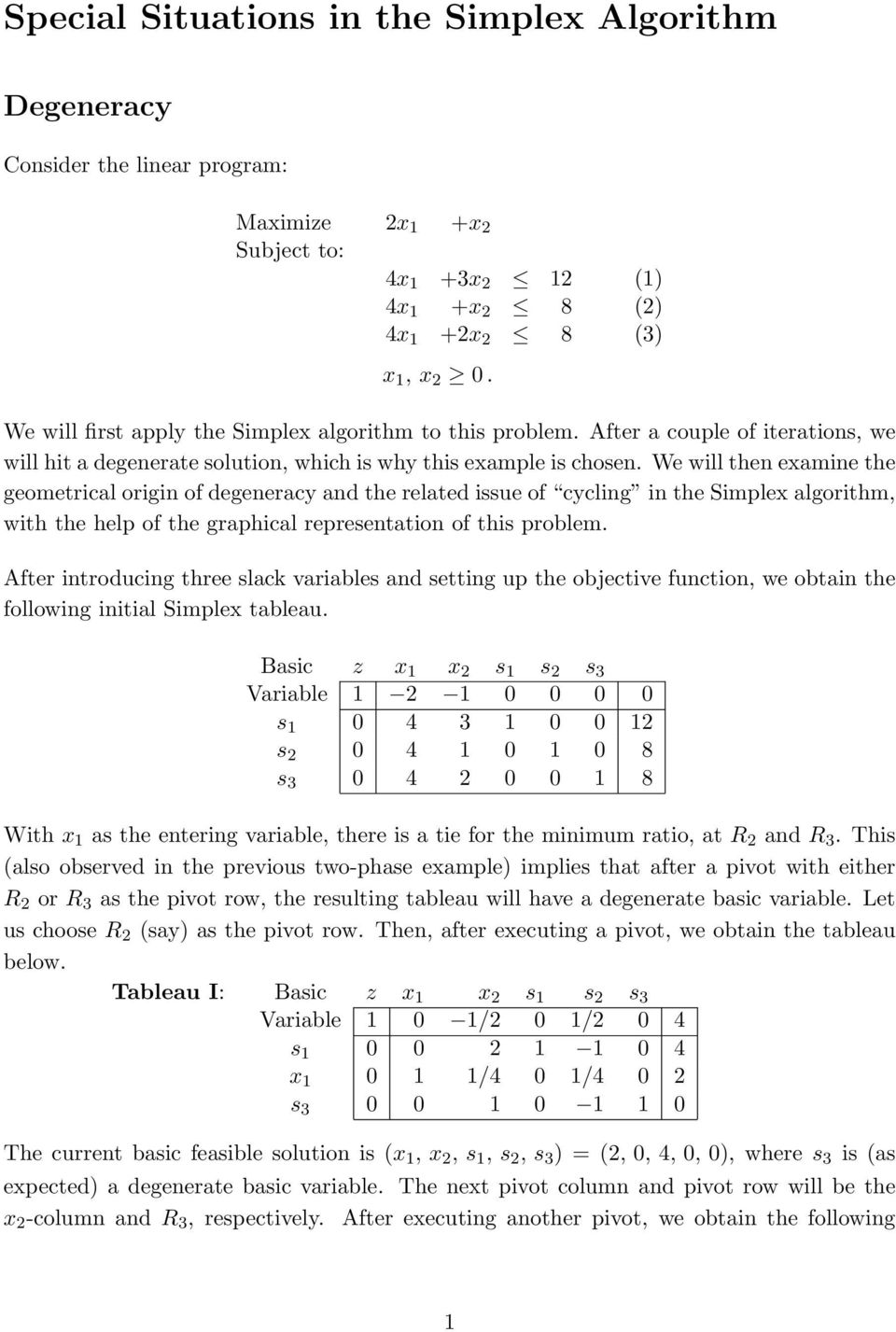
2 tableau. Tableau II: s 3 Variable /2 4 s x /2 1/4 2 x Again, the current basic feasible solution is (x 1, x 2, s 1, s 2, s 3 ) = (2, 0, 4, 0, 0). However, the identify of the degenerate basic variable has switched from s 3 to x 2. Note that this tableau happens to be optimal (independent of the phenomenon of degeneracy). To understand what it means to have a degenerate solution, let us now refer to the graphical representation of this problem, which is shown in Figure LP-8. Notice that three, not two, constraint equations pass through the corner-point solution (x 1, x 2 ) = (2, 0). These equations are: x 2 = 0, 4x 1 + x 2 = 8, and 4x 1 + 2x 2 = 8. Since only two lines are needed to define such an intersection, we see that degeneracy is a manifestation of redundancy in information. That is, we can choose to let any pair of these equations (out of ( ) 3 = 3 2 combinations) to define this intersection. For example, if we choose x 2 = 0 and 4x 1 +x 2 = 8 as the defining equations, then, since the solution to this pair of equations will automatically satisfy equation 4x 1 + 2x 2 = 8, the value of the slack variable associated with the inequality 4x 1 + 2x 2 8, namely s 3, must turn out to be 0. This accounts for the appearance of the degenerate basic variable s 3 in Tableau I. Similarly, if we choose 4x 1 + x 2 = 8 and 4x 1 + 2x 2 = 8 as the defining equations, then the inequality constraint x 2 0 will turn out to be binding. This accounts for the fact that x 2 is a degenerate basic variable in Tableau II. What will happen if we choose x 2 = 0 and 4x 1 + 2x 2 = 8 as the defining equations? A careful examination of Tableau II shows that if we choose the s 2 -column and R 3 as the pivot column and the pivot row, then the following tableau results after a pivot. Tableau III: s 3 Variable /2 4 s x / /4 2 s This new tableau, again, corresponds to the solution (x 1, x 2, s 1, s 2, s 3 ) = (2, 0, 4, 0, 0). Notice however that the slack variable s 2 associated with the inequality 4x 1 + x 2 8 has indeed replaced x 2 as the degenerate basic variable. 2

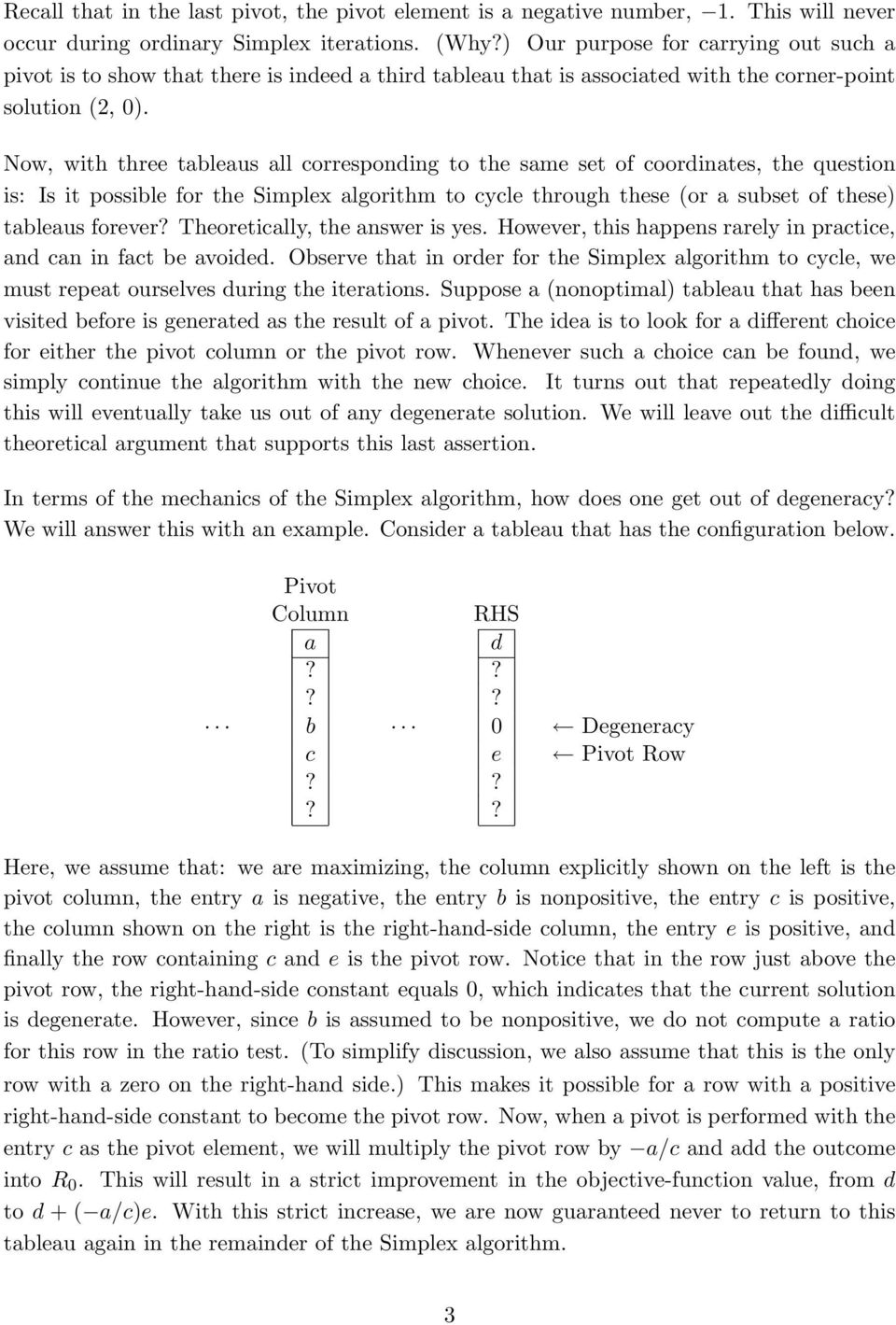
3 Recall that in the last pivot, the pivot element is a negative number, 1. This will never occur during ordinary Simplex iterations. (Why?) Our purpose for carrying out such a pivot is to show that there is indeed a third tableau that is associated with the corner-point solution (2, 0). Now, with three tableaus all corresponding to the same set of coordinates, the question is: Is it possible for the Simplex algorithm to cycle through these (or a subset of these) tableaus forever? Theoretically, the answer is yes. However, this happens rarely in practice, and can in fact be avoided. Observe that in order for the Simplex algorithm to cycle, we must repeat ourselves during the iterations. Suppose a (nonoptimal) tableau that has been visited before is generated as the result of a pivot. The idea is to look for a different choice for either the pivot column or the pivot row. Whenever such a choice can be found, we simply continue the algorithm with the new choice. It turns out that repeatedly doing this will eventually take us out of any degenerate solution. We will leave out the difficult theoretical argument that supports this last assertion. In terms of the mechanics of the Simplex algorithm, how does one get out of degeneracy? We will answer this with an example. Consider a tableau that has the configuration below. Pivot Column RHS a d b 0 Degeneracy c e Pivot Row Here, we assume that: we are maximizing, the column explicitly shown on the left is the pivot column, the entry a is negative, the entry b is nonpositive, the entry c is positive, the column shown on the right is the right-hand-side column, the entry e is positive, and finally the row containing c and e is the pivot row. Notice that in the row just above the pivot row, the right-hand-side constant equals 0, which indicates that the current solution is degenerate. However, since b is assumed to be nonpositive, we do not compute a ratio for this row in the ratio test. (To simplify discussion, we also assume that this is the only row with a zero on the right-hand side.) This makes it possible for a row with a positive right-hand-side constant to become the pivot row. Now, when a pivot is performed with the entry c as the pivot element, we will multiply the pivot row by a/c and add the outcome into R 0. This will result in a strict improvement in the objective-function value, from d to d + ( a/c)e. With this strict increase, we are now guaranteed never to return to this tableau again in the remainder of the Simplex algorithm. 3
4 In summary, the phenomenon of cycling in the Simplex algorithm is caused by degeneracy. While cycling can be avoided, the presence of degenerate solutions may temporarily suspend progress in the algorithm. Unboundedness Consider the linear program: Maximize 2x 1 +x 2 Subject to: x 1 x 2 10 (1) 2x 1 x 2 40 (2) x 1, x 2 0. Again, we will first apply the Simplex algorithm to this problem. The algorithm will take us to a tableau that indicates unboundedness of the problem. We will then examine the geometrical origin of unboundedness with the help of the graphical representation of this problem. After introducing two slack variables and setting up the objective function, we obtain the following initial Simplex tableau. Variable s s With x 1 as the entering variable, it is easily seen that R 1 is the pivot row. After executing a pivot, we obtain the tableau below. Variable x s Since x 2 has a negative coefficient in R 0, this tableau is not optimal. Another pivot takes us to the next tableau. Variable x x This tableau again is not optimal. However, at this point, we are unable to perform further iterations, because as we attempt to carry out a ratio test with s 1 as the entering variable, 4
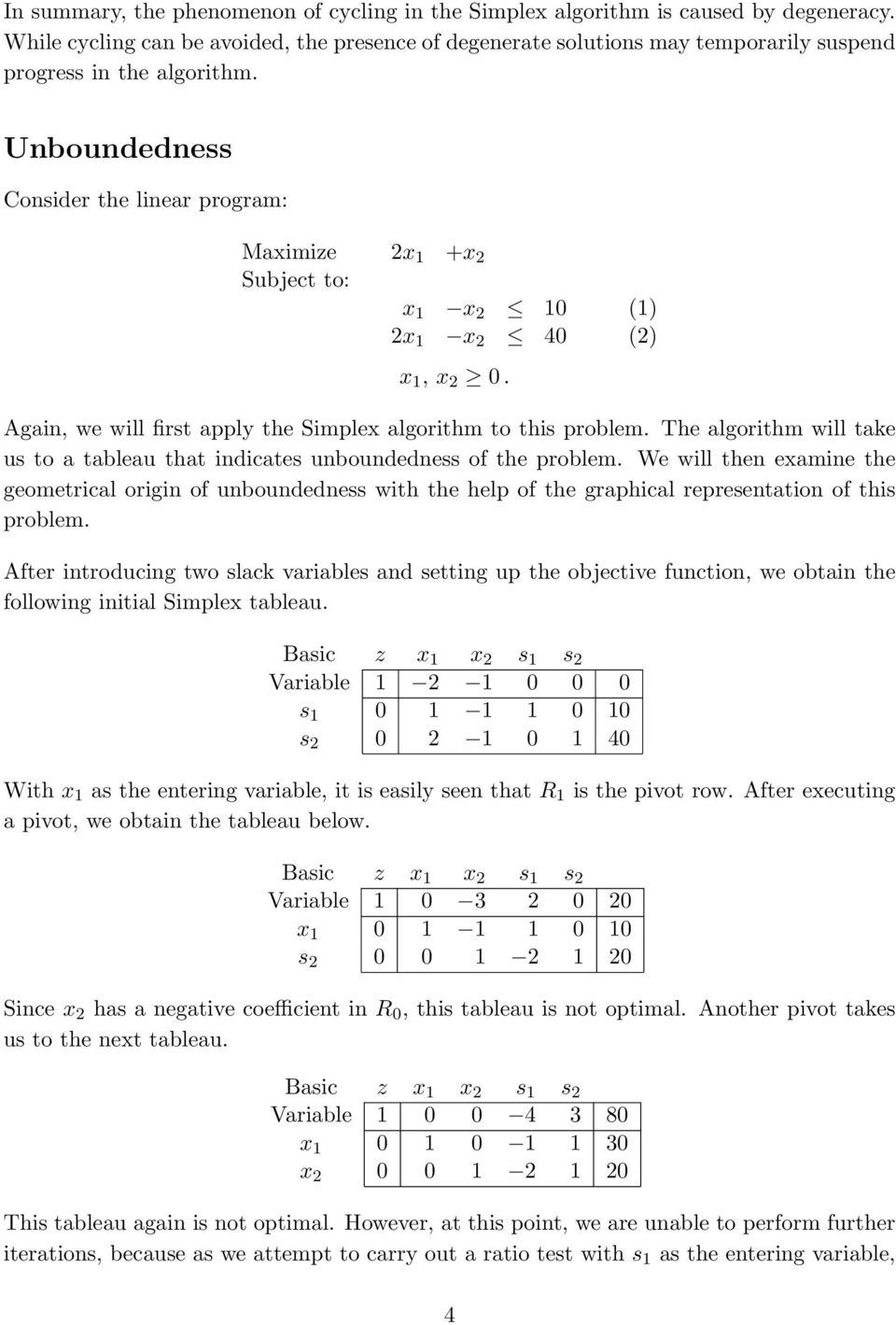
5 it turns out that there is no ratio to compute. What this means is that as we attempt to bring s 1 in as a basic variable, none of the constraints will stop us from increasing its value to infinity. Now, as the value of s 1 increases, the objective-function value will also increase correspondingly at a rate of 4. It follows that the problem does not have an optimal solution. The feasible region of this problem is depicted in Figure LP-9. There, we see that the Simplex algorithm starts with the point (0, 0), follows the x 1 -axis to the point (10, 0), rises diagonally to the point (30, 20), and then takes off to infinity along an infinite ray that emanates from (30, 20). More formally, what we have is that for any nonnegative δ, the solution (x 1, x 2, s 1, s 2 ) = (30 + δ, δ, δ, 0) is feasible. Since this solution has a corresponding objective-function value of δ, we see that the problem is unbounded. Clearly, unboundedness of a problem can occur only when the feasible region is unbounded, which, unfortunately, is something we cannot tell in advance of the solution attempt. In the above example, we detected unboundedness when we encountered a pivot column that does not contain any positive entry. More generally, we can in fact declare a problem as unbounded if any (nonbasic) column, not necessarily associated with the entering variable, is identified to have the above-stated property at the end of an iteration. Referring back to the initial tableau, we see that, indeed, the x 2 -column had this property. Therefore, we could have concluded that the problem is unbounded at the outset. The difference is that the algorithm would then follow the x 2 -axis to infinity. (Of course, another difference is the amount of effort.) The corresponding condition for unboundedness in a minimization problem is slightly different: We should look for a nonbasic column with a positive coefficient in R 0 and with all other entries nonpositive. In most applications of linear programming, if a problem turns out to be unbounded, it is often due to the fact that at least one relevant constraint has been left out during the formulation stage. Therefore, one should carefully reexamine the original formulation. Multiple Optimal Solutions Consider the linear program: Maximize 4x 1 +14x 2 Subject to: 2x 1 +7x 2 21 (1) 7x 1 +2x 2 21 (2) x 1, x
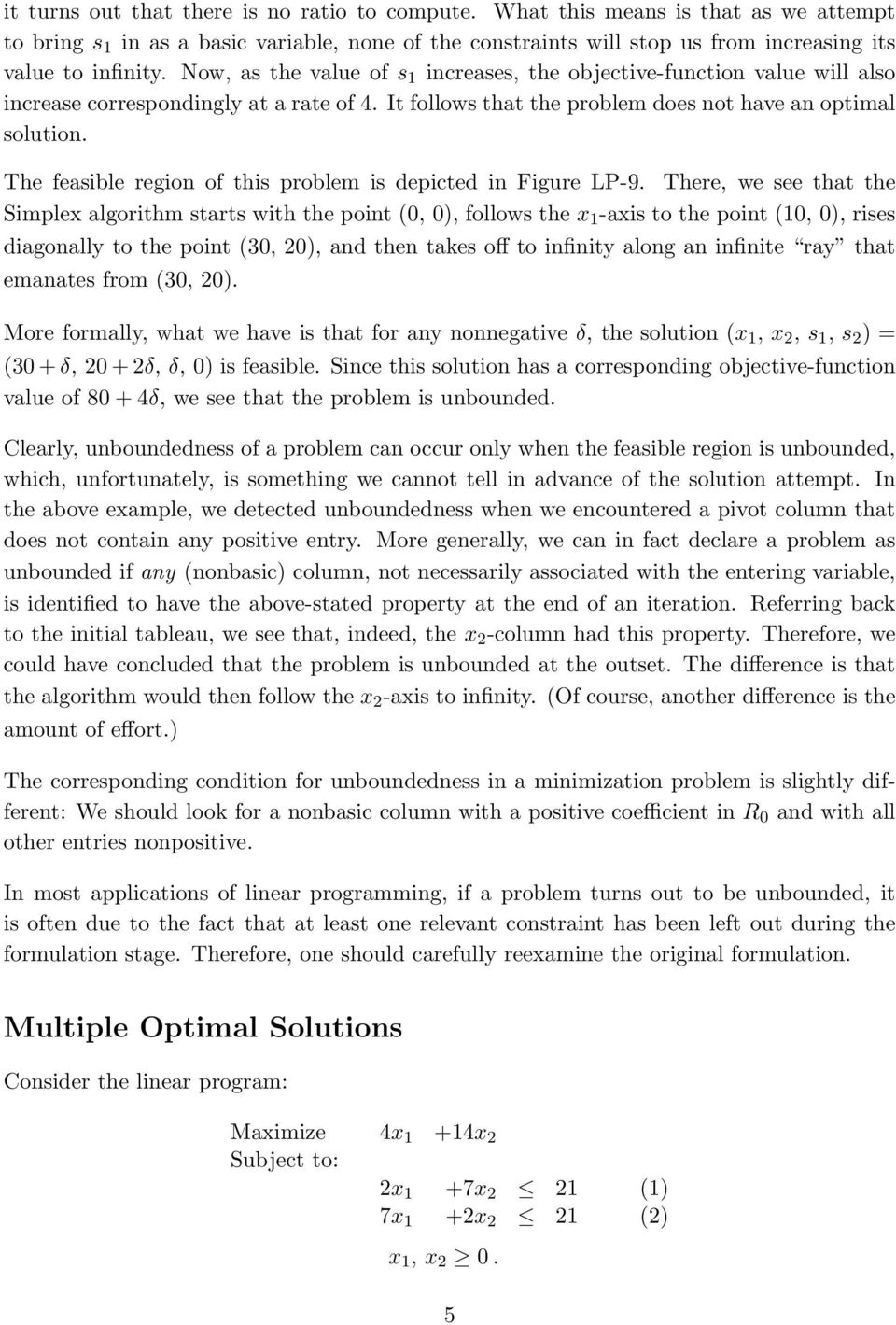
6 As before, we will first apply the Simplex algorithm to this problem. The algorithm will take us to a tableau that indicates that alternative optimal solutions exist. We will then examine the geometrical origin behind the existence of alternative optimal solutions, with the help of the graphical representation of this problem. After introducing two slack variables and setting up the objective function, we obtain the following initial Simplex tableau. Variable s s With x 2 as the entering variable, it is easily seen that R 1 is the pivot row. After executing a pivot, we obtain the tableau below. Variable x 2 0 2/7 1 1/7 0 3 s /7 0 2/ At this point, since every nonbasic variable has a nonnegative coefficient in R 0, the current solution (x 1, x 2, s 1, s 2 ) = (0, 3, 0, 15) is optimal. However, notice that the nonbasic variable x 1 has a coefficient of 0 in R 0. This implies that if we attempt to let x 1 enter the basis, then the objective-function value will not change. Indeed, after a pivot with the x 1 -column as the pivot column, we obtain the following new tableau. Variable x /45 2/45 7/3 x /45 7/45 7/3 With the same objective-function value, the new solution (x 1, x 2, s 1, s 2 ) = (7/3, 7/3, 0, 0) is, of course, also optimal. Note that a further attempt at a pivot in the s 2 -column will take us back to the previous solution. We will therefore not pursue things further. The feasible region of this problem is depicted in Figure LP-10. There, we see that the Simplex algorithm starts with the point (0, 0), travels along the x 2 -axis to the first optimal solution at (0, 3), and then continues on to the second optimal solution at (7/3, 7/3). Notice that the objective-function line 4x x 2 = c (for any c) is parallel to the edge that begins at (0, 3) and ends at (7/3, 7/3). Hence, every point on this edge is optimal. In general, if we are given two optimal solutions to a linear program, then an infinite number of optimal solutions can be constructed. In this example, both (0, 3) and (7/3, 7/3) are 6
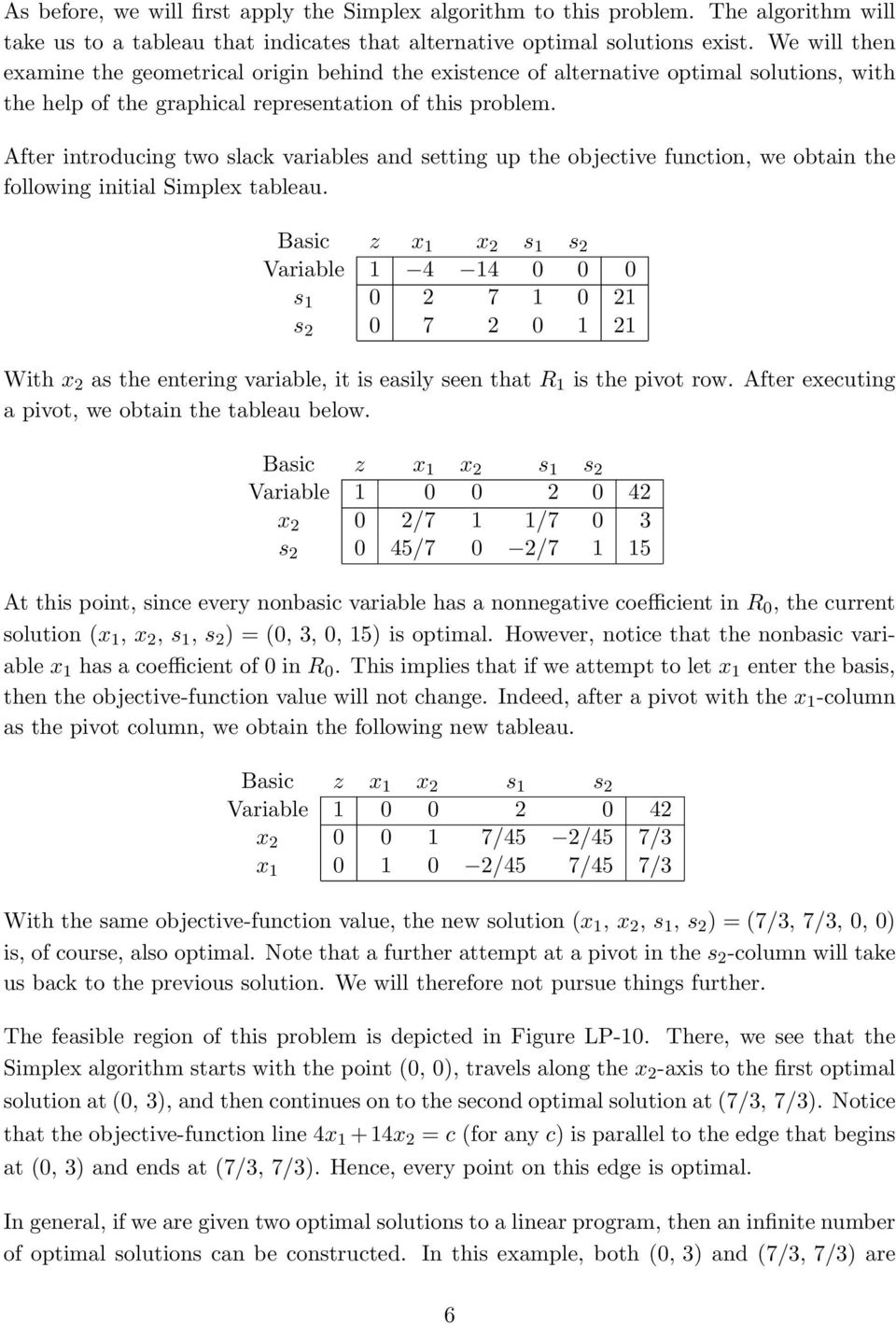
7 optimal. Therefore, every point on the edge connecting these two points will also be optimal. Formally, points on this edge are traced out by solutions of the form: (x 1, x 2 ) = δ (0, 3) + (1 δ) (7/3, 7/3), where δ is any value in the interval [0, 1]. As specific examples, if we let δ = 1, then we have the point (0, 3); if we let δ = 0, then we have the point (7/3, 7/3); and if we let δ = 1/2, then we have the point (7/6, 8/3), which is half way between (0, 3) and (7/3, 7/3). 7
![δ is any value in the interval [0, 1].](/docs-images/47/21065521/images/page_7.jpg "As specific examples, if we let δ = 1, then we have the point (0, 3); if we let δ = 0, then we have the point (7/3,")
Simplex method summary
 Simplex method summary Problem: optimize a linear objective, subject to linear constraints 1. Step 1: Convert to standard form: variables on right-hand side, positive constant on left slack variables for
OPRE 6201 : 2. Simplex Method
 OPRE 6201 : 2. Simplex Method 1 The Graphical Method: An Example Consider the following linear program: Max 4x 1 +3x 2 Subject to: 2x 1 +3x 2 6 (1) 3x 1 +2x 2 3 (2) 2x 2 5 (3) 2x 1 +x 2 4 (4) x 1, x 2
The Graphical Method: An Example
 The Graphical Method: An Example Consider the following linear program: Maximize 4x 1 +3x 2 Subject to: 2x 1 +3x 2 6 (1) 3x 1 +2x 2 3 (2) 2x 2 5 (3) 2x 1 +x 2 4 (4) x 1, x 2 0, where, for ease of reference,
Chapter 2 Solving Linear Programs
 Chapter 2 Solving Linear Programs Companion slides of Applied Mathematical Programming by Bradley, Hax, and Magnanti (Addison-Wesley, 1977) prepared by José Fernando Oliveira Maria Antónia Carravilla A
Solving Linear Programs
 Solving Linear Programs 2 In this chapter, we present a systematic procedure for solving linear programs. This procedure, called the simplex method, proceeds by moving from one feasible solution to another,
Linear Programming Notes V Problem Transformations
 Linear Programming Notes V Problem Transformations 1 Introduction Any linear programming problem can be rewritten in either of two standard forms. In the first form, the objective is to maximize, the material
Sensitivity Analysis 3.1 AN EXAMPLE FOR ANALYSIS
 Sensitivity Analysis 3 We have already been introduced to sensitivity analysis in Chapter via the geometry of a simple example. We saw that the values of the decision variables and those of the slack and
1 Solving LPs: The Simplex Algorithm of George Dantzig
 Solving LPs: The Simplex Algorithm of George Dantzig. Simplex Pivoting: Dictionary Format We illustrate a general solution procedure, called the simplex algorithm, by implementing it on a very simple example.
Duality in Linear Programming
 Duality in Linear Programming 4 In the preceding chapter on sensitivity analysis, we saw that the shadow-price interpretation of the optimal simplex multipliers is a very useful concept. First, these shadow
Linear Programming for Optimization. Mark A. Schulze, Ph.D. Perceptive Scientific Instruments, Inc.
 1. Introduction Linear Programming for Optimization Mark A. Schulze, Ph.D. Perceptive Scientific Instruments, Inc. 1.1 Definition Linear programming is the name of a branch of applied mathematics that
Linear Programming. March 14, 2014
 Linear Programming March 1, 01 Parts of this introduction to linear programming were adapted from Chapter 9 of Introduction to Algorithms, Second Edition, by Cormen, Leiserson, Rivest and Stein [1]. 1
Chapter 6. Linear Programming: The Simplex Method. Introduction to the Big M Method. Section 4 Maximization and Minimization with Problem Constraints
 Chapter 6 Linear Programming: The Simplex Method Introduction to the Big M Method In this section, we will present a generalized version of the simplex method that t will solve both maximization i and
Chapter 6: Sensitivity Analysis
 Chapter 6: Sensitivity Analysis Suppose that you have just completed a linear programming solution which will have a major impact on your company, such as determining how much to increase the overall production
Practical Guide to the Simplex Method of Linear Programming
 Practical Guide to the Simplex Method of Linear Programming Marcel Oliver Revised: April, 0 The basic steps of the simplex algorithm Step : Write the linear programming problem in standard form Linear
56:171 Operations Research Midterm Exam Solutions Fall 2001
 56:171 Operations Research Midterm Exam Solutions Fall 2001 True/False: Indicate by "+" or "o" whether each statement is "true" or "false", respectively: o_ 1. If a primal LP constraint is slack at the
Linear Programming: Theory and Applications
 Linear Programming: Theory and Applications Catherine Lewis May 11, 2008 1 Contents 1 Introduction to Linear Programming 3 1.1 What is a linear program?...................... 3 1.2 Assumptions.............................
Linear Programming in Matrix Form
 Linear Programming in Matrix Form Appendix B We first introduce matrix concepts in linear programming by developing a variation of the simplex method called the revised simplex method. This algorithm,
Linear Programming Notes VII Sensitivity Analysis
 Linear Programming Notes VII Sensitivity Analysis 1 Introduction When you use a mathematical model to describe reality you must make approximations. The world is more complicated than the kinds of optimization
Standard Form of a Linear Programming Problem
 494 CHAPTER 9 LINEAR PROGRAMMING 9. THE SIMPLEX METHOD: MAXIMIZATION For linear programming problems involving two variables, the graphical solution method introduced in Section 9. is convenient. However,
Linear Programming. Solving LP Models Using MS Excel, 18
 SUPPLEMENT TO CHAPTER SIX Linear Programming SUPPLEMENT OUTLINE Introduction, 2 Linear Programming Models, 2 Model Formulation, 4 Graphical Linear Programming, 5 Outline of Graphical Procedure, 5 Plotting
What is Linear Programming?
 Chapter 1 What is Linear Programming? An optimization problem usually has three essential ingredients: a variable vector x consisting of a set of unknowns to be determined, an objective function of x to
Linear Programming. April 12, 2005
 Linear Programming April 1, 005 Parts of this were adapted from Chapter 9 of i Introduction to Algorithms (Second Edition) /i by Cormen, Leiserson, Rivest and Stein. 1 What is linear programming? The first
3. Evaluate the objective function at each vertex. Put the vertices into a table: Vertex P=3x+2y (0, 0) 0 min (0, 5) 10 (15, 0) 45 (12, 2) 40 Max
 SOLUTION OF LINEAR PROGRAMMING PROBLEMS THEOREM 1 If a linear programming problem has a solution, then it must occur at a vertex, or corner point, of the feasible set, S, associated with the problem. Furthermore,
IEOR 4404 Homework #2 Intro OR: Deterministic Models February 14, 2011 Prof. Jay Sethuraman Page 1 of 5. Homework #2
 IEOR 4404 Homework # Intro OR: Deterministic Models February 14, 011 Prof. Jay Sethuraman Page 1 of 5 Homework #.1 (a) What is the optimal solution of this problem? Let us consider that x 1, x and x 3
Degeneracy in Linear Programming
 Degeneracy in Linear Programming I heard that today s tutorial is all about Ellen DeGeneres Sorry, Stan. But the topic is just as interesting. It s about degeneracy in Linear Programming. Degeneracy? Students
LECTURE 5: DUALITY AND SENSITIVITY ANALYSIS. 1. Dual linear program 2. Duality theory 3. Sensitivity analysis 4. Dual simplex method
 LECTURE 5: DUALITY AND SENSITIVITY ANALYSIS 1. Dual linear program 2. Duality theory 3. Sensitivity analysis 4. Dual simplex method Introduction to dual linear program Given a constraint matrix A, right
1 Introduction. Linear Programming. Questions. A general optimization problem is of the form: choose x to. max f(x) subject to x S. where.
 Introduction Linear Programming Neil Laws TT 00 A general optimization problem is of the form: choose x to maximise f(x) subject to x S where x = (x,..., x n ) T, f : R n R is the objective function, S
Using the Simplex Method to Solve Linear Programming Maximization Problems J. Reeb and S. Leavengood
 PERFORMANCE EXCELLENCE IN THE WOOD PRODUCTS INDUSTRY EM 8720-E October 1998 $3.00 Using the Simplex Method to Solve Linear Programming Maximization Problems J. Reeb and S. Leavengood A key problem faced
Reduced echelon form: Add the following conditions to conditions 1, 2, and 3 above:
 Section 1.2: Row Reduction and Echelon Forms Echelon form (or row echelon form): 1. All nonzero rows are above any rows of all zeros. 2. Each leading entry (i.e. left most nonzero entry) of a row is in
Linear Programming I
 Linear Programming I November 30, 2003 1 Introduction In the VCR/guns/nuclear bombs/napkins/star wars/professors/butter/mice problem, the benevolent dictator, Bigus Piguinus, of south Antarctica penguins
4.6 Linear Programming duality
 4.6 Linear Programming duality To any minimization (maximization) LP we can associate a closely related maximization (minimization) LP. Different spaces and objective functions but in general same optimal
Linear Programming Problems
 Linear Programming Problems Linear programming problems come up in many applications. In a linear programming problem, we have a function, called the objective function, which depends linearly on a number
Nonlinear Programming Methods.S2 Quadratic Programming
 Nonlinear Programming Methods.S2 Quadratic Programming Operations Research Models and Methods Paul A. Jensen and Jonathan F. Bard A linearly constrained optimization problem with a quadratic objective
9.4 THE SIMPLEX METHOD: MINIMIZATION
 SECTION 9 THE SIMPLEX METHOD: MINIMIZATION 59 The accounting firm in Exercise raises its charge for an audit to $5 What number of audits and tax returns will bring in a maximum revenue? In the simplex
2x + y = 3. Since the second equation is precisely the same as the first equation, it is enough to find x and y satisfying the system
 1. Systems of linear equations We are interested in the solutions to systems of linear equations. A linear equation is of the form 3x 5y + 2z + w = 3. The key thing is that we don t multiply the variables
Lecture 2: August 29. Linear Programming (part I)
 10-725: Convex Optimization Fall 2013 Lecture 2: August 29 Lecturer: Barnabás Póczos Scribes: Samrachana Adhikari, Mattia Ciollaro, Fabrizio Lecci Note: LaTeX template courtesy of UC Berkeley EECS dept.
Question 2: How do you solve a linear programming problem with a graph?
 Question 2: How do you solve a linear programming problem with a graph? Now that we have several linear programming problems, let s look at how we can solve them using the graph of the system of inequalities.
Operation Research. Module 1. Module 2. Unit 1. Unit 2. Unit 3. Unit 1
 Operation Research Module 1 Unit 1 1.1 Origin of Operations Research 1.2 Concept and Definition of OR 1.3 Characteristics of OR 1.4 Applications of OR 1.5 Phases of OR Unit 2 2.1 Introduction to Linear
Notes on Orthogonal and Symmetric Matrices MENU, Winter 2013
 Notes on Orthogonal and Symmetric Matrices MENU, Winter 201 These notes summarize the main properties and uses of orthogonal and symmetric matrices. We covered quite a bit of material regarding these topics,
3.3. Solving Polynomial Equations. Introduction. Prerequisites. Learning Outcomes
 Solving Polynomial Equations 3.3 Introduction Linear and quadratic equations, dealt within Sections 3.1 and 3.2, are members of a class of equations, called polynomial equations. These have the general
0.1 Linear Programming
 0.1 Linear Programming 0.1.1 Objectives By the end of this unit you will be able to: formulate simple linear programming problems in terms of an objective function to be maximized or minimized subject
Sensitivity Report in Excel
 The Answer Report contains the original guess for the solution and the final value of the solution as well as the objective function values for the original guess and final value. The report also indicates
Chapter 3. Cartesian Products and Relations. 3.1 Cartesian Products
 Chapter 3 Cartesian Products and Relations The material in this chapter is the first real encounter with abstraction. Relations are very general thing they are a special type of subset. After introducing
CHAPTER 11: BASIC LINEAR PROGRAMMING CONCEPTS
 Linear programming is a mathematical technique for finding optimal solutions to problems that can be expressed using linear equations and inequalities. If a real-world problem can be represented accurately
5 Systems of Equations
 Systems of Equations Concepts: Solutions to Systems of Equations-Graphically and Algebraically Solving Systems - Substitution Method Solving Systems - Elimination Method Using -Dimensional Graphs to Approximate
8.1. Cramer s Rule for Solving Simultaneous Linear Equations. Introduction. Prerequisites. Learning Outcomes. Learning Style
 Cramer s Rule for Solving Simultaneous Linear Equations 8.1 Introduction The need to solve systems of linear equations arises frequently in engineering. The analysis of electric circuits and the control
Linear Programming. Widget Factory Example. Linear Programming: Standard Form. Widget Factory Example: Continued.
 Linear Programming Widget Factory Example Learning Goals. Introduce Linear Programming Problems. Widget Example, Graphical Solution. Basic Theory:, Vertices, Existence of Solutions. Equivalent formulations.
A Labeling Algorithm for the Maximum-Flow Network Problem
 A Labeling Algorithm for the Maximum-Flow Network Problem Appendix C Network-flow problems can be solved by several methods. In Chapter 8 we introduced this topic by exploring the special structure of
Chapter 3: Section 3-3 Solutions of Linear Programming Problems
 Chapter 3: Section 3-3 Solutions of Linear Programming Problems D. S. Malik Creighton University, Omaha, NE D. S. Malik Creighton University, Omaha, NE Chapter () 3: Section 3-3 Solutions of Linear Programming
LEARNING OBJECTIVES FOR THIS CHAPTER
 CHAPTER 2 American mathematician Paul Halmos (1916 2006), who in 1942 published the first modern linear algebra book. The title of Halmos s book was the same as the title of this chapter. Finite-Dimensional
MATRIX ALGEBRA AND SYSTEMS OF EQUATIONS. + + x 2. x n. a 11 a 12 a 1n b 1 a 21 a 22 a 2n b 2 a 31 a 32 a 3n b 3. a m1 a m2 a mn b m
 MATRIX ALGEBRA AND SYSTEMS OF EQUATIONS 1. SYSTEMS OF EQUATIONS AND MATRICES 1.1. Representation of a linear system. The general system of m equations in n unknowns can be written a 11 x 1 + a 12 x 2 +
7 Gaussian Elimination and LU Factorization
 7 Gaussian Elimination and LU Factorization In this final section on matrix factorization methods for solving Ax = b we want to take a closer look at Gaussian elimination (probably the best known method
EXCEL SOLVER TUTORIAL
 ENGR62/MS&E111 Autumn 2003 2004 Prof. Ben Van Roy October 1, 2003 EXCEL SOLVER TUTORIAL This tutorial will introduce you to some essential features of Excel and its plug-in, Solver, that we will be using
Largest Fixed-Aspect, Axis-Aligned Rectangle
 Largest Fixed-Aspect, Axis-Aligned Rectangle David Eberly Geometric Tools, LLC http://www.geometrictools.com/ Copyright c 1998-2016. All Rights Reserved. Created: February 21, 2004 Last Modified: February
This exposition of linear programming
 Linear Programming and the Simplex Method David Gale This exposition of linear programming and the simplex method is intended as a companion piece to the article in this issue on the life and work of George
Arrangements And Duality
 Arrangements And Duality 3.1 Introduction 3 Point configurations are tbe most basic structure we study in computational geometry. But what about configurations of more complicated shapes? For example,
The Point-Slope Form
 7. The Point-Slope Form 7. OBJECTIVES 1. Given a point and a slope, find the graph of a line. Given a point and the slope, find the equation of a line. Given two points, find the equation of a line y Slope
15.053/8 February 26, 2013
 15.053/8 February 26, 2013 Sensitivity analysis and shadow prices special thanks to Ella, Cathy, McGraph, Nooz, Stan and Tom 1 Quotes of the Day If the facts don't fit the theory, change the facts. --
EQUATIONS and INEQUALITIES
 EQUATIONS and INEQUALITIES Linear Equations and Slope 1. Slope a. Calculate the slope of a line given two points b. Calculate the slope of a line parallel to a given line. c. Calculate the slope of a line
Definition 8.1 Two inequalities are equivalent if they have the same solution set. Add or Subtract the same value on both sides of the inequality.
 8 Inequalities Concepts: Equivalent Inequalities Linear and Nonlinear Inequalities Absolute Value Inequalities (Sections 4.6 and 1.1) 8.1 Equivalent Inequalities Definition 8.1 Two inequalities are equivalent
Linear Programming II: Minimization 2006 Samuel L. Baker Assignment 11 is on page 16.
 LINEAR PROGRAMMING II 1 Linear Programming II: Minimization 2006 Samuel L. Baker Assignment 11 is on page 16. Introduction A minimization problem minimizes the value of the objective function rather than
MATH10040 Chapter 2: Prime and relatively prime numbers
 MATH10040 Chapter 2: Prime and relatively prime numbers Recall the basic definition: 1. Prime numbers Definition 1.1. Recall that a positive integer is said to be prime if it has precisely two positive
Solutions to Math 51 First Exam January 29, 2015
 Solutions to Math 5 First Exam January 29, 25. ( points) (a) Complete the following sentence: A set of vectors {v,..., v k } is defined to be linearly dependent if (2 points) there exist c,... c k R, not
24. The Branch and Bound Method
 24. The Branch and Bound Method It has serious practical consequences if it is known that a combinatorial problem is NP-complete. Then one can conclude according to the present state of science that no
3.1 Solving Systems Using Tables and Graphs
 Algebra 2 Chapter 3 3.1 Solve Systems Using Tables & Graphs 3.1 Solving Systems Using Tables and Graphs A solution to a system of linear equations is an that makes all of the equations. To solve a system
Managerial Economics Prof. Trupti Mishra S.J.M. School of Management Indian Institute of Technology, Bombay. Lecture - 13 Consumer Behaviour (Contd )
 (Refer Slide Time: 00:28) Managerial Economics Prof. Trupti Mishra S.J.M. School of Management Indian Institute of Technology, Bombay Lecture - 13 Consumer Behaviour (Contd ) We will continue our discussion
. P. 4.3 Basic feasible solutions and vertices of polyhedra. x 1. x 2
 4. Basic feasible solutions and vertices of polyhedra Due to the fundamental theorem of Linear Programming, to solve any LP it suffices to consider the vertices (finitely many) of the polyhedron P of the
International Doctoral School Algorithmic Decision Theory: MCDA and MOO
 International Doctoral School Algorithmic Decision Theory: MCDA and MOO Lecture 2: Multiobjective Linear Programming Department of Engineering Science, The University of Auckland, New Zealand Laboratoire
The number of marks is given in brackets [ ] at the end of each question or part question. The total number of marks for this paper is 72.
![The number of marks is given in brackets [ ] at the end of each question or part question. The total number of marks for this paper is 72.](/thumbs/40/21056142.jpg "The number of marks is given in brackets [ ] at the end of each question or part question. The total number of marks for this paper is 72.") ADVANCED SUBSIDIARY GCE UNIT 4736/01 MATHEMATICS Decision Mathematics 1 THURSDAY 14 JUNE 2007 Afternoon Additional Materials: Answer Booklet (8 pages) List of Formulae (MF1) Time: 1 hour 30 minutes INSTRUCTIONS
ADVANCED SUBSIDIARY GCE UNIT 4736/01 MATHEMATICS Decision Mathematics 1 THURSDAY 14 JUNE 2007 Afternoon Additional Materials: Answer Booklet (8 pages) List of Formulae (MF1) Time: 1 hour 30 minutes INSTRUCTIONS
1 if 1 x 0 1 if 0 x 1
 Chapter 3 Continuity In this chapter we begin by defining the fundamental notion of continuity for real valued functions of a single real variable. When trying to decide whether a given function is or
Network Models 8.1 THE GENERAL NETWORK-FLOW PROBLEM
 Network Models 8 There are several kinds of linear-programming models that exhibit a special structure that can be exploited in the construction of efficient algorithms for their solution. The motivation
Solving Linear Programs in Excel
 Notes for AGEC 622 Bruce McCarl Regents Professor of Agricultural Economics Texas A&M University Thanks to Michael Lau for his efforts to prepare the earlier copies of this. 1 http://ageco.tamu.edu/faculty/mccarl/622class/
3.2. Solving quadratic equations. Introduction. Prerequisites. Learning Outcomes. Learning Style
 Solving quadratic equations 3.2 Introduction A quadratic equation is one which can be written in the form ax 2 + bx + c = 0 where a, b and c are numbers and x is the unknown whose value(s) we wish to find.
a 11 x 1 + a 12 x 2 + + a 1n x n = b 1 a 21 x 1 + a 22 x 2 + + a 2n x n = b 2.
 Chapter 1 LINEAR EQUATIONS 1.1 Introduction to linear equations A linear equation in n unknowns x 1, x,, x n is an equation of the form a 1 x 1 + a x + + a n x n = b, where a 1, a,..., a n, b are given
Elasticity. I. What is Elasticity?
 Elasticity I. What is Elasticity? The purpose of this section is to develop some general rules about elasticity, which may them be applied to the four different specific types of elasticity discussed in
3 Some Integer Functions
 3 Some Integer Functions A Pair of Fundamental Integer Functions The integer function that is the heart of this section is the modulo function. However, before getting to it, let us look at some very simple
Math 202-0 Quizzes Winter 2009
 Quiz : Basic Probability Ten Scrabble tiles are placed in a bag Four of the tiles have the letter printed on them, and there are two tiles each with the letters B, C and D on them (a) Suppose one tile
Solving Quadratic Equations
 9.3 Solving Quadratic Equations by Using the Quadratic Formula 9.3 OBJECTIVES 1. Solve a quadratic equation by using the quadratic formula 2. Determine the nature of the solutions of a quadratic equation
Solving simultaneous equations using the inverse matrix
 Solving simultaneous equations using the inverse matrix 8.2 Introduction The power of matrix algebra is seen in the representation of a system of simultaneous linear equations as a matrix equation. Matrix
Part 1 Expressions, Equations, and Inequalities: Simplifying and Solving
 Section 7 Algebraic Manipulations and Solving Part 1 Expressions, Equations, and Inequalities: Simplifying and Solving Before launching into the mathematics, let s take a moment to talk about the words
Solving Simultaneous Equations and Matrices
 Solving Simultaneous Equations and Matrices The following represents a systematic investigation for the steps used to solve two simultaneous linear equations in two unknowns. The motivation for considering
December 4, 2013 MATH 171 BASIC LINEAR ALGEBRA B. KITCHENS
 December 4, 2013 MATH 171 BASIC LINEAR ALGEBRA B KITCHENS The equation 1 Lines in two-dimensional space (1) 2x y = 3 describes a line in two-dimensional space The coefficients of x and y in the equation
Chapter 9. Systems of Linear Equations
 Chapter 9. Systems of Linear Equations 9.1. Solve Systems of Linear Equations by Graphing KYOTE Standards: CR 21; CA 13 In this section we discuss how to solve systems of two linear equations in two variables
Zeros of a Polynomial Function
 Zeros of a Polynomial Function An important consequence of the Factor Theorem is that finding the zeros of a polynomial is really the same thing as factoring it into linear factors. In this section we
A linear combination is a sum of scalars times quantities. Such expressions arise quite frequently and have the form
 Section 1.3 Matrix Products A linear combination is a sum of scalars times quantities. Such expressions arise quite frequently and have the form (scalar #1)(quantity #1) + (scalar #2)(quantity #2) +...
Creating, Solving, and Graphing Systems of Linear Equations and Linear Inequalities
 Algebra 1, Quarter 2, Unit 2.1 Creating, Solving, and Graphing Systems of Linear Equations and Linear Inequalities Overview Number of instructional days: 15 (1 day = 45 60 minutes) Content to be learned
4.5 Linear Dependence and Linear Independence
 4.5 Linear Dependence and Linear Independence 267 32. {v 1, v 2 }, where v 1, v 2 are collinear vectors in R 3. 33. Prove that if S and S are subsets of a vector space V such that S is a subset of S, then
Section 1.1 Linear Equations: Slope and Equations of Lines
 Section. Linear Equations: Slope and Equations of Lines Slope The measure of the steepness of a line is called the slope of the line. It is the amount of change in y, the rise, divided by the amount of
MATRIX ALGEBRA AND SYSTEMS OF EQUATIONS
 MATRIX ALGEBRA AND SYSTEMS OF EQUATIONS Systems of Equations and Matrices Representation of a linear system The general system of m equations in n unknowns can be written a x + a 2 x 2 + + a n x n b a
Lecture 3. Linear Programming. 3B1B Optimization Michaelmas 2015 A. Zisserman. Extreme solutions. Simplex method. Interior point method
 Lecture 3 3B1B Optimization Michaelmas 2015 A. Zisserman Linear Programming Extreme solutions Simplex method Interior point method Integer programming and relaxation The Optimization Tree Linear Programming
Let s explore the content and skills assessed by Heart of Algebra questions.
 Chapter 9 Heart of Algebra Heart of Algebra focuses on the mastery of linear equations, systems of linear equations, and linear functions. The ability to analyze and create linear equations, inequalities,
An Introduction to Linear Programming
 An Introduction to Linear Programming Steven J. Miller March 31, 2007 Mathematics Department Brown University 151 Thayer Street Providence, RI 02912 Abstract We describe Linear Programming, an important
Study Guide 2 Solutions MATH 111
 Study Guide 2 Solutions MATH 111 Having read through the sample test, I wanted to warn everyone, that I might consider asking questions involving inequalities, the absolute value function (as in the suggested
Linear Programming Supplement E
 Linear Programming Supplement E Linear Programming Linear programming: A technique that is useful for allocating scarce resources among competing demands. Objective function: An expression in linear programming
This unit will lay the groundwork for later units where the students will extend this knowledge to quadratic and exponential functions.
 Algebra I Overview View unit yearlong overview here Many of the concepts presented in Algebra I are progressions of concepts that were introduced in grades 6 through 8. The content presented in this course
Using CPLEX. =5 has objective value 150.
 Using CPLEX CPLEX is optimization software developed and sold by ILOG, Inc. It can be used to solve a variety of different optimization problems in a variety of computing environments. Here we will discuss
CS 3719 (Theory of Computation and Algorithms) Lecture 4
 CS 3719 (Theory of Computation and Algorithms) Lecture 4 Antonina Kolokolova January 18, 2012 1 Undecidable languages 1.1 Church-Turing thesis Let s recap how it all started. In 1990, Hilbert stated a
Math 4310 Handout - Quotient Vector Spaces
 Math 4310 Handout - Quotient Vector Spaces Dan Collins The textbook defines a subspace of a vector space in Chapter 4, but it avoids ever discussing the notion of a quotient space. This is understandable
Sensitivity Analysis with Excel
 Sensitivity Analysis with Excel 1 Lecture Outline Sensitivity Analysis Effects on the Objective Function Value (OFV): Changing the Values of Decision Variables Looking at the Variation in OFV: Excel One-
Lecture 3: Finding integer solutions to systems of linear equations
 Lecture 3: Finding integer solutions to systems of linear equations Algorithmic Number Theory (Fall 2014) Rutgers University Swastik Kopparty Scribe: Abhishek Bhrushundi 1 Overview The goal of this lecture