
Sensitivity Analysis with Excel
|
|
|
- Kory Pearson
- 9 years ago
- Views:
Transcription
1 Sensitivity Analysis with Excel 1 Lecture Outline Sensitivity Analysis Effects on the Objective Function Value (OFV): Changing the Values of Decision Variables Looking at the Variation in OFV: Excel One- and Two-Way Data Tables, and Scenario Manager Finding the Optimum OFV: Excel Solver Effects on the Optimum: Making One Change to the Model Parameters: Changing a Decision Variable Coefficient in a Constraint (Graphical intuitions) Changing the Right Hand Side (RHS) of a Constraint: Slack & Shadow Price Changing a Decision Variable Coefficient in the Objective Function: Reduced Cost Making Multiple Changes to the Model Parameters The 100% Rule SolverTable 2 1

2 Steps in Modeling STEP 1: Formulate STEP 2: Solve (Find the Optimum) STEP 3: Do a Sensitivity Analysis 3 Problem Statement Boxers and Briefs Example - Revisited Champion Sports manufactures two types of custom men's underwear: boxers and briefs. How many boxers and how many briefs should be produced per week, to maximize profits, given the following constraints The (profit) contribution per boxer is $3.00, compared to $4.50 per brief. Briefs use 0.5 yards of material; boxers use 0.4 yards. 300 yards of material are available. It requires 1 hour to manufacture one pair of boxers and 2 hours for one pair of briefs. 900 labors hours are available. There is unlimited demand for boxers but total demand for briefs is 375 units per week. Each boxer uses 1 insignia logo and 600 insignia logos are in stock. 4 2

3 Algebraic Formulation 5 The Algebraic LP Formulation Revisited Variables: number of Boxers, number of Briefs. Objective function: Objective Function Coefficients maximize ( $3.00 x Boxers ) + ( $4.50 x Briefs ) Constraint Coefficients Constraints: Material: (.4 x Boxers ) + (.5 x Briefs ) <= 300 yards Labor: ( 1 x Boxers ) + ( 2 x Briefs ) <= 900 hrs Demand: ( 0 x Boxers ) + ( 1 x Briefs ) <= 375 units Logos: ( 1 x Boxers ) + ( 0 x Briefs ) <= 600 Non-Negativity: Boxers >= 0 Briefs >= 0 Constraints Right Hand Sides (RHS) 6 3

4 Graphical Formulation 7 The Graphical LP Formulation - Revisited Optimal Solution Boxers F Hours E D A C Logos Demand Optimum Material B Briefs $3.00 $4.50 Total Boxers Briefs Profit A $1, B $1, C $2, D $2, E $2, F $1,

5 Excel Formulation 9 Excel Formulation - Revisited Boxers and Briefs Example: Profit Maximization See boxers_and_briefs_example.xls in the downloads for today s class. 10 5

6 Excel Tools for Sensitivity Analysis One-way Data Table, Two-Way Table, Scenario Manager Solver Answer Report Slack Pertains to changing RHS of a constraint Solver Sensitivity Report Shadow Price, Allowable Increase / Decrease Reduced Cost, Allowable Increase / Decrease SolverTable Pertains to changing Objective Function Coefficients 11 Changing the Value of Decision Variables With Two- Way Data Tables The two-way data table below shows the effect, on profit, of changing the two decision variables (i.e. the number of boxers produced, and the number of briefs produced). This initial analysis assumes there are no constraints. Clearly, if constraints are taken into account, the maximum profit in the data table shown below ($4350, for 700 boxers and 500 briefs) would change since that is not a feasible solution. 12 6
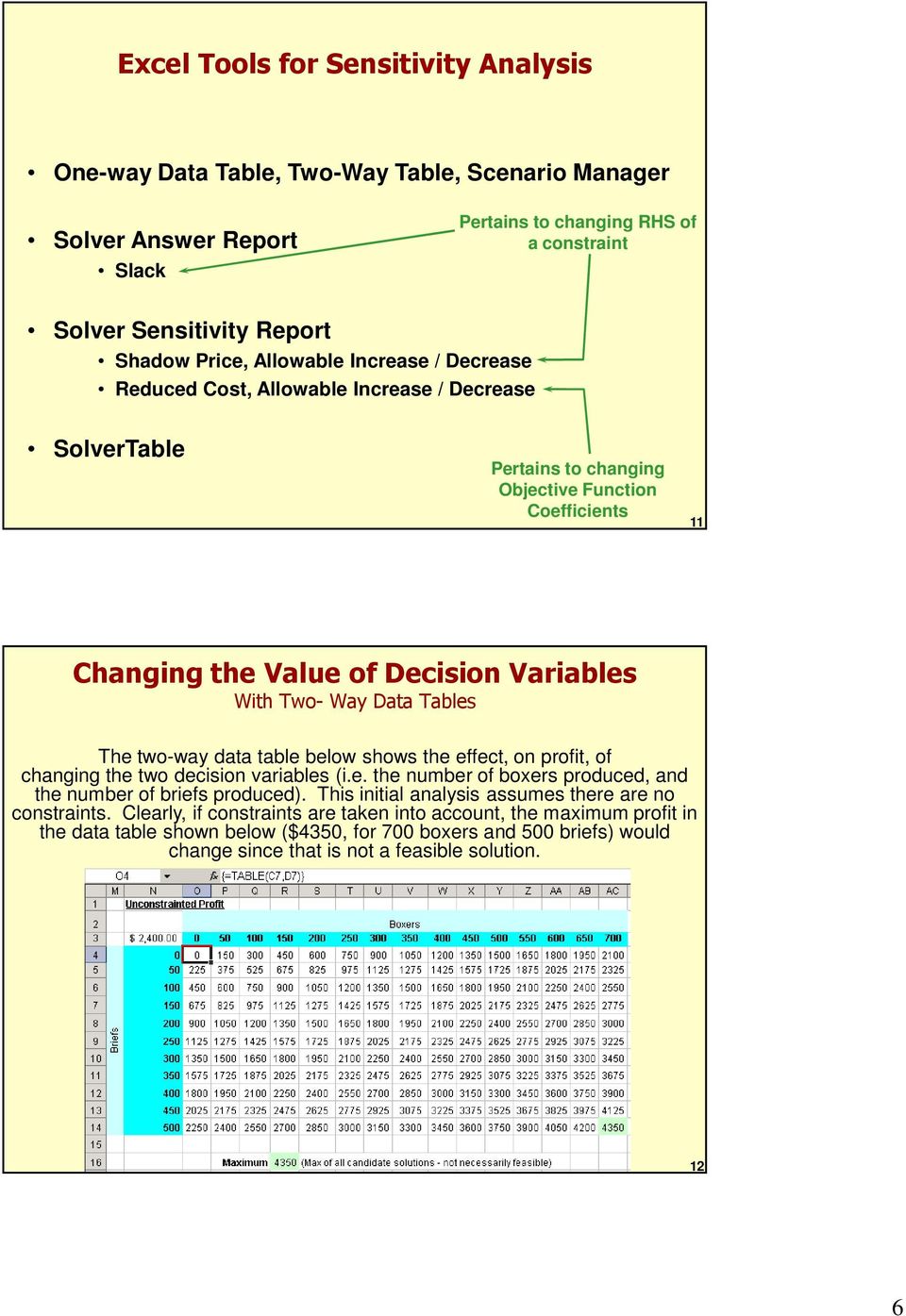
7 Steps in Modeling STEP 1: Formulate STEP 2: Solve (Find the Optimum) STEP 3: Do a Sensitivity Analysis 13 Changing the Value of Decision Variables With Two- Way Data Tables The two-way data table below shows the effect on profit of changing the number of boxers and briefs produced. Conditional formatting has been used to highlight infeasible solutions (in red) and the optimal feasible solution (in green). Don t panic! You aren t expected to know how to construct the table / formula shown below its only shown to illustrate how complex it is to create a table that shows the feasible and optimal solutions! Notice that we were lucky in this instance that the optimum solution falls at a point that was in our table: had we chosen broader intervals for number of boxers and briefs we would have found a good, but not optimal, solution. 14 7


8 Excel Answer Report - Revisited Boxers and Briefs Example: Profit Maximization Fortunately, as we ve seen Excel provides us with an easy mean of finding the optimal feasible solution: simply use Excel Solver. Make sure Solver is available: If not, Tools Add-Ins Solver Add-in Use it: Tools Solver Read the Answer Report to find the optimal value, and the decision variable settings at this optimum. 15 Excel Answer Report Optimum Objective Function Value Optimum Product Mix Status of the Constraints 16 8

9 Steps in Modeling STEP 1: Formulate STEP 2: Solve (Find the Optimum) STEP 3: Do a Sensitivity Analysis 17 Answer Report The Answer Report also shows us which constraints are binding and nonbinding at the optimum. Slack indicates the spare capacity on a non-binding constraint at the optimum. Slack = 0 implies constraint is binding: resources are exhausted Slack 0 implies constraint is non-binding: there are left-over resources We can see below, for instance, that: getting additional logos wouldn t help us improve profit since we already have 100 unused logos at the optimum advertising our briefs to stimulate demand (at the current price) would be money wasted, since demand for briefs is already greater than the number of briefs we should produce at the optimum. material and labor constraints are cramping our profit. 18 9

10 Slack and Binding Slack measures unused available resources Binding constraints Optimal solution lies on binding constraints Multiple binding constraints means solution is at intersection of constraints: a vertex Slack and binding constraints Slack = 0 : the resource is exhausted, the constraint is binding, the optimal vertex includes this constraint. Slack 0 : spare capacity is available, constraint is not binding 19 Excel Sensitivity Analysis Report Choose Sensitivity to see a more detailed Sensitivity Report... Pertain to Objective Function Coefficient Ranging Pertain to Right Hand Side (RHS) Ranging on Constraints 20 10

11 Excel Sensitivity Analysis Report The Excel Sensitivity Analysis Report allows you to see: over what range and under what conditions the components of a solution remain unchanged how sensitive a solution is to changes in the data, and to get an insight into how technological improvements may affect optimum values. 21 Boxers Sensitivity Analysis Changing a Decision Variable Co-Efficient in a Constraint Graphical Intuitions The Sensitivity Report doesn t tell us anything about what happens when the coefficients of a decision variable in a constraint change, but here are some graphical intuitions Hours Logos Demand Assume we changed the amount of material required per brief from 0.5 yards to 1 yard. Notice how the shape of the feasible region changes, and the optimal solution changes. Material Boxers Hours Logos Demand Material Briefs Briefs 11

12 Boxers Sensitivity Analysis Report Changing the Right Hand Side (RHS) of a Constraint Graphical Intuitions Changing the RHS of a constraint causes the constraint line to shift left or right, but does not alter the slope of the line! Hours Demand Logos Material Assume an extra 100 yards of material became available (increasing our total available to 400 yards). Notice how the material constraint shifts right. The change is greater than the allowable increase (see later) and the optimum solution vertex changes. Boxers Hours Demand Logos Material Briefs Briefs Sensitivity Analysis Changing the Right Hand Side (RHS) of a Constraint The Shadow Price What is meant by the optimal vertex? The optimal vertex is : what intersection of constraints is the optimal solution to be found at?. From the previous slide, we saw that the original optimal vertex was: at the intersection of the materials and hours constraints. However, when we increased the RHS of the materials constraint beyond the maximum allowable increase (i.e. by 100 yards), the optimal vertex shifts to: at the intersection of the logos and hours constraints. Had the change in materials been within the allowable increase, then the optimal vertex would have stayed the same (i.e. it would still have been at the intersection of the materials and hours constraints) but the optimal product mix and the optimal solution value would have changed

13 Sensitivity Analysis Changing the Right Hand Side (RHS) of a Constraint Graphical Intuitions Changing the RHS of a constraint causes the constraint line to shift to a parallel position to the left or right, but does not alter the slope of the line! Assume a extra 100 hours of labor became available (increasing our total available to 1000 hours). Notice how the labor constraint shifts right, and the optimal solution value and optimal product mix change. However, the change is less than the allowable increase for this constraint and the optimum solution vertex stays the same: the optimal solution is still at the intersection of the materials and labor hours constraints. Boxers Hours Demand Logos Material Briefs Sensitivity Analysis Changing the Right Hand Side (RHS) of a Constraint Tighten constraint: make feasible region smaller. Optimal value can only get worse (fewer choices) Loosen (relax) constraint: make feasible region larger. Optimal value can only do better (more choices) Assume b is a positive number and the constraint line has the form y = ax + b (i.e. y ax = b) then increasing the RHS (i.e. b) will cause the line to shift vertically up and will: Tighten the constraint if it s a lower-bound constraint Loosen the constraint if its an upper-bound constraint So notice that increasing the RHS may have positive or negative effects on the optimum, depending on the type of constraint! In contrast, if b is a positive number and the constraint line has the form y = ax b (i.e. ax y = b) then increasing the RHS (i.e. b) will cause the line to shift vertically down! 26 13

14 Sensitivity Analysis Report Changing the Right Hand Side (RHS) of a Constraint The Shadow Price The Shadow Price for a constraint is the change in the optimal objective function value per unit increase in the Right Hand Side (RHS) of a given constraint. The Shadow Price only remains valid within the Allowable Increase and Decrease shown for that Shadow Price. 27 Shadow Prices Example A stain is found on 15 yards of material, reducing material from 300 to 285 yards. How does this affect optimal profit? New optimal profit = Old optimal profit - (shadow price x yards) = $2,400 ($5/yard x 15 yards) = $2,325 Notice the Allowable range for the Materials Usage constraint. What could you say about a stain on 60 yards? 28 14

15 Shadow Prices Example Labor is willing to negotiate 100 additional hours of production work. How much of a premium should management pay for overtime hours? Addition to optimal profit = shadow price x hours = $1/hour x 100 hours = $100 If $9.28 for 900th hour, then $10.28 for 901st hour. But remember, the productivity rate will change when people work longer hours 29 Increase Labor by 100 hours Boxers F Hours Logos E D G A Demand C B Material Briefs $3.00 $4.50 Total Boxers Briefs Contribution A $1, B $1, C $2, D $2, E $2, F $1, G $2,

16 Shadow Prices Example How much would you pay for one additional insignia logo? Nothing: logos are not constraining the solution! Notice the range for logos: what is 1E+30? 31 Shadow Price / RHS Ranging Shadow price Shadow price = marginal change to objective function value of increasing constraint RHS by 1 unit Scaling issues: changing one model unit (e.g. model may be in millions of units ) Slack and shadow price Shadow price = 0 implies constraint is not binding Shadow price 0 implies Slack = 0 Slack and allowable increase/decrease How much you must tighten a constraint to make it bind Notice that, for a non-binding constraint, either the allowable increase or the allowable decrease will be equal to the slack, since either adding or subtracting the slack to / from the RHS will make the constraint bind

17 Shadow Price / RHS Ranging Shadow price on a constraint: Change in optimal objective function value per unit change in righthand-side of the constraint zero if constraint is non-binding Shadow price and RHS ranging: Allowable increase / decrease = Range of RHS coefficients for which shadow prices remain valid. Optimal value (production mix) will change: If binding constraints are moved, the optimal mix changes The objective function value changes The shadow price allows us to predict new optimal value. Need to resolve the model to get the new mix (decision variables). 33 Allowable Increase / Decrease for the RHS of a Constraint Allowable increase/decrease in constraints: How much you can tighten or relax a constraint RHS and remain binding (or non-binding) (see also: Slack) Range in RHS coefficients for which the shadow price remains valid (see also: Shadow Price) Feasible Region: How much you can reshape the feasible region without changing the optimal vertex. (The optimal mix will always change, but the optimal vertex stays the same within the allowable increase/decrease.) 34 17

18 Allowable Increase / Decrease for the RHS of a Constraint Change within allowable increase/decrease Optimal vertex (intersection of the binding constraints) is unchanged. Optimal value of objective function is updated by Shadow Price. Optimal product mix (value of decision variables) is calculated by re-testing the model. Change outside allowable increase/decrease Start over. 35 Shadow Price, Slack, and Binding 36 18

19 Shadow Price in Maximization vs Minimization Problems For maximization problems: increase in the objective function value is good (+ve shadow price is good, and helps the optimum solution) decrease in the objective function value is bad (-ve shadow price is bad, and hurts the optimum solution) For minimization problems: increase in the objective function value is bad (+ve shadow price is bad, and hurts the optimum solution) decrease in the objective function value is good (-ve shadow price is good, and helps the optimum solution) 37 Shadow Prices in a Minimization Problem Our objective in the Big Mac Attack Problem is to achieve least-cost in meeting our Recommended Daily Allowance (RDA) requirements: including both upper and lower limits

20 Shadow Prices in a Minimization Problem Sodium was an upper bound constraint. It has a negative shadow price: increasing the RHS of the sodium constraint would loosen the constraint and allow us to achieve a better optimum: i.e. a lower meal cost. Vitamin C was an lower bound constraint. It has a positive shadow price: increasing the RHS of the Vitamin C constraint would tighten the constraint and force us to a worse optimum: i.e. a higher meal cost. Constraints Final Shadow Constraint Allowable Allowable Cell Name Value Price R.H. Side Increase Decrease $D$21 TOTAL Protein E E+30 $E$21 TOTAL Fat E E $F$21 TOTAL Sodium E $G$21 TOTAL VitaminA E $H$21 TOTAL VitaminC E E $I$21 TOTAL VitaminB E E+30 $J$21 TOTAL VitaminB E E+30 $K$21 TOTAL Niacin E E+30 $L$21 TOTAL Calcium E $M$21 TOTAL Iron E Sensitivity Analysis Report Changing a Decision Variable Co-Efficient in the Objective Function The allowable increase and decrease for the Adjustable Cells (i.e. for the objective function coefficients) tells us how much the objective function coefficients can change before the optimal solution vertex changes. Note that the optimal solution value changes as the objective function coefficients change, but the optimal product mix and vertex stays the same within the objective function coefficient s allowable increase/decrease range

21 Sensitivity Analysis Report Changing an Objective Function Coefficient Graphical Intuitions Changing an objective function coefficient changes the slope of the objective function. Optimal solution value always changes but, within the allowable increase / decrease, the optimal product mix will not: within the allowable increase decrease the isoprofit line just swivels around a single point! If the slope of the objective function changes beyond the allowable increase / decrease then the optimal vertex will change, and the optimal product mix will change, as illustrated to the right. At right we see the relative contribution of briefs (i.e. the coefficient of briefs in the objective function) increasing, causing the objective function to become steeper, until eventually (beyond the allowable increase) the optimal product mix and optimal vertex shift. The new optimal solution favors more briefs in the optimal product mix. Boxers Hours Demand Logos Material Briefs 41 Sensitivity Analysis Report Changing an Objective Function Coefficient Graphical Intuitions Multiple Optima Notice that, for a certain combination of objective function coefficients, the objective function can becomes tangent to a segment of a constraint line (in this case, to a segment of the Hours constraint). In this case, every point along the tangential line segment is an optimum, so multiple optimal product mixes are available, all with the same optimal solution value. Notice that for an isoprofit line with multiple optima, the allowable increase and decrease are zero, since it is impossible for the line to swivel around a single point and any change in the objective function coefficients will cause the optimal vertex to shift! Boxers Hours Demand Logos Material Briefs 42 21
22 Summary Changing a Decision Variable Co-Efficient in the Objective Function A coefficient is associated with each decision variable The allowable increase / decrease for each coefficient is the range over which the coefficient can vary without changing the product mix (i.e. without changing the vertex at which the optimal solution is found) The following do change: Objective Function Value Shadow Prices Reduced Costs Need to resolve the model to find this information Can use to understand flexibility in relative pricing of a product. 43 Summary Changing a Decision Variable Co-Efficient in the Objective Function Changes slope of isoprofit / isocost curve (in 2D) Changes decision variable contribution to objective function Does NOT change shape of feasible region In 2-dimensional case, the slope of the objective function changes, but, within the allowable increase / decrease range, the optimal solution still resides at the same extreme vertex of the feasible region 44 22
23 Changing a Decision Variable Co-Efficient in the Objective Function Example A management consultant offers to improve efficiency in the production of boxers. This would increase the contribution by $0.50 to $3.50. What is the new mix? What is the increase in weekly profit? No change in the product mix. Change in weekly profit = $0.50 x 500 boxers/week = $250 ($2,650 total) Note the range: What could you say about $1 increase? 45 Changing a Decision Variable Co-Efficient in the Objective Function Example The contribution of briefs decreases by $0.75 to $3.75. What is the new mix? What is the decrease in weekly profit? No change in the product mix. Change in weekly profit = $0.75 x 200 briefs/week = $150 ($2,250 total) 46 23
24 Reduced Cost Associated with each decision variable. Amount by which profit contribution of variable must be improved before the variable will have a positive value in the solution. Or, rate at which the objective function value will deteriorate if a variable currently at zero is forced to increase by a small amount. Zero if the variable already appears in the optimal solution. 47 Reduced Cost (RC) Unit cost (penalty or loss) in optimal objective function value of forcibly including a Decision Variable (DV) not in the optimal solution. Necessary change in DV coefficient ( reduction in price) so the DV is part of the optimal solution. Rate at which the optimal objective function value deteriorates when a non-optimal DV is required. Reduced cost of a DV happens to be equivalent to the shadow price of the non-negativity constraint for that DV. Why? Because forcing a variable into a solution is the same as increasing the RHS of its non-negativity constraint (e.g. from 0 to 1). RC = 0 implies DV is part of the optimal solution. RC 0 implies DV does not contribute to the optimal objective function value, and that forcing that DV into the solution would worsen the optimal solution
25 Reduced Costs Example Adjustable Cells Final Reduced Objective Allowable Allowable Cell Name Value Cost Coefficient Increase Decrease $B$11 Production Boxers 500 $ $C$11 Production Padded 0 ($1.00) 6 1 1E+30 $D$11 Production Briefs 200 $ New line: padded briefs, 1 yard of material and 2 hours of labor. Contribution is $6.00 per padded brief. Forced to produce one unit of padded brief per week, what would be cost? Reduced cost is -$1.00 per padded brief. 49 Amended Model To Demonstrate Reduced Cost Force the model to construct ONLY boxers: Objective function: Maximize ( $10.00 x Boxers ) + ( $1 x Briefs ) Constraints: Material: ( 1 x Boxers ) + ( 0.5 x Briefs ) 300 yards Logos: ( 1 x Boxers ) + ( 0 x Briefs ) 600 logos Labor: ( 1 x Boxers ) + ( 2 x Briefs ) 900 hrs Demand: ( 0 x Boxers ) + ( 1 x Briefs ) 375 units Boxers 0 Briefs
26 Reduced Cost Example The optimal solution to the amended model is: 300 Boxers, 0 Briefs for Optimal Value: $3,000 Adjustable Cells Final Reduced Objective Allowable Allowable Cell Name Value Cost Coefficient Increase Decrease $C$3 Decision Variables Boxers E $D$3 Decision Variables Briefs E+30 Constraints Final Shadow Constraint Allowable Allowable Cell Name Value Price R.H. Side Increase Decrease $E$6 Material $E$7 Logos E $E$8 Labor E $E$9 Demand E Now, the President comes to visit Penn, but he has forgotten his briefs so we must manufacture at least one pair. What is the penalty? Think carefully 51 Reduced Cost Example (Amended Model) Maximize: ( $10.00 x Boxers ) + ( $1 x Briefs ) Material: ( 1 x Boxers ) + ( 0.5 x Briefs ) 300 yards Adjustable Cells Final Reduced Objective Allowable Allowable Cell Name Value Cost Coefficient Increase Decrease $C$3 Decision Variables Boxers E $D$3 Decision Variables Briefs E+30 Constraints Final Shadow Constraint Allowable Allowable Only Binding Constraint Cell Name Value Price R.H. Side Increase Decrease $E$6 Material $E$7 Logos E $E$8 Labor E $E$9 Demand E Every boxer contributes $10.00 Every brief contributes $1.00 If we make 1 brief we get $1 more profit, but we lose 0.5 yards of material, which costs us 0.5 boxers (i.e. $5 of boxer profits) Thus the marginal loss is $4 (= $1 - $5). Notice that the labor, logo, and demand constraints weren t binding so producing an extra pair of briefs doesn t cost us anything there! 52 26
27 Multiple Optima We saw earlier that one indicator of multiple optima was a zero allowable increase and decrease, since that implied that the objective function overlapped with a line segment (rather than merely being tangent to a single point), and thus could not pivot within a range around a single point. As second indicator of multiple optima is finding a decision variable with a Final Value (at the optimum) of zero, and a Reduced Cost of zero. This means that the variable can be forced into the optimal solution at no cost, and therefore an alternative optimum is available. 53 Reduced Cost in Maximization vs Minimization Problems Reduced cost tells you the effect on the objective function value of forcing a variable into the optimal solution. Forcing a variable into the optimal solution always worsens the solution, irrespective of whether its a max or min problem. However: a worse solution in a max problem involves a lower optimal value (i.e. negative reduced cost) a worse solution in a min problem involves a higher optimal value (i.e. positive reduced cost). This is why: max problems have negative reduced costs min problems have positive reduced costs 54 27
28 Changing Multiple Parameters Simultaneously: The 100% Rule We've only changed on parameter at a time. What happens if we change more than one? Use the 100% rule for simultaneous changes in constraint RHSs and Decision Variable coefficients. Calculate each change as a percentage (%) of its respective allowable increase/decrease. If the accumulated (absolute value) % changes are less than 100%, then you sum their shadow price / reduced cost impacts. Otherwise, you must recalculate the LP 55 The 100% Rule 100% also holds for objective coefficients. Can also be combined for changes in constraint functions. If a single value is outside of range, or if the sum of ratios > 1, then you need to re-compute a solution (resolve the LP) for new constraints. Remember: Change constraint functions, production mix changes Change objective function (within allowable increase / decrease), production mix does not
29 The 100% Rule Example If material decreases from 300 to 290 yards and labor increases from 900 to 1000 hours, what is the change in weekly contribution? 100 / labor hours + 10 / 52.5 material = = < So, change in Objective Function Value = ($1/hr x 100 hrs) - ($5/yard x 10 yards) = $50 So, new Objective Function Value = $2,450 (= $2,400 + $50) NOTE: The solution changes to boxers and briefs (need to resolve to get this information) % Rule Example: Pricing out a New Product Constraints Final Shadow Constraint Allowable Allowable Cell Name Value Price R.H. Side Increase Decrease $D$4 Yards_Material $D$5 Logos E $D$6 Hours_Labor $D$7 Demand_Briefs E Product designers offer a new line of padded briefs that require 1 yard of material and 2 hours of labor. Contribution would be $6.00 per brief. Should management introduce this line? Percentage changes: 1 / 52.5 material 2 / 60 labor hours = = < Loss from one padded brief = reducing relevant constraints ($5.00/yard x 1 yard) + ($1.00/hour x 2 hours) = $7.00 Do not produce! $7.00 cost exceeds the $6.00 contribution 58 29
30 SolverTable SolverTable is an Excel Add-In that allows you to produce 2-way data tables which look at the sensitivity of the optimum solution to changes in any 2 parameters. Question: How does SolverTable differ from a regular 2-way data table? Answer: They re pretty much the same, except: SolverTable reruns Excel Solver for each combination of parameter values, whereas a regular 2-way data table could not do that. SolverTable does not auto-update it merely pastes values. So SolverTable would need to be rerun if other model parameters (besides the 2 you are testing) change. In contrast, a regular 2-way data table uses formulas, and the values of these formulas automatically update as model parameters change. 59 SolverTable Getting it: Download it from solver_table.html Installing It: Follow the instruction on the web-page above. Then open Excel and go to Tools Add-Ins Solver Table Add-in Using it: Lay out your 2-way table, putting the formula to evaluate under the different scenarios in the top left hand corner, like you would in a regular 2-way data table. Go to Tools SolverTable Warning: Because of the complexity of the 2-way data tables and SolverTables in the Boxers and Briefs example spreadsheet, it could take you up to 20 minutes to run the scenario analysis. Press Escape repeatedly at any time, or Ctrl+Break, if you wish to terminate the analysis
31 SolverTable Example Changing Multiple Decision Variables Coefficients in a Constraint The example below shows the results of running SolverTable to investigate the effects of changing per-unit labor requirements for boxers and briefs on the optimal solution. In other words, it shows the effect of changing the coefficients of the decision variables in the labor constraint. The top table shows the effect on the optimal solution value (i.e. optimal profit in dollars). The bottom table shows the effect on the optimal product mix. You can see that increasing the number of hours required per product type (boxers or brief) decreases the amount of that product type in the optimal mix. Effect on Optimal Solution Value Effect on Optimal Product Mix 61 Key Points Constraint Right Hand Sides: Slack and Shadow Price Changes within the allowable / never alter whether a constraint is (non) binding. Change constraint RHS: value of decision variables (product mix) changes. Objective Function Coefficients: Reduced Cost Changes within the allowable / never alter the optimal vertex. Changes within the allowable / : value of decision variables (product mix) does not change
32 Optimal product mix (Optimal decision variable values) Sensitivity Analysis Report Summary Non-zero if the variable is not in the solution. Zero if it is. Allowable objective function coefficient range: Solution vertex stays the same. Usage of resource (Left Hand Side of constraint) Allowable constraint RHS range: Shadow price is valid. Increase in optimal objective function value per unit increase in right hand side (RHS) of constraint. Z = (shadow price) ( RHS) 63 Sensitivity Analysis Why Should You Care? Uncertainty welcome to the real world. Slack what to do with unused resources? Iteration constraints are rarely fixed e.g. begin with a budget allocation and then evaluate alternatives 64 32
Linear Programming. Solving LP Models Using MS Excel, 18
 SUPPLEMENT TO CHAPTER SIX Linear Programming SUPPLEMENT OUTLINE Introduction, 2 Linear Programming Models, 2 Model Formulation, 4 Graphical Linear Programming, 5 Outline of Graphical Procedure, 5 Plotting
Sensitivity Analysis 3.1 AN EXAMPLE FOR ANALYSIS
 Sensitivity Analysis 3 We have already been introduced to sensitivity analysis in Chapter via the geometry of a simple example. We saw that the values of the decision variables and those of the slack and
Chapter 6: Sensitivity Analysis
 Chapter 6: Sensitivity Analysis Suppose that you have just completed a linear programming solution which will have a major impact on your company, such as determining how much to increase the overall production
Linear Programming Supplement E
 Linear Programming Supplement E Linear Programming Linear programming: A technique that is useful for allocating scarce resources among competing demands. Objective function: An expression in linear programming
Linear Programming Notes VII Sensitivity Analysis
 Linear Programming Notes VII Sensitivity Analysis 1 Introduction When you use a mathematical model to describe reality you must make approximations. The world is more complicated than the kinds of optimization
OPRE 6201 : 2. Simplex Method
 OPRE 6201 : 2. Simplex Method 1 The Graphical Method: An Example Consider the following linear program: Max 4x 1 +3x 2 Subject to: 2x 1 +3x 2 6 (1) 3x 1 +2x 2 3 (2) 2x 2 5 (3) 2x 1 +x 2 4 (4) x 1, x 2
Chapter 5. Linear Inequalities and Linear Programming. Linear Programming in Two Dimensions: A Geometric Approach
 Chapter 5 Linear Programming in Two Dimensions: A Geometric Approach Linear Inequalities and Linear Programming Section 3 Linear Programming gin Two Dimensions: A Geometric Approach In this section, we
Solving Linear Programs using Microsoft EXCEL Solver
 Solving Linear Programs using Microsoft EXCEL Solver By Andrew J. Mason, University of Auckland To illustrate how we can use Microsoft EXCEL to solve linear programming problems, consider the following
Lecture 2. Marginal Functions, Average Functions, Elasticity, the Marginal Principle, and Constrained Optimization
 Lecture 2. Marginal Functions, Average Functions, Elasticity, the Marginal Principle, and Constrained Optimization 2.1. Introduction Suppose that an economic relationship can be described by a real-valued
Sensitivity Report in Excel
 The Answer Report contains the original guess for the solution and the final value of the solution as well as the objective function values for the original guess and final value. The report also indicates
Using EXCEL Solver October, 2000
 Using EXCEL Solver October, 2000 2 The Solver option in EXCEL may be used to solve linear and nonlinear optimization problems. Integer restrictions may be placed on the decision variables. Solver may be
Solving Linear Programs in Excel
 Notes for AGEC 622 Bruce McCarl Regents Professor of Agricultural Economics Texas A&M University Thanks to Michael Lau for his efforts to prepare the earlier copies of this. 1 http://ageco.tamu.edu/faculty/mccarl/622class/
Linear Programming Sensitivity Analysis
 Linear Programming Sensitivity Analysis Massachusetts Institute of Technology LP Sensitivity Analysis Slide 1 of 22 Sensitivity Analysis Rationale Shadow Prices Definition Use Sign Range of Validity Opportunity
1 Introduction. Linear Programming. Questions. A general optimization problem is of the form: choose x to. max f(x) subject to x S. where.
 Introduction Linear Programming Neil Laws TT 00 A general optimization problem is of the form: choose x to maximise f(x) subject to x S where x = (x,..., x n ) T, f : R n R is the objective function, S
Linear Programming for Optimization. Mark A. Schulze, Ph.D. Perceptive Scientific Instruments, Inc.
 1. Introduction Linear Programming for Optimization Mark A. Schulze, Ph.D. Perceptive Scientific Instruments, Inc. 1.1 Definition Linear programming is the name of a branch of applied mathematics that
Linear Programming. March 14, 2014
 Linear Programming March 1, 01 Parts of this introduction to linear programming were adapted from Chapter 9 of Introduction to Algorithms, Second Edition, by Cormen, Leiserson, Rivest and Stein [1]. 1
USING EXCEL 2010 TO SOLVE LINEAR PROGRAMMING PROBLEMS MTH 125 Chapter 4
 ONE-TIME ONLY SET UP INSTRUCTIONS Begin by verifying that the computer you are using has the Solver Add-In enabled. Click on Data in the menu across the top of the window. On the far right side, you should
CHAPTER 11: BASIC LINEAR PROGRAMMING CONCEPTS
 Linear programming is a mathematical technique for finding optimal solutions to problems that can be expressed using linear equations and inequalities. If a real-world problem can be represented accurately
Special Situations in the Simplex Algorithm
 Special Situations in the Simplex Algorithm Degeneracy Consider the linear program: Maximize 2x 1 +x 2 Subject to: 4x 1 +3x 2 12 (1) 4x 1 +x 2 8 (2) 4x 1 +2x 2 8 (3) x 1, x 2 0. We will first apply the
Linear Programming I
 Linear Programming I November 30, 2003 1 Introduction In the VCR/guns/nuclear bombs/napkins/star wars/professors/butter/mice problem, the benevolent dictator, Bigus Piguinus, of south Antarctica penguins
Linear Programming. Widget Factory Example. Linear Programming: Standard Form. Widget Factory Example: Continued.
 Linear Programming Widget Factory Example Learning Goals. Introduce Linear Programming Problems. Widget Example, Graphical Solution. Basic Theory:, Vertices, Existence of Solutions. Equivalent formulations.
Chapter 6. Linear Programming: The Simplex Method. Introduction to the Big M Method. Section 4 Maximization and Minimization with Problem Constraints
 Chapter 6 Linear Programming: The Simplex Method Introduction to the Big M Method In this section, we will present a generalized version of the simplex method that t will solve both maximization i and
Airport Planning and Design. Excel Solver
 Airport Planning and Design Excel Solver Dr. Antonio A. Trani Professor of Civil and Environmental Engineering Virginia Polytechnic Institute and State University Blacksburg, Virginia Spring 2012 1 of
Using the Simplex Method to Solve Linear Programming Maximization Problems J. Reeb and S. Leavengood
 PERFORMANCE EXCELLENCE IN THE WOOD PRODUCTS INDUSTRY EM 8720-E October 1998 $3.00 Using the Simplex Method to Solve Linear Programming Maximization Problems J. Reeb and S. Leavengood A key problem faced
Solving Linear Programs
 Solving Linear Programs 2 In this chapter, we present a systematic procedure for solving linear programs. This procedure, called the simplex method, proceeds by moving from one feasible solution to another,
3. Evaluate the objective function at each vertex. Put the vertices into a table: Vertex P=3x+2y (0, 0) 0 min (0, 5) 10 (15, 0) 45 (12, 2) 40 Max
 SOLUTION OF LINEAR PROGRAMMING PROBLEMS THEOREM 1 If a linear programming problem has a solution, then it must occur at a vertex, or corner point, of the feasible set, S, associated with the problem. Furthermore,
Module1. x 1000. y 800.
 Module1 1 Welcome to the first module of the course. It is indeed an exciting event to share with you the subject that has lot to offer both from theoretical side and practical aspects. To begin with,
Linear Programming II: Minimization 2006 Samuel L. Baker Assignment 11 is on page 16.
 LINEAR PROGRAMMING II 1 Linear Programming II: Minimization 2006 Samuel L. Baker Assignment 11 is on page 16. Introduction A minimization problem minimizes the value of the objective function rather than
4.6 Linear Programming duality
 4.6 Linear Programming duality To any minimization (maximization) LP we can associate a closely related maximization (minimization) LP. Different spaces and objective functions but in general same optimal
Question 2: How will changes in the objective function s coefficients change the optimal solution?
 Question 2: How will changes in the objective function s coefficients change the optimal solution? In the previous question, we examined how changing the constants in the constraints changed the optimal
Chapter 2 Solving Linear Programs
 Chapter 2 Solving Linear Programs Companion slides of Applied Mathematical Programming by Bradley, Hax, and Magnanti (Addison-Wesley, 1977) prepared by José Fernando Oliveira Maria Antónia Carravilla A
SENSITIVITY ANALYSIS AS A MANAGERIAL DECISION
 SENSITIVITY ANALYSIS AS A MANAGERIAL DECISION MAKING TOOL SENSITIVITY ANALYSIS AS A MANAGERIAL DECISION MAKING TOOL SUMMARY Martina Briš, B.Sc.(Econ) Faculty of Economics in Osijek 87 Decision making is
Linear Programming in Matrix Form
 Linear Programming in Matrix Form Appendix B We first introduce matrix concepts in linear programming by developing a variation of the simplex method called the revised simplex method. This algorithm,
LINEAR PROGRAMMING WITH THE EXCEL SOLVER
 cha06369_supa.qxd 2/28/03 10:18 AM Page 702 702 S U P P L E M E N T A LINEAR PROGRAMMING WITH THE EXCEL SOLVER Linear programming (or simply LP) refers to several related mathematical techniques that are
Question 2: How do you solve a linear programming problem with a graph?
 Question 2: How do you solve a linear programming problem with a graph? Now that we have several linear programming problems, let s look at how we can solve them using the graph of the system of inequalities.
3.1 Solving Systems Using Tables and Graphs
 Algebra 2 Chapter 3 3.1 Solve Systems Using Tables & Graphs 3.1 Solving Systems Using Tables and Graphs A solution to a system of linear equations is an that makes all of the equations. To solve a system
LECTURE 5: DUALITY AND SENSITIVITY ANALYSIS. 1. Dual linear program 2. Duality theory 3. Sensitivity analysis 4. Dual simplex method
 LECTURE 5: DUALITY AND SENSITIVITY ANALYSIS 1. Dual linear program 2. Duality theory 3. Sensitivity analysis 4. Dual simplex method Introduction to dual linear program Given a constraint matrix A, right
Excel Modeling Practice. The Svelte Glove Problem Step-by-Step With Instructions
 Excel Modeling Practice The Svelte Glove Problem Step-by-Step With Instructions EXCEL REVIEW 2001-2002 Contents Page Number Overview...1 Features...1 The Svelte Glove Problem...1 Outputs...2 Approaching
Efficient Curve Fitting Techniques
 15/11/11 Life Conference and Exhibition 11 Stuart Carroll, Christopher Hursey Efficient Curve Fitting Techniques - November 1 The Actuarial Profession www.actuaries.org.uk Agenda Background Outline of
Lecture 3. Linear Programming. 3B1B Optimization Michaelmas 2015 A. Zisserman. Extreme solutions. Simplex method. Interior point method
 Lecture 3 3B1B Optimization Michaelmas 2015 A. Zisserman Linear Programming Extreme solutions Simplex method Interior point method Integer programming and relaxation The Optimization Tree Linear Programming
Duality in Linear Programming
 Duality in Linear Programming 4 In the preceding chapter on sensitivity analysis, we saw that the shadow-price interpretation of the optimal simplex multipliers is a very useful concept. First, these shadow
Applied Algorithm Design Lecture 5
 Applied Algorithm Design Lecture 5 Pietro Michiardi Eurecom Pietro Michiardi (Eurecom) Applied Algorithm Design Lecture 5 1 / 86 Approximation Algorithms Pietro Michiardi (Eurecom) Applied Algorithm Design
Lecture notes for Choice Under Uncertainty
 Lecture notes for Choice Under Uncertainty 1. Introduction In this lecture we examine the theory of decision-making under uncertainty and its application to the demand for insurance. The undergraduate
Simplex method summary
 Simplex method summary Problem: optimize a linear objective, subject to linear constraints 1. Step 1: Convert to standard form: variables on right-hand side, positive constant on left slack variables for
Notes on Excel Forecasting Tools. Data Table, Scenario Manager, Goal Seek, & Solver
 Notes on Excel Forecasting Tools Data Table, Scenario Manager, Goal Seek, & Solver 2001-2002 1 Contents Overview...1 Data Table Scenario Manager Goal Seek Solver Examples Data Table...2 Scenario Manager...8
15.053/8 February 26, 2013
 15.053/8 February 26, 2013 Sensitivity analysis and shadow prices special thanks to Ella, Cathy, McGraph, Nooz, Stan and Tom 1 Quotes of the Day If the facts don't fit the theory, change the facts. --
Notes on indifference curve analysis of the choice between leisure and labor, and the deadweight loss of taxation. Jon Bakija
 Notes on indifference curve analysis of the choice between leisure and labor, and the deadweight loss of taxation Jon Bakija This example shows how to use a budget constraint and indifference curve diagram
Linear Programming Notes V Problem Transformations
 Linear Programming Notes V Problem Transformations 1 Introduction Any linear programming problem can be rewritten in either of two standard forms. In the first form, the objective is to maximize, the material
Tutorial: Using Excel for Linear Optimization Problems
 Tutorial: Using Excel for Linear Optimization Problems Part 1: Organize Your Information There are three categories of information needed for solving an optimization problem in Excel: an Objective Function,
IEOR 4404 Homework #2 Intro OR: Deterministic Models February 14, 2011 Prof. Jay Sethuraman Page 1 of 5. Homework #2
 IEOR 4404 Homework # Intro OR: Deterministic Models February 14, 011 Prof. Jay Sethuraman Page 1 of 5 Homework #.1 (a) What is the optimal solution of this problem? Let us consider that x 1, x and x 3
What is Linear Programming?
 Chapter 1 What is Linear Programming? An optimization problem usually has three essential ingredients: a variable vector x consisting of a set of unknowns to be determined, an objective function of x to
Chapter 4 Online Appendix: The Mathematics of Utility Functions
 Chapter 4 Online Appendix: The Mathematics of Utility Functions We saw in the text that utility functions and indifference curves are different ways to represent a consumer s preferences. Calculus can
Chapter 10: Network Flow Programming
 Chapter 10: Network Flow Programming Linear programming, that amazingly useful technique, is about to resurface: many network problems are actually just special forms of linear programs! This includes,
Linear Programming: Theory and Applications
 Linear Programming: Theory and Applications Catherine Lewis May 11, 2008 1 Contents 1 Introduction to Linear Programming 3 1.1 What is a linear program?...................... 3 1.2 Assumptions.............................
Using Excel s Solver
 Using Excel s Solver Contents Page Answer Complex What-If Questions Using Microsoft Excel Solver........... 1 When to Use Solver Identifying Key Cells in Your Worksheet Solver Settings are Persistent Saving
chapter Behind the Supply Curve: >> Inputs and Costs Section 2: Two Key Concepts: Marginal Cost and Average Cost
 chapter 8 Behind the Supply Curve: >> Inputs and Costs Section 2: Two Key Concepts: Marginal Cost and Average Cost We ve just seen how to derive a firm s total cost curve from its production function.
CONTENTS. CASE STUDY W-3 Cost Minimization Model for Warehouse Distribution Systems and Supply Chain Management 22
 CONTENTS CHAPTER W Linear Programming 1 W-1 Meaning, Assumptions, and Applications of Linear Programming 2 The Meaning and Assumptions of Linear Programming 2 Applications of Linear Programming 3 W-2 Some
Our development of economic theory has two main parts, consumers and producers. We will start with the consumers.
 Lecture 1: Budget Constraints c 2008 Je rey A. Miron Outline 1. Introduction 2. Two Goods are Often Enough 3. Properties of the Budget Set 4. How the Budget Line Changes 5. The Numeraire 6. Taxes, Subsidies,
Review of Fundamental Mathematics
 Review of Fundamental Mathematics As explained in the Preface and in Chapter 1 of your textbook, managerial economics applies microeconomic theory to business decision making. The decision-making tools
 T O P I C 1 2 Techniques and tools for data analysis Preview Introduction In chapter 3 of Statistics In A Day different combinations of numbers and types of variables are presented. We go through these
Using the Solver add-in in MS Excel 2007
 First version: April 21, 2008 Last revision: February 22, 2011 ANDREI JIRNYI, KELLOGG OFFICE OF RESEARCH Using the Solver add-in in MS Excel 2007 The Excel Solver add-in is a tool that allows you to perform
Choice under Uncertainty
 Choice under Uncertainty Part 1: Expected Utility Function, Attitudes towards Risk, Demand for Insurance Slide 1 Choice under Uncertainty We ll analyze the underlying assumptions of expected utility theory
Demand, Supply, and Market Equilibrium
 3 Demand, Supply, and Market Equilibrium The price of vanilla is bouncing. A kilogram (2.2 pounds) of vanilla beans sold for $50 in 2000, but by 2003 the price had risen to $500 per kilogram. The price
" Y. Notation and Equations for Regression Lecture 11/4. Notation:
 Notation: Notation and Equations for Regression Lecture 11/4 m: The number of predictor variables in a regression Xi: One of multiple predictor variables. The subscript i represents any number from 1 through
Quantitative Analysis BA 452
 This is your. is a 100-minute exam (1hr. 40 min.). There are 4 questions (25 minutes per question). To avoid the temptation to cheat, you must abide by these rules then sign below after you understand
The Graphical Method: An Example
 The Graphical Method: An Example Consider the following linear program: Maximize 4x 1 +3x 2 Subject to: 2x 1 +3x 2 6 (1) 3x 1 +2x 2 3 (2) 2x 2 5 (3) 2x 1 +x 2 4 (4) x 1, x 2 0, where, for ease of reference,
2013 MBA Jump Start Program
 2013 MBA Jump Start Program Module 2: Mathematics Thomas Gilbert Mathematics Module Algebra Review Calculus Permutations and Combinations [Online Appendix: Basic Mathematical Concepts] 2 1 Equation of
Lecture 2: August 29. Linear Programming (part I)
 10-725: Convex Optimization Fall 2013 Lecture 2: August 29 Lecturer: Barnabás Póczos Scribes: Samrachana Adhikari, Mattia Ciollaro, Fabrizio Lecci Note: LaTeX template courtesy of UC Berkeley EECS dept.
Standard Form of a Linear Programming Problem
 494 CHAPTER 9 LINEAR PROGRAMMING 9. THE SIMPLEX METHOD: MAXIMIZATION For linear programming problems involving two variables, the graphical solution method introduced in Section 9. is convenient. However,
1 Solving LPs: The Simplex Algorithm of George Dantzig
 Solving LPs: The Simplex Algorithm of George Dantzig. Simplex Pivoting: Dictionary Format We illustrate a general solution procedure, called the simplex algorithm, by implementing it on a very simple example.
Zeros of Polynomial Functions
 Zeros of Polynomial Functions The Rational Zero Theorem If f (x) = a n x n + a n-1 x n-1 + + a 1 x + a 0 has integer coefficients and p/q (where p/q is reduced) is a rational zero, then p is a factor of
Linear programming. Learning objectives. Theory in action
 2 Linear programming Learning objectives After finishing this chapter, you should be able to: formulate a linear programming model for a given problem; solve a linear programming model with two decision
5 INTEGER LINEAR PROGRAMMING (ILP) E. Amaldi Fondamenti di R.O. Politecnico di Milano 1
 5 INTEGER LINEAR PROGRAMMING (ILP) E. Amaldi Fondamenti di R.O. Politecnico di Milano 1 General Integer Linear Program: (ILP) min c T x Ax b x 0 integer Assumption: A, b integer The integrality condition
BREAK-EVEN ANALYSIS. In your business planning, have you asked questions like these?
 BREAK-EVEN ANALYSIS In your business planning, have you asked questions like these? How much do I have to sell to reach my profit goal? How will a change in my fixed costs affect net income? How much do
SOLVING EQUATIONS WITH EXCEL
 SOLVING EQUATIONS WITH EXCEL Excel and Lotus software are equipped with functions that allow the user to identify the root of an equation. By root, we mean the values of x such that a given equation cancels
Spreadsheets have become the principal software application for teaching decision models in most business
 Vol. 8, No. 2, January 2008, pp. 89 95 issn 1532-0545 08 0802 0089 informs I N F O R M S Transactions on Education Teaching Note Some Practical Issues with Excel Solver: Lessons for Students and Instructors
Using Excel. 4. The Scenario Manager function is used to create and evaluate a collection of what-if scenarios containing multiple input values.
 P L U G - I N T4 Decision Making Using Excel LEARNING OUTCOMES 1. Describe the use of the IF function. 2. Compare the functions of Goal Seek and Solver. 3. List the advantages of using the Scenario Manager.
Issues in Information Systems Volume 14, Issue 2, pp.353-358, 2013
 A MODEL FOR SIMULTANEOUS DECISIONS ON MASTER PRODUCTION SCHEDULING, LOT SIZING, AND CAPACITY REQUIREMENTS PLANNING Harish C. Bahl, California State University-Chico, [email protected] Neelam Bahl, California
Practical Guide to the Simplex Method of Linear Programming
 Practical Guide to the Simplex Method of Linear Programming Marcel Oliver Revised: April, 0 The basic steps of the simplex algorithm Step : Write the linear programming problem in standard form Linear
Arrangements And Duality
 Arrangements And Duality 3.1 Introduction 3 Point configurations are tbe most basic structure we study in computational geometry. But what about configurations of more complicated shapes? For example,
Simple Predictive Analytics Curtis Seare
 Using Excel to Solve Business Problems: Simple Predictive Analytics Curtis Seare Copyright: Vault Analytics July 2010 Contents Section I: Background Information Why use Predictive Analytics? How to use
BONUS REPORT#5. The Sell-Write Strategy
 BONUS REPORT#5 The Sell-Write Strategy 1 The Sell-Write or Covered Put Strategy Many investors and traders would assume that the covered put or sellwrite strategy is the opposite strategy of the covered
Practice Problem Set 2 (ANSWERS)
 Economics 370 Professor H.J. Schuetze Practice Problem Set 2 (ANSWERS) 1. See the figure below, where the initial budget constraint is given by ACE. After the new legislation is passed, the budget constraint
36106 Managerial Decision Modeling Revenue Management
 36106 Managerial Decision Modeling Revenue Management Kipp Martin University of Chicago Booth School of Business October 5, 2015 Reading and Excel Files 2 Reading (Powell and Baker): Section 9.5 Appendix
Problem Set #3 Answer Key
 Problem Set #3 Answer Key Economics 305: Macroeconomic Theory Spring 2007 1 Chapter 4, Problem #2 a) To specify an indifference curve, we hold utility constant at ū. Next, rearrange in the form: C = ū
constraint. Let us penalize ourselves for making the constraint too big. We end up with a
 Chapter 4 Constrained Optimization 4.1 Equality Constraints (Lagrangians) Suppose we have a problem: Maximize 5, (x 1, 2) 2, 2(x 2, 1) 2 subject to x 1 +4x 2 =3 If we ignore the constraint, we get the
! Solve problem to optimality. ! Solve problem in poly-time. ! Solve arbitrary instances of the problem. !-approximation algorithm.
 Approximation Algorithms Chapter Approximation Algorithms Q Suppose I need to solve an NP-hard problem What should I do? A Theory says you're unlikely to find a poly-time algorithm Must sacrifice one of
A Detailed Price Discrimination Example
 A Detailed Price Discrimination Example Suppose that there are two different types of customers for a monopolist s product. Customers of type 1 have demand curves as follows. These demand curves include
! Solve problem to optimality. ! Solve problem in poly-time. ! Solve arbitrary instances of the problem. #-approximation algorithm.
 Approximation Algorithms 11 Approximation Algorithms Q Suppose I need to solve an NP-hard problem What should I do? A Theory says you're unlikely to find a poly-time algorithm Must sacrifice one of three
Profit and Revenue Maximization
 WSG7 7/7/03 4:36 PM Page 95 7 Profit and Revenue Maximization OVERVIEW The purpose of this chapter is to develop a general framework for finding optimal solutions to managerial decision-making problems.
Lecture Note 7: Revealed Preference and Consumer Welfare
 Lecture Note 7: Revealed Preference and Consumer Welfare David Autor, Massachusetts Institute of Technology 14.03/14.003 Microeconomic Theory and Public Policy, Fall 2010 1 1 Revealed Preference and Consumer
Multiple Optimization Using the JMP Statistical Software Kodak Research Conference May 9, 2005
 Multiple Optimization Using the JMP Statistical Software Kodak Research Conference May 9, 2005 Philip J. Ramsey, Ph.D., Mia L. Stephens, MS, Marie Gaudard, Ph.D. North Haven Group, http://www.northhavengroup.com/
Nonlinear Optimization: Algorithms 3: Interior-point methods
 Nonlinear Optimization: Algorithms 3: Interior-point methods INSEAD, Spring 2006 Jean-Philippe Vert Ecole des Mines de Paris [email protected] Nonlinear optimization c 2006 Jean-Philippe Vert,
PoW-TER Problem Packet A Phone-y Deal? (Author: Peggy McCloskey)
 PoW-TER Problem Packet A Phone-y Deal? (Author: Peggy McCloskey) 1. The Problem: A Phone-y Deal? [Problem #3280] With cell phones being so common these days, the phone companies are all competing to earn
Economics 2020a / HBS 4010 / HKS API-111 FALL 2010 Solutions to Practice Problems for Lectures 1 to 4
 Economics 00a / HBS 4010 / HKS API-111 FALL 010 Solutions to Practice Problems for Lectures 1 to 4 1.1. Quantity Discounts and the Budget Constraint (a) The only distinction between the budget line with
Constrained optimization.
 ams/econ 11b supplementary notes ucsc Constrained optimization. c 2010, Yonatan Katznelson 1. Constraints In many of the optimization problems that arise in economics, there are restrictions on the values
Brillig Systems Making Projects Successful
 Metrics for Successful Automation Project Management Most automation engineers spend their days controlling manufacturing processes, but spend little or no time controlling their project schedule and budget.
Introduction to Linear Programming (LP) Mathematical Programming (MP) Concept
 Introduction to Linear Programming (LP) Mathematical Programming Concept LP Concept Standard Form Assumptions Consequences of Assumptions Solution Approach Solution Methods Typical Formulations Massachusetts
Images of Microsoft Excel dialog boxes Microsoft. All rights reserved. This content is excluded from our Creative Commons license.
 1 Images of Microsoft Excel dialog boxes Microsoft. All rights reserved. This content is excluded from our Creative Commons license. For more information, see http://ocw.mit.edu/help/faq-fair-use/. Tool
Linear Programming. April 12, 2005
 Linear Programming April 1, 005 Parts of this were adapted from Chapter 9 of i Introduction to Algorithms (Second Edition) /i by Cormen, Leiserson, Rivest and Stein. 1 What is linear programming? The first