
Chapter 3: Section 3-3 Solutions of Linear Programming Problems
|
|
|
- Katherine Bernadette Porter
- 9 years ago
- Views:
Transcription
1 Chapter 3: Section 3-3 Solutions of Linear Programming Problems D. S. Malik Creighton University, Omaha, NE D. S. Malik Creighton University, Omaha, NE Chapter () 3: Section 3-3 Solutions of Linear Programming Problems 1 / 21

2 Geometric Approach to Solve Linear Programming (LP) Problems The objective of a linear programming problem is to maximize or minimize an objective function, subject to certain constraints. We have considered several examples illustrating how to formulate the constraints and the objective function. In the constraints, the inequalities use either the symbol or the symbol, i.e., none of the inequalities are strict. This is important because the rst step in solving a linear programming problem using the geometric approach is to draw the graphs of the inequalities and determine the region (solution set) that satis es the linear inequalities. Next determine the corner points of the solution set. If an inequality is strict, then a corner point given by that inequality may not be in the solution set. Thus, in all of the linear programming problems that we consider, the linear inequalities will not be strict. D. S. Malik Creighton University, Omaha, NE Chapter () 3: Section 3-3 Solutions of Linear Programming Problems 2 / 21

3 Feasible Region Feasible Region (Solution Set) Bounded Unbounded D. S. Malik Creighton University, Omaha, NE Chapter () 3: Section 3-3 Solutions of Linear Programming Problems 3 / 21
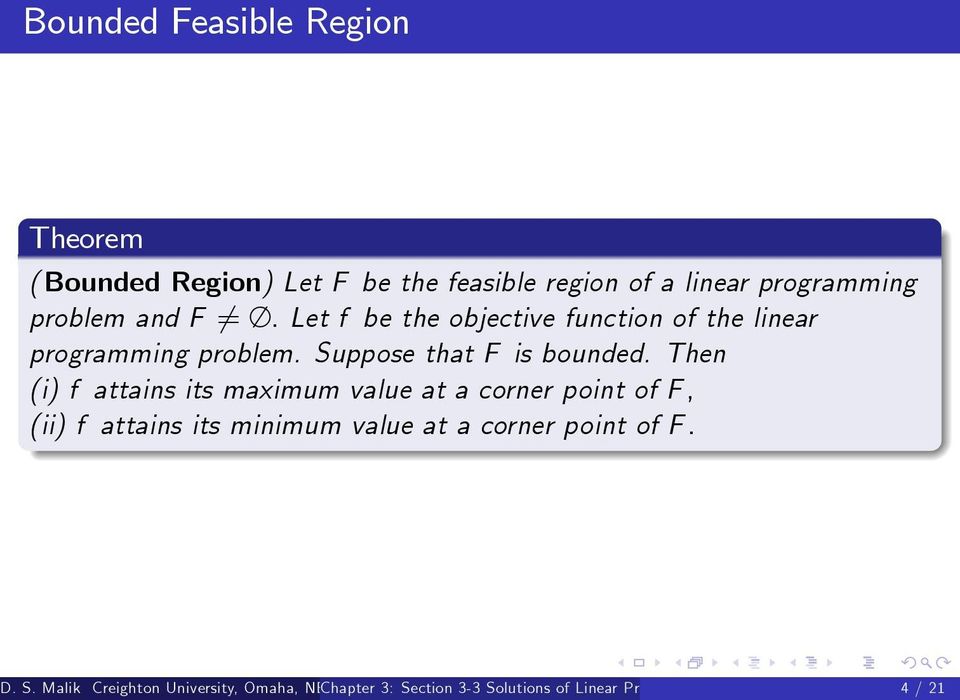
4 Bounded Feasible Region Theorem ( Bounded Region) Let F be the feasible region of a linear programming problem and F 6=. Let f be the objective function of the linear programming problem. Suppose that F is bounded. Then (i) f attains its maximum value at a corner point of F, (ii) f attains its minimum value at a corner point of F.. S. Malik Creighton University, Omaha, NE Chapter () 3: Section 3-3 Solutions of Linear Programming Problems 4 / 21
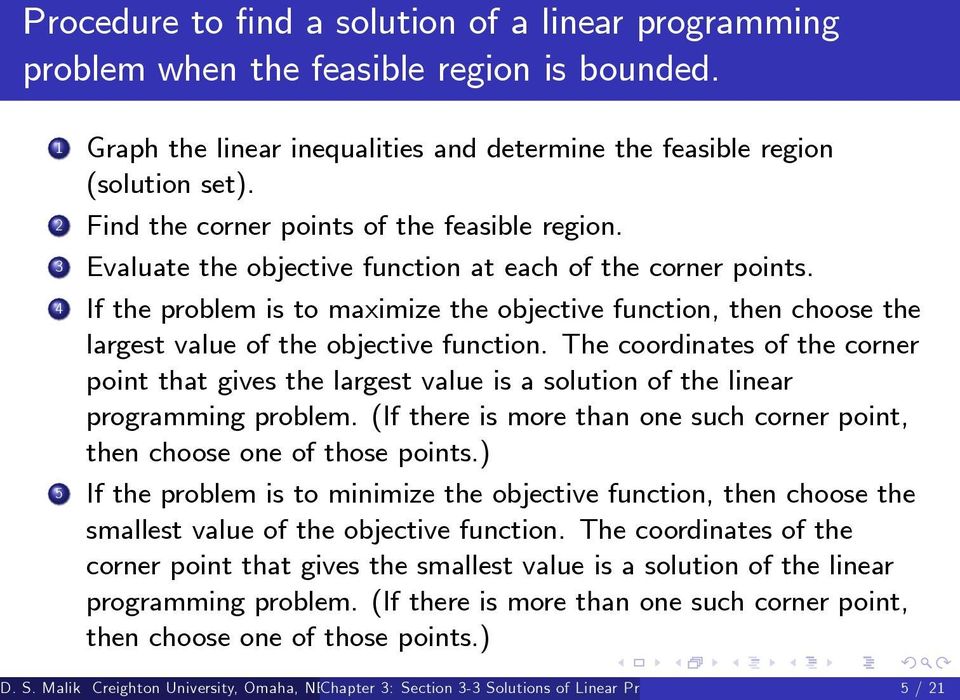
5 Procedure to nd a solution of a linear programming problem when the feasible region is bounded. 1 Graph the linear inequalities and determine the feasible region (solution set). 2 Find the corner points of the feasible region. 3 Evaluate the objective function at each of the corner points. 4 If the problem is to maximize the objective function, then choose the largest value of the objective function. The coordinates of the corner point that gives the largest value is a solution of the linear programming problem. (If there is more than one such corner point, then choose one of those points.) 5 If the problem is to minimize the objective function, then choose the smallest value of the objective function. The coordinates of the corner point that gives the smallest value is a solution of the linear programming problem. (If there is more than one such corner point, then choose one of those points.) D. S. Malik Creighton University, Omaha, NE Chapter () 3: Section 3-3 Solutions of Linear Programming Problems 5 / 21
6 Example Consider the following constraints of a linear programming problem: x 3, x + y 0, x y 0, x + 2y 5. The region in the x-y plane that satis es these inequalities is: x - y = 0 y 4 x = 3 B(3, 4) 3 C(3,3) A(-(5/3),(5/3)) 2 1 O(0,0) x + y = 0 -x + 2y = 5 x Corner points of the feasible region are: O(0, 0), A 5 3, 5 3, B(3, 4), and C (3, 3).. S. Malik Creighton University, Omaha, NE Chapter () 3: Section 3-3 Solutions of Linear Programming Problems 6 / 21
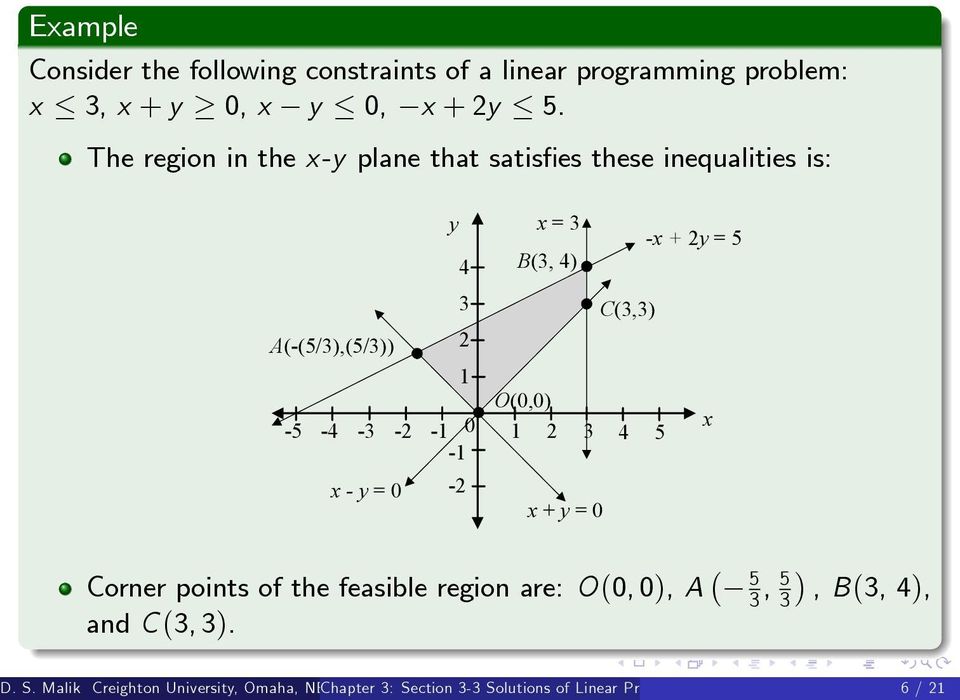
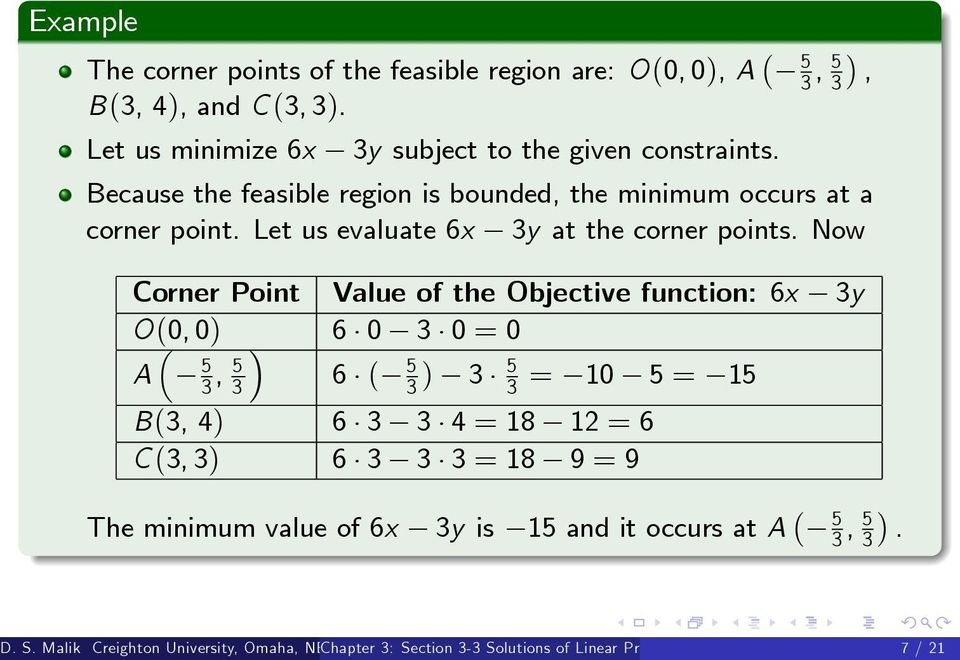
7 Example The corner points of the feasible region are: O(0, 0), A 5 3, 5 3, B(3, 4), and C (3, 3). Let us minimize 6x 3y subject to the given constraints. Because the feasible region is bounded, the minimum occurs at a corner point. Let us evaluate 6x 3y at the corner points. Now Corner Point Value of the Objective function: 6x 3y O(0, 0) = 0 A 5 3, ( 3 ) = 10 5 = 15 B(3, 4) = = 6 C (3, 3) = 18 9 = 9 The minimum value of 6x 3y is 15 and it occurs at A 5 3, 5 3. D. S. Malik Creighton University, Omaha, NE Chapter () 3: Section 3-3 Solutions of Linear Programming Problems 7 / 21
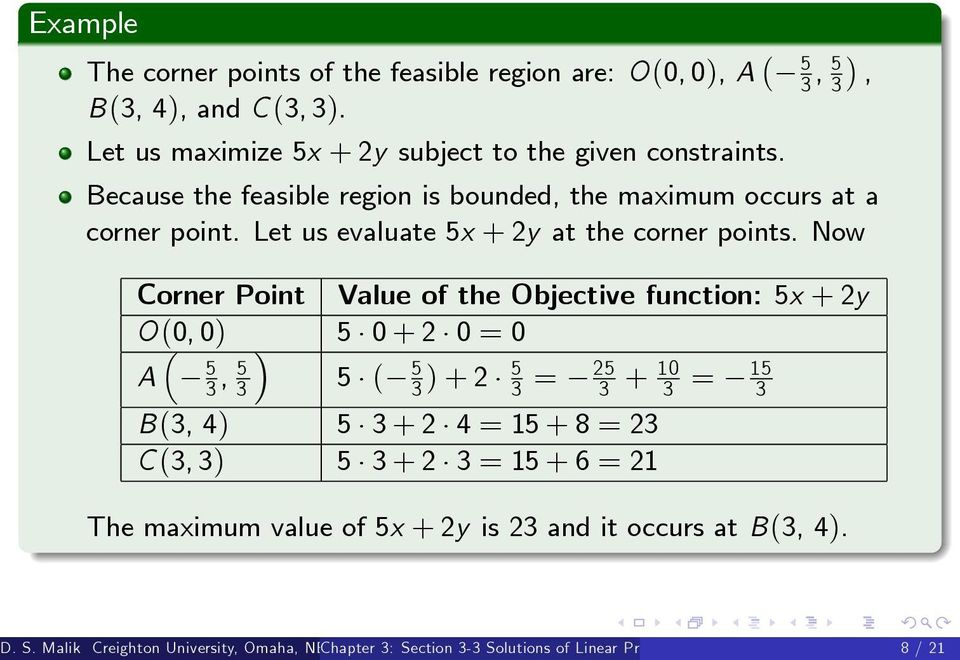
8 Example The corner points of the feasible region are: O(0, 0), A 5 3, 5 3, B(3, 4), and C (3, 3). Let us maximize 5x + 2y subject to the given constraints. Because the feasible region is bounded, the maximum occurs at a corner point. Let us evaluate 5x + 2y at the corner points. Now Corner Point Value of the Objective function: 5x + 2y O(0, 0) = 0 A 5 3, ( 3 ) = = 15 3 B(3, 4) = = 23 C (3, 3) = = 21 The maximum value of 5x + 2y is 23 and it occurs at B(3, 4).. S. Malik Creighton University, Omaha, NE Chapter () 3: Section 3-3 Solutions of Linear Programming Problems 8 / 21
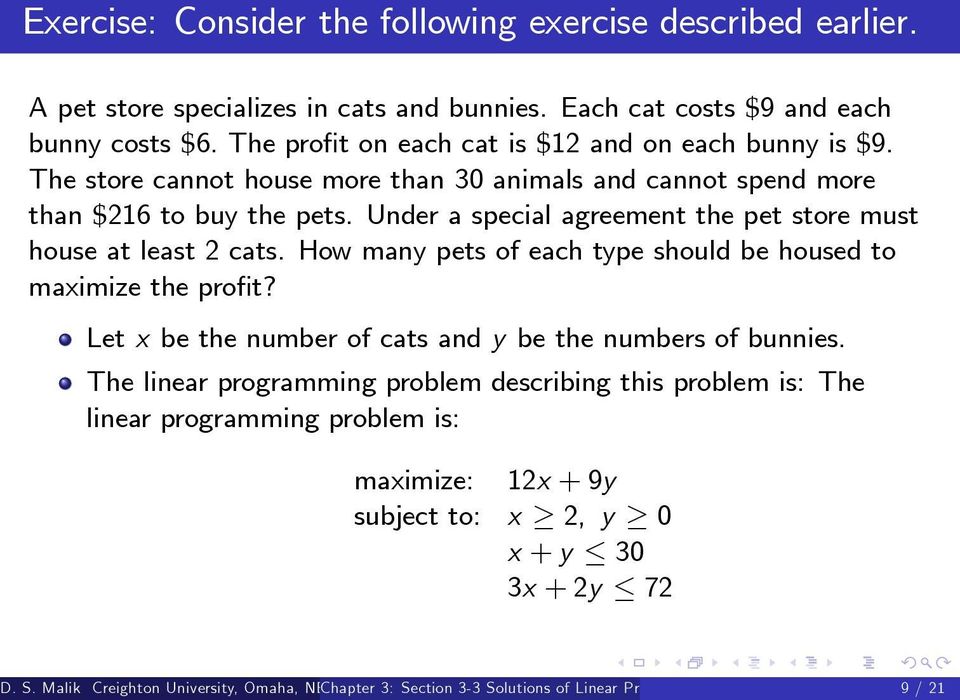
9 Exercise: Consider the following exercise described earlier. A pet store specializes in cats and bunnies. Each cat costs $9 and each bunny costs $6. The pro t on each cat is $12 and on each bunny is $9. The store cannot house more than 30 animals and cannot spend more than $216 to buy the pets. Under a special agreement the pet store must house at least 2 cats. How many pets of each type should be housed to maximize the pro t? Let x be the number of cats and y be the numbers of bunnies. The linear programming problem describing this problem is: The linear programming problem is: maximize: 12x + 9y subject to: x 2, y 0 x + y 30 3x + 2y 72 D. S. Malik Creighton University, Omaha, NE Chapter () 3: Section 3-3 Solutions of Linear Programming Problems 9 / 21
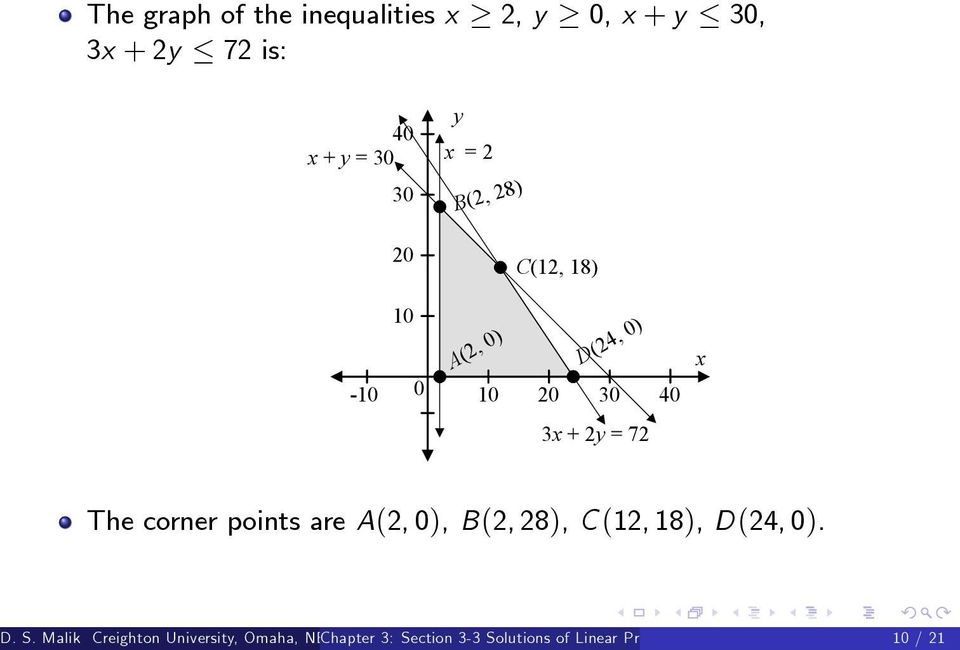
10 The graph of the inequalities x 2, y 0, x + y 30, 3x + 2y 72 is: 40 x + y = y x = 2 B(2, 28) C(12, 18) A(2, 0) D(24, 0) x 3x + 2y = 72 The corner points are A(2, 0), B(2, 28), C (12, 18), D(24, 0). D. S. Malik Creighton University, Omaha, NE Chapter () 3: Section 3-3 Solutions of Linear Programming Problems 10 / 21
11 The corner points are A(2, 0), B(2, 28), C (12, 18), D(24, 0). Example Let us evaluate 12x + 9y at the corner points. Now Corner Point Value of the Objective function: 12x + 9y A(2, 0) = 24 B(2, 28) = 276 C (12, 18) = 306 D(24, 0) = 288 The maximum value of 12x + 9y is 306 and it occurs at C (12, 18). To maximize the pro t, the pet store should house 12 cats and 18 bunnies.. S. Malik Creighton University, Omaha, NE Chapter () 3: Section 3-3 Solutions of Linear Programming Problems 11 / 21

12 Unbounded Feasible Set Theorem ( Unbounded Feasible Region) Let F be the feasible region of a linear programming problem and F 6=. Let f be the objective function of the linear programming problem. Suppose that F is unbounded. (i) If f attains its maximum value, then the maximum value occurs at a corner point of F, (ii) If f attains its minimum value, then the minimum value occurs at a corner point of F... S. Malik Creighton University, Omaha, NE Chapter () 3: Section 3-3 Solutions of Linear Programming Problems 12 / 21
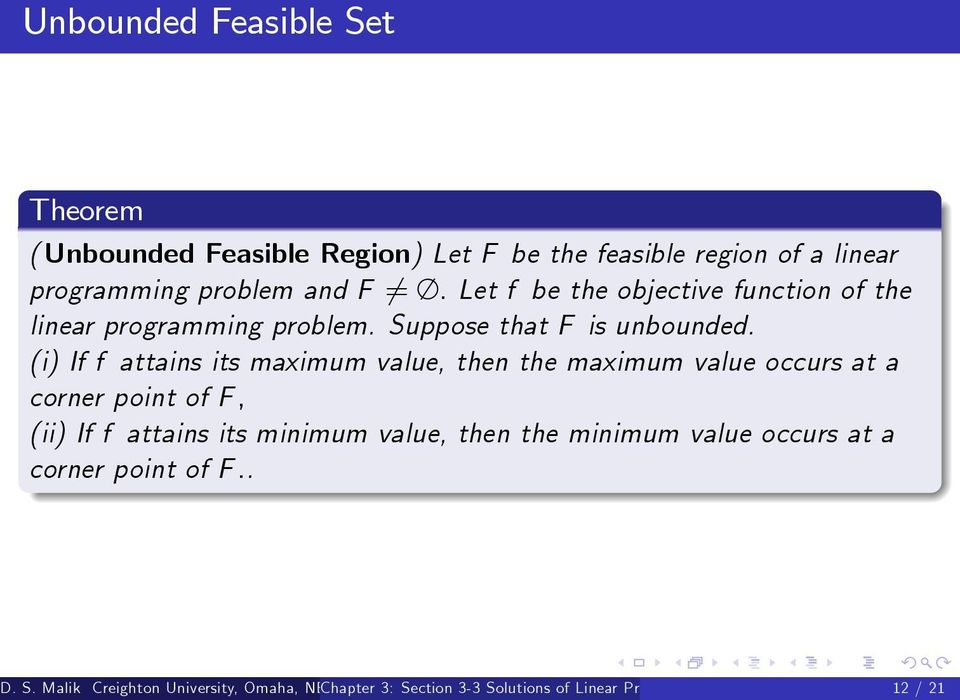
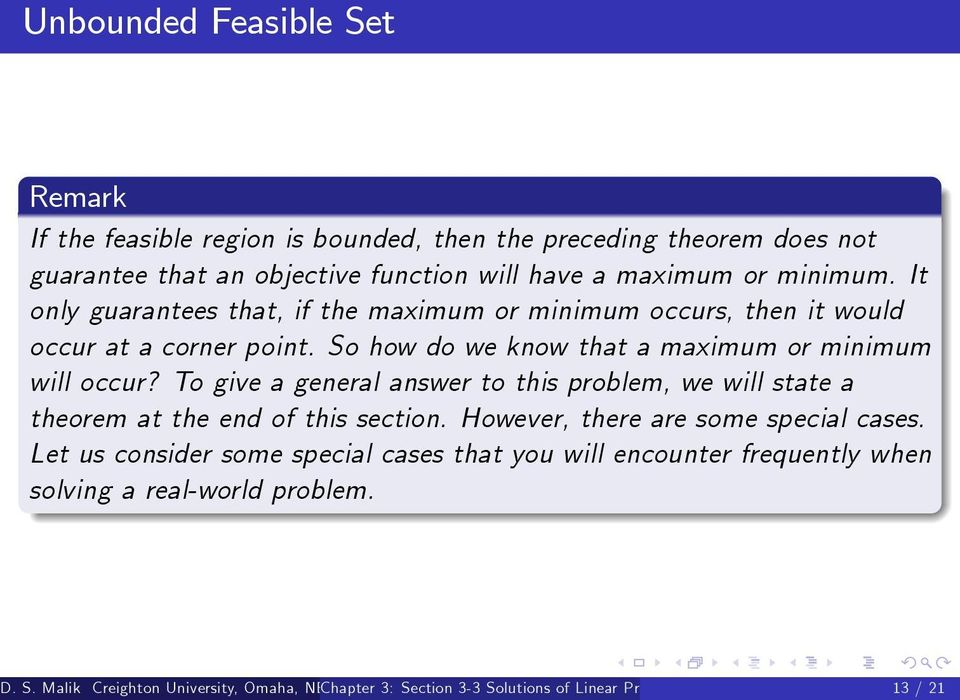
13 Unbounded Feasible Set Remark If the feasible region is bounded, then the preceding theorem does not guarantee that an objective function will have a maximum or minimum. It only guarantees that, if the maximum or minimum occurs, then it would occur at a corner point. So how do we know that a maximum or minimum will occur? To give a general answer to this problem, we will state a theorem at the end of this section. However, there are some special cases. Let us consider some special cases that you will encounter frequently when solving a real-world problem.. S. Malik Creighton University, Omaha, NE Chapter () 3: Section 3-3 Solutions of Linear Programming Problems 13 / 21
14 Suppose that the feasible region is restricted to the rst quadrant and it extends inde nitely in the rst quadrant. Consider the object function 2x + 3y. Because the objective function extends inde nitely in the rst quadrant, the value of 2x + 3y increases without bounds when the values of x and y increase in the feasible region. That is, 2x + 3y has no xed largest value. So 2x + 3y has no maximum in the feasible region. In fact, if the objective function is ax + by, where a 0, b 0, and both a and b are not zero, then the objective function ax + by has no maximum. Suppose that the feasible region is restricted to the rst quadrant and it extends inde nitely in the rst quadrant. However, the objective function, say 3x + 5y, is to be minimized. In this case, the minimum will occur at a corner point, because the value of 3x + 5y cannot be made arbitrarily small. Thus, in general, in this case, if the objective function is ax + by, where a 0, b 0, and both a and b are not zero, then the objective function ax + by has the minimum, and the minimum will occur at a corner point. D. S. Malik Creighton University, Omaha, NE Chapter () 3: Section 3-3 Solutions of Linear Programming Problems 14 / 21

15 Suppose that the feasible region is restricted to the third quadrant and it extends inde nitely in the third quadrant. Suppose that the objective function is ax + by, where a 0, b 0, and both a and b are not zero. Then ax + by has the maximum, and the maximum will occur at a corner point. Furthermore, ax + by has no minimum. D. S. Malik Creighton University, Omaha, NE Chapter () 3: Section 3-3 Solutions of Linear Programming Problems 15 / 21

16 Example A hiker wants to take a snack mix of peanuts and raisins. The hiker wants 1000 calories and 120 grams of fat from the mix. Each gram of peanuts contains 8 calories and 0.4 grams of fat, and costs 7 cents. Each gram of raisins contains 2 calories and 0.6 grams of fat, and costs 4 cents. How many grams of each food should the hiker take so that the cost of the snack is the minimum? Suppose that the hiker takes x grams of peanuts and y grams of raisins. Then Variable Calories Fat Cost Each gram of peanuts x Each gram of raisins y Total (required) D. S. Malik Creighton University, Omaha, NE Chapter () 3: Section 3-3 Solutions of Linear Programming Problems 16 / 21

17 The linear programming problem is: minimize: 7x + 4y subject to x 0 y 0 8x + 2y x + 0.6y 120. D. S. Malik Creighton University, Omaha, NE Chapter () 3: Section 3-3 Solutions of Linear Programming Problems 17 / 21

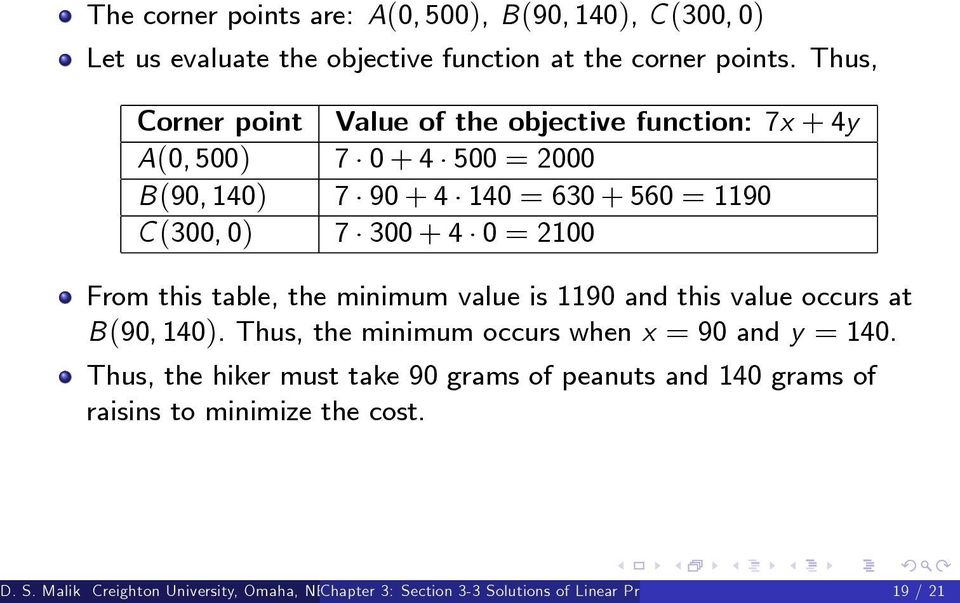
18 x 0, y 0, 8x + 2y 1000, 0.4x + 0.6y 120. We graph these inequalities and obtain the following graph: y A(0, 500) x + 3y = B(90, 140) x + y = 500 C(300, 0) x The corner points are: A(0, 500), B(90, 140), C (300, 0) D. S. Malik Creighton University, Omaha, NE Chapter () 3: Section 3-3 Solutions of Linear Programming Problems 18 / 21

19 The corner points are: A(0, 500), B(90, 140), C (300, 0) Let us evaluate the objective function at the corner points. Thus, Corner point Value of the objective function: 7x + 4y A(0, 500) = 2000 B(90, 140) = = 1190 C (300, 0) = 2100 From this table, the minimum value is 1190 and this value occurs at B(90, 140). Thus, the minimum occurs when x = 90 and y = 140. Thus, the hiker must take 90 grams of peanuts and 140 grams of raisins to minimize the cost.. S. Malik Creighton University, Omaha, NE Chapter () 3: Section 3-3 Solutions of Linear Programming Problems 19 / 21
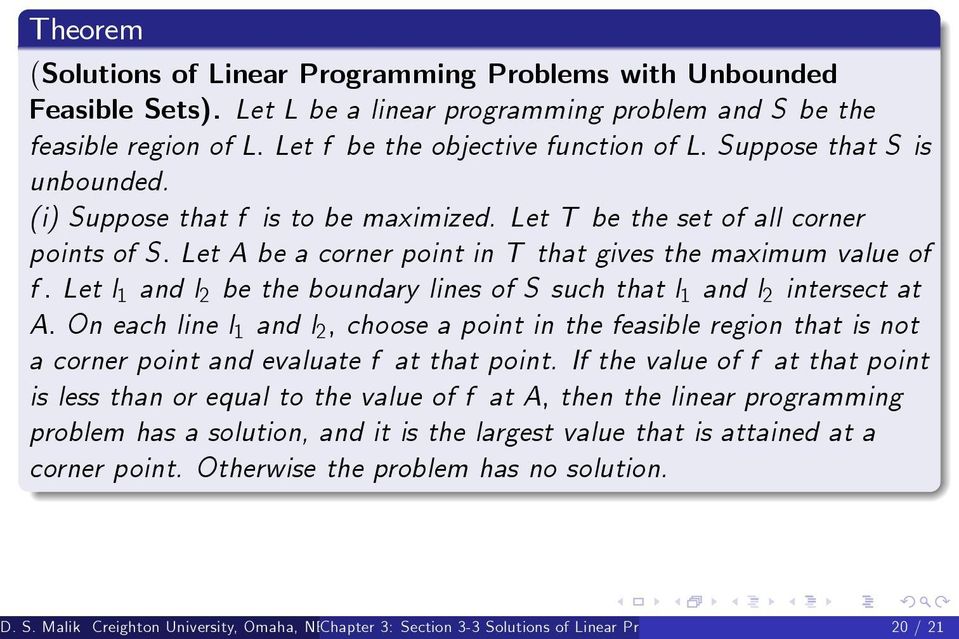
20 Theorem (Solutions of Linear Programming Problems with Unbounded Feasible Sets). Let L be a linear programming problem and S be the feasible region of L. Let f be the objective function of L. Suppose that S is unbounded. (i) Suppose that f is to be maximized. Let T be the set of all corner points of S. Let A be a corner point in T that gives the maximum value of f. Let l 1 and l 2 be the boundary lines of S such that l 1 and l 2 intersect at A. On each line l 1 and l 2, choose a point in the feasible region that is not a corner point and evaluate f at that point. If the value of f at that point is less than or equal to the value of f at A, then the linear programming problem has a solution, and it is the largest value that is attained at a corner point. Otherwise the problem has no solution.. S. Malik Creighton University, Omaha, NE Chapter () 3: Section 3-3 Solutions of Linear Programming Problems 20 / 21
21 Theorem (ii) Suppose that f is to be minimized. Let T be the set of all corner points of S. Let A be a corner point in T that gives the minimized value of f. Let l 1 and l 2 be the boundary lines of S such that l 1 and l 2 intersect at A. On each line l 1 and l 2, choose a point in the feasible region that is not a corner point and evaluate f at that point. If the value of f at that point is greater than or equal to the value of f at A, then the linear programming problem has a solution, and it is the smallest value that is attained at a corner point. Otherwise the problem has no solution.. S. Malik Creighton University, Omaha, NE Chapter () 3: Section 3-3 Solutions of Linear Programming Problems 21 / 21
1. Graphing Linear Inequalities
 Notation. CHAPTER 4 Linear Programming 1. Graphing Linear Inequalities x apple y means x is less than or equal to y. x y means x is greater than or equal to y. x < y means x is less than y. x > y means
3. Evaluate the objective function at each vertex. Put the vertices into a table: Vertex P=3x+2y (0, 0) 0 min (0, 5) 10 (15, 0) 45 (12, 2) 40 Max
 SOLUTION OF LINEAR PROGRAMMING PROBLEMS THEOREM 1 If a linear programming problem has a solution, then it must occur at a vertex, or corner point, of the feasible set, S, associated with the problem. Furthermore,
Chapter 5. Linear Inequalities and Linear Programming. Linear Programming in Two Dimensions: A Geometric Approach
 Chapter 5 Linear Programming in Two Dimensions: A Geometric Approach Linear Inequalities and Linear Programming Section 3 Linear Programming gin Two Dimensions: A Geometric Approach In this section, we
3.1 Solving Systems Using Tables and Graphs
 Algebra 2 Chapter 3 3.1 Solve Systems Using Tables & Graphs 3.1 Solving Systems Using Tables and Graphs A solution to a system of linear equations is an that makes all of the equations. To solve a system
Section 7.2 Linear Programming: The Graphical Method
 Section 7.2 Linear Programming: The Graphical Method Man problems in business, science, and economics involve finding the optimal value of a function (for instance, the maimum value of the profit function
Question 2: How do you solve a linear programming problem with a graph?
 Question 2: How do you solve a linear programming problem with a graph? Now that we have several linear programming problems, let s look at how we can solve them using the graph of the system of inequalities.
Section 2.4: Equations of Lines and Planes
 Section.4: Equations of Lines and Planes An equation of three variable F (x, y, z) 0 is called an equation of a surface S if For instance, (x 1, y 1, z 1 ) S if and only if F (x 1, y 1, z 1 ) 0. x + y
The Graphical Method: An Example
 The Graphical Method: An Example Consider the following linear program: Maximize 4x 1 +3x 2 Subject to: 2x 1 +3x 2 6 (1) 3x 1 +2x 2 3 (2) 2x 2 5 (3) 2x 1 +x 2 4 (4) x 1, x 2 0, where, for ease of reference,
Linear Programming for Optimization. Mark A. Schulze, Ph.D. Perceptive Scientific Instruments, Inc.
 1. Introduction Linear Programming for Optimization Mark A. Schulze, Ph.D. Perceptive Scientific Instruments, Inc. 1.1 Definition Linear programming is the name of a branch of applied mathematics that
Special Situations in the Simplex Algorithm
 Special Situations in the Simplex Algorithm Degeneracy Consider the linear program: Maximize 2x 1 +x 2 Subject to: 4x 1 +3x 2 12 (1) 4x 1 +x 2 8 (2) 4x 1 +2x 2 8 (3) x 1, x 2 0. We will first apply the
160 CHAPTER 4. VECTOR SPACES
 160 CHAPTER 4. VECTOR SPACES 4. Rank and Nullity In this section, we look at relationships between the row space, column space, null space of a matrix and its transpose. We will derive fundamental results
Largest Fixed-Aspect, Axis-Aligned Rectangle
 Largest Fixed-Aspect, Axis-Aligned Rectangle David Eberly Geometric Tools, LLC http://www.geometrictools.com/ Copyright c 1998-2016. All Rights Reserved. Created: February 21, 2004 Last Modified: February
Linear Programming Notes V Problem Transformations
 Linear Programming Notes V Problem Transformations 1 Introduction Any linear programming problem can be rewritten in either of two standard forms. In the first form, the objective is to maximize, the material
0.1 Linear Programming
 0.1 Linear Programming 0.1.1 Objectives By the end of this unit you will be able to: formulate simple linear programming problems in terms of an objective function to be maximized or minimized subject
Introductory Notes on Demand Theory
 Introductory Notes on Demand Theory (The Theory of Consumer Behavior, or Consumer Choice) This brief introduction to demand theory is a preview of the first part of Econ 501A, but it also serves as a prototype
Study Guide 2 Solutions MATH 111
 Study Guide 2 Solutions MATH 111 Having read through the sample test, I wanted to warn everyone, that I might consider asking questions involving inequalities, the absolute value function (as in the suggested
EdExcel Decision Mathematics 1
 EdExcel Decision Mathematics 1 Linear Programming Section 1: Formulating and solving graphically Notes and Examples These notes contain subsections on: Formulating LP problems Solving LP problems Minimisation
Module1. x 1000. y 800.
 Module1 1 Welcome to the first module of the course. It is indeed an exciting event to share with you the subject that has lot to offer both from theoretical side and practical aspects. To begin with,
. P. 4.3 Basic feasible solutions and vertices of polyhedra. x 1. x 2
 4. Basic feasible solutions and vertices of polyhedra Due to the fundamental theorem of Linear Programming, to solve any LP it suffices to consider the vertices (finitely many) of the polyhedron P of the
Chapter 2: Linear Equations and Inequalities Lecture notes Math 1010
 Section 2.1: Linear Equations Definition of equation An equation is a statement that equates two algebraic expressions. Solving an equation involving a variable means finding all values of the variable
Practical Guide to the Simplex Method of Linear Programming
 Practical Guide to the Simplex Method of Linear Programming Marcel Oliver Revised: April, 0 The basic steps of the simplex algorithm Step : Write the linear programming problem in standard form Linear
14.451 Lecture Notes 10
 14.451 Lecture Notes 1 Guido Lorenzoni Fall 29 1 Continuous time: nite horizon Time goes from to T. Instantaneous payo : f (t; x (t) ; y (t)) ; (the time dependence includes discounting), where x (t) 2
Simple Linear Programming Model
 Simple Linear Programming Model Katie Pease In partial fulfillment of the requirements for the Master of Arts in Teaching with a Specialization in the Teaching of Middle Level Mathematics in the Department
Lecture 2: August 29. Linear Programming (part I)
 10-725: Convex Optimization Fall 2013 Lecture 2: August 29 Lecturer: Barnabás Póczos Scribes: Samrachana Adhikari, Mattia Ciollaro, Fabrizio Lecci Note: LaTeX template courtesy of UC Berkeley EECS dept.
Chapter 9. Systems of Linear Equations
 Chapter 9. Systems of Linear Equations 9.1. Solve Systems of Linear Equations by Graphing KYOTE Standards: CR 21; CA 13 In this section we discuss how to solve systems of two linear equations in two variables
1 Introduction. Linear Programming. Questions. A general optimization problem is of the form: choose x to. max f(x) subject to x S. where.
 Introduction Linear Programming Neil Laws TT 00 A general optimization problem is of the form: choose x to maximise f(x) subject to x S where x = (x,..., x n ) T, f : R n R is the objective function, S
Linear Algebra Notes
 Linear Algebra Notes Chapter 19 KERNEL AND IMAGE OF A MATRIX Take an n m matrix a 11 a 12 a 1m a 21 a 22 a 2m a n1 a n2 a nm and think of it as a function A : R m R n The kernel of A is defined as Note
Linear Programming Problems
 Linear Programming Problems Linear programming problems come up in many applications. In a linear programming problem, we have a function, called the objective function, which depends linearly on a number
Using the Simplex Method to Solve Linear Programming Maximization Problems J. Reeb and S. Leavengood
 PERFORMANCE EXCELLENCE IN THE WOOD PRODUCTS INDUSTRY EM 8720-E October 1998 $3.00 Using the Simplex Method to Solve Linear Programming Maximization Problems J. Reeb and S. Leavengood A key problem faced
Lecture 8 : Coordinate Geometry. The coordinate plane The points on a line can be referenced if we choose an origin and a unit of 20
 Lecture 8 : Coordinate Geometry The coordinate plane The points on a line can be referenced if we choose an origin and a unit of 0 distance on the axis and give each point an identity on the corresponding
Basic Components of an LP:
 1 Linear Programming Optimization is an important and fascinating area of management science and operations research. It helps to do less work, but gain more. Linear programming (LP) is a central topic
Linear Programming. Solving LP Models Using MS Excel, 18
 SUPPLEMENT TO CHAPTER SIX Linear Programming SUPPLEMENT OUTLINE Introduction, 2 Linear Programming Models, 2 Model Formulation, 4 Graphical Linear Programming, 5 Outline of Graphical Procedure, 5 Plotting
4.6 Linear Programming duality
 4.6 Linear Programming duality To any minimization (maximization) LP we can associate a closely related maximization (minimization) LP. Different spaces and objective functions but in general same optimal
Chapter 11. 11.1 Load Balancing. Approximation Algorithms. Load Balancing. Load Balancing on 2 Machines. Load Balancing: Greedy Scheduling
 Approximation Algorithms Chapter Approximation Algorithms Q. Suppose I need to solve an NP-hard problem. What should I do? A. Theory says you're unlikely to find a poly-time algorithm. Must sacrifice one
OPRE 6201 : 2. Simplex Method
 OPRE 6201 : 2. Simplex Method 1 The Graphical Method: An Example Consider the following linear program: Max 4x 1 +3x 2 Subject to: 2x 1 +3x 2 6 (1) 3x 1 +2x 2 3 (2) 2x 2 5 (3) 2x 1 +x 2 4 (4) x 1, x 2
v 1 v 3 u v = (( 1)4 (3)2, [1(4) ( 2)2], 1(3) ( 2)( 1)) = ( 10, 8, 1) (d) u (v w) = (u w)v (u v)w (Relationship between dot and cross product)
![v 1 v 3 u v = (( 1)4 (3)2, [1(4) ( 2)2], 1(3) ( 2)( 1)) = ( 10, 8, 1) (d) u (v w) = (u w)v (u v)w (Relationship between dot and cross product)](/thumbs/40/20880945.jpg "v 1 v 3 u v = (( 1)4 (3)2, [1(4) ( 2)2], 1(3) ( 2)( 1)) = ( 10, 8, 1) (d) u (v w) = (u w)v (u v)w (Relationship between dot and cross product)") 0.1 Cross Product The dot product of two vectors is a scalar, a number in R. Next we will define the cross product of two vectors in 3-space. This time the outcome will be a vector in 3-space. Definition
0.1 Cross Product The dot product of two vectors is a scalar, a number in R. Next we will define the cross product of two vectors in 3-space. This time the outcome will be a vector in 3-space. Definition
Lecture 3. Linear Programming. 3B1B Optimization Michaelmas 2015 A. Zisserman. Extreme solutions. Simplex method. Interior point method
 Lecture 3 3B1B Optimization Michaelmas 2015 A. Zisserman Linear Programming Extreme solutions Simplex method Interior point method Integer programming and relaxation The Optimization Tree Linear Programming
(a) We have x = 3 + 2t, y = 2 t, z = 6 so solving for t we get the symmetric equations. x 3 2. = 2 y, z = 6. t 2 2t + 1 = 0,
 Name: Solutions to Practice Final. Consider the line r(t) = 3 + t, t, 6. (a) Find symmetric equations for this line. (b) Find the point where the first line r(t) intersects the surface z = x + y. (a) We
Linear Programming: Theory and Applications
 Linear Programming: Theory and Applications Catherine Lewis May 11, 2008 1 Contents 1 Introduction to Linear Programming 3 1.1 What is a linear program?...................... 3 1.2 Assumptions.............................
How To Understand And Solve A Linear Programming Problem
 At the end of the lesson, you should be able to: Chapter 2: Systems of Linear Equations and Matrices: 2.1: Solutions of Linear Systems by the Echelon Method Define linear systems, unique solution, inconsistent,
How To Solve A Minimum Set Covering Problem (Mcp)
 Measuring Rationality with the Minimum Cost of Revealed Preference Violations Mark Dean and Daniel Martin Online Appendices - Not for Publication 1 1 Algorithm for Solving the MASP In this online appendix
Lecture 1: Systems of Linear Equations
 MTH Elementary Matrix Algebra Professor Chao Huang Department of Mathematics and Statistics Wright State University Lecture 1 Systems of Linear Equations ² Systems of two linear equations with two variables
CHAPTER 11: BASIC LINEAR PROGRAMMING CONCEPTS
 Linear programming is a mathematical technique for finding optimal solutions to problems that can be expressed using linear equations and inequalities. If a real-world problem can be represented accurately
! Solve problem to optimality. ! Solve problem in poly-time. ! Solve arbitrary instances of the problem. !-approximation algorithm.
 Approximation Algorithms Chapter Approximation Algorithms Q Suppose I need to solve an NP-hard problem What should I do? A Theory says you're unlikely to find a poly-time algorithm Must sacrifice one of
Linear Programming I
 Linear Programming I November 30, 2003 1 Introduction In the VCR/guns/nuclear bombs/napkins/star wars/professors/butter/mice problem, the benevolent dictator, Bigus Piguinus, of south Antarctica penguins
c 2008 Je rey A. Miron We have described the constraints that a consumer faces, i.e., discussed the budget constraint.
 Lecture 2b: Utility c 2008 Je rey A. Miron Outline: 1. Introduction 2. Utility: A De nition 3. Monotonic Transformations 4. Cardinal Utility 5. Constructing a Utility Function 6. Examples of Utility Functions
Scalar Valued Functions of Several Variables; the Gradient Vector
 Scalar Valued Functions of Several Variables; the Gradient Vector Scalar Valued Functions vector valued function of n variables: Let us consider a scalar (i.e., numerical, rather than y = φ(x = φ(x 1,
1 if 1 x 0 1 if 0 x 1
 Chapter 3 Continuity In this chapter we begin by defining the fundamental notion of continuity for real valued functions of a single real variable. When trying to decide whether a given function is or
9.4 THE SIMPLEX METHOD: MINIMIZATION
 SECTION 9 THE SIMPLEX METHOD: MINIMIZATION 59 The accounting firm in Exercise raises its charge for an audit to $5 What number of audits and tax returns will bring in a maximum revenue? In the simplex
2.3 Convex Constrained Optimization Problems
 42 CHAPTER 2. FUNDAMENTAL CONCEPTS IN CONVEX OPTIMIZATION Theorem 15 Let f : R n R and h : R R. Consider g(x) = h(f(x)) for all x R n. The function g is convex if either of the following two conditions
Unit 1 Equations, Inequalities, Functions
 Unit 1 Equations, Inequalities, Functions Algebra 2, Pages 1-100 Overview: This unit models real-world situations by using one- and two-variable linear equations. This unit will further expand upon pervious
Operation Research. Module 1. Module 2. Unit 1. Unit 2. Unit 3. Unit 1
 Operation Research Module 1 Unit 1 1.1 Origin of Operations Research 1.2 Concept and Definition of OR 1.3 Characteristics of OR 1.4 Applications of OR 1.5 Phases of OR Unit 2 2.1 Introduction to Linear
What is Linear Programming?
 Chapter 1 What is Linear Programming? An optimization problem usually has three essential ingredients: a variable vector x consisting of a set of unknowns to be determined, an objective function of x to
Chapter 7 Nonlinear Systems
 Chapter 7 Nonlinear Systems Nonlinear systems in R n : X = B x. x n X = F (t; X) F (t; x ; :::; x n ) B C A ; F (t; X) =. F n (t; x ; :::; x n ) When F (t; X) = F (X) is independent of t; it is an example
Mathematical finance and linear programming (optimization)
 Mathematical finance and linear programming (optimization) Geir Dahl September 15, 2009 1 Introduction The purpose of this short note is to explain how linear programming (LP) (=linear optimization) may
Arrangements And Duality
 Arrangements And Duality 3.1 Introduction 3 Point configurations are tbe most basic structure we study in computational geometry. But what about configurations of more complicated shapes? For example,
Math 241, Exam 1 Information.
 Math 241, Exam 1 Information. 9/24/12, LC 310, 11:15-12:05. Exam 1 will be based on: Sections 12.1-12.5, 14.1-14.3. The corresponding assigned homework problems (see http://www.math.sc.edu/ boylan/sccourses/241fa12/241.html)
Algebra Unpacked Content For the new Common Core standards that will be effective in all North Carolina schools in the 2012-13 school year.
 This document is designed to help North Carolina educators teach the Common Core (Standard Course of Study). NCDPI staff are continually updating and improving these tools to better serve teachers. Algebra
5 Systems of Equations
 Systems of Equations Concepts: Solutions to Systems of Equations-Graphically and Algebraically Solving Systems - Substitution Method Solving Systems - Elimination Method Using -Dimensional Graphs to Approximate
Standard Form of a Linear Programming Problem
 494 CHAPTER 9 LINEAR PROGRAMMING 9. THE SIMPLEX METHOD: MAXIMIZATION For linear programming problems involving two variables, the graphical solution method introduced in Section 9. is convenient. However,
IEOR 4404 Homework #2 Intro OR: Deterministic Models February 14, 2011 Prof. Jay Sethuraman Page 1 of 5. Homework #2
 IEOR 4404 Homework # Intro OR: Deterministic Models February 14, 011 Prof. Jay Sethuraman Page 1 of 5 Homework #.1 (a) What is the optimal solution of this problem? Let us consider that x 1, x and x 3
LECTURE 5: DUALITY AND SENSITIVITY ANALYSIS. 1. Dual linear program 2. Duality theory 3. Sensitivity analysis 4. Dual simplex method
 LECTURE 5: DUALITY AND SENSITIVITY ANALYSIS 1. Dual linear program 2. Duality theory 3. Sensitivity analysis 4. Dual simplex method Introduction to dual linear program Given a constraint matrix A, right
1 Portfolio mean and variance
 Copyright c 2005 by Karl Sigman Portfolio mean and variance Here we study the performance of a one-period investment X 0 > 0 (dollars) shared among several different assets. Our criterion for measuring
Solutions to Homework 10
 Solutions to Homework 1 Section 7., exercise # 1 (b,d): (b) Compute the value of R f dv, where f(x, y) = y/x and R = [1, 3] [, 4]. Solution: Since f is continuous over R, f is integrable over R. Let x
Linear Programming. March 14, 2014
 Linear Programming March 1, 01 Parts of this introduction to linear programming were adapted from Chapter 9 of Introduction to Algorithms, Second Edition, by Cormen, Leiserson, Rivest and Stein [1]. 1
Duality in Linear Programming
 Duality in Linear Programming 4 In the preceding chapter on sensitivity analysis, we saw that the shadow-price interpretation of the optimal simplex multipliers is a very useful concept. First, these shadow
Optimal Auctions. Jonathan Levin 1. Winter 2009. Economics 285 Market Design. 1 These slides are based on Paul Milgrom s.
 Optimal Auctions Jonathan Levin 1 Economics 285 Market Design Winter 29 1 These slides are based on Paul Milgrom s. onathan Levin Optimal Auctions Winter 29 1 / 25 Optimal Auctions What auction rules lead
! Solve problem to optimality. ! Solve problem in poly-time. ! Solve arbitrary instances of the problem. #-approximation algorithm.
 Approximation Algorithms 11 Approximation Algorithms Q Suppose I need to solve an NP-hard problem What should I do? A Theory says you're unlikely to find a poly-time algorithm Must sacrifice one of three
Class Notes, Econ 8801 Lump Sum Taxes are Awesome
 Class Notes, Econ 8801 Lump Sum Taxes are Awesome Larry E. Jones 1 Exchange Economies with Taxes and Spending 1.1 Basics 1) Assume that there are n goods which can be consumed in any non-negative amounts;
Representation of functions as power series
 Representation of functions as power series Dr. Philippe B. Laval Kennesaw State University November 9, 008 Abstract This document is a summary of the theory and techniques used to represent functions
constraint. Let us penalize ourselves for making the constraint too big. We end up with a
 Chapter 4 Constrained Optimization 4.1 Equality Constraints (Lagrangians) Suppose we have a problem: Maximize 5, (x 1, 2) 2, 2(x 2, 1) 2 subject to x 1 +4x 2 =3 If we ignore the constraint, we get the
What does the number m in y = mx + b measure? To find out, suppose (x 1, y 1 ) and (x 2, y 2 ) are two points on the graph of y = mx + b.
 PRIMARY CONTENT MODULE Algebra - Linear Equations & Inequalities T-37/H-37 What does the number m in y = mx + b measure? To find out, suppose (x 1, y 1 ) and (x 2, y 2 ) are two points on the graph of
This unit will lay the groundwork for later units where the students will extend this knowledge to quadratic and exponential functions.
 Algebra I Overview View unit yearlong overview here Many of the concepts presented in Algebra I are progressions of concepts that were introduced in grades 6 through 8. The content presented in this course
March 29, 2011. 171S4.4 Theorems about Zeros of Polynomial Functions
 MAT 171 Precalculus Algebra Dr. Claude Moore Cape Fear Community College CHAPTER 4: Polynomial and Rational Functions 4.1 Polynomial Functions and Models 4.2 Graphing Polynomial Functions 4.3 Polynomial
Vector Spaces 4.4 Spanning and Independence
 Vector Spaces 4.4 and Independence October 18 Goals Discuss two important basic concepts: Define linear combination of vectors. Define Span(S) of a set S of vectors. Define linear Independence of a set
GENERALIZED INTEGER PROGRAMMING
 Professor S. S. CHADHA, PhD University of Wisconsin, Eau Claire, USA E-mail: [email protected] Professor Veena CHADHA University of Wisconsin, Eau Claire, USA E-mail: [email protected] GENERALIZED INTEGER
Linear Equations in Linear Algebra
 1 Linear Equations in Linear Algebra 1.5 SOLUTION SETS OF LINEAR SYSTEMS HOMOGENEOUS LINEAR SYSTEMS A system of linear equations is said to be homogeneous if it can be written in the form A 0, where A
1.2 Solving a System of Linear Equations
 1.. SOLVING A SYSTEM OF LINEAR EQUATIONS 1. Solving a System of Linear Equations 1..1 Simple Systems - Basic De nitions As noticed above, the general form of a linear system of m equations in n variables
Linear Programming. April 12, 2005
 Linear Programming April 1, 005 Parts of this were adapted from Chapter 9 of i Introduction to Algorithms (Second Edition) /i by Cormen, Leiserson, Rivest and Stein. 1 What is linear programming? The first
TOPIC 4: DERIVATIVES
 TOPIC 4: DERIVATIVES 1. The derivative of a function. Differentiation rules 1.1. The slope of a curve. The slope of a curve at a point P is a measure of the steepness of the curve. If Q is a point on the
LESSON OBJECTIVES. Mental Math. Skills Review. 344 Chapter 8 Systems of Equations and Inequalities
 LESSON OBJECTIVES 8.1 Solving Systems of Equations by Graphing Identify systems of equations as dependent or independent. Solve systems of linear equations by graphing. 8.2 Solving Systems of Equations
In mathematics, there are four attainment targets: using and applying mathematics; number and algebra; shape, space and measures, and handling data.
 MATHEMATICS: THE LEVEL DESCRIPTIONS In mathematics, there are four attainment targets: using and applying mathematics; number and algebra; shape, space and measures, and handling data. Attainment target
3. Linear Programming and Polyhedral Combinatorics
 Massachusetts Institute of Technology Handout 6 18.433: Combinatorial Optimization February 20th, 2009 Michel X. Goemans 3. Linear Programming and Polyhedral Combinatorics Summary of what was seen in the
Elements of probability theory
 2 Elements of probability theory Probability theory provides mathematical models for random phenomena, that is, phenomena which under repeated observations yield di erent outcomes that cannot be predicted
MATH 304 Linear Algebra Lecture 9: Subspaces of vector spaces (continued). Span. Spanning set.
 MATH 304 Linear Algebra Lecture 9: Subspaces of vector spaces (continued). Span. Spanning set. Vector space A vector space is a set V equipped with two operations, addition V V (x,y) x + y V and scalar
Solving Linear Systems, Continued and The Inverse of a Matrix
 , Continued and The of a Matrix Calculus III Summer 2013, Session II Monday, July 15, 2013 Agenda 1. The rank of a matrix 2. The inverse of a square matrix Gaussian Gaussian solves a linear system by reducing
Linear Programming. Widget Factory Example. Linear Programming: Standard Form. Widget Factory Example: Continued.
 Linear Programming Widget Factory Example Learning Goals. Introduce Linear Programming Problems. Widget Example, Graphical Solution. Basic Theory:, Vertices, Existence of Solutions. Equivalent formulations.
MATH2210 Notebook 1 Fall Semester 2016/2017. 1 MATH2210 Notebook 1 3. 1.1 Solving Systems of Linear Equations... 3
 MATH0 Notebook Fall Semester 06/07 prepared by Professor Jenny Baglivo c Copyright 009 07 by Jenny A. Baglivo. All Rights Reserved. Contents MATH0 Notebook 3. Solving Systems of Linear Equations........................
Question 2: How will changes in the objective function s coefficients change the optimal solution?
 Question 2: How will changes in the objective function s coefficients change the optimal solution? In the previous question, we examined how changing the constants in the constraints changed the optimal
1 Mathematical Models of Cost, Revenue and Profit
 Section 1.: Mathematical Modeling Math 14 Business Mathematics II Minh Kha Goals: to understand what a mathematical model is, and some of its examples in business. Definition 0.1. Mathematical Modeling
Academic Support Center. Using the TI-83/84+ Graphing Calculator PART II
 Academic Support Center Using the TI-83/84+ Graphing Calculator PART II Designed and Prepared by The Academic Support Center Revised June 2012 1 Using the Graphing Calculator (TI-83+ or TI-84+) Table of
Applied Algorithm Design Lecture 5
 Applied Algorithm Design Lecture 5 Pietro Michiardi Eurecom Pietro Michiardi (Eurecom) Applied Algorithm Design Lecture 5 1 / 86 Approximation Algorithms Pietro Michiardi (Eurecom) Applied Algorithm Design
TU e. Advanced Algorithms: experimentation project. The problem: load balancing with bounded look-ahead. Input: integer m 2: number of machines
 The problem: load balancing with bounded look-ahead Input: integer m 2: number of machines integer k 0: the look-ahead numbers t 1,..., t n : the job sizes Problem: assign jobs to machines machine to which
36 CHAPTER 1. LIMITS AND CONTINUITY. Figure 1.17: At which points is f not continuous?
 36 CHAPTER 1. LIMITS AND CONTINUITY 1.3 Continuity Before Calculus became clearly de ned, continuity meant that one could draw the graph of a function without having to lift the pen and pencil. While this
Zeros of a Polynomial Function
 Zeros of a Polynomial Function An important consequence of the Factor Theorem is that finding the zeros of a polynomial is really the same thing as factoring it into linear factors. In this section we
n 2 + 4n + 3. The answer in decimal form (for the Blitz): 0, 75. Solution. (n + 1)(n + 3) = n + 3 2 lim m 2 1
 . Calculate the sum of the series Answer: 3 4. n 2 + 4n + 3. The answer in decimal form (for the Blitz):, 75. Solution. n 2 + 4n + 3 = (n + )(n + 3) = (n + 3) (n + ) = 2 (n + )(n + 3) ( 2 n + ) = m ( n
1 Norms and Vector Spaces
 008.10.07.01 1 Norms and Vector Spaces Suppose we have a complex vector space V. A norm is a function f : V R which satisfies (i) f(x) 0 for all x V (ii) f(x + y) f(x) + f(y) for all x,y V (iii) f(λx)
Derive 5: The Easiest... Just Got Better!
 Liverpool John Moores University, 1-15 July 000 Derive 5: The Easiest... Just Got Better! Michel Beaudin École de Technologie Supérieure, Canada Email; [email protected] 1. Introduction Engineering
The Binomial Distribution
 The Binomial Distribution James H. Steiger November 10, 00 1 Topics for this Module 1. The Binomial Process. The Binomial Random Variable. The Binomial Distribution (a) Computing the Binomial pdf (b) Computing