
MATH 10: Elementary Statistics and Probability Chapter 7: The Central Limit Theorem
|
|
|
- Ross Higgins
- 9 years ago
- Views:
Transcription
1 MATH 10: Elementary Statistics and Probability Chapter 7: The Central Limit Theorem Tony Pourmohamad Department of Mathematics De Anza College Spring 2015

2 Objectives By the end of this set of slides, you should be able to: 1 Understand what the central limit theorem is 2 Recognize the central limit theorem problems 3 Apply and interpret the central limit theorem for means 2 / 20

3 The Central Limit Theorem The Central Limit Theorem (CLT) is one of the most powerful and useful ideas in all of statistics For this class, we will consider two application of the CLT: 1 CLT for means (or averages) of random variables 2 CLT for sums of random variables Let s start with an example, courtesy of Professor Mo Geraghty mo/holistic/clt.swf Try exploring the following website to better understand the CLT 3 / 20

4 The Central Limit Theorem So what is happening in the CLT video? 10 Samples 100 Samples Frequency Frequency ,000 Samples 10,000 Samples Frequency Frequency / 20

5 The Central Limit Theorem -- Basic Idea Imagine there is some population with a mean µ and standard deviation σ We can collect samples of size n where the value of n is "large enough" We can then calculate the mean of each sample If we create a histogram of those means, then the resulting histogram will look close to being a normal distribution It does not matter what the distribution of the original population is, or whether you even know it. The important fact is the the distribution of the sample means tend to follow the normal distribution 5 / 20

6 The Central Limit Theorem -- More Formally Suppose that we have a large population with with mean µ and standard deviation σ Suppose that we select random samples of size n items this population Each sample taken from the population has its own average X. The sample average for any specific sample may not equal the population average exactly. 6 / 20

7 The Central Limit Theorem -- More Formally Continued The sample averages X follow a probability distribution of their own The average of the sample averages is the population average: µ x = µ The standard deviation of the sample averages equals the population standard deviation divided by the square root of the sample size σ x = σ n The shape of the distribution of the sample averages X is normally distributed if the sample size is large enough The larger the sample size, the closer the shape of the distribution of sample averages becomes to the normal distribution This is the Central Limit Theorem! 7 / 20

8 The Central Limit Theorem -- Case 1 IF a random sample of any size n is taken from a population with a normal distribution with mean and standard deviation σ THEN distribution of the sample mean has a normal distribution with: µ x = µ and σ x = σ n and X N(µ x, σ x ) 8 / 20

9 The Central Limit Theorem -- Case 1 X ~ N(10, 2) µ X ~ N(10, 2 50) µ 9 / 20

10 The Central Limit Theorem -- Case 2 IF a random sample of sufficiently large size n is taken from a population with ANY distribution with mean µ and standard deviation THEN the distribution of the sample mean has approximately a normal distribution with: µ x = µ and σ x = σ n and X N(µ x, σ x ) 10 / 20

11 The Central Limit Theorem -- Case 2 X ~ N(10, 2) µ X ~ N(µ, σ n) µ 11 / 20

12 The Central Limit Theorem -- Recap 3 important results for the distribution of X 1 The mean stays the same µ x = µ 2 The standard deviation gets smaller σ x = σ n 3 If n is sufficiently large, X has a normal distribution where X N(µ x, σ x ) 12 / 20

13 What is Large n? How large does the sample size n need to be in order to use the Central Limit Theorem? The value of n needed to be a "large enough" sample size depends on the shape of the original distribution of the individuals in the population If the individuals in the original population follow a normal distribution, then the sample averages will have a normal distribution, no matter how small or large the sample size is If the individuals in the original population do not follow a normal distribution, then the sample averages X become more normally distributed as the sample size grows larger. In this case the sample averages X do not follow the same distribution as the original population 13 / 20

14 What is Large n? Continued The more skewed the original distribution of individual values, the larger the sample size needed If the original distribution is symmetric, the sample size needed can be smaller Many statistics textbooks use the rule of thumb n 30, considering 30 as the minimum sample size to use the Central Limit Theorem. But in reality there is not a universal minimum sample size that works for all distributions; the sample size needed depends on the shape of the original distribution In this class, we will assume the sample size is large enough for the Central Limit Theorem to be used to find probabilities for X 14 / 20

15 Calculating Probabilities from a Normal Distribution Here is the general procedure to calculate probabilities from the distribution of the sample mean X 1 You are given an interval in terms of x, i.e. 2 Convert to a z score by using P( X < x) z = x µ σ/ n 3 Look up probability in z table that corresponds to z score, i.e. P(Z < z) This is just the same idea we used in Chapter 6! 15 / 20

16 Examples Look at Handout #5 on the website 16 / 20

17 Percentile Calculations Based on the Normal Distribution Here is the general procedure to calculate the value x that corresponds to the P th percentile 1 You are given a probability or percentile desired 2 Look up the z score in table that corresponds to the probability 3 Convert to x by the following formula: x = µ + z ( σ Examples: Look at Handout #5 on the website n ) 17 / 20

18 Using Your Calculator If you have a graphing calculator, your calculator can calculate all of these probabilities without using a z table If you want to calculate P(a < X < b) follow these steps: 1 Push 2nd, then DISTR 2 Select normalcdf() and then push ENTER 3 Then enter the following: normalcdf(a, b, µ, σ/ n) Question: If X N(0, 1), what is the probability P( 1 < X < 1)? Solution: normalcdf( 1, 1, 0, 1) = % Question: If X N(10, 2), what is the probability P(7 < X < 9)? Solution: normalcdf(7, 9, 10, 2) = / 20

19 Using Your Calculator If you want to calculate P( X < a) follow these steps: 1 Push 2nd, then DISTR 2 Select normalcdf() and then push ENTER 3 Then enter the following: normalcdf( 10 99, a, µ, σ/ n) Question: If X N(10, 2), what is the probability P( X < 8)? Solution: normalcdf( 10 99, 8, 10, 2) = If you want to calculate P( X > a) follow these steps: 1 Push 2nd, then DISTR 2 Select normalcdf() and then push ENTER 3 Then enter the following: normalcdf(a, 10 99, µ, σ/ n) Question: If X N(10, 2), what is the probability P( X > 9)? Solution: normalcdf(9, 10 99, 10, 2) = / 20

20 Using Your Calculator If you want to calculate the value of X that gives you the P th percentile then follow these steps: 1 Push 2nd, then DISTR 2 Select invnorm() and then push ENTER 3 Then enter the following: invnorm(percentile,µ, σ) Question: If X N(10, 2), what value of X gives us the 25 th percentile? Solution: normalcdf(.25, 10, 2) = Recall: We used the formula x = µ + zσ/ n, so We got from the z table x = 10 + ( 0.67)(2) = / 20

3.4 The Normal Distribution
 3.4 The Normal Distribution All of the probability distributions we have found so far have been for finite random variables. (We could use rectangles in a histogram.) A probability distribution for a continuous
The Normal Distribution
 Chapter 6 The Normal Distribution 6.1 The Normal Distribution 1 6.1.1 Student Learning Objectives By the end of this chapter, the student should be able to: Recognize the normal probability distribution
Stats on the TI 83 and TI 84 Calculator
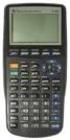 Stats on the TI 83 and TI 84 Calculator Entering the sample values STAT button Left bracket { Right bracket } Store (STO) List L1 Comma Enter Example: Sample data are {5, 10, 15, 20} 1. Press 2 ND and
MATH 10: Elementary Statistics and Probability Chapter 5: Continuous Random Variables
 MATH 10: Elementary Statistics and Probability Chapter 5: Continuous Random Variables Tony Pourmohamad Department of Mathematics De Anza College Spring 2015 Objectives By the end of this set of slides,
4. Continuous Random Variables, the Pareto and Normal Distributions
 4. Continuous Random Variables, the Pareto and Normal Distributions A continuous random variable X can take any value in a given range (e.g. height, weight, age). The distribution of a continuous random
Normal Distribution. Definition A continuous random variable has a normal distribution if its probability density. f ( y ) = 1.
 Normal Distribution Definition A continuous random variable has a normal distribution if its probability density e -(y -µ Y ) 2 2 / 2 σ function can be written as for < y < as Y f ( y ) = 1 σ Y 2 π Notation:
Key Concept. Density Curve
 MAT 155 Statistical Analysis Dr. Claude Moore Cape Fear Community College Chapter 6 Normal Probability Distributions 6 1 Review and Preview 6 2 The Standard Normal Distribution 6 3 Applications of Normal
Week 3&4: Z tables and the Sampling Distribution of X
 Week 3&4: Z tables and the Sampling Distribution of X 2 / 36 The Standard Normal Distribution, or Z Distribution, is the distribution of a random variable, Z N(0, 1 2 ). The distribution of any other normal
Normal distribution. ) 2 /2σ. 2π σ
 Normal distribution The normal distribution is the most widely known and used of all distributions. Because the normal distribution approximates many natural phenomena so well, it has developed into a
6.2 Normal distribution. Standard Normal Distribution:
 6.2 Normal distribution Slide Heights of Adult Men and Women Slide 2 Area= Mean = µ Standard Deviation = σ Donation: X ~ N(µ,σ 2 ) Standard Normal Distribution: Slide 3 Slide 4 a normal probability distribution
STT315 Chapter 4 Random Variables & Probability Distributions KM. Chapter 4.5, 6, 8 Probability Distributions for Continuous Random Variables
 Chapter 4.5, 6, 8 Probability Distributions for Continuous Random Variables Discrete vs. continuous random variables Examples of continuous distributions o Uniform o Exponential o Normal Recall: A random
AP Statistics Solutions to Packet 2
 AP Statistics Solutions to Packet 2 The Normal Distributions Density Curves and the Normal Distribution Standard Normal Calculations HW #9 1, 2, 4, 6-8 2.1 DENSITY CURVES (a) Sketch a density curve that
6 3 The Standard Normal Distribution
 290 Chapter 6 The Normal Distribution Figure 6 5 Areas Under a Normal Distribution Curve 34.13% 34.13% 2.28% 13.59% 13.59% 2.28% 3 2 1 + 1 + 2 + 3 About 68% About 95% About 99.7% 6 3 The Distribution Since
You flip a fair coin four times, what is the probability that you obtain three heads.
 Handout 4: Binomial Distribution Reading Assignment: Chapter 5 In the previous handout, we looked at continuous random variables and calculating probabilities and percentiles for those type of variables.
Chapter 5: Normal Probability Distributions - Solutions
 Chapter 5: Normal Probability Distributions - Solutions Note: All areas and z-scores are approximate. Your answers may vary slightly. 5.2 Normal Distributions: Finding Probabilities If you are given that
6.4 Normal Distribution
 Contents 6.4 Normal Distribution....................... 381 6.4.1 Characteristics of the Normal Distribution....... 381 6.4.2 The Standardized Normal Distribution......... 385 6.4.3 Meaning of Areas under
Math 151. Rumbos Spring 2014 1. Solutions to Assignment #22
 Math 151. Rumbos Spring 2014 1 Solutions to Assignment #22 1. An experiment consists of rolling a die 81 times and computing the average of the numbers on the top face of the die. Estimate the probability
The right edge of the box is the third quartile, Q 3, which is the median of the data values above the median. Maximum Median
 CONDENSED LESSON 2.1 Box Plots In this lesson you will create and interpret box plots for sets of data use the interquartile range (IQR) to identify potential outliers and graph them on a modified box
Probability Distributions
 Learning Objectives Probability Distributions Section 1: How Can We Summarize Possible Outcomes and Their Probabilities? 1. Random variable 2. Probability distributions for discrete random variables 3.
Chapter 1: Looking at Data Section 1.1: Displaying Distributions with Graphs
 Types of Variables Chapter 1: Looking at Data Section 1.1: Displaying Distributions with Graphs Quantitative (numerical)variables: take numerical values for which arithmetic operations make sense (addition/averaging)
Chapter 4. Probability and Probability Distributions
 Chapter 4. robability and robability Distributions Importance of Knowing robability To know whether a sample is not identical to the population from which it was selected, it is necessary to assess the
WHERE DOES THE 10% CONDITION COME FROM?
 1 WHERE DOES THE 10% CONDITION COME FROM? The text has mentioned The 10% Condition (at least) twice so far: p. 407 Bernoulli trials must be independent. If that assumption is violated, it is still okay
Density Curve. A density curve is the graph of a continuous probability distribution. It must satisfy the following properties:
 Density Curve A density curve is the graph of a continuous probability distribution. It must satisfy the following properties: 1. The total area under the curve must equal 1. 2. Every point on the curve
consider the number of math classes taken by math 150 students. how can we represent the results in one number?
 ch 3: numerically summarizing data - center, spread, shape 3.1 measure of central tendency or, give me one number that represents all the data consider the number of math classes taken by math 150 students.
The Normal Distribution. Alan T. Arnholt Department of Mathematical Sciences Appalachian State University
 The Normal Distribution Alan T. Arnholt Department of Mathematical Sciences Appalachian State University [email protected] Spring 2006 R Notes 1 Copyright c 2006 Alan T. Arnholt 2 Continuous Random
AP STATISTICS (Warm-Up Exercises)
 AP STATISTICS (Warm-Up Exercises) 1. Describe the distribution of ages in a city: 2. Graph a box plot on your calculator for the following test scores: {90, 80, 96, 54, 80, 95, 100, 75, 87, 62, 65, 85,
SOLUTIONS: 4.1 Probability Distributions and 4.2 Binomial Distributions
 SOLUTIONS: 4.1 Probability Distributions and 4.2 Binomial Distributions 1. The following table contains a probability distribution for a random variable X. a. Find the expected value (mean) of X. x 1 2
CHAPTER 7 INTRODUCTION TO SAMPLING DISTRIBUTIONS
 CHAPTER 7 INTRODUCTION TO SAMPLING DISTRIBUTIONS CENTRAL LIMIT THEOREM (SECTION 7.2 OF UNDERSTANDABLE STATISTICS) The Central Limit Theorem says that if x is a random variable with any distribution having
Simulation Exercises to Reinforce the Foundations of Statistical Thinking in Online Classes
 Simulation Exercises to Reinforce the Foundations of Statistical Thinking in Online Classes Simcha Pollack, Ph.D. St. John s University Tobin College of Business Queens, NY, 11439 [email protected]
3.2 Measures of Spread
 3.2 Measures of Spread In some data sets the observations are close together, while in others they are more spread out. In addition to measures of the center, it's often important to measure the spread
Chapter 4. iclicker Question 4.4 Pre-lecture. Part 2. Binomial Distribution. J.C. Wang. iclicker Question 4.4 Pre-lecture
 Chapter 4 Part 2. Binomial Distribution J.C. Wang iclicker Question 4.4 Pre-lecture iclicker Question 4.4 Pre-lecture Outline Computing Binomial Probabilities Properties of a Binomial Distribution Computing
The Normal distribution
 The Normal distribution The normal probability distribution is the most common model for relative frequencies of a quantitative variable. Bell-shaped and described by the function f(y) = 1 2σ π e{ 1 2σ
AMS 5 CHANCE VARIABILITY
 AMS 5 CHANCE VARIABILITY The Law of Averages When tossing a fair coin the chances of tails and heads are the same: 50% and 50%. So if the coin is tossed a large number of times, the number of heads and
Exercise 1.12 (Pg. 22-23)
 Individuals: The objects that are described by a set of data. They may be people, animals, things, etc. (Also referred to as Cases or Records) Variables: The characteristics recorded about each individual.
Normal Distribution as an Approximation to the Binomial Distribution
 Chapter 1 Student Lecture Notes 1-1 Normal Distribution as an Approximation to the Binomial Distribution : Goals ONE TWO THREE 2 Review Binomial Probability Distribution applies to a discrete random variable
The normal approximation to the binomial
 The normal approximation to the binomial The binomial probability function is not useful for calculating probabilities when the number of trials n is large, as it involves multiplying a potentially very
z-scores AND THE NORMAL CURVE MODEL
 z-scores AND THE NORMAL CURVE MODEL 1 Understanding z-scores 2 z-scores A z-score is a location on the distribution. A z- score also automatically communicates the raw score s distance from the mean A
Measures of Central Tendency and Variability: Summarizing your Data for Others
 Measures of Central Tendency and Variability: Summarizing your Data for Others 1 I. Measures of Central Tendency: -Allow us to summarize an entire data set with a single value (the midpoint). 1. Mode :
Normal Probability Distribution
 Normal Probability Distribution The Normal Distribution functions: #1: normalpdf pdf = Probability Density Function This function returns the probability of a single value of the random variable x. Use
Capital Market Theory: An Overview. Return Measures
 Capital Market Theory: An Overview (Text reference: Chapter 9) Topics return measures measuring index returns (not in text) holding period returns return statistics risk statistics AFM 271 - Capital Market
Calculating P-Values. Parkland College. Isela Guerra Parkland College. Recommended Citation
 Parkland College A with Honors Projects Honors Program 2014 Calculating P-Values Isela Guerra Parkland College Recommended Citation Guerra, Isela, "Calculating P-Values" (2014). A with Honors Projects.
5/31/2013. 6.1 Normal Distributions. Normal Distributions. Chapter 6. Distribution. The Normal Distribution. Outline. Objectives.
 The Normal Distribution C H 6A P T E R The Normal Distribution Outline 6 1 6 2 Applications of the Normal Distribution 6 3 The Central Limit Theorem 6 4 The Normal Approximation to the Binomial Distribution
The Binomial Probability Distribution
 The Binomial Probability Distribution MATH 130, Elements of Statistics I J. Robert Buchanan Department of Mathematics Fall 2015 Objectives After this lesson we will be able to: determine whether a probability
5.1 Identifying the Target Parameter
 University of California, Davis Department of Statistics Summer Session II Statistics 13 August 20, 2012 Date of latest update: August 20 Lecture 5: Estimation with Confidence intervals 5.1 Identifying
The normal approximation to the binomial
 The normal approximation to the binomial In order for a continuous distribution (like the normal) to be used to approximate a discrete one (like the binomial), a continuity correction should be used. There
Notes on Continuous Random Variables
 Notes on Continuous Random Variables Continuous random variables are random quantities that are measured on a continuous scale. They can usually take on any value over some interval, which distinguishes
The Standard Normal distribution
 The Standard Normal distribution 21.2 Introduction Mass-produced items should conform to a specification. Usually, a mean is aimed for but due to random errors in the production process we set a tolerance
Lecture 5 : The Poisson Distribution
 Lecture 5 : The Poisson Distribution Jonathan Marchini November 10, 2008 1 Introduction Many experimental situations occur in which we observe the counts of events within a set unit of time, area, volume,
Interpreting Data in Normal Distributions
 Interpreting Data in Normal Distributions This curve is kind of a big deal. It shows the distribution of a set of test scores, the results of rolling a die a million times, the heights of people on Earth,
Chapter 7 - Practice Problems 1
 Chapter 7 - Practice Problems 1 SHORT ANSWER. Write the word or phrase that best completes each statement or answers the question. Provide an appropriate response. 1) Define a point estimate. What is the
Variables. Exploratory Data Analysis
 Exploratory Data Analysis Exploratory Data Analysis involves both graphical displays of data and numerical summaries of data. A common situation is for a data set to be represented as a matrix. There is
Ch. 3.1 # 3, 4, 7, 30, 31, 32
 Math Elementary Statistics: A Brief Version, 5/e Bluman Ch. 3. # 3, 4,, 30, 3, 3 Find (a) the mean, (b) the median, (c) the mode, and (d) the midrange. 3) High Temperatures The reported high temperatures
Exact Confidence Intervals
 Math 541: Statistical Theory II Instructor: Songfeng Zheng Exact Confidence Intervals Confidence intervals provide an alternative to using an estimator ˆθ when we wish to estimate an unknown parameter
4.1 4.2 Probability Distribution for Discrete Random Variables
 4.1 4.2 Probability Distribution for Discrete Random Variables Key concepts: discrete random variable, probability distribution, expected value, variance, and standard deviation of a discrete random variable.
Descriptive Statistics. Purpose of descriptive statistics Frequency distributions Measures of central tendency Measures of dispersion
 Descriptive Statistics Purpose of descriptive statistics Frequency distributions Measures of central tendency Measures of dispersion Statistics as a Tool for LIS Research Importance of statistics in research
An Introduction to Basic Statistics and Probability
 An Introduction to Basic Statistics and Probability Shenek Heyward NCSU An Introduction to Basic Statistics and Probability p. 1/4 Outline Basic probability concepts Conditional probability Discrete Random
Sampling Distributions
 Sampling Distributions You have seen probability distributions of various types. The normal distribution is an example of a continuous distribution that is often used for quantitative measures such as
Continuous Random Variables
 Chapter 5 Continuous Random Variables 5.1 Continuous Random Variables 1 5.1.1 Student Learning Objectives By the end of this chapter, the student should be able to: Recognize and understand continuous
Standard Deviation Estimator
 CSS.com Chapter 905 Standard Deviation Estimator Introduction Even though it is not of primary interest, an estimate of the standard deviation (SD) is needed when calculating the power or sample size of
Exploratory Data Analysis. Psychology 3256
 Exploratory Data Analysis Psychology 3256 1 Introduction If you are going to find out anything about a data set you must first understand the data Basically getting a feel for you numbers Easier to find
CALCULATIONS & STATISTICS
 CALCULATIONS & STATISTICS CALCULATION OF SCORES Conversion of 1-5 scale to 0-100 scores When you look at your report, you will notice that the scores are reported on a 0-100 scale, even though respondents
Descriptive Statistics
 Y520 Robert S Michael Goal: Learn to calculate indicators and construct graphs that summarize and describe a large quantity of values. Using the textbook readings and other resources listed on the web
WISE Sampling Distribution of the Mean Tutorial
 Name Date Class WISE Sampling Distribution of the Mean Tutorial Exercise 1: How accurate is a sample mean? Overview A friend of yours developed a scale to measure Life Satisfaction. For the population
Department of Civil Engineering-I.I.T. Delhi CEL 899: Environmental Risk Assessment Statistics and Probability Example Part 1
 Department of Civil Engineering-I.I.T. Delhi CEL 899: Environmental Risk Assessment Statistics and Probability Example Part Note: Assume missing data (if any) and mention the same. Q. Suppose X has a normal
Statistics 104: Section 6!
 Page 1 Statistics 104: Section 6! TF: Deirdre (say: Dear-dra) Bloome Email: [email protected] Section Times Thursday 2pm-3pm in SC 109, Thursday 5pm-6pm in SC 705 Office Hours: Thursday 6pm-7pm SC
Lecture 8. Confidence intervals and the central limit theorem
 Lecture 8. Confidence intervals and the central limit theorem Mathematical Statistics and Discrete Mathematics November 25th, 2015 1 / 15 Central limit theorem Let X 1, X 2,... X n be a random sample of
Lecture 6: Discrete & Continuous Probability and Random Variables
 Lecture 6: Discrete & Continuous Probability and Random Variables D. Alex Hughes Math Camp September 17, 2015 D. Alex Hughes (Math Camp) Lecture 6: Discrete & Continuous Probability and Random September
Summary of Formulas and Concepts. Descriptive Statistics (Ch. 1-4)
 Summary of Formulas and Concepts Descriptive Statistics (Ch. 1-4) Definitions Population: The complete set of numerical information on a particular quantity in which an investigator is interested. We assume
MEASURES OF VARIATION
 NORMAL DISTRIBTIONS MEASURES OF VARIATION In statistics, it is important to measure the spread of data. A simple way to measure spread is to find the range. But statisticians want to know if the data are
9. Sampling Distributions
 9. Sampling Distributions Prerequisites none A. Introduction B. Sampling Distribution of the Mean C. Sampling Distribution of Difference Between Means D. Sampling Distribution of Pearson's r E. Sampling
Lesson 20. Probability and Cumulative Distribution Functions
 Lesson 20 Probability and Cumulative Distribution Functions Recall If p(x) is a density function for some characteristic of a population, then Recall If p(x) is a density function for some characteristic
12.5: CHI-SQUARE GOODNESS OF FIT TESTS
 125: Chi-Square Goodness of Fit Tests CD12-1 125: CHI-SQUARE GOODNESS OF FIT TESTS In this section, the χ 2 distribution is used for testing the goodness of fit of a set of data to a specific probability
Lecture 2: Descriptive Statistics and Exploratory Data Analysis
 Lecture 2: Descriptive Statistics and Exploratory Data Analysis Further Thoughts on Experimental Design 16 Individuals (8 each from two populations) with replicates Pop 1 Pop 2 Randomly sample 4 individuals
Chicago Booth BUSINESS STATISTICS 41000 Final Exam Fall 2011
 Chicago Booth BUSINESS STATISTICS 41000 Final Exam Fall 2011 Name: Section: I pledge my honor that I have not violated the Honor Code Signature: This exam has 34 pages. You have 3 hours to complete this
Introduction; Descriptive & Univariate Statistics
 Introduction; Descriptive & Univariate Statistics I. KEY COCEPTS A. Population. Definitions:. The entire set of members in a group. EXAMPLES: All U.S. citizens; all otre Dame Students. 2. All values of
Lecture 1: Review and Exploratory Data Analysis (EDA)
 Lecture 1: Review and Exploratory Data Analysis (EDA) Sandy Eckel [email protected] Department of Biostatistics, The Johns Hopkins University, Baltimore USA 21 April 2008 1 / 40 Course Information I Course
MULTIPLE CHOICE. Choose the one alternative that best completes the statement or answers the question. A) 0.4987 B) 0.9987 C) 0.0010 D) 0.
 Ch. 5 Normal Probability Distributions 5.1 Introduction to Normal Distributions and the Standard Normal Distribution 1 Find Areas Under the Standard Normal Curve 1) Find the area under the standard normal
STAT 200 QUIZ 2 Solutions Section 6380 Fall 2013
 STAT 200 QUIZ 2 Solutions Section 6380 Fall 2013 The quiz covers Chapters 4, 5 and 6. 1. (8 points) If the IQ scores are normally distributed with a mean of 100 and a standard deviation of 15. (a) (3 pts)
MATH 140 Lab 4: Probability and the Standard Normal Distribution
 MATH 140 Lab 4: Probability and the Standard Normal Distribution Problem 1. Flipping a Coin Problem In this problem, we want to simualte the process of flipping a fair coin 1000 times. Note that the outcomes
TEACHER NOTES MATH NSPIRED
 Math Objectives Students will understand that normal distributions can be used to approximate binomial distributions whenever both np and n(1 p) are sufficiently large. Students will understand that when
Probability and Statistics Prof. Dr. Somesh Kumar Department of Mathematics Indian Institute of Technology, Kharagpur
 Probability and Statistics Prof. Dr. Somesh Kumar Department of Mathematics Indian Institute of Technology, Kharagpur Module No. #01 Lecture No. #15 Special Distributions-VI Today, I am going to introduce
Descriptive Statistics
 Descriptive Statistics Suppose following data have been collected (heights of 99 five-year-old boys) 117.9 11.2 112.9 115.9 18. 14.6 17.1 117.9 111.8 16.3 111. 1.4 112.1 19.2 11. 15.4 99.4 11.1 13.3 16.9
Lesson 7 Z-Scores and Probability
 Lesson 7 Z-Scores and Probability Outline Introduction Areas Under the Normal Curve Using the Z-table Converting Z-score to area -area less than z/area greater than z/area between two z-values Converting
Exploratory Data Analysis
 Exploratory Data Analysis Johannes Schauer [email protected] Institute of Statistics Graz University of Technology Steyrergasse 17/IV, 8010 Graz www.statistics.tugraz.at February 12, 2008 Introduction
Psychology 60 Fall 2013 Practice Exam Actual Exam: Next Monday. Good luck!
 Psychology 60 Fall 2013 Practice Exam Actual Exam: Next Monday. Good luck! Name: 1. The basic idea behind hypothesis testing: A. is important only if you want to compare two populations. B. depends on
Joint Exam 1/P Sample Exam 1
 Joint Exam 1/P Sample Exam 1 Take this practice exam under strict exam conditions: Set a timer for 3 hours; Do not stop the timer for restroom breaks; Do not look at your notes. If you believe a question
EXAM #1 (Example) Instructor: Ela Jackiewicz. Relax and good luck!
 STP 231 EXAM #1 (Example) Instructor: Ela Jackiewicz Honor Statement: I have neither given nor received information regarding this exam, and I will not do so until all exams have been graded and returned.
Unbeknownst to us, the entire population consists of 5 cloned sheep with ages 10, 11, 12, 13, 14 months.
 Activity #14: Sampling distributions and the Central Limit Theorem So far, this unit has focused on distributions of discrete and continuous random variables. In this activity, we ll investigate sampling
Midterm Review Problems
 Midterm Review Problems October 19, 2013 1. Consider the following research title: Cooperation among nursery school children under two types of instruction. In this study, what is the independent variable?
Practice#1(chapter1,2) Name
 Practice#1(chapter1,2) Name Solve the problem. 1) The average age of the students in a statistics class is 22 years. Does this statement describe descriptive or inferential statistics? A) inferential statistics
Means, standard deviations and. and standard errors
 CHAPTER 4 Means, standard deviations and standard errors 4.1 Introduction Change of units 4.2 Mean, median and mode Coefficient of variation 4.3 Measures of variation 4.4 Calculating the mean and standard
Lecture Notes Module 1
 Lecture Notes Module 1 Study Populations A study population is a clearly defined collection of people, animals, plants, or objects. In psychological research, a study population usually consists of a specific
7. Normal Distributions
 7. Normal Distributions A. Introduction B. History C. Areas of Normal Distributions D. Standard Normal E. Exercises Most of the statistical analyses presented in this book are based on the bell-shaped
Probability Distributions
 CHAPTER 5 Probability Distributions CHAPTER OUTLINE 5.1 Probability Distribution of a Discrete Random Variable 5.2 Mean and Standard Deviation of a Probability Distribution 5.3 The Binomial Distribution
Grade Level Year Total Points Core Points % At Standard 9 2003 10 5 7 %
 Performance Assessment Task Number Towers Grade 9 The task challenges a student to demonstrate understanding of the concepts of algebraic properties and representations. A student must make sense of the
Descriptive Statistics and Measurement Scales
 Descriptive Statistics 1 Descriptive Statistics and Measurement Scales Descriptive statistics are used to describe the basic features of the data in a study. They provide simple summaries about the sample
Introduction to the Practice of Statistics Fifth Edition Moore, McCabe
 Introduction to the Practice of Statistics Fifth Edition Moore, McCabe Section 5.1 Homework Answers 5.7 In the proofreading setting if Exercise 5.3, what is the smallest number of misses m with P(X m)
MBA 611 STATISTICS AND QUANTITATIVE METHODS
 MBA 611 STATISTICS AND QUANTITATIVE METHODS Part I. Review of Basic Statistics (Chapters 1-11) A. Introduction (Chapter 1) Uncertainty: Decisions are often based on incomplete information from uncertain
Lecture 2: Discrete Distributions, Normal Distributions. Chapter 1
 Lecture 2: Discrete Distributions, Normal Distributions Chapter 1 Reminders Course website: www. stat.purdue.edu/~xuanyaoh/stat350 Office Hour: Mon 3:30-4:30, Wed 4-5 Bring a calculator, and copy Tables