
Descriptive Statistics
|
|
|
- Brent Neal
- 9 years ago
- Views:
Transcription
1 Y520 Robert S Michael Goal: Learn to calculate indicators and construct graphs that summarize and describe a large quantity of values. Using the textbook readings and other resources listed on the web site, be sure you can define, know when to use, calculate (with Spss), and interpret the following: I. Indicators of Central Tendency A. Mode B. Median C. Mean II. Indicators of Dispersion A. Range B. Interquartile Range C. Variance D. Standard Deviation III. Graphic Presentation and Summarization A. Sort raw data B. Frequency table C. Reduce raw data to categories D. Cumulative frequencies & percentiles E. Histograms IV. Exploratory Data Analysis A. Box and whisker plot B. Stem and leaf display Page 1 of 12
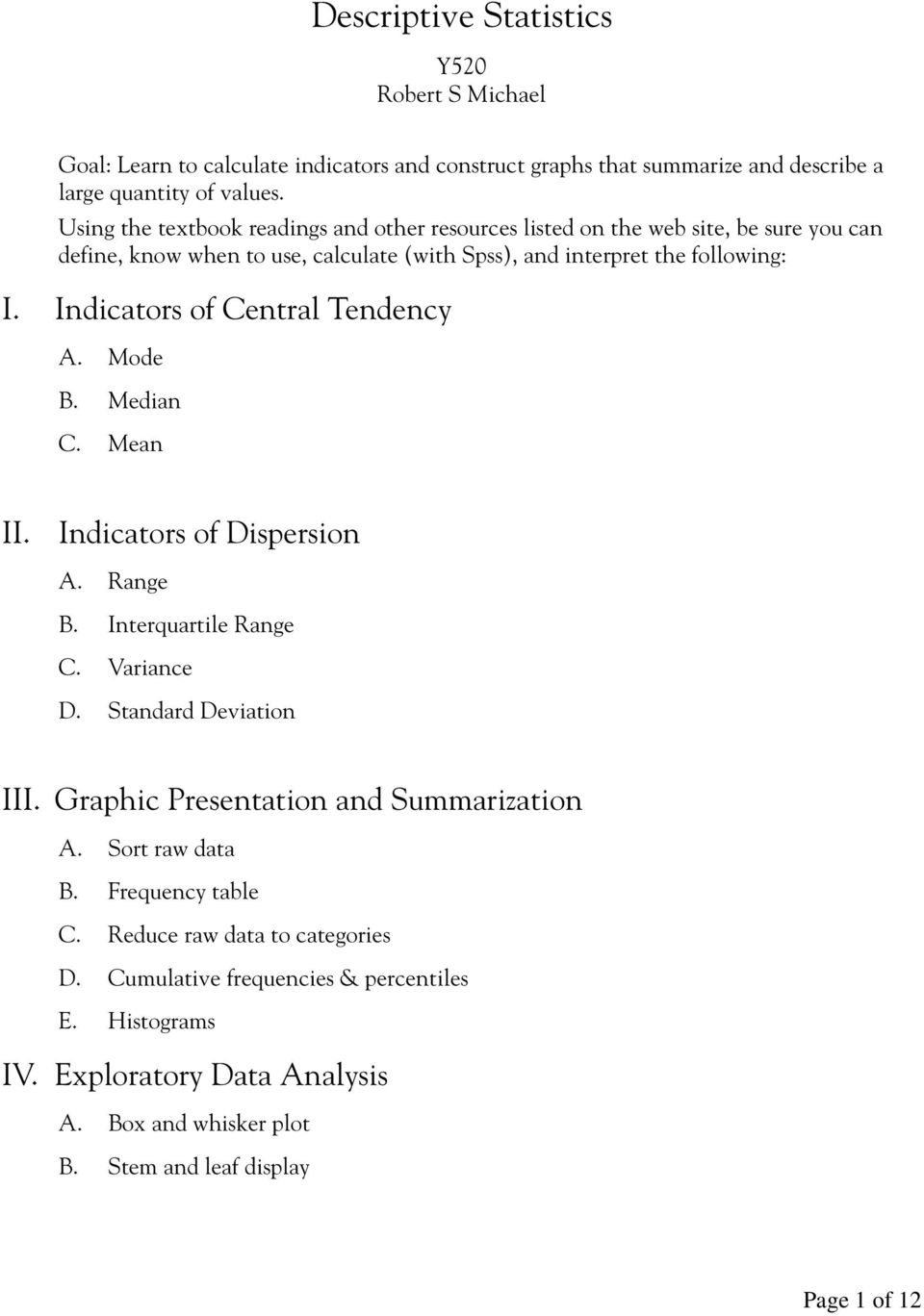
2 Displaying the Shape of the Distribution Goal: Determine how closely does the shape of the distribution approximates a Gaussian distribution. Parametic statistical tests the kind we will study next assume the data do indeed approximate a Gaussian distribution. V. Indicators of a Gaussian distribution A. Mean = Median = Mode B. Skewness: = -- Σ measures the asymmetry of the distribution. A value of n s zero indicates no skewness is present. The larger the value the more skewed the distribution. Negative skew indicates the tail of the distribution is to the left, with most of the scores clustering at the higher end of the scale. Positive skew indicates the scores cluster at the low end of the scale and the tail extends to the right. b 1 1 C. Kurtosis: = -- Σ indicates the flatness of the distribution. 1 b 2 n 1. Mesokutric: = 3 2. Platykurtic: < 3 3. Leptokurtic > 3 D. Graphs 1. Ogive 2. Normal Probability Plots E. Statistical Tests 1. Chi Square VI. Resistant indicators x i x 3 x i x 4 s A. Central Tendency In certain data sets some observed values lie far way from the clump of the data values. These outliers or extreme scores, may be due to measurement errors, data recording errors, or may represent valid data points. Extreme scores influence unduly the mean and standard deviation. Suppose for example, that the mean annual salary in this class is $59,000. Now, imagine that for some reason Bill Gates decides to join our class. When we include his, say, $10,000,000 annual salary, we are now all millionaires, for the class mean is now $x,xxx,xxx. The mean is no longer descriptive of the average, for the mean is not resistant to extreme scores. Hence, use the median instead. The median is not influenced Page 2 of 12
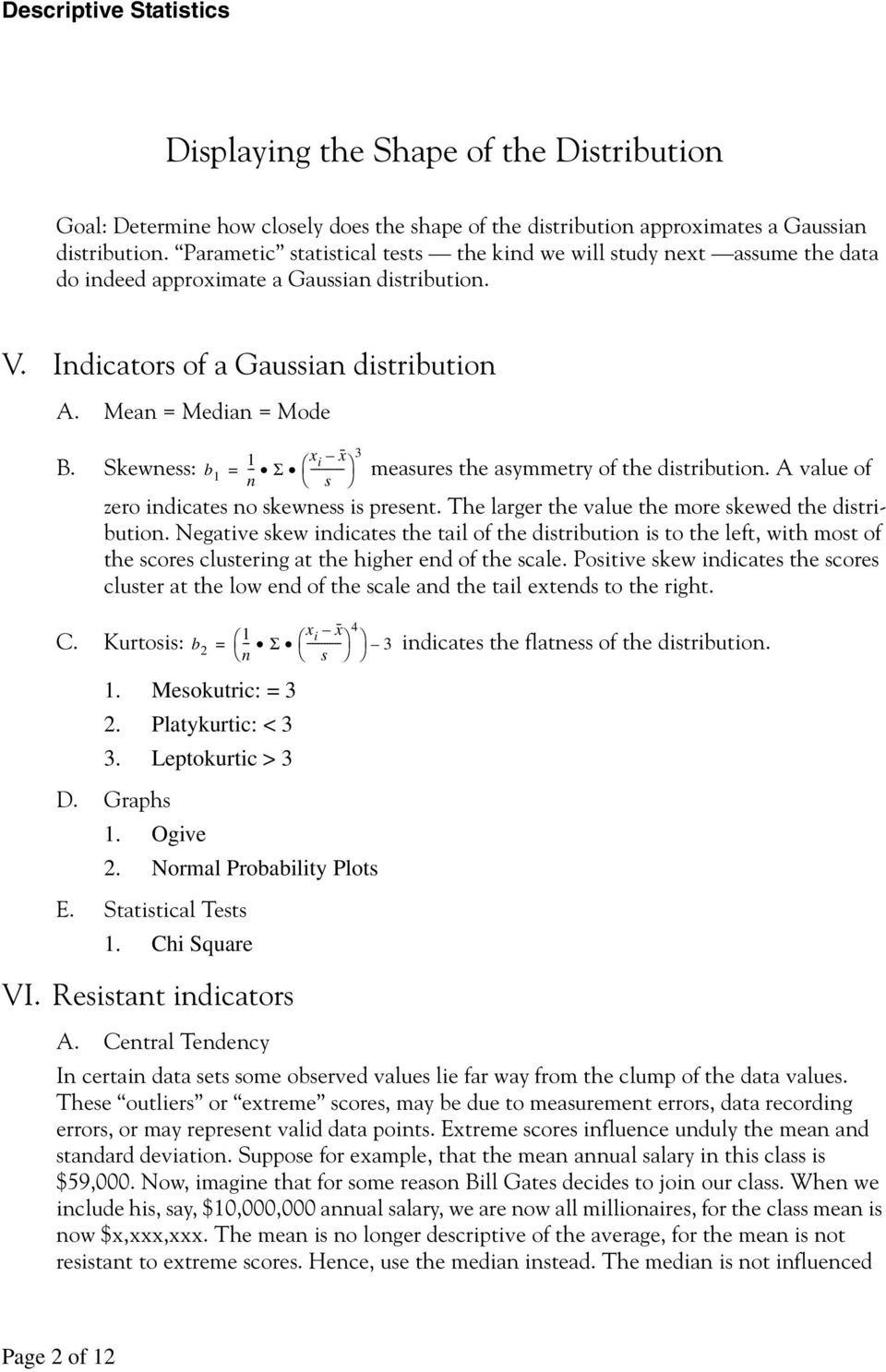
3 by the exact value of the largest score (or value) and thus is a more resistant measure of central tendency. B. Dispersion. The range, clearly, is not resistant to the influence of extreme scores. Because each value in a distribution is included in the calculation of the variance and standard deviation, neither is resistant to extreme values. The interquartile range, because it is based on percentiles, is resistant to extreme scores. The lower quartile is the value such that 25 percent of all values fall below that value. The upper quartile is the value at which 25 percent of all values fall above it. The interquartile range is the difference between the upper and lower quartiles. In a large sample that approximates the Gaussian distribution, the interquartile range tends to be 1.34 times the sample standard deviation. C. Shape of the distribution Resistent indicators of skewness and kurtosis also exist, such as the Yule-Kendall x skewness statistic defined as: ϒYK 0.25 ( 2x x 0.75 ) = x0.75 x 0.25 Other resistant indicators exist based on all the quantities such as L-moments but these are not included in an introductory discussion. Page 3 of 12
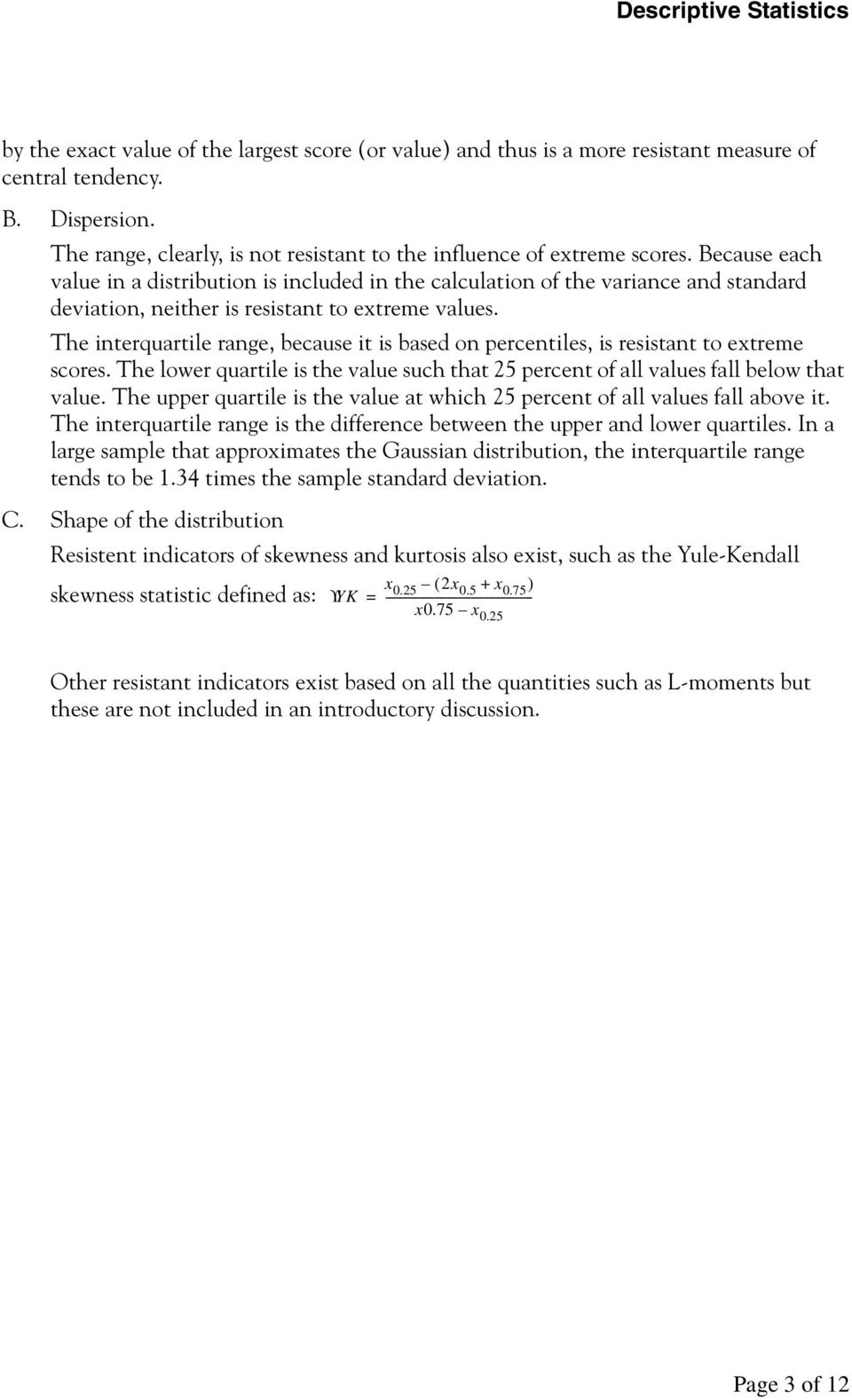
4 Calculation of Mean and Standard Deviation Sample of 10 Scores from P102 Exam Person Score (x) (x-m) (x-m) 2 A B C D E F G H I J sum = 901 sum -> 1,005 mean = 90.1 variance -> standard deviation -> skewness = kurtosis = Note that the mean is the arithmetic average. The column labelled (x-m) shows the amount by which each score deviates from the mean. This column will always sum to zero. The column labelled (x-m) 2 is also known as the sum of the squared deviations about the mean, or just as sum of squares. The variance is the average of the sum of squares Σ( x M) n 1. and the standard deviation is the square root of the variance Σx i n Σ( x M) 2 n 1 To illustrate the impact of an extreme score, the instructor realizes that for student A, the score of 67 was mistakenly entered. In actuality, student A earned a score ot 57. Note the changes in the descriptive statistics when this single change is made. Page 4 of 12

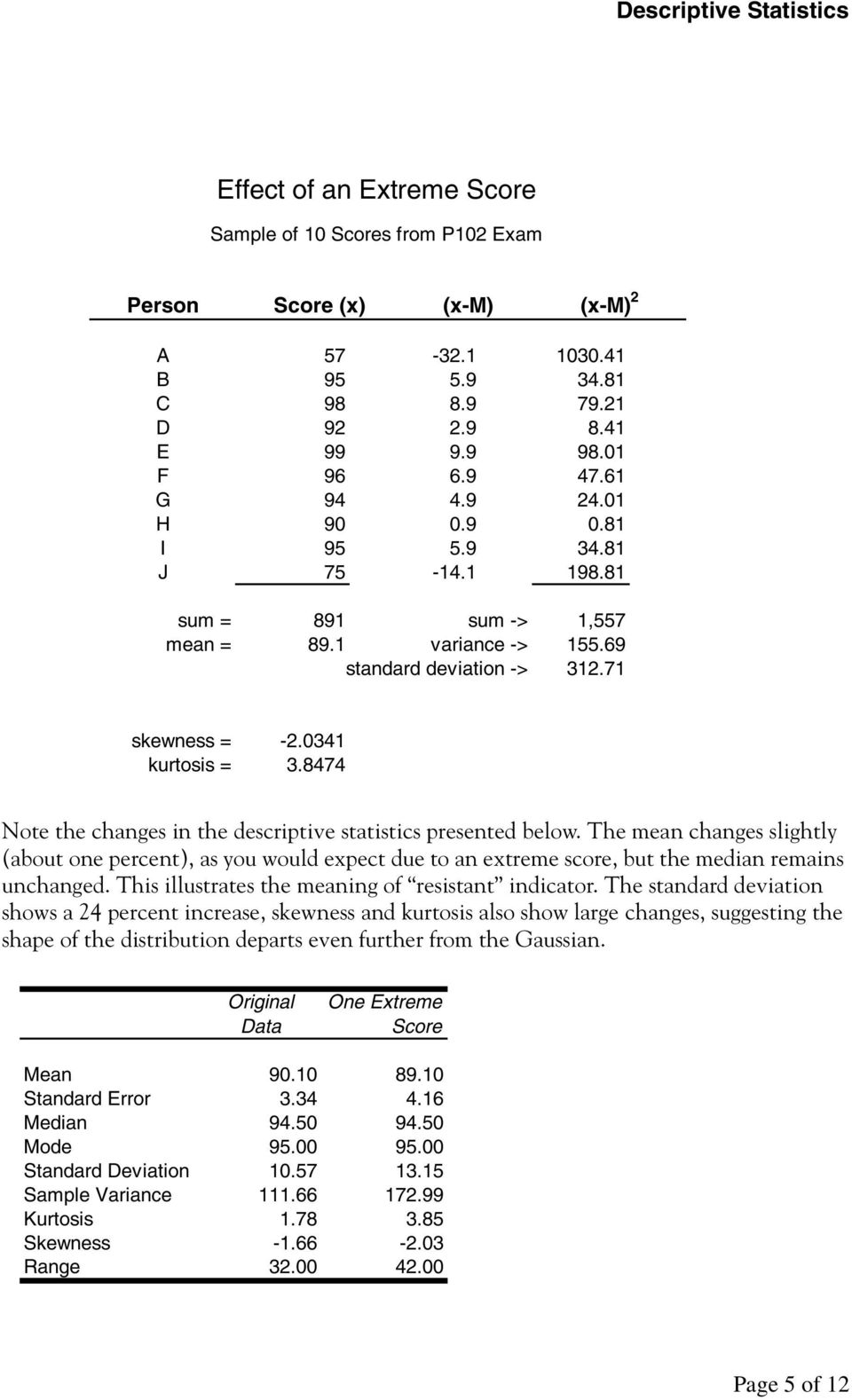
5 Effect of an Extreme Score Sample of 10 Scores from P102 Exam Person Score (x) (x-m) (x-m) 2 A B C D E F G H I J sum = 891 sum -> 1,557 mean = 89.1 variance -> standard deviation -> skewness = kurtosis = Note the changes in the descriptive statistics presented below. The mean changes slightly (about one percent), as you would expect due to an extreme score, but the median remains unchanged. This illustrates the meaning of resistant indicator. The standard deviation shows a 24 percent increase, skewness and kurtosis also show large changes, suggesting the shape of the distribution departs even further from the Gaussian. Original Data One Extreme Score Mean Standard Error Median Mode Standard Deviation Sample Variance Kurtosis Skewness Range Page 5 of 12
6 Here is how skewness is calculated by hand for a different set of data: Skewness 1. List Raw Scores in a column 2. Subtract Mean from each Raw Score. Aka, Deviations from the mean 3. Raise each of these deviations from the mean to the third power and sum. Aka: Sum of third moment deviations 4. Calculate skewness, which is the sum of the deviations from the mean, raise to the third power, divided by number of cases minus 1, times the standard deviation raised to the third power. y (y - M) (y - M) sum = y = sum = deviations 3 mean = (y)/n = M = (n-1) stdev 3 st dev = var = skewness Calculating Skewness: 1. First, calculate the mean and standard deviation 2. Subtract the mean from each raw score and cube (i.e., raise to the third power) 3. Sum the cubed deviations. 4. Multiply the number of scores minus 1 times the cubed standard deviation (i.e., raised to the third power). 5. Skewness = step 3 divided by step 4 Page 6 of 12
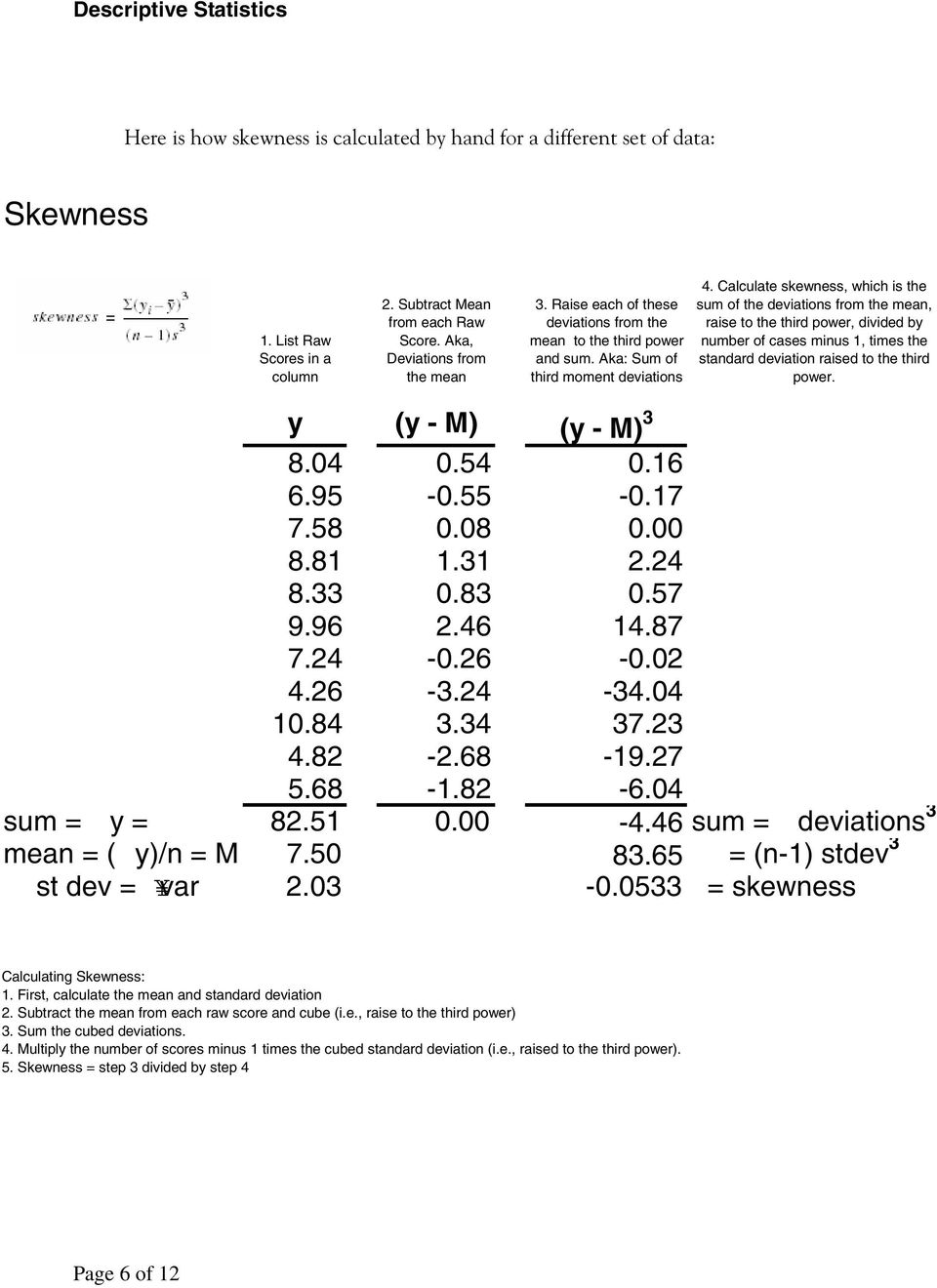
7 Keep in mind that if a distribution is positively skewed, the bulk of the values clump around the lower end of the scale with a few trialing off at the high end. Conversely, in a negatively skewed distribution, the bulk of the values clump around or near the high end of the scale with a few values trailing off at the low end. The following table summarizes the descriptive statistics for the P102 sample. Table 1: Summary Statistics for P102 Exam Data Statistic Symbol Value Comment sample size n 10 number of cases/individuals mean x 90.1 non-resistant measure of location standard deviation non-resistant measure of dispersion range 32 non-resistant measure of scale x max s x skewness non-resistant measure of skewness b 1 x min kurtosis 1.78 non-resistant measure of kurtosis b 2 median 94.5 resistant measure of location x 0, 5 interquartile range resistant measure of dispersion x 0.75 x 0.25 Yule-Kendall ϒYK resistant measure of skewness Page 7 of 12
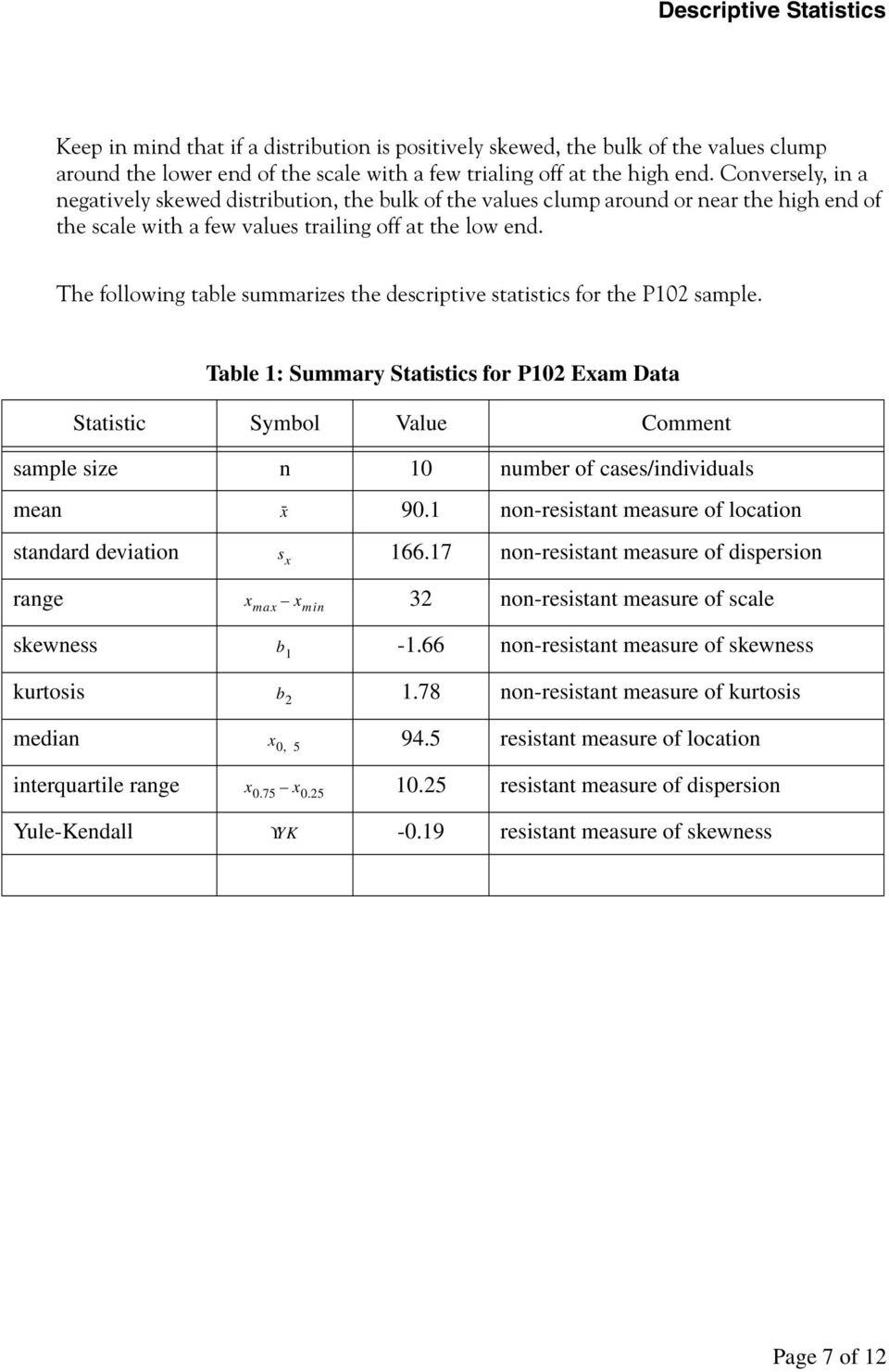
8 4 sd 3 sd 2 sd 1 sd mean 1 sd 2 sd 3 sd 4 sd The equation for the Gaussian curve is y = x µ) ( 1 2σ e σ 2π. where: y = The height of the curve at a given value of x σ π = The standard deviation of the distribution. = A constant (pi) of approximately x = A specific score within the distribution. e = The base of the Napierian logarithms, approximately µ σ 2 = The mean of the distribution. = The variance of the distribution. Page 8 of 12
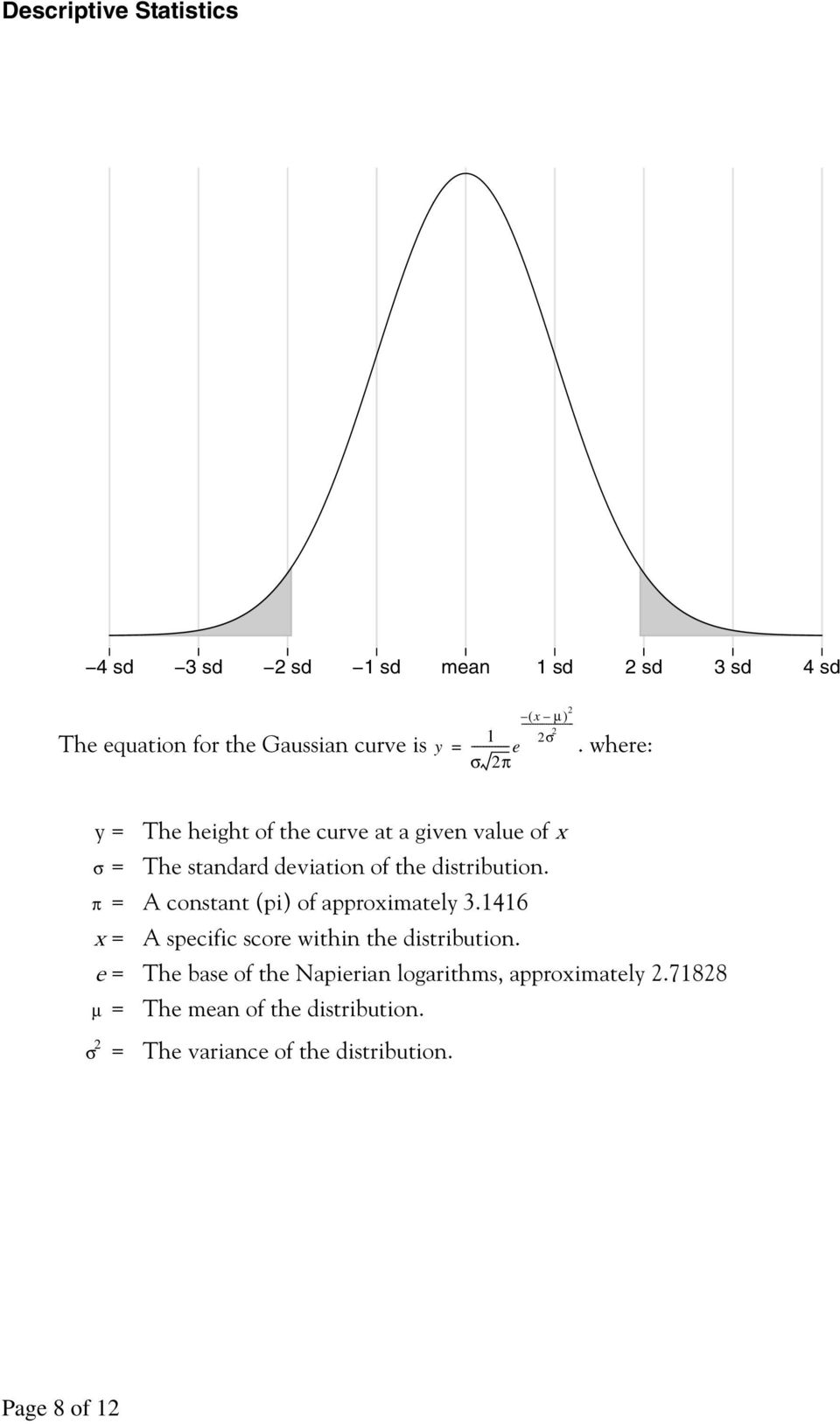
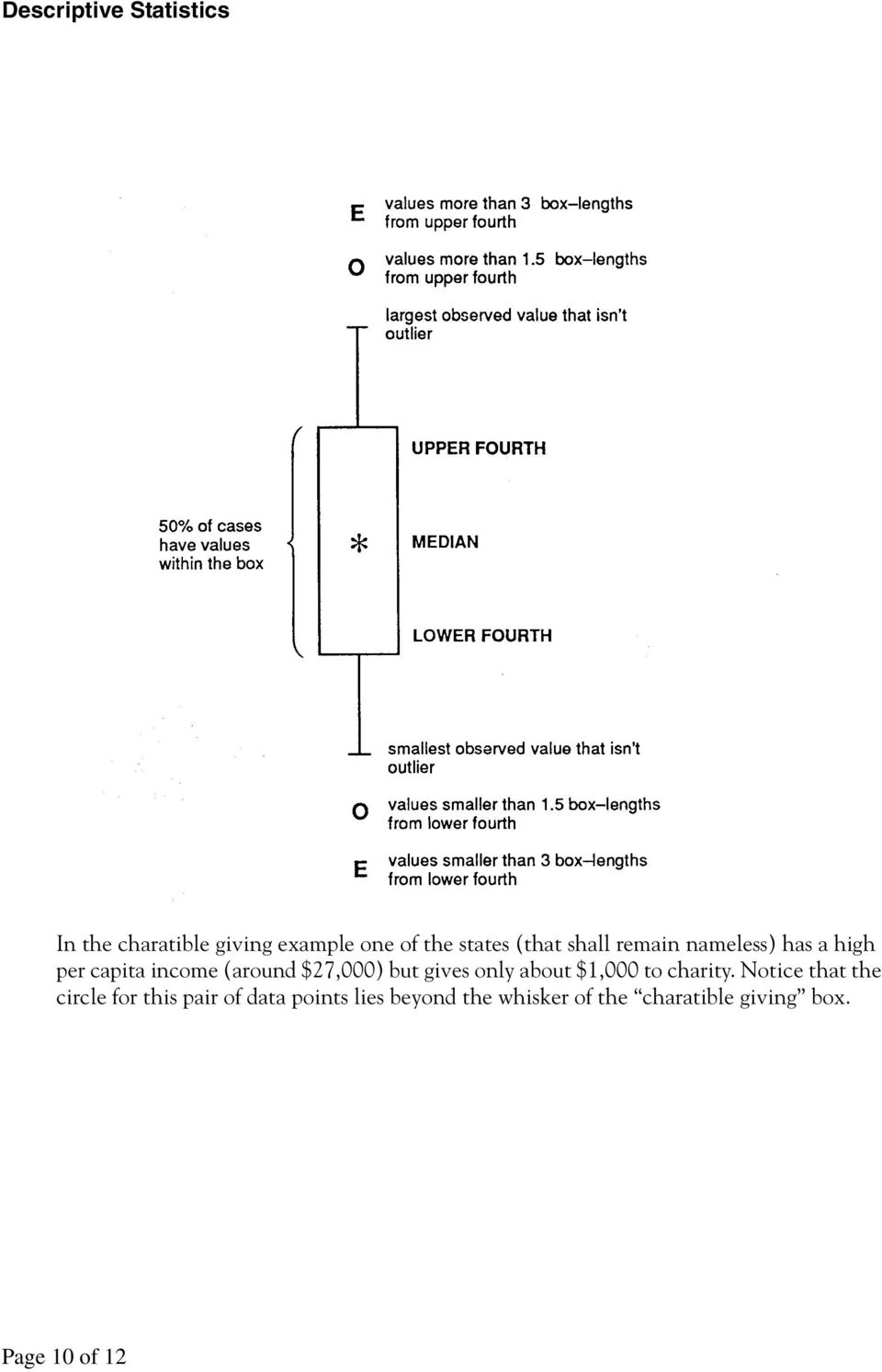
9 Box Plots Box plots are useful in visualizing distributions. Consider the following scattergram of per capita income for each of the 50 states (y axis) with charitable deductions (x axis) listed on 1998 itemized tax returns. 30,000 Per Capita Income 25,000 20,000 15, ,000 4,000 6,000 Charitable Giving An explanation of the box plot appears on the following page. The line or asterisk within the box is the median of the distribution. Fifty percent of the cases fall with the upper and lower hinges (the box boundaries). The upper hinge occurs at the 75 th percentile, which is the third quartile, which corresponds to a z-score of.68. As discussed earlier, the median occurs at the 50 th percentile, which is the second quartile and corresponds to a z-score of zero. The lower hinge occurs at the 25 th percentile, which is the first quartile and corresponds to a z-score of.68. The whiskers terminate at the largest and smallest values that are not considered to be outliers. The definitions for outlier and extreme scores may vary depending on the software program. A common definition for outlier is any value 1.5 box-lengths above or below the upper and lower hinges, and for extreme scores, any value more than 3 box-lengths above or below the upper or lower hinges respectively. Page 9 of 12
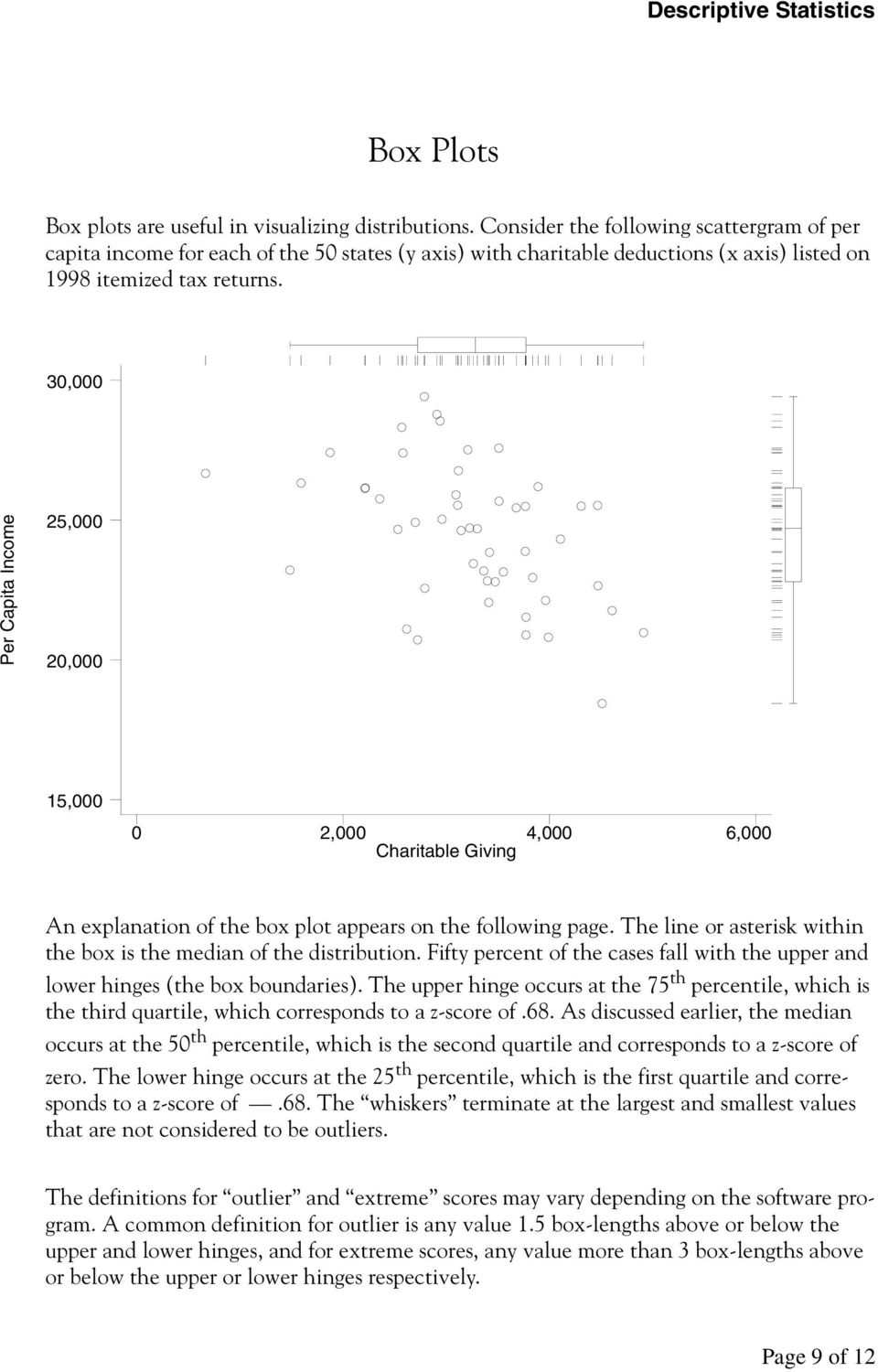
10 In the charatible giving example one of the states (that shall remain nameless) has a high per capita income (around $27,000) but gives only about $1,000 to charity. Notice that the circle for this pair of data points lies beyond the whisker of the charatible giving box. Page 10 of 12
11 Stem and Leaf Another useful data display is know as the stem and leaf. This is a simple way of displaying the distribution of data without having to use computer graphics. The characteristic that makes the stem and left unique is that very value in the data set is displayed. The stem and leaf plot groups the values in a data set according to their all but least significant digits. These are written in ascending or descending order to the left side of a vertical bar and are know as the stem. The leaves are formed by writing the least significant digit to the right of the vertical bar, on the same line as the more significant digits with which it belongs. The stem and leaf plot below shows the charitable giving for 100 individuals. We can see that least amout one person gave was $1,082 while the most one person gave was $5,779. Further, we can see that in the $4,000 range, the following exact values were given: $4,018, $4,057, $4,073, $4, $4,814. The stem and leaf with vary slightly in appearance depending on the specific software used. Some programs enable you to examine the leaves in detail, by reporting the number of cases, the spread, the value of the lower and upper hinges, etc. 1*** 082 1*** 303 1*** 1*** 785 1*** 870,976,985 2*** 012,040,116 2*** 212,242,256,296,308 2*** 448,482,511,511,530,560 2*** 609,632,686,718,740,785 2*** 806,829,833,871,885,899,951,963 3*** 001,010,015,028,030,088,164,170,171,178 3*** 225,229,237,277,310,358,385,392 3*** 413,414,439,450,450,502,519,594 3*** 615,633,638,654,682,738,761 3*** 813,813,820,834,860,872,897,914,918,955,994 4*** 018,057,073,095,154,192 4*** 238,271,342,377,379,387 4*** 425,426,494,545 4*** 4*** 814 5*** 009 5*** 273,379 5*** 501 5*** 779 Page 11 of 12

12 Histogram The range of values is divided into a finite set of class intervals known as bins. The number of values in each bin is then counted and divided by the sample size to obtain frequency of occurrence. The frequency is plotted as vertical bars of varying height. Some programs allow the user to set the number of bins that appear. The frequencies can be divided by the bin width to obtain frequency densities that can be compared to probability densities from a theoretical distribution, such as the Gaussian distribution. For example, the Gaussian probability density function is superimposed on the frequency histogram of the charitable giving of 100 individuals Frequency ,000 4,000 6,000 Charitable Giving Page 12 of 12
Lesson 4 Measures of Central Tendency
 Outline Measures of a distribution s shape -modality and skewness -the normal distribution Measures of central tendency -mean, median, and mode Skewness and Central Tendency Lesson 4 Measures of Central
Descriptive statistics Statistical inference statistical inference, statistical induction and inferential statistics
 Descriptive statistics is the discipline of quantitatively describing the main features of a collection of data. Descriptive statistics are distinguished from inferential statistics (or inductive statistics),
Descriptive Statistics. Purpose of descriptive statistics Frequency distributions Measures of central tendency Measures of dispersion
 Descriptive Statistics Purpose of descriptive statistics Frequency distributions Measures of central tendency Measures of dispersion Statistics as a Tool for LIS Research Importance of statistics in research
STATS8: Introduction to Biostatistics. Data Exploration. Babak Shahbaba Department of Statistics, UCI
 STATS8: Introduction to Biostatistics Data Exploration Babak Shahbaba Department of Statistics, UCI Introduction After clearly defining the scientific problem, selecting a set of representative members
consider the number of math classes taken by math 150 students. how can we represent the results in one number?
 ch 3: numerically summarizing data - center, spread, shape 3.1 measure of central tendency or, give me one number that represents all the data consider the number of math classes taken by math 150 students.
Exercise 1.12 (Pg. 22-23)
 Individuals: The objects that are described by a set of data. They may be people, animals, things, etc. (Also referred to as Cases or Records) Variables: The characteristics recorded about each individual.
DESCRIPTIVE STATISTICS. The purpose of statistics is to condense raw data to make it easier to answer specific questions; test hypotheses.
 DESCRIPTIVE STATISTICS The purpose of statistics is to condense raw data to make it easier to answer specific questions; test hypotheses. DESCRIPTIVE VS. INFERENTIAL STATISTICS Descriptive To organize,
Biostatistics: DESCRIPTIVE STATISTICS: 2, VARIABILITY
 Biostatistics: DESCRIPTIVE STATISTICS: 2, VARIABILITY 1. Introduction Besides arriving at an appropriate expression of an average or consensus value for observations of a population, it is important to
The right edge of the box is the third quartile, Q 3, which is the median of the data values above the median. Maximum Median
 CONDENSED LESSON 2.1 Box Plots In this lesson you will create and interpret box plots for sets of data use the interquartile range (IQR) to identify potential outliers and graph them on a modified box
Summary of Formulas and Concepts. Descriptive Statistics (Ch. 1-4)
 Summary of Formulas and Concepts Descriptive Statistics (Ch. 1-4) Definitions Population: The complete set of numerical information on a particular quantity in which an investigator is interested. We assume
Chapter 1: Looking at Data Section 1.1: Displaying Distributions with Graphs
 Types of Variables Chapter 1: Looking at Data Section 1.1: Displaying Distributions with Graphs Quantitative (numerical)variables: take numerical values for which arithmetic operations make sense (addition/averaging)
MBA 611 STATISTICS AND QUANTITATIVE METHODS
 MBA 611 STATISTICS AND QUANTITATIVE METHODS Part I. Review of Basic Statistics (Chapters 1-11) A. Introduction (Chapter 1) Uncertainty: Decisions are often based on incomplete information from uncertain
1) Write the following as an algebraic expression using x as the variable: Triple a number subtracted from the number
 1) Write the following as an algebraic expression using x as the variable: Triple a number subtracted from the number A. 3(x - x) B. x 3 x C. 3x - x D. x - 3x 2) Write the following as an algebraic expression
Summarizing and Displaying Categorical Data
 Summarizing and Displaying Categorical Data Categorical data can be summarized in a frequency distribution which counts the number of cases, or frequency, that fall into each category, or a relative frequency
Exploratory data analysis (Chapter 2) Fall 2011
 Exploratory data analysis (Chapter 2) Fall 2011 Data Examples Example 1: Survey Data 1 Data collected from a Stat 371 class in Fall 2005 2 They answered questions about their: gender, major, year in school,
Exploratory Data Analysis. Psychology 3256
 Exploratory Data Analysis Psychology 3256 1 Introduction If you are going to find out anything about a data set you must first understand the data Basically getting a feel for you numbers Easier to find
Data Exploration Data Visualization
 Data Exploration Data Visualization What is data exploration? A preliminary exploration of the data to better understand its characteristics. Key motivations of data exploration include Helping to select
AP * Statistics Review. Descriptive Statistics
 AP * Statistics Review Descriptive Statistics Teacher Packet Advanced Placement and AP are registered trademark of the College Entrance Examination Board. The College Board was not involved in the production
Introduction to Statistics for Psychology. Quantitative Methods for Human Sciences
 Introduction to Statistics for Psychology and Quantitative Methods for Human Sciences Jonathan Marchini Course Information There is website devoted to the course at http://www.stats.ox.ac.uk/ marchini/phs.html
Exploratory Data Analysis
 Exploratory Data Analysis Johannes Schauer [email protected] Institute of Statistics Graz University of Technology Steyrergasse 17/IV, 8010 Graz www.statistics.tugraz.at February 12, 2008 Introduction
Descriptive Statistics
 Descriptive Statistics Suppose following data have been collected (heights of 99 five-year-old boys) 117.9 11.2 112.9 115.9 18. 14.6 17.1 117.9 111.8 16.3 111. 1.4 112.1 19.2 11. 15.4 99.4 11.1 13.3 16.9
Lecture 1: Review and Exploratory Data Analysis (EDA)
 Lecture 1: Review and Exploratory Data Analysis (EDA) Sandy Eckel [email protected] Department of Biostatistics, The Johns Hopkins University, Baltimore USA 21 April 2008 1 / 40 Course Information I Course
6.4 Normal Distribution
 Contents 6.4 Normal Distribution....................... 381 6.4.1 Characteristics of the Normal Distribution....... 381 6.4.2 The Standardized Normal Distribution......... 385 6.4.3 Meaning of Areas under
4. Continuous Random Variables, the Pareto and Normal Distributions
 4. Continuous Random Variables, the Pareto and Normal Distributions A continuous random variable X can take any value in a given range (e.g. height, weight, age). The distribution of a continuous random
Describing, Exploring, and Comparing Data
 24 Chapter 2. Describing, Exploring, and Comparing Data Chapter 2. Describing, Exploring, and Comparing Data There are many tools used in Statistics to visualize, summarize, and describe data. This chapter
Variables. Exploratory Data Analysis
 Exploratory Data Analysis Exploratory Data Analysis involves both graphical displays of data and numerical summaries of data. A common situation is for a data set to be represented as a matrix. There is
Frequency Distributions
 Descriptive Statistics Dr. Tom Pierce Department of Psychology Radford University Descriptive statistics comprise a collection of techniques for better understanding what the people in a group look like
MEASURES OF VARIATION
 NORMAL DISTRIBTIONS MEASURES OF VARIATION In statistics, it is important to measure the spread of data. A simple way to measure spread is to find the range. But statisticians want to know if the data are
Foundation of Quantitative Data Analysis
 Foundation of Quantitative Data Analysis Part 1: Data manipulation and descriptive statistics with SPSS/Excel HSRS #10 - October 17, 2013 Reference : A. Aczel, Complete Business Statistics. Chapters 1
Chapter 3 RANDOM VARIATE GENERATION
 Chapter 3 RANDOM VARIATE GENERATION In order to do a Monte Carlo simulation either by hand or by computer, techniques must be developed for generating values of random variables having known distributions.
BNG 202 Biomechanics Lab. Descriptive statistics and probability distributions I
 BNG 202 Biomechanics Lab Descriptive statistics and probability distributions I Overview The overall goal of this short course in statistics is to provide an introduction to descriptive and inferential
Means, standard deviations and. and standard errors
 CHAPTER 4 Means, standard deviations and standard errors 4.1 Introduction Change of units 4.2 Mean, median and mode Coefficient of variation 4.3 Measures of variation 4.4 Calculating the mean and standard
Statistics. Measurement. Scales of Measurement 7/18/2012
 Statistics Measurement Measurement is defined as a set of rules for assigning numbers to represent objects, traits, attributes, or behaviors A variableis something that varies (eye color), a constant does
THE BINOMIAL DISTRIBUTION & PROBABILITY
 REVISION SHEET STATISTICS 1 (MEI) THE BINOMIAL DISTRIBUTION & PROBABILITY The main ideas in this chapter are Probabilities based on selecting or arranging objects Probabilities based on the binomial distribution
Dongfeng Li. Autumn 2010
 Autumn 2010 Chapter Contents Some statistics background; ; Comparing means and proportions; variance. Students should master the basic concepts, descriptive statistics measures and graphs, basic hypothesis
DESCRIPTIVE STATISTICS & DATA PRESENTATION*
 Level 1 Level 2 Level 3 Level 4 0 0 0 0 evel 1 evel 2 evel 3 Level 4 DESCRIPTIVE STATISTICS & DATA PRESENTATION* Created for Psychology 41, Research Methods by Barbara Sommer, PhD Psychology Department
CALCULATIONS & STATISTICS
 CALCULATIONS & STATISTICS CALCULATION OF SCORES Conversion of 1-5 scale to 0-100 scores When you look at your report, you will notice that the scores are reported on a 0-100 scale, even though respondents
Statistics Revision Sheet Question 6 of Paper 2
 Statistics Revision Sheet Question 6 of Paper The Statistics question is concerned mainly with the following terms. The Mean and the Median and are two ways of measuring the average. sumof values no. of
Pie Charts. proportion of ice-cream flavors sold annually by a given brand. AMS-5: Statistics. Cherry. Cherry. Blueberry. Blueberry. Apple.
 Graphical Representations of Data, Mean, Median and Standard Deviation In this class we will consider graphical representations of the distribution of a set of data. The goal is to identify the range of
Descriptive Statistics and Measurement Scales
 Descriptive Statistics 1 Descriptive Statistics and Measurement Scales Descriptive statistics are used to describe the basic features of the data in a study. They provide simple summaries about the sample
How Does My TI-84 Do That
 How Does My TI-84 Do That A guide to using the TI-84 for statistics Austin Peay State University Clarksville, Tennessee How Does My TI-84 Do That A guide to using the TI-84 for statistics Table of Contents
Geostatistics Exploratory Analysis
 Instituto Superior de Estatística e Gestão de Informação Universidade Nova de Lisboa Master of Science in Geospatial Technologies Geostatistics Exploratory Analysis Carlos Alberto Felgueiras [email protected]
Measures of Central Tendency and Variability: Summarizing your Data for Others
 Measures of Central Tendency and Variability: Summarizing your Data for Others 1 I. Measures of Central Tendency: -Allow us to summarize an entire data set with a single value (the midpoint). 1. Mode :
Statistics Chapter 2
 Statistics Chapter 2 Frequency Tables A frequency table organizes quantitative data. partitions data into classes (intervals). shows how many data values are in each class. Test Score Number of Students
2. Filling Data Gaps, Data validation & Descriptive Statistics
 2. Filling Data Gaps, Data validation & Descriptive Statistics Dr. Prasad Modak Background Data collected from field may suffer from these problems Data may contain gaps ( = no readings during this period)
HISTOGRAMS, CUMULATIVE FREQUENCY AND BOX PLOTS
 Mathematics Revision Guides Histograms, Cumulative Frequency and Box Plots Page 1 of 25 M.K. HOME TUITION Mathematics Revision Guides Level: GCSE Higher Tier HISTOGRAMS, CUMULATIVE FREQUENCY AND BOX PLOTS
Probability and Statistics Vocabulary List (Definitions for Middle School Teachers)
 Probability and Statistics Vocabulary List (Definitions for Middle School Teachers) B Bar graph a diagram representing the frequency distribution for nominal or discrete data. It consists of a sequence
First Midterm Exam (MATH1070 Spring 2012)
 First Midterm Exam (MATH1070 Spring 2012) Instructions: This is a one hour exam. You can use a notecard. Calculators are allowed, but other electronics are prohibited. 1. [40pts] Multiple Choice Problems
Center: Finding the Median. Median. Spread: Home on the Range. Center: Finding the Median (cont.)
 Center: Finding the Median When we think of a typical value, we usually look for the center of the distribution. For a unimodal, symmetric distribution, it s easy to find the center it s just the center
CA200 Quantitative Analysis for Business Decisions. File name: CA200_Section_04A_StatisticsIntroduction
 CA200 Quantitative Analysis for Business Decisions File name: CA200_Section_04A_StatisticsIntroduction Table of Contents 4. Introduction to Statistics... 1 4.1 Overview... 3 4.2 Discrete or continuous
Introduction to Environmental Statistics. The Big Picture. Populations and Samples. Sample Data. Examples of sample data
 A Few Sources for Data Examples Used Introduction to Environmental Statistics Professor Jessica Utts University of California, Irvine [email protected] 1. Statistical Methods in Water Resources by D.R. Helsel
1 Descriptive statistics: mode, mean and median
 1 Descriptive statistics: mode, mean and median Statistics and Linguistic Applications Hale February 5, 2008 It s hard to understand data if you have to look at it all. Descriptive statistics are things
Diagrams and Graphs of Statistical Data
 Diagrams and Graphs of Statistical Data One of the most effective and interesting alternative way in which a statistical data may be presented is through diagrams and graphs. There are several ways in
3: Summary Statistics
 3: Summary Statistics Notation Let s start by introducing some notation. Consider the following small data set: 4 5 30 50 8 7 4 5 The symbol n represents the sample size (n = 0). The capital letter X denotes
Module 4: Data Exploration
 Module 4: Data Exploration Now that you have your data downloaded from the Streams Project database, the detective work can begin! Before computing any advanced statistics, we will first use descriptive
Chapter 2: Frequency Distributions and Graphs
 Chapter 2: Frequency Distributions and Graphs Learning Objectives Upon completion of Chapter 2, you will be able to: Organize the data into a table or chart (called a frequency distribution) Construct
2 Describing, Exploring, and
 2 Describing, Exploring, and Comparing Data This chapter introduces the graphical plotting and summary statistics capabilities of the TI- 83 Plus. First row keys like \ R (67$73/276 are used to obtain
Sta 309 (Statistics And Probability for Engineers)
 Instructor: Prof. Mike Nasab Sta 309 (Statistics And Probability for Engineers) Chapter 2 Organizing and Summarizing Data Raw Data: When data are collected in original form, they are called raw data. The
5/31/2013. 6.1 Normal Distributions. Normal Distributions. Chapter 6. Distribution. The Normal Distribution. Outline. Objectives.
 The Normal Distribution C H 6A P T E R The Normal Distribution Outline 6 1 6 2 Applications of the Normal Distribution 6 3 The Central Limit Theorem 6 4 The Normal Approximation to the Binomial Distribution
DATA INTERPRETATION AND STATISTICS
 PholC60 September 001 DATA INTERPRETATION AND STATISTICS Books A easy and systematic introductory text is Essentials of Medical Statistics by Betty Kirkwood, published by Blackwell at about 14. DESCRIPTIVE
Northumberland Knowledge
 Northumberland Knowledge Know Guide How to Analyse Data - November 2012 - This page has been left blank 2 About this guide The Know Guides are a suite of documents that provide useful information about
Standard Deviation Estimator
 CSS.com Chapter 905 Standard Deviation Estimator Introduction Even though it is not of primary interest, an estimate of the standard deviation (SD) is needed when calculating the power or sample size of
Data exploration with Microsoft Excel: univariate analysis
 Data exploration with Microsoft Excel: univariate analysis Contents 1 Introduction... 1 2 Exploring a variable s frequency distribution... 2 3 Calculating measures of central tendency... 16 4 Calculating
Bar Graphs and Dot Plots
 CONDENSED L E S S O N 1.1 Bar Graphs and Dot Plots In this lesson you will interpret and create a variety of graphs find some summary values for a data set draw conclusions about a data set based on graphs
Lecture 2: Descriptive Statistics and Exploratory Data Analysis
 Lecture 2: Descriptive Statistics and Exploratory Data Analysis Further Thoughts on Experimental Design 16 Individuals (8 each from two populations) with replicates Pop 1 Pop 2 Randomly sample 4 individuals
Section 1.3 Exercises (Solutions)
 Section 1.3 Exercises (s) 1.109, 1.110, 1.111, 1.114*, 1.115, 1.119*, 1.122, 1.125, 1.127*, 1.128*, 1.131*, 1.133*, 1.135*, 1.137*, 1.139*, 1.145*, 1.146-148. 1.109 Sketch some normal curves. (a) Sketch
How To Write A Data Analysis
 Mathematics Probability and Statistics Curriculum Guide Revised 2010 This page is intentionally left blank. Introduction The Mathematics Curriculum Guide serves as a guide for teachers when planning instruction
Week 1. Exploratory Data Analysis
 Week 1 Exploratory Data Analysis Practicalities This course ST903 has students from both the MSc in Financial Mathematics and the MSc in Statistics. Two lectures and one seminar/tutorial per week. Exam
Interpreting Data in Normal Distributions
 Interpreting Data in Normal Distributions This curve is kind of a big deal. It shows the distribution of a set of test scores, the results of rolling a die a million times, the heights of people on Earth,
Introduction to Quantitative Methods
 Introduction to Quantitative Methods October 15, 2009 Contents 1 Definition of Key Terms 2 2 Descriptive Statistics 3 2.1 Frequency Tables......................... 4 2.2 Measures of Central Tendencies.................
Chapter 3. The Normal Distribution
 Chapter 3. The Normal Distribution Topics covered in this chapter: Z-scores Normal Probabilities Normal Percentiles Z-scores Example 3.6: The standard normal table The Problem: What proportion of observations
AP Statistics Solutions to Packet 2
 AP Statistics Solutions to Packet 2 The Normal Distributions Density Curves and the Normal Distribution Standard Normal Calculations HW #9 1, 2, 4, 6-8 2.1 DENSITY CURVES (a) Sketch a density curve that
EXAM #1 (Example) Instructor: Ela Jackiewicz. Relax and good luck!
 STP 231 EXAM #1 (Example) Instructor: Ela Jackiewicz Honor Statement: I have neither given nor received information regarding this exam, and I will not do so until all exams have been graded and returned.
99.37, 99.38, 99.38, 99.39, 99.39, 99.39, 99.39, 99.40, 99.41, 99.42 cm
 Error Analysis and the Gaussian Distribution In experimental science theory lives or dies based on the results of experimental evidence and thus the analysis of this evidence is a critical part of the
The Normal Distribution
 Chapter 6 The Normal Distribution 6.1 The Normal Distribution 1 6.1.1 Student Learning Objectives By the end of this chapter, the student should be able to: Recognize the normal probability distribution
BASIC STATISTICAL METHODS FOR GENOMIC DATA ANALYSIS
 BASIC STATISTICAL METHODS FOR GENOMIC DATA ANALYSIS SEEMA JAGGI Indian Agricultural Statistics Research Institute Library Avenue, New Delhi-110 012 [email protected] Genomics A genome is an organism s
Topic 9 ~ Measures of Spread
 AP Statistics Topic 9 ~ Measures of Spread Activity 9 : Baseball Lineups The table to the right contains data on the ages of the two teams involved in game of the 200 National League Division Series. Is
Introduction; Descriptive & Univariate Statistics
 Introduction; Descriptive & Univariate Statistics I. KEY COCEPTS A. Population. Definitions:. The entire set of members in a group. EXAMPLES: All U.S. citizens; all otre Dame Students. 2. All values of
Exploratory Data Analysis
 Exploratory Data Analysis Learning Objectives: 1. After completion of this module, the student will be able to explore data graphically in Excel using histogram boxplot bar chart scatter plot 2. After
AP STATISTICS REVIEW (YMS Chapters 1-8)
 AP STATISTICS REVIEW (YMS Chapters 1-8) Exploring Data (Chapter 1) Categorical Data nominal scale, names e.g. male/female or eye color or breeds of dogs Quantitative Data rational scale (can +,,, with
Without data, all you are is just another person with an opinion.
 OCR Statistics Module Revision Sheet The S exam is hour 30 minutes long. You are allowed a graphics calculator. Before you go into the exam make sureyou are fully aware of the contents of theformula booklet
Describing and presenting data
 Describing and presenting data All epidemiological studies involve the collection of data on the exposures and outcomes of interest. In a well planned study, the raw observations that constitute the data
Engineering Problem Solving and Excel. EGN 1006 Introduction to Engineering
 Engineering Problem Solving and Excel EGN 1006 Introduction to Engineering Mathematical Solution Procedures Commonly Used in Engineering Analysis Data Analysis Techniques (Statistics) Curve Fitting techniques
STT315 Chapter 4 Random Variables & Probability Distributions KM. Chapter 4.5, 6, 8 Probability Distributions for Continuous Random Variables
 Chapter 4.5, 6, 8 Probability Distributions for Continuous Random Variables Discrete vs. continuous random variables Examples of continuous distributions o Uniform o Exponential o Normal Recall: A random
CHI-SQUARE: TESTING FOR GOODNESS OF FIT
 CHI-SQUARE: TESTING FOR GOODNESS OF FIT In the previous chapter we discussed procedures for fitting a hypothesized function to a set of experimental data points. Such procedures involve minimizing a quantity
This unit will lay the groundwork for later units where the students will extend this knowledge to quadratic and exponential functions.
 Algebra I Overview View unit yearlong overview here Many of the concepts presented in Algebra I are progressions of concepts that were introduced in grades 6 through 8. The content presented in this course
Chapter 1: Exploring Data
 Chapter 1: Exploring Data Chapter 1 Review 1. As part of survey of college students a researcher is interested in the variable class standing. She records a 1 if the student is a freshman, a 2 if the student
Algebra I Vocabulary Cards
 Algebra I Vocabulary Cards Table of Contents Expressions and Operations Natural Numbers Whole Numbers Integers Rational Numbers Irrational Numbers Real Numbers Absolute Value Order of Operations Expression
Mathematical goals. Starting points. Materials required. Time needed
 Level S6 of challenge: B/C S6 Interpreting frequency graphs, cumulative cumulative frequency frequency graphs, graphs, box and box whisker and plots whisker plots Mathematical goals Starting points Materials
How To Test For Significance On A Data Set
 Non-Parametric Univariate Tests: 1 Sample Sign Test 1 1 SAMPLE SIGN TEST A non-parametric equivalent of the 1 SAMPLE T-TEST. ASSUMPTIONS: Data is non-normally distributed, even after log transforming.
Describing Data: Measures of Central Tendency and Dispersion
 100 Part 2 / Basic Tools of Research: Sampling, Measurement, Distributions, and Descriptive Statistics Chapter 8 Describing Data: Measures of Central Tendency and Dispersion In the previous chapter we
3.4 The Normal Distribution
 3.4 The Normal Distribution All of the probability distributions we have found so far have been for finite random variables. (We could use rectangles in a histogram.) A probability distribution for a continuous
Tutorial 3: Graphics and Exploratory Data Analysis in R Jason Pienaar and Tom Miller
 Tutorial 3: Graphics and Exploratory Data Analysis in R Jason Pienaar and Tom Miller Getting to know the data An important first step before performing any kind of statistical analysis is to familiarize
Chapter 2 Data Exploration
 Chapter 2 Data Exploration 2.1 Data Visualization and Summary Statistics After clearly defining the scientific question we try to answer, selecting a set of representative members from the population of
CHAPTER THREE. Key Concepts
 CHAPTER THREE Key Concepts interval, ordinal, and nominal scale quantitative, qualitative continuous data, categorical or discrete data table, frequency distribution histogram, bar graph, frequency polygon,
Descriptive statistics parameters: Measures of centrality
 Descriptive statistics parameters: Measures of centrality Contents Definitions... 3 Classification of descriptive statistics parameters... 4 More about central tendency estimators... 5 Relationship between
Mean, Median, Standard Deviation Prof. McGahagan Stat 1040
 Mean, Median, Standard Deviation Prof. McGahagan Stat 1040 Mean = arithmetic average, add all the values and divide by the number of values. Median = 50 th percentile; sort the data and choose the middle
determining relationships among the explanatory variables, and
 Chapter 4 Exploratory Data Analysis A first look at the data. As mentioned in Chapter 1, exploratory data analysis or EDA is a critical first step in analyzing the data from an experiment. Here are the