
Week 3&4: Z tables and the Sampling Distribution of X
|
|
|
- Roland Bruce
- 9 years ago
- Views:
Transcription
1 Week 3&4: Z tables and the Sampling Distribution of X
2 2 / 36 The Standard Normal Distribution, or Z Distribution, is the distribution of a random variable, Z N(0, 1 2 ). The distribution of any other normal random variable, X N(µ, σ 2 ), can be converted to a Z = X µ σ. Probabilities for these variables are areas under the curve, but since we don t use calculus in the this course, we can use software or a Z table to find probabilities. The random variable, Z, is continuous which means the probabilty at any exact point is always 0. Thus, we will find probabilities for ranges of values.
3 3 / 36 First, some general characteristics of the Z distribution. The area under the entire curve is 1 since it represents all possible values. Because it is symmetric, the mean = the median, so the area under the curve to the left of 0 is 0.5 (as is the area to the right). We say, The probability that Z is less than 0 is 0.5. This is written as P(Z < 0) = 0.5. Again, since Z is continuous, P(Z 0) = P(Z < 0) = 0.5.

4 4 / 36 We will use the Z table found on the Stat30X webpage - Notice that the only entry on both pages of the table is z = 0.00 and the probability is The rows of the table are the z-scores with the columns indicating the 2 nd decimal. The body of the table contains the probabilitiesis to the left of any particular z-score = z.zz. For example, the P(Z < 0.00) = and P(Z < 0.07) =
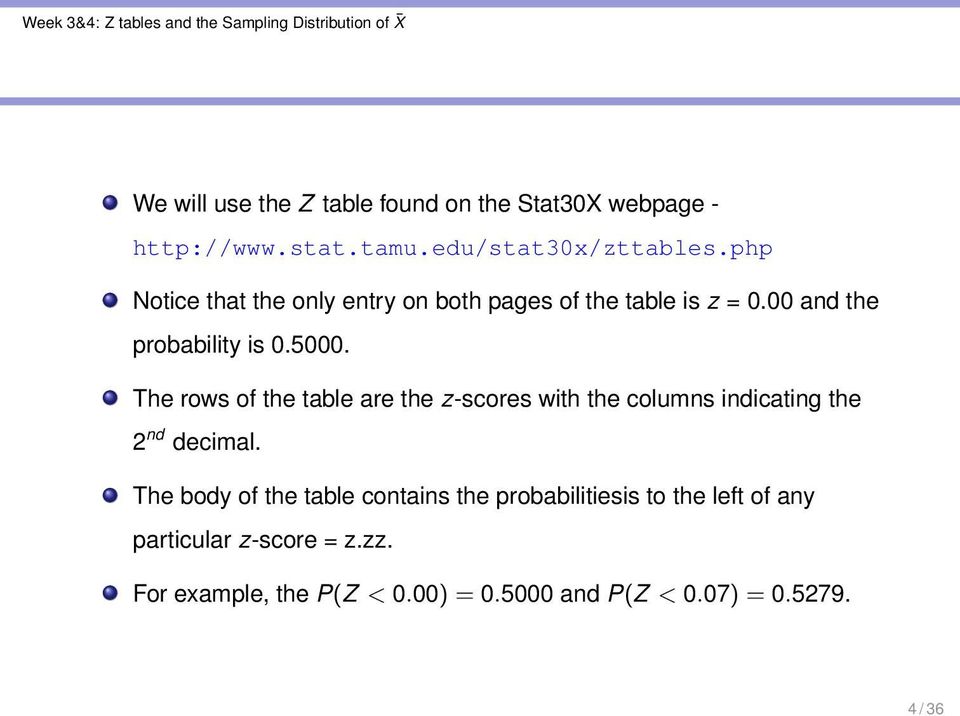
5 5 / 36 Examples of reading the table: P(Z < 1.25) = P(Z < 0.50) =
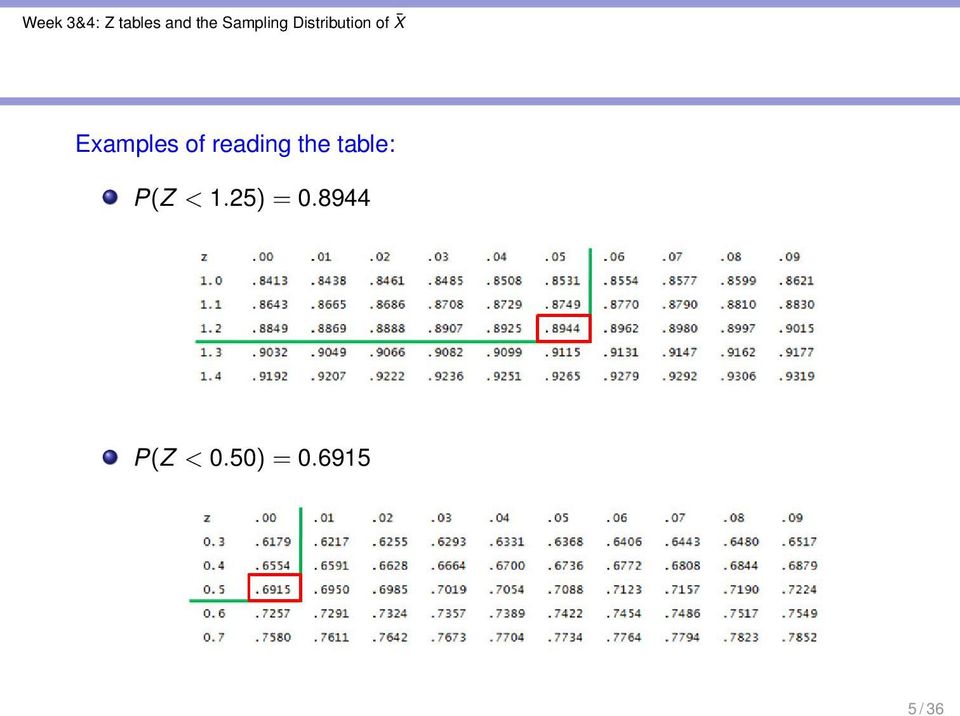
6 6 / 36 P(Z < 0.75) = P(Z < 2.01) =
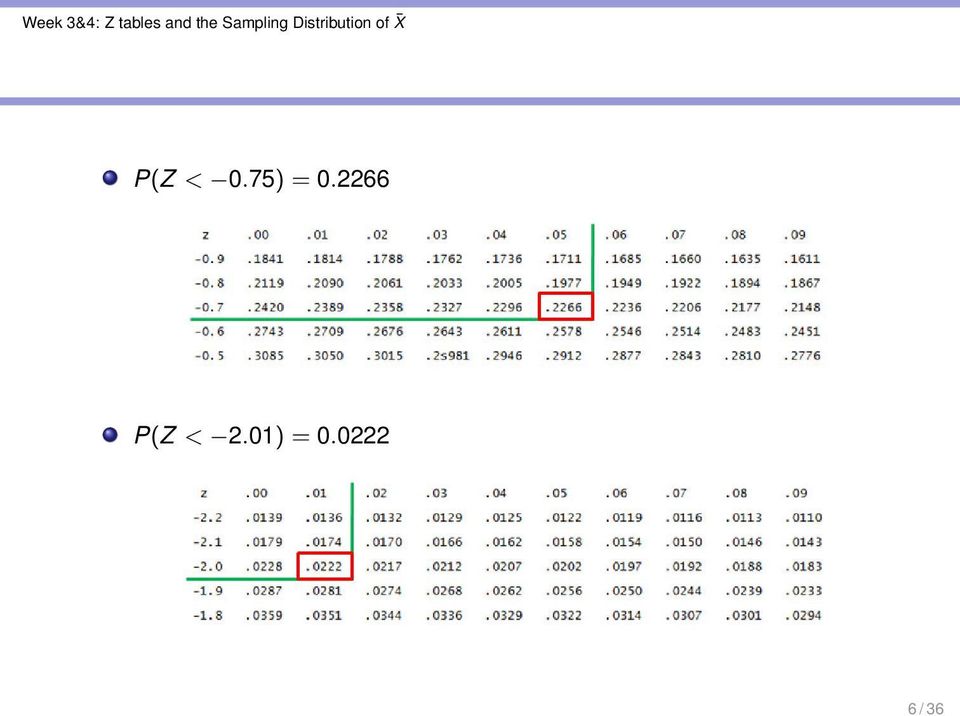
7 7 / 36 The Z -table only gives probabilities to the left of a value. If we want to get probabilities to the right we use the complement rule, P(Z > z) = 1 P(Z < z). P(Z > 1.25) = = P(Z > 0.50) = =

8 8 / 36 P(Z > 0.75) = = P(Z > 2.01) = =

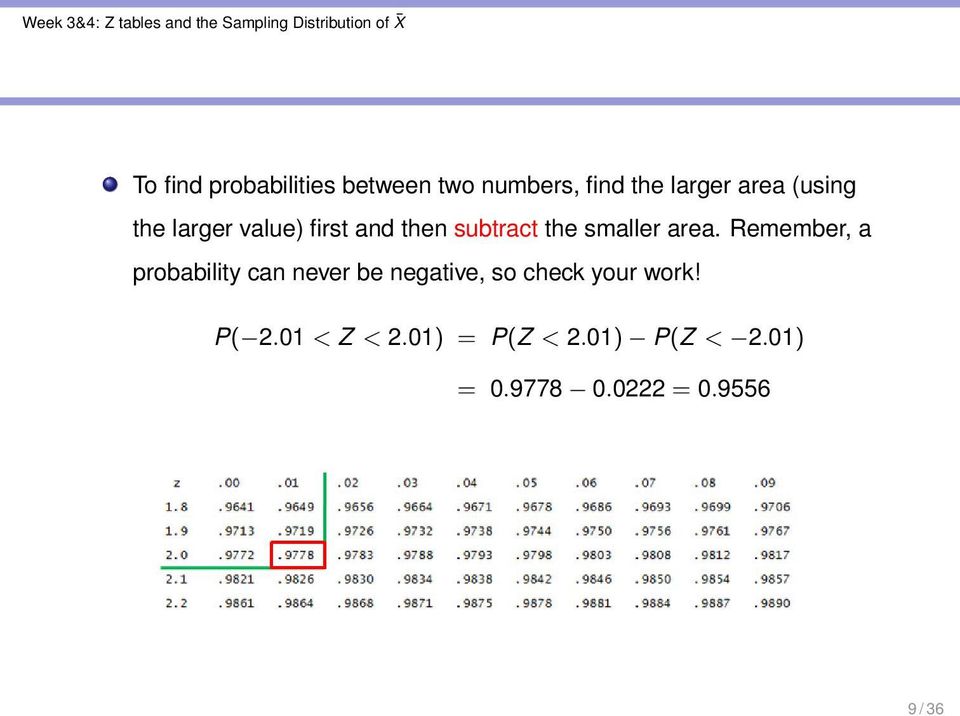
9 9 / 36 To find probabilities between two numbers, find the larger area (using the larger value) first and then subtract the smaller area. Remember, a probability can never be negative, so check your work! P( 2.01 < Z < 2.01) = P(Z < 2.01) P(Z < 2.01) = =
10 10 / 36 Now suppose we have a non-standard normal, X N(µ, σ 2 ), and we want to know the probability that X is less than some value. We must first convert the X to a Z and then use the probabilities from the Z -table. Recall that if X N(µ, σ 2 ), then so Z = X µ σ N(0, 1 2 ) P(X < x) = P(Z < x µ σ ) Beware: P(X > x) 1 P(X < x) if X is not centered at 0. You must convert to a Z before using the complement rule.

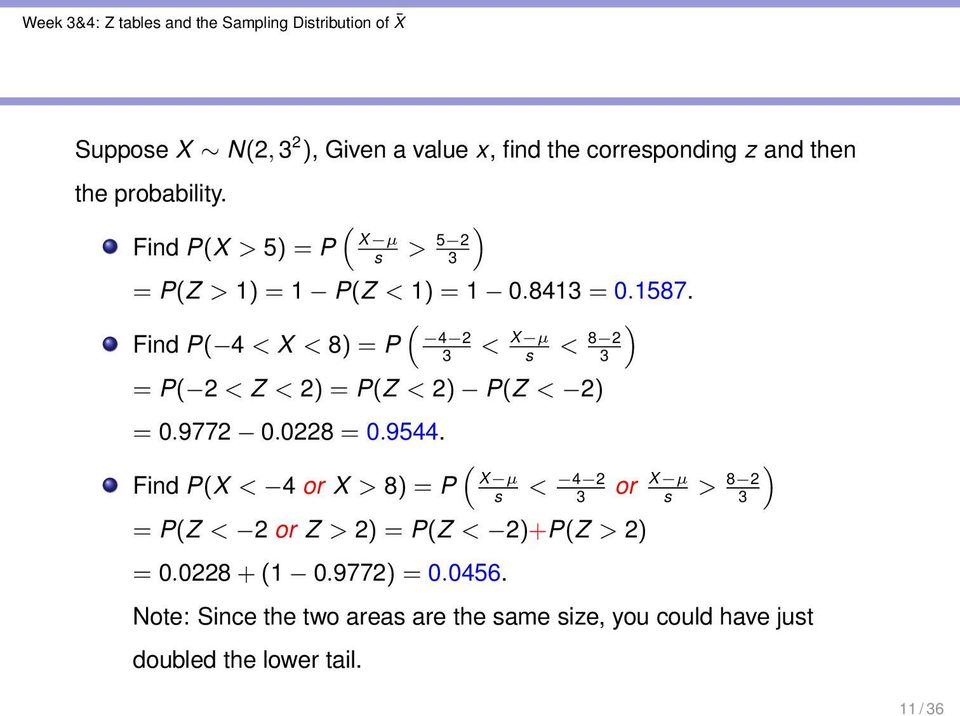
11 11 / 36 Suppose X N(2, 3 2 ), Given a value x, find the corresponding z and then the probability. Find P(X > 5) = P ( X µ s ) > = P(Z > 1) = 1 P(Z < 1) = = ( ) 4 2 Find P( 4 < X < 8) = P < X µ < s 3 = P( 2 < Z < 2) = P(Z < 2) P(Z < 2) = = Find P(X < 4 or X > 8) = P ( X µ s < 4 2 or X µ 3 s = P(Z < 2 or Z > 2) = P(Z < 2)+P(Z > 2) = ( ) = ) > Note: Since the two areas are the same size, you could have just doubled the lower tail.
12 12 / 36 Reverse use of Z -table: Finding probabilities given z-scores. Find the z such that Pr(Z < z ) = , where is some probability. Answer: z = Find z such that P(Z < z ) = Answer z = 0.53 Find z such that P(Z > z ) = = 1 P(Z < z ). Answer: P(Z < z ) = 1 P(Z > z ) = = z = 1.25.

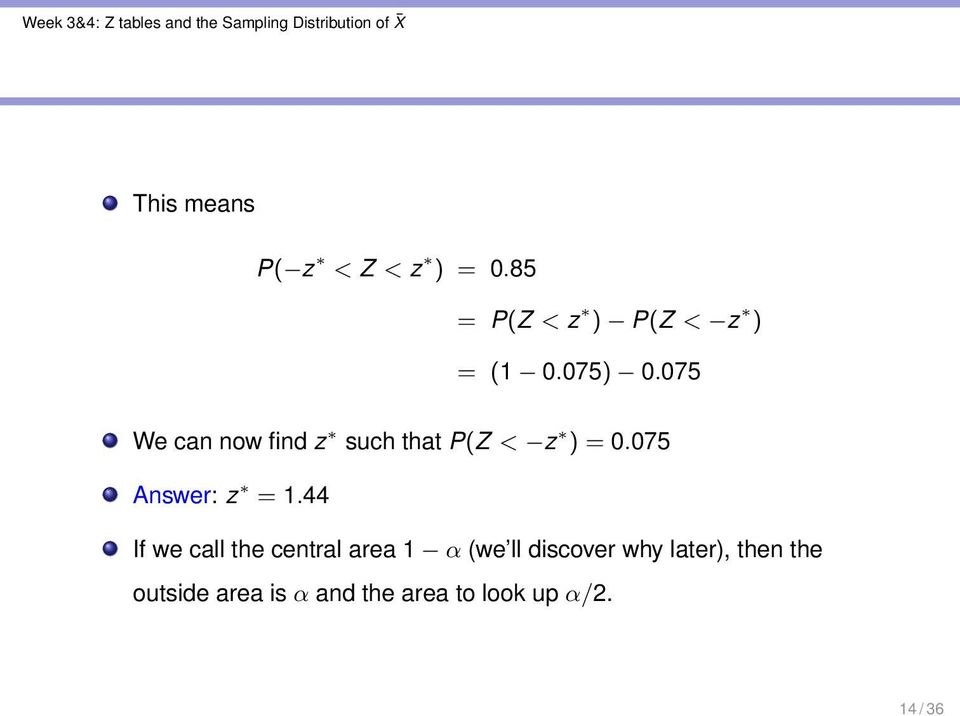
13 13 / 36 Finding Centered Probabilities What if P( z < Z < z ) = 0.85, where 0.85 is a central area under the Z curve (if it s not, we can t do this). Since the total area under the curve is 1 and = 0.15, there is 0.15 of the area outside z and z. And since the Z curve is centered at 0, half of this area is below z and the other half is above z.
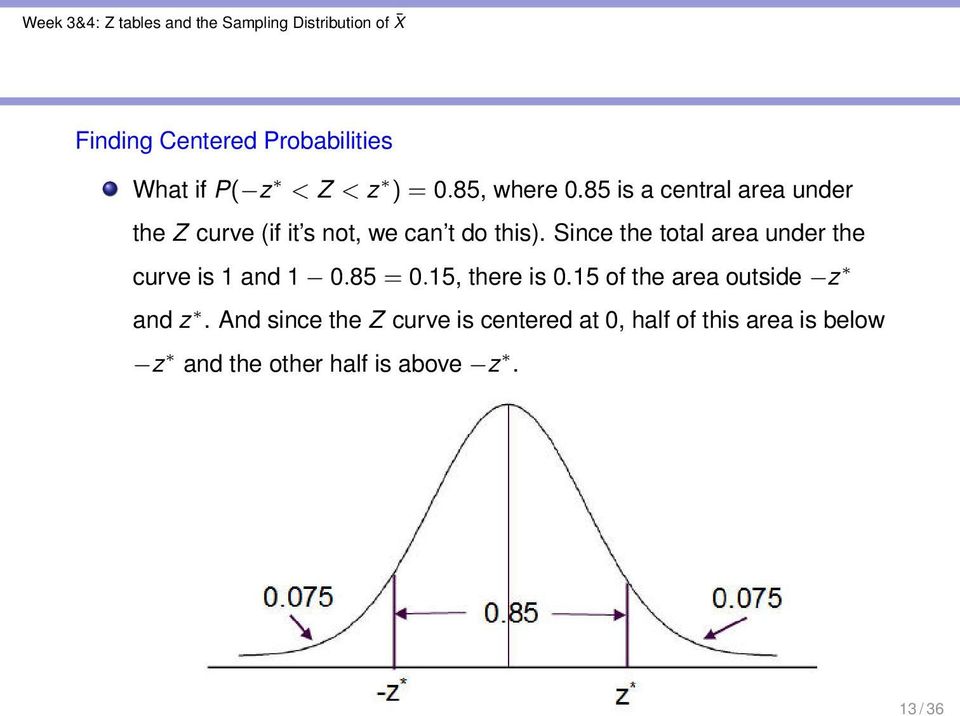
14 14 / 36 This means P( z < Z < z ) = 0.85 = P(Z < z ) P(Z < z ) = ( ) We can now find z such that P(Z < z ) = Answer: z = 1.44 If we call the central area 1 α (we ll discover why later), then the outside area is α and the area to look up α/2.
15 15 / 36 Standard Normal 5 Number Summary We know from Chapter 1 that the IQR = Q 3 Q 1 covers the middle 50% of a distribution. So what are z Q1 and z Q3? P(z Q1 < Z < z Q3 ) = 0.50 = P(Z < z Q3 ) P(Z < z Q1 ) = or P(Z < z Q1 ) = 0.25 and P(Z < z Q3 ) = Answer: z Q1 = and z Q3 = Adding these numbers to the Empirical Rule numbers, we have estimates for the middle 50, 68, 95 and 99.7% s as easy references.

16 16 / 36 Non-standard Normal Example Suppose the sample proportion of 100 students who think that there is insufficient parking is normally distributed with a mean of 0.8 and a standard deviation of As long as we know the distribution is normal, and µ and σ, we can find any probability! p N(µ p = 0.8, σp 2 = ) How often would we get a sample proportion of 0.75 or less? P(p 0.75) = P( p µ σ ) 0.04 = P(Z < 1.25) =

17 17 / 36 Inference So what good are these probabilities? Recall from the Introduction, an important area of statistics is inference: drawing a conclusion based on data and making decisions based on how likely something is to occur. Since probabilities tell us how often things occur, we can use them to make our decisions. But probabilities come from the whole population which would mean we needed a census, a complete listing of all of the data. We need to be able to make our decisions based on samples, or even one sample.

18 18 / 36 Inference Inferential Statistics General Idea of Inferential Statistics We take a sample from the whole population. We summarize the sample using important statistics. We use those summaries to make inference about the whole population. We realize there may be some error involved in making inference.
19 19 / 36 Inference Inferential Statistics Example: (1988, the Steering Committee of the Physicians Health Study Research Group) Question: Can Aspirin reduce the risk of heart attack in humans? Sample: Sample of 22,071 male physicians between the ages of 40 and 84, randomly assigned to one of two groups. One group took an ordinary aspirin tablet every other day (headache or not). The other group took a placebo every other day. This group is the control group. Summary statistic: The rate of heart attacks in the group taking aspirin was only 55% of the rate of heart attacks in the placebo group. Inference to population: Taking aspirin causes lower rate of heart attacks in humans.

20 20 / 36 Inference Basics for sampling Samples should not be biased: no favoring of any individual in the population. Examples of biased samples: select goldfish from a particular store, polling your neighbor rather than the whole city The selection of an individual in the population should not affect the selection of the next individual: independence. Example of non-independent sample: when taking a survey on the cost of a college education, we ask both the mother and the father of a student Samples should be large enough to adequately cover the population. Example of a small sample: suppose only 20 physicians were used in the aspirin study.
21 21 / 36 Inference Basics for sampling Samples should have the smallest variability possible. We know that there are many different samples, so we want to make sure our statistics are consistent. The larger sample we use, the less the different sample statistics will vary. Although there are many types of samples, we will only discuss the simplest, a sample random sample. Every sample of a particular size, n, from the population has an equal chance of being selected. A SRS produces an biased statistic.
22 22 / 36 Inference Basics for sampling
23 23 / 36 Inference Sampling Distribution Since statistics vary from sample to sample, there is a distribution of them called a sampling distribution which is the distribution of all of the values taken by the statistic in all possible samples of the same size, n, from the same population. We can then examine the shape, center, and spread of the sampling distribution. We know that there are many statistic that we can calculate from a sample, but we re going to start with the sample mean, X.
24 24 / 36 Inference Bias and Variance Bias concerns the center of the sampling distribution. A statistic used to estimate a parameter is unbiased if the mean of the sampling distribution is equal to the true value of the parameter being estimated. This says that the mean of the sample mean is the same as the mean of the population sampled, µ X = µ X. To reduce bias, we use a random sample. Variability is described by the spread of the sampling distribution. To reduce the variability of a statistic, use a larger sample; the larger the sample size, n, the smaller the variance of the statistic. The reason this is true is because the variance of the sample mean gets smaller as the sample size increases, σ 2 X = σx 2 /n, or σ X = σ X / n.
25 25 / 36 Inference Bias and Variance Summary Population Distribution of a random variable The distribution of all the members of the population. Parameters help describe the distribution, for example, µ and σ. Sampling Distribution of a sample statistic This is not the distribution of the sample! The sampling distribution is the distribution of a statistic. If we take many, many samples and calculate the statistic for each of those samples, the distribution of all those statistics is the sampling distribution. We will start with the sampling distribution of the sample mean, X.
26 26 / 36 Sampling Distribution for Numeric Data Sampling Distribution of a Sample Mean We already know that if we take random samples the sample mean is unbiased, µ X = µ X, so we know the center. We can minimize the variance by using a large sample, n, σ X = σ X / n, so we know the spread. Since the sample mean of a normal random variable is also normal, we know the shape. So, if the X is normal, the distribution of the sample mean, or sampling distribution of the sample mean is X n N ( ( ) ) 2 σ µ, n the subscript on X indicates the sample size
27 27 / 36 Sampling Distribution for Numeric Data Examples of Sample Mean There has been some concern that young children are spending too much time watching television. A study in Columbia, South Carolina recorded the number of cartoon shows watched per child from 7:00 a.m. to 1:00 p.m. on a particular Saturday morning for 28 different children. The results were as follows: 2, 2, 1, 3, 3, 5, 7, 5, 3, 8, 1, 4, 0, 4, 2, 0, 4, 2, 7, 3, 6, 1, 3, 5, 6, 4, 4, 4. (Adapted from Intro. to Statistics, Milton, McTeer and Corbet, 1997) Suppose the true average for all of South Carolina is 3.4 with a standard deviation of 2.1, and that the data is normal.
28 28 / 36 Sampling Distribution for Numeric Data Examples of Sample Mean What is the population mean? µ = 3.4 What is the sample mean? x = 99/28 = What is the approximate sampling distribution (of the sample mean)? X 28 N ( 3.4, ( ) 2 ) = N(3.4, ) Again, what does this mean?
29 29 / 36 Sampling Distribution for Numeric Data Examples of Sample Mean Suppose we take many, many samples (each sample of size 28), then we find the sample mean for each sample. The sampling distribution of all those means (2.9, 3.4, 4.1,... ) is distributed N(3.4, ).
30 30 / 36 Sampling Distribution for Numeric Data The Central Limit Theorem What if the original data (parent population) is not normal? The Central Limit Theorem states that for any population with mean µ and standard deviation σ, the sampling distribution of the sample mean, X n, is approximately normal when n is large. X n N ( ( ) ) 2 σ µ, n The central limit theorem is a very powerful tool in statistics. Remember, the central limit theorem works for any distribution. Let us see how well it works for the years on pennies.
31 31 / 36 Sampling Distribution for Numeric Data Example of Central Limit Theorem Penny Population Distribution (276)
32 32 / 36 Sampling Distribution for Numeric Data Example of Central Limit Theorem Note from the previous slide, the distribution is highly left skewed. The mean of the 276 pennies is The standard deviation of the 276 pennies is 8.7. Let us take 50 samples of size 10. According to the Central Limit Theorem, the sampling distribution of the sample means should be normal with mean and standard deviation 8.7/ 10 = 2.75.
33 33 / 36 Sampling Distribution for Numeric Data Example of Central Limit Theorem That is, the sampling distribution, the distribution of the x s should be a normal distribution. Suppose we took 50 samples from these pennies and plotted the sample means:
34 34 / 36 Sampling Distribution for Numeric Data Example of Central Limit Theorem The distribution of the means of the 50 samples is Notice x X is close to = µ and s X is not far from 2.75 = σ. The previous slide shows the distribution of the means of the 50 samples is slightly skewed but closer to the normal distribution. So, n = 10 isn t large enough and taking larger samples would produce a more normal distribution of sample means. So what is large enough? Theory says at least n = 30, but sometimes more is needed.
35 35 / 36 Sampling Distribution for Numeric Data Recap So in general: The mean of sample means is the mean of the data, µ X = µ X. The standard deviation of the sample means is the standard deviation of the data divided by the square root of the sample size, σ X = σ X. If the data is normal, then the distribution of the sample means is exactly normal. But even if the distribution of the data isn t known, we can say the distribution of the sample means is approximately normal as long as we take a large sample.
36 36 / 36 Sampling Distribution for Numeric Data Example Example: Suppose past studies indicate it takes an average of 15 minutes with a standard deviation of 5 minutes to memorize a short passage of 100 words. A psychologist claims a new method of memorization will reduce the average time. A random sample of 40 people use the new method and the average time required to memorize the passage is found to be 12.5 minutes minutes is obviously less than 15, but is it small enough to say that the new method actually reduces the average time or is it just random chance that produced such a small sample mean? How likely is x 12.5 if µ = 15? First X N(15, ( 5 40 ) 2 ) = N(15, ) P(X < 12.5) = P(Z < ) = P(Z < 3.16) = So, even though 12.5 isn t much different than 15 minutes, an average this small should rarely if ever happen.
Characteristics of Binomial Distributions
 Lesson2 Characteristics of Binomial Distributions In the last lesson, you constructed several binomial distributions, observed their shapes, and estimated their means and standard deviations. In Investigation
4. Continuous Random Variables, the Pareto and Normal Distributions
 4. Continuous Random Variables, the Pareto and Normal Distributions A continuous random variable X can take any value in a given range (e.g. height, weight, age). The distribution of a continuous random
Summary of Formulas and Concepts. Descriptive Statistics (Ch. 1-4)
 Summary of Formulas and Concepts Descriptive Statistics (Ch. 1-4) Definitions Population: The complete set of numerical information on a particular quantity in which an investigator is interested. We assume
Normal distribution. ) 2 /2σ. 2π σ
 Normal distribution The normal distribution is the most widely known and used of all distributions. Because the normal distribution approximates many natural phenomena so well, it has developed into a
MATH 10: Elementary Statistics and Probability Chapter 7: The Central Limit Theorem
 MATH 10: Elementary Statistics and Probability Chapter 7: The Central Limit Theorem Tony Pourmohamad Department of Mathematics De Anza College Spring 2015 Objectives By the end of this set of slides, you
Def: The standard normal distribution is a normal probability distribution that has a mean of 0 and a standard deviation of 1.
 Lecture 6: Chapter 6: Normal Probability Distributions A normal distribution is a continuous probability distribution for a random variable x. The graph of a normal distribution is called the normal curve.
Lesson 7 Z-Scores and Probability
 Lesson 7 Z-Scores and Probability Outline Introduction Areas Under the Normal Curve Using the Z-table Converting Z-score to area -area less than z/area greater than z/area between two z-values Converting
Chapter 4. Probability and Probability Distributions
 Chapter 4. robability and robability Distributions Importance of Knowing robability To know whether a sample is not identical to the population from which it was selected, it is necessary to assess the
5/31/2013. 6.1 Normal Distributions. Normal Distributions. Chapter 6. Distribution. The Normal Distribution. Outline. Objectives.
 The Normal Distribution C H 6A P T E R The Normal Distribution Outline 6 1 6 2 Applications of the Normal Distribution 6 3 The Central Limit Theorem 6 4 The Normal Approximation to the Binomial Distribution
Probability Distributions
 Learning Objectives Probability Distributions Section 1: How Can We Summarize Possible Outcomes and Their Probabilities? 1. Random variable 2. Probability distributions for discrete random variables 3.
You flip a fair coin four times, what is the probability that you obtain three heads.
 Handout 4: Binomial Distribution Reading Assignment: Chapter 5 In the previous handout, we looked at continuous random variables and calculating probabilities and percentiles for those type of variables.
Measures of Central Tendency and Variability: Summarizing your Data for Others
 Measures of Central Tendency and Variability: Summarizing your Data for Others 1 I. Measures of Central Tendency: -Allow us to summarize an entire data set with a single value (the midpoint). 1. Mode :
Descriptive Statistics
 Descriptive Statistics Suppose following data have been collected (heights of 99 five-year-old boys) 117.9 11.2 112.9 115.9 18. 14.6 17.1 117.9 111.8 16.3 111. 1.4 112.1 19.2 11. 15.4 99.4 11.1 13.3 16.9
SOLUTIONS: 4.1 Probability Distributions and 4.2 Binomial Distributions
 SOLUTIONS: 4.1 Probability Distributions and 4.2 Binomial Distributions 1. The following table contains a probability distribution for a random variable X. a. Find the expected value (mean) of X. x 1 2
CALCULATIONS & STATISTICS
 CALCULATIONS & STATISTICS CALCULATION OF SCORES Conversion of 1-5 scale to 0-100 scores When you look at your report, you will notice that the scores are reported on a 0-100 scale, even though respondents
SAMPLING DISTRIBUTIONS
 0009T_c07_308-352.qd 06/03/03 20:44 Page 308 7Chapter SAMPLING DISTRIBUTIONS 7.1 Population and Sampling Distributions 7.2 Sampling and Nonsampling Errors 7.3 Mean and Standard Deviation of 7.4 Shape of
Chapter 1: Looking at Data Section 1.1: Displaying Distributions with Graphs
 Types of Variables Chapter 1: Looking at Data Section 1.1: Displaying Distributions with Graphs Quantitative (numerical)variables: take numerical values for which arithmetic operations make sense (addition/averaging)
MBA 611 STATISTICS AND QUANTITATIVE METHODS
 MBA 611 STATISTICS AND QUANTITATIVE METHODS Part I. Review of Basic Statistics (Chapters 1-11) A. Introduction (Chapter 1) Uncertainty: Decisions are often based on incomplete information from uncertain
The Normal distribution
 The Normal distribution The normal probability distribution is the most common model for relative frequencies of a quantitative variable. Bell-shaped and described by the function f(y) = 1 2σ π e{ 1 2σ
Descriptive Statistics and Measurement Scales
 Descriptive Statistics 1 Descriptive Statistics and Measurement Scales Descriptive statistics are used to describe the basic features of the data in a study. They provide simple summaries about the sample
Introduction to the Practice of Statistics Fifth Edition Moore, McCabe
 Introduction to the Practice of Statistics Fifth Edition Moore, McCabe Section 5.1 Homework Answers 5.7 In the proofreading setting if Exercise 5.3, what is the smallest number of misses m with P(X m)
6 3 The Standard Normal Distribution
 290 Chapter 6 The Normal Distribution Figure 6 5 Areas Under a Normal Distribution Curve 34.13% 34.13% 2.28% 13.59% 13.59% 2.28% 3 2 1 + 1 + 2 + 3 About 68% About 95% About 99.7% 6 3 The Distribution Since
Lesson 20. Probability and Cumulative Distribution Functions
 Lesson 20 Probability and Cumulative Distribution Functions Recall If p(x) is a density function for some characteristic of a population, then Recall If p(x) is a density function for some characteristic
Stats on the TI 83 and TI 84 Calculator
 Stats on the TI 83 and TI 84 Calculator Entering the sample values STAT button Left bracket { Right bracket } Store (STO) List L1 Comma Enter Example: Sample data are {5, 10, 15, 20} 1. Press 2 ND and
Hypothesis Testing: Two Means, Paired Data, Two Proportions
 Chapter 10 Hypothesis Testing: Two Means, Paired Data, Two Proportions 10.1 Hypothesis Testing: Two Population Means and Two Population Proportions 1 10.1.1 Student Learning Objectives By the end of this
Lesson 9 Hypothesis Testing
 Lesson 9 Hypothesis Testing Outline Logic for Hypothesis Testing Critical Value Alpha (α) -level.05 -level.01 One-Tail versus Two-Tail Tests -critical values for both alpha levels Logic for Hypothesis
6.4 Normal Distribution
 Contents 6.4 Normal Distribution....................... 381 6.4.1 Characteristics of the Normal Distribution....... 381 6.4.2 The Standardized Normal Distribution......... 385 6.4.3 Meaning of Areas under
An Introduction to Basic Statistics and Probability
 An Introduction to Basic Statistics and Probability Shenek Heyward NCSU An Introduction to Basic Statistics and Probability p. 1/4 Outline Basic probability concepts Conditional probability Discrete Random
Introduction to Hypothesis Testing. Hypothesis Testing. Step 1: State the Hypotheses
 Introduction to Hypothesis Testing 1 Hypothesis Testing A hypothesis test is a statistical procedure that uses sample data to evaluate a hypothesis about a population Hypothesis is stated in terms of the
Non-Parametric Tests (I)
 Lecture 5: Non-Parametric Tests (I) KimHuat LIM [email protected] http://www.stats.ox.ac.uk/~lim/teaching.html Slide 1 5.1 Outline (i) Overview of Distribution-Free Tests (ii) Median Test for Two Independent
Statistics 2014 Scoring Guidelines
 AP Statistics 2014 Scoring Guidelines College Board, Advanced Placement Program, AP, AP Central, and the acorn logo are registered trademarks of the College Board. AP Central is the official online home
The Normal Distribution
 Chapter 6 The Normal Distribution 6.1 The Normal Distribution 1 6.1.1 Student Learning Objectives By the end of this chapter, the student should be able to: Recognize the normal probability distribution
AP Statistics Solutions to Packet 2
 AP Statistics Solutions to Packet 2 The Normal Distributions Density Curves and the Normal Distribution Standard Normal Calculations HW #9 1, 2, 4, 6-8 2.1 DENSITY CURVES (a) Sketch a density curve that
CURVE FITTING LEAST SQUARES APPROXIMATION
 CURVE FITTING LEAST SQUARES APPROXIMATION Data analysis and curve fitting: Imagine that we are studying a physical system involving two quantities: x and y Also suppose that we expect a linear relationship
Descriptive Statistics
 Y520 Robert S Michael Goal: Learn to calculate indicators and construct graphs that summarize and describe a large quantity of values. Using the textbook readings and other resources listed on the web
Descriptive Statistics. Purpose of descriptive statistics Frequency distributions Measures of central tendency Measures of dispersion
 Descriptive Statistics Purpose of descriptive statistics Frequency distributions Measures of central tendency Measures of dispersion Statistics as a Tool for LIS Research Importance of statistics in research
Introduction to Statistics for Psychology. Quantitative Methods for Human Sciences
 Introduction to Statistics for Psychology and Quantitative Methods for Human Sciences Jonathan Marchini Course Information There is website devoted to the course at http://www.stats.ox.ac.uk/ marchini/phs.html
HYPOTHESIS TESTING: POWER OF THE TEST
 HYPOTHESIS TESTING: POWER OF THE TEST The first 6 steps of the 9-step test of hypothesis are called "the test". These steps are not dependent on the observed data values. When planning a research project,
The right edge of the box is the third quartile, Q 3, which is the median of the data values above the median. Maximum Median
 CONDENSED LESSON 2.1 Box Plots In this lesson you will create and interpret box plots for sets of data use the interquartile range (IQR) to identify potential outliers and graph them on a modified box
Statistics 104: Section 6!
 Page 1 Statistics 104: Section 6! TF: Deirdre (say: Dear-dra) Bloome Email: [email protected] Section Times Thursday 2pm-3pm in SC 109, Thursday 5pm-6pm in SC 705 Office Hours: Thursday 6pm-7pm SC
MATH 140 Lab 4: Probability and the Standard Normal Distribution
 MATH 140 Lab 4: Probability and the Standard Normal Distribution Problem 1. Flipping a Coin Problem In this problem, we want to simualte the process of flipping a fair coin 1000 times. Note that the outcomes
5.1 Identifying the Target Parameter
 University of California, Davis Department of Statistics Summer Session II Statistics 13 August 20, 2012 Date of latest update: August 20 Lecture 5: Estimation with Confidence intervals 5.1 Identifying
Point and Interval Estimates
 Point and Interval Estimates Suppose we want to estimate a parameter, such as p or µ, based on a finite sample of data. There are two main methods: 1. Point estimate: Summarize the sample by a single number
Introduction to. Hypothesis Testing CHAPTER LEARNING OBJECTIVES. 1 Identify the four steps of hypothesis testing.
 Introduction to Hypothesis Testing CHAPTER 8 LEARNING OBJECTIVES After reading this chapter, you should be able to: 1 Identify the four steps of hypothesis testing. 2 Define null hypothesis, alternative
Introduction to Hypothesis Testing
 I. Terms, Concepts. Introduction to Hypothesis Testing A. In general, we do not know the true value of population parameters - they must be estimated. However, we do have hypotheses about what the true
Standard Deviation Estimator
 CSS.com Chapter 905 Standard Deviation Estimator Introduction Even though it is not of primary interest, an estimate of the standard deviation (SD) is needed when calculating the power or sample size of
3.4 Statistical inference for 2 populations based on two samples
 3.4 Statistical inference for 2 populations based on two samples Tests for a difference between two population means The first sample will be denoted as X 1, X 2,..., X m. The second sample will be denoted
Hypothesis Testing for Beginners
 Hypothesis Testing for Beginners Michele Piffer LSE August, 2011 Michele Piffer (LSE) Hypothesis Testing for Beginners August, 2011 1 / 53 One year ago a friend asked me to put down some easy-to-read notes
STT315 Chapter 4 Random Variables & Probability Distributions KM. Chapter 4.5, 6, 8 Probability Distributions for Continuous Random Variables
 Chapter 4.5, 6, 8 Probability Distributions for Continuous Random Variables Discrete vs. continuous random variables Examples of continuous distributions o Uniform o Exponential o Normal Recall: A random
Normal distributions in SPSS
 Normal distributions in SPSS Bro. David E. Brown, BYU Idaho Department of Mathematics February 2, 2012 1 Calculating probabilities and percents from measurements: The CDF.NORMAL command 1. Go to the Variable
How To Test For Significance On A Data Set
 Non-Parametric Univariate Tests: 1 Sample Sign Test 1 1 SAMPLE SIGN TEST A non-parametric equivalent of the 1 SAMPLE T-TEST. ASSUMPTIONS: Data is non-normally distributed, even after log transforming.
Simple Regression Theory II 2010 Samuel L. Baker
 SIMPLE REGRESSION THEORY II 1 Simple Regression Theory II 2010 Samuel L. Baker Assessing how good the regression equation is likely to be Assignment 1A gets into drawing inferences about how close the
Introduction to Hypothesis Testing OPRE 6301
 Introduction to Hypothesis Testing OPRE 6301 Motivation... The purpose of hypothesis testing is to determine whether there is enough statistical evidence in favor of a certain belief, or hypothesis, about
3: Summary Statistics
 3: Summary Statistics Notation Let s start by introducing some notation. Consider the following small data set: 4 5 30 50 8 7 4 5 The symbol n represents the sample size (n = 0). The capital letter X denotes
Normal Distribution as an Approximation to the Binomial Distribution
 Chapter 1 Student Lecture Notes 1-1 Normal Distribution as an Approximation to the Binomial Distribution : Goals ONE TWO THREE 2 Review Binomial Probability Distribution applies to a discrete random variable
Chapter 5: Normal Probability Distributions - Solutions
 Chapter 5: Normal Probability Distributions - Solutions Note: All areas and z-scores are approximate. Your answers may vary slightly. 5.2 Normal Distributions: Finding Probabilities If you are given that
WISE Sampling Distribution of the Mean Tutorial
 Name Date Class WISE Sampling Distribution of the Mean Tutorial Exercise 1: How accurate is a sample mean? Overview A friend of yours developed a scale to measure Life Satisfaction. For the population
Estimation and Confidence Intervals
 Estimation and Confidence Intervals Fall 2001 Professor Paul Glasserman B6014: Managerial Statistics 403 Uris Hall Properties of Point Estimates 1 We have already encountered two point estimators: th e
The normal approximation to the binomial
 The normal approximation to the binomial The binomial probability function is not useful for calculating probabilities when the number of trials n is large, as it involves multiplying a potentially very
THE BINOMIAL DISTRIBUTION & PROBABILITY
 REVISION SHEET STATISTICS 1 (MEI) THE BINOMIAL DISTRIBUTION & PROBABILITY The main ideas in this chapter are Probabilities based on selecting or arranging objects Probabilities based on the binomial distribution
Density Curve. A density curve is the graph of a continuous probability distribution. It must satisfy the following properties:
 Density Curve A density curve is the graph of a continuous probability distribution. It must satisfy the following properties: 1. The total area under the curve must equal 1. 2. Every point on the curve
Key Concept. Density Curve
 MAT 155 Statistical Analysis Dr. Claude Moore Cape Fear Community College Chapter 6 Normal Probability Distributions 6 1 Review and Preview 6 2 The Standard Normal Distribution 6 3 Applications of Normal
Frequency Distributions
 Descriptive Statistics Dr. Tom Pierce Department of Psychology Radford University Descriptive statistics comprise a collection of techniques for better understanding what the people in a group look like
Chapter 6: Probability
 Chapter 6: Probability In a more mathematically oriented statistics course, you would spend a lot of time talking about colored balls in urns. We will skip over such detailed examinations of probability,
Psychology 60 Fall 2013 Practice Exam Actual Exam: Next Monday. Good luck!
 Psychology 60 Fall 2013 Practice Exam Actual Exam: Next Monday. Good luck! Name: 1. The basic idea behind hypothesis testing: A. is important only if you want to compare two populations. B. depends on
Binary Adders: Half Adders and Full Adders
 Binary Adders: Half Adders and Full Adders In this set of slides, we present the two basic types of adders: 1. Half adders, and 2. Full adders. Each type of adder functions to add two binary bits. In order
WHERE DOES THE 10% CONDITION COME FROM?
 1 WHERE DOES THE 10% CONDITION COME FROM? The text has mentioned The 10% Condition (at least) twice so far: p. 407 Bernoulli trials must be independent. If that assumption is violated, it is still okay
MULTIPLE CHOICE. Choose the one alternative that best completes the statement or answers the question.
 Final Exam Review MULTIPLE CHOICE. Choose the one alternative that best completes the statement or answers the question. 1) A researcher for an airline interviews all of the passengers on five randomly
Probability. Distribution. Outline
 7 The Normal Probability Distribution Outline 7.1 Properties of the Normal Distribution 7.2 The Standard Normal Distribution 7.3 Applications of the Normal Distribution 7.4 Assessing Normality 7.5 The
Chapter 8 Hypothesis Testing Chapter 8 Hypothesis Testing 8-1 Overview 8-2 Basics of Hypothesis Testing
 Chapter 8 Hypothesis Testing 1 Chapter 8 Hypothesis Testing 8-1 Overview 8-2 Basics of Hypothesis Testing 8-3 Testing a Claim About a Proportion 8-5 Testing a Claim About a Mean: s Not Known 8-6 Testing
Exploratory Data Analysis
 Exploratory Data Analysis Johannes Schauer [email protected] Institute of Statistics Graz University of Technology Steyrergasse 17/IV, 8010 Graz www.statistics.tugraz.at February 12, 2008 Introduction
The Binomial Probability Distribution
 The Binomial Probability Distribution MATH 130, Elements of Statistics I J. Robert Buchanan Department of Mathematics Fall 2015 Objectives After this lesson we will be able to: determine whether a probability
Mind on Statistics. Chapter 2
 Mind on Statistics Chapter 2 Sections 2.1 2.3 1. Tallies and cross-tabulations are used to summarize which of these variable types? A. Quantitative B. Mathematical C. Continuous D. Categorical 2. The table
Experimental Design. Power and Sample Size Determination. Proportions. Proportions. Confidence Interval for p. The Binomial Test
 Experimental Design Power and Sample Size Determination Bret Hanlon and Bret Larget Department of Statistics University of Wisconsin Madison November 3 8, 2011 To this point in the semester, we have largely
Pr(X = x) = f(x) = λe λx
 Old Business - variance/std. dev. of binomial distribution - mid-term (day, policies) - class strategies (problems, etc.) - exponential distributions New Business - Central Limit Theorem, standard error
Math 151. Rumbos Spring 2014 1. Solutions to Assignment #22
 Math 151. Rumbos Spring 2014 1 Solutions to Assignment #22 1. An experiment consists of rolling a die 81 times and computing the average of the numbers on the top face of the die. Estimate the probability
Class 19: Two Way Tables, Conditional Distributions, Chi-Square (Text: Sections 2.5; 9.1)
 Spring 204 Class 9: Two Way Tables, Conditional Distributions, Chi-Square (Text: Sections 2.5; 9.) Big Picture: More than Two Samples In Chapter 7: We looked at quantitative variables and compared the
Objectives. 6.1, 7.1 Estimating with confidence (CIS: Chapter 10) CI)
 Objectives 6.1, 7.1 Estimating with confidence (CIS: Chapter 10) Statistical confidence (CIS gives a good explanation of a 95% CI) Confidence intervals. Further reading http://onlinestatbook.com/2/estimation/confidence.html
The Standard Normal distribution
 The Standard Normal distribution 21.2 Introduction Mass-produced items should conform to a specification. Usually, a mean is aimed for but due to random errors in the production process we set a tolerance
Lesson 4 Measures of Central Tendency
 Outline Measures of a distribution s shape -modality and skewness -the normal distribution Measures of central tendency -mean, median, and mode Skewness and Central Tendency Lesson 4 Measures of Central
Lecture 1: Review and Exploratory Data Analysis (EDA)
 Lecture 1: Review and Exploratory Data Analysis (EDA) Sandy Eckel [email protected] Department of Biostatistics, The Johns Hopkins University, Baltimore USA 21 April 2008 1 / 40 Course Information I Course
Independent samples t-test. Dr. Tom Pierce Radford University
 Independent samples t-test Dr. Tom Pierce Radford University The logic behind drawing causal conclusions from experiments The sampling distribution of the difference between means The standard error of
Exercise 1.12 (Pg. 22-23)
 Individuals: The objects that are described by a set of data. They may be people, animals, things, etc. (Also referred to as Cases or Records) Variables: The characteristics recorded about each individual.
Lecture 10: Depicting Sampling Distributions of a Sample Proportion
 Lecture 10: Depicting Sampling Distributions of a Sample Proportion Chapter 5: Probability and Sampling Distributions 2/10/12 Lecture 10 1 Sample Proportion 1 is assigned to population members having a
16. THE NORMAL APPROXIMATION TO THE BINOMIAL DISTRIBUTION
 6. THE NORMAL APPROXIMATION TO THE BINOMIAL DISTRIBUTION It is sometimes difficult to directly compute probabilities for a binomial (n, p) random variable, X. We need a different table for each value of
9. Sampling Distributions
 9. Sampling Distributions Prerequisites none A. Introduction B. Sampling Distribution of the Mean C. Sampling Distribution of Difference Between Means D. Sampling Distribution of Pearson's r E. Sampling
EXAM #1 (Example) Instructor: Ela Jackiewicz. Relax and good luck!
 STP 231 EXAM #1 (Example) Instructor: Ela Jackiewicz Honor Statement: I have neither given nor received information regarding this exam, and I will not do so until all exams have been graded and returned.
Mathematics (Project Maths Phase 1)
 2012. M128 S Coimisiún na Scrúduithe Stáit State Examinations Commission Leaving Certificate Examination, 2012 Sample Paper Mathematics (Project Maths Phase 1) Paper 2 Ordinary Level Time: 2 hours, 30
Descriptive Statistics
 Descriptive Statistics Primer Descriptive statistics Central tendency Variation Relative position Relationships Calculating descriptive statistics Descriptive Statistics Purpose to describe or summarize
Statistics courses often teach the two-sample t-test, linear regression, and analysis of variance
 2 Making Connections: The Two-Sample t-test, Regression, and ANOVA In theory, there s no difference between theory and practice. In practice, there is. Yogi Berra 1 Statistics courses often teach the two-sample
Lecture 5 : The Poisson Distribution
 Lecture 5 : The Poisson Distribution Jonathan Marchini November 10, 2008 1 Introduction Many experimental situations occur in which we observe the counts of events within a set unit of time, area, volume,
Comparing Two Groups. Standard Error of ȳ 1 ȳ 2. Setting. Two Independent Samples
 Comparing Two Groups Chapter 7 describes two ways to compare two populations on the basis of independent samples: a confidence interval for the difference in population means and a hypothesis test. The
Section 7.1. Introduction to Hypothesis Testing. Schrodinger s cat quantum mechanics thought experiment (1935)
 Section 7.1 Introduction to Hypothesis Testing Schrodinger s cat quantum mechanics thought experiment (1935) Statistical Hypotheses A statistical hypothesis is a claim about a population. Null hypothesis
Probability Distributions
 CHAPTER 5 Probability Distributions CHAPTER OUTLINE 5.1 Probability Distribution of a Discrete Random Variable 5.2 Mean and Standard Deviation of a Probability Distribution 5.3 The Binomial Distribution
Notes on Continuous Random Variables
 Notes on Continuous Random Variables Continuous random variables are random quantities that are measured on a continuous scale. They can usually take on any value over some interval, which distinguishes
MEASURES OF VARIATION
 NORMAL DISTRIBTIONS MEASURES OF VARIATION In statistics, it is important to measure the spread of data. A simple way to measure spread is to find the range. But statisticians want to know if the data are
CA200 Quantitative Analysis for Business Decisions. File name: CA200_Section_04A_StatisticsIntroduction
 CA200 Quantitative Analysis for Business Decisions File name: CA200_Section_04A_StatisticsIntroduction Table of Contents 4. Introduction to Statistics... 1 4.1 Overview... 3 4.2 Discrete or continuous
Lesson 1: Comparison of Population Means Part c: Comparison of Two- Means
 Lesson : Comparison of Population Means Part c: Comparison of Two- Means Welcome to lesson c. This third lesson of lesson will discuss hypothesis testing for two independent means. Steps in Hypothesis
Probability and Statistics Prof. Dr. Somesh Kumar Department of Mathematics Indian Institute of Technology, Kharagpur
 Probability and Statistics Prof. Dr. Somesh Kumar Department of Mathematics Indian Institute of Technology, Kharagpur Module No. #01 Lecture No. #15 Special Distributions-VI Today, I am going to introduce