
ADVANCED USER S GUIDE
|
|
|
- Kristin Gilbert
- 9 years ago
- Views:
Transcription
1 ADVANCED USER S GUIDE MFC-9970CDW Version A USA/CAN

2 User's Guides and where do I find it? Which manual? What's in it? Where is it? Safety and Legal Quick Setup Guide Basic User's Guide Advanced User's Guide Software User's Guide Network Glossary Network User's Guide Read this Guide first. Please read the Safety Instructions before you set up your machine. See this Guide for trademarks and legal limitations. Follow the instructions for setting up your machine and installing the drivers and software for the operating system and connection type you are using. Learn the basic Fax, Copy, Scan and Direct Print operations and how to replace consumables. See troubleshooting tips. Learn more advanced operations: Fax, Copy, security features, printing reports and performing routine maintenance. Follow these instructions for Printing, Scanning, Network Scanning, Remote Setup, PC-Fax, and using the Brother ControlCenter utility. This Guide provides basic information about advanced network features of Brother machines along with explanations about general networking and common terms. This Guide provides useful information about wired and wireless network settings and security settings using the Brother machine. You can also find supported protocol information for your machine and detailed troubleshooting tips. Printed / In the Box Printed / In the Box Printed / In the Box PDF file / Documentation CD-ROM / In the Box PDF file / Documentation CD-ROM / In the Box PDF file / Documentation CD-ROM / In the Box PDF file / Documentation CD-ROM / In the Box i

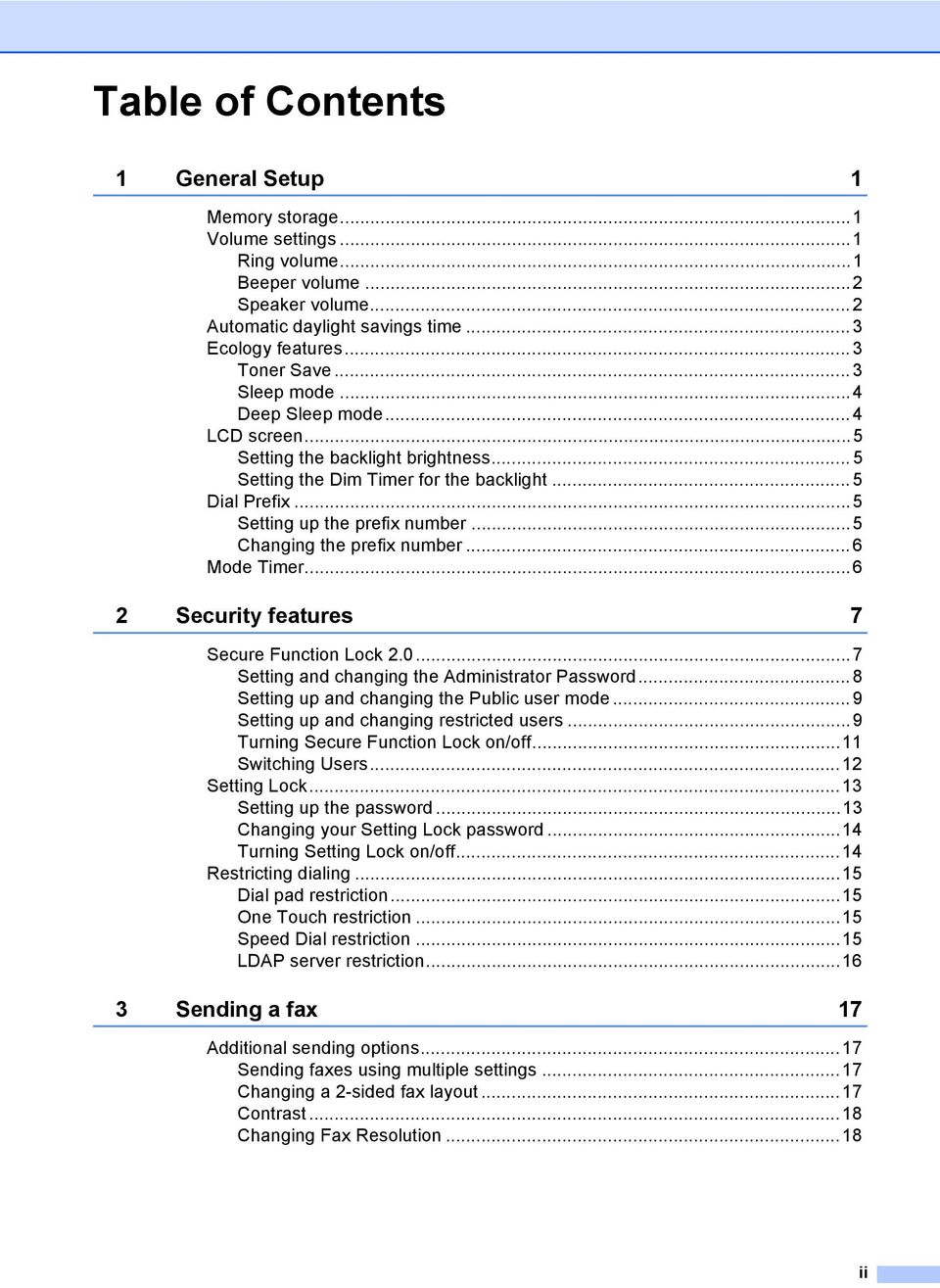
3 Table of Contents 1 General Setup 1 Memory storage...1 Volume settings...1 Ring volume...1 Beeper volume...2 Speaker volume... 2 Automatic daylight savings time...3 Ecology features...3 Toner Save... 3 Sleep mode...4 Deep Sleep mode...4 LCD screen...5 Setting the backlight brightness...5 Setting the Dim Timer for the backlight...5 Dial Prefix...5 Setting up the prefix number...5 Changing the prefix number...6 Mode Timer Security features 7 Secure Function Lock Setting and changing the Administrator Password...8 Setting up and changing the Public user mode...9 Setting up and changing restricted users...9 Turning Secure Function Lock on/off...11 Switching Users...12 Setting Lock...13 Setting up the password...13 Changing your Setting Lock password...14 Turning Setting Lock on/off...14 Restricting dialing...15 Dial pad restriction...15 One Touch restriction...15 Speed Dial restriction...15 LDAP server restriction Sending a fax 17 Additional sending options...17 Sending faxes using multiple settings...17 Changing a 2-sided fax layout...17 Contrast...18 Changing Fax Resolution...18 ii
4 Additional sending operations...19 Sending a fax manually...19 Sending a fax at the end of a conversation...19 Dual access (black & white only)...20 Broadcasting (black & white only)...20 Real Time Transmission...22 Overseas Mode...22 Delayed Fax (black & white only)...22 Delayed batch transmission (black & white only)...23 Checking and canceling waiting jobs...23 Setting your changes as the new default...24 Restoring all fax settings to the factory settings...24 Electronic cover page (black & white only)...25 Polling overview...27 Polled transmit (black & white only) Receiving a fax 28 Remote Fax Options (black & white only)...28 Receiving faxes into memory when the paper tray is empty...28 Fax Forwarding...28 Paging...29 Fax Storage...30 PC-Fax Receive...31 Changing Remote Fax Options...32 Remote retrieval...33 Remote fax commands...35 Additional receiving operations...36 Printing a reduced incoming fax...36 Duplex (2-sided) printing for Fax mode...36 Setting the Fax Receive Stamp (black & white only)...37 Receiving a fax at the end of a conversation...37 Setting the Print Density...38 Printing a fax from the memory...38 Polling overview...39 Polling receive Dialing and storing numbers 41 Telephone line services...41 Tone or Pulse (Canada only)...41 For Fax/Tel mode only...41 Special line considerations...41 Additional dialing operations...43 Dialing access codes and credit card numbers...43 Additional ways to store numbers...44 Setting up Groups for Broadcasting...44 Options for Setting Up Groups...46 Changing Group numbers...47 Deleting Group numbers...48 iii

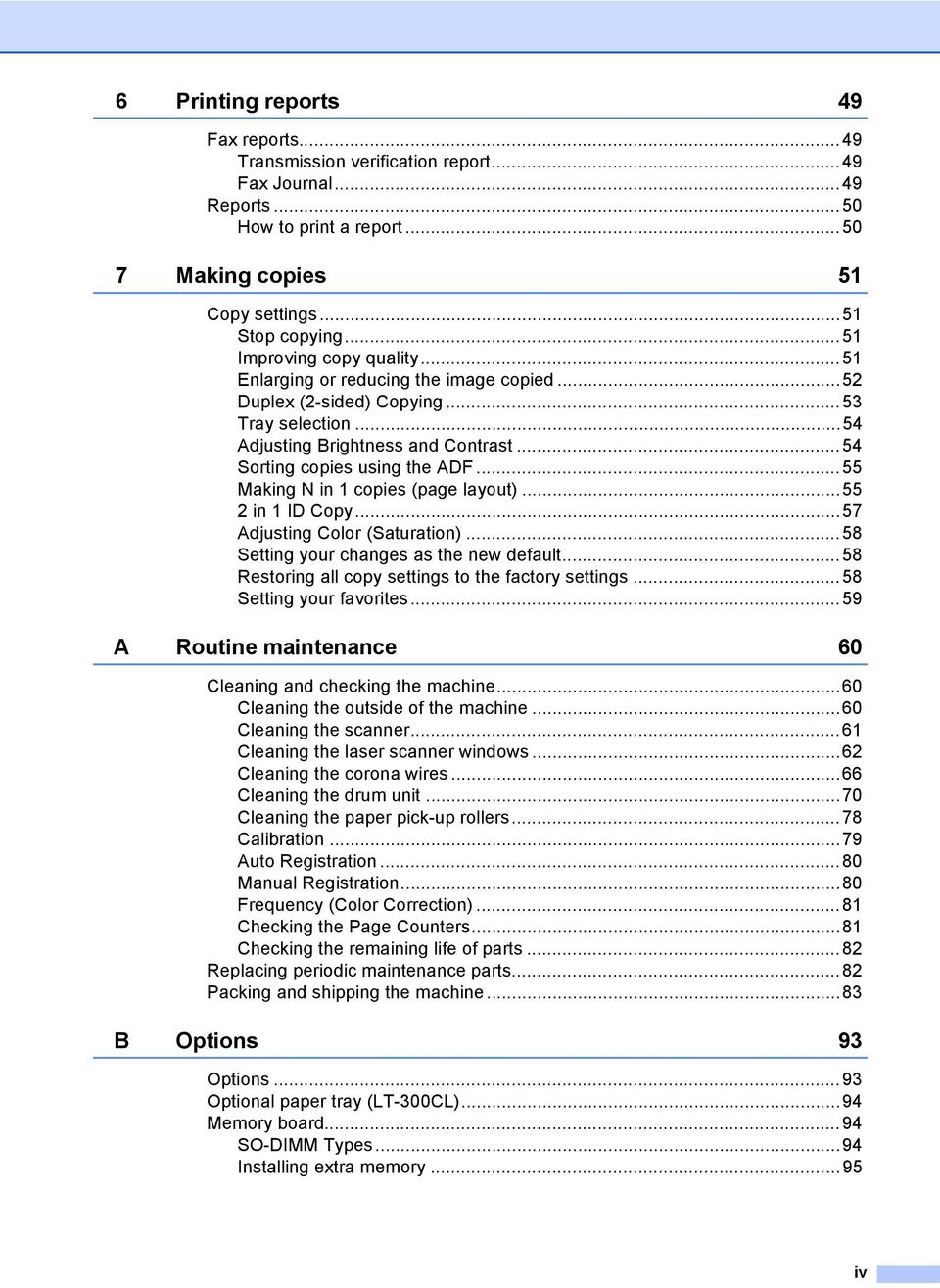
5 6 Printing reports 49 Fax reports...49 Transmission verification report...49 Fax Journal...49 Reports...50 How to print a report Making copies 51 Copy settings...51 Stop copying...51 Improving copy quality...51 Enlarging or reducing the image copied...52 Duplex (2-sided) Copying...53 Tray selection...54 Adjusting Brightness and Contrast...54 Sorting copies using the ADF...55 Making N in 1 copies (page layout) in 1 ID Copy...57 Adjusting Color (Saturation)...58 Setting your changes as the new default...58 Restoring all copy settings to the factory settings...58 Setting your favorites...59 A Routine maintenance 60 Cleaning and checking the machine...60 Cleaning the outside of the machine...60 Cleaning the scanner...61 Cleaning the laser scanner windows...62 Cleaning the corona wires...66 Cleaning the drum unit...70 Cleaning the paper pick-up rollers...78 Calibration...79 Auto Registration...80 Manual Registration...80 Frequency (Color Correction)...81 Checking the Page Counters...81 Checking the remaining life of parts...82 Replacing periodic maintenance parts...82 Packing and shipping the machine...83 B Options 93 Options...93 Optional paper tray (LT-300CL)...94 Memory board...94 SO-DIMM Types...94 Installing extra memory...95 iv
6 C Glossary 97 D Index 101 v

7 1 General Setup 1 Memory storage 1 Your menu settings are stored permanently, and in the event of a power failure will not be lost. Temporary settings (for example, Contrast, Overseas Mode) will be lost. Also, during a power failure the machine will retain the date and time and programed fax timer jobs (for example, Delayed Fax) for approximately 60 hours. Other fax jobs in the machine memory will not be lost. Volume settings 1 Ring volume 1 You can choose a range of ring volume levels, from High to Off. a Press MENU. b Press a or b to display General Setup. Press General Setup. c Press a or b to display Volume. Press Volume. d Press Ring. e Press Low, Med, High or Off. f Press Stop/Exit. 1 1

8 Chapter 1 Beeper volume 1 When the beeper is on, the machine will beep when you press a key, make a mistake, or after you send or receive a fax. You can choose a range of volume levels, from High to Off. a Press MENU. b Press a or b to display General Setup. Press General Setup. c Press a or b to display Volume. Press Volume. d Press Beeper. e Press Low, Med, High or Off. f Press Stop/Exit. Speaker volume 1 You can choose a range of speaker volume levels, from High to Off. a Press MENU. b Press a or b to display General Setup. Press General Setup. c Press a or b to display Volume. Press Volume. d Press Speaker. e Press Low, Med, High or Off. f Press Stop/Exit. You can also temporarily adjust the speaker volume by pressing Hook. a Press Hook on the control panel. b Press d or c on the Touchscreen to display Volume. c Press Volume. d Press to decrease or to increase the speaker volume level. Each button press changes the volume to the next setting. e Press Hook on the control panel. 2

9 General Setup Automatic daylight savings time 1 You can set the machine to change automatically for Daylight Savings Time. It will set itself forward one hour in the Spring, and back one hour in the Fall. a Press MENU. b Press a or b to display Initial Setup. Press Initial Setup. c Press a or b to display Date&Time. Press Date&Time. d Press Auto Daylight. e Press On or Off. f Press Stop/Exit. Ecology features 1 Toner Save 1 You can save toner using this feature. When you set Toner Save to On, print appears lighter. The default setting is Off. a Press MENU. b Press a or b to display General Setup. Press General Setup. c Press a or b to display Ecology. Press Ecology. d Press Toner Save. e Press On or Off. f Press Stop/Exit. Note We do not recommend Toner Save for printing Photo or Gray Scale images. 1 3

10 Chapter 1 Sleep mode 1 The Sleep Mode Setting can reduce power consumption. When the machine is in Sleep Mode (Power Save mode) it acts as though it were turned off. Receiving data or starting an operation wakes up the machine from Sleep mode to Ready mode. The timer will restart if any operation is carried out on the machine, such as receiving a fax or computer data or making a copy. The default setting is 3 minutes. When the machine goes into Sleep mode, the LCD back light turns off. a Press MENU. b Press a or b to display General Setup. Press General Setup. c Press a or b to display Ecology. Press Ecology. Deep Sleep mode 1 If the machine is in Sleep mode and does not receive any jobs for a certain length of time, the machine will go into Deep Sleep mode automatically. Deep Sleep mode uses less power than Sleep mode. The machine will wake up and start warming up when the machine receives a fax or computer data, or when you press the Touchscreen or a key on the control panel. When the machine is in Deep Sleep mode, the LCD backlight is Off and the mode keys are dimmed. If a wireless network is enabled, the machine will not enter Deep Sleep mode. To disable the wireless network, see Chapter 5 in the Network User's Guide. If the machine has secure print data it will not enter Deep Sleep mode. d Press Sleep Time. e Using the dial pad on the Touchscreen, enter the length of time the machine will remain idle before entering sleep mode. Press OK. f Press Stop/Exit. 4

11 General Setup LCD screen 1 Setting the backlight brightness 1 You can adjust the brightness of the LCD backlight. If you are having difficulty reading the LCD, try changing the brightness setting. a Press MENU. b Press a or b to display General Setup. Press General Setup. c Press a or b to display LCD Settings. Press LCD Settings. d Press Backlight. e Press Light, Med or Dark. f Press Stop/Exit. Setting the Dim Timer for the backlight 1 You can set how long the LCD backlight stays on after you go back to the Ready screen. a Press MENU. b Press a or b to display General Setup. Press General Setup. c Press a or b to display LCD Settings. Press LCD Settings. d Press Dim Timer. e Press Off, 10 Secs, 20 Secs or 30 Secs. f Press Stop/Exit. Dial Prefix 1 The Dial Prefix setting will automatically dial a predefined number before every fax number you dial. For example: If your telephone system requires a 9 to dial an outside number use this setting to automatically dial 9 for every fax you send. Setting up the prefix number 1 a Press MENU. b Press a or b to display Initial Setup. Press Initial Setup. c Press a or b to display Dial Prefix. Press Dial Prefix. d Do one of the following: If you want to set the dial prefix feature to on, press On. Go to step e. If you want to set the dial prefix feature to off, press Off. Go to step g. e Press Dial Prefix. f Enter the prefix number (up to 5 digits) by pressing the buttons on the Touchscreen. Press OK. Note You can use the numbers and symbols 0 to 9, #, and l. (You cannot use! with any other numbers or symbols.) If your telephone system requires a time break recall (hookflash), press! to enter the break. (Canada only) If pulse dialing mode is on, # and l are not available to use. 1 g Press Stop/Exit. 5
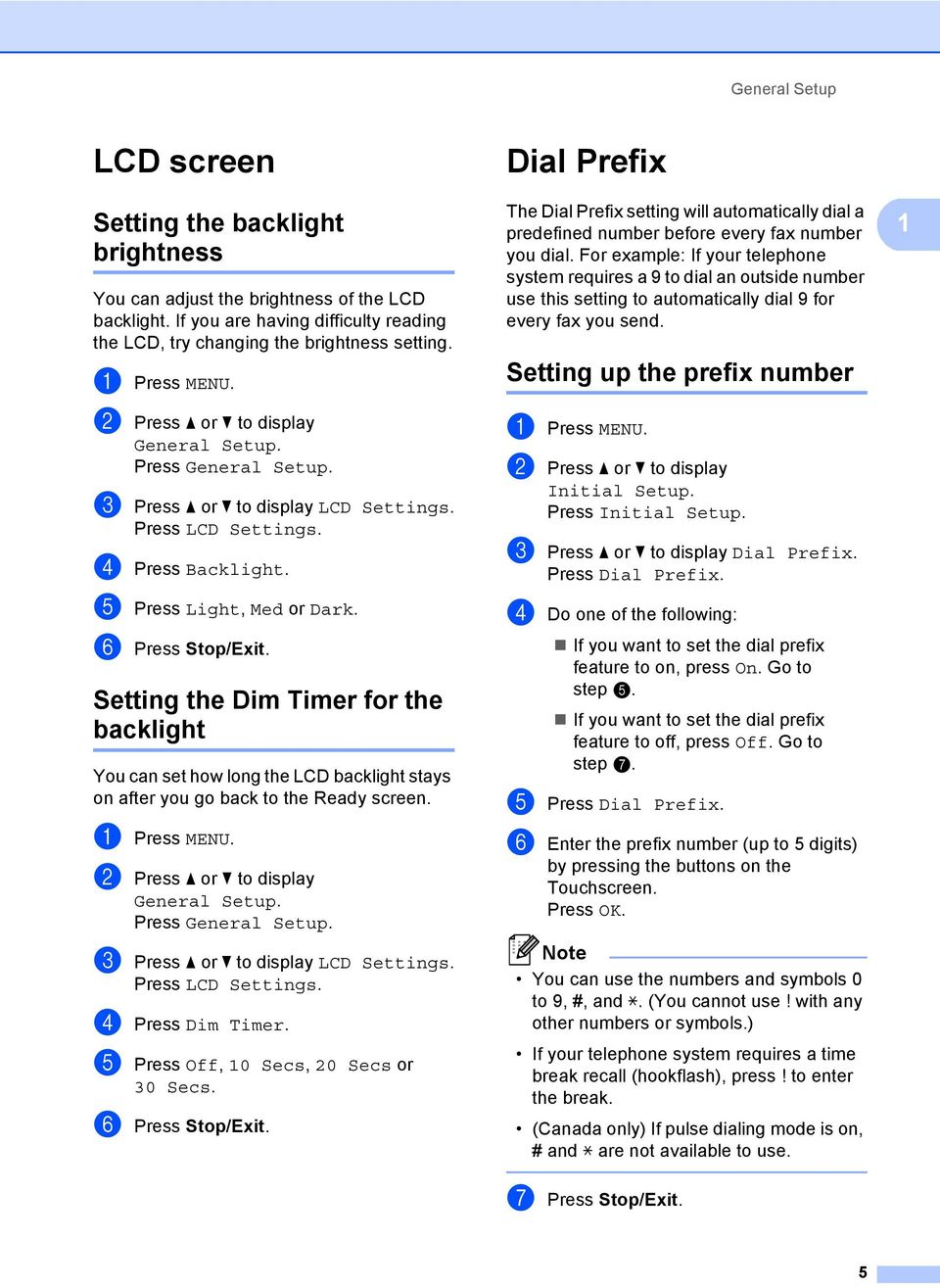
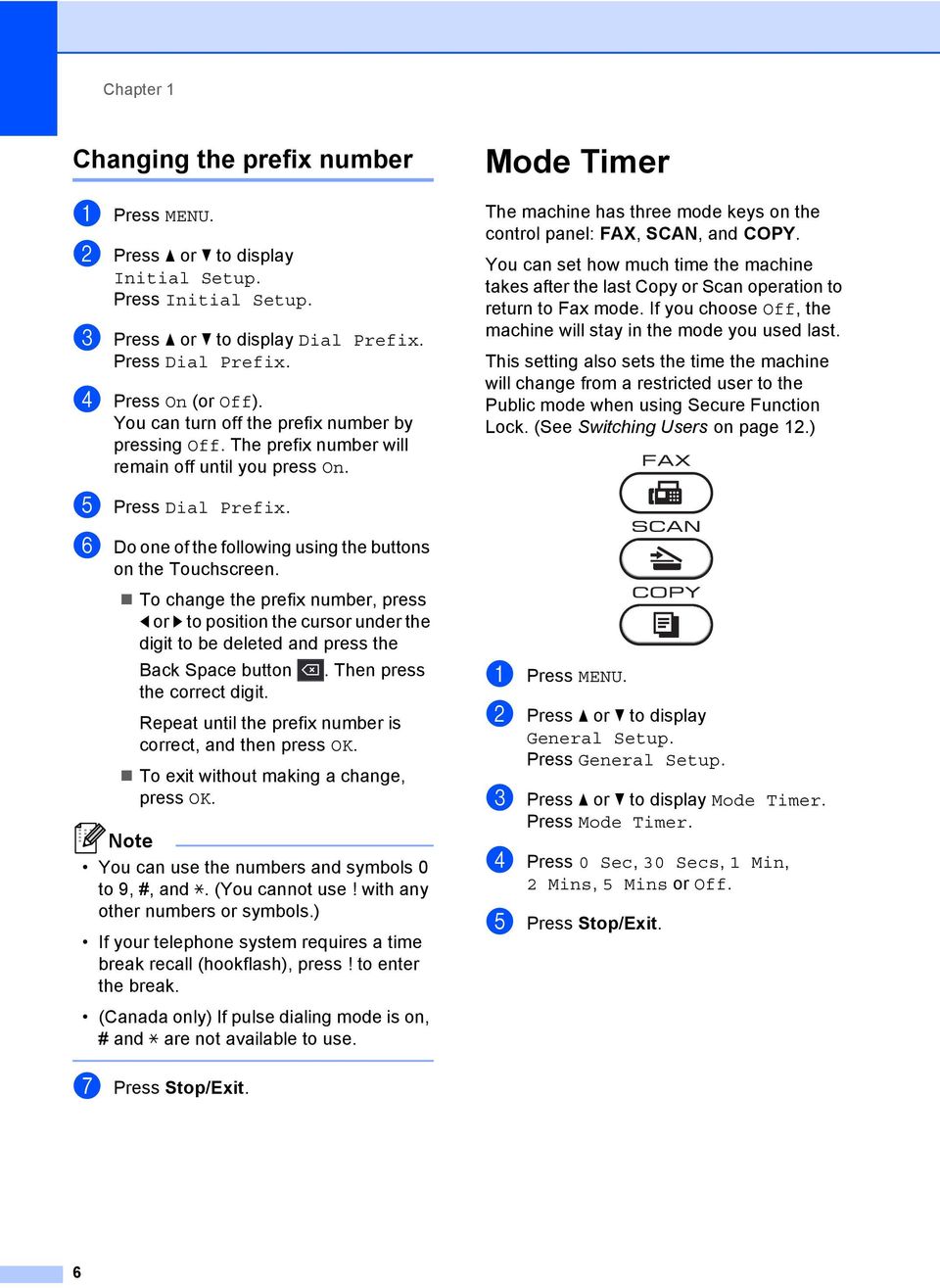
12 Chapter 1 Changing the prefix number 1 a Press MENU. b Press a or b to display Initial Setup. Press Initial Setup. c Press a or b to display Dial Prefix. Press Dial Prefix. d Press On (or Off). You can turn off the prefix number by pressing Off. The prefix number will remain off until you press On. e Press Dial Prefix. f Do one of the following using the buttons on the Touchscreen. To change the prefix number, press d or c to position the cursor under the digit to be deleted and press the Back Space button. Then press the correct digit. Repeat until the prefix number is correct, and then press OK. To exit without making a change, press OK. Note You can use the numbers and symbols 0 to 9, #, and l. (You cannot use! with any other numbers or symbols.) If your telephone system requires a time break recall (hookflash), press! to enter the break. (Canada only) If pulse dialing mode is on, # and l are not available to use. Mode Timer 1 The machine has three mode keys on the control panel: FAX, SCAN, and COPY. You can set how much time the machine takes after the last Copy or Scan operation to return to Fax mode. If you choose Off, the machine will stay in the mode you used last. This setting also sets the time the machine will change from a restricted user to the Public mode when using Secure Function Lock. (See Switching Users on page 12.) a Press MENU. b Press a or b to display General Setup. Press General Setup. c Press a or b to display Mode Timer. Press Mode Timer. d Press 0 Sec, 30 Secs, 1 Min, 2 Mins, 5 Mins or Off. e Press Stop/Exit. g Press Stop/Exit. 6
13 2 Security features 2 Secure Function Lock 2.02 Secure Function Lock lets you restrict Public access to the following machine functions: Fax Tx Fax Rx Copy Scan Direct Print Print Color Print This feature also prevents users from changing the Default settings of the machine by limiting access to the MENU settings. Before using the security features you must first enter an administrator password. Access to restricted operations can be enabled by creating a restricted user. Restricted users must enter a user password to use the machine. Make a careful note of your password. If you forget it, you will have to reset the password stored in the machine. For information about how to reset the password call Brother Customer Service. Note Secure Function Lock can be set manually at the control panel or by using Web Based Management. We recommend using Web Based Management to configure this feature. For more information, see the Network User's Guide. Only administrators can set limitations and make changes for each user. Polling Receive is enabled only when both Fax Tx and Fax Rx are enabled. 2 7

14 Chapter 2 Setting and changing the Administrator Password 2 Setting up the password 2 The password you set in these steps is for the administrator. This password is used to set up users and to turn Secure Function Lock on or off. (See Setting up and changing restricted users on page 9 and Turning Secure Function Lock on/off on page 11.) Note Make a careful note of the administrator password. If you enter the wrong password, the LCD will show Wrong Password. Re-enter the correct password. If you forget it, please call Brother Customer Service. a Press MENU. b Press a or b to display General Setup. Press General Setup. c Press a or b to display Security. Press Security. Changing the password 2 a Press MENU. b Press a or b to display General Setup. Press General Setup. c Press a or b to display Security. Press Security. d Press Function Lock. e Press Set Password. f Enter the registered four-digit password by pressing the buttons on the Touchscreen. Press OK. g Enter a four-digit number for the new password by pressing the buttons on the Touchscreen. Press OK. h Re-enter the password when the LCD shows Verify. Press OK. i Press Stop/Exit. d Press Function Lock. e Enter a four-digit number for the password by pressing the buttons on the Touchscreen. Press OK. f Re-enter the password when the LCD shows Verify. Press OK. g Press Stop/Exit. 8

15 Security features Setting up and changing the Public user mode 2 Public user mode restricts the functions that are available for Public users. Public users do not need to enter a password to access the features made available through this setting. You can set up one Public user. a Press MENU. b Press a or b to display General Setup. Press General Setup. c Press a or b to display Security. Press Security. d Press Function Lock. e Press Setup ID. f Enter the administrator password by pressing the buttons on the Touchscreen. Press OK. g Press a or b to display Public. Press Public. h Do one of the following: To set up the Public user, press Enable or Disable for each operation, as follows: Press Fax Tx. Then press Enable or Disable. After you have set Fax Tx, repeat these steps for Fax Rx, Copy, Scan, Direct Print, Print and Color Print. To change the Public user settings, pressa or b to display the setting you want to change. Press the setting and press Enable or Disable. Repeat this step until you finish changing settings. i Press Stop/Exit. Setting up and changing restricted users 2 You can set up users with restrictions and a password for functions that are available to them. You can set up more advanced restrictions, such as by page count or PC user login name, through Web Based Management. (For more information, see the Network User's Guide.) You can set up to 25 restricted users with restrictions and a password. Setting up restricted users 2 a Press MENU. b Press a or b to display General Setup. Press General Setup. c Press a or b to display Security. Press Security. d Press Function Lock. e Press Setup ID. f Enter the four-digit administrator password by pressing the buttons on the Touchscreen. Press OK. g Press a or b to display User01. Press User01. h Enter the user name by pressing the buttons on the Touchscreen. (See Entering text in Appendix C of the Basic User's Guide.) Press OK. i Enter a four-digit user password by pressing the buttons on the Touchscreen. Press OK. 2 9

16 Chapter 2 j To set up a restricted user, press Enable or Disable for each operation, as follows: Press Fax Tx. Then press Enable or Disable. After you have set Fax Tx, repeat these steps for Fax Rx, Copy, Scan, Direct Print, Print and Color Print. k Repeat steps g to j for entering each additional user and password. l Press Stop/Exit. Note You cannot use the same name as another user's name. Changing user name, password or settings for restricted users 2 a Press MENU. b Press a or b to display General Setup. Press General Setup. c Press a or b to display Security. Press Security. d Press Function Lock. e Press Setup ID. f Enter the four-digit administrator password by pressing the buttons on the Touchscreen. Press OK. g Press a or b to display the existing restricted user you want to change. Press the user name. h Press Change. To change the user name, enter a new user name by pressing the buttons on the Touchscreen. (See Entering text in Appendix C of the Basic User's Guide.) Press OK. i To change the password, enter a new four-digit user password by pressing the buttons on the Touchscreen. Press OK. j To change a restricted user's settings, press a or b to display the setting you want to change. Press the setting and then press Enable or Disable. Repeat this step until you are finished making changes. k Press Stop/Exit. Note You cannot use the same name as another user's name. Reset existing restricted users 2 a Press MENU. b Press a or b to display General Setup. Press General Setup. c Press a or b to display Security. Press Security. d Press Function Lock. e Press Setup ID. f Enter the four-digit administrator password by pressing the buttons on the Touchscreen. Press OK. g Press a or b to display the existing restricted user you want to reset. Press the user name. h Press Reset. i Press Yes to reset the existing restricted user. j Press Stop/Exit. 10

17 Security features Turning Secure Function Lock on/off 2 Turning Secure Function Lock on a Press MENU. b Press a or b to display General Setup. Press General Setup. c Press a or b to display Security. Press Security. d Press Function Lock. e Press Lock OffiOn. f Enter the registered four-digit administrator password by pressing the buttons on the Touchscreen. Press OK. Turning Secure Function Lock off a Press Public or xxxxx (where xxxxx is the user s name). b Press Lock OniOff. c Enter the registered four-digit administrator password by pressing the buttons on the Touchscreen. Press OK. Note If you enter the wrong password, the LCD will show Wrong Password. Re-enter the correct password. 2 11

18 Chapter 2 Switching Users 2 This setting allows you to switch between registered restricted users or Public mode when Secure Function Lock is turned on. Changing to the restricted user Mode a Press Public or xxxxx (where xxxxx is the user s name). Press Change User. b Press a or b to display your user name. c Press your user name. d Enter the registered four-digit user password by pressing the buttons on the Touchscreen. Press OK. Changing to the Public Mode a Press xxxxx. (where xxxxx is the user s name.) b Press Go to Public. Note After a restricted user has finished using the machine, it will return to the Public setting within the same time as the Mode Timer setting. (See Mode Timer on page 6.) If your ID has set page limit restrictions and already reached the maximum number of pages, the LCD will show Limit Exceeded when you print data. Contact your administrator to check your Secure Function Lock Settings. If your ID has set Color Print restrictions to Disable, the LCD will show No Permission when you try to print colored data. The machine prints the data in black & white only. 12

19 Security features Setting Lock 2 Setting Lock lets you set a password to stop other people from accidentally changing your machine settings. Make a careful note of your password. If you forget it, you will have to reset the passwords stored in the machine. Please call your administrator or Brother Customer Service. While Setting Lock is On, you cannot access MENU and Address Book settings. Also, machine settings cannot be changed through the Remote Setup utility while Setting Lock is On. Setting up the password 2 a Press MENU. b Press a or b to display General Setup. Press General Setup. c Press a or b to display Security. Press Security. d Press Setting Lock. e Enter a four-digit number for the password by pressing the buttons on the Touchscreen. Press OK. f Re-enter the password when the LCD shows Verify. Press OK. g Press Stop/Exit. 2 13

20 Chapter 2 Changing your Setting Lock password 2 a Press MENU. b Press a or b to display General Setup. Press General Setup. c Press a or b to display Security. Press Security. d Press Setting Lock. e Press Set Password. f Enter the registered four-digit password by pressing the buttons on the Touchscreen. Press OK. g Enter a four-digit number for the new password by pressing the buttons on the Touchscreen. Press OK. h Re-enter the password when the LCD shows Verify. Press OK. i Press Stop/Exit. Turning Setting Lock on/off 2 If you enter the wrong password when following the instructions below, the LCD will show Wrong Password. Re-enter the correct password. Turning Setting Lock on a Press MENU. b Press a or b to display General Setup. Press General Setup. c Press a or b to display Security. Press Security. d Press Setting Lock. e Press Lock OffiOn. f Enter the registered four-digit administrator password by pressing the buttons on the Touchscreen. Press OK. Turning Setting Lock off a Press Setting Lock on the LCD. b Enter the registered four-digit administrator password by pressing the buttons on the Touchscreen. Press OK. 14

21 Security features Restricting dialing 2 This feature is to prevent users from sending a fax or call to a wrong number by mistake. You can set the machine to restrict dialing by using the dial pad, One Touch and Speed Dial. If you choose Off, the machine does not restrict the dialing method. If you choose Enter # twice, the machine will prompt you to re-enter the number, and then if you re-enter the same number correctly, the machine will start dialing. If you re-enter the wrong number, the LCD will show an error message. If you choose On, the machine will restrict all fax sending and outbound calls for that dialing method. Dial pad restriction 2 a Press MENU. b Press a or b to display Fax. Press Fax. c Press a or b to display Dial Restrict. Press Dial Restrict. d Press Dial Pad. e Press Off, Enter # twice or On. f Press Stop/Exit. One Touch restriction 2 a Press MENU. b Press a or b to display Fax. Press Fax. c Press a or b to display Dial Restrict. Press Dial Restrict. d Press One Touch Dial. e Press Off, Enter # twice or On. f Press Stop/Exit. Speed Dial restriction 2 a Press MENU. b Press a or b to display Fax. Press Fax. c Press a or b to display Dial Restrict. Press Dial Restrict. d Press Speed Dial. e Press Off, Enter # twice or On. f Press Stop/Exit. 2 15
22 Chapter 2 LDAP server restriction 2 a Press MENU. b Press a or b to display Fax. Press Fax. c Press a or b to display Dial Restrict. Press Dial Restrict. d Press LDAP server. e Press Off, Enter # twice or On. f Press Stop/Exit. Note The Enter # twice setting will not work if you use an external phone or press Hook before entering the number. You will not be asked to re-enter the number. You can not restrict dialing when you use Redial/Pause. If you chose On or Enter # twice, you cannot use the Broadcasting feature and cannot combine quick dial numbers when dialing. 16
23 3 Sending a fax 3 Additional sending options 3 Sending faxes using multiple settings 3 Before you send a fax, you can change any combination of these settings: duplex fax, contrast, resolution, overseas mode, delayed fax timer, polling transmission, real time transmission, broadcast, glass scan size or cover page settings. a Press (FAX). The LCD shows: FAX Address Book Duplex Fax Off Fax Resolution Standard Changing a 2-sided fax layout3 You need to choose the duplex scanning format before you send a 2-sided fax. The format you choose will depend on the layout of your 2-sided document. a Press (FAX). b Press d or c to display Duplex Fax. Press Duplex Fax. c Do one of the following: If your document is flipped on the Long edge, press DuplexScan :LongEdge. Long edge Portrait Landscape 3 b Press d or c to display a setting you want to change and press the setting, then press the option you want. c Do one of the following: Repeat step b to change more settings. If you are finished choosing settings, go to the next step for sending your fax. Note Most settings are temporary and the machine returns to its default settings after you send a fax. You can save some of the settings you use most often by setting them as the default. These settings will stay until you change them again. (See Setting your changes as the new default on page 24.) If your document is flipped on the Short edge, press DuplexScan :ShortEdge. Short edge Portrait d Press Stop/Exit. Landscape 17
24 Chapter 3 Contrast 3 For most documents the default setting of Auto will give the best results. Auto automatically chooses the suitable contrast for your document. If your document is very light or very dark, changing the contrast may improve the quality of the fax. Use Dark to make the faxed document lighter. Use Light to make the faxed document darker. a Press (FAX). b Press d or c to display Contrast. Press Contrast. Changing Fax Resolution 3 The quality of a fax can be improved by changing the Fax Resolution. Resolution can be changed for the next fax. a Press (FAX). b Press d or c to display Fax Resolution. Press Fax Resolution. c Press Standard, Fine, S.Fine or Photo. Note You can choose four different resolution settings for black & white faxes and two for colour. c Press Auto, Light or Dark. Note Even if you choose Light or Dark, the machine will send the fax using the Auto setting if you choose Photo as the Fax Resolution. Black & white Standard Fine S.Fine Photo Suitable for most typed documents. Good for small print and transmits a little slower than Standard resolution. Good for small print or artwork and transmits slower than Fine resolution. Use when the document has varying shades of grey or is a photograph. This has the slowest transmission time. Color Standard Fine Suitable for most typed documents. Use when the document is a photograph. The transmission time is slower than Standard resolution. If you choose S.Fine or Photo and then use the Color Start key to send a fax, the machine will send the fax using the Fine setting. 18
25 Sending a fax Additional sending operations 3 Sending a fax manually 3 Manual transmission 3 Manual transmission lets you hear the dialing, ringing and fax-receiving tones while sending a fax. a Make sure you are in Fax mode (FAX). b Load your document. c Press Hook and listen for a dial tone. Or pick up the handset of the external telephone and listen for a dial tone. d Dial the fax number you want to call. e When you hear the fax tones, press Black Start or Color Start. If you are using the scanner glass, press Send. f Replace the handset of an external telephone. Sending a fax at the end of a conversation 3 At the end of a conversation you can send a fax to the other party before you both hang up. a Ask the other party to wait for fax tones (beeps) and then to press the Start or Send key before hanging up. b Make sure you are in Fax mode (FAX). c Load your document. d Press Black Start or Color Start. If you are using the scanner glass, press Send. e Replace the handset of an external telephone. 3 19
26 Chapter 3 Dual access (black & white only) 3 You can dial a number, and start scanning the fax into memory even when the machine is sending from memory, receiving faxes or printing PC data. The LCD will show the new job number. The number of pages you can scan into the memory will vary depending on the data that is printed on them. Note If you get an Out of Memory message while scanning the first page of a fax, press Stop/Exit to cancel scanning. If you get an Out of Memory message while scanning a subsequent page, you can press Black Start to send the pages scanned so far, or press Stop/Exit to cancel the operation. Broadcasting (black & white only) 3 Broadcasting lets you send the same fax message to more than one fax number. You can include Groups, One Touch, Speed Dial numbers and up to 50 manually dialed numbers in the same broadcast. You can broadcast up to 390 different numbers. This will depend on how many groups, access codes or credit card numbers you have stored, and on how many delayed or stored faxes in memory. Before you begin the broadcast 3 One Touch and Speed Dial numbers must be stored in the machine's memory before they can be used in a broadcast. (See Storing One Touch Dial numbers and Storing Speed Dial numbers in Chapter 7 of the Basic User's Guide.) Group numbers must also be stored in the machine's memory before they can be used in a broadcast. Group numbers include many stored One Touch Dial and Speed Dial numbers for easier dialing. (See Setting up Groups for Broadcasting on page 44.) 20
27 Sending a fax How to broadcast a fax 3 Note To help you choose numbers easily, press Address Book or (Search). a Press (FAX). b Load your document. c Press d or c to display Broadcasting. Press Broadcasting. d You can add numbers to the broadcast in the following ways: Press Manual and enter a number by pressing the buttons on the Touchscreen. (See How to dial in Chapter 7 of the Basic User's Guide.) Press OK. Press Address Book. Press to search by Alphabetical Order or Numerical Order. Put a check in the check box beside each number you want to include in the broadcast. Press OK. Note One Touch Dial numbers begin with l. Speed Dial numbers begin with #. Canceling a Broadcast in progress 3 While broadcasting you can cancel the fax currently being sent or the whole broadcast job. a PressStop/Exit. b Do one of the following: To cancel the entire broadcast, press Entire Broadcast. Go to step c. To cancel the current job, press the button that displays the number being dialed. Go to step d. To exit without canceling, press Stop/Exit. c When the LCD asks if you want to cancel the entire broadcast, do one of the following: Press Yes to confirm. To exit without canceling, press No or Stop/Exit. d Do one of the following: To cancel the current job, press Yes. To exit without canceling, press No or Stop/Exit. 3 e After you have entered all the fax numbers by repeating step d, press OK. f Press Black Start. After the broadcast is finished the machine will print a broadcast report to let you know the results. Note The scan profile of the One Touch, Speed Dial or Group number you chose first will be applied to the broadcast. 21
28 Chapter 3 Real Time Transmission 3 When you are sending a fax, the machine will scan the documents into the memory before sending it. Then, as soon as the telephone line is free, the machine will start dialing and sending. Sometimes, you may want to send an important document immediately, without waiting for memory transmission. You can turn on Real Time TX. Note If the memory is full and you are sending a black and white fax from the ADF, the machine will send the document in real time (even if Real Time TX is set to Off). If the memory is full, faxes from the scanner glass cannot be sent until you clear some of the memory. In Real Time Transmission, the automatic redial feature does not work when using the scanner glass. a Press (FAX). b Load your document. c Press d or c to display Real Time TX. Press Real Time TX. d Press On. Overseas Mode 3 If you are having difficulty sending a fax overseas due to a bad connection, then turning on Overseas Mode may help. This is a temporary setting, and will only be active for your next fax. a Press (FAX). b Load your document. c Press d or c to display Overseas Mode. Press Overseas Mode. d Press On. Delayed Fax (black & white only) 3 You can store up to 50 faxes in the memory to be sent within a twenty-four hour period. a Press (FAX). b Load your document. c Press d or c to display Delayed Fax. Press Delayed Fax. d Press On. e Enter the time you want the fax to be sent (in 24-hour format) by pressing the buttons on the Touchscreen. (For example, enter 19:45 for 7:45 PM.) Press OK. Note The number of pages you can scan into the memory depends on the amount of data printed on each page. 22
29 Sending a fax Delayed batch transmission (black & white only) 3 Before sending the delayed faxes, your machine will help you economize by sorting all the faxes in the memory by destination and scheduled time. All delayed faxes that are scheduled to be sent at the same time to the same fax number will be sent as one fax to save transmission time. a Press MENU. b Press a or b to display Fax. Press Fax. c Press a or b to display Setup Send. Press Setup Send. d Press Batch TX. e Press On or Off. f Press Stop/Exit. Checking and canceling waiting jobs 3 Check which jobs are still waiting in the memory to be sent. If there are no jobs, the LCD will show No Jobs Waiting. You can cancel a fax job that is stored and waiting in the memory. a Press MENU. b Press a or b to display Fax. Press Fax. c Press a or b to display Remaining Jobs. Press Remaining Jobs. Jobs that are waiting will appear on the LCD. d Press a or b to scroll through the jobs and press the job you want to cancel. Press OK. e Do one of the following: To cancel, press Yes. If you want to cancel another job repeat step d. To exit without canceling, press No. f When you have finished canceling jobs, press Stop/Exit. 3 23
30 Chapter 3 Setting your changes as the new default 3 You can save the fax settings for Fax Resolution, Contrast, Real Time TX, Glass Scan Size and Coverpage Setup you use most often by setting them as the default. These settings will stay until you change them again. a Press (FAX). b Press d or c to choose the setting you want to change, and then press the new option. Repeat this step for each setting you want to change. Restoring all fax settings to the factory settings 3 You can restore all the fax settings you have changed to the factory settings. These settings will stay until you change them again. a Press (FAX). b After changing the last setting, press d or c to display Factory Reset. Press Factory Reset. c Press Yes. d Press Stop/Exit. c After changing the last setting, press d or c to display Set New Default. Press Set New Default. d Press Yes. e Press Stop/Exit. 24
31 Sending a fax Electronic cover page (black & white only) 3 This feature will not work unless you have already programmed your Station ID. (See the Quick Setup Guide.) You can automatically send a cover page with every fax. Your cover page includes your Station ID, a comment, and the name (or number) stored in the One Touch or Speed Dial memory. By choosing On you can also display the number of pages on the cover page. You can choose one of the following preset comments. 1.Comment Off 2.Please Call 3.Urgent 4.Confidential Instead of using one of the preset comments, you can enter two personal messages of your own, up to 27 characters long. Use the chart for Entering text in Appendix C of the Basic User's Guide for help entering characters. (See Composing your own comments on page 25.) 5.(User Defined) 6.(User Defined) Composing your own comments 3 You can set up two comments of your own. a Press MENU. b Press a or b to display Fax. Press Fax. c Press a or b to display Setup Send. Press Setup Send. d Press Coverpage Setting. e Press Coverpage Message. f Press 5 or 6 to store your own comment. g Enter your own comment by pressing the buttons on the Touchscreen. Press OK. Press to choose numbers, letters or special characters. (Use the chart for Entering text in Appendix C of the Basic User's Guide for help entering characters.) h Press Stop/Exit. 3 25
32 Chapter 3 Send a cover page for all faxes 3 You can set the machine to send a cover page whenever you send a fax. a Press (FAX). b Press d or c to display Coverpage Setup. Press Coverpage Setup. c Press On (or Off). d Press the comment you want to add. e Enter two digits to show the number of pages you are sending. Press OK. For example, enter 0 2 for 2 pages or 00 to leave the number of pages blank. If you make a mistake, press Clear to back up and re-enter the number of pages. Using a printed cover page 3 If you want to use a printed cover page that you can write on, you can print the sample page and attach it to your fax. a Press MENU. b Press a or b to display Fax. Press Fax. c Press a or b to display Setup Send. Press Setup Send. d Press Coverpage Setting. e Press Print Sample. f Press Black Start or Color Start. g After the machine prints a copy of your cover page, press Stop/Exit. 26
33 Sending a fax Polling overview 3 Polling lets you set up your machine so other people can receive faxes from you, but they pay for the call. It also lets you call somebody else s fax machine and receive a fax from it, so you pay for the call. The polling feature needs to be set up on both machines for this to work. Not all fax machines support polling. Polled transmit (black & white only) 3 Polled transmit lets you set up your machine to wait with a document so another fax machine can call and retrieve it. Note The document will be stored and can be retrieved from any other fax machine until you delete the fax from memory. To delete the fax from memory, press MENU, Fax, Remaining Jobs. (See Checking and canceling waiting jobs on page 23.) 3 Setup for polled transmit 3 a Press (FAX). b Load your document. c Press d or c to display Polled TX. Press Polled TX. d Press On. e Press Black Start. f If you are using the scanner glass, the LCD will prompt you to choose one of the following options: Press Yes to scan another page. Go to step g. Press No or Black Start to send the document. g Place the next page on the scanner glass and press Black Start. Repeat steps f and g for each additional page. h Your machine will automatically send the fax. 27
34 4 Receiving a fax 4 Remote Fax Options (black & white only) 4 Remote Fax Options are NOT available for color faxes. Remote Fax Options let you receive faxes while you are away from the machine. You can use only one Remote Fax Option at a time. Receiving faxes into memory when the paper tray is empty 4 As soon as the paper tray becomes empty during fax reception, the LCD shows No Paper and begins receiving faxes into the machine s memory. Put some paper in the paper tray. (See Loading paper and print media in Chapter 2 of the Basic User's Guide.) The machine will carry on receiving the fax, with the remaining pages being stored in memory, if enough memory is available. Incoming faxes will continue to be stored in the memory until the memory becomes full or paper is loaded in the paper tray. When the memory is full the machine will stop automatically answering calls. To print the faxes, put fresh paper in the tray. Fax Forwarding 4 The Fax Forwarding feature lets you automatically forward your received faxes to another machine. a Press MENU. b Press a or b to display Fax. Press Fax. c Press a or b to display Setup Receive. Press Setup Receive. d Press a or b to display Forward/Page/Store. Press Forward/Page/Store. e Press Fax Forward. f Do one of the followings: Press Manual to enter the forwarding fax number (up to 20 characters) or address (up to 60 characters) using the buttons on the Touchscreen. (See Entering text in Appendix C of the Basic User's Guide.) Press OK. Press Address Book. Press a or b to scroll until you find the fax number or address you want your faxes to be forward to. Press the fax number or address you want to use. 28
35 Receiving a fax Note You can enter an address by pressing on the Touchscreen. You can display your stored numbers and addresses in alphabetical order by pressing on the Touchscreen. You cannot enter a forwarding number using a One Touch key on the control panel. Depending on the address you choose, you will be asked for the File Type. Choose TIFF or PDF and go to step g. If you choose a Group number from the Address Book, the faxes will be forwarded to multiple fax numbers. g Press Backup Print:On or Backup Print:Off. IMPORTANT If you choose Backup Print On, the machine will also print received faxes at your machine so you will have a copy. This is a safety feature in case there is a power failure before the fax is forwarded or a problem at the receiving machine. h Press Stop/Exit. Paging 4 When Paging is chosen, the machine dials the cell phone or pager number you programmed. This activates your cell phone or pager so you will know that you have a fax message in the machine s memory. a Press MENU. b Press a or b to display Fax. Press Fax. c Press a or b to display Setup Receive. Press Setup Receive. d Press a or b to display Forward/Page/Store. Press Forward/Page/Store. e Press Paging. f Enter your cell phone number followed by # # (up to 20 digits) by pressing the buttons on the Touchscreen. Press OK. Do not include the area code if it is the same as that of your machine. For example, press ##. g Do one of the following: If you pager needs a PIN, enter the PIN, press #, press Pause, enter your fax number followed by ##. Press OK. (For example, press: # Pause # #) If you do not need a PIN, press OK. If you are programming a cell phone number, press OK. 4 29
36 Chapter 4 h Press Stop/Exit. Note If you have set Paging, a backup copy will automatically be printed at the machine. You cannot change a Paging or PIN number remotely. Fax Storage 4 The Fax Storage feature lets you store your received faxes in the machine s memory. You can retrieve stored fax messages from a fax machine at another location using the remote retrieval commands. (See Retrieving fax messages on page 34.) Your machine will automatically print a copy of the stored fax. a Press MENU. b Press a or b to display Fax. Press Fax. c Press a or b to display Setup Receive. Press Setup Receive. d Press a or b to display Forward/Page/Store. Press Forward/Page/Store. e Press Fax Storage. f Press Stop/Exit. 30
37 Receiving a fax PC-Fax Receive 4 If you turn on the PC-Fax Receive feature your machine will store received faxes in memory and send them to your PC automatically. You can then use your PC to view and store these faxes. Even if you have turned off your PC (at night or on the weekend, for example), your machine will receive and store your faxes in its memory. The number of received faxes that are stored in the memory will appear on the LCD. When you start your PC and the PC-Fax Receiving software runs, your machine transfers your faxes to your PC automatically. For PC-Fax Receive to work you must have the PC-FAX Receive software running on your PC. (For details, see PC-FAX Receiving in the Software User's Guide.) If you choose Backup Print On, the machine will also print the fax. a Press MENU. b Press a or b to display Fax. Press Fax. c Press a or b to display Setup Receive. Press Setup Receive. d Press a or b to display Forward/Page/Store. Press Forward/Page/Store. e Press PC Fax Receive. f The LCD gives you options that you have set up in the PC-Fax receiving program on your PC. If you started the PC-FAX Receiving program on your computer, press OK. (See PC-FAX Receiving in the Software User's Guide.) g Press a or b to choose <USB> or your computer name if the machine is connected to a network. Press OK. h Press Backup Print:On or Backup Print:Off. i Press Stop/Exit. IMPORTANT If you choose Backup Print On, the machine will also print the fax at your machine so you will have a copy. This is a safety feature in case there is a power failure before the fax is forwarded or a problem at the receiving machine. Note Before you can set up PC-Fax Receive you must install the MFL-Pro Suite software on your PC. Make sure your PC is connected and turned on. (For details see PC-FAX Receiving in the Software User's Guide.) If your machine has a problem and is unable to print faxes in memory, you can use this setting to transfer your faxes to a PC. (For details, see Transferring your faxes or Fax Journal report in Appendix B of the Basic User's Guide.) PC-Fax Receive is not supported in Mac OS. Even if you have turned on the PC-Fax Receive feature, color faxes will not be transferred to your PC. The machine prints received color faxes. 4 31
38 Chapter 4 Changing Remote Fax Options 4 If received faxes are left in your machine s memory when you change to another Remote Fax Option, the LCD will ask you one of the following questions: Erase All Fax? Print All Fax? If you press Yes, faxes in the memory will be erased or printed before the setting changes. If a backup copy has already been printed it will not be printed again. If you press No, faxes in the memory will not be erased or printed and the setting will be unchanged. If received faxes are left in the machine s memory when you change to PC Fax Receive from another remote fax option (Fax Forward, Paging or Fax Storage), the LCD will ask you the following question: Send Fax to PC? If you press Yes, faxes in the memory will be sent to your PC before the setting changes. Faxes in the memory will be sent to your PC when the PC-Fax Receive icon is active on your PC. (See the Software User's Guide.) If you press No, faxes in the memory will not be erased or transferred to your PC and the setting will be unchanged. Backup Print:On Backup Print:Off Press Backup Print:On or Backup Print:Off. IMPORTANT If you choose Backup Print On, the machine will also print received faxes at your machine so you will have a copy. This is a safety feature in case there is a power failure before the fax is forwarded or a problem at the receiving machine. Turning off Remote Fax Options 4 a Press MENU. b Press a or b to display Fax. Press Fax. c Press a or b to display Setup Receive. Press Setup Receive. d Press a or b to display Forward/Page/Store. Press Forward/Page/Store. e Press Off. Note The LCD will give you more options if there are received faxes still in your machine s memory. (See Changing Remote Fax Options on page 32.) f Press Stop/Exit. 32
39 Receiving a fax Remote retrieval 4 The remote retrieval feature lets you retrieve your stored fax messages when you are not at the machine. You can call your machine from any touch tone telephone or fax machine, then use the Remote Access Code to retrieve your messages. Setting a Remote Access Code 4 The Remote Access Code feature lets you access the remote retrieval features when you are away from your machine. Before you use the remote access and retrieval features, you have to set up your own code. The default code is an inactive code: l. a Press MENU. b Press a or b to display Fax. Press Fax. c Press a or b to display Remote Access. Press Remote Access. d Enter a three-digit code using the numbers 0 9, l or #. Press OK. e Press Stop/Exit. Note DO NOT use the same code used for your Fax Receive Code (l51) or Telephone Answer Code (#51). (See Using Remote Codes in Chapter 6 of the Basic User's Guide.) You can change your code at any time. If you want to make your code inactive, press Clear and then OK in d to restore the inactive setting l. Using your Remote Access Code 4 a Dial your fax number from a telephone or another fax machine using touch tone. b When your machine answers, immediately enter your Remote Access Code (3 digits followed by l). c The machine signals if it has received messages: No beeps No messages received. 1 long beep Fax message received. d The machine gives two short beeps to tell you to enter a command (See Remote fax commands on page 35). The machine will hang up if you wait longer than 30 seconds before entering a command. If you enter an invalid command the machine will beep three times. e Press 9 0 to reset the machine when you have finished. f Hang up. Note If your machine is set to Manual mode, you can still access the remote retrieval features. Dial the fax number as normal and let the machine ring. After 100 seconds you will hear a long beep to tell you to enter the remote access code. You will then have 30 seconds to enter the code. 4 33
40 Chapter 4 Retrieving fax messages 4 a Dial your fax number from a telephone or another fax machine using touch tone. b When your machine answers, immediately enter your Remote Access Code (3 digits followed by l). If you hear one long beep, you have messages. c When you hear two short beeps, use the dial pad to press d Wait for a long beep, and then use the dial pad to enter the number of the remote fax machine where you want your fax messages sent, followed by ## (up to 20 digits). e Hang up after you hear your machine beep. Your machine will call the other machine, which will then print your fax messages. Note You can insert a pause in a fax number by using the # key. Changing the Fax Forwarding number4 You can change the default setting of your fax forwarding number from another telephone or fax machine using touch tone. a Dial your fax number from a telephone or another fax machine using touch tone. b When your machine answers, immediately enter your Remote Access Code (3 digits followed by l). If you hear one long beep, you have messages. c When you hear two short beeps, use the dial pad to press d Wait for a long beep, and then use the dial pad to enter the new number of the remote fax machine where you want your fax messages forwarded followed by ## (up to 20 digits). e Press 9 0 to reset the machine when you have finished. f Hang up after you hear your machine beep. Note You can insert a pause in a fax number by using the # key. 34
41 Receiving a fax Remote fax commands 4 Follow the commands below to access features when you are away from the machine. When you call the machine and enter your Remote Access Code (3 digits followed by l), the system will give two short beeps and you must enter a remote command. Remote commands Operation details 95 Change the fax forwarding, paging or fax storage settings 1 OFF You can choose Off after you have retrieved or erased all your messages. 2 Fax Forwarding One long beep means the change is accepted. If you hear three 3 Paging short beeps, you cannot make the change because something has not been set up (for example, a fax forwarding or paging 4 Fax Forwarding number number has not been registered). You can register your fax 6 Fax Storage forwarding number by entering 4. (See Changing the Fax Forwarding number on page 34.) Once you have registered the number, fax forwarding will work. 96 Retrieve a fax 2 Retrieve all faxes Enter the number of a remote fax machine to receive stored fax messages. (See Retrieving fax messages on page 34.) 3 Erase faxes from the memory If you hear one long beep, fax messages have been erased from the memory. 97 Check the receiving status 1 Fax You can check whether your machine has received any faxes. If yes, you will hear one long beep. If no, you will hear three short beeps. 98 Change the Receive Mode 1 External TAD If you hear one long beep, your change has been accepted. 2 Fax/Tel 3 Fax Only 90 Exit Press 90 to exit remote retrieval. Wait for the long beep, then replace the handset. 4 35
42 Chapter 4 Additional receiving operations 4 Printing a reduced incoming fax 4 If you choose On, the machine automatically reduces each page of an incoming fax to fit on one page of A4, Letter, Legal or Folio size paper. The machine calculates the reduction ratio by using the page size of the fax and your Paper Size setting (MENU, General Setup, Tray Setting, Tray Use:Fax). See Paper Size and Type in Chapter 2 of the Basic User's Guide. a Press MENU. b Press a or b to display Fax. Press Fax. c Press a or b to display Setup Receive. Press Setup Receive. d Press a or b to display Auto Reduction. Press Auto Reduction. e Press On (or Off). f Press Stop/Exit. Duplex (2-sided) printing for Fax mode 4 Your machine can automatically print received faxes onto both sides of the paper when Duplex is set to On. You can use Letter, Legal or Folio (8.5 in. 13 in.) size paper for this function [16 to 28 lb (60 to 105 g/m 2 )] a Press MENU. b Press a or b to display Fax. Press Fax. c Press a or b to display Setup Receive. Press Setup Receive. d Press a or b to display Duplex. Press Duplex. e Press On (or Off). f Press Stop/Exit. Note When Duplex is turned on incoming faxes will automatically be reduced to fit the size of paper in the paper tray. When Duplex is set to On, the LCD displays 1 2 (Duplex icon). 36
43 Receiving a fax Setting the Fax Receive Stamp (black & white only) 4 You can set the machine to print the received date and time in the top center of each received fax page. a Press MENU. b Press a or b to display Fax. Press Fax. c Press a or b to display Setup Receive. Press Setup Receive. d Press a or b to display Fax Rx Stamp. Press Fax Rx Stamp. e Press On or Off. f Press Stop/Exit. Note The received time and date will not appear when using Internet Fax. Make sure you have set the current date and time in the machine. (See the Quick Setup Guide.) Receiving a fax at the end of a conversation 4 At the end of a conversation you can ask the other party to send you a fax before you both hang up. a Ask the other party to place the document in their machine and to press the Start or Send key. b When you hear the CNG tones (slowly repeating beeps), press Black Start or Color Start. c Press Receive to receive a fax. d Replace the external handset. 4 37
44 Chapter 4 Setting the Print Density 4 You can adjust the Print Density setting to make your printed pages darker or lighter. a Press MENU. b Press a or b to display Fax. Press Fax. c Press a or b to display Setup Receive. Press Setup Receive. d Press a or b to display Print Density. Press Print Density. e Press c to make the print darker. Or, press d to make the print lighter. Press OK. Printing a fax from the memory 4 If you are using the Fax Storage feature (MENU, Fax, Setup Receive, Forward/Page/Store), you can still print a fax from the memory when you are at your machine. (See Fax Storage on page 30.) a Press MENU. b Press a or b to display Fax. Press Fax. c Press a or b to display Print Fax. Press Print Fax. d Press Black Start. e Press Stop/Exit. f Press Stop/Exit. 38
45 Receiving a fax Polling overview 4 Polling lets you set up your machine so other people can receive faxes from you, but they pay for the call. It also lets you call somebody else s fax machine and receive a fax from it, so you pay for the call. The polling feature needs to be set up on both machines for this to work. Not all fax machines support polling. Polling receive 4 Polling receive lets you call another fax machine to receive a fax. a Press (FAX). b Press d or c to display Polling RX. Press Polling RX. c Press On. d Enter the fax number you are polling using One Touch, Speed Dial, or the dial pad. Press Black Start or Color Start. Sequential polling 4 Sequential polling lets you request documents from several fax machines in one operation. Afterwards, a Sequential Polling Report will be printed. a Press (FAX). b Press d or c to display Polling RX. Press Polling RX. c Press On. d Press d or c to display Broadcasting. Press Broadcasting. e Do one of the following: Press Manual and enter a number by pressing the buttons on the Touchscreen. Press OK. Press Address Book. Press to choose Alphabetical Order or Numerical Order. Press a or b to select a number. Press OK. Note One Touch Dial numbers begin with l. Speed Dial numbers begin with #. f After you have entered all the fax numbers by repeating step e, press OK. g Press Black Start. The machine polls each number or Group number in turn for a document. Press Stop/Exit while the machine is dialing to cancel the polling process. To cancel all sequential polling receive jobs, see Canceling a Sequential Polling Job on page 39. Canceling a Sequential Polling Job 4 a Press Stop/Exit. b Do one of the following: To cancel the entire sequential polling job, press Entire Seq. Poll. Go to step c. To cancel the current job, press the button that displays the number being dialed. Go to step d. To exit without canceling, press Stop/Exit. 4 39
46 Chapter 4 c When the LCD asks if you want to cancel the entire sequential polling job, do one of the following: Press Yes to confirm. To exit without canceling, press No or Stop/Exit. d Do one of the following: To cancel the current job, press Yes. To exit without canceling, press No or Stop/Exit. 40
47 5 Dialing and storing numbers 5 Telephone line services 5 Special line considerations 5 Tone or Pulse (Canada only) 5 If you have a Pulse dialing service, but need to send Tone signals (for example, for telephone banking), follow the instructions below. If you have Touch Tone service, you will not need this feature to send tone signals. a Pick up the handset of the external telephone or press Hook. b Press # on the machine s control panel. Any digits dialed after this will send tone signals. When you hang up, the machine will return to the Pulse dialing service. Roll over telephone lines 5 A roll over telephone system is a group of two or more separate telephone lines that pass incoming calls to each other if they are busy. The calls are usually passed down or rolled over to the next available telephone line in a preset order. Your machine can work in a roll over system as long as it is the last number in the sequence, so the call cannot roll away. Do not put the machine on any of the other numbers; when the other lines are busy and a second fax call is received, the fax call would be transferred to a line that does not have a fax machine. Your machine will work best on a dedicated line. 5 For Fax/Tel mode only 5 When the machine is in Fax/Tel mode, it will use the F/T Ring Time (pseudo/double-ringing) to alert you to pick up a voice call. Lift the external telephone s handset, and then press Hook to answer. If you are at an extension telephone, you will need to lift the handset during the F/T Ring Time and then press #51 between the pseudo/double rings. If no one is on the line, or if someone wants to send you a fax, send the call back to the machine by pressing l51. Two-line telephone system 5 A two-line telephone system is nothing more than two separate telephone numbers on the same wall outlet. The two telephone numbers can be on separate jacks (RJ11) or combined into one jack (RJ14). Your machine must be plugged into an RJ11 jack. RJ11 and RJ14 jacks may be equal in size and appearance and both may contain four wires (black, red, green, yellow). To test the type of jack, plug in a two-line telephone and see if it can access both lines. If it can, you must separate the line for your machine. Converting telephone wall outlets 5 There are three ways to convert to an RJ11 jack. The first two ways may require assistance from the telephone company. You can change the wall outlets from one RJ14 jack to two RJ11 jacks. Or, you can have an RJ11 wall outlet installed and slave or jump one of the telephone numbers to it. 41
48 Chapter 5 The third way is the easiest: Buy a triplex adapter. You can plug a triplex adapter into an RJ14 outlet. It separates the wires into two separate RJ11 jacks (Line 1, Line 2) and a third RJ14 jack (Lines 1 and 2). If your machine is on Line 1, plug the machine into L1 of the triplex adapter. If your machine is on Line 2, plug it into L2 of the triplex adapter. d Plug one end of the second telephone line cord for your TAD into the L2 jack of the two-line TAD. Plug the other end into the EXT. jack on the left side of the machine. 1 2 RJ RJ11 RJ14 Installing machine, external two-line TAD and two-line telephone 5 When you are installing an external two-line telephone answering device (TAD) and a two-line telephone, your machine must be isolated on one line at both the wall jack and at the TAD. The most common connection is to put the machine on Line 2, which is explained in the following steps. The back of the two-line TAD must have two telephone jacks: one labeled L1 or L1/L2, and the other labeled L2. You will need at least three telephone line cords, the one that came with your machine and two for your external two-line TAD. You will need a fourth line cord if you add a two-line telephone. 1 Triplex Adapter 2 Two Line Telephone 3 External Two Line TAD 4 Machine You can keep two-line telephones on other wall outlets as always. There are two ways to add a two-line telephone to the machine s wall outlet. You can plug the telephone line cord from the two-line telephone into the L1+L2 jack of the triplex adapter. Or, you can plug the two-line telephone into the TEL jack of the two-line TAD. a Put the two-line TAD and the two-line telephone next to your machine. b Plug one end of the telephone line cord for your machine into the L2 jack of the triplex adapter. Plug the other end into the LINE jack on the back of the machine. c Plug one end of the first telephone line cord for your TAD into the L1 jack of the triplex adapter. Plug the other end into the L1 or L1/L2 jack of the two-line TAD. 42
49 Dialing and storing numbers Additional dialing operations 5 Dialing access codes and credit card numbers 5 Sometimes you may want to choose from several long distance carriers when you send a fax. Rates may vary depending on the time and destination. To take advantage of low rates, you can store the access codes of long distance carriers and credit card numbers as One Touch and Speed Dial numbers. You can store these long dialing sequences by dividing them and setting them up as separate One Touch and Speed Dial numbers in any combination. You can even include manual dialing using the dial pad. See Storing numbers in Chapter 7 of the Basic User's Guide. For example, you might have stored 555 on Speed Dial #003 and 7000 on Speed Dial #002. You can use them both to dial if you press the following keys: Press Address Book, #003 and Send a fax. Press Address Book, #002, Send a fax and Black Start or Color Start. Numbers can be added manually by entering them on the dial pad: Press Address Book, #003, Send a fax, 7001 (on the dial pad), and Black Start or Color Start. This would dial You can also add a pause by pressing Redial/Pause. 5 43
50 Chapter 5 Additional ways to store numbers 5 Setting up Groups for Broadcasting 5 If you often want to send the same fax message to many fax numbers you can set up a Group. Groups are stored on a One Touch key or a Speed Dial number. Each Group uses up a One Touch key or a Speed Dial location. You can then send the fax message to all the numbers stored in a Group just by pressing a One Touch key or entering a Speed Dial number, and then pressing Black Start. Before you can add numbers to a Group, you need to store them as One Touch or Speed Dial numbers. You can have up to 20 small Groups, or you can assign up to 339 numbers to one large Group. a Press Address Book. b Press More. c Press Setup Groups. d Press Set Speed Dial or Set One Touch Dial to choose where you want to store the new Group. Note The machine automatically allocates an available Speed Dial number or One Touch Dial location to the new Group. e Do one of the following: Press OK to accept the displayed One Touch or Speed Dial number. Enter a new number using the buttons on the Touchscreen. Press OK. f Enter the Group name (up to 15 characters) by pressing the buttons on the Touchscreen. Press to choose numbers, letters or special characters. (Use the chart for Entering text in Appendix C of the Basic User's Guide for help entering characters.) Press OK. g Do one of the following: Press OK to accept the displayed Group number. Enter a new Group number using the buttons on the Touchscreen. Press OK. h To select the Registration Type (Dial type) and the file type, press d or c to display Fax/IFAX, B&W PDF, B&W TIFF, Color PDF, Color JPEG, Color XPS, Gray PDF, Gray JPEG, Gray XPS. Press the option you want. i Add One Touch or Speed Dial numbers to the Group by pressing the check box to display a red check mark. If you want to list the numbers in alphabetical order, press. Press OK. Note One Touch Dial numbers begin with l. Speed Dial numbers begin with #. If the stored Registration Type (Dial type) of a One Touch Dial number or a Speed Dial number is not compatible with the Registration Type (Dial type) selected in step h, the One Touch Dial number or Speed Dial number will be dimmed on the LCD. 44
51 Dialing and storing numbers j To choose the fax/scan resolution for the Group number, go to the appropriate next step as shown in the following table. Option selected in step h Fax/IFAX B&W PDF B&W TIFF Color PDF Color JPEG Color XPS Gray PDF Gray JPEG Gray XPS Go to step k Select the resolution from Standard, Fine, S.Fine 1 or Photo and go to step p. 1 S.Fine is available if the Group is constituted by only fax numbers. l Select the resolution from 200 dpi or 200 x 100 dpi. If you chose B&W PDF, go to step o. If you chose B&W TIFF, go to step p. m Select the resolution from 100 dpi, 200 dpi, 300 dpi or 600 dpi. If you chose Color PDF, go to step o. If you chose Color JPEG or Color XPS, go to step p. n Select the resolution from 100 dpi, 200 dpi or 300 dpi. If you chose Gray PDF, go to step o. If you chose Gray JPEG or Gray XPS, go to step p. k l m n o Select the PDF type from PDF, PDF/A, Secure PDF or Signed PDF that will be used to send . Note If you choose Secure PDF, the machine will ask you to enter a four-digit password using numbers 0-9 before it starts scanning. p Press OK to confirm. q Press Stop/Exit. 5 45
52 Chapter 5 Options for Setting Up Groups 5 The following chart shows the selections for setting up Group numbers. When you store numbers, the LCD instructs you to choose from the options shown in the following steps. Step 1 Step 2 Step 3 Step 4 Step 5 Step 6 Step 7 Enter Group Location Enter Group Name Enter Name Select Registration Type (Dial Type) Add Stored One Touch and Speed Dial Numbers to the Group Select Resolution Select File Type One Touch or Speed Dial (Name) Press OK (1 to 40) Fax/IFAX Fax Number or Address B&W PDF Address Standard, Fine, S.Fine 1, Photo 200 dpi, 200 x 100 dpi - PDF, PDF/A, Secure PDF, Signed PDF B&W TIFF 200 dpi, 200 x 100 dpi - Color PDF 100 dpi, 200 dpi, 300 dpi, 600 dpi PDF, PDF/A, Secure PDF, Signed PDF Color JPEG 100 dpi, 200 dpi, 300 dpi, 600 dpi - Color XPS 100 dpi, 200 dpi, 300 dpi, 600 dpi - Gray PDF 100 dpi, 200 dpi, 300 dpi PDF, PDF/A, Secure PDF, Signed PDF Gray JPEG 100 dpi, 200 dpi, 300 dpi - Gray XPS 100 dpi, 200 dpi, 300 dpi - 1 S.Fine does not appear if you add an address in step 5. Note If you choose Signed PDF, you must install a certificate to your machine using Web Based Management. Choose Configure Signed PDF Settings from Administrator Settings in Web Based Management. For how to install a certificate, see the Network User's Guide. PDF/A is a PDF file format intended for long-term archiving. This format contains all the necessary information to be able to reproduce the document after long-term storage. A Signed PDF helps prevent data tampering and the impersonation of an author by including a digital certificate within the document. 46
53 Dialing and storing numbers Changing Group numbers 5 You can change a Group number that has already been stored. If the Group has a fax forwarding number, it will be dimmed on the LCD. You cannot select the number to make changes. Changing a Group name, Resolution or PDF type a Press Address Book. b Press More. c Press Change. d Press a or b to display the Group you want to change. Press the Group. e You can change the Group settings: If you chose Name, enter the name (up to 15 characters) by pressing the buttons on the Touchscreen. Press OK. If you chose Resolution, press one of the available resolution options displayed on the LCD. If you chose PDF type, press one of the available file type options displayed on the LCD. The LCD will display your new setting. Note How to change the stored name or number: If you want to change a character, press d or c to position the cursor under the character you want to change, and then press. Re-enter the character. Adding and deleting numbers in a Group a Press Address Book. b Press More. c Press Change. d Press a or b to display the Group you want to change. Press the Group. e Press Add/Delete. f Press a or b to display the number you want to add or delete. g Press the check box of the number you want to add to check it. Press the check box of the number you want to delete to uncheck it. Press OK to confirm. h Press OK. i Press Stop/Exit. 5 f When you are finished making changes to the Group, press OK. g Press Stop/Exit. 47
54 Chapter 5 Deleting Group numbers 5 You can delete a Group number that has already been stored. If a Group has a scheduled job or fax forwarding number, it will be dimmed on the LCD. You cannot select the number to delete it. a Press Address Book. b Press More. c Press Delete. d Press a or b to display the Group you want to delete. Press the check box of the Group you want to delete to check it. Press OK. e Do one of the following: To Delete the Group, press Yes. To exit without deleting the Group, press No. f Press Stop/Exit. 48
55 6 Printing reports 6 Fax reports 6 Some fax reports (transmission verification and fax journal) can be printed automatically and manually. Transmission verification report 6 You can use the Transmission Verification Report as proof that you sent a fax. (For details about how to set up the type of report you want, see Transmission Verification Report in Chapter 4 of the Basic User's Guide.) Fax Journal 6 You can set the machine to print a fax journal (activity report) at specific intervals (every 50 faxes, 6, 12 or 24 hours, 2 or 7 days). The default setting is Every 50 Faxes, this means that your machine will print the journal when the machine has stored 50 jobs. If you set the interval to Off, you can still print the report by following the steps on the next page. a Press MENU. b Press a or b to display Fax. Press Fax. c Press a or b to display Report Settings. Press Report Settings. d Press Journal Period. e Press d or c to choose an interval 6, 12, 24 hours, 2 or 7 days The machine will print the report at the chosen time and then erase all jobs from its memory. If the machine's memory becomes full with 200 jobs before the time you chose has passed, the machine will print the Journal early and then erase all jobs from the memory. If you want an extra report before it is due to print, you can print it without erasing the jobs from the memory. Every 50 Faxes The machine will print the Journal when the machine has stored 50 jobs. f Do one of the following: If you chose Every 50 Faxes Go to step g. If you chose Every 6, 12, 24 hours or 2 Days Enter the time to start printing in 24-hour format. (For example: enter 19:45 for 7:45 PM.) Press OK. If you chose Every 7 Days Enter the time to start printing in 24-hour format. (For example: enter 19:45 for 7:45 PM.) Press OK. Press d or c to choose the day of the week. g Press Stop/Exit. 6 49
56 Chapter 6 Reports 6 The following reports are available: 1 Transmission Displays the Transmission Verification Report for your last outgoing 200 faxes and prints the last report. 2 Help List Prints a list of commonly used functions to help you program your machine. 3 Tel Index List Prints a list of names and numbers stored in the One Touch and Speed Dial memory in numerical or alphabetical order. 4 Fax Journal Prints a list of information about your last 200 incoming and outgoing faxes. (TX: transmit.) (RX: receive.) 5 User Settings Print a list of your current settings. 6 Network Config Lists your network settings. 7 Drum Dot Print Prints the drum dot check sheet to troubleshoot a dotted print problem. 8 WLAN Report Prints the result of wireless LAN connectivity diagnosis. How to print a report 6 a Press MENU. b Press a or b to display Print Reports. Press Print Reports. c Press a or b to display the report you want to print. Press the report you want to print. d Do one of the following: If you chose Transmission, press Print Report. If you chose Tel Index List, press Numerical Order or Alphabetical Order. If you chose other than Transmission or Tel Index List, go to e. e Press Black Start or Color Start. f Press Stop/Exit. 50
57 7 Making copies 7 Copy settings 7 You can change the copy settings temporarily for the next copy. These settings are temporary, and the machine returns to its default settings one minute after copying, unless you have set the Mode Timer to 30 seconds or less. (See Mode Timer on page 6.) To change a setting, press (COPY) and then press d or c to scroll through the copy settings. When the setting you want is displayed, press the button. When you are finished choosing settings, press Black Start or Color Start. Stop copying 7 To stop copying, press Stop/Exit. Improving copy quality 7 You can choose from a range of quality settings. The default setting is Auto. Auto Auto is the recommended mode for ordinary printouts. Suitable for documents that contain both text and photographs. Text Suitable for documents containing only text. Photo Suitable for copying photographs. Graph Suitable for copying receipts. a Press (COPY). b Load your document. c Enter the number of copies you want. d Press d or c to display Quality. Press Quality. e Press Auto, Text, Photo or Graph. f If you do not want to change additional settings, press Black Start or Color Start. 7 51
58 Chapter 7 Enlarging or reducing the image copied 7 To enlarge or reduce the next copy follow the instructions below: a Press (COPY). b Load your document. c Enter the number of copies you want. d Press d or c to display Enlarge/Reduce. Press Enlarge/Reduce. g If you do not want to change additional settings, press Black Start or Color Start. Note Page Layout Options 2 in 1 (P), 2 in 1 (L), 2 in 1 (ID), 4 in 1 (P) and 4 in 1 (L) are not available with Enlarge/Reduce. e Press 100%, Enlarge, Reduce or Custom(25-400%). f Do one of the following: If you chose Enlarge or Reduce, press the enlargement or reduction ratio button you want. If you chose Custom(25-400%), enter an enlargement or reduction ratio from 25% to 400%. Press OK. If you chose 100%, go to step g. 100%* 104% EXE i LTR 141% A5 i A4 200% 50% 70% A4 i A5 78% LGL i LTR 83% LGL i A4 85% LTR i EXE 91% Full Page 94% A4 i LTR 97% LTR i A4 Custom(25-400%) 52
59 Making copies Duplex (2-sided) Copying 7 If you want to use the automatic duplex copy feature, load your document in the ADF. If you get an Out of Memory message while you are making duplex copies, try installing extra memory. (See Installing extra memory on page 95.) You must choose a 2-sided copy layout from the following options before you can start duplex copying. The layout of your document determines which 2-sided copy layout you should choose. 2sidei2side Portrait 2sidei1side Long Edge Flip Portrait Landscape sidei2side Short Edge Flip Portrait Landscape sidei2side Long Edge Flip Portrait Landscape Landscape sidei1side Short Edge Flip Portrait Landscape a Press (COPY). b Load your document. c Enter the number of copies you want. 53
60 Chapter 7 d Press d or c to display Duplex Copy. Press Duplex Copy. e Press d or c to display the following layout options: 2sidei2side, 1sidei2side LongEdgeFlip, 2sidei1side LongEdgeFlip, 1sidei2side ShortEdgeFlip, 2sidei1side ShortEdgeFlip, Off Press the option you want. f If you do not want to change additional settings, press Black Start or Color Start. Tray selection 7 You can change the Tray Use option for the next copy. a Press (COPY). b Load your document. c Enter the number of copies you want. d Press d or c to display Tray Use. Press Tray Use. e Press MP>T1, MP>T1>T2 1, T1>MP, T1>T2>MP 1, Tray#1 Only, Tray#2 Only 1 or MP Only. 1 T2 and Tray#2 Only appears only if the optional lower tray is installed. f If you do not want to change additional settings, press Black Start or Color Start. Note To change the default setting for Tray Use, see Tray Use in copy mode in Chapter 2 of the Basic User's Guide. Adjusting Brightness and Contrast 7 Brightness 7 Adjust the copy brightness to make copies darker or lighter. a Press (COPY). b Load your document. c Enter the number of copies you want. d Press d or c to display Brightness. Press Brightness. e Press d to make a darker copy or press c to make a lighter copy. Press OK. f If you do not want to change additional settings, press Black Start or Color Start. Contrast 7 Adjust the contrast to help an image look sharper and more vivid. a Press (COPY). b Load your document. c Enter the number of copies you want. d Press d or c to display Contrast. Press Contrast. e Press d to decrease the contrast or press c to increase the contrast. Press OK. f If you do not want to change additional settings, press Black Start or Color Start. 54
61 Making copies Sorting copies using the ADF7 You can sort multiple copies. Pages will be stacked in the order 1 2 3, 1 2 3, 1 2 3, and so on. a Press (COPY). b Load your document in the ADF. c Enter the number of copies you want. d Press d or c to display Stack/Sort. Press Stack/Sort. e Press Sort. f If you do not want to change additional settings, press Black Start or Color Start. Note Sort is available only when the document is in the ADF. Making N in 1 copies (page layout) 7 You can reduce the amount of paper used when copying by using the N in 1 copy feature. This allows you to copy two or four pages onto one page. If you want to copy both sides of an ID card onto one page, see 2 in 1 ID Copy on page 57. IMPORTANT Please make sure the paper size is set to Letter, A4, Legal or Folio. You cannot use the Enlarge/Reduce setting with the N in 1 feature. (P) means Portrait and (L) means Landscape. a Press (COPY). b Load your document. c Enter the number of copies you want. d Press d or c to display Page Layout. Press Page Layout. e Press d or c to display Off(1in1), 2in1(P), 2in1(L), 2in1(ID) 1, 4in1(P) or 4in1(L). Press the button you want. 7 1 For details about 2in1(ID), see 2 in 1 ID Copy on page 57. f If you do not want to change additional settings, press Black Start or Color Start to scan the page. If you placed the document in the ADF, the machine scans the pages and starts printing. If you are using the scanner glass, go to step g. g After the machine scans the page, press Yes to scan the next page. 55
62 Chapter 7 h Place the next page on the scanner glass. Press Black Start or Color Start. Repeat steps g and h for each page of the layout. i After all the pages have been scanned, press No in step g to finish. If you are copying from the scanner glass: 7 Insert your document face down in the direction shown below: 2in1(P) If you are copying from the ADF: 7 Insert your document face up in the direction shown below: 2in1(P) 2in1(L) 4in1(P) 2in1(L) 4in1(L) 4in1(P) 4in1(L) 56
63 Making copies 2 in 1 ID Copy 7 You can copy both sides of your identification card onto one page, keeping the original card size. Note You can copy an identification card to the extent permitted under applicable laws. See Legal limitations for copying in the Safety and Legal Booklet. h Press Black Start or Color Start. The machine scans the other side of the card and prints the page. Note When 2 in 1 ID Copy is chosen, the machine sets the quality to Photo and the contrast to +2. a Press (COPY). b Place your identification card face down on the left side of the scanner glass. 7 Even if a document is placed on the ADF, the machine scans the data from the scanner glass. c Enter the number of copies you want. d Press d or c to display Page Layout. Press Page Layout. e Press d or c to display 2in1(ID). Press 2in1(ID). f Press Black Start or Color Start. After the machine scans the first side of the card, the LCD will display Turn over the ID Card Then Press Start. g Turn over your identification card and place it on the left side of the scanner glass. 57
64 Chapter 7 Adjusting Color (Saturation) 7 You can change the default setting for color saturation. a Press (COPY). b Load your document. c Enter the number of copies you want. d Press d or c to display Color Adjust. Press Color Adjust. e Press Red, Green or Blue. f Press d to decrease or c to increase the color saturation. Press OK. g Repeat steps e and f if you want to adjust the next color. Press. h If you do not want to change additional settings, press Black Start or Color Start. Setting your changes as the new default 7 You can save the copy settings for Quality, Brightness, Contrast and Color Adjust you use most often by setting them as the default. These settings will stay until you change them again. a Press (COPY). b Press d or c to choose the setting you want to change, and then press the new option. Repeat this step for each setting you want to change. c After changing the last setting, press d or c to display Set New Default. Press Set New Default. d Press Yes. e Press Stop/Exit. Restoring all copy settings to the factory settings 7 You can restore all the copy settings you have changed to the factory settings. These settings will stay until you change them again. a Press (COPY). b After changing the last setting, press d or c to display Factory Reset. Press Factory Reset. c Press Yes. d Press Stop/Exit. 58
65 Making copies Setting your favorites 7 You can store the copy settings that you use most often by setting them as a favorite. You can set up to three favorites. a Press (COPY). b Choose the copy option and settings you want to store. c Press d or c to display Favorite Settings. Press Favorite Settings. d Press Store. e Press the location where you want to store your setting for Favorite:1, Favorite:2 or Favorite:3. f Do one of the following: If you want to rename your setting, press to delete characters. Then enter the new name (up to 12 characters). Press OK. If you do not want to rename your setting, press OK. g Press Stop/Exit. Rename your favorite setting 7 After you stored your favorite setting, you can rename it. a Press (COPY). b Press d or c to display Favorite Settings. Press Favorite Settings. c Press Rename. d Press the favorite setting you want to rename. e Enter the new name (up to 12 characters). f Press OK. g Press Stop/Exit. 7 Retrieving your favorite setting 7 When you are ready to use one of your favorite set of settings, you can recall it. a Press (COPY). b Press Favorite. c Press the favorite setting you want to retrieve. d Press Black Start or Color Start. 59
66 A Routine maintenance A Cleaning and checking the machine Clean the outside and inside of the machine regularly with a dry, lint-free cloth. When you replace the toner cartridge or the drum unit, make sure that you clean the inside of the machine. If printed pages are stained with toner, clean the inside of the machine with a dry, lint-free cloth. WARNING DO NOT use cleaning materials that contain ammonia, alcohol, any type of spray, or any type of flammable substance to clean the outside or inside of the machine. Doing this may cause a fire or electrical shock. See To use the product safely in the Safety and Legal Booklet for how to clean the machine. A Cleaning the outside of the machine a Turn off the machine s power switch. Unplug the telephone line cord first, disconnect all cables, and then unplug the power cord from the AC power outlet. b Pull the paper tray completely out of the machine. A Be careful not to inhale toner. IMPORTANT Use neutral detergents. Cleaning with volatile liquids such as thinner or benzine will damage the surface of the machine. 60
67 Routine maintenance c Wipe the outside of the machine with a dry, lint-free soft cloth to remove dust. Cleaning the scanner a Turn off the machine s power switch. Unplug the telephone line cord first, disconnect all cables, and then unplug the power cord from the AC power outlet. A b Unfold the ADF document support (1) and then open the ADF cover (2). Clean the white bar (3) and the scanner glass strip (4) underneath it with a soft lint-free cloth moistened with water. Close the ADF cover (2) and fold the ADF document support (1) d Remove any paper that is in the paper tray. e Wipe the inside and the outside of the paper tray with a dry, lint-free soft cloth to remove dust. A c Lift the document cover (1). Clean the white plastic surface (2) and scanner glass (3) underneath it with a soft lint-free cloth moistened with water. 1 2 f Re-load the paper and put the paper tray firmly back in the machine. g Plug the machine s power cord back into the AC power outlet first, connect all cables, and then plug in the telephone line cord. Turn on the machine s power switch. 3 61
68 d In the ADF unit, clean the white bar (1) and the glass strip (2) underneath it with a soft lint-free cloth moistened with water. 2 1 Cleaning the laser scanner windows a Turn off the machine s power switch. Unplug the telephone line cord first, disconnect all cables, and then unplug the power cord from the AC power outlet. b Press the front cover release button and then open the front cover. A Note In addition to cleaning the scanner glass and glass strip with a soft lint-free cloth moistened with water, run your finger tip over the glass to see if you can feel anything on it. If you feel dirt or debris, clean the glass again concentrating on that area. You may need to repeat the cleaning process three or four times. To test, make a copy after each cleaning. e Plug the machine s power cord back into the AC power outlet first, connect all cables, and then plug in the telephone line cord. Turn on the machine s power switch. 62
69 Routine maintenance c Hold the green handle of the drum unit. Pull the drum unit out until it stops. d Turn the green lock lever (1) at the left of the machine counterclockwise to the release position. Holding the green handles of the drum unit, lift the front of the drum unit and remove it from the machine. 1 A 63
70 IMPORTANT We recommend that you place the drum unit and/or the toner cartridge on a clean, flat surface with a sheet of disposable paper or cloth underneath it in case you accidentally spill or scatter toner. To prevent damage to the machine from static electricity, DO NOT touch the electrodes shown in the illustration. e Wipe the four scanner windows (1) with a dry, lint-free cloth. 1 f Make sure the green lock lever (1) is in the release position as shown in the illustration. Hold the green handles of the drum unit when you carry it. DO NOT hold the sides of the drum unit. 1 64
71 Routine maintenance g Match the guide ends (2) of the drum unit to the c marks (1) on both sides of the machine, then gently slide the drum unit into the machine until it stops at the green lock lever. i Push the drum unit in until it stops. 1 2 A h Turn the green lock lever (1) clockwise to the lock position. j Close the front cover of the machine. k Plug the machine s power cord back into the AC power outlet first, connect all cables, and then plug in the telephone line cord. Turn on the machine s power switch. 1 65
72 Cleaning the corona wires If you have print quality problems, clean the four corona wires as follows: a Press the front cover release button and then open the front cover. A b Hold the green handle of the drum unit. Pull the drum unit out until it stops. 66
73 Routine maintenance c Hold the handle of the toner cartridge and slightly push it toward the machine to unlock it. Then pull it out of the drum unit. Repeat this for all the toner cartridges. d Push to release the latches of the corona wire cover (1), and then open the cover. 1 A 67
74 e Clean the corona wires inside the drum unit by gently sliding the green tabs from left to right and right to left several times. 1 Note Be sure to return the tab to the home position (a) (1). If you do not, printed pages may have a vertical stripe. We recommend that you clean the corona wire for each color. If you want to clean only the corona wire of the color that caused the print quality problem, see the illustration below to identify the position of each of the corona wires. c m y k C M Y K C: Corona wire for Cyan M: Corona wire for Magenta Y: Corona wire for Yellow K: Corona wire for Black c: Cyan toner position label m: Magenta toner position label y: Yellow toner position label k: Black toner position label The corona wires for black, yellow and magenta are located under the next toner cartridge. For example, when you clean the corona wire for black, you need to remove the yellow toner cartridge to access the corona wire for black. 68
75 Routine maintenance f Close the corona wire cover. h Hold the handle of the toner cartridge and slide the toner cartridge into the drum unit, then slightly pull it toward you until you hear it click into place. Make sure that you match the toner cartridge color to the same color label on the drum unit. Repeat this for all the toner cartridges. A C g Repeat steps d to f to clean each of three remaining corona wires. M Y K C - Cyan Y - Yellow M - Magenta K - Black 69
76 i Push the drum unit in until it stops. Cleaning the drum unit A If your printout has colored dots or other repeating marks at 3.7 in. (94 mm) intervals, the drum may have foreign material, such as glue from a label stuck on the drum surface. Follow the steps below to solve the problem. a Make sure that the machine is in the Ready mode. b Press MENU. c Press a or b to display Print Reports. Press Print Reports. d Press a or b to display Drum Dot Print. Press Drum Dot Print. e The machine will display Press Start. Press Black Start or Color Start. f Turn off the machine s power switch. Unplug the telephone line cord first, disconnect all cables, and then unplug the power cord from the AC power outlet. j Close the front cover of the machine. 70
77 Routine maintenance g Press the front cover release button and then open the front cover. h Hold the green handle of the drum unit. Pull the drum unit out until it stops. A 71
78 i Turn the green lock lever (1) at the left of the machine counterclockwise to the release position. Holding the green handles of the drum unit, lift the front of the drum unit and remove it from the machine. 1 IMPORTANT We recommend that you place the drum unit on a clean, flat surface with a sheet of disposable paper or cloth underneath it in case you accidentally spill or scatter toner. To prevent damage to the machine from static electricity, DO NOT touch the electrodes shown in the illustration. Hold the green handles of the drum unit when you carry it. DO NOT hold the sides of the drum unit. 72
79 Routine maintenance j Hold the handle of the toner cartridge and slightly push it to unlock it. Then pull it out of the drum unit. Repeat this for all the toner cartridges. To prevent damage to the machine from static electricity, DO NOT touch the electrodes shown in the illustration. IMPORTANT We recommend that you place the toner cartridges on a clean, flat surface with a sheet of disposable paper or cloth underneath it in case you accidentally spill or scatter toner. Handle the toner cartridge carefully. If toner scatters on your hands or clothes, immediately wipe or wash it off with cold water. To avoid print quality problems, DO NOT touch the shaded parts shown in the illustrations. A 73
80 k Turn the drum unit over by holding the green handles. Make sure that the drum unit gears (1) are on the left hand side. m Confirm suspected area of the appropriate color drum by using the numbers beside the drum which relate to the column numbers. 1 l Read following information from the drum dot check sheet. Dot color: The color of printed dots is the color of the drum you should clean. Dot location: The sheet has eight numbered columns. The number of the column with the printed dots in it is used to find the dot position on the drum. 74
81 Routine maintenance n Turn the drum unit gear toward you by hand while looking at the surface of the suspected area. o When you have found the mark on the drum that matches the drum dot check sheet, wipe the surface of the drum gently with a cotton swab until the mark on the surface comes off. IMPORTANT The drum is photosensitive so DO NOT touch it with your fingers. DO NOT clean the surface of the photosensitive drum with a sharp object or any liquids. DO NOT use a scrubbing or wiping motion because this might damage the drum. A p Turn the drum unit over by holding the green handles. 75
82 q Hold the handle of the toner cartridge and slide the toner cartridge into the drum unit, then slightly pull it toward you until you hear it click into place. Make sure that you match the toner cartridge color to the same color label on the drum unit. Repeat this for all the toner cartridges. r Make sure the green lock lever (1) is in the release position as shown in the illustration. 1 C M Y K s Match the guide ends (2) of the drum unit to the c marks (1) on both sides of the machine, then gently slide the drum unit into the machine until it stops at the green lock lever. 1 2 C - Cyan Y - Yellow M - Magenta K - Black 76
83 Routine maintenance t Turn the green lock lever (1) clockwise to the lock position. w Plug the machine s power cord back into the AC power outlet first, connect all cables, and then plug in the telephone line cord. Turn on the machine s power switch. 1 u Push the drum unit in until it stops. A v Close the front cover of the machine. 77
84 Cleaning the paper pick-up rollers If you have paper feed problems, clean the pick-up rollers as follows: a Turn off the machine s power switch. Unplug the power cord from the AC power outlet. b Pull the paper tray completely out of the machine. A c Tightly wring out a lint-free cloth soaked in lukewarm water, and then wipe the separator pad (1) of the paper tray with it to remove dust. 1 d Wipe the two pick-up rollers (1) inside of the machine to remove dust. 1 e Put the paper tray back in the machine. f Plug the machine s power cord back into the AC power outlet. Turn on the machine s power switch. 78
85 Routine maintenance Calibration The output density for each color may vary depending on the environment the machine is in, such as temperature and humidity. Calibration helps you to improve the color density. a Press MENU. b Press a or b to display Printer. Press Printer. c Press a or b to display Calibration. Press Calibration. d Press Calibrate. e The machine will display Calibrate?. Press Yes to confirm. f The machine will display Completed. g Press Stop/Exit. You can reset the calibration parameters back to those set at the factory. a Press MENU. b Press a or b to display Printer. Press Printer. c Press a or b to display Calibration. Press Calibration. d Press Reset. e The machine will display Reset?. Press Yes to confirm. f The machine will display Completed. g Press Stop/Exit. A Note If an error message is displayed, press Black Start or Color Start and try again. (For more information, see Error and maintenance messages in Appendix B of the Basic User's Guide.) If you print using the Windows printer driver, the driver will get the calibration data automatically if both Use Calibration Data and Get Device Data Automatically are on. (The default settings are on. See Advanced tab in the Software User's Guide.) If you print using the Macintosh printer driver, you need to perform the calibration using the Status Monitor. After turning the Status Monitor on, choose Color Calibration from the Control menu. (See Status Monitor in the Software User's Guide. When the Status Monitor is open, choose Control / Color Calibration from the menu bar.) A 79
86 Auto Registration A Manual Registration A Registration If solid areas of color or images have cyan, magenta or yellow fringes, you can use the auto-registration feature to correct the problem. a Press MENU. b Press a or b to display Printer. Press Printer. c Press a or b to display Auto Regist.. Press Auto Regist.. d The machine will display Registration?. Press Yes. e The machine will display Completed. f Press Stop/Exit. A If color still appears incorrectly after autoregistration, you will need to perform manual registration. a Press MENU. b Press a or b to display Printer. Press Printer. c Press a or b to display Manual Regist.. Press Manual Regist.. d Press Print Chart. e Press Mono Start or Color Start. f When the machine has finished printing the registration chart, press Set Regist. to correct the color manually. g Starting at 1 Magenta Left on the chart, check which colored bar has the most uniform print density. Press 1 Magenta Left and choose the number on the Touchscreen, using d or c to display more numbers if necessary. Repeat for 2 Cyan Left, 3 Yellow Left, 4 Magenta Center, 5 Cyan Center, 6 Yellow Center, 7 Magenta Right, 8 Cyan Right, and 9 Yellow Right, using a or b to display all the options to set. h Press OK if you finished entering the numbers. i Press Stop/Exit. 80
87 Routine maintenance Frequency (Color Correction) A You can set how often the color correction (Color Calibration and Auto Registration) occurs. The default setting is Normal. The color correction process consumes some amount of the toner. a Press MENU. b Press a or b to display Printer. Press Printer. c Press a or b to display Frequency. Press Frequency. d Press Normal, Low or Off. e Press Stop/Exit. Checking the Page Counters A You can see the machine s Page Counters for copies, printed pages, reports and lists, faxes or a summary total. a Press MENU. b Press a or b to display Machine Info.. Press Machine Info.. c Press Page Counter. The LCD shows number of pages for Total, Fax/List, Copy or Print. d Press Total, Fax/List, Copy or Print to see the page counters for Color and Black & White. e Do one of the following: To see the other options, press. To exit, press Stop/Exit. A 81
88 Checking the remaining life of parts You can see the machine s parts life on the LCD. a Press MENU. b Press a or b to display Machine Info.. Press Machine Info.. c Press Parts Life. d Press a or b to see the approximate remaining parts life of the Drum, Belt Unit, Fuser, Laser, PF Kit MP, PF Kit 1 and PF Kit 2. e Press Stop/Exit. Note The life check will be accurate only if you have reset the part counter when you installed a new part. It will not be accurate if that part s life counter was reset during the life of the used part. A Replacing periodic maintenance parts The periodic maintenance parts will need to be replaced regularly to maintain the print quality. The parts listed below will have to be replaced after printing approximately 50,000 pages 1 for PF Kit MP and 100,000 pages 1 for PF Kit 1, PF Kit 2, Fuser and Laser. Please call Brother Customer Service when the following messages appear on the LCD. 1 Letter or A4 size single-sided pages. LCD message Replace Parts Fuser Unit Replace Parts Laser Unit Replace Parts PF Kit 1 Replace Parts PF Kit 2 Replace Parts PF Kit MP Description Replace the fuser unit. Replace the laser unit. Replace the paper feeding kit for the paper tray. Replace the paper feeding kit for the lower tray (option). Replace the paper feeding kit for the multi-purpose tray. A 82
89 Routine maintenance Packing and shipping the machine WARNING This machine is heavy and weighs approximately 62.8 lb (28.5 kg). To prevent possible injuries at least two people should lift the machine. Be careful not to pinch your fingers when you put the machine down. A Note If for any reason you must ship your machine, carefully repack the machine in the original packaging to avoid any damage during transit. The machine should be adequately insured with the carrier. If you are returning your machine to Brother as part of the Exchange Service, pack only the machine. Keep all separate parts, including the drum unit, the toner cartridges, and printed materials to use with your Exchange machine. If you use a Lower Tray, carry it separately from your machine. Make sure that you have the following parts for repacking: A IMPORTANT When shipping the machine, the waste toner box must be removed from the machine and put in a plastic bag, and then sealed. Failure to remove it and put it in a plastic bag before shipping may cause severe damage to the machine and may void the warranty. 1 Plastic bag for the waste toner box 2 Orange packing materials for locking the internal parts (4 pieces) 3 A piece of paper (Letter or A4) to protect the belt unit (Please supply this yourself) 83
90 a Turn off the machine s power switch. Unplug the telephone line cord first, disconnect all cables, and then unplug the power cord from the AC power outlet. c Hold the green handle of the drum unit. Pull the drum unit out until it stops. b Press the front cover release button and then open the front cover. 84
91 Routine maintenance d Turn the green lock lever (1) at the left of the machine counterclockwise to the release position. Holding the green handles of the drum unit, lift the front of the drum unit and remove it from the machine. 1 IMPORTANT Hold the green handles of the drum unit when you carry it. DO NOT hold the sides of the drum unit. We recommend that you place the drum unit on a clean, flat surface with a piece of disposable paper underneath it in case you accidentally spill or scatter toner. Handle the toner cartridge and the waste toner box carefully. If toner scatters on your hands or clothes, immediately wipe or wash it off with cold water. To prevent damage to the machine from static electricity, DO NOT touch the electrodes shown in the illustration. A 85
92 e Hold the green handle of the belt unit with both hands and lift the belt unit up, then pull it out. f Remove the two pieces of orange packing material and discard them. Note This step is only necessary when you are replacing the waste toner box for the first time, and is not required for the replacement waste toner box. The orange packing pieces are installed at the factory to protect your machine during shipment from the factory. 86
93 Routine maintenance g Remove the waste toner box from the machine using the green handle, and then put it in a plastic bag and seal the bag completely. h Put the belt unit back into the machine. Make sure the belt unit is level and fits firmly into place. IMPORTANT Handle the waste toner box carefully. If toner scatters on your hands or clothes, immediately wipe or wash it off with cold water. A 87
94 i Install orange packing materials to the drum unit as follows: To secure the toner cartridges, install the matching orange packing strips (1) (marked L and R) to the drum unit on the left and right sides, as shown in the illustration. Attach the orange packing strip (2) to the left side of the drum unit, as shown in the illustration. Slide the small orange packing material (3) onto the metal shaft on the right side of the drum unit, as shown in the illustration. 2 1 L 1 R 3 88
95 Routine maintenance j Put a piece of paper (Letter or A4) on the belt unit to prevent damage to the belt unit. l Match the guide ends (2) of the drum unit to the c marks (1) on both sides of the machine, then gently slide the drum unit into the machine until it stops at the green lock lever. 1 2 k Make sure the green lock lever (1) is in the release position as shown in the illustration. A m Turn the green lock lever (1) clockwise to the lock position
96 n Push the drum unit in until it stops. p Put the Styrofoam piece (2) into the lower carton (1). Then put the waste toner box in the Styrofoam piece. FRONT 2 1 q Wrap the machine with a plastic bag. Put the machine on the Styrofoam piece (1). o Close the front cover of the machine. 1 FRONT 90
97 Routine maintenance r Put the Styrofoam piece (2) into the back side of Styrofoam piece (1) as shown in the illustration. 2 s Place the upper carton (1) over the machine and the lower carton (2). Align the joint holes of the upper carton with the joint holes of the lower carton. Secure the upper carton to the lower carton using the four plastic joints (3) as shown in the illustration A
98 t Put the two Styrofoam pieces (1) into the carton matching the right of the machine to the "RIGHT" mark on one of the Styrofoam pieces, and the left of the machine to the "LEFT" mark on the other Styrofoam piece. Put the AC power cord and printed materials in the original carton as shown in the illustration. LEFT 1 RIGHT 1 Note If you are returning your machine to Brother as part of the Exchange Service, pack only the machine. Keep all separate parts, including the drum unit, toner cartridges, and printed materials to use with your Exchange machine. u Close the carton and tape it shut. 92
99 B Options B Options B This machine has the following optional accessories. You can increase the capabilities of the machine with these items. Lower tray unit LT-300CL SO-DIMM memory B 93
100 Optional paper tray (LT-300CL) An optional lower tray can be installed, and it can hold up to 500 sheets of 20 lb (80 g/m 2 ) paper. When an optional tray is installed, the machine can hold up to 800 sheets of plain paper. B Memory board MFC-9970CDW has 256 MB of standard memory. The machine has one slot for optional memory expansion. You can increase the memory up to maximum of 512 MB by installing one SO-DIMM (Small Outline Dual In-line Memory Module). SO-DIMM Types You can install the following SO-DIMMs: 128 MB Kingston KTH-LJ2015/ MB Kingston KTH-LJ2015/ MB Transcend TS128MHP422A 256 MB Transcend TS256MHP423A B B For setup, see the Instructions that we have supplied with the lower tray unit. Note For more information, visit the Kingston Technology Web site at For more information, visit the Transcend Web site at In general, the SO-DIMM must have the following specifications: Type: 144-pin and 16-bit output CAS latency: 4 Clock frequency: 267 MHz (533 Mb/S/Pin) or more Capacity: 64, 128 or 256 MB Height: 30.0 mm (1.18 in.) DRAM type: DDR2 SDRAM Note There might be some SO-DIMMs that will not work with the machine. For more information, call the dealer you bought the machine from or Brother Customer Service. 94
101 Options Installing extra memory a Turn off the machine s power switch. Unplug the telephone line cord. b Disconnect the interface cable from the machine, and then unplug the power cord from the AC power outlet. B e Hold the SO-DIMM by the edges and align the notches in the SO-DIMM with the protrusions in the slot. Insert the SO-DIMM diagonally (1), then tilt it toward the interface board until it clicks into place (2). 1 2 Note Be sure to turn off the machine s power switch before you install or remove the SO-DIMM. c Remove the plastic (1) and then metal (2) SO-DIMM covers. 2 1 f Put the metal (2) and then the plastic (1) SO-DIMM covers back on. B 1 d Unpack the SO-DIMM and hold it by its edges. IMPORTANT To prevent damage to the machine from static electricity, DO NOT touch the memory chips or the board surface. 2 g Plug the machine s power cord back into the AC power outlet first, and then connect the interface cable. 95
102 h Plug in the telephone line cord. Turn on the machine s power switch. Note To make sure that you have installed the SO-DIMM properly, you can print the user settings page that shows the current memory size. (See How to print a report on page 50.) 96
103 C Glossary C This is a comprehensive list of features and terms that appear in Brother manuals. Availability of these features depends on the model you purchased. ADF (automatic document feeder) The document can be placed in the ADF and scanned one page at a time automatically. Auto Reduction Reduces the size of incoming faxes. Automatic fax transmission Sending a fax without picking up the handset of the external telephone or pressing Hook. Automatic Redial A feature that enables your machine to redial the last fax number after five minutes if the fax did not go through because the line was busy. Backup Print Your machine prints a copy of every fax that is received and stored in memory. This is a safety feature so you will not lose messages during a power failure. Batch Transmission As a cost saving feature, all delayed faxes to the same fax number will be sent as one transmission. Beeper Volume Volume setting for the beep when you press a key or make an error. Broadcasting The ability to send the same fax message to more than one location. Cancel Job Cancels a programmed print job and clears the machine s memory. CNG tones The special tones (beeps) sent by fax machines during automatic transmission to tell the receiving machine that a fax machine is calling. Coding method Method of coding the information contained in the document. All fax machines must use a minimum standard of Modified Huffman (MH). Your machine is capable of greater compression methods, Modified Read (MR), Modified Modified Read (MMR) and JBIG, if the receiving machine has the same capability. Communication error (or Comm. Error) An error during fax sending or receiving, usually caused by line noise or static. Compatibility group The ability of one fax unit to communicate with another. Compatibility is assured between ITU-T Groups. Contrast Setting to compensate for dark or light documents, by making faxes or copies of dark documents lighter and light documents darker. Delayed Fax Sends your fax at a specified later time that day. Distinctive Ring A subscriber service purchased from the telephone company that gives you another telephone number on an existing telephone line. The Brother machine uses the new number to simulate a dedicated fax line. Dual Access Your machine can scan outgoing faxes or scheduled jobs into memory at the same time it is sending a fax or receiving or printing an incoming fax. C 97
104 Easy Receive Enables your machine to respond to CNG tones if you interrupt a fax call by answering it. ECM (Error Correction Mode) Detects errors during fax transmission and resends the pages of the fax that had an error. Extension telephone A telephone on the fax number that is plugged into a separate telephone wall jack. External telephone A telephone that is plugged into the EXT jack of your machine. F/T Ring Time The length of time that the Brother machine pseudo/double-rings (when the Receive Mode setting is Fax/Tel) to notify you to pick up a voice call that it answered. Fax Forwarding Sends a fax received into the memory to another pre-programmed fax number. Fax Journal Lists information about the last 200 incoming and outgoing faxes. TX means Transmit. RX means Receive. Fax Receive Code Press this code (l51) when you answer a fax call on an extension or external telephone. Fax Storage You can store faxes in the memory. Fax tones The signals sent by sending and receiving fax machines while communicating information. Fax/Tel You can receive faxes and telephone calls. Do not use this mode if you are using a telephone answering device (TAD). Fine resolution Resolution is dpi. It is used for small print and graphs. Gray Scale The shades of gray available for copying and faxing photographs. Group number A combination of One Touch and Speed Dial numbers that are stored on an One Touch key or in a Speed Dial location for Broadcasting. Help List A printout of the complete Menu table that you can use to program your machine when you do not have the User s Guides with you. Journal Period The pre-programmed time period between automatically printed Fax Journal Reports. You can print the Fax Journal on demand without interrupting the cycle. LCD (liquid crystal display) The display screen on the machine that shows interactive messages during On-Screen Programming and shows the date and time when the machine is idle. Manual fax When you lift the handset of your external telephone or press Hook so you can hear the receiving fax machine answer before you press Black Start or Color Start to begin transmission. Menu mode Programming mode for changing your machine s settings. OCR (optical character recognition) ScanSoft PaperPort 12SE with OCR or Presto! PageManager software application converts an image of text to text you can edit. 98
105 Glossary One Touch Keys on the machine s control panel where you can store numbers for easy dialing. You can store a second number on each key if you press and the One Touch key together. Out of Paper Reception Receives faxes into the machine s memory when the machine is out of paper. Overseas Mode Makes temporary changes to the fax tones to accommodate noise and static on overseas telephone lines. Paging This feature enables your machine to call your pager when a fax is received into its memory. Pause Allows you to place a 3.5 second delay in the dialing sequence while you are dialing using the dial pad or while you are storing One Touch and Speed Dial numbers. Press Redial/Pause as many times as needed for longer pauses. Polling The process of a fax machine calling another fax machine to retrieve waiting fax messages. Pulse (Canada only) A form of rotary dialing on a telephone line. Real Time Transmission When memory is full, you can send faxes in real time. Remaining Jobs You can check which programmed fax jobs are waiting in the memory and cancel the jobs individually. Remote Access Code Your own four-digit code ( l) that allows you to call and access your machine from a remote location. Remote Retrieval Access The ability to access your machine remotely from a touch tone telephone. Resolution The number of vertical and horizontal lines per inch. Ring Delay The number of rings before the machine answers in Fax Only and Fax/Tel modes. Ring Volume Volume setting for the machine s ring. Scanning The process of sending an electronic image of a paper document into your computer. Search An electronic, alphabetical listing of stored One Touch, Speed Dial, Group numbers and LDAP. Speed Dial A pre-programmed number for easy dialing. Station ID The stored information that appears on the top of faxed pages. It includes the sender s name and fax number. TAD (telephone answering device) You can connect an external device or answering machine to the EXT. jack of your machine. Telephone Answer Code (Fax/Tel mode only) When the machine answers a voice call, it pseudo/double-rings. You can pick up at an extension telephone by pressing this code (#51). Tel Index List A listing of names and numbers stored in One Touch and Speed Dial memory, in numerical order. C 99
106 Temporary settings You can choose certain options for each fax transmission and copy without changing the default settings. Tone A form of dialing on the telephone line used for Touch Tone telephones. Transmission The process of sending faxes over the telephone lines from your machine to the receiving fax machine. Transmission Verification Report A report for each transmission, that shows its date, time and number. User Settings List A printed report that shows the current settings of the machine. 100
107 D Index A Apple Macintosh See Software User s Guide. B Broadcasting...20 canceling...21 setting up groups for...44 C Canceling broadcast in process...21 fax jobs in memory...23 fax storage...30 jobs awaiting redial...23 remote fax options...32 Cleaning corona wires...66 drum unit...70 laser scanner windows...62 scanner...61 Connecting two-line external TAD or telephone...42 ControlCenter2 (for Macintosh) See Software User s Guide. ControlCenter4 (for Windows ) See Software User s Guide. Copy 2 in 1 ID Copy...57 brightness...54 contrast...54 enlarge/reduce...52 key...51 N in 1 (page layout)...55 quality...51 sort (ADF only)...55 temporary settings...51 using ADF... 55, 56 using scanner glass... 55, 56 Cover page...25 custom comments...25 for all faxes...26 printed form...26 D Daylight Savings Time... 3 Deep Sleep mode... 4 Delayed batch transmission Dialing access codes and credit card numbers dial prefix... 5 groups (broadcasting) restricting dialing Drum unit checking (remaining life) cleaning...66, 70 Dual access Duplex copy E Enlarge/Reduce F Fax codes changing remote access code Fax forwarding changing remotely...34, 35 programming a number Fax storage printing from memory turning off turning on Fax, stand-alone receiving at end of conversation fax forwarding...28, 35 fax receive stamp into memory (fax storage) paging polling receive reducing to fit on paper retrieving from a remote site...34, 35 to your PC D 101
108 sending...17 at end of conversation...19 broadcasting...20 canceling from memory...23 contrast...18 delayed batch...23 delayed fax...22 from memory (dual access)...20 manual...19 overseas...22 polled transmit...27 real time transmission...22 resolution...18 Fax/Tel mode receiving faxes...41 G Groups for broadcasting...44 H HELP...50 Help List...50 Hook key...41 J Jacks convert to RJ11 jack triplex adapter...41 L LCD (liquid crystal display) backlight brightness...5 Help List...50 M Machine information checking remaining life of parts...82 page counts...81 Macintosh See Software User s Guide. Maintenance, routine...60 checking the remaining life of parts...82 Manual transmission...19 Memory adding DIMM (option) installing storage... 1 N N in 1 (page layout) Network faxing See Software User s Guide. printing See Network User s Guide. scanning See Software User s Guide. P Page layout (N in 1) Paging programming your cell number programming your pager number PaperPort 12SE with OCR See Software User s Guide and Help in the PaperPort 12SE application to access How-to-Guides. PC-Fax See Software User s Guide. Polling polled transmit polling receive Power failure... 1 Presto! PageManager See Software User s Guide. See also Help in the Presto! PageManager application. Print fax from memory reports Printing See Software User s Guide. 102
109 Q Quality copying...51 Quick dial access codes and credit card numbers...43 broadcasting...20 using groups...20 group dial setting up groups for broadcasting...44 R Redial/Pause key... 43, 99 Reducing copies...52 incoming faxes...36 Remote retrieval...33 access code...33 commands...35 getting your faxes...34 Remote setup See Software User s Guide. Reports... 49, 50 Fax Journal... 49, 50 journal period...49 Help List...50 how to print...50 Network Configuration...50 Tel Index List...50 Transmission Verification...49 User Settings...50 Resolution fax (standard, fine, superfine, photo)...18 setting for next fax...18 Restricted users...9 S Scanning See Software User s Guide. Security restricting dialing...15 Secure function lock administrator password...8 Public user mode...9 restricted users...9 Setting lock...13 Sleep mode... 4 Sort T TAD (telephone answering device), external with two-line jack Telephone line converting wall outlets roll over lines two-line telephone system Temporary copy settings Timer for mode keys... 6 Toner Save... 3 Two-line telephone system V Volume, setting beeper... 2 ring... 1 speaker... 2 W Windows See Software User s Guide. Wireless Network See Quick Setup Guide and Network User s Guide. D 103
110 Brother International Corporation 100 Somerset Corporate Boulevard P.O. Box 6911 Bridgewater, NJ USA Brother International Corporation (Canada) Ltd. 1 rue Hôtel de Ville, Dollard-des-Ormeaux, QC, Canada H9B 3H6 Visit us on the World Wide Web This machine is approved for use in the country of purchase only. Local Brother companies or their dealers will only support machines purchased in their own countries.
Advanced User s Guide
 Advanced User s Guide MFC-8950DW MFC-8950DWT Not all models are available in all countries. Version 0 USA/CAN User's Guides and where do I find them? Which Guide? What's in it? Where is it? Product Safety
ADVANCED USER S GUIDE
 ADVANCED USER S GUIDE MFC-7360N MFC-7460DN MFC-7860DW Not all models are available in all countries. Version 0 USA/CAN User's Guides and where do I find it? Which manual? What's in it? Where is it? Safety
Advanced User s Guide
 Advanced User s Guide MFC-9130CW MFC-9330CDW MFC-9340CDW Not all models are available in all countries. Version 0 USA/CAN User s Guides and where do I find them? Which Guide? What s in it? Where is it?
ADVANCED USER S GUIDE
 ADVANCED USER S GUIDE MFC-9460CDN MFC-9560CDW Not all models are available in all countries. MFC-9560CDW (in USA): Please go to the Brother Solutions Center at http://solutions.brother.com/ and click Manuals
Advanced User s Guide
 Advanced User s Guide FAX-2840 FAX-2845 FAX-2940 Not all models are available in all countries. Version 0 UK/IRE User s Guides and where do I find them? Which Guide? What s in it? Where is it? Product
ADVANCED USER S GUIDE
 ADVANCED USER S GUIDE MFC-J6910DW Version 0 UK/IRE/GEN User's Guides and where do I find it? Which manual? What's in it? Where is it? Safety and Legal Quick Setup Guide Basic User's Guide Advanced User's
Advanced User s Guide
 Advanced User s Guide MFC-850DN MFC-870DW MFC-880DW MFC-890DW Not all models are available in all countries. Version A USA/CAN User's Guides and where do I find them? Which Guide? What's in it? Where is
Advanced User s Guide
 Advanced User s Guide FAX-2840 FAX-2940 MFC-7240 Not all models are available in all countries. Version 0 USA/CAN User s Guides and where do I find them? Which Guide? What s in it? Where is it? Product
Advanced User s Guide
 Advanced User s Guide MFC-J6920DW MFC-J6925DW Version A UK/IRE/GEN User's Guides and where do I find them? Which Guide? What's in it? Where is it? Product Safety Guide Quick Setup Guide Basic User s Guide
Advanced User s Guide
 Advanced User s Guide MFC-J650DW MFC-J870DW DCP-J552DW DCP-J752DW Version 0 UK/IRE/GEN User's Guides and where do I find them? Which Guide? What's in it? Where is it? Product Safety Guide Quick Setup Guide
Advanced User s Guide
 Advanced User s Guide MFC-J450DW MFC-J470DW MFC-J475DW DCP-J52W Version A USA/CAN User's Guides and where do I find them? Which Guide? What's in it? Where is it? Product Safety Guide Quick Setup Guide
NETWORK USER S GUIDE MFC-9460CDN MFC-9465CDN MFC-9560CDW. Internet Fax and Fax to Server features
 Internet Fax and Fax to Server features NETWORK USER S GUIDE MFC-9460CDN MFC-9465CDN MFC-9560CDW To find basic information about network and advanced network features of your Brother machine, see the Network
USER S GUIDE MFC-8460N MFC-8860DN MFC-8870DW
 USER S GUIDE MFC-8460N MFC-8860DN MFC-8870DW If you need to call Customer Service Please complete the following information for future reference: Model Number: MFC-8460N, MFC-8860DN and MFC-8870DW (Circle
Operating Instructions
 Operating Instructions (For Facsimile and Internet Fax) Digital Color Imaging Systems Model No. DP-C406 / C306 / C266 Before operating this machine, please carefully read this manual, and keep this documentation
FAX-8360P OWNER S MANUAL
 FAX-8360P OWNER S MANUAL THIS EQUIPMENT IS DESIGNED TO WORK WITH A TWO WIRE ANALOGUE PSTN LINE FITTED WITH THE APPROPRIATE CONNECTOR. APPROVAL INFORMATION Brother advises that this product may not function
User s Guide DCP-1600E DCP-1602(E) DCP-1610W(E) DCP-1612W MFC-1900(E) MFC-1905 MFC-1910W(E) Not all models are available in all countries.
 User s Guide DCP-1600E DCP-1602(E) DCP-1610W(E) DCP-1612W MFC-1900(E) MFC-1905 MFC-1910W(E) Not all models are available in all countries. Version 0 UK Brother numbers IMPORTANT For technical help, you
X644e, X646e. User s Guide. www.lexmark.com. January 2006
 X644e, X646e User s Guide January 2006 www.lexmark.com Lexmark and Lexmark with diamond design are trademarks of Lexmark International, Inc., registered in the United States and/or other countries. 2006
Web Connect Guide MFC-J825DW MFC-J835DW. Version 0 USA
 Web Connect Guide MFC-J825DW MFC-J835DW Version 0 USA Definitions of notes We use the following icon throughout this user s guide: s tell you how you should respond to a situation that may arise or give
MFC7840W Windows Network Connection Repair Instructions
 Difficulty printing from your PC can occur for various reasons. The most common reason a networked Brother machine may stop printing, is because the connection between the computer and the Brother machine
Plain-paper digital Fax/Copier/Printer/Scanner Scanner and Fax Guide
 Plain-paper digital Fax/Copier/Printer/Scanner Scanner and Fax Guide Please read this guide before operating this machine. After you finish reading this guide, keep it handy for easy reference. Chapter
Web Connect Guide. Version A USA
 Web Connect Guide Version A USA Applicable models This User s Guide applies to the following models: ADS-500W. Definitions of notes We use the following note style throughout this user s guide: Notes tell
OPERATION GUIDE. TASKalfa 181/221 FS-1300D
 OPERATION GUIDE FS-1100 FAX SYSTEM R TASKalfa 181/221 FS-1300D NOTICE This Operation Guide contains information for using this FAX System that relates to both the inch and metric versions of this machine.
Finding What You Need... 4 Setting Up the Wireless Network Feature... 6 Practice Using the Touchscreen Display... 15
 user guide Table of Contents Getting Started Finding What You Need... 4 Setting Up the Wireless Network Feature... 6 Practice Using the Touchscreen Display... 15 Using Your Phone Making Captioned Phone
AGRI-ALERT 800T / AGRI-ALERT 800 ALARM SYSTEM USER MANUAL
 AGRI-ALERT 800T / AGRI-ALERT 800 ALARM SYSTEM USER MANUAL Manufacturer: Viatron Electronics 3514 1st Street, St-Hubert (Quebec) Canada J3Y 8Y5 WARNING: the warranty can be void if the Agri-Alert 800T or
Instruction Manual. CORTELCO 2700 Single-Line / Multi-Feature Set
 1 Instruction Manual CORTELCO 2700 Single-Line / Multi-Feature Set Table of Contents Why VoiceManager SM with Cortelco Phones?... 2 Cortelco 2700 Set Features... 3 Telephone Set Part Identification...
ADVANCED USER S GUIDE
 ADVANCED USER S GUIDE DCP-7060D DCP-7065DN HL-80DW Not all models are available in all countries. Version 0 USA/CAN User's Guides and where do I find it? Which manual? What's in it? Where is it? Safety
Features Reference. About Unified Communication System. Before Using This Machine. Starting a Meeting. What You Can Do During the Meeting
 Features Reference About Unified Communication System Before Using This Machine Starting a Meeting What You Can Do During the Meeting Leaving a Meeting Managing Address Book Changing Network Configuration
Quick Reference. Store this guide next to the machine for future reference. ENG
 Quick Reference Store this guide next to the machine for future reference. ENG Contents * Screen shots used in this manual may differ from the ones you actually see. Things You Can Do with This Device...........................................................................................................
Frequently Asked Questions: Cisco Jabber 9.x for Android
 Frequently Asked Questions Frequently Asked Questions: Cisco Jabber 9.x for Android Frequently Asked Questions (FAQs) 2 Setup 2 Basics 4 Connectivity 8 Calls 9 Contacts and Directory Search 14 Voicemail
User s Guide EKT-824
 User s Guide EKT-824 The Communiqué Telephone Station Table of Contents Introduction 3 About This Guide 3 The Basics Answering and Making Calls 4 Answering an External Call 4 Answering an Internal Call
Scan to FTP Guide. Version 0 ENG
 Scan to FTP Guide To find basic information about network and advanced network features of your Brother machine: See the uu Network User's Guide. To find basic information about network scanning features
Operating Your Cisco IP Phone Quick Reference Guide. Basic Operations: Answering, Ending and Placing a call
 Operating Your Cisco IP Phone Quick Reference Guide Basic Operations: Answering, Ending and Placing a call Answer a Call End a call Place a Call Using the handset Using the handset To get a dial tone:
Xerox WorkCentre 6655 Color Multifunction Printer Control Panel
 Control Panel Available services can vary on your printer setup. For details about services and settings, see the User Guide. 3 4 5 Touch screen Menus 6 6 Alphanumeric keypad 7 Job controls 7 Services
PRINTER / PC-FAX USER S GUIDE. Intelli FAX-2820 Intelli FAX-2920
 PRINTER / PC-FAX USER S GUIDE Intelli FAX-2820 Intelli FAX-2920 Table of Contents 1 Using the machine as a printer Using the Brother printer driver...1-1 How to print your document...1-1 Printing from
OfficeSuite Mitel IP Phone User Reference Guide Release 4.1
 OfficeSuite Mitel IP Phone User Reference Guide Release 4.1 2004-2009 Broadview Networks & Natural Convergence Inc. All rights reserved. Table of Contents TABLE OF CONTENTS...I INTRODUCTION...4 WHAT'S
SOFTWARE USER S GUIDE
 SOFTWARE USER S GUIDE For DCP users; This documentation is for both MFC and DCP models. Where it says MFC in this user s guide, please read MFC as DCP. Version 0 Table of Contents 1 Printing 2 Scanning
USER S GUIDE MFC-250C MFC-290C. Version 0 ARL/ASA/NZ
 USER S GUIDE MFC-250C MFC-290C Version 0 ARL/ASA/NZ If you need to call Customer Service Please complete the following information for future reference: Model Number: MFC-250C and MFC-290C (Circle your
Motorola C12A. Digital Cordless Telephone with Digital Answering Machine. For C1211A, C1212A, C1213A and C1214A
 Digital Cordless Telephone with Digital Answering Machine Motorola C12A For C1211A, C1212A, C1213A and C1214A Warning: Charge the handset for 24 hours before use. Welcome... to your new Motorola C12A Digital
www.ricoh-usa.com Ricoh Product Line Segment 2 thru 6 MP/5000/5001, MP C5000/C6000/C6501, MP7000/8000, MP6001/7001, MP8001/9001, MP907EX
 www.ricoh-usa.com Ricoh Product Line Segment 2 thru 6 MP/5000/5001, MP C5000/C6000/C6501, MP7000/8000, MP6001/7001, MP8001/9001, MP907EX Understanding Your Ricoh Control Panel To access system administrator
How To Use A 9608 Phone On A Cell Phone On Sim Sims 2 (Satellite) On A Sims 3 (Cell Phone) On An Iphone Or Ipad Or Ipa 2 (Cellphone) On Sims 4
 AVAYA 9608 SIP DESKPHONE INSTRUCTIONS MESSAGE WAITING INDICATOR YOUR PHONE 9608 PHONE INSTRUCTIONS If there are messages in your Avaya Voice Mailbox, the light on the top right corner of your telephone
USER S GUIDE MFC-440CN MFC-660CN MFC-845CW
 USER S GUIDE MFC-440CN MFC-660CN MFC-845CW If you need to call Customer Service Please complete the following information for future reference: Model Number: MFC-440CN, MFC-660CN and MFC-845CW (Circle
MFC6490CW Windows Network Connection Repair Instructions
 Difficulty printing from your PC can occur for various reasons. The most common reason a networked Brother machine may stop printing, is because the connection between the computer and the Brother machine
DocuPrint M225 dw DocuPrint M225 z Basic User s Guide
 DocuPrint M5 dw DocuPrint M5 z Basic User s Guide Contacting Fuji Xerox IMPORTANT For technical help, you must call Fuji Xerox customer service or your local Fuji Xerox dealer. Technical Support Fuji Xerox
LDAP Operation Guide
 LDAP Operation Guide (Lightweight Directory Access Protocol) To find basic information about network and advanced network features of your Brother machine: See the uu Network User's Guide. To download
2.4 GHz Dual Handset Cordless Telephone Answering System 2255 with Caller ID/Call Waiting
 USER S MANUAL Part 2 2.4 GHz Dual Handset Cordless Telephone Answering System 2255 with Caller ID/Call Waiting Please also read Part 1 Important Product Information AT&T and the globe symbol are registered
This is a guide to the Vodafone Red Network. This is how to get started
 This is a guide to the Vodafone Red Network This is how to get started Welcome to the Red Network. This uses the latest technology to help us provide your business with faster response times and an even
IP Phone System: Cisco 7960G and 7940G
 IP Phone System: Cisco 7960G and 7940G Table of Contents: IP Phone System 7940G and 7960G CISCO IP PHONE ROAD MAP...1 NAVIGATE THE PHONE SYSTEM AND USE THE LCD SCREEN...2 SOFT KEYS... 2 USE THE NAVIGATION
Venture Multiline Communications System
 THREE LINE TELEPHONE User Guide Venture Multiline Communications System Introduction...1 Your Venture phone... 2 Key descriptions... 3 Unpacking the phone... 4 Getting started...5 Preparing for the installation...
Mitel IP Phone User Reference Guide Release 5.0
 830 Parkview Drive North, El Segundo, CA 90245 Tel: 310 747 3232 Fax: 310 747 3233 WWW.UNIVOIP.COM OfficeConnect Mitel IP Phone User Reference Guide Release 5.0 Note: The information contained in this
Web Connect Guide. Version A USA
 Web Connect Guide Version A USA Applicable models This User s Guide applies to the following models: DCP-J152W, MFC-J285DW/J450DW/J470DW/J475DW/J650DW/J870DW/J875DW Definitions of notes We use the following
Operating Instructions
 Getting to Know Your Machine Operating Instructions (For Facsimile and Internet Fax/ Email Functions) Digital Imaging Systems Model No. DP-8060 / 8045 / 8035 Facsimile Features Internet Fax Features Advanced
Scan to Network Guide (Windows )
 Scan to Network Guide (Windows ) To find basic information about network and advanced network features of your Brother machine: See the uu Network User's Guide. To find basic information about network
Avaya Campus PBX MICHIGAN STATE UNIVERSITY. Telecommunication Systems. Avaya 2410 User Guide
 Avaya Campus PBX MICHIGAN STATE UNIVERSITY Telecommunication Systems Avaya 2410 User Guide MICHIGAN STATE UNIVERSITY Avaya 2410 Telephone User Guide Michigan State University Telecommunication Systems
Printed in China. Issue 1.2 AT&T 03/07. Advanced American Telephones. AT&T and the AT&T logo are trademarks of AT&T Knowledge Ventures, licensed to
 2007 Advanced American Telephones. All rights reserved. AT&T and the AT&T logo are trademarks of AT&T Knowledge Ventures, licensed to Advanced American Telephones. Printed in China. Issue 1.2 AT&T 03/07
ISDN 970 Telephone USER MANUAL. Copyright 1999 Lucent Technologies Inc. All rights reserved. Printed in Mexico. Issue L3 847937794
 ISDN 970 Telephone USER MANUAL Copyright 1999 Lucent Technologies Inc. All rights reserved. Printed in Mexico. Issue L3 847937794 Table of Contents ABOUT ISDN... 3 ISDN TERMS... 3 A GUIDE TO THIS MANUAL...
Basic User's Guide DCP-L2560DW MFC-L2720DW MFC-L2740DW
 Basic User's Guide DCP-L560DW MFC-L70DW MFC-L740DW Online User's Guide This Basic User's Guide does not contain all the information about the machine. To learn detailed information, read the Online User's
User s manual. Corded telephone. w w w.v t e c h c a n a d a. c o m. Big Button Big Display. Model:CD1281 DIR CID
 User s manual w w w.v t e c h c a n a d a. c o m DIR CID Model:CD1281 Corded telephone Big Button Big Display Congratulations on purchasing your new VTech product. Before using this telephone, please read
P C7800 - KIP C7800 Operator Guide - Touchscreen
 P C7800 - KIP C7800 Operator Guide - Touchscreen P C7800 - Introduction The KIP C7800 is a hybrid Color & B/W LED production printing system based on a unique design that lowers the individual operational
How To Use A Ppanasonic Cell Phone With A Cell Phone From A Cellphone From Alexa (Panasonic) For A Long Distance Phone From An Older Model (Panoramos) For An Extra Money (Panamontani
 INTERCOM PLEASE READ BEFORE USE AND SAVE. Integrated Telephone System Operating Instructions Model No. KX-TS8B KX-TS8W Pulse-or-tone dialing capability KX-TS8W LINE Caller ID Compatible Panasonic World
MULTIFUNCTIONAL DIGITAL SYSTEMS. Scanning Guide
 MULTIFUNCTIONAL DIGITAL SYSTEMS Scanning Guide 2009 KYOCERA MITA Corporation All rights reserved Preface Thank you for purchasing Multifunctional Digital Color Systems. This manual provides instructions
Cisco Unity Express 8.5 Voice-Mail System User s Guide for Advanced Features
 Cisco Unity Express 8.5 Voice-Mail System User s Guide for Advanced Features First Published: January 18, 2011 This guide provides information about using some of the advanced voice-mail features of your
UM8000 MAIL USER GUIDE
 UM8000 MAIL USER GUIDE INT-2076 (UNIV) Issue 1.0 INTRODUCTION Welcome to UM8000 Mail User Guide. The UM8000 Mail is a simple yet powerful voice messaging system that can greet your callers and record your
User Guide. Aastra 6753i
 User Guide Aastra 6753i Content Phone overview Basic telephony features How to place a call How to answer a call How to terminate a call How to redial a number How to mute a call How to set a call on hold
Learning about your All-In-One on page 9. Information about the printer parts and software. How to use your All-In-One in a network environment.
 X6100 Series User s Guide for Windows Learning about your All-In-One on page 9 Information about the printer parts and software. Networking on page 75 How to use your All-In-One in a network environment.
OfficeSuite Cloud-Based Phone System Mitel IP Phone User Reference Guide Release 5.0 Final
 OfficeSuite Cloud-Based Phone System Mitel IP Phone User Reference Guide Release 5.0 Final Note: The information contained in this document is the property of Broadview Networks Inc. and is disclosed to
Version 1.0 09/10. Xerox ColorQube 9301/9302/9303 Administration and Accounting
 Version 1.0 09/10 Xerox ColorQube 9301/9302/9303 2010 Xerox Corporation. All Rights Reserved. Unpublished rights reserved under the copyright laws of the United States. Contents of this publication may
New GSM Alarm System. User s Manual. Profile For a better understanding of this product, please read this user manual thoroughly before using it.
 New GSM Alarm System User s Manual Profile For a better understanding of this product, please read this user manual thoroughly before using it. Chapter 1. Features Chapter 2. Alarm Host Introduction Chapter
Avaya one-x Deskphone Edition 9620 IP Telephone User Guide for University of North Dakota users
 Avaya one-x Deskphone Edition 9620 IP Telephone User Guide for University of North Dakota users 16-300699 Issue 5 February 2009 1 9620 User Guide 2 9620 User Guide Blank Page Contents Chapter 1: Introduction
Before you can use the machine, you must set up the hardware. Please read this Quick Setup Guide for the correct setup procedure.
 FAX-2820 FAX-2920 Before you can use the machine, you must set up the hardware. Please read this Quick Setup Guide for the correct setup procedure. Quick Setup Guide Setting Up the Machine Setup is Complete!
Fusion Voicemail Plus User Guide For Android Devices
 Welcome to Fusion Voicemail Plus! Fusion Voicemail Plus User Guide For Android Devices Fusion Voicemail Plus (FVM+) is a replacement for the ordinary voicemail that you use with your cellular phone company.
Cisco IP Phone Models 7941 and 7945 Quick Reference Guide December 23, 2011
 Emergency Calls Dial 911 or 3 911 Cisco IP Phone Models 7941 and 7945 Quick Reference Guide December 23, 2011 Place a Call Lift handset (or press the Speaker button, the line button, or New Call soft key)
CISCO 7912 TELEPONE USER GUIDE
 Release 5.6.2 CISCO 7912 TELEPONE USER GUIDE WWW www.tekelec.com Tekelec, Inc. 3605 E. Plano Parkway, Suite 100 Plano, TX 75074 2005 Tekelec, Inc. All rights reserved. T100, T300, T6000, T7000, T8000,
Scan to PC Desktop: Image Retriever 5.2 for Xerox WorkCentre C2424
 Scan to PC Desktop: Image Retriever 5.2 for Xerox WorkCentre C2424 Scan to PC Desktop includes Image Retriever, which is designed to monitor a specified folder on a networked file server or local drive
Information Systems Cisco 7945 IP Phone Quick Reference Guide
 Information Systems Cisco 7945 IP Phone Quick Reference Guide Contents Cisco 7945 IP Phone Quick Reference Guide Contents Page 2 Introduction 3 Overview of Phone 3 How Do I: 4 Place a Call? 4 Put a Call
SOFTWARE USER S GUIDE
 SOFTWARE USER S GUIDE Not all models are available in all countries. For DCP users; This documentation is for both MFC and DCP models. Where it says MFC in this user s guide, please read MFC as DCP. Version
DIVERTING CALLS: EXTENSION DIVERT... 36 Diverting all calls from your extension... 36 Diverting your calls while you are at another extension (Follow
 Contents WELCOME...1 USING THIS DOCUMENT...1 BT CONTACT DETAILS...1 ABOUT YOUR BT QUANTUM TELEPHONES...2 BT QUANTUM SYSTEMPHONES...2 BT 8568 Digital Systemphone...2 BT 8528 Digital Systemphone...5 BT 5360
MULTIFUNCTIONAL DIGITAL SYSTEMS. Scanning Guide
 MULTIFUNCTIONAL DIGITAL SYSTEMS Scanning Guide 2011 TOSHIBA TEC CORPORATION All rights reserved Under the copyright laws, this manual cannot be reproduced in any form without prior written permission of
User s manual. ML17929 Two-line corded telephone with caller ID/call waiting
 User s manual ML17929 Two-line corded telephone with caller ID/call waiting Congratulations on purchasing your new AT&T product. Before using this AT&T product, please read Important safety information
Excel 2000 Charts Level 2. NEC Telephone and Voice Mail Training
 Excel 2000 Charts Level 2 NEC Telephone and Voice Mail Training Table of Contents NEC PHONE SYSTEM... 1 Make Calls... 1 Types of Phones... 1 Display Box... 2 Phone Panel... 2 Soft Key Buttons... 2 Exit
OPERATION MANUAL. (for image send) LASER PRINTER
 OPERATION MANUAL (for image send) LASER PRINTER INTRODUCTION This manual explains the scanner function, the Internet fax function, and the metadata send function of the machine. To use these functions,
Using Advanced Phone Features
 Using Advanced Phone Features This chapter describes how to configure advanced features on your IP Phone. It contains the following sections: Configuring Privacy and Security, page 9 Enabling and Using
silhouette Cloud-Based Phone System Mitel IP Phone User Reference Guide Release 5.0 Final
 silhouette Cloud-Based Phone System Mitel IP Phone User Reference Guide Release 5.0 Final Contents Introduction...1 Setting your language...1 Setting your language for the web interface...1 Setting your
OmniPCX Enterprise. Easy Reflexes TM. Quick Guide
 OmniPCX Enterprise Easy Reflexes TM Quick Guide User Guide Easy REFLEXESÔ Alcatel OmniPCXÔ 4400 Your Easy REFLEXESÔ terminal provides simple and quick access to all the services and features offered by
Four-Line Intercom Speakerphone 964
 1 USER S MANUAL Part 2 Four-Line Intercom Speakerphone 964 2000 Advanced American Telephones. All rights reserved. Printed in Indonesia. 850002940 Issue 1AT&T 6/00 Please also read Part 1 Important Product
Meridian 8314 Business Terminal User Guide
 For additional information, Dial Telecommunications Center Centrex Services... - University of Nebraska - Lincoln Telecommunications Center Nebraska Hall Lincoln, NE 6888-0 (0) 7-000 The University of
AVAYA 9608/9611G SIP DESKPHONE INSTRUCTIONS
 AVAYA 9608/9611G SIP DESKPHONE INSTRUCTIONS MESSAGE WAITING INDICATOR PHONE DISPLAY NAVIGATION ARROWS and the OK BUTTON PHONE BUTTON MESSAGE BUTTON CONTACTS HISTORY HOME HEADSET SPEAKER VOLUME BUTTON MUTE
SCORPION. micron security products
 SCORPION 4120 6020 & 8020 USER INSTRUCTIONS Thank you for purchasing a Quality Micron Security Alarm Controller. Micron product is manufactured to exacting quality standards. We understand the importance
Key Connected Office Voice User Reference Guide
 Key Connected Office Voice User Reference Guide 02/10/2016 031114/FT/13v1/EX Page 0 Key System User Reference Guide Table of Contents PLACING/RECEIVING CALLS... 1 Answer a Call... 1 Dialing a Number or
MULTIFUNCTIONAL DIGITAL SYSTEMS. Scanning Guide
 MULTIFUNCTIONAL DIGITAL SYSTEMS Scanning Guide 2008, 2009 TOSHIBA TEC CORPORATION All rights reserved Under the copyright laws, this manual cannot be reproduced in any form without prior written permission
User Guide for the Orchid Key Phones KP416 & KP832
 User Guide for the Orchid Key Phones KP416 & KP832 Contents Page Introduction 2 Setting Up 2 Setting Date & Time 2 Making & Answering Calls 2 Call Pick 3 Call Transfer 3 Calls On Hold 3 Caller Display
Table of Contents. Troubleshooting Guide... 24 Call Answer Quick Reference Chart... 28 Contacting Us... 29
 Table of Contents Introduction................................ Welcome to MTS Call Answer.................... Call Answer Features at a Glance................ 4 Basic Features.................................
HPUG_1014. Shaw Home Phone. User Guide
 HPUG_1014 Shaw Home Phone. User Guide Hello. Welcome to the wonderful world of Shaw Home Phone. This tiny book tells you every detail you need to know to use all of your new phone features like a superstar.
Wireless VoIP Phone User s Manual
 Wireless VoIP Phone User s Manual Table of Contents Chapter 1 Overview of the WiFi phone... 5 1.1 Front Panel and Keypad...5 1.2 Removing and Installing the Battery...7 1.3 Charging the WIFI PHONE...8
Four-Line Intercom Speakerphone 955
 1 USER S Revised: August 3, 2000 MANUAL Part 2 Four-Line Intercom Speakerphone 955 2000 Advanced American Telephones. All rights reserved. Printed in Indonesia. 850004037 Issue 1AT&T 8/00 Please also read
ipecs LG-Ericsson Quick Reference Guide for Digital Handsets (LDP7000)
 ipecs LG-Ericsson Quick Reference Guide for Digital Handsets (LDP7000) To Make an Outside Call Lift Handset and dial 0 for next available line and dial number. (dial 9 for Reception) Or just dial 0 and
Volume NEC DT ERM SERIES E PHONE MANUAL
 Volume 1 NEC DT ERM SERIES E PHONE MANUAL ALPHA VOICE NEC Dterm Series E Alpha Voice 12345 Main Street Suite 100 Phone 123.456.7890 Fax 123.456.7890 Table of Contents Overview Purpose BASIC CALL FUNCTIONS