
ANSWER KEY. Chapter phase 9. spring 10. lunar 11. solar 12. gravity
|
|
|
- Victoria Bradford
- 9 years ago
- Views:
Transcription
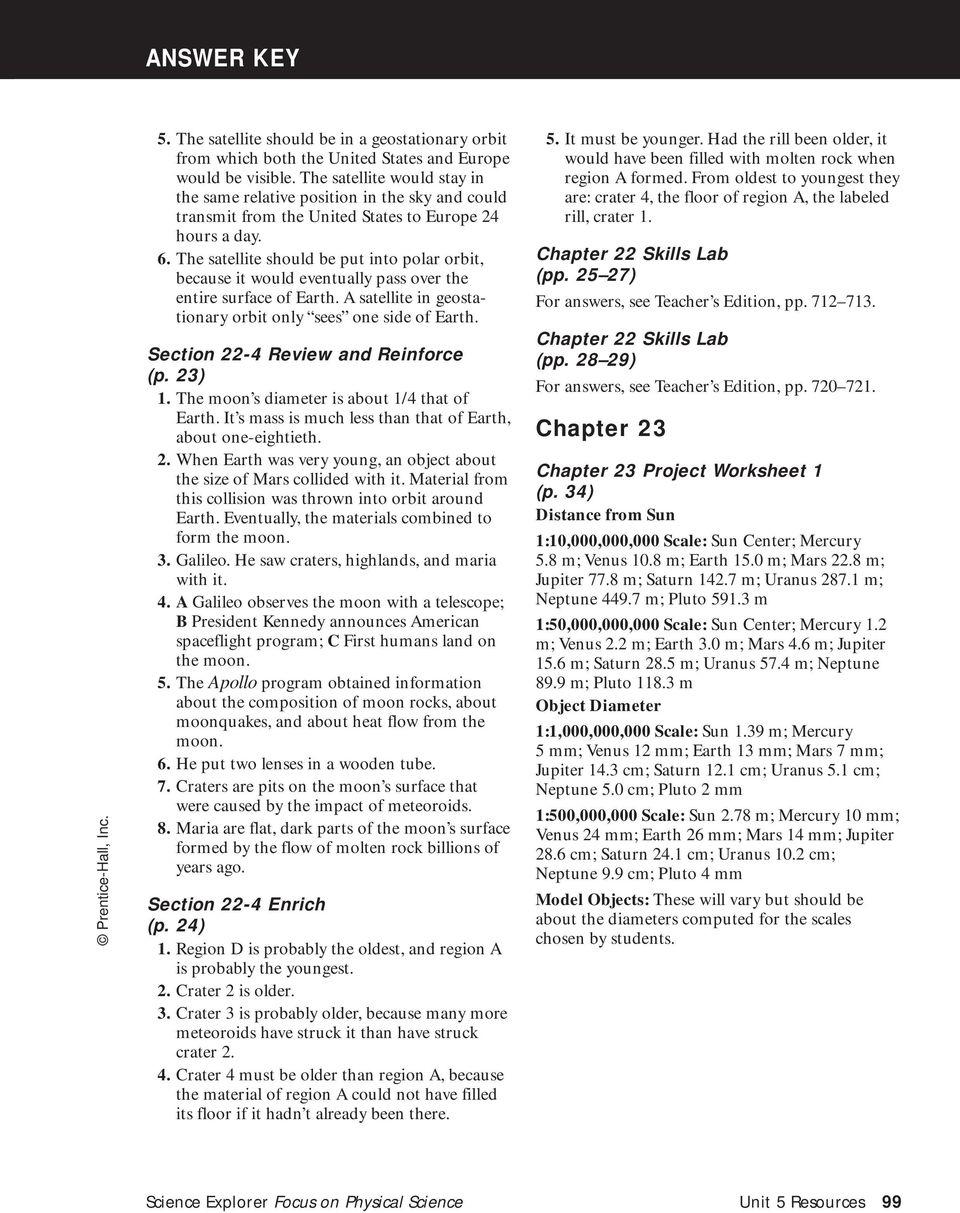
1 Chapter 22 Section 22-1 Review and Reinforce (p. 11) 1. winter 2. At point A the sun would be directly overhead, at point B it would be on the horizon, and at point C it would not be visible because it is night. 3. sunset; Earth rotates from west to east. 4. d 5. i 6. g 7. f 8. a 9. j 10. h 11. e 12. c 13. b Section 22-1 Enrich (p. 12) 1. Answers will vary. Students will probably find that telling time within 15 minutes is difficult with a sundial. 2. Answers will vary. Sample: A moondial couldn t be made because the moon s position in the sky from day to day varies much more than the position of the sun. 3. Accept any two: Sundials can t easily be moved. They don t work at night, indoors, or in cloudy weather. They are not as accurate as clocks. Section 22-2 Review and Reinforce (p. 15) 1. A new, B waxing crescent, C first quarter, D full, E waning gibbous, F third quarter 2. Spring tides would occur when the moon is at A and D. Neap tides would occur when the moon is at C and F. 3. neap 4. eclipse 5. penumbra 6. tides 7. umbra 8. phase 9. spring 10. lunar 11. solar 12. gravity Section 22-2 Enrich (p. 16) 1. a lunar year is days a solar year 365 days ,935 days (7 29.5) 6,932.5 days It s off by 2.5 days. 3. The planting and growth of crops and the movements of animals are seasonal, so it is important for hunters and farmers to be able to accurately predict the seasons. Section 22-3 Review and Reinforce (p. 19) 1. A rocket moves forward when gases expelled from the rear push the rocket forward. 2. A single-stage rocket is a single unit. In a multistage rocket, each stage burns its fuel, then drops away. 3. Satellites and space stations are used for communication, navigation, collecting weather data, and research. 4. Most rockets can only be used once. Space shuttles can be used many times. 5. A satellite in a geosynchronous orbit revolves around Earth at the same rate that Earth rotates. 6. A satellite is any natural or artificial object that revolves around an object in space. Section 22-3 Enrich (p. 20) 1. The path is a result of the combination of the movement of the satellite and the movement of Earth. 2. Relative to any point on Earth, a satellite in geostationary orbit does not move, so it can t trace a path. 3. It would be the same distance to the west of Y that Y is from X. 4. Every twelve hours. 98 Unit 5 Resources Science Explorer Focus on Physical Science

2 5. The satellite should be in a geostationary orbit from which both the United States and Europe would be visible. The satellite would stay in the same relative position in the sky and could transmit from the United States to Europe 24 hours a day. 6. The satellite should be put into polar orbit, because it would eventually pass over the entire surface of Earth. A satellite in geostationary orbit only sees one side of Earth. Section 22-4 Review and Reinforce (p. 23) 1. The moon s diameter is about 1/4 that of Earth. It s mass is much less than that of Earth, about one-eightieth. 2. When Earth was very young, an object about the size of Mars collided with it. Material from this collision was thrown into orbit around Earth. Eventually, the materials combined to form the moon. 3. Galileo. He saw craters, highlands, and maria with it. 4. A Galileo observes the moon with a telescope; B President Kennedy announces American spaceflight program; C First humans land on the moon. 5. The Apollo program obtained information about the composition of moon rocks, about moonquakes, and about heat flow from the moon. 6. He put two lenses in a wooden tube. 7. Craters are pits on the moon s surface that were caused by the impact of meteoroids. 8. Maria are flat, dark parts of the moon s surface formed by the flow of molten rock billions of years ago. Section 22-4 Enrich (p. 24) 1. Region D is probably the oldest, and region A is probably the youngest. 2. Crater 2 is older. 3. Crater 3 is probably older, because many more meteoroids have struck it than have struck crater Crater 4 must be older than region A, because the material of region A could not have filled its floor if it hadn t already been there. 5. It must be younger. Had the rill been older, it would have been filled with molten rock when region A formed. From oldest to youngest they are: crater 4, the floor of region A, the labeled rill, crater 1. Chapter 22 Skills Lab (pp ) For answers, see Teacher s Edition, pp Chapter 22 Skills Lab (pp ) For answers, see Teacher s Edition, pp Chapter 23 Chapter 23 Project Worksheet 1 (p. 34) Distance from Sun 1:10,000,000,000 Scale: Sun Center; Mercury 5.8 m; Venus 10.8 m; Earth 15.0 m; Mars 22.8 m; Jupiter 77.8 m; Saturn m; Uranus m; Neptune m; Pluto m 1:50,000,000,000 Scale: Sun Center; Mercury 1.2 m; Venus 2.2 m; Earth 3.0 m; Mars 4.6 m; Jupiter 15.6 m; Saturn 28.5 m; Uranus 57.4 m; Neptune 89.9 m; Pluto m Object Diameter 1:1,000,000,000 Scale: Sun 1.39 m; Mercury 5 mm; Venus 12 mm; Earth 13 mm; Mars 7 mm; Jupiter 14.3 cm; Saturn 12.1 cm; Uranus 5.1 cm; Neptune 5.0 cm; Pluto 2 mm 1:500,000,000 Scale: Sun 2.78 m; Mercury 10 mm; Venus 24 mm; Earth 26 mm; Mars 14 mm; Jupiter 28.6 cm; Saturn 24.1 cm; Uranus 10.2 cm; Neptune 9.9 cm; Pluto 4 mm Model Objects: These will vary but should be about the diameters computed for the scales chosen by students. Science Explorer Focus on Physical Science Unit 5 Resources 99
3 Chapter 23 Project Worksheet 2 (p. 35) Combination Model Diameter of Objects: Sun 13.9 cm; Mercury 0.5 mm; Venus 1.2 mm; Earth 1.3 mm; Mars 0.7 mm; Jupiter 14.3 mm; Saturn 12.1 mm; Uranus 5.1 mm; Neptune 5.0 mm; Pluto 0.2 mm Distance from Sun: Sun Center; Mercury 5.8 m; Venus 10.8 m; Earth 15.0 m; Mars 22.8 m; Jupiter 77.8 m; Saturn m; Uranus m; Neptune m; Pluto m Model Objects: These will vary, but they should be about the size indicated in Diameter of Objects, above. Analyzing and Presenting 1. Students should write a paragraph on their experiences, including information on the scales that they used, why they chose those scales, and what problems they encountered. 2. Students should write a paragraph on the distances between the planets and the sun, discussing how the solar system is largely empty space. They should mention that the spacing between the planets is not equal some planets are closer together than are others. 3. Students should write a paragraph about scaling. One of the advantages to using scale models is that it allows you to work with measurements that are too large to visualize easily. A disadvantage is that it is difficult to chose a scale that is convenient for showing both large distances and relatively small diameters in one model. Section 23-1 Review and Reinforce (p. 39) 1. In the geocentric model, the planets and the sun revolve around Earth. In the heliocentric model, Earth and the planets revolve around the sun. 2. Ptolemy was trying to explain why the planets seem to move at different speeds and sometimes appear to move backwards among the stars. 3. Galileo observed moons orbiting around Jupiter. This showed that not everything revolves around Earth. He also observed phases of Venus that are similar to Earth s moon. The heliocentric model could easily explain these observations. 4. The sun s gravity pulls the planets toward the sun while inertia keeps them moving ahead. The result is that the planets orbit the sun. 5. heliocentric 6. ellipse 7. inertia 8. geocentric Section 23-1 Enrich (p. 40) 1. The full moon is on the opposite side of Earth from the sun. The full Venus is in almost the same direction as the sun. The apparent size of the moon does not change with its phase. 2. The new moon is between Earth and the sun. So is the new Venus. 3. Because its size does not appear to change, we know the moon is always about the same distance from Earth. Also, the moon is sometimes between Earth and sun, and sometimes on the opposite side of Earth from the sun. Section 23-2 Review and Reinforce (p. 43) 1. chromosphere 2. photosphere 3. core 4. corona 5. sunspot 6. prominence 7. f 8. h 9. b 10. d 11. c 12. i 13. a 14. g 15. e 100 Unit 5 Resources Science Explorer Focus on Physical Science

4 Section 23-2 Enrich (p. 44) 1. Astronomers inferred that the sun rotates because sunspots move in one direction over time. 2. The sun rotates from west to east. 3. Sunspots at points A and B take longer to move around the sun than does a sunspot on the equator. 4. Different parts of the sun s surface rotate at different rates, so scientists must give a range for the time of the sun s rotation. Section 23-3 Review and Reinforce (p. 47) 1. Mercury 2. Venus 3. Earth 4. Mars 5. Mercury, Venus, Earth, Mars 6. Earth 7. Venus 8. Mars 9. Earth, Mars 10. Venus, Earth 11. Mercury 12. Venus 13. Earth, Mars 14. Mars 15. The first four planets from the sun: Mercury, Venus, Earth, and Mars. They are the earthlike planets with rocky surfaces. 16. Rotation from east to west, in the direction opposite from the usual direction 17. The trapping of heat by the atmosphere Section 23-3 Enrich (p. 48) 1. Carbon dioxide either becomes dissolved in the oceans or is absorbed by green plants. 2. On Earth, at any one time, most of the carbon dioxide is locked up in rocks. On Venus, it is in the atmosphere. 3. On Earth, carbon dioxide dissolves in ocean water. While there, it reacts with other chemicals to form rocks. On Venus, there are no oceans in which the carbon dioxide can dissolve. 4. If Earth s temperature increased by 100ºC, the amount of carbon dioxide in the atmosphere would increase. This is because the oceans would evaporate and green plants would not be able to live. Without these, the carbon dioxide would have no way out of the atmosphere. 5. The carbon dioxide would create a greenhouse effect that would further warm Earth s surface. Section 23-4 Review and Reinforce (p. 51) 1. Jupiter, Saturn, Uranus, Neptune, Pluto 2. Jupiter, Saturn, Uranus, Neptune 3. The gas giants are much larger than Pluto. The gas giants are made mostly of gas but Pluto is solid. 4. The gas can t escape because gravity is so great. 5. the sun 6. Jupiter 7. ice and rocks 8. Answers may vary. Students answers should refer to the fact that Neptune s orbit was predicted by mathematicians who calulated where it must be based on its effect on the orbit of Uranus. 9. They are nearly the same size. 10. A gas giant is a large planet made almost entirely of gas. The gas giants are Jupiter, Saturn, Uranus, and Neptune Section 23-4 Enrich (p. 52) a.u a.u. 3. In In Pluto (after February 1999) Science Explorer Focus on Physical Science Unit 5 Resources 101

5 Section 23-5 Review and Reinforce (p. 55) Asteroid Description: Object revolving around the sun that is too small to be considered a planet Location/Movement: Revolves around the sun between the orbits of Mars and Jupiter Comet Description: Chunk of ice and dust with a bright head and long tail Location/Movement: Orbits the sun in a long narrow ellipse Meteoroid Description: Chunk of rock or dust, usually from a comet or asteroid Location/Movement: Moves through the solar system. If formed from comet would have similar elliptical orbit 1. A meteoroid enters Earth s atmosphere and friction causes it to burn. If the meteoroid is big enough, it does not completely burn and it hits Earth s surface. 2. The head is the main body of the comet. The nucleus of the head is made of ice and dust. The coma is the halo of gas and dust, formed when sunlight turns the ice into gas. The tail is the gas from the comet that is pushed away from the sun by the solar wind. 3. Comets are visible for days or weeks. A meteor is a quick flash of light that moves across the sky. 4. meteor 5. comet 6. meteorite 7. asteroid 8. meteoroid 9. asteroid belt Section 23-5 Enrich (p. 56) 1. Craters on the moon were caused by impacts of large meteoroids. The moon has been revolving around Earth for a long time. Since large meteoroids have hit the moon many times in the past, they have probably hit Earth, too. 2. Many meteoroids never hit Earth s surface because they burn up in Earth s atmosphere. When a meteoroid does hit the surface, wind and rain often destroy the crater. 3. About 65 million years old 4. Deep below Earth s surface, rocks from space 5. A large meteoroid might have hit Earth 65 million years ago, causing meteor dust to be spread around Earth. This is one possible explanation of the mass extinction of dinosaurs and other creatures at that time. Section 23-6 Review and Reinforce (p. 59) 1. Students should list three of the four conditions given: All living things are made up of one or more cells, take in energy and use it to grow and develop, reproduce, and give off waste. 2. Goldilocks conditions are the just right conditions on Earth that scientists believe are necessary for life. 3. The presence of liquid water, a suitable temperature range, and a suitable atmosphere 4. Perhaps the Goldilocks conditions aren t necessary for life. 5. The channels may have been formed by flowing water. Since life as we know it requires liquid water, scientists hypothesize that Mars may have once had the conditions needed for life to exist. 6. Europa is covered with an icy crust that has similar patterns to the ice crust over Earth s Arctic Ocean. Some scientists think this may indicate that there is liquid water under the ice. If there is liquid water on Europa, there might also be life. 7. Extraterrestrial life would be life other than that on Earth. 102 Unit 5 Resources Science Explorer Focus on Physical Science
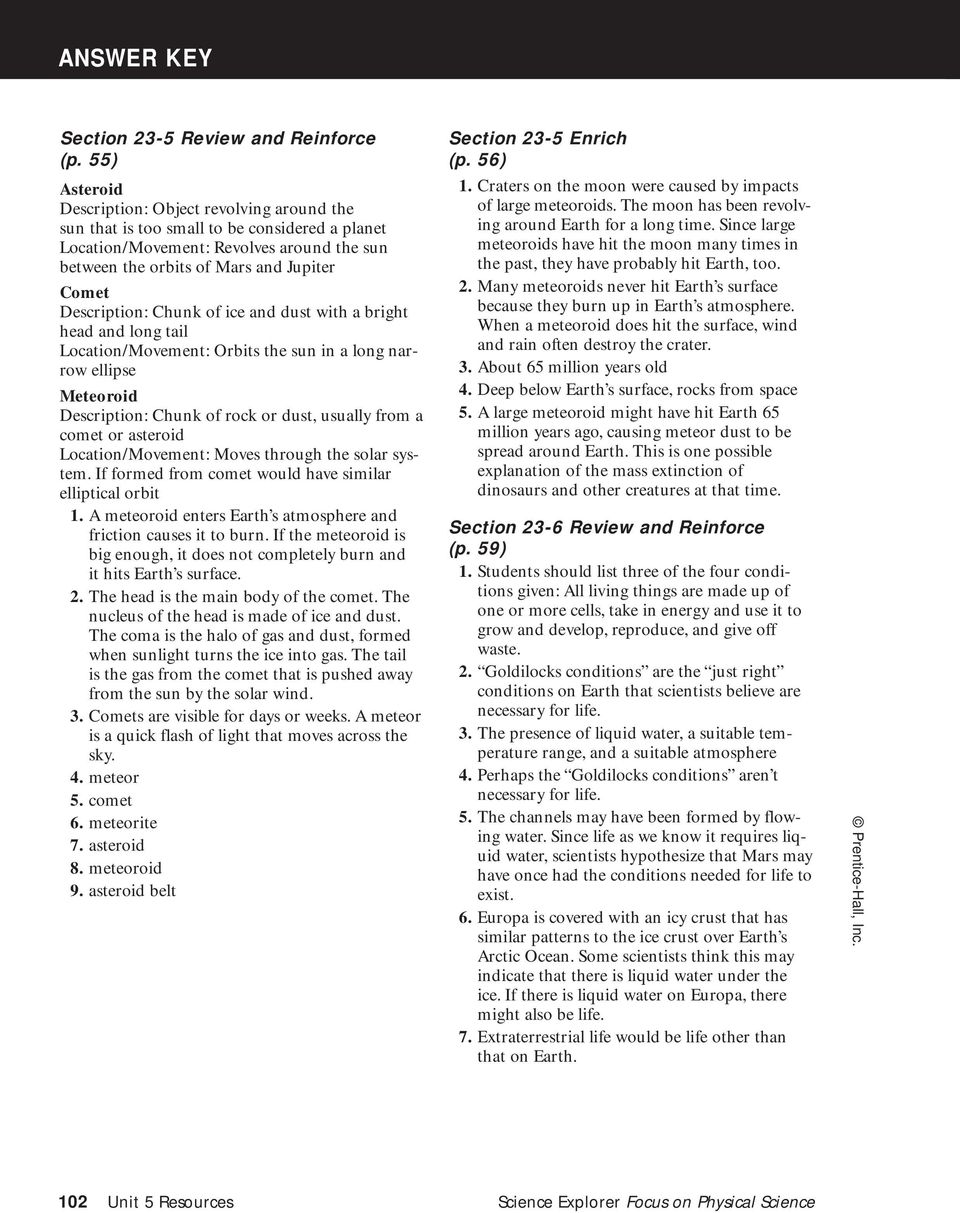
6 Section 23-6 Enrich (p. 60) 1. Planet A could not support human life. Its gravity is too great. 2. Planet B might be able to support human life. Its mass is over 0.4 times Earth s, so it might have water and an atmosphere. Its length of day is close to Earth s. Its gravity is slightly less than Earth s so humans wouldn t be harmed. 3. Planet C could not support human life. Its day is too long. 4. Even though Venus s mass is very similar to Earth, it could not support human life if it were placed in Earth s orbit because its day is far too long. 5. Even though its day is almost the same length as Earth s, Mars could not support human life because it is too small to have a thick enough atmosphere or enough surface water. Chapter 23 Real-World Lab (pp ) For answers, see Teacher s Edition, p Chapter 23 Skills Lab (pp ) For answers, see Teacher s Edition, pp Chapter 24 Section 24-1 Review and Reinforce (p. 75) Tool Reflecting telescope Refracting telescope Radio telescope Spectrograph Function Collects and Focuses Splits into Colors Type of Electromagnetic Radiation Radio waves Infrared radiation Visible light Ultraviolet Radiation X-rays Gamma rays 1. surface temperature of stars, chemical composition of stars 2. d 3. c 4. a 5. f 6. b 7. e Section 24-1 Enrich (p. 76) 1. Gamma radiation should give the highest resolution image, because it has the shortest wavelength. 2. Answers may vary. Sample: Satellites are expensive to build and launch. A large telescope, with high resolution, would be especially expensive to launch. If a telescope breaks in space, it is harder to fix than if it were on the ground. 3. Radio waves, because they could be observed more cheaply and easily from ground-based radio telescopes. Although they would give a low-resolution image, this would be okay because the astronomers are looking at broad areas of the sky, not tiny details. 4. Infrared radiation, because only this kind of radiation can pass through the clouds of gas and dust in space and because its wavelength is short enough to create a higher resolution image. Section 24-2 Review and Reinforce (p. 79) 1. A 2. F 3. Their distance from Earth 4. Astronomers use parallax to measure the distance to nearby stars. They measure how much the star appears to move against a background of stars that are much farther away. 5. The main characteristics used to classify stars are size, temperature, and brightness. 6. The sun is an average brightness, mediumsized star, about 5,500 degrees Celsius. 7. absolute magnitude 8. galaxy 9. light-year 10. main sequence 11. Hertzsprung-Russell diagram 12. Parallax 13. universe 14. apparent magnitude 15. giant star Science Explorer Focus on Physical Science Unit 5 Resources 103
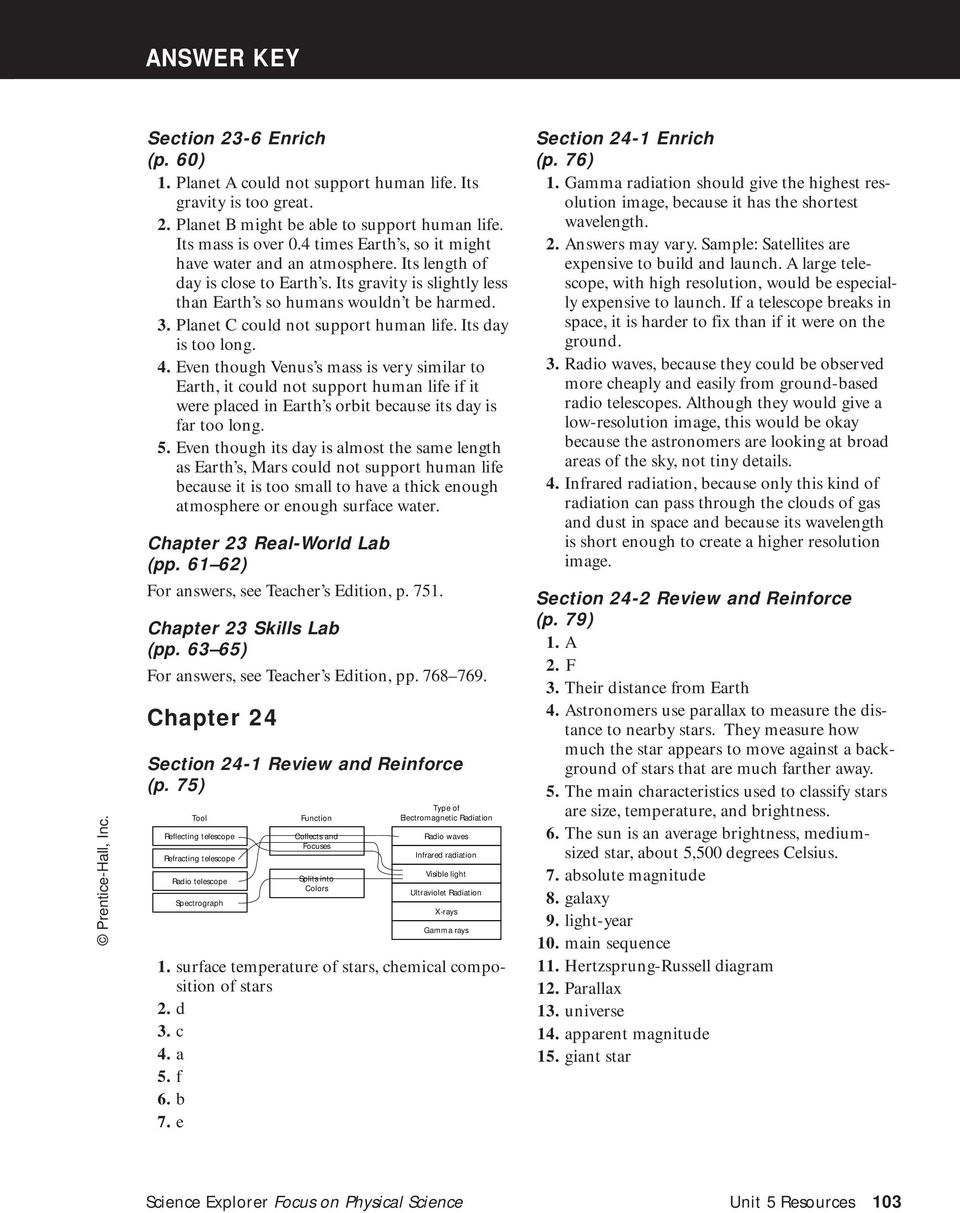
7 Section 24-2 Enrich (p. 80) 1. The difference in magnitude is 1. Procyon is about 2.5 times brighter than Regulus. 2. Venus s magnitude is 2 less than Mars, so Venus is about , or about 6.3 times brighter than Mars. 3. The difference in magnitude between the dimmest star that can be seen with the naked eye, and the dimmest one that can be seen with binoculars is 4. This means that the dimmest naked-eye star is about about 39 times brighter than the dimmest binocular star. Section 24-3 Review and Reinforce (p. 83) 1. D 2. B 3. A 4. E 5. C 6. mass 7. e 8. c 9. b 10. d 11. h 12. g 13. a 14. f Section 24-3 Enrich (p. 84) mm 2. 8 mm (4 mm + 4 mm) 3. You are looking through more of the shell along line The shell would appear thicker and brighter along line The shell must be glowing, since it shows up as a light color. When you look through the outer part of the shell, your line of sight includes more of the glowing shell of gas than when you look nearer the center, so you see a ring. Section 24-4 Review and Reinforce (p. 87) 1. B 2. A triple star 3. The position of the visible star might wobble slightly as the heavy unseen star revolves around it. 4. A group of two or more stars revolving around each other 5. A star system made up of two stars 6. A binary star system in which a brighter star appears to dim when the dimmer star of the pair passes in front of it 7. Spiral galaxies are galaxies with spiral arms radiating out from the center. They contain lots of dust and gas. 8. Elliptical galaxies look like flattened balls and do not contain lots of dust and gas. 9. Irregular galaxies are galaxies with irregular shapes. Section 24-4 Enrich (p. 88) Period Brightness Distance A 5 1, B 20 3, C 35 5,000 1,000 D 50 7,500 1,200 E 90 12,500 1,600 Note: Since students will be using rulers to read the graph, their answers will be approximations only. Section 24-5 Review and Reinforce (p. 91) 1. Away from Earth 2. The farther away a galaxy is, the faster it moves away from Earth Unit 5 Resources Science Explorer Focus on Physical Science

8 10. The big bang theory is the theory that the universe formed in an huge explosion 10 to 15 billion years ago. Section 24-5 Enrich (p. 92) Rank Galaxy A 1 Galaxy B 4 Galaxy C 2 Galaxy D 3 1. Galaxy B is farthest from Earth. 2. No, because none of the spectrums is blue shifted. Chapter 24 Real-World Lab (pp ) For answers, see Teacher s Edition, p Chapter 24 Skills Lab (pp ) For answers, see Teacher s Edition, pp Science Explorer Focus on Physical Science Unit 5 Resources 105

Study Guide due Friday, 1/29
 NAME: Astronomy Study Guide asteroid chromosphere comet corona ellipse Galilean moons VOCABULARY WORDS TO KNOW geocentric system meteor gravity meteorite greenhouse effect meteoroid heliocentric system
Related Standards and Background Information
 Related Standards and Background Information Earth Patterns, Cycles and Changes This strand focuses on student understanding of patterns in nature, natural cycles, and changes that occur both quickly and
Georgia Performance Standards Framework for Science Grade 6. Unit Organizer: UNIVERSE AND SOLAR SYSTEM (Approximate Time 3 Weeks)
 The following instructional plan is part of a GaDOE collection of Unit Frameworks, Performance Tasks, examples of Student Work, and Teacher Commentary. Many more GaDOE approved instructional plans are
Explain the Big Bang Theory and give two pieces of evidence which support it.
 Name: Key OBJECTIVES Correctly define: asteroid, celestial object, comet, constellation, Doppler effect, eccentricity, eclipse, ellipse, focus, Foucault Pendulum, galaxy, geocentric model, heliocentric
UNIT V. Earth and Space. Earth and the Solar System
 UNIT V Earth and Space Chapter 9 Earth and the Solar System EARTH AND OTHER PLANETS A solar system contains planets, moons, and other objects that orbit around a star or the star system. The solar system
Study Guide: Solar System
 Study Guide: Solar System 1. How many planets are there in the solar system? 2. What is the correct order of all the planets in the solar system? 3. Where can a comet be located in the solar system? 4.
The Earth, Sun, and Moon
 reflect The Sun and Moon are Earth s constant companions. We bask in the Sun s heat and light. It provides Earth s energy, and life could not exist without it. We rely on the Moon to light dark nights.
Solar System Fact Sheet
 Solar System Fact Sheet (Source: http://solarsystem.nasa.gov; http://solarviews.com) The Solar System Categories Mercury Venus Earth Mars Jupiter Saturn Uranus Neptune Rocky or Gas Rocky Rocky Rocky Rocky
THE SOLAR SYSTEM - EXERCISES 1
 THE SOLAR SYSTEM - EXERCISES 1 THE SUN AND THE SOLAR SYSTEM Name the planets in their order from the sun. 1 2 3 4 5 6 7 8 The asteroid belt is between and Which planet has the most moons? About how many?
EDMONDS COMMUNITY COLLEGE ASTRONOMY 100 Winter Quarter 2007 Sample Test # 1
 Instructor: L. M. Khandro EDMONDS COMMUNITY COLLEGE ASTRONOMY 100 Winter Quarter 2007 Sample Test # 1 1. An arc second is a measure of a. time interval between oscillations of a standard clock b. time
STUDY GUIDE: Earth Sun Moon
 The Universe is thought to consist of trillions of galaxies. Our galaxy, the Milky Way, has billions of stars. One of those stars is our Sun. Our solar system consists of the Sun at the center, and all
astronomy 2008 1. A planet was viewed from Earth for several hours. The diagrams below represent the appearance of the planet at four different times.
 1. A planet was viewed from Earth for several hours. The diagrams below represent the appearance of the planet at four different times. 5. If the distance between the Earth and the Sun were increased,
The Earth, Sun & Moon. The Universe. The Earth, Sun & Moon. The Universe
 Football Review- Earth, Moon, Sun 1. During a total solar eclipse, when almost all of the Sun's light traveling to the Earth is blocked by the Moon, what is the order of the Earth, Sun, and Moon? A. Moon,
Asteroids. Earth. Asteroids. Earth Distance from sun: 149,600,000 kilometers (92,960,000 miles) Diameter: 12,756 kilometers (7,926 miles) dotted line
 Image taken by NASA Asteroids About 6,000 asteroids have been discovered; several hundred more are found each year. There are likely hundreds of thousands more that are too small to be seen from Earth.
Earth Is Not the Center of the Universe
 Earth Is Not the Center of the Universe Source: Utah State Office of Education Introduction Have you ever looked up at the night sky and wondered about all the pinpoint lights? People through the ages
Grade 6 Standard 3 Unit Test A Astronomy. 1. The four inner planets are rocky and small. Which description best fits the next four outer planets?
 Grade 6 Standard 3 Unit Test A Astronomy Multiple Choice 1. The four inner planets are rocky and small. Which description best fits the next four outer planets? A. They are also rocky and small. B. They
Introduction to the Solar System
 Introduction to the Solar System Lesson Objectives Describe some early ideas about our solar system. Name the planets, and describe their motion around the Sun. Explain how the solar system formed. Introduction
A: Planets. Q: Which of the following objects would NOT be described as a small body: asteroids, meteoroids, comets, planets?
 Q: Which of the following objects would NOT be described as a small body: asteroids, meteoroids, comets, planets? A: Planets Q: What can we learn by studying small bodies of the solar system? A: We can
Name Period 4 th Six Weeks Notes 2015 Weather
 Name Period 4 th Six Weeks Notes 2015 Weather Radiation Convection Currents Winds Jet Streams Energy from the Sun reaches Earth as electromagnetic waves This energy fuels all life on Earth including the
Class 2 Solar System Characteristics Formation Exosolar Planets
 Class 1 Introduction, Background History of Modern Astronomy The Night Sky, Eclipses and the Seasons Kepler's Laws Newtonian Gravity General Relativity Matter and Light Telescopes Class 2 Solar System
1 A Solar System Is Born
 CHAPTER 3 1 A Solar System Is Born SECTION Formation of the Solar System BEFORE YOU READ After you read this section, you should be able to answer these questions: What is a nebula? How did our solar system
Solar System. 1. The diagram below represents a simple geocentric model. Which object is represented by the letter X?
 Solar System 1. The diagram below represents a simple geocentric model. Which object is represented by the letter X? A) Earth B) Sun C) Moon D) Polaris 2. Which object orbits Earth in both the Earth-centered
The Expanding Universe
 Stars, Galaxies, Guided Reading and Study This section explains how astronomers think the universe and the solar system formed. Use Target Reading Skills As you read about the evidence that supports the
Science 9 Worksheet 13-1 The Solar System
 Name Date Due Date Science 9 Read pages 264-287 of SP to help you answer the following questions: Also, go to a school computer connected to the internet. Go to Mr. Colgur s Webpage at http://sd67.bc.ca/teachers/dcolgur
1. Soaring Through Our Solar System By Laura G. Smith
 1. Soaring Through Our Solar System By Laura G. Smith 1 Five, four, three, two, one... BLAST OFF! Come along as we explore our solar system! If we were flying high above the Earth, what would you see?
Earth in the Solar System
 Copyright 2011 Study Island - All rights reserved. Directions: Challenge yourself! Print out the quiz or get a pen/pencil and paper and record your answers to the questions below. Check your answers with
STAAR Science Tutorial 30 TEK 8.8C: Electromagnetic Waves
 Name: Teacher: Pd. Date: STAAR Science Tutorial 30 TEK 8.8C: Electromagnetic Waves TEK 8.8C: Explore how different wavelengths of the electromagnetic spectrum such as light and radio waves are used to
The Solar System. Unit 4 covers the following framework standards: ES 10 and PS 11. Content was adapted the following:
 Unit 4 The Solar System Chapter 7 ~ The History of the Solar System o Section 1 ~ The Formation of the Solar System o Section 2 ~ Observing the Solar System Chapter 8 ~ The Parts the Solar System o Section
The Solar System. Source http://starchild.gsfc.nasa.gov/docs/starchild/solar_system_level1/solar_system.html
 The Solar System What is the solar system? It is our Sun and everything that travels around it. Our solar system is elliptical in shape. That means it is shaped like an egg. Earth s orbit is nearly circular.
NOTES: GEORGIA HIGH SCHOOL SCIENCE TEST THE SOLAR SYSTEM
 NOTES: GEORGIA HIGH SCHOOL SCIENCE TEST THE SOLAR SYSTEM 1.What is a Solar system? A solar system consists of: * one central star, the Sun and * nine planets: Mercury, Venus, Earth, Mars, Jupiter, Saturn,
Solar System Overview
 Solar System Overview Planets: Four inner planets, Terrestrial planets Four outer planets, Jovian planets Asteroids: Minor planets (planetesimals) Meteroids: Chucks of rocks (smaller than asteroids) (Mercury,
CHAPTER 6 THE TERRESTRIAL PLANETS
 CHAPTER 6 THE TERRESTRIAL PLANETS MULTIPLE CHOICE 1. Which of the following is NOT one of the four stages in the development of a terrestrial planet? 2. That Earth, evidence that Earth differentiated.
Science Standard 4 Earth in Space Grade Level Expectations
 Science Standard 4 Earth in Space Grade Level Expectations Science Standard 4 Earth in Space Our Solar System is a collection of gravitationally interacting bodies that include Earth and the Moon. Universal
Chapter 6 Formation of Planetary Systems Our Solar System and Beyond
 Chapter 6 Formation of Planetary Systems Our Solar System and Beyond The solar system exhibits clear patterns of composition and motion. Sun Over 99.9% of solar system s mass Made mostly of H/He gas (plasma)
CHARACTERISTICS OF THE SOLAR SYSTEM
 reflect Our solar system is made up of thousands of objects, at the center of which is a star, the Sun. The objects beyond the Sun include 8 planets, at least 5 dwarf planets, and more than 170 moons.
Lecture 12: The Solar System Briefly
 Lecture 12: The Solar System Briefly Formation of the Moonhttp://www.youtube.com/watch?v=WpOKztEiMqo&feature =related Formation of our Solar System Conservation of Angular Momentum Why are the larger,
A SOLAR SYSTEM COLORING BOOK
 A SOLAR SYSTEM COLORING BOOK Brought to you by: THE SUN Size: The Sun is wider than 100 Earths. 1 Temperature: 27,000,000 F in the center, 10,000 F at the surface. So that s REALLY hot anywhere on the
Vagabonds of the Solar System. Chapter 17
 Vagabonds of the Solar System Chapter 17 ASTR 111 003 Fall 2006 Lecture 13 Nov. 27, 2006 Introduction To Modern Astronomy I Introducing Astronomy (chap. 1-6) Planets and Moons (chap. 7-17) Ch7: Comparative
A Solar System Coloring Book
 A Solar System Coloring Book Courtesy of the Windows to the Universe Project http://www.windows2universe.org The Sun Size: The Sun is wider than 100 Earths. Temperature: ~27,000,000 F in the center, ~10,000
Chapter 12 Asteroids, Comets, and Dwarf Planets. Asteroid Facts. What are asteroids like? Asteroids with Moons. 12.1 Asteroids and Meteorites
 Chapter 12 Asteroids, Comets, and Dwarf Planets Their Nature, Orbits, and Impacts What are asteroids like? 12.1 Asteroids and Meteorites Our goals for learning:! What are asteroids like?! Why is there
Appropriate space vocabulary for Primary School
 Appropriate space vocabulary for Primary School Stuff Looks like Gas Dust Rock Liquid Fatter (moon) Thinner (moon) Faster Slower Hot Cold Material Shape Straight at (an object) Direct (light) Indirect
Chapter 25.1: Models of our Solar System
 Chapter 25.1: Models of our Solar System Objectives: Compare & Contrast geocentric and heliocentric models of the solar sytem. Describe the orbits of planets explain how gravity and inertia keep the planets
Chapter 7 Our Planetary System. Agenda. Intro Astronomy. Intro Astronomy. What does the solar system look like? A. General Basics
 Chapter 7 Our Planetary System Agenda Pass back & discuss Test 2 Where we are (at) Ch. 7 Our Planetary System Finish Einstein s Big Idea Earth, as viewed by the Voyager spacecraft A. General Basics Intro
Unit 8 Lesson 2 Gravity and the Solar System
 Unit 8 Lesson 2 Gravity and the Solar System Gravity What is gravity? Gravity is a force of attraction between objects that is due to their masses and the distances between them. Every object in the universe
4 HOW OUR SOLAR SYSTEM FORMED 750L
 4 HOW OUR SOLAR SYSTEM FORMED 750L HOW OUR SOLAR SYSTEM FORMED A CLOSE LOOK AT THE PLANETS ORBITING OUR SUN By Cynthia Stokes Brown, adapted by Newsela Planets come from the clouds of gas and dust that
A long time ago, people looked
 Supercool Space Tools! By Linda Hermans-Killam A long time ago, people looked into the dark night sky and wondered about the stars, meteors, comets and planets they saw. The only tools they had to study
Probing for Information
 Name Class Date Inquiry Lab Probing for Information Using Scientific Methods Information about planets in our solar system has been collected by observation from Earth and from probes, or scientific instruments,
Astronomy Notes for Educators
 Our Solar System Astronomy Notes for Educators Our Solar System 5-1 5-2 Specific Outcomes: Learning Outcome 1: Knowledge / Content and it place in the Milky Way Different types of bodies make up the Solar
Bangkok Christian College EIP Matayom Course Description Semester One 2011-2012
 Bangkok Christian College EIP Matayom Course Description Semester One 2011-2012 Subject: General Science Grade: Matayom 6 Course Description This semester the General Science course will continue covering
Chapter 7 Our Planetary System. What does the solar system look like? Thought Question How does the Earth-Sun distance compare with the Sun s radius
 Chapter 7 Our Planetary System 7.1 Studying the Solar System Our goals for learning:! What does the solar system look like?! What can we learn by comparing the planets to one another?! What are the major
The Solar System. Olivia Paquette
 The Solar System Olivia Paquette Table of Contents The Sun 1 Mercury 2,3 Venus 4,5 Earth 6,7 Mars 8,9 Jupiter 10,11 Saturn 12 Uranus 13 Neptune Pluto 14 15 Glossary. 16 The Sun Although it may seem like
Cosmic Journey: A Solar System Adventure General Information
 Cosmic Journey: A Solar System Adventure General Information Imagine it a huge spiral galaxy containing hundreds of billions of stars, spiraling out from a galactic center. Nestled deep within one of the
KINDERGARTEN 1 WEEK LESSON PLANS AND ACTIVITIES
 KINDERGARTEN 1 WEEK LESSON PLANS AND ACTIVITIES UNIVERSE CYCLE OVERVIEW OF KINDERGARTEN UNIVERSE WEEK 1. PRE: Discovering misconceptions of the Universe. LAB: Comparing size and distances in space. POST:
LER 2891. Ages. Grades. Solar System. A fun game of thinking & linking!
 Solar System Ages 7+ LER 2891 Grades 2+ Card Game A fun game of thinking & linking! Contents 45 Picture cards 45 Word cards 8 New Link cards 2 Super Link cards Setup Shuffle the two decks together to mix
Astronomy 110 Homework #04 Assigned: 02/06/2007 Due: 02/13/2007. Name:
 Astronomy 110 Homework #04 Assigned: 02/06/2007 Due: 02/13/2007 Name: Directions: Listed below are twenty (20) multiple-choice questions based on the material covered by the lectures this past week. Choose
California Standards Grades 9 12 Boardworks 2009 Science Contents Standards Mapping
 California Standards Grades 912 Boardworks 2009 Science Contents Standards Mapping Earth Sciences Earth s Place in the Universe 1. Astronomy and planetary exploration reveal the solar system s structure,
Solar Matters II Teacher Page
 Solar Matters II Teacher Page Sun Misconceptions Student Objective understands why some common phrases about the Sun are incorrect can describe how the Earth s rotation affects how we perceive the Sun
The Sun-Earth-Moon System. Unit 5 covers the following framework standards: ES 9, 11 and PS 1. Content was adapted the following:
 Unit 5 The Sun-Earth-Moon System Chapter 10 ~ The Significance of Earth s Position o Section 1 ~ Earth in Space o Section 2 ~ Phases, Eclipses, and Tides o Section 3 ~ Earth s Moon Unit 5 covers the following
Motions of the Earth. Stuff everyone should know
 Motions of the Earth Stuff everyone should know Earth Motions E W N W Noon E Why is there day and night? OR Why do the Sun and stars appear to move through the sky? Because the Earth rotates around its
Planets beyond the solar system
 Planets beyond the solar system Review of our solar system Why search How to search Eclipses Motion of parent star Doppler Effect Extrasolar planet discoveries A star is 5 parsecs away, what is its parallax?
1.1 A Modern View of the Universe" Our goals for learning: What is our place in the universe?"
 Chapter 1 Our Place in the Universe 1.1 A Modern View of the Universe What is our place in the universe? What is our place in the universe? How did we come to be? How can we know what the universe was
Exam # 1 Thu 10/06/2010 Astronomy 100/190Y Exploring the Universe Fall 11 Instructor: Daniela Calzetti
 Exam # 1 Thu 10/06/2010 Astronomy 100/190Y Exploring the Universe Fall 11 Instructor: Daniela Calzetti INSTRUCTIONS: Please, use the `bubble sheet and a pencil # 2 to answer the exam questions, by marking
FIRST GRADE 1 WEEK LESSON PLANS AND ACTIVITIES
 FIRST GRADE 1 WEEK LESSON PLANS AND ACTIVITIES UNIVERSE CYCLE OVERVIEW OF FIRST GRADE UNIVERSE WEEK 1. PRE: Describing the Universe. LAB: Comparing and contrasting bodies that reflect light. POST: Exploring
TO GO TO ANY OF THE PAGES LISTED BELOW, CLICK ON ITS TITLE
 TO GO TO ANY OF THE PAGES LISTED BELOW, CLICK ON ITS TITLE CHAPTER 17 The Solar System 1 17-1 What is the solar system? 2 17-2 What do we know about orbits? 3 Comparing Planetary Revolutions Enrichment
The Hidden Lives of Galaxies. Jim Lochner, USRA & NASA/GSFC
 The Hidden Lives of Galaxies Jim Lochner, USRA & NASA/GSFC What is a Galaxy? Solar System Distance from Earth to Sun = 93,000,000 miles = 8 light-minutes Size of Solar System = 5.5 light-hours What is
XXX Background information
 XXX Background information The solar system Our solar system is made up of the Sun, the planets, the dwarf planets, moons, asteroids and comets. The Sun is the star around which everything orbits. There
Our Planetary System. Earth, as viewed by the Voyager spacecraft. 2014 Pearson Education, Inc.
 Our Planetary System Earth, as viewed by the Voyager spacecraft 7.1 Studying the Solar System Our goals for learning: What does the solar system look like? What can we learn by comparing the planets to
Beginning of the Universe Classwork 6 th Grade PSI Science
 Beginning of the Universe Classwork Name: 6 th Grade PSI Science 1 4 2 5 6 3 7 Down: 1. Edwin discovered that galaxies are spreading apart. 2. This theory explains how the Universe was flattened. 3. All
Origins of the Cosmos Summer 2016. Pre-course assessment
 Origins of the Cosmos Summer 2016 Pre-course assessment In order to grant two graduate credits for the workshop, we do require you to spend some hours before arriving at Penn State. We encourage all of
The Moon. Nicola Loaring, SAAO
 The Moon Nicola Loaring, SAAO Vital Statistics Mean distance from Earth Orbital Period Rotational Period Diameter 384,400 km 27.322 days 27.322 days 3476 km (0.272 x Earth) Mass 7.3477 10 22 kg (0.0123
7. Our Solar System. Planetary Orbits to Scale. The Eight Planetary Orbits
 7. Our Solar System Terrestrial & Jovian planets Seven large satellites [moons] Chemical composition of the planets Asteroids & comets The Terrestrial & Jovian Planets Four small terrestrial planets Like
CELESTIAL MOTIONS. In Charlottesville we see Polaris 38 0 above the Northern horizon. Earth. Starry Vault
 CELESTIAL MOTIONS Stars appear to move counterclockwise on the surface of a huge sphere the Starry Vault, in their daily motions about Earth Polaris remains stationary. In Charlottesville we see Polaris
Multiple Choice Identify the choice that best completes the statement or answers the question.
 Test 2 f14 Multiple Choice Identify the choice that best completes the statement or answers the question. 1. Carbon cycles through the Earth system. During photosynthesis, carbon is a. released from wood
Mission To Mars! A dialogue activity for upper KS2
 Mission To Mars! A dialogue activity for upper KS2 Teacher s Sheet Mission to Mars: Dialogue activity for upper KS2 Part One: As a class or in groups. pupils read the Fact or Fiction cards. On each card
Lecture 13. Gravity in the Solar System
 Lecture 13 Gravity in the Solar System Guiding Questions 1. How was the heliocentric model established? What are monumental steps in the history of the heliocentric model? 2. How do Kepler s three laws
2007 Pearson Education Inc., publishing as Pearson Addison-Wesley. The Jovian Planets
 The Jovian Planets The Jovian planets are gas giants - much larger than Earth Sizes of Jovian Planets Planets get larger as they get more massive up to a point... Planets more massive than Jupiter are
The Sun and the Stars
 www.k5learning.com Objective Concepts (gravity, climate, solar system, hydrogen, helium, elements, core, ultraviolet rays, cluster, galaxy, Milky Way Galaxy); Sight words (surface, middle, dangerous, causes,
What's Gravity Got To Do With It?
 Monday, December 16 What's Gravity Got To Do With It? By Erin Horner When you woke up this morning did you fly up to the ceiling? Of course not! When you woke up this morning you put both feet on the floor
Phases of the Moon. Preliminaries:
 Phases of the Moon Sometimes when we look at the Moon in the sky we see a small crescent. At other times it appears as a full circle. Sometimes it appears in the daylight against a bright blue background.
galaxy solar system supernova (noun) (noun) (noun)
 WORDS IN CONTEXT DAY 1 (Page 1 of 4) galaxy A galaxy is a collection of stars, gas, and dust. We live in the Milky Way galaxy. One galaxy may contain billions of stars. solar system A solar system revolves
Name: João Fernando Alves da Silva Class: 7-4 Number: 10
 Name: João Fernando Alves da Silva Class: 7-4 Number: 10 What is the constitution of the Solar System? The Solar System is constituted not only by planets, which have satellites, but also by thousands
Earth Sciences -- Grades 9, 10, 11, and 12. California State Science Content Standards. Mobile Climate Science Labs
 Earth Sciences -- Grades 9, 10, 11, and 12 California State Science Content Standards Covered in: Hands-on science labs, demonstrations, & activities. Investigation and Experimentation. Lesson Plans. Presented
Group Leader: Group Members:
 THE SOLAR SYSTEM PROJECT: TOPIC: THE SUN Required Project Content for an Oral/Poster Presentation on THE SUN - What it s made of - Age and how it formed (provide pictures or diagrams) - What is an AU?
Name: Earth 110 Exploration of the Solar System Assignment 1: Celestial Motions and Forces Due in class Tuesday, Jan. 20, 2015
 Name: Earth 110 Exploration of the Solar System Assignment 1: Celestial Motions and Forces Due in class Tuesday, Jan. 20, 2015 Why are celestial motions and forces important? They explain the world around
Motions of Earth, Moon, and Sun
 Motions of Earth, Moon, and Sun Apparent Motions of Celestial Objects An apparent motion is a motion that an object appears to make. Apparent motions can be real or illusions. When you see a person spinning
Chapter 3 The Science of Astronomy
 Chapter 3 The Science of Astronomy Days of the week were named for Sun, Moon, and visible planets. What did ancient civilizations achieve in astronomy? Daily timekeeping Tracking the seasons and calendar
Chapter 1: Our Place in the Universe. 2005 Pearson Education Inc., publishing as Addison-Wesley
 Chapter 1: Our Place in the Universe Topics Our modern view of the universe The scale of the universe Cinema graphic tour of the local universe Spaceship earth 1.1 A Modern View of the Universe Our goals
Unit 1.8: Earth and Space Science Planets & Stars
 Weekly Focus: Reading for Comprehension Weekly Skill: Compare and Contrast Lesson Summary: This week students will continue to learn about the makeup of the Cosmos, specifically the solar system. Students
Study Guide: Sun, Earth and Moon Relationship Assessment
 I can 1. Define rotation, revolution, solstice and equinox. *Rotation and Revolution Review Worksheet 2. Describe why we experience days and years due to the rotation and r evolution of the Earth around
Asteroids, Comets, Meteoroids
 Asteroids, Comets, Meteoroids (modified from a lesson from Spaceday.org) Activity One Read and make sure you understand the background information! Activity Two Creating Scale Model Strips Materials Ruler
DESCRIPTION ACADEMIC STANDARDS INSTRUCTIONAL GOALS VOCABULARY BEFORE SHOWING. Subject Area: Science
 DESCRIPTION Host Tom Selleck conducts a stellar tour of Jupiter, Saturn, Uranus, Neptune, and Pluto--the outer planets of Earth's solar system. Information from the Voyager space probes plus computer models
Planetary Filters for Small Telescopes
 Planetary Filters for Small Telescopes Erwin Matys, Karoline Mrazek During our observing career of several decades the universe was very generous to us: We witnessed a comet impact on Jupiter, we saw frosty
The Big Bang A Community in the Classroom Presentation for Grade 5
 The Big Bang A Community in the Classroom Presentation for Grade 5 Richard Cupp Engineer STANARDS CONNECTION Grade 5 Physical Science: Elements and their combinations account for all the varied types of
Week 1-2: Overview of the Universe & the View from the Earth
 Week 1-2: Overview of the Universe & the View from the Earth Hassen M. Yesuf ([email protected]) September 29, 2011 1 Lecture summary Protein molecules, the building blocks of a living organism, are made
WELCOME to Aurorae In the Solar System. J.E. Klemaszewski
 WELCOME to Aurorae In the Solar System Aurorae in the Solar System Sponsoring Projects Galileo Europa Mission Jupiter System Data Analysis Program ACRIMSAT Supporting Projects Ulysses Project Outer Planets
Astronomy 1140 Quiz 1 Review
 Astronomy 1140 Quiz 1 Review Prof. Pradhan September 15, 2015 What is Science? 1. Explain the difference between astronomy and astrology. (a) Astrology: nonscience using zodiac sign to predict the future/personality
Standards A complete list of the standards covered by this lesson is included in the Appendix at the end of the lesson.
 Lesson 3: Albedo Time: approximately 40-50 minutes, plus 30 minutes for students to paint pop bottles Materials: Text: Albedo (from web site 1 per group) Small thermometers, at least 0ºC to 100ºC range
ASTR 1010 Astronomy of the Solar System Professor Caillault Fall 2009 Semester Exam 3 Answers
 ASTR 1010 Astronomy of the Solar System Professor Caillault Fall 2009 Semester Exam 3 Answers 1. Earth's atmosphere differs from those of near-neighbor planets, Venus and Mars, in one important respect
Copyright 2006, Astronomical Society of the Pacific
 2 1 3 4 Diameter: 590 miles (950 km) Distance to Sun: 257 million miles (414 million km) Orbits: # 18 Composition: Outer layer probably ice and frozen ammonia, no Diameter: 750 miles (1200 km) Distance
Friday 20 January 2012 Morning
 THIS IS A NEW SPECIFICATION H Friday 20 January 2012 Morning GCSE TWENTY FIRST CENTURY SCIENCE PHYSICS A A181/02 Modules P1 P2 P3 (Higher Tier) *A131500112* Candidates answer on the Question Paper. A calculator