
MAIN IDEA: Early scientists proposed ideas about evolution. In a phrase, tell what each scientist did to help develop evolutionary theory.
|
|
|
- Michael Greer
- 9 years ago
- Views:
Transcription
1 SECTION 10.1 KEY CONCEPT EARLY IDEAS ABOUT EVOLUTION Study Guide There were theories of biological and geologic change before Darwin. VOCABULARY evolution fossil gradualism species catastrophism uniformitarianism MAIN IDEA: Early scientists proposed ideas about evolution. In a phrase, tell what each scientist did to help develop evolutionary theory. Scientist 1. Linnaeus Contribution to Evolutionary Theory 2. Buffon 3. E. Darwin 4. Lamarck 5. What two conditions must be true for a group of animals to be considered the same species? 6. Lamarck s ideas of evolution are known as the inheritance of acquired characteristics. What was incorrect about his theory of how organisms evolve? 7. In the 1700s, many people believed that species were fixed and did not change. How did plant hybridization a type of crossing that could be observed in experiments help change this view? Unit 4 Resource Book Study Guide 1

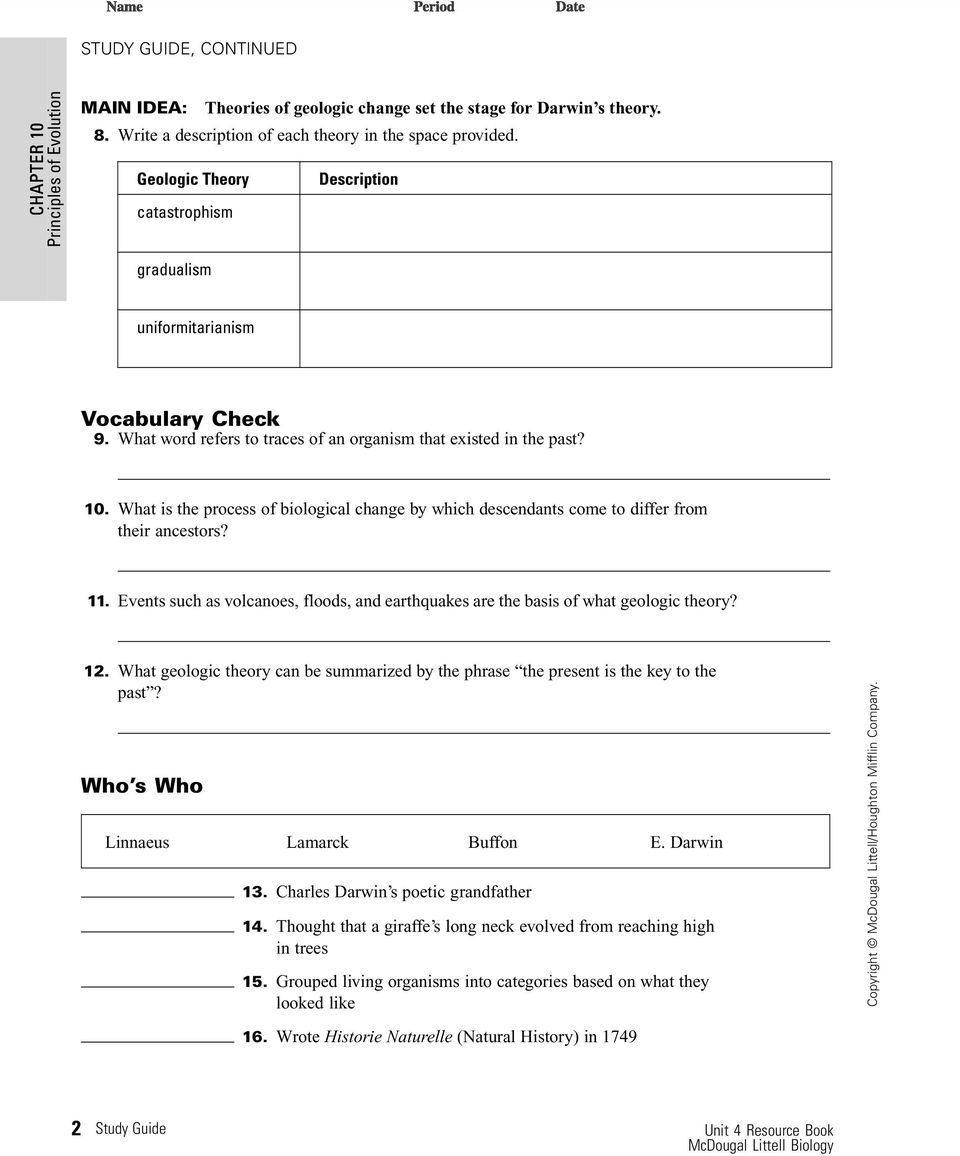
2 STUDY GUIDE, CONTINUED MAIN IDEA: Theories of geologic change set the stage for Darwin s theory. 8. Writeadescriptionofeachtheoryinthe space provided. Geologic Theory Description catastrophism gradualism uniformitarianism Vocabulary Check 9. What word refers to traces of an organism that existed in the past? 10. What is the process of biological change by which descendants come to differ from their ancestors? 11. Events such as volcanoes, floods, and earthquakes are the basis of what geologic theory? 12. What geologic theory can be summarized by the phrase the present is the key to the past? Who s Who Linnaeus Lamarck Buffon E. Darwin 13. Charles Darwin s poetic grandfather 14. Thought that a giraffe s long neck evolved from reaching high in trees 15. Grouped living organisms into categories based on what they looked like 16. Wrote Historie Naturelle (Natural History) in Study Guide Unit 4 Resource Book
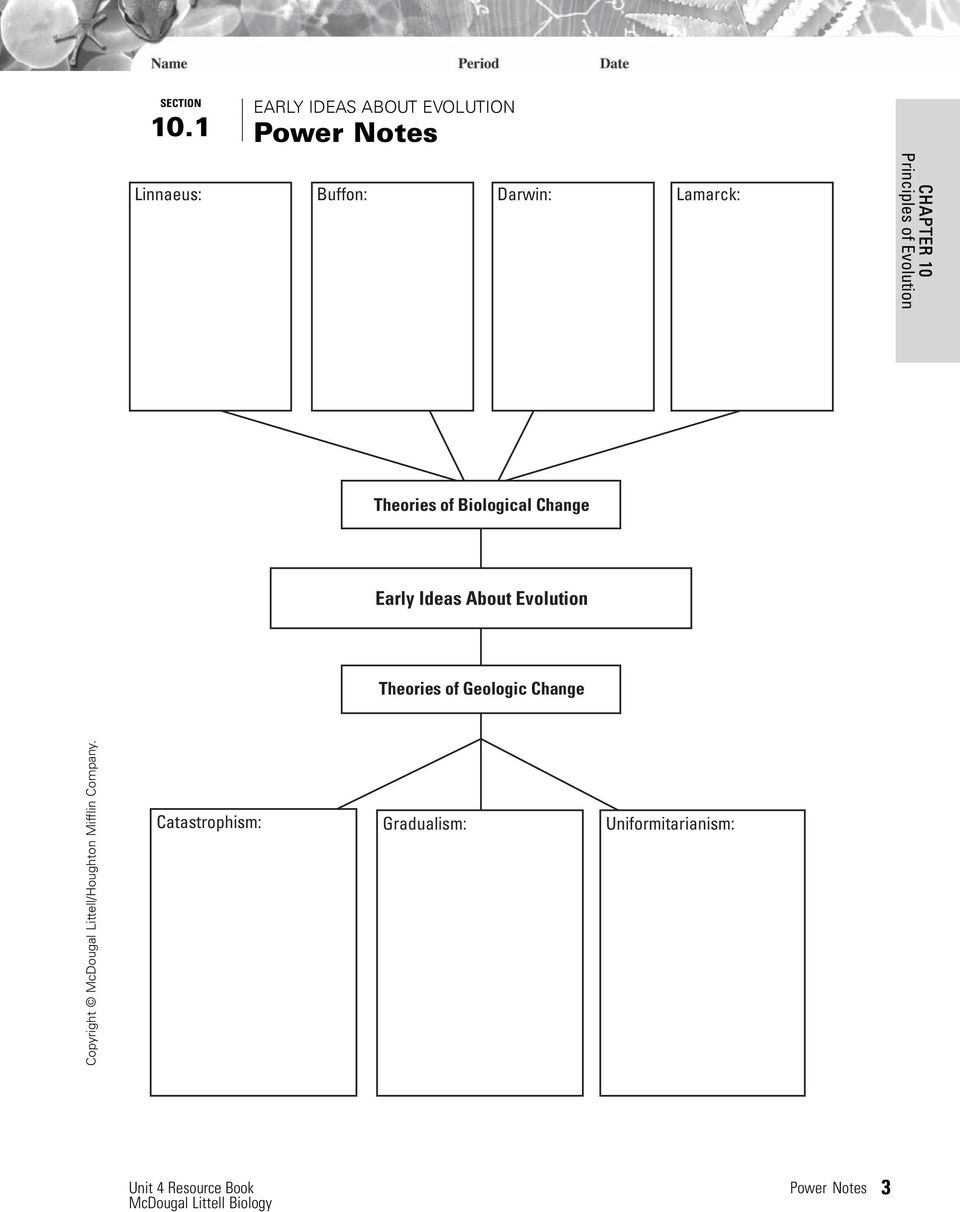
3 SECTION 10.1 EARLY IDEAS ABOUT EVOLUTION Power Notes Linnaeus: Buffon: Darwin: Lamarck: Theories of Biological Change Early Ideas About Evolution Theories of Geologic Change Catastrophism: Gradualism: Uniformitarianism: Unit 4 Resource Book Power Notes 3
4 SECTION 10.1 EARLY IDEAS ABOUT EVOLUTION Reinforcement KEY CONCEPT Darwin. There were theories of biological and geologic change before Evolution is the process of biological change by which descendants come to differ from their ancestors. Charles Darwin was not the first scientist to share his ideas about evolution and how it occurs. Carolus Linnaeus proposed that plant varieties, or species a group of organisms so similar to one another that they can reproduce and have fertile offspring can be crossed to create new species. Georges Buffon proposed that species shared ancestors instead of arising separately, the common thought of the time. Erasmus Darwin, Charles Darwin s grandfather, noted that more-complex forms of lifeseemedtoarisefromless-complexforms. Jean-Baptise Lamarck recognized that changes in physical characteristics could be passed on to offspring and were driven by environmental changes over time. Although Lamarck had ideas that influenced Darwin s thinking, his explanation of how organisms evolve was flawed. He thought, for example, that the long necks of giraffes evolved as generations of giraffes reached for leaves higher in the trees. This idea, which was later discredited, is known as the inheritance of acquired characteristics. The field of geology also offered insights into evolution. Geologists noted that fossils traces of organisms that existed in the past in deeper layers of rock were quite different than those found in the upper layers. There were several ideas proposed to explain how such changes occur. The theory of catastrophism states that natural disasters such as floods and volcanic eruptions have happened often during Earth s long history. These events shaped landforms and caused species to become extinct in the process. The principle of gradualism states that changes in landforms result from slow changes over a long period of time. The theory of uniformitarianism states that the geologic processes that shape Earth are uniform through time. The theory of uniformitarianism, proposed by geologist Charles Lyell, combines gradualism with the observation that changes on Earth have occurred at a constant rate and are ongoing. The concept of uniformitarianism greatly affected Darwin s thinking. 1. What are three ideas about evolution that scientists had before Darwin s ideas were published? 2. Describe Charles Lyell s geologic theory, which influenced Darwin. 4 Reinforcement Unit 4 Resource Book

5 SECTION 10.2 KEY CONCEPT DARWIN S OBSERVATIONS Study Guide Darwin s voyage provided insights into evolution. MAIN IDEA: VOCABULARY variation Darwin observed differences among island species. 1. What is variation among members of different species called? adaptation 2. What is variation among members of the same species called? 3. What island chain in South America was the source of many of Darwin s insights? 4. Darwin saw populations of various species that seemed well-suited to their environment. What did this suggest? MAIN IDEA: Darwin observed fossil and geologic evidence supporting an ancient Earth. 5. Darwin observed fossils of huge animals such as Glyptodon, a giant armadillo. Why were these fossils of interest to him? 6. Many people in the 1700s thought that Earth was only about 6000 years old. How did the fossil organisms Darwin saw lead him to think Earth must be much older than that? 7. Darwin also observed fossil shells of marine organisms high up in the Andes mountains, and saw an earthquake move land that was underwater move above sea level. How did he apply these insights to the evolution of organisms? 8. Look at Figure 10.4 in your textbook. What differences between the two Galápagos tortoises can you identify from the two pictures? Unit 4 Resource Book Study Guide 5

6 STUDY GUIDE, CONTINUED Vocabulary Check variation adaptation 9. the difference in the physical traits of an individual from those of other individuals in the group to which it belongs 10. a feature that allows an organism to better survive in its environment 11. A tortoise population lives in an area with high grass. These tortoises have longer necks than tortoises that live in other areas. Thelongnecksareanexampleofthis. 12. One bird in a population has a slightly thicker beak than its relatives. This thicker beak is an example of what in the population. Be Creative In the space below, draw a sketch of a bird that may eat the food choice that is given in the left column. Food choice Sketch Eats large, hard-shelled nuts Eats fruit and insects 6 Study Guide Unit 4 Resource Book

7 SECTION 10.2 Main Idea DARWIN S OBSERVATIONS Power Notes I. Darwin observed variation among island species. Detail Notes 1. Variation is: 2. Examples include tortoises: 3. and finches: II. Darwin realized species could adapt to their environment. 1. An adaptation is: III. Darwin observed fossil and geologic evidence of an ancient Earth. 1. Fossil evidence included: 2. Geologic evidence included: Unit 4 Resource Book Power Notes 7

8 SECTION 10.2 DARWIN S OBSERVATIONS Reinforcement KEY CONCEPT Darwin s voyage provided insights into evolution. Darwin traveled aboard the ship HMS Beagle to map the coast of South America and the Pacific Islands in He observed variation the difference in the physical traits of an individual from those of other individuals in the same population between island species on his voyage. The differences were especially noticeable on the Galápagos Islands off of South America. Some differences seemed well-suited to the animals environments and diets. He noticed that species have adaptations, or features that allow them to better survive in their environments. Adaptations can lead to genetic change in a population over time. Saddle-backed tortoises, which have long necks and legs, lived in areas with a lot of tall plants. Domed tortoises, with their shorter necks and legs, lived in wet areas rich in mosses and short plants. Finches with strong, thick beaks lived in areas with a lot of large, hard-shelled nuts. Species of finch with more delicate beaks were found where insects or fruits were widely available. On his voyage, Darwin also saw fossil evidence of species changing over time. He found fossils of huge animals, such as Glyptodon, a giant armadillo. He recognized that these fossils looked like living species, which suggested to him that modern animals might have some relationship to fossil forms. He observed fossil shells of marine organisms high up in the mountains. Later, Darwin experienced an earthquake and saw firsthand the result: land that had been underwater was moved above sea level. Darwin realized that over long periods of time, gradual geologic or biological processes can add up to great change. 1. How is a variation different from an adaptation? 2. What are two examples of adaptations that Darwin observed on the Galápagos islands? 3. What did Darwin conclude from the observations he made on his voyage? 8 Reinforcement Unit 4 Resource Book

9 SECTION 10.3 KEY CONCEPT THEORY OF NATURAL SELECTION Study Guide Darwin proposed natural selection as a mechanism for evolution. MAIN IDEA: VOCABULARY artificial selection natural selection fitness heritability population Several key insights led to Darwin s idea for natural selection. 1. Why did artificial selection interest Darwin? 2. Why must selected traits be heritable? 3. In natural selection, what must be true of traits that are passed down through generations? 4. What important idea from Thomas Malthus inspired Darwin? MAIN IDEA: Natural selection explains how evolution can occur. variation overproduction adaptation descent with modification 5. producing many offspring, some of which may not survive 6. individual differences that may be heritable 7. a structure well-suited for the environment 8. a heritable trait becoming common in a population Unit 4 Resource Book Study Guide 9

10 STUDY GUIDE, CONTINUED Use an organism of your choice to sketch the four principles of natural selection. 9. overproduction 10. variation 11. adaptation 12. descent with modification MAIN IDEA: Natural selection works on existing variation. 13. Peter and Rosemary Grant observed natural selection acting on traits within a population of finches on the Galápagos Islands. A drought reduced the number of small soft seeds but left plenty of large, tough-shelled seeds intact. The next year there was a(n) (increase, decrease) in the number of large-beaked hatchlings. 14. After several years, the supply of large seeds went down after an unusually wet period. The increase in small, soft seeds brought a(n) (increase, decrease) in the number of large-beaked hatchlings the following year. Vocabulary Check 15. Humans are the selective agent in which type of process, artificial selection or natural selection? 16. The environment is the selective agent in which type of process, artificial selection or natural selection? 17. What is the measure of the ability to survive and produce more offspring relative to other members of the population called? 18. What is the ability of a trait to be passed down from one generation to the next called? 19. What are all the individuals of a species that live in an area called? 10 Study Guide Unit 4 Resource Book

11 SECTION 10.3 THEORY OF NATURAL SELECTION Power Notes Artificial selection: Heritability: Struggle for survival: Key insights led to Darwin s theory. Natural Selection Explains How Evolution Can Occur. Natural selection is: The 4 main principles of natural selection are: Variation: Overproduction: Adaptation: Descent with modification: Unit 4 Resource Book Power Notes 11

12 SECTION 10.3 THEORY OF NATURAL SELECTION Reinforcement KEY CONCEPT Darwin proposed natural selection as a mechanism for evolution. Darwin s ideas about evolution were influenced by many different sources. One important influence was the work of farmers and breeders. Artificial selection, the process by which humans change a species by breeding it for certain traits, provided Darwin with some important insights. He noticed that breeders could produce a great amount of diversity through selection of certain traits. In order for artificial selection to occur, the trait must be heritable. Heritability is the ability of a trait to be inherited, or passed down, from one generation to the next. Darwin extended the ideas he gained from studying artificial selection to his theory of natural selection. Natural selection is a mechanism by which individuals that have inherited beneficial adaptations produce more offspring on average than do other individuals. Unlike artificial selection, where humans do the selecting of traits, in natural selection the environment is the selective agent. Natural selection is based upon four principles: Overproduction: producing more offspring than are likely to survive Variation: the heritable differences that exist in every population Adaptation: a certain characteristic that allows an individual to survive better than other individuals it competes against for resources Descent with modification: the spread of an adaptation throughout new generations Natural selection works on physical traits rather than genetic material itself. New traits are not made by natural selection. Natural selection can act only on traits that already exist in a population. 1. What is the main similarity between the processes of artificial selection and natural selection? 2. What is the main difference between artificial selection and natural selection? 3. Could natural selection work on a trait that is not heritable? Explain. 4. Could natural selection work on a population that has no variation? Explain. 12 Reinforcement Unit 4 Resource Book

13 SECTION 10.4 KEY CONCEPT EVIDENCE OF EVOLUTION Study Guide Evidence of common ancestry among species comes from many sources. VOCABULARY biogeography homologous structure MAIN IDEA: Evidence for evolution in Darwin s time came from several sources. In the diagram below, give examples of each type of evidence for evolution. analogous structure vestigial structure 1. Fossils: 2. Geography: Evidence for evolution in Darwin s time came from several sources. 3. Embryology: 4. Anatomy: MAIN IDEA: Structural patterns are clues to the history of a species. 5. Vestigial structures seem to lack any useful function, or are at least no longer used for their original purpose. Give three examples of vestigial structures. 6. Many modern whale species have vestigial pelvic and leg bones. What does this suggest about the ancestry of modern whales? Unit 4 Resource Book Study Guide 13

14 STUDY GUIDE, CONTINUED Vocabulary Check homologous structure analogous structure vestigial structure 7. Feature that is similar in structure in different organisms but has different functions 8. Feature that performs a similar function in different organisms but is not similar in origin 9. Is not evidence of a common ancestor 10. Remnant of an organ or structure that had a function in an early ancestor 11. Examples include the wing of a bat and the hand of a human 12. Examples include the wing of a bird and the wing of an insect 13. Examples include the wing of an ostrich and the appendix of a human Sketch it Out Use Figure to sketch a skeleton of a human hand next to the whale fin skeleton shown below. Draw lines to match the groups of bones that are homologous for these two structures. A B C D 14 Study Guide Unit 4 Resource Book

15 SECTION 10.4 EVIDENCE OF EVOLUTION Power Notes Main Idea Evidence of common ancestry among species comes from many sources. Fossils: Analogous structures are not evidence of a recent common ancestor. Analogous structures: Geography: Embryology: Anatomy: Homologous structures: Vestigial structures: Unit 4 Resource Book Power Notes 15

16 SECTION 10.4 EVIDENCE OF EVOLUTION Reinforcement KEY CONCEPT Evidence of common ancestry among species comes from many sources. Darwin found evidence supporting evolution from a wide range of sources. The most important and convincing support came from fossils, geography, embryology, and anatomy. The fossil is a record of change in a species over time. Geologists found that fossil organisms on the bottom, or older, layers were more primitive than those in the upper, or newer, layers. These findings supported Darwin s concept of descent with modification. Biogeography, the study of the distribution of organisms around the world, reveals a pattern of evolution of organisms. Darwin s observations on the Galapagos islands, for instance, demonstrated that species can adapt to different environments and evolve into separate populations or species over time. Embryology, the study of embryo development, reveals that even organisms that are very different from each other in their adult forms can have similar patterns of development. Two species that exhibit similar traits during development are likely to have a common ancestor. Anatomyalsoprovides insightintoevolution. Homologous structures are features that are similar in structure but appear in different organisms and have different functions. Vestigial structures are remnants of organs or structures that had a function in an early ancestor. Both homologous structures and vestigial structures point to a shared ancestry among organisms that share them. 1. How did the study of fossils help support Darwin s ideas about evolution? 2. How did the study of organisms on islands help support Darwin s ideas? 3. In all animals with backbones, including humans, early embryos have gill slits that later develop into structures of ears and throats in mammals. What does this suggest about the relationship between all vertebrates? 4. What are two examples of types of body structures that provide evidence of a common ancestor among diverse organisms? 16 Reinforcement Unit 4 Resource Book

17 SECTION 10.5 KEY CONCEPT EVOLUTIONARY BIOLOGY TODAY Study Guide New technology is furthering our understanding of evolution. MAIN IDEA: Fossils provide a record of evolution. 1. What are two reasons that the fossil record is not complete? VOCABULARY paleontology 2. What is one example of a transitional fossil that has been found? 3. Why are transitional fossils important? MAIN IDEA: Molecular and genetic evidence support fossil and anatomical evidence. In a phrase, explain how each of the following contribute to evolutionary theory. Molecular Evidence 4. DNA sequence analysis Contribution to Evolutionary Theory 5. Pseudogenes 6. Homeobox genes 7. Protein comparisons Unit 4 Resource Book Study Guide 17

18 STUDY GUIDE, CONTINUED MAIN IDEA: Evolution unites all fields of biology. 8. What two things combine to make up our modern evolutionary theory? 9. How has molecular evidence helped support fossil evidence in determining the early ancestor of modern-day whales? 10. What is meant by the phrase Evolution unites all fields of biology? Vocabulary Check 11. How does paleontology contribute to evolutionary biology? Sketch it Out Look at the fossil evidence of whale evolution shown in Figure Sketch one part of the skeletons (such as the skull, forelimbs, hindlimbs, or ribcages) of each of the whale ancestors. Briefly describe their differences and propose how these differences are well-suited for the habitat in which the animals lived. 18 Study Guide Unit 4 Resource Book

19 SECTION 10.5 DNA sequence analysis: EVOLUTIONARY BIOLOGY TODAY Power Notes Pseudogenes: New technology is furthering our understanding of evolution. Homeobox genes: Protein comparisons: Unit 4 Resource Book Power Notes 19

20 SECTION 10.5 EVOLUTIONARY BIOLOGY TODAY Reinforcement KEY CONCEPT New technology is furthering our understanding of evolution. The study of fossils or extinct organisms, called paleontology, continues to provide new information and support current hypotheses about how evolution occurs. The fossil record, although incomplete, contains many transitional fossils, or missing links, that demonstrate the evolution of traits. Transitional fossils can also indicate common ancestors between groups, such as Basilosaurus isis, which had a whalelike body but the limbs of a land animal. Modern molecular techniques continue to provide new information about how evolution occurs. Examples include DNA sequence analysis: The more closely related two organisms are, the more similar their DNA will be. Pseudogenes: Pseudogenes no longer function but are still carried along with working DNA. They are not affected by natural selection, so common pseudogenes among organisms must reflect a common ancestor. Homeobox genes: These genes control the development of structures within the body. They are in diverse organisms, from fruit flies to humans, so they can indicate a very distant common ancestor. Protein comparisons: Sometimes known as molecular fingerprinting, this technique is based on the idea that different species that have cells with the same proteins most likely came from a common ancestor. The theory of natural selection supported by genetic evidence is sometimes called the modern synthesis of evolutionary theory. The amount of data that can be collected by molecular evidence alone is overwhelming. Scientists from many fields of science are contributing to our understanding of evolution, and the field of evolutionary biology is quickly growing. Evolution is a unifying theme among all the fields of biology today. 1. Why is Basilosauris isis considered a transitional fossil? 2. What underlying theme do the four molecular techniques share? 3. What is the modern synthesis of evolutionary theory? 20 Reinforcement Unit 4 Resource Book

21 CHAPTER 10 INTERPRETING LINE GRAPHS Data Analysis Practice Data from experiments can be represented in a line graph for analysis and interpretation. Scientists breeding salmon in captivity can artificially select traits such as large body size and females that produce many eggs. Scientists have determined that one of the effects of artificially selecting these traits is the production of eggs with a smaller volume. In some areas, salmon that have been bred in captivity are added to rivers to help increase population levels. Once released, the previously captive salmon breed with the wild salmon. Scientists hypothesized that in rivers that had significant percentages of captive salmon being added, there would be rapid evolution toward smaller egg size in future generations of salmon. Scientists collected data in four rivers in British Columbia, Canada, to test the hypothesis. Over the course of the study, body size in females did not change. The graph below shows the results of the study. GRAPH 1. EGG VOLUME OVER TIME 0.8 Robertson Creek 0.7 Quinsam River Egg volume (cm 3 ) Nanaimo River Nahmint River Year 1. Analyze Less than 20% of the Nahmint and Nanaimo Rivers were stocked with captive bred salmon. Was there a decrease in egg size in these rivers? 2. Analyze More than 25% of the fish in the Quinsam River and Robertson Creek were captive bred. Was there a decrease in egg size in either place? 3. Conclude How does stocking rivers with salmon bred in captivity affect egg size? Unit 4 Resource Book Data Analysis Practice 21
22
23 CHAPTER 10 LYSENKOISM: EVOLUTIONARY THEORY IN THE U.S.S.R. Pre-AP* Activity *Pre-AP is a registered trademark of the College Board, which was not involved in the production of and does not endorse this product. You have learned in Chapter 10 that Charles Darwin proposed that individuals with characteristics that prove to be beneficial in their environment are more likely to survive and produce offspring than less well adapted individuals. As you learned, Lamarck had seen a connection between the environment and beneficial variations in traits. Though it was rejected by the scientific community, Lamarckism was reexamined on occasion especially when Darwin s theory of natural selection posed a threat to political ideologies. THE RETURN OF LAMARCK In the early 20th century, exciting discoveries on the mechanism of inheritance were emerging in Germany and the United States. Despite advances in the understanding of heritability, some scientists continued to favor Lamarck s theory. A leading proponent of this in the Soviet Union was a plant breeder named Trofim Denisovich Lysenko ( ). Though not a trained scientist, Lysenko rose to prominence through his fierce advocacy of an anti-intellectual worldview that interpreted science through Soviet ideology. Lysenko molded Lamarckism into a theory that viewed heritability and other aspects of biology through the lens of Soviet communism. Lysenko s rise to prominence came from his ability to do quick experiments at a time when the Soviet government was impatient for results, particularly in agriculture. The scientific method, including replicating controlled studies and objective analysis, took too long. Lysenko provided results quickly by using small sample sizes, rarely using controls, and avoiding replicated studies. His results drew attention for their speedy and their apparent success, which Lysenko guaranteed by reporting only successes. THE SITUATION IN THE SCIENCE OF BIOLOGY 1948 The remarks below are excerpted from an address delivered by Lysenko at a conference in The scientists to whom he referred included August Weismann, the German biologist who distinguished between somatic cells and germline cells, Gregor Mendel, and Thomas Morgan, whose studies of fruit fly chromosomes later earned a Nobel prize. The materialist theory of the evolution of living nature involves recognition of the necessity of hereditary transmission of individual characteristics acquired by the organism under the conditions of its life; it is unthinkable without recognition of the inheritance of acquired characters. [Other scientists] denied the inheritability of acquired characters and elaborated the idea of a special hereditary substance to besoughtforinthenucleus...[they]contendthatthechromosomescontain a special hereditary substance which resides in the body of the organism as if in a case and is transmitted to coming generations irrespective of the qualitative features of the body and its conditions of life. The conclusion drawn... is that new tendencies and characteristics acquired by the organism under the influence of conditions... are not inherited and can have no evolutionary significance.... According to this theory, characters acquired by vegetable and animal organisms cannot be handed down, are not inherited. Unit 4 Resource Book Pre-AP* Activity 23
24 LYSENKO AND DARWIN S STRUGGLE FOR EXISTENCE Of the many tenets of Darwin s theory of natural selection that Lysenko disliked, few were more contemptible to him than the views of Malthus on the natural limits to population size and the resultant struggle for existence between members of a population. All mankind belongs to one biological species. Hence, bourgeois science had to invent intraspecific struggle. In nature, they say, within each species there is a cruel struggle for food... The stronger, better-adapted individuals are the victors. The same... occurs among people: the capitalists have millions, the workers live in poverty, because the capitalists supposedly are more intelligent and more able because of their heredity... We Soviet people know well that the oppression of theworkers,thedominanceofthecapitalistclass...areallbasedonthelaws of a rotting, moribund, bourgeois, capitalist society... There is no intraspecific competition in nature. There is only competition between species: the wolf eats the hare; the hare does not eat another hare, it eats grass. THE EFFECT OF LYSENKOISM ON SCIENTIFIC THOUGHT Lysenko s use of science to support Soviet ideals, and vice versa, made a deep impression on Joseph Stalin, the Soviet dictator. He made Lysenko, the Director of Genetics at the USSR Academy of Sciences in The standing director, a respected biologist whose views paralleled those in classical genetics, was arrested and imprisoned. The episode sent the message to scientists that if their work conflicted with state-approved theories, they could suffer the same fate. Soviet physicists began to argue against Einstein s theory of relativity, and biologists challenged well-established tenets of microbiology and dropped any visible pursuit of genetic research. Scientific theories that did not fit Soviet ideology were ignored, and many scientists from this period were arrested as enemies of the state and sent to gulags (labor camps) or simply disappeared. This downward spiral prevailed until Stalin s death in Though Lysenko retained his prominence under Stalin s successor, Nikita Khruschev, the taboo against criticizing him was lifted. A strongly worded attack on his role in holding back Soviet science was voiced in 1964 by several prominent scientists. Lysenko was removed from his position. Answer the following questions on a separate piece of paper. 1. Soviet communism stressed the solidarity of the working class and sought to rid the world of a bourgeois, capitalist class. Why then was it important for Lysenko to challenge the Malthusian/Darwinian ideas of limited resources and intraspecific competition? How would those theories pose a threat to communism? 2. Why is an anti-intellectual ideology damaging for science? 3. Lysenko once stated that to obtain a certain result, you must want to obtain precisely that result; if you want to obtain a certain result, you will obtain it... I need only such people as will obtain the results I need. In what ways is such a statement in opposition to the scientific method? 24 Pre-AP* Activity Unit 4 Resource Book
25 CHAPTER 10 BIOINFORMATICS: SEQUENCING THE CLOCK GENE Pre-AP Activity As you have learned in Chapters 9 and 10, advances in genetics and molecular biology have provided new insights into evolution and have led to an explosion of data and biological information. Increased computing power and the development of extensive databases of information have led to a new field of study: bioinformatics. Bioinformatics is an invaluable tool in evolutionary biology. It has enabled scientists to compare and analyze the DNA sequences specifically associated with genes suchastheclockgeneinhumansandmice,as you will see below. DATABASES AND BIOINFORMATICS When large amounts of scientific data and information are generated, it must be organized in such a way that other scientists have access to it. Most scientific data and information are stored in databases. A database is a computerized collection of data that stores, organizes, and indexes data so that they can be located and retrieved quickly. One such database is the National Institute s of Health s genetic sequence database, GenBank, which contains all publicly available DNA sequences. Due to the nature of some of the data, it may have to be manipulated. Bioinformatics is the branch of science that integrates biology, computer science, and information technology to analyze biological data such as genetic codes, experimental results, taxonomy trees, patient statistics, and scientific literature. Bioinformatics allows scientists to access genetic sequences for various organisms and uncover evolutionary relationships between them. As you have learned, the closer the sequences are, the more closely the organisms are related. CLOCK GENES Most organisms have evolved an internal biological clock, also known as the circadian rhythm, to adapt to the changes that take place over the course of a day and sometimes over the course of a year. An organism s circadian rhythm controls its activity patterns in relation to light and dark, such as when it sleeps and when it awakens. The circadian rhythm is also responsible for other biological functions: body temperature, metabolism, blood pressure, hormone secretion, heart activity, oxygen consumption, hibernation, and migration. The circadian rhythm in mammals is controlled by clock genes. Clock genes carry the genetic instructions to produce specific proteins. By increasing or decreasing protein levels throughout the day, clock genes directly affect the circadian rhythm. The first mammalian clock gene was discovered in a mouse in Scientists identified the location of the gene and determined its sequence. In 2001, scientists at the University of Utah discovered the first human clock gene. Using databases such as GenBank, scientists have been able to analyze and compare the DNA sequences for the clock gene in humans and mice. In doing so, scientists have established that the human clock gene DNA sequence extends for 2538 base pairs and is 89% identical to that of the mouse. The sequence of the 846 amino acids produced by those base pairs is 96% identical to the amino acid sequence produced in mice. On the next page, you will compare the beginning of the DNA sequences of the clock genes of humans and mice. Note that each sequence is broken into five segments in order to fit on the page. Unit 4 Resource Book Pre-AP Activity 25
26 CLOCK GENE DNA SEQUENCES Human Mouse Human Mouse Human Mouse atgttgttta atggtgttta tgacagtagt tgacagtagt cgaaaagagt caaaaagagt ccgtaagctg ccgtaagctg atttttgatg atttttgatg atctagaaac atctagaaac tagtaaaatg tagtaaaatg ggttggtgga gattggtgga aaatctgaaa aaatcagaaa agctcgattg agctcaattg agaagatgac agaagatgac agaaacgtag agaaacgtag ttgacagaga ttgacagaga aaggacaaag aaggacaaag agatcaattt agatcagttc Human Mouse aatgttctca aatgtcctca ttaaagaact ttaaggagct gggatccatg ggggtctatg cttcctggta cttcctggta atgctagaaa acgcgagaaa Human Mouse gatggacaaa gatggacaag tctactgttc tctactgttc tgcagaaaag tacagaagag cattgatttt cattgatttt ttacgaaaac ttgcgcaaac Answer the following questions on a separate sheet of paper. 1. Using the DNA sequences above, how many base differences are there between the human and mouse clock gene? Mark the mismatched pairs, then calculate the percentage of similarity between the two sequences. 2. How does the value you calculated compare to the findings of the scientists? What may account for any differences? 3. Scientists have established that the sequences of the human and mouse clock gene are 89% identical, but the sequences of amino acids produced are 96% identical. Explain what might account for this discrepancy. 4. In the first segment of the human clock gene sequence shown above, the following series of amino acids appears: methionine leucine phenylalanine threonine valine serine cysteine serine lysine methionine Using Figure 8.13 on page 244, write three different DNA sequences that would still code for those amino acids, in that order. 26 Pre-AP Activity Unit 4 Resource Book
27 CHAPTER 10 PRINCIPLES OF EVOLUTION Vocabulary Practice evolution variation fitness species adaptation biogeography fossil artificial selection homologous structure catastrophism heritability analogous structure gradualism natural selection vestigial structure uniformitarianism population paleontology A. Stepped-Out Vocabulary Determine the vocabulary word that fits best, define each word, or write two additional facts that are related to the word in the spaces below. WORD DEFINITION MORE INFORMATION Example Fossil Traces of an organism that existed in the past. there are different types of fossils 1. Variation they allow scientists to study evolution can occur among members of different species 2. Features that are similar in structure but appear in different organisms and have different functions. 3. Analogous structures Structures that perform a similar function but are not similar in origin. can occur among members of the same species evidence of common descent common examples are the forelimbs of vertebrates Unit 4 Resource Book Vocabulary Practice 27
28 VOCABULARY PRACTICE, CONTINUED WORD DEFINITION MORE INFORMATION 4. evidence for common descent examples include snake pelvic bones B. Compound Word Puzzle Read the phrase and write the word that it most closely describes. Then write another phrase that describes the same word in a different way. PHRASE 1 WORD PHRASE 2 Example Process of biological change over time 1. Can interbreed and produce fertile offspring Evolution Process by which descendents come to differ from their ancestors 2. Beneficial feature 3. The environment is the selective agent 4. All the individuals of a species that live in an area C. Do-It Yourself Matching In a random order, write short definitions for each term on the blank lines to the right. Then give your paper to a classmate who should write the number of the term next to the correct definition. 1. evolution 2. fitness 3. catastrophism 4. gradualism 28 Vocabulary Practice Unit 4 Resource Book
29 VOCABULARY PRACTICE, CONTINUED 5. uniformitarianism 6. artificial selection 7. natural selection 8. paleontology 9. biogeography 10. heritability D. Find the Odd Word Put a checkmark next to the word that does not belong and explain why. There may be more than one correct way to answer for some of the word sets. 1. fossil fitness Explanation paleontology 2. artificial selection heritability Explanation biogeography 3. catastrophism gradualism uniformitarianism 4. homologous structure analogous structure vestigial structure 5. variation adaptation vestigial structure 6. evolution natural selection catastrophism Explanation Explanation Explanation Explanation Unit 4 Resource Book Vocabulary Practice 29
30 VOCABULARY PRACTICE, CONTINUED E. Crossword Puzzle Use the clues to solve the puzzle. Across 1. Theory that processes that can be seen today also occurred in the past 5. Remnants of organs that functioned in an ancestor 8. Traces or remains of an organism that existed in the past 10. Features with the same function in two organisms but different recent ancestors 11. Theory of dramatic natural events changing Earth 12. Study of fossils 13. Theory of how evolution occurs 14. Beneficial feature that helps survival Down 2. Choosing particular traits for breeding 3. Theory of slow change over long time periods 4. Process of biological change over generations 6. Members of a group that can interbreed 7. Measure of ability to survive and produce offspring Vocabulary Practice Unit 4 Resource Book
CCR Biology - Chapter 10 Practice Test - Summer 2012
 Name: Class: Date: CCR Biology - Chapter 10 Practice Test - Summer 2012 Multiple Choice Identify the choice that best completes the statement or answers the question. 1. What is the term for a feature
Evolution (18%) 11 Items Sample Test Prep Questions
 Evolution (18%) 11 Items Sample Test Prep Questions Grade 7 (Evolution) 3.a Students know both genetic variation and environmental factors are causes of evolution and diversity of organisms. (pg. 109 Science
Summary. 16 1 Genes and Variation. 16 2 Evolution as Genetic Change. Name Class Date
 Chapter 16 Summary Evolution of Populations 16 1 Genes and Variation Darwin s original ideas can now be understood in genetic terms. Beginning with variation, we now know that traits are controlled by
This is a series of skulls and front leg fossils of organisms believed to be ancestors of the modern-day horse.
 Evidence of Evolution Background When Charles Darwin first proposed the idea that all new species descend from an ancestor, he performed an exhaustive amount of research to provide as much evidence as
Principles of Evolution - Origin of Species
 Theories of Organic Evolution X Multiple Centers of Creation (de Buffon) developed the concept of "centers of creation throughout the world organisms had arisen, which other species had evolved from X
Biology 1406 - Notes for exam 5 - Population genetics Ch 13, 14, 15
 Biology 1406 - Notes for exam 5 - Population genetics Ch 13, 14, 15 Species - group of individuals that are capable of interbreeding and producing fertile offspring; genetically similar 13.7, 14.2 Population
Evidence for evolution factsheet
 The theory of evolution by natural selection is supported by a great deal of evidence. Fossils Fossils are formed when organisms become buried in sediments, causing little decomposition of the organism.
Practice Questions 1: Evolution
 Practice Questions 1: Evolution 1. Which concept is best illustrated in the flowchart below? A. natural selection B. genetic manipulation C. dynamic equilibrium D. material cycles 2. The diagram below
Problem Set 5 BILD10 / Winter 2014 Chapters 8, 10-12
 Chapter 8: Evolution and Natural Selection 1) A population is: a) a group of species that shares the same habitat. b) a group of individuals of the same species that lives in the same general location
Evolutionary Evidence
 Evolutionary Evidence 7th Grade, Science and English/Language Arts: Age of Mammals Make the most of your Museum field trip by integrating it into your classroom curriculum. These lesson plans provide a
Theory of Evolution. A. the beginning of life B. the evolution of eukaryotes C. the evolution of archaebacteria D. the beginning of terrestrial life
 Theory of Evolution 1. In 1966, American biologist Lynn Margulis proposed the theory of endosymbiosis, or the idea that mitochondria are the descendents of symbiotic, aerobic eubacteria. What does the
Connected Experience: Evolution and the Galápagos Tortoise
 Connected Experience: Evolution and the Galápagos Tortoise GRADE LEVELS 6 th -8 th ; California Content Standards for 7 th and High School Biology Objectives SUBJECTS Life Sciences DURATION Pre-Visit:
1. Over the past century, several scientists around the world have made the following observations:
 Evolution Keystone Review 1. Over the past century, several scientists around the world have made the following observations: New mitochondria and plastids can only be generated by old mitochondria and
Endemic and Introduced Species Lesson Plan
 Grade Level: 6-8 Curriculum Focus: Ecosystems and Biomes Lesson Duration: Two class periods Student Objectives Materials Understand and apply the term endemic to animal and plant life, meaning native,
AP Biology Essential Knowledge Student Diagnostic
 AP Biology Essential Knowledge Student Diagnostic Background The Essential Knowledge statements provided in the AP Biology Curriculum Framework are scientific claims describing phenomenon occurring in
Okami Study Guide: Chapter 3 1
 Okami Study Guide: Chapter 3 1 Chapter in Review 1. Heredity is the tendency of offspring to resemble their parents in various ways. Genes are units of heredity. They are functional strands of DNA grouped
Macroevolution: Change above the species level NABT 2006 Evolution Symposium
 Introduction Macroevolution: Change above the species level NABT 2006 Evolution Symposium The basic concept of evolution change over time can be examined in two different time frames. The first, which
Worksheet: The theory of natural selection
 Worksheet: The theory of natural selection Senior Phase Grade 7-9 Learning area: Natural Science Strand: Life and living Theme: Biodiversity, change and continuity Specific Aim 1: Acquiring knowledge of
The Story of Human Evolution Part 1: From ape-like ancestors to modern humans
 The Story of Human Evolution Part 1: From ape-like ancestors to modern humans Slide 1 The Story of Human Evolution This powerpoint presentation tells the story of who we are and where we came from - how
Name: Date: Problem How do amino acid sequences provide evidence for evolution? Procedure Part A: Comparing Amino Acid Sequences
 Name: Date: Amino Acid Sequences and Evolutionary Relationships Introduction Homologous structures those structures thought to have a common origin but not necessarily a common function provide some of
Name Class Date. binomial nomenclature. MAIN IDEA: Linnaeus developed the scientific naming system still used today.
 Section 1: The Linnaean System of Classification 17.1 Reading Guide KEY CONCEPT Organisms can be classified based on physical similarities. VOCABULARY taxonomy taxon binomial nomenclature genus MAIN IDEA:
A Hands-On Exercise To Demonstrate Evolution
 HOW-TO-DO-IT A Hands-On Exercise To Demonstrate Evolution by Natural Selection & Genetic Drift H ELEN J. YOUNG T RUMAN P. Y OUNG Although students learn (i.e., hear about) the components of evolution by
Lesson Title: Constructing a Dichotomous Key and Exploring Its Relationship to Evolutionary Patterns
 Lesson Title: Constructing a Dichotomous Key and Exploring Its Relationship to Evolutionary Patterns NSF GK-12 Fellow: Tommy Detmer Grade Level: 4 th and 5 th grade Type of Lesson: STEM Objectives: The
Unit: Plants & Animals (Grade 2)
 Unit: Plants & Animals (Grade 2) Content Area: Science Course(s): Science Time Period: 8 weeks Length: Weeks Status: Published Unit Overview Students will determine the life cycles of plants and animals
Assignment Discovery Online Curriculum
 Assignment Discovery Online Curriculum Lesson title: Nature Versus Nurture Grade level: 9-12, with adaptation for younger students Subject area: Human Body Contemporary Studies Behavioral Science Duration:
1 Branches of Earth Science
 CHAPTER 1 1 Branches of Earth Science SECTION The World of Earth Science BEFORE YOU READ After you read this section, you should be able to answer these questions: What are the four major branches of Earth
BIO 1: Review: Evolution
 Name: Class: Date: ID: A BIO 1: Review: Evolution True/False Indicate whether the statement is true or false. 1. Radiometric dating measures the age of an object by measuring the proportions of radioactive
Evolution, Natural Selection, and Adaptation
 Evolution, Natural Selection, and Adaptation Nothing in biology makes sense except in the light of evolution. (Theodosius Dobzhansky) Charles Darwin (1809-1882) Voyage of HMS Beagle (1831-1836) Thinking
Heredity - Patterns of Inheritance
 Heredity - Patterns of Inheritance Genes and Alleles A. Genes 1. A sequence of nucleotides that codes for a special functional product a. Transfer RNA b. Enzyme c. Structural protein d. Pigments 2. Genes
Chapter 9 Patterns of Inheritance
 Bio 100 Patterns of Inheritance 1 Chapter 9 Patterns of Inheritance Modern genetics began with Gregor Mendel s quantitative experiments with pea plants History of Heredity Blending theory of heredity -
Preparation. Educator s Section: pp. 1 3 Unit 1 instructions: pp. 4 5 Unit 2 instructions: pp. 6 7 Masters/worksheets: pp. 8-17
 ActionBioscience.org lesson To accompany the article by Lawrence M. Page, Ph.D.: "Planetary Biodiversity Inventories: A Response to the Taxonomic Crisis" (May 2006) http://www.actionbioscience.org/biodiversity/page.html
Complete tests for CO 2 and H 2 Link observations of acid reactions to species
 Acids and Bases 1. Name common acids and bases found at home and at school 2. Use formulae for common acids and bases 3. Give examples of the uses of acids and bases 4. State that all solutions are acidic,
Background Biology and Biochemistry Notes A
 Background Biology and Biochemistry Notes A Vocabulary dependent variable evidence experiment hypothesis independent variable model observation prediction science scientific investigation scientific law
MS. Structure, Function, and Information Processing
 MIDDLE SCHOOL LIFE SCIENCE Alignment with National Science Standards Use the chart below to find Science A-Z units that best support the Next Generation Science Standards* for Middle School Life Science,
Biological kinds and the causal theory of reference
 Biological kinds and the causal theory of reference Ingo Brigandt Department of History and Philosophy of Science 1017 Cathedral of Learning University of Pittsburgh Pittsburgh, PA 15260 E-mail: [email protected]
Name Class Date WHAT I KNOW. about how organisms have changed. grown in complexity over time.
 History of Life Evolution Q: How do fossils help biologists understand the history of life on Earth? 19.1 How do scientists use fossils to study Earth s history? WHAT I KNOW SAMPLE ANSWER: Fossils give
Bony Fish Anatomy Worksheet
 Educational Material Bony Fish Anatomy Worksheet Teacher Information This activity is designed to be team-taught by the classroom and art teacher. Use this guide in conjunction with fish-related art to
Mechanisms of Evolution
 page 2 page 3 Teacher's Notes Mechanisms of Evolution Grades: 11-12 Duration: 28 mins Summary of Program Evolution is the gradual change that can be seen in a population s genetic composition, from one
Name: DUE: May 2, 2013 Ms. Galaydick. Geologic Time Scale Era Period End date (in millions of years) Cenozoic Quaternary present
 Name: DUE: May 2, 2013 Ms. Galaydick Objective: Use the diagrams to answer the questions for each set: USING SCIENCE SKILLS PART #1 Geologic Time Scale Era Period End date (in millions of years) Cenozoic
Lesson Overview. Biodiversity. Lesson Overview. 6.3 Biodiversity
 Lesson Overview 6.3 6.3 Objectives Define biodiversity and explain its value. Identify current threats to biodiversity. Describe how biodiversity can be preserved. THINK ABOUT IT From multicolored coral
This Performance Standards include four major components. They are
 Seventh Grade Science Curriculum Approved July 13, 2006 The Georgia Performance Standards are designed to provide students with the knowledge and skills for proficiency in science at the seventh grade
Religion and Science
 Religion and Science Glossary Cosmology the study of the origins of the universe How did the world come into existence? Theory one Aristotle Taught that the universe has always existed and would always
Understanding by Design. Title: BIOLOGY/LAB. Established Goal(s) / Content Standard(s): Essential Question(s) Understanding(s):
 Understanding by Design Title: BIOLOGY/LAB Standard: EVOLUTION and BIODIVERSITY Grade(s):9/10/11/12 Established Goal(s) / Content Standard(s): 5. Evolution and Biodiversity Central Concepts: Evolution
CPO Science and the NGSS
 CPO Science and the NGSS It is no coincidence that the performance expectations in the Next Generation Science Standards (NGSS) are all action-based. The NGSS champion the idea that science content cannot
Geologic Time Scale Notes
 Name: Date: Period: 1 2 3 4 5 6 7 Notes Essential Question: What is the geologic time scale? Vocabulary: Geology: the scientific study of the origin, history, and structure of Earth and the processes that
A Correlation of Pearson Miller & Levine Biology 2014 To the Utah Core State Standards for Biology Grades 9-12
 A Correlation of Pearson To the Utah Core State Standards Resource Title: Publisher: Pearson Education publishing as Prentice Hall ISBN (10 or 13 digit unique identifier is required): SE: 9780133242003
Unit 2 Lesson 4 The Geologic Time Scale. Copyright Houghton Mifflin Harcourt Publishing Company
 Once Upon a Time How have geologists described the rate of geologic change? Geology is the scientific study of the origin, history, and structure of Earth and the processes that shape it. Early geologists
Evolution by Natural Selection 1
 Evolution by Natural Selection 1 I. Mice Living in a Desert These drawings show how a population of mice on a beach changed over time. 1. Describe how the population of mice is different in figure 3 compared
A CONTENT STANDARD IS NOT MET UNLESS APPLICABLE CHARACTERISTICS OF SCIENCE ARE ALSO ADDRESSED AT THE SAME TIME.
 Biology Curriculum The Georgia Performance Standards are designed to provide students with the knowledge and skills for proficiency in science. The Project 2061 s Benchmarks for Science Literacy is used
Answer Key. Vocabulary Practice
 Answer Key Vocabulary Practice Copyright by McDougal Littell, a division of Houghton Mifflin Company A. Categorize Words 1. organism, L; cell, L; species, L; transgenic, B; biotechnology, T; molecular
Chapter 13: Meiosis and Sexual Life Cycles
 Name Period Chapter 13: Meiosis and Sexual Life Cycles Concept 13.1 Offspring acquire genes from parents by inheriting chromosomes 1. Let s begin with a review of several terms that you may already know.
Worksheet - COMPARATIVE MAPPING 1
 Worksheet - COMPARATIVE MAPPING 1 The arrangement of genes and other DNA markers is compared between species in Comparative genome mapping. As early as 1915, the geneticist J.B.S Haldane reported that
Essentials of Human Anatomy & Physiology 11 th Edition, 2015 Marieb
 A Correlation of Essentials of Human Anatomy Marieb To the Next Generation Science Standards Life A Correlation of, HS-LS1 From Molecules to Organisms: Structures and Processes HS-LS1-1. Construct an explanation
Reproductive System & Development: Practice Questions #1
 Reproductive System & Development: Practice Questions #1 1. Which two glands in the diagram produce gametes? A. glands A and B B. glands B and E C. glands C and F D. glands E and F 2. Base your answer
Carnivore, omnivore or herbivore?
 Carnivore, omnivore or herbivore? Physical adaptations of the giant panda Student booklet (ST) October 2010 panda_st_student.doc Context The Giant Panda is a species that is faced with extinction. It is
The Science of Biology
 Chapter 1 The Science of Biology Section 1 1 What Is Science? (pages 3 7) This section explains what the goal of science is and describes a scientific view of the world. What Science Is and Is Not (page
Approaches to studying animal behavior
 Approaches to studying animal behavior Foundations of modern study of behavior 1. Evolution by natural selection 2. Genetics and inheritance 3. Comparative method Evolution by natural selection Alfred
Smart Science Lessons and Middle School Next Generation Science Standards
 Smart Science Lessons and Middle School Next Generation Science Standards You have chosen the right place to find great science learning and, beyond learning, how to think. The NGSS emphasize thinking
Biological Sciences Initiative. Human Genome
 Biological Sciences Initiative HHMI Human Genome Introduction In 2000, researchers from around the world published a draft sequence of the entire genome. 20 labs from 6 countries worked on the sequence.
A trait is a variation of a particular character (e.g. color, height). Traits are passed from parents to offspring through genes.
 1 Biology Chapter 10 Study Guide Trait A trait is a variation of a particular character (e.g. color, height). Traits are passed from parents to offspring through genes. Genes Genes are located on chromosomes
FAQs: Gene drives - - What is a gene drive?
 FAQs: Gene drives - - What is a gene drive? During normal sexual reproduction, each of the two versions of a given gene has a 50 percent chance of being inherited by a particular offspring (Fig 1A). Gene
FOR TEACHERS ONLY. The University of the State of New York REGENTS HIGH SCHOOL EXAMINATION LIVING ENVIRONMENT
 FOR TEACHERS ONLY LE The University of the State of New York REGENTS HIGH SCHOOL EXAMINATION LIVING ENVIRONMENT Tuesday, June 21, 2011 9:15 a.m. to 12:15 p.m., only SCORING KEY AND RATING GUIDE Directions
ENDANGERED AND THREATENED
 ENDANGERED AND THREATENED Understand how species in the Sonoran Desert Region may become endangered or threatened and what is being done to protect them. ARIZONA SCIENCE STANDARDS SC03-S4C3-03&04, SC08-S1C3-07,
TeachingEnglish Lesson plans. Science and Cloning. Topic: Science vocabulary
 Science and Cloning Topic: Science vocabulary Aims: - To improve oral communication - To link the student's knowledge and interest in science with their English class - To act as an introduction to the
IDENTIFICATION OF ORGANISMS
 reflect Take a look at the pictures on the right. Think about what the two organisms have in common. They both need food and water to survive. They both grow and reproduce. They both have similar body
Classification and Evolution
 Classification and Evolution Starter: How many different ways could I split these objects into 2 groups? Classification All living things can also be grouped how do we decide which groups to put them into?
WEEK 6 EOC Review Evolution, Human Body, Biotechnology
 WEEK 6 EOC Review Evolution, Human Body, Biotechnology Benchmarks: SC.912.L.15.13 Describe the conditions required for natural selection, including: overproduction of offspring, inherited variation, and
Introduction to Animals
 Introduction to Animals Unity and Diversity of Life Q: What characteristics and traits define animals? 25.1 What is an animal? WHAT I KNOW SAMPLE ANSWER: Animals are different from other living things
Ecology 1 Star. 1. Missing from the diagram of this ecosystem are the
 Name: ate: 1. Missing from the diagram of this ecosystem are the 5. ase your answer(s) to the following question(s) on the diagram below and on your knowledge of biology.. biotic factors and decomposers.
Experimental Analysis
 Experimental Analysis Instructors: If your institution does not have the Fish Farm computer simulation, contact the project directors for information on obtaining it free of charge. The ESA21 project team
Illinois School for the Deaf Course Curriculum. Craft and Structure RL.6.4. RL.6.5. RL.6.6. Integration of Knowledge and Ideas RL.6.7. RL.6.8. RL.6.9.
 Illinois School for the Deaf Course Curriculum Course Title: Science Grades 6-8 Cycle: Year 3 (Physical Science) Course Agenda: Topic Length of Unit Characteristics of Matter 3 weeks MS-PS1-1., MS-PS1-3.,
SECOND GRADE PLATE TECTONICS 1 WEEK LESSON PLANS AND ACTIVITIES
 SECOND GRADE PLATE TECTONICS 1 WEEK LESSON PLANS AND ACTIVITIES PLATE TECTONIC CYCLE OVERVIEW OF SECOND GRADE VOLCANOES WEEK 1. PRE: Investigating the parts of a volcano. LAB: Comparing the parts of a
AP Biology 2015 Free-Response Questions
 AP Biology 2015 Free-Response Questions College Board, Advanced Placement Program, AP, AP Central, and the acorn logo are registered trademarks of the College Board. AP Central is the official online home
Section 3 Comparative Genomics and Phylogenetics
 Section 3 Section 3 Comparative enomics and Phylogenetics At the end of this section you should be able to: Describe what is meant by DNA sequencing. Explain what is meant by Bioinformatics and Comparative
HUMAN SKIN COLOR: EVIDENCE FOR SELECTION
 OVERVIEW HUMAN SKIN COLOR: EVIDENCE FOR SELECTION This activity supports the viewing of the short film The Biology of Skin Color. Students watch the film in segments and use real data to propose hypotheses,
11A Plate Tectonics. What is plate tectonics? Setting up. Materials
 11A Plate Tectonics What is plate tectonics? Earth s crust plus the upper mantle forms the lithosphere. Earth s lithosphere is broken in a number of different pieces. How these pieces move and interact
The Science of Biology
 The Science of Biology Science as a Way of Knowing Q: What role does science play in the study of life? 1.1 How do we find explanations for events in the natural world? WHAT I KNOW SAMPLE ANSWER: Asking
GCSE BITESIZE Examinations
 GCSE BITESIZE Examinations General Certificate of Secondary Education AQA SCIENCE A BLY1B Unit Biology B1b (Evolution and Environment) AQA BIOLOGY Unit Biology B1b (Evolution and Environment) HIGHER TIER
LAB : THE CHI-SQUARE TEST. Probability, Random Chance, and Genetics
 Period Date LAB : THE CHI-SQUARE TEST Probability, Random Chance, and Genetics Why do we study random chance and probability at the beginning of a unit on genetics? Genetics is the study of inheritance,
World Oceans Day at ZSL Whipsnade Zoo
 World Oceans Day at ZSL Whipsnade Zoo Teachers notes KS 1 & KS 2 This booklet will help you to focus your self guided trail on ocean animals, looking at the adaptations of the species and focusing in on
Name: Date: Period: DNA Unit: DNA Webquest
 Name: Date: Period: DNA Unit: DNA Webquest Part 1 History, DNA Structure, DNA Replication DNA History http://www.dnaftb.org/dnaftb/1/concept/index.html Read the text and answer the following questions.
AP: LAB 8: THE CHI-SQUARE TEST. Probability, Random Chance, and Genetics
 Ms. Foglia Date AP: LAB 8: THE CHI-SQUARE TEST Probability, Random Chance, and Genetics Why do we study random chance and probability at the beginning of a unit on genetics? Genetics is the study of inheritance,
Lecture 10 Friday, March 20, 2009
 Lecture 10 Friday, March 20, 2009 Reproductive isolating mechanisms Prezygotic barriers: Anything that prevents mating and fertilization is a prezygotic mechanism. Habitat isolation, behavioral isolation,
Name That Adaptation. Background: Link to the Plan Read Section 5 (Whooping Crane Ecology and Biology) in the Management Plan
 Summary Students will explore structural, physiological, and behavioral adaptations of whooping cranes. Objectives: Students will be able to: Define an adaptation Describe several whooping crane adaptations
GENETICS AND HEREDITY
 Page No.1 GENETICS Genetics is the science which deals with the mechanisms responsible for similarities and differences among closely related species. The term genetic was coined by W.Batesmanin 1905.
Answer Keys to Unit Tests
 Reading Geography Series Answer Keys to Unit Tests Unit 1 The Five Themes of Geography Unit 2 Patterns in Physical Geography Unit 3 Natural Resources 7 Portage & Main Press Unit Test for The Five Themes
Regents Biology REGENTS REVIEW: PROTEIN SYNTHESIS
 Period Date REGENTS REVIEW: PROTEIN SYNTHESIS 1. The diagram at the right represents a portion of a type of organic molecule present in the cells of organisms. What will most likely happen if there is
Class Time: 30 minutes. Other activities in the Stem Cells in the Spotlight module can be found at: http://gslc.genetics.utah.edu/teachers/tindex/
 Teacher Guide: Color-Label-Learn: Creating Stem Cells for Research ACTIVITY OVERVIEW Abstract: Students color and label images on a worksheet and answer questions about the on-line content featured in
GCSE BITESIZE Examinations
 GCSE BITESIZE Examinations General Certificate of Secondary Education AQA SCIENCE A BLY1B Unit Biology B1b (Evolution and Environment) AQA BIOLOGY Unit Biology B1b (Evolution and Environment) FOUNDATION
4. Why are common names not good to use when classifying organisms? Give an example.
 1. Define taxonomy. Classification of organisms 2. Who was first to classify organisms? Aristotle 3. Explain Aristotle s taxonomy of organisms. Patterns of nature: looked like 4. Why are common names not
Cherokee County School District Student Performance Standards Unit Guides - Science: Fifth Grade
 Characteristics of Science 1 Cherokee County School District Habits of Mind S5CS1. Students will be aware of the importance of curiosity, honesty, openness, and skepticism in science and will exhibit these
Determining the Use of Technology in World Food and Fiber Production
 Lesson A8 1 Determining the Use of Technology in World Food and Fiber Production Unit A. Mechanical Systems and Technology Problem Area 8. Technology Systems Lesson 1. Determining the Use of Technology
Lab 2/Phylogenetics/September 16, 2002 1 PHYLOGENETICS
 Lab 2/Phylogenetics/September 16, 2002 1 Read: Tudge Chapter 2 PHYLOGENETICS Objective of the Lab: To understand how DNA and protein sequence information can be used to make comparisons and assess evolutionary
1 Characteristics of Living Things
 CHAPTER 2 1 Characteristics of Living Things SECTION It s Alive!! Or Is It? BEFORE YOU READ After you read this section, you should be able to answer these questions: What are all living things made of?
FOR TEACHERS ONLY. The University of the State of New York REGENTS HIGH SCHOOL EXAMINATION LIVING ENVIRONMENT
 LE FOR TEACHERS ONLY The University of the State of New York REGENTS HIGH SCHOOL EXAMINATION LIVING ENVIRONMENT Thursday, January 29, 2004 9:15 a.m. to 12:15 p.m., only SCORING KEY AND RATING GUIDE Directions
Utah State Office of Education Elementary STEM Endorsement Course Framework Nature of Science and Engineering
 Course Description: Utah State Office of Education Elementary STEM Endorsement Course Framework Nature of Science and Engineering In this course participants will experience introductory explorations of
5 DARWIN, EVOLUTION & FAITH 850L
 5 DARWIN, EVOLUTION & FAITH 850L DARWIN, EVOLUTION & FAITH By John F. Haught, adapted by Newsela Nothing in modern science is more challenging to religious believers than the theory of evolution. For more